We've ranked the best advertising books using expert recommendations, sales data, and millions of reader ratings. At Shortform, we know books. Our book guides are the best in the world. Learn why.
A candid and indispensable primer on all aspects of advertising from the man Time has called "the most sought after wizard in the business". 223 photos.
I thought I might put my money where my mouth is. I keep whining that young people are not in touch with some essential books on advertising that have helped me shape the way I practise my trade today, but I never did anything about it. So I am starting here the ultimate books to read list. I will add to it as I get suggestions and as more good books get written. [source]
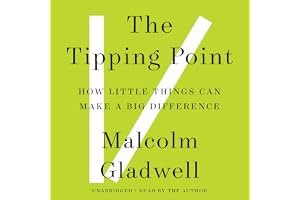
The tipping point is that magic moment when an idea, trend, or social behavior crosses a threshold, tips, and spreads like wildfire. Just as a single sick person can start an epidemic of the flu, so too can a small but precisely targeted push cause a fashion trend, the popularity of a new product, or a drop in the crime rate. This widely acclaimed bestseller, in which Malcolm Gladwell explores and brilliantly illuminates the tipping point phenomenon, is already changing the way people throughout the world think about selling products and disseminating ideas.
Gladwell introduces us to the particular personality types who are natural pollinators of new ideas and trends, the people who create the phenomenon of word of mouth. He analyzes fashion trends, smoking, children's television, direct mail, and the early days of the American Revolution for clues about making ideas infectious, and visits a religious commune, a successful high-tech company, and one of the world's greatest salesmen to show how to start and sustain social epidemics.
Bunch of really good information in here on how to make ideas go viral. This could be good to apply to any kind of products or ideas you may have. Definitely, check out The Tipping Point, which is one of my favorites. [source]
Malcolm Gladwell's breakthrough insight was to focus on the micro-relationships between individuals, which helped organizations realize that it's not about the big ads and the huge charity balls... it's about setting the stage for the buzz to start. [source]
Andy Stern
I think that when we talk about making change, it is much more about macro change, like in policy. This book reminds you that at times when you're building big movements, or trying to elect significant decision-makers in politics, sometimes it's the little things that make a difference. Ever since the book was written, we've become very used to the idea of things going viral unexpectedly and then having massive impact. The Tipping Point, to me, is really an appreciation that very small things can rearrange thinking in ways – like infectious diseases – that have huge implications. While we're always searching for the big policy changes – and we think we have to do that in very traditional ways of building coalitions against constituencies, movements and the media – sometimes it's the little things that actually tip the situation. Like the story of a person and their unique set of circumstances that really captures an issue about health care or housing. So it's trying to remember, while you're thinking about the grand and the glorious, that thinking about the small things can equally bring about change. [source]
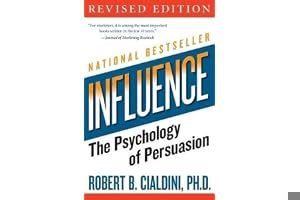
Influence, the classic book on persuasion, explains the psychology of why people say "yes"—and how to apply these understandings. Dr. Robert Cialdini is the seminal expert in the rapidly expanding field of influence and persuasion. His thirty-five years of rigorous, evidence-based research along with a three-year program of study on what moves people to change behavior has resulted in this highly acclaimed book.
You'll learn the six universal principles, how to use them to become a skilled persuader—and how to defend yourself against them. Perfect for people in all walks of life, the principles of Influence will move you toward profound personal change and act as a driving force for your success.
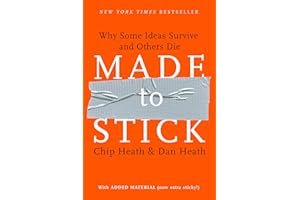
NEW YORK TIMES BESTSELLER - The instant classic about why some ideas thrive, why others die, and how to improve your idea's chances--essential reading in the "fake news" era.
Mark Twain once observed, "A lie can get halfway around the world before the truth can even get its boots on." His observation rings true: Urban legends, conspiracy theories, and bogus news stories circulate effortlessly. Meanwhile, people with important ideas--entrepreneurs, teachers, politicians, and journalists--struggle to make them "stick."
In Made to Stick, Chip and Dan Heath reveal the anatomy of ideas that stick and explain ways to make ideas stickier, such as applying the human scale principle, using the Velcro Theory of Memory, and creating curiosity gaps. Along the way, we discover that sticky messages of all kinds--from the infamous "kidney theft ring" hoax to a coach's lessons on sportsmanship to a vision for a new product at Sony--draw their power from the same six traits.
Made to Stick will transform the way you communicate. It's a fast-paced tour of success stories (and failures): the Nobel Prize-winning scientist who drank a glass of bacteria to prove a point about stomach ulcers; the charities who make use of the Mother Teresa Effect; the elementary-school teacher whose simulation actually prevented racial prejudice.
Provocative, eye-opening, and often surprisingly funny, Made to Stick shows us the vital principles of winning ideas--and tells us how we can apply these rules to making our own messages stick.
@conorgil My all-time favorite example of research communication is The Selfish Gene. Astonishingly effective at explaining deep research ideas/findings to a lay reader. A book with great advice: https://t.co/QD1sM2o0z6 (It isn't specific to research but still super valuable.) [source]
Bill Liao
The Book "Made to Stick" combined with "The Poetics" by Aristotle really helped me to see the power of telling great stories with surprises in them and every time I meet a start-up I can always make a contribution to their pitch. [source]
Cristian-Dragos Baciu
I highly recommend all the books written by the Heath brothers, especially Made to Stick: Why Some Ideas Survive And Others Die. This one's a must-read for marketers. The reason I enjoyed their work so much is because they offer real-life stories and insights that makes it so much easier for the reader to imprint that information in his mind [source]
New York Times bestseller and named Best Marketing Book of 2014 by the American Marketing Association
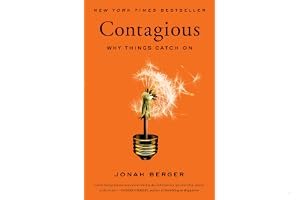
What makes things popular? Why do people talk about certain products and ideas more than others? Why are some stories and rumors more infectious? And what makes online content go viral?
If you said advertising, think again. People don't listen to advertisements, they listen to their peers. But why do people talk about certain products and ideas more than others? Why are some stories and rumors more infectious? And what makes online content go viral?
Wharton marketing professor Jonah Berger has spent the last decade answering these questions. He's studied why New York Times articles make the paper's own Most E-mailed List, why products get word of mouth, and how social influence shapes everything from the cars we buy to the clothes we wear to the names we give our children. In this book, Berger reveals the secret science behind word-of-mouth and social transmission. Discover how six basic principles drive all sorts of things to become contagious, from consumer products and policy initiatives to workplace rumors and YouTube videos.
Contagious combines groundbreaking research with powerful stories. Learn how a luxury steakhouse found popularity through the lowly cheese-steak, why anti-drug commercials might have actually increased drug use, and why more than 200 million consumers shared a video about one of the seemingly most boring products there is: a blender. If you've wondered why certain stories get shared, e-mails get forwarded, or videos go viral, Contagious explains why, and shows how to leverage these concepts to craft contagious content. This book provides a set of specific, actionable techniques for helping information spread - for designing messages, advertisements, and information that people will share. Whether you're a manager at a big company, a small business owner trying to boost awareness, a politician running for office, or a health official trying to get the word out, Contagious will show you how to make your product or idea catch on.
…
Recommended by Vinod Khosla, Vinod Khosla, Andrew Medal, and 10 others.
Andrew Medal
The world is #CONTAGIOUS ☢️☢️☢️ • • My dog and I love this book. I read to him when he wants to learn about marketing techniques. The last time I read this book was in 2013. If you want a read that dissects how and… https://t.co/6v0ckSnSQe [source]
Ee Ling Lim
Contagious by Jonah Berger is another interesting one for those trying to figure out how to market their business. In Contagious, Jonah identifies what makes some things go viral, and narrowed it down to 6 principles STEPPS: Social currency (content that makes people look good when they talk about it), Triggers (top of mind topics), Emotion (content that we care about, especially high arousal ones like anger, awe, excitement and humor), Public, Practical and Stories. [source]
Erik Cheong
Explains why certain products and ideas become popular while others fail. It reveals the secret science behind word-of-mouth and social transmission. Discover how six basic principles drive all sorts of things to become contagious, from consumer products and policy initiatives to workplace rumors and YouTube videos. [source]
Cover unavailable
6
Hey, Whipple, Squeeze This: The Classic Guide to Creating Great Ads
Luke Sullivan, Edward Boches
4.6
The classic guide to creating great advertising now covers all media: Digital, Social, and TraditionalHey Whipple, Squeeze This has helped generations of young creatives make their mark in the field. From starting out and getting work, to building successful campaigns, you gain a real-world perspective on what it means to be great in a fast-moving, sometimes harsh industry. You'll learn how to tell brand stories and create brand experiences online and in traditional media outlets, and you'll learn more about the value of authenticity, simplicity, storytelling, and conflict.
Advertising is in the midst of a massive upheaval, and while creativity is still king, it's not nearly enough. This book is an essential resource for advertising professionals who need up-to-date digital skills to reach the modern consumer.
Turn great ideas into successful campaigns Work effectively in all media channels Avoid the kill shots that will sink any campaign Protect your work Succeed without selling out Today's consumer has seen it all, and they're less likely than ever to even notice your masterpiece of art and copy, let alone internalize it. Your job is to craft a piece that rises out of the noise to make an impact. Hey Whipple, Squeeze This provides the knowledge to create impressive, compelling work.
…
Recommended by Bogdana Butnar and Irina Nica.
Bogdana Butnar
I thought I might put my money where my mouth is. I keep whining that young people are not in touch with some essential books on advertising that have helped me shape the way I practise my trade today, but I never did anything about it. So I am starting here the ultimate books to read list. I will add to it as I get suggestions and as more good books get written. [source]
Irina Nica
This book taught me how to think when I write. It also taught me how to be the voice of a product (or a person) in writing and, ultimately, how to build my own voice. [source]
Cover unavailable
7
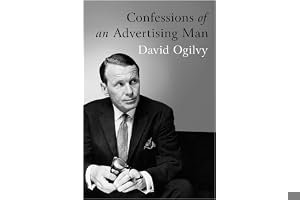
Confessions of an Advertising Man
David Ogilvy
4.6
A new edition of the timeless business classic featured on Mad Men—as fresh and relevant now as the day it was written
"We admire people who work hard, who are objective and thorough. We detest office politicians, toadies, bullies, and pompous asses. We abhor ruthlessness. The way up our ladder is open to everybody. In promoting people to top jobs, we are influenced as much by their character as anything else." —David Ogilvy
David Ogilvy was considered the "father of advertising" and a creative genius by many of the biggest global brands. First published in 1963, this seminal book revolutionized the world of advertising and became a bible for the 1960s ad generation. It also became an international bestseller, translated into 14 languages. Fizzing with Ogilvy's pioneering ideas and inspirational philosophy, it covers not only advertising, but also people management, corporate ethics, and office politics, and forms an essential blueprint for good practice in business.
…
Recommended by Bogdana Butnar, Ola Olusoga, Robert Katai, and 3 others.
Bogdana Butnar
I thought I might put my money where my mouth is. I keep whining that young people are not in touch with some essential books on advertising that have helped me shape the way I practise my trade today, but I never did anything about it. So I am starting here the ultimate books to read list. I will add to it as I get suggestions and as more good books get written. [source]
Ola Olusoga
For business, I've read Influence by Robert Cialdini 3 times, and Traction by Gabriel Weinberg twice, so if number of times read indicates favor, then those are it. There are a whole bunch of others, like The Personal MBA by Josh Kaufman, Confession of an Advertising Man by David Ogilvy, The 4 Hour Work Week by Tim Ferriss, and Running Lean by Ash Maurya, that I've also enjoyed and recommend to people. [source]
Robert Katai
Another book that I read on a trip when I was visiting my girlfriend (who is now my wife) is David Ogilvy’s book “Confessions of an advertising man”. It’s a simple book that must be in every marketer’s or ad person's library. [source]
A dynamic new cover heralds the reissue of this bestselling business classic, which Spencer Johnson, M.D., co-author of The One Minute Manager praised as "One of the most important communication books I've ever read. I recommend it highly!"
Recommended by Ev Williams, Tim O'Reilly, Ken Norton, and 7 others.
Tim O'Reilly
Founder/O'Reilly Media
Positioning, and The 22 Immutable Laws of Marketing by Al Ries and Jack Trout. Anyone who wants to start a business with impact needs to read these books. [source]
Marvin Liao
Partner/500 Startups
My list would be (besides the ones I mentioned in answer to the previous question) both business & Fiction/Sci-Fi and ones I personally found helpful to myself. The business books explain just exactly how business, work & investing are in reality & how to think properly & differentiate yourself. On the non-business side, a mix of History & classic fiction to understand people, philosophy to make sense of life and Science fiction to picture what the future could be like (not always utopian). [source]
This book is built around the brilliant insight that your prospect doesn't care nearly as much about what you do as you do, and thus you must boil down your offering into a unique slot that repositions the competition. [source]
Major New York Times bestseller Winner of the National Academy of Sciences Best Book Award in 2012 Selected by the New York Times Book Review as one of the best books of 2011 A Globe and Mail Best Books of the Year 2011 Title One of The Economist's 2011 Books of the Year One of The Wall Street Journal's Best Nonfiction Books of the Year 2011 2013 Presidential Medal of Freedom Recipient
In the international bestseller, Thinking, Fast and Slow, Daniel Kahneman, the renowned psychologist and winner of the Nobel Prize in Economics, takes us on a groundbreaking tour of the mind and explains the two systems that drive the way we think. System 1 is fast, intuitive, and emotional; System 2 is slower, more deliberative, and more logical. The impact of overconfidence on corporate strategies, the difficulties of predicting what will make us happy in the future, the profound effect of cognitive biases on everything from playing the stock market to planning our next vacation—each of these can be understood only by knowing how the two systems shape our judgments and decisions. Engaging the reader in a lively conversation about how we think, Kahneman reveals where we can and cannot trust our intuitions and how we can tap into the benefits of slow thinking. He offers practical and enlightening insights into how choices are made in both our business and our personal lives—and how we can use different techniques to guard against the mental glitches that often get us into trouble. Winner of the National Academy of Sciences Best Book Award and the Los Angeles Times Book Prize and selected by The New York Times Book Review as one of the ten best books of 2011, Thinking, Fast and Slow is destined to be a classic.
A few months ago, Mr. Obama read “Thinking, Fast and Slow,” by Daniel Kahneman, about how people make decisions — quick, instinctive thinking versus slower, contemplative deliberation. For Mr. Obama, a deliberator in an instinctive business, this may be as instructive as any political science text. [source]
Captivating dive into human decision making, marred by inclusion of several/many? psychology studies that fail to replicate. Will stand as a cautionary tale? [source]
From the author of the bestselling biographies of Benjamin Franklin and Albert Einstein, this is the exclusive, New York Times bestselling biography of Apple co-founder Steve Jobs.
Based on more than forty interviews with Jobs conducted over two years—as well as interviews with more than a hundred family members, friends, adversaries, competitors, and colleagues—Walter Isaacson has written a riveting story of the roller-coaster life and searingly intense personality of a creative entrepreneur whose passion for perfection and ferocious drive revolutionized six industries: personal computers, animated movies, music, phones, tablet computing, and digital publishing.
At a time when America is seeking ways to sustain its innovative edge, and when societies around the world are trying to build digital-age economies, Jobs stands as the ultimate icon of inventiveness and applied imagination. He knew that the best way to create value in the twenty-first century was to connect creativity with technology. He built a company where leaps of the imagination were combined with remarkable feats of engineering.
Although Jobs cooperated with this book, he asked for no control over what was written nor even the right to read it before it was published. He put nothing off-limits. He encouraged the people he knew to speak honestly. And Jobs speaks candidly, sometimes brutally so, about the people he worked with and competed against. His friends, foes, and colleagues provide an unvarnished view of the passions, perfectionism, obsessions, artistry, devilry, and compulsion for control that shaped his approach to business and the innovative products that resulted.
Driven by demons, Jobs could drive those around him to fury and despair. But his personality and products were interrelated, just as Apple’s hardware and software tended to be, as if part of an integrated system. His tale is instructive and cautionary, filled with lessons about innovation, character, leadership, and values.
For Chesky, a source may come in the form of a biography of a business hero such as Steve Jobs or Walt Disney. His primary book source on management technique is Andy Grove’s High Output Management. [source]
Cover unavailable
11
Good to Great: Why Some Companies Make the Leap... and Others Don't
To find the keys to greatness, Collins's 21-person research team read and coded 6,000 articles, generated more than 2,000 pages of interview transcripts and created 384 megabytes of computer data in a five-year project. The findings will surprise many readers and, quite frankly, upset others.
The Challenge Built to Last, the defining management study of the nineties, showed how great companies triumph over time and how long-term sustained performance can be engineered into the DNA of an enterprise from the very beginning.
But what about the company that is not born with great DNA? How can good companies, mediocre companies, even bad companies achieve enduring greatness?
The Study For years, this question preyed on the mind of Jim Collins. Are there companies that defy gravity and convert long-term mediocrity or worse into long-term superiority? And if so, what are the universal distinguishing characteristics that cause a company to go from good to great?
The Standards Using tough benchmarks, Collins and his research team identified a set of elite companies that made the leap to great results and sustained those results for at least fifteen years. How great? After the leap, the good-to-great companies generated cumulative stock returns that beat the general stock market by an average of seven times in fifteen years, better than twice the results delivered by a composite index of the world's greatest companies, including Coca-Cola, Intel, General Electric, and Merck.
The Comparisons The research team contrasted the good-to-great companies with a carefully selected set of comparison companies that failed to make the leap from good to great. What was different? Why did one set of companies become truly great performers while the other set remained only good?
The Findings The findings of the Good to Great study will surprise many readers and shed light on virtually every area of management strategy and practice. The findings include: Level 5 Leaders: The research team was shocked to discover the type of leadership required to achieve greatness.
The Hedgehog Concept (Simplicity within the Three Circles): To go from good to great requires transcending the curse of competence.
A Culture of Discipline: When you combine a culture of discipline with an ethic of entrepreneurship, you get the magical alchemy of great results. Technology Accelerators: Good-to-great companies think differently about the role of technology.
The Flywheel and the Doom Loop: Those who launch radical change programs and wrenching restructurings will almost certainly fail to make the leap.
"Collins briefed Amazon executives on his seminal management book before its publication. Companies must confront the brutal facts of their business, find out what they are uniquely good at, and master their fly wheel, in which each part of the business reinforces and accelerates the other parts," Stone writes. [source]
Why do our headaches persist after taking a one-cent aspirin but disappear when we take a 50-cent aspirin?
Why does recalling the Ten Commandments reduce our tendency to lie, even when we couldn't possibly be caught?
Why do we splurge on a lavish meal but cut coupons to save twenty-five cents on a can of soup?
Why do we go back for second helpings at the unlimited buffet, even when our stomachs are already full?
And how did we ever start spending $4.15 on a cup of coffee when, just a few years ago, we used to pay less than a dollar?
When it comes to making decisions in our lives, we think we're in control. We think we're making smart, rational choices. But are we?
In a series of illuminating, often surprising experiments, MIT behavioral economist Dan Ariely refutes the common assumption that we behave in fundamentally rational ways. Blending everyday experience with groundbreaking research, Ariely explains how expectations, emotions, social norms, and other invisible, seemingly illogical forces skew our reasoning abilities.
Not only do we make astonishingly simple mistakes every day, but we make the same "types" of mistakes, Ariely discovers. We consistently overpay, underestimate, and procrastinate. We fail to understand the profound effects of our emotions on what we want, and we overvalue what we already own. Yet these misguided behaviors are neither random nor senseless. They're systematic and predictable--making us "predictably" irrational.
From drinking coffee to losing weight, from buying a car to choosing a romantic partner, Ariely explains how to break through these systematic patterns of thought to make better decisions. "Predictably Irrational" will change the way we interact with the world--one small decision at a time.
…
Recommended by Max Levchin, Vinod Khosla, Vinod Khosla, and 22 others.
Max Levchin
Co-founder/PayPal, CEO/Affirm, Investor
Max Levchin recommended this book as an answer to "What business books would you advise young entrepreneurs read?" [source]
Andra Zaharia
'While I was thinking of the best books to add to this short list, I realized that not even half of them are directly related to digital marketing. This is because I believe that the best marketers are people who understand human nature deeply and aim to bring out the best in it. Call me naive, but that’s how I see it. If I were to want to pursue a career in marketing, I’d read … Predictably Irrational. [source]
Chris Goward
Here are some of the books that have been very impactful for me, or taught me a new way of thinking: … Predictably Irrational. [source]
Cover unavailable
13
Scientific Advertising
Claude Hopkins
4.4
Scientific Advertising is an important work on advertising from the early 20th century and is still used today by those learning the basics and more advanced parts of the advertising field. The author of Scientific Advertising, Claude C. Hopkins, is well known as the father of modern advertising techniques, and this book has been widely used by students of advertising and marketing. This book covers many important aspects of advertising including how advertising laws are established, mail order advertising, headlines, psychology, strategy, budgeting, and more advanced subjects like negative advertising and how to test an advertising campaign.
…
Recommended by Dean Roller, Elton Mayfield, and Ola Olusoga.
Dean Roller
Read a classic book like Claude Hopkins Scientific Advertising book and Influence by Dr. Robert Cialdini. Understanding fundamental principles to how humans operate is always a great starting point to focus on. It is easy to forgot tried and test examples when the next "new thing" comes along. [source]
Elton Mayfield
ATTENTION is the most important asset that you must capture and capitalize on in marketing. Discover how you can grab attention by reading a 97-year-old marketing book, that’s more relevant than ever: https://t.co/ELRjB0md4y [source]
Ola Olusoga
Like Charlie Munger once said: “I’ve long believed that a certain system - which almost any intelligent person can learn - works way better than the systems most people use to understand the world. What you need is a latticework of mental models in your head. And, with that system, things gradually fit together in a way that enhances cognition. Just as multiple factors shape every system, multiple mental models from a variety of disciplines are necessary to understand that system". You can read this book to start building a "latticework of mental models in your head". [source]
Cover unavailable
14
The 22 Immutable Laws of Marketing: Violate Them at Your Own Risk
World-renowned marketing consultants and bestselling authors Al Ries and Jack Trout reveal 22 laws of marketing, with hundreds of examples that illustrate their success, in this innovative and sensible guide to marketing. Each law is described in detail and backed up by numerous examples of what worked and what didn't in the international marketplace.
Question: What books would you recommend to young people interested in your career path? Answer: Purple Cow by Seth Godin End of Jobs by Taylor Pearson Rework by Jason Fried & DHH Trust Me I’m Lying by Ryan Holiday The Complacent Class by Tyler Cowen The 22 Immutable Laws of Marketing by Al Ries and Jack Trout Losing My Virginity by Richard Branson [source]
Question: What five books would you recommend to young people interested in your career path & why? Answer: I know this is sounds self-serving but I’d recommended both of my books, the soon to be released, “Niche Down: How to Become Legendary by Being Different” and Harper Collins’ “instant classic,” “Play Bigger: How Pirates, Dreamers and Innovators Create and Dominate Markets” In addition: The Effective Executive, by Peter Drucker The E-Myth, by Michael Gerber Radical Candor: Be a Kickass Boss Without Losing Your Humanity by Kim Scott Back from the Dead, by Bill Walton The 22 Immutable Laws of Marketing, by Al Ries and Jack Trout [source]
Cover unavailable
15
Nudge: Improving Decisions About Health, Wealth, and Happiness
Every day, we make decisions on topics ranging from personal investments to schools for our children to the meals we eat to the causes we champion. Unfortunately, we often choose poorly. The reason, the authors explain, is that, being human, we all are susceptible to various biases that can lead us to blunder. Our mistakes make us poorer and less healthy; we often make bad decisions involving education, personal finance, health care, mortgages and credit cards, the family, and even the planet itself.
Thaler and Sunstein invite us to enter an alternative world, one that takes our humanness as a given. They show that by knowing how people think, we can design choice environments that make it easier for people to choose what is best for themselves, their families, and their society. Using colorful examples from the most important aspects of life, Thaler and Sunstein demonstrate how thoughtful “choice architecture” can be established to nudge us in beneficial directions without restricting freedom of choice. Nudge offers a unique new take—from neither the left nor the right—on many hot-button issues, for individuals and governments alike. This is one of the most engaging and provocative books to come along in many years.
Nudge is a very important book. One of the reasons Nudge is so important is because it’s taking these ideas and applying them to the policy domain. Here are the mistakes we make. Here are the ways marketers are trying to influence us. Here’s the way we might be able to fight back. If policymakers understood these principles, what could they do? The other important thing about the book is that it describes, in detail, small interventions. It’s basically a book about cheap persuasion. [source]
This might feel like a weird book to include, but I think it presents another side of strategy that is too often forgotten. It’s not always about bold actors and strategic thrusts. Sometimes strategy is about subtle influence. Sometimes it is framing and small tweaks that change behavior. We can have big aims, but get there with little moves. This book has excellent examples of that kind of thinking and how it is changing politics, government and business. My favorite example is about the bumblebee that they started putting on urinals–which drastically reduced the amount of spray and spillage because it changed where men aimed when they peed. It’s not exactly the coolest strategy but it solved a problem. So we can learn from it. [source]
Cover unavailable
16
Purple Cow, New Edition: Transform Your Business by Being Remarkable--Includes new bonus chapter
You're either a Purple Cow or you're not. You're either remarkable or invisible. Make your choice.
What do Starbucks and JetBlue and KrispyKreme and Apple and DutchBoy and Kensington and Zespri and Hard Candy have that you don't? How do they continue to confound critics and achieve spectacular growth, leaving behind former tried-and true brands to gasp their last?
Face it, the checklist of tired 'P's marketers have used for decades to get their product noticed -Pricing, Promotion, Publicity, to name a few-aren't working anymore. There's an exceptionally important 'P' that has to be added to the list. It's Purple Cow.
Cows, after you've seen one, or two, or ten, are boring. A Purple Cow, though...now that would be something. Purple Cow describes something phenomenal, something counterintuitive and exciting and flat out unbelievable. Every day, consumers come face to face with a lot of boring stuff-a lot of brown cows-but you can bet they won't forget a Purple Cow. And it's not a marketing function that you can slap on to your product or service. Purple Cow is inherent. It's built right in, or it's not there. Period.
In Purple Cow, Seth Godin urges you to put a Purple Cow into everything you build, and everything you do, to create something truly noticeable. It's a manifesto for marketers who want to help create products that are worth marketing in the first place.
…
Recommended by Joe Gebbia, Vinod Khosla, Vinod Khosla, and 21 others.
Joe Gebbia
Co-founder/Airbnb
Make something that’s distinct enough that people want to talk about it. [source]
Marvin Liao
Partner/500 Startups
My list would be (besides the ones I mentioned in answer to the previous question) both business & Fiction/Sci-Fi and ones I personally found helpful to myself. The business books explain just exactly how business, work & investing are in reality & how to think properly & differentiate yourself. On the non-business side, a mix of History & classic fiction to understand people, philosophy to make sense of life and Science fiction to picture what the future could be like (not always utopian). [source]
A few months ago, I was drinking a Noah’s Mill whiskey (cute) with my good buddy Brian Balfour and talking about life... During the conversation, we got on the topic of books that changed our lives. I want to share them with you. I judge a book's success if a year later I'm still using at least 1 thing from the book. [source]
Cover unavailable
17
All Marketers Are Liars: The Underground Classic That Explains How Marketing Really Works - and Why Authenticity Is the Best Marketing of All
Seth Godin’s three essential questions for every marketer: “What’s your story?” “Will the people who need to hear this story believe it?” “Is it true?” All marketers tell stories. And if they do it right, we believe them. We believe that wine tastes better in a $20 glass than a $1 glass. We believe that an $80,000 Porsche is vastly superior to a $36,000 Volkswagen that’s virtually the same car. We believe that $125 sneakers make our feet feel better—and look cooler—than a $25 brand. And believing it makes it true.
As Seth Godin showed in this controversial book, great marketers don’t talk about features or even benefits. Instead, they tell a story—a story we want to believe, whether it’s factual or not. In a world where most people have an infinite number of choices and no time to make them, every organization is a marketer, and all marketing is about telling stories.
Marketers succeed when they tell us a story that fits our worldview, a story that we intuitively embrace and then share with our friends. Think of the Dyson vacuum cleaner, or Fiji water, or the iPod.
But beware: If your stories are inauthentic, you cross the line from fib to fraud. Marketers fail when they are selfish and scurrilous, when they abuse the tools of their trade and make the world worse. That’s a lesson learned the hard way by telemarketers, cigarette companies, and sleazy politicians.
But for the rest of us, it’s time to embrace the power of the story. As Godin writes, “Stories make it easier to understand the world. Stories are the only way we know to spread an idea. Marketers didn’t invent storytelling. They just perfected it.”
…
Recommended by Joe Gebbia, Steve Blank, Alan Webber, and 1 others.
Joe Gebbia
Co-founder/Airbnb
I remember something that the author says in there which I never forgot, which is to make something people want to talk about. [source]
Alan Webber
Founder/Fast Company
If Seth Godin didn't exist we'd need to invent him. [source]
Cover unavailable
18
Creativity, Inc.: Overcoming the Unseen Forces That Stand in the Way of True Inspiration
“What does it mean to manage well?” From Ed Catmull, co-founder (with Steve Jobs and John Lasseter) of Pixar Animation Studios, comes an incisive book about creativity in business—sure to appeal to readers of Daniel Pink, Tom Peters, and Chip and Dan Heath. Creativity, Inc. is a book for managers who want to lead their employees to new heights, a manual for anyone who strives for originality, and the first-ever, all-access trip into the nerve center of Pixar Animation—into the meetings, postmortems, and “Braintrust” sessions where some of the most successful films in history are made. It is, at heart, a book about how to build a creative culture—but it is also, as Pixar co-founder and president Ed Catmull writes, “an expression of the ideas that I believe make the best in us possible.” For nearly twenty years, Pixar has dominated the world of animation, producing such beloved films as the Toy Story trilogy, Monsters, Inc., Finding Nemo, The Incredibles, Up, and WALL-E, which have gone on to set box-office records and garner thirty Academy Awards. The joyousness of the storytelling, the inventive plots, the emotional authenticity: In some ways, Pixar movies are an object lesson in what creativity really is. Here, in this book, Catmull reveals the ideals and techniques that have made Pixar so widely admired—and so profitable.
As a young man, Ed Catmull had a dream: to make the first computer-animated movie. He nurtured that dream as a Ph.D. student at the University of Utah, where many computer science pioneers got their start, and then forged a partnership with George Lucas that led, indirectly, to his founding Pixar with Steve Jobs and John Lasseter in 1986. Nine years later, Toy Story was released, changing animation forever. The essential ingredient in that movie’s success—and in the thirteen movies that followed—was the unique environment that Catmull and his colleagues built at Pixar, based on philosophies that protect the creative process and defy convention, such as:
• Give a good idea to a mediocre team, and they will screw it up. But give a mediocre idea to a great team, and they will either fix it or come up with something better. • If you don’t strive to uncover what is unseen and understand its nature, you will be ill prepared to lead. • It’s not the manager’s job to prevent risks. It’s the manager’s job to make it safe for others to take them. • The cost of preventing errors is often far greater than the cost of fixing them. • A company’s communication structure should not mirror its organizational structure. Everybody should be able to talk to anybody. • Do not assume that general agreement will lead to change—it takes substantial energy to move a group, even when all are on board.
This book is written by the founder of Pixar and is about his experience building a culture that fosters creativity. His theory is that people are fundamentally creative, but many forces stand in the way of people being able to do their best work. I love reading first-hand accounts about how people build great companies like Pixar and nurture innovation and creativity. This should be inspiring to anyone looking to do the same, and hopefully there will be lessons we can apply to connecting the world! [source]
No matter your circumstances, storytelling and creativity are two 'meta-skills' that can take your business and life to the next level. Ed is a master. [source]
Barely one in a hundred businesspeople knows these facts about creating powerful advertising. Do You?
FACT! Sixty percent of people read only headlines. Your headline must stop them or your advertising will likely fail. FACT! Captions under photos get 200 percent greater readership than non-headline copy. FACT! Ads with sale prices draw 20 percent more attention. FACT! Half-page ads pull about 70 percent of full-page ads; quarter-page ads pull about 50 percent of full-page ads. FACT! Four-color ads are up to 45 percent more effective than black and white.
New York's biggest ad agencies use dozens of these little-known secrets every day to influence people to buy. And now--thanks to Cashvertising--you can, too. And it won't matter one bit whether you're a corporate giant or a mom-and-pop pizza shop. These techniques are based on human psychology. They work no matter where you're located, no matter what kind of product or service you sell, and no matter where you advertise. In fact, most don't cost a penny to use.
Like a wild roller-coaster ride through the streets of Madison Avenue, Cashvertising teaches you the tips, tricks, and strategies that New York's top gun copywriters and designers use to persuade people to buy like crazy. No matter what you sell--or how you sell it, this practical, fast-paced book will teach you:
How to create powerful ads, brochures, sales letters, Websites, and more
How to make people believe what you say
"Sneaky" ways to persuade people to respond
Effective tricks for writing "magnetic" headlines
What mistakes to avoid...at all costs!
What you should always/never do in your ads
Expert formulas, guidance, tips and strategies
…
Recommended by Roger Dawson.
Roger Dawson
Cashvertising is a virtual blueprint for persuading the consumer mind. It's fast, fun, and a must-read for businesses in all industries. [source]
This is not a book just for copywriters and other advertising experts but a book for every business owner, marketing expert or anyone who needs to increase sales.
The reason why is because it deals with how to channel the forces in the marketplace which control sales.
Put simply, Gene's book addresses the universal problem of all copywriting: How to write a headline — and an ad that follows it — that will open up a whole new market.
…
Cover unavailable
21
Steal Like an Artist: 10 Things Nobody Told You About Being Creative
You don’t need to be a genius, you just need to be yourself. That’s the message from Austin Kleon, a young writer and artist who knows that creativity is everywhere, creativity is for everyone. A manifesto for the digital age, Steal Like an Artist is a guide whose positive message, graphic look and illustrations, exercises, and examples will put readers directly in touch with their artistic side.
Part of ambition is modeling yourself after those you’d like to be like. Austin’s philosophy of ruthlessly stealing and remixing the greats might sound appalling at first but it is actually the essence of art. You learn by stealing, you become creative by stealing, you push yourself to be better by working with these materials. Austin is a fantastic artist, but most importantly he communicates the essence of writing and creating art better than anyone else I can think of. It is a manifesto for any young, creative person looking to make his mark. Pair up with Show Your Work which is also excellent. [source]
Breezy and fun and yes, scary. Scary because it calls your bluff. [source]
Andra Zaharia
While I was thinking of the best books to add to this short list, I realized that not even half of them are directly related to digital marketing. This is because I believe that the best marketers are people who understand human nature deeply and aim to bring out the best in it. Call me naive, but that’s how I see it. If I were to want to pursue a career in marketing, I’d read … Steal Like An Artist. [source]
Cover unavailable
22
Truth, Lies, and Advertising: The Art of Account Planning
Jon Steel
4.3
Account planning exists for the sole purpose of creating advertising that truly connects with consumers. While many in the industry are still dissecting consumer behavior, extrapolating demographic trends, developing complex behavioral models, and measuring Pavlovian salivary responses, Steel advocates an approach to consumer research that is based on simplicity, common sense, and creativity--an approach that gains access to consumers' hearts and minds, develops ongoing relationships with them, and, most important, embraces them as partners in the process of developing and advertising.
A witty, erudite raconteur and teacher, Steel describes how successful account planners work in partnership with clients, consumer, and agency creatives. He criticizes research practices that, far from creating relationships, drive a wedge between agencies and the people they aim to persuade; he suggests new ways of approaching research to cut through the BS and get people to show their true selves; and he shows how the right research, when translated into a motivating and inspiring brief, can be the catalyst for great creative ideas. He draws upon his own experiences and those of colleagues in the United States and abroad to illustrate those points, and includes examples of some of the most successful campaigns in recent years, including Polaroid, Norwegian Cruise Line, Porsche, Isuzu, "got milk?" and others.
The message of this book is that well-thought-out account planning results in better, more effective marketing and advertising for both agencies and clients. And also makes an evening in front of the television easier to bear for the population at large.
…
Recommended by Bogdana Butnar and Jessica Lauria.
Bogdana Butnar
I thought I might put my money where my mouth is. I keep whining that young people are not in touch with some essential books on advertising that have helped me shape the way I practise my trade today, but I never did anything about it. So I am starting here the ultimate books to read list. I will add to it as I get suggestions and as more good books get written. [source]
Jessica Lauria
‘Truth, Lies and Advertising: The Art of Account Planning’ by Jon Steel In advertising you can try to follow a model, or data or process, but that will never lead to great, impactful work. Great work comes from the humanity of simple consumer insights and how that comes to life. There is just a little bit of magic that happens with people come together with the same goal to create work that has meaning. [source]
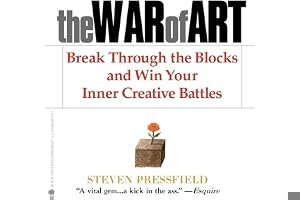
When a writer or an entrepreneur, or a manager, or an employee, or a…whatever…sits down to get to work, he or she is often met by “the resistance”. The excuses that come up: I can’t do this. I am too old. I don’t have enough money. I’m scared. “The War of Art” is the guide to getting through that block. The comfort zone is papered up and cemented shut by our excuses. Learn to blast through that wall. Because on the other side of the comfort zone are all the tools of success. [source]
Also hard to find on audio. I find Steve's voice to be fascinating, and even before I knew him, I was fascinated by listening to him speak his own work. The War of Art is one of those books, at least for me when I finally was exposed to it, I said, 'Why wasn't I informed? Why did it take this long for this book to land on my desk?'... You need to be clear with yourself about what you are afraid of, why you are afraid, and whether you care enough to dance with that fear because it will never go away. [source]
Adam Johnston
The last two pages of Steven Pressfield’s The War of Art gave me a swift kick in the ass. Do it or don’t do it. But if you don’t do it, you not only hurt yourself. You hurt your children. You hurt me. You hurt the planet. Pressfield wrote a beautiful book that you should read, but if nothing else, just read the last two pages of the book. I have them hanging on my wall in my office. [source]
Cover unavailable
24
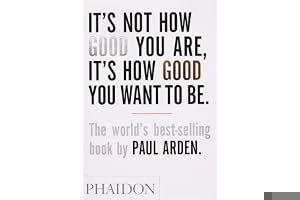
It's Not How Good You Are, It's How Good You Want To Be
Paul Arden
4.3
It’s Not How Good You Are, It’s How Good You Want to Be is a handbook of how to succeed in the world: a pocket bible for the talented and timid alike to help make the unthinkable thinkable and the impossible possible.
The world’s top advertising guru, Paul Arden, offers up his wisdom on issues as diverse as problem solving, responding to a brief, communicating, playing your cards right, making mistakes, and creativity – all endeavors that can be applied to aspects of modern life.
This uplifting and humorous little book provides a unique insight into the world of advertising and is a quirky compilation of quotes, facts, pictures, wit and wisdom – all packed into easy-to-digest, bite-sized spreads. If you want to succeed in life or business, this book is a must.
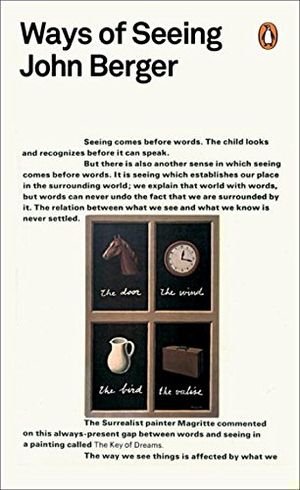
John Berger’s Classic Text on Art John Berger's Ways of Seeing is one of the most stimulating and the most influential books on art in any language. First published in 1972, it was based on the BBC television series about which the (London) Sunday Times critic commented: "This is an eye-opener in more ways than one: by concentrating on how we look at paintings . . . he will almost certainly change the way you look at pictures." By now he has.
"Berger has the ability to cut right through the mystification of the professional art critics . . . He is a liberator of images: and once we have allowed the paintings to work on us directly, we are in a much better position to make a meaningful evaluation" —Peter Fuller, Arts Review
"The influence of the series and the book . . . was enormous . . . It opened up for general attention to areas of cultural study that are now commonplace" —Geoff Dyer in Ways of Telling
Winner of the 1972 Booker Prize for his novel, G., John Peter Berger (born November 5th, 1926) is an art critic, painter and author of many novels including A Painter of Our Time, From A to X and Bento’s Sketchbook.
You have to understand the Marxist interpretation of art; it is absolutely fundamental to the way that art history departments now study the material. Then you have to critique it, because we’ve moved on from the 1970s and the collapse of Marxism in most of the world shows—amongst other things—that the model was flawed. But it’s still a very good book to read, for a teenager especially. [source]
Cover unavailable
26
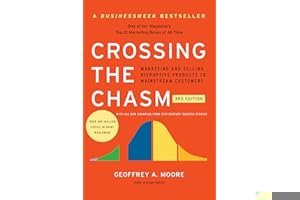
Crossing the Chasm: Marketing and Selling Disruptive Products to Mainstream Customers
The bible for bringing cutting-edge products to larger markets--now revised and updated with new insights into the realities of high-tech marketing
In Crossing the Chasm, Geoffrey A. Moore shows that in the Technology Adoption Life Cycle--which begins with innovators and moves to early adopters, early majority, late majority, and laggards--there is a vast chasm between the early adopters and the early majority. While early adopters are willing to sacrifice for the advantage of being first, the early majority waits until they know that the technology actually offers improvements in productivity. The challenge for innovators and marketers is to narrow this chasm and ultimately accelerate adoption across every segment.
This third edition brings Moore's classic work up to date with dozens of new examples of successes and failures, new strategies for marketing in the digital world, and Moore's most current insights and findings. He also includes two new appendices, the first connecting the ideas in Crossing the Chasm to work subsequently published in his Inside the Tornado, and the second presenting his recent groundbreaking work for technology adoption models for high-tech consumer markets.
…
Recommended by Andrew Chen, Drew Houston, Ev Williams, and 28 others.
Drew Houston
CEO/Dropbox
It’s about how do technology products make their way from early adopters t the mainstream. [source]
Ron Conway
Bestselling guide that created a new game plan for marketing in high-tech industries. [source]
This is a key component in my Purple Cow thinking, but with a twist. I'm not as worried about the chasm as I am about the desire of marketers to go for the big middle. [source]
Drawing on cutting-edge neuroscience and psychology and displaying all of the brilliance that made The Tipping Point a classic, Blink changes the way you'll understand every decision you make. Never again will you think about thinking the same way.
Malcolm Gladwell redefined how we understand the world around us. Now, in Blink, he revolutionizes the way we understand the world within. Blink is a book about how we think without thinking, about choices that seem to be made in an instant - in the blink of an eye - that actually aren't as simple as they seem. Why are some people brilliant decision makers, while others are consistently inept? Why do some people follow their instincts and win, while others end up stumbling into error? How do our brains really work - in the office, in the classroom, in the kitchen, and in the bedroom? And why are the best decisions often those that are impossible to explain to others?
In Blink we meet the psychologist who has learned to predict whether a marriage will last, based on a few minutes of observing a couple; the tennis coach who knows when a player will double-fault before the racket even makes contact with the ball; the antiquities experts who recognize a fake at a glance. Here, too, are great failures of "blink": the election of Warren Harding; "New Coke"; and the shooting of Amadou Diallo by police. Blink reveals that great decision makers aren't those who process the most information or spend the most time deliberating, but those who have perfected the art of "thin-slicing" - filtering the very few factors that matter from an overwhelming number of variables.
…
Recommended by Ev Williams, Mike Shinoda, Marillyn Hewson, and 4 others.
Mike Shinoda
I know most of the guys in the band read this book. [source]
Marillyn Hewson
CEO/Lockheed Martin
CEO Marilyn Hewson recommends this book because it helped her to trust her instincts in business. [source]
Antonio Eram
When asked to name some books that had a big impact on him, Antonio mentioned Blink: The Power of Thinking Without Thinking by Malcolm Gladwell. [source]
Cover unavailable
28
Start with Why: How Great Leaders Inspire Everyone to Take Action
Why are some people and organizations more innovative, more influential, and more profitable than others? Why do some command greater loyalty from customers and employees alike? Even among the successful, why are so few able to repeat their success over and over?
People like Martin Luther King Jr., Steve Jobs, and the Wright Brothers might have little in common, but they all started with why. It was their natural ability to start with why that enabled them to inspire those around them and to achieve remarkable things.
In studying the leaders who've had the greatest influence in the world, Simon Sinek discovered that they all think, act, and communicate in the exact same way—and it's the complete opposite of what everyone else does. Sinek calls this powerful idea The Golden Circle, and it provides a framework upon which organizations can be built, movements can be lead, and people can be inspired. And it all starts with WHY.
Any organization can explain what it does; some can explain how they do it; but very few can clearly articulate why. WHY is not money or profit—those are always results. WHY does your organization exist? WHY does it do the things it does? WHY do customers really buy from one company or another? WHY are people loyal to some leaders, but not others?
Starting with WHY works in big business and small business, in the nonprofit world and in politics. Those who start with WHY never manipulate, they inspire. And the people who follow them don't do so because they have to; they follow because they want to.
Drawing on a wide range of real-life stories, Sinek weaves together a clear vision of what it truly takes to lead and inspire. This book is for anyone who wants to inspire others or who wants to find someone to inspire them.
Today is World Book Day, a wonderful opportunity to address this #ChallengeRichard sent in by Mike Gonzalez of New Jersey: Make a list of your top 65 books to read in a lifetime. [source]
The basis of this book is so important to anyone looking to increase their influence, profits or impact. People won't truly buy into a product, service, movement, or idea until they understand the WHY behind it. When you start with the why, everything else falls into place. This book is so impactful, I consider it required reading. [source]
Tony Hsieh
CEO/Zappos.com
Over the years he’s recommended well over 20 business books — including his own, the 2010 bestseller Delivering Happiness and you can always find what he’s currently reading atop his cluttered desk. Start with Why is amogst those titles. [source]
Cover unavailable
29
Tested Advertising Methods
Caples, Hahn
4.3
The fifth edition of this work on how to create successful advertising features new coverage on small businesses with limited revenues, non-profit advertising, as well as techniques of headlines, illustrations and layouts. There is also new information useful to smaller businesses.
Recommended by Ola Olusoga.
Ola Olusoga
Like Charlie Munger once said: “I’ve long believed that a certain system - which almost any intelligent person can learn - works way better than the systems most people use to understand the world. What you need is a latticework of mental models in your head. And, with that system, things gradually fit together in a way that enhances cognition. Just as multiple factors shape every system, multiple mental models from a variety of disciplines are necessary to understand that system". You can read this book to start building a "latticework of mental models in your head". [source]
Cover unavailable
30
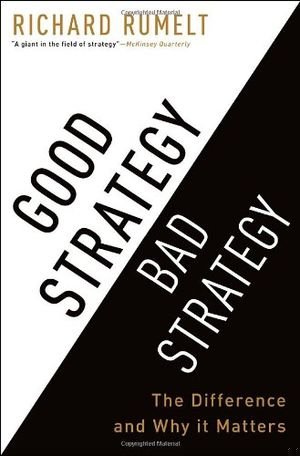
Good Strategy Bad Strategy: The Difference and Why It Matters
Clears out the mumbo jumbo and muddled thinking underlying too many strategies and provides a clear way to create and implement a powerful action-oriented strategy for the real world
Developing and implementing a strategy is the central task of a leader, whether the CEO at a Fortune 100 company, an entrepreneur, a church pastor, the head of a school, or a government official. Richard Rumelt shows that there has been a growing and unfortunate tendency to equate Mom-and-apple-pie values, fluffy packages of buzzwords, motivational slogans, and financial goals with “strategy.” He debunks these elements of “bad strategy” and awakens an understanding of the power of a “good strategy.”
A good strategy is a specific and coherent response to—and approach for overcoming—the obstacles to progress. A good strategy works by harnessing and applying power where it will have the greatest effect in challenges as varied as putting a man on the moon, fighting a war, launching a new product, responding to changing market dynamics, starting a charter school, or setting up a government program. Rumelt’s nine sources of power—ranging from using leverage to effectively focusing on growth—are eye-opening yet pragmatic tools that can be put to work on Monday morning.
Surprisingly, a good strategy is often unexpected because most organizations don’t have one. Instead, they have “visions,” mistake financial goals for strategy, and pursue a “dog’s dinner” of conflicting policies and actions.
Rumelt argues that the heart of a good strategy is insight—into the true nature of the situation, into the hidden power in a situation, and into an appropriate response. He shows you how insight can be cultivated with a wide variety of tools for guiding your own thinking. Good Strategy/Bad Strategy uses fascinating examples from business, nonprofit, and military affairs to bring its original and pragmatic ideas to life. The detailed examples range from Apple to General Motors, from the two Iraq wars to Afghanistan, from a small local market to Wal-Mart, from Nvidia to Silicon Graphics, from the Getty Trust to the Los Angeles Unified School District, from Cisco Systems to Paccar, and from Global Crossing to the 2007–08 financial crisis.
Reflecting an astonishing grasp and integration of economics, finance, technology, history, and the brilliance and foibles of the human character, Good Strategy/Bad Strategy stems from Rumelt’s decades of digging beyond the superficial to address hard questions with honesty and integrity.
…
Recommended by Ann Handley, John Kay, Louis Grenier, and 3 others.
It’s very well written and I see I am quoted on the back cover saying, ‘This is the only book about business strategy which I didn’t want to put down.' [source]
Louis Grenier
If you want to think about strategy, the proper strategy, how to understand what to do, what not to do, read: “Good Strategy, Bad Strategy”, “Good to Great” and “Blue Ocean Strategy”. [source]
Patricia Reed
I loved Good Strategy/Bad Strategy, by Richard Rumelt. It had many stories and examples about how strategy is often misconstrued, and what leaders can do to ensure they have a proper strategy. [source]
Most business books give you the same old advice: Write a business plan, study the competition, seek investors, yadda yadda. If you're looking for a book like that, put this one back on the shelf.
Rework shows you a better, faster, easier way to succeed in business. Read it and you'll know why plans are actually harmful, why you don't need outside investors, and why you're better off ignoring the competition. The truth is, you need less than you think. You don't need to be a workaholic. You don't need to staff up. You don't need to waste time on paperwork or meetings. You don't even need an office. Those are all just excuses.
What you really need to do is stop talking and start working. This book shows you the way. You'll learn how to be more productive, how to get exposure without breaking the bank, and tons more counterintuitive ideas that will inspire and provoke you.
With its straightforward language and easy-is-better approach, Rework is the perfect playbook for anyone who’s ever dreamed of doing it on their own. Hardcore entrepreneurs, small-business owners, people stuck in day jobs they hate, victims of "downsizing," and artists who don’t want to starve anymore will all find valuable guidance in these pages.
Unperturbed by conventional wisdom, the authors start fresh and rewrite the rules of business. Their approach turns out to be as successful as it is counter-intuitive. [source]
If given a choice between investing in someone who has read Rework or has an MBA, I'm investing in Rework every time. This is a must read for every entrepreneur. [source]
Tony Hsieh
CEO/Zappos.com
The wisdom in these pages is edgy yet simple, straightforward, and proven. Read this book multiple times to help give you the courage you need to get out there and make something great. [source]
Cover unavailable
32
Creative Advertising: Ideas and Techniques from the World's Best Campaigns
Mario Pricken
4.3
Unraveling the creative process behind some of the most effective campaigns of recent years, Mario Pricken showcases over two hundred examples of international advertising from a wide range of media, including magazines, billboards, television, movies, and the Internet.
Each chapter highlights different practical methods for creating innovative and unforgettable ads, with award-winning work from some of the most influential names in the industry. This second edition includes a completely revised and updated introductory chapter plus dozens of new examples that demonstrate a fascinating range of approaches.
…
Cover unavailable
33
My Life In Advertising; Scientific Advertising
Claude Hopkins
4.3
Book may have numerous typos, missing text, images, or index. Purchasers can download a free scanned copy of the original book (without typos) from the publisher. 1917. Excerpt: ... Chapter Seventeen SCIENTIFIC ADVERTISING THROUGH a book I wrote my name has become connected with "Scientific Advertising." That is, advertising based on fixed principles and done according to fundamental laws. I learned those principles through thirty-six years of traced advertising. Through conducting campaigns on some hundreds of different lines. Through comparing on some lines, by keyed returns, thousands of pieces of copy. Always, since I sent out my first thousand letters to the time when $5,000,000 yearly was being spent on my copy, I have had to face records on cost and result. So I have naturally proved out many fundamentals which should always be applied. I have little respect for most theories of advertising, because they have not been proved. They are based on limited experiences, on exceptional conditions. Some lines seem to succeed on methods of advertising which every traced return proves impossible. The reasons for success have little to do with the advertising. The line may have succeeded in spite of the advertising. Many unadvertised lines become highly successful, because of some wanted quality which people soon discover. Or because dealers are in some way induced to feature it. Or because of a name which in itself tells an appealing story. Cream of Wheat is an example. The name alone tells the story. So with Spearmint Gum. All successful gums have succeeded through fortunate names. There is almost no story to tell. There are no great distinctions. The very men who succeeded with one name failed again, and again with others. Any conclusions drawn from such experiences are bound to lead others astray. The cases where they apply are rare. Safe principles are evolved only by those who know with reasonable exactness what the advertising does, and who compare results...
Very old, very good. If you're doing any advertising, you have a professional obligation to read this. [source]
Garrett Moon
Ogilvy On Advertising by David Ogilvy and My Life In Advertising by Claude Hopkins for old-school marketing smarts. [source]
Cover unavailable
34
A Technique for Producing Ideas
James Webb Young
4.3
A step-by-step technique for sparking breakthrough creativity in advertising--or any field
Since its publication in 1965, A Technique for Producing Ideas has helped thousands of advertising copywriters smash through internal barriers to unleash their creativity. Professionals from poets and painters to scientists and engineers have also used the techniques in this concise, powerful book to generate exciting ideas on demand, at any time, on any subject. Now let James Webb Young's unique insights help you look inside yourself to find that big, elusive idea--and once and for all lift the veil of mystery from the creative process.
"James Webb Young is in the tradition of some of our greatest thinkers when he describes the workings of the creative process. The results of many years in advertising have proved to him that the key element in communications success is the production of relevant and dramatic ideas. He not only makes this point vividly for us but shows us the road to that goal." --William Bernbach, Former Chairman and CEO, Doyle Dane Bernbach Inc.
…
Cover unavailable
35
Damn Good Advice (For People with Talent!): How To Unleash Your Creative Potential by America's Master Communicator, George Lois
George Lois
4.3
Damn Good Advice (For People With Talent!) is a look into the mind of one of America's most legendary creative thinkers, George Lois. Offering indispensle lessons, practical advice, facts, anecdotes and inspiration, this book is a timeless creative bible for all those looking to succeed in life, business and creativity. These are key lessons derived from the incomparle life of 'Master Communicator' George Lois, the original Mad Man of Madison Avenue. Written and compiled by the man The Wall Street Journal called "prodigy, enfant terrible, founder of agencies, creator of legends," each step is borne from a passion to succeed and a disdain for the status quo.
Organised into inspirational, bite-sized pointers, each page offers fresh insight into the sources of success, from identifying your heroes to identifying yourself. The ideas, images and illustrations presented in this book are fresh, witty and in-your-face. Whether it's communicating your point in nanosecond, creating an explosive portfolio or making your presence felt, no one is better placed than George Lois to teach you the process of creativity.
Poignant, punchy and to-the-point, Damn Good Advice (For People With Talent!) is a must have for anyone on a quest for success.
…
Cover unavailable
36
Hegarty on Advertising
John Hegarty
4.3
What makes a great idea? How does one best pitch to a prospective client? What effect will new technology have on advertising? Written by one of the world’s leading advertising creatives, Hegarty on Advertising contains over four decades of wisdom and insight from the man behind hugely effective and influential campaigns for brands such as Levi Strauss, Audi, and Unilever.
The book is both an advertising credo and a brilliantly entertaining memoir. The first part offers John Hegarty’s personal insights and advice on the advertising business: Ideas, Brands, The Agency, Briefs, Pitching, Storytelling, and Technology. In the second part, Hegarty talks about his own career and experiences, from his early days working with Charles Saatchi to the founding of Bartle Bogle Hegarty (BBH) in 1982 and its rise to global renown with offices in London, New York, Singapore, Shanghai, Mumbai, and Sao Paulo.
…
Recommended by Cat Williams-Treloar and Faisal Amin.
Cat Williams-Treloar
John Hegarty with his self-titled "Hegarty on Advertising. Turning Intelligence into Magic". I laughed and laughed my way through the ups and downs of a legend. [source]
Faisal Amin
‘Hegarty on Advertising’ by John Hegarty is that one book that will always remain special to me and I would recommend every bookworm to read it. [source]
This book provides evidence-based answers to the key questions asked by marketers every day. Tackling issues such as how brands grow, how advertising really works, what price promotions really do & how loyalty programs really affect loyalty.
Cover unavailable
38
The Copywriter's Handbook: A Step-By-Step Guide to Writing Copy That Sells
Robert W. Bly
4.2
The classic guide to copywriting, now in an entirely updated third edition This is a book for everyone who writes or approves copy: copywriters, account executives, creative directors, freelance writers, advertising managers . . . even entrepreneurs and brand managers. It reveals dozens of copywriting techniques that can help you write ads, commercials, and direct mail that are clear, persuasive, and get more attention--and sell more products. Among the tips revealed are • eight headlines that work--and how to use them • eleven ways to make your copy more readable • fifteen ways to open a sales letter • the nine characteristics of successful print ads • how to build a successful freelance copywriting practice • fifteen techniques to ensure your e-mail marketing message is opened This thoroughly revised third edition includes all new essential information for mastering copywriting in the Internet era, including advice on Web- and e-mail-based copywriting, multimedia presentations, and Internet research and source documentation, as well as updated resources. Now more indispensable than ever, The Copywriter's Handbook remains the ultimate guide for people who write or work with copy.
"I don't know a single copywriter whose work would not be improved by reading this book." --David Ogilvy
To build a successful business, you need to stop doing random acts of marketing and start following a reliable plan for rapid business growth. Traditionally, creating a marketing plan has been a difficult and time-consuming process, which is why it often doesn't get done.
In The 1-Page Marketing Plan, serial entrepreneur and rebellious marketer Allan Dib reveals a marketing implementation breakthrough that makes creating a marketing plan simple and fast. It's literally a single page, divided up into nine squares. With it you'll be able to map out your own sophisticated marketing plan and go from zero to marketing hero.
Whether you're just starting out or are an experienced entrepreneur, The 1-Page Marketing Plan is the easiest and fastest way to create a marketing plan that will propel your business growth.
In this groundbreaking new book you'll discover: • How to get new customers, clients, or patients and how make more profit from existing ones. • Why “big business” style marketing could kill your business and strategies that actually work for small and medium-sized businesses. • How to close sales without being pushy, needy, or obnoxious while turning the tables and having prospects begging you to take their money. • A simple step-by-step process for creating your own personalized marketing plan that is literally one page. Simply follow along and fill in each of the nine squares that make up your own 1-Page Marketing Plan. • How to annihilate competitors and make yourself the only logical choice. • How to get amazing results on a small budget using the secrets of direct response marketing. • How to charge high prices for your products and services and have customers actually thank you for it.
…
Cover unavailable
40
Buyology: Truth and Lies About Why We Buy and the New Science of Desire
Martin Lindstrom
4.2
How much do we know about why we buy? What truly influences our decisions in today’s message-cluttered world? An eye-grabbing advertisement, a catchy slogan, an infectious jingle? Or do our buying decisions take place below the surface, so deep within our subconscious minds, we’re barely aware of them?
In BUYOLOGY, Lindstrom presents the astonishing findings from his groundbreaking, three-year, seven-million-dollar neuromarketing study, a cutting-edge experiment that peered inside the brains of 2,000 volunteers from all around the world as they encountered various ads, logos, commercials, brands, and products. His startling results shatter much of what we have long believed about what seduces our interest and drives us to buy. Among his finding:
Gruesome health warnings on cigarette packages not only fail to discourage smoking, they actually make smokers want to light up.
Despite government bans, subliminal advertising still surrounds us – from bars to highway billboards to supermarket shelves.
"Cool” brands, like iPods trigger our mating instincts.
Other senses – smell, touch, and sound - are so powerful, they physically arouse us when we see a product.
Sex doesn't sell. In many cases,people in skimpy clothing and suggestive poses not only fail to persuade us to buy products - they often turn us away .
Companies routinetly copy fromthe world ofreligion and create rituals – like drinking a Corona with a lime – to capture our hard-earned dollars.
Filled with entertaining inside stories about how we respond to such well-known brands as Marlboro, Nokia, Calvin Klein, Ford, and American Idol, BUYOLOGY is a fascinating and shocking journey into the mind of today’s consumer that will captivate anyone who’s been seduced – or turned off – by marketers’ relentless attempts to win our loyalty, our money, and our minds. Includes a foreword by Paco Underhill.
…
Cover unavailable
41
Cutting Edge Advertising: How to Create the World's Best for Brands in the 21st Century
Jim Aitchison, Neil French
4.2
In Cutting Edge Advertising, one of the world's leading creatives offers a step-by-step plan for creating outstanding 21st century print advertising. Along the way, he presents more than 300 of the world's best ads -- each discussed, analyzed and critiqued, frankly and provocatively, by the brilliant creatives responsible for them. Globally-respected names like David Abbott, Tim Delaney, John Hegarty, Gary Goldsmith, Bob Barrie, Neil French and Jeff Goodby -from the world's most admired advertising agencies -- share their secrets in a carefully structured, inspirational journey through the process of creating truly great advertising. No other book covers the subject so completely -from research and strategy, through concept and crafting, and beyond. This book demolishes worn-out advertising myths that may have been true in the '50s and '60s -- replacing them with 21st century techniques that work now! You'll find a full chapter on how to come up with great ideas, specific guidance on the craft of art direction and copy, and great advice for nurturing your own career in advertising. This book is a goldmine for every advertising agency copywriter, art director, and account supervisor; in-house agency; and for every newcomer to the field.
…
Recommended by Bogdana Butnar.
Bogdana Butnar
I thought I might put my money where my mouth is. I keep whining that young people are not in touch with some essential books on advertising that have helped me shape the way I practise my trade today, but I never did anything about it. So I am starting here the ultimate books to read list. I will add to it as I get suggestions and as more good books get written. [source]
Cover unavailable
42
Alchemy: The Surprising Power of Ideas That Don't Make Sense
The legendary advertising guru—Ogilvy UK’s vice chairman—and star of three massively popular TED Talks, blends the science of human behavior with his vast experience in the art of persuasion in this incomparable book that decodes successful branding and marketing in the vein of Freakonomics, Thinking Fast and Slow, and The Power of Habit.
When Rory Sutherland was a trainee working on a direct mail campaign at the famed advertising firm OgilvyOne, he noticed that very small changes in design often had immense effects on the number of consumer responses. Yet no one he worked with knew why. Sutherland began taking stock of each effective yet nebulous trick—”the thing which has no name”—he discovered. As he rose in the advertising industry, he began to understand why these things had no name: no one was interested in quantifying them, cataloguing them, or really investigating them. So, he did it himself.
Like classic behavioral economists Daniel Kahneman and Richard Thaler, Sutherland peels away hidden, often irrational human behaviors that explain how the world around us functions. In How to Be an Alchemist he examines why certain ads work and the broader truths they tell us about who we are. Why do people prefer stripy toothpaste, and how might that help us design retirement plans that young people would actually buy? Why do we think orange juice is healthy, and how does the same principle guide our feelings about nuclear reactors? Why do budget airlines advertise services they don’t offer—and what might insurance companies learn from them about keeping healthcare costs low?
Filled with startling and profound conclusions, Sutherland’s journey through the world of advertising and its surprising lessons for human behavior is insightful, brilliant, eye-opening, and irresistibly fun.
4 hours dinner conversation with @rorysutherland and Rohan @Silva in a Pakistani restaurant in London (2 bottles of wine, but no Negroni). You must buy two copies of Rory's book, in case one is stolen, lost, damaged (by the rain), or self-destructs. https://t.co/Xa5WFOGCNt [source]
Geoffrey Miller
Agree. This is a great book by @rorysutherland that will shake up how you think about lots of things. Try it, and you'll realize you're nowhere near as epistemically humble as you should be. https://t.co/8U1iAxji8Z [source]
Graeme Dixon
@rorysutherland your book ”Alchemy: The surprising power of ideas that don't make sense” is superb. Really useful for what we do and why some don't get it. Silly questions are so powerful. Book of the year so far for me. Thank you. https://t.co/BjoGz9C7dt [source]
Cover unavailable
43
Blue Ocean Strategy: How To Create Uncontested Market Space And Make The Competition Irrelevant
Winning by not competing! This international best seller upends traditional thinking with principles and tools to make the competition irrelevant. In an audiobook that challenges everything you thought you knew, W. Chan Kim and Renee Mauborgne assert that tomorrow's leading companies will succeed, not by battling their rivals for market share in the bloody "red ocean" of a shrinking profit pool, but by creating "blue oceans" of untapped new market spaces ripe for growth.
Based on a study of 150 strategic moves, spanning more than 100 years and 30 industries, they provide a systematic approach that every company can use to render rivals obsolete and unleash new demand:
Reconstruct market boundaries Focus on the big picture Reach beyond existing demand Get the strategic sequence right Overcome organizational hurdles Build execution into strategy
Recommended by Daymond John, Steve Blank, Danielle Morrill, and 13 others.
Daymond John
Founder/FUBU
There are the normal ones that everybody loves. There would be "Rich Dad Poor Dad," "Who Moved My Cheese?;" I love all the Dale Carnegie books; "The One Minute Manager." I love newer ones like "Blue Ocean Strategy" and all the "Freaknomics" books. [source]
I don’t remember who originally told me to read Blue Ocean Strategy but I’m glad they did because this simple recommendation would substantially shape the course of my life and my career. [source]
Ayush Kumar
One doesn't necessarily need to take from others to fill their glass & you can always build a successful business in any industry. [source]
Cover unavailable
44
No Logo
Naomi Klein
4.2
With a new Afterword to the 2002 edition, No Logo employs journalistic savvy and personal testament to detail the insidious practices and far-reaching effects of corporate marketing—and the powerful potential of a growing activist sect that will surely alter the course of the 21st century. First published before the World Trade Organization protests in Seattle, this is an infuriating, inspiring, and altogether pioneering work of cultural criticism that investigates money, marketing, and the anti-corporate movement.
As global corporations compete for the hearts and wallets of consumers who not only buy their products but willingly advertise them from head to toe—witness today's schoolbooks, superstores, sporting arenas, and brand-name synergy—a new generation has begun to battle consumerism with its own best weapons. In this provocative, well-written study, a front-line report on that battle, we learn how the Nike swoosh has changed from an athletic status-symbol to a metaphor for sweatshop labor, how teenaged McDonald's workers are risking their jobs to join the Teamsters, and how "culture jammers" utilize spray paint, computer-hacking acumen, and anti-propagandist wordplay to undercut the slogans and meanings of billboard ads (as in "Joe Chemo" for "Joe Camel").
No Logo will challenge and enlighten students of sociology, economics, popular culture, international affairs, and marketing.
"This book is not another account of the power of the select group of corporate Goliaths that have gathered to form our de facto global government. Rather, it is an attempt to analyze and document the forces opposing corporate rule, and to lay out the particular set of cultural and economic conditions that made the emergence of that opposition inevitable." —Naomi Klein, from her Introduction
…
Recommended by Bogdana Butnar and David Lammy.
Bogdana Butnar
I thought I might put my money where my mouth is. I keep whining that young people are not in touch with some essential books on advertising that have helped me shape the way I practise my trade today, but I never did anything about it. So I am starting here the ultimate books to read list. I will add to it as I get suggestions and as more good books get written. [source]
David Lammy
This is another modern classic worth revisiting. It charts how brands have become tangled up with identity – how they stopped being markers of quality and became symbols of identity and markers of status. Logos have moved from the inside label to being splashed all over products. Having a coffee in Starbucks is an experience not a product. What you wear helps signal your worth. [source]
Cover unavailable
45
Yes!: 50 Scientifically Proven Ways to Be Persuasive
Noah J. Goldstein Ph.D., Steve J. Martin, Robert Cialdini Ph.D.
4.2
Small changes can make a big difference in your powers of persuasion.
What one word can you start using today to increase your persuasiveness by more than fifty percent? Which item of stationery can dramatically increase people's responses to your requests? How can you win over your rivals by inconveniencing them? Why does knowing that so many dentists are named Dennis improve your persuasive prowess?
Every day we face the challenge of persuading others to do what we want. But what makes people say yes to our requests? Persuasion is not only an art, it is also a science, and researchers who study it have uncovered a series of hidden rules for moving people in your direction. Based on more than sixty years of research into the psychology of persuasion, Yes! reveals fifty simple but remarkably effective strategies that will make you much more persuasive at work and in your personal life, too.
Cowritten by the world's most quoted expert on influence, Professor Robert Cialdini, Yes! presents dozens of surprising discoveries from the science of persuasion in short, enjoyable, and insightful chapters that you can apply immediately to become a more effective persuader. Why did a sign pointing out the problem of vandalism in the Petrified Forest National Park actually increase the theft of pieces of petrified wood? Why did sales of jam multiply tenfold when consumers were offered many fewer flavors? Why did people prefer a Mercedes immediately after giving reasons why they prefer a BMW? What simple message on cards left in hotel rooms greatly increased the number of people who behaved in environmentally friendly ways?
Often counterintuitive, the findings presented in Yes! will steer you away from common pitfalls while empowering you with little-known but proven wisdom.
Whether you are in advertising, marketing, management, or sales, or just curious about how to be more influential in everyday life, Yes! shows how making small, scientifically proven changes to your approach can have a dramatic effect on your persuasive powers.
The superstars and leading professionals in the business of writing ads
In 1995, the D&AD published a book on the art of writing for advertising. Though now outdated, the best-selling book remains an important reference work today—a bible for creative directors. D&AD and TASCHEN have joined forces to bring you an updated and redesigned edition of the publication, including works from the last 15 years. Regarded as the most challenging field in advertising, copywriting is usually left to the most talented professionals—often agency leaders or owners themselves. The book features a work selection and essays by 48 leading professionals in the world, including copywriting superstars such as David Abbott, Lionel Hunt, Steve Hayden, Dan Wieden, Neil French, Mike Lescarbeau, Adrian Holmes, and Barbara Nokes. Looking for the clues to well-written, effective, and compelling stories that make great advertising? Look no further.
…
Cover unavailable
47
The Adweek Copywriting Handbook: The Ultimate Guide to Writing Powerful Advertising and Marketing Copy from One of America's Top Copywriters
Joseph Sugarman
4.2
Great copy is the heart and soul of the advertising business. In this practical guide, legendary copywriter Joe Sugarman provides proven guidelines and expert advice on what it takes to write copy that will entice, motivate, and move customers to buy. For anyone who wants to break into the business, this is the ultimate companion resource for unlimited success.
Recommended by Cristian-Dragos Baciu, Jeff Bullas, and Ola Olusoga.
Cristian-Dragos Baciu
I'd just go with something that's a bit of a more light read, like Dan Kennedy's Ultimate Sales Letter, or Joe Sugarman's The Adweek Copywriting Handbook. Either one of these will give you a solid building block that you can then expand upon with the more advanced courses, like Breakthrough Advertising, or Clayton Makepeace's Ultimate Desktop Copycoach. [source]
Ola Olusoga
Like Charlie Munger once said: “I’ve long believed that a certain system - which almost any intelligent person can learn - works way better than the systems most people use to understand the world. What you need is a latticework of mental models in your head. And, with that system, things gradually fit together in a way that enhances cognition. Just as multiple factors shape every system, multiple mental models from a variety of disciplines are necessary to understand that system". You can read this book to start building a "latticework of mental models in your head". [source]
Cover unavailable
48
Propaganda
Edward Bernays
4.2
“Bernays’ honest and practical manual provides much insight into some of the most powerful and influential institutions of contemporary industrial state capitalist democracies.”—Noam Chomsky
“The conscious and intelligent manipulation of the organized habits and opinions of the masses is an important element in democratic society. Those who manipulate this unseen mechanism of society constitute an invisible government which is the true ruling power of our country.”—Edward Bernays, Propaganda
A seminal and controversial figure in the history of political thought and public relations, Edward Bernays (1891–1995), pioneered the scientific technique of shaping and manipulating public opinion, which he famously dubbed “engineering of consent.” During World War I, he was an integral part of the U.S. Committee on Public Information (CPI), a powerful propaganda apparatus that was mobilized to package, advertise and sell the war to the American people as one that would “Make the World Safe for Democracy.” The CPI would become the blueprint in which marketing strategies for future wars would be based upon.
Bernays applied the techniques he had learned in the CPI and, incorporating some of the ideas of Walter Lipmann, became an outspoken proponent of propaganda as a tool for democratic and corporate manipulation of the population. His 1928 bombshell Propaganda lays out his eerily prescient vision for using propaganda to regiment the collective mind in a variety of areas, including government, politics, art, science and education. To read this book today is to frightfully comprehend what our contemporary institutions of government and business have become in regards to organized manipulation of the masses.
This is the first reprint of Propaganda in over 30 years and features an introduction by Mark Crispin Miller, author of The Bush Dyslexicon: Observations on a National Disorder.
…
Recommended by Cynthia Johnson, Dave Elitch, and Jérôme Jarre.
Cynthia Johnson
What people don’t realise is that PR was originally called ‘propaganda.’ After World War II, that word had such negative connotations that they changed it to public relations, but PR and propaganda are one and the same. This book offers a really interesting breakdown of how little has changed in, almost, 100 years. [source]
Dave Elitch
The author was Sigmund Freud’s nephew. He took all of Freud’s theories on the subconscious and came to the conclusion that human beings are either savage animals that are going to rip each other apart, or they can be controlled and made docile via consumerism. [source]
Jérôme Jarre
This book opened my eyes to the marketing industry in a time when I was blindly playing my role in it. [source]
Cover unavailable
49
Where Good Ideas Come from: The Natural History of Innovation
The printing press, the pencil, the flush toilet, the battery--these are all great ideas. But where do they come from? What kind of environment breeds them? What sparks the flash of brilliance? How do we generate the breakthrough technologies that push forward our lives, our society, our culture? Steven Johnson's answers are revelatory as he identifies the seven key patterns behind genuine innovation, and traces them across time and disciplines. From Darwin and Freud to the halls of Google and Apple, Johnson investigates the innovation hubs throughout modern time and pulls out the approaches and commonalities that seem to appear at moments of originality.
Quite good at giving examples of how you create environments that can encourage good ideas. [source]
Tony Hsieh
CEO/Zappos.com
Author Steven Johnson argues in his 2010 book that innovation comes from the collision of ideas. This can happen when an individual working in isolation builds off years of existing knowledge to fuel his insights, or it can happen much more quickly when several creative types bounce ideas off each other in a community like Silicon Valley. This theory is one of the reasons why Hsieh decided to invest $350 million of his own money in 2010 into the Downtown Project, which is building a community of entrepreneurs in Zappos' neighborhood. [source]
Also add to this: “How We Got to Now” by Steven Johnson. Basically: don’t believe the myth of the lonely genius. Ideas come from a confluence of history, “the adjacent possible” specific geographic locations, etc. The connections Johnson makes are brilliant. For instance, The Gutenberg Press (which, in itself, was invented because of improvements in sewing looms), made everyone realize they had bad vision. So the science of lenses was created. So microscopes were eventually created. So germs were eventually discovered. So modern medical science was discovered. And so on. Johnson is a thinker and a linker and tells a good story. [source]
Cover unavailable
50
Bill Bernbach's Book: A History of Advertising That Changed the History of Advertising
Evelyn Bernbach
4.2
Cover unavailable
51
This Is Marketing: You Can't Be Seen Until You Learn to See
Real marketing isn't about racking up clicks and tweets; it's about connection, empathy, and making a difference.
Over the past quarter century, Seth Godin has taught and inspired millions of entrepreneurs, marketers, leaders, and fans from all walks of life, via his blog, online courses, lectures, and bestselling books. He is the inventor of countless ideas and phrases that have made their way into mainstream business language, from Permission Marketing to Purple Cow to Tribes to The Dip.
Now, for the first time, Godin offers the core of his marketing wisdom in one accessible, timeless package. At the heart of his approach is a big idea: Great marketers don't use consumers to solve their company's problem; they use marketing to solve other people's problems. They don't just make noise; they make the world better. Truly powerful marketing is grounded in empathy, generosity, and emotional labor.
This book teaches you how to identify your smallest viable audience; draw on the right signals and signs to position your offering; build trust and permission with your target market; speak to the narratives your audience tells themselves about status, affiliation, and dominance; spot opportunities to create and release tension; and give people the tools to achieve their goals.
It's time for marketers to stop lying, spamming, and feeling guilty about their work. It's time to stop confusing social media metrics with true connections. It's time to stop wasting money on stolen attention that won't pay off in the long run. THIS IS MARKETING offers a better approach that will still apply for decades to come, no matter how the tactics of marketing continue to evolve.
…
Recommended by Seth Godin, Aaron Watson, and Deke Bridges.
Nobody had written the definitive book of the post-advertising age. It needed to be able to explain everything from Airbnb to Trump to the success of Instagram. If there’s going to be a coherent, unified theory of marketing, it will not only explain what we see, but give us the tools to create our own change in the world. [source]
Aaron Watson
This book is my favorite thing he has produced. Unlike most non-fiction books, This Is Marketing does a good job of not going on too long or belaboring the point. Seth deliver succinct actionable insights, some of which I’ve already implemented with the Piper and Going Deep brands. [source]
Deke Bridges
Up late re-reading some of this book again. Seth Godin's book THIS IS MARKETING is so much more than branding, marketing, advertising, and growth. It really makes you think about how to review life. Fantastic book... all his works make your brain click. Got my copy at @Powells. https://t.co/46hSB0Fhv3 [source]
Cover unavailable
52
Jab, Jab, Jab, Right Hook: How to Tell Your Story in a Noisy Social World
The New York Times bestselling author and social media expert returns with hard-won advice on how to connect with customers and beat the competition by mastering social media marketing
When managers and marketers outline their social media strategies, they often plan for the "right hook"-their next highly anticipated sale or campaign that's going to put the competition out for the count. Even companies committed to jabbing-patiently engaging with customers to build the relationships so crucial to successful social media campaigns-still yearn to land the powerful, bruising swing that will knock out their opponent or their customer's resistance in one tooth-spritzing, killer blow. Right hooks, after all, convert traffic to sales. They easily show results and ROI. Except when they don't.
In the same passionate, street-wise style readers have come to expect, Gary Vaynerchuk is on a mission to improve marketers' right hooks by changing the way they fight to make their customers happy, and ultimately to compete. Thanks to the massive change and proliferation in social media platforms in the last four years, the winning combination of jabs and right hooks is different now. Communication is still key, but context matters more than ever. It's not just about developing high-quality content, but developing high-quality content perfectly adapted to specific social media platforms and mobile devices-content tailor-made for Facebook, YouTube, Instagram, Pinterest, Twitter, and Tumblr. A mash-up of the best elements of Crush It! and The Thank You Economy with a 2013 spin, here is a blueprint to social media marketing strategies that really works.
…
Recommended by Daymond John, Marvin Liao, Aaron Agius, and 35 others.
Marvin Liao
Partner/500 Startups
My list would be (besides the ones I mentioned in answer to the previous question) both business & Fiction/Sci-Fi and ones I personally found helpful to myself. The business books explain just exactly how business, work & investing are in reality & how to think properly & differentiate yourself. On the non-business side, a mix of History & classic fiction to understand people, philosophy to make sense of life and Science fiction to picture what the future could be like (not always utopian). [source]
Alex Circei
Question: What five books would you recommend to young people interested in your career path & why? Answer: Screw It, Let's Do It: Lessons In Life by Richard Branson Outliers: The Story of Success by Malcolm Gladwell Start With Why: How Great Leaders Inspire Everyone To Take Action by Simon Sinek The Hard Thing About Hard Things: Building a Business When There Are No Easy Answers by Ben Horowitz Rich Dad Poor Dad: What the Rich Teach Their Kids About Money That the Poor and Middle Class Do Not! by Robert T. Kiyosaki [source]
Auston Bunsen
I’ve got a few, one book that really impacted me early on as someone coming from a middle-class family was “Rich dad, Poor dad”. [source]
Cover unavailable
53
Whatever You Think, Think the Opposite
Paul Arden
4.2
Filled with fun anecdotes, quirky photos, and off-the-wall business advice, the provocative sequel to "It's Not How Good You Are, It's How good You Want to Be" reveals the surprising power of bad decisions.
The first practical explanation of how creativity works, this results-oriented bestseller trains listeners to move beyond a "vertical" mode of thought to tap the potential of lateral thinking.
Recommended by Andra Zaharia, Faisal Amin, and Tudor Mihailescu.
Andra Zaharia
While I was thinking of the best books to add to this short list, I realized that not even half of them are directly related to digital marketing. This is because I believe that the best marketers are people who understand human nature deeply and aim to bring out the best in it. Call me naive, but that’s how I see it. If I were to want to pursue a career in marketing, I’d read … Lateral Thinking. [source]
Faisal Amin
I believe reading is a habit that must be inculcated irrespective of the career paths. Below mentioned are a few of my favourites that can hopefully bring wisdom to aspiring entrepreneurs. Lateral thinking by Edward de Bono 7 habits of highly effective people by Stephen R. Covey The lean startup by Eric Ries Rich Dad Poor Dad by Robert Kiyosaki Freakonomics by Stephen J. Dubner and Steven Levitt [source]
Tudor Mihailescu
Beyond communication, CFO needs to learn to influence effectively, get people to contribute so that they buy in. Again, this is a vast space, some of my personal favourites being Who Moved My Cheese (Johnson), Lateral Thinking (de Bono), The Art of Asking (Palmer). [source]
Cover unavailable
55
Pre-Suasion: A Revolutionary Way to Influence and Persuade
The author of the legendary bestseller Influence, social psychologist Robert Cialdini shines a light on effective persuasion and reveals that the secret doesn’t lie in the message itself, but in the key moment before that message is delivered.
What separates effective communicators from truly successful persuaders? Using the same combination of rigorous scientific research and accessibility that made his Influence an iconic bestseller, Robert Cialdini explains how to capitalize on the essential window of time before you deliver an important message. This “privileged moment for change” prepares people to be receptive to a message before they experience it. Optimal persuasion is achieved only through optimal pre-suasion. In other words, to change “minds” a pre-suader must also change “states of mind.”
His first solo work in over thirty years, Cialdini’s Pre-Suasion draws on his extensive experience as the most cited social psychologist of our time and explains the techniques a person should implement to become a master persuader. Altering a listener’s attitudes, beliefs, or experiences isn’t necessary, says Cialdini—all that’s required is for a communicator to redirect the audience’s focus of attention before a relevant action.
From studies on advertising imagery to treating opiate addiction, from the annual letters of Berkshire Hathaway to the annals of history, Cialdini draws on an array of studies and narratives to outline the specific techniques you can use on online marketing campaigns and even effective wartime propaganda. He illustrates how the artful diversion of attention leads to successful pre-suasion and gets your targeted audience primed and ready to say, “Yes.”
I just finished reading Pre-Suasion, or I should say I just finished skimming Pre-Suasion by Robert Cialdini. I don’t think I needed to read the entire book to get the point, but it was still good to read what I did. [source]
If you want to learn more about copywriting, you need to read “Nobody Wants to Read Your Shit”. Also, “The Boron Letters” – Fantastic resource, absolutely amazing. [source]
Here’s a few books I recommend (in this order) on learning how to write effective copy: The Boron Letters by Gary Halbert; Advertising Secrets of the Written Word by Joseph Sugerman; Kickass Writing Secrets of a Marketing Rebel by John Carlton. [source]
Cover unavailable
57
The Brand Gap
Marty Neumeier
4.2
THE BRAND GAP is the first book to present a unified theory of brand-building. Whereas most books on branding are weighted toward either a strategic or creative approach, this book shows how both ways of thinking can unite to produce a "charismatic brand"--a brand that customers feel is essential to their lives. In an entertaining two-hour read you'll learn:
- the new definition of brand - the five essential disciplines of brand-building - how branding is changing the dynamics of competition - the three most powerful questions to ask about any brand - why collaboration is the key to brand-building - how design determines a customer's experience - how to test brand concepts quickly and cheaply - the importance of managing brands from the inside - 220-word brand glossary
From the back cover: Not since McLuhan's THE MEDIUM IS THE MESSAGE has a book compressed so many ideas into so few pages. Using the visual language of the boardroom, Neumeier presents the first unified theory of branding--a set of five disciplines to help companies bridge the gap between brand strategy and customer experience. Those with a grasp of branding will be inspired by the new perspectives they find here, and those who would like to understand it better will suddenly "get it." This deceptively simple book offers everyone in the company access to "the most powerful business tool since the spreadsheet."
…
Recommended by Andy Budd and Robert Jones.
Robert Jones
It’s got a nice, informal definition of what a brand is…It’s very readable. [source]
Cover unavailable
58
The Psychology of Selling: Increase Your Sales Faster and Easier Than You Ever Thought Possible
Brian Tracy, one of the top professional speakers and sales trainers in the world today, found that his most important breakthrough in selling was the discovery that it is the "Psychology of Selling" that is more important than the techniques and methods of selling.
Tracy's classic audio program, The Psychology of Selling, is the best-selling sales training program in history and is now available in expanded and updated book format for the first time. Salespeople will learn: "the inner game of selling" how to eliminate the fear of rejection how to build unshakeable self-confidence
Salespeople, says Tracy, must learn to control their thoughts, feelings, and actions to make themselves more effective.
…
Recommended by Geoffrey James.
Cover unavailable
59
Permission Marketing: Turning Strangers Into Friends And Friends Into Customers
The man Business Week calls "the ultimate entrepreneur for the Information Age" explains "Permission Marketing"—the groundbreaking concept that enables marketers to shape their message so that consumers will willingly accept it.
Whether it is the TV commercial that breaks into our favorite program, or the telemarketing phone call that disrupts a family dinner, traditional advertising is based on the hope of snatching our attention away from whatever we are doing. Seth Godin calls this Interruption Marketing, and, as companies are discovering, it no longer works.
Instead of annoying potential customers by interrupting their most coveted commodity—time—Permission Marketing offers consumers incentives to accept advertising voluntarily. Now this Internet pioneer introduces a fundamentally different way of thinking about advertising products and services. By reaching out only to those individuals who have signaled an interest in learning more about a product, Permission Marketing enables companies to develop long-term relationships with customers, create trust, build brand awareness -- and greatly improve the chances of making a sale.
…
Recommended by Steve Blank, Noah Kagan, Foti Panagio, and 1 others.
A few months ago, I was drinking a Noah’s Mill whiskey (cute) with my good buddy Brian Balfour and talking about life... During the conversation, we got on the topic of books that changed our lives. I want to share them with you. I judge a book's success if a year later I'm still using at least 1 thing from the book. [source]
Foti Panagio
Honestly, it’s not really as simple as following a career path, at least not anymore. I’d recommend instead reading books on innovation and leadership because that can give you the confidence you need to blaze your own trail and to take your career as it comes. I’d suggest that a good background reading list would include … Permission Marketing by Seth Godin [source]
Cover unavailable
60
The Hidden Persuaders
Vance Packard
4.1
"One of the best books around for demystifying the deliberately mysterious arts of advertising."--Salon
"Fascinating, entertaining and thought-stimulating."--The New York Times Book Review
"A brisk, authoritative and frightening report on how manufacturers, fundraisers and politicians are attempting to turn the American mind into a kind of catatonic dough that will buy, give or vote at their command--The New Yorker
Originally published in 1957 and now back in print to celebrate its fiftieth anniversary, The Hidden Persuaders is Vance Packard’s pioneering and prescient work revealing how advertisers use psychological methods to tap into our unconscious desires in order to "persuade" us to buy the products they are selling.
A classic examination of how our thoughts and feelings are manipulated by business, media and politicians, The Hidden Persuaders was the first book to expose the hidden world of “motivation research,” the psychological technique that advertisers use to probe our minds in order to control our actions as consumers. Through analysis of products, political campaigns and television programs of the 1950s, Packard shows how the insidious manipulation practices that have come to dominate today’s corporate-driven world began. Featuring an introduction by Mark Crispin Miller, The Hidden Persuaders has sold over one million copies, and forever changed the way we look at the world of advertising.
Vance Packard (1914-1996) was an American journalist, social critic, and best-selling author. Among his other books were The Status Seekers, which described American social stratification and behavior, The Waste Makers, which criticizes planned obsolescence, and The Naked Society, about the threats to privacy posed by new technologies.
…
Recommended by David Greenberg.
David Greenberg
This is a classic expose of the advertising industry from the 1950s. [source]
About the Book: The Paradox of Choice. In the spirit of Alvin Tofflers Future Shock, a social critique of our obsession with choice, and how it contributes to anxiety, dissatisfaction and regret. Whether we're buying a pair of jeans, ordering a cup of coffee, selecting a long-distance carrier, applying to college, choosing a doctor, or setting up a 401K, everyday decisions have become increasingly complex due to the overwhelming abundance of choice with which we are presented. In The Paradox of Choice, Barry Schwartz explains why too much of a good thing has proven detrimental to our psychological and emotional well-being. In accessible, engaging, and anecdotal prose, Schwartz explains how a culture that thrives on the availability of constantly evolving options can also foster profound dissatisfaction and self-blame in individuals, which can lead to a paralysis in decision making and, in some cases, depression. With the latest studies on how we make choices in our personal and professional lives, Schwartz offers practical advice on how to focus on the right choices, and how to derive greater satisfaction from choices that we do make. About the Author: Barry Schwartz Barry Schwartz is the Dorwin Cartwright Professor of Social Theory and Social Action at Swarthmore College. He is the author of several books, including The Battle for Human Nature: Science, Morality and Modern Life and The Costs of Living: How Market Freedom Erodes the Best Things in Life. His articles have appeared in many of the leading journals in his field, including the American Psychologist. He lives in Philadelphia, PA.
A few months ago, I was drinking a Noah’s Mill whiskey (cute) with my good buddy Brian Balfour and talking about life... During the conversation, we got on the topic of books that changed our lives. I want to share them with you. I judge a book's success if a year later I'm still using at least 1 thing from the book. [source]
Cover unavailable
62
How to Write a Good Advertisement
Victor O. Schwab
4.1
UPDATE>This is the Recommended definitive and complete edition: Paperback (ISBN: 9781626549623) and Hardcover (ISBN: 9781626549630)
Call it advertising, call it promotion, call it marketing, but whatever you call it, every business and organization depends on words with impact. You need to grab the attention of potential customers, clients, or supporters and call them to action. Few among us are born talented copywriters, that rare combination of both facile wordsmiths and natural salespeople. Most of us need some help, and even naturals can improve by studying the best. Victor O. Schwab was one of the greats. Considered a marketing master during his 44-year career, he was the copywriter who propelled Dale Carnegie's How to Win Friends and Influence People into a mega-seller.
How to Write a Good Advertisement, Schwab's classic guide, has stood the test of time. In just over 200 pages, this book clearly explains the core elements of an effective advertisement. Schwab shows us how to
Get attention Build credibility Create winning layouts and choose the best ad size Test ad effectiveness Convert inquiries to sales Make special offers that dramatically increase response and sales How to Write a Good Advertisement gets you quickly up to speed with examples of powerful profitable headlines (with explanations of why those headlines work so well), and quick lesson reviews that help you turn what you've read into skills you own. Schwab provides us shortcuts without sacrificing long-term understanding. Fifty years after publication this book is still the standard bearer, sought after by a new generation of copy-writers and businesspeople. Read it, apply it, and watch your sales soar.
This guide reveals how writers can utilize cognitive storytelling strategies to craft stories that ignite readers’ brains and captivate them through each plot element.
Imagine knowing what the brain craves from every tale it encounters, what fuels the success of any great story, and what keeps readers transfixed. Wired for Story reveals these cognitive secrets—and it’s a game-changer for anyone who has ever set pen to paper. The vast majority of writing advice focuses on “writing well” as if it were the same as telling a great story. This is exactly where many aspiring writers fail—they strive for beautiful metaphors, authentic dialogue, and interesting characters, losing sight of the one thing that every engaging story must do: ignite the brain’s hardwired desire to learn what happens next. When writers tap into the evolutionary purpose of story and electrify our curiosity, it triggers a delicious dopamine rush that tells us to pay attention. Without it, even the most perfect prose won’t hold anyone’s interest. Backed by recent breakthroughs in neuroscience as well as examples from novels, screenplays, and short stories, Wired for Story offers a revolutionary look at story as the brain experiences it. Each chapter zeroes in on an aspect of the brain, its corresponding revelation about story, and the way to apply it to your storytelling right now.
…
Cover unavailable
64
Story: Substance, Structure, Style, and the Principles of Screenwriting
Robert McKee's screenwriting workshops have earned him an international reputation for inspiring novices, refining works in progress and putting major screenwriting careers back on track. Quincy Jones, Diane Keaton, Gloria Steinem, Julia Roberts, John Cleese and David Bowie are just a few of his celebrity alumni. Writers, producers, development executives and agents all flock to his lecture series, praising it as a mesmerizing and intense learning experience. In Story, McKee expands on the concepts he teaches in his $450 seminars (considered a must by industry insiders), providing readers with the most comprehensive, integrated explanation of the craft of writing for the screen. No one better understands how all the elements of a screenplay fit together, and no one is better qualified to explain the "magic" of story construction and the relationship between structure and character than Robert McKee.
…
Recommended by Bill Liao.
Bill Liao
The human world occurs in language so best get good at it! [source]
Cover unavailable
65
Trust Me, I'm Lying: Confessions of a Media Manipulator
Ryan Holiday
4.1
You've seen it all before. A malicious online rumor costs a company millions. A political sideshow derails the national news cycle and destroys a candidate. Some product or celebrity zooms from total obscurity to viral sensation. What you don't know is that someone is responsible for all this. Usually, someone like me.
I'm a media manipulator. In a world where blogs control and distort the news, my job is to control blogs--as much as any one person can. In today's culture...
1) Blogs like "Gawker," "Buzzfeed" and the "Huffington Post" drive the media agenda.
2) Bloggers are slaves to money, technology, and deadlines.
3) Manipulators wield these levers to shape everything you read, see and watch--online and off.
Why am I giving away these secrets? Because I'm tired of a world where blogs take indirect bribes, marketers help write the news, reckless journalists spread lies, and no one is accountable for any of it. I'm pulling back the curtain because I don't want anyone else to get blindsided.
I'm going to explain exactly how the media "really" works. What you choose to do with this information is up to you.
…
Recommended by Timothy Ferriss, Dov Charney, Tucker Max, and 12 others.
Ryan is part Machiavelli, part Ogilvy, and all results. From American Apparel to the quiet campaigns he's run but not taken credit for, this whiz kid is the secret weapon you've never heard of. [source]
Dov Charney
Founder/American Apparel
Behind my reputation as a marketing genius there is Ryan Holiday, whom I consult often and who has done more for my business than just about anyone. [source]
Tucker Max
Author/I Hope They Serve Beer in Hell
The strategies Ryan created to exploit blogs drove sales of millions of my books and made me an internationally known name. The reason I am standing here while other celebrities were destroyed or became parodies of themselves is because of his insider knowledge. [source]
Cover unavailable
66
Brandwashed
Martin Lindstrom, Morgan Spurlock
4.1
Foreword by Morgan Spurlock
From the bestselling author of Buyology comes a shocking insider’s look at how today’s global giants conspire to obscure the truth and manipulate our minds, all in service of persuading us to buy.
Marketing visionary Martin Lindstrom has been on the front lines of the branding wars for over twenty years. Here, he turns the spotlight on his own industry, drawing on all he has witnessed behind closed doors, exposing for the first time the full extent of the psychological tricks and traps that companies devise to win our hard-earned dollars.
Picking up from where Vance Packard's bestselling classic, The Hidden Persuaders, left off more than half-a-century ago, Lindstrom reveals:
• New findings that reveal how advertisers and marketers intentionally target children at an alarmingly young age – starting when they are still in the womb! • Shocking results of an fMRI study which uncovered what heterosexual men really think about when they see sexually provocative advertising (hint: it isn’t their girlfriends). • How marketers and retailers stoke the flames of public panic and capitalize on paranoia over global contagions, extreme weather events, and food contamination scares. • The first ever neuroscientific evidence proving how addicted we all are to our iPhones and our Blackberry’s (and the shocking reality of cell phone addiction - it can be harder to shake than addictions to drugs and alcohol). • How companies of all stripes are secretly mining our digital footprints to uncover some of the most intimate details of our private lives, then using that information to target us with ads and offers ‘perfectly tailored’ to our psychological profiles. • How certain companies, like the maker of one popular lip balm, purposely adjust their formulas in order to make their products chemically addictive. • What a 3-month long guerilla marketing experiment, conducted specifically for this book, tells us about the most powerful hidden persuader of them all. • And much, much more. This searing expose introduces a new class of tricks, techniques, and seductions – the Hidden Persuaders of the 21st century- and shows why they are more insidious and pervasive than ever.
…
Cover unavailable
67
The Unpublished David Ogilvy
David Ogilvy
4.1
Cover unavailable
68
Perfect Pitch: The Art of Selling Ideas and Winning New Business
Jon Steel
4.1
A professional "pitching coach" for one of the world's largest marketing conglomerates, Jon Steel shares his secrets and explains how you can create presentations and pitches that win hearts, minds, and new business. He identifies the dos and don'ts and uses real-world examples to prove his points. If you make pitches for new business, this is the perfect book for you.
Recommended by Bogdana Butnar.
Bogdana Butnar
I thought I might put my money where my mouth is. I keep whining that young people are not in touch with some essential books on advertising that have helped me shape the way I practise my trade today, but I never did anything about it. So I am starting here the ultimate books to read list. I will add to it as I get suggestions and as more good books get written. [source]
Cover unavailable
69
Where the Suckers Moon: The Life and Death of an Advertising Campaign
Randall Rothenberg
4.1
"For all the right reasons." "Cars that can." "What to Drive." "The perfect Car for an Imperfect World." Only one of these slogans would be chosen by Subaru of America to sell its cars in the recession year of 1991.
As six advertising agencies scrambled for the account and the winner tried to churn out the Big Idea that would install Subaru in the collective national unconscious, Randall Rothenberg was there, observing every nuance of the chaos, comedy, creativity, and egotism that made up an ad campaign.
One can read Rothenberg's book as the behind-the-scenes chronicle of the brief and very troubled marriage between a beleaguered automobile company and Wieden & Kennedy, an aggressively hip ad agency whose creative director despised cars. One can read it as a history of advertising's journey from the conventionally upbeat slogan "Helps Build Strong Bodies 12 Ways" to the supercool nineties minimalism of "Bo Knows." Either way, Where the Suckers Moon is a face-paced, insightful, and occasionally appalling look at an industry whose obsession with image has affected our entireculture.
…
Recommended by Bogdana Butnar.
Bogdana Butnar
I thought I might put my money where my mouth is. I keep whining that young people are not in touch with some essential books on advertising that have helped me shape the way I practise my trade today, but I never did anything about it. So I am starting here the ultimate books to read list. I will add to it as I get suggestions and as more good books get written. [source]
Cover unavailable
70
The Idea Writers: Copywriting in a New Media and Marketing Era
T. Iezzi
4.1
This book is a must read for any copywriter and anyone looking to understand the new realities of the brand creativity business. A memorable slogan has been the cornerstone of every great ad campaign. In the past, writing one great headline could launch a career. But today's advertising campaigns are interactive, multi-platform and ongoing, and the copywriter's canvas is vast. At any given time, a copywriter may be conceiving a video game, writing a TV show, maintaining a Twitter feed, creating a mobile app or an interactive installation or, yes, writing a headline or a TV script.
While the best copywriters have always been brand storytellers, now that story can play out anywhere. The digital revolution put control in the hands of the people - the audience - now no longer just consumers, but active participants in a brand's story. The art and science of advertising has gone from creating one-way messages to engaging audiences in ongoing conversations. A new ad landscape means new opportunities for writers who now have the incredible opportunity to push brand narrative to places it's never been before and to actually create something so useful or entertaining that it generates its own audience. It also means that many of the rules of the past - while exceedingly worthy of study - are insufficient to guide the modern copywriter. Co-published with AdvertisingAge, The Idea Writers outlines the changing landscape of the advertising industry while providing useful how-to advice.
Filled with interviews from top creatives including: Greg Hahn, Nick Law, Jeff Benjamin, Tim Delaney, Rei Inamoto, Lee Clow, Steve Simpson, Rick Condos, David Droga, Gerry Graf, Ty Montague, Calle and Pelle Sjonell, PJ Pereira, David Abbott and many more!
…
Cover unavailable
71
Sorry for the Lobsters
Shari Randal
4.1
The tongue-in-cheek autobiography of the man reputed to be the world's last advertising copywriter. Although it's not only about advertising; more about 'Life. And how to enjoy it'. Including chapters on his experiences as a debt-collector, night club bouncer, pornographer, singer, matador (failed), rock-band (Judas Priest) manager, film actor, director, and in the end, by default, worldwide creative director of WPP. To quote one blurb, by Lee Clow, "Neil is a master storyteller"; and another by David Droga, "Delicious and totally decadent; he may well be the most interesting and authentic person in our entire industry."
This heavy hardback, fully illustrated in color, is currently available only from us, the publishers, on www.neilfrench.com..."to avoid" as he puts it, "the financial ravages of the Amazons of this world."
…
Cover unavailable
72
The Anatomy of Humbug: How to Think Differently About Advertising
Paul Feldwic
4.1
Cover unavailable
73
Predatory Thinking: A Masterclass in Out-Thinking the Competition
Dave Trott
4.1
Powerful strategies for how to out-think the competition - from one of the true greats of the advertising world.
Cover unavailable
74
How to Talk to Anyone: 92 Little Tricks for Big Success in Relationships
"You'll not only break the ice, you'll melt it away with your new skills." -- Larry King
"The lost art of verbal communication may be revitalized by Leil Lowndes." -- Harvey McKay, author of "How to Swim with the Sharks Without Being Eaten Alive"
What is that magic quality makes some people instantly loved and respected? Everyone wants to be their friend (or, if single, their lover!) In business, they rise swiftly to the top of the corporate ladder. What is their "Midas touch?"
What it boils down to is a more skillful way of dealing with people.
The author has spent her career teaching people how to communicate for success. In her book How to Talk to Anyone (Contemporary Books, October 2003) Lowndes offers 92 easy and effective sure-fire success techniques-- she takes the reader from first meeting all the way up to sophisticated techniques used by the big winners in life. In this information-packed book you'll find:
9 ways to make a dynamite first impression 14 ways to master small talk, "big talk," and body language 14 ways to walk and talk like a VIP or celebrity 6 ways to sound like an insider in any crowd 7 ways to establish deep subliminal rapport with anyone 9 ways to feed someone's ego (and know when NOT to!) 11 ways to make your phone a powerful communications tool 15 ways to work a party like a politician works a room 7 ways to talk with tigers and not get eaten alive In her trademark entertaining and straight-shooting style, Leil gives the techniques catchy names so you'll remember them when you really need them, including: "Rubberneck the Room," "Be a Copyclass," "Come Hither Hands," "Bare Their Hot Button," "The Great Scorecard in the Sky," and "Play the Tombstone Game," for big success in your social life, romance, and business.
How to Talk to Anyone, which is an update of her popular book, Talking the Winner's Way (see the 5-star reviews of the latter) is based on solid research about techniques that work!
By the way, don't confuse How to Talk to Anyone with one of Leil's previous books, How to Talk to Anybody About Anything. This one is completely different!
…
Recommended by Derek Sivers, Nicolas Jouvenceau, and Sarissa Rodriguez-Schwartz.
Wonderful considerate book about conversational people skills. [source]
Nicolas Jouvenceau
In my career I spend a great chunk of time dealing with clients and people in general. Our environment today is different from what it was before, we spend a lot of time communicating via electronics that we actually lost some great deal of knowledge in human communication, things that we don’t really learn at school (we actually should), but which I believe are essential to communicating with our peers. Leil did a great job in that book to explain simply those tricks of communication, some of which I am sure lots of people will think trivial and already do, but many that we probably don’t realize we can use. [source]
Sarissa Rodriguez-Schwartz
That book is a great tool for networking and connecting with others. One of the most important tools I remember is to always speak to others about their jobs in the job "lingo" otherwise you come off as disrespectful and ignorant, immediately turning them off. … How to Talk to Anyone helped me change the way I see other people's careers, motives, and how to connect with that. I always say your net worth is your network. It's important to be able to connect with the people you meet, make them like you (if you like them, of course), and create meaningful relationships. [source]
Cover unavailable
75
To Sell Is Human: The Surprising Truth About Moving Others
From the bestselling author of Drive and A Whole New Mind comes a surprising--and surprisingly useful--new book that explores the power of selling in our lives.
According to the U.S. Bureau of Labor Statistics, one in nine Americans works in sales. Every day more than fifteen million people earn their keep by persuading someone else to make a purchase.
But dig deeper and a startling truth emerges:
Yes, one in nine Americans works in sales. But sodo the other eight.
Whether we’re employees pitching colleagues on a new idea, entrepreneurs enticing funders to invest, or parents and teachers cajoling children to study, we spend our days trying to move others. Like it or not, we’re all in sales now.
To Sell Is Human offers a fresh look at the art and science of selling. As he did in Drive and A Whole New Mind, Daniel H. Pink draws on a rich trove of social science for his counterintuitive insights. He reveals the new ABCs of moving others (it's no longer "Always Be Closing"), explains why extraverts don't make the best salespeople, and shows how giving people an "off-ramp" for their actions can matter more than actually changing their minds.
Along the way, Pink describes the six successors to the elevator pitch, the three rules for understanding another's perspective, the five frames that can make your message clearer and more persuasive, and much more. The result is a perceptive and practical book--one that will change how you see the world and transform what you do at work, at school, and at home.
…
Recommended by Cat Williams-Treloar, Jeffrey Shaw, and Ola Olusoga.
Cat Williams-Treloar
Daniel Pink "To Sell is Human" - describes selling as a way to move and serve people along the journey. It's packed full of examples, science and experiments in an easily digestible form. [source]
Jeffrey Shaw
I’m asked all the time what books I suggest. These are the best of the best. Links to each book are here https://t.co/pJXWOeZtBu #marketing #entrepreneur https://t.co/1wCkqQw8GX [source]
Ola Olusoga
Like Charlie Munger once said: “I’ve long believed that a certain system - which almost any intelligent person can learn - works way better than the systems most people use to understand the world. What you need is a latticework of mental models in your head. And, with that system, things gradually fit together in a way that enhances cognition. Just as multiple factors shape every system, multiple mental models from a variety of disciplines are necessary to understand that system". You can read this book to start building a "latticework of mental models in your head". [source]
Cover unavailable
76
$100M Offers: How to Make Offers So Good People Feel Stupid Saying No
Alex Hormozi
4.1
Cover unavailable
77
The Ultimate Sales Letter: Attract New Customers. Boost Your Sales
In the age of e-mail and instant communication, great sales copy is indispensable to closing a deal. But too many sales letters end up in the junk file or the wastebasket. In this new edition of his top-selling book, author Dan Kennedy explains why some sales letters work and most don't. And he shows how to write copy that any business can use.
Among other things, he provides:
Completely updated text and examples Great headline formulas New exercises to spark creativity The best way to use graphics
Kennedy is the most successful, highly paid direct-response copywriter in the country. In this book, he shares his step-by-step formula so everyone can write letters that will nail the sale.
…
Recommended by Cristian-Dragos Baciu.
Cristian-Dragos Baciu
I'd just go with something that's a bit of a more light read, like Dan Kennedy's Ultimate Sales Letter, or Joe Sugarman's The Adweek Copywriting Handbook. Either one of these will give you a solid building block that you can then expand upon with the more advanced courses, like Breakthrough Advertising, or Clayton Makepeace's Ultimate Desktop Copycoach. [source]
Cover unavailable
78
The Elements of Style
William Jr. Strunk
4.1
You know the authors' names. You recognize the title. You've probably used this book yourself. And now "The Elements of Style"-the most widely read and employed English style manual-is available in a specially bound 50th Anniversary Edition that offers the title's vast audience an opportunity to own a more durable and elegantly bound edition of this time-tested classic. Offering the same content as the Fourth Edition, revised in 1999, the new casebound 50th Anniversary Edition includes a brief overview of the book's illustrious history. Used extensively by individual writers as well as high school and college students of writing, it has conveyed the principles of English style to millions of readers. This new deluxe edition makes the perfect gift for writers of any age and ability level. Fifty Years of Acclaim for "The Elements of Style," by William Strunk Jr. and E.B. White "I first read "Elements of Style" during the summer before I went off to Exeter, and I still direct my students at Harvard to their definition about the difference between 'that' and 'which.' It is the Bible for good, clear writing." -- Henry Louis Gates Jr. "For writers of all kinds and sizes the world begins and ends with Strunk and White's "Elements of Style." Only something to actually write about trumps the list of what is required to put words together in some kind of coherent way. I treasure its presence in my life and salute its fifty years of glory and accomplishment." -- Jim Lehrer ""The Elements of Style" remains an unwavering beacon of light in these grammatically troubled times. I would be lost without it." -- Ann Patchett "To the extent I know how to write clearly at all, I probably taught myself while I was teaching others -- seventh graders, in Flint, Michigan, in 1967. I taught them with a copy of Strunk & White lying in full view on my desk, sort of in the way the Gideons leave Bibles in cheap hotel rooms, as a way of saying to the hapless inhabitant: 'In case your reckless ways should strand you here, there's help.' S&W doesn't really teach you how to write, it just tantalizingly reminds you that there's an orderly way to go about it, that clarity's ever your ideal, but -- really -- it's all going to be up to you." -- Richard Ford ""The Elements of Style" never seems to go out of date. Its counsel is sound and funny, wise and unpretentious. And while its precepts are a foundation of direct communication, Strunk and White do not insist on a way of writing beyond clear expression. The rest is up to the imagination, the intelligence within." -- David Remnick, editor of "The New Yorker" "It's the toughness-the irreverence and implicit laughter-that attracted me to the little book when I was seventeen. I fell in love with Strunk & White's loathing for cant and bloviation, the ruthless cutting of crap, jargon, and extra words. For me, that skeptical directness included a tacit permission by "The Elements of Style" to break its rules on occasion: an alloy of generosity in the blade, a grace I still admire and still learn from." -- Robert Pinsky "In the quest for clarity, one can have no better guides than Strunk and White. For me, their book has been invaluable and remains essential." -- Dan Rather "Eschew surplusage! A perfect book." --Jonathan Lethem "Not until I started teaching writing and I reread "The Elements of Style" did I realize that most everything I would be teaching young writers, and everything I would be learning myself as a writer, was contained between the covers of this slim, elegant, wise little book." -- Julia Alvarez "Strunk and White seared their way into my brain long ago, and I benefit from them daily." -- Steven J. Dubner, co-author of "Freakonomics" "Since high school, I have kept a copy of this book handy. That should be unnecessary. I should, by now, have fully internalized "The Elements of Style." But sometimes I get entangled in a paragraph that refuses to be 'clear, brief, bold.' I dip back into "The Elements of Style" and am refreshed. After Scott Simon interviewed me on NPR about whether the word 'e-mail' needs a hyphen (yes, it does), some listeners, including friends of mine, wondered why I had answered in the affirmative when asked, in passing, 'Are you a drunken white man?' Those listeners misheard. 'Strunk and White man' was what Scott said." -- Roy Blount Jr. "Strunk & White--writing's good-natured law firm--still contains enough sparkling good sense to clean up the whole bloviating blogosphere." -- Thomas Mallon "I used Strunk -- that's what we called it, Strunk -- as a student at Berkeley fifty years ago. I didn't know that it was new, and that we were the first generation to be educated in "The Elements of Style." I got a firm foundation in the English language, learned to write basically, and could depict the realistic world. Then I was able to become an impressionist and expressionist." -- Maxine Hong Kingston "Strunk and White's gigantic little book must be the most readable advice on writing ever written. Side by side with Roget, Shakespeare, the Bible, and a dictionary, it's an essential for every writer's shelf." -- X.J. Kennedy" ""With what joy I welcome the fiftieth anniversary of "The Elements of Style." I am greatly indebted to this book for the invaluable help it has given me all these years." -- Horton Foote "Elegant, droll, and perfectly proportioned, and like your favorite aunt, strict but affectionate. And, like your favorite aunt, full of optimism: You can, and will, be a better writer! There has never been a better, briefer, or more loved book about the art and craft of communicating." -- Susan Orlean "This book is an essential tool. It has been of great use to me and is probably responsible for my best writing. I owe my success to Strunk and White; only the mistakes are mine." -- Ben Affleck, in "O, the Oprah Magazine" "This book is a wonderful example of teaching by example. Not only does it recommend clear and concise writing, it demonstrates it. Written in the style of a friend offering help, it is a godsend to anyone wanting to put words on paper. Thank you, Messieurs Strunk and White. And Happy Anniversary, "Elements of Style."" -- S.E. Hinton "When I began to have ... I wouldn't say arguments but conversations in my mind with Strunk and White about a few of their rules and principles, I knew I was coming into my own. If only they were still here to talk things over! No doubt their side of the exchange would be kindly put, well-informed, and wise. They'd probably help me with my side of it. What more could one want from writers reaching out to help other writers?" -- Barbara Wallraff, language columnist for "The Atlantic" "I don't believe there is a serious writer alive who doesn't have a worn copy of 'Strunk & White'on his or her bookshelf." -- Mignon Fogarty, author of "Grammar Girl's Quick and Dirty Tips ""for Better Writing" "This little book has inspired hundreds of thousands of people to write better -- partly by precept and partly by example. It continues to influence more writers than any other. It's a force for good in the world." -- Bryan A. Garner, author of "Garner's Modern American Usage" "I can think of no better guide to good writing, and I always think of this little classic with a warm heart. More importantly, I revisit its pages often. It's the one essential book on writing." -- Jay Parini, author of "Why Poetry Matters" "Clarity and simplicity have always been the goals, and this book shows the way. It has always been a lighthouse in the dark and stormy night of student prose, of all of our prose." -- Ron Carlson "The only rules you are ever going to get from me are all in Strunk and White." --Ursula K. Le Guin, from "Steering the Craft " "["The Elements of Style "is] a book to which I return from time to time, the way I periodically reread Shakespeare. I always discover something new, settle a question that has been puzzling me, or learn a principle of usage that I have been pretending to know, a pretense that has resulted in inconsistency and in the sort of errors from which I can only pray some saintly copy editor will save me." -- Francine Prose, from "Reading"" Like A Writer" ..".still a little book, small enough and important enough to carry in your pocket, as I carry mine." -- Charles Osgood "Almost every writer has a Strunk and White story. One journalism professor spends the first two weeks of school forcing his students to memorize the book. A top editor at a major paper buys copies at yard sales to distribute to her writers and interns. It has even caused love affairs. . . . Could its greatness be any more clear?" -- Jesse Sheidlower, American Editor of the "Oxford"" English Dictionary," on NPR" ""If the English language is one of the finest homes ever devised for the human spirit, "Elements" is the best guided house tour we've got." --David Gelernter, "The Wall Street Journal" ..".Should be the daily companion of anyone who writes for a living and, for that matter, anyone who writes at all." "--"Jonathan Yardley, " Greensboro (N.C.) Daily News" "No book in shorter space, with fewer words, will help any writer more than this persistent little volume." -- Herbert A. Kenny, "The Boston Globe" "Buy it, study it, enjoy it. It's as timeless as a book can be in our age of volubility." -- Charles Poore, "The New York Times" "White is one of the best stylists and most lucid minds in this country. What he says and his way of saying it are equally rewarding." "-- "Edmund Fuller, "The Wall Street Journal ""If you have any young friends who aspire to become writers, the second greatest favor you can do them is to present them with copies of "The Elements of Style." The first greatest, of course, is to shoot them now, while they're happy." -- Dorothy Parker, "Esquire"
…
Recommended by Tobi Lütke, Alina Varlanuta, Ann Handley, and 3 others.
Tobi Lütke
Founder & CEO/Shopify
My most frequently gifted book is this book because I like good writing. [source]
Alina Varlanuta
My professional path – copywriting – somehow intertwines with my unprofessional (hahaha) path – writing so I would recommend reading literature for both. Somehow reading and writing are two ways of doing the same thing: storytelling (even when you read you tell yourself a story in your own voice, bringing your personal emotion and empathy to the story you’re reading). The only difference is that when I’m reading, panic is far away from me, in a safe place. Nevertheless, the words below helped me rewrite and think twice before adding an exclamation point: The Elements of Style. [source]
Bill Nye
This is my guide. I accept that I’ll never write anything as good as the introductory essay by the author. It’s brilliant. [source]
Cover unavailable
79
Advertising Secrets of the Written Word: The Ultimate Resource on How to Write Powerful Advertising Copy from One of America's Top Copywriters and Mail Order Entrepreneurs
Joseph Sugarman
4.1
Learn advertising, copywriting, marketing and creativity from the man who made millions of dollars from the power of his pen.
Many marketing experts teach you to put benefits in your headlines, use plenty of pictures and make your copy brief and to the point.
Joseph Sugarman defied the experts by developing his own style of advertising that not only produced spectacular results but started a new wave in direct response marketing.
Sugarman's style and his JS&A ads are legendary.
He created advertising that grabbed the reader's attention and didn't let go. In print ads that were motivational, entertaining and often educational, his copy enriched the lives of those who read his words. A lucky few have been literally enriched by learning at Sugarman's $3,000 seminars.
And that's the point of this book.
Advertising Secrets of the Written Word takes you through his entire seminar process - from the techniques he uses to write copy to the psychological triggers that cause people to buy, plus plenty of ad examples that illustrate his points.
This book is full of compelling insights into the buying process, the use of salesmanship in advertising and the techniques that Sugarman uses to grab attention and keep it while convincing prospects to exchange their hard-earned money to buy a product or service.
He also relates numerous case histories - stories of his successes (and failures) and those of others. And Sugarman has been highly recognized by his peers.
He was selected Direct Marketing Man of the Year, won the distinguished Maxwell Sackheim Award for his career contributions to direct marketing and became a role model for many in sales and marketing.
If you are a copywriter, a marketing person, somebody who enjoys a few fabulous success stories or if you just plain like Sugarman's writing style, this book will grab you and keep you fascinated - just like one of his uniquely innovative ads.
Here’s a few books I recommend (in this order) on learning how to write effective copy: The Boron Letters by Gary Halbert; Advertising Secrets of the Written Word by Joseph Sugerman; Kickass Writing Secrets of a Marketing Rebel by John Carlton. [source]
Cover unavailable
80
YouTube Secrets: The Ultimate Guide to Growing Your Following and Making Money as a Video Influencer
$100M Leads: How to Get Strangers to Want to Buy Your Stuff
Alex Hormozi
4.0
Cover unavailable
82
Communication Skills Training: How to Talk to Anyone, Connect Effortlessly, Develop Charisma, and Become a People Person (Practical Emotional Intelligence Book 8)
Do you struggle with communicating your thoughts, feelings, and ideas?Have you ever been misunderstood and misinterpreted? Do you, sometimes, misunderstand or misinterpret the signals you are receiving?These situations indicate the inability to communicate appropriately, and it can prove to be detrimental in life and your career. You might be surprised at how many opportunities you could be missing out on. Likewise, a lot of relationships have been ruined because people do not know how to send out the right signals or receive them properly.What if I told you that "communicating" is not only simple and straightforward, but also easy to master?This book provides a comprehensive guide on how you can quickly move through conversations and express yourself in a manner that is conducive to relationship-building and productivity.In this audiobook, you will discover:The foundations of communication, the forms it takes, and the elements that comprise itThe biggest mistakes people make when communicatingHow to read people and connect with different personality typesThe invisible barriers against effective communication and how to address themSecrets to becoming an empathetic listener and conversationalistHow to form your message to get your point across effectivelyThe art of conveying your thoughts and feelings across different mediumsHow to give useful feedback without offending peopleAnd many more tips on improving your communication skills!The best types of communication are those that are simple and easy to understand. As such, this book aims to provide you with the information you need in a format that is non-demanding, easy to digest, and even easier to apply.Is effective communication complicated or demanding? Not at all! With the help of this audiobook Communication Skills Training, you are on your way to becoming a better, more skilled communicator!Scroll up, click "buy now," and master the art of smart and effective communication!
…
Cover unavailable
83
Creative Mischief
Dave Trott
4.0
Cover unavailable
84
Advertising: Concept and Copy
George Felton
4.0
A classic text now in a new edition, George Felton’s Advertising: Concept and Copy is an innovative approach to advertising creativity. It covers the entire conceptual process, from developing smart strategy to executing it with strong ads—from what to say to how to say it. Part 1, Strategies, operates on the premise that the idea beneath an ad’s surface determines its success. This first section shows how to research products, understand consumer behavior, analyze audiences, and navigate marketplace realities, then how to write creative briefs that focus this strategic analysis into specific advertising objectives. Part 2, Executions, explains how to put strategy into play. It discusses the tools at a copywriter’s command—creating a distinctive brand voice, telling stories, using language powerfully and originally—as well as the wide variety of media and advertising genres that carry and help shape messages. But great executions are elusive. So Part 3, the Toolbox, gives advice about how to think creatively, then presents an array of problem-solving tools, a series of techniques that advertisers have used repeatedly to produce exceptional work.
In brief, this book shows how to find strong selling ideas and how to express them in fresh, memorable, persuasive ways. The new edition features greatly expanded discussions of guerrilla advertising, interactive advertising, brand voice, storytelling, and the use of social media. Hundreds of ads in full color, both in the book and on an accompanying Web site, demonstrate the best in television, radio, print, and interactive advertising. Advertising: Concept and Copy is the most comprehensive text in its field, combining substantial discussion of both strategy and technique with an emphasis on the craft of writing not found elsewhere. It is truly a writer’s copywriting text.
…
Cover unavailable
85
The Art of Writing Advertising: Conversations with Masters of the Craft: David Ogilvy, William Bernbach, Leo Burnett, Rosser Reeves,
Denis Higgins
4.0
"What makes a great advertisement?" Nearly four decades ago, an unmatched group of five advertising pioneers first answered that question in "The Art of Writing Advertising."
Their entertaining and historically compelling answers will provide advertising professionals with valuable techniques for applying breakthrough creativity and innovation in the workplace.
Cover unavailable
86
The Advertising Concept Book: Think Now, Design Later
Pete Barry
4.0
In creative advertising, no amount of glossy presentation will improve a bad idea. That’s why this book is dedicated to the first and most important lesson: concept.
Structured to provide both a complete course on advertising and a quick reference on specific industry topics, it covers every aspect of the business, from how to write copy and learn the creative process to how agencies work and the different strategies used for all types of media. This edition has been updated to include expanded chapters on interactive advertising and integrative advertising, a new chapter on branded social media, and fifty specially drawn new roughs of key campaigns.
Pete Barry outlines simple but fundamental rules about how to “push” an ad to turn it into something exceptional, while exercises throughout help readers assess their own work and that of others. Fifty years’ worth of international, award-winning ad campaigns—in the form of over 450 “roughs” specially produced by the author, fifty of which are new to this edition—also reinforce the book’s core lesson: that a great idea will last forever.
…
Cover unavailable
87
Guerrilla Marketing: Easy and Inexpensive Strategies for Making Big Profits from Your Small Business
When Guerrilla Marketing was first published in 1983, Jay Levinson revolutionized marketing strategies for the small-business owner with his take-no-prisoners approach to finding clients. Based on hundreds of solid ideas that really work, Levinson’s philosophy has given birth to a new way of learning about market share and how to gain it. In this completely updated and expanded fourth edition, Levinson offers a new arsenal of weaponry for small-business success including
* strategies for marketing on the Internet (explaining when and precisely how to use it)
* tips for using new technology, such as podcasting and automated marketing
* programs for targeting prospects and cultivating repeat and referral business
* management lessons in the age of telecommuting and freelance employees
Guerrilla Marketing is the entrepreneur’s marketing bible -- and the book every small-business owner should have on his or her shelf.
…
Recommended by Drew Houston, Bogdana Butnar, Pat Walls, and 1 others.
Drew Houston
CEO/Dropbox
About how do you get attention and users for your product if you have no money? The tactic of putting a video on Hacker News or creating a viral video, that was a seed that was planted by reading this book. [source]
Bogdana Butnar
I thought I might put my money where my mouth is. I keep whining that young people are not in touch with some essential books on advertising that have helped me shape the way I practise my trade today, but I never did anything about it. So I am starting here the ultimate books to read list. I will add to it as I get suggestions and as more good books get written. [source]
Pat Walls
One of the best marketing books out there, and looking back - it was way before it's time. [source]
Cover unavailable
88
The 22 Immutable Laws of Branding: How to Build a Product or Service Into a World-Class Brand
Laura Ries, Al Ries
4.0
The only way to stand out in today's -- and tomorrow's -- cluttered marketplace is to build your product or service into a brand. Think Nike, Starbuck's, Xerox, and Kleenex, and you're thinking brands in the biggest and most lucrative sense. In The 22 Immutable Laws of Branding, marketing guru Al Ries, together with Laura Ries, has put together the authoritative work on brands and branding -- organized in a short, pithy book that can be read and digested in as brief a time as an airplane ride.
…
Recommended by Tim O'Reilly and Bogdana Butnar.
Tim O'Reilly
Founder/O'Reilly Media
Positioning, and The 22 Immutable Laws of Marketing by Al Ries and Jack Trout. Anyone who wants to start a business with impact needs to read these books. [source]
Bogdana Butnar
I thought I might put my money where my mouth is. I keep whining that young people are not in touch with some essential books on advertising that have helped me shape the way I practise my trade today, but I never did anything about it. So I am starting here the ultimate books to read list. I will add to it as I get suggestions and as more good books get written. [source]
Cover unavailable
89
Truth in Advertising
John Kenney
4.0
A wickedly funny, honest, and poignant debut novel in the spirit of Then We Came to the End and This Is Where I Leave You about the absurdity of corporate life, the complications of love, and the meaning of family.
“F. Scott Fitzgerald said that there are no second acts in American lives. I have no idea what that means but I believe that in quoting him I appear far more intelligent than I am. I don’t know about second acts, but I do think we get second chances, fifth chances, eighteenth chances. Every day we get a fresh chance to live the way we want.”
FINBAR DOLAN is lost and lonely. Except he doesn’t know it. Despite escaping his blue-collar Boston upbringing to carve out a mildly successful career at a Madison Avenue ad agency, he’s a bit of a mess and closing in on forty. He’s recently called off a wedding. Now, a few days before Christmas, he’s forced to cancel a long-postponed vacation in order to write, produce, and edit a Super Bowl commercial for his diaper account in record time.
Fortunately, it gets worse. Fin learns that his long-estranged and once-abusive father has fallen ill. And that neither of his brothers or his sister intend to visit. It’s a wake-up call for Fin to reevaluate the choices he’s made, admit that he’s falling for his coworker Phoebe, question the importance of diapers in his life, and finally tell the truth about his past.
Truth in Advertising is debut novelist John Kenney’s wickedly funny, honest, at times sardonic, and ultimately moving story about the absurdity of corporate life, the complications of love, and the meaning of family.
…
Cover unavailable
90
This Side of Paradise
F. Scott Fitzgerald, James L. W. III West
4.0
This Side of Paradise, F. Scott Fitzgerald's romantic and witty first novel, was written when the author was only twenty-three years old. This semi-autobiographical story of the handsome, indulged, and idealistic Princeton student Amory Blaine received critical raves and catapulted Fitzgerald to instant fame. Now, readers can enjoy the newly edited, authorized version of this early classic of the Jazz Age, based on Fitzgerald's original manuscript. In this definitive text, This Side of Paradise captures the rhythms and romance of Fitzgerald's youth and offers a poignant portrait of the "Lost Generation."
…
Cover unavailable
91
Zag: The #1 Strategy of High-Performance Brands
Marty Neumeier
4.0
"When everybody zigs, zag," says Marty Neumeier in this fresh view of brand strategy. ZAG follows the ultra-clear "whiteboard overview" style of the author's first book, THE BRAND GAP, but drills deeper into the question of how brands can harness the power of differentiation. The author argues that in an extremely cluttered marketplace, traditional differentiation is no longer enough--today companies need "radical differentiation" to create lasting value for their shareholders and customers. In an entertaining 3-hour read you'll learn:
- why me-too brands are doomed to fail - how to "read" customer feedback on new products and messages - the 17 steps for designing "difference" into your brand - how to turn your brand's "onliness" into a "trueline" to drive synergy - the secrets of naming products, services, and companies - the four deadly dangers faced by brand portfolios - how to "stretch" your brand without breaking it - how to succeed at all three stages of the competition cycle
From the back cover: In an age of me-too products and instant communications, keeping up with the competition is no longer a winning strategy. Today you have to out-position, out-maneuver, and out-design the competition. The new rule? When everybody zigs, zag. In his first book, THE BRAND GAP, Neumeier showed companies how to bridge the distance between business strategy and design. In ZAG, he illustrates the number-one strategy of high-performance brands--radical differentiation.
ZAG is an AIGA Design Press book, published under Peachpit's New Riders imprint in partnership with AIGA. For a quick peek inside ZAG, go to www.zagbook.com.
When ad man Victor Dean falls down the stairs in the offices of Pym's Publicity, a respectable London advertising agency, it looks like an accident. Then Lord Peter Wimsey is called in, and he soon discovers there's more to copywriting than meets the eye. A bit of cocaine, a hint of blackmail, and some wanton women can be read between the lines. And then there is the brutal succession of murders -- 5 of them -- each one a fixed fee for advertising a deadly secret.
…
Cover unavailable
93
The Attention Merchants: The Epic Scramble to Get Inside Our Heads
Tim Wu
4.0
Feeling attention challenged? Even assaulted? American business depends on it. In nearly every moment of our waking lives, we face a barrage of messaging, advertising enticements, branding, sponsored social media, and other efforts to harvest our attention. Few moments or spaces of our day remain uncultivated by the "attention merchants," contributing to the distracted, unfocused tenor of our times. Tim Wu argues that this condition is not simply the byproduct of recent technological innovations but the result of more than a century's growth and expansion in the industries that feed on human attention. From the pre-Madison Avenue birth of advertising to the explosion of the mobile web; from AOL and the invention of email to the attention monopolies of Google and Facebook; from Ed Sullivan to celebritypower brandslike Oprah Winfrey, Kim Kardashian and Donald Trump, the basic business model of "attention merchants" has never changed: free diversion in exchange for a moment of your consideration, sold in turn to the highest-bidding advertiser. Wu describes the revolts that have risen against the relentless siege of our awareness, from the remote control to the creation of public broadcasting to Apple's ad-blocking OS. But he makes clear that attention merchants are always growing new heads, even as their means of getting inside our heads are changing our very nature--cognitive, social, political and otherwise--in ways unimaginable even a generation ago.
…
Recommended by Yuval Noah Harari, Marvin Liao, Jeff Bullas, and 1 others.
A very insightful book that surveys the history of modern information technology and its political implications, from the age of print and radio to the era of Google and Facebook. It gives the context of the current battle to control human attention. [source]
Marvin Liao
Partner/500 Startups
I tend to jump from book to book and may switch if I am interested in some new topic. This is a pleasure for me (which I also do benefit work wise from too). It’s quite a random list because I have eclectic interests (or just scatterbrained most likely) on tech business, AI, general global economy, geopolitics, rising Biotech economy & history. I'm basically 15% to 50% into all these books. [source]
Rafat Ali
Have to say @superwuster is best business writer there is. Just finished Master Switch , now reading “Attention Merchants”, the best history-in-context-with-rigor-and-intellectual-analysis writer/explainer there is. If I ever write a book, want to write it like Tim Wu. [source]
Cover unavailable
94
Understanding Media: The Extensions of Man
Marshall McLuhan, Lewis H. Lapham
4.0
Terms and phrases such as "the global village" and "the medium is the message" are now part of the lexicon, and McLuhan's theories continue to challenge our sensibilities and our assumptions about how and what we communicate.
This reissue of Understanding Media marks the thirtieth anniversary (1964-1994) of Marshall McLuhan's classic expose on the state of the then emerging phenomenon of mass media. Terms and phrases such as "the global village" and "the medium is the message" are now part of the lexicon, and McLuhan's theories continue to challenge our sensibilities and our assumptions about how and what we communicate.
There has been a notable resurgence of interest in McLuhan's work in the last few years, fueled by the recent and continuing conjunctions between the cable companies and the regional phone companies, the appearance of magazines such as WiRed, and the development of new media models and information ecologies, many of which were spawned from MIT's Media Lab. In effect, media now begs to be redefined. In a new introduction to this edition of Understanding Media, Harper's editor Lewis Lapham reevaluates McLuhan's work in the light of the technological as well as the political and social changes that have occurred in the last part of this century.
…
Recommended by Cynthia Johnson.
Cynthia Johnson
This book will help change the way you think about digital marketing tools or social media tools, or any sort of communication device. Really focus on what do they do and how do they work first, and then create the content. [source]
Cover unavailable
95
The Advertising Effect
Adam Ferrier
4.0
Want to know how to influence other people's behaviour? In The Advertising Effect, respected advertising insider, Adam Ferrier, reveals the ten techniques used by some of the best-known brands across the globe. These techniques are grounded in psychological theory with award winning real world examples and explore how the most effective way to change behaviour is through action rather than the conventional advertising practices (emotional or rational persuasion). This is the ultimate insider's guide, to the ultimate behaviour change industry - advertising. Expose the techniques that advertisers use to get consumers to buy. Examples and case studies illustrate successful strategies and includes award winning campaigns such as Rename Speed, Steal Banksy and Share a Coke. Includes insights from some notable people in advertising, philosophy and behavior change including Alain De Botton, Andrew Denton, David Nobay, Faris Yakob and Bob Garfield.
…
Cover unavailable
96
Lovemarks
Kevin Roberts
4.0
"Ideas move mountains, especially in turbulent times. Lovemarks is the product of the fertile-iconoclast mind of Kevin Roberts, CEO Worldwide of Saatchi & Saatchi. Roberts argues vociferously, and with a ton of data to support him, that traditional branding practices have become stultified. What's needed are customer Love affairs. Roberts lays out his grand scheme for mystery, magic, sensuality, and the like in his gloriously designed book Lovemarks." --Tom Peters
Tom Peters, one of the most influential business thinkers of all time, described the first edition of Lovemarks: the future beyond brands as "brilliant." He also announced it as the "Best Business Book" published in the first five years of this century. Now translated into fourteen languages, with more than 150,000 copies in print, Lovemarks is back in a revised edition featuring a new chapter on the peculiarly human experience of shopping.
The new chapter, "Diamonds in the Mine," is an insightful collection of ideas for producers and consumers, for owners of small stores and operators of superstores. So forget making lists! Shopping, says Kevin Roberts, is an emotional event. With this as a starting point, he looks at the history of shopping and how it has changed so dramatically over the last ten years. Using the Lovemark elements of Mystery, Sensuality, and Intimacy, Roberts delves into the secrets of success that can be used to create the ultimate shopping experience.
…
Recommended by Bogdana Butnar.
Bogdana Butnar
I thought I might put my money where my mouth is. I keep whining that young people are not in touch with some essential books on advertising that have helped me shape the way I practise my trade today, but I never did anything about it. So I am starting here the ultimate books to read list. I will add to it as I get suggestions and as more good books get written. [source]
Cover unavailable
97
The Copywriter's Bible
Alistair Crompton, Anthony Simonds-Gooding
4.0
The copywriting bible of the advertising industry. The world's best copywriters explain some of the most famous advertising campaigns ever produced.
Cover unavailable
98
Eating the Big Fish: How Challenger Brands Can Compete Against Brand Leaders
Adam Morgan
4.0
EATING THE BIG FISH: How Challenger Brands Can Compete Against Brand Leaders, Second Edition, Revised and Expanded The second edition of the international bestseller, now revised and updated for 2009, just in time for the business challenges ahead.
It contains over 25 new interviews and case histories, two completely new chapters, introduces a new typology of 12 different kinds of Challengers, has extensive updates of the main chapters, a range of new exercises, supplies weblinks to view interviews online and offers supplementary downloadable information.
…
Recommended by Vinod Khosla, Jeremy Miller, Steven Stokes, and 1 others.
Brand building for entrepreneurs trying to upset the incumbents. One of the few “how to” books I enjoyed. [source]
Steven Stokes
One must-read book for such entrepreneurs that want to take their brand’s fledgling proposition, their drive, spirit, personalities and angst and cement it into a Challenger brand (such as Brewdog, Gymbox, Simba Mattresses or Lush), is Eating the Big Fish. At DUKE, we recognised the increasing indifference from consumers towards brands and most of their advertising. This gave us a springboard to be always radically fighting indifference, because we passionately believe that radical thinking and creative work is one of the best ways of truly transforming businesses. [source]
Cover unavailable
99
$100M Money Models: How to Make Money (Acquisition.com $100M Series)
Alex Hormozi
4.0
*Guinness World Record: Fastest Selling Non-Fiction Book in History**OVER 4,000,000 COPIES SOLD IN THE $100M SERIES!!*This book will show you the art of getting more customers to spend more money faster.If you have a business, this book will help you make more from it. If you don’t have a business, this will help you start one. If you have parents, this book will help you retire them. If you have rivals, this book will help you beat them. If you have monetary goals, this book will help you achieve them. I can show you how to accelerate cash flow in a business — in other words, get more customers to spend more money in less time (over & over again). I know because it’s all I’ve done in my adult career. A little more about the book if you want that... A Money Model is a deliberate sequence of offers. It’s what you offer, when you offer, and how you offer it to make as much money as you can as fast as you can. Ideally, to make enough money from one customer to get and service at least two more customers in less than thirty days. And it rarely looks clean, but I break $100M Money Models into three stages: Stage I: Get Cash Attraction Offers get more customers for less Stage II: Get More Cash Upsell & Downsell Offers make more money from them fasterStage III: Get The Most Cash Continuity Offers maximize their total money spent In real life, it happens like this... First, I get customers reliably.Then, I make sure they pay for themselves reliably.Then, I make sure they pay for other customers reliably.Then, I start maximizing each customer’s long-term value.Then, I spend as many advertising dollars as I can to print as much money as possible. This is my cookbook for making money.If you want to learn more and make more money for your business...then ADD TO CART, use its contents, and see for yourself.
…
Cover unavailable
100
Adland: A Global History of Advertising
Mark Tungate
4.0
Adland is a ground-breaking examination of modern advertising, from its origins in the 19th century to the evolution of the current advertising landscape. Author and journalist Mark Tungate examines key developments in advertising, from print, radio, and television advertisements to the opportunities afforded by digital media -- podcasting, text messaging, and interactive campaigns. Adland focuses on key players in the industry and features exclusive interviews with leading names in international advertising, including Tom Bernadin, CEO of Leo Burnett; Jean-Marie Dru, President and CEO of TBWA Worldwide; and John Hegarty, Chairman of BartleBogleHegarty. Exploring the roots of the advertising industry in New York and London, and going on to cover Western Europe and the emerging markets of Eastern Europe, Asia, and Latin America, Adland offers a comprehensive examination of a global industry and suggests how it is likely to develop in the future.


 1
1