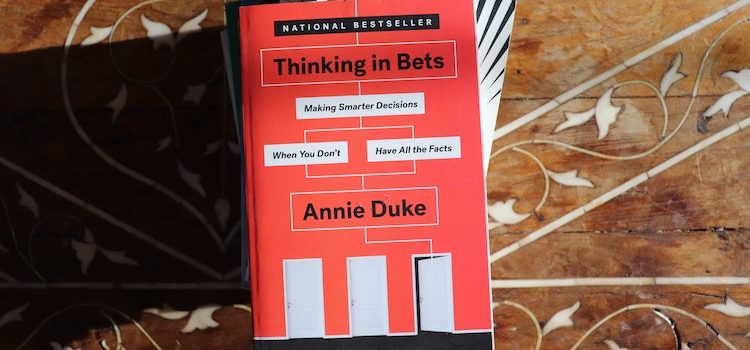
How to Develop a Rational Decision-Making Process

How to Develop a Rational Decision-Making Process

Do you rate your decisions based solely on the outcomes? Have you developed a rational decision-making process? Thinking in Bets author Annie Duke believes that we must judge the soundness of our decisions, not just by their results, but by the reasoning we use to make them. Ultimately, a rational decision-making process should be our goal. Read more to learn what constitutes a rational decision-making process.

Alternative Futures: What’s at Stake With Each Decision

Alternative Futures: What’s at Stake With Each Decision

What are alternative futures? Do you consider them when you make decisions? Whenever you make a decision, you’re choosing between alternative futures—outcomes that result from particular decisions. To make better decisions, you should adopt an “alternative futures” mindset. Keep reading to learn about thinking in terms of alternative futures.

Reconciliation in the Church: 5 Steps to Heal Wounds

Reconciliation in the Church: 5 Steps to Heal Wounds

How can you heal broken fellowship? What is the biblical model for reconciliation in the church? As you’re probably well aware, Christian fellowship is not exempt from conflict, hurt feelings, and broken relationships. Fortunately, the Bible provides direction for reconciliation in the church, calling on you to be a peacemaker. This doesn’t mean sweeping problems under the rug. True peacemaking faces conflict head-on. Read more to learn biblical methods for reconciliation in the church.

Thinking in Bets: Annie Duke’s Decision Strategies

Thinking in Bets: Annie Duke’s Decision Strategies

Have you read Thinking in Bets, Annie Duke’s book about decision-making? What application does it have for your life? In Thinking in Bets, Annie Duke shares strategies that can help you become more consistently rational and intellectually flexible. When you think in bets, you start with a foundation of well-informed beliefs, you become adept at learning from the outcomes of your past decisions, and you find a group of people who can help stop you from slipping into ineffective habits. These three building blocks—beliefs, outcomes, and groups—are the core of Duke’s philosophy. Keep reading to learn how to think in

Why People Believe in Fake News: What Science Says

Why People Believe in Fake News: What Science Says

Can science explain why people believe in fake news? Are we wired to believe false information? False information is all around us. Not only is it being produced, but it’s also being spread by people who believe it’s true. Science provides some interesting answers to why people believe in fake news. Basically, we’re simply wired to believe. Keep reading to learn why people believe in fake news.

A Visionary Company: What It Is and What It Isn’t

The 3 Common Characteristics of a Good Business

What qualifies as a visionary company? What are the truths and myths about companies that endure? In Built to Last, bestselling author Jim Collins and Stanford professor Jerry I. Porras embarked on a six-year research project to 1) identify the characteristics that distinguished the very best companies, and 2) use these insights to create a framework for those who want to build a visionary company of their own. To this end, the authors identified and analyzed 18 visionary companies that performed exceptionally well over a long period of time.  Read more to learn about the qualities of a visionary company.

Shaping a Christ-Like Character: The 4 Tools God Uses

Shaping a Christ-Like Character: The 4 Tools God Uses

How do you form a Christ-like character? What tools does God use? One of the purposes of your life is to be like Jesus more and more by taking on his values and character. Because you were created in the image of God, you innately have a Christ-like character in you, but it hasn’t been shaped yet. That’s the work that God does over your lifetime if you invite him to do so. Read more to learn how God develops a Christ-like character in you.

Made to Stick: Why Some Ideas Survive and Others Die

Made to Stick: Why Some Ideas Survive and Others Die

Have you read Made to Stick: Why Some Ideas Survive and Others Die? What are the key takeaways? In our hyper-connected society, important messages often fail to gain traction, while bad ideas and falsehoods go viral and seem to stick around forever. Made to Stick: Why Some Ideas Survive and Others Die explores what makes some messages “stick”. Based on a wide-ranging research, the book identifies six criteria that anyone can apply for shaping a sticky message. Continue reading for key takeaways of Made to Stick: Why Some Ideas Survive and Others Die.

SUCESSs: A Simple Formula for Creative Messaging

SUCESSs: A Simple Formula for Creative Messaging

Do you have to be an amazing writer or speaker to deliver creative messaging? Is there a simple formula for effectively getting your ideas across? You don’t have to be a creative genius to communicate your message well. Chip and Dan Heath show you what to do through numerous examples of messages that have succeeded and others that have bombed. Rather than sweating over an original presentation, you can follow their “stickiness” template or even emulate someone else’s idea that worked. Keep reading to learn the formula for creative messaging.