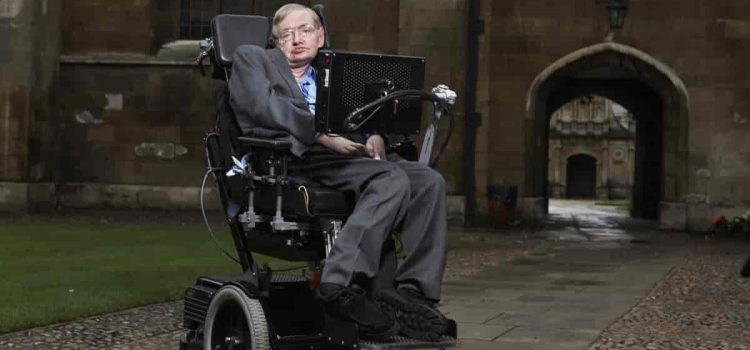
Stephen Hawking: AI Might Become a Threat to Us
Stephen Hawking: AI Might Become a Threat to Us
Why does Stephen Hawking consider artificial intelligence to be a form of life? How can humanity avoid a disaster like the one in I, Robot? According to Stephen Hawking, AI fulfills the two requirements to be considered living. Hawking warns that artificial intelligence may even become conscious one day, and if it does, it better be on the side of humanity rather than against it. Here’s more of what Hawking had to say about AI.

Are There Differences in Male and Female Brains? Yes

How to Build a Latticework of Mental Models

Do sex and gender affect the way we think? Is there evidence of differences in male and female brain structures? While most of the cognitive differences between male and female brains are shaped by social expectations, there are some differences that molecular biologist Dr. John Medina suspects have a profound impact on behavior. Medina posits that the male and female brains react differently to a number of situations. Here are the physical and psychological differences in male and female brains.

Top Quotes From Brief Answers to the Big Questions

Top Quotes From Brief Answers to the Big Questions

What are the top quotes from Brief Answers to the Big Questions? What did Hawking have to say about some of humanity’s biggest questions? In Brief Answers to the Big Questions, prominent astrophysicist Stephen Hawking discusses science, philosophy, human destiny, and how they relate to each other. Writing at the end of his career, Hawking offers his readers some final words of wisdom on the issues he considers most important. Below are the top Brief Answers to the Big Questions quotes—with explanations.

How to Write About Science and Technology

How to Write About Science and Technology

Do you write about science and technology? How can you make your writing sound less robotic? When people write about science and technology, they tend to lack humanity, making the piece too boring and matter-of-fact. To make your technical writing more interesting, focus on humanity first and incorporate facts and statistics only if they add to the story. Here’s how to make your technical writing more interesting.

The Myth of Multitasking: Why You Struggle to Focus

The Myth of Multitasking: Why You Struggle to Focus

Do you often find yourself doing two or more things at once? Did you know that multitasking is actually a myth? Neuroscience proves that the brain cannot handle doing two tasks at once, hence why multitasking fails. While many people believe they have mastered handling many tasks at once, Dr. John Medina believes this is actually the myth of multitasking because you lose your focus when you redirect your attention. Here are a few reasons why multitasking is a myth, and how to stay focused.

The Science Behind Sleep and the Brain

The Science Behind Sleep and the Brain

Why are sleep and the brain often grouped together in science? Why is the brain most affected by sleep? In his book Brain Rules, Dr. John Medina emphasizes sleep as one of the main components of keeping the brain active and healthy. In Rule 3 of his guide to how brains truly work, he explains the importance of sleep and the brain’s reaction to it. Let’s look at how the brain can benefit from sleep, and the negative effects of lacking sleep.

Ways Exercise and the Brain Work Together

Ways Exercise and the Brain Work Together

What are the ways exercise and the brain work together? Does the brain function better thanks to exercise? In his book Brain Rules, Dr. John Medina theorizes that exercise and the brain go hand-in-hand when striving to achieve greater health. Knowing how the brain benefits from exercise can help build a stronger mind and body to improve cognitive and physiological skills. Let’s look at why and how brains thrive from physical activity.

What Is Hawking Radiation? So Far, Just a Theory

What Is Hawking Radiation? So Far, Just a Theory

What is Hawking radiation? Can black holes emit heat? Stephen Hawking published his theoretical prediction that radiation would be produced at the event horizon of a black hole in 1974, the same year he was elected a fellow of the Royal Society. “Hawking radiation” was named after him, since it was regarded as his theoretical discovery. Continue reading to learn about this theory.

How the Universe Began: Evidence for the Big Bang

How the Universe Began: Evidence for the Big Bang

How did the universe begin? What’s the evidence for the big bang? In the twentieth century, new scientific discoveries challenged the theory that the universe had always existed. Based on these discoveries, the “big bang” theory ultimately replaced the old model. In A Brief History of Time, physicist Stephen Hawking discusses the theory, the evidence for it, and its philosophical and theological implications. Keep reading for Hawking’s discussion of how the universe began.