We've ranked the best philosophy books using expert recommendations, sales data, and millions of reader ratings. At Shortform, we know books. Our book guides are the best in the world. Learn why.
Man's Search for Meaning has riveted generations of readers with its descriptions of life in Nazi death camps and its lessons for spiritual survival. Between 1942 and 1945 psychiatrist Viktor Frankl labored in four different camps, including Auschwitz, while his parents, brother, and pregnant wife perished. Based on his own experience and the stories of his many patients, Frankl argues that we cannot avoid suffering but we can choose how to cope with it, find meaning in it, and move forward with renewed purpose. Frankl's theory—known as logotherapy, from the Greek word logos ("meaning")—holds that our primary drive in life is not pleasure, as Freud maintained, but the discovery and pursuit of what we personally find meaningful. In the decades since its first publication in 1959, Man's Search for Meaning has become a classic, with more than twelve million copies in print around the world. A 1991 Library of Congress survey that asked readers to name a "book that made a difference in your life" found Man's Search for Meaning among the ten most influential books in America. At once a memoir, a meditation, a treatise, and a history, it continues to inspire us all to find significance in the very act of living. (back cover)
…
Recommended by Tony Robbins, Dustin Moskovitz, Ev Williams, and 60 others.
Another book that I’ve read dozens of times. It taught me that if you change the meaning, you change everything. Meaning equals emotion, and emotion equals life. [source]
Dustin Moskovitz
Co-founder/Facebook and Asana
Dustin Moskovitz recommended this book on Twitter. [source]
I read it while spending ten days in the ICU of Bellevue hospital trying to reattach my finger from a ring avulsion accident in my kitchen. It talks about the meaning of life, and I believe you come out a better person from reading it. [source]
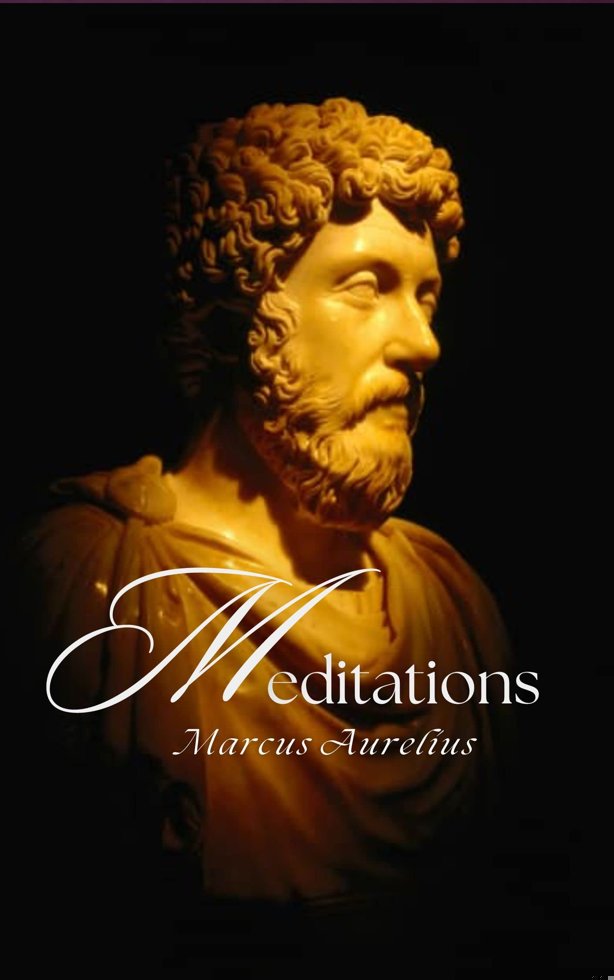
One measure, perhaps, of a book's worth, is its intergenerational pliancy: do new readers acquire it and interpret it afresh down through the ages? The Meditations of Marcus Aurelius, translated and introduced by Gregory Hays, by that standard, is very worthwhile, indeed. Hays suggests that its most recent incarnation--as a self-help book--is not only valid, but may be close to the author's intent. The book, which Hays calls, fondly, a "haphazard set of notes," is indicative of the role of philosophy among the ancients in that it is "expected to provide a 'design for living.'" And it does, both aphoristically ("Think of yourself as dead. You have lived your life. Now take what's left and live it properly.") and rhetorically ("What is it in ourselves that we should prize?"). Whether these, and other entries ("Enough of this wretched, whining monkey life.") sound life-changing or like entries in a teenager's diary is up to the individual reader, as it should be. Hays's introduction, which sketches the life of Marcus Aurelius (emperor of Rome A.D. 161-180) as well as the basic tenets of stoicism, is accessible and jaunty. --H. O'Billovich
…
Recommended by Arianna Huffington, Naval Ravikant, Chip Conley, and 12 others.
Arianna Huffington
Founder/The Huffington Post
I find this book so inspirational and instructive, it lives on my nightstand. [source]
Chip Conley
I have given this book away to a number of people. [source]
Marvin Liao
Partner/500 Startups
My list would be (besides the ones I mentioned in answer to the previous question) both business & Fiction/Sci-Fi and ones I personally found helpful to myself. The business books explain just exactly how business, work & investing are in reality & how to think properly & differentiate yourself. On the non-business side, a mix of History & classic fiction to understand people, philosophy to make sense of life and Science fiction to picture what the future could be like (not always utopian). [source]
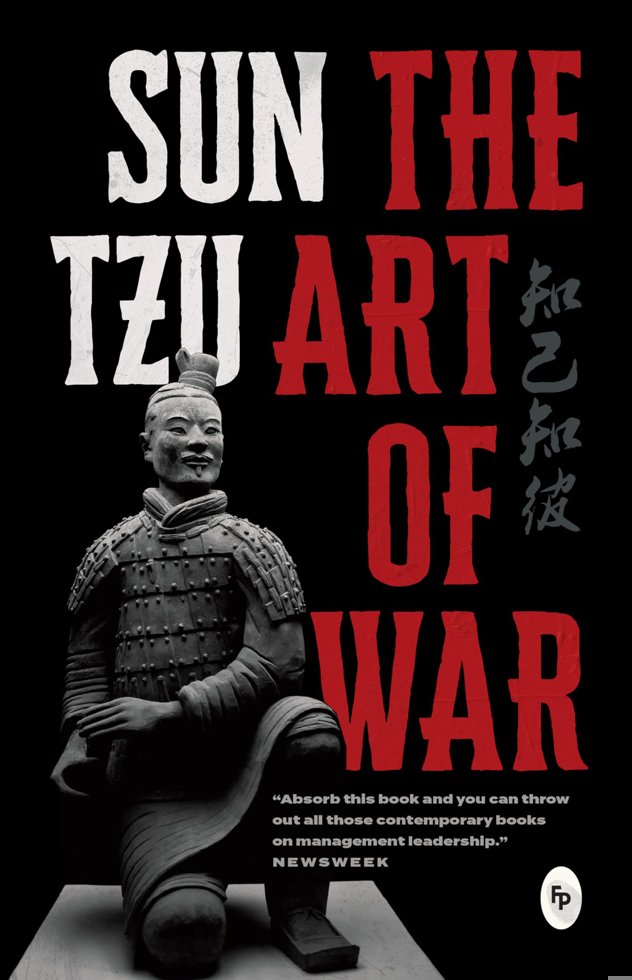
For more than two thousand years, The Art of War has stood as a cornerstone of Chinese culture-a lucid epigrammatic text that reveals as much about human psychology, politics, and economics as it does about battlefield strategy. The influence of Sun-tzu's text has grown tremendously in the West in recent years, with military leaders, politicians, and corporate executives alike finding valuable insight in these ancient words. In his crisp, accessible new translation, scholar John Minford brings this seminal work to life for modern readers.
Minford opens with a lively, learned introduction in which he explores the life and times of Sun-tzu, looks at The Art of War in the context of the turbulent Warring States period, and discusses how best to read and understand the work today. There follows Minford's translation of the core text itself in two different formats-first, the unadorned thirteen chapters of the original work and then the same text reprinted with extensive running commentary by classical Chinese scholars as well as Minford himself. The result is an opportunity for Western readers to experience Sun-tzu's work in all its intensity as it applies to many aspects of our lives.
Which books should be read by every single intelligent person on planet? … The Art of War (Sun Tsu) to learn that the act of killing fellow humans can be raised to an art. If you read all of the above works you will glean profound insight into most of what has driven the history of the western world. [source]
Cover unavailable
4
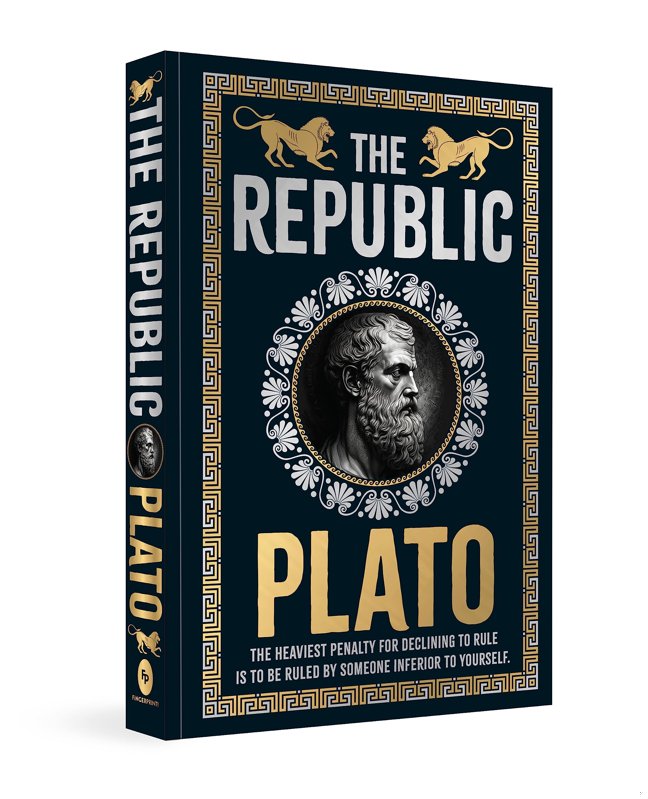
The Republic: The Influential Classic
Plato
4.6
The newest deluxe edition in the bestselling Capstone Classics Series This ancient classic has had a make-over. In recent years these Capstone Classic deluxe editions have caught the book buying public's imagination. The volumes of international bestsellers such as Think and Grow Rich and The Art of War have quickly become the market leaders. Now Plato's best known work, one of the most intellectually and historically influential works of philosophy and political theory, has been brought to life in this luxury, hardback, keep-sake edition.
This edition includes:
Plato's plans for a perfect society characterised by a blend of wisdom, courage, self-discipline and justice Lessons to learn about living according to eternal truths, instead of existing simply for survival and pleasure A new introduction by Tom Butler Bowdon, the classic personal development expert
It’s very readable even if you aren’t a professional philosopher. Take the story of ‘The Ring of Gyges,’ which raises the question of whether you would continue to act like a good person if you had a ring of invisibility that let you get away with doing whatever you wanted to do. That’s a fascinating thought experiment that anybody can appreciate. [source]
I’m about a third through this and still can’t tell whether Plato is making a mockery of Socrates ideas for the idyllic society or not. So many of the arguments presented as Socrates’ are so tortured and with so disconnected leaps of logic that it’s hard to take it at face value. Yet still, it’s good fun to follow the dialogue. It reads more like a play than a book, and again, immensely accessible. It’s fun to see the lines that continue from a book like this to the considerations of the Stoics all the way to Adam Smith and the Wealth of Nations and then onto a modern critique and history in that Debt: First 5,000 Years. A conversation spanning millennia. [source]
Jonathan Glover
It contains a tremendous amount of nonsense about what the ideal society would be like. But it is an unmissable book because of Socrates. He invented the method of doing and teaching philosophy that has never been improved on. [source]
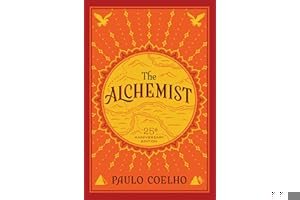
Paulo Coelho's enchanting novel has inspired a devoted following around the world. This story, dazzling in its powerful simplicity and inspiring wisdom, is about an Andalusian shepherd boy named Santiago who travels from his homeland in Spain to the Egyptian desert in search of a treasure buried in the Pyramids. What starts out as a journey to find worldly goods turns into a discovery of the treasure found within. Lush, evocative, and deeply humane, the story of Santiago is an eternal testament to the transforming power of our dreams and the importance of listening to our hearts.
There's a great quote in this book: When you're on the right path the universe conspires to help you! [source]
Daniel Ek
It was fascinating to talk to the author about how this book came to be such a hit—he never backed down, and he allowed people to read it for free in order to then boost sales—much like how Spotify’s freemium model was perceived in the early days. [source]
Eric Ripert
Speaks of everyone having an ultimate goal in life, but most of us are too afraid to pursue it. The encouragement to fulfill your dreams is very inspirational! [source]
In Beyond Good and Evil Friedrich Nietzsche contends that no human values are absolute; that all value distinctions (such as that between 'good' and 'evil') are artificial, the result of mere traditional prejudices; and that humanity should discard its old, outmoded values (such as 'good' and 'evil').
Yes, I think that’s right. It touches on almost all Nietzsche’s central concerns – on truth, on the nature of philosophy, on morality, on what’s wrong with morality, will to power. [source]
Simon Critchley
What did you think of it then? We should talk about your reaction to it! [source]
Cover unavailable
7
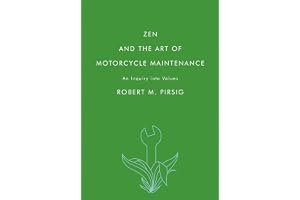
Zen and the Art of Motorcycle Maintenance: An Inquiry Into Values
This lyrical, evocative, thought-provoking journal of a man's quest for truth - and for himself - has touched and changed an entire generation, and is ready to reach out to a new one. At its heart, the story is all too simple: a man and his son take a motorcycle trip across America. But this is not a simple trip at all, for around every corner, through mountain and desert, wind and rain, and searing heat and biting cold, their pilgrimage leads them to new vistas of self-discovery and renewal.
Zen and the Art of Motorcycle Maintenance is an elemental work that has helped to shape and define the past 25-years of American culture. This special audio edition presents this adventure in an exciting new way - for the millions who have already taken this journey and want to travel these roads again, and for the many more who will discover for the first time the wonders and challenges of a story that will change the way they think and feel about their lives. Unique to audio, this edition features a new introduction by the author.
…
Recommended by Brad Feld, Drew Houston, Ev Williams, and 7 others.
Brad Feld
Co-Founder/Foundry Group
I think every entrepreneur or aspiring entrepreneur should read the book Zen and the Art of Motorcycle Maintenance. It was written in the 1970s by a guy named Robert Pirsig. It was his first book, it's kind of a hippie philosophy treatised journey. The word that sort of came out of it was Chautauqua, he's like having a conversation with his son as they do a motorcycle trip across the country, and it's just this incredible treatise on philosophy, product, quality, accomplishing what your goal is, against the backdrop of the narrator, the author, going crazy and having a psychotic break. And so it's this very powerful mix of accessible philosophy, combined with this pretty captivating journey in a book that, again, anybody who builds anything, there's so much in it that's so worth reading and just soaking in. But it's not what you'd expect, it's not a "here's how you do it", you have to read it slowly and think about it. So, it's one of my favorites. [source]
Drew Houston
CEO/Dropbox
There are engineers who dismiss all these things that can’t be fit into an algorithm, or that don’t have some kind of mathematical rigor underpinning them, this book is about that question. [source]
Honorable mentions: Jonathan Livingston Seagull, Zen and the Art of Motorcycle Maintenance, and The Joy of Sex, all given to me by my mother. I believe they helped inculcate some of the 1960s-70s ethos of individual freedom into my thinking. [source]
Cover unavailable
8
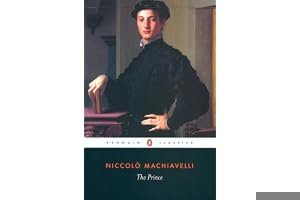
The Prince
Nicollo Machiavelli, Tim Parks
4.4
Niccolo Machiavelli's "The Prince" is intended to be a treatise on ruling and is considered by many to be a classic of political science. In the book Machiavelli offers many bits of practical advice on how to rule and even though the book was written in the early 16th century its ideas are still very relevant today. Where "The Prince" differs from other political literature before it is in its separation of the lofty idealism of morality and ethics from the practical demands of governing. It is this very aspect of Machiavelli's work that has made his name synonymous with an almost immoral opportunism and his book a timeless classic.
Which books should be read by every single intelligent person on planet? … The Prince (Machiavelli) to learn that people not in power will do all they can to acquire it, and people in power will do all they can to keep it. If you read all of the above works you will glean profound insight into most of what has driven the history of the western world. [source]
Of course, this is a must read. Machiavelli is one of those figures and writers who is tragically overrated and underrated at the same time. Unfortunately that means that many people who read him miss the point and other people avoid him and miss out altogether. Take Machiavelli slow, and really read him. Also understand the man behind the book–not just as a masterful writer but a man who withstood heinous torture and exile with barely a whimper. Machiavelli is a glimpse into a time when power was literal and out for public viewing–when he talks about making an example of someone, he doesn’t mean calling them out, he means putting their head on a pike. Don’t let that scare you because we’re not as far from that world as we’d like to think. Deny that at your own peril. [source]
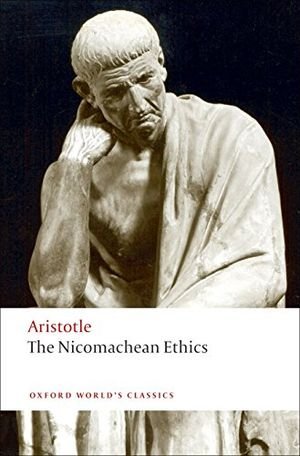
‘One swallow does not make a summer; neither does one day. Similarly neither can one day, or a brief space of time, make a man blessed and happy’
In the Nicomachean Ethics, Aristotle sets out to examine the nature of happiness. He argues that happiness consists in ‘activity of the soul in accordance with virtue’, for example with moral virtues, such as courage, generosity and justice, and intellectual virtues, such as knowledge, wisdom and insight. The Ethics also discusses the nature of practical reasoning, the value and the objects of pleasure, the different forms of friendship, and the relationship between individual virtue, society and the State. Aristotle’s work has had a profound and lasting influence on all subsequent Western thought about ethical matters.
J. A. K. Thomson’s translation has been revised by Hugh Tredennick, and is accompanied by a new introduction by Jonathan Barnes. This edition also includes an updated list for further reading and a new chronology of Aristotle’s life and works.
He said the great question is how we should live well, so that we live a good life, and he came up with a very positive response – what distinguishes us from the rest of the world is our possession of reason [source]
Christian B Miller
According to Aristotle, it is hard to become virtuous, and hard to become vicious too. The character of most people is somewhere in the middle. [source]
"A spectre is haunting Europe," Karl Marx and Frederic Engels wrote in 1848, "the spectre of Communism." This new edition of The Communist Manifesto, commemorating the 150th anniversary of its publication, includes an introduction by renowned historian Eric Hobsbawm which reminds us of the document's continued relevance. Marx and Engels's critique of capitalism and its deleterious effect on all aspects of life, from the increasing rift between the classes to the destruction of the nuclear family, has proven remarkably prescient. Their spectre, manifested in the Manifesto's vivid prose, continues to haunt the capitalist world, lingering as a ghostly apparition even after the collapse of those governments which claimed to be enacting its principles.
…
Recommended by Felipe Fernández-Armesto and Peter Singer.
Felipe Fernández-Armesto
Marx and Engels’s historical analysis is breathtakingly, brilliantly simple. I think it’s wrong but, again, you’ve just got to admire its genius. Obviously, without understanding the historical basis of Marx’s thought you can’t understand anything else in Marxism. [source]
Yes, it is. I chose The Communist Manifesto, rather than, say, Capital because it shows in a much easier-to-read, shorter work something that is central to Marx’s vision. Capital is much drier, and a lot of it is focused on economics, although there are some remarkable passages of Capital describing the conditions of industrial workers in England at the time. [source]
Cover unavailable
11
Thus Spake Zarathustra: A Book For All And None
Friedrich Wilhelm Nietzsche
4.4
Thus Spoke Zarathustra is a foundational work of Western literature and is widely considered to be Friedrich Nietzsche’s masterpiece. It includes the German philosopher’s famous discussion of the phrase ‘God is dead’ as well as his concept of the Superman. Nietzsche delineates his Will to Power theory and devotes pages to critiquing Christian thinking, in particular Christianity’s definition of good and evil.
…
Recommended by Stephane Grand.
Stephane Grand
My favorite book is “Thus spoke Zarathustra” by Friedrich Nietzsche. I do not think I have ever read a book that had more resonance for me. [source]
Cover unavailable
12
A History of Western Philosophy
Bertrand Russell
4.4
Since its first publication in 1945 Lord Russell's A History of Western Philosophy has been universally acclaimed as the outstanding one-volume work on the subject—unparalleled in its comprehensiveness, its clarity, its erudition, its grace and wit. In seventy-six chapters he traces philosophy from the rise of Greek civilization to the emergence of logical analysis in the twentieth century. Among the philosophers considered are: Pythagoras, Heraclitus, Parmenides, Empedocles, Anaxagoras, the Atomists, Protagoras, Socrates, Plato, Aristotle, the Cynics, the Sceptics, the Epicureans, the Stoics, Plotinus, Ambrose, Jerome, Augustine, Benedict, Gregory the Great, John the Scot, Aquinas, Duns Scotus, William of Occam, Machiavelli, Erasmus, More, Bacon, Hobbes, Descartes, Spinoza, Leibniz, Locke, Berkeley, Hume, Rousseau, Kant, Hegel, Schopenhauer, Nietzsche, the Utilitarians, Marx, Bergson, James, Dewey, and lastly the philosophers with whom Lord Russell himself is most closely associated -- Cantor, Frege, and Whitehead, co-author with Russell of the monumental Principia Mathematica.
…
Recommended by Sam Harris, Peter Atkins, and 1 others.
Just a great example of how English should be written and just a great voice to have in your head as a result. [source]
Peter Atkins
It reviews how people have really grappled in a seemingly very intelligent way with very deep questions. [source]
Cover unavailable
13
Tao Te Ching: By Lao Tzu - Illustrated
Lao Tse
4.4
A lucid translation of the well-known Taoist classic by a leading scholar-now in a Shambhala Pocket Library edition. Written more than two thousand years ago, the Tao Teh Ching, or -The Classic of the Way and Its Virtue, - is one of the true classics of the world of spiritual literature. Traditionally attributed to the legendary -Old Master, - Lao Tzu, the Tao Teh Ching teaches that the qualities of the enlightened sage or ideal ruler are identical with those of the perfected individual. Today, Lao Tzu's words are as useful in mastering the arts of leadership in business and politics as they are in developing a sense of balance and harmony in everyday life. To follow the Tao or Way of all things and realize their true nature is to embody humility, spontaneity, and generosity. John C. H. Wu has done a remarkable job of rendering this subtle text into English while retaining the freshness and depth of the original. A jurist and scholar, Dr. Wu was a recognized authority on Taoism and the translator of several Taoist and Zen texts and of Chinese poetry. This book is part of the Shambhala Pocket Library series. The Shambhala Pocket Library is a collection of short, portable teachings from notable figures across religious traditions and classic texts. The covers in this series are rendered by Colorado artist Robert Spellman. The books in this collection distill the wisdom and heart of the work Shambhala Publications has published over 50 years into a compact format that is collectible, reader-friendly, and applicable to everyday life.
Q: What are the books that had a major influence on you? Or simply the ones you like the most. : Tao te Ching, score takes care of itself, between the world and me, the four agreements, the old man and the sea...I love reading! [source]
According to a Yibada interview with Chen Wei, who wrote Ma’s 2014 authorized biography, the Alibaba founder and executive chairman always carries the Tao Te Ching, the foundational text of Taoist philosophy, religion and ethics composed by Lao Tzu in the sixth century B.C. [source]
At Walden Pond, Henry David Thoreau reflected on simpler living in the natural world. By removing himself from the distractions of materialism, Thoreau hoped to not only improve his spiritual life but also gain a better understanding of society through solitary introspection.
In Walden, Thoreau condenses his two-year, two-month, two-day stay into a single year, using the four seasons to symbolize human development—a cycle of life shared by both nature and man. A celebration of personal renewal through self-reliance, independence, and simplicity, composed for all of us living in “quiet desperation,” Walden is eternal.
…
Recommended by Emma Watson, Donna Dickenson, Emily Thomas, and 5 others.
Donna Dickenson
He discusses how the original ideals that America was founded on were being compromised, and how massive industrial interests were starting to dominate. [source]
Emily Thomas
The beginning is hard going. Once you get past that, then suddenly you’re into these beautiful and inspiring descriptions of nature. [source]
Joan Boixados
In case you were deceived and expected me to name Walden by Henry David Thoreau, you should read it too if you haven’t, it obviously is the inspiration to Walden Two. :) [source]
One of the most influential works of this century, this is a crucial exposition of existentialist thought. Influenced by works such as Don Juan, and the novels of Kafka, these essays begin with a meditation on suicide: the question of living or not living in an absurd universe devoid of order or meaning. With lyric eloquence, Camus posits a way out of despair, reaffirming the value of personal existence, and the possibility of life lived with dignity and authenticity.
Camus’ philosophical exposition of absurdity, suicide in the face of meaninglessness, and other cherry topics that continue on from his fictional work in novels like The Stranger. It’s surprisingly readable, unlike many other mid 20th century philosophers, yet no less deep or pointy. It’s a great follow-up, as an original text, to that book The Age of Absurdity, I recommended last year. Still working through it. [source]
Kenan Malik
The Myth of Sisyphus is a small work, but Camus’s meditation on faith and fate has personally been hugely important in developing my ideas. Writing in the embers of World War II, Camus confronts in The Myth of Sisyphus both the tragedy of recent history and what he sees as the absurdity of the human condition. There is, he observes, a chasm between the human need for meaning and what he calls “the unreasonable silence of the world”. Religion is a means of bridging that chasm, but a dishonest one. “I don’t know if the world has any meaning that transcends it,” he writes. “But I know that I do not know this meaning and that it is impossible for me just now to know it.” [source]
100,000 years ago, at least six human species inhabited the earth. Today there is just one. Us. Homo sapiens.
How did our species succeed in the battle for dominance? Why did our foraging ancestors come together to create cities and kingdoms? How did we come to believe in gods, nations and human rights; to trust money, books and laws; and to be enslaved by bureaucracy, timetables and consumerism? And what will our world be like in the millennia to come?
In Sapiens, Dr Yuval Noah Harari spans the whole of human history, from the very first humans to walk the earth to the radical – and sometimes devastating – breakthroughs of the Cognitive, Agricultural and Scientific Revolutions. Drawing on insights from biology, anthropology, paleontology and economics, he explores how the currents of history have shaped our human societies, the animals and plants around us, and even our personalities. Have we become happier as history has unfolded? Can we ever free our behaviour from the heritage of our ancestors? And what, if anything, can we do to influence the course of the centuries to come?
Bold, wide-ranging and provocative, Sapiens challenges everything we thought we knew about being human: our thoughts, our actions, our power ... and our future.
Both Melinda and I read this one, and it has sparked lots of great conversations at our dinner table. Harari takes on a daunting challenge: to tell the entire history of the human race in just 400 pages. He also writes about our species today and how artificial intelligence, genetic engineering, and other technologies will change us in the future. Although I found things to disagree with—especially Harari’s claim that humans were better off before we started farming—I would recommend Sapiens to anyone who’s interested in the history and future of our species. [source]
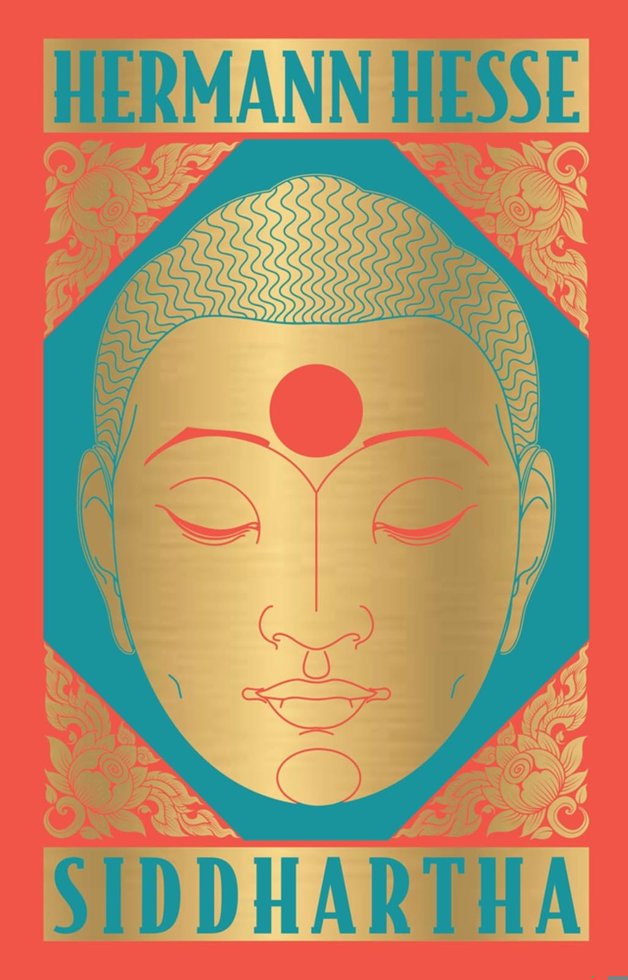
Herman Hesse's classic novel has delighted, inspired, and influenced generations of readers, writers, and thinkers. In this story of a wealthy Indian Brahmin who casts off a life of privilege to seek spiritual fulfillment. Hesse synthesizes disparate philosophies--Eastern religions, Jungian archetypes, Western individualism--into a unique vision of life as expressed through one man's search for meaning.
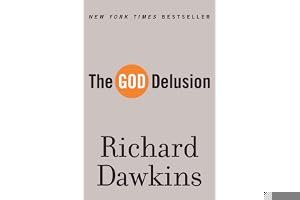
In his sensational international bestseller, the preeminent scientist and outspoken atheist Richard Dawkins delivers a hard-hitting, impassioned, but humorous, rebuttal of religious belief. With rigor and wit, Dawkins eviscerates the arguments for religion and demonstrates the supreme improbability of the existence of a supreme being. He makes a compelling case that faith is not just irrational but potentially deadly. In a preface written for the paperback edition, Dawkins responds to some of the controversies the book has incited. This brilliantly argued, provocative book challenges all of us to examine our belifs, no matter what beliefs we hold.
…
Recommended by Brian Armstrong, Antonio Eram, Susan Jacoby, and 1 others.
Antonio Eram
This book was recommended by Antonio when asked for titles he would recommend to young people interested in his career path. [source]
Susan Jacoby
Richard Dawkins is very funny. One of the reasons for reading The God Delusion is that it will disabuse you of the idea – which is a common stereotype of atheists – that they are utterly humourless. You hear this over and over again. I’m often invited to college campuses to give lectures, and often they’re religious schools – not fundamentalist schools, but colleges of a historically religious type. And very often I will hear: “Oh I expected you to be small and dark-haired and wear glasses!” The image of the atheist woman is kind of like what the image of the feminist used to be, someone too ugly to get a man. But part of it is also humorlessness. People will often say to me, “Oh you’re so funny.” “Well, yeah!” [source]
Vote Dem For The Planet
@KimBledsoe14 @Goodbye_Jesus @Ian313f There were a lot of rebels and drifters in those days against the repressive regime. They had followers. Have you read “The God Delusion”? Great book. [source]
Cover unavailable
19
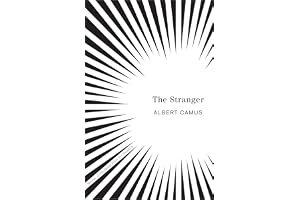
The Stranger
Albert Camus, Jonathan Davis, et al
4.3
Through the story of an ordinary man unwittingly drawn into a senseless murder on an Algerian beach, Camus explored what he termed "the nakedness of man faced with the absurd." First published in English in 1946; now in a new translation by Matthew Ward.
Seminal novel on existentialism and the absurd by Albert Camus from 1946. Explores that feeling of disconnectedness from society, its norms, and the absurdity of every day life. Striking first-person account in a powerful, direct language. [source]
Kyle Maynard
Kyle Maynard said this is one of his most-recommended books. [source]
Cover unavailable
20
Sophie's World
Jostein Gaarder, Paulette Moller
4.3
An alternative cover for this ISBN can be found here
One day fourteen-year-old Sophie Amundsen comes home from school to find in her mailbox two notes, with one question on each: "Who are you?" and "Where does the world come from?" From that irresistible beginning, Sophie becomes obsessed with questions that take her far beyond what she knows of her Norwegian village. Through those letters, she enrolls in a kind of correspondence course, covering Socrates to Sartre, with a mysterious philosopher, while receiving letters addressed to another girl. Who is Hilde? And why does her mail keep turning up? To unravel this riddle, Sophie must use the philosophy she is learning—but the truth turns out to be far more complicated than she could have imagined.
…
Cover unavailable
21
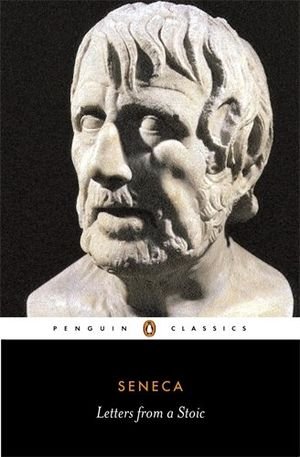
Letters from a Stoic
Seneca
4.3
I feel, my dear Lucilius, that I am being not only reformed, but transformed. I do not yet, however, assure myself, or indulge the hope, that there are no elements left in me which need to be changed. Of course there are many that should be made more compact, or made thinner, or be brought into greater prominence. And indeed this very fact is proof that my spirit is altered into something better, - that it can see its own faults, of which it was previously ignorant. In certain cases sick men are congratulated because they themselves have perceived that they are sick.
This is a letter from Stoic heavyweight Seneca the Younger — who lived a mere 2,000 years or so ago — to his friend Lucilius. It’s from a collection of letters that comprise, effectively, my favorite book of all time. I’ve read it dozens of times, and I loved it so much that I turned it into The Tao of Seneca, a three-volume set of audiobooks. [source]
After Marcus Aurelius, this is one of my favorite books. While Marcus wrote mainly for himself, Seneca had no trouble advising and aiding others. In fact, that was his job—he was Nero’s tutor, tasked with reducing the terrible impulses of a terrible man. His advice on grief, on wealth, on power, on religion, and on life are always there when you need them. [source]
Jerzy Gregorek
From this book, I learned self-mastery: to constantly improve myself so I would be ready for any possible disaster. I also learned that when disaster happens, it means that something is being asked of me. I need to improve. [source]
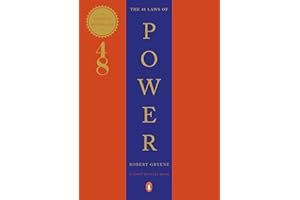
This amoral, cunning, ruthless, and instructive book synthesizes the philosophies of Machiavelli, Sun Tzu, and Carl Von Clausewitz with the historical legacies of statesmen, warriors, seducers, and con men throughout the ages.
These are the books I recommend people to listen to on @applebooks. [source]
Marvin Liao
Partner/500 Startups
My list would be (besides the ones I mentioned in answer to the previous question) both business & Fiction/Sci-Fi and ones I personally found helpful to myself. The business books explain just exactly how business, work & investing are in reality & how to think properly & differentiate yourself. On the non-business side, a mix of History & classic fiction to understand people, philosophy to make sense of life and Science fiction to picture what the future could be like (not always utopian). [source]
There is no living writer (or person) who has been more influential to me than Robert Greene. I met him when I was 19 years old and he’s shaped me as a person, as a writer, as a thinker. You MUST read his books. His work on power and strategy are critical for anyone trying to accomplish anything. In life, power is force we are constantly bumping up against. People have power of over us, we seek power ourselves that we might be free enough and influential enough to accomplish our goals—so we must understand where power comes from, how it works and how to get it. But pure power is meaningless. It must be joined to mastery and purpose. So read his book Mastery so that you can figure your life’s task and how to dedicate yourself to it. [source]
Cover unavailable
23
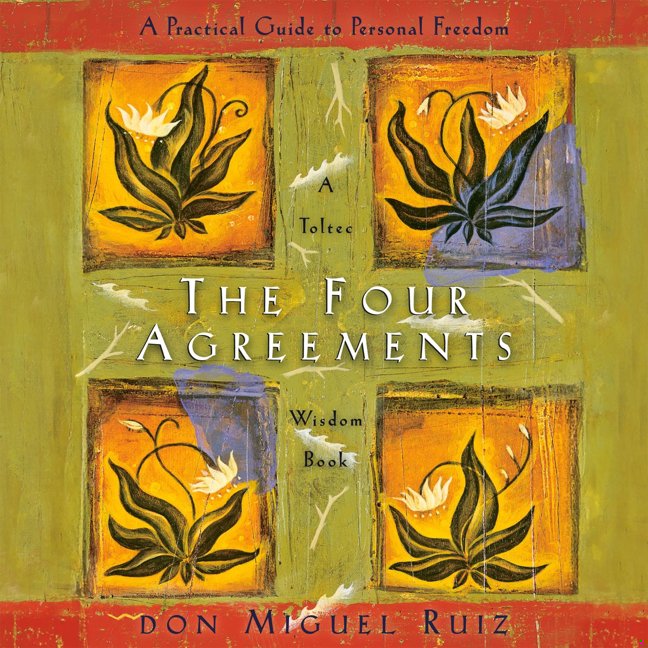
The Four Agreements: A Practical Guide to Personal Freedom
In The Four Agreements, don Miguel Ruiz reveals the source of self-limiting beliefs that rob us of joy and create needless suffering. Based on ancient Toltec wisdom, the Four Agreements offer a powerful code of conduct that can rapidly transform our lives to a new experience of freedom, true happiness, and love. The Four Agreements are: Be Impeccable With Your Word, Don't Take Anything Personally, Don't Make Assumptions, Always Do Your Best.
Question: What are the books that had a major influence on you? Or simply the ones you like the most. : Tao te Ching, score takes care of itself, between the world and me, the four agreements, the old man and the sea...I love reading! [source]
Karlie Kloss
I just think it’s got a lot of great principles and ideas. [source]
Cover unavailable
24
Atlas Shrugged
Ayn Rand
4.2
This is the story of a man who said that he would stop the motor of the world and did. Was he a destroyer or the greatest of liberators?
Why did he have to fight his battle, not against his enemies, but against those who needed him most, and his hardest battle against the woman he loved? What is the world’s motor — and the motive power of every man? You will know the answer to these questions when you discover the reason behind the baffling events that play havoc with the lives of the characters in this story.
Tremendous in its scope, this novel presents an astounding panorama of human life — from the productive genius who becomes a worthless playboy — to the great steel industrialist who does not know that he is working for his own destruction — to the philosopher who becomes a pirate — to the composer who gives up his career on the night of his triumph — to the woman who runs a transcontinental railroad — to the lowest track worker in her Terminal tunnels.
You must be prepared, when you read this novel, to check every premise at the root of your convictions.
This is a mystery story, not about the murder — and rebirth — of man’s spirit. It is a philosophical revolution, told in the form of an action thriller of violent events, a ruthlessly brilliant plot structure and an irresistible suspense. Do you say this is impossible? Well, that is the first of your premises to check.
Travis Kalanick mentioned this book in a Washington Post interview. [source]
Cover unavailable
25
Critique of Pure Reason
Immanuel Kant, Paul Guyer, et al.
4.2
'The purpose of this critique of pure speculative reason consists in the attempt to change the old procedure of metaphysics and to bring about a complete revolution'
Kant's Critique of Pure Reason (1781) is the central text of modern philosophy. It presents a profound and challenging investigation into the nature of human reason, its knowledge and its illusions. Reason, Kant argues, is the seat of certain concepts that precede experience and make it possible, but we are not therefore entitled to draw conclusions about the natural world from these concepts. The Critique brings together the two opposing schools of philosophy: rationalism, which grounds all our knowledge in reason, and empiricism, which traces all our knowledge to experience. Kant's transcendental idealism indicates a third way that goes far beyond these alternatives.
…
Recommended by Adrian Moore, Luciano Floridi, and Simon Blackburn.
Adrian Moore
This is the greatest philosophical book of all time. This is Kant’s masterpiece. [source]
I find reading Kant a bit like understanding cricket as a foreigner: hard to get at first, but once you get it, it’s very enjoyable. [source]
Simon Blackburn
An illuminating way to think of the Critique is as a kind of prolonged wrestling match with Hume. [source]
Cover unavailable
26
The Symposium
Plato, Christopher Gill
4.2
A fascinating discussion on sex, gender, and human instincts, as relevant today as ever.
In the course of a lively drinking party, a group of Athenian intellectuals exchange views on eros, or desire. From their conversation emerges a series of subtle reflections on gender roles, sex in society and the sublimation of basic human instincts. The discussion culminates in a radical challenge to conventional views by Plato's mentor, Socrates, who advocates transcendence through spiritual love. The Symposium is a deft interweaving of different viewpoints and ideas about the nature of love--as a response to beauty, a cosmic force, a motive for social action and as a means of ethical education.
For more than seventy years, Penguin has been the leading publisher of classic literature in the English-speaking world. With more than 1,700 titles, Penguin Classics represents a global bookshelf of the best works throughout history and across genres and disciplines. Readers trust the series to provide authoritative texts enhanced by introductions and notes by distinguished scholars and contemporary authors, as well as up-to-date translations by award-winning translators.
Bryan Callen recommended this book on the podcast "The Tim Ferriss Show". [source]
Edward Skidelsky
Plato is the founding figure in the Western philosophical tradition and the Symposium is one of his most charming books – you can read it like a novel. [source]
Cover unavailable
27
A Guide to the Good Life: The Ancient Art of Stoic Joy
One of the great fears many of us face is that despite all our effort and striving, we will discover at the end that we have wasted our life. In A Guide to the Good Life, William B. Irvine plumbs the wisdom of Stoic philosophy, one of the most popular and successful schools of thought in ancient Rome, and shows how its insight and advice are still remarkably applicable to modern lives. In A Guide to the Good Life, Irvine offers a refreshing presentation of Stoicism, showing how this ancient philosophy can still direct us toward a better life. Using the psychological insights and the practical techniques of the Stoics, Irvine offers a roadmap for anyone seeking to avoid the feelings of chronic dissatisfaction that plague so many of us. Irvine looks at various Stoic techniques for attaining tranquility and shows how to put these techniques to work in our own life. As he does so, he describes his own experiences practicing Stoicism and offers valuable first-hand advice for anyone wishing to live better by following in the footsteps of these ancient philosophers. Readers learn how to minimize worry, how to let go of the past and focus our efforts on the things we can control, and how to deal with insults, grief, old age, and the distracting temptations of fame and fortune. We learn from Marcus Aurelius the importance of prizing only things of true value, and from Epictetus we learn how to be more content with what we have. Finally, A Guide to the Good Life shows readers how to become thoughtful observers of their own life. If we watch ourselves as we go about our daily business and later reflect on what we saw, we can better identify the sources of distress and eventually avoid that pain in our life. By doing this, the Stoics thought, we can hope to attain a truly joyful life.
A good book may have the power to change the way we see the world, but a great book actually becomes part of our daily consciousness, pervading our thinking to the point that we take it for granted, and we forget how provocative and challenging its ideas once were—and still are. The Structure of Scientific Revolutions is that kind of book. When it was first published in 1962, it was a landmark event in the history and philosophy of science. Fifty years later, it still has many lessons to teach.
With The Structure of Scientific Revolutions, Kuhn challenged long-standing linear notions of scientific progress, arguing that transformative ideas don’t arise from the day-to-day, gradual process of experimentation and data accumulation but that the revolutions in science, those breakthrough moments that disrupt accepted thinking and offer unanticipated ideas, occur outside of “normal science,” as he called it. Though Kuhn was writing when physics ruled the sciences, his ideas on how scientific revolutions bring order to the anomalies that amass over time in research experiments are still instructive in our biotech age.
This new edition of Kuhn’s essential work in the history of science includes an insightful introduction by Ian Hacking, which clarifies terms popularized by Kuhn, including paradigm and incommensurability, and applies Kuhn’s ideas to the science of today. Usefully keyed to the separate sections of the book, Hacking’s introduction provides important background information as well as a contemporary context. Newly designed, with an expanded index, this edition will be eagerly welcomed by the next generation of readers seeking to understand the history of our perspectives on science.
…
Recommended by Mark Zuckerberg, Tim O'Reilly, Danielle Morrill, and 3 others.
It's a history of science book that explores the question of whether science and technology make consistent forward progress or whether progress comes in bursts related to other social forces. I tend to think that science is a consistent force for good in the world. I think we'd all be better off if we invested more in science and acted on the results of research. I'm excited to explore this theme further. [source]
Tim O'Reilly
Founder/O'Reilly Media
The Structure of Scientific Revolutions, by Thomas Kuhn. Kuhn introduced the term "paradigm shift" to describe the changeover from Ptolemaic to Copernican astronomy. But the book is far more than a classic in the history of science. It's also a book that emphasizes how what we already believe shapes what we see, what we allow ourselves to think. I've always tried to separate seeing itself from the stories I tell myself about what I see. Pattern recognition is impeded if you are trying to overlay an existing pattern on the facts rather than letting the facts sit quietly until they tell their own story. That's General Semantics again. [source]
Andra Zaharia
I’ve gone through quite a few experiences brought on or shaped by what I’ve learned from books. A particularly unexpected one happened in college when our public relations teacher asked us to read a book called The Structure of Scientific Revolutions by Thomas Kuhn. As a humanities student, you can imagine that I wasn’t thrilled I’d have to read a book on science, but what followed blew my mind at the time. In the book, Kuhn argues that human knowledge does not accumulate incrementally, but increases in leaps, through paradigm shifts which are brought on by crises and scientific revolutions. This was one of the first books that prompted me to think about how I want to evolve in the context of all the fast-paced changes happening around me. [source]
"Man is born free; and everywhere he is in chains."
These are the famous opening words of a treatise that has not ceased to stir vigorous debate since its first publication in 1762. Rejecting the view that anyone has a natural right to wield authority over others, Rousseau argues instead for a pact, or ‘social contract’, that should exist between all the citizens of a state and that should be the source of sovereign power. From this fundamental premise, he goes on to consider issues of liberty and law, freedom and justice, arriving at a view of society that has seemed to some a blueprint for totalitarianism, to others a declaration of democratic principles.
…
Cover unavailable
30
On Liberty
John Stuart Mill
4.2
Alternate cover edition of ISBN 9780140432077
Published in 1859, John Stuart Mill's On Liberty presented one of the most eloquent defenses of individual freedom in nineteenth-century social and political philosophy and is today perhaps the most widely-read liberal argument in support of the value of liberty. Mill's passionate advocacy of spontaneity, individuality, and diversity, along with his contempt for compulsory uniformity and the despotism of popular opinion, has attracted both admiration and condemnation.
…
Recommended by A C Grayling, Anne Heller, Brink Lindsey, and 8 others.
On Liberty is a very important document, and one which, because of the clarity with which one can read it and its brevity, is slightly passed over. [source]
Anne Heller
Imagine how John Stuart Mill would feel if he were made to wear a seatbelt because the federal government tells him so. [source]
Brink Lindsey
I think liberals, of both a libertarian, classical, liberal stripe and a more modern egalitarian stripe, see John Stuart Mill as a common ancestor. [source]
What does everyone in the modern world need to know? Renowned psychologist Jordan B. Peterson's answer to this most difficult of questions uniquely combines the hard-won truths of ancient tradition with the stunning revelations of cutting-edge scientific research.
Humorous, surprising, and informative, Dr. Peterson tells us why skateboarding boys and girls must be left alone, what terrible fate awaits those who criticize too easily, and why you should always pet a cat when you meet one on the street.
What does the nervous system of the lowly lobster have to tell us about standing up straight (with our shoulders back) and about success in life? Why did ancient Egyptians worship the capacity to pay careful attention as the highest of gods? What dreadful paths do people tread when they become resentful, arrogant, and vengeful? Dr. Peterson journeys broadly, discussing discipline, freedom, adventure, and responsibility, distilling the world's wisdom into 12 practical and profound rules for life. 12 Rules for Life shatters the modern commonplaces of science, faith, and human nature while transforming and ennobling the mind and spirit of its listeners.
A bracing disassembly and reconstruction of a theory of individual progress in the modern world. Fascinating compare and contrast with The Courage To Be Disliked. [source]
Just look at the table of contents: Rule 1: Stand up straight with your shoulders back Rule 2: Treat yourself like someone you are responsible for helping Rule 3: Make friends with people who want the best for you Rule 4: Compare yourself to who you were yesterday, not to who someone else is today Rule 5: Do not let your children do anything that makes you dislike them Rule 6: Set your house in perfect order before you criticise the world Rule 7: Pursue what is meaningful (not what is expedient) Rule 8: Tell the truth – or, at least, don’t lie Rule 9: Assume the person you are listening to might know something you don’t Rule 10: Be precise in your speech Rule 11: Do not bother children when they are skateboarding Rule 12: Pet a cat when you encounter one on the street Read this book. [source]
Andrew Price
@stewheckenberg @jordanbpeterson Thanks mate. I almost wish the book was published under a different author so more people would give it a chance. It’s really one of the best “how to fix your life” books around. [source]
Cover unavailable
32
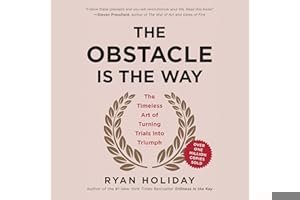
The Obstacle Is the Way: The Timeless Art of Turning Trials into Triumph
“The impediment to action advances action. What stands in the way becomes the way.” — Marcus Aurelius
We are stuck, stymied, frustrated. But it needn’t be this way. There is a formula for success that’s been followed by the icons of history—from John D. Rockefeller to Amelia Earhart to Ulysses S. Grant to Steve Jobs—a formula that let them turn obstacles into opportunities. Faced with impossible situations, they found the astounding triumphs we all seek.
These men and women were not exceptionally brilliant, lucky, or gifted. Their success came from timeless philosophical principles laid down by a Roman emperor who struggled to articulate a method for excellence in any and all situations.
This book reveals that formula for the first time—and shows us how we can turn our own adversity into advantage.
…
Recommended by James Altucher, Marvin Liao, Alok Kejriwal, and 19 others.
My life has been beset with obstacles. It takes practice (and pain) to surmount them and achieve success. This author’s book is a how-to guide for just that. [source]
Marvin Liao
Partner/500 Startups
My list would be (besides the ones I mentioned in answer to the previous question) both business & Fiction/Sci-Fi and ones I personally found helpful to myself. The business books explain just exactly how business, work & investing are in reality & how to think properly & differentiate yourself. On the non-business side, a mix of History & classic fiction to understand people, philosophy to make sense of life and Science fiction to picture what the future could be like (not always utopian). [source]
Alok Kejriwal
The Obstacle is the way - Book review Read the book for the trivia and the amazing factual knowledge points inside. The message will automatically come through. See pic for review https://t.co/xkhms66w9d [source]
"Thought-provoking and charming."-- "Library Journal" Not all Great Masters of Wisdom are venerable graybeards. One is as familiar to us as that beloved teddy bear Winnie the Pooh. From the "how" of Pooh to the Tao of Pooh is a simple, effortless, joyous step...a delicious journey to Pooh Corner illuminated by the timeless teachings of the Taoist immortals.
Recommended by Audrey Russo.
Audrey Russo
Question: What books would you recommend to young people interested in your career path? Answer: Anything by Peter Senge. The Hard Thing About Hard Things – Ben Horowitz Once you are Lucky, Twice you are good – Sara Lacey Revolutionary Wealth – Alvin Toffler Black Swan – Taleb Reset: My Fight for Inclusion and Lasting Change, by Ellen Pao. Creative Class – Richard Florida Creativity Inc. by Ed Catmull & Amy Wallace Liar’s Poker by Michael Lewis American Government 101: From the Continental Congress to the Iowa Caucus, Everything You Need to Know About US Politics – Kathleen Spears The Tao of Pooh by Benjamin Hoff. Anna Karenina by Leo Tolstoy. Any book by Herman Hesse The Art of War by Sun Tzu. [source]
Cover unavailable
34
Being and Time
Martin Heidegger, John Macquarrie, et al.
4.2
One of the most important philosophical works of our time, a work that has had tremendous influence on philosophy, literature, and psychology, and has literally changed the intellectual map of the modern world.
Recommended by Simon Critchley.
Simon Critchley
Heidegger gives us the analytical tools for understanding human existence in the world. [source]
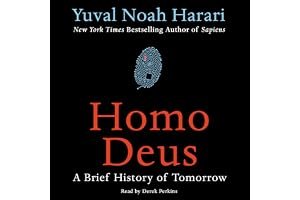
Yuval Noah Harari, author of the critically-acclaimed New York Times bestseller and international phenomenon Sapiens, returns with an equally original, compelling, and provocative book, turning his focus toward humanity’s future, and our quest to upgrade humans into gods.
Over the past century humankind has managed to do the impossible and rein in famine, plague, and war. This may seem hard to accept, but, as Harari explains in his trademark style—thorough, yet riveting—famine, plague and war have been transformed from incomprehensible and uncontrollable forces of nature into manageable challenges. For the first time ever, more people die from eating too much than from eating too little; more people die from old age than from infectious diseases; and more people commit suicide than are killed by soldiers, terrorists and criminals put together. The average American is a thousand times more likely to die from binging at McDonalds than from being blown up by Al Qaeda.
What then will replace famine, plague, and war at the top of the human agenda? As the self-made gods of planet earth, what destinies will we set ourselves, and which quests will we undertake? Homo Deus explores the projects, dreams and nightmares that will shape the twenty-first century—from overcoming death to creating artificial life. It asks the fundamental questions: Where do we go from here? And how will we protect this fragile world from our own destructive powers? This is the next stage of evolution. This is Homo Deus.
With the same insight and clarity that made Sapiens an international hit and a New York Times bestseller, Harari maps out our future.
Harari’s new book is as challenging and readable as Sapiens. Rather than looking back, as Sapiens does, it looks to the future. I don’t agree with everything the author has to say, but he has written a thoughtful look at what may be in store for humanity. [source]
I certainly wouldn’t consider myself a big reader of paleontology or anthropology – not good words for us dyslexics! – but I enjoy learning about how society has unfolded and history has developed in an exciting, easy to read way. The sequel, Homo Deus: A Brief History of Tomorrow, is a fascinating look into the future too. While these aren’t traditional business or leadership books, they are all about people – and learning how to work with, live with, interact with people and get the best out of them is what leadership is all about. [source]
Not that I agree with all of it, but it is still mind-bending speculation about our future as a follow-up to a previous favorite, Sapiens. It’s directionally right. [source]
This lively new translation with clear explanatory notes by one of the foremost scholars of classical Chinese provides the ideal introduction to the Analects for readers who have no previous knowledge of the Chinese language and philosophical traditions.
"How dare I claim to be a sage or a benevolent man?"
By constructing the philosophy expressed through The Analects, Confucius might well dare to make such a claim. The Analects are a collection of Confucius' sayings, compiled by his pupils shortly after his death in 497 B.C., and they reflect the extent to which Confucius held up a moral ideal for all men. The aim is the perfection of one's moral character, the method one of arduous pursuit of such moral attributes as benevolence, wisdom, courage; the result is no recompense either in this life or the next – to follow the Way must be its own reward. A harsh philosophy perhaps, but shining through it is the splendid intellect and spirit of one of the most reasonable and humane thinkers of all time.
…
Recommended by Andrew Hui, Daniel A. Bell, and Michael Puett.
Andrew Hui
This edition is really good at showing both the constructed-ness of the original Analects and the vast exegetical machine that has driven the Chinese philosophical tradition through the centuries. [source]
Daniel A. Bell
It’s not written by Confucius himself. It is more a collection of anecdotes of how he engaged his students. [source]
Michael Puett
He believed one of our dangers is that we fall into ruts that are defined by the world around us. [source]
Cover unavailable
37
The Black Swan: The Impact of the Highly Improbable
A black swan is a highly improbable event with three principal characteristics: It is unpredictable; it carries a massive impact; and, after the fact, we concoct an explanation that makes it appear less random, and more predictable, than it was.
The astonishing success of Google was a black swan; so was 9/11. For Nassim Nicholas Taleb, black swans underlie almost everything about our world, from the rise of religions to events in our own personal lives.
Why do we not acknowledge the phenomenon of black swans until after they occur? Part of the answer, according to Taleb, is that humans are hardwired to learn specifics when they should be focused on generalities.
We concentrate on things we already know and time and time again fail to take into consideration what we don’t know. We are, therefore, unable to truly estimate opportunities, too vulnerable to the impulse to simplify, narrate, and categorize, and not open enough to rewarding those who can imagine the “impossible.”
For years, Taleb has studied how we fool ourselves into thinking we know more than we actually do. We restrict our thinking to the irrelevant and inconsequential, while large events continue to surprise us and shape our world. Now, in this revelatory book, Taleb explains everything we know about what we don’t know. He offers surprisingly simple tricks for dealing with black swans and benefiting from them.
Elegant, startling, and universal in its applications The Black Swan will change the way you look at the world. Taleb is a vastly entertaining writer, with wit, irreverence, and unusual stories to tell. He has a polymathic command of subjects ranging from cognitive science to business to probability theory.
The Black Swan is a landmark book – itself a black swan.
The book also contains a 4-page glossary; 19 pages of notes; and, a 28-page bibliography in addition to an index.
From the book "The Everything Store: and the Age of Amazon" “The scholar argues that people are wired to see patterns in chaos while remaining blind to unpredictable events, with massive consequences. Experimentation and empiricism trumps the easy and obvious narrative,” Stone writes. [source]
And throw in “The Black Swan” and “Fooled by Randomness”. “Fragile” means if you hit something might break. “Resilient” means if you hit something, it will stay the same. On my podcast Nassim discusses “Antifragility” – building a system, even on that works for you on a personal level, where you if you harm your self in some way it becomes stronger. That podcast changed my life He discusses Antifragility throughout history, up to our current economic situation, and even in our personal situations. [source]
From the bestselling author of The Black Swan and one of the foremost philosophers of our time, Nassim Nicholas Taleb, a book on how some systems actually benefit from disorder.
In The Black Swan Taleb outlined a problem; in Antifragile he offers a definitive solution: how to gain from disorder and chaos while being protected from fragilities and adverse events. For what he calls the "antifragile" is one step beyond robust, as it benefits from adversity, uncertainty and stressors, just as human bones get stronger when subjected to stress and tension.
Taleb stands uncertainty on its head, making it desirable, and proposing that things be built in an antifragile manner. Extremely ambitious and multidisciplinary, Antifragile provides a blueprint for how to behave-and thrive-in a world we don't understand and which is too uncertain for us to even try to understand. He who is not antifragile will perish. Why is the city state better than the nation state, why is debt bad for you, and why is almost everything modern bound to fail? The book covers innovation, health, biology, medicine, life decisions, politics, foreign policy, urban planning, war, personal finance, and economic systems. Throughout, the voice and recipes of the ancient wisdom from Phoenician, Roman, Greek, and Medieval sources are heard loud and clear.
You ask about success. To be successful you have to avoid being “fragile” – the idea that if something hurts you, you let collapse completely. You also have to avoid simply being resilient. Bouncing back is not enough. Antifragile is when something tries to hurt you and you come back stronger. That is real life business. That is real life success. Nassim focuses on the economy. But when I read the book I kept asking myself, “how can I apply this to the areas of my life where I feel most fragile?” [source]
Marvin Liao
Partner/500 Startups
My list would be (besides the ones I mentioned in answer to the previous question) both business & Fiction/Sci-Fi and ones I personally found helpful to myself. The business books explain just exactly how business, work & investing are in reality & how to think properly & differentiate yourself. On the non-business side, a mix of History & classic fiction to understand people, philosophy to make sense of life and Science fiction to picture what the future could be like (not always utopian). [source]
Vlad Tenev
The general concept is applicable to many fields beyond biology, for instance finance, economics and monetary policy. [source]
Cover unavailable
39
An Enquiry Concerning Human Understanding
David Hume
4.1
A landmark of Enlightenment thought, Hume's An Enquiry Concerning Human Understanding is accompanied here by two shorter works that shed light on it: A Letter from a Gentleman to His Friend in Edinburgh, Hume's response to those accusing him of atheism, of advocating extreme skepticism, and of undermining the foundations of morality; and his Abstract of A Treatise of Human Nature, which anticipates discussions developed in the Enquiry.
In the Enquiry he puts forward his particular empirical account of the mind. There’s a whole section on morality and so on, but the key bit for me is where he’s talking about how, following on from John Locke and the tradition of seeing the mind as a blank slate, we get ideas from what he calls ‘sense impressions’. If you think of an impression as like a footprint left in the sand, the senses get impressed, somewhat passively, by information that comes in from outside. And the impression that’s left in the mind, when we think about it away from what we’re seeing, is called an idea. [source]
Hume thought that overconfidence and dogmatism led to intolerance, to faction, to a lot of the crimes of human history. [source]
Cover unavailable
40
Nausea
Jean-Paul Sartre, Lloyd Alexander, et al.
4.1
Nausea is the story of Antoine Roquentin, a French writer who is horrified at his own existence. In impressionistic, diary form he ruthlessly catalogues his every feeling and sensation about the world and people around him.
His thoughts culminate in a pervasive, overpowering feeling of nausea which "spread at the bottom of the viscous puddle, at the bottom of our time, the time of purple suspenders and broken chair seats; it is made of wide, soft instants, spreading at the edge, like an oil stain."
Roquentin's efforts to try and come to terms with his life, his philosophical and psychological struggles, give Sartre the opportunity to dramatize the tenets of his Existentialist creed.
The introduction for this edition of Nausea by Hayden Carruth gives background on Sartre's life and major works, a summary of the principal themes of Existentialist philosophy, and a critical analysis of the novel itself.
Existentialists like Sartre are big on the idea that you can’t just relate a philosophical worldview by simply stating values, techniques, and facts. To understand existentialism, you must feel it. Breathe its ambience. It’s like a tonal curve for life. Yes, we can talk about highlights, shadows, and all the mechanical elements of that tonal curve, but you won’t become an artist just by knowing these mechanics. It goes much deeper than that. So Nausea is a novel, which imparts the existentialist tonal curve. I’m only halfway through it, but I’m liking it a lot already. It’s not as wild or erratic as Notes from Underground, but it’s got that similar feel. That the narrator gives us a mirror to reflect in, and those reflections are novel because we’re outside the normal tonal curve. [source]
Samantha Harvey
The question of mental illness comes down to whether Sartre’s right about his philosophy, which is an interesting question. [source]
The Little Prince Family Storybook: Unabridged Original Text
Antoine de Saint-Exupéry
4.1
Rediscover Antoine de Saint-Exupery's universal masterpiece with original text and magnificent new illustrations created by masters of film animation. This wise and enchanginting fable teaches the secret of what is really important in life.
Recommended by Ryan Holiday, Brandon Stanton, Evan Goldberg, and 1 others.
Equally allegorical, I read The Little Prince for the first time which for some reason I’d never been exposed to before. If you’re in the same boat, read it. It’s short but great. [source]
Brandon Stanton
Brandon Stanton recommended this book on the podcast "The Tim Ferriss Show". [source]
The Genealogy of Morals (Translated by Horace B. Samuel with an Introduction by Willard Huntington Wright)
Friedrich Nietzsche, Horace B. Samuel, Willard Huntington Wright
4.1
German philosopher, Friedrich Nietzsche was one the most controversial figures of the 19th century. His evocative writings on religion, morality, culture, philosophy, and science were often polemic attacks against the established views of his time. First published in 1887, "The Genealogy of Morals," is a work which follows and expands upon the principles of his previous works, "Thus Spoke Zarathustra" and "Beyond Good and Evil." In a preface and three interrelated essays, Nietzsche outlines his theories on the origins of our moral prejudices. "The Genealogy of Morals," was written partly in response to his friend Paul R�e's book "The Origin of the Moral Sensations," whose genealogical hypothesis of morality he found unsatisfactory. Nietzsche begins by reiterating in his first essay the historical conflict between socio-economic classes that has given rise to the varying definitions of good and evil. In the second essay, Nietzsche discusses the origins of the institution of punishment, asserting that it arises from a straightforward relationship between creditors and debtors. Lastly, in the third essay, the philosopher considers the meaning of ascetic ideals. A classic work of moral philosophy, "The Genealogy of Morals" is considered by many as one of Nietzsche's finest. This edition is printed on premium acid-free paper, follows the translation of Horace B. Samuel, and includes an introduction by Willard Huntington Wright.
I don’t know I would single it out as the masterpiece, but it’s a fascinating book which follows on many of the themes of Beyond Good and Evil. It’s unusual because it’s less aphoristic, but rather three essays. The essays have more structure and extended argumentation than is typical in most of Nietzsche’s works. [source]
Of course, I read Nietzsche. On the Genealogy of Morality, etc, where the truths and the truisms are really cut and dried in a lot of ways. It's the equivalent of, I guess, intellectual red meat. [source]
An alternative cover edition for this ISBN can be found here.
Since it appeared in 1971, John Rawls’s A Theory of Justice has become a classic. The author has now revised the original edition to clear up a number of difficulties he and others have found in the original book.
Rawls aims to express an essential part of the common core of the democratic tradition—justice as fairness—and to provide an alternative to utilitarianism, which had dominated the Anglo-Saxon tradition of political thought since the nineteenth century. Rawls substitutes the ideal of the social contract as a more satisfactory account of the basic rights and liberties of citizens as free and equal persons. “Each person,” writes Rawls, “possesses an inviolability founded on justice that even the welfare of society as a whole cannot override.” Advancing the ideas of Rousseau, Kant, Emerson, and Lincoln, Rawls’s theory is as powerful today as it was when first published.
…
Recommended by Azeem Azhar, Ann Miura-Ko, Jonathan Wolff, and 1 others.
Ann Miura-Ko
Actually a dialogue and a real logical debate. [source]
Jonathan Wolff
Rawls wants you to think about how you would design society if you didn’t know what place you’d play in it. [source]
Lucas Morales
Depending on your interest and goals, if you are like me and always looking for the trends in the big picture then I highly recommend being an active contrarian reader. Read what no one else is reading. Your goal is to think outside the box. To look at the world and ask “why hasn’t this been solved?” And that gives you a roadmap as to what opportunities may exist for your entrepreneurial efforts. So to that, here’s a snapshot, in no particular order, of what might help you push your intellectual boundaries: Born a Crime: Stories from a South African Childhood by Trevor Noah 23 Things They Don't Tell You About Capitalism by Ha-Joon Chang Postcapitalism: A Guide to Our Future by Paul Mason Capital in the Twenty-First Century by Thomas Piketty Who Gets What--And Why: The New Economics of Matchmaking and Market Design by Alvin E. Roth The Political Economy of Participatory Economics by Michael Albert and Robin Hahnel The Zero Marginal Cost Society: The Internet of Things, the Collaborative Commons, and the Eclipse of Capitalism by Jeremy Rifkin Why America Misunderstands the World by Paul R. Pillar A Theory of Justice by John Rawls Prisoners of Geography by Tim Marshall [source]
Cover unavailable
44
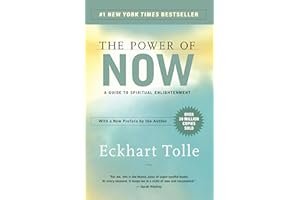
The Power of Now: A Guide to Spiritual Enlightenment
Eckhart Tolle is emerging as one of today's most inspiring teachers. In The Power of Now, a #1 national bestseller, the author describes his transition from despair to self-realization soon after his 29th birthday. Tolle took another ten years to understand this transformation, during which time he evolved a philosophy that has parallels in Buddhism, relaxation techniques, and meditation theory but is also eminently practical. In The Power of Now he shows readers how to recognize themselves as the creators of their own pain, and how to have a pain-free existence by living fully in the present. Accessing the deepest self, the true self, can be learned, he says, by freeing ourselves from the conflicting, unreasonable demands of the mind and living present, fully, and intensely, in the Now.
…
Recommended by Bill Liao, Catherine Plano, Darrah Brustein, and 7 others.
Bill Liao
The human world occurs in language so best get good at it! [source]
Catherine Plano
The one that really resonates with me and still to this day is The Power of NOW from Eckhart Tolle because as an entrepreneur we get so caught up in the future that we fail to be 'present'. The reality of it all when you really think about it - the present is all we have that is real, it requires no effort, nor time. I practice this daily, if I feel uncomfortable then I know I am trying too hard and not being present but when I am being present it is easier to think about what I have to do right now, because now is all that matters. [source]
Darrah Brustein
Others include The Power Of Now which is powerful reminder that all we have is the present and helps give you meaningful ways to live in it, not in the past or the future. [source]
Cover unavailable
45
Leviathan
Thomas Hobbes
4.1
'The life of man, solitary, poore, nasty, brutish, and short'
Written during the chaos of the English Civil War, Thomas Hobbes' Leviathan asks how, in a world of violence and horror, can we stop ourselves from descending into anarchy? Hobbes' case for a 'common-wealth' under a powerful sovereign - or 'Leviathan' - to enforce security and the rule of law, shocked his contemporaries, and his book was publicly burnt for sedition the moment it was published. But his penetrating work of political philosophy - now fully revised and with a new introduction for this edition - opened up questions about the nature of statecraft and society that influenced governments across the world.
The best reason for reading Hobbes is that no other philosopher has ever used the English language to such powerful effect. It is a really remarkable feat of dialectic. You find yourself agreeing with him at each stage of the reasoning as he builds up his case then, quite suddenly, you find that you’ve arrived at a conclusion which seems intolerable. [source]
Jonathan Wolff
Written more than three-and-a-half centuries ago in the shadow of the English Civil War, Leviathan remains a profound and relevant study. [source]
Michael Peel
The idea of ‘the war of all against all’, what a man wins through strength is what he gets, has parallels in modern Nigeria. [source]
Cover unavailable
46
Enlightenment Now: The Case for Reason, Science, Humanism, and Progress
If you think the world is coming to an end, think again: people are living longer, healthier, freer, and happier lives, and while our problems are formidable, the solutions lie in the Enlightenment ideal of using reason and science.
Is the world really falling apart? Is the ideal of progress obsolete? In this elegant assessment of the human condition in the third millennium, cognitive scientist and public intellectual Steven Pinker urges us to step back from the gory headlines and prophecies of doom, which play to our psychological biases. Instead, follow the data: In seventy-five jaw-dropping graphs, Pinker shows that life, health, prosperity, safety, peace, knowledge, and happiness are on the rise, not just in the West, but worldwide. This progress is not the result of some cosmic force. It is a gift of the Enlightenment: the conviction that reason and science can enhance human flourishing.
Far from being a naïve hope, the Enlightenment, we now know, has worked. But more than ever, it needs a vigorous defense. The Enlightenment project swims against currents of human nature–tribalism, authoritarianism, demonization, magical thinking–which demagogues are all too willing to exploit. Many commentators, committed to political, religious, or romantic ideologies, fight a rearguard action against it. The result is a corrosive fatalism and a willingness to wreck the precious institutions of liberal democracy and global cooperation.
With intellectual depth and literary flair, Enlightenment Now makes the case for reason, science, and humanism: the ideals we need to confront our problems and continue our progress.
Pinker is at his best when he analyzes historic trends and uses data to put the past into context. I was already familiar with a lot of the information he shares—especially about health and energy—but he understands each subject so deeply that he’s able to articulate his case in a way that feels fresh and new. I love how he’s willing to dive deep into primary data sources and pull out unexpected signs of progress. I tend to point to things like dramatic reductions in poverty and childhood deaths, because I think they’re such a good measure of how we’re doing as a society. Pinker covers those areas, but he also looks at more obscure topics. Here are five of my favorite facts from the book that show how the world is improving: 1. You’re 37 times less likely to be killed by a bolt of lightning than you were at the turn of the century—and that’s not because there are fewer thunderstorms today. It’s because we have better weather prediction capabilities, improved safety education, and more people living in cities. 2. Time spent doing laundry fell from 11.5 hours a week in 1920 to an hour and a half in 2014. This might sound trivial in the grand scheme of progress. But the rise of the washing machine has improved quality of life by freeing up time for people—mostly women—to enjoy other pursuits. That time represents nearly half a day every week that could be used for everything from binge-watching Ozark or reading a book to starting a new business. 3. You’re way less likely to die on the job. Every year, 5,000 people die from occupational accidents in the U.S. But in 1929—when our population was less than two-fifths the size it is today—20,000 people died on the job. People back then viewed deadly workplace accidents as part of the cost of doing business. Today, we know better, and we’ve engineered ways to build things without putting nearly as many lives at risk. 4. The global average IQ score is rising by about 3 IQ points every decade. Kids’ brains are developing more fully thanks to improved nutrition and a cleaner environment. Pinker also credits more analytical thinking in and out of the classroom. Think about how many symbols you interpret every time you check your phone’s home screen or look at a subway map. Our world today encourages abstract thought from a young age, and it’s making us smarter. 5. War is illegal. This idea seems obvious. But before the creation of the United Nations in 1945, no institution had the power to stop countries from going to war with each other. Although there have been some exceptions, the threat of international sanctions and intervention has proven to be an effective deterrent to wars between nations. [source]
There is of course much to argue about, but that’s what makes this book so interesting.
Cover unavailable
47
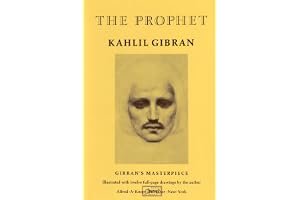
The Prophet
Kahlil Gibran
4.1
Kahlil Gibran’s masterpiece, The Prophet, is one of the most beloved classics of our time. Published in 1923, it has been translated into more than twenty languages, and the American editions alone have sold more than nine million copies.
The Prophet is a collection of poetic essays that are philosophical, spiritual, and, above all, inspirational. Gibran’s musings are divided into twenty-eight chapters covering such sprawling topics as love, marriage, children, giving, eating and drinking, work, joy and sorrow, housing, clothes, buying and selling, crime and punishment, laws, freedom, reason and passion, pain, self-knowledge, teaching, friendship, talking, time, good and evil, prayer, pleasure, beauty, religion, and death.
…
Recommended by Naval Ravikant, Daylon Soh, Jason Nemer, and 3 others.
It actually read like a modern-day poetic religious tome. Up there with the Bhagavad-gita, the Tao Te Ching, The Bible, The Qur’an. It was written in that style where it had that feel of religiosity and truth, but it was very approachable and beautiful and non-denominational and non-secretarian. I really liked that. I loved that book. He has a gift for poetically describing what children are like, what lovers are like, what marriage should be like, how you should treat your enemies and your friends, how you should work with money, what can you think of every time you have to kill something to eat it. I felt, like the great religious books, it gave a very deep, very philosophical, but very true answer to how to approach the major problems in life. I recommend The Prophet to anybody, whether you’re religious or not. Whether you are Christian or Hindu or Jewish or Atheist. I think it’s a beautiful book, and it’s worth reading. [source]
Daylon Soh
The non-business book that has connected to my being most deeply would be poems in The Prophet by Kahlil Gibran. [source]
Jason Nemer
I love really condensed, shakti empowerment-filled, energy-filled statements - something that you can read in a few minutes or you can read for your whole life. [source]
Cover unavailable
48
Being and Nothingness
Jean-Paul Sartre
4.1
Being & Nothingness is without doubt one of the most significant philosophical books of the 20th century. The central work by one of the century's most influential thinkers, it altered the course of western philosophy. Its revolutionary approach challenged all previous assumptions about the individual's relationship with the world. Known as 'the Bible of existentialism', its impact on culture & literature was immediate & was felt worldwide, from the absurdist drama of Samuel Beckett to the soul-searching cries of the Beat poets. Being & Nothingness is one of those rare books whose influence has affected the mindset of subsequent generations. Seventy years after its 1st publication, its message remains as potent as ever--challenging readers to confront the fundamental dilemmas of human freedom, choice, responsibility & action.
…
Cover unavailable
49
Gödel, Escher, Bach: An Eternal Golden Braid
Douglas R. Hofstadter
4.1
Douglas Hofstadter's book is concerned directly with the nature of “maps” or links between formal systems. However, according to Hofstadter, the formal system that underlies all mental activity transcends the system that supports it. If life can grow out of the formal chemical substrate of the cell, if consciousness can emerge out of a formal system of firing neurons, then so too will computers attain human intelligence. Gödel, Escher, Bach is a wonderful exploration of fascinating ideas at the heart of cognitive science: meaning, reduction, recursion, and much more.
…
Recommended by Steve Jurvetson, Seth Godin, Cory Zue, and 2 others.
Steve Jurvetson
Steve Jurvetson recommended this book on the podcast "The Tim Ferriss Show". [source]
In the last week, I discovered that at least two of my smart friends hadn't read Godel, Escher, Bach. They have now. You should too. [source]
Cory Zue
More recently books like Godel, Escher, Bach and Sapiens have influenced my thinking a lot. [source]
Cover unavailable
50
Candide, ou l'Optimisme
Voltaire, Tobias Smollett
4.1
Candide, ou l'Optimisme is a French satire first published in 1759 by Voltaire, a philosopher of the Age of Enlightenment. The novella has been widely translated, with English versions titled Candide: or, All for the Best (1759); Candide: or, The Optimist (1762); and Candide: or, Optimism (1947). It begins with a young man, Candide, who is living a sheltered life in an Edenic paradise and being indoctrinated with Leibnizian optimism (or simply Optimism) by his mentor, Pangloss. The work describes the abrupt cessation of this lifestyle, followed by Candide's slow, painful disillusionment as he witnesses and experiences great hardships in the world. Voltaire concludes with Candide, if not rejecting optimism outright, advocating a deeply practical precept, "we must cultivate our garden," in lieu of the Leibnizian mantra of Pangloss, "all is for the best" in the "best of all possible worlds." Candide is characterised by its sarcastic tone, as well as by its erratic, fantastical and fast-moving plot. A picaresque novel with a story similar to that of a more serious bildungsroman, it parodies many adventure and romance cliches, the struggles of which are caricatured in a tone that is mordantly matter-of-fact. Still, the events discussed are often based on historical happenings, such as the Seven Years' War and the 1755 Lisbon earthquake. As philosophers of Voltaire's day contended with the problem of evil, so too does Candide in this short novel, albeit more directly and humorously. Voltaire ridicules religion, theologians, governments, armies, philosophies, and philosophers through allegory; most conspicuously, he assaults Leibniz and his optimism. As expected by Voltaire, Candide has enjoyed both great success and great scandal. Immediately after its secretive publication, the book was widely banned because it contained religious blasphemy, political sedition and intellectual hostility hidden under a thin veil of naivete. However, with its sharp wit and insightful portrayal of the human condition, the novel has since inspired many later authors and artists to mimic and adapt it. Today, Candide is recognized as Voltaire's magnum opus and is often listed as part of the Western canon; it is arguably taught more than any other work of French literature. In his book of intellectual history Martin Seymour-Smith listed Candide as one of The 100 Most Influential Books Ever Written. Candide contains thirty episodic chapters, which may be grouped into two main schemes: one consists of two divisions, separated by the protagonist's hiatus in El Dorado; the other consists of three parts, each defined by its geographical setting. By the former scheme, the first half of Candide constitutes the rising action and the last part the resolution. This view is supported by the strong theme of travel and quest, reminiscent of adventure and picaresque novels, which tend to employ such a dramatic structure. By the latter scheme, the thirty chapters may be grouped into three parts each comprising ten chapters and defined by locale: I-X are set in Europe, XI-XX are set in the Americas, and XXI-XXX are set in Europe and the Ottoman Empire. The plot summary that follows uses this second format and includes Voltaire's additions of 1761. Chapters I-X The tale of Candide begins in the castle of the Baron Thunder-ten-Tronckh in Westphalia, home to the Baron's daughter, Lady Cunegonde; his bastard nephew, Candide; a tutor, Pangloss; a chambermaid, Paquette; and the rest of the Baron's family. The protagonist, Candide, is romantically attracted to Cunegonde. He is a child of "the most unaffected simplicity," whose face is "the index of his mind." Dr. Pangloss, professor of "metaphysico-theologo-cosmolonigologie" (English translation: "metaphysico-theologo-cosmonigology") and self-proclaimed optimist, teaches his pupils that they live in the "best of all possible worlds" and that "all is for the best."
…
Cover unavailable
51
The Story of Philosophy
Will Durant
4.1
This endlessly inspiring & instructive chronicle of the worlds greatest thinkers, from Socrates to Santayana, describes not only their ideas but their place in history & their influence on our modern intellectual heritage.
"For Michael Sandel, justice is not a spectator sport," The Nation's reviewer of Justice remarked. In his acclaimed book―based on his legendary Harvard course―Sandel offers a rare education in thinking through the complicated issues and controversies we face in public life today. It has emerged as a most lucid and engaging guide for those who yearn for a more robust and thoughtful public discourse. "In terms we can all understand," wrote Jonathan Rauch in The New York Times, Justice "confronts us with the concepts that lurk . . . beneath our conflicts."
Affirmative action, same-sex marriage, physician-assisted suicide, abortion, national service, the moral limits of markets―Sandel relates the big questions of political philosophy to the most vexing issues of the day, and shows how a surer grasp of philosophy can help us make sense of politics, morality, and our own convictions as well.
Justice is lively, thought-provoking, and wise―an essential new addition to the small shelf of books that speak convincingly to the hard questions of our civic life.
The reason I picked this book is because I think Michael Sandel is an outstanding speaker and writer in his ability to bring philosophy alive. He can take a thinker like Aristotle and make him completely relevant to the present day, to show how his ideas have applications in our everyday lives. [source]
Cover unavailable
53
Fear and Trembling
Soren Kierkegaard
4.1
Soren Kierkegaard was a Danish philosopher, theologian, and religious author interested in human psychology. He is regarded as a leading pioneer of existentialism and one of the greatest philosophers of the 19th Century.
In Fear and Trembling, Kierkegaard wanted to understand the anxiety that must have been present in Abraham when God commanded him to offer his son as a human sacrifice. Abraham had a choice to complete the task or to forget it. He resigned himself to the loss of his son, acting according to his faith. In other words, one must be willing to give up all his or her earthly possessions in infinite resignation and must also be willing to give up whatever it is that he or she loves more than God. Abraham had passed the test -- his love for God proved greater than anything else in him. And because a good and just Creator would not want a father to kill his son, God intervened at the last moment to prevent the sacrifice.
While most of the 20th century existentialists, like Sartre and Camus, were devout atheists, Kierkegaard is an existentialist obsessed with faith. Fear and Trembling is a very long, and at times obtuse, meditation on the topic of faith and doubt. It uses the story of Abraham and Isaac to contrast the ideas of faith and humanism. Kierkegaard is in awe of Abraham’s faith and how it compels him to sacrifice Isaac, and he uses that to interrogate the topic of faith in general. I found the theological acrobatics employed by Kierkegaard a bit strained, to say the least. But it was a fascinating read none the less, and Kierkegaard’s language and metaphors and incredible depth is inspiring. I’m keen to give this a read in the original Danish form. [source]
Cover unavailable
54
Behave: The Biology of Humans at Our Best and Worst
"It's no exaggeration to say that Behave is one of the best nonfiction books I've ever read." --David P. Barash, The Wall Street Journal
"It has my vote for science book of the year." --Parul Sehgal, The New York Times
"Hands-down one of the best books I've read in years. I loved it." --Dina Temple-Raston, TheWashington Post Named a Best Book of the Year by The Washington Post and The Wall Street Journal
From the celebrated neurobiologist and primatologist, a landmark, genre-defining examination of human behavior, both good and bad, and an answer to the question: Why do we do the things we do?
Sapolsky's storytelling concept is delightful but it also has a powerful intrinsic logic: he starts by looking at the factors that bear on a person's reaction in the precise moment a behavior occurs, and then hops back in time from there, in stages, ultimately ending up at the deep history of our species and its evolutionary legacy.
And so the first category of explanation is the neurobiological one. A behavior occurs--whether an example of humans at our best, worst, or somewhere in between. What went on in a person's brain a second before the behavior happened? Then Sapolsky pulls out to a slightly larger field of vision, a little earlier in time: What sight, sound, or smell caused the nervous system to produce that behavior? And then, what hormones acted hours to days earlier to change how responsive that individual is to the stimuli that triggered the nervous system? By now he has increased our field of vision so that we are thinking about neurobiology and the sensory world of our environment and endocrinology in trying to explain what happened.
Sapolsky keeps going: How was that behavior influenced by structural changes in the nervous system over the preceding months, by that person's adolescence, childhood, fetal life, and then back to his or her genetic makeup? Finally, he expands the view to encompass factors larger than one individual. How did culture shape that individual's group, what ecological factors millennia old formed that culture? And on and on, back to evolutionary factors millions of years old.
The result is one of the most dazzling tours d'horizon of the science of human behavior ever attempted, a majestic synthesis that harvests cutting-edge research across a range of disciplines to provide a subtle and nuanced perspective on why we ultimately do the things we do...for good and for ill. Sapolsky builds on this understanding to wrestle with some of our deepest and thorniest questions relating to tribalism and xenophobia, hierarchy and competition, morality and free will, and war and peace. Wise, humane, often very funny, Behave is a towering achievement, powerfully humanizing, and downright heroic in its own right.
Bryan Johnson recommended this book on Twitter. [source]
Cover unavailable
55
The Fountainhead
Ayn Rand
4.1
The revolutionary literary vision that sowed the seeds of Objectivism, Ayn Rand's groundbreaking philosophy, and brought her immediate worldwide acclaim.
This modern classic is the story of intransigent young architect Howard Roark, whose integrity was as unyielding as granite...of Dominique Francon, the exquisitely beautiful woman who loved Roark passionately, but married his worst enemy...and of the fanatic denunciation unleashed by an enraged society against a great creator. As fresh today as it was then, Rand's provocative novel presents one of the most challenging ideas in all of fiction--that man's ego is the fountainhead of human progress...
"A writer of great power. She has a subtle and ingenious mind and the capacity of writing brilliantly, beautifully, bitterly...This is the only novel of ideas written by an American woman that I can recall."--The New York Times
A few months ago, I was drinking a Noah’s Mill whiskey (cute) with my good buddy Brian Balfour and talking about life... During the conversation, we got on the topic of books that changed our lives. I want to share them with you. I judge a book's success if a year later I'm still using at least 1 thing from the book. [source]
Ashley Hathaway
Sometimes I want to nerd out and pick a heavy non-fiction book. I was reading The Fountainhead earlier this year which was pretty beefy. Got that checked off the list. [source]
In his book, Smith fervently extolled the simple yet enlightened notion that individuals are fully capable of setting and regulating prices for their own goods and services. He argued passionately in favor of free trade, yet stood up for the little guy. The Wealth of Nations provided the first--and still the most eloquent--integrated description of the workings of a market economy.
Obama, unsurprisingly, appears to be more drawn to stories sympathetic to the working classes than is McCain. Obama cites John Steinbeck’s “In Dubious Battle,” about a labor dispute; Robert Caro’s “Power Broker,” about Robert Moses; and Studs Terkel’s “Working.” But he also includes Adam Smith’s “Wealth of Nations” and “Theory of Moral Sentiments” on his list. [source]
Which books should be read by every single intelligent person on planet? … The Wealth of Nations (Smith) to learn that capitalism is an economy of greed, a force of nature unto itself. If you read all of the above works you will glean profound insight into most of what has driven the history of the western world. [source]
I read The Bhagavad Gita, which is something I wasn’t ready for before, but glad to finally understand. [source]
Bernard Tan
The “Tao Te King” by Lao Tzu probably resonated with me the strongest, but others like the “Art of War” by Sun Tzu, “Bhagavad Gita” or Zen Buddhist scriptures were also real eye-openers, even for a non-religious person like myself. [source]
Bill Liao
The human world occurs in language so best get good at it! [source]
Cover unavailable
58
Confessions
Augustine of Hippo
4.1
Augustine's Confessions is one of the most influential and most innovative works of Latin literature. Written in the author's early forties in the last years of the fourth century A.D. and during his first years as a bishop, they reflect on his life and on the activity of remembering and interpreting a life. Books I-IV are concerned with infancy and learning to talk, schooldays, sexual desire and adolescent rebellion, intense friendships and intellectual exploration. Augustine evolves and analyses his past with all the resources of the reading which shaped his mind: Virgil and Cicero, Neoplatonism and the Bible. This volume, which aims to be usable by students who are new to Augustine, alerts readers to the verbal echoes and allusions of Augustine's brilliant and varied Latin, and explains his theological and philosophical questioning of what God is and what it is to be human. The edition is intended for use by students and scholars of Latin literature, theology and Church history.
…
Recommended by A N Wilson, Carlos Eire, Paula Fredriksen, and 3 others.
A lot of people think becoming a Christian is a decision you make. St Augustine doesn’t really think that. [source]
Carlos Eire
St Augustine of Hippo was one of the first thinkers to struggle with the concepts of time, memory and eternity. [source]
Paula Fredriksen
For the reader it’s somewhat like crashing a session of classic psychoanalytic therapy: Augustine speaks, God just listens, and we overhear. [source]
Cover unavailable
59
Apology
Plato and James J. Helm
4.1
The Apology of Socrates is Plato's version of the speech given by Socrates as he unsuccessfully defended himself in 399BCE against the charges of "corrupting the young, and by not believing in the gods in whom the city believes, but in other daimonia that are novel" (24b). "Apology" here has its earlier meaning (now usually expressed by the word "apologia") of speaking in defense of a cause or of one's beliefs or actions.
The revised edition of this popular textbook features revised vocabulary and grammatical notes that now appear on the same page as the text, sentence diagrams, principal parts of verbs listed both by Stephanus page and alphabetically, word frequency list for words occurring more than twice, and complete vocabulary.
…
Recommended by Mehdi Kajbaf.
Mehdi Kajbaf
It’s difficult for me to separate all the different things I was reading and learning about at that time but I think Socrates Apology is probably the best place to focus. If you aren’t familiar with Socrates, he’s considered by most to be the father of Philosophy (which means love of wisdom). He annoyed a lot of people though because he constantly challenged their world views and encouraged them to seek truth and wisdom. He questioned everything, and eventually created too much of a stir so he was sentenced to death. In the Apology he gives a powerful speech and defense which ultimately falls short. [source]
Cover unavailable
60
The Second Sex
Simone de Beauvoir, Constance Borde, Sheila Malovany-Chevallier
4.1
Newly translated and unabridged in English for the first time, and brilliantly introduced by Judith Thurman, Simone de Beauvoir’s masterpiece weaves together history, philosophy, economics, biology, and a host of other disciplines to analyze the Western notion of “woman” and to explore the power of sexuality.
Sixty years after its initial publication, The Second Sex is still as eye-opening and pertinent as ever. This triumphant and genuinely revolutionary book began as an exceptional woman’s attempt to find out who and what she was. Drawing on extensive interviews with women of every age and station of life, masterfully synthesizing research about women’s bodies and psyches as well as their historic and economic roles, The Second Sex is an encyclopedic and cogently argued document about inequality and enforced “otherness.”
This long-awaited new translation pays particular attention to the existentialist terms and French nuances that may have been misconstrued in the first English edition; restores Beauvoir’s phrasing, rhythms, and tone; and reinstates significant portions of the “Myths” and “History” chapters that were originally cut due to length, including accounts of more than seventy female figures.
A vital and life-changing work that has dramatically revised the way women talk and think about themselves, Beauvoir’s magisterial treatise continues to provoke and inspire.
…
Recommended by Arianna Huffington, Belinda Jack, Erica Jong, and 1 others.
Arianna Huffington
Founder/The Huffington Post
Great Thrive Questionnaire by @smlafleur, founder of M.M.LaFleur. On the book that changed her life, The Second Sex: "it changed my entire perception about what it means to be a woman, and it may be the unconscious reason behind why I started my company." https://t.co/tudVOb28J2 [source]
Belinda Jack
In making a distinction between sex and gender she drew attention to how much of what women had to contend with was actually something that society imposes. [source]
Erica Jong
The French literary world is incredibly sexist and here was one of their darlings pointing out how much they discriminate. [source]
Cover unavailable
61
The Trial and Death of Socrates (Euthyphro, Apology, Crito, Phaedo (death scene only))
Plato
4.1
Chronicling the life and death of the father of western philosophy, and charting his influence on the most influential ancient Greek philosophers, Plato's The Last Days of Socrates is translated from the Greek by Hugh Tredennick, revised with an introduction and notes by Harold Tarrant in Penguin Classics.
The trial and condemnation of Socrates on charges of heresy and corrupting young minds is a defining moment in the history of Classical Athens. In tracing these events through four dialogues, Plato also developed his own philosophy, based on Socrates' manifesto for a life guided by self-responsibility. Euthyphro finds Socrates outside the court-house, debating the nature of piety, while the Apology is his robust rebuttal of the charges of impiety and a defence of the philosopher's life. In the Crito, while awaiting execution in prison, Socrates counters the arguments of friends urging him to escape. Finally, in the Phaedo, he is shown calmly confident in the face of death, skilfully arguing the case for the immortality of the soul.
Hugh Tredennick's landmark 1954 translation has been revised by Harold Tarrant, reflecting changes in Platonic studies, with an introduction and expanded introductions to each of the four dialogues.
Plato (c.427-347 BC) stands with Socrates and Aristotle as one of the shapers of the whole intellectual tradition of the West. He founded the Academy in Athens, the first permanent institution devoted to philosophical research and teaching, and the prototype of all Western universities.
If you enjoyed The Last Days of Socrates, you might like Plato's The Symposium, also available in Penguin Classics.
Belief in free will touches nearly everything that human beings value. It is difficult to think about law, politics, religion, public policy, intimate relationships, morality—as well as feelings of remorse or personal achievement—without first imagining that every person is the true source of his or her thoughts and actions. And yet the facts tell us that free will is an illusion.
In this enlightening book, Sam Harris argues that this truth about the human mind does not undermine morality or diminish the importance of social and political freedom, but it can and should change the way we think about some of the most important questions in life.
…
Recommended by A.J. Jacobs.
A.J. Jacobs
I don’t believe in free will … Some people see that as depressing but I actually find it liberating because it’s so much easier to forgive yourself for doing stupid things. [source]
Written over three centuries ago by a Samurai warrior, the book has been hailed as a limitless source of psychological insight for businessmen-or anyone who relies on strategy and tactics for outwitting the competition.
Recommended by Steve Blank, Ryan Holiday, Bill Liao, and 2 others.
Widely held as a classic, this book is much more than a manifesto and manual on swordsmanship and martial arts. It’s about the mindset, the discipline, and the perception necessary to win in life or death situations. As a swordsman, Musashi fought mostly by himself, for himself. His wisdom, therefore, is mostly internal. He tells you how to out-think and out-move your enemies. He tells you how to fend for yourself and live by a code. And isn’t that precisely what so many of us need help with every day? [source]
Bill Liao
The human world occurs in language so best get good at it! [source]
Stephane Grand
I do not believe there are business and non-business books. Business is life, you do business like the man or woman you excavate from the person you are told you are. Hence, the most potent business books are not about business, in my opinion. What makes a great business book is that it is a book that helps you find a better version of yourself. Therefore, I would say that my favorite business book is Miyamoto Musashi’s Book of Five Rings. It is an amazing inwards look at how to win battles. [source]
Cover unavailable
64
The plague
Albert Camus, Stuart Gilbert
4.1
A gripping tale of human unrelieved horror, of survival and resilience, and of the ways in which humankind confronts death, The Plague is at once a masterfully crafted novel, eloquently understated and epic in scope, and a parable of ageless moral resonance, profoundly relevant to our times. In Oran, a coastal town in North Africa, the plague begins as a series of portents, unheeded by the people. It gradually becomes a omnipresent reality, obliterating all traces of the past and driving its victims to almost unearthly extremes of suffering, madness, and compassion.
…
Recommended by Jim Collins, Arthur Ammann, Jenny Davidson, and 1 others.
Arthur Ammann
It’s an amazing book, considering Camus probably never personally experienced a plague. In his novel, Camus captured everything that we were dealing with in the Aids epidemic without Aids existing at that time. Without his knowing what the consequences of the HIV plague were going to be, he seems to have gotten all the actors in there and the myriad of things that you wrestle with. [source]
Jenny Davidson
Albert Camus’s The Plague probably remains the best-known novel on the topic of epidemic disease. It tells the story of those involved in an epidemic in a North African setting. It is very interested in the details about how quarantines are enforced and the role not just of the government, but of individuals who band together into groups to manage the epidemic. [source]
Stephen Breyer
He talks about the plague. Well, the plague is that part of a human being which can be very evil. That germ, he says at the end, never dies, it simply goes into remission. It lurks. It lurks in the cupboards, it lurks in the hallways, it lurks in the filing cabinets. [source]
Cover unavailable
65
Existentialism is a Humanism
Jean-Paul Sartre, Carol Macomber, Arlette Elkaïm-Sartre, Annie Cohen-Solal
4.1
It was to correct common misconceptions about his thought that Jean-Paul Sartre, the most dominent European intellectual of the post-World War II decades, accepted an invitation to speak on October 29, 1945, at the Club Maintenant in Paris. The unstated objective of his lecture (“Existentialism Is a Humanism”) was to expound his philosophy as a form of “existentialism,” a term much bandied about at the time. Sartre asserted that existentialism was essentially a doctrine for philosophers, though, ironically, he was about to make it accessible to a general audience. The published text of his lecture quickly became one of the bibles of existentialism and made Sartre an international celebrity.
The idea of freedom occupies the center of Sartre’s doctrine. Man, born into an empty, godless universe, is nothing to begin with. He creates his essence—his self, his being—through the choices he freely makes (“existence precedes essence”). Were it not for the contingency of his death, he would never end. Choosing to be this or that is to affirm the value of what we choose. In choosing, therefore, we commit not only ourselves but all of mankind.
This book presents a new English translation of Sartre’s 1945 lecture and his analysis of Camus’s The Stranger, along with a discussion of these works by acclaimed Sartre biographer Annie Cohen-Solal. This edition is a translation of the 1996 French edition, which includes Arlette Elkaïm-Sartre’s introduction and a Q&A with Sartre about his lecture.
As a newcomer to existentialism, it can be hard to wrap your brain around the core concepts when reading novels like The Stranger or Nausea, or writers like Kierkegaard. You get a great feel for the existentialist ambience, but what are the core tenets? This (short) book delivers it about as directly as you can get it, as it’s basically just two parts: 1) An account of a lecture/defense that Sartre gave of existentialism, complete with a debate with someone in the audience, and 2) Sartre’s review of Camus’ The Stranger. The key concept that Sartre explains is the notion of Existence Precedes Essence. It’s one of those concepts that sounds intimidatingly highbrow, but really just means that we are not born with a purpose before we are “thrown into this world”. That then sets the stage for reaffirming human choice. That we always have a choice. That destiny or divine purpose is just an excuse we use not to make (hard) choices. This description of existentialism really resonated with me and provides a wonderful alternative vision to the stoic philosophy. There’s much agreement between the two views of the world, but also enough disagreement to provide interesting tension. Especially between the Aurelius version of stoicism, which endlessly belabors the point of doing “what the universe asks you to do”. [source]
How can we make intelligent decisions about our increasingly technology-driven lives if we don’t understand the difference between the myths of pseudoscience and the testable hypotheses of science? Pulitzer Prize-winning author and distinguished astronomer Carl Sagan argues that scientific thinking is critical not only to the pursuit of truth but to the very well-being of our democratic institutions.
Casting a wide net through history and culture, Sagan examines and authoritatively debunks such celebrated fallacies of the past as witchcraft, faith healing, demons, and UFOs. And yet, disturbingly, in today’s so-called information age, pseudoscience is burgeoning with stories of alien abduction, channeling past lives, and communal hallucinations commanding growing attention and respect. As Sagan demonstrates with lucid eloquence, the siren song of unreason is not just a cultural wrong turn but a dangerous plunge into darkness that threatens our most basic freedoms.
…
Recommended by Dallas Campbell, Edip Yüksel, James Randi, and 2 others.
Dallas Campbell
@TheChilterns Even if you profoundly disagree with Clarke, it’s very detailed. The classic is of course ‘The Demon Haunted World’ by Carl Sagan. When I’m Prime Minister it will be compulsory reading at school! Best book on what science is/isn’t and why we think the way we do. 👍 [source]
Edip Yüksel
For Philosophy of Science class, I am now using Carl Sagan's book as the REQUIRED text book. Instead of bombarding students with terminology and names, we should let them enjoy the dancing of synapses in their own 3-pound grey jelly. In this thread I will share quotes from Sagan. https://t.co/rBEPVvEiuO [source]
James Randi
First of all, Carl was my very good friend, and we had a lot of confidences over the years. He was the epitome of the scientific mind and the scientific thinker. In The Demon-Haunted World, one of his later books, he investigates pseudoscience, frauds and fakes, and the mistakes that scientists made over the years. It’s very comprehensive. He had a whole chapter devoted to “Carlos” – or Jose Alvarez, who travelled all over the world doing this act as a fake psychic, and then revealed the whole thing on Australian television. Carl was quite taken with that story, and he and Jose spent a couple of hours together at a scientific conference that they both attended. [source]
Cover unavailable
67
Elon Musk: Tesla, SpaceX, and the Quest for a Fantastic Future
Elon Musk, the entrepreneur and innovator behind SpaceX, Tesla, and SolarCity, sold one of his internet companies, PayPal, for $1.5 billion. Ashlee Vance captures the full spectacle and arc of the genius's life and work, from his tumultuous upbringing in South Africa and flight to the United States to his dramatic technical innovations and entrepreneurial pursuits. Vance uses Musk's story to explore one of the pressing questions of our age: can the nation of inventors and creators who led the modern world for a century still compete in an age of fierce global competition? He argues that Musk is an amalgam of legendary inventors and industrialists including Thomas Edison, Henry Ford, Howard Hughes, and Steve Jobs. More than any other entrepreneur today, Musk has dedicated his energies and his own vast fortune to inventing a future that is as rich and far-reaching as the visionaries of the golden age of science-fiction fantasy
Elon Musk is a man after my own heart: a risk taker undaunted by setbacks and ever driven to ensure a bright future for humanity. Ashlee Vance's stellar biography captures Musk's remarkable life story and irrepressible spirit. [source]
I'm fascinated by Elon Musk, I own a Tesla, I read Ashlee Vance's biography on Elon Musk. I think he's a very interesting charachter. [source]
Andrea Loubier
Elon Musk: Tesla, SpaceX, and the Quest for a Fantastic Future as this was still in the first couple of years of me starting my own company, Mailbird and it was inspiring and visionary. It helps you go from a small voice in a big corporate company, to thinking big and voicing your wild opinions and creating plan to work towards it. [source]
Cover unavailable
68
The Book of Joy: Lasting Happiness in a Changing World
Two great spiritual masters share their own hard-won wisdom about living with joy even in the face of adversity. The occasion was a big birthday. And it inspired two close friends to get together in Dharamsala for a talk about something very important to them. The friends were His Holiness the Dalai Lama and Archbishop Desmond Tutu. The subject was joy. Both winners of the Nobel Prize, both great spiritual masters and moral leaders of our time, they are also known for being among the most infectiously happy people on the planet.
From the beginning the book was envisioned as a three-layer birthday cake: their own stories and teachings about joy, the most recent findings in the science of deep happiness, and the daily practices that anchor their own emotional and spiritual lives. Both the Dalai Lama and Archbishop Tutu have been tested by great personal and national adversity, and here they share their personal stories of struggle and renewal. Now that they are both in their eighties, they especially want to spread the core message that to have joy yourself, you must bring joy to others.
Most of all, during that landmark week in Dharamsala, they demonstrated by their own exuberance, compassion, and humor how joy can be transformed from a fleeting emotion into an enduring way of life.
…
Recommended by Bogdan Lucaciu and Chelsea Frank.
Bogdan Lucaciu
I recently read “The Book of Joy”. It’s a series of dialogues between Dalai Lama and Archbishop Tutu (beautifully narrated in the audio version). They share their view on living a happy life in the face of adversity. The book brought profound clarity on topics like compassion, gratitude, generosity, and it deeply resonated with my worldview. If there’s one book you end up reading from my list, I hope it’s this one. [source]
Chelsea Frank
I read everything with an open mind, often challenging myself by choosing books with an odd perspective or religious/spiritual views. These books do not reflect my personal feelings but are books that helped shape my perspective on life, love, and happiness. [source]
Cover unavailable
69
The Courage to Be Disliked: The Japanese Phenomenon That Shows You How to Change Your Life and Achieve Real Happiness
The Life-Changing Magic of Tidying Up for the mind, The Courage to Be Disliked is the Japanese phenomenon that shows you how to free yourself from the shackles of past experiences and others’ expectations to achieve real happiness.
The Courage to Be Disliked, already an enormous bestseller in Asia with more than 3.5 million copies sold, demonstrates how to unlock the power within yourself to be the person you truly want to be.
Using the theories of Alfred Adler, one of the three giants of twentieth century psychology, this book follows an illuminating conversation between a philosopher and a young man. The philosopher explains to his pupil how each of us is able to determine our own life, free from the shackles of past experiences, doubts, and the expectations of others. It’s a way of thinking that is deeply liberating, allowing us to develop the courage to change, and to ignore the limitations that we and those around us have placed on ourselves. The result is a book that is both highly accessible and profound in its importance. Millions have already read and benefitted from its wisdom.
This is a truly special book in the vein of Marie Kondo’s The Life-Changing Magic of Tidying Up but for the mind. Those ready to embrace the insights and liberation promised by The Courage to Be Disliked will come to a deeper understanding of themselves and others, and find the inspiration to take the reins of their own life.
Had to take my time reading this one. AMAZING READ. Not that I didn't have the courage to be disliked it's actually one of my specialities but the reasoning why it's ok to be disliked and the understanding behind people disliking you and why you shouldn't give a sh*t is incredible. I highly recommend this one!!!! [source]
Smash hit in Japan, and easy to see why. Adlerian psychology meets Stoic philosophy in Socratic dialogue. Compelling from front to back. Highly recommend. [source]
Ryan Hoover
It's like this book was written just for me. I came away with so many 'aha!' moments that have helped me better understand myself. [source]
At the age of thirty-six, on the verge of completing a decade’s worth of training as a neurosurgeon, Paul Kalanithi was diagnosed with stage IV lung cancer. One day he was a doctor treating the dying, and the next he was a patient struggling to live. And just like that, the future he and his wife had imagined evaporated. When Breath Becomes Air chronicles Kalanithi’s transformation from a naïve medical student “possessed,” as he wrote, “by the question of what, given that all organisms die, makes a virtuous and meaningful life” into a neurosurgeon at Stanford working in the brain, the most critical place for human identity, and finally into a patient and new father confronting his own mortality.
What makes life worth living in the face of death? What do you do when the future, no longer a ladder toward your goals in life, flattens out into a perpetual present? What does it mean to have a child, to nurture a new life as another fades away? These are some of the questions Kalanithi wrestles with in this profoundly moving, exquisitely observed memoir.
I don’t know how Kalanithi found the physical strength to write this book while he was so debilitated by the disease and then potent chemotherapy. But I’m so glad he did. He spent his whole brief life searching for meaning in one way or another -- through books, writing, medicine, surgery, and science. I’m grateful that, by reading this book, I got to witness a small part of that journey. I just wish the journey hadn’t been cut so short [source]
Despite its popularity, When Breath Becomes Air is actually underrated. It’s make-you-cry good. [source]
Bethany S. Mandel
More Shabbat reading recommendations: This book was breathtaking and such a powerful advertisement for the joy of parenthood. https://t.co/V8BH97eiL9 [source]
Cover unavailable
71
The Subtle Art of Not Giving a F*ck: A Counterintuitive Approach to Living a Good Life
In this generation-defining self-help guide, a superstar blogger cuts through the crap to show us how to stop trying to be "positive" all the time so that we can truly become better, happier people.
For decades, we’ve been told that positive thinking is the key to a happy, rich life. "Fk positivity," Mark Manson says. "Let’s be honest, shit is fked and we have to live with it." In his wildly popular Internet blog, Manson doesn’t sugarcoat or equivocate. He tells it like it is—a dose of raw, refreshing, honest truth that is sorely lacking today. The Subtle Art of Not Giving a Fk is his antidote to the coddling, let’s-all-feel-good mindset that has infected American society and spoiled a generation, rewarding them with gold medals just for showing up.
Manson makes the argument, backed both by academic research and well-timed poop jokes, that improving our lives hinges not on our ability to turn lemons into lemonade, but on learning to stomach lemons better. Human beings are flawed and limited—"not everybody can be extraordinary, there are winners and losers in society, and some of it is not fair or your fault." Manson advises us to get to know our limitations and accept them. Once we embrace our fears, faults, and uncertainties, once we stop running and avoiding and start confronting painful truths, we can begin to find the courage, perseverance, honesty, responsibility, curiosity, and forgiveness we seek.
There are only so many things we can give a fk about so we need to figure out which ones really matter, Manson makes clear. While money is nice, caring about what you do with your life is better, because true wealth is about experience. A much-needed grab-you-by-the-shoulders-and-look-you-in-the-eye moment of real-talk, filled with entertaining stories and profane, ruthless humor, The Subtle Art of Not Giving a F**k is a refreshing slap for a generation to help them lead contented, grounded lives.
…
Recommended by Ryan Holiday, Alex Blackwell, Aunty Ada, and 21 others.
The first popular work to combine the spiritual and psychological insights of modern psychoanalysis with the archetypes of world mythology, the book creates a roadmap for navigating the frustrating path of contemporary life. Examining heroic myths in the light of modern psychology, it considers not only the patterns and stages of mythology but also its relevance to our lives today--and to the life of any person seeking a fully realized existence.
Myth, according to Campbell, is the projection of a culture's dreams onto a large screen; Campbell's book, like Star Wars, the film it helped inspire, is an exploration of the big-picture moments from the stage that is our world. It is a must-have resource for both experienced students of mythology and the explorer just beginning to approach myth as a source of knowledge.
The book I’d give every graduating senior in college or high school would be … Joseph Campbell’s 'Hero of a Thousand Faces'. It's little bit dense but it’s so rich, so it’s a good one. [source]
Joseph Campbell was the first person to really open my eyes to the compassionate side of life, or of thought... Campbell was the guy who really kind of put it all together for me, and not in a way I could put my finger on... It made you just glad to be alive, realizing how vast this world is, and how similar and how different we are. [source]
Catherine Plano
Was mind blowing, it really helped me put into perspective, that there are cycles and rhythms, and I now call them initiations, when you are faced with fear we are never too sure of our potential unless we know how to fail, what did we learn from it and what are we going to do differently the next time. There is a lesson in everything we experience, as long as we slow down enough to reflect. The other thing in the hero's journey is that even when you say 'yes' to a project, it really doesn't mean that you are going to succeed at it, but if you go into a project with an open mind and embrace that you are here to learn, the journey itself is rewarding, not always the outcome and when we really look at our failures, they weren't real failures after all, but a stepping stone onto something greater. [source]
Cover unavailable
73
1984
George Orwell
4.1
A PBS Great American Read Top 100 Pick
With extraordinary relevance and renewed popularity, George Orwell’s 1984 takes on new life in this hardcover edition.
“Orwell saw, to his credit, that the act of falsifying reality is only secondarily a way of changing perceptions. It is, above all, a way of asserting power.”—The New Yorker
In 1984, London is a grim city in the totalitarian state of Oceania where Big Brother is always watching you and the Thought Police can practically read your mind. Winston Smith is a man in grave danger for the simple reason that his memory still functions. Drawn into a forbidden love affair, Winston finds the courage to join a secret revolutionary organization called The Brotherhood, dedicated to the destruction of the Party. Together with his beloved Julia, he hazards his life in a deadly match against the powers that be.
Lionel Trilling said of Orwell’s masterpiece “1984 is a profound, terrifying, and wholly fascinating book. It is a fantasy of the political future, and like any such fantasy, serves its author as a magnifying device for an examination of the present.” Though the year 1984 now exists in the past, Orwell’s novel remains an urgent call for the individual willing to speak truth to power.
Today is World Book Day, a wonderful opportunity to address this #ChallengeRichard sent in by Mike Gonzalez of New Jersey: Make a list of your top 65 books to read in a lifetime. [source]
"Mere Christianity" is first and foremost a rational book — it is in many ways the opposite of a traditional religious tome. Lewis, who was once an atheist, has been on both sides of the table, and he approaches the notion of God with accessible, clear thinking. The book reveals that experiencing God doesn't have to be a mystical exercise; God can be a concrete and logical conclusion. Lewis was a man of formidable intellect, and he brought it all to bear in this phenomenal book on the rationality of faith. [source]
Cover unavailable
75
On the Shortness of Life
Seneca, C. D. N. Costa
4.0
The Stoic writings of the philosopher Seneca offer powerful insights into the art of living, the importance of reason and morality, and continue to provide profound guidance to many through their eloquence, lucidity and timeless wisdom.
Throughout history, some books have changed the world. They have transformed the way we see ourselves—and each other. They have inspired debate, dissent, war and revolution. They have enlightened, outraged, provoked and comforted. They have enriched lives—and destroyed them.
Now, Penguin brings you the works of the great thinkers, pioneers, radicals and visionaries whose ideas shook civilization, and helped make us who we are. Penguin's Great Ideas series features twelve groundbreaking works by some of history's most prodigious thinkers, and each volume is beautifully packaged with a unique type-drive design that highlights the bookmaker's art. Offering great literature in great packages at great prices, this series is ideal for those readers who want to explore and savor the Great Ideas that have shaped the world.
…
Recommended by Chip Conley, Ryan Holiday, John Craig, and 3 others.
Chip Conley
Says something about the fact that it’s not so much the shortness of life, it’s how we waste it. [source]
Seneca’s letters are the best place to start, but the essays in On the Shortness of Life are excellent as well. [source]
John Craig
This is the book that I recommend to everybody. It's everything you will need to make it in life & business. It is by far a complete business self-motivational book all-in-one. The best thing is that it’s 2,000-year of time-tested wisdom. [source]
Cover unavailable
76
Tractatus Logico-Philosophicus
Ludwig Wittgenstein
4.0
Perhaps the most important work of philosophy written in the twentieth century, Tractatus Logico-Philosophicus was the only philosophical work that Ludwig Wittgenstein published during his life. Written in short, carefully numbered paragraphs of extreme brilliance, it captured the imagination of a generation of philosophers. For Wittgenstein, logic was something we use to conquer a reality which is in itself both elusive and unobtainable. He famously summarized the book in the following words: 'What can be said at all can be said clearly; and what we cannot talk about we must pass over in silence.' David Pears and Brian McGuinness received the highest praise for their meticulous translation. The work is prefaced by Bertrand Russell's original introduction to the first English edition.
…
Recommended by Reid Hoffman, Sonia Micu, and Tom Stoneham.
Reid recommends studying Ludwig Wittgenstein, about whom he's taught a course at Oxford. "One of the bedrocks of modern analytics philosophy is to think of language ... if you're trying to talk to someone else about some problem, and you're trying to make progress, how do you make language as positive an instrument as possible? What are the ways that language can work, and what are the way that language doesn't work?". [source]
Sonia Micu
The book I read many times already is Wittgenstein’s Tractatus Logico-Philosophicus. Don’t say it’s pretentious. It is beautiful. Some even say it’s poetry. I am far from understanding his complicated genius, but I think I’ve learned how to read it and I think I’ll never stop going back to it. [source]
Tom Stoneham
Wittgenstein’s book is about how we understand the thinkable and the unthinkable, which is a traditional philosophical problem. [source]
Cover unavailable
77
The Daily Stoic: 366 Meditations for Clarity, Effectiveness, and Serenity
A beautifully packaged, gifty daily devotional of Stoic wisdom, from the author of The Obstacle is the Way. Modern readers praise Stoic philosophy for its unique blend of practicality and wisdom. But it's admittedly hard for the average reader to decipher the Dover Thrift edition of Marcus Aurelius' work. The antiquated, needlessly formal language of most modern translations is stripped down in this book, revealing powerful aphorisms that cut straight to the heart of our day-to-day challenges.
Presented in a page-per-day format, this daily resource of Stoic inspiration combines new translations of Seneca, Epictetus, Zeno by Stephen Hanselman with calls to further reflection--and action--by Ryan Holiday. Arranged topically following the same three movements (Perception, Action, Will) that Holiday used inThe Obstacle is the Way, this guide features twelve principles for overcoming obstacles and achieving greater satisfaction.
Aimed at the high-octane, action-oriented, doers of our wired world, this book is intended to open to them a new daily ritual and a new orientation that will bring balanced action, insight, effectiveness, and serenity.
…
Recommended by Brad Feld, Jack Canfield, and Louis Grenier.
Brad Feld
Co-Founder/Foundry Group
This book was a delight. I started reading it earlier this year, caught up quickly (I started in July), and then mostly read a page each day when I was in the bathroom in the morning. I let it unfold slowly, reading the daily quote and Ryan Holiday’s (and Stephen Hanselman’s) thoughts on the quote, and then rereading the quote. [source]
A richly rewarding spring of practical wisdom to help you focus on what's in your control, eliminate false and limiting beliefs, and take more effective action. Make The Daily Stoic your guide and you will grow in clarity, efectiveness, and serenity each day! [source]
Louis Grenier
About tranquility and stoicism and focusing on change, you need to read “The Daily Stoic” which is 365 essays, small essays about stoicism and why you should focus on things that don’t change. [source]
Cover unavailable
78
Discipline and Punish: The Birth of the Prison
Michel Foucault, Alan Sheridan
4.0
Librarian note: an alternate cover for this edition can be found here.
In this brilliant work, the most influential philosopher since Sartre suggests that such vaunted reforms as the abolition of torture and the emergence of the modern penitentiary have merely shifted the focus of punishment from the prisoner’s body to his soul.
Cover unavailable
79
Eichmann in Jerusalem: A Report on the Banality of Evil
Originally appearing as a series of articles in The New Yorker, Hannah Arendt’s authoritative and stunning report on the trial of Nazi leader Adolf Eichmann sparked a flurry of debate upon its publication. This revised edition includes material that came to light after the trial, as well as Arendt’s postscript directly addressing the controversy that arose over her account. A major journalistic triumph by an intellectual of singular influence, Eichmann in Jerusalem is as shocking as it is informative—an unflinching look at one of the most unsettling and unsettled issues of the twentieth century that remains hotly debated to this day.
…
Recommended by Dr. Phil Zimbardo, Daniel Pick, David Bell, and 1 others.
Dr. Phil Zimbardo
Talks about Eichmann as illustrating the banality of evil. [source]
Daniel Pick
The trial focused public attention on the individual high bureaucrat who had such personal responsibility in the Final Solution. There was, in a way, this enigma of what went on in Eichmann’s mind. [source]
David Bell
Political philosopher Arendt sees the work of the Nazis as the inevitable result of colonialism and industrialisation. [source]
Cover unavailable
80
The Gay Science
Friedrich Nietzsche, Walter Kaufmann
4.0
Recommended by Andrew Hui, Emrys Westacott, and Stephane Grand.
Andrew Hui
I chose Gay Science because that’s where he really becomes a master of the form: it’s incredibly vivid and incandescent in parts where you get a dazzled by his sheer visionary, aesthetic philosophy of life. [source]
Emrys Westacott
It’s just a translation of the German, Die fröhliche Wissenschaft, which means the joyful wisdom. It’s my favourite of all Nietzsche’s books. It’s interesting that 50 years ago Nietzsche was not taught much in academic philosophy departments. Gradually, in the 1970s and ever since, there’s been a tremendous burgeoning of academic interest in him. If you go to the philosophy section in any bookshop, you’ll find there are more books on Nietzsche than on any of the other great philosophers. One reason for that is that he’s an absolutely fabulous writer. He’s also extraordinarily original and seems to have so many interesting thoughts on almost everything. [source]
Stephane Grand
I have been running my own businesses for the last 15 years. Just before that, before diving head-on into entrepreneurship and independence, I used to be the country monitor of a large accounting and consulting network for China. Having had some ethical differences with members of my former network, I decided to break away from it. However, since I was equipped with a very expensive education, everybody around me was recommending that I would go and work for another firm. I was mired in doubt and was considering going back to management consulting. I have always had two go-to books when having moments of self-doubt like this. Those books are the Zarathustra and the Gay Science by Nietzsche. As I was reading through the prologue of the Zarathustra, and the title character was seeing the acrobat crossing between towers on the marketplace of Baghdad, I realized that staying in a cushy job would not help me cross between the beast and the superman, in a manner of speaking. Hence, Nietzsche helped me make a decision that I had already made in my heart, and which consisted in starting my own company. [source]
The mind guides our footsteps as we progress along the pathway of life.
Purity of mind leads inevitably to purity of life, to the precious love and understanding that should control our everyday acts and attitudes towards friends and foes.
But where must one look for guidance? How does one achieve purity of mind that alone brings happiness and confidence?
The author offers his clear answers in this book As A Man Thinketh. His words have helped millions for more than a century--and they continue to point the true way to a better life for a troubled humanity.
"Out of a clean heart comes a clean life and a clean body," James Allen writes. "Out of a defiled mind proceeds a defiled life and a corrupt body."
Too many mortals strive to improve only their wordly position--and too few seek spiritual betterment. Such is the problem James Allen faced in his own time. The ideas he found in his inner-most heart after great searching guided him as they will guide you.
As a botanist, Robin Wall Kimmerer has been trained to ask questions of nature with the tools of science. As a member of the Citizen Potawatomi Nation, she embraces the notion that plants and animals are our oldest teachers. In Braiding Sweetgrass, Kimmerer brings these lenses of knowledge together to show that the awakening of a wider ecological consciousness requires the acknowledgment and celebration of our reciprocal relationship with the rest of the living world. For only when we can hear the languages of other beings are we capable of understanding the generosity of the earth, and learning to give our own gifts in return.
…
Recommended by Oliver Sacks Fdn. and Sarah Taber.
Oliver Sacks Fdn.
As a writer, Oliver Sacks found gardens essential to the creative process. Check out our year-end newsletter, devoted to some beautiful books by botanist-writers that would make great gifts for all your plant-loving friends. https://t.co/2U8iEv4L1x https://t.co/IK1cgIMJhE [source]
Sarah Taber
Yeah that's because most of those books are actually just sanctimonious classists pretending they're trying to fix problems. That's why they're depressing If you want a book that's actually about moving forward, "Braiding Sweetgrass" is FANTASTIC. https://t.co/Drr1tmwhSs [source]
Cover unavailable
83
The Righteous Mind: Why Good People Are Divided by Politics and Religion
Why can’t our political leaders work together as threats loom and problems mount? Why do people so readily assume the worst about the motives of their fellow citizens? In The Righteous Mind, social psychologist Jonathan Haidt explores the origins of our divisions and points the way forward to mutual understanding.
His starting point is moral intuition—the nearly instantaneous perceptions we all have about other people and the things they do. These intuitions feel like self-evident truths, making us righteously certain that those who see things differently are wrong. Haidt shows us how these intuitions differ across cultures, including the cultures of the political left and right. He blends his own research findings with those of anthropologists, historians, and other psychologists to draw a map of the moral domain. He then examines the origins of morality, overturning the view that evolution made us fundamentally selfish creatures. But rather than arguing that we are innately altruistic, he makes a more subtle claim—that we are fundamentally groupish. It is our groupishness, he explains, that leads to our greatest joys, our religious divisions, and our political affiliations. In a stunning final chapter on ideology and civility, Haidt shows what each side is right about, and why we need the insights of liberals, conservatives, and libertarians to flourish as a nation.
…
Recommended by A.J. Jacobs, Akin Oyebode, Andrew M. Mwenda, and 3 others.
A.J. Jacobs
All about trying to figure out the gap between the red and blue states – Republican and Democrat – and it’s really interesting. [source]
Akin Oyebode
@eggheader @OnemuVictor1 @JonHaidt Abeg order two. I read Righteous Mind which he also wrote, and that was a very fascinating book. [source]
Andrew M. Mwenda
The best work on this is a book by Jonathan Haidt “The Righteous Mind: Why good People are Divided by Religion and Politics.” He argues that human beings have deeply entrenched moral intuitions which guide their assessment of reality. Facts matter very little if at all. [source]
Cover unavailable
84
The Consolations of Philosophy
Alain de Botton
4.0
From the author of "How Proust Can Change Your Life" comes a delightful, truly consoling work that proves that philosophy can be a supreme source of help for the most painful everyday problems. Illustrations throughout.
Recommended by Jules Evans and 1 others.
Jules Evans
I think of the revival of ancient philosophy as happening in three waves. The first wave was in the 1950s through people like Albert Ellis and Aaron Beck, how they rescued ancient philosophy and bought it back into psychotherapy. Then there was the second wave of people in academic philosophy, led by people like Pierre Hadot, who returned to the idea of philosophy as a way of life. The third wave, which has been around since 2000, was led by Alain de Botton, and it was about making ancient philosophy popular and accessible to ordinary people. [source]
Cover unavailable
85
How Emotions Are Made: The Secret Life of the Brain
“Fascinating . . . A thought-provoking journey into emotion science.” — Wall Street Journal
“A singular book, remarkable for the freshness of its ideas and the boldness and clarity with which they are presented.” — Scientific American
“A brilliant and original book on the science of emotion, by the deepest thinker about this topic since Darwin.” — Daniel Gilbert, best-selling author of Stumbling on Happiness
The science of emotion is in the midst of a revolution on par with the discovery of relativity in physics and natural selection in biology. Leading the charge is psychologist and neuroscientist Lisa Feldman Barrett, whose research overturns the long-standing belief that emotions are automatic, universal, and hardwired in different brain regions. Instead, Barrett shows, we construct each instance of emotion through a unique interplay of brain, body, and culture. A lucid report from the cutting edge of emotion science, How Emotions Are Made reveals the profound real-world consequences of this breakthrough for everything from neuroscience and medicine to the legal system and even national security, laying bare the immense implications of our latest and most intimate scientific revolution.
“Mind-blowing.” — Elle
“Chock-full of startling, science-backed findings . . . An entertaining and engaging read. ” — Forbes
…
Recommended by Kirk Borne and Margaret Morris.
Kirk Borne
As #AI moves toward #AGI with #NeuralNetworks, deeper understanding of Emotion Science is critical! See "How Emotions Are Made — The Secret Life of the Brain" by @LFeldmanBarrett Get the book: https://t.co/MH4f0mgnrs Watch her amazing video on @TEDTalks https://t.co/hPFB1vx4me https://t.co/hzZ4z2RCIr [source]
Margaret Morris
I appreciate Lisa Feldman Barrett’s argument that we can become the architects of our experiences. She pushes against the idea that events trigger emotions in a predetermined way and suggests we find the most specific language possible to describe our experiences and feelings. This specificity may propel us to move forward from challenges in a constructive way. [source]
Cover unavailable
86
The Art of Living: The Classical Manual on Virtue, Happiness and Effectiveness
Epictetus
4.0
Epictetus was born into slavery about 55 C.E. in the eastern outreaches of the Roman Empire. Sold as a child and crippled from the beatings of his master, Epictetus was eventually freed, rising from his humble roots to establish an influential school of Stoic philosophy. Stressing that human beings cannot control life, only how they respond to it, Epictetus dedicated his life to outlining the simple way to happiness, fulfillment, and tranquility. By putting into practice the ninety-three witty, wise, and razor-sharp instructions that make up The Art of Living, readers learn to successfully meet the challenges of everyday life and face life's inevitable losses and disappointments with grace.
Epictetus's teachings rank among the greatest wisdom texts of human civilization. Sharon Lebell presents this esteemed philosopher's invaluable insights for the first time in a splendidly down-to-earth rendition. The result is the West's first and best primer for living the best possible life -- as helpful in the twenty-first century as it was in the first.
…
Cover unavailable
87
Hegel's Phenomenology of Spirit
G. W. F. Hegel, A. V. Miller, et al.
4.0
Perhaps one of the most revolutionary works of philosophy ever presented, The Phenomenology of Spirit is Hegel's 1807 work that is in numerous ways extraordinary. It begins with a Preface, created after the rest of the manuscript was completed, that explains the core of his method and what sets it apart from any preceding philosophy. The Introduction, written before the rest of the work, summarizes and completes Kant's ideas on skepticism by rendering it moot and encouraging idealism and self-realization. The body of the work is divided into six sections of varying length, entitled "Consciousness," "Self-Consciousness," "Reason," "Spirit," "Religion," and "Absolute Knowledge." A myriad of topics are discussed, and explained in such a harmoniously complex way that the method has been termed Hegelian dialectic. Ultimately, the work as a whole is a remarkable study of the mind's growth from its direct awareness to scientific philosophy, proving to be a difficult yet highly influential and enduring work.
In order to understand Marx, you really do need to know something about Hegel. It’s a mistake to think you could read Marx as a scientist or an economist without understanding the Hegelian framework of his thought. That’s why I chose to begin with Hegel. [source]
It’s a process of breaking down certain assumptions that ordinary consciousness has, and in so doing leading consciousness to philosophy. However, in Hegel’s case, the process of breaking down assumptions is immanent: it’s carried out by consciousness itself. [source]
Cover unavailable
88
Made to Stick: Why Some Ideas Survive and Others Die
NEW YORK TIMES BESTSELLER - The instant classic about why some ideas thrive, why others die, and how to improve your idea's chances--essential reading in the "fake news" era.
Mark Twain once observed, "A lie can get halfway around the world before the truth can even get its boots on." His observation rings true: Urban legends, conspiracy theories, and bogus news stories circulate effortlessly. Meanwhile, people with important ideas--entrepreneurs, teachers, politicians, and journalists--struggle to make them "stick."
In Made to Stick, Chip and Dan Heath reveal the anatomy of ideas that stick and explain ways to make ideas stickier, such as applying the human scale principle, using the Velcro Theory of Memory, and creating curiosity gaps. Along the way, we discover that sticky messages of all kinds--from the infamous "kidney theft ring" hoax to a coach's lessons on sportsmanship to a vision for a new product at Sony--draw their power from the same six traits.
Made to Stick will transform the way you communicate. It's a fast-paced tour of success stories (and failures): the Nobel Prize-winning scientist who drank a glass of bacteria to prove a point about stomach ulcers; the charities who make use of the Mother Teresa Effect; the elementary-school teacher whose simulation actually prevented racial prejudice.
Provocative, eye-opening, and often surprisingly funny, Made to Stick shows us the vital principles of winning ideas--and tells us how we can apply these rules to making our own messages stick.
@conorgil My all-time favorite example of research communication is The Selfish Gene. Astonishingly effective at explaining deep research ideas/findings to a lay reader. A book with great advice: https://t.co/QD1sM2o0z6 (It isn't specific to research but still super valuable.) [source]
Bill Liao
The Book "Made to Stick" combined with "The Poetics" by Aristotle really helped me to see the power of telling great stories with surprises in them and every time I meet a start-up I can always make a contribution to their pitch. [source]
Cristian-Dragos Baciu
I highly recommend all the books written by the Heath brothers, especially Made to Stick: Why Some Ideas Survive And Others Die. This one's a must-read for marketers. The reason I enjoyed their work so much is because they offer real-life stories and insights that makes it so much easier for the reader to imprint that information in his mind [source]
Cover unavailable
89
Animal Farm
George Orwell and Christopher Hitchens
4.0
Animal Farm is one of the most famous warnings ever written. Orwell's immortal satire - 'against Stalin' as he wrote to his French translator - can be read on many levels. With its piercing clarity and deceptively simple style it is no surprise that this novel is required reading for schoolchildren and politicians alike. This fable of the steadfast horses Boxer and Clover, the opportunistic pigs Snowball and Napoleon, and the deafening choir of sheep remains an unparalleled masterpiece.
One reviewer wrote 'In a hundred years' time perhaps Animal Farm ... may simply be a fairy story: today it is a fairy story with a good deal of point.' Over sixty years on in the age of spin, it is more relevant than ever.
Rejected by such eminent publishing figures as Victor Gollancz, Jonathan Cape and T.S. Eliot, Animal Farm was published to great acclaim by Martin Secker and Warburg on 17 August 1945 in an edition of 4500 copies. In the centenary year of Martin Secker, Ltd., Harvill Secker is proud to publish this special edition with a brand-new introduction by Christopher Hitchens.
Whitney Cummings recommended this book on the podcast "The Tim Ferriss Show". [source]
Vlad Tenev
When I was in sixth grade I remember being very upset by the ending of this book. [source]
Heather Brooke
I picked Animal Farm because it is an allegory about power and its seductive and corruptive influence on people regardless of their initial good intentions. [source]
Cover unavailable
90
Ethics
Benedict de Spinoza, Edwin Curley, Stuart Hampshire
4.0
Published shortly after his death, the Ethics is undoubtedly Spinoza's greatest work - an elegant, fully cohesive cosmology derived from first principles, providing a coherent picture of reality, and a guide to the meaning of an ethical life. Following a logical step-by-step format, it defines in turn the nature of God, the mind, the emotions, human bondage to the emotions, and the power of understanding - moving from a consideration of the eternal, to speculate upon humanity's place in the natural order, the nature of freedom and the path to attainable happiness. A powerful work of elegant simplicity, the Ethics is a brilliantly insightful consideration of the possibility of redemption through intense thought and philosophical reflection. The Ethics is presented in the standard translation of the work by Edwin Curley. This edition also includes an introduction by Stuart Hampshire, outlining Spinoza's philosophy and placing it in context.
…
Cover unavailable
91
Groundwork of the Metaphysics of Morals
Immanuel Kant, Mary Gregor, et al.
4.0
Immanuel Kant's Groundwork of the Metaphysics of Morals ranks alongside Plato's Republic and Aristotle's Nicomachean Ethics as one of the most profound and influential works in moral philosophy ever written. In Kant's own words its aim is to search for and establish the supreme principle of morality, the categorical imperative. This edition presents the acclaimed translation of the text by Mary Gregor, together with an introduction by Christine M. Korsgaard that examines and explains Kant's argument.
…
Recommended by Adrian Moore.
Adrian Moore
No one could claim that it is an easy read, but it lays out the fundamental principles of Kant’s moral philosophy [source]
Cover unavailable
92
Crime and Punishment: A Russian Realistic Novel
Fyodor Dostoyevsky
4.0
This work has been selected by scholars as being culturally important, and is part of the knowledge base of civilization as we know it. This work was reproduced from the original artifact, and remains as true to the original work as possible. Therefore, you will see the original copyright references, library stamps (as most of these works have been housed in our most important libraries around the world), and other notations in the work.This work is in the public domain in the United States of America, and possibly other nations. Within the United States, you may freely copy and distribute this work, as no entity (individual or corporate) has a copyright on the body of the work.As a reproduction of a historical artifact, this work may contain missing or blurred pages, poor pictures, errant marks, etc. Scholars believe, and we concur, that this work is important enough to be preserved, reproduced, and made generally available to the public. We appreciate your support of the preservation process, and thank you for being an important part of keeping this knowledge alive and relevant.
In Sapiens, he explored our past. In Homo Deus, he looked to our future. Now, one of the most innovative thinkers on the planet turns to the present to make sense of today's most pressing issues.
How do computers and robots change the meaning of being human? How do we deal with the epidemic of fake news? Are nations and religions still relevant? What should we teach our children?
Yuval Noah Harari's21 Lessons for the 21st Century is a probing and visionary investigation into today's most urgent issues as we move into the uncharted territory of the future. As technology advances faster than our understanding of it, hacking becomes a tactic of war, and the world feels more polarized than ever, Harari addresses the challenge of navigating life in the face of constant and disorienting change and raises the important questions we need to ask ourselves in order to survive.
In twenty-one accessible chapters that are both provocative and profound, Harari builds on the ideas explored in his previous books, untangling political, technological, social, and existential issues and offering advice on how to prepare for a very different future from the world we now live in: How can we retain freedom of choice when Big Data is watching us? What will the future workforce look like, and how should we ready ourselves for it? How should we deal with the threat of terrorism? Why is liberal democracy in crisis?
Harari's unique ability to make sense of where we have come from and where we are going has captured the imaginations of millions of readers. Here he invites us to consider values, meaning, and personal engagement in a world full of noise and uncertainty. When we are deluged with irrelevant information, clarity is power. Presenting complex contemporary challenges clearly and accessibly, 21 Lessons for the 21st Century is essential reading.
…
Recommended by Bill Gates, Brajesh Kumar Singh, Eh Bee Family, and 2 others.
Harari is such a stimulating writer that even when I disagreed, I wanted to keep reading and thinking. All three of his books wrestle with some version of the same question: What will give our lives meaning in the decades and centuries ahead? So far, human history has been driven by a desire to live longer, healthier, happier lives. If science is eventually able to give that dream to most people, and large numbers of people no longer need to work in order to feed and clothe everyone, what reason will we have to get up in the morning? It’s no criticism to say that Harari hasn’t produced a satisfying answer yet. Neither has anyone else. So I hope he turns more fully to this question in the future. In the meantime, he has teed up a crucial global conversation about how to take on the problems of the 21st century. [source]
Brajesh Kumar Singh
Harari, currently, the world's best historian and future analyst, is a gay! He is a Jew and writes his books in Hebrew! Got universal acclaim for his first book Sapiens, followed by Homo Deus and now the latest, 21 lessons for the 21st century! Salute to this genius, keep it up! https://t.co/s7R6oEbwiN [source]
Eh Bee Family
@harari_yuval This book is amazing. After every chapter...I pause...then freak out...then gather myself and keep reading. [source]
One of the most important theologians of the twentieth century illuminates the relationship between ourselves and the teachings of Jesus in this classic text on ethics, humanism, and civic duty.
What can the call to discipleship, the adherence to the word of Jesus, mean today to the businessman, the soldier, the laborer, or the aristocrat? What did Jesus mean to say to us? What is his will for us today? Drawing on the Sermon on the Mount, Dietrich Bonhoeffer answers these timeless questions by providing a seminal reading of the dichotomy between "cheap grace" and "costly grace." "Cheap grace," Bonhoeffer wrote, "is the grace we bestow on ourselves...grace without discipleship....Costly grace is the gospel which must be sought again and again, the girl which must be asked for, the door at which a man must know....It is costly because it costs a man his life, and it is grace because it gives a man the only true life."
The Cost of Discipleship is a compelling statement of the demands of sacrifice and ethical consistency from a man whose life and thought were exemplary articulations of a new type of leadership inspired by the Gospel, and imbued with the spirit of Christian humanism and a creative sense of civic duty.
This was a book that I read in college, and it influenced me in that I realised that faith that does not cost anything is what Bonhoeffer would call ‘cheap grace’. So much of American Christianity was cheap grace – fire insurance more than a call to true discipleship. It had a profound impact on me. Here was a person whose faith was not merely a belief system; rather, it was a way of life – to a point of even his own death. [source]
In Bryson's biggest book, he confronts his greatest challenge: to understand—and, if possible, answer—the oldest, biggest questions we have posed about the universe and ourselves. Taking as territory everything from the Big Bang to the rise of civilization, Bryson seeks to understand how we got from there being nothing at all to there being us. To that end, he has attached himself to a host of the world’s most advanced (and often obsessed) archaeologists, anthropologists, and mathematicians, travelling to their offices, laboratories, and field camps. He has read (or tried to read) their books, pestered them with questions, apprenticed himself to their powerful minds. A Short History of Nearly Everything is the record of this quest, and it is a sometimes profound, sometimes funny, and always supremely clear and entertaining adventure in the realms of human knowledge, as only Bill Bryson can render it. Science has never been more involving or entertaining.
…
Recommended by Amanda Palmer, David Goldberg, and Fabrice Grinda.
Amanda Palmer
Amanda Palmer recommended this book in the book "Tools of Titans". [source]
David Goldberg
What I really liked about A Short History of Nearly Everything is that it gives an excellent account of a lot of the personalities and the interconnectedness of important discoveries in cosmology and elsewhere. He does such a great job of bringing together our understanding of cosmology, evolution, paleontology, and geology in a very, very fluid way. [source]
Fabrice Grinda
I have lots of books to recommend, but they are not related to my career path. The only one that is remotely related is Peter Thiel’s Zero to One. That said here are books I would recommend. [source]
Cover unavailable
96
The Book: On the Taboo Against Knowing Who You Are
Alan Watts asks what is the cause of the illusion that the self is a separate ego, housed in a bag of skin, and which confronts a universe of physical objects that are alien to it. Rather a person's identity (their ego) binds them to the physical universe, creating a relationship with their environment and other people. The separation of the self and the physical world leads to the misuse of technology and the attempt to violently subjugate man's natural environment, leading to its destruction.
Explaining man's role in the universe as a unique expression of the total universe, and interdependent on it, Alan Watts offers a new understanding of personal identity. It reveals the mystery of existence, presenting and alternative to the feelings of alienation that is prevalent in Western society, and a vision of how we can come to understand the cosmic self that is within every living thing.
…
Recommended by Kevin Lamping and Kyle Russell.
Kevin Lamping
Not a business book, but *The Book* is one that I can say shines out among the other stars. It's hard to pick a book that's had the most impact on me, because they always have some effect. But there was something so calming, so reassuring about *The Book* that really helped me in a time of lots of self-doubt. I know this is supposed to focus on less "spiritual" books, and I'm not a religious guy, but I really enjoyed the notions put forth by *The Book*. Watts, the author, has some really profound thinking, and his writing guides you through Eastern thought for Western thinkers. I highly recommend this book for anyone searching for answers to the unknown. [source]
Kyle Russell
Book 20 Lesson: Distinction is not separation. To understand something, you must also understand its relationships with other parts of the environment or context around it. https://t.co/DB453aY565 [source]
Cover unavailable
97
The Wisdom of Insecurity: A Message for an Age of Anxiety
In this fascinating book, Alan Watts explores man's quest for psychological security, examining our efforts to find spiritual and intellectual certainty in the realms of religion and philosophy. The Wisdom of Insecurity underlines the importance of our search for stability in an age where human life seems particularly vulnerable and uncertain. Watts argues our insecurity is the consequence of trying to be secure and that, ironically, salvation and sanity lie in the recognition that we have no way of saving ourselves.
This is a very thin book but a mind-blowing one. In many ways it was part of my motivation to write my book. Alan Watts was a philosophical populariser. He called himself a “spiritual entertainer”, and went around the world giving lectures and writing popular books about Eastern philosophies such as Zen Buddhism and Taoism. This book is about non-dualism – the theory that in some sense, everything is one. It’s the principle encapsulated in the symbols of yin and yang. These days it is often seen as cheesy and New Age. But there’s vastly more to it than that. [source]
Cover unavailable
98
The Unbearable Lightness of Being
Milan Kundera
4.0
In The Unbearable Lightness of Being, Milan Kundera tells the story of a young woman in love with a man torn between his love for her and his incorrigible womanizing and one of his mistresses and her humbly faithful lover. This magnificent novel juxtaposes geographically distant places; brilliant and playful reflections; and a variety of styles to take its place as perhaps the major achievement of one of the world’s truly great writers.
This book was recommended by on page 488 in "Tools of Titans". [source]
Bernard Tan
I wasn’t expecting anything going into it, but I am currently quite engrossed by Kundera’s understanding of humanity and his beautiful writing style. [source]
Building on the astonishing success of The Power of Now, Eckhart Tolle presents readers with an honest look at the current state of humanity: He implores us to see and accept that this state, which is based on an erroneous identification with the egoic mind, is one of dangerous insanity.
Tolle tells us there is good news, however. There is an alternative to this potentially dire situation. Humanity now, perhaps more than in any previous time, has an opportunity to create a new, saner, more loving world. This will involve a radical inner leap from the current egoic consciousness to an entirely new one.
In illuminating the nature of this shift in consciousness, Tolle describes in detail how our current ego-based state of consciousness operates. Then gently, and in very practical terms, he leads us into this new consciousness. We will come to experience who we truly are—which is something infinitely greater than anything we currently think we are—and learn to live and breathe freely.
The reason I’m choosing it for the second time is that this book transformed my life ... I already had a life’s purpose in 2008 but it enhanced the purpose that I was living here on earth and I know it can do it for everyone who reads it. [source]
Abid Zaidi
Day 1 : #30Days of posting cover of books I love (1 book a day for 30 days). No expectations, no reviews, just the covers #MyFavouriteBooks Not invited by @rekha_bhardwaj ji or @virtual_opinion but still posting: 😊 https://t.co/rDKfaLADsm [source]
Catherine Molloy
I am an experiential learner I need to see it, feel it, etc. so the book must move me to do something, feel something. With A New Earth I even read snippets to my students as I have experienced a lot of these concepts and write and train in similar concepts. [source]
Cover unavailable
100
Five Dialogues: Euthyphro, Apology, Crito, Meno, Phaedo
Plato, John M. Cooper, et al.
4.0
The second edition of Five Dialogues presents G. M. A. Grube's distinguished translations, as revised by John Cooper for Plato, Complete Works (Hacket, 1997). Cooper has also contributed a number of new or expanded footnotes and updated Suggestions for Further Reading.
Recommended by Carlos Fraenkel, Kenan Malik, and M M McCabe.
Carlos Fraenkel
Reading Plato can be a Socratic exercise because you’re reading a text that is part of the canon of philosophy but it advances views that are opposed to everything you believe in. [source]
Kenan Malik
Unlike earlier Greek philosophers, such as Diagoras and Democritus, Plato believed in the divine, and much of his philosophy flowed from his concept of a transcendental reality. He provided the resources for the later Christian view of goodness as a transcendental quality. But in his dialogue Euthyphro he also provides the classic argument against looking to God as the source of moral values, an argument that still resonates 2,000 years later. [source]
M M McCabe
The philosophical content creeps up on you when you think all this is merely a rhetorical flourish: it’s completely extraordinary. [source]


 1
1