Want to know what books Sarah Bakewell recommends? We've researched interviews, social media posts, podcasts, and articles to build a comprehensive list of Sarah Bakewell's favorite book recommendations of all time. At Shortform, we know books. Our book guides are the best in the world. Learn why.
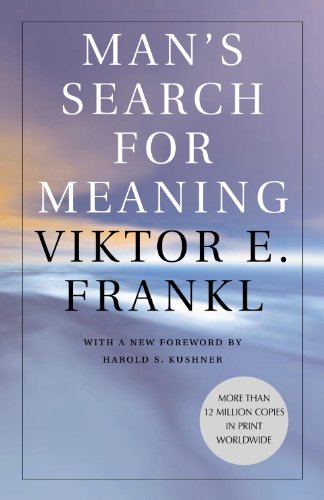
Man's Search for Meaning has riveted generations of readers with its descriptions of life in Nazi death camps and its lessons for spiritual survival. Between 1942 and 1945 psychiatrist Viktor Frankl labored in four different camps, including Auschwitz, while his parents, brother, and pregnant wife perished. Based on his own experience and the stories of his many patients, Frankl argues that we cannot avoid suffering but we can choose how to cope with it, find meaning in it, and move forward with renewed purpose. Frankl's theory—known as logotherapy, from the Greek word logos ("meaning")—holds that our primary drive in life is not pleasure, as Freud maintained, but the discovery and pursuit of what we personally find meaningful. In the decades since its first publication in 1959, Man's Search for Meaning has become a classic, with more than twelve million copies in print around the world. A 1991 Library of Congress survey that asked readers to name a "book that made a difference in your life" found Man's Search for Meaning among the ten most influential books in America. At once a memoir, a meditation, a treatise, and a history, it continues to inspire us all to find significance in the very act of living. (back cover)
…
Recommended by Tony Robbins, Dustin Moskovitz, Ev Williams, and 60 others.
I chose this book because it’s an incredibly powerful and moving example of what existentialist thought can actually be for in real life, what good it can do, how it can help people. [source]
Another book that I’ve read dozens of times. It taught me that if you change the meaning, you change everything. Meaning equals emotion, and emotion equals life. [source]
Dustin Moskovitz
Co-founder/Facebook and Asana
Dustin Moskovitz recommended this book on Twitter. [source]
Cover unavailable
2
Nausea
Jean-Paul Sartre, Lloyd Alexander, et al.
4.2
Nausea is the story of Antoine Roquentin, a French writer who is horrified at his own existence. In impressionistic, diary form he ruthlessly catalogues his every feeling and sensation about the world and people around him.
His thoughts culminate in a pervasive, overpowering feeling of nausea which "spread at the bottom of the viscous puddle, at the bottom of our time, the time of purple suspenders and broken chair seats; it is made of wide, soft instants, spreading at the edge, like an oil stain."
Roquentin's efforts to try and come to terms with his life, his philosophical and psychological struggles, give Sartre the opportunity to dramatize the tenets of his Existentialist creed.
The introduction for this edition of Nausea by Hayden Carruth gives background on Sartre's life and major works, a summary of the principal themes of Existentialist philosophy, and a critical analysis of the novel itself.
Existentialists like Sartre are big on the idea that you can’t just relate a philosophical worldview by simply stating values, techniques, and facts. To understand existentialism, you must feel it. Breathe its ambience. It’s like a tonal curve for life. Yes, we can talk about highlights, shadows, and all the mechanical elements of that tonal curve, but you won’t become an artist just by knowing these mechanics. It goes much deeper than that. So Nausea is a novel, which imparts the existentialist tonal curve. I’m only halfway through it, but I’m liking it a lot already. It’s not as wild or erratic as Notes from Underground, but it’s got that similar feel. That the narrator gives us a mirror to reflect in, and those reflections are novel because we’re outside the normal tonal curve. [source]
Samantha Harvey
The question of mental illness comes down to whether Sartre’s right about his philosophy, which is an interesting question. [source]
Cover unavailable
3
Existentialism
David E. Cooper
3.6
First published in 1990, Existentialism is widely regarded as a classic introductory survey of the topic, and has helped to renew interest in existentialist philosophy. The author places existentialism within the great traditions of philosophy, and argues that it deserves as much attention from analytic philosophers as it has always received on the continent.
This is a fabulous, clear introduction to existentialist thought. It’s also very philosophically rigorous. It tends to steer away from the literary side of existentialism, and it avoids some of the authors that proceed more through essays or novels like Camus. But it makes up for that by really putting existentialism within the philosophical tradition and looking at it as a system of philosophical thought. Cooper’s starting point is the human condition: we’re situated in the world but we’re alienated from it, we don’t feel that we quite belong, that we quite fit. That feeling is what drives existentialists. He works from that through other key ideas about self and others, about angst and anxiety — the anxiety we feel from being free — about absurdity, about freedom and he finishes up with ethics. So it’s a fantastic tour through the existentialist landscape. [source]
Cover unavailable
4
The Existentialist Reader: An Anthology of Key Texts
Paul S. MacDonald
4.3
"The Existentialist Reader" is a comprehensive anthology of classic philosophical writings from eight key existentialist thinkers: Sartre, Camus, Heidegger, de Beauvoir, Jaspers, Marcel, Merleau-Ponty, and Ortega y Gasset. These substantial and carefully selected readings consider the distinctive concerns of existentialism: absurdity, anxiety, alienation, death. A comprehensive introduction by Paul S. MacDonald illuminates the existentialist quest for individual freedom and authentic human experience with insight into the historical and intellectual background of these major figures. "The Existentialist Reader" is a valuable guide to the provocative theories that shook the philosophical world in the 1930s and continue to profoundly shape the way we think about ourselves.
This book is edited by Paul S. MacDonald, and it’s an anthology of texts. Some are by fairly familiar authors — Sartre is in there, so is Camus. But he also includes key works by writers who are less the celebrity names, but who are very much worth reading and provide different directions to explore. Among the people he includes are Gabriel Marcel, who is a Christian existentialist philosopher, and who is very interesting. He writes about the mystery that is at the heart of existence, the fact that we’ll never completely understand what existence is, and about the fact of being embodied, of our connection to other people, which he views as crucial. [source]
Cover unavailable
5
Heidegger: an introduction
Richard Polt
4.3
Richard Polt provides a lively and accessible introduction to one of the most influential and intellectually demanding philosophers of the modern era. Covering the entire range of Heidegger's thought, Polt skillfully communicates the essence of the philosopher, enabling readers, especially those new to his writings, to approach his works with confidence and insight. Polt presents the questions Heidegger grappled with and the positions he adopted, and also analyzes persistent points of difference between competing schools of interpretation. The book begins by exploring Heidegger's central concern, the question of Being, and his way of doing philosophy. After considering his environment, personality, and early thought, it carefully takes readers through his best-known work, Being and Time. Heidegger concludes with highlights of its subject's later thought, providing guidelines for understanding Contributions to Philosophy and other important texts. It gives special attention to the philosopher's political involvement with the Nazis in the 1930s, indicating the strengths and weaknesses of the reactions to his politics, reactions ranging from exculpation to complete condemnation.
It’s a fantastically clear and concise exploration of Heidegger’s philosophy…Polt has a very good way of making Heidegger seem clear, which is not the first word that comes to mind if you go straight to Heidegger. [source]