100 Best International Relations Books of All Time
We've ranked the best international relations books using expert recommendations, sales data, and millions of reader ratings. At Shortform, we know books. Our book guides are the best in the world. Learn why.
Cover unavailable
1
Guns, Germs and Steel: The Fates of Human Societies
Explaining what William McNeill called The Rise of the West has become the central problem in the study of global history. In Guns, Germs, and Steel Jared Diamond presents the biologist's answer: geography, demography, and ecological happenstance. Diamond evenhandedly reviews human history on every continent since the Ice Age at a rate that emphasizes only the broadest movements of peoples and ideas. Yet his survey is binocular: one eye has the rather distant vision of the evolutionary biologist, while the other eye--and his heart--belongs to the people of New Guinea, where he has done field work for more than 30 years.
Fascinating.... Lays a foundation for understanding human history. [source]
Daniel Ek
A brilliant Pulitzer Prize-winning book about how the modern world was formed, analyzing how societies developed differently on different continents. [source]
I’m a fan of books that challenge our assumptions, and Diamond offers us a new and remarkably simple way of looking at our world. Learning to challenge existing assumptions is core to effective leadership for it trains us to keep an open mind. [source]
Cover unavailable
2
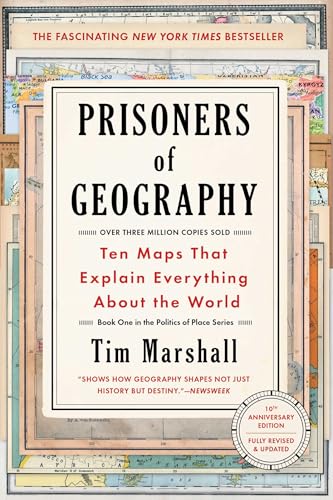
Prisoners of Geography: Ten Maps That Explain Everything About the World
In the bestselling tradition of Why Nations Fail and The Revenge of Geography, an award-winning journalist uses ten maps of crucial regions to explain the geo-political strategies of the world powers.
All leaders of nations are constrained by geography. Their choices are limited by mountains, rivers, seas, and concrete. To understand world events, news organizations and other authorities often focus on people, ideas, and political movements, but without geography, we never have the full picture. Now, in the relevant and timely Prisoners of Geography, seasoned journalist Tim Marshall examines Russia, China, the USA, Latin America, the Middle East, Africa, Europe, Japan and Korea, and Greenland and the Arctic—their weather, seas, mountains, rivers, deserts, and borders—to provide a context often missing from our political reportage: how the physical characteristics of these countries affect their strengths and vulnerabilities and the decisions made by their leaders.
In ten, up-to-date maps of each region, Marshall explains in clear and engaging prose the complex geo-political strategies of these key parts of the globe. What does it mean that Russia must have a navy, but also has frozen ports six months a year? How does this affect Putin’s treatment of Ukraine? How is China’s future constrained by its geography? Why will Europe never be united? Why will America never be invaded? Shining a light on the unavoidable physical realities that shape all of our aspirations and endeavors, Prisoners of Geography is the critical guide to one of the major (and most often overlooked) determining factors in world history.
…
Recommended by Lee Mckenzie, Lucas Morales, and Sunil Chhetri.
Lee Mckenzie
This is a great book and by far the best thing I have read for a while. If you are curious about the world in which we live, geopolitics or just fancy something a little different, you couldn’t do much better than this. Coffee optional! @Itwitius 👏🏻 #prisonersofgeography https://t.co/Gd3G2tDVyT [source]
Lucas Morales
Depending on your interest and goals, if you are like me and always looking for the trends in the big picture then I highly recommend being an active contrarian reader. Read what no one else is reading. Your goal is to think outside the box. To look at the world and ask “why hasn’t this been solved?” And that gives you a roadmap as to what opportunities may exist for your entrepreneurial efforts. So to that, here’s a snapshot, in no particular order, of what might help you push your intellectual boundaries: Born a Crime: Stories from a South African Childhood by Trevor Noah 23 Things They Don't Tell You About Capitalism by Ha-Joon Chang Postcapitalism: A Guide to Our Future by Paul Mason Capital in the Twenty-First Century by Thomas Piketty Who Gets What--And Why: The New Economics of Matchmaking and Market Design by Alvin E. Roth The Political Economy of Participatory Economics by Michael Albert and Robin Hahnel The Zero Marginal Cost Society: The Internet of Things, the Collaborative Commons, and the Eclipse of Capitalism by Jeremy Rifkin Why America Misunderstands the World by Paul R. Pillar A Theory of Justice by John Rawls Prisoners of Geography by Tim Marshall [source]
@TaranaRaja The cover got me and I'm sure the book is very, very interesting! [source]
Cover unavailable
3
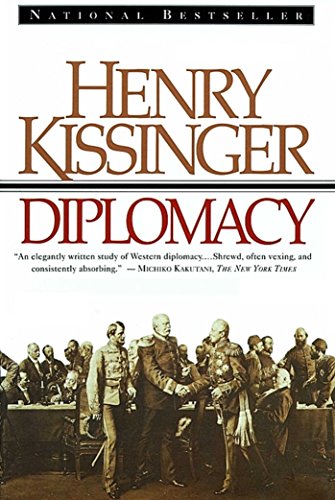
Diplomacy
Henry Kissinger
5.0
A brilliant, sweeping history of diplomacy that includes personal stories from the noted former Secretary of State, including his stunning reopening of relations with China.
The seminal work on foreign policy and the art of diplomacy.
Moving from a sweeping overview of history to blow-by-blow accounts of his negotiations with world leaders, Henry Kissinger describes how the art of diplomacy has created the world in which we live, and how America’s approach to foreign affairs has always differed vastly from that of other nations.
Brilliant, controversial, and profoundly incisive, Diplomacy stands as the culmination of a lifetime of diplomatic service and scholarship. It is vital reading for anyone concerned with the forces that have shaped our world today and will impact upon it tomorrow.
…
Recommended by Bogdan Savonea, Jeremy Greenstock, and Jonathan Powell.
Bogdan Savonea
Kissinger's "Diplomacy", Huntington's "Clash of Civilizations" and Machiavelli's "The Prince". They pretty much shaped the first part of my life, defined my University choice and career path up until my late 20s. [source]
Jeremy Greenstock
The importance of Kissinger’s book is that it is fundamentally about power. It’s amazing how seldom people – newspapers, blogs, speeches – talk about power, but power is the raw thing at the heart of every political unit. Kissinger is a great figure of 20th-century diplomacy and therefore it is about his experience; you’re looking at diplomacy through the eyes of a great exponent of the diplomatic art. [source]
Jonathan Powell
Kissinger said that the original American idealism was a mistake. He remains the grand old man of foreign policy. [source]
For more than two thousand years, The Art of War has stood as a cornerstone of Chinese culture-a lucid epigrammatic text that reveals as much about human psychology, politics, and economics as it does about battlefield strategy. The influence of Sun-tzu's text has grown tremendously in the West in recent years, with military leaders, politicians, and corporate executives alike finding valuable insight in these ancient words. In his crisp, accessible new translation, scholar John Minford brings this seminal work to life for modern readers.
Minford opens with a lively, learned introduction in which he explores the life and times of Sun-tzu, looks at The Art of War in the context of the turbulent Warring States period, and discusses how best to read and understand the work today. There follows Minford's translation of the core text itself in two different formats-first, the unadorned thirteen chapters of the original work and then the same text reprinted with extensive running commentary by classical Chinese scholars as well as Minford himself. The result is an opportunity for Western readers to experience Sun-tzu's work in all its intensity as it applies to many aspects of our lives.
Which books should be read by every single intelligent person on planet? … The Art of War (Sun Tsu) to learn that the act of killing fellow humans can be raised to an art. If you read all of the above works you will glean profound insight into most of what has driven the history of the western world. [source]
Cover unavailable
5
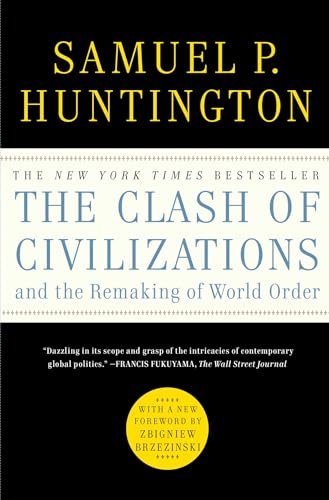
The Clash of Civilizations and the Remaking of World Order
Samuel P. Huntington
4.9
"Sam Huntington, one of the West's most eminent political scientists, presents a challenging framework for understanding the realities of global politics in the next century. The Clash of Civilizations and the Remaking of World Order is one of the most important books to have emerged since the end of the Cold War." --HENRY A. KISSINGER
Based on the author's seminal article in Foreign Affairs, Samuel P. Huntington's The Clash of Civilizations and the Remaking of World Order is a provocative and prescient analysis of the state of world politics after the fall of communism. In this incisive work, the renowned political scientist explains how "civilizations" have replaced nations and ideologies as the driving force in global politics today and offers a brilliant analysis of the current climate and future possibilities of our world's volatile political culture.
"An intellectual tour de force: bold, imaginative, and provocative. A seminal work that will revolutionize our understanding of international affairs." --ZBIGNIEW BRZEZINSKI
"The book is studded with insights, flashes of rare brilliance, great learning, and in particular, an ability to see the familiar in a new and provocative way." --MICHAEL ELLIOTT, THE WASHINGTON POST BOOK WORLD
"A benchmark for informed speculation on those always fascinating questions: Just where are we in history? What hidden hand is controlling our destiny?...A searching reflection on our global state." --RICHARD BERNSTEIN, THE NEW YORK TIMES
"This is what is so stunning about The Clash of Civilizations: It is not just about the future, but may actually help to shape it." --WANG GUNGWU, THE NATIONAL INTEREST
This is a very important book on the post-1989 context, and what the new world order would look like after the fall of the Soviet Union. It was written almost 20 years ago now, and it seems as if Huntington’s hypothesis is getting more and more credit than Francis Fukuyama’s (The End of History) about what the world will look like. [source]
Bogdan Savonea
Kissinger's "Diplomacy", Huntington's "Clash of Civilizations" and Machiavelli's "The Prince". They pretty much shaped the first part of my life, defined my University choice and career path up until my late 20s. [source]
Cover unavailable
6
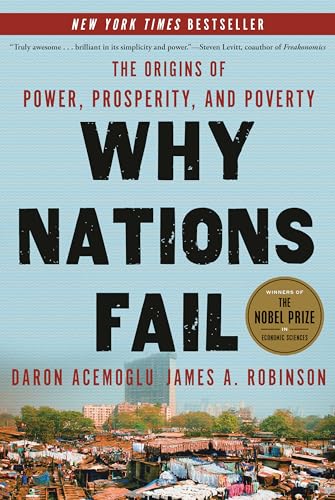
Why Nations Fail: The Origins of Power, Prosperity, and Poverty
Brilliant and engagingly written, Why Nations Fail answers the question that has stumped the experts for centuries: Why are some nations rich and others poor, divided by wealth and poverty, health and sickness, food and famine?
Is it culture, the weather, geography? Perhaps ignorance of what the right policies are?
Simply, no. None of these factors is either definitive or destiny. Otherwise, how to explain why Botswana has become one of the fastest growing countries in the world, while other African nations, such as Zimbabwe, the Congo, and Sierra Leone, are mired in poverty and violence?
Daron Acemoglu and James Robinson conclusively show that it is man-made political and economic institutions that underlie economic success (or lack of it). Korea, to take just one of their fascinating examples, is a remarkably homogeneous nation, yet the people of North Korea are among the poorest on earth while their brothers and sisters in South Korea are among the richest. The south forged a society that created incentives, rewarded innovation, and allowed everyone to participate in economic opportunities. The economic success thus spurred was sustained because the government became accountable and responsive to citizens and the great mass of people. Sadly, the people of the north have endured decades of famine, political repression, and very different economic institutions—with no end in sight. The differences between the Koreas is due to the politics that created these completely different institutional trajectories.
Based on fifteen years of original research Acemoglu and Robinson marshall extraordinary historical evidence from the Roman Empire, the Mayan city-states, medieval Venice, the Soviet Union, Latin America, England, Europe, the United States, and Africa to build a new theory of political economy with great relevance for the big questions of today, including:
- China has built an authoritarian growth machine. Will it continue to grow at such high speed and overwhelm the West? - Are America’s best days behind it? Are we moving from a virtuous circle in which efforts by elites to aggrandize power are resisted to a vicious one that enriches and empowers a small minority? - What is the most effective way to help move billions of people from the rut of poverty to prosperity? More philanthropy from the wealthy nations of the West? Or learning the hard-won lessons of Acemoglu and Robinson’s breakthrough ideas on the interplay between inclusive political and economic institutions?
Why Nations Fail will change the way you look at—and understand—the world.
"I read two books that raise big, interesting questions about social change and technological progress. I’m planning to write longer reviews of each of these books, but let me flag them for you now. One is Why Nations Fail: The Origins of Power, Prosperity, and Poverty by Daron Acemoglu and James A. Robinson.The topic of this book is why some countries have prospered and created great living conditions for their citizens while others have not. This is an important topic, which I care a lot about. The book makes an appealing argument that economic development depends on political institutions that protect individual rights. It is well written and very easy to read with lots of interesting historical stories about different countries. But it is a major disappointment. Its analysis is vague and simplistic. I’ll explain more in a longer review." [source]
My next book for A Year of Books is Why Nations Fail by Daron Acemoğlu and James A. Robinson. This book explores the different kinds of social institutions and incentives that nations have applied to encourage prosperity, economic development and elimination of poverty. This is a good complement to our last book, Portfolios of the Poor, which focused on how people live in poverty. This one discusses why poverty exists and how to reduce it. [source]
In terms of understanding this top inequality, I mentioned the possibility that it might be about politics. How should we think about politics? What are the levers of politics? For that we need a conceptual framework and that’s what this book tries to provide. It’s co-authored with my long-term collaborator and friend Jim Robinson – and it’s not about US or UK or Canadian inequality. It runs through several thousand years of history, and tries to explain how societies work and why, often, they fail to generate prosperity for their citizens. It’s a very political story. [source]
Cover unavailable
7
World Order
Henry Kissinger
4.8
Henry Kissinger offers in World Order a deep meditation on the roots of international harmony and global disorder. Drawing on his experience as one of the foremost statesmen of the modern era—advising presidents, traveling the world, observing and shaping the central foreign policy events of recent decades—Kissinger now reveals his analysis of the ultimate challenge for the twenty-first century: how to build a shared international order in a world of divergent historical perspectives, violent conflict, proliferating technology, and ideological extremism.
There has never been a true “world order,” Kissinger observes. For most of history, civilizations defined their own concepts of order. Each considered itself the center of the world and envisioned its distinct principles as universally relevant. China conceived of a global cultural hierarchy with the Emperor at its pinnacle. In Europe, Rome imagined itself surrounded by barbarians; when Rome fragmented, European peoples refined a concept of an equilibrium of sovereign states and sought to export it across the world. Islam, in its early centuries, considered itself the world’s sole legitimate political unit, destined to expand indefinitely until the world was brought into harmony by religious principles. The United States was born of a conviction about the universal applicability of democracy—a conviction that has guided its policies ever since.
Now international affairs take place on a global basis, and these historical concepts of world order are meeting. Every region participates in questions of high policy in every other, often instantaneously. Yet there is no consensus among the major actors about the rules and limits guiding this process, or its ultimate destination. The result is mounting tension.
Grounded in Kissinger’s deep study of history and his experience as National Security Advisor and Secretary of State, World Order guides readers through crucial episodes in recent world history. Kissinger offers a unique glimpse into the inner deliberations of the Nixon administration’s negotiations with Hanoi over the end of the Vietnam War, as well as Ronald Reagan’s tense debates with Soviet Premier Gorbachev in Reykjavík. He offers compelling insights into the future of U.S.–China relations and the evolution of the European Union, and examines lessons of the conflicts in Iraq and Afghanistan. Taking readers from his analysis of nuclear negotiations with Iran through the West’s response to the Arab Spring and tensions with Russia over Ukraine, World Order anchors Kissinger’s historical analysis in the decisive events of our time.
Provocative and articulate, blending historical insight with geopolitical prognostication, World Order is a unique work that could come only from a lifelong policymaker and diplomat.
My next book for A Year of Books is Quantum Physics for Babies! Just kidding. It's actually World Order by Henry Kissinger -- about foreign relations and how we can build peaceful relationships throughout the world. This is important for creating the world we all want for our children, and that's what I'm thinking about these days. [source]
Cover unavailable
8
The Tragedy of Great Power Politics
John J. Mearsheimer
4.8
The update of this classic treatise on the behavior of great powers takes a penetrating look at the question likely to dominate international relations in the twenty-first century: Can China rise peacefully? To John J. Mearsheimer, great power politics are tragic because the anarchy of the international system requires states to seek dominance at one another s expense, dooming even peaceful nations to a relentless power struggle. The best survival strategy in this dangerous world is to become a regional hegemon like the United States in the Western Hemisphere and to make sure that no other hegemon emerges elsewhere. In a new concluding chapter, Mearsheimer examines the course of Sino-American relations should China continue its ascent to greater economic and military power. He predicts that China will attempt to dominate Asia while the United States, determined to remain the world s sole regional hegemon, will go to great lengths to contain China. The tragedy of great power politics is inescapable."
…
Cover unavailable
9
Man, the State, and War: A Theoretical Analysis
Kenneth N. Waltz
4.8
What are the causes of war? To answer this question, Professor Waltz examines the ideas of major thinkers throughout the history of Western civilization. He explores works both by classic political philosophers, such as St. Augustine, Hobbes, Kant, and Rousseau, and by modern psychologists and anthropologists to discover ideas intended to explain war among states and related prescriptions for peace.
…
Cover unavailable
10
On China
Henry Kissinger
4.7
In this sweeping and insightful history, Henry Kissinger turns for the first time at book-length to a country he has known intimately for decades, and whose modern relations with the West he helped shape. Drawing on historical records as well as his conversations with Chinese leaders over the past forty years, Kissinger examines how China has approached diplomacy, strategy, and negotiation throughout its history, and reflects on the consequences for the global balance of power in the 21st century.
Since no other country can claim a more powerful link to its ancient past and classical principles, any attempt to understand China's future world role must begin with an appreciation of its long history. For centuries, China rarely encountered other societies of comparable size and sophistication; it was the "Middle Kingdom," treating the peoples on its periphery as vassal states. At the same time, Chinese statesmen-facing threats of invasion from without, and the contests of competing factions within-developed a canon of strategic thought that prized the virtues of subtlety, patience, and indirection over feats of martial prowess.
In On China, Kissinger examines key episodes in Chinese foreign policy from the classical era to the present day, with a particular emphasis on the decades since the rise of Mao Zedong. He illuminates the inner workings of Chinese diplomacy during such pivotal events as the initial encounters between China and modern European powers, the formation and breakdown of the Sino-Soviet alliance, the Korean War, Richard Nixon's historic trip to Beijing, and three crises in the Taiwan Straits. Drawing on his extensive personal experience with four generation of Chinese leaders, he brings to life towering figures such as Mao, Zhou Enlai, and Deng Xiaoping, revealing how their different visions have shaped China's modern destiny.
With his singular vantage on U.S.-China relations, Kissinger traces the evolution of this fraught but crucial relationship over the past 60 years, following its dramatic course from estrangement to strategic partnership to economic interdependence, and toward an uncertain future. With a final chapter on the emerging superpower's 21st-century world role, On China provides an intimate historical perspective on Chinese foreign affairs from one of the premier statesmen of the 20th century.
…
Recommended by Greg Norman.
Greg Norman
Greg Norman said this is one of his most-recommended books. [source]
Cover unavailable
11
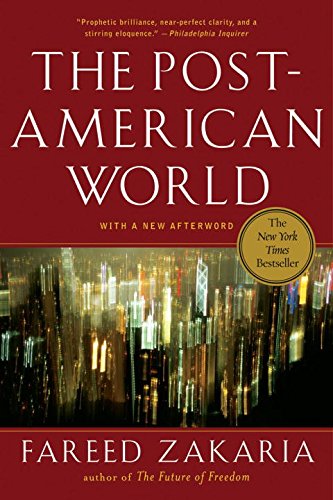
The Post-American World
Fareed Zakaria
4.6
"This is not a book about the decline of America, but rather about the rise of everyone else." So begins Fareed Zakaria's important new work on the era we are now entering.
Following on the success of his best-selling The Future of Freedom, Zakaria describes with equal prescience a world in which the United States will no longer dominate the global economy, orchestrate geopolitics, or overwhelm cultures. He sees the "rise of the rest"—the growth of countries like China, India, Brazil, Russia, and many others—as the great story of our time, and one that will reshape the world.
The tallest buildings, biggest dams, largest-selling movies, and most advanced cell phones are all being built outside the United States. This economic growth is producing political confidence, national pride, and potentially international problems. How should the United States understand and thrive in this rapidly changing international climate? What does it mean to live in a truly global era? Zakaria answers these questions with his customary lucidity, insight, and imagination.
Fact or fiction, the president knows that reading keeps the mind sharp. He also delved into these non-fiction reads: Age of Ambition: Chasing Fortune, Evan Osnos Thinking, Fast and Slow, Daniel Kahneman Moral Man And Immoral Society, Reinhold Niebuhr A Kind And Just Parent, William Ayers The Post-American World, Fareed Zakaria Lessons in Disaster, Gordon Goldstein Sapiens: A Brief History of Humankind, Yuval Noah Harari The Fire Next Time, James Baldwin Andy Grove: The Life and Times of an American, Richard S Tedlow Behind the Beautiful Forevers: Life, Death, and Hope in a Mumbai Undercity, Katherine Boo [source]
Zakaria is Indian by origin and he went to America in his youth. He is now a very prominent journalist in America. His thesis is that America, while still being a superpower, has got to contend with the rise of other countries. It can no longer call the shots in the new world that is developing. This is not a new thesis, but he puts it forward very powerfully and very well. He also looks at the question of whether America can continue to succeed in a world where other countries are catching up in terms of markets and economic progress. Because other countries are rising, America is falling relatively. [source]
Cover unavailable
12
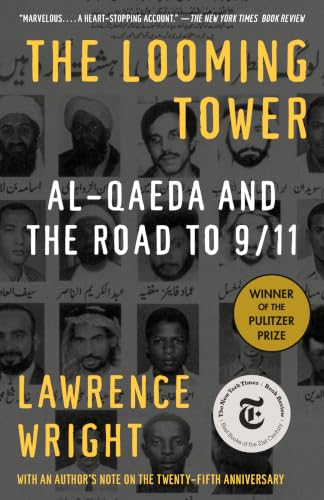
The Looming Tower: Al-Qaeda and the Road to 9/11
Lawrence Wright
4.6
A sweeping narrative history of the events leading to 9/11, a groundbreaking look at the people and ideas, the terrorist plans and the Western intelligence failures that culminated in the assault on America. Lawrence Wright's remarkable book is based on five years of research and hundreds of interviews that he conducted in Egypt, Saudi Arabia, Pakistan, Afghanistan, Sudan, England, France, Germany, Spain, and the United States.
The Looming Tower achieves an unprecedented level of intimacy and insight by telling the story through the interweaving lives of four men: the two leaders of al-Qaeda, Osama bin Laden and Ayman al-Zawahiri; the FBI's counterterrorism chief, John O'Neill; and the former head of Saudi intelligence, Prince Turki al-Faisal.
As these lives unfold, we see revealed: the crosscurrents of modern Islam that helped to radicalize Zawahiri and bin Laden . . . the birth of al-Qaeda and its unsteady development into an organization capable of the American embassy bombings in Kenya and Tanzania and the attack on the USS Cole . . . O'Neill's heroic efforts to track al-Qaeda before 9/11, and his tragic death in the World Trade towers . . . Prince Turki's transformation from bin Laden's ally to his enemy . . . the failures of the FBI, CIA, and NSA to share intelligence that might have prevented the 9/11 attacks.
The Looming Tower broadens and deepens our knowledge of these signal events by taking us behind the scenes. Here is Sayyid Qutb, founder of the modern Islamist movement, lonely and despairing as he meets Western culture up close in 1940s America; the privileged childhoods of bin Laden and Zawahiri; family life in the al-Qaeda compounds of Sudan and Afghanistan; O'Neill's high-wire act in balancing his all-consuming career with his equally entangling personal life--he was living with three women, each of them unaware of the others' existence--and the nitty-gritty of turf battles among U.S. intelligence agencies.
Brilliantly conceived and written, The Looming Tower draws all elements of the story into a galvanizing narrative that adds immeasurably to our understanding of how we arrived at September 11, 2001. The richness of its new information, and the depth of its perceptions, can help us deal more wisely and effectively with the continuing terrorist threat.
…
Recommended by Audrey Kurth Cronin, Bryan Callen, Lloyd Gardner, and 5 others.
Audrey Kurth Cronin
Reading this one book gives you an excellent grasp of the human story and the context from which al-Qaeda emerged. [source]
Wright looks at the linkage between the Egyptian Jihad and Al-Qaeda. It is a worthwhile book to read to try to understand the whole problem. [source]
Cover unavailable
13
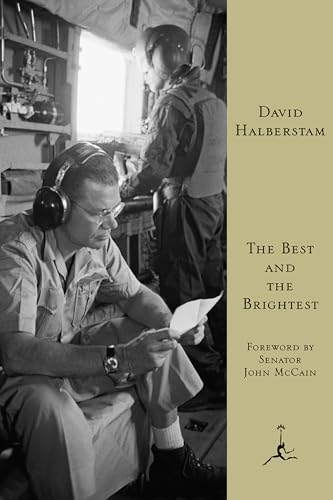
The Best and the Brightest
David Halberstam
4.6
The Best and the Brightest is David Halberstam's masterpiece, the defining history of the making of the Vietnam tragedy. Using portraits of America's flawed policy makers and accounts of the forces that drove them, The Best and the Brightest reckons magnificently with the most important abiding question of our country's recent history: Why did America become mired in Vietnam and why did it lose? As the definitive single-volume answer to that question, this enthralling book has never been superseded. It's an American classic.
…
Recommended by Barack Obama, Chad Dickerson, Martin Bell, and 1 others.
According to the president’s Facebook page and a 2008 interview with the New York Times, these titles are among his most influential forever favorites: Moby Dick, Herman Melville Self-Reliance, Ralph Waldo Emerson Song Of Solomon, Toni Morrison Parting The Waters, Taylor Branch Gilead, Marylinne Robinson Best and the Brightest, David Halberstam The Federalist, Alexander Hamilton Souls of Black Folk, W.E.B. Du Bois The Power and the Glory, Graham Greene The Quiet American, Graham Greene Cancer Ward, Aleksandr Solzhenitsyn Gandhi’s autobiography Working, Studs Terkel Wealth of Nations, Adam Smith Theory of Moral Sentiments, Adam Smith All the King’s Men, Robert Penn Warren [source]
Chad Dickerson
Just finished Best and the Brightest (long and detailed book on the Vietnam War) & if I learned one thing it’s that many assume people in charge of a war have a clear plan that should be supported out of patriotic duty & it’s highly possible they don’t. Skepticism is patriotic. [source]
Martin Bell
I started off doing tribal massacres in Nigeria. Then in early 1967 I went to Vietnam and was back there in 1972. David Halberstam was the main New York Times correspondent in Vietnam during that time. Lyndon Johnson lent very heavily on the newspaper’s editor to get him withdrawn because he didn’t like his reports. Halberstam was very truthful about what he found. [source]
Cover unavailable
14
The Prince
Nicollo Machiavelli, Tim Parks
4.6
Niccolo Machiavelli's "The Prince" is intended to be a treatise on ruling and is considered by many to be a classic of political science. In the book Machiavelli offers many bits of practical advice on how to rule and even though the book was written in the early 16th century its ideas are still very relevant today. Where "The Prince" differs from other political literature before it is in its separation of the lofty idealism of morality and ethics from the practical demands of governing. It is this very aspect of Machiavelli's work that has made his name synonymous with an almost immoral opportunism and his book a timeless classic.
Which books should be read by every single intelligent person on planet? … The Prince (Machiavelli) to learn that people not in power will do all they can to acquire it, and people in power will do all they can to keep it. If you read all of the above works you will glean profound insight into most of what has driven the history of the western world. [source]
Of course, this is a must read. Machiavelli is one of those figures and writers who is tragically overrated and underrated at the same time. Unfortunately that means that many people who read him miss the point and other people avoid him and miss out altogether. Take Machiavelli slow, and really read him. Also understand the man behind the book–not just as a masterful writer but a man who withstood heinous torture and exile with barely a whimper. Machiavelli is a glimpse into a time when power was literal and out for public viewing–when he talks about making an example of someone, he doesn’t mean calling them out, he means putting their head on a pike. Don’t let that scare you because we’re not as far from that world as we’d like to think. Deny that at your own peril. [source]
Cover unavailable
15
Theory of International Politics
Kenneth N. Waltz
4.6
Cover unavailable
16
The Rise and Fall of the Great Powers: Economic Change and Military Conflict from 1500 to 2000
Paul Kennedy
4.6
THE WIDELY ACCLAIMED BESTSELLER THAT BOLDLY AND LUCIDLY PUTS OUR CURRENT ECONOMIC AND POLITICAL DILEMMAS INTO THE PERSPECTIVE OF WORLD HISTORY.
"A work of almost Toynbeean sweep... When a scholar as careful and learned as Mr. Kennedy is prompted by contemporary issues to reexamine the great processes of the past, the result can only be an enhancement of our historical understanding.... When the study is written as simply and attractively as this work is, its publication may have a great and beneficient impact. It is to be hoped that Mr. Kennedy's will have one, at a potentially decisive moment in America's history." Michael Howard, The New York Times Book Review
"Important, learned, and lucid... Paul Kennedy's great achievement is that he makes us see our current international problems against a background of empires that have gone under because they were unaible to sustain the material cost of greatness; and he does so in a universal historical perspective of which Ranke would surely have approved." James Joll, The New York Review of Books
"His strategic-economic approach provides him with the context for a shapely narrative....Professor Kennedy not only exploits his framework eloquently, he also makes use of it to dig deeper and explore the historical contexts in which some 'power centers' prospered....But the most commanding purpose of his project...is the lesson he draws from 15 centuries of statecraft to apply to the present scene....[The book's] final section is for everyone concerned with the contemporary political scene." Christopher Lehmann-Haupt, The New York Times
"Kennedy gives epic meaning to the nation's relative economic and industrial decline." Newsweek
…
Cover unavailable
17
Seeing Like a State: How Certain Schemes to Improve the Human Condition Have Failed
James C. Scott
4.5
Compulsory ujamaa villages in Tanzania, collectivization in Russia, Le Corbusier's urban planning theory realized in Brasilia, the Great Leap Forward in China, agricultural modernization in the Tropics - the 20th century has been racked by grand utopian schemes that have inadvertently brought death and disruption to millions. Why do well-intentioned plans for improving the human condition go tragically awry?
…
Recommended by Marvin Liao, Clare Lockhart, Dan Sullivan, and 2 others.
Marvin Liao
Partner/500 Startups
I tend to jump from book to book and may switch if I am interested in some new topic. This is a pleasure for me (which I also do benefit work wise from too). It’s quite a random list because I have eclectic interests (or just scatterbrained most likely) on tech business, AI, general global economy, geopolitics, rising Biotech economy & history. I'm basically 15% to 50% into all these books. [source]
Clare Lockhart
Seeing Like A State. He’s quite similar to Dewey in a way. He also sees the state as only a mechanism. But he thinks that the way that the state chooses to count, or the way it chooses to see, will inform how it behaves and what kind of animal it becomes. Scott explains, for example, how in France, in early modern times, the state decided to count two things. It decided to count how much salt there was and how many able-bodied men there were, because it wanted to tax the salt and send the able-bodied men off to war. Now perhaps the state decides to count other things, how many healthy people there are, how many well-educated people they are… So that what the state chooses to count determines the parameters of what the state chooses to do. [source]
Roger Pielke Jr
A good lesson for people thinking about climate change, whether to create a global policy for carbon dioxide emissions. [source]
Cover unavailable
18
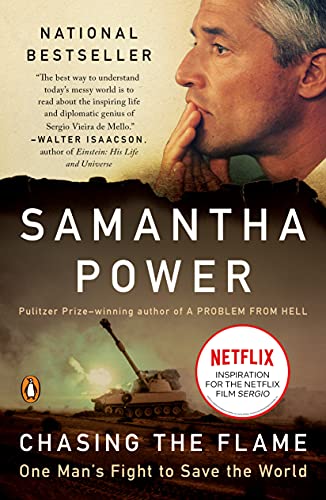
"A Problem from Hell": America and the Age of Genocide
Samantha Power
4.5
Former UN Ambassador Samantha Power's Pulitzer Prize-winning analysis of America's repeated failure to stop genocides around the world
In her Pulitzer Prize-winning examination of the last century of American history, Samantha Power asks the haunting question: Why do American leaders who vow "never again" repeatedly fail to stop genocide? Power, a professor at the Harvard Kennedy School and the former US Ambassador to the United Nations, draws upon exclusive interviews with Washington's top policymakers, thousands of declassified documents, and her own reporting from modern killing fields to provide the answer. "A Problem from Hell" shows how decent Americans inside and outside government refused to get involved despite chilling warnings and tells the stories of the courageous Americans who risked their careers and lives in an effort to get the United States to act. A modern classic, "A Problem from Hell" has forever reshaped debates about American foreign policy.
…
Recommended by Norman Naimark, Peter W. Galbraith, and Steve Crawshaw.
Norman Naimark
This was an extremely important and timely book in calling attention to the deep-seated hypocrisy that lay at the heart of American policies when facing genocide over the past century. Power’s criticism of the devastating combination of American timidity and wishful thinking in face of mass killing, especially in the mid-1990s in Bosnia and Rwanda, is palpable throughout the book. Through historical and political analysis, she sought to mobilise American citizens to place pressure on the US government to act. I think she made a genuine contribution to the heightened awareness of genocide in the US, and to the emergence of an array of NGOs that pay close attention to genocide issues. [source]
Peter W. Galbraith
Samantha Power first came to the public notice for her work on the American response to genocide in Bosnia, or to be more precise, the lack thereof. The title, A Problem From Hell is a quote from Secretary of State Warren Christopher’s congressional testimony about the situation in Bosnia, explaining why the United States couldn’t do anything to stop the genocide there. She was a young reporter during the Bosnia war, but she looks not just at that genocide but at earlier genocides. These include the Ottoman genocide against the Armenians in the First World War and Saddam’s genocide against the Kurds. [source]
Steve Crawshaw
When Power was writing, the Rwandan genocide had already happened, but Darfur was still to come. The sub-title of her book is ‘America and the age of genocide’, and she started work expecting to investigate how American foreign policy had coped so badly. Terrible events, including the mass killing of Armenians in Turkey early in the 20th century, and Pol Pot’s mass killings in Cambodia 60 years later, had gone completely unconfronted by the American and other governments. Then came the Rwandan genocide of 1994. Western governments turned away again. The UN Security Council only finally acknowledged it as genocide when the killing was basically all over – after what Power calls ‘a two-month dance to avoid the g-word’. Power found herself forced to the conclusion that American foreign policy hadn’t failed on all of these occasions. It had done exactly what it meant to do – which was to keep America’s hands out of the very worst stuff. [source]
Cover unavailable
19
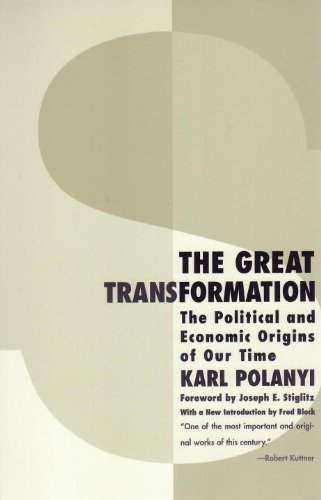
The Great Transformation: The Political and Economic Origins of Our Time
Karl Polanyi
4.5
In this classic work of economic history and social theory, Karl Polanyi analyzes the economic and social changes brought about by the "great transformation" of the Industrial Revolution. His analysis explains not only the deficiencies of the self-regulating market, but the potentially dire social consequences of untempered market capitalism. New introductory material reveals the renewed importance of Polanyi's seminal analysis in an era of globalization and free trade.
"My father recommended this book long ago,” says Nadella of the 1944 classic by a Hungarian-American writer who chronicles the development of England’s market economy and argues that society should drive economic change. [source]
Dani Rodrik
It makes a rather important point, that the economy has always been embedded in society, and when we try to disembed it from society and treat it like an independent institution, then we’re really going to run into trouble. [source]
A story which stretches from 1815 to 1914. He says it was 100 years of peace, although that’s not actually true because if you were a colonial subject it was hardly peaceful. [source]
Carl von Clausewitz's On War has been called, "not simply the greatest, but the only truly great book on war." It is an extraordinary attempt to construct an all-embracing theory of how war works. Its coherence and ambition are unmatched by other military literature. On War is full of sharp observation, biting irony, and memorable phrases, the most famous being, "War is a continuation of politics by other means."
About the Author Except for a brief stint in 1812 when he served in the Russian army, Clausewitz spent his whole career, from the age of twelve until his death in 1831, in the Prussian army. He fought in all the major Prussian campaigns against France, and his most fateful experience - the 1806 Battle of Jena-Auerstedt, in which Napoleon destroyed the Prussian army - inspired him to write On War.
I know this will offend many strategy purists, but for most audiences I recommend these two books only with a pretty strong disclaimer. While both are clearly full of strategic wisdom, they are hard to separate from their respective eras and brands of warfare. As budding strategists in business and in life, most of us are really looking for advice that can help us with our own problems. The reality is that Napoleonic warfare does not exactly have its equivalents in today’s society. On the other hand, Sun-Tzu is so aphoristic that it’s hard to say what is concrete advice and what is just common sense. But the books are so convincing that you might still end up leaving thinking that they can be easily applied. So, again, check these books out if you’re really interested, but I think some of the other books are much better places to start. [source]
Andrew Exum
If you’re trying to understand any conflict you still have to start with the dead Prussian…There’s still no other book that’s as significant in terms of understanding war as On War. [source]
Cover unavailable
21
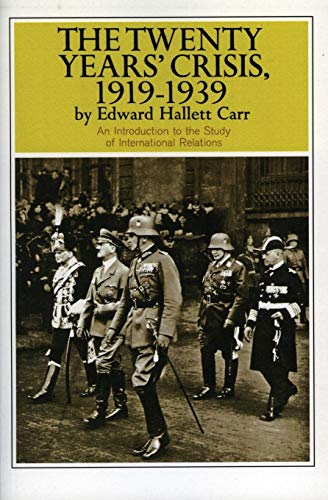
The Twenty Years' Crisis, 1919-1939: An Introduction to the Study of International Relations
Edward Hallett Carr
4.5
E. H. Carr's classic work on international relations published in 1939 was immediately recognized by friend and foe alike as a defining work. The author was one of the most influential and controversial intellectuals of the 20th century. The issues and themes he developed continue to have relevance to modern day concerns with power and its distribution in the international system. Michael Cox's critical introduction provides the reader with background information about the author, the context for the book, and its main themes and contemporary relevance.
…
Cover unavailable
22
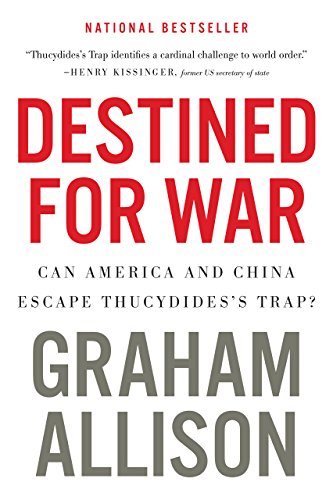
Destined for War: Can America and China Escape Thucydides’s Trap?
Graham Allison
4.5
CHINA AND THE UNITED STATES ARE HEADING TOWARD A WAR NEITHER WANTS. The reason is Thucydides’s Trap, a deadly pattern of structural stress that results when a rising power challenges a ruling one. This phenomenon is as old as history itself. About the Peloponnesian War that devastated ancient Greece, the historian Thucydides explained: “It was the rise of Athens and the fear that this instilled in Sparta that made war inevitable.” Over the past 500 years, these conditions have occurred sixteen times. War broke out in twelve of them. Today, as an unstoppable China approaches an immovable America and both Xi Jinping and Donald Trump promise to make their countries “great again,” the seventeenth case looks grim. Unless China is willing to scale back its ambitions or Washington can accept becoming number two in the Pacific, a trade conflict, cyberattack, or accident at sea could soon escalate into all-out war.
In Destined for War, the eminent Harvard scholar Graham Allison explains why Thucydides’s Trap is the best lens for understanding U.S.-China relations in the twenty-first century. Through uncanny historical parallels and war scenarios, he shows how close we are to the unthinkable. Yet, stressing that war is not inevitable, Allison also reveals how clashing powers have kept the peace in the past — and what painful steps the United States and China must take to avoid disaster today.
…
Recommended by Fareed Zakaria, Kin Kariisa, and Will MacAskill.
It was such a memorable and humbling moment meeting Prof. Allison Graham, professor of government at Harvard, on the sidelines of Jeju Forum for Peace and Prosperity here in Jeju Island, South Korea. His book Destined for War is a fascinating read. https://t.co/ZB3HhBHgLY [source]
Will MacAskill
The last 70 years are a fairly unusual state. We don’t really know why they’ve been so unusually peaceful. This could all change in the 21st century. [source]
Cover unavailable
23
The Shock Doctrine: The Rise of Disaster Capitalism
In her ground-breaking reporting from Iraq, Naomi Klein exposed how the trauma of invasion was being exploited to remake the country in the interest of foreign corporations. She called it "disaster capitalism." Covering Sri Lanka in the wake of the tsunami, and New Orleans post-Katrina, she witnessed something remarkably similar. People still reeling from catastrophe were being hit again, this time with economic "shock treatment" losing their land and homes to rapid-fire corporate makeovers. The Shock Doctrine retells the story of the most dominant ideology of our time, Milton Friedman's free market economic revolution. In contrast to the popular myth of this movement's peaceful global victory, Klein shows how it has exploited moments of shock and extreme violence in order to implement its economic policies in so many parts of the world from Latin America and Eastern Europe to South Africa, Russia, and Iraq. At the core of disaster capitalism is the use of cataclysmic events to advance radical privatization combined with the privatization of the disaster response itself. By capitalizing on crises, created by nature or war, Klein argues that the disaster capitalism complex now exists as a booming new economy, and is the violent culmination of a radical economic project that has been incubating for fifty years.
…
Recommended by Donna Dickenson, George Monbiot, and Mat Whitecross.
Donna Dickenson
Naomi Klein’s argument is that capitalism actually requires deliberately engineered shocks to the economic systems. [source]
The Shock Doctrine explains some of the mechanisms by which patrimonial capital acquires power and enhances its wealth. It’s a brilliant piece of work, and one of those rare books that changes the way you perceive the world. [source]
Mat Whitecross
It starts with the theory that moments of crisis have been utilised by the right wing in the US and other countries to manipulate people into following their agenda. [source]
Cover unavailable
24
Perception and Misperception in International Politics
Robert Jervis
4.5
This study of perception and misperception in foreign policy was a landmark in the application of cognitive psychology to political decision making. The New York Times called it, in an article published nearly ten years after the book's appearance, the seminal statement of principles underlying political psychology.
The perspective established by Jervis remains an important counterpoint to structural explanations of international politics, and from it has developed a large literature on the psychology of leaders and the problems of decision making under conditions of incomplete information, stress, and cognitive bias.
Jervis begins by describing the process of perception (for example, how decision makers learn from history) and then explores common forms of misperception (such as overestimating one's influence). Finally, he tests his ideas through a number of important events in international relations from nineteenth- and twentieth-century European history.
In a contemporary application of Jervis's ideas, some argue that Saddam Hussein invaded Kuwait in 1990 in part because he misread the signals of American leaders with regard to the independence of Kuwait. Also, leaders of the United States and Iraq in the run-up to the most recent Gulf War might have been operating under cognitive biases that made them value certain kinds of information more than others, whether or not the information was true. Jervis proved that, once a leader believed something, that perception would influence the way the leader perceived all other relevant information.
-- "Library Journal"
…
Cover unavailable
25
Politics Among Nations
Hans Morgenthau, Kenneth Thompson, David Clinton
4.4
Hans Morgenthau's classic text established realism as the fundamental way of thinking about international relations. Although it has had its critics, the fact that it continues to be the most long lived text for courses in international relations attests to its enduring value. Someone has said the study of international relations has for half a century been nothing so much as a dialogue between Morgenthau, those who embrace his approach, and those who turn elsewhere for enlightenment. After 50 years, the dialogue between Morgenthau and scholars from around the world continues more or less as in the past something with more intensity even in an "age of terror." The new edition preserves intact Morgenthau's original work while adding a 40 page introduction by the editors who explore its relevance for a new era. What follows the introduction are the perspectives of a dozen statesmen, scholars, and observers each offering insights on Morgenthau's concepts and ideas as they relate to current crises on every continent. They bring up to date the dialogue that began in 1948.
…
Cover unavailable
26
The Revenge Of Geography: What the Map Tells Us About Coming Conflicts and the Battle Against Fate
Robert D. Kaplan
4.4
In this provocative, startling book, Robert D. Kaplan, the bestselling author of Monsoon and Balkan Ghosts, offers a revelatory new prism through which to view global upheavals and to understand what lies ahead for continents and countries around the world.
In The Revenge of Geography, Kaplan builds on the insights, discoveries, and theories of great geographers and geopolitical thinkers of the near and distant past to look back at critical pivots in history and then to look forward at the evolving global scene. Kaplan traces the history of the world’s hot spots by examining their climates, topographies, and proximities to other embattled lands. The Russian steppe’s pitiless climate and limited vegetation bred hard and cruel men bent on destruction, for example, while Nazi geopoliticians distorted geopolitics entirely, calculating that space on the globe used by the British Empire and the Soviet Union could be swallowed by a greater German homeland.
Kaplan then applies the lessons learned to the present crises in Europe, Russia, China, the Indian subcontinent, Turkey, Iran, and the Arab Middle East. The result is a holistic interpretation of the next cycle of conflict throughout Eurasia. Remarkably, the future can be understood in the context of temperature, land allotment, and other physical certainties: China, able to feed only 23 percent of its people from land that is only 7 percent arable, has sought energy, minerals, and metals from such brutal regimes as Burma, Iran, and Zimbabwe, putting it in moral conflict with the United States. Afghanistan’s porous borders will keep it the principal invasion route into India, and a vital rear base for Pakistan, India’s main enemy. Iran will exploit the advantage of being the only country that straddles both energy-producing areas of the Persian Gulf and the Caspian Sea. Finally, Kaplan posits that the United States might rue engaging in far-flung conflicts with Iraq and Afghanistan rather than tending to its direct neighbor Mexico, which is on the verge of becoming a semifailed state due to drug cartel carnage.
A brilliant rebuttal to thinkers who suggest that globalism will trump geography, this indispensable work shows how timeless truths and natural facts can help prevent this century’s looming cataclysms.
Praise for The Revenge of Geography “[An] ambitious and challenging new book . . . [The Revenge of Geography]displays a formidable grasp of contemporary world politics and serves as a powerful reminder that it has been the planet’s geophysical configurations, as much as the flow of competing religions and ideologies, that have shaped human conflicts, past and present.”—Malise Ruthven, The New York Review of Books “Robert D. Kaplan, the world-traveling reporter and intellectual whose fourteen books constitute a bedrock of penetrating exposition and analysis on the post-Cold War world . . . strips away much of the cant that suffuses public discourse these days on global developments and gets to a fundamental reality: that geography remains today, as it has been throughout history, one of the most powerful drivers of world events.”—The National Interest “Kaplan plunges into a planetary review that is often thrilling in its sheer scale . . . encyclopedic.”—The New Yorker
“[The Revenge of Geography] serves the facts straight up. . . . Kaplan’s realism and willingness to face hard facts make The Revenge of Geography a valuable antidote to the feel-good manifestoes that often masquerade as strategic thought.”—The Daily Beast
It's very good. … There are actual physical geographies on the ground making it difficult for us to control certain areas of the globe. [source]
Cover unavailable
27
Ghost Wars: The Secret History of the CIA, Afghanistan, and Bin Laden from the Soviet Invasion to September 10, 2001
Steve Coll
4.4
The news-breaking book that has sent shockwaves through the Bush White House, Ghost Wars is the most accurate and revealing account yet of the CIA's secret involvement in al-Qaeda's evolution. It won the Pulitzer Prize in 2005.
Prize-winning journalist Steve Coll has spent years reporting from the Middle East, accessed previously classified government files and interviewed senior US officials and foreign spymasters. Here he gives the full inside story of the CIA's covert funding of an Islamic jihad against Soviet forces in Afghanistan, explores how this sowed the seeds of Bin Laden's rise, traces how he built his global network and brings to life the dramatic battles within the US government over national security. Above all, he lays bare American intelligence's continual failure to grasp the rising threat of terrorism in the years leading to 9/11 - and its devastating consequences.
…
Cover unavailable
28
Paris 1919: Six Months that Changed the World
Margaret MacMillan, Richard Holbrooke, Casey Hampton
4.4
'Without question, Margaret MacMillan's Paris 1919 is the most honest and engaging history ever written about those fateful months after World War I when the maps of Europe were redrawn. Brimming with lucid analysis, elegant character sketches, and geopolitical pathos, it is essential reading.'
Between January and July 1919, after "the war to end all wars," men and women from around the world converged on Paris to shape the peace. Center stage, for the first time in history, was an American president, Woodrow Wilson, who with his Fourteen Points seemed to promise to so many people the fulfillment of their dreams. Stern, intransigent, impatient when it came to security concerns and wildly idealistic in his dream of a League of Nations that would resolve all future conflict peacefully, Wilson is only one of the larger-than-life characters who fill the pages of this extraordinary book. David Lloyd George, the gregarious and wily British prime minister, brought Winston Churchill and John Maynard Keynes. Lawrence of Arabia joined the Arab delegation. Ho Chi Minh, a kitchen assistant at the Ritz, submitted a petition for an independent Vietnam.
For six months, Paris was effectively the center of the world as the peacemakers carved up bankrupt empires and created new countries. This book brings to life the personalities, ideals, and prejudices of the men who shaped the settlement. They pushed Russia to the sidelines, alienated China, and dismissed the Arabs. They struggled with the problems of Kosovo, of the Kurds, and of a homeland for the Jews.
The peacemakers, so it has been said, failed dismally; above all they failed to prevent another war. Margaret MacMillan argues that they have unfairly been made the scapegoats for the mistakes of those who came later. She refutes received ideas about the path from Versailles to World War II and debunks the widely accepted notion that reparations imposed on the Germans were in large part responsible for the Second World War.
A landmark work of narrative history, Paris 1919 is the first full-scale treatment of the Peace Conference in more than twenty-five years. It offers a scintillating view of those dramatic and fateful days when much of the modern world was sketched out, when countries were created--Iraq, Yugoslavia, Israel--whose troubles haunt us still.
Winner of the Samuel Johnson Prize, the PEN Hessell Tiltman Prize and the Duff Cooper Prize
…
Recommended by James Purnell and Mike Maclay.
James Purnell
She focuses on the meeting between Lloyd George, Georges Clemenceau and Woodrow Wilson that decided what the new boundaries would be for the world at Versailles in 1919. [source]
Mike Maclay
The beautiful story she tells is how men of goodwill did try to make the Second World War impossible. [source]
Cover unavailable
29
Social Theory of International Politics
Alexander Wendt
4.4
Drawing on philosophy and social theory, Social Theory of International Politics develops a cultural theory of international politics that contrasts with the realist mainstream. Wendt argues that states can view each other as enemies, rivals, or friends. He characterizes these roles as "cultures of anarchy," which are shared ideas that help shape states' interests and capabilities. These cultures can change over time as ideas change. Wendt thus argues that the nature of international politics is not fixed, and that the international system is not condemned to conflict and war.
…
Cover unavailable
30
The World Is Flat: A Brief History of the Twenty-first Century
One mark of a great book is that it makes you see things in a new way, and Mr Friedman certainly succeeds in that goal," the Nobel laureate Joseph E. Stiglitz wrote in the New York Times reviewing The World is Flat in 2005. In this new edition, Thomas L. Friedman includes fresh stories and insights to help us understand the flattening of the world. Weaving new information into his overall thesis, and answering the questions he has been most frequently asked by parents and readers, this third edition also includes two new chapters - on how to be a political activist and social entrepreneur in a flat world; and on the more troubling question of how to manage our reputations and privacy in a world where we are all becoming publishers and public figures.
The World is Flat 3.0 is an essential update on globalization, its opportunities for individual empowerment, its achievements at lifting millions out of poverty, and its drawbacks - environmental, social, and political, powerfully illuminated by the Pulitzer Prize-winning author of The Lexus and the Olive Tree.
CEO recommends this book (along with The Intelligent Investor) in his suggestion to JP Morgan summer interns. [source]
Erik Rostad
I read this book in 2003 or 2004. I was out of college and working in my first job. Friedman convincingly showed that the world was rapidly changing and that I would soon be competing for jobs with people from around the world. I decided to go to graduate school as a direct result of being convinced of his argument in this book. What's interesting is that I don't think these two books would have the same impact on me now than they did at the time I read them. Certain books are meant for certain seasons of life. Also, the Friedman one is probably quite outdated by now. In other words, these wouldn't necessarily be the books I recommend to people now, but they shaped the direction of my life. [source]
Cover unavailable
31
All the Shah's Men: An American Coup and the Roots of Middle East Terror
Stephen Kinzer
4.4
An American Coup & the Roots of Middle East Terror Half a century ago, the United States overthrew a Middle Eastern government for the first time. The victim was Mohammad Mossadegh, the democratically elected prime minister of Iran. Although the coup seemed a success at first, today it serves as a chilling lesson about the dangers of foreign intervention.In this book, veteran New York Times correspondent Stephen Kinzer gives the first full account of this fateful operation. His account is centered around an hour-by-hour reconstruction of the events of August 1953, and concludes with an assessment of the coup's "haunting and terrible legacy."Operation Ajax, as the plot was code-named, reshaped the history of Iran, the Middle East, and the world. It restored Mohammad Reza Shah to the Peacock Throne, allowing him to impose a tyranny that ultimately sparked the Islamic Revolution of 1979. The Islamic Revolution, in turn, inspired fundamentalists throughout the Muslim world, including the Taliban and terrorists who thrived under its protection."It is not far-fetched," Kinzer asserts in this book, "to draw a line from Operation Ajax through the Shah's repressive regime and the Islamic Revolution to the fireballs that engulfed the World Trade Center in New York."Drawing on research in the United States and Iran, and using material from a long-secret CIA report, Kinzer explains the background of the coup and tells how it was carried out. It is a cloak-and-dagger story of spies, saboteurs, and secret agents. There are accounts of bribes, staged riots, suitcases full of cash, and midnight meetings between the Shah and CIA agent Kermit Roosevelt, who was smuggled in and out of the royal palace under a blanket in the back seat of a car. Roosevelt,the grandson of President Theodore Roosevelt, was a real-life James Bond in an era when CIA agents operated mainly by their wits. After his first coup attempt failed, he organized a second attempt that succeeded three days later.The colorful cast of characters includes the terrified young Shah, who fled his country at the first sign of trouble; General H. Norman Schwarzkopf, father of the Gulf War commander and the radio voice of "Gang Busters," who flew to Tehran on a secret mission that helped set the coup in motion; and the fiery Prime Minister Mossadegh, who outraged the West by nationalizing the immensely profitable Anglo-Iranian Oil Company. The British, outraged by the seizure of their oil company, persuaded President Dwight Eisenhower that Mossadegh was leading Iran toward Communism. Eisenhower and Prime Minister Winston Churchill of Great Britain became the coup's main sponsors.Brimming with insights into Middle Eastern history and American foreign policy, this book is an eye-opening look at an event whose unintended consequences--Islamic revolution and violent anti-Americanism--have shaped the modern world. As the United States assumes an ever-widening role in the Middle East, it is essential reading.
…
Recommended by Chris Abbott and Demetri Sevastopulo.
Chris Abbott
Kinzer gives a good and quick introduction to Iranian history and its relationships with America and Britain. [source]
Demetri Sevastopulo
On a totally different topic, this book by @stephenkinzer is a great look at US & UK relations with #Iran before the revolution. Lots of interesting similarities with the situation today. https://t.co/rlv8Ip0Kjn https://t.co/gz7InQkMk4 [source]
Cover unavailable
32
The Israel Lobby and U.S. Foreign Policy
John J. Mearsheimer
4.4
The Israel Lobby," by John J. Mearsheimer of the University of Chicago and Stephen M. Walt of Harvard's John F. Kennedy School of Government, was one of the most controversial articles in recent memory. Originally published in the London Review of Books in March 2006, it provoked both howls of outrage and cheers of gratitude for challenging what had been a taboo issue in America: the impact of the Israel lobby on U.S. foreign policy.
Now in a work of major importance, Mearsheimer and Walt deepen and expand their argument and confront recent developments in Lebanon and Iran. They describe the remarkable level of material and diplomatic support that the United States provides to Israel and argues that this support cannot be fully explained on either strategic or moral grounds. This exceptional relationship is due largely to the political influence of a loose coalition of individuals and organizations that actively work to shape U.S. foreign policy in a pro-Israel direction. Mearsheimer and Walt provocatively contend that the lobby has a far-reaching impact on America's posture throughout the Middle East--in Iraq, Iran, Lebanon, and toward the Israeli-Palestinian conflict--and the policies it has encouraged are in neither America's national interest nor Israel's long-term interest. The lobby's influence also affects America's relationship with important allies and increases dangers that all states face from global jihadist terror.
Writing in The New York Review of Books, Michael Massing declared, "Not since Foreign Affairs magazine published Samuel Huntington's 'The Clash of Civilizations?' in 1993 has an academic essay detonated with such force." The publication of The Israel Lobby and U.S. Foreign Policy is certain to widen the debate and to be one of the most talked-about books in foreign policy.
…
Recommended by Robin Yassin-Kassab and Stephen Walt.
Robin Yassin-Kassab
Mearsheimer and Walt are scholars of great repute, not conspiracy theorists or racists. In this book they argue that the remarkable American financial, military and political support for Israel is motivated primarily by the workings of a powerful right-wing Zionist lobby. This acts against American interests and even against Israel’s long-term security. Mearsheimer and Walt examine who makes up the lobby and how it works. [source]
The existence of a special relationship – one of nearly unconditional and generous American support – is due almost entirely to the activities of the Israel lobby. [source]
Cover unavailable
33
The Anarchical Society: A Study of Order in World Politics
Hedley Bull, Andrew Hurrell, Stanley Hoffman
4.4
"The Anarchical Society" is one of the masterworks of political science and the classic text on the nature of order in world politics. Originally published in 1977, it continues to define and shape the discipline of international relations. This edition has been updated with a new, interpretive foreword by Andrew Hurrell. Bull explores three fundamental questions: What is order in world politics? How is order maintained in the contemporary states system? What alternative paths to world order are desirable and feasible? Laws and institutions, Bull points out, shift and change over time. "The Anarchical Society" addresses the unwritten rules which have allowed international order to exist across the ages.
…
Cover unavailable
34
Nations and Nationalism
Ernest Gellner
4.3
This thoughtful and penetrating book, addressed to political scientists, sociologists, historians, and anthropologists, interprets nationalism in terms of its social roots, which it locates in industrial social organization. Professor Gellner asserts here that a society's affluence and economic growth depend on innovation, occupational mobility, the effectiveness of the mass media, universal literacy, and an all-embracing educational system based on a shared, standard idiom. These factors, taken together, govern the relationship between culture and the state. Political units that do not conform to the principle, "one state, one culture" feel the strain in the form of nationalistic activity.
…
Cover unavailable
35
The Origins of Political Order: From Prehuman Times to the French Revolution
Virtually all human societies were once organized tribally, yet over time most developed new political institutions which included a central state that could keep the peace and uniform laws that applied to all citizens. Some went on to create governments that were accountable to their constituents. We take these institutions for granted, but they are absent or are unable to perform in many of today’s developing countries—with often disastrous consequences for the rest of the world.
Francis Fukuyama, author of the bestselling The End of History and the Last Man and one of our most important political thinkers, provides a sweeping account of how today’s basic political institutions developed. The first of a major two-volume work, The Origins of Political Order begins with politics among our primate ancestors and follows the story through the emergence of tribal societies, the growth of the first modern state in China, the beginning of the rule of law in India and the Middle East, and the development of political accountability in Europe up until the eve of the French Revolution.
Drawing on a vast body of knowledge—history, evolutionary biology, archaeology, and economics—Fukuyama has produced a brilliant, provocative work that offers fresh insights on the origins of democratic societies and raises essential questions about the nature of politics and its discontents.
This two-volume book is basically a very extended study of history from that starting point of ‘What happens if you look at history as a convergent evolutionary path that seems to end in liberal democracy? [source]
Cover unavailable
36
Monsoon: The Indian Ocean and the Future of American Power
Robert D. Kaplan
4.3
On the world maps common in America, the Indian Ocean all but disappears. The Western Hemisphere lies front and center, while the Indian Ocean region is relegated to the edges, split up along the maps’ outer reaches. This convention reveals the geopolitical focus of the now-departed twentieth century, for it was in the Atlantic and Pacific theaters that the great wars of that era were lost and won. Thus, many Americans are barely aware of the Indian Ocean at all.
But in the twenty-first century this will fundamentally change. In Monsoon, a pivotal examination of the Indian Ocean region and the countries known as “Monsoon Asia,” bestselling author Robert D. Kaplan deftly shows how crucial this dynamic area has become to American power in the twenty-first century. Like the monsoon itself, a cyclical weather system that is both destructive and essential for growth and prosperity, the rise of these countries (including India, Pakistan, China, Indonesia, Burma, Oman, Sri Lanka, Bangladesh, and Tanzania) represents a shift in the global balance that cannot be ignored. The Indian Ocean area will be the true nexus of world power and conflict in the coming years. It is here that the fight for democracy, energy independence, and religious freedom will be lost or won, and it is here that American foreign policy must concentrate if America is to remain dominant in an ever-changing world.
From the Horn of Africa to the Indonesian archipelago and beyond, Monsoon explores the multilayered world behind the headlines. Kaplan offers riveting insights into the economic and naval strategies of China and India and how they will affect U.S. interests. He provides an on-the-ground perspective on the more volatile countries in the region, plagued by weak infrastructures and young populations tempted by extremism. This, in one of the most nuclearized areas of the world, is a dangerous mix.
The map of this fascinating region contains multitudes: Here lies the entire arc of Islam, from the Sahara Desert to the Indonesian archipelago, and it is here that the political future of Islam will most likely be determined. Here is where the five-hundred-year reign of Western power is slowly being replaced by the influence of indigenous nations, especially India and China, and where a tense dialogue is taking place between Islam and the United States.
With Kaplan’s incisive mix of policy analysis, travel reportage, sharp historical perspective, and fluid writing, Monsoon offers a thought-provoking exploration of the Indian Ocean as a strategic and demographic hub and an in-depth look at the issues that are most pressing for American interests both at home and abroad. Exposing the effects of explosive population growth, climate change, and extremist politics on this unstable region—and how they will affect our own interests—Monsoon is a brilliant, important work about an area of the world Americans can no longer afford to ignore.
…
Cover unavailable
37
Soft Power: The Means to Success in World Politics
Joseph S. Nye Jr.
4.3
Joseph Nye coined the term "soft power" in the late 1980s. It is now used frequently—and often incorrectly—by political leaders, editorial writers, and academics around the world. So what is soft power? Soft power lies in the ability to attract and persuade. Whereas hard power—the ability to coerce—grows out of a country's military or economic might, soft power arises from the attractiveness of a country's culture, political ideals, and policies.
Hard power remains crucial in a world of states trying to guard their independence and of non-state groups willing to turn to violence. It forms the core of the Bush administration's new national security strategy. But according to Nye, the neo-conservatives who advise the president are making a major miscalculation: They focus too heavily on using America's military power to force other nations to do our will, and they pay too little heed to our soft power. It is soft power that will help prevent terrorists from recruiting supporters from among the moderate majority. And it is soft power that will help us deal with critical global issues that require multilateral cooperation among states. That is why it is so essential that America better understands and applies our soft power. This book is our guide.
…
Cover unavailable
38
Globalization and its Discontents
Joseph E. Stiglitz
4.3
When it was first published, this national bestseller quickly became a touchstone in the globalization debate. Renowned economist and Nobel Prize winner Joseph E. Stiglitz had a ringside seat for most of the major economic events of the last decade, including stints as chairman of the Council of Economic Advisers and chief economist at the World Bank. Particularly concerned with the plight of the developing nations, he became increasingly disillusioned as he saw the International Monetary Fund and other major institutions put the interests of Wall Street and the financial community ahead of the poorer nations. Those seeking to understand why globalization has engendered the hostility of protesters in Seattle and Genoa will find the reasons here. While this book includes no simple formula on how to make globalization work, Stiglitz provides a reform agenda that will provoke debate for years to come. Rarely do we get such an insider's analysis of the major institutions of globalization as in this penetrating book. With a new foreword for this paperback edition.
Globalization and its Discontents is a book that anyone looking for a rounded set of perspectives on globalization should read. [source]
Leah Lizarondo
These books propelled me to want to work on a social enterprise and underscored my passion for making a difference in food policy. I believe we can build an innovative company that has deep social impact. That we can use the same mindsets that single bottom-line companies have to build successful triple and quadruple bottom-line companies. It is the holy grail -- for your work to present the challenge to be creative, innovative, quick on a daily basis but also at the end of the day, the knowledge that you are making a real difference in people's lives. I feel extremely fortunate to be in this position right now. [source]
Cover unavailable
39
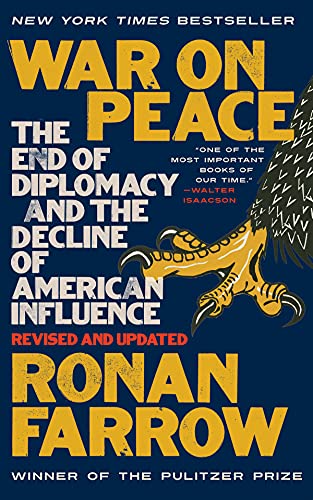
War on Peace: The End of Diplomacy and the Decline of American Influence
Ronan Farrow
4.3
American diplomacy is under siege. Offices across the State Department sit empty, while abroad the military-industrial complex has assumed the work once undertaken by peacemakers. We’re becoming a nation that shoots first and asks questions later.
In an astonishing account ranging from Washington, D.C., to Afghanistan, Pakistan, and North Korea in the years since 9/11, acclaimed journalist and former diplomat Ronan Farrow illuminates one of the most consequential and poorly understood changes in American history. His firsthand experience in the State Department affords a personal look at some of the last standard-bearers of traditional statecraft, including Richard Holbrooke, who made peace in Bosnia and died while trying to do so in Afghanistan. Farrow’s narrative is richly informed by interviews with whistleblowers, policymakers, and a warlord, from Henry Kissinger to Hillary Clinton. Diplomacy, Farrow argues, has declined after decades of political cowardice, short-sightedness, and outright malice—but it may just offer America a way out of a world at war.
…
Recommended by Greta Van Susteren.
Greta Van Susteren
I am getting this book !!! @RonanFarrow is a great journalist - one of the few w/ courage to stand up to power https://t.co/XTtsdeETAI [source]
Cover unavailable
40
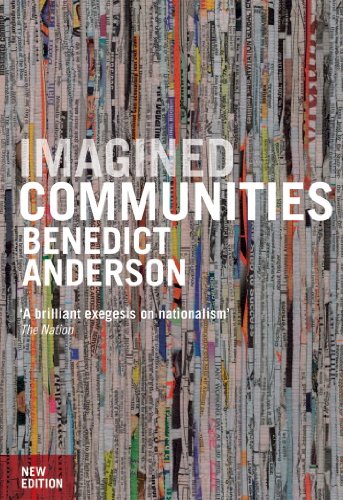
Imagined Communities: Reflections on the Origin and Spread of Nationalism (Revised Edition)
What makes people love and die for nations, as well as hate and kill in their name? While many studies have been written on nationalist political movements, the sense of nationality--the personal and cultural feeling of belonging to a nation--has not received proportionate attention. In this widely acclaimed work, Benedict Anderson examines the creation and global spread of the 'imagined communities' of nationality.
Anderson explores the processes that created these communities: the territorialization of religious faiths, the decline of antique kingship, the interaction between capitalism and print, the development of vernacular languages-of-state, and changing conceptions of time. He shows how an originary nationalism born in the Americas was modularly adopted by popular movements in Europe, by the imperialist powers, and by the anti-imperialist resistances in Asia and Africa.
This revised edition includes two new chapters, one of which discusses the complex role of the colonialist state's mindset in the develpment of Third World nationalism, while the other analyses the processes by which, all over the world, nations came to imagine themselves as old.
…
Recommended by Jon Calame.
Jon Calame
We looked into divided cities not because we had a morbid fascination with these traumatised cities, but because they seemed to be a keyhole through which you could glimpse this larger phenomenon relatively clearly. [source]
More than three decades after its first publication, Edward Said's groundbreaking critique of the West's historical, cultural, and political perceptions of the East has become a modern classic.
In this wide-ranging, intellectually vigorous study, Said traces the origins of "orientalism" to the centuries-long period during which Europe dominated the Middle and Near East and, from its position of power, defined "the orient" simply as "other than" the occident. This entrenched view continues to dominate western ideas and, because it does not allow the East to represent itself, prevents true understanding. Essential, and still eye-opening, Orientalism remains one of the most important books written about our divided world.
…
Cover unavailable
42
The End of History and the Last Man
Francis Fukuyama
4.3
Ever since its first publication in 1992, The End of History and the Last Man has provoked controversy and debate. Francis Fukuyama's prescient analysis of religious fundamentalism, politics, scientific progress, ethical codes, and war is as essential for a world fighting fundamentalist terrorists as it was for the end of the Cold War. Now updated with a new afterword, The End of History and the Last Man is a modern classic.
…
Cover unavailable
43
Half the Sky: Turning Oppression Into Opportunity for Women Worldwide
Nicholas D. Kristof, Sheryl WuDunn
4.3
From two of our most fiercely moral voices, a passionate call to arms against our era’s most pervasive human rights violation: the oppression of women and girls in the developing world.
With Pulitzer Prize winners Nicholas D. Kristof and Sheryl WuDunn as our guides, we undertake an odyssey through Africa and Asia to meet the extraordinary women struggling there, among them a Cambodian teenager sold into sex slavery and an Ethiopian woman who suffered devastating injuries in childbirth. Drawing on the breadth of their combined reporting experience, Kristof and WuDunn depict our world with anger, sadness, clarity, and, ultimately, hope.
They show how a little help can transform the lives of women and girls abroad. That Cambodian girl eventually escaped from her brothel and, with assistance from an aid group, built a thriving retail business that supports her family. The Ethiopian woman had her injuries repaired and in time became a surgeon. A Zimbabwean mother of five, counseled to return to school, earned her doctorate and became an expert on AIDS.
Through these stories, Kristof and WuDunn help us see that the key to economic progress lies in unleashing women’s potential. They make clear how so many people have helped to do just that, and how we can each do our part. Throughout much of the world, the greatest unexploited economic resource is the female half of the population. Countries such as China have prospered precisely because they emancipated women and brought them into the formal economy. Unleashing that process globally is not only the right thing to do; it’s also the best strategy for fighting poverty.
Deeply felt, pragmatic, and inspirational, Half the Sky is essential reading for every global citizen.
…
Recommended by Emma Watson, Julia Enthoven, Mia Farrow, and 2 others.
Julia Enthoven
As for non-fiction, Half the Sky (about crimes against women, especially in the developing world) and Whatever it Takes (about the Harlem Children’s Zone and the work of Geoffrey Canada) both changed my world-view enormously, and I thought they were both super compelling. [source]
Mia Farrow
Women in so much of the world are doing so much of the labour without having any of the rights or reaping their share of the profits. [source]
Pierre Ferrari
One of the most powerful books I've ever read on #GenderEquality is Half the Sky: Turning Oppression into Opportunity for Women Worldwide by @NickKristof & @WuDunn: https://t.co/uj5rfxlmZm. Let's do more to support women in our daily lives! #WomenWednesday #SDGs [source]
Cover unavailable
44
Arms and Influence
Thomas C. Schelling
4.3
Traditionally, Americans have viewed war as an alternative to diplomacy, and military strategy as the science of victory. Today, however, in our world of nuclear weapons, military power is not so much exercised as threatened. It is, Mr. Schelling says, bargaining power, and the exploitation of this power, for good or evil, to preserve peace or to threaten war, is diplomacy—the diplomacy of violence. The author concentrates in this book on the way in which military capabilities—real or imagined—are used, skillfully or clumsily, as bargaining power. He sees the steps taken by the U.S. during the Berlin and Cuban crises as not merely preparations for engagement, but as signals to an enemy, with reports from the adversary's own military intelligence as our most important diplomatic communications. Even the bombing of North Vietnam, Mr. Schelling points out, is as much coercive as tactical, aimed at decisions as much as bridges. He carries forward the analysis so brilliantly begun in his earlier The Strategy of Conflict (1960) and Strategy and Arms Control (with Morton Halperin, 1961), and makes a significant contribution to the growing literature on modern war and diplomacy. Stimson Lectures.Mr. Schelling is professor of economics at Harvard and acting director of Harvard's Center for International Affairs. "An exemplary text on the interplay of national purpose and military force."—Book Week. "A grim but carefully reasoned and coldly analytical book. . . . One of the most frightening previews which this reviewer has ever seen of the roads that lie just ahead in warfare."—Los Angeles Times. "A brilliant and hardheaded book. It will frighten those who prefer not to dwell on the unthinkable and infuriate those who have taken refuge in the stereotypes and moral attitudinizing."—New York Times Book Review.
…
Cover unavailable
45
Asia's Cauldron: The South China Sea and the End of a Stable Pacific
Robert D. Kaplan
4.3
Robert D. Kaplan offers up a vivid snapshot of the nations surrounding the South China Sea, the conflicts brewing in the region at the dawn of the twenty-first century, and their implications for global peace and stability.
Cover unavailable
46
From Beirut to Jerusalem
Thomas L. Friedman
4.3
This extraordinary bestseller is still the most incisive, thought-provoking book ever written about the Middle East. Thomas L. Friedman, twice winner of the Pulitzer Prize for international reporting, and now the Foreign Affairs columnist on the op-ed page of the New York Times, drew on his ten years in the Middle East to write a book that The Wall Street Journal called "a sparkling intellectual guidebook... an engrossing journey not to be missed." Now with a new chapter that brings the ever-changing history of the conflict in the Middle East up to date, this seminal historical work reaffirms both its timeliness and its timelessness. "If you're only going to read one book on the Middle East, this is it." -- Seymour Hersh
…
Cover unavailable
47
Collapse: How Societies Choose to Fail or Succeed
Jared Diamond
4.2
In Jared Diamond’s follow-up to the Pulitzer-Prize winning Guns, Germs and Steel, the author explores how climate change, the population explosion and political discord create the conditions for the collapse of civilization
Environmental damage, climate change, globalization, rapid population growth, and unwise political choices were all factors in the demise of societies around the world, but some found solutions and persisted. As in Guns, Germs, and Steel, Diamond traces the fundamental pattern of catastrophe, and weaves an all-encompassing global thesis through a series of fascinating historical-cultural narratives. Collapse moves from the Polynesian cultures on Easter Island to the flourishing American civilizations of the Anasazi and the Maya and finally to the doomed Viking colony on Greenland. Similar problems face us today and have already brought disaster to Rwanda and Haiti, even as China and Australia are trying to cope in innovative ways. Despite our own society’s apparently inexhaustible wealth and unrivaled political power, ominous warning signs have begun to emerge even in ecologically robust areas like Montana.
Brilliant, illuminating, and immensely absorbing, Collapse is destined to take its place as one of the essential books of our time, raising the urgent question: How can our world best avoid committing ecological suicide?
…
Recommended by Bill Gates, Daniel Headrick, David Pilling, and 3 others.
I found this to be an interesting follow-up to the excellent Guns, Germs, and Steel. It examines the downfall of some of history's greatest civilizations. [source]
Daniel Headrick
I found Jared Diamond’s book Collapse more valuable in influencing my own thinking, because it shows the importance of culture in determining how humans deal with environmental threats. …….The author investigates the successes and failures of a number of civilisations which had reached a crisis point, and looks at why some succeeded and others hadn’t. [source]
David Pilling
This is a warning that societies can do this. We, as a human society, could do this if we’re not careful. If we stretch the earth beyond its planetary limits, we could ruin the soil, we could ruin the ocean, we could ruin the air, and we could drain the ocean of fish. He sees evidence all around that we’re doing precisely that. He sees a limit to technology to solve our problems. [source]
Cover unavailable
48
Confessions of an Economic Hit Man
John Perkins
4.2
Confessions of an Economic Hit Man reveals a game that, according to John Perkins, is "as old as Empire" but has taken on new and terrifying dimensions in an era of globalization. Perkins should know. For many years he worked for an international consulting firm where his main job was to convince LDCs (less developed countries) around the world to accept multibillion-dollar loans for infrastructure projects and to see to it that most of this money ended up at Halliburton, Bechtel, Brown and Root, and other United States engineering and construction companies. This book, which many people warned Perkins not to write, is a blistering attack on a little-known phenomenon that has had dire consequences on both the victimized countries and the U.S.A.
Amazing insights into the economic warfare cast over the last few decades and its implications on the world in different ways
Cover unavailable
49
Nothing to Envy: Ordinary Lives in North Korea
Barbara Demick, Karen White, et al
4.2
Nothing to Envy follows the lives of six North Koreans over fifteen years—a chaotic period that saw the death of Kim Il-sung, the unchallenged rise to power of his son Kim Jong-il, and the devastation of a far-ranging famine that killed one-fifth of the population.
Taking us into a landscape most of us have never before seen, award-winning journalist Barbara Demick brings to life what it means to be living under the most repressive totalitarian regime today—an Orwellian world that is by choice not connected to the Internet, in which radio and television dials are welded to the one government station, and where displays of affection are punished; a police state where informants are rewarded and where an offhand remark can send a person to the gulag for life.
Demick takes us deep inside the country, beyond the reach of government censors. Through meticulous and sensitive reporting, we see her six subjects—average North Korean citizens—fall in love, raise families, nurture ambitions, and struggle for survival. One by one, we experience the moments when they realize that their government has betrayed them.
Nothing to Envy is a groundbreaking addition to the literature of totalitarianism and an eye-opening look at a closed world that is of increasing global importance.
…
Recommended by Hyeonseo Lee.
Hyeonseo Lee
She includes great details that show everyday life in North Korea. [source]
Cover unavailable
50
Theories of International Relations
Andrew Linklater, Richard Devetak, Jack Donnelly, Matthew Paterson, Christian Reus-Smit, Jacqui True, Scott Burchill
4.2
The fully updated and revised third edition of this widely used text provides a comprehensive survey of leading perspectives in the field including an entirely new chapter on Realism by Jack Donnelly. The introduction explains the nature of theory and the reasons for studying international relations in a theoretically informed way. The nine chapters which follow - written by leading scholars in Australia, Canada, New Zealand, the US and the UK - provide thorough examinations of each of the major approaches currently prevailing in the discipline.
…
Cover unavailable
51
Understanding International Conflicts: An Introduction to Theory and History
Joseph S. Nye
4.2
Written by renowned international relations expert Joseph S. Nye, this lively book gives readers the background in history and political concepts they need to understand the issues facing our world today: the war in Iraq, the Israeli-Palestinian conflict, nuclear proliferation in North Korea and Iran, and much more. Origins of the Great Twentieth-Century Conflicts; Balance of Power and World War I; The Failure of Collective Security and World War II; The Cold War; Intervention, Institutions, and Regional Conflicts; Interdependence and Globalization; The Information Age; A New World Order? Anyone interested in understanding international relations today.
…
Cover unavailable
52
The Bottom Billion: Why the Poorest Countries Are Failing and What Can Be Done About It
In the universally acclaimed and award-winning The Bottom Billion, Paul Collier reveals that fifty failed states--home to the poorest one billion people on Earth--pose the central challenge of the developing world in the twenty-first century. The book shines much-needed light on this group of small nations, largely unnoticed by the industrialized West, that are dropping further and further behind the majority of the world's people, often falling into an absolute decline in living standards. A struggle rages within each of these nations between reformers and corrupt leaders--and the corrupt are winning. Collier analyzes the causes of failure, pointing to a set of traps that ensnare these countries, including civil war, a dependence on the extraction and export of natural resources, and bad governance. Standard solutions do not work, he writes; aid is often ineffective, and globalization can actually make matters worse, driving development to more stable nations. What the bottom billion need, Collier argues, is a bold new plan supported by the Group of Eight industrialized nations. If failed states are ever to be helped, the G8 will have to adopt preferential trade policies, new laws against corruption, new international charters, and even conduct carefully calibrated military interventions. Collier has spent a lifetime working to end global poverty. In The Bottom Billion, he offers real hope for solving one of the great humanitarian crises facing the world today.
There’s been a tendency for people looking at global poverty to either emphasise the extraordinary difficulty in making a difference or to make it seem almost too easy. What I really liked about The Bottom Billion is that he acknowledges how difficult it can be to end poverty, but also offers some important ideas about how one can actually make a difference. [source]
Cover unavailable
53
Just and Unjust Wars: A Moral Argument with Historical Illustrations
Michael Walzer
4.2
From the Athenian attack on Melos to the My Lai Massacre, from the wars in the Balkans through the first war in Iraq, Michael Walzer examines the moral issues surrounding military theory, war crimes, and the spoils of war. He studies a variety of conflicts over the course of history, as well as the testimony of those who have been most directly involved--participants, decision makers, and victims. In his introduction to this new edition, Walzer specifically addresses the moral issues surrounding the war in and occupation of Iraq, reminding us once again that "the argument about war and justice is still a political and moral necessity."
…
Recommended by Cécile Fabre and Mary Kaldor.
Cécile Fabre
I should say that I disagree with many of the claims that Walzer makes in the book [source]
Mary Kaldor
There is a long history of literature on what counts as a just war. [source]
Cover unavailable
54
The Grand Chessboard: American Primacy and its Geostrategic Imperatives
Zbigniew Brzezinski
4.2
As the twentieth century draws to a close, the United States has emerged as the world's only superpower: no other nation possesses comparable military and economic power or has interests that bestride the globe. Yet the critical question facing America remains unanswered: What should be the nation's global strategy for maintaining its exceptional position in the world? Zbigniew Brzezinski tackles this question head-on in this incisive and pathbreaking book.The Grand Chessboard presents Brzezinski's bold and provocative geostrategic vision for American preeminence in the twenty-first century. Central to his analysis is the exercise of power on the Eurasian landmass, which is home to the greatest part of the globe's population, natural resources, and economic activity. Stretching from Portugal to the Bering Strait, from Lapland to Malaysia, Eurasia is the ”grand chessboard” on which America's supremacy will be ratified and challenged in the years to come. The task facing the United States, he argues, is to manage the conflicts and relationships in Europe, Asia, and the Middle East so that no rival superpower arises to threaten our interests or our well-being.The heart of The Grand Chessboard is Brzezinski's analysis of the four critical regions of Eurasia and of the stakes for America in each arena—Europe, Russia, Central Asia, and East Asia. The crucial fault lines may seem familiar, but the implosion of the Soviet Union has created new rivalries and new relationships, and Brzezinski maps out the strategic ramifications of the new geopolitical realities. He explains, for example: Why France and Germany will play pivotal geostrategic roles, whereas Britain and Japan will not. Why NATO expansion offers Russia the chance to undo the mistakes of the past, and why Russia cannot afford to toss this opportunity aside. Why the fate of Ukraine and Azerbaijan are so important to America. Why viewing China as a menace is likely to become a self-fulfilling prophecy. Why America is not only the first truly global superpower but also the last—and what the implications are for America's legacy. Brzezinski's surprising and original conclusions often turn conventional wisdom on its head as he lays the groundwork for a new and compelling vision of America's vital interests. Once, again, Zbigniew Brzezinski provides our nation with a philosophical and practical guide for maintaining and managing our hard-won global power.
…
Cover unavailable
55
Bloodlands: Europe Between Hitler and Stalin
Timothy Snyder
4.2
Americans call the Second World War “The Good War.” But before it even began, America’s wartime ally Josef Stalin had killed millions of his own citizens—and kept killing them during and after the war. Before Hitler was finally defeated, he had murdered six million Jews and nearly as many other Europeans. At war’s end, both the German and the Soviet killing sites fell behind the iron curtain, leaving the history of mass killing in darkness. Bloodlands is a new kind of European history, presenting the mass murders committed by the Nazi and Stalinist regimes as two aspects of a single history, in the time and place where they occurred: between Germany and Russia, when Hitler and Stalin both held power. Assiduously researched, deeply humane, and utterly definitive, Bloodlands will be required reading for anyone seeking to understand the central tragedy of modern history.
From Booklist
If there is an explanation for the political killing perpetrated in eastern Europe in the 1930s and 1940s, historian Snyder roots it in agriculture. Stalin wanted to collectivize farmers; Hitler wanted to eliminate them so Germans could colonize the land. The dictators wielded frightening power to advance such fantasies toward reality, and the despots toted up about 14 million corpses between them, so stupefying a figure that Snyder sets himself three goals here: to break down the number into the various actions of murder that comprise it, from liquidation of the kulaks to the final solution; to restore humanity to the victims via surviving testimony to their fates; and to deny Hitler and Stalin any historical justification for their policies, which at the time had legions of supporters and have some even today. Such scope may render Snyder’s project too imposing to casual readers, but it would engage those exposed to the period’s chronology and major interpretive issues, such as the extent to which the Nazi and Soviet systems may be compared. Solid and judicious scholarship for large WWII collections.
This book is about…the Stalinist repression of the areas known as the borderlands, which Snyder has termed the bloodlands. Snyder is looking at the deliberate mass murder of civilians in a particular zone of Europe between about 1930, at the start of the second Ukraine famine, and 1945. [source]
Edward Lucas
Bloodlands: Europe Between Hitler and Stalin offers the best account of the most important and terrible years of the last century, when Joseph Stalin and Adolf Hitler jointly consigned the territories and people between their two empires to the meat-grinder. [source]
Cover unavailable
56
Political Order and Political Decay: From the Industrial Revolution to the Globalization of Democracy
Francis Fukuyama
4.2
The second volume of the bestselling landmark work on the history of the modern state
Writing in The Wall Street Journal, David Gress called Francis Fukuyama's Origins of Political Order "magisterial in its learning and admirably immodest in its ambition." In The New York Times Book Review, Michael Lind described the book as "a major achievement by one of the leading public intellectuals of our time." And in The Washington Post, Gerard DeGrott exclaimed "this is a book that will be remembered. Bring on volume two." Volume two is finally here, completing the most important work of political thought in at least a generation. Taking up the essential question of how societies develop strong, impersonal, and accountable political institutions, Fukuyama follows the story from the French Revolution to the so-called Arab Spring and the deep dysfunctions of contemporary American politics. He examines the effects of corruption on governance, and why some societies have been successful at rooting it out. He explores the different legacies of colonialism in Latin America, Africa, and Asia, and offers a clear-eyed account of why some regions have thrived and developed more quickly than others. And he boldly reckons with the future of democracy in the face of a rising global middle class and entrenched political paralysis in the West. A sweeping, masterful account of the struggle to create a well-functioning modern state, Political Order and Political Decay is destined to be a classic.
In the last 10% of Political Order and Political Decay. It’s been about 50 hours of listening between that volume and the first, The Origins of Political Order. So quite the undertaking. But we’ve finally progressed all the way through the history of political order and arrived at Fukuyama’s diagnosis of modern day societies. It’s a truly epic journey, and one that’s uniquely timely to the current upheaval. “Things are so crazy now” is only something you’d say in the absence of a historical perspective. These books give you just that and then some. [source]
Cover unavailable
57
Civilization: The West and the Rest
Niall Ferguson
4.2
Western civilization’s rise to global dominance is the single most important historical phenomenon of the past five centuries
How did the West overtake its Eastern rivals? And has the zenith of Western power now passed? Acclaimed historian Niall Ferguson argues that beginning in the fifteenth century, the West developed six powerful new concepts, or “killer applications”—competition, science, the rule of law, modern medicine, consumerism, and the work ethic—that the Rest lacked, allowing it to surge past all other competitors.
Yet now, Ferguson shows how the Rest have downloaded the killer apps the West once monopolized, while the West has literally lost faith in itself. Chronicling the rise and fall of empires alongside clashes (and fusions) of civilizations, Civilization: The West and the Rest recasts world history with force and wit. Boldly argued and teeming with memorable characters, this is Ferguson at his very best.
Can't wait to start reading Niall Ferguson's new book, Civilization, The West and the Rest. Bet lots to think about. [source]
Dambisa Moyo
What I found interesting and what I like about this book is the fact that Niall takes a very broad look at the East-West theme. When people are looking at this issue of East versus West, or West versus the Rest, they tend to focus either on politics (which is very important and we’ll talk about that when we discuss Richard McGregor’s book on the Chinese Communist Party) or on economics. But there has not been anything that I have read that has been more all-encompassing: looking at religion, looking at East versus West not just as US versus China, but also bringing in other elements like Islam, cultural aspects, historical context, work ethic, Calvinism. So that’s what really drew me to this book. If I were to be critical of an economist’s perspective, it’s that we tend to have a very narrow lens. What Niall has done is added additional pillars to the discourse by bringing in the historical context, covering religion, technological advance, and many other things that are relevant but would fall outside the purview of an economist or a political scientist. [source]
What are the grand dynamics that drive the accumulation and distribution of capital? Questions about the long-term evolution of inequality, the concentration of wealth, and the prospects for economic growth lie at the heart of political economy. But satisfactory answers have been hard to find for lack of adequate data and clear guiding theories. In Capital in the Twenty-First Century, Thomas Piketty analyzes a unique collection of data from twenty countries, ranging as far back as the eighteenth century, to uncover key economic and social patterns. His findings will transform debate and set the agenda for the next generation of thought about wealth and inequality.
Piketty shows that modern economic growth and the diffusion of knowledge have allowed us to avoid inequalities on the apocalyptic scale predicted by Karl Marx. But we have not modified the deep structures of capital and inequality as much as we thought in the optimistic decades following World War II. The main driver of inequality—the tendency of returns on capital to exceed the rate of economic growth—today threatens to generate extreme inequalities that stir discontent and undermine democratic values. But economic trends are not acts of God. Political action has curbed dangerous inequalities in the past, Piketty says, and may do so again.
A work of extraordinary ambition, originality, and rigor, Capital in the Twenty-First Century reorients our understanding of economic history and confronts us with sobering lessons for today.
Capital sparked a fantastic global discussion this year about inequality. Piketty kindly spent an hour discussing his work with me before I finished my review. As I told him, although I have concerns about some of his secondary points and policy prescriptions, I agree with his most important conclusions: inequality is a growing problem and that governments should play a role in reducing it. I admire his work and hope it draws in more smart people to study the causes of, and cures for, inequality. [source]
This is the book that was catapulted by its conclusion: r > g. That the rate of return on capital is greater than the growth rate of the economy. Which means that capital, and the people who own it, will end up with a larger and larger share of all wealth and income in the economy as time goes on. It’s a dense dive into the historical data on wealth, income, and economic growth from the optic of inequality. It’s fascinating to realize just how little economic growth there was before the industrial revolution (<0.1% at times). Centuries would pass where societies got almost no more productive, and thus saw no per-capita growth. In the past few decades, we’ve moved closer to the historical norm. Real growth through productivity improvements is down a lot since that former golden period, most western societies aren’t growing their population as rapidly as they were, and thus hereditary wealth and privileges are coming back as prime determinants of inequality. Despite the dense approach, the book isn’t in anyway unapproachable. It’s well told and easily read. And it’s about as timely as it gets. Highly recommend it so far. [source]
Piketty explains the economic crisis that we face in ways that also explain the political crisis. He does this by talking about the rise of what he calls ‘patrimonial capital’: wealth arising from inheritance, rent, and interest payments which greatly outweighs any wealth arising from hard work and enterprise. [source]
Cover unavailable
59
The Globalization of World Politics: An Introduction to International Relations
John Baylis and Steve Smith
4.2
Now in its third edition, The Globalization of World Politics has been fully revised to cover the latest developments in world politics. The book features three new chapters on International Law, Terrorism, and Social Constructivism and two updated case studies. Written specially for those coming to the subject for the first time, this text has been carefully edited by John Baylis and Steve Smith to ensure a coherent, accessible and lively account of the globalization of world politics. As with the previous edition, there is a companion website that offers up-to-date case studies of the conflicts in Kosovo and the 1990-91 Gulf War and a new case study on Iraq. The Globalization of World Politics, Third Edition, is ideal for undergraduate and graduate courses in International Relations.
…
Cover unavailable
60
Essence of Decision: Explaining the Cuban Missile Crisis
Graham Allison, Philip Zelikow
4.2
"Essence of Decision" is both a vivid account of a crucial international event and a breakthrough in the application of organizational and political theory to events. Professor Allison analyzes the Cuban missile crisis in terms of three alternative frames of reference. By examining it first through one set of conceptual lenses, then through a second, and finally through a third, he explores some of the fundamental yet often unrecognized choices among the categories and assumptions that channel our thinking and thus influence our decisions and the outcomes in situations such as the missile crisis.
…
Cover unavailable
61
Say Nothing: A True Story of Murder and Memory in Northern Ireland
Patrick Radden Keefe
4.2
14 hours, 40 minutes
From award-winning New Yorker staff writer Patrick Radden Keefe, a stunning, intricate narrative about a notorious killing in Northern Ireland and its devastating repercussions
In December 1972, Jean McConville, a thirty-eight-year-old mother of ten, was dragged from her Belfast home by masked intruders, her children clinging to her legs. They never saw her again. Her abduction was one of the most notorious episodes of the vicious conflict known as The Troubles. Everyone in the neighborhood knew the I.R.A. was responsible. But in a climate of fear and paranoia, no one would speak of it. In 2003, five years after an accord brought an uneasy peace to Northern Ireland, a set of human bones was discovered on a beach. McConville's children knew it was their mother when they were told a blue safety pin was attached to the dress--with so many kids, she had always kept it handy for diapers or ripped clothes.
Patrick Radden Keefe's mesmerizing book on the bitter conflict in Northern Ireland and its aftermath uses the McConville case as a starting point for the tale of a society wracked by a violent guerrilla war, a war whose consequences have never been reckoned with. The brutal violence seared not only people like the McConville children, but also I.R.A. members embittered by a peace that fell far short of the goal of a united Ireland, and left them wondering whether the killings they committed were not justified acts of war, but simple murders. From radical and impetuous I.R.A. terrorists such as Dolours Price, who, when she was barely out of her teens, was already planting bombs in London and targeting informers for execution; to the ferocious I.R.A. mastermind known as The Dark; to the spy games and dirty schemes of the British Army; to Gerry Adams, who negotiated the peace but betrayed his hardcore comrades by denying his I.R.A. past, Say Nothing conjures a world of passion, betrayal, vengeance, and anguish.
…
Recommended by Carrie Johnson, Margot Wallström, Mikko Takkunen, and 3 others.
Carrie Johnson
The best book I read last year. 📚 https://t.co/CULq9zZHEU [source]
Margot Wallström
I recommend the book ”Say nothing” about Northern Ireland and IRA. It makes fascinating reading about memories, murder, mourning and making peace. [source]
Mikko Takkunen
Just finished reading this remarkable book by @praddenkeefe. I was baffled getting this from @VeronicaSanchis as I don’t remember ever showing particular interest in the Troubles, but she obviously knows me better than I do. https://t.co/KlBCF41y47 https://t.co/PnJlLCZyQD [source]
Cover unavailable
62
Three Cups of Tea: One Man's Mission to Promote Peace ... One School at a Time
Greg Mortenson, David Oliver Relin
4.1
The inspiring account of one man's campaign to build schools in the most dangerous, remote, and anti-American reaches of Asia.
In April 2011, the CBS documentary "60 Minutes" called into question Greg Mortenson's work. The program alleged several inaccuracies in Three Cups of Tea, and its sequel, Stones into Schools, as well as financial improprieties in the operation of Mortenson's Central Asia Institute. Questions were also raised about Mortenson's claim that he got lost near K2 and ended up in Korphe; that he was captured by the Taliban in 1996; the number of schools the CAI claimed to have built; and whether CAI funds had been used appropriately for Mortenson's book tours. Jon Krakauer, who had supported the CAI to the tune of $75,000, also questioned Mortenson's accounts, and released his allegations in a lengthy article titled Three Cups of Deceit.
…
Recommended by Gretchen Peters, Jennifer Steil, and Nicholas Kristof.
Gretchen Peters
I went to a refugee camp after 9/11 where people were living in tents and boiling grass to make tea and at least one family offered to let me sleep in their tent. [source]
Jennifer Steil
Greg Mortenson has changed literally thousands and thousands of lives. [source]
I think Greg does a very good job of providing a more nuanced portrait of the Islamic world and what is possible in it. [source]
Cover unavailable
63
War and Change in World Politics
Gilpin
4.1
War and Change in World Politics introduces the reader to an important new theory of international political change. Arguing that the fundamental nature of international relations has not changed over the millennia, Professor Gilpin uses history, sociology, and economic theory to identify the forces causing change in the world order. The discussion focuses on the differential growth of power in the international system and the result of this unevenness. A shift in the balance of power - economic or military - weakens the foundations of the existing system, because those gaining power see the increasing benefits and the decreasing cost of changing the system. The result, maintains Gilpin, is that actors seek to alter the system through territorial, political, or economic expansion until the marginal costs of continuing change are greater than the marginal benefits. When states develop the power to change the system according to their interests they will strive to do so- either by increasing economic efficiency and maximizing mutual gain, or by redistributing wealth and power in their own favour.
…
Recommended by Charles Kupchan.
Charles Kupchan
War and Change was for me the first book which provided a compelling explanation of the rise and fall of great powers over time. There are a lot of books that address this issue and for me Gilpin’s book offers the most straightforward and persuasive in the theory of what it is that causes powers that are at the top of the pecking order to lose, over time, their advantages and eventually be eclipsed by rising challengers. [source]
Cover unavailable
64
Of Paradise and Power: America and Europe in the New World Order
Robert Kagan
4.1
At a time when relations between the United States and Europe are at their lowest ebb since World War II, this brief but cogent book is essential reading. Robert Kagan, a leading scholar of American foreign policy, forces both sides to see themselves through the eyes of the other. Europe, he argues, has moved beyond power into a self-contained world of laws, rules, and negotiation, while America operates in a “Hobbesian” world where rules and laws are unreliable and military force is often necessary.
Tracing how this state of affairs came into being over the past fifty years and fearlessly exploring its ramifications for the future, Kagan reveals the shape of the new transatlantic relationship. The result is a book that promises to be as enduringly influential as Samuel Huntington’s The Clash of Civilizations.
…
Cover unavailable
65
The Lexus and the Olive Tree
Thomas L. Friedman
4.1
In The Lexus and the Olive Tree, Thomas L. Friedman, the Pulitzer Prize-winning foreign affairs columnist for The New York Times, offers an engrossing look at the new international system that is transforming world affairs today. Globalization has replaced the Cold War system with the integration of capital, technology, and information across national borders—uniting Brazilian peasants, Indonesian entrepreneurs, Chinese villagers, and Silicon Valley technocrats in a single global village. You cannot understand the morning news, know where to invest your money, or think about the future unless you understand this new system, which is profoundly influencing virtually every country in the world today. Friedman tells you what this electronic global economy is all about and what it will take to live within it.
With vivid stories drawn from his extensive travels, he dramatizes the conflict of “the Lexus and the olive tree”—the tension between the globalization system and the ancient forces of culture, geography, tradition, and community. He also details the powerful backlash that globalization produces among those who feel brutalized by it, and he spells out what we all need to do to keep the Lexus and the olive tree in balance. For this new paperback edition, Friedman has substantially expanded and updated his provocative analysis, making it essential reading for all who care about how the world works now.
…
Cover unavailable
66
American Diplomacy
George F. Kennan
4.1
Drawing on his diplomatic experience and expertise, George F. Kennan offers an informed, plain-spoken appraisal of United States foreign policy. His evaluations of diplomatic history and international relations cut to the heart of policy issues much debated today.
This expanded edition retains the lectures and essays first published in 1951 as American Diplomacy, 1900-1950 and adds two lectures delivered in 1984 as well as a new preface by the author. In these additional pieces, Kennan explains how some of his ideas have changed over the years. He confronts the events and topics that have come to occupy American opinion in the last thirty years, including the development and significance of the Cold War, the escalation of the nuclear arms race, and the American involvement in Vietnam.
"A book about foreign policy by a man who really knows something about foreign policy."—James Reston,New York Times Book Review
"These celebrated lectures, delivered at the University of Chicago in 1950, were for many years the most widely read account of American diplomacy in the first half of the twentieth century. . . . The second edition of the work contains two lectures from 1984 that reconsider the themes of American Diplomacy"—Foreign Affairs, Significant Books of the Last 75 Years.
…
Cover unavailable
67
Theories of International Politics and Zombies
Daniel W. Drezner
4.1
What would happen to international politics if the dead rose from the grave and started to eat the living? Daniel Drezner's groundbreaking book answers the question that other international relations scholars have been too scared to ask. Addressing timely issues with analytical bite, Drezner looks at how well-known theories from international relations might be applied to a war with zombies. Exploring the plots of popular zombie films, songs, and books, Theories of International Politics and Zombies predicts realistic scenarios for the political stage in the face of a zombie threat and considers how valid--or how rotten--such scenarios might be.
Drezner boldly lurches into the breach and stress tests the ways that different approaches to world politics would explain policy responses to the living dead. He examines the most prominent international relations theories--including realism, liberalism, constructivism, neoconservatism, and bureaucratic politics--and decomposes their predictions. He digs into prominent zombie films and novels, such as Night of the Living Dead and World War Z, to see where essential theories hold up and where they would stumble and fall. Drezner argues that by thinking about outside-of-the-box threats we get a cognitive grip on what former U.S. Secretary of Defense Donald Rumsfeld famously referred to as the unknown unknowns in international security.
Correcting the zombie gap in international relations thinking and addressing the genuine but publicly unacknowledged fear of the dead rising from the grave, Theories of International Politics and Zombies presents political tactics and strategies accessible enough for any zombie to digest.
In his book, Smith fervently extolled the simple yet enlightened notion that individuals are fully capable of setting and regulating prices for their own goods and services. He argued passionately in favor of free trade, yet stood up for the little guy. The Wealth of Nations provided the first--and still the most eloquent--integrated description of the workings of a market economy.
Obama, unsurprisingly, appears to be more drawn to stories sympathetic to the working classes than is McCain. Obama cites John Steinbeck’s “In Dubious Battle,” about a labor dispute; Robert Caro’s “Power Broker,” about Robert Moses; and Studs Terkel’s “Working.” But he also includes Adam Smith’s “Wealth of Nations” and “Theory of Moral Sentiments” on his list. [source]
Which books should be read by every single intelligent person on planet? … The Wealth of Nations (Smith) to learn that capitalism is an economy of greed, a force of nature unto itself. If you read all of the above works you will glean profound insight into most of what has driven the history of the western world. [source]
Cover unavailable
69
The Future of Freedom: Illiberal Democracy at Home and Abroad
Fareed Zakaria
4.1
With an easy command of history, philosophy and current affairs, 'The Future of Freedom' calls for a restoration of the balance between liberty and democracy, and shows how liberal democracy has to be made effective and relevant for our time.
Recommended by Michael Voss.
Michael Voss
I was the head of internal communications for a Fortune 50 company that had just begun to expand internationally when I read The Future of Freedom by Fareed Zakaria. This gripping historical analysis provided tremendous insight on the geopolitical forces shaping our world, and opened my eyes to the tremendous risks and opportunities that lie ahead for businesses operating on a global scale. [source]
Cover unavailable
70
Blowout: Corrupted Democracy, Rogue State Russia, and the Richest, Most Destructive Industry on Earth
Blowout: Corrupted Democracy, Rogue State Russia, and the Richest, Most Destructive Industry on Earth
Big Oil and Gas Versus Democracy—Winner Take All
Rachel Maddow’s Blowout offers a dark, serpentine, riveting tour of the unimaginably lucrative and corrupt oil-and-gas industry. With her trademark black humor, Maddow takes us on a switchback journey around the globe—from Oklahoma City to Siberia to Equatorial Guinea—exposing the greed and incompetence of Big Oil and Gas. She shows how Russia’s rich reserves of crude have, paradoxically, stunted its growth, forcing Putin to maintain his power by spreading Russia’s rot into its rivals, its neighbors, the United States, and the West’s most important alliances. Chevron, BP, and a host of other industry players get their star turn, but ExxonMobil and the deceptively well-behaved Rex Tillerson emerge as two of the past century’s most consequential corporate villains. The oil-and-gas industry has weakened democracies in developed and developing countries, fouled oceans and rivers, and propped up authoritarian thieves and killers. But being outraged at it is, according to Maddow, “like being indignant when a lion takes down and eats a gazelle. You can’t really blame the lion. It’s in her nature.”
This book is a clarion call to contain the lion: to stop subsidizing the wealthiest industry on earth, to fight for transparency, and to check the influence of predatory oil executives and their enablers. The stakes have never been higher. As Maddow writes, “Democracy either wins this one or disappears.”
…
Recommended by Josh Long ( ), Joy Reid, Su Mohan Winblue Demswork4usa, and 1 others.
Josh Long ( )
😂 @maddow you’re so amazing. I’m listening to the Audible version of your fantastic book “Blowout” and just got to a part where you detail a sad, lonely existence and then - as an aside - declare “aw! Sad.” in a completely different voice 😂 [source]
This week I had the chance to interview my pal Rachel @Maddow about her amazing new book, Blowout!! Tune in to #amjoy at 10am ET Sunday to check it out (and find out what Equatorial Guinea, Michael Jackson's glove, black oil and Texas tea have in common...! https://t.co/mTQZKIZT2T [source]
Su Mohan Winblue Demswork4usa
.@Maddow deserves Emmy and Pulitzer.. and more.. for her work in the interview of Lev Parnas, and her book "Blowout" - she is the best reporter. True journalist. Watched 1/14 (documents) and 1/15 (Lev Parnas Interview Part-1) shows twice. I can not wait for part-2 - on 1/16/20. [source]
Cover unavailable
71
Descent into Chaos: How the War Against Islamic Extremism Is Being Lost in Pakistan, Afghanistan and Central Asia
Ahmed Rashid
4.1
After September 11th, Ahmed Rashid's crucial book "Taliban" introduced American readers to that now notorious regime. In this new work, he returns to Pakistan, Afghanistan, and Central Asia to review the catastrophic aftermath of America's failed war on terror. Called "Pakistan's best and bravest reporter" by Christopher Hitchens, Rashid has shown himself to be a voice of reason amid the chaos of present-day Central Asia. "Descent Into Chaos" is his blistering critique of American policy-a dire warning and an impassioned call to correct these disasterous strategies before these failing states threaten global stability and bring devastation to our world.
…
Recommended by Gretchen Peters, Paddy Docherty, and Thomas Barfield.
Gretchen Peters
This is a thorough analysis of how Western policy towards the region has made things worse since 2001. It is pretty bleak. Rashid joked to me while he was writing it that the working title was, What A Fucking Mess. [source]
Paddy Docherty
Because it is the authoritative account of the current situation in the region. I would recommend it to anyone wanting to understand what’s going on in Pakistan and Afghanistan. [source]
Thomas Barfield
His book about the Taliban came to prominence after 9/11. What Rashid manages to do is to show that this is a transnational problem. [source]
Cover unavailable
72
The Hundred-Year Marathon: China's Secret Strategy to Replace America as the Global Superpower
Michael Pillsbury
4.1
One of the U.S. government's leading China experts reveals the hidden strategy fueling that country's rise – and how Americans have been seduced into helping China overtake us as the world's leading superpower.
For more than forty years, the United States has played an indispensable role helping the Chinese government build a booming economy, develop its scientific and military capabilities, and take its place on the world stage, in the belief that China's rise will bring us cooperation, diplomacy, and free trade. But what if the "China Dream" is to replace us, just as America replaced the British Empire, without firing a shot?
Based on interviews with Chinese defectors and newly declassified, previously undisclosed national security documents, The Hundred-Year Marathon reveals China's secret strategy to supplant the United States as the world's dominant power, and to do so by 2049, the one-hundredth anniversary of the founding of the People's Republic. Michael Pillsbury, a fluent Mandarin speaker who has served in senior national security positions in the U.S. government since the days of Richard Nixon and Henry Kissinger, draws on his decades of contact with the "hawks" in China's military and intelligence agencies and translates their documents, speeches, and books to show how the teachings of traditional Chinese statecraft underpin their actions. He offers an inside look at how the Chinese really view America and its leaders – as barbarians who will be the architects of their own demise.
Pillsbury also explains how the U.S. government has helped – sometimes unwittingly and sometimes deliberately – to make this "China Dream" come true, and he calls for the United States to implement a new, more competitive strategy toward China as it really is, and not as we might wish it to be. The Hundred-Year Marathon is a wake-up call as we face the greatest national security challenge of the twenty-first century.
…
Recommended by Norbert Mao.
Norbert Mao
@rkabushenga @cobbo3 @AgaSekalala @dfkm1970 @Kalinaki @TioKauma A fascinating book. Next you should read this one by Michael Pillsbury. Reminds me of the race between the hare and the tortoise! One is faster but distracted while the other is slow but steady. https://t.co/231fMeO0TP [source]
Cover unavailable
73
From Cold War to Hot Peace: The Inside Story of Russia and America
Michael McFaul
4.1
From one of America’s leading scholars of Russia who served as U.S. ambassador to Russia during the Obama administration, a revelatory, inside account of U.S.-Russia relations from 1989 to the present In 2008, when Michael McFaul was asked to leave his perch at Stanford and join an unlikely presidential campaign, he had no idea that he would find himself at the beating heart of one of today’s most contentious and consequential international relationships. As President Barack Obama’s adviser on Russian affairs, McFaul helped craft the United States’ policy known as “reset” that fostered new and unprecedented collaboration between the two countries. And then, as U.S. ambassador to Russia from 2012 to 2014, he had a front-row seat when this fleeting, hopeful moment crumbled with Vladimir Putin’s return to the presidency. This riveting inside account combines history and memoir to tell the full story of U.S.-Russia relations from the fall of the Soviet Union to the new rise of the hostile, paranoid Russian president. From the first days of McFaul’s ambassadorship, the Kremlin actively sought to discredit and undermine him, hassling him with tactics that included dispatching protesters to his front gates, slandering him on state media, and tightly surveilling him, his staff, and his family.
From Cold War to Hot Peace is an essential account of the most consequential global confrontation of our time.
…
Cover unavailable
74
King Leopold's Ghost
Adam Hochschil
4.1
In the 1880s, as the European powers were carving up Africa, King Leopold II of Belgium seized for himself the vast and mostly unexplored territory surrounding the Congo River. Carrying out a genocidal plundering of the Congo, he looted its rubber, brutalized its people, and ultimately slashed its population by ten million--all the while shrewdly cultivating his reputation as a great humanitarian. Heroic efforts to expose these crimes eventually led to the first great human rights movement of the twentieth century, in which everyone from Mark Twain to the Archbishop of Canterbury participated. King Leopold's Ghost is the haunting account of a megalomaniac of monstrous proportions, a man as cunning, charming, and cruel as any of the great Shakespearean villains. It is also the deeply moving portrait of those who fought Leopold: a brave handful of missionaries, travelers, and young idealists who went to Africa for work or adventure and unexpectedly found themselves witnesses to a holocaust. Adam Hochschild brings this largely untold story alive with the wit and skill of a Barbara Tuchman. Like her, he knows that history often provides a far richer cast of characters than any novelist could invent. Chief among them is Edmund Morel, a young British shipping agent who went on to lead the international crusade against Leopold. Another hero of this tale, the Irish patriot Roger Casement, ended his life on a London gallows. Two courageous black Americans, George Washington Williams and William Sheppard, risked much to bring evidence of the Congo atrocities to the outside world. Sailing into the middle of the story was a young Congo River steamboat officer named Joseph Conrad. And looming above them all, the duplicitous billionaire King Leopold II. With great power and compassion, King Leopold's Ghost will brand the tragedy of the Congo--too long forgotten--onto the conscience of the West
Large parts of the Belgian establishment loathe this book. It tells, as its sub-title says, ‘a story of greed, terror and heroism’. It lays bare the absolute fiction that King Leopold’s fief in the Congo was based on some philanthropic urge – a line that Leopold managed to peddle with extraordinary success at the time. I don’t know if what Leopold did would be called ‘genocide’ today or not. But millions died under his rule, often in horrific circumstances, invisible to the rest of the world. Modern communications didn’t exist. [source]
This is an incredibly powerful, horrifying, and utterly brilliant study of Belgian colonialism of the Congo and the brutality and genocide that followed in its wake. [source]
Cover unavailable
75
Fascism: A Warning
Madeleine Albright and HarperAudi
4.1
A personal and urgent examination of Fascism in the twentieth century and how its legacy shapes today’s world, written by one of America’s most admired public servants, the first woman to serve as U.S. secretary of state
A Fascist, observes Madeleine Albright, “is someone who claims to speak for a whole nation or group, is utterly unconcerned with the rights of others, and is willing to use violence and whatever other means are necessary to achieve the goals he or she might have.”
The twentieth century was defined by the clash between democracy and Fascism, a struggle that created uncertainty about the survival of human freedom and left millions dead. Given the horrors of that experience, one might expect the world to reject the spiritual successors to Hitler and Mussolini should they arise in our era. In Fascism: A Warning, Madeleine Albright draws on her experiences as a child in war-torn Europe and her distinguished career as a diplomat to question that assumption.
Fascism, as she shows, not only endured through the twentieth century but now presents a more virulent threat to peace and justice than at any time since the end of World War II. The momentum toward democracy that swept the world when the Berlin Wall fell has gone into reverse. The United States, which historically championed the free world, is led by a president who exacerbates division and heaps scorn on democratic institutions. In many countries, economic, technological, and cultural factors are weakening the political center and empowering the extremes of right and left. Contemporary leaders such as Vladimir Putin and Kim Jong-un are employing many of the tactics used by Fascists in the 1920s and 30s.
Fascism: A Warning is a book for our times that is relevant to all times. Written by someone who has not only studied history but helped to shape it, this call to arms teaches us the lessons we must understand and the questions we must answer if we are to save ourselves from repeating the tragic errors of the past.
…
Recommended by Brad Feld.
Brad Feld
Co-Founder/Foundry Group
Amy and I have been fortunate enough to get to know Madeleine Albright through our collective relationships at Wellesley. Amy knows her better, but I had an amazing dinner sitting next to her one night where I walked away thinking “I wish she had been born here so she could run for president.” The word “fascism” is once again being used so often as to mean nothing, so Albright spends 250 or so pages walking the reader through real fascism, how fascists behave, what they do to their countries (and societies), and what – as a citizen in a democratic country – to pay attention to. She covers the famous ones, but also some not so famous ones, especially those who came to power in the context of a theoretically democratic society. [source]
Cover unavailable
76
History of the Peloponnesian War
R. Warner Thucydides,M. I. Finley
4.1
Written four hundred years before the birth of Christ, this detailed contemporary account of the long life-and-death struggle between Athens and Sparta stands an excellent chance of fulfilling its author's ambitious claim. Thucydides himself (c.460-400 BC) was an Athenian and achieved the rank of general in the earlier stages of the war. He applied thereafter a passion for accuracy and a contempt for myth and romance in compiling this factual record of a disastrous conflict.
This book – of a long forgotten war – really functions as a biography and strategic analysis of some of the greatest minds in the history of war. We have Pericles, Brasidas, Alcibiades and many others. The anecdotes and the stories in this book are timeless. If you make your way all the way through it, I promise you will not forget it. Because the war was so long, involved so many different countries and was so varied (sea, land, siege, politics), it basically covers every type of situation you can think of. Think of this book as a textbook. Read it. [source]
It is loaded with hardcore, timeless truths and the story it tells ought to be required reading for every citizen in a democracy. [source]
Cover unavailable
77
Leviathan
Thomas Hobbes
4.1
'The life of man, solitary, poore, nasty, brutish, and short'
Written during the chaos of the English Civil War, Thomas Hobbes' Leviathan asks how, in a world of violence and horror, can we stop ourselves from descending into anarchy? Hobbes' case for a 'common-wealth' under a powerful sovereign - or 'Leviathan' - to enforce security and the rule of law, shocked his contemporaries, and his book was publicly burnt for sedition the moment it was published. But his penetrating work of political philosophy - now fully revised and with a new introduction for this edition - opened up questions about the nature of statecraft and society that influenced governments across the world.
The best reason for reading Hobbes is that no other philosopher has ever used the English language to such powerful effect. It is a really remarkable feat of dialectic. You find yourself agreeing with him at each stage of the reasoning as he builds up his case then, quite suddenly, you find that you’ve arrived at a conclusion which seems intolerable. [source]
Jonathan Wolff
Written more than three-and-a-half centuries ago in the shadow of the English Civil War, Leviathan remains a profound and relevant study. [source]
Michael Peel
The idea of ‘the war of all against all’, what a man wins through strength is what he gets, has parallels in modern Nigeria. [source]
Cover unavailable
78
The Accidental Superpower: The Next Generation of American Preeminence and the Coming Global Disorder
Peter Zeihan
4.1
In the bestselling tradition of The World Is Flat and The Next 100 Years, The Accidental Superpower will be a much discussed, contrarian, and eye-opening assessment of American power.
Near the end of the Second World War, the United States made a bold strategic gambit that rewired the international system. Empires were abolished and replaced by a global arrangement enforced by the U.S. Navy. With all the world's oceans safe for the first time in history, markets and resources were made available for everyone. Enemies became partners.
We think of this system as normal-it is not. We live in an artificial world on borrowed time.
In The Accidental Superpower, international strategist Peter Zeihan examines how the hard rules of geography are eroding the American commitment to free trade; how much of the planet is aging into a mass retirement that will enervate markets and capital supplies; and how, against all odds, it is the ever-ravenous American economy that-alone among the developed nations-is rapidly approaching energy independence. Combined, these factors are doing nothing less than overturning the global system and ushering in a new (dis)order.
For most, that is a disaster-in-waiting, but not for the Americans. The shale revolution allows Americans to sidestep an increasingly dangerous energy market. Only the United States boasts a youth population large enough to escape the sucking maw of global aging. Most important, geography will matter more than ever in a de-globalizing world, and America's geography is simply sublime.
…
Recommended by Ryan Sarver.
Ryan Sarver
I've been reading The Accidental Superpower by Peter Zeihan and it's one of the most interesting books I've read in awhile. @patrick_oshag did a podcast interview with him that will give you a good taste of what the book is about. I highly recommend it https://t.co/XwuZSejXoh [source]
Cover unavailable
79
America's War for the Greater Middle East
Andrew J. Bacevich, Rob Shapiro, et al
4.1
Retired army colonel and New York Times bestselling author Andrew J. Bacevich provides a searing reassessment of U.S. military policy in the Middle East over the past four decades.
From the end of World War II until 1980, virtually no American soldiers were killed in action while serving in the Greater Middle East. Since 1990, virtually no American soldiers have been killed in action anywhere else. What caused this shift? Andrew J. Bacevich, one of the country’s most respected voices on foreign affairs, offers an incisive critical history of this ongoing military enterprise—now more than thirty years old and with no end in sight.
During the 1980s, Bacevich argues, a great transition occurred. As the Cold War wound down, the United States initiated a new conflict—a War for the Greater Middle East—that continues to the present day. The long twilight struggle with the Soviet Union had involved only occasional and sporadic fighting. But as this new war unfolded, hostilities became persistent. From the Balkans and East Africa to the Persian Gulf and Central Asia, U.S. forces embarked upon a seemingly endless series of campaigns across the Islamic world. Few achieved anything remotely like conclusive success. Instead, actions undertaken with expectations of promoting peace and stability produced just the opposite. As a consequence, phrases like “permanent war” and “open-ended war” have become part of everyday discourse.
Connecting the dots in a way no other historian has done before, Bacevich weaves a compelling narrative out of episodes as varied as the Beirut bombing of 1983, the Mogadishu firefight of 1993, the invasion of Iraq in 2003, and the rise of ISIS in the present decade. Understanding what America’s costly military exertions have wrought requires seeing these seemingly discrete events as parts of a single war. It also requires identifying the errors of judgment made by political leaders in both parties and by senior military officers who share responsibility for what has become a monumental march to folly. This Bacevich unflinchingly does.
A twenty-year army veteran who served in Vietnam, Andrew J. Bacevich brings the full weight of his expertise to this vitally important subject. America’s War for the Greater Middle East is a bracing after-action report from the front lines of history. It will fundamentally change the way we view America’s engagement in the world’s most volatile region.
Advance praise for America’s War for the Greater Middle East
“In one arresting book after another, Bacevich has relentlessly laid bare the failings of American foreign policy since the Cold War. This one is his sad crowning achievement: the story of our long and growing military entanglement in the region of the most tragic, bitter, and intractable of conflicts.”—Richard K. Betts, director, Saltzman Institute of War and Peace Studies, Columbia University
“An unparalleled historical tour de force certain to affect the formation of future U.S. foreign policy . . . Every citizen aspiring to high office needs not only to read but to study and learn from this important book. This is one of the most serious and essential books I have read in more than half a century of public service.”—Lieutenant General Paul K. Van Riper, U.S. Marine Corps (Ret.)
“Bacevich asks and answers a provocative, inconvenient question: In a multigenerational war in the Middle East, ‘Why has the world’s mightiest military achieved so little?’ ”—Graham Allison, director, Belfer Center for Science and International Affairs, and Douglas Dillon Professor of Government at Harvard’s John F. Kennedy School of Government
From the Hardcover edition.
…
Cover unavailable
80
Fiasco: The American Military Adventure in Iraq
Thomas E. Ricks
4.1
This is the Story of The American Military Adventure in Iraq. The Heart of the story Fiasco has to tell, which has never been told before, is that of a Military occupation whose leaders failed to see a blooming insurgency for what it was and as a result lead their soldiers in such a way that the insurgency became inevitable.
Recommended by Bryan Callen, Jeremy Greenstock, and Patrick Cockburn.
Bryan Callen recommended this book on the podcast "The Tim Ferriss Show". [source]
Jeremy Greenstock
Ricks writes fluently and eloquently. His book shows what the Americans thought about Iraq, and what they thought the Iraqis thought. [source]
Patrick Cockburn
When you read about Iraq, you need to know that it is a country more divided than almost anywhere else in the world. [source]
Cover unavailable
81
Our Man: Richard Holbrooke and the End of the American Century
George Packer
4.1
Richard Holbrooke was brilliant, utterly self-absorbed, and possessed of almost inhuman energy and appetites. Admired and detested, he was the force behind the Dayton Accords that ended the Balkan wars, America's greatest diplomatic achievement in the post-Cold War era. His power lay in an utter belief in himself and his idea of a muscular, generous foreign policy. From his days as a young adviser in Vietnam to his last efforts to end the war in Afghanistan, Holbrooke embodied the postwar American impulse to take the lead on the global stage. But his sharp elbows and tireless self-promotion ensured that he never rose to the highest levels in government that he so desperately coveted. His story is thus the story of America during its era of supremacy: its strength, drive, and sense of possibility, as well as its penchant for overreach and heedless self-confidence.
In Our Man, drawn from Holbrooke's diaries and papers, we are given a nonfiction narrative that is both intimate and epic in its revelatory portrait of this extraordinary and deeply flawed man and the elite spheres of society and government he inhabited.
…
Recommended by Carl Bildt, Clara Jeffery, Elizabeth Taylor, and 2 others.
Carl Bildt
Excellent writing, powerful personalities, profound policy lessons. A book well worth reading. https://t.co/NgwpAZP2PE [source]
Clara Jeffery
@cityartssf 4/ But then I started it and this is one amazing book. Yes, you learn or relearn about every conflict from Vietnam to Afghanistan. But THE DISH. THE JUICY JUICY DISH, on so many DC/Hollywood/NYC figures. It's a salacious page-turner! It's a beach read. [source]
Packer presents Holbrooke as a contradictory figure. While he craved approval by the elite, he also wanted to be a man of the people. He was enthralled with celebrity and money. Holbrooke’s social climbing and gross behavior are unseemly, yet Packer approaches him with such an empathic imagination, you just can’t help rooting for this deeply flawed man. [source]
Cover unavailable
82
Bananas, Beaches and Bases: Making Feminist Sense of International Politics
Cynthia Enloe
4.1
This radical analysis of globalization reveals the crucial role of women in international politics today. Cynthia Enloe pulls back the curtain on the familiar scenes—governments promoting tourism, companies moving their factories overseas, soldiers serving on foreign soil—and shows that the real landscape is not exclusively male. She describes how many women's seemingly personal strategies—in their marriages, in their housework, in their coping with ideals of beauty—are, in reality, the stuff of global politics. In exposing policymakers' reliance on false notions of "femininity" and "masculinity," Enloe dismantles an apparently overwhelming world system, revealing it to be much more fragile and open to change than we think.
…
Cover unavailable
83
The Fate of Africa: A History of Fifty Years of Independence
Martin Meredith
4.0
"The fortunes of Africa have changed dramatically in the fifty years since the independence era began. As Europe's colonial powers withdrew, dozens of new states were launched amid much jubilation and to the world's applause. African leaders stepped forward with energy and enthusiasm to tackle the problems of development and nation-building, boldly proclaiming their hopes of establishing new societies that might offer inspiration to the world at large. The circumstances seemed auspicious. Independence came in the midst of an economic boom. On the world stage, African states excited the attention of the world's rival power blocs; in the Cold War era, the position that each newly independent state adopted in its relations with the West or the East was viewed as a matter of crucial importance. Africa was considered too valuable a prize to lose." "Today, Africa is spoken of only in pessimistic terms. The sum of its misfortunes - its wars, its despotisms, its corruption, its droughts - is truly daunting. No other area of the world arouses such a sense of foreboding. Few states have managed to escape the downward spiral: Botswana stands out as a unique example of an enduring multi-party democracy; South Africa, after narrowly avoiding revolution, has emerged in the post-apartheid era as a well-managed democratic state. But most African countries are effectively bankrupt, prone to civil strife, subject to dictatorial rule, weighted down by debt, and heavily dependent on Western assistance for survival." "So what went wrong? What happened to this vast continent, so rich in resources, culture and history, to bring it so close to destitution and despair in the space of two generations?" Focusing on the key personalities, events and themes of the independence era, Martin Meredith's narrative history seeks to explore and explain the myriad problems that Africa has faced in the past half-century, and faces still. The Fate of Africa is essential reading for anyone seeking to understand how it came to this — and what, if anything, is to be done.
…
Cover unavailable
84
The Limits of Power: The End of American Exceptionalism
Andrew Bacevich
4.0
From an acclaimed conservative historian and former military officer, a bracing call for a pragmatic confrontation with the nation's problems
The Limits of Power identifies a profound triple crisis facing America: the economy, in remarkable disarray, can no longer be fixed by relying on expansion abroad; the government, transformed by an imperial presidency, is a democracy in form only; U.S. involvement in endless wars, driven by a deep infatuation with military power, has been a catastrophe for the body politic. These pressing problems threaten all of us, Republicans and Democrats. If the nation is to solve its predicament, it will need the revival of a distinctly American approach: the neglected tradition of realism.
Andrew J. Bacevich, uniquely respected across the political spectrum, offers a historical perspective on the illusions that have governed American policy since 1945. The realism he proposes includes respect for power and its limits; sensitivity to unintended consequences; aversion to claims of exceptionalism; skepticism of easy solutions, especially those involving force; and a conviction that the books will have to balance. Only a return to such principles, Bacevich argues, can provide common ground for fixing America’s urgent problems before the damage becomes irreparable.
This is the post-Iraq disillusionment times. It’s a very slim book, and it’s quite an angry book. Bacevich is an interesting figure. He’s a foreign policy academic who has broken with the conventional Washington establishment view about the use of American power and the basically beneficial aspects of the American military might – the consensus view that both Clinton and Bush would have embraced, even if they might have disagreed over when to use that power. I hesitate to compare him to Chomsky, because I like Bacevich and I’m not Chomsky’s biggest fan, but he’s a thinking man’s Chomsky, if you like. [source]
Cover unavailable
85
Peace & War: A Theory of International Relations
Raymond Aron, Daniel J. Mahoney, Brian C. Anderson
4.0
Peace and War by Raymond Aron is one of the greatest books ever written on international relations. Aron's starting point is the state of nature that exists between nations, a condition that differs essentially from the civil state that holds within political communities. Ever keeping this brute fact about the life of nations in mind and ranging widely over political history and many disciplines, Aron develops the essential analytical tools to enable us to think clearly about the stakes and possibilities of international relations.
In his first section, "Theory," Aron shows that, while international relations can be mapped, and probabilities discerned, no closed, global "science" of international relations is anything more than a mirage. In the second part, "Sociology," Aron studies the many ways various subpolitical forces influence foreign policy. He emphasizes that no rigorous determinism is at work: politics-and thus the need for prudent statesmanship-are inescapable in international relations. In part three, "History," Aron offers a magisterial survey of the twentieth century. He looks at key developments that have had an impact on foreign policy and the emergence of what he calls "universal history," which brings far-flung peoples into regular contact for the first time. In a final section, "Praxeology," Aron articulates a normative theory of international relations that rejects both the bleak vision of the Machiavellians, who hold that any means are legitimate, and the naivete of the idealists, who think foreign policy can be overcome.
This new edition of Peace and War includes an informative introduction by Daniel J. Mahoney and Brian C. Anderson, situating Aron's thought in a new post-Cold War context, and evaluating his contribution to the study of politics and international relations.
…
Cover unavailable
86
The Education of an Idealist: A Memoir
Samantha Power
4.0
A NEW YORK TIMES, WALL STREET JOURNAL, AND USA TODAY BESTSELLER
A NEW YORK TIMES NOTABLE BOOK OF 2019 • AN NPR BEST BOOK OF 2019 • ONE OF TIME’S MUST-READ BOOKS OF 2019 • AN ECONOMIST BOOK OF THE YEAR • A WASHINGTON POST NOTABLE BOOK OF 2019 • A PUBLISHERS WEEKLY BEST BOOK OF 2019
“Her highly personal and reflective memoir . . . is a must-read for anyone who cares about our role in a changing world.”—President Barack Obama
An intimate, powerful, and galvanizing memoir by Pulitzer Prize winner, human rights advocate, and former UN Ambassador Samantha Power.
In her memoir, Power offers an urgent response to the question "What can one person do?" and a call for a clearer eye, a kinder heart, and a more open and civil hand in our politics and daily lives. The Education of an Idealist traces Power’s distinctly American journey from immigrant to war correspondent to presidential Cabinet official. In 2005, her critiques of US foreign policy caught the eye of newly elected senator Barack Obama, who invited her to work with him on Capitol Hill and then on his presidential campaign. After Obama was elected president, Power went from being an activist outsider to a government insider, navigating the halls of power while trying to put her ideals into practice. She served for four years as Obama’s human rights adviser, and in 2013, he named her US Ambassador to the United Nations, the youngest American to assume the role.
Power transports us from her childhood in Dublin to the streets of war-torn Bosnia to the White House Situation Room and the world of high-stakes diplomacy. Humorous and deeply honest, The Education of an Idealist lays bare the searing battles and defining moments of her life and shows how she juggled the demands of a 24/7 national security job with the challenge of raising two young children. Along the way, she illuminates the intricacies of politics and geopolitics, reminding us how the United States can lead in the world, and why we each have the opportunity to advance the cause of human dignity. Power’s memoir is an unforgettable account of the power of idealism and of one person’s fierce determination to make a difference.
“This is a wonderful book. […] The interweaving of Power’s personal story, family story, diplomatic history and moral arguments is executed seamlessly and with unblinking honesty.”—THOMAS L. FRIEDMAN, The New York Times Book Review
“Honest, personal, revealing… about the development of a young woman’s inner strength and self-knowledge.”—COLM TÓIBÍN, author of Brooklyn and Nora Webster
“Truly engrossing.”—RACHEL MADDOW
…
Recommended by Hamdi Ulukaya, Mia Farrow, Piper Perabo, and 1 others.
.@SamanthaJPower rare moment when I’ve put your book down !! always learning from your integrity, brilliance, leadership & unwavering focus on human dignity. this is one book everyone must get.. https://t.co/5EzdiOUDRl [source]
Mia Farrow
Obama thinks we should read this book & I wholeheartedly agree. Buy it, read it, share it with those you care about - it is an inspiring, riveting read. https://t.co/Hc6ekQ04M4 [source]
Piper Perabo
Reading @SamanthaJPower amazing new book, The Education of An Idealist, and learning all kinds of inspiring things: @CarnegieEndow you are one of those inspiring things. Get inspired. Know your rights. And find ways to stand up and defend those rights, so we don’t loose them. https://t.co/dggmPWm5qB [source]
Cover unavailable
87
Billion Dollar Whale: The Man Who Fooled Wall Street, Hollywood, and the World
An epic true-tale of hubris and greed from two Pulitzer-finalist Wall Street Journal reporters, Billion Dollar Whale reveals how a young social climber pulled off one of the biggest financial heists in history--right under the nose of the global financial industry--exposing the shocking secret nexus of elite wealth, banking, Hollywood, and politics.
The dust had yet to settle on the global financial crisis in 2009 when an unlikely Wharton grad was setting in motion a fraud of unprecedented gall and magnitude--one that would come to symbolize the next great threat to the global financial system.
Billion Dollar Whale will become a classic, harrowing parable about the financial world in the twenty-first century.
This book on the 1MDB scandal was great, hard to put down. Low sophistication + huge brazenness is a powerful fraud combo. https://t.co/nYpIJffcb5 [source]
Cover unavailable
88
Strategic Vision: America and the Crisis of Global Power
Zbigniew Brzezinski
4.0
By 1991, following the disintegration first of the Soviet bloc and then of the Soviet Union itself, the United States was left standing tall as the only global super-power. Not only the 20th but even the 21st century seemed destined to be the American centuries. But that super-optimism did not last long. During the last decade of the 20th century and the first decade of the 21st century, the stock market bubble and the costly foreign unilateralism of the younger Bush presidency, as well as the financial catastrophe of 2008 jolted America – and much of the West – into a sudden recognition of its systemic vulnerability to unregulated greed. Moreover, the East was demonstrating a surprising capacity for economic growth and technological innovation. That prompted new anxiety about the future, including even about America’s status as the leading world power. This book is a response to a challenge. It argues that without an America that is economically vital, socially appealing, responsibly powerful, and capable of sustaining an intelligent foreign engagement, the geopolitical prospects for the West could become increasingly grave. The ongoing changes in the distribution of global power and mounting global strife make it all the more essential that America does not retreat into an ignorant garrison-state mentality or wallow in cultural hedonism but rather becomes more strategically deliberate and historically enlightened in its global engagement with the new East. This book seeks to answer four major questions:1. What are the implications of the changing distribution of global power from West to East, and how is it being affected by the new reality of a politically awakened humanity? 2. Why is America’s global appeal waning, how ominous are the symptoms of America’s domestic and international decline, and how did America waste the unique global opportunity offered by the peaceful end of the Cold War? 3. What would be the likely geopolitical consequences if America did decline by 2025, and could China then assume America’s central role in world affairs? 4. What ought to be a resurgent America’s major long-term geopolitical goals in order to shape a more vital and larger West and to engage cooperatively the emerging and dynamic new East?
America, Brzezinski argues, must define and pursue a comprehensive and long-term a geopolitical vision, a vision that is responsive to the challenges of the changing historical context. This book seeks to provide the strategic blueprint for that vision.
…
Cover unavailable
89
A Woman of No Importance: The Untold Story of the American Spy Who Helped Win World War II
Sonia Purnell
4.0
In 1942, the Gestapo sent out an urgent transmission: "She is the most dangerous of all Allied spies. We must find and destroy her."
The target in their sights was Virginia Hall, a Baltimore socialite who talked her way into Special Operations Executive, the spy organization dubbed Winston Churchill's "Ministry of Ungentlemanly Warfare." She became the first Allied woman deployed behind enemy lines and--despite her prosthetic leg--helped to light the flame of the French Resistance, revolutionizing secret warfare as we know it.
Virginia established vast spy networks throughout France, called weapons and explosives down from the skies, and became a linchpin for the Resistance. Even as her face covered wanted posters and a bounty was placed on her head, Virginia refused order after order to evacuate. She finally escaped through a death-defying hike over the Pyrenees into Spain, her cover blown. But she plunged back in, adamant that she had more lives to save, and led a victorious guerilla campaign, liberating swathes of France from the Nazis after D-Day.
Based on new and extensive research, Sonia Purnell has for the first time uncovered the full secret life of Virginia Hall--an astounding and inspiring story of heroism, spycraft, resistance, and personal triumph over shocking adversity.
During these challenging times, tales of resistance in World War II have found a receptive audience. In the case of Sonia Purnell’s biography, Americans are keen to read about our own countryman’s heroism.At the center of Purnell’s biography is socialite Virginia Hall of Baltimore, Maryland who had been shut out of the American diplomatic corps in the 1930s and stuck as a clerk in the State Department. Raised in affluence, she had learned to ride a horse, shoot, sail and cycle. An adventurous sort, she lost her leg below the knee in a hunting accident in Turkey. (True story: she shot herself in the foot.)After the Nazis invaded France, Hall got herself there to drive ambulances which she did with her prosthetic leg, known then as a ‘peg leg’ which she named Cuthbert. Fluent in French and knowledgeable about the terrain, Hall talked her way into the Office of Strategic Services, and eventually ran spy networks and supervised air drops of weapons. She was known as ‘Madonna of the Mountains.’Purnell recounts Hall’s spy operations so vividly that it feels like one is reading a spy novel. As Purnell’s title suggests, Hall was often underestimated and overlooked. In rescuing Virginia Hall from obscurity, the book also tells a great story about the Resistance. [source]
Cover unavailable
90
Dirty Wars: The World is a Battlefield
Jeremy Scahill
4.0
A New York Times bestseller. Now also an Oscar-nominated documentary
In Dirty Wars, Jeremy Scahill, author of the New York Times bestseller Blackwater, takes us inside America’s new covert wars. The foot soldiers in these battles operate globally and inside the United States with orders from the White House to do whatever is necessary to hunt down, capture or kill individuals designated by the president as enemies.
Drawn from the ranks of the Navy SEALs, Delta Force, former Blackwater and other private security contractors, the CIA’s Special Activities Division and the Joint Special Operations Command (JSOC), these elite soldiers operate worldwide, with thousands of secret commandos working in more than one hundred countries. Funded through black budgets, Special Operations Forces conduct missions in denied areas, engage in targeted killings, snatch and grab individuals and direct drone, AC-130 and cruise missile strikes. While the Bush administration deployed these ghost militias, President Barack Obama has expanded their operations and given them new scope and legitimacy.
Dirty Wars follows the consequences of the declaration that “the world is a battlefield,” as Scahill uncovers the most important foreign policy story of our time. From Afghanistan to Yemen, Somalia and beyond, Scahill reports from the frontlines in this high-stakes investigation and explores the depths of America’s global killing machine. He goes beneath the surface of these covert wars, conducted in the shadows, outside the range of the press, without effective congressional oversight or public debate. And, based on unprecedented access, Scahill tells the chilling story of an American citizen marked for assassination by his own government.
As US leaders draw the country deeper into conflicts across the globe, setting the world stage for enormous destabilization and blowback, Americans are not only at greater risk—we are changing as a nation. Scahill unmasks the shadow warriors who prosecute these secret wars and puts a human face on the casualties of unaccountable violence that is now official policy: victims of night raids, secret prisons, cruise missile attacks and drone strikes, and whole classes of people branded as suspected militants. Through his brave reporting, Scahill exposes the true nature of the dirty wars the United States government struggles to keep hidden.
…
Cover unavailable
91
The Accidental Guerrilla: Fighting Small Wars in the Midst of a Big One
David Kilcullen
4.0
David Kilcullen is one of the world's most influential experts on counterinsurgency and modern warfare, a ground-breaking theorist whose ideas "are revolutionizing military thinking throughout the west" (Washington Post). Indeed, his vision of modern warfare powerfully influenced America's decision to rethink its military strategy in Iraq and implement "the Surge," now recognized as a dramatic success. In The Accidental Guerrilla, Kilcullen provides a remarkably fresh perspective on the War on Terror. Kilcullen takes us "on the ground" to uncover the face of modern warfare, illuminating both the big global war (the "War on Terrorism") and its relation to the associated "small wars" across the globe: Iraq, Afghanistan, Indonesia, Thailand, the Pakistani tribal zones, East Timor and the horn of Africa. Kilcullen sees today's conflicts as a complex interweaving of contrasting trends--local insurgencies seeking autonomy caught up in a broader pan-Islamic campaign--small wars in the midst of a big one. He warns that America's actions in the war on terrorism have tended to conflate these trends, blurring the distinction between local and global struggles and thus enormously complicating our challenges. Indeed, the US had done a poor job of applying different tactics to these very different situations, continually misidentifying insurgents with limited aims and legitimate grievances--whom he calls "accidental guerrillas"--as part of a coordinated worldwide terror network. We must learn how to disentangle these strands, develop strategies that deal with global threats, avoid local conflicts where possible, and win them where necessary. Colored with gripping battlefield experiences that range from the jungles and highlands of Southeast Asia to the mountains of the Afghanistan-Pakistan border to the dusty towns of the Middle East, The Accidental Guerrilla will, quite simply, change the way we think about war. This book is a must read for everyone concerned about the war on terror.
…
Recommended by Mary Habeck and Mary Kaldor.
Mary Habeck
Kilcullen writes from both a theoretical and an experiential point of view. [source]
Mary Kaldor
Counter-insurgency, according to Kilcullen, is about protecting people and about separating the accidental guerrillas from the real Al-Qaida people. [source]
Cover unavailable
92
The Landmark Thucydides: A Comprehensive Guide to the Peloponnesian War
Thucydides, Robert B. Strassler, Richard Crawley, Victor Davis Hanson
4.0
Recommended by Gideon Rose, Joseph Nye, and Robert Service.
Gideon Rose
Thucydides is the single best treatment of international relations, foreign policy and military affairs that exists. It is the best description of what life in a multipolar world is like, what politics and war are like for the units involved, of the basic realities of international relations. It has no single line. [source]
Joseph Nye
when Thucydides is trying to account for the Peloponnesian War, an extraordinary war in the fifth century BC in which the Greek city-state system tore itself apart, he says the basic cause of the war was the rise in power of Athens and the fear that created in Sparta. He points out that when there is this kind of fear, and there is a belief that war is inevitable, it can itself become a cause of war. Some of the greatest wisdom on international politics and the rise and fall of power goes back to Thucydides in the fifth century BC. [source]
Robert Service
It was the trauma of Thucydides’ lifetime and in the book he sought to explain why the war had gone on so long and why Athens lost it. [source]
Cover unavailable
93
The Quest: Energy, Security, and the Remaking of the Modern World
Daniel Yergin
4.0
This long-awaited successor to Daniel Yergin's Pulitzer Prize–winning The Prize provides an essential, overarching narrative of global energy, the principal engine of geopolitical and economic change
Renowned energy authority Daniel Yergin continues the riveting story begun in his Pulitzer Prize–winning book, The Prize, in this gripping account of the quest for the energy the world needs—and the power and riches that come with it. A master storyteller as well as one of the world's great experts, Yergin proves that energy is truly the engine of global political and economic change as well as central to the battle over climate change. From the jammed streets of Beijing, the shores of the Caspian Sea, and the conflicts in the Mideast to Capitol Hill and Silicon Valley, Yergin takes us inside the decisions and choices that are shaping our future. Without understanding these realities of energy we will surrender our place at the helm of history. Yergin shows how the drama of oil—the struggle for access to it, the battle for control, the insecurity of supply, the consequences of its use, its impact on the global economy, and the geopolitics that dominate it—will continue to shape our world. He tells the inside stories—of the oil market, the rise of the “petro-state,” the race to control the resources of the former Soviet empire, and the massive corporate mergers that transformed the oil landscape. He takes on the toughest questions: Will we run out of oil? Are China and the United States destined to conflict over oil? Yergin also reveals the surprising and turbulent history of nuclear and coal power, electricity, and natural gas. He investigates the “rebirth of renewables”—biofuels and wind—as well as solar energy, which venture capitalists are betting will be the next big thing for meeting the needs of a growing world economy. Understanding this greening landscape and its future role are crucial to answering energy's largest questions. Yergin brings climate change into unique perspective by offering an original and unprecedented history of how the issue went from concerning a handful of scientists, terrified of a new Ice Age, to one of the most vital issues of our times. The Quest presents an extraordinary range of characters and dramatic stories that illustrate the principles that will shape a robust and flexible energy security system for the decades to come. It is an extraordinary achievement from an author who is truly one of our nation's great resources.
Another great book I read recently was The Quest, by Daniel Yergin. For anyone interested in the dynamics shaping our energy future and all of the innovation around energy, it’s a fantastic book. In addition to my review of his book, I’ve also posted a response from the author to the follow-up questions I had about the important topics covered in his book. [source]
Cover unavailable
94
The Great Game: The Struggle for Empire in Central Asia
Peter Hopkirk
4.0
Hopkirk's spellbinding account of the great imperial struggle for supremacy in Central Asia has been hailed as essential reading with that era's legacy playing itself out today. The Great Game between Victorian Britain & Tsarist Russia was fought across desolate terrain from the Caucasus to China, over the lonely passes of the Parmirs & Karakorams, in the blazing Kerman & Helmund deserts, & thru the caravan towns of the old Silk Road-both powers scrambling to control access to the riches of India & the East. When play first began, the frontiers of Russia & British India lay 2000 miles apart; by the end, this distance had shrunk to 20 miles at some points. Now, in the vacuum left by the disintegration of the USSR, there's once again talk of Russian soldiers "dipping their toes in the Indian Ocean." The Washington Post has said that "every story Peter Hopkirk touches is totally engrossing." In this gripping narrative he recounts a breathtaking tale of espionage & treachery thru the actual experiences of its colorful characters. Based on meticulous scholarship & on-the-spot research, this is the history at the core of today's geopolitics.
…
Recommended by Stephen Evans.
Stephen Evans
This takes me away from London and cholera to Afghanistan, the North West Frontier and Central Asia. Hopkirk’s Great Game is a history of the game of exploration and espionage played out by representatives of Britain and Russia in the 19th century. [source]
Cover unavailable
95
The Girl with Seven Names: Escape From North Korea
Hyeonseo Lee
4.0
With this compelling and unforgettable memoir based on her acclaimed TED Talk, which has over 10 million views, Hyeonseo Lee becomes one of the first female defectors from North Korea to share her story; like I Am Malala and Infidel, this is a narrative of sacrifice, survival, and extraordinary courage.
As a child growing up in North Korea, Hyeonseo Lee was one of millions trapped by the secretive and brutal communist regime created by dictator Kim Il-Sung and his successors (son Kim Jong-Il and grandson Kim Jong-Un). Although her privileged family background insulated her from the cruelest horrors of the regime, living near the border with China gave her some exposure to the world beyond the confines of the Hermit Kingdom. When the famine of the 1990s struck, she began to wonder, question and to realise that she had been brainwashed her entire life. Given the repression, poverty and starvation she witnessed surely her country could not be, as she had been told, “the best on the planet”?Aged seventeen, she decided to escape North Korea. She could not have imagined that it would be twelve years before she was reunited with her family. Rumours of her escape were spreading, and she and her family could incur the punishments of the government authorities—involving imprisonment, torture, and possible public execution—if she returned. Hyeonseo instead remained in China and rapidly learned Chinese in an effort to adapt and survive. This is the unique story not only of Hyeonseo’s escape from the darkness into the light, but also of her coming of age, education and the resolve she found to rebuild her life—not once, but twice—first in China, then in South Korea. Twelve years and two lifetimes later, she would return to the North Korean border in a daring mission to bring her mother and brother to South Korea, risking her own life in the process. Against the odds, she and her family survived one of the most arduous, costly and dangerous journeys imaginable. Strong, brave and eloquent, this memoir is a triumph of her remarkable spirit.
…
Cover unavailable
96
The Anarchy: The East India Company, Corporate Violence, and the Pillage of an Empire
The story of how the East India Company took over large swaths of Asia, and the devastating results of the corporation running a country.
In August 1765, the East India Company defeated the young Mughal emperor and set up, in his place, a government run by English traders who collected taxes through means of a private army.
The creation of this new government marked the moment that the East India Company ceased to be a conventional company and became something much more unusual: an international corporation transformed into an aggressive colonial power. Over the course of the next 47 years, the company's reach grew until almost all of India south of Delhi was effectively ruled from a boardroom in the city of London.
…
Recommended by Andrew Adonis, Carl Malamud, Ken Juster, and 3 others.
Andrew Adonis
Anyone who thinks there’s much good to say about the British Empire should read @DalrympleWill’s brilliant book on the East India Company. A long tale of plunder, extortion, war & murder Maybe the ‘dominions’ are different, but not for indigenous peoples of Australia & N Zealand [source]
Great to welcome renowned author @DalrympleWill to #RooseveltHouse. Excellent discussion with this warm and thoughtful writer about his new book “The Anarchy,” which broadens our understanding of India’s complex history. #CulturalDiplomacy https://t.co/va2FL5Uefy [source]
Cover unavailable
97
Power and Interdependence
Robert O. Keohane, Joseph S. Nye
4.0
Suitable for undergraduate courses in International Relations. This landmark text, an original work by two of the most renowned scholars in the field, continues to offer a rich theoretical approach to understanding contemporary world politics and valid general prescriptions for policy. Power and Interdependence was written to construct a way of looking at the world of politics that helps us understand the relationships between economics and politics, and patterns of institutionalized international cooperation, while retaining key realist insights about the roles that power and interests play in world politics. The new Third Edition has been thoroughly updated to include analyses of the effects of new technologies and growing globalism on power and interdependence in today's world. *New - Chapter 9 Power, Interdependence, and the Information Age presents the reader with important new information about the effects of new technologies on world politics and power and interdependence. *New - Chapter 10 Power, Interdependence & Globalism presents the reader with important new information about the effects of globalism on world politics and power and interdependence.
…
Cover unavailable
98
The Next 100 Years: A Forecast for the 21st Century
George Friedman
4.0
A fascinating, eye-opening and often shocking look at what lies ahead for the U.S. and the world from one of our most incisive futurists.
In his thought-provoking new book, George Friedman, founder of STRATFOR—the preeminent private intelligence and forecasting firm—focuses on what he knows best, the future. Positing that civilization is at the dawn of a new era, he offers a lucid, highly readable forecast of the changes we can expect around the world during the twenty-first century all based on his own thorough analysis and research. For example, The U.S.-Jihadist war will be replaced by a new cold war with Russia; China’s role as a world power will diminish; Mexico will become an important force on the geopolitical stage; and new technologies and cultural trends will radically alter the way we live (and fight wars). Riveting reading from first to last, The Next 100 Years is a fascinating exploration of what the future holds for all of us.
For continual, updated analysis and supplemental material, go to www.Stratfor.com
…
Recommended by Bobby Voicu.
Bobby Voicu
A more centric version of Flashpoints: The Emerging Crisis in Europe (or the other way around). [source]
Cover unavailable
99
Chasing the Flame: One Man's Fight to Save the World
Samantha Power
4.0
From the author of The Education of an Idealist -
Soon to be the Netflix biopic, Sergio, with Narcos star Wagner Moura playing diplomat Sergio Vieira de Mello
In this perfect match of author and subject, Pulitzer Prize-winner Samantha Power tackles the life of Sergio Vieira de Mello, whose work for the U.N. before his 2003 death in Iraq was emblematic of moral struggle on the global stage. Power has drawn on a staggering breadth of research (including 400 interviews) to show us a heroic figure and the conflicts he waded into, from Cambodia's Khmer Rouge to the slaughter in Bosnia to the war-torn Middle East. The result is a peerless portrait of humanity and pragmatism, as well as a history of our convulsive age.
.
…
Recommended by Edward Mortimer.
Edward Mortimer
It’s about a very interesting man, who had a very interesting life, but also you feel that, in a way, it’s not only a book about Sergio Vieira de Mello, but also a book about Samantha Power. [source]
Cover unavailable
100
We Should All Be Feminists
Chimamanda Ngozi Adichie
4.0
What does “feminism” mean today? That is the question at the heart of We Should All Be Feminists, a personal, eloquently-argued essay—adapted from her much-viewed TEDx talk of the same name—by Chimamanda Ngozi Adichie, the award-winning author of Americanah and Half of a Yellow Sun.
With humor and levity, here Adichie offers readers a unique definition of feminism for the twenty-first century—one rooted in inclusion and awareness. She shines a light not only on blatant discrimination, but also the more insidious, institutional behaviors that marginalize women around the world, in order to help readers of all walks of life better understand the often masked realities of sexual politics. Throughout, she draws extensively on her own experiences—in the U.S., in her native Nigeria, and abroad—offering an artfully nuanced explanation of why the gender divide is harmful for women and men, alike.
Argued in the same observant, witty and clever prose that has made Adichie a bestselling novelist, here is one remarkable author’s exploration of what it means to be a woman today—and an of-the-moment rallying cry for why we should all be feminists.


 1
1