Want to know what books Ben Shapiro recommends? We've researched interviews, social media posts, podcasts, and articles to build a comprehensive list of Ben Shapiro's favorite book recommendations of all time. At Shortform, we know books. Our book guides are the best in the world. Learn why.
Cover unavailable
1
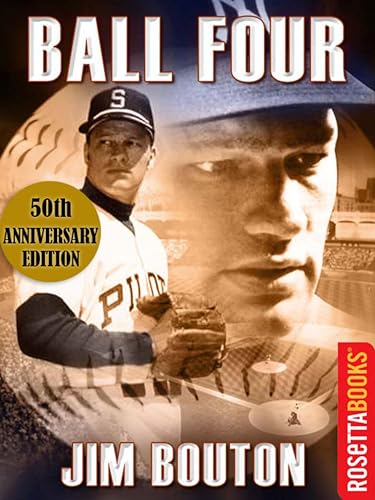
Ball Four: The Final Pitch
Jim Bouton
4.3
The beloved baseball classic now available in paperback, with a new prologue by Jim Bouton
When Ball Four was first published in 1970, it hit the sports world like a lightning bolt. Commissioners, executives, and players were shocked. Sportswriters called author Jim Bouton a traitor and "social leper." Commissioner Bowie Kuhn tried to force him to declare the book untrue. Fans, however, loved the book. And serious critics called it an important social document. Today, Jim Bouton is still not invited to Oldtimer's Days at Yankee Stadium. But his landmark book is still being read by people who don't ordinarily follow baseball.
For the updated edition of this historic book, Bouton has written a new prologue, detailing his perspective on how baseball has changed since the last edition was released.
Damn. Jim Bouton. "Ball Four" is the best baseball book ever written. It blew my 13-year-old mind and I've read it every few years since. It always holds up. Meeting him at a SABR convention in Seattle is something I'll never forget. An absolute legend. https://t.co/g37Afhlyaj [source]
That’s exactly what it is. It’s a diary of a season. Jim Bouton was a wildly successful young player for the Yankees and then basically lost his arm, he got hurt. The book is about his attempt to come back. What makes it wonderful reading, and the reason I love it, is that it’s beautifully written and, again, there’s a great deal of humanity in it. There is certainly also a lot of shock-value in it. There are stories about athletes taking drugs and some of the off-field relationships. That is what made the book somewhat scandalous when it first came out. [source]
Cover unavailable
2
The Once and Future King
T. H. White, Neil Gaiman
4.2
T.H White′s masterful retelling of the Arthurian legend is an abiding classic. Here all five volumes that make up the story are published in one volume, as White himself always wished. Exquisite comedy offsets the tragedy of Arthur′s personal doom as White brings to life the major British epic of all time with brilliance, grandeur, warmth and charm.
TH White’s The Once and Future King. White is less famous than Lewis and Tolkien, but he was a better writer, at least as far as style goes, and his book is a true masterpiece in its own right – a thoroughly modern re-imagining of the great English epic, the story of King Arthur. Like Tolkien, White takes an ancient, mythic landscape and scales it down to human size (or perhaps he scales us up). But White’s world is more brightly lit than Tolkien’s – he dispenses with all those Wagnerian storm clouds. White’s England is all streaming banners and sun-splashed meadows and shining walls, and he lingers longer over his characters, making them more complex and flawed and divided against themselves. The first part alone, “The Sword in the Stone”, about Arthur’s early years and his education by Merlin, may be the best story of a childhood ever committed to paper. [source]
Cover unavailable
3
String Theory: David Foster Wallace on Tennis
David Foster Wallace
4.4
An instant classic of American sportswriting—the tennis essays of David Foster Wallace, “the best mind of his generation” (A. O. Scott) and “the best tennis-writer of all time” (New York Times) Both a onetime "near-great junior tennis player" and a lifelong connoisseur of the finer points of the game, David Foster Wallace wrote about tennis with the authority of an insider, the showmanship of a literary pyrotechnician, and disarming admiration of an irrepressible fan. Including his masterful profiles of Roger Federer and Tracy Austin, String Theory gathers Wallace's five famous essays on tennis, pieces that have been hailed by sportswriters and literary critics alike as some of the greatest and most innovative magazine writing in recent memory. Whiting Award-winning journalist John Jeremiah Sullivan provides an introduction.
Here is a publishing event: the new Mises Institute edition of the classic book that has taught many millions sound economic thinking. It is a hardbound volume, priced very low thanks to special benefactors, and now available in quantity discounts for distribution to your friends, family, and anyone you meet who needs to understand what economics implies for the society, government, and civilization.
Henry Hazlitt wrote this book following his stint at the New York Times as an editorialist. His hope was to reduce the whole teaching of economics to a few principles and explain them in ways that people would never forget. It worked. He relied on some stories by Bastiat and his own impeccable capacity for logical thinking and crystal-clear prose.
He was writing under the influence of Mises himself, of course, but he brought his own special gifts to the project. As just one example, this is the book that made the idea of the "broken window fallacy" so famous.
What thrills us in particular about this new edition is that it is beautiful, it is hardcover, and it is newly typeset for modern readers. It has a full index. It includes a wonderful foreword by Walter Block. It's the right size, shape, and feel – perfect for making this book central to all educational efforts of the future.
This is the book to send to reporters, politicians, pastors, political activists, teachers, or anyone else who needs to know.
Professor Block explains that it was this book that turned him on to economics as a science. He believes that it is probably the most important economics book ever written in the sense that it offers the greatest hope to educating everyone about the meaning of the science.
Written for the non-academic, it has served as the major antidote to fallacies in the popular press, and has appeared in dozens of languages and printings. It's still the quickest way to learn how to think like an economist. And this is why it has been used in the best classrooms more than sixty years.
Many writers have since attempted to beat this book as an introduction, but have never succeeded. Hazlitt's book remains the best. Even if you own this book already, or have several past editions, you will want to have this book as your own as a wonderful testament to its place in the world of ideas.
In putting this edition together, we chose to work from Hazlitt's own first edition because it contains the core of what is crucial here without later updates that only date the book. As with Mises and Human Action, the author's first instincts were the best ones.
Contents:
• Part One: The Lesson • Part Two: The Lesson Applied o The Broken Window o The Blessings of Destruction o Public Works Mean Taxes o Taxes Discourage Production o Credit Diverts Production o The Curse of Machinery o Spread-the-Work Schemes o Disbanding Troops and Bureaucrats o The Fetish of Full Employment o Who's "Protected" by Tariffs? o The Drive for Exports o "Parity" Prices o Saving the X Industry o How the Price System Works o "Stabilizing" Commodities o Government Price-Fixing o Minimum Wage Laws o Do Unions Really Raise Wages? o "Enough to Buy Back the Product" o The Function of Profits o The Mirage of Inflation o The Assault on Savings o The Lesson Restated
If you read this book and "Basic Economics" you'll know more than all or your classmates combined about the basic workings of free markets and economics. [source]
Chris Nichols
@fishin_me @IslesFGC @AsSeenOnTv55 @IlhanMN The best economic book written. [source]
Cover unavailable
5
Nudge: Improving Decisions About Health, Wealth, and Happiness
Every day, we make decisions on topics ranging from personal investments to schools for our children to the meals we eat to the causes we champion. Unfortunately, we often choose poorly. The reason, the authors explain, is that, being human, we all are susceptible to various biases that can lead us to blunder. Our mistakes make us poorer and less healthy; we often make bad decisions involving education, personal finance, health care, mortgages and credit cards, the family, and even the planet itself.
Thaler and Sunstein invite us to enter an alternative world, one that takes our humanness as a given. They show that by knowing how people think, we can design choice environments that make it easier for people to choose what is best for themselves, their families, and their society. Using colorful examples from the most important aspects of life, Thaler and Sunstein demonstrate how thoughtful “choice architecture” can be established to nudge us in beneficial directions without restricting freedom of choice. Nudge offers a unique new take—from neither the left nor the right—on many hot-button issues, for individuals and governments alike. This is one of the most engaging and provocative books to come along in many years.
Nudge is a very important book. One of the reasons Nudge is so important is because it’s taking these ideas and applying them to the policy domain. Here are the mistakes we make. Here are the ways marketers are trying to influence us. Here’s the way we might be able to fight back. If policymakers understood these principles, what could they do? The other important thing about the book is that it describes, in detail, small interventions. It’s basically a book about cheap persuasion. [source]
A pioneer in behavioral economics and just recently awarded the Nobel Prize in Economics, his classic book on how to make better decisions. [source]
Cover unavailable
6
The Wisdom of Crowds: Why the Many Are Smarter Than the Few and How Collective Wisdom Shapes Business, Economies, Societies and Nations
James Surowiecki
4.1
""No one in this world, so far as I know, has ever lost money by underestimating the intelligence of the great masses of the plain people." --H. L. Mencken" H. L. Mencken was wrong. In this endlessly fascinating book, "New Yorker" columnist James Surowiecki explores a deceptively simple idea that has profound implications: large groups of people are "smarter" than an elite few, no matter how brilliant--better at solving problems, fostering innovation, coming to wise decisions, even predicting the future. This seemingly counterintuitive notion has endless and major ramifications for how businesses operate, how knowledge is advanced, how economies are (or should be) organized and how we live our daily lives. With seemingly boundless erudition and in delightfully clear prose, Surowiecki ranges across fields as diverse as popular culture, psychology, ant biology, economic behaviorism, artificial intelligence, military history and political theory to show just how this principle operates in the real world. Despite the sophistication of his arguments, Surowiecki presents them in a wonderfully entertaining manner. The examples he uses are all down-to-earth, surprising, and fun to ponder. Why is the line in which you're standing always the longest? Why is it that you can buy a screw anywhere in the world and it will fit a bolt bought ten-thousand miles away? Why is network television so awful? If you had to meet someone in Paris on a specific day but had no way of contacting them, when and where would you meet? Why are there traffic jams? What's the best way to win money on a game show? Why, when you walk into a convenience store at 2:00 A.M. to buy a quart of orange juice, is it there waiting for you? What do Hollywood mafia movies have to teach us about why corporations exist? "The Wisdom of Crowds" is a brilliant but accessible biography of an idea, one with important lessons for how we live our lives, select our leaders, conduct our business, and think about our world.
@Mbiginji If you like that type you might enjoy The Wisdom of Crowds - James Surowiecki and Homo Deus by Yuval Harari. Recommend also Winners Takes All by Anand Giridharadas. Different kind of book but important read. [source]
Nadia Al Sheikh
Although we tend to elect leaders that we believe know better and follow them hoping for a better future, better life & a safer life. Surprisingly in many cases the wisdom of the crowd has proven to be more accurate than most of our smartest leaders. The message for me is to learn to listen to the people and to learn from them assuming you know nothing with that you will learn a lot! [source]
Cover unavailable
7
Devils
Fyodor Dostoyevsky
4.4
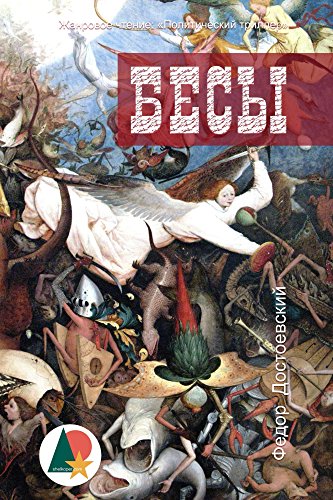
Devils, also known in English as The Possessed and The Demons, was first published in 1871-2. The third of Dostoevsky's five major novels, it is at once a powerful political tract and a profound study of atheism, depicting the disarray which follows the appearance of a band of modish radicals in a small provincial town. Dostoevsky compares infectious radicalism to the devils that drove the Gadarene swine over the precipice in his vision of a society possessed by demonic creatures that produce devastating delusions of rationality. Dostoevsky weaves suicide, rape, and a multiplicity of scandals into a compelling story of political evil, yet he is at his most humorous in Devils: the novel is full of buffoonery and a grotesque comedy.
This new translation also includes the chapter `Stavrogin's Confession', which was initially considered to be too shocking to print. In this edition it appears where the author originally intended it.
You can’t retell the book, but it’s about Russia and what’s coming out of it. It’s the chaos of politics and morals and religion at the end of the imperial period, reflected in this mystical Russian national character. It sounds silly to speak of, but there is a certain mystical quality to the Russian soul. [source]
Ari Iaccarino
I’m currently reading The Devils by Dostoevsky, and I expect to glean absolutely nothing from it but the pleasure of disconnecting from any other literature that requires me to learn a skill for the company. The overburdening characters and plethora of words for something that could otherwise be said in an instant is a type of therapeutic brain massage in an environment where saying as little as possible with maximum effect is the plow that tills the soil in startup atmosphere. [source]
Cover unavailable
8
Childhood's End
Arthur C. Clarke
4.3
The Overlords appeared suddenly over every city--intellectually, technologically, and militarily superior to humankind. Benevolent, they made few demands: unify earth, eliminate poverty, and end war. With little rebellion, humankind agreed, and a golden age began.
But at what cost? With the advent of peace, man ceases to strive for creative greatness, and a malaise settles over the human race. To those who resist, it becomes evident that the Overlords have an agenda of their own. As civilization approaches the crossroads, will the Overlords spell the end for humankind . . . or the beginning?
The best science fiction book probably ever. [source]
Adam Roberts
Childhood’s End is Clarke’s best book by a long way. Alien overlords land on Earth and impose – by force – a benign and workable utopia. That sounds like a whole story there, but that’s only the start of Clarke’s compact, evocative novel. [source]
Childhood’s End is Clarke’s best book by a long way. Alien overlords land on Earth and impose – by force – a benign and workable utopia. That sounds like a whole story there, but that’s only the start of Clarke’s compact, evocative novel. [source]
Cover unavailable
9
Hillbilly Elegy: A Memoir of a Family and Culture in Crisis
From a former marine and Yale Law School graduate, a powerful account of growing up in a poor Rust Belt town that offers a broader, probing look at the struggles of America’s white working class
Hillbilly Elegy is a passionate and personal analysis of a culture in crisis—that of white working-class Americans. The decline of this group, a demographic of our country that has been slowly disintegrating over forty years, has been reported on with growing frequency and alarm, but has never before been written about as searingly from the inside. J. D. Vance tells the true story of what a social, regional, and class decline feels like when you were born with it hung around your neck.
The Vance family story begins hopefully in postwar America. J. D.’s grandparents were “dirt poor and in love,” and moved north from Kentucky’s Appalachia region to Ohio in the hopes of escaping the dreadful poverty around them. They raised a middle-class family, and eventually their grandchild (the author) would graduate from Yale Law School, a conventional marker of their success in achieving generational upward mobility.
But as the family saga of Hillbilly Elegy plays out, we learn that this is only the short, superficial version. Vance’s grandparents, aunt, uncle, sister, and, most of all, his mother, struggled profoundly with the demands of their new middle-class life, and were never able to fully escape the legacy of abuse, alcoholism, poverty, and trauma so characteristic of their part of America. Vance piercingly shows how he himself still carries around the demons of their chaotic family history.
A deeply moving memoir with its share of humor and vividly colorful figures, Hillbilly Elegy is the story of how upward mobility really feels. And it is an urgent and troubling meditation on the loss of the American dream for a large segment of this country.
The disadvantaged world of poor white Appalachia described in this terrific, heartbreaking book is one that I know only vicariously. Vance was raised largely by his loving but volatile grandparents, who stepped in after his father abandoned him and his mother showed little interest in parenting her son. Against all odds, he survived his chaotic, impoverished childhood only to land at Yale Law School. While the book offers insights into some of the complex cultural and family issues behind poverty, the real magic lies in the story itself and Vance’s bravery in telling it. [source]
In terms of other surprising memoirs, I found JD Vance’s Hillbilly Elegy to be another well-written gem. [source]
Cover unavailable
10
The Day of the Jackal
Frederick Forsyth
4.4
Librarian note: an alternate cover for this edition can be found here.
The Jackal. A tall, blond Englishman with opaque, gray eyes. A killer at the top of his profession. A man unknown to any secret service in the world. An assassin with a contract to kill the world's most heavily guarded man.
One man with a rifle who can change the course of history. One man whose mission is so secretive not even his employers know his name. And as the minutes count down to the final act of execution, it seems that there is no power on earth that can stop the Jackal.
…
Recommended by Ben Shapiro, James Twining, and Sam Bourne.
The best action novel ever written. By a looong shot! [source]
James Twining
It’s very well-written in a way that perhaps my next choices aren’t, and it depicts France in the 1960s in an incredibly convincing way. [source]
Sam Bourne
What makes the book compelling is that you are observing the mechanics of an assassin who is a really blank character. He is unnamed, apart from being called ‘the Jackal.’ He should be very blank, but it works because you buy into the idea of a traceless, faceless, ruthless killer. [source]
Cover unavailable
11
The Haunting of Hill House
Shirley Jackson
4.0
In celebration of the Shirley Jackson centennial, a Penguin Classics Deluxe Edition of the greatest haunted house story ever written
First published in 1959, Shirley Jackson’s The Haunting of Hill House has been hailed as a perfect work of unnerving terror. It is the story of four seekers who arrive at a notoriously unfriendly pile called Hill House: Dr. Montague, an occult scholar looking for solid evidence of a “haunting”; Theodora, his lighthearted assistant; Eleanor, a friendless, fragile young woman well acquainted with poltergeists; and Luke, the future heir of Hill House. At first, their stay seems destined to be merely a spooky encounter with inexplicable phenomena. But Hill House is gathering its powers—and soon it will choose one of them to make its own.
This book is one of several novels in which a group of ghost hunters or psychic investigators move into a house with a reputation of being haunted, and see what they find. But what makes this the greatest single ghost novel, in my view, is that it’s at least as much about the psychological interaction of the characters as it is about the overtly spectral. There’s a superb characterisation of the spinster character, who ultimately becomes one of the ghosts of Hill House, if you like. The scenes from her viewpoint are both moving and disturbing. [source]
Cover unavailable
12
Exodus
Leon Uris
4.5
Exodus is an international publishing phenomenon--the towering novel of the twentieth century's most dramatic geopolitical event. Leon Uris magnificently portrays the birth of a new nation in the midst of enemies--the beginning of an earthshaking struggle for power. Here is the tale that swept the world with its fury: the story of an American nurse, an Israeli freedom fighter caught up in a glorious, heartbreaking, triumphant era.
Exodus is a book that had a profound impact on how many Americans thought about Israel. [source]
Cover unavailable
13
In Cold Blood
Truman Capote
4.3
On November 15, 1959, in the small town of Holcomb, Kansas, four members of the Clutter family were savagely murdered by blasts from a shotgun held a few inches from their faces. There was no apparent motive for the crime, and there were almost no clues.
As Truman Capote reconstructs the murder and the investigation that led to the capture, trial, and execution of the killers, he generates both mesmerizing suspense and astonishing empathy. At the center of his study are the amoral young killers Perry Smith and Dick Hickcock, who, vividly drawn by Capote, are shown to be reprehensible yet entirely and frighteningly human. In Cold Blood is a seminal work of modern prose, a remarkable synthesis of journalistic skill and powerfully evocative narrative.
One of the reasons I like this true crime novelisation is down to the fact it was so out of character for Capote and took everyone by surprise. It is also an excellent, almost biographical, insight into the two young killers’ minds. [source]
I think in all honesty it is one of the finest books ever written. It took him six years to finish it because he had to wait for the court case and the final verdict which was the two perpetrators being executed. [source]
Cover unavailable
14
Homage to Catalonia
George Orwell
4.3
In 1936 George Orwell travelled to Spain to report on the Civil War and instead joined the fight against the Fascists. This famous account describes the war and Orwell’s own experiences. Introduction by Lionel Trilling.
The other reason I picked this book is that Orwell, like Dan Schorr, was an outsider. When he went to Spain, he was an unknown. He wasn’t Hemingway. He wasn’t a well-connected intellectual. He just had this amazing eye for detail. He was an amazing observer, and he could write so powerfully. This book, to me, is just one of the classics of foreign reporting. [source]
Anyone who wants to go off and write about Egypt, Tunisia or Libya today should pack a copy of Homage to Catalonia. It’s brilliant reportage. As you know, it opens with a vignette of an Italian militiaman in the barracks in Barcelona and he only saw this guy for a few moments but it captures the excitement. [source]
Cover unavailable
15
Alas, Babylon
Pat Frank, David Brin
4.3
"Alas, Babylon." Those fateful words heralded the end. When a nuclear holocaust ravages the United States, a thousand years of civilization are stripped away overnight, and tens of millions of people are killed instantly. But for one small town in Florida, miraculously spared, the struggle is just beginning, as men and women of all backgrounds join together to confront the darkness.
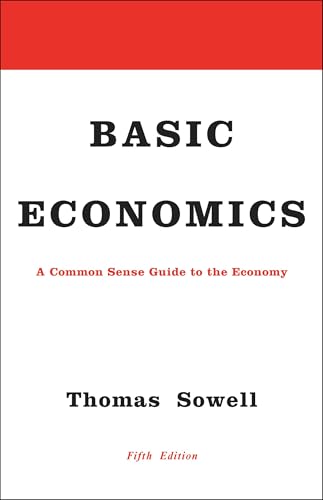
Basic Economicsis a citizen's guide to economics, written for those who want to understand how the economy works but have no interest in jargon or equations. Bestselling economist Thomas Sowell explains the general principles underlying different economic systems: capitalist, socialist, feudal, and so on. In readable language, he shows how to critique economic policies in terms of the incentives they create, rather than the goals they proclaim. With clear explanations of the entire field, from rent control and the rise and fall of businesses to the international balance of payments, this is the first book for anyone who wishes to understand how the economy functions.
This fifth edition includes a new chapter explaining the reasons for large differences of wealth and income between nations.
Drawing on lively examples from around the world and from centuries of history, Sowell explains basic economic principles for the general public in plain English.
If you read this book and "Economics in One Lesson" you'll know more than all or your classmates combined about the basic workings of free markets and economics. [source]
Cover unavailable
17
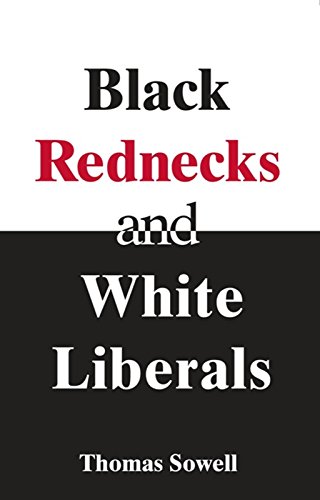
Black Rednecks and White Liberals
Thomas Sowell
4.6
This book presents the kind of eye-opening insights into the history and culture of race for which Sowell has become famous. As late as the 1940s and 1950s, he argues, poor Southern rednecks were regarded by Northern employers and law enforcement officials as lazy, lawless, and sexually immoral. This pattern was repeated by blacks with whom they shared a subculture in the South. Over the last half century poor whites and most blacks have moved up in class and affluence, but the ghetto remains filled with black rednecks. Their attempt to escape, Sowell shows, is hampered by their white liberal friends who turn dysfunctional black redneck culture into a sacrosanct symbol of racial identity. In addition to Black Rednecks and White Liberals, the book takes on subjects ranging from Are Jews Generic? to The Real History of Slavery.
First published in 1949 and a winner of the inaugural International Fantasy Award in 1951, Earth Abides went on to become one of the most influential science-fiction novels of the twentieth century. It remains a fresh, provocative story of apocalyptic pandemic, societal collapse, and rebirth.
The cabin had always been a special retreat for Isherwood Williams, a haven from the demands of society. But one day while hiking, Ish was bitten by a rattlesnake, and the solitude he had so desired took on dire new significance. He was sick for days—and often delirious—waking up to find two strangers peering in at him from the cabin door. Yet oddly, instead of offering help, the two ran off as if terrified. Not long after, the coughing began. Ish suffered chills and fever, and a measles-like rash on his skin. He was one of the few people in the world to live through that peculiar malady, but he didn't know it then.
Ish headed home when he finally felt himself again—and noticed the strangeness almost immediately. No cars passed him on the road; the gas station not far from his cabin looked abandoned; and he was shocked to see the body of a man on the roadside near a small town. Without a radio or phone, Ish had no idea of humanity’s abrupt demise. He had escaped death, yet could not escape the catastrophe—and with an eerie detachment he found himself curious as to how long it would be before all traces of civilization faded from Earth.
Ghosts of Manila: The Fateful Blood Feud Between Muhammad Ali and Joe Frazier
Mark Kram
4.2
When Muhammad Ali met Joe Frazier in Manila for their third fight, their rivalry had spun out of control. The Ali-Frazier matchup had become a madness, inflamed by the media and the politics of race. When the "Thrilla in Manila" was over, one man was left with a ruin of a life; the other was battered to his soul.
Mark Kram covered that fight for Sports Illustrated in an award-winning article. Now his riveting book reappraises the boxers -- who they are and who they were. And in a voice as powerful as a heavyweight punch, Kram explodes the myths surrounding each fighter, particularly Ali. A controversial, no-holds-barred account, Ghosts of Manila ranks with the finest boxing books ever written.
Really terrific book about the fights between Muhammad Ali and Joe Frazier. And it really traces Ali's entire life. [source]
Cover unavailable
20
Going Red: The Two Million Voters Who Will Elect the Next President--and How Conservatives Can Win Them
Ed Morrissey
4.0
The 2016 election is conservatives’ last, best chance to take back the country. So, how can they win? The answer, conservative columnist and analyst Ed Morrissey says, depends on seven battleground counties in swing states Republicans must win. Each county pulled for Obama in one or both of the last two elections, but after eight years of misadventures under the Obama administration, the door is open for Republicans to win them—and the presidency—once again, making a decisive mandate against progressivism for the generation to come.
In Going Red, Morrissey takes readers inside the battlegrounds that will decide the election, weaving together data and the stories of people and leaders in these communities to answer the most pressing questions facing conservatives in 2016:
- What went wrong in 2008 and 2012, and how can the party do better in 2016? - Can Republicans take back crucial swing states like Florida, Ohio, and Virginia? - Is a Hillary Clinton victory really inevitable? - How can conservatives reverse their track record with minorities and young voters?
Providing an unparalleled look into the campaign and the thinking of experts from both parties, Going Red is a field guide for taking back the White House and an essential book for anyone who cares about the fate of the Right.
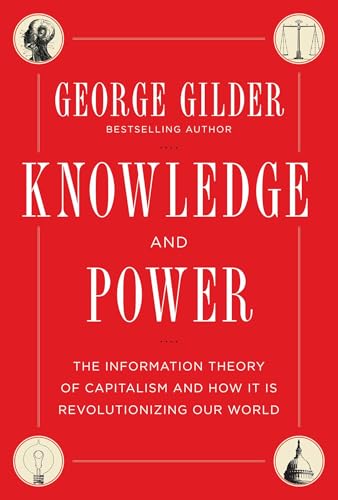
Knowledge and Power: The Information Theory of Capitalism and How it is Revolutionizing our World
George Gilder
4.2
Ronald Reagan’s most-quoted living author—George Gilder—is back with an all-new paradigm-shifting theory of capitalism that will upturn conventional wisdom, just when our economy desperately needs a new direction.
America’s struggling economy needs a better philosophy than the college student's lament: "I can't be out of money, I still have checks in my checkbook!" We’ve tried a government spending spree, and we’ve learned it doesn’t work. Now is the time to rededicate our country to the pursuit of free market capitalism, before we’re buried under a mound of debt and unfunded entitlements. But how do we navigate between government spending that's too big to sustain and financial institutions that are "too big to fail?" In Knowledge and Power, George Gilder proposes a bold new theory on how capitalism produces wealth and how our economy can regain its vitality and its growth.
Gilder breaks away from the supply-side model of economics to present a new economic paradigm: the epic conflict between the knowledge of entrepreneurs on one side, and the blunt power of government on the other. The knowledge of entrepreneurs, and their freedom to share and use that knowledge, are the sparks that light up the economy and set its gears in motion. The power of government to regulate, stifle, manipulate, subsidize or suppress knowledge and ideas is the inertia that slows those gears down, or keeps them from turning at all.
One of the twentieth century’s defining economic minds has returned with a new philosophy to carry us into the twenty-first. Knowledge and Power is a must-read for fiscal conservatives, business owners, CEOs, investors, and anyone interested in propelling America’s economy to future success.
Students of political theory will welcome the return to print of this brilliant defense of ordered liberty. Impugning John Stuart Mill’s famous treatise, On Liberty, Stephen criticized Mill for turning abstract doctrines of the French Revolution into “the creed of a religion.”
Only the constraints of morality and law make liberty possible, warned Stephen, and attempts to impose unlimited freedom, material equality, and an indiscriminate love of humanity will lead inevitably to coercion and tyranny. Liberty must be restrained by custom and tradition if it is to endure; equality must be limited to equality before the law if it is to be just; and fraternity must include actual men, not the amorphous mass of mankind, if it is to be real and genuine.
Please note: This title is available as an ebook for purchase on Amazon, Barnes and Noble, and iTunes.
If you ever want to read a really good book debunking utilitarianism, this is an excellent book. [source]
Cover unavailable
23
Mila 18
Leon Uris
4.5
It was a time of crisis, a time of tragedy�and a time of transcendent courage and determination. Leon Uris's novel is set in the midst of the ghetto uprising that defied Nazi tyranny, as the Jews of Warsaw boldly met Wehrmacht tanks with homemade weapons and bare fists. Here, painted on a canvas as broad as its subject matter, is the compelling story of one of the most heroic struggles of modern times.
"Not only authentic as history....It is convincing as fiction.... the story of a sacrifice that had real meaning and will forever be remembered....A fine and important novel."�The New York Times
Modern Times: The World from the Twenties to the Nineties
Paul Johnson
4.4
Originally published in 1983 and named one of the Best Books of the Year by the New York Times, this bestselling history is now revised and updated and includes a new final chapter.
"Truly a distinguished work of history...Modern Times unites historical and critical consciousness. It is far from being a simple chronicle, though a vast wealth of events and personages and historical changes fill it....We can take a great deal of intellectual pleasure in this book."
People always ask me about history books. I think I've mentioned this book. [source]
Cover unavailable
25
Myths and Facts: A Guide to the Arab-Israeli Conflict
Mitchell G. Bard
4.2
In the last sixty years, Israel has faced seven different wars. During that time, the country has been under immense scrutiny and been the recipient of false accusations. This leaves the public with many questions: Does Israel want peace with the Arab nations? How do Islamic views affect Israel?
Using a number of sources, Mitchell G. Bard uncovers Israel's true history. His book includes the following:
- A discussion of various wars involving Israel (including the war of 1948)
- Multiple maps that help the reader visualize the wars
- An analysis of terrorism directed at Israel
- An alphabetical index
- A discussion of the media's role in how it portrays Israel
- A review of successful and unsuccessful peace efforts
- An overview of US-Israel relations
Bard also offers a synopsis of Israel's roots, beginning with the great myth: that the Jews have no claim to their own land. Bard focuses on Israel's relationships with neighboring countries, but he also includes suggested readings for those interested in further research. You'll learn about the Jewish Virtual Library, an online source that's constantly updated and offers reliable options for study.
Dive into this versatile read as Bard investigates common myths about Israel and reveals the truth.
The best book you can get on the Israeli-Arab conflict. … You'll know everything you need to know if you pick this up. [source]
Cover unavailable
26
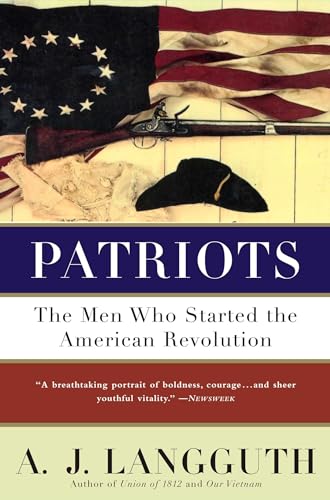
Patriots: The Men Who Started The American Revolution
A.J. Langguth
4.5
With meticulous research and page-turning suspense, Patriots brings to life the American Revolution—the battles, the treacheries, and the dynamic personalities of the men who forged our freedom.
George Washington, John Adams, Samuel Adams, Ben Franklin, Thomas Jefferson, Patrick Henry—these heroes were men of intellect, passion, and ambition. From the secret meetings of the Sons of Liberty to the final victory at Yorktown and the new Congress, Patriots vividly re-creates one of history's great eras.
Another great history book. … Tells the history of the American Revolution. [source]
Cover unavailable
27
The Beast That Crouches at the Door: Adam & Eve, Cain & Abel, and Beyond
Rabbi David Fohrman
4.7
What are we to learn from the narratives in the Torah? A walking, talking snake. A tree that bears mysterious knowledge of Good and Evil. A mark upon Cain for all to see. The early narratives in the Book of Genesis are familiar to us from childhood, yet the meaning of these stories often seem maddeningly elusive. For example: By forbidding Adam and Eve to eat from the Tree of Knowledge, did God really not want mankind to be able to distinguish right from wrong? This book examines the early stories in the Book of Genesis, calling attention to the big questions that bother us all, as well as to the hidden subtleties of text and language. As clues and questions are pieced together, deeper layers of meaning begin to emerge. In the end, the reader gains an experience in the richness and depth of Torah, and a profound confrontation with concepts that define the core of what it means to be a Jew.
A Biblical criticism book that I think is really terrrific. … Really terrific. [source]
Cover unavailable
28
The Insanity Defense: The Complete Prose
Woody Allen
4.2
Comprising the classic bestsellers Getting Even, Without Feathers, and Side Effects, this definitive collection of comic writings is from a man who needs no Introduction. Really–this book has no Introduction.
The Insanity Defense reveals many sides of Woody Allen as he holds forth on the most human of urges (“Why does man kill? He kills for food. And not only for food: frequently there must be a beverage”); reflects on death (“I don’t believe in an afterlife, although I am bringing a change of underwear”); and notes the effect on history wrought by trick chewing gum, the dribble glass, and other novelties. There is also an inspiring story of the futile race to beat Dr. Heimlich to the punch: “The food went down the wrong pipe, and choking occurred. Grasping the mouse firmly by the tail, I snapped it like a small whip, and the morsel of cheese came loose. If we can transfer the procedure to humans, we may have something. Too early to tell.”
All Woody Allen fans will cherish this uproarious treasury–and those who don’t enjoy The Insanity Defense are just plain crazy.
About how the country, the democratic process, and our politicians, have failed the mentally ill in the country. [source]
Cover unavailable
29
The Long March: How the Cultural Revolution of the 1960s Changed America
Roger Kimball
3.9
Roger Kimball shows how the 'cultural revolution' of the 1960s and '70s took hold in America, lodging in our hearts and minds, and in our innermost assumptions about what counts as the good life. Kimball believes that the counterculture transformed high culture as well as our everyday life in terms of attitudes toward self and country, sex and drugs, and manners and morality. Believing that this dramatic change cannot be understood apart from the seductive personalities who articulated its goals, he intersperses his argument with incisive portraits of the life and thought of Allen Ginsberg, Norman Mailer, Timothy Leary, Susan Sontag, Eldridge Cleaver and other 'cultural revolutionaries' who made their mark. For all that has been written about the counterculture, until now there has not been a chronicle of how this revolutionary movement succeeded and how its ideas helped provoke today's 'culture wars'. This book fills this gap with a compelling and well-informed narrative that is sure to provoke discussion and debate.
Quite brilliant. It really traces the rise of the intellectual left and how they defeated the liberals in America. [source]
Cover unavailable
30
The Professor in the Cage: Why Men Fight and Why We Like to Watch
Jonathan Gottschall
4.1
In The Professor in the Cage (2015), professor Jonathan Gottschall enters the world of mixed martial arts to discover the sources of our fascination with violence. Through the power of modern science and by applying the weight of human history, these blinks reveal how our love of fighting is grounded in our deepest human instincts.
All about why it is that men love watching fights. [source]
Cover unavailable
31
The Revenge Of Geography: What the Map Tells Us About Coming Conflicts and the Battle Against Fate
Robert D. Kaplan
4.0
In this provocative, startling book, Robert D. Kaplan, the bestselling author of Monsoon and Balkan Ghosts, offers a revelatory new prism through which to view global upheavals and to understand what lies ahead for continents and countries around the world.
In The Revenge of Geography, Kaplan builds on the insights, discoveries, and theories of great geographers and geopolitical thinkers of the near and distant past to look back at critical pivots in history and then to look forward at the evolving global scene. Kaplan traces the history of the world’s hot spots by examining their climates, topographies, and proximities to other embattled lands. The Russian steppe’s pitiless climate and limited vegetation bred hard and cruel men bent on destruction, for example, while Nazi geopoliticians distorted geopolitics entirely, calculating that space on the globe used by the British Empire and the Soviet Union could be swallowed by a greater German homeland.
Kaplan then applies the lessons learned to the present crises in Europe, Russia, China, the Indian subcontinent, Turkey, Iran, and the Arab Middle East. The result is a holistic interpretation of the next cycle of conflict throughout Eurasia. Remarkably, the future can be understood in the context of temperature, land allotment, and other physical certainties: China, able to feed only 23 percent of its people from land that is only 7 percent arable, has sought energy, minerals, and metals from such brutal regimes as Burma, Iran, and Zimbabwe, putting it in moral conflict with the United States. Afghanistan’s porous borders will keep it the principal invasion route into India, and a vital rear base for Pakistan, India’s main enemy. Iran will exploit the advantage of being the only country that straddles both energy-producing areas of the Persian Gulf and the Caspian Sea. Finally, Kaplan posits that the United States might rue engaging in far-flung conflicts with Iraq and Afghanistan rather than tending to its direct neighbor Mexico, which is on the verge of becoming a semifailed state due to drug cartel carnage.
A brilliant rebuttal to thinkers who suggest that globalism will trump geography, this indispensable work shows how timeless truths and natural facts can help prevent this century’s looming cataclysms.
Praise for The Revenge of Geography “[An] ambitious and challenging new book . . . [The Revenge of Geography]displays a formidable grasp of contemporary world politics and serves as a powerful reminder that it has been the planet’s geophysical configurations, as much as the flow of competing religions and ideologies, that have shaped human conflicts, past and present.”—Malise Ruthven, The New York Review of Books “Robert D. Kaplan, the world-traveling reporter and intellectual whose fourteen books constitute a bedrock of penetrating exposition and analysis on the post-Cold War world . . . strips away much of the cant that suffuses public discourse these days on global developments and gets to a fundamental reality: that geography remains today, as it has been throughout history, one of the most powerful drivers of world events.”—The National Interest “Kaplan plunges into a planetary review that is often thrilling in its sheer scale . . . encyclopedic.”—The New Yorker
“[The Revenge of Geography] serves the facts straight up. . . . Kaplan’s realism and willingness to face hard facts make The Revenge of Geography a valuable antidote to the feel-good manifestoes that often masquerade as strategic thought.”—The Daily Beast
It's very good. … There are actual physical geographies on the ground making it difficult for us to control certain areas of the globe. [source]
Cover unavailable
32
The Rise and Fall of Violent Crime in America
Barry Latzer
4.1
A compelling case can be made that violent crime, especially in the period after the late 1960s, was one of the most significant domestic issues in the United States, and perhaps in the nations of the West generally. Aside from the movement for black civil rights, it is hard to think of a phenomenon that had as profound effect on American life in the last third of the 20th century. After 1965, crime rose to such levels that it frightened virtually all Americans and prompted significant alterations in everyday behaviors and even in lifestyles. The risk of being “mugged” became an issue when Americans chose places to live as well as schools for their children, when they selected commuter routes to work, and when they planned their leisure activities. In some locales, people were fearful of leaving their dwellings at any time, day or night, even to go to market. In the worst of the post-1960s crime wave, Americans spent part of each day literally looking back over their shoulders.
The Rise and Fall of Violent Crime in America is the first book to comprehensively examine this important phenomenon over the entire postwar era. It combines a social history of the U.S. with the insights of criminology. This work examines the relationship between rising and falling crime and such historical developments as the postwar economic boom, suburbanization and the rise of the middle class, baby booms and busts, war and antiwar protest, the urbanization of minorities, etc.
The justice system is not biased against black people or hispanic people, read this book and you will see the statistics. [source]
Cover unavailable
33
The Scandal of Money: Why Wall Street Recovers but the Economy Never Does
George Gilder
4.1
Why do conservatives have such a hard time winning the economic debate in the court of public opinion? Simple, George Gilder says: conservatives misunderstand economics almost as badly as liberals do. Republicans have been running on tax cut proposals since the era of Harding and Coolidge without seriously addressing the key problems of a global economy in decline. Enough is enough. Gilder, author of New York Times bestseller Wealth and Poverty, proposes a completely new framework for understanding economic growth that will replace failed 20th century conservative economics and turn the economic debate—and the country—around.
In the grand storytelling style that is his signature, James Michener sweeps us back through time to the very beginnings of the Jewish faith, thousands of years ago. Through the predecessors of four modern men and women, we experience the entire colorful history of the Jews, including the life of the early Hebrews and their persecutions, the impact of Christianity, the Crusades, and the Spanish Inquisition, all the way to the founding of present-day Israel and the Middle-East conflict. "A sweeping chronology filled with excitement." THE PHILADELPHIA INQUIRER
Basically a bunch of short stories. But a bunch of them are really, really compelling and interesting. … It's a long read but it's an easy read. [source]
Cover unavailable
35
The War on Cops: How the New Attack on Law and Order Makes Everyone Less Safe
Heather Mac Donald
4.3
Since the summer of 2014, America has been convulsed with a protest movement known as Black Lives Matter. That movement holds that police officers are among the greatest threats—if not the greatest threat--facing young black males today. Policing and the rest of the criminal justice system—from prosecutors to drug laws—single out minority communities for gratuitous and heavy-handed enforcement, the charge goes, resulting in an epidemic of “mass incarceration” that falls most heavily on blacks.
This book challenges that narrative. Through vivid, street-level reporting, it gives voice to the many residents of high-crime neighborhoods, rarely heard in the media, who support proactive policing and want more of it. The book will argue that there is no government agency more dedicated to the proposition that Black Lives Matter than today’s data-driven, accountable police department. In New York City alone, over ten thousand minority males are alive who would have been killed had the New York Police Department not brought homicide in the city down 80% from its early 1990’s level. The intelligence-led policing revolution that began in New York and spread nationally has transformed urban neighborhoods, freeing their residents from the thrall of daily fear.
Other topics include such contested tactics as stop, question, and frisk and “broken windows” policing. The book will refute the argument that racist drug statutes and enforcement lie behind the black incarceration rate. It will take the reader inside prisons and jails. And it will argue that proactive policing has been the greatest public policy success story of the last quarter century, resulting in a record-breaking national crime drop that no criminologist or even police chief foresaw.
That crime drop is now at risk, however, thanks to the nonstop agitation against the police led by the Black Lives Matter movement. The book is a call for a more honest and informed debate about policing, crime, and race, before the public safety gains of the last twenty years are lost.
A very good book. … Talks about the Ferguson effect and why it is that the left's attack on law enforcement is actually making people in the inner city less safe, and raising crime rates. [source]
Cover unavailable
36
The Whites
Richard Price, Harry Brandt
3.7
The electrifying tale of a New York City police detective under siege-by an unsolved murder, by his own dark past, and by a violent stalker seeking revenge.
Back in the run-and-gun days of the mid-1990s, when a young Billy Graves worked in the South Bronx as part of an aggressive anti-crime unit known as the Wild Geese, he made headlines by accidentally shooting a ten-year-old boy while struggling with an angel-dusted berserker on a crowded street. Branded as a loose cannon by his higher-ups, Billy spent years enduring one dead-end posting after another. Now in his early forties, he has somehow survived and become a sergeant in Manhattan Night Watch, a small team of detectives charged with responding to all post-midnight felonies from Wall Street to Harlem. Mostly, his unit acts as little more than a set-up crew for the incoming shift, but after years in police purgatory, Billy is content simply to do his job. Then comes a call that changes everything: Night Watch is summoned to the four a.m. fatal slashing of a man in Penn Station, and this time Billy's investigation moves beyond the usual handoff to the day tour. And when he discovers that the victim was once a suspect in the unsolved murder of a twelve-year-old boy-a savage case with connections to the former members of the Wild Geese-the bad old days are back in Billy's life with a vengeance, tearing apart enduring friendships forged in the urban trenches and even threatening the safety of his family. Razor-sharp and propulsively written, The Whites introduces Harry Brandt-a new master of American crime fiction.
A detective crime novel that was recommended to me. [source]
Cover unavailable
37
Tragedy and Comedy
Walter Kerr
4.2
In this superb critical study of tragedy and comedy—their sources, masks, and meanings—Walter Kerr, former drama critic for the New York Times, examines masterpieces from Aristophanes and Shakespeare to Chekhov and Beckett. His imaginative thesis, that "the two masks the theater shows us are in actuality the same face, worn by the same man, reporting the same event," is here worked out with typical seriousness and style. His conclusions point toward a reevaluation of both the theater of the past and the present-day stage. He is one of the few critics able to instruct and entertain, without pedantry or playing to the balcony. He has never been in better form than in this book, which will benefit working dramatists, literary theorists, or the most casual theater-goer.
A great book. The author's theory is that life is both a tragedy and a comedy. … It's the fact that we are capable of reaching out to God and reaching out to the stars, but that we're always gonna fall short, that we're always going to die. [source]
Cover unavailable
38
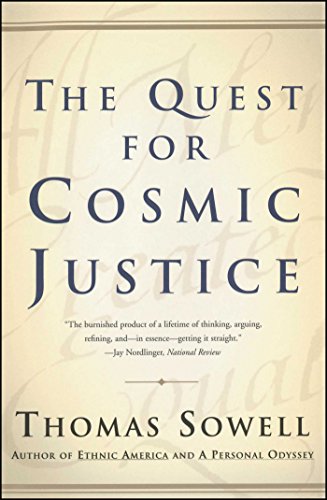
The Quest for Cosmic Justice
Thomas Sowell
4.6
This book is about the great moral issues underlying many of the headline-making political controversies of our times. It is not a comforting book but a book about disturbing and dangerous trends. The Quest for Cosmic Justice shows how confused conceptions of justice end up promoting injustice, how confused conceptions of equality end up promoting inequality, and how the tyranny of social visions prevents many people from confronting the actual consequences of their own beliefs and policies. Those consequences include the steady and dangerous erosion of fundamental principles of freedom - amounting to a quiet repeal of the American revolution. The Quest for Cosmic Justice is the summation of a lifetime of study and thought about where we as a society are headed - and why we need to change course before we do irretrievable damage.
Wealth and Poverty: A New Edition for the Twenty-First Century
George Gilder
4.3
In this acclaimed work, Gilder offers an illuminating discussion of how to increase wealth and curtail poverty, arguing that most welfare programs only serve to keep the poor in poverty as victims of welfare dependency.


 1
1