We've ranked the best brain books using expert recommendations, sales data, and millions of reader ratings. At Shortform, we know books. Our book guides are the best in the world. Learn why.
Cover unavailable
1
The Brain that Changes Itself: Stories of Personal Triumph from the Frontiers of Brain Science
An astonishing new science called neuroplasticity is overthrowing the centuries-old notion that the human brain is immutable. Psychiatrist and psychoanalyst, Norman Doidge, M.D., traveled the country to meet both the brilliant scientists championing neuroplasticity and the people whose lives they’ve transformed - people whose mental limitations or brain damage were seen as unalterable. We see a woman born with half a brain that rewired itself to work as a whole, blind people who learn to see, learning disorders cured, IQs raised, aging brains rejuvenated, stroke patients learning to speak, children with cerebral palsy learning to move with more grace, depression and anxiety disorders successfully treated, and lifelong character traits changed. Using these marvelous stories to probe mysteries of the body, emotion, love, sex, culture, and education, Dr. Doidge has written an immensely moving, inspiring book that will permanently alter the way we look at our brains, human nature, and human potential.
For me it was exciting to read this book because while my research shows a growth mindset is really good for you, this book shows that a growth mindset also has a strong basis in modern neuroscience. It illustrates, though fascinating case histories and descriptions of recent research, the amazing power of the brain to change and even to reorganise itself with practice and experience. [source]
Bogdana Butnar
I don't have favourite books. I equate a favourite something with wanting to do it over and over again and I've never wanted to read a book too many times. I have favourite authors and I have books that changed me in significant ways because they moved me or taught me something or changed my view of the world. So, here's some of those books... [source]
I think the book that I really, really enjoy was, "The Brain That Changes Itself." It's all about neuroplasticity, you'd really love that book. [source]
Major New York Times bestseller Winner of the National Academy of Sciences Best Book Award in 2012 Selected by the New York Times Book Review as one of the best books of 2011 A Globe and Mail Best Books of the Year 2011 Title One of The Economist's 2011 Books of the Year One of The Wall Street Journal's Best Nonfiction Books of the Year 2011 2013 Presidential Medal of Freedom Recipient
In the international bestseller, Thinking, Fast and Slow, Daniel Kahneman, the renowned psychologist and winner of the Nobel Prize in Economics, takes us on a groundbreaking tour of the mind and explains the two systems that drive the way we think. System 1 is fast, intuitive, and emotional; System 2 is slower, more deliberative, and more logical. The impact of overconfidence on corporate strategies, the difficulties of predicting what will make us happy in the future, the profound effect of cognitive biases on everything from playing the stock market to planning our next vacation—each of these can be understood only by knowing how the two systems shape our judgments and decisions. Engaging the reader in a lively conversation about how we think, Kahneman reveals where we can and cannot trust our intuitions and how we can tap into the benefits of slow thinking. He offers practical and enlightening insights into how choices are made in both our business and our personal lives—and how we can use different techniques to guard against the mental glitches that often get us into trouble. Winner of the National Academy of Sciences Best Book Award and the Los Angeles Times Book Prize and selected by The New York Times Book Review as one of the ten best books of 2011, Thinking, Fast and Slow is destined to be a classic.
A few months ago, Mr. Obama read “Thinking, Fast and Slow,” by Daniel Kahneman, about how people make decisions — quick, instinctive thinking versus slower, contemplative deliberation. For Mr. Obama, a deliberator in an instinctive business, this may be as instructive as any political science text. [source]
Captivating dive into human decision making, marred by inclusion of several/many? psychology studies that fail to replicate. Will stand as a cautionary tale? [source]
Cover unavailable
3
Brain Rules: 12 Principles for Surviving and Thriving at Work, Home, and School
Most of us have no idea what’s really going on inside our heads. Yet brain scientists have uncovered details every business leader, parent, and teacher should know—like the need for physical activity to get your brain working its best.
How do we learn? What exactly do sleep and stress do to our brains? Why is multi-tasking a myth? Why is it so easy to forget—and so important to repeat new knowledge? Is it true that men and women have different brains?
In Brain Rules, Dr. John Medina, a molecular biologist, shares his lifelong interest in how the brain sciences might influence the way we teach our children and the way we work. In each chapter, he describes a brain rule—what scientists know for sure about how our brains work—and then offers transformative ideas for our daily lives.
Medina’s fascinating stories and infectious sense of humor breathe life into brain science. You’ll learn why Michael Jordan was no good at baseball. You’ll peer over a surgeon’s shoulder as he proves that most of us have a Jennifer Aniston neuron. You’ll meet a boy who has an amazing memory for music but can’t tie his own shoes.
You will discover how:
Every brain is wired differently Exercise improves cognition We are designed to never stop learning and exploring Memories are volatile Sleep is powerfully linked with the ability to learn Vision trumps all of the other senses Stress changes the way we learn
In the end, you’ll understand how your brain really works—and how to get the most out of it.
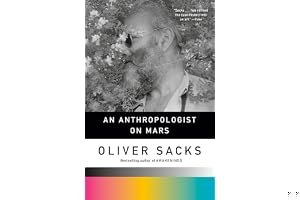
If a man has lost a leg or an eye, he knows he has lost a leg or an eye; but if he has lost a self—himself—he cannot know it, because he is no longer there to know it. Dr. Oliver Sacks recounts the stories of patients struggling to adapt to often bizarre worlds of neurological disorder. Here are people who can no longer recognize everyday objects or those they love; who are stricken with violent tics or shout involuntary obscenities; who have been dismissed as autistic or retarded, yet are gifted with uncanny artistic or mathematical talents. If inconceivably strange, these brilliant tales illuminate what it means to be human.
…
Recommended by Bradley Voytek, Suzanne O'Sullivan, and Tanya Byron.
Bradley Voytek
I can’t imagine one day waking up and not knowing who my wife is, or seeing my wife and thinking that she was replaced by some sort of clone or robot. But that could happen to any of us. [source]
Suzanne O'Sullivan
I didn’t choose neurology because of it but the way Oliver Sacks writes about neurology is very compelling. [source]
Tanya Byron
This is a seminal book that anyone who wants to work in mental health should read. It is a charming and gentle and also an honest exposé of what can happen to us when our mental health is compromised for whatever reason. [source]
Cover unavailable
5
Moonwalking with Einstein: The Art and Science of Remembering Everything
The blockbuster phenomenon that charts an amazing journey of the mind while revolutionizing our concept of memory
An instant bestseller that is poised to become a classic, Moonwalking with Einstein recounts Joshua Foer's yearlong quest to improve his memory under the tutelage of top "mental athletes." He draws on cutting-edge research, a surprising cultural history of remembering, and venerable tricks of the mentalist's trade to transform our understanding of human memory. From the United States Memory Championship to deep within the author's own mind, this is an electrifying work of journalism that reminds us that, in every way that matters, we are the sum of our memories.
Of the five books I finished over vacation, the one that impressed me the most – and that is probably of broadest interest – is Moonwalking with Einstein: The Art and Science of Remembering Everything, by science writer Joshua Foer. This is an absolutely phenomenal book that looks at memory and techniques for dramatically improving memory. Foer actually mastered these techniques, which led him to the finals of the U.S. Memory Championship. His book gives fascinating insights into how the mind works. [source]
It has changed my life and made me embarrass myself much less when meeting someone twice. [source]
Deborah Blum
This book focuses not so much on the scientists but more on the consequence and meaning of memory for the rest of us. Within the framework of a memory championship, Foer looks at this almost obsessive interest in learning, how to remember everything. He asks the really interesting philosophical question, which is, are we defined by what we remember? [source]
Now updated with new research — the book that has changed millions of lives.
After decades of research, world-renowned Stanford University psychologist Carol S. Dweck, Ph.D., discovered a simple but groundbreaking idea: the power of mindset. In this brilliant book, she shows how success in school, work, sports, the arts, and almost every area of human endeavor can be dramatically influenced by how we think about our talents and abilities. People with a fixed mindset — those who believe that abilities are fixed — are less likely to flourish than those with a growth mindset — those who believe that abilities can be developed. Mindset reveals how great parents, teachers, managers, and athletes can put this idea to use to foster outstanding accomplishment.
In this edition, Dweck offers new insights into her now famous and broadly embraced concept. She introduces a phenomenon she calls false growth mindset and guides people toward adopting a deeper, truer growth mindset. She also expands the mindset concept beyond the individual, applying it to the cultures of groups and organizations. With the right mindset, you can motivate those you lead, teach, and love — to transform their lives and your own.
One of the reasons I loved Mindset is because it’s solutions-oriented. In the book’s final chapter, Dweck describes the workshop she and her colleagues have developed to shift students from a fixed to a growth mindset. These workshops demonstrate that ‘just learning about the growth mindset can cause a big shift in the way people think about themselves and their lives. [source]
Without exaggeration, I’ve never met a CEO who didn’t have Mindset on their bookshelf. It resonates with people who have become successful because the belief that your abilities can grow is foundational to their achievements. [source]
Cover unavailable
7
Why We Sleep: Unlocking the Power of Sleep and Dreams
“Why We Sleep is an important and fascinating book…Walker taught me a lot about this basic activity that every person on Earth needs. I suspect his book will do the same for you.” —Bill Gates
A New York Times bestseller and international sensation, this “stimulating and important book” (Financial Times) is a fascinating dive into the purpose and power of slumber.
With two appearances on CBS This Morning and Fresh Air's most popular interview of 2017, Matthew Walker has made abundantly clear that sleep is one of the most important but least understood aspects of our life. Until very recently, science had no answer to the question of why we sleep, or what good it served, or why we suffer such devastating health consequences when it is absent. Compared to the other basic drives in life—eating, drinking, and reproducing—the purpose of sleep remains more elusive.
Within the brain, sleep enriches a diversity of functions, including our ability to learn, memorize, and make logical decisions. It recalibrates our emotions, restocks our immune system, fine-tunes our metabolism, and regulates our appetite. Dreaming creates a virtual reality space in which the brain melds past and present knowledge, inspiring creativity.
In this “compelling and utterly convincing” (The Sunday Times) book, preeminent neuroscientist and sleep expert Matthew Walker provides a revolutionary exploration of sleep, examining how it affects every aspect of our physical and mental well-being. Charting the most cutting-edge scientific breakthroughs, and marshalling his decades of research and clinical practice, Walker explains how we can harness sleep to improve learning, mood and energy levels, regulate hormones, prevent cancer, Alzheimer’s and diabetes, slow the effects of aging, and increase longevity. He also provides actionable steps towards getting a better night’s sleep every night.
Clear-eyed, fascinating, and accessible, Why We Sleep is a crucial and illuminating book. Written with the precision of Atul Gawande, Andrew Solomon, and Sherwin Nuland, it is “recommended for night-table reading in the most pragmatic sense” (TheNew York Times Book Review).
…
Recommended by Bill Gates, Brad Feld, Alexis Ohanian Sr., and 11 others.
Explains how neglecting sleep undercuts your creativity, problem solving, decision-making, learning, memory, heart health, brain health, mental health, emotional well-being, immune system, and even your life span. [source]
Brad Feld
Co-Founder/Foundry Group
Several friends, who know I both love to sleep and am intrigued with how sleep works, recommended that I read Why We Sleep: Unlocking the Power of Sleep and Dreams. It was excellent. While my self-assessment of my sleep habits are very positive, I learned a few things. More importantly, I now have a much better understanding of the “Why” surrounding sleep, especially around sleep’s importance to a healthy and long life. [source]
Alexis Ohanian Sr.
Agree! Best book I've read this year. Wasted so many hours just proving to myself I'd be the last one up working at @reddit and for what??? Stupid. Diminishing marginal returns after enough hours without sleep. https://t.co/cT7fDNBF3A [source]
Cover unavailable
8
The Body Keeps the Score: Brain, Mind, and Body in the Healing of Trauma
“Packed with science and human stories, the book is an intense read. . . . The struggle and resilience of [van der Kolk’s] patients is very moving.” —New Scientist
A pioneering researcher transforms our understanding of trauma and offers a bold new paradigm for healing
Trauma is a fact of life. Veterans and their families deal with the painful aftermath of combat; one in five Americans has been molested; one in four grew up with alcoholics; one in three couples have engaged in physical violence. Dr. Bessel van der Kolk, one of the world’s foremost experts on trauma, has spent over three decades working with survivors. In The Body Keeps the Score, he uses recent scientific advances to show how trauma literally reshapes both body and brain, compromising sufferers’ capacities for pleasure, engagement, self-control, and trust. He explores innovative treatments—from neurofeedback and meditation to sports, drama, and yoga—that offer new paths to recovery by activating the brain’s natural neuroplasticity. Based on Dr. van der Kolk’s own research and that of other leading specialists, The Body Keeps the Score exposes the tremendous power of our relationships both to hurt and to heal—and offers new hope for reclaiming lives.
…
Recommended by Matthew Green.
Matthew Green
Reading The Body Keeps the Score was a eureka moment for me. [source]
Cover unavailable
9
The Power of Habit: Why We Do What We Do in Life and Business
A young woman walks into a laboratory. Over the past two years, she has transformed almost every aspect of her life. She has quit smoking, run a marathon, and been promoted at work. The patterns inside her brain, neurologists discover, have fundamentally changed.
Marketers at Procter & Gamble study videos of people making their beds. They are desperately trying to figure out how to sell a new product called Febreze, on track to be one of the biggest flops in company history. Suddenly, one of them detects a nearly imperceptible pattern—and with a slight shift in advertising, Febreze goes on to earn a billion dollars a year.
An untested CEO takes over one of the largest companies in America. His first order of business is attacking a single pattern among his employees—how they approach worker safety—and soon the firm, Alcoa, becomes the top performer in the Dow Jones.
What do all these people have in common? They achieved success by focusing on the patterns that shape every aspect of our lives.
They succeeded by transforming habits.
In The Power of Habit, award-winning New York Times business reporter Charles Duhigg takes us to the thrilling edge of scientific discoveries that explain why habits exist and how they can be changed. With penetrating intelligence and an ability to distill vast amounts of information into engrossing narratives, Duhigg brings to life a whole new understanding of human nature and its potential for transformation.
Along the way we learn why some people and companies struggle to change, despite years of trying, while others seem to remake themselves overnight. We visit laboratories where neuroscientists explore how habits work and where, exactly, they reside in our brains. We discover how the right habits were crucial to the success of Olympic swimmer Michael Phelps, Starbucks CEO Howard Schultz, and civil-rights hero Martin Luther King, Jr. We go inside Procter & Gamble, Target superstores, Rick Warren’s Saddleback Church, NFL locker rooms, and the nation’s largest hospitals and see how implementing so-called keystone habits can earn billions and mean the difference between failure and success, life and death.
At its core, The Power of Habit contains an exhilarating argument: The key to exercising regularly, losing weight, raising exceptional children, becoming more productive, building revolutionary companies and social movements, and achieving success is understanding how habits work.
Habits aren’t destiny. As Charles Duhigg shows, by harnessing this new science, we can transform our businesses, our communities, and our lives.
…
Recommended by Naval Ravikant, Blake Irving, Alden Mills, and 15 others.
I also recently finished The Power of Habit, or close to finish as I get. That one was interesting, not because of its content necessarily, but because it’s good for me to always keep on top of mind how powerful my habits are. … I think learning how to break habits is a very important meta-skill that can serve you better in life than almost anything else. Although you can read tons of books on it, the reality is you’re never going to learn how to break bad habits until you just break them. [source]
Blake Irving
CEO/GoDaddy
You know, there's a book called The Power of Habit by Charles Duhigg. Simple read book about just how to build positive habits that can be I think I what I'd call you know whether in your personal life or whether in your business life to help you build you know, have a loop that can build your success and that's one I mean there are so many great books out there. [source]
Alden Mills
More recent books that have had a significant impact on me are The Power of Habit and The Diamond Cutter. Both represent different forces for me – the former helps me tactically with making incremental improvements in my life. [source]
Cover unavailable
10
Predictably Irrational: The Hidden Forces That Shape Our Decisions
Why do our headaches persist after taking a one-cent aspirin but disappear when we take a 50-cent aspirin?
Why does recalling the Ten Commandments reduce our tendency to lie, even when we couldn't possibly be caught?
Why do we splurge on a lavish meal but cut coupons to save twenty-five cents on a can of soup?
Why do we go back for second helpings at the unlimited buffet, even when our stomachs are already full?
And how did we ever start spending $4.15 on a cup of coffee when, just a few years ago, we used to pay less than a dollar?
When it comes to making decisions in our lives, we think we're in control. We think we're making smart, rational choices. But are we?
In a series of illuminating, often surprising experiments, MIT behavioral economist Dan Ariely refutes the common assumption that we behave in fundamentally rational ways. Blending everyday experience with groundbreaking research, Ariely explains how expectations, emotions, social norms, and other invisible, seemingly illogical forces skew our reasoning abilities.
Not only do we make astonishingly simple mistakes every day, but we make the same "types" of mistakes, Ariely discovers. We consistently overpay, underestimate, and procrastinate. We fail to understand the profound effects of our emotions on what we want, and we overvalue what we already own. Yet these misguided behaviors are neither random nor senseless. They're systematic and predictable--making us "predictably" irrational.
From drinking coffee to losing weight, from buying a car to choosing a romantic partner, Ariely explains how to break through these systematic patterns of thought to make better decisions. "Predictably Irrational" will change the way we interact with the world--one small decision at a time.
…
Recommended by Max Levchin, Vinod Khosla, Vinod Khosla, and 22 others.
Max Levchin
Co-founder/PayPal, CEO/Affirm, Investor
Max Levchin recommended this book as an answer to "What business books would you advise young entrepreneurs read?" [source]
Andra Zaharia
'While I was thinking of the best books to add to this short list, I realized that not even half of them are directly related to digital marketing. This is because I believe that the best marketers are people who understand human nature deeply and aim to bring out the best in it. Call me naive, but that’s how I see it. If I were to want to pursue a career in marketing, I’d read … Predictably Irrational. [source]
Chris Goward
Here are some of the books that have been very impactful for me, or taught me a new way of thinking: … Predictably Irrational. [source]
Drawing on cutting-edge neuroscience and psychology and displaying all of the brilliance that made The Tipping Point a classic, Blink changes the way you'll understand every decision you make. Never again will you think about thinking the same way.
Malcolm Gladwell redefined how we understand the world around us. Now, in Blink, he revolutionizes the way we understand the world within. Blink is a book about how we think without thinking, about choices that seem to be made in an instant - in the blink of an eye - that actually aren't as simple as they seem. Why are some people brilliant decision makers, while others are consistently inept? Why do some people follow their instincts and win, while others end up stumbling into error? How do our brains really work - in the office, in the classroom, in the kitchen, and in the bedroom? And why are the best decisions often those that are impossible to explain to others?
In Blink we meet the psychologist who has learned to predict whether a marriage will last, based on a few minutes of observing a couple; the tennis coach who knows when a player will double-fault before the racket even makes contact with the ball; the antiquities experts who recognize a fake at a glance. Here, too, are great failures of "blink": the election of Warren Harding; "New Coke"; and the shooting of Amadou Diallo by police. Blink reveals that great decision makers aren't those who process the most information or spend the most time deliberating, but those who have perfected the art of "thin-slicing" - filtering the very few factors that matter from an overwhelming number of variables.
…
Recommended by Ev Williams, Mike Shinoda, Marillyn Hewson, and 4 others.
Mike Shinoda
I know most of the guys in the band read this book. [source]
Marillyn Hewson
CEO/Lockheed Martin
CEO Marilyn Hewson recommends this book because it helped her to trust her instincts in business. [source]
Antonio Eram
When asked to name some books that had a big impact on him, Antonio mentioned Blink: The Power of Thinking Without Thinking by Malcolm Gladwell. [source]
Man's Search for Meaning has riveted generations of readers with its descriptions of life in Nazi death camps and its lessons for spiritual survival. Between 1942 and 1945 psychiatrist Viktor Frankl labored in four different camps, including Auschwitz, while his parents, brother, and pregnant wife perished. Based on his own experience and the stories of his many patients, Frankl argues that we cannot avoid suffering but we can choose how to cope with it, find meaning in it, and move forward with renewed purpose. Frankl's theory—known as logotherapy, from the Greek word logos ("meaning")—holds that our primary drive in life is not pleasure, as Freud maintained, but the discovery and pursuit of what we personally find meaningful. In the decades since its first publication in 1959, Man's Search for Meaning has become a classic, with more than twelve million copies in print around the world. A 1991 Library of Congress survey that asked readers to name a "book that made a difference in your life" found Man's Search for Meaning among the ten most influential books in America. At once a memoir, a meditation, a treatise, and a history, it continues to inspire us all to find significance in the very act of living. (back cover)
…
Recommended by Tony Robbins, Dustin Moskovitz, Ev Williams, and 60 others.
Another book that I’ve read dozens of times. It taught me that if you change the meaning, you change everything. Meaning equals emotion, and emotion equals life. [source]
Dustin Moskovitz
Co-founder/Facebook and Asana
Dustin Moskovitz recommended this book on Twitter. [source]
I read it while spending ten days in the ICU of Bellevue hospital trying to reattach my finger from a ring avulsion accident in my kitchen. It talks about the meaning of life, and I believe you come out a better person from reading it. [source]
Cover unavailable
13
My Stroke of Insight: A Brain Scientist's Personal Journey
The astonishing New York Times bestseller that chronicles how a brain scientist's own stroke led to enlightenment
On December 10, 1996, Jill Bolte Taylor, a thirty-seven- year-old Harvard-trained brain scientist experienced a massive stroke in the left hemisphere of her brain. As she observed her mind deteriorate to the point that she could not walk, talk, read, write, or recall any of her life-all within four hours-Taylor alternated between the euphoria of the intuitive and kinesthetic right brain, in which she felt a sense of complete well-being and peace, and the logical, sequential left brain, which recognized she was having a stroke and enabled her to seek help before she was completely lost. It would take her eight years to fully recover.
For Taylor, her stroke was a blessing and a revelation. It taught her that by "stepping to the right" of our left brains, we can uncover feelings of well-being that are often sidelined by "brain chatter." Reaching wide audiences through her talk at the Technology, Entertainment, Design (TED) conference and her appearance on Oprah's online Soul Series, Taylor provides a valuable recovery guide for those touched by brain injury and an inspiring testimony that inner peace is accessible to anyone.
…
Recommended by Maya Zlatanova.
Maya Zlatanova
One of the books that had the biggest impact on Maya. [source]
Cover unavailable
14
Incognito: The Secret Lives of the Brain
David Eagleman
4.4
If the conscious mind—the part you consider you—accounts for only a tiny fraction of the brain’s function, what is all the rest doing? This is the question that David Eagleman—renowned neuroscientist and acclaimed author of Sum—answers in a book as accessible and entertaining as it is deeply informed by startling, up-to-the-minute research.
At a conference I recently attended, David talked about his work. It's all anyone discussed for the next two days. This book will help you understand the meat/electricity/chemicals you're carrying around inside your head better than you ever have before. [source]
Louis Grenier
“Incognito: The Secret Lives of the Brain” and “Predictably Irrational” are 2 very good books on psychology that I think you should read. [source]
Cover unavailable
15
Spark: The Revolutionary New Science of Exercise and the Brain
The authors embark upon a fascinating journey through the mind-body connection, showing how exercise is truly our best defense against everything from depression to ADD, from addiction to Alzheimer's.
Cover unavailable
16
Quiet: The Power of Introverts in a World That Can't Stop Talking
At least one-third of the people we know are introverts. They are the ones who prefer listening to speaking; who innovate and create but dislike self-promotion; who favor working on their own over working in teams. It is to introverts—Rosa Parks, Chopin, Dr. Seuss, Steve Wozniak—that we owe many of the great contributions to society.
In Quiet, Susan Cain argues that we dramatically undervalue introverts and shows how much we lose in doing so. She charts the rise of the Extrovert Ideal throughout the twentieth century and explores how deeply it has come to permeate our culture. She also introduces us to successful introverts—from a witty, high-octane public speaker who recharges in solitude after his talks, to a record-breaking salesman who quietly taps into the power of questions. Passionately argued, superbly researched, and filled with indelible stories of real people, Quiet has the power to permanently change how we see introverts and, equally important, how they see themselves.
Now with Extra Libris material, including a reader’s guide and bonus content.
Leaders needn’t be the loudest. Leadership is not about theater. It’s not about dominance. It is about putting the lives of others before any other priority. In Quiet, Cain affirms to a good many of us who are introverts by nature that we needn’t try to be extroverts if we want to lead. Simply being ourselves is more important — and more effective. [source]
Danielle Morrill
Co-founder/Mattermark
Anyway, maybe you’re like me and figuring this out for yourself. It’s a good book for introverts and for those who love them [source]
Probably half the world is introverts. Maybe more. It’s not an easy life to live. I sometimes have that feeling in a room full of people, “uh-oh. I just shut down. I can’t talk anymore and there’s a lock on my mouth and this crowd threw away the key.” Do you ever get that feeling? Please? I hope you do. Let’s try to lock eyes at the party. “Quiet” shows the reader how to unlock the secret powers that probably half the world needs to unlock. [source]
An award-winning memoir and instant New York Times bestseller that goes far beyond its riveting medical mystery, Brain on Fire is the powerful account of one woman’s struggle to recapture her identity.
When twenty-four-year-old Susannah Cahalan woke up alone in a hospital room, strapped to her bed and unable to move or speak, she had no memory of how she’d gotten there. Days earlier, she had been on the threshold of a new, adult life: at the beginning of her first serious relationship and a promising career at a major New York newspaper. Now she was labeled violent, psychotic, a flight risk. What happened?
In a swift and breathtaking narrative, Cahalan tells the astonishing true story of her descent into madness, her family’s inspiring faith in her, and the lifesaving diagnosis that nearly didn’t happen.
…
Recommended by Jessica Flitter and Joann Corleyschwarzkopf.
Jessica Flitter
The readability for me is probably the key element for students—and maybe for teachers as well—because it’s a book that you really can’t put down. If that’s what we need to make students readers, then I’m all for it. [source]
Joann Corleyschwarzkopf
Need a fun boost for your team? Want to jump-start great problem-solving? >Book a 1-hour #creativethinking, virtual experience & get a complimentary pdf copy - Brain on Fire: Unleashing Your Creative Superpowers! for each attendee #teambuilding Info here: https://t.co/j6hOxMJrNH https://t.co/b9hAxV90Mf [source]
Cover unavailable
18
How to Change Your Mind: What the New Science of Psychedelics Teaches Us About Consciousness, Dying, Addiction, Depression, and Transcendence
Could psychedelic drugs change our worldview? One of America's most admired writers takes us on a mind-altering journey to the frontiers of human consciousness
When LSD was first discovered in the 1940s, it seemed to researchers, scientists and doctors as if the world might be on the cusp of psychological revolution. It promised to shed light on the deep mysteries of consciousness, as well as offer relief to addicts and the mentally ill. But in the 1960s, with the vicious backlash against the counter-culture, all further research was banned. In recent years, however, work has quietly begun again on the amazing potential of LSD, psilocybin and DMT. Could these drugs in fact improve the lives of many people? Diving deep into this extraordinary world and putting himself forward as a guinea-pig, Michael Pollan has written a remarkable history of psychedelics and a compelling portrait of the new generation of scientists fascinated by the implications of these drugs. How to Change Your Mind is a report from what could very well be the future of human consciousness.
Michael Pollan masterfully guides us through the highs, lows, and highs again of psychedelic drugs. How to Change Your mind chronicles how it’s been a longer and stranger trip than most any of us knew. [source]
Changed my mind, or at least some of the ideas held in my mind. [source]
Andrew Weil
Michael Pollan assembles a great deal of information here on the history, science, and effects of psychedelics. I found his frank recounting of his recent experiences with LSD, psilocybin, and toad venom most revealing. They appear to have softened his materialistic views and opened him to the possibilities of higher consciousness. He did, indeed, change his mind. [source]
Cover unavailable
19
The Language Instinct: How the Mind Creates Language
The classic book on the development of human language by the world’s leading expert on language and the mind.
In this classic, the world's expert on language and mind lucidly explains everything you always wanted to know about language: how it works, how children learn it, how it changes, how the brain computes it, and how it evolved. With deft use of examples of humor and wordplay, Steven Pinker weaves our vast knowledge of language into a compelling story: language is a human instinct, wired into our brains by evolution. The Language Instinct received the William James Book Prize from the American Psychological Association and the Public Interest Award from the Linguistics Society of America. This edition includes an update on advances in the science of language since The Language Instinct was first published.
…
Recommended by Lane Greene and Simon Baron-Cohen.
Lane Greene
There are two achievements in this book. One is to smuggle Linguistics 101 into a popular book, which is just fantastic. The other is his own argument about the nature of language, and the title says it all. [source]
Simon Baron-Cohen
It’s a really wonderful example of what you can do: take research into something as fundamental to human nature as language and make it accessible to a wide audience. [source]
Cover unavailable
20
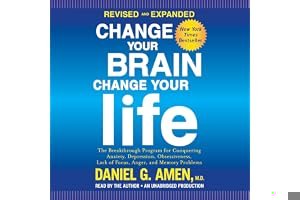
Change Your Brain, Change Your Life (Revised and Expanded): The Breakthrough Program for Conquering Anxiety, Depression, Obsessiveness, Lack of Focus, Anger, and Memory Problems
BRAIN PRESCRIPTIONS THAT REALLY WORK In this breakthrough bestseller, you'll see scientific evidence that your anxiety, depression, anger, obsessiveness, or impulsiveness could be related to how specific structures in your brain work. You're not stuck with the brain you're born with. Here are just a few of neuropsychiatrist Dr. Daniel Amen's surprising--and effective--"brain prescriptions" that can help heal your brain and change your life: To Quell Anxiety and Panic: ¸ Use simple breathing techniques to immediately calm inner turmoil To Fight Depression: ¸ Learn how to kill ANTs (automatic negative thoughts) To Curb Anger: ¸ Follow the Amen anti-anger diet and learn the nutrients that calm rage To Conquer Impulsiveness and Learn to Focus: ¸ Develop total focus with the "One-Page Miracle" To Stop Obsessive Worrying: ¸ Follow the "get unstuck" writing exercise and learn other problem-solving exercises
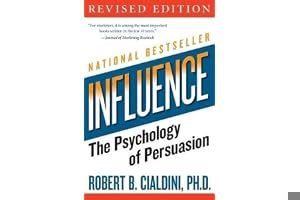
Influence, the classic book on persuasion, explains the psychology of why people say "yes"—and how to apply these understandings. Dr. Robert Cialdini is the seminal expert in the rapidly expanding field of influence and persuasion. His thirty-five years of rigorous, evidence-based research along with a three-year program of study on what moves people to change behavior has resulted in this highly acclaimed book.
You'll learn the six universal principles, how to use them to become a skilled persuader—and how to defend yourself against them. Perfect for people in all walks of life, the principles of Influence will move you toward profound personal change and act as a driving force for your success.
It covers a range of ways in which we end up doing things, and how we don’t understand why we’re doing them. [source]
Max Levchin
Co-founder/PayPal, CEO/Affirm, Investor
Max Levchin recommended this book as an answer to "What business books would you advise young entrepreneurs read?" [source]
Cover unavailable
22
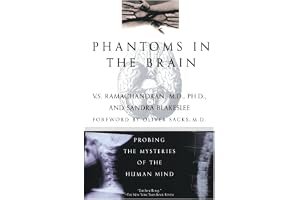
Phantoms in the Brain: Probing the Mysteries of the Human Mind
V. S. Ramachandran, Sandra Blakeslee, et al.
4.4
Neuroscientist V.S. Ramachandran is internationally renowned for uncovering answers to the deep and quirky questions of human nature that few scientists have dared to address. His bold insights about the brain are matched only by the stunning simplicity of his experiments -- using such low-tech tools as cotton swabs, glasses of water and dime-store mirrors. In Phantoms in the Brain, Dr. Ramachandran recounts how his work with patients who have bizarre neurological disorders has shed new light on the deep architecture of the brain, and what these findings tell us about who we are, how we construct our body image, why we laugh or become depressed, why we may believe in God, how we make decisions, deceive ourselves and dream, perhaps even why we're so clever at philosophy, music and art. Some of his most notable cases:
A woman paralyzed on the left side of her body who believes she is lifting a tray of drinks with both hands offers a unique opportunity to test Freud's theory of denial. A man who insists he is talking with God challenges us to ask: Could we be "wired" for religious experience? A woman who hallucinates cartoon characters illustrates how, in a sense, we are all hallucinating, all the time. Dr. Ramachandran's inspired medical detective work pushes the boundaries of medicine's last great frontier -- the human mind -- yielding new and provocative insights into the "big questions" about consciousness and the self.
…
Recommended by Lewis Wolpert.
Lewis Wolpert
It’s really about how people who have some physical injury to their brain can have fantasies that bear no relationship to reality whatsoever. [source]
Cover unavailable
23
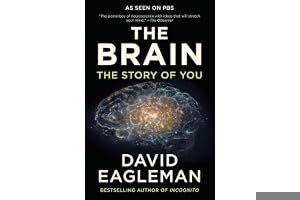
The Brain: The Story of You
David Eagleman
4.4
Locked in the silence and darkness of your skull, your brain fashions the rich narratives of your reality and your identity. Join renowned neuroscientist David Eagleman for a journey into the questions at the mysterious heart of our existence. What is reality? Who are “you”? How do you make decisions? Why does your brain need other people? How is technology poised to change what it means to be human? In the course of his investigations, Eagleman guides us through the world of extreme sports, criminal justice, facial expressions, genocide, brain surgery, gut feelings, robotics, and the search for immortality. Strap in for a whistle-stop tour into the inner cosmos. In the infinitely dense tangle of billions of brain cells and their trillions of connections, something emerges that you might not have expected to see in there: you.
…
Cover unavailable
24
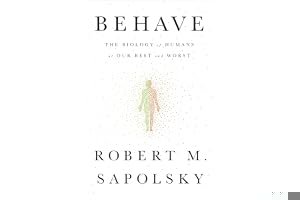
Behave: The Biology of Humans at Our Best and Worst
"It's no exaggeration to say that Behave is one of the best nonfiction books I've ever read." --David P. Barash, The Wall Street Journal
"It has my vote for science book of the year." --Parul Sehgal, The New York Times
"Hands-down one of the best books I've read in years. I loved it." --Dina Temple-Raston, TheWashington Post Named a Best Book of the Year by The Washington Post and The Wall Street Journal
From the celebrated neurobiologist and primatologist, a landmark, genre-defining examination of human behavior, both good and bad, and an answer to the question: Why do we do the things we do?
Sapolsky's storytelling concept is delightful but it also has a powerful intrinsic logic: he starts by looking at the factors that bear on a person's reaction in the precise moment a behavior occurs, and then hops back in time from there, in stages, ultimately ending up at the deep history of our species and its evolutionary legacy.
And so the first category of explanation is the neurobiological one. A behavior occurs--whether an example of humans at our best, worst, or somewhere in between. What went on in a person's brain a second before the behavior happened? Then Sapolsky pulls out to a slightly larger field of vision, a little earlier in time: What sight, sound, or smell caused the nervous system to produce that behavior? And then, what hormones acted hours to days earlier to change how responsive that individual is to the stimuli that triggered the nervous system? By now he has increased our field of vision so that we are thinking about neurobiology and the sensory world of our environment and endocrinology in trying to explain what happened.
Sapolsky keeps going: How was that behavior influenced by structural changes in the nervous system over the preceding months, by that person's adolescence, childhood, fetal life, and then back to his or her genetic makeup? Finally, he expands the view to encompass factors larger than one individual. How did culture shape that individual's group, what ecological factors millennia old formed that culture? And on and on, back to evolutionary factors millions of years old.
The result is one of the most dazzling tours d'horizon of the science of human behavior ever attempted, a majestic synthesis that harvests cutting-edge research across a range of disciplines to provide a subtle and nuanced perspective on why we ultimately do the things we do...for good and for ill. Sapolsky builds on this understanding to wrestle with some of our deepest and thorniest questions relating to tribalism and xenophobia, hierarchy and competition, morality and free will, and war and peace. Wise, humane, often very funny, Behave is a towering achievement, powerfully humanizing, and downright heroic in its own right.
Bryan Johnson recommended this book on Twitter. [source]
Cover unavailable
25
Musicophilia: Tales of Music and the Brain
Oliver Sacks
4.4
With the same trademark compassion and erudition he brought to The Man Who Mistook His Wife for a Hat, Oliver Sacks explores the place music occupies in the brain and how it affects the human condition. In Musicophilia, he shows us a variety of what he calls “musical misalignments.” Among them: a man struck by lightning who suddenly desires to become a pianist at the age of forty-two; an entire group of children with Williams syndrome, who are hypermusical from birth; people with “amusia,” to whom a symphony sounds like the clattering of pots and pans; and a man whose memory spans only seven seconds-for everything but music. Illuminating, inspiring, and utterly unforgettable, Musicophilia is Oliver Sacks’ latest masterpiece.
…
Recommended by Aniela Gregorek and Justin Boreta.
Aniela Gregorek
I gained a deeper understanding of how music affects our moods and our brains. [source]
Justin Boreta
Justin Boreta said this is one of his most-recommended books. [source]
Cover unavailable
26
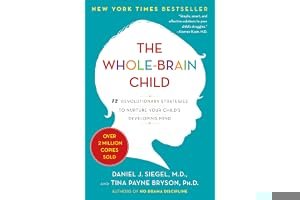
The Whole-Brain Child: 12 Revolutionary Strategies to Nurture Your Child's Developing Mind
“Simple, smart, and effective solutions to your child’s struggles.”—Harvey Karp, M.D.
“Daniel Siegel and Tina Payne Bryson have created a masterly, reader-friendly guide to helping children grow their emotional intelligence. This brilliant method transforms everyday interactions into valuable brain-shaping moments. Anyone who cares for children—or who loves a child—should read The Whole-Brain Child.”—Daniel Goleman, author of Emotional Intelligence
In this pioneering, practical book, Daniel J. Siegel, neuropsychiatrist and author of the bestselling Mindsight, and parenting expert Tina Payne Bryson offer a revolutionary approach to child rearing with twelve key strategies that foster healthy brain development, leading to calmer, happier children. The authors explain—and make accessible—the new science of how a child’s brain is wired and how it matures. The “upstairs brain,” which makes decisions and balances emotions, is under construction until the mid-twenties. And especially in young children, the right brain and its emotions tend to rule over the logic of the left brain. No wonder kids throw tantrums, fight, or sulk in silence. By applying these discoveries to everyday parenting, you can turn any outburst, argument, or fear into a chance to integrate your child’s brain and foster vital growth.
Complete with age-appropriate strategies for dealing with day-to-day struggles and illustrations that will help you explain these concepts to your child, The Whole-Brain Child shows you how to cultivate healthy emotional and intellectual development so that your children can lead balanced, meaningful, and connected lives. “[A] useful child-rearing resource for the entire family . . . The authors include a fair amount of brain science, but they present it for both adult and child audiences.”—Kirkus Reviews “Strategies for getting a youngster to chill out [with] compassion.”—The Washington Post “This erudite, tender, and funny book is filled with fresh ideas based on the latest neuroscience research. I urge all parents who want kind, happy, and emotionally healthy kids to read The Whole-Brain Child. This is my new baby gift.”—Mary Pipher, Ph.D., author of Reviving Ophelia and The Shelter of Each Other
“Gives parents and teachers ideas to get all parts of a healthy child’s brain working together.”—Parent to Parent
…
Recommended by Genevieve Von Lob and Graham Duncan.
Genevieve Von Lob
Siegel uses what neuroscience tells us about how a child’s brain develops to provide practical tips for parents. [source]
Graham Duncan
Graham Duncan recommended this book on the podcast "The Tim Ferriss Show". [source]
You can go after the job you want—and get it! You can take the job you have—and improve it! You can take any situation—and make it work for you!
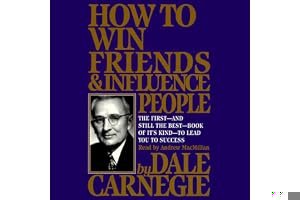
Dale Carnegie’s rock-solid, time-tested advice has carried countless people up the ladder of success in their business and personal lives. One of the most groundbreaking and timeless bestsellers of all time, How to Win Friends & Influence People will teach you:
-Six ways to make people like you -Twelve ways to win people to your way of thinking -Nine ways to change people without arousing resentment
And much more! Achieve your maximum potential—a must-read for the twenty-first century with more than 15 million copies sold!
…
Recommended by Dave Ramsey, Daymond John, Dustin Moskovitz, and 58 others.
The Tell-Tale Brain: A Neuroscientist's Quest for What Makes Us Human
V. S. Ramachandran
4.3
V. S. Ramachandran is at the forefront of his field-so much so that Richard Dawkins dubbed him the "Marco Polo of neuroscience." Now, in a major new work, Ramachandran sets his sights on the mystery of human uniqueness. Taking us to the frontiers of neurology, he reveals what baffling and extreme case studies can teach us about normal brain function and how it evolved. Synesthesia becomes a window into the brain mechanisms that make some of us more creative than others. And autism--for which Ramachandran opens a new direction for treatment--gives us a glimpse of the aspect of being human that we understand least: self-awareness. Ramachandran tackles the most exciting and controversial topics in neurology with a storyteller's eye for compelling case studies and a researcher's flair for new approaches to age-old questions. Tracing the strange links between neurology and behavior, this book unveils a wealth of clues into the deepest mysteries of the human brain.
…
Cover unavailable
29
Emotional Intelligence: Why It Can Matter More Than IQ
Everyone knows that high IQ is no guarantee of success, happiness, or virtue, but until Emotional Intelligence, we could only guess why. Daniel Goleman's brilliant report from the frontiers of psychology and neuroscience offers startling new insight into our "two minds"—the rational and the emotional—and how they together shape our destiny.
Through vivid examples, Goleman delineates the five crucial skills of emotional intelligence, and shows how they determine our success in relationships, work, and even our physical well-being. What emerges is an entirely new way to talk about being smart.
The best news is that "emotional literacy" is not fixed early in life. Every parent, every teacher, every business leader, and everyone interested in a more civil society, has a stake in this compelling vision of human possibility.
From the Trade Paperback edition.
…
Recommended by Drew Houston, Drew Huston, Magda Marcu, and 4 others.
Drew Houston
CEO/Dropbox
It’s nonfiction, but it spelled out something that I just didn’t know you could kind of break down in a logical way. And, suddenly, I had this understanding about the world that I didn’t have before. [source]
Magda Marcu
One of the most eye opening for me was “Emotional Intelligence: Why It Can Matter More Than IQ” as it offered a different perspective on leadership, and how empathy can make you a more successful leader. Every person has some degree of empathy and through this book you understand how to apply it more intently. [source]
Robert Kelsey
Yes, that’s the key revelation. But another key element, which was quite revelatory for me when I read it, is about the impact of fear on your brain. The impact of fear as a physiological response was well known when he wrote the book, but what was less well known was the idea of fear as a neurological response. He pointed to research showing what happens to the brain when fear is triggered, and it’s very damaging. There’s a part of the brain called the amygdala, which is part of the limbic system, and deals with emotions such as fear and distress. Its main purpose is to alert you to danger and it sends an emergency signal. All those physiological responses you have are basically the body’s response to that emergency signal. That’s what people experience when they experience fear, but it’s not just the fear of a dog barking at you or someone attacking you, it’s fear based on a fear conditioning. These are moments when something happens to you that induces fear or distress, and can include fear of failure or fear of being upset, and the same response occurs. [source]
100,000 years ago, at least six human species inhabited the earth. Today there is just one. Us. Homo sapiens.
How did our species succeed in the battle for dominance? Why did our foraging ancestors come together to create cities and kingdoms? How did we come to believe in gods, nations and human rights; to trust money, books and laws; and to be enslaved by bureaucracy, timetables and consumerism? And what will our world be like in the millennia to come?
In Sapiens, Dr Yuval Noah Harari spans the whole of human history, from the very first humans to walk the earth to the radical – and sometimes devastating – breakthroughs of the Cognitive, Agricultural and Scientific Revolutions. Drawing on insights from biology, anthropology, paleontology and economics, he explores how the currents of history have shaped our human societies, the animals and plants around us, and even our personalities. Have we become happier as history has unfolded? Can we ever free our behaviour from the heritage of our ancestors? And what, if anything, can we do to influence the course of the centuries to come?
Bold, wide-ranging and provocative, Sapiens challenges everything we thought we knew about being human: our thoughts, our actions, our power ... and our future.
Both Melinda and I read this one, and it has sparked lots of great conversations at our dinner table. Harari takes on a daunting challenge: to tell the entire history of the human race in just 400 pages. He also writes about our species today and how artificial intelligence, genetic engineering, and other technologies will change us in the future. Although I found things to disagree with—especially Harari’s claim that humans were better off before we started farming—I would recommend Sapiens to anyone who’s interested in the history and future of our species. [source]
The Shallows: What the Internet Is Doing to Our Brains
Nicholas Carr
4.3
“Is Google making us stupid?” When Nicholas Carr posed that question, in a celebrated Atlantic Monthly cover story, he tapped into a well of anxiety about how the Internet is changing us. He also crystallized one of the most important debates of our time: As we enjoy the Net’s bounties, are we sacrificing our ability to read and think deeply?
Now, Carr expands his argument into the most compelling exploration of the Internet’s intellectual and cultural consequences yet published. As he describes how human thought has been shaped through the centuries by “tools of the mind”—from the alphabet to maps, to the printing press, the clock, and the computer—Carr interweaves a fascinating account of recent discoveries in neuroscience by such pioneers as Michael Merzenich and Eric Kandel. Our brains, the historical and scientific evidence reveals, change in response to our experiences. The technologies we use to find, store, and share information can literally reroute our neural pathways.
Building on the insights of thinkers from Plato to McLuhan, Carr makes a convincing case that every information technology carries an intellectual ethic—a set of assumptions about the nature of knowledge and intelligence. He explains how the printed book served to focus our attention, promoting deep and creative thought. In stark contrast, the Internet encourages the rapid, distracted sampling of small bits of information from many sources. Its ethic is that of the industrialist, an ethic of speed and efficiency, of optimized production and consumption—and now the Net is remaking us in its own image. We are becoming ever more adept at scanning and skimming, but what we are losing is our capacity for concentration, contemplation, and reflection.
Part intellectual history, part popular science, and part cultural criticism, The Shallows sparkles with memorable vignettes—Friedrich Nietzsche wrestling with a typewriter, Sigmund Freud dissecting the brains of sea creatures, Nathaniel Hawthorne contemplating the thunderous approach of a steam locomotive—even as it plumbs profound questions about the state of our modern psyche. This is a book that will forever alter the way we think about media and our minds.
While I was thinking of the best books to add to this short list, I realized that not even half of them are directly related to digital marketing. This is because I believe that the best marketers are people who understand human nature deeply and aim to bring out the best in it. Call me naive, but that’s how I see it. If I were to want to pursue a career in marketing, I’d read … The Shallows. [source]
Nicholas Carr talks at length about what is gained and lost by technological progress. Reading and writing enlarged people’s sympathetic response and enriched their lives even when the book was put aside. One could say the same thing about drawing. [source]
Cover unavailable
32
The Tipping Point: How Little Things Can Make a Big Difference
The tipping point is that magic moment when an idea, trend, or social behavior crosses a threshold, tips, and spreads like wildfire. Just as a single sick person can start an epidemic of the flu, so too can a small but precisely targeted push cause a fashion trend, the popularity of a new product, or a drop in the crime rate. This widely acclaimed bestseller, in which Malcolm Gladwell explores and brilliantly illuminates the tipping point phenomenon, is already changing the way people throughout the world think about selling products and disseminating ideas.
Gladwell introduces us to the particular personality types who are natural pollinators of new ideas and trends, the people who create the phenomenon of word of mouth. He analyzes fashion trends, smoking, children's television, direct mail, and the early days of the American Revolution for clues about making ideas infectious, and visits a religious commune, a successful high-tech company, and one of the world's greatest salesmen to show how to start and sustain social epidemics.
Bunch of really good information in here on how to make ideas go viral. This could be good to apply to any kind of products or ideas you may have. Definitely, check out The Tipping Point, which is one of my favorites. [source]
Malcolm Gladwell's breakthrough insight was to focus on the micro-relationships between individuals, which helped organizations realize that it's not about the big ads and the huge charity balls... it's about setting the stage for the buzz to start. [source]
Andy Stern
I think that when we talk about making change, it is much more about macro change, like in policy. This book reminds you that at times when you're building big movements, or trying to elect significant decision-makers in politics, sometimes it's the little things that make a difference. Ever since the book was written, we've become very used to the idea of things going viral unexpectedly and then having massive impact. The Tipping Point, to me, is really an appreciation that very small things can rearrange thinking in ways – like infectious diseases – that have huge implications. While we're always searching for the big policy changes – and we think we have to do that in very traditional ways of building coalitions against constituencies, movements and the media – sometimes it's the little things that actually tip the situation. Like the story of a person and their unique set of circumstances that really captures an issue about health care or housing. So it's trying to remember, while you're thinking about the grand and the glorious, that thinking about the small things can equally bring about change. [source]
Cover unavailable
33
How the Mind Works
Steven Pinker
4.3
In this extraordinary bestseller, Steven Pinker, one of the world's leading cognitive scientists, does for the rest of the mind what he did for language in his 1994 book, The Language Instinct. He explains what the mind is, how it evolved, and how it allows us to see, think, feel, laugh, interact, enjoy the arts, and ponder the mysteries of life. And he does it with the wit that prompted Mark Ridley to write in the New York Times Book Review, "No other science writer makes me laugh so much. . . . [Pinker] deserves the superlatives that are lavished on him." The arguments in the book are as bold as its title. Pinker rehabilitates some unfashionable ideas, such as that the mind is a computer and that human nature was shaped by natural selection, and challenges fashionable ones, such as that passionate emotions are irrational, that parents socialize their children, and that nature is good and modern society corrupting. Winner of the Los Angeles Times Book Prize A New York Times Notable Book of the Year and Publishers Weekly Best Book of 1997 Featured in Time magazine, the New York Times Magazine, The New Yorker, Nature, Science, Lingua Franca, and Science Times Front-page reviews in the Washington Post Book World, the Boston Globe Book Section, and the San Diego Union Book Review
…
Recommended by Dan Kaminsky.
Dan Kaminsky
@DanielMiessler @balajis How The Mind Works being the formative book of my intellectual career makes this particularly interesting. I don’t always agree with Pinker but that’s not a requirement. [source]
In this stunning new book, Malcolm Gladwell takes us on an intellectual journey through the world of "outliers"--the best and the brightest, the most famous and the most successful. He asks the question: what makes high-achievers different?
His answer is that we pay too much attention to what successful people are like, and too little attention to where they are from: that is, their culture, their family, their generation, and the idiosyncratic experiences of their upbringing. Along the way he explains the secrets of software billionaires, what it takes to be a great soccer player, why Asians are good at math, and what made the Beatles the greatest rock band.
Gladwell is not the first person to come up with the 10,000 hour rule. Nor is he the first person to document what it takes to become the best in the world at something. But his stories are so great as he explains these deep concepts. How did the Beatles become the best? Why are professional hockey players born in January, February and March? And so on. [source]
Alex Circei
Question: What five books would you recommend to young people interested in your career path & why? Answer: Screw It, Let's Do It: Lessons In Life by Richard Branson Outliers: The Story of Success by Malcolm Gladwell Start With Why: How Great Leaders Inspire Everyone To Take Action by Simon Sinek The Hard Thing About Hard Things: Building a Business When There Are No Easy Answers by Ben Horowitz Rich Dad Poor Dad: What the Rich Teach Their Kids About Money That the Poor and Middle Class Do Not! by Robert T. Kiyosaki [source]
Psychologist Mihaly Csikszentmihalyi's famous investigations of "optimal experience" have revealed that what makes an experience genuinely satisfying is a state of consciousness called flow. During flow, people typically experience deep enjoyment, creativity, and a total involvement with life. In this new edition of his groundbreaking classic work, Csikszentmihalyi demonstrates the ways this positive state can be controlled, not just left to chance. Flow: The Psychology of Optimal Experience teaches how, by ordering the information that enters our consciousness, we can discover true happiness and greatly improve the quality of our lives.
While re-reading Mihaly Csikszentmihalyi’s wonderful book Flow: The Psychology of Optimal Experience, I came across this passage on working crossword puzzles. I think he could just as well be talking about making blackout poems: "There is much to be said in favor of this popular pastime, which in its best form resembles the ancient riddle contests. It is inexpensive and portable, its challenges can be finely graduated so that both novices and experts can enjoy it, and its solution produces a sense of pleasing order that gives one a satisfying feeling of accomplishment. It provides opportunities to experience a mild state of flow to many people who are stranded in airport lounges, who travel on commuter trains, or who are simply whiling away Sunday mornings." [source]
Tom Chatfield
The notion of flow is the idea that there is a state that is characterised by complete immersion in an activity, by a constant response to stimuli, and a perfect match between your ability and the challenge in front of you. [source]
Cover unavailable
36
Nudge: Improving Decisions About Health, Wealth, and Happiness
Every day, we make decisions on topics ranging from personal investments to schools for our children to the meals we eat to the causes we champion. Unfortunately, we often choose poorly. The reason, the authors explain, is that, being human, we all are susceptible to various biases that can lead us to blunder. Our mistakes make us poorer and less healthy; we often make bad decisions involving education, personal finance, health care, mortgages and credit cards, the family, and even the planet itself.
Thaler and Sunstein invite us to enter an alternative world, one that takes our humanness as a given. They show that by knowing how people think, we can design choice environments that make it easier for people to choose what is best for themselves, their families, and their society. Using colorful examples from the most important aspects of life, Thaler and Sunstein demonstrate how thoughtful “choice architecture” can be established to nudge us in beneficial directions without restricting freedom of choice. Nudge offers a unique new take—from neither the left nor the right—on many hot-button issues, for individuals and governments alike. This is one of the most engaging and provocative books to come along in many years.
Nudge is a very important book. One of the reasons Nudge is so important is because it’s taking these ideas and applying them to the policy domain. Here are the mistakes we make. Here are the ways marketers are trying to influence us. Here’s the way we might be able to fight back. If policymakers understood these principles, what could they do? The other important thing about the book is that it describes, in detail, small interventions. It’s basically a book about cheap persuasion. [source]
This might feel like a weird book to include, but I think it presents another side of strategy that is too often forgotten. It’s not always about bold actors and strategic thrusts. Sometimes strategy is about subtle influence. Sometimes it is framing and small tweaks that change behavior. We can have big aims, but get there with little moves. This book has excellent examples of that kind of thinking and how it is changing politics, government and business. My favorite example is about the bumblebee that they started putting on urinals–which drastically reduced the amount of spray and spillage because it changed where men aimed when they peed. It’s not exactly the coolest strategy but it solved a problem. So we can learn from it. [source]
Cover unavailable
37
The Organized Mind: Thinking Straight in the Age of Information Overload
New York Times bestselling author and neuroscientist Daniel J. Levitin shifts his keen insights from your brain on music to your brain in a sea of details.
The information age is drowning us with an unprecedented deluge of data. At the same time, we’re expected to make more—and faster—decisions about our lives than ever before. No wonder, then, that the average American reports frequently losing car keys or reading glasses, missing appointments, and feeling worn out by the effort required just to keep up.
But somehow some people become quite accomplished at managing information flow. In The Organized Mind, Daniel J. Levitin, PhD, uses the latest brain science to demonstrate how those people excel—and how readers can use their methods to regain a sense of mastery over the way they organize their homes, workplaces, and time.
With lively, entertaining chapters on everything from the kitchen junk drawer to health care to executive office workflow, Levitin reveals how new research into the cognitive neuroscience of attention and memory can be applied to the challenges of our daily lives. This Is Your Brain on Music showed how to better play and appreciate music through an understanding of how the brain works. The Organized Mind shows how to navigate the churning flood of information in the twenty-first century with the same neuroscientific perspective.
Your head is not designed to remember, remind, prioritize, or manage relationships with more than four things. I’ve known this experientially for the last 35 years—that your head is for having ideas, but it’s a terrible place to hang onto them. Levitin validated that in a very rigorously researched book. [source]
Cover unavailable
38
Drive: The Surprising Truth About What Motivates Us
The New York Times bestseller that gives readers a paradigm-shattering new way to think about motivation
Most people believe that the best way to motivate is with rewards like money—the carrot-and-stick approach. That's a mistake, says Daniel H. Pink (author of To Sell Is Human: The Surprising Truth About Motivating Others). In this provocative and persuasive new book, he asserts that the secret to high performance and satisfaction-at work, at school, and at home—is the deeply human need to direct our own lives, to learn and create new things, and to do better by ourselves and our world.
Drawing on four decades of scientific research on human motivation, Pink exposes the mismatch between what science knows and what business does—and how that affects every aspect of life. He examines the three elements of true motivation—autonomy, mastery, and purpose-and offers smart and surprising techniques for putting these into action in a unique book that will change how we think and transform how we live.
…
Recommended by Tobi Lütke, Bogdan Lucaciu, David Brudo, and 5 others.
Tobi Lütke
Founder & CEO/Shopify
Tobi Lütke recommended this book in an interview in "The Globe and Mail." [source]
Bogdan Lucaciu
Spoiler: it’s autonomy, mastery, and purpose. [source]
“Fascinating . . . A thought-provoking journey into emotion science.” — Wall Street Journal
“A singular book, remarkable for the freshness of its ideas and the boldness and clarity with which they are presented.” — Scientific American
“A brilliant and original book on the science of emotion, by the deepest thinker about this topic since Darwin.” — Daniel Gilbert, best-selling author of Stumbling on Happiness
The science of emotion is in the midst of a revolution on par with the discovery of relativity in physics and natural selection in biology. Leading the charge is psychologist and neuroscientist Lisa Feldman Barrett, whose research overturns the long-standing belief that emotions are automatic, universal, and hardwired in different brain regions. Instead, Barrett shows, we construct each instance of emotion through a unique interplay of brain, body, and culture. A lucid report from the cutting edge of emotion science, How Emotions Are Made reveals the profound real-world consequences of this breakthrough for everything from neuroscience and medicine to the legal system and even national security, laying bare the immense implications of our latest and most intimate scientific revolution.
“Mind-blowing.” — Elle
“Chock-full of startling, science-backed findings . . . An entertaining and engaging read. ” — Forbes
…
Recommended by Kirk Borne and Margaret Morris.
Kirk Borne
As #AI moves toward #AGI with #NeuralNetworks, deeper understanding of Emotion Science is critical! See "How Emotions Are Made — The Secret Life of the Brain" by @LFeldmanBarrett Get the book: https://t.co/MH4f0mgnrs Watch her amazing video on @TEDTalks https://t.co/hPFB1vx4me https://t.co/hzZ4z2RCIr [source]
Margaret Morris
I appreciate Lisa Feldman Barrett’s argument that we can become the architects of our experiences. She pushes against the idea that events trigger emotions in a predetermined way and suggests we find the most specific language possible to describe our experiences and feelings. This specificity may propel us to move forward from challenges in a constructive way. [source]
Cover unavailable
40
The Brain's Way of Healing: Remarkable Discoveries and Recoveries from the Frontiers of Neuroplasticity
Norman Doidge
4.3
Now a New York Times Bestseller!
The bestselling author of The Brain That Changes Itself presents astounding advances in the treatment of brain injury and illness
In The Brain That Changes Itself, Norman Doidge described the most important breakthrough in our understanding of the brain in four hundred years: the discovery that the brain can change its own structure and function in response to mental experience—what we call neuroplasticity.
His revolutionary new book shows, for the first time, how the amazing process of neuroplastic healing really works. It describes natural, non-invasive avenues into the brain provided by the forms of energy around us—light, sound, vibration, movement—which pass through our senses and our bodies to awaken the brain’s own healing capacities without producing unpleasant side effects. Doidge explores cases where patients alleviated years of chronic pain or recovered from debilitating strokes or accidents; children on the autistic spectrum or with learning disorders normalizing; symptoms of multiple sclerosis, Parkinson’s disease, and cerebral palsy radically improved, and other near-miracle recoveries. And we learn how to vastly reduce the risk of dementia with simple approaches anyone can use.
For centuries it was believed that the brain’s complexity prevented recovery from damage or disease. The Brain’s Way of Healing shows that this very sophistication is the source of a unique kind of healing. As he did so lucidly in The Brain That Changes Itself, Doidge uses stories to present cutting-edge science with practical real-world applications, and principles that everyone can apply to improve their brain’s performance and health.
…
Cover unavailable
41
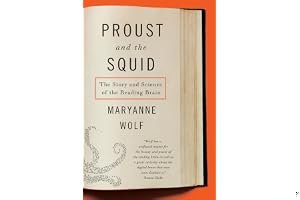
Proust and the Squid: The Story and Science of the Reading Brain
The act of reading is a miracle. Every new reader's brain possesses the extraordinary capacity to rearrange itself beyond its original abilities in order to understand written symbols. But how does the brain learn to read? As world-renowned cognitive neuroscientist and scholar of reading Maryanne Wolf explains in this impassioned book, we taught our brain to read only a few thousand years ago, and in the process changed the intellectual evolution of our species.
Wolf tells us that the brain that examined tiny clay tablets in the cuneiform script of the Sumerians is configured differently from the brain that reads alphabets or of one literate in today's technology.
There are critical implications to such an evolving brain. Just as writing reduced the need for memory, the proliferation of information and the particular requirements of digital culture may short-circuit some of written language's unique contributions—with potentially profound consequences for our future.
Turning her attention to the development of the individual reading brain, Wolf draws on her expertise in dyslexia to investigate what happens when the brain finds it difficult to read. Interweaving her vast knowledge of neuroscience, psychology, literature, and linguistics, Wolf takes the reader from the brains of a pre-literate Homer to a literacy-ambivalent Plato, from an infant listening to Goodnight Moon to an expert reader of Proust, and finally to an often misunderstood child with dyslexia whose gifts may be as real as the challenges he or she faces.
As we come to appreciate how the evolution and development of reading have changed the very arrangement of our brain and our intellectual life, we begin to realize with ever greater comprehension that we truly are what we read. Ambitious, provocative, and rich with examples, Proust and the Squid celebrates reading, one of the single most remarkable inventions in history. Once embarked on this magnificent story of the reading brain, you will never again take for granted your ability to absorb the written word.
…
Recommended by Peg Tyre.
Peg Tyre
Read this and you will never again hand your iPhone to your child in the stroller. You will start talking to them and pointing out colours. [source]
Cover unavailable
42
Buddha's Brain: The Practical Neuroscience of Happiness, Love, and Wisdom
Rick Hanson
4.2
Jesus, Moses, the Buddha, and other great teachers were born with brains built essentially like anyone else's. Then they used their minds to change their brains in ways that changed history.
With the new breakthroughs in neuroscience, combined with the insights from thousands of years of contemplative practice, you, too, can shape your own brain for greater happiness, love, and wisdom.
Buddha's Brain joins the forces of modern science with ancient teachings to show readers how to have greater emotional balance in turbulent times, as well as healthier relationships, more effective actions, and a deeper religious or spiritual practice.
Well-referenced and grounded in science, the book is full of practical tools and skills readers can use in daily life to tap the unused potential of the brain-and rewire it over time for greater peace and well-being.
If you can change your brain, you can change your life.
…
Cover unavailable
43
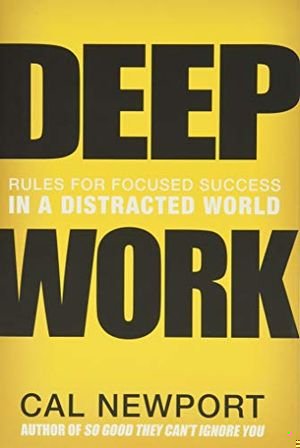
Deep Work: Rules for Focused Success in a Distracted World
One of the most valuable skills in our economy is becoming increasingly rare. If you master this skill, you'll achieve extraordinary results.
Deep work is the ability to focus without distraction on a cognitively demanding task. It's a skill that allows you to quickly master complicated information and produce better results in less time. Deep work will make you better at what you do and provide the sense of true fulfillment that comes from craftsmanship. In short, deep work is like a super power in our increasingly competitive twenty-first century economy. And yet, most people have lost the ability to go deep-spending their days instead in a frantic blur of e-mail and social media, not even realizing there's a better way.
In Deep Work, author and professor Cal Newport flips the narrative on impact in a connected age. Instead of arguing distraction is bad, he instead celebrates the power of its opposite. Dividing this book into two parts, he first makes the case that in almost any profession, cultivating a deep work ethic will produce massive benefits. He then presents a rigorous training regimen, presented as a series of four "rules," for transforming your mind and habits to support this skill.
A mix of cultural criticism and actionable advice, Deep Work takes the reader on a journey through memorable stories-from Carl Jung building a stone tower in the woods to focus his mind, to a social media pioneer buying a round-trip business class ticket to Tokyo to write a book free from distraction in the air-and no-nonsense advice, such as the claim that most serious professionals should quit social media and that you should practice being bored. Deep Work is an indispensable guide to anyone seeking focused success in a distracted world.
As automation and outsourcing reshape the workplace, what new skill do we need? The ability to do deep work. Cal Newport's exciting new book is an introduction and guide to the kind of intense concentration in a distraction-free environment that results in fast, powerful learning and performance. Think of it as calisthenics for your mind-and start your exercise program today. [source]
Marvin Liao
Partner/500 Startups
The Joy of Not Working (Zelinkski), Flash Foresight (Burrus), The Art of Worldly Wisdom (Gracian), Sapiens (Yuval), The End of Jobs (Pearson), Deep Work (Newport), Sovereign Individual (Davidson), The Fourth Economy (Davison) & The Monk & the Riddle (Komisar). Every single one of these books completely changed how I looked at everything in the world & literally pushed my life in a new direction. They were Paradigm Shifting as they say. (hate that word but it really was a Paradigm Shift for me). [source]
I've been a fan of Cal for a long time. His book So Good They Can't Ignore You is one of my favorites, but it's his new book that's probably had the biggest and most immediate impact on me. For those of you who enjoyed Tyler Cowen's Average is Over, you already know how important the ability to focus, be creative, and think at a high level is going to be in the future. This is a book that explains how to cultivate and protect that skill--the ability to do deep work. One thing I've already started doing since reading this book is recording the number of hours of deep work I do each day in my morning journal. It's a way of keeping a running tally and monitoring if I begin to get distracted or slow my pace. Anyway, great book! [source]
Cover unavailable
44
The Righteous Mind: Why Good People Are Divided by Politics and Religion
Why can’t our political leaders work together as threats loom and problems mount? Why do people so readily assume the worst about the motives of their fellow citizens? In The Righteous Mind, social psychologist Jonathan Haidt explores the origins of our divisions and points the way forward to mutual understanding.
His starting point is moral intuition—the nearly instantaneous perceptions we all have about other people and the things they do. These intuitions feel like self-evident truths, making us righteously certain that those who see things differently are wrong. Haidt shows us how these intuitions differ across cultures, including the cultures of the political left and right. He blends his own research findings with those of anthropologists, historians, and other psychologists to draw a map of the moral domain. He then examines the origins of morality, overturning the view that evolution made us fundamentally selfish creatures. But rather than arguing that we are innately altruistic, he makes a more subtle claim—that we are fundamentally groupish. It is our groupishness, he explains, that leads to our greatest joys, our religious divisions, and our political affiliations. In a stunning final chapter on ideology and civility, Haidt shows what each side is right about, and why we need the insights of liberals, conservatives, and libertarians to flourish as a nation.
…
Recommended by A.J. Jacobs, Akin Oyebode, Andrew M. Mwenda, and 3 others.
A.J. Jacobs
All about trying to figure out the gap between the red and blue states – Republican and Democrat – and it’s really interesting. [source]
Akin Oyebode
@eggheader @OnemuVictor1 @JonHaidt Abeg order two. I read Righteous Mind which he also wrote, and that was a very fascinating book. [source]
Andrew M. Mwenda
The best work on this is a book by Jonathan Haidt “The Righteous Mind: Why good People are Divided by Religion and Politics.” He argues that human beings have deeply entrenched moral intuitions which guide their assessment of reality. Facts matter very little if at all. [source]
Cover unavailable
45
The Willpower Instinct: How Self-Control Works, Why It Matters, and What You Can Do to Get More of It
The first book to explain the new science of self-control and how it can be harnessed to improve our health, happiness, and productivity.
After years of watching her students struggling with their choices, health psychologist Kelly McGonigal, Ph.D., realized that much of what people believe about willpower is actually sabotaging their success. Committed to sharing what the scientific community already knew about self-control, McGonigal created a course called "The Science of Willpower" for Stanford University's Continuing Studies Program. The course was an instant hit and spawned the hugely successful Psychology Today blog with the same name.
Informed by the latest research and combining cutting-edge insights from psychology, economics, neuroscience, and medicine, McGonigal's book explains exactly what willpower is, how it works, and why it matters. Readers will learn:
Willpower is a mind-body response, not a virtue. It is a biological function that can be improved through mindfulness, exercise, nutrition, and sleep. People who have better control of their attention, emotions, and actions are healthier, happier, have more satisfying relationships, and make more money. Willpower is not an unlimited resource. Too much self-control can actually be bad for your health. Temptation and stress hijack the brain's systems of self-control, and that the brain can be trained for greater willpower.
In the groundbreaking tradition of Getting Things Done, The Willpower Instinct combines life-changing prescriptive advice and complementary exercises to help readers with goals ranging from a healthier life to more patient parenting, from greater productivity at work to finally finishing the basement.
…
Cover unavailable
46
This Is Your Brain on Music: The Science of a Human Obsession
Daniel J. Levitin
4.2
Whether you load your iPod with Bach or Bono, music has a significant role in your life—even if you never realized it. Why does music evoke such powerful moods? The answers are at last be- coming clear, thanks to revolutionary neuroscience and the emerging field of evolutionary psychology. Both a cutting-edge study and a tribute to the beauty of music itself, This Is Your Brain on Music unravels a host of mysteries that affect everything from pop culture to our understanding of human nature, including: • Are our musical preferences shaped in utero? • Is there a cutoff point for acquiring new tastes in music? • What do PET scans and MRIs reveal about the brain’s response to music? • Is musical pleasure different from other kinds of pleasure?
This Is Your Brain on Music explores cultures in which singing is considered an essential human function, patients who have a rare disorder that prevents them from making sense of music, and scientists studying why two people may not have the same definition of pitch. At every turn, this provocative work unlocks deep secrets about how nature and nurture forge a uniquely human obsession.
A renowned psychiatrist reveals how trauma affects children--and outlines the path to recoveryHow does trauma affect a child's mind--and how can that mind recover? In the classic The Boy Who Was Raised as a Dog, Dr. Perry explains what happens to the brains of children exposed to extreme stress and shares their lessons of courage, humanity, and hope. Only when we understand the science of the mind and the power of love and nurturing, can we hope to heal the spirit of even the most wounded child.
• Why are lovers quicker to forgive their partners for infidelity than for leaving dirty dishes in the sink? • Why will sighted people pay more to avoid going blind than blind people will pay to regain their sight? • Why do dining companions insist on ordering different meals instead of getting what they really want? • Why do pigeons seem to have such excellent aim; why can’t we remember one song while listening to another; and why does the line at the grocery store always slow down the moment we join it? In this brilliant, witty, and accessible book, renowned Harvard psychologist Daniel Gilbert describes the foibles of imagination and illusions of foresight that cause each of us to misconceive our tomorrows and misestimate our satisfactions. Vividly bringing to life the latest scientific research in psychology, cognitive neuroscience, philosophy, and behavioral economics, Gilbert reveals what scientists have discovered about the uniquely human ability to imagine the future, and about our capacity to predict how much we will like it when we get there. With penetrating insight and sparkling prose, Gilbert explains why we seem to know so little about the hearts and minds of the people we are about to become.
…
Recommended by Ev Williams, Jonathan Haidt, Chelsea Frank, and 6 others.
He’s one of the funniest people, certainly in psychology – he’s just endlessly witty, and reading it is like strapping yourself into a roller coaster. [source]
Chelsea Frank
I read everything with an open mind, often challenging myself by choosing books with an odd perspective or religious/spiritual views. These books do not reflect my personal feelings but are books that helped shape my perspective on life, love, and happiness. [source]
My recommendation is to do little tests. Try a few months of living the life you think you want, but leave yourself an exit plan, being open to the big chance that you might not like it after actually trying it... The best book about this subject is Stumbling on Happiness by Daniel Gilbert. His recommendation is to talk to a few people wo are currently where you think you want to be and ask them for the pros and cons. Then trust their opinion since they're right in it, not just remembering or imagining. [source]
Cover unavailable
49
A Whole New Mind: Moving from the Information Age to the Conceptual Age
This is one of the books I recommend to people looking for a career in advertising. [source]
Cover unavailable
50
Descartes' Error: Emotion, Reason and the Human Brain
Antonio Damasio
4.2
Since Descartes famously proclaimed, "I think, therefore I am," science has often overlooked emotions as the source of a person’s true being. Even modern neuroscience has tended, until recently, to concentrate on the cognitive aspects of brain function, disregarding emotions. This attitude began to change with the publication of Descartes’ Error in 1995. Antonio Damasio—"one of the world’s leading neurologists" (The New York Times)—challenged traditional ideas about the connection between emotions and rationality. In this wondrously engaging book, Damasio takes the reader on a journey of scientific discovery through a series of case studies, demonstrating what many of us have long suspected: emotions are not a luxury, they are essential to rational thinking and to normal social behavior.
Damasio worked with people who have suffered strokes and as a result are incapable of feeling emotion. And far from making good decisions, they make terrible decisions, and their lives fall apart. [source]
Paul Thagard
This book understood emotion in terms of what the brain does – not as a kind of abstract computational process but very much tied in with the particular brain processes. [source]
Cover unavailable
51
Algorithms to Live By: The Computer Science of Human Decisions
A fascinating exploration of how insights from computer algorithms can be applied to our everyday lives, helping to solve common decision-making problems and illuminate the workings of the human mind
All our lives are constrained by limited space and time, limits that give rise to a particular set of problems. What should we do, or leave undone, in a day or a lifetime? How much messiness should we accept? What balance of new activities and familiar favorites is the most fulfilling? These may seem like uniquely human quandaries, but they are not: computers, too, face the same constraints, so computer scientists have been grappling with their version of such issues for decades. And the solutions they've found have much to teach us.
In a dazzlingly interdisciplinary work, acclaimed author Brian Christian and cognitive scientist Tom Griffiths show how the algorithms used by computers can also untangle very human questions. They explain how to have better hunches and when to leave things to chance, how to deal with overwhelming choices and how best to connect with others. From finding a spouse to finding a parking spot, from organizing one's inbox to understanding the workings of memory, Algorithms to Live By transforms the wisdom of computer science into strategies for human living.
…
Recommended by Doug McMillon, Chris Oliver, Emi Gal, and 2 others.
Here are some of my favorite reads from 2017. Lots of friends and colleagues send me book suggestions and it's impossible to squeeze them all in. I continue to be super curious about how digital and tech are enabling people to transform our lives but I try to read a good mix of books that apply to a variety of areas and stretch my thinking more broadly. [source]
Chris Oliver
This is a great book talking about how you can use computer science to help you make decisions in life. How do you know when to make a decision on the perfect house? Car? etc? It helps you apply algorithms to making those decisions optimally without getting lost. [source]
Emi Gal
When asked what books he would recommend to young people interested in his career path, mentioned Algorithms to Live By. [source]
Cover unavailable
52
The Happiness Hypothesis: Finding Modern Truth in Ancient Wisdom
In his widely praised book, award-winning psychologist Jonathan Haidt examines the world’s philosophical wisdom through the lens of psychological science, showing how a deeper understanding of enduring maxims-like Do unto others as you would have others do unto you, or What doesn’t kill you makes you stronger-can enrich and even transform our lives.
Recommended by Eric Schmidt, Tony Hsieh, Chelsea Frank, and 4 others.
Chelsea Frank
I read everything with an open mind, often challenging myself by choosing books with an odd perspective or religious/spiritual views. These books do not reflect my personal feelings but are books that helped shape my perspective on life, love, and happiness. [source]
He argues that most of our moral decisions are that kind of an instant reaction. It’s like aesthetics: when we see a scene we know instantly if it’s beautiful or not. [source]
Emrys Westacott
Haidt has a formula for happiness: Genetics + conditions + choices. This is a formula for a realistic approach to trying to achieve the good life. [source]
Cover unavailable
53
The Mind and the Brain: Neuroplasticity and the Power of Mental Force
Jeffrey M. Schwartz MD, Sharon Begley
4.2
A groundbreaking work of science that confirms, for the first time, the independent existence of the mind–and demonstrates the possibilities for human control over the workings of the brain.
Conventional science has long held the position that 'the mind' is merely an illusion, a side effect of electrochemical activity in the physical brain. Now in paperback, Dr Jeffrey Schwartz and Sharon Begley's groundbreaking work, The Mind and the Brain, argues exactly the opposite: that the mind has a life of its own.Dr Schwartz, a leading researcher in brain dysfunctions, and Wall Street Journal science columnist Sharon Begley demonstrate that the human mind is an independent entity that can shape and control the functioning of the physical brain. Their work has its basis in our emerging understanding of adult neuroplasticity–the brain's ability to be rewired not just in childhood, but throughout life, a trait only recently established by neuroscientists.
Through decades of work treating patients with obsessive–compulsive disorder (OCD), Schwartz made an extraordinary finding: while following the therapy he developed, his patients were effecting significant and lasting changes in their own neural pathways. It was a scientific first: by actively focusing their attention away from negative behaviors and toward more positive ones, Schwartz's patients were using their minds to reshape their brains–and discovering a thrilling new dimension to the concept of neuroplasticity.
The Mind and the Brain follows Schwartz as he investigates this newly discovered power, which he calls self–directed neuroplasticity or, more simply, mental force. It describes his work with noted physicist Henry Stapp and connects the concept of 'mental force' with the ancient practice of mindfulness in Buddhist tradition. And it points to potential new applications that could transform the treatment of almost every variety of neurological dysfunction, from dyslexia to stroke–and could lead to new strategies to help us harness our mental powers. Yet as wondrous as these implications are, perhaps even more important is the philosophical dimension of Schwartz's work. For the existence of mental force offers convincing scientific evidence of human free will, and thus of man's inherent capacity for moral choice.
…
Cover unavailable
54
Atomic Habits: An Easy & Proven Way to Build Good Habits & Break Bad Ones
No matter your goals, Atomic Habits offers a proven framework for improving--every day. James Clear, one of the world's leading experts on habit formation, reveals practical strategies that will teach you exactly how to form good habits, break bad ones, and master the tiny behaviors that lead to remarkable results.
If you're having trouble changing your habits, the problem isn't you. The problem is your system. Bad habits repeat themselves again and again not because you don't want to change, but because you have the wrong system for change. You do not rise to the level of your goals. You fall to the level of your systems. Here, you'll get a proven system that can take you to new heights.
Clear is known for his ability to distill complex topics into simple behaviors that can be easily applied to daily life and work. Here, he draws on the most proven ideas from biology, psychology, and neuroscience to create an easy-to-understand guide for making good habits inevitable and bad habits impossible. Along the way, readers will be inspired and entertained with true stories from Olympic gold medalists, award-winning artists, business leaders, life-saving physicians, and star comedians who have used the science of small habits to master their craft and vault to the top of their field.
Learn how to: * make time for new habits (even when life gets crazy); * overcome a lack of motivation and willpower; * design your environment to make success easier; * get back on track when you fall off course; ...and much more.
Atomic Habits will reshape the way you think about progress and success, and give you the tools and strategies you need to transform your habits--whether you are a team looking to win a championship, an organization hoping to redefine an industry, or simply an individual who wishes to quit smoking, lose weight, reduce stress, or achieve any other goal.
I recently read an advance copy of James Clear’s new book, Atomic Habits. His thesis is that small but carefully selected habits can, over time, create massively positive results — not just in terms of what you accomplish, but also in terms of the type of person you become. James’s exposition rings true with what’ve I learned hanging around interesting people and high achievers. I recommend you give this book a closer look. [source]
A lot of people email me asking about habits - how to form good ones, how to break bad ones, how to stop doing the dumb shit we always do. I've got a friend named James Clear. He's an accomplished author and business owner and is kind of a "habit guru." He's probably forgotten more habits research than I've ever brought myself to look at. He just launched his first book. It's called Atomic Habits and it's probably the most practical and complete guide I've ever seen about habit formation and habit change. Do check it out. And then email him and tell him that I have luscious and beautiful hair and he doesn't. Then stick out your tongue and go, "Nyah, nyanya, nyah, nyah." [source]
To most of us, learning something "the hard way" implies wasted time and effort. Good teaching, we believe, should be creatively tailored to the different learning styles of students and should use strategies that make learning easier. Make It Stick turns fashionable ideas like these on their head. Drawing on recent discoveries in cognitive psychology and other disciplines, the authors offer concrete techniques for becoming more productive learners.
Memory plays a central role in our ability to carry out complex cognitive tasks, such as applying knowledge to problems never before encountered and drawing inferences from facts already known. New insights into how memory is encoded, consolidated, and later retrieved have led to a better understanding of how we learn. Grappling with the impediments that make learning challenging leads both to more complex mastery and better retention of what was learned.
Many common study habits and practice routines turn out to be counterproductive. Underlining and highlighting, rereading, cramming, and single-minded repetition of new skills create the illusion of mastery, but gains fade quickly. More complex and durable learning come from self-testing, introducing certain difficulties in practice, waiting to re-study new material until a little forgetting has set in, and interleaving the practice of one skill or topic with another. Speaking most urgently to students, teachers, trainers, and athletes, Make It Stick will appeal to all those interested in the challenge of lifelong learning and self-improvement.
If you’re trying to keep up your reading about learning, one of the best books about learning is Make It Stick: The Science of Successful Learning by Peter Brown, Henry Roediger III, and Mark McDaniel. This insightful book was co-authored by some of the most influential researchers around. The book jacket says it best: “Many common study habits and practice routines turn out to be counterproductive. Underlining and highlighting, rereading, cramming, and single-minded repetition of new skills create the illusion of mastery, but gains fade quickly. More complex and durable learning come from self-testing, introducing certain difficulties in practice, waiting to re-study new material until a little forgetting has set in, and interleaving the practice of one skill or topic with another. Speaking most urgently to students, teachers, trainers, and athletes, Make It Stick will appeal to all those interested in the challenge of lifelong learning and self-improvement. [source]
Cover unavailable
56
The Future of the Mind: The Scientific Quest to Understand, Enhance, and Empower the Mind
Michio Kaku
4.2
The New York Times best-selling author of Physics of the Impossible, Physics of the Future and Hyperspace tackles the most fascinating and complex object in the known universe: the human brain.
For the first time in history, the secrets of the living brain are being revealed by a battery of high tech brain scans devised by physicists. Now what was once solely the province of science fiction has become a startling reality. Recording memories, telepathy, videotaping our dreams, mind control, avatars, and telekinesis are not only possible; they already exist.
The Future of the Mind gives us an authoritative and compelling look at the astonishing research being done in top laboratories around the world—all based on the latest advancements in neuroscience and physics. One day we might have a "smart pill" that can enhance our cognition; be able to upload our brain to a computer, neuron for neuron; send thoughts and emotions around the world on a "brain-net"; control computers and robots with our mind; push the very limits of immortality; and perhaps even send our consciousness across the universe.
Dr. Kaku takes us on a grand tour of what the future might hold, giving us not only a solid sense of how the brain functions but also how these technologies will change our daily lives. He even presents a radically new way to think about "consciousness" and applies it to provide fresh insight into mental illness, artificial intelligence and alien consciousness.
With Dr. Kaku's deep understanding of modern science and keen eye for future developments, The Future of the Mind is a scientific tour de force--an extraordinary, mind-boggling exploration of the frontiers of neuroscience.
…
Recommended by Dominic Steil.
Dominic Steil
One of the books that had the biggest impact on . [source]
Cover unavailable
57
On Intelligence: How a New Understanding of the Brain Will Lead to the Creation of Truly Intelligent Machines
Jeff Hawkins, Sandra Blakeslee
4.2
From the inventor of the PalmPilot comes a new and compelling theory of intelligence, brain function, and the future of intelligent machines
Jeff Hawkins, the man who created the PalmPilot, Treo smart phone, and other handheld devices, has reshaped our relationship to computers. Now he stands ready to revolutionize both neuroscience and computing in one stroke, with a new understanding of intelligence itself.
Hawkins develops a powerful theory of how the human brain works, explaining why computers are not intelligent and how, based on this new theory, we can finally build intelligent machines.
The brain is not a computer, but a memory system that stores experiences in a way that reflects the true structure of the world, remembering sequences of events and their nested relationships and making predictions based on those memories. It is this memory-prediction system that forms the basis of intelligence, perception, creativity, and even consciousness.
In an engaging style that will captivate audiences from the merely curious to the professional scientist, Hawkins shows how a clear understanding of how the brain works will make it possible for us to build intelligent machines, in silicon, that will exceed our human ability in surprising ways.
Written with acclaimed science writer Sandra Blakeslee, On Intelligence promises to completely transfigure the possibilities of the technology age. It is a landmark book in its scope and clarity.
…
Recommended by Ev Williams and Joan Boixados.
Joan Boixados
I’m reading “On intelligence” by Jeff Hawkins. I am really enjoying it. It’s a very specific theory of how our brain learns and makes predictions (the root of our intelligence) explained for average people unfamiliar with the field. It’s also very related to computer science and artificial intelligence since it tried to prove the current approaches to those are flawed. I’m getting a better understanding of how our brain works and how does our behaviour affects our thinking as much as our thinking affects our behaviour. Thus, it’s interesting to connect it with the idea of habits and how we can really benefit from them. [source]
Cover unavailable
58
The Female Brain
Louann Brizendine M.D.
4.2
This comprehensive new look at the hormonal roller coaster that rules women's lives down to the cellular level, "a user's guide to new research about the female brain and the neurobehavioral systems that make us women," offers a trove of information, as well as some stunning insights. Though referenced like a work of research, Brizedine's writing style is fully accessible. Brizendine provides a fascinating look at the life cycle of the female brain from birth ("baby girls will connect emotionally in ways that baby boys don't") to birthing ("Motherhood changes you because it literally alters a woman's brain-structurally, functionally, and in many ways, irreversibly") to menopause (when "the female brain is nowhere near ready to retire") and beyond. At the same time, Brizedine is not above reviewing the basics: "We may think we're a lot more sophisticated than Fred or Wilma Flintstone, but our basic mental outlook and equipment are the same." While this book will be of interest to anyone who wonders why men and women are so different, it will be particularly useful for women and parents of girls.
The first book to use the unexpected discoveries of neuroscience to help us make the best decisions.
Since Plato, philosophers have described the decision-making process as either rational or emotional: we carefully deliberate, or we “blink” and go with our gut. But as scientists break open the mind’s black box with the latest tools of neuroscience, they’re discovering that this is not how the mind works. Our best decisions are a finely tuned blend of both feeling and reason—and the precise mix depends on the situation. When buying a house, for example, it’s best to let our unconscious mull over the many variables. But when we’re picking a stock, intuition often leads us astray. The trick is to determine when to use the different parts of the brain, and to do this, we need to think harder (and smarter) about how we think.
Jonah Lehrer arms us with the tools we need, drawing on cutting-edge research as well as the real-world experiences of a wide range of “deciders”—from airplane pilots and hedge fund investors to serial killers and poker players.
Lehrer shows how people are taking advantage of the new science to make better television shows, win more football games, and improve military intelligence. His goal is to answer two questions that are of interest to just about anyone, from CEOs to firefighters: How does the human mind make decisions? And how can we make those decisions better?
Forty years ago, Israeli psychologists Daniel Kahneman and Amos Tversky wrote a series of breathtakingly original papers that invented the field of behavioral economics. One of the greatest partnerships in the history of science, Kahneman and Tversky’s extraordinary friendship incited a revolution in Big Data studies, advanced evidence-based medicine, led to a new approach to government regulation, and made much of Michael Lewis’s own work possible. In The Undoing Project, Lewis shows how their Nobel Prize–winning theory of the mind altered our perception of reality.
Here are some of my favorite reads from 2017. Lots of friends and colleagues send me book suggestions and it's impossible to squeeze them all in. I continue to be super curious about how digital and tech are enabling people to transform our lives but I try to read a good mix of books that apply to a variety of areas and stretch my thinking more broadly. [source]
Michael Lewis is just a great storyteller, and tell a story in this he does. It’s about two Israeli psychologists, their collaboration on the irrationality of the human mind, and the milestones they set with concepts like loss-aversion, endowment effect, and other common quirks that the assumption of rationality doesn’t account for. It’s a bit long-winded, but if you like Lewis’ style, you probably won’t mind it. The scientific recaps could have happened in a book 1/10th the length, but then you’d miss out on the character portrayals of these two fascinating scientists. [source]
Francisco Perez Mackenna
This summer, Mackenna is learning more about the birth of behavioral economics, the psychology of white collar crime, and the restoration of American cities as locations of economic growth. [source]
Cover unavailable
61
Hallucinations
Oliver Sacks
4.1
Have you ever seen something that wasn’t really there? Heard someone call your name in an empty house? Sensed someone following you and turned around to find nothing?
Hallucinations don’t belong wholly to the insane. Much more commonly, they are linked to sensory deprivation, intoxication, illness, or injury. People with migraines may see shimmering arcs of light or tiny, Lilliputian figures of animals and people. People with failing eyesight, paradoxically, may become immersed in a hallucinatory visual world. Hallucinations can be brought on by a simple fever or even the act of waking or falling asleep, when people have visions ranging from luminous blobs of color to beautifully detailed faces or terrifying ogres. Those who are bereaved may receive comforting “visits” from the departed. In some conditions, hallucinations can lead to religious epiphanies or even the feeling of leaving one’s own body.
Humans have always sought such life-changing visions, and for thousands of years have used hallucinogenic compounds to achieve them. As a young doctor in California in the 1960s, Oliver Sacks had both a personal and a professional interest in psychedelics. These, along with his early migraine experiences, launched a lifelong investigation into the varieties of hallucinatory experience.
Here, with his usual elegance, curiosity, and compassion, Dr. Sacks weaves together stories of his patients and of his own mind-altering experiences to illuminate what hallucinations tell us about the organization and structure of our brains, how they have influenced every culture’s folklore and art, and why the potential for hallucination is present in us all, a vital part of the human condition.
…
Cover unavailable
62
Your Brain at Work: Strategies for Overcoming Distraction, Regaining Focus, and Working Smarter All Day Long
David Rock
4.1
Meet Emily and Paul: The parents of two young children, Emily is the newly promoted VP of marketing at a large corporation while Paul works from home or from clients' offices as an independent IT consultant. Their lives, like all of ours, are filled with a bewildering blizzard of emails, phone calls, yet more emails, meetings, projects, proposals, and plans. Just staying ahead of the storm has become a seemingly insurmountable task.
In this book, we travel inside Emily and Paul's brains as they attempt to sort the vast quantities of information they're presented with, figure out how to prioritize it, organize it and act on it. Fortunately for Emily and Paul, they're in good hands: David Rock knows how the brain works-and more specifically, how it works in a work setting. Rock shows how it's possible for Emily and Paul, and thus the reader, not only to survive in today's overwhelming work environment but succeed in it-and still feel energized and accomplished at the end of the day.
YOUR BRAIN AT WORK explores issues such as:
- why our brains feel so taxed, and how to maximize our mental resources
- why it's so hard to focus, and how to better manage distractions
- how to maximize your chance of finding insights that can solve seemingly insurmountable problems
- how to keep your cool in any situation, so that you can make the best decisions possible
- how to collaborate more effectively with others
- why providing feedback is so difficult, and how to make it easier
- how to be more effective at changing other people's behavior
…
Recommended by Noah Kagan, Jason Stirman, and Kyrylo Taranenko.
A few months ago, I was drinking a Noah’s Mill whiskey (cute) with my good buddy Brian Balfour and talking about life... During the conversation, we got on the topic of books that changed our lives. I want to share them with you. I judge a book's success if a year later I'm still using at least 1 thing from the book. [source]
Jason Stirman
Understand how our brains operate at work throughout the day was really illuminating for me, especially because I manage other humans who have brains. [source]
Kyrylo Taranenko
The golden rule that always works for me: “If something takes two minutes or less, just do it”. I also work remotely, so reading “Your Brain at Work” by D. Rock taught me… well, how our brain works at work (sorry if this sentence sounds like a Rihanna`s song). With this knowledge, I manage my priorities better. [source]
Why is change so difficult and frightening? How do you create change when you have few resources and no title or authority to back you up? Chip and Dan Heath, the best-selling authors of Made to Stick, are back with a ground-breaking book that addresses one of the greatest challenges of our personal and professional lives — how to change things when change is hard.
In their follow-up book to the critically acclaimed international bestseller Made to Stick, Chip and Dan Heath talk about how difficult change is in our companies, our careers, and our lives, why change is so hard, and how we can overcome our resistance and make change happen. The Heaths liken the human mind to two distinct entities — the animal mind, or what psychologist Jonathan Haidt calls the elephant, and the logical brain, which Haidt describes as the rider. The elephant is instinctive; it acts on emotion. It likes gorging on Oreos and sleeping in. And it loves routines — doing things the same old way, every day.
The rider is the planner and thinker. The rider obsesses about the future. He or she wants to stop eating junk food and stop hitting the snooze button. But it’s hard, because when the rider and elephant disagree on where to go, the rider usually loses. And that describes the essential tension between our primitive emotional brain and our high intellect, and helps to explain why changing how we behave is so difficult. The secret to making a switch is understanding this odd couple relationship. Direct the Rider. Motivate the Elephant. Shape the Path.
Throughout Switch, Chip and Dan Heath illustrate and explain situations in which sweeping change was adopted, from a university researcher who ended the cycle of child abuse in a group of families, to an entrepreneur who turned his skeptical employees into customer service zealots and saved his company.
In the tradition of Made to Stick, Blink, and Outliers, Switch is filled with engaging and entertaining stories of how companies and individuals have brought about and sustained significant change. An indispensable guide to making change happen, it is certain to become a classic.
…
Recommended by Africa Mentor, Richard H Thaler, Satya Patel, and 2 others.
Africa Mentor
6 fine summer reads | London Business School London Business School Review A good book is the best travel companion – wherever you are. By the pool or on your commute, be transported with these titles chos... https://t.co/Wo9NYOrwqG via @theafricamentor #entrepreneur #africabiz [source]
Tudor Mihailescu
First thing first, finance people need to be decent communicators, ideally awesome communicators. There is an art in building a case or in delivering a presentation and we need to treat this step as seriously as we have treated the other steps. I do believe this is a top priority for an aspiring or practicing CFO - There are plenty of books on this topic, I would recommend the works of Chip and Dan Health like Switch and Made to Stick [source]
At the age of thirty-six, on the verge of completing a decade’s worth of training as a neurosurgeon, Paul Kalanithi was diagnosed with stage IV lung cancer. One day he was a doctor treating the dying, and the next he was a patient struggling to live. And just like that, the future he and his wife had imagined evaporated. When Breath Becomes Air chronicles Kalanithi’s transformation from a naïve medical student “possessed,” as he wrote, “by the question of what, given that all organisms die, makes a virtuous and meaningful life” into a neurosurgeon at Stanford working in the brain, the most critical place for human identity, and finally into a patient and new father confronting his own mortality.
What makes life worth living in the face of death? What do you do when the future, no longer a ladder toward your goals in life, flattens out into a perpetual present? What does it mean to have a child, to nurture a new life as another fades away? These are some of the questions Kalanithi wrestles with in this profoundly moving, exquisitely observed memoir.
I don’t know how Kalanithi found the physical strength to write this book while he was so debilitated by the disease and then potent chemotherapy. But I’m so glad he did. He spent his whole brief life searching for meaning in one way or another -- through books, writing, medicine, surgery, and science. I’m grateful that, by reading this book, I got to witness a small part of that journey. I just wish the journey hadn’t been cut so short [source]
Despite its popularity, When Breath Becomes Air is actually underrated. It’s make-you-cry good. [source]
Bethany S. Mandel
More Shabbat reading recommendations: This book was breathtaking and such a powerful advertisement for the joy of parenthood. https://t.co/V8BH97eiL9 [source]
Cover unavailable
65
The Tale of the Dueling Neurosurgeons: The History of the Human Brain as Revealed by True Stories of Trauma, Madness, and Recovery
Sam Kean
4.1
From the author of the bestseller The Disappearing Spoon, tales of the brain and the history of neuroscience.
Early studies of the functions of the human brain used a simple method: wait for misfortune to strike-strokes, seizures, infectious diseases, lobotomies, horrendous accidents-and see how the victim coped. In many cases survival was miraculous, and observers could only marvel at the transformations that took place afterward, altering victims' personalities. An injury to one section can leave a person unable to recognize loved ones; some brain trauma can even make you a pathological gambler, pedophile, or liar. But a few scientists realized that these injuries were an opportunity for studying brain function at its extremes. With lucid explanations and incisive wit, Sam Kean explains the brain's secret passageways while recounting forgotten stories of common people whose struggles, resiliency, and deep humanity made modern neuroscience possible.
…
Cover unavailable
66
The Singularity is Near: When Humans Transcend Biology
The great inventor and futurist Ray Kurzweil is one of the best-known and controversial advocates for the role of machines in the future of humanity. In his latest, thrilling foray into the future, he envisions an event--thesingularity--in which technological change becomes so rapid and so profound that our bodies and brains will merge with our machines.
The Singularity Is Near portrays what life will be like after this event--a human-machine civilization where our experiences shift from real reality to virtual reality and where our intelligence becomes nonbiological and trillions of times more powerful than unaided human intelligence. In practical terms, this means that human aging and pollution will be reversed, world hunger will be solved, and our bodies and environment transformed by nanotechnology to overcome the limitations of biology, including death.
We will be able to create virtually any physical product just from information, resulting in radical wealth creation. In addition to outlining these fantastic changes, Kurzweil also considers their social and philosophical ramifications. With its radical but optimistic view of the course of human development, The Singularity Is Near is certain to be one of the most widely discussed and provocative books of 2005.
This book was recommended by Antonio when asked for titles he would recommend to young people interested in his career path. [source]
Mark O'Connell
I wouldn’t be the first to look at him this way but I read Kurzweil’s work as essentially a work of religious mysticism. I think there’s no other way to read it, really. [source]
Steve Aoki
It opened me up to the idea of science fiction becoming science fact. [source]
In The Power of Your Subconscious Mind, Dr. Joseph Murphy gives you the tools you will need to unlock the awesome powers of your subconscious mind. You can improve your relationships, your finances, your physical well-being. Once you learn how to use this unbelievably powerful force there is nothing you will not be able to accomplish. Join the millions of people who have already unlocked the power of their subconscious minds. I urge you to study this book and apply the techniques outlined therein; and as you do, I feel absolutely convinced that you will lay hold of a miracle-working power that will lift you up from confusion, misery, melancholy, and failure, and guide you to your true place, solve your difficulties, sever you from emotional and physical bondage, and place you on the royal road to freedom, happiness, and peace of mind.- Dr. Joseph Murphy
…
Recommended by The CEO Library Community (through anonymous form).
The CEO Library Community (through anonymous form)
One of the best 3 books I've read in 2019 [source]
Cover unavailable
68
A Mind for Numbers: How to Excel at Math and Science (Even If You Flunked Algebra)
Whether you are a student struggling to fulfill a math or science requirement, or you are embarking on a career change that requires a higher level of math competency, A Mind for Numbers offers the tools you need to get a better grasp of that intimidating but inescapable field. Engineering professor Barbara Oakley knows firsthand how it feels to struggle with math. She flunked her way through high school math and science courses, before enlisting in the army immediately after graduation. When she saw how her lack of mathematical and technical savvy severely limited her options—both to rise in the military and to explore other careers—she returned to school with a newfound determination to re-tool her brain to master the very subjects that had given her so much trouble throughout her entire life.
In A Mind for Numbers, Dr. Oakley lets us in on the secrets to effectively learning math and science—secrets that even dedicated and successful students wish they’d known earlier. Contrary to popular belief, math requires creative, as well as analytical, thinking. Most people think that there’s only one way to do a problem, when in actuality, there are often a number of different solutions—you just need the creativity to see them. For example, there are more than three hundred different known proofs of the Pythagorean Theorem. In short, studying a problem in a laser-focused way until you reach a solution is not an effective way to learn math. Rather, it involves taking the time to step away from a problem and allow the more relaxed and creative part of the brain to take over. A Mind for Numbers shows us that we all have what it takes to excel in math, and learning it is not as painful as some might think!
CEO/MikeRoweWorks Foundation, Former TV Host/Dirty Jobs
A good teacher will leave you educated. But a great teacher will leave you curious. Well, Barbara Oakley is a great teacher. Not only does she have a mind for numbers, she has a way with words, and she makes every one of them count [source]
Cover unavailable
69
The Mind's Eye
Oliver W. Sacks
4.1
In Musicophilia, Oliver Sacks explored music and the brain; now, in The Mind's Eye, he writes about the myriad ways in which we experience the visual world: how we see in three dimensions; how we recognize individual faces or places; how we use language to communicate verbally; how we translate marks on paper into words and paragraphs; and, even how we represent the world internally when our eyes are closed. Alongside remarkable stories of people who have lost these abilities but adapted with courage, resilience and ingenuity, there is an added, personal element: one day in late 2005, Sacks became aware of a dazzling, flashing light in one part of his visual field; it was not the familiar migraine aura he had experienced since childhood, and just two days later a malignant tumor in one eye was diagnosed. In subsequent journal entries - some of which are included in The Mind's Eye - he chronicled the experience of living with cancer, recording both the effects of the tumor itself, and radiation therapy. In turning himself into a case history, Sacks has given us perhaps his most intimate, impressive and insightful (no pun intended) book yet.
…
Cover unavailable
70
How to Create a Mind: The Secret of Human Thought Revealed
Ray Kurzweil
4.1
The bold futurist and bestselling author explores the limitless potential of reverse-engineering the human brain
Ray Kurzweil is arguably today’s most influential—and often controversial—futurist. In How to Create a Mind, Kurzweil presents a provocative exploration of the most important project in human-machine civilization—reverse engineering the brain to understand precisely how it works and using that knowledge to create even more intelligent machines.
Kurzweil discusses how the brain functions, how the mind emerges from the brain, and the implications of vastly increasing the powers of our intelligence in addressing the world’s problems. He thoughtfully examines emotional and moral intelligence and the origins of consciousness and envisions the radical possibilities of our merging with the intelligent technology we are creating.
Certain to be one of the most widely discussed and debated science books of the year, How to Create a Mind is sure to take its place alongside Kurzweil’s previous classics which include Fantastic Voyage: Live Long Enough to Live Forever and The Age of Spiritual Machines.
Then the great book that Ray Kurzweil wrote, "How to Create a Mind" really tells you about how human brain works. [source]
Sonja Mel
This book in the photo is How to Create a Mind - Ray Kurzweil.. I just finished it a few days ago 🤯, if you’re interested in consciousness, how we process our world, AI it’s a must read. Your first gift on audible is free, here!!! - https://t.co/58MrEa8pP9 [source]
Cover unavailable
71
In Search of Memory: The Emergence of a New Science of Mind
Eric R. Kandel
4.1
Nobel Prize winner Kandel intertwines cogntive psychology, neuroscience, and molecular biology with his own quest to understand memory.
Cover unavailable
72
An Anthropologist on Mars: Seven Paradoxical Tales
Oliver Sacks
4.1
Paradoxical portraits of seven neurological patients, including a surgeon consumed by the compulsive tics of Tourette's syndrome unless he is operating; an artist who loses all sense of color in a car accident, but finds new creative power in black & white; & others.
Recommended by Alexandra Horowitz.
Alexandra Horowitz
Sacks’s books are an inspiration to me in bringing together scientific and philosophical reflections on various human conditions. [source]
The personal memoir of a manic depressive and an authority on the subject describes the onset of the illness during her teenage years and her determined journey through the realm of available treatments.
Recommended by Jonathan Glover and Tanya Byron.
Jonathan Glover
Kay Redfield Jamison is a psychologist who has co-authored the major psychiatric textbook on manic depression. It authoritatively covers every aspect of the science, from genetics to pharmacology, and also has chapters on the links with creativity and on what the illness feels like. The chapters on the subjective experience are enriched with vivid quotations from patients. In her autobiography, An Unquiet Mind, Kay Jamison came out as not only an expert on the illness but also someone who has it. The power of her book comes from her understanding it both scientifically and from the inside. [source]
Tanya Byron
This is a divine book. A patient of mine who suffers with a bipolar illness, an absolutely inspiring young genius, recommended it to me. So I read it, and then we discussed it in a lot of our sessions together. [source]
Cover unavailable
74
10% Happier: How I Tamed the Voice in My Head, Reduced Stress Without Losing My Edge, and Found Self-Help That Actually Works
Nightline anchor Dan Harris embarks on an unexpected, hilarious, and deeply skeptical odyssey through the strange worlds of spirituality and self-help, and discovers a way to get happier that is truly achievable.
After having a nationally televised panic attack on Good Morning America, Dan Harris knew he had to make some changes. A lifelong nonbeliever, he found himself on a bizarre adventure, involving a disgraced pastor, a mysterious self-help guru, and a gaggle of brain scientists. Eventually, Harris realized that the source of his problems was the very thing he always thought was his greatest asset: the incessant, insatiable voice in his head, which had both propelled him through the ranks of a hyper-competitive business and also led him to make the profoundly stupid decisions that provoked his on-air freak-out.
We all have a voice in our head. It’s what has us losing our temper unnecessarily, checking our email compulsively, eating when we’re not hungry, and fixating on the past and the future at the expense of the present. Most of us would assume we’re stuck with this voice – that there’s nothing we can do to rein it in – but Harris stumbled upon an effective way to do just that. It’s a far cry from the miracle cures peddled by the self-help swamis he met; instead, it’s something he always assumed to be either impossible or useless: meditation. After learning about research that suggests meditation can do everything from lower your blood pressure to essentially rewire your brain, Harris took a deep dive into the underreported world of CEOs, scientists, and even marines who are now using it for increased calm, focus, and happiness.
10% Happier takes readers on a ride from the outer reaches of neuroscience to the inner sanctum of network news to the bizarre fringes of America’s spiritual scene, and leaves them with a takeaway that could actually change their lives.
Modulating hormones as necessary - we’ve not really talked about that. Fixing anything that needs to be fixed, on top of that pharmacologically, and I’m a huge proponent of pharmacotherapy under the right setting. The final component is managing your stress. So as a guy who’s thinking about this, I became really interested after actually reading Dan Harris’s book. [source]
Chelsea Frank
I read everything with an open mind, often challenging myself by choosing books with an odd perspective or religious/spiritual views. These books do not reflect my personal feelings but are books that helped shape my perspective on life, love, and happiness. [source]
Chris Goward
I remember reading 10% Happier by Dan Harris on one of my many flights to speak at a conference a couple years ago. I had been practicing meditation for a few years, and had tried to get deeper into learning about it, I struggled with the religious aspect many Buddhist authors brought, which seemed to bring more confusion than clarity. The way Dan described his process of skepticism and discovery of the practical benefits without religion involved was a breath of fresh air. [source]
Cover unavailable
75
Gödel, Escher, Bach: An Eternal Golden Braid
Douglas R. Hofstadter
4.1
Douglas Hofstadter's book is concerned directly with the nature of “maps” or links between formal systems. However, according to Hofstadter, the formal system that underlies all mental activity transcends the system that supports it. If life can grow out of the formal chemical substrate of the cell, if consciousness can emerge out of a formal system of firing neurons, then so too will computers attain human intelligence. Gödel, Escher, Bach is a wonderful exploration of fascinating ideas at the heart of cognitive science: meaning, reduction, recursion, and much more.
…
Recommended by Steve Jurvetson, Seth Godin, Cory Zue, and 2 others.
Steve Jurvetson
Steve Jurvetson recommended this book on the podcast "The Tim Ferriss Show". [source]
In the last week, I discovered that at least two of my smart friends hadn't read Godel, Escher, Bach. They have now. You should too. [source]
Cory Zue
More recently books like Godel, Escher, Bach and Sapiens have influenced my thinking a lot. [source]
Cover unavailable
76
Mapping the Mind
Rita Carter
4.1
Today a brain scan reveals our thoughts, moods, and memories as clearly as an X-ray reveals our bones. We can actually observe a person's brain registering a joke or experiencing a painful memory. Drawing on the latest imaging technology and the expertise of distinguished scientists, Rita Carter explores the geography of the human brain. Her writing is clear, accessible, witty, and the book's 150 illustrations—most in color—present an illustrated guide to that wondrous, coconut-sized, wrinkled gray mass we carry inside our heads.
Mapping the Mind charts the way human behavior and culture have been molded by the landscape of the brain. Carter shows how our personalities reflect the biological mechanisms underlying thought and emotion and how behavioral eccentricities may be traced to abnormalities in an individual brain. Obsessions and compulsions seem to be caused by a stuck neural switch in a region that monitors the environment for danger. Addictions stem from dysfunction in the brain's reward system. Even the sense of religious experience has been linked to activity in a certain brain region. The differences between men and women's brains, the question of a "gay brain," and conditions such as dyslexia, autism, and mania are also explored.
Looking inside the brain, writes Carter, we see that actions follow from our perceptions, which are due to brain activity dictated by a neuronal structure formed from the interplay between our genes and the environment. Without sidestepping the question of free will, Carter suggests that future generations will use our increasing knowledge of the brain to "enhance those mental qualities that give sweetness and meaning to our lives, and to eradicate those that are destructive."
I started my interest in neurobiology in December 1998 after reading a discussion by Rita Carter in the FT showing that rational behavior under uncertainty and rational decision making can come from a defect in the amygdala. Since then I've had five years of reading more technical material (Gazzaniga et al is perhaps the most complete reference on cognitive neuroscience) and thought that I transcended this book. But it was not so. I picked up this book again last weekend and was both astonished at a) the ease of reading , b) the clarity of the text and c) the breadth of the approach! I was looking for a refresher as I am trying to capture a general idea of the functioning of that black box and found exactly what I needed without the excess burden of prominent textbooks. Very pedagogical. I read here and there comments by neuroscientists dissing the book over small details perhaps invisible even to experts. I just realize that Carter should keep updating it, as it is invaluable in my suitcase when I travel! I do not conceal my suspicion of "science writers" and journalists more trained in communicating than understanding and usually shallow babblers but Carter is an exception. Perhaps the science of the mind requires breadth of knowledge that she has. She is a thinker in her own right not just a "medical journalist". [source]
Cover unavailable
77
The Master and His Emissary: The Divided Brain and the Making of the Western World
A new edition of the bestselling classic – published with a special introduction to mark its 10th anniversary
This pioneering account sets out to understand the structure of the human brain – the place where mind meets matter. Until recently, the left hemisphere of our brain has been seen as the ‘rational’ side, the superior partner to the right. But is this distinction true?
Drawing on a vast body of experimental research, Iain McGilchrist argues while our left brain makes for a wonderful servant, it is a very poor master. As he shows, it is the right side which is the more reliable and insightful. Without it, our world would be mechanistic – stripped of depth, colour and value.
“A veritable tour de force, gradually and skilfully revealed. I know of no better exposition of the current state of functional brain neuroscience.”—W. F. Bynum, TLS
“A profound examination.”—Philip Pullman
“Persuasively argues that our society is suffering from the consequences of an over-dominant left hemisphere losing touch with its natural regulative ‘master’ the right. Brilliant and disturbing.”—Salley Vickers, a Guardian Best Book of the Year
“Clear, penetrating, lively, thorough and fascinating. . . . I couldn’t put it down.”—Mary Midgley, The Guardian
Renowned primatologist Robert Sapolsky offers a completely revised and updated edition of his most popular work, with nearly 90,000 copies in print
Now in a third edition, Robert M. Sapolsky's acclaimed and successful Why Zebras Don't Get Ulcers features new chapters on how stress affects sleep and addiction, as well as new insights into anxiety and personality disorder and the impact of spirituality on managing stress.
As Sapolsky explains, most of us do not lie awake at night worrying about whether we have leprosy or malaria. Instead, the diseases we fear--and the ones that plague us now--are illnesses brought on by the slow accumulation of damage, such as heart disease and cancer. When we worry or experience stress, our body turns on the same physiological responses that an animal's does, but we do not resolve conflict in the same way--through fighting or fleeing. Over time, this activation of a stress response makes us sick.
Combining cutting-edge research with a healthy dose of good humor and practical advice, Why Zebras Don't Get Ulcers explains how prolonged stress causes or intensifies a range of physical and mental afflictions, including depression, ulcers, colitis, heart disease, and more. It also provides essential guidance to controlling our stress responses. This new edition promises to be the most comprehensive and engaging one yet.
Robert M. Sapolsky is one of the best science writers of our time. [source]
Cover unavailable
79
Awakenings
Oliver Sacks
4.1
Awakenings--which inspired the major motion picture--is the remarkable story of a group of patients who contracted sleeping-sickness during the great epidemic just after World War I. Frozen for decades in a trance-like state, these men and women were given up as hopeless until 1969, when Dr. Oliver Sacks gave them the then-new drug L-DOPA, which had an astonishing, explosive, "awakening" effect. Dr. Sacks recounts the moving case histories of his patients, their lives, and the extraordinary transformations which went with their reintroduction to a changed world.
I must have first read this book in the early eighties, and found it – like a lot of Sacks’s writing – absolutely fascinating. Not just because of the philosophical and scientific perspectives that he is involved in, but because of his involuntary self-characterisation. I used some of Sacks’s modes and mannerisms quite shamelessly as one of the sources for my character Zack Busner, who is a repeat presence in my fictions. So in a way the seeds of Umbrella were planted here, many years ago. [source]
Cover unavailable
80
The Other Brain: From Dementia to Schizophrenia, How New Discoveries about the Brain Are Revolutionizing Medicine and Science
R. Douglas Fields
4.1
Despite everything that has been written about the brain, a very important part of this vital organ has been overlooked in most books -- until now. The Other Brain is the story of glia, which make up approximately 85 percent of the cells in the brain. Long neglected as little more than cerebral packing material ("glia" means glue), glia are sparking a revolution in brain science.
Glia are completely different from neurons, the brain cells that we are familiar with. Scientists are discovering that glia have their own communication network, which operates in parallel to the more familiar communication among neurons. Glia provide the insulation for the neurons, and glia even regulate the flow of information between neurons.
But it is the potential breakthroughs for medical science that are the most exciting frontier in glia research today. Diseases such as brain cancer and multiple sclerosis are caused by diseased glia. Glia are now believed to play an important role in such psychiatric illnesses as schizophrenia and depression, and in neurodegenerative diseases such as Parkinson's and Alzheimer's. They are linked to infectious diseases such as HIV and prion disease (mad cow disease, for example) and to chronic pain. Scientists have discovered that glia repair the brain and spinal cord after injury and stroke. The more we learn about these cells that make up the "other" brain, the more important they seem to be.
Written by a neuroscientist who is a leader in the research to reveal the secrets of these brain cells, The Other Brain offers a firsthand account of science in action. It takes us into the laboratories where important discoveries are being made, and it explains how scientists are learning that glial cells come in different types, with different capabilities. It tells the story of glia research from its origins to the most recent discoveries and gives readers a much more complete understanding of how the brain works and where the next breakthroughs in brain science and medicine are likely to come.
…
Cover unavailable
81
Mindsight: The New Science of Personal Transformation
Daniel Siegel
4.1
From a pioneer in the field of mental health comes a groundbreaking book on the healing power of "mindsight," the potent skill that is the basis for both emotional and social intelligence. Mindsight allows you to make positive changes in your brain-and in your life.
- Is there a memory that torments you, or an irrational fear you can' t shake? - Do you sometimes become unreasonably angry or upset and find it hard to calm down? - Do you ever wonder why you can't stop behaving the way you do, no matter how hard you try? - Are you and your child (or parent, partner, or boss) locked in a seemingly inevitable pattern of conflict?
What if you could escape traps like these and live a fuller, richer, happier life? This isn't mere speculation but the result of twenty-five years of careful hands-on clinical work by Daniel J. Siegel, M.D. A Harvard-trained physician, Dr. Siegel is one of the revolutionary global innovators in the integration of brain science into the practice of psychotherapy. Using case histories from his practice, he shows how, by following the proper steps, nearly everyone can learn how to focus their attention on the internal world of the mind in a way that will literally change the wiring and architecture of their brain.
Through his synthesis of a broad range of scientific research with applications to everyday life, Dr. Siegel has developed novel approaches that have helped hundreds of patients heal themselves from painful events in the past and liberate themselves from obstacles blocking their happiness in the present. And now he has written the first book that will help all of us understand the potential we have to create our own lives. Showing us mindsight in action, Dr. Siegel describes
- a sixteen-year-old boy with bipolar disorder who uses meditation and other techniques instead of drugs to calm the emotional storms that made him suicidal - a woman paralyzed by anxiety, who uses mindsight to discover, in an unconscious memory of a childhood accident, the source of her dread - a physician-the author himself-who pays attention to his intuition, which he experiences as a "vague, uneasy feeling in my belly, a gnawing restlessness in my heart and my gut," and tracks down a patient who could have gone deaf because of an inaccurately written prescription for an ear infection - a twelve-year-old girl with OCD who learns a meditation that is "like watching myself from outside myself" and, using a form of internal dialogue, is able to stop the compulsive behaviors that have been tormenting her
These and many other extraordinary stories illustrate how mindsight can help us master our emotions, heal our relationships, and reach our fullest potential.
A book as inspiring as it is informative, as practical as it is profound, Mindsight offers exciting new proof that we aren't hardwired to behave in certain ways, but instead have the ability to harness the power of our minds to resculpt the neural pathways of our brains in ways that will be life-transforming.
…
Recommended by Kara Nortman.
Kara Nortman
@patrick_oshag @JohnCGreer @zackkanter Mindsight by @DrDanSiegel - Great book on board and executive team management w/o intending to be Meant to be a summary of broad range of research on brain science + best ways to impact your brain (for better outcomes) in the moment https://t.co/sMH9rfO0Ba [source]
"Emotional Intelligence 2.0 succinctly explains how to deal with emotions creatively and employ our intelligence in a beneficial way." --THE DALAI LAMA
For the first time ever in a book, TalentSmart's revolutionary program helps people identify their EQ skills, build these skills into strengths, and enjoy consistent performance in the pursuit of important life objectives. The book contains proven strategies from a decade-long effort to accurately measure and increase emotional intelligence. Trusted by upper-echelon leaders inside companies worldwide, these strategies will enable you to capitalize on the skills responsible for 58% of performance in all types of jobs.
Includes a passcode for online access to the world's bestselling emotional intelligence test, the Emotional Intelligence Appraisal®, which will show you where your EQ stands today and what you can do to begin maximizing it immediately.
Rooted in sound research involving more than 500,000 responses, this new edition of the test will:
--Pinpoint which of the book's 66 emotional intelligence strategies will increase your EQ the most.
--Reveal the specific behaviors responsible for your EQ scores.
--Allow you to test yourself a second time to measure how much your EQ has increased from your efforts.
The book's smooth narrative style turns rigorous research into memorable stories and practical strategies that anyone can use to his or her advantage.
With 90% of top performers high in EQ, and EQ twice as important as IQ in getting where you want to go in life, who can afford to ignore it?
What people are saying about it:
"Emotional Intelligence 2.0 is a fast read with compelling anecdotes and good context in which to understand and improve your score." --Newsweek
"Surveys of 500,000 people on the role of emotions in daily life have enabled the authors to hone EQ assessment to a 28-question online survey that can be completed in seven minutes." --The Washington Post
"Read worthy strategies for improving emotional intelligence skills make this our how-to book of the week. It's nice to know that average IQ doesn't limit a person to average performance. And who can resist an online quiz with instant feedback?" --Newsday
"Gives abundant, practical findings and insights with emphasis on how to develop EQ. Research shows convincingly that EQ is more important than IQ." --Stephen R. Covey, author, The 7 Habits of Highly Effective People
"This book can drastically change the way you think about success...read it twice." --Patrick Lencioni, author, The Five Dysfunctions of a Team
"At last a book that gives how to's rather than just what to's. We need no more convincing that emotional intelligence is at the core of life success. What we need are practical ways of improving it. Bradberry and Greaves brilliant new book is a godsend. It will change your life." --Joseph Grenny, New York Times bestselling coauthor of Crucial Conversations
"Emotional intelligence is an extremely important skill for personal and professional success. This book is excellent and the learning included in the free online test is cutting-edge. I strongly recommend it." --Ken Blanchard, bestselling business book author of all time; coauthor The One Minute Manager®
"I distributed the book to my entire team. We found it very helpful in our dealings with each other and our internal customers. With all the new buzzwords over the past few years, the heart and soul of a company's culture is how they support and promote emotional intelligence. Those with foresight see that emotional intelligence will separate the good companies from the great ones. This book is a wonderful tool for a grass roots approach. If your desire is to be a truly resonate leader that people will trust and follow, this is an opportunity that cannot only change your professional career, but also your personal relationships." --Regina Sacha, vice president, human resources, FedEx Custom Critical
"In the fast lane of business life today, people spend more time on computer keyboards, blackberries and conference calls than they do in face-to-face communication. We're expected to piece together broken conversations, cryptic voicemails, and abbreviated text messages to figure out how to proceed. In this increasingly complex web, emotional intelligence is more important than ever before. This book is filled with invaluable insights and information that no one can afford to ignore." --Rajeev Peshawaria, executive director, Goldman Sachs International
Gives abundant, practical findings and insights with emphasis on how to develop EQ. Research shows convincingly that EQ is more important than IQ. [source]
Deke Bridges
Current read... fascinating IQ vs EQ. Worthy book. #books #education #growth #LifeLessons @LeadersBest https://t.co/j0fjFstOWb [source]
Cover unavailable
83
Synaptic Self: How Our Brains Become Who We Are
Joseph LeDoux
4.1
Following up his 1996 "The Emotional Brain, " the world-renowned brain expert presents a groundbreaking work that tells a more profound story: how the little spaces between the neurons--the brain's synapses--are the channels through which we think, feel, imagine, act, and remember. In 1996 Joseph LeDoux's "The Emotional Brain" presented a revelatory examination of the biological bases of our emotions and memories. Now, the world-renowned expert on the brain has produced with a groundbreaking work that tells a more profound story: how the little spaces between the neurons-the brain's synapses--are the channels through which we think, act, imagine, feel, and remember. Synapses encode the essence of personality, enabling each of us to function as a distinctive, integrated individual from moment to moment. Exploring the functioning of memory, the synaptic basis of mental illness and drug addiction, and the mechanism of self-awareness, "Synaptic Self" is a provocative and mind-expanding work that is destined to become a classic.
…
Cover unavailable
84
Consciousness and the Brain: Deciphering How the Brain Codes Our Thoughts
Stanislas Dehaene
4.1
A breathtaking look at the new science that can track consciousness deep in the brain
How does our brain generate a conscious thought? And why does so much of our knowledge remain unconscious? Thanks to clever psychological and brain-imaging experiments, scientists are closer to cracking this mystery than ever before.
In this lively book, Stanislas Dehaene describes the pioneering work his lab and the labs of other cognitive neuroscientists worldwide have accomplished in defining, testing, and explaining the brain events behind a conscious state. We can now pin down the neurons that fire when a person reports becoming aware of a piece of information and understand the crucial role unconscious computations play in how we make decisions. The emerging theory enables a test of consciousness in animals, babies, and those with severe brain injuries.
A joyous exploration of the mind and its thrilling complexities, Consciousness and the Brain will excite anyone interested in cutting-edge science and technology and the vast philosophical, personal, and ethical implications of finally quantifying consciousness.
@RayDalio So true Ray! I recently read an amazing book on the subconscious that you would really enjoy. It's called, Consciousness and the Brain: Deciphering How the Brain Codes Our Thoughts. Here's the link: https://t.co/sAjcNV368I [source]
Cover unavailable
85
You Are Not So Smart: Why You Have Too Many Friends on Facebook, Why Your Memory Is Mostly Fiction, and 46 Other Ways You're Deluding Yourself
David McRaney
4.1
An entertaining illumination of the stupid beliefs that make us feel wise.
Whether you’re deciding which smart phone to purchase or which politician to believe, you think you are a rational being whose every decision is based on cool, detached logic, but here’s the truth: You are not so smart. You’re just as deluded as the rest of us--but that’s okay, because being deluded is part of being human.
Growing out of David McRaney’s popular blog, You Are Not So Smart reveals that every decision we make, every thought we contemplate, and every emotion we feel comes with a story we tell ourselves to explain them, but often these stories aren’t true. Each short chapter--covering topics such as Learned Helplessness, Selling Out, and the Illusion of Transparency--is like a psychology course with all the boring parts taken out.
Bringing together popular science and psychology with humor and wit, You Are Not So Smart is a celebration of our irrational, thoroughly human behavior.
…
Recommended by Jessica Flitter.
Jessica Flitter
Honestly, almost every major topic that we cover in an introductory social psychology chapter is covered in the book. It makes psychology real: this isn’t something that theoretically exists in the classroom. It exists every single day. That’s why I love this book. [source]
Cover unavailable
86
Self Comes to Mind: Constructing the Conscious Brain
Antonio Damasio
4.0
From one of the most significant neuroscientists at work today, a pathbreaking investigation of a question that has confounded philosophers, psychologists, and neuroscientists for centuries: how is consciousness created?
Antonio Damasio has spent the past thirty years studying and writing about how the brain operates, and his work has garnered acclaim for its singular melding of the scientific and the humanistic. In Self Comes to Mind, he goes against the long-standing idea that consciousness is somehow separate from the body, presenting compelling new scientific evidence that consciousness—what we think of as a mind with a self—is to begin with a biological process created by a living organism. Besides the three traditional perspectives used to study the mind (the introspective, the behavioral, and the neurological), Damasio introduces an evolutionary perspective that entails a radical change in the way the history of conscious minds is viewed and told. He also advances a radical hypothesis regarding the origins and varieties of feelings, which is central to his framework for the biological construction of consciousness: feelings are grounded in a near fusion of body and brain networks, and first emerge from the historically old and humble brain stem rather than from the modern cerebral cortex.
Damasio suggests that the brain’s development of a human self becomes a challenge to nature’s indifference and opens the way for the appearance of culture, a radical break in the course of evolution and the source of a new level of life regulation—sociocultural homeostasis. He leaves no doubt that the blueprint for the work-in-progress he calls sociocultural homeostasis is the genetically well-established basic homeostasis, the curator of value that has been present in simple life-forms for billions of years. Self Comes to Mind is a groundbreaking journey into the neurobiological foundations of mind and self.
Download http://depositfiles.com/files/xlt08paxh Or http://www.filesonic.com/file/3554828...
…
Cover unavailable
87
The Origin of Consciousness in the Breakdown of the Bicameral Mind
Julian Jaynes
4.0
At the heart of this seminal book is Julian Jaynes's still-controversial thesis that consciousness didn't begin far back in animal evolution but instead is a learned process that came about only 3000 years ago & is still developing. The implications of this revolutionary scientific paradigm extend into virtually all aspects of psychology, history & religion. Preface Introduction The mind of man The consciousness of consciousness Consciousness The mind of Iliad The bicameral mind The double brain The origin of civilization -- The witness of history Gods, graves & idols Literate bicameral theocracies The causes of consciousness A change of mind in Mesopotamia The intellectual consciousness of Greece The moral consciousness of the Khabiru Vestiges of the bicameral mind in the modern world The quest for authorization Of prophets and possession Of poetry & music Hypnosis Schizophrenia The auguries of science Index
…
Recommended by Adam Robinson, Adam Robinson, Bret Victor, and 1 others.
Adam Robinson
One of five books (this one perhaps most of all) that confirm there is far, far more in our unconscious mind than is dreamt of in our philosophy. [source]
Adam Robinson
One of five books (this one perhaps most of all) that confirm there is far, far more in our unconscious mind than is dreamt of in our philosophy. [source]
Susan Blackmore
Jaynes thinks we only started talking and thinking about consciousness and the problem of consciousness within historical times. [source]
Cover unavailable
88
Mistakes Were Made (But Not by Me): Why We Justify Foolish Beliefs, Bad Decisions, and Hurtful Acts
Why do people dodge responsibility when things fall apart? Why the parade of public figures unable to own up when they screw up? Why the endless marital quarrels over who is right? Why can we see hypocrisy in others but not in ourselves? Are we all liars? Or do we really believe the stories we tell?
Renowned social psychologists Carol Tavris and Elliot Aronson take a compelling look into how the brain is wired for self-justification. When we make mistakes, we must calm the cognitive dissonance that jars our feelings of self-worth. And so we create fictions that absolve us of responsibility, restoring our belief that we are smart, moral, and right -- a belief that often keeps us on a course that is dumb, immoral, and wrong.
Backed by years of research and delivered in lively, energetic prose, Mistakes Were Made (But Not by Me) offers a fascinating explanation of self-deception -- how it works, the harm it can cause, and how we can overcome it.
A book about cognitive dissonance that looks at common weaknesses and biases in human thinking. Peter wants to ensure he goes through life without being too sure of himeself, and this book helps him to recalibrate. [source]
Cognitive Dissonance is one of the most powerful and delusionary forces in the world. [source]
David Kramaley
When asked what books he would recommend to youngsters interested in his professional path, David mentioned Mistakes Were Made (But Not by Me). [source]
Cover unavailable
89
Consciousness Explained
Daniel C. Dennett
4.0
In Consciousness Explained, Daniel C. Dennett reveals the secrets of one of the last remaining mysteries of the universe: the human brain.
Daniel C. Dennett's now-classic book blends philosophy, psychology and neuroscience - with the aid of numerous examples and thought-experiments - to explore how consciousness has evolved, and how a modern understanding of the human mind is radically different from conventional explanations of consciousness.
What people think of as the stream of consciousness is not a single, unified sequence, the author argues, but 'multiple drafts' of reality composed by a computer-like 'virtual machine'.
Dennett explains how science has exploded the classic mysteries of consciousness: the nature of introspection, the self or ego and its relation to thoughts and sensations, the problems posed by qualia, and the level of consciousness of non-human creatures.
'Brilliant ... a torrent of stimulating thought' Richard Dawkins
'Revolutionary ... one of the most mentally agile, intellectually resourceful books you are likely to read' Guardian
'A masterful tapestry of deep insights ... Dennett has written a profound and important book that is also clear, exciting and witty' Douglas R. Hofstadter, author of Gödel, Escher, Bach
'Extraordinary ... supremely engaging and witty' Independent
'Dennett's exposition is nothing short of brilliant, the best example I've seen of a science book aimed at both professionals and general readers' The New York Times Book Review
Daniel C. Dennett is one of the most original and provocative thinkers in the world. A brilliant polemicist and philosopher, he is famous for challenging unexamined orthodoxies, and an outspoken supporter of the Brights movement. His books include Brainstorms, Brainchildren, Elbow Room, Breaking the Spell, Darwin's Dangerous Idea and Freedom Evolves.
…
Recommended by Keith Frankish and Susan Blackmore.
Keith Frankish
The book is packed with thought experiments, all designed to undermine the intuitive but misleading picture of the Cartesian Theatre. [source]
Susan Blackmore
People go in two directions: they either love the way he writes, or they hate it. I love it, with all his mad examples and neologisms. [source]
Cover unavailable
90
The Blank Slate: The Modern Denial of Human Nature
Steven Pinker
4.0
“In a work of outstanding clarity and sheer brilliance Steven Pinker banishes forever fears that a biological understanding of human nature threatens humane values.” —Helena Cronin, author of The Ant and The Peacock
“A mind blowing, mind openingexpos. Pinker's profoundly positive arguments for the compatibility of biology and humanism are unrivalled for their scope and depth and should be mandatory, if disquieting, reading.” —Patricia Goldman-Rakic, past president of the Society for Neuroscience
In The Blank Slate, Steven Pinker explores the idea of human nature and its moral, emotional, and political colorings. He shows how many intellectuals have denied the existence of human nature by embracing three linked dogmas: the Blank Slate (the mind has no innate traits), the Noble Savage (people are born good and corrupted by society), and the Ghost in the Machine (each of us has a soul that makes choices free from biology). Each dogma carries a moral burden, so their defenders have engaged in desperate tactics to discredit the scientists who are now challenging them.
Pinker injects calm and rationality into these debates by showing that equality, progress, responsibility, and purpose have nothing to fear from discoveries about a rich human nature. He disarms even the most menacing threats with clear thinking, common sense, and pertinent facts from science and history.
Despite its popularity among intellectuals during much of the twentieth century, he argues, the doctrine of the Blank Slate may have done more harm than good. It denies our common humanity and our individual preferences, replaces hardheaded analyses of social problems with feel-good slogans, and distorts our understanding of government, violence, parenting, and the arts.
Pinker shows that an acknowledgement of human nature that is grounded in science and common sense, far from being dangerous, can complement insights about the human condition made by millennia of artists and philosophers. All this is done in the style that earned his previous books many prizes and worldwide acclaim: wit, lucidity, and insight into matters great and small.
An argument against the old view that there is no such thing as human nature, that we’re all culturally determined. He brings together a ton of evidence that that’s wrong. [source]
Cover unavailable
91
The Art of Thinking Clearly: Better Thinking, Better Decision
The Art of Thinking Clearly by world-class thinker and entrepreneur Rolf Dobelli is an eye-opening look at human psychology and reasoning -- essential reading for anyone who wants to avoid "cognitive errors" and make better choices in all aspects of their lives.
Have you ever: Invested time in something that, with hindsight, just wasn't worth it? Or continued doing something you knew was bad for you? These are examples of cognitive biases, simple errors we all make in our day-to-day thinking. But by knowing what they are and how to spot them, we can avoid them and make better decisions.
Simple, clear, and always surprising, this indispensable book will change the way you think and transform your decision-making--work, at home, every day. It reveals, in 99 short chapters, the most common errors of judgment, and how to avoid them.
Dobelli examines our most common decision-making failings with engaging eloquence and describes how to counter them with instructive good sense. [source]
This is an unpretentious book. Dobelli doesn’t claim to be an original thinker himself. He’s a summariser of other people’s thoughts. What he’s done is brought lots of different things together in one place. Each of the 99 entries is pretty short, and it’s the kind of book to dip into. [source]
Cover unavailable
92
Subliminal: How Your Unconscious Mind Rules Your Behavior
Leonard Mlodinow
4.0
Leonard Mlodinow, the best-selling author of The Drunkard’s Walk and coauthor of The Grand Design (with Stephen Hawking), gives us a startling and eye-opening examination of how the unconscious mind shapes our experience of the world and how, for instance, we often misperceive our relationships with family, friends, and business associates, misunderstand the reasons for our investment decisions, and misremember important events.
Your preference in politicians, the amount you tip your waiter—all judgments and perceptions reflect the workings of our mind on two levels: the conscious, of which we are aware, and the unconscious, which is hidden from us. The latter has long been the subject of speculation, but over the past two decades researchers have developed remarkable new tools for probing the hidden, or subliminal, workings of the mind. The result of this explosion of research is a new science of the unconscious and a sea change in our understanding of how the subliminal mind affects the way we live.
Employing his trademark wit and lucid, accessible explanations of the most obscure scientific subjects, Leonard Mlodinow takes us on a tour of this research, unraveling the complexities of the subliminal self and increasing our understanding of how the human mind works and how we interact with friends, strangers, spouses, and coworkers. In the process he changes our view of ourselves and the world around us.
…
Cover unavailable
93
Idiot Brain: What Your Head Is Really Up To
Dean Burnett
4.0
The brain is an absolute marvel—the seat of our consciousness, the pinnacle (so far) of evolutionary progress, and the engine of human experience. But it’s also messy, fallible, and about 50,000 years out of date. We cling to superstitions, remember faces but not names, miss things sitting right in front of us, and lie awake at night while our brains endlessly replay our greatest fears. Idiot Brain is for anyone who has ever wondered why their brain appears to be sabotaging their life—and what on earth it is really up to.
A Library Journal Science Bestseller and a Finalist for the Goodreads Choice Award in Science Technology.
…
Cover unavailable
94
Lost Connections: Uncovering the Real Causes of Depression – and the Unexpected Solutions
From the New York Times bestselling author of Chasing the Scream: The First and Last Days of the War on Drugs, a startling challenge to our thinking about depression and anxiety.
Award-winning journalist Johann Hari suffered from depression since he was a child and started taking antidepressants when he was a teenager. He was told—like his entire generation—that his problem was caused by a chemical imbalance in his brain. As an adult, trained in the social sciences, he began to investigate this question—and he learned that almost everything we have been told about depression and anxiety is wrong.
Across the world, Hari discovered social scientists who were uncovering the real causes—and they are mostly not in our brains, but in the way we live today. Hari’s journey took him from the people living in the tunnels beneath Las Vegas, to an Amish community in Indiana, to an uprising in Berlin—all showing in vivid and dramatic detail these new insights. They lead to solutions radically different from the ones we have been offered up until now.
Just as Chasing the Scream transformed the global debate about addiction, with over twenty million views for his TED talk and the animation based on it, Lost Connections will lead us to a very different debate about depression and anxiety—one that shows how, together, we can end this epidemic.
About the Book: The Paradox of Choice. In the spirit of Alvin Tofflers Future Shock, a social critique of our obsession with choice, and how it contributes to anxiety, dissatisfaction and regret. Whether we're buying a pair of jeans, ordering a cup of coffee, selecting a long-distance carrier, applying to college, choosing a doctor, or setting up a 401K, everyday decisions have become increasingly complex due to the overwhelming abundance of choice with which we are presented. In The Paradox of Choice, Barry Schwartz explains why too much of a good thing has proven detrimental to our psychological and emotional well-being. In accessible, engaging, and anecdotal prose, Schwartz explains how a culture that thrives on the availability of constantly evolving options can also foster profound dissatisfaction and self-blame in individuals, which can lead to a paralysis in decision making and, in some cases, depression. With the latest studies on how we make choices in our personal and professional lives, Schwartz offers practical advice on how to focus on the right choices, and how to derive greater satisfaction from choices that we do make. About the Author: Barry Schwartz Barry Schwartz is the Dorwin Cartwright Professor of Social Theory and Social Action at Swarthmore College. He is the author of several books, including The Battle for Human Nature: Science, Morality and Modern Life and The Costs of Living: How Market Freedom Erodes the Best Things in Life. His articles have appeared in many of the leading journals in his field, including the American Psychologist. He lives in Philadelphia, PA.
A few months ago, I was drinking a Noah’s Mill whiskey (cute) with my good buddy Brian Balfour and talking about life... During the conversation, we got on the topic of books that changed our lives. I want to share them with you. I judge a book's success if a year later I'm still using at least 1 thing from the book. [source]
Cover unavailable
96
Brain Maker: The Power of Gut Microbes to Heal and Protect Your Brain for Life
David Perlmutter, Kristin Loberg
4.0
The bestselling author of Grain Brain uncovers the powerful role of gut bacteria in determining your brain's destiny.
Debilitating brain disorders are on the rise-from children diagnosed with autism and ADHD to adults developing dementia at younger ages than ever before. But a medical revolution is underway that can solve this problem: Astonishing new research is revealing that the health of your brain is, to an extraordinary degree, dictated by the state of your microbiome - the vast population of organisms that live in your body and outnumber your own cells ten to one. What's taking place in your intestines today is determining your risk for any number of brain-related conditions.
In BRAIN MAKER, Dr. Perlmutter explains the potent interplay between intestinal microbes and the brain, describing how the microbiome develops from birth and evolves based on lifestyle choices, how it can become "sick," and how nurturing gut health through a few easy strategies can alter your brain's destiny for the better. With simple dietary recommendations and a highly practical program of six steps to improving gut ecology, BRAIN MAKER opens the door to unprecedented brain health potential.
…
Cover unavailable
97
Whole Brain Living: The Anatomy of Choice and the Four Characters That Drive Our Life
The Psychopath Test: A Journey Through the Madness Industry
Jon Ronson
4.0
In this madcap journey, a bestselling journalist investigates psychopaths and the industry of doctors, scientists, and everyone else who studies them.
The Psychopath Test is a fascinating journey through the minds of madness. Jon Ronson's exploration of a potential hoax being played on the world's top neurologists takes him, unexpectedly, into the heart of the madness industry. An influential psychologist who is convinced that many important CEOs and politicians are, in fact, psychopaths teaches Ronson how to spot these high-flying individuals by looking out for little telltale verbal and nonverbal clues. And so Ronson, armed with his new psychopath-spotting abilities, enters the corridors of power. He spends time with a death-squad leader institutionalized for mortgage fraud in Coxsackie, New York; a legendary CEO whose psychopathy has been speculated about in the press; and a patient in an asylum for the criminally insane who insists he's sane and certainly not a psychopath.
Ronson not only solves the mystery of the hoax but also discovers, disturbingly, that sometimes the personalities at the helm of the madness industry are, with their drives and obsessions, as mad in their own way as those they study. And that relatively ordinary people are, more and more, defined by their maddest edges.
…
Recommended by Memo Akten.
Memo Akten
@therourke you may very well be a pyschopath!, it doesn't mean you'll be an axe wielding homicidal maniac :) (I think I might be a bit pyschopath, dunno. My AE is a bit of a yoyo. At times I might feel more for a fly in a spiderweb than a person). V interesting book: https://t.co/QRAJAZPhDY [source]
Cover unavailable
99
Flowers for Algernon
Daniel Keyes
4.0
The story of a mentally disabled man whose experimental quest for intelligence mirrors that of Algernon, an extraordinary lab mouse. In diary entries, Charlie tells how a brain operation increases his IQ and changes his life. As the experimental procedure takes effect, Charlie's intelligence expands until it surpasses that of the doctors who engineered his metamorphosis. The experiment seems to be a scientific breakthrough of paramount importance--until Algernon begins his sudden, unexpected deterioration. Will the same happen to Charlie?
…
Recommended by Irina Botnari.
Irina Botnari
It’s pretty hard to pick only one favorite book because as we get wiser (to be read: get older ☺) our interests change and so do our books, but it’ll stick to the plan. The highlight of this year for me was Flowers for Algernon by Daniel Keyes. The idea behind is heartbreaking and completely brilliant, being in the same time so perfect and so horribly disturbing. [source]
Cover unavailable
100
NeuroTribes: The Legacy of Autism and How to Think Smarter About People Who Think Differently
Steve Silberman
4.0
NeuroTribes is a sweeping and penetrating history, presented with a rare sympathy and sensitivity. It will change how you think of autism.' - From the foreword by Oliver Sacks
What is autism: a devastating developmental condition, a lifelong disability, or a naturally occurring form of cognitive difference akin to certain forms of genius? In truth, it is all of these things and more - and the future of our society depends on our understanding it.
Following on from his groundbreaking article 'The Geek Syndrome', Wired reporter Steve Silberman unearths the secret history of autism, long suppressed by the same clinicians who became famous for discovering it, and finds surprising answers to the crucial question of why the number of diagnoses has soared in recent years.
Going back to the earliest autism research and chronicling the brave and lonely journey of autistic people and their families through the decades, Silberman provides long-sought solutions to the autism puzzle, while mapping out a path towards a more humane world in which people with learning differences have access to the resources they need to live happier and more meaningful lives.
Along the way, he reveals the untold story of Hans Asperger, the father of Asperger's syndrome, whose 'little professors' were targeted by the darkest social-engineering experiment in human history; exposes the covert campaign by child psychiatrist Leo Kanner to suppress knowledge of the autism spectrum for fifty years; and casts light on the growing movement of 'neurodiversity' activists seeking respect, technological innovation, accommodations in the workplace and education, and the right to self-determination for those with cognitive differences.


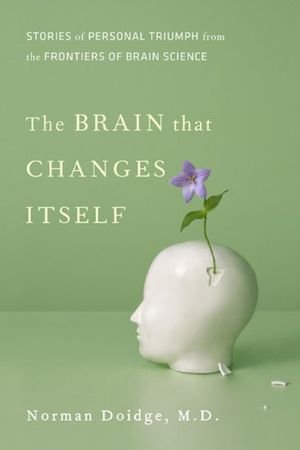 1
1