
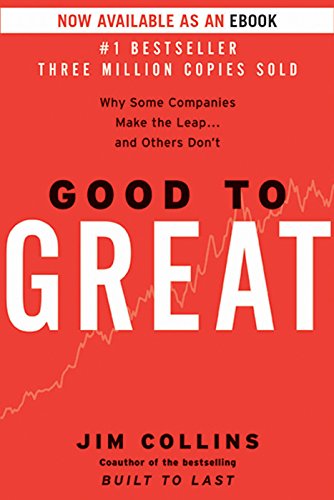
This article is an excerpt from the Shortform summary of "Good to Great" by Jim Collins. Shortform has the world's best summaries of books you should be reading.
Like this article? Sign up for a free trial here .
How can you foster a culture of discipline in your own workplace? A culture of discipline is a workplace culture in which everyone gauges their actions against the company’s common goal.
The concept is detailed in the book Good to Great, in which he argues that truly great companies have a culture of discipline. We’ll cover Jim Collins’s culture of discipline, why it leads to success, and how to develop one.
Originally Published: December 20, 2019
Last Updated: January 21, 2026
Takeaways From Good to Great
- Good-to-great companies foster cultures of discipline, according to Jim Collins. Every person gauges their actions against the three circles and the company’s Hedgehog Concept.
- Good-to-great companies get the right people—i.e., disciplined people—on the bus first, and so there’s little need for tight management. Good-to-great companies don’t need to retain micromanaging, disciplinarian executives for the same reason.
- A counterintuitive technique for maintaining an organization’s discipline is to create a “stop doing” list (rather than a “to-do” list).
Maintaining Discipline
One principle behind good-to-great companies is that they create and maintain discipline, meaning they constantly refer to and consistently realize their Hedgehog Concepts. Collins contends that rigorous adherence to a Hedgehog Concept saves companies from panic acquisitions or misguided projects. (Shortform note: In Great by Choice, Collins and Morten T. Hansen looked at another set of high-performing companies and found that they had a disciplined, consistent approach to progress. Even, or especially, during tough times—economic downturns, market turbulence, or unexpected crises—these companies hit their targets. They resisted the temptation to overreach in good times or to cut back too drastically in bad times.)
Collins clarifies that discipline does not mean a tyranny presided over by the executive. Rather than having an executive who imposes and enforces discipline, good-to-great companies have a culture of discipline permeating the organization. With a solid understanding of the company’s Hedgehog Concept, individuals can police themselves and make sound decisions without layers of bureaucracy.
(Shortform note: In order for employees to have a solid understanding of the company’s Hedgehog Concept, you need to give them enough information. In No Rules Rules, Netflix cofounder Reed Hastings says a company should have a culture of radical transparency, making sensitive information such as financial data available to all employees. With access to relevant information, employees can then operate more autonomously—making decisions, taking risks, and taking ownership of the consequences without having to seek approval from higher-ups.)
How to Achieve It
Collins says you can maintain discipline by doing the following:
1) Allow individuals freedom within a clear framework of responsibility. (Shortform note: In Team of Teams, General Stanley McChrystal says he veered away from the traditional command-and-control model and gave individuals more freedom by instituting a policy of empowered execution. Instead of explicitly delegating, he had a general rule: If it advances the team effort, do it—assuming it’s moral and legal.)
2) Retain self-disciplined people who are driven to produce results. (Shortform note: Money isn’t the only way you can retain your top performers. Experts say you can encourage them to stay by being receptive to their ideas, giving them space to grow, and recognizing their hard work.)
3) Recognize that a disciplined culture is different from a culture led by a tyrant or disciplinarian. (Shortform note: If you believe that people won’t be disciplined if you’re not breathing down their necks, then you might be a micromanager (or worse). Tame your inner tyrant by hiring people who have the right skills for the job, being clear about your expectations, and allowing your employees to use their own approach to tackle problems.)
4) Adhere fanatically to hedgehog thinking. A key technique for staying true to your Hedgehog Concept is to create a “stop doing” list, meaning if an activity doesn’t serve your Hedgehog Concept, you should stop doing it. (Shortform note: One way to stop doing things that don’t serve your Hedgehog Concept is to ask yourself the Focusing Question. In The One Thing, Gary Keller says this question is: “What’s the one thing I can do such that by doing it everything else will be easier or unnecessary?” This has the dual purpose of clarifying your big-picture purpose and identifying your most important immediate action toward attaining it.)
———End of Preview———
Like what you just read? Read the rest of the world's best summary of "Good to Great" at Shortform . Learn the book's critical concepts in 20 minutes or less .
Here's what you'll find in our full Good to Great summary :
- The 3 key attributes of Great companies
- Why it's better to focus on your one core strength than get spread thin
- How to build a virtuous cycle, or flywheel effect, in your business