We've ranked the best project management books using expert recommendations, sales data, and millions of reader ratings. At Shortform, we know books. Our book guides are the best in the world. Learn why.
Cover unavailable
1
A Guide to the Project Management Body of Knowledge (PMBOK® Guide)–Sixth Edition
Project Management Institute
5.0
The PMBOK® Guide–Sixth Edition – PMI’s flagship publication has been updated to reflect the latest good practices in project management. New to the Sixth Edition, each knowledge area will contain a section entitled Approaches for Agile, Iterative and Adaptive Environments, describing how these practices integrate in project settings. It will also contain more emphasis on strategic and business knowledge—including discussion of project management business documents—and information on the PMI Talent Triangle™ and the essential skills for success in today’s market.
…
Cover unavailable
2
The Lean Startup: How Today's Entrepreneurs Use Continuous Innovation to Create Radically Successful Businesses
Most startups fail. But many of those failures are preventable. The Lean Startup is a new approach being adopted across the globe, changing the way companies are built and new products are launched.
Eric Ries defines a startup as an organization dedicated to creating something new under conditions of extreme uncertainty. This is just as true for one person in a garage or a group of seasoned professionals in a Fortune 500 boardroom. What they have in common is a mission to penetrate that fog of uncertainty to discover a successful path to a sustainable business.
The Lean Startup approach fosters companies that are both more capital efficient and that leverage human creativity more effectively. Inspired by lessons from lean manufacturing, it relies on "validated learning," rapid scientific experimentation, as well as a number of counter-intuitive practices that shorten product development cycles, measure actual progress without resorting to vanity metrics, and learn what customers really want. It enables a company to shift directions with agility, altering plans inch by inch, minute by minute.
Rather than wasting time creating elaborate business plans, The Lean Startup offers entrepreneurs - in companies of all sizes - a way to test their vision continuously, to adapt and adjust before it's too late. Ries provides a scientific approach to creating and managing successful startups in a age when companies need to innovate more than ever.
At Asana, we've been lucky to benefit from the author's advice firsthand; this book will enable him to help many more entrepreneurs answer the tough questions about their business. [source]
Cover unavailable
3
Getting Things Done: The Art of Stress-Free Productivity
"The Bible of business and personal productivity" —Lifehack
"A completely revised and updated edition of the blockbuster bestseller from 'the personal productivity guru'"—Fast Company
Since it was first published almost fifteen years ago, David Allen’s Getting Things Done has become one of the most influential business books of its era, and the ultimate book on personal organization. “GTD” is now shorthand for an entire way of approaching professional and personal tasks, and has spawned an entire culture of websites, organizational tools, seminars, and offshoots.
Allen has rewritten the book from start to finish, tweaking his classic text with important perspectives on the new workplace, and adding material that will make the book fresh and relevant for years to come. This new edition of Getting Things Done will be welcomed not only by its hundreds of thousands of existing fans but also by a whole new generation eager to adopt its proven principles.
…
Recommended by David Allen, Dustin Moskovitz, Ev Williams, and 19 others.
Getting Things Done by David Allen. He recently spoke at our Zappos all-hands meeting and gave me a signed copy of his book. [source]
Eric Rose
Chairman/Columbia University Department of Surgery
When I'm flat-out stressed about the volume and complexity of my work, I open this book and find immediate ways to gain a sense of control. That's really a critical need for decision making. David made me what I am today: headstrong and proud of it. [source]
Written in a fast-paced thriller style, 'The Goal' contains a serious message for all managers in industry and explains the ideas which underline the Theory of Constraints developed by the author.
Recommended by Jeff Bezos, Danielle Morrill, Kevin Systrom, and 4 others.
Encourages companies to identify the biggest constraints in their operations and then structure their organizations to get the most out of those constraints. [source]
Kevin Systrom
About basically manufacturing and supply chain management. It sounds really boring, but I promise you it’s really good. [source]
Chris Goward
Here are some of the books that have been very impactful for me, or taught me a new way of thinking: … The Goal. [source]
Cover unavailable
5
The Mythical Man-Month: Essays on Software Engineering
Few books on software project management have been as influential and timeless as The Mythical Man-Month. With a blend of software engineering facts and thought-provoking opinions, Fred Brooks offers insight for anyone managing complex projects. These essays draw from his experience as project manager for the IBM System/360 computer family and then for OS/360, its massive software system. Now, 20 years after the initial publication of his book, Brooks has revisited his original ideas and added new thoughts and advice, both for readers already familiar with his work and for readers discovering it for the first time.
The added chapters contain (1) a crisp condensation of all the propositions asserted in the original book, including Brooks' central argument in The Mythical Man-Month: that large programming projects suffer management problems different from small ones due to the division of labor; that the conceptual integrity of the product is therefore critical; and that it is difficult but possible to achieve this unity; (2) Brooks' view of these propositions a generation later; (3) a reprint of his classic 1986 paper "No Silver Bullet"; and (4) today's thoughts on the 1986 assertion, "There will be no silver bullet within ten years."
From "The Everything Store", written by Brad Stone “An influential computer scientist makes the counterintuitive argument that small groups of engineers are more effective than larger ones at handling complex software projects. The book lays out the theory behind Amazon’s two pizza teams,” Stone writes. [source]
The New York Times bestselling author of Better and Complications reveals the surprising power of the ordinary checklist
We live in a world of great and increasing complexity, where even the most expert professionals struggle to master the tasks they face. Longer training, ever more advanced technologies‚neither seems to prevent grievous errors. But in a hopeful turn, acclaimed surgeon and writer Atul Gawande finds a remedy in the humblest and simplest of techniques: the checklist.
First introduced decades ago by the U.S. Air Force, checklists have enabled pilots to fly aircraft of mind-boggling sophistication. Now innovative checklists are being adopted in hospitals around the world, helping doctors and nurses respond to everything from flu epidemics to avalanches. Even in the immensely complex world of surgery, a simple ninety-second variant has cut the rate of fatalities by more than a third.
In riveting stories, Gawande takes us from Austria, where an emergency checklist saved a drowning victim who had spent half an hour underwater, to Michigan, where a cleanliness checklist in intensive care units virtually eliminated a type of deadly hospital infection. He explains how checklists actually work to prompt striking and immediate improvements. And he follows the checklist revolution into fields well beyond medicine, from homeland security to investment banking, skyscraper construction, and businesses of all kinds.
An intellectual adventure in which lives are lost and saved and one simple idea makes a tremendous difference, The Checklist Manifesto is essential reading for anyone working to get things right.
Atul is really talking about how absolutely powerful checklists are, and I think he makes a very creative point: that checklist are not just some static, boring thing. They actually allow you to do excellent work and free up your brain by not having to keep remembering what you need to do when. That then allows your brain to be a lot more creative about whatever it is you’re doing. [source]
Influence, the classic book on persuasion, explains the psychology of why people say "yes"—and how to apply these understandings. Dr. Robert Cialdini is the seminal expert in the rapidly expanding field of influence and persuasion. His thirty-five years of rigorous, evidence-based research along with a three-year program of study on what moves people to change behavior has resulted in this highly acclaimed book.
You'll learn the six universal principles, how to use them to become a skilled persuader—and how to defend yourself against them. Perfect for people in all walks of life, the principles of Influence will move you toward profound personal change and act as a driving force for your success.
In the updated edition of this critically acclaimed and bestselling book, Microsoft project veteran Scott Berkun offers a collection of essays on field-tested philosophies and strategies for defining, leading, and managing projects. Each essay distills complex concepts and challenges into practical nuggets of useful advice, and the new edition now adds more value for leaders and managers of projects everywhere.
Based on his nine years of experience as a program manager for Internet Explorer, and lead program manager for Windows and MSN, Berkun explains to technical and non-technical readers alike what it takes to get through a large software or web development project. Making Things Happen doesn't cite specific methods, but focuses on philosophy and strategy. Unlike other project management books, Berkun offers personal essays in a comfortable style and easy tone that emulate the relationship of a wise project manager who gives good, entertaining and passionate advice to those who ask.
Topics in this new edition include:
How to make things happen Making good decisions Specifications and requirements Ideas and what to do with them How not to annoy people Leadership and trust The truth about making dates What to do when things go wrong Complete with a new forward from the author and a discussion guide for forming reading groups/teams, Making Things Happen offers in-depth exercises to help you apply lessons from the book to your job. It is inspiring, funny, honest, and compelling, and definitely the one book that you and your team need to have within arm's reach throughout the life of your project.
Coming from the rare perspective of someone who fought difficult battles on Microsoft's biggest projects and taught project design and management for MSTE, Microsoft's internal best practices group, this is valuable advice indeed. It will serve you well with your current work, and on future projects to come.
…
Cover unavailable
11
The Fast Forward MBA in Project Management
Eric Verzuh
4.6
The all-inclusive guide to exceptional project management
The Fast Forward MBA in Project Management is the comprehensive guide to real-world project management methods, tools, and techniques. Practical, easy-to-use, and deeply thorough, this book gives you answers you need now. You'll find the cutting-edge ideas and hard-won wisdom of one of the field's leading experts, delivered in short, lively segments that address common management issues. Brief descriptions of important concepts, tips on real-world applications, and compact case studies illustrate the most sought-after skills and the pitfalls you should watch out for. This new fifth edition features new case studies, new information on engaging stakeholders, change management, new guidance on using Agile techniques, and new content that integrates current events and trends in the project management sphere.
Project management is a complex role, with seemingly conflicting demands that must be coordinated into a single, overarching, executable strategy -- all within certain time, resource, and budget constraints. This book shows you how to get it all together and get it done, with expert guidance every step of the way.
Navigate complex management issues effectively Master key concepts and real-world applications Learn from case studies of today's leading experts Keep your project on track, on time, and on budget From finding the right sponsor to clarifying objectives to setting a realistic schedule and budget projection, all across different departments, executive levels, or technical domains, project management incorporates a wide range of competencies. The Fast Forward MBA in Project Management shows you what you need to know, the best way to do it, and what to watch out for along the way.
…
Cover unavailable
12
The Phoenix Project: A Novel About IT, DevOps, and Helping Your Business Win
Bill is an IT manager at Parts Unlimited. It's Tuesday morning and on his drive into the office, Bill gets a call from the CEO.
The company's new IT initiative, code named Phoenix Project, is critical to the future of Parts Unlimited, but the project is massively over budget and very late. The CEO wants Bill to report directly to him and fix the mess in ninety days or else Bill's entire department will be outsourced.
With the help of a prospective board member and his mysterious philosophy of The Three Ways, Bill starts to see that IT work has more in common with manufacturing plant work than he ever imagined. With the clock ticking, Bill must organize work flow streamline interdepartmental communications, and effectively serve the other business functions at Parts Unlimited.
In a fast-paced and entertaining style, three luminaries of the DevOps movement deliver a story that anyone who works in IT will recognize. Readers will not only learn how to improve their own IT organizations, they'll never view IT the same way again.
…
Recommended by Jeffrey Snover and Louis Nyffenegger.
Jeffrey Snover
Great thread. I know of a number of devops people that haven't read this book. Ya'll should fix that. https://t.co/Yri4JJ0jBZ [source]
Louis Nyffenegger
I don't think I have a specific book that I can call my favourite. Some books have had a big impact on my view of how to build a product/company ("Rework"), some were very enjoyable to read ("The Phoenix Project"), some helped me improve the way I think ("The Pleasure Of Finding Things Out") and some the way I live ("Essentialism") or work ("Deep Work"). [source]
Cover unavailable
13
Measure What Matters: How Google, Bono, and the Gates Foundation Rock the World with OKRs
Legendary venture capitalist John Doerr reveals how the goal-setting system of Objectives and Key Results (OKRs) has helped tech giants from Intel to Google achieve explosive growth--and how it can help any organization thrive.
In the fall of 1999, John Doerr met with the founders of a start-up whom he'd just given $12.5 million, the biggest investment of his career. Larry Page and Sergey Brin had amazing technology, entrepreneurial energy, and sky-high ambitions, but no real business plan. For Google to change the world (or even to survive), Page and Brin had to learn how to make tough choices on priorities while keeping their team on track. They'd have to know when to pull the plug on losing propositions, to fail fast. And they needed timely, relevant data to track their progress -- to measure what mattered.
Doerr taught them about a proven approach to operating excellence: Objectives and Key Results. He had first discovered OKRs in the 1970s as an engineer at Intel, where the legendary Andy Grove ("the greatest manager of his or any era") drove the best-run company Doerr had ever seen. Later, as a venture capitalist, Doerr shared Grove's brainchild with more than fifty companies. Wherever the process was faithfully practiced, it worked.
In this goal-setting system, objectives define what we seek to achieve; key results are how those top-priority goals will be attained with specific, measurable actions within a set time frame. Everyone's goals, from entry level to CEO, are transparent to the entire organization.
The benefits are profound. OKRs surface an organization's most important work. They focus effort and foster coordination. They keep employees on track. They link objectives across silos to unify and strengthen the entire company. Along the way, OKRs enhance workplace satisfaction and boost retention.
In Measure What Matters, Doerr shares a broad range of first-person, behind-the-scenes case studies, with narrators including Bono and Bill Gates, to demonstrate the focus, agility, and explosive growth that OKRs have spurred at so many great organizations. This book will help a new generation of leaders capture the same magic.
John explains how OKRs Objectives and Key Results work and shows how you can apply them in all sorts of situations. I’d recommend John’s book for anyone interested in becoming a better manager (and I’d say that even if I hadn’t been interviewed for a super-nice chapter about the Gates Foundation). [source]
Whether you're a seasoned CEO or a first-time entrepreneur, you'll find valuable lessons, tools, and inspiration in the pages of Measure What Matters. I'm glad John invested the time to share these ideas with the world. [source]
In this indispensable book, the most important venture capitalist of our era reveals a key to business innovation and success. This crisp and colorful book combines fascinating case studies with insightful personal stories to show how OKRs can add magic to organizations of any size. [source]
Cover unavailable
14
Pmp Exam Prep: Rita's Course in a Book for Passing the Pmp Exam
Rita Mulcahy
4.5
Cover unavailable
15
The Five Dysfunctions of a Team: A Leadership Fable
In The Five Dysfunctions of a Team Patrick Lencioni once again offers a leadership fable that is as enthralling and instructive as his first two best-selling books, The Five Temptations of a CEO and The Four Obsessions of an Extraordinary Executive. This time, he turns his keen intellect and storytelling power to the fascinating, complex world of teams.
Kathryn Petersen, Decision Tech's CEO, faces the ultimate leadership crisis: Uniting a team in such disarray that it threatens to bring down the entire company. Will she succeed? Will she be fired? Will the company fail? Lencioni's utterly gripping tale serves as a timeless reminder that leadership requires as much courage as it does insight.
Throughout the story, Lencioni reveals the five dysfunctions which go to the very heart of why teams even the best ones-often struggle. He outlines a powerful model and actionable steps that can be used to overcome these common hurdles and build a cohesive, effective team. Just as with his other books, Lencioni has written a compelling fable with a powerful yet deceptively simple message for all those who strive to be exceptional team leaders.
…
Recommended by AnneMarie Schindler, Holger Seim, Jennifer Rock, and 3 others.
AnneMarie Schindler
I suggest these books because they really open up 'how' you think about life and in turn work, success/challenges/setbacks, and in general, yourself. I believe that the more you can understand yourself and broaden your approach to work, the easier it will be to find work that energizes you. Finally, I'm a team player at heart, and love working with others to achieve a huge goal so a portion of these deal with team composition and performance too. [source]
Holger Seim
Lencioni’s books helped me to shift my focus from individual performance to team performance, and what it takes to make a team perform well. It helped me to realize and take seriously the fact that great team performance doesn’t happen magically but needs conscious effort. When I discovered The Five Dysfunctions of a Team for the first time, we had a dysfunctional team at Blinkist and the book opened my eyes to see the problem clearly and showed clear steps for how they should be tackled. Beforehand I was aware that we had a problem, but I couldn’t pinpoint it specifically and hence, couldn’t solve it easily. This book helped a lot. [source]
Jennifer Rock
In Patrick Lencioni's book The Five Dysfunctions of a Team, the executive asks her senior leaders "Who is your first team?" And they each answer incorrectly that it's the team that reports to him or her. The point is that you need to shift your perspective to understanding your senior leadership peers are your first team. We read that book as a leadership team in a corporation where I worked -- and the environment was very competitive between us. When we agreed that our cross-functional leadership team was our first team, we became more cooperative, innovative and productive. And we vastly boosted our results. [source]
Cover unavailable
16
Head First Pmp: A Learner's Companion to Passing the Project Management Professional Exam
Jennifer Greene and Andrew Stellman
4.5
What will you learn from this book?
Head First PMP teaches you the latest principles and certification objectives in The PMBOK(R) Guide in a unique and inspiring way. This updated fourth edition takes you beyond specific questions and answers with a unique visual format that helps you grasp the big picture of project management. By putting PMP concepts into context, you'll be able to understand, remember, and apply them--not just on the exam, but on the job. No wonder so many people have used Head First PMP as their sole source for passing the PMP exam.
This book will help you:
Learn PMP's underlying concepts to help you understand the PMBOK principles and pass the certification exam with flying colors Get 100% coverage of the latest principles and certification objectives in The PMBOK(R) Guide, Sixth Edition Make use of a thorough and effective preparation guide with hundreds of practice questions and exam strategies Explore the material through puzzles, games, problems, and exercises that make learning easy and entertaining Why does this book look so different?
Based on the latest research in cognitive science and learning theory, Head First PMP uses a visually rich format to engage your mind, rather than a text-heavy approach that puts you to sleep. Why waste your time struggling with new concepts? This multi-sensory learning experience is designed for the way your brain really works.
…
Cover unavailable
17
The 4-Hour Workweek: Escape 9-5, Live Anywhere, and Join the New Rich
More than 100 pages of new, cutting-edge content. Forget the old concept of retirement and the rest of the deferred-life plan there is no need to wait and every reason not to, especially in unpredictable economic times. Whether your dream is escaping the rat race, experiencing high-end world travel, earning a monthly five-figure income with zero management, or just living more and working less, The 4-Hour Workweek is the blueprint. This step-by-step guide to luxury lifestyle design teaches: How Tim went from $40,000 per year and 80 hours per week to $40,000 per month and 4 hours per week. How to outsource your life to overseas virtual assistants for $5 per hour and do whatever you want How blue-chip escape artists travel the world without quitting their jobs How to eliminate 50% of your work in 48 hours using the principles of a forgotten Italian economist How to trade a long-haul career for short work bursts and frequent mini-retirements The new expanded edition of Tim Ferriss The 4-Hour Workweek includes: More than 50 practical tips and case studies from readers (including families) who have doubled income, overcome common sticking points, and reinvented themselves using the original book as a starting point Real-world templates you can copy for eliminating e-mail, negotiating with bosses and clients, or getting a private chef for less than $8 a meal How Lifestyle Design principles can be suited to unpredictable economic times The latest tools and tricks, as well as high-tech shortcuts, for living like a diplomat or millionaire without being either"
Eric Weinstein recommended this book on Twitter. [source]
Tim Draper
Founder/Draper Fisher Jurvetson
With this kind of time management and focus on the important things in life, people should be able to get 15 times as much done in a normal work week. [source]
It's about time this book was written. It is a long-overdue manifesto for the mobile lifestyle, and Tim Ferriss is the ideal ambassador. This will be huge. [source]
Cover unavailable
18
The Black Swan: The Impact of the Highly Improbable
A black swan is a highly improbable event with three principal characteristics: It is unpredictable; it carries a massive impact; and, after the fact, we concoct an explanation that makes it appear less random, and more predictable, than it was.
The astonishing success of Google was a black swan; so was 9/11. For Nassim Nicholas Taleb, black swans underlie almost everything about our world, from the rise of religions to events in our own personal lives.
Why do we not acknowledge the phenomenon of black swans until after they occur? Part of the answer, according to Taleb, is that humans are hardwired to learn specifics when they should be focused on generalities.
We concentrate on things we already know and time and time again fail to take into consideration what we don’t know. We are, therefore, unable to truly estimate opportunities, too vulnerable to the impulse to simplify, narrate, and categorize, and not open enough to rewarding those who can imagine the “impossible.”
For years, Taleb has studied how we fool ourselves into thinking we know more than we actually do. We restrict our thinking to the irrelevant and inconsequential, while large events continue to surprise us and shape our world. Now, in this revelatory book, Taleb explains everything we know about what we don’t know. He offers surprisingly simple tricks for dealing with black swans and benefiting from them.
Elegant, startling, and universal in its applications The Black Swan will change the way you look at the world. Taleb is a vastly entertaining writer, with wit, irreverence, and unusual stories to tell. He has a polymathic command of subjects ranging from cognitive science to business to probability theory.
The Black Swan is a landmark book – itself a black swan.
The book also contains a 4-page glossary; 19 pages of notes; and, a 28-page bibliography in addition to an index.
From the book "The Everything Store: and the Age of Amazon" “The scholar argues that people are wired to see patterns in chaos while remaining blind to unpredictable events, with massive consequences. Experimentation and empiricism trumps the easy and obvious narrative,” Stone writes. [source]
And throw in “The Black Swan” and “Fooled by Randomness”. “Fragile” means if you hit something might break. “Resilient” means if you hit something, it will stay the same. On my podcast Nassim discusses “Antifragility” – building a system, even on that works for you on a personal level, where you if you harm your self in some way it becomes stronger. That podcast changed my life He discusses Antifragility throughout history, up to our current economic situation, and even in our personal situations. [source]
Cover unavailable
19
The Power of Habit: Why We Do What We Do in Life and Business
A young woman walks into a laboratory. Over the past two years, she has transformed almost every aspect of her life. She has quit smoking, run a marathon, and been promoted at work. The patterns inside her brain, neurologists discover, have fundamentally changed.
Marketers at Procter & Gamble study videos of people making their beds. They are desperately trying to figure out how to sell a new product called Febreze, on track to be one of the biggest flops in company history. Suddenly, one of them detects a nearly imperceptible pattern—and with a slight shift in advertising, Febreze goes on to earn a billion dollars a year.
An untested CEO takes over one of the largest companies in America. His first order of business is attacking a single pattern among his employees—how they approach worker safety—and soon the firm, Alcoa, becomes the top performer in the Dow Jones.
What do all these people have in common? They achieved success by focusing on the patterns that shape every aspect of our lives.
They succeeded by transforming habits.
In The Power of Habit, award-winning New York Times business reporter Charles Duhigg takes us to the thrilling edge of scientific discoveries that explain why habits exist and how they can be changed. With penetrating intelligence and an ability to distill vast amounts of information into engrossing narratives, Duhigg brings to life a whole new understanding of human nature and its potential for transformation.
Along the way we learn why some people and companies struggle to change, despite years of trying, while others seem to remake themselves overnight. We visit laboratories where neuroscientists explore how habits work and where, exactly, they reside in our brains. We discover how the right habits were crucial to the success of Olympic swimmer Michael Phelps, Starbucks CEO Howard Schultz, and civil-rights hero Martin Luther King, Jr. We go inside Procter & Gamble, Target superstores, Rick Warren’s Saddleback Church, NFL locker rooms, and the nation’s largest hospitals and see how implementing so-called keystone habits can earn billions and mean the difference between failure and success, life and death.
At its core, The Power of Habit contains an exhilarating argument: The key to exercising regularly, losing weight, raising exceptional children, becoming more productive, building revolutionary companies and social movements, and achieving success is understanding how habits work.
Habits aren’t destiny. As Charles Duhigg shows, by harnessing this new science, we can transform our businesses, our communities, and our lives.
…
Recommended by Naval Ravikant, Blake Irving, Alden Mills, and 15 others.
I also recently finished The Power of Habit, or close to finish as I get. That one was interesting, not because of its content necessarily, but because it’s good for me to always keep on top of mind how powerful my habits are. … I think learning how to break habits is a very important meta-skill that can serve you better in life than almost anything else. Although you can read tons of books on it, the reality is you’re never going to learn how to break bad habits until you just break them. [source]
Blake Irving
CEO/GoDaddy
You know, there's a book called The Power of Habit by Charles Duhigg. Simple read book about just how to build positive habits that can be I think I what I'd call you know whether in your personal life or whether in your business life to help you build you know, have a loop that can build your success and that's one I mean there are so many great books out there. [source]
Alden Mills
More recent books that have had a significant impact on me are The Power of Habit and The Diamond Cutter. Both represent different forces for me – the former helps me tactically with making incremental improvements in my life. [source]
The essential skill of creating and maintaining new businesses—the art of the entrepreneur—can be summed up in a single word: managing. In High Output Management, Andrew S. Grove, former chairman and CEO (and employee number three) of Intel, shares his perspective on how to build and run a company. Born of Grove’s experiences at one of America’s leading technology companies, this legendary management book is a Silicon Valley staple, equally appropriate for sales managers, accountants, consultants, and teachers, as well as CEOs and startup founders. Grove covers techniques for creating highly productive teams, demonstrating methods of motivation that lead to peak performance—throughout, High Output Management is a practical handbook for navigating real-life business scenarios and a powerful management manifesto with the ability to revolutionize the way we work.
Andy Grove, who built himself from nothing to run Intel, stopped what he was doing to teach us his magic. And not through some ghostwriter either — Andy wrote this book himself. What an incredible gift. [source]
For Chesky, a source may come in the form of a biography of a business hero such as Steve Jobs or Walt Disney. His primary book source on management technique is Andy Grove’s High Output Management. [source]
Cover unavailable
21
Agile Estimating and Planning
Mike Cohn
4.4
Praise for Agile Estimating and Planning "Traditional, deterministic approaches to planning and estimating simply don't cut it on the slippery slopes of today's dynamic, change-driven projects. Mike Cohn's breakthrough book gives us not only the philosophy, but also the guidelines and a proven set of tools that we need to succeed in planning, estimating, and scheduling projects with a high uncertainty factor. At the same time, the author never loses sight of the need to deliver business value to the customer each step of the way."
--Doug DeCarlo, author of eXtreme Project Management: Using Leadership, Principles and Tools to Deliver Value in the Face of Volatility (Jossey-Bass, 2004)
"We know how to build predictive plans and manage them. But building plans that only estimate the future and then embrace change, challenge most of our training and skills. In Agile Estimating and Planning, Mike Cohn once again fills a hole in the Agile practices, this time by showing us a workable approach to Agile estimating and planning. Mike delves into the nooks and crannies of the subject and anticipates many of the questions and nuances of this topic. Students of Agile processes will recognize that this book is truly about agility, bridging many of the practices between Scrum and ExtremeProgramming."
--Ken Schwaber, Scrum evangelist, Agile Alliance cofounder, and signatory to the Agile Manifesto
"In Agile Estimating and Planning, Mike Cohn has, for the first time, brought together most everything that the Agile community has learned about the subject. The book is clear, well organized, and a pleasant and valuable read. It goes into all the necessary detail, and at the same time keeps the reader's burden low. We can dig in as deeply as we need to, without too much detail before we need it. The book really brings together everything we have learned about Agile estimation and planning over the past decade. It will serve its readers well."
--Ron Jeffries, www.XProgramming.com, author of Extreme Programming Installed (Addison-Wesley, 2001) and Extreme Programming Adventures in C# (Microsoft Press, 2004)
"Agile Estimating and Planning provides a view of planning that's balanced between theory and practice, and it is supported by enough concrete experiences to lend it credibility. I particularly like the quote 'planning is a quest for value.' It points to a new, more positive attitude toward planning that goes beyond the 'necessary evil' view that I sometimes hold."
--Kent Beck, author of Extreme Programming Explained, Second Edition (Addison-Wesley, 2005)
"Up-front planning is still the most critical part of software development. Agile software development requires Agile planning techniques. This book shows you how to employ Agile planning in a succinct, practical, and easy-to-follow manner."
--Adam Rogers, Ultimate Software
"Mike does a great follow-up to User Stories Applied by continuing to provide Agile teams with the practical approaches and techniques to increase agility. In this book, Mike provides time-proven and well-tested methods for being successful with the multiple levels of planning and estimating required by Agile. This book is the first to detail the disciplines of Agile estimating and planning, in ways that rival my 1980 civil engineering texts on CPM Planning and Estimating."
--Ryan Martens, President and Founder, Rally Software Development Corporation
"With insight and clarity, Mike Cohn shows how to effectively produce software of high business value. With Agile estimation and planning, you focus effort where it really counts, and continue to do so as circumstances change."
--Rick Mugridge, Rimu Research Ltd., and lead author, Fit for Developing Software (Prentice Hall, 2005)
"Finally! The groundbreaking book my clients have been clamoring for! Agile Estimating and Planning demystifies the process of defining, driving, and delivering great software that matters to the business. Mike's clarity, insight, and experience leap out through every page of this book, offering an approach that is relevant and immediately useful to all members of an Agile project."
--Kert D. Peterson, President, Enterprise Agile Group, LLC
"This isn't yet another generic book on Agile software development. Agile Estimating and Planning fills a gap left by most of the other books and gives you important, practical, down-to-earth techniques needed to be successful on Agile development projects."
--Steve Tockey, Principal Consultant, Construx Software
"Estimation, planning, and tracking is a trinity. If you don't do one of them, you don't need the other two. This book provides very practical knowledge for estimation, planning, prioritizing, and tracking. It should be compulsory subject matter for project managers and their teams, even if they hesitate to call themselves Agile."
--Niels Malotaux, Project Coach
"Effective planning is an important, but often misunderstood, part of any successful Agile project. With Agile Estimating and Planning, Mike Cohn has given us a definitive guide to a wide range of Agile estimating and planning practices. With his clear and practical style, Mike not only explains how to successfully get started planning an Agile project, but also provides a wealth of tips and advice for improving any team's Agile planning process. This book is a must-read for managers, coaches, and members of Agile teams."
--Paul Hodgetts, Agile coach and CEO, Agile Logic
"Mike's writing style captures the essence of agility-just the right amount of information to bring clarity to the reader. This book provides an excellent guide for all Agile practitioners, both seasoned and novice."
--Robert Holler, President and CEO, VersionOne, LLC
"It is as if Mike took the distilled knowledge regarding planning and estimation of a great Agile developer (which he is) and laid out all he knows in an easily understandable manner. More importantly, he has a great mix of concepts with real-world examples finished off with a case study so the reader can relate the information to their own situation. Unless you are already an expert Agile planner and estimator, this book is for you."
--Alan Shalloway, CEO, Senior Consultant, Net Objectives, and coauthor of Design Patterns Explained, Second Edition (Addison-Wesley, 2005)
"Although I had plenty of XP experience before trying out Mike Cohn's Agile planning practices, the effectiveness of the practical and proven techniques in this book blew me away! The book recognizes that people, not tools or processes, produce great software, and that teams benefit most by learning about their project and their product as they go. The examples in the book are concrete, easily grasped, and simply reek of common sense. This book will help teams (whether Agile or not) deliver more value, more often, and have fun doing it! Whether you're a manager or a programmer, a tester or a CEO, part of an Agile team, or just looking for a way to stamp out chaos and death marches, this book will guide you."
--Lisa Crispin, coauthor of Testing Extreme Programming (Addison-Wesley, 2003)
"Mike Cohn does an excellent job demonstrating how an Agile approach can address issues of risk and uncertainty in order to provide more meaningful estimates and plans for software projects."
--Todd Little, Senior Development Manager, Landmark Graphics
"Mike Cohn explains his approach to Agile planning, and shows how 'critical chain' thinking can be used to effectively buffer both schedule and features. As with User Stories Applied, this book is easy to read and grounded in real-world experience."
--Bill Wake, author of Refactoring Workbook (Addison-Wesley, 2003)
"Mike brings this book to life with real-world examples that help reveal how and why an Agile approach works for planning software development projects. This book has great breadth, ranging from the fundamentals of release planning to advanced topics such as financial aspects of prioritization. I can see this book becoming an invaluable aid to Agile project managers, as it provides a wealth of practical tips such as how to set iteration length and boot-strap velocity, and communicate progress."
--Rachel Davies, Independent Consultant
"There has been a need for a solid, pragmatic book on the long-term vision of an Agile Project for project managers. Agile Estimating and Planning addresses this need. It's not theory--this book contains project-tested practices that have been used on Agile projects. As Mike's test subjects, we applied these practices to the development of video games (one of the most unpredictable project environments you can imagine) with success."
--Clinton Keith, Chief Technical Officer, High Moon Studios
"When I first heard Mike Cohn speak, I was impressed by a rare combination of qualities: deep experience and understanding in modern iterative and Agile methods; a drive to find and validate easy, high-impact solutions beyond the status quo of traditional (usually ineffective) methods; and the passion and clarity of a natural coach. These qualities are evident in this wonderful, practical guide. I estimate you won't be disappointed in studying and applying his advice."
--Craig Larman, Chief Scientist, Valtech, and author of Applying UML and Patterns, Third Edition (Prentice Hall, 2005) and Agile and Iterative Development (Addison-Wesley, 2004)
"Agile Estimating and Planning is a critical guide on how to successfully provide value to customers of IT services. This book is filled with clear examples that are essential--from project team members to the executive level."
--Lou Thomas, Director, Applications Development, Farm Credit Services of America
"This work is deeply significant in that it articulates and details structured techniques to realize a simple, but profound insight--planning is an iterative quest for value, rather than a perfunctory scheduling of activities. Mike presents processes to converge on this value while reducing risk and uncertainty, supporting decision making, establishing trust, and conveying information. Agile methodologies have shifted the emphasis from plans to planning, but have glossed over many of the finer details of Agile planning. Now, very simply and accessibly, Mike demonstrates how it can be done."
--Sanjiv Augustine, Practice Director, Lean-Agile Consulting at CC Pace, and author of Managing Agile Projects (Prentice Hall, 2005)
"The techniques described in Agile Estimating and Planning have helped us tremendously with planning and managing our projects. It provides all you have ever wanted to know about Agile project management."
"Mike Cohn presents a highly pragmatic and logical approach to making projects successful in a world beset by uncertainty and change. With his trademark clarity and directness, Mike cuts through the management mumbo jumbo to present practical techniques that can be put into use immediately. Put the odds squarely in your favor by making Mike Cohn the planning guru on your next big project."
"This book distills the fundamental ideas behind Agile estimating and planning, presenting them in a thoughtful and approachable manner. This is a 'must-have' book that presents clear, unambiguous, and practical advice for anyone who wants to successfully manage modern software development projects."
--Scott W. Ambler, President, Ambysoft Inc.
"How do your projects go? Frustrating changes? Uncertainty? Product missing both the mark and the deadline? With insight and clarity, Mike Cohn shows how to effectively produce software that is of high business value. With agile estimation and planning, you focus effort where it really counts, and continue to do so as circumstances change."
--Rick Mugridge, Rimu Research Ltd., and lead author of Fit for Developing Software
"We are true believers in the agile methods described in this book, and have experienced a substantially positive impact from their implementation and continued use. I would highly recommend this book to anyone who is interested in making their software development more practical and effective."
--Mark M. Gutrich, President and CEO, Fast 401k, Inc.
Detailed, Proven Techniques for Estimating and Planning Any Agile Project Agile Estimating and Planning is the definitive, practical guide to estimating and planning agile projects. In this book, Agile Alliance cofounder Mike Cohn discusses the philosophy of agile estimating and planning and shows you exactly how to get the job done, with real-world examples and case studies.
Concepts are clearly illustrated and readers are guided, step by step, toward how to answer the following questions: What will we build? How big will it be? When must it be done? How much can I really complete by then? You will first learn what makes a good plan-and then what makes it agile.
Using the techniques in Agile Estimating and Planning, you can stay agile from start to finish, saving time, conserving resources, and accomplishing more. Highlights include:
Why conventional prescriptive planning fails and why agile planning works How to estimate feature size using story points and ideal days--and when to use each How and when to re-estimate How to prioritize features using both financial and nonfinancial approaches How to split large features into smaller, more manageable ones How to plan iterations and predict your team's initial rate of progress How to schedule projects that have unusually high uncertainty or schedule-related risk How to estimate projects that will be worked on by multiple teams Agile Estimating and Planning supports any agile, semiagile, or iterative process, including Scrum, XP, Feature-Driven Development, Crystal, Adaptive Software Development, DSDM, Unified Process, and many more. It will be an indispensable resource for every development manager, team leader, and team member.
…
Cover unavailable
22
Project Management for the Unofficial Project Manager
Kory Kogon, Suzette Blakemore, et al.
4.4
No project management training? No problem!
In today’s workplace, employees are routinely expected to coordinate and manage projects. Yet, chances are, you aren’t formally trained in managing projects—you’re an unofficial project manager.
FranklinCovey experts Kory Kogon, Suzette Blakemore, and James Wood understand the importance of leadership in project completion and explain that people are crucial in the formula for success.
Project Management for the Unofficial Project Manager offers practical, real-world insights for effective project management and guides you through the essentials of the people and project management process:
Initiate Plan Execute Monitor/Control Close
Unofficial project managers in any arena will benefit from the accessible, engaging real-life anecdotes, memorable “Project Management Proverbs,” and quick reviews at the end of each chapter.
If you’re struggling to keep your projects organized, this book is for you. If you manage projects without the benefit of a team, this book is also for you. Change the way you think about project management—"project manager" may not be your official title or necessarily your dream job, but with the right strategies, you can excel.
…
Cover unavailable
23
First, Break All the Rules: What the World's Greatest Managers Do Differently
The world s greatest managers differ in sex, age, and race. They employ different styles and focus on different goals. Despite their differences, great managers share one trait: They break virtually every rule conventional wisdom holds sacred. They don t believe that, with enough training, a person can achieve anything he sets his mind to. They don t try to help people overcome their weaknesses. They disregard the golden rule. They even play favorites. Gallup presents the remarkable findings of its massive in-depth study of great managers those who excelled at turning each employee s talent into performance. Companies compete to find and keep the best employees using pay, benefits, promotions, and training. But these well-intentioned efforts often miss the mark. The front-line manager is the key to attracting and retaining talented employees. This amazing book explains how the best managers select employees for talent rather than for skills or experience, how they set expectations, how they motivate people, and how they develop people. Gallup s research produced twelve simple questions that distinguish the strongest departments of a company from the rest. This book introduces this essential measuring stick and proves the link between employee opinions and productivity, profit, customer satisfaction, and rate of turnover."
…
Recommended by Simon Sinek, Jared Spool, Jessica Pryce-Jones, and 1 others.
Jared Spool
The first framework is from Gallup and was written up in their great book: First, Break All The Rules. https://t.co/w54in9zCyH It’s the Q12 employee engagement measures. Each question makes it simple for a manager to identify where they need to improve. https://t.co/A9L8Yx2NHp [source]
Jessica Pryce-Jones
I’m a sucker for books and I always buy management books when I get on planes. There I am at Heathrow Airport going on a business trip, and I think, ‘I’ve got to read this stuff!’ And normally I pick a book up, read the first few pages, then find I can’t face it and end up leaving it in a hotel room. But this book, I picked it up, started to read it and I thought, ‘Hallelujah! Here is a book that makes sense at last.’ And that was just so refreshing. I don’t even have a copy at the moment, because I have given about ten of them away to people saying, ‘You have just got to read this!’ [source]
Cover unavailable
24
The Deadline: A Novel about Project Management
Tom DeMarco
4.4
Contents- Preface- Opportunity Knocking- Standing Up to Kalbfuss- Silikon Valejit- The CD-ROM Plant- NNL- The World's Greatest Project Manager- Taking On Staff- The Eminent Dr. Rizzoli- Ex-General Markov- Abdul Jamid- The Sinister Minister Belok- The Numbers Man- QuickerStill- Morovia's First Programmer- Think Fast!- Planning for the Summer Games- The Guru of Conflict Resolution- Maestro Diyeniar- Interlude- Part and Whole- Standing on Ceremony- Endgame Begins- The Year's Hottest IPO- Passing Through Riga on the Way Home
…
Cover unavailable
25
Sprint: How to Solve Big Problems and Test New Ideas in Just Five Days
A fantastic, proven formula for moving from idea to prototyping to decision making within five days, based on a process he developed while working at Google and later GV. [source]
Cat Williams-Treloar
Jake Knapp, John Zeratsky & Braden Kowitz "Sprint" - the go-to guide on how to sprint. You may not follow everything to the tee, but it's simple, clean and full of great examples of how to move fast with structure. [source]
Javed Khatri
This book details the "sprint" process used at Google Ventures. We follow a similar process at Kustard to validate business ideas and to solve problems without wasting much time, money and energy. If you want to quickly validate an idea, this is a proven model and a must read. [source]
Cover unavailable
26
Critical Chain
Eliyahu M. Goldratt
4.4
"Critical Chain," a gripping fast-paced business novel, does for Project Management what Eli Goldratt's other novels have done for Production and Marketing. Dr. Goldratt's books have transformed the thinking and actions of management throughout the world.
Cover unavailable
27
Agile Project Management with Scrum
Ken Schwaber
4.4
The rules and practices for Scrum—a simple process for managing complex projects—are few, straightforward, and easy to learn. But Scrum’s simplicity itself—its lack of prescription—can be disarming, and new practitioners often find themselves reverting to old project management habits and tools and yielding lesser results. In this illuminating series of case studies, Scrum co-creator and evangelist Ken Schwaber identifies the real-world lessons—the successes and failures—culled from his years of experience coaching companies in agile project management. Through them, you’ll understand how to use Scrum to solve complex problems and drive better results—delivering more valuable software faster. Gain the foundation in Scrum theory—and practice—you need to:
Rein in even the most complex, unwieldy projects Effectively manage unknown or changing product requirements Simplify the chain of command with self-managing development teams Receive clearer specifications—and feedback—from customers Greatly reduce project planning time and required tools Build—and release—products in 30-day cycles so clients get deliverables earlier Avoid missteps by regularly inspecting, reporting on, and fine-tuning projects Support multiple teams working on a large-scale project from many geographic locations Maximize return on investment!
…
Cover unavailable
28
Drive: The Surprising Truth About What Motivates Us
The New York Times bestseller that gives readers a paradigm-shattering new way to think about motivation
Most people believe that the best way to motivate is with rewards like money—the carrot-and-stick approach. That's a mistake, says Daniel H. Pink (author of To Sell Is Human: The Surprising Truth About Motivating Others). In this provocative and persuasive new book, he asserts that the secret to high performance and satisfaction-at work, at school, and at home—is the deeply human need to direct our own lives, to learn and create new things, and to do better by ourselves and our world.
Drawing on four decades of scientific research on human motivation, Pink exposes the mismatch between what science knows and what business does—and how that affects every aspect of life. He examines the three elements of true motivation—autonomy, mastery, and purpose-and offers smart and surprising techniques for putting these into action in a unique book that will change how we think and transform how we live.
…
Recommended by Tobi Lütke, Bogdan Lucaciu, David Brudo, and 5 others.
Tobi Lütke
Founder & CEO/Shopify
Tobi Lütke recommended this book in an interview in "The Globe and Mail." [source]
Bogdan Lucaciu
Spoiler: it’s autonomy, mastery, and purpose. [source]
Essential Scrum: A Practical Guide to the Most Popular Agile Process
Kenneth Rubin
4.3
A Practical Guide to the Most Popular Agile Process The Single-Source, Comprehensive Guide to Scrum for All Team Members, Managers, and Executives If you want to use Scrum to develop innovative products and services that delight your customers, Essential Scrum is the complete, single-source reference you've been searching for. Leading Scrum coach and trainer Kenny Rubin illuminates the values, principles, and practices of Scrum, and describes flexible, proven approaches that can help you implement it far more effectively. Whether you are new to Scrum or years into your use, this book will introduce, clarify, and deepen your Scrum knowledge at the team, product, and portfolio levels. Drawing from Rubin's experience helping hundreds of organizations succeed with Scrum, this book provides easy-to-digest descriptions enhanced by more than two hundred illustrations based on an entirely new visual icon language for describing Scrum's roles, artifacts, and activities. Essential Scrum will provide every team member, manager, and executive with a common understanding of Scrum, a shared vocabulary they can use in applying it, and practical knowledge for deriving maximum value from it.
…
Cover unavailable
30
Start with Why: How Great Leaders Inspire Everyone to Take Action
Why are some people and organizations more innovative, more influential, and more profitable than others? Why do some command greater loyalty from customers and employees alike? Even among the successful, why are so few able to repeat their success over and over?
People like Martin Luther King Jr., Steve Jobs, and the Wright Brothers might have little in common, but they all started with why. It was their natural ability to start with why that enabled them to inspire those around them and to achieve remarkable things.
In studying the leaders who've had the greatest influence in the world, Simon Sinek discovered that they all think, act, and communicate in the exact same way—and it's the complete opposite of what everyone else does. Sinek calls this powerful idea The Golden Circle, and it provides a framework upon which organizations can be built, movements can be lead, and people can be inspired. And it all starts with WHY.
Any organization can explain what it does; some can explain how they do it; but very few can clearly articulate why. WHY is not money or profit—those are always results. WHY does your organization exist? WHY does it do the things it does? WHY do customers really buy from one company or another? WHY are people loyal to some leaders, but not others?
Starting with WHY works in big business and small business, in the nonprofit world and in politics. Those who start with WHY never manipulate, they inspire. And the people who follow them don't do so because they have to; they follow because they want to.
Drawing on a wide range of real-life stories, Sinek weaves together a clear vision of what it truly takes to lead and inspire. This book is for anyone who wants to inspire others or who wants to find someone to inspire them.
Today is World Book Day, a wonderful opportunity to address this #ChallengeRichard sent in by Mike Gonzalez of New Jersey: Make a list of your top 65 books to read in a lifetime. [source]
The basis of this book is so important to anyone looking to increase their influence, profits or impact. People won't truly buy into a product, service, movement, or idea until they understand the WHY behind it. When you start with the why, everything else falls into place. This book is so impactful, I consider it required reading. [source]
Tony Hsieh
CEO/Zappos.com
Over the years he’s recommended well over 20 business books — including his own, the 2010 bestseller Delivering Happiness and you can always find what he’s currently reading atop his cluttered desk. Start with Why is amogst those titles. [source]
Cover unavailable
31
Project Management: A Systems Approach To Planning, Scheduling, And Controlling
Harold Kerzner
4.3
This Ninth Edition of the industry-leading project management "bible" applies its streamlined approach to new, authoritative coverage aligned with the Project Management Institute's Project Management Body of Knowledge (PMI(R)'s PMBOK(R)), the new mandatory source of training for the Project Management Professional (PMP(R)) Certification Exam. Written by one of the best-known authorities on the subject, this extraordinary edition gives a profound understanding of project management. Content from this book is available as an online continuing professional education course at http: //www.wiley.com/WileyCDA/Section/id-320.... WileyCPE courses are available on demand, 24 hours a day, and are approved by the American Institute of Architects.
(PMBOK, PMP, Project Management Professional, and CAPM are registered marks of the Project Management Institute, Inc.)
…
Cover unavailable
32
The Hard Thing About Hard Things: Building a Business When There Are No Easy Answers
A lot of people talk about how great it is to start a business, but only Ben Horowitz is brutally honest about how hard it is to run one.
In The Hard Thing About Hard Things, Ben Horowitz, cofounder of Andreessen Horowitz and one of Silicon Valley's most respected and experienced entrepreneurs, draws on his own story of founding, running, selling, buying, managing, and investing in technology companies to offer essential advice and practical wisdom for navigating the toughest problems business schools don't cover. His blog has garnered a devoted following of millions of readers who have come to rely on him to help them run their businesses. A lifelong rap fan, Horowitz amplifies business lessons with lyrics from his favorite songs and tells it straight about everything from firing friends to poaching competitors, from cultivating and sustaining a CEO mentality to knowing the right time to cash in.
His advice is grounded in anecdotes from his own hard-earned rise—from cofounding the early cloud service provider Loudcloud to building the phenomenally successful Andreessen Horowitz venture capital firm, both with fellow tech superstar Marc Andreessen (inventor of Mosaic, the Internet's first popular Web browser). This is no polished victory lap; he analyzes issues with no easy answers through his trials, including
demoting (or firing) a loyal friend; whether you should incorporate titles and promotions, and how to handle them; if it's OK to hire people from your friend's company; how to manage your own psychology, while the whole company is relying on you; what to do when smart people are bad employees; why Andreessen Horowitz prefers founder CEOs, and how to become one; whether you should sell your company, and how to do it. Filled with Horowitz's trademark humor and straight talk, and drawing from his personal and often humbling experiences, The Hard Thing About Hard Things is invaluable for veteran entrepreneurs as well as those aspiring to their own new ventures.
Ben's book is a great read - with uncomfortable truths about entrepreneurship and how to lead to a company. It's also an inspiring story of a business rebirth through sheer willpower. [source]
Ben's experience and expertise make him one of the most important leaders not just in Silicon Valley but also in the global knowledge economy. For anyone interested in building, growing or leading a great company, this book is an incredibly valuable resource - and a funny and insightful read. [source]
Drew Houston
CEO/Dropbox
One of the great things that the author wrote in this book is the hardest part of being a CEO is managing your psychology. [source]
Most business books give you the same old advice: Write a business plan, study the competition, seek investors, yadda yadda. If you're looking for a book like that, put this one back on the shelf.
Rework shows you a better, faster, easier way to succeed in business. Read it and you'll know why plans are actually harmful, why you don't need outside investors, and why you're better off ignoring the competition. The truth is, you need less than you think. You don't need to be a workaholic. You don't need to staff up. You don't need to waste time on paperwork or meetings. You don't even need an office. Those are all just excuses.
What you really need to do is stop talking and start working. This book shows you the way. You'll learn how to be more productive, how to get exposure without breaking the bank, and tons more counterintuitive ideas that will inspire and provoke you.
With its straightforward language and easy-is-better approach, Rework is the perfect playbook for anyone who’s ever dreamed of doing it on their own. Hardcore entrepreneurs, small-business owners, people stuck in day jobs they hate, victims of "downsizing," and artists who don’t want to starve anymore will all find valuable guidance in these pages.
Unperturbed by conventional wisdom, the authors start fresh and rewrite the rules of business. Their approach turns out to be as successful as it is counter-intuitive. [source]
If given a choice between investing in someone who has read Rework or has an MBA, I'm investing in Rework every time. This is a must read for every entrepreneur. [source]
Tony Hsieh
CEO/Zappos.com
The wisdom in these pages is edgy yet simple, straightforward, and proven. Read this book multiple times to help give you the courage you need to get out there and make something great. [source]
Cover unavailable
34
User Stories Applied: For Agile Software Development
Mike Cohn
4.3
Thoroughly reviewed and eagerly anticipated by the agile community, User Stories Applied offers a requirements process that saves time, eliminates rework, and leads directly to better software.
The best way to build software that meets users' needs is to begin with "user stories": simple, clear, brief descriptions of functionality that will be valuable to real users. In User Stories Applied, Mike Cohn provides you with a front-to-back blueprint for writing these user stories and weaving them into your development lifecycle.
You'll learn what makes a great user story, and what makes a bad one. You'll discover practical ways to gather user stories, even when you can't speak with your users. Then, once you've compiled your user stories, Cohn shows how to organize them, prioritize them, and use them for planning, management, and testing.
User role modeling: understanding what users have in common, and where they differ Gathering stories: user interviewing, questionnaires, observation, and workshops Working with managers, trainers, salespeople and other "proxies" Writing user stories for acceptance testing Using stories to prioritize, set schedules, and estimate release costs Includes end-of-chapter practice questions and exercises User Stories Applied will be invaluable to every software developer, tester, analyst, and manager working with any agile method: XP, Scrum... or even your own home-grown approach.
…
Cover unavailable
35
Creativity, Inc.: Overcoming the Unseen Forces That Stand in the Way of True Inspiration
“What does it mean to manage well?” From Ed Catmull, co-founder (with Steve Jobs and John Lasseter) of Pixar Animation Studios, comes an incisive book about creativity in business—sure to appeal to readers of Daniel Pink, Tom Peters, and Chip and Dan Heath. Creativity, Inc. is a book for managers who want to lead their employees to new heights, a manual for anyone who strives for originality, and the first-ever, all-access trip into the nerve center of Pixar Animation—into the meetings, postmortems, and “Braintrust” sessions where some of the most successful films in history are made. It is, at heart, a book about how to build a creative culture—but it is also, as Pixar co-founder and president Ed Catmull writes, “an expression of the ideas that I believe make the best in us possible.” For nearly twenty years, Pixar has dominated the world of animation, producing such beloved films as the Toy Story trilogy, Monsters, Inc., Finding Nemo, The Incredibles, Up, and WALL-E, which have gone on to set box-office records and garner thirty Academy Awards. The joyousness of the storytelling, the inventive plots, the emotional authenticity: In some ways, Pixar movies are an object lesson in what creativity really is. Here, in this book, Catmull reveals the ideals and techniques that have made Pixar so widely admired—and so profitable.
As a young man, Ed Catmull had a dream: to make the first computer-animated movie. He nurtured that dream as a Ph.D. student at the University of Utah, where many computer science pioneers got their start, and then forged a partnership with George Lucas that led, indirectly, to his founding Pixar with Steve Jobs and John Lasseter in 1986. Nine years later, Toy Story was released, changing animation forever. The essential ingredient in that movie’s success—and in the thirteen movies that followed—was the unique environment that Catmull and his colleagues built at Pixar, based on philosophies that protect the creative process and defy convention, such as:
• Give a good idea to a mediocre team, and they will screw it up. But give a mediocre idea to a great team, and they will either fix it or come up with something better. • If you don’t strive to uncover what is unseen and understand its nature, you will be ill prepared to lead. • It’s not the manager’s job to prevent risks. It’s the manager’s job to make it safe for others to take them. • The cost of preventing errors is often far greater than the cost of fixing them. • A company’s communication structure should not mirror its organizational structure. Everybody should be able to talk to anybody. • Do not assume that general agreement will lead to change—it takes substantial energy to move a group, even when all are on board.
This book is written by the founder of Pixar and is about his experience building a culture that fosters creativity. His theory is that people are fundamentally creative, but many forces stand in the way of people being able to do their best work. I love reading first-hand accounts about how people build great companies like Pixar and nurture innovation and creativity. This should be inspiring to anyone looking to do the same, and hopefully there will be lessons we can apply to connecting the world! [source]
No matter your circumstances, storytelling and creativity are two 'meta-skills' that can take your business and life to the next level. Ed is a master. [source]
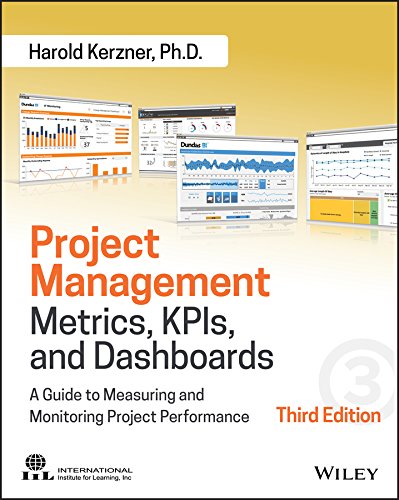
Project Management Metrics, Kpis, and Dashboards: A Guide to Measuring and Monitoring Project Performance
Harold Kerzner
4.3
Harold Kerzner's essential strategies on measuring project management performance
With the growth of complex projects, stakeholder involvement, and advancements in visual-based technology, metrics and KPIs (key performance indicators) are key factors in evaluating project performance. Dashboard reporting systems provide accessible project performance data, and sharing this vital data in a concise and consistent manner is a key communication responsibility of all project managers.
This third edition of Kerzner's groundbreaking work, Project Management Metrics, KPIs, and Dashboards: A Guide to Measuring and Monitoring Project Performance, helps functional managers gain a thorough grasp of what metrics and KPIs are and how to use them. Plus, this edition includes new sections on processing dashboard information, portfolio management PMO and metrics, and BI tool flexibility.
- Offers comprehensive coverage of the different dashboard types, design issues, and applications
Provides full-color dashboards from some of the most successful project management companies, including IBM, Microsoft, and others Aligns with PMI's PMBOK(R) Guide and stresses value-driven project management PPT decks are available by chapter and a test bank will be available for use in seminar presentations and courses Get ready to bolster your awareness of what good metrics management really entails today--and be armed with the knowledge to measure performance more effectively.
…
Cover unavailable
37
The Art of Project Management
Scott Berkun
4.3
The Art of Project Management covers it all--from practical methods for making sure work gets done right and on time, to the mindset that can make you a great leader motivating your team to do their best. Reading this was like reading the blueprint for how the best projects are managed at Microsoft... I wish we always put these lessons into action!" --Joe Belfiore, General Manager, E-home Division, Microsoft Corporation
"Berkun has written a fast paced, jargon-free and witty guide to what he wisely refers to as the 'art' of project management. It's a great introduction to the discipline. Seasoned and new managers will benefit from Berkun's perspectives." --Joe Mirza, Director, CNET Networks (Cnet.com)
"Most books with the words 'project management' in the title are dry tomes. If that's what you are expecting to hear from Berkun's book, you will be pleasantly surprised. Sure, it's about project management. But it's also about creativity, situational problem-solving, and leadership. If you're a team member, project manager, or even a non-technical stakeholder, Scott offers dozens of practical tools and techniques you can use, and questions you can ask, to ensure your projects succeed." --Bill Bliss, Senior VP of product and customer experience, expedia.com
In The Art of Project Management, you'll learn from a veteran manager of software and web development how to plan, manage, and lead projects. This personal account of hard lessons learned over a decade of work in the industry distills complex concepts and challenges into practical nuggets of useful advice. Inspiring, funny, honest, and compelling, this is the book you and your team need to have within arms reach. It will serve you well with your current work, and on future projects to come.
Topics include:
How to make things happen Making good decisions Specifications and requirements Ideas and what to do with them How not to annoy people Leadership and trust The truth about making dates What to do when things go wrong
…
Cover unavailable
38
Rapid Development: Taming Wild Software Schedules
Steve McConnell
4.3
A fundamental software engineering project management guide based on the practical requirements of "Taming Wild Software Schedules". Emphasizes possible, realistic and "best practice" approaches for managers, technical leads and self-managed teams. The author emphasizes efficient development concepts with an examination of rapid development strategies and a study of classic mistakes, within the context of software-development fundamentals and risk management. Dissects the core issues of rapid development, lifecycle planning, estimation and scheduling. Contains very good and practical discussions of customer-oriented development, motivation and teamwork. Explains such fundamental requirements as team structure, feature-set control (the dreaded feature creep in every project), availability and use of productivity tools and project recovery options. Relevant case studies are analyzed and discussed within the context of specific software development problems. Over 200 pages in this publication are devoted to a summary of best practices, everything from the daily build and smoke test, through prototyping, model selection, measurement, reuse, and the top-10 risks list.
This publication is definitely recommended and will become a classic in the field, just as the author's prior publication, "Code Complete" already is.
…
Recommended by Jeff Atwood.
Cover unavailable
39
Results Without Authority: Controlling a Project When the Team Doesn't Report to You - A Project Manager's Guide
Tom Kendrick PMP
4.2
"When you're a project manager with a team of people who don't technically report to you, your challenge is to get Results Without Authority. This book delivers proven techniques for controlling projects and managing diverse teams in a wide variety of situations, and bringing those projects to successful closure. The concepts in this book are essential for all project managers, with and without authority, because they offer a productive alternative to ""command and control"" management techniques that can easily backfire.
Tom Kendrick's system will help you get successful project results from diverse, cross-functional, virtual, outsourced, and other types of project teams by showing how to establish and build:
Control Through Process. Key project management processes, infrastructure, and the role of the project office.
Control Through Influence. Productive leadership styles, reciprocity, and maintaining relationships.
Control Through Project Metrics. Quantitative, predictive, diagnostic, and retrospective metrics for project control, motivating desired behaviors, and avoiding potential problems.
Control Through Project Initiation. The role of the sponsor in project control, the importance of project vision, project launch documentation, and the project start-up workshop.
Control Through Project Planning. Collaborative planning as the foundation of project control; planning as a key factor in setting baselines and establishing metrics.
Control During Project Execution. Measurement and interpretation of project status, informal communication, and maintaining relationships as keys to maintaining control.
Control Through Tracking and Monitoring. Controlling scope and other project parameters; formal project communication and reporting, rewards and recognition, and project reviews.
Enhancing Overall Control Through Project Closure. Sign-off, evaluating retrospective project metrics, celebrating, and rewarding the team; improving long-term project control through lessons learned.
Packed with invaluable guidance for controlling projects of all scopes and in any field, Results Without Authority will help novice and experienced project leaders get the best from their project teams."
…
Cover unavailable
40
The Lazy Project Manager: How to be Twice as Productive and Still Leave the Office Early
Peter Taylor
4.2
Cover unavailable
41
Management 3.0: Leading Agile Developers, Developing Agile Leaders
Jurgen Appel
4.2
In many organizations, management is the biggest obstacle to successful Agile development. Unfortunately, reliable guidance on Agile management has been scarce indeed. Now, leading Agile manager Jurgen Appelo fills that gap, introducing a realistic approach to leading, managing, and growing your Agile team or organization. Writing for current managers and developers moving into management, Appelo shares insights that are grounded in modern complex systems theory, reflecting the intense complexity of modern software development. Appelo's Management 3.0 model recognizes that today's organizations are living, networked systems; and that management is primarily about people and relationships. Management 3.0 doesn't offer mere checklists or prescriptions to follow slavishly; rather, it deepens your understanding of how organizations and Agile teams work and gives you tools to solve your own problems. Drawing on his extensive experience as an Agile manager, the author identifies the most important practices of Agile management and helps you improve each of them. Coverage includes - Getting beyond "Management 1.0" control and "Management 2.0" fads - Understanding how complexity affects your organization - Keeping your people active, creative, innovative, and motivated - Giving teams the care and authority they need to grow on their own - Defining boundaries so teams can succeed in alignment with business goals - Sowing the seeds for a culture of software craftsmanship - Crafting an organizational network that promotes success - Implementing continuous improvement that actually works Thoroughly pragmatic-and never trendy-Jurgen Appelo's Management 3.0 helps you bring greater agility to any software organization, team, or project.
…
Cover unavailable
42
User Story Mapping: Discover the Whole Story, Build the Right Product
Jeff Patton and Peter Economy
4.2
How do you build a product that delights users? You must first know who your users are and how they plan to use what you're building. With this practical book, you'll explore the often-misunderstood practice of user story mapping, and learn how it can help keep your team stay focused on users and their experience throughout the development process.
You and your team will learn that user stories aren't a way to write better specifications, but a way to organize and have better conversations. This book will help you understand what kinds of conversations you should be having, when to have them, and what to keep track of when you do.Learn the key concepts used to create a great story mapUnderstand how user stories really work, and how to make good use of them in agile and lean projectsExamine the nuts and bolts of managing stories through the development cycleUse strategies that help you continue to learn before and after the product's release to customers and users
"User Story Mapping" is ideal for agile and lean software development team members, product managers and UX practitioners in commercial product companies, and business analysts and project managers in IT organizations--whether you're new to this approach or want to understand more about it.
Kanban: Successful Evolutionary Change for Your Technology Business
David J. Anderson
4.2
Cover unavailable
44
Code Complete
Steve McConnell
4.2
Widely considered one of the best practical guides to programming, Steve McConnell's original CODE COMPLETE has been helping developers write better software for more than a decade. Now this classic book has been fully updated and revised with leading-edge practices--and hundreds of new code samples--illustrating the art and science of software construction. Capturing the body of knowledge available from research, academia, and everyday commercial practice, McConnell synthesizes the most effective techniques and must-know principles into clear, pragmatic guidance. No matter what your experience level, development environment, or project size, this book will inform and stimulate your thinking--and help you build the highest quality code. Discover the timeless techniques and strategies that help you:
Design for minimum complexity and maximum creativity Reap the benefits of collaborative development Apply defensive programming techniques to reduce and flush out errors Exploit opportunities to refactor--or evolve--code, and do it safely Use construction practices that are right-weight for your project Debug problems quickly and effectively Resolve critical construction issues early and correctly Build quality into the beginning, middle, and end of your project
…
Recommended by Jeff Atwood, Ana Bell, and Santiago Basulto.
Ana Bell
Code Complete is for people working in industry, writing software for companies. It has little checklists at key points in the book; if you are in industry, you can make sure that your code is readable and debugged by going through these checklists and making sure you’re touching upon all aspects. [source]
Santiago Basulto
If my career path is hackers turned business people, I’d say: Start with the basics and fundamentals: SICP: Structure and Interpretation of Computer Programs Code Complete 2 [source]
Cover unavailable
45
Project Management Absolute Beginner's Guide
Greg Horine
4.2
Succeed as a project manager, even if you've never run a project before! This book is the fastest way to master every project management task, from upfront budgeting and scheduling through execution, managing teams through closing projects, and learning from experience. Updated with more insights from the front lines, including agile approaches, dealing with security and privacy priorities, and leading remote/virtual teams, along with the latest on Microsoft Project and PMI standards and certifications and a special bonus chapter on preparing for the PMP certification. This book will show you exactly how to get the job done, one incredibly clear and easy step at a time. Project management has never, ever been this simple! Who knew how simple project management could be? This is today's best beginner's guide to modern project management... simple, practical instructions for succeeding with every task you'll need to perform! Here's a small sample of what you'll learn: - Master the key skills and qualities every project manager needs - Lead projects, don't just "manage" them - Avoid 15 most common mistakes new project managers make - Learn from troubled, successful, and "recovered" projects - Set the stage for success by effectively defining your project - Build a usable project plan and an accurate work breakdown structure (WBS) - Create budgets and schedules that help you manage risk - Use powerful control and reporting techniques, including earned value management - Smoothly manage project changes, issues, risks, deliverables, and quality - Manage project communications and stakeholder expectations - Organize and lead high-performance project teams - Manage cross-functional, cross-cultural, and virtual projects - Work successfully with vendors and Project Management Offices - Make the most of Microsoft Project and new web-based alternatives - Get started with agile and "critical chain" project management - Gain key insights that will accelerate your learning curve - Know how to respond to real-life situations, not just what they teach you in school Normal 0 false false false EN-US X-NONE X-NONE
…
Cover unavailable
46
The Effective Executive: The Definitive Guide to Getting the Right Things Done
A handsome, commemorative edition of Peter F. Drucker’s timeless classic work on leadership and management, with a foreword by Jim Collins.
What makes an effective executive?
For decades, Peter F. Drucker was widely regarded as "the dean of this country’s business and management philosophers" (Wall Street Journal). In this concise and brilliant work, he looks to the most influential position in management—the executive.
The measure of the executive, Drucker reminds us, is the ability to "get the right things done." This usually involves doing what other people have overlooked as well as avoiding what is unproductive. Intelligence, imagination, and knowledge may all be wasted in an executive job without the acquired habits of mind that mold them into results.
Drucker identifies five practices essential to business effectiveness that can—and must—be mastered:
Managing time; Choosing what to contribute to the organization; Knowing where and how to mobilize strength for best effect; Setting the right priorities; Knitting all of them together with effective decision-making Ranging across the annals of business and government, Drucker demonstrates the distinctive skill of the executive and offers fresh insights into old and seemingly obvious business situations.
…
Recommended by Drew Houston, Ev Williams, Guy Kawasaki, and 15 others.
Drew Houston
CEO/Dropbox
I think one of the most valuable concepts from this book is measuring your time. [source]
I think it's much more valuable than 99% of the so-called time management books out there. [source]
Matt Mullenweg
Founder & CEO/Automattic
We're both big fans of Peter Drucker and his book The Effective Executive, as well as Alain de Botton's How Proust Can Change your Life. [source]
Cover unavailable
47
Strategic Project Management Made Simple: Practical Tools for Leaders and Teams
Terry Schmidt
4.2
When Fortune Magazine estimated that 70% of all strategies fail, it also noted that most of these strategies were basically sound, but could not be executed. The central premise of Strategic Project Management Made Simple is that most projects and strategies never get off the ground because of adhoc, haphazard, and obsolete methods used to turn their ideas into coherent and actionable plans. Strategic Project Management Made Simple is the first book to couple a step-by-step process with an interactive thinking tool that takes a strategic approach to designing projects and action initiatives. Strategic Project Management Made Simple builds a solid platform upon four critical questions that are vital for teams to intelligently answer in order to create their own strong, strategic foundation. These questions are:
1. What are we trying to accomplish and why?
2. How will we measure success?
3. What other conditions must exist?
4. How do we get there?
This fresh approach begins with clearly understanding the what and why of a project - comprehending the bigger picture goals that are often given only lip service or cursory reviews. The second and third questions clarify success measures and identify the risky assumptions that can later cause pain if not spotted early. The how questions - what are the activities, budgets, and schedules - comes last in our four-question system. By contrast, most project approaches prematurely concentrate on the how without first adequately addressing the three other questions. These four questions guide readers into fleshing out a simple, yet sophisticated, mental workbench called "the Logical Framework" - a Systems Thinking paradigm that lays out one's own project strategy in an easily accessible, interactive 4x4 matrix. The inclusion of memorable features and concepts (four critical questions, LogFrame matrix, If-then thinking, and Implementation Equation) make this book unique.
…
Cover unavailable
48
Agile Retrospectives: Making Good Teams Great
Esther Derby, Diana Larsen, Ken Schwaber
4.2
See how to mine the experience of your software development team continually throughout the life of the project. The tools and recipes in this book will help you uncover and solve hidden (and not-so-hidden) problems with your technology, your methodology, and those difficult "people" issues on your team.
Project retrospectives help teams examine what went right and what went wrong on a project. But traditionally, retrospectives (also known as "post-mortems") are only helpful at the end of the project--too late to help. You need agile retrospectives that are iterative and incremental. You need to accurately find and fix problems to help the team today.
Now, Derby and Larsen show you the tools, tricks, and tips you need to fix the problems you face on a software development project on an on-going basis. You'll see how to architect retrospectives in general, how to design them specifically for your team and organization, how to run them effectively, how to make the needed changes, and how to scale these techniques up. You'll learn how to deal with problems, and implement solutions effectively throughout the project--not just at the end.
With regular tune-ups, your team will hum like a precise, world-class orchestra.
Contents
Forward Preface Introduction
1. Helping your team inspect and adapt 2. A retrospective custom-fit for your team 3. Leading retrospectives 4. Activities to set the stage 5. Activities to gather data 6. Activities to gather insights 7. Activities to decide what to do 8. Activities to close the retrospective 9. Releases and project retrospectives 10. Make it so
A new book that explores the science of productivity, and why, in today’s world, managing how you think—rather than what you think—can transform your life.
Recommended by Chelsea Frank, Mike Benkovich, and Pierrette Abeel.
Chelsea Frank
I read everything with an open mind, often challenging myself by choosing books with an odd perspective or religious/spiritual views. These books do not reflect my personal feelings but are books that helped shape my perspective on life, love, and happiness. [source]
Mike Benkovich
Last year I read the book 'Smarter Faster Better: The Secrets of Being Productive in Life and Business' by Charles Duhigg. Look passed the click-baity title and you'll find one of the best books on productivity I've ever read... And I've read a lot of them. [source]
Cover unavailable
50
Crossing the Chasm: Marketing and Selling Disruptive Products to Mainstream Customers
The bible for bringing cutting-edge products to larger markets--now revised and updated with new insights into the realities of high-tech marketing
In Crossing the Chasm, Geoffrey A. Moore shows that in the Technology Adoption Life Cycle--which begins with innovators and moves to early adopters, early majority, late majority, and laggards--there is a vast chasm between the early adopters and the early majority. While early adopters are willing to sacrifice for the advantage of being first, the early majority waits until they know that the technology actually offers improvements in productivity. The challenge for innovators and marketers is to narrow this chasm and ultimately accelerate adoption across every segment.
This third edition brings Moore's classic work up to date with dozens of new examples of successes and failures, new strategies for marketing in the digital world, and Moore's most current insights and findings. He also includes two new appendices, the first connecting the ideas in Crossing the Chasm to work subsequently published in his Inside the Tornado, and the second presenting his recent groundbreaking work for technology adoption models for high-tech consumer markets.
…
Recommended by Andrew Chen, Drew Houston, Ev Williams, and 28 others.
Drew Houston
CEO/Dropbox
It’s about how do technology products make their way from early adopters t the mainstream. [source]
Ron Conway
Bestselling guide that created a new game plan for marketing in high-tech industries. [source]
This is a key component in my Purple Cow thinking, but with a twist. I'm not as worried about the chasm as I am about the desire of marketers to go for the big middle. [source]
Cover unavailable
51
The Principles of Product Development Flow: Second Generation Lean Product Development
Donald G. Reinertsen
4.2
In this book, Reinertsen provides an examination of product development practices. He explains why invisible and unmanaged queues are the underlying root cause of poor product development performance. He shows why these queues form and how they undermine the speed, quality, and efficiency in product development.
Cover unavailable
52
Project Management for Dummies (UK Edition)
Nick Graham
4.2
More than two thirds of American companies use teams to execute their most important projects, making project management a highly valuable skill for advancing your career. Project Management For Dummies, Second Edition introduces you to the principles of successful project management and shows you how to motivate any team to gain maximum productivity. You’ll find out how to: Define your project and what you intend to accomplish Identify project stakeholders and their expectations Develop a project plan Establish project schedules and timetables Determine which skill sets and resources the project requires Choose team members and define their roles Launch you project and track its progress Encourage peak performance Conclude your project successfully
Complete with helpful tips on delegating, shortening schedules, and optimizing your own performance Project Management for Dummies, help you get your project, and your career, off the ground in no time.
…
Cover unavailable
53
Extreme Programming Explained: Embrace Change (The XP Series)
Kent Beck
4.2
"In this second edition of Extreme Programming Explained, Kent Beck organizes and presents five years' worth of experiences, growth, and change revolving around XP. If you are seriously interested in understanding how you and your team can start down the path of improvement with XP, you must read this book."
--Francesco Cirillo, Chief Executive Officer, XPLabs S.R.L. "The first edition of this book told us what XP was--it changed the way many of us think about software development. This second edition takes it farther and gives us a lot more of the 'why' of XP, the motivations and the principles behind the practices. This is great stuff. Armed with the 'what' and the 'why, ' we can now all set out to confidently work on the 'how' how to run our projects better, and how to get agile techniques adopted in our organizations."
--Dave Thomas, The Pragmatic Programmers LLC "This book is dynamite! It was revolutionary when it first appeared a few years ago, and this new edition is equally profound. For those who insist on cookbook checklists, there's an excellent chapter on 'primary practices, ' but I urge you to begin by truly contemplating the meaning of the opening sentence in the first chapter of Kent Beck's book: 'XP is about social change.' You should do whatever it takes to ensure that every IT professional and every IT manager--all the way up to the CIO--has a copy of Extreme Programming Explained on his or her desk."
--Ed Yourdon, author and consultant "XP is a powerful set of concepts for simplifying the process of software design, development, and testing. It is about minimalism and incrementalism, which are especially useful principles when tackling complex problems that require a balance of creativity and discipline."
--Michael A. Cusumano, Professor, MIT Sloan School of Management, and author of The Business of Software "Extreme Programming Explained is the work of a talented and passionate craftsman. Kent Beck has brought together a compelling collection of ideas about programming and management that deserves your full attention. My only beef is that our profession has gotten to a point where such common-sense ideas are labeled 'extreme.'..."
--Lou Mazzucchelli, Fellow, Cutter Business Technology Council "If your organization is ready for a change in the way it develops software, there's the slow incremental approach, fixing things one by one, or the fast track, jumping feet first into Extreme Programming. Do not be frightened by the name, it is not that extreme at all. It is mostly good old recipes and common sense, nicely integrated together, getting rid of all the fat that has accumulated over the years."
--Philippe Kruchten, UBC, Vancouver, British Columbia "Sometimes revolutionaries get left behind as the movement they started takes on a life of its own. In this book, Kent Beck shows that he remains ahead of the curve, leading XP to its next level. Incorporating five years of feedback, this book takes a fresh look at what it takes to develop better software in less time and for less money. There are no silver bullets here, just a set of practical principles that, when used wisely, can lead to dramatic improvements in software development productivity."
--Mary Poppendieck, author of Lean Software Development: An Agile Toolkit "Kent Beck has revised his classic book based on five more years of applying and teaching XP. He shows how the path to XP is both easy and hard: It can be started with fewer practices, and yet it challenges teams to go farther than ever."
--William Wake, independent consultant "With new insights, wisdom from experience, and clearer explanations of the art of Extreme Programming, this edition of Beck's classic will help many realize the dream of outstanding software development."
--Joshua Kerievsky, author of Refactoring to Patterns and Founder, Industrial Logic, Inc. "XP has changed the way our industry thinks about software development. Its brilliant simplicity, focused execution, and insistence on fact-based planning over speculation have set a new standard for software delivery."
--David Trowbridge, Architect, Microsoft Corporation Accountability. Transparency. Responsibility. These are not words that are often applied to software development.
In this completely revised introduction to Extreme Programming (XP), Kent Beck describes how to improve your software development by integrating these highly desirable concepts into your daily development process.
The first edition of Extreme Programming Explained is a classic. It won awards for its then-radical ideas for improving small-team development, such as having developers write automated tests for their own code and having the whole team plan weekly. Much has changed in five years. This completely rewritten second edition expands the scope of XP to teams of any size by suggesting a program of continuous improvement based on:
Five core values consistent with excellence in software development Eleven principles for putting those values into action Thirteen primary and eleven corollary practices to help you push development past its current business and technical limitations Whether you have a small team that is already closely aligned with your customers or a large team in a gigantic or multinational organization, you will find in these pages a wealth of ideas to challenge, inspire, and encourage you and your team members to substantially improve your software development.
You will discover how to:
Involve the whole team--XP style Increase technical collaboration through pair programming and continuous integration Reduce defects through developer testing Align business and technical decisions through weekly and quarterly planning Improve teamwork by setting up an informative, shared workspace You will also find many other concrete ideas for improvement, all based on a philosophy that emphasizes simultaneously increasing the humanity and effectiveness of software development.
Every team can improve. Every team can begin improving today. Improvement is possible--beyond what we can currently imagine. Extreme Programming Explained, Second Edition, offers ideas to fuel your improvement for years to come.
…
Recommended by Steve Blank.
Cover unavailable
54
Coaching Agile Teams: A Companion for ScrumMasters, Agile Coaches, and Project Managers in Transition
Lyssa Adkins
4.2
The Provocative and Practical Guide to Coaching Agile Teams As an agile coach, you can help project teams become outstanding at agile, creating products that make them proud and helping organizations reap the powerful benefits of teams that deliver both innovation and excellence. More and more frequently, ScrumMasters and project managers are being asked to coach agile teams. But it's a challenging role. It requires new skills--as well as a subtle understanding of when to step in and when to step back. Migrating from "command and control" to agile coaching requires a whole new mind-set. In Coaching Agile Teams, Lyssa Adkins gives agile coaches the insights they need to adopt this new mind-set and to guide teams to extraordinary performance in a re-energized work environment. You'll gain a deep view into the role of the agile coach, discover what works and what doesn't, and learn how to adapt powerful skills from many allied disciplines, including the fields of professional coaching and mentoring. Coverage includes Understanding what it takes to be a great agile coach Mastering all of the agile coach's roles: teacher, mentor, problem solver, conflict navigator, and performance coach Creating an environment where self-organized, high-performance teams can emerge Coaching teams past cooperation and into full collaboration Evolving your leadership style as your team grows and changes Staying actively engaged without dominating your team and stunting its growth Recognizing failure, recovery, and success modes in your coaching Getting the most out of your own personal agile coaching journey Whether you're an agile coach, leader, trainer, mentor, facilitator, ScrumMaster, project manager, product owner, or team member, this book will help you become skilled at helping others become truly great. What could possibly be more rewarding?
…
Cover unavailable
55
Succeeding with Agile: Software Development Using Scrum
Mike Cohn
4.2
Proven, 100% Practical Guidance for Making Scrum and Agile Work in Any Organization.
This is the definitive, realistic, actionable guide to starting fast with Scrum and agile–and then succeeding over the long haul. Leading agile consultant and practitioner Mike Cohn presents detailed recommendations, powerful tips, and real-world case studies drawn from his unparalleled experience helping hundreds of software organizations make Scrum and agile work.
"Succeeding with Agile" is for pragmatic software professionals who want real answers to the most difficult challenges they face in implementing Scrum. Cohn covers every facet of the transition: getting started, helping individuals transition to new roles, structuring teams, scaling up, working with a distributed team, and finally, implementing effective metrics and continuous improvement.
Throughout, Cohn presents “Things to Try Now” sections based on his most successful advice. Complementary “Objection” sections reproduce typical conversations with those resisting change and offer practical guidance for addressing their concerns. Coverage includes: - Practical ways to get started immediately–and “get good” fast - Overcoming individual resistance to the changes Scrum requires - Staffing Scrum projects and building effective teams - Establishing “improvement communities” of people who are passionate about driving change - Choosing which agile technical practices to use or experiment with - Leading self-organizing teams - Making the most of Scrum sprints, planning, and quality techniques - Scaling Scrum to distributed, multiteam projects - Using Scrum on projects with complex sequential processes or challenging compliance and governance requirements - Understanding Scrum’s impact on HR, facilities, and project management
Whether you've completed a few sprints or multiple agile projects and whatever your role–manager, developer, coach, ScrumMaster, product owner, analyst, team lead, or project lead–this book will help you succeed with your very next project. Then, it will help you go much further: It will help you transform your entire development organization.
…
Recommended by Nicolae Andronic.
Nicolae Andronic
I’m a technical guy. I studied the IT field and did software development for a long time until I discovered the business world. So the path for me is to slowly adapt from the clear, technical world, to the fuzzy, way more complex, business world. All the books that I recommend help this transition. “Succeeding with Agile” - Mike Cohn: for approaching the process involved into building a product in an organized manner. [source]
Cover unavailable
56
Lean from the Trenches
Henrik Kniberg
4.2
Lean from the Trenches is all about actual practice.
Find out how the Swedish police combined XP, Scrum, and Kanban in a 60-person project. From start to finish, you'll see how to deliver a successful product using Lean principles.
We start with an organization in desperate need of a new way of doing things and finish with a group of sixty, all working in sync to develop a scalable, complex system. You'll walk through the project step by step, from customer engagement, to the daily "cocktail party," version control, bug tracking, and release. In this honest look at what works--and what doesn't--you'll find out how to: Make quality everyone's business, not just the testers. Keep everyone moving in the same direction without micromanagement. Use simple and powerful metrics to aid in planning and process improvement. Balance between low-level feature focus and high-level system focus. You'll be ready to jump into the trenches and streamline your own development process.
Contents
Foreword Preface
PART I: HOW WE WORK
1. About the Project 1.1 Timeline 5 1.2 How We Sliced the Elephant 6 1.3 How We Involved the Customer 7
2. Structuring the Teams
3. Attending the Daily Cocktail Party 3.1 First Tier: Feature Team Daily Stand-up 3.2 Second Tier: Sync Meetings per Specialty 3.3 Third Tier: Project Sync Meeting
4. The Project Board 4.1 Our Cadences 4.2 How We Handle Urgent Issues and Impediments
5. Scaling the Kanban Boards
6. Tracking the High-Level Goal
7. Defining Ready and Done 7.1 Ready for Development 7.2 Ready for System Test 7.3 How This Improved Collaboration
8. Handling Tech Stories 8.1 Example 1: System Test Bottleneck 8.2 Example 2: Day Before the Release 8.3 Example 3: The 7-Meter Class
9. Handling Bugs 9.1 Continuous System Test 9.2 Fix the Bugs Immediately 9.3 Why We Limit the Number of Bugs in the Bug Tracker 9.4 Visualizing Bugs 9.5 Preventing Recurring Bugs
10. Continuously Improving the Process 10.1 Team Retrospectives 10.2 Process Improvement Workshops 10.3 Managing the Rate of Change
11. Managing Work in Progress 11.1 Using WIP Limits 11.2 Why WIP Limits Apply Only to Features
12. Capturing and Using Process Metrics 12.1 Velocity (Features per Week) 12.2 Why We Don’t Use Story Points 12.3 Cycle Time (Weeks per Feature) 12.4 Cumulative Flow 12.5 Process Cycle Efficiency
13. Planning the Sprint and Release 13.1 Backlog Grooming 13.2 Selecting the Top Ten Features 13.3 Why We Moved Backlog Grooming Out of the Sprint Planning Meeting 13.4 Planning the Release
14. How We Do Version Control 14.1 No Junk on the Trunk 14.2 Team Branches 14.3 System Test Branch
15. Why We Use Only Physical Kanban Boards
16. What We Learned 16.1 Know Your Goal 16.2 Experiment 16.3 Embrace Failure 16.4 Solve Real Problems 16.5 Have Dedicated Change Agents 16.6 Involve People
PART II: A CLOSER LOOK AT THE TECHNIQUES
17. Agile and Lean in a Nutshell 17.1 Agile in a Nutshell 17.2 Lean in a Nutshell 17.3 Scrum in a Nutshell 17.4 XP in a Nutshell 17.5 Kanban in a Nutshell
18. Reducing the Test Automation Backlog 18.1 What to Do About It 18.2 How to Improve Test Coverage a Little Bit Each Iteration 18.3 Step 1: List Your Test Cases 18.4 Step 2: Classify Each Test 18.5 Step 3: Sort the List in Priority Order 18.6 Step 4: Automate a Few Tests Each Iteration 18.7 Does This Solve the Problem?
19. Sizing the Backlog with Planning Poker 19.1 Estimating Without Planning Poker 19.2 Estimating with Planning Poker 19.3 Special Cards
20. Cause-Effect Diagrams 20.1 Solve Problems, Not Symptoms 20.2 The Lean Problem-Solving Approach: A3 Thinking 20.3 How to Use Cause-Effect Diagrams 20.4 Example 1: Long Release Cycle 20.5 Example 2: Defects Released to Production 20.6 Example 3: Lack of Pair Programming 20.7 Example 4: Lots of Problems 20.8 Practical Issues: How to Create and Maintain the Diagrams 20.9 Pitfalls 20.10 Why Use Cause-Effect Diagrams?
21. Final Words
A1. Glossary: How We Avoid Buzzword Bingo Index
…
Cover unavailable
57
Waltzing with Bears: Managing Risk on Software Projects
Tom DeMarco, Timothy Lister
4.2
The authors, consultants in risk and management, show how to identify and embrace worthwhile risks in software development and offer strategies for common risks that software projects face, such as schedule flaws, requirements inflation, and specification breakdown. Annotation (c) Book News, Inc., P
Cover unavailable
58
Scrum and XP from the Trenches
Henrik Kniberg
4.2
This book aims to give you a head start by providing a detailed down-to-earth account of how one Swedish company implemented Scrum and XP with a team of approximately 40 people and how they continuously improved their process over a year's time. Under the leadership of Henrik Kniberg they experimented with different team sizes, different sprint lengths, different ways of defining "done," different formats for product backlogs and sprint backlogs, different testing strategies, different ways of doing demos, different ways of synchronizing multiple Scrum teams, etc. They also experimented with XP practices - different ways of doing continuous build, pair programming, test driven development, etc, and how to combine this with Scrum.
…
Recommended by Mircea Scarlatescu.
Mircea Scarlatescu
Many, but here’s a short list, for both entrepreneurs and team leaders: The E-Myth by Michael E. Gerber Zero to One by Peter Thiel The Lean Startup by Eric Ries Scrum and XP from the Trenches by Henrik Kniberg ReWork – Jason Fried [source]
Cover unavailable
59
Agile Project Management: Creating Innovative Products (Agile Software Development Series)
Jim Highsmith
4.2
Cover unavailable
60
Managing Successful Projects with PRINCE2
Office of Government Commerce
4.2
PRINCE2 is the project management method developed by CCTA. This book presents guidance on how to set-up, organise, control, and deliver projects on time, within budget and to the right quality. It is applicable to projects in both IT and non-IT environments.
Cover unavailable
61
Continuous Delivery: Reliable Software Releases Through Build, Test, and Deployment Automation
Jez Humble and David Farley
4.1
Winner of the 2011 Jolt Excellence Award!
Getting software released to users is often a painful, risky, and time-consuming process. This groundbreaking new book sets out the principles and technical practices that enable rapid, incremental delivery of high quality, valuable new functionality to users. Through automation of the build, deployment, and testing process, and improved collaboration between developers, testers, and operations, delivery teams can get changes released in a matter of hours-- sometimes even minutes-no matter what the size of a project or the complexity of its code base. Jez Humble and David Farley begin by presenting the foundations of a rapid, reliable, low-risk delivery process. Next, they introduce the "deployment pipeline," an automated process for managing all changes, from check-in to release. Finally, they discuss the "ecosystem" needed to support continuous delivery, from infrastructure, data and configuration management to governance. The authors introduce state-of-the-art techniques, including automated infrastructure management and data migration, and the use of virtualization. For each, they review key issues, identify best practices, and demonstrate how to mitigate risks. Coverage includes - Automating all facets of building, integrating, testing, and deploying software - Implementing deployment pipelines at team and organizational levels - Improving collaboration between developers, testers, and operations - Developing features incrementally on large and distributed teams - Implementing an effective configuration management strategy - Automating acceptance testing, from analysis to implementation - Testing capacity and other non-functional requirements - Implementing continuous deployment and zero-downtime releases - Managing infrastructure, data, components and dependencies - Navigating risk management, compliance, and auditing Whether you're a developer, systems administrator, tester, or manager, this book will help your organization move from idea to release faster than ever--so you can deliver value to your business rapidly and reliably.
…
Cover unavailable
62
The Pragmatic Programmer: From Journeyman to Master
Andrew Hunt and David Thomas
4.1
-- Ward Cunningham Straight from the programming trenches, The Pragmatic Programmer cuts through the increasing specialization and technicalities of modern software development to examine the core process--taking a requirement and producing working, maintainable code that delights its users. It covers topics ranging from personal responsibility and career development to architectural techniques for keeping your code flexible and easy to adapt and reuse. Read this book, and youll learn how to *Fight software rot; *Avoid the trap of duplicating knowledge; *Write flexible, dynamic, and adaptable code; *Avoid programming by coincidence; *Bullet-proof your code with contracts, assertions, and exceptions; *Capture real requirements; *Test ruthlessly and effectively; *Delight your users; *Build teams of pragmatic programmers; and *Make your developments more precise with automation. Written as a series of self-contained sections and filled with entertaining anecdotes, thoughtful examples, and interesting analogies, The Pragmatic Programmer illustrates the best practices and major pitfalls of many different aspects of software development. Whether youre a new coder, an experienced programm
…
Recommended by Jeff Atwood, Hadley Wickham, and 1 others.
This book is about the craft of software development, and thinking about how to produce good code. [source]
Cover unavailable
63
Scrum: a Breathtakingly Brief and Agile Introduction
Chris Sims
4.1
A pocket-sized overview of roles, artifacts and the sprint cycle, adapted from the bestseller The Elements of Scrum by Chris Sims & Hillary Louise Johnson
Why is change so difficult and frightening? How do you create change when you have few resources and no title or authority to back you up? Chip and Dan Heath, the best-selling authors of Made to Stick, are back with a ground-breaking book that addresses one of the greatest challenges of our personal and professional lives — how to change things when change is hard.
In their follow-up book to the critically acclaimed international bestseller Made to Stick, Chip and Dan Heath talk about how difficult change is in our companies, our careers, and our lives, why change is so hard, and how we can overcome our resistance and make change happen. The Heaths liken the human mind to two distinct entities — the animal mind, or what psychologist Jonathan Haidt calls the elephant, and the logical brain, which Haidt describes as the rider. The elephant is instinctive; it acts on emotion. It likes gorging on Oreos and sleeping in. And it loves routines — doing things the same old way, every day.
The rider is the planner and thinker. The rider obsesses about the future. He or she wants to stop eating junk food and stop hitting the snooze button. But it’s hard, because when the rider and elephant disagree on where to go, the rider usually loses. And that describes the essential tension between our primitive emotional brain and our high intellect, and helps to explain why changing how we behave is so difficult. The secret to making a switch is understanding this odd couple relationship. Direct the Rider. Motivate the Elephant. Shape the Path.
Throughout Switch, Chip and Dan Heath illustrate and explain situations in which sweeping change was adopted, from a university researcher who ended the cycle of child abuse in a group of families, to an entrepreneur who turned his skeptical employees into customer service zealots and saved his company.
In the tradition of Made to Stick, Blink, and Outliers, Switch is filled with engaging and entertaining stories of how companies and individuals have brought about and sustained significant change. An indispensable guide to making change happen, it is certain to become a classic.
…
Recommended by Africa Mentor, Richard H Thaler, Satya Patel, and 2 others.
Africa Mentor
6 fine summer reads | London Business School London Business School Review A good book is the best travel companion – wherever you are. By the pool or on your commute, be transported with these titles chos... https://t.co/Wo9NYOrwqG via @theafricamentor #entrepreneur #africabiz [source]
Tudor Mihailescu
First thing first, finance people need to be decent communicators, ideally awesome communicators. There is an art in building a case or in delivering a presentation and we need to treat this step as seriously as we have treated the other steps. I do believe this is a top priority for an aspiring or practicing CFO - There are plenty of books on this topic, I would recommend the works of Chip and Dan Health like Switch and Made to Stick [source]
Cover unavailable
65
The Fifth Discipline: The Art & Practice of the Learning Organization
This revised edition of Peter Senge’s bestselling classic, The Fifth Discipline, is based on fifteen years of experience in putting the book’s ideas into practice. As Senge makes clear, in the long run the only sustainable competitive advantage is your organization’s ability to learn faster than the competition. The leadership stories in the book demonstrate the many ways that the core ideas in The Fifth Discipline, many of which seemed radical when first published in 1990, have become deeply integrated into people’s ways of seeing the world and their managerial practices.
In The Fifth Discipline, Senge describes how companies can rid themselves of the learning “disabilities” that threaten their productivity and success by adopting the strategies of learning organizations—ones in which new and expansive patterns of thinking are nurtured, collective aspiration is set free, and people are continually learning how to create results they truly desire.
The updated and revised Currency edition of this business classic contains over one hundred pages of new material based on interviews with dozens of practitioners at companies like BP, Unilever, Intel, Ford, HP, Saudi Aramco, and organizations like Roca, Oxfam, and The World Bank. It features a new Foreword about the success Peter Senge has achieved with learning organizations since the book’s inception, as well as new chapters on Impetus (getting started), Strategies, Leaders’ New Work, Systems Citizens, and Frontiers for the Future.
Mastering the disciplines Senge outlines in the book will:
• Reignite the spark of genuine learning driven by people focused on what truly matters to them • Bridge teamwork into macro-creativity • Free you of confining assumptions and mindsets • Teach you to see the forest and the trees • End the struggle between work and personal time
…
Recommended by Brian Tracy, Jana Eggers, Josh Brewer, and 2 others.
Jana Eggers
My entrepreneurial and leadership inspiration came from a long line of amazing women in my family that always acted independently and gave me the fire and confidence to chose my path, and some fantastic and inspiring men who always expected me to do more. What I love about 5th Discipline is that it focuses on learning, specifically teaching and inspiring your organization to be a learning org. It is more critical than now than ever before that we be able to learn from customers and the current context of our business for adapting to new challenges. One of my favorite parts of the book is how it teaches teams to work across boundaries -- systems thinking. I've found this builds amazingly cohesive and respectful teams. So this is a business book, but it is really about organizations and how to get them learning and working together for a common purpose. [source]
Josh Brewer
After working at many startups and now running my own company, the one difference I have observed between good and great companies (and products) is how oriented the org is toward learning, The more people in an organization learn, the more value they create for the whole company. [source]
Cover unavailable
66
Inspired: How to Create Tech Products Customers Love
The basic premise of Inspired is that the best tech companies create products in a manner very different from how most companies create products. The goal of the book is to share the techniques of the best companies. This book is aimed primarily at Product Managers working on technology-powered products. That includes the hundreds of "tech companies" like Google, Facebook, Amazon, Twitter and the like, as well as the thousands of companies moving to leverage technology (financial companies, media companies, retailers, manufacturers, nearly every industry). Inspired covers companies from early stage start-ups to large, established companies. The products might be consumer products or devices, business services for small businesses to enterprises, internal tools, and developer platforms.
Inspired is secondarily aimed at the designers, engineers, user researchers and data scientists that work closely with the product managers on product teams at these same companies.
Radical Candor: Be a Kickass Boss Without Losing Your Humanity
Kim Scott
4.1
From the time we learn to speak, we’re told that if you don’t have anything nice to say, don’t say anything at all. While this advice may work for everyday life, it is, as Kim Scott has seen, a disaster when adopted by managers.
Scott earned her stripes as a highly successful manager at Google and then decamped to Apple, where she developed a class on optimal management. She has earned growing fame in recent years with her vital new approach to effective management, the “radical candor” method.
Radical candor is the sweet spot between managers who are obnoxiously aggressive on one side and ruinously empathetic on the other. It’s about providing guidance, which involves a mix of praise as well as criticism—delivered to produce better results and help employees achieve.
Great bosses have strong relationships with their employees, and Scott has identified three simple principles for building better relationships with your employees: make it personal, get (sh)it done, and understand why it matters.
Radical Candor offers a guide to those bewildered or exhausted by management, written for bosses and those who manage bosses. Taken from years of the author’s experience, and distilled clearly giving actionable lessons to the reader; it shows managers how to be successful while retaining their humanity, finding meaning in their job, and creating an environment where people both love their work and their colleagues.
"Kim Scott has a well-earned reputation as a kick-ass boss and a voice that CEOs take seriously. In this remarkable book, she draws on her extensive experience to provide clear and honest guidance on the fundamentals of leading others: how to give (and receive) feedback, how to make smart decisions, how to keep moving forward, and much more. If you manage people―whether it be 1 person or a 1,000--you need RADICAL CANDOR. Now." [source]
Question: What five books would you recommend to young people interested in your career path & why? Answer: I know this is sounds self-serving but I’d recommended both of my books, the soon to be released, “Niche Down: How to Become Legendary by Being Different” and Harper Collins’ “instant classic,” “Play Bigger: How Pirates, Dreamers and Innovators Create and Dominate Markets” In addition: The Effective Executive, by Peter Drucker The E-Myth, by Michael Gerber Radical Candor: Be a Kickass Boss Without Losing Your Humanity by Kim Scott Back from the Dead, by Bill Walton The 22 Immutable Laws of Marketing, by Al Ries and Jack Trout [source]
Dux Raymond Sy
@magrom I recommend you be radically candid by challenging directly and caring personally - if you haven't, checkout @kimballscott's book #RadicalCandor - tons of great insights https://t.co/TP58vhmi18 [source]
Cover unavailable
68
Good Strategy Bad Strategy: The Difference and Why It Matters
Clears out the mumbo jumbo and muddled thinking underlying too many strategies and provides a clear way to create and implement a powerful action-oriented strategy for the real world
Developing and implementing a strategy is the central task of a leader, whether the CEO at a Fortune 100 company, an entrepreneur, a church pastor, the head of a school, or a government official. Richard Rumelt shows that there has been a growing and unfortunate tendency to equate Mom-and-apple-pie values, fluffy packages of buzzwords, motivational slogans, and financial goals with “strategy.” He debunks these elements of “bad strategy” and awakens an understanding of the power of a “good strategy.”
A good strategy is a specific and coherent response to—and approach for overcoming—the obstacles to progress. A good strategy works by harnessing and applying power where it will have the greatest effect in challenges as varied as putting a man on the moon, fighting a war, launching a new product, responding to changing market dynamics, starting a charter school, or setting up a government program. Rumelt’s nine sources of power—ranging from using leverage to effectively focusing on growth—are eye-opening yet pragmatic tools that can be put to work on Monday morning.
Surprisingly, a good strategy is often unexpected because most organizations don’t have one. Instead, they have “visions,” mistake financial goals for strategy, and pursue a “dog’s dinner” of conflicting policies and actions.
Rumelt argues that the heart of a good strategy is insight—into the true nature of the situation, into the hidden power in a situation, and into an appropriate response. He shows you how insight can be cultivated with a wide variety of tools for guiding your own thinking. Good Strategy/Bad Strategy uses fascinating examples from business, nonprofit, and military affairs to bring its original and pragmatic ideas to life. The detailed examples range from Apple to General Motors, from the two Iraq wars to Afghanistan, from a small local market to Wal-Mart, from Nvidia to Silicon Graphics, from the Getty Trust to the Los Angeles Unified School District, from Cisco Systems to Paccar, and from Global Crossing to the 2007–08 financial crisis.
Reflecting an astonishing grasp and integration of economics, finance, technology, history, and the brilliance and foibles of the human character, Good Strategy/Bad Strategy stems from Rumelt’s decades of digging beyond the superficial to address hard questions with honesty and integrity.
…
Recommended by Ann Handley, John Kay, Louis Grenier, and 3 others.
It’s very well written and I see I am quoted on the back cover saying, ‘This is the only book about business strategy which I didn’t want to put down.' [source]
Louis Grenier
If you want to think about strategy, the proper strategy, how to understand what to do, what not to do, read: “Good Strategy, Bad Strategy”, “Good to Great” and “Blue Ocean Strategy”. [source]
Patricia Reed
I loved Good Strategy/Bad Strategy, by Richard Rumelt. It had many stories and examples about how strategy is often misconstrued, and what leaders can do to ensure they have a proper strategy. [source]
Cover unavailable
69
Software Project Survival Guide
Steve McConnell
4.1
Equip yourself with SOFTWARE PROJECT SURVIVAL GUIDE. It's for everyone with a stake in the outcome of a development project--and especially for those without formal software project management training. That includes top managers, executives, clients, investors, end-user representatives, project managers, and technical leads.
Here you'll find guidance from the acclaimed author of the classics CODE COMPLETE and RAPID DEVELOPMENT. Steve McConnell draws on solid research and a career's worth of hard-won experience to map the surest path to your goal--what he calls "one specific approach to software development that works pretty well most of the time for most projects." Nineteen chapters in four sections cover the concepts and strategies you need for mastering the development process, including planning, design, management, quality assurance, testing, and archiving. For newcomers and seasoned project managers alike, SOFTWARE PROJECT SURVIVAL GUIDE draws on a vast store of techniques to create an elegantly simplified and reliable framework for project management success.
So don't worry about wandering among complex sets of project management techniques that require years to sort out and master. SOFTWARE PROJECT SURVIVAL GUIDE goes straight to the heart of the matter to help your projects succeed. And that makes it a required addition to every professional's bookshelf.
With 200 pages of new content, the fifth edition of this popular guide gives new or veteran project managers a comprehensive overview of all of the best-of-breed project management approaches and tools today, including Traditional (Linear and Incremental), Agile (Iterative and Adaptive), and Extreme. Step-by-step instruction and practical case studies show you how to use these tools effectively to achieve better outcomes of projects at hand. Plus, the book provides full coverage on managing continuous process improvement, procurement management, managing distressed projects, and managing multiple team projects. The companion Web site includes exercises and solutions that accompany the project management instruction in the book.
…
Cover unavailable
71
Project Management Lite: Just Enough to Get the Job Done...Nothing More
Juana Clark Craig
4.1
Get your projects done without having a Master's Degree in Project Management
There is no shortage of books on project management, yet most of those guides are weighed down with tiresome project management-speak and heavy process. This easy-to-use, step-by-step, plain English guide to project management shows readers how to hit ground running and nail the completion of projects.
For beginners who find themselves in charge of a project but have no clue where to start or those who are struggling or feel overwhelmed, Project Management Lite focuses less on the theory and more on the action with simple worksheets and checklists.
Author Juana Clark Craig, PMP, draws on over twenty-five years of project management experience gained while working in Fortune 500 companies to deliver a minimalistic approach to managing your projects without the mumbo-jumbo of traditional project management techniques.
…
Cover unavailable
72
Project Pain Reliever: A Just-In-Time Handbook for Anyone Managing Projects
Dave Garrett
4.1
Much of the work performed in organizations around the world today is project oriented. Those responsible for leading the majority of these projects to successful results have varied educational backgrounds, knowledge, skill sets, and experiences gained over the course of their lives and careers that do not include the professional discipline known as project management. Most are managing projects as part of their role, not their profession. However, these accidental project managers frequently run into the same sort of issues and problems faced by those whose profession is project management, but they lack the education or training to properly address them. As a result, more projects run by accidental project managers fail than succeed.This handbook was developed specifically for those accidental project managers and for the relatively new project managers within the profession. It is uniquely organized in a manner designed to help these project managers quickly find specific solutions to the problems they are desperate to fix right now!
The text is divided into two broad categories: the Art of Project Management and the Science of Project Management. Each part is divided into chapters to narrow the user's search by type of issue that project managers encounter, such as Planning and Managing Risks. These are then further divided by specific problems labeled as sub-chapters, such as "The company's project management process doesn't work for me" and "My project is too dependent on a few key people." Project Pain Reliever: A Just-In-Time Handbook for Anyone Managing Projects is essentially a plug-and-play answer to the accidental project manager's problems, and a valuable desk reference for all project managers.
…
Cover unavailable
73
How Google Works
Eric Schmidt
4.1
Both Eric Schmidt and Jonathan Rosenberg came to Google as seasoned Silicon Valley business executives, but over the course of a decade they came to see the wisdom in Coach John Wooden's observation that 'it's what you learn after you know it all that counts'. As they helped grow Google from a young start-up to a global icon, they relearned everything they knew about management. How Google Works is the sum of those experiences distilled into a fun, easy-to-read primer on corporate culture, strategy, talent, decision-making, communication, innovation, and dealing with disruption.
The authors explain how the confluence of three seismic changes - the internet, mobile, and cloud computing - has shifted the balance of power from companies to consumers. The companies that will thrive in this ever-changing landscape will be the ones that create superior products and attract a new breed of multifaceted employees whom the authors dub 'smart creatives'. The management maxims ('Consensus requires dissension', 'Exile knaves but fight for divas', 'Think 10X, not 10%') are illustrated with previously unreported anecdotes from Google's corporate history.
'Back in 2010, Eric and I created an internal class for Google managers,' says Rosenberg. 'The class slides all read 'Google confidential' until an employee suggested we uphold the spirit of openness and share them with the world. This book codifies the recipe for our secret sauce: how Google innovates and how it empowers employees to succeed.'
…
Recommended by Andreas Zhou, Cynthia Johnson, Gary Bury, and 4 others.
Andreas Zhou
After reading How Google Works I just became fascinated with Google culture and I hope to understand a bit more about what unique things they're doing right that we aren't. [source]
Cynthia Johnson
What happens is that we look at things Google, or Facebook, and we see these big corporate enterprises. We don’t see the fact that there are people inside running them, and there have been hurdles. [source]
Gary Bury
How Google Works is a good insight to a large corporate in the tech world. [source]
Cover unavailable
74
The Project Management Answer Book
Jeff Furman
4.1
With a new chapter on Scrum agile, updates throughout, and many additional PMP test tips, this new edition builds on the solid foundation of the first edition. The structure of this update maps closely to the PMBOK guide V5 and is designed to assist anyone studying for the PMP and other certification exams. Helpful sections cover: networking and social media tips for PMs, including the best professional organizations, virtual groups, and podcast resources; formulas PMs need to know, plus a template to help certification candidates prepare and self-test for their exams; quick study sheet for the processes covered on the PMP exam; key changes in PMBOK guide V5, for readers familiar with earlier versions who want the skinny on the new version. -- Edited summary from book.
…
Cover unavailable
75
The Manager's Path: A Guide for Tech Leaders Navigating Growth and Change
Managing people is difficult wherever you work, but the tech industry as a whole is pretty bad at it. Tech companies in general lack the experience, tools, texts, and frameworks to do it well. And the handful of books that share tips and tricks of engineering management don t explain how to supervise employees in the face of growth and change.
In this book, author Camille Fournier takes you through the stages of technical management, from mentoring interns to working with the senior staff. You ll get actionable advice for approaching various obstacles in your path, whether you re a new manager, a mentor, or a more experienced leader looking for fresh advice. Pick up this book and learn how to become a better manager and leader in your organization.
• Discover how to manage small teams and large/multi-level teams • Understand how to build and bootstrap a unifying culture in teams • Deal with people problems and learn how to mentor other managers and new leaders • Learn how to manage yourself: avoid common pitfalls that challenge many leaders • Obtain several practices that you can incorporate and practice along the way
…
Cover unavailable
76
Manage It!: Your Guide to Modern, Pragmatic Project Management
Johanna Rothman
4.1
This book is a reality-based guide for modern projects. You'll learn how to recognize your project's potholes and ruts, and determine the best way to fix problems - without causing more problems.
Your project can't fail. That's a lot of pressure on you, and yet you don't want to buy into any one specific process, methodology, or lifecycle.
Your project is different. It doesn't fit into those neat descriptions.
Manage It! will show you how to beg, borrow, and steal from the best methodologies to fit your particular project. It will help you find what works best for you and not for some mythological project that doesn't even exist.
Before you know it, your project will be on track and headed to a successful conclusion.
…
Cover unavailable
77
Death March
Edward Yourdon
4.1
Describes the reasons why companies spawn Death Marches and provides you with guidance to identify and survive death march projects. This work covers the project lifecycle, addressing every key issue participants face: politics, people, process, project management, and tools.
Cover unavailable
78
Agile Product Management with Scrum: Creating Products That Customers Love
Roman Pichler
4.1
The First Guide to Scrum-Based Agile Product Management In Agile Product Management with Scrum, leading Scrum consultant Roman Pichler uses real-world examples to demonstrate how product owners can create successful products with Scrum. He describes a broad range of agile product management practices, including making agile product discovery work, taking advantage of emergent requirements, creating the minimal marketable product, leveraging early customer feedback, and working closely with the development team. Benefitting from Pichler's extensive experience, you'll learn how Scrum product ownership differs from traditional product management and how to avoid and overcome the common challenges that Scrum product owners face. Coverage includes Understanding the product owner's role: what product owners do, how they do it, and the surprising implications Envisioning the product: creating a compelling product vision to galvanize and guide the team and stakeholders Grooming the product backlog: managing the product backlog effectively even for the most complex products Planning the release: bringing clarity to scheduling, budgeting, and functionality decisions Collaborating in sprint meetings: understanding the product owner's role in sprint meetings, including the dos and don'ts Transitioning into product ownership: succeeding as a product owner and establishing the role in the enterprise This book is an indispensable resource for anyone who works as a product owner, or expects to do so, as well as executives and coaches interested in establishing agile product management.
…
Cover unavailable
79
The Toyota Way: 14 Management Principles from the World's Greatest Manufacturer
Jeffrey Liker
4.1
"This book will give you an understanding of what has made Toyota successful and some practical ideas that you can use to develop your own approach to business."--Gary Convis, Managing Office of Toyota
Fewer man-hours. Less inventory. The highest quality cars with the fewest defects of any competing manufacturer. In factories around the globe, Toyota consistently raises the bar for manufacturing, product development, and process excellence. The result is an amazing business success story: steadily taking market share from price-cutting competitors, earning far more profit than any other automaker, and winning the praise of business leaders worldwide.
The Toyota Way reveals the management principles behind Toyota's worldwide reputation for quality and reliability. Dr. Jeffrey Liker, a renowned authority on Toyota's Lean methods, explains how you can adopt these principles--known as the "Toyota Production System" or "Lean Production"--to improve the speed of your business processes, improve product and service quality, and cut costs, no matter what your industry.
Drawing on his extensive research on Toyota, Dr. Liker shares his insights into the foundational principles at work in the Toyota culture. He explains how the Toyota Production System evolved as a new paradigm of manufacturing excellence, transforming businesses across industries. You'll learn how Toyota fosters employee involvement at all levels, discover the difference between traditional process improvement and Toyota's Lean improvement, and learn why companies often think they are Lean--but aren't.
…
Cover unavailable
80
Fundamentals of Project Management
Joseph Heagney
4.1
Boasting sales of more than 180,000 copies, Fundamentals of Project Management has helped generations of project managers navigate the ins and outs of every aspect of this complex discipline. But much has changed in recent years. Fully updated in accordance with the latest version of the Project Management Body of Knowledge (PMBOK®), the fifth edition of this classic text remains the perfect introduction to the subject, showing readers how to:
Clarify project goals and objectives Develop a work breakdown structure Create a project risk plan Produce a realistic schedule Manage change requests Control and evaluate progress at every stage Lead the project team The book contains new information and expanded coverage on topics including estimating; stakeholder management; procurement management; creating a communication plan; project closure; requirements for PMP certification; and much more.
Chock full of tools, techniques, examples, and instructive exercises, this up-to-the-minute guide will help you plan and execute projects on time, on budget—and with maximum efficiency.
…
Cover unavailable
81
The Lean Product Playbook: How to Innovate with Minimum Viable Products and Rapid Customer Feedback
Dan Olsen
4.0
The missing manual on how to apply Lean Startup to build products that customers love"The Lean Product Playbook" is a practical guide to building products that customers love. Whether you work at a startup or a large, established company, we all know that building great products is hard. Most new products fail. This book helps improve your chances of building successful products through clear, step-by-step guidance and advice.
The Lean Startup movement has contributed new and valuable ideas about product development and has generated lots of excitement. However, many companies have yet to successfully adopt Lean thinking. Despite their enthusiasm and familiarity with the high-level concepts, many teams run into challenges trying to adopt Lean because they feel like they lack specific guidance on what exactly they should be doing.
If you are interested in Lean Startup principles and want to apply them to develop winning products, this book is for you. This book describes the Lean Product Process: a repeatable, easy-to-follow methodology for iterating your way to product-market fit. It walks you through how to: - Determine your target customers - Identify underserved customer needs - Create a winning product strategy - Decide on your Minimally Viable Product (MVP) - Design your MVP prototypeTest your MVP with customers - Iterate rapidly to achieve product-market fit
This book was written by entrepreneur and Lean product expert Dan Olsen whose experience spans product management, UX design, coding, analytics, and marketing across a variety of products. As a hands-on consultant, he refined and applied the advice in this book as he helped many companies improve their product process and build great products. His clients include Facebook, Box, Hightail, Epocrates, and Medallia.
Executives, product managers, designers, developers, marketers, analysts and anyone who is passionate about building great products will find "The Lean Product Playbook" an indispensable, hands-on resource.
…
Recommended by Nir Eyal, Ken Norton, Dan Olsen, and 2 others.
Julia Enthoven
For people interested in designing or building software products: The Design of Everyday Things by Don Norman and The Lean Product Playbook by Dan Olsen. Both books have informed my product sense and helped me make decisions about great UX. [source]
Cover unavailable
82
Managing Humans: Biting and Humorous Tales of a Software Engineering Manager
Michael Lopp
4.0
Managing Humans is a selection of the best essays from Michael Lopp's web site, Rands in Repose. Drawing on Lopp's management experiences at Apple, Netscape, Symantec, and Borland, this book is full of stories based on companies in the Silicon Valley where people have been known to yell at each other. It is a place full of dysfunctional bright people who are in an incredible hurry to find the next big thing so they can strike it rich and then do it all over again. Among these people are managers, a strange breed of people who through a mystical organizational ritual have been given power over your future and your bank account.
Whether you're an aspiring manager, a current manager, or just wondering what the heck a manager does all day, there is a story in this book that will speak to you.
…
Recommended by Dave Child.
Dave Child
Perhaps Managing Humans by Michael Lopp would be the most practical - it's a great read, and for people making the leap from developer to manager, it's full of useful advice. [source]
Cover unavailable
83
The One Minute Manager
Blanchard, Ken, Johnson, Spencer
4.0
For more than twenty years, millions of managers in Fortune 500 companies and small businesses nationwide have followed The One Minute Manager's techniques, thus increasing their productivity, job satisfaction, and personal prosperity. These very real results were achieved through learning the management techniques that spell profitability for the organization and its employees.
The One Minute Manager is a concise, easily read story that reveals three very practical secrets: One Minute Goals, One Minute Praisings, and One Minute Reprimands. The audio also presents several studies in medicine and the behavioral sciences that clearly explain why these apparently simple methods work so well with so many people. By the audio's end you will know how to apply them to your own situation and enjoy the benefits.
…
Recommended by Daymond John, Skip Prichard, and Todd Adkins.
Cover unavailable
84
The PMP Exam: How to Pass on Your First Try
Andy Crowe
4.0
This book is based on the 6th edition PMBOK Guide® and has been fully updated for the March 2018 exam.
Studying for the Project Management Professional (PMP®) certification exam can take time and effort, but knowing what to study should be effortless. That’s where this book comes in! A complete study guide for the PMP certification exam, Andy Crowe’s The PMP Exam: How to Pass on Your First Try, 6th edition provides all the information project managers need to thoroughly prepare for and pass the test.
This comprehensive study resource includes:
All the processes, inputs, tools, and outputs that will be tested Insider secrets, test tricks and tips Links to 60 videos with Andy explaining concepts Over 400 practice exam questions including end of chapter quizzes and a simulated final exam Meaningful exercises designed to strengthen mastery of key concepts Dedicated margin space study notes One week subscription to InSite, Velociteach’s e-learning portal, with additional content including an extra 100 simulated practice exam questions Glossary of terms and definitions in back of book for reference
The PMP Exam: How to Pass on Your First Try is clearly organized and presents the material in an easily understandable format. All of the concepts, and every process, input, tool and technique, and output is clearly explained.
The most complete, concise, and up-to-date study resource, Andy’s book cuts down on the difficulty factors in obtaining the PMP certification and helps candidates pass the exam on the FIRST try.
…
Cover unavailable
85
A Guide to the Project Management Body of Knowledge (PMBOK(R) Guide–Sixth Edition / Agile Practice Guide Bundle
Project Management Institute
4.0
To support the broadening spectrum of project delivery approaches, PMI is offering A Guide to the Project Management Body of Knowledge (PMBOK® Guide) – Sixth Edition as a bundle with its latest, the Agile Practice Guide. The PMBOK® Guide – Sixth Edition now contains detailed information about agile; while the Agile Practice Guide, created in partnership with Agile Alliance®, serves as a bridge to connect waterfall and agile. Together they are a powerful tool for project managers.
…
Cover unavailable
86
Software Estimation: Demystifying the Black Art
Steve McConnell
4.0
Often referred to as the "black art" because of its complexity and uncertainty, software estimation is not as difficult or puzzling as people think. In fact, generating accurate estimates is straightforward--once you understand the art of creating them. In his highly anticipated book, acclaimed author Steve McConnell unravels the mystery to successful software estimation--distilling academic information and real-world experience into a practical guide for working software professionals. Instead of arcane treatises and rigid modeling techniques, this guide highlights a proven set of procedures, understandable formulas, and heuristics that individuals and development teams can apply to their projects to help achieve estimation proficiency. Discover how to:
Estimate schedule and cost--or estimate the functionality that can be delivered within a given time frame Avoid common software estimation mistakes Learn estimation techniques for you, your team, and your organization • Estimate specific project activities--including development, management, and defect correction Apply estimation approaches to any type of project--small or large, agile or traditional Navigate the shark-infested political waters that surround project estimates
When many corporate software projects are failing, McConnell shows you what works for successful software estimation.
…
Cover unavailable
87
Agile Software Development with Scrum
Ken Schwaber, Mike Beedle
4.0
eXtreme Programming is an ideal many software shops would love to reach, but with the constant pressures to produce software quickly, they cannot actually implement it. The Agile software process allows a company to implement eXtreme Programming quickly and immediately-and to begin producing software incrementally in as little as 30 days! Implementing eXtreme Programming is easier said than done. The process can be time consuming and actually slow down current software projects that are in process. This book shows readers how to use SCRUM, an Agile software development process, to quickly and seamlessly implement XP in their shop-while still producing actual software. Using SCRUM and the Agile process can virtually eliminate all downtime during an XP implementation.
…
Cover unavailable
88
The Power of Full Engagement: Managing Energy, Not Time, Is the Key to High Performance and Personal Renewal
Jim Loehr, Tony Schwartz
4.0
We live in digital time. Our pace is rushed, rapid-fire, and relentless. Facing crushing workloads, we try to cram as much as possible into every day. We're wired up, but we're melting down. Time management is no longer a viable solution. As bestselling authors Jim Loehr and Tony Schwartz demonstrate in this groundbreaking book, managing energy, not time, is the key to enduring high performance as well as to health, happiness, and life balance. The number of hours in a day is fixed, but the quantity and quality of energy available to us is not. This fundamental insight has the power to revolutionize the way you live your life. The Power of Full Engagement is a highly practical, scientifically based approach to managing your energy more skillfully both on and off the job. At the heart of the program is the Corporate Athlete® Training System. It is grounded in twenty-five years of work with some of the world's greatest athletes to help them perform more effectively under brutal competitive pressures. Clients have included Jim Courier, Monica Seles, and Arantxa Sanchez-Vicario in tennis; Mark O'Meara and Ernie Els in golf; Eric Lindros and Mike Richter in hockey; Nick Anderson and Grant Hill in basketball; and gold medalist Dan Jansen in speed skating. During the past decade, dozens of Fortune 500 companies have paid thousands of dollars to learn the Corporate Athlete training system. So have FBI swat teams, critical care physicians and nurses, salesmen, and stay-at-home moms. The Power of Full Engagement lays out the key training principles and provides a powerful, step-by-step program that will help you to: • Mobilize four key sources of energy • Balance energy expenditure with intermittent energy renewal • Expand capacity in the same systematic way that elite athletes do • Create highly specific, positive energy management rituals Above all, this book provides a life-changing road map to becoming more fully engaged on and off the job, meaning physically energized, emotionally connected, mentally focused, and spiritually aligned.
…
Recommended by Noah Kagan, Chris Goward, and Joel Gascoigne.
One of my favorite books ever. It’s not about your time, it’s about your energy. I read my favorite books again this year. Why not keep doing what works? The main things discussed in this book are how to maximize your energy and optimize recovery. [source]
Chris Goward
I recently enjoyed The Power of Full Engagement by Jim Loehr and Tony Schwartz. It was a good reminder about the importance of managing energy rather than time and how important rest and balance are to achieving the highest levels of performance. [source]
Joel Gascoigne
The Power of Full Engagement was one of the first books that helped me to start to understand myself, and to work to embrace how I feel and be intuitive. The key concept in the book is that you should be either fully engaged in a task, or fully disegaged and finding renewal. For example, finding the natural dips within your day and thinking about rituals and changes you could make. Maybe you go for a 20 minute walk at 3pm when you naturally find yourself less productive. [source]
Cover unavailable
89
Scrum Guide
Gunther Verheye
4.0
The Scrum Guide documents the Scrum framework and is maintained by Scrum’s creators, Ken Schwaber and Jeff Sutherland.
Cover unavailable
90
Kanban and Scrum - Making the Most of Both
Henrik Kniberg, Mattias Skarin
4.0
Scrum and Kanban are two flavours of Agile software development - two deceptively simple but surprisingly powerful approaches to software development. So how do they relate to each other? The purpose of this book is to clear up the fog, so you can figure out how Kanban and Scrum might be useful in your environment. Part I illustrates the similarities and differences between Kanban and Scrum, comparing for understanding, not for judgement. There is no such thing as a good or bad tool - just good or bad decisions about when and how to use which tool. This book includes: - Kanban and Scrum in a nutshell - Comparison of Kanban and Scrum and other Agile methods - Practical examples and pitfalls - Cartoons and diagrams illustrating day-to-day work - Detailed case study of a Kanban implementation within a Scrum organization Part II is a case study illustrating how a Scrum-based development organization implemented Kanban in their operations and support teams.
…
Cover unavailable
91
Kanban in Action
Marcus Hammarberg, Joakim Sunden
4.0
Do you have more work that needs to be done than you have time to do it? Do you suffer from interruptions and context switching? Would your work benefit from faster feedback and shorter lead times? Are you challenged to find time and guidance for improving your way of working? If you answered yes to any of these questions, kanban is for you!
Kanban is an emerging second generation agile method inspired by five decades of process excellence in the Japanese auto manufacturing industry, also known as lean thinking. Kanban leverages visual management techniques to involve stakeholders and to facilitate understanding of how the work works. Through limiting the amount of work in process, and by focusing on finishing that work as soon as possible, kanban helps you to adjust demand to capacity, to reduce lead times and to create a driver for continuous improvement.
Kanban in Action is a down-to-earth, no-frills, get-to-know-the-ropes introduction to kanban. It's based on the real-world experience and observations from two kanban coaches who have introduced this process to dozens of teams. In this book, you'll discover basic but powerful techniques on how to visualize and track work, how to construct a kanban board, how to visualize queues and bottlenecks, and much much more. You'll learn the principles of why kanban works as well as nitty-gritty details like how to use different color stickies to help you organize and track your work items.
…
Cover unavailable
92
Running Lean: Iterate from Plan A to a Plan That Works
Ash Maurya
4.0
We live in an age of unparalleled opportunity for innovation. We’re building more products than ever before, but most of them fail—not because we can’t complete what we set out to build, but because we waste time, money, and effort building the wrong product.
What we need is a systematic process for quickly vetting product ideas and raising our odds of success. That’s the promise of Running Lean.
In this inspiring book, Ash Maurya takes you through an exacting strategy for achieving a "product/market fit" for your fledgling venture, based on his own experience in building a wide array of products from high-tech to no-tech. Throughout, he builds on the ideas and concepts of several innovative methodologies, including the Lean Startup, Customer Development, and bootstrapping.
Running Lean is an ideal tool for business managers, CEOs, small business owners, developers and programmers, and anyone who’s interested in starting a business project.
Find a problem worth solving, then define a solution Engage your customers throughout the development cycle Continually test your product with smaller, faster iterations Build a feature, measure customer response, and verify/refute the idea Know when to "pivot" by changing your plan’s course Maximize your efforts for speed, learning, and focus Learn the ideal time to raise your "big round" of funding
Get on track with The Lean Series Presented by Eric Ries—bestselling author of The Lean Startup: How Today’s Entrepreneurs Use Continuous Innovation to Create Radically Successful Businesses—The Lean Series gives you solid footing in a proven methodology that will help your business succeed.
…
Recommended by Ash Maurya, Garrett Moon, and Ola Olusoga.
Garrett Moon
Running Lean by Ash Maurya: Learn to build products the lean way! [source]
Ola Olusoga
For business, I've read Influence by Robert Cialdini 3 times, and Traction by Gabriel Weinberg twice, so if number of times read indicates favor, then those are it. There are a whole bunch of others, like The Personal MBA by Josh Kaufman, Confession of an Advertising Man by David Ogilvy, The 4 Hour Work Week by Tim Ferriss, and Running Lean by Ash Maurya, that I've also enjoyed and recommend to people. [source]
Cover unavailable
93
It's Not Luck
Eliyahu M. Goldratt
4.0
There has been a shift of policy at board level. Cash is needed and Alex Rogo's companies are to be put on the block. Alex faces a cruel dilemma. If he successfully completes the turnaround of his companies they can be sold for the maximum return: if he fails they will be closed down. Either way Alex and his team will be out of work. It looks like lose-lose, both for Alex and for his team. And as if he doesn't have enough to deal with, his two children have become teenagers. As Alex grapples with problems at work and at home, we begin to understand the full scope of Eli Goldratt's powerful techniques. It's Not Luck reveals more of the Thinking Process-techniques that consistently produce win-win solutions to seemingly impossible problems.
…
Cover unavailable
94
Scrum Mastery: From Good To Great Servant-Leadership
Geoff Watts, Rebecca Traeger, Ole Storksen, Mike Cohn, Esther Derby
4.0
The basics of being a ScrumMaster are fairly straightforward: Facilitate the Scrum process and remove impediments. But being a great ScrumMaster, one who truly embodies the principles of servant-leadership and helps move a team to the high performance levels possible with Scrum, is much harder and much more elusive. In his over ten years of coaching numerous Scrum teams, the highly-respected and experienced Scrum coach Geoff Watts has identified patterns that separate a good ScrumMaster from a great one. In this book, he not only illustrates these patterns through stories of his own experiences and those of the many Scrum teams he has encountered but offers practical guidance for you on your own path to greatness.
In this book you will learn: The skills and characteristics of great ScrumMasters How to generate, maintain and increase engagement from the team How to increase the effectiveness of the Scrum meetings, such as retrospectives and daily scrums. How to foster a more creative and collaborative team How to increase the performance of the team How to know when you are a successful ScrumMaster
Scrum Mastery is for practicing ScrumMasters who want to develop themselves into a great servant-leader capable of taking their teams beyond simple process compliance.
Comments on the book
Mike Cohn, in his foreword for the book, said:
"Most books rehash well-trod territory and I don’t finish them any wiser. I am positive I will be referring back to this book for many years"
Roman Pichler, author of Agile Product Management with Scrum: Creating Products That Customers Love said:
"I am thoroughly impressed with how comprehensive and well-written the book is. It will be indispensable for many people"
Jean Tabaka, Agile Fellow, Rally Software:
"Geoff brings us a personal and inspired peak into what truly moves us from good to great: great in how we serve; great in how we lead; great in how we create mastery in our teams and organizations; and, great in how we recognize the impediments to our own growth to greatness. Scrum mastery is a skill that can be honed and Geoff gives us rich tools to sharpen our craft."
…
Cover unavailable
95
Fundamentals of Project Management
James P. Lewis
4.0
Through its first two editions, "Fundamentals of Project Management" has helped more than 115,000 project professionals meet or exceed even the toughest project requirements. The updated and revised third edition provides an unparalleled introduction to project management, along with new tools and techniques for planning and executing projects on time, on budget, and with maximum efficiency and productivity.
…
Cover unavailable
96
Remote: Office Not Required
Jason Fried
4.0
The “work from home” phenomenon is thoroughly explored in this illuminating new book from bestselling 37signals founders Fried and Hansson, who point to the surging trend of employees working from home (and anywhere else) and explain the challenges and unexpected benefits. Most important, they show why – with a few controversial exceptions such as Yahoo -- more businesses will want to promote this new model of getting things done.
The Industrial Revolution's "under one roof" model of conducting work is steadily declining owing to technology that is rapidly creating virtual workspaces and allowing workers to provide their vital contribution without physically clustering together. Today, the new paradigm is "move work to the workers, rather than workers to the workplace." According to Reuters, one in five global workers telecommutes frequently and nearly ten percent work from home every day. Moms in particular will welcome this trend. A full 60% wish they had a flexible work option. But companies see advantages too in the way remote work increases their talent pool, reduces turnover, lessens their real estate footprint, and improves the ability to conduct business across multiple time zones, to name just a few advantages. In Remote, inconoclastic authors Fried and Hansson will convince readers that letting all or part of work teams function remotely is a great idea--and they're going to show precisely how a remote work setup can be accomplished.
Today is World Book Day, a wonderful opportunity to address this #ChallengeRichard sent in by Mike Gonzalez of New Jersey: Make a list of your top 65 books to read in a lifetime. [source]
Vincenzo Ruggiero
Question: What books would you recommend to young people interested in your career path? Answer: Rework, Getting real and Remote - The combo from Fried and DHH. [source]
Zack Onisko
I just reread Remote, which is the 37Signals guys, Jason Fried and DHH. … We're 100% remote, so that's why I picked it up again. It's a really great book, highly recommend that one. Actually all their books are really good, because they kind of write to the contrary of common Silicon Valley common sense, and they make a very common sense point about a lot of their claims, so I really like that one. [source]
Cover unavailable
97
The Agile Samurai
Jonathan Rasmusson
4.0
Faced with a software project of epic proportions? Tired of over-committing and under-delivering? Enter the dojo of the agile samurai, where agile expert Jonathan Rasmusson shows you how to kick-start, execute, and deliver your agile projects. Combining cutting-edge tools with classic agile practices, The Agile Samurai gives you everything you need to deliver something of value every week and make rolling your software into production a non-event.
Get ready to kick some software project butt. By learning the ways of the agile samurai you will discover:
how to create plans and schedules your customer and your team can believe in
what characteristics make a good agile team and how to form your own
how to gather requirements in a fraction of the time using agile user stories
what to do when you discover your schedule is wrong, and how to look like a pro correcting it
• how to execute fiercely by leveraging the power of agile software engineering practices
By the end of this book you will know everything you need to set up, execute, and successfully deliver agile projects, and have fun along the way. If you're a project lead, this book gives you the tools to set up and lead your agile project from start to finish. If you are an analyst, programmer, tester, usability designer, or project manager, this book gives you the insight and foundation necessary to become a valuable agile team member.
The Agile Samurai slices away the fluff and theory that make other books less-than-agile. It's packed with best practices, war stories, plenty of humor and hands-on tutorial exercises that will get you doing the right things, the right way.
This book will make a difference.
…
Cover unavailable
98
Release It!: Design and Deploy Production-Ready Software (Pragmatic Programmers)
Michael T. Nygard
4.0
Whether it's in Java, .NET, or Ruby on Rails, getting your application ready to ship is only half the battle. Did you design your system to survivef a sudden rush of visitors from Digg or Slashdot? Or an influx of real world customers from 100 different countries? Are you ready for a world filled with flakey networks, tangled databases, and impatient users?
If you're a developer and don't want to be on call for 3AM for the rest of your life, this book will help.
In Release It!, Michael T. Nygard shows you how to design and architect your application for the harsh realities it will face. You'll learn how to design your application for maximum uptime, performance, and return on investment.
Mike explains that many problems with systems today start with the design.
…
Cover unavailable
99
The Productivity Project: Accomplishing More by Managing Your Time, Attention, and Energy
A fresh, personal, and entertaining exploration of a topic that concerns all of us: how to be more productive at work and in every facet of our lives. Chris Bailey turned down lucrative job offers to pursue a lifelong dream—to spend a year performing a deep dive experiment into the pursuit of productivity, a subject he had been enamored with since he was a teenager. After obtaining his business degree, he created a blog to chronicle a year-long series of productivity experiments he conducted on himself, where he also continued his research and interviews with some of the world’s foremost experts, from Charles Duhigg to David Allen. Among the experiments that he tackled: Bailey went several weeks with getting by on little to no sleep; he cut out caffeine and sugar; he lived in total isolation for 10 days; he used his smartphone for just an hour a day for three months; he gained ten pounds of muscle mass; he stretched his work week to 90 hours; a late riser, he got up at 5:30 every morning for three months—all the while monitoring the impact of his experiments on the quality and quantity of his work.
The Productivity Project—and the lessons Chris learned—are the result of that year-long journey. Among the counterintuitive insights Chris Bailey will teach you: · slowing down to work more deliberately; · shrinking or eliminating the unimportant; · the rule of three; · striving for imperfection; · scheduling less time for important tasks; · the 20 second rule to distract yourself from the inevitable distractions; · and the concept of productive procrastination. In an eye-opening and thoroughly engaging read, Bailey offers a treasure trove of insights and over 25 best practices that will help you accomplish more.
…
Cover unavailable
100
Emotional Intelligence for Project Managers: The People Skills You Need to Achieve Outstanding Results
Anthony Mersino
4.0
As if the project manager’s job was not hard enough--having to be not a jack of all trades but a master of them!--all the technical expertise he has learned can be completely nullified if he doesn’t have good people skills to navigate appropriately through all the obstacles each project is certain to bring. As recent research has indicated that emotional intelligence (EI) now accounts for an astonishing 70 to 80 percent of management success, there is no doubt that today’s successful project manager needs strong interpersonal skills and the ability to recognize emotional cues in order to lead their teams to success--the technical expertise the position depended on so greatly in the past simply isn’t enough anymore!Emotional Intelligence for Project Managers introduces readers to all facets of EI and shows how emotions can be leveraged to meet project goals. Project managers strong in technical skills but needing help in the EI department will learn how to: • Set the tone and direction for the project • Communicate effectively • Motivate, inspire, and engage their team • Encourage flexibility and collaboration • Deal productively with stress, criticism, and change • Establish the kind of high morale that attracts top performers • And moreNow in its second edition, this unique and invaluable resource for project managers in every industry includes several expanded sections on self-awareness and self-management, as well as a new chapter on using EI to lead Agile Teams and a close look at Servant Leadership. You’ve spent years gathering the technical intelligence you need for this challenging career--now separate yourself from the pack by increasing your emotional intelligence!


 1
1