
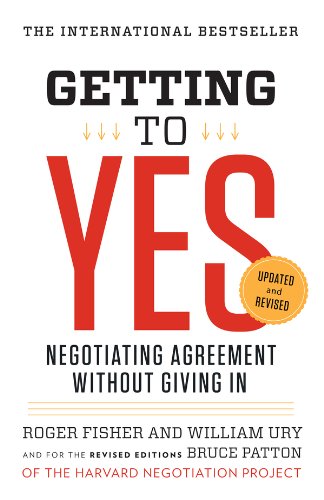
This article is an excerpt from the Shortform summary of "Getting to Yes" by Roger Fisher and William Ury. Shortform has the world's best summaries of books you should be reading.
Like this article? Sign up for a free trial here .
When we approach a conflict, most of us instinctively default to positional bargaining, a “dig in your heels” tactic where each side fights for a rigid demand. While common in everything from used car sales to international diplomacy, this tug-of-war approach often leads to stalled agreements and damaged relationships. According to negotiation theorists Roger Fisher and William Ury, the key to a successful outcome isn’t playing “hard” or “soft,” but shifting toward a strategy that prioritizes mutual gain and objective fairness.
This article explores why positional bargaining fails to meet the three criteria of a wise negotiation: efficiency, efficacy, and relationship preservation. By understanding the pitfalls of traditional haggling, you can transition to principled negotiation, a framework designed to produce better results in half the time. Read on to learn how to separate the people from the problem and focus on interests rather than demands to secure agreements that actually last.
Originally Published: September 19, 2019
Last Updated: January 14, 2026
Table of Contents
The Problem: Positional Bargaining
Despite how often we find ourselves in situations that require negotiation, most of us aren’t particularly skilled at it. According to Roger Fisher and William Ury in their book Getting to Yes, this is largely because we rely on traditional tactics—an approach that could be called the “dig in your heels” method.
In “dig in your heels” negotiations, each party holds firm on a specific demand, defends it vigorously, and slowly inches toward a middle ground. This is known as positional bargaining, and it regularly leads to agreements that are unfair, suboptimal, and damaging to relationships.
What Is Positional Bargaining?
In positional bargaining, each side starts with a rigid position, argues for it, and bargains to reach a compromise. A classic example is haggling over the price of a used car.
The seller lists it at $15,000, you counter with $10,000, but neither of you is being entirely honest about what you’d actually accept. You spend the next hour trading offers back and forth, each trying to give up as little ground as possible, until you eventually meet around $12,500—a number that doesn’t satisfy you or the seller and leaves you both wondering if you got taken advantage of.
3 Criteria for a Successful Negotiation
To understand why this method fails, we must look at the three criteria for a truly successful negotiation:
- The Outcome: The agreement must be wise, meaning it meets the interests of each side and is fair and lasting.
- The Process: It must be efficient, producing results without wasting time.
- The Relationship: It must strengthen the bond between parties—or at least not damage it.
Positional bargaining falls short on all three counts.
Why Positional Bargaining Fails
1. It produces bad outcomes. Negotiators become rigid. The harder you try to convince the other side of your “rightness,” the more committed you become to your position to save face.
For example, the 1961 U.S.-Soviet nuclear test ban talks failed because of rigid positions on the number of annual on-site inspections (the Soviets wanted three; the U.S. wanted ten). They became so bogged down in these numbers that they never even defined the procedure of the inspections. By focusing on positions rather than the underlying interests—minimal intrusion for the Soviets and verification for the U.S.—they missed an opportunity to avoid the ensuing arms race.
2. It’s inefficient. The give-and-take of “digging in your heels” is time-consuming. Negotiators often start with unreasonable positions and make tiny, incremental concessions to avoid “losing.” These tactics, along with stalling or threatening to walk out, turn a simple decision into an exhausting ordeal.
3. It undermines relationships. When negotiation becomes a struggle of wills, anger and resentment build. These bad feelings linger, making it harder for the two sides to work together in the future. This is especially risky in “Soft” bargaining—often used by friends or family—where one party makes overly lenient concessions just to avoid conflict. They may reach an agreement, but they often end up feeling bitter or “losing their shirt” to a hardball negotiator.
4. It fails in complex groups In multilateral talks (like UN negotiations involving 150 countries), the inefficiency is magnified. When every party has a position to defend, it becomes nearly impossible to change course or find substantive common ground.
The Solution: Principled Negotiation
You don’t have to choose between being a “hard” or “soft” bargainer. Instead, Fisher and Ury suggest principled negotiation (negotiating on the merits). This straightforward method allows sides to work toward mutual interests through four key components:
- People: Separate the personalities and emotions from the issue.
- Interests: Focus on the reasons underlying positions rather than the positions themselves.
- Options: Brainstorm multiple solutions based on mutual gain.
- Criteria: Base the final agreement on objective, fair standards (like market value or expert opinion).
By shifting from a “tug-of-war” over positions to a collaborative search for interests, you avoid the traps of the “dig in your heels” method and move toward agreements that actually last.
| When to Take an Uncompromising Stand Although the authors write that digging in your heels is usually counterproductive, some negotiation experts write that sometimes it can be effective to take an uncompromising position. This mindset proves particularly valuable in time-sensitive situations where delays could prove costly or when specific terms are non-negotiable and must be secured exactly as needed. This approach also serves as an effective counter-strategy when the opposing side uses similar tactics, creating balance rather than allowing one party to dominate. For example, let’s say you see an apartment listed at $1,800 per month. You know that units in the building rent for $1,600, and that the “For Rent” sign has been up for two months. The landlord takes an aggressive approach: “I have two other applicants ready to sign today at full price. If you want it, I need your decision and deposit right now—no negotiations.” But you hold firm, responding, “I’ll sign a one-year lease today for $1,600 per month. That’s my offer.” When the landlord mentions the other applicants again, you simply reply, “I understand. I have another apartment I’m viewing this afternoon at $1,550,” as you start to walk out. The landlord quickly changes his tone and accepts your $1,600 offer. Your uncompromising stance succeeded as a counter-strategy to his bullying tactics. By refusing to be intimidated and matching his pressure with equal resolve, you balanced the power dynamic. Without this firm approach, any willingness to negotiate upward would have signaled weakness and encouraged him to push for more. Standing pat neutralized his high-pressure game and saved you $200 monthly. |
Negotiation Prep Worksheet
This “Negotiation Prep Worksheet,” based on these four principled components, is a great way to turn the theory into a practical tool. To make this worksheet effective, we break it down into the four pillars of principled negotiation. You can fill this out before your next negotiation to ensure you stay out of the “positional” trap.
1. People: Separate the Person from the Problem
Instead of seeing the other party as an adversary, see them as a partner in solving a puzzle.
- What are their likely emotions? (Fear of looking weak? Pressure from a boss?)
- How can I acknowledge their concerns? (Draft a phrase: “I understand that [concern] is a priority for you…”)
- Relationship goal: How do I want our relationship to look after this deal is signed?
2. Interests: Focus on the “Why”
A position is what you decided. An interest is what caused you to decide.
- My Interests: List the 3 things you actually need (e.g., “I need a car that is reliable for winter,” not “I need this car for $12k”).
- Their Interests: Why might they be saying “No” right now? What are their underlying needs (e.g., “They need the cash quickly for a down payment”)?
3. Options: Brainstorm for Mutual Gain
Avoid searching for a single answer; look for ways to expand the pie.
- Option A (The Win-Win): If we can’t agree on price, could we agree on [delivery date/warranty/extra service]?
- Option B (The Trade-off): “I can give you [X] if you can provide [Y].”
4. Criteria: Use Objective Standards
Stop the “tug-of-war” by pointing to facts outside of either person’s control.
- Market Value: What are similar items/services selling for right now?
- Precedent: How was this handled in the past?
- Professional Standards: Is there an industry benchmark or legal requirement we can use as a “fairness” anchor?
Summary: The Transition
To keep your mindset in the right place, keep this comparison in mind as you walk into the room:
| Instead of… (Positional Bargaining) | Try… (Principled Negotiation) |
| Demanding a specific number | Asking: “What is the reasoning behind that number?” |
| Making a small concession to be “nice” | Offering a trade based on mutual interests. |
| Digging in your heels | Saying: “Let’s look at the market data together.” |
———End of Preview———
Like what you just read? Read the rest of the world's best summary of "Getting to Yes" at Shortform . Learn the book's critical concepts in 20 minutes or less .
Here's what you'll find in our full Getting to yes summary :
- Why the standard way of negotiating is completely wrong
- How to find outcomes that are wins for both sides
- How to protect yourself against aggressive negotiators