We've ranked the best human resources books using expert recommendations, sales data, and millions of reader ratings. At Shortform, we know books. Our book guides are the best in the world. Learn why.
You can go after the job you want—and get it! You can take the job you have—and improve it! You can take any situation—and make it work for you!
Dale Carnegie’s rock-solid, time-tested advice has carried countless people up the ladder of success in their business and personal lives. One of the most groundbreaking and timeless bestsellers of all time, How to Win Friends & Influence People will teach you:
-Six ways to make people like you -Twelve ways to win people to your way of thinking -Nine ways to change people without arousing resentment
And much more! Achieve your maximum potential—a must-read for the twenty-first century with more than 15 million copies sold!
…
Recommended by Dave Ramsey, Daymond John, Dustin Moskovitz, and 58 others.
When Stephen Covey first released The Seven Habits of Highly Effective People, the book became an instant rage because people suddenly got up and took notice that their lives were headed off in the wrong direction; and more than that, they realized that there were so many simple things they could do in order to navigate their life correctly. This book was wonderful education for people, education in how to live life effectively and get closer to the ideal of being a ‘success’ in life.
But not everyone understands Stephen Covey’s model fully well, or maybe there are some people who haven’t read it yet. This is definitely true because we still see so much failure all around us. Now, I am not saying that by using Covey’s model, or anyone else’s model for that matter, you can become a sure-shot success, but at least we should have seen many more successes around us already judging by the number of copies the book has sold! So, where is the shortcoming?
There are two main problems here, and we are talking only about the people who have read the book already. The first problem is that most people are too lazy to implement the ideals of Stephen Covey in their lives. They consider his masterpiece of a book as a mere coffee-table book or a book that you use for light reading when you are traveling and then forget all about it. They do not realize that this book contains life-changing information. Or, they take the information and do not make the effort to actually utilize it so that it becomes knowledge for them.
The second problem is that a lot of people have a myopic view of Covey’s ideals. These are people who are impressed by the book already. If you ask them what the seven habits are, they can rattle them off end to end, but then they miss the larger picture. They do not understand that Covey was trying to tell more than he wrote in words. There are hidden implications in this book, yes, and a lot of people have just failed to see through them.
That is what we are trying to do. We are trying to show you how Covey’s book, or rather, his model, was a complete model in itself. There was nothing amiss about it. If you implement it, there should be no aspect of your life that should go untouched. The only thing is that you have to understand these ideals and try to implement them in your life.
But, before we barge into that area, it is extremely important to understand what these ideals are. What was the model that was propounded by Stephen Covey in his mega-famous book? We shall begin by trying to understand his model first, and then interpret it in such a way that it pertains to every aspect of our life
Dave Ramsey recommended this book on his website. [source]
Dustin Moskovitz
Co-founder/Facebook and Asana
I was surprised at how familiar the topics felt. [source]
Joe Martin
@benmorris @audible_com @Gladwell I enjoy the quiet on the way home, but on the way to work I am listening to the 7 habits book by Stephen Coveru, a fave of mine [source]
Cover unavailable
3
Good to Great: Why Some Companies Make the Leap... and Others Don't
To find the keys to greatness, Collins's 21-person research team read and coded 6,000 articles, generated more than 2,000 pages of interview transcripts and created 384 megabytes of computer data in a five-year project. The findings will surprise many readers and, quite frankly, upset others.
The Challenge Built to Last, the defining management study of the nineties, showed how great companies triumph over time and how long-term sustained performance can be engineered into the DNA of an enterprise from the very beginning.
But what about the company that is not born with great DNA? How can good companies, mediocre companies, even bad companies achieve enduring greatness?
The Study For years, this question preyed on the mind of Jim Collins. Are there companies that defy gravity and convert long-term mediocrity or worse into long-term superiority? And if so, what are the universal distinguishing characteristics that cause a company to go from good to great?
The Standards Using tough benchmarks, Collins and his research team identified a set of elite companies that made the leap to great results and sustained those results for at least fifteen years. How great? After the leap, the good-to-great companies generated cumulative stock returns that beat the general stock market by an average of seven times in fifteen years, better than twice the results delivered by a composite index of the world's greatest companies, including Coca-Cola, Intel, General Electric, and Merck.
The Comparisons The research team contrasted the good-to-great companies with a carefully selected set of comparison companies that failed to make the leap from good to great. What was different? Why did one set of companies become truly great performers while the other set remained only good?
The Findings The findings of the Good to Great study will surprise many readers and shed light on virtually every area of management strategy and practice. The findings include: Level 5 Leaders: The research team was shocked to discover the type of leadership required to achieve greatness.
The Hedgehog Concept (Simplicity within the Three Circles): To go from good to great requires transcending the curse of competence.
A Culture of Discipline: When you combine a culture of discipline with an ethic of entrepreneurship, you get the magical alchemy of great results. Technology Accelerators: Good-to-great companies think differently about the role of technology.
The Flywheel and the Doom Loop: Those who launch radical change programs and wrenching restructurings will almost certainly fail to make the leap.
"Collins briefed Amazon executives on his seminal management book before its publication. Companies must confront the brutal facts of their business, find out what they are uniquely good at, and master their fly wheel, in which each part of the business reinforces and accelerates the other parts," Stone writes. [source]
Influence, the classic book on persuasion, explains the psychology of why people say "yes"—and how to apply these understandings. Dr. Robert Cialdini is the seminal expert in the rapidly expanding field of influence and persuasion. His thirty-five years of rigorous, evidence-based research along with a three-year program of study on what moves people to change behavior has resulted in this highly acclaimed book.
You'll learn the six universal principles, how to use them to become a skilled persuader—and how to defend yourself against them. Perfect for people in all walks of life, the principles of Influence will move you toward profound personal change and act as a driving force for your success.
Now updated with new research — the book that has changed millions of lives.
After decades of research, world-renowned Stanford University psychologist Carol S. Dweck, Ph.D., discovered a simple but groundbreaking idea: the power of mindset. In this brilliant book, she shows how success in school, work, sports, the arts, and almost every area of human endeavor can be dramatically influenced by how we think about our talents and abilities. People with a fixed mindset — those who believe that abilities are fixed — are less likely to flourish than those with a growth mindset — those who believe that abilities can be developed. Mindset reveals how great parents, teachers, managers, and athletes can put this idea to use to foster outstanding accomplishment.
In this edition, Dweck offers new insights into her now famous and broadly embraced concept. She introduces a phenomenon she calls false growth mindset and guides people toward adopting a deeper, truer growth mindset. She also expands the mindset concept beyond the individual, applying it to the cultures of groups and organizations. With the right mindset, you can motivate those you lead, teach, and love — to transform their lives and your own.
One of the reasons I loved Mindset is because it’s solutions-oriented. In the book’s final chapter, Dweck describes the workshop she and her colleagues have developed to shift students from a fixed to a growth mindset. These workshops demonstrate that ‘just learning about the growth mindset can cause a big shift in the way people think about themselves and their lives. [source]
Without exaggeration, I’ve never met a CEO who didn’t have Mindset on their bookshelf. It resonates with people who have become successful because the belief that your abilities can grow is foundational to their achievements. [source]
Cover unavailable
6
Getting Things Done: The Art of Stress-Free Productivity
"The Bible of business and personal productivity" —Lifehack
"A completely revised and updated edition of the blockbuster bestseller from 'the personal productivity guru'"—Fast Company
Since it was first published almost fifteen years ago, David Allen’s Getting Things Done has become one of the most influential business books of its era, and the ultimate book on personal organization. “GTD” is now shorthand for an entire way of approaching professional and personal tasks, and has spawned an entire culture of websites, organizational tools, seminars, and offshoots.
Allen has rewritten the book from start to finish, tweaking his classic text with important perspectives on the new workplace, and adding material that will make the book fresh and relevant for years to come. This new edition of Getting Things Done will be welcomed not only by its hundreds of thousands of existing fans but also by a whole new generation eager to adopt its proven principles.
…
Recommended by David Allen, Dustin Moskovitz, Ev Williams, and 20 others.
Getting Things Done by David Allen. He recently spoke at our Zappos all-hands meeting and gave me a signed copy of his book. [source]
Eric Rose
Chairman/Columbia University Department of Surgery
When I'm flat-out stressed about the volume and complexity of my work, I open this book and find immediate ways to gain a sense of control. That's really a critical need for decision making. David made me what I am today: headstrong and proud of it. [source]
Cover unavailable
7
The Five Dysfunctions of a Team: A Leadership Fable
In The Five Dysfunctions of a Team Patrick Lencioni once again offers a leadership fable that is as enthralling and instructive as his first two best-selling books, The Five Temptations of a CEO and The Four Obsessions of an Extraordinary Executive. This time, he turns his keen intellect and storytelling power to the fascinating, complex world of teams.
Kathryn Petersen, Decision Tech's CEO, faces the ultimate leadership crisis: Uniting a team in such disarray that it threatens to bring down the entire company. Will she succeed? Will she be fired? Will the company fail? Lencioni's utterly gripping tale serves as a timeless reminder that leadership requires as much courage as it does insight.
Throughout the story, Lencioni reveals the five dysfunctions which go to the very heart of why teams even the best ones-often struggle. He outlines a powerful model and actionable steps that can be used to overcome these common hurdles and build a cohesive, effective team. Just as with his other books, Lencioni has written a compelling fable with a powerful yet deceptively simple message for all those who strive to be exceptional team leaders.
…
Recommended by AnneMarie Schindler, Holger Seim, Jennifer Rock, and 3 others.
AnneMarie Schindler
I suggest these books because they really open up 'how' you think about life and in turn work, success/challenges/setbacks, and in general, yourself. I believe that the more you can understand yourself and broaden your approach to work, the easier it will be to find work that energizes you. Finally, I'm a team player at heart, and love working with others to achieve a huge goal so a portion of these deal with team composition and performance too. [source]
Holger Seim
Lencioni’s books helped me to shift my focus from individual performance to team performance, and what it takes to make a team perform well. It helped me to realize and take seriously the fact that great team performance doesn’t happen magically but needs conscious effort. When I discovered The Five Dysfunctions of a Team for the first time, we had a dysfunctional team at Blinkist and the book opened my eyes to see the problem clearly and showed clear steps for how they should be tackled. Beforehand I was aware that we had a problem, but I couldn’t pinpoint it specifically and hence, couldn’t solve it easily. This book helped a lot. [source]
Jennifer Rock
In Patrick Lencioni's book The Five Dysfunctions of a Team, the executive asks her senior leaders "Who is your first team?" And they each answer incorrectly that it's the team that reports to him or her. The point is that you need to shift your perspective to understanding your senior leadership peers are your first team. We read that book as a leadership team in a corporation where I worked -- and the environment was very competitive between us. When we agreed that our cross-functional leadership team was our first team, we became more cooperative, innovative and productive. And we vastly boosted our results. [source]
Cover unavailable
8
Quiet: The Power of Introverts in a World That Can't Stop Talking
At least one-third of the people we know are introverts. They are the ones who prefer listening to speaking; who innovate and create but dislike self-promotion; who favor working on their own over working in teams. It is to introverts—Rosa Parks, Chopin, Dr. Seuss, Steve Wozniak—that we owe many of the great contributions to society.
In Quiet, Susan Cain argues that we dramatically undervalue introverts and shows how much we lose in doing so. She charts the rise of the Extrovert Ideal throughout the twentieth century and explores how deeply it has come to permeate our culture. She also introduces us to successful introverts—from a witty, high-octane public speaker who recharges in solitude after his talks, to a record-breaking salesman who quietly taps into the power of questions. Passionately argued, superbly researched, and filled with indelible stories of real people, Quiet has the power to permanently change how we see introverts and, equally important, how they see themselves.
Now with Extra Libris material, including a reader’s guide and bonus content.
Leaders needn’t be the loudest. Leadership is not about theater. It’s not about dominance. It is about putting the lives of others before any other priority. In Quiet, Cain affirms to a good many of us who are introverts by nature that we needn’t try to be extroverts if we want to lead. Simply being ourselves is more important — and more effective. [source]
Danielle Morrill
Co-founder/Mattermark
Anyway, maybe you’re like me and figuring this out for yourself. It’s a good book for introverts and for those who love them [source]
Probably half the world is introverts. Maybe more. It’s not an easy life to live. I sometimes have that feeling in a room full of people, “uh-oh. I just shut down. I can’t talk anymore and there’s a lock on my mouth and this crowd threw away the key.” Do you ever get that feeling? Please? I hope you do. Let’s try to lock eyes at the party. “Quiet” shows the reader how to unlock the secret powers that probably half the world needs to unlock. [source]
Cover unavailable
9
Deep Work: Rules for Focused Success in a Distracted World
One of the most valuable skills in our economy is becoming increasingly rare. If you master this skill, you'll achieve extraordinary results.
Deep work is the ability to focus without distraction on a cognitively demanding task. It's a skill that allows you to quickly master complicated information and produce better results in less time. Deep work will make you better at what you do and provide the sense of true fulfillment that comes from craftsmanship. In short, deep work is like a super power in our increasingly competitive twenty-first century economy. And yet, most people have lost the ability to go deep-spending their days instead in a frantic blur of e-mail and social media, not even realizing there's a better way.
In Deep Work, author and professor Cal Newport flips the narrative on impact in a connected age. Instead of arguing distraction is bad, he instead celebrates the power of its opposite. Dividing this book into two parts, he first makes the case that in almost any profession, cultivating a deep work ethic will produce massive benefits. He then presents a rigorous training regimen, presented as a series of four "rules," for transforming your mind and habits to support this skill.
A mix of cultural criticism and actionable advice, Deep Work takes the reader on a journey through memorable stories-from Carl Jung building a stone tower in the woods to focus his mind, to a social media pioneer buying a round-trip business class ticket to Tokyo to write a book free from distraction in the air-and no-nonsense advice, such as the claim that most serious professionals should quit social media and that you should practice being bored. Deep Work is an indispensable guide to anyone seeking focused success in a distracted world.
As automation and outsourcing reshape the workplace, what new skill do we need? The ability to do deep work. Cal Newport's exciting new book is an introduction and guide to the kind of intense concentration in a distraction-free environment that results in fast, powerful learning and performance. Think of it as calisthenics for your mind-and start your exercise program today. [source]
Marvin Liao
Partner/500 Startups
The Joy of Not Working (Zelinkski), Flash Foresight (Burrus), The Art of Worldly Wisdom (Gracian), Sapiens (Yuval), The End of Jobs (Pearson), Deep Work (Newport), Sovereign Individual (Davidson), The Fourth Economy (Davison) & The Monk & the Riddle (Komisar). Every single one of these books completely changed how I looked at everything in the world & literally pushed my life in a new direction. They were Paradigm Shifting as they say. (hate that word but it really was a Paradigm Shift for me). [source]
I've been a fan of Cal for a long time. His book So Good They Can't Ignore You is one of my favorites, but it's his new book that's probably had the biggest and most immediate impact on me. For those of you who enjoyed Tyler Cowen's Average is Over, you already know how important the ability to focus, be creative, and think at a high level is going to be in the future. This is a book that explains how to cultivate and protect that skill--the ability to do deep work. One thing I've already started doing since reading this book is recording the number of hours of deep work I do each day in my morning journal. It's a way of keeping a running tally and monitoring if I begin to get distracted or slow my pace. Anyway, great book! [source]
Cover unavailable
10
The Subtle Art of Not Giving a F*ck: A Counterintuitive Approach to Living a Good Life
In this generation-defining self-help guide, a superstar blogger cuts through the crap to show us how to stop trying to be "positive" all the time so that we can truly become better, happier people.
For decades, we’ve been told that positive thinking is the key to a happy, rich life. "Fk positivity," Mark Manson says. "Let’s be honest, shit is fked and we have to live with it." In his wildly popular Internet blog, Manson doesn’t sugarcoat or equivocate. He tells it like it is—a dose of raw, refreshing, honest truth that is sorely lacking today. The Subtle Art of Not Giving a Fk is his antidote to the coddling, let’s-all-feel-good mindset that has infected American society and spoiled a generation, rewarding them with gold medals just for showing up.
Manson makes the argument, backed both by academic research and well-timed poop jokes, that improving our lives hinges not on our ability to turn lemons into lemonade, but on learning to stomach lemons better. Human beings are flawed and limited—"not everybody can be extraordinary, there are winners and losers in society, and some of it is not fair or your fault." Manson advises us to get to know our limitations and accept them. Once we embrace our fears, faults, and uncertainties, once we stop running and avoiding and start confronting painful truths, we can begin to find the courage, perseverance, honesty, responsibility, curiosity, and forgiveness we seek.
There are only so many things we can give a fk about so we need to figure out which ones really matter, Manson makes clear. While money is nice, caring about what you do with your life is better, because true wealth is about experience. A much-needed grab-you-by-the-shoulders-and-look-you-in-the-eye moment of real-talk, filled with entertaining stories and profane, ruthless humor, The Subtle Art of Not Giving a F**k is a refreshing slap for a generation to help them lead contented, grounded lives.
…
Recommended by Ryan Holiday, Alex Blackwell, Aunty Ada, and 21 others.
The world s greatest managers differ in sex, age, and race. They employ different styles and focus on different goals. Despite their differences, great managers share one trait: They break virtually every rule conventional wisdom holds sacred. They don t believe that, with enough training, a person can achieve anything he sets his mind to. They don t try to help people overcome their weaknesses. They disregard the golden rule. They even play favorites. Gallup presents the remarkable findings of its massive in-depth study of great managers those who excelled at turning each employee s talent into performance. Companies compete to find and keep the best employees using pay, benefits, promotions, and training. But these well-intentioned efforts often miss the mark. The front-line manager is the key to attracting and retaining talented employees. This amazing book explains how the best managers select employees for talent rather than for skills or experience, how they set expectations, how they motivate people, and how they develop people. Gallup s research produced twelve simple questions that distinguish the strongest departments of a company from the rest. This book introduces this essential measuring stick and proves the link between employee opinions and productivity, profit, customer satisfaction, and rate of turnover."
…
Recommended by Simon Sinek, Jared Spool, Jessica Pryce-Jones, and 1 others.
Jared Spool
The first framework is from Gallup and was written up in their great book: First, Break All The Rules. https://t.co/w54in9zCyH It’s the Q12 employee engagement measures. Each question makes it simple for a manager to identify where they need to improve. https://t.co/A9L8Yx2NHp [source]
Jessica Pryce-Jones
I’m a sucker for books and I always buy management books when I get on planes. There I am at Heathrow Airport going on a business trip, and I think, ‘I’ve got to read this stuff!’ And normally I pick a book up, read the first few pages, then find I can’t face it and end up leaving it in a hotel room. But this book, I picked it up, started to read it and I thought, ‘Hallelujah! Here is a book that makes sense at last.’ And that was just so refreshing. I don’t even have a copy at the moment, because I have given about ten of them away to people saying, ‘You have just got to read this!’ [source]
Cover unavailable
12
Emotional Intelligence: Why It Can Matter More Than IQ
Everyone knows that high IQ is no guarantee of success, happiness, or virtue, but until Emotional Intelligence, we could only guess why. Daniel Goleman's brilliant report from the frontiers of psychology and neuroscience offers startling new insight into our "two minds"—the rational and the emotional—and how they together shape our destiny.
Through vivid examples, Goleman delineates the five crucial skills of emotional intelligence, and shows how they determine our success in relationships, work, and even our physical well-being. What emerges is an entirely new way to talk about being smart.
The best news is that "emotional literacy" is not fixed early in life. Every parent, every teacher, every business leader, and everyone interested in a more civil society, has a stake in this compelling vision of human possibility.
From the Trade Paperback edition.
…
Recommended by Drew Houston, Drew Huston, Magda Marcu, and 4 others.
Drew Houston
CEO/Dropbox
It’s nonfiction, but it spelled out something that I just didn’t know you could kind of break down in a logical way. And, suddenly, I had this understanding about the world that I didn’t have before. [source]
Magda Marcu
One of the most eye opening for me was “Emotional Intelligence: Why It Can Matter More Than IQ” as it offered a different perspective on leadership, and how empathy can make you a more successful leader. Every person has some degree of empathy and through this book you understand how to apply it more intently. [source]
Robert Kelsey
Yes, that’s the key revelation. But another key element, which was quite revelatory for me when I read it, is about the impact of fear on your brain. The impact of fear as a physiological response was well known when he wrote the book, but what was less well known was the idea of fear as a neurological response. He pointed to research showing what happens to the brain when fear is triggered, and it’s very damaging. There’s a part of the brain called the amygdala, which is part of the limbic system, and deals with emotions such as fear and distress. Its main purpose is to alert you to danger and it sends an emergency signal. All those physiological responses you have are basically the body’s response to that emergency signal. That’s what people experience when they experience fear, but it’s not just the fear of a dog barking at you or someone attacking you, it’s fear based on a fear conditioning. These are moments when something happens to you that induces fear or distress, and can include fear of failure or fear of being upset, and the same response occurs. [source]
Cover unavailable
13
Getting to Yes: Negotiating Agreement Without Giving in
The key text on problem-solving negotiation-updated and revised
Getting to Yes has helped millions of people learn a better way to negotiate. One of the primary business texts of the modern era, it is based on the work of the Harvard Negotiation Project, a group that deals with all levels of negotiation and conflict resolution.
Getting to Yes offers a proven, step-by-step strategy for coming to mutually acceptable agreements in every sort of conflict. Thoroughly updated and revised, it offers readers a straight- forward, universally applicable method for negotiating personal and professional disputes without getting angry-or getting taken.
…
Recommended by Charles T. Munger, Drew Houston, Dustin Moskovitz, and 8 others.
Who Moved My Cheese? is a simple parable that reveals profound truths. It is an amusing and enlightening story of four characters who live in a "Maze" and look for "Cheese" to nourish them and make them happy.
Two are mice named Sniff and Scurry. And two are "Littlepeople"—beings the size of mice who look and act a lot like people. Their names are Hem and Haw.
"Cheese" is a metaphor for what you want to have in life—whether it is a good job, a loving relationship, money, a possession, health, or spiritual peace of mind.
And the "Maze" is where you look for what you want—the organization you work in, or the family or community you live in.
In the story, the characters are faced with unexpected change. Eventually, one of them deals with it successfully, and writes what he has learned from his experience on the Maze walls.
When you come to see "The Handwriting on the Wall," you can discover for yourself how to deal with change, so that you can enjoy less stress and more success (however you define it) in your work and in your life.
Written for all ages, the story takes less than an hour to read, but its unique insights can last a lifetime.
…
Recommended by Dave Ramsey, Daymond John, Darren Chua, and 5 others.
Why are some people and organizations more innovative, more influential, and more profitable than others? Why do some command greater loyalty from customers and employees alike? Even among the successful, why are so few able to repeat their success over and over?
People like Martin Luther King Jr., Steve Jobs, and the Wright Brothers might have little in common, but they all started with why. It was their natural ability to start with why that enabled them to inspire those around them and to achieve remarkable things.
In studying the leaders who've had the greatest influence in the world, Simon Sinek discovered that they all think, act, and communicate in the exact same way—and it's the complete opposite of what everyone else does. Sinek calls this powerful idea The Golden Circle, and it provides a framework upon which organizations can be built, movements can be lead, and people can be inspired. And it all starts with WHY.
Any organization can explain what it does; some can explain how they do it; but very few can clearly articulate why. WHY is not money or profit—those are always results. WHY does your organization exist? WHY does it do the things it does? WHY do customers really buy from one company or another? WHY are people loyal to some leaders, but not others?
Starting with WHY works in big business and small business, in the nonprofit world and in politics. Those who start with WHY never manipulate, they inspire. And the people who follow them don't do so because they have to; they follow because they want to.
Drawing on a wide range of real-life stories, Sinek weaves together a clear vision of what it truly takes to lead and inspire. This book is for anyone who wants to inspire others or who wants to find someone to inspire them.
Today is World Book Day, a wonderful opportunity to address this #ChallengeRichard sent in by Mike Gonzalez of New Jersey: Make a list of your top 65 books to read in a lifetime. [source]
The basis of this book is so important to anyone looking to increase their influence, profits or impact. People won't truly buy into a product, service, movement, or idea until they understand the WHY behind it. When you start with the why, everything else falls into place. This book is so impactful, I consider it required reading. [source]
Tony Hsieh
CEO/Zappos.com
Over the years he’s recommended well over 20 business books — including his own, the 2010 bestseller Delivering Happiness and you can always find what he’s currently reading atop his cluttered desk. Start with Why is amogst those titles. [source]
Cover unavailable
16
The Culture Code: The Secrets of Highly Successful Groups
An essential book that unlocks the secrets of highly successful groups and provides readers with a toolkit for building a cohesive, innovative culture, from the New York Times bestselling author of The Talent Code
If you want to understand how successful groups work—the signals they transmit, the language they speak, the cues that foster creativity—you won’t find a more essential guide than The Culture Code.
So here are my three must read books. I've been reading a lot of great books like: Outsmart Your Instincts, The Culture Code, and Antonio Damasio’s The Strange Order, and sometimes when you read a lot of nonfiction it’s very enriching, sometimes you need a novel. I really believe you should take a minute and read something beautiful. Listen, listen to Lolita by Nabokov. But also listen to Blood Meridian by Cormac McCarthy and listen to Richard Poe narrate that. Those are two of the greatest feats of the english language that I can think of. Then there’s Fortress of Solitude, an amazing book, Extremely Loud and Incredibly Close, these are great novels. Cold Mountain is a beautiful novel, Snow Falling On Cedars, I mean they’ve been around for a while. But goddamnit, get those under your belt. Those are the novels I think you should read. You know Love In The Time Of Cholera it just makes you ache. Kind of like a Hemingway thing, where Hemingway “ahh!”, it’s the same thing, you know. So I don’t know, I’m a fan of all those books. Those are my 3 slash 20 books. [source]
Graham Duncan
The author looks at a bunch of different cultures. Pixar, Navy SEALs, etc... And he’s looking for patterns among what makes people disproportionately effective as a culture. [source]
Cover unavailable
17
Range: Why Generalists Triumph in a Specialized World
What's the most effective path to success in any domain? It's not what you think. Plenty of experts argue that anyone who wants to develop a skill, play an instrument, or lead their field should start early, focus intensely, and rack up as many hours of deliberate practice as possible. If you dabble or delay, you'll never catch up to the people who got a head start. But a closer look at research on the world's top performers, from professional athletes to Nobel laureates, shows that early specialization is the exception, not the rule.
David Epstein examined the world's most successful athletes, artists, musicians, inventors, forecasters and scientists. He discovered that in most fields--especially those that are complex and unpredictable--generalists, not specialists, are primed to excel. Generalists often find their path late, and they juggle many interests rather than focusing on one. They're also more creative, more agile, and able to make connections their more specialized peers can't see.
Provocative, rigorous, and engrossing, Range makes a compelling case for actively cultivating inefficiency. Failing a test is the best way to learn. Frequent quitters end up with the most fulfilling careers. The most impactful inventors cross domains rather than deepening their knowledge in a single area. As experts silo themselves further while computers master more of the skills once reserved for highly focused humans, people who think broadly and embrace diverse experiences and perspectives will increasingly thrive.
For reasons I cannot explain, David Epstein manages to make me thoroughly enjoy the experience of being told that everything I thought about something was wrong. I loved Range. [source]
This book looks at how an emphasis on specialization can actually hamper our ability to really excel at something. It aligns with what I try to do when I am coaching, in my stories, and what we’re doing with Mamba Sports Academy — create all-around athletes who can think critically and make assessments in real time to enhance their play rather than rely only on a narrow set of skills. [source]
Susan Cain
Author
It’s a joy to spend hours in the company of a writer as gifted as David Epstein. And the joy is all the greater when that writer shares so much crucial and revelatory information about performance, success, and education. [source]
Most business books give you the same old advice: Write a business plan, study the competition, seek investors, yadda yadda. If you're looking for a book like that, put this one back on the shelf.
Rework shows you a better, faster, easier way to succeed in business. Read it and you'll know why plans are actually harmful, why you don't need outside investors, and why you're better off ignoring the competition. The truth is, you need less than you think. You don't need to be a workaholic. You don't need to staff up. You don't need to waste time on paperwork or meetings. You don't even need an office. Those are all just excuses.
What you really need to do is stop talking and start working. This book shows you the way. You'll learn how to be more productive, how to get exposure without breaking the bank, and tons more counterintuitive ideas that will inspire and provoke you.
With its straightforward language and easy-is-better approach, Rework is the perfect playbook for anyone who’s ever dreamed of doing it on their own. Hardcore entrepreneurs, small-business owners, people stuck in day jobs they hate, victims of "downsizing," and artists who don’t want to starve anymore will all find valuable guidance in these pages.
Unperturbed by conventional wisdom, the authors start fresh and rewrite the rules of business. Their approach turns out to be as successful as it is counter-intuitive. [source]
If given a choice between investing in someone who has read Rework or has an MBA, I'm investing in Rework every time. This is a must read for every entrepreneur. [source]
Tony Hsieh
CEO/Zappos.com
The wisdom in these pages is edgy yet simple, straightforward, and proven. Read this book multiple times to help give you the courage you need to get out there and make something great. [source]
Cover unavailable
19
Crucial Conversations: Tools for Talking When Stakes Are High
Kerry Patterson, Joseph Grenny, Ron McMillan, and Al Switzler
Crucial Conversations: Tools For Talking When Stakes Are High is a guide to hone your conversation skills, and prepare you for the most important or trying times of your life and career. The book discusses how talking in the right way can help people achieve what they want. People are often tongue-tied when it comes to interacting with someone, especially when there is a lot of tension in the air. Strong emotions often give away the ability to rationalise one's thoughts, especially during conversations, and emotionally-driven conversations will not work on important occasions. This book teaches readers how to tackle such situations with ease. It provides tips on how to be persuasive, and turn a conversation to one's advantage. The book helps in dealing with confrontations at home, at work, and even with friends. These skills can positively impact the lives of the book's readers in all spheres, and direct their thoughts in a constructive manner. Some of the sections from the book are, How to Notice When Safety Is at Risk, How to Speak Persuasively Not Abrasively, How to Turn Crucial Conversations, and How to Stay Focused on What You Really Want.Kerry Patterson, the co-founder of VitalSmarts, has authored four bestsellers. Some of his other books are Change Anything: The New Science of Personal Success, and Crucial Confrontations: Tools for Resolving Broken Promises, Violated Expectations, and Bad Behavior. Joseph Grenny works as a consultant for many Fortune 500 companies and has impacted many lives throughout the globe through his corporate change initiatives. He is the co-founder of VitalSmarts, and a popular speaker too. Al Switzler is the author of four New York Times bestsellers and has designed and framed many programs for Fortune 500 companies. Ron McMillan has worked as a leadership consultant and trained many people, from first level managers to CEOs.
…
Recommended by Max Levchin and Deke Bridges.
Max Levchin
Co-founder/PayPal, CEO/Affirm, Investor
A now-venerable guide to having tough conversations in a way that engages the debaters. [source]
Deke Bridges
Picked up this great book @Powells to read. Better conversation and listening enables you to get deeper into subjects at hand. When talking with people, this makes your communication skills a very powerful tool. Always be learning. #growth #education #leadership https://t.co/r0ujX9IPqh [source]
Cover unavailable
20
Atomic Habits: An Easy & Proven Way to Build Good Habits & Break Bad Ones
No matter your goals, Atomic Habits offers a proven framework for improving--every day. James Clear, one of the world's leading experts on habit formation, reveals practical strategies that will teach you exactly how to form good habits, break bad ones, and master the tiny behaviors that lead to remarkable results.
If you're having trouble changing your habits, the problem isn't you. The problem is your system. Bad habits repeat themselves again and again not because you don't want to change, but because you have the wrong system for change. You do not rise to the level of your goals. You fall to the level of your systems. Here, you'll get a proven system that can take you to new heights.
Clear is known for his ability to distill complex topics into simple behaviors that can be easily applied to daily life and work. Here, he draws on the most proven ideas from biology, psychology, and neuroscience to create an easy-to-understand guide for making good habits inevitable and bad habits impossible. Along the way, readers will be inspired and entertained with true stories from Olympic gold medalists, award-winning artists, business leaders, life-saving physicians, and star comedians who have used the science of small habits to master their craft and vault to the top of their field.
Learn how to: * make time for new habits (even when life gets crazy); * overcome a lack of motivation and willpower; * design your environment to make success easier; * get back on track when you fall off course; ...and much more.
Atomic Habits will reshape the way you think about progress and success, and give you the tools and strategies you need to transform your habits--whether you are a team looking to win a championship, an organization hoping to redefine an industry, or simply an individual who wishes to quit smoking, lose weight, reduce stress, or achieve any other goal.
I recently read an advance copy of James Clear’s new book, Atomic Habits. His thesis is that small but carefully selected habits can, over time, create massively positive results — not just in terms of what you accomplish, but also in terms of the type of person you become. James’s exposition rings true with what’ve I learned hanging around interesting people and high achievers. I recommend you give this book a closer look. [source]
A lot of people email me asking about habits - how to form good ones, how to break bad ones, how to stop doing the dumb shit we always do. I've got a friend named James Clear. He's an accomplished author and business owner and is kind of a "habit guru." He's probably forgotten more habits research than I've ever brought myself to look at. He just launched his first book. It's called Atomic Habits and it's probably the most practical and complete guide I've ever seen about habit formation and habit change. Do check it out. And then email him and tell him that I have luscious and beautiful hair and he doesn't. Then stick out your tongue and go, "Nyah, nyanya, nyah, nyah." [source]
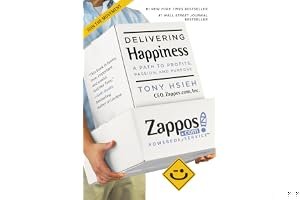
You want to learn about the path that we took at Zappos to get to over $1 billion in gross merchandise sales in less than ten years. You want to learn about the path I took that eventually led me to Zappos, and the lessons I learned along the way. You want to learn from all the mistakes we made at Zappos over the years so that your business can avoid making some of the same ones. You want to figure out the right balance of profits, passion, and purpose in business and in life. You want to build a long-term, enduring business and brand. You want to create a stronger company culture, which will make your employees and coworkers happier and create more employee engagement, leading to higher productivity. You want to deliver a better customer experience, which will make your customers happier and create more customer loyalty, leading to increased profits. You want to build something special. You want to find inspiration and happiness in work and in life. You ran out of firewood for your fireplace. This book makes an excellent fire-starter.
…
Recommended by Ev Williams, Chip Conley, Adam Johnston, and 15 others.
Chip Conley
The author is a wise guy. Sincerely. He’s one of the wisest and most thoughtful business leaders of the modern age. [source]
Adam Johnston
Inspiring case study into building brand and customer service. [source]
Chelsea Frank
I read everything with an open mind, often challenging myself by choosing books with an odd perspective or religious/spiritual views. These books do not reflect my personal feelings but are books that helped shape my perspective on life, love, and happiness. [source]
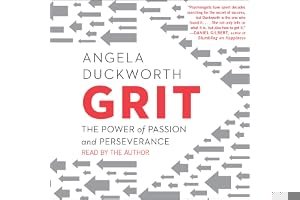
In this must-read book for anyone striving to succeed, pioneering psychologist Angela Duckworth shows parents, educators, students, and business people both seasoned and new that the secret to outstanding achievement is not talent but a focused persistence called grit.
Why do some people succeed and others fail? Sharing new insights from her landmark research on grit, Angela Duckworth explains why talent is hardly a guarantor of success. Rather, other factors can be even more crucial such as identifying our passions and following through on our commitments.
Drawing on her own powerful story as the daughter of a scientist who frequently bemoaned her lack of smarts, Duckworth describes her winding path through teaching, business consulting, and neuroscience, which led to the hypothesis that what really drives success is not genius, but a special blend of passion and long-term perseverance. As a professor at the University of Pennsylvania, Duckworth created her own character lab and set out to test her theory.
Here, she takes readers into the field to visit teachers working in some of the toughest schools, cadets struggling through their first days at West Point, and young finalists in the National Spelling Bee. She also mines fascinating insights from history and shows what can be gleaned from modern experiments in peak performance. Finally, she shares what she's learned from interviewing dozens of high achievers; from JP Morgan CEO Jamie Dimon to the cartoon editor of The New Yorker to Seattle Seahawks Coach Pete Carroll.
Winningly personal, insightful, and even life-changing, Grit is a book about what goes through your head when you fall down, and how that not talent or luck makes all the difference.
…
Recommended by Albert Wenger, Anu Hariharan, Benjamin Spall, and 11 others.
Benjamin Spall
Question: What five books would you recommend to youngsters interested in your professional path? … Grit by Angela Duckworth [source]
Bogdan Lucaciu
Grit: The Power of Passion and Perseverance - it was frustrating to read: “Where was this book 20 years ago!?” [source]
Stephen Lew
When asked what books he would recommend to youngsters interested in his professional path, Stephen mentioned Grit. [source]
From the bestselling author of The Black Swan and one of the foremost philosophers of our time, Nassim Nicholas Taleb, a book on how some systems actually benefit from disorder.
In The Black Swan Taleb outlined a problem; in Antifragile he offers a definitive solution: how to gain from disorder and chaos while being protected from fragilities and adverse events. For what he calls the "antifragile" is one step beyond robust, as it benefits from adversity, uncertainty and stressors, just as human bones get stronger when subjected to stress and tension.
Taleb stands uncertainty on its head, making it desirable, and proposing that things be built in an antifragile manner. Extremely ambitious and multidisciplinary, Antifragile provides a blueprint for how to behave-and thrive-in a world we don't understand and which is too uncertain for us to even try to understand. He who is not antifragile will perish. Why is the city state better than the nation state, why is debt bad for you, and why is almost everything modern bound to fail? The book covers innovation, health, biology, medicine, life decisions, politics, foreign policy, urban planning, war, personal finance, and economic systems. Throughout, the voice and recipes of the ancient wisdom from Phoenician, Roman, Greek, and Medieval sources are heard loud and clear.
You ask about success. To be successful you have to avoid being “fragile” – the idea that if something hurts you, you let collapse completely. You also have to avoid simply being resilient. Bouncing back is not enough. Antifragile is when something tries to hurt you and you come back stronger. That is real life business. That is real life success. Nassim focuses on the economy. But when I read the book I kept asking myself, “how can I apply this to the areas of my life where I feel most fragile?” [source]
Marvin Liao
Partner/500 Startups
My list would be (besides the ones I mentioned in answer to the previous question) both business & Fiction/Sci-Fi and ones I personally found helpful to myself. The business books explain just exactly how business, work & investing are in reality & how to think properly & differentiate yourself. On the non-business side, a mix of History & classic fiction to understand people, philosophy to make sense of life and Science fiction to picture what the future could be like (not always utopian). [source]
Vlad Tenev
The general concept is applicable to many fields beyond biology, for instance finance, economics and monetary policy. [source]
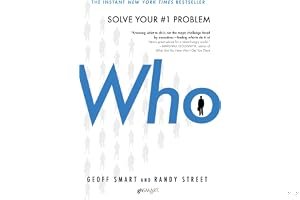
In this instant New York Times Bestseller, Geoff Smart and Randy Street provide a simple, practical, and effective solution to what The Economist calls "the single biggest problem in business today" unsuccessful hiring. The average hiring mistake costs a company $1.5 million or more a year and countless wasted hours. This statistic becomes even more startling when you consider that the typical hiring success rate of managers is only 50 percent.
The silver lining is that "who" problems are easily preventable. Based on more than 1,300 hours of interviews with more than 20 billionaires and 300 CEOs, Who presents Smart and Street's A Method for Hiring. Refined through the largest research study of its kind ever undertaken, the A Method stresses fundamental elements that anyone can implement-and it has a 90 percent success rate.
Whether you're a member of a board of directors looking for a new CEO, the owner of a small business searching for the right people to make your company grow, or a parent in need of a new babysitter, it's all about Who. Inside you'll learn how to
- avoid common "voodoo hiring" methods - define the outcomes you seek - generate a flow of A Players to your team-by implementing the #1 tactic used by successful businesspeople - ask the right interview questions to dramatically improve your ability to quickly distinguish an A Player from a B or C candidate - attract the person you want to hire, by emphasizing the points the candidate cares about most
In business, you are who you hire. In Who, Geoff Smart and Randy Street offer simple, easy-to-follow steps that will put the right people in place for optimal success.
…
Recommended by Daniël Lakens and Matthieu David-Experton.
Daniël Lakens
@TheNewStats Thanks. I think saying the correctly used p-value needs an effect size and CI is a perfect example of the Statistician's Fallacy. Your books are great - I learned a lot from Geoff's 2012 book. But the issue is not 'is there good stuff out there' but 'how do we teach it to > [source]
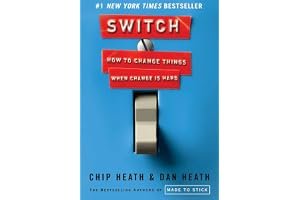
Why is change so difficult and frightening? How do you create change when you have few resources and no title or authority to back you up? Chip and Dan Heath, the best-selling authors of Made to Stick, are back with a ground-breaking book that addresses one of the greatest challenges of our personal and professional lives — how to change things when change is hard.
In their follow-up book to the critically acclaimed international bestseller Made to Stick, Chip and Dan Heath talk about how difficult change is in our companies, our careers, and our lives, why change is so hard, and how we can overcome our resistance and make change happen. The Heaths liken the human mind to two distinct entities — the animal mind, or what psychologist Jonathan Haidt calls the elephant, and the logical brain, which Haidt describes as the rider. The elephant is instinctive; it acts on emotion. It likes gorging on Oreos and sleeping in. And it loves routines — doing things the same old way, every day.
The rider is the planner and thinker. The rider obsesses about the future. He or she wants to stop eating junk food and stop hitting the snooze button. But it’s hard, because when the rider and elephant disagree on where to go, the rider usually loses. And that describes the essential tension between our primitive emotional brain and our high intellect, and helps to explain why changing how we behave is so difficult. The secret to making a switch is understanding this odd couple relationship. Direct the Rider. Motivate the Elephant. Shape the Path.
Throughout Switch, Chip and Dan Heath illustrate and explain situations in which sweeping change was adopted, from a university researcher who ended the cycle of child abuse in a group of families, to an entrepreneur who turned his skeptical employees into customer service zealots and saved his company.
In the tradition of Made to Stick, Blink, and Outliers, Switch is filled with engaging and entertaining stories of how companies and individuals have brought about and sustained significant change. An indispensable guide to making change happen, it is certain to become a classic.
…
Recommended by Africa Mentor, Richard H Thaler, Satya Patel, and 2 others.
Africa Mentor
6 fine summer reads | London Business School London Business School Review A good book is the best travel companion – wherever you are. By the pool or on your commute, be transported with these titles chos... https://t.co/Wo9NYOrwqG via @theafricamentor #entrepreneur #africabiz [source]
Tudor Mihailescu
First thing first, finance people need to be decent communicators, ideally awesome communicators. There is an art in building a case or in delivering a presentation and we need to treat this step as seriously as we have treated the other steps. I do believe this is a top priority for an aspiring or practicing CFO - There are plenty of books on this topic, I would recommend the works of Chip and Dan Health like Switch and Made to Stick [source]
Cover unavailable
26
The E-Myth Revisited: Why Most Small Businesses Don't Work and What to Do About It
E-Myth \ 'e-,'mith\ n 1: the entrepreneurial myth: the myth that most people who start small businesses are entrepreneurs 2: the fatal assumption that an individual who understands the technical work of a business can successfully run a business that does that technical work
Voted #1 business book by Inc. 500 CEOs.
An instant classic, this revised and updated edition of the phenomenal bestseller dispels the myths about starting your own business. Small business consultant and author Michael E. Gerber, with sharp insight gained from years of experience, points out how common assumptions, expectations, and even technical expertise can get in the way of running a successful business.
Gerber walks you through the steps in the life of a business—from entrepreneurial infancy through adolescent growing pains to the mature entrepreneurial perspective: the guiding light of all businesses that succeed—and shows how to apply the lessons of franchising to any business, whether or not it is a franchise. Most importantly, Gerber draws the vital, often overlooked distinction between working on your business and working in your business.
The E-Myth Revisited will help you grow your business in a productive, assured way.
After reading The E-Myth Revisited by Michael Gerber and The 80/20 Principle by Richard Koch, I decided that extreme questions were the forcing function I needed. [source]
Brian Scudamore
Founder & CEO/1-800-GOT-JUNK?
The book that’s had the biggest impact on me is The E-Myth by Michael Gerber (I even wrote about it in my own book). I read it front to back, then reread it right away. Gerber takes you through every step of a running a business from start to finish, and shows you what you need to make it successful. I read it when I was looking to take 1-800-GOT-JUNK? to the next level, and I had an epiphany: people don’t fail, systems do. Reading his book got me to take a good, hard look at my business and focus on developing our systems and hiring happy people. His book is one of the reasons we were able to sell out of 1-800-GOT-JUNK? franchises and scale that success into three other home-service companies, WOW 1 DAY PAINTING, You Move Me, and Shack Shine under the O2E Brands banner. [source]
Even the smartest among us can feel inept as we fail to figure out which light switch or oven burner to turn on, or whether to push, pull, or slide a door. The fault, argues this ingenious—even liberating—book, lies not in ourselves, but in product design that ignores the needs of users and the principles of cognitive psychology. The problems range from ambiguous and hidden controls to arbitrary relationships between controls and functions, coupled with a lack of feedback or other assistance and unreasonable demands on memorization. The Design of Everyday Things shows that good, usable design is possible. The rules are simple: make things visible, exploit natural relationships that couple function and control, and make intelligent use of constraints. The goal: guide the user effortlessly to the right action on the right control at the right time.
In this entertaining and insightful analysis, cognitive scientist Don Norman hails excellence of design as the most important key to regaining the competitive edge in influencing consumer behavior. Now fully expanded and updated, with a new introduction by the author, The Design of Everyday Things is a powerful primer on how—and why—some products satisfy customers while others only frustrate them.
…
Recommended by Andrew Chen, Marissa Mayer, Nir Eyal, and 23 others.
Grey Baker
I mainly read to decompress and change my state of mind, so it’s hard to point to an insight I read that helped me. Reading fiction has pulled me out of a bad mood more times than I can count, though, and always reenergises me to attack problems that had stumped me again. That said, I read and loved Norman Norman’s “The Design of Everyday Things”, and it’s helped me think through design problems ever since. [source]
Julia Enthoven
For people interested in designing or building software products: The Design of Everyday Things by Don Norman and The Lean Product Playbook by Dan Olsen. Both books have informed my product sense and helped me make decisions about great UX. [source]
Kaci Lambe
These three books are about how people actually use design in their lives. They helped me understand this very basic idea: There are no dumb users, only bad designers. Take the time to create based on how your design will be interacted with. Test it. Iterate. That's how you become a good designer. [source]
Cover unavailable
28
The Coaching Habit: Say Less, Ask More Change the Way You Lead Forever
Coaching is an essential skill for leaders. But for most busy, overworked managers, coaching employees is done badly, or not at all. They’re just too busy, and it’s too hard to change.
But what if managers could coach their people in 10 minutes or less?
In Michael Bungay Stanier’s The Coaching Habit, coaching becomes a regular, informal part of your day so managers and their teams can work less hard and have more impact.
Coaching is an art and it’s far easier said than done. It takes courage to ask a question rather than offer up advice, provide an answer, or unleash a solution. Giving another person the opportunity to find their own way, make their own mistakes, and create their own wisdom is both brave and vulnerable. It can also mean unlearning our “fix it” habits. In this practical and inspiring book, Michael shares seven transformative questions that can make a difference in how we lead and support. And, he guides us through the tricky part - how to take this new information and turn it into habits and a daily practice.
––Brené Brown, author of Rising Strong and Daring Greatly
Drawing on years of experience training more than 10,000 busy managers from around the globe in practical, everyday coaching skills, Bungay Stanier reveals how to unlock your peoples’ potential. He unpacks seven essential coaching questions to demonstrate how—by saying less and asking more—you can develop coaching methods that produce great results. • Get straight to the point in any conversation with The Kickstart Question • Stay on track during any interaction with The AWE Question • Save hours of time for yourself with The Lazy Question, and hours of time for others with The Strategic Question • Get to the heart of any interpersonal or external challenge with The Focus Question and The Foundation Question • Finally, ensure others find your coaching as beneficial as you do with The Learning Question
A fresh, innovative take on the traditional how-to manual, the book combines insider information with research based in neuroscience and behavioural economics, together with interactive training tools to turn practical advice into practiced habits. Dynamic question-and-answer sections help identify old habits and kick-start new behaviour, making sure you get the most out of all seven chapters. Witty and conversational, The Coaching Habit takes your work—and your workplace—from good to great.
…
Recommended by Armina Sirbu, Brene Brown, Dan Rockwell, and 3 others.
Armina Sirbu
The Coaching Habit by M. Stanier - for people who need to coach their teams. [source]
Coaching is an art and it's far easier said than done. It takes courage to ask a question rather than offer up advice, provide and answer, or unleash a solution. giving another person the opportunity to find their own way, make their own mistakes, and create their own wisdom is both brave and vulnerable. In this practical and inspiring book, Michael shares seven transformative questions that can make a difference in how we lead and support. And he guides us through the tricky part - how to take this new information and turn it into habits and a daily practice. [source]
Scott Perry
Michael Bungay-Stanier’s The Coaching Habit was the first book I read when I received the altMBA6 “care package.” It delivers a system for developing worthwhile habits and engagements that I found compelling and effective. I use the seven question system Michael teaches in my work as a guitar teacher, life coach, and musical collaborator. [source]
Based on his exclusive "Date with Destiny" seminars, the bestselling author of Unlimited Powerional anecdotes, case studies, personalized self-help tests and a program anyone can follow teach readers the lessons in destiny that lead to self-mastery.
This book was the first of Tony Robbins books I read, and it asked me crucial questions about the stories I was telling myself that were limiting my growth. [source]
When I was 18, this book changed my life. [source]
Gennady Batrakov
In the business category, my #1 book is Awaken the Giant Within by Anthony Robbins. It has been over 20 years since I read the book for the first time. I reread it a few times since. I even keep extra copies of this book on my bookshelf to give away to my friends. Awaken the Giant Within has helped me in many ways. It aided me to deal with the habits I wanted to stay away from. It was easy to quit smoking after reading that book, even though I had many unsuccessful attempts to quit smoking in the previous 20 years; however, after reading that book - it was just natural. I stopped “cold turkey” and I never looked back since (21 years of non-smoking life… Yay!). I gained some understanding of how to run the brain to achieve results. It helped me to focus on the goals through some rough time and the tragic losses throughout my life. [source]
Cover unavailable
30
Multipliers: How the Best Leaders Make Everyone Smarter
We've all had experience with two dramatically different types of leaders. The first type drain intelligence, energy, and capability from the ones around them and always need to be the smartest ones in the room. These are the idea killers, the energy sappers, the diminishers of talent and commitment. On the other side of the spectrum are leaders who use their intelligence to amplify the smarts and capabilities of the people around them. When these leaders walk into a room, lightbulbs go off over people's heads, ideas flow, and problems get solved. These are the leaders who inspire employees to stretch themselves to deliver results that surpass expectations. These are the Multipliers. And the world needs more of them, especially now, when leaders are expected to do more with less.
In this engaging and highly practical book, leadership expert Liz Wiseman and management consultant Greg McKeown explore these two leadership styles, persuasively showing how Multipliers can have a resoundingly positive and profitable effect on organizations—getting more done with fewer resources, developing and attracting talent, and cultivating new ideas and energy to drive organizational change and innovation.
In analyzing data from more than 150 leaders, Wiseman and McKeown have identified five disciplines that distinguish Multipliers from Diminishers. These five disciplines are not based on innate talent; indeed, they are skills and practices that everyone can learn to use, even lifelong and recalcitrant Diminishers. Lively, real-world case studies and practical tips and techniques bring to life each of these principles, showing you how to become a Multiplier too, whether you are a new or an experienced manager. Just imagine what you could accomplish if you could harness all the energy and intelligence around you. Multipliers will show you how.
…
Recommended by Dustin Moskovitz, Ben Chestnut, Mike Weinberg, and 2 others.
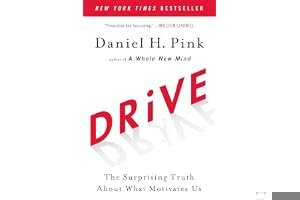
The New York Times bestseller that gives readers a paradigm-shattering new way to think about motivation
Most people believe that the best way to motivate is with rewards like money—the carrot-and-stick approach. That's a mistake, says Daniel H. Pink (author of To Sell Is Human: The Surprising Truth About Motivating Others). In this provocative and persuasive new book, he asserts that the secret to high performance and satisfaction-at work, at school, and at home—is the deeply human need to direct our own lives, to learn and create new things, and to do better by ourselves and our world.
Drawing on four decades of scientific research on human motivation, Pink exposes the mismatch between what science knows and what business does—and how that affects every aspect of life. He examines the three elements of true motivation—autonomy, mastery, and purpose-and offers smart and surprising techniques for putting these into action in a unique book that will change how we think and transform how we live.
…
Recommended by Tobi Lütke, Bogdan Lucaciu, David Brudo, and 5 others.
Tobi Lütke
Founder & CEO/Shopify
Tobi Lütke recommended this book in an interview in "The Globe and Mail." [source]
Bogdan Lucaciu
Spoiler: it’s autonomy, mastery, and purpose. [source]
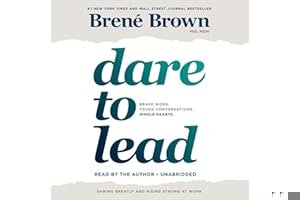
In her #1 New York Times bestsellers, Brené Brown has taught us what it means to dare greatly, rise strong, and brave the wilderness. Now, based on new research conducted with leaders, change makers, and culture shifters, she's showing us how to put those ideas into practice so we can step up and lead.
Leadership is not about titles, status, and wielding power. A leader is anyone who takes responsibility for recognizing the potential in people and ideas, and has the courage to develop that potential.
When we dare to lead, we don't pretend to have the right answers; we stay curious and ask the right questions. We don't see power as finite and hoard it; we know that power becomes infinite when we share it with others. We don't avoid difficult conversations and situations; we lean into vulnerability when it's necessary to do good work.
But daring leadership in a culture defined by scarcity, fear, and uncertainty requires skill-building around traits that are deeply and uniquely human. The irony is that we're choosing not to invest in developing the hearts and minds of leaders at the exact same time as we're scrambling to figure out what we have to offer that machines and AI can't do better and faster. What can we do better? Empathy, connection, and courage, to start.
Four-time #1 New York Times bestselling author Brené Brown has spent the past two decades studying the emotions and experiences that give meaning to our lives, and the past seven years working with transformative leaders and teams spanning the globe. She found that leaders in organizations ranging from small entrepreneurial startups and family-owned businesses to nonprofits, civic organizations, and Fortune 50 companies all ask the same question:
How do you cultivate braver, more daring leaders, and how do you embed the value of courage in your culture?
In this new book, Brown uses research, stories, and examples to answer these questions in the no-BS style that millions of readers have come to expect and love.
Brown writes, "One of the most important findings of my career is that daring leadership is a collection of skills and practices that are 100 percent teachable. It's learning and unlearning that requires brave work, tough conversations, and showing up with your whole heart. Easy? No. Because choosing courage over comfort is not always our default. Worth it? Always. We want to be brave with our lives and our work. It's why we're here."
Whether you've read Daring Greatly and Rising Strong or you're new to Brené Brown's work, this book is for anyone who wants to step up and into brave leadership.
With Dare to Lead, Brené brings decades of research to bear in a practical and insightful guide to courageous leadership. This book is a road map for anyone who wants to lead mindfully, live bravely, and dare to lead. [source]
Co-Founder/Pixar, CEO Pixar and Walt Disney Animation Studios
Brene visited Pixar to talk with our filmmakers. Her message was important, as movies are best when they come from a place of vulnerability, when the people who make them encounter setbacks and are forced to overcome them, when they are willing to have their asses handed to them. It is easy to sit back and talk about the values of a safe and meaningful culture, but extraordinarily difficult to pull it off. You don’t achieve good culture without constant attention, without an environment of safety, courage, and vulnerability. These are hard skills, but they are teachable skills. Start with this book. [source]
Don’t miss one of my favorite human beings @BreneBrown, discuss her book #DareToLead on this #MarieTV: this is for every one of us that wants to show up, contribute, and lean into our purpose 💪🏼💗 https://t.co/QVgSpZe9e9 [source]
Cover unavailable
33
The Power of Habit: Why We Do What We Do in Life and Business
A young woman walks into a laboratory. Over the past two years, she has transformed almost every aspect of her life. She has quit smoking, run a marathon, and been promoted at work. The patterns inside her brain, neurologists discover, have fundamentally changed.
Marketers at Procter & Gamble study videos of people making their beds. They are desperately trying to figure out how to sell a new product called Febreze, on track to be one of the biggest flops in company history. Suddenly, one of them detects a nearly imperceptible pattern—and with a slight shift in advertising, Febreze goes on to earn a billion dollars a year.
An untested CEO takes over one of the largest companies in America. His first order of business is attacking a single pattern among his employees—how they approach worker safety—and soon the firm, Alcoa, becomes the top performer in the Dow Jones.
What do all these people have in common? They achieved success by focusing on the patterns that shape every aspect of our lives.
They succeeded by transforming habits.
In The Power of Habit, award-winning New York Times business reporter Charles Duhigg takes us to the thrilling edge of scientific discoveries that explain why habits exist and how they can be changed. With penetrating intelligence and an ability to distill vast amounts of information into engrossing narratives, Duhigg brings to life a whole new understanding of human nature and its potential for transformation.
Along the way we learn why some people and companies struggle to change, despite years of trying, while others seem to remake themselves overnight. We visit laboratories where neuroscientists explore how habits work and where, exactly, they reside in our brains. We discover how the right habits were crucial to the success of Olympic swimmer Michael Phelps, Starbucks CEO Howard Schultz, and civil-rights hero Martin Luther King, Jr. We go inside Procter & Gamble, Target superstores, Rick Warren’s Saddleback Church, NFL locker rooms, and the nation’s largest hospitals and see how implementing so-called keystone habits can earn billions and mean the difference between failure and success, life and death.
At its core, The Power of Habit contains an exhilarating argument: The key to exercising regularly, losing weight, raising exceptional children, becoming more productive, building revolutionary companies and social movements, and achieving success is understanding how habits work.
Habits aren’t destiny. As Charles Duhigg shows, by harnessing this new science, we can transform our businesses, our communities, and our lives.
…
Recommended by Naval Ravikant, Blake Irving, Alden Mills, and 15 others.
I also recently finished The Power of Habit, or close to finish as I get. That one was interesting, not because of its content necessarily, but because it’s good for me to always keep on top of mind how powerful my habits are. … I think learning how to break habits is a very important meta-skill that can serve you better in life than almost anything else. Although you can read tons of books on it, the reality is you’re never going to learn how to break bad habits until you just break them. [source]
Blake Irving
CEO/GoDaddy
You know, there's a book called The Power of Habit by Charles Duhigg. Simple read book about just how to build positive habits that can be I think I what I'd call you know whether in your personal life or whether in your business life to help you build you know, have a loop that can build your success and that's one I mean there are so many great books out there. [source]
Alden Mills
More recent books that have had a significant impact on me are The Power of Habit and The Diamond Cutter. Both represent different forces for me – the former helps me tactically with making incremental improvements in my life. [source]
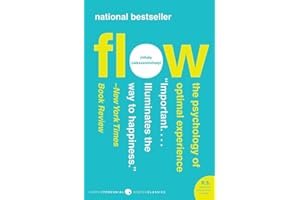
Psychologist Mihaly Csikszentmihalyi's famous investigations of "optimal experience" have revealed that what makes an experience genuinely satisfying is a state of consciousness called flow. During flow, people typically experience deep enjoyment, creativity, and a total involvement with life. In this new edition of his groundbreaking classic work, Csikszentmihalyi demonstrates the ways this positive state can be controlled, not just left to chance. Flow: The Psychology of Optimal Experience teaches how, by ordering the information that enters our consciousness, we can discover true happiness and greatly improve the quality of our lives.
While re-reading Mihaly Csikszentmihalyi’s wonderful book Flow: The Psychology of Optimal Experience, I came across this passage on working crossword puzzles. I think he could just as well be talking about making blackout poems: "There is much to be said in favor of this popular pastime, which in its best form resembles the ancient riddle contests. It is inexpensive and portable, its challenges can be finely graduated so that both novices and experts can enjoy it, and its solution produces a sense of pleasing order that gives one a satisfying feeling of accomplishment. It provides opportunities to experience a mild state of flow to many people who are stranded in airport lounges, who travel on commuter trains, or who are simply whiling away Sunday mornings." [source]
Tom Chatfield
The notion of flow is the idea that there is a state that is characterised by complete immersion in an activity, by a constant response to stimuli, and a perfect match between your ability and the challenge in front of you. [source]
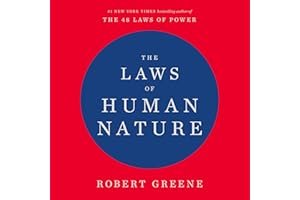
Robert Greene is a master guide for millions of readers, distilling ancient wisdom and philosophy into essential texts for seekers of power, understanding and mastery. Now he turns to the most important subject of all - understanding people's drives and motivations, even when they are unconscious of them themselves. We are social animals. Our very lives depend on our relationships with people. Knowing why people do what they do is the most important tool we can possess, without which our other talents can only take us so far. Drawing from the ideas and examples of Pericles, Queen Elizabeth I, Martin Luther King Jr, and many others, Greene teaches us how to detach ourselves from our own emotions and master self-control, how to develop the empathy that leads to insight, how to look behind people's masks, and how to resist conformity to develop your singular sense of purpose. Whether at work, in relationships, or in shaping the world around you, The Laws of Human Nature offers brilliant tactics for success, self-improvement, and self-defence.
Robert has been writing this book since Mastery came out in 2013 and it shows - it's a spectacular masterwork that builds atop all his other books. Robert's book have always been an unvarnished look at how the world really works, for better and for worse. What I like about this book is that it pushes us to question our own biases, our own assumptions, irrationalities and tendencies. It's almost as if we believe other people have a 'human nature' but we don't - we're logical, fair, motivated by higher purposes always. Of course this is silly. Lots of good stuff here for anyone in a position of leadership, who works with an audience or studies human behavior. [source]
Ayush Kumar
People are the ROI, people are the asset, everything is people and one needs to understand people. [source]
Cover unavailable
36
Culture Map: How to Navigate the Realities of Multi-Cultural Business
Success in business requires navigating through wildly different cultural realities, and we become vulnerable without any knowledge of how to decode cultures foreign to our own. For today’s ever-more-globalized audience, international culture expert Erin Meyer writes a fun and instructive guide to the tactics and strategies we’ll need to overcome cultural obstacles and obtain success.
Recommended by Emma Wedekind, Katharina Borchert, Mark Hertling, and 1 others.
Emma Wedekind
@sarah_edo @jennyshen I love this topic so much! Sarah you might love The Culture Map. BEST book of 2019 so far and taught me how to work on internationally diverse teams! [source]
Katharina Borchert
Welcoming the brilliant @ErinMeyerINSEAD to #brrrlin - her book #culturemap should be required reading for anyone communicating with anyone outside their own native #culture. It will save you so much pain. https://t.co/KLUyc2uOqH [source]
Mark Hertling
BTW, a great book on the subject: The Culture Map, by Erin Meyer (especially good for those working in multinational organizations...or the govt/military) [source]
Jack Welch knows how to win. During his forty-year career at General Electric, he led the company to year-after-year success around the globe, in multiple markets, against brutal competition. His honest, be-the-best style of management became the gold standard in business, with his relentless focus on people, teamwork, and profits.
Since Welch retired in 2001 as chairman and chief executive officer of GE, he has traveled the world, speaking to more than 250,000 people and answering their questions on dozens of wide-ranging topics.
Inspired by his audiences and their hunger for straightforward guidance, Welch has written both a philosophical and pragmatic book, which is destined to become the bible of business for generations to come. It clearly lays out the answers to the most difficult questions people face both on and off the job.
Welch's objective is to speak to people at every level of an organization, in companies large and small. His audience is everyone from line workers to MBAs, from project managers to senior executives. His goal is to help everyone who has a passion for success.
Welch begins Winning with an introductory section called "Underneath It All," which describes his business philosophy. He explores the importance of values, candor, differentiation, and voice and dignity for all.
The core of Winning is devoted to the real "stuff" of work. This main part of the book is split into three sections. The first looks inside the company, from leadership to picking winners to making change happen. The second section looks outside, at the competition, with chapters on strategy, mergers, and Six Sigma, to name just three. The next section of the book is about managing your career—from finding the right job to achieving work-life balance.
Welch's optimistic, no excuses, get-it-done mind-set is riveting. Packed with personal anecdotes and written in Jack's distinctive no b.s. voice, Winning offers deep insights, original thinking, and solutions to nuts-and-bolts problems that will change the way people think about work.
In this New York Times bestseller, Ijeoma Oluo offers a hard-hitting but user-friendly examination of race in America Widespread reporting on aspects of white supremacy--from police brutality to the mass incarceration of Black Americans--has put a media spotlight on racism in our society. Still, it is a difficult subject to talk about. How do you tell your roommate her jokes are racist? Why did your sister-in-law take umbrage when you asked to touch her hair--and how do you make it right? How do you explain white privilege to your white, privileged friend? In So You Want to Talk About Race, Ijeoma Oluo guides readers of all races through subjects ranging from intersectionality and affirmative action to "model minorities" in an attempt to make the seemingly impossible possible: honest conversations about race and racism, and how they infect almost every aspect of American life. "Oluo gives us--both white people and people of color--that language to engage in clear, constructive, and confident dialogue with each other about how to deal with racial prejudices and biases."--National Book Review "Generous and empathetic, yet usefully blunt . . . it's for anyone who wants to be smarter and more empathetic about matters of race and engage in more productive anti-racist action."--Salon (Required Reading)
…
Recommended by Imani Gandy Corn, Mike Monteiro, and Sarah Parcak.
Imani Gandy Corn
I’m not really kidding. Ijeoma’s book is great for white people—because seriously, get a clue—but it’s also great for Black people who are sick and tired of trying to talk about race with clueless white people and end up frustrated and wanting to stab everything in sight. [source]
Mike Monteiro
LOVE LOVE LOVE THIS BOOK! https://t.co/x3jxCD3q7g [source]
The Secret’s 10th Anniversary Edition includes a new foreword by Rhonda Byrne, and 10 of the most life-changing insights she’s had over the last 10 years of practicing and living The Secret every day. The 10 insights alone will accelerate your understanding and mastery of the law of attraction.
Recommended by Ntwana Kasi. and Woman In Purpose.
Ntwana Kasi.
@Sibongubuhle_N Don't you have pdf of it i love this book [source]
Sheryl Sandberg’s Lean In is a massive cultural phenomenon and its title has become an instant catchphrase for empowering women. The book soared to the top of bestseller lists internationally, igniting global conversations about women and ambition. Sandberg packed theatres, dominated opinion pages, appeared on every major television show and on the cover of Time magazine, and sparked ferocious debate about women and leadership. Ask most women whether they have the right to equality at work and the answer will be a resounding yes, but ask the same women whether they'd feel confident asking for a raise, a promotion, or equal pay, and some reticence creeps in. The statistics, although an improvement on previous decades, are certainly not in women's favour – of 197 heads of state, only twenty-two are women. Women hold just 20 percent of seats in parliaments globally, and in the world of big business, a meagre eighteen of the Fortune 500 CEOs are women. In Lean In, Sheryl Sandberg – Facebook COO and one of Fortune magazine's Most Powerful Women in Business – draws on her own experience of working in some of the world's most successful businesses and looks at what women can do to help themselves, and make the small changes in their life that can effect change on a more universal scale.
For the past five years, I've sat at a desk next to Sheryl and I've learned something from her almost every day. She has a remarkable intelligence that can cut through complex processes and find solutions to the hardest problems. Lean In combines Sheryl's ability to synthesize information with her understanding of how to get the best out of people. The book is smart and honest and funny. Her words will help all readers - especially men - to become better and more effective leaders. [source]
If you loved Sheryl Sandberg's incredible TED talk on why we have too few women leaders, or simply believe as I do that we need equality in the boardroom, then this book is for you. As Facebook's COO, Sheryl Sandberg has first-hand experience of why having more women in leadership roles is good for business as well as society. Lean In is essential reading for anyone interested in righting the injustice of this inequality. [source]
Cover unavailable
41
Measure What Matters: How Google, Bono, and the Gates Foundation Rock the World with OKRs
Legendary venture capitalist John Doerr reveals how the goal-setting system of Objectives and Key Results (OKRs) has helped tech giants from Intel to Google achieve explosive growth--and how it can help any organization thrive.
In the fall of 1999, John Doerr met with the founders of a start-up whom he'd just given $12.5 million, the biggest investment of his career. Larry Page and Sergey Brin had amazing technology, entrepreneurial energy, and sky-high ambitions, but no real business plan. For Google to change the world (or even to survive), Page and Brin had to learn how to make tough choices on priorities while keeping their team on track. They'd have to know when to pull the plug on losing propositions, to fail fast. And they needed timely, relevant data to track their progress -- to measure what mattered.
Doerr taught them about a proven approach to operating excellence: Objectives and Key Results. He had first discovered OKRs in the 1970s as an engineer at Intel, where the legendary Andy Grove ("the greatest manager of his or any era") drove the best-run company Doerr had ever seen. Later, as a venture capitalist, Doerr shared Grove's brainchild with more than fifty companies. Wherever the process was faithfully practiced, it worked.
In this goal-setting system, objectives define what we seek to achieve; key results are how those top-priority goals will be attained with specific, measurable actions within a set time frame. Everyone's goals, from entry level to CEO, are transparent to the entire organization.
The benefits are profound. OKRs surface an organization's most important work. They focus effort and foster coordination. They keep employees on track. They link objectives across silos to unify and strengthen the entire company. Along the way, OKRs enhance workplace satisfaction and boost retention.
In Measure What Matters, Doerr shares a broad range of first-person, behind-the-scenes case studies, with narrators including Bono and Bill Gates, to demonstrate the focus, agility, and explosive growth that OKRs have spurred at so many great organizations. This book will help a new generation of leaders capture the same magic.
John explains how OKRs Objectives and Key Results work and shows how you can apply them in all sorts of situations. I’d recommend John’s book for anyone interested in becoming a better manager (and I’d say that even if I hadn’t been interviewed for a super-nice chapter about the Gates Foundation). [source]
Whether you're a seasoned CEO or a first-time entrepreneur, you'll find valuable lessons, tools, and inspiration in the pages of Measure What Matters. I'm glad John invested the time to share these ideas with the world. [source]
In this indispensable book, the most important venture capitalist of our era reveals a key to business innovation and success. This crisp and colorful book combines fascinating case studies with insightful personal stories to show how OKRs can add magic to organizations of any size. [source]
Cover unavailable
42
Crucial Accountability
Kerry Patterson, Joseph Grenny, Ron McMillan, Al Switzler
The authors of the New York Times bestseller Crucial Conversations show you how to achieve personal, team, and organizational success by healing broken promises, resolving violated expectations, and influencing good behavior.
Discover skills to resolve touchy, controversial, and complex issues at work and at home--now available in this follow-up to the internationally popular Crucial Conversations.
Behind the problems that routinely plague organizations and families, you'll find individuals who are either unwilling or unable to deal with failed promises. Others have broken rules, missed deadlines, failed to live up to commitments, or just plain behaved badly--and nobody steps up to the issue. Or they do, but do a lousy job and create a whole new set of problems. Accountability suffers and new problems spring up. New research demonstrates that these disappointments aren't just irritating, they're costly--sapping organizational performance by twenty to fifty percent and accounting for up to ninety percent of divorces.
Crucial Confrontations teaches skills drawn from 10,000 hours of real-life observations to increase confidence in facing issues like:
- An employee speaks to you in an insulting tone that crosses the line between sarcasm and insubordination. Now what? - Your boss just committed you to a deadline you know you can't meet--and not-so-subtly hinted he doesn't want to hear complaints about it. - Your son walks through the door sporting colorful new body art that raises your blood pressure by forty points. Speak now, pay later. - An accountant wonders how to step up to a client who is violating the law. Can you spell unemployment? - Family members fret over how to tell granddad that he should no longer drive his car. This is going to get ugly. - A nurse worries about what to say to an abusive physician. She quickly remembers "how things work around here" and decides not to say anything.
Everyone knows how to run for cover, or if adequately provoked, step up to these confrontations in a way that causes a real ruckus. That we have down pat. Crucial Confrontations teaches you how to deal with violated expectations in a way that solves the problem at hand, and doesn't harm the relationship--and in fact, even strengthens it.
Crucial Confrontations borrows from twenty years of research involving two groups. More than 25,000 people helped the authors identify those who were most influential during crucial confrontations. They spent 10,000 hours watching these people, documented what they saw, and then trained and tested with more than 300,000 people. Second, they measured the impact of crucial confrontations improvements on organizational and team performance--the results were immediate and sustainable: twenty to fifty percent improvements in measurable performance.
…
Cover unavailable
43
Turn the Ship Around!: A True Story of Turning Followers into Leaders
"Leadership should mean giving control rather than taking control and creating leaders rather than forging followers." David Marquet, an experienced Navy officer, was used to giving orders. As newly appointed captain of the USS Santa Fe, a nuclear-powered submarine, he was responsible for more than a hundred sailors, deep in the sea. In this high-stress environment, where there is no margin for error, it was crucial his men did their job and did it well.
But the ship was dogged by poor morale, poor performance, and the worst retention in the fleet. Marquet acted like any other captain until, one day, he unknowingly gave an impossible order, and his crew tried to follow it anyway. When he asked why the order wasn't challenged, the answer was "Because you told me to." Marquet realized he was leading in a culture of followers, and they were all in danger unless they fundamentally changed the way they did things. That's when Marquet took matters into his own hands and pushed for leadership at every level.
Turn the Ship Around! is the true story of how the Santa Fe skyrocketed from worst to first in the fleet by challenging the U.S. Navy's traditional leader-follower approach. Struggling against his own instincts to take control, he instead achieved the vastly more powerful model of giving control. Before long, each member of Marquet's crew became a leader and assumed responsibility for everything he did, from clerical tasks to crucial combat decisions. The crew became fully engaged, contributing their full intellectual capacity every day, and the Santa Fe started winning awards and promoting a highly disproportionate number of officers to submarine command.
No matter your business or position, you can apply Marquet's radical guidelines to turn your own ship around. The payoff: a workplace where everyone around you is taking responsibility for their actions, where people are healthier and happier, where everyone is a leader.
So many leadership books are either theoretical (written by people who study it but don’t do it) or by people who look back and try to explain how they did it. Though both valuable, most leadership books are also very hard to implement as prescribed. That’s what makes Marquet’s book is so remarkable. A submarine commander, he used to obey traditional models of leadership … until they failed him. Unable to change any variables (people, technology or equipment), the only thing left for him to change in order to achieve success was how he acted as a leader. Based on real life events, Marquet presents his ideas in a superbly practical way — perfect for implementing. [source]
A wonderful book about a naval Admiral that was running one of the worst performing U.S. nuclear submarines and turned it around to be the best performing U.S. submarine by infusing his staff with basically saying they’re not waiting for a command, they’re saying what they intend to do. [source]
Cover unavailable
44
The Power of Vulnerability: Teachings of Authenticity, Connections and Courage
Is vulnerability the same as weakness? “In our culture,” teaches Dr. Brené Brown, “we associate vulnerability with emotions we want to avoid such as fear, shame, and uncertainty. Yet we too often lose sight of the fact that vulnerability is also the birthplace of joy, belonging, creativity, authenticity, and love.” On The Power of Vulnerability, Dr. Brown offers an invitation and a promise - that when we dare to drop the armor that protects us from feeling vulnerable, we open ourselves to the experiences that bring purpose and meaning to our lives. Here she dispels the cultural myth that vulnerability is weakness and reveals that it is, in truth, our most accurate measure of courage. “The Power of Vulnerability is a very personal project for me,” Brené explains. “This is the first place that all of my work comes together. This audio course draws from all three of my books - it’s the culmination of everything I’ve learned over the past twelve years. I'm very excited to weave it all into a truly comprehensive form that shows what these findings and insights can mean in our lives.”
Guidance and Insights for Wholehearted Living
Over the past twelve years, Dr. Brené Brown has interviewed hundreds of people as part of an ongoing study of vulnerability. “The research shows that we try to ward disappointment with a shield of cynicism, disarm shame by numbing ourselves against joy, and circumvent grief by shutting off our willingness to love,” explains Dr. Brown. When we become aware of these patterns, she teaches, we begin to become conscious of how much we sacrifice in the name of self-defense -and how much richer our lives become when we open ourselves to vulnerability. “In my research,” Dr. Brown says, “the word I use to describe people who can live from a place of vulnerability is wholehearted.” Being wholehearted is a practice—one that we can choose to cultivate through empathy, gratitude, and awareness of our vulnerability armor. Join this engaging and heartfelt teacher on The Power of Vulnerability as she offers profound insights on leaning into the full spectrum of emotions—so we can show up, let ourselves be seen, and truly be all in.
HIGHLIGHTS
Cultivating shame resilience—the key to developing a sense of worth and belonging. Vulnerability as the origin point for innovation, adaptability, accountability, and visionary leadership. Our emotional armory - how we use perfectionism, numbing, and other tactics to avoid feeling vulnerable. The myths of vulnerability - common misconceptions about weakness, trust, and self-sufficiency. Discovering your vulnerability armor - recognizing what makes us shut down, and how we can change. The 10 guideposts of wholehearted living - essential skills for becoming fully engaged in life. Six hours of stories, warm humor, and transformative insights for living a life of courage, authenticity, and compassion from Dr. Brené Brown.
…
Recommended by Chelsea Frank.
Chelsea Frank
I read everything with an open mind, often challenging myself by choosing books with an odd perspective or religious/spiritual views. These books do not reflect my personal feelings but are books that helped shape my perspective on life, love, and happiness. [source]
Cover unavailable
45
Fast Food Nation: The Dark Side of the All-American Meal
Fast food has hastened the malling of our landscape, widened the chasm between rich and poor, fueled an epidemic of obesity, and propelled American cultural imperialism abroad. That's a lengthy list of charges, but here Eric Schlosser makes them stick with an artful mix of first-rate reportage, wry wit, and careful reasoning.
Schlosser's myth-shattering survey stretches from California's subdivisions where the business was born to the industrial corridor along the New Jersey Turnpike where many fast food's flavors are concocted. Along the way, he unearths a trove of fascinating, unsettling truths -- from the unholy alliance between fast food and Hollywood to the seismic changes the industry has wrought in food production, popular culture, and even real estate. (back cover)
…
Recommended by Richard Branson, Antonio Eram, Barry Estabrook, and 1 others.
Today is World Book Day, a wonderful opportunity to address this #ChallengeRichard sent in by Mike Gonzalez of New Jersey: Make a list of your top 65 books to read in a lifetime. [source]
Antonio Eram
This book was recommended by Antonio when asked for titles he would recommend to young people interested in his career path. [source]
Barry Estabrook
Eric Schlosser takes apart a single fast-food meal and shows not only how it affects our health but also how the people who serve it to you are treated. He also looks at how the people in the slaughterhouses working with the cattle are treated, and so it shows you the true picture of the all-American meal – burgers and fries. [source]
"Emotional Intelligence 2.0 succinctly explains how to deal with emotions creatively and employ our intelligence in a beneficial way." --THE DALAI LAMA
For the first time ever in a book, TalentSmart's revolutionary program helps people identify their EQ skills, build these skills into strengths, and enjoy consistent performance in the pursuit of important life objectives. The book contains proven strategies from a decade-long effort to accurately measure and increase emotional intelligence. Trusted by upper-echelon leaders inside companies worldwide, these strategies will enable you to capitalize on the skills responsible for 58% of performance in all types of jobs.
Includes a passcode for online access to the world's bestselling emotional intelligence test, the Emotional Intelligence Appraisal®, which will show you where your EQ stands today and what you can do to begin maximizing it immediately.
Rooted in sound research involving more than 500,000 responses, this new edition of the test will:
--Pinpoint which of the book's 66 emotional intelligence strategies will increase your EQ the most.
--Reveal the specific behaviors responsible for your EQ scores.
--Allow you to test yourself a second time to measure how much your EQ has increased from your efforts.
The book's smooth narrative style turns rigorous research into memorable stories and practical strategies that anyone can use to his or her advantage.
With 90% of top performers high in EQ, and EQ twice as important as IQ in getting where you want to go in life, who can afford to ignore it?
What people are saying about it:
"Emotional Intelligence 2.0 is a fast read with compelling anecdotes and good context in which to understand and improve your score." --Newsweek
"Surveys of 500,000 people on the role of emotions in daily life have enabled the authors to hone EQ assessment to a 28-question online survey that can be completed in seven minutes." --The Washington Post
"Read worthy strategies for improving emotional intelligence skills make this our how-to book of the week. It's nice to know that average IQ doesn't limit a person to average performance. And who can resist an online quiz with instant feedback?" --Newsday
"Gives abundant, practical findings and insights with emphasis on how to develop EQ. Research shows convincingly that EQ is more important than IQ." --Stephen R. Covey, author, The 7 Habits of Highly Effective People
"This book can drastically change the way you think about success...read it twice." --Patrick Lencioni, author, The Five Dysfunctions of a Team
"At last a book that gives how to's rather than just what to's. We need no more convincing that emotional intelligence is at the core of life success. What we need are practical ways of improving it. Bradberry and Greaves brilliant new book is a godsend. It will change your life." --Joseph Grenny, New York Times bestselling coauthor of Crucial Conversations
"Emotional intelligence is an extremely important skill for personal and professional success. This book is excellent and the learning included in the free online test is cutting-edge. I strongly recommend it." --Ken Blanchard, bestselling business book author of all time; coauthor The One Minute Manager®
"I distributed the book to my entire team. We found it very helpful in our dealings with each other and our internal customers. With all the new buzzwords over the past few years, the heart and soul of a company's culture is how they support and promote emotional intelligence. Those with foresight see that emotional intelligence will separate the good companies from the great ones. This book is a wonderful tool for a grass roots approach. If your desire is to be a truly resonate leader that people will trust and follow, this is an opportunity that cannot only change your professional career, but also your personal relationships." --Regina Sacha, vice president, human resources, FedEx Custom Critical
"In the fast lane of business life today, people spend more time on computer keyboards, blackberries and conference calls than they do in face-to-face communication. We're expected to piece together broken conversations, cryptic voicemails, and abbreviated text messages to figure out how to proceed. In this increasingly complex web, emotional intelligence is more important than ever before. This book is filled with invaluable insights and information that no one can afford to ignore." --Rajeev Peshawaria, executive director, Goldman Sachs International
Gives abundant, practical findings and insights with emphasis on how to develop EQ. Research shows convincingly that EQ is more important than IQ. [source]
Deke Bridges
Current read... fascinating IQ vs EQ. Worthy book. #books #education #growth #LifeLessons @LeadersBest https://t.co/j0fjFstOWb [source]
Brilliant distillations of the strategies of war—and the subtle social game of everyday life—by the bestselling author of The 48 Laws of Power and Mastery
Robert Greene’s groundbreaking guides, The 48 Laws of Power, The Art of Seduction, and his latest book, Mastery, espouse profound, timeless lessons from the events of history to help readers vanquish an enemy, ensnare an unsuspecting victim, or become the greatest in your field. In The 33 Strategies of War, Greene has crafted an important addition to this ruthless and unique series.
Spanning world civilizations, synthesizing dozens of political, philosophical, and religious texts and thousands of years of violent conflict, The 33 Strategies of War is a comprehensive guide to the subtle social game of everyday life informed by the most ingenious and effective military principles in war. Structured in Greene’s trademark style, The 33 Strategies of War is the I-Ching of conflict, the contemporary companion to Sun Tzu’s The Art of War.
Abundantly illustrated with examples from history, including the folly and genius of everyone from Napoleon to Margaret Thatcher, Shaka the Zulu to Lord Nelson, Hannibal to Ulysses S. Grant, as well as movie moguls, Samurai swordsmen, and diplomats, each of the thirty-three chapters outlines a strategy that will help you win life’s wars. Learn the offensive strategies that require you to maintain the initiative and negotiate from a position of strength, or the defensive strategies designed to help you respond to dangerous situations and avoid unwinnable wars. The great warriors of battlefields and drawing rooms alike demonstrate prudence, agility, balance, and calm, and a keen understanding that the rational, resourceful, and intuitive always defeat the panicked, the uncreative, and the stupid. An indispensable book, The 33 Strategies of War provides all the psychological ammunition you need to overcome patterns of failure and forever gain the upper hand.
For decades, The One Minute Manager® has helped millions achieve more successful professional and personal lives. While the principles it lays out are timeless, our world has changed drastically since the book’s publication. The exponential rise of technology, global flattening of markets, instant communication, and pressures on corporate workforces to do more with less—including resources, funding, and staff—have all revolutionized the world in which we live and work.
Now, Ken Blanchard and Spencer Johnson have written The New One Minute Manager to introduce the book’s powerful, important lessons to a new generation. In their concise, easy-to-read story, they teach readers three very practical secrets about leading others—and explain why these techniques continue to work so well.
As compelling today as the original was thirty years ago, this classic parable of a young man looking for an effective manager is more relevant and useful than ever.
…
Recommended by Daymond John, Brian Armstrong, and Bill Liao.
Daymond John
Founder/FUBU
Daymond John recommended this book in an interview. [source]
Bill Liao
The human world occurs in language so best get good at it! [source]
Cover unavailable
49
Scrum: The Art of Doing Twice the Work in Half the Time
The way we manage organizations seems increasingly out of date. Deep inside, we sense that more is possible. We long for soulful workplaces, for authenticity, community, passion, and purpose.
In this groundbreaking book, the author shows that every time, in the past, when humanity has shifted to a new stage of consciousness, it has achieved extraordinary breakthroughs in collaboration. A new shift in consciousness is currently underway. Could it help us invent a more soulful and purposeful way to run our businesses and nonprofits, schools and hospitals?
A few pioneers have already cracked the code and they show us, in practical detail, how it can be done. Leaders, founders, coaches, and consultants will find this work a joyful handbook, full of insights, examples, and inspiring stories.
ADVANCE PRAISE
"Congratulations on a spectacular treatise! This is truly pioneering work. In terms of integral sophistication, there is simply nothing like it out there." --Ken Wilber, from the Foreword
"The most exciting book I've read in years on organization design and leadership models." --Jenny Wade, Ph.D., Author of Changes of Mind
"A book like Reinventing Organizations only comes along once in a decade. Sweeping and brilliant in scope, it is the Good To Great for a more enlightened age. What it reveals about the organizational model of the future is exhilarating and deeply hopeful." --Norman Wolfe, Author of The Living Organization
"A comprehensive, highly practical account of the emergent worldview in business. Everything you need to know about building a new paradigm organization!" --Richard Barrett, Chairman and Founder, Barrett Values Center
"Frederic Laloux has done business people and professionals everywhere a signal service. He has discovered a better future for organizations by describing, in useful detail, the unusual best practices of today." --Bill Torbert, Author of Action Inquiry
"As the rate of change escalates exponentially, the old ways of organizing and educating, which were designed for efficiency and repetition, are dying. Frederic Laloux is one of the few management leaders exploring what comes next. It's deeply different." --Bill Drayton, Founder, Ashoka: Innovators for the Public
…
Recommended by Armina Sirbu, Bogdan Lucaciu, Cristina Riesen, and 1 others.
Armina Sirbu
Reinventing Organizations by F. Laloux - the best book there is about the organizations of the future. [source]
Bogdan Lucaciu
Completely unrelated people told me about it at the same time, for different reasons. People that I really looked up to. Quite serendipitous. It was almost spooky reading it, I didn't expect such a highly regarded book to be so close to my unconventional beliefs about organisation design. [source]
Cristina Riesen
First, a word on career paths. In time, I realised that career paths are like one-way streets. Magic happens in unexplored territories. Plus life is how you choose to live every moment, every day. So today, rather than building a career, I prefer to make lateral moves in life, working with great people and being part of ambitious projects impacting the world. There are a few books that got me here: … Frederic Laloux "Reinventing Organizations". [source]
Cover unavailable
51
The $100 Startup: Reinvent the Way You Make a Living, Do What You Love, and Create a New Future
In The $100 Startup, Chris Guillebeau shows you how to lead of life of adventure, meaning and purpose – and earn a good living.
Still in his early thirties, Chris is on the verge of completing a tour of every country on earth – he’s already visited more than 175 nations – and yet he’s never held a “real job” or earned a regular paycheck. Rather, he has a special genius for turning ideas into income, and he uses what he earns both to support his life of adventure and to give back.
There are manyothers like Chris – those who’ve found ways to opt out of traditional employment and create the time and income to pursue what they find meaningful. Sometimes, achieving that perfect blend of passion and income doesn’t depend on shelving what you currently do. You can start small with your venture, committing little time or money, and wait to take the real plunge when you're sure it's successful.
In preparing to write this book, Chris identified 1,500 individuals who have built businesses earning $50,000 or more from a modest investment (in many cases, $100 or less), and from that group he’s chosen to focus on the 50 most intriguing case studies. In nearly all cases, people with no special skills discovered aspects of their personal passions that could be monetized, and were able to restructure their lives in ways that gave them greater freedom and fulfillment.
Here, finally, distilled into one easy-to-use guide, are the most valuable lessons from those who’ve learned how to turn what they do into a gateway to self-fulfillment. It’s all about finding the intersection between your “expertise” – even if you don’t consider it such -- and what other people will pay for. You don’t need an MBA, a business plan or even employees. All you need is a product or service that springs from what you love to do anyway, people willing to pay, and a way to get paid.
Not content to talk in generalities, Chris tells you exactly how many dollars his group of unexpected entrepreneurs required to get their projects up and running; what these individuals did in the first weeks and months to generate significant cash; some of the key mistakes they made along the way, and the crucial insights that made the business stick. Among Chris’s key principles: if you’re good at one thing, you’re probably good at something else; never teach a man to fish – sell him the fish instead; and in the battle between planning and action, action wins.
In ancient times, people who were dissatisfied with their lives dreamed of finding magic lamps, buried treasure, or streets paved with gold. Today, we know that it’s up to us to change our lives. And the best part is, if we change our own life, we can help others change theirs. This remarkable book will start you on your way.
In this valuable guide Chris Guillebeau shows that transforming an idea into a successful business can be easier than you think…You are in charge of which ideas deserve your time, and this book can help you wake up every morning eager to progress to the next step. [source]
Chelsea Frank
I read everything with an open mind, often challenging myself by choosing books with an odd perspective or religious/spiritual views. These books do not reflect my personal feelings but are books that helped shape my perspective on life, love, and happiness. [source]
Dean Roller
Question: What books would you recommend to young people interested in your career path? Answer: Four Hour Work Week, The $100 startup and Jobs to be done . I like books that share examples of real world approaches to getting something off the ground. [source]
Cover unavailable
52
The 17 Indisputable Laws of Teamwork: Embrace Them and Empower Your Team
Building and maintaining a successful team is no simpletask. Even people who have taken their teams to the highest level in theirfield have difficulty recreating what accounted for their successes. Is it astrong work ethic? Is it “chemistry”? What tools can you wrap your hands aroundto build–or rebuild–your team?
In The 17 Indisputable Laws of Teamwork, leadership expertand New York Times bestselling author John C. Maxwell shares the vitalprinciples of team building that are necessary for success in your business,family, church, or organization. In his practical, down-to-earth style, Dr.Maxwell shows how: The Law of HighMorale inspired a 50 year-old man who couldn’t even swim to train for thetoughest triathlon in the world. The Lawof the Big Picture prompted a former U.S. president to travel crosscountry bybus, sleep in a basement, and do manual labor. Playing by The Law of theScoreboard enabled one Web-based company to keep growing and making money whilethousands of other Internet businesses failed. Ignoring The Law of the PriceTag caused one of the world’s largest retailers to close its doors after 128years in business. The 17 Indisputable Laws of Teamwork will empoweryou–whether coach or player, teacher or student, CEO or non-profitvolunteer–with the “how-tos” and attitudes for building a successful team.
John C. Maxwell, known as America's expert on leadership, isa best-selling author and the founder of INJOY Stewardship Services, EQUIP, andMaximum Impact, dedicated to helping people reach their leadership potential.For more information, visit www.MaximumImpact.com.
Just making a decision can be hard enough, but how do you begin to judge whether it's the right one? Chip and Dan Heath, authors of #1 New York Times best-seller Switch, show you how to overcome your brain's natural shortcomings.
In Decisive, Chip and Dan Heath draw on decades of psychological research to explain why we so often get it very badly wrong - why our supposedly rational brains are frequently tripped up by powerful biases and wishful thinking. At the same time they demonstrate how relatively easy it is to avoid the pitfalls and find the best answers, offering four simple principles that we can all learn and follow. In the process, they show why it is that experts frequently make mistakes. They demonstrate the perils of getting trapped in a narrow decision frame. And they explore people's tendency to be over-confident about how their choices will unfold.
Drawing on case studies as diverse as the downfall of Kodak and the inspiring account of a cancer survivor, they offer both a fascinating tour through the workings of our minds and an invaluable guide to making smarter decisions.
Winner in the Practical Manager category of the CMI Management Book of the Year awards 2014.
…
Recommended by Cristian-Dragos Baciu, Julia Galef, Richard H Thaler, and 1 others.
Cristian-Dragos Baciu
So for business related books, the one that I think had the most impact for me was Decisive: How to make better choices in life and work, by Chip & Dan Heath. … The reason I enjoyed their work so much is because they offer real-life stories and insights that makes it so much easier for the reader to imprint that information in his mind. [source]
Julia Galef
Explains four of the biggest judgment errors … and gives tips for combating them. [source]
Sean Mallon
It looks at what hinders great decision making, and how to improve any decisions you make. Any entrepreneur knows how crucial their decisions in business are (and how devastating indecision can be). Decisive helps the reader to understand how good decisions are made, what key elements to look for, and how to make your choices better and quicker. [source]
Cover unavailable
54
The Start-up of You: Adapt to the Future, Invest in Yourself, and Transform Your Career
From the co-founder and chairman of LinkedIn and author Ben Casnocha comes a revolutionary new book on how to apply the strategies of successful entrepreneurship to your career: in other words, how to run the 'start-up of you'.
In a world where wages are virtually stagnant, creative disruption is rocking every industry, global competition for jobs is fierce, and job security is a thing of the past, we're all on our own when it comes to our careers. In the face of such uncertainty, the key to success is to think and act like an entrepreneur: to be nimble and self-reliant, to be innovative, and to know how to network and stand out from the crowd. And this is precisely what Hoffman and Casnocha show you how to do in a book that is both inspirational and supremely practical.
Just as LinkedIn is the one online community that no professional can afford not to belong to, this is the book that no professional can afford to be without.
Everyone, women and men alike, needs to think big to succeed. This is a practical book that shows you how to take control and build a career that will enable you to have real impact. [source]
The Startup of You" describes how to take the Silicon Valley approach to building a life: start with an idea, and work over your entire career to turn it something remarkable. In the world today, I think that the startup approach to life is necessary. This book distills the key techniques needed to succeed. [source]
The same extraordinary vision and timing that enabled Reid to found LinkedIn is once again on display with his book "the start-up of YOU." His central thesis, that every individual can benefit from acting as the entrepreneur of their own life and career, has never been more important than it is in today's increasingly globalized, competitive, and networked world. [source]
Cover unavailable
55
The Ideal Team Player: How to Recognize and Cultivate The Three Essential Virtues
In his classic book, The Five Dysfunctions of a Team, Patrick Lencioni laid out a groundbreaking approach for tackling the perilous group behaviors that destroy teamwork. Here he turns his focus to the individual, revealing the three indispensable virtues of an ideal team player.
In The Ideal Team Player, Lencioni tells the story of Jeff Shanley, a leader desperate to save his uncle’s company by restoring its cultural commitment to teamwork. Jeff must crack the code on the virtues that real team players possess, and then build a culture of hiring and development around those virtues.
Beyond the fable, Lencioni presents a practical framework and actionable tools for identifying, hiring, and developing ideal team players. Whether you’re a leader trying to create a culture around teamwork, a staffing professional looking to hire real team players, or a team player wanting to improve yourself, this book will prove to be as useful as it is compelling.
…
Cover unavailable
56
Leadershift: The 11 Essential Changes Every Leader Must Embrace
Lots of takes in this book. It shifts leaders leadership. How to lead today. Also helping you identify what kind of a leader you are. It is just dirty from my highlighter. Great read. I think page 100 is my favorite https://t.co/oHQhgxOTMx [source]
Chances are, you don't. From the cradle to the cubicle, we devote more time to fixing our shortcomings than to developing our strengths.
To help people uncover their talents, Gallup introduced StrengthsFinder in the 2001 management book Now, Discover Your Strengths. The book ignited a global conversation, while StrengthsFinder helped millions discover their top five talents.
In StrengthsFinder 2.0, Gallup unveils the new and improved version of its popular online assessment. With hundreds of strategies for applying your strengths, StrengthsFinder 2.0 will change the way you look at yourself and the world forever.
…
Recommended by Cat Williams-Treloar and 1 others.
Cat Williams-Treloar
If you want my favourite practical business book, go and buy yourself a copy of the Gallup StrengthsFinder. You'll get an access code to the survey in the back of the book. Years ago, my Chairman gifted the book to the entire team as a Christmas present. I loved it because it's grounded in the theory of playing from your strengths. [source]
Cover unavailable
58
Difficult Conversations: How to Discuss What Matters Most
The 10th-anniversary edition of the New York Times business bestseller-now updated with "Answers to Ten Questions People Ask"
We attempt or avoid difficult conversations every day-whether dealing with an underperforming employee, disagreeing with a spouse, or negotiating with a client. From the Harvard Negotiation Project, the organization that brought you Getting to Yes, Difficult Conversationsprovides a step-by-step approach to having those tough conversations with less stress and more success. you'll learn how to:
? Decipher the underlying structure of every difficult conversation ? Start a conversation without defensiveness ? Listen for the meaning of what is not said ? Stay balanced in the face of attacks and accusations ? Move from emotion to productive problem solving
…
Recommended by April Wensel, Auren Hoffman, Bogdan Lucaciu, and 1 others.
April Wensel
@amyvpellegrini I really liked a book called Difficult Conversations. I also love the book Nonviolent Communication for conflicts. [source]
I’m re-reading “Difficult Conversations”. It’s written by the “Harvard Negotiation Project” guys that also wrote “Getting to Yes” and “Thanks for the Feedback”. It allowed me to navigate super important conversations by shifting from a “who’s right” stance to a learning stance. Giving it another spin after two years from the first read as I'm working on my assertiveness. [source]
Cover unavailable
59
Leadership and Self-Deception: Getting Out of the Box
Since its original publication in 2000, Leadership and Self-Deception has become a word-of-mouth phenomenon. Its sales continue to increase year after year, and the book's popularity has gone global, with editions now available in over twenty languages.
Leadership and Self-Deception shows how the problems that typically prevent superior performance in organizations and cause conflicts in our personal lives are the result of a little-known problem called self-deception. People who are in self-deception live and work as if trapped in a box. They can't see the reality around them--they're blind to the self-serving motivations that are sabotaging them on the job and at home. But there is a way out. Through an entertaining and engaging story, Leadership and Self-Deception shows what self-deception is, how it operates, the damage it does, and, most importantly, what can be done about it.This third edition includes new research about the self-deception gap in organizations and the keys to closing this gap so that people take responsibility for their own problems and for organizational problems. It also includes the first chapter from Arbinger's latest bestseller, The Outward Mindset.
…
Recommended by Dustin Moskovitz, Bruce L. Christensen, Dave Browne, and 9 others.
Dustin Moskovitz
Co-founder/Facebook and Asana
Dustin Moskovitz recommended this book on Twitter. [source]
Bruce L. Christensen
CEO/PBS
After decades of executive leadership in senior management positions, I’ve finally found in Arbinger what I consider to be the best means of improving every measure of success. From boosting the bottom line to increasing personal joy, this book shows the way. [source]
Dave Browne
Former President & CEO/LensCrafters
Remarkable. Arbinger possesses the hidden key to productivity and creativity. Do whatever you can to get your hands on this material. [source]
Cover unavailable
60
Radical Candor: Be a Kickass Boss Without Losing Your Humanity
Kim Scott
4.3
From the time we learn to speak, we’re told that if you don’t have anything nice to say, don’t say anything at all. While this advice may work for everyday life, it is, as Kim Scott has seen, a disaster when adopted by managers.
Scott earned her stripes as a highly successful manager at Google and then decamped to Apple, where she developed a class on optimal management. She has earned growing fame in recent years with her vital new approach to effective management, the “radical candor” method.
Radical candor is the sweet spot between managers who are obnoxiously aggressive on one side and ruinously empathetic on the other. It’s about providing guidance, which involves a mix of praise as well as criticism—delivered to produce better results and help employees achieve.
Great bosses have strong relationships with their employees, and Scott has identified three simple principles for building better relationships with your employees: make it personal, get (sh)it done, and understand why it matters.
Radical Candor offers a guide to those bewildered or exhausted by management, written for bosses and those who manage bosses. Taken from years of the author’s experience, and distilled clearly giving actionable lessons to the reader; it shows managers how to be successful while retaining their humanity, finding meaning in their job, and creating an environment where people both love their work and their colleagues.
"Kim Scott has a well-earned reputation as a kick-ass boss and a voice that CEOs take seriously. In this remarkable book, she draws on her extensive experience to provide clear and honest guidance on the fundamentals of leading others: how to give (and receive) feedback, how to make smart decisions, how to keep moving forward, and much more. If you manage people―whether it be 1 person or a 1,000--you need RADICAL CANDOR. Now." [source]
Question: What five books would you recommend to young people interested in your career path & why? Answer: I know this is sounds self-serving but I’d recommended both of my books, the soon to be released, “Niche Down: How to Become Legendary by Being Different” and Harper Collins’ “instant classic,” “Play Bigger: How Pirates, Dreamers and Innovators Create and Dominate Markets” In addition: The Effective Executive, by Peter Drucker The E-Myth, by Michael Gerber Radical Candor: Be a Kickass Boss Without Losing Your Humanity by Kim Scott Back from the Dead, by Bill Walton The 22 Immutable Laws of Marketing, by Al Ries and Jack Trout [source]
Dux Raymond Sy
@magrom I recommend you be radically candid by challenging directly and caring personally - if you haven't, checkout @kimballscott's book #RadicalCandor - tons of great insights https://t.co/TP58vhmi18 [source]
Cover unavailable
61
Team of Teams: New Rules of Engagement for a Complex World
Stanley McChrystal, Tantum Collins, David Silverman, and Chris Fussell
The retired four-star general and and bestselling author of My Share of the Task shares a powerful new leadership model
As commander of Joint Special Operations Command (JSOC), General Stanley McChrystal played a crucial role in the War on Terror. But when he took the helm in 2004, America was losing that war badly: despite vastly inferior resources and technology, Al Qaeda was outmaneuvering America’s most elite warriors.
McChrystal came to realize that today’s faster, more interdependent world had overwhelmed the conventional, top-down hierarchy of the US military. Al Qaeda had seen the future: a decentralized network that could move quickly and strike ruthlessly. To defeat such an enemy, JSOC would have to discard a century of management wisdom, and pivot from a pursuit of mechanical efficiency to organic adaptability. Under McChrystal’s leadership, JSOC remade itself, in the midst of a grueling war, into something entirely new: a network that combined robust centralized communication with decentralized managerial authority. As a result, they beat back Al Qaeda.
In this book, McChrystal shows not only how the military made that transition, but also how similar shifts are possible in all organizations, from large companies to startups to charities to governments. In a turbulent world, the best organizations think and act like a team of teams, embracing small groups that combine the freedom to experiment with a relentless drive to share what they’ve learned.
Drawing on a wealth of evidence from his military career, the private sector, and sources as diverse as hospital emergency rooms and NASA’s space program, McChrystal frames the existential challenge facing today’s organizations, and presents a compelling, effective solution.
…
Recommended by Doug McMillon, Gene Kim, and Josh Bersin.
Here's a list of the top books that taught and inspired me this year. I go back to Sam Walton's book frequently and was struck, this year, by some common principles between Sam and General McChrystal. It seems they learned some similar things about what works when it comes to leading teams. For example, fostering a shared consciousness and empowering execution delivers results. Greg Foran shared The Good Jobs Strategy with me and I see a connection to Tim Brown's Change by Design. We are making progress in designing a "system" for our associates that results in opportunities for them and an even better work environment. [source]
Gene Kim
I love this diagram from the amazing book "Team of Teams" by General Stanley McChrystal! RT @TechBeaconCom: RT @manupaisable: Great visualization of the problems relying on org charts by @j_elmqvist @DOES_EUR #DOES19 https://t.co/XTz8SAWhff [source]
Available for the first time in the United States, this international bestseller reveals the secrets of nonverbal communication to give you confidence and control in any face-to-face encounter–from making a great first impression and acing a job interview to finding the right partner.
It is a scientific fact that people’s gestures give away their true intentions. Yet most of us don’t know how to read body language–and don’t realize how our own physical movements speak to others. Now the world’s foremost experts on the subject share their techniques for reading body language signals to achieve success in every area of life.
Drawing upon more than thirty years in the field, as well as cutting-edge research from evolutionary biology, psychology, and medical technologies that demonstrate what happens in the brain, the authors examine each component of body language and give you the basic vocabulary to read attitudes and emotions through behavior.
Discover: • How palms and handshakes are used to gain control • The most common gestures of liars • How the legs reveal what the mind wants to do • The most common male and female courtship gestures and signals • The secret signals of cigarettes, glasses, and makeup • The magic of smiles–including smiling advice for women • How to use nonverbal cues and signals to communicate more effectively and get the reactions you want
Filled with fascinating insights, humorous observations, and simple strategies that you can apply to any situation, this intriguing book will enrich your communication with and understanding of others–as well as yourself.
…
Cover unavailable
63
The First 90 Days: Critical Success Strategies for New Leaders at All Levels
Since its original release, The First 90 Days has become the bestselling globally acknowledged bible of leadership and career transitions. In this updated and expanded 10th anniversary edition, internationally known leadership transition expert Michael D. Watkins gives you the keys to successfully negotiating your next move—whether you’re onboarding into a new company, being promoted internally, or embarking on an international assignment.
In The First 90 Days, Watkins outlines proven strategies that will dramatically shorten the time it takes to reach what he calls the "breakeven point" when your organization needs you as much as you need the job. This new edition includes a substantial new preface by the author on the new definition of a career as a series of transitions; and notes the growing need for effective and repeatable skills for moving through these changes. As well, updated statistics and new tools make this book more reader-friendly and useful than ever.
As hundreds of thousands of readers already know, The First 90 Days is a road map for taking charge quickly and effectively during critical career transition periods—whether you are a first-time manager, a mid-career professional on your way up, or a newly minted CEO.
…
Cover unavailable
64
The 6 Types of Working Genius: A Better Way to Understand Your Gifts, Your Frustrations, and Your Team
A new book that explores the science of productivity, and why, in today’s world, managing how you think—rather than what you think—can transform your life.
Recommended by Chelsea Frank, Mike Benkovich, and Pierrette Abeel.
Chelsea Frank
I read everything with an open mind, often challenging myself by choosing books with an odd perspective or religious/spiritual views. These books do not reflect my personal feelings but are books that helped shape my perspective on life, love, and happiness. [source]
Mike Benkovich
Last year I read the book 'Smarter Faster Better: The Secrets of Being Productive in Life and Business' by Charles Duhigg. Look passed the click-baity title and you'll find one of the best books on productivity I've ever read... And I've read a lot of them. [source]
Cover unavailable
66
Work Rules!: Insights from Inside Google That Will Transform How You Live and Lead
Laszlo Bock
4.2
From the visionary head of Google's innovative People Operations comes a groundbreaking inquiry into the philosophy of work-and a blueprint for attracting the most spectacular talent to your business and ensuring that they succeed.
"We spend more time working than doing anything else in life. It's not right that the experience of work should be so demotivating and dehumanizing." So says Laszlo Bock, head of People Operations at the company that transformed how the world interacts with knowledge.
This insight is the heart of WORK RULES!, a compelling and surprisingly playful manifesto that offers lessons including:
Take away managers' power over employees Learn from your best employees-and your worst Hire only people who are smarter than you are, no matter how long it takes to find them Pay unfairly (it's more fair!) Don't trust your gut: Use data to predict and shape the future Default to open-be transparent and welcome feedback If you're comfortable with the amount of freedom you've given your employees, you haven't gone far enough.
Drawing on the latest research in behavioral economics and a profound grasp of human psychology, WORK RULES! also provides teaching examples from a range of industries-including lauded companies that happen to be hideous places to work and little-known companies that achieve spectacular results by valuing and listening to their employees. Bock takes us inside one of history's most explosively successful businesses to reveal why Google is consistently rated one of the best places to work in the world, distilling 15 years of intensive worker R&D into principles that are easy to put into action, whether you're a team of one or a team of thousands.
WORK RULES! shows how to strike a balance between creativity and structure, leading to success you can measure in quality of life as well as market share. Read it to build a better company from within rather than from above; read it to reawaken your joy in what you do.
…
Recommended by Ken Norton.
Cover unavailable
67
The Fearless Organization: Creating Psychological Safety in the Workplace for Learning, Innovation, and Growth
Conquer the most essential adaptation to the knowledge economy
The Fearless Organization: Creating Psychological Safety in the Workplace for Learning, Innovation, and Growth offers practical guidance for teams and organizations who are serious about success in the modern economy. With so much riding on innovation, creativity, and spark, it is essential to attract and retain quality talent--but what good does this talent do if no one is able to speak their mind? The traditional culture of "fitting in" and "going along" spells doom in the knowledge economy. Success requires a continuous influx of new ideas, new challenges, and critical thought, and the interpersonal climate must not suppress, silence, ridicule or intimidate. Not every idea is good, and yes there are stupid questions, and yes dissent can slow things down, but talking through these things is an essential part of the creative process. People must be allowed to voice half-finished thoughts, ask questions from left field, and brainstorm out loud; it creates a culture in which a minor flub or momentary lapse is no big deal, and where actual mistakes are owned and corrected, and where the next left-field idea could be the next big thing.
This book explores this culture of psychological safety, and provides a blueprint for bringing it to life. The road is sometimes bumpy, but succinct and informative scenario-based explanations provide a clear path forward to constant learning and healthy innovation.
* Explore the link between psychological safety and high performance * Create a culture where it's "safe" to express ideas, ask questions, and admit mistakes * Nurture the level of engagement and candor required in today's knowledge economy * Follow a step-by-step framework for establishing psychological safety in your team or organization
Shed the "yes-men" approach and step into real performance. Fertilize creativity, clarify goals, achieve accountability, redefine leadership, and much more. The Fearless Organization helps you bring about this most critical transformation.
…
Recommended by Bob Sutton.
Bob Sutton
@davisliumd @AmyCEdmondson Amy's new book is amazing, it weaves together research and practical tips from her decades of research on psychological safety [source]
Cover unavailable
68
Influencer: The Power to Change Anything
Kerry Patterson, Joseph Grenny, David Maxfield, Ron McMillan, Al Switzler
From the bestselling authors who taught the world how to have Crucial Conversations comes Influencer, a thought-provoking book that combines the remarkable insights of behavioral scientists and business leaders with the astonishing stories of high-powered influencers from all walks of life. You'll be taught each and every step of the influence process-including robust strategies for making change inevitable in your personal life, your business, and your world. You'll learn how to:
- Identify a handful of high-leverage behaviors that lead to rapid and profound change. - Apply strategies for changing both thoughts and actions. - Marshall six sources of influence to make change inevitable.
Influencer takes you on a fascinating journey from San Francisco to Thailand where you'll see how seemingly “insignificant” people are making incredibly significant improvements in solving problems others would think impossible. You'll learn how savvy folks make change not only achievable and sustainable, but inevitable. You'll discover why some managers have increased productivity repeatedly and significantly-while others have failed miserably.
…
Cover unavailable
69
Emotional Agility: Get Unstuck, Embrace Change, and Thrive in Work and Life
The counterintuitive approach to achieving your true potential, heralded by the Harvard Business Review as a groundbreaking idea of the year.
The path to fulfillment, whether at work or at home, is almost never a straight line. Ask anyone who has achieved their biggest goals or who thrives in their relationships, and you’ll hear stories of many unexpected detours along the way. What separates those who rise to these challenges and those who get derailed? The answer is agility—emotional agility.
Emotional agility is a four-step approach that allows us to navigate life’s twists and turns with self-acceptance, clear-sightedness, and an open mind. In her more than twenty years of research, Susan David has found that no matter how intelligent, resilient, or creative people are, when they ignore how situations or interactions make them feel, they miss opportunities to gain insight, getting hooked by thoughts, emotions, and habits that prevent them from reaching their full potential. Emotionally agile people experience the same stresses and setbacks as anyone else, but they know how to adapt, aligning their actions with their values and making small changes that lead to a life of growth.
Drawing on her extensive professional research, her international consulting work, and her own experiences growing up in Apartheid-era South Africa and losing her father at a young age, David shows how anyone can become more emotionally agile and thrive in an uncertain world. Written with authority, wit, and empathy, Emotional Agility will help you live your most successful life, whoever you are and whatever you face.
Take the FREE Emotional Agility Insights Quiz here: https://bitly.com/ea-quiz
The business world is constantly transforming. When restructures, mergers, bankruptcies, and layoffs hit the workplace, employees and managers naturally find the resulting situational shifts to be challenging. But the psychological transitions that accompany them are even more stressful. Organizational transitions affect people; it is always people, rather than a company, who have to embrace a new situation and carry out the corresponding change.
As veteran business consultant William Bridges explains, transition is successful when employees have a purpose, a plan, and a part to play. This indispensable guide is now updated to reflect the challenges of today's ever-changing, always-on, and globally connected workplaces. Directed at managers on all rungs of the corporate ladder, this expanded edition of the classic bestseller provides practical, step-by-step strategies for minimizing disruptions and navigating uncertain times.
…
Cover unavailable
71
Tribal Leadership: Leveraging Natural Groups to Build a Thriving Organization
“Tribal Leadership gives amazingly insightful perspective on how people interact and succeed. I learned about myself and learned lessons I will carry with me and reflect on for the rest of my life.” —John W. Fanning, Founding Chairman and CEO napster Inc.
“An unusually nuanced view of high-performance cultures.” —Inc.
Within each corporation are anywhere from a few to hundreds of separate tribes. In Tribal Leadership, Dave Logan, John King, and Halee Fischer-Wright demonstrate how these tribes develop—and show you how to assess them and lead them to maximize productivity and growth. A business management book like no other, Tribal Leadership is an essential tool to help managers and business leaders take better control of their organizations by utilizing the unique characteristics of the tribes that exist within.
…
Recommended by Eric Schmidt, Tony Hsieh, and Graham Duncan.
Tony Hsieh
CEO/Zappos.com
admires the book because it explains the importance of creating a strong company culture. [source]
Graham Duncan
Has looked at thousands of organizations and puts them into categories. [source]
Cover unavailable
72
Coaching for Performance: GROWing Human Potential and Purpose (People Skills for Professionals)
New 5th edition of Coaching for Performance is now available!
This fourth edition explains clearly and in-depth how to unlock people's potential to maximise their performance. It contains the eponymous GROW model (Goals, Reality, Options, Will), now established as the basis for coaching professionals. Clear, concise, hands-on and reader-friendly, this is a coaching guide written in a coaching style. Coaching for Performance digs deep into the roots of coaching, particularly transpersonal psychology, a useful model for personal development and in-depth coaching. There are new coaching questions and fresh chapters on emotional intelligence and high-performance leadership.
Whitmore also considers the future of coaching and its role in the transformation of learning and workplace relationships, as well as illustrating how coaching can help in a crisis.
…
Recommended by Dan Barker.
Dan Barker
@dohertyjf @iannuttall @jaredmckiernan @jessethanley @DamianThompson fwiw, 'coaching for performance' by john whitmore is perhaps the best book on coaching, whether you're coaching someone else or being coached. [source]
Cover unavailable
73
Talent is Overrated: What Really Separates World-Class Performers from Everybody Else
One of the most popular Fortune articles in many years was a cover story called: "What It Takes to Be Great." Geoff Colvin offered new evidence that top performers in any field are not determined by their inborn talents. Greatness doesn't come from DNA but from practice and perseverance honed over decades. The key is how you practice, how you analyze the results of your progress and learn from your mistakes, that enables you to achieve greatness.
Colvin shows that the skills of business: negotiating deals, evaluating financial statements obey the principles that lead to greatness, so that anyone can get better at them with the right kind of effort. Even the hardest decisions and interactions can be systematically improved.
This new mind-set, combined with Colvin's practical advice, will change the way you think about your job and career, and will inspire you to achieve more in all you do.
…
Recommended by Chelsea Frank.
Chelsea Frank
I read everything with an open mind, often challenging myself by choosing books with an odd perspective or religious/spiritual views. These books do not reflect my personal feelings but are books that helped shape my perspective on life, love, and happiness. [source]
Cover unavailable
74
The Manager's Path: A Guide for Tech Leaders Navigating Growth and Change
Managing people is difficult wherever you work, but the tech industry as a whole is pretty bad at it. Tech companies in general lack the experience, tools, texts, and frameworks to do it well. And the handful of books that share tips and tricks of engineering management don t explain how to supervise employees in the face of growth and change.
In this book, author Camille Fournier takes you through the stages of technical management, from mentoring interns to working with the senior staff. You ll get actionable advice for approaching various obstacles in your path, whether you re a new manager, a mentor, or a more experienced leader looking for fresh advice. Pick up this book and learn how to become a better manager and leader in your organization.
• Discover how to manage small teams and large/multi-level teams • Understand how to build and bootstrap a unifying culture in teams • Deal with people problems and learn how to mentor other managers and new leaders • Learn how to manage yourself: avoid common pitfalls that challenge many leaders • Obtain several practices that you can incorporate and practice along the way
…
Cover unavailable
75
Raving Fans: A Revolutionary Approach to Customer Service
"Your customers are only satisfied because their expectations are so low and because no one else is doing better. Just having satisfied customers isn't good enough anymore. If you really want a booming business, you have to create Raving Fans." This, in a nutshell, is the advice given to a new Area Manager on his first day--in an extraordinary business book that will help everyone, in every kind of organization or business, deliver stunning customer service and achieve miraculous bottom-line results.
Written in the parable style of The One Minute Manager, Raving Fans uses a brilliantly simple and charming story to teach how to define a vision, learn what a customer really wants, institute effective systems, and make Raving Fan Service a constant feature--not just another program of the month.
America is in the midst of a service crisis that has left a wake of disillusioned customers from coast to coast. Raving Fans includes startling new tips and innovative techniques that can help anyone create a revolution in any workplace--and turn their customers into raving, spending fans.
From bestselling writer David Graeber, a powerful argument against the rise of meaningless, unfulfilling jobs, and their consequences.
Does your job make a meaningful contribution to the world? In the spring of 2013, David Graeber asked this question in a playful, provocative essay titled “On the Phenomenon of Bullshit Jobs.” It went viral. After a million online views in seventeen different languages, people all over the world are still debating the answer.
There are millions of people—HR consultants, communication coordinators, telemarketing researchers, corporate lawyers—whose jobs are useless, and, tragically, they know it. These people are caught in bullshit jobs.
Graeber explores one of society’s most vexing and deeply felt concerns, indicting among other villains a particular strain of finance capitalism that betrays ideals shared by thinkers ranging from Keynes to Lincoln. Bullshit Jobs gives individuals, corporations, and societies permission to undergo a shift in values, placing creative and caring work at the center of our culture. This book is for everyone who wants to turn their vocation back into an avocation.
…
Cover unavailable
77
Impact Players: How to Take the Lead, Play Bigger, and Multiply Your Impact
Communication Skills Training: How to Talk to Anyone, Connect Effortlessly, Develop Charisma, and Become a People Person (Practical Emotional Intelligence Book 8)
Do you struggle with communicating your thoughts, feelings, and ideas?Have you ever been misunderstood and misinterpreted? Do you, sometimes, misunderstand or misinterpret the signals you are receiving?These situations indicate the inability to communicate appropriately, and it can prove to be detrimental in life and your career. You might be surprised at how many opportunities you could be missing out on. Likewise, a lot of relationships have been ruined because people do not know how to send out the right signals or receive them properly.What if I told you that "communicating" is not only simple and straightforward, but also easy to master?This book provides a comprehensive guide on how you can quickly move through conversations and express yourself in a manner that is conducive to relationship-building and productivity.In this audiobook, you will discover:The foundations of communication, the forms it takes, and the elements that comprise itThe biggest mistakes people make when communicatingHow to read people and connect with different personality typesThe invisible barriers against effective communication and how to address themSecrets to becoming an empathetic listener and conversationalistHow to form your message to get your point across effectivelyThe art of conveying your thoughts and feelings across different mediumsHow to give useful feedback without offending peopleAnd many more tips on improving your communication skills!The best types of communication are those that are simple and easy to understand. As such, this book aims to provide you with the information you need in a format that is non-demanding, easy to digest, and even easier to apply.Is effective communication complicated or demanding? Not at all! With the help of this audiobook Communication Skills Training, you are on your way to becoming a better, more skilled communicator!Scroll up, click "buy now," and master the art of smart and effective communication!
…
Cover unavailable
79
The Essential HR Handbook, 10th Anniversary Edition: A Quick and Handy Resource for Any Manager or HR Professional
Sharon Armstrong and Barbara Mitchell
4.1
Since 2008, busy managers by the tens of thousands have turned to this best-selling book as a handy guide to the ins and outs of human resources. And no wonder! Because whether you're a small business owner, a manager in a business without an HR department, or even a seasoned HR professional, The Essential HR Handbook will help you handle any personnel problem--from onboarding to outplacement--quickly and easily. This fully updated 10th anniversary edition is packed with information, tools, checklists, sample forms, and timely tips to guide you through the maze of personnel issues in today's complex business environment.
In it you'll find out how to:
Attract talented staff through social media recruiting Identify legal pitfalls to avoid lawsuits and regulatory interference Train a diverse and inclusive multigenerational workforce Provide the compensation and benefits package that will make your organization an "employer of choice" Streamline your orientation and onboarding practices so new employees hit the ground running Whenever personnel problems arise, having The Essential HR Handbook on your bookshelf is like having a team of expert HR consultants at your beck and call!
…
Cover unavailable
80
Find Your Why: A Practical Guide to Discovering Purpose for You and Your Team
I feel that I pretty much know my "why", but I do hope that I can better conceptualize it so that I can help my team better understand the "why" of Ardor. [source]
Cover unavailable
81
HR on Purpose: Developing Deliberate People Passion
Steve Browne
4.1
Can you be in HR for more than 30 years and still be geeked about it? The answer is -- YES you can!! HR leader and popular "Everyday People" blogger Steve Browne takes a fresh look at HR through an engaging assortment of real-life examples, insights, and epiphanies and encourages practitioners to drop the preconceptions of what HR should be and instead look to what HR could be. Read this book to rekindle your passion for a field that is vibrant and vital and touch the lives of everyone your encounter with HR on Purpose!
“Steve does a masterful job of not only helping us all understand what capabilities are needed to be successful into the future in our profession, but does so in a manner that leaves us excited, inspired, and ready to take action. HR on Purpose is a must-read for anyone at any point in their career in the ever-changing HR field.” —Jason Averbook, Co-founder of Infusion and former CEO, The Marcus Buckingham Company
“Steve Browne has a passage in this book that says: ‘When you go into a grocery store, you are drawn to the things that are placed to catch your eye. Companies intentionally pay for better shelf space so that you will look at their brands in the hope that you’re more likely to buy their goods. We have to do this in HR. We have to get in the line of sight of our employees and make our goods attractive and accessible.’ I urge you to put this book at eye level in wherever you work and make sure you see this book every day. Each day, open it like an HR daily devotional and read for five minutes. It doesn’t really matter where you open the book. Just randomly open it and read. You will be a better HR professional and a better person for doing it.” —Paul Hebert, Senior Director, Solutions Architecture, Creative Group
“As someone who has known Steve Browne for many years and considers him a friend and mentor, I’ve been suggesting for years that he write a book to share his wealth of wisdom and experiences with HR and business leaders. I’m so excited that it’s finally here! This book is a great collection of personal stories and observations, as well as great tips and advice for human resources professionals. Steve’s encouragement to engage with people, get to know them, and make HR relevant in the workplace is much needed, and his guidance and strategies come both from years of experience as a successful HR/business/community leader and from the heart. He truly cares about the future of HR and HR professionals. I strongly suggest that you read this book and highlight relevant passages so you can refer and continually challenge yourself to implement the suggestions that are offered. If you want to be encouraged, inspired, and given a road map for success as an HR professional, this book is a must-read!” —Jennifer McClure, President, Unbridled Talent LLC, and CEO, DisruptHR LLC
“Steve Browne reminds us of the rewards of a career in human resources. He shares his wisdom and experiences, and underscores the importance of focusing on others first and always. Not just because it’s a feel-good idea, but because it’s an effective way to influence business and affect the bottom line.” —Susan Meisinger, SHRM-SCP, SPHR, J.D., former CEO of SHRM and renowned columnist on HR leadership
…
Cover unavailable
82
The First-Time Manager (First-Time Manager Series)
The acclaimed author of Turn the Ship Around! teaches leaders a better way to communicate and bring out the best in their people.
In Turn the Ship Around!, former U.S. Navy Captain David Marquet explained the empowering leadership strategy he developed with great success while commanding the nuclear submarine USS Santa Fe. That book generated passionate word-of-mouth, was named one of USA Today's 12 best business books of all time, and made Marquet a globally recognized leadership expert. His "Intent-Based Leadership" system has helped countless teams take responsibility and solve problems -- without waiting to be told what to do.
His new book expands on those ideas, with a fresh approach to workplace communication. Few leaders realize how easy it is to say things that inhibit creative solutions and escalate stress. In both high-pressure situations and routine scenarios, in every meeting and email, the wrong words will disempower and demoralize our colleagues. On the other hand, small changes in our language can lead to dramatic improvements in how our teams perform.
For instance, Marquet reveals why...
* Asking "Are you sure?" leads to less information and worse decisions than asking "How sure are you?"
* Using a few key phrases during stressful, unfamiliar situations can help everyone keep cool heads.
* Sometimes the most valuable thing a leader can say is... nothing.
…
Cover unavailable
85
The One Minute Manager
Blanchard, Ken, Johnson, Spencer
4.1
For more than twenty years, millions of managers in Fortune 500 companies and small businesses nationwide have followed The One Minute Manager's techniques, thus increasing their productivity, job satisfaction, and personal prosperity. These very real results were achieved through learning the management techniques that spell profitability for the organization and its employees.
The One Minute Manager is a concise, easily read story that reveals three very practical secrets: One Minute Goals, One Minute Praisings, and One Minute Reprimands. The audio also presents several studies in medicine and the behavioral sciences that clearly explain why these apparently simple methods work so well with so many people. By the audio's end you will know how to apply them to your own situation and enjoy the benefits.
…
Recommended by Daymond John, Skip Prichard, and Todd Adkins.
Cover unavailable
86
Words That Change Minds: The 14 Patterns for Mastering the Language of Influence
How to master Influencing Language and get what you want, without manipulating.
Do you work and live with people who are hard to convince? Who dismiss ideas before even thinking about them?
Do you want to know how to influence people, without being manipulative?
Want to find out how people get motivated, make decisions, to be more persuasive with everyone?
Learn how to use the right words with the right people, and get through the “Communication Wall”
Have you ever felt like you were talking to a wall? Well, that’s a very accurate description of what’s happening when 2 people are communicating! Everyone has a metaphorical “Communication Wall” around them to protect them from “bad people”. But in all of our walls, we have left some bricks out, to let the “good people” communicate with us.
The problem in communication is not the wall, because the wall is standard equipment that everyone has. The problem comes from the holes where the bricks have been left out. The holes come in specific shapes, unique to each person.
And if you want to communicate with that person, you need to use words, and behavior that fit exactly with the holes in the other person’s wall.
Shelle Rose Charvet, best-selling author of Words That Change Minds shows you how to match your language to people around you (in your work, with your colleagues, your boss and your clients, and at home, with your partner, family and other relationships).
Learn the persuasion psychology, spark interest and enthusiasm and get what you want.
In Words That Change Minds you will:
- Learn the influence science and practice. - Discover the ways people unconsciously get motivated, process information and make decisions. - Decode any communication problem and solve it. - Find out how to pry open mental space in even the most closed of minds. - Create rapport and credibility with anyone. - Avoid inadvertently saying or doing the wrong thing. - Get practical applications for sales, marketing, recruiting, negotiation, teaching, training, communication at work, conflict resolution. - Increase your impact in interpersonal communication, teamwork, and in mass communication.
Words That Change Minds is based on the Language and Behavior Profile, (LAB Profile® for short) – a powerful tool that enables you to understand, predict and influence behavior by de-coding the language people use.
You can directly influence people one-on-one, in groups and even in mass communication by customizing your language to match their subconscious Motivation Patterns.
Increase your impact, improve relationships and reduce conflicts, by using the Words That Change Minds.
The NEW 3rd edition of Words That Change Minds has more than 50% new material; examples, research, advanced applications, with 7 completely new chapters, including: 1. How to Complete a LAB Profile® 2. Conversational Coaching with the LAB Profile® 3. Understanding and Working with Combination Patterns 4. Solving Communication Problems 5. Influencing Strategies and Techniques 6. The LAB Profile® of Conflict 7. LAB Profile® Inventions and Tools, and more.
Interested? Just scroll up and get your copy today!
About the author:
Shelle Rose Charvet is a bestselling author and the international expert on Influencing Language.
…
Cover unavailable
87
The Truth about Employee Engagement: A Fable about Addressing the Three Root Causes of Job Misery
Patrick M. Lencioni
4.1
The Truth About Employee Engagement was originally published as The Three Signs of a Miserable Job.
A bestselling author and business guru tells how to improve job satisfaction and performance.
In his sixth fable, bestselling author Patrick Lencioni takes on a topic that almost everyone can relate to: job misery. Millions of workers, even those who have carefully chosen careers based on true passions and interests, dread going to work, suffering each day as they trudge to jobs that make them cynical, weary, and frustrated. It is a simple fact of business life that any job, from investment banker to dishwasher, can become miserable. Through the story of a CEO turned pizzeria manager, Lencioni reveals the three elements that make work miserable -- irrelevance, immeasurability, and anonymity -- and gives managers and their employees the keys to make any job more engaging.
As with all of Lencioni's books, this one is filled with actionable advice you can put into effect immediately. In addition to the fable, the book includes a detailed model examining the three root causes of job misery and how they can be remedied. It covers the benefits of managing for job engagement within organizations -- increased productivity, greater retention, and competitive advantage -- and offers examples of how managers can use the applications in the book to deal with specific jobs and situations.
Patrick Lencioni is President of The Table Group, a management consulting firm specializing in executive team development and organizational health. As a consultant and keynote speaker, he has worked with thousands of senior executives and executive teams in organizations ranging from Fortune 500 companies to high-tech startups to universities and nonprofits. His clients include. AT&T, Direct TV, JCPenney, Microsoft, Nestle, Northwestern Mutual, Southwest Airlines and St. Jude Chilren's Research Hospital. Lencioni is the author of ten bestselling books, including The Five Dysfunctions of a Team and The Advantage. He previously worked for Oracle, Sybase, and the management consulting firm Bain & Company.
…
Recommended by Sean Si.
Cover unavailable
88
The SHRM Essential Guide to Employment Law: A Handbook for HR Professionals, Managers, Businesses, and Organizations
Charles Fleischer
4.1
The SHRM Essential Guide to Employment Lawis your One-Stop Legal Reference to Employment Law. It simple, straightforward language on everything HR professionals, employers, and small business owners need to know about their relationship with their employees in order to comply with the law and protect thems elves and their business from legal action.Covering more than 200 workplace law topics, the Guide provides an overview of U.S. workplace laws, regulations, and court decisions that employers, large or small, are likely to face, as well as what pitfalls to anticipate and when to seek professional advice. Each chapter offers general principles, highlights key issues, and provides specific examples and suggestions to help make the employer-employee relationship run more smoothly.
…
Cover unavailable
89
Scaling People: Tactics for Management and Company Building
The international bestseller on the extent to which personal freedom has been eroded by government regulations and agencies while personal prosperity has been undermined by government spending and economic controls. New Foreword by the Authors; Index.
The other book that I have given hundreds of copies to is Free to Choose by Milton Friedman. It kind of lays out why the private sector is really the answer to a lot of problems that we have and not government. I think it’s a real great philosophic kind of a book about how to approach our problems, if it is education, if it is economic growth, all of those various kinds of different issues. He lays it out. It’s a very simple book to read, but it is very good and it makes an impact on your when you read it. [source]
Grover Norquist
With Free to Choose, the title summarises it. He deals with vouchers in education and the whole idea of what we’re promoting. This goes back to the argument on the science stuff. We’re not for freedom because it brings economic growth. We’re not for freedom because it brings technology and improvements in standards of living. We’re for freedom because we’re for people being free. It also happens to be the case that a free people are going to be more financially and economically successful than an un-free people. But the goal is freedom, not that you’re allowed to have a little freedom because it brings more prosperity. That’s the New Economic Policy of Lenin: ‘We’re starving, so we are going to allow a little freedom to have stores operate and people grow food.’ Freedom is a tool that you let people have a little bit in order to get what you want – which is food for the cities. For us, freedom is the goal. [source]
John Quiggin
Milton Friedman’s Free to Choose: that book very much takes the view that what matters is the individual choice. The problems of people’s interactions with others can all be solved reasonably straightforwardly without any real interference with individual choice and so the best thing governments can do is back out and leave people alone to make their own choices. [source]
Cover unavailable
91
The Dip: A Little Book That Teaches You When to Quit (and When to Stick)
Seth Godin
4.1
A New York Times, USA Today, and Wall Street Journal bestseller
In this iconic bestseller, popular business blogger and bestselling author Seth Godin proves that winners are really just the best quitters. Godin shows that winners quit fast, quit often, and quit without guilt--until they commit to beating the right Dip.
Every new project (or job, or hobby, or company) starts out fun...then gets really hard, and not much fun at all. You might be in a Dip--a temporary setback that will get better if you keep pushing. But maybe it's really a Cul-de-Sac--a total dead end. What really sets superstars apart is the ability to tell the two apart.
Winners seek out the Dip. They realize that the bigger the barrier, the bigger the reward for getting past it. If you can beat the Dip to be the best, you'll earn profits, glory, and long-term security. Whether you're an intern or a CEO, this fun little book will help you figure out if you're in a Dip that's worthy of your time, effort, and talents. The old saying is wrong--winners do quit, and quitters do win.
In this iconic bestseller, popular business blogger and bestselling author Seth Godin proves that winners are really just the best quitters. Godin shows that winners quit fast, quit often, and quit without guilt—until they commit to beating the right Dip. Every new project (or job, or hobby, or company) starts out fun…then gets really hard, and not much fun at all. You might be in a Dip—a temporary setback that will get better if you keep pushing. But maybe it’s really a Cul-de-Sac—a total dead end. What really sets superstars apart is the ability to tell the two apart. Winners seek out the Dip. They realize that the bigger the barrier, the bigger the reward for getting past it. If you can beat the Dip to be the best, you’ll earn profits, glory, and long-term security. Whether you’re an intern or a CEO, this fun little book will help you figure out if you’re in a Dip that’s worthy of your time, effort, and talents. The old saying is wrong—winners do quit, and quitters do win. [source]
Foti Panagio
My favourite business book at the moment is The Dip by Seth Godin because it has some great advice on when to stick with something and when to quit. I’m currently working on a new venture called GrowthMentor.io and The Dip gave me the ammunition I needed to follow my gut and to stick with the project even when I felt like shelving it and moving on to something else. … When I was reading The Dip, I could almost superimpose what Godin was saying directly on top of my own work. Without The Dip, I might have bailed on the project or switched my attention somewhere else. [source]
Michael Herrmann
Very motivating for sticking through hard times. [source]
Cover unavailable
92
Crucial Conversations (Third Edition): Tools for Talking When Stakes Are High
Joseph Grenny
4.1
Cover unavailable
93
The Cold Start Problem: How to Start and Scale Network Effects
The No Asshole Rule: Building a Civilized Workplace and Surviving One That Isn't
Robert I. Sutton
4.0
The definitive guide to working with -- and surviving -- bullies, creeps, jerks, tyrants, tormentors, despots, backstabbers, egomaniacs, and all the other assholes who do their best to destroy you at work.
"What an asshole!"
How many times have you said that about someone at work? You're not alone! In this groundbreaking book, Stanford University professor Robert I. Sutton builds on his acclaimed Harvard Business Review article to show you the best ways to deal with assholes...and why they can be so destructive to your company. Practical, compassionate, and in places downright funny, this guide offers:
Strategies on how to pinpoint and eliminate negative influences for good Illuminating case histories from major organizations A self-diagnostic test and a program to identify and keep your own "inner jerk" from coming out
The No Asshole Rule is a New York Times, Wall Street Journal, USA Today and Business Week bestseller.
…
Recommended by Jessica Pryce-Jones, Mark Hertling, and Ronn Torossian.
Jessica Pryce-Jones
I love this book, because while work is about trying to make a context in which everybody can thrive, and continuously building up trust, you also have to dismantle distrust. You have to do the two things at the same time, in my view. You walk into any school and if they say, ‘We don’t have any bullies,’ my thought is you’re just not looking hard enough. There’s always going to be distrust, there’s always going to be jerks. And there’s always going to be bullies around at work. So how are you going to deal with them? You have to build happiness and dismantle unhappiness at the same time. The book is written by a Stanford professor, but what I like about it is that he really puts it out there, and hits you on the chin, by calling it The No Asshole rule. And he also lays himself open and gives lots of personal examples, which show how he can be one and the rest of us all have the capacity to be one. He refers to keeping your ‘inner asshole in check’. The book is a very quick read – you can read it in a couple of hours – and it really made me laugh. [source]
Mark Hertling
@Strike_Williams Dealing with toxic leaders is a challenge, each is different w different motivations...they usually fly under their bosses radar. Much longer conversation than we can have here...but check out this great book: “The No Asshole Rule”. [source]
Ronn Torossian
PR is notoriously a hard industry to succeed in. And as an entrepreneur, it’s really hard - and sometimes you have to make decisions that are not always easy but best for the company. A great book — necessary reading for everyone at 5WPR — is the great business book, The No Asshole Rule. The book’s theory, while seemingly obvious, is quite difficult to adhere to for many people – learn to cut your losses. We’ve had to resign clients when they no longer fit our business. It’s an unfortunate reality that you must eliminate aspects of your business that are no longer serving your mission. One can be tough without being an asshole. A key lesson in business, and in life. [source]
Cover unavailable
96
Conversational Intelligence: How Great Leaders Build Trust & Get Extraordinary Results
The key to success in life and business is to become a master at Conversational Intelligence. It’s not about how smart you are, but how open you are to learn new and effective powerful conversational rituals that prime the brain for trust, partnership, and mutual success. Conversational Intelligence translates the wealth of new insights coming out of neuroscience from across the globe, and brings the science down to earth so people can understand and apply it in their everyday lives. Author Judith Glaser presents a framework for knowing what kind of conversations trigger the lower, more primitive brain; and what activates higher-level intelligences such as trust, integrity, empathy, and good judgment. Conversational Intelligence makes complex scientific material simple to understand and apply through a wealth of easy to use tools, examples, conversational rituals, and practices for all levels of an organization.
…
Cover unavailable
97
The 360 Degree Leader: Developing Your Influence from Anywhere in the Organization
John C. Maxwell
4.0
Don't wait for that promotion!
Start leading NOW... right where you are!
What's the number one question leadership expert John C. Maxwell is asked while conducting his leadership conferences? "How can I implement what you teach when I'm not the top leader?"
Is it possible to lead well when you're not the top dog? How about if the person you work for is a bad leader? The answer is a resounding yes!
Welcome to The 360° Leader. People who desire to lead from the middle of organizations face unique challenges. And they are often held back by myths that prevent them from developing their influence. Dr. Maxwell, one of the globe's most trusted leadership mentors, debunks the myths, shows you how to overcome the challenges, and teaches you the skills you need to become a 360° leader.
If you have found yourself trying to lead from the middle of the organization, as the vast majority of professionals do, then you need Maxwell's insights. You have a unique opportunity to exercise influence in all directions-up (to the boss), across (among your peers), and down (to those you lead).
The good news is that your influence is greater than you know. Practice the disciplines of 360° leadership and the opportunities will be endless... for your organization, for your career, and for your life.
…
Recommended by Sean Si.
Cover unavailable
98
Fish!: A Remarkable Way to Boost Morale and Improve Results
Stephen C. Lundin, Harry Paul, John Christensen, Ken Blanchard
4.0
Here's another management parable that draws its lesson from an unlikely source--this time it's the fun-loving fishmongers at Seattle's Pike Place Market. In Fish! the heroine, Mary Jane Ramirez, recently widowed and mother of two, is asked to engineer a turnaround of her company's troubled operations department, a group that authors Stephen Lundin, Harry Paul, and John Christensen describe as a "toxic energy dump." Most reasonable heads would cut their losses and move on. Why bother with this bunch of losers? But the authors don't make it so easy for Mary Jane. Instead, she's left to sort out this mess with the help of head fishmonger Lonnie. Based on a bestselling corporate education video, Fish! aims to help employees find their way to a fun and happy workplace. While some may find the story line and prescriptions--such as "Choose Your Attitude," "Make Their Day," and "Be Present"--downright corny, others will find a good dose of worthwhile motivational management techniques. If you loved Who Moved My Cheese? then you'll find much to like here. And don't worry about Mary Jane and kids. Fish! has a happy ending for everyone. --Harry C. Edwards
Powerful: Building a Culture of Freedom and Responsibility
Patty McCord
4.0
When it comes to recruiting, motivating, and creating great teams, Patty McCord says most companies have it all wrong. McCord helped create the unique and high-performing culture at Netflix, where she was chief talent officer. In her new book, Powerful: Building a Culture of Freedom and Responsibility, she shares what she learned there and elsewhere in Silicon Valley.
McCord advocates practicing radical honesty in the workplace, saying good-bye to employees who don’t fit the company’s emerging needs, and motivating with challenging work, not promises, perks, and bonus plans. McCord argues that the old standbys of corporate HR―annual performance reviews, retention plans, employee empowerment and engagement programs―often end up being a colossal waste of time and resources. Her road-tested advice, offered with humor and irreverence, provides readers a different path for creating a culture of high performance and profitability.
Powerful will change how you think about work and the way a business should be run.
Patty McCord’s compelling account of the culture that made Netflix succeed should be required reading for everyone who wants their business to thrive in the 21st century. A natural-born storyteller, McCord shows us how the Netflix ‘methodology’ of radical honesty, debating everything and relentlessly focusing on the future can set us up to win in the 21st century. With Powerful, McCord challenges, entertains, and inspires as she sets out how we can bring out the best in ourselves and others. [source]
Drawing on her decades of experience building high-performance professional environments, Patty McCord has given us a valuable playbook for designing workplaces where colleagues thrive. Anyone interested in building and strengthening talent will find Powerful a useful resource to create professional cultures anchored in mutual respect, empathy, and creativity. [source]
Cover unavailable
100
HR from the Outside In: Six Competencies for the Future of Human Resources
Dave Ulrich, Jon Younger, Wayne Brockbank, Mike Ulrich
4.0
"This definitive work on HR competencies provides ideas and tools that help HR professionals develop their career and make their organization effective." --Edward E. Lawler III, Professor, University of Southern California
"This book is a crucial blueprint of what it takes to succeed. A must have for every HR professional." --Lynda Gratton, Professor, London Business School
"One single concept changed the HR world forever: 'HR business partner'. Through consistent cycles of research and practical application, Dave and his team have produced and update the most comprehensive set of HR competencies ever." --Horacio Quiros, President, World Federation of People Management Associations
"Packed with facts, evidence, and prescriptive advice. It is about being a business leader first, and an HR professional second." --Randy MacDonald, Senior Vice President, Human Resources, IBM Corporation
"The concepts and competencies presented in this book provide HR leaders with new insights." --Gina Qiao, Senior Vice President, HR Lenovo
"Powerful, relevant and timely! Defines "new HR" in a pragmatic way. This book is a must for leaders and HR folks who seek to create sustainable competitive advantage." --Satish Pradhan, Chief, Group Human Resources, Tata Sons Limited
"You can't argue with the data! This book is a definitive and practical guide to learning the HR competencies for success." --John Lynch, Senior Vice President, HR, General Electric
"A must read for any HR executive. This research-based competency model is particularly compelling because it is informed by the perspective of non-HR executives and stakeholders." --Sue Meisinger, Distinguished speaker and author, former CEO of SHRM
"Read this book for a unique long-term perspective on where HR competencies have brought us and must take us in future." --John Boudreau, Professor, University of Southern California and Research Director, Center for Effective Organizations


 1
1