We've ranked the best storytelling books using expert recommendations, sales data, and millions of reader ratings. At Shortform, we know books. Our book guides are the best in the world. Learn why.
Cover unavailable
1
Story: Substance, Structure, Style, and the Principles of Screenwriting
Robert McKee's screenwriting workshops have earned him an international reputation for inspiring novices, refining works in progress and putting major screenwriting careers back on track. Quincy Jones, Diane Keaton, Gloria Steinem, Julia Roberts, John Cleese and David Bowie are just a few of his celebrity alumni. Writers, producers, development executives and agents all flock to his lecture series, praising it as a mesmerizing and intense learning experience. In Story, McKee expands on the concepts he teaches in his $450 seminars (considered a must by industry insiders), providing readers with the most comprehensive, integrated explanation of the craft of writing for the screen. No one better understands how all the elements of a screenplay fit together, and no one is better qualified to explain the "magic" of story construction and the relationship between structure and character than Robert McKee.
…
Recommended by Bill Liao.
Bill Liao
The human world occurs in language so best get good at it! [source]
Immensely helpful and illuminating to any aspiring writer, Stephen King’s critically lauded, classic bestseller shares the experiences, habits, and convictions that have shaped him and his work.
"Long live the King" hailed Entertainment Weekly upon publication of Stephen King’s On Writing. Part memoir, part master class by one of the bestselling authors of all time, this superb volume is a revealing and practical view of the writer’s craft, comprising the basic tools of the trade every writer must have. King’s advice is grounded in his vivid memories from childhood through his emergence as a writer, from his struggling early career to his widely reported, near-fatal accident in 1999—and how the inextricable link between writing and living spurred his recovery. Brilliantly structured, friendly and inspiring, On Writing will empower and entertain everyone who reads it—fans, writers, and anyone who loves a great story well told.
I read a bunch of books on writing before I wrote my first book and the two that stuck with me were Stephen King’s book and “On Writing Well” by Zinsser (which is a bit on the technical side). [source]
Alina Varlanuta
My professional path – copywriting – somehow intertwines with my unprofessional (hahaha) path – writing so I would recommend reading literature for both. Somehow reading and writing are two ways of doing the same thing: storytelling (even when you read you tell yourself a story in your own voice, bringing your personal emotion and empathy to the story you’re reading). The only difference is that when I’m reading, panic is far away from me, in a safe place. Nevertheless, the words below helped me rewrite and think twice before adding an exclamation point: On Writing by Stephen King. [source]
Andrew Cowan
Yes. It is a surprise to a lot of people that this book is so widely read on university campuses and so widely recommended by teachers of writing. Students love it. It’s bracing: there’s no nonsense. He says somewhere in the foreword or preface that it is a short book because most books are filled with bullshit and he is determined not to offer bullshit but to tell it like it is. [source]
Cover unavailable
3
Made to Stick: Why Some Ideas Survive and Others Die
NEW YORK TIMES BESTSELLER - The instant classic about why some ideas thrive, why others die, and how to improve your idea's chances--essential reading in the "fake news" era.
Mark Twain once observed, "A lie can get halfway around the world before the truth can even get its boots on." His observation rings true: Urban legends, conspiracy theories, and bogus news stories circulate effortlessly. Meanwhile, people with important ideas--entrepreneurs, teachers, politicians, and journalists--struggle to make them "stick."
In Made to Stick, Chip and Dan Heath reveal the anatomy of ideas that stick and explain ways to make ideas stickier, such as applying the human scale principle, using the Velcro Theory of Memory, and creating curiosity gaps. Along the way, we discover that sticky messages of all kinds--from the infamous "kidney theft ring" hoax to a coach's lessons on sportsmanship to a vision for a new product at Sony--draw their power from the same six traits.
Made to Stick will transform the way you communicate. It's a fast-paced tour of success stories (and failures): the Nobel Prize-winning scientist who drank a glass of bacteria to prove a point about stomach ulcers; the charities who make use of the Mother Teresa Effect; the elementary-school teacher whose simulation actually prevented racial prejudice.
Provocative, eye-opening, and often surprisingly funny, Made to Stick shows us the vital principles of winning ideas--and tells us how we can apply these rules to making our own messages stick.
@conorgil My all-time favorite example of research communication is The Selfish Gene. Astonishingly effective at explaining deep research ideas/findings to a lay reader. A book with great advice: https://t.co/QD1sM2o0z6 (It isn't specific to research but still super valuable.) [source]
Bill Liao
The Book "Made to Stick" combined with "The Poetics" by Aristotle really helped me to see the power of telling great stories with surprises in them and every time I meet a start-up I can always make a contribution to their pitch. [source]
Cristian-Dragos Baciu
I highly recommend all the books written by the Heath brothers, especially Made to Stick: Why Some Ideas Survive And Others Die. This one's a must-read for marketers. The reason I enjoyed their work so much is because they offer real-life stories and insights that makes it so much easier for the reader to imprint that information in his mind [source]
The first popular work to combine the spiritual and psychological insights of modern psychoanalysis with the archetypes of world mythology, the book creates a roadmap for navigating the frustrating path of contemporary life. Examining heroic myths in the light of modern psychology, it considers not only the patterns and stages of mythology but also its relevance to our lives today--and to the life of any person seeking a fully realized existence.
Myth, according to Campbell, is the projection of a culture's dreams onto a large screen; Campbell's book, like Star Wars, the film it helped inspire, is an exploration of the big-picture moments from the stage that is our world. It is a must-have resource for both experienced students of mythology and the explorer just beginning to approach myth as a source of knowledge.
The book I’d give every graduating senior in college or high school would be … Joseph Campbell’s 'Hero of a Thousand Faces'. It's little bit dense but it’s so rich, so it’s a good one. [source]
Joseph Campbell was the first person to really open my eyes to the compassionate side of life, or of thought... Campbell was the guy who really kind of put it all together for me, and not in a way I could put my finger on... It made you just glad to be alive, realizing how vast this world is, and how similar and how different we are. [source]
Catherine Plano
Was mind blowing, it really helped me put into perspective, that there are cycles and rhythms, and I now call them initiations, when you are faced with fear we are never too sure of our potential unless we know how to fail, what did we learn from it and what are we going to do differently the next time. There is a lesson in everything we experience, as long as we slow down enough to reflect. The other thing in the hero's journey is that even when you say 'yes' to a project, it really doesn't mean that you are going to succeed at it, but if you go into a project with an open mind and embrace that you are here to learn, the journey itself is rewarding, not always the outcome and when we really look at our failures, they weren't real failures after all, but a stepping stone onto something greater. [source]
Cover unavailable
5
Wired for Story: The Writer's Guide to Using Brain Science to Hook Readers from the Very First Sentence
This guide reveals how writers can utilize cognitive storytelling strategies to craft stories that ignite readers’ brains and captivate them through each plot element.
Imagine knowing what the brain craves from every tale it encounters, what fuels the success of any great story, and what keeps readers transfixed. Wired for Story reveals these cognitive secrets—and it’s a game-changer for anyone who has ever set pen to paper. The vast majority of writing advice focuses on “writing well” as if it were the same as telling a great story. This is exactly where many aspiring writers fail—they strive for beautiful metaphors, authentic dialogue, and interesting characters, losing sight of the one thing that every engaging story must do: ignite the brain’s hardwired desire to learn what happens next. When writers tap into the evolutionary purpose of story and electrify our curiosity, it triggers a delicious dopamine rush that tells us to pay attention. Without it, even the most perfect prose won’t hold anyone’s interest. Backed by recent breakthroughs in neuroscience as well as examples from novels, screenplays, and short stories, Wired for Story offers a revolutionary look at story as the brain experiences it. Each chapter zeroes in on an aspect of the brain, its corresponding revelation about story, and the way to apply it to your storytelling right now.
…
Cover unavailable
6
Save the Cat: The Last Book on Screenwriting You'll Ever Need
Blake Snyder
4.7
This ultimate insider's guide reveals the secrets that none dare admit, told by a show biz veteran who's proven that you can sell your script if you can save the cat!
It takes you through 11 different 'archetypes' of screenplays you can write, and the exact elements each needs to be a great story. [source]
Cover unavailable
7
The Anatomy of Story: 22 Steps to Becoming a Master Storyteller
John Truby
4.7
John Truby is one of the most respected and sought-after story consultants in the film industry, and his students have gone on to pen some of Hollywood's most successful films, including Sleepless in Seattle, Scream, and Shrek. The Anatomy of Story is his long-awaited first book, and it shares all of his secrets for writing a compelling script. Based on the lessons in his award-winning class, Great Screenwriting, The Anatomy of Story draws on a broad range of philosophy and mythology, offering fresh techniques and insightful anecdotes alongside Truby's own unique approach for how to build an effective, multifaceted narrative. Truby's method for constructing a story is at once insightful and practical, focusing on the hero's moral and emotional growth. As a result, writers will dig deep within and explore their own values and worldviews in order to create an effective story. Writers will come away with an extremely precise set of tools to work with--specific, useful techniques to make the audience care about their characters, and that make their characters grow in meaningful ways. They will construct a surprising plot that is unique to their particular concept, and they will learn how to express a moral vision that can genuinely move an audience.
The foundations of story that Truby lays out are so fundamental they are applicable--and essential--to all writers, from novelists and short-story writers to journalists, memoirists, and writers of narrative non-fiction.
…
Cover unavailable
8
The Storytelling Animal: How Stories Make Us Human
Jonathan Gottschall
4.7
Humans live in landscapes of make-believe. We spin fantasies. We devour novels, films, and plays. Even sporting events and criminal trials unfold as narratives. Yet the world of story has long remained an undiscovered and unmapped country. It’s easy to say that humans are “wired” for story, but why?
In this delightful and original book, Jonathan Gottschall offers the first unified theory of storytelling. He argues that stories help us navigate life’s complex social problems—just as flight simulators prepare pilots for difficult situations. Storytelling has evolved, like other behaviors, to ensure our survival.
Drawing on the latest research in neuroscience, psychology, and evolutionary biology, Gottschall tells us what it means to be a storytelling animal. Did you know that the more absorbed you are in a story, the more it changes your behavior? That all children act out the same kinds of stories, whether they grow up in a slum or a suburb? That people who read more fiction are more empathetic?
Of course, our story instinct has a darker side. It makes us vulnerable to conspiracy theories, advertisements, and narratives about ourselves that are more “truthy” than true. National myths can also be terribly dangerous: Hitler’s ambitions were partly fueled by a story.
But as Gottschall shows in this remarkable book, stories can also change the world for the better. Most successful stories are moral—they teach us how to live, whether explicitly or implicitly, and bind us together around common values. We know we are master shapers of story. The Storytelling Animal finally reveals how stories shape us.
…
Recommended by Park Howell.
Park Howell
This is one of the books I recommend to people looking for a career in advertising. [source]
Cover unavailable
9
Bird By Bird: Some Instructions on Writing and Life
Anne Lamott
4.6
Thirty years ago my older brother, who was ten years old at the time, was trying to get a report on birds written that he'd had three months to write. It was due the next day. We were out at our family cabin in Bolinas, and he was at the kitchen table close to tears, surrounded by binder paper and pencils and unopened books on birds, immobilized by the hugeness of the task ahead. Then my father sat down beside him, put his arm around my brother's shoulder, and said, 'Bird by bird, buddy. Just take it bird by bird.'" "Superb writing advice... hilarious, helpful and provocative." -- "New York Times Book Review."
"A warm, generous and hilarious guide through the writer's world and its treacherous swamps." -- "Los Angeles Times."
"A gift to all of us mortals who write or ever wanted to write... sidesplittingly funny, patiently wise and alternately cranky and kind -- a reveille to get off our duffs and start writing "now," while we still can." -- "Seattle Times.
Bird by Bird is one of my absolute favorite books, and I gift it to everybody, which I should probably also give to startup founders, quite frankly. A lot of the lessons are the same. But you can get to your destination, even though you can only see 20 feet in front of you. [source]
It was wonderful to read these two provocative books of essays by two incredibly wise and compassionate women. … Anne Lamott’s book is ostensibly about the art of writing, but really it too is about life and how to tackle the problems, temptations and opportunities life throws at us. Both will make you think and both made me a better person this year. [source]
Cover unavailable
10
Building a StoryBrand: Clarify Your Message So Customers Will Listen
New York Times bestselling author Donald Miller uses the seven universal elements of powerful stories to teach readers how to dramatically improve how they connect with customers and grow their businesses.
Donald Miller’s StoryBrand process is a proven solution to the struggle business leaders face when talking about their businesses. This revolutionary method for connecting with customers provides readers with the ultimate competitive advantage, revealing the secret for helping their customers understand the compelling benefits of using their products, ideas, or services. Building a StoryBrand does this by teaching readers the seven universal story points all humans respond to; the real reason customers make purchases; how to simplify a brand message so people understand it; and how to create the most effective messaging for websites, brochures, and social media. Whether you are the marketing director of a multibillion dollar company, the owner of a small business, a politician running for office, or the lead singer of a rock band, Building a StoryBrand will forever transform the way you talk about who you are, what you do, and the unique value you bring to your customers.
…
Recommended by Dave Ramsey, Nick Loper, Sa El, and 1 others.
Dave Ramsey recommended this book on his website. [source]
Nick Loper
I just finished Building a StoryBrand, and need to fill in the worksheets and re-think my homepage as a result. That's the mark of a good business book — homework! [source]
Sa El
This book is all about telling the story of your business to your customers to that they know exactly what you offer and how to make them the hero in the journey. If you want to build a smart site, with a strong call to action, this book is essential. [source]
Cover unavailable
11
The Writer's Journey: Mythic Structure for Writers
Christopher Vogler
4.5
Provides new insights and observations from Vogler's pioneering work in mythic structure for writers.
Recommended by Darren Aronofsky.
Darren Aronofsky
It’s the Bible for screenwriters. I think it’s the best book on how to write a screenplay ever written. It helped me get through so many roadblocks as a writer. [source]
New York Times bestseller and named Best Marketing Book of 2014 by the American Marketing Association
What makes things popular? Why do people talk about certain products and ideas more than others? Why are some stories and rumors more infectious? And what makes online content go viral?
If you said advertising, think again. People don't listen to advertisements, they listen to their peers. But why do people talk about certain products and ideas more than others? Why are some stories and rumors more infectious? And what makes online content go viral?
Wharton marketing professor Jonah Berger has spent the last decade answering these questions. He's studied why New York Times articles make the paper's own Most E-mailed List, why products get word of mouth, and how social influence shapes everything from the cars we buy to the clothes we wear to the names we give our children. In this book, Berger reveals the secret science behind word-of-mouth and social transmission. Discover how six basic principles drive all sorts of things to become contagious, from consumer products and policy initiatives to workplace rumors and YouTube videos.
Contagious combines groundbreaking research with powerful stories. Learn how a luxury steakhouse found popularity through the lowly cheese-steak, why anti-drug commercials might have actually increased drug use, and why more than 200 million consumers shared a video about one of the seemingly most boring products there is: a blender. If you've wondered why certain stories get shared, e-mails get forwarded, or videos go viral, Contagious explains why, and shows how to leverage these concepts to craft contagious content. This book provides a set of specific, actionable techniques for helping information spread - for designing messages, advertisements, and information that people will share. Whether you're a manager at a big company, a small business owner trying to boost awareness, a politician running for office, or a health official trying to get the word out, Contagious will show you how to make your product or idea catch on.
…
Recommended by Vinod Khosla, Vinod Khosla, Andrew Medal, and 10 others.
Andrew Medal
The world is #CONTAGIOUS ☢️☢️☢️ • • My dog and I love this book. I read to him when he wants to learn about marketing techniques. The last time I read this book was in 2013. If you want a read that dissects how and… https://t.co/6v0ckSnSQe [source]
Ee Ling Lim
Contagious by Jonah Berger is another interesting one for those trying to figure out how to market their business. In Contagious, Jonah identifies what makes some things go viral, and narrowed it down to 6 principles STEPPS: Social currency (content that makes people look good when they talk about it), Triggers (top of mind topics), Emotion (content that we care about, especially high arousal ones like anger, awe, excitement and humor), Public, Practical and Stories. [source]
Erik Cheong
Explains why certain products and ideas become popular while others fail. It reveals the secret science behind word-of-mouth and social transmission. Discover how six basic principles drive all sorts of things to become contagious, from consumer products and policy initiatives to workplace rumors and YouTube videos. [source]
Cover unavailable
13
All Marketers Are Liars: The Underground Classic That Explains How Marketing Really Works - and Why Authenticity Is the Best Marketing of All
Seth Godin’s three essential questions for every marketer: “What’s your story?” “Will the people who need to hear this story believe it?” “Is it true?” All marketers tell stories. And if they do it right, we believe them. We believe that wine tastes better in a $20 glass than a $1 glass. We believe that an $80,000 Porsche is vastly superior to a $36,000 Volkswagen that’s virtually the same car. We believe that $125 sneakers make our feet feel better—and look cooler—than a $25 brand. And believing it makes it true.
As Seth Godin showed in this controversial book, great marketers don’t talk about features or even benefits. Instead, they tell a story—a story we want to believe, whether it’s factual or not. In a world where most people have an infinite number of choices and no time to make them, every organization is a marketer, and all marketing is about telling stories.
Marketers succeed when they tell us a story that fits our worldview, a story that we intuitively embrace and then share with our friends. Think of the Dyson vacuum cleaner, or Fiji water, or the iPod.
But beware: If your stories are inauthentic, you cross the line from fib to fraud. Marketers fail when they are selfish and scurrilous, when they abuse the tools of their trade and make the world worse. That’s a lesson learned the hard way by telemarketers, cigarette companies, and sleazy politicians.
But for the rest of us, it’s time to embrace the power of the story. As Godin writes, “Stories make it easier to understand the world. Stories are the only way we know to spread an idea. Marketers didn’t invent storytelling. They just perfected it.”
…
Recommended by Joe Gebbia, Steve Blank, Alan Webber, and 1 others.
Joe Gebbia
Co-founder/Airbnb
I remember something that the author says in there which I never forgot, which is to make something people want to talk about. [source]
Alan Webber
Founder/Fast Company
If Seth Godin didn't exist we'd need to invent him. [source]
Cover unavailable
14
Understanding Comics: The Invisible Art
Scott McCloud
4.5
The bestselling international classic on storytelling and visual communication
"You must read this book." — Neil Gaiman
Praised throughout the cartoon industry by such luminaries as Art Spiegelman, Matt Groening, and Will Eisner, Scott McCloud's Understanding Comics is a seminal examination of comics art: its rich history, surprising technical components, and major cultural significance. Explore the secret world between the panels, through the lines, and within the hidden symbols of a powerful but misunderstood art form.
…
Recommended by Ev Williams, Austin Kleon, Bret Victor, and 1 others.
Unsolicited, but here’s my advice for visual thinkers (and others) who want to be better writers: … Cartoonists, because their work demands work from two disciplines (writing/art, poetry/design, words/pictures), are highly instructive when it comes to visual people learning to write, writers learning to make art, etc. (Check out Scott McCloud’s Understanding Comics for more.) [source]
Will Brooker
Understanding Comics is a book about how comics work, told in comic form. It’s very accessible, it’s for the general reader and is about comics in general, not just superhero comics. It explores areas like pacing and editing – how motion can be created through static panels on a page, and how arranging those panels in different ways, or drawing in different styles, or combining text and image, has different effects. It’s almost like a book on film study which explores the role of sound, lighting or editing. Scott McCloud is an artist himself, and he draws pastiches to show how different styles produce different effects. [source]
Cover unavailable
15
Resonate: Present Visual Stories that Transform Audiences
Nancy Duarte
4.5
Reveals the underlying story form of all great presentations that will not only create impact, but will move people to action Presentations are meant to inform, inspire, and persuade audiences. So why then do so many audiences leave feeling like they've wasted their time? All too often, presentations don't resonate with the audience and move them to transformative action.
Just as the author's first book helped presenters become visual communicators, Resonate helps you make a strong connection with your audience and lead them to purposeful action. The author's approach is simple: building a presentation today is a bit like writing a documentary. Using this approach, you'll convey your content with passion, persuasion, and impact.
Author has a proven track record, including having created the slides in Al Gore's Oscar-winning An Inconvenient Truth Focuses on content development methodologies that are not only fundamental but will move people to action Upends the usual paradigm by making the audience the hero and the presenter the mentor Shows how to use story techniques of conflict and resolution Presentations don't have to be boring ordeals. You can make them fun, exciting, and full of meaning. Leave your audiences energized and ready to take action with Resonate.
…
Recommended by Brian Burkhart.
Brian Burkhart
But the book which really hit home was “Resonate: Present Visual Stories that Transform Audiences,” by Nancy Duarte. It’s interesting, I didn’t agree with her methodology or like much of what I read. It was too complex and not realistic for people to use in everyday life. That said, it did help confirm to me that I was onto something. It was a different kind of validation than Godin—that the power of a great presentation isn’t just one man’s opinion. There’s real science behind it. [source]
When a writer or an entrepreneur, or a manager, or an employee, or a…whatever…sits down to get to work, he or she is often met by “the resistance”. The excuses that come up: I can’t do this. I am too old. I don’t have enough money. I’m scared. “The War of Art” is the guide to getting through that block. The comfort zone is papered up and cemented shut by our excuses. Learn to blast through that wall. Because on the other side of the comfort zone are all the tools of success. [source]
Also hard to find on audio. I find Steve's voice to be fascinating, and even before I knew him, I was fascinated by listening to him speak his own work. The War of Art is one of those books, at least for me when I finally was exposed to it, I said, 'Why wasn't I informed? Why did it take this long for this book to land on my desk?'... You need to be clear with yourself about what you are afraid of, why you are afraid, and whether you care enough to dance with that fear because it will never go away. [source]
Adam Johnston
The last two pages of Steven Pressfield’s The War of Art gave me a swift kick in the ass. Do it or don’t do it. But if you don’t do it, you not only hurt yourself. You hurt your children. You hurt me. You hurt the planet. Pressfield wrote a beautiful book that you should read, but if nothing else, just read the last two pages of the book. I have them hanging on my wall in my office. [source]
Cover unavailable
17
Long Story Short: The Only Storytelling Guide You'll Ever Need
Margot Leitman
4.5
This is a practical storytelling guide from comedian, winner of multiple Moth storytelling competitions, and founder of the Upright Citizens Brigade storytelling program, Margot Leitman. Did you ever wish you could tell a story that leaves others spellbound? Storytelling teacher and champion Margot Leitman will show you how! With a fun, irreverent, and infographic approach, this guide breaks a story into concrete components with ways to improve content, structure, emotional impact, and delivery through personal anecdotes, relatable examples, and practical exercises.
…
Cover unavailable
18
The Story Factor: Inspiration, Influence, and Persuasion through the Art of Storytelling
Annette Simmons, Doug Lipman
4.4
Cover unavailable
19
Into the Woods: A Five Act Journey Into Story
John Yorke
4.4
Into The Woods is a revelation of the fundamental structure and meaning of all stories, from the man responsible for more hours of drama on British television than anyone else, John Yorke. We all love stories. Many of us love to tell them, and even dream of making a living from it too. But what is a story? Hundreds of books about screenwriting and storytelling have been written, but none of them ask 'Why?' Why do we tell stories? And why do all stories function in an eerily similar way? John Yorke has been telling stories almost his entire adult life, and the more he has done it, the more he has asked himself why? Every great thinker or writer has their theories: Aristotle, David Hare, Lajos Egri, Robert McKee, Gustav Freytag, David Mamet, Christopher Booker, Charlie Kaufman, William Goldman and Aaron Sorkin - all have offered insightful and illuminating answers. Here, John Yorke draws on these figures and more as he takes us on a historical, philosophical, scientific and psychological journey to the heart of all storytelling. What he reveals is that there truly is a unifying shape to narrative - one that echoes the great fairytale journey into the woods, and one, like any great art, that comes from deep within. Much more than a 'how to write' book, Into the Woods is an exploration of this fundamental structure underneath all narrative forms, from film and television to theatre and novel-writing. With astonishing detail and wisdom, John Yorke explains to us a phenomenon that, whether it is as a simple fable, or a big-budget 3D blockbuster, most of us experience almost every day of our lives.
…
Cover unavailable
20
The Power of Myth
Joseph Campbell
4.4
The Power Of Myth launched an extraordinary resurgence of interest in Joseph Campbell and his work. A preeminent scholar, writer, and teacher, he has had a profound influence on millions of people. To him, mythology was the "song of the universe, the music of the spheres." With Bill Moyers, one of America's most prominent journalists, as his thoughtful and engaging interviewer, The Power Of Myth touches on subjects from modern marriage to virgin births, from Jesus to John Lennon, offering a brilliant combination of intelligence and wit.
I’m rereading The Power of Myth by Joseph Campbell. Sometimes I think it’s better to just to reread the greats than it is to read something that’s not as great. [source]
Ashley Hathaway
The Power of Myth by Joseph Campbell has got to be at least one of my all-time favorites. I reference it constantly. If you’re not familiar the book is just a conversation between the journalist Bill Moyers and Joseph Campbell, who worked in comparative mythology and religious studies. It so beautifully brings every human experience together from the beginning of time. The world is basically explained through archetypes of people and the stories we tell. I highly recommend it and re-read parts regularly. [source]
Joseph Campbell was the first person to really open my eyes to the compassionate side of life, or of thought... Campbell was the guy who really kind of put it all together for me, and not in a way I could put my finger on... It made you just glad to be alive, realizing how vast this world is, and how similar and how different we are. [source]
Cover unavailable
21
The Book Thief
Markus Zusak
4.4
It is 1939. Nazi Germany. The country is holding its breath. Death has never been busier, and will be busier still.
By her brother's graveside, Liesel's life is changed when she picks up a single object, partially hidden in the snow. It is The Gravedigger's Handbook, left behind there by accident, and it is her first act of book thievery. So begins a love affair with books and words, as Liesel, with the help of her accordian-playing foster father, learns to read. Soon she is stealing books from Nazi book-burnings, the mayor's wife's library, wherever there are books to be found.
But these are dangerous times. When Liesel's foster family hides a Jew in their basement, Liesel's world is both opened up, and closed down.
In superbly crafted writing that burns with intensity, award-winning author Markus Zusak has given us one of the most enduring stories of our time.
“What does it mean to manage well?” From Ed Catmull, co-founder (with Steve Jobs and John Lasseter) of Pixar Animation Studios, comes an incisive book about creativity in business—sure to appeal to readers of Daniel Pink, Tom Peters, and Chip and Dan Heath. Creativity, Inc. is a book for managers who want to lead their employees to new heights, a manual for anyone who strives for originality, and the first-ever, all-access trip into the nerve center of Pixar Animation—into the meetings, postmortems, and “Braintrust” sessions where some of the most successful films in history are made. It is, at heart, a book about how to build a creative culture—but it is also, as Pixar co-founder and president Ed Catmull writes, “an expression of the ideas that I believe make the best in us possible.” For nearly twenty years, Pixar has dominated the world of animation, producing such beloved films as the Toy Story trilogy, Monsters, Inc., Finding Nemo, The Incredibles, Up, and WALL-E, which have gone on to set box-office records and garner thirty Academy Awards. The joyousness of the storytelling, the inventive plots, the emotional authenticity: In some ways, Pixar movies are an object lesson in what creativity really is. Here, in this book, Catmull reveals the ideals and techniques that have made Pixar so widely admired—and so profitable.
As a young man, Ed Catmull had a dream: to make the first computer-animated movie. He nurtured that dream as a Ph.D. student at the University of Utah, where many computer science pioneers got their start, and then forged a partnership with George Lucas that led, indirectly, to his founding Pixar with Steve Jobs and John Lasseter in 1986. Nine years later, Toy Story was released, changing animation forever. The essential ingredient in that movie’s success—and in the thirteen movies that followed—was the unique environment that Catmull and his colleagues built at Pixar, based on philosophies that protect the creative process and defy convention, such as:
• Give a good idea to a mediocre team, and they will screw it up. But give a mediocre idea to a great team, and they will either fix it or come up with something better. • If you don’t strive to uncover what is unseen and understand its nature, you will be ill prepared to lead. • It’s not the manager’s job to prevent risks. It’s the manager’s job to make it safe for others to take them. • The cost of preventing errors is often far greater than the cost of fixing them. • A company’s communication structure should not mirror its organizational structure. Everybody should be able to talk to anybody. • Do not assume that general agreement will lead to change—it takes substantial energy to move a group, even when all are on board.
This book is written by the founder of Pixar and is about his experience building a culture that fosters creativity. His theory is that people are fundamentally creative, but many forces stand in the way of people being able to do their best work. I love reading first-hand accounts about how people build great companies like Pixar and nurture innovation and creativity. This should be inspiring to anyone looking to do the same, and hopefully there will be lessons we can apply to connecting the world! [source]
No matter your circumstances, storytelling and creativity are two 'meta-skills' that can take your business and life to the next level. Ed is a master. [source]
On Writing Well has been praised for its sound advice, its clarity and the warmth of its style. It is a book for everybody who wants to learn how to write or who needs to do some writing to get through the day, as almost everybody does in the age of e-mail and the Internet. Whether you want to write about people or places, science and technology, business, sports, the arts or about yourself in the increasingly popular memoir genre, On Writing Well offers you fundamental priciples as well as the insights of a distinguished writer and teacher. With more than a million copies sold, this volume has stood the test of time and remains a valuable resource for writers and would-be writers.
I read a bunch of books on writing before I wrote my first book and the two that stuck with me were Stephen King’s book and “On Writing Well” by Zinsser (which is a bit on the technical side). [source]
Tim O'Reilly
Founder/O'Reilly Media
On Writing Well, by William Zinsser. I wouldn't say this book influenced me, since my principles of writing were established long before I read it. However, it does capture many things that I believe about effective writing. [source]
Great blunt advice about writing better non-fiction. So inspiring. [source]
Cover unavailable
24
Storytelling with Data: A Data Visualization Guide for Business Professionals
Cole Nussbaumer Knaflic
4.4
Don't simply show your data--tell a story with it!Storytelling with Data teaches you the fundamentals of data visualization and how to communicate effectively with data. You'll discover the power of storytelling and the way to make data a pivotal point in your story. The lessons in this illuminative text are grounded in theory, but made accessible through numerous real-world examples--ready for immediate application to your next graph or presentation.
Storytelling is not an inherent skill, especially when it comes to data visualization, and the tools at our disposal don't make it any easier. This book demonstrates how to go beyond conventional tools to reach the root of your data, and how to use your data to create an engaging, informative, compelling story. Specifically, you'll learn how to:
Understand the importance of context and audience Determine the appropriate type of graph for your situation Recognize and eliminate the clutter clouding your information Direct your audience's attention to the most important parts of your data Think like a designer and utilize concepts of design in data visualization Leverage the power of storytelling to help your message resonate with your audience Together, the lessons in this book will help you turn your data into high impact visual stories that stick with your audience. Rid your world of ineffective graphs, one exploding 3D pie chart at a time. There is a story in your data--Storytelling with Data will give you the skills and power to tell it!
…
Recommended by Roger D. Peng.
Roger D. Peng
It’s important to think in terms of what your audience needs, and what would be best for them among the many choices you could make when analysing data. [source]
Cover unavailable
25
Life of Pi
Yann Martel
4.4
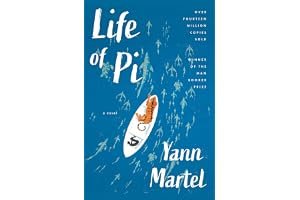
Yann Martel's imaginative and unforgettable Life of Pi is a magical reading experience, an endless blue expanse of storytelling about adventure, survival, and ultimately, faith. The precocious son of a zookeeper, 16-year-old Pi Patel is raised in Pondicherry, India, where he tries on various faiths for size, attracting "religions the way a dog attracts fleas." Planning a move to Canada, his father packs up the family and their menagerie and they hitch a ride on an enormous freighter. After a harrowing shipwreck, Pi finds himself adrift in the Pacific Ocean, trapped on a 26-foot lifeboat with a wounded zebra, a spotted hyena, a seasick orangutan, and a 450-pound Bengal tiger named Richard Parker ("His head was the size and color of the lifebuoy, with teeth"). It sounds like a colorful setup, but these wild beasts don't burst into song as if co-starring in an anthropomorphized Disney feature. After much gore and infighting, Pi and Richard Parker remain the boat's sole passengers, drifting for 227 days through shark-infested waters while fighting hunger, the elements, and an overactive imagination. In rich, hallucinatory passages, Pi recounts the harrowing journey as the days blur together, elegantly cataloging the endless passage of time and his struggles to survive: "It is pointless to say that this or that night was the worst of my life. I have so many bad nights to choose from that I've made none the champion."
The protagonist Piscine "Pi" Molitor Patel, an Indian boy from Pondicherry, explores the issues of religion and spirituality from an early age and survives 227 days shipwrecked in the Pacific Ocean.
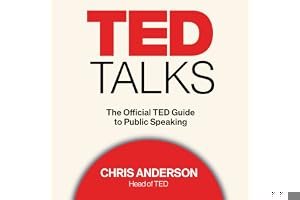
In Ted Talks Chris Anderson, head of TED, reveals the inside secrets of how to give a first-class presentation. Where books like Talk Like TED and TED Talks Storytelling whetted the appetite, here is the official TED guide to public speaking from the man who put TED talks on the world's stage. 'Nobody in the world better understands the art and science of public speaking than Chris Anderson. He is absolutely the best person to have written this book' Elizabeth Gilbert.
Anderson shares his five key techniques to presentation success: Connection, Narration, Explanation, Persuasion and Revelation (plus the three to avoid). He also answers the most frequently asked questions about giving a talk, from 'What should I wear?' to 'How do I handle my nerves?'.
Ted Talks is also full of presentation tips from such TED notable speakers as Sir Ken Robinson, Bill Gates, Mary Roach, Amy Cuddy, Elizabeth Gilbert, Dan Gilbert, Amanda Palmer, Matt Ridley and many more. This is a lively, fun read with great practical application from the man who knows what goes into a truly memorable speech. In Ted Talks Anderson pulls back the TED curtain for anyone who wants to learn how to prepare an exceptional presentation.
…
Recommended by Chris Anderson, Chris Anderson, Chris Anderson, and 1 others.
Chris Anderson
In Apollo week, a great book recommendation: this more than a story of a computer--it's about the first shot in the man vs machine battles (should astronauts be pilots or "spam in a can"?) that foreshadowed today's debates about drones & self driving cars https://t.co/CidYughKHz [source]
Chris Anderson
In Apollo week, a great book recommendation: this more than a story of a computer--it's about the first shot in the man vs machine battles (should astronauts be pilots or "spam in a can"?) that foreshadowed today's debates about drones & self driving cars https://t.co/CidYughKHz [source]
Chris Anderson
In Apollo week, a great book recommendation: this more than a story of a computer--it's about the first shot in the man vs machine battles (should astronauts be pilots or "spam in a can"?) that foreshadowed today's debates about drones & self driving cars https://t.co/CidYughKHz [source]
Cover unavailable
27
I Am a Story
Dan Yaccarino
4.3
Internationally acclaimed author-illustrator Dan Yaccarino presents a powerful picture book that celebrates storytelling—from the past to the present and beyond.
From cave drawings to the invention of the printing press to our digital age, discover how a story has been told in many different ways from the past to today. It’s always been around, making us happy, sad, excited, or scared and bringing people together. With simple text and delightful illustrations, Dan Yaccarino reminds us of the power of story.
…
Cover unavailable
28
The Name of the Wind (The Kingkiller Chronicle, #1)
Patrick Rothfuss
4.3
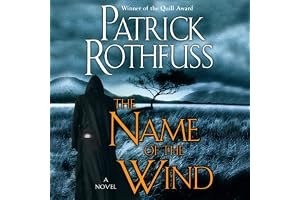
Told in Kvothe's own voice, this is the tale of the magically gifted young man who grows to be the most notorious wizard his world has ever seen.
The intimate narrative of his childhood in a troupe of traveling players, his years spent as a near-feral orphan in a crime-ridden city, his daringly brazen yet successful bid to enter a legendary school of magic, and his life as a fugitive after the murder of a king form a gripping coming-of-age story unrivaled in recent literature.
A high-action story written with a poet's hand, The Name of the Wind is a masterpiece that will transport readers into the body and mind of a wizard.
…
Recommended by Aubrey Marcus, Chris Albon, and Matt Schlicht.
Chris Albon
@WaltHickey I don’t really read fiction and randomly found that book, amazing. [source]
Matt Schlicht
@teej_m Read it. Love it. So amazing. Waiting for the last book and fear it may never come. [source]
Cover unavailable
29
Talk Like TED: The 9 Public-Speaking Secrets of the World's Top Minds
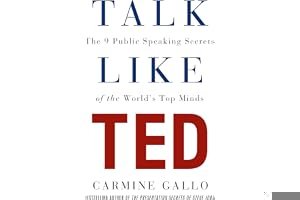
Ideas are the currency of the twenty-first century. In order to succeed, you need to be able to sell your ideas persuasively. This ability is the single greatest skill that will help you accomplish your dreams. Many people have a fear of public speaking or are insecure about their ability to give a successful presentation. Now public speaking coach and bestselling author Carmine Gallo explores what makes a great presentation by examining the widely acclaimed TED Talks, which have redefined the elements of a successful presentation and become the gold standard for public speaking. TED ? which stands for technology, entertainment, and design ? brings together the world's leading thinkers. These are the presentations that set the world on fire, and the techniques that top TED speakers use will make any presentation more dynamic, fire up any team, and give anyone the confidence to overcome their fear of public speaking.
In his book, Carmine Gallo has broken down hundreds of TED talks and interviewed the most popular TED presenters, as well as the top researchers in the fields of psychology, communications, and neuroscience to reveal the nine secrets of all successful TED presentations. Gallo's step-by-step method makes it possible for anyone to deliver a presentation that is engaging, persuasive, and memorable.
Carmine Gallo's top 10 Wall Street Journal Bestseller Talk Like TED will give anyone who is insecure about their public speaking abilities the tools to communicate the ideas that matter most to them, the skill to win over hearts and minds, and the confidence to deliver the talk of their lives.
The opinions expressed by Carmine Gallo in TALK LIKE TED are his own. His book is not endorsed, sponsored or authorized by TED Conferences, LLC or its affiliates.
…
Recommended by Emma Wedekind, Radu Marcusu, and Shaen Yeo.
A book that most recently made a difference for me was Talk Like TED: The 9 Public-Speaking Secrets of the World's Top Minds. My IMWorld speech this year benefited tremendously from Carmine Gallo's framing of the nine secrets of all time successful TED presentations. I believe Gallo's step-by-step method makes it possible for anyone to sell their ideas persuasively when delivering a presentation. … Talk like TED is NOT an optional book whatever career path you want to follow. A person can have the best idea in the World, but if that person can not convince enough people, it doesn’t matter. I’ve seen too many good ideas dim due to lack of pitching skills. This book will help you raise your game when it comes to selling your ideas. [source]
Shaen Yeo
In the book Talk like TED, there were a few suggestions on how to make my speech better. I tweaked the way I speak using the advice, and produced a speech like never before. I had many people coming up to shake my hands and offer me name cards! [source]
Cover unavailable
30
The Art of Dramatic Writing: Its Basis in the Creative Interpretation of Human Motives
Lajos Egri
4.3
Among the many "how-to" playwriting books that have appeared over the years, there have been few that attempt to analyze the mysteries of play construction. Lajos Egri's classic, The Art of Dramatic Writing, does just that, with instruction that can be applied equally well to a short story, novel, or screenplay. Examining a play from the inside out, Egri starts with the heart of any drama: its characters. All good dramatic writing hinges on people and their relationships, which serve to move the story forward and give it life, as well as an understanding of human motives - why people act the way that they do. Using examples from everything from William Shakespeare's Romeo and Juliet to Henrik Ibsen's A Doll's House, Egri shows how it is essential for the author to have a basic premise - a thesis, demonstrated in terms of human behavior - and to develop the dramatic conflict on the basis of that behavior. Using Egri's ABCs of premise, character, and conflict, The Art of Dramatic Writing is a direct, jargon-free approach to the problem of achieving truth in writing.
You know the authors' names. You recognize the title. You've probably used this book yourself. And now "The Elements of Style"-the most widely read and employed English style manual-is available in a specially bound 50th Anniversary Edition that offers the title's vast audience an opportunity to own a more durable and elegantly bound edition of this time-tested classic. Offering the same content as the Fourth Edition, revised in 1999, the new casebound 50th Anniversary Edition includes a brief overview of the book's illustrious history. Used extensively by individual writers as well as high school and college students of writing, it has conveyed the principles of English style to millions of readers. This new deluxe edition makes the perfect gift for writers of any age and ability level. Fifty Years of Acclaim for "The Elements of Style," by William Strunk Jr. and E.B. White "I first read "Elements of Style" during the summer before I went off to Exeter, and I still direct my students at Harvard to their definition about the difference between 'that' and 'which.' It is the Bible for good, clear writing." -- Henry Louis Gates Jr. "For writers of all kinds and sizes the world begins and ends with Strunk and White's "Elements of Style." Only something to actually write about trumps the list of what is required to put words together in some kind of coherent way. I treasure its presence in my life and salute its fifty years of glory and accomplishment." -- Jim Lehrer ""The Elements of Style" remains an unwavering beacon of light in these grammatically troubled times. I would be lost without it." -- Ann Patchett "To the extent I know how to write clearly at all, I probably taught myself while I was teaching others -- seventh graders, in Flint, Michigan, in 1967. I taught them with a copy of Strunk & White lying in full view on my desk, sort of in the way the Gideons leave Bibles in cheap hotel rooms, as a way of saying to the hapless inhabitant: 'In case your reckless ways should strand you here, there's help.' S&W doesn't really teach you how to write, it just tantalizingly reminds you that there's an orderly way to go about it, that clarity's ever your ideal, but -- really -- it's all going to be up to you." -- Richard Ford ""The Elements of Style" never seems to go out of date. Its counsel is sound and funny, wise and unpretentious. And while its precepts are a foundation of direct communication, Strunk and White do not insist on a way of writing beyond clear expression. The rest is up to the imagination, the intelligence within." -- David Remnick, editor of "The New Yorker" "It's the toughness-the irreverence and implicit laughter-that attracted me to the little book when I was seventeen. I fell in love with Strunk & White's loathing for cant and bloviation, the ruthless cutting of crap, jargon, and extra words. For me, that skeptical directness included a tacit permission by "The Elements of Style" to break its rules on occasion: an alloy of generosity in the blade, a grace I still admire and still learn from." -- Robert Pinsky "In the quest for clarity, one can have no better guides than Strunk and White. For me, their book has been invaluable and remains essential." -- Dan Rather "Eschew surplusage! A perfect book." --Jonathan Lethem "Not until I started teaching writing and I reread "The Elements of Style" did I realize that most everything I would be teaching young writers, and everything I would be learning myself as a writer, was contained between the covers of this slim, elegant, wise little book." -- Julia Alvarez "Strunk and White seared their way into my brain long ago, and I benefit from them daily." -- Steven J. Dubner, co-author of "Freakonomics" "Since high school, I have kept a copy of this book handy. That should be unnecessary. I should, by now, have fully internalized "The Elements of Style." But sometimes I get entangled in a paragraph that refuses to be 'clear, brief, bold.' I dip back into "The Elements of Style" and am refreshed. After Scott Simon interviewed me on NPR about whether the word 'e-mail' needs a hyphen (yes, it does), some listeners, including friends of mine, wondered why I had answered in the affirmative when asked, in passing, 'Are you a drunken white man?' Those listeners misheard. 'Strunk and White man' was what Scott said." -- Roy Blount Jr. "Strunk & White--writing's good-natured law firm--still contains enough sparkling good sense to clean up the whole bloviating blogosphere." -- Thomas Mallon "I used Strunk -- that's what we called it, Strunk -- as a student at Berkeley fifty years ago. I didn't know that it was new, and that we were the first generation to be educated in "The Elements of Style." I got a firm foundation in the English language, learned to write basically, and could depict the realistic world. Then I was able to become an impressionist and expressionist." -- Maxine Hong Kingston "Strunk and White's gigantic little book must be the most readable advice on writing ever written. Side by side with Roget, Shakespeare, the Bible, and a dictionary, it's an essential for every writer's shelf." -- X.J. Kennedy" ""With what joy I welcome the fiftieth anniversary of "The Elements of Style." I am greatly indebted to this book for the invaluable help it has given me all these years." -- Horton Foote "Elegant, droll, and perfectly proportioned, and like your favorite aunt, strict but affectionate. And, like your favorite aunt, full of optimism: You can, and will, be a better writer! There has never been a better, briefer, or more loved book about the art and craft of communicating." -- Susan Orlean "This book is an essential tool. It has been of great use to me and is probably responsible for my best writing. I owe my success to Strunk and White; only the mistakes are mine." -- Ben Affleck, in "O, the Oprah Magazine" "This book is a wonderful example of teaching by example. Not only does it recommend clear and concise writing, it demonstrates it. Written in the style of a friend offering help, it is a godsend to anyone wanting to put words on paper. Thank you, Messieurs Strunk and White. And Happy Anniversary, "Elements of Style."" -- S.E. Hinton "When I began to have ... I wouldn't say arguments but conversations in my mind with Strunk and White about a few of their rules and principles, I knew I was coming into my own. If only they were still here to talk things over! No doubt their side of the exchange would be kindly put, well-informed, and wise. They'd probably help me with my side of it. What more could one want from writers reaching out to help other writers?" -- Barbara Wallraff, language columnist for "The Atlantic" "I don't believe there is a serious writer alive who doesn't have a worn copy of 'Strunk & White'on his or her bookshelf." -- Mignon Fogarty, author of "Grammar Girl's Quick and Dirty Tips ""for Better Writing" "This little book has inspired hundreds of thousands of people to write better -- partly by precept and partly by example. It continues to influence more writers than any other. It's a force for good in the world." -- Bryan A. Garner, author of "Garner's Modern American Usage" "I can think of no better guide to good writing, and I always think of this little classic with a warm heart. More importantly, I revisit its pages often. It's the one essential book on writing." -- Jay Parini, author of "Why Poetry Matters" "Clarity and simplicity have always been the goals, and this book shows the way. It has always been a lighthouse in the dark and stormy night of student prose, of all of our prose." -- Ron Carlson "The only rules you are ever going to get from me are all in Strunk and White." --Ursula K. Le Guin, from "Steering the Craft " "["The Elements of Style "is] a book to which I return from time to time, the way I periodically reread Shakespeare. I always discover something new, settle a question that has been puzzling me, or learn a principle of usage that I have been pretending to know, a pretense that has resulted in inconsistency and in the sort of errors from which I can only pray some saintly copy editor will save me." -- Francine Prose, from "Reading"" Like A Writer" ..".still a little book, small enough and important enough to carry in your pocket, as I carry mine." -- Charles Osgood "Almost every writer has a Strunk and White story. One journalism professor spends the first two weeks of school forcing his students to memorize the book. A top editor at a major paper buys copies at yard sales to distribute to her writers and interns. It has even caused love affairs. . . . Could its greatness be any more clear?" -- Jesse Sheidlower, American Editor of the "Oxford"" English Dictionary," on NPR" ""If the English language is one of the finest homes ever devised for the human spirit, "Elements" is the best guided house tour we've got." --David Gelernter, "The Wall Street Journal" ..".Should be the daily companion of anyone who writes for a living and, for that matter, anyone who writes at all." "--"Jonathan Yardley, " Greensboro (N.C.) Daily News" "No book in shorter space, with fewer words, will help any writer more than this persistent little volume." -- Herbert A. Kenny, "The Boston Globe" "Buy it, study it, enjoy it. It's as timeless as a book can be in our age of volubility." -- Charles Poore, "The New York Times" "White is one of the best stylists and most lucid minds in this country. What he says and his way of saying it are equally rewarding." "-- "Edmund Fuller, "The Wall Street Journal ""If you have any young friends who aspire to become writers, the second greatest favor you can do them is to present them with copies of "The Elements of Style." The first greatest, of course, is to shoot them now, while they're happy." -- Dorothy Parker, "Esquire"
…
Recommended by Tobi Lütke, Alina Varlanuta, Ann Handley, and 3 others.
Tobi Lütke
Founder & CEO/Shopify
My most frequently gifted book is this book because I like good writing. [source]
Alina Varlanuta
My professional path – copywriting – somehow intertwines with my unprofessional (hahaha) path – writing so I would recommend reading literature for both. Somehow reading and writing are two ways of doing the same thing: storytelling (even when you read you tell yourself a story in your own voice, bringing your personal emotion and empathy to the story you’re reading). The only difference is that when I’m reading, panic is far away from me, in a safe place. Nevertheless, the words below helped me rewrite and think twice before adding an exclamation point: The Elements of Style. [source]
Bill Nye
This is my guide. I accept that I’ll never write anything as good as the introductory essay by the author. It’s brilliant. [source]
Cover unavailable
32
Storyworthy: Engage, Teach, Persuade, and Change Your Life through the Power of Storytelling
Matthew Dicks
4.3
Cover unavailable
33
Making Comics: Storytelling Secrets of Comics, Manga and Graphic Novels
Scott McCloud
4.3
"Magnificent! The best how-to manual ever published." — Kevin Kelly, Cool Tools
Scott McCloud tore down the wall between high and low culture in 1993 with Understanding Comics, a massive comic book about comics, linking the medium to such diverse fields as media theory, movie criticism, and web design. In Reinventing Comics, McCloud took this to the next level, charting twelve different revolutions in how comics are generated, read, and perceived today. Now, in Making Comics, McCloud focuses his analysis on the art form itself, exploring the creation of comics, from the broadest principles to the sharpest details (like how to accentuate a character's facial muscles in order to form the emotion of disgust rather than the emotion of surprise.) And he does all of it in his inimitable voice and through his cartoon stand–in narrator, mixing dry humor and legitimate instruction. McCloud shows his reader how to master the human condition through word and image in a brilliantly minimalistic way. Both comic book devotees and the uninitiated will marvel at this journey into a once–underappreciated art form.
…
Recommended by Bret Victor.
Cover unavailable
34
Women Who Run With the Wolves: Myths and Stories of the Wild Woman Archetype
Clarissa Pinkola Estés
4.3
Within every woman there is a wild and natural creature, a powerful force, filled with good instincts, passionate creativity, and ageless knowing. Her name is Wild Woman, but she is an endangered species. Clarissa Pinkola Estes, Ph.D., Jungian analyst and cantadora storyteller shows how women's vitality can be restored through what she calls "psychic archeological digs" into the ruins of the female unconsious. Using multicultural myths, fairy tales, folk tales, and stories, Dr. Estes helps women reconnect with the healthy, instinctual, visionary attributes of the Wild Woman archetype.
Dr. Estes has created a new lexicon for describing the female psyche. Fertile and life-giving, it is a psychology of women in the truest sense, a knowing of the soul.
I’m reading more books at the same time. Guilty. Some of them are Tools of Titans - Tim Ferriss, My Berlin Child – Anne Wiazemsky, Women who Run with the Wolves - Clarissa Pinkola Estés. Tim is full of lessons to learn, remember & implement, I’ll see what the rest of the books will unfold. [source]
Cover unavailable
35
Invisible Ink: A Practical Guide to Building Stories That Resonate
Brian McDonald
4.3
Acclaimed by successful screenwriters and authors, Invisible Ink is a helpful, accessible guide to the essential elements of the best storytelling. Brian McDonald, an award winning screenwriter who has taught his craft at several major studios, supplies writers with tools to make their work more effective and provides readers and audiences a deeper understanding of the storyteller's art. When people think of a screenplay, they usually think about dialogue-the "visible ink" that is readily accessible to the listener, reader, or viewer. But a successful screenplay needs Invisible Ink as well, the craft below the surface of words. Invisible Ink lays out the essential elements of screenplay structure, using vivid examples from famous moments in popular movies as well as from one of his own popular scripts. You will learn techniques for building a compelling story around a theme, making your writing engage audiences, creating appealing characters, and much more. Praise for Invisible Ink: ..".If I manage to reach the summit of my next story it will be in no small part due to having read Invisible Ink." -Andrew Stanton (cowriter Toy Story, Toy Story 2, A Bug's Life, Monsters, Inc., and cowriter/director Finding Nemo and WALL-E) ..".Brian McDonald uses his deep understanding of story and character to pass on essential truths about dramatic writing. Ignore him at your peril." -Jim Taylor (Academy Award-winning screenwriter of Sideways and Election) ..". I recommend this fine handbook on craft to any writer, apprentice or professional, working in any genre or form." -Dr. Charles Johnson (National Book Award-winning author of Middle Passage) "If you want to write scripts, listen to Brian. The guy knows what he's talking about." -Paul Feig (creator of NBC's Freaks and Geeks, co-executive producer The Office) "With Invisible Ink Brian McDonald has written us a book to keep and heed forever because through the simple, graceful, graspable, original wisdom of it, we might just save our screenwriting lives." -Stewart Stern (Screenwriter of Rebel Without a Cause)
…
Cover unavailable
36
Winning the Story Wars: Why Those Who Tell (and Live) the Best Stories Will Rule the Future
Jonah Sachs
4.3
Does your brand tell a story?
In Winning the Story Wars, globally recognized storyteller, designer and entrepreneur Jonah Sachs argues that only those brands that tell values-driven stories through the right channels will revolutionize marketing. Above that, they may become humanity’s greatest hope for the future.
It’s no surprise that most of today’s marketing messages are swallowed up in a flood of noise the minute they hit the market, with thousands of ads and emails hitting each recipient on a weekly basis. And those recipients, empowered by social media tools and on-demand viewing, will ignore you in favor of something they’d prefer to seek out themselves. Sachs cites a quote from the former advertising chief at Macy’s and Citigroup to emphasize this point: “The irony is that while there have never been more ways to reach consumers, it's never been harder to connect with consumers.”
For those of us who not only want to be heard, but need to be heard to create a better future—the time has come to cross the chasm with the only strategic approach that has ever really worked: telling great stories.
In Winning the Story Wars, Sachs systematically breaks down how communicators can go beyond the sell by creating stories that inspire people not just to listen, but to proselytize. The President and co-founder of Free Range Studios, Sachs has been a David among Goliaths helping hundreds of for-profit and non-profit organizations rise above the din with campaigns built around the internal structures of ancient myth. Even with a modest budget, his first two viral media efforts—The Meatrix and Store Wars—alone yielded forty million viewers. Drawing on the wisdom of Carl Jung and Joseph Campbell, Sachs will guide readers to harness myth-making powers of their very own. Weaving prescriptive tools throughout the book, Sachs will help communicators:
• Identify and learn the best myth structures at work today • Find a tight-knit audience of evangelists to spread the word • Foster the image of their audience as potential heroes • Watch the message take on a life of its own
This book will speak to the message-makers in any type of company or organization. The Story Wars have long been underway, now it's time for heroic communicators to turn the tides away from simple selling, and towards real inspiration.
…
Recommended by Deepak Chopra, Bill Bradley, Cat Williams-Treloar, and 1 others.
Great leaders transform the world through stories that inspire hope, stability, trust, compassion, and authenticity. This important and thought-provoking book shows that leadership in marketing will require the living and telling of such stories as well. [source]
Bill Bradley
We know about who we are both individually and as a society through stories. In this brilliant book, Jonah Sachs tells us how we lost our storytelling capacity and how we must regain it, constructing our own myths and living the truth of the stories we tell. [source]
Cat Williams-Treloar
Jonah Sachs "Winning the Story Wars" - without a great story you've got nothing. We are rediscovering this as Marketers that stories win a noisy, digital world. Jonah does an excellent job of laying out all the steps you need to tell a compelling story. [source]
Cover unavailable
37
Jab, Jab, Jab, Right Hook: How to Tell Your Story in a Noisy Social World
The New York Times bestselling author and social media expert returns with hard-won advice on how to connect with customers and beat the competition by mastering social media marketing
When managers and marketers outline their social media strategies, they often plan for the "right hook"-their next highly anticipated sale or campaign that's going to put the competition out for the count. Even companies committed to jabbing-patiently engaging with customers to build the relationships so crucial to successful social media campaigns-still yearn to land the powerful, bruising swing that will knock out their opponent or their customer's resistance in one tooth-spritzing, killer blow. Right hooks, after all, convert traffic to sales. They easily show results and ROI. Except when they don't.
In the same passionate, street-wise style readers have come to expect, Gary Vaynerchuk is on a mission to improve marketers' right hooks by changing the way they fight to make their customers happy, and ultimately to compete. Thanks to the massive change and proliferation in social media platforms in the last four years, the winning combination of jabs and right hooks is different now. Communication is still key, but context matters more than ever. It's not just about developing high-quality content, but developing high-quality content perfectly adapted to specific social media platforms and mobile devices-content tailor-made for Facebook, YouTube, Instagram, Pinterest, Twitter, and Tumblr. A mash-up of the best elements of Crush It! and The Thank You Economy with a 2013 spin, here is a blueprint to social media marketing strategies that really works.
…
Recommended by Daymond John, Marvin Liao, Aaron Agius, and 35 others.
Marvin Liao
Partner/500 Startups
My list would be (besides the ones I mentioned in answer to the previous question) both business & Fiction/Sci-Fi and ones I personally found helpful to myself. The business books explain just exactly how business, work & investing are in reality & how to think properly & differentiate yourself. On the non-business side, a mix of History & classic fiction to understand people, philosophy to make sense of life and Science fiction to picture what the future could be like (not always utopian). [source]
Alex Circei
Question: What five books would you recommend to young people interested in your career path & why? Answer: Screw It, Let's Do It: Lessons In Life by Richard Branson Outliers: The Story of Success by Malcolm Gladwell Start With Why: How Great Leaders Inspire Everyone To Take Action by Simon Sinek The Hard Thing About Hard Things: Building a Business When There Are No Easy Answers by Ben Horowitz Rich Dad Poor Dad: What the Rich Teach Their Kids About Money That the Poor and Middle Class Do Not! by Robert T. Kiyosaki [source]
Auston Bunsen
I’ve got a few, one book that really impacted me early on as someone coming from a middle-class family was “Rich dad, Poor dad”. [source]
Cover unavailable
38
Screenplay: The Foundations of Screenwriting
Syd Field
4.2
A generation of screenwriters has used Syd Field’s bestselling books to ignite successful careers in film. Now the celebrated producer, lecturer, teacher, and bestselling author has updated his classic guide for a new generation of filmmakers, offering a fresh insider’s perspective on the film industry today. From concept to character, from opening scene to finished script, here are easily understood guidelines to help aspiring screenwriters—from novices to practiced writers—hone their craft. Filled with updated material—including all-new personal anecdotes and insights, guidelines on marketing and collaboration, plus analyses of recent films, from American Beauty to Lord of the Rings—Screenplay presents a step-by-step, comprehensive technique for writing the screenplay that will succeed in Hollywood. Discover:
•Why the first ten pages of your script are crucially important •How to visually “grab” the reader from page one, word one •Why structure and character are the essential foundation of your screenplay •How to adapt a novel, a play, or an article into a screenplay •Tips on protecting your work—three legal ways to claim ownership of your screenplay •The essentials of writing great dialogue, creating character, building a story line, overcoming writer’s block, getting an agent, and much more.
With this newly updated edition of his bestselling classic, Syd Field proves yet again why he is revered as the master of the screenplay—and why his celebrated guide has become the industry’s gold standard for successful screenwriting.
…
Cover unavailable
39
A Million Miles in a Thousand Years: What I Learned While Editing My Life
Donald Miller
4.2
Full of beautiful, heart-wrenching, and hilarious stories, A Million Miles in a Thousand Years details one man's opportunity to edit his life as if he were a character in a movie.
Years after writing his best-selling memoir, Donald Miller went into a funk and spent months sleeping in and avoiding his publisher. One story had ended, and Don was unsure how to start another.
But he gets rescued by two movie producers who want to make a movie based on his memoir. When they start fictionalizing Don's life for film--changing a meandering memoir into a structured narrative--the real-life Don starts a journey to edit his actual life into a better story. A Million Miles in a Thousand Years details that journey and challenges readers to reconsider what they strive for in life. It shows how to get a second chance at life the first time around.
"A must read for anyone hoping to live a creative life... I dare you not to be inspired to be brave, to be free, and to be curious.” —PopSugar
From the worldwide bestselling author of Eat Pray Love and City of Girls: the path to the vibrant, fulfilling life you’ve dreamed of
Readers of all ages and walks of life have drawn inspiration and empowerment from Elizabeth Gilbert’s books for years. Now this beloved author digs deep into her own generative process to share her wisdom and unique perspective about creativity. With profound empathy and radiant generosity, she offers potent insights into the mysterious nature of inspiration. She asks us to embrace our curiosity and let go of needless suffering. She shows us how to tackle what we most love, and how to face down what we most fear. She discusses the attitudes, approaches, and habits we need in order to live our most creative lives. Balancing between soulful spirituality and cheerful pragmatism, Gilbert encourages us to uncover the “strange jewels” that are hidden within each of us. Whether we are looking to write a book, make art, find new ways to address challenges in our work, embark on a dream long deferred, or simply infuse our everyday lives with more mindfulness and passion, Big Magic cracks open a world of wonder and joy.
I read a bunch of books on writing before I wrote my first book and the two that stuck with me were Stephen King’s book and “On Writing Well” by Zinsser (which is a bit on the technical side). I was also surprised by how much I enjoyed Elizabeth Gilbert’s “Big Magic.” [source]
Chelsea Frank
I read everything with an open mind, often challenging myself by choosing books with an odd perspective or religious/spiritual views. These books do not reflect my personal feelings but are books that helped shape my perspective on life, love, and happiness. [source]
Cover unavailable
41
Stories That Stick: How Storytelling Can Captivate Customers, Influence Audiences, and Transform Your Business
The moment you take control of your stories, you take control of your business and your life.
You keep hearing how story is the latest-and-greatest business tool, and that storytelling can do everything—from helping leaders better communicate to motivating sales teams and winning customers away from competitors.
But what stories do you need to tell? And how do you tell them?
In Stories That Stick, Kindra Hall, professional storyteller and nationally-known speaker, reveals the four unique stories you can use to differentiate, captivate, and elevate:
the Value Story, to convince customers they need what you provide; the Founder Story, to persuade investors and customers your organization is worth the investment; the Purpose Story, to align and inspire your employees and internal customers; and the Customer Story, to allow those who use your product or service to share their authentic experiences with others.
Telling these stories well is a simple, accessible skill anyone can develop. With case studies, company profiles, and anecdotes backed with original research, Hall presents storytelling as the underutilized talent that separates the good from the best in business. She offers specific, actionable steps readers can take to find, craft, and leverage the stories they already have and simply aren’t telling.
Every person, every organization has at least four stories at their disposal. Will you tell yours?
The physics of vulnerability is simple: If we are brave enough often enough, we will fall. The author of Daring Greatly and The Gifts of Imperfection tells us what it takes to get back up, and how owning our stories of disappointment, failure, and heartbreak gives us the power to write a daring new ending. Struggle, Brené Brown writes, can be our greatest call to courage, and rising strong our clearest path to deeper meaning, wisdom, and hope.
…
Recommended by AnneMarie Schindler, Chelsea Frank, and Shaen Yeo.
AnneMarie Schindler
I just started Rising Strong by Brene Brown. I'm turning 35 this year, and emotional intelligence isn't something that comes naturally to me. Brown's previous books have always pushed me into a space that's uncomfortable and rewarding. As a wife, parent, and entrepreneur, I'm expecting the book to help uncover some blind spots in each of those roles. [source]
Chelsea Frank
I read everything with an open mind, often challenging myself by choosing books with an odd perspective or religious/spiritual views. These books do not reflect my personal feelings but are books that helped shape my perspective on life, love, and happiness. [source]
Shaen Yeo
Non-business - Rising Strong, because it is so real, vulnerable AND full of wise nuggets which inspire me to be resilient in my life. [source]
Cover unavailable
43
Lead with a Story: A Guide to Crafting Business Narratives That Captivate, Convince, and Inspire
Paul Smith
4.2
Storytelling has come of age in the business world. Today, many of the most successful companies use storytelling as a leadership tool. At Nike, all senior executives are designated "corporate storytellers." 3M banned bullet points years ago and replaced them with a process of writing "strategic narratives." Procter & Gamble hired Hollywood directors to teach its executives storytelling techniques. Some forward-thinking business schools have even added storytelling courses to their management curriculum. The reason for this is simple: Stories have the ability to engage an audience the way logic and bullet points alone never could. Whether you are trying to communicate a vision, sell an idea, or inspire commitment, storytelling is a powerful business tool that can mean the difference between mediocre results and phenomenal success. "Lead with a Story" contains both ready-to-use stories and how-to guidance for readers looking to craft their own. Designed for a wide variety of business challenges, the book shows how narrative can help: - Define culture and values - Engender creativity and innovation - Foster collaboration and build relationships - Provide coaching and feedback - Lead change - And more Whether in a speech or a memo, communicated to one person or a thousand, storytelling is an essential skill for success. Complete with examples from companies like Kellogg's, Merrill-Lynch, Procter & Gamble, National Car Rental, Wal-Mart, Pizza Hut, and more, this practical resource gives readers the guidance they need to deliver stories to stunning effect.
…
Cover unavailable
44
Unleash the Power of Storytelling: Win Hearts, Change Minds, Get Results
TED Talks Storytelling: 23 Storytelling Techniques from the Best TED Talks
Akash Karia
4.2
Cover unavailable
46
The Storyteller's Secret: From TED Speakers to Business Legends, Why Some Ideas Catch On and Others Don't
CARMINE GALLO
4.2
How did an American immigrant without a college education go from Venice Beach T-Shirt vendor to television's most successful producer? How did a timid pastor's son surmount a paralyzing fear of public speaking to sell out Yankee stadium, twice? How did the city of Tokyo create a PowerPoint stunning enough to win it the chance to host the Olympics?
They told brilliant stories.
In his hugely attendedTalk Like TED events, bestselling author and communications guru Carmine Gallo found, again and again, that audiences wanted to discover the keys to telling powerful stories; inspiring stories that could galvanize movements and actuate global change. And indeed, whether your goal is to sell, educate, fundraise, or entertain, your story is your most valuable asset. A well told story hits you like a punch to the gut; it triggers the light bulb moment, the 'aha' that illuminates the path to innovation. Your story is "a strategic tool with irresistible power," according to the NYT. Radical transformation can occur in an instant, with a single sentence; The Storyteller's Secret lets you craft your most powerful delivery ever.
In The Storyteller's Secret, Gallo offers lessons from a range of visionary leaders, each of whom cites storytelling as a crucial ingredient in success. A good story can spark action and passion; it can revolutionize the way people think and spur them to chase their dreams. Isn't it time you shared yours?
…
Recommended by Julia Enthoven.
Julia Enthoven
Since Kapwing is still a very young company, The Storyteller’s Secret helps me think about how I can communicate the origin story of Kapwing to our users and other people. I’m enjoying both! [source]
Cover unavailable
47
Creating Character Arcs: The Masterful Author's Guide to Uniting Story Structure, Plot, and Character Development (Helping Writers Become Authors Book 7)
K.M. Weiland
4.2
About the Book
Powerful Character Arcs Create Powerful Stories
Have you written a story with an exciting concept and interesting characters—but it just isn’t grabbing the attention of readers or agents? It’s time to look deeper into the story beats that create realistic and compelling character arcs. Internationally published, award-winning novelist K.M. Weiland shares her acclaimed method for achieving memorable and moving character arcs in every book you write.
By applying the foundation of the Three-Act Story Structure and then delving even deeper into the psychology of realistic and dynamic human change, Weiland offers a beat-by-beat checklist of character arc guidelines that flexes to fit any type of story.
This comprehensive book will teach you:
How to determine which arc—positive, negative, or flat—is right for your character. Why you should NEVER pit plot against character. Instead, learn how to blend story structure and character development. How to recognize and avoid the worst pitfalls of writing novels without character arcs. How to hack the secret to using overarching character arcs to create amazing trilogies and series. And much more!
Gaining an understanding of how to write character arcs is a game-changing moment in any author’s pursuit of the craft.
Bring your characters to unforgettable and realistic life—and take your stories from good to great!
…
Cover unavailable
48
The Night Gardener
Jonathan Auxier
4.2
This much-anticipated follow-up to Jonathan Auxier’s exceptional debut, Peter Nimble and His Fantastic Eyes, is a Victorian ghost story with shades of Washington Irving and Henry James. More than just a spooky tale, it’s also a moral fable about human greed and the power of storytelling.
The Night Gardener follows two abandoned Irish siblings who travel to work as servants at a creepy, crumbling English manor house. But the house and its family are not quite what they seem. Soon the children are confronted by a mysterious spectre and an ancient curse that threatens their very lives. With Auxier’s exquisite command of language, The Night Gardener is a mesmerizing read and a classic in the making.
…
Cover unavailable
49
Improving Your Storytelling: Beyond the Basics for All Who Tell Stories in Work or Play
Doug Lipman
4.2
The first steps in storytelling are often easy, because we tell stories informally every day. Once you take storytelling into the more formal contexts of performance or occupational uses, however, you may be faced with challenges you hadn't anticipated. You need information that goes beyond the basics. And you need it in a form that does not just tell you what to do but helps you make your own informed decisions. This book is meant for the reader who has already begun to tell stories and is ready to learn more about the art. Instead of rules to follow, it gives you a series of frameworks that encourage you to think on your feet. Doug Lipman has written and taught extensively on the art of storytelling. With the same generosity and warmth that characterize his workshops, he considers the teller's relationship to the story, the teller's relationship to the audience, and the transfer of imagery in a medium that is simultaneously visual, auditory, and kinesthetic.
…
Cover unavailable
50
Storyteller's Start-Up Book
Margaret Read MacDonald
4.2
Finding, learning, performing, and using folktales. For those who want to begin storytelling but don't know where to start, The Storyteller's Start-Up Book offers everything one could ask for. Margaret Read MacDonald, an award-winning folklorist and children's librarian who is also a touring storyteller, offers basic start-up information on finding stories, looking at them critically, starting a "story bank," networking with other storytellers, and creating a storytelling event. In chapters on learning and performing folktales, MacDonald offers the reader suggestions for finding his or her own performance style. Most importantly, MacDonald presents twelve fool-proof tales that will work for the first-time storyteller. Arranged in ethnopoetic style to relay a sense of rhythm, the stories encourage audience participation and feature enough repetition to make them easy to remember. These multicultural tales selected from the folklore of Angola, Canada, Ghana, Nigeria, Siberia, Wales, and Zaire will delight any audience. Includes excellent bibliographies to help the new teller continue to explore the world of storytelling.
…
Cover unavailable
51
Circe
Madeline Miller
4.2
In the house of Helios, god of the sun and mightiest of the Titans, a daughter is born. But Circe is a strange child—not powerful, like her father, nor viciously alluring like her mother. Turning to the world of mortals for companionship, she discovers that she does possess power—the power of witchcraft, which can transform rivals into monsters and menace the gods themselves.
Threatened, Zeus banishes her to a deserted island, where she hones her occult craft, tames wild beasts and crosses paths with many of the most famous figures in all of mythology, including the Minotaur, Daedalus and his doomed son Icarus, the murderous Medea, and, of course, wily Odysseus.
But there is danger, too, for a woman who stands alone, and Circe unwittingly draws the wrath of both men and gods, ultimately finding herself pitted against one of the most terrifying and vengeful of the Olympians. To protect what she loves most, Circe must summon all her strength and choose, once and for all, whether she belongs with the gods she is born from, or the mortals she has come to love.
…
Recommended by Jacqui Pretty and Jason Kottke.
Jacqui Pretty
When it comes to fiction, there are so many to choose from! Some books I've loved in the past year include Circe by Madeline Miller. [source]
Jason Kottke
Another contemporary reinterpretation of Greek mythology from the perspective of a woman. I’m 3/4s of the way through Circe right now and I might like it even more than The Odyssey. [source]
Cover unavailable
52
Watership Down
Richard Adams
4.1
Set in England's Downs, a once idyllic rural landscape, this stirring tale of adventure, courage and survival follows a band of very special creatures on their flight from the intrusion of man and the certain destruction of their home. Led by a stouthearted pair of friends, they journey forth from their native Sandleford Warren through the harrowing trials posed by predators and adversaries, to a mysterious promised land and a more perfect society.
…
Recommended by Jennifer Gunter, M G Leonard, Philip Reeve, and 1 others.
@SuetheLibrarian I suppose if you only have one great book in you Watership Down is knocking it out of the park! [source]
M G Leonard
My view of the countryside changed forever after reading the book. [source]
Philip Reeve
Watership Down is one of the most famous animal adventures ever written. It is a far stranger book than many people expect. [source]
Cover unavailable
53
The Tiger's Wife
Téa Obreht
4.1
Weaving a brilliant latticework of family legend, loss, and love, Téa Obreht, the youngest of The New Yorker’s twenty best American fiction writers under forty, has spun a timeless novel that will establish her as one of the most vibrant, original authors of her generation.
In a Balkan country mending from years of conflict, Natalia, a young doctor, arrives on a mission of mercy at an orphanage by the sea. By the time she and her lifelong friend Zóra begin to inoculate the children there, she feels age-old superstitions and secrets gathering everywhere around her. Secrets her outwardly cheerful hosts have chosen not to tell her. Secrets involving the strange family digging for something in the surrounding vineyards. Secrets hidden in the landscape itself.
But Natalia is also confronting a private, hurtful mystery of her own: the inexplicable circumstances surrounding her beloved grandfather’s recent death. After telling her grandmother that he was on his way to meet Natalia, he instead set off for a ramshackle settlement none of their family had ever heard of and died there alone. A famed physician, her grandfather must have known that he was too ill to travel. Why he left home becomes a riddle Natalia is compelled to unravel.
Grief struck and searching for clues to her grandfather’s final state of mind, she turns to the stories he told her when she was a child. On their weeklytrips to the zoo he would read to her from a worn copy of Rudyard Kipling’s The Jungle Book, which he carried with him everywhere; later, he told her stories of his own encounters over many years with “the deathless man,” a vagabond who claimed to be immortal and appeared never to age. But the most extraordinary story of all is the one her grandfather never told her, the one Natalia must discover for herself. One winter during the Second World War, his childhood village was snowbound, cut off even from the encroaching German invaders but haunted by another, fierce presence: a tiger who comes ever closer under cover of darkness. “These stories,” Natalia comes to understand, “run like secret rivers through all the other stories” of her grandfather’s life. And it is ultimately within these rich, luminous narratives that she will find the answer she is looking for.
…
Recommended by Caterina Fake.
Cover unavailable
54
Story Engineering: Character Development, Story Concept, Scene Construction
Larry Brooks
4.1
Cover unavailable
55
Haroun and the Sea of Stories (Khalifa Brothers, #1)
Salman Rushdie, Paul Birkbeck, Paul Brickbeck
4.1
Alternate cover for this ISBN can be found here
Discover Haroun and the Sea of Stories, Salman Rushdie’s classic fantasy novel
Set in an exotic Eastern landscape peopled by magicians and fantastic talking animals, Salman Rushdie's classic children's novel Haroun and the Sea of Stories inhabits the same imaginative space as The Lord of the Rings, The Alchemist, and The Wizard of Oz. In this captivating work of fantasy from the author of Midnight’s Children and The Enchantress of Florence, Haroun sets out on an adventure to restore the poisoned source of the sea of stories. On the way, he encounters many foes, all intent on draining the sea of all its storytelling powers.
…
Cover unavailable
56
The Seven Basic Plots: Why We Tell Stories
Christopher Booker
4.1
This remarkable and monumental book at last provides a comprehensive answer to the age-old riddle of whether there are only a small number of 'basic stories' in the world. Using a wealth of examples, from ancient myths and folk tales via the plays and novels of great literature to the popular movies and TV soap operas of today, it shows that there are seven archetypal themes which recur throughout every kind of storytelling. But this is only the prelude to an investigation into how and why we are 'programmed' to imagine stories in these ways, and how they relate to the inmost patterns of human psychology.
Drawing on a vast array of examples, from Proust to detective stories, from the Marquis de Sade to E.T., Christopher Booker then leads us through the extraordinary changes in the nature of storytelling over the past 200 years, and why so many stories have 'lost the plot' by losing touch with their underlying archetypal purpose. Booker analyses why evolution has given us the need to tell stories and illustrates how storytelling has provided a uniquely revealing mirror to mankind's psychological development over the past 5000 years.
This seminal book opens up in an entirely new way our understanding of the real purpose storytelling plays in our lives, and will be a talking point for years to come.
…
Cover unavailable
57
The Faraway Nearby
Rebecca Solnit
4.1
In this new book by the author of A Paradise Built in Hell, Rebecca Solnit explores the ways we make our lives out of stories, and how we are connected by empathy, by narrative, by imagination. In the course of unpacking some of her own stories—of her mother and her decline from memory loss, of a trip to Iceland, of an illness—Solnit revisits fairytales and entertains other stories: about arctic explorers, Che Guevara among the leper colonies, and Mary Shelley’s Dr. Frankenstein, about warmth and coldness, pain and kindness, decay and transformation, making art and making self. Woven together, these stories create a map which charts the boundaries and territories of storytelling, reframing who each of us is and how we might tell our story.
…
Cover unavailable
58
Where the Wild Things Are
Maurice Sendak
4.1
Max, a wild and naughty boy, is sent to bed without his supper by his exhausted mother. In his room, he imagines sailing far away to a land of Wild Things. Instead of eating him, the Wild Things make Max their king.
During a trip to a public library in Washington’s Anacostia neighborhood in 2015, Obama shared some of his childhood favorites with a group of young students. He also read (and acted out) Where the Wild Things Are by Maurice Sendak to kids at the White House in 2014. [source]
Today is World Book Day, a wonderful opportunity to address this #ChallengeRichard sent in by Mike Gonzalez of New Jersey: Make a list of your top 65 books to read in a lifetime. [source]
In this photo, Jimmy Fallon and I enjoy slurping Eggs of Newt together for Season-5 of “The Martha Stewart Show." I am dressed as "Queen of the Wild Things" inspired by the beloved Maurice Sendak children's book, "Where the Wild Things Are." https://t.co/1ZBqXEW7dC [source]
Cover unavailable
59
Plot & Structure: Techniques and Exercises for Crafting a Plot That Grips Readers from Start to Finish
James Scott Bell
4.1
Craft an Engaging Plot
How does plot influence story structure? What's the difference between plotting for commercial and literary fiction? How do you revise a plot or structure that's gone off course?
With "Write Great Fiction: Plot & Structure," you'll discover the answers to these questions and more. Award-winning author James Scott Bell offers clear, concise information that will help you create a believable and memorable plot, including: Techniques for crafting strong beginnings, middles, and endsEasy-to-understand plotting diagrams and chartsBrainstorming techniques for original plot ideasThought-provoking exercises at the end of each chapterStory structure models and methods for all genresTips and tools for correcting common plot problems
Filled with plot examples from popular novels, comprehensive checklists, and practical hands-on guidance, "Write Great Fiction: Plot & Structure" gives you the skills you need to approach plot and structure like an experienced pro.
…
Cover unavailable
60
Where the Mountain Meets the Moon
Grace Lin
4.1
In the valley of Fruitless Mountain, a young girl named Minli spends her days working hard in the fields and her nights listening to her father spin fantastic tales about the Jade Dragon and the Old Man of the Moon. Minli's mother, tired of their poor life, chides him for filling her head with nonsense. But Minli believes these enchanting stories and embarks on an extraordinary journey to find the Old Man of the Moon and ask him how her family can change their fortune. She encounters an assorted cast of characters and magical creatures along the way, including a dragon who accompanies her on her quest.
Source: Jacket flap
…
Cover unavailable
61
Out on the Wire: Uncovering the Secrets of Radio's New Masters of Story with Ira Glass
Jessica Abel
4.1
A graphic narrative that takes readers behind-the-scenes of five of today's most popular narrative radio shows, including This American Life and RadioLab.
Every week, millions of devoted fans download or tune in to This American Life, The Moth, Radiolab, Planet Money, Snap Judgment, and other narrative radio shows. The pieces captivating listeners are by turns funny, heartbreaking, and profound. Using personal stories to breathe life into abstractions, these programs help us--all in the space of an hour or less--to understand ourselves and our world a little bit better. Each of these beloved shows has a distinct style, but every one delivers stories that are brilliantly told and produced. Out on the Wire offers an unexpected window into this new kind of storytelling--one that literally illustrates the making of a purely auditory medium.
With the help of This American Life's Ira Glass, Jessica Abel, a cartoonist and devotee of narrative radio, uncovers just how radio producers construct a narrative, spilling some juicy insider details. Jad Abumrad of RadioLab talks about chasing moments of awe with scientists, while Planet Money's Robert Smith speaks candidly about his slightly goofy strategy for putting interviewees at ease. And Abel reveals how mad--really mad--Ira Glass becomes when he receives edits from his colleagues. Informative and engaging, Out on the Wire demonstrates that, even in the midst of all the other media that consumes us, radio is still very much alive.
…
Cover unavailable
62
Pixar Storytelling: Rules for Effective Storytelling Based on Pixar’s Greatest Films
Dean Movshovitz
4.1
Cover unavailable
63
Bear Has a Story to Tell
Philip C. Stead, Erin E. Stead
4.1
It was almost winter and Bear was getting sleepy. But first, Bear had a story to tell...
Bear found his friend Mouse, but Mouse was busy gathering seeds and didn't have time to listen to a story. Then Bear saw his friend Duck, but Duck was getting ready to fly south. What about his friend Toad? He was busy looking for a warm place to sleep. By the time Bear was through helping his friends get ready for winter, would anyone still be awake to hear his story?
This endearing story of friendship and patience is a worthy companion to Philip and Erin Stead's last collaboration, A Sick Day for Amos McGee, winner of the 2011 Caldecott Medal.
Bear Has a Story to Tell is a Kirkus Reviews Best Children's Book of 2012. This title has Common Core connections.
…
Cover unavailable
64
The Marvels
Brian Selznick
4.1
The journey begins at sea in 1766, with a boy named Billy Marvel. After surviving a shipwreck, he finds work in a London theatre. There, his family flourishes for generations as brilliant actors until 1900, when young Leontes Marvel is banished from the stage.
Nearly a century later, runaway Joseph Jervis seeks refuge with an uncle in London. Albert Nightingale's strange, beautiful house, with its mysterious portraits and ghostly presences, captivates Joseph and leads him on a search for clues about the house, his family, and the past.
…
Cover unavailable
65
The Storyteller
Evan Turk
4.1
From Ezra Jack Keats 2015 New Illustrator Honor recipient Evan Turk comes his debut work as author-illustrator: an original folktale that celebrates the power of stories and storytelling.
Long, long ago, like a pearl around a grain of sand, the Kingdom of Morocco formed at the edge of the great, dry Sahara. It had fountains of cool, refreshing water to quench the thirst of the desert, and storytellers to bring the people together.
But as the kingdom grew, the people forgot the dangers of the desert, and they forgot about the storytellers, too. All but one young boy, who came to the Great Square for a drink and found something that quenched his thirst even better: wonderful stories. As he listened to the last storyteller recount the Endless Drought, and the Glorious Blue Water Bird, he discovered the power of a tale well told.
Acclaimed illustrator Evan Turk has created a stunning multidimensional story within a story that will captivate the imagination and inspire a new generation of young storytellers.
…
Cover unavailable
66
A Monster Calls
Patrick Ness, Jim Kay
4.1
An unflinching, darkly funny, and deeply moving story of a boy, his seriously ill mother, and an unexpected monstrous visitor.
At seven minutes past midnight, thirteen-year-old Conor wakes to find a monster outside his bedroom window. But it isn't the monster Conor's been expecting - he's been expecting the one from his nightmare, the nightmare he's had nearly every night since his mother started her treatments. The monster in his backyard is different. It's ancient. And wild. And it wants something from Conor. Something terrible and dangerous. It wants the truth.
From the final idea of award-winning author Siobhan Dowd - whose premature death from cancer prevented her from writing it herself - Patrick Ness has spun a haunting and darkly funny novel of mischief, loss, and monsters both real and imagined.
…
Cover unavailable
67
When the Sea Turned to Silver
Grace Lin
4.1
Pinmei's gentle, loving grandmother always has the most exciting tales for her granddaughter and the other villagers. However, the peace is shattered one night when soldiers of the Emperor arrive and kidnap the storyteller.
Everyone knows that the Emperor wants something called the Luminous Stone That Lights the Night. Determined to have her grandmother returned, Pinmei embarks on a journey to find the Luminous Stone alongside her friend Yishan, a mysterious boy who seems to have his own secrets to hide. Together, the two must face obstacles usually found only in legends to find the Luminous Stone and save Pinmei's grandmother--before it's too late.
A fast-paced adventure that is extraordinarily written and beautifully illustrated, When the Sea Turned to Silver is a masterpiece companion novel to Where the Mountain Meets the Moon and Starry River of the Sky.
…
Cover unavailable
68
The Emotion Thesaurus: A Writer's Guide to Character Expression
Becca Puglisi
4.1
The bestselling Emotion Thesaurus, often hailed as “the gold standard for writers” and credited with transforming how writers craft emotion, has now been expanded to include 55 new entries!
One of the biggest struggles for writers is how to convey emotion to readers in a unique and compelling way. When showing our characters’ feelings, we often use the first idea that comes to mind, and they end up smiling, nodding, and frowning too much.
If you need inspiration for creating characters’ emotional responses that are personalized and evocative, this ultimate show-don’t-tell guide for emotion can help. It includes:
Body language cues, thoughts, and visceral responses for 130 emotions that cover a range of intensity from mild to severe, providing innumerable options for individualizing a character’s reactions A breakdown of the biggest emotion-related writing problems and how to overcome them Advice on what should be done before drafting to make sure your characters’ emotions will be realistic and consistent Instruction for how to show hidden feelings and emotional subtext through dialogue and nonverbal cues And much more!
The Emotion Thesaurus, in its easy-to-navigate list format, will inspire you to create stronger, fresher character expressions and engage readers from your first page to your last.
…
Cover unavailable
69
The Uses of Enchantment: The Meaning and Importance of Fairy Tales
Bruno Bettelheim
4.1
The famous child psychologist, Bruno Bettelheim, explains how fairy tales educate, support, and liberate the emotions of children.
Cover unavailable
70
The Moth Presents All These Wonders: True Stories about Facing the Unknown
Catherine Burns
4.1
From storytelling phenomenon The Moth, 45 unforgettable true stories about risk, courage, and facing the unknown, drawn from the best ever told on their stages Carefully selected by the creative minds at The Moth, and adapted to the page to preserve the raw energy of live storytelling, All These Wonders features voices both familiar and new. Alongside Louis C.K., Tig Notaro, John Turturro, and Meg Wolitzer, readers will encounter: an astronomer gazing at the surface of Pluto for the first time, an Afghan refugee learning how much her father sacrificed to save their family, a hip-hop star coming to terms with being a one-hit wonder, a young female spy risking everything as part of Churchill's secret army during World War II, and more. High-school student and neuroscientist alike, the storytellers share their ventures into uncharted territory and how their lives were changed indelibly by what they discovered there. With passion, and humor, they encourage us all to be more open, vulnerable, and alive."
…
Cover unavailable
71
Twenty Tellable Tales: Audience Participation Folktales for the Beginning Storyteller
MacDonald, Margaret Read.
4.1
MacDonald's classic storytelling how-to primer returns, filled with updated resources, classic stories from around the globe, guidelines to tell them with gusto, as well as advice on finding, learning, and telling new tales. Twenty stories, complete with suggestions for chants, songs, dialects, repeating lines, and audience participation, make these multicultural tales easy to learn and tell while satisfying young audiences. A master of communicating in the story format, MacDonald engages readers just as she does her young audience members in story circles worldwide. She shares a goldmine of practical advice so that both veteran and inexperienced storytellers can: Find your unique voice to make the stories your own; Build up a sure-fire story repertoire quickly, and expand it easily using McDonald's recommended resources; Identify traditional story variants to wow audiences; Prepare and rehearse for success using techniques honed over 40+ years; Find the best tales for your style and audience; A new generation of school and children's librarians, storytellers, and folklorists can get ready to be inspired! for tellers and listeners alike.
…
Cover unavailable
72
The Hero's Journey: Joseph Campbell on His Life & Work (Works)
Joseph Campbell
4.1
The author of Hero With a Thousand Faces, The Masks of God series, and The Power of Myth here turns his powers of observation and analysis on his own life's journey and conveys the excitement of his life-long exploration of mythic traditions, which he called "the one great story of mankind." In conversations with poets, anthropologists, and philosophers, Campbell reflects on subjects ranging from the origins and functions of myth, the role of the artist and the need for ritual, to the ordeals of love and romance. Illustrated throughout with photographs from Joseph Campbell's family archive and with a new, revised introduction, The Hero's Journey introduces the reader first-hand to Joseph Campbell the man, his discoveries, his terminology, and his thinking.
…
Cover unavailable
73
On the Origin of Stories: Evolution, Cognition, and Fiction
Brian Boyd
4.1
A century and a half after the publication of "Origin of Species, " evolutionary thinking has expanded beyond the field of biology to include virtually all human-related subjects--anthropology, archeology, psychology, economics, religion, morality, politics, culture, and art. Now a distinguished scholar offers the first comprehensive account of the evolutionary origins of art and storytelling. Brian Boyd explains why we tell stories, how our minds are shaped to understand them, and what difference an evolutionary understanding of human nature makes to stories we love.
Art is a specifically human adaptation, Boyd argues. It offers tangible advantages for human survival, and it derives from play, itself an adaptation widespread among more intelligent animals. More particularly, our fondness for storytelling has sharpened social cognition, encouraged cooperation, and fostered creativity.
After considering art as adaptation, Boyd examines Homer's "Odyssey" and Dr. Seuss's "Horton Hears a Who!" demonstrating how an evolutionary lens can offer new understanding and appreciation of specific works. What triggers our emotional engagement with these works? What patterns facilitate our responses? The need to hold an audience's attention, Boyd underscores, is the fundamental problem facing all storytellers. Enduring artists arrive at solutions that appeal to cognitive universals: an insight out of step with contemporary criticism, which obscures both the individual and universal. Published for the bicentenary of Darwin's birth and the 150th anniversary of the publication of "Origin of Species, " Boyd's study embraces a Darwinian view of human nature and art, and offers a credo for a new humanism.
…
Cover unavailable
74
The Science of Storytelling
Will Storr
4.1
‘One of my absolute favourite writers’ Decca Aitkenhead
Who would we be without stories?
Stories mould who we are, from our character to our cultural identity. They drive us to act out our dreams and ambitions, and shape our politics and beliefs. We use them to construct our relationships, to keep order in our law courts, to interpret events in our newspapers and social media. Storytelling is an essential part of what makes us human.
There have been many attempts to understand what makes a good story – from Joseph Campbell’s well-worn theories about myth and archetype to recent attempts to crack the ‘Bestseller Code’. But few have used a scientific approach. This is curious, for if we are to truly understand storytelling in its grandest sense, we must first come to understand the ultimate storyteller – the human brain.
In this scalpel-sharp, thought-provoking book, Will Storr demonstrates how master storytellers manipulate and compel us, leading us on a journey from the Hebrew scriptures to Mr Men, from Booker Prize-winning literature to box set TV. Applying dazzling psychological research and cutting-edge neuroscience to the foundations of our myths and archetypes, he shows how we can use these tools to tell better stories – and make sense of our chaotic modern world.
Tomorrow night at @WaterstonesTCR I’ll be in conversation with @wstorr about his brilliant book The Science of Storytelling - a book that has made me change how I write. Come. https://t.co/mbQpHfwysV [source]
Hannah Fry
This is the intro to The Science of Storytelling by @wstorr. Easily the best book I've read this year. https://t.co/WzpSWlzVGi https://t.co/RX9kdQANeB [source]
Cover unavailable
75
Whoever Tells the Best Story Wins: How to Use Your Own Stories to Communicate with Power and Impact
Annette Simmons
4.1
CEO Refresher The Best Books of 2007
Cover unavailable
76
The Complete Grimm's Fairy Tales
Grimm Brothers Grimm, Jacob Ludwig Carl Grimm, Wilhelm Grimm
4.1
Once upon a time, two brothers wished to preserve their German folklore in a collection of tales that they believed had been handed down for generations. When they began in 1812 they had just 86 stories that rather harshly reflected the difficult life of European peasantry. Subsequent editions would grow to hold over 200 tales. As time passed, the Brothers Grimm found that their collection of fairy tales, with all of its royalty, magical creatures, and brave adventures, entranced those who read them. This compilation of fairy tales which includes the complete canon of over 200 tales has become a beloved set of classical stories the world over. Presented here in this edition is the faithful translation of Margaret Hunt.
…
Recommended by Uta Frith.
Uta Frith
I think of this as a story about our genetic endowment at birth. We are all dealt out gifts of good genes and also some not so good ones. [source]
Cover unavailable
77
Fortunately, the Milk
Neil Gaiman, Skottie Young
4.1
"I bought the milk," said my father. "I walked out of the corner shop, and heard a noise like this: t h u m m t h u m m. I looked up and saw a huge silver disc hovering in the air above Marshall Road."
"Hullo," I said to myself. "That's not something you see every day. And then something odd happened."
Find out just how odd things get in this hilarious New York Times bestselling story of time travel and breakfast cereal, expertly told by Newbery Medalist and bestselling author Neil Gaiman and illustrated by Skottie Young.
…
Cover unavailable
78
Graphic Storytelling and Visual Narrative
Will Eisner
4.1
Cover unavailable
79
The Art of Immersion: How the Digital Generation Is Remaking Hollywood, Madison Avenue, and the Way We Tell Stories
Frank Rose
4.1
A field guide to the visionaries—and the fans—who are reinventing the art of storytelling.
Not long ago we were spectators, passive consumers of mass media. Now, on YouTube and blogs and Facebook and Twitter, we are media. And while we watch more television than ever before, how we watch it is changing in ways we have barely slowed down to register. No longer content in our traditional role as couch potatoes, we approach television shows, movies, even advertising as invitations to participate—as experiences to immerse ourselves in at will. Wired contributing editor Frank Rose introduces us to the people who are reshaping media for a two-way world—people like Will Wright (The Sims), James Cameron (Avatar), Damon Lindelof (Lost), and dozens of others whose ideas are changing how we play, how we chill, and even how we think. The Art of Immersion is an eye-opening look at the shifting shape of entertainment today.
…
Cover unavailable
80
Interrupting Chicken
David Ezra Stein
4.1
Awarded a 2011 Caldecott Honor!
A favorite joke inspires this charming tale, in which a little chicken’s habit of interrupting bedtime stories is gleefully turned on its head.
It’s time for the little red chicken’s bedtime story —and a reminder from Papa to try not to interrupt. But the chicken can’t help herself! Whether the tale is HANSEL AND GRETEL or LITTLE RED RIDING HOOD or even CHICKEN LITTLE, she jumps into the story to save its hapless characters from doing some dangerous or silly thing. Now it’s the little red chicken’s turn to tell a story, but will her yawning papa make it to the end without his own kind of interrupting? Energetically illustrated with glowing colors —and offering humorous story-within-a-story views —this all-too-familiar tale is sure to amuse (and hold the attention of ) spirited little chicks.
…
Cover unavailable
81
The Art of Storytelling: Easy Steps to Presenting an Unforgettable Story
John Walsh
4.1
Can you captivate an audience with your story?
Many of us would love to hold the attention of a crowd, a classroom, or just a group of our friends by telling them a great story. We have felt the pressure of a public presentation or the disappointment of telling a story that others ignore. We are ready to be heard, ready to captivate.
In The Art of Storytelling, John Walsh takes us through the steps to presenting a compelling story—outlining the strategies that helped him move from stutterer to storyteller. This book will help any person with a story to share by walking you through all aspects of presentation . . . from what to do with your hands as you speak all the way to crafting a killer ending.
Whether you’re telling bedtime stories to your children or Bible stories to a congregation, this book will take your storytelling to a new level.
…
Cover unavailable
82
The Storied Life of A.J. Fikry
Gabrielle Zevin
4.0
As surprising as it is moving, The Storied Life of A. J. Fikry is an unforgettable tale of transformation and second chances, an irresistible affirmation of why we read, and why we love.
We are not quite novels.
We are not quite short stories.
In the end, we are collected works.
A. J. Fikry's life is not at all what he expected it to be. His wife has died; his bookstore is experiencing the worst sales in its history; and now his prized possession, a rare collection of Poe poems, has been stolen. Slowly but surely, he is isolating himself from all the people of Alice Island—from Chief Lambiase, the well-intentioned police officer who's always felt kindly toward him; from Ismay, his sister-in-law, who is hell-bent on saving A.J. from his dreary self; from Amelia, the lovely and idealistic (if eccentric) Knightley Press sales rep who persists in taking the ferry to Alice Island, refusing to be deterred by A.J.'s bad attitude. Even the books in his store have stopped holding pleasure for him. These days, he can only see them as a sign of a world that is changing too rapidly.
And then a mysterious package appears at the bookstore. It's a small package, though large in weight—an unexpected arrival that gives A.J. the opportunity to make his life over, the ability to see everything anew. It doesn't take long for the locals to notice the change overcoming A.J., for the determined sales rep Amelia to see her curmudgeonly client in a new light, for the wisdom of all those books to become again the lifeblood of A.J.'s world. Or for everything to twist again into a version of his life that he didn't see coming.
…
Cover unavailable
83
Story Genius: How to Use Brain Science to Go Beyond Outlining and Write a Riveting Novel (Before You Waste Three Years Writing 327 Pages That Go Nowhere)
Lisa Cron
4.0
Following on the heels of Lisa Cron's breakout first book, Wired for Story, this writing guide reveals how to use cognitive storytelling strategies to build a scene-by-scene blueprint for a riveting story.
Story Genius is a foolproof program that saves writers from penning hundreds of pages only to realize that something's not working and they have to start again. Informed by story consultant Lisa Cron's science-based insights into how story structure is built into the architecture of the brain, this guide shows writers how to plumb the nitty-gritty details of their raw idea to organically generate a story scene by scene. Once writers reach the end of Cron's program, they will have both a blueprint that works and plenty of compelling writing suitable for their finished novel--allowing them to write forward with confidence.
…
Cover unavailable
84
Storycraft: The Complete Guide to Writing Narrative Nonfiction
Jack Hart
4.0
From the work of the New Journalists in the 1960s, to the New Yorker essays of John McPhee, Susan Orlean, Atul Gawande, and a host of others, to blockbuster book-length narratives such as Mary Roach’s Stiff or Erik Larson’s Devil in the White City, narrative nonfiction has come into its own. Yet writers looking for guidance on reporting and writing true stories have had few places to turn for advice. Now in Storycraft, Jack Hart, a former managing editor of the Oregonian who guided several Pulitzer Prize–winning narratives to publication, delivers what will certainly become the definitive guide to the methods and mechanics of crafting narrative nonfiction.
Hart covers what writers in this genre need to know, from understanding story theory and structure, to mastering point of view and such basic elements as scene, action, and character, to drafting, revising, and editing work for publication. Revealing the stories behind the stories, Hart brings readers into the process of developing nonfiction narratives by sharing tips, anecdotes, and recommendations he forged during his decades-long career in journalism. From there, he expands the discussion to other well-known writers to show the broad range of texts, styles, genres, and media to which his advice applies. With examples that draw from magazine essays, book-length nonfiction narratives, documentaries, and radio programs, Storycraft will be an indispensable resource for years to come.
…
Cover unavailable
85
The Wise Man's Fear (The Kingkiller Chronicle, #2)
Patrick Rothfuss
4.0
“There are three things all wise men fear: the sea in storm, a night with no moon, and the anger of a gentle man.”
My name is Kvothe. I have stolen princesses back from sleeping barrow kings. I burned down the town of Trebon. I have spent the night with Felurian and left with both my sanity and my life. I was expelled from the University at a younger age than most people are allowed in. I tread paths by moonlight that others fear to speak of during day. I have talked to Gods, loved women, and written songs that make the minstrels weep. You may have heard of me.
So begins the tale of a hero told from his own point of view — a story unequaled in fantasy literature. Now in The Wise Man's Fear, an escalating rivalry with a powerful member of the nobility forces Kvothe to leave the University and seek his fortune abroad. Adrift, penniless, and alone, he travels to Vintas, where he quickly becomes entangled in the politics of courtly society. While attempting to curry favor with a powerful noble, Kvothe uncovers an assassination attempt, comes into conflict with a rival arcanist, and leads a group of mercenaries into the wild, in an attempt to solve the mystery of who (or what) is waylaying travelers on the King's Road.
All the while, Kvothe searches for answers, attempting to uncover the truth about the mysterious Amyr, the Chandrian, and the death of his parents. Along the way, Kvothe is put on trial by the legendary Adem mercenaries, is forced to reclaim the honor of the Edema Ruh, and travels into the Fae realm. There he meets Felurian, the faerie woman no man can resist, and who no man has ever survived ... until Kvothe.
In The Wise Man's Fear, Kvothe takes his first steps on the path of the hero and learns how difficult life can be when a man becomes a legend in his own time.
…
Cover unavailable
86
Writing for Story: Craft Secrets of Dramatic Nonfiction
Jon Franklin
4.0
The new "nonfiction"—the adaptation of storytelling techniques to journalistic articles in the manner of Truman Capote, Tom Wolfe, and John McPhee—is an innovative genre that has been awarded virtually every Pulitzer Prize for literary journalism since 1979. And now Jon Franklin, himself a two-time Pulitzer Prize winner and undisputed master of the great American nonfiction short story, shares the secrets of his success. Franklin shows how to make factual pieces come alive by applying the literary techniques of complication/resolution, flashback, foreshadowing, and pace. He illustrates his points with a close analysis and annotation of two of his most acclaimed stories, so that the reader can see, step-by-step, just how they were created. This lively, easy-to-follow guid combines readability and excitement with the best of expository prose and illuminates the techniques that beginning journalists—and more experienced ones, too—will find immensely helpful:
Stalking the true short story Drafting an effective outline Structuring the rough copy Polishing like a pro and the tips, tools, and techniques that will put your stories on the cutting edge
…
Cover unavailable
87
The Girl Who Drank the Moon (Winner of the 2017 Newbery Medal)
Kelly Barnhill
4.0
Winner of the 2017 Newbery Medal The New York Times Bestseller
An Entertainment Weekly Best Middle Grade Book of 2016 A New York Public Library Best Book of 2016 A Chicago Public Library Best Book of 2016 An Amazon Top 20 Best Book of 2016 A Publishers Weekly Best Book of 2016 A School Library Journal Best Book of 2016 Named to KirkusReviews’ Best Books of 2016 2017 Booklist Youth Editors’ Choice
Every year, the people of the Protectorate leave a baby as an offering to the witch who lives in the forest. They hope this sacrifice will keep her from terrorizing their town. But the witch in the Forest, Xan, is kind. She shares her home with a wise Swamp Monster and a Perfectly Tiny Dragon. Xan rescues the children and delivers them to welcoming families on the other side of the forest, nourishing the babies with starlight on the journey.
One year, Xan accidentally feeds a baby moonlight instead of starlight, filling the ordinary child with extraordinary magic. Xan decides she must raise this girl, whom she calls Luna, as her own. As Luna’s thirteenth birthday approaches, her magic begins to emerge—with dangerous consequences. Meanwhile, a young man from the Protectorate is determined to free his people by killing the witch. Deadly birds with uncertain intentions flock nearby. A volcano, quiet for centuries, rumbles just beneath the earth’s surface. And the woman with the Tiger’s heart is on the prowl . . .
…
Cover unavailable
88
Norse Mythology
Neil Gaiman
4.0
Introducing an instant classic—master storyteller Neil Gaiman presents a dazzling version of the great Norse myths.
Neil Gaiman has long been inspired by ancient mythology in creating the fantastical realms of his fiction. Now he turns his attention back to the source, presenting a bravura rendition of the great northern tales. In Norse Mythology, Gaiman fashions primeval stories into a novelistic arc that begins with the genesis of the legendary nine worlds; delves into the exploits of the deities, dwarves, and giants; and culminates in Ragnarok, the twilight of the gods and the rebirth of a new time and people. Gaiman stays true to the myths while vividly reincarnating Odin, the highest of the high, wise, daring, and cunning; Thor, Odin’s son, incredibly strong yet not the wisest of gods; and Loki, the son of giants, a trickster and unsurpassable manipulator. From Gaiman’s deft and witty prose emerges the gods with their fiercely competitive natures, their susceptibility to being duped and to dupe others, and their tendency to let passion ignite their actions, making these long-ago myths breathe pungent life again.
…
Cover unavailable
89
Structuring Your Novel: Essential Keys for Writing an Outstanding Story
K. M. Weiland
4.0
Is Structure the Hidden Foundation of All Successful Stories?
Why do some stories work and others don’t? The answer is structure. In this new guide from the author of the bestselling Outlining Your Novel, you will discover the universal underpinnings that guarantee powerful plot and character arcs. An understanding of proper story and scene structure will help you to not only perfectly time your story’s major events, but will also provide you with an unerring standard to use in evaluating your novel’s pacing and progression.
Structuring Your Novel will show you:
• How to determine the best methods for unleashing your unique and personal vision for your story. • How to identify common structural weaknesses and flip them around into stunning strengths. • How to eliminate saggy middles by discovering your “centerpiece.” • Why you should NEVER include conflict on every page. • How to discover the questions you don’t want readers asking about your plot—and then how to get them to ask the right questions.
Story structure has empowered countless bestselling and classic authors. Now it’s your turn!
…
Cover unavailable
90
The Way of the Storyteller
Ruth Sawyer
4.0
As interest in the art of storytelling continues to grow, many books have appeared on the subject but none have matched the scope and charm of The Way of the Storyteller. First published in 1942, this classic work is unique in its blend of literary history, criticism, analysis, personal anecdote, and how-to instructions. Sawyer examines storytelling as a folk art and a still-living art, tracing its evolution from the earliest narrative impulses that developed as stories were written down. With simple suggestions, she instructs the reader in the art of storytelling and freeing the creative imagination by disciplining the mind. Sawyer's guide also includes an engaging selection of international stories sure to enchant both children and adults. The Way of the Storyteller also is an invaluable resource with a comprehensive reading and story list.
…
Cover unavailable
91
The Visual Story: Creating the Visual Structure of Film, TV and Digital Media
Bruce Block
4.0
If you can't make it to one of Bruce Block's legendary visual storytelling seminars, then you need his book! Now in full color for the first time, this best-seller offers a clear view of the relationship between the story/script structure and the visual structure of a film, video, animated piece, or video game. You'll learn how to structure your visuals as carefully as a writer structures a story or a composer structures music. Understanding visual structure allows you to communicate moods and emotions, and most importantly, reveals the critical relationship between story structure and visual structure.
The Visual Story offers a clear view of the relationship between the story/script structure and the visual structure of a film, video, or multimedia work. An understanding of the visual components will serve as the guide to strengthening the overall story.
The Visual Story divides what is seen on screen into tangible sections: contrast and affinity, space, line and shape, tone, color, movement, and rhythm. The vocabulary as well as the insight is provided to purposefully control the given components to create the ultimate visual story. For example: know that a saturated yellow will always attract a viewer's eye first; decide to avoid abrupt editing by mastering continuum of movement; and benefit from the suggested list of films to study rhythmic control. The Visual Story shatters the wall between theory and practice, bringing these two aspects of the craft together in an essential connection for all those creating visual stories.
Bruce Block has the production credentials to write this definitive guide. His expertise is in demand, and he gives seminars at the American Film Institute, PIXAR Studios, Walt Disney Feature and Television Animation, Dreamworks Animation, Nickelodeon Animation Studios, Industrial Light & Magic and a variety of film schools in Europe.
The concepts in this book will benefit writers, directors, photographers, production designers, art directors, and editors who are always confronted by the same visual problems that have faced every picture maker in the past, present, and future.
• Now in full color! • Written by a renowned producer, visual consultant, and teacher • The material in this books applies to any kind of visual story, including films, animated pieces, video games, and television
…
Cover unavailable
92
Story Trumps Structure: How to Write Unforgettable Fiction by Breaking the Rules
Steven James and Donald Maas
4.0
Cover unavailable
93
The Story Grid: What Good Editors Know
Shawn Coyne and Steven Pressfiel
4.0
Cover unavailable
94
The Canterbury Tales
Geoffrey Chaucer, Nevill Coghill
4.0
The procession that crosses Chaucer's pages is as full of life and as richly textured as a medieval tapestry. The Knight, the Miller, the Friar, the Squire, the Prioress, the Wife of Bath, and others who make up the cast of characters -- including Chaucer himself -- are real people, with human emotions and weaknesses. When it is remembered that Chaucer wrote in English at a time when Latin was the standard literary language across western Europe, the magnitude of his achievement is even more remarkable. But Chaucer's genius needs no historical introduction; it bursts forth from every page of The Canterbury Tales.
If we trust the General Prologue, Chaucer intended that each pilgrim should tell two tales on the way to Canterbury and two tales on the way back. He never finished his enormous project and even the completed tales were not finally revised. Scholars are uncertain about the order of the tales. As the printing press had yet to be invented when Chaucer wrote his works, The Canterbury Tales has been passed down in several handwritten manuscripts.
…
Recommended by Marion Turner.
Marion Turner
Each individual tale can be interpreted in so many ways—Chaucer really opens up possibilities of multiple interpretations. Even when he seems to give you a clear moral, that moral is never effective or convincing. He’s always saying: ‘Find your own moral; find your own meaning.’ [source]
Cover unavailable
95
Metaphors We Live By
George Lakoff, Mark Johnson
4.0
The now-classic Metaphors We Live By changed our understanding of metaphor and its role in language and the mind. Metaphor, the authors explain, is a fundamental mechanism of mind, one that allows us to use what we know about our physical and social experience to provide understanding of countless other subjects. Because such metaphors structure our most basic understandings of our experience, they are "metaphors we live by", metaphors that can shape our perceptions and actions without our ever noticing them.
In this updated edition of Lakoff and Johnson's influential book, the authors supply an afterword surveying how their theory of metaphor has developed within the cognitive sciences to become central to the contemporary understanding of how we think and how we express our thoughts in language.
I became aware of all the metaphors embedded in the way I speak and, therefore, the way I think about what is and what isn’t possible. [source]
Cover unavailable
96
Impro for Storytellers (Theatre Arts)
Keith Johnstone
4.0
Impro for Storytellers is the follow-up to Keith Johnstone's classic Impro, one of the best-selling books ever published on improvisation. Impro for Storytellers aims to take jealous and self-obsessed beginners and teach them to play games with good nature and to fail gracefully.
Cover unavailable
97
Once Upon a River
Diane Setterfield
4.0
On a dark midwinter’s night in an ancient inn on the river Thames, an extraordinary event takes place. The regulars are telling stories to while away the dark hours, when the door bursts open on a grievously wounded stranger. In his arms is the lifeless body of a small child. Hours later, the girl stirs, takes a breath and returns to life. Is it a miracle? Is it magic? Or can science provide an explanation? These questions have many answers, some of them quite dark indeed.
Those who dwell on the river bank apply all their ingenuity to solving the puzzle of the girl who died and lived again, yet as the days pass the mystery only deepens. The child herself is mute and unable to answer the essential questions: Who is she? Where did she come from? And to whom does she belong? But answers proliferate nonetheless.
Three families are keen to claim her. A wealthy young mother knows the girl is her kidnapped daughter, missing for two years. A farming family reeling from the discovery of their son’s secret liaison, stand ready to welcome their granddaughter. The parson’s housekeeper, humble and isolated, sees in the child the image of her younger sister. But the return of a lost child is not without complications and no matter how heartbreaking the past losses, no matter how precious the child herself, this girl cannot be everyone’s. Each family has mysteries of its own, and many secrets must be revealed before the girl’s identity can be known.
Once Upon a River is a glorious tapestry of a book that combines folklore and science, magic and myth. Suspenseful, romantic, and richly atmospheric, the beginning of this novel will sweep you away on a powerful current of storytelling, transporting you through worlds both real and imagined, to the triumphant conclusion whose depths will continue to give up their treasures long after the last page is turned.
…
Cover unavailable
98
Clever Jack Takes the Cake
Candace Fleming, G. Brian Karas
4.0
Take a bite out of this deliciously funny original fairy tale, which received four starred reviews and was named a Best Book of the Year by Booklist, School Library Journal, Kirkus Reviews, and the Bank Street College of Education.
What would you do if you were invited to the princess’s tenth birthday party but didn’t have money for a gift? Well, clever Jack decides to bake the princess a cake.
Now he just has to get it to the castle in one piece. What could possibly go wrong?
Candace Fleming and G. Brian Karas, creators of the bestselling picture book Muncha! Muncha!Muncha!, have teamed up again to bring us a modern fairy tale starring a determined boy and a story-loving princess with a good sense of humor. While girls will fall for a story featuring a princess’s birthday party, Jack’s adventures with trolls, bears, and gypsies make this the perfect read for young boys as well—and ideal for storytime.
…
Cover unavailable
99
The Neverending Story
Michael Ende, Ralph Manheim
4.0
This epic work of the imagination has captured the hearts of millions of readers worldwide since it was first published more than a decade ago. Its special story within a story is an irresistible invitation for readers to become part of the book itself. And now this modern classic and bibliophile's dream is available in hardcover again.
The story begins with a lonely boy named Bastian and the strange book that draws him into the beautiful but doomed world of Fantastica. Only a human can save this enchanted place by giving its ruler, the Childlike Empress, a new name. But the journey to her tower leads through lands of dragons, giants, monsters, and magic and once Bastian begins his quest, he may never return. As he is drawn deeper into Fantastica, he must find the courage to face unspeakable foes and the mysteries of his own heart.
Readers, too, can travel to the wondrous, unforgettable world of Fantastica if they will just turn the page... --front flap
…
Recommended by Jamie Grayson and Yaro Starak.
Jamie Grayson
@frigay13 Boys. My love is very deep for this book & film. This is a painting I have. https://t.co/x7crDkEuFu [source]
Yaro Starak
During the early days of my life, my mother read to me the classics, like “The Hobbit”, “The Lord of the Rings”, Enid Blyton, “The Land of the Faraway Tree”, “The Narnia Chronicles”, “The Neverending Story” . All these books were really important to me as a kid and they became just as important to me as an adult because I read through most of them again, for example (obviously) The Lord of the Rings and The Hobbit and also The Narnia Chronicles. Went through all of those again and got something powerful out of them because you don’t realise as a child what kind of maybe more spiritual or religious or conceptual or psychological or philosophical messages are hidden within the stories, that you just can’t see them as a child, so it was really great to see them as an adult and take away that extra layer from those kind of books. [source]
Cover unavailable
100
A Little Princess
Frances Hodgson Burnett, U. C. Knoepflmacher
4.0
Sara Crewe, an exceptionally intelligent and imaginative student at Miss Minchin's Select Seminary for Young Ladies, is devastated when her adored, indulgent father dies. Now penniless and banished to a room in the attic, Sara is demeaned, abused, and forced to work as a servant. How this resourceful girl's fortunes change again is at the center of A Little Princess, one of the best-loved stories in all of children's literature.
This unique and fully annotated edition appends excerpts from Frances Hodgson Burnett's original 1888 novella Sara Crewe and the stage play that preceded the novel, as well as an early story, "Behind the White Brick," allowing readers to see how A Little Princess evolved. In his delightful introduction, U. C. Knoepflmacher considers the fairy-tale allusions and literary touchstones that place the book among the major works of Victorian literature, and shows it to be an exceptionally rich and resonant novel.


 1
1 Recommended by Bill Liao.