We've ranked the best philosopher books using expert recommendations, sales data, and millions of reader ratings. At Shortform, we know books. Our book guides are the best in the world. Learn why.
One measure, perhaps, of a book's worth, is its intergenerational pliancy: do new readers acquire it and interpret it afresh down through the ages? The Meditations of Marcus Aurelius, translated and introduced by Gregory Hays, by that standard, is very worthwhile, indeed. Hays suggests that its most recent incarnation--as a self-help book--is not only valid, but may be close to the author's intent. The book, which Hays calls, fondly, a "haphazard set of notes," is indicative of the role of philosophy among the ancients in that it is "expected to provide a 'design for living.'" And it does, both aphoristically ("Think of yourself as dead. You have lived your life. Now take what's left and live it properly.") and rhetorically ("What is it in ourselves that we should prize?"). Whether these, and other entries ("Enough of this wretched, whining monkey life.") sound life-changing or like entries in a teenager's diary is up to the individual reader, as it should be. Hays's introduction, which sketches the life of Marcus Aurelius (emperor of Rome A.D. 161-180) as well as the basic tenets of stoicism, is accessible and jaunty. --H. O'Billovich
…
Recommended by Arianna Huffington, Naval Ravikant, Chip Conley, and 12 others.
Arianna Huffington
Founder/The Huffington Post
I find this book so inspirational and instructive, it lives on my nightstand. [source]
Chip Conley
I have given this book away to a number of people. [source]
Marvin Liao
Partner/500 Startups
My list would be (besides the ones I mentioned in answer to the previous question) both business & Fiction/Sci-Fi and ones I personally found helpful to myself. The business books explain just exactly how business, work & investing are in reality & how to think properly & differentiate yourself. On the non-business side, a mix of History & classic fiction to understand people, philosophy to make sense of life and Science fiction to picture what the future could be like (not always utopian). [source]
Cover unavailable
2
Enlightenment Now: The Case for Reason, Science, Humanism, and Progress
If you think the world is coming to an end, think again: people are living longer, healthier, freer, and happier lives, and while our problems are formidable, the solutions lie in the Enlightenment ideal of using reason and science.
Is the world really falling apart? Is the ideal of progress obsolete? In this elegant assessment of the human condition in the third millennium, cognitive scientist and public intellectual Steven Pinker urges us to step back from the gory headlines and prophecies of doom, which play to our psychological biases. Instead, follow the data: In seventy-five jaw-dropping graphs, Pinker shows that life, health, prosperity, safety, peace, knowledge, and happiness are on the rise, not just in the West, but worldwide. This progress is not the result of some cosmic force. It is a gift of the Enlightenment: the conviction that reason and science can enhance human flourishing.
Far from being a naïve hope, the Enlightenment, we now know, has worked. But more than ever, it needs a vigorous defense. The Enlightenment project swims against currents of human nature–tribalism, authoritarianism, demonization, magical thinking–which demagogues are all too willing to exploit. Many commentators, committed to political, religious, or romantic ideologies, fight a rearguard action against it. The result is a corrosive fatalism and a willingness to wreck the precious institutions of liberal democracy and global cooperation.
With intellectual depth and literary flair, Enlightenment Now makes the case for reason, science, and humanism: the ideals we need to confront our problems and continue our progress.
Pinker is at his best when he analyzes historic trends and uses data to put the past into context. I was already familiar with a lot of the information he shares—especially about health and energy—but he understands each subject so deeply that he’s able to articulate his case in a way that feels fresh and new. I love how he’s willing to dive deep into primary data sources and pull out unexpected signs of progress. I tend to point to things like dramatic reductions in poverty and childhood deaths, because I think they’re such a good measure of how we’re doing as a society. Pinker covers those areas, but he also looks at more obscure topics. Here are five of my favorite facts from the book that show how the world is improving: 1. You’re 37 times less likely to be killed by a bolt of lightning than you were at the turn of the century—and that’s not because there are fewer thunderstorms today. It’s because we have better weather prediction capabilities, improved safety education, and more people living in cities. 2. Time spent doing laundry fell from 11.5 hours a week in 1920 to an hour and a half in 2014. This might sound trivial in the grand scheme of progress. But the rise of the washing machine has improved quality of life by freeing up time for people—mostly women—to enjoy other pursuits. That time represents nearly half a day every week that could be used for everything from binge-watching Ozark or reading a book to starting a new business. 3. You’re way less likely to die on the job. Every year, 5,000 people die from occupational accidents in the U.S. But in 1929—when our population was less than two-fifths the size it is today—20,000 people died on the job. People back then viewed deadly workplace accidents as part of the cost of doing business. Today, we know better, and we’ve engineered ways to build things without putting nearly as many lives at risk. 4. The global average IQ score is rising by about 3 IQ points every decade. Kids’ brains are developing more fully thanks to improved nutrition and a cleaner environment. Pinker also credits more analytical thinking in and out of the classroom. Think about how many symbols you interpret every time you check your phone’s home screen or look at a subway map. Our world today encourages abstract thought from a young age, and it’s making us smarter. 5. War is illegal. This idea seems obvious. But before the creation of the United Nations in 1945, no institution had the power to stop countries from going to war with each other. Although there have been some exceptions, the threat of international sanctions and intervention has proven to be an effective deterrent to wars between nations. [source]
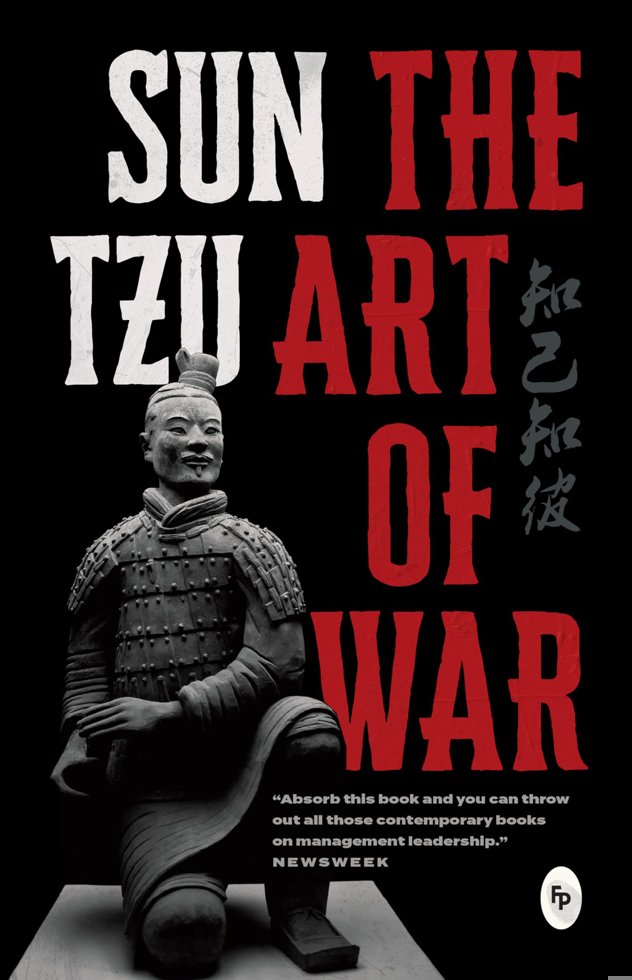
For more than two thousand years, The Art of War has stood as a cornerstone of Chinese culture-a lucid epigrammatic text that reveals as much about human psychology, politics, and economics as it does about battlefield strategy. The influence of Sun-tzu's text has grown tremendously in the West in recent years, with military leaders, politicians, and corporate executives alike finding valuable insight in these ancient words. In his crisp, accessible new translation, scholar John Minford brings this seminal work to life for modern readers.
Minford opens with a lively, learned introduction in which he explores the life and times of Sun-tzu, looks at The Art of War in the context of the turbulent Warring States period, and discusses how best to read and understand the work today. There follows Minford's translation of the core text itself in two different formats-first, the unadorned thirteen chapters of the original work and then the same text reprinted with extensive running commentary by classical Chinese scholars as well as Minford himself. The result is an opportunity for Western readers to experience Sun-tzu's work in all its intensity as it applies to many aspects of our lives.
Which books should be read by every single intelligent person on planet? … The Art of War (Sun Tsu) to learn that the act of killing fellow humans can be raised to an art. If you read all of the above works you will glean profound insight into most of what has driven the history of the western world. [source]
In his book, Smith fervently extolled the simple yet enlightened notion that individuals are fully capable of setting and regulating prices for their own goods and services. He argued passionately in favor of free trade, yet stood up for the little guy. The Wealth of Nations provided the first--and still the most eloquent--integrated description of the workings of a market economy.
Obama, unsurprisingly, appears to be more drawn to stories sympathetic to the working classes than is McCain. Obama cites John Steinbeck’s “In Dubious Battle,” about a labor dispute; Robert Caro’s “Power Broker,” about Robert Moses; and Studs Terkel’s “Working.” But he also includes Adam Smith’s “Wealth of Nations” and “Theory of Moral Sentiments” on his list. [source]
Which books should be read by every single intelligent person on planet? … The Wealth of Nations (Smith) to learn that capitalism is an economy of greed, a force of nature unto itself. If you read all of the above works you will glean profound insight into most of what has driven the history of the western world. [source]
In Beyond Good and Evil Friedrich Nietzsche contends that no human values are absolute; that all value distinctions (such as that between 'good' and 'evil') are artificial, the result of mere traditional prejudices; and that humanity should discard its old, outmoded values (such as 'good' and 'evil').
Yes, I think that’s right. It touches on almost all Nietzsche’s central concerns – on truth, on the nature of philosophy, on morality, on what’s wrong with morality, will to power. [source]
Simon Critchley
What did you think of it then? We should talk about your reaction to it! [source]
Cover unavailable
6
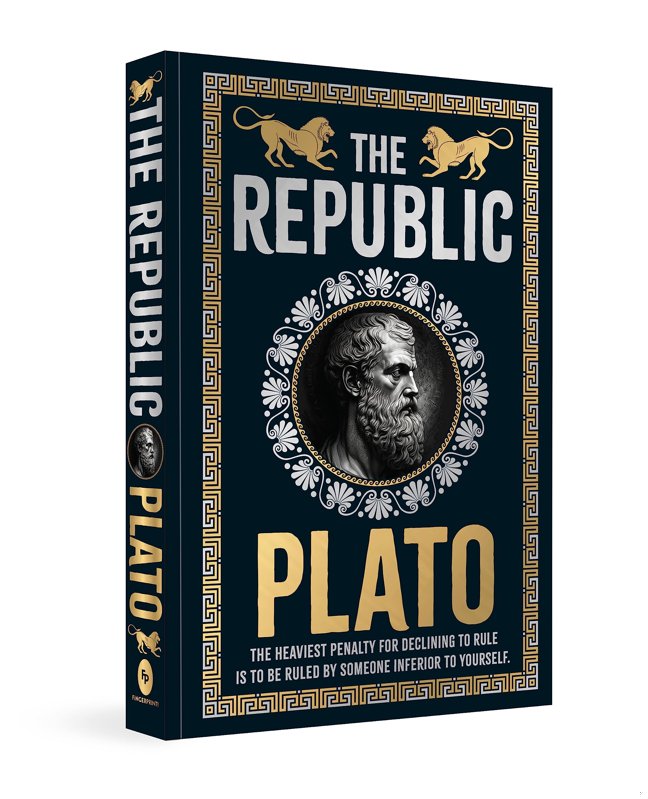
The Republic: The Influential Classic
Plato
4.6
The newest deluxe edition in the bestselling Capstone Classics Series This ancient classic has had a make-over. In recent years these Capstone Classic deluxe editions have caught the book buying public's imagination. The volumes of international bestsellers such as Think and Grow Rich and The Art of War have quickly become the market leaders. Now Plato's best known work, one of the most intellectually and historically influential works of philosophy and political theory, has been brought to life in this luxury, hardback, keep-sake edition.
This edition includes:
Plato's plans for a perfect society characterised by a blend of wisdom, courage, self-discipline and justice Lessons to learn about living according to eternal truths, instead of existing simply for survival and pleasure A new introduction by Tom Butler Bowdon, the classic personal development expert
It’s very readable even if you aren’t a professional philosopher. Take the story of ‘The Ring of Gyges,’ which raises the question of whether you would continue to act like a good person if you had a ring of invisibility that let you get away with doing whatever you wanted to do. That’s a fascinating thought experiment that anybody can appreciate. [source]
I’m about a third through this and still can’t tell whether Plato is making a mockery of Socrates ideas for the idyllic society or not. So many of the arguments presented as Socrates’ are so tortured and with so disconnected leaps of logic that it’s hard to take it at face value. Yet still, it’s good fun to follow the dialogue. It reads more like a play than a book, and again, immensely accessible. It’s fun to see the lines that continue from a book like this to the considerations of the Stoics all the way to Adam Smith and the Wealth of Nations and then onto a modern critique and history in that Debt: First 5,000 Years. A conversation spanning millennia. [source]
Jonathan Glover
It contains a tremendous amount of nonsense about what the ideal society would be like. But it is an unmissable book because of Socrates. He invented the method of doing and teaching philosophy that has never been improved on. [source]
At Walden Pond, Henry David Thoreau reflected on simpler living in the natural world. By removing himself from the distractions of materialism, Thoreau hoped to not only improve his spiritual life but also gain a better understanding of society through solitary introspection.
In Walden, Thoreau condenses his two-year, two-month, two-day stay into a single year, using the four seasons to symbolize human development—a cycle of life shared by both nature and man. A celebration of personal renewal through self-reliance, independence, and simplicity, composed for all of us living in “quiet desperation,” Walden is eternal.
…
Recommended by Emma Watson, Donna Dickenson, Emily Thomas, and 5 others.
Donna Dickenson
He discusses how the original ideals that America was founded on were being compromised, and how massive industrial interests were starting to dominate. [source]
Emily Thomas
The beginning is hard going. Once you get past that, then suddenly you’re into these beautiful and inspiring descriptions of nature. [source]
Joan Boixados
In case you were deceived and expected me to name Walden by Henry David Thoreau, you should read it too if you haven’t, it obviously is the inspiration to Walden Two. :) [source]
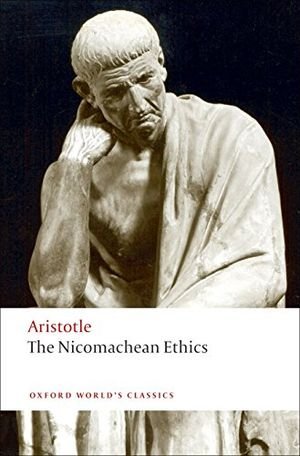
‘One swallow does not make a summer; neither does one day. Similarly neither can one day, or a brief space of time, make a man blessed and happy’
In the Nicomachean Ethics, Aristotle sets out to examine the nature of happiness. He argues that happiness consists in ‘activity of the soul in accordance with virtue’, for example with moral virtues, such as courage, generosity and justice, and intellectual virtues, such as knowledge, wisdom and insight. The Ethics also discusses the nature of practical reasoning, the value and the objects of pleasure, the different forms of friendship, and the relationship between individual virtue, society and the State. Aristotle’s work has had a profound and lasting influence on all subsequent Western thought about ethical matters.
J. A. K. Thomson’s translation has been revised by Hugh Tredennick, and is accompanied by a new introduction by Jonathan Barnes. This edition also includes an updated list for further reading and a new chronology of Aristotle’s life and works.
He said the great question is how we should live well, so that we live a good life, and he came up with a very positive response – what distinguishes us from the rest of the world is our possession of reason [source]
Christian B Miller
According to Aristotle, it is hard to become virtuous, and hard to become vicious too. The character of most people is somewhere in the middle. [source]
"For Michael Sandel, justice is not a spectator sport," The Nation's reviewer of Justice remarked. In his acclaimed book―based on his legendary Harvard course―Sandel offers a rare education in thinking through the complicated issues and controversies we face in public life today. It has emerged as a most lucid and engaging guide for those who yearn for a more robust and thoughtful public discourse. "In terms we can all understand," wrote Jonathan Rauch in The New York Times, Justice "confronts us with the concepts that lurk . . . beneath our conflicts."
Affirmative action, same-sex marriage, physician-assisted suicide, abortion, national service, the moral limits of markets―Sandel relates the big questions of political philosophy to the most vexing issues of the day, and shows how a surer grasp of philosophy can help us make sense of politics, morality, and our own convictions as well.
Justice is lively, thought-provoking, and wise―an essential new addition to the small shelf of books that speak convincingly to the hard questions of our civic life.
The reason I picked this book is because I think Michael Sandel is an outstanding speaker and writer in his ability to bring philosophy alive. He can take a thinker like Aristotle and make him completely relevant to the present day, to show how his ideas have applications in our everyday lives. [source]
Cover unavailable
10
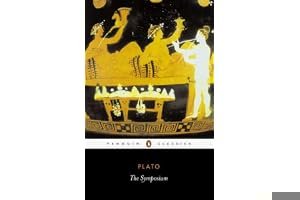
The Symposium
Plato, Christopher Gill
4.4
A fascinating discussion on sex, gender, and human instincts, as relevant today as ever.
In the course of a lively drinking party, a group of Athenian intellectuals exchange views on eros, or desire. From their conversation emerges a series of subtle reflections on gender roles, sex in society and the sublimation of basic human instincts. The discussion culminates in a radical challenge to conventional views by Plato's mentor, Socrates, who advocates transcendence through spiritual love. The Symposium is a deft interweaving of different viewpoints and ideas about the nature of love--as a response to beauty, a cosmic force, a motive for social action and as a means of ethical education.
For more than seventy years, Penguin has been the leading publisher of classic literature in the English-speaking world. With more than 1,700 titles, Penguin Classics represents a global bookshelf of the best works throughout history and across genres and disciplines. Readers trust the series to provide authoritative texts enhanced by introductions and notes by distinguished scholars and contemporary authors, as well as up-to-date translations by award-winning translators.
Bryan Callen recommended this book on the podcast "The Tim Ferriss Show". [source]
Edward Skidelsky
Plato is the founding figure in the Western philosophical tradition and the Symposium is one of his most charming books – you can read it like a novel. [source]
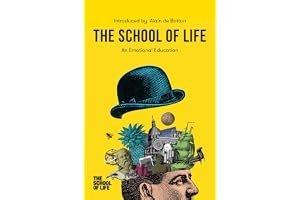
Discover everything you were never taught at school about how to lead a better life...
Introduced and edited by the bestselling author of The Consolations of Philosophy, The Art of Travel and The Course of Love
We spend years in school learning facts and figures but the one thing we're never taught is how to live a fulfilled life. That's why we need The School of Life - a real organisation founded ten years ago by writer and philosopher Alain de Botton. The School of Life has one simple aim: to equip people with the tools to survive and thrive in the modern world. And the most important of these tools is emotional intelligence.
This book brings together ten years of essential and transformative research on emotional intelligence, with practical topics including:
- how to understand yourself - how to master the dilemmas of relationships - how to become more effective at work - how to endure failure - how to grow more serene and resilient
The School of Life is nothing short of a crash course in emotional maturity. With all the trademark wit and elegance of Alain de Botton's other writings, and rooted in practical, achievable advice, it show us a path to the better lives we all want and deserve.
…
Cover unavailable
12
The Prince
Nicollo Machiavelli, Tim Parks
4.4
Niccolo Machiavelli's "The Prince" is intended to be a treatise on ruling and is considered by many to be a classic of political science. In the book Machiavelli offers many bits of practical advice on how to rule and even though the book was written in the early 16th century its ideas are still very relevant today. Where "The Prince" differs from other political literature before it is in its separation of the lofty idealism of morality and ethics from the practical demands of governing. It is this very aspect of Machiavelli's work that has made his name synonymous with an almost immoral opportunism and his book a timeless classic.
Which books should be read by every single intelligent person on planet? … The Prince (Machiavelli) to learn that people not in power will do all they can to acquire it, and people in power will do all they can to keep it. If you read all of the above works you will glean profound insight into most of what has driven the history of the western world. [source]
Of course, this is a must read. Machiavelli is one of those figures and writers who is tragically overrated and underrated at the same time. Unfortunately that means that many people who read him miss the point and other people avoid him and miss out altogether. Take Machiavelli slow, and really read him. Also understand the man behind the book–not just as a masterful writer but a man who withstood heinous torture and exile with barely a whimper. Machiavelli is a glimpse into a time when power was literal and out for public viewing–when he talks about making an example of someone, he doesn’t mean calling them out, he means putting their head on a pike. Don’t let that scare you because we’re not as far from that world as we’d like to think. Deny that at your own peril. [source]
"A spectre is haunting Europe," Karl Marx and Frederic Engels wrote in 1848, "the spectre of Communism." This new edition of The Communist Manifesto, commemorating the 150th anniversary of its publication, includes an introduction by renowned historian Eric Hobsbawm which reminds us of the document's continued relevance. Marx and Engels's critique of capitalism and its deleterious effect on all aspects of life, from the increasing rift between the classes to the destruction of the nuclear family, has proven remarkably prescient. Their spectre, manifested in the Manifesto's vivid prose, continues to haunt the capitalist world, lingering as a ghostly apparition even after the collapse of those governments which claimed to be enacting its principles.
…
Recommended by Felipe Fernández-Armesto and Peter Singer.
Felipe Fernández-Armesto
Marx and Engels’s historical analysis is breathtakingly, brilliantly simple. I think it’s wrong but, again, you’ve just got to admire its genius. Obviously, without understanding the historical basis of Marx’s thought you can’t understand anything else in Marxism. [source]
Yes, it is. I chose The Communist Manifesto, rather than, say, Capital because it shows in a much easier-to-read, shorter work something that is central to Marx’s vision. Capital is much drier, and a lot of it is focused on economics, although there are some remarkable passages of Capital describing the conditions of industrial workers in England at the time. [source]
Cover unavailable
14
Siddhartha
Hermann Hesse
4.3
Herman Hesse's classic novel has delighted, inspired, and influenced generations of readers, writers, and thinkers. In this story of a wealthy Indian Brahmin who casts off a life of privilege to seek spiritual fulfillment. Hesse synthesizes disparate philosophies--Eastern religions, Jungian archetypes, Western individualism--into a unique vision of life as expressed through one man's search for meaning.
"Man is born free; and everywhere he is in chains."
These are the famous opening words of a treatise that has not ceased to stir vigorous debate since its first publication in 1762. Rejecting the view that anyone has a natural right to wield authority over others, Rousseau argues instead for a pact, or ‘social contract’, that should exist between all the citizens of a state and that should be the source of sovereign power. From this fundamental premise, he goes on to consider issues of liberty and law, freedom and justice, arriving at a view of society that has seemed to some a blueprint for totalitarianism, to others a declaration of democratic principles.
…
Cover unavailable
16
Montaigne: Complete Essays
Michel de Montaigne
4.3
Catalog of a private collection of mostly post-archaic Chinese jade carvings, including many very fine animals and human figures.
I’ve given quite a lot of copies of this book to people down the years. [source]
Cover unavailable
17
The Worldly Philosophers
Robert L. Heilbroner
4.3
The Worldly Philosophers not only enables us to see more deeply into our history but helps us better understand our own times. In this seventh edition, Robert L. Heilbroner provides a new theme that connects thinkers as diverse as Adam Smith and Karl Marx. The theme is the common focus of their highly varied ideas—namely, the search to understand how a capitalist society works. It is a focus never more needed than in this age of confusing economic headlines. In a bold new concluding chapter entitled “The End of the Worldly Philosophy?” Heilbroner reminds us that the word “end” refers to both the purpose and limits of economics. This chapter conveys a concern that today’s increasingly “scientific” economics may overlook fundamental social and political issues that are central to economics. Thus, unlike its predecessors, this new edition provides not just an indispensable illumination of our past but a call to action for our future. (amazon.com)
…
Recommended by Andrew W Lo, Daniel Hamermesh, Erik Brynjolfsson, and 1 others.
This book really opened my eyes to the fact that there’s some very deep and beautiful logic underlying the economy, and financial markets and institutions especially. [source]
Daniel Hamermesh
This is the oldest book I’ve chosen by far. The first edition came out in 1953 – I read it in my senior year in high school. That’s one of the reasons I love this book. We had what was called the Honours Social Studies class. The teacher was quite sophisticated, a very unusual guy. He had an MA from Harvard. [source]
Erik Brynjolfsson
@AndrewWLo @DianeCoyle1859 Great book. I read it in high school and it kind of turned into an economist [source]
This lively new translation with clear explanatory notes by one of the foremost scholars of classical Chinese provides the ideal introduction to the Analects for readers who have no previous knowledge of the Chinese language and philosophical traditions.
"How dare I claim to be a sage or a benevolent man?"
By constructing the philosophy expressed through The Analects, Confucius might well dare to make such a claim. The Analects are a collection of Confucius' sayings, compiled by his pupils shortly after his death in 497 B.C., and they reflect the extent to which Confucius held up a moral ideal for all men. The aim is the perfection of one's moral character, the method one of arduous pursuit of such moral attributes as benevolence, wisdom, courage; the result is no recompense either in this life or the next – to follow the Way must be its own reward. A harsh philosophy perhaps, but shining through it is the splendid intellect and spirit of one of the most reasonable and humane thinkers of all time.
…
Recommended by Andrew Hui, Daniel A. Bell, and Michael Puett.
Andrew Hui
This edition is really good at showing both the constructed-ness of the original Analects and the vast exegetical machine that has driven the Chinese philosophical tradition through the centuries. [source]
Daniel A. Bell
It’s not written by Confucius himself. It is more a collection of anecdotes of how he engaged his students. [source]
Michael Puett
He believed one of our dangers is that we fall into ruts that are defined by the world around us. [source]
Cover unavailable
19
On Liberty
John Stuart Mill
4.3
Alternate cover edition of ISBN 9780140432077
Published in 1859, John Stuart Mill's On Liberty presented one of the most eloquent defenses of individual freedom in nineteenth-century social and political philosophy and is today perhaps the most widely-read liberal argument in support of the value of liberty. Mill's passionate advocacy of spontaneity, individuality, and diversity, along with his contempt for compulsory uniformity and the despotism of popular opinion, has attracted both admiration and condemnation.
…
Recommended by A C Grayling, Anne Heller, Brink Lindsey, and 8 others.
On Liberty is a very important document, and one which, because of the clarity with which one can read it and its brevity, is slightly passed over. [source]
Anne Heller
Imagine how John Stuart Mill would feel if he were made to wear a seatbelt because the federal government tells him so. [source]
Brink Lindsey
I think liberals, of both a libertarian, classical, liberal stripe and a more modern egalitarian stripe, see John Stuart Mill as a common ancestor. [source]
Cover unavailable
20
Critique of Pure Reason
Immanuel Kant, Paul Guyer, et al.
4.3
'The purpose of this critique of pure speculative reason consists in the attempt to change the old procedure of metaphysics and to bring about a complete revolution'
Kant's Critique of Pure Reason (1781) is the central text of modern philosophy. It presents a profound and challenging investigation into the nature of human reason, its knowledge and its illusions. Reason, Kant argues, is the seat of certain concepts that precede experience and make it possible, but we are not therefore entitled to draw conclusions about the natural world from these concepts. The Critique brings together the two opposing schools of philosophy: rationalism, which grounds all our knowledge in reason, and empiricism, which traces all our knowledge to experience. Kant's transcendental idealism indicates a third way that goes far beyond these alternatives.
…
Recommended by Adrian Moore, Luciano Floridi, and Simon Blackburn.
Adrian Moore
This is the greatest philosophical book of all time. This is Kant’s masterpiece. [source]
I find reading Kant a bit like understanding cricket as a foreigner: hard to get at first, but once you get it, it’s very enjoyable. [source]
Simon Blackburn
An illuminating way to think of the Critique is as a kind of prolonged wrestling match with Hume. [source]
Cover unavailable
21
The Gay Science
Friedrich Nietzsche, Walter Kaufmann
4.3
Recommended by Andrew Hui, Emrys Westacott, and Stephane Grand.
Andrew Hui
I chose Gay Science because that’s where he really becomes a master of the form: it’s incredibly vivid and incandescent in parts where you get a dazzled by his sheer visionary, aesthetic philosophy of life. [source]
Emrys Westacott
It’s just a translation of the German, Die fröhliche Wissenschaft, which means the joyful wisdom. It’s my favourite of all Nietzsche’s books. It’s interesting that 50 years ago Nietzsche was not taught much in academic philosophy departments. Gradually, in the 1970s and ever since, there’s been a tremendous burgeoning of academic interest in him. If you go to the philosophy section in any bookshop, you’ll find there are more books on Nietzsche than on any of the other great philosophers. One reason for that is that he’s an absolutely fabulous writer. He’s also extraordinarily original and seems to have so many interesting thoughts on almost everything. [source]
Stephane Grand
I have been running my own businesses for the last 15 years. Just before that, before diving head-on into entrepreneurship and independence, I used to be the country monitor of a large accounting and consulting network for China. Having had some ethical differences with members of my former network, I decided to break away from it. However, since I was equipped with a very expensive education, everybody around me was recommending that I would go and work for another firm. I was mired in doubt and was considering going back to management consulting. I have always had two go-to books when having moments of self-doubt like this. Those books are the Zarathustra and the Gay Science by Nietzsche. As I was reading through the prologue of the Zarathustra, and the title character was seeing the acrobat crossing between towers on the marketplace of Baghdad, I realized that staying in a cushy job would not help me cross between the beast and the superman, in a manner of speaking. Hence, Nietzsche helped me make a decision that I had already made in my heart, and which consisted in starting my own company. [source]
Cover unavailable
22
Plato: The Complete Works
Plato
4.3
This ebook contains Plato's complete works.
This edition has been professionally formatted and contains several tables of contents. The first table of contents (at the very beginning of the ebook) lists the titles of all novels included in this volume. By clicking on one of those titles you will be redirected to the beginning of that work, where you'll find a new TOC that lists all the chapters and sub-chapters of that specific work.
This collection contains the following works by Plato:
The Complete Plato
Part 1: Early Dialogues The Apology Crito Charmides Laches Lysis Euthyphro Menexenus Ion Gorgias Protagoras Meno Part 2: Middle Dialogues Euthydemus Cratylus Phaedo Phaedrus The Symposium Theaetetus Parmenides Part 3: Late Dialogues Sophist Statesman Philebus Timaeus Critias Part 4: The Republic I: Of Wealth, Justice, Moderation, and their Opposites II: The Individual, the State, and Education III: The Arts in Education IV: Wealth, Poverty, and Virtue V: On Matrimony and Philosophy VI: The Philosophy of Government VII: On Shadows and Realities in Education VIII: Four Forms of Government IX: On Wrong or Right Government, and the Pleasures of Each X: The Recompense of Life Part 5: The Laws
…
Cover unavailable
23
Harry Potter and the Chamber of Secrets (Harry Potter, #2)
J.K. Rowling
4.2
The Dursleys were so mean and hideous that summer that all Harry Potter wanted was to get back to the Hogwarts School for Witchcraft and Wizardry. But just as he's packing his bags, Harry receives a warning from a strange, impish creature named Dobby who says that if Harry Potter returns to Hogwarts, disaster will strike
And strike it does. For in Harry's second year at Hogwarts, fresh torments and horrors arise, including an outrageously stuck-up new professor, Gilderoy Lockhart, a spirit named Moaning Myrtle who haunts the girls' bathroom, and the unwanted attentions of Ron Weasley's younger sister, Ginny.
But each of these seem minor annoyances when the real trouble begins, and someone -- or something -- starts turning Hogwarts students to stone. Could it be Draco Malfoy, a more poisonous rival than ever? Could it possibly be Hagrid, whose mysterious past is finally told? Or could it be the one everyone at Hogwarts most suspects . . . Harry Potter himself?
…
Cover unavailable
24
Thus Spake Zarathustra: A Book For All And None
Friedrich Wilhelm Nietzsche
4.2
Thus Spoke Zarathustra is a foundational work of Western literature and is widely considered to be Friedrich Nietzsche’s masterpiece. It includes the German philosopher’s famous discussion of the phrase ‘God is dead’ as well as his concept of the Superman. Nietzsche delineates his Will to Power theory and devotes pages to critiquing Christian thinking, in particular Christianity’s definition of good and evil.
…
Recommended by Stephane Grand.
Stephane Grand
My favorite book is “Thus spoke Zarathustra” by Friedrich Nietzsche. I do not think I have ever read a book that had more resonance for me. [source]
Cover unavailable
25
The plague
Albert Camus, Stuart Gilbert
4.2
A gripping tale of human unrelieved horror, of survival and resilience, and of the ways in which humankind confronts death, The Plague is at once a masterfully crafted novel, eloquently understated and epic in scope, and a parable of ageless moral resonance, profoundly relevant to our times. In Oran, a coastal town in North Africa, the plague begins as a series of portents, unheeded by the people. It gradually becomes a omnipresent reality, obliterating all traces of the past and driving its victims to almost unearthly extremes of suffering, madness, and compassion.
…
Recommended by Jim Collins, Arthur Ammann, Jenny Davidson, and 1 others.
Arthur Ammann
It’s an amazing book, considering Camus probably never personally experienced a plague. In his novel, Camus captured everything that we were dealing with in the Aids epidemic without Aids existing at that time. Without his knowing what the consequences of the HIV plague were going to be, he seems to have gotten all the actors in there and the myriad of things that you wrestle with. [source]
Jenny Davidson
Albert Camus’s The Plague probably remains the best-known novel on the topic of epidemic disease. It tells the story of those involved in an epidemic in a North African setting. It is very interested in the details about how quarantines are enforced and the role not just of the government, but of individuals who band together into groups to manage the epidemic. [source]
Stephen Breyer
He talks about the plague. Well, the plague is that part of a human being which can be very evil. That germ, he says at the end, never dies, it simply goes into remission. It lurks. It lurks in the cupboards, it lurks in the hallways, it lurks in the filing cabinets. [source]
Cover unavailable
26
The Doors of Perception: Heaven and Hell (Thinking Classics)
Aldous Huxley
4.2
In 1953, in the presence of an investigator, Aldous Huxley took four-tenths of a gramme of mescalin, sat down and waited to see what would happen. Huxley described his experience in 'The Doors of Perception' and its sequel 'Heaven and Hell'.
Recommended by Auston Bunsen, Dr. Andrew Weil, and Michelle Rodriguez.
Auston Bunsen
I also really loved “The doors of perception” by Aldous Huxley. [source]
Aldous Huxley on Technodictators https://t.co/RDyX70lnZz via @YouTube ‘Doors of Perception’ is a great book entry level to hallucinogenics [source]
Cover unavailable
27
How to Live: Or A Life of Montaigne in One Question and Twenty Attempts at an Answer
Sarah Bakewell
4.2
Winner of the 2010 National Book Critics Circle Award for Biography
How to get along with people, how to deal with violence, how to adjust to losing someone you love—such questions arise in most people’s lives. They are all versions of a bigger question: how do you live? How do you do the good or honorable thing, while flourishing and feeling happy?
This question obsessed Renaissance writers, none more than Michel Eyquem de Monatigne, perhaps the first truly modern individual. A nobleman, public official and wine-grower, he wrote free-roaming explorations of his thought and experience, unlike anything written before. He called them “essays,” meaning “attempts” or “tries.” Into them, he put whatever was in his head: his tastes in wine and food, his childhood memories, the way his dog’s ears twitched when it was dreaming, as well as the appalling events of the religious civil wars raging around him. The Essays was an instant bestseller and, over four hundred years later, Montaigne’s honesty and charm still draw people to him. Readers come in search of companionship, wisdom and entertainment—and in search of themselves.
This book, a spirited and singular biography, relates the story of his life by way of the questions he posed and the answers he explored. It traces his bizarre upbringing, youthful career and sexual adventures, his travels, and his friendships with the scholar and poet Étienne de La Boétie and with his adopted “daughter,” Marie de Gournay. And we also meet his readers—who for centuries have found in Montaigne an inexhaustible source of answers to the haunting question, “how to live?”
How to get along with people, how to deal with violence, how to adjust to losing someone you love—All versions of a bigger question: How do you live? [source]
Montaigne is one of humanities greatest treasures. If you've not read any of his essays or Sarah Bakewell's magnificent book How To Live … you are missing out. [source]
Book that introduced me to one of my new favorite thinkers: Sarah Bakewell’s How To Live: Or A Life Of Montaigne. [source]
Cover unavailable
28
An Enquiry Concerning Human Understanding
David Hume
4.2
A landmark of Enlightenment thought, Hume's An Enquiry Concerning Human Understanding is accompanied here by two shorter works that shed light on it: A Letter from a Gentleman to His Friend in Edinburgh, Hume's response to those accusing him of atheism, of advocating extreme skepticism, and of undermining the foundations of morality; and his Abstract of A Treatise of Human Nature, which anticipates discussions developed in the Enquiry.
In the Enquiry he puts forward his particular empirical account of the mind. There’s a whole section on morality and so on, but the key bit for me is where he’s talking about how, following on from John Locke and the tradition of seeing the mind as a blank slate, we get ideas from what he calls ‘sense impressions’. If you think of an impression as like a footprint left in the sand, the senses get impressed, somewhat passively, by information that comes in from outside. And the impression that’s left in the mind, when we think about it away from what we’re seeing, is called an idea. [source]
Hume thought that overconfidence and dogmatism led to intolerance, to faction, to a lot of the crimes of human history. [source]
Cover unavailable
29
The Landmark Thucydides: A Comprehensive Guide to the Peloponnesian War
Thucydides, Robert B. Strassler, Richard Crawley, Victor Davis Hanson
4.2
Recommended by Gideon Rose, Joseph Nye, and Robert Service.
Gideon Rose
Thucydides is the single best treatment of international relations, foreign policy and military affairs that exists. It is the best description of what life in a multipolar world is like, what politics and war are like for the units involved, of the basic realities of international relations. It has no single line. [source]
Joseph Nye
when Thucydides is trying to account for the Peloponnesian War, an extraordinary war in the fifth century BC in which the Greek city-state system tore itself apart, he says the basic cause of the war was the rise in power of Athens and the fear that created in Sparta. He points out that when there is this kind of fear, and there is a belief that war is inevitable, it can itself become a cause of war. Some of the greatest wisdom on international politics and the rise and fall of power goes back to Thucydides in the fifth century BC. [source]
Robert Service
It was the trauma of Thucydides’ lifetime and in the book he sought to explain why the war had gone on so long and why Athens lost it. [source]
Cover unavailable
30
The Story of Philosophy
Will Durant
4.2
This endlessly inspiring & instructive chronicle of the worlds greatest thinkers, from Socrates to Santayana, describes not only their ideas but their place in history & their influence on our modern intellectual heritage.
Cover unavailable
31
The Trial and Death of Socrates (Euthyphro, Apology, Crito, Phaedo (death scene only))
Plato
4.2
Chronicling the life and death of the father of western philosophy, and charting his influence on the most influential ancient Greek philosophers, Plato's The Last Days of Socrates is translated from the Greek by Hugh Tredennick, revised with an introduction and notes by Harold Tarrant in Penguin Classics.
The trial and condemnation of Socrates on charges of heresy and corrupting young minds is a defining moment in the history of Classical Athens. In tracing these events through four dialogues, Plato also developed his own philosophy, based on Socrates' manifesto for a life guided by self-responsibility. Euthyphro finds Socrates outside the court-house, debating the nature of piety, while the Apology is his robust rebuttal of the charges of impiety and a defence of the philosopher's life. In the Crito, while awaiting execution in prison, Socrates counters the arguments of friends urging him to escape. Finally, in the Phaedo, he is shown calmly confident in the face of death, skilfully arguing the case for the immortality of the soul.
Hugh Tredennick's landmark 1954 translation has been revised by Harold Tarrant, reflecting changes in Platonic studies, with an introduction and expanded introductions to each of the four dialogues.
Plato (c.427-347 BC) stands with Socrates and Aristotle as one of the shapers of the whole intellectual tradition of the West. He founded the Academy in Athens, the first permanent institution devoted to philosophical research and teaching, and the prototype of all Western universities.
If you enjoyed The Last Days of Socrates, you might like Plato's The Symposium, also available in Penguin Classics.
…
Cover unavailable
32
Apology
Plato and James J. Helm
4.2
The Apology of Socrates is Plato's version of the speech given by Socrates as he unsuccessfully defended himself in 399BCE against the charges of "corrupting the young, and by not believing in the gods in whom the city believes, but in other daimonia that are novel" (24b). "Apology" here has its earlier meaning (now usually expressed by the word "apologia") of speaking in defense of a cause or of one's beliefs or actions.
The revised edition of this popular textbook features revised vocabulary and grammatical notes that now appear on the same page as the text, sentence diagrams, principal parts of verbs listed both by Stephanus page and alphabetically, word frequency list for words occurring more than twice, and complete vocabulary.
…
Recommended by Mehdi Kajbaf.
Mehdi Kajbaf
It’s difficult for me to separate all the different things I was reading and learning about at that time but I think Socrates Apology is probably the best place to focus. If you aren’t familiar with Socrates, he’s considered by most to be the father of Philosophy (which means love of wisdom). He annoyed a lot of people though because he constantly challenged their world views and encouraged them to seek truth and wisdom. He questioned everything, and eventually created too much of a stir so he was sentenced to death. In the Apology he gives a powerful speech and defense which ultimately falls short. [source]
Cover unavailable
33
Leviathan
Thomas Hobbes
4.2
'The life of man, solitary, poore, nasty, brutish, and short'
Written during the chaos of the English Civil War, Thomas Hobbes' Leviathan asks how, in a world of violence and horror, can we stop ourselves from descending into anarchy? Hobbes' case for a 'common-wealth' under a powerful sovereign - or 'Leviathan' - to enforce security and the rule of law, shocked his contemporaries, and his book was publicly burnt for sedition the moment it was published. But his penetrating work of political philosophy - now fully revised and with a new introduction for this edition - opened up questions about the nature of statecraft and society that influenced governments across the world.
The best reason for reading Hobbes is that no other philosopher has ever used the English language to such powerful effect. It is a really remarkable feat of dialectic. You find yourself agreeing with him at each stage of the reasoning as he builds up his case then, quite suddenly, you find that you’ve arrived at a conclusion which seems intolerable. [source]
Jonathan Wolff
Written more than three-and-a-half centuries ago in the shadow of the English Civil War, Leviathan remains a profound and relevant study. [source]
Michael Peel
The idea of ‘the war of all against all’, what a man wins through strength is what he gets, has parallels in modern Nigeria. [source]
Cover unavailable
34
The Manual: A Philosopher's Guide to Life
Epictetus, Sam Torode, Ancient Renewal
4.2
Life's Missing Instruction Manual
Epictetus (c. 50-135 CE) was brought as a slave to Rome, where he became a great teacher, deeply influencing the future emperor Marcus Aurelius among many others. His philosophy, Stoicism, was practical, not theoretical--aimed at relieving human suffering here and now.
And Epictetus knew suffering. Besides being a former slave, he was lame in one leg and walked with a crutch. After a decade of teaching in Rome, he was banished by Emperor Domitian; undaunted, he established a school in Greece.
The Manualis a collection of Epictetus' essential teachings and pithy sayings, compiled by his closet student. It is the most accessible and actionable guide to Stoic philosophy, as relevant today as it was in the Roman Empire.
This new edition is rendered in contemporary English, with a foreword, by Sam Torode. A companion volume, The Meditations: An Emperor's Guide to Mastery by Marcus Aurelius, is also available from Ancient Renewal.
The Kindle e-book is FREE when you buy the paperback.
Despite being an avid student of Stoicism for many years, I somehow never got around to reading the last of the three big stoic writers, Epictetus, directly. What a mistake. The Manual is a profound work. It’s perhaps the most tensely packed tome of wisdom I’ve ever had the good fortune to read. Seriously. You can read it in about an hour, but you’ll spend weeks, years, hell, probably the following lifetime, trying to internalize and master its hard-hitting truths and techniques. It was a great reminder that even if you think you know a topic, there’s a big gap between knowing and knowing. None of the themes in The Manual would be novel to anyone who’ve read Aurelius or Seneca, but the delivery is so different, so direct, that the material still comes across as entirely fresh. The Manual is the double espresso of stoicism. [source]
Pound for pound probably the best book I’ve read… check out the “Art Of Living” edition. https://t.co/BbzPss9UVH [source]
Cover unavailable
35
Nausea
Jean-Paul Sartre, Lloyd Alexander, et al.
4.2
Nausea is the story of Antoine Roquentin, a French writer who is horrified at his own existence. In impressionistic, diary form he ruthlessly catalogues his every feeling and sensation about the world and people around him.
His thoughts culminate in a pervasive, overpowering feeling of nausea which "spread at the bottom of the viscous puddle, at the bottom of our time, the time of purple suspenders and broken chair seats; it is made of wide, soft instants, spreading at the edge, like an oil stain."
Roquentin's efforts to try and come to terms with his life, his philosophical and psychological struggles, give Sartre the opportunity to dramatize the tenets of his Existentialist creed.
The introduction for this edition of Nausea by Hayden Carruth gives background on Sartre's life and major works, a summary of the principal themes of Existentialist philosophy, and a critical analysis of the novel itself.
Existentialists like Sartre are big on the idea that you can’t just relate a philosophical worldview by simply stating values, techniques, and facts. To understand existentialism, you must feel it. Breathe its ambience. It’s like a tonal curve for life. Yes, we can talk about highlights, shadows, and all the mechanical elements of that tonal curve, but you won’t become an artist just by knowing these mechanics. It goes much deeper than that. So Nausea is a novel, which imparts the existentialist tonal curve. I’m only halfway through it, but I’m liking it a lot already. It’s not as wild or erratic as Notes from Underground, but it’s got that similar feel. That the narrator gives us a mirror to reflect in, and those reflections are novel because we’re outside the normal tonal curve. [source]
Samantha Harvey
The question of mental illness comes down to whether Sartre’s right about his philosophy, which is an interesting question. [source]
Now in paperback, "The Philosophy Book" explores the history and concepts of philosophy, and demystifies what can often be daunting subject matter.
Are the ideas of Rene Descartes, Mary Wollstonecraft, John Locke, and Thomas Hobbes still relevant today? "The Philosophy Book" unpacks the writings and ideas of more than 100 of history's biggest thinkers, taking you on a journey from Ancient Greece to modern day. Explore feminism, rationalism, idealism, existentialism, and other influential movements in the world of philosophy.
From Socrates to Confucius to Julia Kristeva, "The Philosophy Book" breaks down difficult concepts using innovating graphics that pop off the page alongside creative typography. Cutting through the haze of academia and untangling complicated theories to show how our social, political, and ethical ideas are formed, "The Philosophy Book" contextualizes the information around time periods, innovative thinkers, method, and philosophical approach.
With graphics, clear writing, a philosopher directory, and a vocabulary glossary, "The Philosophy Book" is a perfect and comprehensive introduction to a complicated and fascinating subject.
Series Overview: Big Ideas Simply Explained series uses creative design and innovative graphics, along with straightforward and engaging writing, to make complex subjects easier to understand. These award-winning books provide just the information needed for students, families, or anyone interested in concise, thought-provoking refreshers on a single subject."
…
Cover unavailable
38
Candide, ou l'Optimisme
Voltaire, Tobias Smollett
4.2
Candide, ou l'Optimisme is a French satire first published in 1759 by Voltaire, a philosopher of the Age of Enlightenment. The novella has been widely translated, with English versions titled Candide: or, All for the Best (1759); Candide: or, The Optimist (1762); and Candide: or, Optimism (1947). It begins with a young man, Candide, who is living a sheltered life in an Edenic paradise and being indoctrinated with Leibnizian optimism (or simply Optimism) by his mentor, Pangloss. The work describes the abrupt cessation of this lifestyle, followed by Candide's slow, painful disillusionment as he witnesses and experiences great hardships in the world. Voltaire concludes with Candide, if not rejecting optimism outright, advocating a deeply practical precept, "we must cultivate our garden," in lieu of the Leibnizian mantra of Pangloss, "all is for the best" in the "best of all possible worlds." Candide is characterised by its sarcastic tone, as well as by its erratic, fantastical and fast-moving plot. A picaresque novel with a story similar to that of a more serious bildungsroman, it parodies many adventure and romance cliches, the struggles of which are caricatured in a tone that is mordantly matter-of-fact. Still, the events discussed are often based on historical happenings, such as the Seven Years' War and the 1755 Lisbon earthquake. As philosophers of Voltaire's day contended with the problem of evil, so too does Candide in this short novel, albeit more directly and humorously. Voltaire ridicules religion, theologians, governments, armies, philosophies, and philosophers through allegory; most conspicuously, he assaults Leibniz and his optimism. As expected by Voltaire, Candide has enjoyed both great success and great scandal. Immediately after its secretive publication, the book was widely banned because it contained religious blasphemy, political sedition and intellectual hostility hidden under a thin veil of naivete. However, with its sharp wit and insightful portrayal of the human condition, the novel has since inspired many later authors and artists to mimic and adapt it. Today, Candide is recognized as Voltaire's magnum opus and is often listed as part of the Western canon; it is arguably taught more than any other work of French literature. In his book of intellectual history Martin Seymour-Smith listed Candide as one of The 100 Most Influential Books Ever Written. Candide contains thirty episodic chapters, which may be grouped into two main schemes: one consists of two divisions, separated by the protagonist's hiatus in El Dorado; the other consists of three parts, each defined by its geographical setting. By the former scheme, the first half of Candide constitutes the rising action and the last part the resolution. This view is supported by the strong theme of travel and quest, reminiscent of adventure and picaresque novels, which tend to employ such a dramatic structure. By the latter scheme, the thirty chapters may be grouped into three parts each comprising ten chapters and defined by locale: I-X are set in Europe, XI-XX are set in the Americas, and XXI-XXX are set in Europe and the Ottoman Empire. The plot summary that follows uses this second format and includes Voltaire's additions of 1761. Chapters I-X The tale of Candide begins in the castle of the Baron Thunder-ten-Tronckh in Westphalia, home to the Baron's daughter, Lady Cunegonde; his bastard nephew, Candide; a tutor, Pangloss; a chambermaid, Paquette; and the rest of the Baron's family. The protagonist, Candide, is romantically attracted to Cunegonde. He is a child of "the most unaffected simplicity," whose face is "the index of his mind." Dr. Pangloss, professor of "metaphysico-theologo-cosmolonigologie" (English translation: "metaphysico-theologo-cosmonigology") and self-proclaimed optimist, teaches his pupils that they live in the "best of all possible worlds" and that "all is for the best."
…
Cover unavailable
39
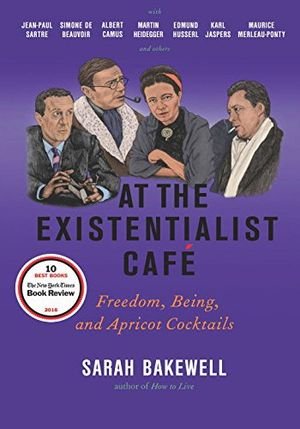
At the Existentialist Café: Freedom, Being, and Apricot Cocktails
Sarah Bakewell
4.2
Paris, near the turn of 1933. Three young friends meet over apricot cocktails at the Bec-de-Gaz bar on the rue Montparnasse. They are Jean-Paul Sartre, Simone de Beauvoir and their friend Raymond Aron, who opens their eyes to a radical new way of thinking. Pointing to his drink, he says, 'You can make philosophy out of this cocktail!'
From this moment of inspiration, Sartre will create his own extraordinary philosophy of real, experienced life–of love and desire, of freedom and being, of cafés and waiters, of friendships and revolutionary fervour. It is a philosophy that will enthral Paris and sweep through the world, leaving its mark on post-war liberation movements, from the student uprisings of 1968 to civil rights pioneers.
At the Existentialist Café tells the story of modern existentialism as one of passionate encounters between people, minds and ideas. From the ‘king and queen of existentialism'–Sartre and de Beauvoir–to their wider circle of friends and adversaries including Albert Camus, Martin Heidegger, Maurice Merleau-Ponty and Iris Murdoch, this book is an enjoyable and original journey through a captivating intellectual movement. Weaving biography and thought, Sarah Bakewell takes us to the heart of a philosophy about life that also changed lives, and that tackled the biggest questions of all: what we are and how we are to live.
This is the best philosophy book that I’ve read this year. [source]
Cover unavailable
40
The Genealogy of Morals (Translated by Horace B. Samuel with an Introduction by Willard Huntington Wright)
Friedrich Nietzsche, Horace B. Samuel, Willard Huntington Wright
4.2
German philosopher, Friedrich Nietzsche was one the most controversial figures of the 19th century. His evocative writings on religion, morality, culture, philosophy, and science were often polemic attacks against the established views of his time. First published in 1887, "The Genealogy of Morals," is a work which follows and expands upon the principles of his previous works, "Thus Spoke Zarathustra" and "Beyond Good and Evil." In a preface and three interrelated essays, Nietzsche outlines his theories on the origins of our moral prejudices. "The Genealogy of Morals," was written partly in response to his friend Paul R�e's book "The Origin of the Moral Sensations," whose genealogical hypothesis of morality he found unsatisfactory. Nietzsche begins by reiterating in his first essay the historical conflict between socio-economic classes that has given rise to the varying definitions of good and evil. In the second essay, Nietzsche discusses the origins of the institution of punishment, asserting that it arises from a straightforward relationship between creditors and debtors. Lastly, in the third essay, the philosopher considers the meaning of ascetic ideals. A classic work of moral philosophy, "The Genealogy of Morals" is considered by many as one of Nietzsche's finest. This edition is printed on premium acid-free paper, follows the translation of Horace B. Samuel, and includes an introduction by Willard Huntington Wright.
I don’t know I would single it out as the masterpiece, but it’s a fascinating book which follows on many of the themes of Beyond Good and Evil. It’s unusual because it’s less aphoristic, but rather three essays. The essays have more structure and extended argumentation than is typical in most of Nietzsche’s works. [source]
Of course, I read Nietzsche. On the Genealogy of Morality, etc, where the truths and the truisms are really cut and dried in a lot of ways. It's the equivalent of, I guess, intellectual red meat. [source]
Cover unavailable
41
The Stranger
Albert Camus, Jonathan Davis, et al
4.1
Through the story of an ordinary man unwittingly drawn into a senseless murder on an Algerian beach, Camus explored what he termed "the nakedness of man faced with the absurd." First published in English in 1946; now in a new translation by Matthew Ward.
Seminal novel on existentialism and the absurd by Albert Camus from 1946. Explores that feeling of disconnectedness from society, its norms, and the absurdity of every day life. Striking first-person account in a powerful, direct language. [source]
Kyle Maynard
Kyle Maynard said this is one of his most-recommended books. [source]
Cover unavailable
42
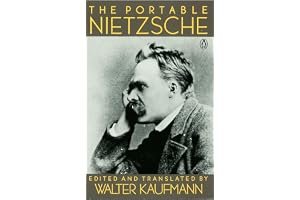
The Portable Nietzsche
Friedrich Nietzsche
4.1
The works of Friedrich Nietzsche have fascinated readers around the world ever since the publication of his first book more than a hundred years ago. As Walter Kaufmann, one of the world's leading authorities on Nietzsche, notes in his introduction, "Few writers in any age were so full of ideas," and few writers have been so consistently misinterpreted. The Portable Nietzsche includes Kaufmann's definitive translations of the complete and unabridged texts of Nietzsche's four major works: Twilight of the Idols, The Antichrist, Nietzsche Contra Wagner and Thus Spoke Zarathustra. In addition, Kaufmann brings together selections from his other books, notes, and letters, to give a full picture of Nietzsche's development, versatility, and inexhaustibility. "In this volume, one may very conveniently have a rich review of one of the most sensitive, passionate, and misunderstood writers in Western, or any, literature." --Newsweek
…
Cover unavailable
43
Theaetetus
Plato, Robin H. Waterfield
4.1
Set immediately prior to the trial and execution of Socrates in 399 BC, Theaetetus shows the great philosopher considering the nature of knowledge itself, in a debate with the geometrician Theodorus and his young follower Theaetetus. Their dialogue covers many questions, such as: is knowledge purely subjective, composed of the ever-changing flow of impressions we receive from the outside world? Is it better thought of as 'true belief'? Or is it, as many modern philosophers argue, 'justified true belief', in which the belief is supported by argument or evidence? With skill and eloquence, Socrates guides the debate, drawing out the implications of these theories and subjecting them to merciless and mesmerising criticism. One of the founding works of epistemology, this profound discussion of the problem of knowledge continues to intrigue and inspire.
…
Recommended by Angela Hobbs and M M McCabe.
Angela Hobbs
Plato’s Theaetetus asks what knowledge is, and several possible definitions are explored in depth. [source]
M M McCabe
The great contemporary translation is by M J Levitt, with a magisterial introduction by Myles Burnyeat [source]
Cover unavailable
44
Fear and Trembling
Soren Kierkegaard
4.1
Soren Kierkegaard was a Danish philosopher, theologian, and religious author interested in human psychology. He is regarded as a leading pioneer of existentialism and one of the greatest philosophers of the 19th Century.
In Fear and Trembling, Kierkegaard wanted to understand the anxiety that must have been present in Abraham when God commanded him to offer his son as a human sacrifice. Abraham had a choice to complete the task or to forget it. He resigned himself to the loss of his son, acting according to his faith. In other words, one must be willing to give up all his or her earthly possessions in infinite resignation and must also be willing to give up whatever it is that he or she loves more than God. Abraham had passed the test -- his love for God proved greater than anything else in him. And because a good and just Creator would not want a father to kill his son, God intervened at the last moment to prevent the sacrifice.
While most of the 20th century existentialists, like Sartre and Camus, were devout atheists, Kierkegaard is an existentialist obsessed with faith. Fear and Trembling is a very long, and at times obtuse, meditation on the topic of faith and doubt. It uses the story of Abraham and Isaac to contrast the ideas of faith and humanism. Kierkegaard is in awe of Abraham’s faith and how it compels him to sacrifice Isaac, and he uses that to interrogate the topic of faith in general. I found the theological acrobatics employed by Kierkegaard a bit strained, to say the least. But it was a fascinating read none the less, and Kierkegaard’s language and metaphors and incredible depth is inspiring. I’m keen to give this a read in the original Danish form. [source]
Cover unavailable
45
Tractatus Logico-Philosophicus
Ludwig Wittgenstein
4.1
Perhaps the most important work of philosophy written in the twentieth century, Tractatus Logico-Philosophicus was the only philosophical work that Ludwig Wittgenstein published during his life. Written in short, carefully numbered paragraphs of extreme brilliance, it captured the imagination of a generation of philosophers. For Wittgenstein, logic was something we use to conquer a reality which is in itself both elusive and unobtainable. He famously summarized the book in the following words: 'What can be said at all can be said clearly; and what we cannot talk about we must pass over in silence.' David Pears and Brian McGuinness received the highest praise for their meticulous translation. The work is prefaced by Bertrand Russell's original introduction to the first English edition.
…
Recommended by Reid Hoffman, Sonia Micu, and Tom Stoneham.
Reid recommends studying Ludwig Wittgenstein, about whom he's taught a course at Oxford. "One of the bedrocks of modern analytics philosophy is to think of language ... if you're trying to talk to someone else about some problem, and you're trying to make progress, how do you make language as positive an instrument as possible? What are the ways that language can work, and what are the way that language doesn't work?". [source]
Sonia Micu
The book I read many times already is Wittgenstein’s Tractatus Logico-Philosophicus. Don’t say it’s pretentious. It is beautiful. Some even say it’s poetry. I am far from understanding his complicated genius, but I think I’ve learned how to read it and I think I’ll never stop going back to it. [source]
Tom Stoneham
Wittgenstein’s book is about how we understand the thinkable and the unthinkable, which is a traditional philosophical problem. [source]
Cover unavailable
46
Sophie's World
Jostein Gaarder, Paulette Moller
4.1
An alternative cover for this ISBN can be found here
One day fourteen-year-old Sophie Amundsen comes home from school to find in her mailbox two notes, with one question on each: "Who are you?" and "Where does the world come from?" From that irresistible beginning, Sophie becomes obsessed with questions that take her far beyond what she knows of her Norwegian village. Through those letters, she enrolls in a kind of correspondence course, covering Socrates to Sartre, with a mysterious philosopher, while receiving letters addressed to another girl. Who is Hilde? And why does her mail keep turning up? To unravel this riddle, Sophie must use the philosophy she is learning—but the truth turns out to be far more complicated than she could have imagined.
…
Cover unavailable
47
Ethics
Benedict de Spinoza, Edwin Curley, Stuart Hampshire
4.1
Published shortly after his death, the Ethics is undoubtedly Spinoza's greatest work - an elegant, fully cohesive cosmology derived from first principles, providing a coherent picture of reality, and a guide to the meaning of an ethical life. Following a logical step-by-step format, it defines in turn the nature of God, the mind, the emotions, human bondage to the emotions, and the power of understanding - moving from a consideration of the eternal, to speculate upon humanity's place in the natural order, the nature of freedom and the path to attainable happiness. A powerful work of elegant simplicity, the Ethics is a brilliantly insightful consideration of the possibility of redemption through intense thought and philosophical reflection. The Ethics is presented in the standard translation of the work by Edwin Curley. This edition also includes an introduction by Stuart Hampshire, outlining Spinoza's philosophy and placing it in context.
…
Cover unavailable
48
Politics
Aristotle and Benjamin Jowett
4.1
What is the relationship of the individual to the state? What is the ideal state, and how can it bring about the most desirable life for its citizens? What sort of education should it provide? What is the purpose of amassing wealth? These are some of the questions Aristotle attempts to answer in one of the most intellectually stimulating works. Both heavily influenced by and critical of Plato's Republic and Laws,Politics represents the distillation of a lifetime of thought and observation. "Encyclopaedic knowledge has never, before or since, gone hand in hand with a logic so masculine or with speculation so profound," says H. W. C. Davis in his introduction. Students, teachers, and scholars will welcome this inexpensive new edition of the Benjamin Jowett translation, as will all readers interested in Greek thought, political theory, and depictions of the ideal state.
…
Cover unavailable
49
On the Shortness of Life
Seneca, C. D. N. Costa
4.1
The Stoic writings of the philosopher Seneca offer powerful insights into the art of living, the importance of reason and morality, and continue to provide profound guidance to many through their eloquence, lucidity and timeless wisdom.
Throughout history, some books have changed the world. They have transformed the way we see ourselves—and each other. They have inspired debate, dissent, war and revolution. They have enlightened, outraged, provoked and comforted. They have enriched lives—and destroyed them.
Now, Penguin brings you the works of the great thinkers, pioneers, radicals and visionaries whose ideas shook civilization, and helped make us who we are. Penguin's Great Ideas series features twelve groundbreaking works by some of history's most prodigious thinkers, and each volume is beautifully packaged with a unique type-drive design that highlights the bookmaker's art. Offering great literature in great packages at great prices, this series is ideal for those readers who want to explore and savor the Great Ideas that have shaped the world.
…
Recommended by Chip Conley, Ryan Holiday, John Craig, and 3 others.
Chip Conley
Says something about the fact that it’s not so much the shortness of life, it’s how we waste it. [source]
Seneca’s letters are the best place to start, but the essays in On the Shortness of Life are excellent as well. [source]
John Craig
This is the book that I recommend to everybody. It's everything you will need to make it in life & business. It is by far a complete business self-motivational book all-in-one. The best thing is that it’s 2,000-year of time-tested wisdom. [source]
Cover unavailable
50
Marcus Aurelius - Meditations: Adapted for the Contemporary Reader
Marcus Aurelius
4.1
Cover unavailable
51
The Correspondence of Thomas Hobbes: Volume I: 1622-1659
Thomas Hobbes and Noel Malcolm
4.1
Thomas Hobbes (1588-1679) is one of the most important figures in the history of European thought. Although interest in his life and work has grown enormously in recent years, this is the first complete edition of his correspondence. The texts of the letters are richly supplemented with explanatory notes and full biographical and bibliographical information. This landmark publication sheds new light in abundance on the intellectual life of a major thinker.
…
Cover unavailable
52
The Mind-Body Politic
Michelle Maiese and Robert Hann
4.1
Cover unavailable
53
Laws, Mind, and Free Will
Steven Horst
4.1
An account of scientific laws that vindicates the status of psychological laws and shows natural laws to be compatible with free will.
In Laws, Mind, and Free Will, Steven Horst addresses the apparent dissonance between the picture of the natural world that arises from the sciences and our understanding of ourselves as agents who think and act. If the mind and the world are entirely governed by natural laws, there seems to be no room left for free will to operate. Moreover, although the laws of physical science are clear and verifiable, the sciences of the mind seem to yield only rough generalizations rather than universal laws of nature. Horst argues that these two familiar problems in philosophy--the apparent tension between free will and natural law and the absence of strict laws in the sciences of the mind--are artifacts of a particular philosophical thesis about the nature of laws: that laws make claims about how objects actually behave.
Horst argues against this Empiricist orthodoxy and proposes an alternative account of laws--an account rooted in a cognitivist approach to philosophy of science. Horst argues that once we abandon the Empiricist misunderstandings of the nature of laws there is no contrast between strict laws and generalizations about the mind (ceteris paribus laws, laws hedged by the caveat other things being equal), and that a commitment to laws is compatible with a commitment to the existence of free will. Horst's alternative account, which he calls cognitive Pluralism, vindicates the truth of psychological laws and resolves the tension between human freedom and the sciences.
…
Cover unavailable
54
The Collected Works of Spinoza, Volumes I and II: Complete Digital Edition
Baruch Spinoza
4.1
Cover unavailable
55
Conversations of Socrates
Xenophon
4.1
After the execution of Socrates in 399 BC, a number of his followers wrote dialogues featuring him as the protagonist and, in so doing, transformed the great philosopher into a legendary figure. Xenophon's portrait is the only one other than Plato's to survive, and while it offers a very personal interpretation of Socratic thought, it also reveals much about the man and his philosophical views. In 'Socrates' Defence' Xenophon defends his mentor against charges of arrogance made at his trial, while the 'Memoirs of Socrates' also starts with an impassioned plea for the rehabilitation of a wronged reputation. Along with 'The Estate-Manager', a practical economic treatise, and 'The Dinner-Party', a sparkling exploration of love, Xenophon's dialogues offer fascinating insights into the Socratic world and into the intellectual atmosphere and daily life of ancient Greece.
…
Cover unavailable
56
Discourse on Method and Meditations on First Philosophy
Rene Descartes and Donald A. Cress
4.1
Cover unavailable
57
Discourses, Fragments, Handbook
Epictetus, Robin Hard, Christopher Gill
4.1
'About things that are within our power and those that are not.' Epictetus' Discourses have been the most widely read and influential of all writings of Stoic philosophy, from antiquity onwards. They set out the core ethical principles of Stoicism in a form designed to help people put them into practice and to use them as a basis for leading a good human life. Epictetus was a teacher, and a freed slave, whose discourses have a vivid informality, animated by anecdotes and dialogue. Forceful, direct, and challenging, their central message is that the basis of happiness is up to us, and that we all have the capacity, through sustained reflection and hard work, of achieving this goal. They still speak eloquently to modern readers seeking meaning in their own lives.
This is the only complete modern translation of the Discourses, together with the Handbook or manual of key themes, and surviving fragments. Robin Hard's accurate and accessible translation is accompanied by Christopher Gill's full introduction and comprehensive notes.
It guides you on how to live your life from a Stoic perspective. The chapter titles are topics that Epictetus debated with his students, and these topics were often very practical. There’s very little theoretical philosophy in Epictetus. [source]
Cover unavailable
58
Embodied Minds in Action
Robert Hanna and Michelle Maiese
4.1
In Embodied Minds in Action, Robert Hanna and Michelle Maiese work out a unified treatment of three fundamental philosophical problems: the mind-body problem, the problem of mental causation, and the problem of action. This unified treatment rests on two basic claims. The first is that conscious, intentional minds like ours are essentially embodied. This entails that our minds are necessarily spread throughout our living, organismic bodies and belong to their complete neurobiological constitution. So minds like ours are necessarily alive. The second claim is that essentially embodied minds are self-organizing thermodynamic systems. This entails that our mental lives consist in the possibility and actuality of moving our own living organismic bodies through space and time, by means of our conscious desires. The upshot is that we are essentially minded animals who help to create the natural world through our own agency. This doctrine--the Essential Embodiment Theory--is a truly radical idea which subverts the traditionally opposed and seemingly exhaustive categories of Dualism and Materialism, and offers a new paradigm for contemporary mainstream research in the philosophy of mind and cognitive neuroscience.
…
Cover unavailable
59
Al-Ghazali on Disciplining the Soul and on Breaking the Two Desires (Books XXII and XXIII of The Revival of the Religious Sciences)
Abu Hamid Muhammad al-Ghazali, T. J. Winter
4.1
The spiritual life in Islam begins with riyadat al-nafs, the inner warfare against the ego. Distracted and polluted by worldliness, the lower self has a tendency to drag the human creature down into arrogance and vice. Only by a powerful effort of will can the sincere worshipper achieve the purity of soul which enables him to attain God's proximity.
This translation of two chapters from The Revival of the Religious Sciences (Ihya' 'Ulum al-Din) details the sophisticated spiritual techniques adopted by classical Islam. In the first step, On Disciplining the Soul, which cites copious anecdotes from the Islamic scriptures and biographies of the saints, Ghazali explains how to acquire good character traits, and goes on to describe how the sickness of the heart may be cured. In the second part, Breaking the Two Desires, he focusses on the question of gluttony and sexual desire, concluding, in the words of the Prophet, that 'the best of all matters is the middle way'.
The translator has added an introduction and notes which explore Ghazali's ability to make use of Greek as well as Islamic ethics. The work will prove of special interest to those interested in Sufi mysticism, comparative ethics, and the question of sexuality in Islam.
…
Cover unavailable
60
The Discourses
Niccolo Machiavelli
4.1
"It is not the well-being of individuals that makes cities great, but the well-being of the community"
Few figures in intellectual history have proved as notorious and ambiguous as Niccolò Machiavelli. But while his treatise The Prince made his name synonymous with autocratic ruthlessness and cynical manipulation, The Discourses (c.1517) shows a radically different outlook on the world of politics. In this carefully argued commentary on Livy's history of republican Rome, Machiavelli proposed a system of government that would uphold civic freedom and security by instilling the virtues of active citizenship, and that would also encourage citizens to put the needs of the state above selfish, personal interests. Ambitious in scope, but also clear-eyed and pragmatic, The Discourses creates a modern theory of republic politics.
For more than seventy years, Penguin has been the leading publisher of classic literature in the English-speaking world. With more than 1,700 titles, Penguin Classics represents a global bookshelf of the best works throughout history and across genres and disciplines. Readers trust the series to provide authoritative texts enhanced by introductions and notes by distinguished scholars and contemporary authors, as well as up-to-date translations by award-winning translators.
…
Cover unavailable
61
The Moral Landscape: How Science Can Determine Human Values
Sam Harris
4.1
Sam Harris' first book, The End of Faith, ignited a worldwide debate about the validity of religion. In the aftermath, Harris discovered that most people - from religious fundamentalists to non-believing scientists - agree on one point: science has nothing to say on the subject of human values. Indeed, our failure to address questions of meaning and morality through science has now become the most common justification for religious faith. It is also the primary reason why so many secularists and religious moderates feel obligated to "respect" the hardened superstitions of their more devout neighbors.
In this explosive new book, Sam Harris tears down the wall between scientific facts and human values, arguing that most people are simply mistaken about the relationship between morality and the rest of human knowledge. Harris urges us to think about morality in terms of human and animal well-being, viewing the experiences of conscious creatures as peaks and valleys on a "moral landscape." Because there are definite facts to be known about where we fall on this landscape, Harris foresees a time when science will no longer limit itself to merely describing what people do in the name of "morality"; in principle, science should be able to tell us what we ought to do to live the best lives possible.
Bringing a fresh perspective to age-old questions of right and wrong and good and evil, Harris demonstrates that we already know enough about the human brain and its relationship to events in the world to say that there are right and wrong answers to the most pressing questions of human life. Because such answers exist, moral relativism is simply false - and comes at increasing cost to humanity. And the intrusions of religion into the sphere of human values can be finally repelled: for just as there is no such thing as Christian physics or Muslim algebra, there can be no Christian or Muslim morality.
Using his expertise in philosophy and neuroscience, along with his experience on the front lines of our "culture wars," Harris delivers a game-changing book about the future of science and about the real basis of human cooperation.
…
Cover unavailable
62
Wabi-Sabi for Artists, Designers, Poets & Philosophers
Leonard Koren
4.1
An updated version of the classic volume on the beauty of things imperfect, impermanent, and incomplete.
Cover unavailable
63
Basic Writings of Nietzsche
Friedrich Nietzsche
4.1
Introduction by Peter Gay Translated and edited by Walter Kaufmann Commentary by Martin Heidegger, Albert Camus, and Gilles Deleuze One hundred years after his death, Friedrich Nietzsche remains the most influential philosopher of the modern era. Basic Writings of Nietzsche gathers the complete texts of five of Nietzsche's most important works, from his first book to his last: The Birth of Tragedy, Beyond Good and Evil, On the Genealogy of Morals, The Case of Wagner, and Ecce Homo. Edited and translated by the great Nietzsche scholar Walter Kaufmann, this volume also features seventy-five aphorisms, selections from Nietzsche's correspondence, and variants from drafts for Ecce Homo. It is a definitive guide to the full range of Nietzsche's thought.
Includes a Modern Library Reading Group Guide
…
Cover unavailable
64
The Classic Friedrich Nietzsche Collection: 5-Book Paperback Boxed Set (Arcturus Classic Collections, 7)
Frederich Nietzsche, Thomas Common, Gerta Valentine, Helen Zimmern, and Horace B. Samuel
4.1
Cover unavailable
65
The Art of Living: The Classical Manual on Virtue, Happiness and Effectiveness
Epictetus
4.1
Epictetus was born into slavery about 55 C.E. in the eastern outreaches of the Roman Empire. Sold as a child and crippled from the beatings of his master, Epictetus was eventually freed, rising from his humble roots to establish an influential school of Stoic philosophy. Stressing that human beings cannot control life, only how they respond to it, Epictetus dedicated his life to outlining the simple way to happiness, fulfillment, and tranquility. By putting into practice the ninety-three witty, wise, and razor-sharp instructions that make up The Art of Living, readers learn to successfully meet the challenges of everyday life and face life's inevitable losses and disappointments with grace.
Epictetus's teachings rank among the greatest wisdom texts of human civilization. Sharon Lebell presents this esteemed philosopher's invaluable insights for the first time in a splendidly down-to-earth rendition. The result is the West's first and best primer for living the best possible life -- as helpful in the twenty-first century as it was in the first.
What I loved about this book is that it takes you right into Nietzsche’s life. This is particularly important with him because the life and the work are not so easily separable. For Nietzsche, there’s a sense that his life is actually part of what he’s trying to do. [source]
Cover unavailable
67
A Treatise of Human Nature
David Hume
4.0
A Treatise of Human Nature (1739-40), David Hume's comprehensive attempt to base philosophy on a new, observationally grounded study of human nature, is one of the most important texts in Western philosophy. It is also the focal point of current attempts to understand 18th-century philosophy. The Treatise first explains how we form such concepts as cause and effect, external existence, and personal identity, and to form compelling but unconfirmable beliefs in the entities represented by these concepts. It then offers a novel account of the passions, explains freedom and necessity as they apply to human choices and actions, and concludes with detailed explanations of how we distinguish between virtue and vice and of the different kinds of virtue. Hume's Abstract of the Treatise, also included in the volume, outlines his 'chief argument' regarding our conception of, and belief in, cause and effect. The texts printed in this volume are those of the critical edition of Hume's philosophical works now being published by the Clarendon Press. The volume includes a substantial introduction explaining the aims of the Treatise as a whole and of each of its ten parts, extensive annotations, a glossary of terms, a comprehensive index, and suggestions for further reading.
…
Cover unavailable
68
Fragments: Citations Et Témoignages
Heraclitus, Brooks Haxton, James Hillman
4.0
Peut-être Héraclite d'Ephèse (520-460 ?), dont nous ne savons presque rien, a-t-il de son vivant écrit un livre Sur la nature. Les auteurs anciens en ont conservé une centaine de brèves citations, énigmatiques, qui sont autant d'oracles prononcés sur le monde, le feu qui le constitue et le changement perpétuel auquel tout est éternellement soumis. Ces «fragments», qui sont ici rassemblés et commentés avec quelques-uns des témoignages anciens relatifs à la vie et à la doctrine de ce solitaire que les auteurs anciens nommaient l'«Obscur», montrent un effort inédit : en s'appuyant sur les acquis de la science de la nature qu'avaient élaborée ses compatriotes de Milet (Thalès ou Anaximandre, par exemple), Héraclite exige des hommes qu'ils abandonnent les rêves de leur existence ensommeillée pour vivre enfin à la mesure de la réalité qui les entoure. Il ne faut plus vivre comme nos parents, comme si le monde était autre chose que l'harmonie des contraires et des mouvements que révèle une connaissance enfin conforme à la nature. Un siècle plus tard, l'Athénien Platon donnera le nom de «philosophes» à ceux qui aspirent ainsi à ordonner la réforme des modes de vie à la connaissance savante de la réalité. Héraclite fut sans doute le premier d'entre eux.
While most of the other practical philosophy recommendations I’m making are bent towards hard, practical advice, Heraclitus might seem a bit poetic. But those beautiful lines are really the same direct advice and timeless, perspective-changing observations as the others. “Try in vain with empty talk / to separate the essences of things / and say how each thing truly is.” “Applicants for wisdom / do what I have done: / inquire within.” “Character is fate.” “What eyes witness / ears believe on hearsay.” “The crops are sold / for money spent on food.” [source]
Cover unavailable
69
Outlines of Scepticism
Sextus Empiricus
4.0
Cover unavailable
70
Theological-Political Treatise
Baruch Spinoza, Samuel Shirley, et al.
4.0
Rational examination of the Old Testament to show that freedom of thought and speech is consistent with the religious life. True religion consists in practice of simple piety, independent of philosophical speculation.
This is a work which is perhaps of all Spinoza’s works the most accessible, he is a tremendously significant figure for our modern age. [source]
Anthony Gottlieb
The first real biblical criticism, and still the best critique of traditional theism (i.e., the view that God is like a person). [source]
Cover unavailable
71
Essays and Aphorisms
Arthur Schopenhauer
4.0
One of the greatest philosophers of the nineteenth century, Schopenhauer believed that human action is determined not by reason but by 'will' - the blind and irrational desire for physical existence. This selection of his writings on religion, ethics, politics, women and many other themes is taken from Schopenhauer's last work, Parerga and Paralipomena, which he published in 1851. He depicts humanity as locked in a struggle beyond good and evil, each individual absolutely free within a Godless world in which art, morality and self-awareness are our only salvation. This innovative and pessimistic view proved powerfully influential upon philosophy and art, affecting the work of Nietzsche and Wittgenstein among others.
Schopenhauer is a brilliant composer of quick thoughts that will help us with our problems. His work was often concerned with the “will”–our inner drives and power. “For that which is otherwise quite indigestible, all affliction, vexation, loss, grief, time alone digests.” But he also talks about surprisingly current issues: “Newspapers are the second hand of history”–and that the hand is often broken or malfunctioning. And of course, the timeless as well: “Hope is the confusion of the desire for a thing for its probability.” [source]
Cover unavailable
72
The Greeks Who Made Us Who We Are: Eighteen Ancient Philosophers, Scientists, Poets and Others
M.A. Soupios
4.0
Cover unavailable
73
The Portable Voltaire
Voltaire, Francois Maria Arouet De Voltaire, Ben Ray Redman
4.0
Satirist, novelist, poet, dramatist, historian, moralist, critic, courtier and correspondent, champion of reason and fanatical adversary of fanaticism, a darling of kings with the unfortunate habit of turning them into enemies, François Arouet de Voltaire is one of the few writers to have imposed his name on an entire epoch. It is entirely appropriate that the French Enlightenment is also known as "the age of Voltaire." And if that age ended with a revolution, Voltaire was nothing if not a subversive. His abiding motto was "Écrasez l'infame": "Crush infamy."
This encyclopedic anthology acquaints us with Voltaire's mercurial range of expression as well as with the steadfastness of his vision, which might be called the religion of reason. It includes his sardonic comedies Candide and Zadig; the tales "Micromegas" and 'Story of a Good Brahmin"; more than seventy articles from the Philosophical Dictionary that offer heretical definitions of subjects from Adultery to Tyranny; letters written to such correspondents as Frederick the Great and Jean-Jacques Rousseau; selections from The English Letters and Essay on the Manners and Spirit of Nations, and the long poem "The Lisbon Earthquake." The whole is rounded out with an Introduction by Ben Ray Redman, which distills Voltaire's prodigious oeuvre while summing up the grand picaresque adventure of his life.
Cover design by Melissa Jacoby Portrait of Voltaire after N. de Largilliere, 1718. Collection Musee Carnavalet, Paris. Photograph: Art Resource
Description from back cover
Contents
Editor's introduction Some dates in the life of Voltaire Brief bibliography of works Voltaire Philosophical dictionary Selections Miscellany Candide Zadig Micromegas Story of a good Brahmin Letters - To Frederick the great - Miscellaneous letters - Selections from the English letters Essay on the manners and spirit of nations: Recapitulation Lisbon earthquake - Author's preface - Lisbon earthquake
…
Cover unavailable
74
The Essential Marcus Aurelius
Jacob Needleman
4.0
The late antique world possessed no voice like that of Roman emperor Marcus Aurelius (AD 121-180). His meditations on what constitutes a good life have withstood the centuries and reach us today with a force that has not diminished. In this remarkable new translation, philosopher Jacob Needleman and classics scholar John P. Piazza reveal Marcus Aurelius not only in light of his philosophical ideas, but as a great practitioner who struggled to live according to those ideas. The voice that emerges from their translation is a universal one that stands within the stream of the wisdom traditions of every historic faith. While rooted in the Stoic philosophy of Greece and Rome, it is recognizable to students of early Christianity and Buddhism, of the Vedas and the Talmud, and to all who seriously search for meaning in contemporary life. The translators' selection process has also been guided by the intention of making Marcus's thought vividly accessible to the general reader. They frame the translation with concise, relevant introductions that tell who Marcus was and provide a fresh, while historically grounded, way of entering this deeply powerful work. Also included are a glossary of terms; spare yet helpful notes that do not cloud the text; and recommendations for further reading.
…
Cover unavailable
75
Second Treatise of Government
John Locke and C. B. Macpherson
4.0
The Second Treatise is one of the most important political treatises ever written and one of the most far-reaching in its influence. In his provocative 15-page introduction to this edition, the late eminent political theorist C. B. Macpherson examines Locke's arguments for limited, conditional government, private property and right of revolution and suggests reasons for the appeal of these arguments in Locke's time and since.
…
Recommended by Donna Dickenson.
Donna Dickenson
I am interested in the book mainly because it is where we find Locke putting across the now very familiar idea about the relationship between labour and property. [source]
Cover unavailable
76
On the Genealogy of Morals / Ecce Homo
Friedrich Nietzsche and Walter Kaufmann
4.0
The Genealogy of Morals consists of three essays exploring morality and its origins where Nietzsche makes ample use of his training as a philologist. These works contain Nietzsche's most thorough and clear expression of his psychological philosophy. This edition includes Ecce Homo, Nietzsche's review of his life and works, with the exception of The Antichrist. These two books are compiled, translated and annotated by renowned Nietzsche scholar Walter Kaufmann.
The equivalent of, … intellectual red meat. [source]
Cover unavailable
77
Walden & Civil Disobedience
Henry David Thoreau
4.0
Disdainful of America’s booming commercialism and industrialism, Henry David Thoreau left Concord, Massachusetts, in 1845 to live in solitude in the woods near Walden Pond. Walden, the account of his stay, conveys at once a naturalist’s wonder at the commonplace and a Transcendentalist’s yearning for spiritual truth and self-reliance. But even as Thoreau disentangled himself from worldly matters, his musings were often disturbed by his social conscience. Civil Disobedience, also included in this volume, expresses his antislavery and antiwar sentiments, and has influenced non-violent resistance movements worldwide. Both give a rewarding insight into a free-minded, principled and idiosyncratic man.
…
Cover unavailable
78
The Metaphysical Club: A Story of Ideas in America
Louis Menand
4.0
Winner of the 2002 Pulitzer Prize for History
A riveting, original book about the creation of modern American thought.
The Metaphysical Club was an informal group that met in Cambridge, Massachusetts, in 1872, to talk about ideas. Its members included Oliver Well Holmes, Jr., future associate justice of the United States Supreme Court; William James, the father of modern American psychology; and Charles Sanders Peirce, logician, scientist, and the founder of semiotics. The Club was probably in existence for about nine months. No records were kept. The one thing we know that came out of it was an idea -- an idea about ideas. This book is the story of that idea.
Holmes, James, and Peirce all believed that ideas are not things "out there" waiting to be discovered but are tools people invent -- like knives and forks and microchips -- to make their way in the world. They thought that ideas are produced not by individuals, but by groups of individuals -- that ideas are social. They do not develop according to some inner logic of their own but are entirely depent -- like germs -- on their human carriers and environment. And they thought that the survival of any idea deps not on its immutability but on its adaptability.
The Metaphysical Club is written in the spirit of this idea about ideas. It is not a history of philosophy but an absorbing narrative about personalities and social history, a story about America. It begins with the Civil War and s in 1919 with Justice Holmes's dissenting opinion in the case of U.S. v. Abrams-the basis for the constitutional law of free speech. The first four sections of the book focus on Holmes, James, Peirce, and their intellectual heir, John Dewey. The last section discusses some of the fundamental twentieth-century ideas they are associated with. This is a book about a way of thinking that changed American life."
…
Recommended by Franklin Foer.
Franklin Foer
It’s a beautifully crafted group biography about the birth of the first American school of philosophy – pragmatism. Pragmatism is an idea about ideas. The gist is to assess theories based on their efficacy. Menand describes ideas as being like microchips or screwdrivers, tools that help us achieve results. That concept sprung from this generation. So, the four figures it tells this birth story through are Oliver Wendell Holmes, who became the legal embodiment of pragmatism, William James, who is the philosopher of pragmatism, Charles Pierce, who was James’s mentor, and John Dewey, who made James’s ideas more coherent and more part of popular conversation. [source]
Cover unavailable
79
Betraying Spinoza: The Renegade Jew Who Gave Us Modernity
Rebecca Goldstein
4.0
Part of the Jewish Encounter series
In 1656, Amsterdam’s Jewish community excommunicated Baruch Spinoza, and, at the age of twenty–three, he became the most famous heretic in Judaism. He was already germinating a secularist challenge to religion that would be as radical as it was original. He went on to produce one of the most ambitious systems in the history of Western philosophy, so ahead of its time that scientists today, from string theorists to neurobiologists, count themselves among Spinoza’s progeny.
In Betraying Spinoza, Rebecca Goldstein sets out to rediscover the flesh-and-blood man often hidden beneath the veneer of rigorous rationality, and to crack the mystery of the breach between the philosopher and his Jewish past. Goldstein argues that the trauma of the Inquisition’ s persecution of its forced Jewish converts plays itself out in Spinoza’s philosophy. The excommunicated Spinoza, no less than his excommunicators, was responding to Europe’ s first experiment with racial anti-Semitism.
Here is a Spinoza both hauntingly emblematic and deeply human, both heretic and hero—a surprisingly contemporary figure ripe for our own uncertain age.
…
Cover unavailable
80
The Basic Works of Aristotle
Aristotle, Richard McKeon
4.0
Edited by Richard McKeon, with an introduction by C.D.C. Reeve
Preserved by Arabic mathematicians and canonized by Christian scholars, Aristotle's works have shaped Western thought, science, and religion for nearly two thousand years. Richard McKeon's The Basic Works of Aristotle--constituted out of the definitive Oxford translation and in print as a Random House hardcover for sixty years--has long been considered the best available one-volume Aristotle. Appearing in paperback at long last, this edition includes selections from the Organon, On the Heavens, The Short Physical Treatises, Rhetoric, among others, and On the Soul, On Generation and Corruption, Physics, Metaphysics, Nicomachean Ethics, Politics, and Poetics in their entirety.
…
Cover unavailable
81
Philosophical Investigations
Ludwig Wittgenstein, G. E. M. Anscombe, et al.
4.0
Cover unavailable
82
Physics
Aristotle, David Bostock, et al.
4.0
For many centuries, Aristotle's Physics was the essential starting point for anyone who wished to study the natural sciences. Now, in the first translation into English since 1930, Aristotle's thought is presented accurately, with a lucid introduction and extensive notes to explain the general structure of each section of the book, and shed light on particular problems. It simplifies and expands the style of the original, making for easier reading and better comprehension.
…
Cover unavailable
83
The Path: What Chinese Philosophers Can Teach Us About the Good Life
Michael Puett and Christine Gross-Loh
4.0
For the first time an award-winning Harvard professor shares his wildly popular course on classical Chinese philosophy, showing you how these ancient ideas can guide you on the path to a good life today.
The lessons taught by ancient Chinese philosophers surprisingly still apply, and they challenge our fundamental assumptions about how to lead a fulfilled, happy, and successful life. Self-discovery, it turns out, comes through looking outward, not inward. Power comes from holding back. Good relationships come from small gestures. Spontaneity comes from practice. And excellence comes from what you choose to do, not your “natural” abilities.
Counterintuitive. Countercultural. Even revolutionary. These powerful ideas have made Professor Michael Puett’s course the third most popular at Harvard University in recent years, with enrollment surging every year since it was first offered in 2006. It’s clear students are drawn by a bold promise Professor Puett makes on the first day of class: “These ideas will change your life.” Now he offers his course to the world.
It’s a very easy read, but it makes Chinese philosophy quite fresh. [source]
Cover unavailable
84
Meditaciones Marco Aurelio en Español Los 12 Libros Completos La Nueva Edición con Traducción Moderna y Analisis Detallados de su Estoicismo y Filosofía (Traducida y Anotada) (Spanish Edition)
Marco Aurelio
4.0
Cover unavailable
85
Candide and Other Stories
Voltaire, Roger Pearson
4.0
Candide is the most famous of Voltaire's "philosophical tales," in which he combined witty improbabilities with the sanest of good sense. First published in 1759, it was an instant bestseller and has come to be regarded as one of the key texts of the Enlightenment. What Candide does for chivalric romance, the other tales in this selection--Micromegas, Zadig, The Ingenu, and The White Bull--do for science fiction, the Oriental tale, the sentimental novel, and the Old Testament. The most extensive one-volume selection currently available, this new edition includes a new verse translation of the story Voltaire based on Chaucer's The Wife of Bath's Tale: What Pleases the Ladies and opens with a revised introduction that reflects recent critical debates, including a new section on Candide.
About the Series: For over 100 years Oxford World's Classics has made available the broadest spectrum of literature from around the globe. Each affordable volume reflects Oxford's commitment to scholarship, providing the most accurate text plus a wealth of other valuable features, including expert introductions by leading authorities, voluminous notes to clarify the text, up-to-date bibliographies for further study, and much more.
…
Recommended by Ryan Holiday, Gilles Bernhard, and Nicholas Cronk.
Dr. Drew recommended Voltaire’s Candide, which I read on my wedding day, and found to be fantastic and educational. [source]
Gilles Bernhard
Utopias and dystopias are fictional genres I enjoy a lot. I could also mention Candide ou l'Optimisme by Voltaire as a book I appreciate a lot. [source]
Nicholas Cronk
Voltaire is a global writer because of Candide; it has been translated into every possible language, both western and eastern. It has a huge resonance and was a bestseller right from the minute it was published. [source]
Cover unavailable
86
Logicomix: An Epic Search for Truth
Apostolos Doxiadis, Christos Papadimitriou
4.0
An innovative, dramatic graphic novel about the treacherous pursuit of the foundations of mathematics. This graphic novel recounts the spiritual odyssey of philosopher Bertrand Russell. In his agonized search for absolute truth, he crosses paths with thinkers like Gottlob Frege, David Hilbert & Kurt Gödel, & finds a passionate student in Ludwig Wittgenstein. But his most ambitious goal—to establish unshakable logical foundations of mathematics—continues to loom before him. Thru love & hate, peace & war, he persists in the mission threatening to claim both his career & happiness, finally driving him to the brink of insanity. This story is at the same time a historical novel & an accessible explication of some of the biggest ideas of mathematics & modern philosophy. With rich characterizations & atmospheric artwork, it spins the pursuit of such ideas into a satisfying tale. Probing, layered, the book throws light on Russell’s inner struggles while setting them in the context of the timeless questions he tried to answer. At its heart, Logicomix is a story about the conflict between ideal rationality & the flawed fabric of reality.
This is quite a recent publication and I saw the first inklings of this graphic novel when I went to a meeting in Mykonos on maths and narrative and it really looked an incredibly exciting project. I enjoy the graphic novel as an art form and I’ve always enjoyed Tintin and this has a very Tintinesque line to it, the illustration. But it brings alive one of the great stories of 20th-century mathematics, which is the crisis that happened when Gödel proved that there are statements about numbers which are true but which will never be proved. And this went against the whole ethos of mathematics since the ancient Greeks. If something is true, we should be able to prove why it’s true. If there are infinitely many primes, we can prove that there are infinitely many primes. But we don’t know that there are infinitely many twin primes: Primes that are two apart, like 17 and 19. Maybe that’s a true statement that doesn’t have a proof and we’re trying to chase something that doesn’t exist. Gödel’s theorem, proved in the 1930s, was a real bombshell for the philosophy of mathematics. [source]
Cover unavailable
87
How to Do Things with Words
J. L. Austin, J. O. Urmson, Marina Sbisà
4.0
John L. Austin was one of the leading philosophers of the twentieth century. The William James Lectures presented Austin's conclusions in the field to which he directed his main efforts on a wide variety of philosophical problems. These talks became the classic How to Do Things with Words.
For this second edition, the editors have returned to Austin's original lecture notes, amending the printed text where it seemed necessary. Students will find the new text clearer, and, at the same time, more faithful to the actual lectures. An appendix contains literal transcriptions of a number of marginal notes made by Austin but not included in the text. Comparison of the text with these annotations provides new dimensions to the study of Austin's work.
…
Recommended by Stephen Breyer.
Stephen Breyer
JL Austin was an ordinary language philosopher. When I studied in Oxford, I went to one of his classes and I read his books. How to Do Things with Words teaches us a lot about how ordinary language works. It is useful to me as a judge, because it helps me avoid the traps that linguistic imprecision can set. If I had to pick a single thing that I draw from Austin’s work it would be that context matters. It enables us to understand, when someone makes a statement, what that statement refers to and what that person meant. Austin set a famous exam question: you bet that all swans are white or black, but does this refer to possible swans on Mars? Not clear. The question is: what’s the context? What’s the scope of that bet? [source]
Cover unavailable
88
Critique of Judgment
Immanuel Kant, Werner S. Pluhar, Mary J. Gregor
4.0
In THE CRITIQUE OF JUDGMENT (1790), Immanuel Kant (1724-1804) seeks to establish the a priori principles underlying the faculty of judgment, just as he did in his previous critiques of pure and practical reason. The first part deals with the subject of our aesthetic sensibility; we respond to certain natural phenomena as beautiful, says Kant, when we recognize in nature a harmonious order that satisfies the mind's own need for order. The second half of the critique concentrates on the apparent teleology in nature's design of organisms. Kant argues that our minds are inclined to see purpose and order in nature and this is the main principle underlying all of our judgments. Although this might imply a super sensible Designer, Kant insists that we cannot prove a supernatural dimension or the existence of God. Such considerations are beyond reason and are solely the province of faith.
…
Recommended by Adrian Moore.
Adrian Moore
Kant tackles questions about aesthetics: the whole idea of beauty (which he considers at great length); the whole idea of the sublime. [source]
Cover unavailable
89
Health Is in Your Hands: Jin Shin Jyutsu - Practicing the Art of Self-Healing (with 51 Flash Cards for the Hands-On Practice of Jin Shin Jyutsu)
Waltraud Riegger-Krause
4.0
Nonfiction. Health, Self-Help, Physio- Philosophy. The physio-philosophy of Jin Shin Jyutsu is a traditional Japanese healing art for harmonizing life energy. In HEALTH IS IN YOUR HANDS, bestselling author and authorized Jin Shin Jyutsu instructor Waltraud Riegger-Krause makes Jin Shin Jyutsu conveniently accessible as a hands-on practice to anyone interested in sharing and benefiting from its therapeutic and salutary powers. Besides offering an astute, yet simply and clearly written introduction to the foundations and complexities of Jin Shin Jyutsu, HEALTH IS IN YOUR HANDS lays out a wide variety of treatments for a broad range of symptoms and conditions. What makes HEALTH IS IN YOUR HANDS truly revolutionary and indispensable, however, is its comprehensive flash- card set for immediate hands-on Jin Shin Jyutsu application, which, owing to its visual aids and multicolored arrangement, allows you to quickly learn the connections between the depths, energy locks and organ flows, and to choose the appropriate cards and practice the appropriate flows for any given symptoms. HEALTH IS IN YOUR HANDS is nothing less than a veritable Jin Shin Jyutsu First Aid Kit together with a thorough presentation of this healing art all in one.
…
Cover unavailable
90
Twilight of the Idols/The Anti-Christ
Friedrich Nietzsche
4.0
In 1888, the last sane year of his life Nietsche produced these two brief but devastating books.
Twilight of the Idols, 'a grand declaration of war' on all the prevalent ideas of his time, offers a lightning tour of his whole philosophy. It also prepares the way for The Anti-Christ, a final assault on institutional Christianity. Yet although Nietzsche makes a compelling case for the 'Dionysian' artist and celebrates magnificently two of his great heroes, Goethe and Cesare Borgia, he also gives a moving, almost ecstatic portrait of his only worthy opponent: Christ. Both works show Nietsche lashing out at self-deception, astounded at how often morality is based on vengefulness and resentment. Both combine utterly unfair attacks on individuals with amazingly acute surveys of the whole contemporary cultural scene. Both reveal a profound understanding of human mean-spiritedness which still cannot destroy the underlying optimism of Nietzsche, the supreme affirmer among the great philosophers.
…
Cover unavailable
91
Ayn Rand and the World She Made
Anne Conover Heller
4.0
Ayn Rand is best known as the author of the perennially bestselling novels The Fountainhead and Atlas Shrugged. Altogether, more than 12 million copies of the two novels have been sold in the United States. The books have attracted three generations of readers, shaped the foundation of the Libertarian movement, and influenced White House economic policies throughout the Reagan years and beyond. A passionate advocate of laissez-faire capitalism and individual rights, Rand remains a powerful force in the political perceptions of Americans today. Yet twenty-five years after her death, her readers know little about her life.
In this seminal biography, Anne C. Heller traces the controversial author’s life from her childhood in Russia during the Bolshevik Revolution to her years as a screenwriter in Hollywood, the publication of her blockbuster novels, and the rise and fall of the cult that formed around her in the 1950s and 1960s. Throughout, Heller reveals previously unknown facts about Rand’s history and looks at Rand with new research and a fresh perspective.
Based on original research in Russia, dozens of interviews with Rand’s acquaintances and former acolytes, and previously unexamined archives of tapes and letters, AYN RAND AND THE WORLD SHE MADE is a comprehensive and eye-opening portrait of one of the most significant and improbable figures of the twentieth century.
…
Cover unavailable
92
Bergsonism
Gilles Deleuze, Hugh Tomlinson, Barbara Habberjam
4.0
What is needed for something new to appear? According to Gilles Deleuze, one of the most brilliant of contemporary philosophers, this question of “novelty” is the major problem posed by Bergson’s work. In Bergsonism, Deleuze demonstrates both the development and the range of three fundamental Bergsonian concepts: duration, memory, and the élan vital.
A perfect companion book to Bergson’s Matter and Memory, Bergsonism is also of particular interest to students of Deleuze’s own work, influenced as it is by Bergson. Given his texts on Nietzsche, Kafka, and cinema, this book by Deleuze is essential to his English-reading audience. The paperback contains a new afterword prepared by the author especially for this English-language edition.
…
Cover unavailable
93
The Philosophical Writings of Descartes, Volume II
René Descartes
4.0
This edition features reliable, accessible translations; useful editorial materials; and a straightforward presentation of the Objections and Replies, including the objections from Caterus, Arnauld, and Hobbes, accompanied by Descartes' replies, in their entirety. The letter serving as a reply to Gassendi--in which several of Descartes' associates present Gassendi's best arguments and Descartes' replies--conveys the highlights and important issues of their notoriously extended exchange. Roger Ariew's illuminating Introduction discusses the Meditations and the intellectual environment surrounding its reception.
…
Cover unavailable
94
Lives of Eminent Philosophers, Vol 1, Books 1-5
Diogenes Laertius and R. D. Hicks
4.0
This rich compendium on the lives and doctrines of philosophers ranges over three centuries, from Thales to Epicurus (to whom the whole tenth book is devoted); 45 important figures are portrayed. Diogenes Laertius carefully compiled his information from hundreds of sources and enriches his accounts with numerous quotations. Diogenes Laertius lived probably in the earlier half of the 3rd century CE, his ancestry and birthplace being unknown. His history, in ten books, is divided unscientifically into two 'Successions' or sections: 'Ionian' from Anaximander to Theophrastus and Chrysippus, including the Socratic schools; 'Italian' from Pythagoras to Epicurus, including the Eleatics and sceptics. It is a very valuable collection of quotations and facts. The Loeb Classical Library edition of Diogenes Laertius is in two volumes.
…
Cover unavailable
95
The Courtier and the Heretic: Leibniz, Spinoza & the Fate of God in the Modern World
Matthew Stewart
4.0
Cover unavailable
96
The Story of Philosophy (Original Classic Edition): The Lives and Opinions of The Greater Philosophers
Will Durant
4.0
The Story of Philosophy was first published in 1926, with modest expectations that were soon outgrown. In a few years, it sold 2 million copies. To this day, it is still capturing new readers in America and has found many abroad in translations into Chinese, Czech, Danish, Dutch, Finnish, German, French, Hebrew, Hungarian, Italian, Japanese, Norwegian, Polish, Portuguese, Serbo-Croatian, Spanish, and Swedish.Durant provides an immensely astute, clear, and enjoyable story of philosophy. He focuses not on schools of thought or subdisciplines, but on the most vigorous, powerful, and appealing thinkers in the Western philosophical tradition, starting with the founding figures of Plato and Aristotle, and taking us through Francis Bacon, the prime theorist of present-day scientific thought, and on to Spinoza, whom Durant prizes above all for his earnest effort to live his own philosophy.Then Durant proceeds to the wise and witty Voltaire, Nietzsche, whose shadow looms over the history of the twentieth century, and other figures, who are not as well known today as they were when this book was published, but who retain vitality and interest.The Story of Philosophy is a rare treasure. In an age of dumbing down and short attention spans, it provides a sweeping and absorbing history of some of the most important ideas that have ever been formed by human minds. Reading it is an education in itself—and an enjoyable one. It is not to be missed.
…
Cover unavailable
97
The Lost Art of Gratitude (Isabel Dalhousie, #6)
Alexander McCall Smith
4.0
ISABEL DALHOUSIE - Book 6
Nothing captures the charm of Edinburgh like the bestselling Isabel Dalhousie series of novels featuring the insatiably curious philosopher and woman detective. Whether investigating a case or a problem of philosophy, the indefatigable Isabel Dalhousie, one of fiction's most richly developed amateur detectives, is always ready to pursue the answers to all of life's questions, large and small.
Isabel's son, Charlie, is now of an age--eighteen months--to have a social life, and so off they go to a birthday party, where, much to Isabel's surprise, she encounters an old adversary, Minty Auchterlonie, now a high-flying financier. Minty had seemed to Isabel a woman of ruthless ambition, but the question of her integrity had never been answered. Now, when Minty takes Isabel into her confidence about a personal matter, Isabel finds herself going another round: Is Minty to be trusted? Or is she the perpetrator of an enormous financial fraud? And what should Isabel make of the rumors of shady financial transactions at Minty's investment bank?
Not that this is the only dilemma facing Isabel: she also crosses swords again with her nemesis, Professor Dove, in an argument over plagiarism. Of course her niece, Cat, has a new, problematic man (a tightrope walker!) in her life. And there remains the open question of marriage to Jamie--doting father of Charlie.
As always, there is no end to the delight in accompanying Isabel as she makes her way toward the heart of every problem: philosophizing, sleuthing, and downright snooping in her inimitable--and inimitably charming--fashion.
…
Cover unavailable
98
Philosophy in the Tragic Age of the Greeks
Friedrich Wilhelm Nietzsche, Marianne Cowan
4.0
For Nietzsche the Age of Greek Tragedy was indeed a tragic age. He saw in it the rise and climax of values so dear to him that their subsequent drop into catastrophe (in the person of Socrates - Plato) was clearly foreshadowed as though these were events taking place in the theater.
And so in this work, unpublished in his own day but written at the same time that his The Birth of Tragedy had so outraged the German professorate as to imperil his own academic career, his most deeply felt task was one of education. He wanted to present the culture of the Greeks as a paradigm to his young German contemporaries who might thus be persuaded to work toward a state of culture of their own; a state where Nietzsche found sorely missing.
…
Cover unavailable
99
Greatest Greek Philosophers
Various
4.0
Explore the intellectual marvels of ancient Greece through the profound insights of its greatest philosophers. Seneca, the unyielding questioner of truths; Plato, the visionary founder of the Academy; and Aristotle, the polymath who shaped logic and ethics. This captivating journey unveils their timeless wisdom on ethics, politics, and the human condition. From the dialectic method to the pursuit of eudaimonia, their philosophies continue to shape our understanding of life, knowledge, and morality. An unraveling intellectual heritage that laid the foundation for Western thought and ignited the flame of reason.Dive into ancient Greece's intellectual marvels with its greatest philosophers' insights.Meet Seneca, the unyielding truth-seeker; Plato, founder of the visionary Academy.Explore Aristotle's legacy in shaping logic, ethics, and polymathic brilliance.Timeless wisdom on ethics, politics, and the essence of the human condition.Unravel an intellectual heritage that ignited the flame of Western reason. Optimized for digital reading, this ebook offers a smooth, immersive experience on any device.
…
Cover unavailable
100
An Essay Concerning Human Understanding
John Locke
4.0
Recommended by Sophie Gee.
Sophie Gee
Locke’s a very interesting figure in many of the same ways that Newton is. They’re both coming out of a century of revolution and dissent in England; a century in which the church and the state have been questioned in the most profound ways. A century in which absolutism has been seen as an insupportable political position, where the old regime government in Britain was no longer viable. The 17th century saw a dawning of parliamentary government, and a commitment at least to popular social participation in the life of the state. That’s the political backdrop against which both of these men are working. [source]


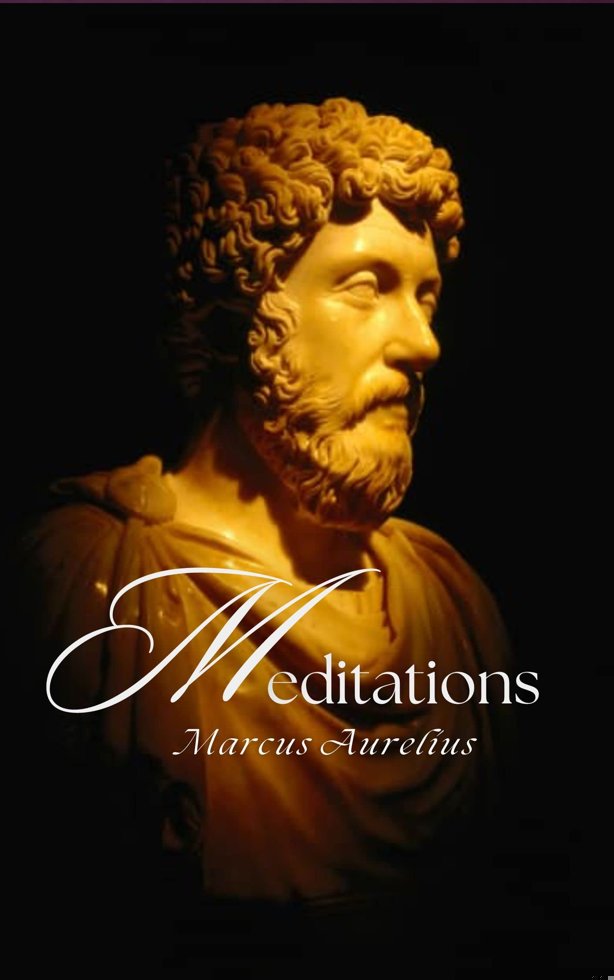 1
1