We've ranked the best media books using expert recommendations, sales data, and millions of reader ratings. At Shortform, we know books. Our book guides are the best in the world. Learn why.
Cover unavailable
1
Amusing Ourselves to Death: Public Discourse in the Age of Show Business
Television has conditioned us to tolerate visually entertaining material measured out in spoonfuls of time, to the detriment of rational public discourse and reasoned public affairs. In this eloquent, persuasive book, Neil Postman alerts us to the real and present dangers of this state of affairs, and offers compelling suggestions as to how to withstand the media onslaught. Before we hand over politics, education, religion, and journalism to the show business demands of the television age, we must recognize the ways in which the media shape our lives and the ways we can, in turn, shape them to serve out highest goals.
…
Recommended by Austin Kleon, Kara Nortman, Stephen Kinsella, and 3 others.
Earlier this year Postman’s son Andrew wrote an op-ed with the title, “My dad predicted Trump in 1985 — it’s not Orwell, he warned, it’s Brave New World.” Postman wrote: “What Orwell feared were those who would ban books. What Huxley feared was that there would be no reason to ban a book, for there would be no one who wanted to read one.” [source]
Kara Nortman
@andrewchen Also a great book on the topic - Amusing Ourselves to Death https://t.co/yWLBxKumLQ [source]
Stephen Kinsella
@AlanReillyIRL @t0nyyates @WhelanKarl Yes! Fantastic book. So glad you're re-reading it. [source]
Cover unavailable
2
Manufacturing Consent: The Political Economy of the Mass Media
In this pathbreaking work, Edward S. Herman and Noam Chomsky show that, contrary to the usual image of the news media as cantankerous, obstinate, and ubiquitous in their search for truth and defense of justice, in their actual practice they defend the economic, social, and political agendas of the privileged groups that dominate domestic society, the state, and the global order.
Based on a series of case studies—including the media’s dichotomous treatment of “worthy” versus “unworthy” victims, “legitimizing” and “meaningless” Third World elections, and devastating critiques of media coverage of the U.S. wars against Indochina—Herman and Chomsky draw on decades of criticism and research to propose a Propaganda Model to explain the media’s behavior and performance. Their new introduction updates the Propaganda Model and the earlier case studies, and it discusses several other applications. These include the manner in which the media covered the passage of the North American Free Trade Agreement and subsequent Mexican financial meltdown of 1994-1995, the media’s handling of the protests against the World Trade Organization, World Bank, and International Monetary Fund in 1999 and 2000, and the media’s treatment of the chemical industry and its regulation. What emerges from this work is a powerful assessment of how propagandistic the U.S. mass media are, how they systematically fail to live up to their self-image as providers of the kind of information that people need to make sense of the world, and how we can understand their function in a radically new way.
…
Recommended by Louis Nyffenegger.
Louis Nyffenegger
Few technical books and a bit of everything. The following books are currently sitting on my bedside table: "The Hitchhiker's Guide To The Galaxy", "Predictable Revenue", "Manufacturing Consent", "Agile Application Security". "Oauth In Action", "Serious Cryptography". [source]
Cover unavailable
3
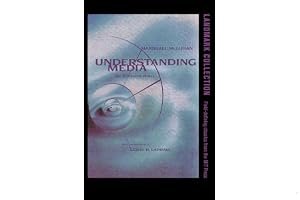
Understanding Media: The Extensions of Man
Marshall McLuhan, Lewis H. Lapham
4.6
Terms and phrases such as "the global village" and "the medium is the message" are now part of the lexicon, and McLuhan's theories continue to challenge our sensibilities and our assumptions about how and what we communicate.
This reissue of Understanding Media marks the thirtieth anniversary (1964-1994) of Marshall McLuhan's classic expose on the state of the then emerging phenomenon of mass media. Terms and phrases such as "the global village" and "the medium is the message" are now part of the lexicon, and McLuhan's theories continue to challenge our sensibilities and our assumptions about how and what we communicate.
There has been a notable resurgence of interest in McLuhan's work in the last few years, fueled by the recent and continuing conjunctions between the cable companies and the regional phone companies, the appearance of magazines such as WiRed, and the development of new media models and information ecologies, many of which were spawned from MIT's Media Lab. In effect, media now begs to be redefined. In a new introduction to this edition of Understanding Media, Harper's editor Lewis Lapham reevaluates McLuhan's work in the light of the technological as well as the political and social changes that have occurred in the last part of this century.
…
Recommended by Cynthia Johnson.
Cynthia Johnson
This book will help change the way you think about digital marketing tools or social media tools, or any sort of communication device. Really focus on what do they do and how do they work first, and then create the content. [source]
Cover unavailable
4
Catch and Kill: Lies, Spies, and a Conspiracy to Protect Predators
In a dramatic account of violence and espionage, Pulitzer Prize-winning investigative reporter Ronan Farrow exposes serial abusers and a cabal of powerful interests hell-bent on covering up the truth, at any cost.
In 2017, a routine network television investigation led Ronan Farrow to a story only whispered about: one of Hollywood's most powerful producers was a predator, protected by fear, wealth, and a conspiracy of silence. As Farrow drew closer to the truth, shadowy operatives, from high-priced lawyers to elite war-hardened spies, mounted a secret campaign of intimidation, threatening his career, following his every move and weaponizing an account of abuse in his own family.
All the while, Farrow and his producer faced a degree of resistance that could not be explained - until now. And a trail of clues revealed corruption and cover-ups from Hollywood, to Washington, and beyond.
This is the untold story of the exotic tactics of surveillance and intimidation deployed by wealthy and connected men to threaten journalists, evade accountability and silence victims of abuse - and it's the story of the women who risked everything to expose the truth and spark a global movement.
Both a spy thriller and a meticulous work of investigative journalism, Catch and Kill breaks devastating new stories about the rampant abuse of power - and sheds far-reaching light on investigations that shook the culture.
…
Recommended by Reese Witherspoon, Bastian Obermayer, Julie K. Brown, and 4 others.
Congrats @RonanFarrow on your incredible book #CatchandKill. Amazing investigative reporting and A real thrill ride of a read. 📚 [source]
Bastian Obermayer
I know I’m very late to this party, but: „Catch And Kill“ from the unrelenting @RonanFarrow is a hell of a read!! Need inspiration for how to hold the powerful accountable - or only looking for great entertainment? Get this book. https://t.co/y3xWkUTWhh [source]
Julie K. Brown
The parallels to the Jeffrey Epstein case are amazing in @RonanFarrow’s new book. Imagine this same predatory behavior and coverup among powerful men — not at a TV-media network — but at the highest levels of our government. #perversionofjustice https://t.co/wh2EJlg7iW [source]
Cover unavailable
5
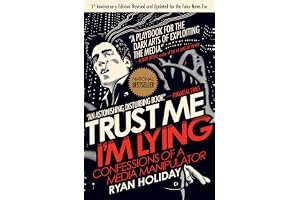
Trust Me, I'm Lying: Confessions of a Media Manipulator
Ryan Holiday
4.5
You've seen it all before. A malicious online rumor costs a company millions. A political sideshow derails the national news cycle and destroys a candidate. Some product or celebrity zooms from total obscurity to viral sensation. What you don't know is that someone is responsible for all this. Usually, someone like me.
I'm a media manipulator. In a world where blogs control and distort the news, my job is to control blogs--as much as any one person can. In today's culture...
1) Blogs like "Gawker," "Buzzfeed" and the "Huffington Post" drive the media agenda.
2) Bloggers are slaves to money, technology, and deadlines.
3) Manipulators wield these levers to shape everything you read, see and watch--online and off.
Why am I giving away these secrets? Because I'm tired of a world where blogs take indirect bribes, marketers help write the news, reckless journalists spread lies, and no one is accountable for any of it. I'm pulling back the curtain because I don't want anyone else to get blindsided.
I'm going to explain exactly how the media "really" works. What you choose to do with this information is up to you.
…
Recommended by Timothy Ferriss, Dov Charney, Tucker Max, and 12 others.
Ryan is part Machiavelli, part Ogilvy, and all results. From American Apparel to the quiet campaigns he's run but not taken credit for, this whiz kid is the secret weapon you've never heard of. [source]
Dov Charney
Founder/American Apparel
Behind my reputation as a marketing genius there is Ryan Holiday, whom I consult often and who has done more for my business than just about anyone. [source]
Tucker Max
Author/I Hope They Serve Beer in Hell
The strategies Ryan created to exploit blogs drove sales of millions of my books and made me an internationally known name. The reason I am standing here while other celebrities were destroyed or became parodies of themselves is because of his insider knowledge. [source]
Cover unavailable
6
The Medium is the Massage
Marshall McLuhan, Quentin Fiore, Shepard Fairey
4.5
The Medium is the Massage is Marshall McLuhan's most condensed, and perhaps most effective, presentation of his ideas. Using a layout style that was later copied by Wired, McLuhan and coauthor/designer Quentin Fiore combine word and image to illustrate and enact the ideas that were first put forward in the dense and poorly organized Understanding Media. McLuhan's ideas about the nature of media, the increasing speed of communication, and the technological basis for our understanding of who we are come to life in this slender volume. Although originally printed in 1967, the art and style in The Medium is the Massage seem as fresh today as in the summer of love, and the ideas are even more resonant now that computer interfaces are becoming gateways to the global village.
If you really want to look at what everybody else is building on, it’s really McLuhan’s ideas. [source]
Cover unavailable
7
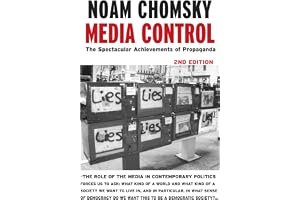
Media Control: The Spectacular Achievements of Propaganda
Noam Chomsky
4.4
Noam Chomsky’s backpocket classic on wartime propaganda and opinion control begins by asserting two models of democracy—one in which the public actively participates, and one in which the public is manipulated and controlled. According to Chomsky, "propaganda is to democracy as the bludgeon is to a totalitarian state," and the mass media is the primary vehicle for delivering propaganda in the United States. From an examination of how Woodrow Wilson’s Creel Commission "succeeded, within six months, in turning a pacifist population into a hysterical, war-mongering population," to Bush Sr.'s war on Iraq, Chomsky examines how the mass media and public relations industries have been used as propaganda to generate public support for going to war. Chomsky further touches on how the modern public relations industry has been influenced by Walter Lippmann’s theory of "spectator democracy," in which the public is seen as a "bewildered herd" that needs to be directed, not empowered; and how the public relations industry in the United States focuses on "controlling the public mind," and not on informing it. Media Control is an invaluable primer on the secret workings of disinformation in democratic societies.
Now a New York Times bestseller and from the author of The Psychopath Test, a captivating and brilliant exploration of one of our world's most underappreciated forces: shame.
'It's about the terror, isn't it?'
'The terror of what?' I said.
'The terror of being found out.'
For the past three years, Jon Ronson has travelled the world meeting recipients of high-profile public shamings. The shamed are people like us - people who, say, made a joke on social media that came out badly, or made a mistake at work. Once their transgression is revealed, collective outrage circles with the force of a hurricane and the next thing they know they're being torn apart by an angry mob, jeered at, demonized, sometimes even fired from their job.
A great renaissance of public shaming is sweeping our land. Justice has been democratized. The silent majority are getting a voice. But what are we doing with our voice? We are mercilessly finding people's faults. We are defining the boundaries of normality by ruining the lives of those outside it. We are using shame as a form of social control.
Simultaneously powerful and hilarious in the way only Jon Ronson can be, So You've Been Publicly Shamed is a deeply honest book about modern life, full of eye-opening truths about the escalating war on human flaws - and the very scary part we all play in it.
…
Recommended by Ryan Holiday, Audrey Russo, Max Rushden, and 1 others.
There’s no question this was the year’s best book about media and culture–maybe even the best of the decade. Not only is it provocative and insightful, but the idea—interviewing and focusing on people who have screwed up and found themselves in the midst of massive online controversies—is one I am genuinely jealous of. Ronson proceeds to write about it with such sensitivity, empathy, humor and insight that I was blown away. If you’ve at all appreciated any of my media criticism over the years, please read this book. It looks at all that’s wrong with the rage and glee with which we tear people down–often people who were never public figures to begin with. He is just a helluva writer. If you get a chance, watch Monica Lewinsky’s TED talk which is also surprisingly good and pairs well with the ideas in the book. [source]
Audrey Russo
So You Have Been Publicly Shamed – Jon Ronson (we are living in interesting times and I am trying to have perspective on how social media has altered our personas) [source]
Max Rushden
fascinating, open & honest. I've said this before - but I recommend @jonronson's book - "So You've Been Publicly Shamed" - on the often seismic difference between someone's mistakes and the impact on their lives...and our increasing inability to forgive.👍❤️ https://t.co/bzJRyOO3Mb [source]
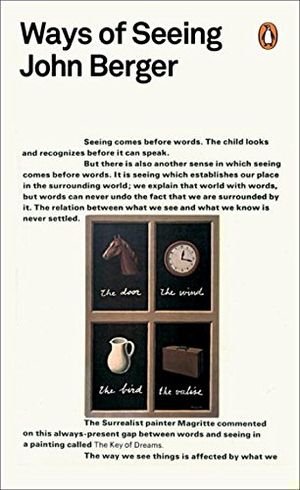
John Berger’s Classic Text on Art John Berger's Ways of Seeing is one of the most stimulating and the most influential books on art in any language. First published in 1972, it was based on the BBC television series about which the (London) Sunday Times critic commented: "This is an eye-opener in more ways than one: by concentrating on how we look at paintings . . . he will almost certainly change the way you look at pictures." By now he has.
"Berger has the ability to cut right through the mystification of the professional art critics . . . He is a liberator of images: and once we have allowed the paintings to work on us directly, we are in a much better position to make a meaningful evaluation" —Peter Fuller, Arts Review
"The influence of the series and the book . . . was enormous . . . It opened up for general attention to areas of cultural study that are now commonplace" —Geoff Dyer in Ways of Telling
Winner of the 1972 Booker Prize for his novel, G., John Peter Berger (born November 5th, 1926) is an art critic, painter and author of many novels including A Painter of Our Time, From A to X and Bento’s Sketchbook.
You have to understand the Marxist interpretation of art; it is absolutely fundamental to the way that art history departments now study the material. Then you have to critique it, because we’ve moved on from the 1970s and the collapse of Marxism in most of the world shows—amongst other things—that the model was flawed. But it’s still a very good book to read, for a teenager especially. [source]
Cover unavailable
10
1984
George Orwell
4.4
A PBS Great American Read Top 100 Pick
With extraordinary relevance and renewed popularity, George Orwell’s 1984 takes on new life in this hardcover edition.
“Orwell saw, to his credit, that the act of falsifying reality is only secondarily a way of changing perceptions. It is, above all, a way of asserting power.”—The New Yorker
In 1984, London is a grim city in the totalitarian state of Oceania where Big Brother is always watching you and the Thought Police can practically read your mind. Winston Smith is a man in grave danger for the simple reason that his memory still functions. Drawn into a forbidden love affair, Winston finds the courage to join a secret revolutionary organization called The Brotherhood, dedicated to the destruction of the Party. Together with his beloved Julia, he hazards his life in a deadly match against the powers that be.
Lionel Trilling said of Orwell’s masterpiece “1984 is a profound, terrifying, and wholly fascinating book. It is a fantasy of the political future, and like any such fantasy, serves its author as a magnifying device for an examination of the present.” Though the year 1984 now exists in the past, Orwell’s novel remains an urgent call for the individual willing to speak truth to power.
Today is World Book Day, a wonderful opportunity to address this #ChallengeRichard sent in by Mike Gonzalez of New Jersey: Make a list of your top 65 books to read in a lifetime. [source]
“What does it mean to manage well?” From Ed Catmull, co-founder (with Steve Jobs and John Lasseter) of Pixar Animation Studios, comes an incisive book about creativity in business—sure to appeal to readers of Daniel Pink, Tom Peters, and Chip and Dan Heath. Creativity, Inc. is a book for managers who want to lead their employees to new heights, a manual for anyone who strives for originality, and the first-ever, all-access trip into the nerve center of Pixar Animation—into the meetings, postmortems, and “Braintrust” sessions where some of the most successful films in history are made. It is, at heart, a book about how to build a creative culture—but it is also, as Pixar co-founder and president Ed Catmull writes, “an expression of the ideas that I believe make the best in us possible.” For nearly twenty years, Pixar has dominated the world of animation, producing such beloved films as the Toy Story trilogy, Monsters, Inc., Finding Nemo, The Incredibles, Up, and WALL-E, which have gone on to set box-office records and garner thirty Academy Awards. The joyousness of the storytelling, the inventive plots, the emotional authenticity: In some ways, Pixar movies are an object lesson in what creativity really is. Here, in this book, Catmull reveals the ideals and techniques that have made Pixar so widely admired—and so profitable.
As a young man, Ed Catmull had a dream: to make the first computer-animated movie. He nurtured that dream as a Ph.D. student at the University of Utah, where many computer science pioneers got their start, and then forged a partnership with George Lucas that led, indirectly, to his founding Pixar with Steve Jobs and John Lasseter in 1986. Nine years later, Toy Story was released, changing animation forever. The essential ingredient in that movie’s success—and in the thirteen movies that followed—was the unique environment that Catmull and his colleagues built at Pixar, based on philosophies that protect the creative process and defy convention, such as:
• Give a good idea to a mediocre team, and they will screw it up. But give a mediocre idea to a great team, and they will either fix it or come up with something better. • If you don’t strive to uncover what is unseen and understand its nature, you will be ill prepared to lead. • It’s not the manager’s job to prevent risks. It’s the manager’s job to make it safe for others to take them. • The cost of preventing errors is often far greater than the cost of fixing them. • A company’s communication structure should not mirror its organizational structure. Everybody should be able to talk to anybody. • Do not assume that general agreement will lead to change—it takes substantial energy to move a group, even when all are on board.
This book is written by the founder of Pixar and is about his experience building a culture that fosters creativity. His theory is that people are fundamentally creative, but many forces stand in the way of people being able to do their best work. I love reading first-hand accounts about how people build great companies like Pixar and nurture innovation and creativity. This should be inspiring to anyone looking to do the same, and hopefully there will be lessons we can apply to connecting the world! [source]
No matter your circumstances, storytelling and creativity are two 'meta-skills' that can take your business and life to the next level. Ed is a master. [source]
"THE FIRST RULE ABOUT FIGHT CLUB IS YOU DON'T TALK ABOUT CLUB."
Every weekend, in the basements and parking lots of bars across the country, young men with good white-collar jobs and absent fathers take off their shoes and shirts and fight each other barehanded for as long as they have to. Then they go back to those jobs with blackened eyes and loosened teeth and the sense that they can handle anything. Fight Club is the invention of Tyler Durden, projectionist, waiter, and dark, anarchic genius, and it's only the beginning of his plans for revenge on a world where cancer support groups have the corner on human warmth. As the narrator of Fight Club puts it: "If people thought you were dying, they gave you their full attention."
"THE SECOND RULE ABOUT FIGHT CLUB IS YOU DON'T TALK ABOUT CLUB."
Where does Tyler Durden come from? Why do his violent schemes so capture the troubled, insomniac narrator? What events bring them to the roof of the world's tallest building, wired to explode in ten minutes? The answers in Fight Club reveal a world poised on the brink of mayhem—and introduce a blazingly original literary scene.
"THE THIRD RULE ABOUT FIGHT CLUB IS TWO MEN PER FIGHT."
What will the end of the millennium feel like? Readers of Chuck Palahniuk's brilliantly apocalyptic and unnerving first novel are going to find out.
I’m amazed how many young people haven’t read this book. Truly life-changing. This is the classic of my generation; it is the book that defines our age and ultimately, how to find meaning in it. It’s a cautionary tale too—about being too caught up in revolutionary ideas. [source]
Van Badham
SUPER EXCITED to receive my copy of “Solved! How Other Countries Have Cracked the World’s Biggest Problems and We Can, Too” by Andrew Wear. SO GREAT to read a political book that’s about both pragmatic action *and* hope. Squee! #auspol https://t.co/jIYgr36kZO [source]
Cover unavailable
13
The Green Mile
Stephen King
4.3
When it first appeared, one volume per month, Stephen King's THE GREEN MILE was an unprecedented publishing triumph: all six volumes ended up on the New York Times bestseller lists—simultaneously—and delighted millions of fans the world over.
Welcome to Cold Mountain Penitentiary, home to the Depression-worn men of E Block. Convicted killers all, each awaits his turn to walk the Green Mile, keeping a date with "Old Sparky," Cold Mountain's electric chair. Prison guard Paul Edgecombe has seen his share of oddities in his years working the Mile. But he's never seen anyone like John Coffey, a man with the body of a giant and the mind of a child, condemned for a crime terrifying in its violence and shocking in its depravity. In this place of ultimate retribution, Edgecombe is about to discover the terrible, wondrous truth about Coffey, a truth that will challenge his most cherished beliefes... and yours.
…
Recommended by Clive Stafford Smith.
Clive Stafford Smith
It’s an immensely courageous book for such a famous author to write. It’s written from the perspective of the warder, whose job is to supervise death row and the execution of prisoners. The story is ultimately about a guy called John Coffey, a Christ-like figure who gets executed. [source]
Cover unavailable
14
The Shock Doctrine: The Rise of Disaster Capitalism
In her ground-breaking reporting from Iraq, Naomi Klein exposed how the trauma of invasion was being exploited to remake the country in the interest of foreign corporations. She called it "disaster capitalism." Covering Sri Lanka in the wake of the tsunami, and New Orleans post-Katrina, she witnessed something remarkably similar. People still reeling from catastrophe were being hit again, this time with economic "shock treatment" losing their land and homes to rapid-fire corporate makeovers. The Shock Doctrine retells the story of the most dominant ideology of our time, Milton Friedman's free market economic revolution. In contrast to the popular myth of this movement's peaceful global victory, Klein shows how it has exploited moments of shock and extreme violence in order to implement its economic policies in so many parts of the world from Latin America and Eastern Europe to South Africa, Russia, and Iraq. At the core of disaster capitalism is the use of cataclysmic events to advance radical privatization combined with the privatization of the disaster response itself. By capitalizing on crises, created by nature or war, Klein argues that the disaster capitalism complex now exists as a booming new economy, and is the violent culmination of a radical economic project that has been incubating for fifty years.
…
Recommended by Donna Dickenson, George Monbiot, and Mat Whitecross.
Donna Dickenson
Naomi Klein’s argument is that capitalism actually requires deliberately engineered shocks to the economic systems. [source]
The Shock Doctrine explains some of the mechanisms by which patrimonial capital acquires power and enhances its wealth. It’s a brilliant piece of work, and one of those rare books that changes the way you perceive the world. [source]
Mat Whitecross
It starts with the theory that moments of crisis have been utilised by the right wing in the US and other countries to manipulate people into following their agenda. [source]
Cover unavailable
15
Flat Earth News: An Award-Winning Reporter Exposes Falsehood, Distortion and Propaganda in the Global Media
Nick Davies
4.3
After years of working as a respected journalist, Nick Davies broke the unwritten rule of the media by investigating the practices of his fellow colleagues. In this eye-opening exposé, Davies uncovers an industry awash in corruption and bias. His findings include the story of a prestigious Sunday newspaper that allowed the CIA to plant fiction in its columns; the newsroom that routinely rejects stories about black people; the respected paper that hired a professional fraudster to set up a front company to entrap senior political figures; as well as a number of newspapers that pay cash bribes to bent detectives. His research also exposes a range of national stories that were in fact pseudo events manufactured by the public relations industry and global news stories that were fiction generated by a machinery of international propaganda. The degree to which the media industry has affected government policy and perverted popular belief is also addressed. Gripping and thought-provoking, this is an insider’s look at one of the world’s most tainted professions.
…
Recommended by Max Mosley.
Max Mosley
This to me is fascinating because it’s the first time that a top-quality journalist has done a complete exposé on the way in which the media distort what’s going on. He says in his preface that dog doesn’t eat dog. Usually, all institutions are open to criticism by the media except the media themselves. So this is the first time that somebody has actually done it to the media. It’s immensely interesting because he has done a great deal of research and he gives all sorts of examples. [source]
Cover unavailable
16
All the Pretty Horses (The Border Trilogy, #1)
Cormac McCarthy
4.3
All the Pretty Horses tells of young John Grady Cole, the last of a long line of Texas ranchers. Across the border Mexico beckons—beautiful and desolate, rugged and cruelly civilized. With two companions, he sets off on an idyllic, sometimes comic adventure, to a place where dreams are paid for in blood.
Recommended by Daniel Buttner, Devon Sawa, Meg Rosoff, and 1 others.
Daniel Buttner
Cormac McCarthy is one of my favorite authors, specifically The Border Trilogy. [source]
Devon Sawa
This is the best book I’ve ever read. https://t.co/AUJLuRAadm [source]
Meg Rosoff
A book that explores that whole subject of finding out where you belong in the world, which is not a search that starts and ends between 18 and 21. [source]
Cover unavailable
17
Understanding Comics: The Invisible Art
Scott McCloud
4.3
The bestselling international classic on storytelling and visual communication
"You must read this book." — Neil Gaiman
Praised throughout the cartoon industry by such luminaries as Art Spiegelman, Matt Groening, and Will Eisner, Scott McCloud's Understanding Comics is a seminal examination of comics art: its rich history, surprising technical components, and major cultural significance. Explore the secret world between the panels, through the lines, and within the hidden symbols of a powerful but misunderstood art form.
…
Recommended by Ev Williams, Austin Kleon, Bret Victor, and 1 others.
Unsolicited, but here’s my advice for visual thinkers (and others) who want to be better writers: … Cartoonists, because their work demands work from two disciplines (writing/art, poetry/design, words/pictures), are highly instructive when it comes to visual people learning to write, writers learning to make art, etc. (Check out Scott McCloud’s Understanding Comics for more.) [source]
Will Brooker
Understanding Comics is a book about how comics work, told in comic form. It’s very accessible, it’s for the general reader and is about comics in general, not just superhero comics. It explores areas like pacing and editing – how motion can be created through static panels on a page, and how arranging those panels in different ways, or drawing in different styles, or combining text and image, has different effects. It’s almost like a book on film study which explores the role of sound, lighting or editing. Scott McCloud is an artist himself, and he draws pastiches to show how different styles produce different effects. [source]
Cover unavailable
18
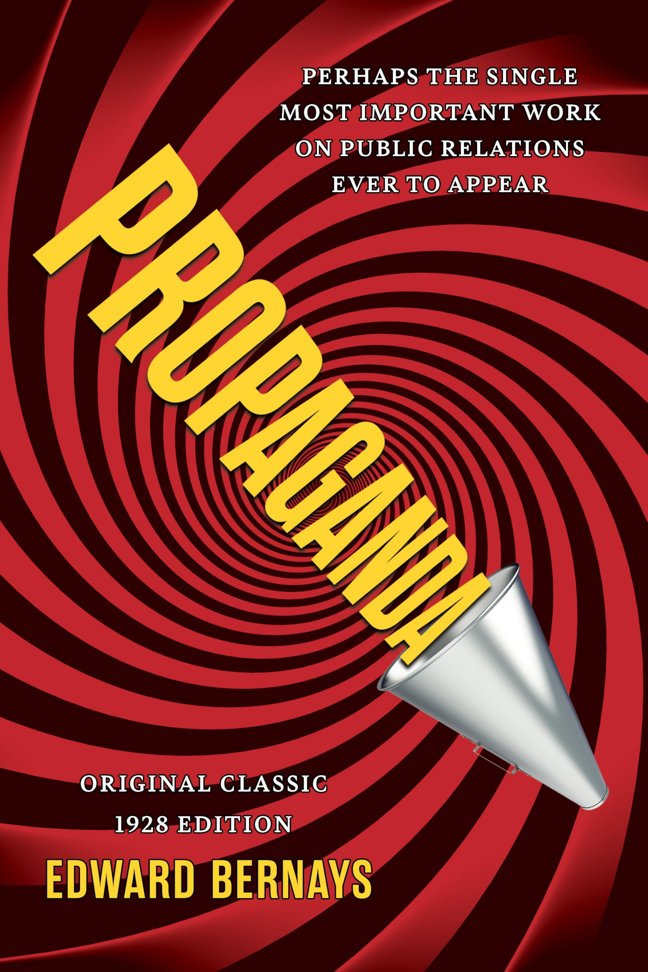
Propaganda
Edward Bernays
4.3
“Bernays’ honest and practical manual provides much insight into some of the most powerful and influential institutions of contemporary industrial state capitalist democracies.”—Noam Chomsky
“The conscious and intelligent manipulation of the organized habits and opinions of the masses is an important element in democratic society. Those who manipulate this unseen mechanism of society constitute an invisible government which is the true ruling power of our country.”—Edward Bernays, Propaganda
A seminal and controversial figure in the history of political thought and public relations, Edward Bernays (1891–1995), pioneered the scientific technique of shaping and manipulating public opinion, which he famously dubbed “engineering of consent.” During World War I, he was an integral part of the U.S. Committee on Public Information (CPI), a powerful propaganda apparatus that was mobilized to package, advertise and sell the war to the American people as one that would “Make the World Safe for Democracy.” The CPI would become the blueprint in which marketing strategies for future wars would be based upon.
Bernays applied the techniques he had learned in the CPI and, incorporating some of the ideas of Walter Lipmann, became an outspoken proponent of propaganda as a tool for democratic and corporate manipulation of the population. His 1928 bombshell Propaganda lays out his eerily prescient vision for using propaganda to regiment the collective mind in a variety of areas, including government, politics, art, science and education. To read this book today is to frightfully comprehend what our contemporary institutions of government and business have become in regards to organized manipulation of the masses.
This is the first reprint of Propaganda in over 30 years and features an introduction by Mark Crispin Miller, author of The Bush Dyslexicon: Observations on a National Disorder.
…
Recommended by Cynthia Johnson, Dave Elitch, and Jérôme Jarre.
Cynthia Johnson
What people don’t realise is that PR was originally called ‘propaganda.’ After World War II, that word had such negative connotations that they changed it to public relations, but PR and propaganda are one and the same. This book offers a really interesting breakdown of how little has changed in, almost, 100 years. [source]
Dave Elitch
The author was Sigmund Freud’s nephew. He took all of Freud’s theories on the subconscious and came to the conclusion that human beings are either savage animals that are going to rip each other apart, or they can be controlled and made docile via consumerism. [source]
Jérôme Jarre
This book opened my eyes to the marketing industry in a time when I was blindly playing my role in it. [source]
Cover unavailable
19
The Master Switch: The Rise and Fall of Information Empires
Tim Wu
4.3
In this age of an open Internet, it is easy to forget that every American information industry, beginning with the telephone, has eventually been taken captive by some ruthless monopoly or cartel. With all our media now traveling a single network, an unprecedented potential is building for centralized control over what Americans see and hear. Could history repeat itself with the next industrial consolidation? Could the Internet—the entire flow of American information—come to be ruled by one corporate leviathan in possession of “the master switch”? That is the big question of Tim Wu’s pathbreaking book.
As Wu’s sweeping history shows, each of the new media of the twentieth century—radio, telephone, television, and film—was born free and open. Each invited unrestricted use and enterprising experiment until some would-be mogul battled his way to total domination. Here are stories of an uncommon will to power, the power over information: Adolph Zukor, who took a technology once used as commonly as YouTube is today and made it the exclusive prerogative of a kingdom called Hollywood . . . NBC’s founder, David Sarnoff, who, to save his broadcast empire from disruptive visionaries, bullied one inventor (of electronic television) into alcoholic despair and another (this one of FM radio, and his boyhood friend) into suicide . . . And foremost, Theodore Vail, founder of the Bell System, the greatest information empire of all time, and a capitalist whose faith in Soviet-style central planning set the course of every information industry thereafter.
Explaining how invention begets industry and industry begets empire—a progress often blessed by government, typically with stifling consequences for free expression and technical innovation alike—Wu identifies a time-honored pattern in the maneuvers of today’s great information powers: Apple, Google, and an eerily resurgent AT&T. A battle royal looms for the Internet’s future, and with almost every aspect of our lives now dependent on that network, this is one war we dare not tune out.
Part industrial exposé, part meditation on what freedom requires in the information age, The Master Switch is a stirring illumination of a drama that has played out over decades in the shadows of our national life and now culminates with terrifying implications for our future.
Now starting the section now these information empires eventually got dismantled, by the internet, cable, and the government antitrust efforts on the 1950s! Awesome book so far [source]
If The Information is a sprawling, sweeping story of how information has changed over time, one thing it doesn’t get into is the commercial nature of information as a good that is bought and sold. That’s the story Tim Wu tells in The Master Switch. His basic argument is that whenever a new communication medium arises, a similar pattern occurs. The technology starts off as a hobbyist’s passion, democratic and open. Then over time, as it becomes more popular, it starts to be dominated by corporate interests and becomes much more formalised, before eventually being displaced by a new technology. [source]
Cover unavailable
20
The Shallows: What the Internet Is Doing to Our Brains
Nicholas Carr
4.3
“Is Google making us stupid?” When Nicholas Carr posed that question, in a celebrated Atlantic Monthly cover story, he tapped into a well of anxiety about how the Internet is changing us. He also crystallized one of the most important debates of our time: As we enjoy the Net’s bounties, are we sacrificing our ability to read and think deeply?
Now, Carr expands his argument into the most compelling exploration of the Internet’s intellectual and cultural consequences yet published. As he describes how human thought has been shaped through the centuries by “tools of the mind”—from the alphabet to maps, to the printing press, the clock, and the computer—Carr interweaves a fascinating account of recent discoveries in neuroscience by such pioneers as Michael Merzenich and Eric Kandel. Our brains, the historical and scientific evidence reveals, change in response to our experiences. The technologies we use to find, store, and share information can literally reroute our neural pathways.
Building on the insights of thinkers from Plato to McLuhan, Carr makes a convincing case that every information technology carries an intellectual ethic—a set of assumptions about the nature of knowledge and intelligence. He explains how the printed book served to focus our attention, promoting deep and creative thought. In stark contrast, the Internet encourages the rapid, distracted sampling of small bits of information from many sources. Its ethic is that of the industrialist, an ethic of speed and efficiency, of optimized production and consumption—and now the Net is remaking us in its own image. We are becoming ever more adept at scanning and skimming, but what we are losing is our capacity for concentration, contemplation, and reflection.
Part intellectual history, part popular science, and part cultural criticism, The Shallows sparkles with memorable vignettes—Friedrich Nietzsche wrestling with a typewriter, Sigmund Freud dissecting the brains of sea creatures, Nathaniel Hawthorne contemplating the thunderous approach of a steam locomotive—even as it plumbs profound questions about the state of our modern psyche. This is a book that will forever alter the way we think about media and our minds.
While I was thinking of the best books to add to this short list, I realized that not even half of them are directly related to digital marketing. This is because I believe that the best marketers are people who understand human nature deeply and aim to bring out the best in it. Call me naive, but that’s how I see it. If I were to want to pursue a career in marketing, I’d read … The Shallows. [source]
Nicholas Carr talks at length about what is gained and lost by technological progress. Reading and writing enlarged people’s sympathetic response and enriched their lives even when the book was put aside. One could say the same thing about drawing. [source]
Cover unavailable
21
The Gutenberg Galaxy: The Making of Typographic Man
Marshall McLuhan
4.3
Since its first appearance in 1962, the impact of The Gutenberg Galaxy has been felt around the world. It gave us the concept of the global village; that phrase has now been translated, along with the rest of the book, into twelve languages, from Japanese to Serbo-Croat. It helped establish Marshall McLuhan as the original 'media guru.' More than 200,000 copies are in print. The reissue of this landmark book reflects the continuing importance of McLuhan's work for contemporary readers.
…
Cover unavailable
22
The Hunger Games (The Hunger Games, #1)
Suzanne Collins
4.3
WINNING MEANS FAME AND FORTUNE. LOSING MEANS CERTAIN DEATH. THE HUNGER GAMES HAVE BEGUN. . . .
In the ruins of a place once known as North America lies the nation of Panem, a shining Capitol surrounded by twelve outlying districts. The Capitol is harsh and cruel and keeps the districts in line by forcing them all to send one boy and once girl between the ages of twelve and eighteen to participate in the annual Hunger Games, a fight to the death on live TV.
Sixteen-year-old Katniss Everdeen regards it as a death sentence when she steps forward to take her sister's place in the Games. But Katniss has been close to dead before—and survival, for her, is second nature. Without really meaning to, she becomes a contender. But if she is to win, she will have to start making choices that weight survival against humanity and life against love.
A brutal, exciting, action-based sci-fi novel. Hugely popular and excellent fun. [source]
Cover unavailable
23
It
Stephen King
4.3
They were seven teenagers when they first stumbled upon the horror. Now they are grown-up men and women who have gone out into the big world to gain success and happiness. But the promise they made 28 years ago calls them to reunite in the same place where, as teenagers, they battled an evil creature that preyed on the city's children. Now children are being murdered again, and their repressed memories of that terrifying summer return as they prepare to once again battle the monster lurking in Derry's sewers.
…
Cover unavailable
24
The Image: A Guide to Pseudo-Events in America
Daniel J. Boorstin
4.3
First published in 1962, this wonderfully provocative book introduced the notion of “pseudo-events”—events such as press conferences and presidential debates, which are manufactured solely in order to be reported—and the contemporary definition of celebrity as “a person who is known for his well-knownness.” Since then Daniel J. Boorstin’s prophetic vision of an America inundated by its own illusions has become an essential resource for any reader who wants to distinguish the manifold deceptions of our culture from its few enduring truths.
Cover design by Matt Dorfman.
…
Recommended by Dave Elitch and Susan Bordo.
Dave Elitch
Dave Elitch recommended this book on the podcast "The Tim Ferriss Show". [source]
Susan Bordo
A pseudo-event is something that acquires its reality and power not because it is based on fact, but simply because the media has reported it. [source]
Cover unavailable
25
The Shining, Carrie and Misery
Stephen King
4.2
For the first time ever in one volume three nightmarish tales of horror from the best selling author Stephen King.
Recommended by Rob Anderson For Louisiana.
Rob Anderson For Louisiana
@CrazyVetDem80 @blu_joon Great book, great movie (“Misery”). Nice reference. We are all in this together. I’m honored to have your support - y’all are the important ones. [source]
Cover unavailable
26
Convergence Culture: Where Old and New Media Collide
Henry Jenkins
4.2
Winner of the 2007 Society for Cinema and Media Studies Katherine Singer Kovacs Book Award 2007 Choice Outstanding Academic Title
A classic study on the dynamic between an individual and different media channels
Convergence Culture maps a new territory: where old and new media intersect, where grassroots and corporate media collide, where the power of the media producer and the power of the consumer interact in unpredictable ways.
Henry Jenkins, one of America's most respected media analysts, delves beneath the new media hype to uncover the important cultural transformations that are taking place as media converge. He takes us into the secret world of Survivor Spoilers, where avid internet users pool their knowledge to unearth the show's secrets before they are revealed on the air. He introduces us to young Harry Potter fans who are writing their own Hogwarts tales while executives at Warner Brothers struggle for control of their franchise. He shows us how The Matrix has pushed transmedia storytelling to new levels, creating a fictional world where consumers track down bits of the story across multiple media channels.Jenkins argues that struggles over convergence will redefine the face of American popular culture. Industry leaders see opportunities to direct content across many channels to increase revenue and broaden markets. At the same time, consumers envision a liberated public sphere, free of network controls, in a decentralized media environment. Sometimes corporate and grassroots efforts reinforce each other, creating closer, more rewarding relations between media producers and consumers. Sometimes these two forces are at war.
Jenkins provides a riveting introduction to the world where every story gets told and every brand gets sold across multiple media platforms. He explains the cultural shift that is occurring as consumers fight for control across disparate channels, changing the way we do business, elect our leaders, and educate our children.
…
Recommended by Bogdana Butnar.
Bogdana Butnar
I thought I might put my money where my mouth is. I keep whining that young people are not in touch with some essential books on advertising that have helped me shape the way I practise my trade today, but I never did anything about it. So I am starting here the ultimate books to read list. I will add to it as I get suggestions and as more good books get written. [source]
Cover unavailable
27
Story: Substance, Structure, Style, and the Principles of Screenwriting
Robert McKee's screenwriting workshops have earned him an international reputation for inspiring novices, refining works in progress and putting major screenwriting careers back on track. Quincy Jones, Diane Keaton, Gloria Steinem, Julia Roberts, John Cleese and David Bowie are just a few of his celebrity alumni. Writers, producers, development executives and agents all flock to his lecture series, praising it as a mesmerizing and intense learning experience. In Story, McKee expands on the concepts he teaches in his $450 seminars (considered a must by industry insiders), providing readers with the most comprehensive, integrated explanation of the craft of writing for the screen. No one better understands how all the elements of a screenplay fit together, and no one is better qualified to explain the "magic" of story construction and the relationship between structure and character than Robert McKee.
…
Recommended by Bill Liao.
Bill Liao
The human world occurs in language so best get good at it! [source]
Cover unavailable
28
Technopoly: The Surrender of Culture to Technology
Neil Postman
4.2
In this witty, often terrifying work of cultural criticism, the author of Amusing Ourselves to Death chronicles our transformation into a Technopoly: a society that no longer merely uses technology as a support system but instead is shaped by it--with radical consequences for the meanings of politics, art, education, intelligence, and truth.
Cover unavailable
29
Proven Guilty (The Dresden Files, #8)
Jim Butcher
4.2
There's no love lost between Harry Dresden, the only wizard in the Chicago phone book, and the White Council of Wizards, who find him brash and undisciplined. But war with the vampires has thinned their ranks, so the Council has drafted Harry as a Warden and assigned him to look into rumors of black magic in the Windy City.
As Harry adjusts to his new role, another problem arrives in the form of the tattooed and pierced daughter of an old friend, all grown-up and already in trouble. Her boyfriend is the only suspect in what looks like a supernatural assault straight out of a horror film. Malevolent entities that feed on fear are loose in Chicago, but it's all in a day's work for a wizard, his faithful dog, and a talking skull named Bob....
…
Cover unavailable
30
Coraline
Neil Gaiman, Dave McKean
4.2
Coraline lives with her preoccupied parents in part of a huge old house--a house so huge that other people live in it, too... round, old former actresses Miss Spink and Miss Forcible and their aging Highland terriers ("We trod the boards, luvvy") and the mustachioed old man under the roof ("'The reason you cannot see the mouse circus,' said the man upstairs, 'is that the mice are not yet ready and rehearsed.'") Coraline contents herself for weeks with exploring the vast garden and grounds. But with a little rain she becomes bored--so bored that she begins to count everything blue (153), the windows (21), and the doors (14). And it is the 14th door that--sometimes blocked with a wall of bricks--opens up for Coraline into an entirely alternate universe. Now, if you're thinking fondly of The Lion, the Witch, and the Wardrobe or Alice's Adventures in Wonderland, you're on the wrong track. Neil Gaiman's Coraline is far darker, far stranger, playing on our deepest fears. And, like Roald Dahl's work, it is delicious.
What's on the other side of the door? A distorted-mirror world, containing presumably everything Coraline has ever dreamed of... people who pronounce her name correctly (not "Caroline"), delicious meals (not like her father's overblown "recipes"), an unusually pink and green bedroom (not like her dull one), and plenty of horrible (very un-boring) marvels, like a man made out of live rats. The creepiest part, however, is her mirrored parents, her "other mother" and her "other father"--people who look just like her own parents, but with big, shiny, black button eyes, paper-white skin... and a keen desire to keep her on their side of the door. To make creepy creepier, Coraline has been illustrated masterfully in scritchy, terrifying ink drawings by British mixed-media artist and Sandman cover illustrator Dave McKean. This delightful, funny, haunting, scary as heck, fairy-tale novel is about as fine as they come. Highly recommended. (Ages 11 and older) --Karin Snelson
…
Recommended by Simon Smith.
Simon Smith
@lindsanderson @Misterbodd @PaulWat5 @f33lthesun Awesomely scary book full stop! Great though. [source]
Cover unavailable
31
The Amazing Adventures of Kavalier & Clay
Michael Chabon
4.2
The novel follows the lives of the title characters, a Czech artist named Joe Kavalier and a Brooklyn-born writer named Sam Clay—both Jewish—before, during, and after World War II. Kavalier and Clay become major figures in the nascent comics industry during its "Golden Age."
Recommended by Ev Williams, Anne Thériault, Natasha Lyonne, and 1 others.
Anne Thériault
@luzbianca417 Phew! I loved that book so much and then the ending I was just like .... what??? No one is making decisions with this child’s best interests in mind! [source]
Sprawling, well researched, historical story. A true pleasure to read. [source]
Cover unavailable
32
Night Shift
Stephen King
4.2
NIGHT SHIFT -- Stephen King's first collection of stories -- is an early showcase of the depths that King's wicked imagination could plumb. In these 20 tales, we see mutated rates gone bad ("Graveyard Shift"); a cataclysmic virus that threatens humanity ("Night Surf," the basis for The Stand); a smoker who will try anything to stop ("Quitters, Inc."); a reclusive alcoholic who begins a gruesome transformation ("Gray Matter"); and many more. This is Stephen King at his horrifying best. --back cover
With a new Afterword to the 2002 edition, No Logo employs journalistic savvy and personal testament to detail the insidious practices and far-reaching effects of corporate marketing—and the powerful potential of a growing activist sect that will surely alter the course of the 21st century. First published before the World Trade Organization protests in Seattle, this is an infuriating, inspiring, and altogether pioneering work of cultural criticism that investigates money, marketing, and the anti-corporate movement.
As global corporations compete for the hearts and wallets of consumers who not only buy their products but willingly advertise them from head to toe—witness today's schoolbooks, superstores, sporting arenas, and brand-name synergy—a new generation has begun to battle consumerism with its own best weapons. In this provocative, well-written study, a front-line report on that battle, we learn how the Nike swoosh has changed from an athletic status-symbol to a metaphor for sweatshop labor, how teenaged McDonald's workers are risking their jobs to join the Teamsters, and how "culture jammers" utilize spray paint, computer-hacking acumen, and anti-propagandist wordplay to undercut the slogans and meanings of billboard ads (as in "Joe Chemo" for "Joe Camel").
No Logo will challenge and enlighten students of sociology, economics, popular culture, international affairs, and marketing.
"This book is not another account of the power of the select group of corporate Goliaths that have gathered to form our de facto global government. Rather, it is an attempt to analyze and document the forces opposing corporate rule, and to lay out the particular set of cultural and economic conditions that made the emergence of that opposition inevitable." —Naomi Klein, from her Introduction
…
Recommended by Bogdana Butnar and David Lammy.
Bogdana Butnar
I thought I might put my money where my mouth is. I keep whining that young people are not in touch with some essential books on advertising that have helped me shape the way I practise my trade today, but I never did anything about it. So I am starting here the ultimate books to read list. I will add to it as I get suggestions and as more good books get written. [source]
David Lammy
This is another modern classic worth revisiting. It charts how brands have become tangled up with identity – how they stopped being markers of quality and became symbols of identity and markers of status. Logos have moved from the inside label to being splashed all over products. Having a coffee in Starbucks is an experience not a product. What you wear helps signal your worth. [source]
"No denunciation without its proper instrument of close analysis," Roland Barthes wrote in his preface to Mythologies. There is no more proper instrument of analysis of our contemporary myths than this book—one of the most significant works in French theory, and one that has transformed the way readers and philosophers view the world around them.
Our age is a triumph of codification. We own devices that bring the world to the command of our fingertips. We have access to boundless information and prodigious quantities of stuff. We decide to like or not, to believe or not, to buy or not. We pick and choose. We think we are free. Yet all around us, in pop culture, politics, mainstream media, and advertising, there are codes and symbols that govern our choices. They are the fabrications of consumer society. They express myths of success, well-being, and happiness. As Barthes sees it, these myths must be carefully deciphered, and debunked.
What Barthes discerned in mass media, the fashion of plastic, and the politics of postcolonial France applies with equal force to today's social networks, the iPhone, and the images of 9/11. This new edition of Mythologies, complete and beautifully rendered by the Pulitzer Prize–winning poet, critic, and translator Richard Howard, is a consecration of Barthes's classic—a lesson in clairvoyance that is more relevant now than ever.
…
Cover unavailable
35
The 1-Page Marketing Plan: Get New Customers, Make More Money, And Stand out From The Crowd
To build a successful business, you need to stop doing random acts of marketing and start following a reliable plan for rapid business growth. Traditionally, creating a marketing plan has been a difficult and time-consuming process, which is why it often doesn't get done.
In The 1-Page Marketing Plan, serial entrepreneur and rebellious marketer Allan Dib reveals a marketing implementation breakthrough that makes creating a marketing plan simple and fast. It's literally a single page, divided up into nine squares. With it you'll be able to map out your own sophisticated marketing plan and go from zero to marketing hero.
Whether you're just starting out or are an experienced entrepreneur, The 1-Page Marketing Plan is the easiest and fastest way to create a marketing plan that will propel your business growth.
In this groundbreaking new book you'll discover: • How to get new customers, clients, or patients and how make more profit from existing ones. • Why “big business” style marketing could kill your business and strategies that actually work for small and medium-sized businesses. • How to close sales without being pushy, needy, or obnoxious while turning the tables and having prospects begging you to take their money. • A simple step-by-step process for creating your own personalized marketing plan that is literally one page. Simply follow along and fill in each of the nine squares that make up your own 1-Page Marketing Plan. • How to annihilate competitors and make yourself the only logical choice. • How to get amazing results on a small budget using the secrets of direct response marketing. • How to charge high prices for your products and services and have customers actually thank you for it.
…
Cover unavailable
36
Covering Islam: How the Media and the Experts Determine How We See the Rest of the World
Edward W. Said
4.2
From the Iranian hostage crisis through the Gulf War and the bombing of the World Trade Center, the American news media have portrayed "Islam" as a monolithic entity, synonymous with terrorism and religious hysteria. In this classic work, now updated, the author of Culture and Imperialism reveals the hidden agendas and distortions of fact that underlie even the most "objective" coverage of the Islamic world.
…
Recommended by Issandr El Amrani and Lorraine Adams.
Issandr El Amrani
This book, although less intellectually challenging than Orientalism, is very important as well. In a sense it is even more important. [source]
Lorraine Adams
He insisted that news is partial and dependent on official interpretation that may serve a private interest rather than a national interest. [source]

Cover unavailable
37
Public Opinion
Walter Lippmann
4.2
In what is widely considered the most influential book ever written by Walter Lippmann, the late journalist and social critic provides a fundamental treatise on the nature of human information and communication. As Michael Curtis indicates in his introduction to this edition. Public Opinion qualifies as a classic by virtue of its systematic brilliance and literary grace. The work is divided into eight parts, covering such varied issues as stereotypes, image making, and organized intelligence. The study begins with an analysis of "the world outside and the pictures in our heads, " a leitmotif that starts with issues of censorship and privacy, speed, words, and clarity, and ends with a careful survey of the modern newspaper. The work is a showcase for Lippmann's vast erudition. He easily integrated the historical, psychological, and philosophical literature of his day, and in every instance showed how relevant intellectual formations were to the ordinary operations of everyday life. Public Opinion is of enduring significance for communications scholars, historians, sociologists, and political scientists.
…
Recommended by David Greenberg and Lorraine Adams.
David Greenberg
When Lippmann wrote this book he had become disillusioned with aspects of democratic theory that assumed citizens could be fully rational and knowledgeable in making up their minds about public issues. [source]
Lorraine Adams
It was written in 1922 and is an insider’s view of how news is made. That is, news is a made thing. News is not facts. [source]

Cover unavailable
38
The Influencing Machine: Brooke Gladstone On The Media
Brooke Gladstone, Josh Neufeld
4.2
Nearly one million weekly listeners trust NPR's Brooke Gladstone to guide them through the distortions and complexities of the modern media. This brilliant radio personality now bursts onto the page as an illustrated character in vivid comics drawn by acclaimed artist Josh Neufeld. The cartoon of Brooke conducts the reader through two millennia of history-from the newspapers in Caesar's Rome to the penny press of the American Revolution and the manipulations of contemporary journalism. Gladstone's manifesto debunks the notion that "The Media" is an external force, outside of our control, since we've begun directly constructing, filtering, and responding to what we watch and read. With fascinating digressions, sobering anecdotes, and brave analytical wit, The Influencing Machine equips us to be smart, savvy, informed consumers and shapers of the media. It shows that we have met the media and it is us. So now what?
…
Cover unavailable
39
Dolores Claiborne
Stephen King, Frances Sternhagen, et al
4.2
Suspected of killing Vera Donovan, her wealthy employer, Dolores Claiborne tells police the story of her life, harkening back to her disintegrating marriage and the suspicious death of her violent husband, Joe St. George, thirty years earlier. Dolores also tells of Vera's physical and mental decline and of her loyalty to an employer who has become emotionally demanding in recent years.
Cover unavailable
40
The Attention Merchants: The Epic Scramble to Get Inside Our Heads
Tim Wu
4.2
Feeling attention challenged? Even assaulted? American business depends on it. In nearly every moment of our waking lives, we face a barrage of messaging, advertising enticements, branding, sponsored social media, and other efforts to harvest our attention. Few moments or spaces of our day remain uncultivated by the "attention merchants," contributing to the distracted, unfocused tenor of our times. Tim Wu argues that this condition is not simply the byproduct of recent technological innovations but the result of more than a century's growth and expansion in the industries that feed on human attention. From the pre-Madison Avenue birth of advertising to the explosion of the mobile web; from AOL and the invention of email to the attention monopolies of Google and Facebook; from Ed Sullivan to celebritypower brandslike Oprah Winfrey, Kim Kardashian and Donald Trump, the basic business model of "attention merchants" has never changed: free diversion in exchange for a moment of your consideration, sold in turn to the highest-bidding advertiser. Wu describes the revolts that have risen against the relentless siege of our awareness, from the remote control to the creation of public broadcasting to Apple's ad-blocking OS. But he makes clear that attention merchants are always growing new heads, even as their means of getting inside our heads are changing our very nature--cognitive, social, political and otherwise--in ways unimaginable even a generation ago.
…
Recommended by Yuval Noah Harari, Marvin Liao, Jeff Bullas, and 1 others.
A very insightful book that surveys the history of modern information technology and its political implications, from the age of print and radio to the era of Google and Facebook. It gives the context of the current battle to control human attention. [source]
Marvin Liao
Partner/500 Startups
I tend to jump from book to book and may switch if I am interested in some new topic. This is a pleasure for me (which I also do benefit work wise from too). It’s quite a random list because I have eclectic interests (or just scatterbrained most likely) on tech business, AI, general global economy, geopolitics, rising Biotech economy & history. I'm basically 15% to 50% into all these books. [source]
Rafat Ali
Have to say @superwuster is best business writer there is. Just finished Master Switch , now reading “Attention Merchants”, the best history-in-context-with-rigor-and-intellectual-analysis writer/explainer there is. If I ever write a book, want to write it like Tim Wu. [source]
Cover unavailable
41
The Postman
David Brin
4.2
Recommended by P W Singer and August Cole.
P W Singer and August Cole
Like all great science fiction, it has the underlying themes that make you think and retain their relevance decades later. [source]
Cover unavailable
42
Here Comes Everybody: The Power of Organizing Without Organizations
Clay Shirky
4.2
A revelatory examination of how the wildfirelike spread of new forms of social interaction enabled by technology is changing the way humans form groups and exist within them, with profound long-term economic and social effects-for good and for ill A handful of kite hobbyists scattered around the world find each other online and collaborate on the most radical improvement in kite design in decades. A midwestern professor of Middle Eastern history starts a blog after 9/11 that becomes essential reading for journalists covering the Iraq war. Activists use the Internet and e-mail to bring offensive comments made by Trent Lott and Don Imus to a wide public and hound them from their positions. A few people find that a world-class online encyclopedia created entirely by volunteers and open for editing by anyone, a wiki, is not an impractical idea. Jihadi groups trade inspiration and instruction and showcase terrorist atrocities to the world, entirely online. A wide group of unrelated people swarms to a Web site about the theft of a cell phone and ultimately goads the New York City police to take action, leading to the culprit's arrest.
With accelerating velocity, our age's new technologies of social networking are evolving, and evolving us, into new groups doing new things in new ways, and old and new groups alike doing the old things better and more easily. You don't have to have a MySpace page to know that the times they are a changin'. Hierarchical structures that exist to manage the work of groups are seeing their raisons d’être swiftly eroded by the rising technological tide. Business models are being destroyed, transformed, born at dizzying speeds, and the larger social impact is profound.
One of the culture's wisest observers of the transformational power of the new forms of tech-enabled social interaction is Clay Shirky, and Here Comes Everybody is his marvelous reckoning with the ramifications of all this on what we do and who we are. Like Lawrence Lessig on the effect of new technology on regimes of cultural creation, Shirky's assessment of the impact of new technology on the nature and use of groups is marvelously broad minded, lucid, and penetrating; it integrates the views of a number of other thinkers across a broad range of disciplines with his own pioneering work to provide a holistic framework for understanding the opportunities and the threats to the existing order that these new, spontaneous networks of social interaction represent. Wikinomics, yes, but also wikigovernment, wikiculture, wikievery imaginable interest group, including the far from savory. A revolution in social organization has commenced, and Clay Shirky is its brilliant chronicler.
This is another must-read. It’s a really great book for anyone who wants to understand the social media revolution. Benkler talks about the cooperative system. Shirky talks about self-organisation, about how the digital revolution and the social media revolution completely changed the economics of organisation. It used to be much harder for people to organise. There was a lot of cost to it. But with social media you can organise a group of your friends instantly. So all sorts of phenomena that once would have been too costly to create suddenly emerged. It’s suddenly simple for human beings to come together simply because they share a common passion – it might be a political ideology, it might be the love of surfing. [source]

Cover unavailable
43
The Information: A History, a Theory, a Flood
James Gleick
4.2
James Gleick, the author of the best sellers Chaos and Genius, now brings us a work just as astonishing and masterly: a revelatory chronicle and meditation that shows how information has become the modern era’s defining quality—the blood, the fuel, the vital principle of our world.
The story of information begins in a time profoundly unlike our own, when every thought and utterance vanishes as soon as it is born. From the invention of scripts and alphabets to the long-misunderstood talking drums of Africa, Gleick tells the story of information technologies that changed the very nature of human consciousness. He provides portraits of the key figures contributing to the inexorable development of our modern understanding of information: Charles Babbage, the idiosyncratic inventor of the first great mechanical computer; Ada Byron, the brilliant and doomed daughter of the poet, who became the first true programmer; pivotal figures like Samuel Morse and Alan Turing; and Claude Shannon, the creator of information theory itself.
And then the information age arrives. Citizens of this world become experts willy-nilly: aficionados of bits and bytes. And we sometimes feel we are drowning, swept by a deluge of signs and signals, news and images, blogs and tweets. The Information is the story of how we got here and where we are heading.
If Standage’s is a small book focused on a particular technology and moment in time, Gleick’s is extraordinarily broad and sweeping. It’s a very large book, in which he tries – and succeeds in many ways I think – to tell the story of information in human history. Information breaks down into two different things in essence. On the one hand it is messages – things with meaning to human beings – and on the other hand it is an abstract good without meaning which we have begun to industrialise, by which I mean figure out how to get more information across a distance more quickly and efficiently. [source]
Cover unavailable
44
The Age of Surveillance Capitalism: The Fight for a Human Future at the New Frontier of Power
The challenges to humanity posed by the digital future, the first detailed examination of the unprecedented form of power called "surveillance capitalism," and the quest by powerful corporations to predict and control our behavior.
In this masterwork of original thinking and research, Shoshana Zuboff provides startling insights into the phenomenon that she has named surveillance capitalism. The stakes could not be higher: a global architecture of behavior modification threatens human nature in the twenty-first century just as industrial capitalism disfigured the natural world in the twentieth.
Zuboff vividly brings to life the consequences as surveillance capitalism advances from Silicon Valley into every economic sector. Vast wealth and power are accumulated in ominous new "behavioral futures markets," where predictions about our behavior are bought and sold, and the production of goods and services is subordinated to a new "means of behavioral modification."
The threat has shifted from a totalitarian Big Brother state to a ubiquitous digital architecture: a "Big Other" operating in the interests of surveillance capital. Here is the crucible of an unprecedented form of power marked by extreme concentrations of knowledge and free from democratic oversight. Zuboff's comprehensive and moving analysis lays bare the threats to twenty-first century society: a controlled "hive" of total connection that seduces with promises of total certainty for maximum profit--at the expense of democracy, freedom, and our human future.
With little resistance from law or society, surveillance capitalism is on the verge of dominating the social order and shaping the digital future--if we let it.
Table of contents
INTRODUCTION 1. Home or exile in the digital future
I. THE FOUNDATIONS OF SURVEILLANCE CAPITALISM 2. August 9, 2011: Setting the stage for Surveillance Capitalism 3. The discovery of behavioral surplus 4. The moat around the castle 5. The elaboration of Surveillance Capitalism: Kidnap, corner, compete 6. Hijacked: The division of learning in society
II. THE ADVANCE OF SURVEILLANCE CAPITALISM 7. The reality business 8. Rendition: From experience to data 9. Rendition from the depths 10. Make them dance 11. The right to the future tense
III. INSTRUMENTARIAN POWER FOR A THIRD MODERNITY 12. Two species of power 13. Big Other and the rise of instrumentarian power 14. A utopia of certainty 15, The instrumentarian collective 16. Of life in the hive 17. The right to sanctuary
CONCLUSION 18. A coup from above
Acknowledgements About the author Detailed table of contents Notes Index
…
Recommended by Clive Lewis Mp, Dilip Cherian, John Tasioulas, and 3 others.
Clive Lewis Mp
Cant make the brilliant event below? Havent had a chance to read @shoshanazuboff groundbreaking book, ‘Surveillance Capitalism’? Then listen to this brilliant interview with the author as she explains the terrifying scale&ambition of Facebook/Google et al https://t.co/DCtNlFbmE0 https://t.co/ZX0YpW5pOo [source]
Dilip Cherian
Brave New World? Thanks @shoshanazuboff for that amazing book. It's compulsory reading for those trying to make sense of our world now. https://t.co/5nBJWoLS9p [source]
John Tasioulas
2019... Best book: Shoshana Zuboff, “The Age of Surveillance Capitalism: The Fight for a Human Future at the New Frontier of Power” Best political commentary: @HelenHet20 Best film @jokermovie Best restaurant: @farangLDN & @Trullo_LDN (London); Shinoki (Melbourne) [source]
Cover unavailable
45
The Godfather
Mario Puzo, Anthony Puzo, et al
4.2
The Godfather—the epic tale of crime and betrayal that became a global phenomenon.
Almost fifty years ago, a classic was born. A searing portrayal of the Mafia underworld, The Godfather introduced readers to the first family of American crime fiction, the Corleones, and their powerful legacy of tradition, blood, and honor. The seduction of power, the pitfalls of greed, and the allegiance to family—these are the themes that have resonated with millions of readers around the world and made The Godfather the definitive novel of the violent subculture that, steeped in intrigue and controversy, remains indelibly etched in our collective consciousness.
~penguin.com
…
Recommended by Michal Ptacek and Nicky Cullen.
Michal Ptacek
My most favourite book is Godfather by Mario Puzo. I think it is even slightly more interesting and better than a movie which is almost perfect. Total masterpiece :) [source]
Nicky Cullen
That is such a tough question. I'm going to say The Godfather because I couldn't stop until it was finished. [source]
Cover unavailable
46
Necessary Illusions: Thought Control in Democratic Societies
Eric Weinstein recommended this book on Twitter. [source]
Cover unavailable
47
Communication Skills Training: How to Talk to Anyone, Connect Effortlessly, Develop Charisma, and Become a People Person (Practical Emotional Intelligence Book 8)
Do you struggle with communicating your thoughts, feelings, and ideas?Have you ever been misunderstood and misinterpreted? Do you, sometimes, misunderstand or misinterpret the signals you are receiving?These situations indicate the inability to communicate appropriately, and it can prove to be detrimental in life and your career. You might be surprised at how many opportunities you could be missing out on. Likewise, a lot of relationships have been ruined because people do not know how to send out the right signals or receive them properly.What if I told you that "communicating" is not only simple and straightforward, but also easy to master?This book provides a comprehensive guide on how you can quickly move through conversations and express yourself in a manner that is conducive to relationship-building and productivity.In this audiobook, you will discover:The foundations of communication, the forms it takes, and the elements that comprise itThe biggest mistakes people make when communicatingHow to read people and connect with different personality typesThe invisible barriers against effective communication and how to address themSecrets to becoming an empathetic listener and conversationalistHow to form your message to get your point across effectivelyThe art of conveying your thoughts and feelings across different mediumsHow to give useful feedback without offending peopleAnd many more tips on improving your communication skills!The best types of communication are those that are simple and easy to understand. As such, this book aims to provide you with the information you need in a format that is non-demanding, easy to digest, and even easier to apply.Is effective communication complicated or demanding? Not at all! With the help of this audiobook Communication Skills Training, you are on your way to becoming a better, more skilled communicator!Scroll up, click "buy now," and master the art of smart and effective communication!
…
Cover unavailable
48
Jurassic Park (Jurassic Park, #1)
Michael Crichton, Scott Brick, et al
4.1
An astonishing technique for recovering and cloning dinosaur DNA has been discovered. Now humankind’s most thrilling fantasies have come true. Creatures extinct for eons roam Jurassic Park with their awesome presence and profound mystery, and all the world can visit them—for a price.
Until something goes wrong. . . .
In Jurassic Park, Michael Crichton taps all his mesmerizing talent and scientific brilliance to create his most electrifying technothriller.
Today is World Book Day, a wonderful opportunity to address this #ChallengeRichard sent in by Mike Gonzalez of New Jersey: Make a list of your top 65 books to read in a lifetime. [source]
Cover unavailable
49
Propaganda: The Formation of Men's Attitudes
Jacques Ellul, Konrad Kellen, et al.
4.1
"A far more frightening work than any of the nightmare novels of George Orwell. With the logic which is the great instrument of French thought, [Ellul] explores and attempts to prove the thesis that propaganda, whether its ends are demonstrably good or bad, is not only destructive to democracy, it is perhaps the most serious threat to humanity operating in the modern world." --Los Angeles Times
"The theme of Propaganda is quite simply...that when our new technology encompasses any culture or society, the result is propaganda... Ellul has made many splendid contributions in this book." --Book Week
"An exhaustive catalog of horrors. It shows how modern, committed man, surrounded and seized by propaganda, more often than not surrenders himself to it only too willingly, especially in democracies--because he is educated for his rule as dupe. 'The most favorable moment to seize a man and influence him,' Ellul writes, 'is when he is alone in the mass; it is at this point that propaganda can be most effective. This is the situation of the 'lonely crowd,' or of isolation in the mass, which is a natural product of modern-day society, which is both used and deepened by the mass media.' " --Los Angeles Free Press
…
Cover unavailable
50
The Society of the Spectacle
Guy Debord, Donald Nicholson-Smith
4.1
Few works of political and cultural theory have been as enduringly provocative as Guy Debord's The Society of the Spectacle. From its publication amid the social upheavals of the 1960s up to the present, the volatile theses of this book have decisively transformed debates on the shape of modernity, capitalism and everyday life in the late twentieth century. Now finally available in a superb English translation approved by the author, Debord's text remains as crucial as ever for understanding the contemporary effects of power, which are increasingly inseparable from the new virtual worlds of our rapidly changing image/information culture.
…
Recommended by Dave Elitch and Sanja Zepan.
Dave Elitch
Dave Elitch recommended this book on the podcast "The Tim Ferriss Show". [source]
Sanja Zepan
The most dramatic change was definitely when I read Guy Debord's The Society of Spectacle in high school. That book made me go study communicology and media, instead of everything else I wanted to study back then. It really cemented my university application. [source]
Cover unavailable
51
The Tommyknockers
Stephen King, Edward Herrmann, et al
4.1
Librarian's Note: This is alternate cover edition #2 ISBN 10: 0451156609 ISBN13: 9780451156600 See: Original Record Here
Late Last Night and the Night Before ... ... Tommyknockers, tommyknockers, knocking at the door.
Something was happening in Bobbi Anderson's idyllic small town of Haven, Maine. Something that gave every man, woman, and child in town powers far beyond ordinary mortals. Something that turned the town into a death trap for all outsiders. Something that came from a metal object, buried for millennia, that Bobbi accidentally stumbled across.
It wasn't that Bobbi and the other good folks of Haven had sold their souls to reap the rewards of the most deadly evil this side of hell. It was more like a diabolical takeover...an invasion of body and soul--and mind....
Note: All information herein, such as number of pages, publisher, etc., refer to this alternate cover edition and may or may not coincide with the main entry for this ISBN or any other alternate covers.
~
…
Cover unavailable
52
The Filter Bubble: What the Internet is Hiding From You
Eli Pariser
4.1
An eye-opening account of how the hidden rise of personalization on the Internet is controlling - and limiting - the information we consume.
In December 2009, Google began customizing its search results for each user. Instead of giving you the most broadly popular result, Google now tries to predict what you are most likely to click on. According to MoveOn.org board president Eli Pariser, Google's change in policy is symptomatic of the most significant shift to take place on the Web in recent years - the rise of personalization. In this groundbreaking investigation of the new hidden Web, Pariser uncovers how this growing trend threatens to control how we consume and share information as a society-and reveals what we can do about it.
Though the phenomenon has gone largely undetected until now, personalized filters are sweeping the Web, creating individual universes of information for each of us. Facebook - the primary news source for an increasing number of Americans - prioritizes the links it believes will appeal to you so that if you are a liberal, you can expect to see only progressive links. Even an old-media bastion like "The Washington Post" devotes the top of its home page to a news feed with the links your Facebook friends are sharing. Behind the scenes a burgeoning industry of data companies is tracking your personal information to sell to advertisers, from your political leanings to the color you painted your living room to the hiking boots you just browsed on Zappos.
In a personalized world, we will increasingly be typed and fed only news that is pleasant, familiar, and confirms our beliefs - and because these filters are invisible, we won't know what is being hidden from us. Our past interests will determine what we are exposed to in the future, leaving less room for the unexpected encounters that spark creativity, innovation, and the democratic exchange of ideas.
While we all worry that the Internet is eroding privacy or shrinking our attention spans, Pariser uncovers a more pernicious and far-reaching trend on the Internet and shows how we can - and must - change course. With vivid detail and remarkable scope, The Filter Bubble reveals how personalization undermines the Internet's original purpose as an open platform for the spread of ideas and could leave us all in an isolated, echoing world.
…
Cover unavailable
53
I Am Legend and Other Stories
Richard Matheson
4.1
Robert Neville is the last living man on Earth...but he is not alone. Every other man, woman, and child on Earth has become a vampire, and they are all hungry for Neville's blood.
By day, he is the hunter, stalking the sleeping undead through the abandoned ruins of civilization. By night, he barricades himself in his home and prays for dawn.
How long can one man survive in a world of vampires?
I am legend -- Buried talents -- The near departed -- Prey -- Witch war -- Dance of the dead -- Dress of white silk -- Mad house -- The funeral -- From shadowed places -- Person to person.
…
Recommended by Greg Garrett.
Greg Garrett
The monsters in the book are more like vampires. But the interesting thing about I Am Legend is that it is an apocalyptic survival story. The main character thinks that he is the last human being left on earth. [source]
Cover unavailable
54
I, Robot
Isaac Asimov
4.1
The three laws of Robotics: 1) A robot may not injure a human being or, through inaction, allow a human being to come to harm. 2) A robot must obey orders given to it by human beings except where such orders would conflict with the First Law. 3) A robot must protect its own existence as long as such protection does not conflict with the First or Second Law.
With these three, simple directives, Isaac Asimov changed our perception of robots forever when he formulated the laws governing their behavior. In I, Robot, Asimov chronicles the development of the robot through a series of interlinked stories: from its primitive origins in the present to its ultimate perfection in the not-so-distant future--a future in which humanity itself may be rendered obsolete.
Here are stories of robots gone mad, of mind-read robots, and robots with a sense of humor. Of robot politicians, and robots who secretly run the world--all told with the dramatic blend of science fact and science fiction that has become Asimov's trademark.
…
Recommended by Laurie Voss.
Laurie Voss
@ThePenguinLemma @MusingsOfDeimos The I, Robot book (actually a short story collection) is amazing if you've not read it. Enough ideas to make a dozen movies. [source]
Cover unavailable
55
Merchants of Doubt: How a Handful of Scientists Obscured the Truth on Issues from Tobacco Smoke to Global Warming
The U.S. scientific community has long led the world in research on such areas as public health, environmental science, and issues affecting quality of life. Our scientists have produced landmark studies on the dangers of DDT, tobacco smoke, acid rain, and global warming. But at the same time, a small yet potent subset of this community leads the world in vehement denial of these dangers.
Merchants of Doubt tells the story of how a loose-knit group of high-level scientists and scientific advisers, with deep connections in politics and industry, ran effective campaigns to mislead the public and deny well-established scientific knowledge over four decades. Remarkably, the same individuals surface repeatedly—some of the same figures who have claimed that the science of global warming is "not settled" denied the truth of studies linking smoking to lung cancer, coal smoke to acid rain, and CFCs to the ozone hole. "Doubt is our product," wrote one tobacco executive. These "experts" supplied it.
Naomi Oreskes and Erik M. Conway, historians of science, roll back the rug on this dark corner of the American scientific community, showing how ideology and corporate interests, aided by a too-compliant media, have skewed public understanding of some of the most pressing issues of our era.
I recommend people read a book called Merchants of Doubt. All they need to do is create doubt. [source]
Cover unavailable
56
Do Androids Dream Of Electric Sheep?
Philip K. Dick
4.1
It was January 2021, and Rick Deckard had a license to kill. Somewhere among the hordes of humans out there, lurked several rogue androids. Deckard's assignment--find them and then..."retire" them. Trouble was, the androids all looked exactly like humans, and they didn't want to be found!
Cover unavailable
57
Digital Minimalism: Choosing a Focused Life in a Noisy World
The key to living well in a high tech world is to spend much less time using technology.
Georgetown computer scientist Cal Newport's Deep Work sparked a movement around the idea that unbroken concentration produces far more value than the electronic busyness that defines the modern work day. But his readers had an urgent follow-up question: What about technology in our personal lives?
In recent years, our culture's relationship with personal technology has transformed from something exciting into something darker. Innovations like smartphones and social media are useful, but many of us are increasingly troubled by how much control these tools seem to exert over our daily experiences--including how we spend our free time and how we feel about ourselves.
In Digital Minimalism, Newport proposes a bold solution: a minimalist approach to technology use in which you radically reduce the time you spend online, focusing on a small set of carefully-selected activities while happily ignoring the rest.
He mounts a vigorous defense for this less-is-more approach, combining historical examples with case studies of modern digital minimalists to argue that this philosophy isn't a rejection of technology, but instead a necessary realignment to ensure that these tools serve us, not the other way around.
To make these principles practical, he takes us inside the growing subculture of digital minimalists who have built rich lives on a foundation of intentional technology use, and details a decluttering process that thousands have already used to simplify their online lives. He also stresses the importance of never clicking "like," explores the underappreciated value of analog hobbies, and draws lessons from the "attention underground"--a resistance movement fighting the tech companies' attempts to turn us into gadget addicts.
Digital Minimalism is an indispensable guide for anyone looking to reclaim their life from the alluring diversions of the digital world.
I’m an introvert in an extrovert’s world. I like to be alone. In contrast, I spend a large portion of my work time with groups. Figuring out how to manage this duality, while staying mentally healthy, has been a life-long challenge. Newport’s concept of digital minimalism helps me with all of this. Newport has an entire chapter on solitude, nicely titled “Spend Time Alone.” He makes the important distinction between spending time alone with other stimuli (music, podcasts, audible, streaming media) and real solitude. In addition to the framework around digital minimalism, Newport unloads on the reader with numerous tactics. I use some of them but found a few new ones to add to my repertoire. [source]

This book is incredible. I’m a have to read it at least 3x and reference it forever. Disconnecting is very important because as the book says “Human Beings are not wired to always be wired.” A Silicon Valley whistle blower name Tristan Harris says “Is Silicon Valley programming apps or are they programming people?” They are programming people!!! Technology is not neutral, they want us to use it in particular ways and for long periods of time because that’s how the money is made.” It’s a whole lot of brain hacking going on, we are slaves to are smart phones and if you don’t think social media is bad for your mental health then you probably not paying attention to your mental health. The chapter “Spend Time Alone” breaks that all the way down. Smart Phones are a tool not a vital organ and if you think otherwise YOU NEED THIS BOOK. Thank Me Later. [source]
The unassuming Georgetown computer science professor has become one of this generation’s leading voices on how we can all work more wisely and more deeply. With media consumption continuing to go way up (which, for most of us, means happiness and productivity continue to go way down) and the world becoming noisier every day, this book is an urgent call to action for anyone serious about being in command of their own life. The minimalism movement successfully led millions to opt out of the many possessions we’re told we’re supposed to crave and focus instead on the small number of things that bring the most meaning and value to our lives. The same ideology applies to our online lives. Digital clutter is stressful. We don’t need the constant connectivity, the pages and pages of apps, the incessant scrolling and clicking. New technologies can improve our lives if we know how to best leverage them. This book already helped me break my Facebook addiction—and the first month of the year has been a big improvement for me because of that. [source]
Cover unavailable
58
A Game of Thrones (A Song of Ice and Fire, #1)
George R. R. Martin and Jeffrey Jones
4.1
Here is the first volume in George R. R. Martin’s magnificent cycle of novels that includes A Clash of Kings and A Storm of Swords. As a whole, this series comprises a genuine masterpiece of modern fantasy, bringing together the best the genre has to offer. Magic, mystery, intrigue, romance, and adventure fill these pages and transport us to a world unlike any we have ever experienced. Already hailed as a classic, George R. R. Martin’s stunning series is destined to stand as one of the great achievements of imaginative fiction.
A GAME OF THRONES
Long ago, in a time forgotten, a preternatural event threw the seasons out of balance. In a land where summers can last decades and winters a lifetime, trouble is brewing. The cold is returning, and in the frozen wastes to the north of Winterfell, sinister and supernatural forces are massing beyond the kingdom’s protective Wall. At the center of the conflict lie the Starks of Winterfell, a family as harsh and unyielding as the land they were born to. Sweeping from a land of brutal cold to a distant summertime kingdom of epicurean plenty, here is a tale of lords and ladies, soldiers and sorcerers, assassins and bastards, who come together in a time of grim omens.
Here an enigmatic band of warriors bear swords of no human metal; a tribe of fierce wildlings carry men off into madness; a cruel young dragon prince barters his sister to win back his throne; and a determined woman undertakes the most treacherous of journeys. Amid plots and counterplots, tragedy and betrayal, victory and terror, the fate of the Starks, their allies, and their enemies hangs perilously in the balance, as each endeavors to win that deadliest of conflicts: the game of thrones.
Best books in recent years imo are Iain Banks & George Martin. [source]
Cover unavailable
59
Mystic River
Dennis Lehane
4.1
When they were children, Sean Devine, Jimmy Marcus, and Dave Boyle were friends. But then a strange car pulled up to their street. One boy got into the car, two did not, and something terrible happened -- something that ended their friendship and changed all three boys forever.
Twenty-five years later, Sean is a homicide detective. Jimmy is an ex-con who owns a corner store. And Dave is trying to hold his marriage together and keep his demons at bay -- demons that urge him to do terrible things. When Jimmy's daughter is found murdered, Sean is assigned to the case. His investigation brings him into conflict with Jimmy, who finds his old criminal impulses tempt him to solve the crime with brutal justice. And then there is Dave, who came home the night Jimmy's daughter died covered in someone else's blood.
A tense and unnerving psychological thriller, Mystic River is also an epic novel of love and loyalty, faith and family, in which people irrevocably marked by the past find themselves on a collision course with the darkest truths of their own hidden selves.
…
Cover unavailable
60
Requiem for a Dream
Hubert Selby Jr.
4.1
In Coney Island, Brooklyn, Sarah Goldfarb, a lonely widow, wants nothing more than to lose weight and appear on a television game show. She becomes addicted to diet pills in her obsessive quest, while her junkie son, Harry, along with his girlfriend, Marion, and his best friend, Tyrone, have devised an illicit shortcut to wealth and leisure by scoring a pound of uncut heroin. Entranced by the gleaming visions of their futures, these four convince themselves that unexpected setbacks are only temporary. Even as their lives slowly deteriorate around them, they cling to their delusions and become utterly consumed in the spiral of drugs and addiction, refusing to see that they have instead created their own worst nightmares.
"Selby's place is in the front rank of American novelists. HIs work has the power, the intimacy with suffering and morality, the honesty and moral urgency of Doestoevsky's. To understand Selby's work is to understand the anguish of America." - The New York Times Book Review
…
Recommended by Darren Aronofsky.
Darren Aronofsky
I made this book into a film and even got pretty close to the author as a dear friend. [source]

Cover unavailable
61
The Art of Gathering: How We Meet and Why It Matters
A transformative exploration of the power, purpose, and benefits of gatherings in our lives: at work, at school, at home and beyond.
Every day we find ourselves in gatherings, Priya Parker says in The Art of Gathering. If we can understand what makes these gatherings effective and memorable, then we can reframe and redirect them to benefit everyone, host and guest alike. Parker defines a gathering as three or more people who come together for a specific purpose. When we understand why we gather, she says -- to acknowledge, to learn, to challenge, to change -- we learn how to organize gatherings that are relevant and memorable: from an effective business meeting to a thought-provoking conference; from a joyful wedding to a unifying family dinner. Drawing on her experience as a strategic facilitator who's worked with such organizations as the World Economic Forum, the Museum of Modern Art, and the retail company Fresh, Parker explains how ordinary people can create remarkable occasions, large and small. In dozens of fascinating examples, she breaks down the alchemy of these experiences to show what goes into the good ones and demonstrates how we can learn to incorporate those elements into all of our gatherings. The result is a book that's both journey and guide, full of big ideas with real-world applications that will change the way you look at a business meeting, a parent-teacher conference, and a backyard barbecue.
…
Recommended by Anita Zielina.
Anita Zielina
Just finished "The Art of Gathering" (thanks @CFahrenbach) - a fascinating book on how and why humans gather and how we might make gatherings better. Worth the read! [source]
Cover unavailable
62
The Liberal Media Industrial Complex
Mark Dice
4.1
Cover unavailable
63
Fahrenheit 451
Ray Bradbury
4.1
Guy Montag is a fireman. In his world, where television rules and literature is on the brink of extinction, firemen start fires rather than put them out. His job is to destroy the most illegal of commodities, the printed book, along with the houses in which they are hidden.
Montag never questions the destruction and ruin his actions produce, returning each day to his bland life and wife, Mildred, who spends all day with her television 'family'. But then he meets an eccentric young neighbor, Clarisse, who introduces him to a past where people did not live in fear and to a present where one sees the world through the ideas in books instead of the mindless chatter of television.
When Mildred attempts suicide and Clarisse suddenly disappears, Montag begins to question everything he has ever known.
This classic work on state censorship remains as relevant in today’s world of digital delights as it was when published in the black-and-white world of 1953. In a futuristic American city, firefighter Guy Montag does not put out blazes; instead, he extinguishes knowledge and promotes ignorance by conducting state decreed book burnings. After an elderly woman chooses a fiery death with her books rather than a life without the written word, he begins questioning not only his profession, but also a society that allows itself to be lulled into complacency by constant exposure to state-controlled, mind-numbing television shows. If you wonder why some people take censorship so seriously, this book will give you the answer. It’s also a fantastically inspiring story of a one-versus-a-million fight that’s worth fighting. Who knows when your turn will come? [source]
I’m not sure what compelled me to pick Fahrenheit 451 back up but I’m so glad I did because I was able to see the book in a very different context. Bradbury’s message (made explicit in his 50th Anniversary Afterword) is much less a warning against government control and much more about a road to hell paved by people attempting to rid the world of offensive speech and conflicting ideas. In a world of microaggressions and outrage porn, this is an important idea to see in such a timeless work of fiction. [source]
Cover unavailable
64
The Dark Half
Stephen King
4.1
Thad Beaumont would like to say he is innocent. He'd like to say he has nothing to do with the series of monstrous murders that keep coming closer to his home. But how can Thad disown the ultimate embodiment of evil that goes by the name he gave it-and signs its crimes with Thad's bloody fingerprints?
Alternate cover editions: New English Library, 1990 New English Library Early Export Edition, 1990
Cover unavailable
65
Live from New York: An Oral History of Saturday Night Live
Tom Shales
4.1
WHEN A YOUNG WRITER named Lorne Michaels talked NBC executives into taking a chance on a new weekend late-night comedy series, nobody really knew what to expect-not even Michaels. But Saturday Night Live, launched in 1975 and still thriving today, would change the face of television. It introduced brash new stars with names like Belushi, Radner, Chase, and Murray; trashed taboos that had inhibited TV for decades; and had such an impact on American life, laughter, and politics that even presidents of the United States had to take notice. Now, Pulitzer Prize-winner Tom Shales and bestselling author James Andrew Miller bring together stars, writers, guest hosts, contributors, and craftsmen for the first-ever oral history of Saturday Night Live, from 1974, when it was just an idea, through 2002, when it has long since become an institution. In their own words, dozens of personalities recall the backstage stories, behind-the-scenes gossip, feuds, foibles, drugs, sex, struggles, and calamities, including personal details never before revealed. Shales and Miller have interviewed a galaxy of stars, including Mike Myers, Chris Rock, Bill Murray, Tom Hanks, Adam Sandler, Chevy Chase, Will Ferrell, Dan Aykroyd, Steve Martin, Jon Lovitz, Jane Curtin, Billy Crystal, Martin Short, Dana Carvey, Tina Fey, Jimmy Fallon, Chris Kattan, Julia Louis-Dreyfus, Garrett Morris, Molly Shannon, Damon Wayans, Chris Elliott, Julia Sweeney, Norm Macdonald, and Paul Simon-plus writers like Al Franken, Conan O'Brien, Larry David, Rosie Shuster, Jack Handey, Robert Smigel, Don Novello, and others who got their big breaks as part of the SNL team. The Coneheads, the Blues Brothers, Buck-wheat, Wayne and Garth, Hans and Franz, the Cheerleaders, Todd DiLaMuca and Lisa Loopner, "Cheeseburger cheeseburger," Mango, the Church Lady, Ed Grimley-they're all here. And for every fabulous character on-screen there was an outrageous maverick, misfit, or rebel behind the scenes. Live from New York does what no other book about the show has ever done: It lets the people who were there tell the story in their own words, blunt and loving and uncensored.
…
Recommended by Angela Pham.
Angela Pham
I recently finished the oral history of Saturday Night Live, Live from New York. SNL’s cast and crew discuss their perception of Lorne Michaels, and it is rare to hear employees speak of their still-alive, legendary boss so truthfully. [source]

Cover unavailable
66
Nothing Is True and Everything Is Possible: The Surreal Heart of the New Russia
Peter Pomerantsev
4.1
A journey into the glittering, surreal heart of 21st century Russia, where even dictatorship is a reality show
Professional killers with the souls of artists, would-be theater directors turned Kremlin puppet-masters, suicidal supermodels, Hell's Angels who hallucinate themselves as holy warriors, and oligarch revolutionaries: welcome to the wild and bizarre heart of twenty-first-century Russia. It is a world erupting with new money and new power, changing so fast it breaks all sense of reality, home to a form of dictatorship-far subtler than twentieth-century strains-that is rapidly rising to challenge the West.
When British producer Peter Pomerantsev plunges into the booming Russian TV industry, he gains access to every nook and corrupt cranny of the country. He is brought to smoky rooms for meetings with propaganda gurus running the nerve-center of the Russian media machine, and visits Siberian mafia-towns and the salons of the international super-rich in London and the US. As the Putin regime becomes more aggressive, Pomerantsev finds himself drawn further into the system.
Dazzling yet piercingly insightful, Nothing Is True and Everything Is Possible is an unforgettable voyage into a country spinning from decadence into madness.
…
Recommended by John Sipher and Paul Kedrosky.
John Sipher
@twistopherrobin His book is great. “Nothing is True and Everything is Possible”. [source]

Paul Kedrosky
Fascinating how this quote — from Peter Pomerantsev's terrific 2014 book, Nothing Is True and Everything Is Possible: The Surreal Heart of the New Russia — already seems like it's from another era. [source]
Cover unavailable
67
Cognitive Surplus: Creativity and Generosity in a Connected Age
Clay Shirky
4.1
The author of the breakout hit Here Comes Everybody reveals how new technology is changing us from consumers to collaborators, unleashing a torrent of creative production that will transform our world.
For decades, technology encouraged people to squander their time and intellect as passive consumers. Today, tech has finally caught up with human potential. In Cognitive Surplus, Internet guru Clay Shirky forecasts the thrilling changes we will all enjoy as new digital technology puts our untapped resources of talent and goodwill to use at last.
Since we Americans were suburbanized and educated by the postwar boom, we've had a surfeit of intellect, energy, and time-what Shirky calls a cognitive surplus. But this abundance had little impact on the common good because television consumed the lion's share of it-and we consume TV passively, in isolation from one another. Now, for the first time, people are embracing new media that allow us to pool our efforts at vanishingly low cost. The results of this aggregated effort range from mind expanding-reference tools like Wikipedia-to lifesaving-such as Ushahidi.com, which has allowed Kenyans to sidestep government censorship and report on acts of violence in real time.
Shirky argues persuasively that this cognitive surplus-rather than being some strange new departure from normal behavior-actually returns our society to forms of collaboration that were natural to us up through the early twentieth century. He also charts the vast effects that our cognitive surplus- aided by new technologies-will have on twenty-first-century society, and how we can best exploit those effects. Shirky envisions an era of lower creative quality on average but greater innovation, an increase in transparency in all areas of society, and a dramatic rise in productivity that will transform our civilization.
The potential impact of cognitive surplus is enormous. As Shirky points out, Wikipedia was built out of roughly 1 percent of the man-hours that Americans spend watching TV every year. Wikipedia and other current products of cognitive surplus are only the iceberg's tip. Shirky shows how society and our daily lives will be improved dramatically as we learn to exploit our goodwill and free time like never before.
…
Recommended by Vinod Khosla, Vinod Khosla, Bogdana Butnar, and 1 others.
Bogdana Butnar
I thought I might put my money where my mouth is. I keep whining that young people are not in touch with some essential books on advertising that have helped me shape the way I practise my trade today, but I never did anything about it. So I am starting here the ultimate books to read list. I will add to it as I get suggestions and as more good books get written. [source]
Jules Evans
Clay Shirky’s book isn’t really about ancient philosophy, but explores one of the reasons why there is a revival of community philosophy today. As discussed, there is the rediscovery of the ancients’ idea of philosophy as a therapeutic way of life, and this naturally leads to questions of community. Ancient philosophy wasn’t just individual self help. It was very social and communal. The Stoics would gather together under the Colonnade in their Athenian marketplace to talk about philosophy, the Epicureans lived together in a commune called “the Garden” outside Athens, the Aristotelians had their own community called the Lyceum, and so on. [source]
Cover unavailable
68
Catching Fire (The Hunger Games, #2)
Suzanne Collins
4.1
SPARKS ARE IGNITING. FLAMES ARE SPREADING. AND THE CAPITAL WANTS REVENGE.
Against all odds, Katniss Everdeen has survived the Hunger Games. She and fellow District 12 tribute Peeta Mellark are miraculously still alive. Katniss should be relieved, happy even. Yet nothing is the way Katniss wishes it to be. Gale holds her at an icy distance. Peeta has turned his back on her completely. And there are whispers of a rebellion against the Capitol - a rebellion that Katniss and Peeta may have helped create.
Much to her shock, Katniss has fueled an unrest that she's afraid she cannot stop. And what scares her even more is that she's not entirely convinced she should try. As time draws near for Katniss and Peeta to visit the districts on the Capitol's cruel Victory Tour, the stakes are higher than ever. If they can't prove, without a shadow of a doubt, that they are lost in their love for each other, the consequences will be horrifying. Katniss is about to be tested as never before.
…
Cover unavailable
69
Everything Bad is Good for You
Steven Johnson
4.1
Forget everything you’ve ever read about the age of dumbed-down, instant-gratification culture. In this provocative, unfailingly intelligent, thoroughly researched, and surprisingly convincing big idea book, Steven Johnson draws from fields as diverse as neuroscience, economics, and media theory to argue that the pop culture we soak in every day—from Lord of the Rings to Grand Theft Auto to The Simpsons—has been growing more sophisticated with each passing year, and, far from rotting our brains, is actually posing new cognitive challenges that are actually making our minds measurably sharper. After reading Everything Bad is Good for You, you will never regard the glow of the video game or television screen the same way again.
With a new afterword by the author.
Steven Johnson's newest book, How We Got to Now, is now available from Riverhead Books.
…
Recommended by Ev Williams.
Cover unavailable
70
She Said: Breaking the Sexual Harassment Story That Helped Ignite a Movement
Jodi Kantor, Megan Twohey
4.1
From the Pulitzer-prize winning reporters who broke the news of Harvey Weinstein's sexual harassment and abuse for the New York Times, Jodi Kantor and Megan Twohey, the thrilling untold story of their investigation and its consequences for the #MeToo movement.
On October 5, 2017, the New York Times published an article by Jodi Kantor and Megan Twohey--and then the world changed. For months Kantor and Twohey had been having confidential discussions with top actresses, former Weinstein employees and other sources, learning of disturbing long-buried allegations, some of which had been covered up by onerous legal settlements. The journalists meticulously picked their way through a web of decades-old secret payouts and nondisclosure agreements, pressed some of the most famous women in the world--and some unknown ones--to risk going on the record, and faced down Weinstein, his team of high-priced defenders, and even his private investigators.
But nothing could have prepared them for what followed the publication of their Weinstein story. Within days, a veritable Pandora's Box of sexual harassment and abuse was opened, and women who had suffered in silence for generations began coming forward, trusting that the world would understand their stories. Over the next twelve months, hundreds of men from every walk of life and industry would be outed for mistreating their colleagues. But did too much change--or not enough? Those questions plunged the two journalists into a new phase of reporting and some of their most startling findings yet.
With superlative detail, insight, and journalistic expertise, Kantor and Twohey take us for the first time into the very heart of this social shift, reliving in real-time what it took to get the story and giving an up-close portrait of the forces that hindered and spurred change. They describe the surprising journeys of those who spoke up--for the sake of other women, for future generations, and for themselves--and so changed us all.
…
Recommended by Nigella Lawson, Arianna Ciccone, Cindy Gallop, and 9 others.
Prompted by a @jonronson tweet, I’ve been listing to the audio-book version of #SheSaid by @jodikantor and @mega2e, and I just want to tell you it is brilliant. [source]
Arianna Ciccone
'She Said' is the best book about journalism I have ever read. Here are its best lessons for journalists. https://t.co/40HmRx0sDi via @thisisinsider [source]
Cindy Gallop
Everybody, @jodikantor @mega2e's book is a MUST-READ - buy it here: https://t.co/hfSoCVs2Yp I'm ordering copies to be delivered to @adage @adweek @CampaignLiveUS @campaignmag @thedrum because this is THE investigative roadmap for how you expose the Weinsteins of the ad industry https://t.co/uoIWEHSajQ [source]
Cover unavailable
71
The Two Towers (The Lord of the Rings, #2)
J. R. R. Tolkien
4.1
The Fellowship was scattered. Some were bracing hopelessly for war against the ancient evil of Sauron. Some were contending with the treachery of the wizard Saruman. Only Frodo and Sam were left to take the accursed Ring of Power to be destroyed in Mordor–the dark Kingdom where Sauron was supreme. Their guide was Gollum, deceitful and lust-filled, slave to the corruption of the Ring. Thus continues the magnificent, bestselling tale of adventure begun in The Fellowship of the Ring, which reaches its soul-stirring climax in The Return of the King.
…
Cover unavailable
72
LikeWar: The Weaponization of Social Media
P. W. Singer
4.1
Social media has been weaponized, as state hackers and rogue terrorists have seized upon Twitter and Facebook to create chaos and destruction. This urgent report is required reading, from defense expert P.W. Singer and Council on Foreign Relations fellow Emerson Brooking.
Cover unavailable
73
All the President's Men
Bob Woodward, Carl Bernstein
4.1
This landmark book details all the events of the biggest political scandal in the history of this nation--Watergate. Woodward and Bernstein kept the headlines coming, delivering revelation after amazing revelation to a shocked public. Black-and-white photograph section.
Recommended by Nick Davies.
Nick Davies
What is so good about All the President’s Men is that most books about journalists are full of gun fights and car chases – but that’s just not what the job involves. Woodward and Bernstein simply wrote a great, really detailed account of the work that went into the case. I still use sections from it as case studies when I give lectures. [source]
Cover unavailable
74
A Walk to Remember
Nicholas Spark
4.1
There was a time when the world was sweeter...when the women in Beaufort, North Carolina, wore dresses, and the men donned hats...when something happened to a seventeen-year-old boy that would change his life forever. Every April, when the wind blows in from the sea and mingles with the scent of lilacs, Landon Carter remembers his last year at Beaufort High. It was 1958, and Landon had already dated a girl or two. He even swore that he had once been in love. Certainly the last person in town he thought he'd fall for was Jamie Sullivan, the daughter of the town's Baptist minister. A quiet girl who always carried a Bible with her schoolbooks, Jamie seemed content living in a world apart from the other teens. She took care of her widowed father, rescued hurt animals, and helped out at the local orphanage. No boy had ever asked her out. Landon would never have dreamed of it. Then a twist of fate made Jamie his partner for the homecoming dance, and Landon Carter's life would never be the same. Being with Jamie would show him the depths of the human heart and lead him to a decision so stunning it would send him irrevocably on the road to manhood. No other author today touches our emotions more deeply than Nicholas Sparks. Illuminating both the strength and the gossamer fragility of our deepest emotions, his two New York Times bestsellers, The Notebook and Message in a Bottle, have established him as the leading author of today's most cherished love stories. Now, in A Walk to Remember, he tells a truly unforgettable story, one that glimmers with all of his magic, holding us spellbound-and reminding us that in life each of us may find one great love, the kind that changes everything...
…
Cover unavailable
75
No Filter: The Inside Story of Instagram
Sarah Frier
4.1
Award-winning reporter Sarah Frier reveals an inside, never-before-told, behind-the-scenes look at how Instagram defied the odds to become one of the most culturally defining apps of the decade.
Since its creation in 2010, Instagram’s fun and simple interface has captured our collective imagination, swiftly becoming a way of life. In No Filter: The Inside Story of Instagram, technology reporter Sarah Frier explains how Instagram’s founders married art and technology to overcome skeptics and to hook the public on visual storytelling. At first, Instagram initially attracted artisans, but then the platform exploded in popularity among the masses, creating an entire industry of digital influencers that’s now worth tens of billions of dollars.
Eighteen months after Instagram’s launch and explosive growth, the founders made the gut-wrenching decision to sell the company to Facebook. For most companies, that would be the end of the story; but for Instagram, it was only the beginning. Instagram borrowed some lessons from Facebook and rejected others, until eventually its success stirred tension with Facebook’s CEO Mark Zuckerberg, just as Facebook became embroiled in a string of public crises. Frier unearths the details that led to the cofounders’—Kevin Systrom and Mike Krieger—departure, bringing to light dramatic moments unknown to the public until now.
At its heart, No Filter draws on unprecedented exclusive access—from the founders of Instagram, as well as employees, executives, and competitors; hedge fund billionaire Ray Dalio; Anna Wintour of Vogue; Kris Jenner of the Kardashian-Jenner empire; and a plethora of influencers, from fashionistas with millions of followers to owners of famous dogs worldwide—to show how Instagram has fundamentally changed the way we communicate, shop, eat, and travel. The book brings readers inside users’ strategies to craft their personal image and fame, explaining how the company’s product decisions have affected the structure of our society. From teenagers to the pope, No Filter tells the captivating story of how Instagram not only created a new industry but also changed our lives.
…
Recommended by Casey Neistat, Kurt Wagner, and Taylor Lorenz On Vacation.
Awesome story about how ig came to be and its impact broadly on human interaction. [source]
Kurt Wagner
omg so candid: someone caught me reading @sarahfrier’s book at the office this morning! For real though: This book is tremendous & expertly reported (no surprise there). It’s so much more than a business book - the best read yet on IG’s influence on culture and society https://t.co/O1Hmplii7B [source]
Taylor Lorenz On Vacation
🚨 🚨 🚨 MUST READ NEW BOOK ALERT. 🚨 🚨 🚨 You can now preorder @sarahfrier’s incredible book on the inside story of Instagram. There’s no book I’m excited to read more this year https://t.co/DBO46e79jo [source]
Cover unavailable
76
You're Never Weird on the Internet (Almost)
Felicia Day, Joss Whedon
4.1
From online entertainment mogul, actress, and “queen of the geeks” Felicia Day, a funny, quirky, and inspiring memoir about her unusual upbringing, her rise to Internet-stardom, and embracing her individuality to find success in Hollywood.
The Internet isn’t all cat videos. There’s also Felicia Day—violinist, filmmaker, Internet entrepreneur, compulsive gamer, hoagie specialist, and former lonely homeschooled girl who overcame her isolated childhood to become the ruler of a new world... or at least semi-influential in the world of Internet Geeks and Goodreads book clubs.
After growing up in the south where she was "home-schooled for hippie reasons", Felicia moved to Hollywood to pursue her dream of becoming an actress and was immediately typecast as a crazy cat-lady secretary. But Felicia’s misadventures in Hollywood led her to produce her own web series, own her own production company, and become an Internet star.
Felicia’s short-ish life and her rags-to-riches rise to Internet fame launched her career as one of the most influential creators in new media. Now, Felicia’s strange world is filled with thoughts on creativity, video games, and a dash of mild feminist activism—just like her memoir.
Hilarious and inspirational, You’re Never Weird on the Internet (Almost) is proof that everyone should embrace what makes them different and be brave enough to share it with the world, because anything is possible now—even for a digital misfit.
…
Recommended by Simon Cocking.
Simon Cocking
A great book for millennials and beyond. Review of You're Never Weird On The Internet by @feliciaday https://t.co/f8zMiInP0Z @SimonCocking @Irish_TechNews @joss https://t.co/OdLSGIlbjD [source]
Cover unavailable
77
Eating the Dinosaur
Chuck Klosterman
4.0
Chuck Klosterman has chronicled rock music, film, and sports for almost fifteen years. He's covered extreme metal, extreme nostalgia, disposable art, disposable heroes, life on the road, life through the television, urban uncertainty and small-town weirdness. Through a variety of mediums and with a multitude of motives, he's written about everything he can think of (and a lot that he's forgotten). The world keeps accelerating, but the pop ideas keep coming.
In Eating the Dinosaur, Klosterman is more entertaining and incisive than ever. Whether he's dissecting the boredom of voyeurism, the reason why music fans inevitably hate their favorite band's latest album, or why we love watching can't-miss superstars fail spectacularly, Klosterman remains obsessed with the relationship between expectation, reality, and living history. It's amateur anthropology for the present tense, and sometimes it's incredibly funny.
…
Cover unavailable
78
Leadership Is Language: The Hidden Power of What You Say—and What You Don’t
The acclaimed author of Turn the Ship Around! teaches leaders a better way to communicate and bring out the best in their people.
In Turn the Ship Around!, former U.S. Navy Captain David Marquet explained the empowering leadership strategy he developed with great success while commanding the nuclear submarine USS Santa Fe. That book generated passionate word-of-mouth, was named one of USA Today's 12 best business books of all time, and made Marquet a globally recognized leadership expert. His "Intent-Based Leadership" system has helped countless teams take responsibility and solve problems -- without waiting to be told what to do.
His new book expands on those ideas, with a fresh approach to workplace communication. Few leaders realize how easy it is to say things that inhibit creative solutions and escalate stress. In both high-pressure situations and routine scenarios, in every meeting and email, the wrong words will disempower and demoralize our colleagues. On the other hand, small changes in our language can lead to dramatic improvements in how our teams perform.
For instance, Marquet reveals why...
* Asking "Are you sure?" leads to less information and worse decisions than asking "How sure are you?"
* Using a few key phrases during stressful, unfamiliar situations can help everyone keep cool heads.
* Sometimes the most valuable thing a leader can say is... nothing.
…
Cover unavailable
79
Phantom (Sword of Truth, #10)
Terry Goodkind
4.0
Bestselling author Terry Goodkind's epic Sword of Truth series continues with the next stunning installment, Phantom
On the day she awoke remembering nothing but her name, Kahlan Amnell became the most dangerous woman alive. For everyone else, that was the day that the world began to end.
As her husband, Richard, desperately searches for his beloved, whom only he remembers, he knows that if she doesn't soon discover who she really is, she will unwittingly become the instrument that will unleash annihilation. But Kahlan learns that if she ever were to unlock the truth of her lost identity, then evil itself would finally possess her, body and soul.
If she is to survive in a murky world of deception and betrayal, where life is not only cheap but fleeting, Kahlan must find out why she is such a central figure in the war-torn world swirling around her. What she uncovers are secrets darker than she could ever have imagined.
…
Cover unavailable
80
New Moon (Twilight, #2)
Stephenie Meyer
4.0
There is an alternate cover edition for this ISBN13 here.
I knew we were both in mortal danger. Still, in that instant, I felt well. Whole. I could feel my heart racing in my chest, the blood pulsing hot and fast through my veins again. My lungs filled deep with the sweet scent that came off his skin. It was like there had never been any hole in my chest. I was perfect - not healed, but as if there had never been a wound in the first place.
I FELT LIKE I WAS TRAPPED IN ONE OF THOSE TERRIFYING NIGHTMARES, the one where you have to run, run till your lungs burst, but you can't make your body move fast enough.... But this was no dream, and, unlike the nightmare, I wasn't running for my life; I was racing to save something infinitely more precious. My own life meant little to me today.
FOR BELLA SWAN THERE IS ONE THING more important than life itself: Edward Cullen. But being in love with a vampire is even more dangerous than Bella could ever have imagined. Edward has already rescued Bella from the clutches of one evil vampire, but now, as their daring relationship threatens all that is near and dear to them, they realize their troubles may be just beginning....
LEGIONS OF READERS ENTRANCED BY THE New York Times bestseller Twilight are hungry for the continuing story of star-crossed lovers Bell and Edward. In New Moon, Stephanie Meyer delivers another irresistible combination of romance and suspense with a supernatural spin. passionate, riveting, and full of surprising twists and turns, this vampire love saga is well on its way to literary immortality.
…
Cover unavailable
81
Being Digital
Nicholas Negroponte
4.0
In lively, mordantly witty prose, Negroponte decodes the mysteries--and debunks the hype--surrounding bandwidth, multimedia, virtual reality, and the Internet, and explains why such touted innovations as the fax and the CD-ROM are likely to go the way of the BetaMax. "Succinct and readable. . . . If you suffer from digital anxiety . . . here is a book that lays it all out for you."--Newsday.
Recommended by David Soskin.
David Soskin
An amazingly prescient book, right at the outset of the Internet revolution [source]
Cover unavailable
82
Dexter Is Delicious (Dexter, #5)
Jeff Lindsay
4.0
The newest novel in the New York Times bestselling series that inspired Showtime's #1 hit, Dexter. Jeff Lindsay now delivers his most macabre, witty, and purely entertaining new adventure for America's dark defender.
Dexter Morgan's happy homicidal life is undergoing some major changes. He's always live by a single golden rule - he kills only people who deserve it. But the Miami blood-spatter analyst has recently become a daddy - to an eight-pound curiosity named Lily Anne - and strangely, Dex's dark urges seem to have left him. Is he ready to become an overprotective father? To pick up soft teddy bears instead of his trusty knife, duct tape, and fishing wire? What's a serial killer to do?
Then Dexter is summoned to investigate the disappearance of an eighteen-year-old girl who seems to have been abducted by a bizarre group...who just may be vampires...and - possibly - cannibals. Nothing like the familiar hum of his day job to get Dexter's creative dark juices flowing again. Assisting his bull-in-a-china-shop detective sister, Deborah, Dex wades into an investigation that gets more disturbing by the moment. And to compound the complication of Dexter's ever-more-complicated life, a person from his past suddenly reappears...moving dangerously close to his home turf and threatening to destroy the one thing tat has maintained Dexter's pretend human cover and kept him out of the electric chair: his new family.
From an uncharacteristically racy encounter in the Florida Everglades to the most bizarre fringe nightclub in the anything-goes Miami scene, Dexter Is Delicious is an ingenious journey through the dark recesses of Dexter's lovably cold soul. Jeff Lindsay is once again at the top of his game, with this new novel that will thrill fans of his bestselling series.
…
Cover unavailable
83
No Place to Hide: Edward Snowden, the NSA, and the U.S. Surveillance State
Glenn Greenwald
4.0
By Glenn Greenwald, star of Citizenfour, the Academy Award-winning documentary on Edward Snowden
In May 2013, Glenn Greenwald set out for Hong Kong to meet an anonymous source who claimed to have astonishing evidence of pervasive government spying and insisted on communicating only through heavily encrypted channels. That source turned out to be the twenty-nine-year-old NSA contractor Edward Snowden, and his revelations about the agency's widespread, systemic overreach proved to be some of the most explosive and consequential news in recent history, triggering a fierce debate over national security and information privacy.
Now Greenwald fits all the pieces together, recounting his high-intensity eleven-day trip to Hong Kong, examining the broader implications of the surveillance detailed in his reporting for The Guardian, and revealing fresh information on the NSA's unprecedented abuse of power with documents from the Snowden archive. Fearless and incisive, No Place to Hide has already sparked outrage around the globe and been hailed by voices across the political spectrum as an essential contribution to our understanding of the U.S. surveillance state.
…
Recommended by Gilbert Rwabigwi.
Gilbert Rwabigwi
Your book, “No Place To Hide”, was a thrilling/insightful read. Can’t wait to flip through @Snowden’s memoir. 🙏🏾 https://t.co/pZPLxDpNcM [source]
Cover unavailable
84
The Work of Art in the Age of Its Technological Reproducibility, and Other Writings on Media
Walter Benjamin, Michael W. Jennings, et al.
4.0
Benjamin’s famous 'Work of Art' essay sets out his boldest thoughts--on media and on culture in general--in their most realized form, while retaining an edge that gets under the skin of everyone who reads it. In this essay the visual arts of the machine age morph into literature and theory and then back again to images, gestures, and thought.
This essay, however, is only the beginning of a vast collection of writings that the editors have assembled to demonstrate what was revolutionary about Benjamin's explorations on media. Long before Marshall McLuhan, Benjamin saw that the way a bullet rips into its victim is exactly the way a movie or pop song lodges in the soul.
This book contains the second, and most daring, of the four versions of the 'Work of Art' essay the one that addresses the utopian developments of the modern media. The collection tracks Benjamin's observations on the media as they are revealed in essays on the production and reception of art; on film, radio, and photography; and on the modern transformations of literature and painting. The volume contains some of Benjamin's best-known work alongside fascinating, little-known essays--some appearing for the first time in English. In the context of his passionate engagement with questions of aesthetics, the scope of Benjamin's media theory can be fully appreciated.
…
Cover unavailable
85
All You Need to Know About the Music Business: Eleventh Edition
Donald S. Passman
4.0
Cover unavailable
86
Simulacra and Simulation
Jean Baudrillard, Sheila Faria Glaser
4.0
The publication of Simulacra et Simulation in 1981 marked Jean Baudrillard's first important step toward theorizing the postmodern. Moving away from the Marxist/Freudian approaches that had concerned him earlier, Baudrillard developed in this book a theory of contemporary culture that relies on displacing economic notions of cultural production with notions of cultural expenditure.
Baudrillard uses the concepts of the simulacra—the copy without an original—and simulation. These terms are crucial to an understanding of the postmodern, to the extent that they address the concept of mass reproduction and reproduceability that characterizes our electronic media culture.
Baudrillard's book represents a unique and original effort to rethink cultural theory from the perspective of a new concept of cultural materialism, one that radically redefines postmodern formulations of the body.
Sheila Glaser is an editor at Artforum magazine.
…
Cover unavailable
87
Hate Inc.: Why Today's Media Makes Us Despise One Another
Matt Taibbi
4.0
Part tirade, part confessional from the celebrated Rolling Stone journalist, Hate Inc. reveals that what most people think of as "the news" is, in fact, a twisted wing of the entertainment business
In this characteristically turbocharged new book, celebrated Rolling Stone journalist Matt Taibbi provides an insider's guide to the variety of ways today's mainstream media tells us lies. Part tirade, part confessional, it reveals that what most people think of as "the news" is, in fact, a twisted wing of the entertainment business.
In the Internet age, the press have mastered the art of monetizing anger, paranoia, and distrust. Taibbi, who has spent much of his career covering elections in which this kind of manipulative activity is most egregious, provides a rich taxonomic survey of American political journalism's dirty tricks.
Heading into a 2020 election season that promises to be a Great Giza Pyramid Complex of invective and digital ugliness, Hate Inc. will be an invaluable antidote to the hidden poisons dished up by those we rely on to tell us what is happening in the world.
…
Recommended by Krystal Ball.
Krystal Ball
Great convo and great book. Matt outlines how the media fans the flames of division over small issues to keep people from asking questions about bigger structural issues. #hateinc #rising https://t.co/G2fcBNn732 [source]
Cover unavailable
88
Four Arguments for the Elimination of Television
Jerry Mander
4.0
A total departure from previous writing about television, this book is the first ever to advocate that the medium is not reformable. Its problems are inherent in the technology itself and are so dangerous -- to personal health and sanity, to the environment, and to democratic processes -- that TV ought to be eliminated forever.
Weaving personal experiences through meticulous research, the author ranges widely over aspects of television that have rarely been examined and never before joined together, allowing an entirely new, frightening image to emerge. The idea that all technologies are "neutral," benign instruments that can be used well or badly, is thrown open to profound doubt. Speaking of TV reform is, in the words of the author, "as absurd as speaking of the reform of a technology such as guns."
…
Cover unavailable
89
Ghost Story
Peter Straub
4.0
In life, not every sin goes unpunished.
GHOST STORY
For four aging men in the terror-stricken town of Milburn, New York, an act inadvertently carried out in their youth has come back to haunt them. Now they are about to learn what happens to those who believe they can bury the past -- and get away with murder.
Cover unavailable
90
The Mist
Stephen King
4.0
It's a hot, lazy day, perfect for a cookout, until you see those strange dark clouds. Suddenly a violent storm sweeps across the lake and ends as abruptly and unexpectedly as it had begun. Then comes the mist...creeping slowly, inexorably into town, where it settles and waits, trapping you in the supermarket with dozens of others, cut off from your families and the world. The mist is alive, seething with unearthly sounds and movements. What unleashed this terror? Was it the Arrowhead Project---the top secret government operation that everyone has noticed but no one quite understands? And what happens when the provisions have run out and you're forced to make your escape, edging blindly through the dim light?
…
Cover unavailable
91
Orality and Literacy: The Technologizing of the Word
Walter J. Ong
4.0
This classic work explores the vast differences between oral and literate cultures offering a very clear account of the intellectual, literary and social effects of writing, print and electronic technology.
In the course of his study, Walter J. Ong offers fascinating insights into oral genres across the globe and through time, and examines the rise of abstract philosophical and scientific thinking. He considers the impact of orality-literacy studies not only on literary criticism and theory but on our very understanding of what it is to be a human being, conscious of self and other.
This is a book no reader, writer or speaker should be without.
…
Cover unavailable
92
Rich Media, Poor Democracy: Communication Politics in Dubious Times
Robert W. McChesney
4.0
Winner of Harvard's Goldsmith Book Prize as well as the Kappa Tau Alpha Research Award, Rich Media, Poor Democracy destroys the assumption that a society drenched in commercial information "choices" is a democratic one. Robert McChesney, whom Marc Crispin Miller calls "the greatest of our media historians," maintains that the major beneficiaries of the so-called Information Age are no more than a handful of enormous corporations, and that this concentrated corporate control is disastrous for any notion of participatory democracy.
In a book that Noam Chomsky hails as a "rich, penetrating study," McChesney combines historical sweep and unprecedented detail on current events as he chronicles the recent waves of media mergers and acquisitions, as well as the corrupt and secretive enactment of public policies surrounding the Internet, digital television, and public broadcasting. He also addresses the gradual and ominous adaptation of the First Amendment as a means of shielding corporate media power, and debunks the myth that the market compels media firms to "give the people what they want."
…
Cover unavailable
93
Bossypants
Tina Fey
4.0
Tina Fey is one of of the world's greatest comic writers and performers. Here she reveals all, and proves what we've all suspected - you're no one until someone calls you bossy.
Recommended by Sheryl Sandberg.
Sheryl Sandberg
COO/Facebook
I absolutely loved Tina Fey's "Bossypants" and didn't want it to end. It's hilarious as well as important. Not only was I laughing on every page, but I was nodding along, highlighting and dog-earing like crazy. … It is so, so good. As a young girl, I was labeled bossy, too, so as a former - O.K., current - bossypants, I am grateful to Tina for being outspoken, unapologetic and hysterically funny. [source]
Cover unavailable
94
The Revolution Was Televised: The Cops, Crooks, Slingers and Slayers Who Changed TV Drama Forever
Alan Sepinwal
4.0
A mob boss in therapy. An experimental, violent prison unit. The death of an American city, as seen through a complex police investigation. A lawless frontier town trying to talk its way into the United States. A corrupt cop who rules his precinct like a warlord. The survivors of a plane crash trying to make sense of their disturbing new island home. A high school girl by day, monster fighter by night. A spy who never sleeps. A space odyssey inspired by 9/11. An embattled high school football coach. A polished ad exec with a secret. A chemistry teacher turned drug lord.
These are the subjects of 12 shows that started a revolution in TV drama: The Sopranos. Oz. The Wire. Deadwood. The Shield. Lost. Buffy the Vampire Slayer. 24. Battlestar Galactica. Friday Night Lights. Mad Men. Breaking Bad.
These 12 shows, and the many more they made possible, ushered in a new golden age of television — one that made people take the medium more seriously than ever before. Alan Sepinwall became a TV critic right before this creative revolution began, was there to chronicle this incredible moment in pop culture history, and along the way “changed the nature of television criticism,” according to Slate. The Revolution Was Televised is the story of these 12 shows, as told by Sepinwall and the people who made them, including David Chase, David Simon, David Milch, Damon Lindelof and Carlton Cuse, Vince Gilligan and more.
…
Cover unavailable
95
The Key to Rebecca
Ken Follett
4.0
Ken Follett’s The Key to Rebecca took readers and critics by storm when first published more than twenty years ago. Today, it remains one of the best espionage novels ever written. Look out for Ken’s newest book, A Column of Fire, available now.
A brilliant and ruthless Nazi master agent is on the loose in Cairo. His mission is to send Rommel’s advancing army the secrets that will unlock the city’s doors. In all of Cairo, only two people can stop him. One is a down-on-his-luck English officer no one will listen to. The other is a vulnerable young Jewish girl. . . .
…
Cover unavailable
96
The Language of New Media
Lev Manovich
4.0
A stimulating, eclectic accountof new media that finds its origins in old media, particularly the cinema.
In this book Lev Manovich offers the first systematic and rigorous theory of new media. He places new media within the histories of visual and media cultures of the last few centuries. He discusses new media's reliance on conventions of old media, such as the rectangular frame and mobile camera, and shows how new media works create the illusion of reality, address the viewer, and represent space. He also analyzes categories and forms unique to new media, such as interface and database.
Manovich uses concepts from film theory, art history, literary theory, and computer science and also develops new theoretical constructs, such as cultural interface, spatial montage, and cinegratography. The theory and history of cinema play a particularly important role in the book. Among other topics, Manovich discusses parallels between the histories of cinema and of new media, digital cinema, screen and montage in cinema and in new media, and historical ties between avant-garde film and new media.
…
Cover unavailable
97
Mockingjay (The Hunger Games, #3)
Suzanne Collins
4.0
My name is Katniss Everdeen. Why am I not dead? I should be dead.
Katniss Everdeen, girl on fire, has survived, even though her home has been destroyed. Gale has escaped. Katniss's family is safe. Peeta has been captured by the Capitol. District 13 really does exist. There are rebels. There are new leaders. A revolution is unfolding.
It is by design that Katniss was rescued from the arena in the cruel and haunting Quarter Quell, and it is by design that she has long been part of the revolution without knowing it. District 13 has come out of the shadows and is plotting to overthrow the Capitol. Everyone, it seems, has had a hand in the carefully laid plans - except Katniss.
The success of the rebellion hinges on Katniss's willingness to be a pawn, to accept responsibility for countless lives, and to change the course of the future of Panem. To do this, she must put aside her feelings of anger and distrust. She must become the rebels' Mockingjay - no matter what the personal cost.
…
Cover unavailable
98
Adventures in the Screen Trade
William Goldman
4.0
Now available as an ebook for the first time!
No one knows the writer's Hollywood more intimately than William Goldman. Two-time Academy Award-winning screenwriter and the bestselling author of Marathon Man, Tinsel, Boys and Girls Together, and other novels, Goldman now takes you into Hollywood's inner sanctums...on and behind the scenes for Butch Cassidy and the Sundance Kid, All the President's Men, and other films...into the plush offices of Hollywood producers...into the working lives of acting greats such as Redford, Olivier, Newman, and Hoffman...and into his own professional experiences and creative thought processes in the crafting of screenplays. You get a firsthand look at why and how films get made and what elements make a good screenplay. Says columnist Liz Smith, "You'll be fascinated.
The Collected Stories of Philip K. Dick 4: The Minority Report
Philip K. Dick
4.0
Many thousands of readers consider Philip K. Dick the greatest science fiction mind on any planet. Since his untimely death in 1982, interest in Dick's works has continued to mount and his reputation has been further enhanced by a growing body of critical attention. The Philip K. Dick Award is now given annually to a distinguished work of science fiction, and the Philip K. Dick Society is devoted to the study and promulgation of his works.
This collection includes all of the writer's earliest short and medium-length fiction (including some previously unpublished stories) covering the years 1954-1964. These fascinating stories include Service Call, Stand By, The Days of Perky Pat, and many others.
Contents: Autofac -- Service call -- Captive market -- The mold of Yancy -- The minority report -- Recall mechanism -- The unreconstructed M -- Explorers we -- War game -- If there were no Benny Cemoli -- Novelty act -- Waterspider -- What the dead men say -- Orpheus with clay feet -- The days of Perky Pat -- Stand-by -- What'll we do with Ragland Park? -- Oh, to be a Blobel! --
"A useful acquisition for any serious SF library or collection" -- Kirkus
"The collected stories of Philip K. Dick is awe inspiring". -- The Washington Post
"More than anyone else in the field, Mr. Dick really puts you inside people's minds". -- Wall Street Journal
…
Cover unavailable
100
Unleash the Power of Storytelling: Win Hearts, Change Minds, Get Results