We've ranked the best documentaries books using expert recommendations, sales data, and millions of reader ratings. At Shortform, we know books. Our book guides are the best in the world. Learn why.
Man's Search for Meaning has riveted generations of readers with its descriptions of life in Nazi death camps and its lessons for spiritual survival. Between 1942 and 1945 psychiatrist Viktor Frankl labored in four different camps, including Auschwitz, while his parents, brother, and pregnant wife perished. Based on his own experience and the stories of his many patients, Frankl argues that we cannot avoid suffering but we can choose how to cope with it, find meaning in it, and move forward with renewed purpose. Frankl's theory—known as logotherapy, from the Greek word logos ("meaning")—holds that our primary drive in life is not pleasure, as Freud maintained, but the discovery and pursuit of what we personally find meaningful. In the decades since its first publication in 1959, Man's Search for Meaning has become a classic, with more than twelve million copies in print around the world. A 1991 Library of Congress survey that asked readers to name a "book that made a difference in your life" found Man's Search for Meaning among the ten most influential books in America. At once a memoir, a meditation, a treatise, and a history, it continues to inspire us all to find significance in the very act of living. (back cover)
…
Recommended by Tony Robbins, Dustin Moskovitz, Ev Williams, and 60 others.
Another book that I’ve read dozens of times. It taught me that if you change the meaning, you change everything. Meaning equals emotion, and emotion equals life. [source]
Dustin Moskovitz
Co-founder/Facebook and Asana
Dustin Moskovitz recommended this book on Twitter. [source]
I read it while spending ten days in the ICU of Bellevue hospital trying to reattach my finger from a ring avulsion accident in my kitchen. It talks about the meaning of life, and I believe you come out a better person from reading it. [source]
100,000 years ago, at least six human species inhabited the earth. Today there is just one. Us. Homo sapiens.
How did our species succeed in the battle for dominance? Why did our foraging ancestors come together to create cities and kingdoms? How did we come to believe in gods, nations and human rights; to trust money, books and laws; and to be enslaved by bureaucracy, timetables and consumerism? And what will our world be like in the millennia to come?
In Sapiens, Dr Yuval Noah Harari spans the whole of human history, from the very first humans to walk the earth to the radical – and sometimes devastating – breakthroughs of the Cognitive, Agricultural and Scientific Revolutions. Drawing on insights from biology, anthropology, paleontology and economics, he explores how the currents of history have shaped our human societies, the animals and plants around us, and even our personalities. Have we become happier as history has unfolded? Can we ever free our behaviour from the heritage of our ancestors? And what, if anything, can we do to influence the course of the centuries to come?
Bold, wide-ranging and provocative, Sapiens challenges everything we thought we knew about being human: our thoughts, our actions, our power ... and our future.
Both Melinda and I read this one, and it has sparked lots of great conversations at our dinner table. Harari takes on a daunting challenge: to tell the entire history of the human race in just 400 pages. He also writes about our species today and how artificial intelligence, genetic engineering, and other technologies will change us in the future. Although I found things to disagree with—especially Harari’s claim that humans were better off before we started farming—I would recommend Sapiens to anyone who’s interested in the history and future of our species. [source]
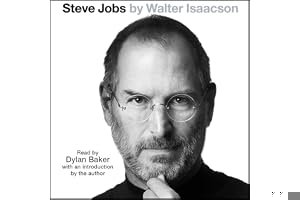
From the author of the bestselling biographies of Benjamin Franklin and Albert Einstein, this is the exclusive, New York Times bestselling biography of Apple co-founder Steve Jobs.
Based on more than forty interviews with Jobs conducted over two years—as well as interviews with more than a hundred family members, friends, adversaries, competitors, and colleagues—Walter Isaacson has written a riveting story of the roller-coaster life and searingly intense personality of a creative entrepreneur whose passion for perfection and ferocious drive revolutionized six industries: personal computers, animated movies, music, phones, tablet computing, and digital publishing.
At a time when America is seeking ways to sustain its innovative edge, and when societies around the world are trying to build digital-age economies, Jobs stands as the ultimate icon of inventiveness and applied imagination. He knew that the best way to create value in the twenty-first century was to connect creativity with technology. He built a company where leaps of the imagination were combined with remarkable feats of engineering.
Although Jobs cooperated with this book, he asked for no control over what was written nor even the right to read it before it was published. He put nothing off-limits. He encouraged the people he knew to speak honestly. And Jobs speaks candidly, sometimes brutally so, about the people he worked with and competed against. His friends, foes, and colleagues provide an unvarnished view of the passions, perfectionism, obsessions, artistry, devilry, and compulsion for control that shaped his approach to business and the innovative products that resulted.
Driven by demons, Jobs could drive those around him to fury and despair. But his personality and products were interrelated, just as Apple’s hardware and software tended to be, as if part of an integrated system. His tale is instructive and cautionary, filled with lessons about innovation, character, leadership, and values.
For Chesky, a source may come in the form of a biography of a business hero such as Steve Jobs or Walt Disney. His primary book source on management technique is Andy Grove’s High Output Management. [source]
Cover unavailable
4
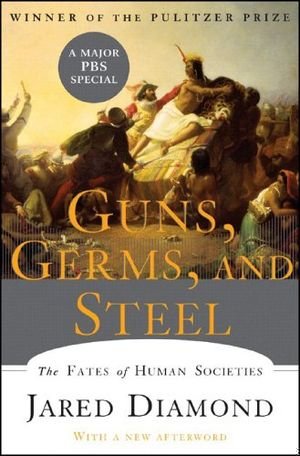
Guns, Germs and Steel: The Fates of Human Societies
Explaining what William McNeill called The Rise of the West has become the central problem in the study of global history. In Guns, Germs, and Steel Jared Diamond presents the biologist's answer: geography, demography, and ecological happenstance. Diamond evenhandedly reviews human history on every continent since the Ice Age at a rate that emphasizes only the broadest movements of peoples and ideas. Yet his survey is binocular: one eye has the rather distant vision of the evolutionary biologist, while the other eye--and his heart--belongs to the people of New Guinea, where he has done field work for more than 30 years.
Fascinating.... Lays a foundation for understanding human history. [source]
Daniel Ek
A brilliant Pulitzer Prize-winning book about how the modern world was formed, analyzing how societies developed differently on different continents. [source]
I’m a fan of books that challenge our assumptions, and Diamond offers us a new and remarkably simple way of looking at our world. Learning to challenge existing assumptions is core to effective leadership for it trains us to keep an open mind. [source]
In Everyman’s Library for the first time—one of the most moving and eloquent accounts of the Holocaust, read by tens of millions of people around the world since its publication in 1947. The Diary of a Young Girl is the record of two years in the life of a remarkable Jewish girl whose triumphant humanity in the face of unfathomable deprivation and fear has made the book one of the most enduring documents of our time.
The Everyman’s hardcover edition reprints the Definitive Edition authorized by the Frank estate, plus a new introduction, a bibliography, and a chronology of Anne Frank’s life and times.
…
Recommended by Alice Little, Catalina Penciu, and Tim Fargo.
Alice Little
I remember being a fourth grader and trying to check out this book and being told it was grossly inappropriate and going so far as to have my parents take it to the school board and petition for me to be allowed to read this book. [source]
Catalina Penciu
I'm a huge fan of personal stories and biographies like this one. [source]
Tim Fargo
@Quixoticnance Good point, Nancy. The museum is a powerful experience, esp. when you've read her book. [source]
In this candid and riveting memoir, for the first time ever, Nike founder and CEO Phil Knight shares the inside story of the company’s early days as an intrepid start-up and its evolution into one of the world’s most iconic, game-changing, and profitable brands.
In 1962, fresh out of business school, Phil Knight borrowed $50 from his father and created a company with a simple mission: import high-quality, low-cost athletic shoes from Japan. Selling the shoes from the trunk of his lime green Plymouth Valiant, Knight grossed $8,000 his first year. Today, Nike’s annual sales top $30 billion. In an age of startups, Nike is the ne plus ultra of all startups, and the swoosh has become a revolutionary, globe-spanning icon, one of the most ubiquitous and recognizable symbols in the world today.
But Knight, the man behind the swoosh, has always remained a mystery. Now, for the first time, in a memoir that is candid, humble, gutsy, and wry, he tells his story, beginning with his crossroads moment. At 24, after backpacking around the world, he decided to take the unconventional path, to start his own business—a business that would be dynamic, different.
Knight details the many risks and daunting setbacks that stood between him and his dream—along with his early triumphs. Above all, he recalls the formative relationships with his first partners and employees, a ragtag group of misfits and seekers who became a tight-knit band of brothers. Together, harnessing the transcendent power of a shared mission, and a deep belief in the spirit of sport, they built a brand that changed everything.
This memoir, by the co-founder of Nike, is a refreshingly honest reminder of what the path to business success really looks like: messy, precarious, and riddled with mistakes. I’ve met Knight a few times over the years. He’s super nice, but he’s also quiet and difficult to get to know. Here Knight opens up in a way few CEOs are willing to do. I don’t think Knight sets out to teach the reader anything. Instead, he accomplishes something better. He tells his story as honestly as he can. It’s an amazing tale. [source]
I've known Phil Knight since I was a kid, but I didn't really know him until I opened this beautiful, startling, intimate book. And the same goes for Nike. I've worn the gear with pride, but I didn't realize the remarkable saga of innovation and survival and triumph that stood behind every swoosh. Candid, funny, suspenseful, literary - this is a memoir for people who love sport, but above all it's a memoir for people who love memoirs. [source]
In the ten years since its publication in 1988, Stephen Hawking's classic work has become a landmark volume in scientific writing, with more than nine million copies in forty languages sold worldwide. That edition was on the cutting edge of what was then known about the origins and nature of the universe. But the intervening years have seen extraordinary advances in the technology of observing both the micro- and the macrocosmic worlds. These observations have confirmed many of Professor Hawking's theoretical predictions in the first edition of his book, including the recent discoveries of the Cosmic Background Explorer satellite (COBE), which probed back in time to within 300,000 years of the universe's beginning and revealed wrinkles in the fabric of space-time that he had projected. Eager to bring to his original text the new knowledge revealed by these observations, as well as his own recent research, Professor Hawking has prepared a new introduction to the book, written an entirely new chapter on wormholes and time travel, and updated the chapters throughout.
…
Recommended by Richard Branson, Adam Hart-Davis, Anurag Ramdasan, and 2 others.
Today is World Book Day, a wonderful opportunity to address this #ChallengeRichard sent in by Mike Gonzalez of New Jersey: Make a list of your top 65 books to read in a lifetime. [source]
Adam Hart-Davis
When Stephen Hawking wrote A Brief History of Time..his publisher told him that every equation he left in would halve the number of readers [source]
Anurag Ramdasan
My first intro into the world of physics and this got me completely hooked!
Cover unavailable
8
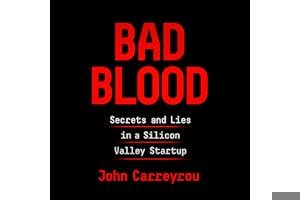
Bad Blood: Secrets and Lies in a Silicon Valley Startup
The full inside story of the breathtaking rise and shocking collapse of a multibillion-dollar startup, by the prize-winning journalist who first broke the story and pursued it to the end in the face of pressure and threats from the CEO and her lawyers.
In 2014, Theranos founder and CEO Elizabeth Holmes was widely seen as the female Steve Jobs: a brilliant Stanford dropout whose startup "unicorn" promised to revolutionize the medical industry with a machine that would make blood tests significantly faster and easier. Backed by investors such as Larry Ellison and Tim Draper, Theranos sold shares in a fundraising round that valued the company at $9 billion, putting Holmes's worth at an estimated $4.7 billion. There was just one problem: The technology didn't work.
For years, Holmes had been misleading investors, FDA officials, and her own employees. When Carreyrou, working at The Wall Street Journal, got a tip from a former Theranos employee and started asking questions, both Carreyrou and the Journal were threatened with lawsuits. Undaunted, the newspaper ran the first of dozens of Theranos articles in late 2015. By early 2017, the company's value was zero and Holmes faced potential legal action from the government and her investors. Here is the riveting story of the biggest corporate fraud since Enron, a disturbing cautionary tale set amid the bold promises and gold-rush frenzy of Silicon Valley.
A bunch of my friends recommended this one to me. Carreyrou gives you the definitive insider’s look at the rise and fall of Theranos. The story is even crazier than I expected, and I found myself unable to put it down once I started. This book has everything: elaborate scams, corporate intrigue, magazine cover stories, ruined family relationships, and the demise of a company once valued at nearly $10 billion. [source]
Finished “bad blood” on the Theranos scandal. Wow. Just wow. It’s a must read for everyone in tech and startups. Just 1-click buy it :) Amazing how far charisma and social proof got them. Here’s the NYT review of the book https://t.co/PyMGxfoG2R [source]
Brad Feld
Co-Founder/Foundry Group
Every entrepreneur and VC should read this book. John Carreyrou has done something important here. Maybe this book will finally put a nail in the phrase “fake it till you make it”, but I doubt it. The amount of lying, disingenuousness, blatant and unjustified self-promotion, and downright deceit that exists in entrepreneurship right now is at a local maximum. This always happens when entrepreneurship gets trendy. Carreyrou just wrote a long warning for entrepreneurs and VCs. [source]
Cover unavailable
9
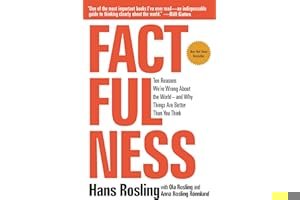
Factfulness: Ten Reasons We're Wrong About the World – and Why Things Are Better Than You Think
Factfulness: The stress-reducing habit of only carrying opinions for which you have strong supporting facts.
When asked simple questions about global trends—what percentage of the world’s population live in poverty; why the world’s population is increasing; how many girls finish school—we systematically get the answers wrong. So wrong that a chimpanzee choosing answers at random will consistently outguess teachers, journalists, Nobel laureates, and investment bankers.
In Factfulness, Professor of International Health and global TED phenomenon Hans Rosling, together with his two long-time collaborators, Anna and Ola, offers a radical new explanation of why this happens. They reveal the ten instincts that distort our perspective—from our tendency to divide the world into two camps (usually some version of us and them) to the way we consume media (where fear rules) to how we perceive progress (believing that most things are getting worse).
Our problem is that we don’t know what we don’t know, and even our guesses are informed by unconscious and predictable biases.
It turns out that the world, for all its imperfections, is in a much better state than we might think. That doesn’t mean there aren’t real concerns. But when we worry about everything all the time instead of embracing a worldview based on facts, we can lose our ability to focus on the things that threaten us most.
Inspiring and revelatory, filled with lively anecdotes and moving stories, Factfulness is an urgent and essential book that will change the way you see the world and empower you to respond to the crises and opportunities of the future.
As 2018 draws to a close, I’m continuing a favorite tradition of mine and sharing my year-end lists. It gives me a moment to pause and reflect on the year through the books I found most thought-provoking, inspiring, or just plain loved. It also gives me a chance to highlight talented authors – some who are household names and others who you may not have heard of before. Here’s my best of 2018 list. [source]
This was a breakthrough to me. The framework Hans enunciates is one that took me decades of working in global development to create for myself, and I could have never expressed it in such a clear way. I’m going to try to use this model moving forward. [source]
Aidan Connolly
I would suggest Hans Rosling’s Factfulness on the real world of statistics. [source]
In Bryson's biggest book, he confronts his greatest challenge: to understand—and, if possible, answer—the oldest, biggest questions we have posed about the universe and ourselves. Taking as territory everything from the Big Bang to the rise of civilization, Bryson seeks to understand how we got from there being nothing at all to there being us. To that end, he has attached himself to a host of the world’s most advanced (and often obsessed) archaeologists, anthropologists, and mathematicians, travelling to their offices, laboratories, and field camps. He has read (or tried to read) their books, pestered them with questions, apprenticed himself to their powerful minds. A Short History of Nearly Everything is the record of this quest, and it is a sometimes profound, sometimes funny, and always supremely clear and entertaining adventure in the realms of human knowledge, as only Bill Bryson can render it. Science has never been more involving or entertaining.
…
Recommended by Amanda Palmer, David Goldberg, and Fabrice Grinda.
Amanda Palmer
Amanda Palmer recommended this book in the book "Tools of Titans". [source]
David Goldberg
What I really liked about A Short History of Nearly Everything is that it gives an excellent account of a lot of the personalities and the interconnectedness of important discoveries in cosmology and elsewhere. He does such a great job of bringing together our understanding of cosmology, evolution, paleontology, and geology in a very, very fluid way. [source]
Fabrice Grinda
I have lots of books to recommend, but they are not related to my career path. The only one that is remotely related is Peter Thiel’s Zero to One. That said here are books I would recommend. [source]
Tara Westover was 17 the first time she set foot in a classroom. Born to survivalists in the mountains of Idaho, she prepared for the end of the world by stockpiling home-canned peaches and sleeping with her "head-for-the-hills bag". In the summer she stewed herbs for her mother, a midwife and healer, and in the winter she salvaged in her father's junkyard.
Her father forbade hospitals, so Tara never saw a doctor or nurse. Gashes and concussions, even burns from explosions, were all treated at home with herbalism. The family was so isolated from mainstream society that there was no one to ensure the children received an education and no one to intervene when one of Tara's older brothers became violent.
Then, lacking any formal education, Tara began to educate herself. She taught herself enough mathematics and grammar to be admitted to Brigham Young University, where she studied history, learning for the first time about important world events like the Holocaust and the civil rights movement. Her quest for knowledge transformed her, taking her over oceans and across continents, to Harvard and to Cambridge. Only then would she wonder if she'd traveled too far, if there was still a way home.
Educated is an account of the struggle for self-invention. It is a tale of fierce family loyalty and of the grief that comes with severing the closest of ties. With the acute insight that distinguishes all great writers, Westover has crafted a universal coming-of-age story that gets to the heart of what an education is and what it offers: the perspective to see one's life through new eyes and the will to change it.
As 2018 draws to a close, I’m continuing a favorite tradition of mine and sharing my year-end lists. It gives me a moment to pause and reflect on the year through the books I found most thought-provoking, inspiring, or just plain loved. It also gives me a chance to highlight talented authors – some who are household names and others who you may not have heard of before. Here’s my best of 2018 list. [source]
Tara never went to school or visited a doctor until she left home at 17. I never thought I’d relate to a story about growing up in a Mormon survivalist household, but she’s such a good writer that she got me to reflect on my own life while reading about her extreme childhood. Melinda and I loved this memoir of a young woman whose thirst for learning was so strong that she ended up getting a Ph.D. from Cambridge University. [source]
If you read or listen to only one book this summer, this is it. Bloody brilliant! Every word, every sentence. Rarely do I go through a book with such a rollecoaster of emotion, from love to hate. Thank you for sharing @tarawestover #Educated https://t.co/GqLaqlcWMp [source]
In this stunning new book, Malcolm Gladwell takes us on an intellectual journey through the world of "outliers"--the best and the brightest, the most famous and the most successful. He asks the question: what makes high-achievers different?
His answer is that we pay too much attention to what successful people are like, and too little attention to where they are from: that is, their culture, their family, their generation, and the idiosyncratic experiences of their upbringing. Along the way he explains the secrets of software billionaires, what it takes to be a great soccer player, why Asians are good at math, and what made the Beatles the greatest rock band.
Gladwell is not the first person to come up with the 10,000 hour rule. Nor is he the first person to document what it takes to become the best in the world at something. But his stories are so great as he explains these deep concepts. How did the Beatles become the best? Why are professional hockey players born in January, February and March? And so on. [source]
Alex Circei
Question: What five books would you recommend to young people interested in your career path & why? Answer: Screw It, Let's Do It: Lessons In Life by Richard Branson Outliers: The Story of Success by Malcolm Gladwell Start With Why: How Great Leaders Inspire Everyone To Take Action by Simon Sinek The Hard Thing About Hard Things: Building a Business When There Are No Easy Answers by Ben Horowitz Rich Dad Poor Dad: What the Rich Teach Their Kids About Money That the Poor and Middle Class Do Not! by Robert T. Kiyosaki [source]
Cover unavailable
13
Fast Food Nation: The Dark Side of the All-American Meal
Fast food has hastened the malling of our landscape, widened the chasm between rich and poor, fueled an epidemic of obesity, and propelled American cultural imperialism abroad. That's a lengthy list of charges, but here Eric Schlosser makes them stick with an artful mix of first-rate reportage, wry wit, and careful reasoning.
Schlosser's myth-shattering survey stretches from California's subdivisions where the business was born to the industrial corridor along the New Jersey Turnpike where many fast food's flavors are concocted. Along the way, he unearths a trove of fascinating, unsettling truths -- from the unholy alliance between fast food and Hollywood to the seismic changes the industry has wrought in food production, popular culture, and even real estate. (back cover)
…
Recommended by Richard Branson, Antonio Eram, Barry Estabrook, and 1 others.
Today is World Book Day, a wonderful opportunity to address this #ChallengeRichard sent in by Mike Gonzalez of New Jersey: Make a list of your top 65 books to read in a lifetime. [source]
Antonio Eram
This book was recommended by Antonio when asked for titles he would recommend to young people interested in his career path. [source]
Barry Estabrook
Eric Schlosser takes apart a single fast-food meal and shows not only how it affects our health but also how the people who serve it to you are treated. He also looks at how the people in the slaughterhouses working with the cattle are treated, and so it shows you the true picture of the all-American meal – burgers and fries. [source]
In a life filled with meaning and accomplishment, Michelle Obama has emerged as one of the most iconic and compelling women of our era. As First Lady of the United States of America—the first African American to serve in that role—she helped create the most welcoming and inclusive White House in history, while also establishing herself as a powerful advocate for women and girls in the U.S. and around the world, dramatically changing the ways that families pursue healthier and more active lives, and standing with her husband as he led America through some of its most harrowing moments. Along the way, she showed us a few dance moves, crushed Carpool Karaoke, and raised two down-to-earth daughters under an unforgiving media glare.
In her memoir, a work of deep reflection and mesmerizing storytelling, Michelle Obama invites readers into her world, chronicling the experiences that have shaped her—from her childhood on the South Side of Chicago to her years as an executive balancing the demands of motherhood and work, to her time spent at the world’s most famous address. With unerring honesty and lively wit, she describes her triumphs and her disappointments, both public and private, telling her full story as she has lived it—in her own words and on her own terms. Warm, wise, and revelatory, Becoming is the deeply personal reckoning of a woman of soul and substance who has steadily defied expectations—and whose story inspires us to do the same.
…
Recommended by Barack Obama, Piers Morgan, Mary Burkey, and 3 others.
Of course, @MichelleObama’s my wife, so I’m a little biased here. But she also happens to be brilliant, funny, wise – one of a kind. This book tells her quintessentially American story. I love it because it faithfully reflects the woman I have loved for so long. [source]
Piers Morgan
Congrats to @MichelleObama on sensational sales of her new book #Becoming. I always take people as I find them & when I met her at the White House, she was a delightfully warm, friendly & genuine lady. A great First Lady & now a best-selling author. https://t.co/nlSUHI01SM [source]
Mary Burkey
This is a case where you have to hear Michelle Obama read her story. It’s her story and she puts her whole emotional self into it. [source]
Cover unavailable
15
Quiet: The Power of Introverts in a World That Can't Stop Talking
At least one-third of the people we know are introverts. They are the ones who prefer listening to speaking; who innovate and create but dislike self-promotion; who favor working on their own over working in teams. It is to introverts—Rosa Parks, Chopin, Dr. Seuss, Steve Wozniak—that we owe many of the great contributions to society.
In Quiet, Susan Cain argues that we dramatically undervalue introverts and shows how much we lose in doing so. She charts the rise of the Extrovert Ideal throughout the twentieth century and explores how deeply it has come to permeate our culture. She also introduces us to successful introverts—from a witty, high-octane public speaker who recharges in solitude after his talks, to a record-breaking salesman who quietly taps into the power of questions. Passionately argued, superbly researched, and filled with indelible stories of real people, Quiet has the power to permanently change how we see introverts and, equally important, how they see themselves.
Now with Extra Libris material, including a reader’s guide and bonus content.
Leaders needn’t be the loudest. Leadership is not about theater. It’s not about dominance. It is about putting the lives of others before any other priority. In Quiet, Cain affirms to a good many of us who are introverts by nature that we needn’t try to be extroverts if we want to lead. Simply being ourselves is more important — and more effective. [source]
Danielle Morrill
Co-founder/Mattermark
Anyway, maybe you’re like me and figuring this out for yourself. It’s a good book for introverts and for those who love them [source]
Probably half the world is introverts. Maybe more. It’s not an easy life to live. I sometimes have that feeling in a room full of people, “uh-oh. I just shut down. I can’t talk anymore and there’s a lock on my mouth and this crowd threw away the key.” Do you ever get that feeling? Please? I hope you do. Let’s try to lock eyes at the party. “Quiet” shows the reader how to unlock the secret powers that probably half the world needs to unlock. [source]
Cover unavailable
16
Elon Musk: Tesla, SpaceX, and the Quest for a Fantastic Future
Elon Musk, the entrepreneur and innovator behind SpaceX, Tesla, and SolarCity, sold one of his internet companies, PayPal, for $1.5 billion. Ashlee Vance captures the full spectacle and arc of the genius's life and work, from his tumultuous upbringing in South Africa and flight to the United States to his dramatic technical innovations and entrepreneurial pursuits. Vance uses Musk's story to explore one of the pressing questions of our age: can the nation of inventors and creators who led the modern world for a century still compete in an age of fierce global competition? He argues that Musk is an amalgam of legendary inventors and industrialists including Thomas Edison, Henry Ford, Howard Hughes, and Steve Jobs. More than any other entrepreneur today, Musk has dedicated his energies and his own vast fortune to inventing a future that is as rich and far-reaching as the visionaries of the golden age of science-fiction fantasy
Elon Musk is a man after my own heart: a risk taker undaunted by setbacks and ever driven to ensure a bright future for humanity. Ashlee Vance's stellar biography captures Musk's remarkable life story and irrepressible spirit. [source]
I'm fascinated by Elon Musk, I own a Tesla, I read Ashlee Vance's biography on Elon Musk. I think he's a very interesting charachter. [source]
Andrea Loubier
Elon Musk: Tesla, SpaceX, and the Quest for a Fantastic Future as this was still in the first couple of years of me starting my own company, Mailbird and it was inspiring and visionary. It helps you go from a small voice in a big corporate company, to thinking big and voicing your wild opinions and creating plan to work towards it. [source]
Cover unavailable
17
Freakonomics: A Rogue Economist Explores the Hidden Side of Everything
Which is more dangerous, a gun or a swimming pool? What do schoolteachers and sumo wrestlers have in common? Why do drug dealers still live with their moms? How much do parents really matter? What kind of impact did Roe v. Wade have on violent crime? Freakonomics will literally redefine the way we view the modern world.
These may not sound like typical questions for an economist to ask. But Steven D. Levitt is not a typical economist. He is a much heralded scholar who studies the stuff and riddles of everyday life -- from cheating and crime to sports and child rearing -- and whose conclusions regularly turn the conventional wisdom on its head. He usually begins with a mountain of data and a simple, unasked question. Some of these questions concern life-and-death issues; others have an admittedly freakish quality. Thus the new field of study contained in this book: freakonomics.
Through forceful storytelling and wry insight, Levitt and co-author Stephen J. Dubner show that economics is, at root, the study of incentives -- how people get what they want, or need, especially when other people want or need the same thing. In Freakonomics, they set out to explore the hidden side of ... well, everything. The inner workings of a crack gang. The truth about real-estate agents. The myths of campaign finance. The telltale marks of a cheating schoolteacher. The secrets of the Ku Klux Klan.
What unites all these stories is a belief that the modern world, despite a surfeit of obfuscation, complication, and downright deceit, is not impenetrable, is not unknowable, and -- if the right questions are asked -- is even more intriguing than we think. All it takes is a new way of looking. Steven Levitt, through devilishly clever and clear-eyed thinking, shows how to see through all the clutter.
Freakonomics establishes this unconventional premise: If morality represents how we would like the world to work, then economics represents how it actually does work. It is true that readers of this book will be armed with enough riddles and stories to last a thousand cocktail parties. But Freakonomics can provide more than that. It will literally redefine the way we view the modern world. (front flap)
…
Recommended by Malcolm Gladwell, Daymond John, Ev Williams, and 12 others.
I come from a country that was created at midnight. When I almost died it was just after midday.
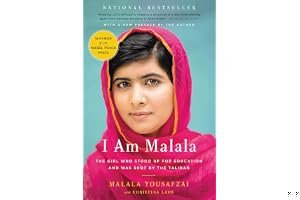
When the Taliban took control of the Swat Valley in Pakistan, one girl spoke out. Malala Yousafzai refused to be silenced and fought for her right to an education.
On Tuesday, October 9, 2012, when she was fifteen, she almost paid the ultimate price. She was shot in the head at point-blank range while riding the bus home from school, and few expected her to survive.
Instead, Malala's miraculous recovery has taken her on an extraordinary journey from a remote valley in northern Pakistan to the halls of the United Nations in New York. At sixteen, she has become a global symbol of peaceful protest and the youngest-ever Nobel Peace Prize laureate.
I Am Malala is the remarkable tale of a family uprooted by global terrorism, of the fight for girls' education, of a father who, himself a school owner, championed and encouraged his daughter to write and attend school, and of brave parents who have a fierce love for their daughter in a society that prizes sons.
…
Recommended by Adrienne Kisner.
Adrienne Kisner
Malala’s story of triumph is a battle cry for girls (and boys) everywhere. Education can set you free. [source]
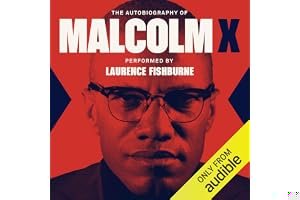
With its first great victory in the landmark Supreme Court decision Brown v. Board of Education in 1954, the civil rights movement gained the powerful momentum it needed to sweep forward into its crucial decade, the 1960s. As voices of protest and change rose above the din of history and false promises, one voice sounded more urgently, more passionately, than the rest. Malcolm X—once called the most dangerous man in America—challenged the world to listen and learn the truth as he experienced it. And his enduring message is as relevant today as when he first delivered it.
In the searing pages of this classic autobiography, originally published in 1964, Malcolm X, the Muslim leader, firebrand, and anti-integrationist, tells the extraordinary story of his life and the growth of the Black Muslim movement to veteran writer and journalist Alex Haley . In a unique collaboration, Haley worked with Malcolm X for nearly two years, interviewing, listening to, and understanding the most controversial leader of his time.
Raised in Lansing, Michigan, Malcolm Little journeyed on a road to fame as astonishing as it was unpredictable. Drifting from childhood poverty to petty crime, Malcolm found himself in jail. It was there that he came into contact with the teachings of a little-known Black Muslim leader renamed Elijah Muhammad. The newly renamed Malcolm X devoted himself body and soul to the teachings of Elijah Muhammad and the world of Islam, becoming the Nation’s foremost spokesman. When his conscience forced him to break with Elijah Muhammad, Malcolm founded the Organization of Afro-American Unity to reach African Americans across the country with an inspiring message of pride, power, and self-determination.
I forget who said it but I heard someone say that Catcher in the Rye was to young white boys what the Autobiography of Malcolm X was to young black boys. Personally, I prefer that latter over the former. I would much rather read about and emulate a man who is born into adversity and pain, struggles with criminality, does prison time, teaches himself to read through the dictionary, finds religion and then becomes an activist for Civil Rights before being gunned down by his former supporters when he tempers the hate and anger that had long defined parts of his message. [source]
David Coogan
His memoir describes that process of transformation from a common narrative of street hustler and limited opportunities, struggling in a racist society, to this radicalization in part through literacy, in part through literature and religion. [source]
A powerful true story about the potential for mercy to redeem us, and a clarion call to fix our broken system of justice—from one of the most brilliant and influential lawyers of our time
Bryan Stevenson was a young lawyer when he founded the Equal Justice Initiative, a legal practice dedicated to defending those most desperate and in need: the poor, the wrongly condemned, and women and children trapped in the farthest reaches of our criminal justice system. One of his first cases was that of Walter McMillian, a young man who was sentenced to die for a notorious murder he insisted he didn’t commit. The case drew Bryan into a tangle of conspiracy, political machination, and legal brinksmanship—and transformed his understanding of mercy and justice forever.
Just Mercy is at once an unforgettable account of an idealistic, gifted young lawyer’s coming of age, a moving window into the lives of those he has defended, and an inspiring argument for compassion in the pursuit of true justice.
Today is World Book Day, a wonderful opportunity to address this #ChallengeRichard sent in by Mike Gonzalez of New Jersey: Make a list of your top 65 books to read in a lifetime. [source]
Chris Sacca
Proud that @crystale and I could help fund the making of a film about one of our heroes, Bryan Stevenson. If you’ve read the book, then you know how powerful this film is. #JustMercy https://t.co/vNfXK4Imwr [source]
At the age of thirty-six, on the verge of completing a decade’s worth of training as a neurosurgeon, Paul Kalanithi was diagnosed with stage IV lung cancer. One day he was a doctor treating the dying, and the next he was a patient struggling to live. And just like that, the future he and his wife had imagined evaporated. When Breath Becomes Air chronicles Kalanithi’s transformation from a naïve medical student “possessed,” as he wrote, “by the question of what, given that all organisms die, makes a virtuous and meaningful life” into a neurosurgeon at Stanford working in the brain, the most critical place for human identity, and finally into a patient and new father confronting his own mortality.
What makes life worth living in the face of death? What do you do when the future, no longer a ladder toward your goals in life, flattens out into a perpetual present? What does it mean to have a child, to nurture a new life as another fades away? These are some of the questions Kalanithi wrestles with in this profoundly moving, exquisitely observed memoir.
I don’t know how Kalanithi found the physical strength to write this book while he was so debilitated by the disease and then potent chemotherapy. But I’m so glad he did. He spent his whole brief life searching for meaning in one way or another -- through books, writing, medicine, surgery, and science. I’m grateful that, by reading this book, I got to witness a small part of that journey. I just wish the journey hadn’t been cut so short [source]
Despite its popularity, When Breath Becomes Air is actually underrated. It’s make-you-cry good. [source]
Bethany S. Mandel
More Shabbat reading recommendations: This book was breathtaking and such a powerful advertisement for the joy of parenthood. https://t.co/V8BH97eiL9 [source]
Immensely helpful and illuminating to any aspiring writer, Stephen King’s critically lauded, classic bestseller shares the experiences, habits, and convictions that have shaped him and his work.
"Long live the King" hailed Entertainment Weekly upon publication of Stephen King’s On Writing. Part memoir, part master class by one of the bestselling authors of all time, this superb volume is a revealing and practical view of the writer’s craft, comprising the basic tools of the trade every writer must have. King’s advice is grounded in his vivid memories from childhood through his emergence as a writer, from his struggling early career to his widely reported, near-fatal accident in 1999—and how the inextricable link between writing and living spurred his recovery. Brilliantly structured, friendly and inspiring, On Writing will empower and entertain everyone who reads it—fans, writers, and anyone who loves a great story well told.
I read a bunch of books on writing before I wrote my first book and the two that stuck with me were Stephen King’s book and “On Writing Well” by Zinsser (which is a bit on the technical side). [source]
Alina Varlanuta
My professional path – copywriting – somehow intertwines with my unprofessional (hahaha) path – writing so I would recommend reading literature for both. Somehow reading and writing are two ways of doing the same thing: storytelling (even when you read you tell yourself a story in your own voice, bringing your personal emotion and empathy to the story you’re reading). The only difference is that when I’m reading, panic is far away from me, in a safe place. Nevertheless, the words below helped me rewrite and think twice before adding an exclamation point: On Writing by Stephen King. [source]
Andrew Cowan
Yes. It is a surprise to a lot of people that this book is so widely read on university campuses and so widely recommended by teachers of writing. Students love it. It’s bracing: there’s no nonsense. He says somewhere in the foreword or preface that it is a short book because most books are filled with bullshit and he is determined not to offer bullshit but to tell it like it is. [source]
Cover unavailable
23
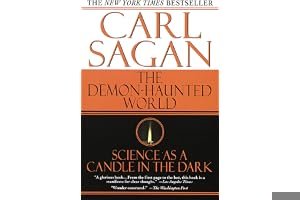
The Demon-haunted World: Science As a Candle in the Dark
How can we make intelligent decisions about our increasingly technology-driven lives if we don’t understand the difference between the myths of pseudoscience and the testable hypotheses of science? Pulitzer Prize-winning author and distinguished astronomer Carl Sagan argues that scientific thinking is critical not only to the pursuit of truth but to the very well-being of our democratic institutions.
Casting a wide net through history and culture, Sagan examines and authoritatively debunks such celebrated fallacies of the past as witchcraft, faith healing, demons, and UFOs. And yet, disturbingly, in today’s so-called information age, pseudoscience is burgeoning with stories of alien abduction, channeling past lives, and communal hallucinations commanding growing attention and respect. As Sagan demonstrates with lucid eloquence, the siren song of unreason is not just a cultural wrong turn but a dangerous plunge into darkness that threatens our most basic freedoms.
…
Recommended by Dallas Campbell, Edip Yüksel, James Randi, and 2 others.
Dallas Campbell
@TheChilterns Even if you profoundly disagree with Clarke, it’s very detailed. The classic is of course ‘The Demon Haunted World’ by Carl Sagan. When I’m Prime Minister it will be compulsory reading at school! Best book on what science is/isn’t and why we think the way we do. 👍 [source]
Edip Yüksel
For Philosophy of Science class, I am now using Carl Sagan's book as the REQUIRED text book. Instead of bombarding students with terminology and names, we should let them enjoy the dancing of synapses in their own 3-pound grey jelly. In this thread I will share quotes from Sagan. https://t.co/rBEPVvEiuO [source]
James Randi
First of all, Carl was my very good friend, and we had a lot of confidences over the years. He was the epitome of the scientific mind and the scientific thinker. In The Demon-Haunted World, one of his later books, he investigates pseudoscience, frauds and fakes, and the mistakes that scientists made over the years. It’s very comprehensive. He had a whole chapter devoted to “Carlos” – or Jose Alvarez, who travelled all over the world doing this act as a fake psychic, and then revealed the whole thing on Australian television. Carl was quite taken with that story, and he and Jose spent a couple of hours together at a scientific conference that they both attended. [source]
Cover unavailable
24
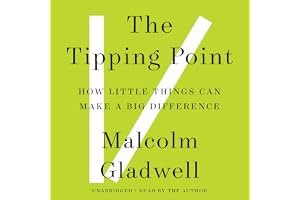
The Tipping Point: How Little Things Can Make a Big Difference
The tipping point is that magic moment when an idea, trend, or social behavior crosses a threshold, tips, and spreads like wildfire. Just as a single sick person can start an epidemic of the flu, so too can a small but precisely targeted push cause a fashion trend, the popularity of a new product, or a drop in the crime rate. This widely acclaimed bestseller, in which Malcolm Gladwell explores and brilliantly illuminates the tipping point phenomenon, is already changing the way people throughout the world think about selling products and disseminating ideas.
Gladwell introduces us to the particular personality types who are natural pollinators of new ideas and trends, the people who create the phenomenon of word of mouth. He analyzes fashion trends, smoking, children's television, direct mail, and the early days of the American Revolution for clues about making ideas infectious, and visits a religious commune, a successful high-tech company, and one of the world's greatest salesmen to show how to start and sustain social epidemics.
Bunch of really good information in here on how to make ideas go viral. This could be good to apply to any kind of products or ideas you may have. Definitely, check out The Tipping Point, which is one of my favorites. [source]
Malcolm Gladwell's breakthrough insight was to focus on the micro-relationships between individuals, which helped organizations realize that it's not about the big ads and the huge charity balls... it's about setting the stage for the buzz to start. [source]
Andy Stern
I think that when we talk about making change, it is much more about macro change, like in policy. This book reminds you that at times when you're building big movements, or trying to elect significant decision-makers in politics, sometimes it's the little things that make a difference. Ever since the book was written, we've become very used to the idea of things going viral unexpectedly and then having massive impact. The Tipping Point, to me, is really an appreciation that very small things can rearrange thinking in ways – like infectious diseases – that have huge implications. While we're always searching for the big policy changes – and we think we have to do that in very traditional ways of building coalitions against constituencies, movements and the media – sometimes it's the little things that actually tip the situation. Like the story of a person and their unique set of circumstances that really captures an issue about health care or housing. So it's trying to remember, while you're thinking about the grand and the glorious, that thinking about the small things can equally bring about change. [source]
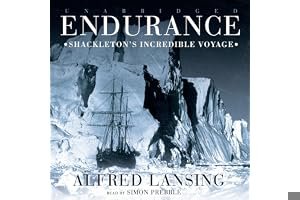
The harrowing tale of British explorer Ernest Shackleton's 1914 attempt to reach the South Pole, one of the greatest adventure stories of the modern age.
In August 1914, polar explorer Ernest Shackleton boarded the Endurance became locked in an island of ice. Thus began the legendary ordeal of Shackleton and his crew of twenty-seven men. When their ship was finally crushed between two ice floes, they attempted a near-impossible journey over 850 miles of the South Atlantic's heaviest seas to the closest outpost of civilization.
In Endurance, the definitive account of Ernest Shackleton's fateful trip, Alfred Lansing brilliantly narrates the harrowing and miraculous voyage that has defined heroism for the modern age.
50 plus years old, this is a story that more than stands the test of time. Sir Ernest Shackleton makes his daring attempt to cross Antarctic continent but his crew and boat are trapped in the ice flows. What follows are 600 days of harrowing survival, first from the elements, then from hunger, then from the sea as he makes a daring attempt in a small lifeboat to reach land 650 miles away, then again as he struggles over land and mountains to bring relief to his men. And when he finally arrives with it, Shackleton simply boards them on the boat and returns home as if nothing had happened. He was an immensely brave man in the midst of terrible adversity and we see this so clearly in a book based on the remarkable diaries of his men. He never quit, never seemed to despair. This book (and his life) were living proof of his family motto: “Fortitudine vincimus” (By endurance we conquer). [source]
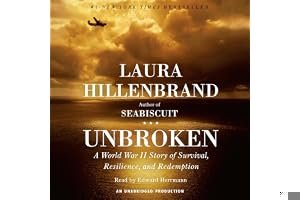
In her long-awaited new book, Laura Hillenbrand writes with the same rich and vivid narrative voice she displayed in Seabiscuit. Telling an unforgettable story of a man's journey into extremity, Unbroken is a testament to the resilience of the human mind, body, and spirit.
On a May afternoon in 1943, an Army Air Forces bomber crashed into the Pacific Ocean and disappeared, leaving only a spray of debris and a slick of oil, gasoline, and blood. Then, on the ocean surface, a face appeared. It was that of a young lieutenant, the plane's bombardier, who was struggling to a life raft and pulling himself aboard. So began one of the most extraordinary odysseys of the Second World War.
The lieutenant’s name was Louis Zamperini. In boyhood, he'd been a cunning and incorrigible delinquent, breaking into houses, brawling, and fleeing his home to ride the rails. As a teenager, he had channeled his defiance into running, discovering a prodigious talent that had carried him to the Berlin Olympics and within sight of the four-minute mile. But when war had come, the athlete had become an airman, embarking on a journey that led to his doomed flight, a tiny raft, and a drift into the unknown.
Ahead of Zamperini lay thousands of miles of open ocean, leaping sharks, a foundering raft, thirst and starvation, enemy aircraft, and, beyond, a trial even greater. Driven to the limits of endurance, Zamperini would answer desperation with ingenuity; suffering with hope, resolve, and humor; brutality with rebellion. His fate, whether triumph or tragedy, would be suspended on the fraying wire of his will.
…
Cover unavailable
27
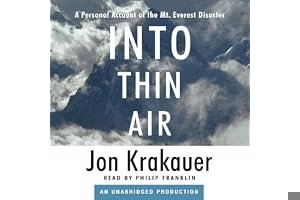
Into Thin Air: A Personal Account of the Mt. Everest Disaster
Jon Krakauer
4.4
When Jon Krakauer reached the summit of Mt. Everest in the early afternoon of May 10, 1996, he hadn't slept in fifty-seven hours and was reeling from the brain-altering effects of oxygen depletion. As he turned to begin his long, dangerous descent from 29,028 feet, twenty other climbers were still pushing doggedly toward the top. No one had noticed that the sky had begun to fill with clouds. Six hours later and 3,000 feet lower, in 70-knot winds and blinding snow, Krakauer collapsed in his tent, freezing, hallucinating from exhaustion and hypoxia, but safe. The following morning, he learned that six of his fellow climbers hadn't made it back to their camp and were desperately struggling for their lives. When the storm finally passed, five of them would be dead, and the sixth so horribly frostbitten that his right hand would have to be amputated.
Into Thin Air is the definitive account of the deadliest season in the history of Everest by the acclaimed journalist and author of the bestseller Into the Wild. On assignment for Outside Magazine to report on the growing commercialization of the mountain, Krakauer, an accomplished climber, went to the Himalayas as a client of Rob Hall, the most respected high-altitude guide in the world. A rangy, thirty-five-year-old New Zealander, Hall had summited Everest four times between 1990 and 1995 and had led thirty-nine climbers to the top. Ascending the mountain in close proximity to Hall's team was a guided expedition led by Scott Fischer, a forty-year-old American with legendary strength and drive who had climbed the peak without supplemental oxygen in 1994. But neither Hall nor Fischer survived the rogue storm that struck in May 1996.
Krakauer examines what it is about Everest that has compelled so many people -- including himself -- to throw caution to the wind, ignore the concerns of loved ones, and willingly subject themselves to such risk, hardship, and expense. Written with emotional clarity and supported by his unimpeachable reporting, Krakauer's eyewitness account of what happened on the roof of the world is a singular achievement.
Into the Wild is available on audio, read by actor Campbell Scott.
…
Recommended by Richard Branson, Cristina Riesen, Fabrice Grinda, and 2 others.
Today is World Book Day, a wonderful opportunity to address this #ChallengeRichard sent in by Mike Gonzalez of New Jersey: Make a list of your top 65 books to read in a lifetime. [source]
Cristina Riesen
First, a word on career paths. In time, I realised that career paths are like one-way streets. Magic happens in unexplored territories. Plus life is how you choose to live every moment, every day. So today, rather than building a career, I prefer to make lateral moves in life, working with great people and being part of ambitious projects impacting the world. There are a few books that got me here: … Jon Krakauer "Into Thin Air". [source]
Fabrice Grinda
I have lots of books to recommend, but they are not related to my career path. The only one that is remotely related is Peter Thiel’s Zero to One. That said here are books I would recommend. [source]
Cover unavailable
28
The Omnivore's Dilemma: A Natural History of Four Meals
What should we have for dinner? For omnivore's like ourselves, this simple question has always posed a dilemma: When you can eat just about anything nature (or the supermarket) has to offer, deciding what you should eat will inevitably stir anxiety, especially when some of the foods on offer might shorten your life. Today, buffeted by one food fad after another, America is suffering from what can only be described as a national eating disorder. The omnivore's dilemma has returned with a vengeance, as the cornucopia of the modern American supermarket and fast-food outlet confronts us with a bewildering and treacherous food landscape. What's at stake in our eating choices is not only our own and our children's health, but the health of the environment that sustains life on earth.
The Omnivore's Dilemma is a groundbreaking book in which one of America's most fascinating, original, and elegant writers turns his own omnivorous mind to the seemingly straightforward question of what we should have for dinner. The question has confronted us since man discovered fire, but, according to Michael Pollan, the bestselling author of The Botany of Desire, how we answer it today, ath the dawn of the twenty-first century, may well determine our very survival as a species. Should we eat a fast-food hamburger? Something organic> Or perhaps something we hunt, gather or grow ourselves?
To find out, Pollan follows each of the food chains that sustain us--industrial food, organic or alternative food, and food we forage ourselves--from the source to a final meal, and in the process develops a definitive account of the American way of eating. His absorbing narrative takes us from Iowa cornfields to food laboratories, from feedlots and fast-food restaurants to organic farms and hunting grounds, always emphasizing our dynamic coevolutionary relationship with the handful of plant and animal species we depend on. Each time Pollan sits down to a meal, he deploys his unique blend of personal and investigative journalism to trace the origins of everything consumed, revealing what we unwittingly ingest and explaining how our taste for particular foods and flavors reflects our evolutionary inheritance.
The surprising answers Pollan offers to the simple question posed by this book have profound political, economic, psychological, and even mortal implications for all of us. Ultimately, this is a book as much about visionary solutions as it is about problems, and Pollan contends that, when it comes to food, doing the right thing often turns out to be the tastiest thing an eater can do. Beautifully written and thrillingly argued, The Omnivore's Dilemma promises to change the way we think about the politics and pleasure of eating. For anyone who reads it, dinner will never again look, or taste, quite the same. --jacket
…
Recommended by Barry Estabrook, Gabriel Coarna, Paul Rozin, and 1 others.
Barry Estabrook
Michael Pollan looks at food production through four meals. One is a fast-food meal, the other is an industrial-scale organic meal, then there is a small-scale organic meal and finally he actually goes out and either grows or kills, in the case of the meat, the entire meal himself. That is the narrative. [source]
Gabriel Coarna
Michael Pollan's "The Omnivore's Dilemma" --more precisely, the first 3rd of it-- was what first made me realize how badly the Earth, as an ecosystem, is out of balance. [source]
Paul Rozin
Michael Pollan is an excellent journalist who specializes in the food domain.He proposes relying more on whole foods and less on processed foods, like Oreo Cookies. He argues that unprocessed foods are more nutritious, more wholistic and better for the environment. [source]
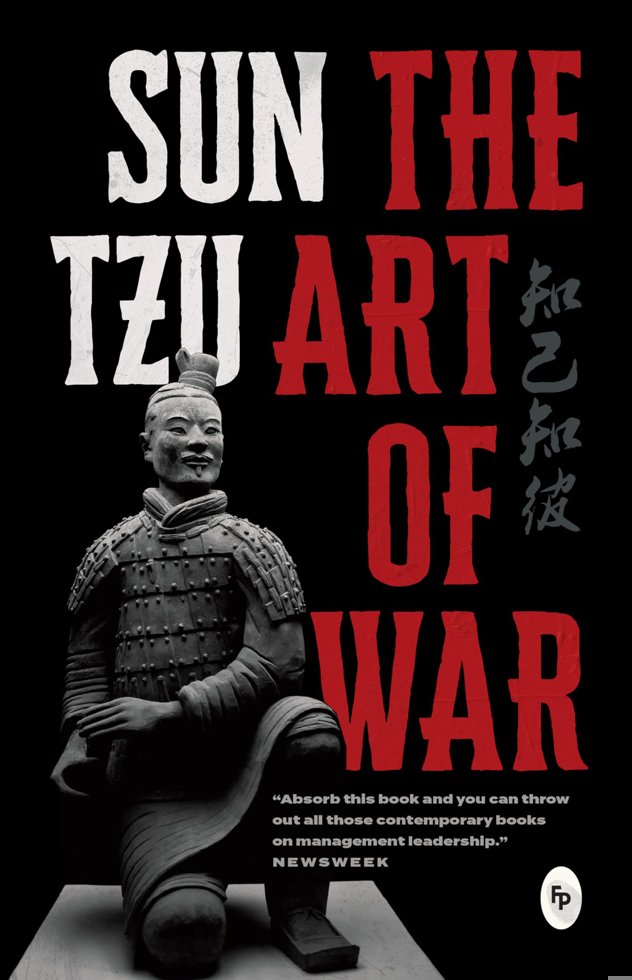
For more than two thousand years, The Art of War has stood as a cornerstone of Chinese culture-a lucid epigrammatic text that reveals as much about human psychology, politics, and economics as it does about battlefield strategy. The influence of Sun-tzu's text has grown tremendously in the West in recent years, with military leaders, politicians, and corporate executives alike finding valuable insight in these ancient words. In his crisp, accessible new translation, scholar John Minford brings this seminal work to life for modern readers.
Minford opens with a lively, learned introduction in which he explores the life and times of Sun-tzu, looks at The Art of War in the context of the turbulent Warring States period, and discusses how best to read and understand the work today. There follows Minford's translation of the core text itself in two different formats-first, the unadorned thirteen chapters of the original work and then the same text reprinted with extensive running commentary by classical Chinese scholars as well as Minford himself. The result is an opportunity for Western readers to experience Sun-tzu's work in all its intensity as it applies to many aspects of our lives.
Which books should be read by every single intelligent person on planet? … The Art of War (Sun Tsu) to learn that the act of killing fellow humans can be raised to an art. If you read all of the above works you will glean profound insight into most of what has driven the history of the western world. [source]
Cover unavailable
30
The Power of Habit: Why We Do What We Do in Life and Business
A young woman walks into a laboratory. Over the past two years, she has transformed almost every aspect of her life. She has quit smoking, run a marathon, and been promoted at work. The patterns inside her brain, neurologists discover, have fundamentally changed.
Marketers at Procter & Gamble study videos of people making their beds. They are desperately trying to figure out how to sell a new product called Febreze, on track to be one of the biggest flops in company history. Suddenly, one of them detects a nearly imperceptible pattern—and with a slight shift in advertising, Febreze goes on to earn a billion dollars a year.
An untested CEO takes over one of the largest companies in America. His first order of business is attacking a single pattern among his employees—how they approach worker safety—and soon the firm, Alcoa, becomes the top performer in the Dow Jones.
What do all these people have in common? They achieved success by focusing on the patterns that shape every aspect of our lives.
They succeeded by transforming habits.
In The Power of Habit, award-winning New York Times business reporter Charles Duhigg takes us to the thrilling edge of scientific discoveries that explain why habits exist and how they can be changed. With penetrating intelligence and an ability to distill vast amounts of information into engrossing narratives, Duhigg brings to life a whole new understanding of human nature and its potential for transformation.
Along the way we learn why some people and companies struggle to change, despite years of trying, while others seem to remake themselves overnight. We visit laboratories where neuroscientists explore how habits work and where, exactly, they reside in our brains. We discover how the right habits were crucial to the success of Olympic swimmer Michael Phelps, Starbucks CEO Howard Schultz, and civil-rights hero Martin Luther King, Jr. We go inside Procter & Gamble, Target superstores, Rick Warren’s Saddleback Church, NFL locker rooms, and the nation’s largest hospitals and see how implementing so-called keystone habits can earn billions and mean the difference between failure and success, life and death.
At its core, The Power of Habit contains an exhilarating argument: The key to exercising regularly, losing weight, raising exceptional children, becoming more productive, building revolutionary companies and social movements, and achieving success is understanding how habits work.
Habits aren’t destiny. As Charles Duhigg shows, by harnessing this new science, we can transform our businesses, our communities, and our lives.
…
Recommended by Naval Ravikant, Blake Irving, Alden Mills, and 15 others.
I also recently finished The Power of Habit, or close to finish as I get. That one was interesting, not because of its content necessarily, but because it’s good for me to always keep on top of mind how powerful my habits are. … I think learning how to break habits is a very important meta-skill that can serve you better in life than almost anything else. Although you can read tons of books on it, the reality is you’re never going to learn how to break bad habits until you just break them. [source]
Blake Irving
CEO/GoDaddy
You know, there's a book called The Power of Habit by Charles Duhigg. Simple read book about just how to build positive habits that can be I think I what I'd call you know whether in your personal life or whether in your business life to help you build you know, have a loop that can build your success and that's one I mean there are so many great books out there. [source]
Alden Mills
More recent books that have had a significant impact on me are The Power of Habit and The Diamond Cutter. Both represent different forces for me – the former helps me tactically with making incremental improvements in my life. [source]
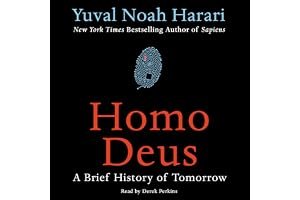
Yuval Noah Harari, author of the critically-acclaimed New York Times bestseller and international phenomenon Sapiens, returns with an equally original, compelling, and provocative book, turning his focus toward humanity’s future, and our quest to upgrade humans into gods.
Over the past century humankind has managed to do the impossible and rein in famine, plague, and war. This may seem hard to accept, but, as Harari explains in his trademark style—thorough, yet riveting—famine, plague and war have been transformed from incomprehensible and uncontrollable forces of nature into manageable challenges. For the first time ever, more people die from eating too much than from eating too little; more people die from old age than from infectious diseases; and more people commit suicide than are killed by soldiers, terrorists and criminals put together. The average American is a thousand times more likely to die from binging at McDonalds than from being blown up by Al Qaeda.
What then will replace famine, plague, and war at the top of the human agenda? As the self-made gods of planet earth, what destinies will we set ourselves, and which quests will we undertake? Homo Deus explores the projects, dreams and nightmares that will shape the twenty-first century—from overcoming death to creating artificial life. It asks the fundamental questions: Where do we go from here? And how will we protect this fragile world from our own destructive powers? This is the next stage of evolution. This is Homo Deus.
With the same insight and clarity that made Sapiens an international hit and a New York Times bestseller, Harari maps out our future.
Harari’s new book is as challenging and readable as Sapiens. Rather than looking back, as Sapiens does, it looks to the future. I don’t agree with everything the author has to say, but he has written a thoughtful look at what may be in store for humanity. [source]
I certainly wouldn’t consider myself a big reader of paleontology or anthropology – not good words for us dyslexics! – but I enjoy learning about how society has unfolded and history has developed in an exciting, easy to read way. The sequel, Homo Deus: A Brief History of Tomorrow, is a fascinating look into the future too. While these aren’t traditional business or leadership books, they are all about people – and learning how to work with, live with, interact with people and get the best out of them is what leadership is all about. [source]
Not that I agree with all of it, but it is still mind-bending speculation about our future as a follow-up to a previous favorite, Sapiens. It’s directionally right. [source]
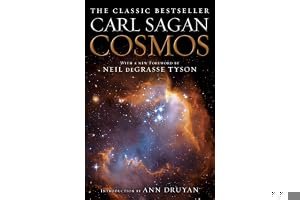
Cosmos has 13 heavily illustrated chapters, corresponding to the 13 episodes of the Cosmos television series. In the book, Sagan explores 15 billion years of cosmic evolution and the development of science and civilization. Cosmos traces the origins of knowledge and the scientific method, mixing science and philosophy, and speculates to the future of science. The book also discusses the underlying premises of science by providing biographical anecdotes about many prominent scientists throughout history, placing their contributions into the broader context of the development of modern science.
The book covers a broad range of topics, comprising Sagan's reflections on anthropological, cosmological, biological, historical, and astronomical matters from antiquity to contemporary times. Sagan reiterates his position on extraterrestrial life—that the magnitude of the universe permits the existence of thousands of alien civilizations, but no credible evidence exists to demonstrate that such life has ever visited earth.
…
Recommended by Richard Branson, Ante Shoda, Anurag Ramdasan, and 1 others.
Today is World Book Day, a wonderful opportunity to address this #ChallengeRichard sent in by Mike Gonzalez of New Jersey: Make a list of your top 65 books to read in a lifetime. [source]
Ante Shoda
It explains 14 billion years of the evolution of the universe, a sort of engineering experiment on the largest possible scale. It spans all scales of space and time, describing everything from the largest scales of the universe to the smallest scales of molecules and atoms. It’s a good book for putting everything in perspective. [source]
Anurag Ramdasan
This book helped draft a great perspective on the world and the universe at large and made me a fan of the Cosmos!
Cover unavailable
33
The Shock Doctrine: The Rise of Disaster Capitalism
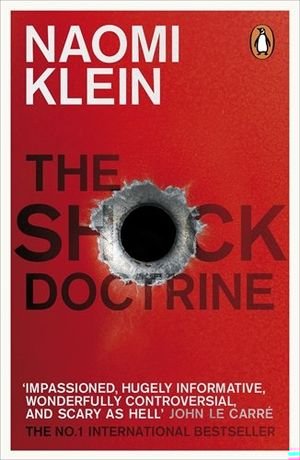
In her ground-breaking reporting from Iraq, Naomi Klein exposed how the trauma of invasion was being exploited to remake the country in the interest of foreign corporations. She called it "disaster capitalism." Covering Sri Lanka in the wake of the tsunami, and New Orleans post-Katrina, she witnessed something remarkably similar. People still reeling from catastrophe were being hit again, this time with economic "shock treatment" losing their land and homes to rapid-fire corporate makeovers. The Shock Doctrine retells the story of the most dominant ideology of our time, Milton Friedman's free market economic revolution. In contrast to the popular myth of this movement's peaceful global victory, Klein shows how it has exploited moments of shock and extreme violence in order to implement its economic policies in so many parts of the world from Latin America and Eastern Europe to South Africa, Russia, and Iraq. At the core of disaster capitalism is the use of cataclysmic events to advance radical privatization combined with the privatization of the disaster response itself. By capitalizing on crises, created by nature or war, Klein argues that the disaster capitalism complex now exists as a booming new economy, and is the violent culmination of a radical economic project that has been incubating for fifty years.
…
Recommended by Donna Dickenson, George Monbiot, and Mat Whitecross.
Donna Dickenson
Naomi Klein’s argument is that capitalism actually requires deliberately engineered shocks to the economic systems. [source]
The Shock Doctrine explains some of the mechanisms by which patrimonial capital acquires power and enhances its wealth. It’s a brilliant piece of work, and one of those rare books that changes the way you perceive the world. [source]
Mat Whitecross
It starts with the theory that moments of crisis have been utilised by the right wing in the US and other countries to manipulate people into following their agenda. [source]
Cover unavailable
34
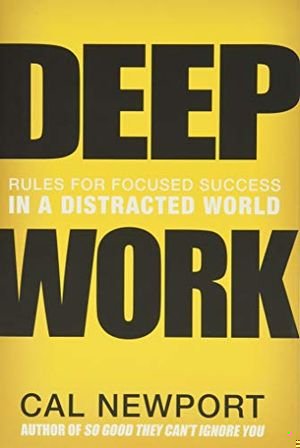
Deep Work: Rules for Focused Success in a Distracted World
One of the most valuable skills in our economy is becoming increasingly rare. If you master this skill, you'll achieve extraordinary results.
Deep work is the ability to focus without distraction on a cognitively demanding task. It's a skill that allows you to quickly master complicated information and produce better results in less time. Deep work will make you better at what you do and provide the sense of true fulfillment that comes from craftsmanship. In short, deep work is like a super power in our increasingly competitive twenty-first century economy. And yet, most people have lost the ability to go deep-spending their days instead in a frantic blur of e-mail and social media, not even realizing there's a better way.
In Deep Work, author and professor Cal Newport flips the narrative on impact in a connected age. Instead of arguing distraction is bad, he instead celebrates the power of its opposite. Dividing this book into two parts, he first makes the case that in almost any profession, cultivating a deep work ethic will produce massive benefits. He then presents a rigorous training regimen, presented as a series of four "rules," for transforming your mind and habits to support this skill.
A mix of cultural criticism and actionable advice, Deep Work takes the reader on a journey through memorable stories-from Carl Jung building a stone tower in the woods to focus his mind, to a social media pioneer buying a round-trip business class ticket to Tokyo to write a book free from distraction in the air-and no-nonsense advice, such as the claim that most serious professionals should quit social media and that you should practice being bored. Deep Work is an indispensable guide to anyone seeking focused success in a distracted world.
As automation and outsourcing reshape the workplace, what new skill do we need? The ability to do deep work. Cal Newport's exciting new book is an introduction and guide to the kind of intense concentration in a distraction-free environment that results in fast, powerful learning and performance. Think of it as calisthenics for your mind-and start your exercise program today. [source]
Marvin Liao
Partner/500 Startups
The Joy of Not Working (Zelinkski), Flash Foresight (Burrus), The Art of Worldly Wisdom (Gracian), Sapiens (Yuval), The End of Jobs (Pearson), Deep Work (Newport), Sovereign Individual (Davidson), The Fourth Economy (Davison) & The Monk & the Riddle (Komisar). Every single one of these books completely changed how I looked at everything in the world & literally pushed my life in a new direction. They were Paradigm Shifting as they say. (hate that word but it really was a Paradigm Shift for me). [source]
I've been a fan of Cal for a long time. His book So Good They Can't Ignore You is one of my favorites, but it's his new book that's probably had the biggest and most immediate impact on me. For those of you who enjoyed Tyler Cowen's Average is Over, you already know how important the ability to focus, be creative, and think at a high level is going to be in the future. This is a book that explains how to cultivate and protect that skill--the ability to do deep work. One thing I've already started doing since reading this book is recording the number of hours of deep work I do each day in my morning journal. It's a way of keeping a running tally and monitoring if I begin to get distracted or slow my pace. Anyway, great book! [source]
Cover unavailable
35
Born a Crime: Stories from a South African Childhood
Trevor Noah’s unlikely path from apartheid South Africa to the desk of The Daily Show began with a criminal act: his birth. Trevor was born to a white Swiss father and a black Xhosa mother at a time when such a union was punishable by five years in prison. Living proof of his parents’ indiscretion, Trevor was kept mostly indoors for the earliest years of his life, bound by the extreme and often absurd measures his mother took to hide him from a government that could, at any moment, steal him away. Finally liberated by the end of South Africa’s tyrannical white rule, Trevor and his mother set forth on a grand adventure, living openly and freely and embracing the opportunities won by a centuries-long struggle.
…
Recommended by Bill Gates, Heather Zynczak, Irina Nica, and 3 others.
As a longtime fan of The Daily Show, I loved reading this memoir about how its host honed his outsider approach to comedy over a lifetime of never quite fitting in. Born to a black South African mother and a white Swiss father in apartheid South Africa, he entered the world as a biracial child in a country where mixed race relationships were forbidden. Much of Noah’s story of growing up in South Africa is tragic. Yet, as anyone who watches his nightly monologues knows, his moving stories will often leave you laughing. [source]
Heather Zynczak
So excited for our latest speaker announcement for #PSLIVE19! Trevor Noah! I am a huge @TheDailyShow fan! And his book -Born a Crime -and life story are amazing. Can't wait! Join us! https://t.co/N6ykJq7TOy https://t.co/r0dIx5RFVI [source]
Irina Nica
I also pay attention to any book recommendations my friends post on Facebook. I started reading Trevor Noah’s Born a Crime after I saw Radu Marcusu, CEO of Upswing, recommending it. He swore by it that is was funny -- and it was! Until the last chapter. I remember listening to the audiobook on a train and crying my eyes out. So yeah. That happened. [source]
Her name was Henrietta Lacks, but scientists know her as HeLa. She was a poor Southern tobacco farmer who worked the same land as her slave ancestors, yet her cells—taken without her knowledge—became one of the most important tools in medicine. The first “immortal” human cells grown in culture, they are still alive today, though she has been dead for more than sixty years. If you could pile all HeLa cells ever grown onto a scale, they’d weigh more than 50 million metric tons—as much as a hundred Empire State Buildings. HeLa cells were vital for developing the polio vaccine; uncovered secrets of cancer, viruses, and the atom bomb’s effects; helped lead to important advances like in vitro fertilization, cloning, and gene mapping; and have been bought and sold by the billions.
Yet Henrietta Lacks remains virtually unknown, buried in an unmarked grave.
Now Rebecca Skloot takes us on an extraordinary journey, from the “colored” ward of Johns Hopkins Hospital in the 1950s to stark white laboratories with freezers full of HeLa cells; from Henrietta’s small, dying hometown of Clover, Virginia — a land of wooden slave quarters, faith healings, and voodoo — to East Baltimore today, where her children and grandchildren live and struggle with the legacy of her cells.
Henrietta’s family did not learn of her “immortality” until more than twenty years after her death, when scientists investigating HeLa began using her husband and children in research without informed consent. And though the cells had launched a multimillion-dollar industry that sells human biological materials, her family never saw any of the profits. As Rebecca Skloot so brilliantly shows, the story of the Lacks family — past and present — is inextricably connected to the dark history of experimentation on African Americans, the birth of bioethics, and the legal battles over whether we control the stuff we are made of.
Over the decade it took to uncover this story, Rebecca became enmeshed in the lives of the Lacks family—especially Henrietta’s daughter Deborah, who was devastated to learn about her mother’s cells. She was consumed with questions: Had scientists cloned her mother? Did it hurt her when researchers infected her cells with viruses and shot them into space? What happened to her sister, Elsie, who died in a mental institution at the age of fifteen? And if her mother was so important to medicine, why couldn’t her children afford health insurance?
Intimate in feeling, astonishing in scope, and impossible to put down, The Immortal Life of Henrietta Lacks captures the beauty and drama of scientific discovery, as well as its human consequences.
Yes. This is a fascinating book on so many different levels. It is really compelling as the story of the author trying to uncover the history of the woman from whom all these cells came. [source]
Cover unavailable
37
Invisible Women: Data Bias in a World Designed for Men
Imagine a world where your phone is too big for your hand, where your doctor prescribes a drug that is wrong for your body, where in a car accident you are 47% more likely to be seriously injured, where every week the countless hours of work you do are not recognised or valued. If any of this sounds familiar, chances are that you're a woman.
Invisible Women shows us how, in a world largely built for and by men, we are systematically ignoring half the population. It exposes the gender data gap – a gap in our knowledge that is at the root of perpetual, systemic discrimination against women, and that has created a pervasive but invisible bias with a profound effect on women’s lives.
Award-winning campaigner and writer Caroline Criado Perez brings together for the first time an impressive range of case studies, stories and new research from across the world that illustrate the hidden ways in which women are forgotten, and the impact this has on their health and well-being. From government policy and medical research, to technology, workplaces, urban planning and the media, Invisible Women reveals the biased data that excludes women. In making the case for change, this powerful and provocative book will make you see the world anew.
…
Recommended by Adam Wagner, Asher Wolf, Caitlin Moran, and 9 others.
Adam Wagner
@CCriadoPerez @MumsnetTowers I love this - the book, Poppy, the mug - it's so well composed! [source]
Asher Wolf
Tell me your best thing today. Mine was an amazing book and greeting card arrived in the post from the wonderful @MmeEmmeline https://t.co/GpEs2lg037 [source]
Caitlin Moran
@CCriadoPerez mate, I bow in admiration. it's an AMAZING, game-changing book. [source]
A highly infectious, deadly virus from the central African rain forest suddenly appears in the suburbs of Washington, D.C. There is no cure. In a few days 90 percent of its victims are dead. A secret military SWAT team of soldiers and scientists is mobilized to stop the outbreak of this exotic "hot" virus. The Hot Zone tells this dramatic story, giving a hair-raising account of the appearance of rare and lethal viruses and their "crashes" into the human race. Shocking, frightening, and impossible to ignore, The Hot Zone proves that truth really is scarier than fiction.
…
Recommended by Jon Najarian and Pierre Haski.
Jon Najarian
I believe both the corona virus and ebola have a bat connection. Scary, but great book on ebola: Hot Zone by Richard Preston https://t.co/jGEjbrB7pZ [source]
Pierre Haski
@ChuBailiang The hot zone, it made my days during SARS in Beijing, a great book! https://t.co/8E8AYgIhp7 [source]
Cover unavailable
39
The 4-Hour Workweek: Escape 9-5, Live Anywhere, and Join the New Rich
More than 100 pages of new, cutting-edge content. Forget the old concept of retirement and the rest of the deferred-life plan there is no need to wait and every reason not to, especially in unpredictable economic times. Whether your dream is escaping the rat race, experiencing high-end world travel, earning a monthly five-figure income with zero management, or just living more and working less, The 4-Hour Workweek is the blueprint. This step-by-step guide to luxury lifestyle design teaches: How Tim went from $40,000 per year and 80 hours per week to $40,000 per month and 4 hours per week. How to outsource your life to overseas virtual assistants for $5 per hour and do whatever you want How blue-chip escape artists travel the world without quitting their jobs How to eliminate 50% of your work in 48 hours using the principles of a forgotten Italian economist How to trade a long-haul career for short work bursts and frequent mini-retirements The new expanded edition of Tim Ferriss The 4-Hour Workweek includes: More than 50 practical tips and case studies from readers (including families) who have doubled income, overcome common sticking points, and reinvented themselves using the original book as a starting point Real-world templates you can copy for eliminating e-mail, negotiating with bosses and clients, or getting a private chef for less than $8 a meal How Lifestyle Design principles can be suited to unpredictable economic times The latest tools and tricks, as well as high-tech shortcuts, for living like a diplomat or millionaire without being either"
Eric Weinstein recommended this book on Twitter. [source]
Tim Draper
Founder/Draper Fisher Jurvetson
With this kind of time management and focus on the important things in life, people should be able to get 15 times as much done in a normal work week. [source]
It's about time this book was written. It is a long-overdue manifesto for the mobile lifestyle, and Tim Ferriss is the ideal ambassador. This will be huge. [source]
Nelson Mandela is one of the great moral and political leaders of our time: an international hero whose lifelong dedication to the fight against racial oppression in South Africa won him the Nobel Peace Prize and the presidency of his country.
Since his triumphant release in 1990 from more than a quarter-century of imprisonment, Mandela has been at the center of the most compelling and inspiring political drama in the world. As president of the African National Congress and head of South Africa's anti-apartheid movement, he was instrumental in moving the nation toward multiracial government and majority rule. He is revered everywhere as a vital force in the fight for human rights and racial equality.
The foster son of a Thembu chief, Mandela was raised in the traditional, tribal culture of his ancestors, but at an early age learned the modern, inescapable reality of what came to be called apartheid, one of the most powerful and effective systems of oppression ever conceived. In classically elegant and engrossing prose, he tells of his early years as an impoverished student and law clerk in a Jewish firm in Johannesburg, of his slow political awakening, and of his pivotal role in the rebirth of a stagnant ANC and the formation of its Youth League in the 1950s.
He describes the struggle to reconcile his political activity with his devotion to his family, the anguished breakup of his first marriage, and the painful separations from his children. He brings vividly to life the escalating political warfare in the fifties between the ANC and the government, culminating in his dramatic escapades as an underground leader and the notorious Rivonia Trial of 1964, at which he was sentenced to life imprisonment. Herecounts the surprisingly eventful twenty-seven years in prison and the complex, delicate negotiations that led both to his freedom and to the beginning of the end of apartheid. Finally he provides the ultimate inside account.
As 2018 draws to a close, I’m continuing a favorite tradition of mine and sharing my year-end lists. It gives me a moment to pause and reflect on the year through the books I found most thought-provoking, inspiring, or just plain loved. It also gives me a chance to highlight talented authors – some who are household names and others who you may not have heard of before. Here’s my best of 2018 list. [source]
Today is World Book Day, a wonderful opportunity to address this #ChallengeRichard sent in by Mike Gonzalez of New Jersey: Make a list of your top 65 books to read in a lifetime. [source]
Bianca Belair
For #BHM I will be sharing some of my favorite books by Black Authors 21st Book: Long Walk to Freedom -Nelson Mandela Read about his journey from childhood to the struggles of living under apartheid to becoming a freedom fighter & leader of his country. He is inspirational! https://t.co/bdvZu0kbh0 [source]
Cover unavailable
41
Voices from Chernobyl
Svetlana Alexievich
4.3
On April 26, 1986, the worst nuclear reactor accident in history occurred at the Chernobyl complex in Pripyat. English-language reportage on the incident has, so far, focused on facts, names, and data; Voices from Chernobyl presents first-hand accounts of what happened to the people of Belarus and the fear, anger, and uncertainty that they lived through. In order to give voice to their experiences, Svetlana Alexievich interviewed hundreds of people (firefighters, disaster-cleanup technicians, and innocent citizens alike) affected by the meltdown. She presents these interviews in monologue form, giving readers a harrowing inside view into the minds of the affected people. No spin, no accusations, and no summary judgment: just the lifeshattering pain of the meltdown and the aftermath.
…
Recommended by Caterina Fake, Craig Mazin, Kate Brown, and 1 others.
These are sources I found fascinating and useful. Not ALL of them, but a bunch. First up, obviously... Svetlana Alexievich's Voices From Chernobyl. Absolutely essential, and heartbreaking, reading. There's a reason Ms. Alexievich has a Nobel Prize. [source]
Kate Brown
It’s a very beautiful work and I think it gives you the emotional landscape of how people dealt with their anxieties, fears, the health problems that ensued, and their growing sense of disillusionment with their political leaders and the Communist party. [source]
Rebecca Altman
What follows events like Chernobyl is a politics of measurement. Who counts? What counts? Who does the counting? How are boundaries drawn for the purposes of counting and comparing? And what is discounted, or never counted at all? [source]
Cover unavailable
42
Dark Money: The Hidden History of the Billionaires Behind the Rise of the Radical Right
Who are the immensely wealthy right-wing ideologues shaping the fate of America today? From the bestselling author of The Dark Side, an electrifying work of investigative journalism that uncovers the agenda of this powerful group.
In her new preface, Jane Mayer discusses the results of the most recent election and Donald Trump's victory, and how, despite much discussion to the contrary, this was a huge victory for the billionaires who have been pouring money in the American political system.
Why is America living in an age of profound and widening economic inequality? Why have even modest attempts to address climate change been defeated again and again? Why do hedge-fund billionaires pay a far lower tax rate than middle-class workers? In a riveting and indelible feat of reporting, Jane Mayer illuminates the history of an elite cadre of plutocrats—headed by the Kochs, the Scaifes, the Olins, and the Bradleys—who have bankrolled a systematic plan to fundamentally alter the American political system. Mayer traces a byzantine trail of billions of dollars spent by the network, revealing a staggering conglomeration of think tanks, academic institutions, media groups, courthouses, and government allies that have fallen under their sphere of influence. Drawing from hundreds of exclusive interviews, as well as extensive scrutiny of public records, private papers, and court proceedings, Mayer provides vivid portraits of the secretive figures behind the new American oligarchy and a searing look at the carefully concealed agendas steering the nation. Dark Money is an essential book for anyone who cares about the future of American democracy.
…
Recommended by Brad Feld and Avi Asherschapiro.
Avi Asherschapiro
Who could forget that great book of reportage, "Dark Money," about the shadowy mechanization of the Nurses Union & the Climate Change Youth Movement. [source]
Cover unavailable
43
The Black Swan: The Impact of the Highly Improbable
A black swan is a highly improbable event with three principal characteristics: It is unpredictable; it carries a massive impact; and, after the fact, we concoct an explanation that makes it appear less random, and more predictable, than it was.
The astonishing success of Google was a black swan; so was 9/11. For Nassim Nicholas Taleb, black swans underlie almost everything about our world, from the rise of religions to events in our own personal lives.
Why do we not acknowledge the phenomenon of black swans until after they occur? Part of the answer, according to Taleb, is that humans are hardwired to learn specifics when they should be focused on generalities.
We concentrate on things we already know and time and time again fail to take into consideration what we don’t know. We are, therefore, unable to truly estimate opportunities, too vulnerable to the impulse to simplify, narrate, and categorize, and not open enough to rewarding those who can imagine the “impossible.”
For years, Taleb has studied how we fool ourselves into thinking we know more than we actually do. We restrict our thinking to the irrelevant and inconsequential, while large events continue to surprise us and shape our world. Now, in this revelatory book, Taleb explains everything we know about what we don’t know. He offers surprisingly simple tricks for dealing with black swans and benefiting from them.
Elegant, startling, and universal in its applications The Black Swan will change the way you look at the world. Taleb is a vastly entertaining writer, with wit, irreverence, and unusual stories to tell. He has a polymathic command of subjects ranging from cognitive science to business to probability theory.
The Black Swan is a landmark book – itself a black swan.
The book also contains a 4-page glossary; 19 pages of notes; and, a 28-page bibliography in addition to an index.
From the book "The Everything Store: and the Age of Amazon" “The scholar argues that people are wired to see patterns in chaos while remaining blind to unpredictable events, with massive consequences. Experimentation and empiricism trumps the easy and obvious narrative,” Stone writes. [source]
And throw in “The Black Swan” and “Fooled by Randomness”. “Fragile” means if you hit something might break. “Resilient” means if you hit something, it will stay the same. On my podcast Nassim discusses “Antifragility” – building a system, even on that works for you on a personal level, where you if you harm your self in some way it becomes stronger. That podcast changed my life He discusses Antifragility throughout history, up to our current economic situation, and even in our personal situations. [source]
In his sensational international bestseller, the preeminent scientist and outspoken atheist Richard Dawkins delivers a hard-hitting, impassioned, but humorous, rebuttal of religious belief. With rigor and wit, Dawkins eviscerates the arguments for religion and demonstrates the supreme improbability of the existence of a supreme being. He makes a compelling case that faith is not just irrational but potentially deadly. In a preface written for the paperback edition, Dawkins responds to some of the controversies the book has incited. This brilliantly argued, provocative book challenges all of us to examine our belifs, no matter what beliefs we hold.
…
Recommended by Brian Armstrong, Antonio Eram, Susan Jacoby, and 1 others.
Antonio Eram
This book was recommended by Antonio when asked for titles he would recommend to young people interested in his career path. [source]
Susan Jacoby
Richard Dawkins is very funny. One of the reasons for reading The God Delusion is that it will disabuse you of the idea – which is a common stereotype of atheists – that they are utterly humourless. You hear this over and over again. I’m often invited to college campuses to give lectures, and often they’re religious schools – not fundamentalist schools, but colleges of a historically religious type. And very often I will hear: “Oh I expected you to be small and dark-haired and wear glasses!” The image of the atheist woman is kind of like what the image of the feminist used to be, someone too ugly to get a man. But part of it is also humorlessness. People will often say to me, “Oh you’re so funny.” “Well, yeah!” [source]
Vote Dem For The Planet
@KimBledsoe14 @Goodbye_Jesus @Ian313f There were a lot of rebels and drifters in those days against the repressive regime. They had followers. Have you read “The God Delusion”? Great book. [source]
Cover unavailable
45
In Cold Blood
Truman Capote
4.3
On November 15, 1959, in the small town of Holcomb, Kansas, four members of the Clutter family were savagely murdered by blasts from a shotgun held a few inches from their faces. There was no apparent motive for the crime, and there were almost no clues.
As Truman Capote reconstructs the murder and the investigation that led to the capture, trial, and execution of the killers, he generates both mesmerizing suspense and astonishing empathy. At the center of his study are the amoral young killers Perry Smith and Dick Hickcock, who, vividly drawn by Capote, are shown to be reprehensible yet entirely and frighteningly human. In Cold Blood is a seminal work of modern prose, a remarkable synthesis of journalistic skill and powerfully evocative narrative.
One of the reasons I like this true crime novelisation is down to the fact it was so out of character for Capote and took everyone by surprise. It is also an excellent, almost biographical, insight into the two young killers’ minds. [source]
I think in all honesty it is one of the finest books ever written. It took him six years to finish it because he had to wait for the court case and the final verdict which was the two perpetrators being executed. [source]
Michael Pollan's last book, The Omnivore's Dilemma, launched a national conversation about the American way of eating; now In Defense of Food shows us how to change it, one meal at a time. Pollan proposes a new answer to the question of what we should eat that comes down to seven simple but liberating words: Eat food. Not too much. Mostly plants. Pollan's bracing and eloquent manifesto shows us how we can start making thoughtful food choices that will enrich our lives, enlarge our sense of what it means to be healthy, and bring pleasure back to eating.,,,
Today is World Book Day, a wonderful opportunity to address this #ChallengeRichard sent in by Mike Gonzalez of New Jersey: Make a list of your top 65 books to read in a lifetime. [source]
Henry Dimbleby
Pollan takes the science of food and shows where it’s been misapplied. [source]
Cover unavailable
47
The Power of Now: A Guide to Spiritual Enlightenment
Eckhart Tolle is emerging as one of today's most inspiring teachers. In The Power of Now, a #1 national bestseller, the author describes his transition from despair to self-realization soon after his 29th birthday. Tolle took another ten years to understand this transformation, during which time he evolved a philosophy that has parallels in Buddhism, relaxation techniques, and meditation theory but is also eminently practical. In The Power of Now he shows readers how to recognize themselves as the creators of their own pain, and how to have a pain-free existence by living fully in the present. Accessing the deepest self, the true self, can be learned, he says, by freeing ourselves from the conflicting, unreasonable demands of the mind and living present, fully, and intensely, in the Now.
…
Recommended by Bill Liao, Catherine Plano, Darrah Brustein, and 7 others.
Bill Liao
The human world occurs in language so best get good at it! [source]
Catherine Plano
The one that really resonates with me and still to this day is The Power of NOW from Eckhart Tolle because as an entrepreneur we get so caught up in the future that we fail to be 'present'. The reality of it all when you really think about it - the present is all we have that is real, it requires no effort, nor time. I practice this daily, if I feel uncomfortable then I know I am trying too hard and not being present but when I am being present it is easier to think about what I have to do right now, because now is all that matters. [source]
Darrah Brustein
Others include The Power Of Now which is powerful reminder that all we have is the present and helps give you meaningful ways to live in it, not in the past or the future. [source]
Cover unavailable
48
The Everything Store: Jeff Bezos and the Age of Amazon
The definitive story of Amazon.com, one of the most successful companies in the world, and of its driven, brilliant founder, Jeff Bezos.
Amazon.com started off delivering books through the mail. But its visionary founder, Jeff Bezos, wasn't content with being a bookseller. He wanted Amazon to become the everything store, offering limitless selection and seductive convenience at disruptively low prices. To do so, he developed a corporate culture of relentless ambition and secrecy that's never been cracked. Until now. Brad Stone enjoyed unprecedented access to current and former Amazon employees and Bezos family members, giving readers the first in-depth, fly-on-the-wall account of life at Amazon. Compared to tech's other elite innovators--Jobs, Gates, Zuckerberg--Bezos is a private man. But he stands out for his restless pursuit of new markets, leading Amazon into risky new ventures like the Kindle and cloud computing, and transforming retail in the same way Henry Ford revolutionized manufacturing.
The Everything Store will be the revealing, definitive biography of the company that placed one of the first and largest bets on the Internet and forever changed the way we shop and read.
…
Recommended by Doug McMillon, Aaron Watson, Alan Pierce, and 10 others.
I read and give this book because you need to understand what you’re up against. [source]
Aaron Watson
Amazon is going to rule the world unless governments decide to break them up. It just makes sense to understand the most powerful company on the planet. Also, there is a (small) chance that Amazon sets up HQ2 in my hometown (Pittsburgh). [source]
Alan Pierce
This was an amazing glimpse into one of the most disruptive companies in history as well as the past and future trajectory of e-commerce and retail. It is also a testament to unwavering self-belief. The thing that impressed me the most is that Jeff Bezos intentionally built an entire department dedicated to making his primary business obsolete which allowed him to take the lead in the next development, e-books. His foresight is extraordinary and he is an inspirational big thinker. [source]
Cover unavailable
49
Last Chance to See
Douglas Adams, Mark Carwardine
4.3
"Very funny and moving...The glimpses of rare fauna seem to have enlarged [Adams'] thinking, enlivened his world; and so might the animals do for us all, if we were to help them live." THE WASHINGTON POST BOOK WORLD Join bestselling author Douglas Adams and zooligist Mark Carwardine as they take off around the world in search of exotic, endangered creatures. Hilarious and poignant--as only Douglas Adams can be--LAST CHANCE TO SEE is an entertaining and arresting odyssey through the Earth's magnificent wildlife galaxy.
…
Recommended by Beth Shapiro, Gaia Vince, and Mark Lynas.
Beth Shapiro
He describes in this book not only the beauty of these animals, but the human landscape they live in and what a disastrous time he has getting to these locations. [source]
Gaia Vince
This is a book obviously for readers but it’s also a book for writers of science to understand how to capture the imagination of readers. [source]
Mark Lynas
For me, Last Chance to See is a real eye-opener, with the idea that you can take a depressing subject – species on the verge of extinction – and present it in a way which is so engaging, so funny and so humane. [source]
Cover unavailable
50
The Man Who Mistook His Wife for a Hat and Other Clinical Tales
If a man has lost a leg or an eye, he knows he has lost a leg or an eye; but if he has lost a self—himself—he cannot know it, because he is no longer there to know it. Dr. Oliver Sacks recounts the stories of patients struggling to adapt to often bizarre worlds of neurological disorder. Here are people who can no longer recognize everyday objects or those they love; who are stricken with violent tics or shout involuntary obscenities; who have been dismissed as autistic or retarded, yet are gifted with uncanny artistic or mathematical talents. If inconceivably strange, these brilliant tales illuminate what it means to be human.
…
Recommended by Bradley Voytek, Suzanne O'Sullivan, and Tanya Byron.
Bradley Voytek
I can’t imagine one day waking up and not knowing who my wife is, or seeing my wife and thinking that she was replaced by some sort of clone or robot. But that could happen to any of us. [source]
Suzanne O'Sullivan
I didn’t choose neurology because of it but the way Oliver Sacks writes about neurology is very compelling. [source]
Tanya Byron
This is a seminal book that anyone who wants to work in mental health should read. It is a charming and gentle and also an honest exposé of what can happen to us when our mental health is compromised for whatever reason. [source]
Drawing on cutting-edge neuroscience and psychology and displaying all of the brilliance that made The Tipping Point a classic, Blink changes the way you'll understand every decision you make. Never again will you think about thinking the same way.
Malcolm Gladwell redefined how we understand the world around us. Now, in Blink, he revolutionizes the way we understand the world within. Blink is a book about how we think without thinking, about choices that seem to be made in an instant - in the blink of an eye - that actually aren't as simple as they seem. Why are some people brilliant decision makers, while others are consistently inept? Why do some people follow their instincts and win, while others end up stumbling into error? How do our brains really work - in the office, in the classroom, in the kitchen, and in the bedroom? And why are the best decisions often those that are impossible to explain to others?
In Blink we meet the psychologist who has learned to predict whether a marriage will last, based on a few minutes of observing a couple; the tennis coach who knows when a player will double-fault before the racket even makes contact with the ball; the antiquities experts who recognize a fake at a glance. Here, too, are great failures of "blink": the election of Warren Harding; "New Coke"; and the shooting of Amadou Diallo by police. Blink reveals that great decision makers aren't those who process the most information or spend the most time deliberating, but those who have perfected the art of "thin-slicing" - filtering the very few factors that matter from an overwhelming number of variables.
…
Recommended by Ev Williams, Mike Shinoda, Marillyn Hewson, and 4 others.
Mike Shinoda
I know most of the guys in the band read this book. [source]
Marillyn Hewson
CEO/Lockheed Martin
CEO Marilyn Hewson recommends this book because it helped her to trust her instincts in business. [source]
Antonio Eram
When asked to name some books that had a big impact on him, Antonio mentioned Blink: The Power of Thinking Without Thinking by Malcolm Gladwell. [source]
Cover unavailable
52
The Life-Changing Magic of Tidying Up: The Japanese Art of Decluttering and Organizing
Despite constant efforts to declutter your home, do papers still accumulate like snowdrifts and clothes pile up like a tangled mess of noodles?
Japanese cleaning consultant Marie Kondo takes tidying to a whole new level, promising that if you properly simplify and organize your home once, you'll never have to do it again. Most methods advocate a room-by-room or little-by-little approach, which doom you to pick away at your piles of stuff forever. The KonMari Method, with its revolutionary category-by-category system, leads to lasting results. In fact, none of Kondo's clients have lapsed (and she still has a three-month waiting list).
With detailed guidance for determining which items in your house "spark joy" (and which don't), this international best seller featuring Tokyo's newest lifestyle phenomenon will help you clear your clutter and enjoy the unique magic of a tidy home - and the calm, motivated mindset it can inspire.
…
Recommended by Andra Zaharia, Annie Loves Covfefe, Benjamin Spall, and 3 others.
Andra Zaharia
I’ve gone through quite a few experiences brought on or shaped by what I’ve learned from books. … a more frivolous example is The Life-Changing Magic of Tidying. I read this one when moving apartments a few years ago and it made me throw or give away ⅓ of my stuff. The result: freeing up space, both physical and mental, and acquiring some home organizing skills that have stuck with me ever since. My home is tidier and my mind is clearer because of this book. [source]
Annie Loves Covfefe
@Benny29143790 @Thereal_ssteele Oh how I love Kondo cleaning. Her first book is fantastic too!! [source]
Benjamin Spall
The Life-Changing Magic of Tidying Up by Marie Kondo … I started reading on vacation. I interviewed Marie for my own book and while the translation is somewhat quirky in places, her book is worth the hype. [source]
What is the nature of space and time? How do we fit within the universe? How does the universe fit within us? There’s no better guide through these mind-expanding questions than acclaimed astrophysicist and best-selling author Neil deGrasse Tyson.
But today, few of us have time to contemplate the cosmos. So Tyson brings the universe down to Earth succinctly and clearly, with sparkling wit, in tasty chapters consumable anytime and anywhere in your busy day.
What's the most effective path to success in any domain? It's not what you think. Plenty of experts argue that anyone who wants to develop a skill, play an instrument, or lead their field should start early, focus intensely, and rack up as many hours of deliberate practice as possible. If you dabble or delay, you'll never catch up to the people who got a head start. But a closer look at research on the world's top performers, from professional athletes to Nobel laureates, shows that early specialization is the exception, not the rule.
David Epstein examined the world's most successful athletes, artists, musicians, inventors, forecasters and scientists. He discovered that in most fields--especially those that are complex and unpredictable--generalists, not specialists, are primed to excel. Generalists often find their path late, and they juggle many interests rather than focusing on one. They're also more creative, more agile, and able to make connections their more specialized peers can't see.
Provocative, rigorous, and engrossing, Range makes a compelling case for actively cultivating inefficiency. Failing a test is the best way to learn. Frequent quitters end up with the most fulfilling careers. The most impactful inventors cross domains rather than deepening their knowledge in a single area. As experts silo themselves further while computers master more of the skills once reserved for highly focused humans, people who think broadly and embrace diverse experiences and perspectives will increasingly thrive.
For reasons I cannot explain, David Epstein manages to make me thoroughly enjoy the experience of being told that everything I thought about something was wrong. I loved Range. [source]
This book looks at how an emphasis on specialization can actually hamper our ability to really excel at something. It aligns with what I try to do when I am coaching, in my stories, and what we’re doing with Mamba Sports Academy — create all-around athletes who can think critically and make assessments in real time to enhance their play rather than rely only on a narrow set of skills. [source]
Susan Cain
Author
It’s a joy to spend hours in the company of a writer as gifted as David Epstein. And the joy is all the greater when that writer shares so much crucial and revelatory information about performance, success, and education. [source]
Cover unavailable
55
Talking to Strangers: What We Should Know about the People We Don't Know
Malcolm Gladwell, host of the podcast Revisionist History and author of the #1 New York Times bestseller Outliers, offers a powerful examination of our interactions with strangers -- and why they often go wrong.
How did Fidel Castro fool the CIA for a generation? Why did Neville Chamberlain think he could trust Adolf Hitler? Why are campus sexual assaults on the rise? Do television sitcoms teach us something about the way we relate to each other that isn't true?
While tackling these questions, Malcolm Gladwell was not solely writing a book for the page. He was also producing for the ear. In the audiobook version of Talking to Strangers, you'll hear the voices of people he interviewed--scientists, criminologists, military psychologists. Court transcripts are brought to life with re-enactments. You actually hear the contentious arrest of Sandra Bland by the side of the road in Texas. As Gladwell revisits the deceptions of Bernie Madoff, the trial of Amanda Knox, and the suicide of Sylvia Plath, you hear directly from many of the players in these real-life tragedies. There's even a theme song - Janelle Monae's "Hell You Talmbout."
Something is very wrong, Gladwell argues, with the tools and strategies we use to make sense of people we don't know. And because we don't know how to talk to strangers, we are inviting conflict and misunderstanding in ways that have a profound effect on our lives and our world.
I'll put here what I emailed Malcolm when I finished the book: "Just finished your new book in one sitting yesterday. So good. You are at the height of your powers and remain an inspiration to all of us trying to master an un-masterable profession." It's a little less practical or self-improvement oriented than his previous books, but far more thought provoking. [source]
Nilofer Merchant
An interesting analysis/ essay re Gladwell’s latest book —> https://t.co/5Ey1maNRyI [source]
In Sapiens, he explored our past. In Homo Deus, he looked to our future. Now, one of the most innovative thinkers on the planet turns to the present to make sense of today's most pressing issues.
How do computers and robots change the meaning of being human? How do we deal with the epidemic of fake news? Are nations and religions still relevant? What should we teach our children?
Yuval Noah Harari's21 Lessons for the 21st Century is a probing and visionary investigation into today's most urgent issues as we move into the uncharted territory of the future. As technology advances faster than our understanding of it, hacking becomes a tactic of war, and the world feels more polarized than ever, Harari addresses the challenge of navigating life in the face of constant and disorienting change and raises the important questions we need to ask ourselves in order to survive.
In twenty-one accessible chapters that are both provocative and profound, Harari builds on the ideas explored in his previous books, untangling political, technological, social, and existential issues and offering advice on how to prepare for a very different future from the world we now live in: How can we retain freedom of choice when Big Data is watching us? What will the future workforce look like, and how should we ready ourselves for it? How should we deal with the threat of terrorism? Why is liberal democracy in crisis?
Harari's unique ability to make sense of where we have come from and where we are going has captured the imaginations of millions of readers. Here he invites us to consider values, meaning, and personal engagement in a world full of noise and uncertainty. When we are deluged with irrelevant information, clarity is power. Presenting complex contemporary challenges clearly and accessibly, 21 Lessons for the 21st Century is essential reading.
…
Recommended by Bill Gates, Brajesh Kumar Singh, Eh Bee Family, and 2 others.
Harari is such a stimulating writer that even when I disagreed, I wanted to keep reading and thinking. All three of his books wrestle with some version of the same question: What will give our lives meaning in the decades and centuries ahead? So far, human history has been driven by a desire to live longer, healthier, happier lives. If science is eventually able to give that dream to most people, and large numbers of people no longer need to work in order to feed and clothe everyone, what reason will we have to get up in the morning? It’s no criticism to say that Harari hasn’t produced a satisfying answer yet. Neither has anyone else. So I hope he turns more fully to this question in the future. In the meantime, he has teed up a crucial global conversation about how to take on the problems of the 21st century. [source]
Brajesh Kumar Singh
Harari, currently, the world's best historian and future analyst, is a gay! He is a Jew and writes his books in Hebrew! Got universal acclaim for his first book Sapiens, followed by Homo Deus and now the latest, 21 lessons for the 21st century! Salute to this genius, keep it up! https://t.co/s7R6oEbwiN [source]
Eh Bee Family
@harari_yuval This book is amazing. After every chapter...I pause...then freak out...then gather myself and keep reading. [source]
Two kids with the same name lived in the same decaying city. One went on to be a Rhodes Scholar, decorated combat veteran, White House Fellow, and business leader. The other is serving a life sentence in prison. Here is the story of two boys and the journey of a generation.
In December 2000, the Baltimore Sunran a small piece about Wes Moore, a local student who had just received a Rhodes Scholarship. The same paper also ran a series of articles about four young men who had allegedly killed a police officer in a spectacularly botched armed robbery. The police were still hunting for two of the suspects who had gone on the lam, a pair of brothers. One was named Wes Moore.
Wes just couldn’t shake off the unsettling coincidence, or the inkling that the two shared much more than space in the same newspaper. After following the story of the robbery, the manhunt, and the trial to its conclusion, he wrote a letter to the other Wes, now a convicted murderer serving a life sentence without the possibility of parole. His letter tentatively asked the questions that had been haunting him: Who are you? How did this happen?
That letter led to a correspondence and relationship that have lasted for several years. Over dozens of letters and prison visits, Wes discovered that the other Wes had had a life not unlike his own: Both had grown up in similar neighborhoods and had had difficult childhoods, both were fatherless; they’d hung out on similar corners with similar crews, and both had run into trouble with the police. At each stage of their young lives they had come across similar moments of decision, yet their choices would lead them to astonishingly different destinies.
Told in alternating dramatic narratives that take readers from heart-wrenching losses to moments of surprising redemption, The Other Wes Moore tells the story of a generation of boys trying to find their way in a hostile world.
Edward Snowden, the man who risked everything to expose the US government’s system of mass surveillance, reveals for the first time the story of his life, including how he helped to build that system and what motivated him to try to bring it down.
In 2013, twenty-nine-year-old Edward Snowden shocked the world when he broke with the American intelligence establishment and revealed that the United States government was secretly pursuing the means to collect every single phone call, text message, and email. The result would be an unprecedented system of mass surveillance with the ability to pry into the private lives of every person on earth. Six years later, Snowden reveals for the very first time how he helped to build this system and why he was moved to expose it.
Spanning the bucolic Beltway suburbs of his childhood and the clandestine CIA and NSA postings of his adulthood, Permanent Record is the extraordinary account of a bright young man who grew up online—a man who became a spy, a whistleblower, and, in exile, the Internet’s conscience. Written with wit, grace, passion, and an unflinching candor, Permanent Record is a crucial memoir of our digital age and destined to be a classic.
Edward Snowden decided at the age of 29 to give up his entire future for the good of his country. He displayed enormous courage in doing so, and like him or not, his is an incredible American story. There is no doubt that the world is a better and more private place for his actions. Macmillan is enormously proud to publish Permanent Record. [source]
In The Hidden Life of Trees, Peter Wohlleben shares his deep love of woods and forests and explains the amazing processes of life, death, and regeneration he has observed in the woodland and the amazing scientific processes behind the wonders of which we are blissfully unaware. Much like human families, tree parents live together with their children, communicate with them, and support them as they grow, sharing nutrients with those who are sick or struggling and creating an ecosystem that mitigates the impact of extremes of heat and cold for the whole group. As a result of such interactions, trees in a family or community are protected and can live to be very old. In contrast, solitary trees, like street kids, have a tough time of it and in most cases die much earlier than those in a group.
Drawing on groundbreaking new discoveries, Wohlleben presents the science behind the secret and previously unknown life of trees and their communication abilities; he describes how these discoveries have informed his own practices in the forest around him. As he says, a happy forest is a healthy forest, and he believes that eco-friendly practices not only are economically sustainable but also benefit the health of our planet and the mental and physical health of all who live on Earth.
Fooled by Randomness is a standalone book in Nassim Nicholas Taleb’s landmark Incerto series, an investigation of opacity, luck, uncertainty, probability, human error, risk, and decision-making in a world we don’t understand. The other books in the series are The Black Swan, Antifragile, and The Bed of Procrustes.
Now in a striking new hardcover edition, Fooled by Randomness is the word-of-mouth sensation that will change the way you think about business and the world. Nassim Nicholas Taleb–veteran trader, renowned risk expert, polymathic scholar, erudite raconteur, and New York Times bestselling author of The Black Swan–has written a modern classic that turns on its head what we believe about luck and skill.
This book is about luck–or more precisely, about how we perceive and deal with luck in life and business. Set against the backdrop of the most conspicuous forum in which luck is mistaken for skill–the world of trading–Fooled by Randomness provides captivating insight into one of the least understood factors in all our lives. Writing in an entertaining narrative style, the author tackles major intellectual issues related to the underestimation of the influence of happenstance on our lives.
The book is populated with an array of characters, some of whom have grasped, in their own way, the significance of chance: the baseball legend Yogi Berra; the philosopher of knowledge Karl Popper; the ancient world’s wisest man, Solon; the modern financier George Soros; and the Greek voyager Odysseus. We also meet the fictional Nero, who seems to understand the role of randomness in his professional life but falls victim to his own superstitious foolishness.
However, the most recognizable character of all remains unnamed–the lucky fool who happens to be in the right place at the right time–he embodies the “survival of the least fit.” Such individuals attract devoted followers who believe in their guru’s insights and methods. But no one can replicate what is obtained by chance.
Are we capable of distinguishing the fortunate charlatan from the genuine visionary? Must we always try to uncover nonexistent messages in random events? It may be impossible to guard ourselves against the vagaries of the goddess Fortuna, but after reading Fooled by Randomness we can be a little better prepared.
PRAISE FOR FOOLED BY RANDOMNESS:
Named by Fortune One of the Smartest Books of All Time
A Financial Times Best Business Book of the Year
“[Fooled by Randomness] is to conventional Wall Street wisdom approximately what Martin Luther’s ninety-five theses were to the Catholic Church.” –Malcolm Gladwell, author of Blink
“The book that rolled down Wall Street like a hand grenade.” –Maggie Mahar, author of Bull! A History of the Boom, 1982—1999
“Fascinating . . . Taleb will grab you.” –Peter L. Bernstein, author of Capital Ideas Evolving
“Recalls the best of scientist/essayists like Richard Dawkins . . . and Stephen Jay Gould.” –Michael Schrage, author of Serious Play: How the World’s Best Companies Simulate to Innovate
“We need a book like this. . . . Fun to read, refreshingly independent-minded.” –Robert J. Shiller, author of Irrational Exuberance
“Powerful . . . loaded with crackling little insights [and] extreme brilliance.” –National Review
And throw in “The Black Swan” and “Fooled by Randomness”. “Fragile” means if you hit something might break. “Resilient” means if you hit something, it will stay the same. On my podcast Nassim discusses “Antifragility” – building a system, even on that works for you on a personal level, where you if you harm your self in some way it becomes stronger. That podcast changed my life He discusses Antifragility throughout history, up to our current economic situation, and even in our personal situations. [source]
Anant Jain
The five-book series, "Incerto", by Nassim Nicholas Taleb has had a profound impact on how I think about the world. There’s some overlap across the books — but you'll likely find the repetition helpful in retaining the content better. [source]
Art De Vany
I used this book is a class I taught on the economics of uncertainty. [source]
Cover unavailable
61
Behind the Beautiful Forevers: Life, Death, and Hope in a Mumbai Undercity
From Pulitzer Prize-winner Katherine Boo, a landmark work of narrative nonfiction that tells the dramatic and sometimes heartbreaking story of families striving toward a better life in one of the twenty-first century's great, unequal cities.
In this brilliantly written, fast-paced book, based on three years of uncompromising reporting, a bewildering age of global change and inequality is made human.
Annawadi is a makeshift settlement in the shadow of luxury hotels near the Mumbai airport, and as India starts to prosper, Annawadians are electric with hope. Abdul, a reflective and enterprising Muslim teenager, sees "a fortune beyond counting" in the recyclable garbage that richer people throw away. Asha, a woman of formidable wit and deep scars from a childhood in rural poverty, has identified an alternate route to the middle class: political corruption. With a little luck, her sensitive, beautiful daughter - Annawadi's "most-everything girl" - will soon become its first female college graduate. And even the poorest Annawadians, like Kalu, a fifteen-year-old scrap-metal thief, believe themselves inching closer to the good lives and good times they call "the full enjoy."
But then Abdul the garbage sorter is falsely accused in a shocking tragedy; terror and a global recession rock the city; and suppressed tensions over religion, caste, sex, power and economic envy turn brutal. As the tenderest individual hopes intersect with the greatest global truths, the true contours of a competitive age are revealed. And so, too, are the imaginations and courage of the people of Annawadi.
With intelligence, humor, and deep insight into what connects human beings to one another in an era of tumultuous change, Behind the Beautiful Forevers carries the reader headlong into one of the twenty-first century's hidden worlds, and into the lives of people impossible to forget.
Katherine Boo spent three years getting to know the people of Annawadi, a slum of about 3,000 people on the edge of a sewage-filled lake in India’s largest city. Her book is a poignant reminder of how much more work needs to be done to address the inequities in the world. But it’s also an uplifting story of people striving to make a life for themselves, sacrificing for their families, and in their own way, being innovative and entrepreneurial in creating a vibrant local economy. [source]
Adam Minter
Vivid scenes of walking down Mumbai’s Airport Road, lined by shacks and trash pickers, and behind them are walls, and behind them are the finest five star hotels in India. [source]
Cover unavailable
62
David and Goliath: Underdogs, Misfits, and the Art of Battling Giants
In his #1 bestselling books The Tipping Point, Blink, and Outliers, Malcolm Gladwell has explored the ways we understand and change our world. Now he looks at the complex and surprising ways the weak can defeat the strong, the small can match up against the giant, and how our goals (often culturally determined) can make a huge difference in our ultimate sense of success. Drawing upon examples from the world of business, sports, culture, cutting-edge psychology, and an array of unforgettable characters around the world, David and Goliath is in many ways the most practical and provocative book Malcolm Gladwell has ever written.
…
Recommended by Andrew Chen, Cat Williams-Treloar, Catalina Penciu, and 3 others.
Cat Williams-Treloar
The books that I've talked the most about with friends and colleagues over the years are the Malcolm Gladwell series of novels. Glorious stories that mix science, behaviours and insight. You can't go wrong with the "The Tipping Point", "Outliers", "Blink" or "David & Goliath". [source]
Catalina Penciu
Business-wise, my goal for this year is to improve my collection and my mindset, but my favorite so far has been David and Goliath by Malcolm Gladwell. [source]
Robert Katai
Buy Malcolm Gladwell’s book “David and Goliath” and read the interesting stories about how the Davids of that moments have defeated the Goliaths. [source]
A celebrated writer's irresistible, candid, and eloquent account of her pursuit of worldly pleasure, spiritual devotion, and what she really wanted out of life.
Around the time Elizabeth Gilbert turned thirty, she went through an early-onslaught midlife crisis. She had everything an educated, ambitious American woman was supposed to want—a husband, a house, a successful career. But instead of feeling happy and fulfilled, she was consumed with panic, grief, and confusion. She went through a divorce, a crushing depression, another failed love, and the eradication of everything she ever thought she was supposed to be.
To recover from all this, Gilbert took a radical step. In order to give herself the time and space to find out who she really was and what she really wanted, she got rid of her belongings, quit her job, and undertook a yearlong journey around the world—all alone. Eat, Pray, Love is the absorbing chronicle of that year. Her aim was to visit three places where she could examine one aspect of her own nature set against the backdrop of a culture that has traditionally done that one thing very well. In Rome, she studied the art of pleasure, learning to speak Italian and gaining the twenty-three happiest pounds of her life. India was for the art of devotion, and with the help of a native guru and a surprisingly wise cowboy from Texas, she embarked on four uninterrupted months of spiritual exploration. In Bali, she studied the art of balance between worldly enjoyment and divine transcendence. She became the pupil of an elderly medicine man and also fell in love the best way—unexpectedly.
An intensely articulate and moving memoir of self-discovery, Eat, Pray, Love is about what can happen when you claim responsibility for your own contentment and stop trying to live in imitation of society’s ideals. It is certain to touch anyone who has ever woken up to the unrelenting need for change.
…
Recommended by Chelsea Frank and Gabriel Coarna.
Chelsea Frank
I read everything with an open mind, often challenging myself by choosing books with an odd perspective or religious/spiritual views. These books do not reflect my personal feelings but are books that helped shape my perspective on life, love, and happiness. [source]
Gabriel Coarna
I started reading "Eat, Pray, Love" as soon as I finished watching Elizabeth Gilbert give this talk. [source]
Cover unavailable
64
SuperFreakonomics: Global Cooling, Patriotic Prostitutes And Why Suicide Bombers Should Buy Life Insurance
Steven D. Levitt
4.2
The New York Times best-selling Freakonomics was a worldwide sensation, selling over four million copies in thirty-five languages and changing the way we look at the world. Now, Steven D. Levitt and Stephen J. Dubner return with SuperFreakonomics, and fans and newcomers alike will find that the freakquel is even bolder, funnier, and more surprising than the first.
Four years in the making, SuperFreakonomics asks not only the tough questions, but the unexpected ones: What's more dangerous, driving drunk or walking drunk? Why is chemotherapy prescribed so often if it's so ineffective? Can a sex change boost your salary?
SuperFreakonomics challenges the way we think all over again, exploring the hidden side of everything with such questions as:
How is a street prostitute like a department-store Santa? Why are doctors so bad at washing their hands? How much good do car seats do? What's the best way to catch a terrorist? Did TV cause a rise in crime? What do hurricanes, heart attacks, and highway deaths have in common? Are people hard-wired for altruism or selfishness? Can eating kangaroo save the planet? Which adds more value: a pimp or a Realtor?
Levitt and Dubner mix smart thinking and great storytelling like no one else, whether investigating a solution to global warming or explaining why the price of oral sex has fallen so drastically. By examining how people respond to incentives, they show the world for what it really is – good, bad, ugly, and, in the final analysis, super freaky.
Freakonomics has been imitated many times over – but only now, with SuperFreakonomics, has it met its match.
I recommend this book to anyone who reads nonfiction. It is very well written and full of great insights. [source]
Fabrice Grinda
I have lots of books to recommend, but they are not related to my career path. The only one that is remotely related is Peter Thiel’s Zero to One. That said here are books I would recommend. [source]
Keith Slotter
These two gentlemen wrote the first book several years ago and SuperFreakonomics just came out. The books are very interesting on crime theory. Their theories are controversial. For example, they link a decrease in crime to the legalisation of abortion. In a nutshell they say that abortion stopped a whole new generation of criminals from being born. And that is because they say abortion is most prominent among the lowest class people. That is, of course, not a politically correct statement to make, but when you go through their numbers and what they have done, sadly there rings a strong sound of truth in their argument. So, I would encourage anyone with an open mind to read these books and give it some thought. Read 4 The Cell by John Miller, Michael Stone, and Chris Mitchell Read [source]
An award-winning memoir and instant New York Times bestseller that goes far beyond its riveting medical mystery, Brain on Fire is the powerful account of one woman’s struggle to recapture her identity.
When twenty-four-year-old Susannah Cahalan woke up alone in a hospital room, strapped to her bed and unable to move or speak, she had no memory of how she’d gotten there. Days earlier, she had been on the threshold of a new, adult life: at the beginning of her first serious relationship and a promising career at a major New York newspaper. Now she was labeled violent, psychotic, a flight risk. What happened?
In a swift and breathtaking narrative, Cahalan tells the astonishing true story of her descent into madness, her family’s inspiring faith in her, and the lifesaving diagnosis that nearly didn’t happen.
…
Recommended by Jessica Flitter and Joann Corleyschwarzkopf.
Jessica Flitter
The readability for me is probably the key element for students—and maybe for teachers as well—because it’s a book that you really can’t put down. If that’s what we need to make students readers, then I’m all for it. [source]
Joann Corleyschwarzkopf
Need a fun boost for your team? Want to jump-start great problem-solving? >Book a 1-hour #creativethinking, virtual experience & get a complimentary pdf copy - Brain on Fire: Unleashing Your Creative Superpowers! for each attendee #teambuilding Info here: https://t.co/j6hOxMJrNH https://t.co/b9hAxV90Mf [source]
Cover unavailable
66
War's Unwomanly Face
S. Alexiyevich
4.2
This book is a confession, a document and a record of people's memory. More than 200 women speak in it, describing how young girls, who dreamed of becoming brides, became soldiers in 1941. More than 500,000 Soviet women participated on a par with men in the Second World War, the most terrible war of the 20th century. Women not only rescued and bandaged the wounded but also fired a sniper's rifle, blew up bridges, went reconnoitering and killed... They killed the enemy who, with unprecedented cruelty, had attacked their land, their homes and their children. Soviet writer of Belarussia, Svetlana Alexiyevich spent four years working on the book, visiting over 100 cities and towns, settlements and villages and recording the stories and reminiscences of women war veterans. The Soviet press called the book"a vivid reporting of events long past, which affected the destiny of the nation as a whole." The most important thing about the book is not so much the front-line episodes as women's heart-rending experiences in the war. Through their testimony the past makes an impassioned appeal to the present, denouncing yesterday's and today's fascism...
…
Cover unavailable
67
Merchants of Doubt: How a Handful of Scientists Obscured the Truth on Issues from Tobacco Smoke to Global Warming
The U.S. scientific community has long led the world in research on such areas as public health, environmental science, and issues affecting quality of life. Our scientists have produced landmark studies on the dangers of DDT, tobacco smoke, acid rain, and global warming. But at the same time, a small yet potent subset of this community leads the world in vehement denial of these dangers.
Merchants of Doubt tells the story of how a loose-knit group of high-level scientists and scientific advisers, with deep connections in politics and industry, ran effective campaigns to mislead the public and deny well-established scientific knowledge over four decades. Remarkably, the same individuals surface repeatedly—some of the same figures who have claimed that the science of global warming is "not settled" denied the truth of studies linking smoking to lung cancer, coal smoke to acid rain, and CFCs to the ozone hole. "Doubt is our product," wrote one tobacco executive. These "experts" supplied it.
Naomi Oreskes and Erik M. Conway, historians of science, roll back the rug on this dark corner of the American scientific community, showing how ideology and corporate interests, aided by a too-compliant media, have skewed public understanding of some of the most pressing issues of our era.
I recommend people read a book called Merchants of Doubt. All they need to do is create doubt. [source]
Cover unavailable
68
Nothing to Envy: Ordinary Lives in North Korea
Barbara Demick, Karen White, et al
4.2
Nothing to Envy follows the lives of six North Koreans over fifteen years—a chaotic period that saw the death of Kim Il-sung, the unchallenged rise to power of his son Kim Jong-il, and the devastation of a far-ranging famine that killed one-fifth of the population.
Taking us into a landscape most of us have never before seen, award-winning journalist Barbara Demick brings to life what it means to be living under the most repressive totalitarian regime today—an Orwellian world that is by choice not connected to the Internet, in which radio and television dials are welded to the one government station, and where displays of affection are punished; a police state where informants are rewarded and where an offhand remark can send a person to the gulag for life.
Demick takes us deep inside the country, beyond the reach of government censors. Through meticulous and sensitive reporting, we see her six subjects—average North Korean citizens—fall in love, raise families, nurture ambitions, and struggle for survival. One by one, we experience the moments when they realize that their government has betrayed them.
Nothing to Envy is a groundbreaking addition to the literature of totalitarianism and an eye-opening look at a closed world that is of increasing global importance.
…
Recommended by Hyeonseo Lee.
Hyeonseo Lee
She includes great details that show everyday life in North Korea. [source]
Cover unavailable
69
Blood, Sweat, and Pixels: The Triumphant, Turbulent Stories Behind How Video Games Are Made
Developing video games—hero's journey or fool's errand? The creative and technical logistics that go into building today's hottest games can be more harrowing and complex than the games themselves, often seeming like an endless maze or a bottomless abyss. In Blood, Sweat, and Pixels, Jason Schreier takes readers on a fascinating odyssey behind the scenes of video game development, where the creator may be a team of 600 overworked underdogs or a solitary geek genius. Exploring the artistic challenges, technical impossibilities, marketplace demands, and Donkey Kong-sized monkey wrenches thrown into the works by corporate, Blood, Sweat, and Pixels reveals how bringing any game to completion is more than Sisyphean—it's nothing short of miraculous.
Taking some of the most popular, bestselling recent games, Schreier immerses readers in the hellfire of the development process, whether it's RPG studio Bioware's challenge to beat an impossible schedule and overcome countless technical nightmares to build Dragon Age: Inquisition; indie developer Eric Barone's single-handed efforts to grow country-life RPG Stardew Valley from one man's vision into a multi-million-dollar franchise; or Bungie spinning out from their corporate overlords at Microsoft to create Destiny, a brand new universe that they hoped would become as iconic as Star Wars and Lord of the Rings—even as it nearly ripped their studio apart.
Documenting the round-the-clock crunches, buggy-eyed burnout, and last-minute saves, Blood, Sweat, and Pixels is a journey through development hell—and ultimately a tribute to the dedicated diehards and unsung heroes who scale mountains of obstacles in their quests to create the best games imaginable.
…
Recommended by Aaron Greenberg, Anoop Anthony, and Cliff Bleszinski.
A journalistic masterpiece about the grueling production journeys of some of today's most successful video games. Having worked in video game development for about three years, I know that making video games is one of the hardest jobs in the world. Video games are fun when you play them, but creating AAA titles involves long hard hours, vast budgets, and herculean team efforts. Video game production brings together disparate creative disciplines like no other industry — Coding, AI, Graphics, Music, Sound, Storytelling & Narrative. [source]
Cliff Bleszinski
@dizcrowell Book is great. @jasonschreier [source]
Cover unavailable
70
Into the Wild
Jon Krakauer
4.2
Librarian's Note: An alternate cover edition can be found here
In April, 1992, a young man from a well-to-do family hitchhiked to Alaska and walked alone into the wilderness north of Mt. McKinley. His name was Christopher Johnson McCandless. He had given $25,000 in savings to charity, abandoned his car and most of his possessions, burned all the cash in his wallet, and invented a new life for himself. Four months later, a party of moose hunters found his decomposed body. How McCandless came to die is the unforgettable story of Into the Wild.
Immediately after graduating from college in 1991, McCandless had roamed through the West and Southwest on a vision quest like those made by his heroes Jack London and John Muir. In the Mojave Desert he abandoned his car, stripped it of its license plates, and burned all of his cash. He would give himself a new name, Alexander Supertramp, and, unencumbered by money and belongings, he would be free to wallow in the raw, unfiltered experiences that nature presented. Craving a blank spot on the map, McCandless simply threw away the maps. Leaving behind his desperate parents and sister, he vanished into the wild.
…
Recommended by Holger Seim.
Holger Seim
When it comes to adventure stories, Into the Wild. [source]
Cover unavailable
71
Columbine
Dave Cullen
4.1
"The tragedies keep coming. As we reel from the latest horror . . . " So begins a new epilogue, illustrating how Columbine became the template for nearly two decades of "spectacle murders." It is a false script, seized upon by a generation of new killers. In the wake of Newtown, Aurora, and Virginia Tech, the imperative to understand the crime that sparked this plague grows more urgent every year.
What really happened April 20, 1999? The horror left an indelible stamp on the American psyche, but most of what we "know" is wrong. It wasn't about jocks, Goths, or the Trench Coat Mafia. Dave Cullen was one of the first reporters on scene, and spent ten years on this book-widely recognized as the definitive account. With a keen investigative eye and psychological acumen, he draws on mountains of evidence, insight from the world's leading forensic psychologists, and the killers' own words and drawings-several reproduced in a new appendix. Cullen paints raw portraits of two polar opposite killers. They contrast starkly with the flashes of resilience and redemption among the survivors.
…
Cover unavailable
72
The Better Angels of Our Nature: Why Violence Has Declined
Steven Pinker
4.1
Believe it or not, today we may be living in the most peaceful moment in our species' existence. In his gripping and controversial new work, New York Times bestselling author Steven Pinker shows that despite the ceaseless news about war, crime, and terrorism, violence has actually been in decline over long stretches of history. Exploding myths about humankind's inherent violence and the curse of modernity, this ambitious book continues Pinker's exploration of the essence of human nature, mixing psychology and history to provide a remarkable picture of an increasingly enlightened world.
Yong succeeds in his intention to give us a 'grander view of life' and does so without falling prey to grand, unifying explanations that are far too simplistic. He presents our inner ecosystems in all their wondrous messiness and complexity. And he offers realistic optimism that our growing knowledge of the human microbiome will lead to great new opportunities for enhancing our health. [source]
My second book of the year is The Better Angels of Our Nature by Steven Pinker. It's a timely book about how and why violence has steadily decreased throughout our history, and how we can continue this trend. Recent events might make it seem like violence and terrorism are more common than ever, so it's worth understanding that all violence -- even terrorism -- is actually decreasing over time. If we understand how we are achieving this, we can continue our path towards peace. A few people I trust have told me this is the best book they've ever read. It's a long book, so I plan on taking a month to read it rather than two weeks. I'll add a third book in two weeks that will be a shorter read to complement this. If you want to follow along with the books I'm reading and participate in conversations with the authors, you can like the page A Year of Books. [source]
Cover unavailable
73
Born to Run: A Hidden Tribe, Superathletes, and the Greatest Race the World Has Never Seen
Christopher McDougall
4.1
Full of incredible characters, amazing athletic achievements, cutting-edge science, and, most of all, pure inspiration, Born to Run is an epic adventure that began with one simple question: Why does my foot hurt? In search of an answer, Christopher McDougall sets off to find a tribe of the world’s greatest distance runners and learn their secrets, and in the process shows us that everything we thought we knew about running is wrong.
Isolated by the most savage terrain in North America, the reclusive Tarahumara Indians of Mexico’s deadly Copper Canyons are custodians of a lost art. For centuries they have practiced techniques that allow them to run hundreds of miles without rest and chase down anything from a deer to an Olympic marathoner while enjoying every mile of it. Their superhuman talent is matched by uncanny health and serenity, leaving the Tarahumara immune to the diseases and strife that plague modern existence. With the help of Caballo Blanco, a mysterious loner who lives among the tribe, the author was able not only to uncover the secrets of the Tarahumara but also to find his own inner ultra-athlete, as he trained for the challenge of a lifetime: a fifty-mile race through the heart of Tarahumara country pitting the tribe against an odd band of Americans, including a star ultramarathoner, a beautiful young surfer, and a barefoot wonder.
With a sharp wit and wild exuberance, McDougall takes us from the high-tech science labs at Harvard to the sun-baked valleys and freezing peaks across North America, where ever-growing numbers of ultrarunners are pushing their bodies to the limit, and, finally, to the climactic race in the Copper Canyons. Born to Run is that rare book that will not only engage your mind but inspire your body when you realize that the secret to happiness is right at your feet, and that you, indeed all of us, were born to run.
…
Recommended by Ed Stafford and Turia Pitt.
Ed Stafford
An honour to be asked to do an impromptu little talk tonight after #christophermcdougall. Great to see the big man in the flesh in the UK. #BornToRun was a book that definitely changed the path of my life. #legend @vivobarefoot #barefootrunning https://t.co/3QgVKZ0OQ4 [source]
Turia Pitt
If people are interested in running, I give them this book. [source]
Cover unavailable
74
Wild: From Lost to Found on the Pacific Crest Trail
Cheryl Strayed
4.1
An alternate cover for this ISBN can be found here.
At twenty-two, Cheryl Strayed thought she had lost everything. In the wake of her mother’s death, her family scattered and her own marriage was soon destroyed. Four years later, with nothing more to lose, she made the most impulsive decision of her life. With no experience or training, driven only by blind will, she would hike more than a thousand miles of the Pacific Crest Trail from the Mojave Desert through California and Oregon to Washington State — and she would do it alone. Told with suspense and style, sparkling with warmth and humor, Wild powerfully captures the terrors and pleasures of one young woman forging ahead against all odds on a journey that maddened, strengthened, and ultimately healed her.
I found the narrative honest and riveting. The author used the journey through the hiking trail to work out her problems. [source]
Cover unavailable
75
The Origin of Species by Means of Natural Selection: Or, the Preservation of Favored Races in the Struggle for Life
Charles Darwin
4.1
Darwin's theory of natural selection issued a profound challenge to orthodox thought and belief: no being or species has been specifically created; all are locked into a pitiless struggle for existence, with extinction looming for those not fitted for the task.
Yet The Origin of Species (1859) is also a humane and inspirational vision of ecological interrelatedness, revealing the complex mutual interdependencies between animal and plant life, climate and physical environment, and—by implication—within the human world.
Written for the general reader, in a style which combines the rigour of science with the subtlety of literature, The Origin of Species remains one of the founding documents of the modern age.
Which books should be read by every single intelligent person on planet? … On the Origin of Species (Darwin) to learn of our kinship with all other life on Earth. If you read all of the above works you will glean profound insight into most of what has driven the history of the western world. [source]
It is one of the most important books written, and I always urge people to read it. [source]

Adam Maloof
For me (and many others) this book forms the foundation for modern biology. It is all about humans’ concept of themselves. [source]
Cover unavailable
76
Night
Elie Wiesel
4.1
Night is Elie Wiesel's masterpiece, a candid, horrific, and deeply poignant autobiographical account of his survival as a teenager in the Nazi death camps. This new translation by Marion Wiesel, Elie's wife and frequent translator, presents this seminal memoir in the language and spirit truest to the author's original intent. And in a substantive new preface, Elie reflects on the enduring importance of Night and his lifelong, passionate dedication to ensuring that the world never forgets man's capacity for inhumanity to man.
Night offers much more than a litany of the daily terrors, everyday perversions, and rampant sadism at Auschwitz and Buchenwald; it also el
…
Recommended by Johanna Reiss and Steven Katz.
Johanna Reiss
Elie Wiesel wrote..that he was considering running into the barbed wire once, but he didn’t because his father needed him. [source]
Steven Katz
Probably the best known memoir that has been written about the experience of the death camps. [source]
Cover unavailable
77
The Devil in the White City: Murder, Magic, and Madness at the Fair That Changed America
Erik Larson
4.1
Author Erik Larson imbues the incredible events surrounding the 1893 Chicago World's Fair with such drama that readers may find themselves checking the book's categorization to be sure that 'The Devil in the White City' is not, in fact, a highly imaginative novel. Larson tells the stories of two men: Daniel H. Burnham, the architect responsible for the fair's construction, and H.H. Holmes, a serial killer masquerading as a charming doctor.
Burnham's challenge was immense. In a short period of time, he was forced to overcome the death of his partner and numerous other obstacles to construct the famous "White City" around which the fair was built. His efforts to complete the project, and the fair's incredible success, are skillfully related along with entertaining appearances by such notables as Buffalo Bill Cody, Susan B. Anthony, and Thomas Edison.
The activities of the sinister Dr. Holmes, who is believed to be responsible for scores of murders around the time of the fair, are equally remarkable. He devised and erected the World's Fair Hotel, complete with crematorium and gas chamber, near the fairgrounds and used the event as well as his own charismatic personality to lure victims.
Combining the stories of an architect and a killer in one book, mostly in alternating chapters, seems like an odd choice but it works. The magical appeal and horrifying dark side of 19th-century Chicago are both revealed through Larson's skillful writing. - John Moe
Half the Sky: Turning Oppression Into Opportunity for Women Worldwide
Nicholas D. Kristof, Sheryl WuDunn
4.1
From two of our most fiercely moral voices, a passionate call to arms against our era’s most pervasive human rights violation: the oppression of women and girls in the developing world.
With Pulitzer Prize winners Nicholas D. Kristof and Sheryl WuDunn as our guides, we undertake an odyssey through Africa and Asia to meet the extraordinary women struggling there, among them a Cambodian teenager sold into sex slavery and an Ethiopian woman who suffered devastating injuries in childbirth. Drawing on the breadth of their combined reporting experience, Kristof and WuDunn depict our world with anger, sadness, clarity, and, ultimately, hope.
They show how a little help can transform the lives of women and girls abroad. That Cambodian girl eventually escaped from her brothel and, with assistance from an aid group, built a thriving retail business that supports her family. The Ethiopian woman had her injuries repaired and in time became a surgeon. A Zimbabwean mother of five, counseled to return to school, earned her doctorate and became an expert on AIDS.
Through these stories, Kristof and WuDunn help us see that the key to economic progress lies in unleashing women’s potential. They make clear how so many people have helped to do just that, and how we can each do our part. Throughout much of the world, the greatest unexploited economic resource is the female half of the population. Countries such as China have prospered precisely because they emancipated women and brought them into the formal economy. Unleashing that process globally is not only the right thing to do; it’s also the best strategy for fighting poverty.
Deeply felt, pragmatic, and inspirational, Half the Sky is essential reading for every global citizen.
…
Recommended by Emma Watson, Julia Enthoven, Mia Farrow, and 2 others.
Julia Enthoven
As for non-fiction, Half the Sky (about crimes against women, especially in the developing world) and Whatever it Takes (about the Harlem Children’s Zone and the work of Geoffrey Canada) both changed my world-view enormously, and I thought they were both super compelling. [source]
Mia Farrow
Women in so much of the world are doing so much of the labour without having any of the rights or reaping their share of the profits. [source]
Pierre Ferrari
One of the most powerful books I've ever read on #GenderEquality is Half the Sky: Turning Oppression into Opportunity for Women Worldwide by @NickKristof & @WuDunn: https://t.co/uj5rfxlmZm. Let's do more to support women in our daily lives! #WomenWednesday #SDGs [source]
Cover unavailable
79
The Game: Penetrating the Secret Society of Pickup Artists
Hidden somewhere, in nearly every major city in the world, is an underground seduction lair. And in these lairs, men trade the most devastatingly effective techniques ever invented to charm women. This is not fiction. These men really exist. They live together in houses known as Projects. And Neil Strauss, the bestselling author, spent two years living among them, using the pseudonym Style to protect his real-life identity. The result is one of the most explosive and controversial books of the year -- guaranteed to change the lives of men and transform the way women understand the opposite sex forever.
On his journey from AFC (average frustrated chump) to PUA (pick-up artist) to PUG (pick-up guru), Strauss not only shares scores of original seduction techniques but also has unforgettable encounters with the likes of Tom Cruise, Britney Spears, Paris Hilton, Heidi Fleiss, and Courtney Love. And then things really start to get strange -- and passions lead to betrayals lead to violence. The Game is the story of one man's transformation from frog to prince -- to prisoner in the most unforgettable book of the year.
It probably seems weird to recommend books on pickup artists, pick pockets and con men (nor am I necessarily equating the three groups) but it fits. Though I would accept that most of what these guys do is tactical rather than strategic–they are still quite excellent at identifying opportunities and weaving such flawless, enveloping plans that the marks often have no idea that anything is actually occurring. A favorite con example is the one where the con man sets up a fake boxing match that he agrees to “fix” with his mark. Taking the marks money, he then fakes the fake boxing match so that it appears that one boxers kills the other in the ring. He and the mark then flee the scene in opposite direction to avoid the police–the mark thinking he got away with murder, when really he was robbed. The Game is about seduction, literally, but the other two books are about seduction in their own way as well. These books are all classics and will help you, no matter what you do. [source]
Cover unavailable
80
The Guns of August
Barbara Tuchman
4.1
"More dramatic than fiction...THE GUNS OF AUGUST is a magnificent narrative--beautifully organized, elegantly phrased, skillfully paced and sustained....The product of painstaking and sophisticated research." CHICAGO TRIBUNE Historian and Pulitzer Prize-winning author Barbara Tuchman has brought to life again the people and events that led up to Worl War I. With attention to fascinating detail, and an intense knowledge of her subject and its characters, Ms. Tuchman reveals, for the first time, just how the war started, why, and why it could have been stopped but wasn't. A classic historical survey of a time and a people we all need to know more about, THE GUNS OF AUGUST will not be forgotten.
So beautifully written. But more importantly, for me, she was writing about battles and military stuff and things that you don’t imagine that sometimes a woman might be so adept at. [source]
Erik Martin
This book started my obsession with WWI, illustrating how drastically the world went from interrelated monarchies and cavalry charges to chemical warfare between modern nation states. If you want to see what disruption looks like, there's no greater period in human history. [source]
Matt Calkins
The best way to understand how the world resolves its conflicts and its tensions is by looking at how a conflict that has been studied thoroughly, like World War I, unfolded and resolved. Business is like this too. If anyone were to ever get to the heart of Coke vs. Pepsi, they would see a parade of mistakes in the same way World War I looks in retrospect—so many ways you could have done better. [source]
Cover unavailable
81
Homage to Catalonia
George Orwell
4.1
In 1936 George Orwell travelled to Spain to report on the Civil War and instead joined the fight against the Fascists. This famous account describes the war and Orwell’s own experiences. Introduction by Lionel Trilling.
The other reason I picked this book is that Orwell, like Dan Schorr, was an outsider. When he went to Spain, he was an unknown. He wasn’t Hemingway. He wasn’t a well-connected intellectual. He just had this amazing eye for detail. He was an amazing observer, and he could write so powerfully. This book, to me, is just one of the classics of foreign reporting. [source]
Anyone who wants to go off and write about Egypt, Tunisia or Libya today should pack a copy of Homage to Catalonia. It’s brilliant reportage. As you know, it opens with a vignette of an Italian militiaman in the barracks in Barcelona and he only saw this guy for a few moments but it captures the excitement. [source]
Cover unavailable
82
And the Band Played On: Politics, People, and the AIDS Epidemic
Randy Shilts
4.1
Upon its first publication twenty years ago, And The Band Played on was quickly recognized as a masterpiece of investigatve reporting. An international bestseller, a nominee for the National Book Critics Circle Award, and made into a critically acclaimed movie, Shilts' expose revealed why AIDS was allowed to spread unchecked during the early 80's while the most trusted institutions ignored or denied the threat. One of the few true modern classics, it changed and framed how AIDS was discussed in the following years. Now republished in a special 20th Anniversary edition, And the Band Played On remains one of the essential books of our time.
…
Recommended by Arthur Ammann, Clara Jeffery, and Jonathan Rauch.
Arthur Ammann
He was concerned because his friends were infected and some of them were dying. [source]
Clara Jeffery
Book is great but the movie pretty great too and horrifying similar failure of politicized science, just a way shorter timetable now https://t.co/TRUiKs9WTR [source]
Jonathan Rauch
A harrowing vision of what a world without marriage finally looks like. [source]
Cover unavailable
83
Eating Animals
Jonathan Safran Foer
4.1
Jonathan Safran Foer spent much of his life oscillating between enthusiastic carnivore and occasional vegetarian. Once he started a family, the moral dimensions of food became increasingly important. Faced with the prospect of being unable to explain why we eat some animals and not others, Foer set out to explore the origins of many eating traditions and the fictions involved with creating them. Traveling to the darkest corners of our dining habits, Foer raises the unspoken question behind every fish we eat, every chicken we fry, and every burger we grill. Part memoir and part investigative report, Eating Animals is a book that, in the words of the Los Angeles Times, places Jonathan Safran Foer "at the table with our greatest philosophers."
…
Recommended by Louise Gray.
Louise Gray
It’s a really powerful book and I know many people who it has made vegetarian. [source]
Cover unavailable
84
Collapse: How Societies Choose to Fail or Succeed
Jared Diamond
4.1
In Jared Diamond’s follow-up to the Pulitzer-Prize winning Guns, Germs and Steel, the author explores how climate change, the population explosion and political discord create the conditions for the collapse of civilization
Environmental damage, climate change, globalization, rapid population growth, and unwise political choices were all factors in the demise of societies around the world, but some found solutions and persisted. As in Guns, Germs, and Steel, Diamond traces the fundamental pattern of catastrophe, and weaves an all-encompassing global thesis through a series of fascinating historical-cultural narratives. Collapse moves from the Polynesian cultures on Easter Island to the flourishing American civilizations of the Anasazi and the Maya and finally to the doomed Viking colony on Greenland. Similar problems face us today and have already brought disaster to Rwanda and Haiti, even as China and Australia are trying to cope in innovative ways. Despite our own society’s apparently inexhaustible wealth and unrivaled political power, ominous warning signs have begun to emerge even in ecologically robust areas like Montana.
Brilliant, illuminating, and immensely absorbing, Collapse is destined to take its place as one of the essential books of our time, raising the urgent question: How can our world best avoid committing ecological suicide?
…
Recommended by Bill Gates, Daniel Headrick, David Pilling, and 3 others.
I found this to be an interesting follow-up to the excellent Guns, Germs, and Steel. It examines the downfall of some of history's greatest civilizations. [source]
Daniel Headrick
I found Jared Diamond’s book Collapse more valuable in influencing my own thinking, because it shows the importance of culture in determining how humans deal with environmental threats. …….The author investigates the successes and failures of a number of civilisations which had reached a crisis point, and looks at why some succeeded and others hadn’t. [source]
David Pilling
This is a warning that societies can do this. We, as a human society, could do this if we’re not careful. If we stretch the earth beyond its planetary limits, we could ruin the soil, we could ruin the ocean, we could ruin the air, and we could drain the ocean of fish. He sees evidence all around that we’re doing precisely that. He sees a limit to technology to solve our problems. [source]
Cover unavailable
85
World War Z: An Oral History of the Zombie War
Max Brooks
4.1
The Zombie War came unthinkably close to eradicating humanity. Max Brooks, driven by the urgency of preserving the acid-etched first-hand experiences of the survivors from those apocalyptic years, traveled across the United States of America and throughout the world, from decimated cities that once teemed with upwards of thirty million souls to the most remote and inhospitable areas of the planet. He recorded the testimony of men, women, and sometimes children who came face-to-face with the living, or at least the undead, hell of that dreadful time. World War Z is the result. Never before have we had access to a document that so powerfully conveys the depth of fear and horror, and also the ineradicable spirit of resistance, that gripped human society through the plague years.
Ranging from the now infamous village of New Dachang in the United Federation of China, where the epidemiological trail began with the twelve-year-old Patient Zero, to the unnamed northern forests where untold numbers sought a terrible and temporary refuge in the cold, to the United States of Southern Africa, where the Redeker Plan provided hope for humanity at an unspeakable price, to the west-of-the-Rockies redoubt where the North American tide finally started to turn, this invaluable chronicle reflects the full scope and duration of the Zombie War.
Most of all, the book captures with haunting immediacy the human dimension of this epochal event. Facing the often raw and vivid nature of these personal accounts requires a degree of courage on the part of the reader, but the effort is invaluable because, as Mr. Brooks says in his introduction, "By excluding the human factor, aren't we risking the kind of personal detachment from history that may, heaven forbid, lead us one day to repeat it? And in the end, isn't the human factor the only true difference between us and the enemy we now refer to as 'the living dead'?"
Note: Some of the numerical and factual material contained in this edition was previously published under the auspices of the United Nations Postwar Commission.
…
Recommended by Bradley Voytek, Geoffrey Miller, Greg Garrett, and 1 others.
Bradley Voytek
World War Z is told from multiple different perspectives and multiple different cultures. It’s about how they respond to the impending apocalypse: what the Americans do and what happens in the Middle East, how individuals respond. So you have a couple of people who are already preparing for the end of the world and you’ve got the military view. It’s great because Max Brooks really pulls together this multi-cultural viewpoint, it’s not just a Brad Pitt action-movie vehicle. [source]
Geoffrey Miller
World War Z (the book, not the movie) by @maxbrooksauthor is an incredibly well-researched, thoughtful, horrifying page-turner that explores the many ways that people, media, & gov'ts are likely to mismanage global pandemics. Highly prescient must-read. https://t.co/04YMqnu06e https://t.co/7dyx0F9qqB [source]
Greg Garrett
World War Z is a novel that bridges the gap between pulp and high literature. It takes a subject matter which we would think of as mainstream geek culture, but it finds universal human themes, develops characters that you care about, and also manages to be culturally critical. It is clearly critical of many of the post-9/11 choices made by the United States and Britain. [source]
Cover unavailable
86
Stiff: The Curious Lives of Human Cadavers
Mary Roach
4.1
Stiff is an oddly compelling, often hilarious exploration of the strange lives of our bodies postmortem. For two thousand years, cadavers—some willingly, some unwittingly—have been involved in science's boldest strides and weirdest undertakings. In this fascinating account, Mary Roach visits the good deeds of cadavers over the centuries and tells the engrossing story of our bodies when we are no longer with them.
…
Cover unavailable
87
Orange Is the New Black: My Year in a Women's Prison
With her career, live-in boyfriend and loving family, Piper Kerman barely resembles the rebellious young woman who got mixed up with drug runners and delivered a suitcase of drug money to Europe over a decade ago. But when she least expects it, her reckless past catches up with her; convicted and sentenced to 15 months at an infamous women's prison in Connecticut. From her first strip search to her final release, she learns to navigate this strange world with its arbitrary rules and codes, its unpredictable, even dangerous relationships. Now a major original television series, Piper's story is a fascinating, heartbreaking and often hilarious insight into life on the inside.
…
Cover unavailable
88
Harry Potter Page to Screen: Updated Edition: The Complete Filmmaking Journey
Bob McCabe
4.1
Harry Potter Page to Screen: Revised and Expanded now has more pages devoted to the legacy of the Harry Potter films. In addition to the complete history of all eight Harry Potter films, the book now explores the theme parks in Florida, California and Japan, the sets and props in Leavesden, England and the House of MinaLima, founded by the graphic designers on all of the films, and located in London. With 1200 photographs, sketches, and diagrams, the book provides unbridled access to every aspect of the film-making process. It tells the stories behind each individual film and covers the design and technology behind all the astounding effects. This book pays homage to how one film became eight, how a few months became a decade, and how one author’s fantasy became the project of many individuals’ lifetimes-told by the people who were there, the people who made the magic real. Harry Potter Page to Screen: Revised and Expanded will start from the very beginning, describing how the book was optioned, the casting of Harry, Ron and Hermione, and the assembling of a creative team with the vision to tackle a world we had previously seen only in our imaginations. Interviews, quotes, and stories from the directors, producers, screenwriters, and actors discuss the making of all eight films at length, including the last film, film number 8, Harry Potter and the Deathly Hallows, Part 2. Daniel Radcliffe and his personal narrative from set to set is used as the life line that connects all aspects of this memoir, giving structure to the many voices of the Harry Potter family who orate this tale. All of the movies were filmed at the Leavesden Studio in Hertfordshire, England and these pages describe how the Leavesden family dealt with numerous cast, crew, and production dramas, replacements, technical difficulties and countless narrative and visual decisions. This book will touch on subjects such as J.K. Rowling’s private comments to her young cast, the impact of Richard Harris’ (the original Dumbledore) death on the cast and crew, the effects of 9/11 on the Leavesden family (during the filming of Harry Potter and the Chamber of Secrets), the reality of "growing up Potter" for the young starlets who experienced their adolescence on a hugely public stage, and reflections from the cast and crew on the end of the film series. In addition to stories on and off set, Harry Potter Page to Screen: Revised and Expanded pays tribute to the stunning physical, visual and technological genius that went into making an unbelievable story believable, showcasing more than a decade’s worth of art and special effects, including never-before-seen photos of the costumes, sets, props, and creatures, as well as early concept art, drawings and designs. The book is fully supported by Warner Bros. and is being put together with the same group as Harry Potter Film Wizardry: The Updated Edition. While Film Wizardry provided a whimsical and informative scrapbook for Harry Potter fans and was published prior to the release of the last film, this mammoth book gives readers a more complete account of the entire film-making process, designed in a more classical, sophisticated package. Harry Potter Page to Screen: Revised and Expanded is a publishing event. This book is the Bible for everything Potter and will stand as the most complete and final visual history of the Harry Potter movie story ever to be published.
…
Cover unavailable
89
Bury My Heart at Wounded Knee: An Indian History of the American West
Dee Brown
4.0
Now a special 30th-anniversary edition in both hardcover and paperback, the classic bestselling history The New York Times called "Original, remarkable, and finally heartbreaking...Impossible to put down."
Bury My Heart at Wounded Knee is Dee Brown's eloquent, fully documented account of the systematic destruction of the American Indian during the second half of the nineteenth century. A national bestseller in hardcover for more than a year after its initial publication, it has sold almost four million copies and has been translated into seventeen languages. For this elegant thirtieth-anniversary edition—published in both hardcover and paperback—Brown has contributed an incisive new preface.
Using council records, autobiographies, and firsthand descriptions, Brown allows the great chiefs and warriors of the Dakota, Ute, Sioux, Cheyenne, and other tribes to tell us in their own words of the battles, massacres, and broken treaties that finally left them demoralized and defeated. A unique and disturbing narrative told with force and clarity, Bury My Heart at Wounded Knee changed forever our vision of how the West was really won.
…
Cover unavailable
90
Escape from Camp 14: One Man's Remarkable Odyssey from North Korea to Freedom in the West
Blaine Harden
4.0
A New York Times bestseller, the shocking story of one of the few people born in a North Korean political prison to have escaped and survived.
North Korea is isolated and hungry, bankrupt and belligerent. It is also armed with nuclear weapons. Between 150,000 and 200,000 people are being held in its political prison camps, which have existed twice as long as Stalin's Soviet gulags and twelve times as long as the Nazi concentration camps. Very few born and raised in these camps have escaped. But Shin Donghyuk did.
In Escape from Camp 14, acclaimed journalist Blaine Harden tells the story of Shin Dong-hyuk and through the lens of Shin's life unlocks the secrets of the world's most repressive totalitarian state. Shin knew nothing of civilized existence-he saw his mother as a competitor for food, guards raised him to be a snitch, and he witnessed the execution of his own family. Through Harden's harrowing narrative of Shin's life and remarkable escape, he offers an unequaled inside account of one of the world's darkest nations and a riveting tale of endurance, courage, and survival.
…
Cover unavailable
91
The Psychopath Test: A Journey Through the Madness Industry
Jon Ronson
4.0
In this madcap journey, a bestselling journalist investigates psychopaths and the industry of doctors, scientists, and everyone else who studies them.
The Psychopath Test is a fascinating journey through the minds of madness. Jon Ronson's exploration of a potential hoax being played on the world's top neurologists takes him, unexpectedly, into the heart of the madness industry. An influential psychologist who is convinced that many important CEOs and politicians are, in fact, psychopaths teaches Ronson how to spot these high-flying individuals by looking out for little telltale verbal and nonverbal clues. And so Ronson, armed with his new psychopath-spotting abilities, enters the corridors of power. He spends time with a death-squad leader institutionalized for mortgage fraud in Coxsackie, New York; a legendary CEO whose psychopathy has been speculated about in the press; and a patient in an asylum for the criminally insane who insists he's sane and certainly not a psychopath.
Ronson not only solves the mystery of the hoax but also discovers, disturbingly, that sometimes the personalities at the helm of the madness industry are, with their drives and obsessions, as mad in their own way as those they study. And that relatively ordinary people are, more and more, defined by their maddest edges.
…
Recommended by Memo Akten.
Memo Akten
@therourke you may very well be a pyschopath!, it doesn't mean you'll be an axe wielding homicidal maniac :) (I think I might be a bit pyschopath, dunno. My AE is a bit of a yoyo. At times I might feel more for a fly in a spiderweb than a person). V interesting book: https://t.co/QRAJAZPhDY [source]
Cover unavailable
92
Down and Out in Paris and London
George Orwell
4.0
This unusual fictional memoir - in good part autobiographical - narrates without self-pity and often with humor the adventures of a penniless British writer among the down-and-outs of two great cities. The Parisian episode is fascinating for its expose of the kitchens of posh French restaurants, where the narrator works at the bottom of the culinary echelon as dishwasher, or plongeur. In London, while waiting for a job, he experiences the world of tramps, street people, and free lodging houses. In the tales of both cities we learn some sobering Orwellian truths about poverty and of society.
…
Recommended by D J Taylor, David Downie, David Kramaley, and 2 others.
D J Taylor
The fascination of Down and Out in Paris and London is that it’s his first book. In it, you can see Orwell stumbling, moving towards the kind of writer he wants to be, choosing the sort of subject matter he thinks will be appropriate. He spent time in Paris, working humbly in hotels and restaurants as what the French called a plongeur, someone who basically does the washing up. Then, he came back to England and went on what he called his ‘tramping adventures,’ masquerading as a down and out. [source]
David Downie
That is a book I read when I was young – in my teens – and it really marked me. [source]
David Kramaley
I really enjoyed Down and Out in Paris and London. I think it’s meant to be a semi-autobiographical novel by George Orwell. I liked it because it was one of those books that had a big influence on the way I perceive and think about the world. Highly recommended. [source]
Cover unavailable
93
The Prince
Nicollo Machiavelli, Tim Parks
4.0
Niccolo Machiavelli's "The Prince" is intended to be a treatise on ruling and is considered by many to be a classic of political science. In the book Machiavelli offers many bits of practical advice on how to rule and even though the book was written in the early 16th century its ideas are still very relevant today. Where "The Prince" differs from other political literature before it is in its separation of the lofty idealism of morality and ethics from the practical demands of governing. It is this very aspect of Machiavelli's work that has made his name synonymous with an almost immoral opportunism and his book a timeless classic.
Which books should be read by every single intelligent person on planet? … The Prince (Machiavelli) to learn that people not in power will do all they can to acquire it, and people in power will do all they can to keep it. If you read all of the above works you will glean profound insight into most of what has driven the history of the western world. [source]
Of course, this is a must read. Machiavelli is one of those figures and writers who is tragically overrated and underrated at the same time. Unfortunately that means that many people who read him miss the point and other people avoid him and miss out altogether. Take Machiavelli slow, and really read him. Also understand the man behind the book–not just as a masterful writer but a man who withstood heinous torture and exile with barely a whimper. Machiavelli is a glimpse into a time when power was literal and out for public viewing–when he talks about making an example of someone, he doesn’t mean calling them out, he means putting their head on a pike. Don’t let that scare you because we’re not as far from that world as we’d like to think. Deny that at your own peril. [source]
Cover unavailable
94
What If? Serious Scientific Answers to Absurd Hypothetical Questions
Randall Munroe
4.0
Randall Munroe left NASA in 2005 to start up his hugely popular site XKCD 'a web comic of romance, sarcasm, math and language' which offers a witty take on the world of science and geeks. It now has 600,000 to a million page hits daily. Every now and then, Munroe would get emails asking him to arbitrate a science debate. 'My friend and I were arguing about what would happen if a bullet got struck by lightning, and we agreed that you should resolve it . . . ' He liked these questions so much that he started up What If.
If your cells suddenly lost the power to divide, how long would you survive?
How dangerous is it, really, to be in a swimming pool in a thunderstorm?
If we hooked turbines to people exercising in gyms, how much power could we produce?
What if everyone only had one soulmate?
When (if ever) did the sun go down on the British empire?
How fast can you hit a speed bump while driving and live?
What would happen if the moon went away?
In pursuit of answers, Munroe runs computer simulations, pores over stacks of declassified military research memos, solves differential equations, and consults with nuclear reactor operators. His responses are masterpieces of clarity and hilarity, studded with memorable cartoons and infographics. They often predict the complete annihilation of humankind, or at least a really big explosion. Far more than a book for geeks, WHAT IF: Serious Scientific Answers to Absurd Hypothetical Questions explains the laws of science in operation in a way that every intelligent reader will enjoy and feel much the smarter for having read.
…
Recommended by Bill Gates, Astro Teller, Fabrice Grinda, and 1 others.
The subtitle of the book is “Serious Scientific Answers to Absurd Hypothetical Questions,” and that’s exactly what it is. People write Munroe with questions that range over all fields of science: physics, chemistry, biology. Questions like, “From what height would you need to drop a steak for it to be cooked when it hit the ground?” (The answer, it turns out, is “high enough that it would disintegrate before it hit the ground.”) Munroe’s explanations are funny, but the science underpinning his answers is very accurate. It’s an entertaining read, and you’ll also learn a bit about things like ballistics, DNA, the oceans, the atmosphere, and lightning along the way. [source]
Astro Teller
The kids are obsessed with this. They can quote it from memory. They’ve learned probably more science from this book than they have from their science class in the last two years. [source]
Fabrice Grinda
I have lots of books to recommend, but they are not related to my career path. The only one that is remotely related is Peter Thiel’s Zero to One. That said here are books I would recommend. [source]
Cover unavailable
95
Midnight in Chernobyl: The Untold Story of the World's Greatest Nuclear Disaster
Adam Higginbotham
4.0
The definitive, dramatic untold story of the Chernobyl nuclear power plant disaster, based on original reporting and new archival research.
April 25, 1986, in Chernobyl, was a turning point in world history. The disaster not only changed the world’s perception of nuclear power and the science that spawned it, but also our understanding of the planet’s delicate ecology. With the images of the abandoned homes and playgrounds beyond the barbed wire of the 30-kilometer Exclusion Zone, the rusting graveyards of contaminated trucks and helicopters, the farmland lashed with black rain, the event fixed for all time the notion of radiation as an invisible killer.
Chernobyl was also a key event in the destruction of the Soviet Union, and, with it, the United States’ victory in the Cold War. For Moscow, it was a political and financial catastrophe as much as an environmental and scientific one. With a total cost of 18 billion rubles—at the time equivalent to $18 billion—Chernobyl bankrupted an already teetering economy and revealed to its population a state built upon a pillar of lies.
The full story of the events that started that night in the control room of Reactor No.4 of the V.I. Lenin Nuclear Power Plant has never been told—until now. Through two decades of reporting, new archival information, and firsthand interviews with witnesses, journalist Adam Higginbotham tells the full dramatic story, including Alexander Akimov and Anatoli Dyatlov, who represented the best and worst of Soviet life; denizens of a vanished world of secret policemen, internal passports, food lines, and heroic self-sacrifice for the Motherland. Midnight in Chernobyl, award-worthy nonfiction that reads like sci-fi, shows not only the final epic struggle of a dying empire but also the story of individual heroism and desperate, ingenious technical improvisation joining forces against a new kind of enemy.
…
Recommended by Maggie Koerthbaker.
Maggie Koerthbaker
So I'm reading "Midnight in Chernobyl" because obviously TV viewing needs to come with a syllabus afterwards. https://t.co/bWCLHTy7fq It is very interesting contrasting the fictionalized show, the history book, and the essays meant to debunk aspects of the show. [source]
Cover unavailable
96
Helter Skelter: The True Story of the Manson Murders
Vincent Bugliosi
4.0
Prosecuting attorney in the Manson trial, Vincent Bugliosi held a unique insider's position in one of the most baffling and horrifying cases of the twentieth century: the cold-blooded Tate-LaBianca murders carried out by Charles Manson and four of his followers. What motivated Manson in his seemingly mindless selection of victims, and what was his hold over the young women who obeyed his orders? Here is the gripping story of this famous and haunting crime. 50 pages of b/w photographs.
…
Cover unavailable
97
I Am Not Your Negro
James Baldwin
4.0
To compose his stunning documentary film I Am Not Your Negro, acclaimed filmmaker Raoul Peck mined James Baldwin s published and unpublished oeuvre, selecting passages from his books, essays, letters, notes, and interviews that are every bit as incisive and pertinent now as they have ever been. Weaving these texts together, Peck brilliantly imagines the book that Baldwin never wrote. In his final years, Baldwin had envisioned a book about his three assassinated friends, Medgar Evers, Malcolm X, and Martin Luther King. His deeply personal notes for the project have never been published before. Peck s film uses them to jump through time, juxtaposing Baldwin s private words with his public statements, in a blazing examination of the tragic history of race in America.
…
Cover unavailable
98
In the Heart of the Sea: The Tragedy of the Whaleship Essex
Nathaniel Philbrick
4.0
"With its huge, scarred head halfway out of the water and its tail beating the ocean into a white-water wake more than forty feet across, the whale approached the ship at twice its original speed - at least six knots. With a tremendous cracking and splintering of oak, it struck the ship just beneath the anchor secured at the cat-head on the port bow..."
In the Heart of the Sea brings to new life the incredible story of the wreck of the whaleship Essex - an event as mythic in its own century as the Titanic disaster in ours, and the inspiration for the climax of Moby-Dick. In a harrowing page-turner, Nathaniel Philbrick restores this epic story to its rightful place in American history.
In 1820, the 240-ton Essex set sail from Nantucket on a routine voyage for whales. Fifteen months later, in the farthest reaches of the South Pacific, it was repeatedly rammed and sunk by an eighty-ton bull sperm whale. Its twenty-man crew, fearing cannibals on the islands to the west, made for the 3,000-mile-distant coast of South America in three tiny boats. During ninety days at sea under horrendous conditions, the survivors clung to life as one by one, they succumbed to hunger, thirst, disease, and fear.
Philbrick interweaves his account of this extraordinary ordeal of ordinary men with a wealth of whale lore and with a brilliantly detailed portrait of the lost, unique community of Nantucket whalers. Impeccably researched and beautifully told, the book delivers the ultimate portrait of man against nature, drawing on a remarkable range of archival and modern sources, including a long-lost account by the ship's cabin boy.
At once a literary companion and a page-turner that speaks to the same issues of class, race, and man's relationship to nature that permeate the works of Melville, In the Heart of the Sea will endure as a vital work of American history.
Today is World Book Day, a wonderful opportunity to address this #ChallengeRichard sent in by Mike Gonzalez of New Jersey: Make a list of your top 65 books to read in a lifetime. [source]
Wow, did you know that Moby Dick was based on a true story? There was a real whaling ship that was broken in half by an angry sperm whale. But it gets even more insane. The members of the crew escaped in three lifeboats, traveling thousands of miles at sea with little food and water until they slowly resorted to cannibalism(!) Besides being an utterly unbelievable story, this book also gives a great history into the whaling industry and the cowboys/entrepreneurs who led it. Definitely recommend and I promise my spoilers did not ruin anything. [source]
Cover unavailable
99
The Shadow of the Sun
Ryszard Kapuscinski
4.0
In 1957, Ryszard Kapuscinski arrived in Africa to witness the beginning of the end of colonial rule as the first African correspondent of Poland's state newspaper. From the early days of independence in Ghana to the ongoing ethnic genocide in Rwanda, Kapuscinski has crisscrossed vast distances pursuing the swift, and often violent, events that followed liberation. Kapuscinski hitchhikes with caravans, wanders the Sahara with nomads, and lives in the poverty-stricken slums of Nigeria. He wrestles a king cobra to the death and suffers through a bout of malaria. What emerges is an extraordinary depiction of Africa--not as a group of nations or geographic locations--but as a vibrant and frequently joyous montage of peoples, cultures, and encounters. Kapuscinski's trenchant observations, wry analysis and overwhelming humanity paint a remarkable portrait of the continent and its people. His unorthodox approach and profound respect for the people he meets challenge conventional understandings of the modern problems faced by Africa at the dawn of the twenty-first century.
Once you discover Kapuściński, it’s a love affair for life. He’s such a beautiful writer. [source]
Cover unavailable
100
The Perfect Storm: A True Story of Men Against the Sea
Sebastian Junger
4.0
"Takes readers into the maelstrom and shows nature's splendid and dangerous havoc at its utmost".
October 1991. It was "the perfect storm"--a tempest that may happen only once in a century--a nor'easter created by so rare a combination of factors that it could not possibly have been worse. Creating waves ten stories high and winds of 120 miles an hour, the storm whipped the sea to inconceivable levels few people on Earth have ever witnessed. Few, except the six-man crew of the Andrea Gail, a commercial fishing boat tragically headed towards its hellish center.