We've ranked the best academia books using expert recommendations, sales data, and millions of reader ratings. At Shortform, we know books. Our book guides are the best in the world. Learn why.
Cover unavailable
1
The Secret History
Donna Tartt
5.0
Under the influence of their charismatic classics professor, a group of clever, eccentric misfits at an elite New England college discover a way of thinking and living that is a world away from the humdrum existence of their contemporaries. But when they go beyond the boundaries of normal morality they slip gradually from obsession to corruption and betrayal, and at last - inexorably - into evil.
Recommended by Dave Child, Jess Brammar, Kelly Ellis, and 1 others.
Dave Child
In my 20s, it would have been The Secret History by Donna Tartt. It's a shame you can only read a book for the first time once, because this doesn't fare so well the second time around, when you already know what happens. I'm not sure I've found another book quite like it since, but then I'm not really sure what sort of book it is. It isn't a murder mystery, except when it is. It isn't a crime thriller, except when it is. It isn't a love story, except ... you get the idea. [source]
@elanpin @Nicole_Cliffe Like a favorite song, just thinking about this book immediately takes me back to the point in my life when I first read it. I really enjoyed The Goldfinch, as well. [source]
Tara Westover was 17 the first time she set foot in a classroom. Born to survivalists in the mountains of Idaho, she prepared for the end of the world by stockpiling home-canned peaches and sleeping with her "head-for-the-hills bag". In the summer she stewed herbs for her mother, a midwife and healer, and in the winter she salvaged in her father's junkyard.
Her father forbade hospitals, so Tara never saw a doctor or nurse. Gashes and concussions, even burns from explosions, were all treated at home with herbalism. The family was so isolated from mainstream society that there was no one to ensure the children received an education and no one to intervene when one of Tara's older brothers became violent.
Then, lacking any formal education, Tara began to educate herself. She taught herself enough mathematics and grammar to be admitted to Brigham Young University, where she studied history, learning for the first time about important world events like the Holocaust and the civil rights movement. Her quest for knowledge transformed her, taking her over oceans and across continents, to Harvard and to Cambridge. Only then would she wonder if she'd traveled too far, if there was still a way home.
Educated is an account of the struggle for self-invention. It is a tale of fierce family loyalty and of the grief that comes with severing the closest of ties. With the acute insight that distinguishes all great writers, Westover has crafted a universal coming-of-age story that gets to the heart of what an education is and what it offers: the perspective to see one's life through new eyes and the will to change it.
As 2018 draws to a close, I’m continuing a favorite tradition of mine and sharing my year-end lists. It gives me a moment to pause and reflect on the year through the books I found most thought-provoking, inspiring, or just plain loved. It also gives me a chance to highlight talented authors – some who are household names and others who you may not have heard of before. Here’s my best of 2018 list. [source]
Tara never went to school or visited a doctor until she left home at 17. I never thought I’d relate to a story about growing up in a Mormon survivalist household, but she’s such a good writer that she got me to reflect on my own life while reading about her extreme childhood. Melinda and I loved this memoir of a young woman whose thirst for learning was so strong that she ended up getting a Ph.D. from Cambridge University. [source]
If you read or listen to only one book this summer, this is it. Bloody brilliant! Every word, every sentence. Rarely do I go through a book with such a rollecoaster of emotion, from love to hate. Thank you for sharing @tarawestover #Educated https://t.co/GqLaqlcWMp [source]
Cover unavailable
3
Stoner
John Williams, John McGahern
4.8
William Stoner is born at the end of the nineteenth century into a dirt-poor Missouri farming family. Sent to the state university to study agronomy, he instead falls in love with English literature and embraces a scholar’s life, so different from the hardscrabble existence he has known. And yet as the years pass, Stoner encounters a succession of disappointments: marriage into a “proper” family estranges him from his parents; his career is stymied; his wife and daughter turn coldly away from him; a transforming experience of new love ends under threat of scandal. Driven ever deeper within himself, Stoner rediscovers the stoic silence of his forebears and confronts an essential solitude.
John Williams’s luminous and deeply moving novel is a work of quiet perfection. William Stoner emerges from it not only as an archetypal American, but as an unlikely existential hero, standing, like a figure in a painting by Edward Hopper, in stark relief against an unforgiving world.
It is a story of intellectual determination and the ability of a man to find love simply in what he does. It is a book about love of learning. [source]
Major New York Times bestseller Winner of the National Academy of Sciences Best Book Award in 2012 Selected by the New York Times Book Review as one of the best books of 2011 A Globe and Mail Best Books of the Year 2011 Title One of The Economist's 2011 Books of the Year One of The Wall Street Journal's Best Nonfiction Books of the Year 2011 2013 Presidential Medal of Freedom Recipient
In the international bestseller, Thinking, Fast and Slow, Daniel Kahneman, the renowned psychologist and winner of the Nobel Prize in Economics, takes us on a groundbreaking tour of the mind and explains the two systems that drive the way we think. System 1 is fast, intuitive, and emotional; System 2 is slower, more deliberative, and more logical. The impact of overconfidence on corporate strategies, the difficulties of predicting what will make us happy in the future, the profound effect of cognitive biases on everything from playing the stock market to planning our next vacation—each of these can be understood only by knowing how the two systems shape our judgments and decisions. Engaging the reader in a lively conversation about how we think, Kahneman reveals where we can and cannot trust our intuitions and how we can tap into the benefits of slow thinking. He offers practical and enlightening insights into how choices are made in both our business and our personal lives—and how we can use different techniques to guard against the mental glitches that often get us into trouble. Winner of the National Academy of Sciences Best Book Award and the Los Angeles Times Book Prize and selected by The New York Times Book Review as one of the ten best books of 2011, Thinking, Fast and Slow is destined to be a classic.
A few months ago, Mr. Obama read “Thinking, Fast and Slow,” by Daniel Kahneman, about how people make decisions — quick, instinctive thinking versus slower, contemplative deliberation. For Mr. Obama, a deliberator in an instinctive business, this may be as instructive as any political science text. [source]
Captivating dive into human decision making, marred by inclusion of several/many? psychology studies that fail to replicate. Will stand as a cautionary tale? [source]
Cover unavailable
5
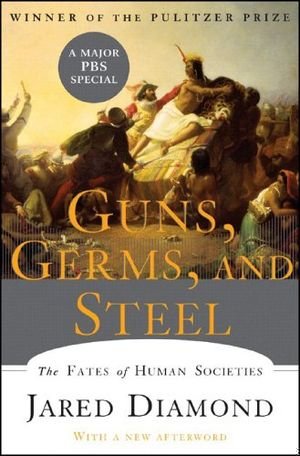
Guns, Germs and Steel: The Fates of Human Societies
Explaining what William McNeill called The Rise of the West has become the central problem in the study of global history. In Guns, Germs, and Steel Jared Diamond presents the biologist's answer: geography, demography, and ecological happenstance. Diamond evenhandedly reviews human history on every continent since the Ice Age at a rate that emphasizes only the broadest movements of peoples and ideas. Yet his survey is binocular: one eye has the rather distant vision of the evolutionary biologist, while the other eye--and his heart--belongs to the people of New Guinea, where he has done field work for more than 30 years.
Fascinating.... Lays a foundation for understanding human history. [source]
Daniel Ek
A brilliant Pulitzer Prize-winning book about how the modern world was formed, analyzing how societies developed differently on different continents. [source]
I’m a fan of books that challenge our assumptions, and Diamond offers us a new and remarkably simple way of looking at our world. Learning to challenge existing assumptions is core to effective leadership for it trains us to keep an open mind. [source]
100,000 years ago, at least six human species inhabited the earth. Today there is just one. Us. Homo sapiens.
How did our species succeed in the battle for dominance? Why did our foraging ancestors come together to create cities and kingdoms? How did we come to believe in gods, nations and human rights; to trust money, books and laws; and to be enslaved by bureaucracy, timetables and consumerism? And what will our world be like in the millennia to come?
In Sapiens, Dr Yuval Noah Harari spans the whole of human history, from the very first humans to walk the earth to the radical – and sometimes devastating – breakthroughs of the Cognitive, Agricultural and Scientific Revolutions. Drawing on insights from biology, anthropology, paleontology and economics, he explores how the currents of history have shaped our human societies, the animals and plants around us, and even our personalities. Have we become happier as history has unfolded? Can we ever free our behaviour from the heritage of our ancestors? And what, if anything, can we do to influence the course of the centuries to come?
Bold, wide-ranging and provocative, Sapiens challenges everything we thought we knew about being human: our thoughts, our actions, our power ... and our future.
Both Melinda and I read this one, and it has sparked lots of great conversations at our dinner table. Harari takes on a daunting challenge: to tell the entire history of the human race in just 400 pages. He also writes about our species today and how artificial intelligence, genetic engineering, and other technologies will change us in the future. Although I found things to disagree with—especially Harari’s claim that humans were better off before we started farming—I would recommend Sapiens to anyone who’s interested in the history and future of our species. [source]
Finally, a novel that puts the "pissed" back into "epistolary."
Jason Fitger is a beleaguered professor of creative writing and literature at Payne University, a small and not very distinguished liberal arts college in the midwest. His department is facing draconian cuts and squalid quarters, while one floor above them the Economics Department is getting lavishly remodeled offices. His once-promising writing career is in the doldrums, as is his romantic life, in part as the result of his unwise use of his private affairs for his novels. His star (he thinks) student can't catch a break with his brilliant (he thinks) work Accountant in a Bordello, based on Melville's Bartleby.
In short, his life is a tale of woe, and the vehicle this droll and inventive novel uses to tell that tale is a series of hilarious letters of recommendation that Fitger is endlessly called upon by his students and colleagues to produce, each one of which is a small masterpiece of high dudgeon, low spirits, and passive-aggressive strategies. We recommend Dear Committee Members to you in the strongest possible terms.
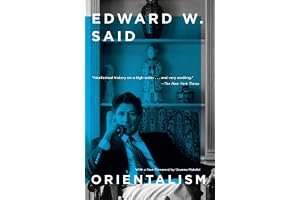
More than three decades after its first publication, Edward Said's groundbreaking critique of the West's historical, cultural, and political perceptions of the East has become a modern classic.
In this wide-ranging, intellectually vigorous study, Said traces the origins of "orientalism" to the centuries-long period during which Europe dominated the Middle and Near East and, from its position of power, defined "the orient" simply as "other than" the occident. This entrenched view continues to dominate western ideas and, because it does not allow the East to represent itself, prevents true understanding. Essential, and still eye-opening, Orientalism remains one of the most important books written about our divided world.
…
Cover unavailable
9
Straight Man
Richard Russo
4.5
In this uproarious new novel, Richard Russo performs his characteristic high-wire walk between hilarity and heartbreak. Russo's protagonist is William Henry Devereaux, Jr., the reluctant chairman of the English department of a badly underfunded college in the Pennsylvania rust belt. Devereaux's reluctance is partly rooted in his character--he is a born anarchist-- and partly in the fact that his department is more savagely divided than the Balkans.
In the course of a single week, Devereaux will have his nose mangled by an angry colleague, imagine his wife is having an affair with his dean, wonder if a curvaceous adjunct is trying to seduce him with peach pits, and threaten to execute a goose on local television. All this while coming to terms with his philandering father, the dereliction of his youthful promise, and the ominous failure of certain vital body functions. In short, Straight Man is classic Russo--side-splitting and true-to-life, witty, compassionate, and impossible to put down.
…
Cover unavailable
10
Imagined Communities: Reflections on the Origin and Spread of Nationalism (Revised Edition)
What makes people love and die for nations, as well as hate and kill in their name? While many studies have been written on nationalist political movements, the sense of nationality--the personal and cultural feeling of belonging to a nation--has not received proportionate attention. In this widely acclaimed work, Benedict Anderson examines the creation and global spread of the 'imagined communities' of nationality.
Anderson explores the processes that created these communities: the territorialization of religious faiths, the decline of antique kingship, the interaction between capitalism and print, the development of vernacular languages-of-state, and changing conceptions of time. He shows how an originary nationalism born in the Americas was modularly adopted by popular movements in Europe, by the imperialist powers, and by the anti-imperialist resistances in Asia and Africa.
This revised edition includes two new chapters, one of which discusses the complex role of the colonialist state's mindset in the develpment of Third World nationalism, while the other analyses the processes by which, all over the world, nations came to imagine themselves as old.
…
Recommended by Jon Calame.
Jon Calame
We looked into divided cities not because we had a morbid fascination with these traumatised cities, but because they seemed to be a keyhole through which you could glimpse this larger phenomenon relatively clearly. [source]
Cover unavailable
11
How to Write a Lot: A Practical Guide to Productive Academic Writing
Paul J. Silvia
4.5
All academics need to write, but many struggle to finish their dissertations, articles, books, or grant proposals. Writing is hard work and can be difficult to wedge into a frenetic academic schedule. How can we write it all while still having a life?
In this second edition of his popular guidebook, Paul Silvia offers fresh advice to help you overcome barriers to writing and use your time more productively. After addressing some common excuses and bad habits, he provides practical strategies to motivate students, professors, researchers, and other academics to become better and more prolific writers. Silvia draws from his own experience in psychology to explain how to write, submit, and revise academic work, from journal articles to books, all without sacrificing evenings, weekends, and vacations. The tips and strategies in this second edition have been updated to apply to academic writing in most disciplines. Also new to this edition is a chapter on writing grant and fellowship proposals.
…
Cover unavailable
12
To Kill a Mockingbird
Harper Lee, Sissy Spacek, et al
4.5
The unforgettable novel of a childhood in a sleepy Southern town and the crisis of conscience that rocked it, To Kill A Mockingbird became both an instant bestseller and a critical success when it was first published in 1960. It went on to win the Pulitzer Prize in 1961 and was later made into an Academy Award-winning film, also a classic.
Compassionate, dramatic, and deeply moving, To Kill A Mockingbird takes readers to the roots of human behavior - to innocence and experience, kindness and cruelty, love and hatred, humor and pathos. Now with over 18 million copies in print and translated into forty languages, this regional story by a young Alabama woman claims universal appeal. Harper Lee always considered her book to be a simple love story. Today it is regarded as a masterpiece of American literature.
…
Recommended by Adam Lawrence, Antonio Villaraigosa, Clive Stafford Smith, and 6 others.
Even though I know we’ve made great strides in America, and have come from the reality of Maycomb, we still suffer today from the lingering effects of the bigotry of that era. At the same time, it’s a lesson in standing tall in the face of tremendously hostile circumstances. [source]
Clive Stafford Smith
The book touches on so many issues and deals with so many prejudices – prejudices towards the mentally ill, racial stuff. It’s a book that was way ahead of its time in many ways. It’s also a wonderfully written book – a joy to read. [source]
Cover unavailable
13
Frankenstein
Mary Shelley
4.5
Mary Shelley began writing Frankenstein when she was only eighteen. At once a Gothic thriller, a passionate romance, and a cautionary tale about the dangers of science, Frankenstein tells the story of committed science student Victor Frankenstein. Obsessed with discovering the cause of generation and life and bestowing animation upon lifeless matter, Frankenstein assembles a human being from stolen body parts but; upon bringing it to life, he recoils in horror at the creature's hideousness. Tormented by isolation and loneliness, the once-innocent creature turns to evil and unleashes a campaign of murderous revenge against his creator, Frankenstein.
Frankenstein, an instant bestseller and an important ancestor of both the horror and science fiction genres, not only tells a terrifying story, but also raises profound, disturbing questions about the very nature of life and the place of humankind within the cosmos: What does it mean to be human? What responsibilities do we have to each other? How far can we go in tampering with Nature? In our age, filled with news of organ donation genetic engineering, and bio-terrorism, these questions are more relevant than ever.
…
Recommended by Michael Arrington, Adam Roberts, Adam Roberts, and 5 others.
Michael Arrington
Founder/TechCrunch
Shelley wrote this book as a teenager, and most of us read it in high school. Often credited as the first science fiction novel. You can read just about any political viewpoint you want into the book, and there are strong undertones that technology isn’t all good. But what I get out of it is the creativeness that can come with solitude, and how new technology can be misunderstood, even perhaps by the creator (see Twitter). Key thing to remember: Frankenstein is the name of the scientist/creator, not the Monster. Everybody forgets that. [source]
Adam Roberts
Brian Aldiss has famously argued that science fiction starts with Mary Shelley’s novel, and many people have agreed with him. [source]
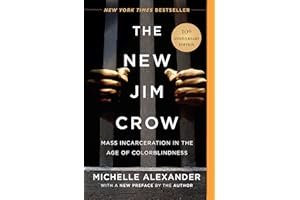
"Jarvious Cotton's great-great-grandfather could not vote as a slave. His great-grandfather was beaten to death by the Klu Klux Klan for attempting to vote. His grandfather was prevented from voting by Klan intimidation; his father was barred by poll taxes and literacy tests. Today, Cotton cannot vote because he, like many black men in the United States, has been labeled a felon and is currently on parole."
As the United States celebrates the nation's "triumph over race" with the election of Barack Obama, the majority of young black men in major American cities are locked behind bars or have been labeled felons for life. Although Jim Crow laws have been wiped off the books, an astounding percentage of the African American community remains trapped in a subordinate status--much like their grandparents before them.
In this incisive critique, former litigator-turned-legal-scholar Michelle Alexander provocatively argues that we have not ended racial caste in America: we have simply redesigned it. Alexander shows that, by targeting black men and decimating communities of color, the U.S. criminal justice system functions as a contemporary system of racial control, even as it formally adheres to the principle of color blindness. The New Jim Crow challenges the civil rights community--and all of us--to place mass incarceration at the forefront of a new movement for racial justice in America.
I read The New Jim Crow, a study of how the U.S. justice system disproportionately criminalizes and jails blacks and Latinos. Making our criminal justice system fairer and more effective is a huge challenge for our country. I’m going to keep learning about this topic, but some things are already clear: We can’t jail our way to a just society, and our current system isn’t working (adapted with permission from Facebook’s A Year of Books project). [source]
Peter Temin
The new Jim Crow that Michelle Alexander is talking about is mass incarceration. [source]
Cover unavailable
15
If We Were Villains
M. L. Rio
4.4
Oliver Marks has just served ten years in jail - for a murder he may or may not have committed. On the day he's released, he's greeted by the man who put him in prison. Detective Colborne is retiring, but before he does, he wants to know what really happened a decade ago.
As one of seven young actors studying Shakespeare at an elite arts college, Oliver and his friends play the same roles onstage and off: hero, villain, tyrant, temptress, ingenue, extra. But when the casting changes, and the secondary characters usurp the stars, the plays spill dangerously over into life, and one of them is found dead. The rest face their greatest acting challenge yet: convincing the police, and themselves, that they are blameless.
…
Recommended by Jacqui Pretty.
Jacqui Pretty
"When it comes to fiction, there are so many to choose from! Some books I've loved in the past year include If We Were Villains by M. L. Rio" [source]
Cover unavailable
16
Possession
A. S. Byatt
4.4
Possession is an exhilarating novel of wit and romance, at once an intellectual mystery and triumphant love story. It is the tale of a pair of young scholars researching the lives of two Victorian poets. As they uncover their letters, journals, and poems, and track their movements from London to Yorkshire—from spiritualist séances to the fairy-haunted far west of Brittany—what emerges is an extraordinary counterpoint of passions and ideas.
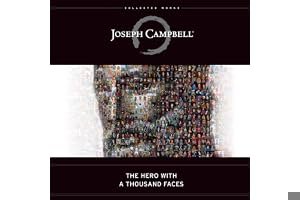
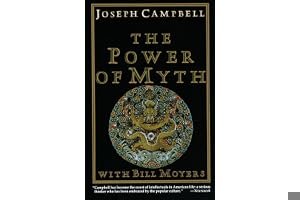
The first popular work to combine the spiritual and psychological insights of modern psychoanalysis with the archetypes of world mythology, the book creates a roadmap for navigating the frustrating path of contemporary life. Examining heroic myths in the light of modern psychology, it considers not only the patterns and stages of mythology but also its relevance to our lives today--and to the life of any person seeking a fully realized existence.
Myth, according to Campbell, is the projection of a culture's dreams onto a large screen; Campbell's book, like Star Wars, the film it helped inspire, is an exploration of the big-picture moments from the stage that is our world. It is a must-have resource for both experienced students of mythology and the explorer just beginning to approach myth as a source of knowledge.
The book I’d give every graduating senior in college or high school would be … Joseph Campbell’s 'Hero of a Thousand Faces'. It's little bit dense but it’s so rich, so it’s a good one. [source]
Joseph Campbell was the first person to really open my eyes to the compassionate side of life, or of thought... Campbell was the guy who really kind of put it all together for me, and not in a way I could put my finger on... It made you just glad to be alive, realizing how vast this world is, and how similar and how different we are. [source]
Catherine Plano
Was mind blowing, it really helped me put into perspective, that there are cycles and rhythms, and I now call them initiations, when you are faced with fear we are never too sure of our potential unless we know how to fail, what did we learn from it and what are we going to do differently the next time. There is a lesson in everything we experience, as long as we slow down enough to reflect. The other thing in the hero's journey is that even when you say 'yes' to a project, it really doesn't mean that you are going to succeed at it, but if you go into a project with an open mind and embrace that you are here to learn, the journey itself is rewarding, not always the outcome and when we really look at our failures, they weren't real failures after all, but a stepping stone onto something greater. [source]
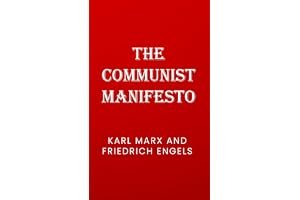
"A spectre is haunting Europe," Karl Marx and Frederic Engels wrote in 1848, "the spectre of Communism." This new edition of The Communist Manifesto, commemorating the 150th anniversary of its publication, includes an introduction by renowned historian Eric Hobsbawm which reminds us of the document's continued relevance. Marx and Engels's critique of capitalism and its deleterious effect on all aspects of life, from the increasing rift between the classes to the destruction of the nuclear family, has proven remarkably prescient. Their spectre, manifested in the Manifesto's vivid prose, continues to haunt the capitalist world, lingering as a ghostly apparition even after the collapse of those governments which claimed to be enacting its principles.
…
Recommended by Felipe Fernández-Armesto and Peter Singer.
Felipe Fernández-Armesto
Marx and Engels’s historical analysis is breathtakingly, brilliantly simple. I think it’s wrong but, again, you’ve just got to admire its genius. Obviously, without understanding the historical basis of Marx’s thought you can’t understand anything else in Marxism. [source]
Yes, it is. I chose The Communist Manifesto, rather than, say, Capital because it shows in a much easier-to-read, shorter work something that is central to Marx’s vision. Capital is much drier, and a lot of it is focused on economics, although there are some remarkable passages of Capital describing the conditions of industrial workers in England at the time. [source]
Cover unavailable
19
The Catcher in the Rye
J. D. Salinger
4.4
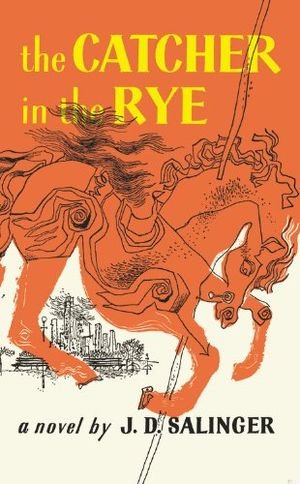
The hero-narrator of The Catcher in the Rye is an ancient child of sixteen, a native New Yorker named Holden Caulfield. Through circumstances that tend to preclude adult, secondhand description, he leaves his prep school in Pennsylvania and goes underground in New York City for three days. The boy himself is at once too simple and too complex for us to make any final comment about him or his story. Perhaps the safest thing we can say about Holden is that he was born in the world not just strongly attracted to beauty but, almost, hopelessly impaled on it. There are many voices in this novel: children's voices, adult voices, underground voices-but Holden's voice is the most eloquent of all. Transcending his own vernacular, yet remaining marvelously faithful to it, he issues a perfectly articulated cry of mixed pain and pleasure. However, like most lovers and clowns and poets of the higher orders, he keeps most of the pain to, and for, himself. The pleasure he gives away, or sets aside, with all his heart. It is there for the reader who can handle it to keep.
J.D. Salinger's classic novel of teenage angst and rebellion was first published in 1951. The novel was included on Time's 2005 list of the 100 best English-language novels written since 1923. It was named by Modern Library and its readers as one of the 100 best English-language novels of the 20th century. It has been frequently challenged in the court for its liberal use of profanity and portrayal of sexuality and in the 1950's and 60's it was the novel that every teenage boy wants to read.
It was such a relief from the other books I was reading at the time, which all had a quality of homework to them. [source]
Audrey Russo
So many novels; Lord of the Flies, Great Gatsby, Great Expectations; all the Nancy Drew books; Catcher in the Rye, Books written by Zora Neale Hurston; Pat Conroy – all because of the view about different people who endure despite adversity while kindling the hearts of the human spirit. [source]
In his book, Smith fervently extolled the simple yet enlightened notion that individuals are fully capable of setting and regulating prices for their own goods and services. He argued passionately in favor of free trade, yet stood up for the little guy. The Wealth of Nations provided the first--and still the most eloquent--integrated description of the workings of a market economy.
Obama, unsurprisingly, appears to be more drawn to stories sympathetic to the working classes than is McCain. Obama cites John Steinbeck’s “In Dubious Battle,” about a labor dispute; Robert Caro’s “Power Broker,” about Robert Moses; and Studs Terkel’s “Working.” But he also includes Adam Smith’s “Wealth of Nations” and “Theory of Moral Sentiments” on his list. [source]
Which books should be read by every single intelligent person on planet? … The Wealth of Nations (Smith) to learn that capitalism is an economy of greed, a force of nature unto itself. If you read all of the above works you will glean profound insight into most of what has driven the history of the western world. [source]
Cover unavailable
21
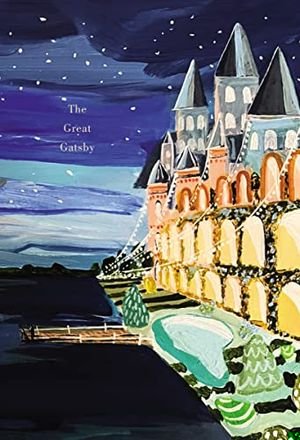
The Great Gatsby
F. Scott Fitzgerald
4.3
A young man, newly rich, tries to recapture the past and win back his former love, despite the fact that she has married.
When he got to high school, the president said, his tastes changed and he learned to enjoy classics like “Of Mice and Men” and “The Great Gatsby.” [source]
Melinda and I really like this book. When we were first dating, she had a green light that she would turn on when her office was empty and it made sense for me to come over. [source]
Marvin Liao
Partner/500 Startups
For Non-Business, I'd have to say Dune (Herbert), Emergency (Strauss), The Great Gatsby (Fitzgerald) or Flint (L'Amour). I re-read these books every year because they are just so well written & great stories that I get new perspective & details every time I read them. [source]
Cover unavailable
22
Freakonomics: A Rogue Economist Explores the Hidden Side of Everything
Which is more dangerous, a gun or a swimming pool? What do schoolteachers and sumo wrestlers have in common? Why do drug dealers still live with their moms? How much do parents really matter? What kind of impact did Roe v. Wade have on violent crime? Freakonomics will literally redefine the way we view the modern world.
These may not sound like typical questions for an economist to ask. But Steven D. Levitt is not a typical economist. He is a much heralded scholar who studies the stuff and riddles of everyday life -- from cheating and crime to sports and child rearing -- and whose conclusions regularly turn the conventional wisdom on its head. He usually begins with a mountain of data and a simple, unasked question. Some of these questions concern life-and-death issues; others have an admittedly freakish quality. Thus the new field of study contained in this book: freakonomics.
Through forceful storytelling and wry insight, Levitt and co-author Stephen J. Dubner show that economics is, at root, the study of incentives -- how people get what they want, or need, especially when other people want or need the same thing. In Freakonomics, they set out to explore the hidden side of ... well, everything. The inner workings of a crack gang. The truth about real-estate agents. The myths of campaign finance. The telltale marks of a cheating schoolteacher. The secrets of the Ku Klux Klan.
What unites all these stories is a belief that the modern world, despite a surfeit of obfuscation, complication, and downright deceit, is not impenetrable, is not unknowable, and -- if the right questions are asked -- is even more intriguing than we think. All it takes is a new way of looking. Steven Levitt, through devilishly clever and clear-eyed thinking, shows how to see through all the clutter.
Freakonomics establishes this unconventional premise: If morality represents how we would like the world to work, then economics represents how it actually does work. It is true that readers of this book will be armed with enough riddles and stories to last a thousand cocktail parties. But Freakonomics can provide more than that. It will literally redefine the way we view the modern world. (front flap)
…
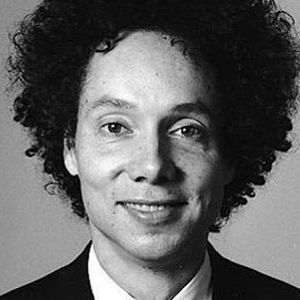
Recommended by Malcolm Gladwell, Daymond John, Ev Williams, and 12 others.
On Writing Well has been praised for its sound advice, its clarity and the warmth of its style. It is a book for everybody who wants to learn how to write or who needs to do some writing to get through the day, as almost everybody does in the age of e-mail and the Internet. Whether you want to write about people or places, science and technology, business, sports, the arts or about yourself in the increasingly popular memoir genre, On Writing Well offers you fundamental priciples as well as the insights of a distinguished writer and teacher. With more than a million copies sold, this volume has stood the test of time and remains a valuable resource for writers and would-be writers.
I read a bunch of books on writing before I wrote my first book and the two that stuck with me were Stephen King’s book and “On Writing Well” by Zinsser (which is a bit on the technical side). [source]
Tim O'Reilly
Founder/O'Reilly Media
On Writing Well, by William Zinsser. I wouldn't say this book influenced me, since my principles of writing were established long before I read it. However, it does capture many things that I believe about effective writing. [source]
Great blunt advice about writing better non-fiction. So inspiring. [source]
Cover unavailable
24
1984
George Orwell
4.3
A PBS Great American Read Top 100 Pick
With extraordinary relevance and renewed popularity, George Orwell’s 1984 takes on new life in this hardcover edition.
“Orwell saw, to his credit, that the act of falsifying reality is only secondarily a way of changing perceptions. It is, above all, a way of asserting power.”—The New Yorker
In 1984, London is a grim city in the totalitarian state of Oceania where Big Brother is always watching you and the Thought Police can practically read your mind. Winston Smith is a man in grave danger for the simple reason that his memory still functions. Drawn into a forbidden love affair, Winston finds the courage to join a secret revolutionary organization called The Brotherhood, dedicated to the destruction of the Party. Together with his beloved Julia, he hazards his life in a deadly match against the powers that be.
Lionel Trilling said of Orwell’s masterpiece “1984 is a profound, terrifying, and wholly fascinating book. It is a fantasy of the political future, and like any such fantasy, serves its author as a magnifying device for an examination of the present.” Though the year 1984 now exists in the past, Orwell’s novel remains an urgent call for the individual willing to speak truth to power.
Today is World Book Day, a wonderful opportunity to address this #ChallengeRichard sent in by Mike Gonzalez of New Jersey: Make a list of your top 65 books to read in a lifetime. [source]
called this book "one of his favorite" and recommended it to the hires. The book also inspired one the greatest TV ad (made by Jobs) [source]
Andra Zaharia
These books and their core ideas have stuck with me the most and continue to guide me when I hit crossroads along the way. [source]
Cover unavailable
25
Discipline and Punish: The Birth of the Prison
Michel Foucault, Alan Sheridan
4.3
Librarian note: an alternate cover for this edition can be found here.
In this brilliant work, the most influential philosopher since Sartre suggests that such vaunted reforms as the abolition of torture and the emergence of the modern penitentiary have merely shifted the focus of punishment from the prisoner’s body to his soul.
A lot of professors give talks titled 'The Last Lecture'. Professors are asked to consider their demise and to ruminate on what matters most to them: What wisdom would we impart to the world if we knew it was our last chance? If we had to vanish tomorrow, what would we want as our legacy?
When Randy Pausch, a computer science professor at Carnegie Mellon, was asked to give such a lecture, he didn't have to imagine it as his last, since he had recently been diagnosed with terminal cancer. But the lecture he gave, 'Really Achieving Your Childhood Dreams', wasn't about dying. It was about the importance of overcoming obstacles, of enabling the dreams of others, of seizing every moment (because time is all you have and you may find one day that you have less than you think). It was a summation of everything Randy had come to believe. It was about living.
In this book, Randy Pausch has combined the humour, inspiration, and intelligence that made his lecture such a phenomenon and given it an indelible form. It is a book that will be shared for generations to come.
…
Recommended by Gabriel Coarna.
Gabriel Coarna
I read "The Last Lecture" because I had seen Randy Pausch give this talk: https://www.youtube.com/watch?v=ji5_MqicxSo [source]
Cover unavailable
27
The Man Who Mistook His Wife for a Hat and Other Clinical Tales
If a man has lost a leg or an eye, he knows he has lost a leg or an eye; but if he has lost a self—himself—he cannot know it, because he is no longer there to know it. Dr. Oliver Sacks recounts the stories of patients struggling to adapt to often bizarre worlds of neurological disorder. Here are people who can no longer recognize everyday objects or those they love; who are stricken with violent tics or shout involuntary obscenities; who have been dismissed as autistic or retarded, yet are gifted with uncanny artistic or mathematical talents. If inconceivably strange, these brilliant tales illuminate what it means to be human.
…
Recommended by Bradley Voytek, Suzanne O'Sullivan, and Tanya Byron.
Bradley Voytek
I can’t imagine one day waking up and not knowing who my wife is, or seeing my wife and thinking that she was replaced by some sort of clone or robot. But that could happen to any of us. [source]
Suzanne O'Sullivan
I didn’t choose neurology because of it but the way Oliver Sacks writes about neurology is very compelling. [source]
Tanya Byron
This is a seminal book that anyone who wants to work in mental health should read. It is a charming and gentle and also an honest exposé of what can happen to us when our mental health is compromised for whatever reason. [source]
Cover unavailable
28
The Professor Is In: The Essential Guide To Turning Your Ph.D. Into a Job
Karen Kelsky
4.3
The definitive career guide for grad students, adjuncts, post-docs and anyone else eager to get tenure or turn their Ph.D. into their ideal job
Each year tens of thousands of students will, after years of hard work and enormous amounts of money, earn their Ph.D. And each year only a small percentage of them will land a job that justifies and rewards their investment. For every comfortably tenured professor or well-paid former academic, there are countless underpaid and overworked adjuncts, and many more who simply give up in frustration.
Those who do make it share an important asset that separates them from the pack: they have a plan. They understand exactly what they need to do to set themselves up for success. They know what really moves the needle in academic job searches, how to avoid the all-too-common mistakes that sink so many of their peers, and how to decide when to point their Ph.D. toward other, non-academic options.
Karen Kelsky has made it her mission to help readers join the select few who get the most out of their Ph.D. As a former tenured professor and department head who oversaw numerous academic job searches, she knows from experience exactly what gets an academic applicant a job. And as the creator of the popular and widely respected advice site The Professor is In, she has helped countless Ph.D.’s turn themselves into stronger applicants and land their dream careers.
Now, for the first time ever, Karen has poured all her best advice into a single handy guide that addresses the most important issues facing any Ph.D., including:
-When, where, and what to publish -Writing a foolproof grant application -Cultivating references and crafting the perfect CV -Acing the job talk and campus interview -Avoiding the adjunct trap -Making the leap to nonacademic work, when the time is right
The Professor Is In addresses all of these issues, and many more.
…
Cover unavailable
29
The History of Sexuality, Volume 1: An Introduction
Michel Foucault
4.3
Michel Foucault offers an iconoclastic exploration of why we feel compelled to continually analyze and discuss sex, and of the social and mental mechanisms of power that cause us to direct the questions of what we are to what our sexuality is.
Cover unavailable
30
Lucky Jim
Kingsley Amis, David Lodge
4.3
Kingsley Amis's witty campus novel, Lucky Jim is a comedy that skewers the hypocrisies and vanities of 1950s academic life. This Penguin Modern Classics edition contains an introduction by David Lodge.
Jim Dixon has accidentally fallen into a job at one of Britain's new red brick universities. A moderately successful future in the History Department beckons - as long as Jim can stave off the unwelcome advances of fellow lecturer Margaret, survive a madrigal-singing weekend at Professor Welch's, deliver a lecture on 'Merrie England' and resist Christine, the hopelessly desirable girlfriend of Welch's awful son Bertrand. Inspired by Amis's friend, the poet Philip Larkin, Jim Dixon is a timeless comic character, adrift in a hopelessly gauche and pretentious world.
…
Recommended by Andy Borowitz.
Andy Borowitz
This is Kingsley Amis’s best novel, and maybe the best novel ever written about university life. [source]
Cover unavailable
31
Crossing to Safety
Wallace Stegner
4.3
Two couples meet during the Depression years in Madison, Wisconsin, and become devoted friends despite vast differences in upbringing and social status.
In terms of human tenderness I find this particular book remarkable and unforgettable. [source]
Cover unavailable
32
Hamlet
William Shakespeare
4.3
No Fear Shakespeare gives you the complete text of Hamlet on the left-hand page, side-by-side with an easy-to-understand translation on the right.
"Hamlet" is the story of the Prince of Denmark who learns of the death of his father at the hands of his uncle, Claudius. Claudius murders Hamlet's father, his own brother, to take the throne of Denmark and to marry Hamlet's widowed mother. Hamlet is sunk into a state of great despair as a result of discovering the murder of his father and the infidelity of his mother. Hamlet is torn between his great sadness and his desire for the revenge of his father's murder.
Philosophy runs through this play–all sorts of great lines. There are gems like “..for there is nothing either good or bad, but thinking makes it so” which I used in my last book and “Beware of entrance to a quarrel; but, being in, bear it, that the opposed may beware of thee.” was a favorite of Sherman. [source]
Tim Lott
I love the speech when Hamlet’s uncle Claudius admits to being inflicted with the primal eldest curse for killing his brother, and begs on his knees for forgiveness for this ultimate violation of the law of nature. [source]
Cover unavailable
33
Gender Trouble: Feminism and the Subversion of Identity
Judith Butler
4.3
Since its publication in 1990, Gender Trouble has become one of the key works of contemporary feminist theory, and an essential work for anyone interested in the study of gender, queer theory, or the politics of sexuality in culture. This is the text where Judith Butler began to advance the ideas that would go on to take life as "performativity theory," as well as some of the first articulations of the possibility for subversive gender practices, and she writes in her preface to the 10th anniversary edition released in 1999 that one point of Gender Trouble was "not to prescribe a new gendered way of life [...] but to open up the field of possibility for gender [...]" Widely taught, and widely debated, Gender Trouble continues to offer a powerful critique of heteronormativity and of the function of gender in the modern world.
"No denunciation without its proper instrument of close analysis," Roland Barthes wrote in his preface to Mythologies. There is no more proper instrument of analysis of our contemporary myths than this book—one of the most significant works in French theory, and one that has transformed the way readers and philosophers view the world around them.
Our age is a triumph of codification. We own devices that bring the world to the command of our fingertips. We have access to boundless information and prodigious quantities of stuff. We decide to like or not, to believe or not, to buy or not. We pick and choose. We think we are free. Yet all around us, in pop culture, politics, mainstream media, and advertising, there are codes and symbols that govern our choices. They are the fabrications of consumer society. They express myths of success, well-being, and happiness. As Barthes sees it, these myths must be carefully deciphered, and debunked.
What Barthes discerned in mass media, the fashion of plastic, and the politics of postcolonial France applies with equal force to today's social networks, the iPhone, and the images of 9/11. This new edition of Mythologies, complete and beautifully rendered by the Pulitzer Prize–winning poet, critic, and translator Richard Howard, is a consecration of Barthes's classic—a lesson in clairvoyance that is more relevant now than ever.
…
Cover unavailable
35
Ninth House - Signed / Autographed Copy
Leigh Bardugo
4.3
The mesmerizing adult debut from #1 New York Times bestselling author Leigh Bardugo
Galaxy “Alex” Stern is the most unlikely member of Yale’s freshman class. Raised in the Los Angeles hinterlands by a hippie mom, Alex dropped out of school early and into a world of shady drug dealer boyfriends, dead-end jobs, and much, much worse. By age twenty, in fact, she is the sole survivor of a horrific, unsolved multiple homicide. Some might say she’s thrown her life away. But at her hospital bed, Alex is offered a second chance: to attend one of the world’s most elite universities on a full ride. What’s the catch, and why her?
Still searching for answers to this herself, Alex arrives in New Haven tasked by her mysterious benefactors with monitoring the activities of Yale’s secret societies. These eight windowless “tombs” are well-known to be haunts of the future rich and powerful, from high-ranking politicos to Wall Street and Hollywood’s biggest players. But their occult activities are revealed to be more sinister and more extraordinary than any paranoid imagination might conceive.
…
Recommended by Joe Hill, Marie Lu, and Rainbow Rowell.
Was absolutely thrilled by @LBardugo's 9th House & @LordGrimdark's A Little Hatred... riveting masterpieces both, textbooks in suspense, pacing, and brilliant characterizations. Was wowed by @susanorlean's lovely weird dive into libraries, THE LIBRARY BOOK. https://t.co/f4atN6dxwj [source]
Marie Lu
Possibly the best book I’ve read this year, no surprise, and for so many reasons. @LBardugo ‘s best work to date. That is saying a LOT. 🖤🖤🖤 Take us into the darkness, queen! https://t.co/Ma4h12455u [source]
Rainbow Rowell
I only came on here to say HAPPY BOOKDAY to one of my favorite people, @LBardugo, who has written a kickass book for adults! 🖤🖤🖤 https://t.co/2KSgpgGasB [source]
Cover unavailable
36
The Republic: The Influential Classic
Plato
4.3
The newest deluxe edition in the bestselling Capstone Classics Series This ancient classic has had a make-over. In recent years these Capstone Classic deluxe editions have caught the book buying public's imagination. The volumes of international bestsellers such as Think and Grow Rich and The Art of War have quickly become the market leaders. Now Plato's best known work, one of the most intellectually and historically influential works of philosophy and political theory, has been brought to life in this luxury, hardback, keep-sake edition.
This edition includes:
Plato's plans for a perfect society characterised by a blend of wisdom, courage, self-discipline and justice Lessons to learn about living according to eternal truths, instead of existing simply for survival and pleasure A new introduction by Tom Butler Bowdon, the classic personal development expert
It’s very readable even if you aren’t a professional philosopher. Take the story of ‘The Ring of Gyges,’ which raises the question of whether you would continue to act like a good person if you had a ring of invisibility that let you get away with doing whatever you wanted to do. That’s a fascinating thought experiment that anybody can appreciate. [source]
I’m about a third through this and still can’t tell whether Plato is making a mockery of Socrates ideas for the idyllic society or not. So many of the arguments presented as Socrates’ are so tortured and with so disconnected leaps of logic that it’s hard to take it at face value. Yet still, it’s good fun to follow the dialogue. It reads more like a play than a book, and again, immensely accessible. It’s fun to see the lines that continue from a book like this to the considerations of the Stoics all the way to Adam Smith and the Wealth of Nations and then onto a modern critique and history in that Debt: First 5,000 Years. A conversation spanning millennia. [source]
Jonathan Glover
It contains a tremendous amount of nonsense about what the ideal society would be like. But it is an unmissable book because of Socrates. He invented the method of doing and teaching philosophy that has never been improved on. [source]
Cover unavailable
37
The Art of Fielding
ChadHarbach
4.3
At Westish College, a small school on the shore of Lake Michigan, baseball star Henry Skrimshander seems destined for big league stardom. But when a routine throw goes disastrously off course, the fates of five people are upended.
Henry's fight against self-doubt threatens to ruin his future. College president Guert Affenlight, a longtime bachelor, has fallen unexpectedly and helplessly in love. Owen Dunne, Henry's gay roommate and teammate, becomes caught up in a dangerous affair. Mike Schwartz, the Harpooners' team captain and Henry's best friend, realizes he has guided Henry's career at the expense of his own. And Pella Affenlight, Guert's daughter, returns to Westish after escaping an ill-fated marriage, determined to start a new life.
As the season counts down to its climactic final game, these five are forced to confront their deepest hopes, anxieties, and secrets. In the process they forge new bonds, and help one another find their true paths. Written with boundless intelligence and filled with the tenderness of youth, The Art of Fielding is an expansive, warmhearted novel about ambition and its limits, about family and friendship and love, and about commitment - to oneself and to others.
…
Recommended by Julia Enthoven and Leo Babauta.
Julia Enthoven
For non-business, I’ve loved so many different books that it’s hard to pick a favorite. Recently, I’ve enjoyed The Art of Fielding and Americanah, and I love classics like A Farewell to Arms and Lord of the Flies. [source]
Cover unavailable
38
The Prince
Nicollo Machiavelli, Tim Parks
4.3
Niccolo Machiavelli's "The Prince" is intended to be a treatise on ruling and is considered by many to be a classic of political science. In the book Machiavelli offers many bits of practical advice on how to rule and even though the book was written in the early 16th century its ideas are still very relevant today. Where "The Prince" differs from other political literature before it is in its separation of the lofty idealism of morality and ethics from the practical demands of governing. It is this very aspect of Machiavelli's work that has made his name synonymous with an almost immoral opportunism and his book a timeless classic.
Which books should be read by every single intelligent person on planet? … The Prince (Machiavelli) to learn that people not in power will do all they can to acquire it, and people in power will do all they can to keep it. If you read all of the above works you will glean profound insight into most of what has driven the history of the western world. [source]
Of course, this is a must read. Machiavelli is one of those figures and writers who is tragically overrated and underrated at the same time. Unfortunately that means that many people who read him miss the point and other people avoid him and miss out altogether. Take Machiavelli slow, and really read him. Also understand the man behind the book–not just as a masterful writer but a man who withstood heinous torture and exile with barely a whimper. Machiavelli is a glimpse into a time when power was literal and out for public viewing–when he talks about making an example of someone, he doesn’t mean calling them out, he means putting their head on a pike. Don’t let that scare you because we’re not as far from that world as we’d like to think. Deny that at your own peril. [source]
Cover unavailable
39
On Beauty
Zadie Smith
4.2
Howard Belsey, a Rembrandt scholar who doesn't like Rembrandt, is an Englishman abroad and a long-suffering professor at Wellington, a liberal New England arts college. He has been married for thirty years to Kiki, an American woman who no longer resembles the sexy activist she once was. Their three children passionately pursue their own paths: Levi quests after authentic blackness, Zora believes that intellectuals can redeem everybody, and Jerome struggles to be a believer in a family of strict atheists. Faced with the oppressive enthusiasms of his children, Howard feels that the first two acts of his life are over and he has no clear plans for the finale. Or the encore.
Then Jerome, Howard's older son, falls for Victoria, the stunning daughter of the right-wing icon Monty Kipps, and the two families find themselves thrown together in a beautiful corner of America, enacting a cultural and personal war against the background of real wars that they barely register. An infidelity, a death, and a legacy set in motion a chain of events that sees all parties forced to examine the unarticulated assumptions which underpin their lives. How do you choose the work on which to spend your life? Why do you love the people you love? Do you really believe what you claim to? And what is the beautiful thing, and how far will you go to get it?
Set on both sides of the Atlantic, Zadie Smith's third novel is a brilliant analysis of family life, the institution of marriage, intersections of the personal and political, and an honest look at people's deceptions. It is also, as you might expect, very funny indeed.
…
Cover unavailable
40
The Odyssey
Homer
4.2
After enduring the Trojan War, Odysseus begins the treacherous journey home to Ithaca. On the way, he faces ravenous monsters and vengeful gods. But the real battle awaits, as his kingdom is under siege by unruly suitors vying for his wife’s hand—and his son’s head. To reclaim his throne and save his family, Odysseus must rely on his wits…and help from the unpredictable gods.
Homer’s The Odyssey was composed around 700 BC. It is one of the earliest epics in existence and remains one of the most influential works of literature today.
Revised edition: Previously published as The Odyssey, this edition of The Odyssey (AmazonClassics Edition) includes editorial revisions.
…
Recommended by Caterina Fake, Ted Turner, Charlotte Higgins, and 3 others.
When I got to college, I was a classics major, and that was mainly the study of Greek - and to a lesser extent Roman - history and culture, and that fascinated me: the Iliad, the Odyssey, the Aeneid by Virgil. [source]
Charlotte Higgins
It’s a very easy read, and a completely different world from The Iliad. Whereas The Iliad depicts a militaristic and war-wrecked world, The Odyssey is like a fairytale and it’s fascinatingly complex. It’s told in flashbacks, it has time that’s extended and time that’s compressed, and it’s told from different viewpoints. [source]
Janine di Giovanni
The thing I loved about Ulysses was that he’s so in love with adventure and with love. [source]
Cover unavailable
41
Animal Farm
George Orwell and Christopher Hitchens
4.2
Animal Farm is one of the most famous warnings ever written. Orwell's immortal satire - 'against Stalin' as he wrote to his French translator - can be read on many levels. With its piercing clarity and deceptively simple style it is no surprise that this novel is required reading for schoolchildren and politicians alike. This fable of the steadfast horses Boxer and Clover, the opportunistic pigs Snowball and Napoleon, and the deafening choir of sheep remains an unparalleled masterpiece.
One reviewer wrote 'In a hundred years' time perhaps Animal Farm ... may simply be a fairy story: today it is a fairy story with a good deal of point.' Over sixty years on in the age of spin, it is more relevant than ever.
Rejected by such eminent publishing figures as Victor Gollancz, Jonathan Cape and T.S. Eliot, Animal Farm was published to great acclaim by Martin Secker and Warburg on 17 August 1945 in an edition of 4500 copies. In the centenary year of Martin Secker, Ltd., Harvill Secker is proud to publish this special edition with a brand-new introduction by Christopher Hitchens.
Whitney Cummings recommended this book on the podcast "The Tim Ferriss Show". [source]
Vlad Tenev
When I was in sixth grade I remember being very upset by the ending of this book. [source]
Heather Brooke
I picked Animal Farm because it is an allegory about power and its seductive and corruptive influence on people regardless of their initial good intentions. [source]
Cover unavailable
42
The Craft of Research (Chicago Guides to Writing, Editing, and Publishing)
Wayne C. Booth, Gregory G. Colomb, Joseph M. Williams
4.2
With more than 400,000 copies now in print, The Craft of Research is the unrivaled resource for researchers at every level, from first-year undergraduates to research reporters at corporations and government offices.
Seasoned researchers and educators Gregory G. Colomb and Joseph M. Williams present an updated third edition of their classic handbook, whose first and second editions were written in collaboration with the late Wayne C. Booth. The Craft of Research explains how to build an argument that motivates readers to accept a claim; how to anticipate the reservations of readers and to respond to them appropriately; and how to create introductions and conclusions that answer that most demanding question, “So what?”
The third edition includes an expanded discussion of the essential early stages of a research task: planning and drafting a paper. The authors have revised and fully updated their section on electronic research, emphasizing the need to distinguish between trustworthy sources (such as those found in libraries) and less reliable sources found with a quick Web search. A chapter on warrants has also been thoroughly reviewed to make this difficult subject easier for researchers
Throughout, the authors have preserved the amiable tone, the reliable voice, and the sense of directness that have made this book indispensable for anyone undertaking a research project.
…
Cover unavailable
43
The Language Instinct: How the Mind Creates Language
The classic book on the development of human language by the world’s leading expert on language and the mind.
In this classic, the world's expert on language and mind lucidly explains everything you always wanted to know about language: how it works, how children learn it, how it changes, how the brain computes it, and how it evolved. With deft use of examples of humor and wordplay, Steven Pinker weaves our vast knowledge of language into a compelling story: language is a human instinct, wired into our brains by evolution. The Language Instinct received the William James Book Prize from the American Psychological Association and the Public Interest Award from the Linguistics Society of America. This edition includes an update on advances in the science of language since The Language Instinct was first published.
…
Recommended by Lane Greene and Simon Baron-Cohen.
Lane Greene
There are two achievements in this book. One is to smuggle Linguistics 101 into a popular book, which is just fantastic. The other is his own argument about the nature of language, and the title says it all. [source]
Simon Baron-Cohen
It’s a really wonderful example of what you can do: take research into something as fundamental to human nature as language and make it accessible to a wide audience. [source]
Cover unavailable
44
Lab Girl
Hope Jahren
4.2
Acclaimed scientist Hope Jahren has built three laboratories in which she’s studied trees, flowers, seeds, and soil. Her first book is a revelatory treatise on plant life—but it is also so much more. Lab Girl is a book about work, love, and the mountains that can be moved when those two things come together. It is told through Jahren’s stories: about her childhood in rural Minnesota with an uncompromising mother and a father who encouraged hours of play in his classroom’s labs; about how she found a sanctuary in science, and learned to perform lab work done “with both the heart and the hands”; and about the inevitable disappointments, but also the triumphs and exhilarating discoveries, of scientific work.
Yet at the core of this book is the story of a relationship Jahren forged with a brilliant, wounded man named Bill, who becomes her lab partner and best friend. Their sometimes rogue adventures in science take them from the Midwest across the United States and back again, over the Atlantic to the ever-light skies of the North Pole and to tropical Hawaii, where she and her lab currently make their home.
…
Recommended by Gail Kelly.
Cover unavailable
45
The Rosie Project (Don Tillman, #1)
Graeme Simsion
4.2
An international sensation, this hilarious, feel-good novel is narrated by an oddly charming and socially challenged genetics professor on an unusual quest: to find out if he is capable of true love.
Don Tillman, professor of genetics, has never been on a second date. He is a man who can count all his friends on the fingers of one hand, whose lifelong difficulty with social rituals has convinced him that he is simply not wired for romance. So when an acquaintance informs him that he would make a “wonderful” husband, his first reaction is shock. Yet he must concede to the statistical probability that there is someone for everyone, and he embarks upon The Wife Project. In the orderly, evidence-based manner with which he approaches all things, Don sets out to find the perfect partner. She will be punctual and logical—most definitely not a barmaid, a smoker, a drinker, or a late-arriver.
Yet Rosie Jarman is all these things. She is also beguiling, fiery, intelligent—and on a quest of her own. She is looking for her biological father, a search that a certain DNA expert might be able to help her with. Don's Wife Project takes a back burner to the Father Project and an unlikely relationship blooms, forcing the scientifically minded geneticist to confront the spontaneous whirlwind that is Rosie—and the realization that love is not always what looks good on paper.
The Rosie Project is a moving and hilarious novel for anyone who has ever tenaciously gone after life or love in the face of overwhelming challenges.
Anyone who occasionally gets overly logical will identify with the hero, a genetics professor with Asperger’s Syndrome who goes looking for a wife. (Melinda thought I would appreciate the parts where he’s a little too obsessed with optimizing his schedule. She was right.) It’s an extraordinarily clever, funny, and moving book about being comfortable with who you are and what you’re good at. I’m sending copies to several friends and hope to re-read it later this year. This is one of the most profound novels I’ve read in a long time. [source]
Cover unavailable
46
The Origin of Species by Means of Natural Selection: Or, the Preservation of Favored Races in the Struggle for Life
Charles Darwin
4.2
Darwin's theory of natural selection issued a profound challenge to orthodox thought and belief: no being or species has been specifically created; all are locked into a pitiless struggle for existence, with extinction looming for those not fitted for the task.
Yet The Origin of Species (1859) is also a humane and inspirational vision of ecological interrelatedness, revealing the complex mutual interdependencies between animal and plant life, climate and physical environment, and—by implication—within the human world.
Written for the general reader, in a style which combines the rigour of science with the subtlety of literature, The Origin of Species remains one of the founding documents of the modern age.
Which books should be read by every single intelligent person on planet? … On the Origin of Species (Darwin) to learn of our kinship with all other life on Earth. If you read all of the above works you will glean profound insight into most of what has driven the history of the western world. [source]
It is one of the most important books written, and I always urge people to read it. [source]
Adam Maloof
For me (and many others) this book forms the foundation for modern biology. It is all about humans’ concept of themselves. [source]
Cover unavailable
47
A PhD Is Not Enough: A Guide To Survival In Science
Peter J. Feibelman
4.2
Despite your graduate education, brainpower, and technical prowess, your career in scientific research is far from assured. Permanent positions are scarce, science survival is rarely part of formal graduate training, and a good mentor is hard to find. This exceptional volume explains what stands between you and fulfilling long-term research career. Bringing the key survival skills into focus, A Ph.D. Is Not Enough! proposes a rational approach to establishing yourself as a scientist. It offers sound advice of selecting a thesis or postdoctoral adviser, choosing among research jobs in academia, government laboratories, and industry, preparing for an employment interview, and defining a research program. This book will help you make your oral presentations effective, your journal articles compelling, and your grant proposals successful. A Ph.D. Is Not Enough should be required reading for anyone on the threshold of a career in science.
…
Cover unavailable
48
The Adventures of Huckleberry Finn
Mark Twain
4.2
Adventures of Huckleberry Finn (or, in more recent editions, The Adventures of Huckleberry Finn) is a novel by Mark Twain, first published in the United Kingdom in December 1884 and in the United States in February 1885. Commonly named among the Great American Novels, the work is among the first in major American literature to be written throughout in vernacular English, characterized by local color regionalism. It is told in the first person by Huckleberry "Huck" Finn, the narrator of two other Twain novels (Tom Sawyer Abroad and Tom Sawyer, Detective) and a friend of Tom Sawyer. It is a direct sequel to The Adventures of Tom Sawyer.
Today is World Book Day, a wonderful opportunity to address this #ChallengeRichard sent in by Mike Gonzalez of New Jersey: Make a list of your top 65 books to read in a lifetime. [source]
I enjoy nearly everything Mark Twain ever wrote, but my favorite is The Adventures of Huckleberry Finn. This novel showcases Twain at the top of his game in terms of acerbic wit, sharp societal observations and the use of regional dialects - for which he initially garnered great criticism, before the passage of time enabled critics to understand and acknowledge its authenticity. [source]
Cover unavailable
49
My Hero Academia Series(Vol 1-15) Collection 15 Books Set By Kohei Horikoshi
Kohei Horikoshi
4.2
Cover unavailable
50
Lord of the Flies
William Golding
4.2
At the dawn of the next world war, a plane crashes on an uncharted island, stranding a group of schoolboys. At first, with no adult supervision, their freedom is something to celebrate; this far from civilization the boys can do anything they want. Anything. They attempt to forge their own society, failing, however, in the face of terror, sin and evil. And as order collapses, as strange howls echo in the night, as terror begins its reign, the hope of adventure seems as far from reality as the hope of being rescued. Labeled a parable, an allegory, a myth, a morality tale, a parody, a political treatise, even a vision of the apocalypse, Lord of the Flies is perhaps our most memorable tale about “the end of innocence, the darkness of man’s heart.”
…
Recommended by Elon Musk, Ev Williams, Audrey Russo, and 5 others.
Audrey Russo
So many novels; Lord of the Flies, Great Gatsby, Great Expectations; all the Nancy Drew books; Catcher in the Rye, Books written by Zora Neale Hurston; Pat Conroy – all because of the view about different people who endure despite adversity while kindling the hearts of the human spirit. [source]
Chigozie Obioma
William Golding imbues some of these children with wisdom that would read, in the hands of a lesser author, as implausibly knowing [source]
Disco Donnie
@JoshRHernandez1 I love the book “Lord of the Flies” so just started watching The Society [source]
Cover unavailable
51
The Elements of Style
William Jr. Strunk
4.2
You know the authors' names. You recognize the title. You've probably used this book yourself. And now "The Elements of Style"-the most widely read and employed English style manual-is available in a specially bound 50th Anniversary Edition that offers the title's vast audience an opportunity to own a more durable and elegantly bound edition of this time-tested classic. Offering the same content as the Fourth Edition, revised in 1999, the new casebound 50th Anniversary Edition includes a brief overview of the book's illustrious history. Used extensively by individual writers as well as high school and college students of writing, it has conveyed the principles of English style to millions of readers. This new deluxe edition makes the perfect gift for writers of any age and ability level. Fifty Years of Acclaim for "The Elements of Style," by William Strunk Jr. and E.B. White "I first read "Elements of Style" during the summer before I went off to Exeter, and I still direct my students at Harvard to their definition about the difference between 'that' and 'which.' It is the Bible for good, clear writing." -- Henry Louis Gates Jr. "For writers of all kinds and sizes the world begins and ends with Strunk and White's "Elements of Style." Only something to actually write about trumps the list of what is required to put words together in some kind of coherent way. I treasure its presence in my life and salute its fifty years of glory and accomplishment." -- Jim Lehrer ""The Elements of Style" remains an unwavering beacon of light in these grammatically troubled times. I would be lost without it." -- Ann Patchett "To the extent I know how to write clearly at all, I probably taught myself while I was teaching others -- seventh graders, in Flint, Michigan, in 1967. I taught them with a copy of Strunk & White lying in full view on my desk, sort of in the way the Gideons leave Bibles in cheap hotel rooms, as a way of saying to the hapless inhabitant: 'In case your reckless ways should strand you here, there's help.' S&W doesn't really teach you how to write, it just tantalizingly reminds you that there's an orderly way to go about it, that clarity's ever your ideal, but -- really -- it's all going to be up to you." -- Richard Ford ""The Elements of Style" never seems to go out of date. Its counsel is sound and funny, wise and unpretentious. And while its precepts are a foundation of direct communication, Strunk and White do not insist on a way of writing beyond clear expression. The rest is up to the imagination, the intelligence within." -- David Remnick, editor of "The New Yorker" "It's the toughness-the irreverence and implicit laughter-that attracted me to the little book when I was seventeen. I fell in love with Strunk & White's loathing for cant and bloviation, the ruthless cutting of crap, jargon, and extra words. For me, that skeptical directness included a tacit permission by "The Elements of Style" to break its rules on occasion: an alloy of generosity in the blade, a grace I still admire and still learn from." -- Robert Pinsky "In the quest for clarity, one can have no better guides than Strunk and White. For me, their book has been invaluable and remains essential." -- Dan Rather "Eschew surplusage! A perfect book." --Jonathan Lethem "Not until I started teaching writing and I reread "The Elements of Style" did I realize that most everything I would be teaching young writers, and everything I would be learning myself as a writer, was contained between the covers of this slim, elegant, wise little book." -- Julia Alvarez "Strunk and White seared their way into my brain long ago, and I benefit from them daily." -- Steven J. Dubner, co-author of "Freakonomics" "Since high school, I have kept a copy of this book handy. That should be unnecessary. I should, by now, have fully internalized "The Elements of Style." But sometimes I get entangled in a paragraph that refuses to be 'clear, brief, bold.' I dip back into "The Elements of Style" and am refreshed. After Scott Simon interviewed me on NPR about whether the word 'e-mail' needs a hyphen (yes, it does), some listeners, including friends of mine, wondered why I had answered in the affirmative when asked, in passing, 'Are you a drunken white man?' Those listeners misheard. 'Strunk and White man' was what Scott said." -- Roy Blount Jr. "Strunk & White--writing's good-natured law firm--still contains enough sparkling good sense to clean up the whole bloviating blogosphere." -- Thomas Mallon "I used Strunk -- that's what we called it, Strunk -- as a student at Berkeley fifty years ago. I didn't know that it was new, and that we were the first generation to be educated in "The Elements of Style." I got a firm foundation in the English language, learned to write basically, and could depict the realistic world. Then I was able to become an impressionist and expressionist." -- Maxine Hong Kingston "Strunk and White's gigantic little book must be the most readable advice on writing ever written. Side by side with Roget, Shakespeare, the Bible, and a dictionary, it's an essential for every writer's shelf." -- X.J. Kennedy" ""With what joy I welcome the fiftieth anniversary of "The Elements of Style." I am greatly indebted to this book for the invaluable help it has given me all these years." -- Horton Foote "Elegant, droll, and perfectly proportioned, and like your favorite aunt, strict but affectionate. And, like your favorite aunt, full of optimism: You can, and will, be a better writer! There has never been a better, briefer, or more loved book about the art and craft of communicating." -- Susan Orlean "This book is an essential tool. It has been of great use to me and is probably responsible for my best writing. I owe my success to Strunk and White; only the mistakes are mine." -- Ben Affleck, in "O, the Oprah Magazine" "This book is a wonderful example of teaching by example. Not only does it recommend clear and concise writing, it demonstrates it. Written in the style of a friend offering help, it is a godsend to anyone wanting to put words on paper. Thank you, Messieurs Strunk and White. And Happy Anniversary, "Elements of Style."" -- S.E. Hinton "When I began to have ... I wouldn't say arguments but conversations in my mind with Strunk and White about a few of their rules and principles, I knew I was coming into my own. If only they were still here to talk things over! No doubt their side of the exchange would be kindly put, well-informed, and wise. They'd probably help me with my side of it. What more could one want from writers reaching out to help other writers?" -- Barbara Wallraff, language columnist for "The Atlantic" "I don't believe there is a serious writer alive who doesn't have a worn copy of 'Strunk & White'on his or her bookshelf." -- Mignon Fogarty, author of "Grammar Girl's Quick and Dirty Tips ""for Better Writing" "This little book has inspired hundreds of thousands of people to write better -- partly by precept and partly by example. It continues to influence more writers than any other. It's a force for good in the world." -- Bryan A. Garner, author of "Garner's Modern American Usage" "I can think of no better guide to good writing, and I always think of this little classic with a warm heart. More importantly, I revisit its pages often. It's the one essential book on writing." -- Jay Parini, author of "Why Poetry Matters" "Clarity and simplicity have always been the goals, and this book shows the way. It has always been a lighthouse in the dark and stormy night of student prose, of all of our prose." -- Ron Carlson "The only rules you are ever going to get from me are all in Strunk and White." --Ursula K. Le Guin, from "Steering the Craft " "["The Elements of Style "is] a book to which I return from time to time, the way I periodically reread Shakespeare. I always discover something new, settle a question that has been puzzling me, or learn a principle of usage that I have been pretending to know, a pretense that has resulted in inconsistency and in the sort of errors from which I can only pray some saintly copy editor will save me." -- Francine Prose, from "Reading"" Like A Writer" ..".still a little book, small enough and important enough to carry in your pocket, as I carry mine." -- Charles Osgood "Almost every writer has a Strunk and White story. One journalism professor spends the first two weeks of school forcing his students to memorize the book. A top editor at a major paper buys copies at yard sales to distribute to her writers and interns. It has even caused love affairs. . . . Could its greatness be any more clear?" -- Jesse Sheidlower, American Editor of the "Oxford"" English Dictionary," on NPR" ""If the English language is one of the finest homes ever devised for the human spirit, "Elements" is the best guided house tour we've got." --David Gelernter, "The Wall Street Journal" ..".Should be the daily companion of anyone who writes for a living and, for that matter, anyone who writes at all." "--"Jonathan Yardley, " Greensboro (N.C.) Daily News" "No book in shorter space, with fewer words, will help any writer more than this persistent little volume." -- Herbert A. Kenny, "The Boston Globe" "Buy it, study it, enjoy it. It's as timeless as a book can be in our age of volubility." -- Charles Poore, "The New York Times" "White is one of the best stylists and most lucid minds in this country. What he says and his way of saying it are equally rewarding." "-- "Edmund Fuller, "The Wall Street Journal ""If you have any young friends who aspire to become writers, the second greatest favor you can do them is to present them with copies of "The Elements of Style." The first greatest, of course, is to shoot them now, while they're happy." -- Dorothy Parker, "Esquire"
…
Recommended by Tobi Lütke, Alina Varlanuta, Ann Handley, and 3 others.
Tobi Lütke
Founder & CEO/Shopify
My most frequently gifted book is this book because I like good writing. [source]
Alina Varlanuta
My professional path – copywriting – somehow intertwines with my unprofessional (hahaha) path – writing so I would recommend reading literature for both. Somehow reading and writing are two ways of doing the same thing: storytelling (even when you read you tell yourself a story in your own voice, bringing your personal emotion and empathy to the story you’re reading). The only difference is that when I’m reading, panic is far away from me, in a safe place. Nevertheless, the words below helped me rewrite and think twice before adding an exclamation point: The Elements of Style. [source]
Bill Nye
This is my guide. I accept that I’ll never write anything as good as the introductory essay by the author. It’s brilliant. [source]
Cover unavailable
52
The Second Sex
Simone de Beauvoir, Constance Borde, Sheila Malovany-Chevallier
4.2
Newly translated and unabridged in English for the first time, and brilliantly introduced by Judith Thurman, Simone de Beauvoir’s masterpiece weaves together history, philosophy, economics, biology, and a host of other disciplines to analyze the Western notion of “woman” and to explore the power of sexuality.
Sixty years after its initial publication, The Second Sex is still as eye-opening and pertinent as ever. This triumphant and genuinely revolutionary book began as an exceptional woman’s attempt to find out who and what she was. Drawing on extensive interviews with women of every age and station of life, masterfully synthesizing research about women’s bodies and psyches as well as their historic and economic roles, The Second Sex is an encyclopedic and cogently argued document about inequality and enforced “otherness.”
This long-awaited new translation pays particular attention to the existentialist terms and French nuances that may have been misconstrued in the first English edition; restores Beauvoir’s phrasing, rhythms, and tone; and reinstates significant portions of the “Myths” and “History” chapters that were originally cut due to length, including accounts of more than seventy female figures.
A vital and life-changing work that has dramatically revised the way women talk and think about themselves, Beauvoir’s magisterial treatise continues to provoke and inspire.
…
Recommended by Arianna Huffington, Belinda Jack, Erica Jong, and 1 others.
Arianna Huffington
Founder/The Huffington Post
Great Thrive Questionnaire by @smlafleur, founder of M.M.LaFleur. On the book that changed her life, The Second Sex: "it changed my entire perception about what it means to be a woman, and it may be the unconscious reason behind why I started my company." https://t.co/tudVOb28J2 [source]
Belinda Jack
In making a distinction between sex and gender she drew attention to how much of what women had to contend with was actually something that society imposes. [source]
Erica Jong
The French literary world is incredibly sexist and here was one of their darlings pointing out how much they discriminate. [source]
Cover unavailable
53
Special Topics in Calamity Physics
Marisha Pessl
4.2
Special Topics in Calamity Physics is a darkly hilarious coming-of-age novel and a richly plotted suspense tale told through the distinctive voice of its heroine, Blue van Meer. After a childhood moving from one academic outpost to another with her father (a man prone to aphorisms and meteoric affairs), Blue is clever, deadpan, and possessed of a vast lexicon of literary, political, philosophical, and scientific knowledge—and is quite the cineaste to boot. In her final year of high school at the elite (and unusual) St. Gallway School in Stockton, North Carolina, Blue falls in with a charismatic group of friends and their captivating teacher, Hannah Schneider. But when the drowning of one of Hannah's friends and the shocking death of Hannah herself lead to a confluence of mysteries, Blue is left to make sense of it all with only her gimlet-eyed instincts and cultural references to guide—or misguide—her.
…
Cover unavailable
54
A Discovery of Witches (All Souls Trilogy, #1)
Deborah E. Harkness
4.2
Deep in the stacks of Oxford's Bodleian Library, young scholar Diana Bishop unwittingly calls up a bewitched alchemical manuscript in the course of her research. Descended from an old and distinguished line of witches, Diana wants nothing to do with sorcery; so after a furtive glance and a few notes, she banishes the book to the stacks. But her discovery sets a fantastical underworld stirring, and a horde of daemons, witches, and vampires soon descends upon the library. Diana has stumbled upon a coveted treasure lost for centuries-and she is the only creature who can break its spell.
…
Cover unavailable
55
My Hero Academia, Vol. 5 (My Hero Academia, #5)
Kohei Horikoshi and Caleb Cook
4.1
What would the world be like if 80 percent of the population manifested superpowers called "Quirks"? Heroes and villains would be battling it out everywhere! Being a hero would mean learning to use your power, but where would you go to study? The Hero Academy of course! But what would you do if you were one of the 20 percent who were born Quirkless?
The final stages of the U.A. High sports festival promise to be explosive as Uraraka takes on Bakugo in a head to head match! Bakugo never gives anyone a break, and the crowd holds its breath as the battle begins. The finals will push the students of Class 1-A to their limits and beyond!
…
Cover unavailable
56
Changing Places
David Lodge
4.1
Anyone intrigued by differences between American and British academic institutions will find this an amusing and accurate send-up. David Lodge, portraying two American and British professors who replace one another at their respective institutions, gives greed, pettiness, and pretense full rein.
Cover unavailable
57
Jane Eyre
Charlotte Brontë
4.1
Orphaned as a child, Jane has felt an outcast her whole young life. Her courage is tested once again when she arrives at Thornfield Hall, where she has been hired by the brooding, proud Edward Rochester to care for his ward Adèle. Jane finds herself drawn to his troubled yet kind spirit. She falls in love. Hard.
But there is a terrifying secret inside the gloomy, forbidding Thornfield Hall. Is Rochester hiding from Jane? Will Jane be left heartbroken and exiled once again?
…
Recommended by Audrey Penn, John Sutherland, Lucy Atkins, and 2 others.
Audrey Penn
My next one is Jane Eyre. She was orphaned and sent to a very rich aunt, who had her own very selfish children. Jane Eyre was not the perfect child and she was sent to live in a girls’ school. She made one friend, but unfortunately the little girl died, so she had to toughen up. She grew up there and learned everything she needed to know about teaching. She was a very good artist, she played a little piano, she learned French. When she got older she became the governess for a little French girl who was the ward of a man who lived in a manor. They fell in love, but it turned out that he had a wife, who was insane and lived in the attic. So Jane Eyre ran away and found out she had an uncle who had left her a great deal of money. But she couldn’t get the man out of her mind, so she went back. She found out that after she left, the man’s wife had set the place on fire. The wife had died in the fire, and it had blinded him. They were still very much in love and they married. And they lived happily ever after. [source]
John Sutherland
There is an interesting debate … that the real heroine of Jane Eyre is not the plain little governess but the mad woman in the attic, Bertha Mason [source]
I think Charlotte Brontë’s most accomplished book is Villette. It’s probably a better book, it’s tighter and more sophisticated in some ways. But there’s something about Jane Eyre that is just deeply emotionally compelling for me. [source]
Cover unavailable
58
The Marriage Plot
Jeffrey Eugenides
4.1
It's the early 1980s - the country is in a deep recession, and life after college is harder than ever. In the cafés on College Hill, the wised-up kids are inhaling Derrida and listening to the Talking Heads. But Madeleine Hanna, dutiful English major, is writing her senior thesis on Jane Austen and George Eliot, purveyors of the marriage plot that lies at the heart of the greatest English novels.
As Madeleine tries to understand why "it became laughable to read writers like Cheever and Updike, who wrote about the suburbia Madeleine and most of her friends had grown up in, in favor of reading the Marquis de Sade, who wrote about deflowering virgins in eighteenth century France," real life, in the form of two very different guys, intervenes. Leonard Bankhead - charismatic loner, college Darwinist, and lost Portland boy - suddenly turns up in a semiotics seminar, and soon Madeleine finds herself in a highly charged erotic and intellectual relationship with him. At the same time, her old "friend" Mitchell Grammaticus - who's been reading Christian mysticism and generally acting strange - resurfaces, obsessed with the idea that Madeleine is destined to be his mate.
Over the next year, as the members of the triangle in this amazing, spellbinding novel graduate from college and enter the real world, events force them to reevaluate everything they learned in school. Leonard and Madeleine move to a biology laboratory on Cape Cod, but can't escape the secret responsible for Leonard's seemingly inexhaustible energy and plunging moods. And Mitchell, traveling around the world to get Madeleine out of his mind, finds himself face-to-face with ultimate questions about the meaning of life, the existence of God, and the true nature of love.
Are the great love stories of the nineteenth century dead? Or can there be a new story, written for today and alive to the realities of feminism, sexual freedom, prenups, and divorce? With devastating wit and an abiding understanding of and affection for his characters, Jeffrey Eugenides revives the motivating energies of the Novel, while creating a story so contemporary and fresh that it reads like the intimate journal of our own lives.
…
Cover unavailable
59
Writing Your Journal Article in 12 Weeks: A Guide to Academic Publishing Success
Wendy Laura Belcher
4.1
"This book is a wonderful addition to a graduate course on professional writing, to a writers' group in need of some structure, or even to the lone writer who needs assistance becoming an academic writer." --Chronicle of Higher Education
Wendy Laura Belcher's Writing Your Journal Article in Twelve Weeks: A Guide to Academic Publishing Success isa revolutionary approach to enabling academic authors to overcome their anxieties and produce the publications that are essential to succeeding in their fields. Each week, readers learn a particular feature of strong articles and work on revising theirs accordingly. At the end of twelve weeks, they send their article to a journal. This invaluable resource is the only guide that focuses specifically on publishing humanities and social science journal articles.Key Features
Has a proven record of helping graduate students and professors get published: This workbook, developed over a decade of teaching scholarly writers in a range of disciplines at UCLA and around the world, has already helped hundreds to publish their articles in peer-reviewed journals.
Demystifies the academic publishing process: This workbook is based on actual research about faculty productivity and peer review, students' writing triumphs and failures, as well as the author's experiences as a journal editor and award-winning author.
Proceeds step by manageable step: Within the context of clear deadlines, the workbook provides the instruction, exercises, and structure needed to revise a classroom essay, conference paper, dissertation chapter, master's thesis, or unfinished draft into a journal article and send it to a suitable journal.
Targets the biggest writing challenges: This workbook focuses squarely on the most difficult tasks facing scholarly writers, such as getting motivated, making an argument, and creating a logical whole. Writing Your Journal Article in Twelve Weeks can be used individually or in groups, and is particularly appropriate for graduate student professional development courses, junior faculty orientation workshops, post-doc groups, and journal article writing courses.
Wendy Laura Belcher is assistant professor of African literature at Princeton University in the Department of Comparative Literature and Center for African American Studies. She has taught journal article writing workshops in North America, Europe, and Africa.
Praise for Wendy Belcher and Writing Your Journal Article in Twelve Weeks
"A comprehensive, well-written and beautifully organized book on publishing articles in the humanities and social sciences that will help its readers write forward with a first-rate guide as good company." --Joan Bolker, author of Writing Your Dissertation in Fifteen Minutes a Day"Humorous, direct, authentic ... a seamless weave of experience, anecdote, and research." --Kathleen McHugh, professor and director of the UCLA Center for the Study of Women
"A useful text that will be an excellent resource for any writer attempting to publish their work." --Larry Chandler, Graduate Student
"Wendy Belcher's book is revolutionizing the way younger scholars perceive academic publishing and radically transforming their level of access to it (and consequently to the profession). It is by far the most readable or practical guide to academic writing on the market." --Beth Goodhue, UCLA
"Wendy's guidance has been a tremendous help to me, and the book is great for grad students, junior faculty, or anyone who wants to learn how to write and publish more effectively." -Jake Dorman, The University of Kansas
"Your book struck such a nerve because there is a long chain of assumptions in academia that scholars should just know how to do certain things. The relief among faculty is palpable when I explain in groups that few of us -- even those who have been published in journals -- were ever taught properly. And although it helps everyone who cracks it, your book is especially a godsend for faculty from other cultures." -Carole Sargent, Georgetown University
"Thanks for your wonderful book!" -Georgina Green, Graduate Student
"Absolutely LOVE the book!" -Karra Bikson, Graduate Student
…
Cover unavailable
60
Night
Elie Wiesel
4.1
Night is Elie Wiesel's masterpiece, a candid, horrific, and deeply poignant autobiographical account of his survival as a teenager in the Nazi death camps. This new translation by Marion Wiesel, Elie's wife and frequent translator, presents this seminal memoir in the language and spirit truest to the author's original intent. And in a substantive new preface, Elie reflects on the enduring importance of Night and his lifelong, passionate dedication to ensuring that the world never forgets man's capacity for inhumanity to man.
Night offers much more than a litany of the daily terrors, everyday perversions, and rampant sadism at Auschwitz and Buchenwald; it also el
…
Recommended by Johanna Reiss and Steven Katz.
Johanna Reiss
Elie Wiesel wrote..that he was considering running into the barbed wire once, but he didn’t because his father needed him. [source]
Steven Katz
Probably the best known memoir that has been written about the experience of the death camps. [source]
Cover unavailable
61
Gaudy Night (Lord Peter Wimsey, #12)
Dorothy L. Sayers
4.1
The great Dorothy L. Sayers is considered by many to be the premier detective novelist of the Golden Age, and her dashing sleuth, Lord Peter Wimsey, one of mystery fiction’s most enduring and endearing protagonists. Acclaimed author Ruth Rendell has expressed her admiration for Sayers’s work, praising her “great fertility of invention, ingenuity, and wonderful eye for detail.” The third Dorothy L. Sayers classic to feature mystery writer Harriet Vane, Gaudy Night is now back in print with an introduction by Elizabeth George, herself a crime fiction master. Gaudy Night takes Harriet and her paramour, Lord Peter, to Oxford University, Harriet’s alma mater, for a reunion, only to find themselves the targets of a nightmare of harassment and mysterious, murderous threats.
…
Cover unavailable
62
Moo
Smiley jane
4.1
The hallowed halls of Moo University, a midwestern agricultural institution (aka "cow college"), are rife with devious plots, mischievous intrigue, lusty liaisons, and academic one-upsmanship. In this wonderfully written and masterfully plotted novel, Jane Smiley, the prizewinning author of A Thousand Acres, offers a wickedly funny, darkly poignant comedy.
Cover unavailable
63
My Hero Academia, Vol. 2 (My Hero Academia, #2)
Kouhei Horikoshi
4.1
What would the world be like if 80 percent of the population manifested superpowers called “Quirks” at age four? Heroes and villains would be battling it out everywhere! Being a hero would mean learning to use your power, but where would you go to study? The Hero Academy of course! But what would you do if you were one of the 20 percent who were born Quirkless?
Getting into U.A. High School was difficult enough, but it was only the beginning of Izuku’s long road toward becoming a superhero. The new students all have some amazing powers, and although Izuku has inherited All Might’s abilities, he can barely control them. Then the first-year students are told they will have to compete just to avoid being expelled!
…
Cover unavailable
64
Pnin
Vladimir Nabokov
4.1
Librarian Note: An alternate cover edition can be found here
Pnin is a professor of Russian at an American college who takes the wrong train to deliver a lecture in a language he cannot master. Pnin is a tireless lover who writes to his treacherous Liza: "A genius needs to keep so much in store, and thus cannot offer you the whole of himself as I do." Pnin is the focal point of subtle academic conspiracies he cannot begin to comprehend, yet he stages a faculty party to end all faculty parties forever.
…
Recommended by Maxim D Shrayer.
Maxim D Shrayer
I deliberately chose Glory over The Gift, but I have to get the American years in. There is Lolita in the back of everybody’s mind, of course, and 95 per cent of the students who take my undergraduate course are doing it because of Lolita. But I’m choosing Pnin instead for two reasons. Firstly, Lolita looms so large that I don’t have to choose it, but, secondly, because Pnin is the immigrant of Nabokov’s American novels. The main character is a Russian professor at an American college, and the novel is to a large extent about Russian culture misunderstood by Westerners. But it is also a truncated love story with a moral dilemma. Pnin himself is not Jewish but Mira, once Pnin’s beloved, is Jewish, and she died in Buchenwald. The story is punctuated by the tension of his trying to forget and being incapable of unremembering. Nabokov was one of the very first American writers to write extensively about the Shoah in a work of fiction. Nabokov wrote Pnin in the 1950s and parts of it were published in the New Yorker, so it is astounding how far ahead of his literary contemporaries Nabokov was in his thinking about the Shoah and how it might be remembered and memorialised. [source]
Cover unavailable
65
Of Mice and Men
John Steinbeck
4.1
The compelling story of two outsiders striving to find their place in an unforgiving world.
Drifters in search of work, George and his simple-minded friend Lennie have nothing in the world except each other and a dream -- a dream that one day they will have some land of their own. Eventually they find work on a ranch in California’s Salinas Valley, but their hopes are doomed as Lennie, struggling against extreme cruelty, misunderstanding and feelings of jealousy, becomes a victim of his own strength.
Tackling universal themes such as the friendship of a shared vision, and giving voice to America’s lonely and dispossessed, Of Mice and Men has proved one of Steinbeck’s most popular works, achieving success as a novel, a Broadway play and three acclaimed films.
When he got to high school, the president said, his tastes changed and he learned to enjoy classics like “Of Mice and Men” and “The Great Gatsby.” [source]
Steve Benjamins
I think all of John Steinbeck’s books are uplifting. He sees the best in humanity and it leaves me feeling warm and generous. I always love this paragraph in Of Mice and Men that hints at the tension between business and humanity: "It has always seemed strange to me that the things we admire in men, kindness and generosity, openness, honestly, understanding, and feeling are the concomitants of failure in our system. And those traits we detest, sharpness, greed, acquisitiveness, meanness, egotism, and self-interest are the traits of success. And while men admire the quality of the first they love the produce of the second." [source]
Cover unavailable
66
White Noise
Don DeLillo
4.1
Part of the Penguin Orange Collection, a limited-run series of twelve influential and beloved American classics in a bold series design offering a modern take on the iconic Penguin paperback
For the seventieth anniversary of Penguin Classics, the Penguin Orange Collection celebrates the heritage of Penguin’s iconic book design with twelve influential American literary classics representing the breadth and diversity of the Penguin Classics library. These collectible editions are dressed in the iconic orange and white tri-band cover design, first created in 1935, while french flaps, high-quality paper, and striking cover illustrations provide the cutting-edge design treatment that is the signature of Penguin Classics Deluxe Editions today.
White Noise
Winner of the 1985 National Book Award, White Noise tells the story of Jack Gladney, his fourth wife, Babette, and their four ultramodern offspring, as they navigate the rocky passages of family life to the background babble of brand-name consumerism.
…
Cover unavailable
67
Teaching to Transgress: Education as the Practice of Freedom
bell hooks
4.1
In Teaching to Transgress, bell hooks--writer, teacher, and insurgent black intellectual--writes about a new kind of education, educations as the practice of freedom. Teaching students to "transgress" against racial, sexual, and class boundaries in order to achieve the gift of freedom is, for hooks, the teacher's most important goal.
Bell hooks speaks to the heart of education today: how can we rethink teaching practices in the age of multiculturalism? What do we do about teachers who do not want to teach, and students who do not want to learn? How should we deal with racism and sexism in the classroom?
Full of passion and politics, Teaching to Transgress combines practical knowledge of the classroom with a deeply felt connection to the world of emotions and feelings. This is the rare book about teachers and students that dares to raise critical questions about eros and rage, grief and reconciliation, and the future o teaching its self.
"To educate as the practice of freedom," writes bell hooks, "is a way of teaching that any one can learn." Teaching to Transgress is the record of one gifted teacher's struggle to make classrooms work.
This book sat next to my bed the entire first year I taught at the University of Houston. Hooks' idea of "education as the practice of freedom" shaped who I am today. Whenever difficult conversations about race, class, or gender begin to surface, I remember what she taught me: If your students are comfortable, you're not doing your job. [source]
Les Back
It’s really a wonderful account of the possibility that education has to shape and transform lives. [source]
Cover unavailable
68
Black Skin, White Masks
Frantz Fanon
4.1
Few modern voices have had as profound an impact on the black identity and critical race theory as Frantz Fanon, and Black Skin, White Masks represents some of his most important work. Fanon’s masterwork is now available in a new translation that updates its language for a new generation of readers.
A major influence on civil rights, anti-colonial, and black consciousness movements around the world, Black Skin, White Masks is the unsurpassed study of the black psyche in a white world. Hailed for its scientific analysis and poetic grace when it was first published in 1952, the book remains a vital force today from one of the most important theorists of revolutionary struggle, colonialism, and racial difference in history.
…
Recommended by Jonathan Webber and Kurt Barling.
Jonathan Webber
Fanon was particularly interested in the psychiatric problems you could face if you were a victim of racism, particularly of anti-black racism in France. [source]
Kurt Barling
Fanon was saying that black people are re-burdened by skin colour in a white-dominated society. [source]
What does it mean when a fictional hero takes a journey? Shares a meal? Gets drenched in a sudden rain shower? Often, there is much more going on in a novel or poem than is readily visible on the surface -- a symbol, maybe, that remains elusive, or an unexpected twist on a character -- and there's that sneaking suspicion that the deeper meaning of a literary text keeps escaping you.
In this practical and amusing guide to literature, Thomas C. Foster shows how easy and gratifying it is to unlock those hidden truths, and to discover a world where a road leads to a quest; a shared meal may signify a communion; and rain, whether cleansing or destructive, is never just rain. Ranging from major themes to literary models, narrative devices, and form, How to Read Literature Like a Professor is the perfect companion for making your reading experience more enriching, satisfying, and fun.
…
Cover unavailable
70
My Hero Academia, Vol. 3 (My Hero Academia, #3)
Kohei Horikoshi
4.1
What would the world be like if 80 percent of the population manifested superpowers called “Quirks”? Heroes and villains would be battling it out everywhere! Being a hero would mean learning to use your power, but where would you go to study? The Hero Academy of course! But what would you do if you were one of the 20 percent who were born Quirkless?
A sinister group of villains has attacked the first-year U.A. students, but their real target is All Might. It’s all that Midoriya and his classmates can do to hold them off until reinforcements arrive. All Might joins the battle to protect the kids, but as his power runs out he may be forced into an extremely dangerous bluff!
…
Cover unavailable
71
My Hero Academia, Vol. 1 (My Hero Academia, #1)
Kohei Horikoshi
4.1
What would the world be like if 80 percent of the population manifested superpowers called “Quirks” at age four? Heroes and villains would be battling it out everywhere! Being a hero would mean learning to use your power, but where would you go to study? The Hero Academy of course! But what would you do if you were one of the 20 percent who were born Quirkless?
Middle school student Izuku Midoriya wants to be a hero more than anything, but he hasn’t got an ounce of power in him. With no chance of ever getting into the prestigious U.A. High School for budding heroes, his life is looking more and more like a dead end. Then an encounter with All Might, the greatest hero of them all, gives him a chance to change his destiny…
…
Cover unavailable
72
Macbeth
William Shakespeare, Dr. Barbara A. Mowat, Paul Werstine Ph.D.
4.1
One night on the heath, the brave and respected general Macbeth encounters three witches who foretell that he will become king of Scotland. At first sceptical, he’s urged on by the ruthless, single-minded ambitions of Lady Macbeth, who suffers none of her husband’s doubt. But seeing the prophecy through to the bloody end leads them both spiralling into paranoia, tyranny, madness, and murder.
This shocking tragedy - a violent caution to those seeking power for its own sake - is, to this day, one of Shakespeare’s most popular and influential masterpieces.
…
Cover unavailable
73
The Historian
Elizabeth Kostov
4.1
To you, perceptive reader, I bequeath my history....Late one night, exploring her father's library, a young woman finds an ancient book and a cache of yellowing letters. The letters are all addressed to "My dear and unfortunate successor," and they plunge her into a world she never dreamed of, a labyrinth where the secrets of her father's past and her mother's mysterious fate connect to an inconceivable evil hidden in the depths of history.
The letters provide links to one of the darkest powers that humanity has ever known and to a centuries-long quest to find the source of that darkness and wipe it out. It is a quest for the truth about Vlad the Impaler, the medieval ruler whose barbarous reign formed the basis of the legend of Dracula. Generations of historians have risked their reputations, their sanity, and even their lives to learn the truth about Vlad the Impaler and Dracula. Now one young woman must decide whether to take up this quest herself--to follow her father in a hunt that nearly brought him to ruin years ago, when he was a vibrant young scholar and her mother was still alive. What does the legend of Vlad the Impaler have to do with the modern world? Is it possible that the Dracula of myth truly existed and that he has lived on, century after century, pursuing his own unknowable ends? The answers to these questions cross time and borders, as first the father and then the daughter search for clues, from dusty Ivy League libraries to Istanbul, Budapest, and the depths of Eastern Europe. In city after city, in monasteries and archives, in letters and in secret conversations, the horrible truth emerges about Vlad the Impaler's dark reign and about a time-defying pact that may have kept his awful work alive down through the ages.
…
Cover unavailable
74
They Say / I Say: The Moves That Matter in Academic Writing
Gerald Graff and Cathy Birkenstein
4.1
The book that has taught millions of students to present their arguments as a response to what "they say" has been expanded to define as broadly as possible who's included in "they."
Readings demonstrate the moves that matter in academic writing and represent a multitude of perspectives.
The Fourth Edition includes an anthology of 40 readings--half of which are NEW--that will prompt students to listen, think, and write about five important issues, including new "How Can We Bridge the Differences That Divide Us?"
…
Recommended by Raul Pachecovega.
Raul Pachecovega
They Say/I Say: The Moves that Matter in Academic Writing (my reading notes) https://t.co/wLOB6VMiSO Best book ever to write analytical and argumentative writing. [source]
Cover unavailable
75
The Shakespeare Requirement
Julie Schumache
4.1
Cover unavailable
76
Vicious (Villains, #1)
V. E. Schwab
4.1
A masterful tale of ambition, jealousy, desire, and superpowers.
Victor and Eli started out as college roommates—brilliant, arrogant, lonely boys who recognized the same sharpness and ambition in each other. In their senior year, a shared research interest in adrenaline, near-death experiences, and seemingly supernatural events reveals an intriguing possibility: that under the right conditions, someone could develop extraordinary abilities. But when their thesis moves from the academic to the experimental, things go horribly wrong.
Ten years later, Victor breaks out of prison, determined to catch up to his old friend (now foe), aided by a young girl whose reserved nature obscures a stunning ability. Meanwhile, Eli is on a mission to eradicate every other super-powered person that he can find—aside from his sidekick, an enigmatic woman with an unbreakable will. Armed with terrible power on both sides, driven by the memory of betrayal and loss, the archnemeses have set a course for revenge—but who will be left alive at the end?
In Vicious, V. E. Schwab brings to life a gritty comic-book-style world in vivid prose: a world where gaining superpowers doesn't automatically lead to heroism, and a time when allegiances are called into question.
Listening Length: 9 hours and 55 minutes
…
Cover unavailable
77
Slow Professor: Challenging the Culture of Speed in the Academy
Maggie Berg, Barbara K. Seeber, et al
4.0
If there is one sector of society that should be cultivating deep thought in itself and others, it is academia. Yet the corporatisation of the contemporary university has sped up the clock, demanding increased speed and efficiency from faculty regardless of the consequences for education and scholarship.
In The Slow Professor, Maggie Berg and Barbara K. Seeber discuss how adopting the principles of the Slow movement in academic life can counter this erosion of humanistic education. Focusing on the individual faculty member and his or her own professional practice, Berg and Seeber present both an analysis of the culture of speed in the academy and ways of alleviating stress while improving teaching, research, and collegiality. The Slow Professor will be a must-read for anyone in academia concerned about the frantic pace of contemporary university life.
…
Cover unavailable
78
What the Best College Teachers Do
Ken Bain
4.0
What makes a great teacher great? Who are the professors students remember long after graduation? This book, the conclusion of a fifteen-year study of nearly one hundred college teachers in a wide variety of fields and universities, offers valuable answers for all educators.
The short answer is--it's not what teachers do, it's what they understand. Lesson plans and lecture notes matter less than the special way teachers comprehend the subject and value human learning. Whether historians or physicists, in El Paso or St. Paul, the best teachers know their subjects inside and out--but they also know how to engage and challenge students and to provoke impassioned responses. Most of all, they believe two things fervently: that teaching matters and that students can learn.
In stories both humorous and touching, Bain describes examples of ingenuity and compassion, of students' discoveries of new ideas and the depth of their own potential. What the Best College Teachers Do is a treasure trove of insight and inspiration for first-year teachers and seasoned educators.
…
Cover unavailable
79
A Room of One's Own
Virginia Woolf
4.0
A Room of One's Own is an extended essay by Virginia Woolf. First published on the 24th of October, 1929, the essay was based on a series of lectures she delivered at Newnham College and Girton College, two women's colleges at Cambridge University in October 1928. While this extended essay in fact employs a fictional narrator and narrative to explore women both as writers of and characters in fiction, the manuscript for the delivery of the series of lectures, titled Women and Fiction, and hence the essay, are considered nonfiction. The essay is seen as a feminist text, and is noted in its argument for both a literal and figural space for women writers within a literary tradition dominated by patriarchy.
…
Cover unavailable
80
My Hero Academia, Vol. 4 (My Hero Academia, #4)
Kohei Horikoshi
4.0
What would the world be like if 80 percent of the population manifested superpowers called “Quirks”? Heroes and villains would be battling it out everywhere! Being a hero would mean learning to use your power, but where would you go to study? The Hero Academy of course! But what would you do if you were one of the 20 percent who were born Quirkless?
The U.A. High sports festival is a chance for the budding heroes to show their stuff and find a superhero mentor. The students have already struggled through a grueling preliminary round, but now they have to team up to prove they’re capable of moving on to the next stage. The whole country is watching, and so are the shadowy forces that attacked the academy…
…
Cover unavailable
81
A Separate Peace
John Knowles
4.0
An American classic and great bestseller for over thirty years, A Separate Peace is timeless in its description of adolescence during a period when the entire country was losing its innocence to the second world war.
Set at a boys boarding school in New England during the early years of World War II, A Separate Peace is a harrowing and luminous parable of the dark side of adolescence. Gene is a lonely, introverted intellectual. Phineas is a handsome, taunting, daredevil athlete. What happens between the two friends one summer, like the war itself, banishes the innocence of these boys and their world.
A bestseller for more than thirty years, A Separate Peace is John Knowles crowning achievement and an undisputed American classic.
What I really love about it is that it’s one of the very few novels that I read as a kid that deal with that really intense kind of friendship between boys, a kind of presexual love story that grows up at boarding schools when there are no women around. I became very affected by it because of the subtlety of the psychological portrait of the two. [source]
Cover unavailable
82
The Order of Things: An Archaeology of the Human Sciences
Michel Foucault
4.0
Librarian note: an alternate cover for this edition can be found here.
With vast erudition, Foucault cuts across disciplines and reaches back into seventeenth century to show how classical systems of knowledge, which linked all of nature within a great chain of being and analogies between the stars in the heavens and the features in a human face, gave way to the modern sciences of biology, philology, and political economy. The result is nothing less than an archaeology of the sciences that unearths old patterns of meaning and reveals the shocking arbitrariness of our received truths.
In the work that established him as the most important French thinker since Sartre, Michel Foucault offers startling evidence that “man”—man as a subject of scientific knowledge—is at best a recent invention, the result of a fundamental mutation in our culture.
…
Recommended by Bill Liao.
Bill Liao
"The Order of Things" by Foucault literally changed my life forever as it demonstrated to me that language is how we make the world. [source]
Cover unavailable
83
My Hero Academia, Vol. 11
Kohei Horikoshi
4.0
Midoriya inherits the superpower of the world’s greatest hero, but greatness won’t come easy.
What would the world be like if 80 percent of the population manifested superpowers called “Quirks”? Heroes and villains would be battling it out everywhere! Being a hero would mean learning to use your power, but where would you go to study? The Hero Academy of course! But what would you do if you were one of the 20 percent who were born Quirkless?
Bakugo’s abduction by the League of Villains was a carefully calculated move designed to draw out the Heroes—All Might in particular—and destroy them. Midoriya and his friends set out on a rescue mission that eventually pulls in not only All Might but also several other heroes! The casualties mount, until at last the mastermind of the plot appears—the only villain powerful enough to go head-to-head with All Might and possibly win…All For One!
…
Cover unavailable
84
Disgrace
J.M. COETZEE
4.0
After years teaching Romantic poetry at the Technical University of Cape Town, David Lurie, middle-aged and twice divorced, has an impulsive affair with a student. The affair sours; he is denounced and summoned before a committee of inquiry. Willing to admit his guilt, but refusing to yield to pressure to repent publicly, he resigns and retreats to his daughter Lucy's isolated smallholding.
For a time, his daughter's influence and the natural rhythms of the farm promise to harmonise his discordant life. But the balance of power in the country is shifting. He and Lucy become victims of a savage and disturbing attack which brings into relief all the faultlines in their relationship.
…
Recommended by Justin Cartwright and Kevin Bloom.
Justin Cartwright
The book is a sort of farewell note to South Africa – a Goodbye, I’m off. [source]
Kevin Bloom
This book was written in the late 90s and although it is very difficult – especially with writers like J M Coetzee – to link the work to the man, my personal reading of the book is that it is a work of profound disappointment and sadness. It is all about a fifty-something professor, David Lurie, who teaches at a Cape Town university. He has an affair with a young student – Melanie. He gets hauled before a disciplinary panel and refuses to defend himself. [source]
Cover unavailable
85
My Hero Academia Volume 6-10 Collection 5 Books Set (Series 2) by Kohei Horikoshi
Kohei Horikoshi
4.0
Cover unavailable
86
The Human Stain (The American Trilogy, #3)
Philip Roth
4.0
It is 1998, the year in which America is whipped into a frenzy of prurience by the impeachment of a president, and in a small New England town an aging Classics professor, Coleman Silk, is forced to retire when his colleagues decree that he is a racist. The charge is a lie, but the real truth about Silk would astonish even his most virulent accuser.
Coleman Silk has a secret, one which has been kept for fifty years from his wife, his four children, his colleagues, and his friends, including the writer Nathan Zuckerman. It is Zuckerman who stumbles upon Silk's secret and sets out to reconstruct the unknown biography of this eminent, upright man, esteemed as an educator for nearly all his life, and to understand how this ingeniously contrived life came unraveled. And to understand also how Silk's astonishing private history is, in the words of the Wall Street Journal, "magnificently" interwoven with "the larger public history of modern America."
…
Recommended by Claire Fox and Selina O'Grady.
Claire Fox
The main focus of the novel is a professor of Classics and faculty dean called Coleman Silk. It is a liberal university, and the reason why I chose this novel is to show how doing things in the name of tolerance can lead to a right old mess. [source]
Selina O'Grady
The book is about the violence that you do to yourself, and to your identity, when you try and imitate the in-group, the majority. [source]
Cover unavailable
87
The Iliad
Homer, Robert Fagles, Bernard Knox
4.0
Dating to the ninth century B.C., Homer’s timeless poem still vividly conveys the horror and heroism of men and gods wrestling with towering emotions and battling amidst devastation and destruction, as it moves inexorably to the wrenching, tragic conclusion of the Trojan War. Renowned classicist Bernard Knox observes in his superb introduction that although the violence of the Iliad is grim and relentless, it coexists with both images of civilized life and a poignant yearning for peace.
Combining the skills of a poet and scholar, Robert Fagles, winner of the PEN/Ralph Manheim Medal for Translation and a 1996 Academy Award in Literature from the American Academy of Arts and Letters, brings the energy of contemporary language to this enduring heroic epic. He maintains the drive and metric music of Homer’s poetry, and evokes the impact and nuance of the Iliad’s mesmerizing repeated phrases in what Peter Levi calls “an astonishing performance.”
When I got to college, I was a classics major, and that was mainly the study of Greek - and to a lesser extent Roman - history and culture, and that fascinated me: the Iliad, the Odyssey, the Aeneid by Virgil. [source]
Charlotte Higgins
I think The Iliad has much to say to politicians now – it’s completely clear-eyed about collateral damage, about problems of post-conflict and about the ghastly things that happen to women and children in war. [source]
There are always new translations of The Iliad coming out, but this one has a very specific approach, both in terms of its philosophy of translation and its approach to the text. [source]
Cover unavailable
88
Excellent Sheep: The Miseducation of the American Elite and the Way to a Meaningful Life
A groundbreaking manifesto for people searching for the kind of insight on leading, thinking, and living that elite schools should be—but aren’t—providing.
As a professor at Yale, Bill Deresiewicz saw something that troubled him deeply. His students, some of the nation’s brightest minds, were adrift when it came to the big questions: how to think critically and creatively, and how to find a sense of purpose.
Excellent Sheep takes a sharp look at the high-pressure conveyor belt that begins with parents and counselors who demand perfect grades and culminates in the skewed applications Deresiewicz saw firsthand as a member of Yale’s admissions committee. As schools shift focus from the humanities to "practical" subjects like economics and computer science, students are losing the ability to think in innovative ways. Deresiewicz explains how college should be a time for self-discovery, when students can establish their own values and measures of success, so they can forge their own path. He addresses parents, students, educators, and anyone who's interested in the direction of American society, featuring quotes from real students and graduates he has corresponded with over the years, candidly exposing where the system is broken and clearly presenting solutions.
There’s a guy who I just had on my podcast, Mark Deresiewicz, who wrote a book called Excellent Sheep. He was a Yale professor, and took a look at the essentially what was wrong with higher education, at these elite institutions, primarily places like Amherst and Yale and Harvard. And one of the things he said is that we’re breeding excellent sheep. You’ve got 31 flavors of vanilla. These kids are so obsessed with essentially achievement for its own sake, not fulfillment or meaning, but rather achievement for its own sake, so they can get into a great – become rich doctors or lawyers, or consultants or investment bankers. And even that becomes an extension of what they’ve been doing their whole life, which was hey, I want to please my boss, jump through these loopholes and be in an elite person. And it’s an interesting book. But one of the things he talked about was that these elite institutions are – there’s a feeder system of about 100 high schools in this country, about 100 high schools, and that’s it, that provide students to these universities. So something like QuestBridge is desperately needed, so that we can create an equality of opportunity. That’s always what it is, right? [source]
Cover unavailable
89
Fahrenheit 451
Ray Bradbury
4.0
Guy Montag is a fireman. In his world, where television rules and literature is on the brink of extinction, firemen start fires rather than put them out. His job is to destroy the most illegal of commodities, the printed book, along with the houses in which they are hidden.
Montag never questions the destruction and ruin his actions produce, returning each day to his bland life and wife, Mildred, who spends all day with her television 'family'. But then he meets an eccentric young neighbor, Clarisse, who introduces him to a past where people did not live in fear and to a present where one sees the world through the ideas in books instead of the mindless chatter of television.
When Mildred attempts suicide and Clarisse suddenly disappears, Montag begins to question everything he has ever known.
This classic work on state censorship remains as relevant in today’s world of digital delights as it was when published in the black-and-white world of 1953. In a futuristic American city, firefighter Guy Montag does not put out blazes; instead, he extinguishes knowledge and promotes ignorance by conducting state decreed book burnings. After an elderly woman chooses a fiery death with her books rather than a life without the written word, he begins questioning not only his profession, but also a society that allows itself to be lulled into complacency by constant exposure to state-controlled, mind-numbing television shows. If you wonder why some people take censorship so seriously, this book will give you the answer. It’s also a fantastically inspiring story of a one-versus-a-million fight that’s worth fighting. Who knows when your turn will come? [source]
I’m not sure what compelled me to pick Fahrenheit 451 back up but I’m so glad I did because I was able to see the book in a very different context. Bradbury’s message (made explicit in his 50th Anniversary Afterword) is much less a warning against government control and much more about a road to hell paved by people attempting to rid the world of offensive speech and conflicting ideas. In a world of microaggressions and outrage porn, this is an important idea to see in such a timeless work of fiction. [source]
Cover unavailable
90
Graduate Study for the Twenty-First Century: How to Build an Academic Career in the Humanities
Gregory Colon Semenza
4.0
Many graduate students continue to be regarded as "apprentices" despite the fact that they are expected to design and teach their own classes, serve on university committees, and conference and publish regularly. The Chronicle of Higher Education reports that the attrition rate for American Ph.D. programs is at an all-time high, between 40% and 50% (higher for women and minorities). Of those who finish, only one in three will secure tenure-track jobs. These statistics highlight waste: of millions of dollars by universities and of time and energy by students. Rather than teaching graduate students how to be graduate students, then, the guide prepares them for what they really seek: a successful academic career.
…
Cover unavailable
91
My Hero Academia, Vol. 6
Kohei Horikoshi and Caleb Cook
4.0
Izuku Midoriya is the inheritor of the superpower of the world’s greatest hero, but the mantle of greatness won’t come easy, and even superheroes have to go to school!
What would the world be like if 80 percent of the population manifested superpowers called “Quirks”? Heroes and villains would be battling it out everywhere! Being a hero would mean learning to use your power, but where would you go to study? The Hero Academy of course! But what would you do if you were one of the 20 percent who were born Quirkless?
In the aftermath of the sports festival, the class 1-A students begin their internships. Midoriya goes to study under Gran Torino, who was once All Might’s mentor. Gran Torino appears to be a washed-up nutjob, but the old hero still has more moves than a football team, and Midoriya has a lot to learn! Elsewhere, the League of Villains enacts another sinister plot and unleashes a terrifying new enemy!
…
Cover unavailable
92
This Bridge Called My Back: Writings by Radical Women of Color
Cherrie Moraga, Gloria Anzaldua, Toni Cade Bambara
4.0
This groundbreaking collection reflects an uncompromised definition of feminism by women of color. Through personal essays, criticism, interviews, testimonials, poetry, and visual art, the collection explores, as coeditor Cherríe Moraga writes, “the complex confluence of identities—race, class, gender, and sexuality—systemic to women of color oppression and liberation.”
Cover unavailable
93
That Old Cape Magic
Richard Russo, Arthur Morey
4.0
Following Bridge of Sighs—a national best seller hailed by The Boston Globe as “an astounding achievement” and “a masterpiece”—Richard Russo gives us the story of a marriage, and of all the other ties that bind, from parents and in-laws to children and the promises of youth.
Griffin has been tooling around for nearly a year with his father’s ashes in the trunk, but his mother is very much alive and not shy about calling on his cell phone. She does so as he drives down to Cape Cod, where he and his wife, Joy, will celebrate the marriage of their daughter Laura’s best friend. For Griffin this is akin to driving into the past, since he took his childhood summer vacations here, his parents’ respite from the hated Midwest. And the Cape is where he and Joy honeymooned, in the course of which they drafted the Great Truro Accord, a plan for their lives together that’s now thirty years old and has largely come true. He’d left screenwriting and Los Angeles behind for the sort of New England college his snobby academic parents had always aspired to in vain; they’d moved into an old house full of character; and they’d started a family. Check, check and check.
But be careful what you pray for, especially if you manage to achieve it. By the end of this perfectly lovely weekend, the past has so thoroughly swamped the present that the future suddenly hangs in the balance. And when, a year later, a far more important wedding takes place, their beloved Laura’s, on the coast of Maine, Griffin’s chauffeuring two urns of ashes as he contends once more with Joy and her large, unruly family, and both he and she have brought dates along. How in the world could this have happened?
That Old Cape Magic is a novel of deep introspection and every family feeling imaginable, with a middle-aged man confronting his parents and their failed marriage, his own troubled one, his daughter’s new life and, finally, what it was he thought he wanted and what in fact he has. The storytelling is flawless throughout, moments of great comedy and even hilarity alternating with others of rueful understanding and heart-stopping sadness, and its ending is at once surprising, uplifting and unlike anything this Pulitzer Prize winner has ever written.
From the Hardcover edition.
…
Cover unavailable
94
The Power of Myth
Joseph Campbell
4.0
The Power Of Myth launched an extraordinary resurgence of interest in Joseph Campbell and his work. A preeminent scholar, writer, and teacher, he has had a profound influence on millions of people. To him, mythology was the "song of the universe, the music of the spheres." With Bill Moyers, one of America's most prominent journalists, as his thoughtful and engaging interviewer, The Power Of Myth touches on subjects from modern marriage to virgin births, from Jesus to John Lennon, offering a brilliant combination of intelligence and wit.
I’m rereading The Power of Myth by Joseph Campbell. Sometimes I think it’s better to just to reread the greats than it is to read something that’s not as great. [source]
Ashley Hathaway
The Power of Myth by Joseph Campbell has got to be at least one of my all-time favorites. I reference it constantly. If you’re not familiar the book is just a conversation between the journalist Bill Moyers and Joseph Campbell, who worked in comparative mythology and religious studies. It so beautifully brings every human experience together from the beginning of time. The world is basically explained through archetypes of people and the stories we tell. I highly recommend it and re-read parts regularly. [source]
Joseph Campbell was the first person to really open my eyes to the compassionate side of life, or of thought... Campbell was the guy who really kind of put it all together for me, and not in a way I could put my finger on... It made you just glad to be alive, realizing how vast this world is, and how similar and how different we are. [source]
Cover unavailable
95
The Giver (The Giver, #1)
Lois Lowry
4.0
Twelve-year-old Jonas lives in a seemingly ideal world. Not until he is given his life assignment as the Receiver does he begin to understand the dark secrets behind this fragile community.
Cover unavailable
96
King Lear
William Shakespeare
4.0
In King Lear, one of Shakespeare's greatest and most enduring plays, an aging father's demand that his daughters publicly declare their love for him triggers a reaction that involves nations and brings suffering and death to his entire family. The play takes ordinary jealousies, demands for love, sibling rivalries, desires for money and power, and petty cruelties to the extreme. In this play, we see ourselves and our small vices magnified to gigantic proportions; also, through the character of Lear, we see the end of our lives, with old age portrayed in all its vulnerability, helplessness, pride, and finally, perhaps, wisdom. THE NEW FOLGER LIBRARY SHAKESPEARE Designed to make Shakespeare's great plays available to all readers, the New Folger Library edition of Shakespeare's plays provides accurate texts in modern spelling and punctuation, as well as scene-by-scene action summaries, full explanatory notes, many pictures clarifying Shakespeare's language, and notes recording all significant departures from the early printed versions. Each play is prefaced by a brief introduction, by a guide to reading Shakespeare's language, and by accounts of his life and theater. Each play is followed by an annotated list of further readings and by a Modern Perspective written by an expert on that particular play.
Jobs told Walter Isaacson, the author of his biography, that he “loved King Lear”, which isn’t surprising. [source]
Kathleen Taylor
Lear is about all sorts of things but one of the things it’s about is people getting old and not ceding what their kids think they should to them and the kids trying to bully them. [source]
Cover unavailable
97
Americanah
Chimamanda Ngozi Adichie
4.0
Ifemelu and Obinze are young and in love when they depart military-ruled Nigeria for the West. Beautiful, self-assured Ifemelu heads for America, where despite her academic success, she is forced to grapple with what it means to be black for the first time. Quiet, thoughtful Obinze had hoped to join her, but with post-9/11 America closed to him, he instead plunges into a dangerous, undocumented life in London. Fifteen years later, they reunite in a newly democratic Nigeria, and reignite their passion—for each other and for their homeland.
Source: chimamanda.com
…
Recommended by Barack Obama, Angelica Ross, and Julia Enthoven.
As 2018 draws to a close, I’m continuing a favorite tradition of mine and sharing my year-end lists. It gives me a moment to pause and reflect on the year through the books I found most thought-provoking, inspiring, or just plain loved. It also gives me a chance to highlight talented authors – some who are household names and others who you may not have heard of before. Here’s my best of 2018 list. [source]
Angelica Ross
@WarnerMediaGrp @tressiemcphd @Lupita_Nyongo @DanaiGurira LOVE THIS BOOK! Can’t wait for this!!!! [source]
Julia Enthoven
For non-business, I’ve loved so many different books that it’s hard to pick a favorite. Recently, I’ve enjoyed The Art of Fielding and Americanah, and I love classics like A Farewell to Arms and Lord of the Flies. [source]
Cover unavailable
98
Nice Work
David Lodge
4.0
When Vic Wilcox, MD of Pringle's engineering works, meets English lecturer Dr Robyn Penrose, sparks fly as their lifestyles and ideologies collide head on. But, in time, both parties make some surprising discoveries about each other's worlds - and about themselves.
Cover unavailable
99
Romeo and Juliet
William Shakespeare, Dr. Barbara A. Mowat, Paul Werstine Ph.D.
4.0
In Romeo and Juliet, Shakespeare creates a violent world, in which two young people fall in love. It is not simply that their families disapprove; the Montagues and the Capulets are engaged in a blood feud.
In this death-filled setting, the movement from love at first sight to the lovers’ final union in death seems almost inevitable. And yet, this play set in an extraordinary world has become the quintessential story of young love. In part because of its exquisite language, it is easy to respond as if it were about all young lovers.
…
Cover unavailable
100
The Picture of Dorian Gray
Oscar Wilde
4.0
On its first publication The Picture of Dorian Gray was regarded as dangerously modern in its depiction of fin-de-siècle decadence. In this updated version of the Faust story, the tempter is Lord Henry Wotton, who lives selfishly for amoral pleasure; Dorian's good angel is the portrait painter Basil Hallward, whom Dorian murders. The book highlights the tension between the polished surface of high society and the life of secret vice. Although sin is punished in the end the book has a flavour of the elegantly perverse.
With an Afterword by Peter Harness.
Designed to appeal to the booklover, the Macmillan Collector's Library is a series of beautifully bound gift editions of much loved classic titles. Bound in real cloth, printed on high quality paper, and featuring ribbon markers and gilt edges, Macmillan Collector's Library are books to love and treasure.
…
Recommended by Andra Zaharia, Eric Berkowitz, Marc Montagne, and 1 others.
Andra Zaharia
A copy from 1903 of this book is my most prized possession. [source]
Eric Berkowitz
The Picture of Dorian Gray is now a part of the canon that no one would admit to not having read. Most of us have read it and delighted in its witticisms. It’s hard to imagine, but when Dorian Gray was first published, the book was not well received at all. It was totally panned. It was held against him as being an example of an effete character. It was being serialised by Lippincott’s Magazine, and the serialisation of the novel stopped when it became too inflammatory. [source]
Marc Montagne
My favorite fiction book is the The Picture of Dorian Gray by Oscar Wilde. I'm a huge Oscar Wilde fan, he has one of the brightest minds and the Picture is a masterpiece and his unique novel. I consider that you should only read books that you would consider reading again at some point while still enjoying the same pleasure. The Picture is definitely one of those. [source]


 1
1

 Recommended by Dave Child, Jess Brammar, Kelly Ellis, and 1 others.