
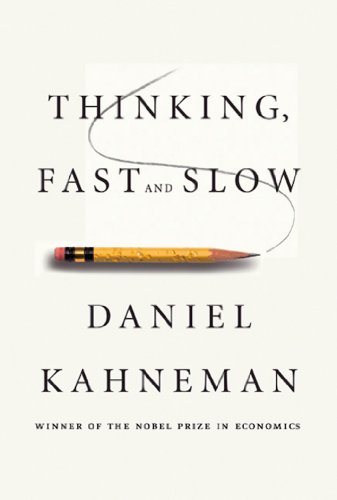
This article is an excerpt from the Shortform summary of "Thinking, Fast and Slow" by Daniel Kahneman. Shortform has the world's best summaries of books you should be reading.
Like this article? Sign up for a free trial here .
Have you ever wondered why you jump to conclusions before you’ve had time to think things through? System 1 thinking is your brain’s automatic, lightning-fast mode that processes information instantly—without conscious effort or control. This mental shortcut helped our ancestors survive, but it often leads to mistakes and hasty decisions in modern life.
System 1 operates through rapid associations, connecting what you experience to patterns stored in your memory. Drawing studies from Thinking, Fast and Slow by Daniel Kahneman, we’ll explain how System 1 works and when you should slow down and think more carefully instead.
Originally Published: November 3, 2019
Last Updated: December 14, 2025
System 1: Thinking Fast
Kahneman explains that System 1 operates automatically and quickly, with little or no conscious effort and no sense of voluntary control. This system gives rise to your feelings and intuitions, and it suggests courses of action for your conscious mind to consider. In short, System 1 is Kahneman’s collective term for all the ways you think fast.
Some examples of System 1 thinking include your ability to tell that one object is farther away than another, to read and understand simple sentences, to detect the emotions in someone else’s voice, and to perform simple or habitual actions like driving a car on an empty road.
(Shortform note: System 1 thinking gives rise to what Malcolm Gladwell (Blink) calls unconscious thinking, better known as intuition or a “gut feeling.” Gladwell believes unconscious thinking is often as effective as conscious, rational thinking, with the added benefits of happening more quickly and being less likely to get derailed by stress or anxiety. He explains that your subconscious mind naturally takes in a huge amount of information—much more than you consciously process—filters out what’s irrelevant, and returns the best answer to your current problem.)
Kahneman further explains that System 1 operates through association: It rapidly connects what you see or experience to related concepts and patterns stored in your memory. By doing so, this mental system can generate impressions and judgments nearly instantly.
For instance, if you see someone frowning, System 1 thinking instantly associates that input with related concepts like anger, threat, and negativity. As a result, within milliseconds of seeing that expression, you’re primed to defend yourself, escape, or defuse the situation.
(Shortform note: Associative thinking like Kahneman describes here isn’t just fast, it’s also creative—in fact, in The Innovator’s DNA, Hal Gregersen, Jeff Dyer, and Clayton Christensen argue that associative thinking is the very foundation of creativity. They explain that creative ideas and innovations usually aren’t completely new concepts, but rather come from people connecting concepts in ways that nobody had connected them before.)
System 1 Is Inaccurate
Since you can’t stop to consciously think about everything you see, hear, or otherwise experience, you need System 1 to function in your everyday interactions. However, Kahneman adds that this system is impulsive and imprecise.
To continue the previous example, you might see someone frowning and, because of System 1 thinking, immediately assume the person is angry and that you’re in danger. However, they could be frowning for any number of reasons: Perhaps they’re simply thinking over a difficult problem, and the expression has nothing to do with you at all.
Trick questions provide perfect demonstrations of System 1’s fallibility. For instance: According to the Old Testament, how many of each type of animal did Moses take on the ark?
You most likely thought of the number two immediately. However, if you think carefully, you’ll realize the answer is actually zero—it was Noah who took animals on the ark, not Moses. Your associative System 1 thinking saw the words “animal” and “ark” and answered the question it thought was being asked, rather than the actual question.
| System 1 Reliance Is an Evolutionary Holdover If System 1 thinking is so unreliable, why do we depend on it so much? In large part, the answer lies in our evolutionary history: For our ancient ancestors, making fast decisions was much more important for survival than making perfectly accurate decisions. For example, suppose two ancient humans saw a pair of eyes staring out of a nearby bush—the person who immediately runs away is more likely to survive than the one who makes sure it really is a predator before starting to run. Therefore, the first person survives and passes on their quick-thinking genes, while the second person doesn’t. The next generation then tends more heavily toward quick thinking than careful decisions. As for the reason we haven’t continued to evolve and become better suited to our lower-risk modern environment—why we haven’t gradually traded speed for accuracy in our thinking—it’s because we simply haven’t needed to in order to survive. While evolution is commonly framed as survival of the fittest, some biologists argue that it would be more appropriate to call it survival of the adequate. In other words, evolution doesn’t try to create some hypothetical perfect species. Instead, it’s simply the process of “good enough” organisms creating more “good enough” organisms. |
———End of Preview———
Like what you just read? Read the rest of the world's best summary of "Thinking, Fast and Slow" at Shortform . Learn the book's critical concepts in 20 minutes or less .
Here's what you'll find in our full Thinking, Fast and Slow summary :
- Why we get easily fooled when we're stressed and preoccupied
- Why we tend to overestimate the likelihood of good things happening (like the lottery)
- How to protect yourself from making bad decisions and from scam artists