We've ranked the best social engineering books using expert recommendations, sales data, and millions of reader ratings. At Shortform, we know books. Our book guides are the best in the world. Learn why.
Influence, the classic book on persuasion, explains the psychology of why people say "yes"—and how to apply these understandings. Dr. Robert Cialdini is the seminal expert in the rapidly expanding field of influence and persuasion. His thirty-five years of rigorous, evidence-based research along with a three-year program of study on what moves people to change behavior has resulted in this highly acclaimed book.
You'll learn the six universal principles, how to use them to become a skilled persuader—and how to defend yourself against them. Perfect for people in all walks of life, the principles of Influence will move you toward profound personal change and act as a driving force for your success.
You can go after the job you want—and get it! You can take the job you have—and improve it! You can take any situation—and make it work for you!
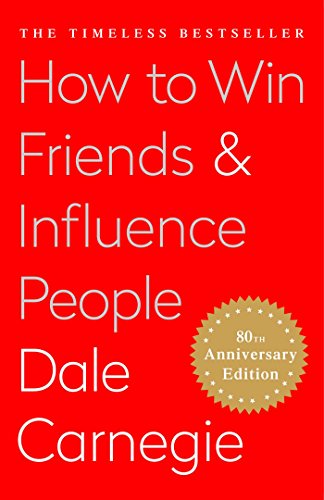
Dale Carnegie’s rock-solid, time-tested advice has carried countless people up the ladder of success in their business and personal lives. One of the most groundbreaking and timeless bestsellers of all time, How to Win Friends & Influence People will teach you:
-Six ways to make people like you -Twelve ways to win people to your way of thinking -Nine ways to change people without arousing resentment
And much more! Achieve your maximum potential—a must-read for the twenty-first century with more than 15 million copies sold!
…
Recommended by Dave Ramsey, Daymond John, Dustin Moskovitz, and 58 others.
Major New York Times bestseller Winner of the National Academy of Sciences Best Book Award in 2012 Selected by the New York Times Book Review as one of the best books of 2011 A Globe and Mail Best Books of the Year 2011 Title One of The Economist's 2011 Books of the Year One of The Wall Street Journal's Best Nonfiction Books of the Year 2011 2013 Presidential Medal of Freedom Recipient
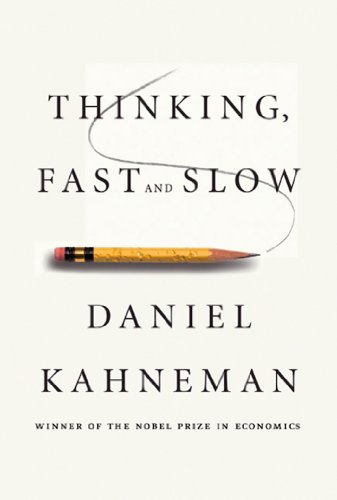
In the international bestseller, Thinking, Fast and Slow, Daniel Kahneman, the renowned psychologist and winner of the Nobel Prize in Economics, takes us on a groundbreaking tour of the mind and explains the two systems that drive the way we think. System 1 is fast, intuitive, and emotional; System 2 is slower, more deliberative, and more logical. The impact of overconfidence on corporate strategies, the difficulties of predicting what will make us happy in the future, the profound effect of cognitive biases on everything from playing the stock market to planning our next vacation—each of these can be understood only by knowing how the two systems shape our judgments and decisions. Engaging the reader in a lively conversation about how we think, Kahneman reveals where we can and cannot trust our intuitions and how we can tap into the benefits of slow thinking. He offers practical and enlightening insights into how choices are made in both our business and our personal lives—and how we can use different techniques to guard against the mental glitches that often get us into trouble. Winner of the National Academy of Sciences Best Book Award and the Los Angeles Times Book Prize and selected by The New York Times Book Review as one of the ten best books of 2011, Thinking, Fast and Slow is destined to be a classic.
A few months ago, Mr. Obama read “Thinking, Fast and Slow,” by Daniel Kahneman, about how people make decisions — quick, instinctive thinking versus slower, contemplative deliberation. For Mr. Obama, a deliberator in an instinctive business, this may be as instructive as any political science text. [source]
Captivating dive into human decision making, marred by inclusion of several/many? psychology studies that fail to replicate. Will stand as a cautionary tale? [source]
This amoral, cunning, ruthless, and instructive book synthesizes the philosophies of Machiavelli, Sun Tzu, and Carl Von Clausewitz with the historical legacies of statesmen, warriors, seducers, and con men throughout the ages.
These are the books I recommend people to listen to on @applebooks. [source]
Marvin Liao
Partner/500 Startups
My list would be (besides the ones I mentioned in answer to the previous question) both business & Fiction/Sci-Fi and ones I personally found helpful to myself. The business books explain just exactly how business, work & investing are in reality & how to think properly & differentiate yourself. On the non-business side, a mix of History & classic fiction to understand people, philosophy to make sense of life and Science fiction to picture what the future could be like (not always utopian). [source]
There is no living writer (or person) who has been more influential to me than Robert Greene. I met him when I was 19 years old and he’s shaped me as a person, as a writer, as a thinker. You MUST read his books. His work on power and strategy are critical for anyone trying to accomplish anything. In life, power is force we are constantly bumping up against. People have power of over us, we seek power ourselves that we might be free enough and influential enough to accomplish our goals—so we must understand where power comes from, how it works and how to get it. But pure power is meaningless. It must be joined to mastery and purpose. So read his book Mastery so that you can figure your life’s task and how to dedicate yourself to it. [source]
Cover unavailable
5
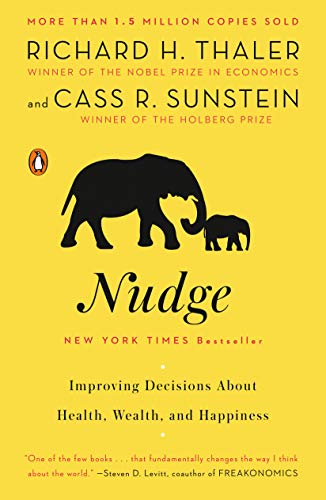
Nudge: Improving Decisions About Health, Wealth, and Happiness
Every day, we make decisions on topics ranging from personal investments to schools for our children to the meals we eat to the causes we champion. Unfortunately, we often choose poorly. The reason, the authors explain, is that, being human, we all are susceptible to various biases that can lead us to blunder. Our mistakes make us poorer and less healthy; we often make bad decisions involving education, personal finance, health care, mortgages and credit cards, the family, and even the planet itself.
Thaler and Sunstein invite us to enter an alternative world, one that takes our humanness as a given. They show that by knowing how people think, we can design choice environments that make it easier for people to choose what is best for themselves, their families, and their society. Using colorful examples from the most important aspects of life, Thaler and Sunstein demonstrate how thoughtful “choice architecture” can be established to nudge us in beneficial directions without restricting freedom of choice. Nudge offers a unique new take—from neither the left nor the right—on many hot-button issues, for individuals and governments alike. This is one of the most engaging and provocative books to come along in many years.
Nudge is a very important book. One of the reasons Nudge is so important is because it’s taking these ideas and applying them to the policy domain. Here are the mistakes we make. Here are the ways marketers are trying to influence us. Here’s the way we might be able to fight back. If policymakers understood these principles, what could they do? The other important thing about the book is that it describes, in detail, small interventions. It’s basically a book about cheap persuasion. [source]
This might feel like a weird book to include, but I think it presents another side of strategy that is too often forgotten. It’s not always about bold actors and strategic thrusts. Sometimes strategy is about subtle influence. Sometimes it is framing and small tweaks that change behavior. We can have big aims, but get there with little moves. This book has excellent examples of that kind of thinking and how it is changing politics, government and business. My favorite example is about the bumblebee that they started putting on urinals–which drastically reduced the amount of spray and spillage because it changed where men aimed when they peed. It’s not exactly the coolest strategy but it solved a problem. So we can learn from it. [source]
Cover unavailable
6
Social Engineering: The Science of Human Hacking
Hadnagy
4.7
Harden the human firewall against the most current threats
Social Engineering: The Science of Human Hacking reveals the craftier side of the hacker's repertoire--why hack into something when you could just ask for access? Undetectable by firewalls and antivirus software, social engineering relies on human fault to gain access to sensitive spaces; in this book, renowned expert Christopher Hadnagy explains the most commonly-used techniques that fool even the most robust security personnel, and shows you how these techniques have been used in the past. The way that we make decisions as humans affects everything from our emotions to our security. Hackers, since the beginning of time, have figured out ways to exploit that decision making process and get you to take an action not in your best interest. This new Second Edition has been updated with the most current methods used by sharing stories, examples, and scientific study behind how those decisions are exploited.
Networks and systems can be hacked, but they can also be protected; when the "system" in question is a human being, there is no software to fall back on, no hardware upgrade, no code that can lock information down indefinitely. Human nature and emotion is the secret weapon of the malicious social engineering, and this book shows you how to recognize, predict, and prevent this type of manipulation by taking you inside the social engineer's bag of tricks.
Examine the most common social engineering tricks used to gain access Discover which popular techniques generally don't work in the real world Examine how our understanding of the science behind emotions and decisions can be used by social engineers Learn how social engineering factors into some of the biggest recent headlines Learn how to use these skills as a professional social engineer and secure your company Adopt effective counter-measures to keep hackers at bay By working from the social engineer's playbook, you gain the advantage of foresight that can help you protect yourself and others from even their best efforts. Social Engineering gives you the inside information you need to mount an unshakeable defense.
For more than two thousand years, The Art of War has stood as a cornerstone of Chinese culture-a lucid epigrammatic text that reveals as much about human psychology, politics, and economics as it does about battlefield strategy. The influence of Sun-tzu's text has grown tremendously in the West in recent years, with military leaders, politicians, and corporate executives alike finding valuable insight in these ancient words. In his crisp, accessible new translation, scholar John Minford brings this seminal work to life for modern readers.
Minford opens with a lively, learned introduction in which he explores the life and times of Sun-tzu, looks at The Art of War in the context of the turbulent Warring States period, and discusses how best to read and understand the work today. There follows Minford's translation of the core text itself in two different formats-first, the unadorned thirteen chapters of the original work and then the same text reprinted with extensive running commentary by classical Chinese scholars as well as Minford himself. The result is an opportunity for Western readers to experience Sun-tzu's work in all its intensity as it applies to many aspects of our lives.
Which books should be read by every single intelligent person on planet? … The Art of War (Sun Tsu) to learn that the act of killing fellow humans can be raised to an art. If you read all of the above works you will glean profound insight into most of what has driven the history of the western world. [source]
Cover unavailable
8
Getting to Yes: Negotiating Agreement Without Giving in
The key text on problem-solving negotiation-updated and revised
Getting to Yes has helped millions of people learn a better way to negotiate. One of the primary business texts of the modern era, it is based on the work of the Harvard Negotiation Project, a group that deals with all levels of negotiation and conflict resolution.
Getting to Yes offers a proven, step-by-step strategy for coming to mutually acceptable agreements in every sort of conflict. Thoroughly updated and revised, it offers readers a straight- forward, universally applicable method for negotiating personal and professional disputes without getting angry-or getting taken.
…
Recommended by Charles T. Munger, Drew Houston, Dustin Moskovitz, and 8 others.
recommends this title in the book "Poor Charlie's Almanack: The Wit and Wisdom of Charles T. Munger". [source]
Drew Houston
CEO/Dropbox
About principled negotiation, and I still think about and apply a lot of those concepts today. [source]
Dustin Moskovitz
Co-founder/Facebook and Asana
Dustin Moskovitz recommended this book on Twitter. [source]
Cover unavailable
9
1984
George Orwell
4.6
A PBS Great American Read Top 100 Pick
With extraordinary relevance and renewed popularity, George Orwell’s 1984 takes on new life in this hardcover edition.
“Orwell saw, to his credit, that the act of falsifying reality is only secondarily a way of changing perceptions. It is, above all, a way of asserting power.”—The New Yorker
In 1984, London is a grim city in the totalitarian state of Oceania where Big Brother is always watching you and the Thought Police can practically read your mind. Winston Smith is a man in grave danger for the simple reason that his memory still functions. Drawn into a forbidden love affair, Winston finds the courage to join a secret revolutionary organization called The Brotherhood, dedicated to the destruction of the Party. Together with his beloved Julia, he hazards his life in a deadly match against the powers that be.
Lionel Trilling said of Orwell’s masterpiece “1984 is a profound, terrifying, and wholly fascinating book. It is a fantasy of the political future, and like any such fantasy, serves its author as a magnifying device for an examination of the present.” Though the year 1984 now exists in the past, Orwell’s novel remains an urgent call for the individual willing to speak truth to power.
Today is World Book Day, a wonderful opportunity to address this #ChallengeRichard sent in by Mike Gonzalez of New Jersey: Make a list of your top 65 books to read in a lifetime. [source]
Television has conditioned us to tolerate visually entertaining material measured out in spoonfuls of time, to the detriment of rational public discourse and reasoned public affairs. In this eloquent, persuasive book, Neil Postman alerts us to the real and present dangers of this state of affairs, and offers compelling suggestions as to how to withstand the media onslaught. Before we hand over politics, education, religion, and journalism to the show business demands of the television age, we must recognize the ways in which the media shape our lives and the ways we can, in turn, shape them to serve out highest goals.
…
Recommended by Austin Kleon, Kara Nortman, Stephen Kinsella, and 3 others.
Earlier this year Postman’s son Andrew wrote an op-ed with the title, “My dad predicted Trump in 1985 — it’s not Orwell, he warned, it’s Brave New World.” Postman wrote: “What Orwell feared were those who would ban books. What Huxley feared was that there would be no reason to ban a book, for there would be no one who wanted to read one.” [source]
Kara Nortman
@andrewchen Also a great book on the topic - Amusing Ourselves to Death https://t.co/yWLBxKumLQ [source]
Stephen Kinsella
@AlanReillyIRL @t0nyyates @WhelanKarl Yes! Fantastic book. So glad you're re-reading it. [source]
Cover unavailable
11
What Every Body is Saying: An Ex-FBI Agent's Guide to Speed-Reading People
Read this book and send your nonverbal intelligence soaring. Joe Navarro, a former FBI counterintelligence officer and a recognized expert on nonverbal behavior, explains how to "speed-read" people: decode sentiments and behaviors, avoid hidden pitfalls, and look for deceptive behaviors. You'll also learn how your body language can influence what your boss, family, friends, and strangers think of you. You will discover:
The ancient survival instincts that drive body language Why the face is the least likely place to gauge a person's true feelings What thumbs, feet, and eyelids reveal about moods and motives The most powerful behaviors that reveal our confidence and true sentiments Simple nonverbals that instantly establish trust Simple nonverbals that instantly communicate authority Filled with examples from Navarro's professional experience, this definitive book offers a powerful new way to navigate your world.
One measure, perhaps, of a book's worth, is its intergenerational pliancy: do new readers acquire it and interpret it afresh down through the ages? The Meditations of Marcus Aurelius, translated and introduced by Gregory Hays, by that standard, is very worthwhile, indeed. Hays suggests that its most recent incarnation--as a self-help book--is not only valid, but may be close to the author's intent. The book, which Hays calls, fondly, a "haphazard set of notes," is indicative of the role of philosophy among the ancients in that it is "expected to provide a 'design for living.'" And it does, both aphoristically ("Think of yourself as dead. You have lived your life. Now take what's left and live it properly.") and rhetorically ("What is it in ourselves that we should prize?"). Whether these, and other entries ("Enough of this wretched, whining monkey life.") sound life-changing or like entries in a teenager's diary is up to the individual reader, as it should be. Hays's introduction, which sketches the life of Marcus Aurelius (emperor of Rome A.D. 161-180) as well as the basic tenets of stoicism, is accessible and jaunty. --H. O'Billovich
…
Recommended by Arianna Huffington, Naval Ravikant, Chip Conley, and 12 others.
Arianna Huffington
Founder/The Huffington Post
I find this book so inspirational and instructive, it lives on my nightstand. [source]
Chip Conley
I have given this book away to a number of people. [source]
Marvin Liao
Partner/500 Startups
My list would be (besides the ones I mentioned in answer to the previous question) both business & Fiction/Sci-Fi and ones I personally found helpful to myself. The business books explain just exactly how business, work & investing are in reality & how to think properly & differentiate yourself. On the non-business side, a mix of History & classic fiction to understand people, philosophy to make sense of life and Science fiction to picture what the future could be like (not always utopian). [source]
Cover unavailable
13
Crucial Conversations: Tools for Talking When Stakes Are High
Kerry Patterson, Joseph Grenny, Ron McMillan, and Al Switzler
Crucial Conversations: Tools For Talking When Stakes Are High is a guide to hone your conversation skills, and prepare you for the most important or trying times of your life and career. The book discusses how talking in the right way can help people achieve what they want. People are often tongue-tied when it comes to interacting with someone, especially when there is a lot of tension in the air. Strong emotions often give away the ability to rationalise one's thoughts, especially during conversations, and emotionally-driven conversations will not work on important occasions. This book teaches readers how to tackle such situations with ease. It provides tips on how to be persuasive, and turn a conversation to one's advantage. The book helps in dealing with confrontations at home, at work, and even with friends. These skills can positively impact the lives of the book's readers in all spheres, and direct their thoughts in a constructive manner. Some of the sections from the book are, How to Notice When Safety Is at Risk, How to Speak Persuasively Not Abrasively, How to Turn Crucial Conversations, and How to Stay Focused on What You Really Want.Kerry Patterson, the co-founder of VitalSmarts, has authored four bestsellers. Some of his other books are Change Anything: The New Science of Personal Success, and Crucial Confrontations: Tools for Resolving Broken Promises, Violated Expectations, and Bad Behavior. Joseph Grenny works as a consultant for many Fortune 500 companies and has impacted many lives throughout the globe through his corporate change initiatives. He is the co-founder of VitalSmarts, and a popular speaker too. Al Switzler is the author of four New York Times bestsellers and has designed and framed many programs for Fortune 500 companies. Ron McMillan has worked as a leadership consultant and trained many people, from first level managers to CEOs.
…
Recommended by Max Levchin and Deke Bridges.
Max Levchin
Co-founder/PayPal, CEO/Affirm, Investor
A now-venerable guide to having tough conversations in a way that engages the debaters. [source]
Deke Bridges
Picked up this great book @Powells to read. Better conversation and listening enables you to get deeper into subjects at hand. When talking with people, this makes your communication skills a very powerful tool. Always be learning. #growth #education #leadership https://t.co/r0ujX9IPqh [source]
Cover unavailable
14
Predictably Irrational: The Hidden Forces That Shape Our Decisions
Why do our headaches persist after taking a one-cent aspirin but disappear when we take a 50-cent aspirin?
Why does recalling the Ten Commandments reduce our tendency to lie, even when we couldn't possibly be caught?
Why do we splurge on a lavish meal but cut coupons to save twenty-five cents on a can of soup?
Why do we go back for second helpings at the unlimited buffet, even when our stomachs are already full?
And how did we ever start spending $4.15 on a cup of coffee when, just a few years ago, we used to pay less than a dollar?
When it comes to making decisions in our lives, we think we're in control. We think we're making smart, rational choices. But are we?
In a series of illuminating, often surprising experiments, MIT behavioral economist Dan Ariely refutes the common assumption that we behave in fundamentally rational ways. Blending everyday experience with groundbreaking research, Ariely explains how expectations, emotions, social norms, and other invisible, seemingly illogical forces skew our reasoning abilities.
Not only do we make astonishingly simple mistakes every day, but we make the same "types" of mistakes, Ariely discovers. We consistently overpay, underestimate, and procrastinate. We fail to understand the profound effects of our emotions on what we want, and we overvalue what we already own. Yet these misguided behaviors are neither random nor senseless. They're systematic and predictable--making us "predictably" irrational.
From drinking coffee to losing weight, from buying a car to choosing a romantic partner, Ariely explains how to break through these systematic patterns of thought to make better decisions. "Predictably Irrational" will change the way we interact with the world--one small decision at a time.
…
Recommended by Max Levchin, Vinod Khosla, Vinod Khosla, and 22 others.
Max Levchin
Co-founder/PayPal, CEO/Affirm, Investor
Max Levchin recommended this book as an answer to "What business books would you advise young entrepreneurs read?" [source]
Andra Zaharia
'While I was thinking of the best books to add to this short list, I realized that not even half of them are directly related to digital marketing. This is because I believe that the best marketers are people who understand human nature deeply and aim to bring out the best in it. Call me naive, but that’s how I see it. If I were to want to pursue a career in marketing, I’d read … Predictably Irrational. [source]
Chris Goward
Here are some of the books that have been very impactful for me, or taught me a new way of thinking: … Predictably Irrational. [source]
Cover unavailable
15
Ghost in the Wires: My Adventures as the World's Most Wanted Hacker
Kevin Mitnick
4.5
If they were a hall of fame or shame for computer hackers, a Kevin Mitnick plaque would be mounted the near the entrance. While other nerds were fumbling with password possibilities, this adept break-artist was penetrating the digital secrets of Sun Microsystems, Digital Equipment Corporation, Nokia, Motorola, Pacific Bell, and other mammoth enterprises. His Ghost in the Wires memoir paints an action portrait of a plucky loner motivated by a passion for trickery, not material game. (P.S. Mitnick's capers have already been the subject of two books and a movie. This first-person account is the most comprehensive to date.)
…
Recommended by Antonio Eram, Nick Janetakis, and Richard Bejtlich.
Antonio Eram
This book was recommended by Antonio when asked for titles he would recommend to young people interested in his career path. [source]
I'm going to start reading Ghost in the Wires by Kevin Mitnick this week. I used to go to 2600 meetings back when he was arrested for wire fraud and other hacking related shenanigans in the mid 1990s. I'm fascinated by things like social engineering and language in general. In the end, I just want to be entertained by his stories. For someone who is into computer programming, a book like this is pretty close to porn! [source]
Richard Bejtlich
In 2002 I reviewed Kevin Mitnick's first book, The Art of Deception. In 2005 I reviewed his second book, The Art of Intrusion. I gave both books four stars. Mitnick's newest book, however, with long-time co-author Bill Simon, is a cut above their previous collaborations and earns five stars. As far as I can tell (and I am no Mitnick expert, despite reading almost all previous texts mentioning him), this is the real deal. Mitnick addresses just about everything you might want to know about. For me, the factor that made the book very unique was the authors' attention to detail. This sounds like it might have been a point of contention between the co-authors, but I found the methodical explanation of the social engineering and technical attacks to be relevant and interesting. Mitnick just doesn't say he social engineered a target; rather, he walks you through every step of the event! It's amazing, audacious, and in many cases beyond the pale. … Ghost in the Wires also shares the human side of Mitnick's story. His description of solitary confinement and his anxiety of returning to those conditions seemed very real. They appear ever more relevant given recent treatment of Bradley Manning. One has to wonder about "cruel and unusual punishment" of those who are not convicted, such that they will sign plea deals just to avoid solitary confinement. Beyond prison issues, Mitnick's love for his family (especially his mother and grandmother) were clear throughout the book. I very much enjoyed reading Ghost in the Wires, and I believe the majority of the computer security community would too. [source]
Cover unavailable
16
The Art of Deception: Controlling the Human Element of Security
Kevin D. Mitnick
4.5
The world's most infamous hacker offers an insider's view of the low-tech threats to high-tech security Kevin Mitnick's exploits as a cyber-desperado and fugitive form one of the most exhaustive FBI manhunts in history and have spawned dozens of articles, books, films, and documentaries. Since his release from federal prison, in 1998, Mitnick has turned his life around and established himself as one of the most sought-after computer security experts worldwide. Now, in The Art of Deception, the world's most notorious hacker gives new meaning to the old adage, "It takes a thief to catch a thief." Focusing on the human factors involved with information security, Mitnick explains why all the firewalls and encryption protocols in the world will never be enough to stop a savvy grifter intent on rifling a corporate database or an irate employee determined to crash a system. With the help of many fascinating true stories of successful attacks on business and government, he illustrates just how susceptible even the most locked-down information systems are to a slick con artist impersonating an IRS agent. Narrating from the points of view of both the attacker and the victims, he explains why each attack was so successful and how it could have been prevented in an engaging and highly readable style reminiscent of a true-crime novel. And, perhaps most importantly, Mitnick offers advice for preventing these types of social engineering hacks through security protocols, training programs, and manuals that address the human element of security.
In this book, Robert Greene demonstrates that the ultimate form of power is mastery itself. By analyzing the lives of such past masters as Charles Darwin, Benjamin Franklin, Albert Einstein, and Leonard da Vinci, as well as by interviewing nine contemporary masters, including tech guru Paul Graham and animal rights advocate Temple Grandin, Greene debunks our culture’s many myths about genius and distills the wisdom of the ages to reveal the secret to greatness. With this seminal text as a guide, readers will learn how to unlock the passion within and become masters.
What better way to learn about success then the minute paths taken by 100s or 1000s of successful people.It feels like Robert takes everyone in history and dissects the exact moments and decisions that led to their great success. [source]
There is no living writer (or person) who has been more influential to me than Robert Greene. I met him when I was 19 years old and he’s shaped me as a person, as a writer, as a thinker. You MUST read his books. His work on power and strategy are critical for anyone trying to accomplish anything. In life, power is force we are constantly bumping up against. People have power of over us, we seek power ourselves that we might be free enough and influential enough to accomplish our goals—so we must understand where power comes from, how it works and how to get it. But pure power is meaningless. It must be joined to mastery and purpose. So read his book Mastery so that you can figure your life’s task and how to dedicate yourself to it. [source]
Boban Dedovic
Question: What books had the biggest impact on you? Perhaps changed the way you see things or dramatically changed your career path. Answer: Here are some others books that are important to me. Zero to One by Peter Thiel (on startups) Mastery by Robert Greene (life and career path study) Good to Great by Jim Collins (on growing a great company) Getting to Yes by Roger Fisher (negotiation) [source]
Cover unavailable
18
Propaganda
Edward Bernays
4.4
“Bernays’ honest and practical manual provides much insight into some of the most powerful and influential institutions of contemporary industrial state capitalist democracies.”—Noam Chomsky
“The conscious and intelligent manipulation of the organized habits and opinions of the masses is an important element in democratic society. Those who manipulate this unseen mechanism of society constitute an invisible government which is the true ruling power of our country.”—Edward Bernays, Propaganda
A seminal and controversial figure in the history of political thought and public relations, Edward Bernays (1891–1995), pioneered the scientific technique of shaping and manipulating public opinion, which he famously dubbed “engineering of consent.” During World War I, he was an integral part of the U.S. Committee on Public Information (CPI), a powerful propaganda apparatus that was mobilized to package, advertise and sell the war to the American people as one that would “Make the World Safe for Democracy.” The CPI would become the blueprint in which marketing strategies for future wars would be based upon.
Bernays applied the techniques he had learned in the CPI and, incorporating some of the ideas of Walter Lipmann, became an outspoken proponent of propaganda as a tool for democratic and corporate manipulation of the population. His 1928 bombshell Propaganda lays out his eerily prescient vision for using propaganda to regiment the collective mind in a variety of areas, including government, politics, art, science and education. To read this book today is to frightfully comprehend what our contemporary institutions of government and business have become in regards to organized manipulation of the masses.
This is the first reprint of Propaganda in over 30 years and features an introduction by Mark Crispin Miller, author of The Bush Dyslexicon: Observations on a National Disorder.
…
Recommended by Cynthia Johnson, Dave Elitch, and Jérôme Jarre.
Cynthia Johnson
What people don’t realise is that PR was originally called ‘propaganda.’ After World War II, that word had such negative connotations that they changed it to public relations, but PR and propaganda are one and the same. This book offers a really interesting breakdown of how little has changed in, almost, 100 years. [source]
Dave Elitch
The author was Sigmund Freud’s nephew. He took all of Freud’s theories on the subconscious and came to the conclusion that human beings are either savage animals that are going to rip each other apart, or they can be controlled and made docile via consumerism. [source]
Jérôme Jarre
This book opened my eyes to the marketing industry in a time when I was blindly playing my role in it. [source]
Cover unavailable
19
Win Bigly: Persuasion in a World Where Facts Don't Matter
The New York Times bestseller that explains one of the most important perceptual shifts in the history of humankind
Scott Adams was one of the earliest public figures to predict Donald Trump's election. The mainstream media regarded Trump as a lucky clown, but Adams - best known as "the guy who created Dilbert" -- recognized a level of persuasion you only see once in a generation. We're hardwired to respond to emotion, not reason, and Trump knew exactly which emotional buttons to push.
The point isn't whether Trump was right or wrong, good or bad. Adams goes beyond politics to look at persuasion tools that can work in any setting--the same ones Adams saw in Steve Jobs when he invested in Apple decades ago. Win Bigly is a field guide for persuading others in any situation--or resisting the tactics of emotional persuasion when they're used on you.
This revised edition features a bonus chapter that assesses just how well Adams foresaw the outcomes of Trump's tactics with North Korea, the NFL protesters, Congress, and more.
@_KevinAGC Best book on writing persuasively: @ScottAdamsSays "Win Bigly" and @RobertCialdini "Influence". [source]
Aaron Watson
This one’s going to be controversial. Adams, the creator of Dilbert, was one of the first commentators to come out and predict that Trump would win the 2016 presidential election. How’d he do that? By viewing the world through his Persuasion Filter. This reframing of how humans interact, the world works, and why Trump won was fascinating. It’s already starting to influence the way that I write. Check it out. [source]
From the bestselling author of The Black Swan and one of the foremost philosophers of our time, Nassim Nicholas Taleb, a book on how some systems actually benefit from disorder.
In The Black Swan Taleb outlined a problem; in Antifragile he offers a definitive solution: how to gain from disorder and chaos while being protected from fragilities and adverse events. For what he calls the "antifragile" is one step beyond robust, as it benefits from adversity, uncertainty and stressors, just as human bones get stronger when subjected to stress and tension.
Taleb stands uncertainty on its head, making it desirable, and proposing that things be built in an antifragile manner. Extremely ambitious and multidisciplinary, Antifragile provides a blueprint for how to behave-and thrive-in a world we don't understand and which is too uncertain for us to even try to understand. He who is not antifragile will perish. Why is the city state better than the nation state, why is debt bad for you, and why is almost everything modern bound to fail? The book covers innovation, health, biology, medicine, life decisions, politics, foreign policy, urban planning, war, personal finance, and economic systems. Throughout, the voice and recipes of the ancient wisdom from Phoenician, Roman, Greek, and Medieval sources are heard loud and clear.
You ask about success. To be successful you have to avoid being “fragile” – the idea that if something hurts you, you let collapse completely. You also have to avoid simply being resilient. Bouncing back is not enough. Antifragile is when something tries to hurt you and you come back stronger. That is real life business. That is real life success. Nassim focuses on the economy. But when I read the book I kept asking myself, “how can I apply this to the areas of my life where I feel most fragile?” [source]
Marvin Liao
Partner/500 Startups
My list would be (besides the ones I mentioned in answer to the previous question) both business & Fiction/Sci-Fi and ones I personally found helpful to myself. The business books explain just exactly how business, work & investing are in reality & how to think properly & differentiate yourself. On the non-business side, a mix of History & classic fiction to understand people, philosophy to make sense of life and Science fiction to picture what the future could be like (not always utopian). [source]
Vlad Tenev
The general concept is applicable to many fields beyond biology, for instance finance, economics and monetary policy. [source]
Brilliant distillations of the strategies of war—and the subtle social game of everyday life—by the bestselling author of The 48 Laws of Power and Mastery
Robert Greene’s groundbreaking guides, The 48 Laws of Power, The Art of Seduction, and his latest book, Mastery, espouse profound, timeless lessons from the events of history to help readers vanquish an enemy, ensnare an unsuspecting victim, or become the greatest in your field. In The 33 Strategies of War, Greene has crafted an important addition to this ruthless and unique series.
Spanning world civilizations, synthesizing dozens of political, philosophical, and religious texts and thousands of years of violent conflict, The 33 Strategies of War is a comprehensive guide to the subtle social game of everyday life informed by the most ingenious and effective military principles in war. Structured in Greene’s trademark style, The 33 Strategies of War is the I-Ching of conflict, the contemporary companion to Sun Tzu’s The Art of War.
Abundantly illustrated with examples from history, including the folly and genius of everyone from Napoleon to Margaret Thatcher, Shaka the Zulu to Lord Nelson, Hannibal to Ulysses S. Grant, as well as movie moguls, Samurai swordsmen, and diplomats, each of the thirty-three chapters outlines a strategy that will help you win life’s wars. Learn the offensive strategies that require you to maintain the initiative and negotiate from a position of strength, or the defensive strategies designed to help you respond to dangerous situations and avoid unwinnable wars. The great warriors of battlefields and drawing rooms alike demonstrate prudence, agility, balance, and calm, and a keen understanding that the rational, resourceful, and intuitive always defeat the panicked, the uncreative, and the stupid. An indispensable book, The 33 Strategies of War provides all the psychological ammunition you need to overcome patterns of failure and forever gain the upper hand.
The Art of Intrusion: The Real Stories Behind the Exploits of Hackers, Intruders and Deceivers
Kevin D. Mitnick, William L. Simon
4.4
Hacker extraordinaire Kevin Mitnick delivers the explosive encore to his bestselling The Art of Deception Kevin Mitnick, the world's most celebrated hacker, now devotes his life to helping businesses and governments combat data thieves, cybervandals, and other malicious computer intruders. In his bestselling The Art of Deception, Mitnick presented fictionalized case studies that illustrated how savvy computer crackers use "social engineering" to compromise even the most technically secure computer systems. Now, in his new book, Mitnick goes one step further, offering hair-raising stories of real-life computer break-ins-and showing how the victims could have prevented them. Mitnick's reputation within the hacker community gave him unique credibility with the perpetrators of these crimes, who freely shared their stories with him-and whose exploits Mitnick now reveals in detail for the first time, including: A group of friends who won nearly a million dollars in Las Vegas by reverse-engineering slot machines Two teenagers who were persuaded by terrorists to hack into the Lockheed Martin computer systems Two convicts who joined forces to become hackers inside a Texas prison A "Robin Hood" hacker who penetrated the computer systems of many prominent companies-andthen told them how he gained access With riveting "you are there" descriptions of real computer break-ins, indispensable tips on countermeasures security professionals need to implement now, and Mitnick's own acerbic commentary on the crimes he describes, this book is sure to reach a wide audience-and attract the attention of both law enforcement agencies and the media.
…
Cover unavailable
23
The Republic: The Influential Classic
Plato
4.3
The newest deluxe edition in the bestselling Capstone Classics Series This ancient classic has had a make-over. In recent years these Capstone Classic deluxe editions have caught the book buying public's imagination. The volumes of international bestsellers such as Think and Grow Rich and The Art of War have quickly become the market leaders. Now Plato's best known work, one of the most intellectually and historically influential works of philosophy and political theory, has been brought to life in this luxury, hardback, keep-sake edition.
This edition includes:
Plato's plans for a perfect society characterised by a blend of wisdom, courage, self-discipline and justice Lessons to learn about living according to eternal truths, instead of existing simply for survival and pleasure A new introduction by Tom Butler Bowdon, the classic personal development expert
It’s very readable even if you aren’t a professional philosopher. Take the story of ‘The Ring of Gyges,’ which raises the question of whether you would continue to act like a good person if you had a ring of invisibility that let you get away with doing whatever you wanted to do. That’s a fascinating thought experiment that anybody can appreciate. [source]
I’m about a third through this and still can’t tell whether Plato is making a mockery of Socrates ideas for the idyllic society or not. So many of the arguments presented as Socrates’ are so tortured and with so disconnected leaps of logic that it’s hard to take it at face value. Yet still, it’s good fun to follow the dialogue. It reads more like a play than a book, and again, immensely accessible. It’s fun to see the lines that continue from a book like this to the considerations of the Stoics all the way to Adam Smith and the Wealth of Nations and then onto a modern critique and history in that Debt: First 5,000 Years. A conversation spanning millennia. [source]
Jonathan Glover
It contains a tremendous amount of nonsense about what the ideal society would be like. But it is an unmissable book because of Socrates. He invented the method of doing and teaching philosophy that has never been improved on. [source]
Cover unavailable
24
The Charisma Myth: How Anyone Can Master the Art and Science of Personal Magnetism
What if charisma could be taught? For the first time, science and technology have taken charisma apart, figured it out and turned it into an applied science: In controlled laboratory experiments, researchers could raise or lower people's level of charisma as if they were turning a dial. What you'll find here is practical magic: unique knowledge, drawn from a variety of sciences, revealing what charisma really is and how it works. You'll get both the insights and the techniques you need to apply this knowledge. The world will become your lab, and every person you meet, a chance to experiment. The Charisma Myth is a mix of fun stories, sound science, and practical tools. Cabane takes a hard scientific approach to a heretofore mystical topic, covering what charisma actually is, how it is learned, what its side effects are, and how to handle them.
…
Recommended by Marissa Mayer, Laura Lang, Dr. Monali Y. Desai, and 2 others.
Marissa Mayer
Former CEO/Yahoo!
Proud of our friend and neighbor Olivia Fox Cabane - her book 'The Charisma Myth' launched today and is already #122 of all books on Amazon. It went into its second printing even before launch! [source]
Laura Lang
CEO/Time Inc.
Olivia Fox Cabane offers hands-on advice and a practical guide to humanizing leaders without comprising integrity or authority. She focused on the ‘it’ factors that can make a real difference. [source]
Dr. Monali Y. Desai
Currently, my favorite business book is The Charisma Myth (Olivia Fox Cabane) because I feel it has so many small but impactful takeaways about improving how you communicate with others, I try to reread it once a year. [source]
Cover unavailable
25
The Art of Worldly Wisdom
Baltasar Gracián y Morales
4.3
The remarkable best-seller -- a long-lost, 300-year-old book of wisdom on how to live successfully yet responsibly in a society governed by self-interest -- as acute as Machiavelli yet as humanistic and scrupulously moral as Marcus Aurelius.
The Joy of Not Working (Zelinkski), Flash Foresight (Burrus), The Art of Worldly Wisdom (Gracian), Sapiens (Yuval), The End of Jobs (Pearson), Deep Work (Newport), Sovereign Individual (Davidson), The Fourth Economy (Davison) & The Monk & the Riddle (Komisar). Every single one of these books completely changed how I looked at everything in the world & literally pushed my life in a new direction. They were Paradigm Shifting as they say. (hate that word but it really was a Paradigm Shift for me). [source]
Cover unavailable
26
The Art of Invisibility: The World's Most Famous Hacker Teaches You How to Be Safe in the Age of Big Brother and Big Data
Kevin Mitnick
4.3
Kevin Mitnick, the world's most famous hacker, teaches you easy cloaking and counter-measures for citizens and consumers in the age of Big Brother and Big Data.
Like it or not, your every move is being watched and analyzed. Consumer's identities are being stolen, and a person's every step is being tracked and stored. What once might have been dismissed as paranoia is now a hard truth, and privacy is a luxury few can afford or understand.
In this explosive yet practical book, Kevin Mitnick illustrates what is happening without your knowledge--and he teaches you "the art of invisibility." Mitnick is the world's most famous--and formerly the Most Wanted--computer hacker. He has hacked into some of the country's most powerful and seemingly impenetrable agencies and companies, and at one point he was on a three-year run from the FBI. Now, though, Mitnick is reformed and is widely regarded as the expert on the subject of computer security. He knows exactly how vulnerabilities can be exploited and just what to do to prevent that from happening.
In THE ART OF INVISIBILITY Mitnick provides both online and real life tactics and inexpensive methods to protect you and your family, in easy step-by-step instructions. He even talks about more advanced "elite" techniques, which, if used properly, can maximize your privacy. Invisibility isn't just for superheroes--privacy is a power you deserve and need in this modern age.
Carl von Clausewitz's On War has been called, "not simply the greatest, but the only truly great book on war." It is an extraordinary attempt to construct an all-embracing theory of how war works. Its coherence and ambition are unmatched by other military literature. On War is full of sharp observation, biting irony, and memorable phrases, the most famous being, "War is a continuation of politics by other means."
About the Author Except for a brief stint in 1812 when he served in the Russian army, Clausewitz spent his whole career, from the age of twelve until his death in 1831, in the Prussian army. He fought in all the major Prussian campaigns against France, and his most fateful experience - the 1806 Battle of Jena-Auerstedt, in which Napoleon destroyed the Prussian army - inspired him to write On War.
I know this will offend many strategy purists, but for most audiences I recommend these two books only with a pretty strong disclaimer. While both are clearly full of strategic wisdom, they are hard to separate from their respective eras and brands of warfare. As budding strategists in business and in life, most of us are really looking for advice that can help us with our own problems. The reality is that Napoleonic warfare does not exactly have its equivalents in today’s society. On the other hand, Sun-Tzu is so aphoristic that it’s hard to say what is concrete advice and what is just common sense. But the books are so convincing that you might still end up leaving thinking that they can be easily applied. So, again, check these books out if you’re really interested, but I think some of the other books are much better places to start. [source]
Andrew Exum
If you’re trying to understand any conflict you still have to start with the dead Prussian…There’s still no other book that’s as significant in terms of understanding war as On War. [source]
Cover unavailable
28
Intellectuals and Society
Thomas Sowell
4.3
Thomas Sowell's classic book on the influence of modern intellectuals The influence of intellectuals is not only greater than in previous eras but also takes a very different form from that envisioned by those like Machiavelli and others who have wanted to directly influence rulers. It has not been by shaping the opinions or directing the actions of the holders of power that modern intellectuals have most influenced the course of events, but by shaping public opinion in ways that affect the actions of power holders in democratic societies, whether or not those power holders accept the general vision or the particular policies favored by intellectuals. Even government leaders with disdain or contempt for intellectuals have had to bend to the climate of opinion shaped by those intellectuals.
Intellectuals and Society not only examines the track record of intellectuals in the things they have advocated but also analyzes the incentives and constraints under which their views and visions have emerged. One of the most surprising aspects of this study is how often intellectuals have been proved not only wrong, but grossly and disastrously wrong in their prescriptions for the ills of society--and how little their views have changed in response to empirical evidence of the disasters entailed by those views. This much revised and reorganized edition of Intellectuals and Society is more than half again larger than the first edition. Four new chapters have been added on intellectuals and race, including a chapter on race and intelligence.
…
Cover unavailable
29
Trust Me, I'm Lying: Confessions of a Media Manipulator
Ryan Holiday
4.3
You've seen it all before. A malicious online rumor costs a company millions. A political sideshow derails the national news cycle and destroys a candidate. Some product or celebrity zooms from total obscurity to viral sensation. What you don't know is that someone is responsible for all this. Usually, someone like me.
I'm a media manipulator. In a world where blogs control and distort the news, my job is to control blogs--as much as any one person can. In today's culture...
1) Blogs like "Gawker," "Buzzfeed" and the "Huffington Post" drive the media agenda.
2) Bloggers are slaves to money, technology, and deadlines.
3) Manipulators wield these levers to shape everything you read, see and watch--online and off.
Why am I giving away these secrets? Because I'm tired of a world where blogs take indirect bribes, marketers help write the news, reckless journalists spread lies, and no one is accountable for any of it. I'm pulling back the curtain because I don't want anyone else to get blindsided.
I'm going to explain exactly how the media "really" works. What you choose to do with this information is up to you.
…
Recommended by Timothy Ferriss, Dov Charney, Tucker Max, and 12 others.
Ryan is part Machiavelli, part Ogilvy, and all results. From American Apparel to the quiet campaigns he's run but not taken credit for, this whiz kid is the secret weapon you've never heard of. [source]
Dov Charney
Founder/American Apparel
Behind my reputation as a marketing genius there is Ryan Holiday, whom I consult often and who has done more for my business than just about anyone. [source]
Tucker Max
Author/I Hope They Serve Beer in Hell
The strategies Ryan created to exploit blogs drove sales of millions of my books and made me an internationally known name. The reason I am standing here while other celebrities were destroyed or became parodies of themselves is because of his insider knowledge. [source]
Cover unavailable
30
Brave New World / Brave New World Revisited
Aldous Huxley, Christopher Hitchens
4.3
The astonishing novel Brave New World, originally published in 1932, presents Aldous Huxley's vision of the future--of a world utterly transformed. Through the most efficient scientific and psychological engineering, people are genetically designed to be passive and therefore consistently useful to the ruling class. This powerful work of speculative fiction sheds a blazing critical light on the present and is considered to be Aldous Huxley's most enduring masterpiece.
The non-fiction work Brave New World Revisited, published in 1958, is a fascinating work in which Huxley uses his tremendous knowledge of human relations to compare the modern-day world with his prophetic fantasy envisioned in Brave New World, including the threats to humanity, such as over-population, propaganda, and chemical persuasion.
Written over three centuries ago by a Samurai warrior, the book has been hailed as a limitless source of psychological insight for businessmen-or anyone who relies on strategy and tactics for outwitting the competition.
Recommended by Steve Blank, Ryan Holiday, Bill Liao, and 2 others.
Widely held as a classic, this book is much more than a manifesto and manual on swordsmanship and martial arts. It’s about the mindset, the discipline, and the perception necessary to win in life or death situations. As a swordsman, Musashi fought mostly by himself, for himself. His wisdom, therefore, is mostly internal. He tells you how to out-think and out-move your enemies. He tells you how to fend for yourself and live by a code. And isn’t that precisely what so many of us need help with every day? [source]
Bill Liao
The human world occurs in language so best get good at it! [source]
Stephane Grand
I do not believe there are business and non-business books. Business is life, you do business like the man or woman you excavate from the person you are told you are. Hence, the most potent business books are not about business, in my opinion. What makes a great business book is that it is a book that helps you find a better version of yourself. Therefore, I would say that my favorite business book is Miyamoto Musashi’s Book of Five Rings. It is an amazing inwards look at how to win battles. [source]
Cover unavailable
32
Race After Technology: Abolitionist Tools for the New Jim Code
Ruha Benjamin
4.3
From everyday apps to complex algorithms, Ruha Benjamin cuts through tech-industry hype to understand how emerging technologies can reinforce White supremacy and deepen social inequity.
Benjamin argues that automation, far from being a sinister story of racist programmers scheming on the dark web, has the potential to hide, speed up, and deepen discrimination while appearing neutral and even benevolent when compared to the racism of a previous era. Presenting the concept of the "New Jim Code," she shows how a range of discriminatory designs encode inequity by explicitly amplifying racial hierarchies; by ignoring but thereby replicating social divisions; or by aiming to fix racial bias but ultimately doing quite the opposite. Moreover, she makes a compelling case for race itself as a kind of technology, designed to stratify and sanctify social injustice in the architecture of everyday life.
This illuminating guide provides conceptual tools for decoding tech promises with sociologically informed skepticism. In doing so, it challenges us to question not only the technologies we are sold but also the ones we ourselves manufacture.
If you adopt this book for classroom use in the 2019-2020 academic year, the author would be pleased to arrange to Skype to a session of your class. If interested, enter your details in this sign-up sheet https: //buff.ly/2wJsvZr
You’re so generous. Get this book. It is brilliant! https://t.co/aKBHSi3kGM [source]
Imani Perry
@ruha9 It is such a brilliant book!! ❤️❤️❤️ [source]
Kate Crawford
@RDBinns Yep, lots of great resources on this. @ruha9’s book goes into contextual use really well, imho. For the past few years I’ve been describing it in terms of parity != justice. [source]
The season's most talked-about all-purpose personal strategy guide and philosophical compendium," said Newsweek of Robert Greene's bold, elegant, and ingenious manual of modern manipulation, The 48 Laws of Power. Now Greene has once again mined history and literature to distill the essence of seduction, the most highly refined mode of influence, the ultimate power trip.
The Art of Seduction is a masterful synthesis of the work of thinkers such as Freud, Ovid, Kierkegaard, and Einstein, as well as the achievements of the greatest seducers throughout history. From Cleopatra to John F. Kennedy, from Andy Warhol to Josephine Bonaparte, The Art of Seduction gets to the heart of the character of the seducer and his or her tactics, triumphs and failures. The seducer's many faces include: the Siren, the Rake, the Ideal Lover, the Dandy, the Natural, the Coquette, the Charmer, and the Charismatic. Twenty-four maneuvers will guide readers through the seduction process, providing cunning, amoral instructions for and analysis of this fascinating, all-pervasive form of power. Just as beautifully packaged and every bit as essential as The 48 Laws of Power, The Art of Seduction is an indispensable primer of persuasion and offers the best lessons on how to take what you want from whomever you want or how to prevent yourself from being taken.
…
Cover unavailable
34
The Shallows: What the Internet Is Doing to Our Brains
Nicholas Carr
4.3
“Is Google making us stupid?” When Nicholas Carr posed that question, in a celebrated Atlantic Monthly cover story, he tapped into a well of anxiety about how the Internet is changing us. He also crystallized one of the most important debates of our time: As we enjoy the Net’s bounties, are we sacrificing our ability to read and think deeply?
Now, Carr expands his argument into the most compelling exploration of the Internet’s intellectual and cultural consequences yet published. As he describes how human thought has been shaped through the centuries by “tools of the mind”—from the alphabet to maps, to the printing press, the clock, and the computer—Carr interweaves a fascinating account of recent discoveries in neuroscience by such pioneers as Michael Merzenich and Eric Kandel. Our brains, the historical and scientific evidence reveals, change in response to our experiences. The technologies we use to find, store, and share information can literally reroute our neural pathways.
Building on the insights of thinkers from Plato to McLuhan, Carr makes a convincing case that every information technology carries an intellectual ethic—a set of assumptions about the nature of knowledge and intelligence. He explains how the printed book served to focus our attention, promoting deep and creative thought. In stark contrast, the Internet encourages the rapid, distracted sampling of small bits of information from many sources. Its ethic is that of the industrialist, an ethic of speed and efficiency, of optimized production and consumption—and now the Net is remaking us in its own image. We are becoming ever more adept at scanning and skimming, but what we are losing is our capacity for concentration, contemplation, and reflection.
Part intellectual history, part popular science, and part cultural criticism, The Shallows sparkles with memorable vignettes—Friedrich Nietzsche wrestling with a typewriter, Sigmund Freud dissecting the brains of sea creatures, Nathaniel Hawthorne contemplating the thunderous approach of a steam locomotive—even as it plumbs profound questions about the state of our modern psyche. This is a book that will forever alter the way we think about media and our minds.
While I was thinking of the best books to add to this short list, I realized that not even half of them are directly related to digital marketing. This is because I believe that the best marketers are people who understand human nature deeply and aim to bring out the best in it. Call me naive, but that’s how I see it. If I were to want to pursue a career in marketing, I’d read … The Shallows. [source]
Nicholas Carr talks at length about what is gained and lost by technological progress. Reading and writing enlarged people’s sympathetic response and enriched their lives even when the book was put aside. One could say the same thing about drawing. [source]
Models is the first book ever written on seduction as an emotional process rather than a logical one, a process of connecting with women rather than impressing them. It's the most mature and honest guide on how a man can attract women without faking behavior, without lying and without emulating others. A game-changer.
Recommended by Pat Walls.
Pat Walls
Yes, this is a dating book, and it's really good for that. But there is a really important concept that transcends all personal relationships - family, friends, etc: And that is the concept of non-neediness and true confidence. Reading this book transformed my relationships with people. [source]
Cover unavailable
36
What to Post: How to Create Engaging Social Media Content that Builds Your Brand and Gets Results (for Real Estate)
Chelsea Peitz
4.3
Cover unavailable
37
The Seven-Day Weekend
Ricardo Semler
4.3
In The Seven-Day Weekend, Semler explains how he transformed a small family business into a highly profitable manufacturing, services and high-tech powerhouse - 40 times larger - while watching his favorite movies or relaxing with his son in the middle of the business day. Praise for The Seven-Day Weekend'Are there real-life lessons to be learned? The answer is yes-Pragmatic, inspirational and intriguing advice' The Times'Ricardo Semler is our kind of capitalist.' Guardian'In this book, Ricardo Semler tells how Semco, Latin America's fastest growing company, uses a revolutionary way of working to run a profit making company with a work force who love their jobs.' The Sunday Times'The Seven-Day Weekend challenges conventional approaches to work. It sparks ideas that can be applied to one's own business [and] will certainly encourage managers to look very carefully at their management practices.' Rocco Forte, Management TodayPraise for Ricardo Semler's Maverick!'Semco takes workplace democracy to previously unimagined frontiers' The Times'His egalitarian approach works like a dream' Today
…
Recommended by Ev Williams, Joel Gascoigne, and Mehdi Kajbaf.
Joel Gascoigne
Ricardo Semler took over his father's business, Semco, in 1980 under the condition that he could change it completely. On his first day as CEO, he fired 60% of all top managers. Since then he has introduced a wide range of unconventional practices, such as having no official working hours, employees choosing their own salaries, and having no vision (instead wanting employees to find the way using their instinct). For me, The Seven-Day Weekend opened my eyes and helped me to question every business practice that exists today. Semler aimed to operate as a 'sevant leader' and made a conscious effort to make zero decisions himself. [source]
Mehdi Kajbaf
I think that every career path begins with an understanding of who you are and what matters to you. In that light I will suggest some self discovery books. And of course some great business books. [source]
Cover unavailable
38
Catch Me If You Can: The True Story of a Real Fake
Frank Abagnale
4.3
I stole every nickel and blew it on fine threads, luxurious lodgings, fantastic foxes and other sensual goodies. I partied in every capital in Europe and basked on all the world's most famous beaches'. Frank W Abagnale, alias Frank Williams, Robert Conrad, Frank Adams and Ringo Monjo, was one of the most daring con men, forgers, imposters and escape artists in history. In his brief but notorious career, Abagnale donned a pilot's uniform and co-piloted a Pan Am jet, masqueraded as a member of hospital management, practised law without a licence, passed himself off as a college sociology professor, and cashed over $2.5 million in forged checks all before he was twenty-one. Known by the police of twenty-six foreign countries and all fifty states as 'The Skywayman', Abagnale lived a sumptuous life on the run - until the law caught up with him. Now recognised as the nation's leading authority on financial foul play, Abagnale is a charming rogue whose hilarious, stranger-than-fiction international escapades and ingenious escapes - including one from an aeroplane - make CATCH ME IF YOU CAN an irresistable tale of deceit.
…
Cover unavailable
39
Pre-Suasion: A Revolutionary Way to Influence and Persuade
The author of the legendary bestseller Influence, social psychologist Robert Cialdini shines a light on effective persuasion and reveals that the secret doesn’t lie in the message itself, but in the key moment before that message is delivered.
What separates effective communicators from truly successful persuaders? Using the same combination of rigorous scientific research and accessibility that made his Influence an iconic bestseller, Robert Cialdini explains how to capitalize on the essential window of time before you deliver an important message. This “privileged moment for change” prepares people to be receptive to a message before they experience it. Optimal persuasion is achieved only through optimal pre-suasion. In other words, to change “minds” a pre-suader must also change “states of mind.”
His first solo work in over thirty years, Cialdini’s Pre-Suasion draws on his extensive experience as the most cited social psychologist of our time and explains the techniques a person should implement to become a master persuader. Altering a listener’s attitudes, beliefs, or experiences isn’t necessary, says Cialdini—all that’s required is for a communicator to redirect the audience’s focus of attention before a relevant action.
From studies on advertising imagery to treating opiate addiction, from the annual letters of Berkshire Hathaway to the annals of history, Cialdini draws on an array of studies and narratives to outline the specific techniques you can use on online marketing campaigns and even effective wartime propaganda. He illustrates how the artful diversion of attention leads to successful pre-suasion and gets your targeted audience primed and ready to say, “Yes.”
I just finished reading Pre-Suasion, or I should say I just finished skimming Pre-Suasion by Robert Cialdini. I don’t think I needed to read the entire book to get the point, but it was still good to read what I did. [source]
Cover unavailable
40
Manufacturing Consent: The Political Economy of the Mass Media
In this pathbreaking work, Edward S. Herman and Noam Chomsky show that, contrary to the usual image of the news media as cantankerous, obstinate, and ubiquitous in their search for truth and defense of justice, in their actual practice they defend the economic, social, and political agendas of the privileged groups that dominate domestic society, the state, and the global order.
Based on a series of case studies—including the media’s dichotomous treatment of “worthy” versus “unworthy” victims, “legitimizing” and “meaningless” Third World elections, and devastating critiques of media coverage of the U.S. wars against Indochina—Herman and Chomsky draw on decades of criticism and research to propose a Propaganda Model to explain the media’s behavior and performance. Their new introduction updates the Propaganda Model and the earlier case studies, and it discusses several other applications. These include the manner in which the media covered the passage of the North American Free Trade Agreement and subsequent Mexican financial meltdown of 1994-1995, the media’s handling of the protests against the World Trade Organization, World Bank, and International Monetary Fund in 1999 and 2000, and the media’s treatment of the chemical industry and its regulation. What emerges from this work is a powerful assessment of how propagandistic the U.S. mass media are, how they systematically fail to live up to their self-image as providers of the kind of information that people need to make sense of the world, and how we can understand their function in a radically new way.
…
Recommended by Louis Nyffenegger.
Louis Nyffenegger
Few technical books and a bit of everything. The following books are currently sitting on my bedside table: "The Hitchhiker's Guide To The Galaxy", "Predictable Revenue", "Manufacturing Consent", "Agile Application Security". "Oauth In Action", "Serious Cryptography". [source]
Cover unavailable
41
I'm OK - You're OK
Thomas Harris
4.3
An enormously popular (7-million copies sold) and insightful classic of popular psychology based on Eric Berne’s theory of Transactional Analysis that has helped millions of people who never before felt OK about themselves find the freedom to change, to liberate their ADULT effectiveness, and to achieve joyful intimacy with the people in their lives.
Transactional analysis delineates three ego-states (parent, adult and child) as the basis for the content and quality of interpersonal communication. “Happy childhood” notwithstanding, says Harris, most of us are living out the not ok feelings of a defenseless child wholly dependent on ok others (parents) for stroking and caring. At some stage early in our lives we adopt a “position” about ourselves which very significantly determines how we feel about ourselves, particularly in relation to other people. And for a huge portion of the population, that position is that I’m Not OK-You’re OK. This negative Life Position, shared by successful and unsuccessful people alike, contaminates our rational adult potential, leaving us vulnerable to the inappropriate, emotional reactions of our child and the uncritically learned behavior programmed into our parent. By exploring the four basic “life positions,” we can radically change our lives.
…
Cover unavailable
42
The Metaphysics of Technology
David Skrbina
4.2
What is technology? Why does it have such power in our lives? Why does it seemingly progress of its own accord, and without regard to social or environmental well-being? The quest for the essence of technology is an old one, with roots in the pre-Socratic philosophy of ancient Greece. It was then that certain thinkers first joined the ideas of techn� and logos into a single worldview. The Greeks saw it as a kind of world-force, present in both the works of men and in nature itself. It was the very creative power of the cosmos. In the 20th century, German thinkers like Dessauer, Juenger, and Heidegger sought the metaphysical basis of technology, with varying success. French theologian Jacques Ellul argued persuasively that technology was an autonomous force of nature that determined all aspects of human existence, but he neglected the metaphysical underpinnings. Recent writers in the philosophy of technology have generally eschewed metaphysics altogether, preferring to concentrate on constructivist models or pragmatic analyses. In the present work, Skrbina returns to a classic metaphysical approach, seeking not so much an essence of technology but rather a deep and penetrating analysis of the entire technological phenomenon. Drawing on the Greeks, he argues for a teleological metaphysics in which increasing order in the universe is itself defined as a technological process. On this reading, all of reality constitutes a technical sphere, a "pantechnikon," of universal scope. This work - the first-ever book-length treatment of the topic - breaks new ground by providing an in-depth and critical study of the metaphysics of technology, as well as drawing out the practical consequences. Technology poses significant risks to humanity and the planet, risks that can be mitigated through a detailed philosophical analysis.
…
Cover unavailable
43
You Are Not So Smart: Why You Have Too Many Friends on Facebook, Why Your Memory Is Mostly Fiction, and 46 Other Ways You're Deluding Yourself
David McRaney
4.2
An entertaining illumination of the stupid beliefs that make us feel wise.
Whether you’re deciding which smart phone to purchase or which politician to believe, you think you are a rational being whose every decision is based on cool, detached logic, but here’s the truth: You are not so smart. You’re just as deluded as the rest of us--but that’s okay, because being deluded is part of being human.
Growing out of David McRaney’s popular blog, You Are Not So Smart reveals that every decision we make, every thought we contemplate, and every emotion we feel comes with a story we tell ourselves to explain them, but often these stories aren’t true. Each short chapter--covering topics such as Learned Helplessness, Selling Out, and the Illusion of Transparency--is like a psychology course with all the boring parts taken out.
Bringing together popular science and psychology with humor and wit, You Are Not So Smart is a celebration of our irrational, thoroughly human behavior.
…
Recommended by Jessica Flitter.
Jessica Flitter
Honestly, almost every major topic that we cover in an introductory social psychology chapter is covered in the book. It makes psychology real: this isn’t something that theoretically exists in the classroom. It exists every single day. That’s why I love this book. [source]
Cover unavailable
44
Teach Boldly: Using Edtech for Social Good
Jennifer Williams
4.2
Today's students are ready to design, dream and MAKE the future. Teach Boldly: Using Edtech for Social Good is a guide for educators ready to activate positive change in teaching and learning through innovative practices, meaningful use of technology and global collaboration. The book offers a human-centered approach with design- and empathy-driven practices that address many aspects of teaching and learning. Topics covered include constructing agile classrooms, digital storytelling and communicating across lines of difference, and prioritizing feedback and active listening. This book invites readers to create a customized plan to leverage innovative practice, education technology and global networks to activate positive change in the classroom and the world; discusses learning space design through the lens of empathy and amplification of student voice; provides easy-to-implement ideas for transforming learning and classroom culture through space; showcases the power of narrative and bringing focus to the need for storytelling in education and the world; and offers direction for seeking out authentic feedback and steps for iterating on ideas with emphasis on preservation of voice and prioritization of creativity in expression of ideas. With inspiration from real-world peaceMAKERS in education, Teach Boldly invites readers to create ready-to-go action plans for themselves as educators, for classroom communities and for the global community.
Originally published as an e-book that became a controversial media phenomenon, No More Mr. Nice Guy! landed its author, a certified marriage and family therapist, on The O'Reilly Factor and the Rush Limbaugh radio show. Dr. Robert Glover has dubbed the "Nice Guy Syndrome" trying too hard to please others while neglecting one's own needs, thus causing unhappiness and resentfulness. It's no wonder that unfulfilled Nice Guys lash out in frustration at their loved ones, claims Dr. Glover. He explains how they can stop seeking approval and start getting what they want in life, by presenting the information and tools to help them ensure their needs are met, to express their emotions, to have a satisfying sex life, to embrace their masculinity and form meaningful relationships with other men, and to live up to their creative potential.
…
Recommended by Boban Dedovic.
Boban Dedovic
Question: What five books would you recommend to young people interested in your career path & why? Answer: Here are the main five I would recommend (in chronological order): Swim with the Sharks Without Being Eaten Alive by Harvey Mackay How to Win Friends and Influence People by Dale Carnegie Think and Grow Rich by Napoleon Hill The 7 Habits of Highly Effective People by Stephen R. Covey No More Mr Nice Guy by Robert Glover [source]
Cover unavailable
46
Island
Aldous Huxley
4.2
In his final novel, which he considered his most important, Aldous Huxley transports us to the remote Pacific island of Pala, where an ideal society has flourished for 120 years.
Inevitably, this island of bliss attracts the envy and enmity of the surrounding world. A conspiracy is underway to take over Pala, and events are set in motion when an agent of the conspirators, a newspaperman named Faranby, is shipwrecked there. What Faranby doesn't expect is how his time with the people of Pala will revolutionize all his values and—to his amazement—give him hope.
Island by Aldous Huxley https://t.co/7N4nyrwCCj, a book from my great books list https://t.co/AxBNX3QpMb [source]
Cover unavailable
47
LikeWar: The Weaponization of Social Media
P. W. Singer
4.2
Social media has been weaponized, as state hackers and rogue terrorists have seized upon Twitter and Facebook to create chaos and destruction. This urgent report is required reading, from defense expert P.W. Singer and Council on Foreign Relations fellow Emerson Brooking.
Cover unavailable
48
Mistakes Were Made (But Not by Me): Why We Justify Foolish Beliefs, Bad Decisions, and Hurtful Acts
Why do people dodge responsibility when things fall apart? Why the parade of public figures unable to own up when they screw up? Why the endless marital quarrels over who is right? Why can we see hypocrisy in others but not in ourselves? Are we all liars? Or do we really believe the stories we tell?
Renowned social psychologists Carol Tavris and Elliot Aronson take a compelling look into how the brain is wired for self-justification. When we make mistakes, we must calm the cognitive dissonance that jars our feelings of self-worth. And so we create fictions that absolve us of responsibility, restoring our belief that we are smart, moral, and right -- a belief that often keeps us on a course that is dumb, immoral, and wrong.
Backed by years of research and delivered in lively, energetic prose, Mistakes Were Made (But Not by Me) offers a fascinating explanation of self-deception -- how it works, the harm it can cause, and how we can overcome it.
A book about cognitive dissonance that looks at common weaknesses and biases in human thinking. Peter wants to ensure he goes through life without being too sure of himeself, and this book helps him to recalibrate. [source]
Cognitive Dissonance is one of the most powerful and delusionary forces in the world. [source]
David Kramaley
When asked what books he would recommend to youngsters interested in his professional path, David mentioned Mistakes Were Made (But Not by Me). [source]
Cover unavailable
49
Unmasking the Social Engineer: The Human Element of Security
Christopher Hadnagy, Paul F. Kelly, et al.
4.2
Learn to identify the social engineer by non-verbal behavior
Unmasking the Social Engineer: The Human Element of Security focuses on combining the science of understanding non-verbal communications with the knowledge of how social engineers, scam artists and con men use these skills to build feelings of trust and rapport in their targets. The author helps readers understand how to identify and detect social engineers and scammers by analyzing their non-verbal behavior. Unmasking the Social Engineer shows how attacks work, explains nonverbal communications, and demonstrates with visuals the connection of non-verbal behavior to social engineering and scamming.
Clearly combines both the practical and technical aspects of social engineering security Reveals the various dirty tricks that scammers use Pinpoints what to look for on the nonverbal side to detect the social engineer Sharing proven scientific methodology for reading, understanding, and deciphering non-verbal communications, Unmasking the Social Engineer arms readers with the knowledge needed to help protect their organizations.
…
Cover unavailable
50
Yes!: 50 Scientifically Proven Ways to Be Persuasive
Noah J. Goldstein Ph.D., Steve J. Martin, Robert Cialdini Ph.D.
4.2
Small changes can make a big difference in your powers of persuasion.
What one word can you start using today to increase your persuasiveness by more than fifty percent? Which item of stationery can dramatically increase people's responses to your requests? How can you win over your rivals by inconveniencing them? Why does knowing that so many dentists are named Dennis improve your persuasive prowess?
Every day we face the challenge of persuading others to do what we want. But what makes people say yes to our requests? Persuasion is not only an art, it is also a science, and researchers who study it have uncovered a series of hidden rules for moving people in your direction. Based on more than sixty years of research into the psychology of persuasion, Yes! reveals fifty simple but remarkably effective strategies that will make you much more persuasive at work and in your personal life, too.
Cowritten by the world's most quoted expert on influence, Professor Robert Cialdini, Yes! presents dozens of surprising discoveries from the science of persuasion in short, enjoyable, and insightful chapters that you can apply immediately to become a more effective persuader. Why did a sign pointing out the problem of vandalism in the Petrified Forest National Park actually increase the theft of pieces of petrified wood? Why did sales of jam multiply tenfold when consumers were offered many fewer flavors? Why did people prefer a Mercedes immediately after giving reasons why they prefer a BMW? What simple message on cards left in hotel rooms greatly increased the number of people who behaved in environmentally friendly ways?
Often counterintuitive, the findings presented in Yes! will steer you away from common pitfalls while empowering you with little-known but proven wisdom.
Whether you are in advertising, marketing, management, or sales, or just curious about how to be more influential in everyday life, Yes! shows how making small, scientifically proven changes to your approach can have a dramatic effect on your persuasive powers.
Encompassing more than a decade of research around the globe, this book shows that cultural capital has far more impact than politics, prejudice, or genetics on the social and economic fates of minorities, nations, and civilization.
Cover unavailable
52
Freakishly Effective Social Media for Network Marketing: How to Stop Wasting Your Time on Things That Don't Work and Start Doing What Does!
Available for the first time in the United States, this international bestseller reveals the secrets of nonverbal communication to give you confidence and control in any face-to-face encounter–from making a great first impression and acing a job interview to finding the right partner.
It is a scientific fact that people’s gestures give away their true intentions. Yet most of us don’t know how to read body language–and don’t realize how our own physical movements speak to others. Now the world’s foremost experts on the subject share their techniques for reading body language signals to achieve success in every area of life.
Drawing upon more than thirty years in the field, as well as cutting-edge research from evolutionary biology, psychology, and medical technologies that demonstrate what happens in the brain, the authors examine each component of body language and give you the basic vocabulary to read attitudes and emotions through behavior.
Discover: • How palms and handshakes are used to gain control • The most common gestures of liars • How the legs reveal what the mind wants to do • The most common male and female courtship gestures and signals • The secret signals of cigarettes, glasses, and makeup • The magic of smiles–including smiling advice for women • How to use nonverbal cues and signals to communicate more effectively and get the reactions you want
Filled with fascinating insights, humorous observations, and simple strategies that you can apply to any situation, this intriguing book will enrich your communication with and understanding of others–as well as yourself.
…
Cover unavailable
54
Irresistible: The Rise of Addictive Technology and the Business of Keeping Us Hooked
Adam Alter
4.2
Welcome to the age of behavioral addiction—an age in which half of the American population is addicted to at least one behavior. We obsess over our emails, Instagram likes, and Facebook feeds; we binge on TV episodes and YouTube videos; we work longer hours each year; and we spend an average of three hours each day using our smartphones. Half of us would rather suffer a broken bone than a broken phone, and Millennial kids spend so much time in front of screens that they struggle to interact with real, live humans.
In this revolutionary book, Adam Alter, a professor of psychology and marketing at NYU, tracks the rise of behavioral addiction, and explains why so many of today's products are irresistible. Though these miraculous products melt the miles that separate people across the globe, their extraordinary and sometimes damaging magnetism is no accident. The companies that design these products tweak them over time until they become almost impossible to resist.
By reverse engineering behavioral addiction, Alter explains how we can harness addictive products for the good—to improve how we communicate with each other, spend and save our money, and set boundaries between work and play—and how we can mitigate their most damaging effects on our well-being, and the health and happiness of our children.
As if to prove his point, Adam Alter has written a truly addictive book about the rise of addiction. Irresistible is a fascinating and much needed exploration of one of the most troubling phenomena of modern times. [source]
Arianna Huffington
Founder/The Huffington Post
If you can't stop checking, clicking, surfing and liking, put your device down and read Adam Alter's Irresistible, an important, groundbreaking book about why we're addicted to technology, how we got here, and what we should do next. [source]
"A spectre is haunting Europe," Karl Marx and Frederic Engels wrote in 1848, "the spectre of Communism." This new edition of The Communist Manifesto, commemorating the 150th anniversary of its publication, includes an introduction by renowned historian Eric Hobsbawm which reminds us of the document's continued relevance. Marx and Engels's critique of capitalism and its deleterious effect on all aspects of life, from the increasing rift between the classes to the destruction of the nuclear family, has proven remarkably prescient. Their spectre, manifested in the Manifesto's vivid prose, continues to haunt the capitalist world, lingering as a ghostly apparition even after the collapse of those governments which claimed to be enacting its principles.
…
Recommended by Felipe Fernández-Armesto and Peter Singer.
Felipe Fernández-Armesto
Marx and Engels’s historical analysis is breathtakingly, brilliantly simple. I think it’s wrong but, again, you’ve just got to admire its genius. Obviously, without understanding the historical basis of Marx’s thought you can’t understand anything else in Marxism. [source]
Yes, it is. I chose The Communist Manifesto, rather than, say, Capital because it shows in a much easier-to-read, shorter work something that is central to Marx’s vision. Capital is much drier, and a lot of it is focused on economics, although there are some remarkable passages of Capital describing the conditions of industrial workers in England at the time. [source]
Cover unavailable
56
The Social Animal
Elliot Aronson
4.2
Newly revised and up-to-date, this edition of The Social Animal is a brief, compelling introduction to modern social psychology. Through vivid narrative, lively presentations of important research, and intriguing examples, Elliot Aronson probes the patterns and motives of human behavior, covering such diverse topics as terrorism, conformity, obedience, politics, race relations, advertising, war, interpersonal attraction, and the power of religious cults.
…
Cover unavailable
57
The Social Construction of Technological Systems: New Directions in the Sociology and History of Technology
Wiebe E. Bijker, Thomas Parke Hughes, et al.
4.2
An anniversary edition of an influential book that introduced a groundbreaking approach to the study of science, technology, and society.
This pioneering book, first published in 1987, launched the new field of social studies of technology. It introduced a method of inquiry--social construction of technology, or SCOT--that became a key part of the wider discipline of science and technology studies. The book helped the MIT Press shape its STS list and inspired the Inside Technology series. The thirteen essays in the book tell stories about such varied technologies as thirteenth-century galleys, eighteenth-century cooking stoves, and twentieth-century missile systems. Taken together, they affirm the fruitfulness of an approach to the study of technology that gives equal weight to technical, social, economic, and political questions, and they demonstrate the illuminating effects of the integration of empirics and theory. The approaches in this volume--collectively called SCOT (after the volume's title) have since broadened their scope, and twenty-five years after the publication of this book, it is difficult to think of a technology that has not been studied from a SCOT perspective and impossible to think of a technology that cannot be studied that way.
…
Cover unavailable
58
Social Engineering and Nonverbal Behavior Set
Christopher Hadnagy
4.2
"Social Engineering: The Art of Human Hacking"
From elicitation, pretexting, influence and manipulation all aspects of social engineering are picked apart, discussed and explained by using real world examples, personal experience and the science behind them to unraveled the mystery in social engineering.Examines social engineering, the science of influencing a target to perform a desired task or divulge informationArms you with invaluable information about the many methods of trickery that hackers use in order to gather information with the intent of executing identity theft, fraud, or gaining computer system accessReveals vital steps for preventing social engineering threats
"Unmasking the Social Engineer: The Human Element of Security"
Focuses on combining the science of understanding non-verbal communications with the knowledge of how social engineers, scam artists and con men use these skills to build feelings of trust and rapport in their targets. The author helps readers understand how to identify and detect social engineers and scammers by analyzing their non-verbal behavior. "Unmasking the Social Engineer" shows how attacks work, explains nonverbal communications, and demonstrates with visuals the connection of non-verbal behavior to social engineering and scamming.Clearly combines both the practical and technical aspects of social engineering securityReveals the various dirty tricks that scammers usePinpoints what to look for on the nonverbal side to detect the social engineer
…
Cover unavailable
59
Rules for Radicals: A Practical Primer for Realistic Radicals
Saul David Alinsky
4.2
First published in 1971, Rules for Radicals is Saul Alinsky's impassioned counsel to young radicals on how to effect constructive social change and know “the difference between being a realistic radical and being a rhetorical one.” Written in the midst of radical political developments whose direction Alinsky was one of the first to question, this volume exhibits his style at its best. Like Thomas Paine before him, Alinsky was able to combine, both in his person and his writing, the intensity of political engagement with an absolute insistence on rational political discourse and adherence to the American democratic tradition.
…
Recommended by Ryan Holiday, Mad Bitcoins, Mark Bloomfield, and 1 others.
This is the 48 Laws of Power written in more of an idealist, activist tone. Alinsky was the liaison for many civil rights, union and student causes in the late 50’s and 60’s. He teaches how to implement your radical agenda without using radical tactics, how to disarm with words and media as opposed to arms and Utopian rhetoric. [source]
Mad Bitcoins
I just read this fantastic book by Saul Alinsky and I tell you what, I think @AOC has read it as well. Trump should be very afraid. https://t.co/n7rlmetqzW [source]
Mark Bloomfield
I recently browsed through the book and remembered that Alinsky said ‘The Prince was written by Machiavelli for the haves on how to hold power. Rules for Radicals is written for the have-nots on how to take it away.’ [source]
Cover unavailable
60
Maxims and Reflections: Ricordi
Francesco Guicciardini, Mario Domandi, Nicolai Rubinstein
4.2
Translated by Mario Domandi, Introduction by Nicolai Rubinstein
Recommended by Kenneth Bartlett.
Kenneth Bartlett
He and Machiavelli were friends. For a while, they lived across the road from one another. [source]
Cover unavailable
61
Age Of Propaganda: The Everyday Use And Abuse Of Persuasion
If you understand principles, you can create tactics. If you are dependent on perishable tactics, you are always at a disadvantage. This is why Ramit studies behavioral psychology and the elements of persuasion that appear hardwired. One of his most gifted books is Age of Propaganda by Anthony Pratkanis and Elliot Aronson, and his favorite copywriting book is an oldie: The Robert Collier Letter Book, originally published in 1931. [source]
Cover unavailable
62
The Honest Truth About Dishonesty: How We Lie to Everyone - Especially Ourselves
Dan Ariely
4.2
The New York Times bestselling author of Predictably Irrational and The Upside of Irrationality returns with thought-provoking work to challenge our preconceptions about dishonesty and urge us to take an honest look at ourselves.
Does the chance of getting caught affect how likely we are to cheat? How do companies pave the way for dishonesty? Does collaboration make us more honest or less so? Does religion improve our honesty?
Most of us think of ourselves as honest, but, in fact, we all cheat. From Washington to Wall Street, the classroom to the workplace, unethical behavior is everywhere. None of us is immune, whether it's the white lie to head off trouble or padding our expense reports. In The (Honest) Truth About Dishonesty, award-winning, bestselling author Dan Ariely turns his unique insight and innovative research to the question of dishonesty.
Generally, we assume that cheating, like most other decisions, is based on a rational cost-benefit analysis. But Ariely argues, and then demonstrates, that it's actually the irrational forces that we don't take into account that often determine whether we behave ethically or not. For every Enron or political bribe, there are countless puffed résumés, hidden commissions, and knockoff purses. In The (Honest) Truth About Dishonesty, Ariely shows why some things are easier to lie about; how getting caught matters less than we think; and how business practices pave the way for unethical behavior, both intentionally and unintentionally. Ariely explores how unethical behavior works in the personal, professional, and political worlds, and how it affects all of us, even as we think of ourselves as having high moral standards.
But all is not lost. Ariely also identifies what keeps us honest, pointing the way for achieving higher ethics in our everyday lives. With compelling personal and academic findings, The (Honest) Truth About Dishonesty will change the way we see ourselves, our actions, and others.
…
Cover unavailable
63
When Prophecy Fails: A Social and Psychological Study of a Modern Group That Predicted the Destruction of the World
Leon Festinger, Henry Riecken, Stanley Schachter
4.2
2009 reprint of 1956 First edition. When Prophecy Fails [1956] is a classic text in social psychology authored by Leon Festinger, Henry Riecken, and Stanley Schachter. It chronicles the experience of a UFO cult that believed the end of the world was at hand. In effect, it is a social and psychological study of a modern group that predicted the destruction of the world, and the adjustments made when the prediction failed to materialize. "The authors have done something as laudable as it is unusual for social psychologists. They espied a fleeting social movement important to a line of research they were interested in and took after it. They recruited a team of observers, joined the movement, and watched it from within under great difficulties until its crisis came and went. Their report is of interest as much for the method as for the substance."-Everett C. Hughes, The American Journal of Sociology.
…
Recommended by Richard Bentall Fbpe Climate Terrorist & Rejoiner.
Richard Bentall Fbpe Climate Terrorist & Rejoiner
@MikeSjw Most economic forecasts have been pretty much right. Try again. Or just keep sticking your head in the sand, whatever. BTW I've just read Festinger's 'When prophecy fails' (classic book that introduced concept of cognitive dissonance). He'd love you. [source]
Cover unavailable
64
The New Rules of Marketing and PR: How to Use Social Media, Online Video, Mobile Applications, Blogs, Newsjacking, and Viral Marketing to Reach Buyers Directly
David Meerman Scott
4.2
The international bestseller--now in a new edition When it comes to marketing, anything goes in the Digital Age, right? Well, not quite. While marketing and public relations tactics do seem to change overnight, every smart businessperson knows that it takes a lot more than the 'next big thing.'
The New Rules of Marketing & PR is an international bestseller with more than 375,000 copies sold in twenty-nine languages. In the latest edition of this pioneering guide to the future of marketing, you'll get a step-by-step action plan for leveraging the power of the latest approaches to generating attention for your idea or your business. You'll learn how get the right information to the right people at the right time--at a fraction of the cost of traditional advertising.
The Internet continues to change the way people communicate and interact with each other, and if you're struggling to keep up with what's trending in social media, online videos, apps, blogs, or more, your product or service is bound to get lost in the ether. In The New Rules of Marketing & PR, you'll get access to the tried-and-true rules that will keep you ahead of the curve when using the latest and greatest digital spaces to their fullest PR, marketing, and customer-communications potential. Keeping in mind that your audience is savvy and crunched for time, this essential guide shows you how to cut through the online clutter to ensure that your message gets seen and heard.
Serves as the ideal resource for entrepreneurs, business owners, marketers, PR professionals, and non-profit managers Offers a wealth of compelling case studies and real-world examples Includes information on new platforms including Facebook Live and Snapchat Shows both small and large organizations how to best use Web-based communication Finally, everything you need to speak directly to your audience and establish a personal link with those who make your business work is in one place.
…
Recommended by Ann Handley and Kyrylo Taranenko.
Kyrylo Taranenko
Make sure to pick up the revised edition. For my generation, most advice is pretty obvious (blogs are Social Media too - oh I didn’t know that already :D), but there are some interesting cases and thoughts on going viral. [source]
Cover unavailable
65
Crystallizing Public Opinion
Edward Bernays
4.2
In Crystallizing Public Opinion, Edward Bernays helped to create the fundamental concepts of public relations. Topics he discusses include: - The roles of a public relations counsel and their importance to organizations. - Herd mentality, how people's reasons for doing things is not always rational and how to use these factors to your benefit. - Identifying the best time and medium to communicate with certain groups of people. - How to determine what information to deliver.
…
Recommended by Ronn Torossian.
Ronn Torossian
Crystallizing Public Opinion was written by the Godfather of PR. Bernays combined crowd psychology with the psychoanalytical ideas of his uncle, Sigmund Freud, to become the first thinker to explain how PR could thrive by managing public opinion. It’s truly incredible how poignant his insights and analysis remain in popular culture. [source]
Cover unavailable
66
Brainfluence: 100 Ways to Persuade and Convince Consumers with Neuromarketing
Roger Dooley
4.2
Practical techniques for applying neuroscience and behavior research to attract new customersBrainfluence explains how to practically apply neuroscience and behavior research to better market to consumers by understanding their decision patterns. This application, called neuromarketing, studies the way the brain responds to various cognitive and sensory marketing stimuli. Analysts use this to measure a consumer's preference, what a customer reacts to, and why consumers make certain decisions. With quick and easy takeaways offered in 60 short chapters, this book contains key strategies for targeting consumers through in-person sales, online and print ads, and other marketing mediums.
This scientific approach to marketing has helped many well-known brands and companies determine how to best market their products to different demographics and consumer groups. Brainfluence offers short, easy-to-digest ideas that can be accessed in any order.
Discover ways for brands and products to form emotional bonds with customers Includes ideas for small businesses and non-profits Roger Dooley is the creator and publisher of Neuromarketing, the most popular blog on using brain and behavior research in marketing, advertising, and sales Brainfluence delivers the latest insights and research, giving you an edge in your marketing, advertising, and sales efforts.
…
Cover unavailable
67
Prisoner of Infinity: UFOs, Social Engineering, and the Psychology of Fragmentation
Jasun Horsley
4.2
Using UFOs and the work of "experiencer" Whitley Strieber as its departure point, Prisoner of Infinity explores how beliefs are created and perceptions are managed in the face of the inexplicably complex forces of our existence. While keeping the question of a nonhuman and/or paranormal element open, the book maps how all-too-human agendas (such as the CIA's MK Ultra program) have co-opted the ancient psychological process of myth-making, giving rise to dissociative Hollywood versions of reality.
Prisoner of Infinity examines modernday accounts of UFOs, alien abductions, and psychism to uncover a century-long program of psychological fragmentation, collective indoctrination, and covert cultural, social, and mythic engineering.
…
Cover unavailable
68
You Are the Message
Roger Ailes, Jon Kraushar
4.2
"You are the message." What does that mean, exactly? It means that when you communicate with someone, it's not just the words you choose to send to the other person that make up the message. You're also sending signals about what kind of person you are--by your eyes, your facial expression, your body movement, your vocal pitch, tone, volume, and intensity, your commitment to your message, your sense of humor, and many other factors.
The receiving person is bombarded with symbols and signals from you. Everything you do in relation to other people causes them to make judgments about what you stand for and what your message is. "You are the message" comes down to the fact that unless you identify yourself as a walking, talking message, you miss that critical point.
The words themselves are meaningless unless the rest of you is in synchronization. The total you affects how others think of and respond to you.
…
Cover unavailable
69
Captains Of Consciousness: Advertising And The Social Roots Of The Consumer Culture
Stuart Ewen
4.2
Captains of Consciousness offers a historical look at the origins of the advertising industry and consumer society at the turn of the twentieth century. For this new edition Stuart Ewen, one of our foremost interpreters of popular culture, has written a new preface that considers the continuing influence of advertising and commercialism in contemporary life. Not limiting his critique strictly to consumers and the advertising culture that serves them, he provides a fascinating history of the ways in which business has refined its search for new consumers by ingratiating itself into Americans' everyday lives. A timely and still-fascinating critique of life in a consumer culture.
…
Cover unavailable
70
Emotions Revealed: Recognizing Faces and Feelings to Improve Communication and Emotional Life
Paul Ekman Ph.D.
4.2
A renowned expert in nonverbal communication, Paul Ekman led a revolution in our scientific understanding of emotions. In Emotions Revealed, he assembles his research and theories to provide a comprehensive look at the evolutionary roots of human emotions, including anger, sadness, fear, disgust, and happiness.
Drawing on decades of fieldwork, Ekman shows that emotions are deeply embedded in the human species. In the process, he answers such questions as: What triggers emotions and can we stop them? How does our body signal to others whether we are slightly sad or anguished, peeved or enraged? Can we learn to distinguish between a polite smile and the genuine thing? Can we ever truly control our emotions? Unique exercises and photographs help readers identify emotions in themselves and others.
Emotions Revealed is a practical, mind-opening, and potentially life-changing exploration of science and self. c
…
Cover unavailable
71
Social Media Marketing Workbook: How to Use Social Media for Business
Jason McDonald
4.2
UPDATED: 2017 Edition of the SOCIAL MEDIA MARKETING WORKBOOK!
NEW for 2017 - Videos - follow Jason step-by-step in companion video trainings. These make it easier than ever to master the mystery of social media marketing
Extensive Worksheets - downloadable PDFs walk you thru step-by-step how to research, set up, and optimize your social media profiles PLUS how to create a strategic posting strategy.
Social Media Marketing Explained - an easy-to-use, step-by-step guide for small business owners and marketers.
Covers the Main Networks - Facebook marketing, Twitter marketing... YouTube, LinkedIn, and Pinterest plus bonus chapter on Yelp / Google Local and review marketing. A best-selling social media marketing book from a best-selling author on Internet marketing: Jason McDonald
Social media is big - really big. Facebook has over 1 billion users, and LinkedIn has over 350 million. Today's customers go online to review sites like Yelp and Google] to check out businesses before they engage. Whether it's on Twitter, on Instagram, on YouTube, or even Pinterest, your customers are "on" social media and they are talking about businesses, products, and services just like yours. Small businesses and large businesses alike can leverage social media for amazing free marketing opportunities.
If you know how... you can market on social media effectively. But do you know how?
Or are you confused, befuddled, lost, or just spinning your wheels while your competitors blast ahead on Facebook or Twitter, LinkedIn or Pinterest, YouTube or Yelp?
Enter the Social Media Marketing Workbook 2017, your step-by-step book / workbook / guide on how to market your business on social media.
With up-to-date information for 2017 on how to market on all of the major social media platforms, the Social Media Marketing Workbook includes
SOCIAL MEDIA MARKETING - an easy explanation of what social media marketing really is, and how to "think" about social media marketing.
PLATFORM MARKETING STEP-BY-STEP - an explanation of: Facebook Marketing - Facebook for Business LinkedIn Marketing - LinkedIn for Business Twitter Marketing - Twitter for Business YouTube Marketing - YouTube for Business Pinterest Marketing - Pinterest for Business Yelp / Local - Marketing via Yelp, Google+ and other local review sites Epilogue - the "new" kids on the block of Snapchat and Instagram
POSTING STRATEGY - creating great content is the first step, and knowing how to post it is the second. The SOCIAL MEDIA MARKETING WORKBOOK explains how to find other people's content to share and how to create your own content as well as how to OPTIMIZE and PROMOTE your social media efforts.
FREE SOCIAL MEDIA MARKETING TOOLS - as part of Jason's SOCIAL MEDIA TOOLBOOK, you get complete access to hundreds of FREE social media tools as well - a $29.99 value! INCREDIBLE WORKSHEETS AND VIDEOS - let Jason guide you step-by-step to success at social media. Social Media Marketing Worksheets This isn't a fancy book on social media marketing 2017. This isn't a pie-in-the-sky book. This is a practical hands-on book, with links not only to free tools but to step-by-step worksheets. By the end of the book, you'll have a social media marketing plan ready for your business AND specific plans for each medium that makes sense for you (e.g., Facebook, Yelp, Twitter, etc.).
Got questions? Just Google Jason McDonald and send him an email - he's happy to help.
Compare with: Social Media for Dummies, Social Media Marketing in a Day, Social Media Marketing for Dummies, The Art of Social Media (Guy Kawasaki), and Chaos Monkeys (Antonio Garcia Marquez).
…
Cover unavailable
72
Tavistock Institute: Social Engineering the Masses
Daniel Estulin
4.2
The real story behind the Tavistock Institute and its network, from a popular conspiracy expert
The Tavistock Institute, in Sussex, England, describes itself as a nonprofit charity that applies social science to contemporary issues and problems. But this book posits that it is the world’s center for mass brainwashing and social engineering activities. It grew from a somewhat crude beginning at Wellington House into a sophisticated organization that was to shape the destiny of the entire planet, and in the process, change the paradigm of modern society. In this eye-opening work, both the Tavistock network and the methods of brainwashing and psychological warfare are uncovered. With connections to U.S. research institutes, think tanks, and the drug industry, the Tavistock has a large reach, and Tavistock Institute attempts to show that the conspiracy is real, who is behind it, what its final long term objectives are, and how we the people can stop them.
…
Cover unavailable
73
Secret Societies and Psychological Warfare
Michael Hoffman
4.2
Cover unavailable
74
It's Not All About Me: The Top Ten Techniques for Building Quick Rapport with Anyone
Robin Dreeke
4.2
Despite the age-old saying, individuals everywhere still have a hard time realizing that it's not all about them. Robin Dreeke uses his research and years of work in the field of interpersonal relations and behavior to help readers focus on building relationships with others in "It's Not All About Me: The Top Ten Techniques for Building Quick Rapport with Anyone". Dreeke has used the techniques listed in "It's Not All About Me" with skilled professionals within the law enforcement community as well as with sales professionals, educators and individuals across the country and world. He knows the information provided will apply to business professionals of all sectors, those just entering the workforce and those leading companies. "It's Not All About Me" offers readers a look into the human mind, explaining how it really works. From reading body language to massaging egos in order to learn more information, Dreeke provides techniques he's tested and mastered when it comes to building rapport with others. In some aspects, Dreeke's "It's Not All About Me" is about the individual and his wants, goals, desires and dreams. The 10 techniques covered in this guide will help readers achieve their goals by treating others well and placing communal wants and needs above individual ones. Dreeke believes the short and simple nature of his guide to building rapport makes the points easy to understand and adapt to one's life. Warning, the content of this book is so effective that the reader should think carefully about how it is used. Dreeke does not endorse or condone the malicious use of these skills.
…
Cover unavailable
75
Public Relations
Edward L. Bernays
4.2
Public relations as described in this volume is, among other things, society’s solution to problems of maladjustment that plague an overcomplex world. All of us, individuals or organizations, depend for survival and growth on adjustment to our publics.
Publicist Edward L. Bernays offers here the kind of advice individuals and a variety of organizations sought from him on a professional basis during more than four decades. With such knowledge, every intelligent person can carry on his or her activities more effectively.
This book provides know-why as well know-how. Bernays explains the underlying philosophy of public relations and the PR methods and practices to be applied in specific cases. He presents broad approaches and solutions as they were successfully carried out in his long professional career. Public relations is not publicity, press agentry, promotion, advertising, or a bag of tricks, but a continuing process of social integration. It is a field of adjusting private and public interest.
Everyone engaged in any public activity, and every student of human behavior and society, will find in this book a challenge and opportunity to further both the public interest and their own interest.
…
Cover unavailable
76
'the Social Agent' 2.0 Update: The Evolution of Digital Marketing
Tony Giordano
4.1
Social media can be one of the most versatile tools in an entrepreneur's toolbox, but are you using it to its full potential? With the help of businessman, best-selling author, speaker, and social media expert Tony Giordano, you can use multiple social media websites to research new clients, prospect, build relationships, generate leads, and create brand awareness. Giordano shares tips and techniques for website SEO, Facebook, Twitter, Google, YouTube, LinkedIn, Instagram, Pinterest, WhatsApp, WeChat, and Snapchat.
In The Social Agent 2.O Update, Giordano teaches you how to
capitalize on the amazing potential of social media, generate a powerful online presence, make a stellar first impression, maintain relationships over the Internet, create your digital identity, use search engine optimization effectively, promote your brand, and target the right demographics for your business. The advent of the digital age has changed the way people build their businesses and their brands. Giordano inspires you to stop using old and tired methods, such as the traditional cold call, and start making the most influential social media websites in the world work for you. You can pull your business into the future from a simple mobile device. All you need is vision, determination, and some savvy business advice.
…
Cover unavailable
77
No Tech Hacking: A Guide to Social Engineering, Dumpster Diving, and Shoulder Surfing
Johnny Long, Jack Wiles, Scott Pinzon, Kevin D. Mitnick
4.1
Johnny Long's last book sold 12,000 units worldwide. Kevin Mitnick's last book sold 40,000 units in North America.
As the clich� goes, information is power. In this age of technology, an increasing majority of the world's information is stored electronically. It makes sense then that we rely on high-tech electronic protection systems to guard that information. As professional hackers, Johnny Long and Kevin Mitnick get paid to uncover weaknesses in those systems and exploit them. Whether breaking into buildings or slipping past industrial-grade firewalls, their goal has always been the same: extract the information using any means necessary. After hundreds of jobs, they have discovered the secrets to bypassing every conceivable high-tech security system. This book reveals those secrets; as the title suggests, it has nothing to do with high technology.
- Dumpster Diving Be a good sport and don't read the two "D" words written in big bold letters above, and act surprised when I tell you hackers can accomplish this without relying on a single bit of technology (punny). - Tailgating Hackers and ninja both like wearing black, and they do share the ability to slip inside a building and blend with the shadows. - Shoulder Surfing If you like having a screen on your laptop so you can see what you're working on, don't read this chapter. - Physical Security Locks are serious business and lock technicians are true engineers, most backed with years of hands-on experience. But what happens when you take the age-old respected profession of the locksmith and sprinkle it with hacker ingenuity? - Social Engineering with Jack Wiles Jack has trained hundreds of federal agents, corporate attorneys, CEOs and internal auditors on computer crime and security-related topics. His unforgettable presentations are filled with three decades of personal "war stories" from the trenches of Information Security and Physical Security. - Google Hacking A hacker doesn't even need his own computer to do the necessary research. If he can make it to a public library, Kinko's or Internet cafe, he can use Google to process all that data into something useful. - P2P Hacking Let's assume a guy has no budget, no commercial hacking software, no support from organized crime and no fancy gear. With all those restrictions, is this guy still a threat to you? Have a look at this chapter and judge for yourself. - People Watching Skilled people watchers can learn a whole lot in just a few quick glances. In this chapter we'll take a look at a few examples of the types of things that draws a no-tech hacker's eye. - Kiosks What happens when a kiosk is more than a kiosk? What happens when the kiosk holds airline passenger information? What if the kiosk holds confidential patient information? What if the kiosk holds cash? - Vehicle Surveillance Most people don't realize that some of the most thrilling vehicular espionage happens when the cars aren't moving at all!
…
Cover unavailable
78
Learn Social Engineering: Learn the art of human hacking with an internationally renowned expert
Dr. Erdal Ozkaya
4.1
Cover unavailable
79
Public Opinion
Walter Lippmann
4.1
In what is widely considered the most influential book ever written by Walter Lippmann, the late journalist and social critic provides a fundamental treatise on the nature of human information and communication. As Michael Curtis indicates in his introduction to this edition. Public Opinion qualifies as a classic by virtue of its systematic brilliance and literary grace. The work is divided into eight parts, covering such varied issues as stereotypes, image making, and organized intelligence. The study begins with an analysis of "the world outside and the pictures in our heads, " a leitmotif that starts with issues of censorship and privacy, speed, words, and clarity, and ends with a careful survey of the modern newspaper. The work is a showcase for Lippmann's vast erudition. He easily integrated the historical, psychological, and philosophical literature of his day, and in every instance showed how relevant intellectual formations were to the ordinary operations of everyday life. Public Opinion is of enduring significance for communications scholars, historians, sociologists, and political scientists.
…
Recommended by David Greenberg and Lorraine Adams.
David Greenberg
When Lippmann wrote this book he had become disillusioned with aspects of democratic theory that assumed citizens could be fully rational and knowledgeable in making up their minds about public issues. [source]
Lorraine Adams
It was written in 1922 and is an insider’s view of how news is made. That is, news is a made thing. News is not facts. [source]
Cover unavailable
80
The Social Engineer's Playbook A Practical Guide to Pretexting
Jeremiah Talamantes
4.1
The Social Engineer's Playbook is a practical guide to pretexting and a collection of social engineering pretexts for Hackers, Social Engineers and Security Analysts. Build effective social engineering plans using the techniques, tools and expert guidance in this book. Learn valuable elicitation techniques, such as: Bracketing, Artificial Ignorance, Flattery, Sounding Board and others. This book covers an introduction to tools, such as: Maltego, Social Engineer Toolkit, Dradis, Metasploit and Kali Linux among others. Crucial to any social engineering test is the information used to build it. Discover the most valuable sources of intel and how to put them to use.
…
Cover unavailable
81
Fundamentals of Case Management Practice: Skills for the Human Services
Nancy Summers
4.1
This book/workbook is a step-by-step guide through the case management process, from intake and assessment to referrals and termination. The fifth edition focuses on what is most important for readers to consider, document, and pass along in each step of the human services process. Chapters walk readers through each step of the case management process, while realistic exercises drawn from active professionals expose readers to a broad range of true-to-life circumstances and difficulties.
…
Cover unavailable
82
The Good Society
Walter Lippmann
4.1
The Good Society is a critical text in the history of liberalism. Initially a series of articles published in a variety of Lippmann's favorite magazines, as the whole evolved, it became a frontal assault against totalitarian tendencies within American society. Lippmann took to task those who sought to improve the lot of mankind by undoing the work of their predecessors and by undermining movements in which men struggle to be free. This book is a strong indictment of programs of reform that are at odds with the liberal tradition, and it is critical of those who ask people to choose between security and liberty.
The Good Society falls naturally into two segments. In the first, Lippmann shows the errors and common fallacies of faith in government as the solution to all problems. He says, "from left to right, from communist to conservative. They all believe the same fundamental doctrine. All the philosophies go into battle singing the same tune with slightly different words." In the second part of the book, Lippmann offers reasons why liberalism lost sight of its purpose and suggests the first principles on which it can flourish again.
Lippmann argues that liberalism's revival is inevitable because no other system of government can work, given the kind of economic world mankind seeks. He did not write The Good Society to please adherents of any political ideology. Lippmann challenges all philosophies of government, and yet manages to present a positive program. Bewildered liberals and conservatives alike will find this work a successful effort to synthesize a theory of liberalism with the practice of a strong democracy. Gary Dean Best has provided the twenty-first century reader a clear-eyed context for interpreting Lippmann's defense of classical liberalism.
The Good Society is the eleventh in a series of books written by Walter Lippmann reissued by Transaction with new introductions and in a paperback format. As with other major figures of the twentieth century such as Thorstein Veblen, Peter Drucker, Margaret Mead, and Richard Hoggart, these are classic books with contemporary perspectives.
…
Cover unavailable
83
The Invisible Rainbow: A History of Electricity and Life
Arthur Firstenberg
4.1
The most misunderstood force driving health and disease
The story of the invention and use of electricity has often been told before, but never from an environmental point of view. The assumption of safety, and the conviction that electricity has nothing to do with life, are by now so entrenched in the human psyche that new research, and testimony by those who are being injured, are not enough to change the course that society has set. Two increasingly isolated worlds--that inhabited by the majority, who embrace new electrical technology without question, and that inhabited by a growing minority, who are fighting for survival in an electrically polluted environment--no longer even speak the same language. In The Invisible Rainbow, Arthur Firstenberg bridges the two worlds. In a story that is rigorously scientific yet easy to read, he provides a surprising answer to the question, "How can electricity be suddenly harmful today when it was safe for centuries?"
…
Cover unavailable
84
Aircraft Structures
David J. Peery
4.1
Still relevant decades after its initial publication, this legendary reference text on aircraft stress analysis is considered the best book on the subject. It emphasizes basic structural theory, which remains unchanged with the development of new materials and construction methods, and the application of elementary principles of mechanics to analysis of aircraft structures. 1950 edition.
We think we’re relating to other people–but actually we’re all playing games.
Forty years ago, Games People Play revolutionized our understanding of what really goes on during our most basic social interactions. More than five million copies later, Dr. Eric Berne’s classic is as astonishing–and revealing–as it was on the day it was first published. This anniversary edition features a new introduction by Dr. James R. Allen, president of the International Transactional Analysis Association, and Kurt Vonnegut’s brilliant Life magazine review from 1965. We play games all the time–sexual games, marital games, power games with our bosses, and competitive games with our friends. Detailing status contests like “Martini” (I know a better way), to lethal couples combat like “If It Weren’t For You” and “Uproar,” to flirtation favorites like “The Stocking Game” and “Let’s You and Him Fight,” Dr. Berne exposes the secret ploys and unconscious maneuvers that rule our intimate lives. Explosive when it first appeared, Games People Play is now widely recognized as the most original and influential popular psychology book of our time. It’s as powerful and eye-opening as ever.
…
Cover unavailable
86
Likeable Social Media, Revised and Expanded: How to Delight Your Customers, Create an Irresistible Brand, and Be Amazing on Facebook, Twitter, Linkedin, Instagram, Pinterest, and More
Dave Kerpen
4.1
The NEW YORK TIMES and USA TODAY bestseller--updated with today's hottest sites!
A friend's recommendation is more powerful than any advertisement. In the world of Facebook, Twitter, Vine, Instagram, and beyond, that recommendation can travel farther and faster than ever before. Packed with brand-new case studies from today's emerging social sites, this updated edition of Likeable Social Media helps you harness the power of word-of-mouth marketing to transform your business. Listen to your customers and prospects. Deliver value, excitement, and surprise. And most important, learn how to truly engage your customers and help them spread the word.
…
Cover unavailable
87
The Manipulated Man
Esther Vilar
4.1
Esther Vilar's classic polemic about the relationship between the sexes caused a sensation. Vilar's perceptive and often very funny look at the battle between the sexes has earned her death threats. But Vilar's intention is not misogynous: she maintains that only if women and men look at their place in society with honesty, will there be any hope for change.
Cover unavailable
88
Landscape Construction
David Sauter
4.1
Landscape Construction, 3rd edition, with its simple but complete instructions for a multitude of exterior construction projects, is the ideal learning and resource tool for future landscape contractors and designers. Photos and illustrations support the instructions for such activities as site preparation, grading and drainage, utilities and irrigation, retaining wall construction, paving, exterior carpentry, fencing, and such amenities as pools, ponds, and edging. Readers will appreciate the easy-to-follow process of construction and the review of various materials, tools, and methods. A discussion of estimating and bidding for jobs will be valuable to professionals in their work and also to homeowners as they consider their own exterior projects. Landscape Construction, 3rd edition, is the sole resource needed to accomplish a multitude of hardscape construction goals.
…
Cover unavailable
89
Writing on the Wall: Social Media - The First 2,000 Years
Tom Standage
4.1
Papyrus rolls and Twitter have much in common, as each was their generation's signature means of “instant” communication. Indeed, as Tom Standage reveals in his scintillating new book, social media is anything but a new phenomenon.
From the papyrus letters that Roman statesmen used to exchange news across the Empire to the advent of hand-printed tracts of the Reformation to the pamphlets that spread propaganda during the American and French revolutions, Standage chronicles the increasingly sophisticated ways people shared information with each other, spontaneously and organically, down the centuries. With the rise of newspapers in the nineteenth century, then radio and television, “mass media” consolidated control of information in the hands of a few moguls. However, the Internet has brought information sharing full circle, and the spreading of news along social networks has reemerged in powerful new ways.
A fresh, provocative exploration of social media over two millennia, Writing on the Wall reminds us how modern behavior echoes that of prior centuries-the Catholic Church, for example, faced similar dilemmas in deciding whether or how to respond to Martin Luther's attacks in the early sixteenth century to those that large institutions confront today in responding to public criticism on the Internet. Invoking the likes of Thomas Paine and Vinton Cerf, co-inventor of the Internet, Standage explores themes that have long been debated: the tension between freedom of expression and censorship; whether social media trivializes, coarsens or enhances public discourse; and its role in spurring innovation, enabling self-promotion, and fomenting revolution. As engaging as it is visionary, Writing on the Wall draws on history to cast new light on today's social media and encourages debate and discussion about how we'll communicate in the future.
…
Cover unavailable
90
A Social History of American Technology
Ruth Schwartz Cowan and Matthew H. Hersch
4.1
A Social History of American Technology, Second Edition, tells the story of American technology from the tools used by its earliest inhabitants to the technological systems--cars and computers, aircraft and antibiotics--that we are familiar with today. Ruth Schwartz Cowan and Matthew H. Hersch demonstrate how technological change has always been closely related to social and economic development, and examine the important mutual relationships between social history and technological change. They explain how the unique characteristics of American cultures and American geography have affected the technologies that have been invented, manufactured, and used throughout the years--and also the reverse: how those technologies have affected the daily lives, the unique cultures, and the environments of all Americans.
…
Cover unavailable
91
Investigative Reporter's Handbook: A Guide to Documents, Databases, and Techniques
Brant Houston and Investigative Reporters & Eds.
4.1
Published with Investigative Reporters and Editors, Inc. (IRE), The Investigative Reporter’s Handbook is the best-selling classroom and newsroom classic. Useful as a textbook in advanced journalism courses and as a reference for professional journalists, this book shows students how to use fundamental news reporting and writing skills like gathering sources, tracking information, and interviewing to pursue investigative stories in a variety of beats — from the government and education to healthcare, the environment and real estate. In addition to discussing the latest techniques and challenges in the profession, the fifth edition is now thoroughly streamlined, making it easier to locate the resources that investigative reporters need to get the story.
…
Cover unavailable
92
How to Read a Person Like a Book
Gerard I. Nierenberg, Henry H. Calero, et al.
4.1
Learn what your friend, your lover, your boss are really saying to you—in the language that everybody uses but nobody speaks—body language! From the renowned founder of The Negotiation Institute Gerard Nierenberg comes this easy to use guide to improving your ability to communicate with other people.
Whether conscious or not of our bodies’ movements, we express our feelings, attitudes, and motives through gestures that are often vague and frequently ignored. How to Read a Person Like a Book teaches you how to “decode” and reply to nonverbal signals from strangers, friends, and business associates, allowing you to: gain command of business and social situations; sharpen your negotiating skills; recognize signals of affection and attraction; enrich your knowledge of body language; and much more!
Learn the clues that make reading people easy. Gerard Nierenberg’s proven techniques for gaining control of negotiations, detecting lies, or recognizing signals of affection and sexual attraction will dramatically improve your understanding of others, giving you the advantage of added insight into all social and business situations.
…
Cover unavailable
93
The Father of Spin: Edward L. Bernays and The Birth of Public Relations
Larry Tye
4.1
The Father of Spin is the first full-length biography of the legendary Edward L. Bernays, who, beginning in the 1920s, was one of the first and most successful practioners of the art of public relations. In this engrossing biography, Larry Tye uses Bernays's life as a prism to understand the evolution of the craft of public relations and how it came to play such a critical-and sometimes insidious-role in American life.
Drawing on interviews with primary sources and voluminous private papers, Tye presents a fascinating and revealing portrait of the man who, more than any other, defined and personified public relations, a profession that today helps shape our political discourse and define our commercial choices.
…
Cover unavailable
94
The Art of the Steal
Christopher Mason
4.1
The Art of the Steal tells the story of several larger-than-life figures - the billionaire tycoon Alfred Taubman; the most powerful woman in the art world, Dede Brooks; and the wily British executive Christopher Davidge - who conspired to cheat their clients out of millions of dollars. It offers an unprecedented look inside this secretive, glamorous, gold-plated industry, describing just how Sotheby's and Christie's grew from clubby, aristocratic businesses into slick international corporations. And it shows how the groundwork for the most recent illegal activities was laid decades before the perpetrators were caught by federal prosecutors.
…
Cover unavailable
95
The Craft of Power
R. G. H Siu
4.1
Cover unavailable
96
Stop Getting Ripped Off: Why Consumers Get Screwed, and How You Can Always Get a Fair Deal
Bob Sullivan
4.0
New York Times bestselling author of Gotcha Capitalism and MSNBC.com "Red Tape Chronicles" columnist Bob Sullivan strikes again to help you evade the financial traps big businesses set for unwary consumers—and shows you how to get the best possible deals every single time.
Today's marketplace is full of hidden fees, fine print, and other booby traps designed to trip you up and take your money. You may be losing big even when you think you're getting a steal! But with Sullivan's keen guidance and sensible advice, you can save money and regain control of your financial life. Clearly and concisely, Sullivan reveals
• why American consumers make such easy targets for corporate America (you'll be stunned, for example, at how poor our math skills are) • how Wall Street will skim off one third of your retirement money (avoid this trap with Sullivan's new "Pitfall-Proof Pyramid") • the myths behind credit-card reward programs and "the 21st-Century Bank Account" • the real numbers to focus on when buying a new car • why you should spend more time shopping for your mortgage than your home • the key questions you must ask before buying life insurance • the secrets to saving for college and paying off student loans the right way • the best deals on cell phones and pay-TV service
With Sullivan's empowering message, financial savvy, and knowledge of consumers' wants and needs, you can outsmart the system, keep your hard-earned cash, and finally stop getting ripped off. And you'll become part of a growing grass-roots movement to rein in the abuses of corporate America before consumers get hurt by another boom-and-bust cycle.
…
Cover unavailable
97
#makechichappen: Your 52 Week Social Media Game Plan
Melanie Mitro and Katy Ursta
4.0
The #makechichappen 52 week social media game plan will help the busy entreprenuer stay organized, craft a niche specific message, and create a comeback audience. The planner will help you simplify your social strategy and clarify your specific marketing message. We have also included resources, content starters, weekly planning, reflection and brainstorming activities.You will also have access to free online resources as well as a collaborative Facbook group.Let's make a move. Let's commit. We know you're serious about making chic happen and your business growth!
…
Cover unavailable
98
The Branded Mind: What Neuroscience Really Tells Us about the Puzzle of the Brain and the Brand
Erik Du Plessis
4.0
The Branded Mind is about how people think, and in particular how people think about brands. Brand choice decisions ultimately take place inside the consumer's head. Neuroscience, then, holds lessons for how consumers respond to brands and make purchasing decisions. Marketers and brand managers should take note.
Erik du Plessis does just that. In this, his second book, du Plessis explores what scientists have uncovered about the structure of the brain and how different parts of the brain interact. He investigates developments in neuroscience and neuromarketing and what lessons this holds for brand managers. What bearing do these developments have on current theories of consumer behavior? How can neuroscience contribute to marketing and brand-building strategies?
Including research by Millward Brown, The Branded Mind touches on key topics such as the nature of feelings, moods, personality, measuring the brain, consumer behavior, decision making, and market segmentation.
…
Cover unavailable
99
Burning All Illusions: A Guide to Personal and Political Freedom
David Edwards
4.0
This is a book about freedom. Above all about the idea that there is often no greater obstacle to freedom than the assumption that it has already been attained. What prison, after all, could be more secure than that deemed to be "the world," where boundaries of action and thought are assumed to define not the limits of the permissible, but the limits of the possible.
In the past we have been prisoners of tyrants and dictators, and consequently have needed to win our freedom in very concrete, physical terms. We now need to free ourselves not from a slave ship or a concentration camp, but from many of the illusions fostered in our democratic society.
“[A] wise and acute analysis of the way our minds are controlled, not in a totalitarian state, but in a ‘democratic’ one. Edwards also suggests how we can escape this control in a self-help book which, unlike other books of this genre, connects our inner world of alienation with the world outside.”—Howard Zinn
“[A] treatise on what freedom truly means.… Burning All Illusions is an important philosophical and psychology text that should be on every political science curriculum reading list!”—Wisconsin Book Watch
…
Cover unavailable
100
Hacking the Human: Social Engineering Techniques and Security Countermeasures
Ian Mann
4.0
Information security is about people, yet in most organizations protection remains focused on technical countermeasures. The human element is crucial in the majority of successful attacks on systems and attackers are rarely required to find technical vulnerabilities, hacking the human is usually sufficient.Ian Mann turns the black art of social engineering into an information security risk that can be understood, measured and managed effectively. The text highlights the main sources of risk from social engineering and draws on psychological models to explain the basis for human vulnerabilities. If you are responsible for physical or information security or the protection of your business and employees from significant risk, then Hacking the Human is a must-read.


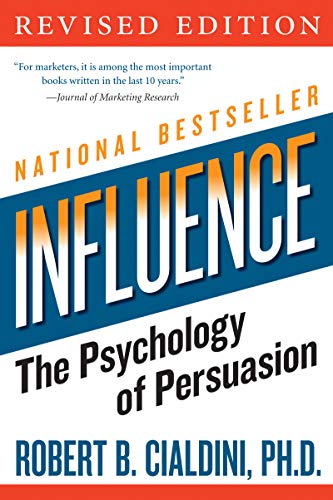 1
1