
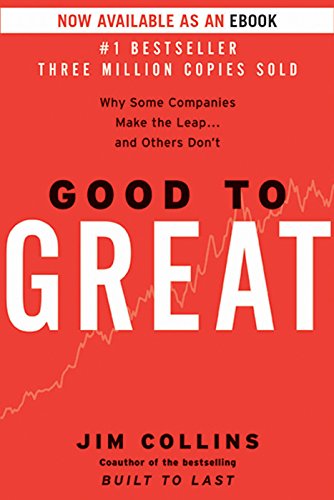
This article is an excerpt from the Shortform summary of "Good to Great" by Jim Collins. Shortform has the world's best summaries of books you should be reading.
Like this article? Sign up for a free trial here .
In Good to Great, former Stanford business professor Jim Collins offers a primer on turning the average into the exceptional. Through detailed case studies of 11 companies that went from tracking the market to exceeding it by at least 3x, Collins presents the key factors that separate merely good organizations from great ones—from rare leadership to disciplined thinking to the dogged pursuit of a core mission.
Whether you’re an entrepreneur, a manager, or just an individual looking to improve, the concepts in Good to Great provide food for thought—and spurs to action. We’ll cover six qualities of a good business that evolve into great ones below.
Originally Published: December 30, 2019
Last Updated: January 26, 2026
What Distinguished the Great Companies From the Good Ones?
According to Collins, the great companies followed six essential principles that led to their sustained success:
1. Cultivating Singular Leadership
Collins says that the first quality of a good business becoming great is that they have “Level 5” leaders. He explains that there are five levels of contributors in a company:
- Level 1: A capable individual contributor
- Level 2: A productive team member
- Level 3: An effective manager
- Level 4: A leader who can inspire subordinates
- Level 5: An exceptional leader
Collins describes Level 5 leaders as humble, almost shy, but highly driven professionally. They avoid the limelight and tend to credit external forces or colleagues for their companies’ successes. Although they’re often likable and inspiring, they’re not usually “charismatic.” Their lack of ego enables them to concentrate on the company’s success, not their own.
How to Achieve It
Collins acknowledges that Level 5 characteristics are likely a product of both nature and nurture, and so are difficult to create out of whole cloth; he also doesn’t have hard data to back up any suggestions he might make. His best advice for aspiring Level 5 leaders is to follow the other principles he outlines. That way, even if you aren’t a Level 5 leader, you’ll at least be acting like one.
2. Assembling the Right Team
The second principle behind good-to-great companies is they recruit and retain the right people before embarking on any specific program. Collins argues that when good people come on board before a new direction is unveiled, they’re signing on because of who else is on board. This means that if the company has to change direction down the road, these team members will stick with you—because it was never about the direction in the first place.
Collins adds that a good-to-great team is composed of people who care deeply about the company and will argue passionately for the decisions they believe are right (but will come together to support whatever decision is eventually reached). At all costs, avoid the “genius with a thousand helpers” model; management teams should be composed of independent and critical thinkers, not “yes people.”
How to Achieve It
To assemble the right team, Collins offers the following tips:
1) Don’t hire until you’re sure you have the right person.
2) Recognize when you need to make a change (whether by shifting a role or letting someone go) and act swiftly.
3) Assign your best people to your biggest opportunities rather than your biggest problems. That might mean taking a top performer away from a thriving division and transferring them to one you’re aiming to grow.
3. Unearthing and Facing Facts
Collins says the third principle that makes good-to-great companies successful is that leaders are unflinching in the face of facts, no matter how dire—leaders remain stoic yet hopeful, and realistic without turning cynical. Collins adds that in order to respond to facts in this way, leaders cultivate a culture in which facts can be discovered and expressed without fear of reprisal or blame.
For example, in the 1970s, Kroger and A&P were well-established grocery companies that were similarly positioned to take advantage of a new customer demand for a one-stop shopping experience. But whereas Kroger saw the demand for “superstores”—establishments that sold conventional groceries as well as prepared foods and nutritional supplements—and overhauled all their stores, A&P stayed the course. Over the 15-year period that Collins and his team evaluated, Kroger generated 80 times the returns of A&P. Collins says A&P had the facts: It rolled out an experimental superstore that was a success, but management chose to stick to what worked for the company in the past rather than adjust to a changing marketplace.
How to Achieve It
With the right management team—one comprising sharp, critical thinkers—the facts should never be in short supply. Collins says leaders can encourage truth-telling by:
1) Beginning meetings with questions, not answers. Leaders should ask their team tough questions to unearth information and insight.
2) Cultivating, rather than stifling, debate among the team. Collins says that some executives solicit input from their team just to give them a sense of being heard, even though they’re determined to pursue the direction they already had in mind. He says leaders should instead encourage dissent that has real implications on company strategy.
3) Analyzing mistakes without assigning blame. Collins says evaluating failures in this way ensures that the same errors aren’t made twice.
4. Thinking Like a Hedgehog
Collins says the fourth principle behind good-to-great companies is hedgehog thinking. He explains that people can be divided into foxes and hedgehogs: Foxes know many things and see the world in all its complexity, whereas hedgehogs know one big thing and order the world according to that thing. Leaders of good-to-great companies think like a hedgehog.
Collins adds that good-to-great leaders develop a “Hedgehog Concept”—an elegant, easy-to understand guiding philosophy based on facts—that the company adheres to fanatically.
For example, Walgreens’ concept was to build the most convenient drugstores with the highest profit per customer visit in the industry. Once that was established, they built stores on corners rather than midblock, clustered stores in high-traffic areas, provided drive-through pharmacy services, and added highly profitable services like one-hour photo development. In contrast, its competitor Eckerd had no unifying concept for growth and even tried getting into the home-video industry, eventually leading to its collapse.
How to Achieve It
Collins says you can derive your company’s Hedgehog Concept from the answer(s) to three questions:
Question 1: What can you do better than anyone else in the world? Collins says that if you can’t be the best in the world in a particular area, even if it’s your core business, then it can’t be part of your Hedgehog Concept.
Question 2: What’s your economic engine? Good-to-great companies have sharp insight into the fundamental economics of what aspect of their business will drive profits. The ones in Collins’s research formulated a single economic denominator, such as “profit per X,” and aligned their strategy around that ratio. The challenge was to define the correct X to produce the correct strategy.
For example, while banks used to focus on profit per loan, Wells Fargo changed tack in the era of deregulation and focused on profit per employee.
Question 3: What are you passionate about? Collins says good-to-great companies certainly want to maximize profits, but they also choose opportunities that inspire their people.
5. Maintaining Discipline
The fifth principle behind good-to-great companies is that they create and maintain discipline, meaning they constantly refer to and consistently realize their Hedgehog Concepts. Collins contends that rigorous adherence to a Hedgehog Concept saves companies from panic acquisitions or misguided projects.
Collins clarifies that discipline does not mean a tyranny presided over by the executive. Rather than having an executive who imposes and enforces discipline, good-to-great companies have a culture of discipline permeating the organization. With a solid understanding of the company’s Hedgehog Concept, individuals can police themselves and make sound decisions without layers of bureaucracy.
How to Achieve It
Collins says you can maintain discipline by doing the following:
1) Allow individuals freedom within a clear framework of responsibility.
2) Retain self-disciplined people who are driven to produce results.
3) Recognize that a disciplined culture is different from a culture led by a tyrant or disciplinarian.
4) Adhere fanatically to hedgehog thinking. A key technique for staying true to your Hedgehog Concept is to create a “stop doing” list, meaning if an activity doesn’t serve your Hedgehog Concept, you should stop doing it.
6. Using Technology Tactically
The sixth principle behind good-to-great companies is that they engage with groundbreaking technologies in a very specific way. Rather than betting the house on the technology itself, they think deeply about how the technology can serve the company’s Hedgehog Concept. In other words, good-to-great companies don’t use technology to create growth but to accelerate it. In contrast, other companies fear being left behind, so they adopt new technology as a reflex without methodical thought.
How to Achieve It
Collins says that when evaluating a new technology, the key question to ask is: Does this technology impact my Hedgehog Concept? If it doesn’t, you can safely ignore it and/or adopt it just enough to keep pace. If it does support your Hedgehog Concept, you must figure out how you can lead in the application of that technology.
———End of Preview———
Like what you just read? Read the rest of the world's best summary of "Good to Great" at Shortform . Learn the book's critical concepts in 20 minutes or less .
Here's what you'll find in our full Good to Great summary :
- The 3 key attributes of Great companies
- Why it's better to focus on your one core strength than get spread thin
- How to build a virtuous cycle, or flywheel effect, in your business