
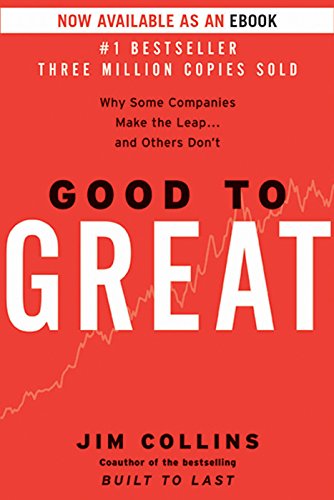
This article is an excerpt from the Shortform summary of "Good to Great" by Jim Collins. Shortform has the world's best summaries of books you should be reading.
Like this article? Sign up for a free trial here .
What is Jim Collins’s “hedgehog concept”? A hedgehog concept is a simple concept in response to the complex facts of reality. The principle was introduced by Jim Collins in his book Good to Great, in which he argues that truly great companies are oriented around a hedgehog concept.
If you think thinking like a hedgehog can help your company in the long run, we have a breakdown of Collins’s advice on using the principle to your advantage. We’ll cover the Good to Great hedgehog concept, examples, and the questions to ask yourself and your team to find your own hedgehog concept.
Originally Published: December 22, 2019
Last Updated: January 22, 2026
Top-Line Takeaways
- Hedgehog concepts don’t strike like lightning bolts, but rather develop through an iterative process of debate, decision, and analysis.
- The hedgehog principle says that people can be divided into foxes and hedgehogs: Foxes know many things and engage with a complex world on its own terms; hedgehogs know one big thing and subsume the world’s complexity to a single, simple, unifying idea.
- This division is based on the parable of the fox and the hedgehog: whereas the clever fox is forever coming up with new ways to attack the hedgehog, the hedgehog always defends itself the same effective way: by curling up into an untouchable ball of spikes.
- Good-to-great leaders are hedgehogs—they develop a simple concept in response to the facts of reality and pursue that concept vigorously and with singular focus. The concepts they develop are hedgehog concepts.
- Collins et al. determined that “hedgehog concepts” emerge from a Venn diagram consisting of three key questions: What can I do better than anyone else in the world? What is my financial engine? And: What am I profoundly passionate about?
Thinking Like a Hedgehog
Collins says a key principle behind good-to-great companies is hedgehog thinking. He explains that people can be divided into foxes and hedgehogs: Foxes know many things and see the world in all its complexity, whereas hedgehogs know one big thing and order the world according to that thing. Leaders of good-to-great companies think like a hedgehog.
(Shortform note: Some experts argue against rigidly adhering to hedgehog thinking. They reason that hedgehogs are single-minded and determined, but foxes are agile—they’re more attuned to uncertainties and more readily adapt to a fast-changing environment. Thus, you should adjust your approach to the situation, or even try to be both a fox and a hedgehog at the same time.)
Collins adds that good-to-great leaders develop a “Hedgehog Concept”—an elegant, easy-to understand guiding philosophy based on facts—that the company adheres to fanatically. (Shortform note: Collins’s Hedgehog Concept is similar to the Japanese concept of ikigai, or a person’s reason for being. In Ikigai & Kaizen, Anthony Raymond explains that it combines four elements: what you love doing, what you’re good at or willing to become good at, what benefits others, and what can make money. While ikigai is meant for your personal purpose, you can apply the idea to an organization by considering the company’s intrinsic motivation, its core competencies and resources, and the needs of the market.)
For example, Walgreens’ concept was to build the most convenient drugstores with the highest profit per customer visit in the industry. Once that was established, they built stores on corners rather than midblock, clustered stores in high-traffic areas, provided drive-through pharmacy services, and added highly profitable services like one-hour photo development. In contrast, its competitor Eckerd had no unifying concept for growth and even tried getting into the home-video industry, eventually leading to its collapse.
(Shortform note: Walgreens has since been in decline, with billions of dollars in losses and 1,200 stores shuttered in 2024. As of 2025, it was also set to be taken off the US stock market after 98 years. But unlike Eckerd, its downfall wasn’t caused by a lack of a unifying concept; rather, experts say it’s a combination of factors, including losses due to theft, poor acquisitions, and shrinking profits as a result of competition as well as stricter insurance requirements.)
How to Achieve It
Collins says you can derive your company’s Hedgehog Concept from the answer(s) to three questions:
Question 1: What can you do better than anyone else in the world? Collins says that if you can’t be the best in the world in a particular area, even if it’s your core business, then it can’t be part of your Hedgehog Concept.
(Shortform note: To help you determine if you can become the best in a particular area, use your most formidable competitor as a benchmark. In Playing to Win, A.G. Lafley and Roger Martin say you should ask: “What are they doing that I’m not? How are they serving people better than I am? How can I overtake them?” Note that your strongest competitor might not be the most obvious one. For example, if you’re running a tech startup, your direct competitor in the beginning likely isn’t Google—it might be a much smaller company that’s targeting the same section of the market as you.)
Question 2: What’s your economic engine? Good-to-great companies have sharp insight into the fundamental economics of what aspect of their business will drive profits. The ones in Collins’s research formulated a single economic denominator, such as “profit per X,” and aligned their strategy around that ratio. The challenge was to define the correct X to produce the correct strategy.
(Shortform note: Collins’s economic engine identifies the long-term driver of profitability for a mature company. But if you’re running a startup, consider identifying short-term indicators that reflect whether your company is learning and progressing toward a sustainable model. In The Lean Startup, Eric Ries says you should identify actionable metrics, which are the true drivers of a company’s growth and guide product development, customer acquisition, and business viability. He warns against using vanity metrics—like total users or downloads—which look impressive but don’t meaningfully predict future success.)
For example, while banks used to focus on profit per loan, Wells Fargo changed tack in the era of deregulation and focused on profit per employee. (Shortform note: While this approach was successful during Collins’s research period, it may have contributed to the Wells Fargo cross-selling scandal in 2013: Bank employees, under pressure to meet aggressive sales targets, created millions of fake accounts for customers without their consent.)
Question 3: What are you passionate about? Collins says good-to-great companies certainly want to maximize profits, but they also choose opportunities that inspire their people. (Shortform note: In Built to Last, Collins and Porras write that visionary companies are able to maximize profits while pursuing other objectives. This is because they don’t limit themselves with the view that they must choose between seemingly contradictory choices A or B. Instead, they figure out how to have A and B. For example, they don’t choose between change or stability, or investing in the long-term or doing well in the short-term; they find a way to achieve both.)
———End of Preview———
Like what you just read? Read the rest of the world's best summary of "Good to Great" at Shortform . Learn the book's critical concepts in 20 minutes or less .
Here's what you'll find in our full Good to Great summary :
- The 3 key attributes of Great companies
- Why it's better to focus on your one core strength than get spread thin
- How to build a virtuous cycle, or flywheel effect, in your business