We've ranked the best world books using expert recommendations, sales data, and millions of reader ratings. At Shortform, we know books. Our book guides are the best in the world. Learn why.
Cover unavailable
1
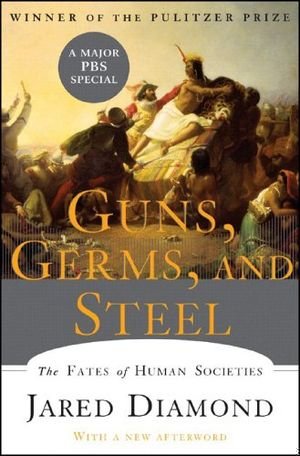
Guns, Germs and Steel: The Fates of Human Societies
Explaining what William McNeill called The Rise of the West has become the central problem in the study of global history. In Guns, Germs, and Steel Jared Diamond presents the biologist's answer: geography, demography, and ecological happenstance. Diamond evenhandedly reviews human history on every continent since the Ice Age at a rate that emphasizes only the broadest movements of peoples and ideas. Yet his survey is binocular: one eye has the rather distant vision of the evolutionary biologist, while the other eye--and his heart--belongs to the people of New Guinea, where he has done field work for more than 30 years.
Fascinating.... Lays a foundation for understanding human history. [source]
Daniel Ek
A brilliant Pulitzer Prize-winning book about how the modern world was formed, analyzing how societies developed differently on different continents. [source]
I’m a fan of books that challenge our assumptions, and Diamond offers us a new and remarkably simple way of looking at our world. Learning to challenge existing assumptions is core to effective leadership for it trains us to keep an open mind. [source]
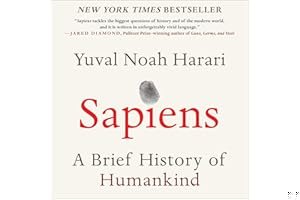
100,000 years ago, at least six human species inhabited the earth. Today there is just one. Us. Homo sapiens.
How did our species succeed in the battle for dominance? Why did our foraging ancestors come together to create cities and kingdoms? How did we come to believe in gods, nations and human rights; to trust money, books and laws; and to be enslaved by bureaucracy, timetables and consumerism? And what will our world be like in the millennia to come?
In Sapiens, Dr Yuval Noah Harari spans the whole of human history, from the very first humans to walk the earth to the radical – and sometimes devastating – breakthroughs of the Cognitive, Agricultural and Scientific Revolutions. Drawing on insights from biology, anthropology, paleontology and economics, he explores how the currents of history have shaped our human societies, the animals and plants around us, and even our personalities. Have we become happier as history has unfolded? Can we ever free our behaviour from the heritage of our ancestors? And what, if anything, can we do to influence the course of the centuries to come?
Bold, wide-ranging and provocative, Sapiens challenges everything we thought we knew about being human: our thoughts, our actions, our power ... and our future.
Both Melinda and I read this one, and it has sparked lots of great conversations at our dinner table. Harari takes on a daunting challenge: to tell the entire history of the human race in just 400 pages. He also writes about our species today and how artificial intelligence, genetic engineering, and other technologies will change us in the future. Although I found things to disagree with—especially Harari’s claim that humans were better off before we started farming—I would recommend Sapiens to anyone who’s interested in the history and future of our species. [source]
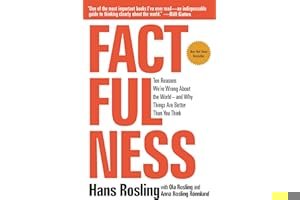
Factfulness: The stress-reducing habit of only carrying opinions for which you have strong supporting facts.
When asked simple questions about global trends—what percentage of the world’s population live in poverty; why the world’s population is increasing; how many girls finish school—we systematically get the answers wrong. So wrong that a chimpanzee choosing answers at random will consistently outguess teachers, journalists, Nobel laureates, and investment bankers.
In Factfulness, Professor of International Health and global TED phenomenon Hans Rosling, together with his two long-time collaborators, Anna and Ola, offers a radical new explanation of why this happens. They reveal the ten instincts that distort our perspective—from our tendency to divide the world into two camps (usually some version of us and them) to the way we consume media (where fear rules) to how we perceive progress (believing that most things are getting worse).
Our problem is that we don’t know what we don’t know, and even our guesses are informed by unconscious and predictable biases.
It turns out that the world, for all its imperfections, is in a much better state than we might think. That doesn’t mean there aren’t real concerns. But when we worry about everything all the time instead of embracing a worldview based on facts, we can lose our ability to focus on the things that threaten us most.
Inspiring and revelatory, filled with lively anecdotes and moving stories, Factfulness is an urgent and essential book that will change the way you see the world and empower you to respond to the crises and opportunities of the future.
As 2018 draws to a close, I’m continuing a favorite tradition of mine and sharing my year-end lists. It gives me a moment to pause and reflect on the year through the books I found most thought-provoking, inspiring, or just plain loved. It also gives me a chance to highlight talented authors – some who are household names and others who you may not have heard of before. Here’s my best of 2018 list. [source]
This was a breakthrough to me. The framework Hans enunciates is one that took me decades of working in global development to create for myself, and I could have never expressed it in such a clear way. I’m going to try to use this model moving forward. [source]
Aidan Connolly
I would suggest Hans Rosling’s Factfulness on the real world of statistics. [source]
Cover unavailable
4
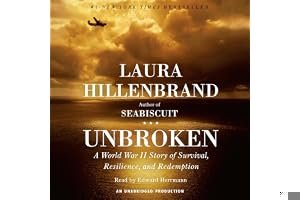
Unbroken: A World War II Story of Survival, Resilience and Redemption
In her long-awaited new book, Laura Hillenbrand writes with the same rich and vivid narrative voice she displayed in Seabiscuit. Telling an unforgettable story of a man's journey into extremity, Unbroken is a testament to the resilience of the human mind, body, and spirit.
On a May afternoon in 1943, an Army Air Forces bomber crashed into the Pacific Ocean and disappeared, leaving only a spray of debris and a slick of oil, gasoline, and blood. Then, on the ocean surface, a face appeared. It was that of a young lieutenant, the plane's bombardier, who was struggling to a life raft and pulling himself aboard. So began one of the most extraordinary odysseys of the Second World War.
The lieutenant’s name was Louis Zamperini. In boyhood, he'd been a cunning and incorrigible delinquent, breaking into houses, brawling, and fleeing his home to ride the rails. As a teenager, he had channeled his defiance into running, discovering a prodigious talent that had carried him to the Berlin Olympics and within sight of the four-minute mile. But when war had come, the athlete had become an airman, embarking on a journey that led to his doomed flight, a tiny raft, and a drift into the unknown.
Ahead of Zamperini lay thousands of miles of open ocean, leaping sharks, a foundering raft, thirst and starvation, enemy aircraft, and, beyond, a trial even greater. Driven to the limits of endurance, Zamperini would answer desperation with ingenuity; suffering with hope, resolve, and humor; brutality with rebellion. His fate, whether triumph or tragedy, would be suspended on the fraying wire of his will.
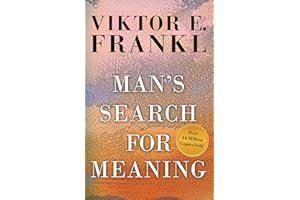
Man's Search for Meaning has riveted generations of readers with its descriptions of life in Nazi death camps and its lessons for spiritual survival. Between 1942 and 1945 psychiatrist Viktor Frankl labored in four different camps, including Auschwitz, while his parents, brother, and pregnant wife perished. Based on his own experience and the stories of his many patients, Frankl argues that we cannot avoid suffering but we can choose how to cope with it, find meaning in it, and move forward with renewed purpose. Frankl's theory—known as logotherapy, from the Greek word logos ("meaning")—holds that our primary drive in life is not pleasure, as Freud maintained, but the discovery and pursuit of what we personally find meaningful. In the decades since its first publication in 1959, Man's Search for Meaning has become a classic, with more than twelve million copies in print around the world. A 1991 Library of Congress survey that asked readers to name a "book that made a difference in your life" found Man's Search for Meaning among the ten most influential books in America. At once a memoir, a meditation, a treatise, and a history, it continues to inspire us all to find significance in the very act of living. (back cover)
…
Recommended by Tony Robbins, Dustin Moskovitz, Ev Williams, and 60 others.
Another book that I’ve read dozens of times. It taught me that if you change the meaning, you change everything. Meaning equals emotion, and emotion equals life. [source]
Dustin Moskovitz
Co-founder/Facebook and Asana
Dustin Moskovitz recommended this book on Twitter. [source]
I read it while spending ten days in the ICU of Bellevue hospital trying to reattach my finger from a ring avulsion accident in my kitchen. It talks about the meaning of life, and I believe you come out a better person from reading it. [source]
Paulo Coelho's enchanting novel has inspired a devoted following around the world. This story, dazzling in its powerful simplicity and inspiring wisdom, is about an Andalusian shepherd boy named Santiago who travels from his homeland in Spain to the Egyptian desert in search of a treasure buried in the Pyramids. What starts out as a journey to find worldly goods turns into a discovery of the treasure found within. Lush, evocative, and deeply humane, the story of Santiago is an eternal testament to the transforming power of our dreams and the importance of listening to our hearts.
There's a great quote in this book: When you're on the right path the universe conspires to help you! [source]
Daniel Ek
It was fascinating to talk to the author about how this book came to be such a hit—he never backed down, and he allowed people to read it for free in order to then boost sales—much like how Spotify’s freemium model was perceived in the early days. [source]
Eric Ripert
Speaks of everyone having an ultimate goal in life, but most of us are too afraid to pursue it. The encouragement to fulfill your dreams is very inspirational! [source]
In Everyman’s Library for the first time—one of the most moving and eloquent accounts of the Holocaust, read by tens of millions of people around the world since its publication in 1947. The Diary of a Young Girl is the record of two years in the life of a remarkable Jewish girl whose triumphant humanity in the face of unfathomable deprivation and fear has made the book one of the most enduring documents of our time.
The Everyman’s hardcover edition reprints the Definitive Edition authorized by the Frank estate, plus a new introduction, a bibliography, and a chronology of Anne Frank’s life and times.
…
Recommended by Alice Little, Catalina Penciu, and Tim Fargo.
Alice Little
I remember being a fourth grader and trying to check out this book and being told it was grossly inappropriate and going so far as to have my parents take it to the school board and petition for me to be allowed to read this book. [source]
Catalina Penciu
I'm a huge fan of personal stories and biographies like this one. [source]
Tim Fargo
@Quixoticnance Good point, Nancy. The museum is a powerful experience, esp. when you've read her book. [source]
Cover unavailable
8
The Kite Runner
Khaled Hosseini and Simon & Schuster Audi
4.7
The unforgettable, heartbreaking story of the unlikely friendship between a wealthy boy and the son of his father’s servant, The Kite Runner is a beautifully crafted novel set in a country that is in the process of being destroyed. It is about the power of reading, the price of betrayal, and the possibility of redemption; and an exploration of the power of fathers over sons—their love, their sacrifices, their lies.
A sweeping story of family, love, and friendship told against the devastating backdrop of the history of Afghanistan over the last thirty years, The Kite Runner is an unusual and powerful novel that has become a beloved, one-of-a-kind classic. --khaledhosseini.com
…
Recommended by James Altucher, Ann Miura-Ko, Magda Marcu, and 1 others.
Ann Miura-Ko recommended this book on the podcast "The Tim Ferriss Show". [source]
Magda Marcu
I’m currently reading “The Kite Runner”. I never have expectations from books, I let them surprise me as I get into the story. Learning about characteristics of different cultures, in this case the Afghan one, it’s one aspect I am interested in. [source]
Cover unavailable
9
The Book Thief
Markus Zusak
4.6
It is 1939. Nazi Germany. The country is holding its breath. Death has never been busier, and will be busier still.
By her brother's graveside, Liesel's life is changed when she picks up a single object, partially hidden in the snow. It is The Gravedigger's Handbook, left behind there by accident, and it is her first act of book thievery. So begins a love affair with books and words, as Liesel, with the help of her accordian-playing foster father, learns to read. Soon she is stealing books from Nazi book-burnings, the mayor's wife's library, wherever there are books to be found.
But these are dangerous times. When Liesel's foster family hides a Jew in their basement, Liesel's world is both opened up, and closed down.
In superbly crafted writing that burns with intensity, award-winning author Markus Zusak has given us one of the most enduring stories of our time.
A Thousand Splendid Suns is a breathtaking story set against the volatile events of Afghanistan's last thirty years—from the Soviet invasion to the reign of the Taliban to post-Taliban rebuilding—that puts the violence, fear, hope, and faith of this country in intimate, human terms. It is a tale of two generations of characters brought jarringly together by the tragic sweep of war, where personal lives—the struggle to survive, raise a family, find happiness—are inextricable from the history playing out around them.
Propelled by the same storytelling instinct that made The Kite Runner a beloved classic, A Thousand Splendid Suns is at once a remarkable chronicle of three decades of Afghan history and a deeply moving account of family and friendship. It is a striking, heart-wrenching novel of an unforgiving time, an unlikely friendship, and an indestructible love—a stunning accomplishment. --front flap
I would encourage people to read it because it gives you a sense of Afghanistan’s incredible history and the role women have played within that history [source]
Cover unavailable
11
Why Nations Fail: The Origins of Power, Prosperity, and Poverty
Brilliant and engagingly written, Why Nations Fail answers the question that has stumped the experts for centuries: Why are some nations rich and others poor, divided by wealth and poverty, health and sickness, food and famine?
Is it culture, the weather, geography? Perhaps ignorance of what the right policies are?
Simply, no. None of these factors is either definitive or destiny. Otherwise, how to explain why Botswana has become one of the fastest growing countries in the world, while other African nations, such as Zimbabwe, the Congo, and Sierra Leone, are mired in poverty and violence?
Daron Acemoglu and James Robinson conclusively show that it is man-made political and economic institutions that underlie economic success (or lack of it). Korea, to take just one of their fascinating examples, is a remarkably homogeneous nation, yet the people of North Korea are among the poorest on earth while their brothers and sisters in South Korea are among the richest. The south forged a society that created incentives, rewarded innovation, and allowed everyone to participate in economic opportunities. The economic success thus spurred was sustained because the government became accountable and responsive to citizens and the great mass of people. Sadly, the people of the north have endured decades of famine, political repression, and very different economic institutions—with no end in sight. The differences between the Koreas is due to the politics that created these completely different institutional trajectories.
Based on fifteen years of original research Acemoglu and Robinson marshall extraordinary historical evidence from the Roman Empire, the Mayan city-states, medieval Venice, the Soviet Union, Latin America, England, Europe, the United States, and Africa to build a new theory of political economy with great relevance for the big questions of today, including:
- China has built an authoritarian growth machine. Will it continue to grow at such high speed and overwhelm the West? - Are America’s best days behind it? Are we moving from a virtuous circle in which efforts by elites to aggrandize power are resisted to a vicious one that enriches and empowers a small minority? - What is the most effective way to help move billions of people from the rut of poverty to prosperity? More philanthropy from the wealthy nations of the West? Or learning the hard-won lessons of Acemoglu and Robinson’s breakthrough ideas on the interplay between inclusive political and economic institutions?
Why Nations Fail will change the way you look at—and understand—the world.
"I read two books that raise big, interesting questions about social change and technological progress. I’m planning to write longer reviews of each of these books, but let me flag them for you now. One is Why Nations Fail: The Origins of Power, Prosperity, and Poverty by Daron Acemoglu and James A. Robinson.The topic of this book is why some countries have prospered and created great living conditions for their citizens while others have not. This is an important topic, which I care a lot about. The book makes an appealing argument that economic development depends on political institutions that protect individual rights. It is well written and very easy to read with lots of interesting historical stories about different countries. But it is a major disappointment. Its analysis is vague and simplistic. I’ll explain more in a longer review." [source]
My next book for A Year of Books is Why Nations Fail by Daron Acemoğlu and James A. Robinson. This book explores the different kinds of social institutions and incentives that nations have applied to encourage prosperity, economic development and elimination of poverty. This is a good complement to our last book, Portfolios of the Poor, which focused on how people live in poverty. This one discusses why poverty exists and how to reduce it. [source]
In terms of understanding this top inequality, I mentioned the possibility that it might be about politics. How should we think about politics? What are the levers of politics? For that we need a conceptual framework and that’s what this book tries to provide. It’s co-authored with my long-term collaborator and friend Jim Robinson – and it’s not about US or UK or Canadian inequality. It runs through several thousand years of history, and tries to explain how societies work and why, often, they fail to generate prosperity for their citizens. It’s a very political story. [source]
Cover unavailable
12
Born a Crime: Stories from a South African Childhood
Trevor Noah’s unlikely path from apartheid South Africa to the desk of The Daily Show began with a criminal act: his birth. Trevor was born to a white Swiss father and a black Xhosa mother at a time when such a union was punishable by five years in prison. Living proof of his parents’ indiscretion, Trevor was kept mostly indoors for the earliest years of his life, bound by the extreme and often absurd measures his mother took to hide him from a government that could, at any moment, steal him away. Finally liberated by the end of South Africa’s tyrannical white rule, Trevor and his mother set forth on a grand adventure, living openly and freely and embracing the opportunities won by a centuries-long struggle.
…
Recommended by Bill Gates, Heather Zynczak, Irina Nica, and 3 others.
As a longtime fan of The Daily Show, I loved reading this memoir about how its host honed his outsider approach to comedy over a lifetime of never quite fitting in. Born to a black South African mother and a white Swiss father in apartheid South Africa, he entered the world as a biracial child in a country where mixed race relationships were forbidden. Much of Noah’s story of growing up in South Africa is tragic. Yet, as anyone who watches his nightly monologues knows, his moving stories will often leave you laughing. [source]
Heather Zynczak
So excited for our latest speaker announcement for #PSLIVE19! Trevor Noah! I am a huge @TheDailyShow fan! And his book -Born a Crime -and life story are amazing. Can't wait! Join us! https://t.co/N6ykJq7TOy https://t.co/r0dIx5RFVI [source]
Irina Nica
I also pay attention to any book recommendations my friends post on Facebook. I started reading Trevor Noah’s Born a Crime after I saw Radu Marcusu, CEO of Upswing, recommending it. He swore by it that is was funny -- and it was! Until the last chapter. I remember listening to the audiobook on a train and crying my eyes out. So yeah. That happened. [source]
Cover unavailable
13
Night
Elie Wiesel
4.5
Night is Elie Wiesel's masterpiece, a candid, horrific, and deeply poignant autobiographical account of his survival as a teenager in the Nazi death camps. This new translation by Marion Wiesel, Elie's wife and frequent translator, presents this seminal memoir in the language and spirit truest to the author's original intent. And in a substantive new preface, Elie reflects on the enduring importance of Night and his lifelong, passionate dedication to ensuring that the world never forgets man's capacity for inhumanity to man.
Night offers much more than a litany of the daily terrors, everyday perversions, and rampant sadism at Auschwitz and Buchenwald; it also el
…
Recommended by Johanna Reiss and Steven Katz.
Johanna Reiss
Elie Wiesel wrote..that he was considering running into the barbed wire once, but he didn’t because his father needed him. [source]
Steven Katz
Probably the best known memoir that has been written about the experience of the death camps. [source]
Cover unavailable
14
Slaughterhouse-Five
Kurt Vonnegut and Kevin Power
4.5
Selected by the Modern Library as one of the 100 best novels of all time, Slaughterhouse-Five, an American classic, is one of the world's great antiwar books. Centering on the infamous firebombing of Dresden, Billy Pilgrim's odyssey through time reflects the mythic journey of our own fractured lives as we search for meaning in what we fear most.
Recommended by Bernard Tan, Carlos Eire, and Dan Christensen.
Bernard Tan
I’m also a Murakami and Vonnegut fan, Kafka on the Shore, The Wind-up Bird Chronicle, Norwegian Wood, Slaughterhouse-Five, etc. Now that I look at the books listed, they seem to carry an existential theme. I guess I like to understand humanity and human behaviour ultimately to better understand myself. I find reading a means to connect with people who may have lived before my time, or in a distant country, that I may never have had the chance to connect with in real life. As three-dimensional humans, we are all made up of so many faces and emotional layers that we find it hard to dissect them all, and when we find writers who can explain these thought processes in a way that’s tangible and digestible, there’s this incredibly comforting eureka moment of feeling understood. [source]
Carlos Eire
Even though he is no philosopher Vonnegut is still able to ask the questions that all of us think about – how time affects our lives. [source]
THINGS FALL APART tells two overlapping, intertwining stories, both of which center around Okonkwo, a “strong man” of an Ibo village in Nigeria. The first of these stories traces Okonkwo's fall from grace with the tribal world in which he lives, and in its classical purity of line and economical beauty it provides us with a powerful fable about the immemorial conflict between the individual and society.
The second story, which is as modern as the first is ancient, and which elevates the book to a tragic plane, concerns the clash of cultures and the destruction of Okonkwo's world through the arrival of aggressive, proselytizing European missionaries. These twin dramas are perfectly harmonized, and they are modulated by an awareness capable of encompassing at once the life of nature, human history, and the mysterious compulsions of the soul. THINGS FALL APART is the most illuminating and permanent monument we have to the modern African experience as seen from within.
…
Recommended by Barack Obama, Helon Habila, Jacqueline Novogratz, and 2 others.
As 2018 draws to a close, I’m continuing a favorite tradition of mine and sharing my year-end lists. It gives me a moment to pause and reflect on the year through the books I found most thought-provoking, inspiring, or just plain loved. It also gives me a chance to highlight talented authors – some who are household names and others who you may not have heard of before. Here’s my best of 2018 list. [source]
Helon Habila
It almost feels like a cliché to say that this is one of my favourite books. But there is no way you can escape this book. It is such a part of African literature. It is an inescapable classic. It is a brilliant feat of storytelling, the economy of it, the brevity, the imagery, the ear he has for the traditional language. [source]
Jacqueline Novogratz
The first book I read by an African author. Achebe is unflinching in his portrayal of the challenges of change, the relationships of colonialism, and power/powerlessness. [source]
Cover unavailable
16
Catch-22
Joseph Heller, Christopher Buckley
4.5
This fiftieth-anniversary edition commemorates Joseph Heller’s masterpiece with a new introduction; critical essays and reviews by Norman Mailer, Alfred Kazin, Anthony Burgess, and others; rare papers and photos; and much more.
Nominated as one of America’s best-loved novels by PBS’s The Great American Read.
Now a Hulu limited series starring Christopher Abbott, George Clooney, Kyle Chandler, and Hugh Laurie.
Fifty years after its original publication, Catch-22 remains a cornerstone of American literature and one of the funniest—and most celebrated—books of all time. In recent years it has been named to “best novels” lists by Time, Newsweek, the Modern Library, and the London Observer.
Set in Italy during World War II, this is the story of the incomparable, malingering bombardier, Yossarian, a hero who is furious because thousands of people he has never met are trying to kill him. But his real problem is not the enemy—it is his own army, which keeps increasing the number of missions the men must fly to complete their service. Yet if Yossarian makes any attempt to excuse himself from the perilous missions he’s assigned, he’ll be in violation of Catch-22, a hilariously sinister bureaucratic rule: a man is considered insane if he willingly continues to fly dangerous combat missions, but if he makes a formal request to be removed from duty, he is proven sane and therefore ineligible to be relieved.
This fiftieth-anniversary edition commemorates Joseph Heller’s masterpiece with a new introduction by Christopher Buckley; a wealth of critical essays and reviews by Norman Mailer, Alfred Kazin, Anthony Burgess, and others; rare papers and photos from Joseph Heller’s personal archive; and much more. Here, at last, is the definitive edition of a classic of world literature.
…
Recommended by Brian Burkhart, Charles Glass, Kate McLoughlin, and 5 others.
Brian Burkhart
This book is a masterpiece and absolutely hilarious. In subtle ways, you realize the main character is questioning not just the notion of authority, but the way authority thinks and how we must react to it. To me, a guy with the core belief “make waves,” it has a great message, which is, “It’s okay to question the status quo.” For people just starting their careers, it’s easy to think our superiors know everything—they’re not quick to admit their insecurities, flaws, and blind spots, but they have them. And having a healthy dose of skepticism isn’t such a terrible thing. Plus, it’s just a fun read. [source]
Charles Glass
It’s one of the funniest books ever written. It’s about the insanity of military life and the absurdity of a big institution. Heller was very good on the absurdity of big institutions. Catch 22 has every character in it that the American military did have at the time and still has today in Iraq and Afghanistan: The money-makers, the crooks, the officers who were trying to claw their way to the top where they get their men killed, the placing in order of priority the pretence of military success at the cost of many civilian lives. [source]
Kate McLoughlin
It gets you to the point where you can’t apply your reason any more and laughter takes over. It’s the laughter of the absurd. [source]
In Bryson's biggest book, he confronts his greatest challenge: to understand—and, if possible, answer—the oldest, biggest questions we have posed about the universe and ourselves. Taking as territory everything from the Big Bang to the rise of civilization, Bryson seeks to understand how we got from there being nothing at all to there being us. To that end, he has attached himself to a host of the world’s most advanced (and often obsessed) archaeologists, anthropologists, and mathematicians, travelling to their offices, laboratories, and field camps. He has read (or tried to read) their books, pestered them with questions, apprenticed himself to their powerful minds. A Short History of Nearly Everything is the record of this quest, and it is a sometimes profound, sometimes funny, and always supremely clear and entertaining adventure in the realms of human knowledge, as only Bill Bryson can render it. Science has never been more involving or entertaining.
…
Recommended by Amanda Palmer, David Goldberg, and Fabrice Grinda.
Amanda Palmer
Amanda Palmer recommended this book in the book "Tools of Titans". [source]
David Goldberg
What I really liked about A Short History of Nearly Everything is that it gives an excellent account of a lot of the personalities and the interconnectedness of important discoveries in cosmology and elsewhere. He does such a great job of bringing together our understanding of cosmology, evolution, paleontology, and geology in a very, very fluid way. [source]
Fabrice Grinda
I have lots of books to recommend, but they are not related to my career path. The only one that is remotely related is Peter Thiel’s Zero to One. That said here are books I would recommend. [source]

Cover unavailable
18
One Hundred Years of Solitude
Gabriel Garcia Marquez
4.5
The brilliant, bestselling, landmark novel that tells the story of the Buendia family, and chronicles the irreconcilable conflict between the desire for solitude and the need for love—in rich, imaginative prose that has come to define an entire genre known as "magical realism."
When asked what books he recommended to his 18-year-old daughter Malia, Obama gave the Times a list that included The Naked and the Dead and One Hundred Years of Solitude. “I think some of them were sort of the usual suspects … I think she hadn’t read yet. Then there were some books that are not on everybody’s reading list these days, but I remembered as being interesting.” Here’s what he included: The Naked and the Dead, Norman Mailer One Hundred Years of Solitude, Gabriel García Márquez The Golden Notebook, Doris Lessing The Woman Warrior, Maxine Hong Kingston [source]
Brace yourselves—One Hundred Years of Solitude by Gabriel García Márquez is as steamy, dense and sensual as the jungle that surrounds the surreal town of Macondo! [source]
Today is World Book Day, a wonderful opportunity to address this #ChallengeRichard sent in by Mike Gonzalez of New Jersey: Make a list of your top 65 books to read in a lifetime. [source]
Cover unavailable
19
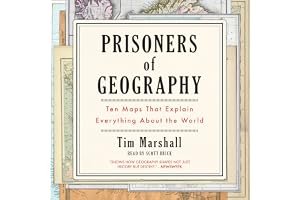
Prisoners of Geography: Ten Maps That Explain Everything About the World
In the bestselling tradition of Why Nations Fail and The Revenge of Geography, an award-winning journalist uses ten maps of crucial regions to explain the geo-political strategies of the world powers.
All leaders of nations are constrained by geography. Their choices are limited by mountains, rivers, seas, and concrete. To understand world events, news organizations and other authorities often focus on people, ideas, and political movements, but without geography, we never have the full picture. Now, in the relevant and timely Prisoners of Geography, seasoned journalist Tim Marshall examines Russia, China, the USA, Latin America, the Middle East, Africa, Europe, Japan and Korea, and Greenland and the Arctic—their weather, seas, mountains, rivers, deserts, and borders—to provide a context often missing from our political reportage: how the physical characteristics of these countries affect their strengths and vulnerabilities and the decisions made by their leaders.
In ten, up-to-date maps of each region, Marshall explains in clear and engaging prose the complex geo-political strategies of these key parts of the globe. What does it mean that Russia must have a navy, but also has frozen ports six months a year? How does this affect Putin’s treatment of Ukraine? How is China’s future constrained by its geography? Why will Europe never be united? Why will America never be invaded? Shining a light on the unavoidable physical realities that shape all of our aspirations and endeavors, Prisoners of Geography is the critical guide to one of the major (and most often overlooked) determining factors in world history.
…
Recommended by Lee Mckenzie, Lucas Morales, and Sunil Chhetri.
Lee Mckenzie
This is a great book and by far the best thing I have read for a while. If you are curious about the world in which we live, geopolitics or just fancy something a little different, you couldn’t do much better than this. Coffee optional! @Itwitius 👏🏻 #prisonersofgeography https://t.co/Gd3G2tDVyT [source]
Lucas Morales
Depending on your interest and goals, if you are like me and always looking for the trends in the big picture then I highly recommend being an active contrarian reader. Read what no one else is reading. Your goal is to think outside the box. To look at the world and ask “why hasn’t this been solved?” And that gives you a roadmap as to what opportunities may exist for your entrepreneurial efforts. So to that, here’s a snapshot, in no particular order, of what might help you push your intellectual boundaries: Born a Crime: Stories from a South African Childhood by Trevor Noah 23 Things They Don't Tell You About Capitalism by Ha-Joon Chang Postcapitalism: A Guide to Our Future by Paul Mason Capital in the Twenty-First Century by Thomas Piketty Who Gets What--And Why: The New Economics of Matchmaking and Market Design by Alvin E. Roth The Political Economy of Participatory Economics by Michael Albert and Robin Hahnel The Zero Marginal Cost Society: The Internet of Things, the Collaborative Commons, and the Eclipse of Capitalism by Jeremy Rifkin Why America Misunderstands the World by Paul R. Pillar A Theory of Justice by John Rawls Prisoners of Geography by Tim Marshall [source]
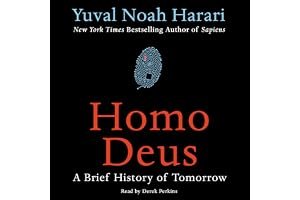
Yuval Noah Harari, author of the critically-acclaimed New York Times bestseller and international phenomenon Sapiens, returns with an equally original, compelling, and provocative book, turning his focus toward humanity’s future, and our quest to upgrade humans into gods.
Over the past century humankind has managed to do the impossible and rein in famine, plague, and war. This may seem hard to accept, but, as Harari explains in his trademark style—thorough, yet riveting—famine, plague and war have been transformed from incomprehensible and uncontrollable forces of nature into manageable challenges. For the first time ever, more people die from eating too much than from eating too little; more people die from old age than from infectious diseases; and more people commit suicide than are killed by soldiers, terrorists and criminals put together. The average American is a thousand times more likely to die from binging at McDonalds than from being blown up by Al Qaeda.
What then will replace famine, plague, and war at the top of the human agenda? As the self-made gods of planet earth, what destinies will we set ourselves, and which quests will we undertake? Homo Deus explores the projects, dreams and nightmares that will shape the twenty-first century—from overcoming death to creating artificial life. It asks the fundamental questions: Where do we go from here? And how will we protect this fragile world from our own destructive powers? This is the next stage of evolution. This is Homo Deus.
With the same insight and clarity that made Sapiens an international hit and a New York Times bestseller, Harari maps out our future.
Harari’s new book is as challenging and readable as Sapiens. Rather than looking back, as Sapiens does, it looks to the future. I don’t agree with everything the author has to say, but he has written a thoughtful look at what may be in store for humanity. [source]
I certainly wouldn’t consider myself a big reader of paleontology or anthropology – not good words for us dyslexics! – but I enjoy learning about how society has unfolded and history has developed in an exciting, easy to read way. The sequel, Homo Deus: A Brief History of Tomorrow, is a fascinating look into the future too. While these aren’t traditional business or leadership books, they are all about people – and learning how to work with, live with, interact with people and get the best out of them is what leadership is all about. [source]
Not that I agree with all of it, but it is still mind-bending speculation about our future as a follow-up to a previous favorite, Sapiens. It’s directionally right. [source]
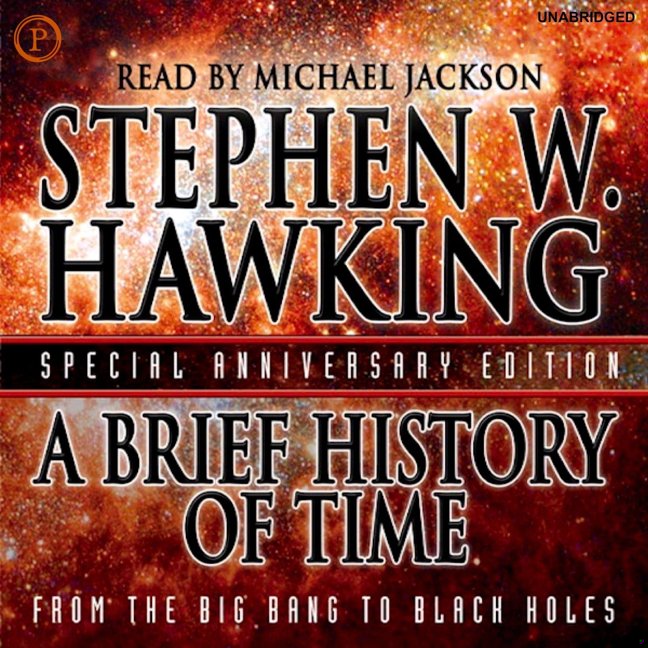
In the ten years since its publication in 1988, Stephen Hawking's classic work has become a landmark volume in scientific writing, with more than nine million copies in forty languages sold worldwide. That edition was on the cutting edge of what was then known about the origins and nature of the universe. But the intervening years have seen extraordinary advances in the technology of observing both the micro- and the macrocosmic worlds. These observations have confirmed many of Professor Hawking's theoretical predictions in the first edition of his book, including the recent discoveries of the Cosmic Background Explorer satellite (COBE), which probed back in time to within 300,000 years of the universe's beginning and revealed wrinkles in the fabric of space-time that he had projected. Eager to bring to his original text the new knowledge revealed by these observations, as well as his own recent research, Professor Hawking has prepared a new introduction to the book, written an entirely new chapter on wormholes and time travel, and updated the chapters throughout.
…
Recommended by Richard Branson, Adam Hart-Davis, Anurag Ramdasan, and 2 others.
Today is World Book Day, a wonderful opportunity to address this #ChallengeRichard sent in by Mike Gonzalez of New Jersey: Make a list of your top 65 books to read in a lifetime. [source]
Adam Hart-Davis
When Stephen Hawking wrote A Brief History of Time..his publisher told him that every equation he left in would halve the number of readers [source]
Anurag Ramdasan
My first intro into the world of physics and this got me completely hooked!
In Sapiens, he explored our past. In Homo Deus, he looked to our future. Now, one of the most innovative thinkers on the planet turns to the present to make sense of today's most pressing issues.
How do computers and robots change the meaning of being human? How do we deal with the epidemic of fake news? Are nations and religions still relevant? What should we teach our children?
Yuval Noah Harari's21 Lessons for the 21st Century is a probing and visionary investigation into today's most urgent issues as we move into the uncharted territory of the future. As technology advances faster than our understanding of it, hacking becomes a tactic of war, and the world feels more polarized than ever, Harari addresses the challenge of navigating life in the face of constant and disorienting change and raises the important questions we need to ask ourselves in order to survive.
In twenty-one accessible chapters that are both provocative and profound, Harari builds on the ideas explored in his previous books, untangling political, technological, social, and existential issues and offering advice on how to prepare for a very different future from the world we now live in: How can we retain freedom of choice when Big Data is watching us? What will the future workforce look like, and how should we ready ourselves for it? How should we deal with the threat of terrorism? Why is liberal democracy in crisis?
Harari's unique ability to make sense of where we have come from and where we are going has captured the imaginations of millions of readers. Here he invites us to consider values, meaning, and personal engagement in a world full of noise and uncertainty. When we are deluged with irrelevant information, clarity is power. Presenting complex contemporary challenges clearly and accessibly, 21 Lessons for the 21st Century is essential reading.
…
Recommended by Bill Gates, Brajesh Kumar Singh, Eh Bee Family, and 2 others.
Harari is such a stimulating writer that even when I disagreed, I wanted to keep reading and thinking. All three of his books wrestle with some version of the same question: What will give our lives meaning in the decades and centuries ahead? So far, human history has been driven by a desire to live longer, healthier, happier lives. If science is eventually able to give that dream to most people, and large numbers of people no longer need to work in order to feed and clothe everyone, what reason will we have to get up in the morning? It’s no criticism to say that Harari hasn’t produced a satisfying answer yet. Neither has anyone else. So I hope he turns more fully to this question in the future. In the meantime, he has teed up a crucial global conversation about how to take on the problems of the 21st century. [source]
Brajesh Kumar Singh
Harari, currently, the world's best historian and future analyst, is a gay! He is a Jew and writes his books in Hebrew! Got universal acclaim for his first book Sapiens, followed by Homo Deus and now the latest, 21 lessons for the 21st century! Salute to this genius, keep it up! https://t.co/s7R6oEbwiN [source]
Eh Bee Family
@harari_yuval This book is amazing. After every chapter...I pause...then freak out...then gather myself and keep reading. [source]
Cover unavailable
23
Americanah
Chimamanda Ngozi Adichie
4.4
Ifemelu and Obinze are young and in love when they depart military-ruled Nigeria for the West. Beautiful, self-assured Ifemelu heads for America, where despite her academic success, she is forced to grapple with what it means to be black for the first time. Quiet, thoughtful Obinze had hoped to join her, but with post-9/11 America closed to him, he instead plunges into a dangerous, undocumented life in London. Fifteen years later, they reunite in a newly democratic Nigeria, and reignite their passion—for each other and for their homeland.
Source: chimamanda.com
…
Recommended by Barack Obama, Angelica Ross, and Julia Enthoven.
As 2018 draws to a close, I’m continuing a favorite tradition of mine and sharing my year-end lists. It gives me a moment to pause and reflect on the year through the books I found most thought-provoking, inspiring, or just plain loved. It also gives me a chance to highlight talented authors – some who are household names and others who you may not have heard of before. Here’s my best of 2018 list. [source]
Angelica Ross
@WarnerMediaGrp @tressiemcphd @Lupita_Nyongo @DanaiGurira LOVE THIS BOOK! Can’t wait for this!!!! [source]
Julia Enthoven
For non-business, I’ve loved so many different books that it’s hard to pick a favorite. Recently, I’ve enjoyed The Art of Fielding and Americanah, and I love classics like A Farewell to Arms and Lord of the Flies. [source]
Cover unavailable
24
I Am Malala: The Story of the Girl Who Stood Up for Education and Was Shot by the Taliban
I come from a country that was created at midnight. When I almost died it was just after midday.
When the Taliban took control of the Swat Valley in Pakistan, one girl spoke out. Malala Yousafzai refused to be silenced and fought for her right to an education.
On Tuesday, October 9, 2012, when she was fifteen, she almost paid the ultimate price. She was shot in the head at point-blank range while riding the bus home from school, and few expected her to survive.
Instead, Malala's miraculous recovery has taken her on an extraordinary journey from a remote valley in northern Pakistan to the halls of the United Nations in New York. At sixteen, she has become a global symbol of peaceful protest and the youngest-ever Nobel Peace Prize laureate.
I Am Malala is the remarkable tale of a family uprooted by global terrorism, of the fight for girls' education, of a father who, himself a school owner, championed and encouraged his daughter to write and attend school, and of brave parents who have a fierce love for their daughter in a society that prizes sons.
…
Recommended by Adrienne Kisner.
Adrienne Kisner
Malala’s story of triumph is a battle cry for girls (and boys) everywhere. Education can set you free. [source]
Cover unavailable
25
Crime and Punishment: A Russian Realistic Novel
Fyodor Dostoyevsky
4.3
This work has been selected by scholars as being culturally important, and is part of the knowledge base of civilization as we know it. This work was reproduced from the original artifact, and remains as true to the original work as possible. Therefore, you will see the original copyright references, library stamps (as most of these works have been housed in our most important libraries around the world), and other notations in the work.This work is in the public domain in the United States of America, and possibly other nations. Within the United States, you may freely copy and distribute this work, as no entity (individual or corporate) has a copyright on the body of the work.As a reproduction of a historical artifact, this work may contain missing or blurred pages, poor pictures, errant marks, etc. Scholars believe, and we concur, that this work is important enough to be preserved, reproduced, and made generally available to the public. We appreciate your support of the preservation process, and thank you for being an important part of keeping this knowledge alive and relevant.
One mark of a great book is that it makes you see things in a new way, and Mr Friedman certainly succeeds in that goal," the Nobel laureate Joseph E. Stiglitz wrote in the New York Times reviewing The World is Flat in 2005. In this new edition, Thomas L. Friedman includes fresh stories and insights to help us understand the flattening of the world. Weaving new information into his overall thesis, and answering the questions he has been most frequently asked by parents and readers, this third edition also includes two new chapters - on how to be a political activist and social entrepreneur in a flat world; and on the more troubling question of how to manage our reputations and privacy in a world where we are all becoming publishers and public figures.
The World is Flat 3.0 is an essential update on globalization, its opportunities for individual empowerment, its achievements at lifting millions out of poverty, and its drawbacks - environmental, social, and political, powerfully illuminated by the Pulitzer Prize-winning author of The Lexus and the Olive Tree.
CEO recommends this book (along with The Intelligent Investor) in his suggestion to JP Morgan summer interns. [source]
Erik Rostad
I read this book in 2003 or 2004. I was out of college and working in my first job. Friedman convincingly showed that the world was rapidly changing and that I would soon be competing for jobs with people from around the world. I decided to go to graduate school as a direct result of being convinced of his argument in this book. What's interesting is that I don't think these two books would have the same impact on me now than they did at the time I read them. Certain books are meant for certain seasons of life. Also, the Friedman one is probably quite outdated by now. In other words, these wouldn't necessarily be the books I recommend to people now, but they shaped the direction of my life. [source]
Cover unavailable
27
Band of Brothers: E Company, 506th Regiment, 101st Airborne from Normandy to Hitler's Eagle's Nest
Stephen E. Ambrose
4.3
As good a rifle company as any, Easy Company, 506th Airborne Division, US Army, kept getting tough assignments--responsible for everything from parachuting into France early DDay morning to the capture of Hitler's Eagle's Nest at Berchtesgaden. In "Band of Brothers," Ambrose tells of the men in this brave unit who fought, went hungry, froze & died, a company that took 150% casualties & considered the Purple Heart a badge of office. Drawing on hours of interviews with survivors as well as the soldiers' journals & letters, Stephen Ambrose recounts the stories, often in the men's own words, of these American heroes. Foreword "We wanted those wings"; Camp Toccoa, 7-12/42 "Stand up & hook up"; Benning, Mackall, Bragg, Shanks, 12/42-9/43 "Duties of the latrine orderly"; Aldbourne, 9/43-3/44 "Look out, Hitler! Here we come!"; Slapton Sands, Uppottery, 4/1-6/5/44 "Follow me"; Normandy, 6/6/44 "Move out!"; Carentan, 6/7-7/12/44 Healing wounds & scrubbed missions; Aldbourne, 7/13-9/16/44 "Hell's highway"; Holland, 9/17-10/1/44 Island; Holland, 10/2-11/25/44 Resting, recovering & refitting: Mourmelon-le-Grand, 11/26-12/18/44 "They got us surrounded-the poor bastards"; Bastogne, 12/19-31/44 Breaking point; Bastogne, 1/1-13/45 Attack; Noville, 1/14-17/45 Patrol: Haguenau, 1/18-2/23/45 "Best feeling in the world": Mourmelon, 2/25-4/2/45 Getting to know the enemy: Germany, 4/2-30/45 Drinking Hitler's champagne; Berchtesgaden, 5/1-8/45 Soldier's dream life; Austria, 5/8-7/31/45 Postwar careers; 1945-91 Acknowledgments & Sources Index
…
Cover unavailable
28
The Stand
Stephen King
4.3
Stephen King’s apocalyptic vision of a world blasted by plague and tangled in an elemental struggle between good and evil remains as riveting and eerily plausible as when it was first published. A patient escapes from a biological testing facility, unknowingly carrying a deadly weapon: a mutated strain of super-flu that will wipe out 99 percent of the world’s population within a few weeks. Those who remain are scared, bewildered, and in need of a leader. Two emerge—Mother Abagail, the benevolent 108-year-old woman who urges them to build a peaceful community in Boulder, Colorado; and Randall Flagg, the nefarious “Dark Man,” who delights in chaos and violence. As the dark man and the peaceful woman gather power, the survivors will have to choose between them—and ultimately decide the fate of all humanity.
(This edition includes all of the new and restored material first published in The Stand: The Complete And Uncut Edition.)
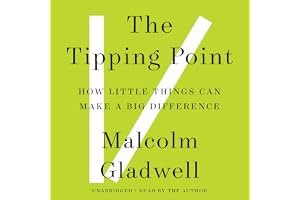
The tipping point is that magic moment when an idea, trend, or social behavior crosses a threshold, tips, and spreads like wildfire. Just as a single sick person can start an epidemic of the flu, so too can a small but precisely targeted push cause a fashion trend, the popularity of a new product, or a drop in the crime rate. This widely acclaimed bestseller, in which Malcolm Gladwell explores and brilliantly illuminates the tipping point phenomenon, is already changing the way people throughout the world think about selling products and disseminating ideas.
Gladwell introduces us to the particular personality types who are natural pollinators of new ideas and trends, the people who create the phenomenon of word of mouth. He analyzes fashion trends, smoking, children's television, direct mail, and the early days of the American Revolution for clues about making ideas infectious, and visits a religious commune, a successful high-tech company, and one of the world's greatest salesmen to show how to start and sustain social epidemics.
Bunch of really good information in here on how to make ideas go viral. This could be good to apply to any kind of products or ideas you may have. Definitely, check out The Tipping Point, which is one of my favorites. [source]
Malcolm Gladwell's breakthrough insight was to focus on the micro-relationships between individuals, which helped organizations realize that it's not about the big ads and the huge charity balls... it's about setting the stage for the buzz to start. [source]
Andy Stern
I think that when we talk about making change, it is much more about macro change, like in policy. This book reminds you that at times when you're building big movements, or trying to elect significant decision-makers in politics, sometimes it's the little things that make a difference. Ever since the book was written, we've become very used to the idea of things going viral unexpectedly and then having massive impact. The Tipping Point, to me, is really an appreciation that very small things can rearrange thinking in ways – like infectious diseases – that have huge implications. While we're always searching for the big policy changes – and we think we have to do that in very traditional ways of building coalitions against constituencies, movements and the media – sometimes it's the little things that actually tip the situation. Like the story of a person and their unique set of circumstances that really captures an issue about health care or housing. So it's trying to remember, while you're thinking about the grand and the glorious, that thinking about the small things can equally bring about change. [source]
Cover unavailable
30
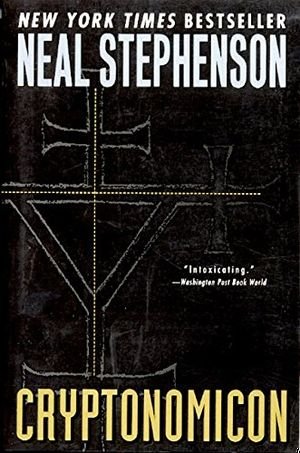
Cryptonomicon
Neal Stephenson
4.3
With this extraordinary first volume in an epoch-making masterpiece, Neal Stephenson hacks into the secret histories of nations and the private obsessions of men, decrypting with dazzling virtuosity the forces that shaped this century.
In 1942, Lawrence Pritchard Waterhouse—mathematical genius and young Captain in the U.S. Navy—is assigned to detachment 2702. It is an outfit so secret that only a handful of people know it exists, and some of those people have names like Churchill and Roosevelt. The mission of Waterhouse and Detachment 2702—commanded by Marine Raider Bobby Shaftoe-is to keep the Nazis ignorant of the fact that Allied Intelligence has cracked the enemy's fabled Enigma code. It is a game, a cryptographic chess match between Waterhouse and his German counterpart, translated into action by the gung-ho Shaftoe and his forces.
Fast-forward to the present, where Waterhouse's crypto-hacker grandson, Randy, is attempting to create a "data haven" in Southeast Asia—a place where encrypted data can be stored and exchanged free of repression and scrutiny. As governments and multinationals attack the endeavor, Randy joins forces with Shaftoe's tough-as-nails granddaughter, Amy, to secretly salvage a sunken Nazi submarine that holds the key to keeping the dream of a data haven afloat. But soon their scheme brings to light a massive conspiracy with its roots in Detachment 2702 linked to an unbreakable Nazi code called Arethusa. And it will represent the path to unimaginable riches and a future of personal and digital liberty...or to universal totalitarianism reborn.
A breathtaking tour de force, and Neal Stephenson's most accomplished and affecting work to date, Cryptonomicon is profound and prophetic, hypnotic and hyper-driven, as it leaps forward and back between World War II and the World Wide Web, hinting all the while at a dark day-after-tomorrow. It is a work of great art, thought and creative daring; the product of a truly iconoclastic imagination working with white-hot intensity.
…
Recommended by Ev Williams, Marc Andreessen, Risto Siilasmaa, and 2 others.
The Sovereign Individual—written 20 years ago, this is the most thought provoking book on the unfolding nature of the 21st Century that I’ve yet read. It’s packed with ideas on every page, many that are now fast becoming conventional wisdom, and many that are still heretical. Two related books to read are The Twilight of Sovereignty and Cryptonomicon. [source]
Risto Siilasmaa
CEO/Nokia
The one book on Siilasmaa's list is this fantasy offering from Neal Stephenson. The novel relates two parallel stories, one about an elite group of code-breakers in World War II, and another set in the present day, about two grandchildren of members of the group trying to track down a previously unknown – and rumored to be unbreakable – Nazi code. The book's subject matter resonates with current issues surrounding data liberty, computer surveillance and cyber security. [source]
Marko Rakar
This is a novel about a new world order where information is the currency, a virtual currency in the world. [source]
Cover unavailable
31
Memoirs of a Geisha
Arthur Golden
4.3
A literary sensation and runaway bestseller, this brilliant debut novel presents with seamless authenticity and exquisite lyricism the true confessions of one of Japan's most celebrated geisha.
In Memoirs of a Geisha, we enter a world where appearances are paramount; where a girl's virginity is auctioned to the highest bidder; where women are trained to beguile the most powerful men; and where love is scorned as illusion. It is a unique and triumphant work of fiction - at once romantic, erotic, suspenseful - and completely unforgettable.
…
Recommended by Alice Little.
Alice Little
The author uses language that is very, very rich and colorful. … You can really immerse yourself into that world and kind of get a sense of what things were like, at that time. [source]

Cover unavailable
32
The Guernsey Literary and Potato Peel Pie Society
Mary Ann Shaffer, Annie Barrows
4.3
#1 NEW YORK TIMES BESTSELLER - NOW A MAJOR MOTION PICTURE ON NETFLIX - A remarkable tale of the island of Guernsey during the German Occupation, and of a society as extraordinary as its name.
"I wonder how the book got to Guernsey? Perhaps there is some sort of secret homing instinct in books that brings them to their perfect readers." January 1946: London is emerging from the shadow of the Second World War, and writer Juliet Ashton is looking for her next book subject. Who could imagine that she would find it in a letter from a man she's never met, a native of the island of Guernsey, who has come across her name written inside a book by Charles Lamb...
As Juliet and her new correspondent exchange letters, Juliet is drawn into the world of this man and his friends—and what a wonderfully eccentric world it is. The Guernsey Literary and Potato Peel Pie Society—born as a spur-of-the-moment alibi when its members were discovered breaking curfew by the Germans occupying their island—boasts a charming, funny, deeply human cast of characters, from pig farmers to phrenologists, literature lovers all.
Juliet begins a remarkable correspondence with the society's members, learning about their island, their taste in books, and the impact the recent German occupation has had on their lives. Captivated by their stories, she sets sail for Guernsey, and what she finds will change her forever.
Written with warmth and humor as a series of letters, this novel is a celebration of the written word in all its guises and of finding connection in the most surprising ways.
…
Cover unavailable
33
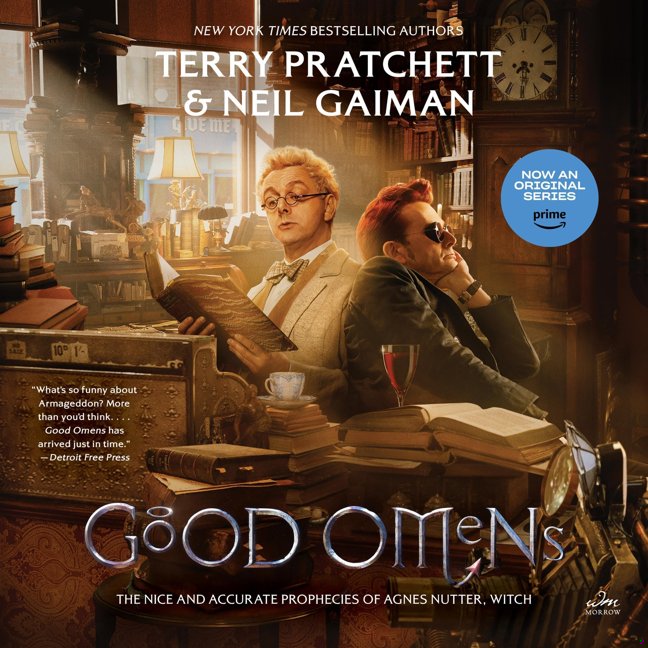
Good Omens: The Nice and Accurate Prophecies of Agnes Nutter, Witch
Neil Gaiman, Terry Pratchett
4.3
‘Armageddon only happens once, you know. They don’t let you go around again until you get it right.’
People have been predicting the end of the world almost from its very beginning, so it’s only natural to be sceptical when a new date is set for Judgement Day. But what if, for once, the predictions are right, and the apocalypse really is due to arrive next Saturday, just after tea?
You could spend the time left drowning your sorrows, giving away all your possessions in preparation for the rapture, or laughing it off as (hopefully) just another hoax. Or you could just try to do something about it.
It’s a predicament that Aziraphale, a somewhat fussy angel, and Crowley, a fast-living demon now finds themselves in. They’ve been living amongst Earth’s mortals since The Beginning and, truth be told, have grown rather fond of the lifestyle and, in all honesty, are not actually looking forward to the coming Apocalypse.
And then there’s the small matter that someone appears to have misplaced the Antichrist…
…
Recommended by Jazz Shaw, Jim Lee, The CEO Library Community (through anonymous form), and 3 others.
Jazz Shaw
We're watching Good Omens. It was a great book, but the TV series may actually be better. [source]
Jim Lee
@thecameroncuffe @skydart Lovely pic! And a great show! (And book 👍🏼) [source]
The CEO Library Community (through anonymous form)
One of the best 3 books I've read in 2019 [source]
Cover unavailable
34
Behind the Beautiful Forevers: Life, Death, and Hope in a Mumbai Undercity
From Pulitzer Prize-winner Katherine Boo, a landmark work of narrative nonfiction that tells the dramatic and sometimes heartbreaking story of families striving toward a better life in one of the twenty-first century's great, unequal cities.
In this brilliantly written, fast-paced book, based on three years of uncompromising reporting, a bewildering age of global change and inequality is made human.
Annawadi is a makeshift settlement in the shadow of luxury hotels near the Mumbai airport, and as India starts to prosper, Annawadians are electric with hope. Abdul, a reflective and enterprising Muslim teenager, sees "a fortune beyond counting" in the recyclable garbage that richer people throw away. Asha, a woman of formidable wit and deep scars from a childhood in rural poverty, has identified an alternate route to the middle class: political corruption. With a little luck, her sensitive, beautiful daughter - Annawadi's "most-everything girl" - will soon become its first female college graduate. And even the poorest Annawadians, like Kalu, a fifteen-year-old scrap-metal thief, believe themselves inching closer to the good lives and good times they call "the full enjoy."
But then Abdul the garbage sorter is falsely accused in a shocking tragedy; terror and a global recession rock the city; and suppressed tensions over religion, caste, sex, power and economic envy turn brutal. As the tenderest individual hopes intersect with the greatest global truths, the true contours of a competitive age are revealed. And so, too, are the imaginations and courage of the people of Annawadi.
With intelligence, humor, and deep insight into what connects human beings to one another in an era of tumultuous change, Behind the Beautiful Forevers carries the reader headlong into one of the twenty-first century's hidden worlds, and into the lives of people impossible to forget.
Katherine Boo spent three years getting to know the people of Annawadi, a slum of about 3,000 people on the edge of a sewage-filled lake in India’s largest city. Her book is a poignant reminder of how much more work needs to be done to address the inequities in the world. But it’s also an uplifting story of people striving to make a life for themselves, sacrificing for their families, and in their own way, being innovative and entrepreneurial in creating a vibrant local economy. [source]
Adam Minter
Vivid scenes of walking down Mumbai’s Airport Road, lined by shacks and trash pickers, and behind them are walls, and behind them are the finest five star hotels in India. [source]
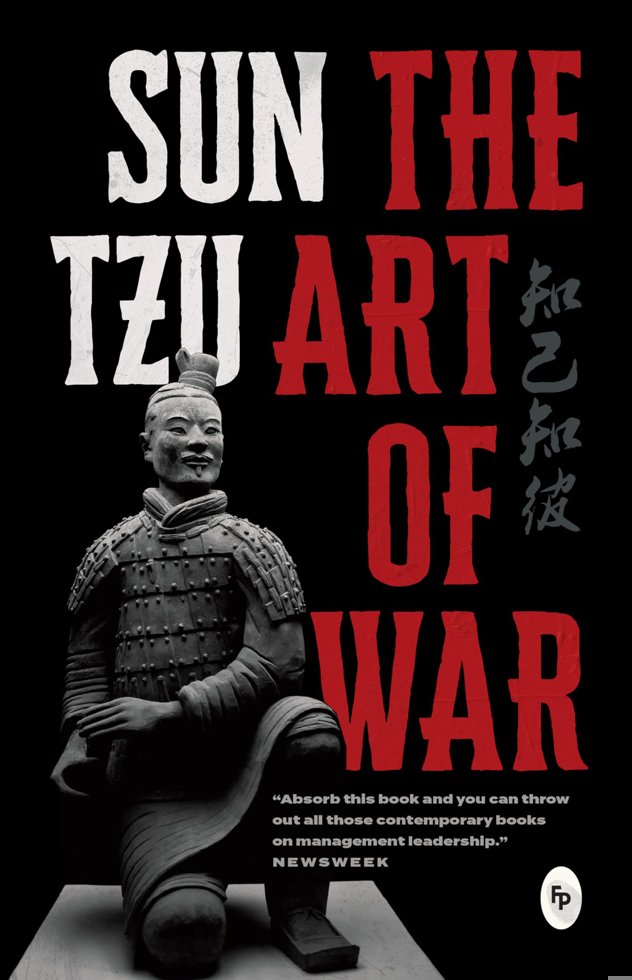
For more than two thousand years, The Art of War has stood as a cornerstone of Chinese culture-a lucid epigrammatic text that reveals as much about human psychology, politics, and economics as it does about battlefield strategy. The influence of Sun-tzu's text has grown tremendously in the West in recent years, with military leaders, politicians, and corporate executives alike finding valuable insight in these ancient words. In his crisp, accessible new translation, scholar John Minford brings this seminal work to life for modern readers.
Minford opens with a lively, learned introduction in which he explores the life and times of Sun-tzu, looks at The Art of War in the context of the turbulent Warring States period, and discusses how best to read and understand the work today. There follows Minford's translation of the core text itself in two different formats-first, the unadorned thirteen chapters of the original work and then the same text reprinted with extensive running commentary by classical Chinese scholars as well as Minford himself. The result is an opportunity for Western readers to experience Sun-tzu's work in all its intensity as it applies to many aspects of our lives.
Which books should be read by every single intelligent person on planet? … The Art of War (Sun Tsu) to learn that the act of killing fellow humans can be raised to an art. If you read all of the above works you will glean profound insight into most of what has driven the history of the western world. [source]
The sun is setting on the Western world. Slowly but surely, the direction in which the world spins has reversed: where for the last five centuries the globe turned westwards on its axis, it now turns to the east...For centuries, fame and fortune was to be found in the west - in the New World of the Americas. Today, it is the east which calls out to those in search of adventure and riches. The region stretching from eastern Europe and sweeping right across Central Asia deep into China and India, is taking centre stage in international politics, commerce and culture - and is shaping the modern world. This region, the true centre of the earth, is obscure to many in the English-speaking world. Yet this is where civilization itself began, where the world's great religions were born and took root. The Silk Roads were no exotic series of connections, but networks that linked continents and oceans together. Along them flowed ideas, goods, disease and death. This was where empires were won - and where they were lost. As a new era emerges, the patterns of exchange are mirroring those that have criss-crossed Asia for millennia. The Silk Roads are rising again. A major reassessment of world history, The Silk Roads> is an important account of the forces that have shaped the global economy and the political renaissance in the re-emerging east.
…
Recommended by Professor Frank Mcdonough and Raoul Pal.
Professor Frank Mcdonough
Christmas is coming and if you want to give a thought-provoking book to that history fan in your life then the recent books by the brilliant @peterfrankopan will satisfy. Some write books, this guy changes perceptions. https://t.co/gWZWZnv5TN [source]
Raoul Pal
@The92ers @zerohedge It’s fascinating. The Peter Frankopan book on the Silk Roads told history well from the perspective of Iran in particular [source]
Cover unavailable
37
The Shock Doctrine: The Rise of Disaster Capitalism
In her ground-breaking reporting from Iraq, Naomi Klein exposed how the trauma of invasion was being exploited to remake the country in the interest of foreign corporations. She called it "disaster capitalism." Covering Sri Lanka in the wake of the tsunami, and New Orleans post-Katrina, she witnessed something remarkably similar. People still reeling from catastrophe were being hit again, this time with economic "shock treatment" losing their land and homes to rapid-fire corporate makeovers. The Shock Doctrine retells the story of the most dominant ideology of our time, Milton Friedman's free market economic revolution. In contrast to the popular myth of this movement's peaceful global victory, Klein shows how it has exploited moments of shock and extreme violence in order to implement its economic policies in so many parts of the world from Latin America and Eastern Europe to South Africa, Russia, and Iraq. At the core of disaster capitalism is the use of cataclysmic events to advance radical privatization combined with the privatization of the disaster response itself. By capitalizing on crises, created by nature or war, Klein argues that the disaster capitalism complex now exists as a booming new economy, and is the violent culmination of a radical economic project that has been incubating for fifty years.
…
Recommended by Donna Dickenson, George Monbiot, and Mat Whitecross.
Donna Dickenson
Naomi Klein’s argument is that capitalism actually requires deliberately engineered shocks to the economic systems. [source]
The Shock Doctrine explains some of the mechanisms by which patrimonial capital acquires power and enhances its wealth. It’s a brilliant piece of work, and one of those rare books that changes the way you perceive the world. [source]
Mat Whitecross
It starts with the theory that moments of crisis have been utilised by the right wing in the US and other countries to manipulate people into following their agenda. [source]
Cover unavailable
38
All Quiet on the Western Front
Erich Maria Remarque, A W. Wheen
4.3
One by one the boys begin to fall…
In 1914 a room full of German schoolboys, fresh-faced and idealistic, are goaded by their schoolmaster to troop off to the ‘glorious war’. With the fire and patriotism of youth they sign up. What follows is the moving story of a young ‘unknown soldier’ experiencing the horror and disillusionment of life in the trenches.
Recommended by Cécile Fabre.
Cécile Fabre
He knows that his pleasure at a beautiful landscape, at the smell of good food, will forever be coloured by what the landscape looked like in the trenches, by the food that was cooked in the trenches. [source]
Cover unavailable
39
Sarah's Key
Tatiana de Rosnay
4.3
Paris, July 1942: Ten-year-old Sarah is brutally arrested with her family in the Vel' d'Hiv' roundup, the most notorious act of French collaboration with the Nazis. but before the police come to take them, Sarah locks her younger brother, Michel, in their favorite hiding place, a cupboard in the family's apartment. She keeps the key, thinking that she will be back within a few hours.
Paris, May 2002: On Vel' d'Hiv's sixtieth anniversary, Julia Jarmond, an American journalist, is asked by her Paris-based American magazine to write an article about this black day in France's past. Julia has lived in Paris for nearly twenty-five years, married a Frenchman, and she is shocked both by her ignorance about the event and the silence that still surrounds it. In the course of her investigation, she stumbles onto a trail of long-hidden family secrets that connects her to Sarah. Julia finds herself compelled to retrace the girl's ordeal, from the terrible days spent shut in at the Vel' d'Hiv' to the camps and beyond. As she probes into Sarah's past, she begins to question her own place in France and to reevaluate her marriage and her life.
Writing about the fate of her country with a pitiless clarity, Tatiana de Rosnay offers us a brilliantly subtle, compelling portrait of France under occupation and reveals the taboos and denial surrounding this painful episode in French history. (front flap)
…
Cover unavailable
40
Freakonomics: A Rogue Economist Explores the Hidden Side of Everything
Which is more dangerous, a gun or a swimming pool? What do schoolteachers and sumo wrestlers have in common? Why do drug dealers still live with their moms? How much do parents really matter? What kind of impact did Roe v. Wade have on violent crime? Freakonomics will literally redefine the way we view the modern world.
These may not sound like typical questions for an economist to ask. But Steven D. Levitt is not a typical economist. He is a much heralded scholar who studies the stuff and riddles of everyday life -- from cheating and crime to sports and child rearing -- and whose conclusions regularly turn the conventional wisdom on its head. He usually begins with a mountain of data and a simple, unasked question. Some of these questions concern life-and-death issues; others have an admittedly freakish quality. Thus the new field of study contained in this book: freakonomics.
Through forceful storytelling and wry insight, Levitt and co-author Stephen J. Dubner show that economics is, at root, the study of incentives -- how people get what they want, or need, especially when other people want or need the same thing. In Freakonomics, they set out to explore the hidden side of ... well, everything. The inner workings of a crack gang. The truth about real-estate agents. The myths of campaign finance. The telltale marks of a cheating schoolteacher. The secrets of the Ku Klux Klan.
What unites all these stories is a belief that the modern world, despite a surfeit of obfuscation, complication, and downright deceit, is not impenetrable, is not unknowable, and -- if the right questions are asked -- is even more intriguing than we think. All it takes is a new way of looking. Steven Levitt, through devilishly clever and clear-eyed thinking, shows how to see through all the clutter.
Freakonomics establishes this unconventional premise: If morality represents how we would like the world to work, then economics represents how it actually does work. It is true that readers of this book will be armed with enough riddles and stories to last a thousand cocktail parties. But Freakonomics can provide more than that. It will literally redefine the way we view the modern world. (front flap)
…
Recommended by Malcolm Gladwell, Daymond John, Ev Williams, and 12 others.
James Altucher recommended this book on the podcast "The Tim Ferriss Show". [source]
Cover unavailable
41
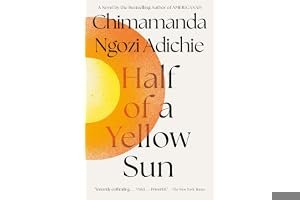
Half of a Yellow Sun
Chimamanda Ngozi Adichie
4.2
A masterly, haunting new novel from a writer heralded by The Washington Post Book World as “the 21st-century daughter of Chinua Achebe,” Half of a Yellow Sun re-creates a seminal moment in modern African history: Biafra’s impassioned struggle to establish an independent republic in Nigeria in the 1960s, and the chilling violence that followed.
With astonishing empathy and the effortless grace of a natural storyteller, Chimamanda Ngozi Adichie weaves together the lives of three characters swept up in the turbulence of the decade. Thirteen-year-old Ugwu is employed as a houseboy for a university professor full of revolutionary zeal. Olanna is the professor’s beautiful mistress, who has abandoned her life of privilege in Lagos for a dusty university town and the charisma of her new lover. And Richard is a shy young Englishman in thrall to Olanna’s twin sister, an enigmatic figure who refuses to belong to anyone. As Nigerian troops advance and the three must run for their lives, their ideals are severely tested, as are their loyalties to one another.
Epic, ambitious, and triumphantly realized, Half of a Yellow Sun is a remarkable novel about moral responsibility, about the end of colonialism, about ethnic allegiances, about class and race—and the ways in which love can complicate them all. Adichie brilliantly evokes the promise and the devastating disappointments that marked this time and place, bringing us one of the most powerful, dramatic, and intensely emotional pictures of modern Africa that we have ever had.
…
Recommended by Michael Peel and Michelle Jana Chan.
Michael Peel
Chimamanda Adichie broke the ice in writing about the Biafran war. [source]
Michelle Jana Chan
Her story is told by three powerful, self-aware and intellectually upright characters who are swept up in the struggle to establish an independent Nigeria. It’s a call to arms. [source]
In April 1942, Lale Sokolov, a Slovakian Jew, is forcibly transported to the concentration camps at Auschwitz-Birkenau. When his captors discover that he speaks several languages, he is put to work as a Tätowierer (the German word for tattooist), tasked with permanently marking his fellow prisoners.
Imprisoned for over two and a half years, Lale witnesses horrific atrocities and barbarism—but also incredible acts of bravery and compassion. Risking his own life, he uses his privileged position to exchange jewels and money from murdered Jews for food to keep his fellow prisoners alive.
One day in July 1942, Lale, prisoner 32407, comforts a trembling young woman waiting in line to have the number 34902 tattooed onto her arm. Her name is Gita, and in that first encounter, Lale vows to somehow survive the camp and marry her.
A vivid, harrowing, and ultimately hopeful re-creation of Lale Sokolov's experiences as the man who tattooed the arms of thousands of prisoners with what would become one of the most potent symbols of the Holocaust, The Tattooist of Auschwitz is also a testament to the endurance of love and humanity under the darkest possible conditions.
Mikhail Bulgakov's devastating satire of Soviet life was written during the darkest period of Stalin's regime. Combining two distinct yet interwoven parts—one set in ancient Jerusalem, one in contemporary Moscow—the novel veers from moods of wild theatricality with violent storms, vampire attacks, and a Satanic ball; to such somber scenes as the meeting of Pilate and Yeshua, and the murder of Judas in the moonlit garden of Gethsemane; to the substanceless, circus-like reality of Moscow. Its central characters, Woland (Satan) and his retinue—including the vodka-drinking black cat, Behemoth; the poet, Ivan Homeless; Pontius Pilate; and a writer known only as The Master, and his passionate companion, Margarita—exist in a world that blends fantasy and chilling realism, an artful collage of grotesqueries, dark comedy, and timeless ethical questions.
Though completed in 1940, "The Master and Margarita" wasn't published in Moscow until 1966, when the first part appeared in the magazine "Moskva." It was an immediate and enduring success: audiences responded with great enthusiasm to its expression of artistic and spiritual freedom.
…
Recommended by Max Levchin, Neil Gaiman, Andi Dumitrescu, and 5 others.
Max Levchin
Co-founder/PayPal, CEO/Affirm, Investor
One of the finest works of fiction of the last century. [source]

If I had to make a more rational choice, I’d go with Ulises or The Master and Margareta, but I think that choice is a bit snobbish. [source]

Cover unavailable
44
All the Light We Cannot See
Anthony Doerr
4.2
An alternate cover for this ISBN can be found here
From the highly acclaimed, multiple award-winning Anthony Doerr, the stunningly beautiful instant New York Times bestseller about a blind French girl and a German boy whose paths collide in occupied France as both try to survive the devastation of World War II.
Marie-Laure lives in Paris near the Museum of Natural History, where her father works. When she is twelve, the Nazis occupy Paris and father and daughter flee to the walled citadel of Saint-Malo, where Marie-Laure’s reclusive great uncle lives in a tall house by the sea. With them they carry what might be the museum’s most valuable and dangerous jewel.
In a mining town in Germany, Werner Pfennig, an orphan, grows up with his younger sister, enchanted by a crude radio they find that brings them news and stories from places they have never seen or imagined. Werner becomes an expert at building and fixing these crucial new instruments and is enlisted to use his talent to track down the resistance. Deftly interweaving the lives of Marie-Laure and Werner, Doerr illuminates the ways, against all odds, people try to be good to one another.
…
Recommended by Jason Goldman.
Jason Goldman
All The Light We Cannot See is the best book I've read in a while. I tend to speed read and here I savored every word; the writing is just effortlessly beautiful. I hope it's made it onto high school WWII syllabi by now. [source]
Cover unavailable
45
Love in the Time of Cholera
Gabriel Garcia Marquez
4.2
From the Nobel Prize-winning author of One Hundred Years of Solitude comes a masterly evocation of an unrequited passion so strong that it binds three people's lives together for more than fifty years. In the story of Florentino Ariza, who waits more than half a century to declare his undying love to the beautiful Fermina Daza, whom he lost to Dr. Juvenal Urbino so many years before, García Márquez has created a vividly absorbing fictional world, as lush and dazzling as a dream and as real and immediate as our own deepest longings. Now available for the first time in the Contemporary Classics series!
…
Recommended by Bryan Callen, Kate Figes, and Tendai Biti.
So here are my three must read books. I've been reading a lot of great books like: Outsmart Your Instincts, The Culture Code, and Antonio Damasio’s The Strange Order, and sometimes when you read a lot of nonfiction it’s very enriching, sometimes you need a novel. I really believe you should take a minute and read something beautiful. Listen, listen to Lolita by Nabokov. But also listen to Blood Meridian by Cormac McCarthy and listen to Richard Poe narrate that. Those are two of the greatest feats of the english language that I can think of. Then there’s Fortress of Solitude, an amazing book, Extremely Loud and Incredibly Close, these are great novels. Cold Mountain is a beautiful novel, Snow Falling On Cedars, I mean they’ve been around for a while. But goddamnit, get those under your belt. Those are the novels I think you should read. You know Love In The Time Of Cholera it just makes you ache. Kind of like a Hemingway thing, where Hemingway “ahh!”, it’s the same thing, you know. So I don’t know, I’m a fan of all those books. Those are my 3 slash 20 books. [source]
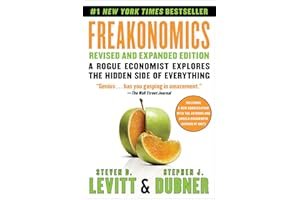
Kate Figes
It’s partly such a passionate book because of the beauty of the prose, describing love through time and how she found contentment – love, passion and sex all in one. [source]
Tendai Biti
2)Marquez s “Love in the time of cholera” & “100 yrs of solitude “ are two of my top books but one still weeps reading or re- reading Tolstoy s “ War & Peace “a book bettered only by “ Anna Karenina. Not a fan of these motivational books but that “f#cked “ up book is quite funny [source]
Cover unavailable
46
Nothing to Envy: Ordinary Lives in North Korea
Barbara Demick, Karen White, et al
4.2
Nothing to Envy follows the lives of six North Koreans over fifteen years—a chaotic period that saw the death of Kim Il-sung, the unchallenged rise to power of his son Kim Jong-il, and the devastation of a far-ranging famine that killed one-fifth of the population.
Taking us into a landscape most of us have never before seen, award-winning journalist Barbara Demick brings to life what it means to be living under the most repressive totalitarian regime today—an Orwellian world that is by choice not connected to the Internet, in which radio and television dials are welded to the one government station, and where displays of affection are punished; a police state where informants are rewarded and where an offhand remark can send a person to the gulag for life.
Demick takes us deep inside the country, beyond the reach of government censors. Through meticulous and sensitive reporting, we see her six subjects—average North Korean citizens—fall in love, raise families, nurture ambitions, and struggle for survival. One by one, we experience the moments when they realize that their government has betrayed them.
Nothing to Envy is a groundbreaking addition to the literature of totalitarianism and an eye-opening look at a closed world that is of increasing global importance.
…
Recommended by Hyeonseo Lee.
Hyeonseo Lee
She includes great details that show everyday life in North Korea. [source]
Cover unavailable
47
The Little Prince Family Storybook: Unabridged Original Text
Antoine de Saint-Exupéry
4.2
Rediscover Antoine de Saint-Exupery's universal masterpiece with original text and magnificent new illustrations created by masters of film animation. This wise and enchanginting fable teaches the secret of what is really important in life.
Recommended by Ryan Holiday, Brandon Stanton, Evan Goldberg, and 1 others.
Equally allegorical, I read The Little Prince for the first time which for some reason I’d never been exposed to before. If you’re in the same boat, read it. It’s short but great. [source]
Brandon Stanton
Brandon Stanton recommended this book on the podcast "The Tim Ferriss Show". [source]
This powerful and inspiring book shows how one person can make a difference, as Kidder tells the true story of a gifted man who is in love with the world and has set out to do all he can to cure it.
Tracy Kidder is a winner of the Pulitzer Prize and the author of the bestsellers The Soul of a New Machine, House, Among Schoolchildren, and Home Town. He has been described by the Baltimore Sun as the "master of the non-fiction narrative." This powerful and inspiring new book shows how one person can make a difference, as Kidder tells the true story of a gifted man who is in love with the world and has set out to do all he can to cure it.
At the center of Mountains Beyond Mountains stands Paul Farmer. Doctor, Harvard professor, renowned infectious-disease specialist, anthropologist, the recipient of a MacArthur "genius" grant, world-class Robin Hood, Farmer was brought up in a bus and on a boat, and in medical school found his life’s calling: to diagnose and cure infectious diseases and to bring the lifesaving tools of modern medicine to those who need them most. This magnificent book shows how radical change can be fostered in situations that seem insurmountable, and it also shows how a meaningful life can be created, as Farmer—brilliant, charismatic, charming, both a leader in international health and a doctor who finds time to make house calls in Boston and the mountains of Haiti—blasts through convention to get results.
Mountains Beyond Mountains takes us from Harvard to Haiti, Peru, Cuba, and Russia as Farmer changes minds and practices through his dedication to the philosophy that "the only real nation is humanity"—a philosophy that is embodied in the small public charity he founded, Partners in Health. He enlists the help of the Gates Foundation, George Soros, the U.N.’s World Health Organization, and others in his quest to cure the world. At the heart of this book is the example of a life based on hope, and on an understanding of the truth of the Haitian proverb "Beyond mountains there are mountains": as you solve one problem, another problem presents itself, and so you go on and try to solve that one too.
"Mountains Beyond Mountains unfolds with the force of a gathering revelation," says Annie Dillard, and Jonathan Harr says, "[Farmer] wants to change the world. Certainly this luminous and powerful book will change the way you see it."
Today is World Book Day, a wonderful opportunity to address this #ChallengeRichard sent in by Mike Gonzalez of New Jersey: Make a list of your top 65 books to read in a lifetime. [source]
Cecile Richards
Everyone has to read this book. I guess I just picked it for anyone who hasn’t read it and if you’re a progressive and you’re trying to figure out what to do with your life. Tracy Kidder is a great writer so that doesn’t hurt, but Paul Farmer’s story, the story of one person who decides they want to change the world, is so compelling. I think even for the most cynical, hard-bitten progressive you can’t help but read this book and feel inspired. So it’s a lot of levels. [source]
Cover unavailable
49
Anna Karenina
Leo Tolstoy
4.2
Tolstoy's epic novel of love, destiny and self-destruction, in a gorgeous new clothbound edition from Penguin Classics. Anna Karenina seems to have everything - beauty, wealth, popularity and an adored son. But she feels that her life is empty until the moment she encounters the impetuous officer Count Vronsky. Their subsequent affair scandalizes society and family alike and soon brings jealously and bitterness in its wake. Contrasting with this tale of love and self-destruction is the vividly observed story of Levin, a man striving to find contentment and a meaning to his life - and also a self-portrait of Tolstoy himself. This acclaimed modern translation by Richard Pevear and Larissa Volokhonsky won the PEN/ Book of the Month Club Translation Prize in 2001. Their translation is accompanied in this edition by an introduction by Richard Pevear and a preface by John Bayley. "The new and brilliantly witty translation by Richard Pevear and Larissa Volokhonsky is a must". (Lisa Appignanesi, Independent, Books of the Year). "Pevear and Volokhonsky are at once scrupulous translators and vivid stylists of English, and their superb rendering allows us, as perhaps never before, to grasp the palpability of Tolstoy's "characters, acts, situations"". (James Wood, New Yorker).
…
Recommended by Chelsea Handler, Marvin Liao, Audrey Russo, and 5 others.
I don't know if I have to expound on why I love this book, but everyone should read this author, and this was the first one of his works I read. So, it's like a first boyfriend. Or my first Cabbage Patch Kid. [source]
Marvin Liao
Partner/500 Startups
My list would be (besides the ones I mentioned in answer to the previous question) both business & Fiction/Sci-Fi and ones I personally found helpful to myself. The business books explain just exactly how business, work & investing are in reality & how to think properly & differentiate yourself. On the non-business side, a mix of History & classic fiction to understand people, philosophy to make sense of life and Science fiction to picture what the future could be like (not always utopian). [source]
Audrey Russo
Question: What books would you recommend to young people interested in your career path? Answer: Anything by Peter Senge. The Hard Thing About Hard Things – Ben Horowitz Once you are Lucky, Twice you are good – Sara Lacey Revolutionary Wealth – Alvin Toffler Black Swan – Taleb Reset: My Fight for Inclusion and Lasting Change, by Ellen Pao. Creative Class – Richard Florida Creativity Inc. by Ed Catmull & Amy Wallace Liar’s Poker by Michael Lewis American Government 101: From the Continental Congress to the Iowa Caucus, Everything You Need to Know About US Politics – Kathleen Spears The Tao of Pooh by Benjamin Hoff. Anna Karenina by Leo Tolstoy. Any book by Herman Hesse The Art of War by Sun Tzu. [source]
Cover unavailable
50
The Guns of August
Barbara Tuchman
4.2
"More dramatic than fiction...THE GUNS OF AUGUST is a magnificent narrative--beautifully organized, elegantly phrased, skillfully paced and sustained....The product of painstaking and sophisticated research." CHICAGO TRIBUNE Historian and Pulitzer Prize-winning author Barbara Tuchman has brought to life again the people and events that led up to Worl War I. With attention to fascinating detail, and an intense knowledge of her subject and its characters, Ms. Tuchman reveals, for the first time, just how the war started, why, and why it could have been stopped but wasn't. A classic historical survey of a time and a people we all need to know more about, THE GUNS OF AUGUST will not be forgotten.
So beautifully written. But more importantly, for me, she was writing about battles and military stuff and things that you don’t imagine that sometimes a woman might be so adept at. [source]
Erik Martin
This book started my obsession with WWI, illustrating how drastically the world went from interrelated monarchies and cavalry charges to chemical warfare between modern nation states. If you want to see what disruption looks like, there's no greater period in human history. [source]
Matt Calkins
The best way to understand how the world resolves its conflicts and its tensions is by looking at how a conflict that has been studied thoroughly, like World War I, unfolded and resolved. Business is like this too. If anyone were to ever get to the heart of Coke vs. Pepsi, they would see a parade of mistakes in the same way World War I looks in retrospect—so many ways you could have done better. [source]
The Greatest Salesman in the World is a bestseller by Og Mandino. His books have sold over 50 million copies. Published in '68, reissued in '83 by Bantam, it's a guide to a philosophy of salesmanship, telling the story of Hafid, a poor camel boy who achieves a life of abundance. A cloth edition was published by Buccaneer Books in 6/93. It takes ten months to read the book. His instructions are to read Scroll I (Ch. 8) three times a day for 30 days. After completing Scroll I continue to II (Ch. 9) & so forth thru X (Ch. 17). The Ten Scrolls are: Scroll I - Commitment Scroll II - Love Scroll III - Persistence Scroll IV - Miracle Scroll V - Time Scroll VI - Emotion Scroll VII - Laughter Scroll VIII - Value Scroll IX - Action Scroll X - Guidance His primary message is to "do it now". In the marking of Scroll IX, "I will act now" appears 18 times. While his messages have Xian undertones, it's still a message of repetitive actions to build good habits.
…
Recommended by Adam Haritan, Geoffrey James, Mark Hunter, and 3 others.
The Greatest Salesman In The World by Og Mandino is my pick for favorite book in the business field. Unlike most business books, The Greatest Salesman In The World is presented in parable form. Additionally, this book contains timeless passages and lessons that are meant to be read— both silently and aloud — on a daily basis, multiple times per day. It’s not difficult to see what major effects a book presented in this format can have on one’s life. [source]
Cover unavailable
52
Animal Farm
George Orwell and Christopher Hitchens
4.2
Animal Farm is one of the most famous warnings ever written. Orwell's immortal satire - 'against Stalin' as he wrote to his French translator - can be read on many levels. With its piercing clarity and deceptively simple style it is no surprise that this novel is required reading for schoolchildren and politicians alike. This fable of the steadfast horses Boxer and Clover, the opportunistic pigs Snowball and Napoleon, and the deafening choir of sheep remains an unparalleled masterpiece.
One reviewer wrote 'In a hundred years' time perhaps Animal Farm ... may simply be a fairy story: today it is a fairy story with a good deal of point.' Over sixty years on in the age of spin, it is more relevant than ever.
Rejected by such eminent publishing figures as Victor Gollancz, Jonathan Cape and T.S. Eliot, Animal Farm was published to great acclaim by Martin Secker and Warburg on 17 August 1945 in an edition of 4500 copies. In the centenary year of Martin Secker, Ltd., Harvill Secker is proud to publish this special edition with a brand-new introduction by Christopher Hitchens.
Whitney Cummings recommended this book on the podcast "The Tim Ferriss Show". [source]
Vlad Tenev
When I was in sixth grade I remember being very upset by the ending of this book. [source]
Heather Brooke
I picked Animal Farm because it is an allegory about power and its seductive and corruptive influence on people regardless of their initial good intentions. [source]
Cover unavailable
53
Half the Sky: Turning Oppression Into Opportunity for Women Worldwide
Nicholas D. Kristof, Sheryl WuDunn
4.2
From two of our most fiercely moral voices, a passionate call to arms against our era’s most pervasive human rights violation: the oppression of women and girls in the developing world.
With Pulitzer Prize winners Nicholas D. Kristof and Sheryl WuDunn as our guides, we undertake an odyssey through Africa and Asia to meet the extraordinary women struggling there, among them a Cambodian teenager sold into sex slavery and an Ethiopian woman who suffered devastating injuries in childbirth. Drawing on the breadth of their combined reporting experience, Kristof and WuDunn depict our world with anger, sadness, clarity, and, ultimately, hope.
They show how a little help can transform the lives of women and girls abroad. That Cambodian girl eventually escaped from her brothel and, with assistance from an aid group, built a thriving retail business that supports her family. The Ethiopian woman had her injuries repaired and in time became a surgeon. A Zimbabwean mother of five, counseled to return to school, earned her doctorate and became an expert on AIDS.
Through these stories, Kristof and WuDunn help us see that the key to economic progress lies in unleashing women’s potential. They make clear how so many people have helped to do just that, and how we can each do our part. Throughout much of the world, the greatest unexploited economic resource is the female half of the population. Countries such as China have prospered precisely because they emancipated women and brought them into the formal economy. Unleashing that process globally is not only the right thing to do; it’s also the best strategy for fighting poverty.
Deeply felt, pragmatic, and inspirational, Half the Sky is essential reading for every global citizen.
…
Recommended by Emma Watson, Julia Enthoven, Mia Farrow, and 2 others.
Julia Enthoven
As for non-fiction, Half the Sky (about crimes against women, especially in the developing world) and Whatever it Takes (about the Harlem Children’s Zone and the work of Geoffrey Canada) both changed my world-view enormously, and I thought they were both super compelling. [source]
Mia Farrow
Women in so much of the world are doing so much of the labour without having any of the rights or reaping their share of the profits. [source]
Pierre Ferrari
One of the most powerful books I've ever read on #GenderEquality is Half the Sky: Turning Oppression into Opportunity for Women Worldwide by @NickKristof & @WuDunn: https://t.co/uj5rfxlmZm. Let's do more to support women in our daily lives! #WomenWednesday #SDGs [source]
Cover unavailable
54
Poor Economics: A Radical Rethinking of the Way to Fight Global Poverty
Winner of the 2011 Financial Times/Goldman Sachs Best Business Book of the Year Award
Billions of government dollars, and thousands of charitable organizations and NGOs, are dedicated to helping the world's poor. But much of their work is based on assumptions that are untested generalizations at best, harmful misperceptions at worst.
Abhijit Banerjee and Esther Duflo have pioneered the use of randomized control trials in development economics. Work based on these principles, supervised by the Poverty Action Lab, is being carried out in dozens of countries. Drawing on this and their 15 years of research from Chile to India, Kenya to Indonesia, they have identified wholly new aspects of the behavior of poor people, their needs, and the way that aid or financial investment can affect their lives. Their work defies certain presumptions: that microfinance is a cure-all, that schooling equals learning, that poverty at the level of 99 cents a day is just a more extreme version of the experience any of us have when our income falls uncomfortably low.
This important book illuminates how the poor live, and offers all of us an opportunity to think of a world beyond poverty.
Does a great job of bringing alive the complexities of poor people’s lives. [source]
Harini Calamur
@ask0704 Read his book. I don't agree with some of the things he says. But, it is a great read on understanding poverty [source]
Cover unavailable
55
Lord of the Flies
William Golding
4.2
At the dawn of the next world war, a plane crashes on an uncharted island, stranding a group of schoolboys. At first, with no adult supervision, their freedom is something to celebrate; this far from civilization the boys can do anything they want. Anything. They attempt to forge their own society, failing, however, in the face of terror, sin and evil. And as order collapses, as strange howls echo in the night, as terror begins its reign, the hope of adventure seems as far from reality as the hope of being rescued. Labeled a parable, an allegory, a myth, a morality tale, a parody, a political treatise, even a vision of the apocalypse, Lord of the Flies is perhaps our most memorable tale about “the end of innocence, the darkness of man’s heart.”
…
Recommended by Elon Musk, Ev Williams, Audrey Russo, and 5 others.
Audrey Russo
So many novels; Lord of the Flies, Great Gatsby, Great Expectations; all the Nancy Drew books; Catcher in the Rye, Books written by Zora Neale Hurston; Pat Conroy – all because of the view about different people who endure despite adversity while kindling the hearts of the human spirit. [source]
Chigozie Obioma
William Golding imbues some of these children with wisdom that would read, in the hands of a lesser author, as implausibly knowing [source]
Disco Donnie
@JoshRHernandez1 I love the book “Lord of the Flies” so just started watching The Society [source]
Cover unavailable
56
Siddhartha
Hermann Hesse
4.2
Herman Hesse's classic novel has delighted, inspired, and influenced generations of readers, writers, and thinkers. In this story of a wealthy Indian Brahmin who casts off a life of privilege to seek spiritual fulfillment. Hesse synthesizes disparate philosophies--Eastern religions, Jungian archetypes, Western individualism--into a unique vision of life as expressed through one man's search for meaning.
Why can’t our political leaders work together as threats loom and problems mount? Why do people so readily assume the worst about the motives of their fellow citizens? In The Righteous Mind, social psychologist Jonathan Haidt explores the origins of our divisions and points the way forward to mutual understanding.
His starting point is moral intuition—the nearly instantaneous perceptions we all have about other people and the things they do. These intuitions feel like self-evident truths, making us righteously certain that those who see things differently are wrong. Haidt shows us how these intuitions differ across cultures, including the cultures of the political left and right. He blends his own research findings with those of anthropologists, historians, and other psychologists to draw a map of the moral domain. He then examines the origins of morality, overturning the view that evolution made us fundamentally selfish creatures. But rather than arguing that we are innately altruistic, he makes a more subtle claim—that we are fundamentally groupish. It is our groupishness, he explains, that leads to our greatest joys, our religious divisions, and our political affiliations. In a stunning final chapter on ideology and civility, Haidt shows what each side is right about, and why we need the insights of liberals, conservatives, and libertarians to flourish as a nation.
…
Recommended by A.J. Jacobs, Akin Oyebode, Andrew M. Mwenda, and 3 others.
A.J. Jacobs
All about trying to figure out the gap between the red and blue states – Republican and Democrat – and it’s really interesting. [source]
Akin Oyebode
@eggheader @OnemuVictor1 @JonHaidt Abeg order two. I read Righteous Mind which he also wrote, and that was a very fascinating book. [source]
Andrew M. Mwenda
The best work on this is a book by Jonathan Haidt “The Righteous Mind: Why good People are Divided by Religion and Politics.” He argues that human beings have deeply entrenched moral intuitions which guide their assessment of reality. Facts matter very little if at all. [source]
Over the last half-billion years, there have been five mass extinctions, when the diversity of life on earth suddenly and dramatically contracted. Scientists around the world are currently monitoring the sixth extinction, predicted to be the most devastating extinction event since the asteroid impact that wiped out the dinosaurs. This time around, the cataclysm is us.
In prose that is at once frank, entertaining, and deeply informed, The New Yorker writer Elizabeth Kolbert tells us why and how human beings have altered life on the planet in a way no species has before. Interweaving research in half a dozen disciplines, descriptions of the fascinating species that have already been lost, and the history of extinction as a concept, Kolbert provides a moving and comprehensive account of the disappearances occurring before our very eyes. She shows that the sixth extinction is likely to be mankind's most lasting legacy, compelling us to rethink the fundamental question of what it means to be human.
The president also released a list of his summer favorites back in 2015: All That Is, James Salter The Sixth Extinction, Elizabeth Kolbert The Lowland, Jhumpa Lahiri Between the World and Me, Ta-Nehisi Coates Washington: A Life, Ron Chernow All the Light We Cannot See, Anthony Doerr [source]
The Sixth Extinction: An Unnatural History, by Elizabeth Kolbert. Climate change is a big problem—one of the biggest we’ll face this century—but it’s not the only environmental concern on the horizon. Humans are putting down massive amounts of pavement, moving species around the planet, over-fishing and acidifying the oceans, changing the chemical composition of rivers, and more. Natural scientists posit that there have been five extinction events in the Earth’s history (think of the asteroid that wiped out the dinosaurs), and Kolbert makes a compelling case that human activity is leading to the sixth. Unlike a lot of people who write about the environment, Kolbert doesn’t resort to hype. She just lays out the facts and wraps them in memorable anecdotes. It’s a sobering but engaging and informative read. [source]
"In his autobiography, Walmart's founder expounds on the principles of discount retailing and discusses his core values of frugality and a bias for action — a willingness to try a lot of things and make many mistakes. Bezos included both in Amazon's corporate values," Brad Stone writes. [source]
In his sensational international bestseller, the preeminent scientist and outspoken atheist Richard Dawkins delivers a hard-hitting, impassioned, but humorous, rebuttal of religious belief. With rigor and wit, Dawkins eviscerates the arguments for religion and demonstrates the supreme improbability of the existence of a supreme being. He makes a compelling case that faith is not just irrational but potentially deadly. In a preface written for the paperback edition, Dawkins responds to some of the controversies the book has incited. This brilliantly argued, provocative book challenges all of us to examine our belifs, no matter what beliefs we hold.
…
Recommended by Brian Armstrong, Antonio Eram, Susan Jacoby, and 1 others.
Antonio Eram
This book was recommended by Antonio when asked for titles he would recommend to young people interested in his career path. [source]
Susan Jacoby
Richard Dawkins is very funny. One of the reasons for reading The God Delusion is that it will disabuse you of the idea – which is a common stereotype of atheists – that they are utterly humourless. You hear this over and over again. I’m often invited to college campuses to give lectures, and often they’re religious schools – not fundamentalist schools, but colleges of a historically religious type. And very often I will hear: “Oh I expected you to be small and dark-haired and wear glasses!” The image of the atheist woman is kind of like what the image of the feminist used to be, someone too ugly to get a man. But part of it is also humorlessness. People will often say to me, “Oh you’re so funny.” “Well, yeah!” [source]
Vote Dem For The Planet
@KimBledsoe14 @Goodbye_Jesus @Ian313f There were a lot of rebels and drifters in those days against the repressive regime. They had followers. Have you read “The God Delusion”? Great book. [source]
Cover unavailable
60
A Long Way Gone: Memoirs of a Boy Soldier
Ishmael Beah
4.1
The devastating story of war through the eyes of a child soldier. Beah tells how, at the age of twelve, he fled attacking rebels and wandered a land rendered unrecognizable by violence. By thirteen, he’d been picked up by the government army, and became a soldier.
My new friends have begun to suspect I haven’t told them the full story of my life. “Why did you leave Sierra Leone?” “Because there is a war.” “You mean, you saw people running around with guns and shooting each other?” “Yes, all the time.” “Cool.” I smile a little. “You should tell us about it sometime.” “Yes, sometime.”
This is how wars are fought now: by children, hopped-up on drugs and wielding AK-47s. Children have become soldiers of choice. In the more than fifty conflicts going on worldwide, it is estimated that there are some 300,000 child soldiers. Ishmael Beah used to be one of them.
What is war like through the eyes of a child soldier? How does one become a killer? How does one stop? Child soldiers have been profiled by journalists, and novelists have struggled to imagine their lives. But until now, there has not been a first-person account from someone who came through this hell and survived.
In A Long Way Gone, Beah, now twenty-five years old, tells a riveting story: how at the age of twelve, he fled attacking rebels and wandered a land rendered unrecognizable by violence. By thirteen, he’d been picked up by the government army, and Beah, at heart a gentle boy, found that he was capable of truly terrible acts.
This is a rare and mesmerizing account, told with real literary force and heartbreaking honesty.
…
Cover unavailable
61
The Stranger
Albert Camus, Jonathan Davis, et al
4.1
Through the story of an ordinary man unwittingly drawn into a senseless murder on an Algerian beach, Camus explored what he termed "the nakedness of man faced with the absurd." First published in English in 1946; now in a new translation by Matthew Ward.
Seminal novel on existentialism and the absurd by Albert Camus from 1946. Explores that feeling of disconnectedness from society, its norms, and the absurdity of every day life. Striking first-person account in a powerful, direct language. [source]
Kyle Maynard
Kyle Maynard said this is one of his most-recommended books. [source]
Cover unavailable
62
Collapse: How Societies Choose to Fail or Succeed
Jared Diamond
4.1
In Jared Diamond’s follow-up to the Pulitzer-Prize winning Guns, Germs and Steel, the author explores how climate change, the population explosion and political discord create the conditions for the collapse of civilization
Environmental damage, climate change, globalization, rapid population growth, and unwise political choices were all factors in the demise of societies around the world, but some found solutions and persisted. As in Guns, Germs, and Steel, Diamond traces the fundamental pattern of catastrophe, and weaves an all-encompassing global thesis through a series of fascinating historical-cultural narratives. Collapse moves from the Polynesian cultures on Easter Island to the flourishing American civilizations of the Anasazi and the Maya and finally to the doomed Viking colony on Greenland. Similar problems face us today and have already brought disaster to Rwanda and Haiti, even as China and Australia are trying to cope in innovative ways. Despite our own society’s apparently inexhaustible wealth and unrivaled political power, ominous warning signs have begun to emerge even in ecologically robust areas like Montana.
Brilliant, illuminating, and immensely absorbing, Collapse is destined to take its place as one of the essential books of our time, raising the urgent question: How can our world best avoid committing ecological suicide?
…
Recommended by Bill Gates, Daniel Headrick, David Pilling, and 3 others.
I found this to be an interesting follow-up to the excellent Guns, Germs, and Steel. It examines the downfall of some of history's greatest civilizations. [source]
Daniel Headrick
I found Jared Diamond’s book Collapse more valuable in influencing my own thinking, because it shows the importance of culture in determining how humans deal with environmental threats. …….The author investigates the successes and failures of a number of civilisations which had reached a crisis point, and looks at why some succeeded and others hadn’t. [source]
David Pilling
This is a warning that societies can do this. We, as a human society, could do this if we’re not careful. If we stretch the earth beyond its planetary limits, we could ruin the soil, we could ruin the ocean, we could ruin the air, and we could drain the ocean of fish. He sees evidence all around that we’re doing precisely that. He sees a limit to technology to solve our problems. [source]
Cover unavailable
63
Les Misérables
Victor Hugo, Isabel F. Hapgood, et al.
4.1
Introducing one of the most famous characters in literature, Jean Valjean—the noble peasant imprisoned for stealing a loaf of bread—Les Misérables ranks among the greatest novels of all time. In it, Victor Hugo takes readers deep into the Parisian underworld, immerses them in a battle between good and evil, and carries them to the barricades during the uprising of 1832 with a breathtaking realism that is unsurpassed in modern prose. Within his dramatic story are themes that capture the intellect and the emotions: crime and punishment, the relentless persecution of Valjean by Inspector Javert, the desperation of the prostitute Fantine, the amorality of the rogue Thénardier, and the universal desire to escape the prisons of our own minds. Les Misérables gave Victor Hugo a canvas upon which he portrayed his criticism of the French political and judicial systems, but the portrait that resulted is larger than life, epic in scope—an extravagant spectacle that dazzles the senses even as it touches the heart.
…
Recommended by Christian B Miller and David Bellos.
Christian B Miller
Vividly illustrates two ideas about character. The first is that our characters can change over time, the second is that role models can be powerful sources of character change. [source]
David Bellos
Because it’s so huge and so capacious and contains so many different stories and takes on the world, you can make anything out of Les Misérables. [source]
Cover unavailable
64
The Odyssey
Homer
4.1
After enduring the Trojan War, Odysseus begins the treacherous journey home to Ithaca. On the way, he faces ravenous monsters and vengeful gods. But the real battle awaits, as his kingdom is under siege by unruly suitors vying for his wife’s hand—and his son’s head. To reclaim his throne and save his family, Odysseus must rely on his wits…and help from the unpredictable gods.
Homer’s The Odyssey was composed around 700 BC. It is one of the earliest epics in existence and remains one of the most influential works of literature today.
Revised edition: Previously published as The Odyssey, this edition of The Odyssey (AmazonClassics Edition) includes editorial revisions.
…
Recommended by Caterina Fake, Ted Turner, Charlotte Higgins, and 3 others.
When I got to college, I was a classics major, and that was mainly the study of Greek - and to a lesser extent Roman - history and culture, and that fascinated me: the Iliad, the Odyssey, the Aeneid by Virgil. [source]
Charlotte Higgins
It’s a very easy read, and a completely different world from The Iliad. Whereas The Iliad depicts a militaristic and war-wrecked world, The Odyssey is like a fairytale and it’s fascinatingly complex. It’s told in flashbacks, it has time that’s extended and time that’s compressed, and it’s told from different viewpoints. [source]
Janine di Giovanni
The thing I loved about Ulysses was that he’s so in love with adventure and with love. [source]
Cover unavailable
65
1984
George Orwell
4.1
A PBS Great American Read Top 100 Pick
With extraordinary relevance and renewed popularity, George Orwell’s 1984 takes on new life in this hardcover edition.
“Orwell saw, to his credit, that the act of falsifying reality is only secondarily a way of changing perceptions. It is, above all, a way of asserting power.”—The New Yorker
In 1984, London is a grim city in the totalitarian state of Oceania where Big Brother is always watching you and the Thought Police can practically read your mind. Winston Smith is a man in grave danger for the simple reason that his memory still functions. Drawn into a forbidden love affair, Winston finds the courage to join a secret revolutionary organization called The Brotherhood, dedicated to the destruction of the Party. Together with his beloved Julia, he hazards his life in a deadly match against the powers that be.
Lionel Trilling said of Orwell’s masterpiece “1984 is a profound, terrifying, and wholly fascinating book. It is a fantasy of the political future, and like any such fantasy, serves its author as a magnifying device for an examination of the present.” Though the year 1984 now exists in the past, Orwell’s novel remains an urgent call for the individual willing to speak truth to power.
Today is World Book Day, a wonderful opportunity to address this #ChallengeRichard sent in by Mike Gonzalez of New Jersey: Make a list of your top 65 books to read in a lifetime. [source]
called this book "one of his favorite" and recommended it to the hires. The book also inspired one the greatest TV ad (made by Jobs) [source]
Andra Zaharia
These books and their core ideas have stuck with me the most and continue to guide me when I hit crossroads along the way. [source]
Cover unavailable
66
A Fine Balance
Rohinton Mistry
4.1
With a compassionate realism and narrative sweep that recall the work of Charles Dickens, this magnificent novel captures all the cruelty and corruption, dignity and heroism, of India.
The time is 1975. The place is an unnamed city by the sea. The government has just declared a State of Emergency, in whose upheavals four strangers--a spirited widow, a young student uprooted from his idyllic hill station, and two tailors who have fled the caste violence of their native village--will be thrust together, forced to share one cramped apartment and an uncertain future.
As the characters move from distrust to friendship and from friendship to love, A Fine Balance creates an enduring panorama of the human spirit in an inhuman state.
…
Recommended by Oprah Winfrey, Jacqueline Novogratz, Michael Peel, and 1 others.
Jacqueline Novogratz
A Dickensian novel that captures the essence of being poor in urban India in ways extraordinary and deeply human. [source]
Michael Peel
The book is full of these terrible moments and yet at the end of it you feel strangely uplifted. [source]
Stuart Rutherford
A great romp of a novel, set in western India. In a way, it’s a precursor of Slumdog Millionaire, but much darker. [source]
Cover unavailable
67
The Brothers Karamazov
Fyodor Dostoevsky
4.1
The Brothers Karamasov is a murder mystery, a courtroom drama, and an exploration of erotic rivalry in a series of triangular love affairs involving the “wicked and sentimental” Fyodor Pavlovich Karamazov and his three sons―the impulsive and sensual Dmitri; the coldly rational Ivan; and the healthy, red-cheeked young novice Alyosha. Through the gripping events of their story, Dostoevsky portrays the whole of Russian life, is social and spiritual striving, in what was both the golden age and a tragic turning point in Russian culture.
This award-winning translation by Richard Pevear and Larissa Volokhonsky remains true to the verbal inventiveness of Dostoevsky’s prose, preserving the multiple voices, the humor, and the surprising modernity of the original. It is an achievement worthy of Dostoevsky’s last and greatest novel.
…
Recommended by Randall Stephenson, Adam Townsend, Christian B Miller, and 3 others.
@FinchmanWill @jposhaughnessy @Cernovich @mcclay_roman My son's favorite book of all time [source]
Christian B Miller
A host of deep philosophical questions are at work in the book: about, say, the existence of God, the nature of morality without God, and the role of free will. [source]
Cover unavailable
68
The Poisonwood Bible
Barbara Kingsolver
4.1
The Poisonwood Bible is a story told by the wife and four daughters of Nathan Price, a fierce, evangelical Baptist who takes his family and mission to the Belgian Congo in 1959. They carry with them everything they believe they will need from home, but soon find that all of it -- from garden seeds to Scripture -- is calamitously transformed on African soil. What follows is a suspenseful epic of one family's tragic undoing and remarkable reconstruction over the course of three decades in postcolonial Africa.
…
Recommended by Brigid Keenan and Michelle Jana Chan.
Brigid Keenan
This is about everything that can go wrong when you are in another country and faced with another culture. It’s about a family – primarily it centres on a father and his four daughters – who move to the Congo from America as missionaries. The book is tragic because the father has the best intentions of making a good life for his family, but he’s too closed-minded and set in his American ways. I identify with the daughters because they have a childish sensitivity to their surroundings that adults don’t always have. It is important if you go to live in other countries to be aware of the cultural differences, otherwise you can upset people. [source]
Michelle Jana Chan
It’s quite an old-fashioned story of sin and redemption, yet a hugely ambitious tale for Kingsolver to take on. It’s about filial responsibility as a wife and as daughters and sisters; it’s about guilt, bitterness and revenge. [source]
Cover unavailable
69
Homegoing
Yaa Gyasi
4.1
A novel of breathtaking sweep and emotional power that traces three hundred years in Ghana and along the way also becomes a truly great American novel. Extraordinary for its exquisite language, its implacable sorrow, its soaring beauty, and for its monumental portrait of the forces that shape families and nations, Homegoing heralds the arrival of a major new voice in contemporary fiction.
Two half-sisters, Effia and Esi, are born into different villages in eighteenth-century Ghana. Effia is married off to an Englishman and lives in comfort in the palatial rooms of Cape Coast Castle. Unbeknownst to Effia, her sister, Esi, is imprisoned beneath her in the castle's dungeons, sold with thousands of others into the Gold Coast's booming slave trade, and shipped off to America, where her children and grandchildren will be raised in slavery. One thread of Homegoing follows Effia's descendants through centuries of warfare in Ghana, as the Fante and Asante nations wrestle with the slave trade and British colonization. The other thread follows Esi and her children into America. From the plantations of the South to the Civil War and the Great Migration, from the coal mines of Pratt City, Alabama, to the jazz clubs and dope houses of twentieth-century Harlem, right up through the present day, Homegoing makes history visceral, and captures, with singular and stunning immediacy, how the memory of captivity came to be inscribed in the soul of a nation.
Generation after generation, Yaa Gyasi's magisterial first novel sets the fate of the individual against the obliterating movements of time, delivering unforgettable characters whose lives were shaped by historical forces beyond their control. Homegoing is a tremendous reading experience, not to be missed, by an astonishingly gifted young writer.
…
Cover unavailable
70
The Portable Atheist: Essential Readings for the Nonbeliever
Christopher Hitchens
4.1
From the #1 New York Times best-selling author of God Is Not Great, a provocative and entertaining guided tour of atheist and agnostic thought through the ages with never-before-published pieces by Salman Rushdie, Ian McEwan, and Ayaan Hirsi Ali. Christopher Hitchens continues to make the case for a splendidly godless universe in this first-ever gathering of the influential voices--past and present--that have shaped his side of the current (and raging) God/no-god debate.
With Hitchens as your erudite and witty guide, you'll be led through a wealth of philosophy, literature, and scientific inquiry, including generous portions of the words of Lucretius, Benedict de Spinoza, Charles Darwin, Karl Marx, Mark Twain, George Eliot, Bertrand Russell, Emma Goldman, H. L. Mencken, Albert Einstein, Daniel Dennett, Sam Harris, Richard Dawkins, and many others well-known and lesser known. And they're all set in context and commented upon as only Christopher Hitchens political and literary journalist extraordinaire can.” (Los Angeles Times)
Atheist? Believer? Uncertain? No matter: The Portable Atheist will speak to you and engage you every step of the way.
…
Cover unavailable
71
Three Cups of Tea: One Man's Mission to Promote Peace ... One School at a Time
Greg Mortenson, David Oliver Relin
4.1
The inspiring account of one man's campaign to build schools in the most dangerous, remote, and anti-American reaches of Asia.
In April 2011, the CBS documentary "60 Minutes" called into question Greg Mortenson's work. The program alleged several inaccuracies in Three Cups of Tea, and its sequel, Stones into Schools, as well as financial improprieties in the operation of Mortenson's Central Asia Institute. Questions were also raised about Mortenson's claim that he got lost near K2 and ended up in Korphe; that he was captured by the Taliban in 1996; the number of schools the CAI claimed to have built; and whether CAI funds had been used appropriately for Mortenson's book tours. Jon Krakauer, who had supported the CAI to the tune of $75,000, also questioned Mortenson's accounts, and released his allegations in a lengthy article titled Three Cups of Deceit.
…
Recommended by Gretchen Peters, Jennifer Steil, and Nicholas Kristof.
Gretchen Peters
I went to a refugee camp after 9/11 where people were living in tents and boiling grass to make tea and at least one family offered to let me sleep in their tent. [source]
Jennifer Steil
Greg Mortenson has changed literally thousands and thousands of lives. [source]
I think Greg does a very good job of providing a more nuanced portrait of the Islamic world and what is possible in it. [source]
Cover unavailable
72
The Rise and Fall of the Third Reich: A History of Nazi Germany
William L. Shirer
4.1
Hitler boasted that The Third Reich would last a thousand years. It lasted only 12. But those 12 years contained some of the most catastrophic events Western civilization has ever known.
No other powerful empire ever bequeathed such mountains of evidence about its birth and destruction as the Third Reich. When the bitter war was over, and before the Nazis could destroy their files, the Allied demand for unconditional surrender produced an almost hour-by-hour record of the nightmare empire built by Adolph Hitler. This record included the testimony of Nazi leaders and of concentration camp inmates, the diaries of officials, transcripts of secret conferences, army orders, private letters—all the vast paperwork behind Hitler's drive to conquer the world.
The famed foreign correspondent and historian William L. Shirer, who had watched and reported on the Nazis since 1925, spent five and a half years sifting through this massive documentation. The result is a monumental study that has been widely acclaimed as the definitive record of one of the most frightening chapters in the history of mankind.
This worldwide bestseller has been acclaimed as the definitive book on Nazi Germany; it is a classic work.
The accounts of how the United States got involved and how Hitler used Mussolini and Japan are astonishing, and the coverage of the war-from Germany's early successes to her eventual defeat-is must reading
…
Recommended by Gunhee Park.
Gunhee Park
A few months back, I read a book called A Higher Call: An Incredible True Story of Combat and Chivalry in the War-Torn Skies of World War II that led me to want to learn more about Nazi Germany and Hitler, so I then picked up The Rise and Fall of the Third Reich, which led me to wanting to learn more about Winston Churchill. [source]
Cover unavailable
73
Cutting for Stone
Abraham Verghese
4.1
A sweeping, emotionally riveting first novel—an enthralling family saga of Africa and America, doctors and patients, exile and home.
Marion and Shiva Stone are twin brothers born of a secret union between a beautiful Indian nun and a brash British surgeon at a mission hospital in Addis Ababa. Orphaned by their mother’s death in childbirth and their father’s disappearance, bound together by a preternatural connection and a shared fascination with medicine, the twins come of age as Ethiopia hovers on the brink of revolution. Yet it will be love, not politics—their passion for the same woman—that will tear them apart and force Marion, fresh out of medical school, to flee his homeland. He makes his way to America, finding refuge in his work as an intern at an underfunded, overcrowded New York City hospital. When the past catches up to him—nearly destroying him—Marion must entrust his life to the two men he thought he trusted least in the world: the surgeon father who abandoned him and the brother who betrayed him.
An unforgettable journey into one man’s remarkable life, and an epic story about the power, intimacy, and curious beauty of the work of healing others. (front flap)
As a devoted reader, the president has been linked to a lengthy list of novels and poetry collections over the years. [source]
Daniel Hamermesh
This novel from a decade ago should be read by every American interested in immigration. While it deals with a lot of medical details, the essence of it is about urban life in developing countries and about the immigrant experience. It is both moving and thought-provoking. [source]
Cover unavailable
74
A Farewell to Arms: The Hemingway Library Edition
Ernest Hemingway, Seán Hemingway, Patrick Hemingway
4.1
Presented by Patrick and Seán Hemingway, this augmented edition of Ernest Hemingway’s classic novel of love during wartime features early drafts and, for the first time, all of the author’s alternate endings.
Written when Ernest Hemingway was thirty years old and lauded as the best American novel to emerge from World War I, A Farewell to Arms is the unforgettable story of an American ambulance driver on the Italian front and his passion for a beautiful English nurse. Set against the looming horrors of the battlefield—weary, demoralized men marching in the rain during the German attack on Caporetto; the profound struggle between loyalty and desertion—this gripping, semiautobiographical work captures the harsh realities of war and the pain of lovers caught in its inexorable sweep.
Ernest Hemingway famously said that he rewrote the ending to A Farewell to Arms thirty-nine times to get the words right. This edition collects all of the alternative endings together for the first time, along with early drafts of other essential passages, offering new insight into Hemingway’s craft and creative process and the evolution of one of the greatest novels of the twentieth century. Featuring Hemingway’s own 1948 introduction to an illustrated reissue of the novel, a personal foreword by the author’s son Patrick Hemingway, and a new introduction by the author’s grandson Seán Hemingway, this edition of A Farewell to Arms is truly a celebration.
…
Recommended by Jordan B Peterson, Jordan Peterson, and Julia Enthoven.
A Farewell to Arms by Ernest Hemingway https://t.co/dwAYVoKl3K, a book from my great books list https://t.co/AxBNX3QpMb [source]
Jordan Peterson
Jordan Peterson recommended this book on his website. [source]
Julia Enthoven
For non-business, I’ve loved so many different books that it’s hard to pick a favorite. Recently, I’ve enjoyed The Art of Fielding and Americanah, and I love classics like A Farewell to Arms and Lord of the Flies. [source]
Cover unavailable
75
The Shadow of the Wind (The Cemetery of Forgotten Books, #1)
Carlos Ruiz Zafon and Lucia Grave
4.1
Barcelona, 1945: A city slowly heals from its war wounds, and Daniel, an antiquarian book dealer's son who mourns the loss of his mother, finds solace in a mysterious book entitled The Shadow of the Wind, by one Julian Carax. But when he sets out to find the author's other works, he makes a shocking discovery: someone has been systematically destroying every copy of every book Carax has written. In fact, Daniel may have the last of Carax's books in existence. Soon Daniel's seemingly innocent quest opens a door into one of Barcelona's darkest secrets--an epic story of murder, madness, and doomed love. --back cover
Three remarkable women--grandmother, mother, and daughter--struggle to survive in a true-life saga that spans 20th-century China with all its violence: wars, invasions, revolution, and continuing upheaval. A thrilling adventure story, Wild Swans is an important work of history, and a breathtaking testimony to the human spirit. 16 pages of photographs.
Recommended by Richard Branson, Harry Wu, and Vishakha Desai.
Today is World Book Day, a wonderful opportunity to address this #ChallengeRichard sent in by Mike Gonzalez of New Jersey: Make a list of your top 65 books to read in a lifetime. [source]
Harry Wu
Wild Swans is talking about people who are living at the highest level of society but they are still suffering persecution and live in fear. And the peasants in the village became slaves, they became nothing. So what the book does brilliantly is give a real insight into what life was like for ordinary people against the backdrop of the ever-changing China. [source]
Vishakha Desai
To me Wild Swans is one of those iconic books for understanding the generations of Chinese women. She is from this amazing intellectual family and it’s about what happens to them. The book just has this tremendous power. It’s an amazing journey. It’s about what women do to survive and also how they suffer. [source]
Cover unavailable
77
The Gulag Archipelago, 1918-1956: An Experiment in Literary Investigation, Volume 1
Volume 1 of the gripping epic masterpiece, Solzhenitsyn's chilling report of his arrest and interrogation, which exposed to the world the vast bureaucracy of secret police that haunted Soviet society
Cover unavailable
78
The Handmaid's Tale
Margaret Atwood
4.1
Before The Testaments, there was The Handmaid’s Tale: an instant classic and eerily prescient cultural phenomenon, from “the patron saint of feminist dystopian fiction” (New York Times).
The Handmaid’s Tale is a novel of such power that the reader will be unable to forget its images and its forecast. Set in the near future, it describes life in what was once the United States and is now called the Republic of Gilead, a monotheocracy that has reacted to social unrest and a sharply declining birthrate by reverting to, and going beyond, the repressive intolerance of the original Puritans. The regime takes the Book of Genesis absolutely at its word, with bizarre consequences for the women and men in its population.
The story is told through the eyes of Offred, one of the unfortunate Handmaids under the new social order. In condensed but eloquent prose, by turns cool-eyed, tender, despairing, passionate, and wry, she reveals to us the dark corners behind the establishment’s calm facade, as certain tendencies now in existence are carried to their logical conclusions. The Handmaid’s Tale is funny, unexpected, horrifying, and altogether convincing. It is at once scathing satire, dire warning, and a tour de force. It is Margaret Atwood at her best.
Atwood takes all the hard information about gender inequality that she sees around her and then turns it up a few notches. [source]
Cliff Bleszinski
@HandmaidsOnHulu Done. Love the show, book is a classic, can't wait for season 2. [source]
Grady Booch
I read this several years ago but — much like Orwell’s 1984 — it seems particularly relevant given our current political morass. [source]
Cover unavailable
79
Number the Stars
Lois Lowry
4.1
Ten-year-old Annemarie Johansen and her best friend Ellen Rosen often think of life before the war. It's now 1943 and their life in Copenhagen is filled with school, food shortages, and the Nazi soldiers marching through town. When the Jews of Denmark are "relocated," Ellen moves in with the Johansens and pretends to be one of the family. Soon Annemarie is asked to go on a dangerous mission to save Ellen's life.
…
Cover unavailable
80
The Complete Persepolis (Persepolis, #1-4)
Marjane Satrapi
4.1
Here, in one volume: Marjane Satrapi's best-selling, internationally acclaimed graphic memoir.
Persepolis is the story of Satrapi's unforgettable childhood and coming of age within a large and loving family in Tehran during the Islamic Revolution; of the contradictions between private life and public life in a country plagued by political upheaval; of her high school years in Vienna facing the trials of adolescence far from her family; of her homecoming--both sweet and terrible; and, finally, of her self-imposed exile from her beloved homeland. It is the chronicle of a girlhood and adolescence at once outrageous and familiar, a young life entwined with the history of her country yet filled with the universal trials and joys of growing up.
Edgy, searingly observant, and candid, often heartbreaking but threaded throughout with raw humor and hard-earned wisdom--Persepolis is a stunning work from one of the most highly regarded, singularly talented graphic artists at work today.
Combined for the first time here are Maus I: A Survivor's Tale and Maus II - the complete story of Vladek Spiegelman and his wife, living and surviving in Hitler's Europe. By addressing the horror of the Holocaust through cartoons, the author captures the everyday reality of fear and is able to explore the guilt, relief and extraordinary sensation of survival - and how the children of survivors are in their own way affected by the trials of their parents. A contemporary classic of immeasurable significance.
…
Recommended by Susan Bordo.
Susan Bordo
It’s about the Holocaust. It’s also a comic book, in which the various characters are depicted as animals – the Jews as mice, the Nazis as cats. [source]
Cover unavailable
82
With the Old Breed
E. B. Sledge
4.0
"Eugene Sledge became more than a legend with his memoir, With The Old Breed. He became a chronicler, a historian, a storyteller who turns the extremes of the war in the Pacific--the terror, the camaraderie, the banal and the extraordinary--into terms we mortals can grasp."--Tom Hanks
NEW YORK TIMES BESTSELLER
In The Wall Street Journal, Victor Davis Hanson named With the Old Breed one of the top five books on epic twentieth-century battles. Studs Terkel interviewed the author for his definitive oral history, The Good War. Now E. B. Sledge's acclaimed first-person account of fighting at Peleliu and Okinawa returns to thrill, edify, and inspire a new generation.
An Alabama boy steeped in American history and enamored of such heroes as George Washington and Daniel Boone, Eugene B. Sledge became part of the war's famous 1st Marine Division--3rd Battalion, 5th Marines. Even after intense training, he was shocked to be thrown into the battle of Peleliu, where "the world was a nightmare of flashes, explosions, and snapping bullets." By the time Sledge hit the hell of Okinawa, he was a combat vet, still filled with fear but no longer with panic.
Based on notes Sledge secretly kept in a copy of the New Testament, With the Old Breed captures with utter simplicity and searing honesty the experience of a soldier in the fierce Pacific Theater. Here is what saved, threatened, and changed his life. Here, too, is the story of how he learned to hate and kill--and came to love--his fellow man.
"In all the literature on the Second World War, there is not a more honest, realistic or moving memoir than Eugene Sledge's. This is the real deal, the real war: unvarnished, brutal, without a shred of sentimentality or false patriotism, a profound primer on what it actually was like to be in that war. It is a classic that will outlive all the armchair generals' safe accounts of--not the 'good war'--but the worst war ever."--Ken Burns
…
Cover unavailable
83
The Unbearable Lightness of Being
Milan Kundera
4.0
In The Unbearable Lightness of Being, Milan Kundera tells the story of a young woman in love with a man torn between his love for her and his incorrigible womanizing and one of his mistresses and her humbly faithful lover. This magnificent novel juxtaposes geographically distant places; brilliant and playful reflections; and a variety of styles to take its place as perhaps the major achievement of one of the world’s truly great writers.
This book was recommended by on page 488 in "Tools of Titans". [source]
Bernard Tan
I wasn’t expecting anything going into it, but I am currently quite engrossed by Kundera’s understanding of humanity and his beautiful writing style. [source]
Cover unavailable
84
Persepolis: The Story of a Childhood (Persepolis, #1)
Marjane Satrapi
4.0
A New York Times Notable Book A Time Magazine “Best Comix of the Year” A San Francisco Chronicle and Los Angeles Times Best-seller
Wise, funny, and heartbreaking, Persepolis is Marjane Satrapi’s memoir of growing up in Iran during the Islamic Revolution. In powerful black-and-white comic strip images, Satrapi tells the story of her life in Tehran from ages six to fourteen, years that saw the overthrow of the Shah’s regime, the triumph of the Islamic Revolution, and the devastating effects of war with Iraq. The intelligent and outspoken only child of committed Marxists and the great-granddaughter of one of Iran’s last emperors, Marjane bears witness to a childhood uniquely entwined with the history of her country.
Persepolis paints an unforgettable portrait of daily life in Iran and of the bewildering contradictions between home life and public life. Marjane’s child’s-eye view of dethroned emperors, state-sanctioned whippings, and heroes of the revolution allows us to learn as she does the history of this fascinating country and of her own extraordinary family. Intensely personal, profoundly political, and wholly original, Persepolis is at once a story of growing up and a reminder of the human cost of war and political repression. It shows how we carry on, with laughter and tears, in the face of absurdity. And, finally, it introduces us to an irresistible little girl with whom we cannot help but fall in love.
…
Recommended by Pooneh Ghoddoosi.
Pooneh Ghoddoosi
I read the book and it was great, but more people saw the film because it was nominated for an Academy Award. And after seeing the movie, so many people I knew came up to me and told me that they thought it was exactly the story of my life. And not just me, but most of my Iranian friends had the same feeling of “Oh God, that could have been me, I could have written that book – it could have been the story of my life and my family, and that’s exactly how I felt in high school.” [source]
Cover unavailable
85
The God of Small Things
Arundhati Roy
4.0
Compared favorably to the works of Faulkner and Dickens, Arundhati Roy’s debut novel is a modern classic that has been read and loved worldwide. Equal parts powerful family saga, forbidden love story, and piercing political drama, it is the story of an affluent Indian family forever changed by one fateful day in 1969. The seven-year-old twins Estha and Rahel see their world shaken irrevokably by the arrival of their beautiful young cousin, Sophie. It is an event that will lead to an illicit liaison and tragedies accidental and intentional, exposing “big things [that] lurk unsaid” in a country drifting dangerously toward unrest. Lush, lyrical, and unnerving, The God of Small Things is an award-winning landmark that started for its author an esteemed career of fiction and political commentary that continues unabated.
Of all the great modern Indian novels, of which there has been a flood, Arundhati Roy is the one I enjoyed most. It’s got that fabulous quality, in the literal sense. It has a craftsmanship to it, and one of the greatest endings to any novel. There are so few modern novels which end perfectly, with that perfect click into place, the lock clicking shut. But it has that, and it’s a very well-worked, well-written novel. I hope she repeats it at some point in the future. [source]
From the Bestselling Author of Cod and The Basque History of the World
In his fifth work of nonfiction, Mark Kurlansky turns his attention to a common household item with a long and intriguing history: salt. The only rock we eat, salt has shaped civilization from the very beginning, and its story is a glittering, often surprising part of the history of humankind. A substance so valuable it served as currency, salt has influenced the establishment of trade routes and cities, provoked and financed wars, secured empires, and inspired revolutions. Populated by colorful characters and filled with an unending series of fascinating details, Salt by Mark Kurlansky is a supremely entertaining, multi-layered masterpiece.
Mark Kurlansky is the author of many books including Cod, The Basque History of the World, 1968, and The Big Oyster. His newest book is Birdseye.
"A spectre is haunting Europe," Karl Marx and Frederic Engels wrote in 1848, "the spectre of Communism." This new edition of The Communist Manifesto, commemorating the 150th anniversary of its publication, includes an introduction by renowned historian Eric Hobsbawm which reminds us of the document's continued relevance. Marx and Engels's critique of capitalism and its deleterious effect on all aspects of life, from the increasing rift between the classes to the destruction of the nuclear family, has proven remarkably prescient. Their spectre, manifested in the Manifesto's vivid prose, continues to haunt the capitalist world, lingering as a ghostly apparition even after the collapse of those governments which claimed to be enacting its principles.
…
Recommended by Felipe Fernández-Armesto and Peter Singer.
Felipe Fernández-Armesto
Marx and Engels’s historical analysis is breathtakingly, brilliantly simple. I think it’s wrong but, again, you’ve just got to admire its genius. Obviously, without understanding the historical basis of Marx’s thought you can’t understand anything else in Marxism. [source]
Yes, it is. I chose The Communist Manifesto, rather than, say, Capital because it shows in a much easier-to-read, shorter work something that is central to Marx’s vision. Capital is much drier, and a lot of it is focused on economics, although there are some remarkable passages of Capital describing the conditions of industrial workers in England at the time. [source]
Cover unavailable
88
The Girl with the Dragon Tattoo (Millennium, #1)
Stieg Larsson and Reg Keelan
4.0
Harriet Vanger, a scion of one of Sweden’s wealthiest families disappeared over forty years ago. All these years later, her aged uncle continues to seek the truth. He hires Mikael Blomkvist, a crusading journalist recently trapped by a libel conviction, to investigate. He is aided by the pierced and tattooed punk prodigy Lisbeth Salander. Together they tap into a vein of unfathomable iniquity and astonishing corruption.
An international publishing sensation, Stieg Larsson’s The Girl with the Dragon Tattoo combines murder mystery, family saga, love story, and financial intrigue into one satisfyingly complex and entertainingly atmospheric novel.
Alternate Cover Edition ISBN 0307269752 (ISBN13: 9780307269751)
…
Cover unavailable
89
The Nightingale
KRISTIN HANNAH
4.0
In love we find out who we want to be. In war we find out who we are.
FRANCE, 1939
In the quiet village of Carriveau, Vianne Mauriac says goodbye to her husband, Antoine, as he heads for the Front. She doesn’t believe that the Nazis will invade France…but invade they do, in droves of marching soldiers, in caravans of trucks and tanks, in planes that fill the skies and drop bombs upon the innocent. When a German captain requisitions Vianne’s home, she and her daughter must live with the enemy or lose everything. Without food or money or hope, as danger escalates all around them, she is forced to make one impossible choice after another to keep her family alive.
Vianne’s sister, Isabelle, is a rebellious eighteen-year-old girl, searching for purpose with all the reckless passion of youth. While thousands of Parisians march into the unknown terrors of war, she meets Gäetan, a partisan who believes the French can fight the Nazis from within France, and she falls in love as only the young can…completely. But when he betrays her, Isabelle joins the Resistance and never looks back, risking her life time and again to save others.
With courage, grace and powerful insight, bestselling author Kristin Hannah captures the epic panorama of WWII and illuminates an intimate part of history seldom seen: the women’s war. The Nightingale tells the stories of two sisters, separated by years and experience, by ideals, passion and circumstance, each embarking on her own dangerous path toward survival, love, and freedom in German-occupied, war-torn France–a heartbreakingly beautiful novel that celebrates the resilience of the human spirit and the durability of women. It is a novel for everyone, a novel for a lifetime.
…
Cover unavailable
90
The White Tiger
Aravind Adiga
4.0
The White Tiger is a compelling first novel about the new India that is growing roots all around us, in unexpected and often ominous ways.
'Compelling, angry, and darkly humorous, The White Tiger is an unexpected journey into a new India. Aravind Adiga is a talent to watch.' Mohsin Hamid, Booker-shortlisted author of The Reluctant Fundamentalist
'In the grand illusions of a "rising" India, Aravind Adiga has found a subject Gogol might have envied. With remorselessly and delightfully mordant wit The White Tiger anatomises the fantastic cravings of the rich; it evokes, too, with startling accuracy and tenderness, the no less desperate struggles of the deprived.' Pankaj Mishra
'Unlike almost any other Indian novel you might have read in recent years, this page-turner offers a completely bald, angry, unadorned portrait of the country as seen from the bottom of the heap; there's not a sniff of saffron or a swirl of sari anywhere. Narrated by Balram, a self-styled "entrepreneur" who has murdered his employer, the book follows his progress from child labourer, via humiliation as a servant and driver, to a mysterious new life in Bangalore. Balram himself is an enticing figure, whose reasons for murder become completely understandable by the end, but even more impressive is the nitty-gritty of Indian life that Adiga unearths: the corruption, the class system, the sheer petty viciousness. The Indian tourist board won't be pleased, but you'll read it in a trice and find yourself gripped.' Sunday Times, London
…
Recommended by Robert McCrum and Shekhar Kapur.
Robert McCrum
This book won the Man Booker prize and I think it is a wonderful book which is written in this very gripping Indian English. It is very high octane. Here is someone who has taken this phenomenon of the liberation of English into the global arena and turned it into literature. He is Indian, highly educated and a very good writer and he has taken a what can be sometimes incomprehensible global form of English and transformed it. [source]
Shekhar Kapur
It’s an amazing book, White Tiger. Arvind Adiga at this best ! Read many scripts, none had the sheer power of the book .. great to know that there is one that measures up to the book , good luck! @priyankachopra https://t.co/VsvZFBdmy8 [source]
Cover unavailable
91
Brave New World
Aldous Huxley
4.0
Now reissued in a gorgeous hardcover edition: "one of the most prophetic dystopian works of the 20th century" (Wall Street Journal) must be read and understood by anyone concerned with preserving the human spirit in the face of our "brave new world." Huxley's masterpiece has become a bestseller once again after the American election.
Aldous Huxley's profoundly important classic of world literature,Brave New World is a searching vision of an unequal, technologically-advanced future where humans are genetically bred, socially indoctrinated, and pharmaceutically anesthetized to passively uphold an authoritarian ruling order whose motto is "Community, Identity, Stability."—all at the cost of our freedom, humanity, and perhaps our souls. "A genius [who] who spent his life decrying the onward march of the Machine" (The New Yorker), Huxley was a man of incomparable talents: equally an artist, a spiritual seeker, and one of history's keenest observers of human nature and civilization. Brave New World, his masterpiece, has enthralled and terrified millions of readers, and retains its urgent relevance to this day as both a warning as we head into tomorrow and as a thought-provoking, satisfying work of literature. Written in the shadow of the rise of fascism during the 1930s, Brave New World likewise speaks to a twenty-first-century world dominated by mass-entertainment, technology, medicine and pharmaceuticals, the arts of persuasion, and the hidden influence of elites.
The most prophetic book of the 20th century. Today many people would easily mistake it for a utopia. [source]
Andra Zaharia
These books and their core ideas have stuck with me the most and continue to guide me when I hit crossroads along the way. [source]
Catherine Mayer
It shows the ways in which technology, our need for certain creature comforts and consumer culture can be used to manipulate us. [source]
Cover unavailable
92
Fall of Giants (The Century Trilogy, #1)
Ken Follett
4.0
This is an epic of love, hatred, war and revolution. This is a huge novel that follows five families through the world-shaking dramas of the First World War, the Russian Revolution, and the struggle for votes for women.
It is 1911. The Coronation Day of King George V. The Williams, a Welsh coal-mining family is linked by romance and enmity to the Fitzherberts, aristocratic coal-mine owners. Lady Maud Fitzherbert falls in love with Walter von Ulrich, a spy at the German Embassy in London. Their destiny is entangled with that of an ambitious young aide to U.S. President Woodrow Wilson and to two orphaned Russian brothers, whose plans to emigrate to America fall foul of war, conscription and revolution. In a plot of unfolding drama and intriguing complexity, "Fall Of Giants" moves seamlessly from Washington to St Petersburg, from the dirt and danger of a coal mine to the glittering chandeliers of a palace, from the corridors of power to the bedrooms of the mighty.
…
Recommended by Tudor Mihailescu.
Tudor Mihailescu
It’s vacation time so I got brave enough to start a sizeable trilogy by Ken Follett, The Century (Fall of Giants, Winter of the World, Edge of Eternity). The only expectation I had was to enjoy a good story, take my mind off into a different space. And it delivers, it’s a nice blend of history and fiction, an absorbing story throughout 20th century. [source]
Cover unavailable
93
Between Shades of Gray
Ruta Sepetys
4.0
Lina is just like any other fifteen-year-old Lithuanian girl in 1941. She paints, she draws, she gets crushes on boys. Until one night when Soviet officers barge into her home, tearing her family from the comfortable life they've known. Separated from her father, forced onto a crowded and dirty train car, Lina, her mother, and her young brother slowly make their way north, crossing the Arctic Circle, to a work camp in the coldest reaches of Siberia. Here they are forced, under Stalin's orders, to dig for beets and fight for their lives under the cruelest of conditions.
Lina finds solace in her art, meticulously--and at great risk--documenting events by drawing, hoping these messages will make their way to her father's prison camp to let him know they are still alive. It is a long and harrowing journey, spanning years and covering 6,500 miles, but it is through incredible strength, love, and hope that Lina ultimately survives. Between Shades of Gray is a novel that will steal your breath and capture your heart.
…
Cover unavailable
94
Shantaram
Gregory David Roberts
4.0
"It took me a long time and most of the world to learn what I know about love and fate and the choices we make, but the heart of it came to me in an instant, while I was chained to a wall and being tortured."
So begins this epic, mesmerizing first novel set in the underworld of contemporary Bombay. Shantaram is narrated by Lin, an escaped convict with a false passport who flees maximum security prison in Australia for the teeming streets of a city where he can disappear.
Accompanied by his guide and faithful friend, Prabaker, the two enter Bombay's hidden society of beggars and gangsters, prostitutes and holy men, soldiers and actors, and Indians and exiles from other countries, who seek in this remarkable place what they cannot find elsewhere.
As a hunted man without a home, family, or identity, Lin searches for love and meaning while running a clinic in one of the city's poorest slums, and serving his apprenticeship in the dark arts of the Bombay mafia. The search leads him to war, prison torture, murder, and a series of enigmatic and bloody betrayals. The keys to unlock the mysteries and intrigues that bind Lin are held by two people. The first is Khader Khan: mafia godfather, criminal-philosopher-saint, and mentor to Lin in the underworld of the Golden City. The second is Karla: elusive, dangerous, and beautiful, whose passions are driven by secrets that torment her and yet give her a terrible power.
Burning slums and five-star hotels, romantic love and prison agonies, criminal wars and Bollywood films, spiritual gurus and mujaheddin guerrillas – this huge novel has the world of human experience in its reach, and a passionate love for India at its heart. Based on the life of the author, it is by any measure the debut of an extraordinary voice in literature.
…
Recommended by Richard Branson, Henry Medine, Irina Marinescu, and 3 others.
Today is World Book Day, a wonderful opportunity to address this #ChallengeRichard sent in by Mike Gonzalez of New Jersey: Make a list of your top 65 books to read in a lifetime. [source]
Henry Medine
I promote range and diversity. Thus, I recommend readers to expose themselves to as many different topics as possible. I usually have 2-4 books I refer back to at any given time. They range in topics from management, art, spirituality and philosophy. Trying to get the engineering thing going but don't much of a mind for science. [source]
Irina Marinescu
I am always eager to learn how people think and form friendships, how they deal with life's challenges and still remain human. This book delivers that and even more! Shantaram takes you on an incredible journey and you return a changed person. [source]
Cover unavailable
95
War And Peace
Leo Tolstoi, Louise Maude, Aylmer Maude
4.0
War and Peace broadly focuses on Napoleon's invasion of Russia in 1812 and follows three of the most well-known characters in literature: Pierre Bezukhov, the illegitimate son of a count who is fighting for his inheritance and yearning for spiritual fulfillment; Prince Andrei Bolkonsky, who leaves his family behind to fight in the war against Napoleon; and Natasha Rostov, the beautiful young daughter of a nobleman who intrigues both men.
As Napoleon's army invades, Tolstoy brilliantly follows characters from diverse backgrounds—peasants and nobility, civilians and soldiers—as they struggle with the problems unique to their era, their history, and their culture. And as the novel progresses, these characters transcend their specificity, becoming some of the most moving—and human—figures in world literature. Translated by Louise and Aylmer Maude.
Three-Volume Boxed Set
…
Recommended by Andrei Maylunas, Cécile Fabre, Kate McLoughlin, and 6 others.
One doesn’t have to invent the bicycle, there is one: it’s War and Peace. It’s about how Russia won the Napoleonic wars, and moved into the first row of nations who dealt with European history. It’s set during the peak of Russian culture, the age of Pushkin, who created the modern Russian language. It’s the peak…The only thing I would recommend to modern readers is to skip all those parts – which are completely separate from the other parts of the book – where Tolstoy is philosophising about the role of the individual in history. It’s maybe 15 per cent of the book, in separate chapters, and I would definitely recommend to skip those because they are not interesting today. [source]
Cécile Fabre
One of the key questions that Tolstoy asks in the appendix is the central question of War and Peace: how can we explain the fact that, on orders, millions of people go out and kill one another, when they know that killing another human being is morally wrong? [source]
Kate McLoughlin
Tolstoy didn’t fight in the Napoleonic wars, but he did fight in the Crimean war, so he drew on his experiences in that when he wrote War and Peace. [source]
Cover unavailable
96
World War Z: An Oral History of the Zombie War
Max Brooks
4.0
The Zombie War came unthinkably close to eradicating humanity. Max Brooks, driven by the urgency of preserving the acid-etched first-hand experiences of the survivors from those apocalyptic years, traveled across the United States of America and throughout the world, from decimated cities that once teemed with upwards of thirty million souls to the most remote and inhospitable areas of the planet. He recorded the testimony of men, women, and sometimes children who came face-to-face with the living, or at least the undead, hell of that dreadful time. World War Z is the result. Never before have we had access to a document that so powerfully conveys the depth of fear and horror, and also the ineradicable spirit of resistance, that gripped human society through the plague years.
Ranging from the now infamous village of New Dachang in the United Federation of China, where the epidemiological trail began with the twelve-year-old Patient Zero, to the unnamed northern forests where untold numbers sought a terrible and temporary refuge in the cold, to the United States of Southern Africa, where the Redeker Plan provided hope for humanity at an unspeakable price, to the west-of-the-Rockies redoubt where the North American tide finally started to turn, this invaluable chronicle reflects the full scope and duration of the Zombie War.
Most of all, the book captures with haunting immediacy the human dimension of this epochal event. Facing the often raw and vivid nature of these personal accounts requires a degree of courage on the part of the reader, but the effort is invaluable because, as Mr. Brooks says in his introduction, "By excluding the human factor, aren't we risking the kind of personal detachment from history that may, heaven forbid, lead us one day to repeat it? And in the end, isn't the human factor the only true difference between us and the enemy we now refer to as 'the living dead'?"
Note: Some of the numerical and factual material contained in this edition was previously published under the auspices of the United Nations Postwar Commission.
…
Recommended by Bradley Voytek, Geoffrey Miller, Greg Garrett, and 1 others.
Bradley Voytek
World War Z is told from multiple different perspectives and multiple different cultures. It’s about how they respond to the impending apocalypse: what the Americans do and what happens in the Middle East, how individuals respond. So you have a couple of people who are already preparing for the end of the world and you’ve got the military view. It’s great because Max Brooks really pulls together this multi-cultural viewpoint, it’s not just a Brad Pitt action-movie vehicle. [source]
Geoffrey Miller
World War Z (the book, not the movie) by @maxbrooksauthor is an incredibly well-researched, thoughtful, horrifying page-turner that explores the many ways that people, media, & gov'ts are likely to mismanage global pandemics. Highly prescient must-read. https://t.co/04YMqnu06e https://t.co/7dyx0F9qqB [source]
Greg Garrett
World War Z is a novel that bridges the gap between pulp and high literature. It takes a subject matter which we would think of as mainstream geek culture, but it finds universal human themes, develops characters that you care about, and also manages to be culturally critical. It is clearly critical of many of the post-9/11 choices made by the United States and Britain. [source]
Cover unavailable
97
The Three-Body Problem (Remembrance of Earth’s Past #1)
Cixin Liu, Ken Liu
4.0
The Three-Body Problem is the first chance for English-speaking readers to experience the Hugo Award-winning phenomenon from China's most beloved science fiction author, Liu Cixin.
Set against the backdrop of China's Cultural Revolution, a secret military project sends signals into space to establish contact with aliens. An alien civilization on the brink of destruction captures the signal and plans to invade Earth. Meanwhile, on Earth, different camps start forming, planning to either welcome the superior beings and help them take over a world seen as corrupt, or to fight against the invasion. The result is a science fiction masterpiece of enormous scope and vision.
As a devoted reader, the president has been linked to a lengthy list of novels and poetry collections over the years — he admits he enjoys a thriller. [source]
It's a Chinese science fiction book that has gotten so popular there's now a Hollywood movie being made based on it. This will also be a fun break from all the economics and social science books I've read recently. [source]
I felt like I was getting a Chinese version of Chinese culture. And that frame felt unique. [source]
Cover unavailable
98
City of Thieves
David Benioff
4.0
From the critically acclaimed author of The 25th Hour, a captivating novel about war, courage, survival — and a remarkable friendship that ripples across a lifetime.
During the Nazis’ brutal siege of Leningrad, Lev Beniov is arrested for looting and thrown into the same cell as a handsome deserter named Kolya. Instead of being executed, Lev and Kolya are given a shot at saving their own lives by complying with an outrageous directive: secure a dozen eggs for a powerful Soviet colonel to use in his daughter’s wedding cake. In a city cut off from all supplies and suffering unbelievable deprivation, Lev and Kolya embark on a hunt through the dire lawlessness of Leningrad and behind enemy lines to find the impossible.
By turns insightful and funny, thrilling and terrifying, City of Thieves is a gripping, cinematic World War II adventure and an intimate coming-of-age story with an utterly contemporary feel for how boys become men.
…
Recommended by Brian Koppelman, Leo Babauta, Nicholas Carlson, and 2 others.
I’ve given it to 100 people. All of them thanked me and gave away a bunch themselves. [source]
Nicholas Carlson
Amazing recommendations. Thanks everyone. Just finished a book off this list: "City of Thieves." It was funny, moving, and thrilling. I also recommend it. https://t.co/mvmjjNpyHC [source]
The CEO Library Community (through anonymous form)
One of the best 3 books I've read in 2019 [source]
Cover unavailable
99
Reading Lolita in Tehran: A Memoir in Books
Azar Nafisi
4.0
Every Thursday morning for two years in the Islamic Republic of Iran, a bold and inspired teacher named Azar Nafisi secretly gathered seven of her most committed female students to read forbidden Western classics. As Islamic morality squads staged arbitrary raids in Tehran, fundamentalists seized hold of the universities, and a blind censor stifled artistic expression, the girls in Azar Nafisi's living room risked removing their veils and immersed themselves in the worlds of Jane Austen, F. Scott Fitzgerald, Henry James, and Vladimir Nabokov. In this extraordinary memoir, their stories become intertwined with the ones they are reading. Reading Lolita in Tehran is a remarkable exploration of resilience in the face of tyranny and a celebration of the liberating power of literature.
A celebrated writer's irresistible, candid, and eloquent account of her pursuit of worldly pleasure, spiritual devotion, and what she really wanted out of life.
Around the time Elizabeth Gilbert turned thirty, she went through an early-onslaught midlife crisis. She had everything an educated, ambitious American woman was supposed to want—a husband, a house, a successful career. But instead of feeling happy and fulfilled, she was consumed with panic, grief, and confusion. She went through a divorce, a crushing depression, another failed love, and the eradication of everything she ever thought she was supposed to be.
To recover from all this, Gilbert took a radical step. In order to give herself the time and space to find out who she really was and what she really wanted, she got rid of her belongings, quit her job, and undertook a yearlong journey around the world—all alone. Eat, Pray, Love is the absorbing chronicle of that year. Her aim was to visit three places where she could examine one aspect of her own nature set against the backdrop of a culture that has traditionally done that one thing very well. In Rome, she studied the art of pleasure, learning to speak Italian and gaining the twenty-three happiest pounds of her life. India was for the art of devotion, and with the help of a native guru and a surprisingly wise cowboy from Texas, she embarked on four uninterrupted months of spiritual exploration. In Bali, she studied the art of balance between worldly enjoyment and divine transcendence. She became the pupil of an elderly medicine man and also fell in love the best way—unexpectedly.
An intensely articulate and moving memoir of self-discovery, Eat, Pray, Love is about what can happen when you claim responsibility for your own contentment and stop trying to live in imitation of society’s ideals. It is certain to touch anyone who has ever woken up to the unrelenting need for change.
…
Recommended by Chelsea Frank and Gabriel Coarna.
Chelsea Frank
I read everything with an open mind, often challenging myself by choosing books with an odd perspective or religious/spiritual views. These books do not reflect my personal feelings but are books that helped shape my perspective on life, love, and happiness. [source]
Gabriel Coarna
I started reading "Eat, Pray, Love" as soon as I finished watching Elizabeth Gilbert give this talk. [source]