We've ranked the best new york city books using expert recommendations, sales data, and millions of reader ratings. At Shortform, we know books. Our book guides are the best in the world. Learn why.
Cover unavailable
1
A Tree Grows in Brooklyn
Betty Smith
5.0
The beloved American classic about a young girl's coming-of-age at the turn of the century, Betty Smith's A Tree Grows in Brooklyn is a poignant and moving tale filled with compassion and cruelty, laughter and heartache, crowded with life and people and incident. The story of young, sensitive, and idealistic Francie Nolan and her bittersweet formative years in the slums of Williamsburg has enchanted and inspired millions of readers for more than sixty years. By turns overwhelming, sublime, heartbreaking, and uplifting, the daily experiences of the unforgettable Nolans are raw with honesty and tenderly threaded with family connectedness -- in a work of literary art that brilliantly captures a unique time and place as well as incredibly rich moments of universal experience.
When he got to high school, the president said, his tastes changed and he learned to enjoy classics like “Of Mice and Men” and “The Great Gatsby.” [source]
Melinda and I really like this book. When we were first dating, she had a green light that she would turn on when her office was empty and it made sense for me to come over. [source]
Marvin Liao
Partner/500 Startups
For Non-Business, I'd have to say Dune (Herbert), Emergency (Strauss), The Great Gatsby (Fitzgerald) or Flint (L'Amour). I re-read these books every year because they are just so well written & great stories that I get new perspective & details every time I read them. [source]
Cover unavailable
3
The Catcher in the Rye
J. D. Salinger
4.9
The hero-narrator of The Catcher in the Rye is an ancient child of sixteen, a native New Yorker named Holden Caulfield. Through circumstances that tend to preclude adult, secondhand description, he leaves his prep school in Pennsylvania and goes underground in New York City for three days. The boy himself is at once too simple and too complex for us to make any final comment about him or his story. Perhaps the safest thing we can say about Holden is that he was born in the world not just strongly attracted to beauty but, almost, hopelessly impaled on it. There are many voices in this novel: children's voices, adult voices, underground voices-but Holden's voice is the most eloquent of all. Transcending his own vernacular, yet remaining marvelously faithful to it, he issues a perfectly articulated cry of mixed pain and pleasure. However, like most lovers and clowns and poets of the higher orders, he keeps most of the pain to, and for, himself. The pleasure he gives away, or sets aside, with all his heart. It is there for the reader who can handle it to keep.
J.D. Salinger's classic novel of teenage angst and rebellion was first published in 1951. The novel was included on Time's 2005 list of the 100 best English-language novels written since 1923. It was named by Modern Library and its readers as one of the 100 best English-language novels of the 20th century. It has been frequently challenged in the court for its liberal use of profanity and portrayal of sexuality and in the 1950's and 60's it was the novel that every teenage boy wants to read.
It was such a relief from the other books I was reading at the time, which all had a quality of homework to them. [source]
Audrey Russo
So many novels; Lord of the Flies, Great Gatsby, Great Expectations; all the Nancy Drew books; Catcher in the Rye, Books written by Zora Neale Hurston; Pat Conroy – all because of the view about different people who endure despite adversity while kindling the hearts of the human spirit. [source]
Cover unavailable
4
The Power Broker: Robert Moses and the Fall of New York
Robert A. Caro
4.9
Everywhere acknowledged as a modern American classic, winner of the Pulitzer Prize, and chosen by the Modern Library as one of the hundred greatest books of the twentieth century, The Power Broker is a huge and galvanizing biography revealing not only the saga of one man's incredible accumulation of power, but the story of the shaping (and mis-shaping) of New York in the twentieth century.
Robert Caro's monumental book makes public what few outsiders knew: that Robert Moses was the single most powerful man of his time in the City and in the State of New York. And in telling the Moses story, Caro both opens up to an unprecedented degree the way in which politics really happens--the way things really get done in America's City Halls and Statehouses--and brings to light a bonanza of vital information about such national figures as Alfred E. Smith and Franklin D. Roosevelt (and the genesis of their blood feud), about Fiorello La Guardia, John V. Lindsay and Nelson Rockefeller.
But The Power Broker is first and foremost a brilliant multidimensional portrait of a man--an extraordinary man who, denied power within the normal framework of the democratic process, stepped outside that framework to grasp power sufficient to shape a great city and to hold sway over the very texture of millions of lives. We see how Moses began: the handsome, intellectual young heir to the world of Our Crowd, an idealist. How, rebuffed by the entrenched political establishment, he fought for the power to accomplish his ideals. How he first created a miraculous flowering of parks and parkways, playlands and beaches--and then ultimately brought down on the city the smog-choked aridity of our urban landscape, the endless miles of (never sufficient) highway, the hopeless sprawl of Long Island, the massive failures of public housing, and countless other barriers to humane living. How, inevitably, the accumulation of power became an end in itself.
Moses built an empire and lived like an emperor. He was held in fear--his dossiers could disgorge the dark secret of anyone who opposed him. He was, he claimed, above politics, above deals; and through decade after decade, the newspapers and the public believed. Meanwhile, he was developing his public authorities into a fourth branch of government known as "Triborough"--a government whose records were closed to the public, whose policies and plans were decided not by voters or elected officials but solely by Moses--an immense economic force directing pressure on labor unions, on banks, on all the city's political and economic institutions, and on the press, and on the Church. He doled out millions of dollars' worth of legal fees, insurance commissions, lucrative contracts on the basis of who could best pay him back in the only coin he coveted: power. He dominated the politics and politicians of his time--without ever having been elected to any office. He was, in essence, above our democratic system.
Robert Moses held power in the state for 44 years, through the governorships of Smith, Roosevelt, Lehman, Dewey, Harriman and Rockefeller, and in the city for 34 years, through the mayoralties of La Guardia, O'Dwyer, Impellitteri, Wagner and Lindsay, He personally conceived and carried through public works costing 27 billion dollars--he was undoubtedly America's greatest builder.
This is how he built and dominated New York--before, finally, he was stripped of his reputation (by the press) and his power (by Nelson Rockefeller). But his work, and his will, had been done.
It took me 15 days to read all 1,165 pages of this monstrosity that chronicles the rise of Robert Moses. I was 20 years old. It was one of the most magnificent books I’ve ever read. Moses built just about every other major modern construction project in New York City. The public couldn’t stop him, the mayor couldn’t stop him, the governor couldn’t stop him, and only once could the President of the United States stop him. But ultimately, you know where the cliché must take us. Robert Moses was an asshole. He may have had more brain, more drive, more strategy than other men, but he did not have more compassion. And ultimately power turned him into something monstrous. [source]
Adam Townsend
@willchamberlain Power broker is such a remarkable book. [source]
Cover unavailable
5
Just Kids
Patti Smith
4.9
In Just Kids, Patti Smith's first book of prose, the legendary American artist offers a never-before-seen glimpse of her remarkable relationship with photographer Robert Mapplethorpe in the epochal days of New York City and the Chelsea Hotel in the late sixties and seventies. An honest and moving story of youth and friendship, Smith brings the same unique, lyrical quality to Just Kids as she has to the rest of her formidable body of work--from her influential 1975 album Horses to her visual art and poetry.
This is the single best audiobook ever recorded by Patti Smith. It is not going to change the way you do business, but it might change the way you live. It's about love and loss and art. [source]
Academic Batgirl
This book helped me to see how my life as an academic is artful and creative, and gave me renewed faith in embracing risks, innovation, and taking on art with love and strength even when it’s frustrating or “success” is not assured. Recommend! 8/end https://t.co/tkWtSVY6b9 [source]
Cover unavailable
6
The Amazing Adventures of Kavalier & Clay
Michael Chabon
4.7
The novel follows the lives of the title characters, a Czech artist named Joe Kavalier and a Brooklyn-born writer named Sam Clay—both Jewish—before, during, and after World War II. Kavalier and Clay become major figures in the nascent comics industry during its "Golden Age."
Recommended by Ev Williams, Anne Thériault, Natasha Lyonne, and 1 others.
Anne Thériault
@luzbianca417 Phew! I loved that book so much and then the ending I was just like .... what??? No one is making decisions with this child’s best interests in mind! [source]
Sprawling, well researched, historical story. A true pleasure to read. [source]
Cover unavailable
7
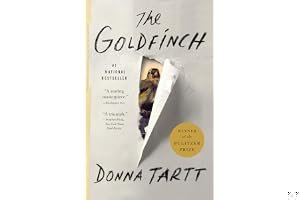
The Goldfinch
Donna Tartt
4.7
A young New Yorker grieving his mother's death is pulled into a gritty underworld of art and wealth in this "extraordinary" and beloved Pulitzer Prize winner that "connects with the heart as well as the mind" (Stephen King, New York Times Book Review).
Theo Decker, a 13-year-old New Yorker, miraculously survives an accident that kills his mother. Abandoned by his father, Theo is taken in by the family of a wealthy friend. Bewildered by his strange new home on Park Avenue, disturbed by schoolmates who don't know how to talk to him, and tormented above all by a longing for his mother, he clings to the one thing that reminds him of her: a small, mysteriously captivating painting that ultimately draws Theo into a wealthy and insular art community.
As an adult, Theo moves silkily between the drawing rooms of the rich and the dusty labyrinth of an antiques store where he works. He is alienated and in love -- and at the center of a narrowing, ever more dangerous circle.
The Goldfinch is a mesmerizing, stay-up-all-night and tell-all-your-friends triumph, an old-fashioned story of loss and obsession, survival and self-invention. From the streets of New York to the dark corners of the art underworld, this "soaring masterpiece" examines the devastating impact of grief and the ruthless machinations of fate (Ron Charles, Washington Post).
…
Recommended by Kaci Lambe Kai.
Kaci Lambe Kai
More modern, I recently read The Goldfinch by Donna Tartt and I love the way it was written. A great story brought to life with long, descriptive, sometimes frenetic sentences. She paints some scenes and some ideas that are unlike anything I've ever read. It's like watching magic on the page. [source]
Cover unavailable
8
Let the Great World Spin
Colum McCann
4.6
NATIONAL BOOK AWARD WINNER • Colum McCann’s beloved novel inspired by Philippe Petit’s daring high-wire stunt, which is also depicted in the film The Walk starring Joseph Gordon-Levitt
In the dawning light of a late-summer morning, the people of lower Manhattan stand hushed, staring up in disbelief at the Twin Towers. It is August 1974, and a mysterious tightrope walker is running, dancing, leaping between the towers, suspended a quarter mile above the ground. In the streets below, a slew of ordinary lives become extraordinary in bestselling novelist Colum McCann’s stunningly intricate portrait of a city and its people. Let the Great World Spin is the critically acclaimed author’s most ambitious novel yet: a dazzlingly rich vision of the pain, loveliness, mystery, and promise of New York City in the 1970s.
Corrigan, a radical young Irish monk, struggles with his own demons as he lives among the prostitutes in the middle of the burning Bronx. A group of mothers gather in a Park Avenue apartment to mourn their sons who died in Vietnam, only to discover just how much divides them even in grief. A young artist finds herself at the scene of a hit-and-run that sends her own life careening sideways. Tillie, a thirty-eight-year-old grandmother, turns tricks alongside her teenage daughter, determined not only to take care of her family but to prove her own worth. Elegantly weaving together these and other seemingly disparate lives, McCann’s powerful allegory comes alive in the unforgettable voices of the city’s people, unexpectedly drawn together by hope, beauty, and the “artistic crime of the century.”
A sweeping and radical social novel, Let the Great World Spincaptures the spirit of America in a time of transition, extraordinary promise, and, in hindsight, heartbreaking innocence. Hailed as a “fiercely original talent” (San Francisco Chronicle), award-winning novelist McCann has delivered a triumphantly American masterpiece that awakens in us a sense of what the novel can achieve, confront, and even heal.
Praise for Let the Great World Spin
“This is a gorgeous book, multilayered and deeply felt, and it’s a damned lot of fun to read, too. Leave it to an Irishman to write one of the greatest-ever novels about New York. There’s so much passion and humor and pure lifeforce on every page of Let the Great World Spin that you’ll find yourself giddy, dizzy, overwhelmed.”—Dave Eggers
“Stunning . . . [an] elegiac glimpse of hope . . . It’s a novel rooted firmly in time and place. It vividly captures New York at its worst and best. But it transcends all that. In the end, it’s a novel about families—the ones we’re born into and the ones we make for ourselves.”—USA Today
“The first great 9/11 novel . . . We are all dancing on the wire of history, and even on solid ground we breathe the thinnest of air.”—Esquire
“Mesmerizing . . . a Joycean look at the lives of New Yorkers changed by a single act on a single day . . . Colum McCann’s marvelously rich novel . . . weaves a portrait of a city and a moment, dizzyingly satisfying to read and difficult to put down.”—The Seattle Times
“Vibrantly whole . . . With a series of spare, gorgeously wrought vignettes, Colum McCann brings 1970s New York to life. . . . And as always, McCann’s heart-stoppingly simple descriptions wow.”—Entertainment Weekly
“An act of pure bravado, dizzying proof that to keep your balance you need to know how to fall.”—O: The Oprah Magazine
From the Hardcover edition.
…
Recommended by Esi Edugyan.
Esi Edugyan
I have read it a few times now, and I’m still trying to puzzle out how he fit those strands together so beautifully. It is a miracle of a novel. [source]
Cover unavailable
9
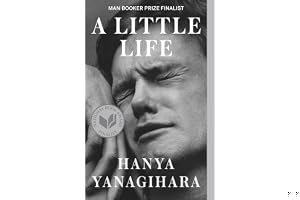
A Little Life
Hanya Yanagihara
4.6
When four classmates from a small Massachusetts college move to New York to make their way, they're broke, adrift, and buoyed only by their friendship and ambition. There is kind, handsome Willem, an aspiring actor; JB, a quick-witted, sometimes cruel Brooklyn-born painter seeking entry to the art world; Malcolm, a frustrated architect at a prominent firm; and withdrawn, brilliant, enigmatic Jude, who serves as their center of gravity.
Over the decades, their relationships deepen and darken, tinged by addiction, success, and pride. Yet their greatest challenge, each comes to realize, is Jude himself, by midlife a terrifyingly talented litigator yet an increasingly broken man, his mind and body scarred by an unspeakable childhood, and haunted by what he fears is a degree of trauma that he’ll not only be unable to overcome—but that will define his life forever.
…
Recommended by Ella Botting, Jane Mcgonigal, and Soman Chainani.
Ella Botting
This may be the best book I’ve ever read. It’s a long old book and I bloody love a long book. I don’t possess the vocabulary to describe this book - it was so good, but I’d say it was an intricate analysis of the character’s daily lives and their daily lives are hella intense at times. This booked reminded me that while success in the workplace is very important to me, so is the time spent with loved ones. All three of those books have both drastically changed the way I see things and helped me in my career and personal journey. They also taught me in varying ways that I really can accomplish the things I want to accomplish as well as the importance of recognising my own privilege. [source]
Jane Mcgonigal
@rhondakap @kellymcgonigal If you haven't read this only read it if you want to be emotionally brutalized. Virtuoso portrayal of compassion but Jesus you could not make worse things happen to your characters. Almost sadistic. Amazing book but traumatic read [source]
Soman Chainani
The greatest work of fiction I’ve ever read, with the simplest theme: All of us come with baggage and wounds and pain; all of us. [source]
Cover unavailable
10
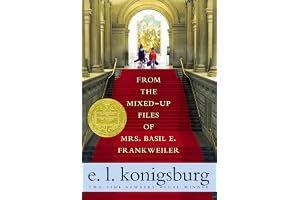
From the Mixed-Up Files of Mrs. Basil E. Frankweiler
E.L. Konigsburg
4.6
When Claudia decided to run away, she planned very carefully. She would be gone just long enough to teach her parents a lesson in Claudia appreciation. And she would go in comfort-she would live at the Metropolitan Museum of Art. She saved her money, and she invited her brother Jamie to go, mostly because be was a miser and would have money.
Claudia was a good organizer and Jamie bad some ideas, too; so the two took up residence at the museum right on schedule. But once the fun of settling in was over, Claudia had two unexpected problems: She felt just the same, and she wanted to feel different; and she found a statue at the Museum so beautiful she could not go home until she bad discovered its maker, a question that baffled the experts, too.
The former owner of the statue was Mrs. Basil E. Frankweiler. Without her-well, without her, Claudia might never have found a way to go home.
@DearDara My 2nd favorite book growing up, just barely edged out by Charlie and the Chocolate Factory. [source]
Robin Stevens
This is an American book that I read as a young child, and it’s a classic in America. It’s a phenomenal book, and one of the cleverest mystery stories I’ve ever read. [source]
Cover unavailable
11
Breakfast at Tiffany's
Truman Capote, Michael C. Hall, et al
4.6
It's New York in the 1940s, where the martinis flow from cocktail hour till breakfast at Tiffany's. And nice girls don't, except, of course, Holly Golightly. Pursued by Mafia gangsters and playboy millionaires, Holly is a fragile eyeful of tawny hair and turned-up nose, a heart-breaker, a perplexer, a traveller, a tease. She is irrepressibly 'top banana in the shock department', and one of the shining flowers of American fiction.
This edition also contains three stories: 'House of Flowers', 'A Diamond Guitar' and 'A Christmas Memory'.
So much of that novella is about personality, and about the way one is liberated by personality or burdened by it. [source]
Cover unavailable
12
Here Is New York
E. B. White, Roger Angell
4.6
Perceptive, funny, and nostalgic, E.B. White's stroll around Manhattan remains the quintessential love letter to the city, written by one of America's foremost literary figures. The New York Times has named Here is New York one of the ten best books ever written about the metropolis, and The New Yorker calls it "the wittiest essay, and one of the most perceptive, ever done on the city.
Recommended by Ben Greenman.
Ben Greenman
Because I’m a writer, I think this is a very important city for writers—and because I work at the New Yorker, I think it’s a very important city for certain kinds of writers. This book was part of a travel series, for which they had reporters and editors try to corral writers and have them talk about their travel. They might take Paul Bowles to northern Africa, for instance, and he’d guide them around. They wanted E B White to take part, but he didn’t really want to travel; he normally stayed pretty close to home. So he came into the city from Maine and walked around a little, and thought about what he had experienced here when he was younger. [source]
Cover unavailable
13
Rules of Civility
Amor Towles
4.6
On the last night of 1937, twenty-five-year-old Katey Kontent is in a second-rate Greenwich Village jazz bar with her boardinghouse roommate stretching three dollars as far as it will go when Tinker Grey, a handsome banker with royal blue eyes and a tempered smile, happens to sit at the neighboring table. This chance encounter and its startling consequences propel Katey on a yearlong journey from a Wall Street secretarial pool toward the upper echelons of New York society and the executive suites of Condé Nast—rarefied environs where she will have little to rely upon other than a bracing wit and her own brand of cool nerve.
Wooed in turn by a shy, principled multi-millionaire, and an irrepressible Upper East Side ne'er-do-well, befriended by a single-minded widow who is ahead of her time, and challenged by an imperious mentor, Katey experiences firsthand the poise secured by wealth and station and the failed aspirations that reside just below the surface. Even as she waits for circumstances to bring Tinker back into her life, she begins to realize how our most promising choices inevitably lay the groundwork for our regrets.
…
Cover unavailable
14
The Alienist (Dr. Laszlo Kreizler, #1)
Caleb Carr
4.5
When The Alienist was first published in 1994, it was a major phenomenon, spending six months on the New York Times bestseller list, receiving critical acclaim, and selling millions of copies. This modern classic continues to be a touchstone of historical suspense fiction for readers everywhere.
The year is 1896. The city is New York. Newspaper reporter John Schuyler Moore is summoned by his friend Dr. Laszlo Kreizler—a psychologist, or “alienist”—to view the horribly mutilated body of an adolescent boy abandoned on the unfinished Williamsburg Bridge. From there the two embark on a revolutionary effort in criminology: creating a psychological profile of the perpetrator based on the details of his crimes. Their dangerous quest takes them into the tortured past and twisted mind of a murderer who will kill again before their hunt is over.
Fast-paced and riveting, infused with historical detail, The Alienist conjures up Gilded Age New York, with its tenements and mansions, corrupt cops and flamboyant gangsters, shining opera houses and seamy gin mills. It is an age in which questioning society’s belief that all killers are born, not made, could have unexpected and fatal consequences.
…
Recommended by Douglas Starr.
Douglas Starr
‘Alienist’ was the term for a psychiatrist or a psychologist at the time. They were called alienists because mentally deranged people were thought to be alienated from themselves. This is a wonderful historical novel, written in 1994, about one such alienist in New York City, who helps solve a series of grizzly serial killings at the time when Theodore Roosevelt was the commissioner of police. [source]
Cover unavailable
15
The Bell Jar
Sylvia Plath
4.5
Sylvia Plath's shocking, realistic, and intensely emotional novel about a woman falling into the grip of insanity.
Esther Greenwood is brilliant, beautiful, enormously talented, and successful, but slowly going under—maybe for the last time. In her acclaimed and enduring masterwork, Sylvia Plath brilliantly draws the reader into Esther's breakdown with such intensity that her insanity becomes palpably real, even rational—as accessible an experience as going to the movies. A deep penetration into the darkest and most harrowing corners of the human psyche, The Bell Jar is an extraordinary accomplishment and a haunting American classic.
…
Recommended by Bryony Gordon, The CEO Library Community (through anonymous form), and Tim Kendall.
As a teenage girl, you have to read The Bell Jar. It’s a rite of passage. [source]
The CEO Library Community (through anonymous form)
One of the best 3 books I've read in 2019 [source]
Tim Kendall
Despite its subject matter, The Bell Jar is often a very funny novel. Perhaps we miss it because the pall of Plath’s biography descends across the whole work and reputation. But The Bell Jar is viciously funny. There are people still alive today who won’t talk about it because they were so badly hurt by Plath’s portrayal of them. [source]
Cover unavailable
16
New York
Edward Rutherfurd
4.5
Edward Rutherfurd celebrates America’s greatest city in a rich, engrossing saga, weaving together tales of families rich and poor, native-born and immigrant—a cast of fictional and true characters whose fates rise and fall and rise again with the city’s fortunes. From this intimate perspective we see New York’s humble beginnings as a tiny Indian fishing village, the arrival of Dutch and British merchants, the Revolutionary War, the emergence of the city as a great trading and financial center, the convulsions of the Civil War, the excesses of the Gilded Age, the explosion of immigration in the late nineteenth and early twentieth centuries, the trials of World War II, the near demise of New York in the 1970s and its roaring rebirth in the 1990s, and the attack on the World Trade Center. A stirring mix of battle, romance, family struggles, and personal triumphs, New York: The Novel gloriously captures the search for freedom and opportunity at the heart of our nation’s history.
…
Cover unavailable
17
Motherless Brooklyn
Jonathan Lethem
4.5
Saint Vincent's Home for Boys, Brooklyn, early 1970s. For Lionel Essrog, a.k.a. The Human Freakshow, a victim of Tourette's syndrome (an uncontrollable urge to shout out nonsense, touch every surface in reach, rearrange objects), Frank Minna is a savior. A local tough guy and fixer, Minna shows up to take Lionel and three of his fellow orphans on mysterious errands: empty a store of stereos as the owner watches; destroy a small amusement park; go visit old Italian men.The four grow up to be the Minna Men, a fly-by-night detective agency-cum-limo service, and their days and nights revolve around Frank, the prince of Brooklyn, who glides through life on street smarts, attitude, and secret knowledge. Then one dreadful night, Frank is knifed and thrown in a Dumpster, and Lionel must become a real detective.
As Lionel struggles to find Frank's killer -- and with his Tourette's -- he's forced to delve into the complex, shadowy web of relationships, threats, and favors that make up the Brooklyn world he thought he knew so well. No one -- not Frank, not Frank's bitter wife, Julia, not the other Minna Men -- is what they seem. Not even The Human Freakshow.
All the familiar Lethem touches are here -- crackling dialogue, sly humor, dizzying plot twists -- but they're secondary to wonderfully full, tragic, funny characterizations, and a dazzling evocation of place. Indeed Brooklyn, with its charming folkways and language, its unique style of bad-boy swagger and sentimentality, becomes itself a major character.
"Motherless Brooklyn" is a bravado performance: funny, tense, touching, extravagant. This novel's publication signals the coming-of-age of a major American writer.
…
Recommended by Adnan Virk, Alan Cooper, and Leo Babauta.
Adnan Virk
@MzCSmith A great time Claire! Loved the book. Heard mixed reviews on the film although @TheAndyKatz also a fan [source]
Alan Cooper
I’m so excited! Edward Norton made a movie of Jonathan Lethem’s awesome book, Motherless Brooklyn. I can’t wait! [source]
Cover unavailable
18
Gotham: A History of New York City to 1898
Edwin G. Burrows, Mike Wallace
4.5
To European explorers, it was Eden, a paradise of waist-high grasses, towering stands of walnut, maple, chestnut, and oak, and forests that teemed with bears, wolves, raccoons, beavers, otters, and foxes. Today, it is the site of Broadway and Wall Street, the Empire State Building and the Statue of Liberty, and the home of millions of people, who have come from every corner of the nation and the globe.
In Gotham, Edwin G. Burrows and Mike Wallace have produced a monumental work of history, one that ranges from the Indian tribes that settled in and around the island of Manna-hata, to the consolidation of the five boroughs into Greater New York in 1898. It is an epic narrative, a story as vast and as varied as the city it chronicles, and it underscores that the history of New York is the story of our nation. Readers will relive the tumultuous early years of New Amsterdam under the Dutch West India Company, Peter Stuyvesant's despotic regime, Indian wars, slave resistance and revolt, the Revolutionary War and the defeat of Washington's army on Brooklyn Heights, the destructive seven years of British occupation, New York as the nation's first capital, the duel between Aaron Burr and Alexander Hamilton, the Erie Canal and the coming of the railroads, the growth of the city as a port and financial center, the infamous draft riots of the Civil War, the great flood of immigrants, the rise of mass entertainment such as vaudeville and Coney Island, the building of the Brooklyn Bridge and the birth of the skyscraper. Here too is a cast of thousands--the rebel Jacob Leisler and the reformer Joanna Bethune; Clement Moore, who saved Greenwich Village from the city's street-grid plan; Herman Melville, who painted disillusioned portraits of city life; and Walt Whitman, who happily celebrated that same life. We meet the rebel Jacob Leisler and the reformer Joanna Bethune; Boss Tweed and his nemesis, cartoonist Thomas Nast; Emma Goldman and Nellie Bly; Jacob Riis and Horace Greeley; police commissioner Theodore Roosevelt; Colonel Waring and his "white angels" (who revolutionized the sanitation department); millionaires John Jacob Astor, Cornelius Vanderbilt, August Belmont, and William Randolph Hearst; and hundreds more who left their mark on this great city.
The events and people who crowd these pages guarantee that this is no mere local history. It is in fact a portrait of the heart and soul of America, and a book that will mesmerize everyone interested in the peaks and valleys of American life as found in the greatest city on earth. Gotham is a dazzling read, a fast-paced, brilliant narrative that carries the reader along as it threads hundreds of stories into one great blockbuster of a book.
…
Cover unavailable
19
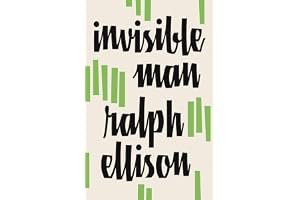
Invisible Man
Ralph Ellison
4.5
First published in 1952 and immediately hailed as a masterpiece, Invisible Man is one of those rare novels that have changed the shape of American literature. For not only does Ralph Ellison's nightmare journey across the racial divide tell unparalleled truths about the nature of bigotry and its effects on the minds of both victims and perpetrators, it gives us an entirely new model of what a novel can be.
As he journeys from the Deep South to the streets and basements of Harlem, from a horrifying "battle royal" where black men are reduced to fighting animals, to a Communist rally where they are elevated to the status of trophies, Ralph Ellison's nameless protagonist ushers readers into a parallel universe that throws our own into harsh and even hilarious relief. Suspenseful and sardonic, narrated in a voice that takes in the symphonic range of the American language, black and white, Invisible Man is one of the most audacious and dazzling novels of our century.
…
Recommended by Barack Obama, Daegan Miller, Dan Barreiro, and 3 others.
As a devoted reader, the president has been linked to a lengthy list of novels and poetry collections over the years — he admits he enjoys a thriller. [source]
Daegan Miller
The novel pinpoints relentlessly, and beautifully, the environment of exploitation. [source]
Dan Barreiro
Riveting time capsule material. Literary giant Ellison on the blues, on race, on his powerful book, Invisible Man. https://t.co/iS6xQ7ojE8 [source]
Cover unavailable
20
Extremely Loud & Incredibly Close
Jonathan Safran Foer
4.5
Nine-year-old Oskar Schell is an inventor, amateur entomologist, Francophile, letter writer, pacifist, natural historian, percussionist, romantic, Great Explorer, jeweller, detective, vegan, and collector of butterflies. When his father is killed in the September 11th attacks on the World Trade Centre, Oskar sets out to solve the mystery of a key he discovers in his father's closet. It is a search which leads him into the lives of strangers, through the five boroughs of New York, into history, to the bombings of Dresden and Hiroshima, and on an inward journey which brings him ever closer to some kind of peace.
So here are my three must read books. I've been reading a lot of great books like: Outsmart Your Instincts, The Culture Code, and Antonio Damasio’s The Strange Order, and sometimes when you read a lot of nonfiction it’s very enriching, sometimes you need a novel. I really believe you should take a minute and read something beautiful. Listen, listen to Lolita by Nabokov. But also listen to Blood Meridian by Cormac McCarthy and listen to Richard Poe narrate that. Those are two of the greatest feats of the english language that I can think of. Then there’s Fortress of Solitude, an amazing book, Extremely Loud and Incredibly Close, these are great novels. Cold Mountain is a beautiful novel, Snow Falling On Cedars, I mean they’ve been around for a while. But goddamnit, get those under your belt. Those are the novels I think you should read. You know Love In The Time Of Cholera it just makes you ache. Kind of like a Hemingway thing, where Hemingway “ahh!”, it’s the same thing, you know. So I don’t know, I’m a fan of all those books. Those are my 3 slash 20 books. [source]
Cover unavailable
21
The Bonfire of the Vanities
Tom Wolfe
4.5
Should you ever go back?
It has been ten years since Abby Williams left home and scrubbed away all visible evidence of her small town roots. Now working as an environmental lawyer in Chicago, she has a thriving career, a modern apartment, and her pick of meaningless one-night stands.
But when a new case takes her back home to Barrens, Indiana, the life Abby painstakingly created begins to crack. Tasked with investigating Optimal Plastics, the town's most high-profile company and economic heart, Abby begins to find strange connections to Barrens’ biggest scandal from more than a decade ago involving the popular Kaycee Mitchell and her closest friends—just before Kaycee disappeared for good.
Abby knows the key to solving any case lies in the weak spots, the unanswered questions. But as Abby tries to find out what really happened to Kaycee, she unearths an even more disturbing secret—a ritual called “The Game,” which will threaten the reputations, and lives, of the community and risk exposing a darkness that may consume her.
With tantalizing twists, slow-burning suspense, and a remote, rural town of just five claustrophobic miles, Bonfire is a dark exploration of the question: can you ever outrun your past?
…
Recommended by Ev Williams and John Timoney.
John Timoney
Tom Wolfe is a very good friend of mine and he wrote the foreword to my new book. When The Bonfire of the Vanities came out in 1986 it captured New York life, and in particular the criminal justice system, like nothing else. I was jealous. I was living this life but Tom Wolfe wrote it. How was a non-cop able to capture this? He captured the nuances of the criminal justice system, and especially the issue of race. His treatment of the criminal justice system in the county of the Bronx is hilarious and deeply troubling. Cops certainly could relate to the prisoners in the Bronx jail who knew more about the sections of the penal law than all of the prosecutors and defence lawyers combined. The inmates were quite comfortable reciting the numerical chapter of the penal code as opposed to the English title of such code. And so we find one inmate proudly proclaiming that he is in for ‘160.15’ (which is armed robbery) as opposed to his less manly inmate who is only in for ‘140.10’ (a second degree burglary.) [source]
Cover unavailable
22
Up in the Old Hotel
Joseph Mitchell
4.4
Saloon-keepers and street preachers, gypsies and steel-walking Mohawks, a bearded lady and a 93-year-old “seafoodetarian” who believes his specialized diet will keep him alive for another two decades. These are among the people that Joseph Mitchell immortalized in his reportage for The New Yorker and in four books—McSorley's Wonderful Saloon, Old Mr. Flood, The Bottom of the Harbor, and Joe Gould's Secret—that are still renowned for their precise, respectful observation, their graveyard humor, and their offhand perfection of style.These masterpieces (along with several previously uncollected stories) are available in one volume, which presents an indelible collective portrait of an unsuspected New York and its odder citizens—as depicted by one of the great writers of this or any other time.
…
Recommended by Mike Dash and William Fiennes.
Mike Dash
For 30 to 40 years he wrote about all the people on the margins of society in New York. But he did this in such a humane way, it’s just wonderful. [source]
William Fiennes
They’re incredibly vivid and moving stories, and often they feel closer to short stories than newspaper or magazine articles. [source]
Cover unavailable
23
The Age of Innocence
Edith Wharton
4.4
The Age of Innocence is Edith Wharton's twelfth novel, initially serialized in four parts in the Pictorial Review magazine in 1920, and later released by D. Appleton and Company as a book in New York and in London. It won the 1921 Pulitzer Prize for Fiction, making it the first novel written by a woman to win the Pulitzer Prize for Fiction, and thus Wharton the first woman to win the prize. The story is set in upper-class New York City in the 1870s.
A tender, moving tale of unconditional love in a family that, despite its profound flaws, gave the author the fiery determination to carve out a successful life on her own terms.
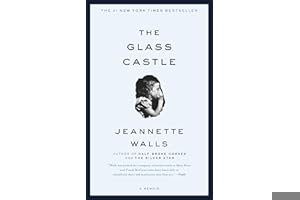
Jeannette Walls grew up with parents whose ideals and stubborn nonconformity were both their curse and their salvation. Rex and Rose Mary Walls had four children. In the beginning, they lived like nomads, moving among Southwest desert towns, camping in the mountains. Rex was a charismatic, brilliant man who, when sober, captured his children's imagination, teaching them physics, geology, and above all, how to embrace life fearlessly. Rose Mary, who painted and wrote and couldn't stand the responsibility of providing for her family, called herself an "excitement addict." Cooking a meal that would be consumed in fifteen minutes had no appeal when she could make a painting that might last forever.
Later, when the money ran out, or the romance of the wandering life faded, the Walls retreated to the dismal West Virginia mining town -- and the family -- Rex Walls had done everything he could to escape. He drank. He stole the grocery money and disappeared for days. As the dysfunction of the family escalated, Jeannette and her brother and sisters had to fend for themselves, supporting one another as they weathered their parents' betrayals and, finally, found the resources and will to leave home.
What is so astonishing about Jeannette Walls is not just that she had the guts and tenacity and intelligence to get out, but that she describes her parents with such deep affection and generosity. Hers is a story of triumph against all odds, but also a tender, moving tale of unconditional love in a family that despite its profound flaws gave her the fiery determination to carve out a successful life on her own terms.
For two decades, Jeannette Walls hid her roots. Now she tells her own story.
…
Cover unavailable
25
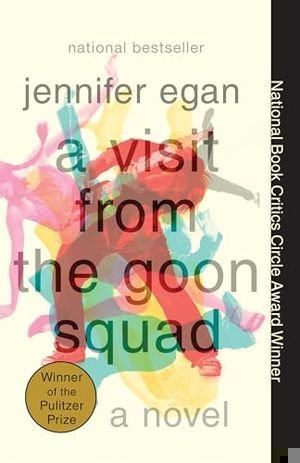
A Visit from the Goon Squad
Jennifer Egan
4.4
Jennifer Egan’s spellbinding interlocking narratives circle the lives of Bennie Salazar, an aging former punk rocker and record executive, and Sasha, the passionate, troubled young woman he employs. Although Bennie and Sasha never discover each other’s pasts, the reader does, in intimate detail, along with the secret lives of a host of other characters whose paths intersect with theirs, over many years, in locales as varied as New York, San Francisco, Naples, and Africa.
We first meet Sasha in her mid-thirties, on her therapist’s couch in New York City, confronting her long-standing compulsion to steal. Later, we learn the genesis of her turmoil when we see her as the child of a violent marriage, then as a runaway living in Naples, then as a college student trying to avert the suicidal impulses of her best friend. We plunge into the hidden yearnings and disappointments of her uncle, an art historian stuck in a dead marriage, who travels to Naples to extract Sasha from the city’s demimonde and experiences an epiphany of his own while staring at a sculpture of Orpheus and Eurydice in the Museo Nazionale. We meet Bennie Salazar at the melancholy nadir of his adult life—divorced, struggling to connect with his nine-year-old son, listening to a washed-up band in the basement of a suburban house—and then revisit him in 1979, at the height of his youth, shy and tender, reveling in San Francisco’s punk scene as he discovers his ardor for rock and roll and his gift for spotting talent. We learn what became of his high school gang—who thrived and who faltered—and we encounter Lou Kline, Bennie’s catastrophically careless mentor, along with the lovers and children left behind in the wake of Lou’s far-flung sexual conquests and meteoric rise and fall.
A Visit from the Goon Squad is a book about the interplay of time and music, about survival, about the stirrings and transformations set inexorably in motion by even the most passing conjunction of our fates. In a breathtaking array of styles and tones ranging from tragedy to satire to PowerPoint, Egan captures the undertow of self-destruction that we all must either master or succumb to; the basic human hunger for redemption; and the universal tendency to reach for both—and escape the merciless progress of time—in the transporting realms of art and music. Sly, startling, exhilarating work from one of our boldest writers.
I love this novel. It is wonderfully written, brilliantly imaginative and engaging, funny and sad and smart. I also love it because of what it says about SF. That in a genre often caricatured (by those who don’t know it very well) as being about the wish-fulfillment fantasies of adolescent boys – huge space weapons, scantily clad astro-girls and so on – some of the very best work is being written by women. [source]
I love this novel. It is wonderfully written, brilliantly imaginative and engaging, funny and sad and smart. I also love it because of what it says about SF. That in a genre often caricatured (by those who don’t know it very well) as being about the wish-fulfillment fantasies of adolescent boys – huge space weapons, scantily clad astro-girls and so on – some of the very best work is being written by women. [source]
@Egangoonsquad @EW I loved this book. Great pick. [source]
Cover unavailable
26
The House of Mirth
Edith Wharton, Anna Quindlen
4.4
A literary sensation when it was published by Scribners in 1905, The House of Mirth quickly established Edith Wharton as the most important American woman of letters in the twentieth century. The first American novel to provide a devastatingly accurate portrait of New York's aristocracy, it is the story of the beautiful and beguiling Lily Bart and her ill-fated attempt to rise to the heights of a heartless society in which, ultimately, she has no part.
A timeless story we have seen play out for hundreds of years — yet, it feels like it would only apply to modern day society in the form of a Kardashian. [source]
Americans are always fascinated with the wealthy. It’s a bit of an illusion to imagine ours to be a classless society, as novelists like Wharton made brilliantly clear. [source]
Cover unavailable
27
City of Girls
Elizabeth Gilbert
4.4
From the # 1 New York Times bestselling author of Eat, Pray, Love and The Signature of All Things, a delicious novel of glamour, sex, and adventure, about a young woman discovering that you don't have to be a good girl to be a good person.
Life is both fleeting and dangerous, and there is no point in denying yourself pleasure, or being anything other than what you are.
Beloved author Elizabeth Gilbert returns to fiction with a unique love story set in the New York City theater world during the 1940s. Told from the perspective of an older woman as she looks back on her youth with both pleasure and regret (but mostly pleasure), City of Girls explores themes of female sexuality and promiscuity, as well as the idiosyncrasies of true love.
In 1940, nineteen-year-old Vivian Morris has just been kicked out of Vassar College, owing to her lackluster freshman-year performance. Her affluent parents send her to Manhattan to live with her Aunt Peg, who owns a flamboyant, crumbling midtown theater called the Lily Playhouse. There Vivian is introduced to an entire cosmos of unconventional and charismatic characters, from the fun-chasing showgirls to a sexy male actor, a grand-dame actress, a lady-killer writer, and no-nonsense stage manager. But when Vivian makes a personal mistake that results in professional scandal, it turns her new world upside down in ways that it will take her years to fully understand. Ultimately, though, it leads her to a new understanding of the kind of life she craves-and the kind of freedom it takes to pursue it. It will also lead to the love of her life, a love that stands out from all the rest.
Now ninety-five years old and telling her story at last, Vivian recalls how the events of those years altered the course of her life - and the gusto and autonomy with which she approached it. At some point in a woman's life, she just gets tired of being ashamed all the time, she muses. After that, she is free to become whoever she truly is. Written with a powerful wisdom about human desire and connection, City of Girls is a love story like no other.
…
Recommended by Rogue Epa and Sarah Lahbati.
Rogue Epa
Tucking into a great new book in my happy place. @GilbertLiz https://t.co/Qoz8tO4OVp [source]
Sarah Lahbati
City of Girls may be my new favorite book. [source]
Cover unavailable
28
Low Life: Lures and Snares of Old New York
Luc Sante
4.3
Luc Sante's Low Life is a portrait of America's greatest city, the riotous and anarchic breeding ground of modernity. This is not the familiar saga of mansions, avenues, and robber barons, but the messy, turbulent, often murderous story of the city's slums; the teeming streets--scene of innumerable cons and crimes whose cramped and overcrowded housing is still a prominent feature of the cityscape.
Low Life voyages through Manhattan from four different directions. Part One examines the actual topography of Manhattan from 1840 to 1919; Part Two, the era's opportunities for vice and entertainment--theaters and saloons, opium and cocaine dens, gambling and prostitution; Part Three investigates the forces of law and order which did and didn't work to contain the illegalities; Part Four counterposes the city's tides of revolt and idealism against the city as it actually was.
Low Life provides an arresting and entertaining view of what New York was actually like in its salad days. But it's more than simpy a book about New York. It's one of the most provocative books about urban life ever written--an evocation of the mythology of the quintessential modern metropolis, which has much to say not only about New York's past but about the present and future of all cities.
…
Recommended by Ben Greenman.
Ben Greenman
Well, I think when people come into New York, if they’ve never been here before, they think of all the possible dangers—purse snatchings and peep shows, that sort of thing—and that’s part of the appeal. In any giant city that has this many people so close together, those things are going to happen. White’s mission was to go out and make sense of all of it. It’s an extremely engaged, really fun and smart book about these things. (The movie Gangs of New York is in some ways a more political look, but it’s that sort of feel.) The book goes all the way up to the early 20s, but it starts in 1840, so it basically covers the Civil War, the turn of the century, and how the industrial shape of the city changed up to the 20s. [source]
Cover unavailable
29
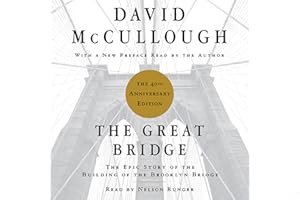
The Great Bridge: The Epic Story of the Building of the Brooklyn Bridge
David McCullough
4.3
Published on the fortieth anniversary of its initial publication, this edition of the classic book contains a new Preface by David McCullough, “one of our most gifted living writers” (The Washington Post).
Built to join the rapidly expanding cities of New York and Brooklyn, the Brooklyn Bridge was thought by many at the start to be an impossibility destined to fail if not from insurmountable technical problems then from political corruption. (It was the heyday of Boss Tweed in New York.)
But the Brooklyn Bridge was at once the greatest engineering triumph of the age, a surpassing work of art, a proud American icon, and a story like no other in our history. Courage, chicanery, unprecedented ingenuity and plain blundering, heroes, rascals, all the best and worst in human nature played a part. At the center of the drama were the stricken chief engineer, Washington Roebling and his remarkable wife, Emily Warren Roebling, neither of whom ever gave up in the face of one heartbreaking setback after another.
The Great Bridge is a sweeping narrative of a stupendous American achievement that rose up out of its era like a cathedral, a symbol of affirmation then and still in our time.
…
Recommended by Michael Lopp and Brent Glass.
Michael Lopp
VP of Engineering/Slack
A fascinating read about when bridges were still in beta. [source]
Brent Glass
Even though you know what the ending is, he creates a dramatic sense of just what it took to bring this bridge into being and to complete it. [source]
Cover unavailable
30
Bright Lights, Big City
Jay McInerney
4.3
With the publication of Bright Lights, Big City in 1984, Jay McInerney became a literary sensation, heralded as the voice of a generation. The novel follows a young man, living in Manhattan as if he owned it, through nightclubs, fashion shows, editorial offices, and loft parties as he attempts to outstrip mortality and the recurring approach of dawn. With nothing but goodwill, controlled substances, and wit to sustain him in this anti-quest, he runs until he reaches his reckoning point, where he is forced to acknowledge loss and, possibly, to rediscover his better instincts. This remarkable novel of youth and New York remains one of the most beloved, imitated, and iconic novels in America.
…
Recommended by Eric Ripert.
Eric Ripert
I don’t think any book describes New York in the ‘80s as accurately and as well as this book. When I arrived in 1991, I instantly felt that energy from the book in the city. [source]
Cover unavailable
31
The Island at the Center of the World: The Epic Story of Dutch Manhattan and the Forgotten Colony That Shaped America
Russell Shorto
4.3
When the British wrested New Amsterdam from the Dutch in 1664, the truth about its thriving,polyglot society began to disappear into myths about an island purchased for 24 dollars and a cartoonish peg-legged governor. But the story of the Dutch colony of New Netherland was merely lost, not destroyed: 12,000 pages of its records–recently declared a national treasure–are now being translated. Drawing on this remarkable archive, Russell Shorto has created a gripping narrative–a story of global sweep centered on a wilderness called Manhattan–that transforms our understanding of early America.
The Dutch colony pre-dated the “original” thirteen colonies, yet it seems strikingly familiar. Its capital was cosmopolitan and multi-ethnic, and its citizens valued free trade, individual rights, and religious freedom. Their champion was a progressive, young lawyer named Adriaen van der Donck, who emerges in these pages as a forgotten American patriot and whose political vision brought him into conflict with Peter Stuyvesant, the autocratic director of the Dutch colony. The struggle between these two strong-willed men laid the foundation for New York City and helped shape American culture. The Island at the Center of the World uncovers a lost world and offers a surprising new perspective on our own.
…
Cover unavailable
32
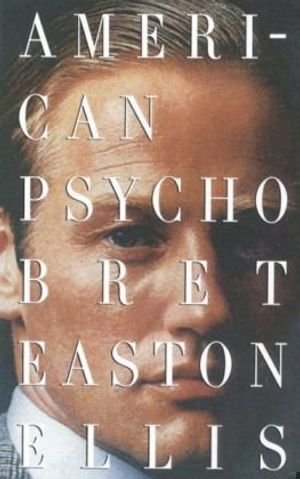
American Psycho
Bret Easton Ellis
4.3
Patrick Bateman is twenty-six and he works on Wall Street, he is handsome, sophisticated, charming and intelligent. He is also a psychopath. Taking us to head-on collision with America's greatest dream—and its worst nightmare—American Psycho is bleak, bitter, black comedy about a world we all recognise but do not wish to confront.
Most people exist between the on and off switch. They are unable to turn on and put out high power, and they are unable to turn off completely and enjoy true rest. To learn how to control your on and off switch, read the book Psych by Dr. Judd Biasiotto. He is one of the most successful power lifters in history, having squatted over 600 pounds at a bodyweight of 132... drug free, at the age of 44, after back surgery. [source]
Cover unavailable
33
The Golem and the Jinni (The Golem and the Jinni, #1)
Helene Wecker
4.3
Chava is a golem, a creature made of clay, brought to life by a disgraced rabbi who dabbles in dark Kabbalistic magic, created to be the wife of a man who dies at sea on the voyage from Poland. Chava is unmoored and adrift as the ship arrives in New York harbor in 1899.
Ahmad is a jinni, a being of fire born in the ancient Syrian desert, trapped in an old copper flask, and released in New York City, though still not entirely free.
Ahmad and Chava become unlikely friends and soul mates with a mystical connection. Marvelous and compulsively readable, Helene Wecker's debut novel The Golem and the Jinni weaves strands of Yiddish and Middle Eastern literature, historical fiction and magical fable, into a wondrously inventive and unforgettable tale.
…
Cover unavailable
34
Behold the Dreamers
Imbolo Mbue
4.3
Jende Jonga, a Cameroonian immigrant living in Harlem, has come to the United States to provide a better life for himself, his wife, Neni, and their six-year-old son. In the fall of 2007, Jende can hardly believe his luck when he lands a job as a chauffeur for Clark Edwards, a senior executive at Lehman Brothers. Clark demands punctuality, discretion, and loyalty—and Jende is eager to please. Clark’s wife, Cindy, even offers Neni temporary work at the Edwardses’ summer home in the Hamptons. With these opportunities, Jende and Neni can at last gain a foothold in America and imagine a brighter future.
However, the world of great power and privilege conceals troubling secrets, and soon Jende and Neni notice cracks in their employers’ façades.
When the financial world is rocked by the collapse of Lehman Brothers, the Jongas are desperate to keep Jende’s job—even as their marriage threatens to fall apart. As all four lives are dramatically upended, Jende and Neni are forced to make an impossible choice.
…
Cover unavailable
35
Brooklyn
Colm Toibin
4.3
Hauntingly beautiful and heartbreaking, Colm Tóibín's sixth novel, Brooklyn, is set in Brooklyn and Ireland in the early 1950s, when one young woman crosses the ocean to make a new life for herself.
Eilis Lacey has come of age in small-town Ireland in the years following World War Two. Though skilled at bookkeeping, she cannot find a job in the miserable Irish economy. When an Irish priest from Brooklyn offers to sponsor Eilis in America--to live and work in a Brooklyn neighborhood "just like Ireland"--she decides she must go, leaving her fragile mother and her charismatic sister behind.
Eilis finds work in a department store on Fulton Street, and when she least expects it, finds love. Tony, a blond Italian from a big family, slowly wins her over with patient charm. He takes Eilis to Coney Island and Ebbets Field, and home to dinner in the two-room apartment he shares with his brothers and parents. He talks of having children who are Dodgers fans. But just as Eilis begins to fall in love with Tony, devastating news from Ireland threatens the promise of her future.
…
Cover unavailable
36
Another Brooklyn
Jacqueline Woodson
4.3
Running into a long-ago friend sets memories from the 1970s in motion for August, transporting her to a time and a place where friendship was everything—until it wasn’t. For August and her girls, sharing confidences as they ambled through neighborhood streets, Brooklyn was a place where they believed that they were beautiful, talented, brilliant—a part of a future that belonged to them.
But beneath the hopeful veneer, there was another Brooklyn, a dangerous place where grown men reached for innocent girls in dark hallways, where ghosts haunted the night, where mothers disappeared. A world where madness was just a sunset away and fathers found hope in religion.
…
Cover unavailable
37
Tell the Wolves I'm Home
Carol Rifka Brunt
4.3
In this striking literary debut, Carol Rifka Brunt unfolds a moving story of love, grief, and renewal as two lonely people become the unlikeliest of friends and find that sometimes you don't know you've lost someone until you've found them.
1987. There's only one person who has ever truly understood fourteen-year-old June Elbus, and that's her uncle, the renowned painter Finn Weiss. Shy at school and distant from her older sister, June can only be herself in Finn's company; he is her godfather, confidant, and best friend. So when he dies, far too young, of a mysterious illness her mother can barely speak about, June's world is turned upside down. But Finn's death brings a surprise acquaintance into June's life—someone who will help her to heal, and to question what she thinks she knows about Finn, her family, and even her own heart.
At Finn's funeral, June notices a strange man lingering just beyond the crowd. A few days later, she receives a package in the mail. Inside is a beautiful teapot she recognizes from Finn's apartment, and a note from Toby, the stranger, asking for an opportunity to meet. As the two begin to spend time together, June realizes she's not the only one who misses Finn, and if she can bring herself to trust this unexpected friend, he just might be the one she needs the most.
An emotionally charged coming-of-age novel, Tell the Wolves I'm Home is a tender story of love lost and found, an unforgettable portrait of the way compassion can make us whole again.
…
Cover unavailable
38
When You Reach Me
Rebecca Stead
4.3
Miranda is an ordinary sixth grader, until she starts receiving mysterious messages from somebody who knows all about her, including things that have not even happened yet. Each message brings her closer to believing that only she can prevent a tragic death. Until the final note makes her think she’s too late.
Cover unavailable
39
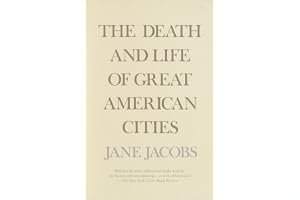
The Death and Life of Great American Cities
Jane Jacobs
4.3
A direct and fundamentally optimistic indictment of the short-sightedness and intellectual arrogance that has characterized much of urban planning in this century, The Death and Life of Great American Cities has, since its first publication in 1961, become the standard against which all endeavors in that field are measured. In prose of outstanding immediacy, Jane Jacobs writes about what makes streets safe or unsafe; about what constitutes a neighborhood, and what function it serves within the larger organism of the city; about why some neighborhoods remain impoverished while others regenerate themselves. She writes about the salutary role of funeral parlors and tenement windows, the dangers of too much development money and too little diversity. Compassionate, bracingly indignant, and always keenly detailed, Jane Jacobs's monumental work provides an essential framework for assessing the vitality of all cities.
Jacobs pointed out innumerable ways in which people are connected by proximity and the virtues of dense living. [source]
Leo Hollis
This book sums up these new ideas of putting people first – that the city is complex but not a place that needs to be rationalised. [source]
Cover unavailable
40
It's Kind of a Funny Story
Ned Vizzini
4.2
Ambitious New York City teenager Craig Gilner is determined to succeed at life - which means getting into the right high school to get into the right job. But once Craig aces his way into Manhattan's Executive Pre-Professional High School, the pressure becomes unbearable. He stops eating and sleeping until, one night, he nearly kills himself.
Craig's suicidal episode gets him checked into a mental hospital, where his new neighbors include a transsexual sex addict, a girl who has scarred her own face with scissors, and the self-elected President Armelio. There, Craig is finally able to confront the sources of his anxiety.
Ned Vizzini, who himself spent time in a psychiatric hospital, has created a remarkably moving tale about the sometimes unexpected road to happiness.
…
Recommended by Rae Earl.
Rae Earl
It covers something the other books don’t cover which is relapse [source]
Cover unavailable
41
The Woman in the Window
A. J Finn
4.2
For readers of Gillian Flynn and Tana French comes one of the decade's most anticipated debuts, to be published in thirty-five languages around the world and already in development as a major film from Fox: a twisty, powerful Hitchcockian thriller about an agoraphobic woman who believes she witnessed a crime in a neighboring house.It isn't paranoia if it's really happening . . .
Anna Fox lives alone--a recluse in her New York City home, unable to venture outside. She spends her day drinking wine (maybe too much), watching old movies, recalling happier times . . . and spying on her neighbors.
Then the Russells move into the house across the way: a father, mother, their teenaged son. The perfect family. But when Anna, gazing out her window one night, sees something she shouldn't, her world begins to crumble?and its shocking secrets are laid bare.
What is real? What is imagined? Who is in danger? Who is in control? In this diabolically gripping thriller, no one--and nothing--is what it seems.
Twisty and powerful, ingenious, and moving, The Woman in the Window is a smart, sophisticated novel of psychological suspense that recalls the best of Hitchcock.
…
Cover unavailable
42
Wonder
R. J. Palacio
4.2
NOW A MAJOR MOTION PICTURE STARRING JULIA ROBERTS, OWEN WILSON, AND JACOB TREMBLAY!
Over 6 million people have read the #1 New York Times bestseller WONDER and have fallen in love with Auggie Pullman, an ordinary boy with an extraordinary face.
The book that inspired the Choose Kind movement.
I won’t describe what I look like. Whatever you’re thinking, it’s probably worse.
August Pullman was born with a facial difference that, up until now, has prevented him from going to a mainstream school. Starting 5th grade at Beecher Prep, he wants nothing more than to be treated as an ordinary kid—but his new classmates can’t get past Auggie’s extraordinary face. WONDER, now a #1 New York Times bestseller and included on the Texas Bluebonnet Award master list, begins from Auggie’s point of view, but soon switches to include his classmates, his sister, her boyfriend, and others. These perspectives converge in a portrait of one community’s struggle with empathy, compassion, and acceptance.
“Wonder is the best kids’ book of the year,” said Emily Bazelon, senior editor at Slate.com and author of Sticks and Stones: Defeating the Culture of Bullying and Rediscovering the Power of Character and Empathy. In a world where bullying among young people is an epidemic, this is a refreshing new narrative full of heart and hope. R.J. Palacio has called her debut novel “a meditation on kindness” —indeed, every reader will come away with a greater appreciation for the simple courage of friendship. Auggie is a hero to root for, a diamond in the rough who proves that you can’t blend in when you were born to stand out.
Join the conversation: #thewonderofwonder
Source: penguinrandomhouse.com
…
Cover unavailable
43
Lillian Boxfish Takes a Walk
Kathleen Rooney
4.2
It’s the last day of 1984, and 85-year-old Lillian Boxfish is about to take a walk.
As she traverses a grittier Manhattan, a city anxious after an attack by a still-at-large subway vigilante, she encounters bartenders, bodega clerks, chauffeurs, security guards, bohemians, criminals, children, parents, and parents-to-be—in surprising moments of generosity and grace. While she strolls, Lillian recalls a long and eventful life that included a brief reign as the highest-paid advertising woman in America—a career cut short by marriage, motherhood, divorce, and a breakdown.
A love letter to city life—however shiny or sleazy—Lillian Boxfish Takes a Walk by Kathleen Rooney paints a portrait of a remarkable woman across the canvas of a changing America: from the Jazz Age to the onset of the AIDS epidemic; the Great Depression to the birth of hip-hop.
…
Cover unavailable
44
The Devil Wears Prada (The Devil Wears Prada, #1)
Lauren Weisberger
4.2
A delightfully dishy novel about the all-time most impossible boss in the history of impossible bosses. Andrea Sachs, a small-town girl fresh out of college, lands the job “a million girls would die for.” Hired as the assistant to Miranda Priestly, the high-profile, fabulously successful editor of "Runway "magazine, Andrea finds herself in an office that shouts "Prada! Armani! Versace!" at every turn, a world populated by impossibly thin, heart-wrenchingly stylish women and beautiful men clad in fine-ribbed turtlenecks and tight leather pants that show off their lifelong dedication to the gym. With breathtaking ease, Miranda can turn each and every one of these hip sophisticates into a scared, whimpering child. THE DEVIL WEARS PRADA gives a rich and hilarious new meaning to complaints about “The Boss from Hell.” Narrated in Andrea’s smart, refreshingly disarming voice, it traces a deep, dark, devilish view of life at the top only hinted at in gossip columns and over Cosmopolitans at the trendiest cocktail parties. From sending the latest, not-yet-in-stores Harry Potter to Miranda’s children in Paris by private jet, to locating an unnamed antique store where Miranda had at some point admired a vintage dresser, to serving lattes to Miranda at precisely the piping hot temperature she prefers, Andrea is sorely tested each and every day—and often late into the night with orders barked over the phone. She puts up with it all by keeping her eyes on the prize: a recommendation from Miranda that will get Andrea a top job at any magazine of her choosing. As things escalate from the merely unacceptable to the downright outrageous, however, Andrea begins to realize that the job a million girls would die for may just kill her. And even if she survives, she has to decide whether or not the job is worth the price of her soul.
…
Cover unavailable
45
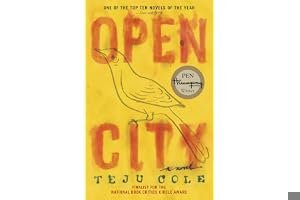
Open City
Teju Cole
4.2
Along the streets of Manhattan, a young Nigerian doctor doing his residency wanders aimlessly. The walks meet a need for Julius: they are a release from the tightly regulated mental environment of work, and they give him the opportunity to process his relationships, his recent breakup with his girlfriend, his present, his past.
But it is not only a physical landscape he covers; Julius crisscrosses social territory as well, encountering people from different cultures and classes who will provide insight on his journey—which takes him to Brussels, to the Nigeria of his youth, and into the most unrecognizable facets of his own soul.
…
Recommended by Amy Waldman, Leo Hollis, and Robert Eaglestone.
Amy Waldman
It’s about a solitary narrator who goes on walks through New York. 9/11 keeps resurfacing, indirectly and almost allusively, in really interesting ways. [source]
Leo Hollis
It’s a series of walks around New York, and is one of the most powerful books on living in a city that I’ve read in a long time. [source]
Robert Eaglestone
In the novel, migration is closely related to the theme of looking in the city, and of blindness. [source]
Cover unavailable
46
The New York Trilogy
Paul Auster, Art Spiegelman, Luc Sante
4.2
The remarkable, acclaimed series of interconnected detective novels – from the author of 4 3 2 1: A Novel
The New York Review of Books has called Paul Auster’s work “one of the most distinctive niches in contemporary literature.” Moving at the breathless pace of a thriller, this uniquely stylized triology of detective novels begins with City of Glass, in which Quinn, a mystery writer, receives an ominous phone call in the middle of the night. He’s drawn into the streets of New York, onto an elusive case that’s more puzzling and more deeply-layered than anything he might have written himself. In Ghosts, Blue, a mentee of Brown, is hired by White to spy on Black from a window on Orange Street. Once Blue starts stalking Black, he finds his subject on a similar mission, as well. In The Locked Room, Fanshawe has disappeared, leaving behind his wife and baby and nothing but a cache of novels, plays, and poems.
This Penguin Classics Deluxe Edition includes an introduction from author and professor Luc Sante, as well as a pulp novel-inspired cover from Art Spiegelman, Pulitzer Prize-winning graphic artist of Maus and In the Shadow of No Towers.
…
Cover unavailable
47
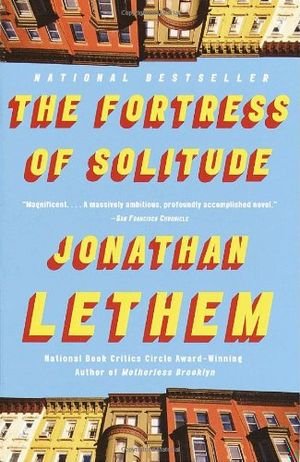
The Fortress of Solitude
Jonathan Lethem
4.2
The Fortress of Solitude is the story of Dylan Ebdus growing up white and motherless in downtown Brooklyn in the 1970s. It's a neighborhood where the entertainments include muggings along with games of stoopball. In that world, Dylan has one friend, a black teenager, also motherless, named Mingus Rude. As Lethem follows the knitting and unraveling of their friendship, he creates an overwhelmingly rich and emotionally gripping canvas of race and class, superheros, gentrification, funk, hip-hop, graffiti tagging, loyalty, and memory. The Fortress of Solitude is the first great urban coming of age novel to appear in years. (back cover)
So here are my three must read books. I've been reading a lot of great books like: Outsmart Your Instincts, The Culture Code, and Antonio Damasio’s The Strange Order, and sometimes when you read a lot of nonfiction it’s very enriching, sometimes you need a novel. I really believe you should take a minute and read something beautiful. Listen, listen to Lolita by Nabokov. But also listen to Blood Meridian by Cormac McCarthy and listen to Richard Poe narrate that. Those are two of the greatest feats of the english language that I can think of. Then there’s Fortress of Solitude, an amazing book, Extremely Loud and Incredibly Close, these are great novels. Cold Mountain is a beautiful novel, Snow Falling On Cedars, I mean they’ve been around for a while. But goddamnit, get those under your belt. Those are the novels I think you should read. You know Love In The Time Of Cholera it just makes you ache. Kind of like a Hemingway thing, where Hemingway “ahh!”, it’s the same thing, you know. So I don’t know, I’m a fan of all those books. Those are my 3 slash 20 books. [source]
Lethem was one of the first people to write about the new Brooklyn. This is a beautiful coming-of-age novel. [source]
Cover unavailable
48
Humans of New York
Brandon Stanton
4.2
A beautiful, heartfelt, funny and inspiring collection of photographs capturing the spirit of a city
In the summer of 2010, photographer Brandon Stanton set out on an ambitious project: to single-handedly create a photographic census of New York City. Armed with his camera, he began crisscrossing the city, covering thousands of miles on foot, all in an attempt to capture New Yorkers and their stories. The result of these efforts was a vibrant blog he called "Humans of New York," in which his photos were featured alongside quotes and anecdotes.
Humans of New York is the book inspired by the Internet sensation. With four hundred color photos, including exclusive portraits and all-new stories, Humans of New York is a stunning collection of images that showcases the outsized personalities of New York.
Surprising and moving, Humans of New York is a celebration of individuality and a tribute to the spirit of the city.
…
Cover unavailable
49
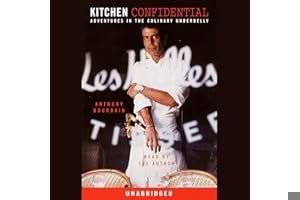
Kitchen Confidential: Adventures in the Culinary Underbelly
Anthony Bourdain
4.2
A deliciously funny, delectably shocking banquet of wild-but-true tales of life in the culinary trade from Chef Anthony Bourdain, laying out his more than a quarter-century of drugs, sex, and haute cuisine—now with all-new, never-before-published material.
New York Chef Tony Bourdain gives away secrets of the trade in his wickedly funny, inspiring memoir/expose. Kitchen Confidential reveals what Bourdain calls "twenty-five years of sex, drugs, bad behavior and haute cuisine."
…
Recommended by Eric Ripert, Jon Favreau, Catalina Penciu, and 2 others.
Eric Ripert
I love that Tony’s world in the kitchen was filled with pirate-like renegades when mine was peopled with regimented professionals. How eye-opening and entertaining to read about the other side! [source]
I'm a huge fan of personal stories and biographies with a touch of gastronomy like this one. [source]
Cover unavailable
50
The Diviners (The Diviners, #1)
Libba Bray, January LaVoy, et al
4.2
Evie O’Neill has been exiled from her boring old hometown and shipped off to the bustling streets of New York City—and she is pos-i-tute-ly ecstatic. It’s 1926, and New York is filled with speakeasies, Ziegfeld girls, and rakish pickpockets. The only catch is that she has to live with her uncle Will and his unhealthy obsession with the occult.
Evie worries he’ll discover her darkest secret: a supernatural power that has only brought her trouble so far. But when the police find a murdered girl branded with a cryptic symbol and Will is called to the scene, Evie realizes her gift could help catch a serial killer.
As Evie jumps headlong into a dance with a murderer, other stories unfold in the city that never sleeps. A young man named Memphis is caught between two worlds. A chorus girl named Theta is running from her past. A student named Jericho hides a shocking secret. And unknown to all, something dark and evil has awakened.
…
Cover unavailable
51
The Poet X
Elizabeth Acevedo and Quill Tree Book
4.2
A young girl in Harlem discovers slam poetry as a way to understand her mother’s religion and her own relationship to the world. Debut novel of renowned slam poet Elizabeth Acevedo.
Xiomara Batista feels unheard and unable to hide in her Harlem neighborhood. Ever since her body grew into curves, she has learned to let her fists and her fierceness do the talking.
But Xiomara has plenty she wants to say, and she pours all her frustration and passion onto the pages of a leather notebook, reciting the words to herself like prayers—especially after she catches feelings for a boy in her bio class named Aman, who her family can never know about. With Mami’s determination to force her daughter to obey the laws of the church, Xiomara understands that her thoughts are best kept to herself.
So when she is invited to join her school’s slam poetry club, she doesn’t know how she could ever attend without her mami finding out, much less speak her words out loud. But still, she can’t stop thinking about performing her poems.
Because in the face of a world that may not want to hear her, Xiomara refuses to be silent.
…
Cover unavailable
52
The Lonely City: Adventures in the Art of Being Alone
Olivia Laing
4.2
What does it mean to be lonely? How do we live, if we're not intimately engaged with another human being? How do we connect with other people? Does technology draw us closer together or trap us behind screens?
When Olivia Laing moved to New York City in her mid-thirties, she found herself inhabiting loneliness on a daily basis. Increasingly fascinated by this most shameful of experiences, she began to explore the lonely city by way of art. Moving fluidly between works and lives -- from Edward Hopper's Nighthawks to Andy Warhol's Time Capsules, from Henry Darger's hoarding to the depredations of the AIDS crisis -- Laing conducts an electric, dazzling investigation into what it means to be alone, illuminating not only the causes of loneliness but also how it might be resisted and redeemed.
…
Cover unavailable
53
Time and Again
Jack Finney
4.2
Science fiction, mystery, a passionate love story, and a detailed history of Old New York blend together in Jack Finney's spellbinding story of a young man enlisted in a secret Government experiment. Transported from the mid-twentieth century to New York City in the year 1882, Si Morley walks the fashionable "Ladies' Mile" of Broadway, is enchanted by the jingling sleigh bells in Central Park, and solves a 20th-century mystery by discovering its 19th-century roots. Falling in love with a beautiful young woman, he ultimately finds himself forced to choose between his lives in the present and the past. A story that will remain in the listener's memory, "Time and Again" is a remarkable blending of the troubled present and a nostalgic past, made vivid and extraordinarily moving by the images of a time that was...and perhaps still is.
…
Recommended by Karen Pfaff Manganillo.
Karen Pfaff Manganillo
I’ve always had an obsession with New York past and present. I’ve probably read this book 10 times. [source]
Cover unavailable
54
Last Exit to Brooklyn
Hubert Selby Jr.
4.2
Last Exit to Brooklyn remains undiminished in its awesome power and magnitude as the novel that first showed us the fierce, primal rage seething in America’s cities. Selby brings out the dope addicts, hoodlums, prostitutes, workers, and thieves brawling in the back alleys of Brooklyn. This explosive best-seller has come to be regarded as a classic of modern American writing.
Recommended by Darren Aronofsky.
Darren Aronofsky
I devoured it in a single night. I had never seen anyone attack the page like he did. [source]
Cover unavailable
55
Humans of New York: Stories
Brandon Stanton
4.2
In the summer of 2010, photographer Brandon Stanton began an ambitious project -to single-handedly create a photographic census of New York City. The photos he took and the accompanying interviews became the blog Humans of New York. In the first three years, his audience steadily grew from a few hundred to over one million. In 2013, his book Humans of New York, based on that blog, was published and immediately catapulted to the top of the NY Times Bestseller List. It has appeared on that list for over twenty-five weeks to date. The appeal of HONY has been so great that in the course of the next year Brandon's following increased tenfold to, now, over 12 million followers on Facebook. In the summer of 2014, the UN chose him to travel around the world on a goodwill mission that had followers meeting people from Iraq to the Ukraine to Mexico City via the photos he took.
Now, Brandon is back with the follow up to Humans of New York that his loyal followers have been waiting for: Humans of New York: Stories. Ever since Brandon began interviewing people on the streets of NY, the dialogue he's had with them has increasingly become as in-depth, intriguing and moving as the photos themselves. Humans of New York: Stories presents a whole new group of humans, complete with stories that delve deeper and surprise with greater candour. Let Brandon Stanton and the people he's photographed astonish you.
…
Cover unavailable
56
Severance
Ling Ma
4.2
Maybe it's the end of the world, but not for Candace Chen, a millennial, first-generation American and office drone meandering her way into adulthood in Ling Ma's offbeat, wryly funny, apocalyptic satire, Severance.
Candace Chen, a millennial drone self-sequestered in a Manhattan office tower, is devoted to routine. With the recent passing of her Chinese immigrant parents, she's had her fill of uncertainty. She's content just to carry on: She goes to work, troubleshoots the teen-targeted Gemstone Bible, watches movies in a Greenpoint basement with her boyfriend.
So Candace barely notices when a plague of biblical proportions sweeps New York. Then Shen Fever spreads. Families flee. Companies cease operations. The subways screech to a halt. Her bosses enlist her as part of a dwindling skeleton crew with a big end-date payoff. Soon entirely alone, still unfevered, she photographs the eerie, abandoned city as the anonymous blogger NY Ghost.
Candace won't be able to make it on her own forever, though. Enter a group of survivors, led by the power-hungry IT tech Bob. They're traveling to a place called the Facility, where, Bob promises, they will have everything they need to start society anew. But Candace is carrying a secret she knows Bob will exploit. Should she escape from her rescuers?
A send-up and takedown of the rituals, routines, and missed opportunities of contemporary life, Ling Ma's Severance is a moving family story, a quirky coming-of-adulthood tale, and a hilarious, deadpan satire. Most important, it's a heartfelt tribute to the connections that drive us to do more than survive.
…
Recommended by Jenny Davidson.
Jenny Davidson
It’s a brilliant book, the one on this list that I most strongly recommend to people trying to take their mind off the news. [source]
Cover unavailable
57
Harriet the Spy (Harriet the Spy #1)
Louise Fitzhugh
4.2
Harriet the Spy has a secret notebook that she fills with utterly honest jottings about her parents, her classmates, and her neighbors. Every day on her spy route she "observes" and notes down anything of interest to her:
I BET THAT LADY WITH THE CROSS-EYE LOOKS IN THE MIRROR AND JUST FEELS TERRIBLE.
PINKY WHITEHEAD WILL NEVER CHANGE. DOES HIS MOTHER HATE HIM? IF I HAD HIM I'D HATE HIM.
IF MARION HAWTHORNE DOESN'T WATCH OUT SHE'S GOING TO GROW UP INTO A LADY HITLER.
But when Harriet's notebook is found by her schoolmates, their anger and retaliation and Harriet's unexpected responses explode in a hilarious way.
This is a novel about a young woman's efforts to duck the ills of the world by embarking on an extended hibernation with the help of one of the worst psychiatrists in the annals of literature and the battery of medicines she prescribes.
Our narrator should be happy, shouldn't she? She's young, thin, pretty, a recent Columbia graduate, works an easy job at a hip art gallery, lives in an apartment on the Upper East Side of Manhattan paid for, like the rest of her needs, by her inheritance. But there is a dark and vacuous hole in her heart, and it isn't just the loss of her parents, or the way her Wall Street boyfriend treats her, or her sadomasochistic relationship with her best friend, Reva. It's the year 2000 in a city aglitter with wealth and possibility; what could be so terribly wrong?
My Year of Rest and Relaxation is a powerful answer to that question. Through the story of a year spent under the influence of a truly mad combination of drugs designed to heal our heroine from her alienation from this world, Moshfegh shows us how reasonable, even necessary, alienation can be
…
Recommended by Ben Collins, Claire Diaz Ortiz, and Lauren Mechling.
Ben Collins
Favorite book of the decade. https://t.co/CRcfp9f6Sq [source]
The friendship in it is very sweet, actually: it’s about two women, one of whom doesn’t have a name, and her best friend, Reva. They’re both brilliant comic characters, but Reva really lived on with me. Ottessa Moshfegh has this ability to say so much with little spiky details that linger. [source]
Cover unavailable
59
Ladies and Gentlemen, the Bronx is Burning: 1977, Baseball, Politics, and the Battle for the Soul of a City
Jonathan Mahler
4.1
A New York Times Notable Book of the Year
Scheduled for release in July 2007 as an ESPN original miniseries, starring John Turturro as Billy Martin, Oliver Platt as George Steinbrenner, and Daniel Sunjata as Reggie Jackson.
A kaleidoscopic portrait of New York City in 1977, The Bronx Is Burning is the story of two epic battles: the fight between Yankee Reggie Jackson and team manager Billy Martin, and the battle between Mario Cuomo and Ed Koch for the city's mayorship. Buried beneath these parallel conflicts--one for the soul of baseball, the other for the soul of the city--was the subtext of race. Deftly intertwined by journalist Jonathan Mahler, these braided Big Apple narratives reverberate to reveal a year that also saw the opening of Studio 54, the acquisition of the New York Post by Rupert Murdoch, a murderer dubbed the "Son of Sam," the infamous blackout, and the evolution of punk rock. As Koch defeated Cuomo, and as Reggie Jackson rescued a team racked with dissension, 1977 became a year of survival--and also of hope.
…
Cover unavailable
60
The History of Love
Nicole Krauss
4.1
An alternative cover edition for this ISBN can be found here
Fourteen-year-old Alma Singer is trying to find a cure for her mother's loneliness. Believing she might discover it in an old book her mother is lovingly translating, she sets out in search of its author. Across New York an old man called Leo Gursky is trying to survive a little bit longer. He spends his days dreaming of the lost love who, sixty years ago in Poland, inspired him to write a book. And although he doesn't know it yet, that book also survived: crossing oceans and generations, and changing lives...
…
Cover unavailable
61
City of Bones (The Mortal Instruments, #1)
Cassandra Clare
4.1
When fifteen-year-old Clary Fray heads out to the Pandemonium Club in New York City, she hardly expects to witness a murder― much less a murder committed by three teenagers covered with strange tattoos and brandishing bizarre weapons. Then the body disappears into thin air. It's hard to call the police when the murderers are invisible to everyone else and when there is nothing―not even a smear of blood―to show that a boy has died. Or was he a boy?
This is Clary's first meeting with the Shadowhunters, warriors dedicated to ridding the earth of demons. It's also her first encounter with Jace, a Shadowhunter who looks a little like an angel and acts a lot like a jerk. Within twenty-four hours Clary is pulled into Jace's world with a vengeance when her mother disappears and Clary herself is attacked by a demon. But why would demons be interested in ordinary mundanes like Clary and her mother? And how did Clary suddenly get the Sight? The Shadowhunters would like to know...
…
Cover unavailable
62
Inside the Apple: A Streetwise History of New York City
Michelle Nevius, James Nevius
4.1
How much do you actually know about New York City? Did you know they tried to anchor Zeppelins at the top of the Empire State Building? Or that the high-rent district of Park Avenue was once so dangerous it was called “Death Avenue”? Lively and comprehensive, Inside the Apple brings to life New York's fascinating past.
This narrative history of New York City is the first to offer practical walking tour know-how. Fast-paced but thorough, its bite-size chapters each focus on an event, person, or place of historical significance. Rich in anecdotes and illustrations, it whisks readers from colonial New Amsterdam through Manhattan's past, right up to post-9/11 New York. The book also works as a historical walking-tour guide, with 14 self-guided tours, maps, and step-by-step directions. Easy to carry with you as you explore the city, Inside the Apple allows you to visit the site of every story it tells. This energetic, wide-ranging, and often humorous book covers New York's most important historical moments, but is always anchored in the city of today.
…
Cover unavailable
63
Bossypants
Tina Fey
4.1
Tina Fey is one of of the world's greatest comic writers and performers. Here she reveals all, and proves what we've all suspected - you're no one until someone calls you bossy.
Recommended by Sheryl Sandberg.
Sheryl Sandberg
COO/Facebook
I absolutely loved Tina Fey's "Bossypants" and didn't want it to end. It's hilarious as well as important. Not only was I laughing on every page, but I was nodding along, highlighting and dog-earing like crazy. … It is so, so good. As a young girl, I was labeled bossy, too, so as a former - O.K., current - bossypants, I am grateful to Tina for being outspoken, unapologetic and hysterically funny. [source]
Cover unavailable
64
The Historical Atlas of New York City: A Visual Celebration of Nearly 400 Years of New York City's History
Eric Homberger, Alice Hudson
4.1
A New York Public Library Outstanding Reference Book
The rich and eminently browsable visual guide to the history of New York, in an all-new second edition
The Historical Atlas of New York City, second edition, takes us, neighborhood by neighborhood, through four hundred years of Gotham's rich past, describing such crucial events as the city's initial settlement of 270 people in thirty log houses; John Jacob Astor's meteoric rise from humble fur trader to the richest, most powerful man in the city; and the fascinating ethnic mixture that is modern Queens. The full-color maps, charts, photographs, drawings, and mini-essays of this encyclopedic volume also trace the historical development and cultural relevance of such iconic New York thoroughfares as Fifth Avenue, Wall Street, Park Avenue, and Broadway. This thoroughly updated edition brings the Atlas up to the present, including three all-new two-page spreads on Rudolph Giuliani's New York, the revival of Forty-second Street, and the rebuilding of Ground Zero.
A fascinating chronicle of the life of a metropolis, the handsome second edition of The Historical Atlas of New York City provides a vivid and unique perspective on the nation's cultural capital.
…
Cover unavailable
65
M Train
Patti Smith
4.1
M Train begins in the tiny Greenwich Village café where Smith goes every morning for black coffee, ruminates on the world as it is and the world as it was, and writes in her notebook. Through prose that shifts fluidly between dreams and reality, past and present, we travel to Frida Kahlo's Casa Azul in Mexico; to the fertile moon terrain of Iceland; to a ramshackle seaside bungalow in New York's Far Rockaway that Smith acquires just before Hurricane Sandy hits; to the West 4th Street subway station, filled with the sounds of the Velvet Underground after the death of Lou Reed; and to the graves of Genet, Plath, Rimbaud, and Mishima.
Woven throughout are reflections on the writer's craft and on artistic creation. Here, too, are singular memories of Smith's life in Michigan and the irremediable loss of her husband, Fred Sonic Smith.
Braiding despair with hope and consolation, illustrated with her signature Polaroids, M Train is a meditation on travel, detective shows, literature, and coffee. It is a powerful, deeply moving book by one of the most remarkable multiplatform artists at work today.
…
Cover unavailable
66
Tenements, Towers & Trash: An Unconventional Illustrated History of New York City
Julia Wertz
4.1
A New York Times Notable Book of 2017!
Here is New York, as you've never seen it before. A perfectly charming, sidesplittingly funny, intellectually entertaining illustrated history of the blocks, the buildings, and the guts of New York City, based on Julia Wertz's popular illustrated columns in The New Yorker and Harper's.
In Tenements, Towers & Trash, Julia Wertz takes us behind the New York that you think you know. Not the tourist's New York-the Statue of Liberty makes a brief appearance and the Empire State Building not at all-but the guts, the underbelly, of this city that never sleeps. With drawings and comics in her signature style, Wertz regales us with streetscapes "Then and Now" and little-known tales, such as the lost history of Kim's Video, the complicated and unresolved business of Ray's Pizza, the vintage trash and horse bones that litter the shore of Brooklyn's Bottle Beach, the ludicrous pinball prohibition, Staten Island's secret abandoned boatyard, and the hair-raising legend of the infamous abortionist of Fifth Avenue, Madame Restell. From bars, bakeries, and bookstores to food carts, street cleaners, and apartments both cramped and grand, Tenements, Towers & Trash is a wild ride in a time machine taxi from the present day city to bygone days of yore.
…
Cover unavailable
67
Forever
Pete Hamill
4.1
This widely acclaimed bestseller is the magical, epic tale of an extraordinary man who arrives in New York in 1740 and remains . . . forever.
Through the eyes of Cormac O'Connor -- granted immortality as long as he never leaves the island of Manhattan -- we watch New York grow from a tiny settlement on the tip of an untamed wilderness to the thriving metropolis of today. And through Cormac's remarkable adventures in both love and war, we come to know the city's buried secrets -- the way it has been shaped by greed, race, and waves of immigration, by the unleashing of enormous human energies, and, above all, by hope.
…
Cover unavailable
68
The Interestings
Meg Wolitzer
4.1
The Interestings explores the meaning of talent; the nature of envy; the roles of class, art, money, and power; and how all of it can shift and tilt precipitously over the course of a friendship and a life.
The summer that Nixon resigns, six teenagers at a summer camp for the arts become inseparable. Decades later the bond remains powerful, but so much else has changed. In The Interestings, Wolitzer follows these characters from the height of youth through middle age, as their talents, fortunes, and degrees of satisfaction diverge.
The kind of creativity that is rewarded at age fifteen is not always enough to propel someone through life at age thirty; not everyone can sustain, in adulthood, what seemed so special in adolescence. Jules Jacobson, an aspiring comic actress, eventually resigns herself to a more practical occupation and lifestyle. Her friend Jonah, a gifted musician, stops playing the guitar and becomes an engineer. But Ethan and Ash, Jules's now-married best friends, become shockingly successful—true to their initial artistic dreams, with the wealth and access that allow those dreams to keep expanding. The friendships endure and even prosper, but also underscore the differences in their fates, in what their talents have become and the shapes their lives have taken.
Wide in scope, ambitious, and populated by complex characters who come together and apart in a changing New York City, The Interestings explores the meaning of talent; the nature of envy; the roles of class, art, money, and power; and how all of it can shift and tilt precipitously over the course of a friendship and a life.
…
Cover unavailable
69
Sweetbitter
Stephanie Danler
4.1
The bestselling novel about a young woman's coming-of-age, set against the glitzy, grimy backdrop of New York's most elite restaurants. Now a STARZ Original Series.
Newly arrived in New York City, twenty-two-year-old Tess lands a job as a "backwaiter" at a celebrated downtown Manhattan restaurant. What follows is the story of her education: in champagne and cocaine, love and lust, dive bars and fine dining rooms, as she learns to navigate the chaotic, enchanting, punishing life she has chosen. As her appetites awaken—for food and wine, but also for knowledge, experience, and belonging—Tess finds herself helplessly drawn into a darkly alluring love triangle. In Sweetbitter, Stephanie Danler deftly conjures with heart-stopping accuracy the nonstop and high-adrenaline world of the restaurant industry and evokes the infinite possibilities, the unbearable beauty, and the fragility and brutality of being young in New York.
…
Cover unavailable
70
Manhattan Beach
Jennifer Egan
4.1
Anna Kerrigan, nearly twelve years old, accompanies her father to visit Dexter Styles, a man who, she gleans, is crucial to the survival of her father and her family. She is mesmerized by the sea beyond the house and by some charged mystery between the two men.
Years later, her father has disappeared and the country is at war. Anna works at the Brooklyn Naval Yard, where women are allowed to hold jobs that once belonged to men, now soldiers abroad. She becomes the first female diver, the most dangerous and exclusive of occupations, repairing the ships that will help America win the war. One evening at a nightclub, she meets Dexter Styles again, and begins to understand the complexity of her father’s life, the reasons he might have vanished.
With the atmosphere of a noir thriller, Egan’s first historical novel follows Anna and Styles into a world populated by gangsters, sailors, divers, bankers, and union men. Manhattan Beach is a deft, dazzling, propulsive exploration of a transformative moment in the lives and identities of women and men, of America and the world.
…
Cover unavailable
71
The Nest
Cynthia D'Aprix Sweene
4.1
For some kids summer is a sun-soaked season of fun. But for Steve, it’s just another season of worries. Worries about his sick newborn baby brother who is fighting to survive, worries about his parents who are struggling to cope, even worries about the wasp’s nest looming ominously from the eaves. So when a mysterious wasp queen invades his dreams, offering to “fix” the baby, Steve thinks his prayers have been answered.
All he has to do is say “Yes.” But “yes” is a powerful word. It is also a dangerous one. And once it is uttered, can it be taken back?
…
Cover unavailable
72
The Poisoner's Handbook: Murder and the Birth of Forensic Medicine in Jazz Age New York
Deborah Blum
4.1
Deborah Blum, writing with the high style and skill for suspense that is characteristic of the very best mystery fiction, shares the untold story of how poison rocked Jazz Age New York City. In The Poisoner's Handbook Blum draws from highly original research to track the fascinating, perilous days when a pair of forensic scientists began their trailblazing chemical detective work, fighting to end an era when untraceable poisons offered an easy path to the perfect crime.
Drama unfolds case by case as the heroes of The Poisoner's Handbook—chief medical examiner Charles Norris and toxicologist Alexander Gettler—investigate a family mysteriously stricken bald, Barnum and Bailey's Famous Blue Man, factory workers with crumbling bones, a diner serving poisoned pies, and many others. Each case presents a deadly new puzzle and Norris and Gettler work with a creativity that rivals that of the most imaginative murderer, creating revolutionary experiments to tease out even the wiliest compounds from human tissue. Yet in the tricky game of toxins, even science can't always be trusted, as proven when one of Gettler's experiments erroneously sets free a suburban housewife later nicknamed "America's Lucretia Borgia" to continue her nefarious work.
From the vantage of Norris and Gettler's laboratory in the infamous Bellevue Hospital it becomes clear that killers aren't the only toxic threat to New Yorkers. Modern life has created a kind of poison playground, and danger lurks around every corner. Automobiles choke the city streets with carbon monoxide; potent compounds, such as morphine, can be found on store shelves in products ranging from pesticides to cosmetics. Prohibition incites a chemist's war between bootleggers and government chemists while in Gotham's crowded speakeasies each round of cocktails becomes a game of Russian roulette. Norris and Gettler triumph over seemingly unbeatable odds to become the pioneers of forensic chemistry and the gatekeepers of justice during a remarkably deadly time. A beguiling concoction that is equal parts true crime, twentieth-century history, and science thriller, The Poisoner's Handbook is a page-turning account of a forgotten New York.
…
Recommended by Michelle Francl.
Michelle Francl
Deborah Blum’s book reminds me that molecules are powerful witnesses, if only we have the skills to interrogate them, and sometimes they are killers. [source]
Cover unavailable
73
The Sun Is Also a Star
Nicola Yoon
4.1
Natasha: I’m a girl who believes in science and facts. Not fate. Not destiny. Or dreams that will never come true. I’m definitely not the kind of girl who meets a cute boy on a crowded New York City street and falls in love with him. Not when my family is twelve hours away from being deported to Jamaica. Falling in love with him won’t be my story.
Daniel: I’ve always been the good son, the good student, living up to my parents’ high expectations. Never the poet. Or the dreamer. But when I see her, I forget about all that. Something about Natasha makes me think that fate has something much more extraordinary in store—for both of us.
The Universe: Every moment in our lives has brought us to this single moment. A million futures lie before us. Which one will come true?
…
Cover unavailable
74
Washington Square
Henry James, Michael Cunningham
4.1
The plot of Washington Square has the simplicity of old-fashioned melodrama: a plain-looking, good-hearted young woman, the only child of a rich widower, is pursued by a charming but unscrupulous man who seeks the wealth she will presumably inherit. On this premise, Henry James constructed one of his most memorable novels, a story in which love is answered with betrayal and loyalty leads inexorably to despair."
-- from the Introduction by Peter Conn
In Washington Square (1880), Henry James reminisces about the New York he had known thirty years before as he tells the story of Catherine Sloper and her fortune-seeking suitor Morris Townsend. This perceptively drawn human drama is James' most accessible work and an enduring literary triumph.
Washington Square Press' Enriched Classics present the great works of world literature enhanced for the contemporary reader. This edition of Washington Square has been prepared by Peter Conn, Andrea Mitchell Professor of English at the University of Pennsylvania. It includes his introduction, notes, selection of critical excerpts, and suggestions for further reading as well as a unique visual essay of period illustrations and photographs.
…
Cover unavailable
75
Night Film
Marisha Pessl
4.1
On a damp October night, 24-year-old Ashley Cordova is found dead in an abandoned warehouse in lower Manhattan. Though her death is ruled a suicide, veteran investigative journalist Scott McGrath suspects otherwise. As he probes the strange circumstances surrounding Ashley's life and death, McGrath comes face-to-face with the legacy of her father: the legendary, reclusive cult-horror film director Stanislaus Cordova--a man who hasn't been seen in public for more than thirty years.
For McGrath, another death connected to this seemingly cursed family dynasty seems more than just a coincidence. Though much has been written about Cordova's dark and unsettling films, very little is known about the man himself.
Driven by revenge, curiosity, and a need for the truth, McGrath, with the aid of two strangers, is drawn deeper and deeper into Cordova's eerie, hypnotic world. The last time he got close to exposing the director, McGrath lost his marriage and his career. This time he might lose even more.
…
Cover unavailable
76
Go Tell It on the Mountain
James Baldwin
4.1
Go Tell It On The Mountain, first published in 1953, is Baldwin's first major work, a semi-autobiographical novel that has established itself as an American classic. With lyrical precision, psychological directness, resonating symbolic power, and a rage that is at once unrelenting and compassionate, Baldwin chronicles a fourteen-year-old boy's discovery of the terms of his identity as the stepson of the minister of a storefront Pentecostal church in Harlem one Saturday in March of 1935. Baldwin's rendering of his protagonist's spiritual, sexual, and moral struggle of self-invention opened new possibilities in the American language and in the way Americans understand themselves.
…
Cover unavailable
77
Ragtime
E.L. Doctorow
4.1
Published in 1975, Ragtime changed our very concept of what a novel could be. An extraordinary tapestry, Ragtime captures the spirit of America in the era between the turn of the century & the First World War. The story opens in 1906 in New Rochelle, NY, at the home of an affluent American family. One lazy Sunday afternoon, the famous escape artist Harry Houdini swerves his car into a telephone pole outside their house. Almost magically, the line between fantasy & historical fact, between real & imaginary characters, disappears. Henry Ford, Emma Goldman, J.P. Morgan, Evelyn Nesbit, Sigmund Freud & Emiliano Zapata slip in & out of the tale, crossing paths with Doctorow's imagined family & other fictional characters, including an immigrant peddler & a ragtime musician from Harlem whose insistence on a point of justice drives him to revolutionary violence.
…
Cover unavailable
78
City of Dreams: The 400-Year Epic History of Immigrant New York
Tyler Anbinder
4.1
A defining American story of millions of immigrants, hundreds of languages, and one great city
New York has been America's city of immigrants for nearly four centuries. Growing from Peter Minuit's tiny settlement of 1626 to one with more than three million immigrants today, the city has always been a magnet for transplants from all over the globe. It is only fitting that the United States, a "nation of immigrants," is home to the only world city built primarily by immigration. More immigrants have entered the United States through New York than through all other entry points combined, making New York's immigrant saga a quintessentially American story.
City of Dreams is the long-overdue, inspiring, and defining account of New York's both famous and forgotten immigrants: the young man from the Caribbean who relocated to New York and became a Founding Father; an Italian immigrant who toiled for years at railroad track maintenance before achieving his dream of becoming a nationally renowned poet; Russian-born Emma Goldman, who condoned the murder of American industrialists as a means of aiding downtrodden workers; Dominican immigrant Oscar de la Renta, who dressed first ladies from Jackie Kennedy to Michelle Obama. Over ten years in the making, Tyler Anbinder's story is one of innovators and artists, revolutionaries and rioters, staggering deprivation and soaring triumphs. Today's immigrants are really no different from those who have come to America in centuries past—and their story has never before been told with such breadth of scope, lavish research, and resounding spirit.
…
Cover unavailable
79
Dash & Lily's Book of Dares (Dash & Lily, #1)
Rachel Cohn, David Levithan
4.1
“I’ve left some clues for you. If you want them, turn the page. If you don’t, put the book back on the shelf, please.”
So begins the latest whirlwind romance from the bestselling authors of Nick & Norah’s Infinite Playlist. Lily has left a red notebook full of challenges on a favorite bookstore shelf, waiting for just the right guy to come along and accept its dares. But is Dash that right guy? Or are Dash and Lily only destined to trade dares, dreams, and desires in the notebook they pass back and forth at locations across New York? Could their in-person selves possibly connect as well as their notebook versions? Or will they be a comic mismatch of disastrous proportions?
Rachel Cohn and David Levithan have written a love story that will have readers perusing bookstore shelves, looking and longing for a love (and a red notebook) of their own.
…
Cover unavailable
80
Gone Girl
Gillian Flynn
4.1
On a warm summer morning in North Carthage, Missouri, it is Nick and Amy Dunne’s fifth wedding anniversary. Presents are being wrapped and reservations are being made when Nick’s clever and beautiful wife disappears. As the police begin to investigate, the town golden boy parades a series of lies, deceits, and inappropriate behavior. Nick is oddly evasive, and he's definitely bitter - but is he really a killer?
Random Family: Love, Drugs, Trouble, and Coming of Age in the Bronx
Adrian Nicole LeBlanc
4.1
In her extraordinary bestseller, Adrian Nicole LeBlanc immerses readers in the intricacies of the ghetto, revealing the true sagas lurking behind the headlines of gangsta glamour, gold-drenched drug dealers, and street-corner society. Focusing on two romances - Jessica's dizzying infatuation with a hugely successful young heroin dealer, Boy George, and Coco's first love with Jessica's little brother, Cesar - Random Family is the story of young people trying to outrun their destinies. Jessica and Boy George ride the wild adventure between riches and ruin, while Coco and Cesar stick closer to the street, all four caught in a precarious dance between survival and death. Friends get murdered; the DEA and FBI investigate Boy George; Cesar becomes a fugitive; Jessica and Coco endure homelessness, betrayal, the heartbreaking separation of prison, and, throughout it all, the insidious damage of poverty.
Charting the tumultuous cycle of the generations - as girls become mothers, boys become criminals, and hope struggles against deprivation - LeBlanc slips behind the cold statistics and sensationalism and comes back with a riveting, haunting, and true story.
…
Cover unavailable
82
Goodbye to All That: Writers on Loving and Leaving New York
Sari Botton
4.0
Cover unavailable
83
The Nanny Diaries (Nanny, #1)
Emma Mclaughlin
4.0
Wanted: One young woman to take care of four-year-old boy. Must be cheerful, enthusiastic and selfless--bordering on masochistic. Must relish sixteen-hour shifts with a deliberately nap-deprived preschooler. Must love getting thrown up on, literally and figuratively, by everyone in his family. Must enjoy the delicious anticipation of ridiculously erratic pay. Mostly, must love being treated like fungus found growing out of employers Hermès bag. Those who take it personally need not apply. Who wouldn't want this job? Struggling to graduate from NYU and afford her microscopic studio apartment, Nanny takes a position caring for the only son of the wealthy X family. She rapidly learns the insane amount of juggling involved to ensure that a Park Avenue wife who doesn't work, cook, clean, or raise her own child has a smooth day. When the X's' marriage begins to disintegrate, Nanny ends up involved way beyond the bounds of human decency or good taste. Her tenure with the X family becomes a nearly impossible mission to maintain the mental health of their four-year-old, her own integrity and, most importantly, her sense of humor. Over nine tense months, Mrs. X and Nanny perform the age-old dance of decorum and power as they test the limits of modern-day servitude. Written by two former nannies, The Nanny Diaries deftly punctures the glamour of Manhattan's upper class.
…
Cover unavailable
84
Franny and Zooey
J. D. Salinger
4.0
The short story, Franny, takes place in an unnamed college town and tells the tale of an undergraduate who is becoming disenchanted with the selfishness and inauthenticity she perceives all around her.
The novella, Zooey, is named for Zooey Glass, the second-youngest member of the Glass family. As his younger sister, Franny, suffers a spiritual and existential breakdown in her parents' Manhattan living room -- leaving Bessie, her mother, deeply concerned -- Zooey comes to her aid, offering what he thinks is brotherly love, understanding, and words of sage advice.
Salinger writes of these works: "FRANNY came out in The New Yorker in 1955, and was swiftly followed, in 1957 by ZOOEY. Both stories are early, critical entries in a narrative series I'm doing about a family of settlers in twentieth-century New York, the Glasses. It is a long-term project, patently an ambiguous one, and there is a real-enough danger, I suppose that sooner or later I'll bog down, perhaps disappear entirely, in my own methods, locutions, and mannerisms. On the whole, though, I'm very hopeful. I love working on these Glass stories, I've been waiting for them most of my life, and I think I have fairly decent, monomaniacal plans to finish them with due care and all-available skill."
…
Cover unavailable
85
The Village: 400 Years of Beats and Bohemians, Radicals and Rogues
John Strausbaugh
4.0
Cultural commentator John Strausbaugh's The Village is the first complete history of Greenwich Village, the prodigiously influential and infamous New York City neighborhood.
From the Dutch settlers and Washington Square patricians, to the Triangle Shirtwaist fire and Prohibition-era speakeasies; from Abstract Expressionism and beatniks, to Stonewall and AIDS, the connecting narratives of The Village tell the story of America itself.
Illustrated with historic black-and-white photographs, The Village features lively, well-researched profiles of many of the people who made Greenwich Village famous, including Thomas Paine, Walt Whitman, Edna St. Vincent Millay, Mark Twain, Margaret Sanger, Eugene O’Neill, Marcel Duchamp, Upton Sinclair, Willa Cather, Jack Kerouac, Allen Ginsberg, Jackson Pollock, Anais Nin, Edward Albee, Charlie Parker, W. H. Auden, Woody Guthrie, James Baldwin, Maurice Sendak, E. E. Cummings, and Bob Dylan.
…
Cover unavailable
86
The Gods of Gotham (Timothy Wilde, #1)
Lyndsay Faye
4.0
1845. New York City forms its first police force. The great potato famine hits Ireland. These two seemingly disparate events will change New York City. Forever.
Timothy Wilde tends bar near the Exchange, fantasizing about the day he has enough money to win the girl of his dreams. But when his dreams literally incinerate in a fire devastating downtown Manhattan, he finds himself disfigured, unemployed, and homeless. His older brother obtains Timothy a job in the newly minted NYPD, but he is highly skeptical of this new "police force." And he is less than thrilled that his new beat is the notoriously down-and-out Sixth Ward - at the border of Five Points, the world's most notorious slum.
One night while making his rounds, Wilde literally runs into a little slip of a girl - a girl not more than ten years old - dashing through the dark in her nightshirt... covered head to toe in blood.
Timothy knows he should take the girl to the House of Refuge, yet he can't bring himself to abandon her. Instead, he takes her home, where she spins wild stories, claiming that dozens of bodies are buried in the forest north of 23rd Street. Timothy isn't sure whether to believe her or not, but, as the truth unfolds, the reluctant copper star finds himself engaged in a battle for justice that nearly costs him his brother, his romantic obsession, and his own life.
…
Cover unavailable
87
The Cricket in Times Square (Chester Cricket and His Friends, #1)
George Selden, Garth Williams
4.0
One night, the sounds of New York City--the rumbling of subway trains, thrumming of automobile tires, hooting of horns, howling of brakes, and the babbling of voices--is interrupted by a sound that even Tucker Mouse, a jaded inhabitant of Times Square, has never heard before. Mario, the son of Mama and Papa Bellini, proprietors of the subway-station newsstand, had only heard the sound once. What was this new, strangely musical chirping? None other than the mellifluous leg-rubbing of the somewhat disoriented Chester Cricket from Connecticut. Attracted by the irresistible smell of liverwurst, Chester had foolishly jumped into the picnic basket of some unsuspecting New Yorkers on a junket to the country. Despite the insect's wurst intentions, he ends up in a pile of dirt in Times Square.
Mario is elated to find Chester. He begs his parents to let him keep the shiny insect in the newsstand, assuring his bug-fearing mother that crickets are harmless, maybe even good luck. What ensues is an altogether captivating spin on the city mouse/country mouse story, as Chester adjusts to the bustle of the big city. Despite the cricket's comfortable matchbox bed (with Kleenex sheets); the fancy, seven-tiered pagoda cricket cage from Sai Fong's novelty shop; tasty mulberry leaves; the jolly company of Tucker Mouse and Harry Cat; and even his new-found fame as "the most famous musician in New York City," Chester begins to miss his peaceful life in the Connecticut countryside. The Cricket in Times Square--a Newbery Honor Book in 1961--is charmingly illustrated by the well-loved Garth Williams, and the tiniest details of this elegantly spun, vividly told, surprisingly suspenseful tale will stick with children for years and years. Make sure this classic sits on the shelf of your favorite child, right next to The Wind in the Willows. (Ages 9 to 12)
…
Cover unavailable
88
Christodora
Tim Murphy
4.0
In this vivid and compelling novel, Tim Murphy follows a diverse set of characters whose fates intertwine in an iconic building in Manhattan’s East Village, the Christodora. The Christodora is home to Milly and Jared, a privileged young couple with artistic ambitions.
Their neighbor, Hector, a Puerto Rican gay man who was once a celebrated AIDS activist but is now a lonely addict, becomes connected to Milly and Jared’s lives in ways none of them can anticipate. Meanwhile, Milly and Jared’s adopted son Mateo grows to see the opportunity for both self-realization and oblivion that New York offers. As the junkies and protesters of the 1980's give way to the hipsters of the 2000's and they, in turn, to the wealthy residents of the crowded, glass-towered city of the 2020's, enormous changes rock the personal lives of Milly and Jared and the constellation of people around them.
Moving kaleidoscopically from the Tompkins Square Riots and attempts by activists to galvanize a true response to the AIDS epidemic, to the New York City of the future, Christodora recounts the heartbreak wrought by AIDS, illustrates the allure and destructive power of hard drugs, and brings to life the ever-changing city itself.
…
Cover unavailable
89
The Lightning Thief (Percy Jackson and the Olympians, #1)
Rick Riordan
4.0
Alternate cover for this ISBN can be found here
Percy Jackson is a good kid, but he can't seem to focus on his schoolwork or control his temper. And lately, being away at boarding school is only getting worse - Percy could have sworn his pre-algebra teacher turned into a monster and tried to kill him. When Percy's mom finds out, she knows it's time that he knew the truth about where he came from, and that he go to the one place he'll be safe. She sends Percy to Camp Half Blood, a summer camp for demigods (on Long Island), where he learns that the father he never knew is Poseidon, God of the Sea. Soon a mystery unfolds and together with his friends—one a satyr and the other the demigod daughter of Athena - Percy sets out on a quest across the United States to reach the gates of the Underworld (located in a recording studio in Hollywood) and prevent a catastrophic war between the gods.
…
Cover unavailable
90
Vanishing New York: How a Great City Lost Its Soul
Jeremiah Moss
4.0
"ESSENTIAL READING FOR FANS OF JANE JACOBS, JOSEPH MITCHELL, PATTI SMITH, LUC SANTE AND CHEAP PIEROGI."--VANITY FAIR
An unflinching chronicle of gentrification in the twenty-first century and a love letter to lost New York by the creator of the popular and incendiary blog Vanishing New York.
For generations, New York City has been a mecca for artists, writers, and other hopefuls longing to be part of its rich cultural exchange and unique social fabric. But today, modern gentrification is transforming the city from an exceptional, iconoclastic metropolis into a suburbanized luxury zone with a price tag only the one percent can afford.
A Jane Jacobs for the digital age, blogger and cultural commentator Jeremiah Moss has emerged as one of the most outspoken and celebrated critics of this dramatic shift. In Vanishing New York, he reports on the city’s development in the twenty-first century, a period of "hyper-gentrification" that has resulted in the shocking transformation of beloved neighborhoods and the loss of treasured unofficial landmarks. In prose that the Village Voice has called a "mixture of snark, sorrow, poeticism, and lyric wit," Moss leads us on a colorful guided tour of the most changed parts of town—from the Lower East Side and Chelsea to Harlem and Williamsburg—lovingly eulogizing iconic institutions as they’re replaced with soulless upscale boutiques, luxury condo towers, and suburban chains.
Propelled by Moss’ hard-hitting, cantankerous style, Vanishing New York is a staggering examination of contemporary "urban renewal" and its repercussions—not only for New Yorkers, but for all of America and the world.
…
Cover unavailable
91
Insomniac City: New York, Oliver, and Me
Bill Hayes
4.0
Bill Hayes came to New York City in 2009 with a one-way ticket and only the vaguest idea of how he would get by. But, at forty-eight years old, having spent decades in San Francisco, he craved change. Grieving over the death of his partner, he quickly discovered the profound consolations of the city's incessant rhythms, the sight of the Empire State Building against the night sky, and New Yorkers themselves, kindred souls that Hayes, a lifelong insomniac, encountered on late-night strolls with his camera.
And he unexpectedly fell in love again, with his friend and neighbor, the writer and neurologist Oliver Sacks, whose exuberance--"I don't so much fear death as I do wasting life," he tells Hayes early on--is captured in vignettes throughout. What emerges is a portrait of Sacks at his most personal and endearing, from falling in love for the first time at age seventy-five to facing illness and death (Sacks died of cancer in August 2015).
…
Cover unavailable
92
Wonderstruck
Brian Selznick
4.0
Ben and Rose secretly wish for better lives. Ben longs for the father he has never known. Rose dreams of a mysterious actress whose life she chronicles in a scrapbook. When Ben discovers a puzzling clue in his mother's room and Rose reads an enticing headline in the newspaper, both children set out alone on desperate quests to find what they are missing.
Set fifty years apart, these two independent stories - Ben's told in words, Rose's in pictures - weave back and forth in symmetry.
…
Cover unavailable
93
The Colossus of New York
Colson Whitehead
4.0
In a dazzlingly original work of nonfiction, the award-winning novelist Colson Whitehead re-creates the exuberance, the chaos, the promise, and the heartbreak of New York. Here is a literary love song that will entrance anyone who has lived in—or spent time—in the greatest of American cities.
A masterful evocation of the city that never sleeps, The Colossus of New York captures the city’s inner and outer landscapes in a series of vignettes, meditations, and personal memories. Colson Whitehead conveys with almost uncanny immediacy the feelings and thoughts of longtime residents and of newcomers who dream of making it their home; of those who have conquered its challenges; and of those who struggle against its cruelties.
Whitehead’s style is as multilayered and multifarious as New York itself: Switching from third person, to first person, to second person, he weaves individual voices into a jazzy musical composition that perfectly reflects the way we experience the city. There is a funny, knowing riff on what it feels like to arrive in New York for the first time; a lyrical meditation on how the city is transformed by an unexpected rain shower; and a wry look at the ferocious battle that is commuting. The plaintive notes of the lonely and dispossessed resound in one passage, while another captures those magical moments when the city seems to be talking directly to you, inviting you to become one with its rhythms.
The Colossus of New York is a remarkable portrait of life in the big city. Ambitious in scope, gemlike in its details, it is at once an unparalleled tribute to New York and the ideal introduction to one of the most exciting writers working today.
From the Hardcover edition.
…
Cover unavailable
94
The Witches of New York
Ami McKay, Julia Whelan, et al
4.0
The beloved, bestselling author of The Birth House and The Virgin Cure is back with her most beguiling novel yet, luring us deep inside the lives of a trio of remarkable young women navigating the glitz and grotesqueries of Gilded-Age New York by any means possible, including witchcraft...
The year is 1880. Two hundred years after the trials in Salem, Adelaide Thom ('Moth' from The Virgin Cure) has left her life in the sideshow to open a tea shop with another young woman who feels it's finally safe enough to describe herself as a witch: a former medical student and "gardien de sorts" (keeper of spells), Eleanor St. Clair. Together they cater to Manhattan's high society ladies, specializing in cures, palmistry and potions--and in guarding the secrets of their clients.
All is well until one bright September afternoon, when an enchanting young woman named Beatrice Dunn arrives at their door seeking employment. Beatrice soon becomes indispensable as Eleanor's apprentice, but her new life with the witches is marred by strange occurrences. She sees things no one else can see. She hears voices no one else can hear. Objects appear out of thin air, as if gifts from the dead. Has she been touched by magic or is she simply losing her mind?
Eleanor wants to tread lightly and respect the magic manifest in the girl, but Adelaide sees a business opportunity. Working with Dr. Quinn Brody, a talented alienist, she submits Beatrice to a series of tests to see if she truly can talk to spirits. Amidst the witches' tug-of-war over what's best for her, Beatrice disappears, leaving them to wonder whether it was by choice or by force.
As Adelaide and Eleanor begin the desperate search for Beatrice, they're confronted by accusations and spectres from their own pasts. In a time when women were corseted, confined and committed for merely speaking their minds, were any of them safe?
…
Cover unavailable
95
Delirious New York: A Retroactive Manifesto for Manhattan
Rem Koolhaas
4.0
In this fanciful volume, Dutch architect Rem Koolhaas, founder of the Office for Metropolitan Architecture (O.M.A.), both analyzes and celebrates New York City. By suggesting the city as the site for an infinite variety of human activities and events--both real and imagined--the essence of the metropolitan lifestyle, its "culture of congestion" and its architecture are revealed in a brilliant new light. "Manhattan," Koolhaas writes, "is the 20th century's Rosetta stone . . . occupied by architectural mutations (Central Park, the Skyscraper), utopian fragments (Rockefeller Center, the U.N. Building), and irrational phenomena (Radio City Music Hall)." Filled with fascinating facts, as well as photographs, postcards, maps, watercolors, and drawings, the vibrancy of Koolhaas's poignant exploration of Gotham equals the heady, frenetic energy of the city itself. Anyone who loves New York will want to own this book.
…
Cover unavailable
96
A Woman Is No Man
Etaf Rum
4.0
A NEW YORK TIMES BESTSELLER • A READ WITH JENNATODAY SHOW BOOK CLUB PICK
A New York Times Book Review Editors’ Choice • A Washington Post 10 Books to Read in March • A Marie Claire Best Women’s Fiction of 2019 • A USA Today Best Book of the Week • A Washington Book Review Difficult-To-Put-Down Novel • A Refinery 29 Best Books of the Month • An Electric Lit 20 Best Debuts of the First Half of 2019 • A The Millions Most Anticipated Books of 2019
“Garnering justified comparisons to Khaled Hosseini’s A Thousand Splendid Suns... Etaf Rum’s debut novel is a must-read about women mustering up the bravery to follow their inner voice.” —Refinery 29
In her debut novel Etaf Rum tells the story of three generations of Palestinian-American women struggling to express their individual desires within the confines of their Arab culture in the wake of shocking intimate violence in their community—a story of culture and honor, secrets and betrayals, love and violence. Set in an America at once foreign to many and staggeringly close at hand, A Woman Is No Man is an intimate glimpse into a controlling and closed cultural world, and a universal tale about family and the ways silence and shame can destroy those we have sworn to protect.
"Where I come from, we’ve learned to silence ourselves. We’ve been taught that silence will save us. Where I come from, we keep these stories to ourselves. To tell them to the outside world is unheard of—dangerous, the ultimate shame.”
Palestine, 1990. Seventeen-year-old Isra prefers reading books to entertaining the suitors her father has chosen for her. Over the course of a week, the naïve and dreamy girl finds herself quickly betrothed and married, and is soon living in Brooklyn. There Isra struggles to adapt to the expectations of her oppressive mother-in-law Fareeda and strange new husband Adam, a pressure that intensifies as she begins to have children—four daughters instead of the sons Fareeda tells Isra she must bear.
Brooklyn, 2008. Eighteen-year-old Deya, Isra’s oldest daughter, must meet with potential husbands at her grandmother Fareeda’s insistence, though her only desire is to go to college. Deya can’t help but wonder if her options would have been different had her parents survived the car crash that killed them when Deya was only eight. But her grandmother is firm on the matter: the only way to secure a worthy future for Deya is through marriage to the right man.
But fate has a will of its own, and soon Deya will find herself on an unexpected path that leads her to shocking truths about her family—knowledge that will force her to question everything she thought she knew about her parents, the past, and her own future.
…
Cover unavailable
97
Rosemary's Baby (Rosemary's Baby, #1)
Ira Levin
4.0
Rosemary and Guy Woodhouse, an ordinary young couple, settle into a New York City apartment, unaware that the elderly neighbors and their bizarre group of friends have taken a disturbing interest in them. But by the time Rosemary discovers the horrifying truth, it may be far too late!
Cover unavailable
98
You (You #1)
Caroline Kepnes
4.0
When a beautiful, aspiring writer strides into the East Village bookstore where Joe Goldberg works, he does what anyone would do: he Googles the name on her credit card.
There is only one Guinevere Beck in New York City. She has a public Facebook account and Tweets incessantly, telling Joe everything he needs to know: she is simply Beck to her friends, she went to Brown University, she lives on Bank Street, and she’ll be at a bar in Brooklyn tonight—the perfect place for a “chance” meeting.
As Joe invisibly and obsessively takes control of Beck’s life, he orchestrates a series of events to ensure Beck finds herself in his waiting arms. Moving from stalker to boyfriend, Joe transforms himself into Beck’s perfect man, all while quietly removing the obstacles that stand in their way—even if it means murder.
‘You’ by Caroline Kepnes is an extraordinary book. So brutal, yet so funny, so cool, yet so terrifying. I can see now why there is praise on the back from Stephen King AND Lena Dunham. Amazing writing. https://t.co/g2SAfjCkBo [source]
Cover unavailable
99
The Museum of Extraordinary Things
Alice Hoffman
4.0
Coralie Sardie is the daughter of the sinister impresario behind The Museum of Extraordinary Things, a Coney Island boardwalk freak show that thrills the masses. An exceptional swimmer, Coralie appears as the Mermaid in her father’s “museum,” alongside performers like the Wolfman, the Butterfly Girl, and a one-hundred-year-old turtle. One night Coralie stumbles upon a striking young man taking pictures of moonlit trees in the woods off the Hudson River. The dashing photographer is Eddie Cohen, a Russian immigrant who has run away from his father’s Lower East Side Orthodox community and his job as a tailor’s apprentice. When Eddie photographs the devastation on the streets of New York following the infamous Triangle Shirtwaist Factory fire, he becomes embroiled in the suspicious mystery behind a young woman’s disappearance and ignites the heart of Coralie.
…
Cover unavailable
100
Netherland
Joseph O'Neill
4.0
In a New York City made phantasmagorical by the events of 9/11, Hans--a banker originally from the Netherlands--finds himself marooned among the strange occupants of the Chelsea Hotel after his English wife and son return to London. Alone and untethered, feeling lost in the country he had come to regard as home, Hans stumbles upon the vibrant New York subculture of cricket, where he revisits his lost childhood and, thanks to a friendship with a charismatic and charming Trinidadian named Chuck Ramkissoon, begins to reconnect with his life and his adopted country. Ramkissoon, a Gatsby-like figure who is part idealist and part operator, introduces Hans to an “other” New York populated by immigrants and strivers of every race and nationality. Hans is alternately seduced and instructed by Chuck’s particular brand of naivete and chutzpah--by his ability to hold fast to a sense of American and human possibility in which Hans has come to lose faith.
Netherland gives us both a flawlessly drawn picture of a little-known New York and a story of much larger, and brilliantly achieved ambition: the grand strangeness and fading promise of 21st century America from an outsider’s vantage point, and the complicated relationship between the American dream and the particular dreamers. Most immediately, though, it is the story of one man--of a marriage foundering and recuperating in its mystery and ordinariness, of the shallows and depths of male friendship, of mourning and memory. Joseph O’Neill’s prose, in its conscientiousness and beauty, involves us utterly in the struggle for meaning that governs any single life.
As a devoted reader, the president has been linked to a lengthy list of novels and poetry collections over the years — he admits he enjoys a thriller. [source]


 1
1