We've ranked the best historical nonfiction books using expert recommendations, sales data, and millions of reader ratings. At Shortform, we know books. Our book guides are the best in the world. Learn why.
Cover unavailable
1
Unbroken: A World War II Story of Survival, Resilience and Redemption
In her long-awaited new book, Laura Hillenbrand writes with the same rich and vivid narrative voice she displayed in Seabiscuit. Telling an unforgettable story of a man's journey into extremity, Unbroken is a testament to the resilience of the human mind, body, and spirit.
On a May afternoon in 1943, an Army Air Forces bomber crashed into the Pacific Ocean and disappeared, leaving only a spray of debris and a slick of oil, gasoline, and blood. Then, on the ocean surface, a face appeared. It was that of a young lieutenant, the plane's bombardier, who was struggling to a life raft and pulling himself aboard. So began one of the most extraordinary odysseys of the Second World War.
The lieutenant’s name was Louis Zamperini. In boyhood, he'd been a cunning and incorrigible delinquent, breaking into houses, brawling, and fleeing his home to ride the rails. As a teenager, he had channeled his defiance into running, discovering a prodigious talent that had carried him to the Berlin Olympics and within sight of the four-minute mile. But when war had come, the athlete had become an airman, embarking on a journey that led to his doomed flight, a tiny raft, and a drift into the unknown.
Ahead of Zamperini lay thousands of miles of open ocean, leaping sharks, a foundering raft, thirst and starvation, enemy aircraft, and, beyond, a trial even greater. Driven to the limits of endurance, Zamperini would answer desperation with ingenuity; suffering with hope, resolve, and humor; brutality with rebellion. His fate, whether triumph or tragedy, would be suspended on the fraying wire of his will.
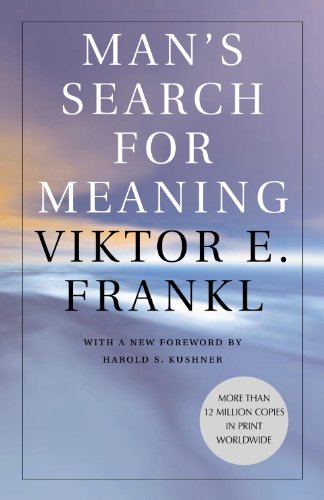
Man's Search for Meaning has riveted generations of readers with its descriptions of life in Nazi death camps and its lessons for spiritual survival. Between 1942 and 1945 psychiatrist Viktor Frankl labored in four different camps, including Auschwitz, while his parents, brother, and pregnant wife perished. Based on his own experience and the stories of his many patients, Frankl argues that we cannot avoid suffering but we can choose how to cope with it, find meaning in it, and move forward with renewed purpose. Frankl's theory—known as logotherapy, from the Greek word logos ("meaning")—holds that our primary drive in life is not pleasure, as Freud maintained, but the discovery and pursuit of what we personally find meaningful. In the decades since its first publication in 1959, Man's Search for Meaning has become a classic, with more than twelve million copies in print around the world. A 1991 Library of Congress survey that asked readers to name a "book that made a difference in your life" found Man's Search for Meaning among the ten most influential books in America. At once a memoir, a meditation, a treatise, and a history, it continues to inspire us all to find significance in the very act of living. (back cover)
…
Recommended by Tony Robbins, Dustin Moskovitz, Ev Williams, and 60 others.
Another book that I’ve read dozens of times. It taught me that if you change the meaning, you change everything. Meaning equals emotion, and emotion equals life. [source]
Dustin Moskovitz
Co-founder/Facebook and Asana
Dustin Moskovitz recommended this book on Twitter. [source]
I read it while spending ten days in the ICU of Bellevue hospital trying to reattach my finger from a ring avulsion accident in my kitchen. It talks about the meaning of life, and I believe you come out a better person from reading it. [source]
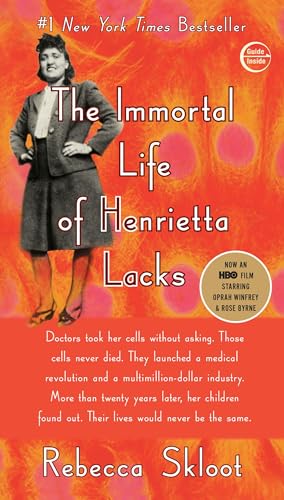
Her name was Henrietta Lacks, but scientists know her as HeLa. She was a poor Southern tobacco farmer who worked the same land as her slave ancestors, yet her cells—taken without her knowledge—became one of the most important tools in medicine. The first “immortal” human cells grown in culture, they are still alive today, though she has been dead for more than sixty years. If you could pile all HeLa cells ever grown onto a scale, they’d weigh more than 50 million metric tons—as much as a hundred Empire State Buildings. HeLa cells were vital for developing the polio vaccine; uncovered secrets of cancer, viruses, and the atom bomb’s effects; helped lead to important advances like in vitro fertilization, cloning, and gene mapping; and have been bought and sold by the billions.
Yet Henrietta Lacks remains virtually unknown, buried in an unmarked grave.
Now Rebecca Skloot takes us on an extraordinary journey, from the “colored” ward of Johns Hopkins Hospital in the 1950s to stark white laboratories with freezers full of HeLa cells; from Henrietta’s small, dying hometown of Clover, Virginia — a land of wooden slave quarters, faith healings, and voodoo — to East Baltimore today, where her children and grandchildren live and struggle with the legacy of her cells.
Henrietta’s family did not learn of her “immortality” until more than twenty years after her death, when scientists investigating HeLa began using her husband and children in research without informed consent. And though the cells had launched a multimillion-dollar industry that sells human biological materials, her family never saw any of the profits. As Rebecca Skloot so brilliantly shows, the story of the Lacks family — past and present — is inextricably connected to the dark history of experimentation on African Americans, the birth of bioethics, and the legal battles over whether we control the stuff we are made of.
Over the decade it took to uncover this story, Rebecca became enmeshed in the lives of the Lacks family—especially Henrietta’s daughter Deborah, who was devastated to learn about her mother’s cells. She was consumed with questions: Had scientists cloned her mother? Did it hurt her when researchers infected her cells with viruses and shot them into space? What happened to her sister, Elsie, who died in a mental institution at the age of fifteen? And if her mother was so important to medicine, why couldn’t her children afford health insurance?
Intimate in feeling, astonishing in scope, and impossible to put down, The Immortal Life of Henrietta Lacks captures the beauty and drama of scientific discovery, as well as its human consequences.
Yes. This is a fascinating book on so many different levels. It is really compelling as the story of the author trying to uncover the history of the woman from whom all these cells came. [source]
Cover unavailable
4
Night
Elie Wiesel
4.8
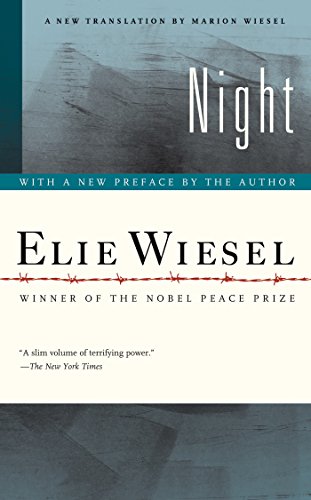
Night is Elie Wiesel's masterpiece, a candid, horrific, and deeply poignant autobiographical account of his survival as a teenager in the Nazi death camps. This new translation by Marion Wiesel, Elie's wife and frequent translator, presents this seminal memoir in the language and spirit truest to the author's original intent. And in a substantive new preface, Elie reflects on the enduring importance of Night and his lifelong, passionate dedication to ensuring that the world never forgets man's capacity for inhumanity to man.
Night offers much more than a litany of the daily terrors, everyday perversions, and rampant sadism at Auschwitz and Buchenwald; it also el
…
Recommended by Johanna Reiss and Steven Katz.
Johanna Reiss
Elie Wiesel wrote..that he was considering running into the barbed wire once, but he didn’t because his father needed him. [source]
Steven Katz
Probably the best known memoir that has been written about the experience of the death camps. [source]
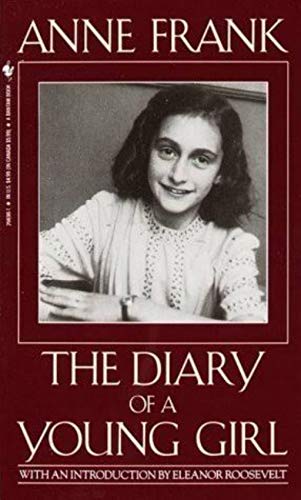
In Everyman’s Library for the first time—one of the most moving and eloquent accounts of the Holocaust, read by tens of millions of people around the world since its publication in 1947. The Diary of a Young Girl is the record of two years in the life of a remarkable Jewish girl whose triumphant humanity in the face of unfathomable deprivation and fear has made the book one of the most enduring documents of our time.
The Everyman’s hardcover edition reprints the Definitive Edition authorized by the Frank estate, plus a new introduction, a bibliography, and a chronology of Anne Frank’s life and times.
…
Recommended by Alice Little, Catalina Penciu, and Tim Fargo.
Alice Little
I remember being a fourth grader and trying to check out this book and being told it was grossly inappropriate and going so far as to have my parents take it to the school board and petition for me to be allowed to read this book. [source]
Catalina Penciu
I'm a huge fan of personal stories and biographies like this one. [source]
Tim Fargo
@Quixoticnance Good point, Nancy. The museum is a powerful experience, esp. when you've read her book. [source]
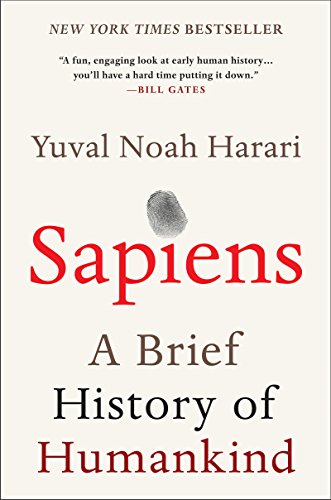
100,000 years ago, at least six human species inhabited the earth. Today there is just one. Us. Homo sapiens.
How did our species succeed in the battle for dominance? Why did our foraging ancestors come together to create cities and kingdoms? How did we come to believe in gods, nations and human rights; to trust money, books and laws; and to be enslaved by bureaucracy, timetables and consumerism? And what will our world be like in the millennia to come?
In Sapiens, Dr Yuval Noah Harari spans the whole of human history, from the very first humans to walk the earth to the radical – and sometimes devastating – breakthroughs of the Cognitive, Agricultural and Scientific Revolutions. Drawing on insights from biology, anthropology, paleontology and economics, he explores how the currents of history have shaped our human societies, the animals and plants around us, and even our personalities. Have we become happier as history has unfolded? Can we ever free our behaviour from the heritage of our ancestors? And what, if anything, can we do to influence the course of the centuries to come?
Bold, wide-ranging and provocative, Sapiens challenges everything we thought we knew about being human: our thoughts, our actions, our power ... and our future.
Both Melinda and I read this one, and it has sparked lots of great conversations at our dinner table. Harari takes on a daunting challenge: to tell the entire history of the human race in just 400 pages. He also writes about our species today and how artificial intelligence, genetic engineering, and other technologies will change us in the future. Although I found things to disagree with—especially Harari’s claim that humans were better off before we started farming—I would recommend Sapiens to anyone who’s interested in the history and future of our species. [source]
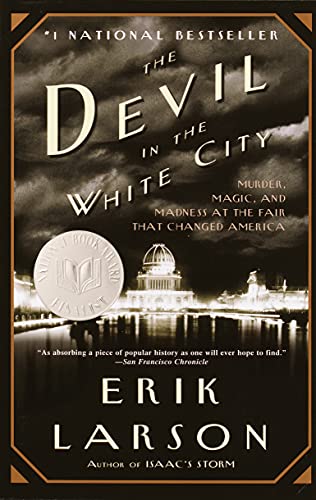
The Devil in the White City: Murder, Magic, and Madness at the Fair That Changed America
Erik Larson
4.7
Author Erik Larson imbues the incredible events surrounding the 1893 Chicago World's Fair with such drama that readers may find themselves checking the book's categorization to be sure that 'The Devil in the White City' is not, in fact, a highly imaginative novel. Larson tells the stories of two men: Daniel H. Burnham, the architect responsible for the fair's construction, and H.H. Holmes, a serial killer masquerading as a charming doctor.
Burnham's challenge was immense. In a short period of time, he was forced to overcome the death of his partner and numerous other obstacles to construct the famous "White City" around which the fair was built. His efforts to complete the project, and the fair's incredible success, are skillfully related along with entertaining appearances by such notables as Buffalo Bill Cody, Susan B. Anthony, and Thomas Edison.
The activities of the sinister Dr. Holmes, who is believed to be responsible for scores of murders around the time of the fair, are equally remarkable. He devised and erected the World's Fair Hotel, complete with crematorium and gas chamber, near the fairgrounds and used the event as well as his own charismatic personality to lure victims.
Combining the stories of an architect and a killer in one book, mostly in alternating chapters, seems like an odd choice but it works. The magical appeal and horrifying dark side of 19th-century Chicago are both revealed through Larson's skillful writing. - John Moe
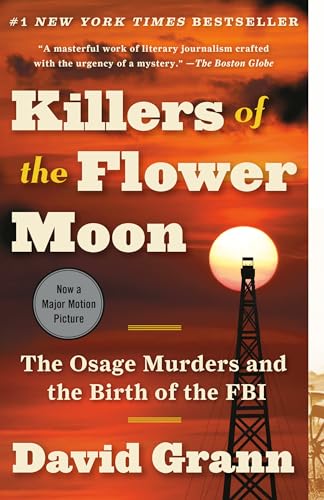
In the 1920s, the richest people per capita in the world were members of the Osage Indian Nation in Oklahoma. After oil was discovered beneath their land, the Osage rode in chauffeured automobiles, built mansions, and sent their children to study in Europe.
Then, one by one, they began to be killed off. One Osage woman, Mollie Burkhart, watched as her family was murdered. Her older sister was shot. Her mother was then slowly poisoned. And it was just the beginning, as more Osage began to die under mysterious circumstances.
In this last remnant of the Wild West—where oilmen like J. P. Getty made their fortunes and where desperadoes such as Al Spencer, “the Phantom Terror,” roamed – virtually anyone who dared to investigate the killings were themselves murdered. As the death toll surpassed more than twenty-four Osage, the newly created F.B.I. took up the case, in what became one of the organization’s first major homicide investigations. But the bureau was then notoriously corrupt and initially bungled the case. Eventually the young director, J. Edgar Hoover, turned to a former Texas Ranger named Tom White to try to unravel the mystery. White put together an undercover team, including one of the only Native American agents in the bureau. They infiltrated the region, struggling to adopt the latest modern techniques of detection. Together with the Osage they began to expose one of the most sinister conspiracies in American history.
A true-life murder mystery about one of the most monstrous crimes in American history.
…
Recommended by Jacqueline Novogratz.
Jacqueline Novogratz
Reads like a novel while giving a deeper understanding of both the good and the terrible that humans are capable of. [source]
Cover unavailable
9
The Hiding Place: The Triumphant True Story of Corrie Ten Boom
At one time Corrie ten Boom would have laughed at the idea that there would ever be a story to tell. For the first fifty years of her life nothing at all out of the ordinary had ever happened to her. She was an old-maid watchmaker living contentedly with her spinster sister and their elderly father in the tiny Dutch house over their shop. Their uneventful days, as regulated as their own watches, revolved around their abiding love for one another. However, with the Nazi invasion and occupation of Holland, a story did ensue.
Corrie ten Boom and her family became leaders in the Dutch Underground, hiding Jewish people in their home in a specially built room and aiding their escape from the Nazis. For their help, all but Corrie found death in a concentration camp. The Hiding Place is their story.
…
Recommended by Alison Alvarez.
Alison Alvarez
What I really took with me from the book were the descriptions of how she dealt with the stress of solitary confinement and eventually the Ravensbruck concentration camp. I adapted some of her techniques for keeping her mind occupied to deal with my own problems with anxiety and worry. Also, it’s a book with a surprising amount of joy in it for subject matter that is so dark. [source]
Cover unavailable
10
Guns, Germs and Steel: The Fates of Human Societies
Explaining what William McNeill called The Rise of the West has become the central problem in the study of global history. In Guns, Germs, and Steel Jared Diamond presents the biologist's answer: geography, demography, and ecological happenstance. Diamond evenhandedly reviews human history on every continent since the Ice Age at a rate that emphasizes only the broadest movements of peoples and ideas. Yet his survey is binocular: one eye has the rather distant vision of the evolutionary biologist, while the other eye--and his heart--belongs to the people of New Guinea, where he has done field work for more than 30 years.
Fascinating.... Lays a foundation for understanding human history. [source]
Daniel Ek
A brilliant Pulitzer Prize-winning book about how the modern world was formed, analyzing how societies developed differently on different continents. [source]
I’m a fan of books that challenge our assumptions, and Diamond offers us a new and remarkably simple way of looking at our world. Learning to challenge existing assumptions is core to effective leadership for it trains us to keep an open mind. [source]
Cover unavailable
11
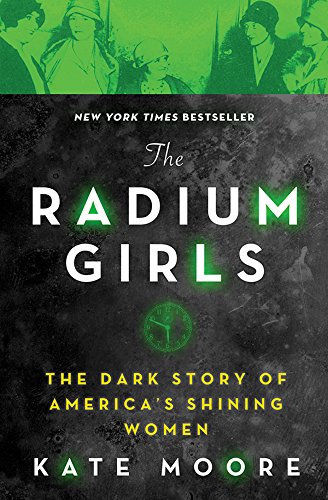
The Radium Girls: The Dark Story of America's Shining Women
Kate Moore
4.6
The incredible true story of the women who fought America's Undark danger
The Curies' newly discovered element of radium makes gleaming headlines across the nation as the fresh face of beauty, and wonder drug of the medical community. From body lotion to tonic water, the popular new element shines bright in the otherwise dark years of the First World War.
Meanwhile, hundreds of girls toil amidst the glowing dust of the radium-dial factories. The glittering chemical covers their bodies from head to toe; they light up the night like industrious fireflies. With such a coveted job, these "shining girls" are the luckiest alive -- until they begin to fall mysteriously ill.
But the factories that once offered golden opportunities are now ignoring all claims of the gruesome side effects, and the women's cries of corruption. And as the fatal poison of the radium takes hold, the brave shining girls find themselves embroiled in one of the biggest scandals of America's early 20th century, and in a groundbreaking battle for workers' rights that will echo for centuries to come.
…
Cover unavailable
12
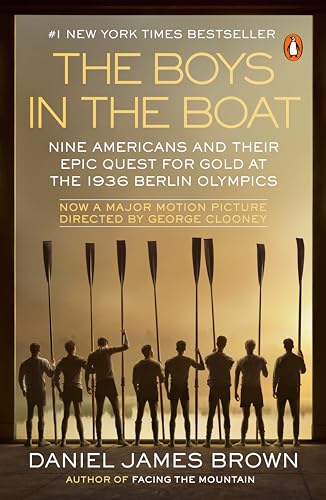
The Boys in the Boat: Nine Americans and Their Epic Quest for Gold at the 1936 Berlin Olympics
Daniel James Brown
4.6
For readers of Laura Hillenbrand's Seabiscuit and Unbroken, the dramatic story of the American rowing team that stunned the world at Hitler's 1936 Berlin Olympics.
Daniel James Brown's robust book tells the story of the University of Washington's 1936 eight-oar crew and their epic quest for an Olympic gold medal, a team that transformed the sport and grabbed the attention of millions of Americans. The sons of loggers, shipyard workers, and farmers, the boys defeated elite rivals first from eastern and British universities and finally the German crew rowing for Adolf Hitler in the Olympic games in Berlin, 1936.
The emotional heart of the story lies with one rower, Joe Rantz, a teenager without family or prospects, who rows not for glory, but to regain his shattered self-regard and to find a place he can call home. The crew is assembled by an enigmatic coach and mentored by a visionary, eccentric British boat builder, but it is their trust in each other that makes them a victorious team. They remind the country of what can be done when everyone quite literally pulls together—a perfect melding of commitment, determination, and optimism.
Drawing on the boys' own diaries and journals, their photos and memories of a once-in-a-lifetime shared dream, The Boys in the Boat is an irresistible story about beating the odds and finding hope in the most desperate of times—the improbable, intimate story of nine working-class boys from the American west who, in the depths of the Great Depression, showed the world what true grit really meant. It will appeal to readers of Erik Larson, Timothy Egan, James Bradley, and David Halberstam's The Amateurs.
Nadella calls this tale with a local Seattle connection—it involves an underdog University of Washington crew team and the 1936 Berlin Olympics—”A wonderful illustration of the importance of teamwork, which was a core part of my focus out of the gate as CEO. [source]
Another great narrative nonfiction out this year that I hope you’ll like is: The Boys in the Boat: Nine Americans and Their Epic Quest for Gold at the 1936 Berlin Olympics by Daniel James Brown. [source]
Gail Kelly
Former CEO/ Westpac
Member of the Group of 30, and former CEO of Westpac will be spending her summer months reading a memoir, a novel and historical non-fiction. [source]
Cover unavailable
13
In the Garden of Beasts: Love, Terror, and an American Family in Hitler's Berlin
Erik Larson
4.5
Erik Larson, New York Times bestselling author of Devil in the White City, delivers a remarkable story set during Hitler’s rise to power.
The time is 1933, the place, Berlin, when William E. Dodd becomes America’s first ambassador to Hitler’s Nazi Germany in a year that proved to be a turning point in history. A mild-mannered professor from Chicago, Dodd brings along his wife, son, and flamboyant daughter, Martha. At first Martha is entranced by the parties and pomp, and the handsome young men of the Third Reich with their infectious enthusiasm for restoring Germany to a position of world prominence. Enamored of the “New Germany,” she has one affair after another, including with the suprisingly honorable first chief of the Gestapo, Rudolf Diels. But as evidence of Jewish persecution mounts, confirmed by chilling first-person testimony, her father telegraphs his concerns to a largely indifferent State Department back home. Dodd watches with alarm as Jews are attacked, the press is censored, and drafts of frightening new laws begin to circulate. As that first year unfolds and the shadows deepen, the Dodds experience days full of excitement, intrigue, romance—and ultimately, horror, when a climactic spasm of violence and murder reveals Hitler’s true character and ruthless ambition. Suffused with the tense atmosphere of the period, and with unforgettable portraits of the bizarre Göring and the expectedly charming--yet wholly sinister--Goebbels, In the Garden of Beasts lends a stunning, eyewitness perspective on events as they unfold in real time, revealing an era of surprising nuance and complexity. The result is a dazzling, addictively readable work that speaks volumes about why the world did not recognize the grave threat posed by Hitler until Berlin, and Europe, were awash in blood and terror.
…
Recommended by Daniel Hamermesh and Steve Schmidt.
Daniel Hamermesh
At a time of increased danger of totalitarianism in the U.S., reading a history of an insider’s view of its growth in Germany in the 1930s gives a good perspective on our contemporary problems, as well as being fascinating history and biography in its own right. [source]
Steve Schmidt
@egayle333 Ellyn, with respect Hitler was always clear about his intent. A great book to read from a US perspective is In the Garden of Beasts. Trump is much more analogous to Mussolini. [source]
Cover unavailable
14
Hidden Figures: The American Dream and the Untold Story of the Black Women Mathematicians Who Helped Win the Space Race
Set against the backdrop of the Jim Crow South and the civil rights movement, the never-before-told true story of NASA’s African-American female mathematicians who played a crucial role in America’s space program—and whose contributions have been unheralded, until now.
Before John Glenn orbited the Earth or Neil Armstrong walked on the moon, a group of professionals worked as “Human Computers,” calculating the flight paths that would enable these historic achievements. Among these were a coterie of bright, talented African-American women. Segregated from their white counterparts by Jim Crow laws, these “colored computers,” as they were known, used slide rules, adding machines, and pencil and paper to support America’s fledgling aeronautics industry, and helped write the equations that would launch rockets, and astronauts, into space.
Drawing on the oral histories of scores of these “computers,” personal recollections, interviews with NASA executives and engineers, archival documents, correspondence, and reporting from the era, Hidden Figures recalls America’s greatest adventure and NASA’s groundbreaking successes through the experiences of five spunky, courageous, intelligent, determined, and patriotic women: Dorothy Vaughan, Mary Jackson, Katherine Johnson, Christine Darden, and Gloria Champine.
Moving from World War II through NASA’s golden age, touching on the civil rights era, the Space Race, the Cold War, and the women’s rights movement, Hidden Figures interweaves a rich history of scientific achievement and technological innovation with the intimate stories of five women whose work forever changed the world—and whose lives show how out of one of America’s most painful histories came one of its proudest moments.
…
Cover unavailable
15
1776
David McCullough
4.5
In this stirring book, David McCullough tells the intensely human story of those who marched with General George Washington in the year of the Declaration of Independence, when the whole American cause was riding on their success, without which all hope for independence would have been dashed and the noble ideals of the Declaration would have amounted to little more than words on paper.
Based on extensive research in both American and British archives, 1776 is the story of Americans in the ranks, men of every shape, size, and color, farmers, schoolteachers, shoemakers, no-accounts, and mere boys turned soldiers. And it is the story of the British commander, William Howe, and his highly disciplined redcoats, who looked on their rebel foes with contempt and fought with a valor too little known. But it is the American commander-in-chief who stands foremost: Washington, who had never before led an army in battle.
The darkest hours of that tumultuous year were as dark as any Americans have known. Especially in our own tumultuous time, 1776 is powerful testimony to how much is owed to a rare few in that brave founding epoch, and what a miracle it was that things turned out as they did.
Written as a companion work to his celebrated biography of John Adams, David McCullough's 1776 is another landmark in the literature of American history.
@msphillipsrvhs @rvhs Great book! Can never go wrong with anything from David McCullough! [source]
Cover unavailable
16
Dead Wake: The Last Crossing of the Lusitania
Erik Larson
4.5
From the #1 New York Times bestselling author and master of narrative nonfiction comes the enthralling story of the sinking of the Lusitania
On May 1, 1915, a luxury ocean liner as richly appointed as an English country house sailed out of New York, bound for Liverpool, carrying a record number of children and infants. The passengers were anxious. Germany had declared the seas around Britain to be a war zone, and for months, its U-boats had brought terror to the North Atlantic. But the Lusitania was one of the era's great transatlantic "Greyhounds" and her captain, William Thomas Turner, placed tremendous faith in the gentlemanly strictures of warfare that for a century had kept civilian ships safe from attack. He knew, moreover, that his ship - the fastest then in service - could outrun any threat.
Germany, however, was determined to change the rules of the game, and Walther Schwieger, the captain of Unterseeboot-20, was happy to oblige. Meanwhile, an ultra-secret British intelligence unit tracked Schwieger's U-boat, but told no one. As U-20 and the Lusitania made their way toward Liverpool, an array of forces both grand and achingly small - hubris, a chance fog, a closely guarded secret, and more--all converged to produce one of the great disasters of history.
It is a story that many of us think we know but don't, and Erik Larson tells it thrillingly, switching between hunter and hunted while painting a larger portrait of America at the height of the Progressive Era. Full of glamour, mystery, and real-life suspense, Dead Wake brings to life a cast of evocative characters, from famed Boston bookseller Charles Lauriat to pioneering female architect Theodate Pope Riddle to President Wilson, a man lost to grief, dreading the widening war but also captivated by the prospect of new love. Gripping and important, Dead Wake captures the sheer drama and emotional power of a disaster that helped place America on the road to war.
…
Recommended by Bethanye McKinney Blount.
Bethanye McKinney Blount
There's so much in this one about leadership, failures and how winners write history. [source]
Cover unavailable
17
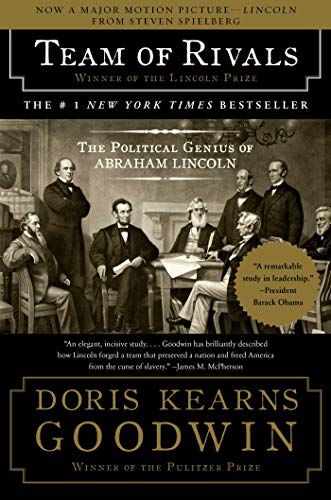
Team of Rivals: The Political Genius of Abraham Lincoln
Doris Kearns Goodwin
4.5
Acclaimed historian Doris Kearns Goodwin illuminates Lincoln's political genius in this highly original work, as the one-term congressman and prairie lawyer rises from obscurity to prevail over three gifted rivals of national reputation to become president.
On May 18, 1860, William H. Seward, Salmon P. Chase, Edward Bates, and Abraham Lincoln waited in their hometowns for the results from the Republican National Convention in Chicago. When Lincoln emerged as the victor, his rivals were dismayed and angry.
Throughout the turbulent 1850s, each had energetically sought the presidency as the conflict over slavery was leading inexorably to secession and civil war. That Lincoln succeeded, Goodwin demonstrates, was the result of a character that had been forged by experiences that raised him above his more privileged and accomplished rivals. He won because he possessed an extraordinary ability to put himself in the place of other men, to experience what they were feeling, to understand their motives and desires.
It was this capacity that enabled Lincoln as president to bring his disgruntled opponents together, create the most unusual cabinet in history, and marshal their talents to the task of preserving the Union and winning the war.
We view the long, horrifying struggle from the vantage of the White House as Lincoln copes with incompetent generals, hostile congressmen, and his raucous cabinet. He overcomes these obstacles by winning the respect of his former competitors, and in the case of Seward, finds a loyal and crucial friend to see him through. --front flap
The Oval office can be a lonely place, so reading about your forefather’s experience could only help. “The biographies have been useful, because I do think that there’s a tendency, understandable, to think that whatever’s going on right now is uniquely disastrous or amazing or difficult,” said President Obama in an interview. [source]
I loved Team of Rivals, and Leadership really built on the things I had taken away from that book. Moving from basketball to building a company, I needed to learn new and different leadership skills, and Goodwin outlines the different skill-sets of Lincoln, both Roosevelts, and Lyndon Johnson, accessibly. [source]
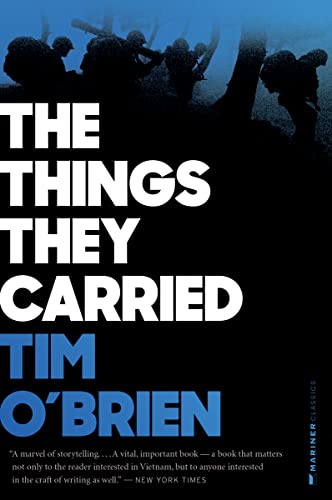
A classic, life-changing meditation on war, memory, imagination, and the redemptive power of storytelling, with more than two-million copies in print
Depicting the men of Alpha Company—Jimmy Cross, Henry Dobbins, Rat Kiley, Mitchell Sanders, Norman Bowker, Kiowa, and the character Tim O’Brien, who survived his tour in Vietnam to become a father and writer at the age of forty-three—the stories in The Things They Carried opened our eyes to the nature of war in a way we will never forget. It is taught everywhere, from high school classrooms to graduate seminars in creative writing, and in the decades since its publication it has never failed to challenge our perceptions of fact and fiction, war and peace, and courage, longing, and fear.
…
Recommended by Caroline Paul, Eugene Gu, Karl Marlantes, and 2 others.
Caroline Paul
A beautiful book by a writer who fought in Vietnam. [source]
Eugene Gu
@realDonaldTrump Tim O’Brien is the author of the book The Things They Carried, which was about the Vietnam War. Must be very triggering for Trump since he dodged the draft multiple times with fraudulent doctors’ notes for fake bone spurs like a coward. [source]
Karl Marlantes
But when O’Brien wrote The Things They Carried he came down to absolute real brass tacks. It was no longer surreal, it was like here’s a list of what a grunt carries, an infantry soldier… [source]
Cover unavailable
19
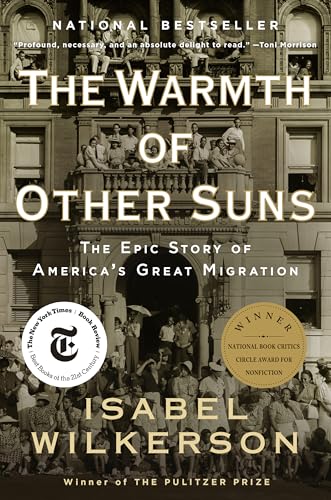
The Warmth of Other Suns: The Epic Story of America's Great Migration
Wilkerson
4.5
In this epic, beautifully written masterwork, Pulitzer Prize–winning author Isabel Wilkerson chronicles one of the great untold stories of American history: the decades-long migration of black citizens who fled the South for northern and western cities, in search of a better life.
From 1915 to 1970, this exodus of almost six million people changed the face of America. Wilkerson compares this epic migration to the migrations of other peoples in history. She interviewed more than a thousand people, and gained access to new data and official records, to write this definitive and vividly dramatic account of how these American journeys unfolded, altering our cities, our country, and ourselves.
With stunning historical detail, Wilkerson tells this story through the lives of three unique individuals: Ida Mae Gladney, who in 1937 left sharecropping and prejudice in Mississippi for Chicago, where she achieved quiet blue-collar success and, in old age, voted for Barack Obama when he ran for an Illinois Senate seat; sharp and quick-tempered George Starling, who in 1945 fled Florida for Harlem, where he endangered his job fighting for civil rights, saw his family fall, and finally found peace in God; and Robert Foster, who left Louisiana in 1953 to pursue a medical career, the personal physician to Ray Charles as part of a glitteringly successful medical career, which allowed him to purchase a grand home where he often threw exuberant parties.
Wilkerson brilliantly captures their first treacherous and exhausting cross-country trips by car and train and their new lives in colonies that grew into ghettos, as well as how they changed these cities with southern food, faith, and culture and improved them with discipline, drive, and hard work. Both a riveting microcosm and a major assessment, The Warmth of Other Suns is a bold, remarkable, and riveting work, a superb account of an “unrecognized immigration” within our own land. Through the breadth of its narrative, the beauty of the writing, the depth of its research, and the fullness of the people and lives portrayed herein, this book is destined to become a classic.
…
Recommended by Britni Danielle.
Britni Danielle
.@byshondaland announced its first @Netflix projects, including "The Warmth of Other Suns" a series based on Isabel Wilkerson's book about the Great Migration, and a documentary on @msdebbieallen's 'Hot Chocolate Nutcracker." Full slate: https://t.co/rLCk65Mmyj [source]
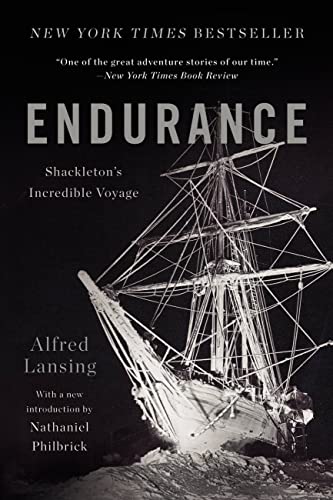
The harrowing tale of British explorer Ernest Shackleton's 1914 attempt to reach the South Pole, one of the greatest adventure stories of the modern age.
In August 1914, polar explorer Ernest Shackleton boarded the Endurance became locked in an island of ice. Thus began the legendary ordeal of Shackleton and his crew of twenty-seven men. When their ship was finally crushed between two ice floes, they attempted a near-impossible journey over 850 miles of the South Atlantic's heaviest seas to the closest outpost of civilization.
In Endurance, the definitive account of Ernest Shackleton's fateful trip, Alfred Lansing brilliantly narrates the harrowing and miraculous voyage that has defined heroism for the modern age.
50 plus years old, this is a story that more than stands the test of time. Sir Ernest Shackleton makes his daring attempt to cross Antarctic continent but his crew and boat are trapped in the ice flows. What follows are 600 days of harrowing survival, first from the elements, then from hunger, then from the sea as he makes a daring attempt in a small lifeboat to reach land 650 miles away, then again as he struggles over land and mountains to bring relief to his men. And when he finally arrives with it, Shackleton simply boards them on the boat and returns home as if nothing had happened. He was an immensely brave man in the midst of terrible adversity and we see this so clearly in a book based on the remarkable diaries of his men. He never quit, never seemed to despair. This book (and his life) were living proof of his family motto: “Fortitudine vincimus” (By endurance we conquer). [source]
The inspiration for the hit Broadway musical Hamilton!
In the first full-length biography of Alexander Hamilton in decades, National Book Award winner Ron Chernow tells the riveting story of a man who overcame all odds to shape, inspire, and scandalize the newborn America. According to historian Joseph Ellis, Alexander Hamilton is “a robust full-length portrait, in my view the best ever written, of the most brilliant, charismatic and dangerous founder of them all.”Few figures in American history have been more hotly debated or more grossly misunderstood than Alexander Hamilton. Chernow’s biography gives Hamilton his due and sets the record straight, deftly illustrating that the political and economic greatness of today’s America is the result of Hamilton’s countless sacrifices to champion ideas that were often wildly disputed during his time. “To repudiate his legacy,” Chernow writes, “is, in many ways, to repudiate the modern world.” Chernow here recounts Hamilton’s turbulent life: an illegitimate, largely self-taught orphan from the Caribbean, he came out of nowhere to take America by storm, rising to become George Washington’s aide-de-camp in the Continental Army, coauthoring The Federalist Papers, founding the Bank of New York, leading the Federalist Party, and becoming the first Treasury Secretary of the United States.
Historians have long told the story of America’s birth as the triumph of Jefferson’s democratic ideals over the aristocratic intentions of Hamilton. Chernow presents an entirely different man, whose legendary ambitions were motivated not merely by self-interest but by passionate patriotism and a stubborn will to build the foundations of American prosperity and power. His is a Hamilton far more human than we’ve encountered before—from his shame about his birth to his fiery aspirations, from his intimate relationships with childhood friends to his titanic feuds with Jefferson, Madison, Adams, Monroe, and Burr, and from his highly public affair with Maria Reynolds to his loving marriage to his loyal wife Eliza. And never before has there been a more vivid account of Hamilton’s famous and mysterious death in a duel with Aaron Burr in July of 1804.
Chernow’s biography is not just a portrait of Hamilton, but the story of America’s birth seen through its most central figure. At a critical time to look back to our roots, Alexander Hamilton will remind readers of the purpose of our institutions and our heritage as Americans.
Related and with equal weight, I want to recommend George B. McClellan: The Young Napoleon by Stephen W. Sears (a biography of the talented but utterly delusional General George McClellan), Rebel Yell: The Violence, Passion, and Redemption of Stonewall Jackson by S.C. Gwynne (a biography of the brilliant but manic Stonewall Jackson) and Ron Chernow’s Alexander Hamilton (an equally brilliant, more accomplished but equally tragic founding father). All these books made me angry, sad, and confused. But they also made me look inward and taught me quite a bit. [source]
Fabrice Grinda
I read books for fun. It just so happens that they often are also insightful, but I would not say any specific book had a huge influence on me. Some biographies like Alexander Hamilton by Ron Chernow are inspiring, but it’s not as though they changed my career path. I knew I wanted to be an Internet entrepreneur from a very young age. [source]
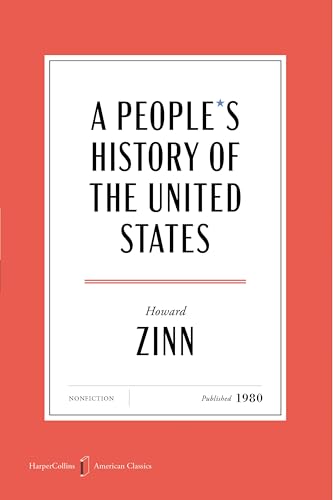
"A wonderful, splendid book--a book that should be ready by every American, student or otherwise, who wants to understand his country, its true history, and its hope for the future." --Howard Fast
With a new introduction by Anthony Arnove, this edition of the classic national bestseller chronicles American history from the bottom up, throwing out the official narrative taught in schools—with its emphasis on great men in high places—to focus on the street, the home and the workplace.
Known for its lively, clear prose as well as its scholarly research, A People's Historyof the United States is the only volume to tell America's story from the point of view of—and in the words of—America's women, factory workers, African-Americans, Native Americans, the working poor, and immigrant laborers. As historian Howard Zinn shows, many of our country's greatest battles—the fights for a fair wage, an eight-hour workday, child-labor laws, health and safety standards, universal suffrage, women's rights, racial equality—were carried out at the grassroots level, against bloody resistance.
Covering Christopher Columbus's arrival through President Clinton's first term, A People's History of the United States features insightful analysis of the most important events in our history.
…
Recommended by Lisa Ling and Alex Honnold.
Lisa Ling
I credit this book with propelling me to dig deeper, and to not always believe the narrative. [source]
Alex Honnold
Totally changed the way I look at politics. [source]
Cover unavailable
23
Extreme Ownership: How U.S. Navy Seals Lead and Win
An updated edition of the blockbuster bestselling leadership book that took America and the world by storm, two U.S. Navy SEAL officers who led the most highly decorated special operations unit of the Iraq War demonstrate how to apply powerful leadership principles from the battlefield to business and life.
Combat, the most intense and dynamic environment imaginable, teaches the toughest leadership lessons, with absolutely everything at stake. Jocko Willink and Leif Babin learned this reality first-hand on the most violent and dangerous battlefield in Iraq. As leaders of SEAL Team Three's Task Unit Bruiser, their mission was one many thought impossible: help U.S. forces secure Ramadi, a violent, insurgent-held city deemed "all but lost." In gripping, firsthand accounts of heroism, tragic loss, and hard-won victories, they learned that leadership--at every level--is the most important factor in whether a team succeeds or fails.
Willink and Babin returned home from deployment and instituted SEAL leadership training to pass on their harsh lessons learned in combat to help forge the next generation of SEAL leaders. After leaving the SEAL Teams, they launched a company, Echelon Front, to teach those same leadership principles to leaders in businesses, companies, and organizations across the civilian sector. Since that time, they have trained countless leaders and worked with hundreds of companies in virtually every industry across the U.S. and internationally, teaching them how to develop their own high-performance teams and most effectively lead those teams to dominate their battlefields.
Since it's release in October 2015, Extreme Ownership has revolutionized leadership development and set a new standard for literature on the subject. Required reading for many of the most successful organizations, it has become an integral part of the official leadership training programs for scores of business teams, military units, and first responders. Detailing the mindset and principles that enable SEAL units to accomplish the most difficult combat missions, Extreme Ownership demonstrates how to apply them to any team or organization, in any leadership environment. A compelling narrative with powerful instruction and direct application, Extreme Ownership challenges leaders everywhere to fulfill their ultimate purpose: lead and win.
Jocko is also the co-author of Extreme Ownership: How U.S. Navy SEALs Lead and Win — which I loved. [source]
Roger Ailes
CEO/Fox News
This is the SEAL Leadership book we have been waiting for. Poignant, powerful, practical. A must read for every leader. [source]
Cover unavailable
24
The Guns of August
Barbara Tuchman
4.4
"More dramatic than fiction...THE GUNS OF AUGUST is a magnificent narrative--beautifully organized, elegantly phrased, skillfully paced and sustained....The product of painstaking and sophisticated research." CHICAGO TRIBUNE Historian and Pulitzer Prize-winning author Barbara Tuchman has brought to life again the people and events that led up to Worl War I. With attention to fascinating detail, and an intense knowledge of her subject and its characters, Ms. Tuchman reveals, for the first time, just how the war started, why, and why it could have been stopped but wasn't. A classic historical survey of a time and a people we all need to know more about, THE GUNS OF AUGUST will not be forgotten.
So beautifully written. But more importantly, for me, she was writing about battles and military stuff and things that you don’t imagine that sometimes a woman might be so adept at. [source]
Erik Martin
This book started my obsession with WWI, illustrating how drastically the world went from interrelated monarchies and cavalry charges to chemical warfare between modern nation states. If you want to see what disruption looks like, there's no greater period in human history. [source]
Matt Calkins
The best way to understand how the world resolves its conflicts and its tensions is by looking at how a conflict that has been studied thoroughly, like World War I, unfolded and resolved. Business is like this too. If anyone were to ever get to the heart of Coke vs. Pepsi, they would see a parade of mistakes in the same way World War I looks in retrospect—so many ways you could have done better. [source]
Cover unavailable
25
In the Heart of the Sea: The Tragedy of the Whaleship Essex
Nathaniel Philbrick
4.3
"With its huge, scarred head halfway out of the water and its tail beating the ocean into a white-water wake more than forty feet across, the whale approached the ship at twice its original speed - at least six knots. With a tremendous cracking and splintering of oak, it struck the ship just beneath the anchor secured at the cat-head on the port bow..."
In the Heart of the Sea brings to new life the incredible story of the wreck of the whaleship Essex - an event as mythic in its own century as the Titanic disaster in ours, and the inspiration for the climax of Moby-Dick. In a harrowing page-turner, Nathaniel Philbrick restores this epic story to its rightful place in American history.
In 1820, the 240-ton Essex set sail from Nantucket on a routine voyage for whales. Fifteen months later, in the farthest reaches of the South Pacific, it was repeatedly rammed and sunk by an eighty-ton bull sperm whale. Its twenty-man crew, fearing cannibals on the islands to the west, made for the 3,000-mile-distant coast of South America in three tiny boats. During ninety days at sea under horrendous conditions, the survivors clung to life as one by one, they succumbed to hunger, thirst, disease, and fear.
Philbrick interweaves his account of this extraordinary ordeal of ordinary men with a wealth of whale lore and with a brilliantly detailed portrait of the lost, unique community of Nantucket whalers. Impeccably researched and beautifully told, the book delivers the ultimate portrait of man against nature, drawing on a remarkable range of archival and modern sources, including a long-lost account by the ship's cabin boy.
At once a literary companion and a page-turner that speaks to the same issues of class, race, and man's relationship to nature that permeate the works of Melville, In the Heart of the Sea will endure as a vital work of American history.
Today is World Book Day, a wonderful opportunity to address this #ChallengeRichard sent in by Mike Gonzalez of New Jersey: Make a list of your top 65 books to read in a lifetime. [source]
Wow, did you know that Moby Dick was based on a true story? There was a real whaling ship that was broken in half by an angry sperm whale. But it gets even more insane. The members of the crew escaped in three lifeboats, traveling thousands of miles at sea with little food and water until they slowly resorted to cannibalism(!) Besides being an utterly unbelievable story, this book also gives a great history into the whaling industry and the cowboys/entrepreneurs who led it. Definitely recommend and I promise my spoilers did not ruin anything. [source]
Cover unavailable
26
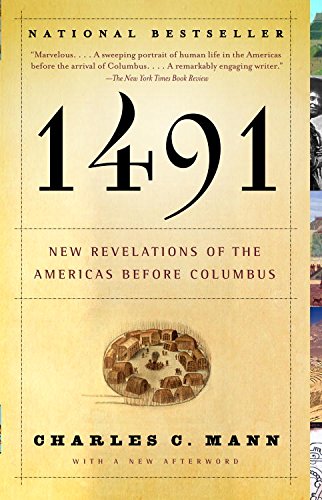
1491: New Revelations of the Americas Before Columbus
Charles C. Mann
4.3
In this groundbreaking work of science, history, and archaeology, Charles C. Mann radically alters our understanding of the Americas before the arrival of Columbus in 1492.
Contrary to what so many Americans learn in school, the pre-Columbian Indians were not sparsely settled in a pristine wilderness; rather, there were huge numbers of Indians who actively molded and influenced the land around them. The astonishing Aztec capital of Tenochtitlan had running water and immaculately clean streets, and was larger than any contemporary European city. Mexican cultures created corn in a specialized breeding process that it has been called man’s first feat of genetic engineering. Indeed, Indians were not living lightly on the land but were landscaping and manipulating their world in ways that we are only now beginning to understand. Challenging and surprising, this a transformative new look at a rich and fascinating world we only thought we knew.
…
Recommended by Adam Conover, Colin Calloway, and Scott Keyes.
@TheBaltimoreSon @CharlesCMann Sure it! A total revolution in my understanding of history, all in one book. Amazing stuff. [source]
Colin Calloway
The book provides a huge hemispheric overview. [source]
Scott Keyes
It’s one of those books that takes everything you thought you knew about the history of European colonialists and indigenous groups in the Americas and turns it on its head. Just a fascinating deep-dive into early American history that questions a lot of dogma we were taught in school. [source]
Cover unavailable
27
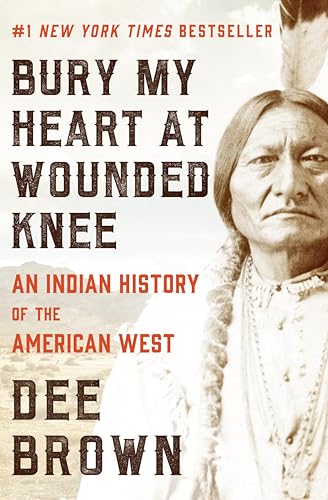
Bury My Heart at Wounded Knee: An Indian History of the American West
Dee Brown
4.3
Now a special 30th-anniversary edition in both hardcover and paperback, the classic bestselling history The New York Times called "Original, remarkable, and finally heartbreaking...Impossible to put down."
Bury My Heart at Wounded Knee is Dee Brown's eloquent, fully documented account of the systematic destruction of the American Indian during the second half of the nineteenth century. A national bestseller in hardcover for more than a year after its initial publication, it has sold almost four million copies and has been translated into seventeen languages. For this elegant thirtieth-anniversary edition—published in both hardcover and paperback—Brown has contributed an incisive new preface.
Using council records, autobiographies, and firsthand descriptions, Brown allows the great chiefs and warriors of the Dakota, Ute, Sioux, Cheyenne, and other tribes to tell us in their own words of the battles, massacres, and broken treaties that finally left them demoralized and defeated. A unique and disturbing narrative told with force and clarity, Bury My Heart at Wounded Knee changed forever our vision of how the West was really won.
…
Cover unavailable
28
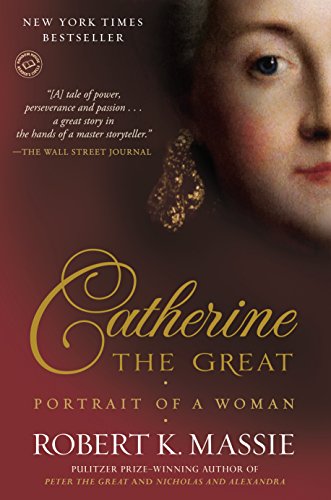
Catherine the Great: Portrait of a Woman
Robert K. Massie
4.3
Pulitzer Prize winner Massie offers the tale of a princess who went to Russia at 14 and became one of the most powerful women in history. Born into minor German nobility, she transformed herself into an empress by sheer determination. Possessing a brilliant, curious mind, she devoured the works of Enlightenment philosophers, and reaching the throne, tried using their principles to rule the vast, backward empire. She knew or corresponded with notable figures of her time: Voltaire, Diderot, Frederick the Great, Maria Theresa of Austria, Marie Antoinette & John Paul Jones. Wanting to be the “benevolent despot” Montesquieu idealized, she contended with the deeply ingrained realities of Russian life, including serfdom. She persevered, and for 34 years the government, foreign policy, cultural development and welfare of the Russian people were in her hands. She dealt with domestic rebellion, wars & the tides of political change and violence inspired by the French Revolution. Her reputation depended on the perspective of the speaker. She was praised by Voltaire as like the classical philosophers. She was condemned by enemies, mostly foreign, as “the Messalina of the north.” Her family, friends, ministers, generals, lovers and enemies are vividly described. These included her ambitious, scheming mother; her weak, bullying husband, Peter (who left her sexually untouched for nine years after their marriage); her unhappy son & heir, Paul; her beloved grandchildren; and her favorites—the young men from whom she sought companionship and the recapture of youth as well as sex. Here, too, is Gregory Potemkin, her most significant lover & possible husband, with whom she shared a correspondence of love & separation, followed by 17 years of unparalleled mutual achievement. All the qualities that Massie brought to Nicholas & Alexandra and Peter the Great are present: historical accuracy, deep understanding, felicity of style, mastery of detail, ability to shatter myth & a genius for finding and expressing a human drama.
I know what you're probably thinking ... did she really f* a horse? [source]
Cover unavailable
29
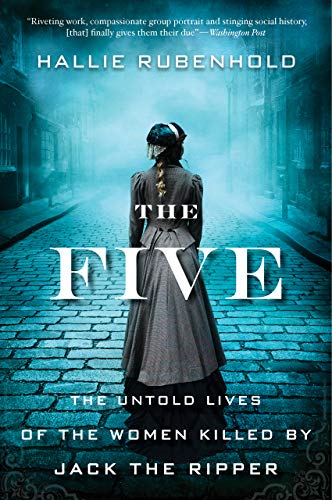
The Five: The Untold Lives of the Women Killed by Jack the Ripper
Hallie Rubenhold
4.3
Winner of the Baillie Gifford Prize for Non-Fiction
Five devastating human stories and a dark and moving portrait of Victorian London—the untold lives of the women killed by Jack the Ripper.
Polly, Annie, Elizabeth, Catherine and Mary-Jane are famous for the same thing, though they never met. They came from Fleet Street, Knightsbridge, Wolverhampton, Sweden, and Wales. They wrote ballads, ran coffee houses, lived on country estates, they breathed ink-dust from printing presses and escaped people-traffickers.
What they had in common was the year of their murders: 1888. The person responsible was never identified, but the character created by the press to fill that gap has become far more famous than any of these five women.
For more than a century, newspapers have been keen to tell us that "the Ripper" preyed on prostitutes. Not only is this untrue, as historian Hallie Rubenhold has discovered, it has prevented the real stories of these fascinating women from being told. Now, in this devastating narrative of five lives, Rubenhold finally sets the record straight, revealing a world not just of Dickens and Queen Victoria, but of poverty, homelessness and rampant misogyny. They died because they were in the wrong place at the wrong time—but their greatest misfortune was to be born a woman.
…
Recommended by Isabelle Khurshudyan and Sarah Churchwell.
Isabelle Khurshudyan
.@HallieRubenhold is awesome and you should check this book out! https://t.co/RL8L1xF8xZ [source]
Sarah Churchwell
Massive congratulations to @HallieRubenhold for being longlisted for the @BGPrize for her brilliant book The Five!! So well deserved and a complete thrill for #twitterstorians! 🎉🎊📚💃 [source]
Cover unavailable
30
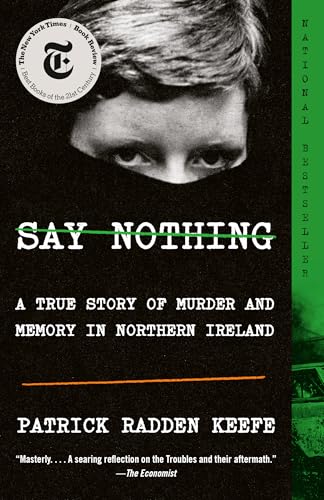
Say Nothing: A True Story of Murder and Memory in Northern Ireland
Patrick Radden Keefe
4.3
14 hours, 40 minutes
From award-winning New Yorker staff writer Patrick Radden Keefe, a stunning, intricate narrative about a notorious killing in Northern Ireland and its devastating repercussions
In December 1972, Jean McConville, a thirty-eight-year-old mother of ten, was dragged from her Belfast home by masked intruders, her children clinging to her legs. They never saw her again. Her abduction was one of the most notorious episodes of the vicious conflict known as The Troubles. Everyone in the neighborhood knew the I.R.A. was responsible. But in a climate of fear and paranoia, no one would speak of it. In 2003, five years after an accord brought an uneasy peace to Northern Ireland, a set of human bones was discovered on a beach. McConville's children knew it was their mother when they were told a blue safety pin was attached to the dress--with so many kids, she had always kept it handy for diapers or ripped clothes.
Patrick Radden Keefe's mesmerizing book on the bitter conflict in Northern Ireland and its aftermath uses the McConville case as a starting point for the tale of a society wracked by a violent guerrilla war, a war whose consequences have never been reckoned with. The brutal violence seared not only people like the McConville children, but also I.R.A. members embittered by a peace that fell far short of the goal of a united Ireland, and left them wondering whether the killings they committed were not justified acts of war, but simple murders. From radical and impetuous I.R.A. terrorists such as Dolours Price, who, when she was barely out of her teens, was already planting bombs in London and targeting informers for execution; to the ferocious I.R.A. mastermind known as The Dark; to the spy games and dirty schemes of the British Army; to Gerry Adams, who negotiated the peace but betrayed his hardcore comrades by denying his I.R.A. past, Say Nothing conjures a world of passion, betrayal, vengeance, and anguish.
…
Recommended by Carrie Johnson, Margot Wallström, Mikko Takkunen, and 3 others.
Carrie Johnson
The best book I read last year. 📚 https://t.co/CULq9zZHEU [source]
Margot Wallström
I recommend the book ”Say nothing” about Northern Ireland and IRA. It makes fascinating reading about memories, murder, mourning and making peace. [source]
Mikko Takkunen
Just finished reading this remarkable book by @praddenkeefe. I was baffled getting this from @VeronicaSanchis as I don’t remember ever showing particular interest in the Troubles, but she obviously knows me better than I do. https://t.co/KlBCF41y47 https://t.co/PnJlLCZyQD [source]
Cover unavailable
31
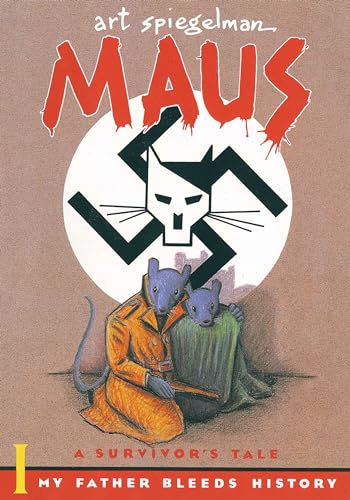
Maus I: A Survivor's Tale: My Father Bleeds History (Maus, #1)
Art Spiegelman
4.3
A story of a Jewish survivor of Hitler's Europe and his son, a cartoonist who tries to come to terms with his father's story and history itself.
Band of Brothers: E Company, 506th Regiment, 101st Airborne from Normandy to Hitler's Eagle's Nest
Stephen E. Ambrose
4.3
As good a rifle company as any, Easy Company, 506th Airborne Division, US Army, kept getting tough assignments--responsible for everything from parachuting into France early DDay morning to the capture of Hitler's Eagle's Nest at Berchtesgaden. In "Band of Brothers," Ambrose tells of the men in this brave unit who fought, went hungry, froze & died, a company that took 150% casualties & considered the Purple Heart a badge of office. Drawing on hours of interviews with survivors as well as the soldiers' journals & letters, Stephen Ambrose recounts the stories, often in the men's own words, of these American heroes. Foreword "We wanted those wings"; Camp Toccoa, 7-12/42 "Stand up & hook up"; Benning, Mackall, Bragg, Shanks, 12/42-9/43 "Duties of the latrine orderly"; Aldbourne, 9/43-3/44 "Look out, Hitler! Here we come!"; Slapton Sands, Uppottery, 4/1-6/5/44 "Follow me"; Normandy, 6/6/44 "Move out!"; Carentan, 6/7-7/12/44 Healing wounds & scrubbed missions; Aldbourne, 7/13-9/16/44 "Hell's highway"; Holland, 9/17-10/1/44 Island; Holland, 10/2-11/25/44 Resting, recovering & refitting: Mourmelon-le-Grand, 11/26-12/18/44 "They got us surrounded-the poor bastards"; Bastogne, 12/19-31/44 Breaking point; Bastogne, 1/1-13/45 Attack; Noville, 1/14-17/45 Patrol: Haguenau, 1/18-2/23/45 "Best feeling in the world": Mourmelon, 2/25-4/2/45 Getting to know the enemy: Germany, 4/2-30/45 Drinking Hitler's champagne; Berchtesgaden, 5/1-8/45 Soldier's dream life; Austria, 5/8-7/31/45 Postwar careers; 1945-91 Acknowledgments & Sources Index
…
Cover unavailable
33
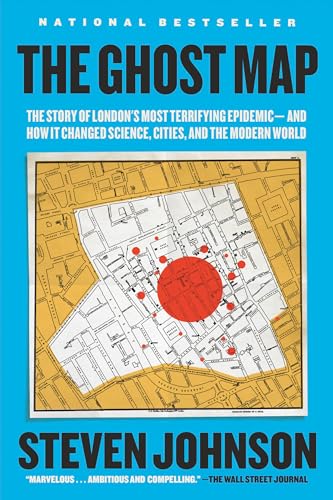
The Ghost Map: The Story of London's Most Terrifying Epidemic—and How It Changed Science, Cities, and the Modern World
Steven Johnson
4.3
From Steven Johnson, the dynamic thinker routinely compared to James Gleick, Dava Sobel, and Malcolm Gladwell, The Ghost Map is a riveting page-turner about a real-life historical hero, Dr. John Snow. It's the summer of 1854, and London is just emerging as one of the first modern cities in the world. But lacking the infrastructure—garbage removal, clean water, sewers—necessary to support its rapidly expanding population, the city has become the perfect breeding ground for a terrifying disease no one knows how to cure. As the cholera outbreak takes hold, a physician and a local curate are spurred to action—and ultimately solve the most pressing medical riddle of their time. In a triumph of multidisciplinary thinking, Johnson illuminates the intertwined histories and inter-connectedness of the spread of disease, contagion theory, the rise of cities, and the nature of scientific inquiry, offering both a riveting history and a powerful explanation of how it has shaped the world we live in.
…
Recommended by Alison Alvarez, Seth Mnookin, and Stephen Evans.
Alison Alvarez
I read the Ghost Map, a book about 1854 London Cholera outbreak. The outbreak was stopped because of a map created by Dr. John Snow. You can see hints of this map in some of our customer discovery tools because it was such an effective way of pinpointing a solution to a seemingly insurmountable problem. [source]
Seth Mnookin
The Ghost Map is a book that I oftentimes give to people to show them how cool and exciting and accessible and gripping stories about scientific discoveries can be. [source]
Stephen Evans
Johnson looks at London during a specific moment in time, August 1854, and focuses on a particular incident, an outbreak of cholera in Soho, in Central London. [source]
Cover unavailable
34
The Professor and the Madman: A Tale of Murder, Insanity and the Making of the Oxford English Dictionary
Simon Winchester
4.3
The Professor and the Madman, masterfully researched and eloquently written, is an extraordinary tale of madness, genius, and the incredible obsessions of two remarkable men that led to the making of the Oxford English Dictionary -- and literary history. The compilation of the OED, begun in 1857, was one of the most ambitious projects ever undertaken. As definitions were collected, the overseeing committee, led by Professor James Murray, discovered that one man, Dr. W. C. Minor, had submitted more than ten thousand. When the committee insisted on honoring him, a shocking truth came to light: Dr. Minor, an American Civil War veteran, was also an inmate at an asylum for the criminally insane.
…
Recommended by Peter Gilliver.
Peter Gilliver
W.C. Minor was a member of the public, but he just happened to be a murderer who was banged up in Broadmoor. [source]
Cover unavailable
35
Ghost Soldiers: The Epic Account of World War II's Greatest Rescue Mission
Hampton Sides
4.3
On January 28, 1945, 121 hand-selected U.S. troops slipped behind enemy lines in the Philippines. Their mission: March thirty rugged miles to rescue 513 POWs languishing in a hellish camp, among them the last survivors of the infamous Bataan Death March. A recent prison massacre by Japanese soldiers elsewhere in the Philippines made the stakes impossibly high and left little time to plan the complex operation.
In Ghost Soldiers Hampton Sides vividly re-creates this daring raid, offering a minute-by-minute narration that unfolds alongside intimate portraits of the prisoners and their lives in the camp. Sides shows how the POWs banded together to survive, defying the Japanese authorities even as they endured starvation, tropical diseases, and torture. Harrowing, poignant, and inspiring, Ghost Soldiers is the mesmerizing story of a remarkable mission. It is also a testament to the human spirit, an account of enormous bravery and self-sacrifice amid the most trying conditions.
For more than two thousand years, The Art of War has stood as a cornerstone of Chinese culture-a lucid epigrammatic text that reveals as much about human psychology, politics, and economics as it does about battlefield strategy. The influence of Sun-tzu's text has grown tremendously in the West in recent years, with military leaders, politicians, and corporate executives alike finding valuable insight in these ancient words. In his crisp, accessible new translation, scholar John Minford brings this seminal work to life for modern readers.
Minford opens with a lively, learned introduction in which he explores the life and times of Sun-tzu, looks at The Art of War in the context of the turbulent Warring States period, and discusses how best to read and understand the work today. There follows Minford's translation of the core text itself in two different formats-first, the unadorned thirteen chapters of the original work and then the same text reprinted with extensive running commentary by classical Chinese scholars as well as Minford himself. The result is an opportunity for Western readers to experience Sun-tzu's work in all its intensity as it applies to many aspects of our lives.
Which books should be read by every single intelligent person on planet? … The Art of War (Sun Tsu) to learn that the act of killing fellow humans can be raised to an art. If you read all of the above works you will glean profound insight into most of what has driven the history of the western world. [source]
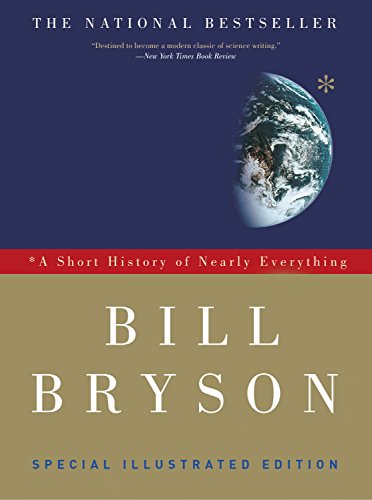
In Bryson's biggest book, he confronts his greatest challenge: to understand—and, if possible, answer—the oldest, biggest questions we have posed about the universe and ourselves. Taking as territory everything from the Big Bang to the rise of civilization, Bryson seeks to understand how we got from there being nothing at all to there being us. To that end, he has attached himself to a host of the world’s most advanced (and often obsessed) archaeologists, anthropologists, and mathematicians, travelling to their offices, laboratories, and field camps. He has read (or tried to read) their books, pestered them with questions, apprenticed himself to their powerful minds. A Short History of Nearly Everything is the record of this quest, and it is a sometimes profound, sometimes funny, and always supremely clear and entertaining adventure in the realms of human knowledge, as only Bill Bryson can render it. Science has never been more involving or entertaining.
…
Recommended by Amanda Palmer, David Goldberg, and Fabrice Grinda.
Amanda Palmer
Amanda Palmer recommended this book in the book "Tools of Titans". [source]
David Goldberg
What I really liked about A Short History of Nearly Everything is that it gives an excellent account of a lot of the personalities and the interconnectedness of important discoveries in cosmology and elsewhere. He does such a great job of bringing together our understanding of cosmology, evolution, paleontology, and geology in a very, very fluid way. [source]
Fabrice Grinda
I have lots of books to recommend, but they are not related to my career path. The only one that is remotely related is Peter Thiel’s Zero to One. That said here are books I would recommend. [source]
Cover unavailable
38
In Cold Blood
Truman Capote
4.2
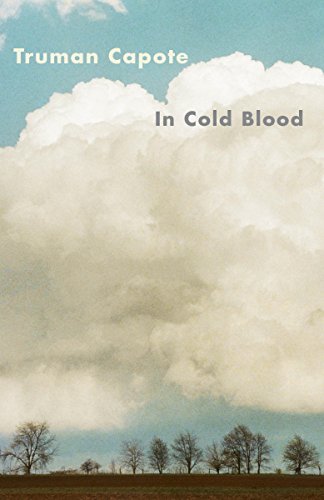
On November 15, 1959, in the small town of Holcomb, Kansas, four members of the Clutter family were savagely murdered by blasts from a shotgun held a few inches from their faces. There was no apparent motive for the crime, and there were almost no clues.
As Truman Capote reconstructs the murder and the investigation that led to the capture, trial, and execution of the killers, he generates both mesmerizing suspense and astonishing empathy. At the center of his study are the amoral young killers Perry Smith and Dick Hickcock, who, vividly drawn by Capote, are shown to be reprehensible yet entirely and frighteningly human. In Cold Blood is a seminal work of modern prose, a remarkable synthesis of journalistic skill and powerfully evocative narrative.
One of the reasons I like this true crime novelisation is down to the fact it was so out of character for Capote and took everyone by surprise. It is also an excellent, almost biographical, insight into the two young killers’ minds. [source]
I think in all honesty it is one of the finest books ever written. It took him six years to finish it because he had to wait for the court case and the final verdict which was the two perpetrators being executed. [source]
Cover unavailable
39
Seabiscuit: An American Legend
Laura Hillenbrand
4.2
There's an alternate cover edition here
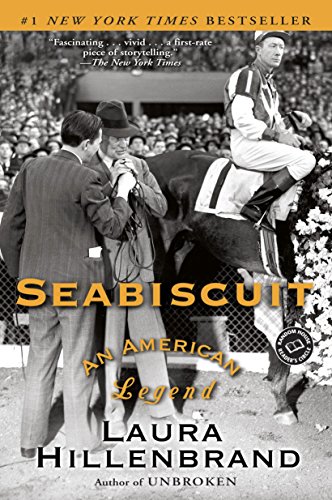
Seabiscuit was one of the most electrifying and popular attractions in sports history and the single biggest newsmaker in the world in 1938, receiving more coverage than FDR, Hitler, or Mussolini. But his success was a surprise to the racing establishment, which had written off the crooked-legged racehorse with the sad tail. Three men changed Seabiscuit’s fortunes:
Charles Howard was a onetime bicycle repairman who introduced the automobile to the western United States and became an overnight millionaire. When he needed a trainer for his new racehorses, he hired Tom Smith, a mysterious mustang breaker from the Colorado plains. Smith urged Howard to buy Seabiscuit for a bargain-basement price, then hired as his jockey Red Pollard, a failed boxer who was blind in one eye, half-crippled, and prone to quoting passages from Ralph Waldo Emerson. Over four years, these unlikely partners survived a phenomenal run of bad fortune, conspiracy, and severe injury to transform Seabiscuit from a neurotic, pathologically indolent also-ran into an American sports icon.
Author Laura Hillenbrand brilliantly re-creates a universal underdog story, one that proves life is a horse race.
From the Hardcover edition.
…
Cover unavailable
40
The Spy and the Traitor: The Greatest Espionage Story of the Cold War
Ben Macintyre
4.2
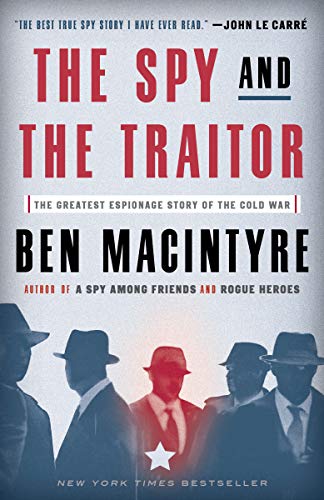
The celebrated author of A Spy Among Friends and Rogue Heroes returns with his greatest spy story yet, a thrilling Cold War-era tale of Oleg Gordievsky, the Russian whose secret work helped hasten the collapse of the Soviet Union.
If anyone could be considered a Russian counterpart to the infamous British double-agent Kim Philby, it was Oleg Gordievsky. The son of two KGB agents and the product of the best Soviet institutions, the savvy, sophisticated Gordievsky grew to see his nation's communism as both criminal and philistine. He took his first posting for Russian intelligence in 1968 and eventually became the Soviet Union's top man in London, but from 1973 on he was secretly working for MI6.
For nearly a decade, as the Cold War reached its twilight, Gordievsky helped the West turn the tables on the KGB, exposing Russian spies and helping to foil countless intelligence plots, as the Soviet leadership grew increasingly paranoid at the United States's nuclear first-strike capabilities and brought the world closer to the brink of war. Desperate to keep the circle of trust close, MI6 never revealed Gordievsky's name to its counterparts in the CIA, which in turn grew obsessed with figuring out the identity of Britain's obviously top-level source. Their obsession ultimately doomed Gordievsky: the CIA officer assigned to identify him was none other than Aldrich Ames, the man who would become infamous for secretly spying for the Soviets.
Unfolding the delicious three-way gamesmanship between America, Britain, and the Soviet Union, and culminating in the gripping cinematic beat-by-beat of Gordievsky's nail-biting escape from Moscow in 1985, Ben Macintyre's latest may be his best yet. Like the greatest novels of John le Carré, it brings readers deep into a world of treachery and betrayal, where the lines bleed between the personal and the professional, and one man's hatred of communism had the power to change the future of nations.
just finished this yesterday. absolutely fantastic book. super recommend if you're into spycraft and espionage. bravo @BenMacintyre1 https://t.co/4OG4C1cBQ1 [source]
I had a great conversation with Ambassador Micheal Lund Jeppesen of @DKinAfghanistan . On the sidelines of our rich conversation we spoke of the Spy & the Traitor a great book in which Denmark's intelligence features highly. Proud of our alliance & cooperation. https://t.co/47GMb7ETWr [source]
Gady Epstein
Think I’ll read a non-China spy story for a change. Have heard great things about this book https://t.co/QcBa0ozRfG [source]
Cover unavailable
41
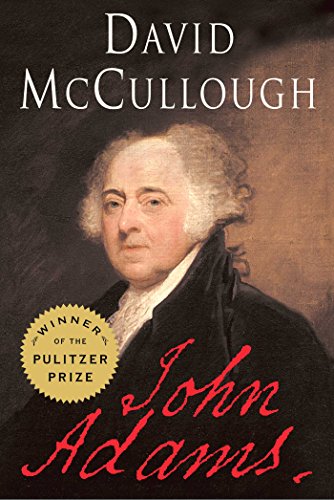
John Adams
David McCullough
4.2
The enthralling, often surprising story of John Adams, one of the most important and fascinating Americans who ever lived.
In this powerful, epic biography, David McCullough unfolds the adventurous life-journey of John Adams, the brilliant, fiercely independent, often irascible, always honest Yankee patriot -- "the colossus of independence," as Thomas Jefferson called him -- who spared nothing in his zeal for the American Revolution; who rose to become the second President of the United States and saved the country from blundering into an unnecessary war; who was learned beyond all but a few and regarded by some as "out of his senses"; and whose marriage to the wise and valiant Abigail Adams is one of the moving love stories in American history.
Like his masterly, Pulitzer Prize-winning biography Truman, David McCullough's John Adams has the sweep and vitality of a great novel. It is both a riveting portrait of an abundantly human man and a vivid evocation of his time, much of it drawn from an outstanding collection of Adams family letters and diaries. In particular, the more than one thousand surviving letters between John and Abigail Adams, nearly half of which have never been published, provide extraordinary access to their private lives and make it possible to know John Adams as no other major American of his founding era.
As he has with stunning effect in his previous books, McCullough tells the story from within -- from the point of view of the amazing eighteenth century and of those who, caught up in events, had no sure way of knowing how things would turn out. George Washington, Benjamin Franklin, John Jay, the British spy Edward Bancroft, Madame Lafayette and Jefferson's Paris "interest" Maria Cosway, Alexander Hamilton, James Madison, the scandalmonger James Callender, Sally Hemings, John Marshall, Talleyrand, and Aaron Burr all figure in this panoramic chronicle, as does, importantly, John Quincy Adams, the adored son whom Adams would live to see become President.
Crucial to the story, as it was to history, is the relationship between Adams and Jefferson, born opposites -- one a Massachusetts farmer's son, the other a Virginia aristocrat and slaveholder, one short and stout, the other tall and spare. Adams embraced conflict; Jefferson avoided it. Adams had great humor; Jefferson, very little. But they were alike in their devotion to their country.
At first they were ardent co-revolutionaries, then fellow diplomats and close friends. With the advent of the two political parties, they became archrivals, even enemies, in the intense struggle for the presidency in 1800, perhaps the most vicious election in history. Then, amazingly, they became friends again, and ultimately, incredibly, they died on the same day -- their day of days -- July 4, in the year 1826.
Much about John Adams's life will come as a surprise to many readers. His courageous voyage on the frigate Boston in the winter of 1778 and his later trek over the Pyrenees are exploits that few would have dared and that few readers will ever forget.
It is a life encompassing a huge arc -- Adams lived longer than any president. The story ranges from the Boston Massacre to Philadelphia in 1776 to the Versailles of Louis XVI, from Spain to Amsterdam, from the Court of St. James's, where Adams was the first American to stand before King George III as a representative of the new nation, to the raw, half-finished Capital by the Potomac, where Adams was the first President to occupy the White House.
This is history on a grand scale -- a book about politics and war and social issues, but also about human nature, love, religious faith, virtue, ambition, friendship and betrayal, and the far-reaching consequences of noble ideas. Above all, John Adams is an enthralling, often surprising story of one of the most important and fascinating Americans who ever lived.
…
Recommended by Barack Obama and Antonio Villaraigosa.
The biographies have been useful, because I do think that there’s a tendency, understandable, to think that whatever’s going on right now is uniquely disastrous or amazing or difficult. [source]
Antonio Villaraigosa
I love biographies and this one in particular strikes me. I don’t believe John Adams comes immediately to mind as one of the great presidents, but he was. Students of history know he had a hand in so many of the founding documents we remember today. [source]
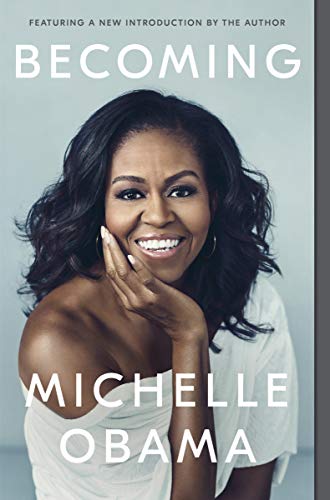
In a life filled with meaning and accomplishment, Michelle Obama has emerged as one of the most iconic and compelling women of our era. As First Lady of the United States of America—the first African American to serve in that role—she helped create the most welcoming and inclusive White House in history, while also establishing herself as a powerful advocate for women and girls in the U.S. and around the world, dramatically changing the ways that families pursue healthier and more active lives, and standing with her husband as he led America through some of its most harrowing moments. Along the way, she showed us a few dance moves, crushed Carpool Karaoke, and raised two down-to-earth daughters under an unforgiving media glare.
In her memoir, a work of deep reflection and mesmerizing storytelling, Michelle Obama invites readers into her world, chronicling the experiences that have shaped her—from her childhood on the South Side of Chicago to her years as an executive balancing the demands of motherhood and work, to her time spent at the world’s most famous address. With unerring honesty and lively wit, she describes her triumphs and her disappointments, both public and private, telling her full story as she has lived it—in her own words and on her own terms. Warm, wise, and revelatory, Becoming is the deeply personal reckoning of a woman of soul and substance who has steadily defied expectations—and whose story inspires us to do the same.
…
Recommended by Barack Obama, Piers Morgan, Mary Burkey, and 3 others.
Of course, @MichelleObama’s my wife, so I’m a little biased here. But she also happens to be brilliant, funny, wise – one of a kind. This book tells her quintessentially American story. I love it because it faithfully reflects the woman I have loved for so long. [source]
Piers Morgan
Congrats to @MichelleObama on sensational sales of her new book #Becoming. I always take people as I find them & when I met her at the White House, she was a delightfully warm, friendly & genuine lady. A great First Lady & now a best-selling author. https://t.co/nlSUHI01SM [source]
Mary Burkey
This is a case where you have to hear Michelle Obama read her story. It’s her story and she puts her whole emotional self into it. [source]
Cover unavailable
43
The Splendid and the Vile: A Saga of Churchill, Family, and Defiance During the Blitz
Erik Larson
4.2
The #1 New York Times bestselling author of Dead Wake and The Devil in the White City delivers a startlingly fresh portrait of Winston Churchill and London during the Blitz
On Winston Churchill's first day as prime minister, Hitler invaded Holland and Belgium. Poland and Czechoslovakia had already fallen, and the Dunkirk evacuation was just two weeks away. For the next twelve months, Hitler would wage a relentless bombing campaign, killing 45,000 Britons (30,000 of them Londoners) and destroying two million homes. It was up to Churchill to hold the country together and persuade President Franklin Roosevelt that Britain was a worthy ally--that she was willing to fight to the end.
In The Splendid and the Vile, Erik Larson shows, in cinematic detail, how Churchill taught the British people "the art of being fearless." It is a story of political brinksmanship but also an intimate domestic drama, set against the backdrop of Churchill's prime-ministerial country house, Chequers, and his wartime residence, Ditchley, where Churchill and his entourage go when the moon is brightest and the bombing threat is highest. Drawing on a wealth of untapped sources, including recently declassified files, intelligence reports, and personal diaries only now available, Larson provides a new lens on London's darkest year through the day-to-day experience of Churchill and his family: his wife, Clementine; their daughters, Sarah, Diana, and the youngest, Mary, who chafes against her parents' wartime protectiveness; their son, Randolph, and his beautiful, unhappy wife, Pamela; her illicit lover, a dashing American emissary; and the cadre of close advisors who comprised Churchill's "Secret Circle," including his dangerously observant private secretary, John Colville; newspaper baron Lord Beaverbrook; and the Rasputin-like Federick Lindemann.
The Splendid and the Vile takes readers out of today's political dysfunction and back to a time of true leadership, when--in the face of unrelenting horror--Churchill's eloquence, strategic brilliance, and perseverance bound a country, and a family, together.
…
Cover unavailable
44
The River of Doubt: Theodore Roosevelt's Darkest Journey
Candice Millard
4.2
At once an incredible adventure narrative and a penetrating biographical portrait, The River of Doubt is the true story of Theodore Roosevelt’s harrowing exploration of one of the most dangerous rivers on earth.
The River of Doubt—it is a black, uncharted tributary of the Amazon that snakes through one of the most treacherous jungles in the world. Indians armed with poison-tipped arrows haunt its shadows; piranhas glide through its waters; boulder-strewn rapids turn the river into a roiling cauldron.
After his humiliating election defeat in 1912, Roosevelt set his sights on the most punishing physical challenge he could find, the first descent of an unmapped, rapids-choked tributary of the Amazon. Together with his son Kermit and Brazil’s most famous explorer, Cândido Mariano da Silva Rondon, Roosevelt accomplished a feat so great that many at the time refused to believe it. In the process, he changed the map of the western hemisphere forever.
Along the way, Roosevelt and his men faced an unbelievable series of hardships, losing their canoes and supplies to punishing whitewater rapids, and enduring starvation, Indian attack, disease, drowning, and a murder within their own ranks. Three men died, and Roosevelt was brought to the brink of suicide. The River of Doubt brings alive these extraordinary events in a powerful nonfiction narrative thriller that happens to feature one of the most famous Americans who ever lived. From the soaring beauty of the Amazon rain forest to the darkest night of Theodore Roosevelt’s life, here is Candice Millard’s dazzling debut.
Americans like to insist that they are living in a post-racial, color-blind society. In fact, racist thought is alive and well; it has simply become more sophisticated and more insidious. And as award-winning historian Ibram X. Kendi argues in Stamped from the Beginning, racist ideas in America have a long and lingering history, one in which nearly every great American thinker is complicit.
In this deeply researched and fast-moving narrative, Kendi chronicles the entire story of anti–Black racist ideas and their staggering power over the course of American history. Stamped from the Beginning uses the lives of five major American intellectuals to offer a window into the contentious debates between assimilationists and segregationists and between racists and anti-racists. From Puritan minister Cotton Mather to Thomas Jefferson, from fiery abolitionist William Lloyd Garrison to brilliant scholar W. E. B. Du Bois to legendary anti–prison activist Angela Davis, Kendi shows how and why some of our leading pro-slavery and pro–civil rights thinkers have challenged or helped cement racist ideas in America.
As Kendi provocatively illustrates, racist thinking did not arise from ignorance or hatred. Racist ideas were created and popularized in an effort to defend deeply entrenched discriminatory policies and to rationalize the nation’s racial inequities in everything from wealth to health. While racist ideas are easily produced and easily consumed, they can also be discredited. In shedding much–needed light on the murky history of racist ideas, Stamped from the Beginning offers tools to expose them—and in the process, reason to hope.
…
Recommended by Bianca Belair.
Bianca Belair
For #BHM I will be sharing some of my favorite books by Black Authors 27th Book: Stamped from the Beginning Written by: @DrIbram When I found this book I couldn’t believe that I had never learned about the information in this book. A book everyone should read. Eye-opening! https://t.co/pLaifB8DFI [source]
Cover unavailable
46
The Six Wives of Henry VIII
Alison Weir
4.2
Weir has tirelessly made her way through the entire labyrinth of Tudor history to tell the collective story of the six wives of Henry VIII--a vivid, full-blooded portrait of six very different women--in a work of sound and brilliant scholarship. Illustrations.
Cover unavailable
47
King Leopold's Ghost
Adam Hochschil
4.2
In the 1880s, as the European powers were carving up Africa, King Leopold II of Belgium seized for himself the vast and mostly unexplored territory surrounding the Congo River. Carrying out a genocidal plundering of the Congo, he looted its rubber, brutalized its people, and ultimately slashed its population by ten million--all the while shrewdly cultivating his reputation as a great humanitarian. Heroic efforts to expose these crimes eventually led to the first great human rights movement of the twentieth century, in which everyone from Mark Twain to the Archbishop of Canterbury participated. King Leopold's Ghost is the haunting account of a megalomaniac of monstrous proportions, a man as cunning, charming, and cruel as any of the great Shakespearean villains. It is also the deeply moving portrait of those who fought Leopold: a brave handful of missionaries, travelers, and young idealists who went to Africa for work or adventure and unexpectedly found themselves witnesses to a holocaust. Adam Hochschild brings this largely untold story alive with the wit and skill of a Barbara Tuchman. Like her, he knows that history often provides a far richer cast of characters than any novelist could invent. Chief among them is Edmund Morel, a young British shipping agent who went on to lead the international crusade against Leopold. Another hero of this tale, the Irish patriot Roger Casement, ended his life on a London gallows. Two courageous black Americans, George Washington Williams and William Sheppard, risked much to bring evidence of the Congo atrocities to the outside world. Sailing into the middle of the story was a young Congo River steamboat officer named Joseph Conrad. And looming above them all, the duplicitous billionaire King Leopold II. With great power and compassion, King Leopold's Ghost will brand the tragedy of the Congo--too long forgotten--onto the conscience of the West
Large parts of the Belgian establishment loathe this book. It tells, as its sub-title says, ‘a story of greed, terror and heroism’. It lays bare the absolute fiction that King Leopold’s fief in the Congo was based on some philanthropic urge – a line that Leopold managed to peddle with extraordinary success at the time. I don’t know if what Leopold did would be called ‘genocide’ today or not. But millions died under his rule, often in horrific circumstances, invisible to the rest of the world. Modern communications didn’t exist. [source]
This is an incredibly powerful, horrifying, and utterly brilliant study of Belgian colonialism of the Congo and the brutality and genocide that followed in its wake. [source]
Cover unavailable
48
Between the World and Me
Ta-Nehisi Coates
4.2
#1 NEW YORK TIMES BESTSELLER [[ LONGLISTED FOR THE NATIONAL BOOK AWARD [[ Hailed by Toni Morrison as "required reading," a bold and personal literary exploration of America's racial history by "the single best writer on the subject of race in the United States" (The New York Observer)
"This is your country, this is your world, this is your body, and you must find some way to live within the all of it."
In a profound work that pivots from the biggest questions about American history and ideals to the most intimate concerns of a father for his son, Ta-Nehisi Coates offers a powerful new framework for understanding our nation's history and current crisis. Americans have built an empire on the idea of "race," a falsehood that damages us all but falls most heavily on the bodies of black women and menbodies exploited through slavery and segregation, and, today, threatened, locked up, and murdered out of all proportion. What is it like to inhabit a black body and find a way to live within it? And how can we all honestly reckon with this fraught history and free ourselves from its burden?
Between the World and Me is Ta-Nehisi Coates's attempt to answer these questions in a letter to his adolescent son. Coates shares with his sonand readersthe story of his awakening to the truth about his place in the world through a series of revelatory experiences, from Howard University to Civil War battlefields, from the South Side of Chicago to Paris, from his childhood home to the living rooms of mothers whose children's lives were taken as American plunder. Beautifully woven from personal narrative, reimagined history, and fresh, emotionally charged reportage, Between the World and Me clearly illuminates the past, bracingly confronts our present, and offers a transcendent vision for a way forward.
The president also released a list of his summer favorites back in 2015: All That Is, James Salter The Sixth Extinction, Elizabeth Kolbert The Lowland, Jhumpa Lahiri Between the World and Me, Ta-Nehisi Coates Washington: A Life, Ron Chernow All the Light We Cannot See, Anthony Doerr [source]
Q: What are the books that had a major influence on you? Or simply the ones you like the most. : Tao te Ching, score takes care of itself, between the world and me, the four agreements, the old man and the sea...I love reading! [source]
Here are some of my favorite reads from 2017. Lots of friends and colleagues send me book suggestions and it's impossible to squeeze them all in. I continue to be super curious about how digital and tech are enabling people to transform our lives but I try to read a good mix of books that apply to a variety of areas and stretch my thinking more broadly. [source]
Cover unavailable
49
SPQR: A History of Ancient Rome
Mary Beard
4.2
In SPQR, an instant classic, Mary Beard narrates the history of Rome "with passion and without technical jargon" and demonstrates how "a slightly shabby Iron Age village" rose to become the "undisputed hegemon of the Mediterranean" (Wall Street Journal). Hailed by critics as animating "the grand sweep and the intimate details that bring the distant past vividly to life" (Economist) in a way that makes "your hair stand on end" (Christian Science Monitor) and spanning nearly a thousand years of history, this "highly informative, highly readable" (Dallas Morning News) work examines not just how we think of ancient Rome but challenges the comfortable historical perspectives that have existed for centuries. With its nuanced attention to class, democratic struggles, and the lives of entire groups of people omitted from the historical narrative for centuries, SPQR will to shape our view of Roman history for decades to come.
I think SPQR is a wonderful book. Ancient Roman history is so very dense and intricate that it can be difficult to teach and learn about. Mary Beard makes it accessible—and she goes through it all, from the early days right up until the present day. [source]
Cover unavailable
50
Schindler's List
Thomas Keneally
4.2
In the shadow of Auschwitz, a flamboyant German industrialist grew into a living legend to the Jews of Cracow. He was a womaniser, a heavy drinker and a bon viveur, but to them he became a saviour. This is the extraordinary story of Oskar Schindler, who risked his life to protect Jews in Nazi-occupied Poland and who was transformed by the war into a man with a mission, a compassionate angel of mercy.
…
Cover unavailable
51
Isaac's Storm: A Man, a Time, and the Deadliest Hurricane in History
Erik Larson
4.2
National Bestseller
September 8, 1900, began innocently in the seaside town of Galveston, Texas. Even Isaac Cline, resident meteorologist for the U.S. Weather Bureau failed to grasp the true meaning of the strange deep-sea swells and peculiar winds that greeted the city that morning. Mere hours later, Galveston found itself submerged in a monster hurricane that completely destroyed the town and killed over six thousand people in what remains the greatest natural disaster in American history--and Isaac Cline found himself the victim of a devastating personal tragedy.
Using Cline's own telegrams, letters, and reports, the testimony of scores of survivors, and our latest understanding of the science of hurricanes, Erik Larson builds a chronicle of one man's heroic struggle and fatal miscalculation in the face of a storm of unimaginable magnitude. Riveting, powerful, and unbearably suspenseful, Isaac's Storm is the story of what can happen when human arrogance meets the great uncontrollable force of nature.
…
Recommended by Deborah Blum.
Deborah Blum
That is exactly right – the Galveston Hurricane in 1900. It killed thousands of people. I was just thinking after this latest round of tornadoes what a storm-torn continent we are. But that was the worst of them. There has never been a hurricane like that to hit the United States and essentially to remove a community, destroy a generation living there. [source]
Cover unavailable
52
Nothing to Envy: Ordinary Lives in North Korea
Barbara Demick, Karen White, et al
4.2
Nothing to Envy follows the lives of six North Koreans over fifteen years—a chaotic period that saw the death of Kim Il-sung, the unchallenged rise to power of his son Kim Jong-il, and the devastation of a far-ranging famine that killed one-fifth of the population.
Taking us into a landscape most of us have never before seen, award-winning journalist Barbara Demick brings to life what it means to be living under the most repressive totalitarian regime today—an Orwellian world that is by choice not connected to the Internet, in which radio and television dials are welded to the one government station, and where displays of affection are punished; a police state where informants are rewarded and where an offhand remark can send a person to the gulag for life.
Demick takes us deep inside the country, beyond the reach of government censors. Through meticulous and sensitive reporting, we see her six subjects—average North Korean citizens—fall in love, raise families, nurture ambitions, and struggle for survival. One by one, we experience the moments when they realize that their government has betrayed them.
Nothing to Envy is a groundbreaking addition to the literature of totalitarianism and an eye-opening look at a closed world that is of increasing global importance.
…
Recommended by Hyeonseo Lee.
Hyeonseo Lee
She includes great details that show everyday life in North Korea. [source]
Cover unavailable
53
Voices from Chernobyl
Svetlana Alexievich
4.2
On April 26, 1986, the worst nuclear reactor accident in history occurred at the Chernobyl complex in Pripyat. English-language reportage on the incident has, so far, focused on facts, names, and data; Voices from Chernobyl presents first-hand accounts of what happened to the people of Belarus and the fear, anger, and uncertainty that they lived through. In order to give voice to their experiences, Svetlana Alexievich interviewed hundreds of people (firefighters, disaster-cleanup technicians, and innocent citizens alike) affected by the meltdown. She presents these interviews in monologue form, giving readers a harrowing inside view into the minds of the affected people. No spin, no accusations, and no summary judgment: just the lifeshattering pain of the meltdown and the aftermath.
…
Recommended by Caterina Fake, Craig Mazin, Kate Brown, and 1 others.
These are sources I found fascinating and useful. Not ALL of them, but a bunch. First up, obviously... Svetlana Alexievich's Voices From Chernobyl. Absolutely essential, and heartbreaking, reading. There's a reason Ms. Alexievich has a Nobel Prize. [source]
Kate Brown
It’s a very beautiful work and I think it gives you the emotional landscape of how people dealt with their anxieties, fears, the health problems that ensued, and their growing sense of disillusionment with their political leaders and the Communist party. [source]
Rebecca Altman
What follows events like Chernobyl is a politics of measurement. Who counts? What counts? Who does the counting? How are boundaries drawn for the purposes of counting and comparing? And what is discounted, or never counted at all? [source]
Cover unavailable
54
The Complete Maus
Art SPIEGELMAN
4.2
Combined for the first time here are Maus I: A Survivor's Tale and Maus II - the complete story of Vladek Spiegelman and his wife, living and surviving in Hitler's Europe. By addressing the horror of the Holocaust through cartoons, the author captures the everyday reality of fear and is able to explore the guilt, relief and extraordinary sensation of survival - and how the children of survivors are in their own way affected by the trials of their parents. A contemporary classic of immeasurable significance.
…
Recommended by Susan Bordo.
Susan Bordo
It’s about the Holocaust. It’s also a comic book, in which the various characters are depicted as animals – the Jews as mice, the Nazis as cats. [source]
Cover unavailable
55
The Rise and Fall of the Third Reich: A History of Nazi Germany
William L. Shirer
4.2
Hitler boasted that The Third Reich would last a thousand years. It lasted only 12. But those 12 years contained some of the most catastrophic events Western civilization has ever known.
No other powerful empire ever bequeathed such mountains of evidence about its birth and destruction as the Third Reich. When the bitter war was over, and before the Nazis could destroy their files, the Allied demand for unconditional surrender produced an almost hour-by-hour record of the nightmare empire built by Adolph Hitler. This record included the testimony of Nazi leaders and of concentration camp inmates, the diaries of officials, transcripts of secret conferences, army orders, private letters—all the vast paperwork behind Hitler's drive to conquer the world.
The famed foreign correspondent and historian William L. Shirer, who had watched and reported on the Nazis since 1925, spent five and a half years sifting through this massive documentation. The result is a monumental study that has been widely acclaimed as the definitive record of one of the most frightening chapters in the history of mankind.
This worldwide bestseller has been acclaimed as the definitive book on Nazi Germany; it is a classic work.
The accounts of how the United States got involved and how Hitler used Mussolini and Japan are astonishing, and the coverage of the war-from Germany's early successes to her eventual defeat-is must reading
…
Recommended by Gunhee Park.
Gunhee Park
A few months back, I read a book called A Higher Call: An Incredible True Story of Combat and Chivalry in the War-Torn Skies of World War II that led me to want to learn more about Nazi Germany and Hitler, so I then picked up The Rise and Fall of the Third Reich, which led me to wanting to learn more about Winston Churchill. [source]
Cover unavailable
56
The Wright Brothers
David McCullough
4.2
Two-time winner of the Pulitzer Prize David McCullough tells the dramatic story-behind-the-story about the courageous brothers who taught the world how to fly: Wilbur and Orville Wright.
On a winter day in 1903, in the Outer Banks of North Carolina, two unknown brothers from Ohio changed history. But it would take the world some time to believe what had happened: the age of flight had begun, with the first heavier-than-air, powered machine carrying a pilot.
Who were these men and how was it that they achieved what they did?
David McCullough, two-time winner of the Pulitzer Prize, tells the surprising, profoundly American story of Wilbur and Orville Wright.
Far more than a couple of unschooled Dayton bicycle mechanics who happened to hit on success, they were men of exceptional courage and determination, and of far-ranging intellectual interests and ceaseless curiosity, much of which they attributed to their upbringing. The house they lived in had no electricity or indoor plumbing, but there were books aplenty, supplied mainly by their preacher father, and they never stopped reading.
When they worked together, no problem seemed to be insurmountable. Wilbur was unquestionably a genius. Orville had such mechanical ingenuity as few had ever seen. That they had no more than a public high school education, little money and no contacts in high places, never stopped them in their mission to take to the air. Nothing did, not even the self-evident reality that every time they took off in one of their contrivances, they risked being killed.
In this thrilling book, master historian David McCullough draws on the immense riches of the Wright Papers, including private diaries, notebooks, scrapbooks, and more than a thousand letters from private family correspondence to tell the human side of the Wright Brothers' story, including the little-known contributions of their sister, Katharine, without whom things might well have gone differently for them.
A Woman of No Importance: The Untold Story of the American Spy Who Helped Win World War II
Sonia Purnell
4.2
In 1942, the Gestapo sent out an urgent transmission: "She is the most dangerous of all Allied spies. We must find and destroy her."
The target in their sights was Virginia Hall, a Baltimore socialite who talked her way into Special Operations Executive, the spy organization dubbed Winston Churchill's "Ministry of Ungentlemanly Warfare." She became the first Allied woman deployed behind enemy lines and--despite her prosthetic leg--helped to light the flame of the French Resistance, revolutionizing secret warfare as we know it.
Virginia established vast spy networks throughout France, called weapons and explosives down from the skies, and became a linchpin for the Resistance. Even as her face covered wanted posters and a bounty was placed on her head, Virginia refused order after order to evacuate. She finally escaped through a death-defying hike over the Pyrenees into Spain, her cover blown. But she plunged back in, adamant that she had more lives to save, and led a victorious guerilla campaign, liberating swathes of France from the Nazis after D-Day.
Based on new and extensive research, Sonia Purnell has for the first time uncovered the full secret life of Virginia Hall--an astounding and inspiring story of heroism, spycraft, resistance, and personal triumph over shocking adversity.
During these challenging times, tales of resistance in World War II have found a receptive audience. In the case of Sonia Purnell’s biography, Americans are keen to read about our own countryman’s heroism.At the center of Purnell’s biography is socialite Virginia Hall of Baltimore, Maryland who had been shut out of the American diplomatic corps in the 1930s and stuck as a clerk in the State Department. Raised in affluence, she had learned to ride a horse, shoot, sail and cycle. An adventurous sort, she lost her leg below the knee in a hunting accident in Turkey. (True story: she shot herself in the foot.)After the Nazis invaded France, Hall got herself there to drive ambulances which she did with her prosthetic leg, known then as a ‘peg leg’ which she named Cuthbert. Fluent in French and knowledgeable about the terrain, Hall talked her way into the Office of Strategic Services, and eventually ran spy networks and supervised air drops of weapons. She was known as ‘Madonna of the Mountains.’Purnell recounts Hall’s spy operations so vividly that it feels like one is reading a spy novel. As Purnell’s title suggests, Hall was often underestimated and overlooked. In rescuing Virginia Hall from obscurity, the book also tells a great story about the Resistance. [source]
Cover unavailable
58
Mayflower: A Story of Courage, Community, and War
Nathaniel Philbrick
4.2
HOW DID AMERICA BEGIN?
This simple question launches acclaimed author Nathaniel Philbrick on an extraordinary journey to understand the truth behind our most sacred national myth: the voyage of the Mayflower and the settlement of Plymouth Colony. As Philbrick reveals in this electrifying new book, the story of the Pilgrims does not end with the First Thanksgiving; instead, it is a fifty-five-year epic that is at once tragic and heroic, and still carries meaning for us today.
…
Recommended by Catherine Manegold.
Catherine Manegold
This is a straight history but – and this is key – the emphasis is on the story. In this book Nathaniel Philbrick takes an event every American schoolchild knows about – the sailing of the Mayflower to North America in 1620 – and turns the comfortable mythology about that moment on its head. [source]
Cover unavailable
59
Talking to Strangers: What We Should Know about the People We Don't Know
Malcolm Gladwell, host of the podcast Revisionist History and author of the #1 New York Times bestseller Outliers, offers a powerful examination of our interactions with strangers -- and why they often go wrong.
How did Fidel Castro fool the CIA for a generation? Why did Neville Chamberlain think he could trust Adolf Hitler? Why are campus sexual assaults on the rise? Do television sitcoms teach us something about the way we relate to each other that isn't true?
While tackling these questions, Malcolm Gladwell was not solely writing a book for the page. He was also producing for the ear. In the audiobook version of Talking to Strangers, you'll hear the voices of people he interviewed--scientists, criminologists, military psychologists. Court transcripts are brought to life with re-enactments. You actually hear the contentious arrest of Sandra Bland by the side of the road in Texas. As Gladwell revisits the deceptions of Bernie Madoff, the trial of Amanda Knox, and the suicide of Sylvia Plath, you hear directly from many of the players in these real-life tragedies. There's even a theme song - Janelle Monae's "Hell You Talmbout."
Something is very wrong, Gladwell argues, with the tools and strategies we use to make sense of people we don't know. And because we don't know how to talk to strangers, we are inviting conflict and misunderstanding in ways that have a profound effect on our lives and our world.
I'll put here what I emailed Malcolm when I finished the book: "Just finished your new book in one sitting yesterday. So good. You are at the height of your powers and remain an inspiration to all of us trying to master an un-masterable profession." It's a little less practical or self-improvement oriented than his previous books, but far more thought provoking. [source]
Nilofer Merchant
An interesting analysis/ essay re Gladwell’s latest book —> https://t.co/5Ey1maNRyI [source]
Cover unavailable
60
Hillbilly Elegy: A Memoir of a Family and Culture in Crisis
From a former marine and Yale Law School graduate, a powerful account of growing up in a poor Rust Belt town that offers a broader, probing look at the struggles of America’s white working class
Hillbilly Elegy is a passionate and personal analysis of a culture in crisis—that of white working-class Americans. The decline of this group, a demographic of our country that has been slowly disintegrating over forty years, has been reported on with growing frequency and alarm, but has never before been written about as searingly from the inside. J. D. Vance tells the true story of what a social, regional, and class decline feels like when you were born with it hung around your neck.
The Vance family story begins hopefully in postwar America. J. D.’s grandparents were “dirt poor and in love,” and moved north from Kentucky’s Appalachia region to Ohio in the hopes of escaping the dreadful poverty around them. They raised a middle-class family, and eventually their grandchild (the author) would graduate from Yale Law School, a conventional marker of their success in achieving generational upward mobility.
But as the family saga of Hillbilly Elegy plays out, we learn that this is only the short, superficial version. Vance’s grandparents, aunt, uncle, sister, and, most of all, his mother, struggled profoundly with the demands of their new middle-class life, and were never able to fully escape the legacy of abuse, alcoholism, poverty, and trauma so characteristic of their part of America. Vance piercingly shows how he himself still carries around the demons of their chaotic family history.
A deeply moving memoir with its share of humor and vividly colorful figures, Hillbilly Elegy is the story of how upward mobility really feels. And it is an urgent and troubling meditation on the loss of the American dream for a large segment of this country.
The disadvantaged world of poor white Appalachia described in this terrific, heartbreaking book is one that I know only vicariously. Vance was raised largely by his loving but volatile grandparents, who stepped in after his father abandoned him and his mother showed little interest in parenting her son. Against all odds, he survived his chaotic, impoverished childhood only to land at Yale Law School. While the book offers insights into some of the complex cultural and family issues behind poverty, the real magic lies in the story itself and Vance’s bravery in telling it. [source]
A very well-written book. … The whole thing is a critique of individual decisions. [source]
Cover unavailable
61
The Only Plane in the Sky: An Oral History of 9/11
Garrett M. Graff
4.2
The first comprehensive oral history of September 11, 2001—a panoramic narrative woven from the voices of Americans on the front lines of an unprecedented national trauma.
Over the past eighteen years, monumental literature has been published about 9/11, from Lawrence Wright’s The Looming Tower, which traced the rise of al-Qaeda, to The 9/11 Commission Report, the government’s definitive factual retrospective of the attacks. But one perspective has been missing up to this point—a 360-degree account of the day told through the voices of the people who experienced it.
Now, in The Only Plane in the Sky, award-winning journalist and bestselling historian Garrett Graff tells the story of the day as it was lived—in the words of those who lived it. Drawing on never-before-published transcripts, recently declassified documents, original interviews, and oral histories from nearly five hundred government officials, first responders, witnesses, survivors, friends, and family members, Graff paints the most vivid and human portrait of the September 11 attacks yet.
Beginning in the predawn hours of airports in the Northeast, we meet the ticket agents who unknowingly usher terrorists onto their flights, and the flight attendants inside the hijacked planes. In New York City, first responders confront a scene of unimaginable horror at the Twin Towers. From a secret bunker underneath the White House, officials watch for incoming planes on radar. Aboard the small number of unarmed fighter jets in the air, pilots make a pact to fly into a hijacked airliner if necessary to bring it down. In the skies above Pennsylvania, civilians aboard United Flight 93 make the ultimate sacrifice in their place. Then, as the day moves forward and flights are grounded nationwide, Air Force One circles the country alone, its passengers isolated and afraid.
More than simply a collection of eyewitness testimonies, The Only Plane in the Sky is the historic narrative of how ordinary people grappled with extraordinary events in real time: the father and son working in the North Tower, caught on different ends of the impact zone; the firefighter searching for his wife who works at the World Trade Center; the operator of in-flight telephone calls who promises to share a passenger’s last words with his family; the beloved FDNY chaplain who bravely performs last rites for the dying, losing his own life when the Towers collapse; and the generals at the Pentagon who break down and weep when they are barred from rushing into the burning building to try to rescue their colleagues.
At once a powerful tribute to the courage of everyday Americans and an essential addition to the literature of 9/11, The Only Plane in the Sky weaves together the unforgettable personal experiences of the men and women who found themselves caught at the center of an unprecedented human drama. The result is a unique, profound, and searing exploration of humanity on a day that changed the course of history, and all of our lives.
…
Recommended by Alex Whitcomb, Andrew Feinberg, Joe Walsh, and 2 others.
Alex Whitcomb
@vermontgmg And if you love it, just buy his book already. I did: https://t.co/1lhlFow6BV [source]
Andrew Feinberg
@reagan_values Graff’s 9/11 book is fantastic. [source]
Joe Walsh
“The Only Plane In The Sky: An Oral History of 9/11.” Simply an amazing read. Buy this book. Read this book. Keep this book. Thank you @vermontgmg for writing this book. https://t.co/V4AS3r2lWw [source]
Cover unavailable
62
Destiny of the Republic: A Tale of Madness, Medicine and the Murder of a President
Candice Millard
4.1
James A. Garfield was one of the most extraordinary men ever elected president. Born into abject poverty, he rose to become a wunderkind scholar, a Civil War hero, and a renowned and admired reformist congressman. Nominated for president against his will, he engaged in a fierce battle with the corrupt political establishment. But four months after his inauguration, a deranged office seeker tracked Garfield down and shot him in the back.
But the shot didn’t kill Garfield. The drama of what happened subsequently is a powerful story of a nation in turmoil. The unhinged assassin’s half-delivered strike shattered the fragile national mood of a country so recently fractured by civil war, and left the wounded president as the object of a bitter behind-the-scenes struggle for power—over his administration, over the nation’s future, and, hauntingly, over his medical care. A team of physicians administered shockingly archaic treatments, to disastrous effect. As his condition worsened, Garfield received help: Alexander Graham Bell, the inventor of the telephone, worked around the clock to invent a new device capable of finding the bullet.
Meticulously researched, epic in scope, and pulsating with an intimate human focus and high-velocity narrative drive, The Destiny of the Republic will stand alongside The Devil in the White City and The Professor and the Madman as a classic of narrative history.
These two unusual historical narratives about U.S presidents are shockingly good. I will read whatever else this woman writes. [source]
Cover unavailable
63
Thunderstruck
Erik Larson
4.1
A true story of love, murder, and the end of the world's "great hush."
In Thunderstruck, Erik Larson tells the interwoven stories of two men--Hawley Crippen, a very unlikely murderer, and Guglielmo Marconi, the obsessive creator of a seemingly supernatural means of communication--whose lives intersect during one of the greatest criminal chases of all time.
Set in Edwardian London and on the stormy coasts of Cornwall, Cape Cod, and Nova Scotia, Thunderstruck evokes the dynamism of those years when great shipping companies competed to build the biggest, fastest ocean liners; scientific advances dazzled the public with visions of a world transformed; and the rich outdid one another with ostentatious displays of wealth. Against this background, Marconi races against incredible odds and relentless skepticism to perfect his invention: the wireless, a prime catalyst for the emergence of the world we know today. Meanwhile, Crippen, "the kindest of men," nearly commits the perfect murder.
With his unparalleled narrative skills, Erik Larson guides us through a relentlessly suspenseful chase over the waters of the North Atlantic. Along the way, he tells of a sad and tragic love affair that was described on the front pages of newspapers around the world, a chief inspector who found himself strangely sympathetic to the killer and his lover, and a driven and compelling inventor who transformed the way we communicate.
…
Recommended by Timothy J. Jorgensen.
Timothy J. Jorgensen
I chose this book because radio waves are a type of radiation. [source]
Cover unavailable
64
The Worst Hard Time: The Untold Story of Those Who Survived the Great American Dust Bowl
Timothy Egan
4.1
The dust storms that terrorized the High Plains in the darkest years of the Depression were like nothing ever seen before or since. Timothy Egan's critically acclaimed account rescues this iconic chapter of American history from the shadows in a tour de force of historical reportage. Following a dozen families and their communities through the rise and fall of the region, Egan tells of their desperate attempts to carry on through blinding black dust blizzards, crop failure, and the death of loved ones. Brilliantly capturing the terrifying drama of catastrophe, Egan does equal justice to the human characters who become his heroes, "the stoic, long suffering men and women whose lives he opens up with urgency and respect" (New York Times).
In an era that promises ever-greater natural disasters, The Worst Hard Time is "arguably the best nonfiction book yet" (Austin Statesman Journal) on the greatest environmental disaster ever to be visited upon our land and a powerful cautionary tale about the dangers of trifling with nature.
…
Cover unavailable
65
The Monuments Men: Allied Heroes, Nazi Thieves, and the Greatest Treasure Hunt in History
Robert M. Edsel, Bret Witter
4.1
At the same time Adolf Hitler was attempting to take over the western world, his armies were methodically seeking and hoarding the finest art treasures in Europe. The Fuehrer had begun cataloguing the art he planned to collect as well as the art he would destroy: "degenerate" works he despised.
In a race against time, behind enemy lines, often unarmed, a special force of American and British museum directors, curators, art historians, and others, called the Momuments Men, risked their lives scouring Europe to prevent the destruction of thousands of years of culture.
Focusing on the eleven-month period between D-Day and V-E Day, this fascinating account follows six Monuments Men and their impossible mission to save the world's great art from the Nazis.
…
Cover unavailable
66
The Accidental President: Harry S. Truman and the Four Months That Changed the World
A. J. Baime
4.1
“[A] well-judged and hugely readable book . . . few are as entertaining.”—Dominic Sandbrook, Sunday Times
“A. J. Baime is a master. His reporting and storytelling are woven to hypnotic effect. This is history and humanity in lush, vivid color.”—Doug Stanton, author of The Odyssey of Echo Company
Heroes are often defined as ordinary characters who get pushed into extraordinary circumstances, and through courage and a dash of luck, cement their place in history. Chosen as FDR’s fourth-term vice president for his well-praised work ethic, good judgment, and lack of enemies, Harry S. Truman was the prototypical ordinary man. That is, until he was shockingly thrust in over his head after FDR’s sudden death. The first four months of Truman’s administration saw the founding of the United Nations, the fall of Berlin, victory at Okinawa, firebombings in Tokyo, the first atomic explosion, the Nazi surrender, the liberation of concentration camps, the mass starvation in Europe, the Potsdam Conference, the controversial decision to bomb Hiroshima and Nagasaki, the surrender of imperial Japan, and finally, the end of World War II and the rise of the Cold War. No other president had ever faced so much in such a short period of time. The Accidental President escorts readers into the situation room with Truman during a tumultuous, history-making 120 days, when the stakes were high and the challenges even higher.
…
Cover unavailable
67
Wild Swans: Three Daughters of China
Jung Chang
4.1
Three remarkable women--grandmother, mother, and daughter--struggle to survive in a true-life saga that spans 20th-century China with all its violence: wars, invasions, revolution, and continuing upheaval. A thrilling adventure story, Wild Swans is an important work of history, and a breathtaking testimony to the human spirit. 16 pages of photographs.
Recommended by Richard Branson, Harry Wu, and Vishakha Desai.
Today is World Book Day, a wonderful opportunity to address this #ChallengeRichard sent in by Mike Gonzalez of New Jersey: Make a list of your top 65 books to read in a lifetime. [source]
Harry Wu
Wild Swans is talking about people who are living at the highest level of society but they are still suffering persecution and live in fear. And the peasants in the village became slaves, they became nothing. So what the book does brilliantly is give a real insight into what life was like for ordinary people against the backdrop of the ever-changing China. [source]
Vishakha Desai
To me Wild Swans is one of those iconic books for understanding the generations of Chinese women. She is from this amazing intellectual family and it’s about what happens to them. The book just has this tremendous power. It’s an amazing journey. It’s about what women do to survive and also how they suffer. [source]
Cover unavailable
68
The Romanov Sisters: The Lost Lives of the Daughters of Nicholas and Alexandra
Helen Rappaport
4.1
They were the Princess Dianas of their day—perhaps the most photographed and talked about young royals of the early twentieth century. The four captivating Russian Grand Duchesses—Olga, Tatiana, Maria and Anastasia Romanov—were much admired for their happy dispositions, their looks, the clothes they wore and their privileged lifestyle.
Over the years, the story of the four Romanov sisters and their tragic end in a basement at Ekaterinburg in 1918 has clouded our view of them, leading to a mass of sentimental and idealized hagiography. With this treasure trove of diaries and letters from the grand duchesses to their friends and family, we learn that they were intelligent, sensitive and perceptive witnesses to the dark turmoil within their immediate family and the ominous approach of the Russian Revolution, the nightmare that would sweep their world away, and them along with it.
The Romanov Sisters sets out to capture the joy as well as the insecurities and poignancy of those young lives against the backdrop of the dying days of late Imperial Russia, World War I and the Russian Revolution. Rappaort aims to present a new and challenging take on the story, drawing extensively on previously unseen or unpublished letters, diaries and archival sources, as well as private collections. It is a book that will surprise people, even aficionados
…
Cover unavailable
69
Undaunted Courage: Meriwether Lewis, Thomas Jefferson, and the Opening of the American West
Stephen Ambrose
4.1
'This was much more than a bunch of guys out on an exploring and collecting expedition. This was a military expedition into hostile territory'. In 1803 President Thomas Jefferson selected his personal secretary, Captain Meriwether Lewis, to lead a pioneering voyage across the Great Plains and into the Rockies. It was completely uncharted territory; a wild, vast land ruled by the Indians. Charismatic and brave, Lewis was the perfect choice and he experienced the savage North American continent before any other white man. UNDAUNTED COURAGE is the tale of a hero, but it is also a tragedy. Lewis may have received a hero's welcome on his return to Washington in 1806, but his discoveries did not match the president's fantasies of sweeping, fertile plains ripe for the taking. Feeling the expedition had been a failure, Lewis took to drink and piled up debts. Full of colourful characters - Jefferson, the president obsessed with conquering the west; William Clark, the rugged frontiersman; Sacagawea, the Indian girl who accompanied the expedition; Drouillard, the French-Indian hunter - this is one of the great adventure stories of all time and it shot to the top of the US bestseller charts. Drama, suspense, danger and diplomacy combine with romance and personal tragedy making UNDAUNTED COURAGE an outstanding work of scholarship and a thrilling adventure.
How the Irish Saved Civilization: The Untold Story of Ireland's Heroic Role from the Fall of Rome to the Rise of Medieval Europe
Thomas Cahill
4.1
From the fall of Rome to the rise of Charlemagne - the "dark ages" - learning, scholarship, and culture disappeared from the European continent. The great heritage of western civilization - from the Greek and Roman classics to Jewish and Christian works - would have been utterly lost were it not for the holy men and women of unconquered Ireland.
In this delightful and illuminating look into a crucial but little-known "hinge" of history, Thomas Cahill takes us to the "island of saints and scholars, " the Ireland of St. Patrick and the Book of Kells. Here, far from the barbarian despoliation of the continent, monks and scribes laboriously, lovingly, even playfully preserved the west's written treasures. With the return of stability in Europe, these Irish scholars were instrumental in spreading learning. Thus the Irish not only were conservators of civilization, but became shapers of the medieval mind, putting their unique stamp on western culture.
Pulitzer Prize winner Ron Chernow returns with a sweeping and dramatic portrait of one of our most compelling generals and presidents, Ulysses S. Grant.
Ulysses S. Grant's life has typically been misunderstood. All too often he is caricatured as a chronic loser and an inept businessman, or as the triumphant but brutal Union general of the Civil War. But these stereotypes don't come close to capturing him, as Chernow shows in his masterful biography, the first to provide a complete understanding of the general and president whose fortunes rose and fell with dizzying speed and frequency.
Before the Civil War, Grant was flailing. His business ventures had ended dismally, and despite distinguished service in the Mexican War he ended up resigning from the army in disgrace amid recurring accusations of drunkenness. But in war, Grant began to realize his remarkable potential, soaring through the ranks of the Union army, prevailing at the battle of Shiloh and in the Vicksburg campaign, and ultimately defeating the legendary Confederate general Robert E. Lee. Along the way, Grant endeared himself to President Lincoln and became his most trusted general and the strategic genius of the war effort. Grant's military fame translated into a two-term presidency, but one plagued by corruption scandals involving his closest staff members.
More important, he sought freedom and justice for black Americans, working to crush the Ku Klux Klan and earning the admiration of Frederick Douglass, who called him "the vigilant, firm, impartial, and wise protector of my race." After his presidency, he was again brought low by a dashing young swindler on Wall Street, only to resuscitate his image by working with Mark Twain to publish his memoirs, which are recognized as a masterpiece of the genre.
With lucidity, breadth, and meticulousness, Chernow finds the threads that bind these disparate stories together, shedding new light on the man whom Walt Whitman described as "nothing heroic... and yet the greatest hero." Chernow's probing portrait of Grant's lifelong struggle with alcoholism transforms our understanding of the man at the deepest level. This is America's greatest biographer, bringing movingly to life one of our finest but most underappreciated presidents. The definitive biography, Grant is a grand synthesis of painstaking research and literary brilliance that makes sense of all sides of Grant's life, explaining how this simple Midwesterner could at once be so ordinary and so extraordinary.
Named one of the best books of the year by Goodreads -Amazon - The New York Times- Newsday- BookPage - Barnes and Noble - Wall Street Journal
This is a good time for Ron Chernow’s fine biography of Ulysses S. Grant to appear… As history, it is remarkable, full of fascinating details sure to make it interesting both to those with the most cursory knowledge of Grant’s life and to those who have read his memoirs or any of several previous biographies… For all its scholarly and literary strengths, this book’s greatest service is to remind us of Grant’s significant achievements at the end of the war and after, which have too long been overlooked and are too important today to be left in the dark… As Americans continue the struggle to defend justice and equality in our tumultuous and divisive era, we need to know what Grant did when our country’s very existence hung in the balance. If we still believe in forming a more perfect union, his steady and courageous example is more valuable than ever. [source]
Jeremy Boudinet
I read Ron Chernow's biography of Ulysses S. Grant at a crucial point in my life, when I was struggling with a few personal and professional career ups-and-downs. Grant is a fascinating character in U.S. history. His life was a dramatic roller coaster of major personal and professional triumphs that were inevitably followed by periods of massive failure and disappointment. Of course, all of this led up to his historic date with destiny as the winning General the U.S. desperately needed during the Civil War. An important takeaway from Grant's story is his primary character virtue - a stoic determination that ultimately carried him through periods of disenchantment and brought the Union victory in the Civil War. There's a lesson in there for all of us fighting in the trenches of business - we'll inevitably face some of the same ups-and-downs that Grant did. And we should aim to carry ourselves like he did. [source]
Cover unavailable
72
The Romanovs: 1613-1918
Simon Sebag-Montefiore
4.1
The Romanovs were the most successful dynasty of modern times, ruling a sixth of the world’s surface for three centuries. How did one family turn a war-ruined principality into the world’s greatest empire? And how did they lose it all?
This is the intimate story of twenty tsars and tsarinas, some touched by genius, some by madness, but all inspired by holy autocracy and imperial ambition. Simon Sebag Montefiore’s gripping chronicle reveals their secret world of unlimited power and ruthless empire-building, overshadowed by palace conspiracy, family rivalries, sexual decadence and wild extravagance, with a global cast of adventurers, courtesans, revolutionaries and poets, from Ivan the Terrible to Tolstoy and Pushkin, to Bismarck, Lincoln, Queen Victoria and Lenin.
…
Cover unavailable
73
Cleopatra: A Life
Stacy Schiff
4.1
The Pulitzer Prize-winning biographer brings to life the most intriguing woman in the history of the world: Cleopatra, the last queen of Egypt.
Her palace shimmered with onyx, garnets, and gold, but was richer still in political and sexual intrigue. Above all else, Cleopatra was a shrewd strategist and an ingenious negotiator.
Though her life spanned fewer than forty years, it reshaped the contours of the ancient world. She was married twice, each time to a brother. She waged a brutal civil war against the first when both were teenagers. She poisoned the second. Ultimately she dispensed with an ambitious sister as well; incest and assassination were family specialties. Cleopatra appears to have had sex with only two men. They happen, however, to have been Julius Caesar and Mark Antony, among the most prominent Romans of the day. Both were married to other women. Cleopatra had a child with Caesar and–after his murder–three more with his protégé. Already she was the wealthiest ruler in the Mediterranean; the relationship with Antony confirmed her status as the most influential woman of the age. The two would together attempt to forge a new empire, in an alliance that spelled their ends. Cleopatra has lodged herself in our imaginations ever since.
Famous long before she was notorious, Cleopatra has gone down in history for all the wrong reasons. Shakespeare and Shaw put words in her mouth. Michelangelo, Tiepolo, and Elizabeth Taylor put a face to her name. Along the way, Cleopatra’s supple personality and the drama of her circumstances have been lost. In a masterly return to the classical sources, Stacy Schiff here boldly separates fact from fiction to rescue the magnetic queen whose death ushered in a new world order. Rich in detail, epic in scope, Schiff ‘s is a luminous, deeply original reconstruction of a dazzling life.
…
Recommended by Danielle Morrill and Anne Thériault.
Anne Thériault
@annfosterwriter Omg isn’t this book the best?? [source]
Based on thousands of pages from Leonardo's astonishing notebooks and new discoveries about his life and work, Walter Isaacson weaves a narrative that connects his art to his science. He shows how Leonardo's genius was based on skills we can improve in ourselves, such as passionate curiosity, careful observation, and an imagination so playful that it flirted with fantasy. He produced the two most famous paintings in history, The Last Supper and the Mona Lisa. But in his own mind, he was just as much a man of science and technology. With a passion that sometimes became obsessive, he pursued innovative studies of anatomy, fossils, birds, the heart, flying machines, botany, geology, and weaponry. His ability to stand at the crossroads of the humanities and the sciences, made iconic by his drawing of Vitruvian Man, made him history's most creative genius
I think Leonardo was one of the most fascinating people ever. Although today he’s best known as a painter, Leonardo had an absurdly wide range of interests, from human anatomy to the theater. Isaacson does the best job I’ve seen of pulling together the different strands of Leonardo’s life and explaining what made him so exceptional. A worthy follow-up to Isaacson’s great biographies of Albert Einstein and Steve Jobs. [source]
Microsoft CEO has plunged into what must be an advance copy of Leonardo da Vinci by Walter Isaacson, who has written biographies of Steve Jobs, Albert Einstein and Ben Franklin. Isaacson’s biography is based on the Renaissance master’s personal notebooks, so you know we’re going to be taken into the creative mind of the genius. [source]
Truly excellent book about one of history’s all time greats. [source]
Cover unavailable
75
Empire of the Summer Moon: Quanah Parker and the Rise and Fall of the Comanches, the Most Powerful Indian Tribe in American History
S.C. Gwynne
4.1
In the tradition of Bury My Heart at Wounded Knee, a stunningly vivid historical account of the forty-year battle between Comanche Indians and white settlers for control of the American West, centering on Quanah, the greatest Comanche chief of them all.
S. C. Gwynne’s Empire of the Summer Moonspans two astonishing stories. The first traces the rise and fall of the Comanches, the most powerful Indian tribe in American history. The second entails one of the most remarkable narratives ever to come out of the Old West: the epic saga of the pioneer woman Cynthia Ann Parker and her mixed-blood son Quanah, who became the last and greatest chief of the Comanches.
Although readers may be more familiar with the tribal names Apache and Sioux, it was in fact the legendary fighting ability of the Comanches that determined just how and when the American West opened up. Comanche boys became adept bareback riders by age six; full Comanche braves were considered the best horsemen who ever rode. They were so masterful at war and so skillful with their arrows and lances that they stopped the northern drive of colonial Spain from Mexico and halted the French expansion westward from Louisiana. White settlers arriving in Texas from the eastern United States were surprised to find the frontier being rolled backward by Comanches incensed by the invasion of their tribal lands. So effective were the Comanches that they forced the creation of the Texas Rangers and account for the advent of the new weapon specifically designed to fight them: the six-gun.
The war with the Comanches lasted four decades, in effect holding up the development of the new American nation. Gwynne’s exhilarating account delivers a sweeping narrative that encompasses Spanish colonialism, the Civil War, the destruction of the buffalo herds, and the arrival of the railroads—a historical feast for anyone interested in how the United States came into being.
Against this backdrop Gwynne presents the compelling drama of Cynthia Ann Parker, a lovely nine-year-old girl with cornflower-blue eyes who was kidnapped by Comanches from the far Texas frontier in 1836. She grew to love her captors and became infamous as the "White Squaw" who refused to return until her tragic capture by Texas Rangers in 1860. More famous still was her son Quanah, a warrior who was never defeated and whose guerrilla wars in the Texas Panhandle made him a legend.
S. C. Gwynne’s account of these events is meticulously researched, intellectually provocative, and, above all, thrillingly told.
In this unforgettable chronicle of perhaps the most famous moment in American military history, James Bradley has captured the glory, the triumph, the heartbreak, and the legacy of the six men who raised the flag at Iwo Jima. Here is the true story behind the immortal photograph that has come to symbolize the courage and indomitable will of America.
In February 1945, American Marines plunged into the surf at Iwo Jima—and into history. Through a hail of machine-gun and mortar fire that left the beaches strewn with comrades, they battled to the island's highest peak. And after climbing through a landscape of hell itself, they raised a flag.
Now the son of one of the flagraisers has written a powerful account of six very different young men who came together in a moment that will live forever.
To his family, John Bradley never spoke of the photograph or the war. But after his death at age seventy, his family discovered closed boxes of letters and photos. In Flags of Our Fathers, James Bradley draws on those documents to retrace the lives of his father and the men of Easy Company. Following these men's paths to Iwo Jima, James Bradley has written a classic story of the heroic battle for the Pacific's most crucial island—an island riddled with Japanese tunnels and 22,000 fanatic defenders who would fight to the last man.
But perhaps the most interesting part of the story is what happened after the victory. The men in the photo—three were killed during the battle—were proclaimed heroes and flown home, to become reluctant symbols. For two of them, the adulation was shattering. Only James Bradley's father truly survived, displaying no copy of the famous photograph in his home, telling his son only: "The real heroes of Iwo Jima were the guys who didn't come back."
Few books ever have captured the complexity and furor of war and its aftermath as well as Flags of Our Fathers. A penetrating, epic look at a generation at war, this is history told with keen insight, enormous honesty, and the passion of a son paying homage to his father. It is the story of the difference between truth and myth, the meaning of being a hero, and the essence of the human experience of war.
From the Hardcover edition.
…
Cover unavailable
77
Maus II: A Survivor's Tale: And Here My Troubles Began (Maus, #2)
Art Spiegelman
4.1
Acclaimed as a quiet triumph and a brutally moving work of art, the first volume of Art Spieglman's Maus introduced readers to Vladek Spiegleman, a Jewish survivor of Hitler's Europe, and his son, a cartoonist trying to come to terms with his father, his father's terrifying story, and History itself. Its form, the cartoon (the Nazis are cats, the Jews mice), succeeds perfectly in shocking us out of any lingering sense of familiararity with the events described, approaching, as it does, the unspeakable through the diminutive.
This second volume, subtitled And Here My Troubles Began, moves us from the barracks of Auschwitz to the bungalows of the Catskills. Genuinely tragic and comic by turns, it attains a complexity of theme and a precision of thought new to comics and rare in any medium. Maus ties together two powerful stories: Vladek's harrowing tale of survival against all odds, delineating the paradox of daily life in the death camps, and the author's account of his tortured relationship with his aging father. At every level this is the ultimate survivor's tale - and that too of the children who somehow survive even the survivors.
…
Cover unavailable
78
The Poisoner's Handbook: Murder and the Birth of Forensic Medicine in Jazz Age New York
Deborah Blum
4.1
Deborah Blum, writing with the high style and skill for suspense that is characteristic of the very best mystery fiction, shares the untold story of how poison rocked Jazz Age New York City. In The Poisoner's Handbook Blum draws from highly original research to track the fascinating, perilous days when a pair of forensic scientists began their trailblazing chemical detective work, fighting to end an era when untraceable poisons offered an easy path to the perfect crime.
Drama unfolds case by case as the heroes of The Poisoner's Handbook—chief medical examiner Charles Norris and toxicologist Alexander Gettler—investigate a family mysteriously stricken bald, Barnum and Bailey's Famous Blue Man, factory workers with crumbling bones, a diner serving poisoned pies, and many others. Each case presents a deadly new puzzle and Norris and Gettler work with a creativity that rivals that of the most imaginative murderer, creating revolutionary experiments to tease out even the wiliest compounds from human tissue. Yet in the tricky game of toxins, even science can't always be trusted, as proven when one of Gettler's experiments erroneously sets free a suburban housewife later nicknamed "America's Lucretia Borgia" to continue her nefarious work.
From the vantage of Norris and Gettler's laboratory in the infamous Bellevue Hospital it becomes clear that killers aren't the only toxic threat to New Yorkers. Modern life has created a kind of poison playground, and danger lurks around every corner. Automobiles choke the city streets with carbon monoxide; potent compounds, such as morphine, can be found on store shelves in products ranging from pesticides to cosmetics. Prohibition incites a chemist's war between bootleggers and government chemists while in Gotham's crowded speakeasies each round of cocktails becomes a game of Russian roulette. Norris and Gettler triumph over seemingly unbeatable odds to become the pioneers of forensic chemistry and the gatekeepers of justice during a remarkably deadly time. A beguiling concoction that is equal parts true crime, twentieth-century history, and science thriller, The Poisoner's Handbook is a page-turning account of a forgotten New York.
…
Recommended by Michelle Francl.
Michelle Francl
Deborah Blum’s book reminds me that molecules are powerful witnesses, if only we have the skills to interrogate them, and sometimes they are killers. [source]
Cover unavailable
79
Hiroshima
John Hersey
4.1
On August 6, 1945, Hiroshima was destroyed by the first atom bomb ever dropped on a city. This book, John Hersey's journalistic masterpiece, tells what happened on that day. Told through the memories of survivors, this timeless, powerful and compassionate document has become a classic "that stirs the conscience of humanity" (The New York Times).
Almost four decades after the original publication of this celebrated book, John Hersey went back to Hiroshima in search of the people whose stories he had told. His account of what he discovered about them is now the eloquent and moving final chapter of Hiroshima.
…
Recommended by Alex Blumberg.
Alex Blumberg
I had always been interested in this kind of … long form narrative nonfiction. [source]
Cover unavailable
80
Midnight in Chernobyl: The Untold Story of the World's Greatest Nuclear Disaster
Adam Higginbotham
4.1
The definitive, dramatic untold story of the Chernobyl nuclear power plant disaster, based on original reporting and new archival research.
April 25, 1986, in Chernobyl, was a turning point in world history. The disaster not only changed the world’s perception of nuclear power and the science that spawned it, but also our understanding of the planet’s delicate ecology. With the images of the abandoned homes and playgrounds beyond the barbed wire of the 30-kilometer Exclusion Zone, the rusting graveyards of contaminated trucks and helicopters, the farmland lashed with black rain, the event fixed for all time the notion of radiation as an invisible killer.
Chernobyl was also a key event in the destruction of the Soviet Union, and, with it, the United States’ victory in the Cold War. For Moscow, it was a political and financial catastrophe as much as an environmental and scientific one. With a total cost of 18 billion rubles—at the time equivalent to $18 billion—Chernobyl bankrupted an already teetering economy and revealed to its population a state built upon a pillar of lies.
The full story of the events that started that night in the control room of Reactor No.4 of the V.I. Lenin Nuclear Power Plant has never been told—until now. Through two decades of reporting, new archival information, and firsthand interviews with witnesses, journalist Adam Higginbotham tells the full dramatic story, including Alexander Akimov and Anatoli Dyatlov, who represented the best and worst of Soviet life; denizens of a vanished world of secret policemen, internal passports, food lines, and heroic self-sacrifice for the Motherland. Midnight in Chernobyl, award-worthy nonfiction that reads like sci-fi, shows not only the final epic struggle of a dying empire but also the story of individual heroism and desperate, ingenious technical improvisation joining forces against a new kind of enemy.
…
Recommended by Maggie Koerthbaker.
Maggie Koerthbaker
So I'm reading "Midnight in Chernobyl" because obviously TV viewing needs to come with a syllabus afterwards. https://t.co/bWCLHTy7fq It is very interesting contrasting the fictionalized show, the history book, and the essays meant to debunk aspects of the show. [source]
In April 1942, Lale Sokolov, a Slovakian Jew, is forcibly transported to the concentration camps at Auschwitz-Birkenau. When his captors discover that he speaks several languages, he is put to work as a Tätowierer (the German word for tattooist), tasked with permanently marking his fellow prisoners.
Imprisoned for over two and a half years, Lale witnesses horrific atrocities and barbarism—but also incredible acts of bravery and compassion. Risking his own life, he uses his privileged position to exchange jewels and money from murdered Jews for food to keep his fellow prisoners alive.
One day in July 1942, Lale, prisoner 32407, comforts a trembling young woman waiting in line to have the number 34902 tattooed onto her arm. Her name is Gita, and in that first encounter, Lale vows to somehow survive the camp and marry her.
A vivid, harrowing, and ultimately hopeful re-creation of Lale Sokolov's experiences as the man who tattooed the arms of thousands of prisoners with what would become one of the most potent symbols of the Holocaust, The Tattooist of Auschwitz is also a testament to the endurance of love and humanity under the darkest possible conditions.
…
Cover unavailable
82
Twelve Years a Slave
Solomon Northup
4.1
Twelve Years a Slave, sub-title: Narrative of Solomon Northup, citizen of New-York, kidnapped in Washington city in 1841, and rescued in 1853, from a cotton plantation near the Red River in Louisiana, is a memoir by Solomon Northup as told to and edited by David Wilson. It is a slave narrative of a black man who was born free in New York state but kidnapped in Washington, D.C., sold into slavery, and kept in bondage for 12 years in Louisiana. He provided details of slave markets in Washington, D.C. and New Orleans, as well as describing at length cotton and sugar cultivation on major plantations in Louisiana.
I read two important memoirs from slaves as well, and strongly recommend 12 Years a Slave by Solomon Northup and A Slave in the White House about Paul Jennings. [source]
Cover unavailable
83
The Life of Elizabeth I
Alison Weir
4.1
NEW YORK TIMES BESTSELLER
Perhaps the most influential sovereign England has ever known, Queen Elizabeth I remained an extremely private person throughout her reign, keeping her own counsel and sharing secrets with no one--not even her closest, most trusted advisers. Now, in this brilliantly researched, fascinating new book, acclaimed biographer Alison Weir shares provocative new interpretations and fresh insights on this enigmatic figure.
Against a lavish backdrop of pageantry and passion, intrigue and war, Weir dispels the myths surrounding Elizabeth I and examines the contradictions of her character. Elizabeth I loved the Earl of Leicester, but did she conspire to murder his wife? She called herself the Virgin Queen, but how chaste was she through dozens of liaisons? She never married—was her choice to remain single tied to the chilling fate of her mother, Anne Boleyn? An enthralling epic that is also an amazingly intimate portrait, The Life of Elizabeth I is a mesmerizing, stunning reading experience.
…
Cover unavailable
84
The Children of Henry VIII
Alison Weir
4.1
At his death in 1547, King Henry VIII left four heirs to the English throne: his only son, the nine-year-old Prince Edward; the Lady Mary, the adult daughter of his first wife, Catherine of Aragon; the Lady Elizabeth, the daughter of his second wife, Anne Boleyn, and his young great-niece, the Lady Jane Grey. These are the players in a royal drama that ultimate led to Elizabeth's ascension to the throne--one of the most spectacularly successful reigns in English history.
…
Cover unavailable
85
The Nazi Officer's Wife: How One Jewish Woman Survived the Holocaust
Edith Hahn Beer
4.1
Edith Hahn was an outspoken young woman in Vienna when the Gestapo forced her into a ghetto and then into a slave labor camp. When she returned home months later, she knew she would become a hunted woman and went underground. With the help of a Christian friend, she emerged in Munich as Grete Denner. There she met Werner Vetter, a Nazi Party member who fell in love with her. Despite Edith's protests and even her eventual confession that she was Jewish, he married her and kept her identity a secret.
In wrenching detail, Edith recalls a life of constant, almost paralyzing fear. She tells how German officials casually questioned the lineage of her parents; how during childbirth she refused all painkillers, afraid that in an altered state of mind she might reveal something of her past; and how, after her husband was captured by the Soviets, she was bombed out of her house and had to hide while drunken Russian soldiers raped women on the street.
Despite the risk it posed to her life, Edith created a remarkable record of survival. She saved every document, as well as photographs she took inside labor camps. Now part of the permanent collection at the Holocaust Memorial Museum in Washington, D.C., these hundreds of documents, several of which are included in this volume, form the fabric of a gripping new chapter in the history of the Holocaust—complex, troubling, and ultimately triumphant.
…
Cover unavailable
86
Little Leaders: Bold Women in Black History
Vashti Harrison, Robin Miles, Bahni Turpin
4.0
Featuring forty trailblazing black women in American history, Little Leaders educates and inspires as it relates true stories of breaking boundaries and achieving beyond expectations. Illuminating text paired with irresistible illustrations bring to life both iconic and lesser-known female figures of Black history such as abolitionist Sojourner Truth, pilot Bessie Coleman, chemist Alice Ball, politician Shirley Chisholm, mathematician Katherine Johnson, poet Maya Angelou, and filmmaker Julie Dash. Among these biographies, readers will find heroes, role models, and everyday women who did extraordinary things - bold women whose actions and beliefs contributed to making the world better for generations of girls and women to come. Whether they were putting pen to paper, soaring through the air or speaking up for the rights of others, the women profiled in these pages were all taking a stand against a world that didn't always accept them. The leaders in this book may be little, but they all did something big and amazing, inspiring generations to come.
…
Recommended by Jamia Wilson and Andrea Pippins and Jess Wade.
Jamia Wilson and Andrea Pippins
An illustrated book about black history that illuminates black women’s specific role in driving change. [source]
Jess Wade
i love anything illustrated by @VashtiHarrison, including her best selling book Little Leaders (https://t.co/AwthrUqhCX). https://t.co/evkZIrsNqH [source]
Cover unavailable
87
Code Girls: The Untold Story of the American Women Code Breakers of World War II
Liza Mundy
4.0
NATIONAL BESTSELLER
"Prodigiously researched and engrossing."---New York Times Book Review
"Code Girls reveals a hidden army of female cryptographers, whose work played a crucial role in ending World War II.... Mundy has rescued a piece of forgotten history, and given these American heroes the recognition they deserve."---Nathalia Holt, bestselling author of Rise of the Rocket Girls
Recruited by the U.S. Army and Navy from small towns and elite colleges, more than ten thousand women served as codebreakers during World War II. While their brothers and boyfriends took up arms, these women moved to Washington and learned the meticulous work of code-breaking. Their efforts shortened the war, saved countless lives, and gave them access to careers previously denied to them. A strict vow of secrecy nearly erased their efforts from history; now, through dazzling research and interviews with surviving code girls, bestselling author Liza Mundy brings to life this riveting and vital story of American courage, service, and scientific accomplishment.
…
Recommended by Bill Nye.
Bill Nye
The story of the remarkable women, including my mother, who served our country and helped shorten World War II. My mom is mentioned in the book. [source]
Cover unavailable
88
The Great Influenza: The Story of the Deadliest Pandemic in History
John M. Barry
4.0
At the height of WWI, history’s most lethal influenza virus erupted in an army camp in Kansas, moved east with American troops, then exploded, killing as many as 100 million people worldwide. It killed more people in twenty-four months than AIDS killed in twenty-four years, more in a year than the Black Death killed in a century. But this was not the Middle Ages, and 1918 marked the first collision of science and epidemic disease. Magisterial in its breadth of perspective and depth of research and now revised to reflect the growing danger of the avian flu, The Great Influenza is ultimately a tale of triumph amid tragedy, which provides us with a precise and sobering model as we confront the epidemics looming on our own horizon. John M. Barry has written a new afterword for this edition that brings us up to speed on the terrible threat of the avian flu and suggest ways in which we might head off another flu pandemic.
…
Recommended by Antonio Eram, Dave Collum, Greg Dworkin, and 4 others.
Antonio Eram
This book was recommended by , Founder of NETOPIA mobilPay, when asked for titles he would recommend to people interested in understanding the world around them. [source]
I guess it is a good time to point out that "The Great Influenza" is a great book. If you think modern medicine would have mitigate this one, you haven't read the book. https://t.co/t4uHPgfLE6 [source]
Greg Dworkin
@heshsson yes1 brilliant book, which also explains flu better than most other things you will read [source]
Cover unavailable
89
Killing Lincoln: The Shocking Assassination that Changed America Forever (The Killing of Historical Figures)
Bill O'Reilly
4.0
A riveting historical narrative of the heart-stopping events surrounding the assassination of Abraham Lincoln, and the first work of history from mega-bestselling author Bill O'Reilly
The anchor of The O'Reilly Factor recounts one of the most dramatic stories in American history—how one gunshot changed the country forever. In the spring of 1865, the bloody saga of America's Civil War finally comes to an end after a series of increasingly harrowing battles. President Abraham Lincoln's generous terms for Robert E. Lee's surrender are devised to fulfill Lincoln's dream of healing a divided nation, with the former Confederates allowed to reintegrate into American society. But one man and his band of murderous accomplices, perhaps reaching into the highest ranks of the U.S. government, are not appeased.
In the midst of the patriotic celebrations in Washington D.C., John Wilkes Booth—charismatic ladies' man and impenitent racist—murders Abraham Lincoln at Ford's Theatre. A furious manhunt ensues and Booth immediately becomes the country's most wanted fugitive. Lafayette C. Baker, a smart but shifty New York detective and former Union spy, unravels the string of clues leading to Booth, while federal forces track his accomplices. The thrilling chase ends in a fiery shootout and a series of court-ordered executions—including that of the first woman ever executed by the U.S. government, Mary Surratt. Featuring some of history's most remarkable figures, vivid detail, and page-turning action, Killing Lincoln is history that reads like a thriller.
http://catalog.loc.gov/cgi-bin/Pwebre...
~
…
Cover unavailable
90
The Lost City of the Monkey God: A True Story
Douglas Preston
4.0
NAMED A NEW YORK TIMES NOTABLE BOOK OF 2017#1 New York Times and #1 Wall Street Journal bestseller! A Best Book of 2017 from the Boston Globe One of the 12 Best Books of the Year from National Geographic Included in Lithub's Ultimate Best Books of 2017 List A Favorite Science Book of 2017 from Science News
A five-hundred-year-old legend. An ancient curse. A stunning medical mystery. And a pioneering journey into the unknown heart of the world's densest jungle.
Since the days of conquistador Hernán Cortés, rumors have circulated about a lost city of immense wealth hidden somewhere in the Honduran interior, called the White City or the Lost City of the Monkey God. Indigenous tribes speak of ancestors who fled there to escape the Spanish invaders, and they warn that anyone who enters this sacred city will fall ill and die. In 1940, swashbuckling journalist Theodore Morde returned from the rainforest with hundreds of artifacts and an electrifying story of having found the Lost City of the Monkey God-but then committed suicide without revealing its location.
Three quarters of a century later, bestselling author Doug Preston joined a team of scientists on a groundbreaking new quest. In 2012 he climbed aboard a rickety, single-engine plane carrying the machine that would change everything: lidar, a highly advanced, classified technology that could map the terrain under the densest rainforest canopy. In an unexplored valley ringed by steep mountains, that flight revealed the unmistakable image of a sprawling metropolis, tantalizing evidence of not just an undiscovered city but an enigmatic, lost civilization.
Venturing into this raw, treacherous, but breathtakingly beautiful wilderness to confirm the discovery, Preston and the team battled torrential rains, quickmud, disease-carrying insects, jaguars, and deadly snakes. But it wasn't until they returned that tragedy struck: Preston and others found they had contracted in the ruins a horrifying, sometimes lethal-and incurable-disease.
Suspenseful and shocking, filled with colorful history, hair-raising adventure, and dramatic twists of fortune, THE LOST CITY OF THE MONKEY GOD is the absolutely true, eyewitness account of one of the great discoveries of the twenty-first century.
Two kids with the same name lived in the same decaying city. One went on to be a Rhodes Scholar, decorated combat veteran, White House Fellow, and business leader. The other is serving a life sentence in prison. Here is the story of two boys and the journey of a generation.
In December 2000, the Baltimore Sunran a small piece about Wes Moore, a local student who had just received a Rhodes Scholarship. The same paper also ran a series of articles about four young men who had allegedly killed a police officer in a spectacularly botched armed robbery. The police were still hunting for two of the suspects who had gone on the lam, a pair of brothers. One was named Wes Moore.
Wes just couldn’t shake off the unsettling coincidence, or the inkling that the two shared much more than space in the same newspaper. After following the story of the robbery, the manhunt, and the trial to its conclusion, he wrote a letter to the other Wes, now a convicted murderer serving a life sentence without the possibility of parole. His letter tentatively asked the questions that had been haunting him: Who are you? How did this happen?
That letter led to a correspondence and relationship that have lasted for several years. Over dozens of letters and prison visits, Wes discovered that the other Wes had had a life not unlike his own: Both had grown up in similar neighborhoods and had had difficult childhoods, both were fatherless; they’d hung out on similar corners with similar crews, and both had run into trouble with the police. At each stage of their young lives they had come across similar moments of decision, yet their choices would lead them to astonishingly different destinies.
Told in alternating dramatic narratives that take readers from heart-wrenching losses to moments of surprising redemption, The Other Wes Moore tells the story of a generation of boys trying to find their way in a hostile world.
…
Cover unavailable
92
March: Book One (March, #1)
John Lewis
4.0
March is a vivid first-hand account of John Lewis’ lifelong struggle for civil and human rights, meditating in the modern age on the distance traveled since the days of Jim Crow and segregation. Rooted in Lewis’ personal story, it also reflects on the highs and lows of the broader civil rights movement.
Book One spans John Lewis’ youth in rural Alabama, his life-changing meeting with Martin Luther King, Jr., the birth of the Nashville Student Movement, and their battle to tear down segregation through nonviolent lunch counter sit-ins, building to a stunning climax on the steps of City Hall.
Many years ago, John Lewis and other student activists drew inspiration from the 1950s comic book "Martin Luther King and the Montgomery Story." Now, his own comics bring those days to life for a new audience, testifying to a movement whose echoes will be heard for generations --back flap
…
Recommended by Tim Cook.
Tim Cook
CEO/Apple
“It is a very unique way to present what is probably the most important story of my entire lifetime,” said when introducing Congressman Lewis at Apple HQ. “My hope is that everyone reads this, and I would love to see the day that it is required reading in every school." [source]
Cover unavailable
93
Lies My Teacher Told Me: Everything Your American History Textbook Got Wrong
James W. Loewen
4.0
Americans have lost touch with their history, and in Lies My Teacher Told Me Professor James Loewen shows why. After surveying eighteen leading high school American history texts, he has concluded that not one does a decent job of making history interesting or memorable. Marred by an embarrassing combination of blind patriotism, mindless optimism, sheer misinformation, and outright lies, these books omit almost all the ambiguity, passion, conflict, and drama from our past.
In this revised edition, packed with updated material, Loewen explores how historical myths continue to be perpetuated in today's climate and adds an eye-opening chapter on the lies surrounding 9/11 and the Iraq War. From the truth about Columbus's historic voyages to an honest evaluation of our national leaders, Loewen revives our history, restoring the vitality and relevance it truly possesses.
Thought provoking, nonpartisan, and often shocking, Loewen unveils the real America in this iconoclastic classic beloved by high school teachers, history buffs, and enlightened citizens across the country.
…
Cover unavailable
94
Into Thin Air: A Personal Account of the Mt. Everest Disaster
Jon Krakauer
4.0
When Jon Krakauer reached the summit of Mt. Everest in the early afternoon of May 10, 1996, he hadn't slept in fifty-seven hours and was reeling from the brain-altering effects of oxygen depletion. As he turned to begin his long, dangerous descent from 29,028 feet, twenty other climbers were still pushing doggedly toward the top. No one had noticed that the sky had begun to fill with clouds. Six hours later and 3,000 feet lower, in 70-knot winds and blinding snow, Krakauer collapsed in his tent, freezing, hallucinating from exhaustion and hypoxia, but safe. The following morning, he learned that six of his fellow climbers hadn't made it back to their camp and were desperately struggling for their lives. When the storm finally passed, five of them would be dead, and the sixth so horribly frostbitten that his right hand would have to be amputated.
Into Thin Air is the definitive account of the deadliest season in the history of Everest by the acclaimed journalist and author of the bestseller Into the Wild. On assignment for Outside Magazine to report on the growing commercialization of the mountain, Krakauer, an accomplished climber, went to the Himalayas as a client of Rob Hall, the most respected high-altitude guide in the world. A rangy, thirty-five-year-old New Zealander, Hall had summited Everest four times between 1990 and 1995 and had led thirty-nine climbers to the top. Ascending the mountain in close proximity to Hall's team was a guided expedition led by Scott Fischer, a forty-year-old American with legendary strength and drive who had climbed the peak without supplemental oxygen in 1994. But neither Hall nor Fischer survived the rogue storm that struck in May 1996.
Krakauer examines what it is about Everest that has compelled so many people -- including himself -- to throw caution to the wind, ignore the concerns of loved ones, and willingly subject themselves to such risk, hardship, and expense. Written with emotional clarity and supported by his unimpeachable reporting, Krakauer's eyewitness account of what happened on the roof of the world is a singular achievement.
Into the Wild is available on audio, read by actor Campbell Scott.
…
Recommended by Richard Branson, Cristina Riesen, Fabrice Grinda, and 2 others.
Today is World Book Day, a wonderful opportunity to address this #ChallengeRichard sent in by Mike Gonzalez of New Jersey: Make a list of your top 65 books to read in a lifetime. [source]
Cristina Riesen
First, a word on career paths. In time, I realised that career paths are like one-way streets. Magic happens in unexplored territories. Plus life is how you choose to live every moment, every day. So today, rather than building a career, I prefer to make lateral moves in life, working with great people and being part of ambitious projects impacting the world. There are a few books that got me here: … Jon Krakauer "Into Thin Air". [source]
Fabrice Grinda
I have lots of books to recommend, but they are not related to my career path. The only one that is remotely related is Peter Thiel’s Zero to One. That said here are books I would recommend. [source]
Cover unavailable
95
With the Old Breed
E. B. Sledge
4.0
"Eugene Sledge became more than a legend with his memoir, With The Old Breed. He became a chronicler, a historian, a storyteller who turns the extremes of the war in the Pacific--the terror, the camaraderie, the banal and the extraordinary--into terms we mortals can grasp."--Tom Hanks
NEW YORK TIMES BESTSELLER
In The Wall Street Journal, Victor Davis Hanson named With the Old Breed one of the top five books on epic twentieth-century battles. Studs Terkel interviewed the author for his definitive oral history, The Good War. Now E. B. Sledge's acclaimed first-person account of fighting at Peleliu and Okinawa returns to thrill, edify, and inspire a new generation.
An Alabama boy steeped in American history and enamored of such heroes as George Washington and Daniel Boone, Eugene B. Sledge became part of the war's famous 1st Marine Division--3rd Battalion, 5th Marines. Even after intense training, he was shocked to be thrown into the battle of Peleliu, where "the world was a nightmare of flashes, explosions, and snapping bullets." By the time Sledge hit the hell of Okinawa, he was a combat vet, still filled with fear but no longer with panic.
Based on notes Sledge secretly kept in a copy of the New Testament, With the Old Breed captures with utter simplicity and searing honesty the experience of a soldier in the fierce Pacific Theater. Here is what saved, threatened, and changed his life. Here, too, is the story of how he learned to hate and kill--and came to love--his fellow man.
"In all the literature on the Second World War, there is not a more honest, realistic or moving memoir than Eugene Sledge's. This is the real deal, the real war: unvarnished, brutal, without a shred of sentimentality or false patriotism, a profound primer on what it actually was like to be in that war. It is a classic that will outlive all the armchair generals' safe accounts of--not the 'good war'--but the worst war ever."--Ken Burns
From the Bestselling Author of Cod and The Basque History of the World
In his fifth work of nonfiction, Mark Kurlansky turns his attention to a common household item with a long and intriguing history: salt. The only rock we eat, salt has shaped civilization from the very beginning, and its story is a glittering, often surprising part of the history of humankind. A substance so valuable it served as currency, salt has influenced the establishment of trade routes and cities, provoked and financed wars, secured empires, and inspired revolutions. Populated by colorful characters and filled with an unending series of fascinating details, Salt by Mark Kurlansky is a supremely entertaining, multi-layered masterpiece.
Mark Kurlansky is the author of many books including Cod, The Basque History of the World, 1968, and The Big Oyster. His newest book is Birdseye.
…
Cover unavailable
97
All the President's Men
Bob Woodward, Carl Bernstein
4.0
This landmark book details all the events of the biggest political scandal in the history of this nation--Watergate. Woodward and Bernstein kept the headlines coming, delivering revelation after amazing revelation to a shocked public. Black-and-white photograph section.
Recommended by Nick Davies.
Nick Davies
What is so good about All the President’s Men is that most books about journalists are full of gun fights and car chases – but that’s just not what the job involves. Woodward and Bernstein simply wrote a great, really detailed account of the work that went into the case. I still use sections from it as case studies when I give lectures. [source]
Cover unavailable
98
The Wives of Henry VIII
Antonia Fraser
4.0
In a sweeping narrative, Fraser traces the cultural, familial and political roots of each of Henry's queens, pushes aside the stereotypes that have long defined them, and illuminates the complex character of each. The result is a superb work of history through which these six women become as memorable for their own achievements--and mistakes--as they have always been for their fateful link to Henry VIII. Illustrations.
…
Cover unavailable
99
Manhunt: The 12-Day Chase for Lincoln's Killer
James L. Swanson
4.0
A fascinating tale of murder, intrigue, and betrayal. A gripping hour-by-hour account told through the eyes of the hunted and the hunters, this is history as you've never read it before.
The murder of Abraham Lincoln set off the greatest manhunt in American history -- the pursuit and capture of John Wilkes Booth. From April 14 to April 26, 1865, the assassin led Union cavalry and detectives on a wild twelve-day chase through the streets of Washington, D.C., across the swamps of Maryland, and into the forests of Virginia, while the nation, still reeling from the just-ended Civil War, watched in horror and sadness.
At the very center of this story is John Wilkes Booth, America's notorious villain. A Confederate sympathizer and a member of a celebrated acting family, Booth threw away his fame and wealth for a chance to avenge the South's defeat. For almost two weeks, he confounded the manhunters, slipping away from their every move and denying them the justice they sought.
Based on rare archival materials, obscure trial transcripts, and Lincoln's own blood relics, Manhunt is a fully documented work, but it is also a fascinating tale of murder, intrigue, and betrayal. A gripping hour-by-hour account told through the eyes of the hunted and the hunters, this is history as you've never read it before.
…
Cover unavailable
100
Nicholas and Alexandra
Robert K. Massie
4.0
The story of the love that ended an empire.
In this commanding book, Pulitzer Prize–winning author Robert K. Massie sweeps readers back to the extraordinary world of Imperial Russia to tell the story of the Romanovs’ lives: Nicholas’s political naïveté, Alexandra’s obsession with the corrupt mystic Rasputin, and little Alexis’s brave struggle with hemophilia. Against a lavish backdrop of luxury and intrigue, Massie unfolds a powerful drama of passion and history—the story of a doomed empire and the death-marked royals who watched it crumble.


 1
1