1Making Movies
It’s an incredibly clear, honest, and precise discussion of the films Lumet made over the course of his career. There are many pearls of wisdom about directing and filmmaking in the book. [source]
We've ranked the best filmmaking books using expert recommendations, sales data, and millions of reader ratings. At Shortform, we know books. Our book guides are the best in the world. Learn why.
1It’s an incredibly clear, honest, and precise discussion of the films Lumet made over the course of his career. There are many pearls of wisdom about directing and filmmaking in the book. [source]
A short, brilliant book about film editing that has quite a few lessons for writers, too. (It would make an excellent companion to Sidney Lumet’s Making Movies.) I first read about Murch in Lawrence Weschler’s book about his adventures in astrophysics, Waves Passing In The Night, which I picked randomly off my local library’s New Arrivals shelf. [source]
Yes, I remember growing up and really wanting to be a film-maker. I didn’t understand how films were made. There wasn’t a huge amount of information at the time. It seemed like an impossible dream to go off and become a director – there was no sure-fire route. There still isn’t. I remember going to the careers adviser at school and saying I want to be a director and he pretty much laughed at me and said, ‘Well you can’t!’ [source]
4Managing Director/Thiel Capital
Eric Weinstein recommended this book on Twitter. [source]
The human world occurs in language so best get good at it! [source]
It takes you through 11 different 'archetypes' of screenplays you can write, and the exact elements each needs to be a great story. [source]
5The human world occurs in language so best get good at it! [source]
9The first popular work to combine the spiritual and psychological insights of modern psychoanalysis with the archetypes of world mythology, the book creates a roadmap for navigating the frustrating path of contemporary life. Examining heroic myths in the light of modern psychology, it considers not only the patterns and stages of mythology but also its relevance to our lives today--and to the life of any person seeking a fully realized existence.
Myth, according to Campbell, is the projection of a culture's dreams onto a large screen; Campbell's book, like Star Wars, the film it helped inspire, is an exploration of the big-picture moments from the stage that is our world. It is a must-have resource for both experienced students of mythology and the explorer just beginning to approach myth as a source of knowledge.
Founder/Bridgewater Associates
The book I’d give every graduating senior in college or high school would be … Joseph Campbell’s 'Hero of a Thousand Faces'. It's little bit dense but it’s so rich, so it’s a good one. [source]
Joseph Campbell was the first person to really open my eyes to the compassionate side of life, or of thought... Campbell was the guy who really kind of put it all together for me, and not in a way I could put my finger on... It made you just glad to be alive, realizing how vast this world is, and how similar and how different we are. [source]
Was mind blowing, it really helped me put into perspective, that there are cycles and rhythms, and I now call them initiations, when you are faced with fear we are never too sure of our potential unless we know how to fail, what did we learn from it and what are we going to do differently the next time. There is a lesson in everything we experience, as long as we slow down enough to reflect. The other thing in the hero's journey is that even when you say 'yes' to a project, it really doesn't mean that you are going to succeed at it, but if you go into a project with an open mind and embrace that you are here to learn, the journey itself is rewarding, not always the outcome and when we really look at our failures, they weren't real failures after all, but a stepping stone onto something greater. [source]
10
15It’s the Bible for screenwriters. I think it’s the best book on how to write a screenplay ever written. It helped me get through so many roadblocks as a writer. [source]
16
17
20Founder/Facebook
This book is written by the founder of Pixar and is about his experience building a culture that fosters creativity. His theory is that people are fundamentally creative, but many forces stand in the way of people being able to do their best work. I love reading first-hand accounts about how people build great companies like Pixar and nurture innovation and creativity. This should be inspiring to anyone looking to do the same, and hopefully there will be lessons we can apply to connecting the world! [source]
Author & Entrepreneur
No matter your circumstances, storytelling and creativity are two 'meta-skills' that can take your business and life to the next level. Ed is a master. [source]
An amazing, amazing book. [source]
23
24Founder/StockPickr
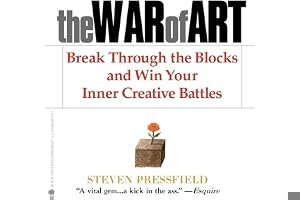
When a writer or an entrepreneur, or a manager, or an employee, or a…whatever…sits down to get to work, he or she is often met by “the resistance”. The excuses that come up: I can’t do this. I am too old. I don’t have enough money. I’m scared. “The War of Art” is the guide to getting through that block. The comfort zone is papered up and cemented shut by our excuses. Learn to blast through that wall. Because on the other side of the comfort zone are all the tools of success. [source]
Author, Marketer, Entrepreneur
Also hard to find on audio. I find Steve's voice to be fascinating, and even before I knew him, I was fascinated by listening to him speak his own work. The War of Art is one of those books, at least for me when I finally was exposed to it, I said, 'Why wasn't I informed? Why did it take this long for this book to land on my desk?'... You need to be clear with yourself about what you are afraid of, why you are afraid, and whether you care enough to dance with that fear because it will never go away. [source]
The last two pages of Steven Pressfield’s The War of Art gave me a swift kick in the ass. Do it or don’t do it. But if you don’t do it, you not only hurt yourself. You hurt your children. You hurt me. You hurt the planet. Pressfield wrote a beautiful book that you should read, but if nothing else, just read the last two pages of the book. I have them hanging on my wall in my office. [source]
My career path is made of several components, all of them main ones: sound engineering, film montage, movie directing, composition and vocal singing. That’s what I want to do in life and this is what makes me happy. For each of these, I’ve had book to help me along the way: The Eye is Quicker, by Richard D. Pepperman, Cut by Cut by Gael Chandler, The Technique of Film and Video Editing by Ken Dancyger, Directing by Mike Goodridge, Cinematic Storytelling by Jennifer Van Sijll, Sound for Picture by Tom Kenny and The Rock'n'Roll Singer's Survival Manual by Mark Baxter. [source]
28If you can't make it to one of Bruce Block's legendary visual storytelling seminars, then you need his book! Now in full color for the first time, this best-seller offers a clear view of the relationship between the story/script structure and the visual structure of a film, video, animated piece, or video game. You'll learn how to structure your visuals as carefully as a writer structures a story or a composer structures music. Understanding visual structure allows you to communicate moods and emotions, and most importantly, reveals the critical relationship between story structure and visual structure.
The Visual Story offers a clear view of the relationship between the story/script structure and the visual structure of a film, video, or multimedia work. An understanding of the visual components will serve as the guide to strengthening the overall story.
The Visual Story divides what is seen on screen into tangible sections: contrast and affinity, space, line and shape, tone, color, movement, and rhythm. The vocabulary as well as the insight is provided to purposefully control the given components to create the ultimate visual story. For example: know that a saturated yellow will always attract a viewer's eye first; decide to avoid abrupt editing by mastering continuum of movement; and benefit from the suggested list of films to study rhythmic control. The Visual Story shatters the wall between theory and practice, bringing these two aspects of the craft together in an essential connection for all those creating visual stories.
Bruce Block has the production credentials to write this definitive guide. His expertise is in demand, and he gives seminars at the American Film Institute, PIXAR Studios, Walt Disney Feature and Television Animation, Dreamworks Animation, Nickelodeon Animation Studios, Industrial Light & Magic and a variety of film schools in Europe.
The concepts in this book will benefit writers, directors, photographers, production designers, art directors, and editors who are always confronted by the same visual problems that have faced every picture maker in the past, present, and future.
• Now in full color!
• Written by a renowned producer, visual consultant, and teacher
• The material in this books applies to any kind of visual story, including films, animated pieces, video games, and television
29Very referential to certain plays. [source]
30Highly recommend it. … About filmmaking in the glory days of the '70s. [source]
This is an incredibly delicious read—just a great, great account of that era from Easy Rider (’69) through the mid-’70s. It’s the story of all those great filmmakers—my icons—Scorsese, Coppola, Friedkin, and Bogdanovich. They changed the way movies were made in America. It recounts their adventures in making movies. [source]
31
32I expected a book written by the person who has led Disney for decades to be defined by both gripping storytelling and deep leadership wisdom. The author delivers, and then some! This book is leadership gold—you won’t forget the stories or the lessons. [source]
Co-Founder & CEO/AirBnb
Bob's book is great and he's an excellent CEO. [source]
Loving the book Bob. Really honest and fascinating! Every Disney fan (everyone) needs to read. https://t.co/13VZpFleb0 [source]
I’ve been watching The Room for years, and I first read Bissell on the subject in Magic Hours. This was a total behind-the-scenes trip, and it is no surprise to me that the movie based on it has gotten great reviews. (I still haven’t seen it.) [source]
35Founder/MarkManson.net
I read a bunch of books on writing before I wrote my first book and the two that stuck with me were Stephen King’s book and “On Writing Well” by Zinsser (which is a bit on the technical side). [source]
My professional path – copywriting – somehow intertwines with my unprofessional (hahaha) path – writing so I would recommend reading literature for both. Somehow reading and writing are two ways of doing the same thing: storytelling (even when you read you tell yourself a story in your own voice, bringing your personal emotion and empathy to the story you’re reading). The only difference is that when I’m reading, panic is far away from me, in a safe place. Nevertheless, the words below helped me rewrite and think twice before adding an exclamation point: On Writing by Stephen King. [source]
Yes. It is a surprise to a lot of people that this book is so widely read on university campuses and so widely recommended by teachers of writing. Students love it. It’s bracing: there’s no nonsense. He says somewhere in the foreword or preface that it is a short book because most books are filled with bullshit and he is determined not to offer bullshit but to tell it like it is. [source]
36
37
39Bazin believed that films should be smooth, and needn’t be so socially weighty; he felt that films should have a realism to them. [source]
44
45
46
47
48
49David Lynch erupted onto the cinema landscape in 1977 with Eraserhead, establishing himself as one of the most original and imaginative directors at work in contemporary cinema. Over the course of his career, he has remained true to a vision of the innocent lost in darkness and confusion, balancing hallucination and surrealism with a sense of Americana that is as pure and simple as his compelling storylines. In this volume, Lynch speaks openly about his films as well as about his lifelong commitment to painting, his work in photography, his television projects, and his musical collaborations with Angelo Badalamenti.
51The book uses extensive illustrations to explain how to create extended sequence shots, elaborate moving camera choreography, and tracking shots with multiple story points.
54👏👏👏👏👏👏👏👏👏👏👏👏 @AnnieAtkins work is genuinely amazing (you'll have seen it on a screen somewhere near you) and a @Phaidon book is a major milestone in the work of any artist. Fair play 😎 https://t.co/qhPKEcyru2 [source]
55The Book "Made to Stick" combined with "The Poetics" by Aristotle really helped me to see the power of telling great stories with surprises in them and every time I meet a start-up I can always make a contribution to their pitch. [source]
Aristotle’s Poetics is the user’s guide to dramatic narrative and dramatic structure. It’s just a ragged little pamphlet really. [source]
56
60
61It’s the story of this pursuit of the bird and how he came to feel a kind of affinity with it, and how he uses the bird as a symbol for the things he feels, or wants to feel, about the natural world. [source]
Baker turned his bulging set of ornithological field journals into a 120-page prose poem. It’s astonishingly energy-filled. [source]
It’s hard to imagine a greater contrast with U and I, although it was written by another Baker. My book The Snow Geese had a lot to do with birds and the non-human world around us, but I didn’t read this book until I’d finished. I wish I’d read it earlier than I did. The way he describes the world outside him, particularly birds, is so electric. It avoids all the traps of rhapsody and the sort of nature writing that Evelyn Waugh satirises in Scoop. You remember William Boot the protagonist of Scoop? He writes a nature column that’s a terrible, sub-poetic kind of purple-word haze. But The Peregrine is far removed from that. [source]
64
66
67
68
69
70DOWN AND DIRTY PICTURES chronicles the rise of independent filmmakers and of the twin engines the Sundance Film Festival and Miramax Films that have powered them. Peter Biskind profiles the people who took the independent movement from obscurity to the Oscars, most notably Sundance founder Robert Redford and Harvey Weinstein, who with his brother, Bob, made Miramax an indie powerhouse. Candid, penetrating and controversial, DOWN AND DIRTY PICTURES is a must read for anyone interested in the film world.
"In DOWN AND DIRTY PICTURES, Biskind takes on the movie industry of the 1990s and again gets the story....Peter Biskind captures his era as John Dunne did that of the Zanucks." Frank Rich, The New York Times
"Dishy, teeming, superbly reported and packed with lively inside anecdotes...[a] juicy and fascinating expose." - Entertainment Weekly
72
73Since his death in 1989, John Cassavettes has become increasingly renowned as a cinematic hero--a renegade loner who fought the Hollywood system, steering his own creative course in a career spanning thirty years. Having already established himself as an actor, he struck out as a filmmaker in 1959 with Shadows, and proceeded to build a formidable body of work, including such classics as Faces, Woman Under the Influence, The Killing of a Chinese Bookie, and Gloria. In Cassavettes on Cassavettes, Ray Carney presents the great director in his own words--frank, uncompromising, humane, and passionate about life and art.
77
78Powerful Character Arcs Create Powerful Stories
Have you written a story with an exciting concept and interesting characters—but it just isn’t grabbing the attention of readers or agents? It’s time to look deeper into the story beats that create realistic and compelling character arcs. Internationally published, award-winning novelist K.M. Weiland shares her acclaimed method for achieving memorable and moving character arcs in every book you write.
By applying the foundation of the Three-Act Story Structure and then delving even deeper into the psychology of realistic and dynamic human change, Weiland offers a beat-by-beat checklist of character arc guidelines that flexes to fit any type of story.
This comprehensive book will teach you:
Gaining an understanding of how to write character arcs is a game-changing moment in any author’s pursuit of the craft.
Bring your characters to unforgettable and realistic life—and take your stories from good to great!
79
80@MarkHarrisNYC I love this so much Mark. Can’t wait to read this book! [source]
Found my new "recommends in every coffee meeting" book - "Pictures at a Revolution: Five Movies and the Birth of the New Hollywood," telling the stories behind the 5 Best Picture nominees in 1968 https://t.co/xpghc74OWy [source]
83
85
88
90
91
93
94
95
96
97