We've ranked the best criminal law books using expert recommendations, sales data, and millions of reader ratings. At Shortform, we know books. Our book guides are the best in the world. Learn why.
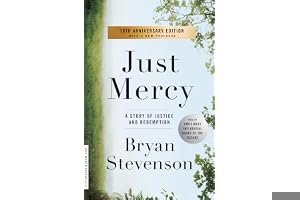
A powerful true story about the potential for mercy to redeem us, and a clarion call to fix our broken system of justice—from one of the most brilliant and influential lawyers of our time
Bryan Stevenson was a young lawyer when he founded the Equal Justice Initiative, a legal practice dedicated to defending those most desperate and in need: the poor, the wrongly condemned, and women and children trapped in the farthest reaches of our criminal justice system. One of his first cases was that of Walter McMillian, a young man who was sentenced to die for a notorious murder he insisted he didn’t commit. The case drew Bryan into a tangle of conspiracy, political machination, and legal brinksmanship—and transformed his understanding of mercy and justice forever.
Just Mercy is at once an unforgettable account of an idealistic, gifted young lawyer’s coming of age, a moving window into the lives of those he has defended, and an inspiring argument for compassion in the pursuit of true justice.
Today is World Book Day, a wonderful opportunity to address this #ChallengeRichard sent in by Mike Gonzalez of New Jersey: Make a list of your top 65 books to read in a lifetime. [source]

Chris Sacca
Proud that @crystale and I could help fund the making of a film about one of our heroes, Bryan Stevenson. If you’ve read the book, then you know how powerful this film is. #JustMercy https://t.co/vNfXK4Imwr [source]
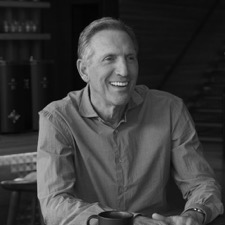
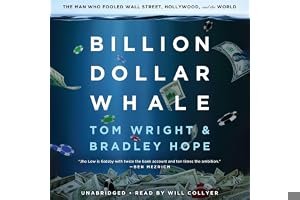
An epic true-tale of hubris and greed from two Pulitzer-finalist Wall Street Journal reporters, Billion Dollar Whale reveals how a young social climber pulled off one of the biggest financial heists in history--right under the nose of the global financial industry--exposing the shocking secret nexus of elite wealth, banking, Hollywood, and politics.
The dust had yet to settle on the global financial crisis in 2009 when an unlikely Wharton grad was setting in motion a fraud of unprecedented gall and magnitude--one that would come to symbolize the next great threat to the global financial system.
Billion Dollar Whale will become a classic, harrowing parable about the financial world in the twenty-first century.
This book on the 1MDB scandal was great, hard to put down. Low sophistication + huge brazenness is a powerful fraud combo. https://t.co/nYpIJffcb5 [source]
Cover unavailable
3
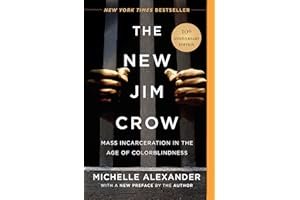
The New Jim Crow: Mass Incarceration in the Age of Colorblindness
"Jarvious Cotton's great-great-grandfather could not vote as a slave. His great-grandfather was beaten to death by the Klu Klux Klan for attempting to vote. His grandfather was prevented from voting by Klan intimidation; his father was barred by poll taxes and literacy tests. Today, Cotton cannot vote because he, like many black men in the United States, has been labeled a felon and is currently on parole."
As the United States celebrates the nation's "triumph over race" with the election of Barack Obama, the majority of young black men in major American cities are locked behind bars or have been labeled felons for life. Although Jim Crow laws have been wiped off the books, an astounding percentage of the African American community remains trapped in a subordinate status--much like their grandparents before them.
In this incisive critique, former litigator-turned-legal-scholar Michelle Alexander provocatively argues that we have not ended racial caste in America: we have simply redesigned it. Alexander shows that, by targeting black men and decimating communities of color, the U.S. criminal justice system functions as a contemporary system of racial control, even as it formally adheres to the principle of color blindness. The New Jim Crow challenges the civil rights community--and all of us--to place mass incarceration at the forefront of a new movement for racial justice in America.
I read The New Jim Crow, a study of how the U.S. justice system disproportionately criminalizes and jails blacks and Latinos. Making our criminal justice system fairer and more effective is a huge challenge for our country. I’m going to keep learning about this topic, but some things are already clear: We can’t jail our way to a just society, and our current system isn’t working (adapted with permission from Facebook’s A Year of Books project). [source]
Peter Temin
The new Jim Crow that Michelle Alexander is talking about is mass incarceration. [source]
Cover unavailable
4
What Every Body is Saying: An Ex-FBI Agent's Guide to Speed-Reading People
Read this book and send your nonverbal intelligence soaring. Joe Navarro, a former FBI counterintelligence officer and a recognized expert on nonverbal behavior, explains how to "speed-read" people: decode sentiments and behaviors, avoid hidden pitfalls, and look for deceptive behaviors. You'll also learn how your body language can influence what your boss, family, friends, and strangers think of you. You will discover:
The ancient survival instincts that drive body language Why the face is the least likely place to gauge a person's true feelings What thumbs, feet, and eyelids reveal about moods and motives The most powerful behaviors that reveal our confidence and true sentiments Simple nonverbals that instantly establish trust Simple nonverbals that instantly communicate authority Filled with examples from Navarro's professional experience, this definitive book offers a powerful new way to navigate your world.
There were dozens of books about Watergate, but only All the President's Men gave readers the full story, with all the drama and nuance and exclusive reporting. And thirty years later, if you're going to read only one book on Watergate, that's still the one. Today, Enron is the biggest business story of our time, and Fortune senior writers Bethany McLean and Peter Elkind are the new Woodward and Bernstein.
Remarkably, it was just two years ago that Enron was thought to epitomize a great New Economy company, with its skyrocketing profits and share price. But that was before Fortune published an article by McLean that asked a seemingly innocent question: How exactly does Enron make money? From that point on, Enron's house of cards began to crumble. Now, McLean and Elkind have investigated much deeper, to offer the definitive book about the Enron scandal and the fascinating people behind it.
Meticulously researched and character driven, Smartest Guys in the Room takes the reader deep into Enron's past—and behind the closed doors of private meetings. Drawing on a wide range of unique sources, the book follows Enron's rise from obscurity to the top of the business world to its disastrous demise. It reveals as never before major characters such as Ken Lay, Jeff Skilling, and Andy Fastow, as well as lesser known players like Cliff Baxter and Rebecca Mark. Smartest Guys in the Room is a story of greed, arrogance, and deceit—a microcosm of all that is wrong with American business today. Above all, it's a fascinating human drama that will prove to be the authoritative account of the Enron scandal.
Former FBI Director James Comey shares his never-before-told experiences from some of the highest-stakes situations of his career in the past two decades of American government, exploring what good, ethical leadership looks like, and how it drives sound decisions. His journey provides an unprecedented entry into the corridors of power, and a remarkable lesson in what makes an effective leader.
Mr. Comey served as Director of the FBI from 2013 to 2017, appointed to the post by President Barack Obama. He previously served as U.S. attorney for the Southern District of New York, and the U.S. deputy attorney general in the administration of President George W. Bush. From prosecuting the Mafia and Martha Stewart to helping change the Bush administration's policies on torture and electronic surveillance, overseeing the Hillary Clinton e-mail investigation as well as ties between the Trump campaign and Russia, Comey has been involved in some of the most consequential cases and policies of recent history.
…
Recommended by Marc Andreessen, Joanna Peñabickley, and Seb Eckersleymaslin.
Certainly the story is well known, but given author's propensity to post photos of himself wearing running shoes in Iowa, potentially relevant again starting next year? [source]
Joanna Peñabickley
Silence is complicity — @Comey ; For the last 4 days I have been glued to #AHigherLoyalty. I sincerely hope all of you read this book about truth, integrity and ethical leadership. Best 📖 on leadership I’ve read in a while #ThankYou for your leadership and service. [source]

Seb Eckersleymaslin
@shandsaker @ScottKilmartin @Hsuen Agreed. It’s tabloid. Read James Comey’s new book, it is much better. Some great lessons on true leadership in there. [source]
Cover unavailable
7
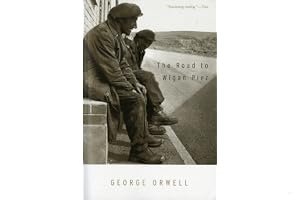
The Road to Wigan Pier
George Orwell
4.3
A searing account of George Orwell’s experiences of working-class life in the bleak industrial heartlands of Yorkshire and Lancashire, The Road to Wigan Pier is a brilliant and bitter polemic that has lost none of its political impact over time. His graphically unforgettable descriptions of social injustice, slum housing, mining conditions, squalor, hunger and growing unemployment are written with unblinking honesty, fury and great humanity.
The Road to Wigan Pier is a very transitional book. It shows all the attention to detail and the thought of street-level reportage that distinguishes Down and Out in Paris and London, but it’s moving forward to a political position—the political position—that will underlie what Orwell starts writing in the 1940s, for which we now celebrate him. [source]

It’s amazing how much of the abusive ideology revealed in his account of the miners is still present in today’s gig economy. [source]
Cover unavailable
8
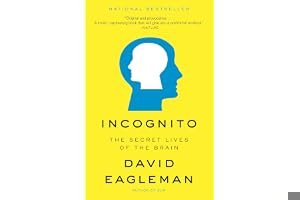
Incognito: The Secret Lives of the Brain
David Eagleman
4.3
If the conscious mind—the part you consider you—accounts for only a tiny fraction of the brain’s function, what is all the rest doing? This is the question that David Eagleman—renowned neuroscientist and acclaimed author of Sum—answers in a book as accessible and entertaining as it is deeply informed by startling, up-to-the-minute research.
At a conference I recently attended, David talked about his work. It's all anyone discussed for the next two days. This book will help you understand the meat/electricity/chemicals you're carrying around inside your head better than you ever have before. [source]

Louis Grenier
“Incognito: The Secret Lives of the Brain” and “Predictably Irrational” are 2 very good books on psychology that I think you should read. [source]
Cover unavailable
9
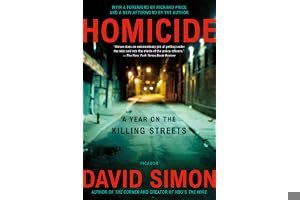
Homicide: A Year on the Killing Streets
David Simon
4.2
The scene is Baltimore; the year is 1988. Twice every three days another citizen is shot, stabbed, or bludgeoned to death. At the center of this hurricane of crime is the city's homicide unit, a small group of hard men who battle to achieve a bit of rough justice in a deadly world. This is their story.
Recommended by John R Stanton.
John R Stanton
@grisuy @anthoknees The snot boogy story is also based on something that really happened as I recall. If you haven’t read @AoDespair’s book Homicide, you should. It’s amazing and has a lot of the source material from the Wire and Homicide the show. [source]
Cover unavailable
10
The Criminal Law Handbook: Know Your Rights, Survive the System
Paul Bergman J.D. and Sara J Berman J.D.
4.2
The criminal justice system is complicated, understand it and your rights
Criminal law is full of complex rules and procedures, but this book demystifies them. It explains how the system works, why police, lawyers, and judges do what they do, and what suspects, defendants, and prisoners can expect. It also provides critical information on working with a lawyer.
In plain English, The Criminal Law Handbook covers: search and seizure arrest, booking, and bail
Miranda rights arraignment plea bargains trials sentencing working with defense attorneys common defenses constitutional rights juvenile court preliminary hearings appeals, and public defenders victims' rights
The 15th edition is completely updated, covering the latest in criminal law, including U.S. Supreme Court cases.
…
Cover unavailable
11
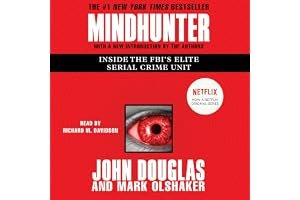
Mindhunter: Inside the FBI's Elite Serial Crime Unit
John E. Douglas
4.2
Discover the classic, behind-the-scenes chronicle of John E. Douglas’ twenty-five-year career in the FBI Investigative Support Unit, where he used psychological profiling to delve into the minds of the country’s most notorious serial killers and criminals—the basis for the upcoming Netflix original series.
In chilling detail, the legendary Mindhunter takes us behind the scenes of some of his most gruesome, fascinating, and challenging cases—and into the darkest recesses of our worst nightmares.
During his twenty-five year career with the Investigative Support Unit, Special Agent John Douglas became a legendary figure in law enforcement, pursuing some of the most notorious and sadistic serial killers of our time: the man who hunted prostitutes for sport in the woods of Alaska, the Atlanta child murderer, and Seattle's Green River killer, the case that nearly cost Douglas his life.
As the model for Jack Crawford in The Silence of the Lambs, Douglas has confronted, interviewed, and studied scores of serial killers and assassins, including Charles Manson, Ted Bundy, and Ed Gein, who dressed himself in his victims' peeled skin. Using his uncanny ability to become both predator and prey, Douglas examines each crime scene, reliving both the killer's and the victim's actions in his mind, creating their profiles, describing their habits, and predicting their next moves.
…
Cover unavailable
12
Black Reconstruction in America 1860-1880
W. E. B. Du Bois
4.2
The pioneering work in the study of the role of Black Americans during Reconstruction by the most influential Black intellectual of his time.
Recommended by Imani Perry.
Imani Perry
W.E.B. Du Bois was the father of American sociology and one of the most influential intellectuals of the twentieth century. His classic text, The Souls of Black Folk, was published in 1903. Black Reconstruction in America came thirty years later. [source]
Cover unavailable
13
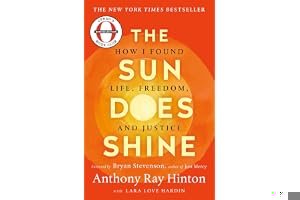
The Sun Does Shine: How I Found Life and Freedom on Death Row
Anthony Ray Hinton
4.2
Anthony Ray Hinton was poor and black when he was convicted of two murders he hadn't committed. For the next three decades he was trapped in solitary confinement in a tiny cell on death row.
Eventually his case was taken up by the award-winning lawyer, Bryan Stevenson, who managed to have him exonerated, though it took 15 years for this to happen. How did Hinton cope with the mental and emotional torture of his situation, and emerge full of compassion and forgiveness? This is a story of hope and the resilience of the human spirit.
If there is ever a story that needs to be told, it is this one. Anthony Ray Hinton is extraordinary, an example to us all of the power of the human spirit to rise above complete injustice. He is using his experience as a way to turn the broken criminal justice system upside down. He is a brilliant storyteller, and his book will make people laugh, cry, and change their own lives for the better. It will also inspire people to never accept the unacceptable, like the death penalty. The Sun Does Shine will be a book that people all around the world will never forget. [source]
Desmond Tutu
Nelson Mandela spent 27 years in prison for opposing a racist system in South Africa. Anthony Ray Hinton spent 30 years on death row because a racist system still exists in America. Both emerged from their incarceration with a profound capacity to forgive. They are stunning examples of how the most horrendous cruelty can lead to the most transcendent compassion. The Sun Does Shine is both a cautionary tale for all who think that a great nation can easily forget its past and inspiring proof of the inability to condemn a man's capacity for hope, love, and joy. An amazing and heartwarming story, it restores our faith in the inherent goodness of humanity. [source]
Cover unavailable
14
I'll Be Gone in the Dark: One Woman's Obsessive Search for the Golden State Killer
Michelle McNamara
4.2
A masterful true crime account of the Golden State Killer—the elusive serial rapist turned murderer who terrorized California for over a decade—from Michelle McNamara, the gifted journalist who died tragically while investigating the case.
"You’ll be silent forever, and I’ll be gone in the dark."
For more than ten years, a mysterious and violent predator committed fifty sexual assaults in Northern California before moving south, where he perpetrated ten sadistic murders. Then he disappeared, eluding capture by multiple police forces and some of the best detectives in the area.
Three decades later, Michelle McNamara, a true crime journalist who created the popular website TrueCrimeDiary.com, was determined to find the violent psychopath she called "the Golden State Killer." McNamara pored over police reports, interviewed victims, and embedded herself in the online communities that were as obsessed with the case as she was.
At the time of the crimes, the Golden State Killer was between the ages of eighteen and thirty, Caucasian, and athletic—capable of vaulting tall fences. He always wore a mask. After choosing a victim—he favored suburban couples—he often entered their home when no one was there, studying family pictures, mastering the layout. He attacked while they slept, using a flashlight to awaken and blind them. Though they could not recognize him, his victims recalled his voice: a guttural whisper through clenched teeth, abrupt and threatening.
I’ll Be Gone in the Dark—the masterpiece McNamara was writing at the time of her sudden death—offers an atmospheric snapshot of a moment in American history and a chilling account of a criminal mastermind and the wreckage he left behind. It is also a portrait of a woman’s obsession and her unflagging pursuit of the truth. Framed by an introduction by Gillian Flynn and an afterword by her husband, Patton Oswalt, the book was completed by McNamara's lead researcher and a close colleague. Utterly original and compelling, it is destined to become a true crime classic—and may at last unmask the Golden State Killer.
…
Cover unavailable
15
Discipline and Punish: The Birth of the Prison
Michel Foucault, Alan Sheridan
4.2
Librarian note: an alternate cover for this edition can be found here.
In this brilliant work, the most influential philosopher since Sartre suggests that such vaunted reforms as the abolition of torture and the emergence of the modern penitentiary have merely shifted the focus of punishment from the prisoner’s body to his soul.
Cover unavailable
16
Exonerated: The Failed Takedown of President Donald Trump by the Swamp
Dan Bongino
4.2
A NEW YORK TIMES BESTSELLER
“Great new book by wonderful and very street smart author Dan Bongino, EXONERATED, THE FAILED TAKEDOWN OF PRESIDENT DONALD TRUMP BY THE SWAMP. Dan hits all of the crooked points of the greatest Witch Hunt in political history. Nevertheless, the Scam continues!” —President Donald J. Trump
An explosive, whistle-blowing exposé, Exonerated: The Failed Takedown of Donald Trump by the Swamp reveals how Deep State actors relied on a cynical plug-and-play template to manufacture the now-discredited Russiagate scandal. With the cutting analysis and insight he exhibited in his blockbuster bestseller Spygate: The Attempted Sabotage of Donald J. Trump, Fox News contributor Bongino exposes who masterminded the dangerous playbook to take down Trump, their motives, and how a plan filled with faked allegations backfired—forcing investigators to up the ante and hide their missteps and half-truths in a desperate effort to prove a collusion case that never happened. The result? The misguided multimillion Mueller investigation that tore the nation apart, tried to destabilize the presidency and led, as the world now knows, to nowhere!
Great new book by wonderful and very street smart author Dan Bongino, EXONERATED, THE FAILED TAKEDOWN OF PRESIDENT DONALD TRUMP BY THE SWAMP. Dan hits all of the crooked points of the greatest Witch Hunt in political history. Nevertheless, the Scam continues! [source]
Cover unavailable
17
An Introduction to Constitutional Law: 100 Supreme Court Cases Everyone Should Know
Randy E. Barnett and Josh Blackman
4.2
This multimedia platform combines a book and video series that will change the way you study constitutional law. An Introduction to Constitutional Law teaches the narrative of constitutional law as it has developed over the past two centuries. All students--even those unfamiliar with American history--will learn the essential background information to grasp how this body of law has come to be what it is today. An online library of sixty-three videos (access codes provided with purchase of the book) brings the Supreme Court's one hundred most important decisions to life. These videos are enriched by photographs, maps, and even audio from the Supreme Court. The book and videos are accessible for all levels: law school, college, high school, home school, and independent study. Students can read and watch these materials before class to prepare for lectures or study after class to fill in any gaps in their notes. And, come exam time, students can watch the entire canon of constitutional law in about twelve hours.
…
Cover unavailable
18
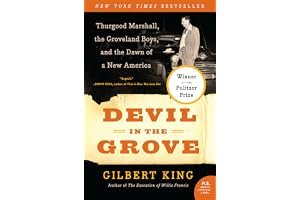
Devil in the Grove: Thurgood Marshall, the Groveland Boys, and the Dawn of a New America
Gilbert King
4.2
Devil in the Grove is the winner of the 2013 Pulitzer Prize for General Nonfiction.
Arguably the most important American lawyer of the twentieth century, Thurgood Marshall was on the verge of bringing the landmark suit Brown v. Board of Education before the U.S. Supreme Court when he became embroiled in an explosive and deadly case that threatened to change the course of the civil rights movement and cost him his life.
In 1949, Florida’s orange industry was booming, and citrus barons got rich on the backs of cheap Jim Crow labor. To maintain order and profits, they turned to Willis V. McCall, a violent sheriff who ruled Lake County with murderous resolve. When a white seventeen-year-old Groveland girl cried rape, McCall was fast on the trail of four young blacks who dared to envision a future for themselves beyond the citrus groves. By day’s end, the Ku Klux Klan had rolled into town, burning the homes of blacks to the ground and chasing hundreds into the swamps, hell-bent on lynching the young men who came to be known as “the Groveland Boys.”
And so began the chain of events that would bring Thurgood Marshall, the man known as “Mr. Civil Rights,” into the deadly fray. Associates thought it was suicidal for him to wade into the “Florida Terror” at a time when he was irreplaceable to the burgeoning civil rights movement, but the lawyer would not shrink from the fight—not after the Klan had murdered one of Marshall’s NAACP associates involved with the case and Marshall had endured continual threats that he would be next.
Drawing on a wealth of never-before-published material, including the FBI’s unredacted Groveland case files, as well as unprecedented access to the NAACP’s Legal Defense Fund files, King shines new light on this remarkable civil rights crusader, setting his rich and driving narrative against the heroic backdrop of a case that U.S. Supreme Court justice Robert Jackson decried as “one of the best examples of one of the worst menaces to American justice.”
…
Cover unavailable
19
Papillon
Henri Charriere
4.2
Henri Charrière, called "Papillon," for the butterfly tattoo on his chest, was convicted in Paris in 1931 of a murder he did not commit. Sentenced to life imprisonment in the penal colony of French Guiana, he became obsessed with one goal: escape. After planning and executing a series of treacherous yet failed attempts over many years, he was eventually sent to the notorious prison, Devil's Island, a place from which no one had ever escaped . . . until Papillon. His flight to freedom remains one of the most incredible feats of human cunning, will, and endurance ever undertaken.
Charrière's astonishing autobiography, Papillon, was published in France to instant acclaim in 1968, more than twenty years after his final escape. Since then, it has become a treasured classic -- the gripping, shocking, ultimately uplifting odyssey of an innocent man who simply would not be defeated.
…
Recommended by Cristina Riesen.
Cristina Riesen
More than career paths, I like to look at life trajectories. There are some books who will forever change who you are. When I was around 12 years old, my father brought home Henri Charriere's "Papillon". He told me that it was totally inappropriate for my age but he wanted me to read it so that I can understand what persistence and grit means and how important it is to learn to develop them. I did and I must say it was a life-changing experience on so many levels. Enlightening not only because of the extraordinary story and skilful storytelling but also because, now looking back, my father's gesture empowered me so much. You will not be surprised that persistence and grit are still my top skills, even today. [source]
Cover unavailable
20
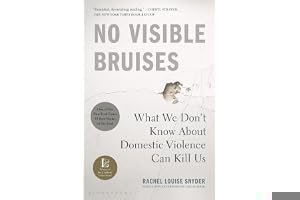
No Visible Bruises: What We Don’t Know About Domestic Violence Can Kill Us
Rachel Louise Snyder
4.2
In No Visible Bruises, journalist Rachel Louise Snyder frames this urgent and immersive account of the scale of domestic violence in our country around key stories that explode the common myths-that if things were bad enough, victims would just leave; that a violent person cannot become nonviolent; that shelter is an adequate response; that violence inside the home is separate from other forms of violence like mass shootings, gang violence, and sexual assault. Through the stories of victims, perpetrators, law enforcement, and reform movements from across the country, Snyder explores not only the dark corners of private violence, but also its far-reaching consequences for society, and what it will take to truly address it.
…
Cover unavailable
21
Are Prisons Obsolete?
Angela Y. Davis
4.2
With her characteristic brilliance, grace and radical audacity, Angela Y. Davis has put the case for the latest abolition movement in American life: the abolition of the prison. As she quite correctly notes, American life is replete with abolition movements, and when they were engaged in these struggles, their chances of success seemed almost unthinkable. For generations of Americans, the abolition of slavery was sheerest illusion. Similarly,the entrenched system of racial segregation seemed to last forever, and generations lived in the midst of the practice, with few predicting its passage from custom. The brutal, exploitative (dare one say lucrative?) convict-lease system that succeeded formal slavery reaped millions to southern jurisdictions (and untold miseries for tens of thousands of men, and women). Few predicted its passing from the American penal landscape. Davis expertly argues how social movements transformed these social, political and cultural institutions, and made such practices untenable.
In Are Prisons Obsolete?, Professor Davis seeks to illustrate that the time for the prison is approaching an end. She argues forthrightly for "decarceration", and argues for the transformation of the society as a whole.
…
Cover unavailable
22
The Poisoner's Handbook: Murder and the Birth of Forensic Medicine in Jazz Age New York
Deborah Blum
4.1
Deborah Blum, writing with the high style and skill for suspense that is characteristic of the very best mystery fiction, shares the untold story of how poison rocked Jazz Age New York City. In The Poisoner's Handbook Blum draws from highly original research to track the fascinating, perilous days when a pair of forensic scientists began their trailblazing chemical detective work, fighting to end an era when untraceable poisons offered an easy path to the perfect crime.
Drama unfolds case by case as the heroes of The Poisoner's Handbook—chief medical examiner Charles Norris and toxicologist Alexander Gettler—investigate a family mysteriously stricken bald, Barnum and Bailey's Famous Blue Man, factory workers with crumbling bones, a diner serving poisoned pies, and many others. Each case presents a deadly new puzzle and Norris and Gettler work with a creativity that rivals that of the most imaginative murderer, creating revolutionary experiments to tease out even the wiliest compounds from human tissue. Yet in the tricky game of toxins, even science can't always be trusted, as proven when one of Gettler's experiments erroneously sets free a suburban housewife later nicknamed "America's Lucretia Borgia" to continue her nefarious work.
From the vantage of Norris and Gettler's laboratory in the infamous Bellevue Hospital it becomes clear that killers aren't the only toxic threat to New Yorkers. Modern life has created a kind of poison playground, and danger lurks around every corner. Automobiles choke the city streets with carbon monoxide; potent compounds, such as morphine, can be found on store shelves in products ranging from pesticides to cosmetics. Prohibition incites a chemist's war between bootleggers and government chemists while in Gotham's crowded speakeasies each round of cocktails becomes a game of Russian roulette. Norris and Gettler triumph over seemingly unbeatable odds to become the pioneers of forensic chemistry and the gatekeepers of justice during a remarkably deadly time. A beguiling concoction that is equal parts true crime, twentieth-century history, and science thriller, The Poisoner's Handbook is a page-turning account of a forgotten New York.
…
Recommended by Michelle Francl.
Michelle Francl
Deborah Blum’s book reminds me that molecules are powerful witnesses, if only we have the skills to interrogate them, and sometimes they are killers. [source]
Cover unavailable
23
Blood in the Water: The Attica Prison Uprising of 1971 and Its Legacy
Heather Ann Thompson
4.1
The first definitive account of the infamous 1971 Attica prison uprising, the state’s violent response, and the victims' decades-long quest for justice including information never released to the public published to coincide with the forty-fifth anniversary of this historic event.
On September 9, 1971, nearly 1,300 prisoners took over the Attica Correctional Facility in upstate New York to protest years of mistreatment. Holding guards and civilian employees hostage, during the four long days and nights that followed, the inmates negotiated with state officials for improved living conditions. On September 13, the state abruptly ended talks and sent hundreds of heavily armed state troopers and corrections officers to retake the prison by force. In the ensuing gunfire, thirty-nine men were killed, hostages as well as prisoners, and close to one hundred were severely injured. After the prison was secured, troopers and officers brutally retaliated against the prisoners during the weeks that followed. For decades afterward, instead of charging any state employee who had committed murder or carried out egregious human rights abuses, New York officials prosecuted only the prisoners and failed to provide necessary support to the hostage survivors or the families of any of the men who'd been killed.
Heather Ann Thompson sheds new light on one of the most important civil rights stories of the last century, exploring every aspect of the uprising and its legacy from the perspectives of all of those involved in this forty-five-year fight for justice: the prisoners, the state officials, the lawyers on both sides, the state troopers and corrections officers, and the families of the slain men.
…
Cover unavailable
24
The Fifth Witness (Mickey Haller, #4; Harry Bosch Universe, #22)
Michael Connelly
4.1
Mickey Haller has fallen on tough times. He expands his business into foreclosure defense, only to see one of his clients accused of killing the banker she blames for trying to take away her home.
Mickey puts his team into high gear to exonerate Lisa Trammel, even though the evidence and his own suspicions tell him his client is guilty. Soon after he learns that the victim had black market dealings of his own, Haller is assaulted, too--and he's certain he's on the right trail.
Despite the danger and uncertainty, Haller mounts the best defense of his career in a trial where the last surprise comes after the verdict is in.
13 hours and 56 minutes
…
Cover unavailable
25
The War on Cops: How the New Attack on Law and Order Makes Everyone Less Safe
Heather Mac Donald
4.1
Since the summer of 2014, America has been convulsed with a protest movement known as Black Lives Matter. That movement holds that police officers are among the greatest threats—if not the greatest threat--facing young black males today. Policing and the rest of the criminal justice system—from prosecutors to drug laws—single out minority communities for gratuitous and heavy-handed enforcement, the charge goes, resulting in an epidemic of “mass incarceration” that falls most heavily on blacks.
This book challenges that narrative. Through vivid, street-level reporting, it gives voice to the many residents of high-crime neighborhoods, rarely heard in the media, who support proactive policing and want more of it. The book will argue that there is no government agency more dedicated to the proposition that Black Lives Matter than today’s data-driven, accountable police department. In New York City alone, over ten thousand minority males are alive who would have been killed had the New York Police Department not brought homicide in the city down 80% from its early 1990’s level. The intelligence-led policing revolution that began in New York and spread nationally has transformed urban neighborhoods, freeing their residents from the thrall of daily fear.
Other topics include such contested tactics as stop, question, and frisk and “broken windows” policing. The book will refute the argument that racist drug statutes and enforcement lie behind the black incarceration rate. It will take the reader inside prisons and jails. And it will argue that proactive policing has been the greatest public policy success story of the last quarter century, resulting in a record-breaking national crime drop that no criminologist or even police chief foresaw.
That crime drop is now at risk, however, thanks to the nonstop agitation against the police led by the Black Lives Matter movement. The book is a call for a more honest and informed debate about policing, crime, and race, before the public safety gains of the last twenty years are lost.
A very good book. … Talks about the Ferguson effect and why it is that the left's attack on law enforcement is actually making people in the inner city less safe, and raising crime rates. [source]
Cover unavailable
26
Locking Up Our Own: Crime and Punishment in Black America
James Forman Jr., Kevin R. Free, et al
4.1
In recent years, America’s criminal justice system has become the subject of an increasingly urgent debate. Critics have assailed the rise of mass incarceration, emphasizing its disproportionate impact on people of color. As James Forman, Jr., points out, however, the war on crime that began in the 1970s was supported by many African American leaders in the nation’s urban centers. In Locking Up Our Own, he seeks to understand why.
Forman shows us that the first substantial cohort of black mayors, judges, and police chiefs took office amid a surge in crime and drug addiction. Many prominent black officials, including Washington, D.C. mayor Marion Barry and federal prosecutor Eric Holder, feared that the gains of the civil rights movement were being undermined by lawlessness—and thus embraced tough-on-crime measures, including longer sentences and aggressive police tactics. In the face of skyrocketing murder rates and the proliferation of open-air drug markets, they believed they had no choice. But the policies they adopted would have devastating consequences for residents of poor black neighborhoods.
A former D.C. public defender, Forman tells riveting stories of politicians, community activists, police officers, defendants, and crime victims. He writes with compassion about individuals trapped in terrible dilemmas—from the men and women he represented in court to officials struggling to respond to a public safety emergency. Locking Up Our Own enriches our understanding of why our society became so punitive and offers important lessons to anyone concerned about the future of race and the criminal justice system in this country.
…
Cover unavailable
27
Taken for Granted: How Conservatism Can Win Back the Americans That Liberalism Failed
Gianno Caldwell
4.1
A deeply personal book from Fox News political analyst Gianno Caldwell about how the status quo of American politics, culture, and self-identity has failed those who need it most.
Gianno Caldwell, raised by his grandmother on the south side of Chicago, saw firsthand how lawmakers have failed African American voters on issues like poverty, welfare, and education. As someone who beat the odds of growing up in poverty under a fear-based mentality that limits what people can achieve, Caldwell believes there's another way.
Throughout the book, Caldwell weaves his personal journey into a cultural exploration about how the status quo came to be in America and casts a hopeful vision for a nation that is no longer beholden to identity politics. Trapped within the expectations and traditions of our community, family, political party, faith, race, and gender, we fail to challenge our politicians and ourselves to create real change. Now more than ever, we need to challenge preconceived notions about the two parties, public policy, and American history.
From the obstacles facing urban communities today on issues such as crime, education, and social mobility, Caldwell digs beneath the statistics, showing the moments that defined his rise to success and the steps that can help more people overcome the odds--whether through policy reform or the heroic efforts of men and women who are already working to make a difference in their communities.
Great new book just out, “Taken for Granted, How Conservatives Can Win Back Americans That Liberalism Failed”, by Gianni Caldwell, a young winner! He will be at the Ronald Reagan Library, Simi Valley, California, on Thursday at 6 PM, PT. Check it out! [source]
Cover unavailable
28
The Tools of Argument: How the Best Lawyers Think, Argue, and Win
Joel P. Trachtman
4.1
Joel Trachtman's book presents in plain and lucid terms the powerful tools of argument that have been honed through the ages in the discipline of law. If you are a law student or new lawyer, a business professional or a government official, this book will boost your analytical thinking, your foundational legal knowledge, and your confidence as you win arguments for your clients, your organizations or yourself.
…
Cover unavailable
29
A Colony in a Nation
Chris Hayes
4.1
New York Times Bestseller
New York Times Book Review Editors’ Choice
"An essential and groundbreaking text in the effort to understand how American criminal justice went so badly awry." —Ta-Nehisi Coates, author of Between the World and Me
In A Colony in a Nation, New York Times best-selling author and Emmy Award–winning news anchor Chris Hayes upends the national conversation on policing and democracy. Drawing on wide-ranging historical, social, and political analysis, as well as deeply personal experiences with law enforcement, Hayes contends that our country has fractured in two: the Colony and the Nation. In the Nation, the law is venerated. In the Colony, fear and order undermine civil rights. With great empathy, Hayes seeks to understand this systemic divide, examining its ties to racial inequality, the omnipresent threat of guns, and the dangerous and unfortunate results of choices made by fear.
…
Recommended by Charles P. Pierce.
Charles P. Pierce
In case you missed it, @chrislhayes took his own bosses to task over their reaction to the Weinstein case and Ronan Farrow’s book. This took a great deal of integrity but, luckily, Chris has that to spare. [source]
Cover unavailable
30
The Run of His Life: The People v. O.J. Simpson
Jeffrey Toobin
4.1
A behind-the-scenes look at the crime of the century and the legal proceedings that followed sheds new light in the arrest and trial of O.J. Simpson, the evidence in the case, and the role of the prosecution and defense.
Cover unavailable
31
First 30 Seconds: The Active Shooter Problem
Ed Monk
4.1
America has been failing for over 40 years at understanding, planning for, and responding to Active Shooter attacks. So, we continue to see attacks end in high victim-counts. America fails because we:- do not base plans on TIME & MATH- like plans that are easy to type, easy to drill, and do not “trigger” anyone- recommend and adopt “best practices” that are not best- adopt plans that work flawlessly every day there is no attack, but fail during attacks- desperately want a non-violent solution to an extremely violent problem- allow emotions and political agendas to distract usThe author served as an active-duty US Army officer for over 20 years. Throughout this career, planning to give and receive deadly violence was a common, required task. Ten days after his Army retirement, he began teaching public high school, where violence was never allowed, discussed, or planned for. He was STUNNED when school leaders told him the school’s planned response during an Active Shooter attack was to gather in groups and wait to see if the killer or cops got to you first.This experience started his study of the Active Shooter problem. This book is about what he found.Read Ed’s no-nonsense, blunt analysis of the Active Shooter problem. Using TIME & MATH analysis, he clearly shows the ONLY response that has a high expectation of minimizing victims in future attacks.This is UNLIKE any discussion of the Active Shooter problem you have heard from any source. It disproves MANY long-held myths and assumptions, including that we should rely on RUN HIDE FIGHT, Lockdown Drills, and 911 response. It is a wake-up call for America, the “leaders” of our schools, churches, and businesses, and our elected officials.America has failed at this for 40+ years. It’s time to end the failure."Ed Monk is today's leading expert on thwarting mass murderers. His recommended strategy is by far the most effective, as proven in cases where the defenders did what Monk suggested." -- Massad Ayoob
…
Cover unavailable
32
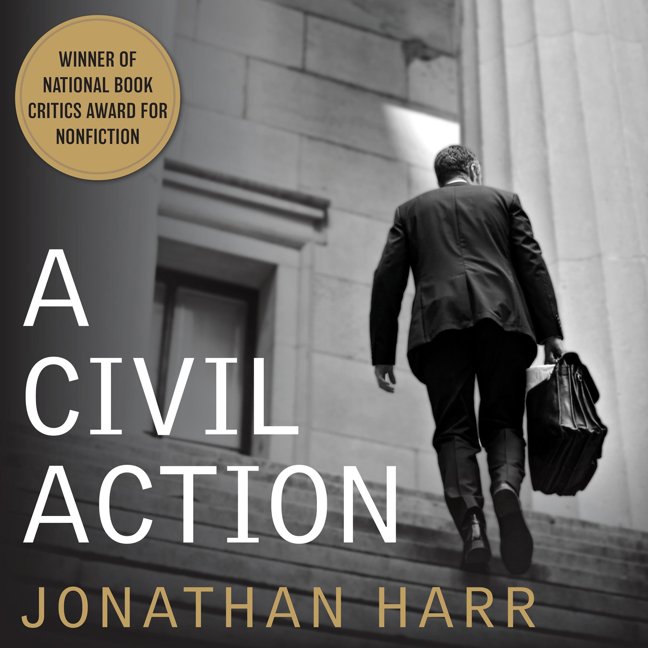
A Civil Action
Jonathan Harr
4.1
A Civil Action is a non-fiction book by Jonathan Harr about a water contamination case in Woburn, Massachusetts, in the 1980s.
After finding that her child is diagnosed with leukemia, Anne Anderson notices a high prevalence of leukemia, a relatively rare disease, in her city. Eventually she gathers other families and seeks a lawyer, Jan Schlichtmann, to consider their options.
Schlichtmann originally decides not to take the case due to both the lack of evidence and a clear defendant. Later picking up the case, Schlichtmann finds evidence suggesting trichloroethylene (TCE) contamination of the town's water supply by Riley Tannery, a subsidiary of Beatrice Foods; a chemical company, W. R. Grace; and another company named Unifirst.
In the course of the lawsuit Schlichtmann gets other attorneys to assist him. He spends lavishly as he had in his prior lawsuits, but the length of the discovery process and trial stretch all of their assets to their limit.
…
Recommended by Catherine Manegold.
Catherine Manegold
This book incorporates less history. Instead, it is just a whiz-bang narrative about a lawyer who takes up the cause of a small New England town that is host to a mysterious rash of cancer deaths. The narrative revolves around Jan Schlichtmann, a Boston lawyer who uncovers an environmental crisis and traces culpability up the chain to several multinational corporations responsible for the mess. As the reader follows Schlichtmann in his crusade, Harr uses the case and Schlichtmann’s obsession with it, to educate us about chemistry, cancer clusters, illegal dumping, environmental degradation and the law. Here again, a seductive narrative yanks the reader in, then great research and reporting leave the reader wholly changed. No one reading this book could ever think about ground pollutants and illegal dumping the same way again. That’s the beauty of it: Who would ever go to a bookstore and say to the clerk: ‘Gee, today I’d really like to sink into a 500-page book on cancer clusters, dead children and irresponsible industry executives.’ In the hands of a writer like Jonathan Harr, however, the education is a treat. [source]
Cover unavailable
33
The Killer Across the Table: Unlocking the Secrets of Serial Killers and Predators with the FBI’s Original Mindhunter
John E. Douglas
4.1
‘John Douglas is the FBI's pioneer and master of investigative profiling, and one of the most exciting figures in law enforcement I've had the privilege of knowing’ Patricia Cornwell
‘John Douglas knows more about serial killers than anybody in the world’ Jonathan Demme, Director of The Silence of the Lambs
The legendary FBI criminal profiler, number-one New York Times bestselling author, and inspiration for the hit Netflix show Mindhunter delves deep into the lives and crimes of four of the most disturbing and complex predatory killers, offering never-before-revealed details about his profiling process, and divulging the strategies used to crack some of his most challenging cases.
The FBI’s pioneer of criminal profiling, former special agent John Douglas, has studied and interviewed many of America’s most notorious killers – including Charles Manson, ‘Son of Sam Killer’ David Berkowitz and ‘BTK Strangler’ Dennis Rader. Twenty years after his famous memoir, the man who literally wrote the book on FBI criminal profiling opens his case files once again. In this riveting work of true crime, he spotlights four of the most diabolical criminals he’s confronted, interviewed and learned from.
A glimpse into the mind of a man who has pierced the heart of human darkness, The Killer Across the Table unlocks the ultimate mystery of depravity and the techniques and approaches that have countered evil in the name of justice.
…
Cover unavailable
34
On Killing: The Psychological Cost of Learning to Kill in War and Society
Dave Grossman
4.1
The good news is that most soldiers are loath to kill. But armies have developed sophisticated ways of overcoming this instinctive aversion. And contemporary civilian society, particularly the media, replicates the army's conditioning techniques, and, according to Lt. Col. Dave Grossman's thesis, is responsible for our rising rate of murder among the young.
Upon its initial publication, On Killingwas hailed as a landmark study of the techniques the military uses to overcome the powerful reluctance to kill, of how killing affects soldiers, and of the societal implications of escalating violence. Now, Grossman has updated this classic work to include information on 21st-century military conflicts, recent trends in crime, suicide bombings, school shootings, and more. The result is a work certain to be relevant and important for decades to come.
…
Cover unavailable
35
Hellhound on His Trail: The Stalking of Martin Luther King, Jr. and the International Hunt for His Assassin
Hampton Sides
4.1
On April 23, 1967, Prisoner #416J, an inmate at the notorious Missouri State Penitentiary, escaped in a breadbox. Fashioning himself Eric Galt, this nondescript thief and con man—whose real name was James Earl Ray—drifted through the South, into Mexico, and then Los Angeles, where he was galvanized by George Wallace’s racist presidential campaign.
On February 1, 1968, two Memphis garbage men were crushed to death in their hydraulic truck, provoking the exclusively African American workforce to go on strike. Hoping to resuscitate his faltering crusade, King joined the sanitation workers’ cause, but their march down Beale Street, the historic avenue of the blues, turned violent. Humiliated, King fatefully vowed to return to Memphis in April.
With relentless storytelling drive, Sides follows Galt and King as they crisscross the country, one stalking the other, until the crushing moment at the Lorraine Motel when the drifter catches up with his prey. Against the backdrop of the resulting nationwide riots and the pathos of King’s funeral, Sides gives us a riveting cross-cut narrative of the assassin’s flight and the sixty-five-day search that led investigators to Canada, Portugal, and England—a massive manhunt ironically led by Hoover’s FBI.
…
Cover unavailable
36
Key Cases Human Rights
Peter Halstead
4.1
Key Cases is the essential series for anyone studying law, including LLB, ILEX and post-graduate conversion courses.Understanding and memorising leading cases fully is a vital part of the study of law. The clear format, style and explanations of Key Cases will ensure you achieve this.Key Cases provides the simplest and most effective way for you to memorise and absorb the essential cases needed to pass your exams effortlessly.
…
Cover unavailable
37
Behind the Badge
Johnny Joey Jones
4.1
Cover unavailable
38
The Grammar of Criminal Law: American, Comparative, and International: Volume One: Foundations
George P. Fletcher
4.1
The Grammar of Criminal Law is a 3-volume work that addresses the field of international and comparative criminal law, with its primary focus on the issues of international concern, ranging from genocide, to domestic efforts to combat terrorism, to torture, and to other international crimes. The first volume is devoted to foundational issues. The Grammar of Criminal Law is unique in its systematic emphasis on the relationship between language and legal theory; there is no comparable comparative study of legal language. Written in the spirit of Fletcher's classic Rethinking Criminal Law, this work is essential reading in the field of international and comparative law.
…
Cover unavailable
39
The Revised Penal Code: Criminal Law Book One
Par Texas and Nat P Jackson
4.1
Cover unavailable
40
Black's Law Dictionary, Fifth Pocket Edition
Bryan A. Garner
4.1
For more than a century Black's has been the gold standard for the language of law. Today it is the most widely cited law book in the world. Edited by Bryan A. Garner, the world's leading legal lexicographer, the 9th Edition is the most authoritative, comprehensive law dictionary ever published. It contains more than 45,000 terms and includes: 2,000 more terms than the 8th Edition and 19,000 more than the 7th Edition including click fraud, Code Adam, collaborative law, ecoterrorism, environmental tort, friendly subpoena, happy-slapping, honor crime, secret detention, Schumer box, and super precedent. Includes the date when selected terms were first used in English-language contexts, especially in judicial opinions. Heightened accuracy: more than 200 lawyers around the country reviewed terms. Definitions of more than 1,000 law-related abbreviations and acronyms. Almost 3,000 quotations drawn from sources over five centurie. Alternate spellings or equivalent expressions for more than 5,300 terms. West Key Numbers.
…
Cover unavailable
41
The Return of Martin Guerre
Natalie Zemon Davis
4.1
The clever peasant Arnaud du Tilh had almost won his case, when a man with a wooden leg swaggered into the French courtroom, denounced du Tilh, and reestablished his claim to the identity, property, and wife of Martin Guerre. This book, by the noted historian who served as a consultant for the film, adds new dimensions to this famous legend.
It’s such an intricate story of very ordinary people, and yet Natalie Davis uses it to draw out these big themes about sixteenth-century Europe. [source]
This book tells the fascinating story of Martin Guerre: a mysterious tale of imposture, love, and honour among sixteenth-century French peasants. It is a brilliant bit of historical detective work and a captivating read that plunges the reader deep into the world of the past. [source]
Cover unavailable
42
The Anatomy of Motive: The FBI's Legendary Mindhunter Explores the Key to Understanding and Catching Violent Criminals
John E. Douglas, Mark Olshaker
4.1
From legendary FBI profiler John Douglas and Mark Olshaker -- authors of the nonfiction international bestsellers Mindhunter, Journey into Darkness, and Obsession -- comes an unprecedented, insightful look at the root of all crime.
Every crime is a mystery story with a motive at its heart. With the brilliant insight he brought to his renowned work inside the FBI's elite serial-crime unit, John Douglas pieces together motives behind violent sociopathic behavior. He not only takes us into the darkest recesses of the minds of arsonists, hijackers, bombers, poisoners, assassins, serial killers, and mass murderers, but also the seemingly ordinary people who suddenly kill their families or go on a rampage in the workplace.
Douglas identifies the antisocial personality, showing surprising similarities and differences among various types of deadly offenders. He also tracks the progressive escalation of those criminals' sociopathic behavior. His analysis of such diverse killers as Lee Harvey Oswald, Theodore Kaczynski, and Timothy McVeigh is gripping, but more importantly, helps us learn how to anticipate potential violent behavior before it's too late.
…
Cover unavailable
43
Cop Under Fire: Moving Beyond Hashtags of Race, Crime and Politics for a Better America
Sheriff David A. Clarke Jr.
4.1
America has become increasingly divided and polarized in recent years. With growing racial tension, animosity toward law enforcement professionals, government corruption, and disregard for the constitutional process, there seems to be no easy answer in sight. But Milwaukee County Sheriff David Clarke knows where we must begin.
Cover unavailable
44
Deadly Force - Understanding Your Right to Self Defense
Massad Ayoob
4.1
In a long-awaited update of the world's most authoritative work on the subject, Massad Ayoob draws from an additional three decades of experience to educate responsible firearms owners about the legal, ethical, and practical use of firearms in self defense-the armed citizens' rules of engagement.
Deadly Force discusses:
Understand the legal and ethical issues surrounding use of lethal force by private citizens Learn about the social and psychological issues surrounding use of lethal force in defense of self or others Preparation and mitigation--steps the responsible armed citizen can/should take
…
Cover unavailable
45
The Condemnation of Blackness: Race, Crime, and the Making of Modern Urban America, with a New Preface
Khalil Gibran Muhammad
4.1
Winner of the John Hope Franklin Prize A Moyers & Company Best Book of the Year
How did we come to think of race as synonymous with crime? The Condemnation of Blackness is a biography of the idea of black criminality in the making of modern urban America. It reveals the influence this pernicious myth, rooted in crime statistics, has had on our society and our sense of self. Black crime statistics have shaped debates about everything from public education to policing to presidential elections, fueling racism and justifying inequality, in stark contrast to the use of white crime statistics. How was this statistical link between blackness and criminality initially forged? Why have the ideas endured for so long? In the age of Black Lives Matter and Donald Trump, under the shadow of Ferguson and Baltimore, no questions could be more urgent and vexing.
"A brilliant work that tells us how directly the past has formed us." --Darryl Pinckney, New York Review of Books
"The role of social-science research in creating the myth of black criminality is the focus of this seminal work...Shows how progressive reformers, academics, and policy-makers subscribed to a 'statistical discourse' about black crime...one that shifted blame onto black people for their disproportionate incarceration and continues to sustain gross racial disparities in American law enforcement and criminal justice." --Elizabeth Hinton, The Nation
…
Cover unavailable
46
Rise of the Warrior Cop: The Militarization of America's Police Forces
Radley Balko
4.1
The last days of colonialism taught America’s revolutionaries that soldiers in the streets bring conflict and tyranny. As a result, our country has generally worked to keep the military out of law enforcement. But according to investigative reporter Radley Balko, over the last several decades, America’s cops have increasingly come to resemble ground troops. The consequences have been dire: the home is no longer a place of sanctuary, the Fourth Amendment has been gutted, and police today have been conditioned to see the citizens they serve as an other—an enemy.
Today’s armored-up policemen are a far cry from the constables of early America. The unrest of the 1960s brought about the invention of the SWAT unit—which in turn led to the debut of military tactics in the ranks of police officers. Nixon’s War on Drugs, Reagan’s War on Poverty, Clinton’s COPS program, the post–9/11 security state under Bush and Obama: by degrees, each of these innovations expanded and empowered police forces, always at the expense of civil liberties. And these are just four among a slew of reckless programs.
In Rise of the Warrior Cop, Balko shows how politicians’ ill-considered policies and relentless declarations of war against vague enemies like crime, drugs, and terror have blurred the distinction between cop and soldier. His fascinating, frightening narrative shows how over a generation, a creeping battlefield mentality has isolated and alienated American police officers and put them on a collision course with the values of a free society.
…
Cover unavailable
47
The Black Widow: My web of secrets and the truth about my murder conviction
Linda Calvey
4.1
Linda Calvey has been married four times, and all four times she has ended up a widow.
Growing up after the war in the East End of London, Linda fell in with local gangsters including the Krays, Freddie Forman and Ronnie Cook.
And in 1990, the so-called 'Black Widow' was convicted of killing her lover Cook. She served a double sentence because she wouldn't confess.
Her 18 years behind bars made her Britain's longest serving female prisoner. She moved to 14 different prisons during her time inside, sharing a prison with Rose West and Myra Hindley.
Since her release she has led a quiet, low-key life marrying a local businessman called George. Sadly George too is now dead..
…
Cover unavailable
48
The Cases That Haunt Us
John E. Douglas, Mark Olshaker, John Douglas
4.1
Violent. Provocative. Shocking. Call them what you will...but don't call them open and shut. Did Lizzie Borden murder her own father and stepmother? Was Jack the Ripper actually the Duke of Clarence? Who killed JonBenet Ramsey?
America's foremost expert on criminal profiling and twenty-five-year FBI veteran John Douglas, along with author and filmmaker Mark Olshaker, explores those tantalizing questions and more in this mesmerizing work of detection. With uniquely gripping analysis, the authors reexamine and reinterpret the accepted facts, evidence, and victimology of the most notorious murder cases in the history of crime, including the Lindbergh baby kidnapping, the Zodiac Killer, and the Whitechapel murders.Utilizing techniques developed by Douglas himself, they give detailed profiles and reveal chief suspects in pursuit of what really happened in each case.
The Cases That Haunt Us not only offers convincing and controversial conclusions, it deconstructs the evidence and widely held beliefs surrounding each case and rebuilds them -- with fascinating, surprising, and haunting results.
…
Cover unavailable
49
The Innocent Man: Murder and Injustice in a Small Town
John Grisham
4.1
#1 NEW YORK TIMES BESTSELLER
In the town of Ada, Oklahoma, Ron Williamson was going to be the next Mickey Mantle. But on his way to the Big Leagues, Ron stumbled, his dreams broken by drinking, drugs, and women. Then, on a winter night in 1982, not far from Ron’s home, a young cocktail waitress named Debra Sue Carter was savagely murdered. The investigation led nowhere. Until, on the flimsiest evidence, it led to Ron Williamson. The washed-up small-town hero was charged, tried, and sentenced to death—in a trial littered with lying witnesses and tainted evidence that would shatter a man’s already broken life, and let a true killer go free.
Impeccably researched, grippingly told, filled with eleventh-hour drama, John Grisham’s first work of nonfiction reads like a page-turning legal thriller. It is a book that will terrify anyone who believes in the presumption of innocence—a book no American can afford to miss.
…
Cover unavailable
50
Government Gangsters: The Deep State, the Truth, and the Battle for Our Democracy
Kash Pramod Patel
4.1
Cover unavailable
51
Death's Acre: Inside the Legendary Forensic Lab the Body Farm Where the Dead Do Tell Tales
William Bass and Jon Jefferson
4.1
Dr. Bill Bass, one of the world's leading forensic anthropologists, gained international attention when he built a forensic lab like no other: The Body Farm. Now, this master scientist unlocks the gates of his lab to reveal his most intriguing cases-and to revisit the Lindbergh kidnapping and murder, fifty years after the fact.
Cover unavailable
52
Beyond Survival: Strategies and Stories from the Transformative Justice Movement
Leah Lakshmi Piepzna-Samarasinha
4.1
Afraid to call 911 but not sure what to do instead? Transformative justice and other community-based approaches to violence have existed for centuries, yet are often under the radar and marginalized. This is How We Survive focuses on concrete alternatives to policing and prisons. From practical tool-kits and personal essays, to supporting people in mental health crises, to community-based murder investigations, this text delves deeply into the “how to” of transformative justice. Along the way, this volume documents the history of this radical movement, creating space for long time organizers to reflect on victories, struggles, mistakes, and transformations.
…
Cover unavailable
53
Criminal Law: A Desk Reference
Paul Bergman J.D.
4.1
Understand criminal law! Learn about crimes, the system, and your rights
Whether you're studying law, work in law enforcement, or simply want to know more about the criminal justice system, this book can help.
Criminal Law: A Desk Reference covers the basic to the complex in alphabetical order. Whether it's "alibi" or "writ of habeas corpus," the book makes it easy to find and understand what you're looking for.
With this book you'll be able to: learn the law with real-life examples understand procedures from arraignment through appeals see defenses to common crimes, and understand recent movements in the law, like new rules on cellphone privacy and the elimination of cash bail.
The fourth edition has been thoroughly updated to reflect the latest criminal law trends and U.S. Supreme Court rulings.
…
Cover unavailable
54
Whoever Fights Monsters: My Twenty Years Tracking Serial Killers for the FBI
Robert K. Ressler
4.1
Face-to-face with some of America's most terrifying killers, FBI veteran and ex-Army CID colonel Robert Ressler learned form then how to identify the unknown monsters who walk among us--and put them behind bars. Now the man who coined the phrase "serial killer" and advised Thomas Harris on The Silence of the Lambs shows how is able to track down some of today's most brutal murderers.
Just as it happened in The Silence of the Lambs, Ressler used the evidence at a crime scene to put together a psychological profile of the killers. From the victims they choose, to the way they kill, to the often grotesque souvenirs they take with them--Ressler unlocks the identities of these vicious killers of the police to capture.
And with his discovery that serial killers share certain violent behaviors, Ressler's gone behind prison walls to hear the bizarre first-hand stories countless convicted murderers. Getting inside the mind of a killer to understand how and why he kills, is one of the FBI's most effective ways of helping police bring in killers who are still at large.
Join Ressler as he takes you on the hunt for toady's most dangerous psychopaths. It is a terrifying journey you will not forget.
…
Cover unavailable
55
Manhunt: The 12-Day Chase for Lincoln's Killer
James L. Swanson
4.1
A fascinating tale of murder, intrigue, and betrayal. A gripping hour-by-hour account told through the eyes of the hunted and the hunters, this is history as you've never read it before.
The murder of Abraham Lincoln set off the greatest manhunt in American history -- the pursuit and capture of John Wilkes Booth. From April 14 to April 26, 1865, the assassin led Union cavalry and detectives on a wild twelve-day chase through the streets of Washington, D.C., across the swamps of Maryland, and into the forests of Virginia, while the nation, still reeling from the just-ended Civil War, watched in horror and sadness.
At the very center of this story is John Wilkes Booth, America's notorious villain. A Confederate sympathizer and a member of a celebrated acting family, Booth threw away his fame and wealth for a chance to avenge the South's defeat. For almost two weeks, he confounded the manhunters, slipping away from their every move and denying them the justice they sought.
Based on rare archival materials, obscure trial transcripts, and Lincoln's own blood relics, Manhunt is a fully documented work, but it is also a fascinating tale of murder, intrigue, and betrayal. A gripping hour-by-hour account told through the eyes of the hunted and the hunters, this is history as you've never read it before.
…
Cover unavailable
56
Emotional Survival for Law Enforcement: A Guide for Officers and Their Families
Kevin M Gilmartin
4.1
Dr. Gilmartin is a behavioral scientist who specializes in issues related to law enforcement. With twenty years of police experience under his belt, he currently provides service to the law enforcement community as a consultant. In writing this book, it was his goal to aid officers and their families in maintaining and/or improving their quality of life both personally and professionally.
Cover unavailable
57
Last Man Standing: The Ascent of Jamie Dimon and JPMorgan Chase
Duff McDonald
4.1
It was a shattering death bed confession by a heartbroken mother. But would it solve the oldest cold case murder case in American jurisprudence?
In January 1994, Eileen Tessier told Jack McCullough's half-sister Janet Tessier that he, her son, kidnapped 7-year-old Maria Ridulph from their neighborhood in Sycamore, Illinois and killed her in December 1957. It was a case that tore the child’s family apart, as well as dividing and terrifying the town as the days, then the months, and finally the years passed with no arrest.
In 2008 the Illinois State police reopened the case against Jack after receiving an email from Janet Tessier about their mother's deathbed confession. After the Illinois State police interviewed Janet and learned that Jack had also been accused of raping their other sister, Jeanne Tessier, they reopened the case. But would reopening the case solve the question of who killed Maria Ridulph? And was McCullough the killer?
In THE LAST MAN STANDING, true crime author Alan Warren writes in exacting detail about the kidnapping, murder and subsequent investigations—both in 1957 and 2008—that eventually led to the murder conviction of Jack McCullough. But the story doesn’t stop there as it delves into the years McCullough spent in prison and the efforts to have his conviction overturned.
Was McCullough the brutal killer of a little girl? Or was he the last man standing when the justice system decided he needed to pay for the crime? You decide.
…
Cover unavailable
58
Dark Alliance: The CIA, the Contras, and the Crack Cocaine Explosion
Gary Webb
4.1
Cover unavailable
59
Deadly Force: A Police Shooting and My Family’s Search for the Truth
Lawrence O'Donnell Jr.
4.1
Featuring a new preface and afterword by the author
From the host of MSNBC’s The Last Word with Lawrence O’Donnell, the riveting story of a 1975 police shooting of an unarmed black man in Boston—one of the first to draw national headlines—and the dramatic investigation and court case that followed.
On a rainy winter night, James Bowden, Jr. left his mother’s house in Roxbury after a visit. As he guided his Buick out of his parking spot, an unmarked police car suddenly blocked his path. Two undercover officers sprang out, running toward his car. Shots were fired, and Bowden slumped over the wheel. Moments later, he was pronounced dead on arrival at a nearby hospital. The police argued that they had fired in self-defense, claiming that Bowden was an armed robbery suspect and that after they had ordered him to stop, he had fired a shot at one of them. And multiple internal investigations by the Boston Police Department exonerated the officers involved.
But Patricia Bowden, James’s widow, knew better. “The truth will come out,” she said at her husband’s funeral. She sought a lawyer willing to take on the Boston Police Department and finally found one in Lawrence F. O’Donnell, the author’s father, a man whose past, unbeknownst to Patricia Bowden, made him the only man in town who could not refuse her case. O’Donnell embarked on a highly contentious three-year battle with the Boston Police Department to win justice for James Bowden.
More timely now than ever, Deadly Force is a powerful indictment of police misconduct, a reminder of this issue’s long, tortured history and of how far we still have to go.
…
Cover unavailable
60
Framed: Astonishing True Stories of Wrongful Convictions
John Grisham
4.1
Cover unavailable
61
Smith and Hogan's Essentials of Criminal Law
John Child and David Ormerod
4.0
gateway to understanding the dynamic world of criminal law
Cover unavailable
62
You Have the Right to Remain Innocent
James Duane
4.0
An urgent, compact manifesto that will teach you how to protect your rights, your freedom, and your future when talking to police.
Law professor James J. Duane became a viral sensation thanks to a 2008 lecture outlining the reasons why you should never agree to answer questions from the police—especially if you are innocent and wish to stay out of trouble with the law. In this timely, relevant, and pragmatic new book, he expands on that presentation, offering a vigorous defense of every citizen’s constitutionally protected right to avoid self-incrimination. Getting a lawyer is not only the best policy, Professor Duane argues, it’s also the advice law-enforcement professionals give their own kids.
Using actual case histories of innocent men and women exonerated after decades in prison because of information they voluntarily gave to police, Professor Duane demonstrates the critical importance of a constitutional right not well or widely understood by the average American. Reflecting the most recent attitudes of the Supreme Court, Professor Duane argues that it is now even easier for police to use your own words against you. This lively and informative guide explains what everyone needs to know to protect themselves and those they love.
…
Cover unavailable
63
The Law of Self Defense: The Indespensable Guide for the Armed Citizen
Andrew F. Branca
4.0
The world is a dangerous place. That's why you're prepared to protect yourself and your loved ones. Now arm yourself for the legal battle that happens after an attack. The first fight is for your life - the second for your liberty. Andrew F. Branca, the renowned expert in self-defense law, teaches you how to make quick, effective, legally appropriate decisions in life-and-death situations. His easy-to-understand analysis thoroughly covers the laws of all fifty states. Key legal principles are illustrated with interesting, sometimes heart-wrenching, true life examples of people defending themselves, and how their decisions helped, hurt, or even destroyed their case. This thoroughly updated third edition includes an all new chapter on interacting with the police, including what to say (or not say!) to 911, first responders, and detectives. Don't be a victim. Stay safe from both the physical attack and the legal aftermath. This book, with a foreword by legendary use-of-force expert Massad Ayoob, will teach you the powerful legal truth that protects your life, wealth, and freedom.
…
Cover unavailable
64
Unreasonable Women: Three Stories of Violence, Imprisonment, and Extraordinary Survival
Justine van der Leun
4.0
A groundbreaking account of how the legal system punishes those it purports to protect, told through the stories of three unforgettable women When award-winning journalist Justine van der Leun began researching the issue of criminalized survival, she was astonished to see women being imprisoned for protecting themselves against abuse. This sparked an intensive, years-long investigation into how survivors are targeted for prosecution, leading her to collect more than a thousand personal accounts from women’s prisons across America.In Unreasonable Women, van der Leun tells the propulsive, shocking, and intimate stories of three extraordinary women who, finding themselves caught in the direst circumstances, had to kill to survive. Tanisha is a spirited Michigan mother determined to help authorities solve a cold case, whatever the consequences. Jema is a softhearted Missouri factory worker struggling to keep her family together while navigating a dangerous relationship. TC is a bold Californian trying to escape generations of trauma and a toxic family environment. In each case, the women's childhood abuse was replicated in adulthood—until they were forced to make an impossible choice.A work of literary reportage that reads like a crime novel, Unreasonable Women is the result of seven years of unprecedented research and on-the-ground reporting in U.S. prisons. It is the story of women and violence in America, a wake-up call about a broken system, and the moving narrative of three women who find hope and humanity in the unlikeliest of places.Supplemental enhancement PDF accompanies the audiobook.
…
Cover unavailable
65
Rethinking Incarceration: Advocating for Justice That Restores
Dominique DuBois Gilliard
4.0
2018 IVP Readers' Choice Award 16th Annual Outreach Magazine Resource of the Year - Social Issues/Justice The United States has more people locked up in jails, prisons, and detention centers than any other country in the history of the world. Mass incarceration has become a lucrative industry, and the criminal justice system is plagued with bias and unjust practices. And the church has unwittingly contributed to the problem. Dominique Gilliard explores the history and foundation of mass incarceration, examining Christianity's role in its evolution and expansion. He then shows how Christians can pursue justice that restores and reconciles, offering creative solutions and highlighting innovative interventions. The church has the power to help transform our criminal justice system. Discover how you can participate in the restorative justice needed to bring authentic rehabilitation, lasting transformation, and healthy reintegration to this broken system.
…
Cover unavailable
66
Attorney for the Damned: Clarence Darrow in the Courtroom
Clarence Darrow, Arthur Weinberg
4.0
"Clarence Darrow [was] perhaps the most effective courtroom opponent of cant, bigotry, and special privilege that our country has produced. All of Darrow's most celebrated pleas are here—in defense of Leopold and Loeb (1924), of Lieutenant Massie (1932), of Big Bill Haywood (1907), of Thomas Scopes (1925), and of himself for attempted bribery."—The New Yorker
Cover unavailable
67
The End of Policing
Alex S. Vitale
4.0
This book attempts to spark public discussion by revealing the tainted origins of modern policing as a tool of social control. It shows how the expansion of police authority is inconsistent with community empowerment, social justice— even public safety. Drawing on groundbreaking research from across the world, and covering virtually every area in the increasingly broad range of police work, Alex Vitale demonstrates how law enforcement has come to exacerbate the very problems it is supposed to solve.
In contrast, there are places where the robust implementation of policing alternatives—such as legalization, restorative justice, and harm reduction—has led to a decrease in crime, spending, and injustice. The best solution to bad policing may be an end to policing.
…
Cover unavailable
68
Criminal Law and Procedure: A Courtroom Approach
Stephanie A. Jirard
4.0
Written by a former federal prosecutor and public defender, Criminal Law and Procedure: A Courtroom Approach introduces students to the essentials of criminal law and procedure by illuminating the legal issues justice professionals face before, during, and after a criminal trial. Through the examination of statutes, edited case excerpts, and recent constitutional interpretation of black letter law, the text bridges the gap between learning criminal procedure and applying criminal law.
Drawing from author Stephanie A. Jirard's vast experience in both the courtroom and the classroom, Criminal Law and Procedure gets students to think critically about real-world issues and practice applying the law in a just and meaningful way. Accessible and engaging, this text presents criminal law and procedure as an exciting opportunity to have a direct, positive impact on our communities and the criminal justice system.
…
Cover unavailable
69
Until We Reckon: Violence, Mass Incarceration, and a Road to Repair
Danielle Sered
4.0
In the eloquent tradition of Bryan Stevenson’s Just Mercy, an award-winning leader in the movement to end mass incarceration takes on the vexing problem of violent crime
Although over half the people incarcerated in America today have committed violent offenses, the focus of reformers has been almost entirely on nonviolent and drug offenses. Danielle Sered’s brilliant and groundbreaking Until We Reckon steers directly and unapologetically into the question of violence, offering approaches that will help end mass incarceration and increase safety.
Widely recognized as one of the leading proponents of a restorative approach to violent crime, Sered asks us to reconsider the purposes of incarceration and argues persuasively that the needs of survivors of violent crime are better met by asking people who commit violence to accept responsibility for their actions and make amends in ways that are meaningful to those they have hurt—none of which happens in the context of a criminal trial or a prison sentence.
Sered launched and directs Common Justice, one of the few organizations offering alternatives to incarceration for people who commit serious violent crime and which has produced immensely promising results.
Critically, Sered argues that the reckoning owed is not only on the part of those who have committed violence, but also by our nation’s overreliance on incarceration to produce safety—at great cost to communities, survivors, racial equity, and the very fabric of our democracy.
…
Cover unavailable
70
Chokehold: Policing Black Men
Paul Butler
4.0
With the eloquence of Ta-Nehisi Coates and the persuasive research of Michelle Alexander, a former federal prosecutor explains how the system really works, and how to disrupt it
Cops, politicians, and ordinary people are afraid of black men. The result is the Chokehold: laws and practices that treat every African American man like a thug. In this explosive new book, an African American former federal prosecutor shows that the system is working exactly the way it’s supposed to. Black men are always under watch, and police violence is widespread—all with the support of judges and politicians.
In his no-holds-barred style, Butler, whose scholarship has been featured on 60 Minutes, uses new data to demonstrate that white men commit the majority of violent crime in the United States. For example, a white woman is ten times more likely to be raped by a white male acquaintance than be the victim of a violent crime perpetrated by a black man. Butler also frankly discusses the problem of black on black violence and how to keep communities safer—without relying as much on police.
Chokehold powerfully demonstrates why current efforts to reform law enforcement will not create lasting change. Butler’s controversial recommendations about how to crash the system, and when it’s better for a black man to plead guilty—even if he’s innocent—are sure to be game-changers in the national debate about policing, criminal justice, and race relations.
Paul Butler illuminates the complexities that shape racial injustice in America with a sharp, critical, intersectional analysis that is honest and sobering. Chokehold deconstructs all of the forces that have created despair and violence in the criminal justice system but courageously posits solutions as well. An important read for anyone searching for a more just system. [source]
Cover unavailable
71
Understanding Criminal Law
Joshua Dressler
4.0
Cover unavailable
72
Actual Innocence: When Justice Goes Wrong and How to Make it Right
Jim Dwyer, Peter Neufeld, Barry Scheck
4.0
Here are the stories of innocent men and women—and the system that put them away under the guise of justice. Now updated with new information, Actual Innocence sheds light on “a system that tolerates lying prosecutors, slumbering defense attorneys and sloppy investigators” (Salt Lake Tribune)—revealing the shocking flaws that can derail the legal process and the ways that DNA testing has often shattered so-called solid evidence that condemned American citizens to death.
…
Cover unavailable
73
Partners (Rogue Lawyer, #0.5)
John Grisha
4.0
Cover unavailable
74
Merriam-Webster's Dictionary of Law
Merriam-Webster
4.0
A convenient, comprehensive guide to the language of law for everyone from the homeowner to the legal professional. Defines more than 10,000 legal words and phrases in common terminology. Special sections included on the judicial system, important legal cases, government agencies and landmark laws.
Cover unavailable
75
The Fix: Saving America from the Corruption of a Mob-Style Government
Barbara McQuade
4.0
In The Fix, McQuade draws on her decades of experience as a federal prosecutor to reveal how systems of organized crime and political opportunism exploit the levers of power—using corruption, cruelty, and chaos as tools to dominate institutions and eliminate accountability. With clarity, precision, and moral force, she exposes the tactics of today's far-right MAGA system: information warfare, aggressive retribution, conformism enforced by fear, and pervasive dismantling of legal checks and balances necessary to defend the public interest and uphold justice.Weaving together courtroom stories, real-time political analysis, and cautionary lessons from history and democratic backsliding abroad, McQuade makes the case that the threats we face are not future possibilities—they're already here. Yet The Fix is not just a warning; it is a call to action. In the book's final chapters, McQuade outlines common-sense reforms and strategies that can reclaim the rule of law and recenter democracy with the power of the people.Accessible, eye-opening, and grounded in constitutional faith, The Fix is essential for everyone concerned about the future of America—and ready to work together to take a stand for it.
…
Cover unavailable
76
Law 101: Everything You Need to Know about the American Legal System
Jay M. Feinman
4.0
The best-selling first edition of Law 101 provided readers with a vividly written and indispensable portrait of our nation's legal system. Now, in this revised edition, Jay M. Feinman offers an updated survey of American law, spiced with new anecdotes and cases, and incorporating fresh material on topics ranging from the President's war powers, to intellectual property, standard form contracts, and eminent domain. Here is an exceptionally clear introduction to law, covering the main subjects found in the first year of law school, giving us a basic understanding of how it all works. Readers are introduced to every aspect of the legal system, from constitutional law and the litigation process to tort law, contract law, property law, and criminal law. Feinman illuminates each discussion with many intriguing, outrageous, and infamous cases, from the scalding coffee case that cost McDonald's half a million dollars, to the sensational murder trial in Victorian London that led to the legal definition of insanity, to the epochal decision in Marbury v. Madison that gave the Supreme Court the power to declare state and federal laws unconstitutional. He broadens the reader's legal vocabulary, clarifying the meaning of everything from "due process" and "equal protection" in constitutional law, to the distinction between "murder" and "manslaughter" in criminal law. Perhaps most important, we learn that though the law is voluminous and complex, it is accessible to all. Everyone who wants a better grasp of current legal issues--from students contemplating law school, to journalists covering the legislature or the courts, to fans of Court TV--will find here a wonderful source of information: a complete, clear, and colorful map of the American legal system. "An entertaining and informative introduction to the law.... For journalists, those interested in the law, and fans of television law dramas, this book should be required reading."--Library Journal
…
Cover unavailable
77
Forensics: What Bugs, Burns, Prints, DNA and More Tell Us About Crime
Val McDermid
4.0
Val McDermid is one of the finest crime writers we have, whose novels have captivated millions of readers worldwide with their riveting narratives of characters who solve complex crimes and confront unimaginable evil. In the course of researching her bestselling novels McDermid has become familiar with every branch of forensics, and now she uncovers the history of this science, real-world murders and the people who must solve them.
The dead talk—to the right listener. They can tell us all about themselves: where they came from, how they lived, how they died, and, of course, who killed them. Forensic scientists can unlock the mysteries of the past and help serve justice using the messages left by a corpse, a crime scene, or the faintest of human traces. Forensics draws on interviews with some of these top-level professionals, ground-breaking research, and McDermid’s own original interviews and firsthand experience on scene with top forensic scientists.
Along the way, McDermid discovers how maggots collected from a corpse can help determine one’s time of death; how a DNA trace a millionth the size of a grain of salt can be used to convict a killer; and how a team of young Argentine scientists led by a maverick American anthropologist were able to uncover the victims of a genocide. It’s a journey that will take McDermid to war zones, fire scenes, and autopsy suites, and bring her into contact with both extraordinary bravery and wickedness, as she traces the history of forensics from its earliest beginnings to the cutting-edge science of the modern day.
…
Cover unavailable
78
Unfair: The New Science of Criminal Injustice
Adam Benforado
4.0
"A law professor sounds an explosive alarm on the hidden unfairness of our legal system." —Kirkus Reviews, starred
A child is gunned down by a police officer; an investigator ignores critical clues in a case; an innocent man confesses to a crime he did not commit; a jury acquits a killer. The evidence is all around us: Our system of justice is fundamentally broken.
But it’s not for the reasons we tend to think, as law professor Adam Benforado argues in this eye-opening, galvanizing book. Even if the system operated exactly as it was designed to, we would still end up with wrongful convictions, trampled rights, and unequal treatment. This is because the roots of injustice lie not inside the dark hearts of racist police officers or dishonest prosecutors, but within the minds of each and every one of us.
This is difficult to accept. Our nation is founded on the idea that the law is impartial, that legal cases are won or lost on the basis of evidence, careful reasoning and nuanced argument. But they may, in fact, turn on the camera angle of a defendant’s taped confession, the number of photos in a mug shot book, or a simple word choice during a cross-examination. In Unfair, Benforado shines a light on this troubling new field of research, showing, for example, that people with certain facial features receive longer sentences and that judges are far more likely to grant parole first thing in the morning.
Over the last two decades, psychologists and neuroscientists have uncovered many cognitive forces that operate beyond our conscious awareness. Until we address these hidden biases head-on, Benforado argues, the social inequality we see now will only widen, as powerful players and institutions find ways to exploit the weaknesses of our legal system.
Weaving together historical examples, scientific studies, and compelling court cases—from the border collie put on trial in Kentucky to the five teenagers who falsely confessed in the Central Park Jogger case—Benforado shows how our judicial processes fail to uphold our values and protect society’s weakest members. With clarity and passion, he lays out the scope of the legal system’s dysfunction and proposes a wealth of practical reforms that could prevent injustice and help us achieve true fairness and equality before the law.
…
Cover unavailable
79
Chase Darkness with Me: How One True-Crime Writer Started Solving Murders
Billy Jensen
4.0
Have you ever wanted to solve a murder? Gather the clues the police overlooked. Put together the pieces. Identify the suspect.
Journalist Billy Jensen spent 15 years investigating unsolved murders, fighting for the families of victims. Every story he wrote had one thing in common - it didn't have an ending. The killer was still out there.
But after the sudden death of a friend, crime writer Michelle McNamara, Billy became fed up. Following a dark night, he came up with a plan. A plan to investigate past the point when the cops have given up. A plan to solve the murders himself.
In Chase Darkness with Me, you'll ride shotgun as Billy identifies the Halloween Mask Murderer, finds a missing girl in the California Redwoods, and investigates the only other murder in New York City on 9/11. You'll hear intimate details of the hunts for two of the most terrifying serial killers in history: his friend Michelle's pursuit of the Golden State Killer which is chronicled in I'll Be Gone In The Dark which Billy helped finish after Michelle's passing, and his own quest to find the murderer of the Allenstown 4 family.
And Billy gives you the tools - and the rules - to help solve murders yourself.
Gripping, complex, unforgettable, Chase Darkness with Me is an examination of the evil forces that walk among us, illustrating a novel way to catch those killers, and a true crime narrative unlike any you've listened to before.
With a foreword by Karen Kilgariff of My Favorite Murder.
…
Cover unavailable
80
Among the Thugs
Bill Buford
4.0
They have names like Barmy Bernie, Daft Donald, and Steamin' Sammy. They like lager (in huge quantities), the Queen, football clubs (especially Manchester United), and themselves. Their dislike encompasses the rest of the known universe, and England's soccer thugs express it in ways that range from mere vandalism to riots that terrorize entire cities. Now Bill Buford, editor of the prestigious journal Granta, enters this alternate society and records both its savageries and its sinister allure with the social imagination of a George Orwell and the raw personal engagement of a Hunter Thompson.
…
Cover unavailable
81
Journey Into Darkness (Mindhunter #2)
John E. Douglas, Mark Olshaker
4.0
In the #1 "New York Times" bestseller "Mindhunter," John Douglas, who headed the FBI's elite Investigative Support Unit, told the story of his brilliant and terrifying career tracking down some of the most heinous criminals in history. Using behavioral profiling and criminal investigative analysis to get into the head and psyche of both the criminal and victim -- to feel what they felt at the critical moment -- Douglas helped crack many high profile cases, including the Trailside Killer, the Atlanta child murders, and the Tylenol murders. Now, working again with his co-author Mark Olshaker, Douglas delves further into the criminal mind with a series of chilling new cases in "Journey into Darkness": Follow the FBI's premier investigative profiler as he penetrates the minds and motives of the most terrifying serial killers. In "Journey into Darkness," Douglas profiles vicious serial killers, rapists, and child molesters. He is straightforward, blunt, often irreverent, and outspoken, but takes pains not to glorify any of these murderers. Some of the unique cases Douglas discusses include:
The Clairemont killer -- Six women were found stabbed to death in San Diego, three in the same apartment complex. In each case, the killer entered through an unlocked door or window in the late morning to early afternoon. A suspect was in custody, tied to one of the murders through a DNA match. Douglas was called upon to use his profiling techniques to link the other five murders to the suspect. Douglas looked at the "signature" of the killer, and found that all the murders were committed by the same man. The prosecution used the profile to force the jury to find the defendant guilty ofall six murders, if they felt he was guilty of the one murder. Celophus Prince was found guilty on all counts. The schoolgirl murders -- What became Canada's "trial of the century." Several schoolgirls disappeared in 1992; their bodies were dumped several weeks later, beaten and sexually attacked. Canadian police agencies contacted the FBI for help on the case and to get a profile on the killer and, according to witnesses, his accomplice. Following the advice of the Investigative Support Unit in Quantico, Canada aired a television special entitled "The Abduction of Kristin French, " allowing agent Gregg McCrary to describe the killer's profile on air. Knowing that the murderer and his accomplice would be watching, he planned to confront the unknown killer, assuring him he would be caught. Paul Bernardo was arrested on February 17, 1993, turned in by his wife and partner in crime, Karla Leanne Homolka.. The profile was dead on the money. Richmond's First Serial Murderer -- In 1987, Richmodd, Virginia, was struck by a serial rapist/murderer. The Richmond police called upon the Investigative Support Unit in Quantico to make up a profile of the perpetrator. The crimes and profile beared a remarkable resemblance to a string of burglaries, rapes and murders in Alexandria, Virginia, several years before. Agent Steve Mardigian then formulated a complex strategy that caught the killer who fit the profile to a tee. In the process he helped free a wrongly convicted man, who due to his low intelligence level, had become confused and confessed to the crime. The brutal and sadistic murder of Suzanne Marie Collins, a beautiful young Marine on the verge of a brilliant career. Theculprit was caught and confessed to her killing, but his story was very different than what really happened. By delving into Sedley Alley's mind, Douglas helped bring the murderer to justice, recreating the evening from the perspective of a sadistic and angry man. Suzanne Collins' horrifying end haunts Douglas to this day.
Douglas delves into other cases, including Polly Klaas' abduction and murder by Richard Allen Davis, the tragedy that lead to the creation of Megan's Law; the abduction and murder of six-year-old Cassandra Lynn Hansen, who was snatched from an evening church service; and the vicious murder and sexual assault of Nancy Newman and her two daughters, eight-year-old Melissa and three-year-old Angie in Anchorage, Alaska. He also explores the murders of Nicole Brown Simpson and Ronald Goldman, focusing on the double homicide purely from a behavioral perspective. Douglas examines what the facts at and surrounding the crime scene told about the killer from a behavioral point of view. From Douglas's profile, the only viable suspect to date is O.J. Simpson.
With "Journey into Darkness, " Douglas provides more than a glimpse into the minds of serial killers; he demonstrates what a powerful weapon behavioral science has become. Profiling criminals helps not only to capture them, but also helps society understand how these predators work and what can be done to prevent them from striking again. Douglas focuses especi
…
Cover unavailable
82
The Cutting Room (C.J. Townsend #3)
Jilliane Hoffman
4.0
THEY WATCH. The body of a student who went missing from a Florida nightclub is found in a dumpster. A horrifying scene, but nothing compared to what she had to endure before her murder. She was drugged and tortured - all broadcast live for the twisted pleasure of a snuff club.
THEY WAIT. Detective Manny Alvarez works the homicide alongside young hotshot Assistant State Attorney Daria DeBianchi. The media spotlight shines on the accused, a privileged playboy seen leaving the club with the victim. But without cast-iron evidence, Daria and Manny must dig deeper to crack the case.
THEY TAKE WHAT THEY WANT. The investigation exposes a terrifying connection between numerous unsolved murders and abductions stretching across the country. Their only lead is through notorious serial killer William Bantling, who knows the sinister society's secrets first-hand. But Bantling won't show his hand for free - he wants off Death Row. For Manny and Daria, the nightmare is just beginning. And the only thing more devastating than this case's past is what lies ahead...
…
Cover unavailable
83
American Prison: A Reporter's Undercover Journey into the Business of Punishment
Shane Bauer
4.0
In 2014, Shane Bauer was hired for $9 an hour to work as an entry-level prison guard at a private prison in Winnfield, Louisiana. An award-winning investigative journalist, he used his real name; In American Prison, Bauer weaves a much deeper reckoning with his experiences together with a thoroughly researched history of for-profit prisons in America from their origins in the decades before the Civil War. For, as he soon realized, we can't understand the cruelty of our current system and its place in the larger story of mass incarceration without understanding where it came from. Private prisons became entrenched in the South as part of a systemic effort to keep the African-American labor force in place in the aftermath of slavery, and the echoes of these shameful origins are with us still.
…
Recommended by Barack Obama and Barbara Ehrenreich.
As 2018 draws to a close, I’m continuing a favorite tradition of mine and sharing my year-end lists. It gives me a moment to pause and reflect on the year through the books I found most thought-provoking, inspiring, or just plain loved. It also gives me a chance to highlight talented authors – some who are household names and others who you may not have heard of before. Here’s my best of 2018 list.
Barbara Ehrenreich
Sometimes the only way to get the full story is to put yourself into it as an ‘immersion journalist.’ Shane Bauer wanted to know more about for-profit prisons so he got a job in one as a correction officer, or guard, and reports his experiences grippingly while weaving in the social and economic factors that give rise to these horrors. His book reveals much that that we didn’t want to know about but, having learned about, can never forget. [source]
Cover unavailable
84
The I-5 Killer
Ann Rule
4.0
As a young man, Randall Woodfield had it all--a star athlete, good looks, and an award-winning student. Working in the swinging West Coast bar scene, he had more than his share of women. But he wanted more than just sex. An appetite for unspeakable violent acts led him to cruise the I-5 highway through California to Washington, leaving a trail of victims along the way. As the list of the dead grew, the police mobilized to stop a twisted killer who had 44 known deaths to his name. Praise for Ann Rule: "Vivid...Extraordinary...A page-turner!"-- "New York Times Book Review," for "Small Sacrifices" "Rule has an instinct for suspense, knowing just what information to leak to the reader and when."-- "Washington Post Book World," for "Small Sacrifices" "A shattering story...carefully investigated, written with compassion but also with professional objectivity."-- "Seattle Times," for "The Stranger Beside Me"
…
Cover unavailable
85
FIRST DEGREE RAGE: The True Story of 'The Assassin,' An Obsession, and Murder
Paula May
4.0
Cover unavailable
86
Ghettoside: A True Story of Murder in America
Jill Leovy
4.0
On a warm spring evening in South Los Angeles, a young man was shot and killed on a sidewalk minutes away from his home, one of hundreds of young men slain in LA every year. His assailant ran down the street, jumped into an SUV, and vanished, hoping to join the vast majority of killers in American cities who are never arrested for their crimes. But as soon as the case was assigned to Detective John Skaggs, the odds shifted. Here is the kaleidoscopic story of the quintessential American murder--one young black man slaying another--and a determined crew of detectives whose creed was to pursue justice at all costs for its forgotten victims. Ghettoside is a fast-paced narrative of a devastating crime, an intimate portrait of detectives and a community bonded in tragedy, and a surprising new lens into the great subject of murder in America--why it happens and how the plague of killings might yet be stopped.
…
Cover unavailable
87
Bleeding Out: The Devastating Consequences of Urban Violence--and a Bold New Plan for Peace in the Streets
Thomas Abt
4.0
From a Harvard scholar and former Obama official, a powerful proposal for curtailing violent crime in America Urban violence is one of the most divisive and allegedly intractable issues of our time. But as Harvard scholar Thomas Abt shows in Bleeding Out, we actually possess all the tools necessary to stem violence in our cities.
Coupling the latest social science with firsthand experience as a crime-fighter, Abt proposes a relentless focus on violence itself -- not drugs, gangs, or guns. Because violence is "sticky," clustering among small groups of people and places, it can be predicted and prevented using a series of smart-on-crime strategies that do not require new laws or big budgets. Bringing these strategies together, Abt offers a concrete, cost-effective plan to reduce homicides by over 50 percent in eight years, saving more than 12,000 lives nationally. Violence acts as a linchpin for urban poverty, so curbing such crime can unlock the untapped potential of our cities' most disadvantaged communities and help us to bridge the nation's larger economic and social divides.
Urgent yet hopeful, Bleeding Out offers practical solutions to the national emergency of urban violence -- and challenges readers to demand action.
…
Recommended by Ricardo Hausmann.
Ricardo Hausmann
A great book on urban violence by @HarvardCID fellow is out: @Abt_Thomas opus on the causes and solutions to this important problem is must read. While the book leverages massive amounts of work on the US, its relevance is global. https://t.co/9u12vfG48K [source]
Cover unavailable
88
Joyce in Court
Adrian Hardima
4.0
Cover unavailable
89
Breaking Free: How I Escaped Polygamy, the FLDS Cult, and My Father, Warren Jeffs
Rachel Jeffs
4.0
In this searing memoir of survival in the spirit of Stolen Innocence, the daughter of Warren Jeffs, the self-proclaimed Prophet of the FLDS Church, takes you deep inside the secretive polygamist Mormon fundamentalist cult run by her family and how she escaped it.
Born into the Fundamentalist Church of Jesus Christ of Latter-Day Saints, Rachel Jeffs was raised in a strict patriarchal culture defined by subordinate sister wives and men they must obey. No one in this radical splinter sect of the Mormon Church was more powerful or terrifying than its leader Warren Jeffs—Rachel’s father.
Living outside mainstream Mormonism and federal law, Jeffs arranged marriages between under-age girls and middle-aged and elderly members of his congregation. In 2006, he gained international notoriety when the FBI placed him on its Ten Most Wanted List. Though he is serving a life sentence for child sexual assault, Jeffs’ iron grip on the church remains firm, and his edicts to his followers increasingly restrictive and bizarre.
In Breaking Free, Rachel blows the lid off this taciturn community made famous by Jon Krakauer’s bestselling Under the Banner of Heaven to offer a harrowing look at her life with Warren Jeffs, and the years of physical and emotional abuse she suffered. Sexually assaulted, compelled into an arranged polygamous marriage, locked away in "houses of hiding" as punishment for perceived transgressions, and physically separated from her children, Rachel, Jeffs’ first plural daughter by his second of more than fifty wives, eventually found the courage to leave the church in 2015. But Breaking Free is not only her story—Rachel’s experiences illuminate those of her family and the countless others who remain trapped in the strange world she left behind.
A shocking and mesmerizing memoir of faith, abuse, courage, and freedom, Breaking Free is an expose of religious extremism and a beacon of hope for anyone trying to overcome personal obstacles.
…
Cover unavailable
90
Barack Obama: Quotable Wisdom
Carol Kelly-Gangi
4.0
“[D]emocracy isn’t a spectator sport. America isn’t about ‘yes he will.’ It’s about ‘yes we can.’” —Barack Obama Experience the powerful oratory of our 44th president! Obama’s skill at expressing deep empathy and thoughtful idealism made him a bestselling author at an early age. These selections have been drawn from his speeches, interviews, essays, books, social media posts, and other writings over the past 20 years. They reveal a sharp intellect, dynamic leadership style, and steadfast determination. Arranged thematically, the quotations reveal his thoughts and feelings, and even the occasional joke, about the many issues he faced during his two terms as president, from universal healthcare and same-sex equality to racial equality, and the threat of terrorism. In these passages, Obama: Speaks passionately about the ideals and beliefs at the core of the American Dream Vigorously advocates for the equality and inclusion of all Americans Eloquently expresses the need for smarter education and innovation Elaborates a vision for a national security posture as judicious as it is tough Makes the case for decisive action on climate change Advocates for common-sense gun-control legislation and prison reform An illuminating and eloquent collection, Barack Obama: Quotable Wisdom offers readers new insight into this remarkable leader, charismatic man, and gifted orator whose words have time and again restored the faith and bolstered the hopes of millions of Americans.
…
Cover unavailable
91
Means of Control: How the Hidden Alliance of Tech and Government Is Creating a New American Surveillance State
Byron Tau
4.0
Cover unavailable
92
The Civilian Rights Handguide: A Citizen's Guide to Navigating Police Encounters
John Lang
4.0
Cover unavailable
93
Invisible No More: Police Violence Against Black Women and Women of Color
Andrea Ritchie and Angela Y. Davis
4.0
An eye-opening account of how Black women, Indigenous women, and other women of color are uniquely affected by racial profiling and police brutality. Amid growing awareness of police violence, individual Black men including Michael Brown, Eric Garner, Philando Castile, and Freddie Gray have been the focus of most media-driven narratives. Yet Black women, Indigenous women, and other women of color also face daily police violence. Invisible No More places the individual stories of women and girls such as Sandra Bland, Dajerria Becton, Mya Hall, and Rekia Boyd into broader contexts, centering women of color within conversations around the twin epidemics of police violence and mass incarceration. Invisible No More also documents the evolution of a movement for justice for women of color targeted by police that has been building for decades, largely in the shadows of mainstream campaigns for racial justice and police accountability. Informed by twenty years of research and advocacy by Black lesbian immigrant and police-misconduct attorney Andrea Ritchie, this groundbreaking work demands a sea change in how police violence is understood by mainstream media, policymakers, academics, and the general public, as well as a radical rethinking of our visions of safety and the means we devote to achieving it."
…
Cover unavailable
94
"Until You Are Dead": Steven Truscott's Long Ride into History
Julian Sher
4.0
FULLY REVISED AND UPDATED
National Bestseller Winner of the Canadian Authors Association Birks Family Foundation Award for Biography Finalist for the Writers’ Trust Shaughnessy Cohen Prize for Political Writing
The investigation that helped Truscott get a new appeal.
In 1959, a popular schoolboy, just 14 years old, was convicted and sentenced to hang for the rape and murder of his 12-year-old classmate. That summer, Canada lost its innocence and the shocking story of Steven Truscott became imprinted on the nation’s memory. First published in 2001, “Until You Are Dead” revealed new witnesses, leads and evidence never presented to the courts. Now this national bestseller is fully revised and updated, and takes readers from that fateful night in 1959 up to the new appeal granted to Truscott in 2006. Julian Sher’s award-winning and insightful chronicle details Steven Truscott’s dramatic final battle – with the help of his family, investigative journalists and lawyers – to clear his name once and for all.
…
Cover unavailable
95
Weird but True: Stupid Criminals: 100 Brainless Baddies Busted, Plus Wacky Facts
National Geographic and Tom Nick Cocotos
4.0
Did you hear the one about the crook who broke into a vending machine and then left a trail of cheese curls all the way to his hideout? Or the burglar who left his wallet in an apartment he robbed, and actually went back to get it? Or how about the runaway criminal who got stuck in a drainpipe? Based on the successful "Stupid Criminals Busted!" column in National GeographicKids magazine, this book is the newest extension of the blockbuster National Geographic Kids Weird But True franchise. This collection of chuckle-worthy stories about stupid criminals and the ridiculous ways they gave themselves away is illustrated with wacky collage art, and sprinkled with more than 150 weird-but-true facts about crime, including: funny laws; hilarious costumes criminals have worn while robbing banks; animal crimes and midemeanors; strange food crimes; great escapes; and more...
…
Cover unavailable
96
The Little Book of Racial Healing: Coming to the Table for Truth-Telling, Liberation, and Transformation
Thomas Norman DeWolf
4.0
This book introduces Coming to the Table’s approach to a continuously evolving set of purposeful theories, ideas, experiments, guidelines, and intentions, all dedicated to facilitating racial healing and transformation.
People of color, relative to white people, fall on the negative side of virtually all measurable social indicators. The “living wound” is seen in the significant disparities in average household wealth, unemployment and poverty rates, infant mortality rates, access to healthcare and life expectancy, education, housing, and treatment within, and by, the criminal justice system.
Coming to the Table (CTTT) was born in 2006 when two dozen descendants from both sides of the system of enslavement gathered together at Eastern Mennonite University (EMU), in collaboration with the Center for Justice & Peacebuilding (CJP). Stories were shared and friendships began. The participants began to envision a more connected and truthful world that would address the unresolved and persistent effects of the historic institution of slavery. This Little Book shares Coming to the Table’s vision for the United States—a vision of a just and truthful society that acknowledges and seeks to heal from the racial wounds of the past. Readers will learn practical skills for better listening; discover tips for building authentic, accountable relationships; and will find specific and varied ideas for taking action. The table of contents includes:
Chapter 1: Introduction Chapter 2: Trauma Awareness and Resilience Chapter 3: Restorative Justice Chapter 4: Uncovering History Chapter 5: Making Connections Chapter 6: Circles, Touchstones, and Values Chapter 7: Working Toward Healing Chapter 8: Taking Action Chapter 9: Liberation and Transformation
And subject include Unresolved Trauma, Brown v. Board of Education, Lynching, Connecting with Your Own Story, Wht Healing Looks Like, Engage Your Community, and much more.
…
Cover unavailable
97
Stalling for Time: My Life as an FBI Hostage Negotiator
Gary Noesner
4.0
The FBI's chief hostage negotiator recounts harrowing standoffs, including the Waco siege with David Koresh and the Branch Davidians, in a memoir that serves as a basis for the upcoming series Waco.
In Stalling for Time, the FBI's chief hostage negotiator takes readers on a harrowing tour through many of the most famous hostage crises in the history of the modern FBI, including the siege at Waco, the Montana Freemen standoff, and the D.C. sniper attacks. Having helped develop the FBI's nonviolent communication techniques for achieving peaceful outcomes in tense situations, Gary Noesner offers a candid, fascinating look back at his years as an innovator in the ranks of the Bureau and a pioneer on the front lines. Whether vividly recounting showdowns with the radical Republic of Texas militia or clashes with colleagues and superiors that expose the internal politics of America's premier law enforcement agency, Stalling for Time crackles with insight and breathtaking suspense. Case by case, minute by minute, it's a behind-the-scenes view of a visionary crime fighter in action.
Praise for Stalling for Time
"Riveting . . . the most in-depth and absorbing section is devoted to the 1993 siege near Waco, Texas."--The Washington Post
"Captivating . . . an electrifying read . . . No Hollywood movie can top this story for thrills, suspense, or action."--New York Journal of Books
"Certain to fascinate true crime readers . . . The compelling centerpiece of the book is Noesner's analysis of 'what went wrong at Waco' with the Branch Davidians."--Publishers Weekly
"Engrossing . . . The book is also an intimate history of contemporary American militia movements."--New Republic
…
Cover unavailable
98
World Without Cancer
G. Edward Griffin
4.0
Cover unavailable
99
Zero Fail: The Rise and Fall of the Secret Service
Carol Leonnig
4.0
Cover unavailable
100
Innocent Victims: The True Story of the Eastburn Family Murders
Scott Whisnant
4.0
The riveting true account of a grisly crime and the unprecedented three murder trials faced by Fort Bragg soldier Tim Hennis.
On Mother’s Day, 1985, the bodies of Kathryn Eastburn and her two young daughters were found in their Fayetteville, North Carolina, home. Katie, an air force captain’s wife, had been raped and stabbed to death. Kara and Erin’s throats had been slit. Their toddler sister, Jana, was the only survivor of a bloody killing spree that terrified a community still reeling from the conviction, six years prior, of Dr. Jeffrey MacDonald for the savage slayings of his pregnant wife and two daughters. The Cumberland County Sheriff’s Department soon focused its investigation on US Army soldier Tim Hennis. Detectives and local prosecutors built their case on circumstantial evidence and a jury convicted Hennis and sentenced him to death. But his defense team refused to give up. Piece by piece, they discredited the state’s case, exposing false testimony, concealed evidence, and prosecutorial misconduct. At a second trial, Hennis was found not guilty and released from death row. But an even more stunning turn of events was yet to come. Twenty-five years after the murders, the North Carolina State Bureau of Investigation tested a crucial piece of DNA evidence from the crime scene. The shocking results led to an unprecedented third trial to determine Tim Hennis’s guilt or innocence. From the initial discovery of the horrifying scene at 367 Summer Hill Road to the controversial change of jurisdiction that allowed Hennis to be prosecuted for an astonishing third time, author Scott Whisnant chronicles every development in this intricate, disturbing, and still-evolving case. Has the mystery of who killed Katie, Kara, and Erin Eastburn been solved beyond a reasonable doubt? Read Innocent Victims and decide for yourself.