

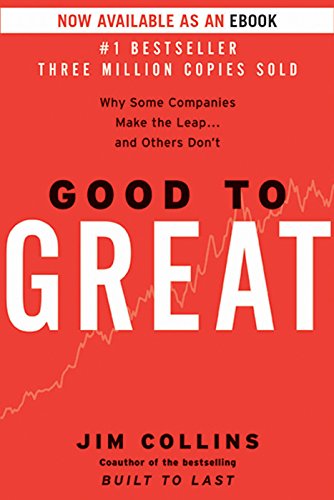
This article is an excerpt from the Shortform summary of "Good to Great" by Jim Collins. Shortform has the world's best summaries of books you should be reading.
Like this article? Sign up for a free trial here .
What are the Good-to-Great companies featured in Jim Collins’s book Good to Great? How did they qualify to be “good to great”? What can you learn from them?
Over five years, Collins’s team of 21 researchers reviewed close to 6,000 articles and generated over 2,000 pages of interview transcripts to determine whether and how companies can go from good to great. We’ll cover the good-to-great companies featured in the book and the lessons they teach us about how to take other companies from good to great.
Originally Published: December 3, 2019
Last Updated: January 27, 2026
Methods
To identify clear examples of good-to-great transitions, Collins and his team searched for companies with 15-year returns equal to or below the general market that, after a distinct transition point, recorded 15-year returns at least three times better than the general market. They found 11 companies that met this criterion.
Collins and his team then identified a “comparison company” for each good-to-great company. The criteria for comparison companies were that (1) they were similarly resourced and situated as their relative good-to-great companies, and (2) their returns remained at or below the general market return after the transition point.
The researchers also examined six “unsustained comparisons”—companies that beat the market after the transition point but failed to sustain those results across the full 15-year threshold.
| Criticisms and Collins’s Response Collins treads familiar ground in Good to Great, using a method similar to the one he employed in his first book, Built to Last (1994): He and coauthor Jerry I. Porras compared high-performing companies to competitors that didn’t have the same level of success over a set period of time. The objective was to find commonalities between the enduring companies and unlock the secrets behind sustained greatness. But while both Built to Last and Good to Great have sold millions of copies and were included on TIME’s list of the 25 Most Influential Business Management Books, some experts are skeptical of Collins’s work. In The Halo Effect, business professor Phil Rosenzweig details the “business delusions” espoused by magazines and management books, including those by Collins. Rosenzweig and other critics argue that Collins’s research often relies on retrospective accounts, interviews, and media coverage, which can be colored by perceptions of success. Critics also point out that selecting companies already known to perform well risks attributing causation to traits that follow from success rather than drive it. Others suggest that luck or randomness could explain many of the patterns Collins identifies, and that the book has deluded some CEOs into thinking that success is simply a matter of following a formula. For his part, Collins emphasizes the rigorousness of his research. He also stresses that his findings show correlations, not definitive causes, and presents them as evidence-based observations for readers to consider thoughtfully, rather than as prescriptive or universally predictive rules. |
The Companies
The 11 companies Collins describes as having gone “from good to great” are listed below. Comparison companies are in parentheses, followed by the companies’ industries.
- Abbott (Upjohn) – Health Care
- Circuit City (Silo) – Retail
- Fannie Mae (Great Western) – Financial Services
- Gillette (Warner-Lambert) – Consumer Goods
- Kimberly-Clark (Scott Paper) – Household and Personal Products
- Kroger (A&P) – Retail
- Nucor (Bethlehem Steel) – Steel
- Philip Morris (R.J. Reynolds) – Tobacco
- Pitney Bowes (Addressograph) – Business Services
- Walgreens (Eckerd) – Retail
- Wells Fargo (Bank of America) – Banking/Financial Services
(Shortform note: A review of the companies’ stock performance over 22 years after the book’s publication shows whether they’ve stood the test of time. Nucor, Abbott, Kroger, Kimberly-Clark, and Philip Morris continue to perform well. Wells Fargo is holding steady, though it has faced numerous financial scandals over the years. Pitney Bowes and Fannie Mae both saw a decline over the 22-year period, Gillette was acquired by Procter & Gamble, and Circuit City filed for bankruptcy in 2008. Walgreens, like other retail pharmacies, is struggling. Most of the comparison companies no longer exist—either due to mergers, acquisitions, or bankruptcy—but Bank of America weathered big challenges and is still going strong.)
Unsustained comparisons:
- Burroughs – Business Services
- Chrysler – Automotive
- Harris – Aerospace and Defense (previously Business Services)
- Hasbro – Toys/Entertainment
- Rubbermaid – Manufacturing
- Teledyne – Conglomerate (Electronics, Aerospace and Defense)
(Shortform note: Almost all of the unsustained companies no longer exist in their original form after having merged with or been acquired by other companies. The exception is Hasbro, which is still a dominant player in its industry. Some notable developments are its acquisition of Entertainment One, which holds the Peppa Pig franchise, and Hasbro’s partnership with Netflix and Mattel to produce a range of toys for the 2025 hit movie KPop Demon Hunters.)
———End of Preview———
Like what you just read? Read the rest of the world's best summary of "Good to Great" at Shortform . Learn the book's critical concepts in 20 minutes or less .
Here's what you'll find in our full Good to Great summary :
- The 3 key attributes of Great companies
- Why it's better to focus on your one core strength than get spread thin
- How to build a virtuous cycle, or flywheel effect, in your business