We've ranked the best time management books using expert recommendations, sales data, and millions of reader ratings. At Shortform, we know books. Our book guides are the best in the world. Learn why.
Cover unavailable
1
Getting Things Done: The Art of Stress-Free Productivity
"The Bible of business and personal productivity" —Lifehack
"A completely revised and updated edition of the blockbuster bestseller from 'the personal productivity guru'"—Fast Company
Since it was first published almost fifteen years ago, David Allen’s Getting Things Done has become one of the most influential business books of its era, and the ultimate book on personal organization. “GTD” is now shorthand for an entire way of approaching professional and personal tasks, and has spawned an entire culture of websites, organizational tools, seminars, and offshoots.
Allen has rewritten the book from start to finish, tweaking his classic text with important perspectives on the new workplace, and adding material that will make the book fresh and relevant for years to come. This new edition of Getting Things Done will be welcomed not only by its hundreds of thousands of existing fans but also by a whole new generation eager to adopt its proven principles.
…
Recommended by David Allen, Dustin Moskovitz, Ev Williams, and 20 others.
Getting Things Done by David Allen. He recently spoke at our Zappos all-hands meeting and gave me a signed copy of his book. [source]
Eric Rose
Chairman/Columbia University Department of Surgery
When I'm flat-out stressed about the volume and complexity of my work, I open this book and find immediate ways to gain a sense of control. That's really a critical need for decision making. David made me what I am today: headstrong and proud of it. [source]
Cover unavailable
2
The 7 Habits of Highly Effective People: Powerful Lessons in Personal Change
When Stephen Covey first released The Seven Habits of Highly Effective People, the book became an instant rage because people suddenly got up and took notice that their lives were headed off in the wrong direction; and more than that, they realized that there were so many simple things they could do in order to navigate their life correctly. This book was wonderful education for people, education in how to live life effectively and get closer to the ideal of being a ‘success’ in life.
But not everyone understands Stephen Covey’s model fully well, or maybe there are some people who haven’t read it yet. This is definitely true because we still see so much failure all around us. Now, I am not saying that by using Covey’s model, or anyone else’s model for that matter, you can become a sure-shot success, but at least we should have seen many more successes around us already judging by the number of copies the book has sold! So, where is the shortcoming?
There are two main problems here, and we are talking only about the people who have read the book already. The first problem is that most people are too lazy to implement the ideals of Stephen Covey in their lives. They consider his masterpiece of a book as a mere coffee-table book or a book that you use for light reading when you are traveling and then forget all about it. They do not realize that this book contains life-changing information. Or, they take the information and do not make the effort to actually utilize it so that it becomes knowledge for them.
The second problem is that a lot of people have a myopic view of Covey’s ideals. These are people who are impressed by the book already. If you ask them what the seven habits are, they can rattle them off end to end, but then they miss the larger picture. They do not understand that Covey was trying to tell more than he wrote in words. There are hidden implications in this book, yes, and a lot of people have just failed to see through them.
That is what we are trying to do. We are trying to show you how Covey’s book, or rather, his model, was a complete model in itself. There was nothing amiss about it. If you implement it, there should be no aspect of your life that should go untouched. The only thing is that you have to understand these ideals and try to implement them in your life.
But, before we barge into that area, it is extremely important to understand what these ideals are. What was the model that was propounded by Stephen Covey in his mega-famous book? We shall begin by trying to understand his model first, and then interpret it in such a way that it pertains to every aspect of our life
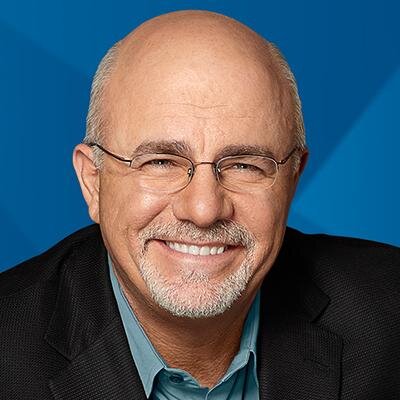
Dave Ramsey recommended this book on his website. [source]
Dustin Moskovitz
Co-founder/Facebook and Asana
I was surprised at how familiar the topics felt. [source]
Joe Martin
@benmorris @audible_com @Gladwell I enjoy the quiet on the way home, but on the way to work I am listening to the 7 habits book by Stephen Coveru, a fave of mine [source]
Cover unavailable
3
Eat That Frog!: 21 Great Ways to Stop Procrastinating and Get More Done in Less Time
Stop Procrastinating Get More of the Important Things Done--Today! There just isn't enough time for everything on our to-do list--and there never will be. Successful people don't try to do everything. They learn to focus on the most important tasks and make sure those get done. They eat their frogs. There's an old saying that if the first thing you do each morning is eat a live frog, you'll have the satisfaction of knowing you're done with the worst thing you'll have to do all day. For Tracy, eating a frog is a metaphor for tackling your most challenging task--but also the one that can have the greatest positive impact on your life. Eat That Frog! shows you how to organize each day so you can zero in on these critical tasks and accomplish them efficiently and effectively. In this fully revised and updated edition, Tracy adds two new chapters. The first explains how you can use technology to remind yourself of what is most important and protect yourself from what is least important. The second offers advice for maintaining focus in our era of constant distractions, electronic and otherwise. But one thing remains unchanged: Brian Tracy cuts to the core of what is vital to effective time management: decision, discipline, and determination. This life-changing book will ensure that you get more of your important tasks done--today!
…
Recommended by Raul Pachecovega and 2 others.
Raul Pachecovega
I recently finished reading @BrianTracy's "Eat That Frog! 21 Great Ways to Stop Procrastinating and Get More Done in Less Time". It took me FOREVER to finish his book (hard to eat THAT frog, I'm sorry Brian!) but if there's ONE frog I always eat is: MAKING MY BED IN THE MORNING. [source]
Cover unavailable
4
The 4-Hour Workweek: Escape 9-5, Live Anywhere, and Join the New Rich
More than 100 pages of new, cutting-edge content. Forget the old concept of retirement and the rest of the deferred-life plan there is no need to wait and every reason not to, especially in unpredictable economic times. Whether your dream is escaping the rat race, experiencing high-end world travel, earning a monthly five-figure income with zero management, or just living more and working less, The 4-Hour Workweek is the blueprint. This step-by-step guide to luxury lifestyle design teaches: How Tim went from $40,000 per year and 80 hours per week to $40,000 per month and 4 hours per week. How to outsource your life to overseas virtual assistants for $5 per hour and do whatever you want How blue-chip escape artists travel the world without quitting their jobs How to eliminate 50% of your work in 48 hours using the principles of a forgotten Italian economist How to trade a long-haul career for short work bursts and frequent mini-retirements The new expanded edition of Tim Ferriss The 4-Hour Workweek includes: More than 50 practical tips and case studies from readers (including families) who have doubled income, overcome common sticking points, and reinvented themselves using the original book as a starting point Real-world templates you can copy for eliminating e-mail, negotiating with bosses and clients, or getting a private chef for less than $8 a meal How Lifestyle Design principles can be suited to unpredictable economic times The latest tools and tricks, as well as high-tech shortcuts, for living like a diplomat or millionaire without being either"
Eric Weinstein recommended this book on Twitter. [source]
Tim Draper
Founder/Draper Fisher Jurvetson
With this kind of time management and focus on the important things in life, people should be able to get 15 times as much done in a normal work week. [source]
It's about time this book was written. It is a long-overdue manifesto for the mobile lifestyle, and Tim Ferriss is the ideal ambassador. This will be huge. [source]
Cover unavailable
5
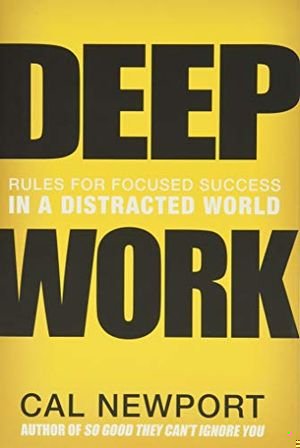
Deep Work: Rules for Focused Success in a Distracted World
One of the most valuable skills in our economy is becoming increasingly rare. If you master this skill, you'll achieve extraordinary results.
Deep work is the ability to focus without distraction on a cognitively demanding task. It's a skill that allows you to quickly master complicated information and produce better results in less time. Deep work will make you better at what you do and provide the sense of true fulfillment that comes from craftsmanship. In short, deep work is like a super power in our increasingly competitive twenty-first century economy. And yet, most people have lost the ability to go deep-spending their days instead in a frantic blur of e-mail and social media, not even realizing there's a better way.
In Deep Work, author and professor Cal Newport flips the narrative on impact in a connected age. Instead of arguing distraction is bad, he instead celebrates the power of its opposite. Dividing this book into two parts, he first makes the case that in almost any profession, cultivating a deep work ethic will produce massive benefits. He then presents a rigorous training regimen, presented as a series of four "rules," for transforming your mind and habits to support this skill.
A mix of cultural criticism and actionable advice, Deep Work takes the reader on a journey through memorable stories-from Carl Jung building a stone tower in the woods to focus his mind, to a social media pioneer buying a round-trip business class ticket to Tokyo to write a book free from distraction in the air-and no-nonsense advice, such as the claim that most serious professionals should quit social media and that you should practice being bored. Deep Work is an indispensable guide to anyone seeking focused success in a distracted world.
As automation and outsourcing reshape the workplace, what new skill do we need? The ability to do deep work. Cal Newport's exciting new book is an introduction and guide to the kind of intense concentration in a distraction-free environment that results in fast, powerful learning and performance. Think of it as calisthenics for your mind-and start your exercise program today. [source]
Marvin Liao
Partner/500 Startups
The Joy of Not Working (Zelinkski), Flash Foresight (Burrus), The Art of Worldly Wisdom (Gracian), Sapiens (Yuval), The End of Jobs (Pearson), Deep Work (Newport), Sovereign Individual (Davidson), The Fourth Economy (Davison) & The Monk & the Riddle (Komisar). Every single one of these books completely changed how I looked at everything in the world & literally pushed my life in a new direction. They were Paradigm Shifting as they say. (hate that word but it really was a Paradigm Shift for me). [source]
I've been a fan of Cal for a long time. His book So Good They Can't Ignore You is one of my favorites, but it's his new book that's probably had the biggest and most immediate impact on me. For those of you who enjoyed Tyler Cowen's Average is Over, you already know how important the ability to focus, be creative, and think at a high level is going to be in the future. This is a book that explains how to cultivate and protect that skill--the ability to do deep work. One thing I've already started doing since reading this book is recording the number of hours of deep work I do each day in my morning journal. It's a way of keeping a running tally and monitoring if I begin to get distracted or slow my pace. Anyway, great book! [source]
Do you simultaneously feel overworked and underutilized?
Are you often busy but not productive?
Do you feel like your time is constantly being hijacked by other people’s agendas?
If you answered yes to any of these, the way out is the Way of the Essentialist.
The Way of the Essentialist isn’t about getting more done in less time. It’s about getting only the right things done. It is not a time management strategy, or a productivity technique. It is a systematic discipline for discerning what is absolutely essential, then eliminating everything that is not, so we can make the highest possible contribution towards the things that really matter.
By forcing us to apply a more selective criteria for what is Essential, the disciplined pursuit of less empowers us to reclaim control of our own choices about where to spend our precious time and energy – instead of giving others the implicit permission to choose for us.
Essentialism is not one more thing – it’s a whole new way of doing everything. A must-read for any leader, manager, or individual who wants to learn who to do less, but better, in every area of their lives, Essentialism is a movement whose time has come.
Noah Kagan recommended this book in the book "Tools of Titans". [source]
Andrew Youderian
Question: What five books would you recommend to young people interested in your career path & why? Answer: 7 Habits of Highly Effective People (Getting the right things done) Entreleadership (Great primer on management) Let My People Go Surfing (How to build a business on your terms, that embraces your values) Essentialism (The Importance of focus) Work the System (A primer on building systems in your business) [source]
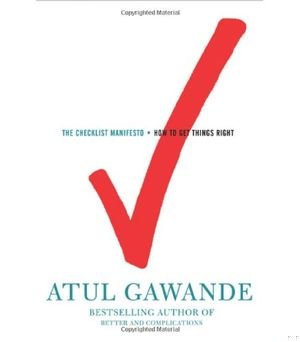
The New York Times bestselling author of Better and Complications reveals the surprising power of the ordinary checklist
We live in a world of great and increasing complexity, where even the most expert professionals struggle to master the tasks they face. Longer training, ever more advanced technologies‚neither seems to prevent grievous errors. But in a hopeful turn, acclaimed surgeon and writer Atul Gawande finds a remedy in the humblest and simplest of techniques: the checklist.
First introduced decades ago by the U.S. Air Force, checklists have enabled pilots to fly aircraft of mind-boggling sophistication. Now innovative checklists are being adopted in hospitals around the world, helping doctors and nurses respond to everything from flu epidemics to avalanches. Even in the immensely complex world of surgery, a simple ninety-second variant has cut the rate of fatalities by more than a third.
In riveting stories, Gawande takes us from Austria, where an emergency checklist saved a drowning victim who had spent half an hour underwater, to Michigan, where a cleanliness checklist in intensive care units virtually eliminated a type of deadly hospital infection. He explains how checklists actually work to prompt striking and immediate improvements. And he follows the checklist revolution into fields well beyond medicine, from homeland security to investment banking, skyscraper construction, and businesses of all kinds.
An intellectual adventure in which lives are lost and saved and one simple idea makes a tremendous difference, The Checklist Manifesto is essential reading for anyone working to get things right.
Atul is really talking about how absolutely powerful checklists are, and I think he makes a very creative point: that checklist are not just some static, boring thing. They actually allow you to do excellent work and free up your brain by not having to keep remembering what you need to do when. That then allows your brain to be a lot more creative about whatever it is you’re doing. [source]
The One Thing explains the success habit to overcome the six lies that block our success, beat the seven thieves that steal time, and leverage the laws of purpose, priority, and productivity.
Recommended by Aaron Agius, Charles Poliquin, David Cancel, and 13 others.
Charles Poliquin recommended this book in the book "Tools of Titans". [source]
Erik Rostad
For career books, I'll focus on more overarching themes. You can get books on particular skills you need for a given job, but these books will help having the right mindset for a career and how work should fit into the greater story of your life. For focus: The One Thing by Gary Keller. [source]
Gennady Batrakov
Reading improved my self-discipline and consistency. It helped me to focus on the right things. This book, in particular, opened my eyes to how extraordinary results can be achieved – The ONE Thing by Gary Keller. [source]
Cover unavailable
9
First Things First
Stephen R. Covey, A. Roger Merrill, Rebecca R. Merrill
The authors of this book apply insights from their previous book, The 7 Habits of Highly Effective People, to the daily problems of people who must struggle with the demands of work and home life. Rather than focusing on time and change, the book emphasizes relationships and results.
Recommended by Abid Zaidi.
Abid Zaidi
Day 10: #30Days of posting cover of books I love (1 book a day for 30 days). No expectations, no reviews, just the covers. Inspired by @rekha_bhardwaj #MyFavouriteBooks https://t.co/zppiZGMPN2 [source]
Cover unavailable
10
The Effective Executive: The Definitive Guide to Getting the Right Things Done
A handsome, commemorative edition of Peter F. Drucker’s timeless classic work on leadership and management, with a foreword by Jim Collins.
What makes an effective executive?
For decades, Peter F. Drucker was widely regarded as "the dean of this country’s business and management philosophers" (Wall Street Journal). In this concise and brilliant work, he looks to the most influential position in management—the executive.
The measure of the executive, Drucker reminds us, is the ability to "get the right things done." This usually involves doing what other people have overlooked as well as avoiding what is unproductive. Intelligence, imagination, and knowledge may all be wasted in an executive job without the acquired habits of mind that mold them into results.
Drucker identifies five practices essential to business effectiveness that can—and must—be mastered:
Managing time; Choosing what to contribute to the organization; Knowing where and how to mobilize strength for best effect; Setting the right priorities; Knitting all of them together with effective decision-making Ranging across the annals of business and government, Drucker demonstrates the distinctive skill of the executive and offers fresh insights into old and seemingly obvious business situations.
…
Recommended by Drew Houston, Ev Williams, Guy Kawasaki, and 15 others.
Drew Houston
CEO/Dropbox
I think one of the most valuable concepts from this book is measuring your time. [source]
A young woman walks into a laboratory. Over the past two years, she has transformed almost every aspect of her life. She has quit smoking, run a marathon, and been promoted at work. The patterns inside her brain, neurologists discover, have fundamentally changed.
Marketers at Procter & Gamble study videos of people making their beds. They are desperately trying to figure out how to sell a new product called Febreze, on track to be one of the biggest flops in company history. Suddenly, one of them detects a nearly imperceptible pattern—and with a slight shift in advertising, Febreze goes on to earn a billion dollars a year.
An untested CEO takes over one of the largest companies in America. His first order of business is attacking a single pattern among his employees—how they approach worker safety—and soon the firm, Alcoa, becomes the top performer in the Dow Jones.
What do all these people have in common? They achieved success by focusing on the patterns that shape every aspect of our lives.
They succeeded by transforming habits.
In The Power of Habit, award-winning New York Times business reporter Charles Duhigg takes us to the thrilling edge of scientific discoveries that explain why habits exist and how they can be changed. With penetrating intelligence and an ability to distill vast amounts of information into engrossing narratives, Duhigg brings to life a whole new understanding of human nature and its potential for transformation.
Along the way we learn why some people and companies struggle to change, despite years of trying, while others seem to remake themselves overnight. We visit laboratories where neuroscientists explore how habits work and where, exactly, they reside in our brains. We discover how the right habits were crucial to the success of Olympic swimmer Michael Phelps, Starbucks CEO Howard Schultz, and civil-rights hero Martin Luther King, Jr. We go inside Procter & Gamble, Target superstores, Rick Warren’s Saddleback Church, NFL locker rooms, and the nation’s largest hospitals and see how implementing so-called keystone habits can earn billions and mean the difference between failure and success, life and death.
At its core, The Power of Habit contains an exhilarating argument: The key to exercising regularly, losing weight, raising exceptional children, becoming more productive, building revolutionary companies and social movements, and achieving success is understanding how habits work.
Habits aren’t destiny. As Charles Duhigg shows, by harnessing this new science, we can transform our businesses, our communities, and our lives.
…
Recommended by Naval Ravikant, Blake Irving, Alden Mills, and 15 others.
I also recently finished The Power of Habit, or close to finish as I get. That one was interesting, not because of its content necessarily, but because it’s good for me to always keep on top of mind how powerful my habits are. … I think learning how to break habits is a very important meta-skill that can serve you better in life than almost anything else. Although you can read tons of books on it, the reality is you’re never going to learn how to break bad habits until you just break them. [source]
Blake Irving
CEO/GoDaddy
You know, there's a book called The Power of Habit by Charles Duhigg. Simple read book about just how to build positive habits that can be I think I what I'd call you know whether in your personal life or whether in your business life to help you build you know, have a loop that can build your success and that's one I mean there are so many great books out there. [source]
Alden Mills
More recent books that have had a significant impact on me are The Power of Habit and The Diamond Cutter. Both represent different forces for me – the former helps me tactically with making incremental improvements in my life. [source]
Major New York Times bestseller Winner of the National Academy of Sciences Best Book Award in 2012 Selected by the New York Times Book Review as one of the best books of 2011 A Globe and Mail Best Books of the Year 2011 Title One of The Economist's 2011 Books of the Year One of The Wall Street Journal's Best Nonfiction Books of the Year 2011 2013 Presidential Medal of Freedom Recipient
In the international bestseller, Thinking, Fast and Slow, Daniel Kahneman, the renowned psychologist and winner of the Nobel Prize in Economics, takes us on a groundbreaking tour of the mind and explains the two systems that drive the way we think. System 1 is fast, intuitive, and emotional; System 2 is slower, more deliberative, and more logical. The impact of overconfidence on corporate strategies, the difficulties of predicting what will make us happy in the future, the profound effect of cognitive biases on everything from playing the stock market to planning our next vacation—each of these can be understood only by knowing how the two systems shape our judgments and decisions. Engaging the reader in a lively conversation about how we think, Kahneman reveals where we can and cannot trust our intuitions and how we can tap into the benefits of slow thinking. He offers practical and enlightening insights into how choices are made in both our business and our personal lives—and how we can use different techniques to guard against the mental glitches that often get us into trouble. Winner of the National Academy of Sciences Best Book Award and the Los Angeles Times Book Prize and selected by The New York Times Book Review as one of the ten best books of 2011, Thinking, Fast and Slow is destined to be a classic.
A few months ago, Mr. Obama read “Thinking, Fast and Slow,” by Daniel Kahneman, about how people make decisions — quick, instinctive thinking versus slower, contemplative deliberation. For Mr. Obama, a deliberator in an instinctive business, this may be as instructive as any political science text. [source]
Captivating dive into human decision making, marred by inclusion of several/many? psychology studies that fail to replicate. Will stand as a cautionary tale? [source]
There are 168 hours in a week. This is your guide to getting the most out of them.
It's an unquestioned truth of modern life: we are starved for time. We tell ourselves we'd like to read more, get to the gym regularly, try new hobbies, and accomplish all kinds of goals. But then we give up because there just aren't enough hours to do it all. Or if we don't make excuses, we make sacrifices- taking time out from other things in order to fit it all in.
There has to be a better way...and Laura Vanderkam has found one. After interviewing dozens of successful, happy people, she realized that they allocate their time differently than most of us. Instead of letting the daily grind crowd out the important stuff, they start by making sure there's time for the important stuff. When plans go wrong and they run out of time, only their lesser priorities suffer.
Vanderkam shows that with a little examination and prioritizing, you'll find it is possible to sleep eight hours a night, exercise five days a week, take piano lessons, and write a novel without giving up quality time for work, family, and other things that really matter.
We so often live our lives day by day. Laura wants us to think about doing it hour by hour. Living this mantra by example, she gets more done in a day than most of us do in a week. [source]
Cover unavailable
14
Scrum: The Art of Doing Twice the Work in Half the Time
The guide to shortening your execution cycle down from one year to twelve weeks
Most organizations and individuals work in the context of annual goals and plans; a twelve-month execution cycle. Instead, "The 12 Week Year" avoids the pitfalls and low productivity of annualized thinking. This book redefines your "year" to be 12 weeks long. In 12 weeks, there just isn't enough time to get complacent, and urgency increases and intensifies. "The 12 Week Year" creates focus and clarity on what matters most and a sense of urgency to do it now. In the end more of the important stuff gets done and the impact on results is profound.Explains how to leverage the power of a 12 week year to drive improved results in any area of your lifeOffers a how-to book for both individuals and organizations seeking to improve their execution effectivenessAuthors are leading experts on execution and implementation
Turn your organization's idea of a year on its head, and speed your journey to success.
…
Recommended by Vincent Pugliese.
Vincent Pugliese
Question: What books would you recommend to young people to be prepared for the future workplaces? Answer: So many! So many by Seth Godin (Linchpin, The Icarus Deception, Purple Cow) Essentialism by Greg McKeown, Deep Work by Cal Newport, The Choice by Og Mandino, Rich Dad Poor Dad by Robert Kiyosaki, The Total Money Makeover by Dave Ramsey, No More Dreaded Mondays and 48 Days To The Work You Love by Dan Miller, The 12 Week Year by Brian Moran, Will It Fly by Pat Flynn, The Traveler's Gift by Andy Andrews, QBQ by John Miller, The Four Hour Workweek by Tim Ferriss. Wow, there are so many more, but that’s a start. [source]
Cover unavailable
16
Atomic Habits: An Easy & Proven Way to Build Good Habits & Break Bad Ones
No matter your goals, Atomic Habits offers a proven framework for improving--every day. James Clear, one of the world's leading experts on habit formation, reveals practical strategies that will teach you exactly how to form good habits, break bad ones, and master the tiny behaviors that lead to remarkable results.
If you're having trouble changing your habits, the problem isn't you. The problem is your system. Bad habits repeat themselves again and again not because you don't want to change, but because you have the wrong system for change. You do not rise to the level of your goals. You fall to the level of your systems. Here, you'll get a proven system that can take you to new heights.
Clear is known for his ability to distill complex topics into simple behaviors that can be easily applied to daily life and work. Here, he draws on the most proven ideas from biology, psychology, and neuroscience to create an easy-to-understand guide for making good habits inevitable and bad habits impossible. Along the way, readers will be inspired and entertained with true stories from Olympic gold medalists, award-winning artists, business leaders, life-saving physicians, and star comedians who have used the science of small habits to master their craft and vault to the top of their field.
Learn how to: * make time for new habits (even when life gets crazy); * overcome a lack of motivation and willpower; * design your environment to make success easier; * get back on track when you fall off course; ...and much more.
Atomic Habits will reshape the way you think about progress and success, and give you the tools and strategies you need to transform your habits--whether you are a team looking to win a championship, an organization hoping to redefine an industry, or simply an individual who wishes to quit smoking, lose weight, reduce stress, or achieve any other goal.
I recently read an advance copy of James Clear’s new book, Atomic Habits. His thesis is that small but carefully selected habits can, over time, create massively positive results — not just in terms of what you accomplish, but also in terms of the type of person you become. James’s exposition rings true with what’ve I learned hanging around interesting people and high achievers. I recommend you give this book a closer look. [source]
A lot of people email me asking about habits - how to form good ones, how to break bad ones, how to stop doing the dumb shit we always do. I've got a friend named James Clear. He's an accomplished author and business owner and is kind of a "habit guru." He's probably forgotten more habits research than I've ever brought myself to look at. He just launched his first book. It's called Atomic Habits and it's probably the most practical and complete guide I've ever seen about habit formation and habit change. Do check it out. And then email him and tell him that I have luscious and beautiful hair and he doesn't. Then stick out your tongue and go, "Nyah, nyanya, nyah, nyah." [source]
How do both elite athletes and business leaders climb to the top? Contrary to what you might think, it's effective habits rather than innate talent that are their keys to success. Dr. Jason Selk—director of mental training for the 2011 World Series Champions, the St. Louis Cardinals—and star business coach Tom Bartow combine the most effective elements of both their disciplines to offer an organizational improvement plan that anyone can learn and apply immediately.
They outline eight fundamental ways to get organized, including the "time paradox," which allows precision to set your schedule free, and a two-minute mental training drill that will start your day with focus, confidence, and energy. Organize Tomorrow Today helps readers to move past their performance roadblocks and achieve more productive lives.
From the New York Times bestselling authors of Sprint, a simple 4-step system for improving focus, finding greater joy in your work, and getting more out of every day
Nobody ever looked at an empty calendar and said, "The best way to spend this time is by cramming it full of meetings!" or got to work in the morning and thought, Today I'll spend hours on Facebook! Yet that's exactly what we do. Why? In a world where information refreshes endlessly and the workday feels like a race to react to other people's priorities faster, frazzled and distracted has become our default position. But what if the exhaustion of constant busyness wasn't mandatory? What if you could step off the hamster wheel and start taking control of your time and attention? That's what this book is about. As creators of Google Ventures' renowned "design sprint," Jake and John have helped hundreds of teams solve important problems by changing how they work. Building on the success of these sprints and their experience designing ubiquitous tech products from Gmail to YouTube, they spent years experimenting with their own habits and routines, looking for ways to help people optimize their energy, focus, and time. Now they've packaged the most effective tactics into a four-step daily framework that anyone can use to systematically design their days. Make Time is not a one-size-fits-all formula. Instead, it offers a customizable menu of bite-size tips and strategies that can be tailored to individual habits and lifestyles. Make Time isn't about productivity, or checking off more to-dos. Nor does it propose unrealistic solutions like throwing out your smartphone or swearing off social media. Making time isn't about radically overhauling your lifestyle; it's about making small shifts in your environment to liberate yourself from constant busyness and distraction. A must-read for anyone who has ever thought, If only there were more hours in the day..., Make Time will help you stop passively reacting to the demands of the modern world and start intentionally making time for the things that matter.
…
Cover unavailable
19
The Now Habit: A Strategic Program for Overcoming Procrastination and Enjoying Guilt-Free Play
Learn how to overcome procrastination and enjoy guilt-free play! One of the most effective programs to combat procrastination, THE NOW HABIT has sold over 100,000 copies, has been translated into 11 languages, and is now revised and updated.
Featuring a new introduction and a new section providing strategies to understand and deal with the role technology plays in procrastination today, THE NOW HABIToffers a comprehensive plan to help readers lower their stress and increase their time to enjoy guilt-free play. Dr. Fiore’s techniques will help any busy person start tasks sooner and accomplish them more quickly, without the anxiety brought on by the negative habits of procrastination and perfectionism.
…
Recommended by Liisa Kyle and Lisa Rothstein.
Liisa Kyle
I recommend THE NOW HABIT to my coaching clients and friends and family members because it provides clear, practical, effective advice for gettingthings done without beating yourself up. [source]
Lisa Rothstein
THE NOW HABIT is the definitive bible for releasing anyone's procrastinating past and becoming a 'producer.' This book is my go-to recommendation to my clients (and myself!) for beating procrastinatiomn and the guilt that comes with it. [source]
Cover unavailable
20
Manage Your Day-to-Day: Build Your Routine, Find Your Focus, and Sharpen Your Creative Mind
Do you work at a breakneck pace all day, only to find that you haven't accomplished the most important things on your agenda by the time you leave the office? With wisdom from 20 leading creative minds, 99U's Manage Your Day-to-Day will equip you with pragmatic insights for using your time wisely and making your best work. We'll show you how to build a rock-solid daily routine, field a constant barrage of messages, find focus amidst chaos, and carve out the time you need to do the work that matters. Contributors include Scott Belsky, Mark McGuinness, Gretchen Rubin, Seth Godin, Tony Schwartz, Leo Babauta, Cal Newport, Christian Jarrett, Dan Ariely, Erin Rooney Doland, Aaron Dignan, Lori Deschene, Tiffany Shlain, Linda Stone, James Victore, Todd Henry, Scott McDowell, Stefan Sagmeister, Elizabeth Grace Saunders, and Steven Pressfield.
A time management book. Personally, I like Manage your day-to-day by 99U. It is an extremely quick read, but provides some good insights for those who need some basic guidance regarding time management, especially in creative fields. [source]
Irina Marinescu
Product Managers can easily fill an entire day with work and never get to do any meaningful strategy thinking or feature viability research etc. Emails and meetings can quickly get out of hand. This book doesn’t provide a magical never-heard-of recipe, but its structure, the clear message, and actionable takeaways will do the trick. It helps to return to it from time to time. One advice I found to work well for me is Unnecessary Creation from Manage Your Day-to-Day. Though aimed at creative jobs, it helped me exercise my skills, find new tools and improve my stream of thought. [source]
Cover unavailable
21
The Bullet Journal Method: Track the Past, Order the Present, Design the Future
The long-awaited first book by the founder of the enormously popular Bullet Journal® organizational system.
For years Ryder Carroll tried countless organizing systems, online and off, but none of them fit the way his mind worked. Out of sheer necessity, he developed a method called the Bullet Journal that helped him become consistently focused and effective. When he started sharing his system with friends who faced similar challenges, it went viral. Just a few years later, to his astonishment, Bullet Journaling is a global movement.
The Bullet Journal Method is about much more than organizing your notes and to-do lists. It's about what Carroll calls "intentional living:" weeding out distractions and focusing your time and energy in pursuit of what's truly meaningful, in both your work and your personal life. It's about spending more time with what you care about, by working on fewer things. His new book shows you how to...
• Track the past: Using nothing more than a pen and paper, create a clear and comprehensive record of your thoughts.
• Order the present: Find daily calm by tackling your to-do list in a more mindful, systematic, and productive way.
• Design the future: Transform your vague curiosities into meaningful goals, and then break those goals into manageable action steps that lead to big change.
Carroll wrote this book for frustrated list-makers, overwhelmed multitaskers, and creatives who need some structure. Whether you've used a Bullet Journal for years or have never seen one before, The Bullet Journal Method will help you go from passenger to pilot of your own life.
Everyone knows that timing is everything. But we don't know much about timing itself. Our lives are a never-ending stream of "when" decisions: when to start a business, schedule a class, get serious about a person. Yet we make those decisions based on intuition and guesswork.
Timing, it's often assumed, is an art. In When: The Scientific Secrets of Perfect Timing, Pink shows that timing is really a science.
Drawing on a rich trove of research from psychology, biology, and economics, Pink reveals how best to live, work, and succeed. How can we use the hidden patterns of the day to build the ideal schedule? Why do certain breaks dramatically improve student test scores? How can we turn a stumbling beginning into a fresh start? Why should we avoid going to the hospital in the afternoon? Why is singing in time with other people as good for you as exercise? And what is the ideal time to quit a job, switch careers, or get married?
…
Recommended by Ryan Foland.
Ryan Foland
@Tiffani_Bova @DanielPink Funny, I just put Dan's book, "When," on @audible_com 2 days ago. Love the messages to never underestimate a good nap and take more breaks. & a big cheers 🍻 to the soft stuff! Dan, "When" the time is right, I'd love to have u as a guest on my podcast, https://t.co/nmNCJlvA6W https://t.co/EvnfO8pTSa [source]
Cover unavailable
23
Time Management from the Inside Out: The Foolproof System for Taking Control of Your Schedule--and Your Life
Julie Morgenstern
4.3
A thoroughly updated and expanded edition of the definitive guide to managing and freeing up time
Applying the groundbreaking from-the-inside-out approach that made Organizing from the Inside Out a New York Times bestseller, Julie Morgenstern set a new standard for the time- management category. Her system has helped countless readers uncover their psychological stumbling blocks and strengths, and develop a time-management system that suits their individual needs. By applying her proven three-step program-Analyze, Strategize, Attack-and following her effective guidelines, readers will find more time for work, family, self-improvement, or whatever is most important to them. Time management is a learnable skill, and in this completely revised edition, Morgenstern provides the ultimate tools to combine, delegate, and eliminate unnecessary tasks; put technology to work; and stop procrastinating once and for all.
This revised edition delivers - a new chapter about the WADE formula for getting started - new time maps for people with irregular schedules - new four-, eight-, and twelve-week program guides for improving time-management skills - a fully updated resource guide
…
Cover unavailable
24
The Productivity Project: Accomplishing More by Managing Your Time, Attention, and Energy
A fresh, personal, and entertaining exploration of a topic that concerns all of us: how to be more productive at work and in every facet of our lives. Chris Bailey turned down lucrative job offers to pursue a lifelong dream—to spend a year performing a deep dive experiment into the pursuit of productivity, a subject he had been enamored with since he was a teenager. After obtaining his business degree, he created a blog to chronicle a year-long series of productivity experiments he conducted on himself, where he also continued his research and interviews with some of the world’s foremost experts, from Charles Duhigg to David Allen. Among the experiments that he tackled: Bailey went several weeks with getting by on little to no sleep; he cut out caffeine and sugar; he lived in total isolation for 10 days; he used his smartphone for just an hour a day for three months; he gained ten pounds of muscle mass; he stretched his work week to 90 hours; a late riser, he got up at 5:30 every morning for three months—all the while monitoring the impact of his experiments on the quality and quantity of his work.
The Productivity Project—and the lessons Chris learned—are the result of that year-long journey. Among the counterintuitive insights Chris Bailey will teach you: · slowing down to work more deliberately; · shrinking or eliminating the unimportant; · the rule of three; · striving for imperfection; · scheduling less time for important tasks; · the 20 second rule to distract yourself from the inevitable distractions; · and the concept of productive procrastination. In an eye-opening and thoroughly engaging read, Bailey offers a treasure trove of insights and over 25 best practices that will help you accomplish more.
…
Cover unavailable
25
The 80/20 Principle: The Secret to Achieving More with Less
How anyone can be more effective with less effort by learning how to identify and leverage the 80/20 principle--the well-known, unpublicized secret that 80 percent of all our results in business and in life stem from a mere 20 percent of our efforts.
The 80/20 principle is one of the great secrets of highly effective people and organizations.
Did you know, for example, that 20 percent of customers account for 80 percent of revenues? That 20 percent of our time accounts for 80 percent of the work we accomplish? The 80/20 Principle shows how we can achieve much more with much less effort, time, and resources, simply by identifying and focusing our efforts on the 20 percent that really counts. Although the 80/20 principle has long influenced today's business world, author Richard Koch reveals how the principle works and shows how we can use it in a systematic and practical way to vastly increase our effectiveness, and improve our careers and our companies.
The unspoken corollary to the 80/20 principle is that little of what we spend our time on actually counts. But by concentrating on those things that do, we can unlock the enormous potential of the magic 20 percent, and transform our effectiveness in our jobs, our careers, our businesses, and our lives.
After reading The E-Myth Revisited by Michael Gerber and The 80/20 Principle by Richard Koch, I decided that extreme questions were the forcing function I needed. [source]
Marvin Liao
Partner/500 Startups
SUCH a hard question to answer because there are so MANY favorite books of mine. For Business, i'd say either 80/20 Principle (Koch) or 4 Hour Work Week (Ferriss) for the principles it teaches on how to optimize work & life. [source]
Psychologist Mihaly Csikszentmihalyi's famous investigations of "optimal experience" have revealed that what makes an experience genuinely satisfying is a state of consciousness called flow. During flow, people typically experience deep enjoyment, creativity, and a total involvement with life. In this new edition of his groundbreaking classic work, Csikszentmihalyi demonstrates the ways this positive state can be controlled, not just left to chance. Flow: The Psychology of Optimal Experience teaches how, by ordering the information that enters our consciousness, we can discover true happiness and greatly improve the quality of our lives.
While re-reading Mihaly Csikszentmihalyi’s wonderful book Flow: The Psychology of Optimal Experience, I came across this passage on working crossword puzzles. I think he could just as well be talking about making blackout poems: "There is much to be said in favor of this popular pastime, which in its best form resembles the ancient riddle contests. It is inexpensive and portable, its challenges can be finely graduated so that both novices and experts can enjoy it, and its solution produces a sense of pleasing order that gives one a satisfying feeling of accomplishment. It provides opportunities to experience a mild state of flow to many people who are stranded in airport lounges, who travel on commuter trains, or who are simply whiling away Sunday mornings." [source]

Tom Chatfield
The notion of flow is the idea that there is a state that is characterised by complete immersion in an activity, by a constant response to stimuli, and a perfect match between your ability and the challenge in front of you. [source]
Cover unavailable
27
The Four Agreements: A Practical Guide to Personal Freedom
In The Four Agreements, don Miguel Ruiz reveals the source of self-limiting beliefs that rob us of joy and create needless suffering. Based on ancient Toltec wisdom, the Four Agreements offer a powerful code of conduct that can rapidly transform our lives to a new experience of freedom, true happiness, and love. The Four Agreements are: Be Impeccable With Your Word, Don't Take Anything Personally, Don't Make Assumptions, Always Do Your Best.
Question: What are the books that had a major influence on you? Or simply the ones you like the most. : Tao te Ching, score takes care of itself, between the world and me, the four agreements, the old man and the sea...I love reading! [source]
Karlie Kloss
I just think it’s got a lot of great principles and ideas. [source]

Cover unavailable
28
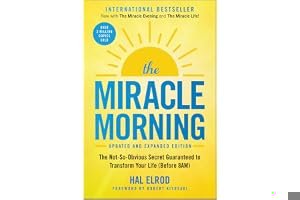
The Miracle Morning: The Not-So-Obvious Secret Guaranteed to Transform Your Life: Before 8AM
What if you could miraculously wake up tomorrow and any—or every area of your life was transformed? What would be different? Would you be happier? Healthier? More successful? In better shape? Would you have more energy? Less Stress? More Money? Better relationships? Which of your problems would be solved?
What if I told you that there is a "not-so-obvious" secret that is guaranteed to transform any—or literally every area of your life, faster than you ever thought possible? What if I told you it would only take 6 minutes a day?
Enter The Miracle Morning. What’s now being practiced by thousands of people around the world could perhaps be the simplest approach to creating the life you’ve always wanted. It’s been right there in front of us, but this book has finally brought it to life.
Are you ready? The next chapter of your life—the most extraordinary life you've ever imagined—is about to begin.
YOU DESERVE AN EXTRAORDINARY LIFE. IT’S TIME TO WAKE UP TO YOUR FULL POTENTIAL
…
Cover unavailable
29
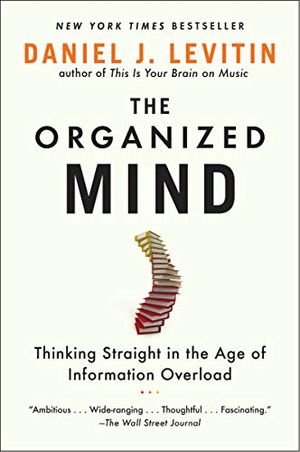
The Organized Mind: Thinking Straight in the Age of Information Overload
New York Times bestselling author and neuroscientist Daniel J. Levitin shifts his keen insights from your brain on music to your brain in a sea of details.
The information age is drowning us with an unprecedented deluge of data. At the same time, we’re expected to make more—and faster—decisions about our lives than ever before. No wonder, then, that the average American reports frequently losing car keys or reading glasses, missing appointments, and feeling worn out by the effort required just to keep up.
But somehow some people become quite accomplished at managing information flow. In The Organized Mind, Daniel J. Levitin, PhD, uses the latest brain science to demonstrate how those people excel—and how readers can use their methods to regain a sense of mastery over the way they organize their homes, workplaces, and time.
With lively, entertaining chapters on everything from the kitchen junk drawer to health care to executive office workflow, Levitin reveals how new research into the cognitive neuroscience of attention and memory can be applied to the challenges of our daily lives. This Is Your Brain on Music showed how to better play and appreciate music through an understanding of how the brain works. The Organized Mind shows how to navigate the churning flood of information in the twenty-first century with the same neuroscientific perspective.
Your head is not designed to remember, remind, prioritize, or manage relationships with more than four things. I’ve known this experientially for the last 35 years—that your head is for having ideas, but it’s a terrible place to hang onto them. Levitin validated that in a very rigorously researched book. [source]
Cover unavailable
30
Smarter Faster Better: The Secrets of Being Productive in Life and Business
A new book that explores the science of productivity, and why, in today’s world, managing how you think—rather than what you think—can transform your life.
Recommended by Chelsea Frank, Mike Benkovich, and Pierrette Abeel.
Chelsea Frank
I read everything with an open mind, often challenging myself by choosing books with an odd perspective or religious/spiritual views. These books do not reflect my personal feelings but are books that helped shape my perspective on life, love, and happiness. [source]
Mike Benkovich
Last year I read the book 'Smarter Faster Better: The Secrets of Being Productive in Life and Business' by Charles Duhigg. Look passed the click-baity title and you'll find one of the best books on productivity I've ever read... And I've read a lot of them. [source]
Cover unavailable
31
So Good They Can't Ignore You: Why Skills Trump Passion in the Quest for Work You Love
In an unorthodox approach, Georgetown University professor Cal Newport debunks the long-held belief that "follow your passion" is good advice, and sets out on a quest to discover the reality of how people end up loving their careers.
Not only are pre-existing passions rare and have little to do with how most people end up loving their work, but a focus on passion over skill can be dangerous, leading to anxiety and chronic job hopping. Spending time with organic farmers, venture capitalists, screenwriters, freelance computer programmers, and others who admitted to deriving great satisfaction from their work, Newport uncovers the strategies they used and the pitfalls they avoided in developing their compelling careers.
Cal reveals that matching your job to a pre-existing passion does not matter. Passion comes after you put in the hard work to become excellent at something valuable, not before. In other words, what you do for a living is much less important than how you do it.
With a title taken from the comedian Steve Martin, who once said his advice for aspiring entertainers was to "be so good they can't ignore you," Cal Newport's clearly written manifesto is mandatory reading for anyone fretting about what to do with their life, or frustrated by their current job situation and eager to find a fresh new way to take control of their livelihood. He provides an evidence-based blueprint for creating work you love, and will change the way you think about careers, happiness, and the crafting of a remarkable life.
Entrepreneurial professionals must develop a competitive advantage by building valuable skills. This book offers advice based on research and reality--not meaningless platitudes-- on how to invest in yourself in order to stand out from the crowd. An important guide to starting up a remarkable career. [source]
Do what you love and the money will follow' sounds like great advice -- until it's time to get a job and disillusionment quickly sets in. Cal Newport ably demonstrates how the quest for 'passion' can corrode job satisfaction. If all he accomplished with this book was to turn conventional wisdom on its head, that would be interesting enough. But he goes further -- offering advice and examples that will help you bypass the disillusionment and get right to work building skills that matter. [source]
Stop worrying about what you feel like doing (and what the world owes you) and instead, start creating something meaningful and then give it to the world. Cal really delivers with this one. [source]
Cover unavailable
32
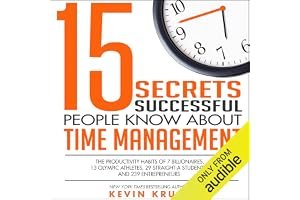
15 Secrets Successful People Know About Time Management: The Productivity Habits of 7 Billionaires, 13 Olympic Athletes, 29 Straight-A Students, and 239 Entrepreneurs
Kevin Kruse
4.2
Are you overworked and overwhelmed? What if a few new habits could increase your productivity by 5x or even 10x? Imagine if you had an extra hour each day to read, exercise, sleep, or to spend with your family.
New York Times bestselling author, Kevin Kruse, presents the remarkable findings of his study of ultra-productive people. Based on survey research and interviews with billionaires, Olympic athletes, straight-A students, and over 200 entrepreneurs--including Mark Cuban, Kevin Harrington, James Altucher, John Lee Dumas, Grant Cardone, and Lewis Howes--Kruse answers the question: what are the secrets to extreme productivity? You will learn:
- How to cure procrastination with "Time Travel" - How to save 8 hours a week with "3 Questions" - How to identify your real top priorities - How to get to zero emails in your inbox every day - How the simple E-3C system will 5x productivity - How to reduce stress with the Richard Branson Tool - How to leave work at 5:00 without feeling guilty - How to run meetings like Apple, Google & Virgin - How to conquer social media distractions - BONUS: Discover Your Time Personality quiz - BONUS: 100+ Time Management Quotes
…
Recommended by Tommy Bar Av.
Cover unavailable
33
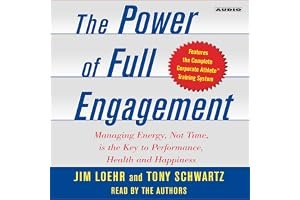
The Power of Full Engagement: Managing Energy, Not Time, Is the Key to High Performance and Personal Renewal
Jim Loehr, Tony Schwartz
4.2
We live in digital time. Our pace is rushed, rapid-fire, and relentless. Facing crushing workloads, we try to cram as much as possible into every day. We're wired up, but we're melting down. Time management is no longer a viable solution. As bestselling authors Jim Loehr and Tony Schwartz demonstrate in this groundbreaking book, managing energy, not time, is the key to enduring high performance as well as to health, happiness, and life balance. The number of hours in a day is fixed, but the quantity and quality of energy available to us is not. This fundamental insight has the power to revolutionize the way you live your life. The Power of Full Engagement is a highly practical, scientifically based approach to managing your energy more skillfully both on and off the job. At the heart of the program is the Corporate Athlete® Training System. It is grounded in twenty-five years of work with some of the world's greatest athletes to help them perform more effectively under brutal competitive pressures. Clients have included Jim Courier, Monica Seles, and Arantxa Sanchez-Vicario in tennis; Mark O'Meara and Ernie Els in golf; Eric Lindros and Mike Richter in hockey; Nick Anderson and Grant Hill in basketball; and gold medalist Dan Jansen in speed skating. During the past decade, dozens of Fortune 500 companies have paid thousands of dollars to learn the Corporate Athlete training system. So have FBI swat teams, critical care physicians and nurses, salesmen, and stay-at-home moms. The Power of Full Engagement lays out the key training principles and provides a powerful, step-by-step program that will help you to: • Mobilize four key sources of energy • Balance energy expenditure with intermittent energy renewal • Expand capacity in the same systematic way that elite athletes do • Create highly specific, positive energy management rituals Above all, this book provides a life-changing road map to becoming more fully engaged on and off the job, meaning physically energized, emotionally connected, mentally focused, and spiritually aligned.
…
Recommended by Noah Kagan, Chris Goward, and Joel Gascoigne.
One of my favorite books ever. It’s not about your time, it’s about your energy. I read my favorite books again this year. Why not keep doing what works? The main things discussed in this book are how to maximize your energy and optimize recovery. [source]
Chris Goward
I recently enjoyed The Power of Full Engagement by Jim Loehr and Tony Schwartz. It was a good reminder about the importance of managing energy rather than time and how important rest and balance are to achieving the highest levels of performance. [source]
Joel Gascoigne
The Power of Full Engagement was one of the first books that helped me to start to understand myself, and to work to embrace how I feel and be intuitive. The key concept in the book is that you should be either fully engaged in a task, or fully disegaged and finding renewal. For example, finding the natural dips within your day and thinking about rituals and changes you could make. Maybe you go for a 20 minute walk at 3pm when you naturally find yourself less productive. [source]
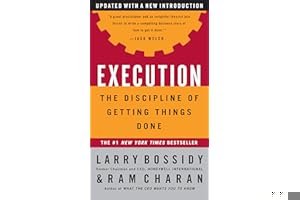
"Execution may very well be the best business book of the year, and one of the most useful to have come around in a long time. This smart and pithy book focuses on a simple though vexing challenge: How can the leaders of an organization exhort their people to deliver on the most important goals?....It's rare to find a book like this that blends smart practice with intelligent articulation of how to get things done. Do yourself a favor. Buy it." --The Boston Globe
"Making all of the moving parts of an organization function smoothly together is just plain hard work. By describing how he has done it, Mr. Bossidy has come up with a valuable and practical management guide that is must-reading for everyone who cares about business." --The New York Times
"If you want to be a CEO--or if you are a CEO and want to keep your job--read Execution and put its principles to work." --Michael Dell, chairman and CEO, Dell Computer Corp.
"A how-to book for the can-do boss....If even half the corporations in America pondered their suggestions, the economy would be in much better shape. Moreover, Bossidy and Charan boast an impressive enough track record that anyone who wants to stay sharp at the helm will welcome their assistance." --BusinessWeek
"Sound, practical advice on how to make things happen." --Ralph S. Larsen, chairman and CEO, Johnson & Johnson
"Here's the real deal.... This is no-nonsense stuff.... The leaders who sweat the small stuff, hire the right people, make the tough decisions and stick around to see that they're carried out are the real winners.... Forget the swarmy memoirs, cheesy parables, advice for idiots, and leadership secrets of despots and barbarians. Getting it done is, according to Bossidy and Charan, the only way to grow." --The Miami Herald
"Captures a lifetime of building winning formulas and puts them in a simple, practical context for executives at any level." --Ivan Seidenberg, president and CEO, Verizon
…
Recommended by Faisal Amin.
Faisal Amin
‘Execution’ by Lawrence Bossidy and Ram Charan is a book that talks about decentralization and the fact that you are supposed to relinquish control to get things done. However, It’s one of the key learnings that most startups fail to understand. Luckily, the book has taught me great things about entrepreneurship. [source]
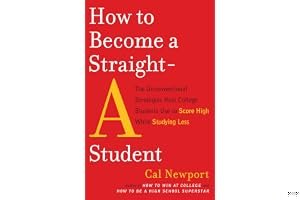
Looking to jumpstart your GPA? Most college students believe that straight A's can be achieved only through cramming and painful all-nighters at the library. But Cal Newport knows that real straight-A students don't study harder--they study smarter. A breakthrough approach to acing academic assignments, from quizzes and exams to essays and papers, "How to Become a Straight-A Student" reveals for the first time the proven study secrets of real straight-A students across the country and weaves them into a simple, practical system that anyone can master. You will learn how to: Streamline and maximize your study time Conquer procrastination Absorb the material quickly and effectively Know which reading assignments are critical--and which are not Target the paper topics that wow professors Provide A+ answers on exams Write stellar prose without the agony A strategic blueprint for success that promises more free time, more fun, and top-tier results, "How to Become a Straight-A Student" is the only study guide written by students for students--with the insider knowledge and real-world methods to help you master the college system and rise to the top of the class.
…
Cover unavailable
36
The One Minute Manager
Blanchard, Ken, Johnson, Spencer
4.2
For more than twenty years, millions of managers in Fortune 500 companies and small businesses nationwide have followed The One Minute Manager's techniques, thus increasing their productivity, job satisfaction, and personal prosperity. These very real results were achieved through learning the management techniques that spell profitability for the organization and its employees.
The One Minute Manager is a concise, easily read story that reveals three very practical secrets: One Minute Goals, One Minute Praisings, and One Minute Reprimands. The audio also presents several studies in medicine and the behavioral sciences that clearly explain why these apparently simple methods work so well with so many people. By the audio's end you will know how to apply them to your own situation and enjoy the benefits.
…
Recommended by Daymond John, Skip Prichard, and Todd Adkins.
Cover unavailable
37
Ready for Anything: 52 Productivity Principles for Getting Things Done
David Allen
4.2
In his bestselling first book, Getting Things Done, veteran coach and management consultant David Allen presented his breakthrough methods to increase efficiency. Now "the personal productivity guru" (Fast Company) shows readers how to increase their ability to work better, not harder every day. Based on Allen's highly popular e-newsletter, Ready for Anything offers readers 52 ways to immediately clear your head for creativity, focus your attention, create structures that work, and take action to get things moving.
With wit, inspiration, and know-how, Allen shows readers how to make things happen with less effort and stress, and lots more energy, creativity, and effectiveness. Ready for Anything is the perfect book for anyone wanting to work and live at his or her very best.
…
Recommended by Ev Williams.
Cover unavailable
38
Start with Why: How Great Leaders Inspire Everyone to Take Action
Why are some people and organizations more innovative, more influential, and more profitable than others? Why do some command greater loyalty from customers and employees alike? Even among the successful, why are so few able to repeat their success over and over?
People like Martin Luther King Jr., Steve Jobs, and the Wright Brothers might have little in common, but they all started with why. It was their natural ability to start with why that enabled them to inspire those around them and to achieve remarkable things.
In studying the leaders who've had the greatest influence in the world, Simon Sinek discovered that they all think, act, and communicate in the exact same way—and it's the complete opposite of what everyone else does. Sinek calls this powerful idea The Golden Circle, and it provides a framework upon which organizations can be built, movements can be lead, and people can be inspired. And it all starts with WHY.
Any organization can explain what it does; some can explain how they do it; but very few can clearly articulate why. WHY is not money or profit—those are always results. WHY does your organization exist? WHY does it do the things it does? WHY do customers really buy from one company or another? WHY are people loyal to some leaders, but not others?
Starting with WHY works in big business and small business, in the nonprofit world and in politics. Those who start with WHY never manipulate, they inspire. And the people who follow them don't do so because they have to; they follow because they want to.
Drawing on a wide range of real-life stories, Sinek weaves together a clear vision of what it truly takes to lead and inspire. This book is for anyone who wants to inspire others or who wants to find someone to inspire them.
Today is World Book Day, a wonderful opportunity to address this #ChallengeRichard sent in by Mike Gonzalez of New Jersey: Make a list of your top 65 books to read in a lifetime. [source]
The basis of this book is so important to anyone looking to increase their influence, profits or impact. People won't truly buy into a product, service, movement, or idea until they understand the WHY behind it. When you start with the why, everything else falls into place. This book is so impactful, I consider it required reading. [source]
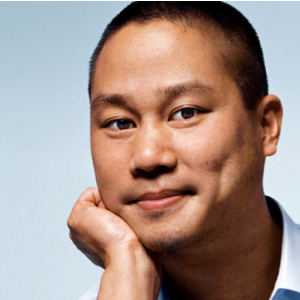
Tony Hsieh
CEO/Zappos.com
Over the years he’s recommended well over 20 business books — including his own, the 2010 bestseller Delivering Happiness and you can always find what he’s currently reading atop his cluttered desk. Start with Why is amogst those titles. [source]
Cover unavailable
39
The Life-Changing Magic of Tidying Up: The Japanese Art of Decluttering and Organizing
Despite constant efforts to declutter your home, do papers still accumulate like snowdrifts and clothes pile up like a tangled mess of noodles?
Japanese cleaning consultant Marie Kondo takes tidying to a whole new level, promising that if you properly simplify and organize your home once, you'll never have to do it again. Most methods advocate a room-by-room or little-by-little approach, which doom you to pick away at your piles of stuff forever. The KonMari Method, with its revolutionary category-by-category system, leads to lasting results. In fact, none of Kondo's clients have lapsed (and she still has a three-month waiting list).
With detailed guidance for determining which items in your house "spark joy" (and which don't), this international best seller featuring Tokyo's newest lifestyle phenomenon will help you clear your clutter and enjoy the unique magic of a tidy home - and the calm, motivated mindset it can inspire.
…
Recommended by Andra Zaharia, Annie Loves Covfefe, Benjamin Spall, and 3 others.
Andra Zaharia
I’ve gone through quite a few experiences brought on or shaped by what I’ve learned from books. … a more frivolous example is The Life-Changing Magic of Tidying. I read this one when moving apartments a few years ago and it made me throw or give away ⅓ of my stuff. The result: freeing up space, both physical and mental, and acquiring some home organizing skills that have stuck with me ever since. My home is tidier and my mind is clearer because of this book. [source]
Annie Loves Covfefe
@Benny29143790 @Thereal_ssteele Oh how I love Kondo cleaning. Her first book is fantastic too!! [source]
Benjamin Spall
The Life-Changing Magic of Tidying Up by Marie Kondo … I started reading on vacation. I interviewed Marie for my own book and while the translation is somewhat quirky in places, her book is worth the hype. [source]
Cover unavailable
40
Digital Minimalism: Choosing a Focused Life in a Noisy World
The key to living well in a high tech world is to spend much less time using technology.
Georgetown computer scientist Cal Newport's Deep Work sparked a movement around the idea that unbroken concentration produces far more value than the electronic busyness that defines the modern work day. But his readers had an urgent follow-up question: What about technology in our personal lives?
In recent years, our culture's relationship with personal technology has transformed from something exciting into something darker. Innovations like smartphones and social media are useful, but many of us are increasingly troubled by how much control these tools seem to exert over our daily experiences--including how we spend our free time and how we feel about ourselves.
In Digital Minimalism, Newport proposes a bold solution: a minimalist approach to technology use in which you radically reduce the time you spend online, focusing on a small set of carefully-selected activities while happily ignoring the rest.
He mounts a vigorous defense for this less-is-more approach, combining historical examples with case studies of modern digital minimalists to argue that this philosophy isn't a rejection of technology, but instead a necessary realignment to ensure that these tools serve us, not the other way around.
To make these principles practical, he takes us inside the growing subculture of digital minimalists who have built rich lives on a foundation of intentional technology use, and details a decluttering process that thousands have already used to simplify their online lives. He also stresses the importance of never clicking "like," explores the underappreciated value of analog hobbies, and draws lessons from the "attention underground"--a resistance movement fighting the tech companies' attempts to turn us into gadget addicts.
Digital Minimalism is an indispensable guide for anyone looking to reclaim their life from the alluring diversions of the digital world.
I’m an introvert in an extrovert’s world. I like to be alone. In contrast, I spend a large portion of my work time with groups. Figuring out how to manage this duality, while staying mentally healthy, has been a life-long challenge. Newport’s concept of digital minimalism helps me with all of this. Newport has an entire chapter on solitude, nicely titled “Spend Time Alone.” He makes the important distinction between spending time alone with other stimuli (music, podcasts, audible, streaming media) and real solitude. In addition to the framework around digital minimalism, Newport unloads on the reader with numerous tactics. I use some of them but found a few new ones to add to my repertoire. [source]
This book is incredible. I’m a have to read it at least 3x and reference it forever. Disconnecting is very important because as the book says “Human Beings are not wired to always be wired.” A Silicon Valley whistle blower name Tristan Harris says “Is Silicon Valley programming apps or are they programming people?” They are programming people!!! Technology is not neutral, they want us to use it in particular ways and for long periods of time because that’s how the money is made.” It’s a whole lot of brain hacking going on, we are slaves to are smart phones and if you don’t think social media is bad for your mental health then you probably not paying attention to your mental health. The chapter “Spend Time Alone” breaks that all the way down. Smart Phones are a tool not a vital organ and if you think otherwise YOU NEED THIS BOOK. Thank Me Later. [source]
The unassuming Georgetown computer science professor has become one of this generation’s leading voices on how we can all work more wisely and more deeply. With media consumption continuing to go way up (which, for most of us, means happiness and productivity continue to go way down) and the world becoming noisier every day, this book is an urgent call to action for anyone serious about being in command of their own life. The minimalism movement successfully led millions to opt out of the many possessions we’re told we’re supposed to crave and focus instead on the small number of things that bring the most meaning and value to our lives. The same ideology applies to our online lives. Digital clutter is stressful. We don’t need the constant connectivity, the pages and pages of apps, the incessant scrolling and clicking. New technologies can improve our lives if we know how to best leverage them. This book already helped me break my Facebook addiction—and the first month of the year has been a big improvement for me because of that. [source]
Cover unavailable
41
Goals!: How to Get Everything You Want Faster Than You Ever Thought Possible
Based on more than 20 years of experience and 40 years of research, this book presents a practical, proven strategy for creating and meeting goals that has been used by more than 1 million people to achieve extraordinary things in life. Author Brian Tracy explains the seven key elements of goal setting and the 12 steps necessary to set and accomplish goals of any size. Using simple language and real-life examples, Tracy shows how to do the crucial work of determining one's strengths, values, and true goals. He explains how to build the self-esteem and confidence necessary for achievement; how to overpower every problem or obstacle; how to overcome difficulties; how to respond to challenges; and how to continue moving forward no matter what happens. The book's "Mental Fitness" program of character development shows readers how to become the kind of person on the inside who can achieve any goal on the outside.
…
Cover unavailable
42
10 Natural Laws of Successful Time and Life Management
Hyrum W. Smith
4.2
Written for anyone who suffers from "time famine", this essential handbook provides simple, effective methods for successfully taking control of one's hours--and one's life. Smith shows how, by managing time better, anyone can lead a happier, more confident and fulfilled life.
Cover unavailable
43
Sprint: How to Solve Big Problems and Test New Ideas in Just Five Days
A fantastic, proven formula for moving from idea to prototyping to decision making within five days, based on a process he developed while working at Google and later GV. [source]
Cat Williams-Treloar
Jake Knapp, John Zeratsky & Braden Kowitz "Sprint" - the go-to guide on how to sprint. You may not follow everything to the tee, but it's simple, clean and full of great examples of how to move fast with structure. [source]
Javed Khatri
This book details the "sprint" process used at Google Ventures. We follow a similar process at Kustard to validate business ideas and to solve problems without wasting much time, money and energy. If you want to quickly validate an idea, this is a proven model and a must read. [source]
Cover unavailable
44
18 Minutes: Find Your Focus, Master Distraction, and Get the Right Things Done
Peter Bregman
4.2
Based upon his weekly Harvard Business Review columns (which is one of the most popular columns on HBR.com, receiving hundreds of thousands of unique page views a month), 18 Minutes clearly shows how busy people can cut through all the daily clutter and distractions and find a way to focus on those key items which are truly the top priorities in our lives.
Bregman works from the premise that the best way to combat constant and distracting interruptions is to create productive distractions of one's own. Based upon a series of short bite-sized chapters, his approach allows us to safely navigate through the constant chatter of emails, text messages, phone calls, and endless meetings that prevent us from focusing our time on those things that are truly important to us.
Mixing first-person insights along with unique case studies, Bregman sprinkles his charming book with pathways which help guide us --pathways that can get us on the right trail in 18 minutes or less.
…
Cover unavailable
45
The 5 Second Rule: Transform Your Life, Work, and Confidence with Everyday Courage
Throughout your life, you've had parents, coaches, teachers, friends and mentors who have pushed you to be better than your excuses and bigger than your fears. What if the secret to having the confidence and courage to enrich your life and work is simply knowing how to push yourself?
Using the science of habits, riveting stories and surprising facts from some of the most famous moments in history, art and business, Mel Robbins will explain the power of a “push moment.” Then, she’ll give you one simple tool you can use to become your greatest self.
It takes just five seconds to use this tool, and every time you do, you’ll be in great company. More than 8 million people have watched Mel’s TEDx Talk, and executives inside of the world’s largest brands are using the tool to increase productivity, collaboration, and engagement.
In The 5 Second Rule, you’ll discover it takes just five seconds to:
Become confident Break the habit of procrastination and self-doubt Beat fear and uncertainty Stop worrying and feel happier Share your ideas with courage
The 5 Second Rule is a simple, one-size-fits-all solution for the one problem we all face —we hold ourselves back.
The secret isn’t knowing what to do—it’s knowing how to make yourself do it.
…
Recommended by Bill Liao, Chelsea Frank, Mark Struczewski, and 2 others.
Bill Liao
The human world occurs in language so best get good at it! [source]
Chelsea Frank
Listening to it on audio is a real treat, too. She shares how to get yourself motivated to do… anything! It was light hearted, informative, and fun. While one may argue that the book could be summed up into a “just do it” Nike add, and while it was sometimes distracting to have a repetitive feel and multiple examples of how the 5 second rule helped people, it is really much more than a “get-‘er-done” attitude as it explores our nature of goal-related impulses, instincts, anxiety, focus, and emotions. My favorite part was learning about the “pros” of creative procrastination. I am a creative procrastinator at heart and enjoy looking at it part of a positive creative process. The 5 second rule provides a unique approach to eliminating unhelpful procrastination. [source]
Mark Struczewski
Grant Cardone: The 10X Rule and Be Obsessed or Be Average; Tony Robbins: Awaken the Giant Within; Mel Robbins: The 5 Second Rule; and Maxwell Maltz: The New Psycho-Cybernetics. These books will encourage you but more than that EQUIP you to win! [source]
Cover unavailable
46
Jab, Jab, Jab, Right Hook: How to Tell Your Story in a Noisy Social World
The New York Times bestselling author and social media expert returns with hard-won advice on how to connect with customers and beat the competition by mastering social media marketing
When managers and marketers outline their social media strategies, they often plan for the "right hook"-their next highly anticipated sale or campaign that's going to put the competition out for the count. Even companies committed to jabbing-patiently engaging with customers to build the relationships so crucial to successful social media campaigns-still yearn to land the powerful, bruising swing that will knock out their opponent or their customer's resistance in one tooth-spritzing, killer blow. Right hooks, after all, convert traffic to sales. They easily show results and ROI. Except when they don't.
In the same passionate, street-wise style readers have come to expect, Gary Vaynerchuk is on a mission to improve marketers' right hooks by changing the way they fight to make their customers happy, and ultimately to compete. Thanks to the massive change and proliferation in social media platforms in the last four years, the winning combination of jabs and right hooks is different now. Communication is still key, but context matters more than ever. It's not just about developing high-quality content, but developing high-quality content perfectly adapted to specific social media platforms and mobile devices-content tailor-made for Facebook, YouTube, Instagram, Pinterest, Twitter, and Tumblr. A mash-up of the best elements of Crush It! and The Thank You Economy with a 2013 spin, here is a blueprint to social media marketing strategies that really works.
…
Recommended by Daymond John, Marvin Liao, Aaron Agius, and 35 others.
Marvin Liao
Partner/500 Startups
My list would be (besides the ones I mentioned in answer to the previous question) both business & Fiction/Sci-Fi and ones I personally found helpful to myself. The business books explain just exactly how business, work & investing are in reality & how to think properly & differentiate yourself. On the non-business side, a mix of History & classic fiction to understand people, philosophy to make sense of life and Science fiction to picture what the future could be like (not always utopian). [source]
Alex Circei
Question: What five books would you recommend to young people interested in your career path & why? Answer: Screw It, Let's Do It: Lessons In Life by Richard Branson Outliers: The Story of Success by Malcolm Gladwell Start With Why: How Great Leaders Inspire Everyone To Take Action by Simon Sinek The Hard Thing About Hard Things: Building a Business When There Are No Easy Answers by Ben Horowitz Rich Dad Poor Dad: What the Rich Teach Their Kids About Money That the Poor and Middle Class Do Not! by Robert T. Kiyosaki [source]
Auston Bunsen
I’ve got a few, one book that really impacted me early on as someone coming from a middle-class family was “Rich dad, Poor dad”. [source]
For decades, The One Minute Manager® has helped millions achieve more successful professional and personal lives. While the principles it lays out are timeless, our world has changed drastically since the book’s publication. The exponential rise of technology, global flattening of markets, instant communication, and pressures on corporate workforces to do more with less—including resources, funding, and staff—have all revolutionized the world in which we live and work.
Now, Ken Blanchard and Spencer Johnson have written The New One Minute Manager to introduce the book’s powerful, important lessons to a new generation. In their concise, easy-to-read story, they teach readers three very practical secrets about leading others—and explain why these techniques continue to work so well.
As compelling today as the original was thirty years ago, this classic parable of a young man looking for an effective manager is more relevant and useful than ever.
…
Recommended by Daymond John, Brian Armstrong, and Bill Liao.
Daymond John
Founder/FUBU
Daymond John recommended this book in an interview. [source]
Bill Liao
The human world occurs in language so best get good at it! [source]
Machines need to be productive. People need to be effective.Productivity books focus on doing more, Jim and Tonianne want you to focus on doing better. Personal Kanban is about choosing the right work at the right time. Recognizing why we do the things we do. Understanding the impact of our actions. Creating value - not just product. For ourselves, our families, our friends, our co-workers. For our legacy.Personal Kanban takes the same Lean principles from manufacturing that led the Japanese auto industry to become a global leader in quality, and applies them to individual and team work. Personal Kanban asks only that we visualize our work and limit our work-in-progress. Visualizing work allows us to transform our conceptual and threatening workload into an actionable, context-sensitive flow. Limiting our work-in-progress helps us complete what we start and understand the value of our choices. Combined, these two simple acts encourage us to improve the way we work and the way we make choices to balance our personal, professional, and social lives.Neither a prescription nor a plan, Personal Kanban provides a light, actionable, achievable framework for understanding our work and its context. This book describes why students, parents, business leaders, major corporations, and world governments all see immediate results with Personal Kanban.
Are leaders born or made? Where does ambition come from? How does adversity affect the growth of leadership? Does the leader make the times or do the times make the leader?
In Leadership, Goodwin draws upon the four presidents she has studied most closely—Abraham Lincoln, Theodore Roosevelt, Franklin D. Roosevelt, and Lyndon B. Johnson (in civil rights)—to show how they recognized leadership qualities within themselves and were recognized as leaders by others. By looking back to their first entries into public life, we encounter them at a time when their paths were filled with confusion, fear, and hope.
Leadership tells the story of how they all collided with dramatic reversals that disrupted their lives and threatened to shatter forever their ambitions. Nonetheless, they all emerged fitted to confront the contours and dilemmas of their times.
No common pattern describes the trajectory of leadership. Although set apart in background, abilities, and temperament, these men shared a fierce ambition and a deep-seated resilience that enabled them to surmount uncommon hardships. At their best, all four were guided by a sense of moral purpose. At moments of great challenge, they were able to summon their talents to enlarge the opportunities and lives of others.
…
Recommended by David Novak, Fola Aina, and Scott Belsky.
David Novak
3 great strategies to use when marketing to Millennials from @guicostin, author of the book "Millennials Are Not Aliens" on my latest @oGoLead Leadership Podcast -> https://t.co/vjNDbmY9Ll https://t.co/76iGmkIXno [source]
Fola Aina
Literally just finished reading one of the BEST books out there on leadership: ‘Leadership In Turbulent Times’ by Doris Kearns Goodwin. If you are serious about leading yourself and preparing yourself to take on leadership roles this book is a MUST read. Now on to the next! [source]
Scott Belsky
Scott Belsky recommended this book on the podcast "The Tim Ferriss Show". [source]
Cover unavailable
50
Indistractable: How to Control Your Attention and Choose Your Life
You sit down at your desk to work on an important project, but a notification on your phone interrupts your morning. Later, as you're about to get back to work, a colleague taps you on the shoulder to chat. At home, screens get in the way of quality time with your family. Another day goes by, and once again, your most important personal and professional goals are put on hold.
What would be possible if you followed through on your best intentions? What could you accomplish if you could stay focused and overcome distractions? What if you had the power to become "indistractable"?
International best-selling author, former Stanford lecturer, and behavioral design expert, Nir Eyal, wrote Silicon Valley's handbook for making technology habit-forming. Five years after publishing Hooked, Eyal reveals distraction's Achilles' heel in his groundbreaking new book.
In Indistractable, Eyal reveals the hidden psychology driving us to distraction. He describes why solving the problem is not as simple as swearing off our devices: Abstinence is impractical and often makes us want more.
Eyal lays bare the secret of finally doing what you say you will do with a four-step, research-backed model. Indistractable reveals the key to getting the best out of technology, without letting it get the best of us.
Inside, Eyal overturns conventional wisdom and reveals:
Why distraction at work is a symptom of a dysfunctional company culture - and how to fix it What really drives human behavior and why "time management is pain management" Why your relationships (and your sex life) depend on you becoming indistractable How to raise indistractable children in an increasingly distracting world Empowering and optimistic, Indistractable provides practical, novel techniques to control your time and attention - helping you live the life you really want.
Indistractable is the most practical and realistic approach to balancing technology with well-being. A must-read for anyone with a smartphone. [source]
"Success in the knowledge economy comes to those who know themselves - their strengths, their values, and how they best perform." -Peter F. Drucker
Recommended by Lewis Smith.
Lewis Smith
In "Managing Oneself" Peter Drucker talks about how different people have different ways of receiving information. I realised that hearing is much more effective for me than reading and so since then I only really listen to audio books. Incidentally, that book is 100% free on audible and is shorter than most podcasts. Well worth your time. [source]
Cover unavailable
52
The Willpower Instinct: How Self-Control Works, Why It Matters, and What You Can Do to Get More of It
The first book to explain the new science of self-control and how it can be harnessed to improve our health, happiness, and productivity.
After years of watching her students struggling with their choices, health psychologist Kelly McGonigal, Ph.D., realized that much of what people believe about willpower is actually sabotaging their success. Committed to sharing what the scientific community already knew about self-control, McGonigal created a course called "The Science of Willpower" for Stanford University's Continuing Studies Program. The course was an instant hit and spawned the hugely successful Psychology Today blog with the same name.
Informed by the latest research and combining cutting-edge insights from psychology, economics, neuroscience, and medicine, McGonigal's book explains exactly what willpower is, how it works, and why it matters. Readers will learn:
Willpower is a mind-body response, not a virtue. It is a biological function that can be improved through mindfulness, exercise, nutrition, and sleep. People who have better control of their attention, emotions, and actions are healthier, happier, have more satisfying relationships, and make more money. Willpower is not an unlimited resource. Too much self-control can actually be bad for your health. Temptation and stress hijack the brain's systems of self-control, and that the brain can be trained for greater willpower.
In the groundbreaking tradition of Getting Things Done, The Willpower Instinct combines life-changing prescriptive advice and complementary exercises to help readers with goals ranging from a healthier life to more patient parenting, from greater productivity at work to finally finishing the basement.
…
Cover unavailable
53
The 10x Rule: The Only Difference Between Success and Failure
Achieve "Massive Action" results and accomplish your business dreams! While most people operate with only three degrees of action-no action, retreat, or normal action-if you're after big goals, you don't want to settle for the ordinary. To reach the next level, you must understand the coveted 4th degree of action. This 4th degree, also known as the 10 X Rule, is that level of action that guarantees companies and individuals realize their goals and dreams.
The 10 X Rule unveils the principle of "Massive Action," allowing you to blast through business clichZs and risk-aversion while taking concrete steps to reach your dreams. It also demonstrates why people get stuck in the first three actions and how to move into making the 10X Rule a discipline. Find out exactly where to start, what to do, and how to follow up each action you take with more action to achieve Massive Action results.
Learn the "Estimation of Effort" calculation to ensure you exceed your targets Make the Fourth Degree a way of life and defy mediocrity Discover the time management myth Get the exact reasons why people fail and others succeed Know the exact formula to solve problems Extreme success is by definition outside the realm of normal action. Instead of behaving like everybody else and settling for average results, take Massive Action with The 10 X Rule, remove luck and chance from your business equation, and lock in massive success.
…
Recommended by Haris Siddique and Mark Struczewski.
Haris Siddique
I would say because it influenced me and created an imperial impact on my career path. An amazing book to read as it teaches you How to reprogram your mind in minutes to eliminate fears and phobia. Being a sales and marketing professional. I adopted many great changes in me and used some of the best techniques which are explained very well in this book by Grant Cardone. I would definitely recommend it to everyone who wants growth. Be focused and keep fueling the fire of success with your tries and learnings! [source]
Mark Struczewski
I love what Grant Cardone writes in The 10X Rule, "wouldn't coming up short on a 10X target accomplish more than coming up short on one-tenth of that goal?" In other words, he says it's better to fall short of a one million dollar goal than a $100,000 goal. [source]
Cover unavailable
54
The Pomodoro Technique
Francesco Cirillo
4.1
Over 2,000,000 people read the first version.
Now, for the first time ever, Francesco Cirillo’s “deceptively simple” time-management method is available in a newly updated and revised hardcover book!
Filled with practical time-management advice, The Pomodoro Technique hardcover book is a godsend for procrastinators. The Wall Street Journal says the method can “help anyone to focus.”
The new version of the Pomodoro Technique includes a chapter on how to make the Technique work for you. Readers will also learn how to predict the time it takes to complete a task, monitor their productivity and set personal goals.
Having fun with time management might seem like an oxymoron to some but it’s actually possible with the Pomodoro Technique!
…
Cover unavailable
55
Master Your Time, Master Your Life: The Breakthrough System to Get More Results, Faster, in Every Area of Your Life
Brian Tracy
4.1
Discover 10 Essential Ways to Make the Most of Your Time
"Time is money," as the saying goes, but most of us never feel we have enough of either. In Master Your Time, Master Your Life, internationally acclaimed productivity expert and bestselling author Brian Tracy presents a brilliant new approach to time management that will help you gain control of your time and accomplish far more, faster and more easily than you ever thought possible.
Drawing on the latest research in productivity science and Tracy's decades of expertise, this breakthrough program allocates time into ten categories of priority--including strategic planning/goal setting, people and family, income improvement, rest/relaxation, and even creative time--and reveals the best techniques for focusing on each effectively. By thoughtfully applying the principles in Master Your Time, Master Your Life, you'll not only achieve greater results and reach your goals more quickly and successfully, you'll alsohave more time to devote to what you truly love.
…
Cover unavailable
56
Buy Back Your Time: Get Unstuck, Reclaim Your Freedom, and Build Your Empire
What the Most Successful People Do Before Breakfast: A Short Guide to Making Over Your Mornings--and Life
Laura Vanderkam and Gildan Media, LL
4.1
Mornings are a madcap time for many of us. We wake up in a haze—often after hitting snooze a few times. Then we rush around to get ready and out the door so we can officially start the day. Before we know it, hours have slipped by without us accomplishing anything beyond downing a cup of coffee, dashing off a few emails, and dishing with our coworkers around the water cooler. By the time the workday wraps up, we’re so exhausted and defeated that any motivation to accomplish something in the evening has vanished.
But according to time management expert Laura Vanderkam, mornings hold the key to taking control of our schedules. If we use them wisely, we can build habits that will allow us to lead happier, more productive lives.
Drawing on real-life anecdotes and scientific research that shows why the early hours of the day are so important, Vanderkam reveals how successful people use mornings to help them accomplish things that are often impossible to take care of later in the day. While many of us are still in bed, these folks are scoring daily victories to improve their health, careers, and personal lives without sacrificing their sanity. For instance, former PepsiCo chairman and CEO Steve Reinemund would rise at 5:00 a.m., run four miles, pray, and eat breakfast with his family before heading to work to run a Fortune 500 company.
What the Most Successful People Do Before Breakfast is a fun, practical guide that will inspire you to rethink your morning routine and jump-start your life before the day has even begun.
…
Cover unavailable
58
Solving the Procrastination Puzzle: A Concise Guide to Strategies for Change
The new edition of the self-published hit, offering powerful strategies to end procrastination! Why do we sabotage our own best intentions? How can we eliminate procrastination from our lives for good? Based on current psychological research and supplemented with clear strategies for change, this concise guide will help readers finally break free from self-destructive ideas and habits, and move into freedom and accomplishment. With numerous practical tips for change, Solving the Procrastination Puzzle brings clarity and scientific studies—and a touch of humor!—to the quest for successfully achieving goals. This accessible guide is perfect for entrepreneurs, parents, students, and anyone who wants to get unstuck, stop delaying, and start living their most inspired life.
…
Cover unavailable
59
Making It All Work: Winning at the Game of Work and Business of Life
David Allen
4.1
The long-awaited follow-up to the New York Times bestseller Getting Things Done.
David Allen’s Getting Things Done hit a nerve and ignited a movement with businesses, students, soccer moms, and techies all the way from Silicon Valley to Europe and Asia. Now, David Allen leads the world on a new path to achieve focus, control, and perspective. Throw out everything you know about productivity-- Making It All Work will make life and work a game you can win. For those who have already experienced the clarity of mind from reading Getting Things Done, Making It All Work will take the process to the next level.
David Allen shows us how to excel in dealing with our daily commitments, the unexpected, and the information overload that threatens to drown us. Making It All Work provides an instantly usable, success-building tool kit for staying ahead of the game.
Making It All Work addresses: how to figure out where you are in life and what you need; how to be your own consultant and a CEO of your life; moving from hope to trust in decision-making; when not to set goals; harnessing intuition, spontaneity, and serendipity; and why life is like business and business is like life.
This eagerly awaited follow-up to Getting Things Done is guaranteed to find an audience in today’s competitive business environment and among David Allen’s many fans.
…
Cover unavailable
60
Do It Tomorrow and Other Secrets of Time Management
Mark Forster
4.1
Aimed at those who have trouble completing assignments on time as well as anyone looking to lead a well-organized life, this innovative handbook takes a unique approach to time management. Efficiency expert Mark Forster shows that prioritizing tasks is never a sufficient approach to organizing a schedule, and is rarely even helpful. In the place of prioritization he posits several radical new ideas, including closed lists, the manyana principle, and the 'will do&' list. Innovative forms of communication that are designed to produce effective conversation and planning are also provided. The result is a complete system which will boost efficiency and simultaneously decrease stress and overworking.
…
Cover unavailable
61
I Know How She Does It: How Successful Women Make the Most of Their Time
Laura Vanderkam
4.1
Everyone has an opinion, anecdote, or horror story about women and work. Now the acclaimed author of What the Most Successful People Do Before Breakfast shows how real working women with families are actually making the most of their time.
“Having it all” has become the subject of countless books, articles, debates, and social media commentary, with emotions running high in all directions. Many now believe this to be gospel truth: Any woman who wants to advance in a challenging career has to make huge sacrifices. She’s unlikely to have a happy marriage, quality time with her kids (assuming she can have kids at all), a social life, hobbies, or even a decent night’s sleep--but what if balancing work and family is actually not as hard as it’s made out to be? What if all those tragic anecdotes ignore the women who quietly but consistently do just fine with the juggle?
Instead of relying on scattered stories, time management expert Laura Vanderkam set out to add hard data to the debate. She collected hour-by-hour time logs from 1,001 days in the lives of women who make at least $100,000 a year, and she found some surprising patterns in how these women spend the 168 hours that every one of us has each week. Overall, these women worked less and slept more than they assumed they did before they started tracking their time. They went jogging or to the gym, played with their children, scheduled date nights with their significant others, and had lunches with friends. They made time for the things that gave them pleasure and meaning, fitting the pieces together like tiles in a mosaic—without adhering to overly rigid schedules that would eliminate flexibility and spontaneity. With examples from hundreds of real women, I Know How She Does It proves that women don’t have to give up the things they really want.
…
Cover unavailable
62
The Coaching Habit: Say Less, Ask More Change the Way You Lead Forever
Coaching is an essential skill for leaders. But for most busy, overworked managers, coaching employees is done badly, or not at all. They’re just too busy, and it’s too hard to change.
But what if managers could coach their people in 10 minutes or less?
In Michael Bungay Stanier’s The Coaching Habit, coaching becomes a regular, informal part of your day so managers and their teams can work less hard and have more impact.
Coaching is an art and it’s far easier said than done. It takes courage to ask a question rather than offer up advice, provide an answer, or unleash a solution. Giving another person the opportunity to find their own way, make their own mistakes, and create their own wisdom is both brave and vulnerable. It can also mean unlearning our “fix it” habits. In this practical and inspiring book, Michael shares seven transformative questions that can make a difference in how we lead and support. And, he guides us through the tricky part - how to take this new information and turn it into habits and a daily practice.
––Brené Brown, author of Rising Strong and Daring Greatly
Drawing on years of experience training more than 10,000 busy managers from around the globe in practical, everyday coaching skills, Bungay Stanier reveals how to unlock your peoples’ potential. He unpacks seven essential coaching questions to demonstrate how—by saying less and asking more—you can develop coaching methods that produce great results. • Get straight to the point in any conversation with The Kickstart Question • Stay on track during any interaction with The AWE Question • Save hours of time for yourself with The Lazy Question, and hours of time for others with The Strategic Question • Get to the heart of any interpersonal or external challenge with The Focus Question and The Foundation Question • Finally, ensure others find your coaching as beneficial as you do with The Learning Question
A fresh, innovative take on the traditional how-to manual, the book combines insider information with research based in neuroscience and behavioural economics, together with interactive training tools to turn practical advice into practiced habits. Dynamic question-and-answer sections help identify old habits and kick-start new behaviour, making sure you get the most out of all seven chapters. Witty and conversational, The Coaching Habit takes your work—and your workplace—from good to great.
…
Recommended by Armina Sirbu, Brene Brown, Dan Rockwell, and 3 others.
Armina Sirbu
The Coaching Habit by M. Stanier - for people who need to coach their teams. [source]
Coaching is an art and it's far easier said than done. It takes courage to ask a question rather than offer up advice, provide and answer, or unleash a solution. giving another person the opportunity to find their own way, make their own mistakes, and create their own wisdom is both brave and vulnerable. In this practical and inspiring book, Michael shares seven transformative questions that can make a difference in how we lead and support. And he guides us through the tricky part - how to take this new information and turn it into habits and a daily practice. [source]
Scott Perry
Michael Bungay-Stanier’s The Coaching Habit was the first book I read when I received the altMBA6 “care package.” It delivers a system for developing worthwhile habits and engagements that I found compelling and effective. I use the seven question system Michael teaches in my work as a guitar teacher, life coach, and musical collaborator. [source]
Cover unavailable
63
Crazy Busy: A (Mercifully) Short Book about a (Really) Big Problem
Kevin DeYoung
4.1
Most people feel frazzled and overwhelmed much of the time. We're distracted and preoccupied in the same sorts of ways--struggling under a crushing weight of work, family, exercise, bills, church, school, friends, and a barrage of requests, demands, and desires.
It's safe to say that on a typical day for most of us, our responsibilities, requirements, and ambitions add upto more than we can handle, whether we admit this or not.
THE REAL THREAT
The biggest dangers arising from this hectic and frustrating modern life aren't what we might expect. The most serious threats are spiritual. When we're crazy busy, we put our souls at risk. Few of us are as safe as we may think.
An immediate and obvious spiritual threat is that busyness can ruin our joy. When we're frantic and frenzied, we're more prone to anxiety, resentment, impatience, and irritability.
Busyness also robs spiritual vitality from our hearts, like seed-growth choked out by thorns in Jesus's parable in Mark 4. Those thorns, he said, include -the cares of the world- (Mark 4:19).
Another danger is in how busyness covers up the rot in our souls. As Christians, we ought to understand deep down that the problem with extreme busyness isn't just with our schedules or the world's complexity--something isn't right with us. The chaos is at least partly self-created. Things aren't as they ought to be because we aren't what we should be.
ROOTED IN PRIDE
Our understanding of busyness must start with the one sin that begets so many others: pride.
We're busy because we try to do too many things; we do too many things because we say yes to too many people. We say yes because we want these people to like us and pat our back; we fear their disapproval.
Busyness also springs from such prideful factors as our tendency to overestimate our importance, our ambition to prove ourselves, or poor planning resulting from our refusal to seek help. How can we tell when pride has made us frantic and overwhelmed? Here's a self-diagnostic question you may find helpful: Am I trying to do good--or to make myself look good?
WHAT DOES GOD EXPECT?
For some people, because of pride as well as other reasons, opportunities we encounter often feel like obligations. We end up trying to do what God doesn't expect us to do. Even Jesus in his life on earth didn't meet every need coming his way. He didn't try doing it all. He did, however, do everything God asked him to.
Jesus stayed resolutely on mission. He was busy, but never distracted by lesser things. He knew his priorities and stuck with them.
If Jesus is our example, we'll know God expects us to say no to many good things so we're freed up to say yes to what's most important. Otherwise, we can't serve others effectively. Setting priorities is an expression of love for others and for God.
BUSY IN THE RIGHT WAY
Turning away from pride and clinging to right priorities will mean, for example, that we won't get caught up in overparenting our kids in the all-consuming way that's dominant in our culture. It will mean we won't let digital devices strangle our soul in screen addiction. It will mean our acceptance of the pattern of Sabbath rest as God's gift for our good--and our opportunity to trust his work more than our own.
We'll also accept the truth that we're supposed to be busy--but in the right way. The antidote to over-busyness isn't sloth and indifference, but rather rest, rhythm, death to pride, acceptance of our own finitude, and trust in God's providence. It isn't work itself that's bad busyness, but working hard at the wrong things: trying to please or control others, trying to do things we haven't been called to do.
YES TO JESUS
At the end of Luke 10 we find the closest thing Jesus gave to a sermon on busyness (though it's only two sentences), in a story about the sisters Mary and Martha. While Mary sat listening to Jesus, Martha was -distracted with much serving.- Jesus told her, -One thing is necessary. Mary has chosen the good portion- (Luke 10:38-42).
For us, taking time to be with Jesus and learn from him must be the priority in life. It isn't enough to let -God-stuff- fill in the cracks during the day. With the problem for so many of us being busyness, we must re-orient our lives toward our Savior. By placing our hope in salvation through Jesus, rather than the things of this world, we will find rest for our souls (Matthew 11:28-30).
If you're sick and tired of feeling so dreadfully busy, this could be the best advice you'll find anywhere: devote yourself to the Word of God and prayer. No single practice brings more peace and discipline to life than sitting at the feet of Jesus. This is the place to start, because being with Jesus is the only thing strong enough to pull us away from crazy busyness. We won't say no to more craziness until we say yes to more Jesus.
For more than two decades, legendary trainer Tim Grover has taken the greats—Michael Jordan, Kobe Bryant, Dwyane Wade, and dozens more—and made them greater. Now, for the first time in paperback, he reveals what it takes to get those results, showing you how to be relentless and achieve whatever you desire.
Fore more than two decades, legendary trainer Tim Grover has taken the greats—Michael Jordan, Kobe Bryant, Dwayne Wade, and dozens more—and made them greater. Now, for the first time ever, he reveals what it takes to get those results, showing you how to be relentless and achieve whatever you desire.
Direct, blunt, and brutally honest,Grover breaks down what it takes to be unstoppable: you keep going when everyone else is giving up, you thrive under pressure, you never let your emotions make you weak. In “The Relentless 13,” he details the essential traits shared by the most intense competitors and achievers in sports, business, and all walks of life. Relentless shows you how to trust your instincts and get in the Zone; how to control and adapt to any situation; how to find your opponent’s weakness and attack. Grover gives you the same advice he gives his world-class clients—“don’t think”—and shows you that anything is possible. Packed with previously untold stories and unparalleled insight into the psyches of the most successful and accomplished athletes of our time, Relentless shows you how even the best get better . . . and how you can too.
…
Recommended by Ryan Switzer.
Ryan Switzer
Never forget my FR year at Carolina, @CoachFedora handed me the book “Relentless” by Tim Grover. Inside look on the mindset that drove Dwade, MJ, KOBE. Gave me an idea of what it was going to take to live my dream. Relentless became my favorite word. My passion. My everything. [source]
Cover unavailable
65
Strategies and Tips for Time Management: Secrets to Organizing Yourself and Ending Procrastination (Focus, Motivation, Organization, Goal Setting, Productivity, and Success Organizing Your Home)
The New York Times and Wall Street Journal bestseller, based on the principle that little, everyday decisions will either take you to the life you desire or to disaster by default.
No gimmicks. No Hyperbole. No Magic Bullet. The Compound Effect is a distillation of the fundamental principles that have guided the most phenomenal achievements in business, relationships, and beyond. This easy-to-use, step-by-step operating system allows you to multiply your success, chart your progress, and achieve any desire. If you're serious about living an extraordinary life, use the power of The Compound Effect to create the success you want. You will find strategies including:
How to win--every time! The No. 1 strategy to achieve any goal and triumph over any competitor, even if they're smarter, more talented or more experienced. Eradicating your bad habits (some you might be unaware of!) that are derailing your progress. The real, lasting keys to motivation--how to get yourself to do things you don't feel like doing. Capturing the elusive, awesome force of momentum. Catch this, and you'll be unstoppable. The acceleration secrets of superachievers. Do they have an unfair advantage? Yes they do, and now you can too!
…
Cover unavailable
67
Death by Meeting: A Leadership Fable...about Solving the Most Painful Problem in Business
"Casey McDaniel had never been so nervous in his life." "In just ten minutes, The Meeting, as it would forever be known, would begin. Casey had every reason to believe that his performance over the next two hours would determine the fate of his career, his financial future, and the company he had built from scratch."
""How could my life have unraveled so quickly?" he wondered."
In his latest page-turning work of business fiction, best-selling author Patrick Lencioni provides readers with another powerful and thought-provoking book, this one centered around a cure for the most painful yet underestimated problem of modern business: bad meetings. And what he suggests is both simple and revolutionary.
Casey McDaniel, the founder and CEO of Yip Software, is in the midst of a problem he created, but one he doesn't know how to solve. And he doesn't know where or who to turn to for advice. His staff can't help him; they're as dumbfounded as he is by their tortuous meetings.
Then an unlikely advisor, Will Peterson, enters Casey's world. When he proposes an unconventional, even radical, approach to solving the meeting problem, Casey is just desperate enough to listen.
As in his other books, Lencioni provides a framework for his groundbreaking model, and makes it applicable to the real world. "Death by Meeting" is nothing short of a blueprint for leaders who want to eliminate waste and frustration among their teams, and create environments of engagement and passion.
…
Cover unavailable
68
The Time Paradox: The New Psychology of Time That Will Change Your Life
Philip Zimbardo, John Boyd Ph.D.
4.1
Your every significant choice -- every important decision you make -- is determined by a force operating deep inside your mind: your perspective on time -- your internal, personal time zone. This is the most influential force in your life, yet you are virtually unaware of it. Once you become aware of your personal time zone, you can begin to see and manage your life in exciting new ways.
In The Time Paradox, Drs. Zimbardo and Boyd draw on thirty years of pioneering research to reveal, for the first time, how your individual time perspective shapes your life and is shaped by the world around you. Further, they demonstrate that your and every other individual's time zones interact to create national cultures, economics, and personal destinies.
You will discover what time zone you live in through Drs. Zimbardo and Boyd's revolutionary tests. Ask yourself:
• Does the smell of fresh-baked cookies bring you back to your childhood?
• Do you believe that nothing will ever change in your world?
• Do you believe that the present encompasses all and the future and past are mere abstractions?
• Do you wear a watch, balance your checkbook, and make to-do lists -- every day?
• Do you believe that life on earth is merely preparation for life after death?
• Do you ruminate over failed relationships?
• Are you the life of every party -- always late, always laughing, and always broke?
These statements are representative of the seven most common ways people relate to time, each of which, in its extreme, creates benefits and pitfalls. The Time Paradox is a practical plan for optimizing your blend of time perspectives so you get the utmost out of every minute in your personal and professional life as well as a fascinating commentary about the power and paradoxes of time in the modern world.
No matter your time perspective, you experience these paradoxes. Only by understanding this new psychological science of time zones will you be able to overcome the mental biases that keep you too attached to the past, too focused on immediate gratification, or unhealthily obsessed with future goals. Time passes no matter what you do -- it's up to you to spend it wisely and enjoy it well. Here's how.
Profound idea that everyone has a primary time focus: either Future-focused, Present-focused, or Past-focused. Fascinating implications of each. [source]
Cover unavailable
69
To-do List Formula: A Stress-free Guide to Creating To-do Lists That Work!
Inspiring #podcast on business development and #leadership. I, as an #entrepreneur, also enjoyed reading the book 'It Doesn't Have to Be Crazy at Work' by @basecamp @dhh. Book: https://t.co/77hsMSCAQc https://t.co/hTcFRdSxx8 [source]
Claire Lew
Just finished this on the train back to Kyoto. Felt like I took the deepest inhale of fresh air. @jasonfried @dhh grateful for your clarity and conviction, as always! [source]
Cover unavailable
71
The Simple Path to Wealth: Your Road Map to Financial Independence and a Rich, Free Life
"In the dark, bewildering, trap-infested jungle of misinformation and opaque riddles that is the world of investment, JL Collins is the fatherly wizard on the side of the path, offering a simple map, warm words of encouragement and the tools to forge your way through with confidence. You'll never find a wiser advisor with a bigger heart." -- Malachi Rempen: Filmmaker, cartoonist, author and self-described ruffian This book grew out of a series of letters to my daughter concerning various things-mostly about money and investing-she was not yet quite ready to hear. Since money is the single most powerful tool we have for navigating this complex world we've created, understanding it is critical. "But Dad," she once said, "I know money is important. I just don't want to spend my life thinking about it." This was eye-opening. I love this stuff. But most people have better things to do with their precious time. Bridges to build, diseases to cure, treaties to negotiate, mountains to climb, technologies to create, children to teach, businesses to run. Unfortunately, benign neglect of things financial leaves you open to the charlatans of the financial world. The people who make investing endlessly complex, because if it can be made complex it becomes more profitable for them, more expensive for us, and we are forced into their waiting arms. Here's an important truth: Complex investments exist only to profit those who create and sell them. Not only are they more costly to the investor, they are less effective. The simple approach I created for her and present now to you, is not only easy to understand and implement, it is more powerful than any other. Together we'll explore: Debt: Why you must avoid it and what to do if you have it. The importance of having F-you Money. How to think about money, and the unique way understanding this is key to building your wealth. Where traditional investing advice goes wrong and what actually works. What the stock market really is and how it really works. Why the stock market always goes up and why most people still lose money investing in it. How to invest in a raging bull, or bear, market. Specific investments to implement these strategies. The Wealth Building and Wealth Preservation phases of your investing life and why they are not always tied to your age. How your asset allocation is tied to those phases and how to choose it. How to simplify the sometimes confusing world of 401(k), 403(b), TSP, IRA and Roth accounts. TRFs (Target Retirement Funds), HSAs (Health Savings Accounts) and RMDs (Required Minimum Distributions). What investment firm to use and why the one I recommend is so far superior to the competition. Why you should be very cautious when engaging an investment advisor and whether you need to at all. Why and how you can be conned, and how to avoid becoming prey. Why I don't recommend dollar cost averaging. What financial independence looks like and how to have your money support you. What the 4% rule is and how to use it to safely spend your wealth. The truth behind Social Security. A Case Study on how this all can be implemented in real life. Don't let any of this intimidate you. Those that have gone before you say: .."..in his patented no-frills and often humorous style, JL makes it both approachable and simple. And powerful." ..".effective message told in a visual, funny style." ..".a refreshingly unique and approachable take on investing." "JL Collins has the gift of making boring financial concepts funny and interesting." "Instead of esoteric equations about measuring a stock's alpha and comparing it to its beta, he lights up the campfire and starts telling stories." Enjoy the read, and the j
…
Recommended by Gunhee Park.
Gunhee Park
Some other books I’ve really enjoyed: … The Simple Path to Wealth. [source]
Cover unavailable
72
Finish: Give Yourself the Gift of Done
Jon Acuff and Penguin Audi
4.1
Year after year, readers pulled me aside at events and said, “I’ve never had a problem starting. I’ve started a million things, but I never finish them. Why can’t I finish?
According to studies, 92 percent of New Year’s resolutions fail. You’ve practically got a better shot at getting into Juilliard to become a ballerina than you do at finishing your goals.
For years, I thought my problem was that I didn’t try hard enough. So I started getting up earlier. I drank enough energy drinks to kill a horse. I hired a life coach and ate more superfoods. Nothing worked, although I did develop a pretty nice eyelid tremor from all the caffeine. It was like my eye was waving at you, very, very quickly.
Then, while leading a thirty-day online course to help people work on their goals, I learned something surprising: The most effective exercises were not those that pushed people to work harder. The ones that got people to the finish line did just the opposite— they took the pressure off.
Why? Because the sneakiest obstacle to meeting your goals is not laziness, but perfectionism. We’re our own worst critics, and if it looks like we’re not going to do something right, we prefer not to do it at all. That’s why we’re most likely to quit on day two, “the day after perfect”—when our results almost always underperform our aspirations.
The strategies in this book are counterintuitive and might feel like cheating. But they’re based on studies conducted by a university researcher with hundreds of participants. You might not guess that having more fun, eliminating your secret rules, and choosing something to bomb intentionally works. But the data says otherwise. People who have fun are 43 percent more successful! Imagine if your diet, guitar playing, or small business was 43 percent more successful just by following a few simple principles.
If you’re tired of being a chronic starter and want to become a consistent finisher, you have two options: You can continue to beat yourself up and try harder, since this time that will work. Or you can give yourself the gift of done.
…
Cover unavailable
73
How to Get Control of Your Time and Your Life
Alan Lakein
4.1
What do Gloria Steinem and I.B.M. have in common? Both have sought the advice of Alan Lakein, famous time management expert, in order to minimize the time they waste and to maximize their productive capabilities. Now his practical widwom and amazingly effective simple rules are available to you:
How to build your willpower How to waste time for pleasure and profit How to work smarter, not harder And much, much more Reading this book can be the wisest investment of your time that you have ever made!
…
Cover unavailable
74
No Excuses!: The Power of Self-Discipline
Brian Tracy
4.1
You don’t need to have been born under a lucky star, or with incredible wealth, or with terrific contacts and connections, or even special skills...but what you do need to succeed in any of your life goals is self-discipline. Unfortunately, most people give in to the two worst enemies of success: they take the path of least resistance (in other words, they’re lazy) and/or they want immediate gratification: they don’t consider the long-term consequences of the actions they take today.No Excuses! shows you how you can achieve success in all three major areas of your life:
1. Your personal goals. 2. Your business and money goals. 3. Your overall happiness.
Each of the 21 chapters in this book shows you how to be more disciplined in one aspect of your life, with end-of-chapter exercises to help you apply the “no excuses” approach to your own life. With these guidelines, you can learn how to be more successful in everything you do—instead of wistfully envying others who you think are just “luckier” than you. A little self-discipline goes a long way...so stop making excuses and read this book!
…
Cover unavailable
75
Measure What Matters: How Google, Bono, and the Gates Foundation Rock the World with OKRs
Legendary venture capitalist John Doerr reveals how the goal-setting system of Objectives and Key Results (OKRs) has helped tech giants from Intel to Google achieve explosive growth--and how it can help any organization thrive.
In the fall of 1999, John Doerr met with the founders of a start-up whom he'd just given $12.5 million, the biggest investment of his career. Larry Page and Sergey Brin had amazing technology, entrepreneurial energy, and sky-high ambitions, but no real business plan. For Google to change the world (or even to survive), Page and Brin had to learn how to make tough choices on priorities while keeping their team on track. They'd have to know when to pull the plug on losing propositions, to fail fast. And they needed timely, relevant data to track their progress -- to measure what mattered.
Doerr taught them about a proven approach to operating excellence: Objectives and Key Results. He had first discovered OKRs in the 1970s as an engineer at Intel, where the legendary Andy Grove ("the greatest manager of his or any era") drove the best-run company Doerr had ever seen. Later, as a venture capitalist, Doerr shared Grove's brainchild with more than fifty companies. Wherever the process was faithfully practiced, it worked.
In this goal-setting system, objectives define what we seek to achieve; key results are how those top-priority goals will be attained with specific, measurable actions within a set time frame. Everyone's goals, from entry level to CEO, are transparent to the entire organization.
The benefits are profound. OKRs surface an organization's most important work. They focus effort and foster coordination. They keep employees on track. They link objectives across silos to unify and strengthen the entire company. Along the way, OKRs enhance workplace satisfaction and boost retention.
In Measure What Matters, Doerr shares a broad range of first-person, behind-the-scenes case studies, with narrators including Bono and Bill Gates, to demonstrate the focus, agility, and explosive growth that OKRs have spurred at so many great organizations. This book will help a new generation of leaders capture the same magic.
John explains how OKRs Objectives and Key Results work and shows how you can apply them in all sorts of situations. I’d recommend John’s book for anyone interested in becoming a better manager (and I’d say that even if I hadn’t been interviewed for a super-nice chapter about the Gates Foundation). [source]
Whether you're a seasoned CEO or a first-time entrepreneur, you'll find valuable lessons, tools, and inspiration in the pages of Measure What Matters. I'm glad John invested the time to share these ideas with the world. [source]
In this indispensable book, the most important venture capitalist of our era reveals a key to business innovation and success. This crisp and colorful book combines fascinating case studies with insightful personal stories to show how OKRs can add magic to organizations of any size. [source]
Cover unavailable
76
The Dip: A Little Book That Teaches You When to Quit (and When to Stick)
Seth Godin
4.1
A New York Times, USA Today, and Wall Street Journal bestseller
In this iconic bestseller, popular business blogger and bestselling author Seth Godin proves that winners are really just the best quitters. Godin shows that winners quit fast, quit often, and quit without guilt--until they commit to beating the right Dip.
Every new project (or job, or hobby, or company) starts out fun...then gets really hard, and not much fun at all. You might be in a Dip--a temporary setback that will get better if you keep pushing. But maybe it's really a Cul-de-Sac--a total dead end. What really sets superstars apart is the ability to tell the two apart.
Winners seek out the Dip. They realize that the bigger the barrier, the bigger the reward for getting past it. If you can beat the Dip to be the best, you'll earn profits, glory, and long-term security. Whether you're an intern or a CEO, this fun little book will help you figure out if you're in a Dip that's worthy of your time, effort, and talents. The old saying is wrong--winners do quit, and quitters do win.
In this iconic bestseller, popular business blogger and bestselling author Seth Godin proves that winners are really just the best quitters. Godin shows that winners quit fast, quit often, and quit without guilt—until they commit to beating the right Dip. Every new project (or job, or hobby, or company) starts out fun…then gets really hard, and not much fun at all. You might be in a Dip—a temporary setback that will get better if you keep pushing. But maybe it’s really a Cul-de-Sac—a total dead end. What really sets superstars apart is the ability to tell the two apart. Winners seek out the Dip. They realize that the bigger the barrier, the bigger the reward for getting past it. If you can beat the Dip to be the best, you’ll earn profits, glory, and long-term security. Whether you’re an intern or a CEO, this fun little book will help you figure out if you’re in a Dip that’s worthy of your time, effort, and talents. The old saying is wrong—winners do quit, and quitters do win. [source]
Foti Panagio
My favourite business book at the moment is The Dip by Seth Godin because it has some great advice on when to stick with something and when to quit. I’m currently working on a new venture called GrowthMentor.io and The Dip gave me the ammunition I needed to follow my gut and to stick with the project even when I felt like shelving it and moving on to something else. … When I was reading The Dip, I could almost superimpose what Godin was saying directly on top of my own work. Without The Dip, I might have bailed on the project or switched my attention somewhere else. [source]
Michael Herrmann
Very motivating for sticking through hard times. [source]
Cover unavailable
77
The 5 AM Club: Own Your Morning. Elevate Your Life
Legendary leadership and elite performance expert Robin Sharma introduced The 5am Club concept over twenty years ago, based on a revolutionary morning routine that has helped his clients maximize their productivity, activate their best health and bulletproof their serenity in this age of overwhelming complexity.
Now, in this life-changing book, handcrafted by the author over a rigorous four-year period, you will discover the early-rising habit that has helped so many accomplish epic results while upgrading their happiness, helpfulness and feelings of aliveness.
Through an enchanting—and often amusing—story about two struggling strangers who meet an eccentric tycoon who becomes their secret mentor, The 5am Club will walk you through:
How great geniuses, business titans and the world’s wisest people start their mornings to produce astonishing achievements A little-known formula you can use instantly to wake up early feeling inspired, focused and flooded with a fiery drive to get the most out of each day A step-by-step method to protect the quietest hours of daybreak so you have time for exercise, self-renewal and personal growth A neuroscience-based practice proven to help make it easy to rise while most people are sleeping, giving you precious time for yourself to think, express your creativity and begin the day peacefully instead of being rushed “Insider-only” tactics to defend your gifts, talents and dreams against digital distraction and trivial diversions so you enjoy fortune, influence and a magnificent impact on the world Part manifesto for mastery, part playbook for genius-grade productivity and part companion for a life lived beautifully, The 5am Club is a work that will transform your life. Forever.
…
Recommended by The CEO Library Community (through anonymous form).
The CEO Library Community (through anonymous form)
One of the best 3 books I've read in 2019 [source]
Cover unavailable
78
Get Your Sh*t Together: How to Stop Worrying About What You Should Do So You Can Finish What You Need to Do and Start Doing What You Want to Do (A No F*cks Given Guide)
the no-f*cks-given, no-holds-barred guide to living your best life Do you ever find yourself snowed under at the office, or even just glued to the couch, when you really want to leave on time (for once), get to the gym (at last), and finally start that fun project you're always putting off? You've really got to Get Your Sh*t Together. In The Life-Changing Magic of Not Giving a F*ck, "anti-guru" Sarah knight liberated you from shame, guilt, and obligations. But what about all the sh*t you do give a f*ck about-like your career, health, relationships, and bank account? Now, Sarah's back with more hilarious advice to make life easier and better. Whether your dream is to quit your day job and buy a food truck, pay off your debt, or just spend more time with your cat, Sarah cuts through the bullsh*t cycle of self-sabotage to show you how to be happy. You'll learn:
Three simple tools for getting (and keeping) your sh*t together The Power of Negative Thinking How to balance work and fun-and save money while you're at it Ways to manage anxiety And tons of other awesome sh*t!
Soon you'll be setting real goals, crushing them, and getting out the door for happy hour-every damn day.
Praise for Sarah Knight"Genius." - Cosmopolitan "Self-help to swear by." - The Boston Globe "Hilarious [and] truly practical." - Booklist
…
Recommended by Chelsea Frank.
Chelsea Frank
I read everything with an open mind, often challenging myself by choosing books with an odd perspective or religious/spiritual views. These books do not reflect my personal feelings but are books that helped shape my perspective on life, love, and happiness. [source]
Cover unavailable
79
Pomodoro Technique Illustrated
Staffan Noteberg
4.1
Do you ever look at the clock and wonder where the day went? You spent all this time at work and didn't come close to getting everything done. Tomorrow try something new. Use the Pomodoro Technique to work in focused sprints throughout the day. In Pomodoro Technique Illustrated, Staffan N teberg shows you how to organize your work to accomplish more in less time. There's no need for expensive software or fancy planners. You can get started with nothing more than a piece of paper, a pencil, and a kitchen timer.
You have so much you need to accomplish today. Your list is a mile long and you find yourself getting interrupted every other minute. You'd like to tell everyone to leave you alone, but most of the interruptions are coming from you! You think of a phone call you need to make or a web site you need to check and before you know it you're answering email, checking twitter, and finding a million other things to occupy your time.
You need to focus---really focus.
The Pomodoro Technique puts you back in charge of your day. You'll apply successful techniques from software engineering to identify what you should be doing today and to help you achieve your goals. Your mind won't wander when it is fully engaged in short bursts of focused activity.
Learn to work less and accomplish more using nothing more than paper, pencil, and a simple kitchen timer.
Set the timer and start on your next Pomodoro. When the bell rings take a break. This personal approach to timeboxing is at the core of the Pomodoro technique and this book is filled with advice on how get started and how to tailor it to your own needs.
…
Cover unavailable
80
Don't Sweat the Small Stuff ... and it's all small stuff: Simple Ways to Keep the Little Things from Taking Over Your Life
Richard Carlson
4.1
Don't Sweat the Small Stuff... and it's all small stuff is a book that shows you how to keep from letting the little things in life drive you crazy. In thoughtful and insightful language, author Richard Carlson reveals ways to calm down in the midst of your incredibly hurried, stress-filled life. You can learn to put things in perspective by making the small daily changes he suggests,including advice such as "Think of your problems as potential teachers"; "Remember that when you die, your 'In' box won't be empty"; and "Do one thing at a time." You should also try to live in the present moment, let others have the glory at times, and lower your tolerance to stress. You can write down your most stubborn positions and see if you can soften them, learn to trust your intuitions, and live each day as if it might be your last. With gentle, supportive suggestions, Dr.Carlson reveals ways to make your actions more peaceful and caring, with the added benefit of making your life more calm and stress-free.
…
Recommended by Robert Kelsey and Sa El.
Robert Kelsey
Don’t Sweat the Small Stuff is almost a self-help book for people who are put off by self-help books. Out of these five, it’s the one you’d probably find in the downstairs loo. It’s very readable, all these nice 300-word bits. It’s brilliant for people with low self-esteem because he really does throw it at you, how you should just reconsider the world. One of the things that happens, if you’ve got low self-esteem, is that you don’t like yourself, so you end up not liking other people. That’s a very negative dynamic. What you should do is start the process of gaining self-esteem by liking other people, by forcing yourself to like other people and that will help you to like yourself. How do you do that? What Carlson says is that you should develop your compassion. That runs right the way through this book — the idea of developing your compassion. He’s saying people are complicated, people have problems just as bad as yours and you should develop compassion for them. If you make sure that’s in the forefront of your mind the whole time, it’ll make you like yourself more. You won’t be thinking “Oh that person is trying to do me over!” which undermines your self-esteem. Instead, you’re reinforcing your self-esteem by saying “The reason they’re behaving that way is because of this or that.” If all you can see is the impact something is having on you, you become ineffective. What I like about this idea of developing your compassion is that it’s something you can proactively adopt. Even after everything has gone wrong, even after you’ve had the wrong reactions, all that stuff that supports your low self-esteem or supports your insecurities, you can then go, “You know what? I’ve got that wrong.” You can mentally develop your compassion even after the event. [source]
Sa El
My favorite non-business book is Don't Sweat The Small Stuff And It's All Small Stuff by Richard Carlson, this book is full of sage advice on how to get over yourself and to not let the small things in life beat you up. It also helps you understand that anything you think is something big, is still really small stuff because it won't matter in 100 years. [source]
Cover unavailable
81
Hyperfocus: How to Be More Productive in a World of Distraction
Time Management for System Administrators: Stop Working Late and Start Working Smart
Thomas Limoncelli
4.1
Time is a precious commodity, especially if you're a system administrator. No other job pulls people in so many directions at once. Users interrupt you constantly with requests, preventing you from getting anything done. Your managers want you to get long-term projects done but flood you with requests for quick-fixes that prevent you from ever getting to those long-term projects. But the pressure is on you to produce and it only increases with time. What do you do?
The answer is time management. And not just any time management theory--you want Time Management for System Administrators, to be exact. With keen insights into the challenges you face as a sys admin, bestselling author Thomas Limoncelli has put together a collection of tips and techniques that will help you cultivate the time management skills you need to flourish as a system administrator.
Time Management for System Administrators understands that an Sys Admin often has competing goals: the concurrent responsibilities of working on large projects and taking care of a user's needs. That's why it focuses on strategies that help you work through daily tasks, yet still allow you to handle critical situations that inevitably arise.
Among other skills, you'll learn how to:
- Manage interruptions - Eliminate timewasters - Keep an effective calendar - Develop routines for things that occur regularly - Use your brain only for what you're currently working on - Prioritize based on customer expectations - Document and automate processes for faster execution
What's more, the book doesn't confine itself to just the work environment, either. It also offers tips on how to apply these time management tools to your social life. It's the first step to a more productive, happier you.
…
Cover unavailable
83
Off the Clock: Feel Less Busy While Getting More Done
Laura Vanderkam delivers a compelling and evidence-based argument that busyness is overrated in our current culture. Living a full life, at work and at home, is about doing the right things well, and confidently missing out on everything else. [source]
Chris Bailey
For every minute you spend inside this book, you'll get back ten. Off the Clock will show you how to spend your hours more meaningfully, reclaim vast amounts of wasted time, and live a better life. Picking up this book will be one of the most valuable investments you make in yourself. [source]
Cover unavailable
84
Tell Your Time: How To Manage Your Schedule So You Can Live Free
Amy Lynn Andrew
4.0
Tell Your Time is a very short, practical ebook outlining a straightforward yet effective approach to time management. A book about time management shouldn't take long to read and implement. There shouldn't be a lot of fluff and filler. This one is specifically designed to help you identify what's most important in your life, set meaningful goals and develop a workable schedule so nothing of value falls through the cracks...all within a few hours.
…
Cover unavailable
85
Daily Rituals: How Artists Work
Mason Currey
4.0
Franz Kafka, frustrated with his living quarters and day job, wrote in a letter to Felice Bauer in 1912, “time is short, my strength is limited, the office is a horror, the apartment is noisy, and if a pleasant, straightforward life is not possible then one must try to wriggle through by subtle maneuvers.”
Kafka is one of 161 inspired—and inspiring—minds, among them, novelists, poets, playwrights, painters, philosophers, scientists, and mathematicians, who describe how they subtly maneuver the many (self-inflicted) obstacles and (self-imposed) daily rituals to get done the work they love to do, whether by waking early or staying up late; whether by self-medicating with doughnuts or bathing, drinking vast quantities of coffee, or taking long daily walks. Thomas Wolfe wrote standing up in the kitchen, the top of the refrigerator as his desk, dreamily fondling his “male configurations”. . . Jean-Paul Sartre chewed on Corydrane tablets (a mix of amphetamine and aspirin), ingesting ten times the recommended dose each day . . . Descartes liked to linger in bed, his mind wandering in sleep through woods, gardens, and enchanted palaces where he experienced “every pleasure imaginable.”
Here are: Anthony Trollope, who demanded of himself that each morning he write three thousand words (250 words every fifteen minutes for three hours) before going off to his job at the postal service, which he kept for thirty-three years during the writing of more than two dozen books . . . Karl Marx . . . Woody Allen . . . Agatha Christie . . . George Balanchine, who did most of his work while ironing . . . Leo Tolstoy . . . Charles Dickens . . . Pablo Picasso . . . George Gershwin, who, said his brother Ira, worked for twelve hours a day from late morning to midnight, composing at the piano in pajamas, bathrobe, and slippers . . .
Here also are the daily rituals of Charles Darwin, Andy Warhol, John Updike, Twyla Tharp, Benjamin Franklin, William Faulkner, Jane Austen, Anne Rice, and Igor Stravinsky (he was never able to compose unless he was sure no one could hear him and, when blocked, stood on his head to “clear the brain”).
Brilliantly compiled and edited, and filled with detail and anecdote, Daily Rituals is irresistible, addictive, magically inspiring.
…
Recommended by Alok Kejriwal, B. J. Novak, Bobby Voicu, and 1 others.
Alok Kejriwal
Daily Rituals - Book Review "Sooner or later, Pritchett writes, "great men turn to be alike. They never stop working. They never lose a minute. It's very depressing". Daily Rituals is a remarkable book. It chronicles the daily habits of artists, writers, composers.. see note https://t.co/tMUhBKmzkI [source]
B. J. Novak
B. J. also recommended Daily Rituals by Mason Currey for anyone who would enjoy seeing the daily routines of legends like Steve Jobs, Charles Darwin, and Charles Dickens. "It is so reassuring to see that everyone has their own system, and how dysfunctional a lot of them are". [source]
Bobby Voicu
Mason Currey’s "Daily Rituals" will show you how 161 of the most creative and inspiring minds in the world work. This book’s great to demolish the myth that artists don’t have a routine and they’re just waiting for inspiration to hit them. As David Brook… https://t.co/4Owd29TQEm [source]
Cover unavailable
86
Overwhelmed: Work, Love, and Play When No One Has the Time
Brigid Schulte
4.0
Overwhelmed is a book about time pressure and modern life. It is a deeply reported and researched, honest and often hilarious journey from feeling that, as one character in the book said, time is like a "rabid lunatic" running naked and screaming as your life flies past you, to understanding the historical and cultural roots of the overwhelm, how worrying about all there is to do and the pressure of feeling like we're never have enough time to do it all, or do it well, is "contaminating" our experience of time, how time pressure and stress is resculpting our brains and shaping our workplaces, our relationships and squeezing the space that the Greeks said was the point of living a Good Life: that elusive moment of peace called leisure.
Author Brigid Schulte, an award-winning journalist for the Washington Post - and harried mother of two - began the journey quite by accident, after a time-use researcher insisted that she, like all American women, had 30 hours of leisure each week. Stunned, she accepted his challenge to keep a time diary and began a journey that would take her from the depths of what she described as the Time Confetti of her days to a conference in Paris with time researchers from around the world, to North Dakota, of all places, where academics are studying the modern love affair with busyness, to Yale, where neuroscientists are finding that feeling overwhelmed is actually shrinking our brains, to exploring new lawsuits uncovering unconscious bias in the workplace, why the US has no real family policy, and where states and cities are filling the federal vacuum.
She spent time with mothers drawn to increasingly super intensive parenting standards, and mothers seeking to pull away from it. And she visited the walnut farm of the world's most eminent motherhood researcher, an evolutionary anthropologist, to ask, are mothers just "naturally" meant to be the primary parent? The answer will surprise you.
Along the way, she was driven by two questions, Why are things the way they are? and, How can they be better? She found real world bright spots of innovative workplaces, couples seeking to shift and share the division of labor at home and work more equitably and traveled to Denmark, the happiest country on earth, where fathers - and mothers - have more pure leisure time than parents in other industrial countries. She devoured research about the science of play, why it's what makes us human, and the feminist leisure research that explains why it's so hard for women to allow themselves to. The answers she found are illuminating, perplexing and ultimately hopeful. The book both outlines the structural and policy changes needed - already underway in small pockets - and mines the latest human performance and motivation science to show the way out of the overwhelm and toward a state that time use researchers call ... Time Serenity.
…
Cover unavailable
87
Time Management (The Brian Tracy Success Library)
Brian Tracy
4.0
Cover unavailable
88
How to Live on 24 Hours a Day
Arnold Bennett
4.0
You have to live on twenty-four hours of daily time. Out of it you have to spin health, pleasure, money, content, respect, and the evolution of your immortal soul. This timeless classic is one of the first self-help books ever written and was a best-seller in both England and America. It remains as useful today as when it was written, and offers fresh and practical advice on how to make the most of the daily miracle of life.
…
Cover unavailable
89
The Power Of Less: The Fine Art of Limiting Yourself to the Essential
Leo Babauta
4.0
With the countless distractions that come from every corner of a modern life, it's amazing that were ever able to accomplish anything. The Power of Less demonstrates how to streamline your life by identifying the essential and eliminating the unnecessary freeing you from everyday clutter and allowing you to focus on accomplishing the goals that can change your life for the better.
The Power of Less will show you how to:
Break any goal down into manageable tasks Focus on only a few tasks at a time Create new and productive habits Hone your focus Increase your efficiency By setting limits for yourself and making the most of the resources you already have, youll finally be able work less, work smarter, and focus on living the life that you deserve.
…
Cover unavailable
90
Today Matters: 12 Daily Practices to Guarantee Tomorrow's Success
John C. Maxwell
4.0
Most of us look at our days in the wrong way: We exaggerate yesterday. We overestimate tomorrow. We underestimate today. The truth is that the most important day you will ever experience is today. Today is the key to your success. Maxwell offers 12 decisions and disciplines-he calls it his daily dozen-that can be learned and mastered by any person to achieve success.
Recommended by Lex Na Wei Ming.
Lex Na Wei Ming
I remember during the days when I was in National Service, between the ages of 19 to 21. I had a lot of time on my hands. I managed to stumble upon the author by the name of John C Maxwell. He was really popular during that period of time and he had so many good titles like “Developing the leader with you.”, “Today Matters.”, “The 21 irrefutable laws of leadership.”. These series of books really mold me into who I am now. These are very deep character building books. And they came at the right time when I was at an age ready to be mentored and guided. [source]
Cover unavailable
91
Time Warrior: How to defeat procrastination, people-pleasing, self-doubt, over-commitment, broken promises and Chaos
Steve Chandler, Bill Eimers, et al
4.0
Time Warrior is a revolutionary, non-linear approach for dealing with time, as bold as it is fresh and new. Forget whatever "guidebooks" you may have read on time management or personal productivity. Time Warrior is much more than tips and tricks. Steve Chandler has given us an invitation--as well as a challenge--to become something far greater than we are now. To become, in essence, a "style tracker" rather than a "time tracker." Tracking your cognitive style is what makes you a Time Warrior, for only your unique cognitive style can liberate you from the treadmill of linear, limited time.
This book takes you on a 101-chapter journey intended to transmute the base metals of ordinary linear time-consciousness into the gold of the Time Warrior's non-linear vision. You will learn to create for yourself a newfound and more powerful cognitive style that will make time tracking, multi-tasking and other clock-subservient behaviors an unsavory and distant memory.
Time Warriors arrange the "chaos" around them by slowing down--way, way down--and then letting go of people-pleasing, approval-seeking and every shade of mood-based and future-based thinking.
…
Cover unavailable
92
The Procrastination Equation: How to Stop Putting Things Off and Start Getting Stuff Done
DON'T WAIT TO READ THIS BOOK: The world's leading expert on procrastination uses his groundbreaking research to offer understanding on a matter that bedevils us all. Writing with humour, humanity and solid scientific information reminiscent of Stumbling on Happiness and Freakonomics, Piers Steel explains why we knowingly and willingly put off a course of action despite recognizing we'll be worse off for it.
For those who surf the Web instead of finishing overdue assignments, who always say diets start tomorrow, who stay up late watching TV to put off going to sleep, The Procrastination Equation explains why we do what we do — or in this case don't — and why in Western societies we're in the midst of an escalating procrastination epidemic.
Dr. Piers Steel takes on the myths and misunderstandings behind procrastination and motivation — showing us how procrastination affects our lives, health, careers and happiness and what we can do about it. With accessible prose and the benefits of new scientific research, he provides insight into why we procrastinate even though the result is that we are less happy, healthy, even wealthy. Who procrastinates and why? How many ways, big and small, do we procrastinate? How can we stop doing it? The reasons are part cultural, part psychological, part biological. And, with a million new ways to distract ourselves in the digitized world — all of which feed on our built-in impulsiveness — more of us are potentially damaging ourselves by putting things off. But Steel not only analyzes the factors that weigh us down but the things that motivate us — including understanding the value of procrastination.
…
Cover unavailable
93
The Essential Drucker: In One Volume the Best of Sixty Years of Peter Drucker's Essential Writings on Management
In one volume a selection of the essential writings from Peter F. Drucker's sixty years of work on management.
The first selection of Drucker's management work from The Practice of Management (1954) to Management Challenges for the 21st Century (1999), this book offers, in Drucker's words, "a coherent and fairly comprehensive Introduction to management [and] gives an overview of my works on management and thus answers a question I have been asked again and again: which of my writings are essential?"
The Essential Drucker contains twenty-six selections on management in the organization, management and the individual, and management and society. It covers the basic principles and concerns of management and its problems, challenges, and opportunities, giving managers, executives, and professionals the tools to perform the tasks that the economy and society of tomorrow will demand of them.
…
Recommended by Audrey Russo, Matthieu David, and Satya Patel.
Audrey Russo
Business books come and go, with the times and trends but anything by Peter Drucker, as in the collection of The Essential Drucker. [source]
Matthieu David
Question: What books would you recommend to young people interested in your career path? Answer: I would recommend the following ones: The Hard Thing About Hard Things Who? How to recruit A players Les Cles du futur by Jean Staune (in French) All the books written by Peter Drucker (The Essentials of Drucker) The 4 steps to the Epiphany by Steve Blank Freakonomics The books by Jack Welsh (especially for French people as it is somewhat contrarian to their education) [source]
Cover unavailable
94
The Best Yes: Making Wise Decisions in the Midst of Endless Demands
Lysa TerKeurst
4.0
Are you living with the stress of an overwhelmed schedule and aching with the sadness of an underwhelmed soul?
Lysa TerKeurst is learning that there is a big difference between saying yes to everyone and saying yes to God. In The Best Yes she will help you:
Cure the disease to please with a biblical understanding of the command to love. Escape the guilt of disappointing others by learning the secret of the small no. Overcome the agony of hard choices by embracing a wisdom based decision-making process. Rise above the rush of endless demands and discover your best yes today.
…
Cover unavailable
95
What's Best Next: How the Gospel Transforms the Way You Get Things Done
Matt Perman
4.0
Do work that matters.
Productivity isn’t just about getting more things done. It’s about getting the right things done—the things that count, make a difference, and move the world forward. In our current era of massive overload, this is harder than ever before. So how do you get more of the right things done without confusing mere activity for actual productivity?
When we take God’s purposes into account, a revolutionary insight emerges. Surprisingly, we see that the way to be productive is to put others first—to make the welfare of other people our motive and criteria in determining what to do (what’s best next). As both the Scriptures and the best business thinkers show, generosity is the key to unlocking our productivity. It is also the key to finding meaning and fulfillment in our work.
What’s Best Next offers a practical approach for improving your productivity in all areas of life. It will help you better understand:
• Why good works are not just rare and special things like going to Africa, but anything you do in faith even tying your shoes.
• How to create a mission statement for your life that actually works.
• How to delegate to people in a way that actually empowers them.
• How to overcome time killers like procrastination, interruptions, and multitasking by turning them around and making them work for you.
• How to process workflow efficiently and get your email inbox to zero every day.
• How your work and life can transform the world socially, economically, and spiritually, and connect to God’s global purposes.
By anchoring your understanding of productivity in God’s purposes and plan, What’s Best Next will give you a practical approach for increasing your effectiveness in everything you do. This expanded edition includes a new chapter on productivity in a fallen world and a new appendix on being more productive with work that requires creative thinking.
…
Cover unavailable
96
Clockwork, Revised and Expanded: Design Your Business to Run Itself
The Power of Focus: How to Hit Your Business, Personal and Financial Targets with Absolute Confidence and Certainty
Jack Canfield, Mark Hansen, Les Hewitt
4.0
More than 600,000 people around the world have been captivated by the simple, practical, and profound strategies contained in the original bestseller, The Power of Focus. Now a decade later, authors Jack Canfield, Mark Victor Hansen, and Les Hewitthave joined forces to create a special 10th Anniversary Edition of this enduring classic. Each of these masters of business and personal development provides a crystal-clear picture of why your ability to focus is even more vital today in determining your future success. Readers will discover: The keys to prosperity in a turbulent economy A personal look at the last ten years through the experienced eyes of Jack Canfield, Mark Victor Hansen, and Les Hewitt: Insights on where to sharpen your focus, capitalizing on the new currency in business, and a Reality Check questionnaire to help you focus and follow through How to dramatically leverage your income using relationships and technology Inspiring success stories from readers who have implemented The Power of Focus strategies
Plus, a free comprehensive workbook containing simple Action Steps to help you maximize The Power of Focus in your business and personal life.
…
Cover unavailable
98
Free to Focus: A Total Productivity System to Achieve More by Doing Less
Michael Hyatt
4.0
Everyone gets 168 hours a week, but it never feels like enough, does it? Work gobbles up the lion's share--many professionals are working as much as 70 hours a week--leaving less and less for rest, exercise, family, and friends. You know, all those things that make life great.
Most people think productivity is about finding or saving time. But it's not. It's about making our time work for us. Just imagine having free time again. It's not a pipe dream.
In Free to Focus, New York Times bestselling author Michael Hyatt reveals to readers nine proven ways to win at work so they are finally free to succeed at the rest of life--their health, relationships, hobbies, and more. He helps readers redefine their goals, evaluate what's working, cut out the nonessentials, focus on the most important tasks, manage their time and energy, and build momentum for a lifetime of success.
One reason so few of us achieve what we truly want is that we never direct our focus; we never concentrate our power. No one understands this better than Michael Hyatt, and he's engineered a new, easy-to-follow approach to harness this power in his new book Free to Focus. [source]
Free to Focus will push you to use your time well and to become a better version of the person you were created to be. [source]
Cover unavailable
99
Do the Work
Steven Pressfield
4.0
“There is an enemy. There is an intelligent, active, malign force working against us. Step one is to recognize this. This recognition alone is enormously powerful. It saved my life, and it will save yours.” —Steven Pressfield
Could you be getting in your way of producing great work? Have you started a project but never finished? Would you like to do work that matters, but don’t know where to start?
The answer is Do the Work, a manifesto by bestselling author Steven Pressfield, that will show you that it’s not about better ideas, it’s about actually doing the work.
Do the Work is a weapon against Resistance—a tool that will help you take action and successfully ship projects out the door. Picking up where The War of Art and Turning Pro left off, Do the Work takes the reader from the start to the finish of any long-form project—novel, screenplay, album, software piece, you name it. Do the Work identifies the predictable Resistance Points along the way and walks you through each of them.
No, you are not crazy. No, you are not alone. No, you are not the first person to “hit the wall” in Act Two. Do the Work charts the territory. It’s the stage-by-stage road map for taking your project from Page One to THE END.
…
Recommended by David Allen, David Cancel, Jeff Bullas, and 1 others.
Cover unavailable
100
Feel-Good Productivity: How to Do More of What Matters to You