We've ranked the best tech books using expert recommendations, sales data, and millions of reader ratings. At Shortform, we know books. Our book guides are the best in the world. Learn why.
From the author of the bestselling biographies of Benjamin Franklin and Albert Einstein, this is the exclusive, New York Times bestselling biography of Apple co-founder Steve Jobs.
Based on more than forty interviews with Jobs conducted over two years—as well as interviews with more than a hundred family members, friends, adversaries, competitors, and colleagues—Walter Isaacson has written a riveting story of the roller-coaster life and searingly intense personality of a creative entrepreneur whose passion for perfection and ferocious drive revolutionized six industries: personal computers, animated movies, music, phones, tablet computing, and digital publishing.
At a time when America is seeking ways to sustain its innovative edge, and when societies around the world are trying to build digital-age economies, Jobs stands as the ultimate icon of inventiveness and applied imagination. He knew that the best way to create value in the twenty-first century was to connect creativity with technology. He built a company where leaps of the imagination were combined with remarkable feats of engineering.
Although Jobs cooperated with this book, he asked for no control over what was written nor even the right to read it before it was published. He put nothing off-limits. He encouraged the people he knew to speak honestly. And Jobs speaks candidly, sometimes brutally so, about the people he worked with and competed against. His friends, foes, and colleagues provide an unvarnished view of the passions, perfectionism, obsessions, artistry, devilry, and compulsion for control that shaped his approach to business and the innovative products that resulted.
Driven by demons, Jobs could drive those around him to fury and despair. But his personality and products were interrelated, just as Apple’s hardware and software tended to be, as if part of an integrated system. His tale is instructive and cautionary, filled with lessons about innovation, character, leadership, and values.

For Chesky, a source may come in the form of a biography of a business hero such as Steve Jobs or Walt Disney. His primary book source on management technique is Andy Grove’s High Output Management. [source]
Cover unavailable
2
The Pragmatic Programmer: From Journeyman to Master
Andrew Hunt and David Thomas
4.8
-- Ward Cunningham Straight from the programming trenches, The Pragmatic Programmer cuts through the increasing specialization and technicalities of modern software development to examine the core process--taking a requirement and producing working, maintainable code that delights its users. It covers topics ranging from personal responsibility and career development to architectural techniques for keeping your code flexible and easy to adapt and reuse. Read this book, and youll learn how to *Fight software rot; *Avoid the trap of duplicating knowledge; *Write flexible, dynamic, and adaptable code; *Avoid programming by coincidence; *Bullet-proof your code with contracts, assertions, and exceptions; *Capture real requirements; *Test ruthlessly and effectively; *Delight your users; *Build teams of pragmatic programmers; and *Make your developments more precise with automation. Written as a series of self-contained sections and filled with entertaining anecdotes, thoughtful examples, and interesting analogies, The Pragmatic Programmer illustrates the best practices and major pitfalls of many different aspects of software development. Whether youre a new coder, an experienced programm
…
Recommended by Jeff Atwood, Hadley Wickham, and 1 others.
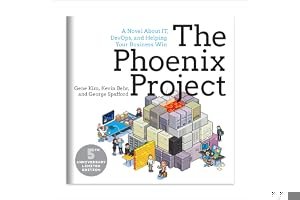
Bill is an IT manager at Parts Unlimited. It's Tuesday morning and on his drive into the office, Bill gets a call from the CEO.
The company's new IT initiative, code named Phoenix Project, is critical to the future of Parts Unlimited, but the project is massively over budget and very late. The CEO wants Bill to report directly to him and fix the mess in ninety days or else Bill's entire department will be outsourced.
With the help of a prospective board member and his mysterious philosophy of The Three Ways, Bill starts to see that IT work has more in common with manufacturing plant work than he ever imagined. With the clock ticking, Bill must organize work flow streamline interdepartmental communications, and effectively serve the other business functions at Parts Unlimited.
In a fast-paced and entertaining style, three luminaries of the DevOps movement deliver a story that anyone who works in IT will recognize. Readers will not only learn how to improve their own IT organizations, they'll never view IT the same way again.
…
Recommended by Jeffrey Snover and Louis Nyffenegger.
Jeffrey Snover
Great thread. I know of a number of devops people that haven't read this book. Ya'll should fix that. https://t.co/Yri4JJ0jBZ [source]
Louis Nyffenegger
I don't think I have a specific book that I can call my favourite. Some books have had a big impact on my view of how to build a product/company ("Rework"), some were very enjoyable to read ("The Phoenix Project"), some helped me improve the way I think ("The Pleasure Of Finding Things Out") and some the way I live ("Essentialism") or work ("Deep Work"). [source]
Cover unavailable
4
Clean Code: A Handbook of Agile Software Craftsmanship
Robert C. Martin
4.8
Even bad code can function. But if code isn t clean, it can bring a development organization to its knees. Every year, countless hours and significant resources are lost because of poorly written code. But it doesn t have to be that way. Noted software expert Robert C. Martin presents a revolutionary paradigm with Clean Code: A Handbook of Agile Software Craftsmanship. Martin has teamed up with his colleagues from Object Mentor to distill their best agile practice of cleaning code on the fly into a book that will instill within you the values of a software craftsman and make you a better programmer but only if you work at it. What kind of work will you be doing? You ll be reading code lots of code. And you will be challenged to think about what s right about that code, and what s wrong with it. More importantly, you will be challenged to reassess your professional values and your commitment to your craft. Clean Code is divided into three parts. The first describes the principles, patterns, and practices of writing clean code. The second part consists of several case studies of increasing complexity. Each case study is an exercise in cleaning up code of transforming a code base that has some problems into one that is sound and efficient. The third part is the payoff: a single chapter containing a list of heuristics and smells gathered while creating the case studies. The result is a knowledge base that describes the way we think when we write, read, and clean code. Readers will come away from this book understanding
How to tell the difference between good and bad code How to write good code and how to transform bad code into good code How to create good names, good functions, good objects, and good classes How to format code for maximum readability How to implement complete error handling without obscuring code logic How to unit test and practice test-driven development This book is a must for any developer, software engineer, project manager, team lead, or systems analyst with an interest in producing better code. "
…
Recommended by Ana Bell.
Ana Bell
This book is going to show you how to write code that is readable by yourself in the future, or by somebody else. You can sit on the couch and read it; you don’t need to code. You can actually enjoy it if you don’t know how to program at all. [source]
Cover unavailable
5
Bad Blood: Secrets and Lies in a Silicon Valley Startup
The full inside story of the breathtaking rise and shocking collapse of a multibillion-dollar startup, by the prize-winning journalist who first broke the story and pursued it to the end in the face of pressure and threats from the CEO and her lawyers.
In 2014, Theranos founder and CEO Elizabeth Holmes was widely seen as the female Steve Jobs: a brilliant Stanford dropout whose startup "unicorn" promised to revolutionize the medical industry with a machine that would make blood tests significantly faster and easier. Backed by investors such as Larry Ellison and Tim Draper, Theranos sold shares in a fundraising round that valued the company at $9 billion, putting Holmes's worth at an estimated $4.7 billion. There was just one problem: The technology didn't work.
For years, Holmes had been misleading investors, FDA officials, and her own employees. When Carreyrou, working at The Wall Street Journal, got a tip from a former Theranos employee and started asking questions, both Carreyrou and the Journal were threatened with lawsuits. Undaunted, the newspaper ran the first of dozens of Theranos articles in late 2015. By early 2017, the company's value was zero and Holmes faced potential legal action from the government and her investors. Here is the riveting story of the biggest corporate fraud since Enron, a disturbing cautionary tale set amid the bold promises and gold-rush frenzy of Silicon Valley.
A bunch of my friends recommended this one to me. Carreyrou gives you the definitive insider’s look at the rise and fall of Theranos. The story is even crazier than I expected, and I found myself unable to put it down once I started. This book has everything: elaborate scams, corporate intrigue, magazine cover stories, ruined family relationships, and the demise of a company once valued at nearly $10 billion. [source]
Finished “bad blood” on the Theranos scandal. Wow. Just wow. It’s a must read for everyone in tech and startups. Just 1-click buy it :) Amazing how far charisma and social proof got them. Here’s the NYT review of the book https://t.co/PyMGxfoG2R [source]
Brad Feld
Co-Founder/Foundry Group
Every entrepreneur and VC should read this book. John Carreyrou has done something important here. Maybe this book will finally put a nail in the phrase “fake it till you make it”, but I doubt it. The amount of lying, disingenuousness, blatant and unjustified self-promotion, and downright deceit that exists in entrepreneurship right now is at a local maximum. This always happens when entrepreneurship gets trendy. Carreyrou just wrote a long warning for entrepreneurs and VCs. [source]
Cover unavailable
6
The Lean Startup: How Today's Entrepreneurs Use Continuous Innovation to Create Radically Successful Businesses
Most startups fail. But many of those failures are preventable. The Lean Startup is a new approach being adopted across the globe, changing the way companies are built and new products are launched.
Eric Ries defines a startup as an organization dedicated to creating something new under conditions of extreme uncertainty. This is just as true for one person in a garage or a group of seasoned professionals in a Fortune 500 boardroom. What they have in common is a mission to penetrate that fog of uncertainty to discover a successful path to a sustainable business.
The Lean Startup approach fosters companies that are both more capital efficient and that leverage human creativity more effectively. Inspired by lessons from lean manufacturing, it relies on "validated learning," rapid scientific experimentation, as well as a number of counter-intuitive practices that shorten product development cycles, measure actual progress without resorting to vanity metrics, and learn what customers really want. It enables a company to shift directions with agility, altering plans inch by inch, minute by minute.
Rather than wasting time creating elaborate business plans, The Lean Startup offers entrepreneurs - in companies of all sizes - a way to test their vision continuously, to adapt and adjust before it's too late. Ries provides a scientific approach to creating and managing successful startups in a age when companies need to innovate more than ever.
At Asana, we've been lucky to benefit from the author's advice firsthand; this book will enable him to help many more entrepreneurs answer the tough questions about their business. [source]
Cover unavailable
7
Zero to One: Notes on Startups, or How to Build the Future
If you want to build a better future, you must believe in secrets.
The great secret of our time is that there are still uncharted frontiers to explore and new inventions to create. In Zero to One, legendary entrepreneur and investor Peter Thiel shows how we can find singular ways to create those new things.
Thiel begins with the contrarian premise that we live in an age of technological stagnation, even if we’re too distracted by shiny mobile devices to notice. Information technology has improved rapidly, but there is no reason why progress should be limited to computers or Silicon Valley. Progress can be achieved in any industry or area of business. It comes from the most important skill that every leader must master: learning to think for yourself.
Doing what someone else already knows how to do takes the world from 1 to n, adding more of something familiar. But when you do something new, you go from 0 to 1. The next Bill Gates will not build an operating system. The next Larry Page or Sergey Brin won’t make a search engine. Tomorrow’s champions will not win by competing ruthlessly in today’s marketplace. They will escape competition altogether, because their businesses will be unique.
Zero to One presents at once an optimistic view of the future of progress in America and a new way of thinking about innovation: it starts by learning to ask the questions that lead you to find value in unexpected places.
Few books on software project management have been as influential and timeless as The Mythical Man-Month. With a blend of software engineering facts and thought-provoking opinions, Fred Brooks offers insight for anyone managing complex projects. These essays draw from his experience as project manager for the IBM System/360 computer family and then for OS/360, its massive software system. Now, 20 years after the initial publication of his book, Brooks has revisited his original ideas and added new thoughts and advice, both for readers already familiar with his work and for readers discovering it for the first time.
The added chapters contain (1) a crisp condensation of all the propositions asserted in the original book, including Brooks' central argument in The Mythical Man-Month: that large programming projects suffer management problems different from small ones due to the division of labor; that the conceptual integrity of the product is therefore critical; and that it is difficult but possible to achieve this unity; (2) Brooks' view of these propositions a generation later; (3) a reprint of his classic 1986 paper "No Silver Bullet"; and (4) today's thoughts on the 1986 assertion, "There will be no silver bullet within ten years."
From "The Everything Store", written by Brad Stone “An influential computer scientist makes the counterintuitive argument that small groups of engineers are more effective than larger ones at handling complex software projects. The book lays out the theory behind Amazon’s two pizza teams,” Stone writes. [source]
Elon Musk, the entrepreneur and innovator behind SpaceX, Tesla, and SolarCity, sold one of his internet companies, PayPal, for $1.5 billion. Ashlee Vance captures the full spectacle and arc of the genius's life and work, from his tumultuous upbringing in South Africa and flight to the United States to his dramatic technical innovations and entrepreneurial pursuits. Vance uses Musk's story to explore one of the pressing questions of our age: can the nation of inventors and creators who led the modern world for a century still compete in an age of fierce global competition? He argues that Musk is an amalgam of legendary inventors and industrialists including Thomas Edison, Henry Ford, Howard Hughes, and Steve Jobs. More than any other entrepreneur today, Musk has dedicated his energies and his own vast fortune to inventing a future that is as rich and far-reaching as the visionaries of the golden age of science-fiction fantasy
Elon Musk is a man after my own heart: a risk taker undaunted by setbacks and ever driven to ensure a bright future for humanity. Ashlee Vance's stellar biography captures Musk's remarkable life story and irrepressible spirit. [source]
I'm fascinated by Elon Musk, I own a Tesla, I read Ashlee Vance's biography on Elon Musk. I think he's a very interesting charachter. [source]
Andrea Loubier
Elon Musk: Tesla, SpaceX, and the Quest for a Fantastic Future as this was still in the first couple of years of me starting my own company, Mailbird and it was inspiring and visionary. It helps you go from a small voice in a big corporate company, to thinking big and voicing your wild opinions and creating plan to work towards it. [source]
Even the smartest among us can feel inept as we fail to figure out which light switch or oven burner to turn on, or whether to push, pull, or slide a door. The fault, argues this ingenious—even liberating—book, lies not in ourselves, but in product design that ignores the needs of users and the principles of cognitive psychology. The problems range from ambiguous and hidden controls to arbitrary relationships between controls and functions, coupled with a lack of feedback or other assistance and unreasonable demands on memorization. The Design of Everyday Things shows that good, usable design is possible. The rules are simple: make things visible, exploit natural relationships that couple function and control, and make intelligent use of constraints. The goal: guide the user effortlessly to the right action on the right control at the right time.
In this entertaining and insightful analysis, cognitive scientist Don Norman hails excellence of design as the most important key to regaining the competitive edge in influencing consumer behavior. Now fully expanded and updated, with a new introduction by the author, The Design of Everyday Things is a powerful primer on how—and why—some products satisfy customers while others only frustrate them.
…
Recommended by Andrew Chen, Marissa Mayer, Nir Eyal, and 23 others.
Grey Baker
I mainly read to decompress and change my state of mind, so it’s hard to point to an insight I read that helped me. Reading fiction has pulled me out of a bad mood more times than I can count, though, and always reenergises me to attack problems that had stumped me again. That said, I read and loved Norman Norman’s “The Design of Everyday Things”, and it’s helped me think through design problems ever since. [source]
Julia Enthoven
For people interested in designing or building software products: The Design of Everyday Things by Don Norman and The Lean Product Playbook by Dan Olsen. Both books have informed my product sense and helped me make decisions about great UX. [source]
Kaci Lambe
These three books are about how people actually use design in their lives. They helped me understand this very basic idea: There are no dumb users, only bad designers. Take the time to create based on how your design will be interacted with. Test it. Iterate. That's how you become a good designer. [source]
Cover unavailable
11
Code Complete
Steve McConnell
4.6
Widely considered one of the best practical guides to programming, Steve McConnell's original CODE COMPLETE has been helping developers write better software for more than a decade. Now this classic book has been fully updated and revised with leading-edge practices--and hundreds of new code samples--illustrating the art and science of software construction. Capturing the body of knowledge available from research, academia, and everyday commercial practice, McConnell synthesizes the most effective techniques and must-know principles into clear, pragmatic guidance. No matter what your experience level, development environment, or project size, this book will inform and stimulate your thinking--and help you build the highest quality code. Discover the timeless techniques and strategies that help you:
Design for minimum complexity and maximum creativity Reap the benefits of collaborative development Apply defensive programming techniques to reduce and flush out errors Exploit opportunities to refactor--or evolve--code, and do it safely Use construction practices that are right-weight for your project Debug problems quickly and effectively Resolve critical construction issues early and correctly Build quality into the beginning, middle, and end of your project
…
Recommended by Jeff Atwood, Ana Bell, and Santiago Basulto.
Ana Bell
Code Complete is for people working in industry, writing software for companies. It has little checklists at key points in the book; if you are in industry, you can make sure that your code is readable and debugged by going through these checklists and making sure you’re touching upon all aspects. [source]
Santiago Basulto
If my career path is hackers turned business people, I’d say: Start with the basics and fundamentals: SICP: Structure and Interpretation of Computer Programs Code Complete 2 [source]
Cover unavailable
12
Weapons of Math Destruction: How Big Data Increases Inequality and Threatens Democracy
Longlisted for the National Book Award New York Times Bestseller
A former Wall Street quant sounds an alarm on the mathematical models that pervade modern life -- and threaten to rip apart our social fabric
We live in the age of the algorithm. Increasingly, the decisions that affect our lives--where we go to school, whether we get a car loan, how much we pay for health insurance--are being made not by humans, but by mathematical models. In theory, this should lead to greater fairness: Everyone is judged according to the same rules, and bias is eliminated.
But as Cathy O'Neil reveals in this urgent and necessary book, the opposite is true. The models being used today are opaque, unregulated, and uncontestable, even when they're wrong. Most troubling, they reinforce discrimination: If a poor student can't get a loan because a lending model deems him too risky (by virtue of his zip code), he's then cut off from the kind of education that could pull him out of poverty, and a vicious spiral ensues. Models are propping up the lucky and punishing the downtrodden, creating a "toxic cocktail for democracy." Welcome to the dark side of Big Data.
Tracing the arc of a person's life, O'Neil exposes the black box models that shape our future, both as individuals and as a society. These "weapons of math destruction" score teachers and students, sort resumes, grant (or deny) loans, evaluate workers, target voters, set parole, and monitor our health.
O'Neil calls on modelers to take more responsibility for their algorithms and on policy makers to regulate their use. But in the end, it's up to us to become more savvy about the models that govern our lives. This important book empowers us to ask the tough questions, uncover the truth, and demand change.
-- Longlist for National Book Award (Non-Fiction) -- Goodreads, semi-finalist for the 2016 Goodreads Choice Awards (Science and Technology) -- Kirkus, Best Books of 2016 -- New York Times, 100 Notable Books of 2016 (Non-Fiction) -- The Guardian, Best Books of 2016 -- WBUR's "On Point," Best Books of 2016: Staff Picks -- Boston Globe, Best Books of 2016, Non-Fiction
…
Recommended by Paula Boddington and Ramesh Srinivasan.
Paula Boddington
How the use of algorithms has affected people’s lives and occasionally ruined them. [source]
Ramesh Srinivasan
This book is a really fantastic analysis of how quantification, the collection of data, the modelling around data, the predictions made by using data, the algorithmic and quantifiable ways of predicting behaviour based on data, are all built by elites for elites and end up, quite frankly, screwing over everybody else. [source]
Cover unavailable
13
Don't Make Me Think, Revisited: A Common Sense Approach to Web Usability
Steve Krug
4.5
Since Don’t Make Me Think was first published in 2000, over 400,000 Web designers and developers have relied on Steve Krug’s guide to help them understand the principles of intuitive navigation and information design.
In this 3rd edition, Steve returns with fresh perspective to reexamine the principles that made Don’t Make Me Think a classic-–with updated examples and a new chapter on mobile usability. And it’s still short, profusely illustrated…and best of all–fun to read.
If you’ve read it before, you’ll rediscover what made Don’t Make Me Think so essential to Web designers and developers around the world. If you’ve never read it, you’ll see why so many people have said it should be required reading for anyone working on Web sites.
…
Recommended by Brian Armstrong, Jeff Atwood, Ken Norton, and 13 others.
Anoop Anthony
Krug was teaching usability two decades ago when UX wasn't a buzzword, and the WWW was still in its nascent stages. (The first edition of this book was published in 2000!) I cut my teeth on Don't make me think back when I first started out in the industry. It is now in its third edition and still relevant — it offers compelling insights into building great user experiences into websites and applications. [source]
Auston Bunsen
I’m actually a self-taught programmer, so these books have really helped me with practical skills that I could put to use & yield results. The return on investment for these kinds of books is off the charts for me! [source]
Chris Goward
Here are some of the books that have been very impactful for me, or taught me a new way of thinking: … Don't Make Me Think. [source]
Superintelligence asks the questions: what happens when machines surpass humans in general intelligence? Will artificial agents save or destroy us? Nick Bostrom lays the foundation for understanding the future of humanity and intelligent life.
The human brain has some capabilities that the brains of other animals lack. It is to these distinctive capabilities that our species owes its dominant position. If machine brains surpassed human brains in general intelligence, then this new superintelligence could become extremely powerful--possibly beyond our control. As the fate of the gorillas now depends more on humans than on the species itself, so would the fate of humankind depend on the actions of the machine superintelligence.
But we have one advantage: we get to make the first move. Will it be possible to construct a seed Artificial Intelligence, to engineer initial conditions so as to make an intelligence explosion survivable? How could one achieve a controlled detonation?
…
Recommended by Elon Musk, Maria Ramos, and Will MacAskill.
Worth reading Superintelligence by Bostrom. We need to be super careful with AI. Potentially more dangerous than nukes. [source]
Maria Ramos
CEO/Barclays Africa
Ramos will take the summer to examine some of the questions weighing more heavily on humankind as we contemplate our collective future: what happens when we can write our own genetic codes, and what happens when we create technology that is meaningfully more intelligent than us. The Gene: An Intimate History—Siddhartha Mukherjee Superintelligence: Paths, Dangers, Strategies—Nick Bostrom The Ministry of Utmost Happiness—Arundhati Roy [source]
Will MacAskill
I picked this book because the possibility of us developing human-level artificial intelligence, and from there superintelligence—an artificial agent that is considerably more intelligent than we are—is at least a contender for the most important issue in the next two centuries. Bostrom’s book has been very influential in effective altruism, lots of people work on artificial intelligence in order to ensure that it is developed safely. I don’t agree with the entire contents of the book, but there are many compelling arguments in it. It would be extremely overconfident to dismiss this book as too speculative. In fact, I think there should be a lot more work that tries to understand the biggest challenges for the next two hundred years, and what we could do to try to overcome them. [source]
Cover unavailable
15
The Clean Coder: A Code of Conduct for Professional Programmers
Programmers who endure and succeed amidst swirling uncertainty and nonstop pressure share a common attribute: They care deeply about the practice of creating software. They treat it as a craft. They are professionals. In The Clean Coder: A Code of Conduct for Professional Programmers, legendary software expert Robert C. Martin introduces the disciplines, techniques, tools, and practices of true software craftsmanship. This book is packed with practical advice-about everything from estimating and coding to refactoring and testing. It covers much more than technique: It is about attitude. Martin shows how to approach software development with honor, self-respect, and pride; work well and work clean; communicate and estimate faithfully; face difficult decisions with clarity and honesty; and understand that deep knowledge comes with a responsibility to act. Readers will learn What it means to behave as a true software craftsman How to deal with conflict, tight schedules, and unreasonable managers How to get into the flow of coding, and get past writer's block How to handle unrelenting pressure and avoid burnout How to combine enduring attitudes with new development paradigms How to manage your time, and avoid blind alleys, marshes, bogs, and swamps How to foster environments where programmers and teams can thrive When to say "No"-and how to say it When to say "Yes"-and what yes really means Great software is something to marvel at: powerful, elegant, functional, a pleasure to work with as both a developer and as a user. Great software isn't written by machines. It is written by professionals with an unshakable commitment to craftsmanship. The Clean Coder will help you become one of them-and earn the pride and fulfillment that they alone possess.
100,000 years ago, at least six human species inhabited the earth. Today there is just one. Us. Homo sapiens.
How did our species succeed in the battle for dominance? Why did our foraging ancestors come together to create cities and kingdoms? How did we come to believe in gods, nations and human rights; to trust money, books and laws; and to be enslaved by bureaucracy, timetables and consumerism? And what will our world be like in the millennia to come?
In Sapiens, Dr Yuval Noah Harari spans the whole of human history, from the very first humans to walk the earth to the radical – and sometimes devastating – breakthroughs of the Cognitive, Agricultural and Scientific Revolutions. Drawing on insights from biology, anthropology, paleontology and economics, he explores how the currents of history have shaped our human societies, the animals and plants around us, and even our personalities. Have we become happier as history has unfolded? Can we ever free our behaviour from the heritage of our ancestors? And what, if anything, can we do to influence the course of the centuries to come?
Bold, wide-ranging and provocative, Sapiens challenges everything we thought we knew about being human: our thoughts, our actions, our power ... and our future.
Both Melinda and I read this one, and it has sparked lots of great conversations at our dinner table. Harari takes on a daunting challenge: to tell the entire history of the human race in just 400 pages. He also writes about our species today and how artificial intelligence, genetic engineering, and other technologies will change us in the future. Although I found things to disagree with—especially Harari’s claim that humans were better off before we started farming—I would recommend Sapiens to anyone who’s interested in the history and future of our species. [source]
Design Patterns: Elements of Reusable Object-Oriented Software
Erich; Helm John Gamma
4.5
Capturing a wealth of experience about the design of object-oriented software, four top-notch designers present a catalog of simple and succinct solutions to commonly occurring design problems. Previously undocumented, these 23 patterns allow designers to create more flexible, elegant, and ultimately reusable designs without having to rediscover the design solutions themselves.
The authors begin by describing what patterns are and how they can help you design object-oriented software. They then go on to systematically name, explain, evaluate, and catalog recurring designs in object-oriented systems. With Design Patterns as your guide, you will learn how these important patterns fit into the software development process, and how you can leverage them to solve your own design problems most efficiently.
Each pattern describes the circumstances in which it is applicable, when it can be applied in view of other design constraints, and the consequences and trade-offs of using the pattern within a larger design. All patterns are compiled from real systems and are based on real-world examples. Each pattern also includes code that demonstrates how it may be implemented in object-oriented programming languages like C++ or Smalltalk.
…
Cover unavailable
18
Refactoring: Improving the Design of Existing Code
Martin Fowler
4.5
Fully Revised and Updated-Includes New Refactorings and Code Examples"Any fool can write code that a computer can understand. Good programmers write code that humans can understand." --M. Fowler (1999) For more than twenty years, experienced programmers worldwide have relied on Martin Fowler's Refactoring to improve the design of existing code and to enhance software maintainability, as well as to make existing code easier to understand. This eagerly awaited new edition has been fully updated to reflect crucial changes in the programming landscape. Refactoring, Second Edition, features an updated catalog of refactorings and includes JavaScript code examples, as well as new functional examples that demonstrate refactoring without classes. Like the original, this edition explains what refactoring is; why you should refactor; how to recognize code that needs refactoring; and how to actually do it successfully, no matter what language you use. Understand the process and general principles of refactoring Quickly apply useful refactorings to make a program easier to comprehend and change Recognize "bad smells" in code that signal opportunities to refactor Explore the refactorings, each with explanations, motivation, mechanics, and simple examples Build solid tests for your refactorings Recognize tradeoffs and obstacles to refactoring Includes free access to the canonical web edition, with even more refactoring resources. (See inside the book for details about how to access the web edition.)
This is next on my list of technical books to read! Refactoring is one of two programming books that I’ve read multiple times (the other is Smalltalk Best Practice Patterns), and I’m due for another reading. What perfect time then to dive into Martin Fowler’s long anticipated 2nd edition, now using JavaScript rather than Java for the code examples. Like the stoic books, I read Refactoring and that Smalltalk book again and again not because I’m going to learn something new, per se, but because I want to be reminded about what I already know. And what better time to reread than just as we’re kicking off a new major project that needs a fresh architectural foundation. Also, these two books just remind every time of how much I love the craft of programming. It’s not just having the programs, it’s not just solving problems, it’s simply using my hands and head to program that in and of itself is sublime. [source]
Cover unavailable
19
Code: The Hidden Language of Computer Hardware and Software
Charles Petzold
4.5
What do flashlights, the British invasion, black cats, and seesaws have to do with computers? In CODE, they show us the ingenious ways we manipulate language and invent new means of communicating with each other. And through CODE, we see how this ingenuity and our very human compulsion to communicate have driven the technological innovations of the past two centuries.
Using everyday objects and familiar language systems such as Braille and Morse code, author Charles Petzold weaves an illuminating narrative for anyone who’s ever wondered about the secret inner life of computers and other smart machines.
It’s a cleverly illustrated and eminently comprehensible story—and along the way, you’ll discover you’ve gained a real context for understanding today’s world of PCs, digital media, and the Internet. No matter what your level of technical savvy, CODE will charm you—and perhaps even awaken the technophile within.
…
Recommended by Ana Bell.
Ana Bell
It gets you to use your imagination to virtually build a computer. It’s easy to read, you can lie down on the couch and enjoy it—it’s not so much of a textbook. It demystifies the magic of a computer and what it is. [source]
Cover unavailable
20
Designing Data-Intensive Applications
Martin Kleppmann
4.5
Many forces affect software today: larger datasets, geographical disparities, complex company structures, and the growing need to be fast and nimble in the face of change.
Proven approaches such as service-oriented and event-driven architectures are joined by newer techniques such as microservices, reactive architectures, DevOps, and stream processing. Many of these patterns are successful by themselves, but as this practical ebook demonstrates, they provide a more holistic and compelling approach when applied together.
Author Ben Stopford explains how service-based architectures and stream processing tools such as Apache Kafka® can help you build business-critical systems.
* Learn why streaming beats request-response based architectures in complex, contemporary use cases * Understand why replayable logs such as Kafka provide a backbone for both service communication and shared datasets * Explore how event collaboration and event sourcing patterns increase safety and recoverability with functional, event-driven approaches * Apply patterns including Event Sourcing and CQRS, and how to build multi-team systems with microservices and SOA using patterns such as “inside out databases” and “event streams as a source of truth” * Build service ecosystems that blend event-driven and request-driven interfaces using a replayable log and Kafka's Streams API * Scale beyond individual teams into larger, department- and company-sized architectures, using event streams as a source of truth
…
Cover unavailable
21
Life 3.0: Being Human in the Age of Artificial Intelligence
How will Artificial Intelligence affect crime, war, justice, jobs, society and our very sense of being human? The rise of AI has the potential to transform our future more than any other technology--and there's nobody better qualified or situated to explore that future than Max Tegmark, an MIT professor who's helped mainstream research on how to keep AI beneficial.
How can we grow our prosperity through automation without leaving people lacking income or purpose? What career advice should we give today's kids? How can we make future AI systems more robust, so that they do what we want without crashing, malfunctioning or getting hacked? Should we fear an arms race in lethal autonomous weapons? Will machines eventually outsmart us at all tasks, replacing humans on the job market and perhaps altogether? Will AI help life flourish like never before or give us more power than we can handle?
What sort of future do you want? This book empowers you to join what may be the most important conversation of our time. It doesn't shy away from the full range of viewpoints or from the most controversial issues--from superintelligence to meaning, consciousness and the ultimate physical limits on life in the cosmos.
As 2018 draws to a close, I’m continuing a favorite tradition of mine and sharing my year-end lists. It gives me a moment to pause and reflect on the year through the books I found most thought-provoking, inspiring, or just plain loved. It also gives me a chance to highlight talented authors – some who are household names and others who you may not have heard of before. Here’s my best of 2018 list. [source]
A compelling guide to the challenges and choices in our quest for a great future of life, intelligence and consciousness—on Earth and beyond. [source]
Cover unavailable
22
Structure and Interpretation of Computer Programs
Harold Abelson and Gerald Jay Sussman
4.5
Structure and Interpretation of Computer Programs has had a dramatic impact on computer science curricula over the past decade. This long-awaited revision contains changes throughout the text. There are new implementations of most of the major programming systems in the book, including the interpreters and compilers, and the authors have incorporated many small changes that reflect their experience teaching the course at MIT since the first edition was published. A new theme has been introduced that emphasizes the central role played by different approaches to dealing with time in computational models: objects with state, concurrent programming, functional programming and lazy evaluation, and nondeterministic programming. There are new example sections on higher-order procedures in graphics and on applications of stream processing in numerical programming, and many new exercises. In addition, all the programs have been reworked to run in any Scheme implementation that adheres to the IEEE standard.
…
Recommended by Max Levchin, Bret Victor, Hadley Wickham, and 2 others.
Max Levchin
Co-founder/PayPal, CEO/Affirm, Investor
Easier to read than "The Art of Computer Programming" end-to-end quickly. [source]
The most valuable thing this book gives you is confidence and knowledge to go and create your own programming language. [source]
John Maeda
@jesseddy The best book in classical and “hands-on example” terms is Structure and Interpretation of Computer Programs — but it requires maybe a year to get thru and for me, 10 years more to marinate over. *A* book is the one I am finishing now to come out Nov 2019. https://t.co/OODjQXgf1I [source]
Cover unavailable
23
Algorithms to Live By: The Computer Science of Human Decisions
A fascinating exploration of how insights from computer algorithms can be applied to our everyday lives, helping to solve common decision-making problems and illuminate the workings of the human mind
All our lives are constrained by limited space and time, limits that give rise to a particular set of problems. What should we do, or leave undone, in a day or a lifetime? How much messiness should we accept? What balance of new activities and familiar favorites is the most fulfilling? These may seem like uniquely human quandaries, but they are not: computers, too, face the same constraints, so computer scientists have been grappling with their version of such issues for decades. And the solutions they've found have much to teach us.
In a dazzlingly interdisciplinary work, acclaimed author Brian Christian and cognitive scientist Tom Griffiths show how the algorithms used by computers can also untangle very human questions. They explain how to have better hunches and when to leave things to chance, how to deal with overwhelming choices and how best to connect with others. From finding a spouse to finding a parking spot, from organizing one's inbox to understanding the workings of memory, Algorithms to Live By transforms the wisdom of computer science into strategies for human living.
…
Recommended by Doug McMillon, Chris Oliver, Emi Gal, and 2 others.
Here are some of my favorite reads from 2017. Lots of friends and colleagues send me book suggestions and it's impossible to squeeze them all in. I continue to be super curious about how digital and tech are enabling people to transform our lives but I try to read a good mix of books that apply to a variety of areas and stretch my thinking more broadly. [source]
Chris Oliver
This is a great book talking about how you can use computer science to help you make decisions in life. How do you know when to make a decision on the perfect house? Car? etc? It helps you apply algorithms to making those decisions optimally without getting lost. [source]
Emi Gal
When asked what books he would recommend to young people interested in his career path, mentioned Algorithms to Live By. [source]
Cover unavailable
24
The Hard Thing About Hard Things: Building a Business When There Are No Easy Answers
A lot of people talk about how great it is to start a business, but only Ben Horowitz is brutally honest about how hard it is to run one.
In The Hard Thing About Hard Things, Ben Horowitz, cofounder of Andreessen Horowitz and one of Silicon Valley's most respected and experienced entrepreneurs, draws on his own story of founding, running, selling, buying, managing, and investing in technology companies to offer essential advice and practical wisdom for navigating the toughest problems business schools don't cover. His blog has garnered a devoted following of millions of readers who have come to rely on him to help them run their businesses. A lifelong rap fan, Horowitz amplifies business lessons with lyrics from his favorite songs and tells it straight about everything from firing friends to poaching competitors, from cultivating and sustaining a CEO mentality to knowing the right time to cash in.
His advice is grounded in anecdotes from his own hard-earned rise—from cofounding the early cloud service provider Loudcloud to building the phenomenally successful Andreessen Horowitz venture capital firm, both with fellow tech superstar Marc Andreessen (inventor of Mosaic, the Internet's first popular Web browser). This is no polished victory lap; he analyzes issues with no easy answers through his trials, including
demoting (or firing) a loyal friend; whether you should incorporate titles and promotions, and how to handle them; if it's OK to hire people from your friend's company; how to manage your own psychology, while the whole company is relying on you; what to do when smart people are bad employees; why Andreessen Horowitz prefers founder CEOs, and how to become one; whether you should sell your company, and how to do it. Filled with Horowitz's trademark humor and straight talk, and drawing from his personal and often humbling experiences, The Hard Thing About Hard Things is invaluable for veteran entrepreneurs as well as those aspiring to their own new ventures.
Ben's book is a great read - with uncomfortable truths about entrepreneurship and how to lead to a company. It's also an inspiring story of a business rebirth through sheer willpower. [source]
Ben's experience and expertise make him one of the most important leaders not just in Silicon Valley but also in the global knowledge economy. For anyone interested in building, growing or leading a great company, this book is an incredibly valuable resource - and a funny and insightful read. [source]
Drew Houston
CEO/Dropbox
One of the great things that the author wrote in this book is the hardest part of being a CEO is managing your psychology. [source]
Cover unavailable
25
The Everything Store: Jeff Bezos and the Age of Amazon
The definitive story of Amazon.com, one of the most successful companies in the world, and of its driven, brilliant founder, Jeff Bezos.
Amazon.com started off delivering books through the mail. But its visionary founder, Jeff Bezos, wasn't content with being a bookseller. He wanted Amazon to become the everything store, offering limitless selection and seductive convenience at disruptively low prices. To do so, he developed a corporate culture of relentless ambition and secrecy that's never been cracked. Until now. Brad Stone enjoyed unprecedented access to current and former Amazon employees and Bezos family members, giving readers the first in-depth, fly-on-the-wall account of life at Amazon. Compared to tech's other elite innovators--Jobs, Gates, Zuckerberg--Bezos is a private man. But he stands out for his restless pursuit of new markets, leading Amazon into risky new ventures like the Kindle and cloud computing, and transforming retail in the same way Henry Ford revolutionized manufacturing.
The Everything Store will be the revealing, definitive biography of the company that placed one of the first and largest bets on the Internet and forever changed the way we shop and read.
…
Recommended by Doug McMillon, Aaron Watson, Alan Pierce, and 10 others.
I read and give this book because you need to understand what you’re up against. [source]
Aaron Watson
Amazon is going to rule the world unless governments decide to break them up. It just makes sense to understand the most powerful company on the planet. Also, there is a (small) chance that Amazon sets up HQ2 in my hometown (Pittsburgh). [source]
Alan Pierce
This was an amazing glimpse into one of the most disruptive companies in history as well as the past and future trajectory of e-commerce and retail. It is also a testament to unwavering self-belief. The thing that impressed me the most is that Jeff Bezos intentionally built an entire department dedicated to making his primary business obsolete which allowed him to take the lead in the next development, e-books. His foresight is extraordinary and he is an inspirational big thinker. [source]
Most business books give you the same old advice: Write a business plan, study the competition, seek investors, yadda yadda. If you're looking for a book like that, put this one back on the shelf.
Rework shows you a better, faster, easier way to succeed in business. Read it and you'll know why plans are actually harmful, why you don't need outside investors, and why you're better off ignoring the competition. The truth is, you need less than you think. You don't need to be a workaholic. You don't need to staff up. You don't need to waste time on paperwork or meetings. You don't even need an office. Those are all just excuses.
What you really need to do is stop talking and start working. This book shows you the way. You'll learn how to be more productive, how to get exposure without breaking the bank, and tons more counterintuitive ideas that will inspire and provoke you.
With its straightforward language and easy-is-better approach, Rework is the perfect playbook for anyone who’s ever dreamed of doing it on their own. Hardcore entrepreneurs, small-business owners, people stuck in day jobs they hate, victims of "downsizing," and artists who don’t want to starve anymore will all find valuable guidance in these pages.
Unperturbed by conventional wisdom, the authors start fresh and rewrite the rules of business. Their approach turns out to be as successful as it is counter-intuitive. [source]
If given a choice between investing in someone who has read Rework or has an MBA, I'm investing in Rework every time. This is a must read for every entrepreneur. [source]
Tony Hsieh
CEO/Zappos.com
The wisdom in these pages is edgy yet simple, straightforward, and proven. Read this book multiple times to help give you the courage you need to get out there and make something great. [source]
How do successful companies create products people can’t put down?
Why do some products capture widespread attention while others flop? What makes us engage with certain products out of sheer habit? Is there a pattern underlying how technologies hook us? Nir Eyal answers these questions (and many more) by explaining the Hook Model—a four-step process embedded into the products of many successful companies to subtly encourage customer behavior. Through consecutive “hook cycles,” these products reach their ultimate goal of bringing users back again and again without depending on costly advertising or aggressive messaging.
Hooked is based on Eyal’s years of research, consulting, and practical experience. He wrote the book he wished had been available to him as a start-up founder—not abstract theory, but a how-to guide for building better products. Hooked is written for product managers, designers, marketers, start-up founders, and anyone who seeks to understand how products influence our behavior.
Eyal provides readers with:
• Practical insights to create user habits that stick. • Actionable steps for building products people love.
• Fascinating examples from the iPhone to Twitter, Pinterest to the Bible App, and many other habit-forming products.
…
Recommended by Andrew Chen, Nir Eyal, Ken Norton, and 41 others.
Matt Mullenweg
Founder & CEO/Automattic
Hooked gives you the blueprint for the next generation of products. Read Hooked or the company that replaces you will. [source]
Boris Veldhuijzen van Zanten
The book everyone in Silicon Valley is talking about. [source]
Chandini Jain
One of the five books Chandini would you recommend to young people interested in her career path. [source]
Cover unavailable
28
The Innovators: How a Group of Hackers, Geniuses and Geeks Created the Digital Revolution
Walter Isaacson
4.4
The computer and the internet are among the most important innovations of our era, but few people know who created them. They were not conjured up in a garret or garage by solo inventors suitable to be singled out on magazine covers or put into a pantheon with Edison, Bell, and Morse. Instead, most of the innovations of the digital age were done collaboratively. There were a lot of fascinating people involved, some ingenious and a few even geniuses. This is the story of these pioneers, hackers, inventors, and entrepreneurs—who they were, how their minds worked, and what made them so creative. It’s also a narrative of how they collaborated and why their ability to work as teams made them even more creative.”
…
Recommended by Brian Burkhart, Chris Fussell, Chris Oliver, and 4 others.
Brian Burkhart
This book is essentially a biography of all the people who’ve led to the technology of today—it’s fascinating. The most important point of the book is everything is one long, connected chain. There isn’t just one person or one industry that makes anything happen—it all goes way back. For example, the communication theory I have espoused and taught throughout my career is from Aristotle, Socrates, and Plato. Yeah, I’ve got my own spin on it—instead of ethos, pathos and logos, we say “know, feel, and do.” But it’s still based on their philosophies. Reading this book, I realized it’s not just someone like Steve Jobs who’s responsible for the era we live in. Rather, it’s Steve Jobs plus a whole lot of people from the last 200-plus years. [source]
I'm currently reading Innovators by Walter Isaacson. I love reading books like this because you learn about the lives of people who have created amazing things. It teaches you that their lives were often much harder than you realize and the struggles you're going through are very similar to what they had to go through before they were successful. It's really inspirational. [source]
Cover unavailable
29
Domain-Driven Design: Tackling Complexity in the Heart of Software
Eric Evans
4.4
"Eric Evans has written a fantastic book on how you can make the design of your software match your mental model of the problem domain you are addressing. "His book is very compatible with XP. It is not about drawing pictures of a domain; it is about how you think of it, the language you use to talk about it, and how you organize your software to reflect your improving understanding of it. Eric thinks that learning about your problem domain is as likely to happen at the end of your project as at the beginning, and so refactoring is a big part of his technique. "The book is a fun read. Eric has lots of interesting stories, and he has a way with words. I see this book as essential reading for software developers--it is a future classic." --Ralph Johnson, author of Design Patterns "If you don't think you are getting value from your investment in object-oriented programming, this book will tell you what you've forgotten to do. "Eric Evans convincingly argues for the importance of domain modeling as the central focus of development and provides a solid framework and set of techniques for accomplishing it. This is timeless wisdom, and will hold up long after the methodologies du jour have gone out of fashion." --Dave Collins, author of Designing Object-Oriented User Interfaces "Eric weaves real-world experience modeling--and building--business applications into a practical, useful book. Written from the perspective of a trusted practitioner, Eric's descriptions of ubiquitous language, the benefits of sharing models with users, object life-cycle management, logical and physical application structuring, and the process and results of deep refactoring are major contributions to our field." --Luke Hohmann, author of Beyond Software Architecture "This book belongs on the shelf of every thoughtful software developer." --Kent Beck "What Eric has managed to capture is a part of the design process that experienced object designers have always used, but that we have been singularly unsuccessful as a group in conveying to the rest of the industry. We've given away bits and pieces of this knowledge...but we've never organized and systematized the principles of building domain logic. This book is important." --Kyle Brown, author of Enterprise Java(TM) Programming with IBM(R) WebSphere(R) The software development community widely acknowledges that domain modeling is central to software design. Through domain models, software developers are able to express rich functionality and translate it into a software implementation that truly serves the needs of its users. But despite its obvious importance, there are few practical resources that explain how to incorporate effective domain modeling into the software development process. Domain-Driven Design fills that need. This is not a book about specific technologies. It offers readers a systematic approach to domain-driven design, presenting an extensive set of design best practices, experience-based techniques, and fundamental principles that facilitate the development of software projects facing complex domains. Intertwining design and development practice, this book incorporates numerous examples based on actual projects to illustrate the application of domain-driven design to real-world software development. Readers learn how to use a domain model to make a complex development effort more focused and dynamic. A core of best practices and standard patterns provides a common language for the development team. A shift in emphasis--refactoring not just the code but the model underlying the code--in combination with the frequent iterations of Agile development leads to deeper insight into domains and enhanced communication between domain expert and programmer. Domain-Driven Design then builds on this foundation, and addresses modeling and design for complex systems and larger organizations.Specific topics covered include: Getting all team members to speak the same language Connecting model and implementation more deeply Sharpening key distinctions in a model Managing the lifecycle of a domain object Writing domain code that is safe to combine in elaborate ways Making complex code obvious and predictable Formulating a domain vision statement Distilling the core of a complex domain Digging out implicit concepts needed in the model Applying analysis patterns Relating design patterns to the model Maintaining model integrity in a large system Dealing with coexisting models on the same project Organizing systems with large-scale structures Recognizing and responding to modeling breakthroughs With this book in hand, object-oriented developers, system analysts, and designers will have the guidance they need to organize and focus their work, create rich and useful domain models, and leverage those models into quality, long-lasting software implementations.
Amazon, Apple, Facebook, and Google are the four most influential companies on the planet. Just about everyone thinks they know how they got there. Just about everyone is wrong.
For all that's been written about the Four over the last two decades, no one has captured their power and staggering success as insightfully as Scott Galloway.
Instead of buying the myths these compa-nies broadcast, Galloway asks fundamental questions. How did the Four infiltrate our lives so completely that they're almost impossible to avoid (or boycott)? Why does the stock market forgive them for sins that would destroy other firms? And as they race to become the world's first trillion-dollar company, can anyone chal-lenge them?
In the same irreverent style that has made him one of the world's most celebrated business professors, Galloway deconstructs the strategies of the Four that lurk beneath their shiny veneers. He shows how they manipulate the fundamental emotional needs that have driven us since our ancestors lived in caves, at a speed and scope others can't match. And he reveals how you can apply the lessons of their ascent to your own business or career.
Whether you want to compete with them, do business with them, or simply live in the world they dominate, you need to understand the Four.
…
Recommended by Angela Pham, Cat Williams-Treloar, Craig Pearce, and 1 others.
Angela Pham
I’m in the middle of The Four, which takes an awestruck-but-critical look at the four largest tech companies. [source]
Cat Williams-Treloar
Scott Galloway "The four" - because that's where the Marketing world is. I like the book for its honesty. [source]
Craig Pearce
I am currently reading The Four: The Hidden DNA of Amazon, Apple, Facebook, and Google. I was introduced to the author, Scott Galloway during his appearance on the aforementioned Recode Decode podcast, specifically episode released on September 14. His opinion and thoughts on the big 4 (Apple, Amazon, Facebook and Google) lead me to research him. I put a hold on his book from my local library and waited a few weeks. A great thing about this book is its recency, for example, it includes Amazon’s recent acquisition of WholeFoods. So far, it has covered, in entertaining detail, Amazon and Apple. The author writes with great knowledge, mixed with the right amount of wit. The author argues that Apple is sex, Google is God, Facebook is love and Amazon is our gut. By aligning with these roles in our lives, they have become wildly successful. I hope to hear an expansion of his positions he discussed on the podcast, and hope to apply some of strategies into my own startup. [source]
Cover unavailable
31
The Age of Surveillance Capitalism: The Fight for a Human Future at the New Frontier of Power
The challenges to humanity posed by the digital future, the first detailed examination of the unprecedented form of power called "surveillance capitalism," and the quest by powerful corporations to predict and control our behavior.
In this masterwork of original thinking and research, Shoshana Zuboff provides startling insights into the phenomenon that she has named surveillance capitalism. The stakes could not be higher: a global architecture of behavior modification threatens human nature in the twenty-first century just as industrial capitalism disfigured the natural world in the twentieth.
Zuboff vividly brings to life the consequences as surveillance capitalism advances from Silicon Valley into every economic sector. Vast wealth and power are accumulated in ominous new "behavioral futures markets," where predictions about our behavior are bought and sold, and the production of goods and services is subordinated to a new "means of behavioral modification."
The threat has shifted from a totalitarian Big Brother state to a ubiquitous digital architecture: a "Big Other" operating in the interests of surveillance capital. Here is the crucible of an unprecedented form of power marked by extreme concentrations of knowledge and free from democratic oversight. Zuboff's comprehensive and moving analysis lays bare the threats to twenty-first century society: a controlled "hive" of total connection that seduces with promises of total certainty for maximum profit--at the expense of democracy, freedom, and our human future.
With little resistance from law or society, surveillance capitalism is on the verge of dominating the social order and shaping the digital future--if we let it.
Table of contents
INTRODUCTION 1. Home or exile in the digital future
I. THE FOUNDATIONS OF SURVEILLANCE CAPITALISM 2. August 9, 2011: Setting the stage for Surveillance Capitalism 3. The discovery of behavioral surplus 4. The moat around the castle 5. The elaboration of Surveillance Capitalism: Kidnap, corner, compete 6. Hijacked: The division of learning in society
II. THE ADVANCE OF SURVEILLANCE CAPITALISM 7. The reality business 8. Rendition: From experience to data 9. Rendition from the depths 10. Make them dance 11. The right to the future tense
III. INSTRUMENTARIAN POWER FOR A THIRD MODERNITY 12. Two species of power 13. Big Other and the rise of instrumentarian power 14. A utopia of certainty 15, The instrumentarian collective 16. Of life in the hive 17. The right to sanctuary
CONCLUSION 18. A coup from above
Acknowledgements About the author Detailed table of contents Notes Index
…
Recommended by Clive Lewis Mp, Dilip Cherian, John Tasioulas, and 3 others.
Clive Lewis Mp
Cant make the brilliant event below? Havent had a chance to read @shoshanazuboff groundbreaking book, ‘Surveillance Capitalism’? Then listen to this brilliant interview with the author as she explains the terrifying scale&ambition of Facebook/Google et al https://t.co/DCtNlFbmE0 https://t.co/ZX0YpW5pOo [source]
Dilip Cherian
Brave New World? Thanks @shoshanazuboff for that amazing book. It's compulsory reading for those trying to make sense of our world now. https://t.co/5nBJWoLS9p [source]
John Tasioulas
2019... Best book: Shoshana Zuboff, “The Age of Surveillance Capitalism: The Fight for a Human Future at the New Frontier of Power” Best political commentary: @HelenHet20 Best film @jokermovie Best restaurant: @farangLDN & @Trullo_LDN (London); Shinoki (Melbourne) [source]
Cover unavailable
32
Building Microservices: Designing Fine-Grained Systems
Sam Newman
4.3
Distributed systems have become more fine-grained in the past 10 years, shifting from code-heavy monolithic applications to smaller, self-contained microservices. But developing these systems brings its own set of headaches. With lots of examples and practical advice, this book takes a holistic view of the topics that system architects and administrators must consider when building, managing, and evolving microservice architectures.
Microservice technologies are moving quickly. Author Sam Newman provides you with a firm grounding in the concepts while diving into current solutions for modeling, integrating, testing, deploying, and monitoring your own autonomous services. You'll follow a fictional company throughout the book to learn how building a microservice architecture affects a single domain.
Discover how microservices allow you to align your system design with your organization's goals Learn options for integrating a service with the rest of your system Take an incremental approach when splitting monolithic codebases Deploy individual microservices through continuous integration Examine the complexities of testing and monitoring distributed services Manage security with user-to-service and service-to-service models Understand the challenges of scaling microservice architectures
…
Cover unavailable
33
Effective Java
Joshua Bloch
4.3
Since this Jolt-award winning classic was last updated in 2008 (shortly after Java 6 was released), Java has changed dramatically. The principal enhancement in Java 8 was the addition of functional programming constructs to Java's object-oriented roots. Java 7, 8, and 9 also introduced language features, such as the try-with-resources statement, the diamond operator for generic types, default and static methods in interfaces, the @SafeVarargs annotation, and modules. New library features include pervasive use of functional interfaces and streams, the java.time package for manipulating dates and times, and numerous minor enhancements such as convenience factory methods for collections. In this new edition of Effective Java, Bloch updates the work to take advantage of these new language and library features, and provides specific best practices for their use. Java's increased support for multiple paradigms increases the need for best-practices advice, and this book delivers. As in previous editions, each chapter consists of several "items," each presented in the form of a short, standalone essay that provides specific advice, insight into Java platform subtleties, and updated code examples. The comprehensive descriptions and explanations for each item illuminate what to do, what not to do, and why. Coverage includes: Updated techniques and best practices on classic topics, including objects, classes, methods, libraries, and generics How to avoid the traps and pitfalls of commonly misunderstood subtleties of the platform Focus on the language and its most fundamental libraries, such as java.lang and java.util
…
Cover unavailable
34
JavaScript: The Good Parts
Douglas Crockford
4.3
Most programming languages contain good and bad parts, but JavaScript has more than its share of the bad, having been developed and released in a hurry before it could be refined. This authoritative book scrapes away these bad features to reveal a subset of JavaScript that's more reliable, readable, and maintainable than the language as a whole--a subset you can use to create truly extensible and efficient code.
Considered the JavaScript expert by many people in the development community, author Douglas Crockford identifies the abundance of good ideas that make JavaScript an outstanding object-oriented programming language-ideas such as functions, loose typing, dynamic objects, and an expressive object literal notation. Unfortunately, these good ideas are mixed in with bad and downright awful ideas, like a programming model based on global variables.
When Java applets failed, JavaScript became the language of the Web by default, making its popularity almost completely independent of its qualities as a programming language. In JavaScript: The Good Parts, Crockford finally digs through the steaming pile of good intentions and blunders to give you a detailed look at all the genuinely elegant parts of JavaScript, including:
Syntax Objects Functions Inheritance Arrays Regular expressions Methods Style Beautiful features The real beauty? As you move ahead with the subset of JavaScript that this book presents, you'll also sidestep the need to unlearn all the bad parts. Of course, if you want to find out more about the bad parts and how to use them badly, simply consult any other JavaScript book.
With JavaScript: The Good Parts, you'll discover a beautiful, elegant, lightweight and highly expressive language that lets you create effective code, whether you're managing object libraries or just trying to get Ajax to run fast. If you develop sites or applications for the Web, this book is an absolute must.
…
Recommended by Auston Bunsen.
Auston Bunsen
I’m actually a self-taught programmer, so these books have really helped me with practical skills that I could put to use & yield results. The return on investment for these kinds of books is off the charts for me! [source]
Edward Snowden, the man who risked everything to expose the US government’s system of mass surveillance, reveals for the first time the story of his life, including how he helped to build that system and what motivated him to try to bring it down.
In 2013, twenty-nine-year-old Edward Snowden shocked the world when he broke with the American intelligence establishment and revealed that the United States government was secretly pursuing the means to collect every single phone call, text message, and email. The result would be an unprecedented system of mass surveillance with the ability to pry into the private lives of every person on earth. Six years later, Snowden reveals for the very first time how he helped to build this system and why he was moved to expose it.
Spanning the bucolic Beltway suburbs of his childhood and the clandestine CIA and NSA postings of his adulthood, Permanent Record is the extraordinary account of a bright young man who grew up online—a man who became a spy, a whistleblower, and, in exile, the Internet’s conscience. Written with wit, grace, passion, and an unflinching candor, Permanent Record is a crucial memoir of our digital age and destined to be a classic.
Edward Snowden decided at the age of 29 to give up his entire future for the good of his country. He displayed enormous courage in doing so, and like him or not, his is an incredible American story. There is no doubt that the world is a better and more private place for his actions. Macmillan is enormously proud to publish Permanent Record. [source]
Btw @Snowden new book “Permanent Record” is quite good and surprisingly a love letter to the Internet as it was. [source]
Cover unavailable
36
Head First Design Patterns
Eric Freeman, Bert Bates, Kathy Sierra, Elisabeth Robson
4.3
You're not alone.
At any given moment, somewhere in the world someone struggles with the same software design problems you have. You know you don't want to reinvent the wheel (or worse, a flat tire), so you look to Design Patterns--the lessons learned by those who've faced the same problems. With Design Patterns, you get to take advantage of the best practices and experience of others, so that you can spend your time on...something else. Something more challenging. Something more complex. Something more fun.
You want to learn about the patterns that matter--why to use them, when to use them, how to use them (and when NOT to use them). But you don't just want to see how patterns look in a book, you want to know how they look "in the wild". In their native environment. In other words, in real world applications. You also want to learn how patterns are used in the Java API, and how to exploit Java's built-in pattern support in your own code.
You want to learn the real OO design principles and why everything your boss told you about inheritance might be wrong (and what to do instead). You want to learn how those principles will help the next time you're up a creek without a design pattern.
Most importantly, you want to learn the "secret language" of Design Patterns so that you can hold your own with your co-worker (and impress cocktail party guests) when he casually mentions his stunningly clever use of Command, Facade, Proxy, and Factory in between sips of a martini. You'll easily counter with your deep understanding of why Singleton isn't as simple as it sounds, how the Factory is so often misunderstood, or on the real relationship between Decorator, Facade and Adapter.
With Head First Design Patterns, you'll avoid the embarrassment of thinking Decorator is something from the "Trading Spaces" show. Best of all, in a way that won't put you to sleep! We think your time is too important (and too short) to spend it struggling with academic texts.
If you've read a Head First book, you know what to expect--a visually rich format designed for the way your brain works. Using the latest research in neurobiology, cognitive science, and learning theory, Head First Design Patterns will load patterns into your brain in a way that sticks. In a way that lets you put them to work immediately. In a way that makes you better at solving software design problems, and better at speaking the language of patterns with others on your team.
…
Cover unavailable
37
Working Effectively with Legacy Code
Michael Feathers
4.3
Get more out of your legacy systems, more performance, functionality, reliability, and manageability.Is your code easy to change? Can you get nearly instantaneous feedback when you do change it? Do you understand it? If the answer to any of these questions is no, you have legacy code, and it is draining time and money away from your development efforts.
In this book, Michael Feathers offers start-to-finish strategies for working more effectively with large, untested legacy code bases. This book draws on material Michael created for his renowned Object Mentor seminars, techniques Michael has used in mentoring to help hundreds of developers, technical managers, and testers bring their legacy systems under control.
The topics covered include:
Understanding the mechanics of software change, adding features, fixing bugs, improving design, optimizing performance Getting legacy code into a test harness Writing tests that protect you against introducing new problems Techniques that can be used with any language or platform, with examples in Java, C++, C, and C# Accurately identifying where code changes need to be made Coping with legacy systems that aren't object-oriented Handling applications that don't seem to have any structure
This book also includes a catalog of twenty-four dependency-breaking techniques that help you work with program elements in isolation and make safer changes.
…
Cover unavailable
38
In the Plex: How Google Thinks, Works, and Shapes Our Lives
Steven Levy
4.3
Written with full cooperation from top management, including cofounders Sergey Brin and Larry Page, this is the inside story behind Google, the most successful and most admired technology company of our time, told by one of our best technology writers.
Few companies in history have ever been as successful and as admired as Google, the company that has transformed the Internet and become an indispensable part of our lives. How has Google done it? Veteran technology reporter Steven Levy was granted unprecedented access to the company, and in this revelatory book he takes readers inside Google headquarters—the Googleplex—to show how Google works.
While they were still students at Stanford, Google cofounders Larry Page and Sergey Brin revolutionized Internet search. They followed this brilliant innovation with another, as two of Google’s earliest employees found a way to do what no one else had: make billions of dollars from Internet advertising. With this cash cow, Google was able to expand dramatically and take on other transformative projects: more efficient data centers, open-source cell phones, free Internet video (YouTube), cloud computing, digitizing books, and much more.
The key to Google’s success in all these businesses, Levy reveals, is its engineering mind-set and adoption of such Internet values as speed, openness, experimentation, and risk taking. After its unapologetically elitist approach to hiring, Google pampers its engineers—free food and dry cleaning, on-site doctors and masseuses—and gives them all the resources they need to succeed. Even today, with a workforce of more than 23,000, Larry Page signs off on every hire.
But has Google lost its innovative edge? With its newest initiative, social networking, Google is chasing a successful competitor for the first time. Some employees are leaving the company for smaller, nimbler start-ups. Can the company that famously decided not to be evil still compete?
No other book has ever turned Google inside out as Levy does with In the Plex.
I’m currently reading “In the Plex: How Google Thinks, Works and Shapes Our Life" and am excited on gaining more insight into how google is changing the world and hopefully to get some valuable understanding I can use to maximize business decisions and read future trends while assessing investment opportunities for my company, ABM Investments. [source]
Bill Slawski
In The Plex is a great introduction to Google, and the many who work there. I knew many by the patents they file, so it was good to learn more about them as people. Some good insights to some algorithms in the book, too. https://t.co/TVz7GsD8nX [source]
Cover unavailable
39
Introduction To Algorithms
Thomas H. Cormen, Charles E. Leiserson, et al.
4.3
Cover unavailable
40
Patterns of Enterprise Application Architecture
Martin Fowler
4.3
The practice of enterprise application development has benefited from the emergence of many new enabling technologies. Multi-tiered object-oriented platforms, such as Java and .NET, have become commonplace. These new tools and technologies are capable of building powerful applications, but they are not easily implemented. Common failures in enterprise applications often occur because their developers do not understand the architectural lessons that experienced object developers have learned. Patterns of Enterprise Application Architecture is written in direct response to the stiff challenges that face enterprise application developers. The author, noted object-oriented designer Martin Fowler, noticed that despite changes in technology--from Smalltalk to CORBA to Java to .NET--the same basic design ideas can be adapted and applied to solve common problems. With the help of an expert group of contributors, Martin distills over forty recurring solutions into patterns. The result is an indispensable handbook of solutions that are applicable to any enterprise application platform. This book is actually two books in one. The first section is a short tutorial on developing enterprise applications, which you can read from start to finish to understand the scope of the book's lessons. The next section, the bulk of the book, is a detailed reference to the patterns themselves. Each pattern provides usage and implementation information, as well as detailed code examples in Java or C#. The entire book is also richly illustrated with UML diagrams to further explain the concepts. Armed with this book, you will have the knowledge necessary to make important architectural decisions about building an enterprise application and the proven patterns for use when building them. The topics covered include - Dividing an enterprise application into layers - The major approaches to organizing business logic - An in-depth treatment of mapping between objects and relational databases - Using Model-View-Controller to organize a Web presentation - Handling concurrency for data that spans multiple transactions - Designing distributed object interfaces
Imagine a world where your phone is too big for your hand, where your doctor prescribes a drug that is wrong for your body, where in a car accident you are 47% more likely to be seriously injured, where every week the countless hours of work you do are not recognised or valued. If any of this sounds familiar, chances are that you're a woman.
Invisible Women shows us how, in a world largely built for and by men, we are systematically ignoring half the population. It exposes the gender data gap – a gap in our knowledge that is at the root of perpetual, systemic discrimination against women, and that has created a pervasive but invisible bias with a profound effect on women’s lives.
Award-winning campaigner and writer Caroline Criado Perez brings together for the first time an impressive range of case studies, stories and new research from across the world that illustrate the hidden ways in which women are forgotten, and the impact this has on their health and well-being. From government policy and medical research, to technology, workplaces, urban planning and the media, Invisible Women reveals the biased data that excludes women. In making the case for change, this powerful and provocative book will make you see the world anew.
…
Recommended by Adam Wagner, Asher Wolf, Caitlin Moran, and 9 others.
Adam Wagner
@CCriadoPerez @MumsnetTowers I love this - the book, Poppy, the mug - it's so well composed! [source]
Asher Wolf
Tell me your best thing today. Mine was an amazing book and greeting card arrived in the post from the wonderful @MmeEmmeline https://t.co/GpEs2lg037 [source]
Caitlin Moran
@CCriadoPerez mate, I bow in admiration. it's an AMAZING, game-changing book. [source]
Cover unavailable
42
Hackers: Heroes of the Computer Revolution
Steven Levy
4.3
A mere fifteen years ago, computer nerds were seen as marginal weirdos, outsiders whose world would never resonate with the mainstream. That was before one pioneering work documented the underground computer revolution that was about to change our world forever. With groundbreaking profiles of Bill Gates, Steve Wozniak, MIT's Tech Model Railroad Club, and more, Steven Levy's Hackers brilliantly captured a seminal moment when the risk-takers and explorers were poised to conquer twentieth-century America's last great frontier. And in the Internet age, the hacker ethic-first espoused here-is alive and well.
…
Recommended by Ev Williams.
Cover unavailable
43
The Manager's Path: A Guide for Tech Leaders Navigating Growth and Change
Managing people is difficult wherever you work, but the tech industry as a whole is pretty bad at it. Tech companies in general lack the experience, tools, texts, and frameworks to do it well. And the handful of books that share tips and tricks of engineering management don t explain how to supervise employees in the face of growth and change.
In this book, author Camille Fournier takes you through the stages of technical management, from mentoring interns to working with the senior staff. You ll get actionable advice for approaching various obstacles in your path, whether you re a new manager, a mentor, or a more experienced leader looking for fresh advice. Pick up this book and learn how to become a better manager and leader in your organization.
• Discover how to manage small teams and large/multi-level teams • Understand how to build and bootstrap a unifying culture in teams • Deal with people problems and learn how to mentor other managers and new leaders • Learn how to manage yourself: avoid common pitfalls that challenge many leaders • Obtain several practices that you can incorporate and practice along the way
…
Cover unavailable
44
The Soul of a New Machine
Tracy Kidder
4.3
The computer revolution brought with it new methods of getting work done—just look at today's news for reports of hard-driven, highly-motivated young software and online commerce developers who sacrifice evenings and weekends to meet impossible deadlines. Tracy Kidder got a preview of this world in the late 1970s when he observed the engineers of Data General design and build a new 32-bit minicomputer in just one year. His thoughtful, prescient book, The Soul of a New Machine, tells stories of 35-year-old "veteran" engineers hiring recent college graduates and encouraging them to work harder and faster on complex and difficult projects, exploiting the youngsters' ignorance of normal scheduling processes while engendering a new kind of work ethic.
These days, we are used to the "total commitment" philosophy of managing technical creation, but Kidder was surprised and even a little alarmed at the obsessions and compulsions he found. From in-house political struggles to workers being permitted to tease management to marathon 24-hour work sessions, The Soul of a New Machine explores concepts that already seem familiar, even old-hat, less than 20 years later. Kidder plainly admires his subjects; while he admits to hopeless confusion about their work, he finds their dedication heroic. The reader wonders, though, what will become of it all, now and in the future. —Rob Lightner
…
Recommended by Satya Nadella, Scott Johnson, and Stephen Baker.
Scott Johnson
Tracy Kidder's The Soul of a New Machine. This was the first book that really took a deep dive into the process of creating a high tech product from scratch. Tracy really humanized the engineering process and made me realize that was the type of industry where I wanted to be. [source]
Stephen Baker
A marvelously detailed book, and I found it very inspiring. An interesting way of looking at how computing has utterly changed in the last 30 years. [source]
Cover unavailable
45
The Inevitable: Understanding the 12 Technological Forces That Will Shape Our Future
Kevin Kelly
4.3
From one of our leading technology thinkers and writers, a guide through the twelve technological imperatives that will shape the next thirty years and transform our lives
Much of what will happen in the next thirty years is inevitable, driven by technological trends that are already in motion. In this fascinating, provocative new book, Kevin Kelly provides an optimistic road map for the future, showing how the coming changes in our lives—from virtual reality in the home to an on-demand economy to artificial intelligence embedded in everything we manufacture—can be understood as the result of a few long-term, accelerating forces. Kelly both describes these deep trends—flowing, screening, accessing, sharing, filtering, remixing, tracking, and questioning—and demonstrates how they overlap and are codependent on one another. These larger forces will completely revolutionize the way we buy, work, learn, and communicate with each other. By understanding and embracing them, says Kelly, it will be easier for us to remain on top of the coming wave of changes and to arrange our day-to-day relationships with technology in ways that bring forth maximum benefits. Kelly’s bright, hopeful book will be indispensable to anyone who seeks guidance on where their business, industry, or life is heading—what to invent, where to work, in what to invest, how to better reach customers, and what to begin to put into place—as this new world emerges.
Kevin said: We’re at a time right now, an apex in our culture, that is more significant than the Industrial Revolution, in terms of how much it’s going to change the world. I love his first chapter. He said, ‘You’re never going to get really good at anything, because everything keeps being updated. [source]
This boook offers profound insight into what happens (soon!) when intelligence flows as easily into objects as electricity. [source]
Cover unavailable
46
Ready Player One
Ernest Cline
4.3
The bestselling cult classic--soon to be a major motion picture directed by Steven Spielberg.
At once wildly original and stuffed with irresistible nostalgia, READY PLAYER ONE is a spectacularly genre-busting, ambitious, and charming debut--part quest novel, part love story, and part virtual space opera set in a universe where spell-slinging mages battle giant Japanese robots, entire planets are inspired by Blade Runner, and flying DeLoreans achieve light speed.
It's the year 2045, and the real world is an ugly place.
Like most of humanity, Wade Watts escapes his grim surroundings by spending his waking hours jacked into the OASIS, a sprawling virtual utopia that lets you be anything you want to be, a place where you can live and play and fall in love on any of ten thousand planets.
And like most of humanity, Wade dreams of being the one to discover the ultimate lottery ticket that lies concealed within this virtual world. For somewhere inside this giant networked playground, OASIS creator James Halliday has hidden a series of fiendish puzzles that will yield massive fortune--and remarkable power--to whoever can unlock them.
For years, millions have struggled fruitlessly to attain this prize, knowing only that Halliday's riddles are based in the pop culture he loved--that of the late twentieth century. And for years, millions have found in this quest another means of escape, retreating into happy, obsessive study of Halliday's icons. Like many of his contemporaries, Wade is as comfortable debating the finer points of John Hughes's oeuvre, playing Pac-Man, or reciting Devo lyrics as he is scrounging power to run his OASIS rig.
And then Wade stumbles upon the first puzzle.
Suddenly the whole world is watching, and thousands of competitors join the hunt--among them certain powerful players who are willing to commit very real murder to beat Wade to this prize. Now the only way for Wade to survive and preserve everything he knows is to win. But to do so, he may have to leave behind his oh-so-perfect virtual existence and face up to life--and love--in the real world he's always been so desperate to escape.
A world at stake. A quest for the ultimate prize. Are you ready?
…
Recommended by Steve Jurvetson, Brian Armstrong, Astro Teller, and 5 others.
Steve Jurvetson
A gift to all of my Apple II programming buddies from high school and Dungeons & Dragons comrades. [source]
The last novel I read was Ernest Cline’s “Ready Player One: A Novel,” because my buddy Mike Maddock said, “You gotta read this book!” And I tore it up. I read the whole book in less than two days. It’s something I wish everyone, including myself, did more of. [source]
Cover unavailable
47
The Singularity is Near: When Humans Transcend Biology
The great inventor and futurist Ray Kurzweil is one of the best-known and controversial advocates for the role of machines in the future of humanity. In his latest, thrilling foray into the future, he envisions an event--thesingularity--in which technological change becomes so rapid and so profound that our bodies and brains will merge with our machines.
The Singularity Is Near portrays what life will be like after this event--a human-machine civilization where our experiences shift from real reality to virtual reality and where our intelligence becomes nonbiological and trillions of times more powerful than unaided human intelligence. In practical terms, this means that human aging and pollution will be reversed, world hunger will be solved, and our bodies and environment transformed by nanotechnology to overcome the limitations of biology, including death.
We will be able to create virtually any physical product just from information, resulting in radical wealth creation. In addition to outlining these fantastic changes, Kurzweil also considers their social and philosophical ramifications. With its radical but optimistic view of the course of human development, The Singularity Is Near is certain to be one of the most widely discussed and provocative books of 2005.
This book was recommended by Antonio when asked for titles he would recommend to young people interested in his career path. [source]
Mark O'Connell
I wouldn’t be the first to look at him this way but I read Kurzweil’s work as essentially a work of religious mysticism. I think there’s no other way to read it, really. [source]
Steve Aoki
It opened me up to the idea of science fiction becoming science fact. [source]
Cover unavailable
48
Crossing the Chasm: Marketing and Selling Disruptive Products to Mainstream Customers
The bible for bringing cutting-edge products to larger markets--now revised and updated with new insights into the realities of high-tech marketing
In Crossing the Chasm, Geoffrey A. Moore shows that in the Technology Adoption Life Cycle--which begins with innovators and moves to early adopters, early majority, late majority, and laggards--there is a vast chasm between the early adopters and the early majority. While early adopters are willing to sacrifice for the advantage of being first, the early majority waits until they know that the technology actually offers improvements in productivity. The challenge for innovators and marketers is to narrow this chasm and ultimately accelerate adoption across every segment.
This third edition brings Moore's classic work up to date with dozens of new examples of successes and failures, new strategies for marketing in the digital world, and Moore's most current insights and findings. He also includes two new appendices, the first connecting the ideas in Crossing the Chasm to work subsequently published in his Inside the Tornado, and the second presenting his recent groundbreaking work for technology adoption models for high-tech consumer markets.
…
Recommended by Andrew Chen, Drew Houston, Ev Williams, and 28 others.
Drew Houston
CEO/Dropbox
It’s about how do technology products make their way from early adopters t the mainstream. [source]
Ron Conway
Bestselling guide that created a new game plan for marketing in high-tech industries. [source]
This is a key component in my Purple Cow thinking, but with a twist. I'm not as worried about the chasm as I am about the desire of marketers to go for the big middle. [source]
Cover unavailable
49
The C Programming Language
Brian W. Kernighan, Dennis M. Ritchie
4.3
This book is meant to help the reader learn how to program in C. It is the definitive reference guide, now in a second edition. Although the first edition was written in 1978, it continues to be a worldwide best-seller. This second edition brings the classic original up to date to include the ANSI standard.
From the Preface: We have tried to retain the brevity of the first edition. C is not a big language, and it is not well served by a big book. We have improved the exposition of critical features, such as pointers, that are central to C programming. We have refined the original examples, and have added new examples in several chapters. For instance, the treatment of complicated declarations is augmented by programs that convert declarations into words and vice versa. As before, all examples have been tested directly from the text, which is in machine-readable form.
As we said in the first preface to the first edition, C "wears well as one's experience with it grows." With a decade more experience, we still feel that way. We hope that this book will help you to learn C and use it well.
…
Cover unavailable
50
Everybody Lies: Big Data, New Data, and What the Internet Can Tell Us About Who We Really Are
Blending the informed analysis of The Signal and the Noise with the instructive iconoclasm of Think Like a Freak, a fascinating, illuminating, and witty look at what the vast amounts of information now instantly available to us reveals about ourselves and our world—provided we ask the right questions.
By the end of an average day in the early twenty-first century, human beings searching the internet will amass eight trillion gigabytes of data. This staggering amount of information—unprecedented in history—can tell us a great deal about who we are—the fears, desires, and behaviors that drive us, and the conscious and unconscious decisions we make. From the profound to the mundane, we can gain astonishing knowledge about the human psyche that less than twenty years ago, seemed unfathomable.
Everybody Lies offers fascinating, surprising, and sometimes laugh-out-loud insights into everything from economics to ethics to sports to race to sex, gender and more, all drawn from the world of big data. What percentage of white voters didn’t vote for Barack Obama because he’s black? Does where you go to school effect how successful you are in life? Do parents secretly favor boy children over girls? Do violent films affect the crime rate? Can you beat the stock market? How regularly do we lie about our sex lives and who’s more self-conscious about sex, men or women?
Investigating these questions and a host of others, Seth Stephens-Davidowitz offers revelations that can help us understand ourselves and our lives better. Drawing on studies and experiments on how we really live and think, he demonstrates in fascinating and often funny ways the extent to which all the world is indeed a lab. With conclusions ranging from strange-but-true to thought-provoking to disturbing, he explores the power of this digital truth serum and its deeper potential—revealing biases deeply embedded within us, information we can use to change our culture, and the questions we’re afraid to ask that might be essential to our health—both emotional and physical. All of us are touched by big data everyday, and its influence is multiplying. Everybody Lies challenges us to think differently about how we see it and the world.
…
Recommended by Jj. Omojuwa and Ron Fournier.
Jj. Omojuwa
@SympLySimi Lol. Read this book. You’d love it. https://t.co/d2cLOyoiZ9 [source]
Ron Fournier
Just finished, “Everybody Lies” by @SethS_D, which in addition to being a tremendous education on Big Data, includes the best conclusion to a non-fiction book I’ve ever read. Read it. -30- [source]
Cover unavailable
51
The Innovator's Dilemma: When New Technologies Cause Great Firms to Fail
The bestselling classic on disruptive innovation, renowned author Clayton M. Christensen.
His work is cited by the world’s best-known thought leaders, from Steve Jobs to Malcolm Gladwell. In this classic bestseller—now updated with a fresh new package—innovation expert Clayton Christensen shows how even the most outstanding companies can do everything right—yet still lose market leadership. Read this international bestseller to avoid a similar fate.
Clay Christensen—who authored the award-winning Harvard Business Review article “How Will You Measure Your Life?”—explains why most companies miss out on new waves of innovation. No matter the industry, he says a successful company with established products WILL get pushed aside unless managers know how and when to abandon traditional business practices. Offering both successes and failures from leading companies as a guide, The Innovator’s Dilemma gives you a set of rules for capitalizing on the phenomenon of disruptive innovation.
Sharp, cogent, provocative, and one of the most influential business books of all time—The Innovator’s Dilemma is the book no manager or entrepreneur should be without. Add this newly released edition to your library.
Brad Stone's new book, The Everything Store, describes how Bezos developed this strategy after reading another book called The Innovator's Dilemma by Harvard professor Clayton Christensen. [source]
It's important that we make this transformation, because of what Clayton Christensen calls "the innovator's dilemma," where people who invent something are usually the last ones to see past it, and we certainly don't want to be left behind. [source]
Drew Houston
CEO/Dropbox
About how businesses get disrupted, and a lot of those themes are why startups can succeed and thrive even when there are big competitors who you would think would just wipe ’em out. [source]
Cover unavailable
52
How Google Works
Eric Schmidt
4.2
Both Eric Schmidt and Jonathan Rosenberg came to Google as seasoned Silicon Valley business executives, but over the course of a decade they came to see the wisdom in Coach John Wooden's observation that 'it's what you learn after you know it all that counts'. As they helped grow Google from a young start-up to a global icon, they relearned everything they knew about management. How Google Works is the sum of those experiences distilled into a fun, easy-to-read primer on corporate culture, strategy, talent, decision-making, communication, innovation, and dealing with disruption.
The authors explain how the confluence of three seismic changes - the internet, mobile, and cloud computing - has shifted the balance of power from companies to consumers. The companies that will thrive in this ever-changing landscape will be the ones that create superior products and attract a new breed of multifaceted employees whom the authors dub 'smart creatives'. The management maxims ('Consensus requires dissension', 'Exile knaves but fight for divas', 'Think 10X, not 10%') are illustrated with previously unreported anecdotes from Google's corporate history.
'Back in 2010, Eric and I created an internal class for Google managers,' says Rosenberg. 'The class slides all read 'Google confidential' until an employee suggested we uphold the spirit of openness and share them with the world. This book codifies the recipe for our secret sauce: how Google innovates and how it empowers employees to succeed.'
…
Recommended by Andreas Zhou, Cynthia Johnson, Gary Bury, and 4 others.
Andreas Zhou
After reading How Google Works I just became fascinated with Google culture and I hope to understand a bit more about what unique things they're doing right that we aren't. [source]
Cynthia Johnson
What happens is that we look at things Google, or Facebook, and we see these big corporate enterprises. We don’t see the fact that there are people inside running them, and there have been hurdles. [source]
Gary Bury
How Google Works is a good insight to a large corporate in the tech world. [source]
Cover unavailable
53
Site Reliability Engineering: How Google Runs Production Systems
Niall Richard Murphy, Betsy Beyer, et al.
4.2
The overwhelming majority of a software system's lifespan is spent in use, not in design or implementation. So, why does conventional wisdom insist that software engineers focus primarily on the design and development of large-scale computing systems?
In this collection of essays and articles, key members of Google's Site Reliability Team explain how and why their commitment to the entire lifecycle has enabled the company to successfully build, deploy, monitor, and maintain some of the largest software systems in the world. You'll learn the principles and practices that enable Google engineers to make systems more scalable, reliable, and efficient--lessons directly applicable to your organization.
This book is divided into four sections: Introduction--Learn what site reliability engineering is and why it differs from conventional IT industry practicesPrinciples--Examine the patterns, behaviors, and areas of concern that influence the work of a site reliability engineer (SRE)Practices--Understand the theory and practice of an SRE's day-to-day work: building and operating large distributed computing systemsManagement--Explore Google's best practices for training, communication, and meetings that your organization can use
…
Cover unavailable
54
Clean Architecture
Robert C. Martin
4.2
Building upon the success of best-sellers The Clean Coder and Clean Code, legendary software craftsman Robert C. "Uncle Bob" Martin shows how to bring greater professionalism and discipline to application architecture and design. As with his other books, Martin's Clean Architecture doesn't merely present multiple choices and options, and say "use your best judgment": it tells you what choices to make, and why those choices are critical to your success. Martin offers direct, no-nonsense answers to key architecture and design questions like:
What are the best high level structures for different kinds of applications, including web, database, thick-client, console, and embedded apps?
What are the core principles of software architecture?
What is the role of the architect, and what is he/she really trying to achieve?
What are the core principles of software design?
How do designs and architectures go wrong, and what can you do about it?
What are the disciplines and practices of professional architects and designers?
Clean Architecture is essential reading for every software architect, systems analyst, system designer, and software manager -- and for any programmer who aspires to these roles or is impacted by their work.
…
Cover unavailable
55
The DevOps Handbook: How to Create World-Class Agility, Reliability, and Security in Technology Organizations
Gene Kim, Patrick Debois, John Willis, Jez Humble, John Allspaw
4.2
Increase profitability, elevate work culture, and exceed productivity goals through DevOps practices.
More than ever, the effective management of technology is critical for business competitiveness. For decades, technology leaders have struggled to balance agility, reliability, and security. The consequences of failure have never been greater whether it's the healthcare.gov debacle, cardholder data breaches, or missing the boat with Big Data in the cloud.
And yet, high performers using DevOps principles, such as Google, Amazon, Facebook, Etsy, and Netflix, are routinely and reliably deploying code into production hundreds, or even thousands, of times per day.
Following in the footsteps of The Phoenix Project, The DevOps Handbook shows leaders how to replicate these incredible outcomes, by showing how to integrate Product Management, Development, QA, IT Operations, and Information Security to elevate your company and win in the marketplace."
Table of contents
Preface Spreading the Aha! Moment Introduction
PART I: THE THREE WAYS 1. Agile, continuous delivery and the three ways 2. The First Way: The Principles of Flow 3. The Second Way: The Principle of Feedback 4. The Third Way: The Principles of Continual Learning
PART II: WHERE TO START 5. Selecting which value stream to start with 6. Understanding the work in our value stream… 7. How to design our organization and architecture 8. How to get great outcomes by integrating operations into the daily work for development
PART III: THE FIRST WAY: THE TECHNICAL PRACTICES OF FLOW 9. Create the foundations of our deployment pipeline 10. Enable fast and reliable automated testing 11. Enable and practice continuous integration 12. Automate and enable low-risk releases 13. Architect for low-risk releases
PART IV: THE SECOND WAY: THE TECHNICAL PRACTICES OF FEEDBACK 14*. Create telemetry to enable seeing abd solving problems 15. Analyze telemetry to better anticipate problems 16. Enable feedbackso development and operation can safely deploy code 17. Integrate hypothesis-driven development and A/B testing into our daily work 18. Create review and coordination processes to increase quality of our current work
PART V: THE THRID WAY: THE TECHNICAL PRACTICES OF CONTINUAL LEARNING 19. Enable and inject learning into daily work 20. Convert local discoveries into global improvements 21. Reserve time to create organizational learning 22. Information security as everyone’s job, every day 23. Protecting the deployment pipeline
PART VI: CONCLUSION A call to action Conclusion to the DevOps Handbook
APPENDICES 1. The convergence of Devops 2. The theory of constraints and core chronic conflicts 3. Tabular form of downward spiral 4. The dangers of handoffs and queues 5. Myths of industrial safety 6. The Toyota Andon Cord 7. COTS Software 8. Post-mortem meetings 9. The Simian Army 10. Transparent uptime
Additional Resources Endnotes
…
Cover unavailable
56
Continuous Delivery: Reliable Software Releases Through Build, Test, and Deployment Automation
Jez Humble and David Farley
4.2
Winner of the 2011 Jolt Excellence Award!
Getting software released to users is often a painful, risky, and time-consuming process. This groundbreaking new book sets out the principles and technical practices that enable rapid, incremental delivery of high quality, valuable new functionality to users. Through automation of the build, deployment, and testing process, and improved collaboration between developers, testers, and operations, delivery teams can get changes released in a matter of hours-- sometimes even minutes-no matter what the size of a project or the complexity of its code base. Jez Humble and David Farley begin by presenting the foundations of a rapid, reliable, low-risk delivery process. Next, they introduce the "deployment pipeline," an automated process for managing all changes, from check-in to release. Finally, they discuss the "ecosystem" needed to support continuous delivery, from infrastructure, data and configuration management to governance. The authors introduce state-of-the-art techniques, including automated infrastructure management and data migration, and the use of virtualization. For each, they review key issues, identify best practices, and demonstrate how to mitigate risks. Coverage includes - Automating all facets of building, integrating, testing, and deploying software - Implementing deployment pipelines at team and organizational levels - Improving collaboration between developers, testers, and operations - Developing features incrementally on large and distributed teams - Implementing an effective configuration management strategy - Automating acceptance testing, from analysis to implementation - Testing capacity and other non-functional requirements - Implementing continuous deployment and zero-downtime releases - Managing infrastructure, data, components and dependencies - Navigating risk management, compliance, and auditing Whether you're a developer, systems administrator, tester, or manager, this book will help your organization move from idea to release faster than ever--so you can deliver value to your business rapidly and reliably.
…
Cover unavailable
57
Cracking the Coding Interview: 189 Programming Questions and Solutions
Gayle Laakmann McDowell
4.2
I am not a recruiter. I am a software engineer. And as such, I know what it's like to be asked to whip up brilliant algorithms on the spot and then write flawless code on a whiteboard. I've been through this as a candidate and as an interviewer.
Cracking the Coding Interview, 6th Edition is here to help you through this process, teaching you what you need to know and enabling you to perform at your very best. I've coached and interviewed hundreds of software engineers. The result is this book.
Learn how to uncover the hints and hidden details in a question, discover how to break down a problem into manageable chunks, develop techniques to unstick yourself when stuck, learn (or re-learn) core computer science concepts, and practice on 189 interview questions and solutions.
These interview questions are real; they are not pulled out of computer science textbooks. They reflect what's truly being asked at the top companies, so that you can be as prepared as possible. WHAT'S INSIDE? • 189 programming interview questions, ranging from the basics to the trickiest algorithm problems. • A walk-through of how to derive each solution, so that you can learn how to get there yourself. • Hints on how to solve each of the 189 questions, just like what you would get in a real interview. • Five proven strategies to tackle algorithm questions, so that you can solve questions you haven't seen. • Extensive coverage of essential topics, such as big O time, data structures, and core algorithms. • A behind the scenes look at how top companies like Google and Facebook hire developers. • Techniques to prepare for and ace the soft side of the interview: behavioral questions. • For interviewers and companies: details on what makes a good interview question and hiring process.
…
Cover unavailable
58
Hackers & Painters: Big Ideas from the Computer Age
Paul Graham
4.2
“The computer world is like an intellectual Wild West, in which you can shoot anyone you wish with your ideas, if you’re willing to risk the consequences.” —from Hackers & Painters: Big Ideas from the Computer Age, by Paul Graham
We are living in the computer age, in a world increasingly designed and engineered by computer programmers and software designers, by people who call themselves hackers. Who are these people, what motivates them, and why should you care?
Consider these facts: Everything around us is turning into computers. Your typewriter is gone, replaced by a computer. Your phone has turned into a computer. So has your camera. Soon your TV will. Your car was not only designed on computers, but has more processing power in it than a room-sized mainframe did in 1970. Letters, encyclopedias, newspapers, and even your local store are being replaced by the Internet.
Hackers & Painters: Big Ideas from the Computer Age, by Paul Graham, explains this world and the motivations of the people who occupy it. In clear, thoughtful prose that draws on illuminating historical examples, Graham takes readers on an unflinching exploration into what he calls “an intellectual Wild West.”
The ideas discussed in this book will have a powerful and lasting impact on how we think, how we work, how we develop technology, and how we live. Topics include the importance of beauty in software design, how to make wealth, heresy and free speech, the programming language renaissance, the open-source movement, digital design, internet startups, and more.
…
Recommended by Ev Williams, Evan Williams, Brian Armstrong, and 8 others.
Evan Williams
Co-creator/Blogger
I want everybody I know to read "How to Make Wealth" and "Mind the Gap" (chapters 6 and 7), which brilliantly articulate the most commonly, and frustratingly, misunderstood core economic principles of everyday life. [source]
Bob Frankston
A wonderful book and required reading. Paul helps others understand why I chose the name 'Software Arts' for the company Dan Bricklin and I started. Those who don't understand the language of software cannot consider themselves literate. [source]
Chris Anderson
A delightful ping-pong around the brain of a really smart guy. The chapter that answers the key question of our age-- why are nerds unpopular?-- is worth the price of admission alone. [source]
Cover unavailable
59
Release It!: Design and Deploy Production-Ready Software (Pragmatic Programmers)
Michael T. Nygard
4.2
Whether it's in Java, .NET, or Ruby on Rails, getting your application ready to ship is only half the battle. Did you design your system to survivef a sudden rush of visitors from Digg or Slashdot? Or an influx of real world customers from 100 different countries? Are you ready for a world filled with flakey networks, tangled databases, and impatient users?
If you're a developer and don't want to be on call for 3AM for the rest of your life, this book will help.
In Release It!, Michael T. Nygard shows you how to design and architect your application for the harsh realities it will face. You'll learn how to design your application for maximum uptime, performance, and return on investment.
Mike explains that many problems with systems today start with the design.
…
Cover unavailable
60
The Master Switch: The Rise and Fall of Information Empires
Tim Wu
4.2
In this age of an open Internet, it is easy to forget that every American information industry, beginning with the telephone, has eventually been taken captive by some ruthless monopoly or cartel. With all our media now traveling a single network, an unprecedented potential is building for centralized control over what Americans see and hear. Could history repeat itself with the next industrial consolidation? Could the Internet—the entire flow of American information—come to be ruled by one corporate leviathan in possession of “the master switch”? That is the big question of Tim Wu’s pathbreaking book.
As Wu’s sweeping history shows, each of the new media of the twentieth century—radio, telephone, television, and film—was born free and open. Each invited unrestricted use and enterprising experiment until some would-be mogul battled his way to total domination. Here are stories of an uncommon will to power, the power over information: Adolph Zukor, who took a technology once used as commonly as YouTube is today and made it the exclusive prerogative of a kingdom called Hollywood . . . NBC’s founder, David Sarnoff, who, to save his broadcast empire from disruptive visionaries, bullied one inventor (of electronic television) into alcoholic despair and another (this one of FM radio, and his boyhood friend) into suicide . . . And foremost, Theodore Vail, founder of the Bell System, the greatest information empire of all time, and a capitalist whose faith in Soviet-style central planning set the course of every information industry thereafter.
Explaining how invention begets industry and industry begets empire—a progress often blessed by government, typically with stifling consequences for free expression and technical innovation alike—Wu identifies a time-honored pattern in the maneuvers of today’s great information powers: Apple, Google, and an eerily resurgent AT&T. A battle royal looms for the Internet’s future, and with almost every aspect of our lives now dependent on that network, this is one war we dare not tune out.
Part industrial exposé, part meditation on what freedom requires in the information age, The Master Switch is a stirring illumination of a drama that has played out over decades in the shadows of our national life and now culminates with terrifying implications for our future.
Now starting the section now these information empires eventually got dismantled, by the internet, cable, and the government antitrust efforts on the 1950s! Awesome book so far [source]
If The Information is a sprawling, sweeping story of how information has changed over time, one thing it doesn’t get into is the commercial nature of information as a good that is bought and sold. That’s the story Tim Wu tells in The Master Switch. His basic argument is that whenever a new communication medium arises, a similar pattern occurs. The technology starts off as a hobbyist’s passion, democratic and open. Then over time, as it becomes more popular, it starts to be dominated by corporate interests and becomes much more formalised, before eventually being displaced by a new technology. [source]
Meadows’ Thinking in Systems, is a concise and crucial book offering insight for problem solving on scales ranging from the personal to the global. Edited by the Sustainability Institute’s Diana Wright, this essential primer brings systems thinking out of the realm of computers and equations and into the tangible world, showing readers how to develop the systems-thinking skills that thought leaders across the globe consider critical for 21st-century life.
Some of the biggest problems facing the world—war, hunger, poverty, and environmental degradation—are essentially system failures. They cannot be solved by fixing one piece in isolation from the others, because even seemingly minor details have enormous power to undermine the best efforts of too-narrow thinking.
While readers will learn the conceptual tools and methods of systems thinking, the heart of the book is grander than methodology. Donella Meadows was known as much for nurturing positive outcomes as she was for delving into the science behind global dilemmas. She reminds readers to pay attention to what is important, not just what is quantifiable, to stay humble, and to stay a learner.
In a world growing ever more complicated, crowded, and interdependent, Thinking in Systems helps readers avoid confusion and helplessness, the first step toward finding proactive and effective solutions.
…
Recommended by Tobi Lütke, Kate Raworth, and Mira Kirshenbaum.
Tobi Lütke
Founder & CEO/Shopify
Tobi Lütke recommended this book on the podcast "The Knowledge Project". [source]
It was a real revelation for me to discover such a different approach to thinking and analysing challenges. [source]
Mira Kirshenbaum
A nice overview of how initial conditions lead to patterns that determine what the relationship feels like to the people in it [source]
Cover unavailable
62
Ghost in the Wires: My Adventures as the World's Most Wanted Hacker
Kevin Mitnick
4.2
If they were a hall of fame or shame for computer hackers, a Kevin Mitnick plaque would be mounted the near the entrance. While other nerds were fumbling with password possibilities, this adept break-artist was penetrating the digital secrets of Sun Microsystems, Digital Equipment Corporation, Nokia, Motorola, Pacific Bell, and other mammoth enterprises. His Ghost in the Wires memoir paints an action portrait of a plucky loner motivated by a passion for trickery, not material game. (P.S. Mitnick's capers have already been the subject of two books and a movie. This first-person account is the most comprehensive to date.)
…
Recommended by Antonio Eram, Nick Janetakis, and Richard Bejtlich.
Antonio Eram
This book was recommended by Antonio when asked for titles he would recommend to young people interested in his career path. [source]
I'm going to start reading Ghost in the Wires by Kevin Mitnick this week. I used to go to 2600 meetings back when he was arrested for wire fraud and other hacking related shenanigans in the mid 1990s. I'm fascinated by things like social engineering and language in general. In the end, I just want to be entertained by his stories. For someone who is into computer programming, a book like this is pretty close to porn! [source]
Richard Bejtlich
In 2002 I reviewed Kevin Mitnick's first book, The Art of Deception. In 2005 I reviewed his second book, The Art of Intrusion. I gave both books four stars. Mitnick's newest book, however, with long-time co-author Bill Simon, is a cut above their previous collaborations and earns five stars. As far as I can tell (and I am no Mitnick expert, despite reading almost all previous texts mentioning him), this is the real deal. Mitnick addresses just about everything you might want to know about. For me, the factor that made the book very unique was the authors' attention to detail. This sounds like it might have been a point of contention between the co-authors, but I found the methodical explanation of the social engineering and technical attacks to be relevant and interesting. Mitnick just doesn't say he social engineered a target; rather, he walks you through every step of the event! It's amazing, audacious, and in many cases beyond the pale. … Ghost in the Wires also shares the human side of Mitnick's story. His description of solitary confinement and his anxiety of returning to those conditions seemed very real. They appear ever more relevant given recent treatment of Bradley Manning. One has to wonder about "cruel and unusual punishment" of those who are not convicted, such that they will sign plea deals just to avoid solitary confinement. Beyond prison issues, Mitnick's love for his family (especially his mother and grandmother) were clear throughout the book. I very much enjoyed reading Ghost in the Wires, and I believe the majority of the computer security community would too. [source]
Cover unavailable
63
Peopleware: Productive Projects and Teams
Tom DeMarco and Tim Lister
4.2
Recommended by Jeff Atwood and 1 others.
Cover unavailable
64
Digital Minimalism: Choosing a Focused Life in a Noisy World
The key to living well in a high tech world is to spend much less time using technology.
Georgetown computer scientist Cal Newport's Deep Work sparked a movement around the idea that unbroken concentration produces far more value than the electronic busyness that defines the modern work day. But his readers had an urgent follow-up question: What about technology in our personal lives?
In recent years, our culture's relationship with personal technology has transformed from something exciting into something darker. Innovations like smartphones and social media are useful, but many of us are increasingly troubled by how much control these tools seem to exert over our daily experiences--including how we spend our free time and how we feel about ourselves.
In Digital Minimalism, Newport proposes a bold solution: a minimalist approach to technology use in which you radically reduce the time you spend online, focusing on a small set of carefully-selected activities while happily ignoring the rest.
He mounts a vigorous defense for this less-is-more approach, combining historical examples with case studies of modern digital minimalists to argue that this philosophy isn't a rejection of technology, but instead a necessary realignment to ensure that these tools serve us, not the other way around.
To make these principles practical, he takes us inside the growing subculture of digital minimalists who have built rich lives on a foundation of intentional technology use, and details a decluttering process that thousands have already used to simplify their online lives. He also stresses the importance of never clicking "like," explores the underappreciated value of analog hobbies, and draws lessons from the "attention underground"--a resistance movement fighting the tech companies' attempts to turn us into gadget addicts.
Digital Minimalism is an indispensable guide for anyone looking to reclaim their life from the alluring diversions of the digital world.
I’m an introvert in an extrovert’s world. I like to be alone. In contrast, I spend a large portion of my work time with groups. Figuring out how to manage this duality, while staying mentally healthy, has been a life-long challenge. Newport’s concept of digital minimalism helps me with all of this. Newport has an entire chapter on solitude, nicely titled “Spend Time Alone.” He makes the important distinction between spending time alone with other stimuli (music, podcasts, audible, streaming media) and real solitude. In addition to the framework around digital minimalism, Newport unloads on the reader with numerous tactics. I use some of them but found a few new ones to add to my repertoire. [source]
This book is incredible. I’m a have to read it at least 3x and reference it forever. Disconnecting is very important because as the book says “Human Beings are not wired to always be wired.” A Silicon Valley whistle blower name Tristan Harris says “Is Silicon Valley programming apps or are they programming people?” They are programming people!!! Technology is not neutral, they want us to use it in particular ways and for long periods of time because that’s how the money is made.” It’s a whole lot of brain hacking going on, we are slaves to are smart phones and if you don’t think social media is bad for your mental health then you probably not paying attention to your mental health. The chapter “Spend Time Alone” breaks that all the way down. Smart Phones are a tool not a vital organ and if you think otherwise YOU NEED THIS BOOK. Thank Me Later. [source]
The unassuming Georgetown computer science professor has become one of this generation’s leading voices on how we can all work more wisely and more deeply. With media consumption continuing to go way up (which, for most of us, means happiness and productivity continue to go way down) and the world becoming noisier every day, this book is an urgent call to action for anyone serious about being in command of their own life. The minimalism movement successfully led millions to opt out of the many possessions we’re told we’re supposed to crave and focus instead on the small number of things that bring the most meaning and value to our lives. The same ideology applies to our online lives. Digital clutter is stressful. We don’t need the constant connectivity, the pages and pages of apps, the incessant scrolling and clicking. New technologies can improve our lives if we know how to best leverage them. This book already helped me break my Facebook addiction—and the first month of the year has been a big improvement for me because of that. [source]
Cover unavailable
65
Snow Crash
Neal Stephenson
4.2
In the near future, Americans excel at only two things: writing software and delivering pizza in less than 30 minutes.
Franchises line the Los Angeles freeway as far as the eye can see: Reverend Wayne's Pearly Gates, Mr. Lee's Greater Hong Kong, Uncle Enzo's CosaNostra Pizza, Incorporated. The only relief from the sea of logos is within the well-guarded borders of the autonomous city-states that law-abiding citizens are afraid to leave. Is it any wonder that most sane folks have chosen to live in a computer-generated universe? Here in virtual reality is a domain of pleasures limited only by imagination, where everyone is safe and free. But now a strange new computer virus called Snow Crash has invaded even this sanctuary, striking down hackers everywhere, leaving young Hiro Protagonist as humankind's last best hope.
In reality, Hiro delivers pizza for the CosaNostra. But in Metaverse, he's a freelance hacker and a warrior prince--the Deliverator, the greatest sword fighter in the world. Now he's racing along the neon-lit streets on a search-and-destroy mission, looking for the shadowy virtual villain threatening to bring about Infocalypse.
Brin said he is a big sci-fi fan, and Stephenson's acclaimed 1992 novel "Snow Crash" is one of his favorites. The book "was really 10 years ahead of its time," Brin said. "It kind of anticipated what's going to happen, and I find that really interesting." [source]
It's a tough call because I prefer other books of this author. But this book is so important within the history of science fiction. [source]
Marvin Liao
Partner/500 Startups
My list would be (besides the ones I mentioned in answer to the previous question) both business & Fiction/Sci-Fi and ones I personally found helpful to myself. The business books explain just exactly how business, work & investing are in reality & how to think properly & differentiate yourself. On the non-business side, a mix of History & classic fiction to understand people, philosophy to make sense of life and Science fiction to picture what the future could be like (not always utopian). [source]
Cover unavailable
66
The Upstarts: How Uber, Airbnb, and the Killer Companies of the New Silicon Valley Are Changing the World
A look deep inside the new Silicon Valley, from the New York Times bestselling author of The Everything Store.
Ten years ago, the idea of getting into a stranger's car, or a walking into a stranger's home, would have seemed bizarre and dangerous, but today it's as common as ordering a book online. Uber and Airbnb have ushered in a new era: redefining neighborhoods, challenging the way governments regulate business, and changing the way we travel.
In the spirit of iconic Silicon Valley renegades like Steve Jobs and Bill Gates, another generation of entrepreneurs is using technology to upend convention and disrupt entire industries. These are the upstarts, idiosyncratic founders with limitless drive and an abundance of self-confidence. Led by such visionaries as Travis Kalanick of Uber and Brian Chesky of Airbnb, they are rewriting the rules of business and often sidestepping serious ethical and legal obstacles in the process.
The Upstarts is the definitive story of two new titans of business and a dawning age of tenacity, conflict and wealth. In Brad Stone's riveting account of the most radical companies of the new Silicon Valley, we discover how it all happened and what it took to change the world.
…
Recommended by Chris Fralic, Craig Pearce, Ee Ling Lim, and 2 others.
Chris Fralic
Great book by @BradStone I was a little late to, but well worth it and I learned a lot - Brad had truly unique access to the CEOs of Uber and AirBnB in the early days. https://t.co/89C4vIhuxx [source]
Craig Pearce
If you read to maintain motivation and be entertained, I recommend a few books that in addition to telling great stories, also contain lessons and learnings. You won’t gain many step-by-step type lessons from these books but you will come away realizing that not all startups, regardless of what stage they are in, are as well polished as they make you think. You will realize that they make mistakes and struggle through the same things you struggle through when first starting out. I find this helps motivate me. [source]
Ee Ling Lim
It's really hard to pinpoint, but for someone who is thinking about venturing into entrepreneurship but looking for something light, I personally like The Upstarts by Brad Stone. It tells the back-stories of Uber, Airbnb - what they went through to get the business off the ground, challenges and missteps, and what it means to be building something that really challenges the status quo. [source]
Cover unavailable
67
Start with Why: How Great Leaders Inspire Everyone to Take Action
Why are some people and organizations more innovative, more influential, and more profitable than others? Why do some command greater loyalty from customers and employees alike? Even among the successful, why are so few able to repeat their success over and over?
People like Martin Luther King Jr., Steve Jobs, and the Wright Brothers might have little in common, but they all started with why. It was their natural ability to start with why that enabled them to inspire those around them and to achieve remarkable things.
In studying the leaders who've had the greatest influence in the world, Simon Sinek discovered that they all think, act, and communicate in the exact same way—and it's the complete opposite of what everyone else does. Sinek calls this powerful idea The Golden Circle, and it provides a framework upon which organizations can be built, movements can be lead, and people can be inspired. And it all starts with WHY.
Any organization can explain what it does; some can explain how they do it; but very few can clearly articulate why. WHY is not money or profit—those are always results. WHY does your organization exist? WHY does it do the things it does? WHY do customers really buy from one company or another? WHY are people loyal to some leaders, but not others?
Starting with WHY works in big business and small business, in the nonprofit world and in politics. Those who start with WHY never manipulate, they inspire. And the people who follow them don't do so because they have to; they follow because they want to.
Drawing on a wide range of real-life stories, Sinek weaves together a clear vision of what it truly takes to lead and inspire. This book is for anyone who wants to inspire others or who wants to find someone to inspire them.
Today is World Book Day, a wonderful opportunity to address this #ChallengeRichard sent in by Mike Gonzalez of New Jersey: Make a list of your top 65 books to read in a lifetime. [source]
The basis of this book is so important to anyone looking to increase their influence, profits or impact. People won't truly buy into a product, service, movement, or idea until they understand the WHY behind it. When you start with the why, everything else falls into place. This book is so impactful, I consider it required reading. [source]
Tony Hsieh
CEO/Zappos.com
Over the years he’s recommended well over 20 business books — including his own, the 2010 bestseller Delivering Happiness and you can always find what he’s currently reading atop his cluttered desk. Start with Why is amogst those titles. [source]
Cover unavailable
68
The Cuckoo's Egg
Cliff Stoll
4.2
Before the Internet became widely known as a global tool for terrorists, one perceptive U.S. citizen recognized its ominous potential. Armed with clear evidence of computer espionage, he began a highly personal quest to expose a hidden network of spies that threatened national security. But would the authorities back him up? Cliff Stoll's dramatic firsthand account is "a computer-age detective story, instantly fascinating [and] astonishingly gripping" (Smithsonian).
Cliff Stoll was an astronomer turned systems manager at Lawrence Berkeley Lab when a 75-cent accounting error alerted him to the presence of an unauthorized user on his system. The hacker's code name was "Hunter"—a mysterious invader who managed to break into U.S. computer systems and steal sensitive military and security information. Stoll began a one-man hunt of his own: spying on the spy. It was a dangerous game of deception, broken codes, satellites, and missile bases—a one-man sting operation that finally gained the attention of the CIA . . . and ultimately trapped an international spy ring fueled by cash, cocaine, and the KGB.
…
Recommended by James Stanley and Rick Klau.
James Stanley
"The Cuckoo's Egg" by Clifford Stoll is another great book. I believe it's the first documented account of a computer being misused by a remote attacker. It talks about how Clifford attached physical teleprinters to the incoming phone lines so that he could see what the attacker was actually doing on the computer, and how he traced the attacker across several countries. [source]
Rick Klau
@AtulAcharya @stevesi Same. Read it in college, realized I was more excited about the tech than what I was studying -- and Cliff did such a great job helping you understand what was going on. Such a great book. [source]
Cover unavailable
69
The Shallows: What the Internet Is Doing to Our Brains
Nicholas Carr
4.2
“Is Google making us stupid?” When Nicholas Carr posed that question, in a celebrated Atlantic Monthly cover story, he tapped into a well of anxiety about how the Internet is changing us. He also crystallized one of the most important debates of our time: As we enjoy the Net’s bounties, are we sacrificing our ability to read and think deeply?
Now, Carr expands his argument into the most compelling exploration of the Internet’s intellectual and cultural consequences yet published. As he describes how human thought has been shaped through the centuries by “tools of the mind”—from the alphabet to maps, to the printing press, the clock, and the computer—Carr interweaves a fascinating account of recent discoveries in neuroscience by such pioneers as Michael Merzenich and Eric Kandel. Our brains, the historical and scientific evidence reveals, change in response to our experiences. The technologies we use to find, store, and share information can literally reroute our neural pathways.
Building on the insights of thinkers from Plato to McLuhan, Carr makes a convincing case that every information technology carries an intellectual ethic—a set of assumptions about the nature of knowledge and intelligence. He explains how the printed book served to focus our attention, promoting deep and creative thought. In stark contrast, the Internet encourages the rapid, distracted sampling of small bits of information from many sources. Its ethic is that of the industrialist, an ethic of speed and efficiency, of optimized production and consumption—and now the Net is remaking us in its own image. We are becoming ever more adept at scanning and skimming, but what we are losing is our capacity for concentration, contemplation, and reflection.
Part intellectual history, part popular science, and part cultural criticism, The Shallows sparkles with memorable vignettes—Friedrich Nietzsche wrestling with a typewriter, Sigmund Freud dissecting the brains of sea creatures, Nathaniel Hawthorne contemplating the thunderous approach of a steam locomotive—even as it plumbs profound questions about the state of our modern psyche. This is a book that will forever alter the way we think about media and our minds.
While I was thinking of the best books to add to this short list, I realized that not even half of them are directly related to digital marketing. This is because I believe that the best marketers are people who understand human nature deeply and aim to bring out the best in it. Call me naive, but that’s how I see it. If I were to want to pursue a career in marketing, I’d read … The Shallows. [source]
Nicholas Carr talks at length about what is gained and lost by technological progress. Reading and writing enlarged people’s sympathetic response and enriched their lives even when the book was put aside. One could say the same thing about drawing. [source]
Yuval Noah Harari, author of the critically-acclaimed New York Times bestseller and international phenomenon Sapiens, returns with an equally original, compelling, and provocative book, turning his focus toward humanity’s future, and our quest to upgrade humans into gods.
Over the past century humankind has managed to do the impossible and rein in famine, plague, and war. This may seem hard to accept, but, as Harari explains in his trademark style—thorough, yet riveting—famine, plague and war have been transformed from incomprehensible and uncontrollable forces of nature into manageable challenges. For the first time ever, more people die from eating too much than from eating too little; more people die from old age than from infectious diseases; and more people commit suicide than are killed by soldiers, terrorists and criminals put together. The average American is a thousand times more likely to die from binging at McDonalds than from being blown up by Al Qaeda.
What then will replace famine, plague, and war at the top of the human agenda? As the self-made gods of planet earth, what destinies will we set ourselves, and which quests will we undertake? Homo Deus explores the projects, dreams and nightmares that will shape the twenty-first century—from overcoming death to creating artificial life. It asks the fundamental questions: Where do we go from here? And how will we protect this fragile world from our own destructive powers? This is the next stage of evolution. This is Homo Deus.
With the same insight and clarity that made Sapiens an international hit and a New York Times bestseller, Harari maps out our future.
Harari’s new book is as challenging and readable as Sapiens. Rather than looking back, as Sapiens does, it looks to the future. I don’t agree with everything the author has to say, but he has written a thoughtful look at what may be in store for humanity. [source]
I certainly wouldn’t consider myself a big reader of paleontology or anthropology – not good words for us dyslexics! – but I enjoy learning about how society has unfolded and history has developed in an exciting, easy to read way. The sequel, Homo Deus: A Brief History of Tomorrow, is a fascinating look into the future too. While these aren’t traditional business or leadership books, they are all about people – and learning how to work with, live with, interact with people and get the best out of them is what leadership is all about. [source]
Not that I agree with all of it, but it is still mind-bending speculation about our future as a follow-up to a previous favorite, Sapiens. It’s directionally right. [source]
Cover unavailable
71
Building a StoryBrand: Clarify Your Message So Customers Will Listen
New York Times bestselling author Donald Miller uses the seven universal elements of powerful stories to teach readers how to dramatically improve how they connect with customers and grow their businesses.
Donald Miller’s StoryBrand process is a proven solution to the struggle business leaders face when talking about their businesses. This revolutionary method for connecting with customers provides readers with the ultimate competitive advantage, revealing the secret for helping their customers understand the compelling benefits of using their products, ideas, or services. Building a StoryBrand does this by teaching readers the seven universal story points all humans respond to; the real reason customers make purchases; how to simplify a brand message so people understand it; and how to create the most effective messaging for websites, brochures, and social media. Whether you are the marketing director of a multibillion dollar company, the owner of a small business, a politician running for office, or the lead singer of a rock band, Building a StoryBrand will forever transform the way you talk about who you are, what you do, and the unique value you bring to your customers.
…
Recommended by Dave Ramsey, Nick Loper, Sa El, and 1 others.
Dave Ramsey recommended this book on his website. [source]
Nick Loper
I just finished Building a StoryBrand, and need to fill in the worksheets and re-think my homepage as a result. That's the mark of a good business book — homework! [source]
Sa El
This book is all about telling the story of your business to your customers to that they know exactly what you offer and how to make them the hero in the journey. If you want to build a smart site, with a strong call to action, this book is essential. [source]
Cover unavailable
72
AI Superpowers: China, Silicon Valley, and the New World Order
Kai-Fu Lee
4.1
Dr. Kai-Fu Lee—one of the world’s most respected experts on AI and China—reveals that China has suddenly caught up to the US at an astonishingly rapid and unexpected pace. In AI Superpowers, Kai-fu Lee argues powerfully that because of these unprecedented developments in AI, dramatic changes will be happening much sooner than many of us expected. Indeed, as the US-Sino AI competition begins to heat up, Lee urges the US and China to both accept and to embrace the great responsibilities that come with significant technological power. Most experts already say that AI will have a devastating impact on blue-collar jobs. But Lee predicts that Chinese and American AI will have a strong impact on white-collar jobs as well. Is universal basic income the solution? In Lee’s opinion, probably not. But he provides a clear description of which jobs will be affected and how soon, which jobs can be enhanced with AI, and most importantly, how we can provide solutions to some of the most profound changes in human history that are coming soon.
Kai-Fu Lee's experience as an AI pioneer, top investor, and cancer survivor has led to this brilliant book about global technology. AI Superpowers gives us a guide to a future that celebrates all the benefits that AI will bring, while cultivating what is unique about our humanity. It’s one of those books you read and think, ‘Why are people reading any other book right now when this is so clearly the one they need to be reading? [source]
Kai-Fu Lee's smart analysis on human-AI coexistence is clear-eyed and a must-read. We must look deep within ourselves for the values and wisdom to guide AI's development. [source]

Coders at Work: Reflections on the Craft of Programming
Peter Seibel
4.1
Peter Seibel interviews 16 of the most interesting computer programmers alive today in Coders at Work, offering a brand-new companion volume to Apress’s highly acclaimed best-seller Founders at Work by Jessica Livingston. As the words "at work" suggest, Peter Seibel focuses on how his interviewees tackle the day–to–day work of programming, while revealing much more, like how they became great programmers, how they recognize programming talent in others, and what kinds of problems they find most interesting.
Hundreds of people have suggested names of programmers to interview on the Coders at Work web site: http://www.codersatwork.com. The complete list was 284 names. Having digested everyone’s feedback, we selected 16 folks who’ve been kind enough to agree to be interviewed:
- Frances Allen: Pioneer in optimizing compilers, first woman to win the Turing Award (2006) and first female IBM fellow - Joe Armstrong: Inventor of Erlang - Joshua Bloch: Author of the Java collections framework, now at Google - Bernie Cosell: One of the main software guys behind the original ARPANET IMPs and a master debugger - Douglas Crockford: JSON founder, JavaScript architect at Yahoo! - L. Peter Deutsch: Author of Ghostscript, implementer of Smalltalk-80 at Xerox PARC and Lisp 1.5 on PDP-1 - Brendan Eich: Inventor of JavaScript, CTO of the Mozilla Corporation - Brad Fitzpatrick: Writer of LiveJournal, OpenID, memcached, and Perlbal - Dan Ingalls: Smalltalk implementor and designer - Simon Peyton Jones: Coinventor of Haskell and lead designer of Glasgow Haskell Compiler - Donald Knuth: Author of The Art of Computer Programming and creator of TeX - Peter Norvig: Director of Research at Google and author of the standard text on AI - Guy Steele: Coinventor of Scheme and part of the Common Lisp Gang of Five, currently working on Fortress - Ken Thompson: Inventor of UNIX - Jamie Zawinski: Author of XEmacs and early Netscape/Mozilla hacker
What you’ll learn: How the best programmers in the world do their job
Who is this book for? Programmers interested in the point of view of leaders in the field. Programmers looking for approaches that work for some of these outstanding programmers.
…
Recommended by Santiago Basulto and Vicki Boykis.
Santiago Basulto
Founders at Work and Coders at Work are really good ones too. They’re filled with interesting and inspiring stories. [source]
Vicki Boykis
It’s about how those people got into programming and how they think about it. It’s a very conversational book that really helps you to learn the culture of this industry you’re coming into, and some of its terminology. [source]
Cover unavailable
75
Hatching Twitter: A True Story of Money, Power, Friendship, and Betrayal
Nick Bilton
4.1
Twitter seems like a perfect start-up success story. In barely six years, a small group of young, ambitious programmers in Silicon Valley built an $11.5 billion business out of the ashes of a failed podcasting company. Today Twitter boasts more than 200 million active users and has affected business, politics, media, and other fields in innumerable ways.
Now Nick Bilton of the New York Times takes readers behind the scenes with a narrative that shows what happened inside Twitter as it grew at exponential speeds. This is a tale of betrayed friendships and high-stakes power struggles as the four founders—Biz Stone, Evan Williams, Jack Dorsey, and Noah Glass—went from everyday engineers to wealthy celebrities, featured on magazine covers, Oprah, The Daily Show, and Time’s list of the world’s most influential people.
Bilton’s exclusive access and exhaustive investigative reporting—drawing on hundreds of sources, documents, and internal e-mails—have enabled him to write an intimate portrait of fame, influence, and power. He also captures the zeitgeist and global influence of Twitter, which has been used to help overthrow governments in the Middle East and disrupt the very fabric of the way people communicate.
…
Recommended by Casey Neistat, Ron Conway, Craig Pearce, and 3 others.
Its was reading his Nick's book Hatching Twitter that literally motivated me, inspired me, gave me the confidence to start my own technology company. [source]
Craig Pearce
If you read to maintain motivation and be entertained, I recommend a few books that in addition to telling great stories, also contain lessons and learnings. You won’t gain many step-by-step type lessons from these books but you will come away realizing that not all startups, regardless of what stage they are in, are as well polished as they make you think. You will realize that they make mistakes and struggle through the same things you struggle through when first starting out. I find this helps motivate me. [source]
Follows two TDD projects from start to finish, illustrating techniques programmers can use to increase the quality of their work. The examples are followed by references to the featured TDD patterns and refactorings. This book emphasises on agile methods and fast development strategies.
Chris Miller tells us the history of how microchips were developed, emphasizing the critical role of the government, and especially defense procurement. He gives us a description of how microchips became the single most complex global good, with different pieces and aspects of the technology located in the Netherlands, the United States, Japan, Korea, and especially and most importantly, Taiwan. And he gives us a discussion of the risks that a literal war in Taiwan or an economic war of the type that we are seeing the beginning of could pose for this incredibly important complex and globalized technology. [source]
Cover unavailable
79
Fanatical Prospecting: The Ultimate Guide to Opening Sales Conversations and Filling the Pipeline by Leveraging Social Selling, Telephone, Email, Text, and Cold Calling
Ditch the failed sales tactics, fill your pipeline, and crush your number
Fanatical Prospecting gives salespeople, sales leaders, entrepreneurs, and executives a practical, eye-opening guide that clearly explains the why and how behind the most important activity in sales and business development--prospecting.
The brutal fact is the number one reason for failure in sales is an empty pipe and the root cause of an empty pipeline is the failure to consistently prospect. By ignoring the muscle of prospecting, many otherwise competent salespeople and sales organizations consistently underperform.
Step by step, Jeb Blount outlines his innovative approach to prospecting that works for real people, in the real world, with real prospects.
Learn how to keep the pipeline full of qualified opportunities and avoid debilitating sales slumps by leveraging a balanced prospecting methodology across multiple prospecting channels.
This book reveals the secrets, techniques, and tips of top earners. You'll learn:
Why the 30-Day Rule is critical for keeping the pipeline full Why understanding the Law of Replacement is the key to avoiding sales slumps How to leverage the Law of Familiarity to reduce prospecting friction and avoid rejection The 5 C's of Social Selling and how to use them to get prospects to call you How to use the simple 5 Step Telephone Framework to get more appointments fast How to double call backs with a powerful voice mail technique How to leverage the powerful 4 Step Email Prospecting Framework to create emails that compel prospects to respond How to get text working for you with the 7 Step Text Message Prospecting Framework And there is so much more! Fanatical Prospecting is filled with the high-powered strategies, techniques, and tools you need to fill your pipeline with high quality opportunities.
In the most comprehensive book ever written about sales prospecting, Jeb Blount reveals the real secret to improving sales productivity and growing your income fast. You'll gain the power to blow through resistance and objections, gain more appointments, start more sales conversations, and close more sales.
Break free from the fear and frustration that is holding you and your team back from effective and consistent prospecting. It's time to get off the feast or famine sales roller-coaster for good!
…
Recommended by Mike Weinberg, The CEO Library Community (through anonymous form), and Trish Bertuzzi.
The CEO Library Community (through anonymous form)
One of the best 3 books I've read in 2019 [source]
Cover unavailable
80
Programming Pearls
Jon Bentley
4.1
The first edition of Programming Pearls was one of the most influential books I read early in my career, and many of the insights I first encountered in that book stayed with me long after I read it. Jon has done a wonderful job of updating the material. I am very impressed at how fresh the new examples seem. - Steve McConnell When programmers list their favorite books, Jon Bentley's collection of programming pearls is commonly included among the classics. Just as natural pearls grow from grains of sand that irritate oysters, programming pearls have grown from real problems that have irritated real programmers. With origins beyond solid engineering, in the realm of insight and creativity, Bentley's pearls offer unique and clever solutions to those nagging problems. Illustrated by programs designed as much for fun as for instruction, the book is filled with lucid and witty descriptions of practical programming techniques and fundamental design principles. It is not at all surprising that Programming Pearls has been so highly valued by programmers at every level of experience. In this revision, the first in 14 years, Bentley has substantially updated his essays to reflect
…
Recommended by Jeff Atwood and James Stanley.
James Stanley
I very much enjoyed reading "Programming Pearls" by John Bentley. Most of the software we write is trying to solve fairly large and ill-defined problems in a way that minimises development cost, but Programming Pearls presents a lot of small, well-defined problems, and talks through their solutions in ways that minimise machine resource usage. There are lots of good "a-ha" moments when reading it, and working through ways to think about the problems that knock asymptotic orders off the computational complexity. [source]
Cover unavailable
81
Where Wizards Stay Up Late: The Origins Of The Internet
Katie Hafner
4.1
Considering that the history of the Internet is perhaps better documented internally than any other technological construct, it is remarkable how shadowy its origins have been to most people, including die-hard Net-denizens!
At last, Hafner and Lyon have written a well-researched story of the origins of the Internet substantiated by extensive interviews with its creators who delve into many interesting details such as the controversy surrounding the adoption of our now beloved "@" sign as the separator of usernames and machine addresses. Essential reading for anyone interested in the past -- and the future -- of the Net specifically, and telecommunications generally.
If you want to go all the way back, Janet Abbate’s Inventing The Internet really takes it all the way back to the Eisenhower administration and the very beginnings of electronic computers. [source]
Cover unavailable
82
How to Do Nothing: Resisting the Attention Economy
This thrilling critique of the forces vying for our attention re-defines what we think of as productivity, shows us a new way to connect with our environment and reveals all that we’ve been too distracted to see about our selves and our world.
When the technologies we use every day collapse our experiences into 24/7 availability, platforms for personal branding, and products to be monetized, nothing can be quite so radical as… doing nothing. Here, Jenny Odell sends up a flare from the heart of Silicon Valley, delivering an action plan to resist capitalist narratives of productivity and techno-determinism, and to become more meaningfully connected in the process.
…
Recommended by Ezra Klein, Bo Ren, Bryan Formhals, and 5 others.
That's from @the_jennitaur's book "How To Do Nothing: Resisting the Attention Economy," which hit me particularly hard, and made this conversation such a delight. https://t.co/y7SgRMhRsZ [source]
Bo Ren
@ClaytonHartford @the_jennitaur Best book I read in 2019! A must-read. [source]
Bryan Formhals
Such a great book. Gave me a lot of confidence to pursue some new ideas. https://t.co/SA9PP7mIAc [source]
Cover unavailable
83
Cryptonomicon
Neal Stephenson
4.1
With this extraordinary first volume in an epoch-making masterpiece, Neal Stephenson hacks into the secret histories of nations and the private obsessions of men, decrypting with dazzling virtuosity the forces that shaped this century.
In 1942, Lawrence Pritchard Waterhouse—mathematical genius and young Captain in the U.S. Navy—is assigned to detachment 2702. It is an outfit so secret that only a handful of people know it exists, and some of those people have names like Churchill and Roosevelt. The mission of Waterhouse and Detachment 2702—commanded by Marine Raider Bobby Shaftoe-is to keep the Nazis ignorant of the fact that Allied Intelligence has cracked the enemy's fabled Enigma code. It is a game, a cryptographic chess match between Waterhouse and his German counterpart, translated into action by the gung-ho Shaftoe and his forces.
Fast-forward to the present, where Waterhouse's crypto-hacker grandson, Randy, is attempting to create a "data haven" in Southeast Asia—a place where encrypted data can be stored and exchanged free of repression and scrutiny. As governments and multinationals attack the endeavor, Randy joins forces with Shaftoe's tough-as-nails granddaughter, Amy, to secretly salvage a sunken Nazi submarine that holds the key to keeping the dream of a data haven afloat. But soon their scheme brings to light a massive conspiracy with its roots in Detachment 2702 linked to an unbreakable Nazi code called Arethusa. And it will represent the path to unimaginable riches and a future of personal and digital liberty...or to universal totalitarianism reborn.
A breathtaking tour de force, and Neal Stephenson's most accomplished and affecting work to date, Cryptonomicon is profound and prophetic, hypnotic and hyper-driven, as it leaps forward and back between World War II and the World Wide Web, hinting all the while at a dark day-after-tomorrow. It is a work of great art, thought and creative daring; the product of a truly iconoclastic imagination working with white-hot intensity.
…
Recommended by Ev Williams, Marc Andreessen, Risto Siilasmaa, and 2 others.
The Sovereign Individual—written 20 years ago, this is the most thought provoking book on the unfolding nature of the 21st Century that I’ve yet read. It’s packed with ideas on every page, many that are now fast becoming conventional wisdom, and many that are still heretical. Two related books to read are The Twilight of Sovereignty and Cryptonomicon. [source]
Risto Siilasmaa
CEO/Nokia
The one book on Siilasmaa's list is this fantasy offering from Neal Stephenson. The novel relates two parallel stories, one about an elite group of code-breakers in World War II, and another set in the present day, about two grandchildren of members of the group trying to track down a previously unknown – and rumored to be unbreakable – Nazi code. The book's subject matter resonates with current issues surrounding data liberty, computer surveillance and cyber security. [source]
Marko Rakar
This is a novel about a new world order where information is the currency, a virtual currency in the world. [source]
Cover unavailable
84
The Information: A History, a Theory, a Flood
James Gleick
4.1
James Gleick, the author of the best sellers Chaos and Genius, now brings us a work just as astonishing and masterly: a revelatory chronicle and meditation that shows how information has become the modern era’s defining quality—the blood, the fuel, the vital principle of our world.
The story of information begins in a time profoundly unlike our own, when every thought and utterance vanishes as soon as it is born. From the invention of scripts and alphabets to the long-misunderstood talking drums of Africa, Gleick tells the story of information technologies that changed the very nature of human consciousness. He provides portraits of the key figures contributing to the inexorable development of our modern understanding of information: Charles Babbage, the idiosyncratic inventor of the first great mechanical computer; Ada Byron, the brilliant and doomed daughter of the poet, who became the first true programmer; pivotal figures like Samuel Morse and Alan Turing; and Claude Shannon, the creator of information theory itself.
And then the information age arrives. Citizens of this world become experts willy-nilly: aficionados of bits and bytes. And we sometimes feel we are drowning, swept by a deluge of signs and signals, news and images, blogs and tweets. The Information is the story of how we got here and where we are heading.
If Standage’s is a small book focused on a particular technology and moment in time, Gleick’s is extraordinarily broad and sweeping. It’s a very large book, in which he tries – and succeeds in many ways I think – to tell the story of information in human history. Information breaks down into two different things in essence. On the one hand it is messages – things with meaning to human beings – and on the other hand it is an abstract good without meaning which we have begun to industrialise, by which I mean figure out how to get more information across a distance more quickly and efficiently. [source]
Cover unavailable
85
Accelerate: Building and Scaling High-Performing Technology Organizations
Nicole Forsgren PhD
4.1
Does technology actually matter? And how can we apply technology to drive business value? For years, we've been told that the performance of software delivery teams doesn't matter--that it can't provide a competitive advantage to our companies. Through four years of groundbreaking research, Dr. Nicole Forsgren, Jez Humble, and Gene Kim set out to find a way to measure software delivery performance--and what drives it--using rigorous statistical methods. This book presents both the findings and the science behind that research. Readers will discover how to measure the performance of their teams, and what capabilities they should invest in to drive higher performance.
…
Recommended by Kirk Borne.
Kirk Borne
Fantastic accomplishment! Congratulations @nicolefv on your outstanding #DevOps book ... I love that: “The Science of Lean” ... that works also for #DataOps and Lean Analytics. https://t.co/i9gPhKL0dt https://t.co/DNJpuJtER0 [source]
Cover unavailable
86
Pro Git
Scott Chacon
4.0
Git is the version control system developed by Linus Torvalds for Linux kernel development. It took the open source world by storm since its inception in 2005, and is used by small development shops and giants like Google, Red Hat, and IBM, and of course many open source projects.
A book by Git experts to turn you into a Git expert. Introduces the world of distributed version control Shows how to build a Git development workflow.
…
Cover unavailable
87
Gödel, Escher, Bach: An Eternal Golden Braid
Douglas R. Hofstadter
4.0
Douglas Hofstadter's book is concerned directly with the nature of “maps” or links between formal systems. However, according to Hofstadter, the formal system that underlies all mental activity transcends the system that supports it. If life can grow out of the formal chemical substrate of the cell, if consciousness can emerge out of a formal system of firing neurons, then so too will computers attain human intelligence. Gödel, Escher, Bach is a wonderful exploration of fascinating ideas at the heart of cognitive science: meaning, reduction, recursion, and much more.
…
Recommended by Steve Jurvetson, Seth Godin, Cory Zue, and 2 others.
Steve Jurvetson
Steve Jurvetson recommended this book on the podcast "The Tim Ferriss Show". [source]
In the last week, I discovered that at least two of my smart friends hadn't read Godel, Escher, Bach. They have now. You should too. [source]
Cory Zue
More recently books like Godel, Escher, Bach and Sapiens have influenced my thinking a lot. [source]
Cover unavailable
88
The Second Machine Age: Work, Progress, and Prosperity in a Time of Brilliant Technologies
Erik Brynjolfsson
4.0
A revolution is under way. In recent years, Google's autonomous cars have logged thousands of miles on American highways and IBM's Watson trounced the best human Jeopardy! players. Digital technologies with hardware, software, and networks at their core will in the near future diagnose diseases more accurately than doctors can, apply enormous data sets to transform retailing, and accomplish many tasks once considered uniquely human.
In The Second Machine Age MIT's Erik Brynjolfsson and Andrew McAfee—two thinkers at the forefront of their field—reveal the forces driving the reinvention of our lives and our economy. As the full impact of digital technologies is felt, we will realize immense bounty in the form of dazzling personal technology, advanced infrastructure, and near-boundless access to the cultural items that enrich our lives.
Amid this bounty will also be wrenching change. Professions of all kinds—from lawyers to truck drivers—will be forever upended. Companies will be forced to transform or die. Recent economic indicators reflect this shift: fewer people are working, and wages are falling even as productivity and profits soar.
Drawing on years of research and up-to-the-minute trends, Brynjolfsson and McAfee identify the best strategies for survival and offer a new path to prosperity. These include revamping education so that it prepares people for the next economy instead of the last one, designing new collaborations that pair brute processing power with human ingenuity, and embracing policies that make sense in a radically transformed landscape.
A fundamentally optimistic book, The Second Machine Age will alter how we think about issues of technological, societal, and economic progress.
The authors make a case for a future world that is better, not worse, than the one we inherited. That may seem far-fetched given the problems we see flashing across our screens every day. But there is reason for optimism, and it starts and ends with one of my favorite things, technology. [source]

Dominic Steil
One of the books that had the biggest impact on . [source]
Cover unavailable
89
The Unicorn Project: A Novel About Developers, Digital Disruption, and Thriving in the Age of Data
This highly anticipated follow-up to the bestselling title The Phoenix Project takes another look at Parts Unlimited, this time from the perspective of software development. In The Phoenix Project, Bill, an IT manager at Parts Unlimited, is tasked with a project critical to the future of the business, code named Phoenix Project. But the project is massively over budget and behind schedule. The CEO demands Bill fix the mess in ninety days or else Bill's entire department will be outsourced. In The Unicorn Project, we follow Maxine, a senior lead developer and architect, as she is exiled to the Phoenix Project, to the horror of her friends and colleagues, as punishment for contributing to a payroll outage. She tries to survive in what feels like a heartless and uncaring bureaucracy and to work within a system where no one can get anything done without endless committees, paperwork, and approvals. One day, she is approached by a ragtag bunch of misfits who say they want to overthrow the existing order, to liberate developers, to bring joy back to technology work, and to enable the business to win in a time of digital disruption. To her surprise, she finds herself drawn ever further into this movement, eventually becoming one of the leaders of the Rebellion, which puts her in the crosshairs of some familiar and very dangerous enemies. The Age of Software is here, and another mass extinction event looms--this is a story about "red shirt" developers and business leaders working together, racing against time to innovate, survive, and thrive in a time of unprecedented uncertainty...and opportunity.
…
Cover unavailable
90
Masters of Doom: How Two Guys Created an Empire and Transformed Pop Culture
David Kushner
4.0
Masters of Doom is the amazing true story of the Lennon and McCartney of video games: John Carmack and John Romero. Together, they ruled big business. They transformed popular culture. And they provoked a national controversy. More than anything, they lived a unique and rollicking American Dream, escaping the broken homes of their youth to produce the most notoriously successful game franchises in history—Doom and Quake— until the games they made tore them apart. This is a story of friendship and betrayal, commerce and artistry—a powerful and compassionate account of what it's like to be young, driven, and wildly creative.
…
Recommended by Alexis Ohanian, Chris Oliver, Duncan Jones, and 2 others.
Alexis Ohanian
Co-founder/Reddit
Made my co-founder and I think, 'Well, if these guys could do it, why can’t we?' [source]
Chris Oliver
Masters of Doom. Many of us started our careers in programming because we wanted to make games. This book covers the story of John Romero and John Carmack as they created ID software making Doom, Quake, and many other games we grew up playing as kids. It's truly inspiring for any software developer. [source]
Duncan Jones
@dannyodwyer I cant wait to see this. The book is fascinating, and I remember watching with bulging fan-boy eyes during those halcyon days! [source]
Cover unavailable
91
Inspired: How to Create Tech Products Customers Love
The basic premise of Inspired is that the best tech companies create products in a manner very different from how most companies create products. The goal of the book is to share the techniques of the best companies. This book is aimed primarily at Product Managers working on technology-powered products. That includes the hundreds of "tech companies" like Google, Facebook, Amazon, Twitter and the like, as well as the thousands of companies moving to leverage technology (financial companies, media companies, retailers, manufacturers, nearly every industry). Inspired covers companies from early stage start-ups to large, established companies. The products might be consumer products or devices, business services for small businesses to enterprises, internal tools, and developer platforms.
Inspired is secondarily aimed at the designers, engineers, user researchers and data scientists that work closely with the product managers on product teams at these same companies.
Eloquent Javascript: A Modern Introduction to Programming
Marijn Haverbeke
4.0
Completely revised and updated, this best-selling introduction to programming in JavaScript focuses on writing real applications.
Eloquent JavaScript dives into the JavaScript language to show programmers how to write elegant, effective JavaScript code. Like any good programming book, Eloquent JavaScript begins with fundamentals--variables, control structures, functions, and data structures--then moves on to complex topics like object-oriented programming and regular expressions. This third edition introduces new features covering the 2017 version of JavaScript, such as class notation, arrow functions, iterators, async functions, template strings, and black scope. Author Marijn Haverbeke keeps the friendly tone and easy-to-follow explanations that made the original a hit, and he adds new exercises for readers to test their skills. Eloquent JavaScript will have readers fluent in the language of the web in no time, eloquently.
…
Cover unavailable
94
Growing Object-Oriented Software, Guided by Tests
Steve Freeman, Nat Pryce
4.0
Foreword by Kent Beck "The authors of this book have led a revolution in the craft of programming by controlling the environment in which software grows." --Ward Cunningham "At last, a book suffused with code that exposes the deep symbiosis between TDD and OOD. This one's a keeper." --Robert C. Martin "If you want to be an expert in the state of the art in TDD, you need to understand the ideas in this book."--Michael Feathers Test-Driven Development (TDD) is now an established technique for delivering better software faster. TDD is based on a simple idea: Write tests for your code before you write the code itself. However, this "simple" idea takes skill and judgment to do well. Now there's a practical guide to TDD that takes you beyond the basic concepts. Drawing on a decade of experience building real-world systems, two TDD pioneers show how to let tests guide your development and "grow" software that is coherent, reliable, and maintainable. Steve Freeman and Nat Pryce describe the processes they use, the design principles they strive to achieve, and some of the tools that help them get the job done. Through an extended worked example, you'll learn how TDD works at multiple levels, using tests to drive the features and the object-oriented structure of the code, and using Mock Objects to discover and then describe relationships between objects. Along the way, the book systematically addresses challenges that development teams encounter with TDD--from integrating TDD into your processes to testing your most difficult features. Coverage includes - Implementing TDD effectively: getting started, and maintaining your momentum throughout the project - Creating cleaner, more expressive, more sustainable code - Using tests to stay relentlessly focused on sustaining quality - Understanding how TDD, Mock Objects, and Object-Oriented Design come together in the context of a real software development project - Using Mock Objects to guide object-oriented designs - Succeeding where TDD is difficult: managing complex test data, and testing persistence and concurrency
…
Cover unavailable
95
Java Concurrency in Practice
Brian Goetz
4.0
"I was fortunate indeed to have worked with a fantastic team on the design and implementation of the concurrency features added to the Java platform in Java 5.0 and Java 6. Now this same team provides the best explanation yet of these new features, and of concurrency in general. Concurrency is no longer a subject for advanced users only. Every Java developer should read this book." --Martin Buchholz JDK Concurrency Czar, Sun Microsystems
"For the past 30 years, computer performance has been driven by Moore's Law; from now on, it will be driven by Amdahl's Law. Writing code that effectively exploits multiple processors can be very challenging. Java Concurrency in Practice provides you with the concepts and techniques needed to write safe and scalable Java programs for today's--and tomorrow's--systems." --Doron Rajwan Research Scientist, Intel Corp
"This is the book you need if you're writing--or designing, or debugging, or maintaining, or contemplating--multithreaded Java programs. If you've ever had to synchronize a method and you weren't sure why, you owe it to yourself and your users to read this book, cover to cover." --Ted Neward Author of Effective Enterprise Java
"Brian addresses the fundamental issues and complexities of concurrency with uncommon clarity. This book is a must-read for anyone who uses threads and cares about performance." --Kirk Pepperdine CTO, JavaPerformanceTuning.com
"This book covers a very deep and subtle topic in a very clear and concise way, making it the perfect Java Concurrency reference manual. Each page is filled with the problems (and solutions!) that programmers struggle with every day. Effectively exploiting concurrency is becoming more and more important now that Moore's Law is delivering more cores but not faster cores, and this book will show you how to do it." --Dr. Cliff Click Senior Software Engineer, Azul Systems
"I have a strong interest in concurrency, and have probably written more thread deadlocks and made more synchronization mistakes than most programmers. Brian's book is the most readable on the topic of threading and concurrency in Java, and deals with this difficult subject with a wonderful hands-on approach. This is a book I am recommending to all my readers of The Java Specialists' Newsletter, because it is interesting, useful, and relevant to the problems facing Java developers today." --Dr. Heinz Kabutz The Java Specialists' Newsletter
"I've focused a career on simplifying simple problems, but this book ambitiously and effectively works to simplify a complex but critical subject: concurrency. Java Concurrency in Practice is revolutionary in its approach, smooth and easy in style, and timely in its delivery--it's destined to be a very important book." --Bruce Tate Author of Beyond Java
"Java Concurrency in Practice is an invaluable compilation of threading know-how for Java developers. I found reading this book intellectually exciting, in part because it is an excellent introduction to Java's concurrency API, but mostly because it captures in a thorough and accessible way expert knowledge on threading not easily found elsewhere." --Bill Venners Author of Inside the Java Virtual Machine
Threads are a fundamental part of the Java platform. As multicore processors become the norm, using concurrency effectively becomes essential for building high-performance applications. Java SE 5 and 6 are a huge step forward for the development of concurrent applications, with improvements to the Java Virtual Machine to support high-performance, highly scalable concurrent classes and a rich set of new concurrency building blocks. In Java Concurrency in Practice, the creators of these new facilities explain not only how they work and how to use them, but also the motivation and design patterns behind them.
However, developing, testing, and debugging multithreaded programs can still be very difficult; it is all too easy to create concurrent programs that appear to work, but fail when it matters most: in production, under heavy load. Java Concurrency in Practice arms readers with both the theoretical underpinnings and concrete techniques for building reliable, scalable, maintainable concurrent applications. Rather than simply offering an inventory of concurrency APIs and mechanisms, it provides design rules, patterns, and mental models that make it easier to build concurrent programs that are both correct and performant.
This book covers:
Basic concepts of concurrency and thread safety Techniques for building and composing thread-safe classes Using the concurrency building blocks in java.util.concurrent Performance optimization dos and don'ts Testing concurrent programs Advanced topics such as atomic variables, nonblocking algorithms, and the Java Memory Model
…
Cover unavailable
96
Practical Object Oriented Design in Ruby
Sandi Metz
4.0
The Complete Guide to Writing More Maintainable, Manageable, Pleasing, and Powerful Ruby Applications Ruby's widely admired ease of use has a downside: Too many Ruby and Rails applications have been created without concern for their long-term maintenance or evolution. The Web is awash in Ruby code that is now virtually impossible to change or extend. This text helps you solve that problem by using powerful real-world object-oriented design techniques, which it thoroughly explains using simple and practical Ruby examples. Sandi Metz has distilled a lifetime of conversations and presentations about object-oriented design into a set of Ruby-focused practices for crafting manageable, extensible, and pleasing code. She shows you how to build new applications that can survive success and repair existing applications that have become impossible to change. Each technique is illustrated with extended examples, all downloadable from the companion Web site, poodr.info. The first title to focus squarely on object-oriented Ruby application design, Practical Object-Oriented Design in Ruby will guide you to superior outcomes, whatever your previous Ruby experience. Novice Ruby programmers will find specific rules to live by; intermediate Ruby programmers will find valuable principles they can flexibly interpret and apply; and advanced Ruby programmers will find a common language they can use to lead development and guide their colleagues. This guide will help you Understand how object-oriented programming can help you craft Ruby code that is easier to maintain and upgrade Decide what belongs in a single Ruby class Avoid entangling objects that should be kept separate Define flexible interfaces among objects Reduce programming overhead costs with duck typing Successfully apply inheritance Build objects via composition Design cost-effective tests Solve common problems associated with poorly designed Ruby code
…
Cover unavailable
97
Extreme Programming Explained: Embrace Change (The XP Series)
Kent Beck
4.0
"In this second edition of Extreme Programming Explained, Kent Beck organizes and presents five years' worth of experiences, growth, and change revolving around XP. If you are seriously interested in understanding how you and your team can start down the path of improvement with XP, you must read this book."
--Francesco Cirillo, Chief Executive Officer, XPLabs S.R.L. "The first edition of this book told us what XP was--it changed the way many of us think about software development. This second edition takes it farther and gives us a lot more of the 'why' of XP, the motivations and the principles behind the practices. This is great stuff. Armed with the 'what' and the 'why, ' we can now all set out to confidently work on the 'how' how to run our projects better, and how to get agile techniques adopted in our organizations."
--Dave Thomas, The Pragmatic Programmers LLC "This book is dynamite! It was revolutionary when it first appeared a few years ago, and this new edition is equally profound. For those who insist on cookbook checklists, there's an excellent chapter on 'primary practices, ' but I urge you to begin by truly contemplating the meaning of the opening sentence in the first chapter of Kent Beck's book: 'XP is about social change.' You should do whatever it takes to ensure that every IT professional and every IT manager--all the way up to the CIO--has a copy of Extreme Programming Explained on his or her desk."
--Ed Yourdon, author and consultant "XP is a powerful set of concepts for simplifying the process of software design, development, and testing. It is about minimalism and incrementalism, which are especially useful principles when tackling complex problems that require a balance of creativity and discipline."
--Michael A. Cusumano, Professor, MIT Sloan School of Management, and author of The Business of Software "Extreme Programming Explained is the work of a talented and passionate craftsman. Kent Beck has brought together a compelling collection of ideas about programming and management that deserves your full attention. My only beef is that our profession has gotten to a point where such common-sense ideas are labeled 'extreme.'..."
--Lou Mazzucchelli, Fellow, Cutter Business Technology Council "If your organization is ready for a change in the way it develops software, there's the slow incremental approach, fixing things one by one, or the fast track, jumping feet first into Extreme Programming. Do not be frightened by the name, it is not that extreme at all. It is mostly good old recipes and common sense, nicely integrated together, getting rid of all the fat that has accumulated over the years."
--Philippe Kruchten, UBC, Vancouver, British Columbia "Sometimes revolutionaries get left behind as the movement they started takes on a life of its own. In this book, Kent Beck shows that he remains ahead of the curve, leading XP to its next level. Incorporating five years of feedback, this book takes a fresh look at what it takes to develop better software in less time and for less money. There are no silver bullets here, just a set of practical principles that, when used wisely, can lead to dramatic improvements in software development productivity."
--Mary Poppendieck, author of Lean Software Development: An Agile Toolkit "Kent Beck has revised his classic book based on five more years of applying and teaching XP. He shows how the path to XP is both easy and hard: It can be started with fewer practices, and yet it challenges teams to go farther than ever."
--William Wake, independent consultant "With new insights, wisdom from experience, and clearer explanations of the art of Extreme Programming, this edition of Beck's classic will help many realize the dream of outstanding software development."
--Joshua Kerievsky, author of Refactoring to Patterns and Founder, Industrial Logic, Inc. "XP has changed the way our industry thinks about software development. Its brilliant simplicity, focused execution, and insistence on fact-based planning over speculation have set a new standard for software delivery."
--David Trowbridge, Architect, Microsoft Corporation Accountability. Transparency. Responsibility. These are not words that are often applied to software development.
In this completely revised introduction to Extreme Programming (XP), Kent Beck describes how to improve your software development by integrating these highly desirable concepts into your daily development process.
The first edition of Extreme Programming Explained is a classic. It won awards for its then-radical ideas for improving small-team development, such as having developers write automated tests for their own code and having the whole team plan weekly. Much has changed in five years. This completely rewritten second edition expands the scope of XP to teams of any size by suggesting a program of continuous improvement based on:
Five core values consistent with excellence in software development Eleven principles for putting those values into action Thirteen primary and eleven corollary practices to help you push development past its current business and technical limitations Whether you have a small team that is already closely aligned with your customers or a large team in a gigantic or multinational organization, you will find in these pages a wealth of ideas to challenge, inspire, and encourage you and your team members to substantially improve your software development.
You will discover how to:
Involve the whole team--XP style Increase technical collaboration through pair programming and continuous integration Reduce defects through developer testing Align business and technical decisions through weekly and quarterly planning Improve teamwork by setting up an informative, shared workspace You will also find many other concrete ideas for improvement, all based on a philosophy that emphasizes simultaneously increasing the humanity and effectiveness of software development.
Every team can improve. Every team can begin improving today. Improvement is possible--beyond what we can currently imagine. Extreme Programming Explained, Second Edition, offers ideas to fuel your improvement for years to come.
As told by Microsoft CEO Satya Nadella, Hit Refresh is the story of corporate change and reinvention as well as the story of Nadella’s personal journey, one that is taking place today inside a storied technology company, and one that is coming in all of our lives as intelligent machines become more ambient and more ubiquitous. It’s about how people, organizations and societies can and must hit refresh—transform—in their persistent quest for new energy, new ideas, relevance and renewal. At the core, it’s about us humans and our unique qualities, like empathy, which will become ever more valuable in a world where the torrent of technology will disrupt like never before. As much a humanist as a technologist, Nadella defines his mission and that of the company he leads as empowering every person and every organization on the planet to achieve more.
With every new technology, there are challenges. How do we help people whose jobs are replaced by AI agents and robots? Will users trust their AI agent with all their information? If an agent could advise you on your work style, would you want it to? That is what makes books like Hit Refresh so valuable. Satya has charted a course for making the most of the opportunities created by technology while also facing up to the hard questions. And he offers his own fascinating personal story, more literary quotations than you might expect, and even a few lessons from his beloved game of cricket. [source]
Aviers Lim
I would recommend biographies of Elon Musk and Satya Nadella. [source]
Cover unavailable
99
The Passionate Programmer: Creating a Remarkable Career in Software Development
Chad Fowler
4.0
Success in today's IT environment requires you to view your career as a business endeavor. In this book, you'll learn how to become an entrepreneur, driving your career in the direction of your choosing. You'll learn how to build your software development career step by step, following the same path that you would follow if you were building, marketing, and selling a product. After all, your skills themselves are a product. The choices you make about which technologies to focus on and which business domains to master have at least as much impact on your success as your technical knowledge itself?don't let those choices be accidental. We'll walk through all aspects of the decision-making process, so you can ensure that you're investing your time and energy in the right areas. You'll develop a structured plan for keeping your mind engaged and your skills fresh. You'll learn how to assess your skills in terms of where they fit on the value chain, driving you away from commodity skills and toward those that are in high demand. Through a mix of high-level, thought-provoking essays and tactical "Act on It" sections, you will come away with concrete plans you can put into action immediately. This new edition focuses more closely on creating a remarkable career. You'll get a chance to read the perspectives of several highly successful members of our industry from a variety of career paths, and new tips have been added through the book to reflect new lessons to learn and new actions to take to improve your career. As with any product or service, if nobody knows what you're selling, nobody will buy. We'll walk through the often-neglected world of marketing, and you'll create a plan to market yourself both inside your company and to the industry in general. Above all, you'll see how you can set the direction of your career, leading to a more fulfilling and remarkable professional life. About
…
Recommended by Timur Badretdinov.
Timur Badretdinov
As for programming, I’d recommend The Passionate Programmer. [source]
Cover unavailable
100
The Explosive Child: A New Approach for Understanding and Parenting Easily Frustrated, Chronically Inflexible Children
Screaming, swearing, crying, hitting, kicking, spitting, biting...these are some of the challenging behaviors we see in kids who are having difficulty meeting our expectations. These behaviors often leave parents feeling frustrated, angry, overwhelmed, and desperate for answers. In this fully revised and updated book, Dr. Ross Greene helps you understand why and when your child does these things and how to respond in ways that are nonpunitive, nonadversarial, humane, and effective.
Dr. Greene describes how best to:
Understand the factors that contribute to challenging episodes. Identify the specific situations in which challenging episodes are likely to occur. Reduce or eliminate challenging episodes by solving the problems that cause them. Solve problems collaboratively (rather than unilaterally) and proactively (rather than reactively). Help your child develop the skills to be more flexible, solve problems, and handle frustration more adaptively. Reduce hostility and antagonism between you and your child. With Dr. Greene's practical, expert guidance, you and your child will forge a new relationship based on communication and mutual respect.