1100 Best Russian History Books of All Time
We've ranked the best russian history books using expert recommendations, sales data, and millions of reader ratings. At Shortform, we know books. Our book guides are the best in the world. Learn why.
1
2A People's Tragedy: The Russian Revolution
‘A modern masterpiece’ Andrew Marr
‘The most moving account of the Russian Revolution since Doctor Zhivago’ Independent
Opening with a panorama of Russian society, from the cloistered world of the Tsar to the brutal life of the peasants, A People’s Tragedy follows workers, soldiers, intellectuals and villagers as their world is consumed by revolution and then degenerates into violence and dictatorship. Drawing on vast original research, Figes conveys above all the shocking experience of the revolution for those who lived it, while providing the clearest and most cogent account of how and why it unfolded.
Illustrated with over 100 photographs and now including a new introduction that reflects on the revolution’s centennial legacy, A People’s Tragedy is a masterful and definitive record of one of the most important events in modern history.
A People’s Tragedy is the most readable and illuminating history of the Russian revolution to be written, using material that only became available to historians following the Soviet Union’s collapse. [source]
Well, I’ve chosen this because, from what I remember, it’s the book I most admired while I was writing about Russia because it gives the tremendous overall sweep of the entire catastrophe up to the end of the civil war in 1922 and the famine. Figes has the capacity to focus on people you’ve never heard of and show them as representatives of ideologies competing for control of the Russian state, and he looks at it on an individual basis. [source]
3Nicholas and Alexandra
In this commanding book, Pulitzer Prize–winning author Robert K. Massie sweeps readers back to the extraordinary world of Imperial Russia to tell the story of the Romanovs’ lives: Nicholas’s political naïveté, Alexandra’s obsession with the corrupt mystic Rasputin, and little Alexis’s brave struggle with hemophilia. Against a lavish backdrop of luxury and intrigue, Massie unfolds a powerful drama of passion and history—the story of a doomed empire and the death-marked royals who watched it crumble.
4Gulag: A History
5Peter the Great: His Life and World
Robert K. Massie delves deep into the life of this captivating historical figure, chronicling the pivotal events that shaped a boy into a legend - including his 'incognito' travels in Europe, his unquenchable curiosity about Western ways, his obsession with the sea and establishment of the stupendous Russian navy, his creation of an unbeatable army, and his relationships with those he loved most: Catherine, his loving mistress, wife, and successor; and Menshikov, the charming, unscrupulous prince who rose to power through Peter's friendship. Impetuous and stubborn, generous and cruel, a man of enormous energy and complexity, Peter the Great is brought fully to life.
6The Romanovs: 1613-1918
This is the intimate story of twenty tsars and tsarinas, some touched by genius, some by madness, but all inspired by holy autocracy and imperial ambition. Simon Sebag Montefiore’s gripping chronicle reveals their secret world of unlimited power and ruthless empire-building, overshadowed by palace conspiracy, family rivalries, sexual decadence and wild extravagance, with a global cast of adventurers, courtesans, revolutionaries and poets, from Ivan the Terrible to Tolstoy and Pushkin, to Bismarck, Lincoln, Queen Victoria and Lenin.
7Natasha's Dance: A Cultural History of Russia
Orlando Figes' enthralling, richly evocative history has been heralded as a literary masterpiece on Russia, the lives of those who have shaped its culture, and the enduring spirit of a people.
'Wonderfully rich ... magnificent and compelling ... a delight to read'
Antony Beevor
'A tour de force by the great storyteller of modern Russian historians ... Figes mobilizes a cast of serf harems, dynasties, politburos, libertines, filmmakers, novelists, composers, poets, tsars and tyrants ... superb, flamboyant and masterful'
Simon Sebag-Montefiore, Financial Times
'Awe-inspiring ... Natasha's Dance has all the qualities of an epic tragedy'
Mail on Sunday
'It is so much fun to read that I hesitate to write too much, for fear of spoiling the pleasures and surprises of the book'
Sunday Telegraph
'Magnificent ... Figes is at his exciting best'
Guardian
'Breathtaking ... The title of this masterly history comes from War and Peace, when the aristocratic heroine, Natasha Rostova, finds herself intuitively picking up the rhythm of a peasant dance ... One of those books that, at times, makes you wonder how you have so far managed to do without it'
Independent on Sunday
'Thrilling, dizzying ... I would defy any reader not to be captivated'
Literary Review
Orlando Figes is Professor of History at Birkbeck College, University of London. He is the author of Peasant Russia, Civil War, A People's Tragedy, Natasha's Dance, The Whisperers and Just Send Me Word. His books have been translated into over twenty languages.
And another brilliant work. He repeats many of the devices I mentioned in the first book. This is an extensive picture of Russian culture, putting culture in its place as inseparable from society. He shows the Russian mind, the cosmology of belief, daily life on a cultural basis. It’s enchanting. I don’t want to say it isn’t upbeat…but, then again, a third of Shakespeare’s plays are tragedies and we’re still reading them. [source]
Stalin: The Court of the Red Tsar
This widely acclaimed biography provides a vivid and riveting account of Stalin and his courtiers—killers, fanatics, women, and children—during the terrifying decades of his supreme power. In a seamless meshing of exhaustive research and narrative ?lan, Simon Sebag Montefiore gives us the everyday details of a monstrous life.We see Stalin playing his deadly game of power and paranoia at debauched dinners at Black Sea villas and in the apartments of the Kremlin. We witness first-hand how the dictator and his magnates carried out the Great Terror and the war against the Nazis, and how their families lived in this secret world of fear, betrayal, murder, and sexual degeneracy. Montefiore gives an unprecedented understanding of Stalin’s dictatorship, and a Stalin as human and complicated as he is brutal.
9The Gulag Archipelago: (Abridged edition)
The work is based on the testimony of some two hundred survivors, and on the recollection of Solzhenitsyn's own eleven years in labour camps and exile. It is both a thoroughly researched document and a feat of literary and imaginative power. This edition has been abridged into one volume at the author's wish and with his full co-operation.
"The Gulag Archipelago" audiobook is available now in the UK (https://t.co/FwqDKSEp2w) with a forward narrated by me as well as a Q&A with myself and Ignat Solzhenitsyn at the end of the book that I believe you'll enjoy! Who here has previously read the book? https://t.co/SHldoeI0sY [source]
10Bloodlands: Europe Between Hitler and Stalin
Bloodlands is a new kind of European history, presenting the mass murders committed by the Nazi and Stalinist regimes as two aspects of a single history, in the time and place where they occurred: between Germany and Russia, when Hitler and Stalin both held power. Assiduously researched, deeply humane, and utterly definitive, Bloodlands will be required reading for anyone seeking to understand the central tragedy of modern history.
From Booklist
If there is an explanation for the political killing perpetrated in eastern Europe in the 1930s and 1940s, historian Snyder roots it in agriculture. Stalin wanted to collectivize farmers; Hitler wanted to eliminate them so Germans could colonize the land. The dictators wielded frightening power to advance such fantasies toward reality, and the despots toted up about 14 million corpses between them, so stupefying a figure that Snyder sets himself three goals here: to break down the number into the various actions of murder that comprise it, from liquidation of the kulaks to the final solution; to restore humanity to the victims via surviving testimony to their fates; and to deny Hitler and Stalin any historical justification for their policies, which at the time had legions of supporters and have some even today. Such scope may render Snyder’s project too imposing to casual readers, but it would engage those exposed to the period’s chronology and major interpretive issues, such as the extent to which the Nazi and Soviet systems may be compared. Solid and judicious scholarship for large WWII collections.
Managing Director/Thiel Capital
Eric Weinstein recommended this book on Twitter. [source]
This book is about…the Stalinist repression of the areas known as the borderlands, which Snyder has termed the bloodlands. Snyder is looking at the deliberate mass murder of civilians in a particular zone of Europe between about 1930, at the start of the second Ukraine famine, and 1945. [source]
Bloodlands: Europe Between Hitler and Stalin offers the best account of the most important and terrible years of the last century, when Joseph Stalin and Adolf Hitler jointly consigned the territories and people between their two empires to the meat-grinder. [source]
11The Romanovs: The Final Chapter
12Voices from Chernobyl
Writer, Producer/Chernobyl TV Series
These are sources I found fascinating and useful. Not ALL of them, but a bunch. First up, obviously... Svetlana Alexievich's Voices From Chernobyl. Absolutely essential, and heartbreaking, reading. There's a reason Ms. Alexievich has a Nobel Prize. [source]
It’s a very beautiful work and I think it gives you the emotional landscape of how people dealt with their anxieties, fears, the health problems that ensued, and their growing sense of disillusionment with their political leaders and the Communist party. [source]
What follows events like Chernobyl is a politics of measurement. Who counts? What counts? Who does the counting? How are boundaries drawn for the purposes of counting and comparing? And what is discounted, or never counted at all? [source]
Lenin's Tomb: The Last Days of the Soviet Empire
To understand the collapse of communism at first hand, the unrivalled account is the Pulitzer-prize winning Lenin’s Tomb: The Last Days of the Soviet Empire. [source]
If you’re not that interested in the intricacies of Soviet law but just want to know what it was like, this is what it was like. [source]
14Midnight in Chernobyl: The Untold Story of the World's Greatest Nuclear Disaster
April 25, 1986, in Chernobyl, was a turning point in world history. The disaster not only changed the world’s perception of nuclear power and the science that spawned it, but also our understanding of the planet’s delicate ecology. With the images of the abandoned homes and playgrounds beyond the barbed wire of the 30-kilometer Exclusion Zone, the rusting graveyards of contaminated trucks and helicopters, the farmland lashed with black rain, the event fixed for all time the notion of radiation as an invisible killer.
Chernobyl was also a key event in the destruction of the Soviet Union, and, with it, the United States’ victory in the Cold War. For Moscow, it was a political and financial catastrophe as much as an environmental and scientific one. With a total cost of 18 billion rubles—at the time equivalent to $18 billion—Chernobyl bankrupted an already teetering economy and revealed to its population a state built upon a pillar of lies.
The full story of the events that started that night in the control room of Reactor No.4 of the V.I. Lenin Nuclear Power Plant has never been told—until now. Through two decades of reporting, new archival information, and firsthand interviews with witnesses, journalist Adam Higginbotham tells the full dramatic story, including Alexander Akimov and Anatoli Dyatlov, who represented the best and worst of Soviet life; denizens of a vanished world of secret policemen, internal passports, food lines, and heroic self-sacrifice for the Motherland. Midnight in Chernobyl, award-worthy nonfiction that reads like sci-fi, shows not only the final epic struggle of a dying empire but also the story of individual heroism and desperate, ingenious technical improvisation joining forces against a new kind of enemy.
So I'm reading "Midnight in Chernobyl" because obviously TV viewing needs to come with a syllabus afterwards. https://t.co/bWCLHTy7fq It is very interesting contrasting the fictionalized show, the history book, and the essays meant to debunk aspects of the show. [source]
15Stalingrad: The Fateful Siege, 1942–1943
In August 1942, Hitler's huge Sixth Army reached the city that bore Stalin's name. In the five-month siege that followed, the Russians fought to hold Stalingrad at any cost; then, in an astonishing reversal, encircled and trapped their Nazi enemy. This battle for the ruins of a city cost more than a million lives. Stalingrad conveys the experience of soldiers on both sides, fighting in inhuman conditions, and of civilians trapped on an urban battlefield. Antony Beevor has interviewed survivors and discovered completely new material in a wide range of German and Soviet archives, including prisoner interrogations and reports of desertions and executions. As a story of cruelty, courage, and human suffering, Stalingrad is unprecedented and unforgettable.
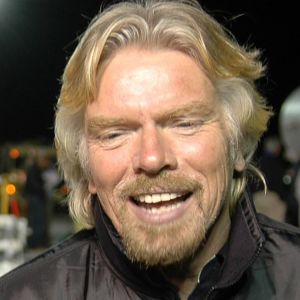
Founder/Virgin Group
Today is World Book Day, a wonderful opportunity to address this #ChallengeRichard sent in by Mike Gonzalez of New Jersey: Make a list of your top 65 books to read in a lifetime. [source]
Yes, it certainly was the turning point of the war. Whatever we British may claim for the titanic fight on the Normandy beaches on D-Day, the Battle of Stalingrad was the real decider and Beevor’s account of it is simply brilliant. He combines a sense of strategic grasp with the incredibly detailed story of ordinary men’s experiences based on their own accounts. He did a huge amount of research into both the Russian side and the German side and he has come out with a masterly book. [source]
16A Gentleman in Moscow
He can't leave his hotel. You won't want to.
From the New York Times bestselling author of Rules of Civility--a transporting novel about a man who is ordered to spend the rest of his life inside a luxury hotel.
In 1922, Count Alexander Rostov is deemed an unrepentant aristocrat by a Bolshevik tribunal, and is sentenced to house arrest in the Metropol, a grand hotel across the street from the Kremlin. Rostov, an indomitable man of erudition and wit, has never worked a day in his life, and must now live in an attic room while some of the most tumultuous decades in Russian history are unfolding outside the hotel's doors. Unexpectedly, his reduced circumstances provide him entry into a much larger world of emotional discovery.
Brimming with humor, a glittering cast of characters, and one beautifully rendered scene after another, this singular novel casts a spell as it relates the count's endeavor to gain a deeper understanding of what it means to be a man of purpose.
CEO/Microsoft
It seems like everyone I know has read this book. I finally joined the club after my brother-in-law sent me a copy, and I’m glad I did. Towles’s novel about a count sentenced to life under house arrest in a Moscow hotel is fun, clever, and surprisingly upbeat. Even if you don’t enjoy reading about Russia as much as I do (I’ve read every book by Dostoyevsky), A Gentleman in Moscow is an amazing story that anyone can enjoy. [source]
I promote range and diversity. Thus, I recommend readers to expose themselves to as many different topics as possible. I usually have 2-4 books I refer back to at any given time. They range in topics from management, art, spirituality and philosophy. Trying to get the engineering thing going but don't much of a mind for science. [source]
17The Romanov Sisters: The Lost Lives of the Daughters of Nicholas and Alexandra
Over the years, the story of the four Romanov sisters and their tragic end in a basement at Ekaterinburg in 1918 has clouded our view of them, leading to a mass of sentimental and idealized hagiography. With this treasure trove of diaries and letters from the grand duchesses to their friends and family, we learn that they were intelligent, sensitive and perceptive witnesses to the dark turmoil within their immediate family and the ominous approach of the Russian Revolution, the nightmare that would sweep their world away, and them along with it.
The Romanov Sisters sets out to capture the joy as well as the insecurities and poignancy of those young lives against the backdrop of the dying days of late Imperial Russia, World War I and the Russian Revolution. Rappaort aims to present a new and challenging take on the story, drawing extensively on previously unseen or unpublished letters, diaries and archival sources, as well as private collections. It is a book that will surprise people, even aficionados
18Red Famine: Stalin's War on Ukraine, 1921-1933
The momentous new book from the Pulitzer Prize-winning author of Gulag and Iron Curtain.
In 1932-33, nearly four million Ukrainians died of starvation, having been deliberately deprived of food. It is one of the most devastating episodes in the history of the twentieth century. With unprecedented authority and detail, Red Famine investigates how this happened, who was responsible, and what the consequences were. It is the fullest account yet published of these terrible events.
The book draws on a mass of archival material and first-hand testimony only available since the end of the Soviet Union, as well as the work of Ukrainian scholars all over the world. It includes accounts of the famine by those who survived it, describing what human beings can do when driven mad by hunger. It shows how the Soviet state ruthlessly used propaganda to turn neighbours against each other in order to expunge supposedly 'anti-revolutionary' elements. It also records the actions of extraordinary individuals who did all they could to relieve the suffering.
The famine was rapidly followed by an attack on Ukraine's cultural and political leadership - and then by a denial that it had ever happened at all. Census reports were falsified and memory suppressed. Some western journalists shamelessly swallowed the Soviet line; others bravely rejected it, and were undermined and harassed. The Soviet authorities were determined not only that Ukraine should abandon its national aspirations, but that the country's true history should be buried along with its millions of victims. Red Famine, a triumph of scholarship and human sympathy, is a milestone in the recovery of those memories and that history. At a moment of crisis between Russia and Ukraine, it also shows how far the present is shaped by the past.
19War And Peace
As Napoleon's army invades, Tolstoy brilliantly follows characters from diverse backgrounds—peasants and nobility, civilians and soldiers—as they struggle with the problems unique to their era, their history, and their culture. And as the novel progresses, these characters transcend their specificity, becoming some of the most moving—and human—figures in world literature. Translated by Louise and Aylmer Maude.
Three-Volume Boxed Set
One doesn’t have to invent the bicycle, there is one: it’s War and Peace. It’s about how Russia won the Napoleonic wars, and moved into the first row of nations who dealt with European history. It’s set during the peak of Russian culture, the age of Pushkin, who created the modern Russian language. It’s the peak…The only thing I would recommend to modern readers is to skip all those parts – which are completely separate from the other parts of the book – where Tolstoy is philosophising about the role of the individual in history. It’s maybe 15 per cent of the book, in separate chapters, and I would definitely recommend to skip those because they are not interesting today. [source]
One of the key questions that Tolstoy asks in the appendix is the central question of War and Peace: how can we explain the fact that, on orders, millions of people go out and kill one another, when they know that killing another human being is morally wrong? [source]
Tolstoy didn’t fight in the Napoleonic wars, but he did fight in the Crimean war, so he drew on his experiences in that when he wrote War and Peace. [source]
20The Last Days of the Romanovs: Tragedy at Ekaterinburg
The brutal murder of the Russian Imperial family on the night of July 16–17, 1918 has long been a defining moment in world history. The Last Days of the Romanovs reveals in exceptional detail how the conspiracy to kill them unfolded.
In the vivid style of a TV documentary, Helen Rappaport reveals both the atmosphere inside the family's claustrophobic prison and the political maneuverings of those who wished to save—or destroy—them. With the watching world and European monarchies proving incapable of saving the Romanovs, the narrative brings this tragic story to life in a compellingly new and dramatic way, culminating in a bloody night of horror in a cramped basement room.
21Stalin: Volume I: Paradoxes of Power, 1878-1928
It has the quality of myth: A poor cobbler’s son, a seminarian from an oppressed outer province of the Russian empire, reinvents himself as a revolutionary and finds a leadership role within a small group of marginal zealots. When the old world is unexpectedly brought down in a total war, the band seizes control of the country, and the new regime it founds as the vanguard of a new world order is ruthlessly dominated from within by the former seminarian until he stands as the absolute ruler of a vast and terrible state apparatus, with dominion over Eurasia. But the largest country in the world is also a poor and backward one, far behind the great capitalist countries in industrial and military power, encircled on all sides. Shortly after seizing total power, Stalin conceives of the largest program of social reengineering ever attempted: the root-and-branch uprooting and collectivization of agriculture and industry across the entire Soviet Union. To stand up to the capitalists he will force into being an industrialized, militarized, collectivized great power is an act of will. Millions will die, and many more will suffer, but Stalin will push through to the end against all resistance and doubts. Where did such power come from? We think we know the story well. Remarkably, Stephen Kotkin’s epic new biography shows us how much we still have to learn.
The product of a decade of scrupulous and intrepid research, Stalin contains a host of astonishing revelations. Kotkin gives an intimate first-ever view of the Bolshevik regime’s inner geography, bringing to the fore materials from Soviet military intelligence and the secret police. He details Stalin’s invention of a fabricated trial and mass executions as early as 1918, the technique he would later impose across the whole country. The book places Stalin’s momentous decision for collectivization more deeply than ever in the tragic history of imperial Russia. Above all, Kotkin offers a convincing portrait and explanation of Stalin’s monstrous power and of Russian power in the world. Stalin restores a sense of surprise to the way we think about the former Soviet Union, revolution, dictatorship, the twentieth century, and indeed the art of history itself.
22Red Notice: A True Story of High Finance, Murder, and One Man's Fight for Justice
Bill Browder's journey started on the South Side of Chicago and moved through Stanford Business School to the dog-eat-dog world of hedge fund investing in the 1990s. It continued in Moscow, where Browder made his fortune heading the largest investment fund in Russia after the Soviet Union's collapse. But when he exposed the corrupt oligarchs who were robbing the companies in which he was investing, Vladimir Putin turned on him and, in 2005, had him expelled from Russia.
In 2007, a group of law enforcement officers raided Browder's offices in Moscow and stole $230 million of taxes that his fund's companies had paid to the Russian government. Browder's attorney Sergei Magnitsky investigated the incident and uncovered a sprawling criminal enterprise. A month after Sergei testified against the officials involved, he was arrested and thrown into pre-trial detention, where he was tortured for a year. On November 16, 2009, he was led to an isolation chamber, handcuffed to a bedrail, and beaten to death by eight guards in full riot gear.
Browder glimpsed the heart of darkness, and it transformed his life: he embarked on an unrelenting quest for justice in Sergei's name, exposing the towering cover-up that leads right up to Putin. A financial caper, a crime thriller, and a political crusade, Red Notice is the story of one man taking on overpowering odds to change the world.
Founder/Long-Term Stock Exchange
This reads like a thriller, but is an urgent and important story about the dangers of Putin’s Russia and the events leading to the Magnitsky Act. [source]
@geoffreysbatt @patrick_oshag 2/ Reminded a bit of the story of @Billbrowder as told in the remarkable book Red Notice which chronicles his investments in Russia very early before everyone saw the opportunity [source]
Just finished @Billbrowder's extraordinary book Red Notice. Inspiring, alarming, unsettling and illuminating in equal measure. I thought I knew a few things about ambition and endeavour in challenging environments, but this is something else. Highly recommended. https://t.co/m4wxR4qesa [source]
23The Whisperers: Private Life in Stalin's Russia
There have been many accounts of the public aspects of Stalin's dictatorship: the arrests and trials, the enslavement and killing in the gulags. No previous book, however, has explored the regime's effect on people's personal lives, what one historian called "the Stalinism that entered into all of us." Now, drawing on a huge collection of newly discovered documents, The Whisperers reveals for the first time the inner world of ordinary Soviet citizens as they struggled to survive amidst the mistrust, fear, compromises, and betrayals that pervaded their existence.
Moving from the Revolution of 1917 to the death of Stalin and beyond, Orlando Figes re-creates the moral maze in which Russians found themselves, where one wrong turn could destroy a family, or perversely, end up saving it. He brings us inside cramped communal apartments, where minor squabbles could lead to fatal denunciations; he examines the Communist faithful, who often rationalized even their own arrest as a case of mistaken identity; and he casts a humanizing light on informers, demonstrating how, in a repressive system, anyone could easily become a collaborator.
A vast panoramic portrait of a society in which everyone spoke in whispers--whether to protect their families and friends, or to inform upon them--The Whisperers is a gripping account of lives lived in impossible times.
24Secondhand Time: The Last of the Soviets
25Young Stalin (Joseph Stalin, #1)
Culminating in the 1917 revolution, Simon Sebag Montefiore's bestselling biography radically alters our understanding of the gifted politician and fanatical Marxist who shaped the Soviet empire in his own brutal image. This is the story of how Stalin became Stalin.
This is an extensive picture of the pre-revolutionary Bolshevik at the tougher prison-going end of the spectrum, far removed from the leafiness implicit in the pictures of Lenin and Krupskaya in exile in Switzerland. It is a much harder experience that Stalin goes through. You can see in the young Stalin considerable signals that he is a very strange man of certain twitches, but a man of great charisma. I suppose the question that Sebag Montefiore doesn’t ask is whether Stalin’s imprisonments made him worse than he would have been otherwise. Stalin was a great bank robber, the Butch Cassidy of the Bolsheviks. [source]
26The Last Tsar: The Life and Death of Nicholas II
This tale of the demise of Tsar Nicholas II and his family is superbly written, brilliantly researched, and an utterly enchanting read. It makes the last days of the Romanovs devastatingly vivid and completely unforgettable. [source]
27One Day in the Life of Ivan Denisovich
Yes let’s do that as I’ve quite a lot to say about old Solzh. It was a critical book – an entirely objective account of a victim in a labour camp. Just one day in an ordinary labour camp. Not exaggerated, not even a particularly nasty day. The most extraordinary part is how is got printed. It ran contrary to everyone in the Communist Party in Russia, but the Novy Mir editor Tvardovsky snuck a copy in to Khrushchev and said, ‘This is awfully good, you ought to publish it’. And he did. It was an extraordinary stroke of luck. And once it was printed, as Galina put it, ‘The Soviet government had let the genie out of the bottle, and however hard they tried later, they couldn’t put it back in.’ [source]
28Lenin: The Man, the Dictator, and the Master of Terror
Brought up in comfort and with a passion for hunting and fishing, chess, and the English classics, Lenin was radicalized after the execution of his brother in 1887. Sebestyen traces the story from Lenin’s early years to his long exile in Europe and return to Petrograd in 1917 to lead the first Communist revolution in history. Uniquely, Sebestyen has discovered that throughout Lenin’s life his closest relationships were with his mother, his sisters, his wife, and his mistress. The long-suppressed story told here of the love triangle that Lenin had with his wife, Nadezhda Krupskaya, and his beautiful, married mistress and comrade, Inessa Armand, reveals a more complicated character than that of the coldly one-dimensional leader of the Bolshevik Revolution.
With Lenin’s personal papers and those of other leading political figures now available, Sebestyen gives is new details that bring to life the dramatic and gripping story of how Lenin seized power in a coup and ran his revolutionary state. The product of a violent, tyrannical, and corrupt Russia, he chillingly authorized the deaths of thousands of people and created a system based on the idea that political terror against opponents was justified for a greater ideal. An old comrade what had once admired him said that Lenin “desired the good . . . but created evil.” This included his invention of Stalin, who would take Lenin’s system of the gulag and the secret police to horrifying new heights.
In Lenin, Victor Sebestyen has written a brilliant portrait of this dictator as a complex and ruthless figure, and he also brings to light important new revelations about the Russian Revolution, a pivotal point in modern history.
Co-founder/Andreessen Horowitz
A thrilling biography that provides great insight into how Communism works in practice. [source]

29The History of the Russian Revolution
--Leon Trotsky, from History of the Russian Revolution
Regarded by many as among the most powerful works of history ever written, this book offers an unparalleled account of one of the most pivotal and hotly debated events in world history. This book reveals, from the perspective of one of its central actors, the Russian Revolution’s profoundly democratic, emancipatory character.
Originally published in three parts, Trotsky’s masterpiece is collected here in a single volume. It serves as the most vital and inspiring record of the Russian Revolution to date.
I chose this book because almost everything that people read about the Russian revolution is written by Westerners, partly because the official histories written under Stalin were incredibly boring and predictable. That all changed when the archives opened up after the collapse of the Soviet Union, but there’s a gap all the same, which Trotsky tried to fill. [source]
30A History of Russia
Widely acclaimed as the best one-volume history available, A History of Russia is also available in two split volumes--the first covers early Russia through the nineteenth century and the second ranges from 1855 to the present. Volume II features an additional introductory chapter that links Russia's modern history to the events that preceded it.
31Ten Days that Shook the World
Ten Days That Shook the World is John Reed’s eyewitness account of the Russian Revolution. A contemporary journalist writing in the first flush of revolutionary enthusiasm, he gives a gripping record of the events in Petrograd in November 1917, when Lenin and the Bolsheviks finally seized power. Containing verbatim reports both of speeches by leaders and the chance comments of bystanders, set against an idealized backcloth of the proletariat, soldiers, sailors, and peasants uniting to throw off oppression, Reed’s account is the product of passionate involvement and remains an unsurpassed classic of reporting.
I like John Reed because he’s a journalist like myself, like yourself, and he was on hand to paint this fantastic, vivid picture of 1917. As you know, Warren Beatty turned it into that movie Reds in the 1980s that made revolution fun, sexy and exciting. John Reed debunks the great Soviet myth that October was a huge heroic struggle by the masses. He said: No, it wasn’t like that. The Winter Palace had been abandoned, we just walked in, went into the wine cellar, tried the wines, people started looting things, we wandered around looking for regiments of defending soldiers but nobody was there. [source]
32The Crimean War: A History
The Charge of the Light Brigade, Florence Nightingale—these are the enduring icons of the Crimean War. Less well-known is that this savage war (1853-1856) killed almost a million soldiers and countless civilians; that it enmeshed four great empires—the British, French, Turkish, and Russian—in a battle over religion as well as territory; that it fixed the fault lines between Russia and the West; that it set in motion the conflicts that would dominate the century to come.
In this masterly history, Orlando Figes reconstructs the first full conflagration of modernity, a global industrialized struggle fought with unusual ferocity and incompetence. Drawing on untapped Russian and Ottoman as well as European sources, Figes vividly depicts the world at war, from the palaces of St. Petersburg to the holy sites of Jerusalem; from the young Tolstoy reporting in Sevastopol to Tsar Nicolas, haunted by dreams of religious salvation; from the ordinary soldiers and nurses on the battlefields to the women and children in towns under siege..
Original, magisterial, alive with voices of the time, The Crimean War is a historical tour de force whose depiction of ethnic cleansing and the West's relations with the Muslim world resonates with contemporary overtones. At once a rigorous, original study and a sweeping, panoramic narrative, The Crimean War is the definitive account of the war that mapped the terrain for today's world..
@cjane87 I liked Orlando Figes’ book in Crimea but it’s the only one I’ve read so I can’t say if it’s best [source]

33Former People: The Final Days of the Russian Aristocracy
Yet Former People is also a story of survival and accommodation, of how many of the tsarist ruling class—so-called “former people” and “class enemies”—overcame the psychological wounds inflicted by the loss of their world and decades of repression as they struggled to find a place for themselves and their families in the new, hostile order of the Soviet Union. Chronicling the fate of two great aristocratic families—the Sheremetevs and the Golitsyns—the book reveals how even in the darkest depths of the terror, daily life went on.
Told with sensitivity and nuance by acclaimed historian Douglas Smith, Former People is the dramatic portrait of two of Russia’s most powerful aristocratic families, and a sweeping account of their homeland in violent transition.
34Iron Curtain: The Crushing of Eastern Europe 1944-1956
At the end of World War II, the Soviet Union to its surprise and delight found itself in control of a huge swath of territory in Eastern Europe. Stalin and his secret police set out to convert a dozen radically different countries to Communism, a completely new political and moral system. In Iron Curtain, Pulitzer Prize-winning journalist Anne Applebaum describes how the Communist regimes of Eastern Europe were created and what daily life was like once they were complete. She draws on newly opened East European archives, interviews, and personal accounts translated for the first time to portray in devastating detail the dilemmas faced by millions of individuals trying to adjust to a way of life that challenged their every belief and took away everything they had accumulated. Today the Soviet Bloc is a lost civilization, one whose cruelty, paranoia, bizarre morality, and strange aesthetics Applebaum captures in the electrifying pages of Iron Curtain.
35Stalin: Waiting for Hitler 1929-1941
When we left Stalin at the end of Stalin: Paradoxes of Power: 1878-1928, it was 1928, and he had finally climbed the mountaintop and achieved dictatorial power of the Soviet empire. The vastest peasant economy in the world would be transformed into socialist modernity, whatever it took.
What it took, or what Stalin believed it took, was the most relentless campaign of shock industrialization the world has ever seen. This is the story of the five year plans, the new factory towns, and the integration of an entire system of penal labor into the larger economy. With the Great Depression throwing global capital into crisis, the Soviet Union's New Man looked like nothing so much as the man of the future. As the shadows of the 30's deepen, Stalin's drive to militarize Soviet society takes on increasing urgency, and the ambition of Nazi Germany becomes the predominant geopolitical reality he faces when Hitler claims that communism is a global "Judeo-Bolshevik" conspiracy to bring the Slavic race to power.
But just because they're out to get you doesn't mean you're not paranoid. Stalin's paranoia is increasingly one of the most horrible facts of life for his entire country. Stalin's obsessions drive him to violently purge almost a million people, including military leadership, diplomatic corps and intelligence apparatus, to say nothing of a generation of artistic talent. And then came the pact that shocked the world, and demoralized leftists everywhere: Stalin's pact with Hitler in 1939, the carve-up of Poland, and Stalin's utter inability to see Hitler's build-up to the invasion of the USSR. Yet for all that, in just 12 years of total power, Stalin has taken this country from a peasant economy to a formidable modern war machine that rivaled anything else in the world. When the invasion came, Stalin wasn't ready, but his country would prove to be prepared. That is a dimension of the Stalin story that has never adequately been reckoned with before, and it looms large here.
Stalin: Waiting for Hitler: 1929-1941 is, like its predecessor, nothing less than a history of the world from Stalin's desk. It is also, like its predecessor, a landmark achievement in the annals of its field, and in the biographer's art.
36Dead Mountain: The Untold True Story of the Dyatlov Pass Incident (Historical Nonfiction Bestseller, True Story Book of Survival)
As gripping and bizarre as Hunt for the Skin Walker: This New York Times bestseller, Dead Mountain: The Untold True Story of the Dyatlov Pass Incident, is a gripping work of literary nonfiction that delves into the untold story of Dead Mountain through unprecedented access to the hikers' own journals and photographs, rarely seen government records, dozens of interviews, and the author's retracing of the hikers' fateful journey in the Russian winter.
You'll love this real-life tale: Dead Mountain is a fascinating portrait of young adventurers in the Soviet era, and a skillful interweaving of the hikers' narrative, the investigators' efforts, and the author's investigations. Here for the first time is a historical nonfiction bestseller with the real story of what happened that night on Dead Mountain.
37The Harvest of Sorrow: Soviet Collectivization and the Terror-Famine
Ambitious, meticulously researched, and lucidly written, The Harvest of Sorrow is a deeply moving testament to those who died, and will register in the Western consciousness a sense of the dark side of this century's history.
38Revolutionary Russia, 1891 - 1991: A History
In this elegant and incisive account, Orlando Figes offers an illuminating new perspective on the Russian Revolution. While other historians have focused their examinations on the cataclysmic years immediately before and after 1917, Figes shows how the revolution, while it changed in form and character, nevertheless retained the same idealistic goals throughout, from its origins in the famine crisis of 1891, until its end with the collapse of the Soviet regime in 1991.
Figes traces three generational phases: Lenin and the Bolsheviks, who set the pattern of destruction and renewal until their demise in the terror of the 1930s; the Stalinist generation, promoted from the lower classes, who created the lasting structures of the Soviet regime and consolidated its legitimacy through victory in war; and the generation of 1956, shaped by the revelations of Stalin’s crimes and committed to “making the Revolution work” to remedy economic decline and mass disaffection. Until the very end of the Soviet system, its leaders believed they were carrying out the revolution Lenin had begun.
With the authority and distinctive style that have marked his magisterial histories, Figes delivers an accessible and paradigm-shifting reconsideration of one of the defining events of the twentieth century.
39The Forsaken: An American Tragedy in Stalin's Russia
This is a fairly recent book which is wonderful and very depressing. It is an account of a large number of Americans who were living in Russia in the 1930s. Many of them had gone there to work. Others had been taken by their parents who had wanted to help build socialism. And many of these people were caught up in the purge trials and hundreds of them were killed. Tzouliadis oriented his book around a number of young American boys who organised baseball teams in Moscow and who used to play in the local parks. And he traces the fate of what happened to those young baseball players. [source]
I’m sure this will be of interest to a Western audience. Its subject is those former American citizens who were made to give up American citizenship in exchange for Soviet citizenship. [source]
40The Russian Revolution 1917-1932
Lucid and concise, this classic study makes comprehensible the complex events of the revolution.
41Tsar: The Lost World of Nicholas and Alexandra
42The Spy and the Traitor: The Greatest Espionage Story of the Cold War
If anyone could be considered a Russian counterpart to the infamous British double-agent Kim Philby, it was Oleg Gordievsky. The son of two KGB agents and the product of the best Soviet institutions, the savvy, sophisticated Gordievsky grew to see his nation's communism as both criminal and philistine. He took his first posting for Russian intelligence in 1968 and eventually became the Soviet Union's top man in London, but from 1973 on he was secretly working for MI6.
For nearly a decade, as the Cold War reached its twilight, Gordievsky helped the West turn the tables on the KGB, exposing Russian spies and helping to foil countless intelligence plots, as the Soviet leadership grew increasingly paranoid at the United States's nuclear first-strike capabilities and brought the world closer to the brink of war. Desperate to keep the circle of trust close, MI6 never revealed Gordievsky's name to its counterparts in the CIA, which in turn grew obsessed with figuring out the identity of Britain's obviously top-level source. Their obsession ultimately doomed Gordievsky: the CIA officer assigned to identify him was none other than Aldrich Ames, the man who would become infamous for secretly spying for the Soviets.
Unfolding the delicious three-way gamesmanship between America, Britain, and the Soviet Union, and culminating in the gripping cinematic beat-by-beat of Gordievsky's nail-biting escape from Moscow in 1985, Ben Macintyre's latest may be his best yet. Like the greatest novels of John le Carré, it brings readers deep into a world of treachery and betrayal, where the lines bleed between the personal and the professional, and one man's hatred of communism had the power to change the future of nations.
Founder/368 Creative Space
just finished this yesterday. absolutely fantastic book. super recommend if you're into spycraft and espionage. bravo @BenMacintyre1 https://t.co/4OG4C1cBQ1 [source]
I had a great conversation with Ambassador Micheal Lund Jeppesen of @DKinAfghanistan . On the sidelines of our rich conversation we spoke of the Spy & the Traitor a great book in which Denmark's intelligence features highly. Proud of our alliance & cooperation. https://t.co/47GMb7ETWr [source]

Think I’ll read a non-China spy story for a change. Have heard great things about this book https://t.co/QcBa0ozRfG [source]
43The 900 Days: The Siege of Leningrad
44The Great Terror: A Reassessment
The definitive work on Stalin's purges, Robert Conquest's The Great Terror was universally acclaimed when it first appeared in 1968. Harrison Salisbury called it "brilliant...not only an odyssey of madness, tragedy, and sadism, but a work of scholarship and literary craftsmanship." And in recent years it has received equally high praise in the former Soviet Union, where it is now considered the definitive account of the period.
When Conquest wrote the original volume, he relied heavily on unofficial sources. With the advent of glasnost, an avalanche of new material became available, and Conquest mined this enormous cache to write, in 1990, a substantially new edition of his classic work, adding enormously to the detail. Both a leading historian and a highly respected poet, Conquest blends profound research with evocative prose, providing not only an authoritative account of Stalin's purges, but also a compelling and eloquent chronicle of one of this century's most tragic events. He provides gripping accounts of everything from the three great "Moscow Trials," to methods of obtaining confessions, the purge of writers and other members of the intelligentsia, life in the labor camps, and many other key matters.
On the fortieth anniversary of the first edition, in the light of further archival releases, and new material published in Moscow and elsewhere, it remains remarkable how many of Conquest's most disturbing conclusions have continued to bear up. This volume, featuring a new preface by Conquest, rounds out the picture of this huge historical tragedy, further establishing the book as the key study of one of the twentieth centurys most lethal, and longest-misunderstood,offenses against humanity.
45From Splendor to Revolution: The Romanov Women, 1847--1928
The early 1850s until the late 1920s marked a turbulent and significant era for Russia. During that time the country underwent a massive transformation, taking it from days of grandeur under the tsars to the chaos of revolution and the beginnings of the Soviet Union.
At the center of all this tumult were four women of the Romanov dynasty. Marie Alexandrovna and Olga Constantinovna were born into the family, Russian Grand Duchesses at birth. Marie Feodorovna and Marie Pavlovna married into the dynasty, the former born a Princess of Denmark, the latter a Duchess of the German duchy of Mecklendburg-Schwerin.
In From Splendor to Revolution, we watch these pampered aristocratic women fight for their lives as the cataclysm of war engulfs them. In a matter of a few short years, they fell from the pinnacle of wealth and power to the depths of danger, poverty, and exile. It is an unforgettable epic story.
46Anna Karenina
This acclaimed modern translation by Richard Pevear and Larissa Volokhonsky won the PEN/ Book of the Month Club Translation Prize in 2001. Their translation is accompanied in this edition by an introduction by Richard Pevear and a preface by John Bayley. "The new and brilliantly witty translation by Richard Pevear and Larissa Volokhonsky is a must". (Lisa Appignanesi, Independent, Books of the Year). "Pevear and Volokhonsky are at once scrupulous translators and vivid stylists of English, and their superb rendering allows us, as perhaps never before, to grasp the palpability of Tolstoy's "characters, acts, situations"". (James Wood, New Yorker).
I don't know if I have to expound on why I love this book, but everyone should read this author, and this was the first one of his works I read. So, it's like a first boyfriend. Or my first Cabbage Patch Kid. [source]
Partner/500 Startups
My list would be (besides the ones I mentioned in answer to the previous question) both business & Fiction/Sci-Fi and ones I personally found helpful to myself. The business books explain just exactly how business, work & investing are in reality & how to think properly & differentiate yourself. On the non-business side, a mix of History & classic fiction to understand people, philosophy to make sense of life and Science fiction to picture what the future could be like (not always utopian). [source]
Question: What books would you recommend to young people interested in your career path? Answer: Anything by Peter Senge. The Hard Thing About Hard Things – Ben Horowitz Once you are Lucky, Twice you are good – Sara Lacey Revolutionary Wealth – Alvin Toffler Black Swan – Taleb Reset: My Fight for Inclusion and Lasting Change, by Ellen Pao. Creative Class – Richard Florida Creativity Inc. by Ed Catmull & Amy Wallace Liar’s Poker by Michael Lewis American Government 101: From the Continental Congress to the Iowa Caucus, Everything You Need to Know About US Politics – Kathleen Spears The Tao of Pooh by Benjamin Hoff. Anna Karenina by Leo Tolstoy. Any book by Herman Hesse The Art of War by Sun Tzu. [source]
47Everyday Stalinism: Ordinary Life in Extraordinary Times: Soviet Russia in the 1930s
The Gulag Archipelago, 1918-1956: An Experiment in Literary Investigation, Volume 1
49The Future Is History: How Totalitarianism Reclaimed Russia
Award-winning journalist Masha Gessen’s understanding of the events and forces that have wracked Russia in recent times is unparalleled. In The Future Is History, Gessen follows the lives of four people born at what promised to be the dawn of democracy. Each of them came of age with unprecedented expectations, some as the children and grandchildren of the very architects of the new Russia, each with newfound aspirations of their own–as entrepreneurs, activists, thinkers, and writers, sexual and social beings.
Gessen charts their paths against the machinations of the regime that would crush them all, and against the war it waged on understanding itself, which ensured the unobstructed reemergence of the old Soviet order in the form of today’s terrifying and seemingly unstoppable mafia state. Powerful and urgent, The Future Is History is a cautionary tale for our time and for all time.
50Kolyma Tales
51Alexandra: The Last Tsarina
52A Lifelong Passion: Nicholas and Alexandra: Their Own Story
53Darkness at Noon
Editor Michael Scammell and translator Philip Boehm bring us a brilliant novel, a remarkable discovery, and a new translation of an international classic.
In print continually since 1940, Darkness at Noon has been translated into over 30 languages and is both a stirring novel and a classic anti-fascist text. What makes its popularity and tenacity even more remarkable is that all existing versions of Darkness at Noon are based on a hastily made English translation of the original German by a novice translator at the outbreak of World War II.
In 2015, Matthias Weßel stumbled across an entry in the archives of the Zurich Central Library that is a scholar's dream: “Koestler, Arthur. Rubaschow: Roman. Typoskript, März 1940, 326 pages.” What he had found was Arthur Koestler’s original, complete German manuscript for what would become Darkness at Noon, thought to have been irrevocably lost in the turmoil of the war. With this stunning literary discovery, and a new English translation direct from the primary German manuscript, we can now for the first time read Darkness at Noon as Koestler wrote it.
Set in the 1930s at the height of the purge and show trials of a Stalinist Moscow, Darkness at Noon is a haunting portrait of an aging revolutionary, Nicholas Rubashov, who is imprisoned, tortured, and forced through a series of hearings by the Party to which he has dedicated his life. As the pressure to confess preposterous crimes increases, he re-lives a career that embodies the terrible ironies and betrayals of a merciless totalitarian movement masking itself as an instrument of deliverance.
Koestler’s portrayal of Stalin-era totalitarianism and fascism is as chilling and resonant today as it was in the 1940s and during the Cold War. Rubashov’s plight explores the meaning and value of moral choices, the attractions and dangers of idealism, and the corrosiveness of political corruption. Like The Trial, 1984, and Animal Farm, this is a book you should read as a citizen of the world, wherever you are and wherever you come from.
A new translation of DARKNESS AT NOON takes what was always an important book and makes it great literature. https://t.co/ATmRSQTuaK [source]
54The Russian Revolution
-- Ronald Hingley, The New York Times Book Review
Ground-breaking in its inclusiveness, enthralling in its narrative of a movement whose purpose, in the words of Leon Trotsky, was "to overthrow the world," The Russian Revolution draws conclusions that have already aroused great controversy in this country-and that are certain to be explosive when the book is published in the Soviet Union. Richard Pipes argues convincingly that the Russian Revolution was an intellectual, rather than a class, uprising; that it was steeped in terror from its very outset; and that it was not a revolution at all but a coup d'etat -- "the capture of governmental power by a small minority."
55The Great Game: The Struggle for Empire in Central Asia
The Washington Post has said that "every story Peter Hopkirk touches is totally engrossing." In this gripping narrative he recounts a breathtaking tale of espionage & treachery thru the actual experiences of its colorful characters. Based on meticulous scholarship & on-the-spot research, this is the history at the core of today's geopolitics.
This takes me away from London and cholera to Afghanistan, the North West Frontier and Central Asia. Hopkirk’s Great Game is a history of the game of exploration and espionage played out by representatives of Britain and Russia in the 19th century. [source]
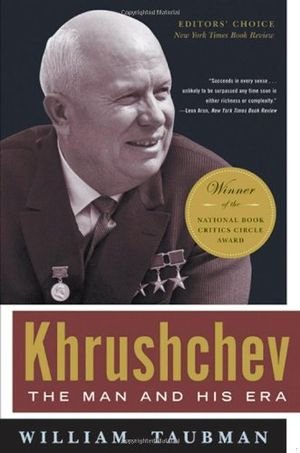
56Khrushchev: The Man and His Era
This is the first comprehensive biography of Khrushchev and the first of any Soviet leader to reflect the full range of sources that have become available since the USSR collapsed. Combining a page-turning historical narrative with penetrating political and psychological analysis, this book brims with the life and excitement of a man whose story personified his era.
Khrushchev started off a miner’s son and had one of those rocket rides in the social stratosphere that could happen once Stalin had got rid of all the old Bolsheviks and needed a completely new political class. He went being from being a semi-literate party member out in the country to the deputy mayor of Moscow in about five years, and he finally ended up as one of Stalin’s inner circle. He worked closely with Stalin for nearly 20 years and approved thousands of arrests and executions and then went on to lead Russia during the Cold War. [source]
57Nothing Is True and Everything Is Possible: The Surreal Heart of the New Russia
Professional killers with the souls of artists, would-be theater directors turned Kremlin puppet-masters, suicidal supermodels, Hell's Angels who hallucinate themselves as holy warriors, and oligarch revolutionaries: welcome to the wild and bizarre heart of twenty-first-century Russia. It is a world erupting with new money and new power, changing so fast it breaks all sense of reality, home to a form of dictatorship-far subtler than twentieth-century strains-that is rapidly rising to challenge the West.
When British producer Peter Pomerantsev plunges into the booming Russian TV industry, he gains access to every nook and corrupt cranny of the country. He is brought to smoky rooms for meetings with propaganda gurus running the nerve-center of the Russian media machine, and visits Siberian mafia-towns and the salons of the international super-rich in London and the US. As the Putin regime becomes more aggressive, Pomerantsev finds himself drawn further into the system.
Dazzling yet piercingly insightful, Nothing Is True and Everything Is Possible is an unforgettable voyage into a country spinning from decadence into madness.
@twistopherrobin His book is great. “Nothing is True and Everything is Possible”. [source]
Fascinating how this quote — from Peter Pomerantsev's terrific 2014 book, Nothing Is True and Everything Is Possible: The Surreal Heart of the New Russia — already seems like it's from another era. [source]
58A Writer At War: Vasily Grossman With The Red Army 1941-1945
When the Germans invaded Russia in 1941, Vasily Grossman became a special correspondent for the Red Star, the Red Army’s newspaper. A Writer at War – based on the notebooks in which Grossman gathered raw material for his articles – depicts the crushing conditions on the Eastern Front, and the lives and deaths of soldiers and civilians alike. It also includes some of the earliest reportage on the Holocaust. In the three years he spent on assignment, Grossman witnessed some of the most savage fighting of the war: the appalling defeats of the Red Army, the brutal street fighting in Stalingrad, the Battle of Kursk (the largest tank engagement in history), the defense of Moscow, the battles in Ukraine and much more.
Historian Antony Beevor has taken Grossman’s raw notebooks, and fashioned them into a narrative providing one of the most even-handed descriptions – at once unflinching and sensitive – we have ever had of what he called “the ruthless truth of war.”
From the Hardcover edition.
These are the notes Grossman took while a war correspondent for the army newspaper, the Red Star. They are true first drafts of history – quick descriptions of what was going on around him as he sat in some truck or dugout, waiting for something to happen. He has a wonderful, cinematic eye, describing the look of burned-out villages, roads full of refugees, and so on. And he gets the voices of the soldiers and officers absolutely right. He famously never took notes as he interviewed people, but had such a good memory that in the evening he could go off into a corner and write it all down verbatim. [source]
59Russia: A 1000-Year Chronicle of the Wild East
Marking the twentieth anniversary of the dissolution of the Soviet Union, Russia is essential reading for anyone who wants to understand the complex political landscape of Russia and its unique place in the modern world.
60October: The Story of the Russian Revolution
This is the story of the extraordinary months between those upheavals, in February and October, of the forces and individuals who made 1917 so epochal a year, of their intrigues, negotiations, conflicts and catastrophes. From familiar names like Lenin and Trotsky to their opponents Kornilov and Kerensky; from the byzantine squabbles of urban activists to the remotest villages of a sprawling empire; from the revolutionary railroad Sublime to the ciphers and static of coup by telegram; from grand sweep to forgotten detail.
Historians have debated the revolution for a hundred years, its portents and possibilities: the mass of literature can be daunting. But here is a book for those new to the events, told not only in their historical import but in all their passion and drama and strangeness. Because as well as a political event of profound and ongoing consequence, Miéville reveals the Russian Revolution as a breathtaking story.
From the Hardcover edition.
61Life and Fate
Interweaving a transfixing account of the battle of Stalingrad with the story of a single middle-class family, the Shaposhnikovs, scattered by fortune from Germany to Siberia, Vasily Grossman fashions an immense, intricately detailed tapestry depicting a time of almost unimaginable horror and even stranger hope.
Life and Fate juxtaposes bedrooms and snipers’ nests, scientific laboratories and the Gulag, taking us deep into the hearts and minds of characters ranging from a boy on his way to the gas chambers to Hitler and Stalin themselves.
This novel of unsparing realism and visionary moral intensity is one of the supreme achievements of modern Russian literature.
Life and Fate…is probably the most important work of fiction about World War II. But, in fact, it is more than just a fiction because it is based on very close reporting from his time with the soldiers. It is a deliberate act of literary homage to Tolstoy as one can see in the title. It is definitely the War and Peace of the 20th century. [source]
It is about the strange interval of freedom during the Second World War in which the Soviet regime had to trust its people because it couldn’t compel their loyalty. [source]
62The Family Romanov: Murder, Rebellion, and the Fall of Imperial Russia
63The Romanovs: Autocrats of All the Russias
Preface
Acknowledgments
A Note on Russian Names and Dates
Prologue
Muscovite beginnings (1613-1689)
Tsars and tsarinas
In the eye of the storm
The politics of Muscovy
The rise of an empire (1689-1796)
Eighteenth-century emperors & empresses
An imperial city in the making
From debauchery to philosophy
Imperial aspirations
Empire triumphant (1796-1894)
The imperial dynasty
The new faces of St. Petersburg
From golden age to iron age
The colossus of the north
The last emperor (1894-1917)
Nicky and Sunny: the last Romanovs
The approach of disaster
Days of war and revolution
The last days of the Romanovs
Notes and References
Works Cited
Index
64The Man Without a Face: The Unlikely Rise of Vladimir Putin
Handpicked as a successor by the "family" surrounding an ailing and increasingly unpopular Boris Yeltsin, Vladimir Putin seemed like a perfect choice for the oligarchy to shape according to its own designs. Suddenly the boy who had stood in the shadows, dreaming of ruling the world, was a public figure, and his popularity soared. Russia and an infatuated West were determined to see the progressive leader of their dreams, even as he seized control of media, sent political rivals and critics into exile or to the grave, and smashed the country's fragile electoral system, concentrating power in the hands of his cronies.
As a journalist living in Moscow, Masha Gessen experienced this history firsthand, and for The Man Without a Face she has drawn on information and sources no other writer has tapped. Her account of how a "faceless" man maneuvered his way into absolute-and absolutely corrupt-power has the makings of a classic of narrative nonfiction.
It’s a very polemical portrait of Putin, a man whom she detests. I think she nails a lot about him. She really focuses in on Putin the man and inverts this common picture of a glamorous, decisive, tough guy to show that the reality is sordid, scary and in a way rather pathetic. [source]
65Journey into the Whirlwind
By the late 1930s, Eugenia Semyonovna Ginzburg had been a loyal and very active member of the Communist Party for many years. Yet like millions of others who suffered during Stalin's reign of terror, she was arrested—on trumped-up charges of being a Trotskyist terrorist and counter-revolutionary—and sentenced to prison. With an amazing eye for detail, profound strength, and an indefatigable spirit, Ginzburg recounts the years, days, and minutes she endured in prisons and labor camps, including two years of solitary confinement. A classic account of survival, Journey into the Whirlwind is considered one of the most important documents of Stalin's regime ever written.
66Russian Thinkers
67City of Thieves
During the Nazis’ brutal siege of Leningrad, Lev Beniov is arrested for looting and thrown into the same cell as a handsome deserter named Kolya. Instead of being executed, Lev and Kolya are given a shot at saving their own lives by complying with an outrageous directive: secure a dozen eggs for a powerful Soviet colonel to use in his daughter’s wedding cake. In a city cut off from all supplies and suffering unbelievable deprivation, Lev and Kolya embark on a hunt through the dire lawlessness of Leningrad and behind enemy lines to find the impossible.
By turns insightful and funny, thrilling and terrifying, City of Thieves is a gripping, cinematic World War II adventure and an intimate coming-of-age story with an utterly contemporary feel for how boys become men.
I’ve given it to 100 people. All of them thanked me and gave away a bunch themselves. [source]
Amazing recommendations. Thanks everyone. Just finished a book off this list: "City of Thieves." It was funny, moving, and thrilling. I also recommend it. https://t.co/mvmjjNpyHC [source]
One of the best 3 books I've read in 2019 [source]
68Blowout: Corrupted Democracy, Rogue State Russia, and the Richest, Most Destructive Industry on Earth
Big Oil and Gas Versus Democracy—Winner Take All
Rachel Maddow’s Blowout offers a dark, serpentine, riveting tour of the unimaginably lucrative and corrupt oil-and-gas industry. With her trademark black humor, Maddow takes us on a switchback journey around the globe—from Oklahoma City to Siberia to Equatorial Guinea—exposing the greed and incompetence of Big Oil and Gas. She shows how Russia’s rich reserves of crude have, paradoxically, stunted its growth, forcing Putin to maintain his power by spreading Russia’s rot into its rivals, its neighbors, the United States, and the West’s most important alliances. Chevron, BP, and a host of other industry players get their star turn, but ExxonMobil and the deceptively well-behaved Rex Tillerson emerge as two of the past century’s most consequential corporate villains. The oil-and-gas industry has weakened democracies in developed and developing countries, fouled oceans and rivers, and propped up authoritarian thieves and killers. But being outraged at it is, according to Maddow, “like being indignant when a lion takes down and eats a gazelle. You can’t really blame the lion. It’s in her nature.”
This book is a clarion call to contain the lion: to stop subsidizing the wealthiest industry on earth, to fight for transparency, and to check the influence of predatory oil executives and their enablers. The stakes have never been higher. As Maddow writes, “Democracy either wins this one or disappears.”
😂 @maddow you’re so amazing. I’m listening to the Audible version of your fantastic book “Blowout” and just got to a part where you detail a sad, lonely existence and then - as an aside - declare “aw! Sad.” in a completely different voice 😂 [source]
This week I had the chance to interview my pal Rachel @Maddow about her amazing new book, Blowout!! Tune in to #amjoy at 10am ET Sunday to check it out (and find out what Equatorial Guinea, Michael Jackson's glove, black oil and Texas tea have in common...! https://t.co/mTQZKIZT2T [source]
.@Maddow deserves Emmy and Pulitzer.. and more.. for her work in the interview of Lev Parnas, and her book "Blowout" - she is the best reporter. True journalist. Watched 1/14 (documents) and 1/15 (Lev Parnas Interview Part-1) shows twice. I can not wait for part-2 - on 1/16/20. [source]
69Russia Under the Old Regime
70The Prince of Princes: The Life of Potemkin
Potemkin shone as an outstandingly gifted statesman, winning the Crimea, founding the Black Sea Fleet, reforming the Cossacks, planning new cities like Sebastopol and Odessa, and making Russia a Near Eastern power - achievements in war and peace that emulated his hero Peter the Great.
He embodied the strengths and weaknesses of Russia itself - volatile, ebullient, handsome, sensual, and always astonishing. His bizarre magnificence enchanted and scandalized Europe. Yet he disdained his own success.
He was surrounded by a cosmopolitan court that included brilliant Americans, such as Admiral John Paul Jones, and Lewis Littlepage, a friend of George Washington and Thomas Jefferson. Both served under Potemkin against the Turks.
An obsessive Anglophile, he commissioned Joshua Reynolds and created an English garden wherever he stopped for the night. In 1787, this master showman presided over Catherine's Crimean river-tour, so sumptuous it was compared to Cleopatra's progress. Potemkin's enemies claimed he displayed fake houses - "Potemkin villages" - a smear this biography lays to rest.
After five years' new research in archives from Petersburg to Odessa, Sebag Montefiore shoes how Potemkin and Catherine, with their younger lovers, created their own "family." He brings blazingly to life Potemkin's loving partnership with Catherine and restores him to his place as a colossus of the eighteenth century. When he died, Catherine was heartbroken. She said there could never be another Potemkin.
We move to the age of Enlightenment: a very nice, well-written book by Simon Sebag Montefiore, and it’s called The Life of Potemkin. So what do we have? We’ve had the reforms of Peter the Great, cutting his ‘window on to Europe’, then we had – and the 18th century is a crucial one – Russia meeting the Enlightenment. Catherine the Great comes to power, and that’s where the biggest revolution I think takes place, from the point of view of civilising the country. She has a great court, of which Voltaire was a part, as well as Potemkin, and this is a wonderful book about these times and days: highly entertaining, informative, pleasant and it’s a very important period, it’s when Russia became a great power. The book is a biography of Prince Potemkin, one of the great characters of the Enlightenment altogether, internationally recognised. You meet all the most interesting people of that era: from the Austrian Emperor Josef, to the Prince de Ligne – they’re all characters in this book and this is already not Muscovite Russia, it’s something transformed. [source]
71Moscow 1812: Napoleon's Fatal March
72The Fate of the Romanovs
The collapse of the Soviet Union in 1991 revealed, among many other things, a hidden wealth of archival documents relating to the imprisonment and eventual murder of Tsar Nicholas II, his wife Alexandra, and their children. Emanating from sources both within and close to the Imperial Family as well as from their captors and executioners, these often-controversial materials have enabled a new and comprehensive examination of one the pivotal events of the twentieth century and the many controversies that surround it.
Based on a careful analysis of more than 500 of these previously unpublished documents, along with numerous newly discovered photos, The Fate of the Romanovs makes compelling revisions to many long-held beliefs about the Romanovs' final months and moments. This powerful account includes:
* Surprising evidence that Anastasia may, indeed, have survived
* Diary entries made by Nicholas and Alexandra during their captivity
* Revelations of how the Romanovs were betrayed by trusted servants
* A reconstruction of daily life among the prisoners at Ipatiev House
* Strong evidence that the Romanovs were not brutalized by their captors
* Statements from admitted participants in the murders
73Rasputin: Faith, Power, and the Twilight of the Romanovs
A hundred years after his murder, Rasputin continues to excite the popular imagination as the personification of evil. Numerous biographies, novels, and films recount his mysterious rise to power as Nicholas and Alexandra's confidant and the guardian of the sickly heir to the Russian throne. His debauchery and sinister political influence are the stuff of legend, and the downfall of the Romanov dynasty was laid at his feet.
But as the prizewinning historian Douglas Smith shows, the true story of Rasputin's life and death has remained shrouded in myth. A major new work that combines probing scholarship and powerful storytelling, Rasputin separates fact from fiction to reveal the real life of one of history's most alluring figures. Drawing on a wealth of forgotten documents from archives in seven countries, Smith presents Rasputin in all his complexity--man of God, voice of peace, loyal subject, adulterer, drunkard. Rasputin is not just a definitive biography of an extraordinary and legendary man but a fascinating portrait of the twilight of imperial Russia as it lurched toward catastrophe.
74The New Tsar: The Rise and Reign of Vladimir Putin
The New Tsar is the book to read if you want to understand how Vladimir Putin sees the world and why he has become one of the gravest threats to American security.
The epic tale of the rise to power of Russia's current president—the only complete biography in English – that fully captures his emergence from shrouded obscurity and deprivation to become one of the most consequential and complicated leaders in modern history, by the former New York Times Moscow bureau chief.
In a gripping narrative of Putin’s rise to power as Russia’s president, Steven Lee Myers recounts Putin’s origins—from his childhood of abject poverty in Leningrad, to his ascension through the ranks of the KGB, and his eventual consolidation of rule. Along the way, world events familiar to readers, such as September 11th and Russia’s war in Georgia in 2008, as well as the 2014 annexation of Crimea and the ongoing conflict in Ukraine, are presented from never-before-seen perspectives.
This book is a grand, staggering achievement and a breathtaking look at one man’s rule. On one hand, Putin’s many reforms—from tax cuts to an expansion of property rights—have helped reshape the potential of millions of Russians whose only experience of democracy had been crime, poverty, and instability after the fall of the Soviet Union. On the other hand, Putin has ushered in a new authoritarianism, unyielding in his brutal repression of revolts and squashing of dissent. Still, he retains widespread support from the Russian public.
The New Tsar is a narrative tour de force, deeply researched, and utterly necessary for anyone fascinated by the formidable and ambitious Vladimir Putin, but also for those interested in the world and what a newly assertive Russia might mean for the future.
With Russia fever at Defcon 2, I’ve made it about half-ways through the biography The New Tsar: The Rise and Reign of Vladimir Putin. It’s a great refresher on post-WWII history, the cold war, KGB, but above all, on the forces present in Russia. There are many lines to draw between Russia’s struggles after the fall of Communism with the fundamental political theories of Fukuyama (Origins of Political Order / Political Order And Political Decay). When taken together, they lend an all the more human and sympathetic story to why things played out the way they did. While still appreciating just how immense the level of brokenness, corruption, and brutality that journey has brought with it. [source]

75Stalin's Daughter: The Extraordinary and Tumultuous Life of Svetlana Alliluyeva
Born in the early years of the Soviet Union, Svetlana Stalin spent her youth inside the walls of the Kremlin. Communist Party privilege protected her from the mass starvation and purges that haunted Russia, but she did not escape tragedy—the loss of everyone she loved, including her mother, two brothers, aunts and uncles, and a lover twice her age, deliberately exiled to Siberia by her father.
As she gradually learned about the extent of her father’s brutality after his death, Svetlana could no longer keep quiet and in 1967 shocked the world by defecting to the United States—leaving her two children behind. But although she was never a part of her father’s regime, she could not escape his legacy. Her life in America was fractured; she moved frequently, married disastrously, shunned other Russian exiles, and ultimately died in poverty in Wisconsin.
With access to KGB, CIA, and Soviet government archives, as well as the close cooperation of Svetlana’s daughter, Rosemary Sullivan pieces together Svetlana’s incredible life in a masterful account of unprecedented intimacy. Epic in scope, it’s a revolutionary biography of a woman doomed to be a political prisoner of her father’s name. Sullivan explores a complicated character in her broader context without ever losing sight of her powerfully human story, in the process opening a closed, brutal world that continues to fascinate us.
Illustrated with photographs.
76Doctor Zhivago
Dr. Yury Zhivago, Pasternak's alter ego, is a poet, philosopher, and physician whose life is disrupted by the war and by his love for Lara, the wife of a revolutionary. His artistic nature makes him vulnerable to the brutality and harshness of the Bolsheviks. The poems he writes constitute some of the most beautiful writing featured in the novel.
77Alexander II: The Last Great Tsar
78George, Nicholas and Wilhelm: Three Royal Cousins and the Road to World War I
Miranda Carter uses the cousins' correspondence and a host of historical sources to tell the tragicomic story of a tiny, glittering, solipsistic world that was often preposterously out of kilter with its times, struggling to stay in command of politics and world events as history overtook it. George, Nicholas and Wilhelm is a brilliant and sometimes darkly hilarious portrait of these men--damaged, egotistical Wilhelm; quiet, stubborn Nicholas; and anxious, dutiful George--and their lives, foibles and obsessions, from tantrums to uniforms to stamp collecting. It is also alive with fresh, subtle portraits of other familiar figures: Queen Victoria--grandmother to two of them, grandmother-in-law to the third--whose conservatism and bullying obsession with family left a dangerous legacy; and Edward VII, the playboy "arch-vulgarian" who turned out to have a remarkable gift for international relations and the theatrics of mass politics. At the same time, Carter weaves through their stories a riveting account of the events that led to World War I, showing how the personal and the political interacted, sometimes to devastating effect.
For all three men the war would be a disaster that destroyed forever the illusion of their close family relationships, with any sense of peace and harmony shattered in a final coda of murder, betrayal and abdication.
79Russia's War: A History of the Soviet Effort: 1941-1945
"An extraordinary tale... Overy's engrossing book provides extensive details of teh slaughter, brutality, bitterness and destruction on the massive front from the White Sea to the flank of Asia."--Chicago Tribune
The Russian war effort to defeat invading Axis powers, an effort that assembled the largest military force in recorded history and that cost the lives of more than 25 million Soviet soldiers and civilians, was the decisive factor for securing an Allied victory. Now with access to the wealth of film archives and interview material from Russia used to produce the ten-hour television documentary Russia's War, Richard Overy tackles the many persuasive questions surrounding this conflict. Was Stalin a military genius? Was the defense of Mother Russia a product of something greater than numbers of tanks and planes--of something deep within the Russian soul?
80The Court of the Last Tsar: Pomp, Power and Pageantry in the Reign of Nicholas II
"Any book by Greg King is a book to be kept and savored. He has not only given us a fresh, clear-eyed, and often startling new look at the life of the last Romanovs, but also lived up to the promise of his title. He has shown us how the whole enterprise worked, from Tsar Nicholas to his lowest cook and chambermaid. This book is a great work of scholarship--and a wonderful read."
--Peter Kurth, author of Tsar: The Lost World of Nicholas and Alexandra and Anastasia: The Riddle of Anna Anderson
"A mammoth, monumental achievement. No other book captures the essence and the entire scope of life at the court of Nicholas II. It's a thoroughly enjoyable and encyclopedic masterpiece that will be a major source for historians and biographers for years to come."
--Marlene A. Eilers, author of Queen Victoria's Descendants and publisher of Royal Book News
"Greg King has truly written a tour de force. The book is extremely well researched, has over 100 illustrations and is, quite simply, marvelous."
--Coryne Hall, author of Little Mother of Russia, Once a Grand Duchess, and Imperial Dancer
"Greg King is emerging as one of the leading authorities in today's liveliest field of Russian studies, and this is a major contribution to the study of late Imperial Russia."
--Joseph T. Fuhrmann, author of Rasputin and the editor of The Complete Wartime Correspondence of Tsar Nicholas II and the Empress Alexandra
81The Last Empire: The Final Days of the Soviet Union
Honing in on this previously disregarded but crucial period and using recently declassified documents and original interviews with key participants, he shatters the established myths of 1991 and presents a bold new interpretation of the Soviet Union’s final months. Plokhy argues that contrary to the triumphalist Western narrative, George H. W. Bush desperately wanted to preserve the Soviet Union and keep Gorbachev in power, and that it was Ukraine and not the US that played the key role in the collapse of the Soviet Union. The consequences of those five months and the myth-making that has since surrounded them are still being felt in Crimea, Russia, the US, and Europe today.
With its spellbinding narrative and strikingly fresh perspective, The Last Empire is the essential account of one of the most important watershed periods in world history, and is indispensable reading for anyone seeking to make sense of international politics today.
82The House of Government: A Saga of the Russian Revolution
Completed in 1931, the House of Government, later known as the House on the Embankment, was located across the Moscow River from the Kremlin. The largest residential building in Europe, it combined 550 furnished apartments with public spaces that included everything from a movie theater and a library to a tennis court and a shooting range. Slezkine tells the chilling story of how the building's residents lived in their apartments and ruled the Soviet state until some eight hundred of them were evicted from the House and led, one by one, to prison or their deaths.
Drawing on letters, diaries, and interviews, and featuring hundreds of rare photographs, The House of Government weaves together biography, literary criticism, architectural history, and fascinating new theories of revolutions, millennial prophecies, and reigns of terror. The result is an unforgettable human saga of a building that, like the Soviet Union itself, became a haunted house, forever disturbed by the ghosts of the disappeared.
@TheIllegit Sorry *of. That was a great book [source]
83Magnetic Mountain: Stalinism as a Civilization
Kotkin argues that Stalinism offered itself as an opportunity for enlightenment. The utopia it proffered, socialism, would be a new civilization based on the repudiation of capitalism. The extent to which the citizenry participated in this scheme and the relationship of the state's ambitions to the dreams of ordinary people form the substance of this fascinating story. Kotkin tells it deftly, with a remarkable understanding of the social and political system, as well as a keen instinct for the details of everyday life.
Kotkin depicts a whole range of life: from the blast furnace workers who labored in the enormous iron and steel plant, to the families who struggled with the shortage of housing and services. Thematically organized and closely focused, Magnetic Mountain signals the beginning of a new stage in the writing of Soviet social history.
84Ivan's War: Life and Death in the Red Army, 1939-1945
Of the thirty million who fought in the eastern front of World War II, eight million died, driven forward in suicidal charges, shattered by German shells and tanks. They were the men and women of the Red Army, a ragtag mass of soldiers who confronted Europe's most lethal fighting force and by 1945 had defeated it. Sixty years have passed since their epic triumph, but the heart and mind of Ivan -- as the ordinary Russian soldier was called -- remain a mystery. We know something about hoe the soldiers died, but nearly nothing about how they lived, how they saw the world, or why they fought.
Drawing on previously closed military and secret police archives, interviews with veterans, and private letters and diaries, Catherine Merridale presents the first comprehensive history of the Soviet Union Army rank and file. She follows the soldiers from the shock of the German invasion to their costly triumph in Stalingrad, where life expectancy was often a mere twenty-four hours. Through the soldiers' eyes, we witness their victorious arrival in Berlin, where their rage and suffering exact an awful toll, and accompany them as they return home full of hope, only to be denied the new life they had been fighting to secure.
A tour de force of original research and a gripping history, Ivan's War reveals the singular mixture of courage, patriotism, anger, and fear that made it possible for these underfed, badly led troops to defeat the Nazi army. In the process Merridale restores to history the invisible millions who sacrificed the most to win the war.
85Caught in the Revolution: Petrograd, Russia, 1917 - A World on the Edge
Between the first revolution in February 1917 and Lenin's Bolshevik coup in October, Petrograd (the former St Petersburg) was in turmoil - felt nowhere more keenly than on the fashionable Nevsky Prospekt. There, the foreign visitors who filled hotels, clubs, offices and embassies were acutely aware of the chaos breaking out on their doorsteps and beneath their windows.
Among this disparate group were journalists, diplomats, businessmen, bankers, governesses, volunteer nurses and expatriate socialites. Many kept diaries and wrote letters home: from an English nurse who had already survived the sinking of the Titanic; to the black valet of the US Ambassador, far from his native Deep South; to suffragette leader Emmeline Pankhurst, who had come to Petrograd to inspect the indomitable Women's Death Battalion led by Maria Bochkareva.
Helen Rappaport draws upon this rich trove of material, much of it previously unpublished, to carry us right up to the action - to see, feel and hear the Revolution as it happened to an assortment of individuals who suddenly felt themselves trapped in a "red madhouse."
86Red Plenty
Strange as it may seem, the gray, oppressive USSR was founded on a fairy tale. It was built on the twentieth-century magic called "the planned economy," which was going to gush forth an abundance of good things that the lands of capitalism could never match. And just for a little while, in the heady years of the late 1950s, the magic seemed to be working. Red Plenty is about that moment in history, and how it came, and how it went away; about the brief era when, under the rash leadership of Khrushchev, the Soviet Union looked forward to a future of rich communists and envious capitalists, when Moscow would out-glitter Manhattan and every Lada would be better engineered than a Porsche. It's about the scientists who did their genuinely brilliant best to make the dream come true, to give the tyranny its happy ending.
Red Plenty is history, it's fiction, it's as ambitious as Sputnik, as uncompromising as an Aeroflot flight attendant, and as different from what you were expecting as a glass of Soviet champagne.
Which side was going to win? Socialism or capitalism? He’s taken that episode in history, those few years, and created this incredible narrative. [source]
87The Cold War: A New History
Drawing on new and often startling information from newly opened Soviet, Eastern European, and Chinese archives, this thrilling account explores the strategic dynamics that drove the Cold War, provides illuminating portraits of its major personalities, and offers much fresh insight into its most crucial events. Riveting, revelatory, and wise, it tells a story whose lessons it is vitally necessary to understand as America once more faces an implacable ideological enemy.
--highbridgeaudio.com
88Lenin: A Biography
89Land of the Firebird: The Beauty of Old Russia
90Catherine the Great: Love, Sex, and Power
This is the story of Catherine the woman, whom power alone could never satisfy, for she also wanted love, affection, friendship and humor. She found these in letter-writing, in grandchildren, in gardens, architecture and greyhounds--as well as in a succession of lovers which gave rise to salacious rumors throughout Europe. The real Catherine, however, was more interesting than any rumor.
Using many of Catherine's own words from her voluminous correspondence and other documents, as well as contemporary accounts by courtiers, ambassadors and foreign visitors, Virginia Rounding penetrates the character of this most powerful, fascinating and surprisingly sympathetic of eighteenth-century women.
91Witch Hunt: The Plot to Destroy Trump and Undo His Election
The president’s enemies cite the number of indictments and guilty pleas wracked up by Special Counsel Robert Mueller and his associates as proof of Donald Trump and his campaign’s criminal wrongdoing. Yet as Fox News’ legal analyst and commentator Gregg Jarrett makes clear, Mueller’s probe has produced no evidence and no indictments in support of his original mandate.
Jarrett shows that while the president’s enemies are desperate and determined to find something, their efforts have proved futile. In this book he outlines the various charges since the publication of The Russia Hoax, including the indictments against Trump long-time confidant and advisor Roger Stone. One by one, he knocks the criminal charges and media-driven innuendo down, making clear that the tens of millions of dollars Mueller has spent has been a wasteful misuse of taxpayer money.
Jarrett dives deep into the indictment against Stone to explain just how flimsy the accusations of collusion and conspiracy are. “The plain truth is that the improper existence of Mueller’s investigation created the crimes Stone stands accused of committing,” Jarret contends. He reveals how the FBI has been complicit in the scheme to frame Trump thanks to a cabal of top former officials, headed by former director James Comey, who worked with phony opposition research paid for by the Clinton campaign to smear Trump. He also exposes the Justice Department’s double standard in charging Trump associates while giving a pass to Clinton cronies, including Huma Abedin and Cheryl Mills.
Factual, highly persuasive, and damning, this must-read expose makes clear that not only was there no collusion, but there was not even a basis for Mueller’s investigation of this charge that has tainted Trump and his administration, and interfered with his presidency.
Thank you Gregg Jarrett @GreggJarrett for the excellent coverage he gave my 40-hrs inquisition by Mueller in which I refused a plea deal & did NOT get indicted (pgs 380-386) in his new book https://t.co/E4INijaAca WITCH HUNT that I strongly recommend @realDonaldTrump A MUST READ [source]
Get @GreggJarrett’s new book Witch Hunt! The story of the greatest mass delusion in American political history. Phenomenal writer and storyteller with another great book! https://t.co/oJ7n2jRQEx [source]
Grab a copy of Gregg Jarrett’s great new book. Witch Hunt: The Story of the Greatest Mass Delusion in American Political History https://t.co/e9bec42r6J [source]

92Catherine the Great
93Russia Against Napoleon: The Battle for Europe, 1807 to 1814
Russia's expulsion of Napoleon's Grande Armée in 1812 is considered one of the most dramatic events in European history. However, Tolstoyan myth and an imbalance of British and French interpretations have clouded most Westerners' understanding of Russia's role in the defeat of Napoleon.
Based on a fresh examination of Russian military archives, Russia Against Napoleon provides the first-ever history of the period told from the Russian perspective. In Dominic Lieven's account, Russia's victory in 1812 was just the beginning of what would be the longest military campaign in European history, marked by Russia's epic efforts to feed and supply half a million troops as they crossed an entire continent.
Moving from the 1807 treaty signed by Napoleon and Tsar Alexander I through the Russian army's improbable entry into Paris in 1814, Lieven provides suspenseful accounts of events, such as the burning of Moscow and the great battles of Leipzig and Borodino, as well as astute analyses of the great military strategists of the time. The result is a magisterial work sure to be eagerly anticipated by military and history buffs alike.
94Symphony for the City of the Dead: Dmitri Shostakovich and the Siege of Leningrad
National Book Award winner M. T. Anderson delivers a brilliant and riveting account of the Siege of Leningrad and the role played by Russian composer Shostakovich and his Leningrad Symphony.
In September 1941, Adolf Hitler’s Wehrmacht surrounded Leningrad in what was to become one of the longest and most destructive sieges in Western history—almost three years of bombardment and starvation that culminated in the harsh winter of 1943–1944. More than a million citizens perished. Survivors recall corpses littering the frozen streets, their relatives having neither the means nor the strength to bury them. Residents burned books, furniture, and floorboards to keep warm; they ate family pets and—eventually—one another to stay alive. Trapped between the Nazi invading force and the Soviet government itself was composer Dmitri Shostakovich, who would write a symphony that roused, rallied, eulogized, and commemorated his fellow citizens—the Leningrad Symphony, which came to occupy a surprising place of prominence in the eventual Allied victory.
This is the true story of a city under siege: the triumph of bravery and defiance in the face of terrifying odds. It is also a look at the power—and layered meaning—of music in beleaguered lives. Symphony for the City of the Dead is a masterwork thrillingly told and impeccably researched by National Book Award–winning author M. T. Anderson.
Symphony for the City of the Dead is, in brief, the story of the Russian composer Dimitri Shostakovich and his Seventh Symphony, which he composed during the 444-day Siege of Leningrad by Hitler’s armies during World War Two. It’s an incredibly multilayered history and narrative, both fast-paced and readable. I recommended it to many of my adult friends who read serious nonfiction, because it delivers for any reader. [source]
95Chernobyl: History of a Tragedy
In Chernobyl, award-winning historian Serhii Plokhy draws on recently opened archives to recreate these events in all their drama, telling the stories of the scientists, workers, soldiers, and policemen who found themselves caught in a nuclear nightmare. While the immediate cause of the accident was a turbine test gone wrong, he shows how its deeper roots lay in the nature of the Soviet political system and the ingrained flaws of its nuclear industry. A little more than five years later, the Soviet Union would fall apart, destroyed from within by its unsustainable ideology and the dysfunctional systems laid bare in the wake of the disaster.
A moment by moment account of the heroes, perpetrators and victims of a tragedy, Chernobyl is the first full account of a gripping, unforgettable Cold War story.
He’s really good here at laying down the background of the disaster itself, the plant’s construction, the days leading up to it, the moments the accident occurred. He talks about the accident itself, the delay in informing the public, the censorship of news, the trial of the nuclear power plant operators who he thinks were treated as scapegoats, and the political outcomes of all this deception. [source]
It’s just a really thrilling book, as well as being a really interesting history of that time. But the reason why I think it’s also a brilliant political book is fundamentally what Plokhii reveals in his writing, is that the failure of Chernobyl was fundamentally a failure of a political system, as well as a failure of a scientific system. [source]
96The Soviet Experiment: Russia, the USSR, and the Successor States
One of the eminent Soviet historians of our time, Ronald Grigor Suny takes us on a journey that examines the complex themes of Soviet history from the last tsar of the Russian empire to the first president of the Russian republic. He examines the legacies left by former Soviet leaders and explores the successor states and the challenges they now face. Combining gripping detail with insightful analysis, Suny focuses on three revolutions: the tumultuous year of 1917 when Vladimir Lenin led the Bolshevik takeover of the tsarist empire; the 1930s when Joseph Stalin refashioned the economy, the society, and the state; and the 1980s and 1990s when Mikhail Gorbachev's ambitious and catastrophic attempt at sweeping reform and revitalization resulted in the breakup of the Soviet Union led by Boris Yeltsin. He unravels issues, explaining "deeply contradictory" policies toward the various Soviet nationalities, including Moscow's ambivalence over its own New Economic Policy of the 1920s and the attempts at reform that followed Stalin's death. He captures familiar as well as little-known events, including the movement of the crowds on the streets of St. Petersburg in the February revolution; Stalin's collapse into a near-catatonic state after Hitler's much-predicted invasion; and Yeltsin's political maneuvering and public grandstanding as he pushed the disintegration of the Soviet Union and faced down his rivals.
Students and social scientists alike continue to be fascinated by the Soviet experiment and its meaning. The Soviet Experiment recovers the complexities and contradictions of the 70 years of Soviet Power, exploring its real achievements as well as its grotesque failings. Clearly written and well-argued, this narrative is complete with helpful anecdotes and examples that will not only engage students and offer them an opportunity to learn from new material but also afford them the opportunity to form their own opinions by reading the text and looking into the suggested readings. With insight and detail, Suny has constructed a masterful work, providing the fullest account yet of one of the greatest transformations of modern history.
97The Flight of the Romanovs: A Family Saga
98Prisoners of Geography: Ten Maps That Explain Everything About the World
All leaders of nations are constrained by geography. Their choices are limited by mountains, rivers, seas, and concrete. To understand world events, news organizations and other authorities often focus on people, ideas, and political movements, but without geography, we never have the full picture. Now, in the relevant and timely Prisoners of Geography, seasoned journalist Tim Marshall examines Russia, China, the USA, Latin America, the Middle East, Africa, Europe, Japan and Korea, and Greenland and the Arctic—their weather, seas, mountains, rivers, deserts, and borders—to provide a context often missing from our political reportage: how the physical characteristics of these countries affect their strengths and vulnerabilities and the decisions made by their leaders.
In ten, up-to-date maps of each region, Marshall explains in clear and engaging prose the complex geo-political strategies of these key parts of the globe. What does it mean that Russia must have a navy, but also has frozen ports six months a year? How does this affect Putin’s treatment of Ukraine? How is China’s future constrained by its geography? Why will Europe never be united? Why will America never be invaded? Shining a light on the unavoidable physical realities that shape all of our aspirations and endeavors, Prisoners of Geography is the critical guide to one of the major (and most often overlooked) determining factors in world history.
This is a great book and by far the best thing I have read for a while. If you are curious about the world in which we live, geopolitics or just fancy something a little different, you couldn’t do much better than this. Coffee optional! @Itwitius 👏🏻 #prisonersofgeography https://t.co/Gd3G2tDVyT [source]
Depending on your interest and goals, if you are like me and always looking for the trends in the big picture then I highly recommend being an active contrarian reader. Read what no one else is reading. Your goal is to think outside the box. To look at the world and ask “why hasn’t this been solved?” And that gives you a roadmap as to what opportunities may exist for your entrepreneurial efforts. So to that, here’s a snapshot, in no particular order, of what might help you push your intellectual boundaries: Born a Crime: Stories from a South African Childhood by Trevor Noah 23 Things They Don't Tell You About Capitalism by Ha-Joon Chang Postcapitalism: A Guide to Our Future by Paul Mason Capital in the Twenty-First Century by Thomas Piketty Who Gets What--And Why: The New Economics of Matchmaking and Market Design by Alvin E. Roth The Political Economy of Participatory Economics by Michael Albert and Robin Hahnel The Zero Marginal Cost Society: The Internet of Things, the Collaborative Commons, and the Eclipse of Capitalism by Jeremy Rifkin Why America Misunderstands the World by Paul R. Pillar A Theory of Justice by John Rawls Prisoners of Geography by Tim Marshall [source]
@TaranaRaja The cover got me and I'm sure the book is very, very interesting! [source]
99Russia and the Russians: A History
100The Russia Hoax: The Illicit Scheme to Clear Hillary Clinton and Frame Donald Trump
The Russia Hoax reveals how persons within the FBI and Barack Obama’s Justice Department worked improperly to help elect Hillary Clinton and defeat Donald Trump in the 2016 presidential election.
When this suspected effort failed, those same people appear to have pursued a contrived investigation of President Trump in an attempt to undo the election results and remove him as president.
The evidence suggests that partisans within the FBI and the Department of Justice, driven by personal animus and a misplaced sense of political righteousness, surreptitiously acted to subvert electoral democracy in our country.
The book will examine:
How did Hillary Clinton manage to escape prosecution despite compelling evidence she violated the law?
Did Peter Strzok, James Comey, Andrew McCabe, Loretta Lynch, and others obstruct justice by protecting Clinton?
Why was there never a legitimate criminal investigation of Clinton in the Uranium One case?
Are the text messages exchanged between Strzok and FBI lawyer Lisa Page evidence of a concerted effort to undermine the electoral process?
Was there ever any real evidence of "collusion" between Trump and the Russians?
Did Trump obstruct justice in the firing of Comey or was he legally exercising his constitutional authority?
Did the FBI and DOJ improperly use a discredited "dossier" about Trump to obtain a FISA warrant to spy on Trump associates?
Should Mueller have disqualified himself under the special counsel law based on glaring conflicts of interest?
Was fired National Security Adviser Michael Flynn unfairly charged with making a false statement?
With insightful analysis and a fact-filled narrative, The Russia Hoax delves deeply into Democrat wrongdoing.
USA President
Congratulations to @GreggJarrett on The TREMENDOUS success of his just out book, “The Russia Hoax, The Illicit Scheme To Clear Hillary Clinton & Frame Donald Trump.” Already number one on Amazon. Hard work from a brilliant guy. It’s the Real Story of the Rigged Witch Hunt! [source]
#TrumpTweet : Congratulations to GreggJarrett on The TREMENDOUS success of his just out book, “The Russia Hoax, The Illicit Scheme To Clear Hillary Clinton & Frame Donald Trump.” Already number one on Amazon. Hard work from a brilliant guy. It’s the Real Story of the Rigged… [source]