

 1
1
Stephen Bush's Top Book Recommendations
Want to know what books Stephen Bush recommends? We've researched interviews, social media posts, podcasts, and articles to build a comprehensive list of Stephen Bush's favorite book recommendations of all time. At Shortform, we know books. Our book guides are the best in the world. Learn why.
1
 2
2The Perils of Perception: Why We’re Wrong About Nearly Everything
Do you eat too much sugar? Is violence in the world increasing or decreasing? What proportion of your country are Muslim? What does it cost to raise a child? How much do we need to save for retirement? How much tax do the rich pay? When we estimate the answers to these fundamental questions that directly affect our lives, we tend to be vastly wrong, irrespective of how educated we are. This landmark book—informed by more than 10 exclusive major polling studies by IPSOS across 40 countries—asks why in the age of the internet, where information should be more accessible than ever, we remain so poorly informed. Using the latest research into the media, decision science, heuristics, and emotional reasoning, Bobby Duffy examines why the populations of some countries seem better informed than others, and how we can address our ignorance of key public data and trends. An essential read for anyone who wants to be smarter and better informed, this fascinating book will transform the way you engage with the world.
What Duffy does very well is he sets out quite dense numerical and psychological topics in a way that is lucid and accessible for almost anyone. It’s about the things that we misperceive and how that changes how we see the world—our political decisions. [source]

Ella Botting
You’ll be wrong at work. Lots of people don’t like getting things wrong. Both these books Factfulness & The Perils of Perception explain the cognitive biases that lead people to being wrong every day. Both of them helped me accept being wrong graciously. [source]
 3
3How Democracy Ends
How will democracy end? And what will replace it? A preeminent political scientist examines the past, present, and future of an endangered political philosophy
Since the end of World War II, democracy's sweep across the globe seemed inexorable. Yet today, it seems radically imperiled, even in some of the world's most stable democracies. How bad could things get?
In How Democracy Ends, David Runciman argues that we are trapped in outdated twentieth-century ideas of democratic failure. By fixating on coups and violence, we are focusing on the wrong threats. Our societies are too affluent, too elderly, and too networked to fall apart as they did in the past. We need new ways of thinking the unthinkable--a twenty-first-century vision of the end of democracy, and whether its collapse might allow us to move forward to something better.
A provocative book by a major political philosopher, How Democracy Ends asks the most trenchant questions that underlie the disturbing patterns of our contemporary political life.
Since the end of World War II, democracy's sweep across the globe seemed inexorable. Yet today, it seems radically imperiled, even in some of the world's most stable democracies. How bad could things get?
In How Democracy Ends, David Runciman argues that we are trapped in outdated twentieth-century ideas of democratic failure. By fixating on coups and violence, we are focusing on the wrong threats. Our societies are too affluent, too elderly, and too networked to fall apart as they did in the past. We need new ways of thinking the unthinkable--a twenty-first-century vision of the end of democracy, and whether its collapse might allow us to move forward to something better.
A provocative book by a major political philosopher, How Democracy Ends asks the most trenchant questions that underlie the disturbing patterns of our contemporary political life.
Recommended by Stephen Bush.He takes as his subject the question that has become incredibly politically timely: With the rise of populist and antidemocratic leaders throughout the world, are we entering the last days of liberal democracy? [source]
 4
4Fall Out: A Year of Political Mayhem
The unmissable inside story of the most dramatic general election campaign in modern history and Theresa May’s battle for a Brexit deal, the greatest challenge for a prime minister since the Second World War.
By the bestselling author of All Out War, shortlisted for the Orwell Prize 2017.
This is the unmissable inside story of the most dramatic general election campaign in modern history and Theresa May’s battle for a Brexit deal – the greatest challenge for a prime minister since the Second World War.
Fall Out tells of how a leader famed for her caution battled her bitterly divided cabinet at home while facing duplicitous Brussels bureaucrats abroad. Of how she then took the biggest gamble of her career to strengthen her position – and promptly blew it. It is also a tale of treachery where – in the hour of her greatest weakness – one by one, May’s colleagues began to plot against her.
Inside this book you will find all the strategy, comedy, tragedy and farce of modern politics – where principle, passion and vaulting ambition collide in the corridors of power. It chronicles a civil war at the heart of the Conservative Party and a Labour Party back from the dead, led by Jeremy Corbyn, who defied the experts and the critics on his own side to mount an unlikely tilt at the top job.
With access to all the key players, Tim Shipman has written a political history that reads like a thriller, exploring how and why the EU referendum result pitched Britain into a year of political mayhem.
By the bestselling author of All Out War, shortlisted for the Orwell Prize 2017.
This is the unmissable inside story of the most dramatic general election campaign in modern history and Theresa May’s battle for a Brexit deal – the greatest challenge for a prime minister since the Second World War.
Fall Out tells of how a leader famed for her caution battled her bitterly divided cabinet at home while facing duplicitous Brussels bureaucrats abroad. Of how she then took the biggest gamble of her career to strengthen her position – and promptly blew it. It is also a tale of treachery where – in the hour of her greatest weakness – one by one, May’s colleagues began to plot against her.
Inside this book you will find all the strategy, comedy, tragedy and farce of modern politics – where principle, passion and vaulting ambition collide in the corridors of power. It chronicles a civil war at the heart of the Conservative Party and a Labour Party back from the dead, led by Jeremy Corbyn, who defied the experts and the critics on his own side to mount an unlikely tilt at the top job.
With access to all the key players, Tim Shipman has written a political history that reads like a thriller, exploring how and why the EU referendum result pitched Britain into a year of political mayhem.
Fall Out is a brilliant book. It’s unashamedly a book about a very small elite; based on the machinations of about 40 people. It is a book built on incredible access; but it also reads well. [source]

Andrew Hindmoor
It is a page-turner. It’s quite interesting to see politicians being so deliciously and cleverly rude about each other and to each other. Clearly he’s dealing with massively important affairs of state, but the characters are just so human, the way they’re portrayed. I just find it beautiful to read. It’s a big book—goodness knows how long the audiobook must be—but coming to the end, you can kid yourself that you’re actually an expert. It really does lay out all of the options. It’s this wonderful mixture of the knife-in-the-back, day-to-day human politics without losing sight of the big picture of why this matters and why people care about it. [source]
 5
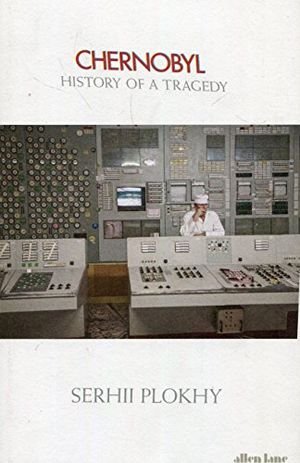
5Chernobyl: History of a Tragedy
On 26 April 1986 at 1.23am a reactor at the Chernobyl Nuclear Power Plant in Soviet Ukraine exploded. While the authorities scrambled to understand what was occurring, workers, engineers, firefighters and those living in the area were abandoned to their fate. The blast put the world on the brink of nuclear annihilation, contaminating over half of Europe with radioactive fallout.
In Chernobyl, award-winning historian Serhii Plokhy draws on recently opened archives to recreate these events in all their drama, telling the stories of the scientists, workers, soldiers, and policemen who found themselves caught in a nuclear nightmare. While the immediate cause of the accident was a turbine test gone wrong, he shows how its deeper roots lay in the nature of the Soviet political system and the ingrained flaws of its nuclear industry. A little more than five years later, the Soviet Union would fall apart, destroyed from within by its unsustainable ideology and the dysfunctional systems laid bare in the wake of the disaster.
A moment by moment account of the heroes, perpetrators and victims of a tragedy, Chernobyl is the first full account of a gripping, unforgettable Cold War story.
In Chernobyl, award-winning historian Serhii Plokhy draws on recently opened archives to recreate these events in all their drama, telling the stories of the scientists, workers, soldiers, and policemen who found themselves caught in a nuclear nightmare. While the immediate cause of the accident was a turbine test gone wrong, he shows how its deeper roots lay in the nature of the Soviet political system and the ingrained flaws of its nuclear industry. A little more than five years later, the Soviet Union would fall apart, destroyed from within by its unsustainable ideology and the dysfunctional systems laid bare in the wake of the disaster.
A moment by moment account of the heroes, perpetrators and victims of a tragedy, Chernobyl is the first full account of a gripping, unforgettable Cold War story.
It’s just a really thrilling book, as well as being a really interesting history of that time. But the reason why I think it’s also a brilliant political book is fundamentally what Plokhii reveals in his writing, is that the failure of Chernobyl was fundamentally a failure of a political system, as well as a failure of a scientific system. [source]

Kate Brown
He’s really good here at laying down the background of the disaster itself, the plant’s construction, the days leading up to it, the moments the accident occurred. He talks about the accident itself, the delay in informing the public, the censorship of news, the trial of the nuclear power plant operators who he thinks were treated as scapegoats, and the political outcomes of all this deception. [source]