We've ranked the best revolution books using expert recommendations, sales data, and millions of reader ratings. At Shortform, we know books. Our book guides are the best in the world. Learn why.
Cover unavailable
1
Animal Farm
George Orwell and Christopher Hitchens
5.0
Animal Farm is one of the most famous warnings ever written. Orwell's immortal satire - 'against Stalin' as he wrote to his French translator - can be read on many levels. With its piercing clarity and deceptively simple style it is no surprise that this novel is required reading for schoolchildren and politicians alike. This fable of the steadfast horses Boxer and Clover, the opportunistic pigs Snowball and Napoleon, and the deafening choir of sheep remains an unparalleled masterpiece.
One reviewer wrote 'In a hundred years' time perhaps Animal Farm ... may simply be a fairy story: today it is a fairy story with a good deal of point.' Over sixty years on in the age of spin, it is more relevant than ever.
Rejected by such eminent publishing figures as Victor Gollancz, Jonathan Cape and T.S. Eliot, Animal Farm was published to great acclaim by Martin Secker and Warburg on 17 August 1945 in an edition of 4500 copies. In the centenary year of Martin Secker, Ltd., Harvill Secker is proud to publish this special edition with a brand-new introduction by Christopher Hitchens.
Whitney Cummings recommended this book on the podcast "The Tim Ferriss Show". [source]

Vlad Tenev
When I was in sixth grade I remember being very upset by the ending of this book. [source]
Heather Brooke
I picked Animal Farm because it is an allegory about power and its seductive and corruptive influence on people regardless of their initial good intentions. [source]
Cover unavailable
2
A Tale of Two Cities
Charles Dickens
5.0
This work has been selected by scholars as being culturally important and is part of the knowledge base of civilization as we know it.
This work is in the public domain in the United States of America, and possibly other nations. Within the United States, you may freely copy and distribute this work, as no entity (individual or corporate) has a copyright on the body of the work.
Scholars believe, and we concur, that this work is important enough to be preserved, reproduced, and made generally available to the public. To ensure a quality reading experience, this work has been proofread and republished using a format that seamlessly blends the original graphical elements with text in an easy-to-read typeface.
We appreciate your support of the preservation process, and thank you for being an important part of keeping this knowledge alive and relevant.
…
Recommended by Amelia Boone, Antonio Villaraigosa, and May Witwit.
As mayor of a large metropolis, the living conditions of our residents are always present in my mind. Every decision I make, I try to evaluate if it will help improve the quality of life of every Angeleno. But Dickens really dissects both the aristocrats and the revolutionaries, to show that change is never easy. As progressives, we value government’s role and power to improve our cities and communities, but at the same time we must never forget that the ends never justify the means. And that the majority cannot deprive the minority of their inalienable rights that come with a democracy. [source]
May Witwit
I started a paper about the historical reality in this book. And as I studied it more deeply I got depressed because the things that were happening were similar to Iraq. How the mob could be turned against people by devious minds. They just killed people without even knowing them. The people who were killed were probably very good people, you never know. You just can’t kill haphazardly, heads rolling everywhere for nothing. There must be a way to check these things [source]
Cover unavailable
3
1776
David McCullough
4.9
In this stirring book, David McCullough tells the intensely human story of those who marched with General George Washington in the year of the Declaration of Independence, when the whole American cause was riding on their success, without which all hope for independence would have been dashed and the noble ideals of the Declaration would have amounted to little more than words on paper.
Based on extensive research in both American and British archives, 1776 is the story of Americans in the ranks, men of every shape, size, and color, farmers, schoolteachers, shoemakers, no-accounts, and mere boys turned soldiers. And it is the story of the British commander, William Howe, and his highly disciplined redcoats, who looked on their rebel foes with contempt and fought with a valor too little known. But it is the American commander-in-chief who stands foremost: Washington, who had never before led an army in battle.
The darkest hours of that tumultuous year were as dark as any Americans have known. Especially in our own tumultuous time, 1776 is powerful testimony to how much is owed to a rare few in that brave founding epoch, and what a miracle it was that things turned out as they did.
Written as a companion work to his celebrated biography of John Adams, David McCullough's 1776 is another landmark in the literature of American history.
@msphillipsrvhs @rvhs Great book! Can never go wrong with anything from David McCullough! [source]
Cover unavailable
4
The Hunger Games (The Hunger Games, #1)
Suzanne Collins
4.8
WINNING MEANS FAME AND FORTUNE. LOSING MEANS CERTAIN DEATH. THE HUNGER GAMES HAVE BEGUN. . . .
In the ruins of a place once known as North America lies the nation of Panem, a shining Capitol surrounded by twelve outlying districts. The Capitol is harsh and cruel and keeps the districts in line by forcing them all to send one boy and once girl between the ages of twelve and eighteen to participate in the annual Hunger Games, a fight to the death on live TV.
Sixteen-year-old Katniss Everdeen regards it as a death sentence when she steps forward to take her sister's place in the Games. But Katniss has been close to dead before—and survival, for her, is second nature. Without really meaning to, she becomes a contender. But if she is to win, she will have to start making choices that weight survival against humanity and life against love.
A brutal, exciting, action-based sci-fi novel. Hugely popular and excellent fun. [source]
Cover unavailable
5
Catching Fire (The Hunger Games, #2)
Suzanne Collins
4.8
SPARKS ARE IGNITING. FLAMES ARE SPREADING. AND THE CAPITAL WANTS REVENGE.
Against all odds, Katniss Everdeen has survived the Hunger Games. She and fellow District 12 tribute Peeta Mellark are miraculously still alive. Katniss should be relieved, happy even. Yet nothing is the way Katniss wishes it to be. Gale holds her at an icy distance. Peeta has turned his back on her completely. And there are whispers of a rebellion against the Capitol - a rebellion that Katniss and Peeta may have helped create.
Much to her shock, Katniss has fueled an unrest that she's afraid she cannot stop. And what scares her even more is that she's not entirely convinced she should try. As time draws near for Katniss and Peeta to visit the districts on the Capitol's cruel Victory Tour, the stakes are higher than ever. If they can't prove, without a shadow of a doubt, that they are lost in their love for each other, the consequences will be horrifying. Katniss is about to be tested as never before.
…
Cover unavailable
6
1984
George Orwell
4.8
A PBS Great American Read Top 100 Pick
With extraordinary relevance and renewed popularity, George Orwell’s 1984 takes on new life in this hardcover edition.
“Orwell saw, to his credit, that the act of falsifying reality is only secondarily a way of changing perceptions. It is, above all, a way of asserting power.”—The New Yorker
In 1984, London is a grim city in the totalitarian state of Oceania where Big Brother is always watching you and the Thought Police can practically read your mind. Winston Smith is a man in grave danger for the simple reason that his memory still functions. Drawn into a forbidden love affair, Winston finds the courage to join a secret revolutionary organization called The Brotherhood, dedicated to the destruction of the Party. Together with his beloved Julia, he hazards his life in a deadly match against the powers that be.
Lionel Trilling said of Orwell’s masterpiece “1984 is a profound, terrifying, and wholly fascinating book. It is a fantasy of the political future, and like any such fantasy, serves its author as a magnifying device for an examination of the present.” Though the year 1984 now exists in the past, Orwell’s novel remains an urgent call for the individual willing to speak truth to power.
Today is World Book Day, a wonderful opportunity to address this #ChallengeRichard sent in by Mike Gonzalez of New Jersey: Make a list of your top 65 books to read in a lifetime. [source]
called this book "one of his favorite" and recommended it to the hires. The book also inspired one the greatest TV ad (made by Jobs) [source]
Andra Zaharia
These books and their core ideas have stuck with me the most and continue to guide me when I hit crossroads along the way. [source]
Cover unavailable
7
John Adams
David McCullough
4.8
The enthralling, often surprising story of John Adams, one of the most important and fascinating Americans who ever lived.
In this powerful, epic biography, David McCullough unfolds the adventurous life-journey of John Adams, the brilliant, fiercely independent, often irascible, always honest Yankee patriot -- "the colossus of independence," as Thomas Jefferson called him -- who spared nothing in his zeal for the American Revolution; who rose to become the second President of the United States and saved the country from blundering into an unnecessary war; who was learned beyond all but a few and regarded by some as "out of his senses"; and whose marriage to the wise and valiant Abigail Adams is one of the moving love stories in American history.
Like his masterly, Pulitzer Prize-winning biography Truman, David McCullough's John Adams has the sweep and vitality of a great novel. It is both a riveting portrait of an abundantly human man and a vivid evocation of his time, much of it drawn from an outstanding collection of Adams family letters and diaries. In particular, the more than one thousand surviving letters between John and Abigail Adams, nearly half of which have never been published, provide extraordinary access to their private lives and make it possible to know John Adams as no other major American of his founding era.
As he has with stunning effect in his previous books, McCullough tells the story from within -- from the point of view of the amazing eighteenth century and of those who, caught up in events, had no sure way of knowing how things would turn out. George Washington, Benjamin Franklin, John Jay, the British spy Edward Bancroft, Madame Lafayette and Jefferson's Paris "interest" Maria Cosway, Alexander Hamilton, James Madison, the scandalmonger James Callender, Sally Hemings, John Marshall, Talleyrand, and Aaron Burr all figure in this panoramic chronicle, as does, importantly, John Quincy Adams, the adored son whom Adams would live to see become President.
Crucial to the story, as it was to history, is the relationship between Adams and Jefferson, born opposites -- one a Massachusetts farmer's son, the other a Virginia aristocrat and slaveholder, one short and stout, the other tall and spare. Adams embraced conflict; Jefferson avoided it. Adams had great humor; Jefferson, very little. But they were alike in their devotion to their country.
At first they were ardent co-revolutionaries, then fellow diplomats and close friends. With the advent of the two political parties, they became archrivals, even enemies, in the intense struggle for the presidency in 1800, perhaps the most vicious election in history. Then, amazingly, they became friends again, and ultimately, incredibly, they died on the same day -- their day of days -- July 4, in the year 1826.
Much about John Adams's life will come as a surprise to many readers. His courageous voyage on the frigate Boston in the winter of 1778 and his later trek over the Pyrenees are exploits that few would have dared and that few readers will ever forget.
It is a life encompassing a huge arc -- Adams lived longer than any president. The story ranges from the Boston Massacre to Philadelphia in 1776 to the Versailles of Louis XVI, from Spain to Amsterdam, from the Court of St. James's, where Adams was the first American to stand before King George III as a representative of the new nation, to the raw, half-finished Capital by the Potomac, where Adams was the first President to occupy the White House.
This is history on a grand scale -- a book about politics and war and social issues, but also about human nature, love, religious faith, virtue, ambition, friendship and betrayal, and the far-reaching consequences of noble ideas. Above all, John Adams is an enthralling, often surprising story of one of the most important and fascinating Americans who ever lived.
…
Recommended by Barack Obama and Antonio Villaraigosa.
The biographies have been useful, because I do think that there’s a tendency, understandable, to think that whatever’s going on right now is uniquely disastrous or amazing or difficult. [source]
Antonio Villaraigosa
I love biographies and this one in particular strikes me. I don’t believe John Adams comes immediately to mind as one of the great presidents, but he was. Students of history know he had a hand in so many of the founding documents we remember today. [source]
Cover unavailable
8
Mockingjay (The Hunger Games, #3)
Suzanne Collins
4.8
My name is Katniss Everdeen. Why am I not dead? I should be dead.
Katniss Everdeen, girl on fire, has survived, even though her home has been destroyed. Gale has escaped. Katniss's family is safe. Peeta has been captured by the Capitol. District 13 really does exist. There are rebels. There are new leaders. A revolution is unfolding.
It is by design that Katniss was rescued from the arena in the cruel and haunting Quarter Quell, and it is by design that she has long been part of the revolution without knowing it. District 13 has come out of the shadows and is plotting to overthrow the Capitol. Everyone, it seems, has had a hand in the carefully laid plans - except Katniss.
The success of the rebellion hinges on Katniss's willingness to be a pawn, to accept responsibility for countless lives, and to change the course of the future of Panem. To do this, she must put aside her feelings of anger and distrust. She must become the rebels' Mockingjay - no matter what the personal cost.
100,000 years ago, at least six human species inhabited the earth. Today there is just one. Us. Homo sapiens.
How did our species succeed in the battle for dominance? Why did our foraging ancestors come together to create cities and kingdoms? How did we come to believe in gods, nations and human rights; to trust money, books and laws; and to be enslaved by bureaucracy, timetables and consumerism? And what will our world be like in the millennia to come?
In Sapiens, Dr Yuval Noah Harari spans the whole of human history, from the very first humans to walk the earth to the radical – and sometimes devastating – breakthroughs of the Cognitive, Agricultural and Scientific Revolutions. Drawing on insights from biology, anthropology, paleontology and economics, he explores how the currents of history have shaped our human societies, the animals and plants around us, and even our personalities. Have we become happier as history has unfolded? Can we ever free our behaviour from the heritage of our ancestors? And what, if anything, can we do to influence the course of the centuries to come?
Bold, wide-ranging and provocative, Sapiens challenges everything we thought we knew about being human: our thoughts, our actions, our power ... and our future.
Both Melinda and I read this one, and it has sparked lots of great conversations at our dinner table. Harari takes on a daunting challenge: to tell the entire history of the human race in just 400 pages. He also writes about our species today and how artificial intelligence, genetic engineering, and other technologies will change us in the future. Although I found things to disagree with—especially Harari’s claim that humans were better off before we started farming—I would recommend Sapiens to anyone who’s interested in the history and future of our species. [source]
In 2075, the Moon is no longer a penal colony. But it is still a prison...
Life isn't easy for the political dissidents and convicts who live in the scattered colonies that make up lunar civilisation. Everything is regulated strictly, efficiently and cheaply by a central supercomputer, HOLMES IV.
When humble technician Mannie O'Kelly-Davis discovers that HOLMES IV has quietly achieved consciousness (and developed a sense of humour), the choice is clear: either report the problem to the authorities... or become friends.
And perhaps overthrow the government while they're at it.
The Moon is a Harsh Mistress has been called Robert A. Heinlein's crowning achievement. His best-known novels include Starship Troopers, Mistress and Stranger in a Strange Land.
With its first great victory in the landmark Supreme Court decision Brown v. Board of Education in 1954, the civil rights movement gained the powerful momentum it needed to sweep forward into its crucial decade, the 1960s. As voices of protest and change rose above the din of history and false promises, one voice sounded more urgently, more passionately, than the rest. Malcolm X—once called the most dangerous man in America—challenged the world to listen and learn the truth as he experienced it. And his enduring message is as relevant today as when he first delivered it.
In the searing pages of this classic autobiography, originally published in 1964, Malcolm X, the Muslim leader, firebrand, and anti-integrationist, tells the extraordinary story of his life and the growth of the Black Muslim movement to veteran writer and journalist Alex Haley . In a unique collaboration, Haley worked with Malcolm X for nearly two years, interviewing, listening to, and understanding the most controversial leader of his time.
Raised in Lansing, Michigan, Malcolm Little journeyed on a road to fame as astonishing as it was unpredictable. Drifting from childhood poverty to petty crime, Malcolm found himself in jail. It was there that he came into contact with the teachings of a little-known Black Muslim leader renamed Elijah Muhammad. The newly renamed Malcolm X devoted himself body and soul to the teachings of Elijah Muhammad and the world of Islam, becoming the Nation’s foremost spokesman. When his conscience forced him to break with Elijah Muhammad, Malcolm founded the Organization of Afro-American Unity to reach African Americans across the country with an inspiring message of pride, power, and self-determination.
I forget who said it but I heard someone say that Catcher in the Rye was to young white boys what the Autobiography of Malcolm X was to young black boys. Personally, I prefer that latter over the former. I would much rather read about and emulate a man who is born into adversity and pain, struggles with criminality, does prison time, teaches himself to read through the dictionary, finds religion and then becomes an activist for Civil Rights before being gunned down by his former supporters when he tempers the hate and anger that had long defined parts of his message. [source]

David Coogan
His memoir describes that process of transformation from a common narrative of street hustler and limited opportunities, struggling in a racist society, to this radicalization in part through literacy, in part through literature and religion. [source]
Cover unavailable
12
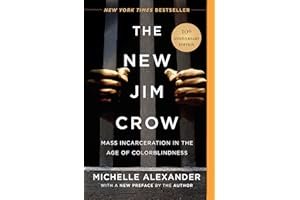
The New Jim Crow: Mass Incarceration in the Age of Colorblindness
"Jarvious Cotton's great-great-grandfather could not vote as a slave. His great-grandfather was beaten to death by the Klu Klux Klan for attempting to vote. His grandfather was prevented from voting by Klan intimidation; his father was barred by poll taxes and literacy tests. Today, Cotton cannot vote because he, like many black men in the United States, has been labeled a felon and is currently on parole."
As the United States celebrates the nation's "triumph over race" with the election of Barack Obama, the majority of young black men in major American cities are locked behind bars or have been labeled felons for life. Although Jim Crow laws have been wiped off the books, an astounding percentage of the African American community remains trapped in a subordinate status--much like their grandparents before them.
In this incisive critique, former litigator-turned-legal-scholar Michelle Alexander provocatively argues that we have not ended racial caste in America: we have simply redesigned it. Alexander shows that, by targeting black men and decimating communities of color, the U.S. criminal justice system functions as a contemporary system of racial control, even as it formally adheres to the principle of color blindness. The New Jim Crow challenges the civil rights community--and all of us--to place mass incarceration at the forefront of a new movement for racial justice in America.
I read The New Jim Crow, a study of how the U.S. justice system disproportionately criminalizes and jails blacks and Latinos. Making our criminal justice system fairer and more effective is a huge challenge for our country. I’m going to keep learning about this topic, but some things are already clear: We can’t jail our way to a just society, and our current system isn’t working (adapted with permission from Facebook’s A Year of Books project). [source]
Peter Temin
The new Jim Crow that Michelle Alexander is talking about is mass incarceration. [source]
The inspiration for the hit Broadway musical Hamilton!
In the first full-length biography of Alexander Hamilton in decades, National Book Award winner Ron Chernow tells the riveting story of a man who overcame all odds to shape, inspire, and scandalize the newborn America. According to historian Joseph Ellis, Alexander Hamilton is “a robust full-length portrait, in my view the best ever written, of the most brilliant, charismatic and dangerous founder of them all.”Few figures in American history have been more hotly debated or more grossly misunderstood than Alexander Hamilton. Chernow’s biography gives Hamilton his due and sets the record straight, deftly illustrating that the political and economic greatness of today’s America is the result of Hamilton’s countless sacrifices to champion ideas that were often wildly disputed during his time. “To repudiate his legacy,” Chernow writes, “is, in many ways, to repudiate the modern world.” Chernow here recounts Hamilton’s turbulent life: an illegitimate, largely self-taught orphan from the Caribbean, he came out of nowhere to take America by storm, rising to become George Washington’s aide-de-camp in the Continental Army, coauthoring The Federalist Papers, founding the Bank of New York, leading the Federalist Party, and becoming the first Treasury Secretary of the United States.
Historians have long told the story of America’s birth as the triumph of Jefferson’s democratic ideals over the aristocratic intentions of Hamilton. Chernow presents an entirely different man, whose legendary ambitions were motivated not merely by self-interest but by passionate patriotism and a stubborn will to build the foundations of American prosperity and power. His is a Hamilton far more human than we’ve encountered before—from his shame about his birth to his fiery aspirations, from his intimate relationships with childhood friends to his titanic feuds with Jefferson, Madison, Adams, Monroe, and Burr, and from his highly public affair with Maria Reynolds to his loving marriage to his loyal wife Eliza. And never before has there been a more vivid account of Hamilton’s famous and mysterious death in a duel with Aaron Burr in July of 1804.
Chernow’s biography is not just a portrait of Hamilton, but the story of America’s birth seen through its most central figure. At a critical time to look back to our roots, Alexander Hamilton will remind readers of the purpose of our institutions and our heritage as Americans.
Related and with equal weight, I want to recommend George B. McClellan: The Young Napoleon by Stephen W. Sears (a biography of the talented but utterly delusional General George McClellan), Rebel Yell: The Violence, Passion, and Redemption of Stonewall Jackson by S.C. Gwynne (a biography of the brilliant but manic Stonewall Jackson) and Ron Chernow’s Alexander Hamilton (an equally brilliant, more accomplished but equally tragic founding father). All these books made me angry, sad, and confused. But they also made me look inward and taught me quite a bit. [source]
Fabrice Grinda
I read books for fun. It just so happens that they often are also insightful, but I would not say any specific book had a huge influence on me. Some biographies like Alexander Hamilton by Ron Chernow are inspiring, but it’s not as though they changed my career path. I knew I wanted to be an Internet entrepreneur from a very young age. [source]
Cover unavailable
14
Les Misérables
Victor Hugo, Isabel F. Hapgood, et al.
4.7
Introducing one of the most famous characters in literature, Jean Valjean—the noble peasant imprisoned for stealing a loaf of bread—Les Misérables ranks among the greatest novels of all time. In it, Victor Hugo takes readers deep into the Parisian underworld, immerses them in a battle between good and evil, and carries them to the barricades during the uprising of 1832 with a breathtaking realism that is unsurpassed in modern prose. Within his dramatic story are themes that capture the intellect and the emotions: crime and punishment, the relentless persecution of Valjean by Inspector Javert, the desperation of the prostitute Fantine, the amorality of the rogue Thénardier, and the universal desire to escape the prisons of our own minds. Les Misérables gave Victor Hugo a canvas upon which he portrayed his criticism of the French political and judicial systems, but the portrait that resulted is larger than life, epic in scope—an extravagant spectacle that dazzles the senses even as it touches the heart.
…
Recommended by Christian B Miller and David Bellos.
Christian B Miller
Vividly illustrates two ideas about character. The first is that our characters can change over time, the second is that role models can be powerful sources of character change. [source]
David Bellos
Because it’s so huge and so capacious and contains so many different stories and takes on the world, you can make anything out of Les Misérables. [source]
Cover unavailable
15
Dune (Dune Chronicles, #1)
Frank Herbert
4.5
A deluxe hardcover edition of the best-selling science-fiction book of all time—part of Penguin Galaxy, a collectible series of six sci-fi/fantasy classics, featuring a series introduction by Neil Gaiman.
Science fiction’s supreme masterpiece, "Dune" will be forever considered a triumph of the imagination. Set on the desert planet Arrakis, it is the story of the boy Paul Atreides, who will become the mysterious man known as Muad’Dib. Paul’s noble family is named stewards of Arrakis, whose sands are the only source of a powerful drug called “the spice.” After his family is brought down in a traitorous plot, Paul must go undercover to seek revenge, and to bring to fruition humankind’s most ancient and unattainable dream. A stunning blend of adventure and mysticism, environmentalism and politics, Dune won the first Nebula Award, shared the Hugo Award, and formed the basis of what is undoubtedly the grandest epic in science fiction.
If you haven't read it, just go read it. It is amazing! [source]
Cover unavailable
16
V for Vendetta
Alan Moore, David Lloyd
4.5
"Remember, remember the fifth of November..."
A frightening and powerful tale of the loss of freedom and identity in a chillingly believable totalitarian world, V for Vendetta stands as one of the highest achievements of the comics medium and a defining work for creators Alan Moore and David Lloyd.
Set in an imagined future England that has given itself over to fascism, this groundbreaking story captures both the suffocating nature of life in an authoritarian police state and the redemptive power of the human spirit which rebels against it. Crafted with sterling clarity and intelligence, V for Vendetta brings an unequaled depth of characterization and verisimilitude to its unflinching account of oppression and resistance.
…
Recommended by Boris Starling and Evan Goldberg.
Boris Starling
V for Vendetta is a graphic novel set in a future, fascist Britain. It mirrors 1984 in some ways. The fascists are called Norsefire. [source]
Persepolis: The Story of a Childhood (Persepolis, #1)
Marjane Satrapi
4.5
A New York Times Notable Book A Time Magazine “Best Comix of the Year” A San Francisco Chronicle and Los Angeles Times Best-seller
Wise, funny, and heartbreaking, Persepolis is Marjane Satrapi’s memoir of growing up in Iran during the Islamic Revolution. In powerful black-and-white comic strip images, Satrapi tells the story of her life in Tehran from ages six to fourteen, years that saw the overthrow of the Shah’s regime, the triumph of the Islamic Revolution, and the devastating effects of war with Iraq. The intelligent and outspoken only child of committed Marxists and the great-granddaughter of one of Iran’s last emperors, Marjane bears witness to a childhood uniquely entwined with the history of her country.
Persepolis paints an unforgettable portrait of daily life in Iran and of the bewildering contradictions between home life and public life. Marjane’s child’s-eye view of dethroned emperors, state-sanctioned whippings, and heroes of the revolution allows us to learn as she does the history of this fascinating country and of her own extraordinary family. Intensely personal, profoundly political, and wholly original, Persepolis is at once a story of growing up and a reminder of the human cost of war and political repression. It shows how we carry on, with laughter and tears, in the face of absurdity. And, finally, it introduces us to an irresistible little girl with whom we cannot help but fall in love.
…
Recommended by Pooneh Ghoddoosi.
Pooneh Ghoddoosi
I read the book and it was great, but more people saw the film because it was nominated for an Academy Award. And after seeing the movie, so many people I knew came up to me and told me that they thought it was exactly the story of my life. And not just me, but most of my Iranian friends had the same feeling of “Oh God, that could have been me, I could have written that book – it could have been the story of my life and my family, and that’s exactly how I felt in high school.” [source]
Cover unavailable
18
Winter (The Lunar Chronicles, #4)
Marissa Meyer
4.5
Princess Winter is admired for her grace, kindness and beauty, despite the scars on her face. She's said to be even more breath-taking than her stepmother, Queen Levana...
When Winter develops feelings for the handsome palace guard, Jacin, she fears the evil Queen will crush their romance before it has a chance to begin.
But there are stirrings against the Queen across the land. Together with the cyborg mechanic, Cinder, and her allies, Winter might even find the power to launch a revolution and win a war that's been raging for far too long.
Can Cinder, Scarlet, Cress, and Winter claim their happily ever afters by defeating Levana once and for all?
…
Cover unavailable
19
Red Queen (Red Queen, #1)
Victoria Aveyard
4.5
This is a world divided by blood - red or silver. The Reds are commoners, ruled by a Silver elite in possession of god-like superpowers. And to Mare Barrow, a seventeen-year-old Red girl from the poverty-stricken Stilts, it seems like nothing will ever change. That is until she finds herself working in the Silver Palace. Here, surrounded by the people she hates the most, Mare discovers that, despite her red blood, she possesses a deadly power of her own. One that threatens to destroy the balance of power. Fearful of Mare's potential, the Silvers hide her in plain view, declaring her a long-lost Silver princess, now engaged to a Silver prince. Despite knowing that one misstep would mean her death, Mare works silently to help the Red Guard, a militant resistance group, and bring down the Silver regime. But this is a world of betrayal and lies, and Mare has entered a dangerous dance - Reds against Silvers, prince against prince, and Mare against her own heart.
…
Recommended by Zoe.
Zoe
The Red Queen series is about a girl living in a world where the colour of your blood determines your status. [source]
Cover unavailable
20
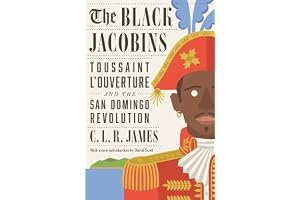
The Black Jacobins: Toussaint L'Ouverture and the San Domingo revolution
C. L. R. (Cyril Lionel James
4.5
In 1789 the West Indian colony of San Domingo supplied two-thirds of the overseas trade of France. The entire structure of what was arguably the most profitable colony in the world rested on the labour of half a million slaves. In 1791 the waves of unrest inspired by the French Revolution reached across the Atlantic dividing the loyalties of the white population of the island. The brutally treated slaves of Saint Domingo seized at this confusion and rose up in rebellion against masters. In thisclassic work, CLR James chronicles the only successful slave revolt in history and provides a critical portrait of their leader, Toussaint L'Ouverture, 'one of the most remarkable men of a period rich in remarkable men'.
…
Recommended by Ben Horowitz, Christian Wisskirchen, and Trevor Phillips.
A management and cultural genius better than anybody that I’ve ever read about or learned from. [source]
Christian Wisskirchen
The book highlights the achievement of the Haitian nation to be the only ever slave revolution achieving independence by armed struggle. [source]
Trevor Phillips
This book is very complex because it does not make the rebellion’s leader, Toussaint L’Ouverture, into a sort of plaster saint. [source]
Cover unavailable
21
Wild Swans: Three Daughters of China
Jung Chang
4.4
Three remarkable women--grandmother, mother, and daughter--struggle to survive in a true-life saga that spans 20th-century China with all its violence: wars, invasions, revolution, and continuing upheaval. A thrilling adventure story, Wild Swans is an important work of history, and a breathtaking testimony to the human spirit. 16 pages of photographs.
Recommended by Richard Branson, Harry Wu, and Vishakha Desai.
Today is World Book Day, a wonderful opportunity to address this #ChallengeRichard sent in by Mike Gonzalez of New Jersey: Make a list of your top 65 books to read in a lifetime. [source]
Harry Wu
Wild Swans is talking about people who are living at the highest level of society but they are still suffering persecution and live in fear. And the peasants in the village became slaves, they became nothing. So what the book does brilliantly is give a real insight into what life was like for ordinary people against the backdrop of the ever-changing China. [source]
Vishakha Desai
To me Wild Swans is one of those iconic books for understanding the generations of Chinese women. She is from this amazing intellectual family and it’s about what happens to them. The book just has this tremendous power. It’s an amazing journey. It’s about what women do to survive and also how they suffer. [source]
Cover unavailable
22
A People's Tragedy: The Russian Revolution
Orlando Figes
4.4
Unrivalled in scope and brimming with human drama, A People’s Tragedy is the most vivid, moving and comprehensive history of the Russian Revolution available today.
‘A modern masterpiece’ Andrew Marr
‘The most moving account of the Russian Revolution since Doctor Zhivago’ Independent
Opening with a panorama of Russian society, from the cloistered world of the Tsar to the brutal life of the peasants, A People’s Tragedy follows workers, soldiers, intellectuals and villagers as their world is consumed by revolution and then degenerates into violence and dictatorship. Drawing on vast original research, Figes conveys above all the shocking experience of the revolution for those who lived it, while providing the clearest and most cogent account of how and why it unfolded.
Illustrated with over 100 photographs and now including a new introduction that reflects on the revolution’s centennial legacy, A People’s Tragedy is a masterful and definitive record of one of the most important events in modern history.
…
Recommended by Roland Chambers and Thomas Keneally.
Roland Chambers
A People’s Tragedy is the most readable and illuminating history of the Russian revolution to be written, using material that only became available to historians following the Soviet Union’s collapse. [source]
Thomas Keneally
Well, I’ve chosen this because, from what I remember, it’s the book I most admired while I was writing about Russia because it gives the tremendous overall sweep of the entire catastrophe up to the end of the civil war in 1922 and the famine. Figes has the capacity to focus on people you’ve never heard of and show them as representatives of ideologies competing for control of the Russian state, and he looks at it on an individual basis. [source]
Cover unavailable
23
Founding Brothers: The Revolutionary Generation
Joseph J. Ellis
4.4
Informs our understanding of American politics--then and now--and gives us a new perspective on the unpredictable forces that shape history.
An illuminating study of the intertwined lives of the founders of the American republic--John Adams, Aaron Burr, Benjamin Franklin, Alexander Hamilton, Thomas Jefferson, James Madison, and George Washington.
During the 1790s, which Ellis calls the most decisive decade in our nation's history, the greatest statesmen of their generation--and perhaps any--came together to define the new republic and direct its course for the coming centuries. Ellis focuses on six discrete moments that exemplify the most crucial issues facing the fragile new nation: Burr and Hamilton's deadly duel, and what may have really happened; Hamilton, Jefferson, and Madison's secret dinner, during which the seat of the permanent capital was determined in exchange for passage of Hamilton's financial plan; Franklin's petition to end the "peculiar institution" of slavery--his last public act--and Madison's efforts to quash it; Washington's precedent-setting Farewell Address, announcing his retirement from public office and offering his country some final advice; Adams's difficult term as Washington's successor and his alleged scheme to pass the presidency on to his son; and finally, Adams and Jefferson's renewed correspondence at the end of their lives, in which they compared their different views of the Revolution and its legacy.
In a lively and engaging narrative, Ellis recounts the sometimes collaborative, sometimes archly antagonistic interactions between these men, and shows us the private characters behind the public personas: Adams, the ever-combative iconoclast, whose closest political collaborator was his wife, Abigail; Burr, crafty, smooth, and one of the most despised public figures of his time; Hamilton, whose audacious manner and deep economic savvy masked his humble origins; Jefferson, renowned for his eloquence, but so reclusive and taciturn that he rarely spoke more than a few sentences in public; Madison, small, sickly, and paralyzingly shy, yet one of the most effective debaters of his generation; and the stiffly formal Washington, the ultimate realist, larger-than-life, and America's only truly indispensable figure.
Ellis argues that the checks and balances that permitted the infant American republic to endure were not primarily legal, constitutional, or institutional, but intensely personal, rooted in the dynamic interaction of leaders with quite different visions and values. Revisiting the old-fashioned idea that character matters, Founding Brothers informs our understanding of American politics--then and now--and gives us a new perspective on the unpredictable forces that shape history.
…
Recommended by Andrea Wulf.
Andrea Wulf
Instead of writing a massive 700-page book, Ellis just gives you seven events which will tell you everything you need to know. [source]
Cover unavailable
24
Revolution
KT McFarlan
4.4
BROOKLYN: Andi Alpers is on the edge. She’s angry at her father for leaving, angry at her mother for not being able to cope, and heartbroken by the loss of her younger brother, Truman. Rage and grief are destroying her. And she’s about to be expelled from Brooklyn Heights’ most prestigious private school when her father intervenes. Now Andi must accompany him to Paris for winter break.
PARIS: Alexandrine Paradis lived over two centuries ago. She dreamed of making her mark on the Paris stage, but a fateful encounter with a doomed prince of France cast her in a tragic role she didn’t want—and couldn’t escape.
Two girls, two centuries apart. One never knowing the other. But when Andi finds Alexandrine’s diary, she recognizes something in her words and is moved to the point of obsession. There’s comfort and distraction for Andi in the journal’s antique pages—until, on a midnight journey through the catacombs of Paris, Alexandrine’s words transcend paper and time, and the past becomes suddenly, terrifyingly present.
…
Cover unavailable
25
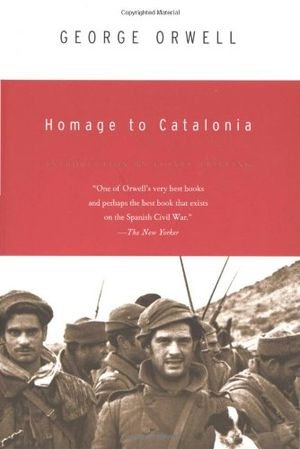
Homage to Catalonia
George Orwell
4.4
In 1936 George Orwell travelled to Spain to report on the Civil War and instead joined the fight against the Fascists. This famous account describes the war and Orwell’s own experiences. Introduction by Lionel Trilling.
The other reason I picked this book is that Orwell, like Dan Schorr, was an outsider. When he went to Spain, he was an unknown. He wasn’t Hemingway. He wasn’t a well-connected intellectual. He just had this amazing eye for detail. He was an amazing observer, and he could write so powerfully. This book, to me, is just one of the classics of foreign reporting. [source]
Anyone who wants to go off and write about Egypt, Tunisia or Libya today should pack a copy of Homage to Catalonia. It’s brilliant reportage. As you know, it opens with a vignette of an Italian militiaman in the barracks in Barcelona and he only saw this guy for a few moments but it captures the excitement. [source]
Cover unavailable
26
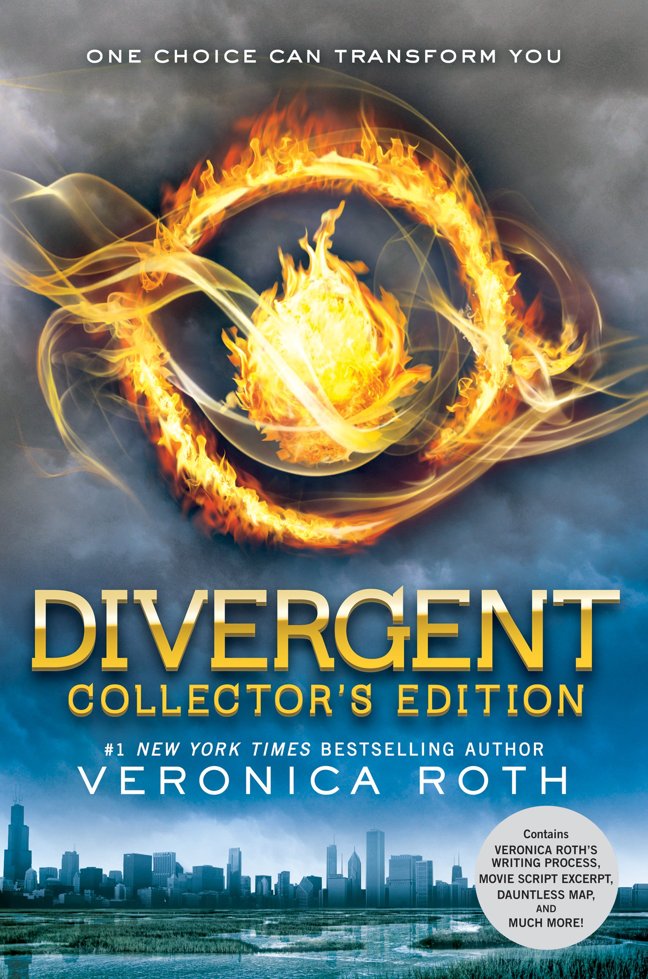
Divergent (Divergent, #1)
Veronica Roth
4.4
In Beatrice Prior's dystopian Chicago world, society is divided into five factions, each dedicated to the cultivation of a particular virtue—Candor (the honest), Abnegation (the selfless), Dauntless (the brave), Amity (the peaceful), and Erudite (the intelligent). On an appointed day of every year, all sixteen-year-olds must select the faction to which they will devote the rest of their lives. For Beatrice, the decision is between staying with her family and being who she really is—she can't have both. So she makes a choice that surprises everyone, including herself.
During the highly competitive initiation that follows, Beatrice renames herself Tris and struggles alongside her fellow initiates to live out the choice they have made. Together they must undergo extreme physical tests of endurance and intense psychological simulations, some with devastating consequences. As initiation transforms them all, Tris must determine who her friends really are—and where, exactly, a romance with a sometimes fascinating, sometimes exasperating boy fits into the life she's chosen. But Tris also has a secret, one she's kept hidden from everyone because she's been warned it can mean death. And as she discovers unrest and growing conflict that threaten to unravel her seemingly perfect society, she also learns that her secret might help her save those she loves . . . or it might destroy her.
…
Cover unavailable
27
The Handmaid's Tale
Margaret Atwood
4.4
Before The Testaments, there was The Handmaid’s Tale: an instant classic and eerily prescient cultural phenomenon, from “the patron saint of feminist dystopian fiction” (New York Times).
The Handmaid’s Tale is a novel of such power that the reader will be unable to forget its images and its forecast. Set in the near future, it describes life in what was once the United States and is now called the Republic of Gilead, a monotheocracy that has reacted to social unrest and a sharply declining birthrate by reverting to, and going beyond, the repressive intolerance of the original Puritans. The regime takes the Book of Genesis absolutely at its word, with bizarre consequences for the women and men in its population.
The story is told through the eyes of Offred, one of the unfortunate Handmaids under the new social order. In condensed but eloquent prose, by turns cool-eyed, tender, despairing, passionate, and wry, she reveals to us the dark corners behind the establishment’s calm facade, as certain tendencies now in existence are carried to their logical conclusions. The Handmaid’s Tale is funny, unexpected, horrifying, and altogether convincing. It is at once scathing satire, dire warning, and a tour de force. It is Margaret Atwood at her best.
Atwood takes all the hard information about gender inequality that she sees around her and then turns it up a few notches. [source]
Cliff Bleszinski
@HandmaidsOnHulu Done. Love the show, book is a classic, can't wait for season 2. [source]
Grady Booch
I read this several years ago but — much like Orwell’s 1984 — it seems particularly relevant given our current political morass. [source]
Cover unavailable
28
The Complete Persepolis (Persepolis, #1-4)
Marjane Satrapi
4.3
Here, in one volume: Marjane Satrapi's best-selling, internationally acclaimed graphic memoir.
Persepolis is the story of Satrapi's unforgettable childhood and coming of age within a large and loving family in Tehran during the Islamic Revolution; of the contradictions between private life and public life in a country plagued by political upheaval; of her high school years in Vienna facing the trials of adolescence far from her family; of her homecoming--both sweet and terrible; and, finally, of her self-imposed exile from her beloved homeland. It is the chronicle of a girlhood and adolescence at once outrageous and familiar, a young life entwined with the history of her country yet filled with the universal trials and joys of growing up.
Edgy, searingly observant, and candid, often heartbreaking but threaded throughout with raw humor and hard-earned wisdom--Persepolis is a stunning work from one of the most highly regarded, singularly talented graphic artists at work today.
Where ash falls from the sky, and mist dominates the night, evil cloaks the land and stifles all life. Criminal mastermind Kelsier teaches Allomancy, the magic of metals, to another Mistborn, urchin Vin 16. The unlikely heroine is distracted by rich Venture heir Elend. Can Kelsier's thieving crew take on the tyrant Lord Ruler and bring back colour to their world?
Cover unavailable
30
Between the World and Me
Ta-Nehisi Coates
4.3
#1 NEW YORK TIMES BESTSELLER [[ LONGLISTED FOR THE NATIONAL BOOK AWARD [[ Hailed by Toni Morrison as "required reading," a bold and personal literary exploration of America's racial history by "the single best writer on the subject of race in the United States" (The New York Observer)
"This is your country, this is your world, this is your body, and you must find some way to live within the all of it."
In a profound work that pivots from the biggest questions about American history and ideals to the most intimate concerns of a father for his son, Ta-Nehisi Coates offers a powerful new framework for understanding our nation's history and current crisis. Americans have built an empire on the idea of "race," a falsehood that damages us all but falls most heavily on the bodies of black women and menbodies exploited through slavery and segregation, and, today, threatened, locked up, and murdered out of all proportion. What is it like to inhabit a black body and find a way to live within it? And how can we all honestly reckon with this fraught history and free ourselves from its burden?
Between the World and Me is Ta-Nehisi Coates's attempt to answer these questions in a letter to his adolescent son. Coates shares with his sonand readersthe story of his awakening to the truth about his place in the world through a series of revelatory experiences, from Howard University to Civil War battlefields, from the South Side of Chicago to Paris, from his childhood home to the living rooms of mothers whose children's lives were taken as American plunder. Beautifully woven from personal narrative, reimagined history, and fresh, emotionally charged reportage, Between the World and Me clearly illuminates the past, bracingly confronts our present, and offers a transcendent vision for a way forward.
The president also released a list of his summer favorites back in 2015: All That Is, James Salter The Sixth Extinction, Elizabeth Kolbert The Lowland, Jhumpa Lahiri Between the World and Me, Ta-Nehisi Coates Washington: A Life, Ron Chernow All the Light We Cannot See, Anthony Doerr [source]
Q: What are the books that had a major influence on you? Or simply the ones you like the most. : Tao te Ching, score takes care of itself, between the world and me, the four agreements, the old man and the sea...I love reading! [source]
Here are some of my favorite reads from 2017. Lots of friends and colleagues send me book suggestions and it's impossible to squeeze them all in. I continue to be super curious about how digital and tech are enabling people to transform our lives but I try to read a good mix of books that apply to a variety of areas and stretch my thinking more broadly. [source]
Cover unavailable
31
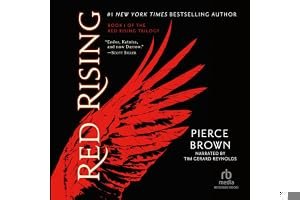
Red Rising (Red Rising Saga, #1)
Pierce Brown
4.3
"I live for the dream that my children will be born free," she says. "That they will be what they like. That they will own the land their father gave them."
"I live for you," I say sadly.
Eo kisses my cheek. "Then you must live for more."
Darrow is a Red, a member of the lowest caste in the color-coded society of the future. Like his fellow Reds, he works all day, believing that he and his people are making the surface of Mars livable for future generations.
Yet he spends his life willingly, knowing that his blood and sweat will one day result in a better world for his children.
But Darrow and his kind have been betrayed. Soon he discovers that humanity already reached the surface generations ago. Vast cities and sprawling parks spread across the planet. Darrow—and Reds like him—are nothing more than slaves to a decadent ruling class.
Inspired by a longing for justice, and driven by the memory of lost love, Darrow sacrifices everything to infiltrate the legendary Institute, a proving ground for the dominant Gold caste, where the next generation of humanity's overlords struggle for power. He will be forced to compete for his life and the very future of civilization against the best and most brutal of Society's ruling class. There, he will stop at nothing to bring down his enemies... even if it means he has to become one of them to do so.
…
Cover unavailable
32
Insurgent (Divergent, #2)
Veronica Roth
4.3
One choice can transform you—or it can destroy you. But every choice has consequences, and as unrest surges in the factions all around her, Tris Prior must continue trying to save those she loves—and herself—while grappling with haunting questions of grief and forgiveness, identity and loyalty, politics and love.
Tris's initiation day should have been marked by celebration and victory with her chosen faction; instead, the day ended with unspeakable horrors. War now looms as conflict between the factions and their ideologies grows. And in times of war, sides must be chosen, secrets will emerge, and choices will become even more irrevocable—and even more powerful. Transformed by her own decisions but also by haunting grief and guilt, radical new discoveries, and shifting relationships, Tris must fully embrace her Divergence, even if she does not know what she may lose by doing so.
New York Times bestselling author Veronica Roth's much-anticipated second book of the dystopian DIVERGENT series is another intoxicating thrill ride of a story, rich with hallmark twists, heartbreaks, romance, and powerful insights about human nature.
…
Cover unavailable
33
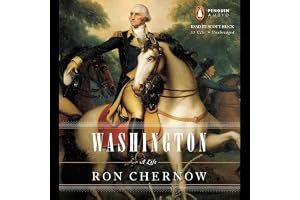
Washington: A Life
Ron Chernow
4.3
The celebrated Ron Chernow provides a richly nuanced portrait of the father of America. With a breadth and depth matched by no other one-volume life, he carries the reader through Washington's troubled boyhood, his precocious feats in the French and Indian Wars, his creation of Mount Vernon, his heroic exploits with the Continental Army, his presiding over the Constitutional Convention and his magnificent performance as America's first president.
Despite the reverence his name inspires Washington remains a waxwork to many readers, worthy but dull, a laconic man of remarkable self-control. But in this groundbreaking work Chernow revises forever the uninspiring stereotype. He portrays Washington as a strapping, celebrated horseman, elegant dancer and tireless hunter, who guarded his emotional life with intriguing ferocity. Not only did Washington gather around himself the foremost figures of the age, including James Madison, Alexander Hamilton, John Adams, and Thomas Jefferson, he orchestrated their actions to help realise his vision for the new federal government, define the separation of powers, and establish the office of the presidency.
Ron Chernow takes us on a page-turning journey through all the formative events of America's founding. This is a magisterial work from one of America's foremost writers and historians.
In Washington: A Life biographer Ron Chernow provides a richly nuanced portrait of the father of our nation. With a breadth & depth matched by no other one-volume life, this crisply paced narrative carries readers thru his troubled boyhood, his precocious feats in the French & Indian War, his creation of Mt Vernon, his heroic exploits with the Continental Army, his presiding over the Constitutional Convention & his performance as the 1st president. Despite the reverence his name inspires, Washington remains a lifeless waxwork for many, worthy but dull. A laconic man of granite self-control, he often arouses more respect than affection. This work, based on massive research, dashes the stereotype of a stolid, unemotional man. A strapping 6', Washington was a celebrated horseman, elegant dancer & tireless hunter, with a fiercely guarded emotional life. Chernow brings to vivid life a dashing, passionate man of fiery opinions & many moods. Probing his private life, he explores his fraught relationship with his crusty mother, his youthful infatuation with the married Sally Fairfax & his often conflicted feelings toward his adopted children & grandchildren. He also provides a portrait of his marriage to Martha & his complex behavior as a slave master. At the same time this is an astute portrait of a canny politician who knew how to inspire people. Not only did Washington gather around himself the foremost figures of the age, including Madison, Hamilton, Adams & Jefferson, but he also orchestrated their actions to shape the new federal government, define the separation of powers & establish the office of the presidency. This biography takes us on a page-turning journey thru the formative events of America's founding. With a dramatic sweep worthy of its subject, this is a magisterial work from an elegant storyteller.
The president also released a list of his summer favorites back in 2015: All That Is, James Salter The Sixth Extinction, Elizabeth Kolbert The Lowland, Jhumpa Lahiri Between the World and Me, Ta-Nehisi Coates Washington: A Life, Ron Chernow All the Light We Cannot See, Anthony Doerr [source]
In terms of big biographies, Ron Chernow’s biography of Washington, Eric Romm’s biography of Seneca Dying Every Day (LOVED THIS) and Edmund Morris’ final biography of Theodore Roosevelt, Col. Roosevelt were all worth every page. [source]
Cover unavailable
34
The Scarlet Pimpernel
Baroness Orczy, Emmuska Orczy
4.3
Armed with only his wits and his cunning, one man recklessly defies the French revolutionaries and rescues scores of innocent men, women, and children from the deadly guillotine. His friends and foes know him only as the Scarlet Pimpernel. But the ruthless French agent Chauvelin is sworn to discover his identity and to hunt him down.
Cover unavailable
35
Prodigy (Legend, #2)
Marie Lu
4.3
Injured and on the run, it has been seven days since June and Day barely escaped Los Angeles and the Republic with their lives. Day is believed dead having lost his own brother to an execution squad who thought they were assassinating him. June is now the Republic's most wanted traitor. Desperate for help, they turn to the Patriots - a vigilante rebel group sworn to bring down the Republic. But can they trust them or have they unwittingly become pawns in the most terrifying of political games?
…
Cover unavailable
36
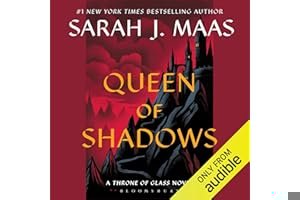
Queen of Shadows (Throne of Glass, #4)
Sarah J. Maas
4.3
The Queen has returned.
Everyone Celaena Sardothien loves has been taken from her. But she’s at last returned to the empire—for vengeance, to rescue her once-glorious kingdom, and to confront the shadows of her past…
She has embraced her identity as Aelin Galathynius, Queen of Terrasen. But before she can reclaim her throne, she must fight.
She will fight for her cousin, a warrior prepared to die for her. She will fight for her friend, a young man trapped in an unspeakable prison. And she will fight for her people, enslaved to a brutal king and awaiting their lost queen’s triumphant return.
The fourth volume in the New York Times bestselling series continues Celaena’s epic journey and builds to a passionate, agonizing crescendo that might just shatter her world.
…
Cover unavailable
37
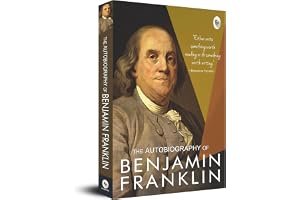
The Autobiography of Benjamin Franklin (Classic Biography)
I copied Franklin in my own book. He believed that we all could determinately sit down and come up with practical steps to make changes in our life. He identified 13 virtues that he wanted to imbue in himself and made a weekly chart to help him track his daily progress. I copied my resolutions chart from him. [source]
Cory Booker
The author didn’t mean to write his autobiography. He wanted to write a note to his family about what he’d learned in his experiments. [source]
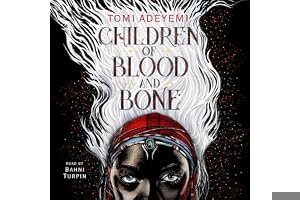
They killed my mother. They took our magic. They tried to bury us.
Now we rise.
Zélie Adebola remembers when the soil of Orïsha hummed with magic. Burners ignited flames, Tiders beckoned waves, and Zélie’s Reaper mother summoned forth souls.
But everything changed the night magic disappeared. Under the orders of a ruthless king, maji were killed, leaving Zélie without a mother and her people without hope.
Now Zélie has one chance to bring back magic and strike against the monarchy. With the help of a rogue princess, Zélie must outwit and outrun the crown prince, who is hell-bent on eradicating magic for good.
Danger lurks in Orïsha, where snow leoponaires prowl and vengeful spirits wait in the waters. Yet the greatest danger may be Zélie herself as she struggles to control her powers and her growing feelings for an enemy.
…
Recommended by Genevieve Nnaji.
Genevieve Nnaji
Just bought this book on #ibooks written by one of ours, @tomi_adeyemi . I’ve heard great things… https://t.co/DiIvPq2xM0 [source]
Cover unavailable
39
Morning Star (Red Rising, #3)
Pierce Brown
4.3
#1 NEW YORK TIMES BESTSELLER • Red Rising thrilled readers and announced the presence of a talented new author. Golden Son changed the game and took the story of Darrow to the next level. Now comes the exhilarating conclusion to the Red Rising Trilogy: Morning Star.
Darrow would have lived in peace, but his enemies brought him war. The Gold overlords demanded his obedience, hanged his wife, and enslaved his people. But Darrow is determined to fight back. Risking everything to transform himself and breach Gold society, Darrow has battled to survive the cutthroat rivalries that breed Society’s mightiest warriors, climbed the ranks, and waited patiently to unleash the revolution that will tear the hierarchy apart from within.
Finally, the time has come.
But devotion to honor and hunger for vengeance run deep on both sides. Darrow and his comrades-in-arms face powerful enemies without scruple or mercy. Among them are some Darrow once considered friends. To win, Darrow will need to inspire those shackled in darkness to break their chains, unmake the world their cruel masters have built, and claim a destiny too long denied—and too glorious to surrender.
Throughout history, some books have changed the world. They have transformed the way we see ourselves—and each other. They have inspired debate, dissent, war and revolution. They have enlightened, outraged, provoked and comforted. They have enriched lives—and destroyed them.
Published anonymously in 1776, six months before the Declaration of Independence, Thomas Paine’s Common Sense was a radical and impassioned call for America to free itself from British rule and set up an independent republican government. Savagely attacking hereditary kingship and aristocratic institutions, Paine urged a new beginning for his adopted country in which personal freedom and social equality would be upheld and economic and cultural progress encouraged.
His pamphlet was the first to speak directly to a mass audience—it went through fifty-six editions within a year of publication—and its assertive and often caustic style both embodied the democratic spirit he advocated, and converted thousands of citizens to the cause of American independence.
…
Cover unavailable
41
Half of a Yellow Sun
Chimamanda Ngozi Adichie
4.3
A masterly, haunting new novel from a writer heralded by The Washington Post Book World as “the 21st-century daughter of Chinua Achebe,” Half of a Yellow Sun re-creates a seminal moment in modern African history: Biafra’s impassioned struggle to establish an independent republic in Nigeria in the 1960s, and the chilling violence that followed.
With astonishing empathy and the effortless grace of a natural storyteller, Chimamanda Ngozi Adichie weaves together the lives of three characters swept up in the turbulence of the decade. Thirteen-year-old Ugwu is employed as a houseboy for a university professor full of revolutionary zeal. Olanna is the professor’s beautiful mistress, who has abandoned her life of privilege in Lagos for a dusty university town and the charisma of her new lover. And Richard is a shy young Englishman in thrall to Olanna’s twin sister, an enigmatic figure who refuses to belong to anyone. As Nigerian troops advance and the three must run for their lives, their ideals are severely tested, as are their loyalties to one another.
Epic, ambitious, and triumphantly realized, Half of a Yellow Sun is a remarkable novel about moral responsibility, about the end of colonialism, about ethnic allegiances, about class and race—and the ways in which love can complicate them all. Adichie brilliantly evokes the promise and the devastating disappointments that marked this time and place, bringing us one of the most powerful, dramatic, and intensely emotional pictures of modern Africa that we have ever had.
…
Recommended by Michael Peel and Michelle Jana Chan.
Michael Peel
Chimamanda Adichie broke the ice in writing about the Biafran war. [source]
Michelle Jana Chan
Her story is told by three powerful, self-aware and intellectually upright characters who are swept up in the struggle to establish an independent Nigeria. It’s a call to arms. [source]
Cover unavailable
42
Benjamin Franklin: An American Life
Walter Isaacson
4.3
In this authoritative and engrossing full-scale biography, Walter Isaacson, bestselling author of Einstein and Steve Jobs, shows how the most fascinating of America's founders helped define our national character.
Benjamin Franklin is the founding father who winks at us, the one who seems made of flesh rather than marble. In a sweeping narrative that follows Franklin’s life from Boston to Philadelphia to London and Paris and back, Walter Isaacson chronicles the adventures of the runaway apprentice who became, over the course of his eighty-four-year life, America’s best writer, inventor, media baron, scientist, diplomat, and business strategist, as well as one of its most practical and ingenious political leaders. He explores the wit behind Poor Richard’s Almanac and the wisdom behind the Declaration of Independence, the new nation’s alliance with France, the treaty that ended the Revolution, and the compromises that created a near-perfect Constitution.
In this colorful and intimate narrative, Isaacson provides the full sweep of Franklin’s amazing life, showing how he helped to forge the American national identity and why he has a particular resonance in the twenty-first century.
I didn't read actually very many general business books, but I like biographies and autobiographies, I think those are pretty helpful. Actually, a lot of them aren't really business. … Isaacson's biography on Franklin is really good. Cause he was an entrepreneur and he sort of started from nothing, actually he was just like a run away kid, basically, and created his printing business and sort of his way of doing that, and then over time all of the science and politics. I'd say certain he's one of the few people I most admire. Franklin's pretty awesome. [source]
Brandon Stanton
The biography of Benjamin Franklin I read. [source]
Ed Zschau
Ed Zschau recommended this book on the podcast "The Tim Ferriss Show". [source]
Cover unavailable
43
Heir of Fire (Throne of Glass, #3)
Sarah J. Maas
4.2
She was the heir of ash and fire, and she would bow to no one.
Celaena Sardothien has survived deadly contests and shattering heartbreak—but at an unspeakable cost. Now she must travel to a new land to confront her darkest truth...a truth about her heritage that could change her life—and her future—forever.
Meanwhile, brutal and monstrous forces are gathering on the horizon, intent on enslaving her world. To defeat them, Celaena must find the strength to not only fight her inner demons but to battle the evil that is about to be unleashed.
The king's assassin takes on an even greater destiny and burns brighter than ever before in this follow-up to the New York Times bestselling Crown of Midnight.
…
Cover unavailable
44
Empire of Storms (Throne of Glass, #5)
Sarah J. Maa
4.2
This is a previously published edition of ISBN 9781619636071. An alternative cover edition for this ISBN can be found here.
Kingdoms will collide.
The long path to the throne has only just begun for Aelin Galathynius as war looms on the horizon. Loyalties have been broken and bought, friends have been lost and gained, and those who possess magic find themselves at odds with those who don't.
With her heart sworn to the warrior-prince by her side, and her fealty pledged to the people she is determined to save, Aelin will delve into the depths of her power to protect those she loves. But as monsters emerge from the horrors of the past, and dark forces become poised to claim her world, the only chance for salvation will lie in a desperate quest that may mark the end of everything Aelin holds dear.
In this breathtaking fifth installment of the New York Times bestselling Throne of Glass series, Aelin will have to choose what—and who—to sacrifice if she's to keep the world of Erilea from breaking apart.
…
Cover unavailable
45
The One (The Selection, #3)
Kiera Cass
4.2
The time has come for one winner to be crowned.
When she was chosen to compete in the Selection, America never dreamed she would find herself anywhere close to the crown—or to Prince Maxon's heart. But as the end of the competition approaches, and the threats outside the palace walls grow more vicious, America realizes just how much she stands to lose—and how hard she'll have to fight for the future she wants.
…
Cover unavailable
46
The Hate U Give
Angie Thomas
4.2
Sixteen-year-old Starr Carter moves between two worlds: the poor neighborhood where she lives and the fancy suburban prep school she attends. The uneasy balance between these worlds is shattered when Starr witnesses the fatal shooting of her childhood best friend Khalil at the hands of a police officer. Khalil was unarmed.
Soon afterward, his death is a national headline. Some are calling him a thug, maybe even a drug dealer and a gangbanger. Protesters are taking to the streets in Khalil's name. Some cops and the local drug lord try to intimidate Starr and her family. What everyone wants to know is: what really went down that night? And the only person alive who can answer that is Starr.
But what Starr does--or does not--say could upend her community. It could also endanger her life.
…
Recommended by Bianca Belair.
Bianca Belair
For #BlackHistoryMonth I will be sharing some of my favorite books by Black Authors 7th Book: The Hate U Give By: Angie Thomas @angiecthomas The movie was really great, but it just hits different when you read the book! https://t.co/rxMH5Uu6JN [source]
Cover unavailable
47
Fall of Giants (The Century Trilogy, #1)
Ken Follett
4.2
This is an epic of love, hatred, war and revolution. This is a huge novel that follows five families through the world-shaking dramas of the First World War, the Russian Revolution, and the struggle for votes for women.
It is 1911. The Coronation Day of King George V. The Williams, a Welsh coal-mining family is linked by romance and enmity to the Fitzherberts, aristocratic coal-mine owners. Lady Maud Fitzherbert falls in love with Walter von Ulrich, a spy at the German Embassy in London. Their destiny is entangled with that of an ambitious young aide to U.S. President Woodrow Wilson and to two orphaned Russian brothers, whose plans to emigrate to America fall foul of war, conscription and revolution. In a plot of unfolding drama and intriguing complexity, "Fall Of Giants" moves seamlessly from Washington to St Petersburg, from the dirt and danger of a coal mine to the glittering chandeliers of a palace, from the corridors of power to the bedrooms of the mighty.
…
Recommended by Tudor Mihailescu.
Tudor Mihailescu
It’s vacation time so I got brave enough to start a sizeable trilogy by Ken Follett, The Century (Fall of Giants, Winter of the World, Edge of Eternity). The only expectation I had was to enjoy a good story, take my mind off into a different space. And it delivers, it’s a nice blend of history and fiction, an absorbing story throughout 20th century. [source]
Cover unavailable
48
Ten Days that Shook the World
John Reed, Vladimir Ilyich Lenin, A. J. P. Taylor
4.2
Ten Days That Shook the World is John Reed’s eyewitness account of the Russian Revolution. A contemporary journalist writing in the first flush of revolutionary enthusiasm, he gives a gripping record of the events in Petrograd in November 1917, when Lenin and the Bolsheviks finally seized power. Containing verbatim reports both of speeches by leaders and the chance comments of bystanders, set against an idealized backcloth of the proletariat, soldiers, sailors, and peasants uniting to throw off oppression, Reed’s account is the product of passionate involvement and remains an unsurpassed classic of reporting.
…
Recommended by Martin Sixsmith.
Martin Sixsmith
I like John Reed because he’s a journalist like myself, like yourself, and he was on hand to paint this fantastic, vivid picture of 1917. As you know, Warren Beatty turned it into that movie Reds in the 1980s that made revolution fun, sexy and exciting. John Reed debunks the great Soviet myth that October was a huge heroic struggle by the masses. He said: No, it wasn’t like that. The Winter Palace had been abandoned, we just walked in, went into the wine cellar, tried the wines, people started looting things, we wandered around looking for regiments of defending soldiers but nobody was there. [source]
Cover unavailable
49
An Ember in the Ashes (An Ember in the Ashes, #1)
Sabaa Tahi
4.2
▶ Alternative Cover Edition #1
Laia is a slave. Elias is a soldier. Neither is free.
Under the Martial Empire, defiance is met with death. Those who do not vow their blood and bodies to the Emperor risk the execution of their loved ones and the destruction of all they hold dear.
It is in this brutal world, inspired by ancient Rome, that Laia lives with her grandparents and older brother. The family ekes out an existence in the Empire’s impoverished backstreets. They do not challenge the Empire. They’ve seen what happens to those who do.
But when Laia’s brother is arrested for treason, Laia is forced to make a decision. In exchange for help from rebels who promise to rescue her brother, she will risk her life to spy for them from within the Empire’s greatest military academy.
There, Laia meets Elias, the school’s finest soldier—and secretly, its most unwilling. Elias wants only to be free of the tyranny he’s being trained to enforce. He and Laia will soon realize that their destinies are intertwined—and that their choices will change the fate of the Empire itself.
From the Hardcover edition.
…
Cover unavailable
50
Doctor Zhivago
Boris Pasternak
4.2
This epic tale about the effects of the Russian Revolution and its aftermath on a bourgeois family was not published in the Soviet Union until 1987. One of the results of its publication in the West was Pasternak's complete rejection by Soviet authorities; when he was awarded the Nobel Prize for Literature in 1958 he was compelled to decline it. The book quickly became an international best-seller.
Dr. Yury Zhivago, Pasternak's alter ego, is a poet, philosopher, and physician whose life is disrupted by the war and by his love for Lara, the wife of a revolutionary. His artistic nature makes him vulnerable to the brutality and harshness of the Bolsheviks. The poems he writes constitute some of the most beautiful writing featured in the novel.
…
Cover unavailable
51
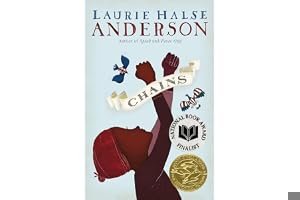
Chains (Seeds of America, #1)
Laurie Halse Anderson
4.2
As the Revolutionary War begins, thirteen-year-old Isabel wages her own fight...for freedom. Promised freedom upon the death of their owner, she and her sister, Ruth, in a cruel twist of fate become the property of a malicious New York City couple, the Locktons, who have no sympathy for the American Revolution and even less for Ruth and Isabel. When Isabel meets Curzon, a slave with ties to the Patriots, he encourages her to spy on her owners, who know details of British plans for invasion. She is reluctant at first, but when the unthinkable happens to Ruth, Isabel realizes her loyalty is available to the bidder who can provide her with freedom.
From acclaimed author Laurie Halse Anderson comes this compelling, impeccably researched novel that shows the lengths we can go to cast off our chains, both physical and spiritual.
Reading Level: Age 10 and Up
…
Cover unavailable
52
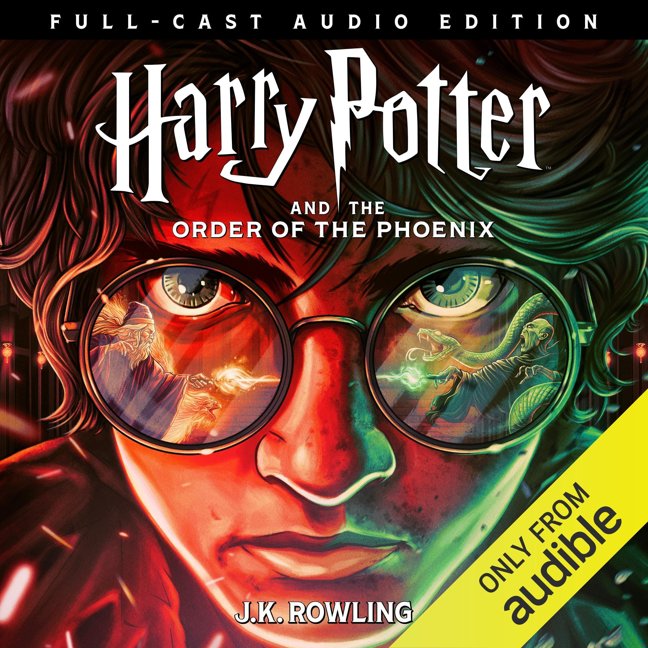
Harry Potter and the Order of the Phoenix (Harry Potter, #5)
J. K. Rowling
4.2
Dumbledore lowered his hands and surveyed Harry through his half-moon glasses. 'It is time,' he said, 'for me to tell you what I should have told you five years ago, Harry. Please sit down. I am going to tell you everything.'
Harry Potter is due to start his fifth year at Hogwarts School of Witchcraft and Wizadry. He is desperate to get back to school and find out why his friends Ron and Hermione have been so secretive all summer. However, what Harry is about to discover in his new year at Hogwarts will turn his world upside down... (back cover)
…
Recommended by Shami Chakrabarti.
Shami Chakrabarti
It’s all about the War on Terror as far as I’m concerned. [source]
Cover unavailable
53
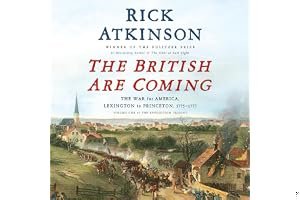
The British Are Coming: The War for America, Lexington to Princeton, 1775-1777
Rick Atkinson
4.2
In the initial volume of the Revolution Trilogy Rick Atkinson recounts the first twenty-one months of America’s violent war for independence. From the battles at Lexington and Concord in spring 1775 to those at Trenton and Princeton in winter 1777, American militiamen and then the ragged Continental Army take on the world’s most formidable fighting force. It is a saga alive with astonishing characters: Henry Knox, the former bookseller with an uncanny understanding of artillery; Nathanael Greene, the bumpkin who becomes a brilliant battle captain; Benjamin Franklin, who proves to be the wiliest of diplomats; George Washington, the commander in chief who learns the difficult art of leadership when the war seems all but lost. The story is also told from the British perspective, making the mortal conflict between the redcoats and the rebels all the more compelling.
…
Recommended by Mount Vernon.
Mount Vernon
@DEdHoggatt Great response, and congratulations! You've been selected to win Rick Atkinson's new book, 'The British Are Coming!' Please DM us to claim your prize, and thank you for participating in our contest! [source]
"A spectre is haunting Europe," Karl Marx and Frederic Engels wrote in 1848, "the spectre of Communism." This new edition of The Communist Manifesto, commemorating the 150th anniversary of its publication, includes an introduction by renowned historian Eric Hobsbawm which reminds us of the document's continued relevance. Marx and Engels's critique of capitalism and its deleterious effect on all aspects of life, from the increasing rift between the classes to the destruction of the nuclear family, has proven remarkably prescient. Their spectre, manifested in the Manifesto's vivid prose, continues to haunt the capitalist world, lingering as a ghostly apparition even after the collapse of those governments which claimed to be enacting its principles.
…
Recommended by Felipe Fernández-Armesto and Peter Singer.
Felipe Fernández-Armesto
Marx and Engels’s historical analysis is breathtakingly, brilliantly simple. I think it’s wrong but, again, you’ve just got to admire its genius. Obviously, without understanding the historical basis of Marx’s thought you can’t understand anything else in Marxism. [source]
Yes, it is. I chose The Communist Manifesto, rather than, say, Capital because it shows in a much easier-to-read, shorter work something that is central to Marx’s vision. Capital is much drier, and a lot of it is focused on economics, although there are some remarkable passages of Capital describing the conditions of industrial workers in England at the time. [source]
Cover unavailable
55
The Age of Revolution, 1789-1848
Eric Hobsbawm
4.2
This magisterial volume follows the death of ancient traditions, the triumph of new classes, and the emergence of new technologies, sciences, and ideologies, with vast intellectual daring and aphoristic elegance. Part of Eric Hobsbawm's epic four-volume history of the modern world, along with The Age of Capitalism, The Age of Empire, and The Age of Extremes.
Cover unavailable
56
Rise to Rebellion
Jeff Shaara
4.2
Jeff Shaara dazzled readers with his bestselling novels Godsand Generals, The Last Full Measure, and Gone for Soldiers. Now the acclaimed author who illuminated the Civil War and the Mexican-American War brilliantly brings to life the American Revolution, creating a superb saga of the men who helped to forge the destiny of a nation.
In 1770, the fuse of revolution is lit by a fateful command--"Fire!"--as England's peacekeeping mission ignites into the Boston Massacre. The senseless killing of civilians leads to a tumultuous trial in which lawyer John Adams must defend the very enemy who has assaulted and abused the laws he holds sacred.
The taut courtroom drama soon broadens into a stunning epic of war as King George III leads a reckless and corrupt government in London toward the escalating abuse of his colonies. Outraged by the increasing loss of their liberties, an extraordinary gathering of America's most inspiring characters confronts the British presence with the ideals that will change history.
John Adams, the idealistic attorney devoted to the law, who rises to greatness by the power of his words . . . Ben Franklin, one of the most celebrated men of his time, the elderly and audacious inventor and philosopher who endures firsthand the hostile prejudice of the British government . . . Thomas Gage, the British general given the impossible task of crushing a colonial rebellion without starting an all-out war . . . George Washington, the dashing Virginian whose battle experience in the French and Indian War brings him the recognition that elevates him to command of a colonial army . . . and many other immortal names from the Founding Family of the colonial struggle--Abigail Adams, Thomas Jefferson, Joseph Warren, Samuel Adams, Richard Henry Lee-- captured as never before in their full flesh-and-blood humanity.
More than a powerful portrait of the people and purpose of the revolution, Rise to Rebellion is a vivid account of history's most pivotal events. The Boston Tea Party, the battles of Concord and Bunker Hill--all are recreated with the kind of breathtaking detail only a master like Jeff Shaara can muster. His most impressive achievement, Rise to Rebellion reveals with new immediacy how philosophers became fighters, ideas their ammunition, and how a scattered group of colonies became the United States of America.
Length: 6 hrs and 1 min
…
Cover unavailable
57
Night Watch (Discworld, #29; City Watch, #6)
Terry Pratchett
4.2
'Don't put your trust in revolutions. They always come round again. That's why they're called revolutions. People die, and nothing changes.'
For a policeman, there can be few things worse than a serial killer at loose in your city. Except, perhaps, a serial killer who targets coppers, and a city on the brink of bloody revolution. The people have found their voice at last, the flags and barricades are rising...And the question for a policeman, an officer of the law, a defender of the peace, is:
Are you with them, or are you against them?
…
Cover unavailable
58
The History of the Russian Revolution
Leon Trotsky
4.2
“During the first two months of 1917 Russia was still a Romanov monarchy. Eight months later the Bolsheviks stood at the helm. They were little known to anybody when the year began, and their leaders were still under indictment for state treason when they came to power. You will not find another such sharp turn in history especially if you remember that it involves a nation of 150 million people. It is clear that the events of 1917, whatever you think of them, deserve study.” --Leon Trotsky, from History of the Russian Revolution
Regarded by many as among the most powerful works of history ever written, this book offers an unparalleled account of one of the most pivotal and hotly debated events in world history. This book reveals, from the perspective of one of its central actors, the Russian Revolution’s profoundly democratic, emancipatory character.
Originally published in three parts, Trotsky’s masterpiece is collected here in a single volume. It serves as the most vital and inspiring record of the Russian Revolution to date.
…
Recommended by Roland Chambers.
Roland Chambers
I chose this book because almost everything that people read about the Russian revolution is written by Westerners, partly because the official histories written under Stalin were incredibly boring and predictable. That all changed when the archives opened up after the collapse of the Soviet Union, but there’s a gap all the same, which Trotsky tried to fill. [source]
Cover unavailable
59
Sister Outsider: Essays and Speeches
Audre Lorde, Cheryl Clarke
4.2
Presenting the essential writings of black lesbian poet and feminist writer Audre Lorde, Sister Outsider celebrates an influential voice in twentieth-century literature. In this charged collection of fifteen essays and speeches, Lorde takes on sexism, racism, ageism, homophobia, and class, and propounds social difference as a vehicle for action and change. Her prose is incisive, unflinching, and lyrical, reflecting struggle but ultimately offering messages of hope. This commemorative edition includes a new foreword by Lorde scholar and poet Cheryl Clarke, who celebrates the ways in which Lorde's philosophies resonate more than twenty years after they were first published. These landmark writings are, in Lorde's own words, a call to "never close our eyes to the terror, to the chaos which is Black which is creative which is female which is dark which is rejected which is messy which is . . . "
—
A writer, activist, and mother of two, AUDRE LORDE grew up in 1930s Harlem. She earned a master's degree in library science from Columbia University, received a National Endowment for the Arts grant for poetry, and was New York State's Poet Laureate from 1991 to 1993. She is the author of twelve books, including Zami: A New Spelling of My Name and The Black Unicorn. Lorde died of cancer at the age of fifty-eight in 1992.
…
Recommended by Bianca Belair.
Bianca Belair
For #BHM I will be sharing some of my favorite books by Black Authors 26th Book: Sister Outsider By: Audre Lorde My first time reading anything by Audre Lorde. I am now really looking forward to reading more of her poems/writings. What she writes is important & timeless. https://t.co/dUDMcaAAbx [source]
Cover unavailable
60
Crown of Midnight (Throne of Glass, #2)
Sarah J. Maas
4.1
From the throne of glass rules a king with a fist of iron and a soul as black as pitch. Assassin Celaena Sardothien won a brutal contest to become his Champion. Yet Celaena is far from loyal to the crown. She hides her secret vigilantly; she knows that the man she serves is bent on evil.
Keeping up the deadly charade becomes increasingly difficult when Celaena realizes she is not the only one seeking justice. As she tries to untangle the mysteries buried deep within the glass castle, her closest relationships suffer. It seems no one is above questioning her allegiances—not the Crown Prince Dorian; not Chaol, the Captain of the Guard; not even her best friend, Nehemia, a foreign princess with a rebel heart.
Then one terrible night, the secrets they have all been keeping lead to an unspeakable tragedy. As Celaena's world shatters, she will be forced to give up the very thing most precious to her and decide once and for all where her true loyalties lie... and whom she is ultimately willing to fight for.
…
Cover unavailable
61
Assata: An Autobiography
Assata Shakur
4.1
On May 2, 1973, Black Panther Assata Shakur (aka JoAnne Chesimard) lay in a hospital, close to death, handcuffed to her bed, while local, state, and federal police attempted to question her about the shootout on the New Jersey Turnpike that had claimed the life of a white state trooper. Long a target of J. Edgar Hoover's campaign to defame, infiltrate, and criminalize Black nationalist organizations and their leaders, Shakur was incarcerated for four years prior to her conviction on flimsy evidence in 1977 as an accomplice to murder.
This intensely personal and political autobiography belies the fearsome image of JoAnne Chesimard long projected by the media and the state. With wit and candor, Assata Shakur recounts the experiences that led her to a life of activism and portrays the strengths, weaknesses, and eventual demise of Black and White revolutionary groups at the hand of government officials. The result is a signal contribution to the literature about growing up Black in America that has already taken its place alongside The Autobiography of Malcolm X and the works of Maya Angelou.
Two years after her conviction, Assata Shakur escaped from prison. She was given political asylum by Cuba, where she now resides.
…
Cover unavailable
62
The Selection (The Selection, #1)
Kiera Cass
4.1
For thirty-five girls, the Selection is the chance of a lifetime. The opportunity to escape the life laid out for them since birth. To be swept up in a world of glittering gowns and priceless jewels. To live in a palace and compete for the heart of gorgeous Prince Maxon.
But for America Singer, being Selected is a nightmare. It means turning her back on her secret love with Aspen, who is a caste below her. Leaving her home to enter a fierce competition for a crown she doesn't want. Living in a palace that is constantly threatened by violent rebel attacks.
Then America meets Prince Maxon. Gradually, she starts to question all the plans she's made for herself—and realizes that the life she's always dreamed of may not compare to a future she never imagined.
…
Cover unavailable
63
October: The Story of the Russian Revolution
China Miéville
4.1
In February 1917, in the midst of bloody war, Russia was still an autocratic monarchy: nine months later, it became the first socialist state in world history. How did this unimaginable transformation take place? How was a ravaged and backward country, swept up in a desperately unpopular war, rocked by not one but two revolutions?
This is the story of the extraordinary months between those upheavals, in February and October, of the forces and individuals who made 1917 so epochal a year, of their intrigues, negotiations, conflicts and catastrophes. From familiar names like Lenin and Trotsky to their opponents Kornilov and Kerensky; from the byzantine squabbles of urban activists to the remotest villages of a sprawling empire; from the revolutionary railroad Sublime to the ciphers and static of coup by telegram; from grand sweep to forgotten detail.
Historians have debated the revolution for a hundred years, its portents and possibilities: the mass of literature can be daunting. But here is a book for those new to the events, told not only in their historical import but in all their passion and drama and strangeness. Because as well as a political event of profound and ongoing consequence, Miéville reveals the Russian Revolution as a breathtaking story.
From the Hardcover edition.
…
Cover unavailable
64
The Dispossessed
Ursula K. Le Guin
4.1
Shevek, a brilliant physicist, decides to take action. He will seek answers, question the unquestionable, and attempt to tear down the walls of hatred that have isolated his planet of anarchists from the rest of the civilized universe. To do this dangerous task will mean giving up his family and possibly his life—Shevek must make the unprecedented journey to the utopian mother planet, Urras, to challenge the complex structures of life and living, and ignite the fires of change.
…
Recommended by Nicholas Whyte.
Nicholas Whyte
The hero of The Dispossessed grows up on a planet which is one of two twin planets in a solar system far away from here. The planet where the hero grows up is essentially a communist-socialist utopia, and the twin planet that they see every day and every night hanging in the sky is a more capitalist society, much more similar to our western society. [source]
Cover unavailable
65
Champion (Legend, #3)
Marie Lu
4.1
He is a Legend. She is a Prodigy. Who will be Champion?
June and Day have sacrificed so much for the people of the Republic—and each other—and now their country is on the brink of a new existence. June is back in the good graces of the Republic, working within the government’s elite circles as Princeps-Elect, while Day has been assigned a high-level military position.
But neither could have predicted the circumstances that will reunite them: just when a peace treaty is imminent, a plague outbreak causes panic in the Colonies, and war threatens the Republic’s border cities. This new strain of plague is deadlier than ever, and June is the only one who knows the key to her country’s defense. But saving the lives of thousands will mean asking the one she loves to give up everything.
With heart-pounding action and suspense, Marie Lu’s bestselling trilogy draws to a stunning conclusion.
…
Cover unavailable
66
En el tiempo de las mariposas
Julia Alvarez
4.1
"Un libro importante...emocionalmente sobrecogedor. �lvarez nos hace un regalo cargado de rara generosidad y coraje."--The San Diego Union-Tribune
In 1960 in the Dominican Republic, four young women from a pious Catholic family were assassinated after visiting their husbands who had been jailed as suspected rebel leaders. The Mirabal sisters became mythical figures in their country, where they are known as Las Mariposas (the butterflies). Three decades later, �lvarez brings the Mirabal sisters back to life in an extraordinary novel.
Ellas eran las cuatro hermanas Mirabal--s�mbolos de una esperanza desafiante en un pa�s ensombrecido por la dictadura y la desesperaci�n. Sacrificaron sus vidas, seguras, y confortables, en nombre de la libertad. Ellas eran "las Mariposas," y en esta novela extraordinaria, Patria, Minerva, Maria Teresa, y Ded� nos cuentan, a trav�s de las d�cadas, sus propias historias. Desde an�cdotas sobre lazos para el pelo y secretos enamoramientos al contrabando de armas y las torturas en la c�rcel. Con ellas aprendemos los horrores cotidianos de la vida bajo el dictador dominicano Trujillo.
A trav�s del arte y la magia de la aclamada e imaginativa novelista Julia �lvarez, la dram�tica y vibrante vida de estas martirizadas mariposas toma forma en una historia c�lida, brillante y desgarradora en la que se nos muestra el incalculable coste humando derivado de la opresi�n pol�tica.
"Un regalo de amor sinf�nico y espl�ndido...un magn�fico tesoro para todas las culturas y todos los tiempos...una novela que celebra la corriente de vida que fluye entre las mujeres, conect�ndolas y d�ndolas coraje para luchar por la justicia y la resistencia, y corazones para amar y perdonar libremente...Julia �lvarez es una escritora asombrosa."--St. Petersburg Times
"Maravilloso...una narraci�n enriquecedora...entrelaza h�bilmente la realidad y la ficci�n hasta alcanzar un sobrecogedor cl�max."--Newsweek
"Una novela con un tremendo poder... un libro bello y valiente."--West Coast Review of Books
…
Cover unavailable
67
Palace of Stone (Princess Academy, #2)
Shannon Hale
4.1
Coming down from the mountain to a new life in the city is a thrill to Miri. She and her princess academy friends have been brought to Asland to help the future princess Britta prepare for her wedding.There, Miri also has a chance to attend school-at the Queen's Castle. But as Miri befriends students who seem sophisticated and exciting she also learns that they have some frightening plans. Torn between loyalty to the princess and her new friends' ideas, between an old love and a new crush, and between her small mountain home and the bustling city, Miri looks to find her own way in this new place. Picking up where Princess Academy left off, and celebrating the joys of friendship, romance and the fate of fairy tale kingdoms, this new book delivers the completely delightful new story that fans have been waiting for.
…
Cover unavailable
68
Bunker Hill: A City, A Siege, A Revolution
Nathaniel Philbrick
4.1
Nathaniel Philbrick, the bestselling author of In the Heart of the Sea--soon to be a major motion picture--and author of the forthcoming Valiant Ambition (May 2016), brings his prodigious talents to the story of the Boston battle that ignited the American Revolution.
Boston in 1775 is an island city occupied by British troops after a series of incendiary incidents by patriots who range from sober citizens to thuggish vigilantes. After the Boston Tea Party, British and American soldiers and Massachusetts residents have warily maneuvered around each other until April 19, when violence finally erupts at Lexington and Concord. In June, however, with the city cut off from supplies by a British blockade and Patriot militia poised in siege, skirmishes give way to outright war in the Battle of Bunker Hill. It would be the bloodiest battle of the Revolution to come, and the point of no return for the rebellious colonists.
Philbrick brings a fresh perspective to every aspect of the story. He finds new characters, and new facets to familiar ones. The real work of choreographing rebellion falls to a thirty-three year old physician named Joseph Warren who emerges as the on-the-ground leader of the Patriot cause and is fated to die at Bunker Hill. Others in the cast include Paul Revere, Warren’s fiancé the poet Mercy Scollay, a newly recruited George Washington, the reluctant British combatant General Thomas Gage and his more bellicose successor William Howe, who leads the three charges at Bunker Hill and presides over the claustrophobic cauldron of a city under siege as both sides play a nervy game of brinkmanship for control.
With passion and insight, Philbrick reconstructs the revolutionary landscape—geographic and ideological—in a mesmerizing narrative of the robust, messy, blisteringly real origins of America.
…
Cover unavailable
69
Madame Tussaud: A Novel of the French Revolution
Michelle Moran
4.1
The world knows Madame Tussaud as a wax artist extraordinaire... but who was this woman who became one of the most famous sculptresses of all time? In these pages, her tumultuous and amazing story comes to life as only Michelle Moran can tell it. The year is 1788, and a revolution is about to begin.
Smart and ambitious, Marie Tussaud has learned the secrets of wax sculpting by working alongside her uncle in their celebrated wax museum, the Salon de Cire. From her popular model of the American ambassador, Thomas Jefferson, to her tableau of the royal family at dinner, Marie's museum provides Parisians with the very latest news on fashion, gossip, and even politics. Her customers hail from every walk of life, yet her greatest dream is to attract the attention of Marie Antoinette and Louis XVI; their stamp of approval on her work could catapult her and her museum to the fame and riches she desires. After months of anticipation, Marie learns that the royal family is willing to come and see their likenesses. When they finally arrive, the king's sister is so impressed that she requests Marie's presence at Versailles as a royal tutor in wax sculpting. It is a request Marie knows she cannot refuse - even if it means time away from her beloved Salon and her increasingly dear friend, Henri Charles.
As Marie gets to know her pupil, Princesse Élisabeth, she also becomes acquainted with the king and queen, who introduce her to the glamorous life at court. From lavish parties with more delicacies than she's ever seen to rooms filled with candles lit only once before being discarded, Marie steps into a world entirely different from her home on the Boulevard du Temple, where people are selling their teeth in order to put food on the table.
Meanwhile, many resent the vast separation between rich and poor. In salons and cafés across Paris, people like Camille Desmoulins, Jean-Paul Marat, and Maximilien Robespierre are lashing out against the monarchy. Soon, there's whispered talk of revolution... Will Marie be able to hold on to both the love of her life and her friendship with the royal family as France approaches civil war? And more important, will she be able to fulfill the demands of powerful revolutionaries who ask that she make the death masks of beheaded aristocrats, some of whom she knows?
Spanning five years, from the budding revolution to the Reign of Terror, Madame Tussaud brings us into the world of an incredible heroine whose talent for wax modeling saved her life and preserved the faces of a vanished kingdom
…
Cover unavailable
70
Hamilton: The Revolution
Lin-Manuel Miranda, Jeremy McCarter
4.1
Lin-Manuel Miranda's groundbreaking musical Hamilton is as revolutionary as its subject, the poor kid from the Caribbean who fought the British, defended the Constitution, and helped to found the United States. Fusing hip-hop, pop, R&B, and the best traditions of theater, this once-in-a-generation show broadens the sound of Broadway, reveals the storytelling power of rap, and claims our country's origins for a diverse new generation.
Hamilton: The Revolution gives readers an unprecedented view of both revolutions, from the only two writers able to provide it. Miranda and Jeremy McCarter, a cultural critic and theater artist who was involved in the project from its earliest stages--"since before this was even a show," according to Miranda--trace its development from an improbable performance at the White House to its landmark opening night on Broadway six years later. In addition, Miranda has written more than 200 funny, revealing footnotes for his award-winning libretto, the full text of which is published here.
Their account features photos by the renowned Frank Ockenfels and veteran Broadway photographer Joan Marcus; exclusive looks at notebooks and emails; interviews with Questlove, Stephen Sondheim, leading political commentators, and more than 40 people involved with the production; and multiple appearances by President Obama himself. The book does more than tell the surprising story of how a Broadway musical became a national phenomenon: It demonstrates that America has always been renewed by the brash upstarts and brilliant outsiders, the men and women who don't throw away their shot.
…
Recommended by André Rupp.
André Rupp
Finally some light reading, right? I chose this book because the work that we do specifically on the innovative edges of educational assessment is, as I said earlier, a mixture of scientific rigour and artful practice. Essentially, it is all about designing under constraints. The design decisions have to permeate everything, from the way you design the activities to the way you design your scoring to the way you design the reporting to the way you design how in teams you work together to make all of this happen. I am, personally, a big supporter and fan of performing arts: musicals, plays, concerts, comedy. I have seen over 900 shows in my life. [source]
Hailed by Thomas Jefferson as “the best commentary on the principles of government which was ever written", The Federalist Papers is a collection of eighty-five essays published by Founding Fathers Alexander Hamilton, James Madison, and John Jay from 1787 to 1788, as a means to persuade the public to ratify the Constitution of the United States.
With nearly two-thirds of the essays written by Hamilton, this enduring classic is perfect for modern audiences passionate about his work or seeking a deeper understanding of one of the most important documents in US history.
AmazonClassics brings you timeless works from iconic authors. Ideal for anyone who wants to read a great work for the first time or revisit an old favorite, these new editions open the door to the stories and ideas that have shaped our world.
According to the president’s Facebook page and a 2008 interview with the New York Times, these titles are among his most influential forever favorites: Moby Dick, Herman Melville Self-Reliance, Ralph Waldo Emerson Song Of Solomon, Toni Morrison Parting The Waters, Taylor Branch Gilead, Marylinne Robinson Best and the Brightest, David Halberstam The Federalist, Alexander Hamilton Souls of Black Folk, W.E.B. Du Bois The Power and the Glory, Graham Greene The Quiet American, Graham Greene Cancer Ward, Aleksandr Solzhenitsyn Gandhi’s autobiography Working, Studs Terkel Wealth of Nations, Adam Smith Theory of Moral Sentiments, Adam Smith All the King’s Men, Robert Penn Warren [source]
I think this is the greatest explanation, in one place, of the American constitution, of the essential underpinnings and structures that make American democracy possible. This is how to view the constitution in its proper perspective, as a document of limited government, and enormous personal freedom – as an attempt to understand human nature and draw on both its strengths and its weaknesses to achieve a community and nation. [source]
Cover unavailable
72
Wool (Silo, #1)
Hugh Howey
4.1
For suspense-filled, post-apocalyptic thrillers, Wool is more than a self-published ebook phenomenon―it’s the new standard in classic science fiction.
In a ruined and toxic future, a community exists in a giant silo underground, hundreds of stories deep. There, men and women live in a society full of regulations they believe are meant to protect them. Sheriff Holston, who has unwaveringly upheld the silo’s rules for years, unexpectedly breaks the greatest taboo of all: He asks to go outside.
His fateful decision unleashes a drastic series of events. An unlikely candidate is appointed to replace him: Juliette, a mechanic with no training in law, whose special knack is fixing machines. Now Juliette is about to be entrusted with fixing her silo, and she will soon learn just how badly her world is broken. The silo is about to confront what its history has only hinted about and its inhabitants have never dared to whisper. Uprising.
A New York Times and USA TODAY bestseller, as well as Kindle Book Review’s 2012 Indie Book of the Year, Wool is truly a blockbuster.
…
Recommended by Ev Williams, Cat Williams-Treloar, and Damien Mulley.
Cat Williams-Treloar
I loved the Hugh Howey "Silo" trilogy. An epic science fiction story about the above ground world coming to an end and the remaining society living underground in Wool Silos. Makes me shiver thinking about what could happen in the future. It's an intense set. [source]
Damien Mulley
I'm expecting to not be able to tell what happens next as I like surprises. [source]
Cover unavailable
73
Citizens: A Chronicle of the French Revolution
Simon Schama
4.1
Instead of a dying Old Regime, Schama presents an ebullient country, vital & inventive, infatuated with novelty & technology. A fresh view of Louis XVI's France. A NY Times cloth bestseller. 200 illustrations.
Recommended by Lynn Hunt.
Lynn Hunt
It’s filled with incredibly interesting titbits and anecdotes and characterisations of people. It’s generally negative about the revolution, because it’s basically about how the revolution is really, really violent. [source]
Cover unavailable
74
Legend (Legend, #1)
Janie Chan
4.1
What was once the western United States is now home to the Republic, a nation perpetually at war with its neighbors. Born into an elite family in one of the Republic's wealthiest districts, fifteen-year-old June is a prodigy being groomed for success in the Republic's highest military circles. Born into the slums, fifteen-year-old Day is the country's most wanted criminal. But his motives may not be as malicious as they seem.
From very different worlds, June and Day have no reason to cross paths—until the day June's brother, Metias, is murdered and Day becomes the prime suspect. Caught in the ultimate game of cat and mouse, Day is in a race for his family's survival, while June seeks to avenge Metias's death. But in a shocking turn of events, the two uncover the truth of what has really brought them together, and the sinister lengths their country will go to keep its secrets.
Alternate Cover edition for ISBN 9780399256752
…
Cover unavailable
75
Women, Race, and Class
Angela Y. Davis
4.1
A powerful study of the women's movement in the U.S. from abolitionist days to the present that demonstrates how it has always been hampered by the racist and classist biases of its leaders.
Recommended by Bianca Belair.
Bianca Belair
For #BlackHistoryMonth I will be sharing some of my favorite books by Black Authors 3rd Book: Women Race & Class By: Angela Y. Davis EYE-OPENING about the intersection b/w women, race, & class Some Topics: The Abolitionist, Feminist, Women’s Suffrage Movement, etc. https://t.co/RvlOadp7oU [source]
Cover unavailable
76
The Shock Doctrine: The Rise of Disaster Capitalism
In her ground-breaking reporting from Iraq, Naomi Klein exposed how the trauma of invasion was being exploited to remake the country in the interest of foreign corporations. She called it "disaster capitalism." Covering Sri Lanka in the wake of the tsunami, and New Orleans post-Katrina, she witnessed something remarkably similar. People still reeling from catastrophe were being hit again, this time with economic "shock treatment" losing their land and homes to rapid-fire corporate makeovers. The Shock Doctrine retells the story of the most dominant ideology of our time, Milton Friedman's free market economic revolution. In contrast to the popular myth of this movement's peaceful global victory, Klein shows how it has exploited moments of shock and extreme violence in order to implement its economic policies in so many parts of the world from Latin America and Eastern Europe to South Africa, Russia, and Iraq. At the core of disaster capitalism is the use of cataclysmic events to advance radical privatization combined with the privatization of the disaster response itself. By capitalizing on crises, created by nature or war, Klein argues that the disaster capitalism complex now exists as a booming new economy, and is the violent culmination of a radical economic project that has been incubating for fifty years.
…
Recommended by Donna Dickenson, George Monbiot, and Mat Whitecross.
Donna Dickenson
Naomi Klein’s argument is that capitalism actually requires deliberately engineered shocks to the economic systems. [source]
The Shock Doctrine explains some of the mechanisms by which patrimonial capital acquires power and enhances its wealth. It’s a brilliant piece of work, and one of those rare books that changes the way you perceive the world. [source]
Mat Whitecross
It starts with the theory that moments of crisis have been utilised by the right wing in the US and other countries to manipulate people into following their agenda. [source]
A good book may have the power to change the way we see the world, but a great book actually becomes part of our daily consciousness, pervading our thinking to the point that we take it for granted, and we forget how provocative and challenging its ideas once were—and still are. The Structure of Scientific Revolutions is that kind of book. When it was first published in 1962, it was a landmark event in the history and philosophy of science. Fifty years later, it still has many lessons to teach.
With The Structure of Scientific Revolutions, Kuhn challenged long-standing linear notions of scientific progress, arguing that transformative ideas don’t arise from the day-to-day, gradual process of experimentation and data accumulation but that the revolutions in science, those breakthrough moments that disrupt accepted thinking and offer unanticipated ideas, occur outside of “normal science,” as he called it. Though Kuhn was writing when physics ruled the sciences, his ideas on how scientific revolutions bring order to the anomalies that amass over time in research experiments are still instructive in our biotech age.
This new edition of Kuhn’s essential work in the history of science includes an insightful introduction by Ian Hacking, which clarifies terms popularized by Kuhn, including paradigm and incommensurability, and applies Kuhn’s ideas to the science of today. Usefully keyed to the separate sections of the book, Hacking’s introduction provides important background information as well as a contemporary context. Newly designed, with an expanded index, this edition will be eagerly welcomed by the next generation of readers seeking to understand the history of our perspectives on science.
…
Recommended by Mark Zuckerberg, Tim O'Reilly, Danielle Morrill, and 3 others.
It's a history of science book that explores the question of whether science and technology make consistent forward progress or whether progress comes in bursts related to other social forces. I tend to think that science is a consistent force for good in the world. I think we'd all be better off if we invested more in science and acted on the results of research. I'm excited to explore this theme further. [source]
Tim O'Reilly
Founder/O'Reilly Media
The Structure of Scientific Revolutions, by Thomas Kuhn. Kuhn introduced the term "paradigm shift" to describe the changeover from Ptolemaic to Copernican astronomy. But the book is far more than a classic in the history of science. It's also a book that emphasizes how what we already believe shapes what we see, what we allow ourselves to think. I've always tried to separate seeing itself from the stories I tell myself about what I see. Pattern recognition is impeded if you are trying to overlay an existing pattern on the facts rather than letting the facts sit quietly until they tell their own story. That's General Semantics again. [source]
Andra Zaharia
I’ve gone through quite a few experiences brought on or shaped by what I’ve learned from books. A particularly unexpected one happened in college when our public relations teacher asked us to read a book called The Structure of Scientific Revolutions by Thomas Kuhn. As a humanities student, you can imagine that I wasn’t thrilled I’d have to read a book on science, but what followed blew my mind at the time. In the book, Kuhn argues that human knowledge does not accumulate incrementally, but increases in leaps, through paradigm shifts which are brought on by crises and scientific revolutions. This was one of the first books that prompted me to think about how I want to evolve in the context of all the fast-paced changes happening around me. [source]
Cover unavailable
78
The House of the Spirits
Isabel Allende, Magda Bogin
4.1
In one of the most important and beloved Latin American works of the twentieth century, Isabel Allende weaves a luminous tapestry of three generations of the Trueba family, revealing both triumphs and tragedies.
Here is patriarch Esteban, whose wild desires and political machinations are tempered only by his love for his ethereal wife, Clara, a woman touched by an otherworldly hand. Their daughter, Blanca, whose forbidden love for a man Esteban has deemed unworthy infuriates her father, yet will produce his greatest joy: his granddaughter Alba, a beautiful, ambitious girl who will lead the family and their country into a revolutionary future.
The House of the Spirits is an enthralling saga that spans decades and lives, twining the personal and the political into an epic novel of love, magic, and fate.
…
Cover unavailable
79
Washington's Crossing
David Hackett Fischer
4.1
Six months after the Declaration of Independence, the American Revolution was all but lost. A powerful British force had routed the Americans at New York, occupied three colonies, and advanced within sight of Philadelphia.
Yet, as David Hackett Fischer recounts in this riveting history, George Washington--and many other Americans--refused to let the Revolution die. On Christmas night, as a howling nor'easter struck the Delaware Valley, he led his men across the river and attacked the exhausted Hessian garrison at Trenton, killing or capturing nearly a thousand men. A second battle of Trenton followed within days. The Americans held off a counterattack by Lord Cornwallis's best troops, then were almost trapped by the British force. Under cover of night, Washington's men stole behind the enemy and struck them again, defeating a brigade at Princeton. The British were badly shaken. In twelve weeks of winter fighting, their army suffered severe damage, their hold on New Jersey was broken, and their strategy was ruined.
Fischer's richly textured narrative reveals the crucial role of contingency in these events. We see how the campaign unfolded in a sequence of difficult choices by many actors, from generals to civilians, on both sides. While British and German forces remained rigid and hierarchical, Americans evolved an open and flexible system that was fundamental to their success. The startling success of Washington and his compatriots not only saved the faltering American Revolution, but helped to give it new meaning.
…
Cover unavailable
80
An Echo in the Bone (Outlander, #7)
Diana Gabaldon
4.1
The Seventh Outlander novel from #1 National Bestselling author Diana Gabaldon.
Jamie Fraser, erstwhile Jacobite and reluctant rebel, knows three things about the American rebellion: the Americans will win, unlikely as that seems in 1778; being on the winning side is no guarantee of survival; and he’d rather die than face his illegitimate son — a young lieutenant in the British Army — across the barrel of a gun. Fraser’s time-travelling wife, Claire, also knows a couple of things: that the Americans will win, but that the ultimate price of victory is a mystery. What she does believe is that the price won’t include Jamie’s life or happiness — not if she has anything to say.
Claire’s grown daughter Brianna, and her husband, Roger, watch the unfolding of Brianna’s parents’ history — a past that may be sneaking up behind their own family.
"A wonderful, splendid book--a book that should be ready by every American, student or otherwise, who wants to understand his country, its true history, and its hope for the future." --Howard Fast
With a new introduction by Anthony Arnove, this edition of the classic national bestseller chronicles American history from the bottom up, throwing out the official narrative taught in schools—with its emphasis on great men in high places—to focus on the street, the home and the workplace.
Known for its lively, clear prose as well as its scholarly research, A People's Historyof the United States is the only volume to tell America's story from the point of view of—and in the words of—America's women, factory workers, African-Americans, Native Americans, the working poor, and immigrant laborers. As historian Howard Zinn shows, many of our country's greatest battles—the fights for a fair wage, an eight-hour workday, child-labor laws, health and safety standards, universal suffrage, women's rights, racial equality—were carried out at the grassroots level, against bloody resistance.
Covering Christopher Columbus's arrival through President Clinton's first term, A People's History of the United States features insightful analysis of the most important events in our history.
…
Recommended by Lisa Ling and Alex Honnold.
Lisa Ling
I credit this book with propelling me to dig deeper, and to not always believe the narrative. [source]
Alex Honnold
Totally changed the way I look at politics. [source]
Cover unavailable
82
Glass Sword (Red Queen, #2)
Victoria Aveyard
4.1
If there’s one thing Mare Barrow knows, it’s that she’s different.
Mare Barrow’s blood is red—the color of common folk—but her Silver ability, the power to control lightning, has turned her into a weapon that the royal court tries to control.
The crown calls her an impossibility, a fake, but as she makes her escape from Maven, the prince—the friend—who betrayed her, Mare uncovers something startling: she is not the only one of her kind.
Pursued by Maven, now a vindictive king, Mare sets out to find and recruit other Red-and-Silver fighters to join in the struggle against her oppressors.
But Mare finds herself on a deadly path, at risk of becoming exactly the kind of monster she is trying to defeat.
Will she shatter under the weight of the lives that are the cost of rebellion? Or have treachery and betrayal hardened her forever?
The electrifying next installment in the Red Queen series escalates the struggle between the growing rebel army and the blood-segregated world they’ve always known—and pits Mare against the darkness that has grown in her soul.
…
Cover unavailable
83
Golden Son (Red Rising Saga, #2)
Pierce Brown, Red Rising by Pierce Brown, et al.
4.1
As a Red, Darrow grew up working the mines deep beneath the surface of Mars, enduring backbreaking labor while dreaming of the better future he was building for his descendants. But the Society he faithfully served was built on lies. Darrow’s kind have been betrayed and denied by their elitist masters, the Golds—and their only path to liberation is revolution. And so Darrow sacrifices himself in the name of the greater good for which Eo, his true love and inspiration, laid down her own life. He becomes a Gold, infiltrating their privileged realm so that he can destroy it from within.
A lamb among wolves in a cruel world, Darrow finds friendship, respect, and even love—but also the wrath of powerful rivals. To wage and win the war that will change humankind’s destiny, Darrow must confront the treachery arrayed against him, overcome his all-too-human desire for retribution—and strive not for violent revolt but a hopeful rebirth. Though the road ahead is fraught with danger and deceit, Darrow must choose to follow Eo’s principles of love and justice to free his people.
He must live for more.
…
Cover unavailable
84
The Glorious Cause
Jeff Shaara
4.1
In Rise to Rebellion, bestselling author Jeff Shaara captured the origins of the American Revolution as brilliantly as he depicted the Civil War in Gods and Generals and The Last Full Measure. Now he continues the amazing saga of how thirteen colonies became a nation, taking the conflict from kingdom and courtroom to the bold and bloody battlefields of war.
It was never a war in which the outcome was obvious. Despite their spirit and stamina, the colonists were outmanned and outfought by the brazen British army. General George Washington found his troops trounced in the battles of Brooklyn and Manhattan and retreated toward Pennsylvania. With the future of the colonies at its lowest ebb, Washington made his most fateful decision: to cross the Delaware River and attack the enemy. The stunning victory at Trenton began a saga of victory and defeat that concluded with the British surrender at Yorktown, a moment that changed the history of the world.
The despair and triumph of America’s first great army is conveyed in scenes as powerful as any Shaara has written, a story told from the points of view of some of the most memorable characters in American history. There is George Washington, the charismatic leader who held his army together to achieve an unlikely victory; Charles Cornwallis, the no-nonsense British general, more than a match for his colonial counterpart; Nathaniel Greene, who rose from obscurity to become the finest battlefield commander in Washington’s army; The Marquis de Lafayette, the young Frenchman who brought a soldier’s passion to America; and Benjamin Franklin, a brilliant man of science and philosophy who became the finest statesman of his day.
From Nathan Hale to Benedict Arnold, William Howe to “Light Horse” Harry Lee, from Trenton and Valley Forge, Brandywine and Yorktown, the American Revolution’s most immortal characters and poignant moments are brought to life in remarkable Shaara style. Yet, The Glorious Cause is more than just a story of the legendary six-year struggle. It is a tribute to an amazing people who turned ideas into action and fought to declare themselves free. Above all, it is a riveting novel that both expands and surpasses its beloved author’s best work.
From the Hardcover edition.
…
Cover unavailable
85
The Ancien Régime and the Revolution
Alexis de Tocqueville, Gerald Bevan
4.0
The Ancien Régime and the Revolution is a powerful comparison of revolutionary France and the despotic rule it toppled. Alexis de Tocqueville (1805–59) is an objective commentator of both periods – providing a merciless critique of the ancien régime, with its venality, oppression and inequality, yet acknowledging the reforms introduced under Louis XVI, and claiming that the post-Revolution state was in many ways as tyrannical as that of the King; its once lofty and egalitarian ideals corrupted and forgotten. Writing in the 1850s, Tocqueville wished to expose the return to despotism he witnessed in his own time under Napoleon III, by illuminating the grand, but ultimately doomed, call to liberty made by the French people in 1789. His eloquent and instructive study raises questions about liberty, nationalism and justice that remain urgent today.
…
Recommended by Lynn Hunt.
Lynn Hunt
What’s striking is that he is able to develop broad analytical categories that relate the French Revolution to the direction of modern society as a whole, which he sees as the destruction of the aristocracy and the coming of democracy. But he adds a twist that will remain influential to this day, which is that he points to the weakness of democracy as a form of government. It has an internal, inherent tendency to lead to despotism unless there are certain conditions that prevent that from happening. [source]
Cover unavailable
86
Fahrenheit 451
Ray Bradbury
4.0
Guy Montag is a fireman. In his world, where television rules and literature is on the brink of extinction, firemen start fires rather than put them out. His job is to destroy the most illegal of commodities, the printed book, along with the houses in which they are hidden.
Montag never questions the destruction and ruin his actions produce, returning each day to his bland life and wife, Mildred, who spends all day with her television 'family'. But then he meets an eccentric young neighbor, Clarisse, who introduces him to a past where people did not live in fear and to a present where one sees the world through the ideas in books instead of the mindless chatter of television.
When Mildred attempts suicide and Clarisse suddenly disappears, Montag begins to question everything he has ever known.
This classic work on state censorship remains as relevant in today’s world of digital delights as it was when published in the black-and-white world of 1953. In a futuristic American city, firefighter Guy Montag does not put out blazes; instead, he extinguishes knowledge and promotes ignorance by conducting state decreed book burnings. After an elderly woman chooses a fiery death with her books rather than a life without the written word, he begins questioning not only his profession, but also a society that allows itself to be lulled into complacency by constant exposure to state-controlled, mind-numbing television shows. If you wonder why some people take censorship so seriously, this book will give you the answer. It’s also a fantastically inspiring story of a one-versus-a-million fight that’s worth fighting. Who knows when your turn will come? [source]
I’m not sure what compelled me to pick Fahrenheit 451 back up but I’m so glad I did because I was able to see the book in a very different context. Bradbury’s message (made explicit in his 50th Anniversary Afterword) is much less a warning against government control and much more about a road to hell paved by people attempting to rid the world of offensive speech and conflicting ideas. In a world of microaggressions and outrage porn, this is an important idea to see in such a timeless work of fiction. [source]
Cover unavailable
87
Pedagogy of the Oppressed
Paulo Freire
4.0
First published in Portuguese in 1968, Pedagogy of the Oppressed was translated and published in English in 1970. Paulo Freire's work has helped to empower countless people throughout the world and has taken on special urgency in the United States and Western Europe, where the creation of a permanent underclass among the underprivileged and minorities in cities and urban centers is ongoing.
This 50th anniversary edition includes an updated introduction by Donaldo Macedo, a new afterword by Ira Shor and interviews with Marina Aparicio Barberan, Noam Chomsky, Ramon Flecha, Gustavo Fischman, Ronald David Glass, Valerie Kinloch, Peter Mayo, Peter McLaren and Margo Okazawa-Rey to inspire a new generation of educators, students, and general readers for years to come.
…
Recommended by Alexis Isabel.
Alexis Isabel
@dontkauf i’ve read it! great book, def worth a re-read [source]
Cover unavailable
88
The Elite (The Selection, #2)
Kiera Cass
4.0
The Selection began with thirty-five girls. Now with the group narrowed down to the six Elite, the competition to win Prince Maxon's heart is fiercer than ever—and America is still struggling to decide where her heart truly lies. Is it with Maxon, who could make her life a fairy tale? Or with her first love, Aspen?
America is desperate for more time. But the rest of the Elite know exactly what they want—and America's chance to choose is about to slip away.
…
Cover unavailable
89
The Winner's Curse (The Winner's Trilogy, #1)
Marie Rutkoski
4.0
Winning what you want may cost you everything you love...
As a general’s daughter in a vast empire that revels in war and enslaves those it conquers, seventeen-year-old Kestrel has two choices: she can join the military or get married. But Kestrel has other intentions.
One day, she is startled to find a kindred spirit in a young slave up for auction. Arin’s eyes seem to defy everything and everyone. Following her instinct, Kestrel buys him—with unexpected consequences. It’s not long before she has to hide her growing love for Arin.
But he, too, has a secret, and Kestrel quickly learns that the price she paid for a fellow human is much higher than she ever could have imagined.
Set in a richly imagined new world, The Winner’s Curse by Marie Rutkoski is a story of deadly games where everything is at stake, and the gamble is whether you will keep your head or lose your heart.
…
Cover unavailable
90
George Washington's Secret Six: The Spy Ring That Saved the American Revolution
Brian Kilmeade and Don Yaeger
4.0
When George Washington beat a hasty retreat from New York City in August 1776, many thought the American Revolution might soon be over. Instead, Washington rallied--thanks in large part to a little-known, top-secret group called the Culper Spy Ring. He realized that he couldn't defeat the British with military might, so he recruited a sophisticated and deeply secretive intelligence network to infiltrate New York.
Drawing on extensive research, Brian Kilmeade and Don Yaeger have offered fascinating portraits of these spies: a reserved Quaker merchant, a tavern keeper, a brash young longshoreman, a curmudgeonly Long Island bachelor, a coffeehouse owner, and a mysterious woman. Long unrecognized, the secret six are finally receiving their due among the pantheon of American heroes.
…
Cover unavailable
91
The Wretched of the Earth
Frantz Fanon
4.0
A distinguished psychiatrist from Martinique who took part in the Algerian Nationalist Movement, Frantz Fanon was one of the most important theorists of revolutionary struggle, colonialism, and racial difference in history. Fanon's masterwork is a classic alongside Edward Said's Orientalism or The Autobiography of Malcolm X, and it is now available in a new translation that updates its language for a new generation of readers.
The Wretched of the Earth is a brilliant analysis of the psychology of the colonized and their path to liberation. Bearing singular insight into the rage and frustration of colonized peoples, and the role of violence in effecting historical change, the book incisively attacks the twin perils of post-independence colonial politics: the disenfranchisement of the masses by the elites on the one hand, and intertribal and interfaith animosities on the other.
Fanon's analysis, a veritable handbook of social reorganization for leaders of emerging nations, has been reflected all too clearly in the corruption and violence that has plagued present-day Africa. The Wretched of the Earth has had a major impact on civil rights, anticolonialism, and black consciousness movements around the world, and this bold new translation by Richard Philcox reaffirms it as a landmark.
…
Cover unavailable
92
Johnny Tremain
Esther Hoskins Forbes
4.0
Johnny Tremain, a young apprentice silversmith, is caught up in the danger and excitement of 1775 Boston, just before the Revolutionary War. But even more gripping than living through the drama of Revolutionary Boston is the important discovery Johnny makes in his own life.
Cover unavailable
93
The Glorious Cause: The American Revolution, 1763-1789
Robert Middlekauff
4.0
The first book to appear in the illustrious Oxford History of the United States, this critically acclaimed volume--a finalist for the Pulitzer Prize--offers an unsurpassed history of the Revolutionary War and the birth of the American republic.
Beginning with the French and Indian War and continuing to the election of George Washington as first president, Robert Middlekauff offers a panoramic history of the conflict between England and America, highlighting the drama and anguish of the colonial struggle for independence. Combining the political and the personal, he provides a compelling account of the key events that precipitated the war, from the Stamp Act to the Tea Act, tracing the gradual gathering of American resistance that culminated in the Boston Tea Party and "the shot heard 'round the world." The heart of the book features a vivid description of the eight-year-long war, with gripping accounts of battles and campaigns, ranging from Bunker Hill and Washington's crossing of the Delaware to the brilliant victory at Hannah's Cowpens and the final triumph at Yorktown, paying particular attention to what made men fight in these bloody encounters. The book concludes with an insightful look at the making of the Constitution in the Philadelphia Convention of 1787 and the struggle over ratification. Through it all, Middlekauff gives the reader a vivid sense of how the colonists saw these events and the importance they gave to them. Common soldiers and great generals, Sons of Liberty and African slaves, town committee-men and representatives in congress--all receive their due. And there are particularly insightful portraits of such figures as Sam and John Adams, James Otis, Thomas Jefferson, George Washington, and many others.
This new edition has been revised and expanded, with fresh coverage of topics such as mob reactions to British measures before the War, military medicine, women's role in the Revolution, American Indians, the different kinds of war fought by the Americans and the British, and the ratification of the Constitution. The book also has a new epilogue and an updated bibliography.
The cause for which the colonists fought, liberty and independence, was glorious indeed. Here is an equally glorious narrative of an event that changed the world, capturing the profound and passionate struggle to found a free nation.
The Oxford History of the United States The Oxford History of the United States is the most respected multi-volume history of our nation. The series includes three Pulitzer Prize winners, a New York Times bestseller, and winners of the Bancroft and Parkman Prizes. The Atlantic Monthly has praised it as "the most distinguished series in American historical scholarship," a series that "synthesizes a generation's worth of historical inquiry and knowledge into one literally state-of-the-art book." Conceived under the general editorship of C. Vann Woodward and Richard Hofstadter, and now under the editorship of David M. Kennedy, this renowned series blends social, political, economic, cultural, diplomatic, and military history into coherent and vividly written narrative.
…
Cover unavailable
94
Cress (The Lunar Chronicles, #3)
Marissa Meyer
4.0
Cinder and Captain Thorne are fugitives on the run, now with Scarlet and Wolf in tow. Together, they're plotting to overthrow Queen Levana and her army.
Their best hope lies with Cress, a girl imprisoned on a satellite since childhood who's only ever had her netscreens as company. All that screen time has made Cress an excellent hacker. Unfortunately, she's just received orders from Levana to track down Cinder and her handsome accomplice.
When a daring rescue of Cress goes awry, the group is separated. Cress finally has her freedom, but it comes at a higher price. Meanwhile, Queen Levana will let nothing prevent her marriage to Emperor Kai. Cress, Scarlet, and Cinder may not have signed up to save the world, but they may be the only hope the world has.
…
Cover unavailable
95
A Gentleman in Moscow
Amor Towles
4.0
The mega-bestseller with more than 1.5 million readers that is soon to be a major television series
He can't leave his hotel. You won't want to.
From the New York Times bestselling author of Rules of Civility--a transporting novel about a man who is ordered to spend the rest of his life inside a luxury hotel.
In 1922, Count Alexander Rostov is deemed an unrepentant aristocrat by a Bolshevik tribunal, and is sentenced to house arrest in the Metropol, a grand hotel across the street from the Kremlin. Rostov, an indomitable man of erudition and wit, has never worked a day in his life, and must now live in an attic room while some of the most tumultuous decades in Russian history are unfolding outside the hotel's doors. Unexpectedly, his reduced circumstances provide him entry into a much larger world of emotional discovery.
Brimming with humor, a glittering cast of characters, and one beautifully rendered scene after another, this singular novel casts a spell as it relates the count's endeavor to gain a deeper understanding of what it means to be a man of purpose.
It seems like everyone I know has read this book. I finally joined the club after my brother-in-law sent me a copy, and I’m glad I did. Towles’s novel about a count sentenced to life under house arrest in a Moscow hotel is fun, clever, and surprisingly upbeat. Even if you don’t enjoy reading about Russia as much as I do (I’ve read every book by Dostoyevsky), A Gentleman in Moscow is an amazing story that anyone can enjoy. [source]
Henry Medine
I promote range and diversity. Thus, I recommend readers to expose themselves to as many different topics as possible. I usually have 2-4 books I refer back to at any given time. They range in topics from management, art, spirituality and philosophy. Trying to get the engineering thing going but don't much of a mind for science. [source]
Cover unavailable
96
Che Guevara: A Revolutionary Life
Jon Lee Anderson
4.0
"Acclaimed around the world and a national best-seller, this is the definitive work on Che Guevara, the dashing rebel whose epic dream was to end poverty and injustice in Latin America and the developing world through armed revelation. Jon Lee Anderson's biography traces Che's extraordinary life, from his comfortable Argentine upbringing to the battlefields of the Cuban revolution, from the halls of power in Castro's government to his failed campaign in the Congo and assassination in the Bolivian Jungle.
Anderson has had unprecedented access to the personal archives maintained by Guevara's window and carefully guarded Cuban government documents. He has conducted extensive interviews with Che's comarades-some of whom speak here for the first time-and with CIA men and Bolivian officers who hunted him down. Anderson broke the story of where Guevara's body was buried, which led to the exhumation and stat burial of the bones. Many of the details of Che's life have long been cloaked in secrecy and intrigue. Meticulously researched and full of exclusive information, Che Guevara illuminates as never before this mythic figure who embodied the high-water mark of revolutionary communism as a force in history."
…
Cover unavailable
97
A Place of Greater Safety
Hilary Mantel
4.0
Capturing the violence, tragedy, history, and drama of the French Revolution, this novel focuses on the families and loves of three men who led the Revolution--Danton, the charismatic leader and orator; Robespierre, the cold rationalist; and Desmoulins, the rabble-rouser.
In these newly collected essays, interviews, and speeches, world-renowned activist and scholar Angela Y. Davis illuminates the connections between struggles against state violence and oppression throughout history and around the world.
Reflecting on the importance of black feminism, intersectionality, and prison abolitionism for today's struggles, Davis discusses the legacies of previous liberation struggles, from the Black Freedom Movement to the South African anti-Apartheid movement. She highlights connections and analyzes today's struggles against state terror, from Ferguson to Palestine.
Facing a world of outrageous injustice, Davis challenges us to imagine and build the movement for human liberation. And in doing so, she reminds us that "Freedom is a constant struggle."
…
Cover unavailable
99
Revolutionary Suicide
Huey P. Newton
4.0
The searing, visionary memoir of founding Black Panther Huey P. Newton, in a dazzling graphic package
Eloquently tracing the birth of a revolutionary, Huey P. Newton's famous and oft-quoted autobiography is as much a manifesto as a portrait of the inner circle of America's Black Panther Party. From Newton's impoverished childhood on the streets of Oakland to his adolescence and struggles with the system, from his role in the Black Panthers to his solitary confinement in the Alameda County Jail, Revolutionary Suicide is smart, unrepentant, and thought-provoking in its portrayal of inspired radicalism.
For more than seventy years, Penguin has been the leading publisher of classic literature in the English-speaking world. With more than 1,700 titles, Penguin Classics represents a global bookshelf of the best works throughout history and across genres and disciplines. Readers trust the series to provide authoritative texts enhanced by introductions and notes by distinguished scholars and contemporary authors, as well as up-to-date translations by award-winning translators.
…
Cover unavailable
100
Rules for Radicals: A Practical Primer for Realistic Radicals
Saul David Alinsky
4.0
First published in 1971, Rules for Radicals is Saul Alinsky's impassioned counsel to young radicals on how to effect constructive social change and know “the difference between being a realistic radical and being a rhetorical one.” Written in the midst of radical political developments whose direction Alinsky was one of the first to question, this volume exhibits his style at its best. Like Thomas Paine before him, Alinsky was able to combine, both in his person and his writing, the intensity of political engagement with an absolute insistence on rational political discourse and adherence to the American democratic tradition.
…
Recommended by Ryan Holiday, Mad Bitcoins, Mark Bloomfield, and 1 others.
This is the 48 Laws of Power written in more of an idealist, activist tone. Alinsky was the liaison for many civil rights, union and student causes in the late 50’s and 60’s. He teaches how to implement your radical agenda without using radical tactics, how to disarm with words and media as opposed to arms and Utopian rhetoric. [source]
Mad Bitcoins
I just read this fantastic book by Saul Alinsky and I tell you what, I think @AOC has read it as well. Trump should be very afraid. https://t.co/n7rlmetqzW [source]
Mark Bloomfield
I recently browsed through the book and remembered that Alinsky said ‘The Prince was written by Machiavelli for the haves on how to hold power. Rules for Radicals is written for the have-nots on how to take it away.’ [source]