We've ranked the best postmodernism books using expert recommendations, sales data, and millions of reader ratings. At Shortform, we know books. Our book guides are the best in the world. Learn why.
Cover unavailable
1
Slaughterhouse-Five
Kurt Vonnegut and Kevin Power
5.0
Selected by the Modern Library as one of the 100 best novels of all time, Slaughterhouse-Five, an American classic, is one of the world's great antiwar books. Centering on the infamous firebombing of Dresden, Billy Pilgrim's odyssey through time reflects the mythic journey of our own fractured lives as we search for meaning in what we fear most.
Recommended by Bernard Tan, Carlos Eire, and Dan Christensen.
Bernard Tan
I’m also a Murakami and Vonnegut fan, Kafka on the Shore, The Wind-up Bird Chronicle, Norwegian Wood, Slaughterhouse-Five, etc. Now that I look at the books listed, they seem to carry an existential theme. I guess I like to understand humanity and human behaviour ultimately to better understand myself. I find reading a means to connect with people who may have lived before my time, or in a distant country, that I may never have had the chance to connect with in real life. As three-dimensional humans, we are all made up of so many faces and emotional layers that we find it hard to dissect them all, and when we find writers who can explain these thought processes in a way that’s tangible and digestible, there’s this incredibly comforting eureka moment of feeling understood. [source]
Carlos Eire
Even though he is no philosopher Vonnegut is still able to ask the questions that all of us think about – how time affects our lives. [source]
When it was published in 1955, Lolita immediately became a cause célèbre because of the freedom and sophistication with which it handled the unusual erotic predilections of its protagonist. But Vladimir Nabokov's wise, ironic, elegant masterpiece owes its stature as one of the twentieth century's novels of record not to the controversy its material aroused but to its author's use of that material to tell a love story almost shocking in its beauty and tenderness.
Awe and exhilaration–along with heartbreak and mordant wit–abound in this account of the aging Humbert Humbert's obsessive, devouring, and doomed passion for the nymphet Dolores Haze. Lolita is also the story of a hypercivilized European colliding with the cheerful barbarism of postwar America, but most of all, it is a meditation on love–love as outrage and hallucination, madness and transformation. With an introduction by Martin Amis.
…
Recommended by Ev Williams, Bryan Callen, Ella Berthoud, and 3 others.
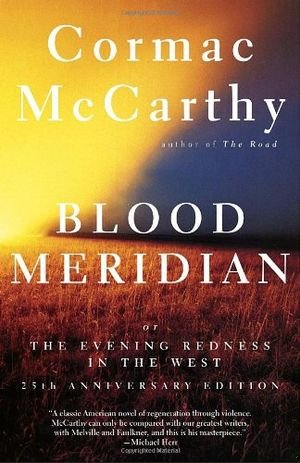
So here are my three must read books. I've been reading a lot of great books like: Outsmart Your Instincts, The Culture Code, and Antonio Damasio’s The Strange Order, and sometimes when you read a lot of nonfiction it’s very enriching, sometimes you need a novel. I really believe you should take a minute and read something beautiful. Listen, listen to Lolita by Nabokov. But also listen to Blood Meridian by Cormac McCarthy and listen to Richard Poe narrate that. Those are two of the greatest feats of the english language that I can think of. Then there’s Fortress of Solitude, an amazing book, Extremely Loud and Incredibly Close, these are great novels. Cold Mountain is a beautiful novel, Snow Falling On Cedars, I mean they’ve been around for a while. But goddamnit, get those under your belt. Those are the novels I think you should read. You know Love In The Time Of Cholera it just makes you ache. Kind of like a Hemingway thing, where Hemingway “ahh!”, it’s the same thing, you know. So I don’t know, I’m a fan of all those books. Those are my 3 slash 20 books. [source]
Ella Berthoud
Even though it’s wrong, you sympathise with him because he can’t help himself and writes about it in such a passionate and empathetic way. [source]
Richard Cohen
It’s more imbued with references to the sun and using the sun as symbol or metaphor – almost a kind of character in the novel – than any other work in literature. [source]
Cover unavailable
3
The Crying of Lot 49
Thomas Pynchon
4.8
Suffused with rich satire, chaotic brilliance, verbal turbulence and wild humor, The Crying of Lot 49 opens as Oedipa Maas discovers that she has been made executrix of a former lover's estate. The performance of her duties sets her on a strange trail of detection, in which bizarre characters crowd in to help or confuse her. But gradually, death, drugs, madness and marriage combine to leave Oedipa in isolation on the threshold of revelation, awaiting the Crying of Lot 49.
…
Cover unavailable
4
White Noise
Don DeLillo
4.7
Part of the Penguin Orange Collection, a limited-run series of twelve influential and beloved American classics in a bold series design offering a modern take on the iconic Penguin paperback
For the seventieth anniversary of Penguin Classics, the Penguin Orange Collection celebrates the heritage of Penguin’s iconic book design with twelve influential American literary classics representing the breadth and diversity of the Penguin Classics library. These collectible editions are dressed in the iconic orange and white tri-band cover design, first created in 1935, while french flaps, high-quality paper, and striking cover illustrations provide the cutting-edge design treatment that is the signature of Penguin Classics Deluxe Editions today.
White Noise
Winner of the 1985 National Book Award, White Noise tells the story of Jack Gladney, his fourth wife, Babette, and their four ultramodern offspring, as they navigate the rocky passages of family life to the background babble of brand-name consumerism.
…
Cover unavailable
5
Infinite Jest
David Foster Wallace
4.7
Infinite Jest is the name of a movie said to be so entertaining that anyone who watches it loses all desire to do anything but watch. People die happily, viewing it in endless repetition. The novel Infinite Jest is the story of this addictive entertainment, and in particular how it affects a Boston halfway house for recovering addicts and a nearby tennis academy, whose students have many budding addictions of their own. As the novel unfolds, various individuals, organisations, and governments vie to obtain the master copy of Infinite Jest for their own ends, and the denizens of the tennis school and halfway house are caught up in increasingly desperate efforts to control the movie—as is a cast including burglars, transvestite muggers, scam artists, medical professionals, pro football stars, bookies, drug addicts both active and recovering, film students, political assassins, and one of the most endearingly messed-up families ever captured in a novel.
On this outrageous frame hangs an exploration of essential questions about what entertainment is, and why it has come to so dominate our lives; about how our desire for entertainment interacts with our need to connect with other humans; and about what the pleasures we choose say about who we are. Equal parts philosophical quest and screwball comedy, Infinite Jest bends every rule of fiction without sacrificing for a moment its own entertainment value. The huge cast and multilevel narrative serve a story that accelerates to a breathtaking, heartbreaking, unfogettable conclusion. It is an exuberant, uniquely American exploration of the passions that make us human and one of those rare books that renew the very idea of what a novel can do.
I think Infinite Jest is the major American novel of the past 25 years…It’s the book on which his reputation will rest, and I think people are going to read it for a long time. [source]
It’s an extraordinary book…One of the things that he is examining in the novel is the various games that we play, many of them recursive. [source]
Cover unavailable
6
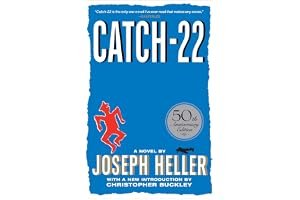
Catch-22
Joseph Heller, Christopher Buckley
4.7
This fiftieth-anniversary edition commemorates Joseph Heller’s masterpiece with a new introduction; critical essays and reviews by Norman Mailer, Alfred Kazin, Anthony Burgess, and others; rare papers and photos; and much more.
Nominated as one of America’s best-loved novels by PBS’s The Great American Read.
Now a Hulu limited series starring Christopher Abbott, George Clooney, Kyle Chandler, and Hugh Laurie.
Fifty years after its original publication, Catch-22 remains a cornerstone of American literature and one of the funniest—and most celebrated—books of all time. In recent years it has been named to “best novels” lists by Time, Newsweek, the Modern Library, and the London Observer.
Set in Italy during World War II, this is the story of the incomparable, malingering bombardier, Yossarian, a hero who is furious because thousands of people he has never met are trying to kill him. But his real problem is not the enemy—it is his own army, which keeps increasing the number of missions the men must fly to complete their service. Yet if Yossarian makes any attempt to excuse himself from the perilous missions he’s assigned, he’ll be in violation of Catch-22, a hilariously sinister bureaucratic rule: a man is considered insane if he willingly continues to fly dangerous combat missions, but if he makes a formal request to be removed from duty, he is proven sane and therefore ineligible to be relieved.
This fiftieth-anniversary edition commemorates Joseph Heller’s masterpiece with a new introduction by Christopher Buckley; a wealth of critical essays and reviews by Norman Mailer, Alfred Kazin, Anthony Burgess, and others; rare papers and photos from Joseph Heller’s personal archive; and much more. Here, at last, is the definitive edition of a classic of world literature.
…
Recommended by Brian Burkhart, Charles Glass, Kate McLoughlin, and 5 others.
Brian Burkhart
This book is a masterpiece and absolutely hilarious. In subtle ways, you realize the main character is questioning not just the notion of authority, but the way authority thinks and how we must react to it. To me, a guy with the core belief “make waves,” it has a great message, which is, “It’s okay to question the status quo.” For people just starting their careers, it’s easy to think our superiors know everything—they’re not quick to admit their insecurities, flaws, and blind spots, but they have them. And having a healthy dose of skepticism isn’t such a terrible thing. Plus, it’s just a fun read. [source]
Charles Glass
It’s one of the funniest books ever written. It’s about the insanity of military life and the absurdity of a big institution. Heller was very good on the absurdity of big institutions. Catch 22 has every character in it that the American military did have at the time and still has today in Iraq and Afghanistan: The money-makers, the crooks, the officers who were trying to claw their way to the top where they get their men killed, the placing in order of priority the pretence of military success at the cost of many civilian lives. [source]
Kate McLoughlin
It gets you to the point where you can’t apply your reason any more and laughter takes over. It’s the laughter of the absurd. [source]
Cover unavailable
7
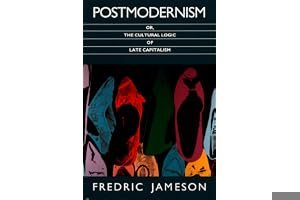
Postmodernism, or, The Cultural Logic of Late Capitalism
Fredric Jameson
4.7
Now in paperback, Fredric Jameson’s most wide-ranging work seeks to crystalize a definition of ”postmodernism”. Jameson’s inquiry looks at the postmodern across a wide landscape, from “high” art to “low” from market ideology to architecture, from painting to “punk” film, from video art to literature.
Cover unavailable
8
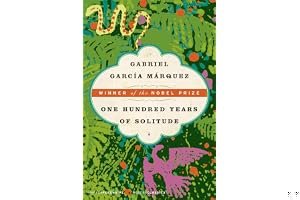
One Hundred Years of Solitude
Gabriel Garcia Marquez
4.7
The brilliant, bestselling, landmark novel that tells the story of the Buendia family, and chronicles the irreconcilable conflict between the desire for solitude and the need for love—in rich, imaginative prose that has come to define an entire genre known as "magical realism."
When asked what books he recommended to his 18-year-old daughter Malia, Obama gave the Times a list that included The Naked and the Dead and One Hundred Years of Solitude. “I think some of them were sort of the usual suspects … I think she hadn’t read yet. Then there were some books that are not on everybody’s reading list these days, but I remembered as being interesting.” Here’s what he included: The Naked and the Dead, Norman Mailer One Hundred Years of Solitude, Gabriel García Márquez The Golden Notebook, Doris Lessing The Woman Warrior, Maxine Hong Kingston [source]
Brace yourselves—One Hundred Years of Solitude by Gabriel García Márquez is as steamy, dense and sensual as the jungle that surrounds the surreal town of Macondo! [source]
Today is World Book Day, a wonderful opportunity to address this #ChallengeRichard sent in by Mike Gonzalez of New Jersey: Make a list of your top 65 books to read in a lifetime. [source]
Cover unavailable
9
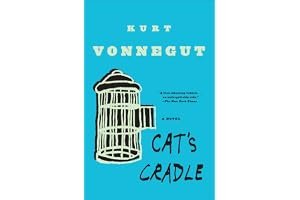
Cat's Cradle
Kurt Vonnegut
4.7
Told with deadpan humour and bitter irony, Kurt Vonnegut's cult tale of global destruction preys on our deepest fears of witnessing Armageddon and, worse still, surviving it ...
Dr Felix Hoenikker, one of the founding 'fathers' of the atomic bomb, has left a deadly legacy to the world. For he's the inventor of 'ice-nine', a lethal chemical capable of freezing the entire planet. The search for its whereabouts leads to Hoenikker's three ecentric children, to a crazed dictator in the Caribbean, to madness. Felix Hoenikker's Death Wish comes true when his last, fatal gift to humankind brings about the end, that for all of us, is nigh...
…
Recommended by Ev Williams and Andy Stern.
Andy Stern
I think it's something that progressives need to think about, because the book talks a lot about two tendencies that people can adopt, to try to find meaning and purpose. One is kind of a sheer technological approach, and the other is more of a spiritual and religious approach. The book talks about the perils and challenges of each way. Sometimes we as progressives defend technology and science and fact, and other people – clearly both progressive and otherwise – appreciate the spiritual more. Then on either extreme, the book tries to say that blind adherence to either tendency also has huge problems. The book, for me, is about trying to seek meaning, not trying to find simple answers, and appreciating that in some ways following a belief to an extreme can be equally as dangerous as having no beliefs. [source]
Cover unavailable
10
If on a Winter's Night a Traveler
Italo Calvino and William Weave
4.6
If on a Winter's Night a Traveler is a marvel of ingenuity, an experimental text that looks longingly back to the great age of narration—"when time no longer seemed stopped and did not yet seem to have exploded." Italo Calvino's novel is in one sense a comedy in which the two protagonists, the Reader and the Other Reader, ultimately end up married, having almost finished If on a Winter's Night a Traveler. In another, it is a tragedy, a reflection on the difficulties of writing and the solitary nature of reading. The Reader buys a fashionable new book, which opens with an exhortation: "Relax. Concentrate. Dispel every other thought. Let the world around you fade." Alas, after 30 or so pages, he discovers that his copy is corrupted, and consists of nothing but the first section, over and over. Returning to the bookshop, he discovers the volume, which he thought was by Calvino, is actually by the Polish writer Bazakbal. Given the choice between the two, he goes for the Pole, as does the Other Reader, Ludmilla. But this copy turns out to be by yet another writer, as does the next, and the next.
The real Calvino intersperses 10 different pastiches—stories of menace, spies, mystery, premonition—with explorations of how and why we choose to read, make meanings, and get our bearings or fail to. Meanwhile the Reader and Ludmilla try to reach, and read, each other. If on a Winter's Night is dazzling, vertiginous, and deeply romantic. "What makes lovemaking and reading resemble each other most is that within both of them times and spaces open, different from measurable time and space."
…
Cover unavailable
11
The Name of the Rose
Umberto Eco, William Weaver
4.6
The year is 1327. Benedictines in a wealthy Italian abbey are suspected of heresy, and Brother William of Baskerville arrives to investigate. When his delicate mission is suddenly overshadowed by seven bizarre deaths, Brother William turns detective. His tools are the logic of Aristotle, the theology of Aquinas, the empirical insights of Roger Bacon—all sharpened to a glistening edge by wry humor and a ferocious curiosity. He collects evidence, deciphers secret symbols and coded manuscripts, and digs into the eerie labyrinth of the abbey, where “the most interesting things happen at night.”
…
Recommended by Vanora Bennett.
Vanora Bennett
I read this a few years ago and it was one of those books you always remember because it creates a whole new way of thinking. I had no idea at the time that the medieval mindset was any different to the modern one. It is about the adventure of a Franciscan friar and his novice in medieval Italy and it is part murder mystery, part game with semiotics and medieval knowledge. At university I read lots of French books referring to this medieval period where all knowledge was supposed to be classified, and re-classified and super-classified, and it became sort of idiotic, this academic approach that these monks had. Yet there was something amazing about this belief that you could classify knowledge. It’s also very good storytelling, but the part I remember was the sort of library filled with knowledge and these games, which teased you with knowing things and not knowing things. It’s just this very complex mindset that’s really different from our own and because I knew nothing about it, it was just terribly exciting to be taken off into this world. [source]
Cover unavailable
12
Gravity's Rainbow
Thomas Pynchon, Frank Miller
4.6
Winner of the 1973 National Book Award, Gravity's Rainbow is a postmodern epic, a work as exhaustively significant to the second half of the 20th century as Joyce's Ulysses was to the first. Its sprawling, encyclopedic narrative, and penetrating analysis of the impact of technology on society make it an intellectual tour de force.
Cover unavailable
13
The Postmodern Condition: A Report on Knowledge
Jean-Francois Lyotard, G. Bennington
4.6
This book explores science and technology, makes connections between these epistemic, cultural, and political trends, and develops profound insights into the nature of our post-modernity. Many definitions of postmodernism focus on its nature as the aftermath of the modern industrial age when technology developed. This book extends that analysis to postmodernism by looking at the status of science, technology, and the arts, the significance of technocracy, and the way the flow of information is controlled in the Western world.
There’s an emphasis in Lyotard’s book on the connection between politics and technology, the politics which manipulate and affect technologies and so impact on how we live. [source]
Cover unavailable
14
House of Leaves
Mark Z. Danielewski
4.5
Years ago, when House of Leaves was first being passed around, it was nothing more than a badly bundled heap of paper, parts of which would occasionally surface on the Internet. No one could have anticipated the small but devoted following this terrifying story would soon command. Starting with an odd assortment of marginalized youth—musicians, tattoo artists, programmers, strippers, environmentalists, and adrenaline junkies—the book eventually made its way into the hands of older generations, who not only found themselves in those strangely arranged pages but also discovered a way back into the lives of their estranged children.
Now, for the first time, this astonishing novel is made available in book form, complete with the original colored words, vertical footnotes, and newly added second and third appendices.
The story remains unchanged, focusing on a young family that moves into a small home on Ash Tree Lane where they discover something is terribly wrong: their house is bigger on the inside than it is on the outside.
Of course, neither Pulitzer Prize-winning photojournalist Will Navidson nor his companion Karen Green was prepared to face the consequences of that impossibility, until the day their two little children wandered off and their voices eerily began to return another story—of creature darkness, of an ever-growing abyss behind a closet door, and of that unholy growl which soon enough would tear through their walls and consume all their dreams.
…
Recommended by Amelia Boone.
Amelia Boone
This is a book that you have to hold, because there are parts of it where you need to turn it upside down to read it. There are certain pages where, you are reading it, and it turns in a circle... This is a book that's an entire sensory experience. [source]
Cover unavailable
15
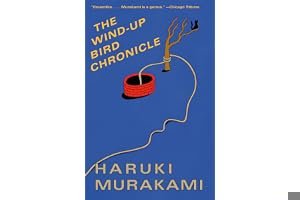
The Wind-Up Bird Chronicle
Haruki Murakami, Jay Rubin
4.5
Japan's most highly regarded novelist now vaults into the first ranks of international fiction writers with this heroically imaginative novel, which is at once a detective story, an account of a disintegrating marriage, and an excavation of the buried secrets of World War II.
In a Tokyo suburb a young man named Toru Okada searches for his wife's missing cat. Soon he finds himself looking for his wife as well in a netherworld that lies beneath the placid surface of Tokyo. As these searches intersect, Okada encounters a bizarre group of allies and antagonists: a psychic prostitute; a malevolent yet mediagenic politician; a cheerfully morbid sixteen-year-old-girl; and an aging war veteran who has been permanently changed by the hideous things he witnessed during Japan's forgotten campaign in Manchuria.
Gripping, prophetic, suffused with comedy and menace, The Wind-Up Bird Chronicle is a tour de force equal in scope to the masterpieces of Mishima and Pynchon.
Three books in one volume: The Thieving Magpie, Bird as Prophet, The Birdcatcher. This translation by Jay Rubin is in collaboration with the author.
…
Recommended by Bernard Tan, Brian Koppelman, and Sung J. Woo.
Bernard Tan
I’m also a Murakami and Vonnegut fan, Kafka on the Shore, The Wind-up Bird Chronicle, Norwegian Wood, Slaughterhouse-Five, etc. Now that I look at the books listed, they seem to carry an existential theme. I guess I like to understand humanity and human behaviour ultimately to better understand myself. I find reading a means to connect with people who may have lived before my time, or in a distant country, that I may never have had the chance to connect with in real life. As three-dimensional humans, we are all made up of so many faces and emotional layers that we find it hard to dissect them all, and when we find writers who can explain these thought processes in a way that’s tangible and digestible, there’s this incredibly comforting eureka moment of feeling understood. [source]
If you have always wanted to read this author, I think this Covid-19 period of time is perfect for it. He could have conceived of this whole thing. [source]
Sung J. Woo
He’s the best-known Japanese writer right now and this book I would consider to be his opus. It’s a big sprawling book that deals with weighty subjects like the Second World War and Japan’s part in that. There is a horrifying section set when the Japanese had occupied Manchuria and the Chinese are approaching and it’s told from the point of view of a soldier who is told to kill all the animals in the zoo as the Chinese close in. It’s a harrowing tale of this Japanese soldier going round the cages killing these magnificent animals. [source]
Cover unavailable
16
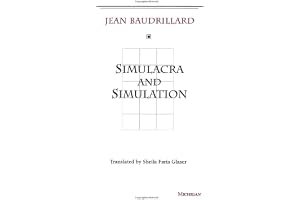
Simulacra and Simulation
Jean Baudrillard, Sheila Faria Glaser
4.5
The publication of Simulacra et Simulation in 1981 marked Jean Baudrillard's first important step toward theorizing the postmodern. Moving away from the Marxist/Freudian approaches that had concerned him earlier, Baudrillard developed in this book a theory of contemporary culture that relies on displacing economic notions of cultural production with notions of cultural expenditure.
Baudrillard uses the concepts of the simulacra—the copy without an original—and simulation. These terms are crucial to an understanding of the postmodern, to the extent that they address the concept of mass reproduction and reproduceability that characterizes our electronic media culture.
Baudrillard's book represents a unique and original effort to rethink cultural theory from the perspective of a new concept of cultural materialism, one that radically redefines postmodern formulations of the body.
Sheila Glaser is an editor at Artforum magazine.
…
Cover unavailable
17
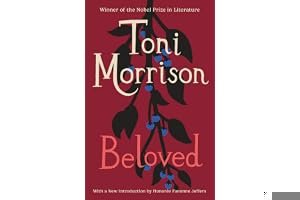
Beloved
Toni Morrison
4.5
Staring unflinchingly into the abyss of slavery, this spellbinding novel transforms history into a story as powerful as Exodus and as intimate as a lullaby.
Sethe was born a slave and escaped to Ohio, but eighteen years later she is still not free. She has too many memories of Sweet Home, the beautiful farm where so many hideous things happened. Her new home is haunted by the ghost of her baby, who died nameless and whose tombstone is engraved with a single word: Beloved.
Filled with bitter poetry and suspense as taut as a rope, Beloved is a towering achievement by Nobel Prize laureate Toni Morrison.
…
Recommended by Bianca Belair, Esi Edugyan, and Farah Jasmine Griffin.
Bianca Belair
@ylc130 I went to the library when I was in the 3rd grade and read Beloved... I remember being so confused and my Mama having to explain it to me... I later read it as an adult and it hit me completely different. GREAT BOOK! [source]
Esi Edugyan
I was shocked by the blunt force of its subject matter and its exquisitely torqued prose. It remains one of my most adored novels. [source]
Farah Jasmine Griffin
Beloved was Morrison’s fifth novel. It’s a gripping story, inspired by a famous abolitionist case, the true story of a woman who runs away from slavery with her children, but when the slave catchers catch up with her, she kills one of her own and tries to kill the others, rather than returning them to slavery. [source]
Cover unavailable
18
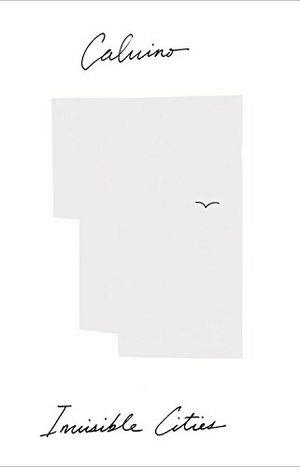
Invisible Cities
Italo Calvino
4.5
"Kublai Khan does not necessarily believe everything Marco Polo says when he describes the cities visited on his expeditions, but the emperor of the Tartars does continue listening to the young Venetian with greater attention and curiosity than he shows any other messenger or explorer of his." So begins Italo Calvino's compilation of fragmentary urban images. As Marco tells the khan about Armilla, which "has nothing that makes it seem a city, except the water pipes that rise vertically where the houses should be and spread out horizontally where the floors should be," the spider-web city of Octavia, and other marvelous burgs, it may be that he is creating them all out of his imagination, or perhaps he is recreating fine details of his native Venice over and over again, or perhaps he is simply recounting some of the myriad possible forms a city might take.
Oh God. Well, officially it’s Marco Polo describing the cities of his travels to Kublai Khan. It’s been opined that every city he describes is a version of Venice, but I think that doesn’t really work. They seem to me to be marvellous imaginative fantasies, which sometimes reproduce states of mind. There are 40 or so cities described, all entirely imaginary I think, and that’s what’s so magical about them. But there are passages that are suggestive of something, and nearly always of the way memory works. It’s a very hard book to describe, because the cities are never just a description of a place. They all mirror states of mind and being. [source]
James Meek
It has different layers. The set-up is that Kublai Khan has conquered this vast empire; an empire so large that he, sitting at the centre of it, cannot know all the many parts of it. He can’t visit them, he can’t see them, and if he goes to one part all the other parts have changed. So he sits there at the centre of his empire and Marco Polo travels around and visits the various cities and comes back and describes them to Kublai Khan. [source]
Cover unavailable
19
Lord of the Flies
William Golding
4.5
At the dawn of the next world war, a plane crashes on an uncharted island, stranding a group of schoolboys. At first, with no adult supervision, their freedom is something to celebrate; this far from civilization the boys can do anything they want. Anything. They attempt to forge their own society, failing, however, in the face of terror, sin and evil. And as order collapses, as strange howls echo in the night, as terror begins its reign, the hope of adventure seems as far from reality as the hope of being rescued. Labeled a parable, an allegory, a myth, a morality tale, a parody, a political treatise, even a vision of the apocalypse, Lord of the Flies is perhaps our most memorable tale about “the end of innocence, the darkness of man’s heart.”
…
Recommended by Elon Musk, Ev Williams, Audrey Russo, and 5 others.
Audrey Russo
So many novels; Lord of the Flies, Great Gatsby, Great Expectations; all the Nancy Drew books; Catcher in the Rye, Books written by Zora Neale Hurston; Pat Conroy – all because of the view about different people who endure despite adversity while kindling the hearts of the human spirit. [source]
Chigozie Obioma
William Golding imbues some of these children with wisdom that would read, in the hands of a lesser author, as implausibly knowing [source]
Disco Donnie
@JoshRHernandez1 I love the book “Lord of the Flies” so just started watching The Society [source]
A classic, life-changing meditation on war, memory, imagination, and the redemptive power of storytelling, with more than two-million copies in print
Depicting the men of Alpha Company—Jimmy Cross, Henry Dobbins, Rat Kiley, Mitchell Sanders, Norman Bowker, Kiowa, and the character Tim O’Brien, who survived his tour in Vietnam to become a father and writer at the age of forty-three—the stories in The Things They Carried opened our eyes to the nature of war in a way we will never forget. It is taught everywhere, from high school classrooms to graduate seminars in creative writing, and in the decades since its publication it has never failed to challenge our perceptions of fact and fiction, war and peace, and courage, longing, and fear.
…
Recommended by Caroline Paul, Eugene Gu, Karl Marlantes, and 2 others.
Caroline Paul
A beautiful book by a writer who fought in Vietnam. [source]
Eugene Gu
@realDonaldTrump Tim O’Brien is the author of the book The Things They Carried, which was about the Vietnam War. Must be very triggering for Trump since he dodged the draft multiple times with fraudulent doctors’ notes for fake bone spurs like a coward. [source]
Karl Marlantes
But when O’Brien wrote The Things They Carried he came down to absolute real brass tacks. It was no longer surreal, it was like here’s a list of what a grunt carries, an infantry soldier… [source]
Cover unavailable
21
The Handmaid's Tale
Margaret Atwood
4.5
Before The Testaments, there was The Handmaid’s Tale: an instant classic and eerily prescient cultural phenomenon, from “the patron saint of feminist dystopian fiction” (New York Times).
The Handmaid’s Tale is a novel of such power that the reader will be unable to forget its images and its forecast. Set in the near future, it describes life in what was once the United States and is now called the Republic of Gilead, a monotheocracy that has reacted to social unrest and a sharply declining birthrate by reverting to, and going beyond, the repressive intolerance of the original Puritans. The regime takes the Book of Genesis absolutely at its word, with bizarre consequences for the women and men in its population.
The story is told through the eyes of Offred, one of the unfortunate Handmaids under the new social order. In condensed but eloquent prose, by turns cool-eyed, tender, despairing, passionate, and wry, she reveals to us the dark corners behind the establishment’s calm facade, as certain tendencies now in existence are carried to their logical conclusions. The Handmaid’s Tale is funny, unexpected, horrifying, and altogether convincing. It is at once scathing satire, dire warning, and a tour de force. It is Margaret Atwood at her best.
Atwood takes all the hard information about gender inequality that she sees around her and then turns it up a few notches. [source]
Cliff Bleszinski
@HandmaidsOnHulu Done. Love the show, book is a classic, can't wait for season 2. [source]
Grady Booch
I read this several years ago but — much like Orwell’s 1984 — it seems particularly relevant given our current political morass. [source]
Cover unavailable
22
Watchmen
Alan Moore, Dave Gibbons
4.5
This Hugo Award-winning graphic novel chronicles the fall from grace of a group of super-heroes plagued by all-too-human failings. Along the way, the concept of the super-hero is dissected as the heroes are stalked by an unknown assassin.
One of the most influential graphic novels of all time and a perennial bestseller, WATCHMEN has been studied on college campuses across the nation and is considered a gateway title, leading readers to other graphic novels such as V FOR VENDETTA, BATMAN: THE DARK KNIGHT RETURNS and THE SANDMAN series.
Watchmen was originally released in 12 parts, one a month, over a year from 1985 to 1986. There was a film made of it in 2009. And now a controversial prequel series is coming out, done by new writers and artists, which goes back to earlier in the characters’ stories and which has been disavowed by Alan Moore, who created the original. [source]
Cover unavailable
23
Pale Fire
Vladimir Nabokov
4.5
The American poet John Shade is dead. His last poem, 'Pale Fire', is put into a book, together with a preface, a lengthy commentary and notes by Shade's editor, Charles Kinbote. Known on campus as the 'Great Beaver', Kinbote is haughty, inquisitive, intolerant, but is he also mad, bad - and even dangerous? As his wildly eccentric annotations slide into the personal and the fantastical, Kinbote reveals perhaps more than he should be.
Nabokov's darkly witty, richly inventive masterpiece is a suspenseful whodunit, a story of one-upmanship and dubious penmanship, and a glorious literary conundrum.
Part of a major new series of the works of Vladimir Nabokov, author of Lolita and Pale Fire, in Penguin Classics.
…
Cover unavailable
24
Breakfast of Champions
Kurt Vonnegut
4.5
In Breakfast of Champions, one of Kurt Vonnegut’s most beloved characters, the aging writer Kilgore Trout, finds to his horror that a Midwest car dealer is taking his fiction as truth. What follows is murderously funny satire, as Vonnegut looks at war, sex, racism, success, politics, and pollution in America and reminds us how to see the truth.
Cover unavailable
25
Discipline and Punish: The Birth of the Prison
Michel Foucault, Alan Sheridan
4.5
Librarian note: an alternate cover for this edition can be found here.
In this brilliant work, the most influential philosopher since Sartre suggests that such vaunted reforms as the abolition of torture and the emergence of the modern penitentiary have merely shifted the focus of punishment from the prisoner’s body to his soul.
Cover unavailable
26
The Unbearable Lightness of Being
Milan Kundera
4.5
In The Unbearable Lightness of Being, Milan Kundera tells the story of a young woman in love with a man torn between his love for her and his incorrigible womanizing and one of his mistresses and her humbly faithful lover. This magnificent novel juxtaposes geographically distant places; brilliant and playful reflections; and a variety of styles to take its place as perhaps the major achievement of one of the world’s truly great writers.
This book was recommended by on page 488 in "Tools of Titans". [source]
Bernard Tan
I wasn’t expecting anything going into it, but I am currently quite engrossed by Kundera’s understanding of humanity and his beautiful writing style. [source]
Cover unavailable
27
A Clockwork Orange
Anthony Burgess
4.4
In Anthony Burgess’s influential nightmare vision of the future, where the criminals take over after dark, the story is told by the central character, Alex, a teen who talks in a fantastically inventive slang that evocatively renders his and his friends’ intense reaction against their society. Dazzling and transgressive, A Clockwork Orange is a frightening fable about good and evil and the meaning of human freedom. This edition includes the controversial last chapter not published in the first edition, and Burgess’s introduction, “A Clockwork Orange Resucked.”
…
Cover unavailable
28
Ficciones
Jorge Luis Borges, John Sturrock
4.4
Jorge Luis Borges was one of those very rare creators who changed the face of an art form—in his case, the short story. His work has been paid the ultimate honor of being appropriated and imitated by innumerable writers on every continent of the world. The seventeen brief masterpieces of FICCIONES explode the boundaries of genre, offering up labyrinthine libraries, a fictional encyclopedia entry that spawns an entire world, a review of a nonexistent writer’s attempt to re-create Don Quixote word for word, a man with the disabling inability to forget anything he has ever experienced, and other metaphysical puzzles. But the true measure of Borges’s greatness lies in the fact that his fictions—elaborately paradoxical, postmodern, and intellectually delicious as they are—managed to return the short story to the realm of the fabulous and the uncanny from which, as parable and fairy tale, it originally came.
This is something very hard to find, almost by definition: a literary writer who thinks in abstract terms (the only other such author I've read is Stanislaw Lem). These are philosophical thought experiments in their purest form, yet somehow magically delivered in a playful literary athmosphere. Borges is a mathematical philosopher, first and last. Ignore the "Latin American" categorization and the nonsense about his background and personal life: one should resist embedding him in a socio-cultural framework; he is as universal as they come. It is good to read a short story once in a while to see how literature and philosophy can be saved by the parable. [source]
Kate Marvel
I don’t think there will ever be a better writer on uncertainty and science than Borges [source]
There is a transnational quality to Borges’s writing. [source]
Cover unavailable
29
Fight Club
Chuck Palahniuk
4.4
"THE FIRST RULE ABOUT FIGHT CLUB IS YOU DON'T TALK ABOUT CLUB."
Every weekend, in the basements and parking lots of bars across the country, young men with good white-collar jobs and absent fathers take off their shoes and shirts and fight each other barehanded for as long as they have to. Then they go back to those jobs with blackened eyes and loosened teeth and the sense that they can handle anything. Fight Club is the invention of Tyler Durden, projectionist, waiter, and dark, anarchic genius, and it's only the beginning of his plans for revenge on a world where cancer support groups have the corner on human warmth. As the narrator of Fight Club puts it: "If people thought you were dying, they gave you their full attention."
"THE SECOND RULE ABOUT FIGHT CLUB IS YOU DON'T TALK ABOUT CLUB."
Where does Tyler Durden come from? Why do his violent schemes so capture the troubled, insomniac narrator? What events bring them to the roof of the world's tallest building, wired to explode in ten minutes? The answers in Fight Club reveal a world poised on the brink of mayhem—and introduce a blazingly original literary scene.
"THE THIRD RULE ABOUT FIGHT CLUB IS TWO MEN PER FIGHT."
What will the end of the millennium feel like? Readers of Chuck Palahniuk's brilliantly apocalyptic and unnerving first novel are going to find out.
I’m amazed how many young people haven’t read this book. Truly life-changing. This is the classic of my generation; it is the book that defines our age and ultimately, how to find meaning in it. It’s a cautionary tale too—about being too caught up in revolutionary ideas. [source]
Van Badham
SUPER EXCITED to receive my copy of “Solved! How Other Countries Have Cracked the World’s Biggest Problems and We Can, Too” by Andrew Wear. SO GREAT to read a political book that’s about both pragmatic action *and* hope. Squee! #auspol https://t.co/jIYgr36kZO [source]
Cover unavailable
30
Labyrinths: Selected Stories and Other Writings
Jorge Luis Borges, James E. Irby, Donald A. Yates, Andre Maurois
4.4
Although his work has been restricted to the short story, the essay, and poetry, Jorge Luis Borges of Argentina is recognized all over the world as one of the most original and significant figures in modern literature. In his preface, Andre Maurois writes: "Borges is a great writer who has composed only little essays or short narratives. Yet they suffice for us to call him great because of their wonderful intelligence, their wealth of invention, and their tight, almost mathematical style."
Labyrinths is a representative selection of Borges' writing, some forty pieces drawn from various books of his published over the years. The translations are by Harriet de Onis, Anthony Kerrigan, and others, including the editors, who have provided a biographical and critical introduction, as well as an extensive bibliography.
…
Recommended by Caterina Fake, John King, and Nicholas Shakespeare.
If you are going to think about Latin American literature, Borges is always a good place to start. [source]
Nicholas Shakespeare
No writer embodied libraries more than the immobile, blind Argentine, Jorge Luis Borges. [source]
Cover unavailable
31
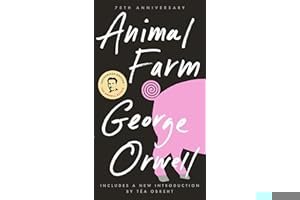
Animal Farm
George Orwell and Christopher Hitchens
4.4
Animal Farm is one of the most famous warnings ever written. Orwell's immortal satire - 'against Stalin' as he wrote to his French translator - can be read on many levels. With its piercing clarity and deceptively simple style it is no surprise that this novel is required reading for schoolchildren and politicians alike. This fable of the steadfast horses Boxer and Clover, the opportunistic pigs Snowball and Napoleon, and the deafening choir of sheep remains an unparalleled masterpiece.
One reviewer wrote 'In a hundred years' time perhaps Animal Farm ... may simply be a fairy story: today it is a fairy story with a good deal of point.' Over sixty years on in the age of spin, it is more relevant than ever.
Rejected by such eminent publishing figures as Victor Gollancz, Jonathan Cape and T.S. Eliot, Animal Farm was published to great acclaim by Martin Secker and Warburg on 17 August 1945 in an edition of 4500 copies. In the centenary year of Martin Secker, Ltd., Harvill Secker is proud to publish this special edition with a brand-new introduction by Christopher Hitchens.
Whitney Cummings recommended this book on the podcast "The Tim Ferriss Show". [source]
Vlad Tenev
When I was in sixth grade I remember being very upset by the ending of this book. [source]
Heather Brooke
I picked Animal Farm because it is an allegory about power and its seductive and corruptive influence on people regardless of their initial good intentions. [source]
Cover unavailable
32
The New York Trilogy
Paul Auster, Art Spiegelman, Luc Sante
4.4
The remarkable, acclaimed series of interconnected detective novels – from the author of 4 3 2 1: A Novel
The New York Review of Books has called Paul Auster’s work “one of the most distinctive niches in contemporary literature.” Moving at the breathless pace of a thriller, this uniquely stylized triology of detective novels begins with City of Glass, in which Quinn, a mystery writer, receives an ominous phone call in the middle of the night. He’s drawn into the streets of New York, onto an elusive case that’s more puzzling and more deeply-layered than anything he might have written himself. In Ghosts, Blue, a mentee of Brown, is hired by White to spy on Black from a window on Orange Street. Once Blue starts stalking Black, he finds his subject on a similar mission, as well. In The Locked Room, Fanshawe has disappeared, leaving behind his wife and baby and nothing but a cache of novels, plays, and poems.
This Penguin Classics Deluxe Edition includes an introduction from author and professor Luc Sante, as well as a pulp novel-inspired cover from Art Spiegelman, Pulitzer Prize-winning graphic artist of Maus and In the Shadow of No Towers.
…
Cover unavailable
33
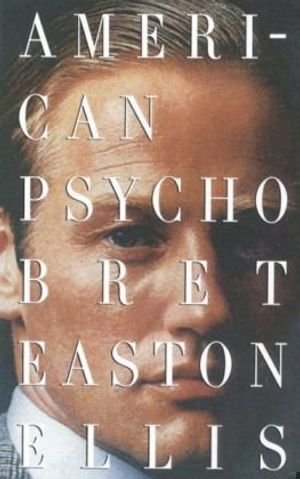
American Psycho
Bret Easton Ellis
4.3
Patrick Bateman is twenty-six and he works on Wall Street, he is handsome, sophisticated, charming and intelligent. He is also a psychopath. Taking us to head-on collision with America's greatest dream—and its worst nightmare—American Psycho is bleak, bitter, black comedy about a world we all recognise but do not wish to confront.
Most people exist between the on and off switch. They are unable to turn on and put out high power, and they are unable to turn off completely and enjoy true rest. To learn how to control your on and off switch, read the book Psych by Dr. Judd Biasiotto. He is one of the most successful power lifters in history, having squatted over 600 pounds at a bodyweight of 132... drug free, at the age of 44, after back surgery. [source]
Cover unavailable
34
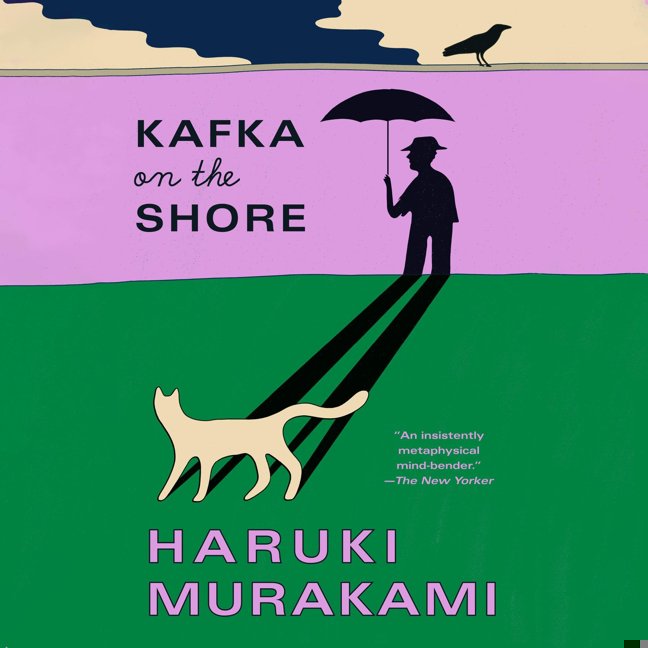
Kafka on the Shore
Haruki Murakami
4.3
Kafka on the Shore, a tour de force of metaphysical reality, is powered by two remarkable characters: a teenage boy, Kafka Tamura, who runs away from home either to escape a gruesome oedipal prophecy or to search for his long-missing mother and sister; and an aging simpleton called Nakata, who never recovered from a wartime affliction and now is drawn toward Kafka for reasons that, like the most basic activities of daily life, he cannot fathom. Their odyssey, as mysterious to them as it is to us, is enriched throughout by vivid accomplices and mesmerizing events. Cats and people carry on conversations, a ghostlike pimp employs a Hegel-quoting prostitute, a forest harbors soldiers apparently unaged since World War II, and rainstorms of fish (and worse) fall from the sky. There is a brutal murder, with the identity of both victim and perpetrator a riddle—yet this, along with everything else, is eventually answered, just as the entwined destinies of Kafka and Nakata are gradually revealed, with one escaping his fate entirely and the other given a fresh start on his own.
…
Recommended by Bernard Tan, Brian Koppelman, and John Craig.
Bernard Tan
I’m also a Murakami and Vonnegut fan, Kafka on the Shore, The Wind-up Bird Chronicle, Norwegian Wood, Slaughterhouse-Five, etc. Now that I look at the books listed, they seem to carry an existential theme. I guess I like to understand humanity and human behaviour ultimately to better understand myself. I find reading a means to connect with people who may have lived before my time, or in a distant country, that I may never have had the chance to connect with in real life. As three-dimensional humans, we are all made up of so many faces and emotional layers that we find it hard to dissect them all, and when we find writers who can explain these thought processes in a way that’s tangible and digestible, there’s this incredibly comforting eureka moment of feeling understood. [source]
If you have always wanted to read this author, I think this Covid-19 period of time is perfect for it. He could have conceived of this whole thing. [source]
John Craig
The only book, or should I say author, that takes priority is Haruki Murakami. He is a Japanese novelist that takes me into the next world. His style is surreal. Check it out. Start with Kafka on the Shore. [source]
Cover unavailable
35
Neuromancer
William Gibson, Neil Gaiman
4.3
A deluxe hardcover edition of the pioneering cyberpunk novel that predicted our obsession with the Internet—part of Penguin Galaxy, a collectible series of six sci-fi/fantasy classics, featuring a series introduction by Neil Gaiman.
Before the Internet was commonplace, William Gibson showed us the Matrix—a world within the world, the representation of every byte of data in cyberspace. Henry Dorsett Case was the sharpest data-thief in the Matrix, until an ex-employer crippled his nervous system. Now a new employer has recruited him for a last-chance run against an unthinkably powerful artificial intelligence. With a mirror-eyed girl street-samurai riding shotgun, he’s ready for the silicon-quick, bleakly prophetic adventure that upped the ante on an entire genre of fiction.
Penguin Galaxy
Six of our greatest masterworks of science fiction and fantasy, in dazzling collector-worthy hardcover editions, and featuring a series introduction by #1 "New York Times" bestselling author Neil Gaiman, Penguin Galaxy represents a constellation of achievement in visionary fiction, lighting the way toward our knowledge of the universe, and of ourselves. From historical legends to mythic futures, monuments of world-building to mind-bending dystopias, these touchstones of human invention and storytelling ingenuity have transported millions of readers to distant realms, and will continue for generations to chart the frontiers of the imagination.
"The Once and Future King" by T. H. White "Stranger in a Strange Land" by Robert A. Heinlein "Dune" by Frank Herbert "2001: A Space Odyssey" by Arthur C. Clarke "The Left Hand of Darkness" by Ursula K. Le Guin "Neuromancer" by William Gibson
For more than seventy years, Penguin has been the leading publisher of classic literature in the English-speaking world. With more than 1,700 titles, Penguin Classics represents a global bookshelf of the best works throughout history and across genres and disciplines. Readers trust the series to provide authoritative texts enhanced by introductions and notes by distinguished scholars and contemporary authors, as well as up-to-date translations by award-winning translators.
…
Recommended by Adam Savage, Aleks Krotoski, Burly Vinson, and 3 others.
This is the seminal cyberpunk book: it’s the thing that the web is based on. [source]
Burly Vinson
As I said, I’m a SciFi nerd, so right now I’m reading Neuromancer by William Gibson. As for what I expect to get from it? Probably not a lot from an entrepreneur point of view, but that’s fine by me. [source]
Cover unavailable
36
Cloud Atlas
David Mitchell
4.3
A postmodern visionary and one of the leading voices in twenty-first-century fiction, David Mitchell combines flat-out adventure, a Nabokovian love of puzzles, a keen eye for character, and a taste for mind-bending, philosophical and scientific speculation in the tradition of Umberto Eco, Haruki Murakami, and Philip K. Dick. The result is brilliantly original fiction as profound as it is playful. In this groundbreaking novel, an influential favorite among a new generation of writers, Mitchell explores with daring artistry fundamental questions of reality and identity.
Cloud Atlas begins in 1850 with Adam Ewing, an American notary voyaging from the Chatham Isles to his home in California. Along the way, Ewing is befriended by a physician, Dr. Goose, who begins to treat him for a rare species of brain parasite... Abruptly, the action jumps to Belgium in 1931, where Robert Frobisher, a disinherited bisexual composer, contrives his way into the household of an infirm maestro who has a beguiling wife and a nubile daughter... From there we jump to the West Coast in the 1970s and a troubled reporter named Luisa Rey, who stumbles upon a web of corporate greed and murder that threatens to claim her life... And onward, with dazzling virtuosity, to an inglorious present-day England; to a Korean superstate of the near future where neocapitalism has run amok; and, finally, to a postapocalyptic Iron Age Hawaii in the last days of history.
But the story doesn’t end even there. The narrative then boomerangs back through centuries and space, returning by the same route, in reverse, to its starting point. Along the way, Mitchell reveals how his disparate characters connect, how their fates intertwine, and how their souls drift across time like clouds across the sky.
As wild as a videogame, as mysterious as a Zen koan, Cloud Atlas is an unforgettable tour de force that, like its incomparable author, has transcended its cult classic status to become a worldwide phenomenon.
…
Recommended by Robert Eaglestone and The Centre for the Study of Existential Risk.
Robert Eaglestone
In this novel, you find stories that interlock like Russian dolls…an obvious example of a writer learning clever postmodern tricks, but domesticating them. [source]
The Centre for the Study of Existential Risk
This is the perfect book if you want to read about human extinction but you still need to be ‘seduced’ into it. [source]
Cover unavailable
37
The French Lieutenant's Woman
John Fowles
4.3
The scene is the village of Lyme Regis on Dorset's Lyme Bay..."the largest bite from the underside of England's out-stretched southwestern leg." The major characters in the love-intrigue triangle are Charles Smithson, 32, a gentleman of independent means & vaguely scientific bent; his fiancée, Ernestina Freeman, a pretty heiress daughter of a wealthy & pompous dry goods merchant; & Sarah Woodruff, mysterious & fascinating...deserted after a brief affair with a French naval officer a short time before the story begins. Obsessed with an irresistible fascination for the enigmatic Sarah, Charles is hurtled by a moment of consummated lust to the brink of the existential void. Duty dictates that his engagement to Tina must be broken as he goes forth once again to seek the woman who has captured his Victorian soul & gentleman's heart.
…
Cover unavailable
38
The Catcher in the Rye
J. D. Salinger
4.3
The hero-narrator of The Catcher in the Rye is an ancient child of sixteen, a native New Yorker named Holden Caulfield. Through circumstances that tend to preclude adult, secondhand description, he leaves his prep school in Pennsylvania and goes underground in New York City for three days. The boy himself is at once too simple and too complex for us to make any final comment about him or his story. Perhaps the safest thing we can say about Holden is that he was born in the world not just strongly attracted to beauty but, almost, hopelessly impaled on it. There are many voices in this novel: children's voices, adult voices, underground voices-but Holden's voice is the most eloquent of all. Transcending his own vernacular, yet remaining marvelously faithful to it, he issues a perfectly articulated cry of mixed pain and pleasure. However, like most lovers and clowns and poets of the higher orders, he keeps most of the pain to, and for, himself. The pleasure he gives away, or sets aside, with all his heart. It is there for the reader who can handle it to keep.
J.D. Salinger's classic novel of teenage angst and rebellion was first published in 1951. The novel was included on Time's 2005 list of the 100 best English-language novels written since 1923. It was named by Modern Library and its readers as one of the 100 best English-language novels of the 20th century. It has been frequently challenged in the court for its liberal use of profanity and portrayal of sexuality and in the 1950's and 60's it was the novel that every teenage boy wants to read.
It was such a relief from the other books I was reading at the time, which all had a quality of homework to them. [source]
Audrey Russo
So many novels; Lord of the Flies, Great Gatsby, Great Expectations; all the Nancy Drew books; Catcher in the Rye, Books written by Zora Neale Hurston; Pat Conroy – all because of the view about different people who endure despite adversity while kindling the hearts of the human spirit. [source]
Cover unavailable
39
Waiting for Godot
Samuel Becket
4.3
The story revolves around two seemingly homeless men simply waiting for someone—or something—named Godot. Vladimir and Estragon wait near a tree, inhabiting a drama spun of their own consciousness. The result is a comical wordplay of poetry, dreamscapes, and nonsense, which has been interpreted as mankind’s inexhaustible search for meaning. Beckett’s language pioneered an expressionistic minimalism that captured the existential post-World War II Europe. His play remains one of the most magical and beautiful allegories of our time.
"No denunciation without its proper instrument of close analysis," Roland Barthes wrote in his preface to Mythologies. There is no more proper instrument of analysis of our contemporary myths than this book—one of the most significant works in French theory, and one that has transformed the way readers and philosophers view the world around them.
Our age is a triumph of codification. We own devices that bring the world to the command of our fingertips. We have access to boundless information and prodigious quantities of stuff. We decide to like or not, to believe or not, to buy or not. We pick and choose. We think we are free. Yet all around us, in pop culture, politics, mainstream media, and advertising, there are codes and symbols that govern our choices. They are the fabrications of consumer society. They express myths of success, well-being, and happiness. As Barthes sees it, these myths must be carefully deciphered, and debunked.
What Barthes discerned in mass media, the fashion of plastic, and the politics of postcolonial France applies with equal force to today's social networks, the iPhone, and the images of 9/11. This new edition of Mythologies, complete and beautifully rendered by the Pulitzer Prize–winning poet, critic, and translator Richard Howard, is a consecration of Barthes's classic—a lesson in clairvoyance that is more relevant now than ever.
…
Cover unavailable
41
Naked Lunch
william s. burroughs
4.3
The book is structured as a series of loosely connected vignettes. Burroughs stated that the chapters are intended to be read in any order. The reader follows the narration of junkie William Lee, who takes on various aliases, from the U.S. to Mexico, eventually to Tangier and the dreamlike Interzone.
The vignettes are drawn from Burroughs' own experiences in these places and his addiction to drugs (heroin, morphine, and while in Tangier, majoun [a strong hashish confection] as well as a German opioid, brand name Eukodol, of which he wrote frequently).
…
Recommended by Andrew Lees.
Andrew Lees
In my book I explain how, after reading Naked Lunch, Burroughs and I drew up a Faustian pact. [source]
Cover unavailable
42
The History of Sexuality, Volume 1: An Introduction
Michel Foucault
4.3
Michel Foucault offers an iconoclastic exploration of why we feel compelled to continually analyze and discuss sex, and of the social and mental mechanisms of power that cause us to direct the questions of what we are to what our sexuality is.
Cover unavailable
43
Foucault's Pendulum
Umberto Eco
4.3
Foucault's Pendulum is divided into ten segments represented by the ten Sefiroth. The novel is full of esoteric references to the Kabbalah. The title of the book refers to an actual pendulum designed by the French physicist Léon Foucault to demonstrate the rotation of the earth, which has symbolic significance within the novel.
Bored with their work, and after reading too many manuscripts about occult conspiracy theories, three vanity publisher employees (Belbo, Diotallevi and Casaubon) invent their own conspiracy for fun. They call this satirical intellectual game "The Plan," a hoax that connects the medieval Knights Templar with other occult groups from ancient to modern times. This produces a map indicating the geographical point from which all the powers of the earth can be controlled—a point located in Paris, France, at Foucault’s Pendulum. But in a fateful turn the joke becomes all too real.
The three become increasingly obsessed with The Plan, and sometimes forget that it's just a game. Worse still, other conspiracy theorists learn about The Plan, and take it seriously. Belbo finds himself the target of a real secret society that believes he possesses the key to the lost treasure of the Knights Templar.
Orchestrating these and other diverse characters into his multilayered semioticadventure, Eco has created a superb cerebral entertainment.
…
Recommended by Igor Debatur.
Igor Debatur
Question: What five books would you recommend to young people interested in your career path & why? Answer: The Glass Bead Game by Herman Hesse Foucault's Pendulum by Umberto Eco The Antichrist by Friedrich Nietzsche The Castle by Franz Kafka 1984 by George Orwell and Brave New World by Aldous Huxley [source]
Cover unavailable
44
Do Androids Dream Of Electric Sheep?
Philip K. Dick
4.3
It was January 2021, and Rick Deckard had a license to kill. Somewhere among the hordes of humans out there, lurked several rogue androids. Deckard's assignment--find them and then..."retire" them. Trouble was, the androids all looked exactly like humans, and they didn't want to be found!
Cover unavailable
45
The Blind Assassin
Margaret Atwood
4.2
The novel opens with these simple, resonant words: "Ten days after the war ended, my sister drove a car off the bridge." They are spoken by Iris, whose terse account of her sister Laura's death in 1945 is followed by an inquest report proclaiming the death accidental. But just as the reader expects to settle into Laura's story, Atwood introduces a novel-within-a-novel. Entitled The Blind Assassin, it is a science fiction story told by two unnamed lovers who meet in dingy backstreet rooms. When we return to Iris, it is through a 1947 newspaper article announcing the discovery of a sailboat carrying the dead body of her husband, a distinguished industrialist.
Told in a style that magnificently captures the colloquialisms and clichés of the 1930s and 1940s, The Blind Assassin is a richly layered and uniquely rewarding experience. The novel has many threads and a series of events that follow one another at a breathtaking pace. As everything comes together, readers will discover that the story Atwood is telling is not only what it seems to be--but, in fact, much more.
The Blind Assassin proves once again that Atwood is one of the most talented, daring, and exciting writers of our time. Like The Handmaid's Tale, it is destined to become a classic.
…
Recommended by Leo Babauta.
Cover unavailable
46
The Road
Cormac McCarthy
4.2
A searing, postapocalyptic novel destined to become Cormac McCarthy’s masterpiece.
A father and his son walk alone through burned America. Nothing moves in the ravaged landscape save the ash on the wind. It is cold enough to crack stones, and when the snow falls it is gray. The sky is dark. Their destination is the coast, although they don’t know what, if anything, awaits them there. They have nothing; just a pistol to defend themselves against the lawless bands that stalk the road, the clothes they are wearing, a cart of scavenged food—and each other.
The Road is the profoundly moving story of a journey. It boldly imagines a future in which no hope remains, but in which the father and his son, “each the other’s world entire,” are sustained by love. Awesome in the totality of its vision, it is an unflinching meditation on the worst and the best that we are capable of: ultimate destructiveness, desperate tenacity, and the tenderness that keeps two people alive in the face of total devastation. (front flap)
It's got everything that's grabbing the headlines in America right now. It's about race and class, the economy, culture, immigration and the danger of the us-versus-them mentality. And underneath it all, pumps the heart and soul of family love, the pursuit of happiness, and what home really means. [source]
This is possibly the most important environmental book ever written. It is a thought-experiment that imagines the world without a biosphere. That is the fundamental thought-experiment at the heart of environmentalism. All the horrors of that story arise from the disappearance of the biosphere, leaving people without any means of feeding themselves and without any means of survival. They are thrown into a brutal and fatal competition where the only thing left to eat is each other. [source]
Greg Garrett
There is no creature that has been transformed by leaking chemicals or radioactive satellites. But, on the other hand, there are human beings who consume other humans and that informs the major conflicts of the book. So, you’ve got a post-apocalyptic setting and you’ve got ethical quandaries for the main characters. There’s the sense of menace that permeates the zombie apocalypse. It’s not bad enough that they’re going to kill you, they’re also going to eat you. What I love about this story is its literary quality. We tend to think of the zombie apocalypse as a low-culture, pulp phenomenon. [source]
Cover unavailable
47
Fear and Loathing in Las Vegas
Hunter S. Thompson
4.2
Fear and Loathing in Las Vegas is the best chronicle of drug-soaked, addle-brained, rollicking good times ever committed to the printed page. It is also the tale of a long weekend road trip that has gone down in the annals of American pop culture as one of the strangest journeys ever undertaken.
Recommended by Bill Earner and Matthew O’Brien.
Bill Earner
My favorites novels are 100 Years of Solitude, All the King's Men, The Last Samurai, and Fear and Loathing in Las Vegas. [source]
Matthew O’Brien
It’s one of my favourite books and probably my favourite Las Vegas-related book. Hunter S Thompson came out here in the early 70s to cover the Mint 400 off-road race for Sports Illustrated. He ended up writing a 10,000-word riff on his visit. In 1971, Jann Wenner ultimately published two long sections of it in Rolling Stone. Those two stories were the foundation for Fear and Loathing in Las Vegas. [source]
Cover unavailable
48
Mother Night
Kurt Vonnegut
4.2
Librarian note: Alternate cover edition for this ISBN can be found here.
Mother Night is a daring challenge to our moral sense. American Howard W. Campbell, Jr., a spy during World War II, is now on trial in Israel as a Nazi war criminal. But is he really guilty? In this brilliant book rife with true gallows humor, Vonnegut turns black and white into a chilling shade of gray with a verdict that will haunt us all.
Derek Sivers recommended this book in the book "Tools of Titans". [source]
Cover unavailable
49
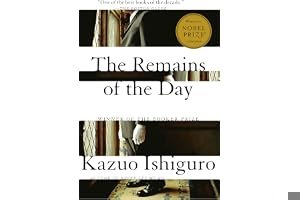
The Remains of the Day
Kazuo Ishiguro
4.2
An elegant Everyman's Library hardcover edition of the universally acclaimed novel—winner of the Booker Prize, a bestseller and a perpetually strong backlist title, and the basis for an award-winning film—with full-cloth binding, a silk ribbon marker, a chronology, and a new introduction by Salman Rushdie.
Here is Kazuo Ishiguro's profoundly compelling portrait of Stevens, the perfect butler, and of his fading, insular world in post-World War II England. Stevens, at the end of three decades of service at Darlington Hall, spending a day on a country drive, embarks as well on a journey through the past in an effort to reassure himself that he has served humanity by serving the "great gentleman," Lord Darlington. But lurking in his memory are doubts about the true nature of Lord Darlington's "greatness," and much graver doubts about the nature of his own life.
If you read The Remains of the Day, which is one of my favorite books, you can't help but come away and think, I just spent 10 hours living an alternate life and I learned something about life and about regret. You can't do that in a blog post. [source]
Riz Khan
About missed chances and what the British character does to a person’s emotions. There is this brick wall that they can’t crack through and after a while a bit of the grout wears away. [source]
Cover unavailable
50
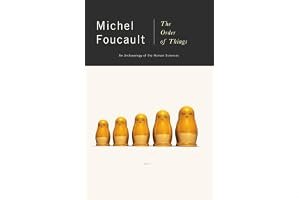
The Order of Things: An Archaeology of the Human Sciences
Michel Foucault
4.2
Librarian note: an alternate cover for this edition can be found here.
With vast erudition, Foucault cuts across disciplines and reaches back into seventeenth century to show how classical systems of knowledge, which linked all of nature within a great chain of being and analogies between the stars in the heavens and the features in a human face, gave way to the modern sciences of biology, philology, and political economy. The result is nothing less than an archaeology of the sciences that unearths old patterns of meaning and reveals the shocking arbitrariness of our received truths.
In the work that established him as the most important French thinker since Sartre, Michel Foucault offers startling evidence that “man”—man as a subject of scientific knowledge—is at best a recent invention, the result of a fundamental mutation in our culture.
…
Recommended by Bill Liao.
Bill Liao
"The Order of Things" by Foucault literally changed my life forever as it demonstrated to me that language is how we make the world. [source]
Cover unavailable
51
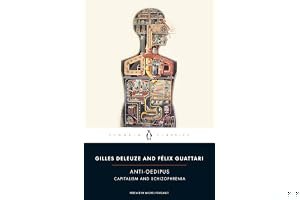
Anti-Oedipus: Capitalism and Schizophrenia
Gilles Deleuze, Felix Guattari
4.2
A major work in the development of critical theory in the late 20th century, ANTI-OEDIPUS is an essential text for feminists, literary theorists, social scientists, philosophers, and other interested in the problems of contemporary Western culture. "An important text in the rethinking of sexuality and sexual politics spurred by the feminist and gay liberation movements".--Margaret Cerullo, Hampshire College.
…
Cover unavailable
52
Underworld
Don DeLillo
4.2
A finalist for the National Book Award, Don DeLillo’s most powerful and riveting novel—“a great American novel, a masterpiece, a thrilling page-turner” (San Francisco Chronicle)—Underworld is about the second half of the twentieth century in America and about two people, an artist and an executive, whose lives intertwine in New York in the fifties and again in the nineties.
With cameo appearances by Lenny Bruce, J. Edgar Hoover, Bobby Thompson, Frank Sinatra, Jackie Gleason and Toots Shor, “this is DeLillo’s most affecting novel…a dazzling, phosphorescent work of art” (Michiko Kakutani, The New York Times).
…
Recommended by Chad Harbach and Hermione Hoby.
Chad Harbach
This is DeLillo’s big, thick novel which ranges over several decades of American history. It’s a book about waste, about trash, about what society sweeps under the rug. But it begins with a long overture set in perhaps the most famous professional baseball game of all time – “The Shot Heard Round The World,” the famous home run hit by Bobby Thomson in 1951. It’s an incredibly virtuosic piece of writing, that section. DeLillo becomes the Emersonian eyeball that is able to circulate not only through the game but through all the various spectators, and he paints a vivid picture of the scene in a beautiful, sinuous sort of way. [source]
Hermione Hoby
It’s such an extraordinarily vast and all-reaching book. [source]
Cover unavailable
53
Midnight's Children
Salman Rushdie
4.2
Saleem Sinai was born at midnight, the midnight of India's independence, and found himself mysteriously "handcuffed to history" by the coincidence. He is one of 1,001 children born at the midnight hour, each of them endowed with an extraordinary talent—and whose privilege and curse it is to be both master and victims of their times. Through Saleem's gifts—inner ear and wildly sensitive sense of smell—we are drawn into a fascinating family saga set against the vast, colourful background of the India of the 20th century.
…
Cover unavailable
54
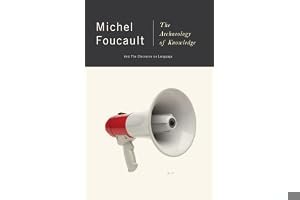
The Archaeology of Knowledge & The Discourse on Language
Michel Foucault
4.2
Librarian note: an alternate cover for this edition can be found here.
Madness, sexuality, power, knowledge—are these facts of life or simply parts of speech? In a series of works of astonishing brilliance, historian Michel Foucault excavated the hidden assumptions that govern the way we live and the way we think.
The Archaeology of Knowledge begins at the level of “things aid” and moves quickly to illuminate the connections between knowledge, language, and action in a style at once profound and personal. A summing up of Foucault’s own methodological assumptions, this book is also a first step toward a genealogy of the way we live now.
Challenging, at times infuriating, it is an absolutely indispensable guide to one of the most innovative thinkers of our time.
…
Cover unavailable
55
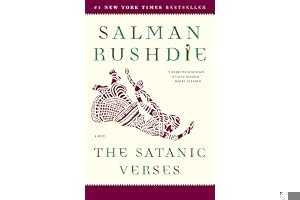
The Satanic Verses
Salman Rushdie
4.2
One of the most controversial and acclaimed novels ever written, The Satanic Verses is Salman Rushdie’s best-known and most galvanizing book. Set in a modern world filled with both mayhem and miracles, the story begins with a bang: the terrorist bombing of a London-bound jet in midflight. Two Indian actors of opposing sensibilities fall to earth, transformed into living symbols of what is angelic and evil. This is just the initial act in a magnificent odyssey that seamlessly merges the actual with the imagined. A book whose importance is eclipsed only by its quality, The Satanic Verses is a key work of our times.
…
Recommended by Anthony Julius.
Anthony Julius
I’m interested in the trials, of course – particularly the trial here, but also the trial in the States – because of what they meant in the context of the 1960s. Just as I’m interested in what The Satanic Verses meant at the moment of its publication in 1989/90: with the collapse of the Berlin Wall and the end of the Cold War, the extinction of socialism as a project of human liberation, and, coincident with that, the emergence of Islam or Islamism as both a threat and a promise – and how a novel manages to be the axis on which these huge global events turn. [source]
Cover unavailable
56
Cosmicomics
Italo Calvino, William Weaver
4.2
Italo Calvino's extraordinary imagination and intelligence combine here in an enchanting series of stories about the evolution of the universe. He makes his characters out of mathematical formulae and simple cellular structures. They disport themselves among galaxies, experience the solidification of planets, move from aquatic to terrestrial existence, play games with hydrogen atoms, and even have a love life.
During the course of these stories Calvino toys with continuous creation, the transformation of matter, and the expanding and contracting reaches of space and time. He succeeds in relating complex scientific concepts to the ordinary reactions of common humanity.
William Weaver's excellent translation won a National Book Award in 1969
“Naturally, we were all there," old Qfwfq said, "where else could we have been? Nobody knew then that there could be space. Or time either: what use did we have for time, packed in there like sardines?”
…
Cover unavailable
57
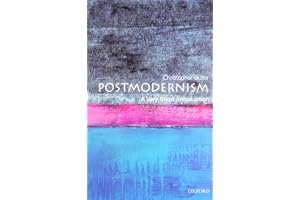
Postmodernism: A Very Short Introduction
Christopher Butler
4.2
Postmodernism has become the buzzword of contemporary society over the last decade. But how can it be defined? In this highly readable introduction the mysteries of this most elusive of concepts are unraveled, casting a critical light upon the way we live now, from the politicizing of museum culture to the cult of the politically correct. The key postmodernist ideas are explored and challenged, as they figure in the theory, philosophy, politics, ethics and artwork of the period, and it is shown how they have interacted within a postmodernist culture.
About the Series: Combining authority with wit, accessibility, and style, Very Short Introductions offer an introduction to some of life's most interesting topics. Written by experts for the newcomer, they demonstrate the finest contemporary thinking about the central problems and issues in hundreds of key topics, from philosophy to Freud, quantum theory to Islam.
…
Cover unavailable
58
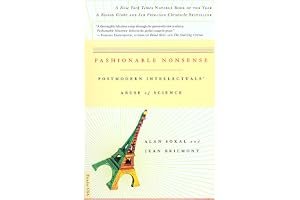
Intellectual Impostures
Alan Sokal, Jean Bricmont
4.2
When Intellectual Impostures was published in France, it sent shock waves through the Left Bank establishment. When it was published in Britain, it provoked impassioned debate. Sokal and Bricmont examine the canon of French postmodernists - Lacan, Kristeva, Baudrillard, Irigaray, Latour, Virilio, Deleuze and Guattari - and systematically expose their abuse of science. This edition contains a new preface analysing the reactions to the book and answering some of the attacks.
…
Recommended by Stephen Law.
Stephen Law
This is an entertaining book. It’s very different. The theme is still pseudoscience. Alan Sokal is a scientist, perhaps best known for the Sokal hoax. He became increasingly irritated by the way in which scientific jargon was being used by postmodern writers in a nonsensical or ridiculous way in their publications, so he decided to expose this by writing a spoof postmodern article called ‘Transgressing the Boundaries: Towards a Transformative Hermeneutics of Quantum Gravity’. He peppered it with scientific gobbledygook, and included all of the relevant sexy buzzwords as far as postmodern philosophy was concerned. The leading journal of postmodern philosophy, Social Text, accepted his submission and published it. Many felt this was an emperor’s new clothes moment for the postmodern philosophical movement. The small boy had now pointed and laughed and everyone could see the truth, that the postmodern emperor had no clothes. This book was written after the hoax, and looks at the work of a number of different postmodern thinkers including Jacques Lacan, Julia Kristeva, Jean Baudrillard and Gilles Deleuze. Sokal explains and illustrates very patiently how they’re using scientific terminology in a way that is either wrong, or else, in many cases, nonsensical, often creating the illusion that they have some deep and profound insight when the truth is that they don’t. There’s a nice quotation from him about Jean Baudrillard’s work which is full of references to chaos theory, quantum mechanics, non-Euclidian geometries, and so on. Sokal and Bricmont write: ‘In summary, one finds in Baudrillard’s work a profusion of scientific terms used with total disregard for their meaning, and above all in a context where they are manifestly irrelevant. Whether or not one interprets them as metaphors, it is hard to see what role they could play, except to give an appearance of profundity to trite observations about sociology, or history. Moreover, the scientific terminology is mixed up with a non-scientific vocabulary that is employed with equal sloppiness. When all is said and done, one wonders what would be left of Baudrillard’s thought if the verbal veneer covering it was stripped away’. (p.143) [source]
Cover unavailable
59
A Poetics of Postmodernism: History, Theory, Fiction
Linda Hutcheon
4.2
First published in 1988. Routledge is an imprint of Taylor & Francis, an informa company.
Cover unavailable
60
Of Grammatology
Jacques Derrida, Gayatri Chakravorty Spivak
4.1
Jacques Derrida's revolutionary theories about deconstruction, phenomenology, psychoanalysis, and structuralism, first voiced in the 1960s, forever changed the face of European and American criticism. The ideas in De la grammatologie sparked lively debates in intellectual circles that included students of literature, philosophy, and the humanities, inspiring these students to ask questions of their disciplines that had previously been considered improper. Thirty years later, the immense influence of Derrida's work is still igniting controversy, thanks in part to Gayatri Spivak's translation, which captures the richness and complexity of the original. This corrected edition adds a new index of the critics and philosophers cited in the text and makes one of contemporary criticism's most indispensable works even more accessible and usable.
…
Cover unavailable
61
The Brief Wondrous Life of Oscar Wao
Junot Díaz
4.1
Things have never been easy for Oscar, a sweet but disastrously overweight, lovesick Dominican ghetto nerd. From his home in New Jersey, where he lives with his old-world mother and rebellious sister, Oscar dreams of becoming the Dominican J. R. R. Tolkien and, most of all, of finding love. But he may never get what he wants, thanks to the Fukœ—the curse that has haunted the Oscar's family for generations, dooming them to prison, torture, tragic accidents, and, above all, ill-starred love. Oscar, still waiting for his first kiss, is just its most recent victim.
Diaz immerses us in the tumultuous life of Oscar and the history of the family at large, rendering with genuine warmth and dazzling energy, humor, and insight the Dominican-American experience, and, ultimately, the endless human capacity to persevere in the face of heartbreak and loss. A true literary triumph, The Brief Wondrous Life of Oscar Wao confirms Junot Diaz as one of the best and most exciting voices of our time.
Raised in a culture where men are powerful, sexual, and dominant, the Klingon-speaking, D&D-playing chubby boy thinks he’ll never find true love or physical affection. Oscar struggles as a young immigrant from the Dominican Republic living with his older sister and mother in Paterson, New Jersey. A fun read with lots of geek culture, great history, and oh, it also won the Pulitzer Prize. [source]
Kushanava Choudhury
Oscar Wao is very real to me. When I read Wao, I think, there but for the grace of God go I. [source]
Cover unavailable
62
The Magus
John Fowles
4.1
A man trapped in a millionare's deadly game of political and sexual betrayal.
Filled with shocks and chilling surprises, The Magus is a masterwork of contemporary literature. In it, a young Englishman, Nicholas Urfe, accepts a teaching position on a Greek island where his friendship with the owner of the islands most magnificent estate leads him into a nightmare. As reality and fantasy are deliberately confused by staged deaths, erotic encounters, and terrifying violence, Urfe becomes a desperate man fighting for his sanity and his life. A work rich with symbols, conundrums and labrinthine twists of event, The Magus is as thought-provoking as it is entertaining, a work that ranks with the best novels of modern times.
…
Recommended by Cristina Riesen.
Cristina Riesen
First, a word on career paths. In time, I realised that career paths are like one-way streets. Magic happens in unexplored territories. Plus life is how you choose to live every moment, every day. So today, rather than building a career, I prefer to make lateral moves in life, working with great people and being part of ambitious projects impacting the world. There are a few books that got me here: … John Fowles "The Magus". [source]
Cover unavailable
63
Love in the Time of Cholera
Gabriel Garcia Marquez
4.1
From the Nobel Prize-winning author of One Hundred Years of Solitude comes a masterly evocation of an unrequited passion so strong that it binds three people's lives together for more than fifty years. In the story of Florentino Ariza, who waits more than half a century to declare his undying love to the beautiful Fermina Daza, whom he lost to Dr. Juvenal Urbino so many years before, García Márquez has created a vividly absorbing fictional world, as lush and dazzling as a dream and as real and immediate as our own deepest longings. Now available for the first time in the Contemporary Classics series!
…
Recommended by Bryan Callen, Kate Figes, and Tendai Biti.
So here are my three must read books. I've been reading a lot of great books like: Outsmart Your Instincts, The Culture Code, and Antonio Damasio’s The Strange Order, and sometimes when you read a lot of nonfiction it’s very enriching, sometimes you need a novel. I really believe you should take a minute and read something beautiful. Listen, listen to Lolita by Nabokov. But also listen to Blood Meridian by Cormac McCarthy and listen to Richard Poe narrate that. Those are two of the greatest feats of the english language that I can think of. Then there’s Fortress of Solitude, an amazing book, Extremely Loud and Incredibly Close, these are great novels. Cold Mountain is a beautiful novel, Snow Falling On Cedars, I mean they’ve been around for a while. But goddamnit, get those under your belt. Those are the novels I think you should read. You know Love In The Time Of Cholera it just makes you ache. Kind of like a Hemingway thing, where Hemingway “ahh!”, it’s the same thing, you know. So I don’t know, I’m a fan of all those books. Those are my 3 slash 20 books. [source]
Kate Figes
It’s partly such a passionate book because of the beauty of the prose, describing love through time and how she found contentment – love, passion and sex all in one. [source]
Tendai Biti
2)Marquez s “Love in the time of cholera” & “100 yrs of solitude “ are two of my top books but one still weeps reading or re- reading Tolstoy s “ War & Peace “a book bettered only by “ Anna Karenina. Not a fan of these motivational books but that “f#cked “ up book is quite funny [source]
Cover unavailable
64
The Third Policeman
Flann O'Brien
4.1
The Third Policeman is Flann O'Brien's brilliantly dark comic novel about the nature of time, death, and existence. Told by a narrator who has committed a botched robbery and brutal murder, the novel follows him and his adventures in a two-dimensional police station where, through the theories of the scientist/philosopher de Selby, he is introduced to "Atomic Theory" and its relation to bicycles, the existence of eternity (which turns out to be just down the road), and de Selby's view that the earth is not round but "sausage-shaped." With the help of his newly found soul named "Joe," he grapples with the riddles and contradictions that three eccentric policeman present to him. The last of O'Brien's novels to be published, The Third Policeman joins O'Brien's other fiction (At Swim-Two-Birds, The Poor Mouth, The Hard Life, The Best of Myles, The Dalkey Archive) to ensure his place, along with James Joyce and Samuel Beckett, as one of Ireland's great comic geniuses.
…
Recommended by Joanna Walsh and Mark O'Connell.
Joanna Walsh
Flann O’Brien is very good at the combination of the familiar and the horrifying [source]
Mark O'Connell
there’s something culturally Irish, but not uniquely Irish, of using logic against itself — of exposing the absurdity that’s inherent in logic, if you know what I mean —that he does incredibly well. [source]
Cover unavailable
65
V.
Thomas Pynchon
4.1
The wild, macabre tale of the twentieth century and of two men—one looking for something he has lost, the other with nothing much to lose—and "V.," the unknown woman of the title.
Cover unavailable
66
The Broom of the System
David Foster Wallace
4.1
Published when Wallace was just twenty-four years old, The Broom of the System stunned critics and marked the emergence of an extraordinary new talent. At the center of this outlandishly funny, fiercely intelligent novel is the bewitching heroine, Lenore Stonecipher Beadsman. The year is 1990 and the place is a slightly altered Cleveland, Ohio. Lenore’s great-grandmother has disappeared with twenty-five other inmates of the Shaker Heights Nursing Home. Her beau, and boss, Rick Vigorous, is insanely jealous, and her cockatiel, Vlad the Impaler, has suddenly started spouting a mixture of psycho-babble, Auden, and the King James Bible. Ingenious and entertaining, this debut from one of the most innovative writers of his generation brilliantly explores the paradoxes of language, storytelling, and reality.
…
Cover unavailable
67
The Collector
John Fowles
4.1
Withdrawn, uneducated and unloved, Frederick collects butterflies and takes photographs. He is obsessed with a beautiful stranger, the art student Miranda. When he wins the pools he buys a remote Sussex house and calmly abducts Miranda, believing she will grow to love him in time.
Cover unavailable
68
Wide Sargasso Sea
Jean Rhys, Edwidge Danticat
4.1
Wide Sargasso Sea, a masterpiece of modern fiction, was Jean Rhys’s return to the literary center stage. She had a startling early career and was known for her extraordinary prose and haunting women characters. With Wide Sargasso Sea, her last and best-selling novel, she ingeniously brings into light one of fiction’s most fascinating characters: the madwoman in the attic from Charlotte Brontë’s Jane Eyre. This mesmerizing work introduces us to Antoinette Cosway, a sensual and protected young woman who is sold into marriage to the prideful Mr. Rochester. Rhys portrays Cosway amidst a society so driven by hatred, so skewed in its sexual relations, that it can literally drive a woman out of her mind.
A new introduction by the award-winning Edwidge Danticat, author most recently of Claire of the Sea Light, expresses the enduring importance of this work. Drawing on her own Caribbean background, she illuminates the setting’s impact on Rhys and her astonishing work.
…
Cover unavailable
69
A Thousand Plateaus: Capitalism and Schizophrenia
Gilles Deleuze, Felix Guattari, Brian Massumi
4.1
Gilles Deleuze (1925-1995) was Professor of Philosophy at the University of Paris VIII. He is a key figure in poststructuralism, and one of the most influential philosophers of the twentieth century. Felix Guattari (1930-1992) was a psychoanalyst at the la Borde Clinic, as well as being a major social theorist and radical activist.
A Thousand Plateaus is part of Deleuze and Guattari's landmark philosophical project, Capitalism and Schizophrenia - a project that still sets the terms of contemporary philosophical debate. A Thousand Plateaus provides a compelling analysis of social phenomena and offers fresh alternatives for thinking about philosophy and culture. Its radical perspective provides a toolbox for nomadic thought and has had a galvanizing influence on today's anti-capitalist movement.
Translated by Brian Massumi
…
Recommended by Chibli Mallat.
Chibli Mallat
Yes, my interest in Deleuze started when I read his Proust et les Signes in high school in Paris in 1977. He was still relatively unknown outside France. Since then I have pillaged his extraordinary conceptual coinage – I use ‘Thousand Planes’ (my translation of Mille Plateaux) in my Introduction to Middle Eastern Law as a holding concept for 4,000 years of Middle Eastern and Islamic law. It is impossible to circumvent Deleuze as the major philosopher of the century. Foucault predicted as much in a famous quote that goes something like: the 21st century will be Deleuzian or nothing. Deleuze, who died in1995, has indeed moved from being a maverick thinker to becoming a major world political and philosophical reference. [source]
Cover unavailable
70
2666 (2666 #1-5)
Roberto Bolaño, Natasha Wimmer
4.1
Three academics on the trail of a reclusive German author; a New York reporter on his first Mexican assignment; a widowed philosopher; a police detective in love with an elusive older woman—these are among the searchers drawn to the border city of Santa Teresa, where over the course of a decade hundreds of women have disappeared.
I have read this once and I keep dipping back into it because it is endlessly fascinating. Roberto Bolaño is a writer who has found a really important way of dealing with the horrors that the 1970s and subsequent decades have inflicted on Latin America. If you look at Borges, García Márquez and Vargas Llosa, in a sense they grew up in times of optimism, of high modernism, with the hope, at least initially, that change might be possible. Whereas someone like Bolaño was a young man at the time of the Chilean coup in 1973. He drifted around and went into exile in Mexico and then moved to Spain, a witness to the end of the dream. [source]
Cover unavailable
71
The Recognitions
William Gaddis, William H. Gass
4.1
The book Jonathan Franzen dubbed the "ur-text of postwar fiction" and the "first great cultural critique, which, even if Heller and Pynchon hadn't read it while composing Catch-22 and V., managed to anticipate the spirit of both”—The Recognitions is a masterwork about art and forgery, and the increasingly thin line between the counterfeit and the fake. Gaddis anticipates by almost half a century the crisis of reality that we currently face, where the real and the virtual are combining in alarming ways, and the sources of legitimacy and power are often obscure to us.
…
Cover unavailable
72
Writing and Difference
Jacques Derrida, Alan Bass
4.1
First published in 1967, Writing and Difference, a collection of Jacques Derrida's essays written between 1959 and 1966, has become a landmark of contemporary French thought. In it we find Derrida at work on his systematic deconstruction of Western metaphysics. The book's first half, which includes the celebrated essay on Descartes and Foucault, shows the development of Derrida's method of deconstruction. In these essays, Derrida demonstrates the traditional nature of some purportedly nontraditional currents of modern thought—one of his main targets being the way in which "structuralism" unwittingly repeats metaphysical concepts in its use of linguistic models.
The second half of the book contains some of Derrida's most compelling analyses of why and how metaphysical thinking must exclude writing from its conception of language, finally showing metaphysics to be constituted by this exclusion. These essays on Artaud, Freud, Bataille, Hegel, and Lévi-Strauss have served as introductions to Derrida's notions of writing and différence—the untranslatable formulation of a nonmetaphysical "concept" that does not exclude writing—for almost a generation of students of literature, philosophy, and psychoanalysis.
Writing and Difference reveals the unacknowledged program that makes thought itself possible. In analyzing the contradictions inherent in this program, Derrida goes on to develop new ways of thinking, reading, and writing,—new ways based on the most complete and rigorous understanding of the old ways. Scholars and students from all disciplines will find Writing and Difference an excellent introduction to perhaps the most challenging of contemporary French thinkers—challenging because Derrida questions thought as we know it.
…
Cover unavailable
73
The Complete Maus
Art SPIEGELMAN
4.1
Combined for the first time here are Maus I: A Survivor's Tale and Maus II - the complete story of Vladek Spiegelman and his wife, living and surviving in Hitler's Europe. By addressing the horror of the Holocaust through cartoons, the author captures the everyday reality of fear and is able to explore the guilt, relief and extraordinary sensation of survival - and how the children of survivors are in their own way affected by the trials of their parents. A contemporary classic of immeasurable significance.
…
Recommended by Susan Bordo.
Susan Bordo
It’s about the Holocaust. It’s also a comic book, in which the various characters are depicted as animals – the Jews as mice, the Nazis as cats. [source]
Cover unavailable
74
Against the Day
Thomas Pynchon
4.1
Spanning the period between the Chicago World's Fair of 1893 and the years just after World War I, this novel moves from the labor troubles in Colorado to turn-of-the-century New York, to London and Gottingen, Venice and Vienna, the Balkans, Central Asia, Siberia at the time of the mysterious Tunguska Event, Mexico during the Revolution, postwar Paris, silent-era Hollywood, and one or two places not strictly speaking on the map at all.
With a worldwide disaster looming just a few years ahead, it is a time of unrestrained corporate greed, false religiosity, moronic fecklessness, and evil intent in high places. No reference to the present day is intended or should be inferred.
The sizable cast of characters includes anarchists, balloonists, gamblers, corporate tycoons, drug enthusiasts, innocents and decadents, mathematicians, mad scientists, shamans, psychics, and stage magicians, spies, detectives, adventuresses, and hired guns. There are cameo appearances by Nikola Tesla, Bela Lugosi, and Groucho Marx.
As an era of certainty comes crashing down around their ears and an unpredictable future commences, these folks are mostly just trying to pursue their lives. Sometimes they manage to catch up; sometimes it's their lives that pursue them.
Meanwhile, the author is up to his usual business. Characters stop what they're doing to sing what are for the most part stupid songs. Strange sexual practices take place. Obscure languages are spoken, not always idiomatically. Contrary-to-the-fact occurrences occur. If it is not the world, it is what the world might be with a minor adjustment or two. According to some, this is one of the main purposes of fiction.
Let the reader decide, let the reader beware. Good luck.
--Thomas Pynchon
About the Author: Thomas Pynchon is the author of V., The Crying of Lot 49, Gravity's Rainbow, Slow Learner, a collection of short stories, Vineland and, most recently, Mason and Dixon. He received the National Book Award for Gravity's Rainbow in 1974.
…
Cover unavailable
75
Blood Meridian: Or the Evening Redness in the West
Cormac McCarthy
4.1
An epic novel of the violence and depravity that attended America's westward expansion, Blood Meridian brilliantly subverts the conventions of the Western novel and the mythology of the "wild west." Based on historical events that took place on the Texas-Mexico border in the 1850s, it traces the fortunes of the Kid, a fourteen-year-old Tennesseean who stumbles into the nightmarish world where Indians are being murdered and the market for their scalps is thriving.
Publisher's Note: The 25th Anniversary Edition has been reset, causing the text to reflow. Page references based on earlier editions will no longer apply, so Vintage Books has compiled the following chart as a conversion aid. Download the chart by copying and pasting the following link into your browser: http://knopfdoubleday.com/marketing/B...
So here are my three must read books. I've been reading a lot of great books like: Outsmart Your Instincts, The Culture Code, and Antonio Damasio’s The Strange Order, and sometimes when you read a lot of nonfiction it’s very enriching, sometimes you need a novel. I really believe you should take a minute and read something beautiful. Listen, listen to Lolita by Nabokov. But also listen to Blood Meridian by Cormac McCarthy and listen to Richard Poe narrate that. Those are two of the greatest feats of the english language that I can think of. Then there’s Fortress of Solitude, an amazing book, Extremely Loud and Incredibly Close, these are great novels. Cold Mountain is a beautiful novel, Snow Falling On Cedars, I mean they’ve been around for a while. But goddamnit, get those under your belt. Those are the novels I think you should read. You know Love In The Time Of Cholera it just makes you ache. Kind of like a Hemingway thing, where Hemingway “ahh!”, it’s the same thing, you know. So I don’t know, I’m a fan of all those books. Those are my 3 slash 20 books. [source]
Cover unavailable
76
Madness and Civilization: A History of Insanity in the Age of Reason
Michel Foucault
4.1
Librarian note: an alternate cover for this edition can be found here.
Michel Foucault examines the archeology of madness in the West from 1500 to 1800 – from the late Middle Ages, when insanity was still considered part of everyday life and fools and lunatics walked the streets freely, to the time when such people began to be considered a threat, asylums were first built, and walls were erected between the “insane” and the rest of humanity.
…
Cover unavailable
77
A Wild Sheep Chase (The Rat, #3)
Haruki Murakami, Alfred Birnbaum
4.1
His life was like a recurring nightmare: a train to nowhere. But an ordinary life has a way of taking an extraordinary turn. Add a girl whose ears are so exquisite that, when uncovered, they improve sex a thousand-fold, a runaway friend, a right-wing politico, an ovine-obsessed professor and a manic-depressive in a sheep outfit, implicate them in a hunt for a sheep, that may or may not be running the world, and the upshot is another singular masterpiece from Japan's finest novelist.
If you have always wanted to read this author, I think this Covid-19 period of time is perfect for it. He could have conceived of this whole thing. [source]
Cover unavailable
78
Extremely Loud & Incredibly Close
Jonathan Safran Foer
4.1
Nine-year-old Oskar Schell is an inventor, amateur entomologist, Francophile, letter writer, pacifist, natural historian, percussionist, romantic, Great Explorer, jeweller, detective, vegan, and collector of butterflies. When his father is killed in the September 11th attacks on the World Trade Centre, Oskar sets out to solve the mystery of a key he discovers in his father's closet. It is a search which leads him into the lives of strangers, through the five boroughs of New York, into history, to the bombings of Dresden and Hiroshima, and on an inward journey which brings him ever closer to some kind of peace.
So here are my three must read books. I've been reading a lot of great books like: Outsmart Your Instincts, The Culture Code, and Antonio Damasio’s The Strange Order, and sometimes when you read a lot of nonfiction it’s very enriching, sometimes you need a novel. I really believe you should take a minute and read something beautiful. Listen, listen to Lolita by Nabokov. But also listen to Blood Meridian by Cormac McCarthy and listen to Richard Poe narrate that. Those are two of the greatest feats of the english language that I can think of. Then there’s Fortress of Solitude, an amazing book, Extremely Loud and Incredibly Close, these are great novels. Cold Mountain is a beautiful novel, Snow Falling On Cedars, I mean they’ve been around for a while. But goddamnit, get those under your belt. Those are the novels I think you should read. You know Love In The Time Of Cholera it just makes you ache. Kind of like a Hemingway thing, where Hemingway “ahh!”, it’s the same thing, you know. So I don’t know, I’m a fan of all those books. Those are my 3 slash 20 books. [source]
Cover unavailable
79
Hard-Boiled Wonderland and the End of the World
Haruki Murakami
4.1
'A narrative particle accelerator that zooms between Wild Turkey Whiskey and Bob Dylan, unicorn skulls and voracious librarians, John Coltrane and Lord Jim. Science fiction, detective story and post-modern manifesto all rolled into one rip-roaring novel, Hard-Boiled Wonderland and the End of the World is the tour de force that expanded Haruki Murakami's international following. Tracking one man's descent into the Kafkaesque underworld of contemporary Tokyo, Murakami unites East and West, tragedy and farce, compassion and detachment, slang and philosophy.'
…
Cover unavailable
80
Life: A User's Manual
Georges Perec, David Bellos
4.1
Life: A User's Manual is an unclassified masterpiece, a sprawling compendium as encyclopedic as Dante's Commedia and Chaucer's Canterbury Tales and, in its break with tradition, as inspiring as Joyce's Ulysses. Perec's spellbinding puzzle begins in an apartment block in the XVIIth arrondissement of Paris where, chapter by chapter, room by room, like an onion being peeled, an extraordinary rich cast of characters is revealed in a series of tales that are bizarre, unlikely, moving, funny, or (sometimes) quite ordinary. From the confessions of a racing cyclist to the plans of an avenging murderer, from a young ethnographer obsessed with a Sumatran tribe to the death of a trapeze artist, from the fears of an ex-croupier to the dreams of a sex-change pop star to an eccentric English millionaire who has devised the ultimate pastime, Life is a manual of human irony, portraying the mixed marriages of fortunes, passions and despairs, betrayals and bereavements, of hundreds of lives in Paris and around the world.
But the novel in more than an extraordinary range of fictions; it is a closely observed account of life and experience. The apartment block's one hundred rooms are arranged in a magic square, and the book as a whole is peppered with a staggering range of literary puzzles and allusions, acrostics, problems of chess and logic, crosswords, and mathematical formulae. All are there for the reader to solve in the best tradition of the detective novel.
…
Recommended by Alina Varlanuta and David Bellos.
Alina Varlanuta
I don’t have a favourite book. But I do have favourite characters: … All inhabitants of the apartment block on 11Rue Simon-Crubellier who lived inside George Perec’s ‘Life. A user’s manual.’. [source]
David Bellos
Some people love it for its cleverness but, behind the cleverness, there is something more, something deeply human. [source]
Cover unavailable
81
The God of Small Things
Arundhati Roy
4.1
Compared favorably to the works of Faulkner and Dickens, Arundhati Roy’s debut novel is a modern classic that has been read and loved worldwide. Equal parts powerful family saga, forbidden love story, and piercing political drama, it is the story of an affluent Indian family forever changed by one fateful day in 1969. The seven-year-old twins Estha and Rahel see their world shaken irrevokably by the arrival of their beautiful young cousin, Sophie. It is an event that will lead to an illicit liaison and tragedies accidental and intentional, exposing “big things [that] lurk unsaid” in a country drifting dangerously toward unrest. Lush, lyrical, and unnerving, The God of Small Things is an award-winning landmark that started for its author an esteemed career of fiction and political commentary that continues unabated.
Of all the great modern Indian novels, of which there has been a flood, Arundhati Roy is the one I enjoyed most. It’s got that fabulous quality, in the literal sense. It has a craftsmanship to it, and one of the greatest endings to any novel. There are so few modern novels which end perfectly, with that perfect click into place, the lock clicking shut. But it has that, and it’s a very well-worked, well-written novel. I hope she repeats it at some point in the future. [source]
Cover unavailable
82
God Bless You, Mr. Rosewater
Kurt Vonnegut
4.1
Second only to Slaughterhouse-Five of Vonnegut's canon in its prominence and influence, God Bless You, Mr. Rosewater (1965) presents Eliot Rosewater, an itinerant, semi-crazed millionaire wandering the country in search of heritage and philanthropic outcome, introducing the science fiction writer Kilgore Trout to the world and Vonnegut to the collegiate audience which would soon make him a cult writer.
Trout, modeled according to Vonnegut on the science fiction writer Theodore Sturgeon (with whom Vonnegut had an occasional relationship) is a desperate, impoverished but visionary hack writer who functions for Eliot Rosewater as both conscience and horrid example. Rosewater, seeking to put his inheritance to some meaningful use (his father was an entrepreneur), tries to do good within the context of almost illimitable cynicism and corruption.
It is in this novel that Rosewater wanders into a science fiction conference--an actual annual event in Milford, Pennsylvania--and at the motel delivers his famous monologue evoked by science fiction writers and critics for almost half a century: "None of you can write for sour apples... but you're the only people trying to come to terms with the really terrific things which are happening today." Money does not drive Mr. Rosewater (or the corrupt lawyer who tries to shape the Rosewater fortune) so much as outrage at the human condition.
The novel was adapted for a 1979 Alan Menken musical. The novel is told mostly thru a collection of short stories dealing with Eliot's interactions with the citizens of Rosewater County, usually with the last sentence serving as a punch line. The antagonist's tale, Mushari's, is told in a similar short essay fashion. The stories reveal different hypocrisies of humankind in a darkly humorous fashion.
…
Cover unavailable
83
One Flew Over the Cuckoo's Nest
Ken Kesey, John C. Reilly, et al
4.1
Tyrannical Nurse Ratched rules her ward in an Oregon State mental hospital with a strict and unbending routine, unopposed by her patients, who remain cowed by mind-numbing medication and the threat of electric shock therapy. But her regime is disrupted by the arrival of McMurphy – the swaggering, fun-loving trickster with a devilish grin who resolves to oppose her rules on behalf of his fellow inmates. His struggle is seen through the eyes of Chief Bromden, a seemingly mute half-Indian patient who understands McMurphy's heroic attempt to do battle with the powers that keep them imprisoned. Ken Kesey's extraordinary first novel is an exuberant, ribald and devastatingly honest portrayal of the boundaries between sanity and madness.
…
Cover unavailable
84
Hopscotch
Julio Cortazar, Gregory Rabassa
4.0
Horacio Oliveira is an Argentinian writer who lives in Paris with his mistress, La Maga, surrounded by a loose-knit circle of bohemian friends who call themselves "the Club." A child's death and La Maga's disappearance put an end to his life of empty pleasures and intellectual acrobatics, and prompt Oliveira to return to Buenos Aires, where he works by turns as a salesman, a keeper of a circus cat which can truly count, and an attendant in an insane asylum. Hopscotch is the dazzling, freewheeling account of Oliveira's astonishing adventures.
The book is highly influenced by Henry Miller’s reckless and relentless search for truth in post-decadent Paris and Daisetz Teitaro Suzuki’s modal teachings on Zen Buddhism.
Cortázar's employment of interior monologue, punning, slang, and his use of different languages is reminiscent of Modernist writers like Joyce, although his main influences were Surrealism and the French New Novel, as well as the "riffing" aesthetic of jazz and New Wave Cinema.
In 1966, Gregory Rabassa won the first National Book Award to recognize the work of a translator, for his English-language edition of Hopscotch. Julio Cortázar was so pleased with Rabassa's translation of Hopscotch that he recommended the translator to Gabriel García Márquez when García Márquez was looking for someone to translate his novel One Hundred Years of Solitude into English. "Rabassa's One Hundred Years of Solitude improved the original," according to García Márquez.
…
Cover unavailable
85
A Heartbreaking Work of Staggering Genius
Dave Eggers
4.0
'When you read his extraordinary memoir you don't laugh, then cry, then laugh again; you somehow experience these emotions all at once.'
"Well, this was when Bill was sighing a lot. He had decided that after our parents died he just didn't want any more fighting between what was left of us. He was twenty-four, Beth was twenty-three, I was twenty-one, Toph was eight, and all of us were so tried already, from that winter. So when something would come up, any little thing, some bill to pay or decision to make, he would just sigh, his eyes tired, his mouth in a sorry kind of smile.
But Beth and I...Jesus, we were fighting with everyone, anyone, each other, with strangers at bars, anywhere -- we were angry people wanting to exact revenge. We came to California and we wanted everything, would take what was ours, anything within reach. And I decided that little Toph and I, he with his backward hat and long hair, living together in our little house in Berkeley, would be world-destroyers. We inherited each other and, we felt, a responsibility to reinvent everything, to scoff and re-create and drive fast while singing loudly and pounding the windows. It was a hopeless sort of exhilaration, a kind of arrogance born of fatalism, I guess, of the feeling that if you could lose a couple of parents in a month, then basically anything could happen, at any time -- all bullets bear your name, all cars are there to crush you, any balcony could give way; more disaster seemed only logical.
And then, as in Dorothy's dream, all these people I grew up with were there, too, some of them orphans also, most but not all of us believing that what we had been given was extraordinary, that it was time to tear or break down, ruin, remake, take and devour. This was San Francisco, you know, and everyone had some dumb idea -- I mean, wicca? -- and no one there would tell you yours was doomed. Thus the public nudity, and this ridiculous magazine, and the Real World tryout, all this need, most of it disguised by sneering, but all driven by a hyper-awareness of this window, I guess, a few years when your muscles are taut, coiled up and vibrating. But what to do with the energy? I mean, when we drive, Toph and I, and we drive past people, standing on top of all these hills, part of me wants to stop the car and turn up the radio and have us all dance in formation, and part of me wants to run them all over."
…
Recommended by Ev Williams and Amy Chua.
Amy Chua
His mother and father died within five weeks of each other, and at 21 he finds himself a single parent in charge of his eight-year-old brother. [source]
Cover unavailable
86
Who's Afraid of Postmodernism?: Taking Derrida, Lyotard, and Foucault to Church (The Church and Postmodern Culture)
James K.A. Smith
4.0
The philosophies of French thinkers Derrida, Lyotard, and Foucault form the basis for postmodern thought and are seemingly at odds with the Christian faith. However, James K. A. Smith claims that their ideas have been misinterpreted and actually have a deep affinity with central Christian claims.
Each chapter opens with an illustration from a recent movie and concludes with a case study considering recent developments in the church that have attempted to respond to the postmodern condition, such as the "emerging church" movement. These case studies provide a concrete picture of how postmodern ideas can influence the way Christians think and worship.
This significant book, winner of a Christianity Today 2007 Book Award, avoids philosophical jargon and offers fuller explanation where needed. It is the first book in the Church and Postmodern Culture series, which provides practical applications for Christians engaged in ministry in a postmodern world.
…
Cover unavailable
87
Lost in the Funhouse
John Barth
4.0
Barth's lively, highly original collection of short pieces is a major landmark of experimental fiction. Though many of the stories gathered here were published separately, there are several themes common to them all, giving them new meaning in the context of this collection.
Cover unavailable
88
The Sot-Weed Factor
John Barth
4.0
Considered by critics to be Barth's most distinguished masterpiece, The Sot-Weed Factor has acquired the status of a modern classic. Set in the late 1600s, it recounts the wildly chaotic odyssey of hapless, ungainly Ebenezer Cooke, sent to the New World to look after his father's tobacco business and to record the struggles of the Maryland colony in an epic poem.
On his mission, Cooke experiences capture by pirates and Indians; the loss of his father's estate to roguish impostors; love for a farmer prostitute; stealthy efforts to rob him of his virginity, which he is (almost) determined to protect; and an extraordinary gallery of treacherous characters who continually switch identities. A hilarious, bawdy tribute to all the most insidious human vices, The Sot-Weed Factor has a lasting relevance for readers of all times.
…
Cover unavailable
89
The Aleph and Other Stories
Jorge Luis Borges, Andrew Hurley
4.0
Full of philosophical puzzles and supernatural surprises, these stories contain some of Borges's most fully realized human characters. With uncanny insight, he takes us inside the minds of an unrepentant Nazi, an imprisoned Mayan priest, fanatical Christian theologians, a woman plotting vengeance on her father’s “killer,” and a man awaiting his assassin in a Buenos Aires guest house. This volume also contains the hauntingly brief vignettes about literary imagination and personal identity collected in The Maker, which Borges wrote as failing eyesight and public fame began to undermine his sense of self.
For more than seventy years, Penguin has been the leading publisher of classic literature in the English-speaking world. With more than 1,700 titles, Penguin Classics represents a global bookshelf of the best works throughout history and across genres and disciplines. Readers trust the series to provide authoritative texts enhanced by introductions and notes by distinguished scholars and contemporary authors, as well as up-to-date translations by award-winning translators.
…
Recommended by Stephen Cave.
Stephen Cave
This story is about a Roman officer who finds the fountain of youth, a river that cleanses men of death, as he puts it. He becomes an immortal and meets the other immortals who have found the river, and the story is about the consequences of this – namely, madness and meaninglessness. There’s a great deal of speculation among philosophers and religious types about what it might be like to live together. These 20 pages capture it so perfectly. It’s such a fine example of Borgesian writing – tense, lucid, packed with meaning so you immediately feel like reading it again in case you missed something. [source]
Cover unavailable
90
The Hours
Michael Cunningham
4.0
In 1920s London, Virginia Woolf is fighting against her rebellious spirit as she attempts to make a start on her new novel. A young wife and mother, broiling in a suburb of 1940s Los Angeles, yearns to escape and read her precious copy of Mrs Dalloway. And Clarissa Vaughan steps out of her smart Greenwich village apartment in 1990s New York to buy flowers for a party she is hosting for a dying friend.
The Hours recasts the classic story of Woolf's Mrs Dalloway in a startling new light. Moving effortlessly across the decades and between England and America, this exquisite novel intertwines the worlds of three unforgettable women.
…
Recommended by Amy Chua and Danielle Teller.
Amy Chua
Laura Brown makes the strictest of tiger mothers look wonderful by comparison. She is totally detached and can’t get out of her head, so she retreats into books, specifically Mrs. Dalloway. [source]
Marco Stanley Fogg is an orphan, a child of the sixties, a quester tirelessly seeking the key to his past, the answers to the ultimate riddle of his fate. As Marco sets out on a journey from the canyons of Manhattan to the deserts of Utah, he encounters a gallery of characters and a series of events as rich and surprising as any in modern fiction.
Beginning during the summer that men first walked on the moon, and moving backward and forward in time to span three generations, Moon Palace is propelled by coincidence and memory, and illuminated by marvelous flights of lyricism and wit. Here is the most entertaining and moving novel yet from an author well known for his breathtaking imagination.
…
Cover unavailable
92
Ragtime
E.L. Doctorow
4.0
Published in 1975, Ragtime changed our very concept of what a novel could be. An extraordinary tapestry, Ragtime captures the spirit of America in the era between the turn of the century & the First World War. The story opens in 1906 in New Rochelle, NY, at the home of an affluent American family. One lazy Sunday afternoon, the famous escape artist Harry Houdini swerves his car into a telephone pole outside their house. Almost magically, the line between fantasy & historical fact, between real & imaginary characters, disappears. Henry Ford, Emma Goldman, J.P. Morgan, Evelyn Nesbit, Sigmund Freud & Emiliano Zapata slip in & out of the tale, crossing paths with Doctorow's imagined family & other fictional characters, including an immigrant peddler & a ragtime musician from Harlem whose insistence on a point of justice drives him to revolutionary violence.
…
Cover unavailable
93
Brief Interviews with Hideous Men
Foster David Wallace
4.0
In his startling and singular new short story collection, David Foster Wallace nudges at the boundaries of fiction with inimitable wit and seductive intelligence. Venturing inside minds and landscapes that are at once recognisable and utterly strange, these stories reaffirm Wallace's reputation as one of his generation's pre-eminent talents, expanding our ides and pleasures fiction can afford.
Among the stories are 'The Depressed Person', a dazzling and blackly humorous portrayal of a woman's mental state; 'Adult World', which reveals a woman's agonised consideration of her confusing sexual relationship with her husband; and 'Brief Interviews with Hideous Men', a dark, hilarious series of portraits of men whose fear of women renders them grotesque. Wallace's stories present a world where the bizarre and the banal are interwoven and where hideous men appear in many different guises. Thought-provoking and playful, this collection confirms David Foster Wallace as one of the most imaginative young writers around. Wallace delights in leftfield observation, mining the ironic, the surprising and the illuminating from every situation. His new collection will delight his growing number of fans, and provide a perfect introduction for new readers.
From the author of White Noise (winner of the National Book Award) and Zero K
In this powerful, eerily convincing fictional speculation on the assassination of John F. Kennedy, Don DeLillo chronicles Lee Harvey Oswald's odyssey from troubled teenager to a man of precarious stability who imagines himself an agent of history. When "history" presents itself in the form of two disgruntled CIA operatives who decide that an unsuccessful attempt on the life of the president will galvanize the nation against communism, the scales are irrevocably tipped.A gripping, masterful blend of fact and fiction, alive with meticulously portrayed characters both real and created, Libra is a grave, haunting, and brilliant examination of an event that has become an indelible part of the American psyche.
…
Cover unavailable
95
A Supposedly Fun Thing I'll Never Do Again: Essays and Arguments
David Foster Wallace
4.0
In this exuberantly praised book - a collection of seven pieces on subjects ranging from television to tennis, from the Illinois State Fair to the films of David Lynch, from postmodern literary theory to the supposed fun of traveling aboard a Caribbean luxury cruiseliner - David Foster Wallace brings to nonfiction the same curiosity, hilarity, and exhilarating verbal facility that has delighted readers of his fiction, including the bestselling Infinite Jest.
…
Recommended by Coleen Baik.
Cover unavailable
96
The Pale King
David Foster Wallace
4.0
The agents at the IRS Regional Examination Center in Peoria, Illinois, appear ordinary enough to newly arrived trainee David Foster Wallace. But as he immerses himself in a routine so tedious and repetitive that new employees receive boredom-survival training, he learns of the extraordinary variety of personalities drawn to this strange calling. And he has arrived at a moment when forces within the IRS are plotting to eliminate even what little humanity and dignity the work still has.
The Pale King remained unfinished at the time of David Foster Wallace's death, but it is a deeply compelling and satisfying novel, hilarious and fearless and as original as anything Wallace ever undertook. It grapples directly with ultimate questions--questions of life's meaning and of the value of work and society--through characters imagined with the interior force and generosity that were Wallace's unique gifts. Along the way it suggests a new idea of heroism and commands infinite respect for one of the most daring writers of our time.
…
Cover unavailable
97
At Swim-Two-Birds
Flann O'Brien and MR William H Gass PhD
4.0
A wildly comic send-up of Irish literature and culture, At Swim-Two-Birds is the story of a young, lazy, and frequently drunk Irish college student who lives with his curmudgeonly uncle in Dublin. When not in bed (where he seems to spend most of his time) or reading he is composing a mischief-filled novel about Dermot Trellis, a second-rate author whose characters ultimately rebel against him and seek vengeance. From drugging him as he sleeps to dropping the ceiling on his head, these figures of Irish myth make Trellis pay dearly for his bad writing.
Hilariously funny and inventive, At Swim-Two-Birds has influenced generations of writers, opening up new possibilities for what can be done in fiction. It is a true masterpiece of Irish literature.
…
Cover unavailable
98
Middlesex
Jeffrey Eugenides
4.0
"I was born twice: first, as a baby girl, on a remarkably smogless Detroit day of January 1960; and then again, as a teenage boy, in an emergency room near Petoskey, Michigan, in August of l974. . . My birth certificate lists my name as Calliope Helen Stephanides. My most recent driver's license...records my first name simply as Cal."
So begins the breathtaking story of Calliope Stephanides and three generations of the Greek-American Stephanides family who travel from a tiny village overlooking Mount Olympus in Asia Minor to Prohibition-era Detroit, witnessing its glory days as the Motor City, and the race riots of l967, before they move out to the tree-lined streets of suburban Grosse Pointe, Michigan. To understand why Calliope is not like other girls, she has to uncover a guilty family secret and the astonishing genetic history that turns Callie into Cal, one of the most audacious and wondrous narrators in contemporary fiction. Lyrical and thrilling, Middlesex is an exhilarating reinvention of the American epic.
Middlesex is the winner of the 2003 Pulitzer Prize for Fiction.
Eugenides does a really nice job of illustrating the complexity of emotional life, the emotional life that doesn’t necessarily fall into neat categories. [source]
Cover unavailable
99
America
Jean Baudrillard
4.0
Cover unavailable
100
My Name Is Red
Orhan Pamuk and Erdag Gokna
4.0
At once a fiendishly devious mystery, a beguiling love story, and a brilliant symposium on the power of art, My Name Is Red is a transporting tale set amid the splendor and religious intrigue of sixteenth-century Istanbul, from one of the most prominent contemporary Turkish writers.
The Sultan has commissioned a cadre of the most acclaimed artists in the land to create a great book celebrating the glories of his realm. Their task: to illuminate the work in the European style. But because figurative art can be deemed an affront to Islam, this commission is a dangerous proposition indeed. The ruling elite therefore mustn’t know the full scope or nature of the project, and panic erupts when one of the chosen miniaturists disappears. The only clue to the mystery–or crime? –lies in the half-finished illuminations themselves. Part fantasy and part philosophical puzzle, My Name is Red is a kaleidoscopic journey to the intersection of art, religion, love, sex and power.


 1
1

 Recommended by Bernard Tan, Carlos Eire, and Dan Christensen.