 1
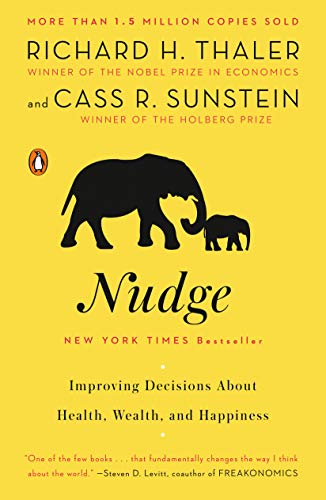
1Nudge: Improving Decisions About Health, Wealth, and Happiness
Thaler and Sunstein invite us to enter an alternative world, one that takes our humanness as a given. They show that by knowing how people think, we can design choice environments that make it easier for people to choose what is best for themselves, their families, and their society. Using colorful examples from the most important aspects of life, Thaler and Sunstein demonstrate how thoughtful “choice architecture” can be established to nudge us in beneficial directions without restricting freedom of choice. Nudge offers a unique new take—from neither the left nor the right—on many hot-button issues, for individuals and governments alike. This is one of the most engaging and provocative books to come along in many years.



Author
Nudge is a very important book. One of the reasons Nudge is so important is because it’s taking these ideas and applying them to the policy domain. Here are the mistakes we make. Here are the ways marketers are trying to influence us. Here’s the way we might be able to fight back. If policymakers understood these principles, what could they do? The other important thing about the book is that it describes, in detail, small interventions. It’s basically a book about cheap persuasion. [source]

Founder/Long-Term Stock Exchange
A pioneer in behavioral economics and just recently awarded the Nobel Prize in Economics, his classic book on how to make better decisions. [source]

Author
This might feel like a weird book to include, but I think it presents another side of strategy that is too often forgotten. It’s not always about bold actors and strategic thrusts. Sometimes strategy is about subtle influence. Sometimes it is framing and small tweaks that change behavior. We can have big aims, but get there with little moves. This book has excellent examples of that kind of thinking and how it is changing politics, government and business. My favorite example is about the bumblebee that they started putting on urinals–which drastically reduced the amount of spray and spillage because it changed where men aimed when they peed. It’s not exactly the coolest strategy but it solved a problem. So we can learn from it. [source]