We've ranked the best bank books using expert recommendations, sales data, and millions of reader ratings. At Shortform, we know books. Our book guides are the best in the world. Learn why.
The real story of the crash began in bizarre feeder markets where the sun doesn't shine and the SEC doesn't dare, or bother, to tread: the bond and real estate derivative markets where geeks invent impenetrable securities to profit from the misery of lower- and middle-class Americans who can't pay their debts. The smart people who understood what was or might be happening were paralyzed by hope and fear; in any case, they weren't talking.
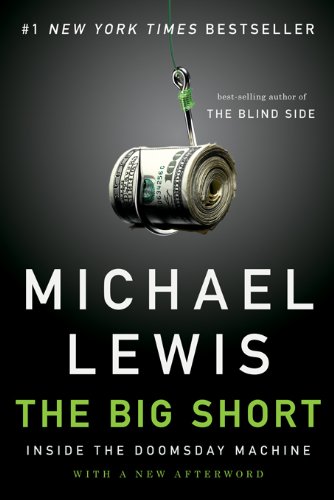
Michael Lewis creates a fresh, character-driven narrative brimming with indignation and dark humor, a fitting sequel to his #1 bestseller Liar's Poker. Out of a handful of unlikely-really unlikely-heroes, Lewis fashions a story as compelling and unusual as any of his earlier bestsellers, proving yet again that he is the finest and funniest chronicler of our time.

Michael Lewis's ability to boil down the most complicated subjects is like a magic trick. You can't believe your own eyes. He takes on important issues - from the 2008 Wall Street crash in "The Big Short" to parenting in "Home Game" - and breaks them down to the deepest truths. His combination of an extraordinarily analytical mind and a deep understanding of human nature allows him to weave together data and events to offer a fresh and insightful narrative. Whatever the topic, the result is always compelling and even thrilling. I am in awe of him. [source]
Ray Dalio, one of the world’s most successful investors and entrepreneurs, shares the unconventional principles that he’s developed, refined, and used over the past forty years to create unique results in both life and business—and which any person or organization can adopt to help achieve their goals.
In 1975, Ray Dalio founded an investment firm, Bridgewater Associates, out of his two-bedroom apartment in New York City. Forty years later, Bridgewater has made more money for its clients than any other hedge fund in history and grown into the fifth most important private company in the United States, according to Fortune magazine. Dalio himself has been named to Time magazine’s list of the 100 most influential people in the world. Along the way, Dalio discovered a set of unique principles that have led to Bridgewater’s exceptionally effective culture, which he describes as “an idea meritocracy that strives to achieve meaningful work and meaningful relationships through radical transparency.” It is these principles, and not anything special about Dalio—who grew up an ordinary kid in a middle-class Long Island neighborhood—that he believes are the reason behind his success.
In Principles, Dalio shares what he’s learned over the course of his remarkable career. He argues that life, management, economics, and investing can all be systemized into rules and understood like machines. The book’s hundreds of practical lessons, which are built around his cornerstones of “radical truth” and “radical transparency,” include Dalio laying out the most effective ways for individuals and organizations to make decisions, approach challenges, and build strong teams. He also describes the innovative tools the firm uses to bring an idea meritocracy to life, such as creating “baseball cards” for all employees that distill their strengths and weaknesses, and employing computerized decision-making systems to make believability-weighted decisions. While the book brims with novel ideas for organizations and institutions, Principles also offers a clear, straightforward approach to decision-making that Dalio believes anyone can apply, no matter what they’re seeking to achieve.
Here is a rare opportunity to gain proven advice unlike anything you’ll find in the conventional business press.
I found it to be truly extraordinary. Every page is full of so many principles of distinction and insights—and I love how Ray incorporates his history and his life in such an elegant way. [source]
Cover unavailable
3
Too Big to Fail: The Inside Story of How Wall Street and Washington Fought to Save the Financial System from Crisis — and Themselves
Andrew Ross Sorkin
4.7
Andrew Ross Sorkin delivers the first true behind-the-scenes, moment-by-moment account of how the greatest financial crisis since the Great Depression developed into a global tsunami. From inside the corner office at Lehman Brothers to secret meetings in South Korea, and the corridors of Washington, Too Big to Fail is the definitive story of the most powerful men and women in finance and politics grappling with success and failure, ego and greed, and, ultimately, the fate of the world’s economy.
“We’ve got to get some foam down on the runway!” a sleepless Timothy Geithner, the then-president of the Federal Reserve of New York, would tell Henry M. Paulson, the Treasury secretary, about the catastrophic crash the world’s financial system would experience.
Through unprecedented access to the players involved, Too Big to Fail re-creates all the drama and turmoil, revealing neverdisclosed details and elucidating how decisions made on Wall Street over the past decade sowed the seeds of the debacle. This true story is not just a look at banks that were “too big to fail,” it is a real-life thriller with a cast of bold-faced names who themselves thought they were too big to fail.
…
Recommended by Bill Gates, Max Levchin, John Lanchester, and 1 others.
Max Levchin recommended this book as an answer to "What business books would you advise young entrepreneurs read?" [source]
John Lanchester
This is a minute-by-minute account of how the whole financial system nearly went over the brink in 2008, and the astonishing sense of tension and danger involved. [source]
Cover unavailable
4
The Black Swan: The Impact of the Highly Improbable
A black swan is a highly improbable event with three principal characteristics: It is unpredictable; it carries a massive impact; and, after the fact, we concoct an explanation that makes it appear less random, and more predictable, than it was.
The astonishing success of Google was a black swan; so was 9/11. For Nassim Nicholas Taleb, black swans underlie almost everything about our world, from the rise of religions to events in our own personal lives.
Why do we not acknowledge the phenomenon of black swans until after they occur? Part of the answer, according to Taleb, is that humans are hardwired to learn specifics when they should be focused on generalities.
We concentrate on things we already know and time and time again fail to take into consideration what we don’t know. We are, therefore, unable to truly estimate opportunities, too vulnerable to the impulse to simplify, narrate, and categorize, and not open enough to rewarding those who can imagine the “impossible.”
For years, Taleb has studied how we fool ourselves into thinking we know more than we actually do. We restrict our thinking to the irrelevant and inconsequential, while large events continue to surprise us and shape our world. Now, in this revelatory book, Taleb explains everything we know about what we don’t know. He offers surprisingly simple tricks for dealing with black swans and benefiting from them.
Elegant, startling, and universal in its applications The Black Swan will change the way you look at the world. Taleb is a vastly entertaining writer, with wit, irreverence, and unusual stories to tell. He has a polymathic command of subjects ranging from cognitive science to business to probability theory.
The Black Swan is a landmark book – itself a black swan.
The book also contains a 4-page glossary; 19 pages of notes; and, a 28-page bibliography in addition to an index.
From the book "The Everything Store: and the Age of Amazon" “The scholar argues that people are wired to see patterns in chaos while remaining blind to unpredictable events, with massive consequences. Experimentation and empiricism trumps the easy and obvious narrative,” Stone writes. [source]
And throw in “The Black Swan” and “Fooled by Randomness”. “Fragile” means if you hit something might break. “Resilient” means if you hit something, it will stay the same. On my podcast Nassim discusses “Antifragility” – building a system, even on that works for you on a personal level, where you if you harm your self in some way it becomes stronger. That podcast changed my life He discusses Antifragility throughout history, up to our current economic situation, and even in our personal situations. [source]
Cover unavailable
5
The House of Morgan: An American Banking Dynasty and the Rise of Modern Finance
Ron Chernow
4.6
The winner of the National Book Award and now considered a classic, The House of Morgan is the most ambitious history ever written about an American banking dynasty. Acclaimed by The Wall Street Journal as "brilliantly researched and written," the book tells the rich, panoramic story of four generations of Morgans and the powerful, secretive firms they spawned. It is the definitive account of the rise of the modern financial world. A gripping history of banking and the booms and busts that shaped the world on both sides of the Atlantic, The House of Morgan traces the trajectory of the J. P. Morgan empire from its obscure beginnings in Victorian London to the crash of 1987. Ron Chernow paints a fascinating portrait of the private saga of the Morgans and the rarefied world of the American and British elite in which they moved. Based on extensive interviews and access to the family and business archives, The House of Morgan is an investigative masterpiece, a compelling account of a remarkable institution and the men who ran it, and an essential book for understanding the money and power behind the major historical events of the last 150 years.
…
Cover unavailable
6
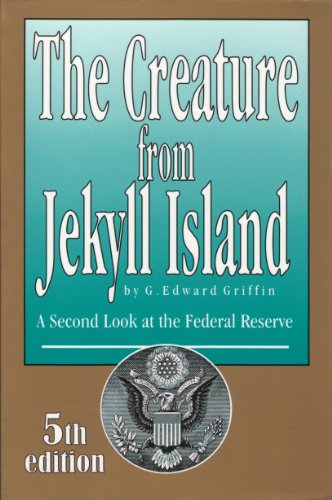
The Creature from Jekyll Island: A Second Look at the Federal Reserve
This classic expose of the Fed has become one of the best-selling books in its category of all time. Where does money come from? Where does it go? Who makes it? The money magician's secrets are unveiled. Here is a close look at their mirrors and smoke machines, the pulleys, cogs, and wheels that create the grand illusion called money. A boring subject? Just wait. You'll be hooked in five minutes. It reads like a detective story - which it really is, but it's all true. This book is about the most blatant scam of history. It's all here: the cause of wars, boom-bust cycles, inflation, depression, prosperity. Your world view will definitely change. Putting it quite simply, this may be the most important book on world affairs you will ever read. The 5th Edition includes a no-holds barred analysis of bank bailouts under the Bush and Obama Administrations that are shown to be nothing less than legalized plunder of the American people. Many other updates have been added, including a revision to the list of those who attended the historic meeting at Jekyll Island, where the Federal Reserve was created.
…
Recommended by Marvin Liao.
Marvin Liao
Partner/500 Startups
I tend to jump from book to book and may switch if I am interested in some new topic. This is a pleasure for me (which I also do benefit work wise from too). It’s quite a random list because I have eclectic interests (or just scatterbrained most likely) on tech business, AI, general global economy, geopolitics, rising Biotech economy & history. I'm basically 15% to 50% into all these books. [source]
Cover unavailable
7
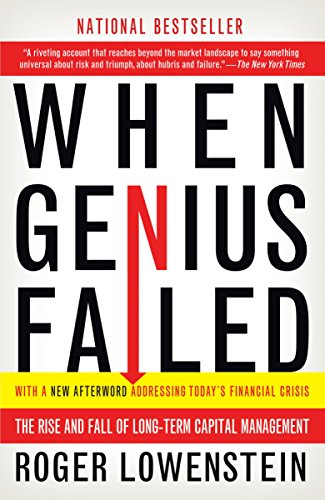
When Genius Failed: The Rise and Fall of Long-Term Capital Management
With a new Afterword addressing today’s financial crisis
A BUSINESS WEEK BEST BOOK OF THE YEAR
In this business classic—now with a new Afterword in which the author draws parallels to the recent financial crisis—Roger Lowenstein captures the gripping roller-coaster ride of Long-Term Capital Management. Drawing on confidential internal memos and interviews with dozens of key players, Lowenstein explains not just how the fund made and lost its money but also how the personalities of Long-Term’s partners, the arrogance of their mathematical certainties, and the culture of Wall Street itself contributed to both their rise and their fall.
When it was founded in 1993, Long-Term was hailed as the most impressive hedge fund in history. But after four years in which the firm dazzled Wall Street as a $100 billion moneymaking juggernaut, it suddenly suffered catastrophic losses that jeopardized not only the biggest banks on Wall Street but the stability of the financial system itself. The dramatic story of Long-Term’s fall is now a chilling harbinger of the crisis that would strike all of Wall Street, from Lehman Brothers to AIG, a decade later. In his new Afterword, Lowenstein shows that LTCM’s implosion should be seen not as a one-off drama but as a template for market meltdowns in an age of instability—and as a wake-up call that Wall Street and government alike tragically ignored.
…
Recommended by Max Levchin and John Gapper.
Max Levchin
Co-founder/PayPal, CEO/Affirm, Investor
Max Levchin recommended this book as an answer to "What business books would you advise young entrepreneurs read?" [source]
John Gapper
The Fed itself did not bail out LTCM, but it was worried enough to get a bunch of big banks into the room and say, “Would you care to chip in and save this thing?” Which they obligingly did – and then liquidated it. The Fed foresaw that the failure of a single big hedge fund could send shock waves through the entire financial system. The issue of systemic risk was highlighted. [source]
Cover unavailable
8
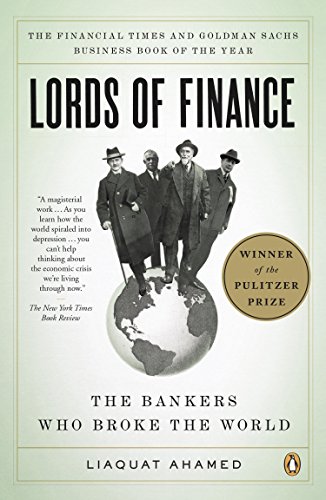
Lords of Finance: The Bankers Who Broke the World
Liaquat Ahamed
4.5
Winner of the 2010 Pulitzer Prize
"A magisterial work...You can't help thinking about the economic crisis we're living through now." --The New York Times Book Review
It is commonly believed that the Great Depression that began in 1929 resulted from a confluence of events beyond any one person's or government's control. In fact, as Liaquat Ahamed reveals, it was the decisions made by a small number of central bankers that were the primary cause of that economic meltdown, the effects of which set the stage for World War II and reverberated for decades. As yet another period of economic turmoil makes headlines today, Lords of Finance is a potent reminder of the enormous impact that the decisions of central bankers can have, their fallibility, and the terrible human consequences that can result when they are wrong.
It covers a 50-year period from before World War I and leading up to World War II. Even if you’re not interested in finance, it’s a great read. [source]
Lords of Finance gives you that alternative history, particularly through the inter-war years from the end of World War I into the Great Depression. [source]
Cover unavailable
9
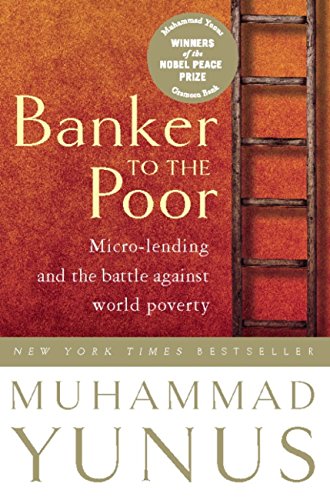
Banker to the Poor: Micro-Lending and the Battle Against World Poverty
Muhammad Yunus
4.4
Muhammad Yunus is that rare thing: a bona fide visionary. His dream is the total eradication of poverty from the world. In 1983, against the advice of banking and government officials, Yunus established Grameen, a bank devoted to providing the poorest of Bangladesh with minuscule loans. Grameen Bank, based on the belief that credit is a basic human right, not the privilege of a fortunate few, now provides over 2.5 billion dollars of micro-loans to more than two million families in rural Bangladesh. Ninety-four percent of Yunus's clients are women, and repayment rates are near 100 percent. Around the world, micro-lending programs inspired by Grameen are blossoming, with more than three hundred programs established in the United States alone.
Banker to the Poor is Muhammad Yunus's memoir of how he decided to change his life in order to help the world's poor. In it he traces the intellectual and spiritual journey that led him to fundamentally rethink the economic relationship between rich and poor, and the challenges he and his colleagues faced in founding Grameen. He also provides wise, hopeful guidance for anyone who would like to join him in "putting homelessness and destitution in a museum so that one day our children will visit it and ask how we could have allowed such a terrible thing to go on for so long." The definitive history of micro-credit direct from the man that conceived of it, Banker to the Poor is necessary and inspirational reading for anyone interested in economics, public policy, philanthropy, social history, and business.
Muhammad Yunus was born in Bangladesh and earned his Ph.D. in economics in the United States at Vanderbilt University, where he was deeply influenced by the civil rights movement. He still lives in Bangladesh, and travels widely around the world on behalf of Grameen Bank and the concept of micro-credit.
…
Recommended by Vinod Khosla, Vinod Khosla, and Roger Thurow.
Roger Thurow
I chose this book for the power of the story that he tells – the founding of Grameen Bank and the success that it has had. [source]
Cover unavailable
10
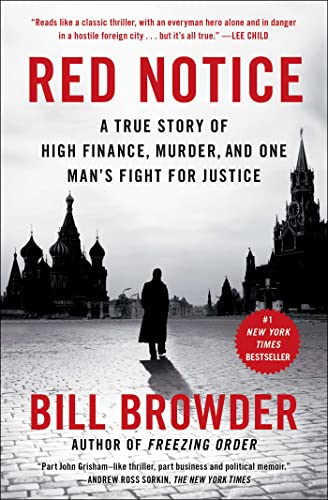
Red Notice: A True Story of High Finance, Murder, and One Man's Fight for Justice
Bill Browder
4.4
A real-life political thriller about an American financier in the Wild East of Russia, the murder of his principled young tax attorney, and his dangerous mission to expose the Kremlin's corruption.
Bill Browder's journey started on the South Side of Chicago and moved through Stanford Business School to the dog-eat-dog world of hedge fund investing in the 1990s. It continued in Moscow, where Browder made his fortune heading the largest investment fund in Russia after the Soviet Union's collapse. But when he exposed the corrupt oligarchs who were robbing the companies in which he was investing, Vladimir Putin turned on him and, in 2005, had him expelled from Russia.
In 2007, a group of law enforcement officers raided Browder's offices in Moscow and stole $230 million of taxes that his fund's companies had paid to the Russian government. Browder's attorney Sergei Magnitsky investigated the incident and uncovered a sprawling criminal enterprise. A month after Sergei testified against the officials involved, he was arrested and thrown into pre-trial detention, where he was tortured for a year. On November 16, 2009, he was led to an isolation chamber, handcuffed to a bedrail, and beaten to death by eight guards in full riot gear.
Browder glimpsed the heart of darkness, and it transformed his life: he embarked on an unrelenting quest for justice in Sergei's name, exposing the towering cover-up that leads right up to Putin. A financial caper, a crime thriller, and a political crusade, Red Notice is the story of one man taking on overpowering odds to change the world.
…
Recommended by Eric Ries, Anand Sanwal, Ben Saunders, and 8 others.
This reads like a thriller, but is an urgent and important story about the dangers of Putin’s Russia and the events leading to the Magnitsky Act. [source]
Anand Sanwal
@geoffreysbatt @patrick_oshag 2/ Reminded a bit of the story of @Billbrowder as told in the remarkable book Red Notice which chronicles his investments in Russia very early before everyone saw the opportunity [source]
Ben Saunders
Just finished @Billbrowder's extraordinary book Red Notice. Inspiring, alarming, unsettling and illuminating in equal measure. I thought I knew a few things about ambition and endeavour in challenging environments, but this is something else. Highly recommended. https://t.co/m4wxR4qesa [source]
Cover unavailable
11
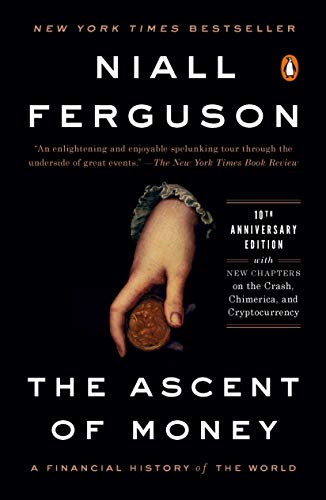
The Ascent of Money: A Financial History of the World
Niall Ferguson
4.4
Niall Ferguson follows the money to tell the human story behind the evolution of finance, from its origins in ancient Mesopotamia to the latest upheavals on what he calls Planet Finance. Bread, cash, dosh, dough, loot, lucre, moolah, readies, the wherewithal: Call it what you like, it matters. To Christians, love of it is the root of all evil. To generals, it’s the sinews of war. To revolutionaries, it’s the chains of labor. But in The Ascent of Money, Niall Ferguson shows that finance is in fact the foundation of human progress. What’s more, he reveals financial history as the essential backstory behind all history. With the clarity and verve for which he is known, Ferguson elucidates key financial institutions and concepts by showing where they came from. What is money? What do banks do? What’s the difference between a stock and a bond? Why buy insurance or real estate? And what exactly does a hedge fund do? This is history for the present. Ferguson travels to post-Katrina New Orleans to ask why the free market can’t provide adequate protection against catastrophe. He delves into the origins of the subprime mortgage crisis.
…
Recommended by Max Levchin, Muhtar Kent, and 1 others.
Max Levchin
Co-founder/PayPal, CEO/Affirm, Investor
Max Levchin recommended this book as an answer to "What business books would you advise young entrepreneurs read?" [source]
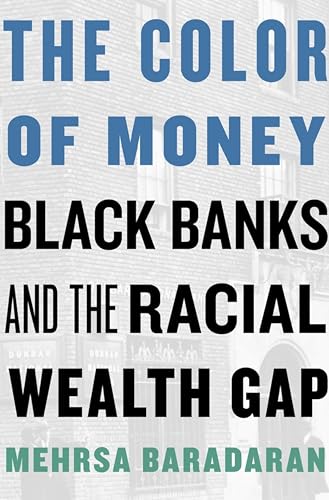
The Color of Money: Black Banks and the Racial Wealth Gap
Mehrsa Baradaran
4.4
"A deep accounting of how America got to a point where a median white family has 13 times more wealth than the median black family." --The Atlantic
"Extraordinary... Baradaran focuses on a part of the American story that's often ignored: the way African Americans were locked out of the financial engines that create wealth in America." --Ezra Klein
When the Emancipation Proclamation was signed in 1863, the black community owned less than 1 percent of the total wealth in America. More than 150 years later, that number has barely budged. The Color of Money seeks to explain the stubborn persistence of this racial wealth gap by focusing on the generators of wealth in the black community: black banks.
With the civil rights movement in full swing, President Nixon promoted "black capitalism," a plan to support black banks and minority-owned businesses. But the catch-22 of black banking is that the very institutions needed to help communities escape the deep poverty caused by discrimination and segregation inevitably became victims of that same poverty. In this timely and eye-opening account, Baradaran challenges the long-standing belief that black communities could ever really hope to accumulate wealth in a segregated economy.
"Black capitalism has not improved the economic lives of black people, and Baradaran deftly explains the reasons why." --Los Angeles Review of Books
"A must read for anyone interested in closing America's racial wealth gap." --Black Perspectives
…
Cover unavailable
13
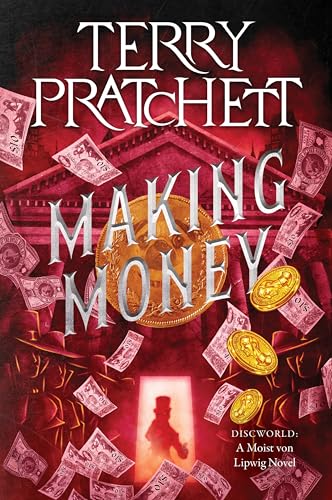
Making Money (Discworld, #36; Moist Von Lipwig, #2)
Terry Pratchett
4.4
It's an offer you can't refuse.
Who would not to wish to be the man in charge of Ankh-Morpork's Royal Mint and the bank next door?
It's a job for life. But, as former con-man Moist von Lipwig is learning, the life is not necessarily for long.
The Chief Cashier is almost certainly a vampire. There's something nameless in the cellar (and the cellar itself is pretty nameless), it turns out that the Royal Mint runs at a loss. A 300 year old wizard is after his girlfriend, he's about to be exposed as a fraud, but the Assassins Guild might get him first. In fact lot of people want him dead
Oh. And every day he has to take the Chairman for walkies.
Everywhere he looks he's making enemies.
What he should be doing is . . . Making Money!
…
Cover unavailable
14
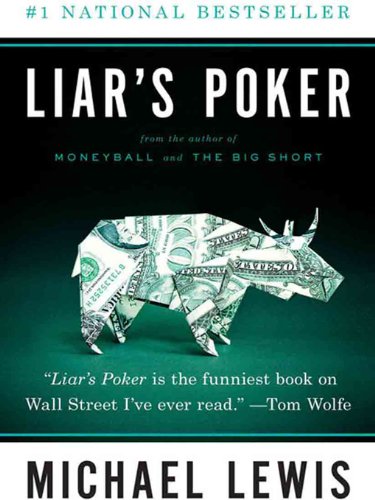
Liar's Poker: Rising Through the Wreckage on Wall Street
In this shrewd and wickedly funny book, Michael Lewis describes an astonishing era and his own rake's progress through a powerful investment bank. From an unlikely beginning (art history at Princeton?) he rose in two short years from Salomon Brothers trainee to Geek (the lowest form of life on the trading floor) to Big Swinging Dick, the most dangerous beast in the jungle, a bond salesman who could turn over millions of dollars' worth of doubtful bonds with just one call.
With the eye and ear of a born storyteller, Michael Lewis shows us how things really worked on Wall Street. In the Salomon training program a roomful of aspirants is stunned speechless by the vitriolic profanity of the Human Piranha; out on the trading floor, bond traders throw telephones at the heads of underlings and Salomon chairman Gutfreund challenges his chief trader to a hand of liar's poker for one million dollars; around the world in London, Tokyo, and New York, bright young men like Michael Lewis, connected by telephones and computer terminals, swap gross jokes and find retail buyers for the staggering debt of individual companies or whole countries.
The bond traders, wearing greed and ambition and badges of honor, might well have swaggered straight from the pages of Bonfire of the Vanities. But for all thier outrageous behavior, they were in fact presiding over enormous changes in the world economy. Lewis's job, simply described, was to transfer money, in the form of bonds, from those outside America who saved to those inside America who consumed. In doing so, he generated tens of millions of dollars for Salomon Brothers, and earned for himself a ringside seat on the greatest financial spectacle of the decade: the leveraging of America.
…
Recommended by Audrey Russo and John Lanchester.
Audrey Russo
Question: What books would you recommend to young people interested in your career path? Answer: Anything by Peter Senge. The Hard Thing About Hard Things – Ben Horowitz Once you are Lucky, Twice you are good – Sara Lacey Revolutionary Wealth – Alvin Toffler Black Swan – Taleb Reset: My Fight for Inclusion and Lasting Change, by Ellen Pao. Creative Class – Richard Florida Creativity Inc. by Ed Catmull & Amy Wallace Liar’s Poker by Michael Lewis American Government 101: From the Continental Congress to the Iowa Caucus, Everything You Need to Know About US Politics – Kathleen Spears The Tao of Pooh by Benjamin Hoff. Anna Karenina by Leo Tolstoy. Any book by Herman Hesse The Art of War by Sun Tzu. [source]
John Lanchester
It’s still a wonderfully entertaining book: An absolutely hilarious, very, very dark, vivid account of how Michael Lewis came out of Princeton and, with basically no qualifications, got a job in the bond trading department of Salomon Brothers [source]
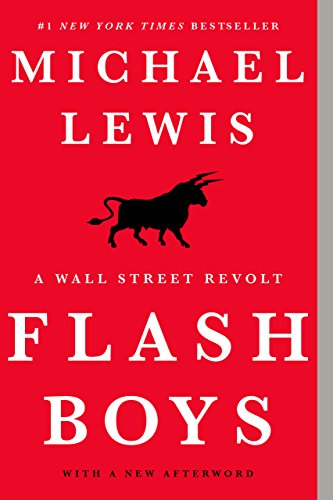
Four years after his #1 bestseller The Big Short, Michael Lewis returns to Wall Street to report on a high-tech predator stalking the equity markets.
Flash Boys is about a small group of Wall Street guys who figure out that the U.S. stock market has been rigged for the benefit of insiders and that, post–financial crisis, the markets have become not more free but less, and more controlled by the big Wall Street banks. Working at different firms, they come to this realization separately; but after they discover one another, the flash boys band together and set out to reform the financial markets. This they do by creating an exchange in which high-frequency trading—source of the most intractable problems—will have no advantage whatsoever.
The characters in Flash Boys are fabulous, each completely different from what you think of when you think “Wall Street guy.” Several have walked away from jobs in the financial sector that paid them millions of dollars a year. From their new vantage point they investigate the big banks, the world’s stock exchanges, and high-frequency trading firms as they have never been investigated, and expose the many strange new ways that Wall Street generates profits.
The light that Lewis shines into the darkest corners of the financial world may not be good for your blood pressure, because if you have any contact with the market, even a retirement account, this story is happening to you. But in the end, Flash Boys is an uplifting read. Here are people who have somehow preserved a moral sense in an environment where you don’t get paid for that; they have perceived an institutionalized injustice and are willing to go to war to fix it.
…
Recommended by Alykhan Satchu.
Alykhan Satchu
@surambaya @MihrThakar @NorthmanTrader great book [source]
“One of the finest, most compelling accounts of what happened to corporate America and Wall Street in the 1980’s.” —New York Times Book Review
A #1 New York Times bestseller and arguably the best business narrative ever written, Barbarians at the Gate is the classic account of the fall of RJR Nabisco. An enduring masterpiece of investigative journalism by Bryan Burrough and John Helyar, it includes a new afterword by the authors that brings this remarkable story of greed and double-dealings up to date twenty years after the famed deal. The Los Angeles Times calls Barbarians at the Gate, “Superlative.” The Chicago Tribune raves, “It’s hard to imagine a better story...and it’s hard to imagine a better account.” And in an era of spectacular business crashes and federal bailouts, it still stands as a valuable cautionary tale that must be heeded.
…
Recommended by Bill Liao, Bogdan Iordache, David Rothschild, and 2 others.
Bill Liao
The human world occurs in language so best get good at it! [source]
Bogdan Iordache
There are quite a few good business books on technology, and I'll list below some I find to be a good starting point. Personally, I like biographies a lot and I mostly read biographies of dead people, because those are the most honest ones. So because the computer age is still very young, there won't be a lot of biographies in my list. [source]
Scott Kupor
@JPHampstead @TimParksauthor Barbarians is a great book. Hope you enjoy mine! [source]
Cover unavailable
17
The Mystery of Banking
Murray N. Rothbard
4.3
Talk about great timing. Rothbard's extraordinary book unravels the mystery of banking: what is legitimate enterprise and what is a government-backed shell game that can't last. His explanation is clear enough for anyone to follow and yet precise and rigorous enough to be the best, textbook for college classes on the topic. This is because its expositional clarity--in its hitosry and theory--is essentially unrivaled.
Most notably, he uses the T account method of explaining the relationship between deposits and loans, showing the inherent instability of fractional reserve banking and how it sets the stage for centralization, inflation, and the boost-bust cycle.
But there is more here. It is an explanation of money's origins and its meaning in the free market. The abstract theory is here but always with real application in history and in modern banking practice. Never does a paragraph go by without an example drawn from his massive knowledge of the subject.
…
Cover unavailable
18
Billion Dollar Whale: The Man Who Fooled Wall Street, Hollywood, and the World
An epic true-tale of hubris and greed from two Pulitzer-finalist Wall Street Journal reporters, Billion Dollar Whale reveals how a young social climber pulled off one of the biggest financial heists in history--right under the nose of the global financial industry--exposing the shocking secret nexus of elite wealth, banking, Hollywood, and politics.
The dust had yet to settle on the global financial crisis in 2009 when an unlikely Wharton grad was setting in motion a fraud of unprecedented gall and magnitude--one that would come to symbolize the next great threat to the global financial system.
Billion Dollar Whale will become a classic, harrowing parable about the financial world in the twenty-first century.
This book on the 1MDB scandal was great, hard to put down. Low sophistication + huge brazenness is a powerful fraud combo. https://t.co/nYpIJffcb5 [source]
Cover unavailable
19
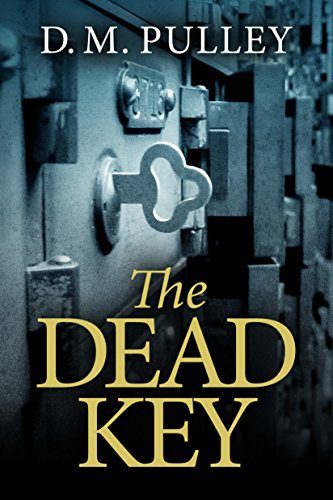
The Dead Key
D. M. Pulle
4.3
2014 Winner — Amazon Breakthrough Novel Award — Grand Prize and Mystery & Thriller Fiction Winner
It’s 1998, and for years the old First Bank of Cleveland has sat abandoned, perfectly preserved, its secrets only speculated on by the outside world.
Twenty years before, amid strange staff disappearances and allegations of fraud, panicked investors sold Cleveland’s largest bank in the middle of the night, locking out customers and employees, and thwarting a looming federal investigation. In the confusion that followed, the keys to the vault’s safe-deposit boxes were lost.
In the years since, Cleveland’s wealthy businessmen kept the truth buried in the abandoned high-rise. The ransacked offices and forgotten safe-deposit boxes remain locked in time, until young engineer Iris Latch stumbles upon them during a renovation survey. What begins as a welcome break from her cubicle becomes an obsession as Iris unravels the bank’s sordid past. With each haunting revelation, Iris follows the looming shadow of the past deeper into the vault—and soon realizes that the key to the mystery comes at an astonishing price.
…
Cover unavailable
20
Titan: The Life of John D. Rockefeller, Sr.
Ron Chernow
4.3
John D. Rockefeller, Sr.--history's first billionaire and the patriarch of America's most famous dynasty--is an icon whose true nature has eluded three generations of historians. Now Ron Chernow, the National Book Award-winning biographer of the Morgan and Warburg banking families, gives us a history of the mogul "etched with uncommon objectivity and literary grace . . . as detailed, balanced, and psychologically insightful a portrait of the tycoon as we may ever have" (Kirkus Reviews). Titan is the first full-length biography based on unrestricted access to Rockefeller's exceptionally rich trove of papers. A landmark publication full of startling revelations, the book will indelibly alter our image of this most enigmatic capitalist. Born the son of a flamboyant, bigamous snake-oil salesman and a pious, straitlaced mother, Rockefeller rose from rustic origins to become the world's richest man by creating America's most powerful and feared monopoly, Standard Oil. Branded "the Octopus" by legions of muckrakers, the trust refined and marketed nearly 90 percent of the oil produced in America. Rockefeller was likely the most controversial businessman in our nation's history. Critics charged that his empire was built on unscrupulous tactics: grand-scale collusion with the railroads, predatory pricing, industrial espionage, and wholesale bribery of political officials. The titan spent more than thirty years dodging investigations until Teddy Roosevelt and his trustbusters embarked on a marathon crusade to bring Standard Oil to bay. While providing abundant new evidence of Rockefeller's misdeeds, Chernow discards the stereotype of the cold-blooded monster to sketch an unforgettably human portrait of a quirky, eccentric original. A devout Baptist and temperance advocate, Rockefeller gave money more generously--his chosen philanthropies included the Rockefeller Foundation, the University of Chicago, and what is today Rockefeller University--than anyone before him. Titan presents a finely nuanced portrait of a fascinating, complex man, synthesizing his public and private lives and disclosing numerous family scandals, tragedies, and misfortunes that have never before come to light. John D. Rockefeller's story captures a pivotal moment in American history, documenting the dramatic post-Civil War shift from small business to the rise of giant corporations that irrevocably transformed the nation. With cameos by Joseph Pulitzer, William Randolph Hearst, Jay Gould, William Vanderbilt, Ida Tarbell, Andrew Carnegie, Carl Jung, J. Pierpont Morgan, William James, Henry Clay Frick, Mark Twain, and Will Rogers, Titan turns Rockefeller's life into a vivid tapestry of American society in the late nineteenth and early twentieth centuries. It is Ron Chernow's signal triumph that he narrates this monumental saga with all the sweep, drama, and insight that this giant subject deserves.
A biography has to be really good to make read you all 800 pages. To me, this was one of those books. Since reading it earlier this year, I’ve since found out it is the favorite book of a lot of people I respect. I think something about the quality of the writing and the empathic understanding of the writer that the main lessons you would take away from someone like Rockefeller would not be business, but life lessons. In fact, when I went back through and took notes on this book, I filled out more cards for Stoicism than I did for Strategy, Business or Money. I found Rockefeller to be strangely stoic, incredibly resilient and, despite his reputation as a robber baron, humble and compassionate. Most people get WORSE as they get successful, many more get worse as they age. Rockefeller did neither of these things, he grew more open-minded the older he became, more generous, more pious, more dedicated to making a difference. Does that excuse the “awful” things that he did? Well, the things he did really weren’t that awful so yes. (By that I mean I’d certainly choose him over the robber barons of this age like Zuckerberg or Murdoch.) [source]
@Morg2006 Yep, I already have it. great book. [source]
Cover unavailable
21
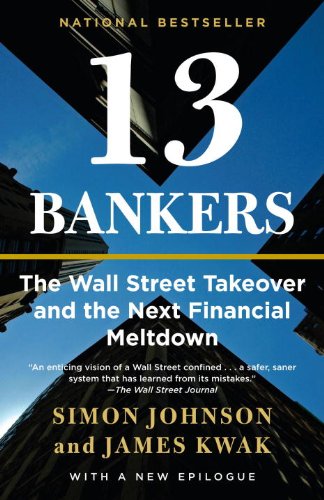
13 Bankers: The Wall Street Takeover and the Next Financial Meltdown
Simon Johnson, James Kwak
4.3
Even after the ruinous financial crisis of 2008, America is still beset by the depredations of an oligarchy that is now bigger, more profitable, and more resistant to regulation than ever. Anchored by six megabanks—Bank of America, JPMorgan Chase, Citigroup, Wells Fargo, Goldman Sachs, and Morgan Stanley—which together control assets amounting, astonishingly, to more than 60 percent of the country’s gross domestic product, these financial institutions (now more emphatically “too big to fail”) continue to hold the global economy hostage, threatening yet another financial meltdown with their excessive risk-taking and toxic “business as usual” practices. How did this come to be—and what is to be done? These are the central concerns of 13 Bankers, a brilliant, historically informed account of our troubled political economy.
In 13 Bankers, Simon Johnson—one of the most prominent and frequently cited economists in America (former chief economist of the International Monetary Fund, Professor of Entrepreneurship at MIT, and author of the controversial “The Quiet Coup” in The Atlantic)—and James Kwak give a wide-ranging, meticulous, and bracing account of recent U.S. financial history within the context of previous showdowns between American democracy and Big Finance: from Thomas Jefferson to Andrew Jackson, from Theodore Roosevelt to Franklin Delano Roosevelt. They convincingly show why our future is imperiled by the ideology of finance (finance is good, unregulated finance is better, unfettered finance run amok is best) and by Wall Street’s political control of government policy pertaining to it.
As the authors insist, the choice that America faces is stark: whether Washington will accede to the vested interests of an unbridled financial sector that runs up profits in good years and dumps its losses on taxpayers in lean years, or reform through stringent regulation the banking system as first and foremost an engine of economic growth. To restore health and balance to our economy, Johnson and Kwak make a radical yet feasible and focused proposal: reconfigure the megabanks to be “small enough to fail.”
Lucid, authoritative, crucial for its timeliness, 13 Bankers is certain to be one of the most discussed and debated books of 2010.
Obviously that’s way overstated, but it is remarkable that here we are in 2012, the fourth year after the crisis. We still don’t have an adequate regulatory system in place to prevent a crisis like this from happening, and the recent collapse of MF Global indicates that in many respects Wall Street hasn’t learned lessons either, in terms of the kinds of risks they’re willing to take. [source]
Cover unavailable
22
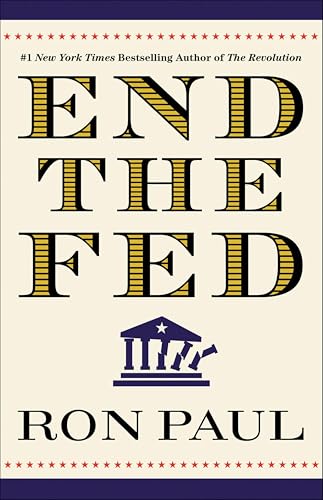
End the Fed
Ron Paul
4.3
In the post-meltdown world, it is irresponsible, ineffective, and ultimately useless to have a serious economic debate without considering and challenging the role of the Federal Reserve.
Most people think of the Fed as an indispensable institution without which the country's economy could not properly function. But in END THE FED, Ron Paul draws on American history, economics, and fascinating stories from his own long political life to argue that the Fed is both corrupt and unconstitutional. It is inflating currency today at nearly a Weimar or Zimbabwe level, a practice that threatens to put us into an inflationary depression where $100 bills are worthless. What most people don't realize is that the Fed -- created by the Morgans and Rockefellers at a private club off the coast of Georgia -- is actually working against their own personal interests. Congressman Paul's urgent appeal to all citizens and officials tells us where we went wrong and what we need to do fix America's economic policy for future generations.
…
Cover unavailable
23
On the Banks of Plum Creek (Little House, #4)
Laura Ingalls Wilder
4.3
The adventures of Laura Ingalls and her family continue as they leave their little house on the prairie and travel in their covered wagon to Minnesota. They settle into a house made of sod on the banks of beautiful Plum Creek. Soon Pa builds them a sturdier house, with real glass windows and a hinged door. Laura and Mary go to school, help with the chores around the house, and fish in the creek. Pa’s fiddle lulls them all to sleep at the end of the day. But then disaster strikes—on top of a terrible blizzard, a grasshopper infestation devours their wheat crop. Now the family must work harder than ever to overcome these challenges.
In his book, Smith fervently extolled the simple yet enlightened notion that individuals are fully capable of setting and regulating prices for their own goods and services. He argued passionately in favor of free trade, yet stood up for the little guy. The Wealth of Nations provided the first--and still the most eloquent--integrated description of the workings of a market economy.
Obama, unsurprisingly, appears to be more drawn to stories sympathetic to the working classes than is McCain. Obama cites John Steinbeck’s “In Dubious Battle,” about a labor dispute; Robert Caro’s “Power Broker,” about Robert Moses; and Studs Terkel’s “Working.” But he also includes Adam Smith’s “Wealth of Nations” and “Theory of Moral Sentiments” on his list. [source]
Which books should be read by every single intelligent person on planet? … The Wealth of Nations (Smith) to learn that capitalism is an economy of greed, a force of nature unto itself. If you read all of the above works you will glean profound insight into most of what has driven the history of the western world. [source]
Cover unavailable
25
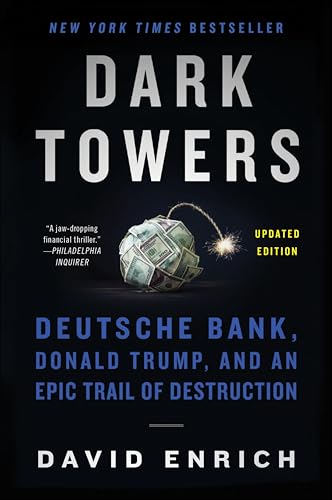
Dark Towers: Deutsche Bank, Donald Trump, and an Epic Trail of Destruction
David Enrich
4.3
A searing exposé of the most scandalous bank in the world, including its shadowy ties to Donald Trump’s business empire
On a rainy Sunday in 2014, a senior executive at Deutsche Bank was found hanging in his London apartment. Bill Broeksmit had helped build the 150-year-old financial institution into a global colossus, and his sudden death was a mystery, made more so by the bank’s efforts to deter investigation. Broeksmit, it turned out, was a man who knew too much.
In Dark Towers, award-winning journalist David Enrich reveals the truth about Deutsche Bank and its epic path of devastation. Tracing the bank’s history back to its propping up of a default-prone American developer in the 1880s, helping the Nazis build Auschwitz, and wooing Eastern Bloc authoritarians, he shows how in the 1990s, via a succession of hard-charging executives, Deutsche made a fateful decision to pursue Wall Street riches, often at the expense of ethics and the law.
Soon, the bank was manipulating markets, violating international sanctions to aid terrorist regimes, scamming investors, defrauding regulators, and laundering money for Russian oligarchs. Ever desperate for an American foothold, Deutsche also started doing business with a self-promoting real estate magnate nearly every other bank in the world deemed too dangerous to touch: Donald Trump. Over the next twenty years, Deutsche executives loaned billions to Trump, the Kushner family, and an array of scandal-tarred clients, including convicted sex offender Jeffrey Epstein.
Dark Towers is the never-before-told saga of how Deutsche Bank became the global face of financial recklessness and criminality—the corporate equivalent of a weapon of mass destruction. It is also the story of a man who was consumed by fear of what he’d seen at the bank—and his son’s obsessive search for the secrets he kept.
…
Recommended by Aunt Crabby Calls Bullshit, Charles P. Pierce, Peter S. Goodman, and 1 others.
Aunt Crabby Calls Bullshit
Every Trump financial thread pulled results in scandal The @maddow Show last night was GREAT!! I pre-ordered the book on Trump and Deutsche Bank immediately! https://t.co/H03Y0bjCDc [source]
Charles P. Pierce
I’m reading the Deutsche Bank book that @maddow is talking about now. It’s an amazing saga. [source]
Peter S. Goodman
In Deutsche Bank, Trump found a lender willing to time again ignore the balance sheet to keep sending money his way. My colleague @davidenrich has just delivered a powerful account in a new book. Highly recommended. https://t.co/mUlobQaA02 [source]
Cover unavailable
26
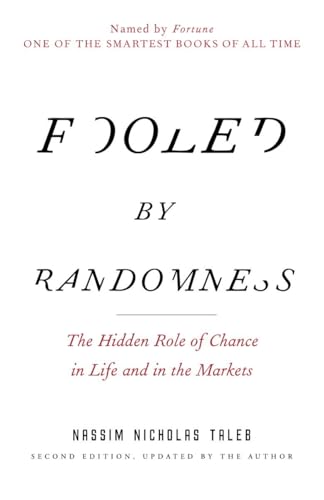
Fooled by Randomness: The Hidden Role of Chance in Life and in the Markets
Fooled by Randomness is a standalone book in Nassim Nicholas Taleb’s landmark Incerto series, an investigation of opacity, luck, uncertainty, probability, human error, risk, and decision-making in a world we don’t understand. The other books in the series are The Black Swan, Antifragile, and The Bed of Procrustes.
Now in a striking new hardcover edition, Fooled by Randomness is the word-of-mouth sensation that will change the way you think about business and the world. Nassim Nicholas Taleb–veteran trader, renowned risk expert, polymathic scholar, erudite raconteur, and New York Times bestselling author of The Black Swan–has written a modern classic that turns on its head what we believe about luck and skill.
This book is about luck–or more precisely, about how we perceive and deal with luck in life and business. Set against the backdrop of the most conspicuous forum in which luck is mistaken for skill–the world of trading–Fooled by Randomness provides captivating insight into one of the least understood factors in all our lives. Writing in an entertaining narrative style, the author tackles major intellectual issues related to the underestimation of the influence of happenstance on our lives.
The book is populated with an array of characters, some of whom have grasped, in their own way, the significance of chance: the baseball legend Yogi Berra; the philosopher of knowledge Karl Popper; the ancient world’s wisest man, Solon; the modern financier George Soros; and the Greek voyager Odysseus. We also meet the fictional Nero, who seems to understand the role of randomness in his professional life but falls victim to his own superstitious foolishness.
However, the most recognizable character of all remains unnamed–the lucky fool who happens to be in the right place at the right time–he embodies the “survival of the least fit.” Such individuals attract devoted followers who believe in their guru’s insights and methods. But no one can replicate what is obtained by chance.
Are we capable of distinguishing the fortunate charlatan from the genuine visionary? Must we always try to uncover nonexistent messages in random events? It may be impossible to guard ourselves against the vagaries of the goddess Fortuna, but after reading Fooled by Randomness we can be a little better prepared.
PRAISE FOR FOOLED BY RANDOMNESS:
Named by Fortune One of the Smartest Books of All Time
A Financial Times Best Business Book of the Year
“[Fooled by Randomness] is to conventional Wall Street wisdom approximately what Martin Luther’s ninety-five theses were to the Catholic Church.” –Malcolm Gladwell, author of Blink
“The book that rolled down Wall Street like a hand grenade.” –Maggie Mahar, author of Bull! A History of the Boom, 1982—1999
“Fascinating . . . Taleb will grab you.” –Peter L. Bernstein, author of Capital Ideas Evolving
“Recalls the best of scientist/essayists like Richard Dawkins . . . and Stephen Jay Gould.” –Michael Schrage, author of Serious Play: How the World’s Best Companies Simulate to Innovate
“We need a book like this. . . . Fun to read, refreshingly independent-minded.” –Robert J. Shiller, author of Irrational Exuberance
“Powerful . . . loaded with crackling little insights [and] extreme brilliance.” –National Review
And throw in “The Black Swan” and “Fooled by Randomness”. “Fragile” means if you hit something might break. “Resilient” means if you hit something, it will stay the same. On my podcast Nassim discusses “Antifragility” – building a system, even on that works for you on a personal level, where you if you harm your self in some way it becomes stronger. That podcast changed my life He discusses Antifragility throughout history, up to our current economic situation, and even in our personal situations. [source]
Anant Jain
The five-book series, "Incerto", by Nassim Nicholas Taleb has had a profound impact on how I think about the world. There’s some overlap across the books — but you'll likely find the repetition helpful in retaining the content better. [source]
Art De Vany
I used this book is a class I taught on the economics of uncertainty. [source]
Cover unavailable
27
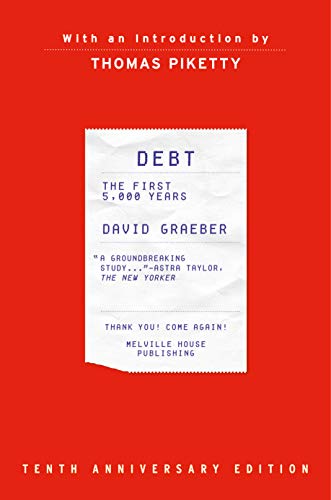
Debt: The First 5,000 Years (Updated and Expanded)
David Graeber
4.2
Before there was money, there was debt
Every economics textbook says the same thing: Money was invented to replace onerous and complicated barter systems—to relieve ancient people from having to haul their goods to market. The problem with this version of history? There’s not a shred of evidence to support it.
Here anthropologist David Graeber presents a stunning reversal of conventional wisdom. He shows that for more than 5,000 years, since the beginnings of the first agrarian empires, humans have used elaborate credit systems to buy and sell goods—that is, long before the invention of coins or cash. It is in this era, Graeber argues, that we also first encounter a society divided into debtors and creditors.
Graeber shows that arguments about debt and debt forgiveness have been at the center of political debates from Italy to China, as well as sparking innumerable insurrections. He also brilliantly demonstrates that the language of the ancient works of law and religion (words like “guilt,” “sin,” and “redemption”) derive in large part from ancient debates about debt, and shape even our most basic ideas of right and wrong. We are still fighting these battles today without knowing it.
Debt: The First 5,000 Years is a fascinating chronicle of this little known history—as well as how it has defined human history, and what it means for the credit crisis of the present day and the future of our economy.
I recommend it in audio because David is sometimes repetitive and a little elliptical, but in audio it's all okay because you can just listen to it again. [source]

After a few false starts, I finally got going with this, and what a treat. It shoots down the common myth that prior to money, everyone just bartered shit. I give you a pig, you give me five pies and a hat. Evidence shows that just wasn’t at all how things went. Most societies were structured either rather communistic (take what you need, give what you can) or with a loose debt-ledger system (or a combination of both). But where things get really interesting is how the emergence of market economies (and money) changed the relationship with human life and dignity. Especially as a consequence of slavery, which put a very explicit price on that which previously was priceless. All sorts of fascinating historical links to women wearing veils (to distinguish them from women who could be bought), how debt peonage really took off once slavery came profitable (so debtors could be sold, or their children sold, if they failed to repay), and how other morality got intertwined with debt. It’s truly eye-opening, and the lines trace disturbingly well from millennia. [source]

Will Davies
What’s stunning about the book is how it brings an anthropological perspective to bear on such an expansive history and geography, bringing the story right up to the present day, at the precise moment when debt has become a hugely political, mobilizing and destabilizing issue. Its central argument is simple and easy to grasp, and has been seized by activists and critics of the financial sector. [source]
Cover unavailable
28
America's Bank: The Epic Struggle to Create the Federal Reserve
Roger Lowenstein
4.2
A tour de force of historical reportage, America’s Bank illuminates the tumultuous era and remarkable personalities that spurred the unlikely birth of America’s modern central bank, the Federal Reserve. Today, the Fed is the bedrock of the financial landscape, yet the fight to create it was so protracted and divisive that it seems a small miracle that it was ever established.
For nearly a century, America, alone among developed nations, refused to consider any central or organizing agency in its financial system. Americans’ mistrust of big government and of big banks—a legacy of the country’s Jeffersonian, small-government traditions—was so widespread that modernizing reform was deemed impossible. Each bank was left to stand on its own, with no central reserve or lender of last resort. The real-world consequences of this chaotic and provincial system were frequent financial panics, bank runs, money shortages, and depressions. By the first decade of the twentieth century, it had become plain that the outmoded banking system was ill equipped to finance America’s burgeoning industry. But political will for reform was lacking. It took an economic meltdown, a high-level tour of Europe, and—improbably—a conspiratorial effort by vilified captains of Wall Street to overcome popular resistance. Finally, in 1913, Congress conceived a federalist and quintessentially American solution to the conflict that had divided bankers, farmers, populists, and ordinary Americans, and enacted the landmark Federal Reserve Act.
Roger Lowenstein—acclaimed financial journalist and bestselling author of When Genius Failed and The End of Wall Street—tells the drama-laden story of how America created the Federal Reserve, thereby taking its first steps onto the world stage as a global financial power. America’s Bank showcases Lowenstein at his very finest: illuminating complex financial and political issues with striking clarity, infusing the debates of our past with all the gripping immediacy of today, and painting unforgettable portraits of Gilded Age bankers, presidents, and politicians.
Lowenstein focuses on the four men at the heart of the struggle to create the Federal Reserve. These were Paul Warburg, a refined, German-born financier, recently relocated to New York, who was horrified by the primitive condition of America’s finances; Rhode Island’s Nelson W. Aldrich, the reigning power broker in the U.S. Senate and an archetypal Gilded Age legislator; Carter Glass, the ambitious, if then little-known, Virginia congressman who chaired the House Banking Committee at a crucial moment of political transition; and President Woodrow Wilson, the academician-turned-progressive-politician who forced Glass to reconcile his deep-seated differences with bankers and accept the principle (anathema to southern Democrats) of federal control. Weaving together a raucous era in American politics with a storied financial crisis and intrigue at the highest levels of Washington and Wall Street, Lowenstein brings the beginnings of one of the country’s most crucial institutions to vivid and unforgettable life. Readers of this gripping historical narrative will wonder whether they’re reading about one hundred years ago or the still-seething conflicts that mark our discussions of banking and politics today.
From the Hardcover edition.
…
Cover unavailable
29
The Expats (Kate Moore, #1)
Chris Pavone
4.2
Kate Moore is a working mother, struggling to make ends meet, to raise children, to keep a spark in her marriage . . . and to maintain an increasingly unbearable life-defining secret. So when her husband is offered a lucrative job in Luxembourg, she jumps at the chance to leave behind her double-life, to start anew.
She begins to reinvent herself as an expat, finding her way in a language she doesn’t speak, doing the housewifely things she’s never before done—play-dates and coffee mornings, daily cooking and unending laundry. Meanwhile, her husband works incessantly, doing a job Kate has never understood, for a banking client she’s not allowed to know. He’s becoming distant and evasive; she’s getting lonely and bored.
Then another American couple arrives. Kate soon becomes suspicious that these people are not who they claim to be, and terrified that her own past is catching up to her. So Kate begins to dig, to peel back the layers of deception that surround her. She discovers fake offices and shell corporations and a hidden gun; a mysterious farmhouse and numbered accounts with bewildering sums of money; a complex web of intrigue where no one is who they claim to be, and the most profound deceptions lurk beneath the most normal-looking of relationships; and a mind-boggling long-play con threatens her family, her marriage, and her life.
…
Cover unavailable
30
Reminiscences of a Stock Operator: The Classic Novel Based on the Life of Legendary Stock Market Speculator Jesse Livermore
Edwin Lefevre
4.2
Reminiscences of a Stock Operator is the unforgettable story of the life of Jesse Livermore, one of Wall Street's greatest ever stock speculators.
Loosely fictionalised in 1923 in collaboration with journalist Edwin Lefevre, this is the story of the highs and the lows, the strategies and the street smarts, the epic wins (and sometimes epic losses) that has inspired generations of investors and traders.
This edition comes with an exclusive foreword by Tim Price, author of Investing Through the Looking Glass.
Harriman Definitive Editions offer the best quality editions of the best financial books of all time. Meticulously proofread, beautifully typeset in new designs, accompanied by forewords by the best modern financial writers, printed and bound in high-quality hardcovers on acid-free paper - they are essential long-term additions to the portfolio of every investor and trader.
…
Recommended by Alykhan Satchu, Bill Liao, Joshua M. Brown, and 3 others.
Alykhan Satchu
My all time favorite Book https://t.co/UxwPMlAcXU [source]
Bill Liao
The human world occurs in language so best get good at it! [source]
Each new generation of traders gets inspired by this book but I have come to love it as more of a cautionary tale. and FYI, this is the better book for that context: https://t.co/116lNciXCF https://t.co/mEYn2ZAqPI [source]
Cover unavailable
31
Secrets of Sand Hill Road: Venture Capital and How to Get It
Scott Kupor
4.2
A Wall Street Journal Bestseller!
What are venture capitalists saying about your startup behind closed doors? And what can you do to influence that conversation?
If Silicon Valley is the greatest wealth-generating machine in the world, Sand Hill Road is its humming engine. That's where you'll find the biggest names in venture capital, including famed VC firm Andreessen Horowitz, where lawyer-turned-entrepreneur-turned-VC Scott Kupor serves as managing partner.
Whether you're trying to get a new company off the ground or scale an existing business to the next level, you need to understand how VCs think. In Secrets of Sand Hill Road, Kupor explains exactly how VCs decide where and how much to invest, and how entrepreneurs can get the best possible deal and make the most of their relationships with VCs. Kupor explains, for instance:
- Why most VCs typically invest in only one startup in a given business category.
- Why the skill you need most when raising venture capital is the ability to tell a compelling story.
- How to handle a "down round," when startups have to raise funds at a lower valuation than in the previous round.
- What to do when VCs get too entangled in the day-to-day operations of the business.
- Why you need to build relationships with potential acquirers long before you decide to sell.
Filled with Kupor's firsthand experiences, insider advice, and practical takeaways, Secrets of Sand Hill Road is the guide every entrepreneur needs to turn their startup into the next unicorn.
As someone who’s helped a small company become a huge, valuable company, I know firsthand the power of the startup ecosystem and entrepreneurship. This book is the definitive book on navigating VC as part of that. [source]
I’ve observed thousands of founders and thought a lot about what it takes to create something important and to achieve outlier success. Kupor’s book takes founders who want to do both through everything from how VCs raise money and evaluate deals, to how to think about term sheets and set up boards. It’s a valuable resource for any founder who wants to work with VCs. [source]
@MahapatraChirag Hope you enjoy it! @skupor's book is great. [source]

Cover unavailable
32
Den of Thieves
James B. Stewart
4.2
A #1 bestseller from coast to coast, Den of Thieves tells the full story of the insider-trading scandal that nearly destroyed Wall Street, the men who pulled it off, and the chase that finally brought them to justice.
Pulitzer Prize–winner James B. Stewart shows for the first time how four of the eighties’ biggest names on Wall Street—Michael Milken, Ivan Boesky, Martin Siegel, and Dennis Levine —created the greatest insider-trading ring in financial history and almost walked away with billions, until a team of downtrodden detectives triumphed over some of America’s most expensive lawyers to bring this powerful quartet to justice.
Based on secret grand jury transcripts, interviews, and actual trading records, and containing explosive new revelations about Michael Milken and Ivan Boesky written especially for this paperback edition, Den of Thieves weaves all the facts into an unforgettable narrative—a portrait of human nature, big business, and crime of unparalleled proportions.
…
Recommended by Doug Rossinow.
Doug Rossinow
Den of Thieves is a very vivid portrait of people who broke what rules there were in the process of transforming American finance and the American economy and making a lot of money by doing so. [source]
Cover unavailable
33
A Dangerous Fortune
Ken Follett
4.2
In 1866, tragedy strikes at the exclusive Windfield School. A young student drowns in a mysterious accident involving a small circle of boys. The drowning and its aftermath initiates a spiraling circle of treachery that will span three decades and entwine many loves... From the exclusive men's club and brothels that cater to every dark desire of London's upper classes to the dazzling ballrooms and mahogany-paneled suites of the manipulators of the world's wealth, Ken Follett conjures up a stunning array of contrasts. This breathtaking novel portrays a family splintered by lust, bound by a shared legacy... men and women swept toward a perilous climax where greed, fed by the shocking truth of a boy's death, must be stopped, or not just one man's dreams, but those of a nation, will die...
…
Cover unavailable
34
The House of Rothschild, Vol 1: Money's Prophets, 1798-1848
Niall Ferguson
4.2
In his rich and nuanced portrait of the remarkable, elusive Rothschild family, Oxford scholar and bestselling author Niall Ferguson uncovers the secrets behind the family's phenomenal economic success. He reveals for the first time the details of the family's vast political network, which gave it access to and influence over many of the greatest statesmen of the age. And he tells a family saga, tracing the importance of unity and the profound role of Judaism in the lives of a dynasty that rose from the confines of the Frankfurt ghetto and later used its influence to assist oppressed Jews throughout Europe. A definitive work of impeccable scholarship with a thoroughly engaging narrative, 'The House of Rothschild' is a biography of the rarest kind, in which mysterious and fascinating historical figures finally spring to life.
…
Cover unavailable
35
GMAT Official Guide 2020: Book + Online Question Bank
GMAC (Graduate Management Admission Council)
4.1
Are you still unprepared for the GMAT? Catch up with the Official Guide.
GMAT Official Guide 2021 is the only study guide written by the Graduate Management Admission Council, the makers of the GMAT exam. Get a competitive edge by studying the guide's 950+ questions. The questions are arranged from simplest to hardest, so you'll be able to consistently increase your knowledge as you fly through the guide.
Access online the 950 questions in the book (plus an additional 150 online only questions!) complete with detailed answer keys and strategies direct from the makers of the GMAT. You can even use the mobile app to study while you're at work or school. It's easy to work seamlessly between all of your devices!
GMAT Official Guide 2021 comes with:
Detailed descriptions of the GMAT's format and content Comprehensive strategies for performing well on the GMAT Online flashcards to help you retain what you read Complete grammar and quantitative reviews Actual GMAT essay topics along with sample responses and scoring info
…
Cover unavailable
36
The Bankers' New Clothes: Whats Wrong with Banking and What to Do about It
Anat Admati, Martin Hellwig
4.1
What is wrong with today's banking system? The past few years have shown that risks in banking can impose significant costs on the economy. Many claim, however, that a safer banking system would require sacrificing lending and economic growth. The Bankers' New Clothes examines this claim and the narratives used by bankers, politicians, and regulators to rationalize the lack of reform, exposing them as invalid.
Admati and Hellwig argue we can have a safer and healthier banking system without sacrificing any of the benefits of the system, and at essentially no cost to society. They show that banks are as fragile as they are not because they must be, but because they want to be--and they get away with it. Whereas this situation benefits bankers, it distorts the economy and exposes the public to unnecessary risks. Weak regulation and ineffective enforcement allowed the buildup of risks that ushered in the financial crisis of 2007-2009. Much can be done to create a better system and prevent crises. Yet the lessons from the crisis have not been learned.
Admati and Hellwig seek to engage the broader public in the debate by cutting through the jargon of banking, clearing the fog of confusion, and presenting the issues in simple and accessible terms. The Bankers' New Clothes calls for ambitious reform and outlines specific and highly beneficial steps that can be taken immediately.
…
Cover unavailable
37
Think and Grow Rich Deluxe Edition: The Complete Classic Text (Think and Grow Rich Series)
Napoleon Hill
4.1
Cover unavailable
38
Secret Kingdom Series 2 Collection Rosie Banks 6 Books Box Set (Midnight maze, Fairyeales Forest, Dream Dale, Lily Pad Lake, Sugarsweet Bakery, Bubble Volcano)
Rosie Banks
4.1
Cover unavailable
39
Breathless Trilogy Boxed Set (Breathless, #1-3)
Maya Banks
4.1
RUSH… When Gabe Hamilton saw Mia Crestwell walk into the ballroom for his hotel’s grand opening, he knew he was going to hell for what he had planned. After all, Mia is his best friend’s little sister. Except she’s not so little anymore. And Gabe has waited a long time to act on his desires.
FEVER… Jace, Ash, and Gabe: three of the wealthiest, most powerful men in the country. They’re accustomed to getting anything they want. Anything at all. For Jace, it’s a woman whose allure takes him completely by surprise…
BURN…When it comes to sex, Ash McIntyre has always explored his wilder side—extreme and uncompromising. He demands control. And he prefers women who want it like that. Then he meets Josie. He never imagined the one woman to tell him no would be the only woman who’d ever drive him to the edge of desire.
…
Cover unavailable
40
Block Party 666: Mark of the Beast Volume 1
Al- Saadiq Banks
4.1
It's a Block Party reunion and Attorney Tony Austin is the glue, as he brings some of his old clients together to teach them how to elevate their game and clean their dirty money. In the midst of contemplating retirement, three of the biggest cases in Tony Austin's legal career fall into his lap. These new cases can solidify him as the (undisputed) greatest attorney of the century - IF he can pull them off. If he fails, not only will his career be ended, but possibly his life! With his legendary flair, a courageous Tony rises to the challenge and puts it all on the line to cement his legacy.Skelter, Black Manson's prized soldier, pulls off the biggest score of her long criminal career. Unfortunately, unknown to her, she has just stolen from one of the biggest cartels in the Western hemisphere. The Cartel turns up the heat (and the body count) on Skelter and her crew, wreaking havoc on the whole city to find her. By the time Skelter realizes her mistake, it's already too late as she's both feet in, ten toes down, in the biggest, bloodiest war she's ever had to fight. This war doesn't only affect her and her crew. Her entire city is turned into a battlefield. The Infamous Black Manson and Smith engaged in a bloody street war with no clear winner in sight. Their street war now spills into prison when Baby Manson, Black Manson's son, is shipped to the same yard that Smith rules with an iron fist. Will the change of turf finally give Smith the upper hand, or will Baby Manson hold on to his "G" status, and live up to his father's name?Block Party 666 is money, murder, mayhem, and Government Conspiracies all wrapped into one fast-paced True 2 Life tale that continues to capture the tone of the streets like only Mr. Banks can. In the end, we learn all money is legal as we bear witness to the Mark of the Beast!
…
Cover unavailable
41
Block Party 666: Mark of the Beast Volume 2
Al-Saadiq Banks
4.1
It's a Block Party reunion and Attorney Tony Austin is the glue, as he brings some of his old clients together to teach them how to elevate their game and clean their dirty money. In the midst of contemplating retirement, three of the biggest cases in Tony Austin's legal career fall into his lap. These new cases can solidify him as the (undisputed) greatest attorney of the century - IF he can pull them off. If he fails, not only will his career be ended, but possibly his life! With his legendary flair, a courageous Tony rises to the challenge and puts it all on the line to cement his legacy.Skelter, Black Manson's prized soldier, pulls off the biggest score of her long criminal career. Unfortunately, unknown to her, she has just stolen from one of the biggest cartels in the Western hemisphere. The Cartel turns up the heat (and the body count) on Skelter and her crew, wreaking havoc on the whole city to find her. By the time Skelter realizes her mistake, it's already too late as she's both feet in, ten toes down, in the biggest, bloodiest war she's ever had to fight. This war doesn't only affect her and her crew. Her entire city is turned into a battlefield. The Infamous Black Manson and Smith engaged in a bloody street war with no clear winner in sight. Their street war now spills into prison when Baby Manson, Black Manson's son, is shipped to the same yard that Smith rules with an iron fist. Will the change of turf finally give Smith the upper hand, or will Baby Manson hold on to his "G" status, and live up to his father's name?Block Party 666 is money, murder, mayhem, and Government Conspiracies all wrapped into one fast-paced True 2 Life tale that continues to capture the tone of the streets like only Mr. Banks can. In the end, we learn all money is legal as we bear witness to the Mark of the Beast!
…
Cover unavailable
42
The Alchemists: Three Central Bankers and a World on Fire
Neil Irwin
4.1
When the first fissures became visible to the naked eye in August 2007, suddenly the most powerful men in the world were three men who were never elected to public office. They were the leaders of the world’s three most important central banks: Ben Bernanke of the U.S. Federal Reserve, Mervyn King of the Bank of England, and Jean-Claude Trichet of the European Central Bank. Over the next five years, they and their fellow central bankers deployed trillions of dollars, pounds and euros to contain the waves of panic that threatened to bring down the global financial system, moving on a scale and with a speed that had no precedent.
Neil Irwin’s The Alchemists is a gripping account of the most intense exercise in economic crisis management we’ve ever seen, a poker game in which the stakes have run into the trillions of dollars. The book begins in, of all places, Stockholm, Sweden, in the seventeenth century, where central banking had its rocky birth, and then progresses through a brisk but dazzling tutorial on how the central banker came to exert such vast influence over our world, from its troubled beginnings to the Age of Greenspan, bringing the reader into the present with a marvelous handle on how these figures and institutions became what they are – the possessors of extraordinary power over our collective fate. What they chose to do with those powers is the heart of the story Irwin tells.
Irwin covered the Fed and other central banks from the earliest days of the crisis for the Washington Post, enjoying privileged access to leading central bankers and people close to them. His account, based on reporting that took place in 27 cities in 11 countries, is the holistic, truly global story of the central bankers’ role in the world economy we have been missing. It is a landmark reckoning with central bankers and their power, with the great financial crisis of our time, and with the history of the relationship between capitalism and the state. Definitive, revelatory, and riveting, The Alchemists shows us where money comes from—and where it may well be going.
…
Cover unavailable
43
Monkey Business: Swinging Through the Wall Street Jungle
John Rolfe, Peter Troob
4.1
Animal House meets Liar's Poker in this hysterically funny, often unbelievable, and absolutely, positively true account of life at DLJ, one of the hottest investment banks on Wall Street.
Cover unavailable
44
Fragile by Design: The Political Origins of Banking Crises and Scarce Credit
Charles W. Calomiris
4.1
Why stable banking systems are so rare
Why are banking systems unstable in so many countries--but not in others? The United States has had twelve systemic banking crises since 1840, while Canada has had none. The banking systems of Mexico and Brazil have not only been crisis prone but have provided miniscule amounts of credit to business enterprises and households.
Analyzing the political and banking history of the United Kingdom, the United States, Canada, Mexico, and Brazil through several centuries, Fragile by Design demonstrates that chronic banking crises and scarce credit are not accidents. Calomiris and Haber combine political history and economics to examine how coalitions of politicians, bankers, and other interest groups form, why they endure, and how they generate policies that determine who gets to be a banker, who has access to credit, and who pays for bank bailouts and rescues.
Fragile by Design is a revealing exploration of the ways that politics inevitably intrudes into bank regulation.
…
Cover unavailable
45
Digital Bank: Strategies to launch or become a digital bank
Chris Skinne
4.1
Cover unavailable
46
Mama's Bank Account
Kathryn Forbes
4.1
The charming adventures of the Mama of an immigrant Norwegian family living in San Francisco. This bestselling book inspired the play, motion picture, and television series I Remember Mama.
Cover unavailable
47
A History of Money and Banking in the United States (Large Print Edition): The Colonial Era to World War II
Murray N. Rothbard
4.1
In what is sure to become the standard account, Rothbard traces inflations, banking panics, and money meltdowns from the Colonial Period through the mid-20th century to show how government's systematic war on sound money is the hidden force behind nearly all major economic calamities in American history.
Never has the story of money and banking been told with such rhetorical power and theoretical vigor. You will treasure this volume.
From the introduction by Joseph Salerno:
"Rothbard employs the Misesian approach to economic history consistently and dazzlingly throughout the volume to unravel the causes and consequences of events and institutions ranging over the course of U.S. monetary history, from the colonial times through the New Deal era. One of the important benefits of Rothbard's unique approach is that it naturally leads to an account of the development of the U.S. monetary system in terms of a compelling narrative linking human motives and plans that often-times are hidden, and devious, leading to outcomes that sometimes are tragic. And one will learn much more about monetary history from reading this exciting story than from poring over reams of statistical analysis. Although its five parts were written separately, this volume presents a relative integrated narrative, with very little overlap, that sweeps across three hundreds years of U.S. monetary history."
…
Cover unavailable
48
The Half Has Never Been Told: Slavery and the Making of American Capitalism
Edward E Baptist
4.1
Americans tend to cast slavery as a pre-modern institution—the nation’s original sin, perhaps, but isolated in time and divorced from America’s later success. But to do so robs the millions who suffered in bondage of their full legacy.
As historian Edward Baptist reveals in The Half Has Never Been Told, the expansion of slavery in the first eight decades after American independence drove the evolution and modernization of the United States. In the span of a single lifetime, the South grew from a narrow coastal strip of worn-out tobacco plantations to a continental cotton empire, and the United States grew into a modern, industrial, and capitalist economy. Until the Civil War, Baptist explains, the most important American economic innovations were ways to make slavery ever more profitable. Through forced migration and torture, slave owners extracted continual increases in efficiency from enslaved African Americans. Thus the United States seized control of the world market for cotton, the key raw material of the Industrial Revolution, and became a wealthy nation with global influence.
Told through intimate slave narratives, plantation records, newspapers, and the words of politicians, entrepreneurs, and escaped slaves, The Half Has Never Been Told offers a radical new interpretation of American history. It forces readers to reckon with the violence at the root of American supremacy, but also with the survival and resistance that brought about slavery’s end—and created a culture that sustains America’s deepest dreams of freedom.
…
Recommended by Cory Ondrejka.
Cory Ondrejka
VP of Engineering/Facebook
It's a heart-wrenching but eye-opening look at the safe ways America looks back at slavery and its impact on modern capitalism. During an election cycle focused on populism and anger, this is a book every American should read. [source]
Cover unavailable
49
Stress Test: Reflections on Financial Crises
Timothy F. Geithner
4.1
From the former Treasury Secretary, the definitive account of the unprecedented effort to save the U.S. economy from collapse in the wake of the worst global financial crisis since the Great Depression
On January 26, 2009, during the depth of the financial crisis and having just completed five years as President of the Federal Reserve Bank of New York, Timothy F. Geithner was sworn in by President Barack Obama as the seventy-fifth Secretary of the Treasury of the United States. Now, in a strikingly candid, riveting, and historically illuminating memoir, Geithner takes readers behind the scenes during the darkestmoments of the crisis. Swift, decisive, and creative action was required to avert a second Great Depression, but policy makers faced a fog of uncertainty, with no good options and the risk of catastrophic outcomes.
Stress Test: Reflections on Financial Crises takes us inside the room, explaining in accessible and forthright terms the hard choices and politically unpalatable decisions that Geithner and others in the Obama administration made during the crisis and recovery. He discusses the most controversial moments of his tenures at the Federal Reserve Bank of New York and at the Treasury, including the harrowing weekend Lehman Brothers went bankrupt; the searing crucible of the AIG bonuses controversy; the development of his widely criticized but ultimately successful plan in early 2009 to end the crisis; the bracing fight for the most sweeping financial reforms in seventy years; and the lingering aftershocks of the crisis, including high unemployment, the fiscal battles, and Europe’s repeated flirtations with the economic abyss.
Geithner also shares his personal and professional recollections of key players such as President Obama, Ben Bernanke, Hank Paulson, and Larry Summers, among others, and examines the tensions between politics and policy that have come to dominate discussions of the U.S. economy. An insider’s account of how the Obama administration saved the economy but lost the American people, Stress Test reveals a side of Timothy Geithner that only few have seen.
The central irony of Stress Test is that a guy who was accused of being a lousy communicator as U.S. Treasury Secretary has penned a book that is such a good read. Geithner paints a compelling human portrait of what it was like to be fighting a global financial meltdown while at the same time fighting critics inside and outside the Administration as well as his own severe guilt over his near-total absence from his family. The politics of fighting financial crises will always be ugly. But it helps if the public knows a little more about the subject—what’s at stake, what the options are, what has worked in similar situations—so that the loud talkers resonate a bit less and the knowledgeable ones a bit more. If Stress Test continues to attract lay readers, it could make at least a modest difference the next time around. [source]
Buffett says that the former secretary of the U.S. Treasury's book about the financial crisis is a must-read for any manager. [source]
Cover unavailable
50
No Exit
Al-Saadiq Banks
4.1
Three young men from the same ghetto with similar upbringings but they all have different goals and dreams. Through the "game" they slowly climb the ladder of success, but the closer they get to the top, the more obstacles they have to overcome. The life, fast cars and fast women; tax free money is what they call it, although that is not true. There are taxes to be paid; murder and life long jail terms. Are these young men prepared to pay up?
…
Cover unavailable
51
The Financial Crisis and the Free Market Cure: Why Pure Capitalism Is the World Economy's Only Hope
John A. Allison, Alan Sklar
4.1
John A. Allison is the longest-serving CEO of a top-25 financial institution, having served as Chairman of BB&T for twenty years. He currently serves as President and CEO of the Cato Institute and as a distinguished professor at the Wake Forest University Schools of Business. He is also one of the lead spokespersons for banking and policy reform today, appearing at universities and business groups nationwide and serving on the board of directors of the Ayn Rand Institute. He received a Lifetime Achievement Award from American Banker and was named one of the decade’s top 100 most successful CEOs by Harvard Business Review.
…
Cover unavailable
52
The Richest Man In Babylon - Original Edition
George S Clason
4.1
Cover unavailable
53
More Money Than God: Hedge Funds and the Making of a New Elite
Sebastian Mallaby
4.1
Based on author Sebastian Mallaby's unprecedented access to the industry, including three hundred hours of interviews, More Money Than God tells the inside story of hedge funds, from their origins in the 1960s and 1970s to their role in the financial crisis of 2007-2009.
Wealthy, powerful, and potentially dangerous, hedge fund moguls have become the It Boys of twenty-first century capitalism. Ken Griffin of Citadel started out trading convertible bonds from his dorm room at Harvard. Julian Robertson staffed his hedge fund with college athletes half his age, then he flew them to various retreats in the Rockies and raced them up the mountains. Paul Tudor Jones posed for a magazine photograph next to a killer shark and happily declared that a 1929-style crash would be "total rock-and-roll" for him. Michael Steinhardt was capable of reducing underlings to sobs. "All I want to do is kill myself," one said. "Can I watch?" Steinhardt responded.
Finance professors have long argued that beating the market is impossible, and yet drawing on insights from physics, economics, and psychology, these titans have cracked the market's mysteries and gone on to earn fortunes. Their innovation has transformed the world, spawning new markets in exotic financial instruments and rewriting the rules of capitalism.
More than just a history, More Money Than God is a window on tomorrow's financial system. Hedge funds have been left for dead after past financial panics: After the stock market rout of the early 1970s, after the bond market bloodbath of 1994, after the collapse of Long Term Capital Management in 1998, and yet again after the dot-com crash in 2000. Each time, hedge funds have proved to be survivors, and it would be wrong to bet against them now. Banks such as CitiGroup, brokers such as Bear Stearns and Lehman Brothers, home lenders such as Fannie Mae and Freddie Mac, insurers such as AIG, and money market funds run by giants such as Fidelity-all have failed or been bailed out. But the hedge fund industry has survived the test of 2008 far better than its rivals. The future of finance lies in the history of hedge funds.
…
Recommended by Deepak Shenoy.
Deepak Shenoy
@gauravsabnis @abhijitkadle @mohitsatyanand @tanayingale I fourth that recommendation. That is a brilliant book. [source]
Cover unavailable
54
The Warburgs: The Twentieth-Century Odyssey of a Remarkable Jewish Family
Ron Chernow
4.1
Bankers, philanthropists, scholars, socialites, artists, and politicians, the Warburgs stood at the pinnacle of German (and, later, of German-American) Jewry. They forged economic dynasties, built mansions and estates, assembled libraries, endowed charities, and advised a German kaiser and two American presidents. But their very success made the Warburgs lightning rods for anti-Semitism, and their sense of patriotism became increasingly dangerous in a Germany that had declared Jews the enemy.
Ron Chernow's hugely fascinating history is a group portrait of a clan whose members were renowned for their brilliance, culture, and personal energy yet tragically vulnerable to the dark and irrational currents of the twentieth century.
…
Cover unavailable
55
The Darkest Hour (KGI, #1)
Maya Banks
4.1
It’s been one year since ex-Navy SEAL Ethan Kelly last saw his wife Rachel alive. Overwhelmed by grief and guilt over his failures as a husband, Ethan shuts himself off from everything and everyone.
His brothers have tried to bring Ethan into the KGI fold, tried to break through the barriers he’s built around himself, but Ethan refuses to respond… until he receives anonymous information claiming Rachel is alive.
To save her, Ethan will have to dodge bullets, cross a jungle, and risk falling captive to a deadly drug cartel that threatens his own demise. And even if he succeeds, he’ll have to force Rachel to recover memories she can’t and doesn’t want to relive—the minute by minute terror of her darkest hour—for their love, and their lives, may depend on it.
…
Cover unavailable
56
Never Love a Highlander (McCabe Trilogy, #3)
Maya Banks
4.1
In a tale of strong ties and true love, Maya Banks' trilogy comes to its conclusion, as the youngest McCabe brother uses sword and seduction to save his clan - and seal his heart.
Caelen McCabe’s young, reckless heart nearly destroyed his clan. Now, putting family loyalty above all else, he steps up to marry his older brother’s jilted bride and salvage the uneasy alliance between two clans. While beautiful Rionna McDonald is a fit wife for any man, Caelen trusts no woman, especially not this sweet temptress who torments him with white-hot longing.
As the sacrificial lamb in her father’s power game, Rionna will do her duty but vows to protect her heart and her pride from humiliation. Despite everything, though, the heat in Caelen’s touch melts her defenses, and she craves the sensual delights of a husband who guards his emotions as fiercely as his clan. But when the ultimate battle for the McCabe legacy is upon them, Rionna’s true warrior spirit emerges. She will risk the wrath of her father, the fury of her enemies, and her life to prove to Caelen that his wife’s love is too precious to lose.
…
Cover unavailable
57
The Spider Network: The Wild Story of a Math Genius, a Gang of Backstabbing Bankers, and One of the Greatest Scams in Financial History
David Enrich
4.1
The Wall Street Journal's award-winning business reporter unveils the bizarre and sinister story of how a math genius named Tom Hayes, a handful of outrageous confederates, and a deeply corrupt banking system ignited one of the greatest financial scandals in history. The paperback edition includes a new chapter discussing further fallout from the scandal.
In 2006, an oddball group of bankers, traders and brokers from some of the world’s largest financial institutions made a startling realization: Libor—the London interbank offered rate, which determines interest rates on trillions in loans worldwide—was set daily by a small group of easily manipulated functionaries. Tom Hayes, a brilliant but troubled mathematician, became the lynchpin of shadowy team that used hook and crook to take over the process and set rates that made them a fortune, no matter the cost to others. Among the motley crew was a French trader nicknamed “Gollum”; the broker “Abbo,” who liked to publicly strip naked when drinking; a Kazakh chicken farmer turned something short of financial whiz kid; an executive called “Clumpy” because of his patchwork hair loss; and a broker uncreatively nicknamed “Big Nose.” Eventually known as the “Spider Network,” Hayes’s circle generated untold riches —until it all unraveled in spectacularly vicious, backstabbing fashion.
Praised as reading “like a fast-paced John le Carré thriller” (New York Times), “compelling” (Washington Post)and “jaw-dropping” (Financial Times), The Spider Network is not only a rollicking account of the scam, but a provocative examination of a financial system that was warped and shady throughout.
"Billions"-esque saga of global financial market manipulation, at mind-boggling scale and hiding in plain sight, by a small cabal of bankers in London. [source]
Cover unavailable
58
Manias, Panics, and Crashes: A History of Financial Crises
Charles P. Kindleberger
4.1
The best known and most highly regarded book on financial crises
Financial crises and speculative excess can be traced back to the very beginning of trade and commerce. Since its introduction in 1978, this book has charted and followed this volatile world of financial markets. Charles Kindleberger's brilliant, panoramic history revealed how financial crises follow a nature-like rhythm: they peak and purge, swell and storm. Now this newly revised and expanded Fourth Edition probes the most recent "natural disasters" of the markets--from the difficulties in East Asia and the repercussions of the Mexican crisis to the 1992 Sterling crisis. His sharply drawn history confronts a host of key questions.
Charles P. Kindleberger (Boston, MA) was the Ford Professor of Economics at MIT for thirty-three years. He is a financial historian and prolific writer who has published over twenty-four books.
Kindleberger’s great virtue is that he was both a respected economist and a student of human nature, and he knew that human nature could never be bottled up in an economic model. His book is a terrific narrative of a series of bubbles, going back to pre-industrial days – the Dutch tulip craze, the South Sea bubble, and so forth.. [source]
He describes very well how these manias occur and what the symptoms are of manias in terms of excessive speculation, overleverage, borrowing, fraud, embezzlement, high trading volumes, and so forth. [source]
Cover unavailable
59
Crash of the Titans: Greed, Hubris, the Fall of Merrill Lynch, and the Near-Collapse of Bank of America
Greg Farrell
4.1
The intimate, fly-on-the wall tale of the decline and fall of an America icon
With one notable exception, the firms that make up what we know as Wall Street have always been part of an inbred, insular culture that most people only vaguely understand. The exception was Merrill Lynch, a firm that revolutionized the stock market by bringing Wall Street to Main Street, setting up offices in far-flung cities and towns long ignored by the giants of finance. With its “thundering herd” of financial advisers, perhaps no other business, whether in financial services or elsewhere, so epitomized the American spirit. Merrill Lynch was not only “bullish on America,” it was a big reason why so many average Americans were able to grow wealthy by investing in the stock market.
Merrill Lynch was an icon. Its sudden decline, collapse, and sale to Bank of America was a shock. How did it happen? Why did it happen? And what does this story of greed, hubris, and incompetence tell us about the culture of Wall Street that continues to this day even though it came close to destroying the American economy? A culture in which the CEO of a firm losing $28 billion pushes hard to be paid a $25 million bonus. A culture in which two Merrill Lynch executives are guaranteed bonuses of $30 million and $40 million for four months’ work, even while the firm is struggling to reduce its losses by firing thousands of employees.
Based on unparalleled sources at both Merrill Lynch and Bank of America, Greg Farrell’s Crash of the Titans is a Shakespearean saga of three flawed masters of the universe. E. Stanley O’Neal, whose inspiring rise from the segregated South to the corner office of Merrill Lynch—where he engineered a successful turnaround—was undone by his belief that a smooth-talking salesman could handle one of the most difficult jobs on Wall Street. Because he enjoyed O’Neal’s support, this executive was allowed to build up an astonishing $30 billion position in CDOs on the firm’s balance sheet, at a time when all other Wall Street firms were desperately trying to exit the business. After O’Neal comes John Thain,the cerebral, MIT-educated technocrat whose rescue of the New York Stock Exchange earned him the nickname “Super Thain.” He was hired to save Merrill Lynch in late 2007, but his belief that the markets would rebound led him to underestimate the depth of Merrill’s problems. Finally, we meet Bank of America CEO Ken Lewis, a street fighter raised barely above the poverty line in rural Georgia, whose “my way or the highway” management style suffers fools more easily than potential rivals, and who made a $50 billion commitment over a September weekend to buy a business he really didn’t understand, thus jeopardizing his own institution.
The merger itself turns out to be a bizarre combination of cultures that blend like oil and water, where slick Wall Street bankers suddenly find themselves reporting to a cast of characters straight out of the Beverly Hillbillies. BofA’s inbred culture, which perceived New York banks its enemies, was based on loyalty and a good-ol’-boy network in which competence played second fiddle to blind obedience. Crash of the Titans is a financial thriller that puts you in the theater as the historic events of the financial crisis unfold and people responsible for billion of dollars of other people’s money gamble recklessly to enhance their power and their paychecks or to save their own skins. Its wealth of never-before-revealed information and focus on two icons of corporate America make it the book that puts together all the pieces of the Wall Street disaster.
Whoops! Why Everyone Owes Everyone and No One Can Pay
John Lanchester
4.1
We are, to use a technical economic term, screwed. The cowboy capitalists had a party with everyone's money and now we're all paying for it. What went wrong? And will we learn our lesson - or just carry on as before, like celebrating surviving a heart attack with a packet of Rothmans?
If you want to know, but are the sort of person who finds it hard to tell the difference between a CDO a CDS an MBS and a toasted cheese sandwich, John Lanchester has mastered the finer points of finance so you don't have to. In Whoops! he explains, in language everyone can understand, what really happened - and what on earth we do next.
…
Recommended by Dorothy Rowe.
Dorothy Rowe
Yes, but capitalism is a relatively recent event in that way. None of this was true in the middle ages. In John Lanchester’s book Whoops!, which is my next choice, he points out that during the Cold War communism and capitalism were balanced – so capitalist America did nice things to show that they were nicer than these horrible communists. And at the time a lot of people had put their hopes in communism. I know that my dad had. Out in Australia he was told and believed that all the wrongs that he and his family had suffered would be put right and it would be a fairer world – he couldn’t believe it when the news of the Stalin trials came out. That really was terrible for him. And Lanchester says that then, after the Cold War, the Americans didn’t have that balancing effect of competition with communism. And then with a whoosh capitalism took off and along came Milton Friedman economist and champion of free markets with minimal intervention. [source]
Cover unavailable
62
The Quants: How a New Breed of Math Whizzes Conquered Wall Street and Nearly Destroyed It
Scott Patterson
4.1
“Beware of geeks bearing formulas.” --Warren Buffett
In March of 2006, the world’s richest men sipped champagne in an opulent New York hotel. They were preparing to compete in a poker tournament with million-dollar stakes, but those numbers meant nothing to them. They were accustomed to risking billions.
At the card table that night was Peter Muller, an eccentric, whip-smart whiz kid who’d studied theoretical mathematics at Princeton and now managed a fabulously successful hedge fund called PDT…when he wasn’t playing his keyboard for morning commuters on the New York subway. With him was Ken Griffin, who as an undergraduate trading convertible bonds out of his Harvard dorm room had outsmarted the Wall Street pros and made money in one of the worst bear markets of all time. Now he was the tough-as-nails head of Citadel Investment Group, one of the most powerful money machines on earth. There too were Cliff Asness, the sharp-tongued, mercurial founder of the hedge fund AQR, a man as famous for his computer-smashing rages as for his brilliance, and Boaz Weinstein, chess life-master and king of the credit default swap, who while juggling $30 billion worth of positions for Deutsche Bank found time for frequent visits to Las Vegas with the famed MIT card-counting team.
On that night in 2006, these four men and their cohorts were the new kings of Wall Street. Muller, Griffin, Asness, and Weinstein were among the best and brightest of a new breed, the quants. Over the prior twenty years, this species of math whiz --technocrats who make billions not with gut calls or fundamental analysis but with formulas and high-speed computers-- had usurped the testosterone-fueled, kill-or-be-killed risk-takers who’d long been the alpha males the world’s largest casino. The quants believed that a dizzying, indecipherable-to-mere-mortals cocktail of differential calculus, quantum physics, and advanced geometry held the key to reaping riches from the financial markets. And they helped create a digitized money-trading machine that could shift billions around the globe with the click of a mouse.
Few realized that night, though, that in creating this unprecedented machine, men like Muller, Griffin, Asness and Weinstein had sowed the seeds for history’s greatest financial disaster.
Drawing on unprecedented access to these four number-crunching titans, The Quants tells the inside story of what they thought and felt in the days and weeks when they helplessly watched much of their net worth vaporize – and wondered just how their mind-bending formulas and genius-level IQ’s had led them so wrong, so fast. Had their years of success been dumb luck, fool’s gold, a good run that could come to an end on any given day? What if The Truth they sought -- the secret of the markets -- wasn’t knowable? Worse, what if there wasn’t any Truth?
In The Quants, Scott Patterson tells the story not just of these men, but of Jim Simons, the reclusive founder of the most successful hedge fund in history; Aaron Brown, the quant who used his math skills to humiliate Wall Street’s old guard at their trademark game of Liar’s Poker, and years later found himself with a front-row seat to the rapid emergence of mortgage-backed securities; and gadflies and dissenters such as Paul Wilmott, Nassim Taleb, and Benoit Mandelbrot.
With the immediacy of today’s NASDAQ close and the timeless power of a Greek tragedy, The Quants is at once a masterpiece of explanatory journalism, a gripping tale of ambition and hubris…and an ominous warning about Wall Street’s future.
The Quants explains how maths, combined with a lot of leverage and a bit of modelling error led to a lot of disasters. It’s about the mathematicians and, literally, rocket scientists who came up with a series of concepts as to how to use mathematics to try to game the market. The fun thing about mathematics is that you can identify these really small, really tiny edges that you wouldn’t find otherwise. But if you have a 0.015% edge, you can’t really make a lot of money unless you really ramp up the leverage, so most of these guys traded with a lot of leverage. But the laws of mathematics are all the same – no matter which firm you’re at – so you ended up with lots of people doing, if not identical trades, certainly very similar trades. Then you have a series of wobbles. [source]
Cover unavailable
63
Discussion Materials: Tales of a Rookie Wall Street Investment Banker
Bill Keenan
4.1
A newly-minted MBA recounts his first years as a Wall Street investment banker—unredacted.
“Why aren’t you using LTM EBITDA for credit metrics?” asked the managing director who sat across from me, his widow’s peak clearly visible as he inspected the sheet in front of him. His spacious office looked out onto New York Harbor.
“Bust,” said the vice president, a younger, douchier version of Widow’s Peak. He slashed his red ballpoint pen across the sheet and flipped to the next page.
“Walk me through the debt paydown and your interest rate assumptions,” continued the VP.
“Pretty dovish view. Maybe the Fed knows what they’re doing after all,” said Widow’s Peak. He shot a glance at the VP. They shared a chuckle—at what, I couldn’t tell you.
This question about interest rates I knew: Dovish, I thought. Doves fly south for the winter, so dovish is downwards…low interest rates—
“We’re running short on time,” said Widow’s Peak. He flipped to the cover page of my presentation. “One final point—all pitch decks should have the same title.”
“Since this presentation was geared towards an LBO analysis I was thinking—”
“No thinking. All decks—same title—Discussion Materials.”
Noted.
Discussion Materials gives the reader an honest look at Wall Street from someone in the trenches. After graduating from Columbia Business School, Bill Keenan joined Deutsche Bank’s investment banking division as an associate where despotic superiors (and the blinking red light of his BlackBerry) instilled low-level terror on an hourly basis. You’ll join him in his cubicle on the 44th floor of 60 Wall Street as he scrambles to ensure floating bar charts are the correct shade of orange and all numbers are left-aligned, but whatever you do, don’t ask him what any of it means. Leaning heavily on his fellow junior bankers and the countless outsourcing resources the bank employs, he slowly develops proficiency at the job, eventually gaining traction and respect, one deal at a time, over a two-year span, ultimately cementing his legacy in the group by attaining the unattainable: placing a dinner order on Seamless one Sunday night at work from Hwa Yuan Szechuan amounting to $25.00 (tax and tip included), the bank’s maximum allowance for meals—the perfect order.
…
Cover unavailable
64
Sincerely Yours
Al-Saadiq Banks
4.1
Suave and Sincere have a solid relationship and all all that comes with a luxurious lifestyle. They live the ultimate ghetto fabulous romance until one late night Suave, by force makes a decision that costs him his freedom. Their lives change right before their eyes. He's shipped off to prison, leaving him no choice but to leave his worldly possessions and his lavish lifestyle behind. What he's not prepared to leave behind, is the love of his life, Sincere. He continuously asks himself the most hated question known to man. Will she get weak, and search for companionship to fill the empty space in her lonely heart or will she rein SINCERELY YOURS?
…
Cover unavailable
65
A Colossal Failure of Common Sense: The Inside Story of the Collapse of Lehman Brothers
Lawrence G. McDonald, Patrick Robinson
4.1
One of the biggest questions of the financial crisis has not been answered until now. What happened at Lehman Brothers and why was it allowed to fail, with aftershocks that rocked the global economy? In this news-making, often astonishing book, a former Lehman Brothers Vice President gives us the straight answers—right from the belly of the beast.
In A Colossal Failure of Common Sense, Larry McDonald, a Wall Street insider, reveals, the culture and unspoken rules of the game like no book has ever done. The book is couched in the very human story of Larry McDonald’s Horatio Alger-like rise from a Massachusetts “gateway to nowhere” housing project to the New York headquarters of Lehman Brothers, home of one of the world’s toughest trading floors.
We get a close-up view of the participants in the Lehman collapse, especially those who saw it coming with a helpless, angry certainty. We meet the Brahmins at the top, whose reckless, pedal-to-the-floor addiction to growth finally demolished the nation’s oldest investment bank. The Wall Street we encounter here is a ruthless place, where brilliance, arrogance, ambition, greed, capacity for relentless toil, and other human traits combine in a potent mix that sometimes fuels prosperity but occasionally destroys it.
The full significance of the dissolution of Lehman Brothers remains to be measured. But this much is certain: it was a devastating blow to America’s—and the world’s—financial system. And it need not have happened. This is the story of why it did.
…
Cover unavailable
66
The Moneychangers
Arthur Hailey
4.1
The "New York Times" Number One bestseller from 1976 is back in this great new package. As the day begins at First Mercantile American Bank, so do the high-stake risks, the public scandals, and the private affairs. It is the inside world where secret million-dollar deals are made, manipulated, and sweetened with sex by the men and women who play to win.
Cover unavailable
67
Bank 3.0 - Why Banking is No Longer Somewhere You Go, But Something You Do
Brett King, Stanislav Koncevich, et al
4.1
The first edition of BANK 2.0 took the financial services world by storm and became synonymous with disruptive customer behaviour, technology shift and new banking models. In BANK 3.0, Brett King looks at the latest trends that are redefining financial services and payments. From the global scramble for dominance of the mobile wallet, the expectations created by tablet computing, the operationalizing of the cloud and the explosion of social media he explores: li>How Social Media has exposed pricing, over-regulation, outdated processes and poor policy, How mobile technology is completely changing the context of banking, How customer advocacy is killing traditional brand marketing, The growth of the ‘de-banked’ consumer who doesn’t need a bank at all; and Why Banking is no longer a place you go, but something you do BANK 3.0 shows that the gap between customer and financial services players is rapidly growing, leaving massive opportunities for new, non-bank competitors to totally disrupt the industry.
…
Cover unavailable
68
Money and Power: How Goldman Sachs Came to Rule the World
William D. Cohan
4.1
From the bestselling, prize-winning author of THE LAST TYCOONS and HOUSE OF CARDS, a revelatory history of Goldman Sachs, the most dominant, feared, and controversial investment bank in the world
For much of its storied 142-year history, Goldman Sachs has projected an image of being better than its competitors--smarter, more collegial, more ethical, and far more profitable. The firm--buttressed by the most aggressive and sophisticated p.r. machine in the financial industry--often boasts of "The Goldman Way," a business model predicated on hiring the most talented people, indoctrinating them in a corporate culture where partners stifle their egos for the greater good, and honoring the "14 Principles," the first of which is "Our clients' interests always come first."
But there is another way of viewing Goldman--a secretive money-making machine that has straddled the line between conflict-of-interest and legitimate deal-making for decades; a firm that has exerted undue influence over government since the early part of the 20th century; a company composed of "cyborgs" who are kept in line by an internal "reputational risk department" staffed by former CIA operatives and private investigators; a workplace rife with brutal power struggles; a Wall Street titan whose clever bet against the mortgage market in 2007--a bet not revealed to its clients--may have made the financial ruin of the Great Recession worse.
As William D. Cohan shows in his riveting chronicle of Goldman's rise to the summit of world capitalism, the firm has shown a remarkable ability to weather financial crises, congressional, federal and SEC investigations, and numerous lawsuits, all with its reputation and its enormous profits intact. By reading thousands of pages of government documents, court cases, SEC filings, Freedom of Information Act papers and other sources, and conducting over 100 interviews, including interviews with clients, competitors, regulators, current and former Goldman employees (including the six living men who have run Goldman), Cohan has constructed a vivid narrative that looks behind the veil of secrecy to reveal how Goldman has become so profitable, and so powerful.
Part of the answer is the firm's assiduous cultivation of people in power--dating back to 1913, when Henry Goldman advised the government on how the new Federal Reserve, designed to oversee Wall Street, should be constituted. Sidney Weinberg, who ran the firm for four decades, advised presidents from Roosevelt to Kennedy and was nicknamed "The Politician" for his behind-the-scenes friendships with government officials. Goldman executives ran fundraising efforts for Nixon, Reagan, Clinton and George W. Bush. The firm showered lucrative consulting or speaking fees on figures like Henry Kissinger and Lawrence Summers. Famously, and fatefully, two Goldman leaders-- Robert Rubin and Henry Paulson--became Secretaries of the Treasury, where their actions both before and during the financial crisis of 2008 became the stuff of controversy and conspiracy theories.
Another major strand in the firm's DNA is its eagerness to deal on both sides of a transaction, eliding questions of conflict of interest by the mere assertion of their innate honesty and nobility, a refrain repeated many times in its history, most notoriously by current Goldman CEO Lloyd Blankfein's jesting assertion that he was doing "God's work."
As Michiko Kakutani's New York Times review of HOUSE OF CARDS said, "Cohan writes with an insider's knowledge of the workings of Wall Street, a reporter's investigative instincts and a natural storyteller's narrative command." In MONEY & POWER, Cohan has marshaled all these gifts in a powerful and definitive account of an institution whose public claims of virtue look very much like ruthlessness when exposed to the light of day.
…
Cover unavailable
69
Principles And Practices Of Banking
IIBF
4.1
Cover unavailable
70
Back 2 Bizness: The Return of the Mayor
Al-Saadiq Banks
4.0
Cover unavailable
71
The Man Who Knew: The Life and Times of Alan Greenspan
Sebastian Mallaby
4.0
The definitive biography of the most important economic statesman of our time
Sebastian Mallaby's magisterial biography of Alan Greenspan, the product of over five years of research based on untrammeled access to his subject and his closest professional and personal intimates, brings into vivid focus the mysterious point where the government and the economy meet. To understand Greenspan's story is to see the economic and political landscape of the last 30 years--and the presidency from Reagan to George W. Bush--in a whole new light. As the most influential economic statesman of his age, Greenspan spent a lifetime grappling with a momentous shift: the transformation of finance from the fixed and regulated system of the post-war era to the free-for-all of the past quarter century. The story of Greenspan is also the story of the making of modern finance, for good and for ill.
Greenspan's life is a quintessential American success story: raised by a single mother in the Jewish émigré community of Washington Heights, he was a math prodigy who found a niche as a stats-crunching consultant. A master at explaining the economic weather to captains of industry, he translated that skill into advising Richard Nixon in his 1968 campaign. This led to a perch on the White House Council of Economic Advisers, and then to a dazzling array of business and government roles, from which the path to the Fed was relatively clear. A fire-breathing libertarian and disciple of Ayn Rand in his youth who once called the Fed's creation a historic mistake, Mallaby shows how Greenspan reinvented himself as a pragmatist once in power. In his analysis, and in his core mission of keeping inflation in check, he was a maestro indeed, and hailed as such. At his retirement in 2006, he was lauded as the age's necessary man, the veritable God in the machine, the global economy's avatar. His memoirs sold for record sums to publishers around the world.
But then came 2008. Mallaby's story lands with both feet on the great crash which did so much to damage Alan Greenspan's reputation. Mallaby argues that the conventional wisdom is off base: Greenspan wasn't a naïve ideologue who believed greater regulation was unnecessary. He had pressed for greater regulation of some key areas of finance over the years, and had gotten nowhere. To argue that he didn't know the risks in irrational markets is to miss the point. He knew more than almost anyone; the question is why he didn't act, and whether anyone else could or would have. A close reading of Greenspan's life provides fascinating answers to these questions, answers whose lessons we would do well to heed. Because perhaps Mallaby's greatest lesson is that economic statesmanship, like political statesmanship, is the art of the possible. The Man Who Knew is a searching reckoning with what exactly comprised the art, and the possible, in the career of Alan Greenspan.
…
Cover unavailable
72
The Thought War
Dr Mary Banks
4.0
The Thought War is a work designed to reveal the perversions that take place in the human soul as it lives its way through offenses, hurts, disappointments and fear. Since 99% of deliverance is identification, the book clearly details the 'operation of the mind' that produces lasting hurts, fears and hopelessness. In the end you will know how to heal emotional wounds, dispel your fears and temper your personality. You will know how to win the Thought War.
…
Cover unavailable
73
All the Devils are Here: The Hidden History of the Financial Crisis
Bethany McLean, Joe Nocera
4.0
"Hell is empty, and all the devils are here." -Shakespeare, The Tempest
As soon as the financial crisis erupted, the finger-pointing began. Should the blame fall on Wall Street, Main Street, or Pennsylvania Avenue? On greedy traders, misguided regulators, sleazy subprime companies, cowardly legislators, or clueless home buyers?
According to Bethany McLean and Joe Nocera, two of America's most acclaimed business journalists, the real answer is all of the above-and more. Many devils helped bring hell to the economy. And the full story, in all of its complexity and detail, is like the legend of the blind men and the elephant. Almost everyone has missed the big picture. Almost no one has put all the pieces together.
All the Devils Are Here goes back several decades to weave the hidden history of the financial crisis in a way no previous book has done. It explores the motivations of everyone from famous CEOs, cabinet secretaries, and politicians to anonymous lenders, borrowers, analysts, and Wall Street traders. It delves into the powerful American mythology of homeownership. And it proves that the crisis ultimately wasn't about finance at all; it was about human nature.
Among the devils you'll meet in vivid detail:
• Angelo Mozilo, the CEO of Countrywide, who dreamed of spreading homeownership to the masses, only to succumb to the peer pressure-and the outsized profits-of the sleaziest subprime lending.
• Roland Arnall, a respected philanthropist and diplomat, who made his fortune building Ameriquest, a subprime lending empire that relied on blatantly deceptive lending practices.
• Hank Greenberg, who built AIG into a Rube Goldberg contraption with an undeserved triple-A rating, and who ran it so tightly that he was the only one who knew where all the bodies were buried.
• Stan O'Neal of Merrill Lynch, aloof and suspicious, who suffered from "Goldman envy" and drove a proud old firm into the ground by promoting cronies and pushing out his smartest lieutenants.
• Lloyd Blankfein, who helped turn Goldman Sachs from a culture that famously put clients first to one that made clients secondary to its own bottom line.
• Franklin Raines of Fannie Mae, who (like his predecessors) bullied regulators into submission and let his firm drift away from its original, noble mission.
• Brian Clarkson of Moody's, who aggressively pushed to increase his rating agency's market share and stock price, at the cost of its integrity.
• Alan Greenspan, the legendary maestro of the Federal Reserve, who ignored the evidence of a growing housing bubble and turned a blind eye to the lending practices that ultimately brought down Wall Street-and inflicted enormous pain on the country.
Just as McLean's The Smartest Guys in the Room was hailed as the best Enron book on a crowded shelf, so will All the Devils Are Here be remembered for finally making sense of the meltdown and its consequences.
…
Recommended by John Gapper.
John Gapper
It comes from The Tempest: “Hell is empty / And all the devils are here”. [source]
Cover unavailable
74
Race for Profit: How Banks and the Real Estate Industry Undermined Black Homeownership
Keeanga-Yamahtta Taylor
4.0
By the late 1960s and early 1970s, reeling from a wave of urban uprisings, politicians finally worked to end the practice of redlining. Reasoning that the turbulence could be calmed by turning Black city-dwellers into homeowners, they passed the Housing and Urban Development Act of 1968, and set about establishing policies to induce mortgage lenders and the real estate industry to treat Black homebuyers equally. The disaster that ensued revealed that racist exclusion had not been eradicated, but rather transmuted into a new phenomenon of predatory inclusion.
Race for Profit uncovers how exploitative real estate practices continued well after housing discrimination was banned. The same racist structures and individuals remained intact after redlining's end, and close relationships between regulators and the industry created incentives to ignore improprieties. Meanwhile, new policies meant to encourage low-income homeownership created new methods to exploit Black homeowners. The federal government guaranteed urban mortgages in an attempt to overcome resistance to lending to Black buyers - as if unprofitability, rather than racism, was the cause of housing segregation. Bankers, investors, and real estate agents took advantage of the perverse incentives, targeting the Black women most likely to fail to keep up their home payments and slip into foreclosure, multiplying their profits. As a result, by the end of the 1970s, the nation's first programs to encourage Black homeownership ended with tens of thousands of foreclosures in Black communities across the country. The push to uplift Black homeownership had descended into a goldmine for realtors and mortgage lenders, and a ready-made cudgel for the champions of deregulation to wield against government intervention of any kind.
Narrating the story of a sea-change in housing policy and its dire impact on African Americans, Race for Profit reveals how the urban core was transformed into a new frontier of cynical extraction.
…
Recommended by Jeanjacques Taylor and Naomi Klein.
Jeanjacques Taylor
my sister @KeeangaYamahtta doing the damn thing again. Her first book was remarkable, and it looks like her new book is gonna have the same impact!!! https://t.co/7vAtRpbLRd [source]
An incredible list! So much congrats to all, especially to my pal @KeeangaYamahtta whose book is so brilliant and urgent right now. https://t.co/YcTozoP7h3 [source]
Cover unavailable
75
The Big Reset: War on Gold and the Financial Endgame
Willem Middelkoop
4.0
A system reset is imminent. Probably even before 2020, the world’s financial system will need to find a different anchor. The dollar has been at the center of the monetary system since the Second World War, but decades of money printing have caused a gradual but relentless dollar devaluation. In a desperate attempt to maintain this dollar system, the United States has waged a secret war on gold since the 1960s. China and Russia have pierced through the American smokescreen around gold and the dollar and are no longer willing to continue lending to the United States. Both countries have been accumulating enormous amounts of gold, positioning themselves for the next phase of the global financial system.
There are only two options: a financial reset planned well in advance, or a hastily implemented one on the back of a dollar crisis. The United States, realizing the dollar will lose its prominent role, seems to be planning a monetary reset that will surprise many. It will be designed to keep the United States in the driving seat, but will include strong roles for the Euro and China’s Renminbi. And it is likely gold will be reintroduced as one of the pillars of this next phase of the global financial system. Insiders claim gold could be revalued up to $7,000 per troy ounce during this process.
…
Cover unavailable
76
Why Aren't They Shouting?: How Computers Ate Banking
Kevin Rodgers
4.0
We're all familiar with the screaming headlines: greedy bankers destroyed banking. But is it really as simple as that? Kevin Rodgers has his doubts, and in this fascinating inside account of the financial world over the past three decades, he explains why. Taking us from the days when traders still shouted their deals down the phone to the silent modern world of computer trading, he shows how, far more than the pursuit of personal gain, it has been the pursuit of ever-more sophisticated systems, algorithms and financial models that has undermined banking and made it chronically unstable. He also shows how, by their very nature, the computers on which modern finance now so completely depend are hopelessly ill-equipped to forestall a future crash. Both a very personal and evocative account of how banking has changed since the 1980s, and a masterclass in how it actually works, Why Aren't They Shouting also offers a nuanced, if alarming, glimpse into its likely future.
…
Cover unavailable
77
The Banks Sisters 2
Nikki Turner
4.0
New York Times bestselling author Nikki Turner returns with the next edition in the highly successful Banks Sisters trilogy. Meet the Banks sisters Simone, Bunny, Tallhya, and Ginger. They feel like they are finally in the clear in connection with the recent bank robberies until their mother shows up demanding her share at gunpoint. She threatens to snitch them out if they don t come correct. The situation becomes a bloody mess, and now, two sisters must band together to cover up the unthinkable actions of one of their own. As if that isn t enough, Pastor Cassius Street hits them with another major blow. He refuses to sign over the deed to their Me-Ma s home, as they had hoped. Luckily, Ginger has more than enough tricks to provide the pastor with a dilemma of his own. As the hunt for the bank robbers continues, Simone worries about being caught by the man she loves. He s the head detective on the case, and with the recent dead bodies washing up at the riverbank around town, he s closer than he thinks to solving the case. Bunny is dealing with the loss of her everything, Spoe. She vows to get her revenge by any means necessary on everyone who played a role in his untimely demise. Will she be able to convince her sisters to have her back once again? Tallhya is still hurting because of her husband s betrayal, and she feels like she s close to losing her mind. Can any of her sisters pull her out of her downward spiral, or will they completely shut her out? How will these sisters deal with their own mountain of problems, get back the only home they know, and get their lives back on track? Only time will tell . . . as long as they stay one step ahead of the circumstances they unwittingly create. The Banks Sisters 2 will make your head spin with all its dramatic twists, turns, and deadly surprises."
…
Cover unavailable
78
I Got Bank! What My Granddad Taught Me About Money
Teri Williams and Acesgraphics Mizoram
4.0
Jazz Ellington says to his best friend Marquis, "I got bank!" And he does. At ten years old, he has over $2,000 in the bank, and his savings keep growing. His granddad taught him to save his allowance and set up a bank account to make sure he did. I Got Bank! increases financial awareness while sharing the lives of two African American boys growing up in the city.
Cover unavailable
79
Commercial Bank Management
Peter S. Rose
4.0
Banking is an essential industry, and one with many regulations as well as frequent, important changes. This work is designed to help students understand the field of banking from the perspective of both a bank customer as well as a bank manager. It provides a description of the banking industry.
Cover unavailable
80
The Lost Bank: The Story of Washington Mutual-The Biggest Bank Failure in American History
Kirsten Grind
4.0
Based on reporting for which the author was named a finalist for the Pulitzer Prize and the Gerald Loeb Award, this book traces the rise and spectacular fall of Washington Mutual.
During the most dizzying days of the financial crisis, Washington Mutual, a bank with hundreds of billions of dollars in its coffers, suffered a crippling bank run. The story of its final, brutal collapse in the autumn of 2008, and its controversial sale to JPMorgan Chase, is an astonishing account of how one bank lost itself to greed and mismanagement, and how the entire financial industry—and even the entire country— lost its way as well.
Kirsten Grind’s The Lost Bank is a magisterial and gripping account of these events, tracing the cultural shifts, the cockamamie financial engineering, and the hubris and avarice that made this incredible story possible. The men and women who become the central players in this tragedy— the regulators and the bankers, the home buyers and the lenders, the number crunchers and the shareholders—are heroes and villains, perpetrators and victims, often switching roles with one another as the drama unfolds.
As a reporter at the time for the Puget Sound Business Journal, Grind covered a story set far from the epicenters of finance and media. It happened largely in places such as the suburban homes of central California and the office buildings of Seattle, but Grind covered the story from the beginning, and the clarity and persistence of her reporting earned her many awards, including being named a finalist for the Pulitzer Prize and the Gerald Loeb Award. She takes readers into boardrooms and bedrooms, revealing the power struggles that pitted regulators at the Office of Thrift Supervision and the FDIC against one another and the predatory negotiations of investment bankers and lawyers who enriched themselves during the bank’s rise and then devoured the decimated bank in its final days.
Written as compellingly as the finest fiction, The Lost Bank makes it clear that the collapse of Washington Mutual was not just the largest bank failure in American history. It is a story of talismanic qualities, reflecting the incredible rise and the precipitous collapse of not only an institution but of trust, fortunes, and the marketplaces for risk across the world.
…
Cover unavailable
81
Young Gunz
Al-Saadiq Banks
4.0
The teen years of a person's life are the most impressionable years of their life. Most of the time what they see and or surround themselves with is what they become and Wustafa knows this which is why he chose all teen-agers to serve in his army. 40 year old Wustafa, a career criminal has been in and out of jail since the age of 11. Wustafa accepts prison as the repercussions of his mistakes. He views it as a part of the game. Quite different from most inmates who sit back wishing they were on the outside, Wustafa uses his incarceration to his advantage. He passes away his time by studying, strategizing and planning his next attacks. All of his life he's been a solo act, a one man army who has single-handedly robbed and extorted some of the wealthiest drug dealers in the city. After sitting on ice for 15 years straight, Wustafa had more than enough time to come up with a master plan. He's decided to give up his solo identity and sign on to a group; not just any group though. In this group he will be the leader. Not only does he lead, he also molds this crew of innocent teen-agers into stone cold killers. Catching these teens at such a young and naive time in their lives makes his job that much easier. He's able to take control of their minds and have them obey his every command. Wustafa understands, the stronger his leadership skills are, the stronger his army will be and the more money they will be able to obtain. The streets of Newark, New Jersey will never be the same as long as Wustafa and his Young Gunz are running wild.
…
Cover unavailable
82
The Courage to Act: A Memoir of a Crisis and Its Aftermath
Ben S. Bernanke
4.0
In 2006, Ben S. Bernanke was appointed chair of the Federal Reserve, the unexpected apex of a personal journey from small-town South Carolina to prestigious academic appointments and finally public service in Washington’s halls of power.
There would be no time to celebrate.
The bursting of a housing bubble in 2007 exposed the hidden vulnerabilities of the global financial system, bringing it to the brink of meltdown. From the implosion of the investment bank Bear Stearns to the unprecedented bailout of insurance giant AIG, efforts to arrest the financial contagion consumed Bernanke and his team at the Fed. Around the clock, they fought the crisis with every tool at their disposal to keep the United States and world economies afloat.
Working with two U.S. presidents, and under fire from a fractious Congress and a public incensed by behavior on Wall Street, the Fed—alongside colleagues in the Treasury Department—successfully stabilized a teetering financial system. With creativity and decisiveness, they prevented an economic collapse of unimaginable scale and went on to craft the unorthodox programs that would help revive the U.S. economy and become the model for other countries.
Rich with detail of the decision-making process in Washington and indelible portraits of the major players, The Courage to Act recounts and explains the worst financial crisis and economic slump in America since the Great Depression, providing an insider’s account of the policy response.
…
Cover unavailable
83
Bull by the Horns: Fighting to Save Main Street from Wall Street and Wall Street from Itself
Sheila Bair
4.0
Bull By The Horns: Fighting To Save Main Street From Wall Street, by Bair, Sheila
I don't have time for a full review for now; all I have to say is that we have the account of a person who says it the way it was, revealing the types of truths that don't fit the New York Times and others pawns. When history is written, this will be used, not the spin by the bankers' slaves and soldiers (Geithner, Rubin et al.) Bravo Sheila! [source]
Cover unavailable
84
Fed Watching for Fun & Profit: A Primer for Investors
Edward Yardeni
4.0
Cover unavailable
85
Moneyland: The Inside Story of the Crooks and Kleptocrats Who Rule the World
Oliver Bullough
4.0
From ruined towns on the edge of Siberia, to Bond-villain lairs in Knightsbridge and Manhattan, something has gone wrong with the workings of the world.
Once upon a time, if an official stole money, there wasn't much he could do with it. He could buy himself a new car or build himself a nice house or give it to his friends and family, but that was about it. If he kept stealing, the money would just pile up in his house until he had no rooms left to put it in, or it was eaten by mice.
And then some bankers in London had a bright idea.
Join the investigative journalist Oliver Bullough on a journey into Moneyland - the secret country of the lawless, stateless superrich.
Learn how the institutions of Europe and the United States have become money-laundering operations, undermining the foundations of Western stability. Discover the true cost of being open for business no matter how corrupt and dangerous the customer. Meet the kleptocrats. Meet their awful children. And find out how heroic activists around the world are fighting back.
This is the story of wealth and power in the 21st century. It isn't too late to change it.
…
Cover unavailable
86
Bank 4.0: Banking everywhere, never at a bank
Brett King
4.0
Cover unavailable
87
After the Music Stopped: The Financial Crisis, the Response, and the Work Ahead
Alan S. Blinder
4.0
With bracing clarity, Blinder shows us how the U.S. financial system, which had grown far too complex for its own good-and too unregulated for the public good-experienced a perfect storm beginning in 2007. When America's financial structure crumbled, the damage proved to be not only deep, but wide. It took the crisis for the world to discover, to its horror, just how truly interconnected-and fragile-the global financial system is. The second part of the story explains how American and international government intervention kept us from a total meltdown. Many of the U.S. government's actions, particularly the Fed's, were previously unimaginable. And to an amazing-and certainly misunderstood-extent, they worked. The worst did not happen. Blinder offers clear-eyed answers to the questions still before us, even if some of the choices ahead are as divisive as they are unavoidable. After the Music Stopped is an essential history that we cannot afford to forget, because one thing history teaches is that it will happen here again.
…
Cover unavailable
88
I Do What I Do
RAGHURAM G. RAJAN
4.0
When Raghuram G. Rajan took charge as Governor of the Reserve Bank of India in September 2013, the rupee was in free fall, inflation was high, India had a large current account deficit and India’s exchange reserves were falling. As measure after measure failed to stabilize markets, speculators sensed a full-blown crisis and labelled India one of the Fragile Five economies.
Rajan’s response was to go all out, not just to tackle the crisis of confidence, but also to send a strong message about the strength of India’s institutions and the country’s ongoing programme of reform. He outlined a vision that went beyond the immediate crisis to focus on long-term growth and stability, thus restoring investor confidence. Boldness and farsightedness would be characteristic of the decisions he took in the ensuing three years.
Rajan’s commentary and speeches in I Do What I Do convey what it was like to be at the helm of the central bank in those turbulent but exciting times. Whether on dosanomics or on debt relief, Rajan explains economic concepts in a readily accessible way. Equally, he addresses key issues that are not in any banking manual but essential to growth: the need for tolerance and respect to assure India’s economic progress, for instance, or the connection between political freedom and prosperity.
I Do What I Do offers a front-row view into the thinking of one of the world’s most respected economists, one whose commitment to India’s progress shines through in the essays and speeches here. It also brings home what every RBI Governor discovers for himself when he sits down at his desk on the 18th floor: the rupee stops here. Right here!
…
Cover unavailable
89
Curious George Saves His Pennies
H. A. Rey
4.0
This hardcover picture book includes a press-out coin bank and a "Just the Money Facts" activity page showing how coins and bills work. When George decides to save up for that special red train in the toy store, he doesn’t realize how long it will take—or how hard he’ll have to work for his money. But when the time finally arrives to take his very full piggy bank to the toy store—surprise!—George loses it. Can this day, and George’s hard-won earnings, be saved? For more monkey fun, investigate www.curiousgeorge.com and discover all the latest on Curious George, books, promotions, games, activities, and more!
…
Cover unavailable
90
Fed Up: An Insider's Take on Why the Federal Reserve is Bad for America
Danielle DiMartino Booth
4.0
Cover unavailable
91
Princes of the Yen: Japan's Central Bankers and the Transformation of the Economy
Richard Werner
4.0
Cover unavailable
92
Cryptoassets: The Innovative Investor's Guide to Blockchain Assets
Chris Burniske, Jack Tatar
4.0
The innovative investor's guide to an entirely new asset class--from two experts on the cutting edge
One of the fastest growing investment opportunities in the world today, blockchain assets such as bitcoin and other cryptocurrencies are changing the way investors think, use, and grow their money. This clear, concise, and accessible guide from two industry experts is the first book of its kind to explain this brave new world to investors who want to explore the potential of blockchain assets in their portfolios.
It gives readers an understanding of how this new asset class has evolved over the last decade, as well as an actionable framework with which to evaluate new blockchain assets and position investment portfolios in the coming wave of blockchain asset innovation. Investors will learn how to securitize these assets in familiar investment vehicles and leverage multiple platforms to achieve their financial goals. This is the future of money.
…
Recommended by Marvin Liao and 1 others.
Marvin Liao
Partner/500 Startups
I tend to jump from book to book and may switch if I am interested in some new topic. This is a pleasure for me (which I also do benefit work wise from too). It’s quite a random list because I have eclectic interests (or just scatterbrained most likely) on tech business, AI, general global economy, geopolitics, rising Biotech economy & history. I'm basically 15% to 50% into all these books. [source]
Cover unavailable
93
Homewreckers
Aaron Glantz
4.0
In the spirit of Evicted, Bait and Switch, and The Big Short, a shocking, heart-wrenching investigation into America’s housing crisis and the modern-day robber barons who are making a fortune off the backs of the disenfranchised working and middle class—among them, Donald Trump and his inner circle.
Two years before the housing market collapsed in 2008, Donald Trump looked forward to a crash: “I sort of hope that happens because then people like me would go in and buy,” he said. But our future president wasn’t alone. While millions of Americans suffered financial loss, tycoons pounced to heartlessly seize thousands of homes—their profiteering made even easier because, as prize-winning investigative reporter Aaron Glantz reveals in Homewreckers, they often used taxpayer money—and the Obama administration’s promise to cover their losses.
In Homewreckers, Glantz recounts the transformation of straightforward lending into a morass of slivered and combined mortgage “products” that could be bought and sold, accompanied by a shift in priorities and a loosening of regulations and laws that made it good business to lend money to those who wouldn’t be able to repay. Among the men who laughed their way to the bank: Trump cabinet members Steve Mnuchin and Wilbur Ross, Trump pal and confidant Tom Barrack, and billionaire Republican cash cow Steve Schwarzman. Homewreckers also brilliantly weaves together the stories of those most ravaged by the housing crisis. The result is an eye-opening expose of the greed that decimated millions and enriched a gluttonous few.
…
Recommended by David Sirota and Richard W. Painter.
David Sirota
Another must-read book out today is this one from @Aaron_Glantz — it’s about how our government allowed private equity vultures to profit off the pain, suffering and misery of the housing crisis. https://t.co/ekG7U8SNFu [source]
Richard W. Painter
@Aaron_Glantz @democracynow Great book! But what a racket! [source]
Cover unavailable
94
The Economics of Money, Banking, and Financial Markets (Addison-Wesley Series in Economics)
Frederic S. Mishkin
4.0
The historic economic events and financial crises of late 2008 have changed the entire landscape of money and banking. Having just served as Governor of the Federal Reserve, only Mishkin has the unique insider's perspective needed to present the current state of money and banking and explain the latest debates and issues for today s students. By applying a unified analytical framework to the models, "The Economics of Money, Banking, and Financial Markets" makes theory intuitive for students, and the rich array of current, real-world events keeps students motivated. Authoritative, comprehensive, and flexible, the text is easy to integrate into a wide variety of syllabi, and its ancillaries provide complete support when teaching the course."
…
Cover unavailable
95
The Return of the Indian
Lynne Reid Banks
4.0
It's been over a year since Omri discovered in The Indian in the Cupboard that, with the turn of a key, he could magically bring to life the three-inch-high Indian figure he placed inside his cupboard. Omri and his Indian, Little Bear, create a fantastic world together until one day, Omri realizes the terrible consequences if Little Bear ever got trapped in his "giant" world. Reluctantly, Omri sends the Indian back through the cupboard, giving his mother the magic key to wear around her neck so that he will never be tempted to bring Little Bear back to life.
But one year later, full of exciting news, Omri gives way to temptation when he finds that his mother has left the magic key lying on the bathroom sink.
A whole new series of adventures awaits Omri as he discovers that his Indian has been critically wounded during the French and Indian Wars and desperately needs Omri's help.
Now, helplessly caught between his own life and his cupboard life of war and death, Omri must act decisively if he is to save Little Bear and his village from being completely destroyed. What began as a harmless game has tumed into a horrible nightmare, a nightmare in which Omri is irrevocably involved, and from which he may never escape.
…
Cover unavailable
96
Last Man Standing: The Ascent of Jamie Dimon and JPMorgan Chase
Duff McDonald
4.0
It was a shattering death bed confession by a heartbroken mother. But would it solve the oldest cold case murder case in American jurisprudence?
In January 1994, Eileen Tessier told Jack McCullough's half-sister Janet Tessier that he, her son, kidnapped 7-year-old Maria Ridulph from their neighborhood in Sycamore, Illinois and killed her in December 1957. It was a case that tore the child’s family apart, as well as dividing and terrifying the town as the days, then the months, and finally the years passed with no arrest.
In 2008 the Illinois State police reopened the case against Jack after receiving an email from Janet Tessier about their mother's deathbed confession. After the Illinois State police interviewed Janet and learned that Jack had also been accused of raping their other sister, Jeanne Tessier, they reopened the case. But would reopening the case solve the question of who killed Maria Ridulph? And was McCullough the killer?
In THE LAST MAN STANDING, true crime author Alan Warren writes in exacting detail about the kidnapping, murder and subsequent investigations—both in 1957 and 2008—that eventually led to the murder conviction of Jack McCullough. But the story doesn’t stop there as it delves into the years McCullough spent in prison and the efforts to have his conviction overturned.
Was McCullough the brutal killer of a little girl? Or was he the last man standing when the justice system decided he needed to pay for the crime? You decide.
…
Cover unavailable
97
The Secrets of the Federal Reserve
Eustace Mullins
4.0
Mullins presents some bare facts about the Federal Reserve System with subjects on: it IS NOT a U.S. government bank; it IS NOT controlled by Congress; it IS a privately owned Central Bank controlled by the elite financiers in their own interest. The Federal Reserve elite controls excessive interest rates, inflation, the printing of paper money, and have taken control of the depression of prosperity in the United States.
…
Cover unavailable
98
The Banks Sisters 3
Nikki Turner
4.0
Just like any dysfunctional family reunion, loyalty, love, and good times soon turn to bitterness, regret, and promises to never see one another again. At the end of the day, the Banks sisters are no different than any other family in the city of Richmond--other than the fact that they are rotten to the core. Sure, the girls are bonded by D.N.A, but they're also tied together because of their past of robbing banks, extortion, drug dealing, and even cold-blooded murder. However, that bond means absolutely nothing to them. When it comes down to it, it is every sister for herself, even if it means throwing her siblings underneath the bus to avoid the consequences of their many crimes. Sisterly love be damned; this is survival!
…
Cover unavailable
99
The Millionaires
Brad Meltzer
4.0
Two brothers. Three secret service agents. And millions for the taking. Charlie and Oliver Caruso are brothers who work at Greene and Greene, a private bank so exclusive there's a $2 million minimum to be a client. But when the door of success slams in their faces, the brothers are presented with an offer they can't refuse: $3 million in an abandoned account that can't be traced. It's the perfect victimless crime. Charlie and Oliver opt to take the money, but get much more than they bargained for. Now, with a lot of extra zeroes in their pockets and a friend found dead, the Secret Service and a female private investigator are closing in. Whose money did they take? How will they stay alive? And why is the Secret Service trying to kill them? Both Charlie and Oliver quickly realize it's not easy being The Millionaires.
…
Cover unavailable
100
Modern Banking
Heffernan
4.0
Modern Banking focuses on the theory and practice of banking, and its prospects in the new millennium. The book is written for courses in banking and finance at Masters/MBA level, or undergraduate degrees specialising in this area. Bank practitioners wishing to deepen and broaden their understanding of banking issues may also be attracted to this book. While they often have exceptional and detailed knowledge of the areas they have worked in, busy bankers may be all too unaware of the key broader issues. Consider the fundamental questions: What is unique about a bank? and What differentiates it from other financial institutions? Answering these questions begins to show how banks should evolve and adapt - or fail. If bankers know the underlying reasons for why profitable banks exist, it will help them to devise strategies for sustained growth. Modern Banking concludes with a set of case studies that give practical insight into the key issues covered in the book:
The core banking functions Different types of banks and diversification of bank activities Risk management: issues and techniques Global regulation: Basel 1 and Basel 2. Bank regulation in the UK, US, EU, and Japan Banking in emerging markets Bank failure and financial crises Competitive issues, from cost efficiency to mergers and acquisitions Case Studies including: Goldman Sachs, Bankers Trust/Deutsche Bank, Sumitomo Mitsui, Bancomer