We've ranked the best forensic psychology books using expert recommendations, sales data, and millions of reader ratings. At Shortform, we know books. Our book guides are the best in the world. Learn why.
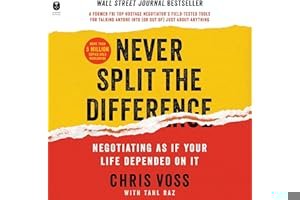
A former international hostage negotiator for the FBI offers a new, field-tested approach to high-stakes negotiations—whether in the boardroom or at home.
After a stint policing the rough streets of Kansas City, Missouri, Chris Voss joined the FBI, where his career as a hostage negotiator brought him face-to-face with a range of criminals, including bank robbers and terrorists. Reaching the pinnacle of his profession, he became the FBI’s lead international kidnapping negotiator. Never Split the Difference takes you inside the world of high-stakes negotiations and into Voss’s head, revealing the skills that helped him and his colleagues to succeed where it mattered most: saving lives. In this practical guide, he shares the nine effective principles—counter-intuitive tactics and strategies—you too can use to become more persuasive in both your professional and personal life.
Life is a series of negotiations you should be prepared for: buying a car; negotiating a salary; buying a home; renegotiating rent; deliberating with your partner. Taking emotional intelligence and intuition to the next level, Never Split the Difference gives you the competitive edge in any discussion.
Emphasizes the importance of emotional intelligence without sacrificing deal-making power. From the pen of a former hostage negotiator—someone who couldn’t take no for an answer—which makes it fascinating reading. But it’s also eminently practical. In these pages, you will find the techniques for getting the deal you want. [source]
This book blew my mind. It’s a riveting read, full of instantly actionable advice—not just for high-stakes negotiations, but also for handling everyday conflicts at work and at home. [source]
Cover unavailable
2
Behave: The Biology of Humans at Our Best and Worst
"It's no exaggeration to say that Behave is one of the best nonfiction books I've ever read." --David P. Barash, The Wall Street Journal
"It has my vote for science book of the year." --Parul Sehgal, The New York Times
"Hands-down one of the best books I've read in years. I loved it." --Dina Temple-Raston, TheWashington Post Named a Best Book of the Year by The Washington Post and The Wall Street Journal
From the celebrated neurobiologist and primatologist, a landmark, genre-defining examination of human behavior, both good and bad, and an answer to the question: Why do we do the things we do?
Sapolsky's storytelling concept is delightful but it also has a powerful intrinsic logic: he starts by looking at the factors that bear on a person's reaction in the precise moment a behavior occurs, and then hops back in time from there, in stages, ultimately ending up at the deep history of our species and its evolutionary legacy.
And so the first category of explanation is the neurobiological one. A behavior occurs--whether an example of humans at our best, worst, or somewhere in between. What went on in a person's brain a second before the behavior happened? Then Sapolsky pulls out to a slightly larger field of vision, a little earlier in time: What sight, sound, or smell caused the nervous system to produce that behavior? And then, what hormones acted hours to days earlier to change how responsive that individual is to the stimuli that triggered the nervous system? By now he has increased our field of vision so that we are thinking about neurobiology and the sensory world of our environment and endocrinology in trying to explain what happened.
Sapolsky keeps going: How was that behavior influenced by structural changes in the nervous system over the preceding months, by that person's adolescence, childhood, fetal life, and then back to his or her genetic makeup? Finally, he expands the view to encompass factors larger than one individual. How did culture shape that individual's group, what ecological factors millennia old formed that culture? And on and on, back to evolutionary factors millions of years old.
The result is one of the most dazzling tours d'horizon of the science of human behavior ever attempted, a majestic synthesis that harvests cutting-edge research across a range of disciplines to provide a subtle and nuanced perspective on why we ultimately do the things we do...for good and for ill. Sapolsky builds on this understanding to wrestle with some of our deepest and thorniest questions relating to tribalism and xenophobia, hierarchy and competition, morality and free will, and war and peace. Wise, humane, often very funny, Behave is a towering achievement, powerfully humanizing, and downright heroic in its own right.
“Packed with science and human stories, the book is an intense read. . . . The struggle and resilience of [van der Kolk’s] patients is very moving.” —New Scientist
A pioneering researcher transforms our understanding of trauma and offers a bold new paradigm for healing
Trauma is a fact of life. Veterans and their families deal with the painful aftermath of combat; one in five Americans has been molested; one in four grew up with alcoholics; one in three couples have engaged in physical violence. Dr. Bessel van der Kolk, one of the world’s foremost experts on trauma, has spent over three decades working with survivors. In The Body Keeps the Score, he uses recent scientific advances to show how trauma literally reshapes both body and brain, compromising sufferers’ capacities for pleasure, engagement, self-control, and trust. He explores innovative treatments—from neurofeedback and meditation to sports, drama, and yoga—that offer new paths to recovery by activating the brain’s natural neuroplasticity. Based on Dr. van der Kolk’s own research and that of other leading specialists, The Body Keeps the Score exposes the tremendous power of our relationships both to hurt and to heal—and offers new hope for reclaiming lives.
…
Recommended by Matthew Green.
Matthew Green
Reading The Body Keeps the Score was a eureka moment for me. [source]
Cover unavailable
4
The New Jim Crow: Mass Incarceration in the Age of Colorblindness
"Jarvious Cotton's great-great-grandfather could not vote as a slave. His great-grandfather was beaten to death by the Klu Klux Klan for attempting to vote. His grandfather was prevented from voting by Klan intimidation; his father was barred by poll taxes and literacy tests. Today, Cotton cannot vote because he, like many black men in the United States, has been labeled a felon and is currently on parole."
As the United States celebrates the nation's "triumph over race" with the election of Barack Obama, the majority of young black men in major American cities are locked behind bars or have been labeled felons for life. Although Jim Crow laws have been wiped off the books, an astounding percentage of the African American community remains trapped in a subordinate status--much like their grandparents before them.
In this incisive critique, former litigator-turned-legal-scholar Michelle Alexander provocatively argues that we have not ended racial caste in America: we have simply redesigned it. Alexander shows that, by targeting black men and decimating communities of color, the U.S. criminal justice system functions as a contemporary system of racial control, even as it formally adheres to the principle of color blindness. The New Jim Crow challenges the civil rights community--and all of us--to place mass incarceration at the forefront of a new movement for racial justice in America.
I read The New Jim Crow, a study of how the U.S. justice system disproportionately criminalizes and jails blacks and Latinos. Making our criminal justice system fairer and more effective is a huge challenge for our country. I’m going to keep learning about this topic, but some things are already clear: We can’t jail our way to a just society, and our current system isn’t working (adapted with permission from Facebook’s A Year of Books project). [source]
Peter Temin
The new Jim Crow that Michelle Alexander is talking about is mass incarceration. [source]
Cover unavailable
5
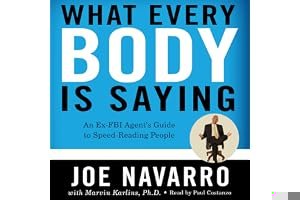
What Every Body is Saying: An Ex-FBI Agent's Guide to Speed-Reading People
Read this book and send your nonverbal intelligence soaring. Joe Navarro, a former FBI counterintelligence officer and a recognized expert on nonverbal behavior, explains how to "speed-read" people: decode sentiments and behaviors, avoid hidden pitfalls, and look for deceptive behaviors. You'll also learn how your body language can influence what your boss, family, friends, and strangers think of you. You will discover:
The ancient survival instincts that drive body language Why the face is the least likely place to gauge a person's true feelings What thumbs, feet, and eyelids reveal about moods and motives The most powerful behaviors that reveal our confidence and true sentiments Simple nonverbals that instantly establish trust Simple nonverbals that instantly communicate authority Filled with examples from Navarro's professional experience, this definitive book offers a powerful new way to navigate your world.
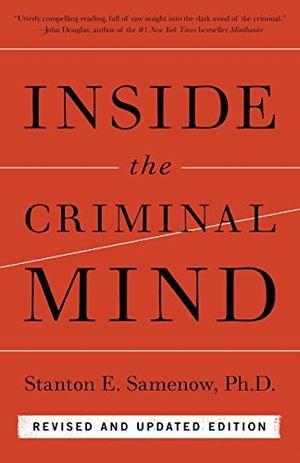
Inside the Criminal Mind: Revised and Updated Edition
Stanton Samenow
4.8
Long-held myths defining the sources of and cures for crime are shattered in this ground-breaking book--and a chilling profile of today's criminal emerges.
What I like about it is the honesty with which, as psychologists, they described their interactions with criminals. They discuss, initially, various attempts to get people to stop being criminals… It emphasises agency. A lot of the sociological explanations ignore the fact that the people from very similar backgrounds can end up very differently. [source]
Cover unavailable
7
Without Conscience: The Disturbing World of the Psychopaths Among Us
Robert D. Hare
4.7
Most people are both repelled and intrigued by the images of cold-blooded, conscienceless murderers that increasingly populate our movies, television programs, and newspaper headlines. With their flagrant criminal violation of society's rules, serial killers like Ted Bundy and John Wayne Gacy are among the most dramatic examples of the psychopath. Individuals with this personality disorder are fully aware of the consequences of their actions and know the difference between right and wrong, yet they are terrifyingly self-centered, remorseless, and unable to care about the feelings of others. Perhaps most frightening, they often seem completely normal to unsuspecting targets--and they do not always ply their trade by killing. Presenting a compelling portrait of these dangerous men and women based on 25 years of distinguished scientific research, Dr. Robert D. Hare vividly describes a world of con artists, hustlers, rapists, and other predators who charm, lie, and manipulate their way through life. Are psychopaths mad, or simply bad? How can they be recognized? And how can we protect ourselves? This book provides solid information and surprising insights for anyone seeking to understand this devastating condition.
…
Cover unavailable
8
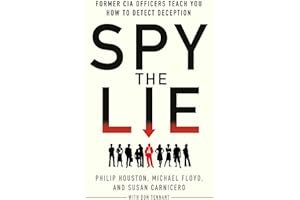
Spy the Lie: Former CIA Officers Teach You How to Detect Deception
Three former CIA officers--among the world's foremost authorities on recognizing deceptive behavior--share their proven techniques for uncovering a lie
Imagine how different your life would be if you could tell whether someone was lying or telling you the truth. Be it hiring a new employee, investing in a financial interest, speaking with your child about drugs, confronting your significant other about suspected infidelity, or even dating someone new, having the ability to unmask a lie can have far-reaching and even life-altering consequences.
As former CIA officers, Philip Houston, Michael Floyd, and Susan Carnicero are among the world's best at recognizing deceptive behavior. "Spy the Lie "chronicles the captivating story of how they used a methodology Houston developed to detect deception in the counterterrorism and criminal investigation realms, and shows how these techniques can be applied in our daily lives.
Through fascinating anecdotes from their intelligence careers, the authors teach readers how to recognize deceptive behaviors, both verbal and nonverbal, that we all tend to display when we respond to questions untruthfully. For the first time, they share with the general public their methodology and their secrets to the art of asking questions that elicit the truth.
""
"Spy the Lie" is a game-changer. You may never read another book that has a more dramatic impact on your career, your relationships, or your future.
…
Recommended by Bogdan Savonea.
Bogdan Savonea
"What five books would you recommend to young people interested in your career path & why? ""Spy the lie"" by Philip Houston and Michael Floyd and ""The subtle art of not giving a f*ck"" + ""Everything is f*cked"" by Mark Manson. I'd leave the remaining 2 books to their spirit of discovery." [source]
Cover unavailable
9
Forensic Psychology for Dummies
David V. Canter, Ian Rankin
4.5
A fascinating guide on the psychology of crime. Thinking of a career that indulges your CSI fantasies? Want to understand the psychology of crime? Whether studying it for the first time or an interested spectator, "Forensic Psychology For Dummies" gives you all the essentials for understanding this exciting field, complemented with fascinating case examples from around the world.
Inside you'll find out why people commit crime, how psychology helps in the investigative process, the ways psychologists work with criminals behind bars - and how you too can become a forensic psychologist. You'll discover what a typical day is like for a forensic psychologist, how they work with the police to build offender profiles, interview suspects or witnesses, and detect lies!Covers the important role psychology plays in assessing offendersExplains how psychology is applied in the courtroomExplains complicated psychology concepts in easy-to-understand terms
If you're a student considering taking forensic psychology or just love to learn about the science behind crime, "Forensic Psychology For Dummies" is everything you need to get up-to-speed on this fascinating subject.
When I was given the task of putting Forensic Psychology for Dummies together, I really had to embrace the whole discipline and find a way of dealing with it that was engaging and scholarly, without being pompous. [source]
Cover unavailable
10
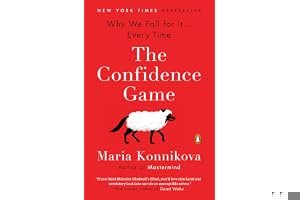
The Confidence Game: Why We Fall for It . . . Every Time
From the New York Times bestselling author of Mastermind, a compelling investigation into the minds, motives, and methods of con artists—and the people who fall for their cons over and over again
While cheats and swindlers may be a dime a dozen, true conmen—the Bernie Madoffs, the Jim Bakkers, the Lance Armstrongs—are elegant, outsized personalities, artists of persuasion and exploiters of trust. How do they do it? Why are they successful? And what keeps us falling for it, over and over again? These are the questions that journalist and psychologist Maria Konnikova tackles in her mesmerizing new book.
From multimillion-dollar Ponzi schemes to small-time frauds, Konnikova pulls together a selection of fascinating stories to demonstrate what all cons share in common, drawing on scientific, dramatic, and psychological perspectives. Insightful and gripping, the book brings readers into the world of the con, examining the relationship between artist and victim. The Confidence Game asks not only why we believe con artists, but also examines the very act of believing and how our sense of truth can be manipulated by those around us.
…
Recommended by Gordon Tredgold.
Gordon Tredgold
This Brilliant Writer Thought She’d Write a Book About Playing Professional Poker. Then She Won a Tournament https://t.co/jRE17q6mFJ #Leadership #Florida #Business [source]
Cover unavailable
11
Introduction to Forensic Psychology: Research and Application
Anne M. Bartol and Curtis R. Bartol
4.5
Written by authors with extensive experience in the field and in the classroom, Introduction to Forensic Psychology: Research and Application, Fifth Edition, by Curt R. Bartol and Anne M. Bartol, demonstrates how to analyze psychological knowledge and research findings and then apply these findings to the civil and criminal justice systems. Focusing on research-based forensic practice and practical application, this text uses real-life examples and case law discussions to define and explore forensic psychology. This text introduces you to emerging specializations within forensic psychology, including investigative psychology, family forensic psychology, and police and public safety psychology. You will develop a multicultural perspective with an ethnic and racial sensitivity, which is critical to the successful practice of forensic psychology.
New to the Fifth Edition:
Updated statistics, research, and case law, such as recent Aid in Dying legislation, as well as analysis of recent events, help you see the real-world applications to current events.
Updated Focus boxes empower you to dig deeper into current issues, such as mental health courts, community-oriented policing, child abduction, hate crimes, the death penalty, and more. All Focus boxes also contain discussion questions for you to debate in a classroom setting.
All new From My Perspective boxes provide you with information about career choices as well as helpful advice about pursuing your career goals.
Increased attention to immigration-related issues offers you additional insights into immigration proceedings and ways to consult with the courts.
Additional coverage of human trafficking and online sexual predators enables you to better understand the psychological effects on victims and the services available to help.
Current research on violent video games, cyberbullying, and cyberstalking provides real examples of the effects of violent media.
New research on juveniles allows you to see the important contributions of neuropsychologists, particularly in terms of brain development in adolescents and promising community-based treatment approaches for juveniles.
Well, the Bartols have devoted their lives to writing these very broad-based, very well-informed textbooks. It’s very much in the American tradition of the textbook, which is a really major undertaking… It’s got an American bias, inevitably. But if somebody wants a detailed overview of forensic psychology, this is probably the best. [source]
Cover unavailable
12
The Silence of the Lambs (Hannibal Lecter, #2)
Thomas Harris
4.4
Hannibal Lecter. The ultimate villain of modern fiction. Read the five-million-copy bestseller that scared the world silent. The Silence of the Lambs. A young FBI trainee. An evil genius locked away for unspeakable crimes. A plunge into the darkest chambers of a psychopath's mind--in the deadly search for a serial killer. - back cover
If you want to be a crime writer it is one of the books that you absolutely have to read. It has been one of the most successful, if not the most successful, crime novel of the 20th century. [source]
Cover unavailable
13
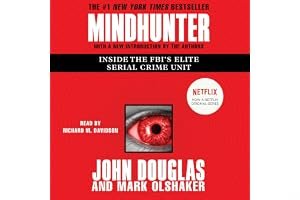
Mindhunter: Inside the FBI's Elite Serial Crime Unit
John E. Douglas
4.4
Discover the classic, behind-the-scenes chronicle of John E. Douglas’ twenty-five-year career in the FBI Investigative Support Unit, where he used psychological profiling to delve into the minds of the country’s most notorious serial killers and criminals—the basis for the upcoming Netflix original series.
In chilling detail, the legendary Mindhunter takes us behind the scenes of some of his most gruesome, fascinating, and challenging cases—and into the darkest recesses of our worst nightmares.
During his twenty-five year career with the Investigative Support Unit, Special Agent John Douglas became a legendary figure in law enforcement, pursuing some of the most notorious and sadistic serial killers of our time: the man who hunted prostitutes for sport in the woods of Alaska, the Atlanta child murderer, and Seattle's Green River killer, the case that nearly cost Douglas his life.
As the model for Jack Crawford in The Silence of the Lambs, Douglas has confronted, interviewed, and studied scores of serial killers and assassins, including Charles Manson, Ted Bundy, and Ed Gein, who dressed himself in his victims' peeled skin. Using his uncanny ability to become both predator and prey, Douglas examines each crime scene, reliving both the killer's and the victim's actions in his mind, creating their profiles, describing their habits, and predicting their next moves.
Improve communication, resolve conflicts, and avoid the most common conversational disasters through simple, easily remembered strategies that deflect and redirect negative behaviour.
Verbal Judo is the martial art of the mind and mouth that can show you how to be better prepared in every verbal encounter. Listen and speak more effectively, engage people through empathy (the most powerful word in the English language), avoid the most common conversational disasters, and use proven strategies that allow you to successfully communicate your point of view and take the upper hand in most disputes.
…
Cover unavailable
15
The Like Switch: An Ex-FBI Agent's Guide to Influencing, Attracting, and Winning People Over
From a former FBI Special Agent specializing in behavior analysis and recruiting spies comes a handbook filled with his proven strategies on how to instantly read people and influence how they perceive you, so you can easily turn on thelike switch.
The Like Switch is packed with all the tools you need for turning strangers into friends, whether you are on a sales call, a first date, or a job interview. As a Special Agent for the FBI’s National Security Division’s Behavioral Analysis Program, Dr. Jack Schafer developed dynamic and breakthrough strategies for profiling terrorists and detecting deception. Now, Dr. Schafer has evolved his proven-on-the-battlefield tactics for the day-to-day, but no less critical battle of getting people to like you.
In The Like Switch, he presents these techniques for how you can influence, attract, and win people over. Learn how to think and react like your favorite TV investigators from Criminal Minds or CSI as Dr. Schafer shows you how toimprove your LQ (Likeability Quotient), “spot the lie” both in person and online, master nonverbal cues that influence how people perceive you, and turn up or turn down the intensity of a relationship.
Dr. Schafer cracks the code on making great first impressions, building lasting relationships, and understanding others’ behavior to learn what they really think about you. With tips and techniques that hold the key to taking control of your communications, interactions, and relationships, The Like Switch shows you how to read others and get people to like you for a moment or a lifetime.
…
Cover unavailable
16
Homicide: A Year on the Killing Streets
David Simon
4.3
The scene is Baltimore; the year is 1988. Twice every three days another citizen is shot, stabbed, or bludgeoned to death. At the center of this hurricane of crime is the city's homicide unit, a small group of hard men who battle to achieve a bit of rough justice in a deadly world. This is their story.
Recommended by John R Stanton.
John R Stanton
@grisuy @anthoknees The snot boogy story is also based on something that really happened as I recall. If you haven’t read @AoDespair’s book Homicide, you should. It’s amazing and has a lot of the source material from the Wire and Homicide the show. [source]
Cover unavailable
17
Dark Dreams: Sexual Violence, Homicide and the Criminal Mind
Roy Hazelwood, Stephen G. Michaud
4.3
Profiler Roy Hazelwood is the world's leading expert on the strangest and most dangerous of all aberrant offenders--the sexual criminal. In Dark Dreams he reveals the twisted motives and perverse thinking that go into the most reprehensible crimes. He also catalogs the innovative and remarkably effective techniques--techniques that he helped pioneer at the FBI's Behavioral Science Unit--that allow Law Enforcement agents to construct psychological profiles of the offenders who comit them.
Hazelwood has helped track down some of the most violent and well known criminals in modern history; in Dark Dreams he takes readers into his world--a sinister world inhabited by scores of dangerous offenders for every Roy Hazelwood who would put them behind bars. These are sexual sadists, serial rapists, child molesters, and serial killers. The cases he describes are as shocking as they are perplexing; their resolutions are as fascinating as they are innovative:
* A young woman disappears from the convenience store where she works. Her body is later found in a field, strapped to a makeshift St. Andrew's Cross and mutilated beyond description. Who committed this heinous crime? And why?
* A teenager's corpse is found hanging in a storm sewer. His clothes are neatly folded by the entrance and a stopwatch lies in the grime beneath him. Is he the victim of a bizarre, ritualistic murder . . . or an elaborate masturbatory fantasy gone awry?
* A married couple, driving with their toddler in the back seat, pick up a female hitchhiker. They kidnap her and for seven years keep her in a box under their bed as a sexual slave. The wife had agreed to this inhuman arrangement in exchange for a second child. Who was to blame?
But as gruesome as the crimes are and as unsettling as the odds seem, Hazelwood, writing with veteran journalsit Stephen Michaud, proves that the right amounts of determination and logic can bring even the most cunning and devious criminals to justice.
Dark Dreams is a 2002 Edgar Award Nominee for Best Fact Crime.
…
Cover unavailable
18
The Gift of Fear: Survival Signals That Protect Us from Violence
Gavin De Becker
4.3
True fear is a gift. Unwarranted fear is a curse. Learn how to tell the difference.
A date won't take "no" for an answer. The new nanny gives a mother an uneasy feeling. A stranger in a deserted parking lot offers unsolicited help. The threat of violence surrounds us every day. But we can protect ourselves, by learning to trust—and act on—our gut instincts.
In this empowering book, Gavin de Becker, the man Oprah Winfrey calls the nation's leading expert on violent behavior, shows you how to spot even subtle signs of danger—before it's too late. Shattering the myth that most violent acts are unpredictable, de Becker, whose clients include top Hollywood stars and government agencies, offers specific ways to protect yourself and those you love, including how to act when approached by a stranger, when you should fear someone close to you, what to do if you are being stalked, how to uncover the source of anonymous threats or phone calls, the biggest mistake you can make with a threatening person, and more. Learn to spot the danger signals others miss. It might just save your life.
The Gift of Fear by Gavin de Becker shares a bunch of anecdotes from violent attacks, how the victims often knew per instinct that something wasn’t right, but suppressed that instinct for fear of seeming rude or silly or whatever. He also presents a bunch of analytical frameworks for evaluating threats, stalkers, and other menaces. But it’s not a dry textbook. Gavin had a violent upbringing and brings a lot of personal anecdotes and perspectives to bear as well. [source]
Nicholas C. Zakas
If I had a daughter, girlfriend, or wife, I’d highly recommend this book to them. https://t.co/rwuAY7cIXw Less useful for men unless you have reason to fear assassination, but an interesting read nonetheless. [source]
Cover unavailable
19
A Time to Kill (Jake Brigance, #1)
John Grisham, Michael Beck, et al
4.3
Librarian's Note: Alternate-cover edition for ISBN 0385338600 / 9780385338608
Before The Firm and The Pelican Brief made him a superstar, John Grisham wrote this riveting story of retribution and justice. In this searing courtroom drama, best-selling author John Grisham probes the savage depths of racial violence...as he delivers a compelling tale of uncertain justice in a small southern town...Clanton, Mississippi.
The life of a ten-year-old girl is shattered by two drunken and remorseless young men. The mostly white town reacts with shock and horror at the inhuman crime. Until her black father acquires an assault rifle and takes matters into his hands.
For ten days, as burning crosses and the crack of sniper fire spread through the streets of Clanton, the nation sits spellbound as young defense attorney Jake Brigance struggles to save his client's life...and then his own.
This was the holiday-reading book which, as a teenager, inspired me to pursue criminal law. The gritty reality of criminal practice is of course somewhat removed from the fictionalised ideal, and any lawyer acting in the way that our hero Jake Brigance does in securing a just outcome for his innocent client would have to deal with fairly serious professional consequences, but the underlying themes transcend time and realities. [source]
Cover unavailable
20
In the Realm of Hungry Ghosts: Close Encounters with Addiction
Gabor Maté
4.3
Based on Gabor Maté’s two decades of experience as a medical doctor and his groundbreaking work with the severely addicted on Vancouver’s skid row, In the Realm of Hungry Ghosts radically reenvisions this much misunderstood field by taking a holistic approach. Dr. Maté presents addiction not as a discrete phenomenon confined to an unfortunate or weak-willed few, but as a continuum that runs throughout (and perhaps underpins) our society; not a medical "condition" distinct from the lives it affects, rather the result of a complex interplay among personal history, emotional, and neurological development, brain chemistry, and the drugs (and behaviors) of addiction. Simplifying a wide array of brain and addiction research findings from around the globe, the book avoids glib self-help remedies, instead promoting a thorough and compassionate self-understanding as the first key to healing and wellness. In the Realm of Hungry Ghosts argues persuasively against contemporary health, social, and criminal justice policies toward addiction and those impacted by it. The mix of personal stories—including the author’s candid discussion of his own "high-status" addictive tendencies—and science with positive solutions makes the book equally useful for lay readers and professionals.
If you wanted to design a system that would make addiction worse, you’d design the system we have now. [source]
Cover unavailable
21
The Alienist (Dr. Laszlo Kreizler, #1)
Caleb Carr
4.3
When The Alienist was first published in 1994, it was a major phenomenon, spending six months on the New York Times bestseller list, receiving critical acclaim, and selling millions of copies. This modern classic continues to be a touchstone of historical suspense fiction for readers everywhere.
The year is 1896. The city is New York. Newspaper reporter John Schuyler Moore is summoned by his friend Dr. Laszlo Kreizler—a psychologist, or “alienist”—to view the horribly mutilated body of an adolescent boy abandoned on the unfinished Williamsburg Bridge. From there the two embark on a revolutionary effort in criminology: creating a psychological profile of the perpetrator based on the details of his crimes. Their dangerous quest takes them into the tortured past and twisted mind of a murderer who will kill again before their hunt is over.
Fast-paced and riveting, infused with historical detail, The Alienist conjures up Gilded Age New York, with its tenements and mansions, corrupt cops and flamboyant gangsters, shining opera houses and seamy gin mills. It is an age in which questioning society’s belief that all killers are born, not made, could have unexpected and fatal consequences.
…
Recommended by Douglas Starr.
Douglas Starr
‘Alienist’ was the term for a psychiatrist or a psychologist at the time. They were called alienists because mentally deranged people were thought to be alienated from themselves. This is a wonderful historical novel, written in 1994, about one such alienist in New York City, who helps solve a series of grizzly serial killings at the time when Theodore Roosevelt was the commissioner of police. [source]
Cover unavailable
22
Unnatural Causes
Richard Shepherd
4.3
As the UK's top forensic pathologist, Dr Richard Shepherd has spent a lifetime uncovering the secrets of the dead. When death is sudden or unexplained, it falls to Shepherd to establish the cause. Each post-mortem is a detective story in its own right - and Shepherd has performed over 23,000 of them. Through his skill, dedication and insight, Dr Shepherd solves the puzzle to answer our most pressing question: how did this person die?
From serial killer to natural disaster, 'perfect murder' to freak accident, Shepherd takes nothing for granted in pursuit of truth. And while he's been involved in some of the most high-profile cases of recent times, it's often the less well known encounters that prove the most perplexing, intriguing and even bizarre. In or out of the public eye, his evidence has put killers behind bars, freed the innocent and turned open-and-shut cases on their heads.
But a life in death, bearing witness to some of humanity's darkest corners, exacts a price and Shepherd doesn't flinch from counting the cost to him and his family.
Death's Acre: Inside the Legendary Forensic Lab the Body Farm Where the Dead Do Tell Tales
William Bass and Jon Jefferson
4.3
Dr. Bill Bass, one of the world's leading forensic anthropologists, gained international attention when he built a forensic lab like no other: The Body Farm. Now, this master scientist unlocks the gates of his lab to reveal his most intriguing cases-and to revisit the Lindbergh kidnapping and murder, fifty years after the fact.
Cover unavailable
24
The Threat: How the FBI Protects America in the Age of Terror and Trump
Andrew G. McCabe
4.3
#1 New York Times Bestseller #1 Washington Post Bestseller #1 Wall Street Journal Bestseller
On March 16, 2018, just twenty-six hours before his scheduled retirement from the organization he had served with distinction for more than two decades, Andrew G. McCabe was fired from his position as deputy director of the FBI. President Donald Trump celebrated on Twitter: "Andrew McCabe FIRED, a great day for the hard working men and women of the FBI - A great day for Democracy."
In The Threat: How the FBI Protects America in the Age of Terror and Trump, Andrew G. McCabe offers a dramatic and candid account of his career, and an impassioned defense of the FBI's agents, and of the institution's integrity and independence in protecting America and upholding our Constitution.
McCabe started as a street agent in the FBI's New York field office, serving under director Louis Freeh. He became an expert in two kinds of investigations that are critical to American national security: Russian organized crime--which is inextricably linked to the Russian state--and terrorism. Under Director Robert Mueller, McCabe led the investigations of major attacks on American soil, including the Boston Marathon bombing, a plot to bomb the New York subways, and several narrowly averted bombings of aircraft. And under James Comey, McCabe was deeply involved in the controversial investigations of the Benghazi attack, the Clinton Foundation's activities, and Hillary Clinton's use of a private email server when she was secretary of state.
The Threat recounts in compelling detail the time between Donald Trump's November 2016 election and McCabe's firing, set against a page-turning narrative spanning two decades when the FBI's mission shifted to a new goal: preventing terrorist attacks on Americans. But as McCabe shows, right now the greatest threat to the United States comes from within, as President Trump and his administration ignore the law, attack democratic institutions, degrade human rights, and undermine the U.S. Constitution that protects every citizen.
Important, revealing, and powerfully argued, The Threat tells the true story of what the FBI is, how it works, and why it will endure as an institution of integrity that protects America.
…
Recommended by Matt Zapotosky.
Matt Zapotosky
Former FBI Deputy Director Andrew McCabe is publishing a book in December. Press release says he will "share a candid account of his career and an impassioned defense of the FBI’s agents, integrity, and independence in protecting America and upholding our Constitution." https://t.co/t8DPHGQtWL [source]
Cover unavailable
25
Sexual Homicide: Patterns and Motives
John E. Douglas, Ann W. Burgess, Robert K. Ressler
4.3
Who are the men committing the rising number of serial homicides in the U.S. -- and why do they kill? The increase in these violent crimes over the past decade has created an urgent need for more and better information about these men: their crime scene patterns, violent acts, and above all, their motivations for committing these shocking and repetitive murders.
This authoritative book represents the data, findings, and implications of a long-term F.B.I.-sponsored study of serial sex killers. Specially trained F.B.I. agents examined thirty-six convicted, incarcerated sexual murderers to build a valuable new bank of information which reveals the world of the serial sexual killer in both quantitative and qualitative detail. Data was obtained from official psychiatric and criminal records, court transcripts, and prison reports, as well as from extensive interviews with the offenders themselves.
Featured in this book is detailed information on the F.B.I.'s recently developed Violent Criminal Apprehension Program (VICAP) and a sample of an actual VICAP Crime Analysis Report Form.
…
Cover unavailable
26
The Sociopath Next Door
Martha Stout
4.2
Who is the devil you know?
Is it your lying, cheating ex-husband? Your sadistic high school gym teacher? Your boss who loves to humiliate people in meetings? The colleague who stole your idea and passed it off as her own?
In the pages of The Sociopath Next Door, you will realize that your ex was not just misunderstood. He’s a sociopath. And your boss, teacher, and colleague? They may be sociopaths too.
We are accustomed to think of sociopaths as violent criminals, but in The Sociopath Next Door, Harvard psychologist Martha Stout reveals that a shocking 4 percent of ordinary people—one in twenty-five—has an often undetected mental disorder, the chief symptom of which is that that person possesses no conscience. He or she has no ability whatsoever to feel shame, guilt, or remorse. One in twenty-five everyday Americans, therefore, is secretly a sociopath. They could be your colleague, your neighbor, even family. And they can do literally anything at all and feel absolutely no guilt.
How do we recognize the remorseless? One of their chief characteristics is a kind of glow or charisma that makes sociopaths more charming or interesting than the other people around them. They’re more spontaneous, more intense, more complex, or even sexier than everyone else, making them tricky to identify and leaving us easily seduced. Fundamentally, sociopaths are different because they cannot love. Sociopaths learn early on to show sham emotion, but underneath they are indifferent to others’ suffering. They live to dominate and thrill to win.
The fact is, we all almost certainly know at least one or more sociopaths already. Part of the urgency in reading The Sociopath Next Door is the moment when we suddenly recognize that someone we know—someone we worked for, or were involved with, or voted for—is a sociopath. But what do we do with that knowledge? To arm us against the sociopath, Dr. Stout teaches us to question authority, suspect flattery, and beware the pity play. Above all, she writes, when a sociopath is beckoning, do not join the game.
It is the ruthless versus the rest of us, and The Sociopath Next Door will show you how to recognize and defeat the devil you know.
…
Cover unavailable
27
Snakes in Suits: When Psychopaths Go to Work
Paul Babiak, Robert D. Hare
4.2
When Psychopaths Go to Work
Let's say you're about to hire somebody for a position in your company. Your corporation wants someone who's fearless, charismatic, and full of new ideas. Candidate X is charming, smart, and has all the right answers to your questions. Problem solved, right? Maybe not.
We'd like to think that if we met someone who was completely without conscience–someone who was capable of doing anything at all if it served his or her purposes–we would recognize it. In popular culture, the image of the psychopath is of someone like Hannibal Lecter or the BTK Killer. But in reality, many psychopaths just want money, or power, or fame, or simply a nice car. Where do these psychopaths go? Often, it's to the corporate world.
Researchers Paul Babiak and Robert Hare have long studied psychopaths. Hare, the author of Without Conscience, is a world–renowned expert on psychopathy, and Babiak is an industrial–organizational psychologist. Recently the two came together to study how psychopaths operate in corporations, and the results were surprising. They found that it's exactly the modern, open, more flexible corporate world, in which high risks can equal high profits, that attracts psychopaths. They may enter as rising stars and corporate saviors, but all too soon they're abusing the trust of colleagues, manipulating supervisors, and leaving the workplace in shambles.
Snakes in Suits is a compelling, frightening, and scientifically sound look at exactly how psychopaths work in the corporate environment: what kind of companies attract them, how they negotiate the hiring process, and how they function day by day. You'll learn how they apply their "instinctive" manipulation techniques–assessing potential targets, controlling influential victims, and abandoning those no longer useful–to business processes such as hiring, political command and control, and executive succession, all while hiding within the corporate culture. It's a must read for anyone in the business world, because whatever level you're at, you'll learn the subtle warning signs of psychopathic behavior and be able to protect yourself and your company–before it's too late.
…
Recommended by David Ruddock.
David Ruddock
If this topic interests you (I find it VERY interesting, and terrifying), I highly recommend this book: Snakes in Suits. It's a description and "guide" to psychopathy in the workplace. This is very much A Thing. https://t.co/LxMm236kLe [source]
Cover unavailable
28
The Dark Side of the Mind: True Stories from My Life as a Forensic Psychologist
Kerry Daynes
4.2
Welcome to the world of the forensic psychologist, where the people you meet are wildly unpredictable and often frightening.
The job: to delve into the psyche of convicted men and women to try to understand what lies behind their often brutal actions.
Follow in the footsteps of Kerry Daynes, one of the most sought-after forensic psychologists in the business and consultant on major police investigations.
Kerry's job has taken her to the cells of maximum-security prisons, police interview rooms, the wards of secure hospitals and the witness box of the court room.
Her work has helped solve a cold case, convict the guilty and prevent a vicious attack.
Spending every moment of your life staring into the darker side of life comes with a price. Kerry's frank memoir gives an unforgettable insight into the personal and professional dangers in store for a female psychologist working with some of the most disturbing men and women.
…
Cover unavailable
29
Gone Girl
Gillian Flynn
4.2
On a warm summer morning in North Carthage, Missouri, it is Nick and Amy Dunne’s fifth wedding anniversary. Presents are being wrapped and reservations are being made when Nick’s clever and beautiful wife disappears. As the police begin to investigate, the town golden boy parades a series of lies, deceits, and inappropriate behavior. Nick is oddly evasive, and he's definitely bitter - but is he really a killer?
Whoever Fights Monsters: My Twenty Years Tracking Serial Killers for the FBI
Robert K. Ressler
4.2
Face-to-face with some of America's most terrifying killers, FBI veteran and ex-Army CID colonel Robert Ressler learned form then how to identify the unknown monsters who walk among us--and put them behind bars. Now the man who coined the phrase "serial killer" and advised Thomas Harris on The Silence of the Lambs shows how is able to track down some of today's most brutal murderers.
Just as it happened in The Silence of the Lambs, Ressler used the evidence at a crime scene to put together a psychological profile of the killers. From the victims they choose, to the way they kill, to the often grotesque souvenirs they take with them--Ressler unlocks the identities of these vicious killers of the police to capture.
And with his discovery that serial killers share certain violent behaviors, Ressler's gone behind prison walls to hear the bizarre first-hand stories countless convicted murderers. Getting inside the mind of a killer to understand how and why he kills, is one of the FBI's most effective ways of helping police bring in killers who are still at large.
Join Ressler as he takes you on the hunt for toady's most dangerous psychopaths. It is a terrifying journey you will not forget.
…
Cover unavailable
31
Evil: Inside Human Violence and Cruelty
Roy Baumeister
4.2
Why is there evil, and what can scientific research tell us about the origins and persistence of evil behavior? Considering evil from the unusual perspective of the perpetrator, Baumeister asks, How do ordinary people find themselves beating their wives? Murdering rival gang members? Torturing political prisoners? Betraying their colleagues to the secret police? Why do cycles of revenge so often escalate?
Baumeister casts new light on these issues as he examines the gap between the victim's viewpoint and that of the perpetrator, and also the roots of evil behavior, from egotism and revenge to idealism and sadism. A fascinating study of one of humankind's oldest problems, Evil has profound implications for the way we conduct our lives and govern our society.
Baumeister reviews the various psychological roots of evil, and what we know about them from social psychology, history and criminology. He argues convincingly that aggression does not come from a single motive in humans, but from a variety of motives, such as practical means-end reasoning, moralistic vengeance, dominance and utopian ideologies. The widespread belief that evil acts come from evil minds is itself an interesting psychological phenomenon. Baumeister argues that the human conception of harmdoing, including violence, depends on whether one takes the viewpoint of the perpetrator or of the victim. [source]
Rabbi Josh Yuter
4. Favorite Book 1: Evil: Inside Human Violence and Cruelty by @RoyFBaumeister. A social psychologist explores how humans perceive the concept of Evil https://t.co/JVpwbtS6pr [source]
Cover unavailable
32
The Killer Across the Table: Unlocking the Secrets of Serial Killers and Predators with the FBI’s Original Mindhunter
John E. Douglas
4.2
‘John Douglas is the FBI's pioneer and master of investigative profiling, and one of the most exciting figures in law enforcement I've had the privilege of knowing’ Patricia Cornwell
‘John Douglas knows more about serial killers than anybody in the world’ Jonathan Demme, Director of The Silence of the Lambs
The legendary FBI criminal profiler, number-one New York Times bestselling author, and inspiration for the hit Netflix show Mindhunter delves deep into the lives and crimes of four of the most disturbing and complex predatory killers, offering never-before-revealed details about his profiling process, and divulging the strategies used to crack some of his most challenging cases.
The FBI’s pioneer of criminal profiling, former special agent John Douglas, has studied and interviewed many of America’s most notorious killers – including Charles Manson, ‘Son of Sam Killer’ David Berkowitz and ‘BTK Strangler’ Dennis Rader. Twenty years after his famous memoir, the man who literally wrote the book on FBI criminal profiling opens his case files once again. In this riveting work of true crime, he spotlights four of the most diabolical criminals he’s confronted, interviewed and learned from.
A glimpse into the mind of a man who has pierced the heart of human darkness, The Killer Across the Table unlocks the ultimate mystery of depravity and the techniques and approaches that have countered evil in the name of justice.
…
Cover unavailable
33
The Psychopath Test: A Journey Through the Madness Industry
Jon Ronson
4.2
In this madcap journey, a bestselling journalist investigates psychopaths and the industry of doctors, scientists, and everyone else who studies them.
The Psychopath Test is a fascinating journey through the minds of madness. Jon Ronson's exploration of a potential hoax being played on the world's top neurologists takes him, unexpectedly, into the heart of the madness industry. An influential psychologist who is convinced that many important CEOs and politicians are, in fact, psychopaths teaches Ronson how to spot these high-flying individuals by looking out for little telltale verbal and nonverbal clues. And so Ronson, armed with his new psychopath-spotting abilities, enters the corridors of power. He spends time with a death-squad leader institutionalized for mortgage fraud in Coxsackie, New York; a legendary CEO whose psychopathy has been speculated about in the press; and a patient in an asylum for the criminally insane who insists he's sane and certainly not a psychopath.
Ronson not only solves the mystery of the hoax but also discovers, disturbingly, that sometimes the personalities at the helm of the madness industry are, with their drives and obsessions, as mad in their own way as those they study. And that relatively ordinary people are, more and more, defined by their maddest edges.
…
Recommended by Memo Akten.
Memo Akten
@therourke you may very well be a pyschopath!, it doesn't mean you'll be an axe wielding homicidal maniac :) (I think I might be a bit pyschopath, dunno. My AE is a bit of a yoyo. At times I might feel more for a fly in a spiderweb than a person). V interesting book: https://t.co/QRAJAZPhDY [source]
Cover unavailable
34
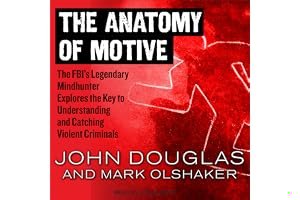
The Anatomy of Motive: The FBI's Legendary Mindhunter Explores the Key to Understanding and Catching Violent Criminals
John E. Douglas, Mark Olshaker
4.2
From legendary FBI profiler John Douglas and Mark Olshaker -- authors of the nonfiction international bestsellers Mindhunter, Journey into Darkness, and Obsession -- comes an unprecedented, insightful look at the root of all crime.
Every crime is a mystery story with a motive at its heart. With the brilliant insight he brought to his renowned work inside the FBI's elite serial-crime unit, John Douglas pieces together motives behind violent sociopathic behavior. He not only takes us into the darkest recesses of the minds of arsonists, hijackers, bombers, poisoners, assassins, serial killers, and mass murderers, but also the seemingly ordinary people who suddenly kill their families or go on a rampage in the workplace.
Douglas identifies the antisocial personality, showing surprising similarities and differences among various types of deadly offenders. He also tracks the progressive escalation of those criminals' sociopathic behavior. His analysis of such diverse killers as Lee Harvey Oswald, Theodore Kaczynski, and Timothy McVeigh is gripping, but more importantly, helps us learn how to anticipate potential violent behavior before it's too late.
…
Cover unavailable
35
I'll Be Gone in the Dark: One Woman's Obsessive Search for the Golden State Killer
Michelle McNamara
4.2
A masterful true crime account of the Golden State Killer—the elusive serial rapist turned murderer who terrorized California for over a decade—from Michelle McNamara, the gifted journalist who died tragically while investigating the case.
"You’ll be silent forever, and I’ll be gone in the dark."
For more than ten years, a mysterious and violent predator committed fifty sexual assaults in Northern California before moving south, where he perpetrated ten sadistic murders. Then he disappeared, eluding capture by multiple police forces and some of the best detectives in the area.
Three decades later, Michelle McNamara, a true crime journalist who created the popular website TrueCrimeDiary.com, was determined to find the violent psychopath she called "the Golden State Killer." McNamara pored over police reports, interviewed victims, and embedded herself in the online communities that were as obsessed with the case as she was.
At the time of the crimes, the Golden State Killer was between the ages of eighteen and thirty, Caucasian, and athletic—capable of vaulting tall fences. He always wore a mask. After choosing a victim—he favored suburban couples—he often entered their home when no one was there, studying family pictures, mastering the layout. He attacked while they slept, using a flashlight to awaken and blind them. Though they could not recognize him, his victims recalled his voice: a guttural whisper through clenched teeth, abrupt and threatening.
I’ll Be Gone in the Dark—the masterpiece McNamara was writing at the time of her sudden death—offers an atmospheric snapshot of a moment in American history and a chilling account of a criminal mastermind and the wreckage he left behind. It is also a portrait of a woman’s obsession and her unflagging pursuit of the truth. Framed by an introduction by Gillian Flynn and an afterword by her husband, Patton Oswalt, the book was completed by McNamara's lead researcher and a close colleague. Utterly original and compelling, it is destined to become a true crime classic—and may at last unmask the Golden State Killer.
…
Cover unavailable
36
Columbine
Dave Cullen
4.2
"The tragedies keep coming. As we reel from the latest horror . . . " So begins a new epilogue, illustrating how Columbine became the template for nearly two decades of "spectacle murders." It is a false script, seized upon by a generation of new killers. In the wake of Newtown, Aurora, and Virginia Tech, the imperative to understand the crime that sparked this plague grows more urgent every year.
What really happened April 20, 1999? The horror left an indelible stamp on the American psyche, but most of what we "know" is wrong. It wasn't about jocks, Goths, or the Trench Coat Mafia. Dave Cullen was one of the first reporters on scene, and spent ten years on this book-widely recognized as the definitive account. With a keen investigative eye and psychological acumen, he draws on mountains of evidence, insight from the world's leading forensic psychologists, and the killers' own words and drawings-several reproduced in a new appendix. Cullen paints raw portraits of two polar opposite killers. They contrast starkly with the flashes of resilience and redemption among the survivors.
…
Cover unavailable
37
Believe Me: How Trusting Women Can Change the World
Jessica Valenti, Jaclyn Friedman
4.2
A powerful anthology of the most well-known feminist voices answering the question: What if we believed women? And making the case that doing so is the key to advancing the modern feminist moment From the leading feminist editors of formative anthology Yes Means Yes, Believe Me brings readers into the current landscape of the anti-sexual violence movement—and outlines how believing women is the critical foundation for future progress. Essays include Jessica Valenti writing about how a woman's word has never been enough in our country, giving context to the question of why we don't believe women. Jaclyn Friedman draws that idea out further, articulating the staggering public health costs of disbelieving women about pain, about pleasure, about reproduction, and beyond. Other contributors touch on: how believing women about on-and-offline violence would transform the internet, how survivors who aren't white or straight struggle to be taken seriously even within anti-rape advocacy; the surprising lesson Native American languages can teach us about gossip as a means of violence prevention and healing; how men are helping each other build masculine identities that aren't dependent on undermining women. Part taking stock of recent movements, part visions for a way forward, Believe Me has the potential to spark change and to appeal to the countless men and women who have been engaging with #metoo and looking to feminist leadership for next steps.
…
Recommended by Soraya Nadia Mcdonald.
Soraya Nadia Mcdonald
For those of you who would like to spend money on a great book that is EXTREMELY well-researched and has dope things to say, might I suggest #BELIEVEME? https://t.co/X1xjm3TUeo [source]
Cover unavailable
38
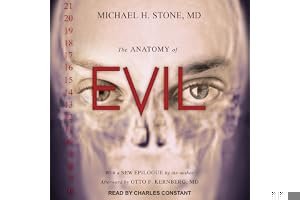
The Anatomy of Evil
Michael H. Stone
4.2
The crimes of Charles Manson, Ted Bundy, Jeffrey Dahmer, John Wayne Gacy, Dennis Rader, and other high-profile killers are so breathtakingly awful that most people would not hesitate to label them "evil." In this groundbreaking book, renowned psychiatrist Michael H. Stone—host of Discovery Channel’s former series Most Evil—uses this common emotional reaction to horrifying acts as his starting point to explore the concept and reality of evil from a new perspective. In an in-depth discussion of the personality traits and behavior that constitute evil across a wide spectrum, Dr. Stone takes a clarifying scientific approach to a topic that for centuries has been inadequately explained by religious doctrines.
Basing his analysis on the detailed biographies of more than 600 violent criminals, Stone has created a 22-level hierarchy of evil behavior, which loosely reflects the structure of Dante’s Inferno. He traces two salient personality traits that run the gamut from those who commit crimes of passion to perpetrators of the worst crimes—sadistic torture and murder. One trait is narcissism, as exhibited in people who are so self-centered that they have little or no ability to care about their victims. The other is aggression, the use of power over another person to inflict humiliation, suffering, and death.
Stone then turns to the various factors that, singly or intertwined, contribute to pushing certain people over the edge into committing heinous crimes. They include heredity, adverse environments, violence-prone cultures, mental illness or brain injury, and abuse of mind-altering drugs. All are considered in the search for the root causes of evil behavior.
What do psychology, psychiatry, and neuroscience tell us about the minds of those whose actions could be described as evil? And what will that mean for the rest of us? Stone discusses how an increased understanding of the causes of evil will affect the justice system. He predicts a day when certain persons can safely be declared salvageable and restored to society and when early signs of violence in children may be corrected before potentially dangerous patterns become entrenched.
…
Cover unavailable
39
Criminological and Forensic Psychology
Helen Gavin
4.2
The second edition of Criminological and Forensic Psychology is an even more theoretically rigorous, practically relevant, engaging and fun introduction to this broad and fascinating field. It covers both the conceptual basis within which psychology knowledge is applied in forensic contexts and the practical applications of psychology to the criminal civil justice systems.
Key Features: Case studies feature in every chapter and place students in the full context of a criminal case, showing them how psychological theories can be used to explain real-life crimes.
In-depth exploration of the fascinating courtroom process including separate chapters on the Defendant's Mind and The Jury.
A dedicated chapter on research methods specific to forensic psychology to help students do their research project around this topic, covering the final year and post-graduate research.
A new chapter on Intimate relationship aggression: Domestic Violence and Domestic Homicide
Online resources including chapter-by-chapter multiple choice questions, additional case studies and links to further readings
…
Cover unavailable
40
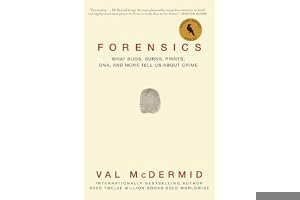
Forensics: What Bugs, Burns, Prints, DNA and More Tell Us About Crime
Val McDermid
4.2
Val McDermid is one of the finest crime writers we have, whose novels have captivated millions of readers worldwide with their riveting narratives of characters who solve complex crimes and confront unimaginable evil. In the course of researching her bestselling novels McDermid has become familiar with every branch of forensics, and now she uncovers the history of this science, real-world murders and the people who must solve them.
The dead talk—to the right listener. They can tell us all about themselves: where they came from, how they lived, how they died, and, of course, who killed them. Forensic scientists can unlock the mysteries of the past and help serve justice using the messages left by a corpse, a crime scene, or the faintest of human traces. Forensics draws on interviews with some of these top-level professionals, ground-breaking research, and McDermid’s own original interviews and firsthand experience on scene with top forensic scientists.
Along the way, McDermid discovers how maggots collected from a corpse can help determine one’s time of death; how a DNA trace a millionth the size of a grain of salt can be used to convict a killer; and how a team of young Argentine scientists led by a maverick American anthropologist were able to uncover the victims of a genocide. It’s a journey that will take McDermid to war zones, fire scenes, and autopsy suites, and bring her into contact with both extraordinary bravery and wickedness, as she traces the history of forensics from its earliest beginnings to the cutting-edge science of the modern day.
…
Cover unavailable
41
A Killer's Mind (Zoe Bentley Mystery, #1)
Mike Omer
4.2
The New York Times and Washington Post bestselling serial-killer thriller that will leave you wondering, is the past really in the past?
Three Chicago women have been found strangled, embalmed, and posed as if still alive. Doubting the findings of the local PD’s profiler, The FBI calls on forensic psychologist Zoe Bentley to investigate.
Zoe quickly gets off on the wrong foot with her new partner, Special Agent Tatum Gray. Zoe’s a hunter, intense and focused; Tatum’s a smug maverick with little respect for the rules. Together, they must descend into a serial killer’s psyche and untangle his twisted fantasies, or more women will die. But when the contents of three inconspicuous envelopes reveal a chilling connection to gruesome murders from Zoe’s childhood, suddenly the hunter becomes the hunted.
…
Cover unavailable
42
Forensic Psychology: A Very Short Introduction
David Canter
4.1
Lie detection, offender profiling, jury selection, insanity in the law, predicting the risk of re-offending, the minds of serial killers, and many other topics that fill news and fiction are all aspects of the rapidly developing area of scientific psychology broadly known as Forensic Psychology. This fascinating Very Short Introduction discusses all the aspects of psychology that are relevant to the legal and criminal process as a whole. It includes explanations of criminal behavior and criminality, including the role of mental disorder in crime, and it reveals how forensic psychology contributes to helping investigate the crime and catching the perpetrators. David Canter also explains how psychologists provide guidance to all those involved in civil and criminal court proceedings, including both the police and the accused, and what expert testimony can be provided by a psychologist about the offender at the trial. Finally, Canter describes how forensic psychology is used, particularly in prisons, to help in the management, treatment and rehabilitation of offenders, once they have been convicted.
…
Cover unavailable
43
Psicología oscura: Una guía esencial de persuasión, manipulación, engaño, control mental, negociación, conducta humana, PNL y
Steven Turner
4.1
Cover unavailable
44
Managing Clinical Risk: A Guide to Effective Practice
Caroline Logan, Lorraine Johnstone
4.1
Violence and self-injury cause anxiety, misery and physical and psychological damage to service users, their carers, the practitioners who look after them, and in some cases, the public at large. This title describes UK and international research and practice in clinical risk management and how it ties in with best practice in risk assessment.
Cover unavailable
45
Evaluation of Criminal Responsibility
Ira K. Packer
4.1
Forensic mental health assessment (FMHA) has grown into a specialization informed by research and professional guidelines. This series presents up-to-date information on the most important and frequently conducted forms of FMHA. The 19 topical volumes address best approaches to practice for particular types of evaluation in the criminal, civil and juvenile/family areas. Each volume contains a thorough discussion of the relevant legal and psychological concepts, followed by a step-by-step description of the assessment process from preparing for the evaluation to writing the report and testifying in court.
Volumes include the following helpful features:
- Boxes that zero in on important information for use in evaluations
- Tips for best practice and cautions against common pitfalls
- Highlighting of relevant case law and statutes
- Separate list of assessment tools for easy reference
- Helpful glossary of key terms for the particular topic
In making recommendations for best practice, authos consider empirical support, legal relevance, and consistency with ethical and professional standards. These volumes offer invaluable guidance for anyone involved in conducting or using forensic evaluations.
…
Cover unavailable
46
Stigma: Notes on the Management of Spoiled Identity
Erving Goffman
4.1
From the author of The Presentation of Self in Everyday Life, Stigma is analyzes a person’s feelings about himself and his relationship to people whom society calls “normal.”
Stigma is an illuminating excursion into the situation of persons who are unable to conform to standards that society calls normal. Disqualified from full social acceptance, they are stigmatized individuals. Physically deformed people, ex-mental patients, drug addicts, prostitutes, or those ostracized for other reasons must constantly strive to adjust to their precarious social identities. Their image of themselves must daily confront and be affronted by the image which others reflect back to them.
Drawing extensively on autobiographies and case studies, sociologist Erving Goffman analyzes the stigmatized person’s feelings about himself and his relationship to “normals” He explores the variety of strategies stigmatized individuals employ to deal with the rejection of others, and the complex sorts of information about themselves they project. In Stigma the interplay of alternatives the stigmatized individual must face every day is brilliantly examined by one of America’s leading social analysts.
…
Recommended by Tom Shakespeare.
Tom Shakespeare
Yes, I went back to Cambridge to do a PhD about how to understand disability and met the sociologist Anthony Gibbons and he said: ‘What are you going to do?’ And I told him my plans. He looked at me and said: ‘Goffman’, and marched off down the street! [source]

Cover unavailable
47
For Laci: A Mother's Story of Love, Loss, and Justice
Sharon Rocha
4.1
Laci Rocha Peterson, 8 months pregnant, was last seen by her sister, Amy, in the late afternoon of December 23, 2002. She spoke to her mother, Sharon Rocha, at 8:30 p.m. that night. This would be the last time anyone from her immediate family ever spoke to her.
A search began which lasted an agonizing four months. Sadly, Laci Peterson and her son Conner were found dead on the shores of San Francisco Bay on April 18, 2003.
Her husband, Scott, was eventually arrested and charged with the murder of Laci and Connor. After a sensational, media-saturated trial, Peterson was found guilty of capital murder and was sentenced to death on March 16, 2005.
This book deals with the story in three separate sections: first, Sharon describes the ordinary, loving life her daughter led, including fond memories of her childhood and adolescence. Second, it covers her marriage, disappearance, the community's moving search for her, and her and Connor's eventual recovery from San Francisco Bay. Third, it tells the story of the trial in detail not before revealed. Sharon will also talk about victim's rights, a subject on which she now campaigns regularly.
From the Hardcover edition.
…
Cover unavailable
48
The Devil You Know: Encounters in Forensic Psychiatry
Gwen Adshead
4.1
Cover unavailable
49
Blueprint: The Evolutionary Origins of a Good Society
Nicholas A. Christakis MD PhD
4.1
For too long, scientists have focused on the dark side of our biological heritage: our capacity for aggression, cruelty, prejudice, and self-interest. But natural selection has given us a suite of beneficial social features, including our capacity for love, friendship, cooperation, and learning. Beneath all of our inventions -- our tools, farms, machines, cities, nations -- we carry with us innate proclivities to make a good society.
In Blueprint, Nicholas A. Christakis introduces the compelling idea that our genes affect not only our bodies and behaviors, but also the ways in which we make societies, ones that are surprisingly similar worldwide.
With many vivid examples -- including diverse historical and contemporary cultures, communities formed in the wake of shipwrecks, commune dwellers seeking utopia, online groups thrown together by design or involving artificially intelligent bots, and even the tender and complex social arrangements of elephants and dolphins that so resemble our own -- Christakis shows that, despite a human history replete with violence, we cannot escape our social blueprint for goodness.
In a world of increasing political and economic polarization, it's tempting to ignore the positive role of our evolutionary past. But by exploring the ancient roots of goodness in civilization, Blueprint shows that our genes have shaped societies for our welfare and that, in a feedback loop stretching back many thousands of years, societies are still shaping our genes today.
Are our similarities powerful enough to overcome our differences? “Blueprint” is an optimistic (and terrific) book that explores why humans have evolved to work together and cooperate. https://t.co/mQz07WvFgm [source]

Tribalism is all around us, but it does not have to be. After all, we are all human. In lively and engaging prose, Christakis shows what is possible, and what we must do. [source]
A remarkable achievement! Christakis explains, in the most lucid and accessible way imaginable, how our genetic and cultural heritages are deeply intertwined. The story of human nature is no fairy tale, but it nevertheless reveals our potential, and our proclivity, for good. [source]
Cover unavailable
50
A Mother's Reckoning: Living in the Aftermath of Tragedy
Sue Klebold, Andrew Solomon, et al
4.1
On April 20, 1999, Eric Harris and Dylan Klebold walked into Columbine High School in Littleton, Colorado. Over the course of minutes, they would kill twelve students and a teacher and wound twenty-four others before taking their own lives.
For the last sixteen years, Sue Klebold, Dylan’s mother, has lived with the indescribable grief and shame of that day. How could her child, the promising young man she had loved and raised, be responsible for such horror? And how, as his mother, had she not known something was wrong? Were there subtle signs she had missed? What, if anything, could she have done differently?
These are questions that Klebold has grappled with every day since the Columbine tragedy. In A Mother’s Reckoning, she chronicles with unflinching honesty her journey as a mother trying to come to terms with the incomprehensible. In the hope that the insights and understanding she has gained may help other families recognize when a child is in distress, she tells her story in full, drawing upon her personal journals, the videos and writings that Dylan left behind, and on countless interviews with mental health experts.
Filled with hard-won wisdom and compassion, A Mother’s Reckoning is a powerful and haunting book that sheds light on one of the most pressing issues of our time. And with fresh wounds from the recent Newtown and Charleston shootings, never has the need for understanding been more urgent.
All author profits from the book will be donated to research and to charitable organizations focusing on mental health issues.
…
Cover unavailable
51
Emotions Inside Out: 130 Years After Darwin's the Expression of the Emotions in Man and Animals
Paul Ekman
4.1
These papers are intended to update and deepen our understanding of the emotional life of animals, the role of emotional communication in human development, and the emotional underpinnings of normal and pathological social behaviour. They are taken from a New York Academy of Sciences conference.
Cover unavailable
52
When Things Seem Odd: Polly and the Internal Guardian
Michael Joseph Legare
4.1
As you will discover by reading this book, the term "stranger danger" is not only misleading to children, it actually does more harm than good. By the constant reminder that a child encounters by media, adults and television programs about never talking to strangers, children are often left confused and powerless of how to deal with the many strangers they come across on a day to day bases. Secondly, this book aims to teach children to become aware of their instincts (feelings of uneasiness, suspicion or otherwise their apprehension) when it is appropriate and important to do so and when it comes to people and situations they encounter as they go about their lives. Not just people of whom they do not know (strangers), but also of people of whom they may already know. Finally, this book is in two parts: The first part are the three short stories of Polly, a fictional character, that describes in detail certain dilemmas she encounters when she becomes lost, first at a grocery store, next at the fair and then in the third story, the close encounter she experiences of nearly being abducted by a stranger. The stories go into detail about the positive aspects that Polly took each time to protect herself in each case scenario. The encounters are based on a realistic chain of circumstances. The second part of this book is aimed towards parents to look at self-protection strategies suggested by some of the world's most prestigious experts on the subject of child safety and the criminal mind.
…
Cover unavailable
53
Professional and Therapeutic Boundaries in Forensic Mental Health Practice
Anne Aiyegbusi, Gillian Kelly, et al.
4.1
People who use forensic mental health services are defined by the fact that they have violated boundaries, often in many ways. For clinicians employed to work therapeutically with this client group however, the capacity to initiate and maintain boundaries is critical to safety as well as to good treatment outcomes.
This book provides a thorough introduction to the subject of professional and therapeutic boundaries and their particular complexities within forensic mental health settings. The contributors, all experts in their respective fields, address the challenges of establishing working boundaries within forensic mental health services from multiple perspectives. They explore the ways in which boundaries can be initiated and maintained in different areas of forensic mental health work, including in psychotherapy, mental health nursing, arts therapies, forensic psychiatry and family therapy, and when working with different client groups, including children and adolescents, offenders with severe personality disorders in high security settings and sex offenders. Consideration is also given to boundaries and homicide, maternal boundary violations and boundaries in a forensic learning disability service.
This authoritative, interdisciplinary resource will support all forensic mental health practitioners in this crucial aspect of their work.
…
Cover unavailable
54
The Phantom Prince: My Life with Ted Bundy
Elizabeth Kendall
4.1
Matapos sundan ni Arcie Morales ang kanyang best friend at first love sa Prince Academy, doon niya narealize kung gaano kalayo ang mga mundo nila sa isa't isa. Pero sa huling taon niya dito, hindi niya inakala na magiging mala-fairytale ang high school life niya at dalawang prinsipe pa ang makaka-love team niya: 1) ang best friend at first love niyang masiyahin at magaling kumanta pero may pagka-glutton, 2) ang seat mate niyang sobrang gwapo pero ubod naman ng sungit.
Pero sa bawat fairytale, palaging isa lang ang nakakatuluyan ng prinsesa.
Sa istorya niyang ito, sino kaya ang para kanino at sino ang para sa kanya?
…
Cover unavailable
55
Crime Classification Manual: A Standard System for Investigating and Classifying Violent Crimes
John Douglas, Ann W. Burgess, Allen G. Burgess, Robert K. Ressler
4.1
This is the second edition of the landmark book that standardized the language and terminology used throughout the criminal justice system. It classifies the critical characteristics of the perpetrators and victims of major crimes—murder, arson, sexual assault, and nonlethal acts—based on the motivation of the offender. The second edition contains new classifications on computer crimes, religion-extremist murder, and elder female sexual homicide.
This edition also contains new information on stalking and child abduction, the use of biological agents as weapons, cybercrimes, Internet child sex offenders, burglary and rape, and homicidal poisoning. In addition, many of the case studies and crime statistics have been updated.
…
Cover unavailable
56
Meeting the Shadow: The Hidden Power of the Dark Side of Human Nature (New Consciousness Reader)
Connie Zweig
4.1
The author offers exploration of self and practical guidance dealing with the dark side of personality based on Jung's concept of "shadow," or the forbidden and unacceptable feelings and behaviors each of us experience.
Cover unavailable
57
Asking for It: The Alarming Rise of Rape Culture and What We Can Do about It
Kate Harding
4.1
Dominique Strauss-Kahn’s arrest. Congressman Todd Akin’s “legitimate” gaffe. The alleged rape crew of Steubenville, Ohio. Sexual violence has been so prominent in recent years that the feminist term “rape culture” has finally entered the mainstream. But what, exactly, is it? And how do we change it?
In Asking for It, Kate Harding answers those questions in the same blunt, bullshit-free voice that’s made her a powerhouse feminist blogger. Combining in-depth research with practical knowledge, Asking for It makes the case that twenty-first century America—where it’s estimated that out of every 100 rapes only 5 result in felony convictions—supports rapists more effectively than victims. Harding offers ideas and suggestions for addressing how we as a culture can take rape much more seriously without compromising the rights of the accused.
…
Cover unavailable
58
Grace Will Lead Us Home: The Charleston Church Massacre and the Hard, Inspiring Journey to Forgiveness
Jennifer Berry Hawes
4.1
A deeply moving work of narrative nonfiction on the tragic shootings at the Mother Emanuel AME church in Charleston, South Carolina.
On June 17, 2015, twelve members of the historically black Emanuel AME Church in Charleston, South Carolina welcomed a young white man to their evening Bible study. He arrived with a pistol, 88 bullets, and hopes of starting a race war. Dylann Roof’s massacre of nine innocents during their closing prayer horrified the nation. Two days later, some relatives of the dead stood at Roof’s hearing and said, “I forgive you.” That grace offered the country a hopeful ending to an awful story. But for the survivors and victims’ families, the journey had just begun.
In Grace Will Lead Us Home, Pulitzer Prize-winning journalist Jennifer Berry Hawes provides a definitive account of the tragedy’s aftermath. With unprecedented access to the grieving families and other key figures, Hawes offers a nuanced and moving portrait of the events and emotions that emerged in the massacre’s wake.
The two adult survivors of the shooting begin to make sense of their lives again. Rifts form between some of the victims’ families and the church. A group of relatives fights to end gun violence, capturing the attention of President Obama. And a city in the Deep South must confront its racist past. This is the story of how, beyond the headlines, a community of people begins to heal.
An unforgettable and deeply human portrait of grief, faith, and forgiveness, Grace Will Lead Us Home is destined to be a classic in the finest tradition of journalism.
…
Cover unavailable
59
Criminal Profiling: An Introduction to Behavioral Evidence Analysis
Brent E. Turvey
4.1
Now in its third edition, Criminal Profiling is established as an industry standard text. It moves evidence-based criminal profiling into a full embrace of the scientific method with respect to examining and interpreting behavioral evidence. If focuses on criminal profiling as an investigative and forensic process, helping to solve crime through an honest understanding of the nature and behavior of the most violent criminals. Throughout the text, the author outlines specific principles and practice standards for Behavioral Evidence Analysis, focusing on the application of theory and method to real cases.
Criminal Profiling, Third Edition, is an ideal companion for students and professionals alike, including investigators, forensic scientists, criminologists, mental health professionals, and attorneys. With contributing authors representing law enforcement, academic, mental health, and forensic science communities, it offers a balanced perspective not found in other books on this subject. Readers will use it as a comprehensive reference text, a handbook for evaluating physical evidence, a tool to bring new perspectives to cold cases, and as an aid in preparing for criminal trials.
…
Cover unavailable
60
Investigative Interviewing: The Conversation Management Approach
Eric Shepherd, Andrew Griffths
4.1
Investigative Interviewing: The Conversation Management Approach provides you with the knowledge, understanding, and tools to facilitate maximum disclosure by any interviewee in order to achieve your investigative aim and objectives.
At its core, the Conversation Management Approach embodies a commitment to transparency and ethical conduct, as well as respect for the individual and professional expertise: qualities that make it applicable to any investigative context, whether conducted by the police or by private investigative agencies, both in the UK and internationally. The second edition of this highly successful book presents a hands-on, 'how to' guide to interviewing a wide range of interviewees (witnesses, suspects, informants and other individuals in special circumstances), underpinned by the world-renowned PEACE model for investigative interviewing. It includes straightforward explanations of how conversation works and how a working relationship is created; the realities of influencing, persuasion and negotiation; the processes of telling and listening; how people remember and forget offence-related experience; how to assist their remembrance of offence-related detail, and how to ask the right question at the right time in the right way.
…
Cover unavailable
61
Risk: The Science and Politics of Fear
Dan Gardner
4.1
We are the safest humans who ever lived - the statistics prove it. And yet the media tells a different story with its warnings and scare stories. How is it possible that anxiety has become the stuff of daily life?
In this ground-breaking, compulsively readable book, Dan Gardner shows how our flawed strategies for perceiving risk influence our lives, often with unforeseen and sometimes-tragic consequences. He throws light on our paranoia about everything from paedophiles to terrorism and reveals how the most significant threats are actually the mundane risks to which we pay little attention.
Speaking to psychologists and scientists, as well as looking at the influence of the media and politicians, Gardner uncovers one of the central puzzles of our time: why are the safest people in history living in a culture of fear?
…
Recommended by Evan Solomon.
Evan Solomon
Just did a short radio essay on risk and quoted your great book Risk: the science and politics of fear re reactions to corona virus. Recommended read to this day! Thanks Dan. https://t.co/7L70b5DYLB [source]
Cover unavailable
62
Journey Into Darkness (Mindhunter #2)
John E. Douglas, Mark Olshaker
4.1
In the #1 "New York Times" bestseller "Mindhunter," John Douglas, who headed the FBI's elite Investigative Support Unit, told the story of his brilliant and terrifying career tracking down some of the most heinous criminals in history. Using behavioral profiling and criminal investigative analysis to get into the head and psyche of both the criminal and victim -- to feel what they felt at the critical moment -- Douglas helped crack many high profile cases, including the Trailside Killer, the Atlanta child murders, and the Tylenol murders. Now, working again with his co-author Mark Olshaker, Douglas delves further into the criminal mind with a series of chilling new cases in "Journey into Darkness": Follow the FBI's premier investigative profiler as he penetrates the minds and motives of the most terrifying serial killers. In "Journey into Darkness," Douglas profiles vicious serial killers, rapists, and child molesters. He is straightforward, blunt, often irreverent, and outspoken, but takes pains not to glorify any of these murderers. Some of the unique cases Douglas discusses include:
The Clairemont killer -- Six women were found stabbed to death in San Diego, three in the same apartment complex. In each case, the killer entered through an unlocked door or window in the late morning to early afternoon. A suspect was in custody, tied to one of the murders through a DNA match. Douglas was called upon to use his profiling techniques to link the other five murders to the suspect. Douglas looked at the "signature" of the killer, and found that all the murders were committed by the same man. The prosecution used the profile to force the jury to find the defendant guilty ofall six murders, if they felt he was guilty of the one murder. Celophus Prince was found guilty on all counts. The schoolgirl murders -- What became Canada's "trial of the century." Several schoolgirls disappeared in 1992; their bodies were dumped several weeks later, beaten and sexually attacked. Canadian police agencies contacted the FBI for help on the case and to get a profile on the killer and, according to witnesses, his accomplice. Following the advice of the Investigative Support Unit in Quantico, Canada aired a television special entitled "The Abduction of Kristin French, " allowing agent Gregg McCrary to describe the killer's profile on air. Knowing that the murderer and his accomplice would be watching, he planned to confront the unknown killer, assuring him he would be caught. Paul Bernardo was arrested on February 17, 1993, turned in by his wife and partner in crime, Karla Leanne Homolka.. The profile was dead on the money. Richmond's First Serial Murderer -- In 1987, Richmodd, Virginia, was struck by a serial rapist/murderer. The Richmond police called upon the Investigative Support Unit in Quantico to make up a profile of the perpetrator. The crimes and profile beared a remarkable resemblance to a string of burglaries, rapes and murders in Alexandria, Virginia, several years before. Agent Steve Mardigian then formulated a complex strategy that caught the killer who fit the profile to a tee. In the process he helped free a wrongly convicted man, who due to his low intelligence level, had become confused and confessed to the crime. The brutal and sadistic murder of Suzanne Marie Collins, a beautiful young Marine on the verge of a brilliant career. Theculprit was caught and confessed to her killing, but his story was very different than what really happened. By delving into Sedley Alley's mind, Douglas helped bring the murderer to justice, recreating the evening from the perspective of a sadistic and angry man. Suzanne Collins' horrifying end haunts Douglas to this day.
Douglas delves into other cases, including Polly Klaas' abduction and murder by Richard Allen Davis, the tragedy that lead to the creation of Megan's Law; the abduction and murder of six-year-old Cassandra Lynn Hansen, who was snatched from an evening church service; and the vicious murder and sexual assault of Nancy Newman and her two daughters, eight-year-old Melissa and three-year-old Angie in Anchorage, Alaska. He also explores the murders of Nicole Brown Simpson and Ronald Goldman, focusing on the double homicide purely from a behavioral perspective. Douglas examines what the facts at and surrounding the crime scene told about the killer from a behavioral point of view. From Douglas's profile, the only viable suspect to date is O.J. Simpson.
With "Journey into Darkness, " Douglas provides more than a glimpse into the minds of serial killers; he demonstrates what a powerful weapon behavioral science has become. Profiling criminals helps not only to capture them, but also helps society understand how these predators work and what can be done to prevent them from striking again. Douglas focuses especi
…
Cover unavailable
63
Serial Murderers and Their Victims
Eric W. Hickey
4.1
This text provides an in-depth, scholarly, and broad-based examination of serial murderers and their victims. The coverage is supported by extensive data and research, and it profiles some of the most prominent murderers of our time. Author Eric Hickey examines the lives of over 400 serial murderers, analyzing the cultural, historical, and religious factors that influence our myths and stereotypes of these individuals. He then describes the biological, psychological, and sociological reasons for serial murder, offering his own Trauma-Control model for explaining serial murder behavior.
…
Cover unavailable
64
Investigative Psychology: Offender Profiling and the Analysis of Criminal Action
David Canter
4.1
This ground-breaking text is the first to provide a detailed overview of Investigative Psychology, from the earliest work through to recent studies, including descriptions of previously unpublished internal reports. Crucially it provides a framework for students to explore this exciting terrain, combining Narrative Theory and an Action Systems framework. It includes empirically tested models for Offender Profiling and guidance for investigations, as well as an agenda for research in Investigative Psychology. Investigative Psychology features:
The full range of crimes from fraud to terrorism, including burglary, serial killing, arson, rape, and organised crime Important methodologies including multi-dimensional scaling and the Radex approach as well as Social Network Analysis Geographical Offender Profiling, supported by detailed analysis of the underlying psychological processes that make this such a valuable investigative decision support tool The full range of investigative activities, including effective information collection, detecting deception and the development of decision support systems. In effect, this text introduces an exciting new paradigm for a wide range of psychological contributions to all forms of investigation within and outside of law enforcement. Each chapter has actual cases and quotations from offenders and ends with questions for discussion and research, making this a valuable text for undergraduate and postgraduate courses in Applied and Forensic Psychology, Criminology, Socio-Legal Studies and related disciplines.
…
Cover unavailable
65
The Science of Evil: On Empathy and the Origins of Cruelty
Simon Baron-Cohen, Jonathan Cowley, et al
4.1
Borderline personality disorder, autism, narcissism, psychosis, Asperger's: All of these syndromes have one thing in common--lack of empathy. In some cases, this absence can be dangerous, but in others it can simply mean a different way of seeing the world.
In The Science of Evil Simon Baron-Cohen, an award-winning British researcher who has investigated psychology and autism for decades, develops a new brain-based theory of human cruelty. A true psychologist, however, he examines social and environmental factors that can erode empathy, including neglect and abuse.
Based largely on Baron-Cohen's own research, The Science of Evil will change the way we understand and treat human cruelty.
…
Cover unavailable
66
Shattered (LOST, #3)
Cynthia Eden
4.1
In New York Times bestselling author Cynthia Eden's latest novel featuring the Last Option Search Team (LOST), one agent is forced to face her past as she uncovers secrets about the man who may be the key to her future.
Criminal psychologist Dr. Sarah Jacobs is all too familiar with the kind of bad boys who belong behind bars. But the dark, dangerous man she meets in the New Orleans underworld is a new kind of ruthless, and all too irresistible.
Jax Fontaine doesn't claim to be a good guy, but he's loyal to his own code and brutally honest about what he wants. He and Sarah may be worlds apart, but when they're skin to skin, nothing matters but the heat between them.
And when a deranged killer targets Sarah, Jax will do whatever it takes to keep her safe.
…
Cover unavailable
67
Postmortem (Kay Scarpetta, #1)
Patricia Cornwell
4.1
Four women with nothing in common, united only in death. Four brutalized victims of a brilliant monster - a "Mr. Nobody", moving undetected through a paralyzed city, leaving behind a gruesome trail of carnage . . . but few clues. With skilled hands, an unerring eye, and the latest advances in forensic research, an unrelenting female medical examiner - Kay Scarpetta - is determined to unmask a maniac. But someone is trying to sabotage Kay's investigation from the inside. And worse yet, someone wants her dead . . .
…
Cover unavailable
68
Psychological Evaluations for the Courts: A Handbook for Mental Health Professionals and Lawyers
Gary B. Melton, John Petrila, Norman G. Poythress, Christopher Slobogin
4.0
Considered the definitive resource and text on forensic psychiatry and psychology since the publication of the first edition, Psychological Evaluations for the Courts, Second Edition, continues to be the most comprehensive discussion of legal, research, and clinical issues for both mental health and legal professionals. Fully revised and updated, the volume covers a broad range of topics in forensic mental health, including insanity, child abuse, sentencing, personal injury claims, and civil commitment. Less traditional subjects such as federal antidiscrimination and entitlement laws, competency to testify, workers' compensation, and a new section on the clinical evaluation of witness credibility have also been added. Throughout, the authors summarize and analyze legal issues, offer suggestions for evaluation procedures, and review appropriate research on both clinical opinions and the legal process.
New to the Second Edition
Completely updated to reflect current research and practice, the volume contains four entirely new chapters and has been revised throughout to include analyses of new case law and clinical techniques; important research on competency and dangerousness from the MacArthur Foundation Research Network on Mental Health and Law; and new ethical rules developed by the American Psychological Assocation and the American Psychiatric Association. Also new to this edition are exercises and case studies for students in each chapter (see below).
…
Cover unavailable
69
Diagnostic and Statistical Manual of Mental Disorders (DSM-5)
American Psychiatric Association
4.0
This new edition of Diagnostic and Statistical Manual of Mental Disorders (DSM-5), used by clinicians and researchers to diagnose and classify mental disorders, is the product of more than 10 years of effort by hundreds of international experts in all aspects of mental health. Their dedication and hard work have yielded an authoritative volume that defines and classifies mental disorders in order to improve diagnoses, treatment, and research.
The criteria are concise and explicit, intended to facilitate an objective assessment of symptom presentations in a variety of clinical settings -- inpatient, outpatient, partial hospital, consultation-liaison, clinical, private practice, and primary care. New features and enhancements make DSM-5 easier to use across all settings:
- The chapter organization reflects a lifespan approach, with disorders typically diagnosed in childhood (such as neurodevelopmental disorders) at the beginning of the manual, and those more typical of older adults (such as neurocognitive disorders) placed at the end. Also included are age-related factors specific to diagnosis. - The latest findings in neuroimaging and genetics have been integrated into each disorder along with gender and cultural considerations.- The revised organizational structure recognizes symptoms that span multiple diagnostic categories, providing new clinical insight in diagnosis. - Specific criteria have been streamlined, consolidated, or clarified to be consistent with clinical practice (including the consolidation of autism disorder, Asperger's syndrome, and pervasive developmental disorder into autism spectrum disorder; the streamlined classification of bipolar and depressive disorders; the restructuring of substance use disorders for consistency and clarity; and the enhanced specificity for major and mild neurocognitive disorders).- Dimensional assessments for research and validation of clinical results have been provided.- Both ICD-9-CM and ICD-10-CM codes are included for each disorder, and the organizational structure is consistent with the new ICD-11 in development.
The Diagnostic and Statistical Manual of Mental Disorders, Fifth Edition, is the most comprehensive, current, and critical resource for clinical practice available to today's mental health clinicians and researchers of all orientations. The information contained in the manual is also valuable to other physicians and health professionals, including psychologists, counselors, nurses, and occupational and rehabilitation therapists, as well as social workers and forensic and legal specialists.
Introduces forensic psychology to students and professionals who want to better understand psychology's expanding influence on the study of law, crime and criminality
Forensic psychology is a constantly growing discipline, both in terms of student interest and as a profession for graduates. This book highlights the often sizeable gap between media myths surrounding forensic practice and reality. Editors Graham Davies and Anthony Beech present an exciting and broad range of topics within the field, including detailed treatments of the causes of crime, investigative methods, the trial process, and interventions with different types of offenders and offences.
Forensic Psychology: Crime, Justice, Law, Interventions, Third Edition covers every aspect of forensic psychology--from understanding criminal behaviour, to applying psychological theory to criminal investigation, analysing the legal process and the treatment of witnesses and offenders. Each chapter has been thoroughly revised and updated with the latest findings. The book also includes two entirely new chapters--one on psychopathy and crime, the other on female offenders. Drawing on a wealth of experience from leading researchers and practitioners, this new edition will interest and enthuse today's generation of students.
All chapters thoroughly revised and updated Features two brand new chapters Supplemented by additional online resource materials, including related links, multiple choice questions, and PowerPoint slides Authored by a wide-range of experienced forensic psychology professionals Forensic Psychology, Third Edition is essential reading for undergraduates' first encounter with the subject area and is an excellent introduction for more specialised postgraduate courses.
…
Cover unavailable
71
Serial Killers: The Method and Madness of Monsters
Peter Vronsky
4.0
A comprehensive examination into the frightening true crime history of serial homicide--including information on America's most prolific serial killers such as:
Ted Bundy - "Co-ed Killer" Ed Kemper - The BTK Killer - "Highway Stalker" Henry Lee Lucas - Monte Ralph Rissell - "Shoe Fetish Slayer" Jerry Brudos - "Night Stalker" Richard Ramirez - "Unabomber" Ted Kaczynski - Ed Gein "The Butcher of Plainfield" - "Killer Clown" John Wayne Gacy - Andrew Cunanan - And more...
In this unique book, Peter Vronsky documents the psychological, investigative, and cultural aspects of serial murder, beginning with its first recorded instance in Ancient Rome through fifteenth-century France on to such notorious contemporary cases as cannibal/necrophile Ed Kemper, the BTK killer, Henry Lee Lucas, Monte Ralph Rissell, Jerry Brudos, Richard Ramirez, "Unabomber" Ted Kaczynski, Ed Gein, John Wayne Gacy, Ted Bundy, and the emergence of what he classifies as the "serial rampage killer" such as Andrew Cunanan, who murdered fashion designer Gianni Versace.
Vronsky not only offers sound theories on what makes a serial killer but also makes concrete suggestions on how to survive an encounter with one--from recognizing verbal warning signs to physical confrontational resistance. Exhaustively researched with transcripts of interviews with killers, and featuring up-to-date information on the apprehension and conviction of the Green River killer and the Beltway Snipers, Vronsky's one-of-a-kind book covers every conceivable aspect of an endlessly riveting true crime phenomenon.
INCLUDES PHOTOGRAPHS
…
Cover unavailable
72
Catching a Serial Killer: My hunt for murderer Christopher Halliwell
Stephen Fulcher
4.0
Cover unavailable
73
Forensic Psychology: Research, Clinical Practice, and Applications
Matthew T. Huss
4.0
Forensic Psychology provides students with an in-depth and insightful introduction to the clinical practice of forensic psychology. Incorporating two main themes, scope of practice and therapeutic jurisprudence, the text focuses on empirically supported clinical practice and exposes students to case and statutory laws necessary in the practice of forensic psychology. The text utilizes real world examples that help students understand the practical applications of forensic psychology. It encourages an understanding of the law as a living and breathing entity, examining its ability to be therapeutic or anti-therapeutic to the people impacted by it. Accessible and user-friendly, this text provides students with a thorough introduction to the field.
…
Cover unavailable
74
The Psychology of Criminal Conduct: Theory, Research and Practice
Ronald Blackburn
4.0
Taken from published reviews: " Dr Blackburn has written a remarkably good book; indeed, the best book on the topic from either side of the Atlantic I have read. the breadth of the author s knowledge is nothing short of encyclopaedic. Not only psychology developmental and social, as well as clinical but also psychiatry, biology, philosophy, and law are addressed in this volume. Finally, the book is written with clarity, economy, and a lucid style. It is as inviting and user-friendly as any work of such complexity can be. I hope that it will find its way into psychiatry residency training programmes as well. It could do wonders for replacing turf-battles with common ground." Criminal Behaviour & Mental Health " The scholarly breadth and accuracy of this work are remarkable. There seems to be no important contribution to our psychological understanding of crime which Blackburn has omitted to discuss, including those approaches from sociological and social psychology which are frequently neglected in straightforward psychological treatments. Moreover, all approaches are intelligently and sympathetically discussed." Expert Evidence " The volume is infused with the author s enthusiasm for a social cognitive perspective on offending behaviour, but he also robustly defends the utility of the notion of personality traits. Overall, this book brings together a vast array of research and theory examined from the perspective of the clinician involved with the individual. It will almost certainly become the key background text for post-graduate courses teaching forensic psychology and would be a valuable addition to the bookshelf of any clinician with forensic concerns." Clinical Psychology Forum " This is undoubtedly an important book. The end result is a book of excellent quality, which I recommend most warmly to clinical psychologists, and indeed, to anybody who is interested in criminological psychology ." Behaviour Research and Therapy " This author is to be congratulated for having produced this impressive volume. It provides a comprehensive review which is critical yet well-balanced. It assumes no prior familiarity with the field, and specialists from many different disciplines will learn a great deal from it." Criminal Law Review
This is a real compendium: a clinical psychologist’s perspective on criminal behaviour. And it’s a very thorough account. It tends to emphasise criminal activity that has a very strong psychological disturbance component to it; a lot of coverage of personality disorder, for instance, as well as sexual offences and violence. [source]
Cover unavailable
75
The Cases That Haunt Us
John E. Douglas, Mark Olshaker, John Douglas
4.0
Violent. Provocative. Shocking. Call them what you will...but don't call them open and shut. Did Lizzie Borden murder her own father and stepmother? Was Jack the Ripper actually the Duke of Clarence? Who killed JonBenet Ramsey?
America's foremost expert on criminal profiling and twenty-five-year FBI veteran John Douglas, along with author and filmmaker Mark Olshaker, explores those tantalizing questions and more in this mesmerizing work of detection. With uniquely gripping analysis, the authors reexamine and reinterpret the accepted facts, evidence, and victimology of the most notorious murder cases in the history of crime, including the Lindbergh baby kidnapping, the Zodiac Killer, and the Whitechapel murders.Utilizing techniques developed by Douglas himself, they give detailed profiles and reveal chief suspects in pursuit of what really happened in each case.
The Cases That Haunt Us not only offers convincing and controversial conclusions, it deconstructs the evidence and widely held beliefs surrounding each case and rebuilds them -- with fascinating, surprising, and haunting results.
…
Cover unavailable
76
The New Evil: Understanding the Emergence of Modern Violent Crime
MD Michael H. Stone
4.0
A CHILLING FOLLOW-UP TO THE POPULAR TRUE CRIME BOOK THE ANATOMY OF EVIL
Revisiting Dr. Michael Stone's groundbreaking 22-level Gradations of Evil Scale, a hierarchy of evil behavior first introduced in the book The Anatomy of Evil, Stone and Dr. Gary Brucato, a fellow violence and serious psychopathology expert, here provide even more detail, using dozens of cases to exemplify the categories along the continuum. The New Evil also presents compelling evidence that, since a cultural tipping-point in the 1960s, certain types of violent crime have emerged that in earlier decades never or very rarely occurred.
The authors examine the biological and psychiatric factors behind serial killing, serial rape, torture, mass and spree murders, and other severe forms of violence. They persuasively argue that, in at least some cases, a collapse of moral faculties contributes to the commission of such heinous crimes, such that "evil" should be considered not only a valid area of inquiry, but, in our current cultural climate, an imperative one. They consider the effects of new technologies and sociological, cultural, and historical factors since the 1960s that may have set the stage for "the new evil." Further, they explain how personality, psychosis, and other qualities can meaningfully contribute to particular crimes, making for many different motives.
Relying on their extensive clinical experience, and examination of writings and artwork by infamous serial killers, these experts offer many insights into the logic that drives horrible criminal behavior, and they discuss the hope that in the future such violence may be prevented.
…
Cover unavailable
77
The Psychology of Criminal Conduct
James Bonta and D.A. Andrews
4.0
The Psychology of Criminal Conduct, Sixth Edition, provides a psychological and evidence-informed perspective of criminal behavior that sets it apart from many criminological and mental health explanations of criminal behavior. Drawing upon the General Personality and Cognitive Social Learning theory, James Bonta and Donald Andrews provide an overview of the theoretical context and major knowledge base of the psychology of criminal conduct, discuss the eight major risk/need factors of criminal conduct, examine the prediction and classification of criminal behavior along with prevention and rehabilitation, and summarize the major issues in understanding criminal conduct. This book also offers the Risk/Need/Responsivity (RNR) model of offender assessment and treatment that has guided developments in the subject throughout the world.
In this edition, the first since Andrews' death, Bonta carefully maintains the book's original contributions while presenting these core concepts succinctly, clearly, and elegantly. Appropriate for advanced undergraduates and graduate students as well as for scholars, researchers, and practitioners, The Psychology of Criminal Conduct, Sixth Edition, further extends and refines the authors' body of work.
…
Cover unavailable
78
Forensic Psychology: An Inside Perspective on Criminal Thinking and Behavior
Jr. Cairns, Kenneth B.
4.0
Cover unavailable
79
Never Enough: The Neuroscience and Experience of Addiction
Judith Grisel
4.0
From a renowned behavioral neuroscientist and recovered drug addict, an authoritative and accessible guide to understanding drug addiction: clearly explained brain science and vivid personal stories reveal how addiction happens, show why specific drugs--from opioids to alcohol to coke and more--are so hard to kick, and illuminate the path to recovery for addicts, loved ones, caregivers, and crafters of public policy.
Addiction is epidemic and catastrophic. With more than one in every five people over the age of fourteen addicted, drug abuse has been called the most formidable health problem worldwide. If we are not victims ourselves, we all know someone struggling with the merciless compulsion to alter their experience by changing how their brain functions.
Drawing on years of research--as well as personal experience as a recovered addict--researcher and professor Judy Grisel has reached a fundamental conclusion: for the addict, there will never be enough drugs. The brain's capacity to learn and adapt is seemingly infinite, allowing it to counteract any regular disruption, including that caused by drugs. What begins as a normal state punctuated by periods of being high transforms over time into a state of desperate craving that is only temporarily subdued by a fix, explaining why addicts are unable to live either with or without their drug. One by one, Grisel shows how different drugs act on the brain, the kind of experiential effects they generate, and the specific reasons why each is so hard to kick.
Grisel's insights lead to a better understanding of the brain's critical contributions to addictive behavior, and will help inform a more rational, coherent, and compassionate response to the epidemic in our homes and communities.
…
Cover unavailable
80
The Myth of the Out of Character Crime
Stanton E. Samenow
4.0
From time to time, into the news burst accounts of regular people who commit crimes that seem totally out of character according to those who know them well. Lee Malvo, one of the D.C. snipers, was known to his friends and family as a smart, promising man. Steven, was a talented, young scientist with no criminal record. No one suspected he was capable of injuring another-until he was arrested for abducting a man, handcuffing him, and threatening to blow off his head with a pistol. What makes these otherwise stable and respected men and women commit crimes? Why do those who know them best not see the signs? Are there clues people can look out for when a person is about to snap? What in the psychological makeup of defendants resulted in their committing crimes? Here, a seasoned forensic psychologist delves into the psyches of these otherwise normal people, whom he has treated and researched for many years.
With first-hand experience interviewing and treating such offenders, Samenow is able to offer numerous case examples of everyday people committing extraordinary crimes. He reveals the significant clues that help to unmask these criminals and the seemingly mundane aspects of their daily lives. The way a person handles money, consumption of alcohol, sexual history, marital conflicts, job history and performance, interests and hobbies, reading preferences, ambitions and goals, and reactions to frustrations all contribute to the factors leading up to the criminal act. By probing into these and other aspects of the offenders' lives, the author finds a context for the crimes they commit. He concludes that the out of character crime does not exist, that the crime is merely the outer manifestation of what lies beneath the surface. By taking readers through the steps necessary to understand these criminals, the author shows how we can all read the signs before it is too late. He uses real life examples in every chapter to illustrate his points and readers will come away with a better understanding of how these criminals operate.
…
Cover unavailable
81
People of the Lie: The Hope for Healing Human Evil
M. Scott Peck
4.0
In this absorbing and equally inspiring companion volume to his classic trilogy – The Road Less Traveled, Further Along the Road Less Traveled, and The Road Less Traveledand Beyond – Dr. M. Scott Peck brilliantly probes into the essence of human evil.
People who are evil attack others instead of facing their own failures. Peck demonstrates the havoc these people of the lie work in the lives of those around them. He presents, from vivid incidents encountered in his psychiatric practice, examples of evil in everyday life.
This book is by turns disturbing, fascinating, and altogether impossible to put down as it offers a strikingly original approach to the age-old problem of human evil.
…
Cover unavailable
82
The Evil That Men Do: FBI Profiler Roy Hazelwood's Journey into the Minds of Serial Killers
Stephen G. Michaud, Roy Hazelwood
4.0
Along with Robert Ressler and John Douglas, Roy Hazelwood is one of the founders of VICAP, the FBI program that profiles serial killers. Hazelwood's specialty, is sexual crime—sexually motivated serial killers to rapists to the frightening psychology that drives sexual sadists to the bizarre scenarios behind autoerotic deaths. Hazelwood consulted on the notorious "Barbie and Ken" case, the Atlanta child murderer, and the explosion aboard the USS Iowa. This is a fascinating look at the human dark side from an expert on the subject.
…
Cover unavailable
83
Murderous Minds: Exploring the Criminal Psychopathic Brain: Neurological Imaging and the Manifestation of Evil
Dean A Haycock
4.0
How many times have you seen a murder on the news or on a TV show like CSI: Crime Scene Investigation, and said to yourself, "How could someone do something like that?"
Today, neuroscientists are imaging, mapping, testing and dissecting the source of the worst behavior imaginable in the brains of the people who lack a conscience: psychopaths. Neuroscientist Dean Haycock examines the behavior of real life psychopaths and discusses how their actions can be explained in scientific terms, from research that literally looks inside their brains to understanding how psychopaths, without empathy but very goal-oriented, think and act the way they do. Some don’t commit crimes at all, but rather make use of their skills in the boardroom.
But what does this mean for lawyers, judges, psychiatrists, victims and readers--for anyone who has ever wondered how some people can be so bad. Could your nine-year-old be a psychopath? What about your co-worker? The ability to recognize psychopaths using the scientific method has vast implications for society, and yet is still loaded with consequences.
…
Cover unavailable
84
Forensic Psychiatry (Oxford Specialist Handbooks in Psychiatry)
Nigel Eastman, Gwen Adshead, Simone Fox, Richard Latham, Sean Whyte
4.0
Forensic Psychiatry is the first book to cover the clinical, legal and ethical issues for the treatment of mentally disordered offenders for all of the United Kingdom and Republic of Ireland jurisdictions. Written by an expert interdisciplinary team from the fields of both law and psychiatry, including the eminent Nigel Eastman who has engaged with many high-profile legal cases, this is a comprehensive and up-to-date guide which includes clinical observations, guidance and ethical advice across the psychiatric discipline.
Uniquely focusing on the interface between psychiatry and law and including suggestions, using case examples, on how to navigate this interface successfully, this book contains clear guidance on all aspects of forensic psychiatry, for both mental health and legal professionals. It also contains extensive cross-referencing which allows the reader to access all the relevant clinical, legal and ethical information quickly and effectively.
Alongside the practical advice on managing clinical and legal situations, there are also case examples, summaries of relevant legislation and introductions to different ethical approaches and clinical observations, derived from the experience of the authors. Also included are brief summaries of important legal cases and inquiries relevant to the subject.
…
Cover unavailable
85
The Psychopath Whisperer: The Science of Those Without Conscience
Kent A. Kiehl PhD
4.0
A compelling journey into the science and behavior of psychopaths, written by the leading scientist in the field of criminal psychopathy.
We know of psychopaths from chilling headlines and stories in the news and movies—from Ted Bundy and John Wayne Gacy, to Hannibal Lecter and Dexter Morgan. As Dr. Kent Kiehl shows, psychopaths can be identified by a checklist of symptoms that includes pathological lying; lack of empathy, guilt, and remorse; grandiose sense of self-worth; manipulation; and failure to accept one’s actions. But why do psychopaths behave the way they do? Is it the result of their environment— how they were raised—or is there a genetic component to their lack of conscience?
This is the question Kiehl, a protégé of famed psychopath researcher Dr. Robert Hare, was determined to answer as he began his career twenty years ago. To aid in his quest to unravel the psychopathic mind, Kiehl created the first mobile functional MRI scanner to study psychopaths in prison populations. The brains of more than five hundred psychopaths and three thousand other offenders have been scanned by Kiehl’s laboratory—the world’s largest forensic neuroscience repository of its kind. Over the course of The Psychopath Whisperer, we follow the scientific bread crumbs that Kiehl uncovered to show that the key brain structures that correspond with emotional engagement and reactions are diminished in psychopaths, offering new clues to how to predict and treat the disorder.
In The Psychopath Whisperer, Kiehl describes in fascinating detail his years working with psychopaths and studying their thought processes— from the remorseless serial killers he meets with behind bars to children whose behavior and personality traits exhibit the early warning signs of psychopathy.
Less than 1 percent of the general population meets the criteria for psychopathy. But psychopaths account for a vastly outsized proportion of violent crimes. And as Kiehl shows, many who aren’t psychopaths exhibit some of the behaviors and traits associated with the condition. What do you do if you discover your roommate, or boss, or the person you are dating has traits that define a psychopath? And what does having a diminished limbic region of the brain mean for how the legal system approaches crimes committed by psychopaths?
A compelling narrative of cutting-edge science, The Psychopath Whisperer will open your eyes on a fascinating but little understood world, with startling implications for society, the law, and our personal lives.
…
Cover unavailable
86
Coercive Control: How Men Entrap Women in Personal Life
Evan Stark
4.0
Despite its great achievements, the domestic violence revolution is stalled, Evan Stark argues, a provocative conclusion he documents by showing that interventions have failed to improve womens long-term safety in relationships or to hold perpetrators accountable. Stark traces this failure to a startling paradox, that the singular focus on violence against women masks an even more devastating reality. In millions of abusive relationships, men use a largely unidentified form of subjugation that more closely resembles kidnapping or indentured servitude than assault. He calls this pattern coercive control. Drawing on sources that range from FBI statistics and film to dozens of actual cases from his thirty years of experience as an award-winning researcher, advocate, and forensic expert, Stark shows in terrifying detail how men can use coercive control to extend their dominance over time and through social space in ways that subvert women's autonomy, isolate them, and infiltrate the most intimate corners of their lives. Against this backdrop, Stark analyzes the cases of three women tried for crimes committed in the context of abuse, showing that their reactions are only intelligible when they are reframed as victims of coercive control rather than as battered wives.
The story of physical and sexual violence against women has been told often. But this is the first book to show that most abused women who seek help do so because their rights and liberties have been jeopardized, not because they have been injured. The coercive control model Stark develops resolves three of the most perplexing challenges posed by abuse: why these relationships endure, why abused women develop a profile of problems seen among no other group of assault victims, and why the legal system has failed to win them justice.
Elevating coercive control from a second-class misdemeanor to a human rights violation, Stark explains why law, policy, and advocacy must shift its focus to emphasize how coercive control jeopardizes women's freedom in everyday life.
Fiercely argued and eminently readable, Stark's work is certain to breathe new life into the domestic violence revolution.
…
Cover unavailable
87
The Seven Ages of Death: A Forensic Pathologist’s Journey Through Life
Dr Richard Shepherd and Penguin Audio
4.0
Cover unavailable
88
The Silent Dead (Paula Maguire, #3)
Claire McGowan
4.0
Victim: Male. Mid-thirties. 5'7".
Cause of death: Hanging. Initial impression - murder.
ID: Mickey Doyle. Suspected terrorist and member of the Mayday Five.
The officers at the crime scene know exactly who the victim is.
Doyle was one of five suspected bombers who caused the deaths of sixteen people.
The remaining four are also missing and when a second body is found, decapitated, it's clear they are being killed by the same methods their victims suffered.
Forensic psychologist Paula Maguire is assigned the case but she is up against the clock - both personally and professionally.
With moral boundaries blurred between victim and perpetrator, will be Paula be able to find those responsible? After all, even killers deserve justice, don't they?
…
Cover unavailable
89
Conviction: The Untold Story of Putting Jodi Arias Behind Bars
Juan Martínez
4.0
Juan Martinez, the fiery prosecutor who convicted notorious murderess Jodi Arias for the disturbing killing of Travis Alexander, speaks for the first time about the shocking investigation and sensational trial that captivated the nation.
Through two trials, America watched with baited breath as Juan Martinez fought relentlessly to convict Jodi Arias of Murder One for viciously stabbing her ex-boyfriend Travis Alexander to death. What emerged was a story wrought with sex, manipulation, and deceit that stunned the public at every turn. Arias, always playing the wronged and innocent woman, changed her story continually as her bizarre behavior surrounding the crime and its aftermath came to light. Unwavering, Arias and her defense team continued to play off the salacious details of the case, until she was finally found guilty and—controversially—sentenced to life behind bars.
Now, speaking openly for the first time, prosecutor Juan Martinez will unearth new details from the investigation that were never revealed at trial, exploring key facts from the case and the pieces of evidence he chose to keep close to the vest. Throughout the trials, his bullish and unfaltering prosecution strategy was both commended and criticized, and in his book, Martinez will illuminate the unique tactics he utilized in this case and how they lead to a successful conviction, and-for the first time-discuss how he felt losing the death penalty sentence he’d pursued for years.
Going beyond the news reports, Martinez will explore the truth behind the multiple facades of Jodi Arias. Sparring with her from across the stand, Martinez came to know Arias like no one else could, dissecting what it took for a seemingly normal girl to become a deluded, cunning, and unrepentant murderer.
With new stories from behind the scenes of the trial and Martinez’s own take on his defendant, the book takes you inside the mind of Jodi Arias like never before. Complete with 16 pages of photos from the case and trial, this book is the definitive account of the case that shocked America.
…
Cover unavailable
90
Beyond the Body Farm: A Legendary Bone Detective Explores Murders, Mysteries, and the Revolution in Forensic Science
Dr. Bill Bass, Jon Jefferson
4.0
There is no scientist in the world like Dr. Bill Bass. A pioneer in forensic anthropology, Bass created the world's first laboratory dedicated to the study of human decomposition—three acres of land on a hillside in Tennessee where human bodies are left to the elements. His research at "the Body Farm" has revolutionized forensic science, helping police crack cold cases and pinpoint time of death. But during a forensics career that spans half a century, Bass and his work have ranged far beyond the gates of the Body Farm. In this riveting book, the bone sleuth explores the rise of modern forensic science, using fascinating cases from his career to take readers into the real world of C.S.I.
Some of Bill Bass's cases rely on the simplest of tools and techniques, such as reassembling—from battered torsos and a stack of severed limbs—eleven people hurled skyward by an explosion at an illegal fireworks factory. Other cases hinge on sophisticated techniques Bass could not have imagined when he began his career: harnessing scanning electron microscopy to detect trace elements in knife wounds; and extracting DNA from a long-buried corpse, only to find that the female murder victim may have been mistakenly identified a quarter-century before.
In Beyond the Body Farm, readers will follow Bass as he explores the depths of an East Tennessee lake with a twenty-first-century sonar system, in a quest for an airplane that disappeared with two people on board thirty-five years ago; see Bass exhume fifties pop star "the Big Bopper" to determine what injuries he suffered in the plane crash that killed three rock and roll legends on "the day the music died"; and join Bass as he works to decipher an ancient Persian death scene nearly three thousand years old. Witty and engaging, Bass dissects the methods used by homicide investigators every day, leading readers on an extraordinary journey into the high-tech science that it takes to crack a case.
…
Cover unavailable
91
International Handbook of Threat Assessment
J. Reid Meloy and Jens Hoffmann
4.0
Cover unavailable
92
The Jigsaw Man
Paul Britton
4.0
Forensic psychologist Paul Britton asks himself four questions when he is faced with a crime scene: what happened: who is the victim: how was it done, and why? Only when he has the answers to these questions can he address the fifth: who is responsible?
An intensely private and unassuming man, Britton has an almost mythic status in the field of crime deduction because of his ability to 'walk through the minds' of those who stalk, abduct, torture, rape and kill other human beings. What he searches for at the scene of a crime are not fingerprints, fibres or blood stains - he looks for the 'mind trace' left behind by those responsible; the psychological characteristics that can help police to identify and understand the nature of the perpetrator.
Over the past dozen years he has been at the centre of more than 100 headline-making investigations, from the murder of Jamie Bulger to the abduction of baby Abbie Humphries, the slaying of Rachel Nickell on Wimbledon Common, the pursuit of the Green Chain rapist and the Heinz baby food extortionist, the notorious Gloucester House of Horror and most recently, the murder of Naomi Smith.
Told with humanity and insight, The Jigsaw Man is Paul Britton's absorbing first-hand account of those cases, and of his groundbreaking analysis and treatment of the criminal mind. It combines the heart-stopping tension of the best detective thriller with his unique and profound understanding of the dark side of the human condition.
…
Cover unavailable
93
Micro Expression Training Tool
Philip Houston, Michael Floyd, et al.
4.0
Ekman Micro Expression Training Tool will improve your accuracy to spot micro expressions. Ekman Subtle Expression Training Tool will train you to see the very "mini" expressions that often appear in just one region of the face.
Cover unavailable
94
Obsession
John E. Douglas, Mark Olshaker
4.0
The authors of Journey into Darkness probes the minds of both the hunter and the hunted in this powerful exploration of human behavior. With a deep sense of compassion for the victims and an uncanny understanding of the perpetrators, Douglas exposes the chilling obsessions that compel the murderers, rapists, and stalkers.
Cover unavailable
95
The Anatomy of Violence: The Biological Roots of Crime
Adrian Raine, Jonathan Cowley, et al
4.0
With a 4-page full-color insert, and black-and-white illustrations throughout
Why do some innocent kids grow up to become cold-blooded serial killers? Is bad biology partly to blame? For more than three decades Adrian Raine has been researching the biological roots of violence and establishing neurocriminology, a new field that applies neuroscience techniques to investigate the causes and cures of crime. In The Anatomy of Violence, Raine dissects the criminal mind with a fascinating, readable, and far-reaching scientific journey into the body of evidence that reveals the brain to be a key culprit in crime causation.
Raine documents from genetic research that the seeds of sin are sown early in life, giving rise to abnormal physiological functioning that cultivates crime. Drawing on classical case studies of well-known killers in history—including Richard Speck, Ted Kaczynski, and Henry Lee Lucas—Raine illustrates how impairments to brain areas controlling our ability to experience fear, make good decisions, and feel guilt predispose us to violence. He contends that killers can actually be coldhearted: something as simple as a low resting heart rate can give rise to violence. But arguing that biology is not destiny, he also sketches out provocative new biosocial treatment approaches that can change the brain and prevent violence.
Finally, Raine tackles the thorny legal and ethical dilemmas posed by his research, visualizing a futuristic brave new world where our increasing ability to identify violent offenders early in life might shape crime-prevention policies, for good and bad. Will we sacrifice our notions of privacy and civil rights to identify children as potential killers in the hopes of helping both offenders and victims? How should we punish individuals with little to no control over their violent behavior? And should parenting require a license? The Anatomy of Violence offers a revolutionary appraisal of our understanding of criminal offending, while also raising provocative questions that challenge our core human values of free will, responsibility, and punishment.
From the Hardcover edition.
…
Cover unavailable
96
Criminal Behavior: A Psychological Approach
Curt R. Bartol and Anne M. Bartol
4.0
A comprehensive psychological approach to criminal and antisocial behavior. Building on a tradition of excellence, Criminal Behavior: A Psychological Approachis accurate, well-researched, contemporary, and comprehensive. It offers a detailed look at crime, what may lead to it, and how criminal behavior may be prevented -- all from a psychological perspective. With a focus on serious crimes, particularly those involving violence, this text offers an all-inclusive look at a very complex field through effective and engaging material that has been classroom-tested for more than thirty years. Now in the Eleventh Edition, you'll find crucial updates relating to crime definitions and DSM-5 categories, as well as the most current statistics and recently proposed models and theories. Numerous topics -- such as intimate partner violence, juvenile sex offending, terrorist recruitment, elderly abuse, and sexual burglary -- now receive more extensive coverage than ever before.
…
Cover unavailable
97
Approaches to Emotion
Klaus R. Scherer, Paul Ekman
4.0
This sourcebook is intended as a reader in the fullest sense of that word: a work that offers researchers and students alike the opportunity to examine the many different aspects and widely divergent approaches to the study of emotion. The contributors include samples of biological, ontogenetic, ethological, psychological, sociological, and anthropological approaches.
Cover unavailable
98
Broken Plea: The Explosive Search for Truth Behind the Idaho Murders
Christopher Whitcomb
4.0
INSTANT NEW YORK TIMES BESTSELLERRead by the author.In one of the most extraordinary true crime stories ever published, Broken Plea questions what really happened in the house on King Road—and the results of that investigation, still unfolding in real time, will astound you.Was there more than one killer? Had the crime scene been cleaned and sanitized before the police arrived? Was furniture staged to throw off detectives? In the aftermath of Bryan Kohberger's request to withdraw his guilty plea, there are more questions than ever before.In the early morning hours of November 13, 2022, four lives were lost in a brutal crime in Moscow, Idaho—and a nation demanded answers. When a suspect accepted a plea bargain, the story seemed settled. Justice, many believed, had been served.Broken Plea prophetically challenges that assumption.Drawing on court records, investigative timelines, witness statements, and apparently overlooked inconsistencies, this meticulously researched exposé examines how a rush to judgment may have shaped one of the most closely watched murder cases in recent memory. As the official narrative hardened, critical leads went unexplored, contradictory evidence was minimized, and alternative explanations faded from view.This book does not claim certainty where none exists. Instead, it asks the questions that were never fully pursued: What happens when pressure to close a case outweighs the search for truth? What evidence may have been sidelined, and why? And what are the consequences when a plea doesn’t end scrutiny but invites it?Clear-eyed, unsparing, and deeply unsettling, Broken Plea reopens a case that never should have closed as it did—and invites readers to look again at what justice demands when the truth remains unresolved.Reference material can be found in the audiobook companion PDF download.
…
Cover unavailable
99
What Works in Offender Rehabilitation: An Evidence-Based Approach to Assessment and Treatment
Leam A. Craig, Theresa A. Gannon, et al.
4.0
This comprehensive volume summarizes the contemporary evidence base for offender assessment and rehabilitation, evaluating commonly used assessment frameworks and intervention strategies in a complete guide to best practice when working with a variety of offenders. Presents an up-to-date review of 'what works' in offer assessment and rehabilitation, along with discussion of contemporary attitudes and translating theory into practiceIncludes assessment and treatment for different offender types across a range of settingsInternationally renowned contributors include James McGuire, James Bonta, Clive Hollin, Anthony Beech, Tony Ward, William Lindsay, Karl Hanson, Ray Novaco and William Marshall
…
Cover unavailable
100
The Compassion Fatigue Workbook: Creative Tools for Transforming Compassion Fatigue and Vicarious Traumatization