We've ranked the best data mining books using expert recommendations, sales data, and millions of reader ratings. At Shortform, we know books. Our book guides are the best in the world. Learn why.
Cover unavailable
1
Data Science for Business: What you need to know about data mining and data-analytic thinking
Foster Provost and Tom Fawcett
5.0
Written by renowned data science experts Foster Provost and Tom Fawcett, Data Science for Business introduces the fundamental principles of data science, and walks you through the "data-analytic thinking" necessary for extracting useful knowledge and business value from the data you collect. This guide also helps you understand the many data-mining techniques in use today.
Based on an MBA course Provost has taught at New York University over the past ten years, Data Science for Business provides examples of real-world business problems to illustrate these principles. You’ll not only learn how to improve communication between business stakeholders and data scientists, but also how participate intelligently in your company’s data science projects. You’ll also discover how to think data-analytically, and fully appreciate how data science methods can support business decision-making.
Understand how data science fits in your organization—and how you can use it for competitive advantage Treat data as a business asset that requires careful investment if you’re to gain real value Approach business problems data-analytically, using the data-mining process to gather good data in the most appropriate way Learn general concepts for actually extracting knowledge from data Apply data science principles when interviewing data science job candidates

…
Recommended by Kirk Borne.
Kirk Borne
Great book for Business Analytics and for building #AnalyticThinking >> “#DataScience for Business — What You Need to Know about #DataMining and Data-Analytic Thinking”: https://t.co/e9rAFnVYYQ #BigData #MachineLearning #DataStrategy #AnalyticsStrategy #Algorithms https://t.co/yEblfU2MZd [source]

Cover unavailable
2
The Hundred-Page Machine Learning Book
Andriy Burkov
4.9
WARNING! To avoid buying counterfeit on Amazon, click on "See All Buying Options" and choose "Amazon.com" and not a third-party seller.
Concise and to the point — the book can be read during a week. During that week, you will learn almost everything modern machine learning has to offer. The author and other practitioners have spent years learning these concepts.
Companion wiki — the book has a continuously updated wiki that extends some book chapters with additional information: Q&A, code snippets, further reading, tools, and other relevant resources.
Flexible price and formats — choose from a variety of formats and price options: Kindle, hardcover, paperback, EPUB, PDF. If you buy an EPUB or a PDF, you decide the price you pay!
Read first, buy later — download book chapters for free, read them and share with your friends and colleagues. Only if you liked the book or found it useful in your work, study or business, then buy it.
…
Recommended by Kirk Borne.
Kirk Borne
Recent top-selling books in #AI & #MachineLearning: https://t.co/Ij9I7SzR4d ————— #BigData #DataScience #DataMining #Algorithms #PredictiveAnalytics #Python ————— ...in the TOP 10: 1)The Hundred-Page ML Book: https://t.co/dQ7nP6gwP0 2)Hands-on ML with...: https://t.co/Y0Iz3GbtGP https://t.co/72rAFN1FwW [source]
Cover unavailable
3
An Introduction to Statistical Learning: With Applications in R
Gareth James, Daniela Witten, Trevor Hastie, Robert Tibshirani
4.8
An Introduction to Statistical Learning provides an accessible overview of the field of statistical learning, an essential toolset for making sense of the vast and complex data sets that have emerged in fields ranging from biology to finance to marketing to astrophysics in the past twenty years. This book presents some of the most important modeling and prediction techniques, along with relevant applications. Topics include linear regression, classification, resampling methods, shrinkage approaches, tree- based methods, support vector machines, clustering, and more. Color graphics and real-world examples are used to illustrate the methods presented. Since the goal of this textbook is to facilitate the use of these statistical learning techniques by practitioners in science, industry, and other fields, each chapter contains a tutorial on implementing the analyses and methods presented in R, an extremely popular open source statistical software platform. Two of the authors co-wrote The Elements of Statistical Learning (Hastie, Tibshirani and Friedman, 2nd edition 2009), a popular reference book for statistics and machine learning researchers. An Introduction to Statistical Learning covers many of the same topics, but at a level accessible to a much broader audience. This book is targeted at statisticians and non-statisticians alike who wish to use cutting-edge statistical learning techniques to analyze their data. The text assumes only a previous course in linear regression and no knowledge of matrix algebra.
…
Recommended by Roger D. Peng.
Roger D. Peng
This book is written by a powerhouse of authors in the machine learning community, true authorities in the field. But beyond that, they’re also great writers. [source]
Cover unavailable
4
Data Mining: Practical Machine Learning Tools and Techniques
Ian H. Witten, Eibe Frank
4.7
The book is a major revision of the first edition that appeared in 1999. While the basic core remains the same, it has been updated to reflect the changes that have taken place over five years, and now has nearly double the references. The highlights for the new edition include thirty new technique sections; an enhanced Weka machine learning workbench, which now features an interactive interface; comprehensive information on neural networks; a new section on Bayesian networks; plus much more.
…
Cover unavailable
5
The Signal and the Noise: Why So Many Predictions Fail - But Some Don't
One of Wall Street Journal's Best Ten Works of Nonfiction in 2012
New York Times Bestseller
"Not so different in spirit from the way public intellectuals like John Kenneth Galbraith once shaped discussions of economic policy and public figures like Walter Cronkite helped sway opinion on the Vietnam War…could turn out to be one of the more momentous books of the decade." -New York Times Book Review
"Nate Silver's The Signal and the Noise is The Soul of a New Machine for the 21st century." -Rachel Maddow, author of Drift
"A serious treatise about the craft of prediction-without academic mathematics-cheerily aimed at lay readers. Silver's coverage is polymathic, ranging from poker and earthquakes to climate change and terrorism." -New York Review of Books
Nate Silver built an innovative system for predicting baseball performance, predicted the 2008 election within a hair's breadth, and became a national sensation as a blogger-all by the time he was thirty. He solidified his standing as the nation's foremost political forecaster with his near perfect prediction of the 2012 election. Silver is the founder and editor in chief of FiveThirtyEight.com.
Drawing on his own groundbreaking work, Silver examines the world of prediction, investigating how we can distinguish a true signal from a universe of noisy data. Most predictions fail, often at great cost to society, because most of us have a poor understanding of probability and uncertainty. Both experts and laypeople mistake more confident predictions for more accurate ones. But overconfidence is often the reason for failure. If our appreciation of uncertainty improves, our predictions can get better too. This is the "prediction paradox": The more humility we have about our ability to make predictions, the more successful we can be in planning for the future.
In keeping with his own aim to seek truth from data, Silver visits the most successful forecasters in a range of areas, from hurricanes to baseball, from the poker table to the stock market, from Capitol Hill to the NBA. He explains and evaluates how these forecasters think and what bonds they share. What lies behind their success? Are they good-or just lucky? What patterns have they unraveled? And are their forecasts really right? He explores unanticipated commonalities and exposes unexpected juxtapositions. And sometimes, it is not so much how good a prediction is in an absolute sense that matters but how good it is relative to the competition. In other cases, prediction is still a very rudimentary-and dangerous-science.
Silver observes that the most accurate forecasters tend to have a superior command of probability, and they tend to be both humble and hardworking. They distinguish the predictable from the unpredictable, and they notice a thousand little details that lead them closer to the truth. Because of their appreciation of probability, they can distinguish the signal from the noise.
With everything from the health of the global economy to our ability to fight terrorism dependent on the quality of our predictions, Nate Silver's insights are an essential read.
Anyone interested in politics may be attracted to Nate Silver’s The Signal and the Noise: Why So Many Predictions Fail—but Some Don't. Silver is the New York Times columnist who got a lot of attention last fall for predicting—accurately, as it turned out–the results of the U.S. presidential election. This book actually came out before the election, though, and it’s about predictions in many domains besides politics. Silver knows a lot about baseball, and I especially liked his explanation of hold’em poker. A few pages – where he talks about how early computers supposedly made everything less efficient—are utter nonsense. I wish he had gone into more depth on some things, like why it is that voters are increasingly polarized. I liked the book, though I wish he’d gone deeper on a number of topics. [source]
Cover unavailable
6
Data Smart: Using Data Science to Transform Information into Insight
JOHN W. FOREMAN
4.6
Data Science gets thrown around in the press like it's magic. Major retailers are predicting everything from when their customers are pregnant to when they want a new pair of Chuck Taylors. It's a brave new world where seemingly meaningless data can be transformed into valuable insight to drive smart business decisions.
But how does one exactly do data science? Do you have to hire one of these priests of the dark arts, the "data scientist," to extract this gold from your data? Nope.
Data science is little more than using straight-forward steps to process raw data into actionable insight. And in Data Smart, author and data scientist John Foreman will show you how that's done within the familiar environment of a spreadsheet.
Why a spreadsheet? It's comfortable! You get to look at the data every step of the way, building confidence as you learn the tricks of the trade. Plus, spreadsheets are a vendor-neutral place to learn data science without the hype.
But don't let the Excel sheets fool you. This is a book for those serious about learning the analytic techniques, the math and the magic, behind big data.
Each chapter will cover a different technique in a spreadsheet so you can follow along:
- Mathematical optimization, including non-linear programming and genetic algorithms - Clustering via k-means, spherical k-means, and graph modularity - Data mining in graphs, such as outlier detection - Supervised AI through logistic regression, ensemble models, and bag-of-words models - Forecasting, seasonal adjustments, and prediction intervals through monte carlo simulation - Moving from spreadsheets into the R programming language
You get your hands dirty as you work alongside John through each technique. But never fear, the topics are readily applicable and the author laces humor throughout. You'll even learn what a dead squirrel has to do with optimization modeling, which you no doubt are dying to know.
…
Cover unavailable
7
Deep Learning Illustrated: A Visual, Interactive Guide to Artificial Intelligence
Jon Krohn, Grant Beyleveld, et al.
4.5
"The authors' clear visual style provides a comprehensive look at what's currently possible with artificial neural networks as well as a glimpse of the magic that's to come." --Tim Urban, author of Wait But Why Fully Practical, Insightful Guide to Modern Deep Learning
Deep learning is transforming software, facilitating powerful new artificial intelligence capabilities, and driving unprecedented algorithm performance. Deep Learning Illustrated is uniquely intuitive and offers a complete introduction to the discipline's techniques. Packed with full-color figures and easy-to-follow code, it sweeps away the complexity of building deep learning models, making the subject approachable and fun to learn.
World-class instructor and practitioner Jon Krohn--with visionary content from Grant Beyleveld and beautiful illustrations by Agla� Bassens--presents straightforward analogies to explain what deep learning is, why it has become so popular, and how it relates to other machine learning approaches. Krohn has created a practical reference and tutorial for developers, data scientists, researchers, analysts, and students who want to start applying it. He illuminates theory with hands-on Python code in accompanying Jupyter notebooks. To help you progress quickly, he focuses on the versatile deep learning library Keras to nimbly construct efficient TensorFlow models; PyTorch, the leading alternative library, is also covered.
You'll gain a pragmatic understanding of all major deep learning approaches and their uses in applications ranging from machine vision and natural language processing to image generation and game-playing algorithms. Discover what makes deep learning systems unique, and the implications for practitioners Explore new tools that make deep learning models easier to build, use, and improve Master essential theory: artificial neurons, training, optimization, convolutional nets, recurrent nets, generative adversarial networks (GANs), deep reinforcement learning, and more Walk through building interactive deep learning applications, and move forward with your own artificial intelligence projects Register your book for convenient access to downloads, updates, and/or corrections as they become available. See inside book for details.
…
Recommended by Kirk Borne.
Kirk Borne
🌟📘📊📈Awesome new book >> #DeepLearning Illustrated — A Visual, Interactive Guide to Artificial Intelligence” https://t.co/xIW48MskrR by @JonKrohnLearns ——————— #BigData #Analytics #DataScience #AI #MachineLearning #Algorithms #NeuralNetworks https://t.co/JKSrVRLpS0 [source]
Cover unavailable
8
Trustworthy Online Controlled Experiments: A Practical Guide to A/B Testing
Ron Kohavi
4.5
Getting numbers is easy; getting numbers you can trust is hard. This practical guide by experimentation leaders at Google, LinkedIn, and Microsoft will teach you how to accelerate innovation using trustworthy online controlled experiments, or A/B tests. Based on practical experiences at companies that each run more than 20,000 controlled experiments a year, the authors share examples, pitfalls, and advice for students and industry professionals getting started with experiments, plus deeper dives into advanced topics for practitioners who want to improve the way they make data-driven decisions. Learn how to • Use the scientific method to evaluate hypotheses using controlled experiments • Define key metrics and ideally an Overall Evaluation Criterion • Test for trustworthiness of the results and alert experimenters to violated assumptions • Build a scalable platform that lowers the marginal cost of experiments close to zero • Avoid pitfalls like carryover effects and Twyman's law • Understand how statistical issues play out in practice
…
Cover unavailable
9
Mining the Social Web: Analyzing Data from Facebook, Twitter, LinkedIn, and Other Social Media Sites
Matthew A. Russell
4.5
Want to tap the tremendous amount of valuable social data in Facebook, Twitter, LinkedIn, and Google+? This refreshed edition helps you discover who’s making connections with social media, what they’re talking about, and where they’re located. You’ll learn how to combine social web data, analysis techniques, and visualization to find what you’ve been looking for in the social haystack—as well as useful information you didn’t know existed.
Each standalone chapter introduces techniques for mining data in different areas of the social Web, including blogs and email. All you need to get started is a programming background and a willingness to learn basic Python tools.
Get a straightforward synopsis of the social web landscape Use adaptable scripts on GitHub to harvest data from social network APIs such as Twitter, Facebook, LinkedIn, and Google+ Learn how to employ easy-to-use Python tools to slice and dice the data you collect Explore social connections in microformats with the XHTML Friends Network Apply advanced mining techniques such as TF-IDF, cosine similarity, collocation analysis, document summarization, and clique detection Build interactive visualizations with web technologies based upon HTML5 and JavaScript toolkits "A rich, compact, useful, practical introduction to a galaxy of tools, techniques, and theories for exploring structured and unstructured data." --Alex Martelli, Senior Staff Engineer, Google
…
Cover unavailable
10
Applied Predictive Modeling
Max Kuhn and Kjell Johnson
4.5
This text is intended for a broad audience as both an introduction to predictive models as well as a guide to applying them. Non- mathematical readers will appreciate the intuitive explanations of the techniques while an emphasis on problem-solving with real data across a wide variety of applications will aid practitioners who wish to extend their expertise. Readers should have knowledge of basic statistical ideas, such as correlation and linear regression analysis. While the text is biased against complex equations, a mathematical background is needed for advanced topics. Dr. Kuhn is a Director of Non-Clinical Statistics at Pfizer Global R&D in Groton Connecticut. He has been applying predictive models in the pharmaceutical and diagnostic industries for over 15 years and is the author of a number of R packages. Dr. Johnson has more than a decade of statistical consulting and predictive modeling experience in pharmaceutical research and development. He is a co-founder of Arbor Analytics, a firm specializing in predictive modeling and is a former Director of Statistics at Pfizer Global R&D. His scholarly work centers on the application and development of statistical methodology and learning algorithms. Applied Predictive Modeling covers the overall predictive modeling process, beginning with the crucial steps of data preprocessing, data splitting and foundations of model tuning. The text then provides intuitive explanations of numerous common and modern regression and classification techniques, always with an emphasis on illustrating and solving real data problems. Addressing practical concerns extends beyond model fitting to topics such as handling class imbalance, selecting predictors, and pinpointing causes of poor model performance-all of which are problems that occur frequently in practice. The text illustrates all parts of the modeling process through many hands-on, real-life examples. And every chapter contains extensive R code f
…
Recommended by Kirk Borne.
Kirk Borne
Find more than 40 useful #PredictiveModeling articles here at @DataScienceCtrl https://t.co/KdcvLRffRk #abdsc ———— #BigData #DataScience #AI #MachineLearning #Forecasting #Statistics #PredictiveAnalytics ——— +This is the best book on the subject: https://t.co/SmsepmniHi https://t.co/amBJHCJSHN [source]
Cover unavailable
11
Building Machine Learning Powered Applications: Going from Idea to Product
Emmanuel Ameisen
4.5
Learn the skills necessary to design, build, and deploy applications powered by machine learning. Through the course of this hands-on book, you'll build an example ML-driven application from initial idea to deployed product. Data scientists, software engineers, and product managers with little or no ML experience will learn the tools, best practices, and challenges involved in building a real-world ML application step-by-step.
Author Emmanuel Ameisen, who worked as a data scientist at Zipcar and led Insight Data Science's AI program, demonstrates key ML concepts with code snippets, illustrations, and screenshots from the book's example application.
The first part of this guide shows you how to plan and measure success for an ML application. Part II shows you how to build a working ML model, and Part III explains how to improve the model until it fulfills your original vision. Part IV covers deployment and monitoring strategies.
This book will help you:
Determine your product goal and set up a machine learning problem Build your first end-to-end pipeline quickly and acquire an initial dataset Train and evaluate your ML model and address performance bottlenecks Deploy and monitor models in a production environment
…
Cover unavailable
12
Machine Learning: 4 Books in 1: A Complete Overview for Beginners to Master the Basics of Python Programming and Understand How to Build Artificial Intelligence Through Data Science
Ethem Mining
4.5
Cover unavailable
13
SQL QuickStart Guide: The Simplified Beginner's Guide to Managing, Analyzing, and Manipulating Data With SQL
Walter Shields
4.5
SQL Made Easy- The Ultimate Step by Step Guide To Success Do you want to learn SQL programming without the complicated explanations? Do you want to understand how to manage databases without all the confusion? Well than, this is your go to guide to help you master SQL programming in no time! This book breaks down the fundamentals elements that are essential to make you proficient in SQL programming and database management By the end of this book you will be confident enough to take on any problems that encompass SQL SQL software can be complex, but a powerful tool if used with the right understanding In this book you will discover how SQL is simple, flexible, portable and most of all well integrated to various database applications The demand for SQL professionals is HUGE and the opportunities are endless! Learn how to easily master it and land yourself high grade paying jobs or free-lance work Entry level positions in the US can easily earn $90,000+ USD salary - That's almost six figures! The demand for these desirable skill sets are high, so become familiar with SQL ASAP What Sets This book apart from the rest? Why choose this book? This is most comprehensive and detailed book out for beginners to use. Not only are readers given step by step guide instructions, but, this book also contains detailed and high quality diagrams that enhance a reader's experience and understanding of the material. Visual aids are essential in the learning process, and this book in specific has ample diagrams for readers to follow. Normal SQL books on the market easily retail for $100s+, but, this book gives you such immense value and is far superior than any book out there for beginners. Why not start off at an affordable price? Don't miss out on this opportunity! What You'll Learn SQL and its uses Data definition language statementsDetailed keywords, statements, commands and functions, and how to put them to use in specific or altered waysData query language statementsHow to use each formula in real life situationsTransactional control commandsTerminology, syntax and expressionsUnderstanding Cursors, Triggers and Errors And, much, much more! The amount of value you receive is immense and the return on investment is exponential. Make the greatest investment in yourself by starting yourself off the right way today. From the examples, images, and step by step guide instructions you can have the assurance that you will be on the right path to mastery and long term success in SQL programming and database management. What are you waiting for? Take advantage this opportunity while you still can. Grab your copy now! Note* For the best visual experience of diagrams it is highly recommended you purchases the paperback version.
…
Cover unavailable
14
Tinyml: Machine Learning with Tensorflow Lite on Arduino and Ultra-Low-Power Microcontrollers
Pete Warden
4.5
Neural networks are getting smaller. Much smaller. The OK Google team, for example, has run machine learning models that are just 14 kilobytes in size--small enough to work on the digital signal processor in an Android phone. With this practical book, you'll learn about TensorFlow Lite for Microcontrollers, a miniscule machine learning library that allows you to run machine learning algorithms on tiny hardware.
Authors Pete Warden and Daniel Situnayake explain how you can train models that are small enough to fit into any environment, including small embedded devices that can run for a year or more on a single coin cell battery. Ideal for software and hardware developers who want to build embedded devices using machine learning, this guide shows you how to create a TinyML project step-by-step. No machine learning or microcontroller experience is necessary.
Learn practical machine learning applications on embedded devices, including simple uses such as speech recognition and gesture detection Train models such as speech, accelerometer, and image recognition, you can deploy on Arduino and other embedded platforms Understand how to work with Arduino and ultralow-power microcontrollers Use techniques for optimizing latency, energy usage, and model and binary size
…
Cover unavailable
15
Pattern Recognition and Machine Learning
Christopher M. Bishop
4.4
Pattern recognition has its origins in engineering, whereas machine learning grew out of computer science. However, these activities can be viewed as two facets of the same field, and together they have undergone substantial development over the past ten years. In particular, Bayesian methods have grown from a specialist niche to become mainstream, while graphical models have emerged as a general framework for describing and applying probabilistic models. Also, the practical applicability of Bayesian methods has been greatly enhanced through the development of a range of approximate inference algorithms such as variational Bayes and expectation propagation. Similarly, new models based on kernels have had a significant impact on both algorithms and applications. This new textbook reflects these recent developments while providing a comprehensive introduction to the fields of pattern recognition and machine learning. It is aimed at advanced undergraduates or first-year PhD students, as well as researchers and practitioners, and assumes no previous knowledge of pattern recognition or machine learning concepts. Knowledge of multivariate calculus and basic linear algebra is required, and some familiarity with probabilities would be helpful though not essential as the book includes a self-contained introduction to basic probability theory.
…
Cover unavailable
16
Hands-On Machine Learning with Microsoft Excel 2019: Build complete data analysis flows, from data collection to visualization
Julio Cesar Rodriguez Martino
4.4
Cover unavailable
17
Python for Data Analysis: Data Wrangling with Pandas, Numpy, and Ipython
Wes McKinney
4.4
Looking for complete instructions on manipulating, processing, cleaning, and crunching structured data in Python? The second edition of this hands-on guide--updated for Python 3.5 and Pandas 1.0--is packed with practical cases studies that show you how to effectively solve a broad set of data analysis problems, using Python libraries such as NumPy, pandas, matplotlib, and IPython.
Written by Wes McKinney, the main author of the pandas library, Python for Data Analysis also serves as a practical, modern introduction to scientific computing in Python for data-intensive applications. It's ideal for analysts new to Python and for Python programmers new to scientific computing.
…
Cover unavailable
18
Programming Collective Intelligence: Building Smart Web 2.0 Applications
Toby Segaran
4.4
Want to tap the power behind search rankings, product recommendations, social bookmarking, and online matchmaking? This fascinating book demonstrates how you can build Web 2.0 applications to mine the enormous amount of data created by people on the Internet. With the sophisticated algorithms in this book, you can write smart programs to access interesting datasets from other web sites, collect data from users of your own applications, and analyze and understand the data once you've found it.
Programming Collective Intelligence takes you into the world of machine learning and statistics, and explains how to draw conclusions about user experience, marketing, personal tastes, and human behavior in general -- all from information that you and others collect every day. Each algorithm is described clearly and concisely with code that can immediately be used on your web site, blog, Wiki, or specialized application. This book explains:
Collaborative filtering techniques that enable online retailers to recommend products or media Methods of clustering to detect groups of similar items in a large dataset Search engine features -- crawlers, indexers, query engines, and the PageRank algorithm Optimization algorithms that search millions of possible solutions to a problem and choose the best one Bayesian filtering, used in spam filters for classifying documents based on word types and other features Using decision trees not only to make predictions, but to model the way decisions are made Predicting numerical values rather than classifications to build price models Support vector machines to match people in online dating sites Non-negative matrix factorization to find the independent features in a dataset Evolving intelligence for problem solving -- how a computer develops its skill by improving its own code the more it plays a game Each chapter includes exercises for extending the algorithms to make them more powerful. Go beyond simple database-backed applications and put the wealth of Internet data to work for you.
"Bravo! I cannot think of a better way for a developer to first learn these algorithms and methods, nor can I think of a better way for me (an old AI dog) to reinvigorate my knowledge of the details." -- Dan Russell, Google
"Toby's book does a great job of breaking down the complex subject matter of machine-learning algorithms into practical, easy-to-understand examples that can be directly applied to analysis of social interaction across the Web today. If I had this book two years ago, it would have saved precious time going down some fruitless paths." -- Tim Wolters, CTO, Collective Intellect
…
Cover unavailable
19
The Creative Destruction of Medicine: How the Digital Revolution Will Create Better Health Care
Eric Topol
4.4
What if your cell phone could detect cancer cells circulating in your blood or warn you of an imminent heart attack? Mobile wireless digital devices, including smartphones and tablets with seemingly limitless functionality, have brought about radical changes in our lives, providing hyper-connectivity to social networks and cloud computing. But the digital world has hardly pierced the medical cocoon.
Until now. Beyond reading email and surfing the Web, we will soon be checking our vital signs on our phone. We can already continuously monitor our heart rhythm, blood glucose levels, and brain waves while we sleep. Miniature ultrasound imaging devices are replacing the icon of medicine—the stethoscope. DNA sequencing, Facebook, and the Watson supercomputer have already saved lives. For the first time we can capture all the relevant data from each individual to enable precision therapy, prevent major side effects of medications, and ultimately to prevent many diseases from ever occurring. And yet many of these digital medical innovations lie unused because of the medical community’s profound resistance to change. In The Creative Destruction of Medicine, Eric Topol—one of the nation’s top physicians and a leading voice on the digital revolution in medicine—argues that radical innovation and a true democratization of medical care are within reach, but only if we consumers demand it. We can force medicine to undergo its biggest shakeup in history. This book shows us the stakes—and how to win them.
The first edition, published in 1973, has become a classic reference in the field. Now with the second edition, readers will find information on key new topics such as neural networks and statistical pattern recognition, the theory of machine learning, and the theory of invariances. Also included are worked examples, comparisons between different methods, extensive graphics, expanded exercises and computer project topics.
An Instructor's Manual presenting detailed solutions to all the problems in the book is available from the Wiley editorial department.
Eric Weinstein recommended this book on Twitter. [source]
Cover unavailable
21
Building Recommender Systems with Machine Learning and AI: Help People Discover New Products and Content with Deep Learning, Neural Networks, and Machine Learning Recommendations.
Frank Kane
4.4
Learn how to build recommender systems from one of Amazon's pioneers in the field. Frank Kane spent over nine years at Amazon, where he managed and led the development of many of Amazon's personalized product recommendation technologies. You've seen automated recommendations everywhere - on Netflix's home page, on YouTube, and on Amazon as these machine learning algorithms learn about your unique interests, and show the best products or content for you as an individual. These technologies have become central to the largest, most prestigious tech employers out there, and by understanding how they work, you'll become very valuable to them. This book is adapted from Frank's popular online course published by Sundog Education, so you can expect lots of visual aids from its slides and a conversational, accessible tone throughout the book. The graphics and scripts from over 300 slides are included, and you'll have access to all of the source code associated with it as well. We'll cover tried and true recommendation algorithms based on neighborhood-based collaborative filtering, and work our way up to more modern techniques including matrix factorization and even deep learning with artificial neural networks. Along the way, you'll learn from Frank's extensive industry experience to understand the real-world challenges you'll encounter when applying these algorithms at large scale and with real-world data. This book is very hands-on; you'll develop your own framework for evaluating and combining many different recommendation algorithms together, and you'll even build your own neural networks using Tensorflow to generate recommendations from real-world movie ratings from real people. We'll cover: -Building a recommendation engine -Evaluating recommender systems -Content-based filtering using item attributes -Neighborhood-based collaborative filtering with user-based, item-based, and KNN CF -Model-based methods including matrix factorization and SVD -Applying deep learning, AI, and artificial neural networks to recommendations -Session-based recommendations with recursive neural networks -Scaling to massive data sets with Apache
…
Cover unavailable
22
Mining of Massive Datasets
Anand Rajaraman, Jeffrey David Ullman
4.4
The popularity of the Web and Internet commerce provides many extremely large datasets from which information can be gleaned by data mining. This book focuses on practical algorithms that have been used to solve key problems in data mining and which can be used on even the largest datasets. It begins with a discussion of the map-reduce framework, an important tool for parallelizing algorithms automatically. The authors explain the tricks of locality-sensitive hashing and stream processing algorithms for mining data that arrives too fast for exhaustive processing. The PageRank idea and related tricks for organizing the Web are covered next. Other chapters cover the problems of finding frequent itemsets and clustering. The final chapters cover two applications: recommendation systems and Web advertising, each vital in e-commerce. Written by two authorities in database and Web technologies, this book is essential reading for students and practitioners alike.
…
Cover unavailable
23
Database Internals: A deep-dive into how distributed data systems work
Alex Petrov
4.4
When it comes to choosing, using, and maintaining a database, understanding its internals is essential. But with so many distributed databases and tools available today, it’s often difficult to understand what each one offers and how they differ. With this practical guide, Alex Petrov guides developers through the concepts behind modern database and storage engine internals.
Throughout the book, you’ll explore relevant material gleaned from numerous books, papers, blog posts, and the source code of several open source databases. These resources are listed at the end of parts one and two. You’ll discover that the most significant distinctions among many modern databases reside in subsystems that determine how storage is organized and how data is distributed.
This book examines:
Storage engines: Explore storage classification and taxonomy, and dive into B-Tree-based and immutable log structured storage engines, with differences and use-cases for each Distributed systems: Learn step-by-step how nodes and processes connect and build complex communication patterns, from UDP to reliable consensus protocols Database clusters: Discover how to achieve consistent models for replicated data
…
Cover unavailable
24
Google BigQuery: The Definitive Guide: Data Warehousing, Analytics, and Machine Learning at Scale
Valliappa Lakshmanan and Jordan Tigani
4.4
Work with petabyte-scale datasets while building a collaborative, agile workplace in the process. This practical book is the canonical reference to Google BigQuery, the query engine that lets you conduct interactive analysis of large datasets. BigQuery enables enterprises to efficiently store, query, ingest, and learn from their data in a convenient framework. With this book, you'll examine how to analyze data at scale to derive insights from large datasets efficiently.
Valliappa Lakshmanan, tech lead for Google Cloud Platform, and Jordan Tigani, engineering director for the BigQuery team, provide best practices for modern data warehousing within an autoscaled, serverless public cloud. Whether you want to explore parts of BigQuery you're not familiar with or prefer to focus on specific tasks, this reference is indispensable.
…
Cover unavailable
25
Super Crunchers: Why Thinking-By-Numbers Is the New Way to Be Smart
Ian Ayres
4.4
Why would a casino try and stop you from losing? How can a mathematical formula find your future spouse? Would you know if a statistical analysis blackballed you from a job you wanted?Today, number crunching affects your life in ways you might never imagine. In this lively and groundbreaking new book, economist Ian Ayres shows how today's best and brightest organizations are analyzing massive databases at lightening speed to provide greater insights into human behavior. They are the Super Crunchers. From internet sites like Google and Amazon that know your tastes better than you do, to a physician's diagnosis and your child's education, to boardrooms and government agencies, this new breed of decision makers are calling the shots. And they are delivering staggeringly accurate results. How can a football coach evaluate a player without ever seeing him play? Want to know whether the price of an airline ticket will go up or down before you buy? How can a formula outpredict wine experts in determining the best vintages? Super crunchers have the answers. In this brave new world of equation versus expertise, Ayres shows us the benefits and risks, who loses and who wins, and how super crunching can be used to help, not manipulate us.Gone are the days of solely relying on intuition to make decisions. No businessperson, consumer, or student who wants to stay ahead of the curve should make another keystroke without reading Super Crunchers.
…
Cover unavailable
26
R in Action
Robert Kabacoff
4.4
Summary
R in Action is the first book to present both the R system and the use cases that make it such a compelling package for business developers. The book begins by introducing the R language, including the development environment. Focusing on practical solutions, the book also offers a crash course in practical statistics and covers elegant methods for dealing with messy and incomplete data using features of R. About the Technology R is a powerful language for statistical computing and graphics that can handle virtually any data-crunching task. It runs on all important platforms and provides thousands of useful specialized modules and utilities. This makes R a great way to get meaningful information from mountains of raw data. About the Book R in Action is a language tutorial focused on practical problems. It presents useful statistics examples and includes elegant methods for handling messy, incomplete, and non-normal data that are difficult to analyze using traditional methods. And statistical analysis is only part of the story. You'll also master R's extensive graphical capabilities for exploring and presenting data visually.
Purchase of the print book comes with an offer of a free PDF, ePub, and Kindle eBook from Manning. Also available is all code from the book. What's Inside Practical data analysis, step by step Interfacing R with other software Using R to visualize data Over 130 graphs Eight reference appendixes
================================ Table of Contents Part I Getting started Introduction to R Creating a dataset Getting started with graphs Basic data management Advanced data management Part II Basic methods Basic graphs Basic statistics Part III Intermediate methods Regression Analysis of variance Power analysis Intermediate graphs Re-sampling statistics and bootstrapping Part IV Advanced methods Generalized linear models Principal components and factor analysis Advanced methods for missing data Advanced graphics
…
Cover unavailable
27
Data Mining: Introductory and Advanced Topics
Margaret H. Dunham
4.4
Thorough in its coverage from basic to advanced topics, this book presents the key algorithms and techniques used in data mining. An emphasis is placed on the use of data mining concepts in real world applications with large database components. Includes unique chapters on Web mining, spatial mining, temporal mining, and prototypes and DM products. Separate case studies section highlights real world applications. An excellent reference book for computer database professionals and researchers.
…
Cover unavailable
28
Big Data: Principles and best practices of scalable realtime data systems
Nathan Marz, James Warren
4.4
Services like social networks, web analytics, and intelligent e-commerce often need to manage data at a scale too big for a traditional database. As scale and demand increase, so does Complexity. Fortunately, scalability and simplicity are not mutually exclusive—rather than using some trendy technology, a different approach is needed. Big data systems use many machines working in parallel to store and process data, which introduces fundamental challenges unfamiliar to most developers.
Big Data shows how to build these systems using an architecture that takes advantage of clustered hardware along with new tools designed specifically to capture and analyze web-scale data. It describes a scalable, easy to understand approach to big data systems that can be built and run by a small team. Following a realistic example, this book guides readers through the theory of big data systems, how to use them in practice, and how to deploy and operate them once they're built.
Purchase of the print book comes with an offer of a free PDF, ePub, and Kindle eBook from Manning. Also available is all code from the book.
…
Recommended by Vicki Boykis.
Vicki Boykis
This book remains a great read if you want to understand how modern data architecture works, and especially distributed data systems. [source]
Cover unavailable
29
Data Visualization: A Practical Introduction
Kieran Healy
4.4
An accessible primer on how to create effective graphics from data
This book provides students and researchers a hands-on introduction to the principles and practice of data visualization. It explains what makes some graphs succeed while others fail, how to make high-quality figures from data using powerful and reproducible methods, and how to think about data visualization in an honest and effective way.
Data Visualization builds the reader's expertise in ggplot2, a versatile visualization library for the R programming language. Through a series of worked examples, this accessible primer then demonstrates how to create plots piece by piece, beginning with summaries of single variables and moving on to more complex graphics. Topics include plotting continuous and categorical variables; layering information on graphics; producing effective "small multiple" plots; grouping, summarizing, and transforming data for plotting; creating maps; working with the output of statistical models; and refining plots to make them more comprehensible.
Effective graphics are essential to communicating ideas and a great way to better understand data. This book provides the practical skills students and practitioners need to visualize quantitative data and get the most out of their research findings.
Provides hands-on instruction using R and ggplot2
Shows how the "tidyverse" of data analysis tools makes working with R easier and more consistent
Includes a library of data sets, code, and functions
…
Cover unavailable
30
Технологии анализа данных. Data Mining Visual Mining Text Mining OLAP
I. I. Holod A. A. Barsegyan, M. S. Kupriyanov, V. V. Stepanenko
4.4
Cover unavailable
31
Machine Learning with R: Expert techniques for predictive modeling, 3rd Edition
Brett Lantz
4.3
Written as a tutorial to explore and understand the power of R for machine learning. This practical guide that covers all of the need to know topics in a very systematic way. For each machine learning approach, each step in the process is detailed, from preparing the data for analysis to evaluating the results. These steps will build the knowledge you need to apply them to your own data science tasks.Intended for those who want to learn how to use R's machine learning capabilities and gain insight from your data. Perhaps you already know a bit about machine learning, but have never used R; or perhaps you know a little R but are new to machine learning. In either case, this book will get you up and running quickly. It would be helpful to have a bit of familiarity with basic programming concepts, but no prior experience is required.
…
Cover unavailable
32
Learn T-SQL Querying: A guide to developing efficient and elegant T-SQL code
Pedro Lopes
4.3
Cover unavailable
33
The Data Science Design Manual
Steven S. Skiena
4.3
This book serves an introduction to data science, focusing on the skills and principles needed to build systems for collecting, analyzing, and interpreting data. As a discipline, data science sits at the intersection of statistics, computer science, and machine learning, but it is building a distinct heft and character of its own.
In particular, the book stresses the following basic principles as fundamental to becoming a good data scientist: "Valuing Doing the Simple Things Right," laying the groundwork of what really matters in analyzing data; "Developing Mathematical Intuition," so that readers can understand on an intuitive level why these concepts were developed, how they are useful and when they work best, and; "Thinking Like a Computer Scientist, but Acting Like a Statistician," following approaches which come most naturally to computer scientists while maintaining the core values of statistical reasoning. The book does not emphasize any particular language or suite of data analysis tools, but instead provides a high-level discussion of important design principles.
This book covers enough material for an "Introduction to Data Science" course at the undergraduate or early graduate student levels. A full set of lecture slides for teaching this course are available at an associated website, along with data resources for projects and assignments, and online video lectures.
Other Pedagogical features of this book include: "War Stories" offering perspectives on how data science techniques apply in the real world; "False Starts" revealing the subtle reasons why certain approaches fail; "Take-Home Lessons" emphasizing the big-picture concepts to learn from each chapter; "Homework Problems" providing a wide range of exercises for self-study; "Kaggle Challenges" from the online platform Kaggle; examples taken from the data science television show "The Quant Shop," and; concluding notes in each tutorial chapter pointing readers to primary sources and additional references.
…
Cover unavailable
34
ABCs of Machine Learning (Tinker Toddlers)
Dr. Dhoot
4.3
Cover unavailable
35
The Elements of Statistical Learning: Data Mining, Inference, and Prediction
Trevor Hastie, Robert Tibshirani, Jerome Friedman
4.3
During the past decade there has been an explosion in computation and information technology. With it have come vast amounts of data in a variety of fields such as medicine, biology, finance, and marketing. The challenge of understanding these data has led to the development of new tools in the field of statistics, and spawned new areas such as data mining, machine learning, and bioinformatics. Many of these tools have common underpinnings but are often expressed with different terminology. This book describes the important ideas in these areas in a common conceptual framework. While the approach is statistical, the emphasis is on concepts rather than mathematics. Many examples are given, with a liberal use of color graphics. It is a valuable resource for statisticians and anyone interested in data mining in science or industry. The book's coverage is broad, from supervised learning (prediction) to unsupervised learning. The many topics include neural networks, support vector machines, classification trees and boosting---the first comprehensive treatment of this topic in any book.
This major new edition features many topics not covered in the original, including graphical models, random forests, ensemble methods, least angle regression & path algorithms for the lasso, non-negative matrix factorization, and spectral clustering. There is also a chapter on methods for ``wide'' data (p bigger than n), including multiple testing and false discovery rates.
Trevor Hastie, Robert Tibshirani, and Jerome Friedman are professors of statistics at Stanford University. They are prominent researchers in this area: Hastie and Tibshirani developed generalized additive models and wrote a popular book of that title. Hastie co-developed much of the statistical modeling software and environment in R/S-PLUS and invented principal curves and surfaces. Tibshirani proposed the lasso and is co-author of the very successful An Introduction to the Bootstrap. Friedman is the co-inventor of many data-mining tools including CART, MARS, projection pursuit and gradient boosting.
Very comprehensive, sufficiently technical to get most of the plumbing behind machine learning. Very useful as a reference book (actually, there is no other complete reference book). The authors are the real thing (Tibshirani is the one behind the LASSO regularization technique). Uses some mathematical statistics without the burdens of measure theory and avoids the obvious but complicated proofs. I own two copies of this edition, one for the office, one for my house, and the authors generously provide the PDF for travelers like me. [source]
Cover unavailable
36
How to Hack Like a LEGEND: A hacker’s tale breaking into a secretive offshore company (Hacking the Planet Book 7)
Sparc FLOW
4.3
Cover unavailable
37
Data Mining Techniques: For Marketing, Sales, and Customer Relationship Management
Gordon S. Linoff, Michael J. A. Berry
4.3
The leading introductory book on data mining, fully updated and revised! When Berry and Linoff wrote the first edition of Data Mining Techniques in the late 1990s, data mining was just starting to move out of the lab and into the office and has since grown to become an indispensable tool of modern business. This new edition--more than 50% new and revised-- is a significant update from the previous one, and shows you how to harness the newest data mining methods and techniques to solve common business problems. The duo of unparalleled authors share invaluable advice for improving response rates to direct marketing campaigns, identifying new customer segments, and estimating credit risk. In addition, they cover more advanced topics such as preparing data for analysis and creating the necessary infrastructure for data mining at your company.
Features significant updates since the previous edition and updates you on best practices for using data mining methods and techniques for solving common business problems Covers a new data mining technique in every chapter along with clear, concise explanations on how to apply each technique immediately Touches on core data mining techniques, including decision trees, neural networks, collaborative filtering, association rules, link analysis, survival analysis, and more Provides best practices for performing data mining using simple tools such as Excel Data Mining Techniques, Third Edition covers a new data mining technique with each successive chapter and then demonstrates how you can apply that technique for improved marketing, sales, and customer support to get immediate results.
…
Recommended by Kirk Borne.
Kirk Borne
If you are just starting your #MachineLearning learning journey, I recommend this as a great beginner’s book: “#DataMining Techniques for Marketing, Sales and Customer Relationship Management” (Third Edition) https://t.co/gSLkCSwLDF #BigData #DataScience #AI #DataScientist #CX https://t.co/2SyjLCqObv [source]

Cover unavailable
38
Practical SQL: A Beginner's Guide to Storytelling with Data
Anthony DeBarros
4.3
Practical SQL is an approachable and fast-paced guide to SQL (Structured Query Language), the standard programming language for defining, organizing, and exploring data in relational databases. The book focuses on using SQL to find the story your data tells, with the popular open-source database PostgreSQL and the pgAdmin interface as its primary tools.
You'll first cover the fundamentals of databases and the SQL language, then build skills by analyzing data from the U.S. Census and other federal and state government agencies. With exercises and real-world examples in each chapter, this book will teach even those who have never programmed before all the tools necessary to build powerful databases and access information quickly and efficiently.
You'll learn how to: •Create databases and related tables using your own data •Define the right data types for your information •Aggregate, sort, and filter data to find patterns •Use basic math and advanced statistical functions •Identify errors in data and clean them up •Import and export data using delimited text files •Write queries for geographic information systems (GIS) •Create advanced queries and automate tasks
Learning SQL doesn't have to be dry and complicated. Practical SQL delivers clear examples with an easy-to-follow approach to teach you the tools you need to build and manage your own databases.
This book uses PostgreSQL, but the SQL syntax is applicable to many database applications, including Microsoft SQL Server and MySQL.
…
Cover unavailable
39
Data Mining with Rattle and R: The Art of Excavating Data for Knowledge Discovery
Graham Williams
4.3
With a focus on the hands-on, end-to-end process for data mining, this book guides the reader through various capabilities of the easy-to-use, free and open source Rattle Data Mining Software built on the sophisticated R Statistical Software.
Cover unavailable
40
Machine Learning with Python for Everyone
Mark Fenner
4.3
The Complete Beginner's Guide to Understanding and Building Machine Learning Systems with Python
Machine Learning with Python for Everyone will help you master the processes, patterns, and strategies you need to build effective learning systems, even if you're an absolute beginner. If you can write some Python code, this book is for you, no matter how little college-level math you know. Principal instructor Mark E. Fenner relies on plain-English stories, pictures, and Python examples to communicate the ideas of machine learning.
Mark begins by discussing machine learning and what it can do; introducing key mathematical and computational topics in an approachable manner; and walking you through the first steps in building, training, and evaluating learning systems. Step by step, you'll fill out the components of a practical learning system, broaden your toolbox, and explore some of the field's most sophisticated and exciting techniques. Whether you're a student, analyst, scientist, or hobbyist, this guide's insights will be applicable to every learning system you ever build or use. Understand machine learning algorithms, models, and core machine learning concepts Classify examples with classifiers, and quantify examples with regressors Realistically assess performance of machine learning systems Use feature engineering to smooth rough data into useful forms Chain multiple components into one system and tune its performance Apply machine learning techniques to images and text Connect the core concepts to neural networks and graphical models Leverage the Python scikit-learn library and other powerful tools Register your book for convenient access to downloads, updates, and/or corrections as they become available. See inside book for details.
…
Cover unavailable
41
Spark: The Definitive Guide: Big Data Processing Made Simple
Bill Chambers
4.3
Learn how to use, deploy, and maintain Apache Spark with this comprehensive guide, written by the creators of the open-source cluster-computing framework. With an emphasis on improvements and new features in Spark 2.0, authors Bill Chambers and Matei Zaharia break down Spark topics into distinct sections, each with unique goals.
You'll explore the basic operations and common functions of Spark's structured APIs, as well as Structured Streaming, a new high-level API for building end-to-end streaming applications. Developers and system administrators will learn the fundamentals of monitoring, tuning, and debugging Spark, and explore machine learning techniques and scenarios for employing MLlib, Spark's scalable machine-learning library.
Get a gentle overview of big data and Spark Learn about DataFrames, SQL, and Datasets--Spark's core APIs--through worked examples Dive into Spark's low-level APIs, RDDs, and execution of SQL and DataFrames Understand how Spark runs on a cluster Debug, monitor, and tune Spark clusters and applications Learn the power of Structured Streaming, Spark's stream-processing engine Learn how you can apply MLlib to a variety of problems, including classification or recommendation
…
Cover unavailable
42
Supercharge Power BI: Power BI Is Better When You Learn to Write DAX
Matt Allington
4.3
Power BI is a self-service (and enterprise) Business Intelligence (BI) tool that facilitates data acquisition, modeling, and visualization—and the skills needed to succeed with Power BI are fully transferable to Microsoft Excel. There are three learning areas required to master everything Power BI Desktop has to offer: TheM Language, The DAX Language, and analysis. Super Charge Power BI clearly explains the necessary concepts while at the same time giving hands-on practice to engage the reader and help new knowledge stick.
…
Cover unavailable
43
Introduction to Data Mining
Pang-Ning Tan, Michael Steinbach, et al.
4.3
'Introduction to Data Mining' presents fundamental concepts and algorithms for those learning data mining. Each concept is explored thoroughly and supported with numerous examples. The text requires only a modest background in mathematics. Each major topic is organized into two chapters, beginning with basic concepts that provide necessary background for understanding each data mining technique, followed by more advanced concepts and algorithms.
…
Recommended by Kirk Borne.
Kirk Borne
This awesome book’s 2nd edition is now available! >> “Introduction to #DataMining” https://t.co/ZTna3ZQIGv #BigData #DataScience #MachineLearning https://t.co/9NuK5RUxv8 [source]
Cover unavailable
44
Machine Learning: 3 books in 1: - Hacking Tools for Computer + Hacking With Kali Linux + Python Programming- The ultimate beginners guide to improve your knowledge of programming and data science
Adam Bash
4.3
Cover unavailable
45
R for Data Science: Import, Tidy, Transform, Visualize, and Model Data
Hadley Wickham and Garrett Grolemund
4.3
Learn how to use R to turn raw data into insight, knowledge, and understanding. This book introduces you to R, RStudio, and the tidyverse, a collection of R packages designed to work together to make data science fast, fluent, and fun. Suitable for readers with no previous programming experience, R for Data Science is designed to get you doing data science as quickly as possible.
Authors Hadley Wickham and Garrett Grolemund guide you through the steps of importing, wrangling, exploring, and modeling your data and communicating the results. You’ll get a complete, big-picture understanding of the data science cycle, along with basic tools you need to manage the details. Each section of the book is paired with exercises to help you practice what you’ve learned along the way.
You’ll learn how to:
Wrangle—transform your datasets into a form convenient for analysis Program—learn powerful R tools for solving data problems with greater clarity and ease Explore—examine your data, generate hypotheses, and quickly test them Model—provide a low-dimensional summary that captures true "signals" in your dataset Communicate—learn R Markdown for integrating prose, code, and results
…
Cover unavailable
46
Super Charge Power BI: Power BI Is Better When You Learn to Write DAX
Matt Allington
4.3
Cover unavailable
47
Data Mining: Concepts and Techniques (The Morgan Kaufmann Series in Data Management Systems)
Jiawei Han, Micheline Kamber, Jian Pei
4.3
Our ability to generate and collect data has been increasing rapidly. Not only are all of our business, scientific, and government transactions now computerized, but the widespread use of digital cameras, publication tools, and bar codes also generate data. On the collection side, scanned text and image platforms, satellite remote sensing systems, and the World Wide Web have flooded us with a tremendous amount of data. This explosive growth has generated an even more urgent need for new techniques and automated tools that can help us transform this data into useful information and knowledge.
Like the first edition, voted the most popular data mining book by KD Nuggets readers, this book explores concepts and techniques for the discovery of patterns hidden in large data sets, focusing on issues relating to their feasibility, usefulness, effectiveness, and scalability. However, since the publication of the first edition, great progress has been made in the development of new data mining methods, systems, and applications. This new edition substantially enhances the first edition, and new chapters have been added to address recent developments on mining complex types of data- including stream data, sequence data, graph structured data, social network data, and multi-relational data.
A comprehensive, practical look at the concepts and techniques you need to know to get the most out of real business data Updates that incorporate input from readers, changes in the field, and more material on statistics and machine learning Dozens of algorithms and implementation examples, all in easily understood pseudo-code and suitable for use in real-world, large-scale data mining projects Complete classroom support for instructors at www.mkp.com/datamining2e companion site
…
Cover unavailable
48
Text Mining with R: A Tidy Approach
Julia Silge, David Robinson
4.3
Much of the data available today is unstructured and text-heavy, making it challenging for analysts to apply their usual data wrangling and visualization tools. With this practical book, you'll explore text-mining techniques with tidytext, a package that authors Julia Silge and David Robinson developed using the tidy principles behind R packages like ggraph and dplyr. You'll learn how tidytext and other tidy tools in R can make text analysis easier and more effective.
The authors demonstrate how treating text as data frames enables you to manipulate, summarize, and visualize characteristics of text. You'll also learn how to integrate natural language processing (NLP) into effective workflows. Practical code examples and data explorations will help you generate real insights from literature, news, and social media.
Learn how to apply the tidy text format to NLP Use sentiment analysis to mine the emotional content of text Identify a document's most important terms with frequency measurements Explore relationships and connections between words with the ggraph and widyr packages Convert back and forth between R's tidy and non-tidy text formats Use topic modeling to classify document collections into natural groups Examine case studies that compare Twitter archives, dig into NASA metadata, and analyze thousands of Usenet messages
…
Cover unavailable
49
Microsoft Excel Data Analysis and Business Modeling
Wayne Winston
4.3
Master business modeling and analysis techniques with Microsoft Excel 2016, and transform data into bottom-line results. Written by award-winning educator Wayne Winston, this hands on, scenario-focused guide helps you use Excel's newest tools to ask the right questions and get accurate, actionable answers. This edition adds 150+ new problems with solutions, plus a chapter of basic spreadsheet models to make sure you're fully up to speed. Solve real business problems with Excel--and build your competitive advantage Quickly transition from Excel basics to sophisticated analytics Summarize data by using PivotTables and Descriptive Statistics Use Excel trend curves, multiple regression, and exponential smoothing Master advanced functions such as OFFSET and INDIRECT Delve into key financial, statistical, and time functions Leverage the new charts in Excel 2016 (including box and whisker and waterfall charts) Make charts more effective by using Power View Tame complex optimizations by using Excel Solver Run Monte Carlo simulations on stock prices and bidding models Work with the AGGREGATE function and table slicers Create PivotTables from data in different worksheets or workbooks Learn about basic probability and Bayes' Theorem Automate repetitive tasks by using macros
…
Cover unavailable
50
Neural Networks and Deep Learning
Charu C. Aggarwa
4.3
Neural Networks and Deep Learning is a free online book. The book will teach you about: * Neural networks, a beautiful biologically-inspired programming paradigm which enables a computer to learn from observational data * Deep learning, a powerful set of techniques for learning in neural networks
Neural networks and deep learning currently provide the best solutions to many problems in image recognition, speech recognition, and natural language processing. This book will teach you the core concepts behind neural networks and deep learning.
…
Cover unavailable
51
SQL for Data Analytics: Perform fast and efficient data analysis with the power of SQL
Upom Malik
4.3
Cover unavailable
52
Big Data: A Revolution That Will Transform How We Live, Work, and Think
Viktor Mayer-Schönberger, Kenneth Cukier
4.3
A revelatory exploration of the hottest trend in technology and the dramatic impact it will have on the economy, science, and society at large.
Which paint color is most likely to tell you that a used car is in good shape? How can officials identify the most dangerous New York City manholes before they explode? And how did Google searches predict the spread of the H1N1 flu outbreak?
The key to answering these questions, and many more, is big data. “Big data” refers to our burgeoning ability to crunch vast collections of information, analyze it instantly, and draw sometimes profoundly surprising conclusions from it. This emerging science can translate myriad phenomena—from the price of airline tickets to the text of millions of books—into searchable form, and uses our increasing computing power to unearth epiphanies that we never could have seen before. A revolution on par with the Internet or perhaps even the printing press, big data will change the way we think about business, health, politics, education, and innovation in the years to come. It also poses fresh threats, from the inevitable end of privacy as we know it to the prospect of being penalized for things we haven’t even done yet, based on big data’s ability to predict our future behavior.
In this brilliantly clear, often surprising work, two leading experts explain what big data is, how it will change our lives, and what we can do to protect ourselves from its hazards. Big Data is the first big book about the next big thing.
www.big-data-book.com
…
Cover unavailable
53
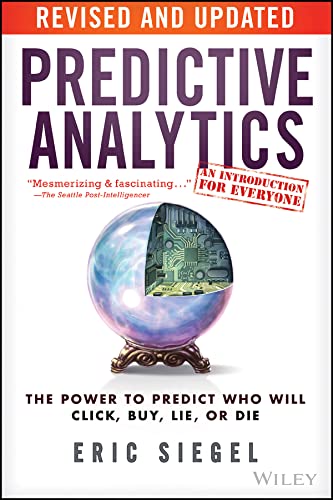
Predictive Analytics: The Power to Predict Who Will Click, Buy, Lie, or Die
"The Freakonomics of big data." --Stein Kretsinger, founding executive of Advertising.com
Award-winning - Used by over 30 universities - Translated into 9 languages
An introduction for everyone. In this rich, fascinating -- surprisingly accessible -- introduction, leading expert Eric Siegel reveals how predictive analytics (aka machine learning) works, and how it affects everyone every day. Rather than a "how to" for hands-on techies, the book serves lay readers and experts alike by covering new case studies and the latest state-of-the-art techniques.
Prediction is booming. It reinvents industries and runs the world. Companies, governments, law enforcement, hospitals, and universities are seizing upon the power. These institutions predict whether you're going to click, buy, lie, or die.
Why? For good reason: predicting human behavior combats risk, boosts sales, fortifies healthcare, streamlines manufacturing, conquers spam, optimizes social networks, toughens crime fighting, and wins elections.
How? Prediction is powered by the world's most potent, flourishing unnatural resource: data. Accumulated in large part as the by-product of routine tasks, data is the unsalted, flavorless residue deposited en masse as organizations churn away. Surprise! This heap of refuse is a gold mine. Big data embodies an extraordinary wealth of experience from which to learn. Predictive analytics(aka machine learning) unleashes the power of data. With this technology, the computer literally learns from data how to predict the future behavior of individuals. Perfect prediction is not possible, but putting odds on the future drives millions of decisions more effectively, determining whom to call, mail, investigate, incarcerate, set up on a date, or medicate.
In this lucid, captivating introduction -- now in its Revised and Updated edition -- former Columbia University professor and Predictive Analytics World founder Eric Siegel reveals the power and perils of prediction:
What type of mortgage risk Chase Bank predicted before the recession. Predicting which people will drop out of school, cancel a subscription, or get divorced before they even know it themselves. Why early retirement predicts a shorter life expectancy and vegetarians miss fewer flights. Five reasons why organizations predict death -- including one health insurance company. How U.S. Bank and Obama for America calculated the way to most strongly persuade each individual. Why the NSA wants all your data: machine learning supercomputers to fight terrorism. How IBM's Watson computer used predictive modeling to answer questions and beat the human champs on TV's Jeopardy! How companies ascertain untold, private truths -- how Target figures out you're pregnant and Hewlett-Packard deduces you're about to quit your job. How judges and parole boards rely on crime-predicting computers to decide how long convicts remain in prison. 182 examples from Airbnb, the BBC, Citibank, ConEd, Facebook, Ford, Google, the IRS, LinkedIn, Match.com, MTV, Netflix, PayPal, Pfizer, Spotify, Uber, UPS, Wikipedia, and more. How does predictive analytics work? This jam-packed book satisfies by demystifying the intriguing science under the hood. For future hands-on practitioners pursuing a career in the field, it sets a strong foundation, delivers the prerequisite knowledge, and whets your appetite for more.
A truly omnipresent science, predictive analytics constantly affects our daily lives. Whether you are a consumer of it -- or consumed by it -- get a handle on the power of Predictive Analytics.
…
Cover unavailable
54
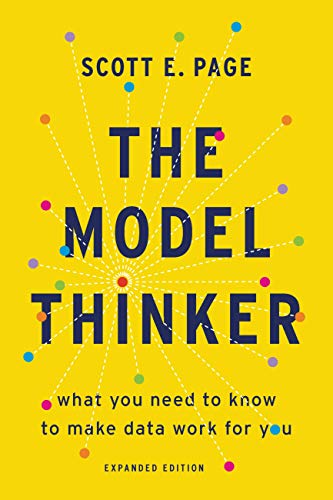
The Model Thinker: What You Need to Know to Make Data Work for You
Scott E. Page
4.3
How anyone can become a data ninja
From the stock market to genomics laboratories, census figures to marketing email blasts, we are awash with data. But as anyone who has ever opened up a spreadsheet packed with seemingly infinite lines of data knows, numbers aren't enough: we need to know how to make those numbers talk. In The Model Thinker, social scientist Scott E. Page shows us the mathematical, statistical, and computational models--from linear regression to random walks and far beyond--that can turn anyone into a genius. At the core of the book is Page's "many-model paradigm," which shows the reader how to apply multiple models to organize the data, leading to wiser choices, more accurate predictions, and more robust designs. The Model Thinker provides a toolkit for business people, students, scientists, pollsters, and bloggers to make them better, clearer thinkers, able to leverage data and information to their advantage.
…
Cover unavailable
55
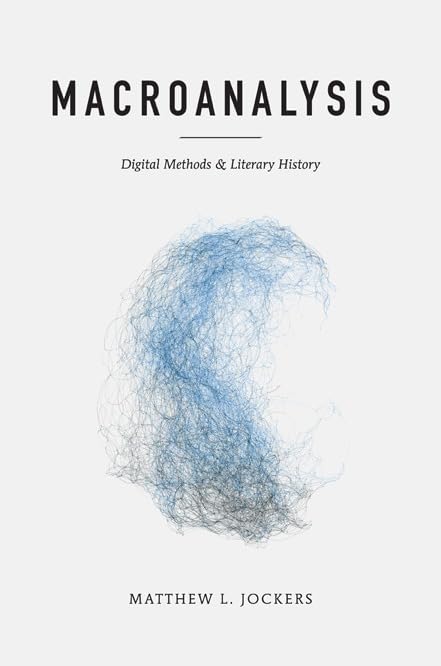
Macroanalysis: Digital Methods and Literary History
Matthew L. Jockers
4.3
In this volume, Matthew L. Jockers introduces readers to large-scale literary computing and the revolutionary potential of macroanalysis--a new approach to the study of the literary record designed for probing the digital-textual world as it exists today, in digital form and in large quantities. Using computational analysis to retrieve key words, phrases, and linguistic patterns across thousands of texts in digital libraries, researchers can draw conclusions based on quantifiable evidence regarding how literary trends are employed over time, across periods, within regions, or within demographic groups, as well as how cultural, historical, and societal linkages may bind individual authors, texts, and genres into an aggregate literary culture.
Moving beyond the limitations of literary interpretation based on the "close-reading" of individual works, Jockers describes how this new method of studying large collections of digital material can help us to better understand and contextualize the individual works within those collections.
…
Cover unavailable
56
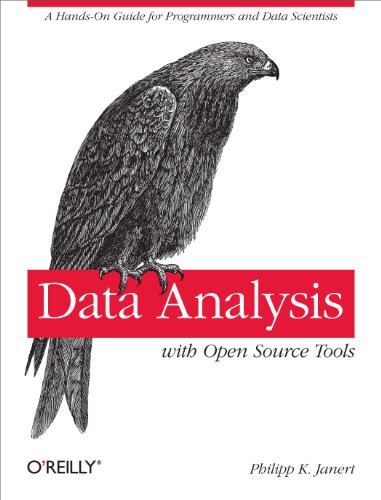
Data Analysis with Open Source Tools: A Hands-On Guide for Programmers and Data Scientists
Philipp K. Janert
4.3
Collecting data is relatively easy, but turning raw information into something useful requires that you know how to extract precisely what you need. With this insightful book, intermediate to experienced programmers interested in data analysis will learn techniques for working with data in a business environment. You'll learn how to look at data to discover what it contains, how to capture those ideas in conceptual models, and then feed your understanding back into the organization through business plans, metrics dashboards, and other applications.
Along the way, you'll experiment with concepts through hands-on workshops at the end of each chapter. Above all, you'll learn how to think about the results you want to achieve -- rather than rely on tools to think for you.
Use graphics to describe data with one, two, or dozens of variables Develop conceptual models using back-of-the-envelope calculations, as well as scaling and probability arguments Mine data with computationally intensive methods such as simulation and clustering Make your conclusions understandable through reports, dashboards, and other metrics programs Understand financial calculations, including the time-value of money Use dimensionality reduction techniques or predictive analytics to conquer challenging data analysis situations Become familiar with different open source programming environments for data analysis "Finally, a concise reference for understanding how to conquer piles of data." --Austin King, Senior Web Developer, Mozilla
"An indispensable text for aspiring data scientists." --Michael E. Driscoll, CEO/Founder, Dataspora
…
Cover unavailable
57
Machine Learning Essentials: Practical Guide in R
Alboukadel Kassambara
4.2
Discovering knowledge from big multivariate data, recorded every days, requires specialized machine learning techniques.
This book presents an easy to use practical guide in R to compute the most popular machine learning methods for exploring real word data sets, as well as, for building predictive models.
The main parts of the book include: A) Unsupervised learning methods, to explore and discover knowledge from a large multivariate data set using clustering and principal component methods. You will learn hierarchical clustering, k-means, principal component analysis and correspondence analysis methods. B) Regression analysis, to predict a quantitative outcome value using linear regression and non-linear regression strategies. C) Classification techniques, to predict a qualitative outcome value using logistic regression, discriminant analysis, naive bayes classifier and support vector machines. D) Advanced machine learning methods, to build robust regression and classification models using k-nearest neighbors methods, decision tree models, ensemble methods (bagging, random forest and boosting). E) Model selection methods, to select automatically the best combination of predictor variables for building an optimal predictive model. These include, best subsets selection methods, stepwise regression and penalized regression (ridge, lasso and elastic net regression models). We also present principal component-based regression methods, which are useful when the data contain multiple correlated predictor variables. F) Model validation and evaluation techniques for measuring the performance of a predictive model. G) Model diagnostics for detecting and fixing a potential problems in a predictive model. The book presents the basic principles of these tasks and provide many examples in R. This book offers solid guidance in data mining for students and researchers.
Key features:
Covers machine learning algorithm and implementation Key mathematical concepts are presented Short, self-contained chapters with practical examples.
…
Cover unavailable
58
Mastering Social Media Mining with Python
Marco Bonzanini
4.2
Acquire and analyze data from all corners of the social web with Python About This Book Make sense of highly unstructured social media data with the help of the insightful use cases provided in this guide Use this easy-to-follow, step-by-step guide to apply analytics to complicated and messy social data This is your one-stop solution to fetching, storing, analyzing, and visualizing social media data Who This Book Is For This book is for intermediate Python developers who want to engage with the use of public APIs to collect data from social media platforms and perform statistical analysis in order to produce useful insights from data. The book assumes a basic understanding of the Python Standard Library and provides practical examples to guide you toward the creation of your data analysis project based on social data. What You Will Learn Interact with a social media platform via their public API with Python Store social data in a convenient format for data analysis Slice and dice social data using Python tools for data science Apply text analytics techniques to understand what people are talking about on social media Apply advanced statistical and analytical techniques to produce useful insights from data Build beautiful visualizations with web technologies to explore data and present data products In Detail Your social media is filled with a wealth of hidden data - unlock it with the power of Python. Transform your understanding of your clients and customers when you use Python to solve the problems of understanding consumer behavior and turning raw data into actionable customer insights. This book will help you acquire and analyze data from leading social media sites. It will show you how to employ scientific Python tools to mine popular social websites such as Facebook, Twitter, Quora, and more. Explore the Python libraries used for social media mining, and get the tips, tricks, and insider insight you need to make the most of them. Discover how to develop data mining tools that use a social media API, and how to create your own data analysis projects using Python for clear insight from your social data. Style and approach This practical, hands-on guide will help you learn everything you need to perform data mining for social media. Throughout the book, we take an example-oriented approach to use Python for data analysis and provide useful tips and tricks that you can use in day-to-day tasks."
…
Cover unavailable
59
Statistical Analysis of Network Data with R (Use R!)
Eric D. Kolaczyk
4.2
Networks have permeated everyday life through everyday realities like the Internet, social networks, and viral marketing. As such, network analysis is an important growth area in the quantitative sciences, with roots in social network analysis going back to the 1930s and graph theory going back centuries. Measurement and analysis are integral components of network research. As a result, statistical methods play a critical role in network analysis. This book is the first of its kind in network research. It can be used as a stand-alone resource in which multiple R packages are used to illustrate how to conduct a wide range of network analyses, from basic manipulation and visualization, to summary and characterization, to modeling of network data. The central package is igraph, which provides extensive capabilities for studying network graphs in R. This text builds on Eric D. Kolaczyk’s book Statistical Analysis of Network Data (Springer, 2009).
…
Cover unavailable
60
Cassandra High Availability
Robbie Strickland
4.2
If you are a developer or DevOps engineer who understands the basics of Cassandra and are ready to take your knowledge to the next level, then this book is for you. Perhaps you've just got your hands dirty working on a small application, but now you have a use case that demands greater scale and zero downtime. An understanding of the essentials of Cassandra is needed, including knowing how to install and configure Cassandra, create tables, and read and write data.
…
Cover unavailable
61
Information Visualization: Perception for Design
Colin Ware
4.2
"This unique and essential guide to human visual perception and related cognitive principles will enrich courses on information visualization and empower designers to see their way forward. Ware's updated review of empirical research and interface design examples will do much to accelerate innovation and adoption of information visualization." —Ben Shneiderman, University of Maryland
"Colin Ware is the perfect person to write this book, with a long history of prominent contributions to the visual interaction with machines and to information visualization directly. It goes a long way towards joining science to the practical design of information visualization systems." —from the foreword by Stuart Card, PARC
Most designers know that yellow text presented against a blue background reads clearly and easily, but how many can explain why, and what really are the best ways to help others and ourselves clearly see key patterns in a bunch of data? When we use software, access a web site, or view graphics, our understanding is greatly enhanced or impeded by the way information is presented. By explaining in detail how we think visually, this book provides guidance on how to construct effective interactive information displays.
This book combines a strictly scientific approach to human perception with a practical concern for the rules governing the effective visual presentation of information. Surveying the research of leading psychologists and neurophysiologists, author Colin Ware isolates key principles at work in vision and perception, and from them derives specific and effective visualization techniques suitable for a wide range of scenarios. Information Visualization offers practical guidelines that can be applied by anyone, and covers all facets of visual perception: color, organization, space perception, motion, and texture.
* Major revision of this classic work, with a new chapter on visual thinking, new sections on face perception and flow visualization, an appendix on how to evaluate visualizations,and a greatly expanded chapter on color and color sequences.
*New to this edition is the full-color treatment throughout, to better display over 400 illustrations.
*From a leading researcher in the field of human perception who has brought together, in a single resource, all current scientific insight into the question of data visualization.
…
Cover unavailable
62
Text Data Management and Analysis: A Practical Introduction to Information Retrieval and Text Mining
ChengXiang Zhai and Sean Massung
4.2
Recent years have seen a dramatic growth of natural language text data, including web pages, news articles, scientific literature, emails, enterprise documents, and social media such as blog articles, forum posts, product reviews, and tweets. This has led to an increasing demand for powerful software tools to help people analyze and manage vast amounts of text data effectively and efficiently. Unlike data generated by a computer system or sensors, text data are usually generated directly by humans, and are accompanied by semantically rich content. As such, text data are especially valuable for discovering knowledge about human opinions and preferences, in addition to many other kinds of knowledge that we encode in text. In contrast to structured data, which conform to well-defined schemas (thus are relatively easy for computers to handle), text has less explicit structure, requiring computer processing toward understanding of the content encoded in text. The current technology of natural language processing has not yet reached a point to enable a computer to precisely understand natural language text, but a wide range of statistical and heuristic approaches to analysis and management of text data have been developed over the past few decades. They are usually very robust and can be applied to analyze and manage text data in any natural language, and about any topic.
This book provides a systematic introduction to all these approaches, with an emphasis on covering the most useful knowledge and skills required to build a variety of practically useful text information systems. The focus is on text mining applications that can help users analyze patterns in text data to extract and reveal useful knowledge. Information retrieval systems, including search engines and recommender systems, are also covered as supporting technology for text mining applications. The book covers the major concepts, techniques, and ideas in text data mining and information retrieval from a practical viewpoint, and includes many hands-on exercises designed with a companion software toolkit (i.e., MeTA) to help readers learn how to apply techniques of text mining and information retrieval to real-world text data and how to experiment with and improve some of the algorithms for interesting application tasks. The book can be used as a textbook for a computer science undergraduate course or a reference book for practitioners working on relevant problems in analyzing and managing text data.
…
Cover unavailable
63
Artificial Intelligence Basics: A Non-Technical Introduction
Tom Taulli
4.2
Artificial intelligence touches nearly every part of your day. While you may initially assume that technology such as smart speakers and digital assistants are the extent of it, AI has in fact rapidly become a general-purpose technology, reverberating across industries including transportation, healthcare, financial services, and many more. In our modern era, an understanding of AI and its possibilities for your organization is essential for growth and success.
Artificial Intelligence Basicshas arrived to equip you with a fundamental, timely grasp of AI and its impact. Author Tom Taulli provides an engaging, non-technical introduction to important concepts such as machine learning, deep learning, natural language processing (NLP), robotics, and more. In addition to guiding you through real-world case studies and practical implementation steps, Taulli uses his expertise to expand on the bigger questions that surround AI. These include societal trends, ethics, and future impact AI will have on world governments, company structures, and daily life.
Google, Amazon, Facebook, and similar tech giants are far from the only organizations on which artificial intelligence has had--and will continue to have--an incredibly significant result. AI is the present and the future of your business as well as your home life. Strengthening your prowess on the subject will prove invaluable to your preparation for the future of tech, and Artificial Intelligence Basics is the indispensable guide that you've been seeking.
What You Will Learn
Study the core principles for AI approaches such as machine learning, deep learning, and NLP (Natural Language Processing) Discover the best practices to successfully implement AI by examining case studies including Uber, Facebook, Waymo, UiPath, and Stitch Fix Understand how AI capabilities for robots can improve business Deploy chatbots and Robotic Processing Automation (RPA) to save costs and improve customer service Avoid costly gotchas Recognize ethical concerns and other risk factors of using artificial intelligence Examine the secular trends and how they may impact your business
Who This Book Is For
Readers without a technical background, such as managers, looking to understand AI to evaluate solutions.
…
Cover unavailable
64
HBR Guide to Data Analytics Basics for Managers (HBR Guide Series)
Harvard Business Review
4.2
Cover unavailable
65
SQL Server 2019 Revealed: Including Big Data Clusters and Machine Learning
Bob Ward
4.2
Get up to speed on the game-changing developments in SQL Server 2019. No longer your grandparent's database engine, SQL Server 2019 is cutting edge with support for artificial intelligence (AI), machine learning (ML), big data performance and analysis, Java, and connections to Azure IOT Edge. This is not a book on traditional database administration and SQL. It focuses on all that is new and cutting edge in one of the best database systems available. This is a book for SQL Server professionals who already know how to create tables and want to up their game by building their skills in some of the hottest new areas in technology. SQL Server 2019 Revealed begins with a look at Big Data Clusters--a marquee feature of 2019--and their use in creating a unified data hub with connections to disparate data sources such as Oracle, MongoDB, and Hadoop. You will learn to build end-to-end data virtualization solutions involving Spark, SQL, and HDFS. Also covered in the book is the use of SQL and Spark to build a machine learning platform for artificial intelligence applications. The book also dives into the details of new capabilities in performance, security, and availability such as Intelligent Query Processing, Secure Enclaves, and enhancements for Always On Availability Groups. The book explores enhancements for SQL Server on Linux, containers, and goes into detail covering deployment and management of SQL Server on Kubernetes clusters. You will learn about a range of new enhancements across the database engine for SQL Server 2019, including how to leverage SQL Server in IOT Edge scenarios.
What You Will Learn Implement Big Data Clusters with SQL, Spark, and HDFS
Create a Unified Data Hub with connections to MongoDB, Hadoop, Oracle, and other sources
Combine SQL and Spark to build a machine learning platform for AI applications
Increase security through Enclaves, Static Data Masking, and Data Classification
Improve your ability to deploy on Linux using containers and Kubernetes
Take advantage of SQL Graph, Java, and other new developer features
Reap performance gains from persistent memory, query profiling, and Intelligent Query Processing
Who This Book Is For IT professionals and developers who understand the fundamentals of SQL Server and wish to focus on learning about the new, cutting-edge features in SQL Server 2019. The book is for those who want to learn about SQL Server 2019's new Big Data Clusters and AI feature set, support for IOT Edge and Java, and increased capabilities around performance, security, and high availability.
…
Cover unavailable
66
Python Data Analytics: With Pandas, Numpy, and Matplotlib
Fabio Nelli
4.2
Explore the latest Python tools and techniques to help you tackle the world of data acquisition and analysis. You'll review scientific computing with NumPy, visualization with matplotlib, and machine learning with scikit-learn. This revision is fully updated with new content on social media data analysis, image analysis with OpenCV, and deep learning libraries. Each chapter includes multiple examples demonstrating how to work with each library. At its heart lies the coverage of pandas, for high-performance, easy-to-use data structures and tools for data manipulation Author Fabio Nelli expertly demonstrates using Python for data processing, management, and information retrieval. Later chapters apply what you've learned to handwriting recognition and extending graphical capabilities with the JavaScript D3 library. Whether you are dealing with sales data, investment data, medical data, web page usage, or other data sets, Python Data Analytics, Second Edition is an invaluable reference with its examples of storing, accessing, and analyzing data. What You'll Learn Understand the core concepts of data analysis and the Python ecosystem
Go in depth with pandas for reading, writing, and processing data
Use tools and techniques for data visualization and image analysis
Examine popular deep learning libraries Keras, Theano, TensorFlow, and PyTorch
Who This Book Is For
Experienced Python developers who need to learn about Pythonic tools for data analysis
…
Cover unavailable
67
Doing Data Science
Cathy O'Neil, Rachel Schutt
4.2
Now that people are aware that data can make the difference in an election or a business model, data science as an occupation is gaining ground. But how can you get started working in a wide-ranging, interdisciplinary field that’s so clouded in hype? This insightful book, based on Columbia University’s Introduction to Data Science class, tells you what you need to know.
In many of these chapter-long lectures, data scientists from companies such as Google, Microsoft, and eBay share new algorithms, methods, and models by presenting case studies and the code they use. If you’re familiar with linear algebra, probability, and statistics, and have programming experience, this book is an ideal introduction to data science.
Topics include:
Statistical inference, exploratory data analysis, and the data science process Algorithms Spam filters, Naive Bayes, and data wrangling Logistic regression Financial modeling Recommendation engines and causality Data visualization Social networks and data journalism Data engineering, MapReduce, Pregel, and Hadoop
Doing Data Science is collaboration between course instructor Rachel Schutt, Senior VP of Data Science at News Corp, and data science consultant Cathy O’Neil, a senior data scientist at Johnson Research Labs, who attended and blogged about the course.
…
Cover unavailable
68
Data Mining with Decision Trees: Theory and Applications (2nd Edition)
Lior Rokach and Oded Z Maimon
4.2
Decision trees have become one of the most powerful and popular approaches in knowledge discovery and data mining; it is the science of exploring large and complex bodies of data in order to discover useful patterns. Decision tree learning continues to evolve over time. Existing methods are constantly being improved and new methods introduced.This 2nd Edition is dedicated entirely to the field of decision trees in data mining; to cover all aspects of this important technique, as well as improved or new methods and techniques developed after the publication of our first edition. In this new edition, all chapters have been revised and new topics brought in. New topics include Cost-Sensitive Active Learning, Learning with Uncertain and Imbalanced Data, Using Decision Trees beyond Classification Tasks, Privacy Preserving Decision Tree Learning, Lessons Learned from Comparative Studies, and Learning Decision Trees for Big Data. A walk-through guide to existing open-source data mining software is also included in this edition.This book invites readers to explore the many benefits in data mining that decision trees offer:
…
Cover unavailable
69
OCA Oracle Database SQL Exam Guide (Exam 1Z0-071) (Oracle Press)
Steve O'Hearn
4.1
Cover unavailable
70
Modern Multivariate Statistical Techniques: Regression, Classification, and Manifold Learning
Alan J. Izenman
4.1
Remarkable advances in computation and data storage and the ready availability of huge data sets have been the keys to the growth of the new disciplines of data mining and machine learning, while the enormous success of the Human Genome Project has opened up the field of bioinformatics.
These exciting developments, which led to the introduction of many innovative statistical tools for high-dimensional data analysis, are described here in detail. The author takes a broad perspective; for the first time in a book on multivariate analysis, nonlinear methods are discussed in detail as well as linear methods. Techniques covered range from traditional multivariate methods, such as multiple regression, principal components, canonical variates, linear discriminant analysis, factor analysis, clustering, multidimensional scaling, and correspondence analysis, to the newer methods of density estimation, projection pursuit, neural networks, multivariate reduced-rank regression, nonlinear manifold learning, bagging, boosting, random forests, independent component analysis, support vector machines, and classification and regression trees. Another unique feature of this book is the discussion of database management systems.
This book is appropriate for advanced undergraduate students, graduate students, and researchers in statistics, computer science, artificial intelligence, psychology, cognitive sciences, business, medicine, bioinformatics, and engineering. Familiarity with multivariable calculus, linear algebra, and probability and statistics is required. The book presents a carefully-integrated mixture of theory and applications, and of classical and modern multivariate statistical techniques, including Bayesian methods. There are over 60 interesting data sets used as examples in the book, over 200 exercises, and many color illustrations and photographs.
…
Cover unavailable
71
Data Analytics Made Accessible
Anil Maheshwari
4.1
Cover unavailable
72
Learning R: A Step-By-Step Function Guide to Data Analysis
Richard Cotton
4.1
Learn how to perform data analysis with the R language and software environment, even if you have little or no programming experience. With the tutorials in this hands-on guide, you'll learn how to use the essential R tools you need to know to analyze data, including data types and programming concepts.
The second half of Learning R shows you real data analysis in action by covering everything from importing data to publishing your results. Each chapter in the book includes a quiz on what you've learned, and concludes with exercises, most of which involve writing R code.
Write a simple R program, and discover what the language can do Use data types such as vectors, arrays, lists, data frames, and strings Execute code conditionally or repeatedly with branches and loops Apply R add-on packages, and package your own work for others Learn how to clean data you import from a variety of sources Understand data through visualization and summary statistics Use statistical models to pass quantitative judgments about data and make predictions Learn what to do when things go wrong while writing data analysis code
…
Cover unavailable
73
Data Mining With R: Learning By Case Studies
Luis Torgo
4.1
The versatile capabilities and large set of add-on packages make R an excellent alternative to many existing and often expensive data mining tools. Exploring this area from the perspective of a practitioner, Data Mining with R: Learning with Case Studies uses practical examples to illustrate the power of R and data mining.
Assuming no prior knowledge of R or data mining/statistical techniques, the book covers a diverse set of problems that pose different challenges in terms of size, type of data, goals of analysis, and analytical tools. To present the main data mining processes and techniques, the author takes a hands-on approach that utilizes a series of detailed, real-world case studies:
Predicting algae blooms Predicting stock market returns Detecting fraudulent transactions Classifying microarray samples With these case studies, the author supplies all necessary steps, code, and data.
Web Resource A supporting website mirrors the do-it-yourself approach of the text. It offers a collection of freely available R source files that encompass all the code used in the case studies. The site also provides the data sets from the case studies as well as an R package of several functions.
…
Cover unavailable
74
Handbook of Statistical Analysis and Data Mining Applications
Robert Nisbet, John Elder IV, Gary Miner
4.1
Cover unavailable
75
Python Machine Learning by Example
Yuxi (Hayden) Li
4.1
Take tiny steps to enter the big world of data science through this interesting guide About This Book - Learn the fundamentals of machine learning and build your own intelligent applications - Master the art of building your own machine learning systems with this example-based practical guide - Work with important classification and regression algorithms and other machine learning techniques Who This Book Is For This book is for anyone interested in entering the data science stream with machine learning. Basic familiarity with Python is assumed. What You Will Learn - Exploit the power of Python to handle data extraction, manipulation, and exploration techniques - Use Python to visualize data spread across multiple dimensions and extract useful features - Dive deep into the world of analytics to predict situations correctly - Implement machine learning classification and regression algorithms from scratch in Python - Be amazed to see the algorithms in action - Evaluate the performance of a machine learning model and optimize it - Solve interesting real-world problems using machine learning and Python as the journey unfolds In Detail Data science and machine learning are some of the top buzzwords in the technical world today. A resurging interest in machine learning is due to the same factors that have made data mining and Bayesian analysis more popular than ever. This book is your entry point to machine learning. This book starts with an introduction to machine learning and the Python language and shows you how to complete the setup. Moving ahead, you will learn all the important concepts such as, exploratory data analysis, data preprocessing, feature extraction, data visualization and clustering, classification, regression and model performance evaluation. With the help of various projects included, you will find it intriguing to acquire the mechanics of several important machine learning algorithms - they are no more obscure as they thought. Also, you will be guided step by step to build your own models from scratch. Toward the end, you will gather a broad picture of the machine learning ecosystem and best practices of applying machine learning techniques. Through this book, you will learn to tackle data-driven problems and implement your solutions with the powerful yet simple language, Python. Interesting and easy-to-follow examples, to name some, news topic classification, spam email detection, online ad click-through prediction, stock prices forecast, will keep you glued till you reach your goal. Style and approach This book is an enticing journey that starts from the very basics and gradually picks up pace as the story unfolds. Each concept is first succinctly defined in the larger context of things, followed by a detailed explanation of their application. Every concept is explained with the help of a project that solves a real-world problem, and involves hands-on work-giving you a deep insight into the world of machine learning. With simple yet rich language-Python-you will understand and be able to implement the examples with ease.
…
Cover unavailable
76
Humanizing Big Data: Marketing at the Meeting of Data, Social Science & Consumer Insight
Colin Strong
4.1
Between tweets, likes, comments, blogs, videos and images, today’s customer is estimated to generate 2.5 quintillion bytes of data per day. How can marketers utilize the ever-increasing amount of data to better understand and interact with their customers?
This book offers advice on how to interpret and incorporate data into an organization’s overall marketing strategy. It is designed to help marketers improve customer relationships, enhance the targeting of their marketing efforts, align marketing activities with ultimate goals and objectives, and gain insight into the effectiveness of marketing campaigns and channels.
Topics covered include: the current limitations associated with big data, the differences between deriving the what, how and why from data, how to use social science to provide frameworks for a smart data agenda, privacy and personal data and the role of market research in a marketing strategy.
…
Cover unavailable
77
Practical Data Science with R Second Edition
Nina Zumel
4.1
Practical Data Science with R, Second Edition is a task-based tutorial that leads readers through dozens of useful data analysis practices using the R language. By concentrating on the most important tasks you'll face on the job, this friendly guide is comfortable both for business analysts and data scientists. Because data is only useful if it can be understood, you'll also find fantastic tips for organizing and presenting data in tables, as well as snappy visualizations.
…
Cover unavailable
78
Data Mining for Business Intelligence: Concepts, Techniques, and Applications in Microsoft Office Excel with Xlminer
Galit Shmueli, Nitin R. Patel, et al.
4.1
Praise for the "First Edition"" full of vivid and thought-provoking anecdotes needs to be read by anyone with a serious interest in research and marketing."--"Research" magazine
"Shmueli et al. have done a wonderful job in presenting the field of data mining a welcome addition to the literature."--computingreviews.com
Incorporating a new focus on data visualization and time series forecasting, "Data Mining for Business Intelligence," Second Edition continues to supply insightful, detailed guidance on fundamental data mining techniques. This new edition guides readers through the use of the Microsoft Office Excel add-in XLMiner for developing predictive models and techniques for describing and finding patterns in data.
From clustering customers into market segments and finding the characteristics of frequent flyers to learning what items are purchased with other items, the authors use interesting, real-world examples to build a theoretical and practical understanding of key data mining methods, including classification, prediction, and affinity analysis as well as data reduction, exploration, and visualization.
The "Second Edition" now features: Three new chapters on time series forecasting, introducing popular business forecasting methods including moving average, exponential smoothing methods; regression-based models; and topics such as explanatory vs. predictive modeling, two-level models, and ensemblesA revised chapter on data visualization that now features interactive visualization principles and added assignments that demonstrate interactive visualization in practiceSeparate chapters that each treat k-nearest neighbors and Naive Bayes methodsSummaries at the start of each chapter that supply an outline of key topics
The book includes access to XLMiner, allowing readers to work hands-on with the provided data. Throughout the book, applications of the discussed topics focus on the business problem as motivation and avoid unnecessary statistical theory. Each chapter concludes with exercises that allow readers to assess their comprehension of the presented material. The final chapter includes a set of cases that require use of the different data mining techniques, and a related Web site features data sets, exercise solutions, PowerPoint slides, and case solutions.
"Data Mining for Business Intelligence," Second Edition is an excellent book for courses on data mining, forecasting, and decision support systems at the upper-undergraduate and graduate levels. It is also a one-of-a-kind resource for analysts, researchers, and practitioners working with quantitative methods in the fields of business, finance, marketing, computer science, and information technology.
…
Cover unavailable
79
Probability and Statistics for Data Science: Math + R + Data
Norman Matloff
4.1
Probability and Statistics for Data Science: Math + R + Data covers "math stat"--distributions, expected value, estimation etc.--but takes the phrase "Data Science" in the title quite seriously:
* Real datasets are used extensively.
* All data analysis is supported by R coding.
* Includes many Data Science applications, such as PCA, mixture distributions, random graph models, Hidden Markov models, linear and logistic regression, and neural networks.
* Leads the student to think critically about the "how" and "why" of statistics, and to "see the big picture."
* Not "theorem/proof"-oriented, but concepts and models are stated in a mathematically precise manner.
Prerequisites are calculus, some matrix algebra, and some experience in programming.
Norman Matloff is a professor of computer science at the University of California, Davis, and was formerly a statistics professor there. He is on the editorial boards of the Journal of Statistical Software and The R Journal. His book Statistical Regression and Classification: From Linear Models to Machine Learning was the recipient of the Ziegel Award for the best book reviewed in Technometrics in 2017. He is a recipient of his university's Distinguished Teaching Award.
…
Cover unavailable
80
Data Jujitsu: The Art of Turning Data into Product
DJ Pati
4.1
Acclaimed data scientist DJ Patil details a new approach to solving problems in Data Jujitsu.
Learn how to use a problem's "weight" against itself to:
Break down seemingly complex data problems into simplified parts Use alternative data analysis techniques to examine them Use human input, such as Mechanical Turk, and design tricks that enlist the help of your users to take short cuts around tough problems Learn more about the problems before starting on the solutions—and use the findings to solve them, or determine whether the problems are worth solving at all.
…
Cover unavailable
81
Data Analytics: 3 Books in 1 - The New Ultimate Bible for Understanding & Using Data Analytics, Big Data + Data Science For Business + Data Mining
John Harper
4.1
Cover unavailable
82
Pandas for Everyone: Python Data Analysis
Daniel Y. Chen
4.1
The Hands-On, Example-Rich Introduction to Pandas Data Analysis in Python Today, analysts must manage data characterized by extraordinary variety, velocity, and volume. Using the open source Pandas library, you can use Python to rapidly automate and perform virtually any data analysis task, no matter how large or complex. Pandas can help you ensure the veracity of your data, visualize it for effective decision-making, and reliably reproduce analyses across multiple datasets. Pandas for Everyone brings together practical knowledge and insight for solving real problems with Pandas, even if you're new to Python data analysis. Daniel Y. Chen introduces key concepts through simple but practical examples, incrementally building on them to solve more difficult, real-world problems. Chen gives you a jumpstart on using Pandas with a realistic dataset and covers combining datasets, handling missing data, and structuring datasets for easier analysis and visualization. He demonstrates powerful data cleaning techniques, from basic string manipulation to applying functions simultaneously across dataframes. Once your data is ready, Chen guides you through fitting models for prediction, clustering, inference, and exploration. He provides tips on performance and scalability, and introduces you to the wider Python data analysis ecosystem. Work with DataFrames and Series, and import or export data Create plots with matplotlib, seaborn, and pandas Combine datasets and handle missing data Reshape, tidy, and clean datasets so they're easier to work with Convert data types and manipulate text strings Apply functions to scale data manipulations Aggregate, transform, and filter large datasets with groupby Leverage Pandas' advanced date and time capabilities Fit linear models using statsmodels and scikit-learn libraries Use generalized linear modeling to fit models with different response variables Compare multiple models to select the "best" Regularize to overcome overfitting and improve performance Use clustering in unsupervised machine learning
…
Cover unavailable
83
Hadoop: The Definitive Guide
Tom White
4.1
Hadoop: The Definitive Guide helps you harness the power of your data. Ideal for processing large datasets, the Apache Hadoop framework is an open source implementation of the MapReduce algorithm on which Google built its empire. This comprehensive resource demonstrates how to use Hadoop to build reliable, scalable, distributed systems: programmers will find details for analyzing large datasets, and administrators will learn how to set up and run Hadoop clusters.
Complete with case studies that illustrate how Hadoop solves specific problems, this book helps you:
Use the Hadoop Distributed File System (HDFS) for storing large datasets, and run distributed computations over those datasets using MapReduce Become familiar with Hadoop's data and I/O building blocks for compression, data integrity, serialization, and persistence Discover common pitfalls and advanced features for writing real-world MapReduce programs Design, build, and administer a dedicated Hadoop cluster, or run Hadoop in the cloud Use Pig, a high-level query language for large-scale data processing Take advantage of HBase, Hadoop's database for structured and semi-structured data Learn ZooKeeper, a toolkit of coordination primitives for building distributed systems If you have lots of data -- whether it's gigabytes or petabytes -- Hadoop is the perfect solution. Hadoop: The Definitive Guide is the most thorough book available on the subject.
"Now you have the opportunity to learn about Hadoop from a master-not only of the technology, but also of common sense and plain talk." -- Doug Cutting, Hadoop Founder, Yahoo!
…
Cover unavailable
84
A Programmer’s Guide to Data Mining: The Ancient Art of the Numerati
Frances Buontempo
4.1
The ancient art of the Numerati provides insight into basic datamining techniques for beginners wishing to immerse themselves in the field using practical examples.
Cover unavailable
85
Unti Nonfiction
Brittany Kaiser
4.1
In this explosive memoir, a political consultant and technology whistleblower reveals the disturbing truth about the multi-billion-dollar data industry, revealing to the public how companies are getting richer using our personal information and exposing how Cambridge Analytica exploited weaknesses in privacy laws to help elect Donald Trump--and how this could easily happen again in the 2020 presidential election.
When Brittany Kaiser joined Cambridge Analytica--the UK-based political consulting firm funded by conservative billionaire and Donald Trump patron Robert Mercer--she was an idealistic young professional working on her fourth degree in human rights law and international relations. A veteran of Barack Obama's 2008 campaign, Kaiser's goal was to utilize data for humanitarian purposes, most notably to prevent genocide and human rights abuses. But her experience inside Cambridge Analytica opened her eyes to the tremendous risks that this unregulated industry poses to privacy and democracy.
Targeted is Kaiser's eyewitness chronicle of the dramatic and disturbing story of the rise and fall of Cambridge Analytica. She reveals to the public how Facebook's lax policies and lack of sufficient national laws allowed voters to be manipulated in both Britain and the United States, where personal data was weaponized to spread fake news and racist messaging during the Brexit vote and the 2016 election. But the damage isn't done Kaiser warns; the 2020 election can be compromised as well if we continue to do nothing.
In the aftermath of the U.S. election, as she became aware of the horrifying reality of what Cambridge Analytica had done in support of Donald Trump, Kaiser made the difficult choice to expose the truth. Risking her career, relationships, and personal safety, she told authorities about the data industry's unethical business practices, eventually testifying before Parliament about the company's Brexit efforts and helping Special Counsel Robert Mueller's investigation into Russian interference in the 2016 election, alongside at least 10 other international investigations.
Packed with never-before-publicly-told stories and insights, Targeted goes inside the secretive meetings with Trump campaign personnel and details the promises Cambridge Analytica made to win. Throughout, Kaiser makes the case for regulation, arguing that legal oversight of the data industry is not only justifiable but essential to ensuring the long-term safety of our democracy.
…
Cover unavailable
86
Introduction to Statistical Relational Learning
Lise Getoor, Ben Taskar, et al.
4.1
Cover unavailable
87
Pragmatic AI: An Introduction to Cloud-Based Machine Learning
Noah Gift
4.1
Master Powerful Off-the-Shelf Business Solutions for AI and Machine Learning Pragmatic AI will help you solve real-world problems with contemporary machine learning, artificial intelligence, and cloud computing tools. Noah Gift demystifies all the concepts and tools you need to get results--even if you don't have a strong background in math or data science. Gift illuminates powerful off-the-shelf cloud offerings from Amazon, Google, and Microsoft, and demonstrates proven techniques using the Python data science ecosystem. His workflows and examples help you streamline and simplify every step, from deployment to production, and build exceptionally scalable solutions. As you learn how machine language (ML) solutions work, you'll gain a more intuitive understanding of what you can achieve with them and how to maximize their value. Building on these fundamentals, you'll walk step-by-step through building cloud-based AI/ML applications to address realistic issues in sports marketing, project management, product pricing, real estate, and beyond. Whether you're a business professional, decision-maker, student, or programmer, Gift's expert guidance and wide-ranging case studies will prepare you to solve data science problems in virtually any environment. Get and configure all the tools you'll need Quickly review all the Python you need to start building machine learning applications Master the AI and ML toolchain and project lifecycle Work with Python data science tools such as IPython, Pandas, Numpy, Juypter Notebook, and Sklearn Incorporate a pragmatic feedback loop that continually improves the efficiency of your workflows and systems Develop cloud AI solutions with Google Cloud Platform, including TPU, Colaboratory, and Datalab services Define Amazon Web Services cloud AI workflows, including spot instances, code pipelines, boto, and more Work with Microsoft Azure AI APIs Walk through building six real-world AI applications, from start to finish Register your book for convenient access to downloads, updates, and/or corrections as they become available. See inside book for details.
…
Cover unavailable
88
The Practitioner's Guide to Graph Data
Denise Gosnell, Matthias Broecheler
4.1
How do you apply graph thinking to solve complex problems? With this practical guide, data scientists will learn how to think about data as a graph and determine if graph technology is right for your company. You'll learn techniques for building scalable, real-time, and multimodel architectures that solve complex problems with graph data.
Authors Denise Koessler Gosnell and Matthias Broecheler show you how companies today are successfully applying graph thinking in distributed production environments. You'll also learn the Graph Schema Language, a set of terminology and visual illustrations to normalize how graph practitioners communicate conceptual graph models, graph schema, and graph database design.
…
Cover unavailable
89
Data Mining Techniques in Crm: Inside Customer Segmentation
Konstantinos K. Tsiptsis, Antonios Chorianopoulos
4.1
This is an applied handbook for the application of data mining techniques in the CRM framework. It combines a technical and a business perspective to cover the needs of business users who are looking for a practical guide on data mining. It focuses on Customer Segmentation and presents guidelines for the development of actionable segmentation schemes. By using non-technical language it guides readers through all the phases of the data mining process.
…
Cover unavailable
90
Real-World Machine Learning
Henrik Brink, Joseph Richards, Mark Fetherolf
4.1
Summary
Real-World Machine Learning is a practical guide designed to teach working developers the art of ML project execution. Without overdosing you on academic theory and complex mathematics, it introduces the day-to-day practice of machine learning, preparing you to successfully build and deploy powerful ML systems.
Purchase of the print book includes a free eBook in PDF, Kindle, and ePub formats from Manning Publications.
About the Technology
Machine learning systems help you find valuable insights and patterns in data, which you'd never recognize with traditional methods. In the real world, ML techniques give you a way to identify trends, forecast behavior, and make fact-based recommendations. It's a hot and growing field, and up-to-speed ML developers are in demand.
About the Book
Real-World Machine Learning will teach you the concepts and techniques you need to be a successful machine learning practitioner without overdosing you on abstract theory and complex mathematics. By working through immediately relevant examples in Python, you'll build skills in data acquisition and modeling, classification, and regression. You'll also explore the most important tasks like model validation, optimization, scalability, and real-time streaming. When you're done, you'll be ready to successfully build, deploy, and maintain your own powerful ML systems.
What's Inside
Predicting future behavior Performance evaluation and optimization Analyzing sentiment and making recommendations About the Reader
No prior machine learning experience assumed. Readers should know Python.
About the Authors
Henrik Brink, Joseph Richards and Mark Fetherolf are experienced data scientists engaged in the daily practice of machine learning.
Table of Contents
THE MACHINE-LEARNING WORKFLOWWhat is machine learning? Real-world data Modeling and prediction Model evaluation and optimization Basic feature engineeringPRACTICAL APPLICATIONExample: NYC taxi data Advanced feature engineering Advanced NLP example: movie review sentiment Scaling machine-learning workflows Example: digital display advertising
…
Cover unavailable
91
Text Mining: A Guidebook for the Social Sciences
Gabe Ignatow and Rada F. Mihalcea
4.1
Online communities generate massive volumes of natural language data and the social sciences continue to learn how to best make use of this new information and the technology available for analyzing it. Text Mining: A Guidebook for the Social Sciences brings together a broad range of contemporary qualitative and quantitative methods to provide strategic and practical guidance on analyzing large text collections. This accessible book, written by sociologist Gabe Ignatow and computer scientist Rada Mihalcea, surveys the fast-changing landscape of data sources, programming languages, software packages, and methods of analysis available today. Suitable for novice and experienced researchers alike, the book will help readers use text mining techniques more efficiently and productively.
…
Cover unavailable
92
Statistical Methods for Speech Recognition
Frederick Jelinek
4.0
This book reflects decades of important research on the mathematical foundations of speech recognition. It focuses on underlying statistical techniques such as hidden Markov models, decision trees, the expectation-maximization algorithm, information theoretic goodness criteria, maximum entropy probability estimation, parameter and data clustering, and smoothing of probability distributions. The author's goal is to present these principles clearly in the simplest setting, to show the advantages of self-organization from real data, and to enable the reader to apply the techniques.
…
Cover unavailable
93
The Numerati
Stephen Baker
4.0
An urgent look at how a global math elite is predicting and altering our behavior -- at work, at the mall, and in bed
Every day we produce loads of data about ourselves simply by living in the modern world: we click web pages, flip channels, drive through automatic toll booths, shop with credit cards, and make cell phone calls. Now, in one of the greatest undertakings of the twenty-first century, a savvy group of mathematicians and computer scientists is beginning to sift through this data to dissect us and map out our next steps. Their goal? To manipulate our behavior -- what we buy, how we vote -- without our even realizing it.
In this tour de force of original reporting and analysis, journalist Stephen Baker provides us with a fascinating guide to the world we're all entering -- and to the people controlling that world. The Numerati have infiltrated every realm of human affairs, profiling us as workers, shoppers, patients, voters, potential terrorists -- and lovers. The implications are vast. Our privacy evaporates. Our bosses can monitor and measure our every move (then reward or punish us). Politicians can find the swing voters among us, by plunking us all into new political groupings with names like "Hearth Keepers" and "Crossing Guards." It can sound scary. But the Numerati can also work on our behalf, diagnosing an illness before we're aware of the symptoms, or even helping us find our soul mate. Surprising, enlightening, and deeply relevant, The Numerati shows how a powerful new endeavor -- the mathematical modeling of humanity -- will transform every aspect of our lives.
STEPHEN BAKER has written for BusinessWeek for over twenty years, covering Mexico and Latin America, the Rust Belt, European technology, and a host of other topics, including blogs, math, and nanotechnology. But he's always considered himself a foreign correspondent. This, he says, was especially useful as he met the Numerati. "While I came from the world of words, they inhabited the symbolic realms of math and computer science. This was foreign to me. My reporting became an anthropological mission." Baker has written for many publications, including the Wall Street Journal, the Los Angeles Times, and the Boston Globe. He won an Overseas Press Club Award for his portrait of the rising Mexican auto industry. He is the coauthor of blogspotting.net, featured by the New York Times as one of fifty blogs to watch.
…
Cover unavailable
94
Practical Time Series Analysis: Prediction with Statistics and Machine Learning
Aileen Nielsen
4.0
Time series data analysis is increasingly important due to the massive production of such data through the internet of things, the digitalization of healthcare, and the rise of smart cities. As continuous monitoring and data collection become more common, the need for competent time series analysis with both statistical and machine learning techniques will increase.
Covering innovations in time series data analysis and use cases from the real world, this practical guide will help you solve the most common data engineering and analysis challengesin time series, using both traditional statistical and modern machine learning techniques. Author Aileen Nielsen offers an accessible, well-rounded introduction to time series in both R and Python that will have data scientists, software engineers, and researchers up and running quickly.
You'll get the guidance you need to confidently:
Find and wrangle time series data Undertake exploratory time series data analysis Store temporal data Simulate time series data Generate and select features for a time series Measure error Forecast and classify time series with machine or deep learning Evaluate accuracy and performance
…
Cover unavailable
95
Data Mining: Concepts, Models And Techniques (Intelligent Systems Reference Library)
Florin Gorunescu
4.0
The knowledge discovery process is as old as Homo sapiens. Until some time ago this process was solely based on the 'natural personal' computer provided by Mother Nature. Fortunately, in recent decades the problem has begun to be solved based on the development of the Data mining technology, aided by the huge computational power of the 'artificial' computers. Digging intelligently in different large databases, data mining aims to extract implicit, previously unknown and potentially useful information from data, since "knowledge is power." The goal of this book is to provide, in a friendly way, both theoretical concepts and, especially, practical techniques of this exciting field, ready to be applied in real-world situations. Accordingly, it is meant for all those who wish to learn how to explore and analysis of large quantities of data in order to discover the hidden nugget of information.
…
Cover unavailable
96
The Enterprise Big Data Lake: Delivering the Promise of Big Data and Data Science
Alex Gorelik
4.0
The data lake is a daring new approach for harnessing the power of big data technology and providing convenient self-service capabilities. But is it right for your company? This book is based on discussions with practitioners and executives from more than a hundred organizations, ranging from data-driven companies such as Google, LinkedIn, and Facebook, to governments and traditional corporate enterprises. You'll learn what a data lake is, why enterprises need one, and how to build one successfully with the best practices in this book.
Alex Gorelik, CTO and founder of Waterline Data, explains why old systems and processes can no longer support data needs in the enterprise. Then, in a collection of essays about data lake implementation, you'll examine data lake initiatives, analytic projects, experiences, and best practices from data experts working in various industries.
Get a succinct introduction to data warehousing, big data, and data science Learn various paths enterprises take to build a data lake Explore how to build a self-service model and best practices for providing analysts access to the data Use different methods for architecting your data lake Discover ways to implement a data lake from experts in different industries
…
Cover unavailable
97
Interpretable Machine Learning
Christoph Molnar
4.0
This book is about making machine learning models and their decisions interpretable.
After exploring the concepts of interpretability, you will learn about simple, interpretable models such as decision trees, decision rules and linear regression. Later chapters focus on general model-agnostic methods for interpreting black box models like feature importance and accumulated local effects and explaining individual predictions with Shapley values and LIME.
All interpretation methods are explained in depth and discussed critically. How do they work under the hood? What are their strengths and weaknesses? How can their outputs be interpreted? This book will enable you to select and correctly apply the interpretation method that is most suitable for your machine learning project.
…
Cover unavailable
98
High Performance Spark: Best Practices for Scaling and Optimizing Apache Spark
Holden Karau, Rachel Warren
4.0
Apache Spark is amazing when everything clicks. But if you haven't seen the performance improvements you expected, or still don't feel confident enough to use Spark in production, this practical book is for you. Authors Holden Karau and Rachel Warren demonstrate performance optimizations to help your Spark queries run faster and handle larger data sizes, while using fewer resources.
Ideal for software engineers, data engineers, developers, and system administrators working with large-scale data applications, this book describes techniques that can reduce data infrastructure costs and developer hours. Not only will you gain a more comprehensive understanding of Spark, you'll also learn how to make it sing.
With this book, you'll explore:
How Spark SQL's new interfaces improve performance over SQL's RDD data structure The choice between data joins in Core Spark and Spark SQL Techniques for getting the most out of standard RDD transformations How to work around performance issues in Spark's key/value pair paradigm Writing high-performance Spark code without Scala or the JVM How to test for functionality and performance when applying suggested improvements Using Spark MLlib and Spark ML machine learning libraries Spark's Streaming components and external community packages
…
Cover unavailable
99
Natural Language Processing with Pytorch: Build Intelligent Language Applications Using Deep Learning
Delip Rao, Brian McMahan
4.0
Natural Language Processing (NLP) provides boundless opportunities for solving problems in artificial intelligence, making products such as Amazon Alexa and Google Translate possible. If you're a developer or data scientist new to NLP and deep learning, this practical guide shows you how to apply these methods using PyTorch, a Python-based deep learning library.
Authors Delip Rao and Brian McMahon provide you with a solid grounding in NLP and deep learning algorithms and demonstrate how to use PyTorch to build applications involving rich representations of text specific to the problems you face. Each chapter includes several code examples and illustrations.
Explore computational graphs and the supervised learning paradigm Master the basics of the PyTorch optimized tensor manipulation library Get an overview of traditional NLP concepts and methods Learn the basic ideas involved in building neural networks Use embeddings to represent words, sentences, documents, and other features Explore sequence prediction and generate sequence-to-sequence models Learn design patterns for building production NLP systems
…
Cover unavailable
100
Fraud Analytics Using Descriptive, Predictive, and Social Network Techniques: A Guide to Data Science for Fraud Detection
Bart Baesens
4.0
Detect fraud earlier to mitigate loss and prevent cascading damageFraud Analytics Using Descriptive, Predictive, and Social Network Techniques is an authoritative guidebook for setting up a comprehensive fraud detection analytics solution. Early detection is a key factor in mitigating fraud damage, but it involves more specialized techniques than detecting fraud at the more advanced stages. This invaluable guide details both the theory and technical aspects of these techniques, and provides expert insight into streamlining implementation. Coverage includes data gathering, preprocessing, model building, and post-implementation, with comprehensive guidance on various learning techniques and the data types utilized by each. These techniques are effective for fraud detection across industry boundaries, including applications in insurance fraud, credit card fraud, anti-money laundering, healthcare fraud, telecommunications fraud, click fraud, tax evasion, and more, giving you a highly practical framework for fraud prevention.
It is estimated that a typical organization loses about 5% of its revenue to fraud every year. More effective fraud detection is possible, and this book describes the various analytical techniques your organization must implement to put a stop to the revenue leak.
Examine fraud patterns in historical data Utilize labeled, unlabeled, and networked data Detect fraud before the damage cascades Reduce losses, increase recovery, and tighten security The longer fraud is allowed to go on, the more harm it causes. It expands exponentially, sending ripples of damage throughout the organization, and becomes more and more complex to track, stop, and reverse. Fraud prevention relies on early and effective fraud detection, enabled by the techniques discussed here. Fraud Analytics Using Descriptive, Predictive, and Social Network Techniques helps you stop fraud in its tracks, and eliminate the opportunities for future occurrence.