We've ranked the best computer science books using expert recommendations, sales data, and millions of reader ratings. At Shortform, we know books. Our book guides are the best in the world. Learn why.
Cover unavailable
1
Structure and Interpretation of Computer Programs
Harold Abelson and Gerald Jay Sussman
5.0
Structure and Interpretation of Computer Programs has had a dramatic impact on computer science curricula over the past decade. This long-awaited revision contains changes throughout the text. There are new implementations of most of the major programming systems in the book, including the interpreters and compilers, and the authors have incorporated many small changes that reflect their experience teaching the course at MIT since the first edition was published. A new theme has been introduced that emphasizes the central role played by different approaches to dealing with time in computational models: objects with state, concurrent programming, functional programming and lazy evaluation, and nondeterministic programming. There are new example sections on higher-order procedures in graphics and on applications of stream processing in numerical programming, and many new exercises. In addition, all the programs have been reworked to run in any Scheme implementation that adheres to the IEEE standard.
…
Recommended by Max Levchin, Bret Victor, Hadley Wickham, and 2 others.
Max Levchin
Co-founder/PayPal, CEO/Affirm, Investor
Easier to read than "The Art of Computer Programming" end-to-end quickly. [source]
The most valuable thing this book gives you is confidence and knowledge to go and create your own programming language. [source]
John Maeda
@jesseddy The best book in classical and “hands-on example” terms is Structure and Interpretation of Computer Programs — but it requires maybe a year to get thru and for me, 10 years more to marinate over. *A* book is the one I am finishing now to come out Nov 2019. https://t.co/OODjQXgf1I [source]
Cover unavailable
2
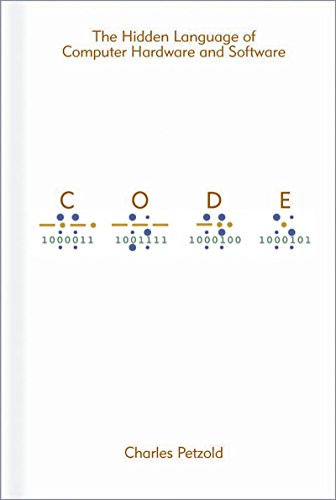
Code: The Hidden Language of Computer Hardware and Software
Charles Petzold
4.9
What do flashlights, the British invasion, black cats, and seesaws have to do with computers? In CODE, they show us the ingenious ways we manipulate language and invent new means of communicating with each other. And through CODE, we see how this ingenuity and our very human compulsion to communicate have driven the technological innovations of the past two centuries.
Using everyday objects and familiar language systems such as Braille and Morse code, author Charles Petzold weaves an illuminating narrative for anyone who’s ever wondered about the secret inner life of computers and other smart machines.
It’s a cleverly illustrated and eminently comprehensible story—and along the way, you’ll discover you’ve gained a real context for understanding today’s world of PCs, digital media, and the Internet. No matter what your level of technical savvy, CODE will charm you—and perhaps even awaken the technophile within.
…
Recommended by Ana Bell.
Ana Bell
It gets you to use your imagination to virtually build a computer. It’s easy to read, you can lie down on the couch and enjoy it—it’s not so much of a textbook. It demystifies the magic of a computer and what it is. [source]
Cover unavailable
3
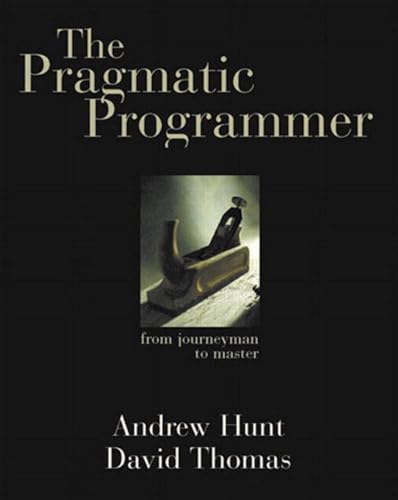
The Pragmatic Programmer: From Journeyman to Master
Andrew Hunt and David Thomas
4.8
-- Ward Cunningham Straight from the programming trenches, The Pragmatic Programmer cuts through the increasing specialization and technicalities of modern software development to examine the core process--taking a requirement and producing working, maintainable code that delights its users. It covers topics ranging from personal responsibility and career development to architectural techniques for keeping your code flexible and easy to adapt and reuse. Read this book, and youll learn how to *Fight software rot; *Avoid the trap of duplicating knowledge; *Write flexible, dynamic, and adaptable code; *Avoid programming by coincidence; *Bullet-proof your code with contracts, assertions, and exceptions; *Capture real requirements; *Test ruthlessly and effectively; *Delight your users; *Build teams of pragmatic programmers; and *Make your developments more precise with automation. Written as a series of self-contained sections and filled with entertaining anecdotes, thoughtful examples, and interesting analogies, The Pragmatic Programmer illustrates the best practices and major pitfalls of many different aspects of software development. Whether youre a new coder, an experienced programm
…
Recommended by Jeff Atwood, Hadley Wickham, and 1 others.
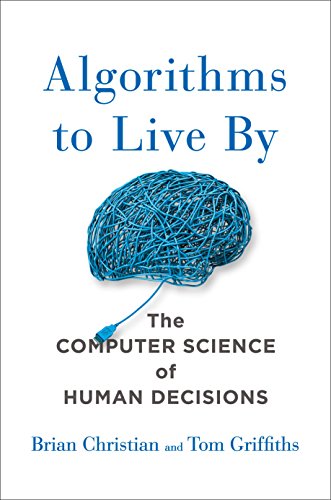
A fascinating exploration of how insights from computer algorithms can be applied to our everyday lives, helping to solve common decision-making problems and illuminate the workings of the human mind
All our lives are constrained by limited space and time, limits that give rise to a particular set of problems. What should we do, or leave undone, in a day or a lifetime? How much messiness should we accept? What balance of new activities and familiar favorites is the most fulfilling? These may seem like uniquely human quandaries, but they are not: computers, too, face the same constraints, so computer scientists have been grappling with their version of such issues for decades. And the solutions they've found have much to teach us.
In a dazzlingly interdisciplinary work, acclaimed author Brian Christian and cognitive scientist Tom Griffiths show how the algorithms used by computers can also untangle very human questions. They explain how to have better hunches and when to leave things to chance, how to deal with overwhelming choices and how best to connect with others. From finding a spouse to finding a parking spot, from organizing one's inbox to understanding the workings of memory, Algorithms to Live By transforms the wisdom of computer science into strategies for human living.
…
Recommended by Doug McMillon, Chris Oliver, Emi Gal, and 2 others.
Here are some of my favorite reads from 2017. Lots of friends and colleagues send me book suggestions and it's impossible to squeeze them all in. I continue to be super curious about how digital and tech are enabling people to transform our lives but I try to read a good mix of books that apply to a variety of areas and stretch my thinking more broadly. [source]
Chris Oliver
This is a great book talking about how you can use computer science to help you make decisions in life. How do you know when to make a decision on the perfect house? Car? etc? It helps you apply algorithms to making those decisions optimally without getting lost. [source]
Emi Gal
When asked what books he would recommend to young people interested in his career path, mentioned Algorithms to Live By. [source]
Cover unavailable
5
Clean Code: A Handbook of Agile Software Craftsmanship
Robert C. Martin
4.8
Even bad code can function. But if code isn t clean, it can bring a development organization to its knees. Every year, countless hours and significant resources are lost because of poorly written code. But it doesn t have to be that way. Noted software expert Robert C. Martin presents a revolutionary paradigm with Clean Code: A Handbook of Agile Software Craftsmanship. Martin has teamed up with his colleagues from Object Mentor to distill their best agile practice of cleaning code on the fly into a book that will instill within you the values of a software craftsman and make you a better programmer but only if you work at it. What kind of work will you be doing? You ll be reading code lots of code. And you will be challenged to think about what s right about that code, and what s wrong with it. More importantly, you will be challenged to reassess your professional values and your commitment to your craft. Clean Code is divided into three parts. The first describes the principles, patterns, and practices of writing clean code. The second part consists of several case studies of increasing complexity. Each case study is an exercise in cleaning up code of transforming a code base that has some problems into one that is sound and efficient. The third part is the payoff: a single chapter containing a list of heuristics and smells gathered while creating the case studies. The result is a knowledge base that describes the way we think when we write, read, and clean code. Readers will come away from this book understanding
How to tell the difference between good and bad code How to write good code and how to transform bad code into good code How to create good names, good functions, good objects, and good classes How to format code for maximum readability How to implement complete error handling without obscuring code logic How to unit test and practice test-driven development This book is a must for any developer, software engineer, project manager, team lead, or systems analyst with an interest in producing better code. "
…
Recommended by Ana Bell.
Ana Bell
This book is going to show you how to write code that is readable by yourself in the future, or by somebody else. You can sit on the couch and read it; you don’t need to code. You can actually enjoy it if you don’t know how to program at all. [source]
Cover unavailable
6
Introduction To Algorithms
Thomas H. Cormen, Charles E. Leiserson, et al.
4.8
Cover unavailable
7
Code Complete
Steve McConnell
4.7
Widely considered one of the best practical guides to programming, Steve McConnell's original CODE COMPLETE has been helping developers write better software for more than a decade. Now this classic book has been fully updated and revised with leading-edge practices--and hundreds of new code samples--illustrating the art and science of software construction. Capturing the body of knowledge available from research, academia, and everyday commercial practice, McConnell synthesizes the most effective techniques and must-know principles into clear, pragmatic guidance. No matter what your experience level, development environment, or project size, this book will inform and stimulate your thinking--and help you build the highest quality code. Discover the timeless techniques and strategies that help you:
Design for minimum complexity and maximum creativity Reap the benefits of collaborative development Apply defensive programming techniques to reduce and flush out errors Exploit opportunities to refactor--or evolve--code, and do it safely Use construction practices that are right-weight for your project Debug problems quickly and effectively Resolve critical construction issues early and correctly Build quality into the beginning, middle, and end of your project
…
Recommended by Jeff Atwood, Ana Bell, and Santiago Basulto.
Ana Bell
Code Complete is for people working in industry, writing software for companies. It has little checklists at key points in the book; if you are in industry, you can make sure that your code is readable and debugged by going through these checklists and making sure you’re touching upon all aspects. [source]
Santiago Basulto
If my career path is hackers turned business people, I’d say: Start with the basics and fundamentals: SICP: Structure and Interpretation of Computer Programs Code Complete 2 [source]
Cover unavailable
8
The Mythical Man-Month: Essays on Software Engineering
Few books on software project management have been as influential and timeless as The Mythical Man-Month. With a blend of software engineering facts and thought-provoking opinions, Fred Brooks offers insight for anyone managing complex projects. These essays draw from his experience as project manager for the IBM System/360 computer family and then for OS/360, its massive software system. Now, 20 years after the initial publication of his book, Brooks has revisited his original ideas and added new thoughts and advice, both for readers already familiar with his work and for readers discovering it for the first time.
The added chapters contain (1) a crisp condensation of all the propositions asserted in the original book, including Brooks' central argument in The Mythical Man-Month: that large programming projects suffer management problems different from small ones due to the division of labor; that the conceptual integrity of the product is therefore critical; and that it is difficult but possible to achieve this unity; (2) Brooks' view of these propositions a generation later; (3) a reprint of his classic 1986 paper "No Silver Bullet"; and (4) today's thoughts on the 1986 assertion, "There will be no silver bullet within ten years."
From "The Everything Store", written by Brad Stone “An influential computer scientist makes the counterintuitive argument that small groups of engineers are more effective than larger ones at handling complex software projects. The book lays out the theory behind Amazon’s two pizza teams,” Stone writes. [source]
An early look and experience with timeless truths (and gotchas) from systems building with teams [source]
Cover unavailable
9
Cracking the Coding Interview: 189 Programming Questions and Solutions
Gayle Laakmann McDowell
4.7
I am not a recruiter. I am a software engineer. And as such, I know what it's like to be asked to whip up brilliant algorithms on the spot and then write flawless code on a whiteboard. I've been through this as a candidate and as an interviewer.
Cracking the Coding Interview, 6th Edition is here to help you through this process, teaching you what you need to know and enabling you to perform at your very best. I've coached and interviewed hundreds of software engineers. The result is this book.
Learn how to uncover the hints and hidden details in a question, discover how to break down a problem into manageable chunks, develop techniques to unstick yourself when stuck, learn (or re-learn) core computer science concepts, and practice on 189 interview questions and solutions.
These interview questions are real; they are not pulled out of computer science textbooks. They reflect what's truly being asked at the top companies, so that you can be as prepared as possible. WHAT'S INSIDE? • 189 programming interview questions, ranging from the basics to the trickiest algorithm problems. • A walk-through of how to derive each solution, so that you can learn how to get there yourself. • Hints on how to solve each of the 189 questions, just like what you would get in a real interview. • Five proven strategies to tackle algorithm questions, so that you can solve questions you haven't seen. • Extensive coverage of essential topics, such as big O time, data structures, and core algorithms. • A behind the scenes look at how top companies like Google and Facebook hire developers. • Techniques to prepare for and ace the soft side of the interview: behavioral questions. • For interviewers and companies: details on what makes a good interview question and hiring process.
…
Cover unavailable
10
Design Patterns: Elements of Reusable Object-Oriented Software
Erich; Helm John Gamma
4.6
Capturing a wealth of experience about the design of object-oriented software, four top-notch designers present a catalog of simple and succinct solutions to commonly occurring design problems. Previously undocumented, these 23 patterns allow designers to create more flexible, elegant, and ultimately reusable designs without having to rediscover the design solutions themselves.
The authors begin by describing what patterns are and how they can help you design object-oriented software. They then go on to systematically name, explain, evaluate, and catalog recurring designs in object-oriented systems. With Design Patterns as your guide, you will learn how these important patterns fit into the software development process, and how you can leverage them to solve your own design problems most efficiently.
Each pattern describes the circumstances in which it is applicable, when it can be applied in view of other design constraints, and the consequences and trade-offs of using the pattern within a larger design. All patterns are compiled from real systems and are based on real-world examples. Each pattern also includes code that demonstrates how it may be implemented in object-oriented programming languages like C++ or Smalltalk.
…
Cover unavailable
11
The C Programming Language
Brian W. Kernighan, Dennis M. Ritchie
4.6
This book is meant to help the reader learn how to program in C. It is the definitive reference guide, now in a second edition. Although the first edition was written in 1978, it continues to be a worldwide best-seller. This second edition brings the classic original up to date to include the ANSI standard.
From the Preface: We have tried to retain the brevity of the first edition. C is not a big language, and it is not well served by a big book. We have improved the exposition of critical features, such as pointers, that are central to C programming. We have refined the original examples, and have added new examples in several chapters. For instance, the treatment of complicated declarations is augmented by programs that convert declarations into words and vice versa. As before, all examples have been tested directly from the text, which is in machine-readable form.
As we said in the first preface to the first edition, C "wears well as one's experience with it grows." With a decade more experience, we still feel that way. We hope that this book will help you to learn C and use it well.
…
Cover unavailable
12
Gödel, Escher, Bach: An Eternal Golden Braid
Douglas R. Hofstadter
4.6
Douglas Hofstadter's book is concerned directly with the nature of “maps” or links between formal systems. However, according to Hofstadter, the formal system that underlies all mental activity transcends the system that supports it. If life can grow out of the formal chemical substrate of the cell, if consciousness can emerge out of a formal system of firing neurons, then so too will computers attain human intelligence. Gödel, Escher, Bach is a wonderful exploration of fascinating ideas at the heart of cognitive science: meaning, reduction, recursion, and much more.
…
Recommended by Steve Jurvetson, Seth Godin, Cory Zue, and 2 others.
Steve Jurvetson
Steve Jurvetson recommended this book on the podcast "The Tim Ferriss Show". [source]
This book is an illustration of the power of names in the Google era. [source]
Cover unavailable
14
Refactoring: Improving the Design of Existing Code
Martin Fowler
4.5
Fully Revised and Updated-Includes New Refactorings and Code Examples"Any fool can write code that a computer can understand. Good programmers write code that humans can understand." --M. Fowler (1999) For more than twenty years, experienced programmers worldwide have relied on Martin Fowler's Refactoring to improve the design of existing code and to enhance software maintainability, as well as to make existing code easier to understand. This eagerly awaited new edition has been fully updated to reflect crucial changes in the programming landscape. Refactoring, Second Edition, features an updated catalog of refactorings and includes JavaScript code examples, as well as new functional examples that demonstrate refactoring without classes. Like the original, this edition explains what refactoring is; why you should refactor; how to recognize code that needs refactoring; and how to actually do it successfully, no matter what language you use. Understand the process and general principles of refactoring Quickly apply useful refactorings to make a program easier to comprehend and change Recognize "bad smells" in code that signal opportunities to refactor Explore the refactorings, each with explanations, motivation, mechanics, and simple examples Build solid tests for your refactorings Recognize tradeoffs and obstacles to refactoring Includes free access to the canonical web edition, with even more refactoring resources. (See inside the book for details about how to access the web edition.)
This is next on my list of technical books to read! Refactoring is one of two programming books that I’ve read multiple times (the other is Smalltalk Best Practice Patterns), and I’m due for another reading. What perfect time then to dive into Martin Fowler’s long anticipated 2nd edition, now using JavaScript rather than Java for the code examples. Like the stoic books, I read Refactoring and that Smalltalk book again and again not because I’m going to learn something new, per se, but because I want to be reminded about what I already know. And what better time to reread than just as we’re kicking off a new major project that needs a fresh architectural foundation. Also, these two books just remind every time of how much I love the craft of programming. It’s not just having the programs, it’s not just solving problems, it’s simply using my hands and head to program that in and of itself is sublime. [source]
Cover unavailable
15
Artificial Intelligence: A Modern Approach
Stuart Russell and Peter Norvig
4.5
For one or two-semester, undergraduate or graduate-level courses in Artificial Intelligence. The long-anticipated revision of this best-selling text offers the most comprehensive, up-to-date introduction to the theory and practice of artificial intelligence. *NEW-Nontechnical learning material-Accompanies each part of the book. *NEW-The Internet as a sample application for intelligent systems-Added in several places including logical agents, planning, and natural language. *NEW-Increased coverage of material - Includes expanded coverage of: default reasoning and truth maintenance systems, including multi-agent/distributed AI and game theory; probabilistic approaches to learning including EM; more detailed descriptions of probabilistic inference algorithms. *NEW-Updated and expanded exercises-75% of the exercises are revised, with 100 new exercises. *NEW-On-line Java software. *Makes it easy for students to do projects on the web using intelligent agents. *A unified, agent-based approach to AI-Organizes the material around the task of building intelligent agents. *Comprehensive, up-to-date coverage-Includes a unified view of the field organized around the rational decision making pa
…
Cover unavailable
16
The Code Book: The Science of Secrecy from Ancient Egypt to Quantum Cryptography
Simon Singh
4.5
In his first book since the bestselling Fermat's Enigma, Simon Singh offers the first sweeping history of encryption, tracing its evolution and revealing the dramatic effects codes have had on wars, nations, and individual lives. From Mary, Queen of Scots, trapped by her own code, to the Navajo Code Talkers who helped the Allies win World War II, to the incredible (and incredibly simple) logistical breakthrough that made Internet commerce secure, The Code Book tells the story of the most powerful intellectual weapon ever known: secrecy.
Throughout the text are clear technical and mathematical explanations, and portraits of the remarkable personalities who wrote and broke the world's most difficult codes. Accessible, compelling, and remarkably far-reaching, this book will forever alter your view of history and what drives it. It will also make yo wonder how private that e-mail you just sent really is.
Eric Freeman, Bert Bates, Kathy Sierra, Elisabeth Robson
4.4
You're not alone.
At any given moment, somewhere in the world someone struggles with the same software design problems you have. You know you don't want to reinvent the wheel (or worse, a flat tire), so you look to Design Patterns--the lessons learned by those who've faced the same problems. With Design Patterns, you get to take advantage of the best practices and experience of others, so that you can spend your time on...something else. Something more challenging. Something more complex. Something more fun.
You want to learn about the patterns that matter--why to use them, when to use them, how to use them (and when NOT to use them). But you don't just want to see how patterns look in a book, you want to know how they look "in the wild". In their native environment. In other words, in real world applications. You also want to learn how patterns are used in the Java API, and how to exploit Java's built-in pattern support in your own code.
You want to learn the real OO design principles and why everything your boss told you about inheritance might be wrong (and what to do instead). You want to learn how those principles will help the next time you're up a creek without a design pattern.
Most importantly, you want to learn the "secret language" of Design Patterns so that you can hold your own with your co-worker (and impress cocktail party guests) when he casually mentions his stunningly clever use of Command, Facade, Proxy, and Factory in between sips of a martini. You'll easily counter with your deep understanding of why Singleton isn't as simple as it sounds, how the Factory is so often misunderstood, or on the real relationship between Decorator, Facade and Adapter.
With Head First Design Patterns, you'll avoid the embarrassment of thinking Decorator is something from the "Trading Spaces" show. Best of all, in a way that won't put you to sleep! We think your time is too important (and too short) to spend it struggling with academic texts.
If you've read a Head First book, you know what to expect--a visually rich format designed for the way your brain works. Using the latest research in neurobiology, cognitive science, and learning theory, Head First Design Patterns will load patterns into your brain in a way that sticks. In a way that lets you put them to work immediately. In a way that makes you better at solving software design problems, and better at speaking the language of patterns with others on your team.
…
Cover unavailable
18
Compilers: Principles, Techniques, and Tools
Alfred V. Aho, Ravi Sethi, Jeffrey D. Ullman
4.4
This introduction to compilers is the direct descendant of the well-known book by Aho and Ullman, Principles of Compiler Design. The authors present updated coverage of compilers based on research and techniques that have been developed in the field over the past few years. The book provides a thorough introduction to compiler design and covers topics such as context-free grammars, fine state machines, and syntax-directed translation.
…
Cover unavailable
19
Don't Make Me Think, Revisited: A Common Sense Approach to Web Usability
Steve Krug
4.4
Since Don’t Make Me Think was first published in 2000, over 400,000 Web designers and developers have relied on Steve Krug’s guide to help them understand the principles of intuitive navigation and information design.
In this 3rd edition, Steve returns with fresh perspective to reexamine the principles that made Don’t Make Me Think a classic-–with updated examples and a new chapter on mobile usability. And it’s still short, profusely illustrated…and best of all–fun to read.
If you’ve read it before, you’ll rediscover what made Don’t Make Me Think so essential to Web designers and developers around the world. If you’ve never read it, you’ll see why so many people have said it should be required reading for anyone working on Web sites.
…
Recommended by Brian Armstrong, Jeff Atwood, Ken Norton, and 13 others.
Anoop Anthony
Krug was teaching usability two decades ago when UX wasn't a buzzword, and the WWW was still in its nascent stages. (The first edition of this book was published in 2000!) I cut my teeth on Don't make me think back when I first started out in the industry. It is now in its third edition and still relevant — it offers compelling insights into building great user experiences into websites and applications. [source]
Auston Bunsen
I’m actually a self-taught programmer, so these books have really helped me with practical skills that I could put to use & yield results. The return on investment for these kinds of books is off the charts for me! [source]
Chris Goward
Here are some of the books that have been very impactful for me, or taught me a new way of thinking: … Don't Make Me Think. [source]
Cover unavailable
20
Designing Data-Intensive Applications
Martin Kleppmann
4.4
Many forces affect software today: larger datasets, geographical disparities, complex company structures, and the growing need to be fast and nimble in the face of change.
Proven approaches such as service-oriented and event-driven architectures are joined by newer techniques such as microservices, reactive architectures, DevOps, and stream processing. Many of these patterns are successful by themselves, but as this practical ebook demonstrates, they provide a more holistic and compelling approach when applied together.
Author Ben Stopford explains how service-based architectures and stream processing tools such as Apache Kafka® can help you build business-critical systems.
* Learn why streaming beats request-response based architectures in complex, contemporary use cases * Understand why replayable logs such as Kafka provide a backbone for both service communication and shared datasets * Explore how event collaboration and event sourcing patterns increase safety and recoverability with functional, event-driven approaches * Apply patterns including Event Sourcing and CQRS, and how to build multi-team systems with microservices and SOA using patterns such as “inside out databases” and “event streams as a source of truth” * Build service ecosystems that blend event-driven and request-driven interfaces using a replayable log and Kafka's Streams API * Scale beyond individual teams into larger, department- and company-sized architectures, using event streams as a source of truth
…
Cover unavailable
21
The Art of Computer Programming, Volume 1: Fundamental Algorithms
Donald E. Knuth
4.4
The first revision of this third volume is the most comprehensivesurvey of classical computer techniques for sorting and searching. It extends thetreatment of data structures in Volume 1 to consider both large and smalldatabases and internal and external memories. The book contains a selection ofcarefully checked computer methods, with a quantitative analysis of theirefficiency. Outstanding features of the second edition include a revised sectionon optimum sorting and new discussions of the theory of permutations and ofuniversal hashing.
Superintelligence asks the questions: what happens when machines surpass humans in general intelligence? Will artificial agents save or destroy us? Nick Bostrom lays the foundation for understanding the future of humanity and intelligent life.
The human brain has some capabilities that the brains of other animals lack. It is to these distinctive capabilities that our species owes its dominant position. If machine brains surpassed human brains in general intelligence, then this new superintelligence could become extremely powerful--possibly beyond our control. As the fate of the gorillas now depends more on humans than on the species itself, so would the fate of humankind depend on the actions of the machine superintelligence.
But we have one advantage: we get to make the first move. Will it be possible to construct a seed Artificial Intelligence, to engineer initial conditions so as to make an intelligence explosion survivable? How could one achieve a controlled detonation?
…
Recommended by Elon Musk, Maria Ramos, and Will MacAskill.
Worth reading Superintelligence by Bostrom. We need to be super careful with AI. Potentially more dangerous than nukes. [source]
Maria Ramos
CEO/Barclays Africa
Ramos will take the summer to examine some of the questions weighing more heavily on humankind as we contemplate our collective future: what happens when we can write our own genetic codes, and what happens when we create technology that is meaningfully more intelligent than us. The Gene: An Intimate History—Siddhartha Mukherjee Superintelligence: Paths, Dangers, Strategies—Nick Bostrom The Ministry of Utmost Happiness—Arundhati Roy [source]
Will MacAskill
I picked this book because the possibility of us developing human-level artificial intelligence, and from there superintelligence—an artificial agent that is considerably more intelligent than we are—is at least a contender for the most important issue in the next two centuries. Bostrom’s book has been very influential in effective altruism, lots of people work on artificial intelligence in order to ensure that it is developed safely. I don’t agree with the entire contents of the book, but there are many compelling arguments in it. It would be extremely overconfident to dismiss this book as too speculative. In fact, I think there should be a lot more work that tries to understand the biggest challenges for the next two hundred years, and what we could do to try to overcome them. [source]
Cover unavailable
23
Introduction to the Theory of Computation
Michael Sipser
4.4
This highly anticipated revision builds upon the strengths of the previous edition. Sipser's candid, crystal-clear style allows students at every level to understand and enjoy this field. His innovative "proof idea" sections explain profound concepts in plain English. The new edition incorporates many improvements students and professors have suggested over the years, and offers updated, classroom-tested problem sets at the end of each chapter.
…
Cover unavailable
24
The Clean Coder: A Code of Conduct for Professional Programmers
Programmers who endure and succeed amidst swirling uncertainty and nonstop pressure share a common attribute: They care deeply about the practice of creating software. They treat it as a craft. They are professionals. In The Clean Coder: A Code of Conduct for Professional Programmers, legendary software expert Robert C. Martin introduces the disciplines, techniques, tools, and practices of true software craftsmanship. This book is packed with practical advice-about everything from estimating and coding to refactoring and testing. It covers much more than technique: It is about attitude. Martin shows how to approach software development with honor, self-respect, and pride; work well and work clean; communicate and estimate faithfully; face difficult decisions with clarity and honesty; and understand that deep knowledge comes with a responsibility to act. Readers will learn What it means to behave as a true software craftsman How to deal with conflict, tight schedules, and unreasonable managers How to get into the flow of coding, and get past writer's block How to handle unrelenting pressure and avoid burnout How to combine enduring attitudes with new development paradigms How to manage your time, and avoid blind alleys, marshes, bogs, and swamps How to foster environments where programmers and teams can thrive When to say "No"-and how to say it When to say "Yes"-and what yes really means Great software is something to marvel at: powerful, elegant, functional, a pleasure to work with as both a developer and as a user. Great software isn't written by machines. It is written by professionals with an unshakable commitment to craftsmanship. The Clean Coder will help you become one of them-and earn the pride and fulfillment that they alone possess.
…
Cover unavailable
25
Effective Java
Joshua Bloch
4.3
Since this Jolt-award winning classic was last updated in 2008 (shortly after Java 6 was released), Java has changed dramatically. The principal enhancement in Java 8 was the addition of functional programming constructs to Java's object-oriented roots. Java 7, 8, and 9 also introduced language features, such as the try-with-resources statement, the diamond operator for generic types, default and static methods in interfaces, the @SafeVarargs annotation, and modules. New library features include pervasive use of functional interfaces and streams, the java.time package for manipulating dates and times, and numerous minor enhancements such as convenience factory methods for collections. In this new edition of Effective Java, Bloch updates the work to take advantage of these new language and library features, and provides specific best practices for their use. Java's increased support for multiple paradigms increases the need for best-practices advice, and this book delivers. As in previous editions, each chapter consists of several "items," each presented in the form of a short, standalone essay that provides specific advice, insight into Java platform subtleties, and updated code examples. The comprehensive descriptions and explanations for each item illuminate what to do, what not to do, and why. Coverage includes: Updated techniques and best practices on classic topics, including objects, classes, methods, libraries, and generics How to avoid the traps and pitfalls of commonly misunderstood subtleties of the platform Focus on the language and its most fundamental libraries, such as java.lang and java.util
…
Cover unavailable
26
The Elements of Computing Systems: Building a Modern Computer from First Principles
Noam Nisan and Shimon Schocken
4.3
In the early days of computer science, the interactions of hardware, software, compilers, and operating system were simple enough to allow students to see an overall picture of how computers worked. With the increasing complexity of computer technology and the resulting specialization of knowledge, such clarity is often lost. Unlike other texts that cover only one aspect of the field, The Elements of Computing Systems gives students an integrated and rigorous picture of applied computer science, as its comes to play in the construction of a simple yet powerful computer system.
Indeed, the best way to understand how computers work is to build one from scratch, and this textbook leads students through twelve chapters and projects that gradually build a basic hardware platform and a modern software hierarchy from the ground up. In the process, the students gain hands-on knowledge of hardware architecture, operating systems, programming languages, compilers, data structures, algorithms, and software engineering. Using this constructive approach, the book exposes a significant body of computer science knowledge and demonstrates how theoretical and applied techniques taught in other courses fit into the overall picture.
Designed to support one- or two-semester courses, the book is based on an abstraction-implementation paradigm; each chapter presents a key hardware or software abstraction, a proposed implementation that makes it concrete, and an actual project. The emerging computer system can be built by following the chapters, although this is only one option, since the projects are self-contained and can be done or skipped in any order. All the computer science knowledge necessary for completing the projects is embedded in the book, the only pre-requisite being a programming experience.
The book's web site provides all tools and materials necessary to build all the hardware and software systems described in the text, including two hundred test programs for the twelve projects. The projects and systems can be modified to meet various teaching needs, and all the supplied software is open-source.
…
Cover unavailable
27
Programming Pearls
Jon Bentley
4.3
The first edition of Programming Pearls was one of the most influential books I read early in my career, and many of the insights I first encountered in that book stayed with me long after I read it. Jon has done a wonderful job of updating the material. I am very impressed at how fresh the new examples seem. - Steve McConnell When programmers list their favorite books, Jon Bentley's collection of programming pearls is commonly included among the classics. Just as natural pearls grow from grains of sand that irritate oysters, programming pearls have grown from real problems that have irritated real programmers. With origins beyond solid engineering, in the realm of insight and creativity, Bentley's pearls offer unique and clever solutions to those nagging problems. Illustrated by programs designed as much for fun as for instruction, the book is filled with lucid and witty descriptions of practical programming techniques and fundamental design principles. It is not at all surprising that Programming Pearls has been so highly valued by programmers at every level of experience. In this revision, the first in 14 years, Bentley has substantially updated his essays to reflect
…
Recommended by Jeff Atwood and James Stanley.
James Stanley
I very much enjoyed reading "Programming Pearls" by John Bentley. Most of the software we write is trying to solve fairly large and ill-defined problems in a way that minimises development cost, but Programming Pearls presents a lot of small, well-defined problems, and talks through their solutions in ways that minimise machine resource usage. There are lots of good "a-ha" moments when reading it, and working through ways to think about the problems that knock asymptotic orders off the computational complexity. [source]
Cover unavailable
28
Concrete Mathematics: A Foundation for Computer Science
Ronald L. Graham, Donald E. Knuth, et al.
4.3
Concrete Mathematics is a blending of CONtinuous and disCRETE mathematics. "More concretely," the authors explain, "it is the controlled manipulation of mathematical formulas, using a collection of techniques for solving problems."
From the author of the bestselling biographies of Benjamin Franklin and Albert Einstein, this is the exclusive, New York Times bestselling biography of Apple co-founder Steve Jobs.
Based on more than forty interviews with Jobs conducted over two years—as well as interviews with more than a hundred family members, friends, adversaries, competitors, and colleagues—Walter Isaacson has written a riveting story of the roller-coaster life and searingly intense personality of a creative entrepreneur whose passion for perfection and ferocious drive revolutionized six industries: personal computers, animated movies, music, phones, tablet computing, and digital publishing.
At a time when America is seeking ways to sustain its innovative edge, and when societies around the world are trying to build digital-age economies, Jobs stands as the ultimate icon of inventiveness and applied imagination. He knew that the best way to create value in the twenty-first century was to connect creativity with technology. He built a company where leaps of the imagination were combined with remarkable feats of engineering.
Although Jobs cooperated with this book, he asked for no control over what was written nor even the right to read it before it was published. He put nothing off-limits. He encouraged the people he knew to speak honestly. And Jobs speaks candidly, sometimes brutally so, about the people he worked with and competed against. His friends, foes, and colleagues provide an unvarnished view of the passions, perfectionism, obsessions, artistry, devilry, and compulsion for control that shaped his approach to business and the innovative products that resulted.
Driven by demons, Jobs could drive those around him to fury and despair. But his personality and products were interrelated, just as Apple’s hardware and software tended to be, as if part of an integrated system. His tale is instructive and cautionary, filled with lessons about innovation, character, leadership, and values.
For Chesky, a source may come in the form of a biography of a business hero such as Steve Jobs or Walt Disney. His primary book source on management technique is Andy Grove’s High Output Management. [source]
Meadows’ Thinking in Systems, is a concise and crucial book offering insight for problem solving on scales ranging from the personal to the global. Edited by the Sustainability Institute’s Diana Wright, this essential primer brings systems thinking out of the realm of computers and equations and into the tangible world, showing readers how to develop the systems-thinking skills that thought leaders across the globe consider critical for 21st-century life.
Some of the biggest problems facing the world—war, hunger, poverty, and environmental degradation—are essentially system failures. They cannot be solved by fixing one piece in isolation from the others, because even seemingly minor details have enormous power to undermine the best efforts of too-narrow thinking.
While readers will learn the conceptual tools and methods of systems thinking, the heart of the book is grander than methodology. Donella Meadows was known as much for nurturing positive outcomes as she was for delving into the science behind global dilemmas. She reminds readers to pay attention to what is important, not just what is quantifiable, to stay humble, and to stay a learner.
In a world growing ever more complicated, crowded, and interdependent, Thinking in Systems helps readers avoid confusion and helplessness, the first step toward finding proactive and effective solutions.
…
Recommended by Tobi Lütke, Kate Raworth, and Mira Kirshenbaum.
Tobi Lütke
Founder & CEO/Shopify
Tobi Lütke recommended this book on the podcast "The Knowledge Project". [source]
A black swan is a highly improbable event with three principal characteristics: It is unpredictable; it carries a massive impact; and, after the fact, we concoct an explanation that makes it appear less random, and more predictable, than it was.
The astonishing success of Google was a black swan; so was 9/11. For Nassim Nicholas Taleb, black swans underlie almost everything about our world, from the rise of religions to events in our own personal lives.
Why do we not acknowledge the phenomenon of black swans until after they occur? Part of the answer, according to Taleb, is that humans are hardwired to learn specifics when they should be focused on generalities.
We concentrate on things we already know and time and time again fail to take into consideration what we don’t know. We are, therefore, unable to truly estimate opportunities, too vulnerable to the impulse to simplify, narrate, and categorize, and not open enough to rewarding those who can imagine the “impossible.”
For years, Taleb has studied how we fool ourselves into thinking we know more than we actually do. We restrict our thinking to the irrelevant and inconsequential, while large events continue to surprise us and shape our world. Now, in this revelatory book, Taleb explains everything we know about what we don’t know. He offers surprisingly simple tricks for dealing with black swans and benefiting from them.
Elegant, startling, and universal in its applications The Black Swan will change the way you look at the world. Taleb is a vastly entertaining writer, with wit, irreverence, and unusual stories to tell. He has a polymathic command of subjects ranging from cognitive science to business to probability theory.
The Black Swan is a landmark book – itself a black swan.
The book also contains a 4-page glossary; 19 pages of notes; and, a 28-page bibliography in addition to an index.
From the book "The Everything Store: and the Age of Amazon" “The scholar argues that people are wired to see patterns in chaos while remaining blind to unpredictable events, with massive consequences. Experimentation and empiricism trumps the easy and obvious narrative,” Stone writes. [source]
And throw in “The Black Swan” and “Fooled by Randomness”. “Fragile” means if you hit something might break. “Resilient” means if you hit something, it will stay the same. On my podcast Nassim discusses “Antifragility” – building a system, even on that works for you on a personal level, where you if you harm your self in some way it becomes stronger. That podcast changed my life He discusses Antifragility throughout history, up to our current economic situation, and even in our personal situations. [source]
Cover unavailable
32
Domain-Driven Design: Tackling Complexity in the Heart of Software
Eric Evans
4.3
"Eric Evans has written a fantastic book on how you can make the design of your software match your mental model of the problem domain you are addressing. "His book is very compatible with XP. It is not about drawing pictures of a domain; it is about how you think of it, the language you use to talk about it, and how you organize your software to reflect your improving understanding of it. Eric thinks that learning about your problem domain is as likely to happen at the end of your project as at the beginning, and so refactoring is a big part of his technique. "The book is a fun read. Eric has lots of interesting stories, and he has a way with words. I see this book as essential reading for software developers--it is a future classic." --Ralph Johnson, author of Design Patterns "If you don't think you are getting value from your investment in object-oriented programming, this book will tell you what you've forgotten to do. "Eric Evans convincingly argues for the importance of domain modeling as the central focus of development and provides a solid framework and set of techniques for accomplishing it. This is timeless wisdom, and will hold up long after the methodologies du jour have gone out of fashion." --Dave Collins, author of Designing Object-Oriented User Interfaces "Eric weaves real-world experience modeling--and building--business applications into a practical, useful book. Written from the perspective of a trusted practitioner, Eric's descriptions of ubiquitous language, the benefits of sharing models with users, object life-cycle management, logical and physical application structuring, and the process and results of deep refactoring are major contributions to our field." --Luke Hohmann, author of Beyond Software Architecture "This book belongs on the shelf of every thoughtful software developer." --Kent Beck "What Eric has managed to capture is a part of the design process that experienced object designers have always used, but that we have been singularly unsuccessful as a group in conveying to the rest of the industry. We've given away bits and pieces of this knowledge...but we've never organized and systematized the principles of building domain logic. This book is important." --Kyle Brown, author of Enterprise Java(TM) Programming with IBM(R) WebSphere(R) The software development community widely acknowledges that domain modeling is central to software design. Through domain models, software developers are able to express rich functionality and translate it into a software implementation that truly serves the needs of its users. But despite its obvious importance, there are few practical resources that explain how to incorporate effective domain modeling into the software development process. Domain-Driven Design fills that need. This is not a book about specific technologies. It offers readers a systematic approach to domain-driven design, presenting an extensive set of design best practices, experience-based techniques, and fundamental principles that facilitate the development of software projects facing complex domains. Intertwining design and development practice, this book incorporates numerous examples based on actual projects to illustrate the application of domain-driven design to real-world software development. Readers learn how to use a domain model to make a complex development effort more focused and dynamic. A core of best practices and standard patterns provides a common language for the development team. A shift in emphasis--refactoring not just the code but the model underlying the code--in combination with the frequent iterations of Agile development leads to deeper insight into domains and enhanced communication between domain expert and programmer. Domain-Driven Design then builds on this foundation, and addresses modeling and design for complex systems and larger organizations.Specific topics covered include: Getting all team members to speak the same language Connecting model and implementation more deeply Sharpening key distinctions in a model Managing the lifecycle of a domain object Writing domain code that is safe to combine in elaborate ways Making complex code obvious and predictable Formulating a domain vision statement Distilling the core of a complex domain Digging out implicit concepts needed in the model Applying analysis patterns Relating design patterns to the model Maintaining model integrity in a large system Dealing with coexisting models on the same project Organizing systems with large-scale structures Recognizing and responding to modeling breakthroughs With this book in hand, object-oriented developers, system analysts, and designers will have the guidance they need to organize and focus their work, create rich and useful domain models, and leverage those models into quality, long-lasting software implementations.
Get more out of your legacy systems, more performance, functionality, reliability, and manageability.Is your code easy to change? Can you get nearly instantaneous feedback when you do change it? Do you understand it? If the answer to any of these questions is no, you have legacy code, and it is draining time and money away from your development efforts.
In this book, Michael Feathers offers start-to-finish strategies for working more effectively with large, untested legacy code bases. This book draws on material Michael created for his renowned Object Mentor seminars, techniques Michael has used in mentoring to help hundreds of developers, technical managers, and testers bring their legacy systems under control.
The topics covered include:
Understanding the mechanics of software change, adding features, fixing bugs, improving design, optimizing performance Getting legacy code into a test harness Writing tests that protect you against introducing new problems Techniques that can be used with any language or platform, with examples in Java, C++, C, and C# Accurately identifying where code changes need to be made Coping with legacy systems that aren't object-oriented Handling applications that don't seem to have any structure
This book also includes a catalog of twenty-four dependency-breaking techniques that help you work with program elements in isolation and make safer changes.
…
Cover unavailable
34
Types and Programming Languages
Benjamin C. Pierce
4.3
A comprehensive introduction to type systems and programming languages.
A type system is a syntactic method for automatically checking the absence of certain erroneous behaviors by classifying program phrases according to the kinds of values they compute. The study of type systems--and of programming languages from a type-theoretic perspective--has important applications in software engineering, language design, high-performance compilers, and security.
This text provides a comprehensive introduction both to type systems in computer science and to the basic theory of programming languages. The approach is pragmatic and operational; each new concept is motivated by programming examples and the more theoretical sections are driven by the needs of implementations. Each chapter is accompanied by numerous exercises and solutions, as well as a running implementation, available via the Web. Dependencies between chapters are explicitly identified, allowing readers to choose a variety of paths through the material.
The core topics include the untyped lambda-calculus, simple type systems, type reconstruction, universal and existential polymorphism, subtyping, bounded quantification, recursive types, kinds, and type operators. Extended case studies develop a variety of approaches to modeling the features of object-oriented languages.
…
Recommended by Ana Bell.
Ana Bell
It’s not a book for beginners, but it’s a good book if you’re interested in the theory behind programming languages. [source]
Cover unavailable
35
The Phoenix Project: A Novel About IT, DevOps, and Helping Your Business Win
Bill is an IT manager at Parts Unlimited. It's Tuesday morning and on his drive into the office, Bill gets a call from the CEO.
The company's new IT initiative, code named Phoenix Project, is critical to the future of Parts Unlimited, but the project is massively over budget and very late. The CEO wants Bill to report directly to him and fix the mess in ninety days or else Bill's entire department will be outsourced.
With the help of a prospective board member and his mysterious philosophy of The Three Ways, Bill starts to see that IT work has more in common with manufacturing plant work than he ever imagined. With the clock ticking, Bill must organize work flow streamline interdepartmental communications, and effectively serve the other business functions at Parts Unlimited.
In a fast-paced and entertaining style, three luminaries of the DevOps movement deliver a story that anyone who works in IT will recognize. Readers will not only learn how to improve their own IT organizations, they'll never view IT the same way again.
…
Recommended by Jeffrey Snover and Louis Nyffenegger.
Jeffrey Snover
Great thread. I know of a number of devops people that haven't read this book. Ya'll should fix that. https://t.co/Yri4JJ0jBZ [source]
Louis Nyffenegger
I don't think I have a specific book that I can call my favourite. Some books have had a big impact on my view of how to build a product/company ("Rework"), some were very enjoyable to read ("The Phoenix Project"), some helped me improve the way I think ("The Pleasure Of Finding Things Out") and some the way I live ("Essentialism") or work ("Deep Work"). [source]
Cover unavailable
36
Deep Learning
Ian Goodfellow, Yoshua Bengio, et al.
4.2
An introduction to a broad range of topics in deep learning, covering mathematical and conceptual background, deep learning techniques used in industry, and research perspectives.
Deep learning is a form of machine learning that enables computers to learn from experience and understand the world in terms of a hierarchy of concepts. Because the computer gathers knowledge from experience, there is no need for a human computer operator to formally specify all the knowledge that the computer needs. The hierarchy of concepts allows the computer to learn complicated concepts by building them out of simpler ones; a graph of these hierarchies would be many layers deep. This book introduces a broad range of topics in deep learning.
The text offers mathematical and conceptual background, covering relevant concepts in linear algebra, probability theory and information theory, numerical computation, and machine learning. It describes deep learning techniques used by practitioners in industry, including deep feedforward networks, regularization, optimization algorithms, convolutional networks, sequence modeling, and practical methodology; and it surveys such applications as natural language processing, speech recognition, computer vision, online recommendation systems, bioinformatics, and videogames. Finally, the book offers research perspectives, covering such theoretical topics as linear factor models, autoencoders, representation learning, structured probabilistic models, Monte Carlo methods, the partition function, approximate inference, and deep generative models.
Deep Learning can be used by undergraduate or graduate students planning careers in either industry or research, and by software engineers who want to begin using deep learning in their products or platforms. A website offers supplementary material for both readers and instructors.
Very clear exposition, does the math without getting lost in the details. Although many of the concepts of the introductory first 100 pages can be found elsewhere, they are presented with remarkable cut-to-the-chase clarity. [source]
Elon Musk and Facebook AI chief Yann LeCun have praised this textbook on one of software’s most promising frontiers. After its publication, Microsoft signed up coauthor Bengio, a pioneer in machine learning, as an adviser [source]
Cover unavailable
37
The C++ Programming Language
Bjarne Stroustrup
4.2
The new C++11 standard allows programmers to express ideas more clearly, simply, and directly, and to write faster, more efficient code. Bjarne Stroustrup, the designer and original implementer of C++, has reorganized, extended, and completely rewritten his definitive reference and tutorial for programmers who want to use C++ most effectively. "The C++ Programming Language, Fourth Edition, " delivers meticulous, richly explained, and integrated coverage of the entire language--its facilities, abstraction mechanisms, standard libraries, and key design techniques. Throughout, Stroustrup presents concise, "pure C++11" examples, which have been carefully crafted to clarify both usage and program design. To promote deeper understanding, the author provides extensive cross-references, both within the book and to the ISO standard. New C++11 coverage includes Support for concurrency Regular expressions, resource management pointers, random numbers, and improved containers General and uniform initialization, simplified for-statements, move semantics, and Unicode support Lambdas, general constant expressions, control over class defaults, variadic templates, template aliases, and user-defined literals Compatibility issues Topics addressed in this comprehensive book include Basic facilities: type, object, scope, storage, computation fundamentals, and more Modularity, as supported by namespaces, source files, and exception handling C++ abstraction, including classes, class hierarchies, and templates in support of a synthesis of traditional programming, object-oriented programming, and generic programming Standard Library: containers, algorithms, iterators, utilities, strings, stream I/O, locales, numerics, and more The C++ basic memory model, in depth This fourth edition makes C++11 thoroughly accessible to programmers moving from C++98 or other languages, while introducing insights and techniques that even cutting-edge C++11 programmers will find indispensable. "This book features an enhanced, layflat binding, which allows the book to stay open more easily when placed on a flat surface. This special binding method--noticeable by a small space inside the spine--also increases durability."
…
Cover unavailable
38
The Little Schemer
Daniel P. Friedman, Matthias Felleisen, et al.
4.2
The notion that “thinking about computing is one of the most exciting things the human mind can do” sets both The Little Schemer (formerly known as The Little LISPer) and its new companion volume, The Seasoned Schemer, apart from other books on LISP. The authors' enthusiasm for their subject is compelling as they present abstract concepts in a humorous and easy-to-grasp fashion. Together, these books will open new doors of thought to anyone who wants to find out what computing is really about. The Little Schemer introduces computing as an extension of arithmetic and algebra; things that everyone studies in grade school and high school. It introduces programs as recursive functions and briefly discusses the limits of what computers can do. The authors use the programming language Scheme, and interesting foods to illustrate these abstract ideas. The Seasoned Schemer informs the reader about additional dimensions of computing: functions as values, change of state, and exceptional cases. The Little LISPer has been a popular introduction to LISP for many years. It had appeared in French and Japanese. The Little Schemer and The Seasoned Schemer are worthy successors and will prove equally popular as textbooks for Scheme courses as well as companion texts for any complete introductory course in Computer Science.
…
Recommended by Bret Victor.
Cover unavailable
39
JavaScript: The Good Parts
Douglas Crockford
4.2
Most programming languages contain good and bad parts, but JavaScript has more than its share of the bad, having been developed and released in a hurry before it could be refined. This authoritative book scrapes away these bad features to reveal a subset of JavaScript that's more reliable, readable, and maintainable than the language as a whole--a subset you can use to create truly extensible and efficient code.
Considered the JavaScript expert by many people in the development community, author Douglas Crockford identifies the abundance of good ideas that make JavaScript an outstanding object-oriented programming language-ideas such as functions, loose typing, dynamic objects, and an expressive object literal notation. Unfortunately, these good ideas are mixed in with bad and downright awful ideas, like a programming model based on global variables.
When Java applets failed, JavaScript became the language of the Web by default, making its popularity almost completely independent of its qualities as a programming language. In JavaScript: The Good Parts, Crockford finally digs through the steaming pile of good intentions and blunders to give you a detailed look at all the genuinely elegant parts of JavaScript, including:
Syntax Objects Functions Inheritance Arrays Regular expressions Methods Style Beautiful features The real beauty? As you move ahead with the subset of JavaScript that this book presents, you'll also sidestep the need to unlearn all the bad parts. Of course, if you want to find out more about the bad parts and how to use them badly, simply consult any other JavaScript book.
With JavaScript: The Good Parts, you'll discover a beautiful, elegant, lightweight and highly expressive language that lets you create effective code, whether you're managing object libraries or just trying to get Ajax to run fast. If you develop sites or applications for the Web, this book is an absolute must.
…
Recommended by Auston Bunsen.
Auston Bunsen
I’m actually a self-taught programmer, so these books have really helped me with practical skills that I could put to use & yield results. The return on investment for these kinds of books is off the charts for me! [source]
Cover unavailable
40
Modern Operating Systems, 4th Edition
Andrew S. Tanenbaum and Herbert Bos
4.2
Cover unavailable
41
Patterns of Enterprise Application Architecture
Martin Fowler
4.2
The practice of enterprise application development has benefited from the emergence of many new enabling technologies. Multi-tiered object-oriented platforms, such as Java and .NET, have become commonplace. These new tools and technologies are capable of building powerful applications, but they are not easily implemented. Common failures in enterprise applications often occur because their developers do not understand the architectural lessons that experienced object developers have learned. Patterns of Enterprise Application Architecture is written in direct response to the stiff challenges that face enterprise application developers. The author, noted object-oriented designer Martin Fowler, noticed that despite changes in technology--from Smalltalk to CORBA to Java to .NET--the same basic design ideas can be adapted and applied to solve common problems. With the help of an expert group of contributors, Martin distills over forty recurring solutions into patterns. The result is an indispensable handbook of solutions that are applicable to any enterprise application platform. This book is actually two books in one. The first section is a short tutorial on developing enterprise applications, which you can read from start to finish to understand the scope of the book's lessons. The next section, the bulk of the book, is a detailed reference to the patterns themselves. Each pattern provides usage and implementation information, as well as detailed code examples in Java or C#. The entire book is also richly illustrated with UML diagrams to further explain the concepts. Armed with this book, you will have the knowledge necessary to make important architectural decisions about building an enterprise application and the proven patterns for use when building them. The topics covered include - Dividing an enterprise application into layers - The major approaches to organizing business logic - An in-depth treatment of mapping between objects and relational databases - Using Model-View-Controller to organize a Web presentation - Handling concurrency for data that spans multiple transactions - Designing distributed object interfaces
For courses in computer networking or introductions to networking at both the undergraduate and graduate level in computer science, engineering, CIS, MIS, and business departments. In this revision, the author takes a structured approach to explaining how networks function.
Cover unavailable
43
The Art of Computer Programming, Volumes 1-3 Boxed Set
Donald E. Knuth
4.2
Knuth's classic work has been widely acclaimed as one of the most influential works in the field of computer science. For the first time, these books are available as a boxed, three-volume set. The handsome slipcase makes this set an ideal gift for the recent computer science graduate or professional programmer. Offering a description of classical computer science, this multi-volume work is a useful resource in programming theory and practice for students, researchers, and practitioners alike. For programmers, it offers cookbook solutions to their day-to-day problems.
…
Cover unavailable
44
Coders at Work: Reflections on the Craft of Programming
Peter Seibel
4.2
Peter Seibel interviews 16 of the most interesting computer programmers alive today in Coders at Work, offering a brand-new companion volume to Apress’s highly acclaimed best-seller Founders at Work by Jessica Livingston. As the words "at work" suggest, Peter Seibel focuses on how his interviewees tackle the day–to–day work of programming, while revealing much more, like how they became great programmers, how they recognize programming talent in others, and what kinds of problems they find most interesting.
Hundreds of people have suggested names of programmers to interview on the Coders at Work web site: http://www.codersatwork.com. The complete list was 284 names. Having digested everyone’s feedback, we selected 16 folks who’ve been kind enough to agree to be interviewed:
- Frances Allen: Pioneer in optimizing compilers, first woman to win the Turing Award (2006) and first female IBM fellow - Joe Armstrong: Inventor of Erlang - Joshua Bloch: Author of the Java collections framework, now at Google - Bernie Cosell: One of the main software guys behind the original ARPANET IMPs and a master debugger - Douglas Crockford: JSON founder, JavaScript architect at Yahoo! - L. Peter Deutsch: Author of Ghostscript, implementer of Smalltalk-80 at Xerox PARC and Lisp 1.5 on PDP-1 - Brendan Eich: Inventor of JavaScript, CTO of the Mozilla Corporation - Brad Fitzpatrick: Writer of LiveJournal, OpenID, memcached, and Perlbal - Dan Ingalls: Smalltalk implementor and designer - Simon Peyton Jones: Coinventor of Haskell and lead designer of Glasgow Haskell Compiler - Donald Knuth: Author of The Art of Computer Programming and creator of TeX - Peter Norvig: Director of Research at Google and author of the standard text on AI - Guy Steele: Coinventor of Scheme and part of the Common Lisp Gang of Five, currently working on Fortress - Ken Thompson: Inventor of UNIX - Jamie Zawinski: Author of XEmacs and early Netscape/Mozilla hacker
What you’ll learn: How the best programmers in the world do their job
Who is this book for? Programmers interested in the point of view of leaders in the field. Programmers looking for approaches that work for some of these outstanding programmers.
…
Recommended by Santiago Basulto and Vicki Boykis.
Santiago Basulto
Founders at Work and Coders at Work are really good ones too. They’re filled with interesting and inspiring stories. [source]
Vicki Boykis
It’s about how those people got into programming and how they think about it. It’s a very conversational book that really helps you to learn the culture of this industry you’re coming into, and some of its terminology. [source]
Cover unavailable
45
Computer Systems: A Programmer's Perspective
Randal E. Bryant, David R. O'Hallaron
4.2
For Computer Organization and Architecture and Computer Systems courses in CS and EE and ECE departments. Developed out of an introductory course at Carnegie Mellon University, this text explains the important and enduring concepts underlying all computer systems, and shows the concrete ways that these ideas affect the correctness, performance, and utility of application programs. The text's concrete and hands-on approach will help students understand what is going on "under the hood" of a computer system.
Few students studying computer science or computer engineering will ever have the opportunity to build a computer system. On the other hand, most students will be required to use and program computers on a near daily basis. 'Computer Systems' introduces the important and enduring concepts that underlie application programs.
…
Cover unavailable
46
Data Structures and Algorithms in Java
Robert Sedgewick and Kevin Wayne
4.2
The design and analysis of efficient data structures has long been recognized as a key component of the Computer Science curriculum. Goodrich, Tomassia and Goldwasser's approach to this classic topic is based on the object-oriented paradigm as the framework of choice for the design of data structures. For each ADT presented in the text, the authors provide an associated Java interface. Concrete data structures realizing the ADTs are provided as Java classes implementing the interfaces. The Java code implementing fundamental data structures in this book is organized in a single Java package, net.datastructures. This package forms a coherent library of data structures and algorithms in Java specifically designed for educational purposes in a way that is complimentary with the Java Collections Framework.
…
Recommended by Ana Bell.
Ana Bell
The book presents some very basic algorithms, using Java. Every algorithm you see in the book is also implemented in Java, so if you want to run it, you can copy the code and execute it yourself. [source]
Cover unavailable
47
Hackers: Heroes of the Computer Revolution
Steven Levy
4.2
A mere fifteen years ago, computer nerds were seen as marginal weirdos, outsiders whose world would never resonate with the mainstream. That was before one pioneering work documented the underground computer revolution that was about to change our world forever. With groundbreaking profiles of Bill Gates, Steve Wozniak, MIT's Tech Model Railroad Club, and more, Steven Levy's Hackers brilliantly captured a seminal moment when the risk-takers and explorers were poised to conquer twentieth-century America's last great frontier. And in the Internet age, the hacker ethic-first espoused here-is alive and well.
…
Recommended by Ev Williams.
Cover unavailable
48
Pro Git
Scott Chacon
4.2
Git is the version control system developed by Linus Torvalds for Linux kernel development. It took the open source world by storm since its inception in 2005, and is used by small development shops and giants like Google, Red Hat, and IBM, and of course many open source projects.
A book by Git experts to turn you into a Git expert. Introduces the world of distributed version control Shows how to build a Git development workflow.
Even the smartest among us can feel inept as we fail to figure out which light switch or oven burner to turn on, or whether to push, pull, or slide a door. The fault, argues this ingenious—even liberating—book, lies not in ourselves, but in product design that ignores the needs of users and the principles of cognitive psychology. The problems range from ambiguous and hidden controls to arbitrary relationships between controls and functions, coupled with a lack of feedback or other assistance and unreasonable demands on memorization. The Design of Everyday Things shows that good, usable design is possible. The rules are simple: make things visible, exploit natural relationships that couple function and control, and make intelligent use of constraints. The goal: guide the user effortlessly to the right action on the right control at the right time.
In this entertaining and insightful analysis, cognitive scientist Don Norman hails excellence of design as the most important key to regaining the competitive edge in influencing consumer behavior. Now fully expanded and updated, with a new introduction by the author, The Design of Everyday Things is a powerful primer on how—and why—some products satisfy customers while others only frustrate them.
…
Recommended by Andrew Chen, Marissa Mayer, Nir Eyal, and 23 others.
Grey Baker
I mainly read to decompress and change my state of mind, so it’s hard to point to an insight I read that helped me. Reading fiction has pulled me out of a bad mood more times than I can count, though, and always reenergises me to attack problems that had stumped me again. That said, I read and loved Norman Norman’s “The Design of Everyday Things”, and it’s helped me think through design problems ever since. [source]
Julia Enthoven
For people interested in designing or building software products: The Design of Everyday Things by Don Norman and The Lean Product Playbook by Dan Olsen. Both books have informed my product sense and helped me make decisions about great UX. [source]
Kaci Lambe
These three books are about how people actually use design in their lives. They helped me understand this very basic idea: There are no dumb users, only bad designers. Take the time to create based on how your design will be interacted with. Test it. Iterate. That's how you become a good designer. [source]
Cover unavailable
50
The Annotated Turing: A Guided Tour Through Alan Turing's Historic Paper on Computability and the Turing Machine
Charles Petzold
4.2
Programming Legend Charles Petzold unlocks the secrets of the extraordinary and prescient 1936 paper by Alan M. Turing
Mathematician Alan Turing invented an imaginary computer known as the Turing Machine; in an age before computers, he explored the concept of what it meant to be "computable," creating the field of computability theory in the process, a foundation of present-day computer programming.
The book expands Turing's original 36-page paper with additional background chapters and extensive annotations; the author elaborates on and clarifies many of Turing's statements, making the original difficult-to-read document accessible to present day programmers, computer science majors, math geeks, and others.
Interwoven into the narrative are the highlights of Turing's own life: his years at Cambridge and Princeton, his secret work in cryptanalysis during World War II, his involvement in seminal computer projects, his speculations about artificial intelligence, his arrest and prosecution for the crime of "gross indecency," and his early death by apparent suicide at the age of 41.
…
Cover unavailable
51
Operating System Concepts
Abraham Silberschatz, Peter B. Galvin, Greg Gagne
4.2
Another defining moment in the evolution of operating systems Small footprint operating systems, such as those driving the handheld devices that the baby dinosaurs are using on the cover, are just one of the cutting-edge applications you'll find in Silberschatz, Galvin, and Gagne's Operating System Concepts, Seventh Edition. By staying current, remaining relevant, and adapting to emerging course needs, this market-leading text has continued to define the operating systems course. This Seventh Edition not only presents the latest and most relevant systems, it also digs deeper to uncover those fundamental concepts that have remained constant throughout the evolution of today's operation systems. With this strong conceptual foundation in place, students can more easily understand the details related to specific systems. New Adaptations • Increased coverage of user perspective in Chapter 1. • Increased coverage of OS design throughout. • A new chapter on real-time and embedded systems (Chapter 19). • A new chapter on multimedia (Chapter 20). • Additional coverage of security and protection. • Additional coverage of distributed programming. • New exercises at the end of each chapter. • New programming exercises and projects at the end of each chapter. • New student-focused pedagogy and a new two-color design to enhance the learning process.
…
Cover unavailable
52
Effective C++: 55 Specific Ways to Improve Your Programs and Designs
Scott Meyers
4.2
The Barnes & Noble Review Since early in the 90s, working C++ programmers have relied on Scott Meyers s Effective C++ to dramatically improve their skills. But the state-of-the-art has moved forward dramatically since Meyers last updated this book in 1997. (For instance, there s now STL. Design patterns. Even new functionality being added through TR1 and Boost.) So Meyers has done a top-to-bottom rewrite, identifying the 55 most valuable techniques you need now to be exceptionally effective with C++.
Over half of this edition s content is new. Templates broadly impact C++ development, and you ll find them everywhere. There s extensive coverage of multithreaded systems. There s an entirely new chapter on resource management. You ll find substantial new coverage of exceptions. Much is gained, but nothing s lost: You ll find the same depth of practical insight that first made Effective C++ a classic all those years ago. Bill Camarda, from the July 2005 href="Read" rel="nofollow">http://www.barnesandnoble.com/newslet... Only
…
Cover unavailable
53
Hacker's Delight
Henry S. Warren Jr.
4.2
Aiming to tell the dark secrets of computer arithmetic, this title is suitable for library developers, compiler writers, and lovers of elegant hacks.
Cover unavailable
54
An Introduction to Statistical Learning: With Applications in R
Gareth James, Daniela Witten, Trevor Hastie, Robert Tibshirani
4.2
An Introduction to Statistical Learning provides an accessible overview of the field of statistical learning, an essential toolset for making sense of the vast and complex data sets that have emerged in fields ranging from biology to finance to marketing to astrophysics in the past twenty years. This book presents some of the most important modeling and prediction techniques, along with relevant applications. Topics include linear regression, classification, resampling methods, shrinkage approaches, tree- based methods, support vector machines, clustering, and more. Color graphics and real-world examples are used to illustrate the methods presented. Since the goal of this textbook is to facilitate the use of these statistical learning techniques by practitioners in science, industry, and other fields, each chapter contains a tutorial on implementing the analyses and methods presented in R, an extremely popular open source statistical software platform. Two of the authors co-wrote The Elements of Statistical Learning (Hastie, Tibshirani and Friedman, 2nd edition 2009), a popular reference book for statistics and machine learning researchers. An Introduction to Statistical Learning covers many of the same topics, but at a level accessible to a much broader audience. This book is targeted at statisticians and non-statisticians alike who wish to use cutting-edge statistical learning techniques to analyze their data. The text assumes only a previous course in linear regression and no knowledge of matrix algebra.
…
Recommended by Roger D. Peng.
Roger D. Peng
This book is written by a powerhouse of authors in the machine learning community, true authorities in the field. But beyond that, they’re also great writers. [source]
Cover unavailable
55
The Art of Computer Programming, Volumes 1-4a Boxed Set
Donald E. Knuth
4.2
"The bible of all fundamental algorithms and the work that taught many of today's software developers most of what they know about computer programming.""--Byte," September 1995 Countless readers have spoken about the profound personal influence of Knuth's work. Scientists have marveled at the beauty and elegance of his analysis, while ordinary programmers have successfully applied his "cookbook" solutions to their day-to-day problems. All have admired Knuth for the breadth, clarity, accuracy, and good humor found in his books. "I can't begin to tell you how many pleasurable hours of study and recreation they have afforded me I have pored over them in cars, restaurants, at work, at home... and even at a Little League game when my son wasn't in the line-up.""--"Charles Long Primarily written as a reference, some people have nevertheless found it possible and interesting to read each volume from beginning to end. A programmer in China even compared the experience to reading a poem. "If you think you're a really good programmer... read Knuth's] "Art of Computer Programming.".. You should definitely send me a resume if you can read the whole thing.""--"Bill Gates Whatever your background, if you need to do any serious computer programming, you will find your own good reason to make each volume in this series a readily accessible part of your scholarly or professional library. "It's always a pleasure when a problem is hard enough that you have to get the Knuths off the shelf. I find that merely opening one has a very useful terrorizing effect on computers.""--"Jonathan Laventhol In describing the new fourth volume, one reviewer listed the qualities that distinguish all of Knuth's work. In sum: ] "detailed coverage of the basics, illustrated with well-chosen examples; occasional forays into more esoteric topics and problems at the frontiers of research; impeccable writing peppered with occasional bits of humor; extensive collections of exercises, all with solutions or helpful hints; a careful attention to history; implementations of many of the algorithms in his classic step-by-step form." --Frank Ruskey These four books comprise what easily could be the most important set of information on any serious programmer's bookshelf.
…
Recommended by Max Levchin.
Max Levchin
Co-founder/PayPal, CEO/Affirm, Investor
I have a certain permanent love for the author's magnum opus. [source]
Cover unavailable
56
Peopleware: Productive Projects and Teams
Tom DeMarco and Tim Lister
4.1
Recommended by Jeff Atwood and 1 others.
Cover unavailable
57
Learn You a Haskell for Great Good!
Miran Lipovača
4.1
Learn You a Haskell for Great Good! is a fun, illustrated guide to learning Haskell, a functional programming language that's growing in popularity. Learn You a Haskell for Great Good! introduces programmers familiar with imperative languages (such as C++, Java, or Python) to the unique aspects of functional programming. Packed with jokes, pop culture references, and the author's own hilarious artwork, Learn You a Haskell for Great Good! eases the learning curve of this complex language, and is a perfect starting point for any programmer looking to expand his or her horizons. The well-known web tutorial on which this book is based is widely regarded as the best way for beginners to learn Haskell, and receives over 30,000 unique visitors monthly.
…
Recommended by Santiago Basulto.
Santiago Basulto
I love the following books, even though I don’t code in these languages in a daily basis. It’s still interesting to learn the concepts behind them Programming in Scala (Odersky) Learn You a Haskell for Great Good [source]
Cover unavailable
58
Hackers & Painters: Big Ideas from the Computer Age
Paul Graham
4.1
“The computer world is like an intellectual Wild West, in which you can shoot anyone you wish with your ideas, if you’re willing to risk the consequences.” —from Hackers & Painters: Big Ideas from the Computer Age, by Paul Graham
We are living in the computer age, in a world increasingly designed and engineered by computer programmers and software designers, by people who call themselves hackers. Who are these people, what motivates them, and why should you care?
Consider these facts: Everything around us is turning into computers. Your typewriter is gone, replaced by a computer. Your phone has turned into a computer. So has your camera. Soon your TV will. Your car was not only designed on computers, but has more processing power in it than a room-sized mainframe did in 1970. Letters, encyclopedias, newspapers, and even your local store are being replaced by the Internet.
Hackers & Painters: Big Ideas from the Computer Age, by Paul Graham, explains this world and the motivations of the people who occupy it. In clear, thoughtful prose that draws on illuminating historical examples, Graham takes readers on an unflinching exploration into what he calls “an intellectual Wild West.”
The ideas discussed in this book will have a powerful and lasting impact on how we think, how we work, how we develop technology, and how we live. Topics include the importance of beauty in software design, how to make wealth, heresy and free speech, the programming language renaissance, the open-source movement, digital design, internet startups, and more.
…
Recommended by Ev Williams, Evan Williams, Brian Armstrong, and 8 others.
Evan Williams
Co-creator/Blogger
I want everybody I know to read "How to Make Wealth" and "Mind the Gap" (chapters 6 and 7), which brilliantly articulate the most commonly, and frustratingly, misunderstood core economic principles of everyday life. [source]
Bob Frankston
A wonderful book and required reading. Paul helps others understand why I chose the name 'Software Arts' for the company Dan Bricklin and I started. Those who don't understand the language of software cannot consider themselves literate. [source]
Chris Anderson
A delightful ping-pong around the brain of a really smart guy. The chapter that answers the key question of our age-- why are nerds unpopular?-- is worth the price of admission alone. [source]
Cover unavailable
59
Pattern Recognition and Machine Learning
Christopher M. Bishop
4.1
Pattern recognition has its origins in engineering, whereas machine learning grew out of computer science. However, these activities can be viewed as two facets of the same field, and together they have undergone substantial development over the past ten years. In particular, Bayesian methods have grown from a specialist niche to become mainstream, while graphical models have emerged as a general framework for describing and applying probabilistic models. Also, the practical applicability of Bayesian methods has been greatly enhanced through the development of a range of approximate inference algorithms such as variational Bayes and expectation propagation. Similarly, new models based on kernels have had a significant impact on both algorithms and applications. This new textbook reflects these recent developments while providing a comprehensive introduction to the fields of pattern recognition and machine learning. It is aimed at advanced undergraduates or first-year PhD students, as well as researchers and practitioners, and assumes no previous knowledge of pattern recognition or machine learning concepts. Knowledge of multivariate calculus and basic linear algebra is required, and some familiarity with probabilities would be helpful though not essential as the book includes a self-contained introduction to basic probability theory.
…
Cover unavailable
60
The Soul of a New Machine
Tracy Kidder
4.1
The computer revolution brought with it new methods of getting work done—just look at today's news for reports of hard-driven, highly-motivated young software and online commerce developers who sacrifice evenings and weekends to meet impossible deadlines. Tracy Kidder got a preview of this world in the late 1970s when he observed the engineers of Data General design and build a new 32-bit minicomputer in just one year. His thoughtful, prescient book, The Soul of a New Machine, tells stories of 35-year-old "veteran" engineers hiring recent college graduates and encouraging them to work harder and faster on complex and difficult projects, exploiting the youngsters' ignorance of normal scheduling processes while engendering a new kind of work ethic.
These days, we are used to the "total commitment" philosophy of managing technical creation, but Kidder was surprised and even a little alarmed at the obsessions and compulsions he found. From in-house political struggles to workers being permitted to tease management to marathon 24-hour work sessions, The Soul of a New Machine explores concepts that already seem familiar, even old-hat, less than 20 years later. Kidder plainly admires his subjects; while he admits to hopeless confusion about their work, he finds their dedication heroic. The reader wonders, though, what will become of it all, now and in the future. —Rob Lightner
…
Recommended by Satya Nadella, Scott Johnson, and Stephen Baker.
Scott Johnson
Tracy Kidder's The Soul of a New Machine. This was the first book that really took a deep dive into the process of creating a high tech product from scratch. Tracy really humanized the engineering process and made me realize that was the type of industry where I wanted to be. [source]
Stephen Baker
A marvelously detailed book, and I found it very inspiring. An interesting way of looking at how computing has utterly changed in the last 30 years. [source]
Cover unavailable
61
Grokking Algorithms An Illustrated Guide For Programmers and Other Curious People
Aditya Bhargava
4.1
An algorithm is nothing more than a step-by-step procedure for solving a problem. The algorithms you'll use most often as a programmer have already been discovered, tested, and proven. If you want to take a hard pass on Knuth's brilliant but impenetrable theories and the dense multi-page proofs you'll find in most textbooks, this is the book for you. This fully-illustrated and engaging guide makes it easy for you to learn how to use algorithms effectively in your own programs.
Grokking Algorithms is a disarming take on a core computer science topic. In it, you'll learn how to apply common algorithms to the practical problems you face in day-to-day life as a programmer. You'll start with problems like sorting and searching. As you build up your skills in thinking algorithmically, you'll tackle more complex concerns such as data compression or artificial intelligence. Whether you're writing business software, video games, mobile apps, or system utilities, you'll learn algorithmic techniques for solving problems that you thought were out of your grasp. For example, you'll be able to: Write a spell checker using graph algorithms Understand how data compression works using Huffman coding Identify problems that take too long to solve with naive algorithms, and attack them with algorithms that give you an approximate answer instead Each carefully-presented example includes helpful diagrams and fully-annotated code samples in Python. By the end of this book, you will know some of the most widely applicable algorithms as well as how and when to use them.
…
Cover unavailable
62
Hacking: The Art of Exploitation
Jon Erickson
4.1
Hacking is the art of creative problem solving, whether that means finding an unconventional solution to a difficult problem or exploiting holes in sloppy programming. Many people call themselves hackers, but few have the strong technical foundation needed to really push the envelope.
Rather than merely showing how to run existing exploits, author Jon Erickson explains how arcane hacking techniques actually work. To share the art and science of hacking in a way that is accessible to everyone, Hacking: The Art of Exploitation, 2nd Edition introduces the fundamentals of C programming from a hacker's perspective.
The included LiveCD provides a complete Linux programming and debugging environment-all without modifying your current operating system. Use it to follow along with the book's examples as you fill gaps in your knowledge and explore hacking techniques on your own. Get your hands dirty debugging code, overflowing buffers, hijacking network communications, bypassing protections, exploiting cryptographic weaknesses, and perhaps even inventing new exploits. This book will teach you how to:
Program computers using C, assembly language, and shell scripts Corrupt system memory to run arbitrary code using buffer overflows and format strings Inspect processor registers and system memory with a debugger to gain a real understanding of what is happening Outsmart common security measures like nonexecutable stacks and intrusion detection systems Gain access to a remote server using port-binding or connect-back shellcode, and alter a server's logging behavior to hide your presence Redirect network traffic, conceal open ports, and hijack TCP connections Crack encrypted wireless traffic using the FMS attack, and speed up brute-force attacks using a password probability matrix Hackers are always pushing the boundaries, investigating the unknown, and evolving their art. Even if you don't already know how to program, Hacking: The Art of Exploitation, 2nd Edition will give you a complete picture of programming, machine architecture, network communications, and existing hacking techniques. Combine this knowledge with the included Linux environment, and all you need is your own creativity.
…
Cover unavailable
63
The Innovators: How a Group of Hackers, Geniuses and Geeks Created the Digital Revolution
Walter Isaacson
4.1
The computer and the internet are among the most important innovations of our era, but few people know who created them. They were not conjured up in a garret or garage by solo inventors suitable to be singled out on magazine covers or put into a pantheon with Edison, Bell, and Morse. Instead, most of the innovations of the digital age were done collaboratively. There were a lot of fascinating people involved, some ingenious and a few even geniuses. This is the story of these pioneers, hackers, inventors, and entrepreneurs—who they were, how their minds worked, and what made them so creative. It’s also a narrative of how they collaborated and why their ability to work as teams made them even more creative.”
…
Recommended by Brian Burkhart, Chris Fussell, Chris Oliver, and 4 others.
Brian Burkhart
This book is essentially a biography of all the people who’ve led to the technology of today—it’s fascinating. The most important point of the book is everything is one long, connected chain. There isn’t just one person or one industry that makes anything happen—it all goes way back. For example, the communication theory I have espoused and taught throughout my career is from Aristotle, Socrates, and Plato. Yeah, I’ve got my own spin on it—instead of ethos, pathos and logos, we say “know, feel, and do.” But it’s still based on their philosophies. Reading this book, I realized it’s not just someone like Steve Jobs who’s responsible for the era we live in. Rather, it’s Steve Jobs plus a whole lot of people from the last 200-plus years. [source]
I'm currently reading Innovators by Walter Isaacson. I love reading books like this because you learn about the lives of people who have created amazing things. It teaches you that their lives were often much harder than you realize and the struggles you're going through are very similar to what they had to go through before they were successful. It's really inspirational. [source]
Cover unavailable
64
Test Driven Development: By Example
Kent Beck
4.1
Follows two TDD projects from start to finish, illustrating techniques programmers can use to increase the quality of their work. The examples are followed by references to the featured TDD patterns and refactorings. This book emphasises on agile methods and fast development strategies.
Cover unavailable
65
The Information: A History, a Theory, a Flood
James Gleick
4.1
James Gleick, the author of the best sellers Chaos and Genius, now brings us a work just as astonishing and masterly: a revelatory chronicle and meditation that shows how information has become the modern era’s defining quality—the blood, the fuel, the vital principle of our world.
The story of information begins in a time profoundly unlike our own, when every thought and utterance vanishes as soon as it is born. From the invention of scripts and alphabets to the long-misunderstood talking drums of Africa, Gleick tells the story of information technologies that changed the very nature of human consciousness. He provides portraits of the key figures contributing to the inexorable development of our modern understanding of information: Charles Babbage, the idiosyncratic inventor of the first great mechanical computer; Ada Byron, the brilliant and doomed daughter of the poet, who became the first true programmer; pivotal figures like Samuel Morse and Alan Turing; and Claude Shannon, the creator of information theory itself.
And then the information age arrives. Citizens of this world become experts willy-nilly: aficionados of bits and bytes. And we sometimes feel we are drowning, swept by a deluge of signs and signals, news and images, blogs and tweets. The Information is the story of how we got here and where we are heading.
If Standage’s is a small book focused on a particular technology and moment in time, Gleick’s is extraordinarily broad and sweeping. It’s a very large book, in which he tries – and succeeds in many ways I think – to tell the story of information in human history. Information breaks down into two different things in essence. On the one hand it is messages – things with meaning to human beings – and on the other hand it is an abstract good without meaning which we have begun to industrialise, by which I mean figure out how to get more information across a distance more quickly and efficiently. [source]
Cover unavailable
66
The Linux Programming Interface: A Linux and Unix System Programming Handbook
Michael Kerrisk
4.1
The Linux Programming Interface is the definitive guide to the Linux and UNIX programming interface—the interface employed by nearly every application that runs on a Linux or UNIX system.
In this authoritative work, Linux programming expert Michael Kerrisk provides detailed descriptions of the system calls and library functions that you need in order to master the craft of system programming, and accompanies his explanations with clear, complete example programs.
You'll find descriptions of over 500 system calls and library functions, and more than 200 example programs, 88 tables, and 115 diagrams. You'll learn how to:
Read and write files efficiently Use signals, clocks, and timers Create processes and execute programs Write secure programs Write multithreaded programs using POSIX threads Build and use shared libraries Perform interprocess communication using pipes, message queues, shared memory, and semaphores Write network applications with the sockets API While The Linux Programming Interface covers a wealth of Linux-specific features, including epoll, inotify, and the /proc file system, its emphasis on UNIX standards (POSIX.1-2001/SUSv3 and POSIX.1-2008/SUSv4) makes it equally valuable to programmers working on other UNIX platforms.
The Linux Programming Interface is the most comprehensive single-volume work on the Linux and UNIX programming interface, and a book that's destined to become a new classic.
Praise for The Linux Programming Interface
"If I had to choose a single book to sit next to my machine when writing software for Linux, this would be it." —Martin Landers, Software Engineer, Google
"This book, with its detailed descriptions and examples, contains everything you need to understand the details and nuances of the low-level programming APIs in Linux . . . no matter what the level of reader, there will be something to be learnt from this book." —Mel Gorman, Author of Understanding the Linux Virtual Memory Manager
"Michael Kerrisk has not only written a great book about Linux programming and how it relates to various standards, but has also taken care that bugs he noticed got fixed and the man pages were (greatly) improved. In all three ways, he has made Linux programming easier. The in-depth treatment of topics in The Linux Programming Interface . . . makes it a must-have reference for both new and experienced Linux programmers." —Andreas Jaeger, Program Manager, openSUSE, Novell
"Michael's inexhaustible determination to get his information right, and to express it clearly and concisely, has resulted in a strong reference source for programmers. While this work is targeted at Linux programmers, it will be of value to any programmer working in the UNIX/POSIX ecosystem." —David Butenhof, Author of Programming with POSIX Threads and Contributor to the POSIX and UNIX Standards
". . . a very thorough—yet easy to read—explanation of UNIX system and network programming, with an emphasis on Linux systems. It's certainly a book I'd recommend to anybody wanting to get into UNIX programming (in general) or to experienced UNIX programmers wanting to know 'what's new' in the popular GNU/Linux system." —Fernando Gont, Network Security Researcher, IETF Participant, and RFC Author
". . . encyclopedic in the breadth and depth of its coverage, and textbook-like in its wealth of worked examples and exercises. Each topic is clearly and comprehensively covered, from theory to hands-on working code. Professionals, students, educators, this is the Linux/UNIX reference that you have been waiting for." —Anthony Robins, Associate Professor of Computer Science, The University of Otago
"I've been very impressed by the precision, the quality and the level of detail Michael Kerrisk put in his book. He is a great expert of Linux system calls and lets us share his knowledge and understanding of the Linux APIs." —Christophe Blaess, Author of Programmation systeme en C sous Linux
". . . an essential resource for the serious or professional Linux and UNIX systems programmer. Michael Kerrisk covers the use of all the key APIs across both the Linux and UNIX system interfaces with clear descriptions and tutorial examples and stresses the importance and benefits of following standards such as the Single UNIX Specification and POSIX 1003.1." —Andrew Josey, Director, Standards, The Open Group, and Chair of the POSIX 1003.1 Working Group
"What could be better than an encyclopedic reference to the Linux system, from the standpoint of the system programmer, written by none other than the maintainer of the man pages himself? The Linux Programming Interface is comprehensive and detailed. I firmly expect it to become an indispensable addition to my programming bookshelf." —Bill Gallmeister, Author of POSIX.4 Programmer's Guide: Programming for the Real World
". . . the most complete and up-to-date book about Linux and UNIX system programming. If you're new to Linux system programming, if you're a UNIX veteran focused on portability while interested in learning the Linux way, or if you're simply looking for an excellent reference about the Linux programming interface, then Michael Kerrisk's book is definitely the companion you want on your bookshelf." —Loic Domaigne, Chief Software Architect (Embedded), Corpuls.com
…
Recommended by Julia Evans.
Julia Evans
hanging out with my favourite Linux book this morning. I love that the chapters are so short (usually less than 20 pages) and I always learn something interesting by picking a chapter and reading it. https://t.co/fZBNu8rfU8 [source]
Cover unavailable
67
Clean Architecture
Robert C. Martin
4.1
Building upon the success of best-sellers The Clean Coder and Clean Code, legendary software craftsman Robert C. "Uncle Bob" Martin shows how to bring greater professionalism and discipline to application architecture and design. As with his other books, Martin's Clean Architecture doesn't merely present multiple choices and options, and say "use your best judgment": it tells you what choices to make, and why those choices are critical to your success. Martin offers direct, no-nonsense answers to key architecture and design questions like:
What are the best high level structures for different kinds of applications, including web, database, thick-client, console, and embedded apps?
What are the core principles of software architecture?
What is the role of the architect, and what is he/she really trying to achieve?
What are the core principles of software design?
How do designs and architectures go wrong, and what can you do about it?
What are the disciplines and practices of professional architects and designers?
Clean Architecture is essential reading for every software architect, systems analyst, system designer, and software manager -- and for any programmer who aspires to these roles or is impacted by their work.
…
Cover unavailable
68
Computer Networking: A Top-Down Approach
James F. Kurose, Keith W. Ross
4.1
Building on the successful top-down approach of previous editions, the Fourth Edition of Computer Networking continues with an early emphasis on application-layer paradigms and application programming interfaces, encouraging a hands-on experience with protocols and networking concepts. With this edition, Kurose and Ross bring the issues of network security to the forefront, along with integration of the most current and relevant networking technologies.
Computer Networks and the Internet; Application Layer; Transport Layer; The Network Layer; The Link Layer and Local Area Networks; Wireless and Mobile Networks; Multimedia Networking; Security in Computer Networks; Network Management.
For all readers interested in computer networking technologies.
…
Cover unavailable
69
Applied Cryptography: Protocols, Algorithms, and Source Code in C
Bruce Schneier
4.1
"…the best introduction to cryptography I've ever seen. … The book the National Security Agency wanted never to be published." –Wired Magazine
"…monumental… fascinating… comprehensive… the definitive work on cryptography for computer programmers…" –Dr. Dobb's Journal
"…easily ranks as one of the most authoritative in its field." —PC Magazine
"…the bible of code hackers." –The Millennium Whole Earth Catalog
This new edition of the cryptography classic provides you with a comprehensive survey of modern cryptography. The book details how programmers and electronic communications professionals can use cryptography—the technique of enciphering and deciphering messages-to maintain the privacy of computer data. It describes dozens of cryptography algorithms, gives practical advice on how to implement them into cryptographic software, and shows how they can be used to solve security problems. Covering the latest developments in practical cryptographic techniques, this new edition shows programmers who design computer applications, networks, and storage systems how they can build security into their software and systems. What's new in the Second Edition? • New information on the Clipper Chip, including ways to defeat the key escrow mechanism • New encryption algorithms, including algorithms from the former Soviet Union and South Africa, and the RC4 stream cipher • The latest protocols for digital signatures, authentication, secure elections, digital cash, and more • More detailed information on key management and cryptographic implementations
…
Recommended by Dominic Steil.
Dominic Steil
One of the five books recommends to young people interested in his career path. [source]
Cover unavailable
70
Advanced Programming in the UNIX Environment
W. Richard Stevens
4.1
If you are an experienced C programmer with a working knowledge of UNIX, you cannot afford to be without this up-to-date tutorial on the system call interface and the most important functions found in the ANSI C library. Rich Stevens describes more than 200 system calls and functions; since he believes the best way to learn code is to read code, a brief example accompanies each description.Building upon information presented in the first 15 chapters, the author offers chapter-long examples teaching you how to create a database library, a PostScript printer driver, a modem dialer, and a program that runs other programs under a pseudo terminal. To make your analysis and understanding of this code even easier, and to allow you to modify it, all of the code in the book is available via UUNET.A 20-page appendix provides detailed function prototypes for all the UNIX, POSIX, and ANSI C functions that are described in the book, and lists the page on which each prototype function is described in detail. Additional tables throughout the text and a thorough index make Advanced Programming in the UNIX Environment an invaluable reference tool that all UNIX programmers - beginners to experts - w
…
Cover unavailable
71
Head First Java
Kathy Sierra and Bert Bates
4.1
Learning a complex new language is no easy task especially when it s an object-oriented computer programming language like Java. You might think the problem is your brain. It seems to have a mind of its own, a mind that doesn't always want to take in the dry, technical stuff you're forced to study.
The fact is your brain craves novelty. It's constantly searching, scanning, waiting for something unusual to happen. After all, that's the way it was built to help you stay alive. It takes all the routine, ordinary, dull stuff and filters it to the background so it won't interfere with your brain's real work--recording things that matter. How does your brain know what matters? It's like the creators of the Head First approach say, suppose you're out for a hike and a tiger jumps in front of you, what happens in your brain? Neurons fire. Emotions crank up. Chemicals surge.
That's how your brain knows.
And that's how your brain will learn Java. Head First Java combines puzzles, strong visuals, mysteries, and soul-searching interviews with famous Java objects to engage you in many different ways. It's fast, it's fun, and it's effective. And, despite its playful appearance, Head First Java is serious stuff: a complete introduction to object-oriented programming and Java. You'll learn everything from the fundamentals to advanced topics, including threads, network sockets, and distributed programming with RMI. And the new. second edition focuses on Java 5.0, the latest version of the Java language and development platform. Because Java 5.0 is a major update to the platform, with deep, code-level changes, even more careful study and implementation is required. So learning the Head First way is more important than ever.
If you've read a Head First book, you know what to expect--a visually rich format designed for the way your brain works. If you haven't, you're in for a treat. You'll see why people say it's unlike any other Java book you've ever read.
By exploiting how your brain works, Head First Java compresses the time it takes to learn and retain--complex information. Its unique approach not only shows you what you need to know about Java syntax, it teaches you to think like a Java programmer. If you want to be bored, buy some other book. But if you want to understand Java, this book's for you.
…
Cover unavailable
72
Machine Learning
Tom M. Mitchell
4.1
Mitchell covers the field of machine learning, the study of algorithms that allow computer programs to automatically improve through experience and that automatically infer general laws from specific data.
Recommended by Daniel H Wilson.
Daniel H Wilson
Yes, Machine Learning is a textbook and I would call it the textbook for machine learning and artificial intelligence. Machine learning is just the math of teaching a machine how to solve a problem on its own, because you’re not going to be able to be there to solve it for the machine. It can be any kind of problem: it could be a robot that needs to figure out how to get from point A to point B or it could be a supply inventory algorithm for trying to figure out how many products it should order for Walmart. [source]
Cover unavailable
73
Computer Organization & Design: The Hardware/Software Interface
David A. Patterson, John L. Hennessy
4.1
The performance of software systems is dramatically affected by how well software designers understand the basic hardware technologies at work in a system. Similarly, hardware designers must understand the far-reaching effects their design decisions have on software applications. For readers in either category, this classic introduction to the field provides a look deep into the computer. It demonstrates the relationships between the software and hardware and focuses on the foundational concepts that are the basis for current computer design.
…
Recommended by Vicki Boykis.
Vicki Boykis
This is a textbook that covers how computers work from the ground up. It includes hardware, software, and operating systems. It’s a really thick book, but also a really good one! This is the book I’d recommend reading if you missed out on a formal computer science education. [source]
Cover unavailable
74
The Art of Computer Programming, Volume 2: Seminumerical Algorithms
Donald E. Knuth
4.1
The bible of all fundamental algorithms and the work that taught many of today's software developers most of what they know about computer programming. -Byte, September 1995 I can't begin to tell you how many pleasurable hours of study and recreation they have afforded me! I have pored over them in cars, restaurants, at work, at home... and even at a Little League game when my son wasn't in the line-up. -Charles Long If you think you're a really good programmer... read [Knuth's] Art of Computer Programming... You should definitely send me a resume if you can read the whole thing. -Bill Gates It's always a pleasure when a problem is hard enough that you have to get the Knuths off the shelf. I find that merely opening one has a very useful terrorizing effect on computers. -Jonathan Laventhol The second volume offers a complete introduction to the field of seminumerical algorithms, with separate chapters on random numbers and arithmetic. The book summarizes the major paradigms and basic theory of such algorithms, thereby providing a comprehensive interface between computer programming and numerical analysis. Particularly noteworthy in this third edition is Knuth's new treatment of random number generators, and his discussion of calculations with formal power series. Ebook (PDF version) produced by Mathematical Sciences Publishers (MSP), http: //msp.org
…
Cover unavailable
75
The Art of Computer Programming: Volume 3: Sorting and Searching
Donald E. Knuth
4.1
The first revision of this third volume is the most comprehensivesurvey of classical computer techniques for sorting and searching. It extends thetreatment of data structures in Volume 1 to consider both large and smalldatabases and internal and external memories. The book contains a selection ofcarefully checked computer methods, with a quantitative analysis of theirefficiency. Outstanding features of the second edition include a revised sectionon optimum sorting and new discussions of the theory of permutations and ofuniversal hashing.
…
Cover unavailable
76
Building Microservices: Designing Fine-Grained Systems
Sam Newman
4.1
Distributed systems have become more fine-grained in the past 10 years, shifting from code-heavy monolithic applications to smaller, self-contained microservices. But developing these systems brings its own set of headaches. With lots of examples and practical advice, this book takes a holistic view of the topics that system architects and administrators must consider when building, managing, and evolving microservice architectures.
Microservice technologies are moving quickly. Author Sam Newman provides you with a firm grounding in the concepts while diving into current solutions for modeling, integrating, testing, deploying, and monitoring your own autonomous services. You'll follow a fictional company throughout the book to learn how building a microservice architecture affects a single domain.
Discover how microservices allow you to align your system design with your organization's goals Learn options for integrating a service with the rest of your system Take an incremental approach when splitting monolithic codebases Deploy individual microservices through continuous integration Examine the complexities of testing and monitoring distributed services Manage security with user-to-service and service-to-service models Understand the challenges of scaling microservice architectures
…
Cover unavailable
77
The Master Algorithm: How the Quest for the Ultimate Learning Machine Will Remake Our World
Pedro Domingos
4.1
A thought-provoking and wide-ranging exploration of machine learning and the race to build computer intelligences as flexible as our own In the world's top research labs and universities, the race is on to invent the ultimate learning algorithm: one capable of discovering any knowledge from data, and doing anything we want, before we even ask. In The Master Algorithm, Pedro Domingos lifts the veil to give us a peek inside the learning machines that power Google, Amazon, and your smartphone. He assembles a blueprint for the future universal learner--the Master Algorithm--and discusses what it will mean for business, science, and society. If data-ism is today's philosophy, this book is its bible.
If you want speculation about what the master AI might need (one view). For a slightly more technical read, I’d suggest Ian Goodfellows Deep Learning. [source]
Cover unavailable
78
Java Concurrency in Practice
Brian Goetz
4.0
"I was fortunate indeed to have worked with a fantastic team on the design and implementation of the concurrency features added to the Java platform in Java 5.0 and Java 6. Now this same team provides the best explanation yet of these new features, and of concurrency in general. Concurrency is no longer a subject for advanced users only. Every Java developer should read this book." --Martin Buchholz JDK Concurrency Czar, Sun Microsystems
"For the past 30 years, computer performance has been driven by Moore's Law; from now on, it will be driven by Amdahl's Law. Writing code that effectively exploits multiple processors can be very challenging. Java Concurrency in Practice provides you with the concepts and techniques needed to write safe and scalable Java programs for today's--and tomorrow's--systems." --Doron Rajwan Research Scientist, Intel Corp
"This is the book you need if you're writing--or designing, or debugging, or maintaining, or contemplating--multithreaded Java programs. If you've ever had to synchronize a method and you weren't sure why, you owe it to yourself and your users to read this book, cover to cover." --Ted Neward Author of Effective Enterprise Java
"Brian addresses the fundamental issues and complexities of concurrency with uncommon clarity. This book is a must-read for anyone who uses threads and cares about performance." --Kirk Pepperdine CTO, JavaPerformanceTuning.com
"This book covers a very deep and subtle topic in a very clear and concise way, making it the perfect Java Concurrency reference manual. Each page is filled with the problems (and solutions!) that programmers struggle with every day. Effectively exploiting concurrency is becoming more and more important now that Moore's Law is delivering more cores but not faster cores, and this book will show you how to do it." --Dr. Cliff Click Senior Software Engineer, Azul Systems
"I have a strong interest in concurrency, and have probably written more thread deadlocks and made more synchronization mistakes than most programmers. Brian's book is the most readable on the topic of threading and concurrency in Java, and deals with this difficult subject with a wonderful hands-on approach. This is a book I am recommending to all my readers of The Java Specialists' Newsletter, because it is interesting, useful, and relevant to the problems facing Java developers today." --Dr. Heinz Kabutz The Java Specialists' Newsletter
"I've focused a career on simplifying simple problems, but this book ambitiously and effectively works to simplify a complex but critical subject: concurrency. Java Concurrency in Practice is revolutionary in its approach, smooth and easy in style, and timely in its delivery--it's destined to be a very important book." --Bruce Tate Author of Beyond Java
"Java Concurrency in Practice is an invaluable compilation of threading know-how for Java developers. I found reading this book intellectually exciting, in part because it is an excellent introduction to Java's concurrency API, but mostly because it captures in a thorough and accessible way expert knowledge on threading not easily found elsewhere." --Bill Venners Author of Inside the Java Virtual Machine
Threads are a fundamental part of the Java platform. As multicore processors become the norm, using concurrency effectively becomes essential for building high-performance applications. Java SE 5 and 6 are a huge step forward for the development of concurrent applications, with improvements to the Java Virtual Machine to support high-performance, highly scalable concurrent classes and a rich set of new concurrency building blocks. In Java Concurrency in Practice, the creators of these new facilities explain not only how they work and how to use them, but also the motivation and design patterns behind them.
However, developing, testing, and debugging multithreaded programs can still be very difficult; it is all too easy to create concurrent programs that appear to work, but fail when it matters most: in production, under heavy load. Java Concurrency in Practice arms readers with both the theoretical underpinnings and concrete techniques for building reliable, scalable, maintainable concurrent applications. Rather than simply offering an inventory of concurrency APIs and mechanisms, it provides design rules, patterns, and mental models that make it easier to build concurrent programs that are both correct and performant.
This book covers:
Basic concepts of concurrency and thread safety Techniques for building and composing thread-safe classes Using the concurrency building blocks in java.util.concurrent Performance optimization dos and don'ts Testing concurrent programs Advanced topics such as atomic variables, nonblocking algorithms, and the Java Memory Model
…
Cover unavailable
79
Eloquent Javascript: A Modern Introduction to Programming
Marijn Haverbeke
4.0
Completely revised and updated, this best-selling introduction to programming in JavaScript focuses on writing real applications.
Eloquent JavaScript dives into the JavaScript language to show programmers how to write elegant, effective JavaScript code. Like any good programming book, Eloquent JavaScript begins with fundamentals--variables, control structures, functions, and data structures--then moves on to complex topics like object-oriented programming and regular expressions. This third edition introduces new features covering the 2017 version of JavaScript, such as class notation, arrow functions, iterators, async functions, template strings, and black scope. Author Marijn Haverbeke keeps the friendly tone and easy-to-follow explanations that made the original a hit, and he adds new exercises for readers to test their skills. Eloquent JavaScript will have readers fluent in the language of the web in no time, eloquently.
…
Cover unavailable
80
Purely Functional Data Structures
Chris Okasaki
4.0
Most books on data structures assume an imperative language such as C or C++. However, data structures for these languages do not always translate well to functional languages such as Standard ML, Haskell, or Scheme. This book describes data structures from the point of view of functional languages, with examples, and presents design techniques that allow programmers to develop their own functional data structures. The author includes both classical data structures, such as red-black trees and binomial queues, and a host of new data structures developed exclusively for functional languages. All source code is given in Standard ML and Haskell, and most of the programs are easily adaptable to other functional languages. This handy reference for professional programmers working with functional languages can also be used as a tutorial or for self-study.
…
Cover unavailable
81
Automate the Boring Stuff with Python: Practical Programming for Total Beginners
Al Sweigart
4.0
If you've ever spent hours renaming files or updating hundreds of spreadsheet cells, you know how tedious tasks like these can be. But what if you could have your computer do them for you?
In "Automate the Boring Stuff with Python," you'll learn how to use Python to write programs that do in minutes what would take you hours to do by hand no prior programming experience required. Once you've mastered the basics of programming, you'll create Python programs that effortlessly perform useful and impressive feats of automation to: Search for text in a file or across multiple filesCreate, update, move, and rename files and foldersSearch the Web and download online contentUpdate and format data in Excel spreadsheets of any sizeSplit, merge, watermark, and encrypt PDFsSend reminder emails and text notificationsFill out online forms
Step-by-step instructions walk you through each program, and practice projects at the end of each chapter challenge you to improve those programs and use your newfound skills to automate similar tasks.
Don't spend your time doing work a well-trained monkey could do. Even if you've never written a line of code, you can make your computer do the grunt work. Learn how in "Automate the Boring Stuff with Python.""
…
Cover unavailable
82
Continuous Delivery: Reliable Software Releases Through Build, Test, and Deployment Automation
Jez Humble and David Farley
4.0
Winner of the 2011 Jolt Excellence Award!
Getting software released to users is often a painful, risky, and time-consuming process. This groundbreaking new book sets out the principles and technical practices that enable rapid, incremental delivery of high quality, valuable new functionality to users. Through automation of the build, deployment, and testing process, and improved collaboration between developers, testers, and operations, delivery teams can get changes released in a matter of hours-- sometimes even minutes-no matter what the size of a project or the complexity of its code base. Jez Humble and David Farley begin by presenting the foundations of a rapid, reliable, low-risk delivery process. Next, they introduce the "deployment pipeline," an automated process for managing all changes, from check-in to release. Finally, they discuss the "ecosystem" needed to support continuous delivery, from infrastructure, data and configuration management to governance. The authors introduce state-of-the-art techniques, including automated infrastructure management and data migration, and the use of virtualization. For each, they review key issues, identify best practices, and demonstrate how to mitigate risks. Coverage includes - Automating all facets of building, integrating, testing, and deploying software - Implementing deployment pipelines at team and organizational levels - Improving collaboration between developers, testers, and operations - Developing features incrementally on large and distributed teams - Implementing an effective configuration management strategy - Automating acceptance testing, from analysis to implementation - Testing capacity and other non-functional requirements - Implementing continuous deployment and zero-downtime releases - Managing infrastructure, data, components and dependencies - Navigating risk management, compliance, and auditing Whether you're a developer, systems administrator, tester, or manager, this book will help your organization move from idea to release faster than ever--so you can deliver value to your business rapidly and reliably.
…
Cover unavailable
83
The UNIX Programming Environment (Prentice-Hall Software Series)
Brian W. Kernighan, Rob Pike
4.0
In their preface, the authors explain, "This book is meant to help the reader learn how to program in C. It contains tutorial introduction to get new users started as soon as possible, separate chapters on each major feature, and a reference manual. Most of the treatment is based on reading, writing, and revising examples, rather than on mere statement of rules. For the most part, the examples are complete, real programs, rather than isolated garments. All examples have been tested directly from the text, which is in machine-readable form. Besides showing how to make effective use of the language, we have also tried where possible to illustrate useful algorithms and principles of good style and sound design....
…
Recommended by Tim O'Reilly.
Tim O'Reilly
Founder/O'Reilly Media
The Unix Programming Environment, by Brian Kernighan and Rob Pike. In addition to its articulation of the Unix tools philosophy that is so dear to my heart, the writing is a model of clarity and elegance. As a technical writer, I aspired to be as transparent as Kernighan. [source]
Cover unavailable
84
Quantum Computing Since Democritus
Scott Aaronson
4.0
Written by noted quantum computing theorist Scott Aaronson, this book takes readers on a tour through some of the deepest ideas of maths, computer science and physics. Full of insights, arguments and philosophical perspectives, the book covers an amazing array of topics. Beginning in antiquity with Democritus, it progresses through logic and set theory, computability and complexity theory, quantum computing, cryptography, the information content of quantum states and the interpretation of quantum mechanics. There are also extended discussions about time travel, Newcomb's Paradox, the anthropic principle and the views of Roger Penrose. Aaronson's informal style makes this fascinating book accessible to readers with scientific backgrounds, as well as students and researchers working in physics, computer science, mathematics and philosophy.
…
Recommended by Chris Bernhardt.
Chris Bernhardt
This is not a beginner’s quantum computing book, but if you already have some experience with some of the ideas of quantum computing then this could be the book for you. [source]
Cover unavailable
85
The Linux Command Line, 2nd Edition: A Complete Introduction
William Shotts
4.0
You've experienced the shiny, point-and-click surface of your Linux computer--now dive below and explore its depths with the power of the command line.
The Linux Command Line takes you from your very first terminal keystrokes to writing full programs in Bash, the most popular Linux shell (or command line). Along the way you'll learn the timeless skills handed down by generations of experienced, mouse-shunning gurus: file navigation, environment configuration, command chaining, pattern matching with regular expressions, and more.
In addition to that practical knowledge, author William Shotts reveals the philosophy behind these tools and the rich heritage that your desktop Linux machine has inherited from Unix supercomputers of yore.
As you make your way through the book's short, easily-digestible chapters, you'll learn how to:
* Create and delete files, directories, and symlinks * Administer your system, including networking, package installation, and process management * Use standard input and output, redirection, and pipelines * Edit files with Vi, the world's most popular text editor * Write shell scripts to automate common or boring tasks * Slice and dice text files with cut, paste, grep, patch, and sed
Once you overcome your initial "shell shock," you'll find that the command line is a natural and expressive way to communicate with your computer. Just don't be surprised if your mouse starts to gather dust.
…
Cover unavailable
86
A Discipline of Programming
Edsger W. Dijkstra
4.0
Cover unavailable
87
Think Python: How to Think Like a Computer Scientist
Allen B. Downey
4.0
If you want to learn how to program, working with Python is an excellent way to start. This hands-on guide takes you through the language a step at a time, beginning with basic programming concepts before moving on to functions, recursion, data structures, and object-oriented design. This second edition and its supporting code have been updated for Python 3.
Through exercises in each chapter, you'll try out programming concepts as you learn them. Think Python is ideal for students at the high school or college level, as well as self-learners, home-schooled students, and professionals who need to learn programming basics. Beginners just getting their feet wet will learn how to start with Python in a browser.
Start with the basics, including language syntax and semantics Get a clear definition of each programming concept Learn about values, variables, statements, functions, and data structures in a logical progression Discover how to work with files and databases Understand objects, methods, and object-oriented programming Use debugging techniques to fix syntax, runtime, and semantic errors Explore interface design, data structures, and GUI-based programs through case studies
…
Cover unavailable
88
Operating Systems: Three Easy Pieces
Remzi Arpaci-Dusseau and Andrea Arpaci-Dussea
4.0
A book about modern operating systems. Topics are broken down into three major conceptual pieces: Virtualization, Concurrency, and Persistence. Includes all major components of modern systems including scheduling, virtual memory management, disk subsystems and I/O, file systems, and even a short introduction to distributed systems.
Cover unavailable
89
The Practice of Programming (Addison-Wesley Professional Computing Series)
Brian W. Kernighan, Rob Pike
4.0
With the same insight and authority that made their book The Unix programming Environment a classic, Brian Kernighan and Rob Pike have written The Practice of Programming to help make individual programmers more effective and productive.
Cover unavailable
90
Mastering Regular Expressions
Jeffrey E. F. Friedl
4.0
Regular expressions are an extremely powerful tool for manipulating text and data. They are now standard features in a wide range of languages and popular tools, including Perl, Python, Ruby, Java, VB.NET and C# (and any language using the .NET Framework), PHP, and MySQL.
If you don't use regular expressions yet, you will discover in this book a whole new world of mastery over your data. If you already use them, you'll appreciate this book's unprecedented detail and breadth of coverage. If you think you know all you need to know about regularexpressions, this book is a stunning eye-opener.
As this book shows, a command of regular expressions is an invaluable skill. Regular expressions allow you to code complex and subtle text processing that you never imagined could be automated. Regular expressions can save you time and aggravation. They can be used to craft elegant solutions to a wide range of problems. Once you've mastered regular expressions, they'll become an invaluable part of your toolkit. You will wonder how you ever got by without them.
Yet despite their wide availability, flexibility, and unparalleled power, regular expressions are frequently underutilized. Yet what is power in the hands of an expert can be fraught with peril for the unwary. Mastering Regular Expressions will help you navigate the minefield to becoming an expert and help you optimize your use of regular expressions.
Mastering Regular Expressions, Third Edition, now includes a full chapter devoted to PHP and its powerful and expressive suite of regular expression functions, in addition to enhanced PHP coverage in the central "core" chapters. Furthermore, this edition has been updated throughout to reflect advances in other languages, including expanded in-depth coverage of Sun's java.util.regex package, which has emerged as the standard Java regex implementation.Topics include:
A comparison of features among different versions of many languages and tools How the regular expression engine works Optimization (major savings available here!) Matching just what you want, but not what you don't want Sections and chapters on individual languages Written in the lucid, entertaining tone that makes a complex, dry topic become crystal-clear to programmers, and sprinkled with solutions to complex real-world problems, Mastering Regular Expressions, Third Edition offers a wealth information that you can put to immediateuse.
Reviews of this new edition and the second edition:
"There isn't a better (or more useful) book available on regular expressions."
--Zak Greant, Managing Director, eZ Systems
"A real tour-de-force of a book which not only covers the mechanics of regexes in extraordinary detail but also talks about efficiency and the use of regexes in Perl, Java, and .NET...If you use regular expressions as part of your professional work (even if you already have a good book on whatever language you're programming in) I would strongly recommend this book to you."
--Dr. Chris Brown, Linux Format
"The author does an outstanding job leading the reader from regexnovice to master. The book is extremely easy to read and chock full ofuseful and relevant examples...Regular expressions are valuable toolsthat every developer should have in their toolbox. Mastering RegularExpressions is the definitive guide to the subject, and an outstandingresource that belongs on every programmer's bookshelf. Ten out of TenHorseshoes."
--Jason Menard, Java Ranch
…
Cover unavailable
91
Growing Object-Oriented Software, Guided by Tests
Steve Freeman, Nat Pryce
4.0
Foreword by Kent Beck "The authors of this book have led a revolution in the craft of programming by controlling the environment in which software grows." --Ward Cunningham "At last, a book suffused with code that exposes the deep symbiosis between TDD and OOD. This one's a keeper." --Robert C. Martin "If you want to be an expert in the state of the art in TDD, you need to understand the ideas in this book."--Michael Feathers Test-Driven Development (TDD) is now an established technique for delivering better software faster. TDD is based on a simple idea: Write tests for your code before you write the code itself. However, this "simple" idea takes skill and judgment to do well. Now there's a practical guide to TDD that takes you beyond the basic concepts. Drawing on a decade of experience building real-world systems, two TDD pioneers show how to let tests guide your development and "grow" software that is coherent, reliable, and maintainable. Steve Freeman and Nat Pryce describe the processes they use, the design principles they strive to achieve, and some of the tools that help them get the job done. Through an extended worked example, you'll learn how TDD works at multiple levels, using tests to drive the features and the object-oriented structure of the code, and using Mock Objects to discover and then describe relationships between objects. Along the way, the book systematically addresses challenges that development teams encounter with TDD--from integrating TDD into your processes to testing your most difficult features. Coverage includes - Implementing TDD effectively: getting started, and maintaining your momentum throughout the project - Creating cleaner, more expressive, more sustainable code - Using tests to stay relentlessly focused on sustaining quality - Understanding how TDD, Mock Objects, and Object-Oriented Design come together in the context of a real software development project - Using Mock Objects to guide object-oriented designs - Succeeding where TDD is difficult: managing complex test data, and testing persistence and concurrency
…
Cover unavailable
92
Effective Modern C++: 42 Specific Ways to Improve Your Use of C++11 and C++14
Scott Meyers
4.0
Coming to grips with C++11 and C++14 is more than a matter of familiarizing yourself with the features they introduce (e.g., auto type declarations, move semantics, lambda expressions, and concurrency support). The challenge is learning to use those features effectively--so that your software is correct, efficient, maintainable, and portable. That's where this practical book comes in. It describes how to write truly great software using C++11 and C++14--i.e. using modern C++.
Topics include:
The pros and cons of braced initialization, noexcept specifications, perfect forwarding, and smart pointer make functions The relationships among std:: move, std:: forward, rvalue references, and universal references Techniques for writing clear, correct, effective lambda expressions How std:: atomic differs from volatile, how each should be used, and how they relate to C++'s concurrency API How best practices in "old" C++ programming (i.e., C++98) require revision for software development in modern C++ Effective Modern C++ follows the proven guideline-based, example-driven format of Scott Meyers' earlier books, but covers entirely new material.
"After I learned the C++ basics, I then learned how to use C++ in production code from Meyer's series of Effective C++ books. Effective Modern C++ is the most important how-to book for advice on key guidelines, styles, and idioms to use modern C++ effectively and well. Don't own it yet? Buy this one. Now".
-- Herb Sutter, Chair of ISO C++ Standards Committee and C++ Software Architect at Microsoft
…
Cover unavailable
93
Fluent Python: Clear, Concise, and Effective Programming
Luciano Ramalho
4.0
Python's simplicity lets you become productive quickly, but this often means you aren't using everything it has to offer. With this hands-on guide, you'll learn how to write effective, idiomatic Python code by leveraging its best and possibly most neglected features. Author Luciano Ramalho takes you through Python's core language features and libraries, and shows you how to make your code shorter, faster, and more readable at the same time.
Many experienced programmers try to bend Python to fit patterns they learned from other languages, and never discover Python features outside of their experience. With this book, those Python programmers will thoroughly learn how to become proficient in Python 3.
This book covers:
Python data model: understand how special methods are the key to the consistent behavior of objects
Data structures: take full advantage of built-in types, and understand the text vs bytes duality in the Unicode age
Functions as objects: view Python functions as first-class objects, and understand how this affects popular design patterns
Object-oriented idioms: build classes by learning about references, mutability, interfaces, operator overloading, and multiple inheritance
Control flow: leverage context managers, generators, coroutines, and concurrency with the concurrent.futures and asyncio packages
Metaprogramming: understand how properties, attribute descriptors, class decorators, and metaclasses work "
…
Cover unavailable
94
HTML and CSS: Design and Build Websites
Jon Duckett
4.0
Every day, more and more people want to learn some HTML and CSS. Joining the professional web designers and programmers are new audiences who need to know a little bit of code at work (update a content management system or e-commerce store) and those who want to make their personal blogs more attractive. Many books teaching HTML and CSS are dry and only written for those who want to become programmers, which is why this book takes an entirely new approach.
• Introduces HTML and CSS in a way that makes them accessible to everyone—hobbyists, students, and professionals—and it’s full-color throughout
• Utilizes information graphics and lifestyle photography to explain the topics in a simple way that is engaging
• Boasts a unique structure that allows you to progress through the chapters from beginning to end or just dip into topics of particular interest at your leisure
This educational book is one that you will enjoy picking up, reading, then referring back to. It will make you wish other technical topics were presented in such a simple, attractive and engaging way!
…
Cover unavailable
95
Release It!: Design and Deploy Production-Ready Software (Pragmatic Programmers)
Michael T. Nygard
4.0
Whether it's in Java, .NET, or Ruby on Rails, getting your application ready to ship is only half the battle. Did you design your system to survivef a sudden rush of visitors from Digg or Slashdot? Or an influx of real world customers from 100 different countries? Are you ready for a world filled with flakey networks, tangled databases, and impatient users?
If you're a developer and don't want to be on call for 3AM for the rest of your life, this book will help.
In Release It!, Michael T. Nygard shows you how to design and architect your application for the harsh realities it will face. You'll learn how to design your application for maximum uptime, performance, and return on investment.
Mike explains that many problems with systems today start with the design.
…
Cover unavailable
96
Computer Science Distilled: Learn the Art of Solving Computational Problems
Wladston Ferreira Filho and Raimondo Pictet
4.0
A foolproof walkthrough of must-know computer science concepts. Designed for readers who don't need the academic formality, it's a fast and easy computer science guide. It teaches essential concepts for people who want to program computers effectively. First, it introduces discrete mathematics, then it exposes the most common algorithms and data structures. It also shows the principles that make computers and programming languages work.
…
Cover unavailable
97
Information Theory, Inference and Learning Algorithms
David J. C. MacKay
4.0
Information theory and inference, often taught separately, are here united in one entertaining textbook. These topics lie at the heart of many exciting areas of contemporary science and engineering - communication, signal processing, data mining, machine learning, pattern recognition, computational neuroscience, bioinformatics, and cryptography. This textbook introduces theory in tandem with applications. Information theory is taught alongside practical communication systems, such as arithmetic coding for data compression and sparse-graph codes for error-correction. A toolbox of inference techniques, including message-passing algorithms, Monte Carlo methods, and variational approximations, are developed alongside applications of these tools to clustering, convolutional codes, independent component analysis, and neural networks. The final part of the book describes the state of the art in error-correcting codes, including low-density parity-check codes, turbo codes, and digital fountain codes -- the twenty-first century standards for satellite communications, disk drives, and data broadcast. Richly illustrated, filled with worked examples and over 400 exercises, some with detailed solutions, David MacKay's groundbreaking book is ideal for self-learning and for undergraduate or graduate courses. Interludes on crosswords, evolution, and sex provide entertainment along the way. In sum, this is a textbook on information, communication, and coding for a new generation of students, and an unparalleled entry point into these subjects for professionals in areas as diverse as computational biology, financial engineering, and machine learning.
…
Cover unavailable
98
Algorithms
Sanjoy Dasgupta, Christos Papadimitriou, et al.
4.0
This text, extensively class-tested over a decade at UC Berkeley and UC San Diego, explains the fundamentals of algorithms in a story line that makes the material enjoyable and easy to digest. Emphasis is placed on understanding the crisp mathematical idea behind each algorithm, in a manner that is intuitive and rigorous without being unduly formal. Features include: The use of boxes to strengthen the narrative: pieces that provide historical context, descriptions of how the algorithms are used in practice, and excursions for the mathematically sophisticated.
Carefully chosen advanced topics that can be skipped in a standard one-semester course, but can be covered in an advanced algorithms course or in a more leisurely two-semester sequence.
An accessible treatment of linear programming introduces students to one of the greatest achievements in algorithms. An optional chapter on the quantum algorithm for factoring provides a unique peephole into this exciting topic. In addition to the text, DasGupta also offers a Solutions Manual, which is available on the Online Learning Center.
"Algorithms is an outstanding undergraduate text, equally informed by the historical roots and contemporary applications of its subject. Like a captivating novel, it is a joy to read." Tim Roughgarden Stanford University
…
Cover unavailable
99
Site Reliability Engineering: How Google Runs Production Systems
Niall Richard Murphy, Betsy Beyer, et al.
4.0
The overwhelming majority of a software system's lifespan is spent in use, not in design or implementation. So, why does conventional wisdom insist that software engineers focus primarily on the design and development of large-scale computing systems?
In this collection of essays and articles, key members of Google's Site Reliability Team explain how and why their commitment to the entire lifecycle has enabled the company to successfully build, deploy, monitor, and maintain some of the largest software systems in the world. You'll learn the principles and practices that enable Google engineers to make systems more scalable, reliable, and efficient--lessons directly applicable to your organization.
This book is divided into four sections: Introduction--Learn what site reliability engineering is and why it differs from conventional IT industry practicesPrinciples--Examine the patterns, behaviors, and areas of concern that influence the work of a site reliability engineer (SRE)Practices--Understand the theory and practice of an SRE's day-to-day work: building and operating large distributed computing systemsManagement--Explore Google's best practices for training, communication, and meetings that your organization can use
…
Cover unavailable
100
Computer Architecture: A Quantitative Approach
John L. Hennessy, David A. Patterson
4.0
The computing world today is in the middle of a revolution: mobile clients and cloud computing have emerged as the dominant paradigms driving programming and hardware innovation today. The Fifth Edition of Computer Architecture focuses on this dramatic shift, exploring the ways in which software and technology in the cloud are accessed by cell phones, tablets, laptops, and other mobile computing devices. Each chapter includes two real-world examples, one mobile and one datacenter, to illustrate this revolutionary change.
Updated to cover the mobile computing revolution Emphasizes the two most important topics in architecture today: memory hierarchy and parallelism in all its forms. Develops common themes throughout each chapter: power, performance, cost, dependability, protection, programming models, and emerging trends ("What's Next") Includes three review appendices in the printed text. Additional reference appendices are available online. Includes updated Case Studies and completely new exercises.


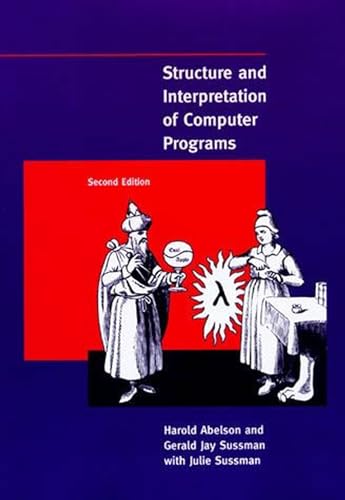 1
1