We've ranked the best china books using expert recommendations, sales data, and millions of reader ratings. At Shortform, we know books. Our book guides are the best in the world. Learn why.
Cover unavailable
1
Wild Swans: Three Daughters of China
Jung Chang
5.0
Three remarkable women--grandmother, mother, and daughter--struggle to survive in a true-life saga that spans 20th-century China with all its violence: wars, invasions, revolution, and continuing upheaval. A thrilling adventure story, Wild Swans is an important work of history, and a breathtaking testimony to the human spirit. 16 pages of photographs.
Recommended by Richard Branson, Harry Wu, and Vishakha Desai.
Today is World Book Day, a wonderful opportunity to address this #ChallengeRichard sent in by Mike Gonzalez of New Jersey: Make a list of your top 65 books to read in a lifetime. [source]
Harry Wu
Wild Swans is talking about people who are living at the highest level of society but they are still suffering persecution and live in fear. And the peasants in the village became slaves, they became nothing. So what the book does brilliantly is give a real insight into what life was like for ordinary people against the backdrop of the ever-changing China. [source]
Vishakha Desai
To me Wild Swans is one of those iconic books for understanding the generations of Chinese women. She is from this amazing intellectual family and it’s about what happens to them. The book just has this tremendous power. It’s an amazing journey. It’s about what women do to survive and also how they suffer. [source]
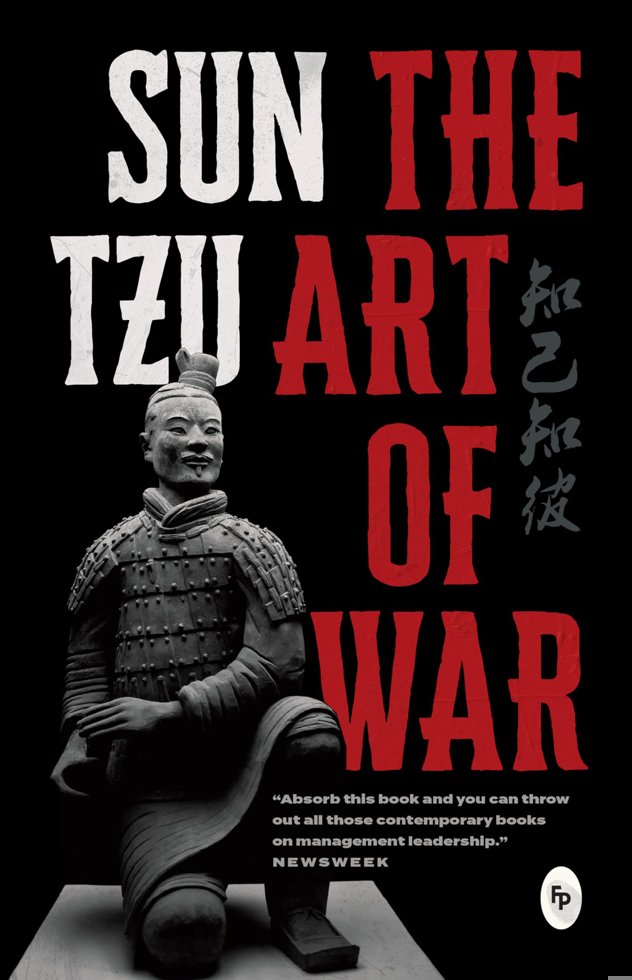
For more than two thousand years, The Art of War has stood as a cornerstone of Chinese culture-a lucid epigrammatic text that reveals as much about human psychology, politics, and economics as it does about battlefield strategy. The influence of Sun-tzu's text has grown tremendously in the West in recent years, with military leaders, politicians, and corporate executives alike finding valuable insight in these ancient words. In his crisp, accessible new translation, scholar John Minford brings this seminal work to life for modern readers.
Minford opens with a lively, learned introduction in which he explores the life and times of Sun-tzu, looks at The Art of War in the context of the turbulent Warring States period, and discusses how best to read and understand the work today. There follows Minford's translation of the core text itself in two different formats-first, the unadorned thirteen chapters of the original work and then the same text reprinted with extensive running commentary by classical Chinese scholars as well as Minford himself. The result is an opportunity for Western readers to experience Sun-tzu's work in all its intensity as it applies to many aspects of our lives.
Which books should be read by every single intelligent person on planet? … The Art of War (Sun Tsu) to learn that the act of killing fellow humans can be raised to an art. If you read all of the above works you will glean profound insight into most of what has driven the history of the western world. [source]
Cover unavailable
3
The Good Earth (House of Earth #1)
Pearl S. Buck
4.7
Librarian's note: An alternate cover edition can be found here
The Good Earth is Buck’s classic story of Wang Lung, a Chinese peasant farmer, and his wife, O-lan, a former slave. With luck and hard work, the couple’s fortunes improve over the years: They are blessed with sons, and save steadily until one day they can afford to buy property in the House of Wang—the very house in which O-lan used to work. But success brings with it a new set of problems. Wang soon finds himself the target of jealousy, and as good harvests come and go, so does the social order. Will Wang’s family cherish the estate after he’s gone? And can his material success, the bedrock of his life, guarantee anything about his soul?
Winner of the Pulitzer Prize and the William Dean Howells Award, The Good Earth was an Oprah’s Book Club choice in 2004. A readers’ favorite for generations, this powerful and beautifully written fable resonates with universal themes of hope and family unity.
This ebook features an illustrated biography of Pearl S. Buck including rare images from the author’s estate.
…
Recommended by Oprah Winfrey, Amy Chua, and Abid Zaidi.
Reading Pearl Buck's writing feels like reading poetry to me. I just love the quiet rhythm of the words. They evoke the simple beauty of the characters and the harsh mystery of China's ancient culture. [source]
Amy Chua
I read this book when I was about nine years old. It just made such an impact on me. O-Lan, the mother in this book, toils silently and stoically all her life to provide for her family. [source]
Abid Zaidi
Day 4 : #30Days of posting cover of books I love (1 book a day for 30 days). No expectations, no reviews, just the covers. Inspired by @rekha_bhardwaj #MyFavouriteBooks https://t.co/Z1RZbzh9vZ [source]
Cover unavailable
4
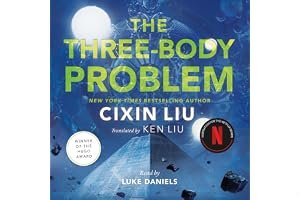
The Three-Body Problem (Remembrance of Earth’s Past #1)
Cixin Liu, Ken Liu
4.6
The Three-Body Problem is the first chance for English-speaking readers to experience the Hugo Award-winning phenomenon from China's most beloved science fiction author, Liu Cixin.
Set against the backdrop of China's Cultural Revolution, a secret military project sends signals into space to establish contact with aliens. An alien civilization on the brink of destruction captures the signal and plans to invade Earth. Meanwhile, on Earth, different camps start forming, planning to either welcome the superior beings and help them take over a world seen as corrupt, or to fight against the invasion. The result is a science fiction masterpiece of enormous scope and vision.
As a devoted reader, the president has been linked to a lengthy list of novels and poetry collections over the years — he admits he enjoys a thriller. [source]
It's a Chinese science fiction book that has gotten so popular there's now a Hollywood movie being made based on it. This will also be a fun break from all the economics and social science books I've read recently. [source]
I felt like I was getting a Chinese version of Chinese culture. And that frame felt unique. [source]
Cover unavailable
5
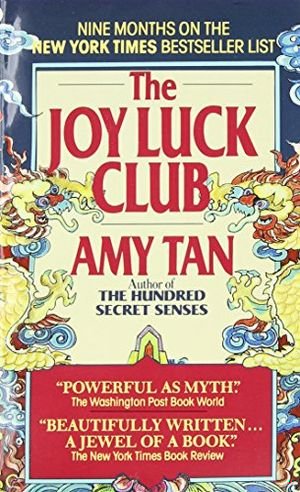
The Joy Luck Club
Amy Tan
4.6
Four mothers, four daughters, four families, whose histories shift with the four winds depending on who's telling the stories. In 1949, four Chinese women, recent immigrants to San Francisco, meet weekly to play mahjong and tell stories of what they left behind in China. United in loss and new hope for their daughters' futures, they call themselves the Joy Luck Club. Their daughters, who have never heard these stories, think their mothers' advice is irrelevant to their modern American lives – until their own inner crises reveal how much they've unknowingly inherited of their mothers' pasts.
With wit and sensitivity, Amy Tan examines the sometimes painful, often tender, and always deep connection between mothers and daughters. As each woman reveals her secrets, trying to unravel the truth about her life, the strings become more tangled, more entwined. Mothers boast or despair over daughters, and daughters roll their eyes even as they feel the inextricable tightening of their matriarchal ties. Tan is an astute storyteller, enticing readers to immerse themselves into these lives of complexity and mystery.
The novel is structured around the four corners of the mahjong table. The device makes clear the distance between the old world of China and the new world that these women inhabit in San Francisco. The novel focuses on the memories and secrets that these women carry about their mothers and their daughters. It shows modern Chinese-Americans dealing with cultural differences across generations. Although it might sound like that terrible term chick lit, it’s completely compelling because Amy writes with remarkable wit. [source]
Cover unavailable
6
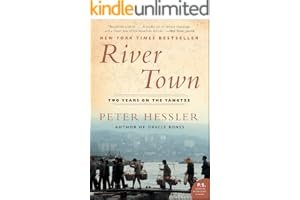
River Town: Two Years on the Yangtze
Peter Hessler
4.6
In the heart of China's Sichuan province lies the small city of Fuling. Surrounded by the terraced hills of the Yangtze River valley, Fuling has long been a place of continuity, far from the bustling political centers of Beijing and Shanghai. But now Fuling is heading down a new path, and gradually, along with scores of other towns in this vast and ever-evolving country, it is becoming a place of change and vitality, tension and reform, disruption and growth. As the people of Fuling hold on to the China they know, they are also opening up and struggling to adapt to a world in which their fate is uncertain.
Fuling's position at the crossroads came into remarkably sharp focus when Peter Hessler arrived as a Peace Corps volunteer in 1996, marking the first time in more than half a century that the city had an American resident. He found himself teaching English and American literature at the local college, discovering how Shakespeare and other classics look when seen through the eyes of students who have been raised in the Sichuan countryside and educated in Communist Party doctrine. His students, though, are the ones who taught him about the ways of Fuling — and about the complex process of understanding that takes place when one is immersed in a radically different society.
As he learns the language and comes to know the people, Hessler begins to see that it is indeed a unique moment for Fuling. In its past is Communist China's troubled history — the struggles of land reform, the decades of misguided economic policies, and the unthinkable damage of the Cultural Revolution — and in the future is the Three Gorges Dam, which upon completion will partly flood thecity and force the resettlement of more than a million people. Making his way in the city and traveling by boat and train throughout Sichuan province and beyond, Hessler offers vivid descriptions of the people he meets, from priests to prostitutes and peasants to professors, and gives voice to their views. This is both an intimate personal story of his life in Fuling and a colorful, beautifully written account of the surrounding landscape and its history. Imaginative, poignant, funny, and utterly compelling, River Town is an unforgettable portrait of a city that, much like China itself, is seeking to understand both what it was and what it someday will be.
…
Recommended by Jennifer Steil.
Jennifer Steil
Let’s start with River Town by Peter Hessler. River Town is his memoir of two years teaching for the Peace Corps at a teacher training college in China in a very remote city – a small city of 200,000 people or so, very few of whom had ever met foreigners. So Hessler really was in a very isolated, alien place. I love this book for many reasons. Firstly because he’s a beautiful writer and he gives you this wonderful sense of what it’s like to actually be there: the landscape and the people and the hustle and bustle, the pollution and the way the city’s built in the mountains with stairs going up and down, and the porters to carry your stuff that they call ‘stick-stick men’. He makes it really easy for you to visualise this foreign place. [source]
Cover unavailable
7
Tao Te Ching: By Lao Tzu - Illustrated
Lao Tse
4.5
A lucid translation of the well-known Taoist classic by a leading scholar-now in a Shambhala Pocket Library edition. Written more than two thousand years ago, the Tao Teh Ching, or -The Classic of the Way and Its Virtue, - is one of the true classics of the world of spiritual literature. Traditionally attributed to the legendary -Old Master, - Lao Tzu, the Tao Teh Ching teaches that the qualities of the enlightened sage or ideal ruler are identical with those of the perfected individual. Today, Lao Tzu's words are as useful in mastering the arts of leadership in business and politics as they are in developing a sense of balance and harmony in everyday life. To follow the Tao or Way of all things and realize their true nature is to embody humility, spontaneity, and generosity. John C. H. Wu has done a remarkable job of rendering this subtle text into English while retaining the freshness and depth of the original. A jurist and scholar, Dr. Wu was a recognized authority on Taoism and the translator of several Taoist and Zen texts and of Chinese poetry. This book is part of the Shambhala Pocket Library series. The Shambhala Pocket Library is a collection of short, portable teachings from notable figures across religious traditions and classic texts. The covers in this series are rendered by Colorado artist Robert Spellman. The books in this collection distill the wisdom and heart of the work Shambhala Publications has published over 50 years into a compact format that is collectible, reader-friendly, and applicable to everyday life.
Q: What are the books that had a major influence on you? Or simply the ones you like the most. : Tao te Ching, score takes care of itself, between the world and me, the four agreements, the old man and the sea...I love reading! [source]
According to a Yibada interview with Chen Wei, who wrote Ma’s 2014 authorized biography, the Alibaba founder and executive chairman always carries the Tao Te Ching, the foundational text of Taoist philosophy, religion and ethics composed by Lao Tzu in the sixth century B.C. [source]
In the philosophy side, I’ve been rereading the Tao Te Ching. [source]
Cover unavailable
8
Snow
Orhan Pamuk
4.5
One of multiple covers for ISBN 9780375706868.
A spellbinding tale of disparate yearnings – for love, art, power, and God – set in a remote Turkish town, where stirrings of political Islamism threaten to unravel the secular order; by the winner of the 2006 Nobel Prize for Literature.
From the acclaimed author of My Name Is Red comes a spellbinding tale of disparate yearnings–for love, art, power, and God–set in a remote Turkish town, where stirrings of political Islamism threaten to unravel the secular order.
Following years of lonely political exile in Western Europe, Ka, a middle-aged poet, returns to Istanbul to attend his mother's funeral. Only partly recognizing this place of his cultured, middle-class youth, he is even more disoriented by news of strange events in the wider country: a wave of suicides among girls forbidden to wear their head scarves at school. An apparent thaw of his writer's curiosity–a frozen sea these many years–leads him to Kars, a far-off town near the Russian border and the epicenter of the suicides.
No sooner has he arrived, however, than we discover that Ka's motivations are not purely journalistic; for in Kars, once a province of Ottoman and then Russian glory, now a cultural gray-zone of poverty and paralysis, there is also Ipek, a radiant friend of Ka's youth, lately divorced, whom he has never forgotten. As a snowstorm, the fiercest in memory, descends on the town and seals it off from the modern, westernized world that has always been Ka's frame of reference, he finds himself drawn in unexpected directions: not only headlong toward the unknowable Ipek and the desperate hope for love–or at least a wife–that she embodies, but also into the maelstrom of a military coup staged to restrain the local Islamist radicals, and even toward God, whose existence Ka has never before allowed himself to contemplate. In this surreal confluence of emotion and spectacle, Ka begins to tap his dormant creative powers, producing poem after poem in untimely, irresistible bursts of inspiration. But not until the snows have melted and the political violence has run its bloody course will Ka discover the fate of his bid to seize a last chance for happiness.
Blending profound sympathy and mischievous wit, Snow illuminates the contradictions gripping the individual and collective heart in many parts of the Muslim world. But even more, by its narrative brilliance and comprehension of the needs and duties
This lively new translation with clear explanatory notes by one of the foremost scholars of classical Chinese provides the ideal introduction to the Analects for readers who have no previous knowledge of the Chinese language and philosophical traditions.
"How dare I claim to be a sage or a benevolent man?"
By constructing the philosophy expressed through The Analects, Confucius might well dare to make such a claim. The Analects are a collection of Confucius' sayings, compiled by his pupils shortly after his death in 497 B.C., and they reflect the extent to which Confucius held up a moral ideal for all men. The aim is the perfection of one's moral character, the method one of arduous pursuit of such moral attributes as benevolence, wisdom, courage; the result is no recompense either in this life or the next – to follow the Way must be its own reward. A harsh philosophy perhaps, but shining through it is the splendid intellect and spirit of one of the most reasonable and humane thinkers of all time.
…
Recommended by Andrew Hui, Daniel A. Bell, and Michael Puett.
Andrew Hui
This edition is really good at showing both the constructed-ness of the original Analects and the vast exegetical machine that has driven the Chinese philosophical tradition through the centuries. [source]
Daniel A. Bell
It’s not written by Confucius himself. It is more a collection of anecdotes of how he engaged his students. [source]
Michael Puett
He believed one of our dangers is that we fall into ruts that are defined by the world around us. [source]
Cover unavailable
10
Shanghai Girls (Shanghai Girls #1)
Lisa See
4.4
Pearl and May are sisters, living carefree lives in Shanghai, the Paris of Asia. But when Japanese bombs fall on their beloved city, they set out on the journey of a lifetime, one that will take them through the Chinese countryside, in and out of the clutch of brutal soldiers, and across the Pacific to the shores of America.
In 1937, Shanghai is the Paris of Asia, a city of great wealth and glamour, the home of millionaires and beggars, gangsters and gamblers, patriots and revolutionaries, artists and warlords. Thanks to the financial security and material comforts provided by their father’s prosperous rickshaw business, twenty-one-year-old Pearl Chin and her younger sister, May, are having the time of their lives. Though both sisters wave off authority and tradition, they couldn’t be more different: Pearl is a Dragon sign, strong and stubborn, while May is a true Sheep, adorable and placid. Both are beautiful, modern, and carefree . . . until the day their father tells them that he has gambled away their wealth and that in order to repay his debts he must sell the girls as wives to suitors who have traveled from California to find Chinese brides.
As Japanese bombs fall on their beloved city, Pearl and May set out on the journey of a lifetime, one that will take them through the Chinese countryside, in and out of the clutch of brutal soldiers, and across the Pacific to the shores of America. In Los Angeles they begin a fresh chapter, trying to find love with the strangers they have married, brushing against the seduction of Hollywood, and striving to embrace American life even as they fight against discrimination, brave Communist witch hunts, and find themselves hemmed in by Chinatown’s old ways and rules.
…
Cover unavailable
11
On China
Henry Kissinger
4.4
In this sweeping and insightful history, Henry Kissinger turns for the first time at book-length to a country he has known intimately for decades, and whose modern relations with the West he helped shape. Drawing on historical records as well as his conversations with Chinese leaders over the past forty years, Kissinger examines how China has approached diplomacy, strategy, and negotiation throughout its history, and reflects on the consequences for the global balance of power in the 21st century.
Since no other country can claim a more powerful link to its ancient past and classical principles, any attempt to understand China's future world role must begin with an appreciation of its long history. For centuries, China rarely encountered other societies of comparable size and sophistication; it was the "Middle Kingdom," treating the peoples on its periphery as vassal states. At the same time, Chinese statesmen-facing threats of invasion from without, and the contests of competing factions within-developed a canon of strategic thought that prized the virtues of subtlety, patience, and indirection over feats of martial prowess.
In On China, Kissinger examines key episodes in Chinese foreign policy from the classical era to the present day, with a particular emphasis on the decades since the rise of Mao Zedong. He illuminates the inner workings of Chinese diplomacy during such pivotal events as the initial encounters between China and modern European powers, the formation and breakdown of the Sino-Soviet alliance, the Korean War, Richard Nixon's historic trip to Beijing, and three crises in the Taiwan Straits. Drawing on his extensive personal experience with four generation of Chinese leaders, he brings to life towering figures such as Mao, Zhou Enlai, and Deng Xiaoping, revealing how their different visions have shaped China's modern destiny.
With his singular vantage on U.S.-China relations, Kissinger traces the evolution of this fraught but crucial relationship over the past 60 years, following its dramatic course from estrangement to strategic partnership to economic interdependence, and toward an uncertain future. With a final chapter on the emerging superpower's 21st-century world role, On China provides an intimate historical perspective on Chinese foreign affairs from one of the premier statesmen of the 20th century.
…
Recommended by Greg Norman.
Greg Norman
Greg Norman said this is one of his most-recommended books. [source]
Cover unavailable
12
Balzac and the Little Chinese Seamstress
Dai Sijie, Ina Rilke
4.4
In this enchanting tale about the magic of reading and the wonder of romantic awakening, two hapless city boys are exiled to a remote mountain village for reeducation during China's infamous Cultural Revolution. There they meet the daughter of the local tailor and discover a hidden stash of Western classics in Chinese translation. As they flirt with the seamstress and secretly devour these banned works, they find transit from their grim surroundings to worlds they never imagined.
…
Cover unavailable
13
Mao
Jung Chang
4.4
Based on a decade of research, and on interviews with many of Mao's close circle in China who have never talked before - and with virtually everyone outside China who had significant dealings with him - this is the most authoritative life of Mao ever written. It is full of startling revelations, exploding the myth of the Long March, and showing a completely unknown Mao: he was not driven by idealism or ideology; his intimate and intricate relationship with Stalin went back to the 1920s, ultimately bringing him to power; he welcomed Japanese occupation of much of China; and he schemed, poisoned and blackmailed to get his way. After Mao conquered China in 1949, his secret goal was to dominate the world. In chasing this dream he caused the deaths of 38 million people in the greatest famine in history. In all, well over 70 million Chinese perished under Mao's rule - in peacetime.
Today is World Book Day, a wonderful opportunity to address this #ChallengeRichard sent in by Mike Gonzalez of New Jersey: Make a list of your top 65 books to read in a lifetime. [source]
Harry Wu
To this day we don’t really know much about Mao’s personal history. The Communist Party portrays him as the Great Leader. His smiling image is everywhere. Even the political system still follows his model. So what Chang did was delve deeper to discover who is the real Mao? You hear from people like his private doctor talking about his personal history [source]
Cover unavailable
14
Life and Death in Shanghai
Cheng Nien
4.4
A first-hand account of China's cultural revolution.
A first-hand account of China's cultural revolution. Nien Cheng, an anglophile and fluent English-speaker who worked for Shell in Shanghai under Mao, was put under house arrest by Red Guards in 1966 and subsequently jailed. All attempts to make her confess to the charges of being a British spy failed; all efforts to indoctrinate her were met by a steadfast and fearless refusal to accept the terms offered by her interrogators. When she was released from prison she was told that her daughter had committed suicide. In fact Meiping had been beaten to death by Maoist revolutionaries.
I can’t narrow down one favorite book, but there are a few that have had a strong impact on me over the past few years. Life and Death in Shanghai and Man’s Search for Meaning are great non-business books that have helped me gain a deeper perspective on life. Both books also helps you gain a stronger appreciation of the times we live in today. [source]
I think it’s right that Graham Peck was disappointed by the Cultural Revolution. This, of course, was essentially a revolt by Mao against his own party. Mao on one level fears that he is being sidelined by his own party, and on another level feels that the revolution had lost steam 17 years in. A new generation had been born that didn’t remember the struggles of 1949 and it was time to revitalise them and get them on the streets, to feel what a real revolution was like. That was Mao’s intention, and the results – from what we know – pleased him greatly, but they were much more explosive and wide-ranging than perhaps even he would have imagined, with terrible consequences for a very wide variety of people. [source]
Cover unavailable
15
Oracle Bones: A Journey Between China's Past and Present
Peter Hessler
4.4
From the acclaimed author of River Town comes a rare portrait, both intimate and epic, of twenty-first-century China as it opens its doors to the outside world.
A century ago, outsiders saw China as a place where nothing ever changes. Today the country has become one of the most dynamic regions on earth. That sense of time—the contrast between past and present, and the rhythms that emerge in a vast, ever-evolving country—is brilliantly illuminated by Peter Hessler in Oracle Bones, a book that explores the human side of China's transformation.
Hessler tells the story of modern-day China and its growing links to the Western world as seen through the lives of a handful of ordinary people. In addition to the author, an American writer living in Beijing, the narrative follows Polat, a member of a forgotten ethnic minority, who moves to the United States in search of freedom; William Jefferson Foster, who grew up in an illiterate family and becomes a teacher; Emily, a migrant factory worker in a city without a past; and Chen Mengjia, a scholar of oracle-bone inscriptions, the earliest known writing in East Asia, and a man whose tragic story has been lost since the Cultural Revolution. All are migrants, emigrants, or wanderers who find themselves far from home, their lives dramatically changed by historical forces they are struggling to understand.
Peter Hessler excavates the past and puts a remarkable human face on the history he uncovers. In a narrative that gracefully moves between the ancient and the present, the East and the West, Hessler captures the soul of a country that is undergoing a momentous change before our eyes.
…
Cover unavailable
16
Factory Girls: From Village to City in a Changing China
Leslie T. Chang
4.4
An eye-opening and previously untold story, Factory Girls is the first look into the everyday lives of the migrant factory population in China.
China has 130 million migrant workers—the largest migration in human history. In Factory Girls, Leslie T. Chang, a former correspondent for the Wall Street Journal in Beijing, tells the story of these workers primarily through the lives of two young women, whom she follows over the course of three years as they attempt to rise from the assembly lines of Dongguan, an industrial city in China’s Pearl River Delta.
As she tracks their lives, Chang paints a never-before-seen picture of migrant life—a world where nearly everyone is under thirty; where you can lose your boyfriend and your friends with the loss of a mobile phone; where a few computer or English lessons can catapult you into a completely different social class. Chang takes us inside a sneaker factory so large that it has its own hospital, movie theater, and fire department; to posh karaoke bars that are fronts for prostitution; to makeshift English classes where students shave their heads in monklike devotion and sit day after day in front of machines watching English words flash by; and back to a farming village for the Chinese New Year, revealing the poverty and idleness of rural life that drive young girls to leave home in the first place. Throughout this riveting portrait, Chang also interweaves the story of her own family’s migrations, within China and to the West, providing historical and personal frames of reference for her investigation.
A book of global significance that provides new insight into China, Factory Girls demonstrates howthe mass movement from rural villages to cities is remaking individual lives and transforming Chinese society, much as immigration to America’s shores remade our own country a century ago.
…
Recommended by Jeffrey Wasserstrom.
Jeffrey Wasserstrom
I love the way it’s written, and the way that Chang blends her own life story in with it. She pairs the story of her family’s migration out of China to the United States, where she grew up, to the movement of young women from rural China to urban China today. And she sets up a parallel between the way that American cities were transformed by overseas immigrants who fuelled the American industrial rise, with the enormous migration today – that doesn’t involve crossing an ocean or leaving one country for another – of rural dwellers to the world of Chinese cities. I also love the way she brings to our attention the distinctive personalities of young Chinese women. She describes them as working in very difficult conditions, but often experiencing them as liberating, because they have so much more freedom and control over their private life than they had in their villages, where male-dominated family structures remain powerful. [source]
Cover unavailable
17
Deng Xiaoping and the Transformation of China
Ezra F. Vogel
4.4
No one in the twentieth century had a greater impact on world history than Deng Xiaoping. And no scholar is better qualified than Ezra Vogel to disentangle the contradictions embodied in the life and legacy of China's boldest strategist--the pragmatic, disciplined force behind China's radical economic, technological, and social transformation.
This is the best and most comprehensive book I know, certainly in English, on the Deng Xiaoping era. Deng’s importance will only grow with the passage of time. I think he will emerge as a truly historic figure – less dramatic than Mao, but with more lasting impact if China remains on this course. There was a need for a really serious and readable study of him, and this is a big door-stopping book but a pleasure to read. The author has an eye for anecdote, and I am surprised at how much is known about private conversations at the top of the Communist party. My assumption had been that this was a secret society that didn’t keep records, and we wouldn’t have any clue. [source]
Cover unavailable
18
Country Driving: A Journey Through China from Farm to Factory
Peter Hessler
4.4
From the bestselling author of Oracle Bones and River Town comes the final book in his award-winning trilogy, on the human side of the economic revolution in China. In the summer of 2001, Peter Hessler, the longtime Beijing correspondent for The New Yorker, acquired his Chinese driver's license. For the next seven years, he traveled the country, tracking how the automobile and improved roads were transforming China. Hessler writes movingly of the average people farmers, migrant workers, entrepreneurs who have reshaped the nation during one of the most critical periods in its modern history.
Country Driving begins with Hessler's 7,000-mile trip across northern China, following the Great Wall, from the East China Sea to the Tibetan plateau. He investigates a historically important rural region being abandoned, as young people migrate to jobs in the southeast. Next Hessler spends six years in Sancha, a small farming village in the mountains north of Beijing, which changes dramatically after the local road is paved and the capital's auto boom brings new tourism. Finally, he turns his attention to urban China, researching development over a period of more than two years in Lishui, a small southeastern city where officials hope that a new government-built expressway will transform a farm region into a major industrial center. Hessler, whom The Wall Street Journal calls "one of the Western world's most thoughtful writers on modern China," deftly illuminates the vast, shifting landscape of a traditionally rural nation that, having once built walls against foreigners, is now building roads and factory towns that look to the outside world.
…
Cover unavailable
19
The Rape of Nanking
Iris Chang
4.4
In December 1937, the Japanese army invaded the ancient city of Nanking, systematically raping, torturing, and murdering more than 300,000 Chinese civilians.
This book tells the story from three perspectives: of the Japanese soldiers who performed it, of the Chinese civilians who endured it, and of a group of Europeans and Americans who refused to abandon the city and were able to create a safety zone that saved many.
…
Cover unavailable
20
Age of Ambition: Chasing Fortune, Truth, and Faith in the New China
Evan Osnos
4.4
From abroad, we often see China as a caricature: a nation of pragmatic plutocrats and ruthlessly dedicated students destined to rule the global economy-or an addled Goliath, riddled with corruption and on the edge of stagnation. What we don't see is how both powerful and ordinary people are remaking their lives as their country dramatically changes. As the Beijing correspondent for The New Yorker, Evan Osnos was on the ground in China for years, witness to profound political, economic, and cultural upheaval. In Age of Ambition, he describes the greatest collision taking place in that country: the clash between the rise of the individual and the Communist Party's struggle to retain control. He asks probing questions: Why does a government with more success lifting people from poverty than any civilization in history choose to put strict restraints on freedom of expression? Why do millions of young Chinese professionals-fluent in English and devoted to Western pop culture-consider themselves "angry youth," dedicated to resisting the West's influence? How are Chinese from all strata finding meaning after two decades of the relentless pursuit of wealth? Writing with great narrative verve and a keen sense of irony, Osnos follows the moving stories of everyday people and reveals life in the new China to be a battleground between aspiration and authoritarianism, in which only one can prevail.
…
Recommended by Barack Obama and Dr. Sue Desmond-Hellmann.
President Obama is spending his Hawaiian vacation playing golf, getting together with high school friends and reading a handful of dark novels set in foreign lands, according to a book list released by the White House Wednesday. The presidential reading list includes … two works of non-fiction for the trip: "Age of Ambition: Chasing Fortune, Truth and Faith in the New China," by Evan Osnos … . [source]
Dr. Sue Desmond-Hellmann
CEO/Gates Foundation
A standout for me this year was Age of Ambition: Chasing Fortune, Truth, and Faith in the New China, by Evan Osnos. Osnos spent eight years in China as a foreign correspondent, and his book helped me gain insight into today's China through stories of people, some well-known and others ordinary. [source]
Cover unavailable
21
The Good Women of China: Hidden Voices
Xinran
4.4
When Deng Xiaoping’s efforts to “open up” China took root in the late 1980s, Xinran recognized an invaluable opportunity. As an employee for the state radio system, she had long wanted to help improve the lives of Chinese women. But when she was given clearance to host a radio call-in show, she barely anticipated the enthusiasm it would quickly generate. Operating within the constraints imposed by government censors, “Words on the Night Breeze” sparked a tremendous outpouring, and the hours of tape on her answering machines were soon filled every night. Whether angry or muted, posing questions or simply relating experiences, these anonymous women bore witness to decades of civil strife, and of halting attempts at self-understanding in a painfully restrictive society. In this collection, by turns heartrending and inspiring, Xinran brings us the stories that affected her most, and offers a graphically detailed, altogether unprecedented work of oral history.
…
Cover unavailable
22
The Bonesetter's Daughter
Amy Tan
4.3
Ruth Young and her widowed mother, LuLing, have always had a tumultuous relationship. Now, before she succumbs to forgetfulness, LuLing gives Ruth some of her writings, which reveal a side of LuLing that Ruth has never known. . . .
In a remote mountain village where ghosts and tradition rule, LuLing grows up in the care of her mute Precious Auntie as the family endures a curse laid upon a relative known as the bonesetter. When headstrong LuLing rejects the marriage proposal of the coffinmaker, a shocking series of events are set in motion–all of which lead back to Ruth and LuLing in modern San Francisco. The truth that Ruth learns from her mother’s past will forever change her perception of family, love, and forgiveness.
…
Cover unavailable
23
The Dark Forest
Cixin Liu, Joel Martinsen
4.3
With the scope of Dune and the rousing action of Independence Day this near-future trilogy is the first chance for English-speaking readers to experience this multple-award-winning phenemonenon from Cixin Liu Chinas most beloved science fiction author In DarkForest Earth is reeling from the revelation of a coming alien invasionin just four centuries time The aliens human collaborators may have been defeated but the presence of the sophons the subatomic particles that allow Trisolaris instant access to all human information means that Earths defense plans are totally exposed to the enemy Only the human mind remains a secret This is the motivation for the Wallfacer Project a daring plan that grants four men enormous resources to design secret strategies hidden through deceit and misdirection fromEarth and Trisolaris alike Three of the Wallfacers are influential statesmen and scientists but the fourth is a total unknown Luo Ji an unambitious Chinese astronomer and sociologist is baffled by his new status All he knows is that hes the one Wallfacer that Trisolaris wants dead
…
Recommended by Adam Savage, Ben Brode, and The Centre for the Study of Existential Risk.
I felt like I was getting a Chinese version of Chinese culture. And that frame felt unique. [source]
Ben Brode
@noahmp @devonzuegel I thought book 2 and of the series that starts with “the three body problem” fulfilled this condition and was awesome [source]
The Centre for the Study of Existential Risk
It makes the point that humanity is fairly weak, and that if we’re ever faced by a really big threat, we most likely won’t survive it. [source]
Cover unavailable
24
China in Ten Words
Yu Hua
4.3
From one of China's most acclaimed writers: a unique, intimate look at the Chinese experience over the last several decades.
Framed by ten phrases common in the Chinese vernacular, China in Ten Words uses personal stories and astute analysis to reveal as never before the world's most populous yet oft-misunderstood nation. In "Disparity," for example, Yu Hua illustrates the expanding gaps that separate citizens of the country. In "Copycat," he depicts the escalating trend of piracy and imitation as a creative new form of revolutionary action. And in "Bamboozle," he describes the increasingly brazen practices of trickery, fraud, and chicanery that are, he suggests, becoming a way of life at every level of society. Witty, insightful, and courageous, this is a refreshingly candid vision of the "Chinese miracle" and all of its consequences.
…
Cover unavailable
25
The Kitchen God's Wife
Amy Tan
4.3
Winnie and Helen have kept each other's worst secrets for more than fifty years. Now, because she believes she is dying, Helen wants to expose everything. And Winnie angrily determines that she must be the one to tell her daughter, Pearl, about the past—including the terrible truth even Helen does not know. And so begins Winnie's story of her life on a small island outside Shanghai in the 1920s, and other places in China during World War II, and traces the happy and desperate events that led to Winnie's coming to America in 1949.
…
Recommended by Ellah Allfrey.
Ellah Allfrey
This is my bestseller! Amy Tan unleashed this western obsession, or interest in, Chinese women’s writing and it’s not the best book in the world, but it’s a classic story of not understanding your parents until it’s nearly too late. There is this woman married to a white American man and she has always thought her parents never loved her. She finds out that in Chinese culture you must never tell your children they are beautiful or praise them because the spirits might be listening and will come and take the child away. So they are always saying you could be better, you could do better because you never know what spirits are listening. In some ways it takes you to a completely alien world and in other ways it’s completely familiar because we all have mothers. The food in it is amazing too. [source]
Cover unavailable
26
The China Study: Revised and Expanded Edition: The Most Comprehensive Study of Nutrition Ever Conducted and the Startling Implications for Diet, Weight Loss, and Long-Term Health
The revised and expanded edition of the bestseller that changed millions of lives
The science is clear. The results are unmistakable.
You can dramatically reduce your risk of cancer, heart disease, and diabetes just by changing your diet.
More than 30 years ago, nutrition researcher T. Colin Campbell and his team at Cornell, in partnership with teams in China and England, embarked upon the China Study, the most comprehensive study ever undertaken of the relationship between diet and the risk of developing disease. What they found when combined with findings in Colin’s laboratory, opened their eyes to the dangers of a diet high in animal protein and the unparalleled health benefits of a whole foods, plant-based diet.
In 2005, Colin and his son Tom, now a physician, shared those findings with the world in The China Study, hailed as one of the most important books about diet and health ever written.
Featuring brand new content, this heavily expanded edition of Colin and Tom’s groundbreaking book includes the latest undeniable evidence of the power of a plant-based diet, plus updated information about the changing medical system and how patients stand to benefit from a surging interest in plant-based nutrition.
The China Study—Revised and Expanded Edition presents a clear and concise message of hope as it dispels a multitude of health myths and misinformation. The basic message is clear. The key to a long, healthy life lies in three things: breakfast, lunch, and dinner.
…
Recommended by Ev Williams and Aimée Lyn Inhc.
Aimée Lyn Inhc
Best book I’ve ever read. https://t.co/pc68Yvw7U8 [source]
Cover unavailable
27
The Search For Modern China (Third Edition)
Jonathan D. Spence
4.3
The leading textbook by the leading scholar.
This text, the classic introduction to modern China for students and general readers, emerged from Spence’s highly successful introductory course at Yale, in which he traced the beginnings of modern China to internal developments beginning in the early 17th century. Strong on social and political history, as well as Chinese culture and its intersections with politics, this paperback is a longstanding leader in the survey course on modern China.
The definitive book about modern Chinese history. [source]
Cover unavailable
28
To Live
Yu Hua, Michael Berry
4.3
From the author of Brothers and China in Ten Words this celebrated contemporary classic of Chinese literature was also adapted for film by Zhang Yimou. This searing novel, originally banned in China but later named one of that nation's most influential books, portrays one man's transformation from the spoiled son of a landlord to a kindhearted peasant. After squandering his family's fortune in gambling dens and brothels, the young, deeply penitent Fugui settles down to do the honest work of a farmer. Forced by the Nationalist Army to leave behind his family, he witnesses the horrors and privations of the Civil War, only to return years later to face a string of hardships brought on by the ravages of the Cultural Revolution. Left with an ox as the companion of his final years, Fugui stands as a model of gritty authenticity, buoyed by his appreciation for life in this narrative of humbling power.
…
Recommended by Chris Kutarna and Xinran.
Chris Kutarna
It’s a story of the personal experience of the chaos of revolutionary political and economic change in China. [source]
Xinran
Yes. I normally only read non-fiction books but, as you can see, this novel is exceptional like A Good Earth by Pearl S Buck. It is all about family life in a Chinese village before and after the 1949 revolution. These are ordinary people and the book looks at how they survive this very difficult period in Chinese history. This was the time of endless political war between 1940s to 1980s. [source]
Cover unavailable
29
Dreams of Joy (Shanghai Girls #2)
Lisa See
4.3
In her most powerful novel yet, acclaimed author Lisa See returns to the story of sisters Pearl and May from Shanghai Girls, and Pearl’s strong-willed nineteen-year-old daughter, Joy. Reeling from newly uncovered family secrets, Joy runs away to Shanghai in early 1957 to find her birth father—the artist Z.G. Li, with whom both May and Pearl were once in love. Dazzled by him, and blinded by idealism and defiance, Joy throws herself into the New Society of Red China, heedless of the dangers in the Communist regime. Devastated by Joy’s flight and terrified for her safety, Pearl is determined to save her daughter, no matter the personal cost. From the crowded city to remote villages, Pearl confronts old demons and almost insurmountable challenges as she follows Joy, hoping for reconciliation. Yet even as Joy’s and Pearl’s separate journeys converge, one of the most tragic episodes in China’s history threatens their very lives.
…
Cover unavailable
30
Falling Leaves: The Memoir of an Unwanted Chinese Daughter
Adeline Yen Mah
4.2
Born in 1937 in a port city a thousand miles north of Shanghai, Adeline Yen Mah was the youngest child of an affluent Chinese family who enjoyed rare privileges during a time of political and cultural upheaval. But wealth and position could not shield Adeline from a childhood of appalling emotional abuse at the hands of a cruel and manipulative Eurasian stepmother. Determined to survive through her enduring faith in family unity, Adeline struggled for independence as she moved from Hong Kong to England and eventually to the United States to become a physician and writer.
A compelling, painful, and ultimately triumphant story of a girl's journey into adulthood, Adeline's story is a testament to the most basic of human needs: acceptance, love, and understanding. With a powerful voice that speaks of the harsh realities of growing up female in a family and society that kept girls in emotional chains, Falling Leaves is a work of heartfelt intimacy and a rare authentic portrait of twentieth-century China.
…
Cover unavailable
31
The Corpse Walker: Real Life Stories, China From the Bottom Up
Liao Yiwu
4.2
The Corpse Walker introduces us to regular men and women at the bottom of Chinese society, most of whom have been battered by life but have managed to retain their dignity: a professional mourner, a human trafficker, a public toilet manager, a leper, a grave robber, and a Falung Gong practitioner, among others. By asking challenging questions with respect and empathy, Liao Yiwu managed to get his subjects to talk openly and sometimes hilariously about their lives, desires, and vulnerabilities, creating a book that is an instance par excellence of what was once upon a time called “The New Journalism.” The Corpse Walker reveals a fascinating aspect of modern China, describing the lives of normal Chinese citizens in ways that constantly provoke and surprise.
…
Recommended by Marianne Bastid-Bruguière.
Marianne Bastid-Bruguière
It’s a bit like the first one: the writer Liao Yiwu is not much appreciated by the present government – he was put in jail in 1989 because he’d written a poem called ‘The Massacre’, about the 4 June incident in Peking. He spent ten years in jail, where he was put with the ordinary criminals, so he mixed with all kinds of people and interviewed them and recorded their life stories, and it’s an extraordinary testimony about how people live at the bottom of society. Through the story of their lives you have a record of recent Chinese history (some are 60, 70 years old), and so you have an awful lot about the human component of society: a kind of mirror of the life that has been lived by individuals. For instance, he interviewed a schoolteacher, a public toilet manager – the man who does the dirtiest work – and also a professional mourner: a profession that has recently been revived under the Communist regime. [source]
Cover unavailable
32
Summary of The Tea Girl of Hummingbird Lane: A Novel: Conversation Starters
Lisa See
4.2
The Tea Girl of Hummingbird Lane: A Novel by Lisa See: Conversation Starters
A Brief Look Inside:
EVERY GOOD BOOK CONTAINS A WORLD FAR DEEPER than the surface of its pages. The characters and their world come alive, and the characters and its world still live on. Conversation Starters is peppered with questions designed to bring us beneath the surface of the page and invite us into the world that lives on.
These questions can be used to create hours of conversation:
• Foster a deeper understanding of the book • Promote an atmosphere of discussion for groups • Assist in the study of the book, either individually or corporately • Explore unseen realms of the book as never seen before
Disclaimer: This book you are about to enjoy is an independent resource to supplement the original book, enhancing your experience. If you have not yet purchased a copy of the original book, please do before purchasing this unofficial Conversation Starters.
To rescue her family from poverty and avoid marrying her slope-shouldered cousin, seventeen-year-old Orchid competes to be one of the Emperor's wives. When she is chosen as a lower-ranking concubine she enters the erotically charged and ritualised Forbidden City. But beneath its immaculate façade lie whispers of murders and ghosts, and the thousands of concubines will stoop to any lengths to bear the Emperor's son.
Orchid trains herself in the art of pleasuring a man, bribes her way into the royal bed, and seduces the monarch, drawing the attention of dangerous foes. Little does she know that China will collapse around her, and that she will be its last Empress.
…
Cover unavailable
34
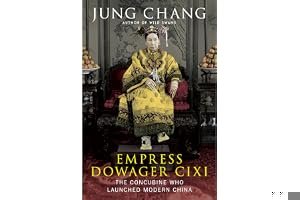
Empress Dowager Cixi: The Concubine Who Launched Modern China
Jung Chang
4.2
A New York Times Notable Book
Empress Dowager Cixi (1835–1908) is the most important woman in Chinese history. She ruled China for decades and brought a medieval empire into the modern age. At the age of sixteen, in a nationwide selection for royal consorts, Cixi was chosen as one of the emperor’s numerous concubines. When he died in 1861, their five-year-old son succeeded to the throne. Cixi at once launched a palace coup against the regents appointed by her husband and made herself the real ruler of China—behind the throne, literally, with a silk screen separating her from her officials who were all male.
In this groundbreaking biography, Jung Chang vividly describes how Cixi fought against monumental obstacles to change China. Under her the ancient country attained virtually all the attributes of a modern state: industries, railways, electricity, the telegraph and an army and navy with up-to-date weaponry. It was she who abolished gruesome punishments like “death by a thousand cuts” and put an end to foot-binding. She inaugurated women’s liberation and embarked on the path to introduce parliamentary elections to China. Chang comprehensively overturns the conventional view of Cixi as a diehard conservative and cruel despot.
Cixi reigned during extraordinary times and had to deal with a host of major national crises: the Taiping and Boxer rebellions, wars with France and Japan—and an invasion by eight allied powers including Britain, Germany, Russia and the United States. Jung Chang not only records the Empress Dowager’s conduct of domestic and foreign affairs, but also takes the reader into the depths of her splendid Summer Palace and the harem of Beijing’s Forbidden City, where she lived surrounded by eunuchs—one of whom she fell in love, with tragic consequences. The world Chang describes here, in fascinating detail, seems almost unbelievable in its extraordinary mixture of the very old and the very new.
Based on newly available, mostly Chinese, historical documents such as court records, official and private correspondence, diaries and eyewitness accounts, this biography will revolutionize historical thinking about a crucial period in China’s—and the world’s—history. Packed with drama, fast paced and gripping, it is both a panoramic depiction of the birth of modern China and an intimate portrait of a woman: as the concubine to a monarch, as the absolute ruler of a third of the world’s population, and as a unique stateswoman.
…
Cover unavailable
35
The Hundred-Year Marathon: China's Secret Strategy to Replace America as the Global Superpower
Michael Pillsbury
4.2
One of the U.S. government's leading China experts reveals the hidden strategy fueling that country's rise – and how Americans have been seduced into helping China overtake us as the world's leading superpower.
For more than forty years, the United States has played an indispensable role helping the Chinese government build a booming economy, develop its scientific and military capabilities, and take its place on the world stage, in the belief that China's rise will bring us cooperation, diplomacy, and free trade. But what if the "China Dream" is to replace us, just as America replaced the British Empire, without firing a shot?
Based on interviews with Chinese defectors and newly declassified, previously undisclosed national security documents, The Hundred-Year Marathon reveals China's secret strategy to supplant the United States as the world's dominant power, and to do so by 2049, the one-hundredth anniversary of the founding of the People's Republic. Michael Pillsbury, a fluent Mandarin speaker who has served in senior national security positions in the U.S. government since the days of Richard Nixon and Henry Kissinger, draws on his decades of contact with the "hawks" in China's military and intelligence agencies and translates their documents, speeches, and books to show how the teachings of traditional Chinese statecraft underpin their actions. He offers an inside look at how the Chinese really view America and its leaders – as barbarians who will be the architects of their own demise.
Pillsbury also explains how the U.S. government has helped – sometimes unwittingly and sometimes deliberately – to make this "China Dream" come true, and he calls for the United States to implement a new, more competitive strategy toward China as it really is, and not as we might wish it to be. The Hundred-Year Marathon is a wake-up call as we face the greatest national security challenge of the twenty-first century.
…
Recommended by Norbert Mao.
Norbert Mao
@rkabushenga @cobbo3 @AgaSekalala @dfkm1970 @Kalinaki @TioKauma A fascinating book. Next you should read this one by Michael Pillsbury. Reminds me of the race between the hare and the tortoise! One is faster but distracted while the other is slow but steady. https://t.co/231fMeO0TP [source]
Cover unavailable
36
Mao's Last Dancer
Li Cunxin
4.2
THE INTERNATIONAL BESTSELLER
The extraordinary memoir of a peasant boy raised in rural Maoist China who was plucked from his village to study ballet and went on to become one of the greatest dancers of his generation.
From a desperately poor village in northeast China, at age eleven, Li Cunxin was chosen by Madame Mao's cultural delegates to be taken from his rural home and brought to Beijing, where he would study ballet. In 1979, the young dancer arrived in Texas as part of a cultural exchange, only to fall in love with America-and with an American woman. Two years later, through a series of events worthy of the most exciting cloak-and-dagger fiction, he defected to the United States, where he quickly became known as one of the greatest ballet dancers in the world. This is his story, told in his own inimitable voice.
THE BASIS FOR A MAJOR MOTION PICTURE
…
Cover unavailable
37
Mao's Great Famine: The History Of China's Most Devastating Catastrophe, 1958-62
Frank Dikötter
4.2
Between 1958 and 1962, China descended into hell. Mao Zedong threw his country into a frenzy with the Great Leap Forward, an attempt to catch up and overtake Britain in less than 15 years. The experiment ended in the greatest catastrophe the country had ever known, destroying tens of millions of lives. Access to Communist Party archives has long been denied to all but the most loyal historians, but now a new law has opened up thousands of central and provincial documents that fundamentally change the way one can study the Maoist era. Frank Dikotter's astonishing, riveting and magnificently detailed book chronicles an era in Chinese history much speculated about but never before fully documented. Dikotter shows that instead of lifting the country among the world's superpowers and proving the power of communism, as Mao imagined, in reality the Great Leap Forward was a giant - and disastrous -- step in the opposite direction. He demonstrates, as nobody has before, that under this initiative the country became the site not only of one of the most deadly mass killings of human history (at least 45 million people were worked, starved or beaten to death) but also the greatest demolition of real estate - and catastrophe for the natural environment - in human history, as up to a third of all housing was turned to rubble and the land savaged in the maniacal pursuit of steel and other industrial accomplishments. Piecing together both the vicious machinations in the corridors of power and the everyday experiences of ordinary people, Dikotter at last gives voice to the dead and disenfranchised. Exhaustively researched and brilliantly written, this magisterial, groundbreaking account definitively recasts the history of the People's Republic of China.
It’s book 3 on my summer reading list and the revelations are eye-popping. Dikotter was among the first to gain access to formerly hidden government reports from the era. https://t.co/XdQtenV7vl https://t.co/zZ45fUeSiO [source]
Cover unavailable
38
The Golden Days (The Story of the Stone #1)
Cao Xueqin, David Hawkes
4.2
"The Story of the Stone" (c. 1760) is one of the greatest novels of Chinese literature. The first part of the story, The Golden Days, begins the tale of Bao-yu, a gentle young boy who prefers girls to Confucian studies, and his two cousins: Bao-chai, his parents' choice of a wife for him, and the ethereal beauty Dai-yu. Through the changing fortunes of the Jia family, this rich, magical work sets worldly events - love affairs, sibling rivalries, political intrigues, even murder - within the context of the Buddhist understanding that earthly existence is an illusion and karma determines the shape of our lives.
…
Recommended by Chris Livaccari and Xinran.
Chris Livaccari
Like Lu Xun for the modern literary tradition, if you ask scholars – or most people in China – for the greatest novel in the classical tradition, there are generally four novels of the Ming and Qing that are venerated. This is the most recent. It’s a very long and complex novel, and hard to summarise. For me, in the literary tradition of the whole world, this book along with two others – The Tale of Genji from Japan in the 11th century, and Proust’s Remembrance of Things Past from France in the 20th century – are the three works in which the experience of reading the novel is genuinely an experience. It becomes a world in which you can live and get lost. As you read through each chapter it feels like you are going through what the characters are going through. [source]
Xinran
This book is believed by many to be the greatest Chinese novel ever written. [source]
The sun is setting on the Western world. Slowly but surely, the direction in which the world spins has reversed: where for the last five centuries the globe turned westwards on its axis, it now turns to the east...For centuries, fame and fortune was to be found in the west - in the New World of the Americas. Today, it is the east which calls out to those in search of adventure and riches. The region stretching from eastern Europe and sweeping right across Central Asia deep into China and India, is taking centre stage in international politics, commerce and culture - and is shaping the modern world. This region, the true centre of the earth, is obscure to many in the English-speaking world. Yet this is where civilization itself began, where the world's great religions were born and took root. The Silk Roads were no exotic series of connections, but networks that linked continents and oceans together. Along them flowed ideas, goods, disease and death. This was where empires were won - and where they were lost. As a new era emerges, the patterns of exchange are mirroring those that have criss-crossed Asia for millennia. The Silk Roads are rising again. A major reassessment of world history, The Silk Roads> is an important account of the forces that have shaped the global economy and the political renaissance in the re-emerging east.
…
Recommended by Professor Frank Mcdonough and Raoul Pal.
Professor Frank Mcdonough
Christmas is coming and if you want to give a thought-provoking book to that history fan in your life then the recent books by the brilliant @peterfrankopan will satisfy. Some write books, this guy changes perceptions. https://t.co/gWZWZnv5TN [source]
Raoul Pal
@The92ers @zerohedge It’s fascinating. The Peter Frankopan book on the Silk Roads told history well from the perspective of Iran in particular [source]
Cover unavailable
40
Genghis Khan and the Making of the Modern World
Jack Weatherford
4.2
The name Genghis Khan often conjures the image of a relentless, bloodthirsty barbarian on horseback leading a ruthless band of nomadic warriors in the looting of the civilized world. But the surprising truth is that Genghis Khan was a visionary leader whose conquests joined backward Europe with the flourishing cultures of Asia to trigger a global awakening, an unprecedented explosion of technologies, trade, and ideas. In Genghis Khan and the Making of the Modern World, Jack Weatherford, the only Western scholar ever to be allowed into the Mongols’ “Great Taboo”—Genghis Khan’s homeland and forbidden burial site—tracks the astonishing story of Genghis Khan and his descendants, and their conquest and transformation of the world.
Fighting his way to power on the remote steppes of Mongolia, Genghis Khan developed revolutionary military strategies and weaponry that emphasized rapid attack and siege warfare, which he then brilliantly used to overwhelm opposing armies in Asia, break the back of the Islamic world, and render the armored knights of Europe obsolete. Under Genghis Khan, the Mongol army never numbered more than 100,000 warriors, yet it subjugated more lands and people in twenty-five years than the Romans conquered in four hundred. With an empire that stretched from Siberia to India, from Vietnam to Hungary, and from Korea to the Balkans, the Mongols dramatically redrew the map of the globe, connecting disparate kingdoms into a new world order.
But contrary to popular wisdom, Weatherford reveals that the Mongols were not just masters of conquest, but possessed a genius for progressive and benevolent rule. On every level and from any perspective, the scale and scope of Genghis Khan’s accomplishments challenge the limits of imagination. Genghis Khan was an innovative leader, the first ruler in many conquered countries to put the power of law above his own power, encourage religious freedom, create public schools, grant diplomatic immunity, abolish torture, and institute free trade. The trade routes he created became lucrative pathways for commerce, but also for ideas, technologies, and expertise that transformed the way people lived. The Mongols introduced the first international paper currency and postal system and developed and spread revolutionary technologies like printing, the cannon, compass, and abacus. They took local foods and products like lemons, carrots, noodles, tea, rugs, playing cards, and pants and turned them into staples of life around the world. The Mongols were the architects of a new way of life at a pivotal time in history.
In Genghis Khan and the Making of the Modern World, Jack Weatherford resurrects the true history of Genghis Khan, from the story of his relentless rise through Mongol tribal culture to the waging of his devastatingly successful wars and the explosion of civilization that the Mongol Empire unleashed. This dazzling work of revisionist history doesn’t just paint an unprecedented portrait of a great leader and his legacy, but challenges us to reconsider how the modern world was made.
…
Recommended by Ben Horowitz, Daymond John, Lisa Ling, and 2 others.
Unexpectedly the most interesting book on the topic of how you think about inclusion. [source]
Daymond John
Founder/FUBU
Daymond John said this is one of his most-recommended books. [source]
Lisa Ling
Genghis Khan was a great democratizer. His Mongol Empire conquered more territory in 25 years than the Romans did in 200. [source]
Cover unavailable
41
Death's End (Remembrance of Earth’s Past, #3)
Cixin Liu
4.2
Half a century after the Doomsday Battle, the uneasy balance of Dark Forest Deterrence keeps the Trisolaran invaders at bay. Earth enjoys unprecedented prosperity due to the infusion of Trisolaran knowledge. With human science advancing daily and the Trisolarans adopting Earth culture, it seems that the two civilizations will soon be able to co-exist peacefully as equals without the terrible threat of mutually assured annihilation. But the peace has also made humanity complacent.
Cheng Xin, an aerospace engineer from the early twenty-first century, awakens from hibernation in this new age. She brings with her knowledge of a long-forgotten program dating from the beginning of the Trisolar Crisis, and her very presence may upset the delicate balance between two worlds. Will humanity reach for the stars or die in its cradle?
…
Recommended by Adam Savage and Ash "Ivivvi" Furrow.
I felt like I was getting a Chinese version of Chinese culture. And that frame felt unique. [source]
Ash "Ivivvi" Furrow
I’m finally reading Death’s End, the conclusion of The Three Body Problem trilogy. It’s amazing! But I’m only 1/3 through the book and all hope for humanity already seems lost? This happened much later in the first two books 🤔 [source]
Cover unavailable
42
China Road: A Journey into the Future of a Rising Power
Rob Gifford
4.2
Route 312 is the Chinese Route 66. It flows three thousand miles from east to west, passing through the factory towns of the coastal areas, through the rural heart of China, then up into the Gobi Desert, where it merges with the Old Silk Road. The highway witnesses every part of the social and economic revolution that is turning China upside down.
In this utterly surprising and deeply personal book, acclaimed National Public Radio reporter Rob Gifford, a fluent Mandarin speaker, takes the dramatic journey along Route 312 from its start in the boomtown of Shanghai to its end on the border with Kazakhstan. Gifford reveals the rich mosaic of modern Chinese life in all its contradictions, as he poses the crucial questions that all of us are asking about China: Will it really be the next global superpower? Is it as solid and as powerful as it looks from the outside? And who are the ordinary Chinese people, to whom the twenty-first century is supposed to belong?
Gifford is not alone on his journey. The largest migration in human history is taking place along highways such as Route 312, as tens of millions of people leave their homes in search of work. He sees signs of the booming urban economy everywhere, but he also uncovers many of the country’s frailties, and some of the deep-seated problems that could derail China’s rise.
The whole compelling adventure is told through the cast of colorful characters Gifford meets: garrulous talk-show hosts and ambitious yuppies, impoverished peasants and tragic prostitutes, cell-phone salesmen, AIDS patients, and Tibetan monks. He rides with members of a Shanghai jeep club, hitchhikes across the Gobi desert, and sings karaoke with migrant workers at truck stops along the way.
As he recounts his travels along Route 312, Rob Gifford gives a face to what has historically, for Westerners, been a faceless country and breathes life into a nation that is so often reduced to economic statistics. Finally, he sounds a warning that all is not well in the Chinese heartlands, that serious problems lie ahead, and that the future of the West has become inextricably linked with the fate of 1.3 billion Chinese people.
“Informative, delightful, and powerfully moving . . . Rob Gifford’s acute powers of observation, his sense of humor and adventure, and his determination to explore the wrenching dilemmas of China’s explosive development open readers’ eyes and reward their minds.” –Robert A. Kapp, president, U.S.-China Business Council, 1994-2004
…
Cover unavailable
43
Out of Mao's Shadow: The Struggle for the Soul of a New China
Philip P. Pan
4.2
Now in paperback, an intimate, elegant account of a society in turmoil: the most important book in a generation about the Chinese people and their long, heartbreaking battle for political freedom.
Out of Mao’s Shadow offers a startling perspective on China and its remarkable transformation, challenging conventional wisdom about the political apathy of the Chinese people and the notion that prosperity leads automatically to freedom. Like David Remnick’s Lenin’s Tomb, this is a moving story of a nation in transition, of a people coming to terms with their past and struggling to take control of their future.
…
Recommended by Richard Baum.
Richard Baum
This is another book along the lines of Will the Boat Sink the Water? Its author, the Washington Post investigative reporter Philip Pan, presents moving portraits of several victims of China’s corruption-tainted economic growth. Pan also draws attention to the few brave souls – mostly journalists and lawyers – who at great personal risk to their careers, and occasionally to their lives, dared to unmask egregious wrongdoing by local officials and their underlings. Unlike Chen and Wu, whose case studies are drawn exclusively from rural China, Pan selects his vignettes from a broad array of contemporary Chinese settings, from the well-connected real estate tycoon who ordered the eviction of hundreds of Beijing residents in the run-up to the 2008 Olympics, to the unscrupulous township officials in East China who forced local women to undergo late-term abortions so they could meet their birth-control quotas, to the bravery of a lone army surgeon who dared to violate a government-imposed curtain of silence about the burgeoning 2003 Sars epidemic in China. In these and other vignettes, Pan catalogues typical abuses of official power in post-reform China, while calling attention to a handful of true Chinese heroes who bravely exposed these misdeeds. In doing so, he vividly illuminates the dark side of China’s developmental miracle, while at the same time helping us to rekindle our faith in the ultimate decency and humanity of those ordinary Chinese who dare to speak truth to power. [source]
Cover unavailable
44
Crazy Rich Asians (Crazy Rich Asians, #1)
Kevin Kwan
4.2
When New Yorker Rachel Chu agrees to spend the summer in Singapore with her boyfriend, Nicholas Young, she envisions a humble family home and quality time with the man she hopes to marry. But Nick has failed to give his girlfriend a few key details. One, that his childhood home looks like a palace; two, that he grew up riding in more private planes than cars; and three, that he just happens to be the country’s most eligible bachelor.
On Nick’s arm, Rachel may as well have a target on her back the second she steps off the plane, and soon, her relaxed vacation turns into an obstacle course of old money, new money, nosy relatives, and scheming social climbers.
…
Recommended by Cat Williams-Treloar and Tracy Chou.
Cat Williams-Treloar
A couple of years after moving to Singapore I read Kevin Kwan's first book "Crazy Rich Asians". I've never laughed so much in my life and have been an advocate of the entire series. To this day, whenever someone has a copy in hand at the airport or in our regular store, I tell them how amazing the books area. Kevin is a genius, and his books are full of beautiful cultural insights from across the region. I can't wait for the movie! [source]
Tracy Chou
@nelson @CrazyRichMovie yay i’m so glad you got to enjoy it!! lots of singaporeans do speak hokkien and eleanor does in the movie, i can’t remember if she does in the book [source]
Cover unavailable
45
Where the Mountain Meets the Moon
Grace Lin
4.2
In the valley of Fruitless Mountain, a young girl named Minli spends her days working hard in the fields and her nights listening to her father spin fantastic tales about the Jade Dragon and the Old Man of the Moon. Minli's mother, tired of their poor life, chides him for filling her head with nonsense. But Minli believes these enchanting stories and embarks on an extraordinary journey to find the Old Man of the Moon and ask him how her family can change their fortune. She encounters an assorted cast of characters and magical creatures along the way, including a dragon who accompanies her on her quest.
Source: Jacket flap
…
Cover unavailable
46
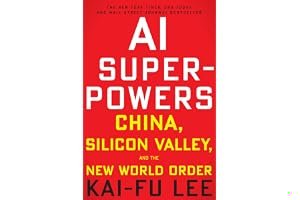
AI Superpowers: China, Silicon Valley, and the New World Order
Kai-Fu Lee
4.2
Dr. Kai-Fu Lee—one of the world’s most respected experts on AI and China—reveals that China has suddenly caught up to the US at an astonishingly rapid and unexpected pace. In AI Superpowers, Kai-fu Lee argues powerfully that because of these unprecedented developments in AI, dramatic changes will be happening much sooner than many of us expected. Indeed, as the US-Sino AI competition begins to heat up, Lee urges the US and China to both accept and to embrace the great responsibilities that come with significant technological power. Most experts already say that AI will have a devastating impact on blue-collar jobs. But Lee predicts that Chinese and American AI will have a strong impact on white-collar jobs as well. Is universal basic income the solution? In Lee’s opinion, probably not. But he provides a clear description of which jobs will be affected and how soon, which jobs can be enhanced with AI, and most importantly, how we can provide solutions to some of the most profound changes in human history that are coming soon.
Kai-Fu Lee's experience as an AI pioneer, top investor, and cancer survivor has led to this brilliant book about global technology. AI Superpowers gives us a guide to a future that celebrates all the benefits that AI will bring, while cultivating what is unique about our humanity. It’s one of those books you read and think, ‘Why are people reading any other book right now when this is so clearly the one they need to be reading? [source]
Kai-Fu Lee's smart analysis on human-AI coexistence is clear-eyed and a must-read. We must look deep within ourselves for the values and wisdom to guide AI's development. [source]
A superb and very timely survey of the impact of AI on the geopolitical system, the job market and human society. [source]
Cover unavailable
47
Peony in Love
Lisa See
4.2
In seventeenth-century China, three women become emotionally involved with The Peony Pavilion, a famed opera rumored to cause lovesickness and even death, including Peony, the cloistered daughter of a wealthy scholar, who succumbs to its spell only to return after her death as a "hungry ghost" to haunt her former fiancé, who has married another.
Cover unavailable
48
The Hundred Secret Senses
Amy Tan
4.2
The Hundred Secret Senses is an exultant novel about China and America, love and loyalty, the identities we invent and the true selves we discover along the way. Olivia Laguni is half-Chinese, but typically American in her uneasiness with her patchwork family. And no one in Olivia's family is more embarrassing to her than her half-sister, Kwan Li. For Kwan speaks mangled English, is cheerfully deaf to Olivia's sarcasm, and sees the dead with her "yin eyes."
Even as Olivia details the particulars of her decades-long grudge against her sister (who, among other things, is a source of infuriatingly good advice), Kwan Li is telling her own story, one that sweeps us into the splendor, squalor, and violence of Manchu China. And out of the friction between her narrators, Amy Tan creates a work that illuminates both the present and the past sweetly, sadly, hilariously, with searing and vivid prose.
…
Cover unavailable
49
Red China Blues: My Long March From Mao to Now
Jan Wong
4.2
Jan Wong, a Canadian of Chinese descent, went to China as a starry-eyed Maoist in 1972 at the height of the Cultural Revolution. A true believer--and one of only two Westerners permitted to enroll at Beijing University--her education included wielding a pneumatic drill at the Number One Machine Tool Factory. In the name of the Revolution, she renounced rock & roll, hauled pig manure in the paddy fields, and turned in a fellow student who sought her help in getting to the United States. She also met and married the only American draft dodger from the Vietnam War to seek asylum in China.
Red China Blues is Wong's startling--and ironic--memoir of her rocky six-year romance with Maoism (which crumbled as she became aware of the harsh realities of Chinese communism); her dramatic firsthand account of the devastating Tiananmen Square uprising; and her engaging portrait of the individuals and events she covered as a correspondent in China during the tumultuous era of capitalist reform under Deng Xiaoping. In a frank, captivating, deeply personal narrative she relates the horrors that led to her disillusionment with the "worker's paradise." And through the stories of the people--an unhappy young woman who was sold into marriage, China's most famous dissident, a doctor who lengthens penises--Wong reveals long-hidden dimensions of the world's most populous nation.
In setting out to show readers in the Western world what life is like in China, and why we should care, she reacquaints herself with the old friends--and enemies of her radical past, and comes to terms with the legacy of her ancestral homeland.
…
Cover unavailable
50
The Woman Warrior
Maxine Hong Kingston
4.1
A Chinese American woman tells of the Chinese myths, family stories and events of her California childhood that have shaped her identity.
When asked what books he recommended to his 18-year-old daughter Malia, Obama gave the Times a list that included The Naked and the Dead and One Hundred Years of Solitude. “I think some of them were sort of the usual suspects … I think she hadn’t read yet. Then there were some books that are not on everybody’s reading list these days, but I remembered as being interesting.” Here’s what he included: The Naked and the Dead, Norman Mailer One Hundred Years of Solitude, Gabriel García Márquez The Golden Notebook, Doris Lessing The Woman Warrior, Maxine Hong Kingston [source]
Eva Hoffman
This is a very interesting memoir by a woman, Maxine Hong Kingston, who was born in America but of a Chinese immigrant family, so it is an immigrant memoir. It recounts her childhood and youth in a desperately poor family, originally from rural China, who are uneducated and think of Americans as “ghosts” – the literal Chinese name for the natives. Her father has a contemptuous attitude to women, and she is treated shabbily in many ways. The memoir is about her conflict between this family and the American world that she enters into. She feels a double alienation. She feels increasingly alienated from her family and the Chinese immigrant community that she grows up in. But she also, initially, feels very lost in the American world which she goes to school in. [source]
Cover unavailable
51
Waiting
Ha Jin
4.1
In Waiting, PEN/Hemingway Award-winning author Ha Jin draws on his intimate knowledge of contemporary China to create a novel of unexpected richness and feeling. This is the story of Lin Kong, a man living in two worlds, struggling with the conflicting claims of two utterly different women as he moves through the political minefields of a society designed to regulate his every move and stifle the promptings of his innermost heart.
For more than seventeen years, this devoted and ambitious doctor has been in love with an educated, clever, modern woman, Manna Wu. But back in the traditional world of his home village lives the wife his family chose for him when he was young--a humble and touchingly loyal woman, whom he visits in order to ask, again and again, for a divorce. In a culture in which the ancient ties of tradition and family still hold sway and where adultery discovered by the Party can ruin lives forever, Lin's passionate love is stretched ever more taut by the passing years. Every summer, his compliant wife agrees to a divorce but then backs out. This time, Lin promises, will be different.
Tracing these lives through their summer of decision and beyond, Ha Jin vividly conjures the texture of daily life in a place where the demands of human longing must contend with the weight of centuries of custom. Waiting charms and startles us with its depiction of a China that remains hidden to Western eyes even as it moves us with its piercing vision of the universal complications of love.
…
Cover unavailable
52
Destined for War: Can America and China Escape Thucydides’s Trap?
Graham Allison
4.1
CHINA AND THE UNITED STATES ARE HEADING TOWARD A WAR NEITHER WANTS. The reason is Thucydides’s Trap, a deadly pattern of structural stress that results when a rising power challenges a ruling one. This phenomenon is as old as history itself. About the Peloponnesian War that devastated ancient Greece, the historian Thucydides explained: “It was the rise of Athens and the fear that this instilled in Sparta that made war inevitable.” Over the past 500 years, these conditions have occurred sixteen times. War broke out in twelve of them. Today, as an unstoppable China approaches an immovable America and both Xi Jinping and Donald Trump promise to make their countries “great again,” the seventeenth case looks grim. Unless China is willing to scale back its ambitions or Washington can accept becoming number two in the Pacific, a trade conflict, cyberattack, or accident at sea could soon escalate into all-out war.
In Destined for War, the eminent Harvard scholar Graham Allison explains why Thucydides’s Trap is the best lens for understanding U.S.-China relations in the twenty-first century. Through uncanny historical parallels and war scenarios, he shows how close we are to the unthinkable. Yet, stressing that war is not inevitable, Allison also reveals how clashing powers have kept the peace in the past — and what painful steps the United States and China must take to avoid disaster today.
…
Recommended by Fareed Zakaria, Kin Kariisa, and Will MacAskill.
It was such a memorable and humbling moment meeting Prof. Allison Graham, professor of government at Harvard, on the sidelines of Jeju Forum for Peace and Prosperity here in Jeju Island, South Korea. His book Destined for War is a fascinating read. https://t.co/ZB3HhBHgLY [source]
Will MacAskill
The last 70 years are a fairly unusual state. We don’t really know why they’ve been so unusually peaceful. This could all change in the 21st century. [source]
Cover unavailable
53
The Painted Veil
W. Somerset Maugham
4.1
Set in England and Hong Kong in the 1920s, The Painted Veil is the story of the beautiful, but love-starved Kitty Fane.
When her husband discovers her adulterous affair, he forces her to accompany him to the heart of a cholera epidemic. Stripped of the British society of her youth and the small but effective society she fought so hard to attain in Hong Kong, she is compelled by her awakening conscience to reassess her life and learn how to love.
The Painted Veil is a beautifully written affirmation of the human capacity to grow, to change, and to forgive.
…
Cover unavailable
54
The People's Republic of Amnesia: Tiananmen Revisited
Louisa Lim
4.1
Finalist for the 2015 Helen Bernstein Book Award for Excellence in Journalism
Longlisted for the Lionel Gelber Award for the Best Non-Fiction book in the world on Foreign Affairs
An Economist Book of the Year, 2014
A New York Times Book Review Editor's Choice
"One of the best analyses of the impact of Tiananmen throughout China in the years since 1989." --The New York Times Book Review
On June 4, 1989, People's Liberation Army soldiers opened fire on unarmed civilians in Beijing, killing untold hundreds of people. A quarter-century later, this defining event remains buried in China's modern history, successfully expunged from collective memory. In The People's Republic of Amnesia, Louisa Lim charts how the events of June 4th changed China, and how China changed the events of June 4th by rewriting its own history.
Lim reveals new details about those fateful days, including how one of the country's most senior politicians lost a family member to an army bullet, as well as the inside story of the young soldiers sent to clear Tiananmen Square. She also introduces us to individuals whose lives were transformed by the events of Tiananmen Square, such as a founder of the Tiananmen Mothers, whose son was shot by martial law troops; and one of the most important government officials in the country, who post-Tiananmen became one of its most prominent dissidents. And she examines how June 4th shaped China's national identity, fostering a generation of young nationalists, who know little and care less about 1989. For the first time, Lim uncovers the details of a brutal crackdown in a second Chinese city that until now has been a near-perfect case study in the state's ability to rewrite history, excising the most painful episodes. By tracking down eyewitnesses, discovering US diplomatic cables, and combing through official Chinese records, Lim offers the first account of a story that has remained untold for a quarter of a century. The People's Republic of Amnesia is an original, powerfully gripping, and ultimately unforgettable book about a national tragedy and an unhealed wound.
…
Recommended by Jeffrey Wasserstrom and Mark Krikorian.
Jeffrey Wasserstrom
Yes, and a great book. It’s the most important book to deal with 1989 in a long time: to my mind at least in the past decade. It’s powerful in the way it revisits the events of 1989 through profiles of participants. For example, we hear from a soldier who was involved in the crackdown and has rethought his role in events since then. The book also has a new investigation of a massacre that took place outside of Beijing, a few days later, in Chengdu. It was known about in specialist circles so it wasn’t as if this was something she discovered out of nowhere, but she did some very determined and brave investigation of the details. So that is one contribution of the book. [source]
Mark Krikorian
There was an interesting book a few years back describing how Chinese society, and not just the govt, has made a conscious effort to erase memory of the Tiananmen protests & massacre. https://t.co/sjfSnrD1wJ https://t.co/7VFiYj0FEh [source]
Cover unavailable
55
The Man Who Loved China: The Fantastic Story of the Eccentric Scientist Who Unlocked the Mysteries of the Middle Kingdom
Simon Winchester
4.1
In illuminating detail, Winchester, bestselling author of The Professor & the Madman ("Elegant & scrupulous"—NY Times Book Review) & Krakatoa ("A mesmerizing page-turner"—Time) tells the story of Joseph Needham, the Cambridge scientist who unlocked the most closely held secrets of China, long the world's most technologically advanced country. No cloistered don, this tall, married Englishman was a freethinking intellectual. A nudist, he was devoted to quirky folk dancing. In 1937, while working as a biochemist at Cambridge, he fell in love with a visiting Chinese student, with whom he began a lifelong affair. His mistress persuaded him to travel to her home country, where he embarked on a series of expeditions to the frontiers of the ancient empire. He searched for evidence to bolster a conviction that the Chinese were responsible for hundreds of humankind's most familiar innovations—including printing, the compass, explosives, suspension bridges, even toilet paper—often centuries before others. His journeys took him across war-torn China, consolidating his admiration for the Chinese. After the war, he determined to announce what he'd discovered & began writing Science & Civilisation in China, describing the country's long history of invention & technology. By the time he died, he'd produced, almost single-handedly, 17 volumes, making him the greatest one-man encyclopedist ever. Epic & intimate, The Man Who Loved China tells the sweeping story of China thru Needham's life. Here's a tale of what makes men, nations & humankind great—related by one of the world's best storytellers. Prologue The barbarian & the celestial Bringing fuel in snowy weather The discovering of China The rewards of restlessness The making of his masterpiece Persona non grata: the certain fall from grace The passage to the gate
…
Cover unavailable
56
Chinese Cinderella: The True Story of an Unwanted Daughter
Adeline Yen Mah
4.1
A riveting memoir of a girl's painful coming-of-age in a wealthy Chinese family during the 1940s.
A Chinese proverb says, "Falling leaves return to their roots." In Chinese Cinderella, Adeline Yen Mah returns to her roots to tell the story of her painful childhood and her ultimate triumph and courage in the face of despair. Adeline's affluent, powerful family considers her bad luck after her mother dies giving birth to her. Life does not get any easier when her father remarries. She and her siblings are subjected to the disdain of her stepmother, while her stepbrother and stepsister are spoiled. Although Adeline wins prizes at school, they are not enough to compensate for what she really yearns for -- the love and understanding of her family.
Following the success of the critically acclaimed adult bestseller Falling Leaves, this memoir is a moving telling of the classic Cinderella story, with Adeline Yen Mah providing her own courageous voice.
…
Cover unavailable
57
Red Azalea
Anchee Min
4.1
Red Azalea is Anchee Min’s celebrated memoir of growing up in the last years of Mao’s China. As a child, she was asked to publicly humiliate a teacher; at seventeen, she was sent to work at a labor collective. Forbidden to speak, dress, read, write, or love as she pleased, she found a lifeline in a secret love affair with another woman. Miraculously selected for the film version of one of Madame Mao’s political operas, Min’s life changed overnight. Then Chairman Mao suddenly died, taking with him an entire world. A revelatory and disturbing portrait of China, Anchee Min’s memoir is exceptional for its candor, its poignancy, its courage, and for its prose.
…
Cover unavailable
58
The Party: The Secret World of China's Communist Rulers
Richard McGregor
4.1
An eye-opening investigation into china's communist party and its integral role in the country's rise as a global superpower and rival of the united states
China's political and economic growth in the past three decades is one of astonishing, epochal dimensions. The country has undergone a remarkable transformation on a scale similar to that of the Industrial Revolution in the West. The most remarkable part of this transformation, however, has been left largely untold—the central role of the Chinese Communist Party.
As an organization alone, the Party is a phenomenon of unique scale and power. Its membership surpasses seventy-three million, and it does more than just rule a country. The Party not only has a grip on every aspect of government, from the largest, richest cities to the smallest far-flung villages in Tibet and Xinjiang, it also has a hold on all official religions, the media, and the military. The Party presides over large, wealthy state-owned businesses, and it exercises control over the selection of senior executives of all government companies, many of which are in the top tier of the Fortune 500 list.
In The Party, Richard McGregor delves deeply into China's inner sanctum for the first time, showing how the Communist Party controls the government, courts, media, and military, and how it keeps all corruption accusations against its members in-house. The Party's decisions have a global impact, yet the CPC remains a deeply secretive body, hostile to the law, unaccountable to anyone or anything other than its own internal tribunals. It is the world's only geopolitical rival of the United States, and is steadfastly poised to think the worst of the West.
In this provocative and illuminating account, Richard McGregor offers a captivating portrait of China's Communist Party, its grip on power and control over China, and its future.
…
Recommended by Dambisa Moyo.
Dambisa Moyo
This is why I think Richard’s book is particularly interesting. It’s a sneak peak into the way the Communist Party works. Clearly the Chinese government has succeeded in providing a policy environment that incentivises people to do things – to work hard, to make money – without it necessarily being democratic. Like it or not, they have a rule of law, they have some transparency – certainly enough that foreigners are happy to invest there. It’s not a model of democracy or transparency as we know it in the West, but it’s clearly a good enough system that people feel they want to invest their money there. [source]
Cover unavailable
59
China: A History
John Keay
4.1
An authoritative account of five thousand years of Chinese history Many nations define themselves in terms of territory or people; China defines itself in terms of history. Taking into account the country's unrivaled, voluminous tradition of history writing, John Keay has composed a vital and illuminating overview of the nation's complex and vivid past. Keay's authoritative history examines 5,000 years in China, from the time of the Three Dynasties through Chairman Mao and the current economic transformation of the country. Crisp, judicious, and engaging, China is the classic single-volume history for anyone seeking to understand the present and future of this immensely powerful nation.
…
Cover unavailable
60
Pavilion of Women
Pearl S. Buck
4.1
On her fortieth birthday, Madame Wu carries out a decision she has been planning for a long time: she tells her husband that after twenty-four years their physical life together is now over and she wishes him to take a second wife. The House of Wu, one of the oldest and most revered in China, is thrown into an uproar by her decision, but Madame Wu will not be dissuaded and arranges for a young country girl to come take her place in bed. Elegant and detached, Madame Wu orchestrates this change as she manages everything in the extended household of more than sixty relatives and servants. Alone in her own quarters, she relishes her freedom and reads books she has never been allowed to touch. When her son begins English lessons, she listens, and is soon learning from the foreigner, a free-thinking priest named Brother Andre, who will change her life. Few books raise so many questions about the nature and roles of men and women, about self-discipline and happiness.
…
Cover unavailable
61
Do Not Say We Have Nothing
Madeleine Thien
4.1
“In a single year, my father left us twice. The first time, to end his marriage, and the second, when he took his own life. I was ten years old.”
Master storyteller Madeleine Thien takes us inside an extended family in China, showing us the lives of two successive generations—those who lived through Mao’s Cultural Revolution and their children, who became the students protesting in Tiananmen Square. At the center of this epic story are two young women, Marie and Ai-Ming. Through their relationship Marie strives to piece together the tale of her fractured family in present-day Vancouver, seeking answers in the fragile layers of their collective story. Her quest will unveil how Kai, her enigmatic father, a talented pianist, and Ai-Ming’s father, the shy and brilliant composer, Sparrow, along with the violin prodigy Zhuli were forced to reimagine their artistic and private selves during China’s political campaigns and how their fates reverberate through the years with lasting consequences.
With maturity and sophistication, humor and beauty, Thien has crafted a novel that is at once intimate and grandly political, rooted in the details of life inside China yet transcendent in its universality.
…
Cover unavailable
62
China Rich Girlfriend (Crazy Rich Asians, #2)
Kevin Kwan
4.1
Kevin Kwan, bestselling author of Crazy Rich Asians, is back with a wickedly funny new novel of social climbing, secret e-mails, art-world scandal, lovesick billionaires, and the outrageous story of what happens when Rachel Chu, engaged to marry Asia's most eligible bachelor, discovers her birthfather.
On the eve of her wedding to Nicholas Young, heir to one of the greatest fortunes in Asia, Rachel should be over the moon. She has a flawless Asscher-cut diamond from JAR, a wedding dress she loves more than anything found in the salons of Paris, and a fiance willing to sacrifice his entire inheritance in order to marry her. But Rachel still mourns the fact that her birthfather, a man she never knew, won't be able to walk her down the aisle. Until: a shocking revelation draws Rachel into a world of Shanghai splendor beyond anything she has ever imagined. Here we meet Carlton, a Ferrari-crashing bad boy known for Prince Harry-like antics; Colette, a celebrity girlfriend chased by fevered paparazzi; and the man Rachel has spent her entire life waiting to meet: her father. Meanwhile, Singapore's It Girl, Astrid Leong, is shocked to discover that there is a downside to having a newly minted tech billionaire husband. A romp through Asia's most exclusive clubs, auction houses, and estates, China Rich Girlfriend brings us into the elite circles of Mainland China, introducing a captivating cast of characters, and offering an inside glimpse at what it's like to be gloriously, crazily, China-rich.
…
Cover unavailable
63
1421: The Year China Discovered America
Gavin Menzies
4.1
The incredible true story of the discovery of America before Columbus was even born.Gavin Menzies's extraordinary findings rewrite history.
On March 8, 1421, the largest fleet the world had ever seen sailed from its base in China. The ships, huge junks nearly five hundred feet long and built from the finest teak, were under the command of Emperor Zhu Di's loyal eunuch admirals. Their mission was "to proceed all the way to the end of the earth to collect tribute from the barbarians beyond the seas" and unite the whole world in Confucian harmony. Their journey would last more than two years and circle the globe.
When they returned in October 1423, the emperor had fallen, leaving China in political and economic chaos. The great ships, now considered frivolous, were left to rot at their moorings and the records of their journeys were destroyed. Lost in China's long, self-imposed isolation that followed was the knowledge that Chinese ships had reached America seventy years before Columbus and circumnavigated the globe a century before Magellan. Also concealed were how the Chinese colonized America before the Europeans and transplanted to America, Australia, New Zealand and South America the principal economic crops that have fed and clothed the world.
Now, in a landmark historical journey, Gavin Menzies, who spent fifteen years tracing the astonishing voyages of the Chinese fleet, shares the remarkable account of his discoveries and the incontrovertible evidence to support them. His compelling narrative pulls together ancient maps, precise navigational knowledge, astronomy and the surviving accounts of Chinese explorers and the later European navigators to prove that the Chinese had also discovered Antarctica, reached Australia three hundred and fifty years before Cook and solved the problem of longitude three hundred years ahead of the Europeans. 1421 describes the artifacts and inscribed stones left behind by the emperor's fleet, the evidence of wrecked junks along its route -- discovered in locations ranging from the middle of the Mississippi River to tributaries of the Amazon -- and the ornate votive offerings left by the Chinese sailors wherever they landed, in honor of Shao Lin, goddess of the sea.
1421: The Year China Discovered America is the story of a remarkable journey of discovery that rewrites our understanding of history. Our knowledge of world exploration as it has been commonly accepted for centuries must now be reconceived due to this classic work of historical detection.
This is another book that trains us to keep an open mind. It offers a theory of how the Chinese discovered America 70 years before Columbus. The practice of being open to new ways of seeing things makes a leader open to the ideas of others — an essential characteristic of great leadership. [source]
Cover unavailable
64
Monkey: The Journey to the West
Wu Ch'êng-ên, Arthur Waley, Hu Shih
4.1
Probably the most popular book in the history of the Far East, this classic combination of picaresque novel and folk epic mixes satire, allegory, and history into a rollicking tale. It is the story of the roguish Monkey and his encounters with major and minor spirits, gods, demigods, demons, ogres, monsters, and fairies.
Cover unavailable
65
Midnight in Peking: How the Murder of a Young Englishwoman Haunted the Last Days of Old China
Paul French
4.1
Peking in 1937 is a heady mix of privilege and scandal, opulence and opium dens, rumors and superstition. The Japanese are encircling the city, and the discovery of Pamela Werner's body sends a shiver through already nervous Peking. Is it the work of a madman? One of the ruthless Japanese soldiers now surrounding the city? Or perhaps the dreaded fox spirits? With the suspect list growing and clues sparse, two detectives—one British and one Chinese—race against the clock to solve the crime before the Japanese invade and Peking as they know it is gone forever. Can they find the killer in time, before the Japanese invade?
Historian and China expert Paul French at last uncovers the truth behind this notorious murder, and offers a rare glimpse of the last days of colonial Peking.
Winner of the both the Edgar Award for Best Fact Crime and the CWA Non-Fiction Dagger
…
Cover unavailable
66
Lost on Planet China: The Strange and True Story of One Man's Attempt to Understand the World's Most Mystifying Nation, or How He Became Comfortable Eating Live Squid
J. Maarten Troost
4.1
The bestselling author of The Sex Lives of Cannibals returns with a sharply observed, hilarious account of his adventures in China—a complex, fascinating country with enough dangers and delicacies to keep him, and readers, endlessly entertained.
Maarten Troost has charmed legions of readers with his laugh-out-loud tales of wandering the remote islands of the South Pacific. When the travel bug hit again, he decided to go big-time, taking on the world’s most populous and intriguing nation. In Lost on Planet China, Troost escorts readers on a rollicking journey through the new beating heart of the modern world, from the megalopolises of Beijing and Shanghai to the Gobi Desert and the hinterlands of Tibet. Lost on Planet China finds Troost dodging deadly drivers in Shanghai; eating Yak in Tibet; deciphering restaurant menus (offering local favorites such as Cattle Penis with Garlic); visiting with Chairman Mao (still dead, very orange); and hiking (with 80,000 other people) up Tai Shan, China’s most revered mountain. But in addition to his trademark gonzo adventures, the book also delivers a telling look at a vast and complex country on the brink of transformation that will soon shape the way we all work, live, and think. As Troost shows, while we may be familiar with Yao Ming or dim sum or the cheap, plastic products that line the shelves of every store, the real China remains a world—indeed, a planet--unto itself.
Maarten Troostbrings China to life as you’ve never seen it before, and his insightful, rip-roaringly funny narrative proves that once again he is one of the most entertaining and insightful armchair travel companions around.
…
Cover unavailable
67
Dream of the Red Chamber
Tsao Hsueh-Chin, Chi-Chen Wang
4.1
For more than a century and a half, Dream of the Red Chamber has been recognized in China as the greatest of its novels, a Chinese Romeo-and-Juliet love story and a portrait of one of the world's great civilizations. Chi-chen Wang's translation is skillful and accurate.
Cover unavailable
68
Stilwell and the American Experience in China: 1911-1945
Barbara W. Tuchman
4.1
Barbara W. Tuchman uses the life of Joseph Stilwell, the military attache to China in 1935-39 and commander of United States forces and allied chief of staff to Chiang Kai-shek in 1942-44, to explore the history of China from the revolution of 1911 to the turmoil of World War II, when China's Nationalist government faced attack from Japanese invaders and Communist insurgents. Her story is an account of both American relations with China and the experiences of one of our men on the ground. In the cantankerous but level-headed "Vinegar Joe", Tuchman found a subject who allowed her to perform, in the words of The National Review, "one of the historian's most envied magic acts: conjoining a fine biography of a man with a fascinating epic story".
…
Cover unavailable
69
The Valley of Amazement
Amy Tan
4.1
A sweeping, evocative epic of two women's intertwined fates and their search for identity, that moves from the lavish parlors of Shanghai courtesans to the fog-shrouded mountains of a remote Chinese village.
Spanning more than forty years and two continents, The Valley of Amazement resurrects pivotal episodes in history: from the collapse of China's last imperial dynasty, to the rise of the Republic, the explosive growth of lucrative foreign trade and anti-foreign sentiment, to the inner workings of courtesan houses and the lives of the foreign "Shanghailanders" living in the International Settlement, both erased by World War II.
A deeply evocative narrative about the profound connections between mothers and daughters, The Valley of Amazement returns readers to the compelling territory of Amy Tan's The Joy Luck Club. With her characteristic insight and humor, she conjures a story of inherited trauma, desire and deception, and the power and stubbornness of love.
…
Cover unavailable
70
Wolf Totem
Jiang Rong, Howard Goldblatt
4.1
China's runaway bestseller and winner of the inaugural Man Asian Literary Prize
Published in China in 2004, Wolf Totem has broken all sales records, selling millions of copies (along with millions more on the black market). Part period epic, part fable for modern days, Wolf Totem depicts the dying culture of the Mongols--the ancestors of the Mongol hordes who at one time terrorized the world--and the parallel extinction of the animal they believe to be sacred: the fierce and otherworldly Mongolian wolf. Beautifully translated by Howard Goldblatt, the foremost translator of Chinese fiction, this extraordinary novel is finally available in English.
…
Recommended by Isabel Hilton and James Palmer.
Isabel Hilton
Wolf Totem contains certain things that have universal romantic appeal: wolves, tribesmen, and so on. But the message that central Chinese policies have been catastrophic for the people who were China’s neighbours – and who are now incorporated into China – very much needed to be said. And it was a way of criticising the party without it being about Han China. But it spoke for a lot of what had happened in Han China too. [source]
James Palmer
It positions the Mongols as this kind of in-touch-with-nature, fierce, warrior people, like wolves, and the Han as these settled ‘sheeple.’ [source]
Cover unavailable
71
Tai-Pan (Asian Saga, #2)
James Clavell
4.1
It is the early 19th century, when European traders and adventurers first began to penetrate the forbidding Chinese mainland. And it is in this exciting time and exotic place that a giant of an Englishman, Dirk Straun, sets out to turn the desolate island of Hong Kong into an impregnable fortress of British power, and to make himself supreme ruler…Tai-Pan!
Recommended by Alan Pierce and Maya Zlatanova.
Alan Pierce
This novel is the second book in a great saga detailing the intense competition between two shipping magnates and their battle over the gateway to China: the very lucrative island of Hong Kong. Set in the tumultuous period during which the British had seized Hong Kong before it was known as England’s crown jewel, it is an exciting and fun ride detailing Hong Kong as a melting pot of political and economic interests with no shortage of intrigue. It’s a must read for sure. [source]
Maya Zlatanova
One of the books that had the biggest impact on Maya. [source]
Cover unavailable
72
The Last Days of Old Beijing: Life in the Vanishing Backstreets of a City Transformed
Michael Meyer
4.1
A fascinating, intimate portrait of Beijing through the lens of its oldest neighborhood, facing destruction as the city, and China, relentlessly modernizes.
Soon we will be able to say about old Beijing that what emperors, warlords, Japanese invaders, and Communist planners couldn’t eradicate, the market economy has. Nobody has been more aware of this than Michael Meyer. A long-time resident, Meyer has, for the past two years, lived as no other Westerner—in a shared courtyard home in Beijing’s oldest neighborhood, Dazhalan, on one of its famed hutong (lanes). There he volunteers to teach English at the local grade school and immerses himself in the community, recording with affection the life stories of the Widow, who shares his courtyard; coteacher Miss Zhu and student Little Liu; and the migrants Recycler Wang and Soldier Liu; among the many others who, despite great differences in age and profession, make up the fabric of this unique neighborhood.
Their bond is rapidly being torn, however, by forced evictions as century-old houses and ways of life are increasingly destroyed to make way for shopping malls, the capital’s first Wal-Mart, high-rise buildings, and widened streets for cars replacing bicycles. Beijing has gone through this cycle many times, as Meyer reveals, but never with the kind of dislocation and overturning of its storied culture now occurring as the city prepares to host the 2008 Summer Olympics.
Weaving historical vignettes of Beijing and China over a thousand years through his narrative, Meyer captures the city’s deep past as he illuminates its present. With the kind of insight only someone on the inside can provide, The Last Days of Old Beijing brings this moment and the ebb and flow of daily lives on the other side of the planet into shining focus.
…
Cover unavailable
73
The Water Margin: Outlaws of the Marsh
Shi Naian, J.H. Jackson, Edwin Lowe
4.1
Based upon the historical bandit Song Jiang and his companions, this Chinese equivalent of the English classic Robin Hood and His Merry Men is an epic tale of rebellion against tyranny and has been thrilling and inspiring readers for hundreds of years.
This edition of the classic J. H. Jackson translation features a new preface and introduction by Edwin Lowe, which gives the history of the book and puts the story into perspective for modern readers. First translated into English by Pearl S. Buck in 1933 as All Men Are Brothers, the original edition of the J.H. Jackson translation appeared under the title The Water Margin in 1937. In this updated edition, Edwin Lowe addresses many of the shortcomings found in the original J.H. Jackson translation, and replaces the original grit and flavor of Shuihui Zhuan found in Chinese versions, including the sexual seduction, explicit descriptions of brutality and barbarity, and the profane voices of the thieving, scheming, drinking, fighting, pimping lower classes of Song Dynasty China. Similarly, the Chinese deities, Bodhisattvas, gods and demons have reclaimed their true names, as has the lecherous, over-sexed and ill-fated Ximen Qing. All of which was sanitized out when first published in 1937.
While Chinese in origin, the themes of The Water Margin are universal enough that it has served as a source of inspiration for numerous movies, television shows and video games up to the present day.
…
Recommended by Marianne Bastid-Bruguière.
Marianne Bastid-Bruguière
I’ve always been interested in Chinese attitudes towards life: towards what happens, the misfortunes of life, and how they handle life in their society. And I think that, although you get a lot of hard facts through the historical record, of course, in order to get the mood and to understand deeper you need to look into literature. The first novel I really like is The Water Margin. It’s one of the four great classical novels of Chinese literature, but it’s very different because it’s a story of bandits – in a way it’s like a Chinese equivalent of Robin Hood. The novel came out of stories told among the people before the 14th century, and all these folk tales were taken together and put into written form by someone called Shi Naian, although it’s not even sure if this man existed. The story is based upon some historical facts: there was a bandit called Song Jiang who rebelled against the Song dynasty in the early 12th century. The novel takes the story of this bandit and his companions, and puts them into a kind of epic tale of rebellion against tyranny, which has been thrilling and inspiring Chinese readers for centuries. The novel is beautiful, because the personal stories of each of the bandits are taken together and also pursued individually, and as you have 108 characters it’s an extraordinary feat. It’s very vivid, and it shows the reactions of ordinary Chinese people: how they have a sense of justice, generosity, and humanity. And it also shows the extraordinary violence of Chinese society, and the way people make their lives with that: how they are able to subdue this violence, and turn it into human relations. [source]
Cover unavailable
74
Three Kingdoms: A Historical Novel
Guanzhong Luo, Moss Roberts
4.1
Romance of The Three Kingdoms (Hardcover) tells about the three kingdoms, Wei, Shu and Wu, led by Cao Cao, Liu Bei and Sun Quan and the conflicts and fights among the three political, military blocs during the end of Eastern Han dynasty and the entire three kingdoms period. Based on the broad social and historical backdrop, it shows the sharp, complex and distinctive political and military conflicts of that era, which has left deep impact on later generations in politics and military strategies.
…
Cover unavailable
75
Autumn in the Heavenly Kingdom: China, the West, and the Epic Story of the Taiping Civil War
Stephen R. Platt
4.1
A gripping account of China’s nineteenth-century Taiping Rebellion, one of the largest civil wars in history. Autumn in the Heavenly Kingdom brims with unforgettable characters and vivid re-creations of massive and often gruesome battles—a sweeping yet intimate portrait of the conflict that shaped the fate of modern China.
The story begins in the early 1850s, the waning years of the Qing dynasty, when word spread of a major revolution brewing in the provinces, led by a failed civil servant who claimed to be the son of God and brother of Jesus. The Taiping rebels drew their power from the poor and the disenfranchised, unleashing the ethnic rage of millions of Chinese against their Manchu rulers. This homegrown movement seemed all but unstoppable until Britain and the United States stepped in and threw their support behind the Manchus: after years of massive carnage, all opposition to Qing rule was effectively snuffed out for generations. Stephen R. Platt recounts these events in spellbinding detail, building his story on two fascinating characters with opposing visions for China’s future: the conservative Confucian scholar Zeng Guofan, an accidental general who emerged as the most influential military strategist in China’s modern history; and Hong Rengan, a brilliant Taiping leader whose grand vision of building a modern, industrial, and pro-Western Chinese state ended in tragic failure.
This is an essential and enthralling history of the rise and fall of the movement that, a century and a half ago, might have launched China on an entirely different path into the modern world.
…
Cover unavailable
76
Red Sorghum
Mo Yan, Howard Goldblatt
4.0
Spanning three generations, this novel of family and myth is told through a series of flashbacks that depict events of staggering horror set against a landscape of gemlike beauty, as the Chinese battle both Japanese invaders and each other in the turbulent 1930s. A legend in China, where it won major literary awards and inspired an Oscar-nominated film, Red Sorghum is a book in which fable and history collide to produce fiction that is entirely new and unforgettable.
…
Cover unavailable
77
Death of a Red Heroine (Inspector Chen Cao #1)
Qiu Xiaolong
4.0
Alternate Cover Edition for ISBN 9781569472422
Qiu Xiaolong's Anthony Award-winning debut introduces Inspector Chen of the Shanghai Police.
A young “national model worker,” renowned for her adherence to the principles of the Communist Party, turns up dead in a Shanghai canal. As Inspector Chen Cao of the Shanghai Special Cases Bureau struggles to trace the hidden threads of her past, he finds himself challenging the very political forces that have guided his life since birth. Chen must tiptoe around his superiors if he wants to get to the bottom of this crime, and risk his career—perhaps even his life—to see justice done.
…
Cover unavailable
78
Girl in Translation
Jean Kwok
4.0
When young Kimberly Chang and her mother emigrate from Hong Kong to America, they speak no English and own nothing but debt. They arrive in New York hopeful for a better life, but find instead a squalid Brooklyn apartment and backbreaking labor in a Chinatown sweatshop. Unable to accept this as her future, Kim decides to use her "talent for school" to earn a place for herself and her mother in their adopted country. Disguising the most difficult truths of her meager existence, Kim embarks on a double life, an exceptional student by day, and a sweatshop worker by evening. In time, Kim learns to translate not just her language but herself, back and forth between two world, between hardship and triumph, heartbreak and love, and all that gets lost in translation.
…
Cover unavailable
79
The Vagrants
Yiyun Li
4.0
Brilliant and illuminating, this astonishing debut novel by the award-winning writer Yiyun Li is set in China in the late 1970s, when Beijing was rocked by the Democratic Wall Movement, an anti-Communist groundswell designed to move China beyond the dark shadow of the Cultural Revolution toward a more enlightened and open society. In this powerful and beautiful story, we follow a group of people in a small town during this dramatic and harrowing time, the era that was a forebear of the Tiananmen Square uprising.
Morning dawns on the provincial city of Muddy River. A young woman, Gu Shan, a bold spirit and a follower of Chairman Mao, has renounced her faith in Communism. Now a political prisoner, she is to be executed for her dissent. Her distraught mother, determined to follow the custom of burning her only child’s clothing to ease her journey into the next world, is about to make another bold decision. Shan’s father, Teacher Gu, who has already, in his heart and mind, buried his rebellious daughter, begins to retreat into memories. Neither of them imagines that their daughter’s death will have profound and far-reaching effects, in Muddy River and beyond.
In luminous prose, Yiyun Li weaves together the lives of these and other unforgettable characters, including a serious seven-year-old boy, Tong; a crippled girl named Nini; the sinister idler Bashi; and Kai, a beautiful radio news announcer who is married to a man from a powerful family. Life in a world of oppression and pain is portrayed through stories of resilience, sacrifice, perversion, courage, and belief. We read of delicate moments and acts of violence by mothers, sons, husbands, neighbors, wives, lovers, and more, as Gu Shan’s execution spurs a brutal government reaction.
Writing with profound emotion, and in the superb tradition of fiction by such writers as Orhan Pamuk and J. M. Coetzee, Yiyun Li gives us a stunning novel that is at once a picture of life in a special part of the world during a historic period, a universal portrait of human frailty and courage, and a mesmerizing work of art.
…
Cover unavailable
80
China Marine: An Infantryman's Life After World War II
E. B. Sledge
4.0
See E.B. Sledge's story in the HBO miniseries The Pacific!
China Marine is the extraordinary sequel to E.B. Sledge's memoir, With the Old Breed, which remains the most powerful and moving account of the U.S. Marines in World War II. Sledge continues his story where With the Old Breed left off and recounts the compelling conclusion of his Marine career.
After Japan's surrender in 1945, Sledge and his company were sent to China to maintain order and to calm the seething cauldron of political and ideological unrest created by opposing factions. His regiment was the first Marine unit to return to the ancient city of Peiping (now Beijing) where they witnessed the last of old China and the rise of the Communist state. Sledge also recounts the difficulty of returning to his hometown of Mobile, Alabama, and resuming civilian life while haunted by shadows of close combat. Through the discipline of writing and the study of biology, he shows how he came to terms with the terrifying memories that had plagued him for years.
Poignant and compelling, China Marine provides a frank depiction of the real costs of war, emotional and psychological as well as physical, and reveals the enduring bond that develops between men who face the horrors of war.
…
Cover unavailable
81
Tombstone: The Great Chinese Famine, 1958-1962
Yang Jisheng, Edward Friedman, Stacy Mosher, Jian Guo, Roderick MacFarquhar
4.0
An estimated thirty-six million Chinese men, women, and children starved to death during China's Great Leap Forward in the late 1950s and early '60s. One of the greatest tragedies of the twentieth century, the famine is poorly understood, and in China is still euphemistically referred to as "the three years of natural disaster."
As a journalist with privileged access to official and unofficial sources, Yang Jisheng spent twenty years piecing together the events that led to mass nationwide starvation, including the death of his own father. Finding no natural causes, Yang attributes responsibility for the deaths to China's totalitarian system and the refusal of officials at every level to value human life over ideology and self-interest.
…
Recommended by Ma Jian.
Ma Jian
It’s a very thick book. My first impression of Tombstone was that it really surprised me, in a good way. We all know that in the sixties, during the Mao era, there was a terrifying period of the Great Famine. That was a secret for a long time, which no-one revealed. But with this book, we can now read extensive evidence of it. Of course, Yang Jisheng isn’t a literary writer, he’s a historian. He lives in Beijing and spent many, many years collecting the material for Tombstone. It’s absolutely terrific, and I really admire him. [source]
Cover unavailable
82
Strange Tales from a Chinese Studio
Pu Songling, John Minford
4.0
The strange tales of Pu Songling are exquisite miniatures regarded as the pinnacle of classical Chinese fiction. With their elegant prose, witty wordplay and subtle charm, the 104 stories in this selection reveal a world in which nothing is as it seems.
Cover unavailable
83
Soul Mountain
Gao Xingjian, Mabel Lee
4.0
In 1983, Chinese playwright, critic, fiction writer, and painter Gao Xingjian was diagnosed with lung cancer and faced imminent death. But six weeks later, a second examination revealed there was no cancer -- he had won "a reprieve from death." Faced with a repressive cultural environment and the threat of a spell in a prison farm, Gao fled Beijing and began a journey of 15,000 kilometers into the remote mountains and ancient forests of Sichuan in southwest China. The result of this epic voyage of discovery is Soul Mountain.
Bold, lyrical, and prodigious, Soul Mountain probes the human soul with an uncommon directness and candor and delights in the freedom of the imagination to expand the notion of the individual self.
…
Cover unavailable
84
Love in a Fallen City
Eileen Chang, Karen S. Kingsbury
4.0
Eileen Chang is one of the great writers of twentieth-century China, where she enjoys a passionate following both on the mainland and in Taiwan. At the heart of Chang's achievement is her short fiction—tales of love, longing, and the shifting and endlessly treacherous shoals of family life. Written when Chang was still in her twenties, these extraordinary stories combine an unsettled, probing, utterly contemporary sensibility, keenly alert to sexual politics and psychological ambiguity, with an intense lyricism that echoes the classics of Chinese literature. Love in a Fallen City, the first collection in English of this dazzling body of work, introduces American readers to the stark and glamorous vision of a modern master.
…
Cover unavailable
85
Pearl of China
Anchee Min
4.0
From the bestselling author of Red Azalea and Empress Orchid comes the powerful story of the friendship of a lifetime, based on the life of Pearl S. Buck.
In the small southern town of Chin-kiang, in the last days of the nineteenth century, two young girls bump heads and become thick as thieves. Willow is the only child of a destitute family, Pearl the headstrong daughter of zealous Christian missionaries. She will ultimately become the internationally renowned author Pearl S. Buck, but for now she is just a girl embarrassed by her blonde hair and enchanted by her new Chinese friend. The two embark on a friendship that will sustain both of them through one of the most tumultuous periods in Chinese history.
Moving out into the world together, the two enter the intellectual fray of the times, share love interests and survive early marriages gone bad. Their shared upbringing inspires Pearl's novels, which celebrate the life of the Chinese peasant and will eventually earn her both a Pulitzer and a Nobel Prize. But when a civil war erupts between the Nationalists and Communists, Pearl is forced to flee the country just ahead of angry mobs. Willow, despite close ties to Mao’s inner circle, is punished for loyalty to her 'cultural imperialist' friend. And yet, through love and loss, heartbreak and joy, exile and imprisonment, the two women remain intimately entwined.
In this ambitious new novel, Anchee Min brings to life a courageous and passionate woman who is now hailed in China as a modern heroine. Like nothing before it, Pearl of China tells the story of one of the twentieth century’s greatest writers, from the perspective of the people she loved and of the land she called home.
…
Cover unavailable
86
Red Scarf Girl
Ji-li Jiang
4.0
Moving, honest, and deeply personal, Red Scarf Girl is the incredible true story of one girl’s courage and determination during one of the most terrifying eras of the twentieth century.
It's 1966, and twelve-year-old Ji-li Jiang has everything a girl could want: brains, popularity, and a bright future in Communist China. But it's also the year that China's leader, Mao Ze-dong, launches the Cultural Revolution—and Ji-li's world begins to fall apart. Over the next few years, people who were once her friends and neighbors turn on her and her family, forcing them to live in constant terror of arrest. And when Ji-li's father is finally imprisoned, she faces the most difficult dilemma of her life.
…
Cover unavailable
87
Riding the Iron Rooster
Paul Theroux
4.0
Paul Theroux invites you to join him on the journey of a lifetime, in the grand romanttic tradition, by train across Euope, through the vast underbelly of Asia and in the heart of Russia, and then up to China. Here is China by rail, as seen and heard through the eyes and ears of one of the most intrepid and insightful travel writers of our time.
Cover unavailable
88
Bridge of Birds (The Chronicles of Master Li and Number Ten Ox, #1)
Barry Hughart
4.0
When the children of his village were struck with a mysterious illness, Number Ten Ox sought a wiseman to save them. He found master Li Kao, a scholar with a slight flaw in his character. Together, they set out to find the Great Root of Power, the only possible cure.
The quest led them to a host of truly memorable characters, multiple wonders, incredible adventures—and strange coincidences, which were really not coincidences at all. And it involved them in an ancient crime that still perturbed the serenity of Heaven. Simply and charmingly told, this is a wry tale, a sly tale, and a story of wisdom delightfully askew. Once read, its marvels and beauty will not easily fade from the mind.
The author claims that this is a novel of an ancient China that never was. But, oh…it should have been!
…
Cover unavailable
89
American Born Chinese
Gene Luen Yang, Lark Pien
4.0
All Jin Wang wants is to fit in. When his family moves to a new neighborhood, he suddenly finds that he's the only Chinese American student at his school. Jocks and bullies pick on him constantly, and he has hardly any friends. Then, to make matters worse, he falls in love with an all-American girl...
Born to rule over all the monkeys in the world, the story of the Monkey King is one of the oldest and greatest Chinese fables. Adored by his subjects, master of the arts of kung-fu, he is the most powerful monkey on earth. But the Monkey King doesn't want to be a monkey. He wants to be hailed as a god...
Chin-Kee is the ultimate negative Chinese stereotype, and he's ruining his cousin Danny's life. Danny's a popular kid at school, but every year Chin-Kee comes to visit, and every year Danny has to transfer to a new school to escape the shame. This year, though, things quickly go from bad to worse...
These three apparently unrelated tales come together with an unexpected twist, in a modern fable that is hilarious, poignant and action-packed. American Born Chinese is an amazing rise, all the way up to the astonishing climax--and confirms what a growing number of readers already know: Gene Yang is a major talent.
…
Cover unavailable
90
Chinese Lessons
Pomfret
4.0
A first-hand account of the remarkable transformation of China over the past forty years as seen through the life of an award-winning journalist and his four Chinese classmates
As a twenty-year-old exchange student from Stanford University, John Pomfret spent a year at Nanjing University in China. His fellow classmates were among those who survived the twin tragedies of Mao's rule--the Great Leap Forward and the Cultural Revolution--and whose success in government and private industry today are shaping China's future. Pomfret went on to a career in journalism, spending the bulk of his time in China. After attending the twentieth reunion of his class, he decided to reacquaint himself with some of his classmates. Chinese Lessons is their story and his own.
Beginning with Pomfret's first days in China, Chinese Lessons takes us back to the often torturous paths that brought together the Nanjing University History Class of 1982. One classmate's father was killed during the Cultural Revolution for the crime of being an intellectual; another classmate labored in the fields for years rather than agree to a Party-arranged marriage; a third was forced to publicly denounce and humiliate her father. As we watch Pomfret and his classmates begin to make their lives as adults, we see as never before the human cost and triumph of China's transition from near-feudal communism to first-world capitalism.
…
Recommended by Richard McGregor.
Richard McGregor
I found this book really unputdownable. We’ve all read lots of books about the reforms under Deng Xiaoping since 1979. Pomfret takes it straight down to street level, almost, with the story of five people that he knew, former classmates he had met at university as a foreign student in Nanjing in 1981. He was able to trace their lives intimately from when he left them. The book really has this grand sweep to it – like a great historical novel, part Balzac, part Exodus. [source]
Cover unavailable
91
Forgotten Ally: China's World War II, 1937-1945
Rana Mitter
4.0
The epic, untold story of China’s devastating eight-year war of resistance against Japan
For decades, a major piece of World War II history has gone virtually unwritten. The war began in China, two years before Hitler invaded Poland, and China eventually became the fourth great ally, partner to the United States, the Soviet Union, and Great Britain. Yet its drama of invasion, resistance, slaughter, and political intrigue remains little known in the West.
Rana Mitter focuses his gripping narrative on three towering leaders: Chiang Kai-shek, the politically gifted but tragically flawed head of China’s Nationalist government; Mao Zedong, the Communists’ fiery ideological stalwart, seen here at the beginning of his epochal career; and the lesser-known Wang Jingwei, who collaborated with the Japanese to form a puppet state in occupied China. Drawing on Chinese archives that have only been unsealed in the past ten years, he brings to vivid new life such characters as Chiang’s American chief of staff, the unforgettable “Vinegar Joe” Stilwell, and such horrific events as the Rape of Nanking and the bombing of China’s wartime capital, Chongqing. Throughout, Forgotten Ally shows how the Chinese people played an essential role in the wider war effort, at great political and personal sacrifice.
Forgotten Ally rewrites the entire history of World War II. Yet it also offers surprising insights into contemporary China. No twentieth-century event was as crucial in shaping China’s worldview, and no one can understand China, and its relationship with America today, without this definitive work.
…
Cover unavailable
92
The Leavers
Lisa Ko
4.0
One morning, Deming Guo’s mother, an undocumented Chinese immigrant named Polly, goes to her job at the nail salon and never comes home. No one can find any trace of her.
With his mother gone, eleven-year-old Deming is left with no one to care for him. He is eventually adopted by two white college professors who move him from the Bronx to a small town upstate. They rename him Daniel Wilkinson in their efforts to make him over into their version of an “all-American boy.” But far away from all he’s ever known, Daniel struggles to reconcile his new life with his mother’s disappearance and the memories of the family and community he left behind.
Set in New York and China, The Leavers is a vivid and moving examination of borders and belonging. It’s the story of how one boy comes into his own when everything he’s loved has been taken away--and how a mother learns to live with the mistakes of her past.
This powerful debut is the winner of the 2016 PEN/Bellwether Prize for fiction, awarded by Barbara Kingsolver for a novel that addresses issues of social justice.
…
Cover unavailable
93
The Tragedy of Liberation: A History of the Chinese Revolution 1945-1957
Frank Dikötter
4.0
“The Chinese Communist party refers to its victory in 1949 as a 'liberation.' In China the story of liberation and the revolution that followed is not one of peace, liberty, and justice. It is first and foremost a story of calculated terror and systematic violence.” So begins Frank Dikötter's stunning and revelatory chronicle of Mao Zedong's ascension and campaign to transform the Chinese into what the party called New People. Following the defeat of Chiang Kai-shek in 1949, after a bloody civil war, Mao hoisted the red flag over Beijing's Forbidden City, and the world watched as the Communist revolution began to wash away the old order. Due to the secrecy surrounding the country's records, little has been known before now about the eight years that followed, preceding the massive famine and Great Leap Forward.
Drawing on hundreds of previously classified documents, secret police reports, unexpurgated versions of leadership speeches, eyewitness accounts of those who survived, and more, The Tragedy of Liberation bears witness to a shocking, largely untold history. Interweaving stories of ordinary citizens with tales of the brutal politics of Mao's court, Frank Dikötter illuminates those who shaped the “liberation” and the horrific policies they implemented in the name of progress. People of all walks of life were caught up in the tragedy that unfolded, and whether or not they supported the revolution, all of them were asked to write confessions, denounce their friends, and answer queries about their political reliability. One victim of thought reform called it a “carefully cultivated Auschwitz of the mind.” Told with great narrative sweep, The Tragedy of Liberation is a powerful and important document giving voice at last to the millions who were lost, and casting new light on the foundations of one of the most powerful regimes of the twenty-first century.
…
Cover unavailable
94
The Private Life of Chairman Mao
Li Zhi-Sui, Li Zhisui
4.0
From 1954 until Mao Zedong's death 22 years later. Dr. Li Zhisui was the Chinese ruler's personal physician. For most of these years, Mao was in excellent health; thus he and the doctor had time to discuss political and personal matters. Dr. Li recorded many of these conversations in his diaries, as well as in his memory. In this book, Dr. Li vividly reconstructs his extraordinary time with Chairman Mao.
…
Cover unavailable
95
Boxers (Boxers & Saints, #1)
Gene Luen Yang, Lark Pien
4.0
China, 1898. Bands of foreign missionaries and soldiers roam the countryside, bullying and robbing Chinese peasants.
Little Bao has had enough. Harnessing the powers of ancient Chinese gods, he recruits an army of Boxers—commoners trained in kung fu—who fight to free China from "foreign devils."
Against all odds, this grass-roots rebellion is violently successful. But nothing is simple. Little Bao is fighting for the glory of China, but at what cost? So many are dying, including thousands of "secondary devils"—Chinese citizens who have converted to Christianity.
…
Cover unavailable
96
Sky Burial: An Epic Love Story of Tibet
Xinran Xinran
4.0
It was 1994 when Xinran, a journalist and the author of The Good Women of China, received a telephone call asking her to travel four hours to meet an oddly dressed woman who had just crossed the border from Tibet into China. Xinran made the trip and met the woman, called Shu Wen, who recounted the story of her thirty-year odyssey in the vast landscape of Tibet.
Shu Wen and her husband had been married for only a few months in the 1950s when he joined the Chinese army and was sent to Tibet for the purpose of unification of the two countries. Shortly after he left she was notified that he had been killed, although no details were given. Determined to find the truth, Shu Wen joined a militia unit going to the Tibetan north, where she soon was separated from the regiment. Without supplies and knowledge of the language, she wandered, trying to find her way until, on the brink of death, she was rescued by a family of nomads under whose protection she moved from place to place with the seasons and eventually came to discover the details of her husband's death.
In the haunting Sky Burial, Xinran has recreated Shu Wen's journey, writing beautifully and simply of the silence and the emptiness in which Shu Wen was enveloped. The book is an extraordinary portrait of a woman and a land, each at the mercy of fate and politics. It is an unforgettable, ultimately uplifting tale of love, loss, loyalty, and survival.
…
Cover unavailable
97
Women of the Silk (Women of the Silk #1)
Gail Tsukiyama
4.0
Sent by her family to work in a silk factory just prior to World War II, young Pei grows to womanhood, working fifteen-hour days and sending her pay to the family who abandoned her.
In "Women of the Silk" Gail Tsukiyama takes her readers back to rural China in 1926, where a group of women forge a sisterhood amidst the reeling machines that reverberate and clamor in a vast silk factory from dawn to dusk. Leading the first strike the village has ever seen, the young women use the strength of their ambition, dreams, and friendship to achieve the freedom they could never have hoped for on their own. Tsukiyama's graceful prose weaves the details of "the silk work" and Chinese village life into a story of courage and strength.
…
Cover unavailable
98
Wealth and Power: China's Long March to the Twenty-first Century
Orville Schell, John Delury
4.0
From two of today's foremost experts on China, a thought-provoking new history that helps us understand China's future by looking at its rise over the last 150 years.
Wealth and Power is a sweeping account of the key, iconic intellectual figures and political leaders of China since the mid-1800s. By examining what they thought and what they did through lively and absorbing portraits, Schell and Delury chart how China made its tortured transformation from a weak, humiliated country under foreign assault to its astonishing rise in the early 21st century. In so doing, they provide us with a deeper and richer understanding of China's present success story.
…
Cover unavailable
99
Red Star Over China: The Classic Account of the Birth of Chinese Communism
Edgar Snow, Dr. John K. Fairbank
4.0
The first Westerner to meet Mao Tse-tung and the Chinese Communist leaders in 1936, Edgar Snow came away with the first authorized account of Mao’s life, as well as a history of the famous Long March and the men and women who were responsible for the Chinese revolution. Out of that experience came Red Star Over China, a classic work that remains one of the most important books ever written about the birth of the Communist movement in China. This edition includes extensive notes on military and political developments in China, further interviews with Mao Tse-tung, a chronology covering 125 years of Chinese revolution, and nearly a hundred detailed biographies of the men and women who were instrumental in making China what it is today.
…
Recommended by Elizabeth Perry and John M Hamilton.
Elizabeth Perry
in some ways it seems the most dated of the books I’ve chosen, because it presents a totally rosy portrait of the Communist revolution. But I think for understanding modern China it’s extremely important. And that’s because it does, in rather sympathetic but comprehensive detail, point out both the importance of the land revolution, and the nationalistic revolution, as key elements in Mao Zedong’s revolution. [source]
John M Hamilton
This arguably is the most important book by an American foreign correspondent in the 20th century. At the time it was written in the mid-1930s nobody knew who the communists were. Many thought they were mere bandits. Snow went to the north-west of China to find them. When his book came out the whole equation changed; thereafter communism was understood to be a viable political movement. [source]
Cover unavailable
100
Empire of the Sun (Empire of the Sun, #1)
J. G. Ballard
4.0
The classic, award-winning novel, made famous by Steven Spielberg's film, tells of a young boy's struggle to survive World War II in China.
Jim is separated from his parents in a world at war. To survive, he must find a deep strength greater than all the events that surround him.
Shanghai, 1941 -- a city aflame from the fateful torch of Pearl Harbor. In streets full of chaos and corpses, a young British boy searches in vain for his parents. Imprisoned in a Japanese concentration camp, he is witness to the fierce white flash of Nagasaki, as the bomb bellows the end of the war...and the dawn of a blighted world.
Ballard's enduring novel of war and deprivation, internment camps and death marches, and starvation and survival is an honest coming-of-age tale set in a world thrown utterly out of joint.


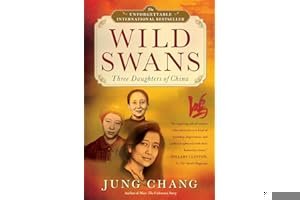 1
1