

Trusted By Top Leaders & Intellectuals







Preview your first Shortform Summary (read and listen)
Community: Atomic Habits by James Clear Discussion

Choose your focus and we'll connect you with the content


Unlock features that support how you learn best
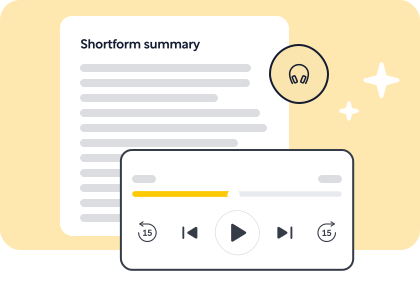
Read or Listen
Read when you have a quiet minute. Listen when you’re on the move.
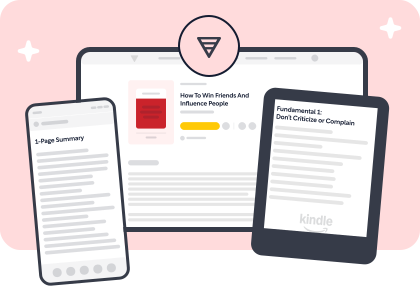
Desktop, App, Kindle
Start on desktop, finish on your phone. Learning doesn’t have to stop when you leave your desk.
Solo or with a Community
Learn on your own or jump into the community when you want more perspectives.
Interactive Exercises
Test your understanding and comprehension with interactive exercises that help you retain.

I've been using Shortform for years, it's by far the best non-fiction book summary service out there. If you like books, learning and doing those things in a time efficient way then you should definitely check out Shortform.

Ready to get started?
Choose a plan and start your free trial. Keep learning in the way that works for you.

Annually
$16.42/mo
Billed annually at $197
- 5-Day Free Trial
- 10,000+ Books Covered
- 1,000+ Article and Topic Guides
- Mobile App (iOS/Android)
- Highlights & Notes
- Audio Narrations
- Community Discussions
- PDF Downloads

Monthly
$24.00/mo
Billed monthly
- 5-Day Free Trial
- 10,000+ Books Covered
- 1,000+ Article and Topic Guides
- Mobile App (iOS/Android)
- Highlights & Notes
- Audio Narrations
- Community Discussions
- PDF Downloads
Included with plans
- 5-Day Free Trial
- 10,000+ Books Covered
- 1,000+ Article and Topic Guides
- Mobile App (iOS/Android)
- Highlights & Notes
- Audio Narrations
- Community Discussions
- PDF Downloads
Got questions? We got answers.
What is Shortform and how is it different from other summary apps?
Shortform is a premium learning platform offering in-depth guides to thousands of non-fiction books, podcasts, and articles. Unlike "summary-only" apps, we provide smart analysis, unique commentary, and zero-fluff objectivity to help you actually master key ideas, not just skim them.
What content and features are included in my Shortform subscription?
You get full access to over 10,000 guides across 30+ categories (from Business to Psychology), plus:
- Audio Narrations: Listen to every guide on the go (even offline).
- Downloads: PDF versions for every title.
- Interactive Tools: Community discussions and custom reading lists.
- Expert Curation: Shortform-original articles and podcast breakdowns.
What are Shortform’s subscription plans and is there a free trial?
We offer flexible monthly and annual plans that you can switch or cancel at any time. Both plans start with a free trial, giving you full access to every feature. You’ll only be charged at the end of your trial, so you can explore the entire library risk-free. See our Pricing page for current rates.
What payment methods does Shortform accept?
We accept Visa, Mastercard, American Express, Discover, Apple Pay, Google Pay, and Link.
Does Shortform have audio narrations?
Yes! Every guide includes full audio narration. You can even listen offline via our mobile app.
Which platforms and languages are supported?
We are available on Desktop, iOS, and Android. Currently, we support English, Spanish, German, and Brazilian Portuguese.
Have more questions?
Contact Customer Support: help@shortform.com
How Habits Form: Comparing Expert's Models
As Clear notes, his habit formation stages expand upon productivity expert Charles Duhigg’s habit model from The Power of Habit—but Clear doesn’t specify how his approach differs. Clear presents a four-stage model of habit formation, but Duhigg’s model has only three stages: First, there’s the cue, or the trigger that tells your brain which habit to use. Second, there’s the routine, in which you act out the habit, and third, there’s the reward, which is the result of the routine and reinforces the habit. Duhigg’s model doesn’t include Clear’s cravings stage—although Duhigg does discuss how cravings drive behavior.