Brian Muraresku on Mysticism and Christianity

Brian Muraresku on Mysticism and Christianity

What is the connection between mysticism and Christianity? Why did the early church want to overthrow mystical practices? At the time of the birth of Christianity, the Greeks practiced a polytheistic religion, which included a rich mystical element. Practitioners sought to attain a profound spiritual connection with the supernatural through a direct mystical experience, which was facilitated by the ingestion of psychedelic brews. Here’s how Christianity put an end to Greek mystical traditions and overtook the Greco-Roman world.

Why Did the Church Reject the Gnostic Gospels?

Why Did the Church Reject the Gnostic Gospels?

What is Gnosis? Why did the Church reject the Gnostic Gospels? The Gnostic Gospels are a collection of books purportedly written by followers of Jesus, likely between AD 120 and 150. Although the writers themselves professed to be devotees of Jesus and claimed to be revealing truths from him, leaders of the early Christian church omitted these books from the Biblical canon. Here’s why the Gnostic texts were excluded from the official Christian canon.

The Immortality Key: Book Overview (Brian Muraresku)

The Immortality Key: Book Overview (Brian Muraresku)

What is Brian Muraresku’s book The Immortality Key about? What is the key message to take away from the book? The Immortality Key, published in 2020, is Brian Muraresku’s deep dive into the origins of Christianity and its overlap with pre-existing pagan religious customs. Muraresku argues that Christianity began as a female-led mystical cult that used psychedelics to induce transcendental states to connect with the divine.  Below is a brief overview of The Immortality Key: The Secret History of the Religion with No Name by Brian Muraresku.

The Eleusinian Mysteries Drink Was Likely Hallucinogenic

The Eleusinian Mysteries Drink Was Likely Hallucinogenic

What was the drink consumed during the Eleusinian Mysteries? What was the purpose of the sacred brew? During the rituals of the Eleusinian Mysteries, the initiates consumed “kukeon,” a barley-based beer. According to Brian Muraresku, the author of The Immortality Key, the kukeon brew was likely psychedelic because it contained ergot—a fungus that possesses hallucinogenic properties. Muraresku presents the following evidence that suggests that the Eleusinian Mysteries drink was psychedelic.  

Proto-Christianity and the Death of Paganism

Proto-Christianity and the Death of Paganism

What is “proto-Christianity”? How did Christianity replace paganism and other mystical traditions? Christianity arrived in Greece in AD 49 with Saint Paul, but it didn’t become the official religion of the Greco-Roman world until AD 392. Before that, the polytheistic pagan and Christian traditions existed simultaneously throughout the region. Brian Muraresku refers to the Christian practices during this time period as “proto-Christianity.” In this article, we’ll discuss the characteristics, beliefs, and practices of proto-Christianity that were likely to have appealed to a polytheistic pagan community with a rich mystical tradition. 

Pre-Christianity: What Was the Primary Religion?

Pre-Christianity: What Was the Primary Religion?

What was the religion practiced before Christianity as we know it today? How does Christianity relate to paganism? According to Brian Muraresku, the author of The Immortality Key, Christianity was born from ancient Greek mystical traditions. More specifically, it was an outgrowth of paganism that was practiced in ancient Greece at the time of the rise of early Christianity. Keep reading to learn about the link between pre-Christianity and Greek paganism.

Dionysus & Jesus: What Is the Connection?

Dionysus & Jesus: What Is the Connection?

Was Jesus a renamed Greek god Dionysus? What is the connection between the two? According to Brian Muraresku, Jesus was a Christian form of the Greek god Dionysus. He argues that the indisputable parallels between Dionysus and Jesus were one of the key factors that facilitated the adoption of Christianity by the ancient Greeks, who initially practiced polytheistic paganism. Keep reading to learn about the connection between the Greek god Dionysus and the Christian prophet Jesus.

The Role of Technology in Globalization: The World Made Flatter

The Role of Technology in Globalization: The World Made Flatter

How does technology bring the world together? How has it made the world “flatter”? In The World Is Flat, Friedman argues that technological advancements helped put globalization into overdrive because people and businesses from around the world could now collaborate and trade hyper-efficiently. He discusses the impact that’s been made by PCs, the internet, search engines, and more. Continue reading to understand the role of technology in globalization, according to Thomas L. Friedman.

What Is a Refrigerium? The Origin of the Eucharist

What Is a Refrigerium? The Origin of the Eucharist

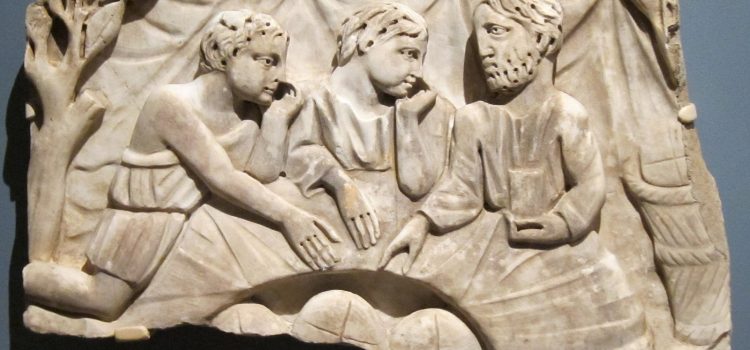
What is a “refrigerium”? What was the meaning behind the rituals performed during the refrigerium ceremony? The refrigerium was an ancient Roman custom conducted by female priestesses and centered on the consumption of wine. The function of these rituals was originally the commemoration of the dead, but over time, it evolved into remembering the death and the resurrection of Jesus Christ. Keep reading to learn about the refrigerium, its meaning and function, and its connection to the Christian Eucharist.

The Origin and History of Globalization (The World Is Flat)

The Origin and History of Globalization (The World Is Flat)

What are the origin and history of globalization? When—and how—did globalization start? Around the turn of the 21st century, the world changed more dramatically than perhaps at any other time in history. Seemingly all at once, shifts in the political landscape, technological advancements, and collaborative business practices came together to create a new globalized society. Keep reading to learn how this seemingly-sudden change was in the making for centuries.