

 1
1100 Best Scrum Books of All Time
We've ranked the best scrum books using expert recommendations, sales data, and millions of reader ratings. At Shortform, we know books. Our book guides are the best in the world. Learn why.
1 2
2The Lean Startup: How Today's Entrepreneurs Use Continuous Innovation to Create Radically Successful Businesses
Most startups fail. But many of those failures are preventable. The Lean Startup is a new approach being adopted across the globe, changing the way companies are built and new products are launched.
Eric Ries defines a startup as an organization dedicated to creating something new under conditions of extreme uncertainty. This is just as true for one person in a garage or a group of seasoned professionals in a Fortune 500 boardroom. What they have in common is a mission to penetrate that fog of uncertainty to discover a successful path to a sustainable business.
The Lean Startup approach fosters companies that are both more capital efficient and that leverage human creativity more effectively. Inspired by lessons from lean manufacturing, it relies on "validated learning," rapid scientific experimentation, as well as a number of counter-intuitive practices that shorten product development cycles, measure actual progress without resorting to vanity metrics, and learn what customers really want. It enables a company to shift directions with agility, altering plans inch by inch, minute by minute.
Rather than wasting time creating elaborate business plans, The Lean Startup offers entrepreneurs - in companies of all sizes - a way to test their vision continuously, to adapt and adjust before it's too late. Ries provides a scientific approach to creating and managing successful startups in a age when companies need to innovate more than ever.
Eric Ries defines a startup as an organization dedicated to creating something new under conditions of extreme uncertainty. This is just as true for one person in a garage or a group of seasoned professionals in a Fortune 500 boardroom. What they have in common is a mission to penetrate that fog of uncertainty to discover a successful path to a sustainable business.
The Lean Startup approach fosters companies that are both more capital efficient and that leverage human creativity more effectively. Inspired by lessons from lean manufacturing, it relies on "validated learning," rapid scientific experimentation, as well as a number of counter-intuitive practices that shorten product development cycles, measure actual progress without resorting to vanity metrics, and learn what customers really want. It enables a company to shift directions with agility, altering plans inch by inch, minute by minute.
Rather than wasting time creating elaborate business plans, The Lean Startup offers entrepreneurs - in companies of all sizes - a way to test their vision continuously, to adapt and adjust before it's too late. Ries provides a scientific approach to creating and managing successful startups in a age when companies need to innovate more than ever.


Sheryl Sandberg
COO/Facebook
Provides a great inside look at how the tech industry approaches building products and businesses. [source]

Ben Horowitz
Co-founder/Andreessen Horowitz
Great. [source]

Dustin Moskovitz
Co-founder/Facebook and Asana
At Asana, we've been lucky to benefit from the author's advice firsthand; this book will enable him to help many more entrepreneurs answer the tough questions about their business. [source]
 3
3Thinking, Fast and Slow
Major New York Times bestseller
Winner of the National Academy of Sciences Best Book Award in 2012
Selected by the New York Times Book Review as one of the best books of 2011
A Globe and Mail Best Books of the Year 2011 Title
One of The Economist's 2011 Books of the Year
One of The Wall Street Journal's Best Nonfiction Books of the Year 2011
2013 Presidential Medal of Freedom Recipient
In the international bestseller, Thinking, Fast and Slow, Daniel Kahneman, the renowned psychologist and winner of the Nobel Prize in Economics, takes us on a groundbreaking tour of the mind and explains the two systems that drive the way we think. System 1 is fast, intuitive, and emotional; System 2 is slower, more deliberative, and more logical. The impact of overconfidence on corporate strategies, the difficulties of predicting what will make us happy in the future, the profound effect of cognitive biases on everything from playing the stock market to planning our next vacation—each of these can be understood only by knowing how the two systems shape our judgments and decisions.
Engaging the reader in a lively conversation about how we think, Kahneman reveals where we can and cannot trust our intuitions and how we can tap into the benefits of slow thinking. He offers practical and enlightening insights into how choices are made in both our business and our personal lives—and how we can use different techniques to guard against the mental glitches that often get us into trouble. Winner of the National Academy of Sciences Best Book Award and the Los Angeles Times Book Prize and selected by The New York Times Book Review as one of the ten best books of 2011, Thinking, Fast and Slow is destined to be a classic.
Winner of the National Academy of Sciences Best Book Award in 2012
Selected by the New York Times Book Review as one of the best books of 2011
A Globe and Mail Best Books of the Year 2011 Title
One of The Economist's 2011 Books of the Year
One of The Wall Street Journal's Best Nonfiction Books of the Year 2011
2013 Presidential Medal of Freedom Recipient
In the international bestseller, Thinking, Fast and Slow, Daniel Kahneman, the renowned psychologist and winner of the Nobel Prize in Economics, takes us on a groundbreaking tour of the mind and explains the two systems that drive the way we think. System 1 is fast, intuitive, and emotional; System 2 is slower, more deliberative, and more logical. The impact of overconfidence on corporate strategies, the difficulties of predicting what will make us happy in the future, the profound effect of cognitive biases on everything from playing the stock market to planning our next vacation—each of these can be understood only by knowing how the two systems shape our judgments and decisions.
Engaging the reader in a lively conversation about how we think, Kahneman reveals where we can and cannot trust our intuitions and how we can tap into the benefits of slow thinking. He offers practical and enlightening insights into how choices are made in both our business and our personal lives—and how we can use different techniques to guard against the mental glitches that often get us into trouble. Winner of the National Academy of Sciences Best Book Award and the Los Angeles Times Book Prize and selected by The New York Times Book Review as one of the ten best books of 2011, Thinking, Fast and Slow is destined to be a classic.


Barack Obama
Former USA President
A few months ago, Mr. Obama read “Thinking, Fast and Slow,” by Daniel Kahneman, about how people make decisions — quick, instinctive thinking versus slower, contemplative deliberation. For Mr. Obama, a deliberator in an instinctive business, this may be as instructive as any political science text. [source]

Bill Gates
CEO/Microsoft
On Bill Gates's reading list in 2012. [source]

Marc Andreessen
Co-Founder/Andreessen Horowitz
Captivating dive into human decision making, marred by inclusion of several/many? psychology studies that fail to replicate. Will stand as a cautionary tale? [source]
 4
4Drive: The Surprising Truth About What Motivates Us
The New York Times bestseller that gives readers a paradigm-shattering new way to think about motivation
Most people believe that the best way to motivate is with rewards like money—the carrot-and-stick approach. That's a mistake, says Daniel H. Pink (author of To Sell Is Human: The Surprising Truth About Motivating Others). In this provocative and persuasive new book, he asserts that the secret to high performance and satisfaction-at work, at school, and at home—is the deeply human need to direct our own lives, to learn and create new things, and to do better by ourselves and our world.
Drawing on four decades of scientific research on human motivation, Pink exposes the mismatch between what science knows and what business does—and how that affects every aspect of life. He examines the three elements of true motivation—autonomy, mastery, and purpose-and offers smart and surprising techniques for putting these into action in a unique book that will change how we think and transform how we live.
Most people believe that the best way to motivate is with rewards like money—the carrot-and-stick approach. That's a mistake, says Daniel H. Pink (author of To Sell Is Human: The Surprising Truth About Motivating Others). In this provocative and persuasive new book, he asserts that the secret to high performance and satisfaction-at work, at school, and at home—is the deeply human need to direct our own lives, to learn and create new things, and to do better by ourselves and our world.
Drawing on four decades of scientific research on human motivation, Pink exposes the mismatch between what science knows and what business does—and how that affects every aspect of life. He examines the three elements of true motivation—autonomy, mastery, and purpose-and offers smart and surprising techniques for putting these into action in a unique book that will change how we think and transform how we live.

 Recommended by Tobi Lütke, Bogdan Lucaciu, David Brudo, and 5 others.
 5
5Essential Scrum: A Practical Guide to the Most Popular Agile Process
A Practical Guide to the Most Popular Agile Process The Single-Source, Comprehensive Guide to Scrum for All Team Members, Managers, and Executives If you want to use Scrum to develop innovative products and services that delight your customers, Essential Scrum is the complete, single-source reference you've been searching for. Leading Scrum coach and trainer Kenny Rubin illuminates the values, principles, and practices of Scrum, and describes flexible, proven approaches that can help you implement it far more effectively. Whether you are new to Scrum or years into your use, this book will introduce, clarify, and deepen your Scrum knowledge at the team, product, and portfolio levels. Drawing from Rubin's experience helping hundreds of organizations succeed with Scrum, this book provides easy-to-digest descriptions enhanced by more than two hundred illustrations based on an entirely new visual icon language for describing Scrum's roles, artifacts, and activities. Essential Scrum will provide every team member, manager, and executive with a common understanding of Scrum, a shared vocabulary they can use in applying it, and practical knowledge for deriving maximum value from it.
 6
6Coaching Agile Teams: A Companion for ScrumMasters, Agile Coaches, and Project Managers in Transition
The Provocative and Practical Guide to Coaching Agile Teams
As an agile coach, you can help project teams become outstanding at agile, creating products that make them proud and helping organizations reap the powerful benefits of teams that deliver both innovation and excellence. More and more frequently, ScrumMasters and project managers are being asked to coach agile teams. But it's a challenging role. It requires new skills--as well as a subtle understanding of when to step in and when to step back. Migrating from "command and control" to agile coaching requires a whole new mind-set. In Coaching Agile Teams, Lyssa Adkins gives agile coaches the insights they need to adopt this new mind-set and to guide teams to extraordinary performance in a re-energized work environment. You'll gain a deep view into the role of the agile coach, discover what works and what doesn't, and learn how to adapt powerful skills from many allied disciplines, including the fields of professional coaching and mentoring. Coverage includes Understanding what it takes to be a great agile coach Mastering all of the agile coach's roles: teacher, mentor, problem solver, conflict navigator, and performance coach Creating an environment where self-organized, high-performance teams can emerge Coaching teams past cooperation and into full collaboration Evolving your leadership style as your team grows and changes Staying actively engaged without dominating your team and stunting its growth Recognizing failure, recovery, and success modes in your coaching Getting the most out of your own personal agile coaching journey Whether you're an agile coach, leader, trainer, mentor, facilitator, ScrumMaster, project manager, product owner, or team member, this book will help you become skilled at helping others become truly great. What could possibly be more rewarding?
As an agile coach, you can help project teams become outstanding at agile, creating products that make them proud and helping organizations reap the powerful benefits of teams that deliver both innovation and excellence. More and more frequently, ScrumMasters and project managers are being asked to coach agile teams. But it's a challenging role. It requires new skills--as well as a subtle understanding of when to step in and when to step back. Migrating from "command and control" to agile coaching requires a whole new mind-set. In Coaching Agile Teams, Lyssa Adkins gives agile coaches the insights they need to adopt this new mind-set and to guide teams to extraordinary performance in a re-energized work environment. You'll gain a deep view into the role of the agile coach, discover what works and what doesn't, and learn how to adapt powerful skills from many allied disciplines, including the fields of professional coaching and mentoring. Coverage includes Understanding what it takes to be a great agile coach Mastering all of the agile coach's roles: teacher, mentor, problem solver, conflict navigator, and performance coach Creating an environment where self-organized, high-performance teams can emerge Coaching teams past cooperation and into full collaboration Evolving your leadership style as your team grows and changes Staying actively engaged without dominating your team and stunting its growth Recognizing failure, recovery, and success modes in your coaching Getting the most out of your own personal agile coaching journey Whether you're an agile coach, leader, trainer, mentor, facilitator, ScrumMaster, project manager, product owner, or team member, this book will help you become skilled at helping others become truly great. What could possibly be more rewarding?
 7
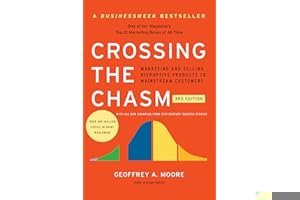
7Crossing the Chasm: Marketing and Selling Disruptive Products to Mainstream Customers
The bible for bringing cutting-edge products to larger markets--now revised and updated with new insights into the realities of high-tech marketing
In Crossing the Chasm, Geoffrey A. Moore shows that in the Technology Adoption Life Cycle--which begins with innovators and moves to early adopters, early majority, late majority, and laggards--there is a vast chasm between the early adopters and the early majority. While early adopters are willing to sacrifice for the advantage of being first, the early majority waits until they know that the technology actually offers improvements in productivity. The challenge for innovators and marketers is to narrow this chasm and ultimately accelerate adoption across every segment.
This third edition brings Moore's classic work up to date with dozens of new examples of successes and failures, new strategies for marketing in the digital world, and Moore's most current insights and findings. He also includes two new appendices, the first connecting the ideas in Crossing the Chasm to work subsequently published in his Inside the Tornado, and the second presenting his recent groundbreaking work for technology adoption models for high-tech consumer markets.
In Crossing the Chasm, Geoffrey A. Moore shows that in the Technology Adoption Life Cycle--which begins with innovators and moves to early adopters, early majority, late majority, and laggards--there is a vast chasm between the early adopters and the early majority. While early adopters are willing to sacrifice for the advantage of being first, the early majority waits until they know that the technology actually offers improvements in productivity. The challenge for innovators and marketers is to narrow this chasm and ultimately accelerate adoption across every segment.
This third edition brings Moore's classic work up to date with dozens of new examples of successes and failures, new strategies for marketing in the digital world, and Moore's most current insights and findings. He also includes two new appendices, the first connecting the ideas in Crossing the Chasm to work subsequently published in his Inside the Tornado, and the second presenting his recent groundbreaking work for technology adoption models for high-tech consumer markets.

Drew Houston
CEO/Dropbox
It’s about how do technology products make their way from early adopters t the mainstream. [source]

Ron Conway
Bestselling guide that created a new game plan for marketing in high-tech industries. [source]

Seth Godin
Author, Marketer, Entrepreneur
This is a key component in my Purple Cow thinking, but with a twist. I'm not as worried about the chasm as I am about the desire of marketers to go for the big middle. [source]
 8
8Crucial Conversations: Tools for Talking When Stakes Are High
Crucial Conversations: Tools For Talking When Stakes Are High is a guide to hone your conversation skills, and prepare you for the most important or trying times of your life and career. The book discusses how talking in the right way can help people achieve what they want. People are often tongue-tied when it comes to interacting with someone, especially when there is a lot of tension in the air. Strong emotions often give away the ability to rationalise one's thoughts, especially during conversations, and emotionally-driven conversations will not work on important occasions. This book teaches readers how to tackle such situations with ease. It provides tips on how to be persuasive, and turn a conversation to one's advantage. The book helps in dealing with confrontations at home, at work, and even with friends. These skills can positively impact the lives of the book's readers in all spheres, and direct their thoughts in a constructive manner. Some of the sections from the book are, How to Notice When Safety Is at Risk, How to Speak Persuasively Not Abrasively, How to Turn Crucial Conversations, and How to Stay Focused on What You Really Want.Kerry Patterson, the co-founder of VitalSmarts, has authored four bestsellers. Some of his other books are Change Anything: The New Science of Personal Success, and Crucial Confrontations: Tools for Resolving Broken Promises, Violated Expectations, and Bad Behavior. Joseph Grenny works as a consultant for many Fortune 500 companies and has impacted many lives throughout the globe through his corporate change initiatives. He is the co-founder of VitalSmarts, and a popular speaker too. Al Switzler is the author of four New York Times bestsellers and has designed and framed many programs for Fortune 500 companies. Ron McMillan has worked as a leadership consultant and trained many people, from first level managers to CEOs.

 Recommended by Max Levchin and Deke Bridges.
Max Levchin
Co-founder/PayPal, CEO/Affirm, Investor
A now-venerable guide to having tough conversations in a way that engages the debaters. [source]
Deke Bridges
Picked up this great book @Powells to read. Better conversation and listening enables you to get deeper into subjects at hand. When talking with people, this makes your communication skills a very powerful tool. Always be learning. #growth #education #leadership https://t.co/r0ujX9IPqh [source]
 9
9Tools of Titans
The latest groundbreaking book from Tim Ferriss, the #1 New York Times best-selling author of The 4-Hour Workweek.
From the author:
“For the last two years, I’ve interviewed nearly two hundred world-class performers for my podcast, The Tim Ferriss Show. The guests range from super celebs (Jamie Foxx, Arnold Schwarzenegger, etc.) and athletes (icons of powerlifting, gymnastics, surfing, etc.) to legendary Special Operations commanders and black-market biochemists. For most of my guests, it’s the first time they’ve agreed to a two-to-three-hour interview, and the show is on the cusp of passing 100 million downloads.
“This book contains the distilled tools, tactics, and ‘inside baseball’ you won’t find anywhere else. It also includes new tips from past guests, and life lessons from new ‘guests’ you haven’t met.
“What makes the show different is a relentless focus on actionable details. This is reflected in the questions. For example: What do these people do in the first sixty minutes of each morning? What do their workout routines look like, and why? What books have they gifted most to other people? What are the biggest wastes of time for novices in their field? What supplements do they take on a daily basis?
“I don’t view myself as an interviewer. I view myself as an experimenter. If I can’t test something and replicate results in the messy reality of everyday life, I’m not interested.
“Everything within these pages has been vetted, explored, and applied to my own life in some fashion. I’ve used dozens of the tactics and philosophies in high-stakes negotiations, high-risk environments, or large business dealings. The lessons have made me millions of dollars and saved me years of wasted effort and frustration.
“I created this book, my ultimate notebook of high-leverage tools, for myself. It’s changed my life, and I hope the same for you.”


Tony Robbins
Life Coach
Tim is a brilliant thinker. The way he approaches mastery is inspiring in many ways. His latest book is no exception. What I loved about Tools of Titans is that it distills key tactics, routines and habits of the ultra-successful in actionable ways that anyone can take advantage of. Highly recommended. Every chapter is a valuable lesson. [source]

James Altucher
Founder/StockPickr
It only came out recently. I had so many questions about it that I flew to California and interviewed him about it for my podcast.It’s the collection of all the knowledge and wisdom he gained from the 100s of people he interviewed.I leave it out on my floor and read a page or two whenever I pass it.It’s already filled with 100s of my notes (see below). It’s maybe the one physical book I keep around. The rest, including my own books, I keep on my Kindle. [source]
Kamal Ravikant
Entrepreneur & Author
I’m reading Tools of Titans which is just amazing. [source]
 10
10The Five Dysfunctions of a Team: A Leadership Fable
In The Five Dysfunctions of a Team Patrick Lencioni once again offers a leadership fable that is as enthralling and instructive as his first two best-selling books, The Five Temptations of a CEO and The Four Obsessions of an Extraordinary Executive. This time, he turns his keen intellect and storytelling power to the fascinating, complex world of teams.
Kathryn Petersen, Decision Tech's CEO, faces the ultimate leadership crisis: Uniting a team in such disarray that it threatens to bring down the entire company. Will she succeed? Will she be fired? Will the company fail? Lencioni's utterly gripping tale serves as a timeless reminder that leadership requires as much courage as it does insight.
Throughout the story, Lencioni reveals the five dysfunctions which go to the very heart of why teams even the best ones-often struggle. He outlines a powerful model and actionable steps that can be used to overcome these common hurdles and build a cohesive, effective team. Just as with his other books, Lencioni has written a compelling fable with a powerful yet deceptively simple message for all those who strive to be exceptional team leaders.
Kathryn Petersen, Decision Tech's CEO, faces the ultimate leadership crisis: Uniting a team in such disarray that it threatens to bring down the entire company. Will she succeed? Will she be fired? Will the company fail? Lencioni's utterly gripping tale serves as a timeless reminder that leadership requires as much courage as it does insight.
Throughout the story, Lencioni reveals the five dysfunctions which go to the very heart of why teams even the best ones-often struggle. He outlines a powerful model and actionable steps that can be used to overcome these common hurdles and build a cohesive, effective team. Just as with his other books, Lencioni has written a compelling fable with a powerful yet deceptively simple message for all those who strive to be exceptional team leaders.
Recommended by AnneMarie Schindler, Holger Seim, Jennifer Rock, and 3 others.AnneMarie Schindler
I suggest these books because they really open up 'how' you think about life and in turn work, success/challenges/setbacks, and in general, yourself. I believe that the more you can understand yourself and broaden your approach to work, the easier it will be to find work that energizes you. Finally, I'm a team player at heart, and love working with others to achieve a huge goal so a portion of these deal with team composition and performance too. [source]
Holger Seim
Lencioni’s books helped me to shift my focus from individual performance to team performance, and what it takes to make a team perform well. It helped me to realize and take seriously the fact that great team performance doesn’t happen magically but needs conscious effort. When I discovered The Five Dysfunctions of a Team for the first time, we had a dysfunctional team at Blinkist and the book opened my eyes to see the problem clearly and showed clear steps for how they should be tackled. Beforehand I was aware that we had a problem, but I couldn’t pinpoint it specifically and hence, couldn’t solve it easily. This book helped a lot. [source]
Jennifer Rock
In Patrick Lencioni's book The Five Dysfunctions of a Team, the executive asks her senior leaders "Who is your first team?" And they each answer incorrectly that it's the team that reports to him or her. The point is that you need to shift your perspective to understanding your senior leadership peers are your first team. We read that book as a leadership team in a corporation where I worked -- and the environment was very competitive between us. When we agreed that our cross-functional leadership team was our first team, we became more cooperative, innovative and productive. And we vastly boosted our results. [source]
 11
11Nonviolent Communication: A Language of Life
The latest edition of the communication guide that has sold more than 1,000,000 copies
An enlightening look at how peaceful communication can create compassionate connections with family, friends, and other acquaintances, this international bestseller uses stories, examples, and sample dialogues to provide solutions to communication problems both at home and in the workplace. Guidance is provided on identifying and articulating feelings and needs, expressing anger fully, and exploring the power of empathy in order to speak honestly without creating hostility, break patterns of thinking that lead to anger and depression, and communicate compassionately. Included in the new edition is a chapter on conflict resolution and mediation.
An enlightening look at how peaceful communication can create compassionate connections with family, friends, and other acquaintances, this international bestseller uses stories, examples, and sample dialogues to provide solutions to communication problems both at home and in the workplace. Guidance is provided on identifying and articulating feelings and needs, expressing anger fully, and exploring the power of empathy in order to speak honestly without creating hostility, break patterns of thinking that lead to anger and depression, and communicate compassionately. Included in the new edition is a chapter on conflict resolution and mediation.
Dustin Moskovitz
Co-founder/Facebook and Asana
Seek first to understand. [source]

Satya Nadella
CEO/Microsoft
Upon becoming CEO, Nadella confronted Microsoft’s legendarily combative culture by urging his new reports to read this book, which preaches the power of empathy, self-awareness, and authenticity in collaboration in the workplace, at home, and beyond. Like many of his favorites, it was first recommended to him by his wife, Anu: “I’m heavily influenced by the books she reads more than the books I read [source]

Chad Dickerson
Rosenberg’s book Nonviolent Communication is a life-changing text. Reading just now & his concept of “life-alienating communication” basically describes the worst of twitter. Love this, though: “Out beyond ideas of wrongdoing & right-doing, there is a field. I’ll meet you there.” https://t.co/9f9gK6pVSE [source]
Cover unavailable
12Scrum Mastery: From Good To Great Servant-Leadership
The basics of being a ScrumMaster are fairly straightforward: Facilitate the Scrum process and remove impediments. But being a great ScrumMaster, one who truly embodies the principles of servant-leadership and helps move a team to the high performance levels possible with Scrum, is much harder and much more elusive. In his over ten years of coaching numerous Scrum teams, the highly-respected and experienced Scrum coach Geoff Watts has identified patterns that separate a good ScrumMaster from a great one. In this book, he not only illustrates these patterns through stories of his own experiences and those of the many Scrum teams he has encountered but offers practical guidance for you on your own path to greatness.
In this book you will learn:
The skills and characteristics of great ScrumMasters
How to generate, maintain and increase engagement from the team
How to increase the effectiveness of the Scrum meetings, such as retrospectives and daily scrums.
How to foster a more creative and collaborative team
How to increase the performance of the team
How to know when you are a successful ScrumMaster
Scrum Mastery is for practicing ScrumMasters who want to develop themselves into a great servant-leader capable of taking their teams beyond simple process compliance.
Comments on the book
Mike Cohn, in his foreword for the book, said:
"Most books rehash well-trod territory and I don’t finish them any wiser. I am positive I will be referring back to this book for many years"
Roman Pichler, author of Agile Product Management with Scrum: Creating Products That Customers Love said:
"I am thoroughly impressed with how comprehensive and well-written the book is. It will be indispensable for many people"
Jean Tabaka, Agile Fellow, Rally Software:
"Geoff brings us a personal and inspired peak into what truly moves us from good to great: great in how we serve; great in how we lead; great in how we create mastery in our teams and organizations; and, great in how we recognize the impediments to our own growth to greatness. Scrum mastery is a skill that can be honed and Geoff gives us rich tools to sharpen our craft."
In this book you will learn:
The skills and characteristics of great ScrumMasters
How to generate, maintain and increase engagement from the team
How to increase the effectiveness of the Scrum meetings, such as retrospectives and daily scrums.
How to foster a more creative and collaborative team
How to increase the performance of the team
How to know when you are a successful ScrumMaster
Scrum Mastery is for practicing ScrumMasters who want to develop themselves into a great servant-leader capable of taking their teams beyond simple process compliance.
Comments on the book
Mike Cohn, in his foreword for the book, said:
"Most books rehash well-trod territory and I don’t finish them any wiser. I am positive I will be referring back to this book for many years"
Roman Pichler, author of Agile Product Management with Scrum: Creating Products That Customers Love said:
"I am thoroughly impressed with how comprehensive and well-written the book is. It will be indispensable for many people"
Jean Tabaka, Agile Fellow, Rally Software:
"Geoff brings us a personal and inspired peak into what truly moves us from good to great: great in how we serve; great in how we lead; great in how we create mastery in our teams and organizations; and, great in how we recognize the impediments to our own growth to greatness. Scrum mastery is a skill that can be honed and Geoff gives us rich tools to sharpen our craft."
 13
13The Phoenix Project: A Novel About IT, DevOps, and Helping Your Business Win
Bill is an IT manager at Parts Unlimited. It's Tuesday morning and on his drive into the office, Bill gets a call from the CEO.
The company's new IT initiative, code named Phoenix Project, is critical to the future of Parts Unlimited, but the project is massively over budget and very late. The CEO wants Bill to report directly to him and fix the mess in ninety days or else Bill's entire department will be outsourced.
With the help of a prospective board member and his mysterious philosophy of The Three Ways, Bill starts to see that IT work has more in common with manufacturing plant work than he ever imagined. With the clock ticking, Bill must organize work flow streamline interdepartmental communications, and effectively serve the other business functions at Parts Unlimited.
In a fast-paced and entertaining style, three luminaries of the DevOps movement deliver a story that anyone who works in IT will recognize. Readers will not only learn how to improve their own IT organizations, they'll never view IT the same way again.
The company's new IT initiative, code named Phoenix Project, is critical to the future of Parts Unlimited, but the project is massively over budget and very late. The CEO wants Bill to report directly to him and fix the mess in ninety days or else Bill's entire department will be outsourced.
With the help of a prospective board member and his mysterious philosophy of The Three Ways, Bill starts to see that IT work has more in common with manufacturing plant work than he ever imagined. With the clock ticking, Bill must organize work flow streamline interdepartmental communications, and effectively serve the other business functions at Parts Unlimited.
In a fast-paced and entertaining style, three luminaries of the DevOps movement deliver a story that anyone who works in IT will recognize. Readers will not only learn how to improve their own IT organizations, they'll never view IT the same way again.
 Recommended by Jeffrey Snover and Louis Nyffenegger.
Jeffrey Snover
Great thread. I know of a number of devops people that haven't read this book. Ya'll should fix that. https://t.co/Yri4JJ0jBZ [source]
Louis Nyffenegger
I don't think I have a specific book that I can call my favourite. Some books have had a big impact on my view of how to build a product/company ("Rework"), some were very enjoyable to read ("The Phoenix Project"), some helped me improve the way I think ("The Pleasure Of Finding Things Out") and some the way I live ("Essentialism") or work ("Deep Work"). [source]
 14
14The Goal: A Process of Ongoing Improvement
Written in a fast-paced thriller style, 'The Goal' contains a serious message for all managers in industry and explains the ideas which underline the Theory of Constraints developed by the author.


Jeff Bezos
Founder/Amazon
Encourages companies to identify the biggest constraints in their operations and then structure their organizations to get the most out of those constraints. [source]

Kevin Systrom
About basically manufacturing and supply chain management. It sounds really boring, but I promise you it’s really good. [source]
Chris Goward
Here are some of the books that have been very impactful for me, or taught me a new way of thinking: … The Goal. [source]
 15
15Multipliers: How the Best Leaders Make Everyone Smarter
Are you a genius or a genius maker?
We've all had experience with two dramatically different types of leaders. The first type drain intelligence, energy, and capability from the ones around them and always need to be the smartest ones in the room. These are the idea killers, the energy sappers, the diminishers of talent and commitment. On the other side of the spectrum are leaders who use their intelligence to amplify the smarts and capabilities of the people around them. When these leaders walk into a room, lightbulbs go off over people's heads, ideas flow, and problems get solved. These are the leaders who inspire employees to stretch themselves to deliver results that surpass expectations. These are the Multipliers. And the world needs more of them, especially now, when leaders are expected to do more with less.
In this engaging and highly practical book, leadership expert Liz Wiseman and management consultant Greg McKeown explore these two leadership styles, persuasively showing how Multipliers can have a resoundingly positive and profitable effect on organizations—getting more done with fewer resources, developing and attracting talent, and cultivating new ideas and energy to drive organizational change and innovation.
In analyzing data from more than 150 leaders, Wiseman and McKeown have identified five disciplines that distinguish Multipliers from Diminishers. These five disciplines are not based on innate talent; indeed, they are skills and practices that everyone can learn to use, even lifelong and recalcitrant Diminishers. Lively, real-world case studies and practical tips and techniques bring to life each of these principles, showing you how to become a Multiplier too, whether you are a new or an experienced manager. Just imagine what you could accomplish if you could harness all the energy and intelligence around you. Multipliers will show you how.

 16
16Built to Last: Successful Habits of Visionary Companies
"This is not a book about charismatic visionary leaders. It is not about visionary product concepts or visionary products or visionary market insights. Nor is it about just having a corporate vision. This is a book about something far more important, enduring, and substantial. This is a book about visionary companies." So write Jim Collins and Jerry Porras in this groundbreaking book that shatters myths, provides new insights, and gives practical guidance to those who would like to build landmark companies that stand the test of time.
Drawing upon a six-year research project at the Stanford University Graduate School of Business, Collins and Porras took eighteen truly exceptional and long-lasting companies -- they have an average age of nearly one hundred years and have outperformed the general stock market by a factor of fifteen since 1926 -- and studied each company in direct comparison to one of its top competitors. They examined the companies from their very beginnings to the present day -- as start-ups, as midsize companies, and as large corporations. Throughout, the authors asked: "What makes the truly exceptional companies different from other companies?"
What separates General Electric, 3M, Merck, Wal-Mart, Hewlett-Packard, Walt Disney, and Philip Morris from their rivals? How, for example, did Procter & Gamble, which began life substantially behind rival Colgate, eventually prevail as the premier institution in its industry? How was Motorola able to move from a humble battery repair business into integrated circuits and cellular communications, while Zenith never became dominant in anything other than TVs? How did Boeing unseat McDonnell Douglas as the world's best commercial aircraft company -- what did Boeing have that McDonnell Douglas lacked?
By answering such questions, Collins and Porras go beyond the incessant barrage of management buzzwords and fads of the day to discover timeless qualities that have consistently distinguished out-standing companies. They also provide inspiration to all executives and entrepreneurs by destroying the false but widely accepted idea that only charismatic visionary leaders can build visionary companies.
Filled with hundreds of specific examples and organized into a coherent framework of practical concepts that can be applied by managers and entrepreneurs at all levels, Built to Last provides a master blueprint for building organizations that will prosper long into the twenty-first century and beyond.
Drawing upon a six-year research project at the Stanford University Graduate School of Business, Collins and Porras took eighteen truly exceptional and long-lasting companies -- they have an average age of nearly one hundred years and have outperformed the general stock market by a factor of fifteen since 1926 -- and studied each company in direct comparison to one of its top competitors. They examined the companies from their very beginnings to the present day -- as start-ups, as midsize companies, and as large corporations. Throughout, the authors asked: "What makes the truly exceptional companies different from other companies?"
What separates General Electric, 3M, Merck, Wal-Mart, Hewlett-Packard, Walt Disney, and Philip Morris from their rivals? How, for example, did Procter & Gamble, which began life substantially behind rival Colgate, eventually prevail as the premier institution in its industry? How was Motorola able to move from a humble battery repair business into integrated circuits and cellular communications, while Zenith never became dominant in anything other than TVs? How did Boeing unseat McDonnell Douglas as the world's best commercial aircraft company -- what did Boeing have that McDonnell Douglas lacked?
By answering such questions, Collins and Porras go beyond the incessant barrage of management buzzwords and fads of the day to discover timeless qualities that have consistently distinguished out-standing companies. They also provide inspiration to all executives and entrepreneurs by destroying the false but widely accepted idea that only charismatic visionary leaders can build visionary companies.
Filled with hundreds of specific examples and organized into a coherent framework of practical concepts that can be applied by managers and entrepreneurs at all levels, Built to Last provides a master blueprint for building organizations that will prosper long into the twenty-first century and beyond.

Jeff Bezos
Founder/Amazon
recommends this book because it shows how to create a long lasting company. [source]

Tim O'Reilly
Founder/O'Reilly Media
Built to Last, by James Collins and Jerry Porras. The idea here is that great companies aren't afraid to have strong values. In fact, their cult-like values are what make them stand out from the norm. [source]
Alden Mills
Built to Last focused my daydreaming mind into what it takes to build truly great companies. [source]
 17
17Getting to Yes: Negotiating Agreement Without Giving in
The key text on problem-solving negotiation-updated and revised
Getting to Yes has helped millions of people learn a better way to negotiate. One of the primary business texts of the modern era, it is based on the work of the Harvard Negotiation Project, a group that deals with all levels of negotiation and conflict resolution.
Getting to Yes offers a proven, step-by-step strategy for coming to mutually acceptable agreements in every sort of conflict. Thoroughly updated and revised, it offers readers a straight- forward, universally applicable method for negotiating personal and professional disputes without getting angry-or getting taken.
Getting to Yes has helped millions of people learn a better way to negotiate. One of the primary business texts of the modern era, it is based on the work of the Harvard Negotiation Project, a group that deals with all levels of negotiation and conflict resolution.
Getting to Yes offers a proven, step-by-step strategy for coming to mutually acceptable agreements in every sort of conflict. Thoroughly updated and revised, it offers readers a straight- forward, universally applicable method for negotiating personal and professional disputes without getting angry-or getting taken.

Charles T. Munger
Vice Chairman/Berkshire Hathaway
recommends this title in the book "Poor Charlie's Almanack: The Wit and Wisdom of Charles T. Munger". [source]
Drew Houston
CEO/Dropbox
About principled negotiation, and I still think about and apply a lot of those concepts today. [source]
Dustin Moskovitz
Co-founder/Facebook and Asana
Dustin Moskovitz recommended this book on Twitter. [source]
 18
18Turn the Ship Around!: A True Story of Turning Followers into Leaders
"Leadership should mean giving control rather than taking control and creating leaders rather than forging followers." David Marquet, an experienced Navy officer, was used to giving orders. As newly appointed captain of the USS Santa Fe, a nuclear-powered submarine, he was responsible for more than a hundred sailors, deep in the sea. In this high-stress environment, where there is no margin for error, it was crucial his men did their job and did it well.
But the ship was dogged by poor morale, poor performance, and the worst retention in the fleet. Marquet acted like any other captain until, one day, he unknowingly gave an impossible order, and his crew tried to follow it anyway. When he asked why the order wasn't challenged, the answer was "Because you told me to." Marquet realized he was leading in a culture of followers, and they were all in danger unless they fundamentally changed the way they did things. That's when Marquet took matters into his own hands and pushed for leadership at every level.
Turn the Ship Around! is the true story of how the Santa Fe skyrocketed from worst to first in the fleet by challenging the U.S. Navy's traditional leader-follower approach. Struggling against his own instincts to take control, he instead achieved the vastly more powerful model of giving control. Before long, each member of Marquet's crew became a leader and assumed responsibility for everything he did, from clerical tasks to crucial combat decisions. The crew became fully engaged, contributing their full intellectual capacity every day, and the Santa Fe started winning awards and promoting a highly disproportionate number of officers to submarine command.
No matter your business or position, you can apply Marquet's radical guidelines to turn your own ship around. The payoff: a workplace where everyone around you is taking responsibility for their actions, where people are healthier and happier, where everyone is a leader.


Simon Sinek
Author
So many leadership books are either theoretical (written by people who study it but don’t do it) or by people who look back and try to explain how they did it. Though both valuable, most leadership books are also very hard to implement as prescribed. That’s what makes Marquet’s book is so remarkable. A submarine commander, he used to obey traditional models of leadership … until they failed him. Unable to change any variables (people, technology or equipment), the only thing left for him to change in order to achieve success was how he acted as a leader. Based on real life events, Marquet presents his ideas in a superbly practical way — perfect for implementing. [source]

Jason Fried
Co-Founder/Basecamp
Turn the Ship Around is my favorite business book. A wonderful look at what leadership is really about. I recommend it highly. [source]

A wonderful book about a naval Admiral that was running one of the worst performing U.S. nuclear submarines and turned it around to be the best performing U.S. submarine by infusing his staff with basically saying they’re not waiting for a command, they’re saying what they intend to do. [source]
Cover unavailable
19Scrum and XP from the Trenches
This book aims to give you a head start by providing a detailed down-to-earth account of how one Swedish company implemented Scrum and XP with a team of approximately 40 people and how they continuously improved their process over a year's time. Under the leadership of Henrik Kniberg they experimented with different team sizes, different sprint lengths, different ways of defining "done," different formats for product backlogs and sprint backlogs, different testing strategies, different ways of doing demos, different ways of synchronizing multiple Scrum teams, etc. They also experimented with XP practices - different ways of doing continuous build, pair programming, test driven development, etc, and how to combine this with Scrum.
Recommended by Mircea Scarlatescu.Mircea Scarlatescu
Many, but here’s a short list, for both entrepreneurs and team leaders: The E-Myth by Michael E. Gerber Zero to One by Peter Thiel The Lean Startup by Eric Ries Scrum and XP from the Trenches by Henrik Kniberg ReWork – Jason Fried [source]
 20
20Agile Retrospectives: Making Good Teams Great
See how to mine the experience of your software development team continually throughout the life of the project. The tools and recipes in this book will help you uncover and solve hidden (and not-so-hidden) problems with your technology, your methodology, and those difficult "people" issues on your team.
Project retrospectives help teams examine what went right and what went wrong on a project. But traditionally, retrospectives (also known as "post-mortems") are only helpful at the end of the project--too late to help. You need agile retrospectives that are iterative and incremental. You need to accurately find and fix problems to help the team today.
Now, Derby and Larsen show you the tools, tricks, and tips you need to fix the problems you face on a software development project on an on-going basis. You'll see how to architect retrospectives in general, how to design them specifically for your team and organization, how to run them effectively, how to make the needed changes, and how to scale these techniques up. You'll learn how to deal with problems, and implement solutions effectively throughout the project--not just at the end.
With regular tune-ups, your team will hum like a precise, world-class orchestra.
Contents
Forward
Preface
Introduction
1. Helping your team inspect and adapt
2. A retrospective custom-fit for your team
3. Leading retrospectives
4. Activities to set the stage
5. Activities to gather data
6. Activities to gather insights
7. Activities to decide what to do
8. Activities to close the retrospective
9. Releases and project retrospectives
10. Make it so
A1. Facilitation supplies
A2. Debriefing activities
A3. Activities quick reference matrix
A4. Resources for learning facilitation skills
A5. Bibliography
Project retrospectives help teams examine what went right and what went wrong on a project. But traditionally, retrospectives (also known as "post-mortems") are only helpful at the end of the project--too late to help. You need agile retrospectives that are iterative and incremental. You need to accurately find and fix problems to help the team today.
Now, Derby and Larsen show you the tools, tricks, and tips you need to fix the problems you face on a software development project on an on-going basis. You'll see how to architect retrospectives in general, how to design them specifically for your team and organization, how to run them effectively, how to make the needed changes, and how to scale these techniques up. You'll learn how to deal with problems, and implement solutions effectively throughout the project--not just at the end.
With regular tune-ups, your team will hum like a precise, world-class orchestra.
Contents
Forward
Preface
Introduction
1. Helping your team inspect and adapt
2. A retrospective custom-fit for your team
3. Leading retrospectives
4. Activities to set the stage
5. Activities to gather data
6. Activities to gather insights
7. Activities to decide what to do
8. Activities to close the retrospective
9. Releases and project retrospectives
10. Make it so
A1. Facilitation supplies
A2. Debriefing activities
A3. Activities quick reference matrix
A4. Resources for learning facilitation skills
A5. Bibliography
Cover unavailable
21Scrum Guide
The Scrum Guide documents the Scrum framework and is maintained by Scrum’s creators, Ken Schwaber and Jeff Sutherland.
 22
22Leadershift: The 11 Essential Changes Every Leader Must Embrace
 Recommended by Steve Komphela.
Steve Komphela
Lots of takes in this book. It shifts leaders leadership. How to lead today. Also helping you identify what kind of a leader you are. It is just dirty from my highlighter. Great read. I think page 100 is my favorite https://t.co/oHQhgxOTMx [source]
 23
23Inspired: How to Create Tech Products Customers Love
The basic premise of Inspired is that the best tech companies create products in a manner very different from how most companies create products. The goal of the book is to share the techniques of the best companies. This book is aimed primarily at Product Managers working on technology-powered products. That includes the hundreds of "tech companies" like Google, Facebook, Amazon, Twitter and the like, as well as the thousands of companies moving to leverage technology (financial companies, media companies, retailers, manufacturers, nearly every industry). Inspired covers companies from early stage start-ups to large, established companies. The products might be consumer products or devices, business services for small businesses to enterprises, internal tools, and developer platforms.
Inspired is secondarily aimed at the designers, engineers, user researchers and data scientists that work closely with the product managers on product teams at these same companies.
Inspired is secondarily aimed at the designers, engineers, user researchers and data scientists that work closely with the product managers on product teams at these same companies.
 24
24Agile Product Management with Scrum: Creating Products That Customers Love
The First Guide to Scrum-Based Agile Product Management In Agile Product Management with Scrum, leading Scrum consultant Roman Pichler uses real-world examples to demonstrate how product owners can create successful products with Scrum. He describes a broad range of agile product management practices, including making agile product discovery work, taking advantage of emergent requirements, creating the minimal marketable product, leveraging early customer feedback, and working closely with the development team. Benefitting from Pichler's extensive experience, you'll learn how Scrum product ownership differs from traditional product management and how to avoid and overcome the common challenges that Scrum product owners face. Coverage includes Understanding the product owner's role: what product owners do, how they do it, and the surprising implications
Envisioning the product: creating a compelling product vision to galvanize and guide the team and stakeholders
Grooming the product backlog: managing the product backlog effectively even for the most complex products
Planning the release: bringing clarity to scheduling, budgeting, and functionality decisions
Collaborating in sprint meetings: understanding the product owner's role in sprint meetings, including the dos and don'ts
Transitioning into product ownership: succeeding as a product owner and establishing the role in the enterprise This book is an indispensable resource for anyone who works as a product owner, or expects to do so, as well as executives and coaches interested in establishing agile product management.
Envisioning the product: creating a compelling product vision to galvanize and guide the team and stakeholders
Grooming the product backlog: managing the product backlog effectively even for the most complex products
Planning the release: bringing clarity to scheduling, budgeting, and functionality decisions
Collaborating in sprint meetings: understanding the product owner's role in sprint meetings, including the dos and don'ts
Transitioning into product ownership: succeeding as a product owner and establishing the role in the enterprise This book is an indispensable resource for anyone who works as a product owner, or expects to do so, as well as executives and coaches interested in establishing agile product management.
 25
25Team of Teams: New Rules of Engagement for a Complex World
The retired four-star general and and bestselling author of My Share of the Task shares a powerful new leadership model
As commander of Joint Special Operations Command (JSOC), General Stanley McChrystal played a crucial role in the War on Terror. But when he took the helm in 2004, America was losing that war badly: despite vastly inferior resources and technology, Al Qaeda was outmaneuvering America’s most elite warriors.
McChrystal came to realize that today’s faster, more interdependent world had overwhelmed the conventional, top-down hierarchy of the US military. Al Qaeda had seen the future: a decentralized network that could move quickly and strike ruthlessly. To defeat such an enemy, JSOC would have to discard a century of management wisdom, and pivot from a pursuit of mechanical efficiency to organic adaptability. Under McChrystal’s leadership, JSOC remade itself, in the midst of a grueling war, into something entirely new: a network that combined robust centralized communication with decentralized managerial authority. As a result, they beat back Al Qaeda.
In this book, McChrystal shows not only how the military made that transition, but also how similar shifts are possible in all organizations, from large companies to startups to charities to governments. In a turbulent world, the best organizations think and act like a team of teams, embracing small groups that combine the freedom to experiment with a relentless drive to share what they’ve learned.
Drawing on a wealth of evidence from his military career, the private sector, and sources as diverse as hospital emergency rooms and NASA’s space program, McChrystal frames the existential challenge facing today’s organizations, and presents a compelling, effective solution.
As commander of Joint Special Operations Command (JSOC), General Stanley McChrystal played a crucial role in the War on Terror. But when he took the helm in 2004, America was losing that war badly: despite vastly inferior resources and technology, Al Qaeda was outmaneuvering America’s most elite warriors.
McChrystal came to realize that today’s faster, more interdependent world had overwhelmed the conventional, top-down hierarchy of the US military. Al Qaeda had seen the future: a decentralized network that could move quickly and strike ruthlessly. To defeat such an enemy, JSOC would have to discard a century of management wisdom, and pivot from a pursuit of mechanical efficiency to organic adaptability. Under McChrystal’s leadership, JSOC remade itself, in the midst of a grueling war, into something entirely new: a network that combined robust centralized communication with decentralized managerial authority. As a result, they beat back Al Qaeda.
In this book, McChrystal shows not only how the military made that transition, but also how similar shifts are possible in all organizations, from large companies to startups to charities to governments. In a turbulent world, the best organizations think and act like a team of teams, embracing small groups that combine the freedom to experiment with a relentless drive to share what they’ve learned.
Drawing on a wealth of evidence from his military career, the private sector, and sources as diverse as hospital emergency rooms and NASA’s space program, McChrystal frames the existential challenge facing today’s organizations, and presents a compelling, effective solution.


Doug McMillon
CEO/Walmart
Here's a list of the top books that taught and inspired me this year. I go back to Sam Walton's book frequently and was struck, this year, by some common principles between Sam and General McChrystal. It seems they learned some similar things about what works when it comes to leading teams. For example, fostering a shared consciousness and empowering execution delivers results. Greg Foran shared The Good Jobs Strategy with me and I see a connection to Tim Brown's Change by Design. We are making progress in designing a "system" for our associates that results in opportunities for them and an even better work environment. [source]

Gene Kim
I love this diagram from the amazing book "Team of Teams" by General Stanley McChrystal! RT @TechBeaconCom: RT @manupaisable: Great visualization of the problems relying on org charts by @j_elmqvist @DOES_EUR #DOES19 https://t.co/XTz8SAWhff [source]
 26
26Necessary Endings: The Employees, Businesses, and Relationships That All of Us Have to Give Up in Order to Move Forward
“If you’re hesitant to pull the trigger when things obviously aren't working out, Henry Cloud’s Necessary Endings may be the most important book you read all year.” —Dave Ramsey, New York Times bestselling author of The Total Money Makeover
“Cloud is a wise, experienced, and compassionate guide through [life’s] turbulent passages.” —Bob Buford, bestelling author of Halftime and Finishing Well; founder of the Leadership Network
Henry Cloud, the bestselling author of Integrity and The One-Life Solution, offers this mindset-altering method for proactively correcting the bad and the broken in our businesses and our lives. Cloud challenges readers to achieve the personal and professional growth they both desire and deserve—and gives crucial insight on how to make those tough decisions that are standing in the way of a more successful business and, ultimately, a better life.
“Cloud is a wise, experienced, and compassionate guide through [life’s] turbulent passages.” —Bob Buford, bestelling author of Halftime and Finishing Well; founder of the Leadership Network
Henry Cloud, the bestselling author of Integrity and The One-Life Solution, offers this mindset-altering method for proactively correcting the bad and the broken in our businesses and our lives. Cloud challenges readers to achieve the personal and professional growth they both desire and deserve—and gives crucial insight on how to make those tough decisions that are standing in the way of a more successful business and, ultimately, a better life.
 Recommended by Dave Ramsey.
Dave Ramsey
Author
Dave Ramsey recommended this book on his website. [source]
Cover unavailable
27Succeeding with Agile: Software Development Using Scrum
Proven, 100% Practical Guidance for Making Scrum and Agile Work in Any Organization.
This is the definitive, realistic, actionable guide to starting fast with Scrum and agile–and then succeeding over the long haul. Leading agile consultant and practitioner Mike Cohn presents detailed recommendations, powerful tips, and real-world case studies drawn from his unparalleled experience helping hundreds of software organizations make Scrum and agile work.
"Succeeding with Agile" is for pragmatic software professionals who want real answers to the most difficult challenges they face in implementing Scrum. Cohn covers every facet of the transition: getting started, helping individuals transition to new roles, structuring teams, scaling up, working with a distributed team, and finally, implementing effective metrics and continuous improvement.
Throughout, Cohn presents “Things to Try Now” sections based on his most successful advice. Complementary “Objection” sections reproduce typical conversations with those resisting change and offer practical guidance for addressing their concerns. Coverage includes:
- Practical ways to get started immediately–and “get good” fast
- Overcoming individual resistance to the changes Scrum requires
- Staffing Scrum projects and building effective teams
- Establishing “improvement communities” of people who are passionate about driving change
- Choosing which agile technical practices to use or experiment with
- Leading self-organizing teams
- Making the most of Scrum sprints, planning, and quality techniques
- Scaling Scrum to distributed, multiteam projects
- Using Scrum on projects with complex sequential processes or challenging compliance and governance requirements
- Understanding Scrum’s impact on HR, facilities, and project management
Whether you've completed a few sprints or multiple agile projects and whatever your role–manager, developer, coach, ScrumMaster, product owner, analyst, team lead, or project lead–this book will help you succeed with your very next project. Then, it will help you go much further: It will help you transform your entire development organization.
This is the definitive, realistic, actionable guide to starting fast with Scrum and agile–and then succeeding over the long haul. Leading agile consultant and practitioner Mike Cohn presents detailed recommendations, powerful tips, and real-world case studies drawn from his unparalleled experience helping hundreds of software organizations make Scrum and agile work.
"Succeeding with Agile" is for pragmatic software professionals who want real answers to the most difficult challenges they face in implementing Scrum. Cohn covers every facet of the transition: getting started, helping individuals transition to new roles, structuring teams, scaling up, working with a distributed team, and finally, implementing effective metrics and continuous improvement.
Throughout, Cohn presents “Things to Try Now” sections based on his most successful advice. Complementary “Objection” sections reproduce typical conversations with those resisting change and offer practical guidance for addressing their concerns. Coverage includes:
- Practical ways to get started immediately–and “get good” fast
- Overcoming individual resistance to the changes Scrum requires
- Staffing Scrum projects and building effective teams
- Establishing “improvement communities” of people who are passionate about driving change
- Choosing which agile technical practices to use or experiment with
- Leading self-organizing teams
- Making the most of Scrum sprints, planning, and quality techniques
- Scaling Scrum to distributed, multiteam projects
- Using Scrum on projects with complex sequential processes or challenging compliance and governance requirements
- Understanding Scrum’s impact on HR, facilities, and project management
Whether you've completed a few sprints or multiple agile projects and whatever your role–manager, developer, coach, ScrumMaster, product owner, analyst, team lead, or project lead–this book will help you succeed with your very next project. Then, it will help you go much further: It will help you transform your entire development organization.
Recommended by Nicolae Andronic.Nicolae Andronic
I’m a technical guy. I studied the IT field and did software development for a long time until I discovered the business world. So the path for me is to slowly adapt from the clear, technical world, to the fuzzy, way more complex, business world. All the books that I recommend help this transition. “Succeeding with Agile” - Mike Cohn: for approaching the process involved into building a product in an organized manner. [source]
Cover unavailable
28Agile Estimating and Planning
Praise for Agile Estimating and Planning "Traditional, deterministic approaches to planning and estimating simply don't cut it on the slippery slopes of today's dynamic, change-driven projects. Mike Cohn's breakthrough book gives us not only the philosophy, but also the guidelines and a proven set of tools that we need to succeed in planning, estimating, and scheduling projects with a high uncertainty factor. At the same time, the author never loses sight of the need to deliver business value to the customer each step of the way."
--Doug DeCarlo, author of eXtreme Project Management: Using Leadership, Principles and Tools to Deliver Value in the Face of Volatility (Jossey-Bass, 2004)
"We know how to build predictive plans and manage them. But building plans that only estimate the future and then embrace change, challenge most of our training and skills. In Agile Estimating and Planning , Mike Cohn once again fills a hole in the Agile practices, this time by showing us a workable approach to Agile estimating and planning. Mike delves into the nooks and crannies of the subject and anticipates many of the questions and nuances of this topic. Students of Agile processes will recognize that this book is truly about agility, bridging many of the practices between Scrum and ExtremeProgramming."
--Ken Schwaber, Scrum evangelist, Agile Alliance cofounder, and signatory to the Agile Manifesto
"In Agile Estimating and Planning , Mike Cohn has, for the first time, brought together most everything that the Agile community has learned about the subject. The book is clear, well organized, and a pleasant and valuable read. It goes into all the necessary detail, and at the same time keeps the reader's burden low. We can dig in as deeply as we need to, without too much detail before we need it. The book really brings together everything we have learned about Agile estimation and planning over the past decade. It will serve its readers well."
--Ron Jeffries, www.XProgramming.com, author of Extreme Programming Installed (Addison-Wesley, 2001) and Extreme Programming Adventures in C# (Microsoft Press, 2004)
" Agile Estimating and Planning provides a view of planning that's balanced between theory and practice, and it is supported by enough concrete experiences to lend it credibility. I particularly like the quote 'planning is a quest for value.' It points to a new, more positive attitude toward planning that goes beyond the 'necessary evil' view that I sometimes hold."
--Kent Beck, author of Extreme Programming Explained, Second Edition (Addison-Wesley, 2005)
"Up-front planning is still the most critical part of software development. Agile software development requires Agile planning techniques. This book shows you how to employ Agile planning in a succinct, practical, and easy-to-follow manner."
--Adam Rogers, Ultimate Software
"Mike does a great follow-up to User Stories Applied by continuing to provide Agile teams with the practical approaches and techniques to increase agility. In this book, Mike provides time-proven and well-tested methods for being successful with the multiple levels of planning and estimating required by Agile. This book is the first to detail the disciplines of Agile estimating and planning, in ways that rival my 1980 civil engineering texts on CPM Planning and Estimating."
--Ryan Martens, President and Founder, Rally Software Development Corporation
"With insight and clarity, Mike Cohn shows how to effectively produce software of high business value. With Agile estimation and planning, you focus effort where it really counts, and continue to do so as circumstances change."
--Rick Mugridge, Rimu Research Ltd., and lead author, Fit for Developing Software (Prentice Hall, 2005)
"Finally! The groundbreaking book my clients have been clamoring for! Agile Estimating and Planning demystifies the process of defining, driving, and delivering great software that matters to the business. Mike's clarity, insight, and experience leap out through every page of this book, offering an approach that is relevant and immediately useful to all members of an Agile project."
--Kert D. Peterson, President, Enterprise Agile Group, LLC
"This isn't yet another generic book on Agile software development. Agile Estimating and Planning fills a gap left by most of the other books and gives you important, practical, down-to-earth techniques needed to be successful on Agile development projects."
--Steve Tockey, Principal Consultant, Construx Software
"Estimation, planning, and tracking is a trinity. If you don't do one of them, you don't need the other two. This book provides very practical knowledge for estimation, planning, prioritizing, and tracking. It should be compulsory subject matter for project managers and their teams, even if they hesitate to call themselves Agile."
--Niels Malotaux, Project Coach
"Effective planning is an important, but often misunderstood, part of any successful Agile project. With Agile Estimating and Planning , Mike Cohn has given us a definitive guide to a wide range of Agile estimating and planning practices. With his clear and practical style, Mike not only explains how to successfully get started planning an Agile project, but also provides a wealth of tips and advice for improving any team's Agile planning process. This book is a must-read for managers, coaches, and members of Agile teams."
--Paul Hodgetts, Agile coach and CEO, Agile Logic
"Mike's writing style captures the essence of agility-just the right amount of information to bring clarity to the reader. This book provides an excellent guide for all Agile practitioners, both seasoned and novice."
--Robert Holler, President and CEO, VersionOne, LLC
"It is as if Mike took the distilled knowledge regarding planning and estimation of a great Agile developer (which he is) and laid out all he knows in an easily understandable manner. More importantly, he has a great mix of concepts with real-world examples finished off with a case study so the reader can relate the information to their own situation. Unless you are already an expert Agile planner and estimator, this book is for you."
--Alan Shalloway, CEO, Senior Consultant, Net Objectives, and coauthor of Design Patterns Explained, Second Edition (Addison-Wesley, 2005)
"Although I had plenty of XP experience before trying out Mike Cohn's Agile planning practices, the effectiveness of the practical and proven techniques in this book blew me away! The book recognizes that people, not tools or processes, produce great software, and that teams benefit most by learning about their project and their product as they go. The examples in the book are concrete, easily grasped, and simply reek of common sense. This book will help teams (whether Agile or not) deliver more value, more often, and have fun doing it! Whether you're a manager or a programmer, a tester or a CEO, part of an Agile team, or just looking for a way to stamp out chaos and death marches, this book will guide you."
--Lisa Crispin, coauthor of Testing Extreme Programming (Addison-Wesley, 2003)
"Mike Cohn does an excellent job demonstrating how an Agile approach can address issues of risk and uncertainty in order to provide more meaningful estimates and plans for software projects."
--Todd Little, Senior Development Manager, Landmark Graphics
"Mike Cohn explains his approach to Agile planning, and shows how 'critical chain' thinking can be used to effectively buffer both schedule and features. As with User Stories Applied, this book is easy to read and grounded in real-world experience."
--Bill Wake, author of Refactoring Workbook (Addison-Wesley, 2003)
"Mike brings this book to life with real-world examples that help reveal how and why an Agile approach works for planning software development projects. This book has great breadth, ranging from the fundamentals of release planning to advanced topics such as financial aspects of prioritization. I can see this book becoming an invaluable aid to Agile project managers, as it provides a wealth of practical tips such as how to set iteration length and boot-strap velocity, and communicate progress."
--Rachel Davies, Independent Consultant
"There has been a need for a solid, pragmatic book on the long-term vision of an Agile Project for project managers. Agile Estimating and Planning addresses this need. It's not theory--this book contains project-tested practices that have been used on Agile projects. As Mike's test subjects, we applied these practices to the development of video games (one of the most unpredictable project environments you can imagine) with success."
--Clinton Keith, Chief Technical Officer, High Moon Studios
"When I first heard Mike Cohn speak, I was impressed by a rare combination of qualities: deep experience and understanding in modern iterative and Agile methods; a drive to find and validate easy, high-impact solutions beyond the status quo of traditional (usually ineffective) methods; and the passion and clarity of a natural coach. These qualities are evident in this wonderful, practical guide. I estimate you won't be disappointed in studying and applying his advice."
--Craig Larman, Chief Scientist, Valtech, and author of Applying UML and Patterns, Third Edition (Prentice Hall, 2005) and Agile and Iterative Development (Addison-Wesley, 2004)
" Agile Estimating and Planning is a critical guide on how to successfully provide value to customers of IT services. This book is filled with clear examples that are essential--from project team members to the executive level."
--Lou Thomas, Director, Applications Development, Farm Credit Services of America
"This work is deeply significant in that it articulates and details structured techniques to realize a simple, but profound insight--planning is an iterative quest for value, rather than a perfunctory scheduling of activities. Mike presents processes to converge on this value while reducing risk and uncertainty, supporting decision making, establishing trust, and conveying information. Agile methodologies have shifted the emphasis from plans to planning, but have glossed over many of the finer details of Agile planning. Now, very simply and accessibly, Mike demonstrates how it can be done."
--Sanjiv Augustine, Practice Director, Lean-Agile Consulting at CC Pace, and author of Managing Agile Projects (Prentice Hall, 2005)
"The techniques described in Agile Estimating and Planning have helped us tremendously with planning and managing our projects. It provides all you have ever wanted to know about Agile project management."
--Roman Pichler, Engineering Manager, Siemens Communications
"Mike Cohn presents a highly pragmatic and logical approach to making projects successful in a world beset by uncertainty and change. With his trademark clarity and directness, Mike cuts through the management mumbo jumbo to present practical techniques that can be put into use immediately. Put the odds squarely in your favor by making Mike Cohn the planning guru on your next big project."
--Pete Deemer, Vice President, Product Development, Yahoo!
"This book distills the fundamental ideas behind Agile estimating and planning, presenting them in a thoughtful and approachable manner. This is a 'must-have' book that presents clear, unambiguous, and practical advice for anyone who wants to successfully manage modern software development projects."
--Scott W. Ambler, President, Ambysoft Inc.
"How do your projects go? Frustrating changes? Uncertainty? Product missing both the mark and the deadline? With insight and clarity, Mike Cohn shows how to effectively produce software that is of high business value. With agile estimation and planning, you focus effort where it really counts, and continue to do so as circumstances change."
--Rick Mugridge, Rimu Research Ltd., and lead author of Fit for Developing Software
"We are true believers in the agile methods described in this book, and have experienced a substantially positive impact from their implementation and continued use. I would highly recommend this book to anyone who is interested in making their software development more practical and effective."
--Mark M. Gutrich, President and CEO, Fast 401k, Inc.
Detailed, Proven Techniques for Estimating and Planning Any Agile Project Agile Estimating and Planning is the definitive, practical guide to estimating and planning agile projects. In this book, Agile Alliance cofounder Mike Cohn discusses the philosophy of agile estimating and planning and shows you exactly how to get the job done, with real-world examples and case studies.
Concepts are clearly illustrated and readers are guided, step by step, toward how to answer the following questions: What will we build? How big will it be? When must it be done? How much can I really complete by then? You will first learn what makes a good plan-and then what makes it agile.
Using the techniques in Agile Estimating and Planning , you can stay agile from start to finish, saving time, conserving resources, and accomplishing more. Highlights include:
Why conventional prescriptive planning fails and why agile planning works How to estimate feature size using story points and ideal days--and when to use each How and when to re-estimate How to prioritize features using both financial and nonfinancial approaches How to split large features into smaller, more manageable ones How to plan iterations and predict your team's initial rate of progress How to schedule projects that have unusually high uncertainty or schedule-related risk How to estimate projects that will be worked on by multiple teams Agile Estimating and Planning supports any agile, semiagile, or iterative process, including Scrum, XP, Feature-Driven Development, Crystal, Adaptive Software Development, DSDM, Unified Process, and many more. It will be an indispensable resource for every development manager, team leader, and team member.
--Doug DeCarlo, author of eXtreme Project Management: Using Leadership, Principles and Tools to Deliver Value in the Face of Volatility (Jossey-Bass, 2004)
"We know how to build predictive plans and manage them. But building plans that only estimate the future and then embrace change, challenge most of our training and skills. In Agile Estimating and Planning , Mike Cohn once again fills a hole in the Agile practices, this time by showing us a workable approach to Agile estimating and planning. Mike delves into the nooks and crannies of the subject and anticipates many of the questions and nuances of this topic. Students of Agile processes will recognize that this book is truly about agility, bridging many of the practices between Scrum and ExtremeProgramming."
--Ken Schwaber, Scrum evangelist, Agile Alliance cofounder, and signatory to the Agile Manifesto
"In Agile Estimating and Planning , Mike Cohn has, for the first time, brought together most everything that the Agile community has learned about the subject. The book is clear, well organized, and a pleasant and valuable read. It goes into all the necessary detail, and at the same time keeps the reader's burden low. We can dig in as deeply as we need to, without too much detail before we need it. The book really brings together everything we have learned about Agile estimation and planning over the past decade. It will serve its readers well."
--Ron Jeffries, www.XProgramming.com, author of Extreme Programming Installed (Addison-Wesley, 2001) and Extreme Programming Adventures in C# (Microsoft Press, 2004)
" Agile Estimating and Planning provides a view of planning that's balanced between theory and practice, and it is supported by enough concrete experiences to lend it credibility. I particularly like the quote 'planning is a quest for value.' It points to a new, more positive attitude toward planning that goes beyond the 'necessary evil' view that I sometimes hold."
--Kent Beck, author of Extreme Programming Explained, Second Edition (Addison-Wesley, 2005)
"Up-front planning is still the most critical part of software development. Agile software development requires Agile planning techniques. This book shows you how to employ Agile planning in a succinct, practical, and easy-to-follow manner."
--Adam Rogers, Ultimate Software
"Mike does a great follow-up to User Stories Applied by continuing to provide Agile teams with the practical approaches and techniques to increase agility. In this book, Mike provides time-proven and well-tested methods for being successful with the multiple levels of planning and estimating required by Agile. This book is the first to detail the disciplines of Agile estimating and planning, in ways that rival my 1980 civil engineering texts on CPM Planning and Estimating."
--Ryan Martens, President and Founder, Rally Software Development Corporation
"With insight and clarity, Mike Cohn shows how to effectively produce software of high business value. With Agile estimation and planning, you focus effort where it really counts, and continue to do so as circumstances change."
--Rick Mugridge, Rimu Research Ltd., and lead author, Fit for Developing Software (Prentice Hall, 2005)
"Finally! The groundbreaking book my clients have been clamoring for! Agile Estimating and Planning demystifies the process of defining, driving, and delivering great software that matters to the business. Mike's clarity, insight, and experience leap out through every page of this book, offering an approach that is relevant and immediately useful to all members of an Agile project."
--Kert D. Peterson, President, Enterprise Agile Group, LLC
"This isn't yet another generic book on Agile software development. Agile Estimating and Planning fills a gap left by most of the other books and gives you important, practical, down-to-earth techniques needed to be successful on Agile development projects."
--Steve Tockey, Principal Consultant, Construx Software
"Estimation, planning, and tracking is a trinity. If you don't do one of them, you don't need the other two. This book provides very practical knowledge for estimation, planning, prioritizing, and tracking. It should be compulsory subject matter for project managers and their teams, even if they hesitate to call themselves Agile."
--Niels Malotaux, Project Coach
"Effective planning is an important, but often misunderstood, part of any successful Agile project. With Agile Estimating and Planning , Mike Cohn has given us a definitive guide to a wide range of Agile estimating and planning practices. With his clear and practical style, Mike not only explains how to successfully get started planning an Agile project, but also provides a wealth of tips and advice for improving any team's Agile planning process. This book is a must-read for managers, coaches, and members of Agile teams."
--Paul Hodgetts, Agile coach and CEO, Agile Logic
"Mike's writing style captures the essence of agility-just the right amount of information to bring clarity to the reader. This book provides an excellent guide for all Agile practitioners, both seasoned and novice."
--Robert Holler, President and CEO, VersionOne, LLC
"It is as if Mike took the distilled knowledge regarding planning and estimation of a great Agile developer (which he is) and laid out all he knows in an easily understandable manner. More importantly, he has a great mix of concepts with real-world examples finished off with a case study so the reader can relate the information to their own situation. Unless you are already an expert Agile planner and estimator, this book is for you."
--Alan Shalloway, CEO, Senior Consultant, Net Objectives, and coauthor of Design Patterns Explained, Second Edition (Addison-Wesley, 2005)
"Although I had plenty of XP experience before trying out Mike Cohn's Agile planning practices, the effectiveness of the practical and proven techniques in this book blew me away! The book recognizes that people, not tools or processes, produce great software, and that teams benefit most by learning about their project and their product as they go. The examples in the book are concrete, easily grasped, and simply reek of common sense. This book will help teams (whether Agile or not) deliver more value, more often, and have fun doing it! Whether you're a manager or a programmer, a tester or a CEO, part of an Agile team, or just looking for a way to stamp out chaos and death marches, this book will guide you."
--Lisa Crispin, coauthor of Testing Extreme Programming (Addison-Wesley, 2003)
"Mike Cohn does an excellent job demonstrating how an Agile approach can address issues of risk and uncertainty in order to provide more meaningful estimates and plans for software projects."
--Todd Little, Senior Development Manager, Landmark Graphics
"Mike Cohn explains his approach to Agile planning, and shows how 'critical chain' thinking can be used to effectively buffer both schedule and features. As with User Stories Applied, this book is easy to read and grounded in real-world experience."
--Bill Wake, author of Refactoring Workbook (Addison-Wesley, 2003)
"Mike brings this book to life with real-world examples that help reveal how and why an Agile approach works for planning software development projects. This book has great breadth, ranging from the fundamentals of release planning to advanced topics such as financial aspects of prioritization. I can see this book becoming an invaluable aid to Agile project managers, as it provides a wealth of practical tips such as how to set iteration length and boot-strap velocity, and communicate progress."
--Rachel Davies, Independent Consultant
"There has been a need for a solid, pragmatic book on the long-term vision of an Agile Project for project managers. Agile Estimating and Planning addresses this need. It's not theory--this book contains project-tested practices that have been used on Agile projects. As Mike's test subjects, we applied these practices to the development of video games (one of the most unpredictable project environments you can imagine) with success."
--Clinton Keith, Chief Technical Officer, High Moon Studios
"When I first heard Mike Cohn speak, I was impressed by a rare combination of qualities: deep experience and understanding in modern iterative and Agile methods; a drive to find and validate easy, high-impact solutions beyond the status quo of traditional (usually ineffective) methods; and the passion and clarity of a natural coach. These qualities are evident in this wonderful, practical guide. I estimate you won't be disappointed in studying and applying his advice."
--Craig Larman, Chief Scientist, Valtech, and author of Applying UML and Patterns, Third Edition (Prentice Hall, 2005) and Agile and Iterative Development (Addison-Wesley, 2004)
" Agile Estimating and Planning is a critical guide on how to successfully provide value to customers of IT services. This book is filled with clear examples that are essential--from project team members to the executive level."
--Lou Thomas, Director, Applications Development, Farm Credit Services of America
"This work is deeply significant in that it articulates and details structured techniques to realize a simple, but profound insight--planning is an iterative quest for value, rather than a perfunctory scheduling of activities. Mike presents processes to converge on this value while reducing risk and uncertainty, supporting decision making, establishing trust, and conveying information. Agile methodologies have shifted the emphasis from plans to planning, but have glossed over many of the finer details of Agile planning. Now, very simply and accessibly, Mike demonstrates how it can be done."
--Sanjiv Augustine, Practice Director, Lean-Agile Consulting at CC Pace, and author of Managing Agile Projects (Prentice Hall, 2005)
"The techniques described in Agile Estimating and Planning have helped us tremendously with planning and managing our projects. It provides all you have ever wanted to know about Agile project management."
--Roman Pichler, Engineering Manager, Siemens Communications
"Mike Cohn presents a highly pragmatic and logical approach to making projects successful in a world beset by uncertainty and change. With his trademark clarity and directness, Mike cuts through the management mumbo jumbo to present practical techniques that can be put into use immediately. Put the odds squarely in your favor by making Mike Cohn the planning guru on your next big project."
--Pete Deemer, Vice President, Product Development, Yahoo!
"This book distills the fundamental ideas behind Agile estimating and planning, presenting them in a thoughtful and approachable manner. This is a 'must-have' book that presents clear, unambiguous, and practical advice for anyone who wants to successfully manage modern software development projects."
--Scott W. Ambler, President, Ambysoft Inc.
"How do your projects go? Frustrating changes? Uncertainty? Product missing both the mark and the deadline? With insight and clarity, Mike Cohn shows how to effectively produce software that is of high business value. With agile estimation and planning, you focus effort where it really counts, and continue to do so as circumstances change."
--Rick Mugridge, Rimu Research Ltd., and lead author of Fit for Developing Software
"We are true believers in the agile methods described in this book, and have experienced a substantially positive impact from their implementation and continued use. I would highly recommend this book to anyone who is interested in making their software development more practical and effective."
--Mark M. Gutrich, President and CEO, Fast 401k, Inc.
Detailed, Proven Techniques for Estimating and Planning Any Agile Project Agile Estimating and Planning is the definitive, practical guide to estimating and planning agile projects. In this book, Agile Alliance cofounder Mike Cohn discusses the philosophy of agile estimating and planning and shows you exactly how to get the job done, with real-world examples and case studies.
Concepts are clearly illustrated and readers are guided, step by step, toward how to answer the following questions: What will we build? How big will it be? When must it be done? How much can I really complete by then? You will first learn what makes a good plan-and then what makes it agile.
Using the techniques in Agile Estimating and Planning , you can stay agile from start to finish, saving time, conserving resources, and accomplishing more. Highlights include:
Why conventional prescriptive planning fails and why agile planning works How to estimate feature size using story points and ideal days--and when to use each How and when to re-estimate How to prioritize features using both financial and nonfinancial approaches How to split large features into smaller, more manageable ones How to plan iterations and predict your team's initial rate of progress How to schedule projects that have unusually high uncertainty or schedule-related risk How to estimate projects that will be worked on by multiple teams Agile Estimating and Planning supports any agile, semiagile, or iterative process, including Scrum, XP, Feature-Driven Development, Crystal, Adaptive Software Development, DSDM, Unified Process, and many more. It will be an indispensable resource for every development manager, team leader, and team member.
 29
29Agile Project Management with Scrum
The rules and practices for Scrum—a simple process for managing complex projects—are few, straightforward, and easy to learn. But Scrum’s simplicity itself—its lack of prescription—can be disarming, and new practitioners often find themselves reverting to old project management habits and tools and yielding lesser results. In this illuminating series of case studies, Scrum co-creator and evangelist Ken Schwaber identifies the real-world lessons—the successes and failures—culled from his years of experience coaching companies in agile project management. Through them, you’ll understand how to use Scrum to solve complex problems and drive better results—delivering more valuable software faster.
Gain the foundation in Scrum theory—and practice—you need to:
Rein in even the most complex, unwieldy projects
Effectively manage unknown or changing product requirements
Simplify the chain of command with self-managing development teams
Receive clearer specifications—and feedback—from customers
Greatly reduce project planning time and required tools
Build—and release—products in 30-day cycles so clients get deliverables earlier
Avoid missteps by regularly inspecting, reporting on, and fine-tuning projects
Support multiple teams working on a large-scale project from many geographic locations
Maximize return on investment!
Gain the foundation in Scrum theory—and practice—you need to:
Rein in even the most complex, unwieldy projects
Effectively manage unknown or changing product requirements
Simplify the chain of command with self-managing development teams
Receive clearer specifications—and feedback—from customers
Greatly reduce project planning time and required tools
Build—and release—products in 30-day cycles so clients get deliverables earlier
Avoid missteps by regularly inspecting, reporting on, and fine-tuning projects
Support multiple teams working on a large-scale project from many geographic locations
Maximize return on investment!
 30
30Servant Leadership: A Journey into the Nature of Legitimate Power and Greatness 25th Anniversary Edition
The Revolution Has Only Just Begun Twenty-five years ago Robert Greenleaf published these prophetic essays on what he coined servant leadership, a practical philosophy that replaces traditional autocratic leadership with a holistic, ethical approach. This highly influential book has been embraced by cutting edge management everywhere. Yet in these days of Enron and what VISA CEO Dee Hock calls our "era of massive institutional failure," Greenleaf's seminal work must reach the mainstream now more than ever. Servant Leadership-- -helps leaders find their true power and moral authority to lead. -helps those served become healthier, wiser, freer, and more autonomous. -encourages collaboration, trust, listening, and empowerment. -offers long-lasting change, not a temporary fix. -extends beyond business for leaders of all types of groups.
 31
31The Professional Product Owner: Leveraging Scrum as a Competitive Advantage
The Professional Product Owner's Guide to Maximizing Value with Scrum
"This book presents a method of communicating our desires, cogently, coherently, and with a minimum of fuss and bother." --Ken Schwaber, Chairman & Founder, Scrum.org The role of the Product Owner is more crucial than ever. But it's about much more than mechanics: it's about taking accountability and refocusing on value as the primary objective of all you do. In The Professional Product Owner, two leading experts in successful Scrum product ownership show exactly how to do this. You'll learn how to identify where value can be found, measure it, and maximize it throughout your entire product lifecycle.
Drawing on their combined 40+ years of experience in using agile and Scrum in product management, Don McGreal and Ralph Jocham guide you through all facets of envisioning, emerging, and maturing a product using the Scrum framework.
McGreal and Jocham discuss strategy, showing how to connect Vision, Value, and Validation in ROI-focused agile product management. They lay out Scrum best-practices for managing complexity and continuously delivering value, and they define the concrete practices and tools you can use to manage Product Backlogs and release plans, all with the goal of making you a more successful Product Owner. Throughout, the authors share revealing personal experiences that illuminate obstacles to success and show how they can be overcome. Define success from the "outside in," using external customer-driven measurements to guide development and maximize value Bring empowerment and entrepreneurship to the Product Owner's role, and align everyone behind a shared business model Use Evidence-Based Management (EBMgt) to invest in the right places, make smarter decisions, and reduce risk Effectively apply Scrum's Product Owner role, artifacts, and events Populate and manage Product Backlogs, and use just-in-time specifications Plan and manage releases, improve transparency, and reduce technical debt Scale your product, not your Scrum Use Scrum to inject autonomy, mastery, and purpose into your product team's work Whatever your role in product management or agile development, this guide will help you deliver products that offer more value, more rapidly, and more often.
Register your book for convenient access to downloads, updates, and/or corrections as they become available. See inside book for details.
"This book presents a method of communicating our desires, cogently, coherently, and with a minimum of fuss and bother." --Ken Schwaber, Chairman & Founder, Scrum.org The role of the Product Owner is more crucial than ever. But it's about much more than mechanics: it's about taking accountability and refocusing on value as the primary objective of all you do. In The Professional Product Owner, two leading experts in successful Scrum product ownership show exactly how to do this. You'll learn how to identify where value can be found, measure it, and maximize it throughout your entire product lifecycle.
Drawing on their combined 40+ years of experience in using agile and Scrum in product management, Don McGreal and Ralph Jocham guide you through all facets of envisioning, emerging, and maturing a product using the Scrum framework.
McGreal and Jocham discuss strategy, showing how to connect Vision, Value, and Validation in ROI-focused agile product management. They lay out Scrum best-practices for managing complexity and continuously delivering value, and they define the concrete practices and tools you can use to manage Product Backlogs and release plans, all with the goal of making you a more successful Product Owner. Throughout, the authors share revealing personal experiences that illuminate obstacles to success and show how they can be overcome. Define success from the "outside in," using external customer-driven measurements to guide development and maximize value Bring empowerment and entrepreneurship to the Product Owner's role, and align everyone behind a shared business model Use Evidence-Based Management (EBMgt) to invest in the right places, make smarter decisions, and reduce risk Effectively apply Scrum's Product Owner role, artifacts, and events Populate and manage Product Backlogs, and use just-in-time specifications Plan and manage releases, improve transparency, and reduce technical debt Scale your product, not your Scrum Use Scrum to inject autonomy, mastery, and purpose into your product team's work Whatever your role in product management or agile development, this guide will help you deliver products that offer more value, more rapidly, and more often.
Register your book for convenient access to downloads, updates, and/or corrections as they become available. See inside book for details.
 32
32Blood, Sweat, and Pixels: The Triumphant, Turbulent Stories Behind How Video Games Are Made
Developing video games—hero's journey or fool's errand? The creative and technical logistics that go into building today's hottest games can be more harrowing and complex than the games themselves, often seeming like an endless maze or a bottomless abyss. In Blood, Sweat, and Pixels, Jason Schreier takes readers on a fascinating odyssey behind the scenes of video game development, where the creator may be a team of 600 overworked underdogs or a solitary geek genius. Exploring the artistic challenges, technical impossibilities, marketplace demands, and Donkey Kong-sized monkey wrenches thrown into the works by corporate, Blood, Sweat, and Pixels reveals how bringing any game to completion is more than Sisyphean—it's nothing short of miraculous.
Taking some of the most popular, bestselling recent games, Schreier immerses readers in the hellfire of the development process, whether it's RPG studio Bioware's challenge to beat an impossible schedule and overcome countless technical nightmares to build Dragon Age: Inquisition; indie developer Eric Barone's single-handed efforts to grow country-life RPG Stardew Valley from one man's vision into a multi-million-dollar franchise; or Bungie spinning out from their corporate overlords at Microsoft to create Destiny, a brand new universe that they hoped would become as iconic as Star Wars and Lord of the Rings—even as it nearly ripped their studio apart.
Documenting the round-the-clock crunches, buggy-eyed burnout, and last-minute saves, Blood, Sweat, and Pixels is a journey through development hell—and ultimately a tribute to the dedicated diehards and unsung heroes who scale mountains of obstacles in their quests to create the best games imaginable.
Taking some of the most popular, bestselling recent games, Schreier immerses readers in the hellfire of the development process, whether it's RPG studio Bioware's challenge to beat an impossible schedule and overcome countless technical nightmares to build Dragon Age: Inquisition; indie developer Eric Barone's single-handed efforts to grow country-life RPG Stardew Valley from one man's vision into a multi-million-dollar franchise; or Bungie spinning out from their corporate overlords at Microsoft to create Destiny, a brand new universe that they hoped would become as iconic as Star Wars and Lord of the Rings—even as it nearly ripped their studio apart.
Documenting the round-the-clock crunches, buggy-eyed burnout, and last-minute saves, Blood, Sweat, and Pixels is a journey through development hell—and ultimately a tribute to the dedicated diehards and unsung heroes who scale mountains of obstacles in their quests to create the best games imaginable.

 Recommended by Aaron Greenberg, Anoop Anthony, and Cliff Bleszinski.
Aaron Greenberg
@vickyfloresn @kingdiarmuid Great book! [source]
Anoop Anthony
A journalistic masterpiece about the grueling production journeys of some of today's most successful video games. Having worked in video game development for about three years, I know that making video games is one of the hardest jobs in the world. Video games are fun when you play them, but creating AAA titles involves long hard hours, vast budgets, and herculean team efforts. Video game production brings together disparate creative disciplines like no other industry — Coding, AI, Graphics, Music, Sound, Storytelling & Narrative. [source]
Cliff Bleszinski
@dizcrowell Book is great. @jasonschreier [source]
Cover unavailable
33Scrum: A Pocket Guide: A Smart Travel Companion
This pocket guide is the one book to read for everyone who wants to learn about Scrum. The book covers all roles, rules and the main principles underpinning Scrum, and is based on the Scrum Guide Edition 2013. A broader context to this fundamental description of Scrum is given by describing the past and the future of Scrum. The author, Gunther Verheyen, has created a concise, yet complete and passionate reference about Scrum. The book demonstrates his core view that Scrum is about a journey, a journey of discovery and fun. He designed the book to be a helpful guide on that journey. Ken Schwaber, Scrum co-creator says that this book currently is the best available description of Scrum around. The book combines some rare characteristics: It describes Scrum in its entirety, yet places it in a broader context (of past and future). The author focuses on the subject, Scrum, in a way that it truly supports the reader. The book has a language and style in line with the philosophy of Scrum. The book shows the playfulness of Scrum. David Starr and Ralph Jocham, Professional Scrum trainers and early agile adopters, say that this is the ultimate book to be advised as follow-up book to the students they teach Scrum to and to teams and managers of organizations that they coach Scrum to."
Cover unavailable
34Scrum: a Breathtakingly Brief and Agile Introduction
A pocket-sized overview of roles, artifacts and the sprint cycle, adapted from the bestseller The Elements of Scrum by Chris Sims & Hillary Louise Johnson
 35
3512 Months to $1 Million: How to Pick a Winning Product, Build a Real Business, and Become a Seven-Figure Entrepreneur
 36
36Tribal Leadership: Leveraging Natural Groups to Build a Thriving Organization
“Tribal Leadership gives amazingly insightful perspective on how people interact and succeed. I learned about myself and learned lessons I will carry with me and reflect on for the rest of my life.”
—John W. Fanning, Founding Chairman and CEO napster Inc.
“An unusually nuanced view of high-performance cultures.”
—Inc.
Within each corporation are anywhere from a few to hundreds of separate tribes. In Tribal Leadership, Dave Logan, John King, and Halee Fischer-Wright demonstrate how these tribes develop—and show you how to assess them and lead them to maximize productivity and growth. A business management book like no other, Tribal Leadership is an essential tool to help managers and business leaders take better control of their organizations by utilizing the unique characteristics of the tribes that exist within.
—John W. Fanning, Founding Chairman and CEO napster Inc.
“An unusually nuanced view of high-performance cultures.”
—Inc.
Within each corporation are anywhere from a few to hundreds of separate tribes. In Tribal Leadership, Dave Logan, John King, and Halee Fischer-Wright demonstrate how these tribes develop—and show you how to assess them and lead them to maximize productivity and growth. A business management book like no other, Tribal Leadership is an essential tool to help managers and business leaders take better control of their organizations by utilizing the unique characteristics of the tribes that exist within.



 37
37Build: An Unorthodox Guide to Making Things Worth Making
 38
38The Monk Who Sold His Ferrari: A Fable About Fulfilling Your Dreams and Reaching Your Destiny
Wisdom to Create a Life of Passion, Purpose, and Peace
This inspiring tale provides a step-by-step approach to living with greater courage, balance, abundance, and joy. A wonderfully crafted fable, The Monk Who Sold His Ferrari tells the extraordinary story of Julian Mantle, a lawyer forced to confront the spiritual crisis of his out-of-balance life. On a life-changing odyssey to an ancient culture, he discovers powerful, wise, and practical lessons that teach us to:
Develop Joyful Thoughts, Follow Our Life's Mission and Calling, Cultivate Self-Discipline and Act Courageously, Value Time as Our Most Important Commodity, Nourish Our Relationships, and Live Fully, One Day at a Time.
This inspiring tale provides a step-by-step approach to living with greater courage, balance, abundance, and joy. A wonderfully crafted fable, The Monk Who Sold His Ferrari tells the extraordinary story of Julian Mantle, a lawyer forced to confront the spiritual crisis of his out-of-balance life. On a life-changing odyssey to an ancient culture, he discovers powerful, wise, and practical lessons that teach us to:
Develop Joyful Thoughts, Follow Our Life's Mission and Calling, Cultivate Self-Discipline and Act Courageously, Value Time as Our Most Important Commodity, Nourish Our Relationships, and Live Fully, One Day at a Time.
Recommended by Iqbal Ameer and Shaen Yeo.Iqbal Ameer
The Monk Who Sold His Ferrari by Robin Sharma is a great read especially when I feel burnt out or when the business is going through hard times. This book made me realize that sometimes I need to prioritize myself before the business as my overall health will affect how I manage my team. [source]
Shaen Yeo
I have borrowed "The Monk who sold his Ferrari". I can't believe I have not gotten down to reading this book. I believe I will have lots to learn from it! [source]
 39
39The Manager's Path: A Guide for Tech Leaders Navigating Growth and Change
Managing people is difficult wherever you work, but the tech industry as a whole is pretty bad at it. Tech companies in general lack the experience, tools, texts, and frameworks to do it well. And the handful of books that share tips and tricks of engineering management don t explain how to supervise employees in the face of growth and change.
In this book, author Camille Fournier takes you through the stages of technical management, from mentoring interns to working with the senior staff. You ll get actionable advice for approaching various obstacles in your path, whether you re a new manager, a mentor, or a more experienced leader looking for fresh advice. Pick up this book and learn how to become a better manager and leader in your organization.
• Discover how to manage small teams and large/multi-level teams
• Understand how to build and bootstrap a unifying culture in teams
• Deal with people problems and learn how to mentor other managers and new leaders
• Learn how to manage yourself: avoid common pitfalls that challenge many leaders
• Obtain several practices that you can incorporate and practice along the way
In this book, author Camille Fournier takes you through the stages of technical management, from mentoring interns to working with the senior staff. You ll get actionable advice for approaching various obstacles in your path, whether you re a new manager, a mentor, or a more experienced leader looking for fresh advice. Pick up this book and learn how to become a better manager and leader in your organization.
• Discover how to manage small teams and large/multi-level teams
• Understand how to build and bootstrap a unifying culture in teams
• Deal with people problems and learn how to mentor other managers and new leaders
• Learn how to manage yourself: avoid common pitfalls that challenge many leaders
• Obtain several practices that you can incorporate and practice along the way
Cover unavailable
40User Stories Applied: For Agile Software Development
Thoroughly reviewed and eagerly anticipated by the agile community, User Stories Applied offers a requirements process that saves time, eliminates rework, and leads directly to better software.
The best way to build software that meets users' needs is to begin with "user stories": simple, clear, brief descriptions of functionality that will be valuable to real users. In User Stories Applied, Mike Cohn provides you with a front-to-back blueprint for writing these user stories and weaving them into your development lifecycle.
You'll learn what makes a great user story, and what makes a bad one. You'll discover practical ways to gather user stories, even when you can't speak with your users. Then, once you've compiled your user stories, Cohn shows how to organize them, prioritize them, and use them for planning, management, and testing.
User role modeling: understanding what users have in common, and where they differ Gathering stories: user interviewing, questionnaires, observation, and workshops Working with managers, trainers, salespeople and other "proxies" Writing user stories for acceptance testing Using stories to prioritize, set schedules, and estimate release costs Includes end-of-chapter practice questions and exercises User Stories Applied will be invaluable to every software developer, tester, analyst, and manager working with any agile method: XP, Scrum... or even your own home-grown approach.
The best way to build software that meets users' needs is to begin with "user stories": simple, clear, brief descriptions of functionality that will be valuable to real users. In User Stories Applied, Mike Cohn provides you with a front-to-back blueprint for writing these user stories and weaving them into your development lifecycle.
You'll learn what makes a great user story, and what makes a bad one. You'll discover practical ways to gather user stories, even when you can't speak with your users. Then, once you've compiled your user stories, Cohn shows how to organize them, prioritize them, and use them for planning, management, and testing.
User role modeling: understanding what users have in common, and where they differ Gathering stories: user interviewing, questionnaires, observation, and workshops Working with managers, trainers, salespeople and other "proxies" Writing user stories for acceptance testing Using stories to prioritize, set schedules, and estimate release costs Includes end-of-chapter practice questions and exercises User Stories Applied will be invaluable to every software developer, tester, analyst, and manager working with any agile method: XP, Scrum... or even your own home-grown approach.
 41
41Clean Code: A Handbook of Agile Software Craftsmanship
Even bad code can function. But if code isn t clean, it can bring a development organization to its knees. Every year, countless hours and significant resources are lost because of poorly written code. But it doesn t have to be that way.
Noted software expert Robert C. Martin presents a revolutionary paradigm with Clean Code: A Handbook of Agile Software Craftsmanship . Martin has teamed up with his colleagues from Object Mentor to distill their best agile practice of cleaning code on the fly into a book that will instill within you the values of a software craftsman and make you a better programmer but only if you work at it.
What kind of work will you be doing? You ll be reading code lots of code. And you will be challenged to think about what s right about that code, and what s wrong with it. More importantly, you will be challenged to reassess your professional values and your commitment to your craft.
Clean Code is divided into three parts. The first describes the principles, patterns, and practices of writing clean code. The second part consists of several case studies of increasing complexity. Each case study is an exercise in cleaning up code of transforming a code base that has some problems into one that is sound and efficient. The third part is the payoff: a single chapter containing a list of heuristics and smells gathered while creating the case studies. The result is a knowledge base that describes the way we think when we write, read, and clean code.
Readers will come away from this book understanding
How to tell the difference between good and bad code How to write good code and how to transform bad code into good code How to create good names, good functions, good objects, and good classes How to format code for maximum readability How to implement complete error handling without obscuring code logic How to unit test and practice test-driven development This book is a must for any developer, software engineer, project manager, team lead, or systems analyst with an interest in producing better code.
"
Noted software expert Robert C. Martin presents a revolutionary paradigm with Clean Code: A Handbook of Agile Software Craftsmanship . Martin has teamed up with his colleagues from Object Mentor to distill their best agile practice of cleaning code on the fly into a book that will instill within you the values of a software craftsman and make you a better programmer but only if you work at it.
What kind of work will you be doing? You ll be reading code lots of code. And you will be challenged to think about what s right about that code, and what s wrong with it. More importantly, you will be challenged to reassess your professional values and your commitment to your craft.
Clean Code is divided into three parts. The first describes the principles, patterns, and practices of writing clean code. The second part consists of several case studies of increasing complexity. Each case study is an exercise in cleaning up code of transforming a code base that has some problems into one that is sound and efficient. The third part is the payoff: a single chapter containing a list of heuristics and smells gathered while creating the case studies. The result is a knowledge base that describes the way we think when we write, read, and clean code.
Readers will come away from this book understanding
How to tell the difference between good and bad code How to write good code and how to transform bad code into good code How to create good names, good functions, good objects, and good classes How to format code for maximum readability How to implement complete error handling without obscuring code logic How to unit test and practice test-driven development This book is a must for any developer, software engineer, project manager, team lead, or systems analyst with an interest in producing better code.
"
 Recommended by Ana Bell.
Ana Bell
This book is going to show you how to write code that is readable by yourself in the future, or by somebody else. You can sit on the couch and read it; you don’t need to code. You can actually enjoy it if you don’t know how to program at all. [source]
Cover unavailable
42A Scrum Book: The Spirit of the Game
Gain insights and depth of rationale into Scrum from many highly respected world authorities, including one of its founders, who lead you through the deep foundations of Scrum's structure and practice. Enhance and customize your Scrum practice with ninety-four organizational building blocks, called patterns, that you can freely and flexibly choose from to fit your needs. Understand and appreciate the history of Scrum and the role it plays in solving common problems in product development.
Building a successful product usually involves teams of people, and many choose the Scrum approach to aid in creating products that deliver the highest possible value. Implementing Scrum gives teams a collection of powerful ideas they can assemble to fit their needs and meet their goals. The ninety-four patterns contained within are elaborated nuggets of insight into Scrum's building blocks, how they work, and how to use them. They offer novices a roadmap for starting from scratch, yet they help intermediate practitioners fine-tune or fortify their Scrum implementations. Experienced practitioners can use the patterns and supporting explanations to get a better understanding of how the parts of Scrum complement each other to solve common problems in product development.
The patterns are written in the well-known Alexandrian form, whose roots in architecture and design have enjoyed broad application in the software world. The form organizes each pattern so you can navigate directly to organizational design tradeoffs or jump to the solution or rationale that makes the solution work. The patterns flow together naturally through the context sections at their beginning and end.
Learn everything you need to know to master and implement Scrum one step at a time - the agile way.
Building a successful product usually involves teams of people, and many choose the Scrum approach to aid in creating products that deliver the highest possible value. Implementing Scrum gives teams a collection of powerful ideas they can assemble to fit their needs and meet their goals. The ninety-four patterns contained within are elaborated nuggets of insight into Scrum's building blocks, how they work, and how to use them. They offer novices a roadmap for starting from scratch, yet they help intermediate practitioners fine-tune or fortify their Scrum implementations. Experienced practitioners can use the patterns and supporting explanations to get a better understanding of how the parts of Scrum complement each other to solve common problems in product development.
The patterns are written in the well-known Alexandrian form, whose roots in architecture and design have enjoyed broad application in the software world. The form organizes each pattern so you can navigate directly to organizational design tradeoffs or jump to the solution or rationale that makes the solution work. The patterns flow together naturally through the context sections at their beginning and end.
Learn everything you need to know to master and implement Scrum one step at a time - the agile way.
 43
43Competing Against Luck
The foremost authority on innovation and growth presents a path-breaking book every company needs to transform innovation from a game of chance to one in which they develop products and services customers not only want to buy, but are willing to pay premium prices for.
How do companies know how to grow? How can they create products that they are sure customers want to buy? Can innovation be more than a game of hit and miss? Harvard Business School professor Clayton Christensen has the answer. A generation ago, Christensen revolutionized business with his groundbreaking theory of disruptive innovation. Now, he goes further, offering powerful new insights.
After years of research, Christensen has come to one critical conclusion: our long held maxim—that understanding the customer is the crux of innovation—is wrong. Customers don’t buy products or services; they "hire" them to do a job. Understanding customers does not drive innovation success, he argues. Understanding customer jobs does. The "Jobs to Be Done" approach can be seen in some of the world’s most respected companies and fast-growing startups, including Amazon, Intuit, Uber, Airbnb, and Chobani yogurt, to name just a few. But this book is not about celebrating these successes—it’s about predicting new ones.
Christensen contends that by understanding what causes customers to "hire" a product or service, any business can improve its innovation track record, creating products that customers not only want to hire, but that they’ll pay premium prices to bring into their lives. Jobs theory offers new hope for growth to companies frustrated by their hit and miss efforts.
This book carefully lays down Christensen’s provocative framework, providing a comprehensive explanation of the theory and why it is predictive, how to use it in the real world—and, most importantly, how not to squander the insights it provides.
How do companies know how to grow? How can they create products that they are sure customers want to buy? Can innovation be more than a game of hit and miss? Harvard Business School professor Clayton Christensen has the answer. A generation ago, Christensen revolutionized business with his groundbreaking theory of disruptive innovation. Now, he goes further, offering powerful new insights.
After years of research, Christensen has come to one critical conclusion: our long held maxim—that understanding the customer is the crux of innovation—is wrong. Customers don’t buy products or services; they "hire" them to do a job. Understanding customers does not drive innovation success, he argues. Understanding customer jobs does. The "Jobs to Be Done" approach can be seen in some of the world’s most respected companies and fast-growing startups, including Amazon, Intuit, Uber, Airbnb, and Chobani yogurt, to name just a few. But this book is not about celebrating these successes—it’s about predicting new ones.
Christensen contends that by understanding what causes customers to "hire" a product or service, any business can improve its innovation track record, creating products that customers not only want to hire, but that they’ll pay premium prices to bring into their lives. Jobs theory offers new hope for growth to companies frustrated by their hit and miss efforts.
This book carefully lays down Christensen’s provocative framework, providing a comprehensive explanation of the theory and why it is predictive, how to use it in the real world—and, most importantly, how not to squander the insights it provides.

 Recommended by Ken Norton, Amir Salihefendic, and Chris Oliver.
Chris Oliver
As for my favorite business book, I'd probably say Competing Against Luck. It talks about the "Jobs to be Done" mindset when you're thinking about why your customers buy your product. I found that it puts you in the right mindset to understand the perspective of your customers so you can serve them better. It's surprisingly hard to understand the reasons why people buy things and this book helps you look at it from a much better angle. [source]
 44
44Building a Second Brain: A Proven Method to Organize Your Digital Life and Unlock Your Creative Potential
 45
45The 17 Indisputable Laws of Teamwork: Embrace Them and Empower Your Team
Building and maintaining a successful team is no simpletask. Even people who have taken their teams to the highest level in theirfield have difficulty recreating what accounted for their successes. Is it astrong work ethic? Is it “chemistry”? What tools can you wrap your hands aroundto build–or rebuild–your team?
In The 17 Indisputable Laws of Teamwork, leadership expertand New York Times bestselling author John C. Maxwell shares the vitalprinciples of team building that are necessary for success in your business,family, church, or organization. In his practical, down-to-earth style, Dr.Maxwell shows how: The Law of HighMorale inspired a 50 year-old man who couldn’t even swim to train for thetoughest triathlon in the world. The Lawof the Big Picture prompted a former U.S. president to travel crosscountry bybus, sleep in a basement, and do manual labor. Playing by The Law of theScoreboard enabled one Web-based company to keep growing and making money whilethousands of other Internet businesses failed. Ignoring The Law of the PriceTag caused one of the world’s largest retailers to close its doors after 128years in business. The 17 Indisputable Laws of Teamwork will empoweryou–whether coach or player, teacher or student, CEO or non-profitvolunteer–with the “how-tos” and attitudes for building a successful team.
John C. Maxwell, known as America's expert on leadership, isa best-selling author and the founder of INJOY Stewardship Services, EQUIP, andMaximum Impact, dedicated to helping people reach their leadership potential.For more information, visit www.MaximumImpact.com.
In The 17 Indisputable Laws of Teamwork, leadership expertand New York Times bestselling author John C. Maxwell shares the vitalprinciples of team building that are necessary for success in your business,family, church, or organization. In his practical, down-to-earth style, Dr.Maxwell shows how: The Law of HighMorale inspired a 50 year-old man who couldn’t even swim to train for thetoughest triathlon in the world. The Lawof the Big Picture prompted a former U.S. president to travel crosscountry bybus, sleep in a basement, and do manual labor. Playing by The Law of theScoreboard enabled one Web-based company to keep growing and making money whilethousands of other Internet businesses failed. Ignoring The Law of the PriceTag caused one of the world’s largest retailers to close its doors after 128years in business. The 17 Indisputable Laws of Teamwork will empoweryou–whether coach or player, teacher or student, CEO or non-profitvolunteer–with the “how-tos” and attitudes for building a successful team.
John C. Maxwell, known as America's expert on leadership, isa best-selling author and the founder of INJOY Stewardship Services, EQUIP, andMaximum Impact, dedicated to helping people reach their leadership potential.For more information, visit www.MaximumImpact.com.
 46
46The Essential Drucker: In One Volume the Best of Sixty Years of Peter Drucker's Essential Writings on Management
In one volume a selection of the essential writings from Peter F. Drucker's sixty years of work on management.
The first selection of Drucker's management work from The Practice of Management (1954) to Management Challenges for the 21st Century (1999), this book offers, in Drucker's words, "a coherent and fairly comprehensive Introduction to management [and] gives an overview of my works on management and thus answers a question I have been asked again and again: which of my writings are essential?"
The Essential Drucker contains twenty-six selections on management in the organization, management and the individual, and management and society. It covers the basic principles and concerns of management and its problems, challenges, and opportunities, giving managers, executives, and professionals the tools to perform the tasks that the economy and society of tomorrow will demand of them.
The first selection of Drucker's management work from The Practice of Management (1954) to Management Challenges for the 21st Century (1999), this book offers, in Drucker's words, "a coherent and fairly comprehensive Introduction to management [and] gives an overview of my works on management and thus answers a question I have been asked again and again: which of my writings are essential?"
The Essential Drucker contains twenty-six selections on management in the organization, management and the individual, and management and society. It covers the basic principles and concerns of management and its problems, challenges, and opportunities, giving managers, executives, and professionals the tools to perform the tasks that the economy and society of tomorrow will demand of them.
 Recommended by Audrey Russo, Matthieu David, and Satya Patel.
Audrey Russo
Business books come and go, with the times and trends but anything by Peter Drucker, as in the collection of The Essential Drucker. [source]
Matthieu David
Question: What books would you recommend to young people interested in your career path? Answer: I would recommend the following ones: The Hard Thing About Hard Things Who? How to recruit A players Les Cles du futur by Jean Staune (in French) All the books written by Peter Drucker (The Essentials of Drucker) The 4 steps to the Epiphany by Steve Blank Freakonomics The books by Jack Welsh (especially for French people as it is somewhat contrarian to their education) [source]
Cover unavailable
47Kanban and Scrum - Making the Most of Both
Scrum and Kanban are two flavours of Agile software development - two deceptively simple but surprisingly powerful approaches to software development. So how do they relate to each other? The purpose of this book is to clear up the fog, so you can figure out how Kanban and Scrum might be useful in your environment. Part I illustrates the similarities and differences between Kanban and Scrum, comparing for understanding, not for judgement. There is no such thing as a good or bad tool - just good or bad decisions about when and how to use which tool. This book includes: - Kanban and Scrum in a nutshell - Comparison of Kanban and Scrum and other Agile methods - Practical examples and pitfalls - Cartoons and diagrams illustrating day-to-day work - Detailed case study of a Kanban implementation within a Scrum organization Part II is a case study illustrating how a Scrum-based development organization implemented Kanban in their operations and support teams.
 48
48Our Iceberg Is Melting: Changing and Succeeding Under Any Conditions
A new edition of the classic business parable that has sold more than a million copies since 2006.
Our Iceberg Is Melting is a simple fable about doing well in an ever-changing world. Based on the award-winning work of Harvard’s John Kotter, it is a story that has been used to help thousands of people and organizations.
The fable is about a penguin colony in Antarctica. A group of beautiful emperor penguins live as they have for many years. Then one curious bird discovers a potentially devastating problem threatening their home—and pretty much no one listens to him.
The characters in the story, Fred, Alice, Louis, Buddy, the Professor, and NoNo, are like people we recognize—even ourselves. Their tale is one of resistance to change and heroic action, seemingly intractable obstacles and the most clever tactics for dealing with those obstacles. It’s a story that is occurring in different forms all around us today—but the penguins handle the very real challenges a great deal better than most of us.
Our Iceberg Is Melting is based on pioneering work that shows how Eight Steps produce needed change in any sort of group. It’s a story that can be enjoyed by anyone while at the same time providing invaluable guidance for a world that just keeps moving faster and faster.
Our Iceberg Is Melting is a simple fable about doing well in an ever-changing world. Based on the award-winning work of Harvard’s John Kotter, it is a story that has been used to help thousands of people and organizations.
The fable is about a penguin colony in Antarctica. A group of beautiful emperor penguins live as they have for many years. Then one curious bird discovers a potentially devastating problem threatening their home—and pretty much no one listens to him.
The characters in the story, Fred, Alice, Louis, Buddy, the Professor, and NoNo, are like people we recognize—even ourselves. Their tale is one of resistance to change and heroic action, seemingly intractable obstacles and the most clever tactics for dealing with those obstacles. It’s a story that is occurring in different forms all around us today—but the penguins handle the very real challenges a great deal better than most of us.
Our Iceberg Is Melting is based on pioneering work that shows how Eight Steps produce needed change in any sort of group. It’s a story that can be enjoyed by anyone while at the same time providing invaluable guidance for a world that just keeps moving faster and faster.
Recommended by Virginia LeBlanc.Virginia LeBlanc
Question: What books had the biggest impact on you? Perhaps changed the way you see things or dramatically changed your career path. Answer: The Art of War by Sun Tzu Who Moved My Cheese by Spencer Johnson, M.D. Our Iceberg is Melting: Changing and Succeeding Under Any Conditions by John Kotter Conscious Capitalism by John Mackey The Talent Code by Daniel Coyle Divergent series by Veronica Roth A mash up, I know…some simple others profound but just as important, eye-opening, and affirming. These and so many more helped change how I see things, my thinking and being, and helped to understand and accept my divergent (differing/deviating) career path in life. [source]
Cover unavailable
49Peopleware: Productive Projects and Teams
 Recommended by Jeff Atwood and 1 others.
Cover unavailable
50Agile Software Development with Scrum
eXtreme Programming is an ideal many software shops would love to reach, but with the constant pressures to produce software quickly, they cannot actually implement it. The Agile software process allows a company to implement eXtreme Programming quickly and immediately-and to begin producing software incrementally in as little as 30 days! Implementing eXtreme Programming is easier said than done. The process can be time consuming and actually slow down current software projects that are in process. This book shows readers how to use SCRUM, an Agile software development process, to quickly and seamlessly implement XP in their shop-while still producing actual software. Using SCRUM and the Agile process can virtually eliminate all downtime during an XP implementation.
Cover unavailable
51The Productivity Project: Accomplishing More by Managing Your Time, Attention, and Energy
A fresh, personal, and entertaining exploration of a topic that concerns all of us: how to be more productive at work and in every facet of our lives.
Chris Bailey turned down lucrative job offers to pursue a lifelong dream—to spend a year performing a deep dive experiment into the pursuit of productivity, a subject he had been enamored with since he was a teenager. After obtaining his business degree, he created a blog to chronicle a year-long series of productivity experiments he conducted on himself, where he also continued his research and interviews with some of the world’s foremost experts, from Charles Duhigg to David Allen. Among the experiments that he tackled: Bailey went several weeks with getting by on little to no sleep; he cut out caffeine and sugar; he lived in total isolation for 10 days; he used his smartphone for just an hour a day for three months; he gained ten pounds of muscle mass; he stretched his work week to 90 hours; a late riser, he got up at 5:30 every morning for three months—all the while monitoring the impact of his experiments on the quality and quantity of his work.
The Productivity Project—and the lessons Chris learned—are the result of that year-long journey. Among the counterintuitive insights Chris Bailey will teach you:
· slowing down to work more deliberately;
· shrinking or eliminating the unimportant;
· the rule of three;
· striving for imperfection;
· scheduling less time for important tasks;
· the 20 second rule to distract yourself from the inevitable distractions;
· and the concept of productive procrastination.
In an eye-opening and thoroughly engaging read, Bailey offers a treasure trove of insights and over 25 best practices that will help you accomplish more.
Chris Bailey turned down lucrative job offers to pursue a lifelong dream—to spend a year performing a deep dive experiment into the pursuit of productivity, a subject he had been enamored with since he was a teenager. After obtaining his business degree, he created a blog to chronicle a year-long series of productivity experiments he conducted on himself, where he also continued his research and interviews with some of the world’s foremost experts, from Charles Duhigg to David Allen. Among the experiments that he tackled: Bailey went several weeks with getting by on little to no sleep; he cut out caffeine and sugar; he lived in total isolation for 10 days; he used his smartphone for just an hour a day for three months; he gained ten pounds of muscle mass; he stretched his work week to 90 hours; a late riser, he got up at 5:30 every morning for three months—all the while monitoring the impact of his experiments on the quality and quantity of his work.
The Productivity Project—and the lessons Chris learned—are the result of that year-long journey. Among the counterintuitive insights Chris Bailey will teach you:
· slowing down to work more deliberately;
· shrinking or eliminating the unimportant;
· the rule of three;
· striving for imperfection;
· scheduling less time for important tasks;
· the 20 second rule to distract yourself from the inevitable distractions;
· and the concept of productive procrastination.
In an eye-opening and thoroughly engaging read, Bailey offers a treasure trove of insights and over 25 best practices that will help you accomplish more.
Cover unavailable
52The Scrum Field Guide: Agile Advice for Your First Year and Beyond
Thousands of organizations are adopting Scrum to transform the way they execute complex projects, in software and beyond. This guide will give you the skills and confidence needed to deploy Scrum, resulting in high-performing teams and satisfied customers. Drawing on years of hands-on experience helping companies succeed, Certified Scrum Trainer (CST) Mitch Lacey helps you overcome the major challenges of Scrum adoption and the deeper issues that emerge later. "Extensively revised to reflect improved Scrum practices and tools, this edition adds an all-new section of tips from the field." Lacey covers many new topics, including immersive interviewing, collaborative estimation, and deepening business alignment. In 35 engaging chapters, you ll learn how to build support and maximize value across your company. Now part of the renowned Mike Cohn Signature Series on agile development, this pragmatic guide addresses everything from establishing roles and priorities to determining team velocity, setting sprint length, and conducting customer reviews. Coverage includes Bringing teams and new team members on board Creating a workable definition of done Planning for short-term wins, and removing impediments to success Balancing predictability and adaptability in release planning Running productive daily scrums Fixing failing sprints Accurately costing projects, and measuring the value they deliver Managing risks in dynamic Scrum projects Prioritizing and estimating backlogs Working with distributed and offshore teams Institutionalizing improvements, and extending agility throughout the organization Packed with real-world examples straight from Lacey s experience, this book will be invaluable to anyone transitioning to Scrum, seeking to improve their early results, or trying to get back on track. "
 53
53How The Mighty Fall: And Why Some Companies Never Give In
Decline can be avoided.
Decline can be detected.
Decline can be reversed.
Amidst the desolate landscape of fallen great companies, Jim Collins began to wonder: How do the mighty fall? Can decline be detected early and avoided? How far can a company fall before the path toward doom becomes inevitable and unshakable? How can companies reverse course?
In How the Mighty Fall, Collins confronts these questions, offering leaders the well-founded hope that they can learn how to stave off decline and, if they find themselves falling, reverse their course. Collins' research project—more than four years in duration—uncovered five step-wise stages of decline:
Stage 1: Hubris Born of Success
Stage 2: Undisciplined Pursuit of More
Stage 3: Denial of Risk and Peril
Stage 4: Grasping for Salvation
Stage 5: Capitulation to Irrelevance or Death
By understanding these stages of decline, leaders can substantially reduce their chances of falling all the way to the bottom.
Great companies can stumble, badly, and recover.
Every institution, no matter how great, is vulnerable to decline. There is no law of nature that the most powerful will inevitably remain at the top. Anyone can fall and most eventually do. But, as Collins' research emphasizes, some companies do indeed recover—in some cases, coming back even stronger—even after having crashed into the depths of Stage 4.
Decline, it turns out, is largely self-inflicted, and the path to recovery lies largely within our own hands. We are not imprisoned by our circumstances, our history, or even our staggering defeats along the way. As long as we never get entirely knocked out of the game, hope always remains. The mighty can fall, but they can often rise again.
Decline can be detected.
Decline can be reversed.
Amidst the desolate landscape of fallen great companies, Jim Collins began to wonder: How do the mighty fall? Can decline be detected early and avoided? How far can a company fall before the path toward doom becomes inevitable and unshakable? How can companies reverse course?
In How the Mighty Fall, Collins confronts these questions, offering leaders the well-founded hope that they can learn how to stave off decline and, if they find themselves falling, reverse their course. Collins' research project—more than four years in duration—uncovered five step-wise stages of decline:
Stage 1: Hubris Born of Success
Stage 2: Undisciplined Pursuit of More
Stage 3: Denial of Risk and Peril
Stage 4: Grasping for Salvation
Stage 5: Capitulation to Irrelevance or Death
By understanding these stages of decline, leaders can substantially reduce their chances of falling all the way to the bottom.
Great companies can stumble, badly, and recover.
Every institution, no matter how great, is vulnerable to decline. There is no law of nature that the most powerful will inevitably remain at the top. Anyone can fall and most eventually do. But, as Collins' research emphasizes, some companies do indeed recover—in some cases, coming back even stronger—even after having crashed into the depths of Stage 4.
Decline, it turns out, is largely self-inflicted, and the path to recovery lies largely within our own hands. We are not imprisoned by our circumstances, our history, or even our staggering defeats along the way. As long as we never get entirely knocked out of the game, hope always remains. The mighty can fall, but they can often rise again.
Cover unavailable
54Scrum Narrative and PSM Exam Guide: All-in-one Guide for Professional Scrum Master (PSM 1) Certificate Assessment Preparation
Cover unavailable
55User Story Mapping: Discover the Whole Story, Build the Right Product
How do you build a product that delights users? You must first know who your users are and how they plan to use what you're building. With this practical book, you'll explore the often-misunderstood practice of user story mapping, and learn how it can help keep your team stay focused on users and their experience throughout the development process.
You and your team will learn that user stories aren't a way to write better specifications, but a way to organize and have better conversations. This book will help you understand what kinds of conversations you should be having, when to have them, and what to keep track of when you do.Learn the key concepts used to create a great story mapUnderstand how user stories really work, and how to make good use of them in agile and lean projectsExamine the nuts and bolts of managing stories through the development cycleUse strategies that help you continue to learn before and after the product's release to customers and users
"User Story Mapping" is ideal for agile and lean software development team members, product managers and UX practitioners in commercial product companies, and business analysts and project managers in IT organizations--whether you're new to this approach or want to understand more about it.
You and your team will learn that user stories aren't a way to write better specifications, but a way to organize and have better conversations. This book will help you understand what kinds of conversations you should be having, when to have them, and what to keep track of when you do.Learn the key concepts used to create a great story mapUnderstand how user stories really work, and how to make good use of them in agile and lean projectsExamine the nuts and bolts of managing stories through the development cycleUse strategies that help you continue to learn before and after the product's release to customers and users
"User Story Mapping" is ideal for agile and lean software development team members, product managers and UX practitioners in commercial product companies, and business analysts and project managers in IT organizations--whether you're new to this approach or want to understand more about it.
 Recommended by Marty Cagan.
Cover unavailable
56Scrum Shortcuts Without Cutting Corners: Agile Tactics, Tools, & Tips
Practical, Step-by-Step Scrum Techniques for Improving Processes, Actions, and Outcomes The widespread adoption and success of Scrum can be attributed in large part to its perceived intuitiveness and simplicity. But when new Scrum practitioners attempt to apply Scrum theory and high-level approaches in actual projects, they often find it surprisingly difficult. In Scrum Shortcuts without Cutting Corners, Scrum expert Ilan Goldstein helps you translate the Scrum framework into reality to meet the Scrum challenges your formal training never warned you about. Drawing on his extensive agile experience in a wide range of projects and environments, Goldstein presents thirty proven, flexible shortcuts for optimizing Scrum processes, actions, and outcomes. Each shortcut walks you through applying a Scrum approach to achieve a tangible output. These easy-to-digest, actionable patterns address a broad range of topics including getting started, quality and metrics, team members and roles, managing stakeholders, estimation, continuous improvement and much more. Whatever your role, Scrum Shortcuts without Cutting Corners will help you take your Scrum skills to the next level and achieve better results in any project you participate in.
Cover unavailable
57Making Things Happen: Mastering Project Management
In the updated edition of this critically acclaimed and bestselling book, Microsoft project veteran Scott Berkun offers a collection of essays on field-tested philosophies and strategies for defining, leading, and managing projects. Each essay distills complex concepts and challenges into practical nuggets of useful advice, and the new edition now adds more value for leaders and managers of projects everywhere.
Based on his nine years of experience as a program manager for Internet Explorer, and lead program manager for Windows and MSN, Berkun explains to technical and non-technical readers alike what it takes to get through a large software or web development project. Making Things Happen doesn't cite specific methods, but focuses on philosophy and strategy. Unlike other project management books, Berkun offers personal essays in a comfortable style and easy tone that emulate the relationship of a wise project manager who gives good, entertaining and passionate advice to those who ask.
Topics in this new edition include:
How to make things happen
Making good decisions
Specifications and requirements
Ideas and what to do with them
How not to annoy people
Leadership and trust
The truth about making dates
What to do when things go wrong
Complete with a new forward from the author and a discussion guide for forming reading groups/teams, Making Things Happen offers in-depth exercises to help you apply lessons from the book to your job. It is inspiring, funny, honest, and compelling, and definitely the one book that you and your team need to have within arm's reach throughout the life of your project.
Coming from the rare perspective of someone who fought difficult battles on Microsoft's biggest projects and taught project design and management for MSTE, Microsoft's internal best practices group, this is valuable advice indeed. It will serve you well with your current work, and on future projects to come.
Based on his nine years of experience as a program manager for Internet Explorer, and lead program manager for Windows and MSN, Berkun explains to technical and non-technical readers alike what it takes to get through a large software or web development project. Making Things Happen doesn't cite specific methods, but focuses on philosophy and strategy. Unlike other project management books, Berkun offers personal essays in a comfortable style and easy tone that emulate the relationship of a wise project manager who gives good, entertaining and passionate advice to those who ask.
Topics in this new edition include:
How to make things happen
Making good decisions
Specifications and requirements
Ideas and what to do with them
How not to annoy people
Leadership and trust
The truth about making dates
What to do when things go wrong
Complete with a new forward from the author and a discussion guide for forming reading groups/teams, Making Things Happen offers in-depth exercises to help you apply lessons from the book to your job. It is inspiring, funny, honest, and compelling, and definitely the one book that you and your team need to have within arm's reach throughout the life of your project.
Coming from the rare perspective of someone who fought difficult battles on Microsoft's biggest projects and taught project design and management for MSTE, Microsoft's internal best practices group, this is valuable advice indeed. It will serve you well with your current work, and on future projects to come.
Cover unavailable
58Scaling Lean & Agile Development: Thinking and Organizational Tools for Large-Scale Scrum
Lean Development and Agile Methods for Large-Scale Products: Key Thinking and Organizational Tools for Sustainable Competitive Success Increasingly, large product-development organizations are turning to lean thinking, agile principles and practices, and large-scale Scrum to sustainably and quickly deliver value and innovation. However, many groups have floundered in their practice-oriented adoptions. Why? Because without a deeper understanding of the thinking tools and profound organizational redesign needed, it is as though casting seeds on to an infertile field. Now, drawing on their long experience leading and guiding large-scale lean and agile adoptions for large, multisite, and offshore product development, and drawing on the best research for great team-based agile organizations, internationally recognized consultant and best-selling author Craig Larman and former leader of the agile transformation at Nokia Networks Bas Vodde share the key thinking and organizational tools needed to plant the seeds of product development success in a fertile lean and agile enterprise. Coverage includes Lean thinking and development combined with agile practices and methods Systems thinking Queuing theory and large-scale development processes Moving from single-function and component teams to stable cross-functional cross-component Scrum feature teams with end-to-end responsibility for features Organizational redesign to a lean and agile enterprise that delivers value fast Large-scale Scrum for multi-hundred-person product groups In a competitive environment that demands ever-faster cycle times and greater innovation, applied lean thinking and agile principles are becoming an urgent priority. Scaling Lean & Agile Development will help leaders create the foundation for their lean enterprise-and deliver on the significant benefits of agility. In addition to the foundation tools in this text, see the companion book Practices for Scaling Lean & Agile Development: Large, Multisite, and Offshore Product Development with Large-Scale Scrum for complementary action tools.
Cover unavailable
59Fixing your Scrum
Broken Scrum practices limit your organization’s ability to take full advantage of the agility Scrum should bring: The development team isn’t cross-functional or self-organizing, the product owner doesn’t get value for their investment, and stakeholders and customers are left wondering when something—anything—will get delivered. Learn how experienced Scrum masters balance the demands of these three levels of servant leadership, while removing organizational impediments and helping Scrum teams deliver real-world value. Discover how to visualize your work, resolve impediments, and empower your teams to self-organize and deliver using advanced coaching and facilitation techniques that honor and support the Scrum values and agile principles.
Cover unavailable
60Lean from the Trenches
Lean from the Trenches is all about actual practice.
Find out how the Swedish police combined XP, Scrum, and Kanban in a 60-person project. From start to finish, you'll see how to deliver a successful product using Lean principles.
We start with an organization in desperate need of a new way of doing things and finish with a group of sixty, all working in sync to develop a scalable, complex system. You'll walk through the project step by step, from customer engagement, to the daily "cocktail party," version control, bug tracking, and release. In this honest look at what works--and what doesn't--you'll find out how to:
Make quality everyone's business, not just the testers. Keep everyone moving in the same direction without micromanagement. Use simple and powerful metrics to aid in planning and process improvement. Balance between low-level feature focus and high-level system focus.
You'll be ready to jump into the trenches and streamline your own development process.
Contents
Foreword
Preface
PART I: HOW WE WORK
1. About the Project
1.1 Timeline 5
1.2 How We Sliced the Elephant 6
1.3 How We Involved the Customer 7
2. Structuring the Teams
3. Attending the Daily Cocktail Party
3.1 First Tier: Feature Team Daily Stand-up
3.2 Second Tier: Sync Meetings per Specialty
3.3 Third Tier: Project Sync Meeting
4. The Project Board
4.1 Our Cadences
4.2 How We Handle Urgent Issues and Impediments
5. Scaling the Kanban Boards
6. Tracking the High-Level Goal
7. Defining Ready and Done
7.1 Ready for Development
7.2 Ready for System Test
7.3 How This Improved Collaboration
8. Handling Tech Stories
8.1 Example 1: System Test Bottleneck
8.2 Example 2: Day Before the Release
8.3 Example 3: The 7-Meter Class
9. Handling Bugs
9.1 Continuous System Test
9.2 Fix the Bugs Immediately
9.3 Why We Limit the Number of Bugs in the Bug Tracker
9.4 Visualizing Bugs
9.5 Preventing Recurring Bugs
10. Continuously Improving the Process
10.1 Team Retrospectives
10.2 Process Improvement Workshops
10.3 Managing the Rate of Change
11. Managing Work in Progress
11.1 Using WIP Limits
11.2 Why WIP Limits Apply Only to Features
12. Capturing and Using Process Metrics
12.1 Velocity (Features per Week)
12.2 Why We Don’t Use Story Points
12.3 Cycle Time (Weeks per Feature)
12.4 Cumulative Flow
12.5 Process Cycle Efficiency
13. Planning the Sprint and Release
13.1 Backlog Grooming
13.2 Selecting the Top Ten Features
13.3 Why We Moved Backlog Grooming Out of the Sprint Planning Meeting
13.4 Planning the Release
14. How We Do Version Control
14.1 No Junk on the Trunk
14.2 Team Branches
14.3 System Test Branch
15. Why We Use Only Physical Kanban Boards
16. What We Learned
16.1 Know Your Goal
16.2 Experiment
16.3 Embrace Failure
16.4 Solve Real Problems
16.5 Have Dedicated Change Agents
16.6 Involve People
PART II: A CLOSER LOOK AT THE TECHNIQUES
17. Agile and Lean in a Nutshell
17.1 Agile in a Nutshell
17.2 Lean in a Nutshell
17.3 Scrum in a Nutshell
17.4 XP in a Nutshell
17.5 Kanban in a Nutshell
18. Reducing the Test Automation Backlog
18.1 What to Do About It
18.2 How to Improve Test Coverage a Little Bit Each Iteration
18.3 Step 1: List Your Test Cases
18.4 Step 2: Classify Each Test
18.5 Step 3: Sort the List in Priority Order
18.6 Step 4: Automate a Few Tests Each Iteration
18.7 Does This Solve the Problem?
19. Sizing the Backlog with Planning Poker
19.1 Estimating Without Planning Poker
19.2 Estimating with Planning Poker
19.3 Special Cards
20. Cause-Effect Diagrams
20.1 Solve Problems, Not Symptoms
20.2 The Lean Problem-Solving Approach: A3 Thinking
20.3 How to Use Cause-Effect Diagrams
20.4 Example 1: Long Release Cycle
20.5 Example 2: Defects Released to Production
20.6 Example 3: Lack of Pair Programming
20.7 Example 4: Lots of Problems
20.8 Practical Issues: How to Create and Maintain the Diagrams
20.9 Pitfalls
20.10 Why Use Cause-Effect Diagrams?
21. Final Words
A1. Glossary: How We Avoid Buzzword Bingo
Index
Find out how the Swedish police combined XP, Scrum, and Kanban in a 60-person project. From start to finish, you'll see how to deliver a successful product using Lean principles.
We start with an organization in desperate need of a new way of doing things and finish with a group of sixty, all working in sync to develop a scalable, complex system. You'll walk through the project step by step, from customer engagement, to the daily "cocktail party," version control, bug tracking, and release. In this honest look at what works--and what doesn't--you'll find out how to:
Make quality everyone's business, not just the testers. Keep everyone moving in the same direction without micromanagement. Use simple and powerful metrics to aid in planning and process improvement. Balance between low-level feature focus and high-level system focus.
You'll be ready to jump into the trenches and streamline your own development process.
Contents
Foreword
Preface
PART I: HOW WE WORK
1. About the Project
1.1 Timeline 5
1.2 How We Sliced the Elephant 6
1.3 How We Involved the Customer 7
2. Structuring the Teams
3. Attending the Daily Cocktail Party
3.1 First Tier: Feature Team Daily Stand-up
3.2 Second Tier: Sync Meetings per Specialty
3.3 Third Tier: Project Sync Meeting
4. The Project Board
4.1 Our Cadences
4.2 How We Handle Urgent Issues and Impediments
5. Scaling the Kanban Boards
6. Tracking the High-Level Goal
7. Defining Ready and Done
7.1 Ready for Development
7.2 Ready for System Test
7.3 How This Improved Collaboration
8. Handling Tech Stories
8.1 Example 1: System Test Bottleneck
8.2 Example 2: Day Before the Release
8.3 Example 3: The 7-Meter Class
9. Handling Bugs
9.1 Continuous System Test
9.2 Fix the Bugs Immediately
9.3 Why We Limit the Number of Bugs in the Bug Tracker
9.4 Visualizing Bugs
9.5 Preventing Recurring Bugs
10. Continuously Improving the Process
10.1 Team Retrospectives
10.2 Process Improvement Workshops
10.3 Managing the Rate of Change
11. Managing Work in Progress
11.1 Using WIP Limits
11.2 Why WIP Limits Apply Only to Features
12. Capturing and Using Process Metrics
12.1 Velocity (Features per Week)
12.2 Why We Don’t Use Story Points
12.3 Cycle Time (Weeks per Feature)
12.4 Cumulative Flow
12.5 Process Cycle Efficiency
13. Planning the Sprint and Release
13.1 Backlog Grooming
13.2 Selecting the Top Ten Features
13.3 Why We Moved Backlog Grooming Out of the Sprint Planning Meeting
13.4 Planning the Release
14. How We Do Version Control
14.1 No Junk on the Trunk
14.2 Team Branches
14.3 System Test Branch
15. Why We Use Only Physical Kanban Boards
16. What We Learned
16.1 Know Your Goal
16.2 Experiment
16.3 Embrace Failure
16.4 Solve Real Problems
16.5 Have Dedicated Change Agents
16.6 Involve People
PART II: A CLOSER LOOK AT THE TECHNIQUES
17. Agile and Lean in a Nutshell
17.1 Agile in a Nutshell
17.2 Lean in a Nutshell
17.3 Scrum in a Nutshell
17.4 XP in a Nutshell
17.5 Kanban in a Nutshell
18. Reducing the Test Automation Backlog
18.1 What to Do About It
18.2 How to Improve Test Coverage a Little Bit Each Iteration
18.3 Step 1: List Your Test Cases
18.4 Step 2: Classify Each Test
18.5 Step 3: Sort the List in Priority Order
18.6 Step 4: Automate a Few Tests Each Iteration
18.7 Does This Solve the Problem?
19. Sizing the Backlog with Planning Poker
19.1 Estimating Without Planning Poker
19.2 Estimating with Planning Poker
19.3 Special Cards
20. Cause-Effect Diagrams
20.1 Solve Problems, Not Symptoms
20.2 The Lean Problem-Solving Approach: A3 Thinking
20.3 How to Use Cause-Effect Diagrams
20.4 Example 1: Long Release Cycle
20.5 Example 2: Defects Released to Production
20.6 Example 3: Lack of Pair Programming
20.7 Example 4: Lots of Problems
20.8 Practical Issues: How to Create and Maintain the Diagrams
20.9 Pitfalls
20.10 Why Use Cause-Effect Diagrams?
21. Final Words
A1. Glossary: How We Avoid Buzzword Bingo
Index
 61
61The 21 Irrefutable Laws of Leadership: 25th Anniversary: Follow Them and People Will Follow You
Cover unavailable
62Fifty Quick Ideas to Improve Your User Stories
This book will help you write better user stories, spot and fix common issues, split stories so that they are smaller but still valuable, and deal with difficult stuff like crosscutting concerns, long-term effects and non-functional requirements. Above all, this book will help you achieve the promise of agile and iterative delivery: to ensure that the right stuff gets delivered through productive discussions between delivery team members and business stakeholders.
Cover unavailable
63The Professional Scrum Product Owner: Guide to Pass PSPO 1 Certification
Cover unavailable
64Continuous Delivery: Reliable Software Releases Through Build, Test, and Deployment Automation
Winner of the 2011 Jolt Excellence Award!
Getting software released to users is often a painful, risky, and time-consuming process. This groundbreaking new book sets out the principles and technical practices that enable rapid, incremental delivery of high quality, valuable new functionality to users. Through automation of the build, deployment, and testing process, and improved collaboration between developers, testers, and operations, delivery teams can get changes released in a matter of hours-- sometimes even minutes-no matter what the size of a project or the complexity of its code base. Jez Humble and David Farley begin by presenting the foundations of a rapid, reliable, low-risk delivery process. Next, they introduce the "deployment pipeline," an automated process for managing all changes, from check-in to release. Finally, they discuss the "ecosystem" needed to support continuous delivery, from infrastructure, data and configuration management to governance. The authors introduce state-of-the-art techniques, including automated infrastructure management and data migration, and the use of virtualization. For each, they review key issues, identify best practices, and demonstrate how to mitigate risks. Coverage includes - Automating all facets of building, integrating, testing, and deploying software - Implementing deployment pipelines at team and organizational levels - Improving collaboration between developers, testers, and operations - Developing features incrementally on large and distributed teams - Implementing an effective configuration management strategy - Automating acceptance testing, from analysis to implementation - Testing capacity and other non-functional requirements - Implementing continuous deployment and zero-downtime releases - Managing infrastructure, data, components and dependencies - Navigating risk management, compliance, and auditing Whether you're a developer, systems administrator, tester, or manager, this book will help your organization move from idea to release faster than ever--so you can deliver value to your business rapidly and reliably.
Getting software released to users is often a painful, risky, and time-consuming process. This groundbreaking new book sets out the principles and technical practices that enable rapid, incremental delivery of high quality, valuable new functionality to users. Through automation of the build, deployment, and testing process, and improved collaboration between developers, testers, and operations, delivery teams can get changes released in a matter of hours-- sometimes even minutes-no matter what the size of a project or the complexity of its code base. Jez Humble and David Farley begin by presenting the foundations of a rapid, reliable, low-risk delivery process. Next, they introduce the "deployment pipeline," an automated process for managing all changes, from check-in to release. Finally, they discuss the "ecosystem" needed to support continuous delivery, from infrastructure, data and configuration management to governance. The authors introduce state-of-the-art techniques, including automated infrastructure management and data migration, and the use of virtualization. For each, they review key issues, identify best practices, and demonstrate how to mitigate risks. Coverage includes - Automating all facets of building, integrating, testing, and deploying software - Implementing deployment pipelines at team and organizational levels - Improving collaboration between developers, testers, and operations - Developing features incrementally on large and distributed teams - Implementing an effective configuration management strategy - Automating acceptance testing, from analysis to implementation - Testing capacity and other non-functional requirements - Implementing continuous deployment and zero-downtime releases - Managing infrastructure, data, components and dependencies - Navigating risk management, compliance, and auditing Whether you're a developer, systems administrator, tester, or manager, this book will help your organization move from idea to release faster than ever--so you can deliver value to your business rapidly and reliably.
 65
65The Agile Samurai
Faced with a software project of epic proportions? Tired of over-committing and under-delivering? Enter the dojo of the agile samurai, where agile expert Jonathan Rasmusson shows you how to kick-start, execute, and deliver your agile projects. Combining cutting-edge tools with classic agile practices, The Agile Samurai gives you everything you need to deliver something of value every week and make rolling your software into production a non-event.
Get ready to kick some software project butt. By learning the ways of the agile samurai you will discover:
how to create plans and schedules your customer and your team can believe in
what characteristics make a good agile team and how to form your own
how to gather requirements in a fraction of the time using agile user stories
what to do when you discover your schedule is wrong, and how to look like a pro correcting it
• how to execute fiercely by leveraging the power of agile software engineering practices
By the end of this book you will know everything you need to set up, execute, and successfully deliver agile projects, and have fun along the way. If you're a project lead, this book gives you the tools to set up and lead your agile project from start to finish. If you are an analyst, programmer, tester, usability designer, or project manager, this book gives you the insight and foundation necessary to become a valuable agile team member.
The Agile Samurai slices away the fluff and theory that make other books less-than-agile. It's packed with best practices, war stories, plenty of humor and hands-on tutorial exercises that will get you doing the right things, the right way.
This book will make a difference.
Get ready to kick some software project butt. By learning the ways of the agile samurai you will discover:
how to create plans and schedules your customer and your team can believe in
what characteristics make a good agile team and how to form your own
how to gather requirements in a fraction of the time using agile user stories
what to do when you discover your schedule is wrong, and how to look like a pro correcting it
• how to execute fiercely by leveraging the power of agile software engineering practices
By the end of this book you will know everything you need to set up, execute, and successfully deliver agile projects, and have fun along the way. If you're a project lead, this book gives you the tools to set up and lead your agile project from start to finish. If you are an analyst, programmer, tester, usability designer, or project manager, this book gives you the insight and foundation necessary to become a valuable agile team member.
The Agile Samurai slices away the fluff and theory that make other books less-than-agile. It's packed with best practices, war stories, plenty of humor and hands-on tutorial exercises that will get you doing the right things, the right way.
This book will make a difference.
Cover unavailable
66Facilitator's Guide to Participatory Decision-Making
Completely revised and updated, the second edition is loaded with new tools and techniques.
Two powerful new chapters on agenda design A full section devoted to reaching closure More than twice as many tools for handling difficult dynamics 70 brand-new pages and over 100 pages significantly improved
Two powerful new chapters on agenda design A full section devoted to reaching closure More than twice as many tools for handling difficult dynamics 70 brand-new pages and over 100 pages significantly improved
Cover unavailable
67Product Mastery: From Good To Great Product Ownership
Scrum is the most successful framework for agile product development and much has been written about how to follow the Scrum process but the key to success is in the leadership skills of the product owner.
Product Mastery explores the traits of the best product owners offering an insight into the difference between good and great product ownership and explaining how the best product owners are DRIVEN to be successful.
In a follow up to the hugely successful Scrum Mastery, Geoff Watts shares more enlightening case studies on how to be:
Decisive with incomplete information.
Ruthless about maximizing value and minimizing risk.
Informed about your product’s domain.
Versatile in your leadership style.
Empowering of project stakeholders.
Negotiable while you pursue your vision.
This is essential reading for anyone involved in an agile product development effort.
Geoff Watts has been a thought leader in the agile development space for many years and his books, training and coaching have helped thousands of teams across the world deliver better products more effectively.
Geoff is the author of Scrum Mastery: From Good to Great Servant-Leadership and The Coach’s Casebook: Mastering The Twelve Traits That Trap Us, a winner of the 2016 International Book Awards.
"Product Mastery is a great book to read if you want to understand how a great Product Owner works. Whether you are hiring a Product Owner or want to be a great Product Owner, the insights that Geoff Watts shares in this book should be your guide."
--Jeff Sutherland, Co-Creator of Scrum and author of Scrum: The Art of Doing Twice The Work in Half the Time
“Geoff has done a great job at distilling the soft skills product owners need to succeed. His new book is packed with practical advice to advance your skills and become a truly great product owner.”
– Roman Pichler, Author of Strategize and Agile Product Management with Scrum.
Product Mastery explores the traits of the best product owners offering an insight into the difference between good and great product ownership and explaining how the best product owners are DRIVEN to be successful.
In a follow up to the hugely successful Scrum Mastery, Geoff Watts shares more enlightening case studies on how to be:
Decisive with incomplete information.
Ruthless about maximizing value and minimizing risk.
Informed about your product’s domain.
Versatile in your leadership style.
Empowering of project stakeholders.
Negotiable while you pursue your vision.
This is essential reading for anyone involved in an agile product development effort.
Geoff Watts has been a thought leader in the agile development space for many years and his books, training and coaching have helped thousands of teams across the world deliver better products more effectively.
Geoff is the author of Scrum Mastery: From Good to Great Servant-Leadership and The Coach’s Casebook: Mastering The Twelve Traits That Trap Us, a winner of the 2016 International Book Awards.
"Product Mastery is a great book to read if you want to understand how a great Product Owner works. Whether you are hiring a Product Owner or want to be a great Product Owner, the insights that Geoff Watts shares in this book should be your guide."
--Jeff Sutherland, Co-Creator of Scrum and author of Scrum: The Art of Doing Twice The Work in Half the Time
“Geoff has done a great job at distilling the soft skills product owners need to succeed. His new book is packed with practical advice to advance your skills and become a truly great product owner.”
– Roman Pichler, Author of Strategize and Agile Product Management with Scrum.
 68
68The Practice of Management
A classic since its publication in 1954, The Practice of Management was the first book to look at management as a whole and being a manager as a separate responsibility. The Practice of Management created the discipline of modern management practices. Readable, fundamental, and basic, it remains an essential book for students, aspiring managers, and seasoned professionals.
 Recommended by William Hopper.
William Hopper
Well, my interest was first stimulated by my elder brother and co-author Ken. As an engineer, he had worked for many different companies in Britain and the US and been struck by the enormous differences which existed in managerial styles between these two countries. Although each enjoyed strengths and weaknesses, the American version was, in his opinion, much superior. This started him off on a lifelong study of what you might call ‘comparative national managerial cultures’. He began to write a book about it way back in the 1970s, but regrettably took ill and became a chronic invalid soon after. As a result, his book would be put on hold for many years. About seven years ago, I said to him that it was a very important book and persuaded him that we should try to produce it together and so we co-wrote our book, The Puritan Gift. [source]
Cover unavailable
69Large-Scale Scrum: Scaling Agile for Large & Multisite Development
In "Large-Scale Scrum," Craig Larman and Bas Vodde offer the most direct, concise, actionable guide to reaping the full benefits of agile in distributed, global enterprises. Larman and Vodde have distilled their immense experience helping geographically distributed development organizations move to agile. Going beyond their previous books, they offer today's fastest, most focused guidance: "brass tacks" advice and field-proven best practices for achieving value fast, and achieving even more value as you move forward. Targeted to enterprise project participants and stakeholders, "Large-Scale Scrum" offers straight-to-the-point insights for scaling Scrum across the entire project lifecycle, from sprint planning to retrospective. Larman and Vodde help you:
Implement proven Scrum frameworks for large-scale developments
Scale requirements, planning, and product management
Scale design and architecture
Effectively manage defects and interruptions
Integrate Scrum into multisite and offshore projects
Choose the right adoption strategies and organizational designs
This will be the go-to resource for enterprise stakeholders at all levels: everyone who wants to maximize the value of Scrum in large, complex projects.
Implement proven Scrum frameworks for large-scale developments
Scale requirements, planning, and product management
Scale design and architecture
Effectively manage defects and interruptions
Integrate Scrum into multisite and offshore projects
Choose the right adoption strategies and organizational designs
This will be the go-to resource for enterprise stakeholders at all levels: everyone who wants to maximize the value of Scrum in large, complex projects.
Cover unavailable
70The Elements of Scrum
The Elements of Scrum has gained an international following and a reputation for being perhaps the only book on software development that reads like a page-turner. Written by Chris Sims, a top scrum trainer and pioneer of experiential learning, and Hillary Louise Johnson, a novelist and business journalist, it demonstrates the principles, practices and pitfalls of the scrum framework through lively storytelling and vividly told example.
The Elements of Scrum opens with a blow-by-blow description of a week in the life of a scrum team, then briefly details the history and origins of scrum, comparing it to traditional methodologies and providing context for how scrum applies to the cultural history of the software industry. Next, the principles and practices set forth in the Agile Manifesto are broken down and illustrated with real-world examples, putting the reader inside the heads of the founders of scrum and agile for a thorough grounding in theory.
The meat of the book explains every aspect of the scrum process, including team composition, scheduling and work flow management, in crisp, clear, example-laden prose designed to provide insight to novices and experienced practitioners alike.
The book concludes with a section on supporting technical practices like Test Driven Development and Pair Programming, to help the reader apply scrum at the practical level.
The Elements of Scrum is taught at colleges and universities across the country, including UCLA, George Mason University, Arizona State, SUNY Potsdam, Wofford College, and Becker College. It has been translated into Mandarin, and is soon to appear in other international editions.
The Elements of Scrum opens with a blow-by-blow description of a week in the life of a scrum team, then briefly details the history and origins of scrum, comparing it to traditional methodologies and providing context for how scrum applies to the cultural history of the software industry. Next, the principles and practices set forth in the Agile Manifesto are broken down and illustrated with real-world examples, putting the reader inside the heads of the founders of scrum and agile for a thorough grounding in theory.
The meat of the book explains every aspect of the scrum process, including team composition, scheduling and work flow management, in crisp, clear, example-laden prose designed to provide insight to novices and experienced practitioners alike.
The book concludes with a section on supporting technical practices like Test Driven Development and Pair Programming, to help the reader apply scrum at the practical level.
The Elements of Scrum is taught at colleges and universities across the country, including UCLA, George Mason University, Arizona State, SUNY Potsdam, Wofford College, and Becker College. It has been translated into Mandarin, and is soon to appear in other international editions.
Cover unavailable
71Becoming A Great Scrum Master: Everything you need know to be a great scrum master
Cover unavailable
72The Great Scrummaster: #scrummasterway
The Fast, Focused, Practical Guide to Excellence with Scrum
The Great ScrumMaster: #ScrumMasterWay is your complete guide to becoming an exceptionally effective ScrumMaster and using Scrum to dramatically improve team and organizational performance. Easy to digest and highly visual, you can read it in a weekend...and use it for an entire career. Drawing on 15 years of pioneering experience implementing Agile and Scrum and helping others do so, Zuzana Sochova guides you step by step through all key facets of success as a ScrumMaster in any context. Sochova reviews the ScrumMaster's responsibilities, introduces her powerful State of Mind model and #ScrumMasterWay approach, and teaches crucial metaskills that every ScrumMaster needs. Learn how to build more effective teams, manage change in Agile environments, and take fulladvantage of the immensely powerful ScrumMaster toolbox. Throughout, Sochova illuminates each concept with practical, proven examples that show how to move from idea to successful execution.
Understand the ScrumMaster's key role in creating high-performance self-organizing teams Master all components of the ScrumMaster State of Mind: teaching/mentoring, removing impediments, facilitation, and coaching Operate effectively as a ScrumMaster at all levels: team, relationships, and the entire system Sharpen key ScrumMaster cognitive strategies and core competencies Build great teams, and improve teams that are currently dysfunctional Drive deeper change in a safer environment with better support for those affected Make the most of Shu Ha Ri, System Rule, Root Cause Analysis, Impact Mapping, and other ScrumMaster tools Whether you're a long-time Certified ScrumMaster (CSM) or participating in your first Scrum project, this guide will help you leverage world-class insight in all you do and get the outstanding results you're looking for. Register your product at informit.com/register for convenient access to downloads, updates, and corrections as they become available Normal 0 false false false EN-US X-NONE X-NONE
The Great ScrumMaster: #ScrumMasterWay is your complete guide to becoming an exceptionally effective ScrumMaster and using Scrum to dramatically improve team and organizational performance. Easy to digest and highly visual, you can read it in a weekend...and use it for an entire career. Drawing on 15 years of pioneering experience implementing Agile and Scrum and helping others do so, Zuzana Sochova guides you step by step through all key facets of success as a ScrumMaster in any context. Sochova reviews the ScrumMaster's responsibilities, introduces her powerful State of Mind model and #ScrumMasterWay approach, and teaches crucial metaskills that every ScrumMaster needs. Learn how to build more effective teams, manage change in Agile environments, and take fulladvantage of the immensely powerful ScrumMaster toolbox. Throughout, Sochova illuminates each concept with practical, proven examples that show how to move from idea to successful execution.
Understand the ScrumMaster's key role in creating high-performance self-organizing teams Master all components of the ScrumMaster State of Mind: teaching/mentoring, removing impediments, facilitation, and coaching Operate effectively as a ScrumMaster at all levels: team, relationships, and the entire system Sharpen key ScrumMaster cognitive strategies and core competencies Build great teams, and improve teams that are currently dysfunctional Drive deeper change in a safer environment with better support for those affected Make the most of Shu Ha Ri, System Rule, Root Cause Analysis, Impact Mapping, and other ScrumMaster tools Whether you're a long-time Certified ScrumMaster (CSM) or participating in your first Scrum project, this guide will help you leverage world-class insight in all you do and get the outstanding results you're looking for. Register your product at informit.com/register for convenient access to downloads, updates, and corrections as they become available Normal 0 false false false EN-US X-NONE X-NONE
 73
73Focus: The Hidden Driver of Excellence
Bestselling author Daniel Goleman returns with a groundbreaking look at today's scarcest resource and the secret to high performance and fulfillment: attention
For more than two decades, psychologist and journalist Daniel Goleman has been scouting the leading edge of the human sciences for what's new, surprising, and important. In Focus, he delves into the science of attention in all its varieties, presenting a long overdue discussion of this little-noticed and under-rated mental asset that matters enormously for how we navigate life. Attention works much like a muscle: use it poorly and it can wither; work it well and it grows. In an era of unstoppable distractions, Goleman persuasively argues that now more than ever we must learn to sharpen focus if we are to contend with, let alone thrive, in a complex world.
Goleman boils down attention research into a threesome: inner, other, and outer focus. A well-lived life demands we be nimble at each. Goleman shows why high-achievers need all three kinds of focus, as demonstrated by rich case studies from fields as diverse as competitive sports, education, the arts, and business. Those who excel rely on what he calls Smart Practices such as mindfulness meditation, focused preparation and recovery, positive emotions and connections, and mental "prosthetics" that help them improve habits, add new skills, and sustain excellence. Combining cutting-edge research with practical findings, Focus reveals what distinguishes experts from amateurs and stars from average performers. Ultimately, Focus calls upon readers not only to pay attention to what matters most to them personally, but also to turn their attention to the pressing problems of the wider world, to the powerless and the poor, and to the future, not just to the seductively simple demands of here-and-now.
For more than two decades, psychologist and journalist Daniel Goleman has been scouting the leading edge of the human sciences for what's new, surprising, and important. In Focus, he delves into the science of attention in all its varieties, presenting a long overdue discussion of this little-noticed and under-rated mental asset that matters enormously for how we navigate life. Attention works much like a muscle: use it poorly and it can wither; work it well and it grows. In an era of unstoppable distractions, Goleman persuasively argues that now more than ever we must learn to sharpen focus if we are to contend with, let alone thrive, in a complex world.
Goleman boils down attention research into a threesome: inner, other, and outer focus. A well-lived life demands we be nimble at each. Goleman shows why high-achievers need all three kinds of focus, as demonstrated by rich case studies from fields as diverse as competitive sports, education, the arts, and business. Those who excel rely on what he calls Smart Practices such as mindfulness meditation, focused preparation and recovery, positive emotions and connections, and mental "prosthetics" that help them improve habits, add new skills, and sustain excellence. Combining cutting-edge research with practical findings, Focus reveals what distinguishes experts from amateurs and stars from average performers. Ultimately, Focus calls upon readers not only to pay attention to what matters most to them personally, but also to turn their attention to the pressing problems of the wider world, to the powerless and the poor, and to the future, not just to the seductively simple demands of here-and-now.
 74
74The 360 Degree Leader: Developing Your Influence from Anywhere in the Organization
Don't wait for that promotion!
Start leading NOW... right where you are!
What's the number one question leadership expert John C. Maxwell is asked while conducting his leadership conferences? "How can I implement what you teach when I'm not the top leader?"
Is it possible to lead well when you're not the top dog? How about if the person you work for is a bad leader? The answer is a resounding yes!
Welcome to The 360° Leader. People who desire to lead from the middle of organizations face unique challenges. And they are often held back by myths that prevent them from developing their influence. Dr. Maxwell, one of the globe's most trusted leadership mentors, debunks the myths, shows you how to overcome the challenges, and teaches you the skills you need to become a 360° leader.
If you have found yourself trying to lead from the middle of the organization, as the vast majority of professionals do, then you need Maxwell's insights. You have a unique opportunity to exercise influence in all directions-up (to the boss), across (among your peers), and down (to those you lead).
The good news is that your influence is greater than you know. Practice the disciplines of 360° leadership and the opportunities will be endless... for your organization, for your career, and for your life.
Start leading NOW... right where you are!
What's the number one question leadership expert John C. Maxwell is asked while conducting his leadership conferences? "How can I implement what you teach when I'm not the top leader?"
Is it possible to lead well when you're not the top dog? How about if the person you work for is a bad leader? The answer is a resounding yes!
Welcome to The 360° Leader. People who desire to lead from the middle of organizations face unique challenges. And they are often held back by myths that prevent them from developing their influence. Dr. Maxwell, one of the globe's most trusted leadership mentors, debunks the myths, shows you how to overcome the challenges, and teaches you the skills you need to become a 360° leader.
If you have found yourself trying to lead from the middle of the organization, as the vast majority of professionals do, then you need Maxwell's insights. You have a unique opportunity to exercise influence in all directions-up (to the boss), across (among your peers), and down (to those you lead).
The good news is that your influence is greater than you know. Practice the disciplines of 360° leadership and the opportunities will be endless... for your organization, for your career, and for your life.
 Recommended by Sean Si.
Cover unavailable
75Software in 30 Days: How Agile Managers Beat the Odds, Delight Their Customers, And Leave Competitors In the Dust
A Radical Approach to Fast, Valuable, and Low–Risk Software Development
Software development doesn't have to be slow and expensive anymore. The Agile and Scrum software development method allows creation of the game–changing software you need to grow your business - in 30 days or less. Projects that use it are three times more successful than those that don′t, and the productivity gain versus traditional "waterfall" methods has been over 100 percent on many projects.
For the business manager, the entrepreneur, or IT manager, Software in 30 Days explains how this unorthodox process works, how to get started, and how to succeed. Learn powerful concepts such as the "art of the possible," "bottom–up intelligence," and why it′s good to fail early. With simple but profound shifts in thinking, you will be able to control risk, manage projects, and deliver your best work possible, faster and cheaper than ever before.
Software development doesn't have to be slow and expensive anymore. The Agile and Scrum software development method allows creation of the game–changing software you need to grow your business - in 30 days or less. Projects that use it are three times more successful than those that don′t, and the productivity gain versus traditional "waterfall" methods has been over 100 percent on many projects.
For the business manager, the entrepreneur, or IT manager, Software in 30 Days explains how this unorthodox process works, how to get started, and how to succeed. Learn powerful concepts such as the "art of the possible," "bottom–up intelligence," and why it′s good to fail early. With simple but profound shifts in thinking, you will be able to control risk, manage projects, and deliver your best work possible, faster and cheaper than ever before.
 76
76The 21 Indispensable Qualities of a Leader: Becoming the Person Others Will Want to Follow
In the tradition of his CBA bestseller "The 21 Irrefutable laws of Leadership" and his sell-out seminars, author John C. Maxwell now provides a concise, accessible leadership book that helps readers become more effective leaders from the inside out. Daily readings highlight twenty-one essential leadership qualities and include "Reflecting On It" and "Bringing It Home" sections which help readers integrate and apply each day's material.
 77
77The Maxwell Daily Reader: 365 Days of Insight to Develop the Leader Within You and Influence Those Around You
Cover unavailable
78Mastering Professional Scrum: A Practitioners Guide to Overcoming Challenges and Maximizing the Benefits of Agility
"Our job as Scrum professionals is to continually improve our ability to use Scrum to deliver products and services that help customers achieve valuable outcomes. This book will help you to improve your ability to apply Scrum."
--From the Foreword by Ken Schwaber, co-author of Scrum Mastering Professional Scrum is for anyone who wants to deliver increased value by using Scrum more effectively. Leading Scrum practitioners Stephanie Ockerman and Simon Reindl draw on years of Scrum training and coaching to help you return to first principles and apply Scrum with the professionalism required to achieve its transformative potential.
The authors aim to help you focus on proven Scrum approaches for improving quality, getting and using fast feedback, and becoming more adaptable, instead of "going through the motions" and settling for only modest improvements.
Whether you're a Scrum Master, Development Team member, or Product Owner, you'll find practical advice for facing challenges with transparency and courage, overcoming a wide array of common challenges, and continually improving your Scrum practice.
Realistically assess your current Scrum practice, and identify areas for improvement Recognize what a great Scrum Team looks like and get there Focus on "Done"--not "sort-of-Done" or "almost-Done" Measure and optimize the value delivered by every Product Increment Improve the way you plan, develop, and grow Clear away wider organizational impediments to agility and professionalism Overcome common misconceptions that stand in the way of progress Register your book for convenient access to downloads, updates, and/or corrections as they become available. See inside book for details.
--From the Foreword by Ken Schwaber, co-author of Scrum Mastering Professional Scrum is for anyone who wants to deliver increased value by using Scrum more effectively. Leading Scrum practitioners Stephanie Ockerman and Simon Reindl draw on years of Scrum training and coaching to help you return to first principles and apply Scrum with the professionalism required to achieve its transformative potential.
The authors aim to help you focus on proven Scrum approaches for improving quality, getting and using fast feedback, and becoming more adaptable, instead of "going through the motions" and settling for only modest improvements.
Whether you're a Scrum Master, Development Team member, or Product Owner, you'll find practical advice for facing challenges with transparency and courage, overcoming a wide array of common challenges, and continually improving your Scrum practice.
Realistically assess your current Scrum practice, and identify areas for improvement Recognize what a great Scrum Team looks like and get there Focus on "Done"--not "sort-of-Done" or "almost-Done" Measure and optimize the value delivered by every Product Increment Improve the way you plan, develop, and grow Clear away wider organizational impediments to agility and professionalism Overcome common misconceptions that stand in the way of progress Register your book for convenient access to downloads, updates, and/or corrections as they become available. See inside book for details.
Cover unavailable
79Agile Software Requirements: Lean Requirements Practices for Teams, Programs, and the Enterprise
"We need better approaches to understanding and managing software requirements, and Dean provides them in this book. He draws ideas from three very useful intellectual pools: classical management practices, Agile methods, and lean product development. By combining the strengths of these three approaches, he has produced something that works better than any one in isolation." -From the Foreword by Don Reinertsen, President of Reinertsen & Associates; author of Managing the Design Factory; and leading expert on rapid product development Effective requirements discovery and analysis is a critical best practice for serious application development. Until now, however, requirements and Agile methods have rarely coexisted peacefully. For many enterprises considering Agile approaches, the absence of effective and scalable Agile requirements processes has been a showstopper for Agile adoption. In Agile Software Requirements, Dean Leffingwell shows exactly how to create effective requirements in Agile environments. Part I presents the "big picture" of Agile requirements in the enterprise, and describes an overall process model for Agile requirements at the project team, program, and portfolio levels Part II describes a simple and lightweight, yet comprehensive model that Agile project teams can use to manage requirements Part III shows how to develop Agile requirements for complex systems that require the cooperation of multiple teams Part IV guides enterprises in developing Agile requirements for ever-larger "systems of systems," application suites, and product portfolios This book will help you leverage the benefits of Agile without sacrificing the value of effective requirements discovery and analysis. You'll find proven solutions you can apply right now-whether you're a software developer or tester, executive, project/program manager, architect, or team leader.
Cover unavailable
80The Scrum Fieldbook: A Master Class on Accelerating Performance, Getting Results, and Defining the Future
Scrum is the secret weapon behind the success of companies like Google, Facebook, Amazon, and Apple, which have reshaped the world through their incredibly fast innovation, laser focus on the customer, and continuous improvement practices. Based on the five years of work in the field with companies like Toyota, 3M, Schlumberger, and Autodesk, The Scrum Fieldbook offers a hands on approach to implementing the practices of the Scrum framework among traditional, non-technology companies.
In J.J. Sutherland's first book, Scrum, written with his father, Jeff, he laid out the Scrum framework used by almost all of today's leading technology companies, based on Agile software development. The book has gone on to sell over 120,000 copies in its print and ebooks editions, and another 95,000 copies as an audio download. Since publication, the Scrum framework has exploded across the corporate world. J.J. and his team at Scrum Inc. have worked with private space companies, global oil and gas firms, banks, medical device manufacturers, and firms on the cutting edge of genetic science.
In the Scrum Fieldbook, J.J. takes leaders, managers, and employees deeper into the specific challenges and opportunities the company has faced in working with major established companies like Toyota, 3M, Schlumberger, and Autodesk. He shows how the simple scrum framework can be successfully applied to any situation, and in every industry, from automobile manufacturers in the USA and Europe, to nonprofits in Africa, from home renovation contractors in Minnesota to gas exploration companies in South America, from building fighter planes to improving the banking industry.
In J.J. Sutherland's first book, Scrum, written with his father, Jeff, he laid out the Scrum framework used by almost all of today's leading technology companies, based on Agile software development. The book has gone on to sell over 120,000 copies in its print and ebooks editions, and another 95,000 copies as an audio download. Since publication, the Scrum framework has exploded across the corporate world. J.J. and his team at Scrum Inc. have worked with private space companies, global oil and gas firms, banks, medical device manufacturers, and firms on the cutting edge of genetic science.
In the Scrum Fieldbook, J.J. takes leaders, managers, and employees deeper into the specific challenges and opportunities the company has faced in working with major established companies like Toyota, 3M, Schlumberger, and Autodesk. He shows how the simple scrum framework can be successfully applied to any situation, and in every industry, from automobile manufacturers in the USA and Europe, to nonprofits in Africa, from home renovation contractors in Minnesota to gas exploration companies in South America, from building fighter planes to improving the banking industry.
 81
81Becoming a Person of Influence: How to Positively Impact the Lives of Others
America's leadership expert teaches that if your life in any way connects with other people, you are an influencer. Whatever your vocation or aspiration is, you can increase your impact with Maxwell's simple, insightful ways to interact more positively with others. Watch your personal and organizational success go off the charts!
 82
82Escaping the Build Trap: How Effective Product Management Creates Real Value
Cover unavailable
83Actionable Agile Metrics for Predictability: An Introduction
Actionable Agile Metrics for Predictability is a comprehensive guide on how to use flow metrics and analytics to get the predictability your customers crave.
“When will it be done?”
That is probably the first question your customers ask you once you start working on something for them. Think about how many times you have been asked that question. How many times have you ever actually been right?
We can debate all we want whether this is a fair question to ask given the tremendous amount of uncertainty in knowledge work, but the truth of the matter is that our customers are going to inquire about completion time whether we like it or not. Which means we need to come up with an accurate way to answer them. The problem is that the forecasting tools that we currently utilize have made us ill-equipped to provide accurate answers to reasonable customer questions.
Until now.
“When will it be done?”
That is probably the first question your customers ask you once you start working on something for them. Think about how many times you have been asked that question. How many times have you ever actually been right?
We can debate all we want whether this is a fair question to ask given the tremendous amount of uncertainty in knowledge work, but the truth of the matter is that our customers are going to inquire about completion time whether we like it or not. Which means we need to come up with an accurate way to answer them. The problem is that the forecasting tools that we currently utilize have made us ill-equipped to provide accurate answers to reasonable customer questions.
Until now.
 84
84The Self-Aware Leader: Play to Your Strengths, Unleash Your Team
 85
85Agile Practice Guide - Second Edition (English)
The Agile Practice Guide―Second Edition, developed collaboratively by Project Management Institute (PMI) and Agile Alliance, equips project and product development leaders and practitioners with practical guidance to leverage agile approaches and drive organizational success. Updates in this edition: • Expanded scope. Provides modernized guidance for implementing agile approaches, including new content on agile-adjacent approaches, sustainability, and today’s work environments. • Practical guidance. Equips project teams with tools, situational guidelines, and an understanding of available agile approaches among the continuum of life cycles available to achieve better results. • Emerging trends. Provides guidance to adapt agile practices to the changing landscape of remote work and the integration of artificial intelligence and new technologies, helping organizations remain flexible and competitive. Unlock the full potential of agile. This practice guide, which is aligned with A Guide to the Project Management Body of Knowledge (PMBOK® Guide)―Eighth Edition, is designed to help practitioners implement agile approaches when planning and executing projects and organizational initiatives. This practice guide facilitates successful agile adoption, enabling organizations to achieve desired outcomes through effective implementation. By providing a comprehensive look at agile practices combined with useful advice, this practice guide supports organizations in their journey toward agility, enhancing their ability to respond to change and drive continuous improvement.
 86
86The One Minute Manager Meets the Monkey
When a person goes to the boss with a problem and the boss agrees to do something about it, the monkey is off his back and onto the boss's. How can managers avoid these leaping monkeys? Here is priceless advice from three famous experts: how managers can meet their own priorities, give back other people's monkeys, and let them solve their own problems.
Cover unavailable
87Kanban: Successful Evolutionary Change for Your Technology Business
Cover unavailable
88Agile Testing: A Practical Guide for Testers and Agile Teams
Testing is a key component of agile development. The widespread adoption of agile methods has brought the need for effective testing into the limelight, and agile projects have transformed the role of testers. Much of a tester's function, however, remains largely misunderstood. What is the true role of a tester? Do agile teams actually need members with QA backgrounds? What does it really mean to be an "agile tester?"
Two of the industry's most experienced agile testing practitioners and consultants, Lisa Crispin and Janet Gregory, have teamed up to bring you the definitive answers to these questions and many others. In Agile Testing, Crispin and Gregory define agile testing and illustrate the tester's role with examples from real agile teams. They teach you how to use the agile testing quadrants to identify what testing is needed, who should do it, and what tools might help. The book chronicles an agile software development iteration from the viewpoint of a tester and explains the seven key success factors of agile testing.
Readers will come away from this book understanding
- How to get testers engaged in agile development
- Where testers and QA managers fit on an agile team
- What to look for when hiring an agile tester
- How to transition from a traditional cycle to agile development
- How to complete testing activities in short iterations
- How to use tests to successfully guide development
- How to overcome barriers to test automation
This book is a must for agile testers, agile teams, their managers, and their customers.
Two of the industry's most experienced agile testing practitioners and consultants, Lisa Crispin and Janet Gregory, have teamed up to bring you the definitive answers to these questions and many others. In Agile Testing, Crispin and Gregory define agile testing and illustrate the tester's role with examples from real agile teams. They teach you how to use the agile testing quadrants to identify what testing is needed, who should do it, and what tools might help. The book chronicles an agile software development iteration from the viewpoint of a tester and explains the seven key success factors of agile testing.
Readers will come away from this book understanding
- How to get testers engaged in agile development
- Where testers and QA managers fit on an agile team
- What to look for when hiring an agile tester
- How to transition from a traditional cycle to agile development
- How to complete testing activities in short iterations
- How to use tests to successfully guide development
- How to overcome barriers to test automation
This book is a must for agile testers, agile teams, their managers, and their customers.
 89
89Leadership and the One Minute Manager Updated Ed: Increasing Effectiveness Through Situational Leadership II
Cover unavailable
90A Guide to the Project Management Body of Knowledge (PMBOK(R) Guide–Sixth Edition / Agile Practice Guide Bundle
To support the broadening spectrum of project delivery approaches, PMI is offering A Guide to the Project Management Body of Knowledge (PMBOK® Guide) – Sixth Edition as a bundle with its latest, the Agile Practice Guide. The PMBOK® Guide – Sixth Edition now contains detailed information about agile; while the Agile Practice Guide, created in partnership with Agile Alliance®, serves as a bridge to connect waterfall and agile. Together they are a powerful tool for project managers.
 91
91PMP®Exam Prep12th Edition: POD Paperback - English
For more than 25 years, Rita Mulcahy’s PMP ® Exam Prep has been helping project managers all over the world pass the Project Management Professional certification exam. This 12th edition has been updated extensively with comprehensive coverage of the new 2026 exam, thought-provoking exercises and case studies for practical skill application, and critical test-taking tips to help you earn your PMP certification.This edition includes new content and illustrations to demonstrate key ECO tasks as they relate to the Focus Areas model and updated coverage of plan-driven, agile, and hybrid approaches. Prepare for test day and beyond with deeper coverage of exam subjects, including project process, integration, communications, stakeholders, agile tools, and more.Ensure that you pass the exam on your first try.Learn the latest exam details from RMC experts.Optimize your study time.Focus on learning rather than memorization.Study exam topics beyond those covered in the PMBOK Guide.Acquire valuable tools and techniques for the real world.The exam and the field of project management are increasingly complex. Building on decades of PMP exam preparation experience and using data from project managers who have taken the exam, PMP ® Exam Prep targets the crucial skills and knowledge that today’s project managers must have to succeed.
Cover unavailable
92Scaling Scrum with Nexus(tm): Applying Agile to Large-Scale Product Delivery
Today, organizations want to scale Scrum to ever larger and more complex projects, driving the benefits of agility throughout the enterprise. But most conventional solutions to scaling agility have added complexity and deviated from the principles that make Scrum so attractive. Scaling Scrum with Nexus introduces a better approach, reflecting the authors' many years of applying and scaling Scrum in multiple industries. Four leading Scrum.org experts introduce the Nexus Framework, showing how it enables smooth integration among multiple Scrum teams, as well as highly-effective collaboration with non-Scrum teams working on the same project. Drawing on their immense experience, they explain what Nexus is, how it works, and how it solves agile scalability problems that have bedeviled organizations for years. Next, they offer start-to-finish guidance for applying Nexus Framework principles throughout your own organization. You'll walk through forming a Nexus, organizing work in a Nexus environment, managing and enabling a Nexus, and much more -- all you need to succeed with Scrum in even the most challenging global projects.
 93
93PMP Exam Prep Simplified: Covers the Current PMP Exam and Includes a 35 Hours of Project Management E-Learning Course
Cover unavailable
94The Power of Scrum
 95
95The Power of Full Engagement: Managing Energy, Not Time, Is the Key to High Performance and Personal Renewal
We live in digital time. Our pace is rushed, rapid-fire, and relentless. Facing crushing workloads, we try to cram as much as possible into every day. We're wired up, but we're melting down. Time management is no longer a viable solution. As bestselling authors Jim Loehr and Tony Schwartz demonstrate in this groundbreaking book, managing energy, not time, is the key to enduring high performance as well as to health, happiness, and life balance.
The number of hours in a day is fixed, but the quantity and quality of energy available to us is not. This fundamental insight has the power to revolutionize the way you live your life. The Power of Full Engagement is a highly practical, scientifically based approach to managing your energy more skillfully both on and off the job.
At the heart of the program is the Corporate Athlete® Training System. It is grounded in twenty-five years of work with some of the world's greatest athletes to help them perform more effectively under brutal competitive pressures. Clients have included Jim Courier, Monica Seles, and Arantxa Sanchez-Vicario in tennis; Mark O'Meara and Ernie Els in golf; Eric Lindros and Mike Richter in hockey; Nick Anderson and Grant Hill in basketball; and gold medalist Dan Jansen in speed skating.
During the past decade, dozens of Fortune 500 companies have paid thousands of dollars to learn the Corporate Athlete training system. So have FBI swat teams, critical care physicians and nurses, salesmen, and stay-at-home moms. The Power of Full Engagement lays out the key training principles and provides a powerful, step-by-step program that will help you to:
• Mobilize four key sources of energy
• Balance energy expenditure with intermittent energy renewal
• Expand capacity in the same systematic way that elite athletes do
• Create highly specific, positive energy management rituals
Above all, this book provides a life-changing road map to becoming more fully engaged on and off the job, meaning physically energized, emotionally connected, mentally focused, and spiritually aligned.
The number of hours in a day is fixed, but the quantity and quality of energy available to us is not. This fundamental insight has the power to revolutionize the way you live your life. The Power of Full Engagement is a highly practical, scientifically based approach to managing your energy more skillfully both on and off the job.
At the heart of the program is the Corporate Athlete® Training System. It is grounded in twenty-five years of work with some of the world's greatest athletes to help them perform more effectively under brutal competitive pressures. Clients have included Jim Courier, Monica Seles, and Arantxa Sanchez-Vicario in tennis; Mark O'Meara and Ernie Els in golf; Eric Lindros and Mike Richter in hockey; Nick Anderson and Grant Hill in basketball; and gold medalist Dan Jansen in speed skating.
During the past decade, dozens of Fortune 500 companies have paid thousands of dollars to learn the Corporate Athlete training system. So have FBI swat teams, critical care physicians and nurses, salesmen, and stay-at-home moms. The Power of Full Engagement lays out the key training principles and provides a powerful, step-by-step program that will help you to:
• Mobilize four key sources of energy
• Balance energy expenditure with intermittent energy renewal
• Expand capacity in the same systematic way that elite athletes do
• Create highly specific, positive energy management rituals
Above all, this book provides a life-changing road map to becoming more fully engaged on and off the job, meaning physically energized, emotionally connected, mentally focused, and spiritually aligned.

Noah Kagan
Founder/Sumo
One of my favorite books ever. It’s not about your time, it’s about your energy. I read my favorite books again this year. Why not keep doing what works? The main things discussed in this book are how to maximize your energy and optimize recovery. [source]
Chris Goward
I recently enjoyed The Power of Full Engagement by Jim Loehr and Tony Schwartz. It was a good reminder about the importance of managing energy rather than time and how important rest and balance are to achieving the highest levels of performance. [source]

Joel Gascoigne
The Power of Full Engagement was one of the first books that helped me to start to understand myself, and to work to embrace how I feel and be intuitive. The key concept in the book is that you should be either fully engaged in a task, or fully disegaged and finding renewal. For example, finding the natural dips within your day and thinking about rituals and changes you could make. Maybe you go for a 20 minute walk at 3pm when you naturally find yourself less productive. [source]
Cover unavailable
96Gamestorming: A Playbook for Innovators, Rule-breakers, and Changemakers
Great things don't happen in a vacuum. But creating an environment for creative thinking and innovation can be a daunting challenge. How can you make it happen at your company? The answer may surprise you: gamestorming.
This book includes more than 80 games to help you break down barriers, communicate better, and generate new ideas, insights, and strategies. The authors have identified tools and techniques from some of the world's most innovative professionals, whose teams collaborate and make great things happen. This book is the result: a unique collection of games that encourage engagement and creativity while bringing more structure and clarity to the workplace. Find out why -- and how -- with Gamestorming.
Overcome conflict and increase engagement with team-oriented games
Improve collaboration and communication in cross-disciplinary teams with visual-thinking techniques
Improve understanding by role-playing customer and user experiences
Generate better ideas and more of them, faster than ever before
Shorten meetings and make them more productive
Simulate and explore complex systems, interactions, and dynamics
Identify a problem's root cause, and find the paths that point toward a solution
This book includes more than 80 games to help you break down barriers, communicate better, and generate new ideas, insights, and strategies. The authors have identified tools and techniques from some of the world's most innovative professionals, whose teams collaborate and make great things happen. This book is the result: a unique collection of games that encourage engagement and creativity while bringing more structure and clarity to the workplace. Find out why -- and how -- with Gamestorming.
Overcome conflict and increase engagement with team-oriented games
Improve collaboration and communication in cross-disciplinary teams with visual-thinking techniques
Improve understanding by role-playing customer and user experiences
Generate better ideas and more of them, faster than ever before
Shorten meetings and make them more productive
Simulate and explore complex systems, interactions, and dynamics
Identify a problem's root cause, and find the paths that point toward a solution
 Recommended by Andy Budd and Ola Olusoga.
Ola Olusoga
Skimmed in the past, rereading. It has great examples of frameworks that help move you from fuzzy ideas to tangible output. [source]
Cover unavailable
97The People's Scrum: Agile Ideas for Revolutionary Transformation
Foreword by Ron Jeffries & Afterword by Lyssa Adkins
Tobias Mayer has always brought both enthusiasm and skepticism to scrum. Whether you agree or disagree with him, and you're likely to do both, the essays in this book will always give you something worth thinking about.
Mike Cohn, author of Succeeding with Agile: Software Development using Scrum
Tobias Mayer’s signature move is to pick up a stone and throw it through our glass house, smashing our old paradigms and causing us, after some pain and turmoil, to say, “OK, my comfortable way doesn’t work anymore. Now what?”
Lyssa Adkins, author of Coaching Agile Teams
Tobias Mayer has a really interesting mind: wide, deep, imaginative, and quirky. I value the quirky most because it's unpredictable. But in hindsight his jumps reveal themselves as the result of intelligence and rigor. What's more, he gets those jumps gracefully down on paper so that we can all participate.
Lee Devin, author of Artrful Making and The Soul of Design
Tobias Mayer is known in the agile community as a brilliant and evangelical orator, an innovative trainer and an extraordinary trouble maker. You could call him the Hunter S. Thompson of the software arena, and no one who knows him would laugh. This book is a collection of essays drawn from his writing over the past seven years on the blogs Agile Thinking and Agile Anarchy, missives from the front lines of agile practice that represent the next generation of thinking on conventional agile topics like self-organization, technical debt and estimation–and utterly original writing on new topics like organizational anarchy, corporate oppression, the effect of testosterone on business practices, and artisanal product development.
Moving beyond the mere how-to, this is a book to excite the emotions and the intellect in those of us who have chosen the path of scrum to guide us in our work lives. Not since Paul Graham’s Hackers and Painters has the discussion of software development been elevated to this level of world-view-changing discourse. In Tobias Mayer, technology has an exciting new voice to lead us into the brave new world of agile practice.
Tobias Mayer has always brought both enthusiasm and skepticism to scrum. Whether you agree or disagree with him, and you're likely to do both, the essays in this book will always give you something worth thinking about.
Mike Cohn, author of Succeeding with Agile: Software Development using Scrum
Tobias Mayer’s signature move is to pick up a stone and throw it through our glass house, smashing our old paradigms and causing us, after some pain and turmoil, to say, “OK, my comfortable way doesn’t work anymore. Now what?”
Lyssa Adkins, author of Coaching Agile Teams
Tobias Mayer has a really interesting mind: wide, deep, imaginative, and quirky. I value the quirky most because it's unpredictable. But in hindsight his jumps reveal themselves as the result of intelligence and rigor. What's more, he gets those jumps gracefully down on paper so that we can all participate.
Lee Devin, author of Artrful Making and The Soul of Design
Tobias Mayer is known in the agile community as a brilliant and evangelical orator, an innovative trainer and an extraordinary trouble maker. You could call him the Hunter S. Thompson of the software arena, and no one who knows him would laugh. This book is a collection of essays drawn from his writing over the past seven years on the blogs Agile Thinking and Agile Anarchy, missives from the front lines of agile practice that represent the next generation of thinking on conventional agile topics like self-organization, technical debt and estimation–and utterly original writing on new topics like organizational anarchy, corporate oppression, the effect of testosterone on business practices, and artisanal product development.
Moving beyond the mere how-to, this is a book to excite the emotions and the intellect in those of us who have chosen the path of scrum to guide us in our work lives. Not since Paul Graham’s Hackers and Painters has the discussion of software development been elevated to this level of world-view-changing discourse. In Tobias Mayer, technology has an exciting new voice to lead us into the brave new world of agile practice.
Cover unavailable
98Practical Kanban: From Team Focus to Creating Value
The title, Practical Kanban: From Team Focus to Creating Value, is a good indication of what you can expect from this book. It will give you practical answers to these questions: Are we using Kanban properly? How can we improve our Kanban? How can we scale our Kanban? How can our work become more predictable? How can we prioritize?
 99
99Fierce Empathy: How to Lead From The Heart Without Finishing Last
The Future of Leadership is Fierce EmpathyOrganizations have never talked more about putting people first. Yet despite the language, leaders are still expected to deliver results, navigate conflict, and hold people accountable. Most genuinely care about their people. What they often lack is a practical way to do both.In Fierce Empathy, keynote speaker and leadership strategist Joseph Cope challenges one of leadership's biggest myths: empathy is not about being nice, compassionate, or endlessly understanding. It's a deliberate skill that helps people face difficult truths, move through resistance, and choose change without sacrificing trust or authority.When people feel seen and heard, they don't just comply. They commit. They take ownership, offer discretionary effort, and become the kind of teammates every organization hopes to keep. Fierce Empathy gives leaders a practical framework for creating cultures where people feel safe enough to speak honestly and strong enough to hear the truth.IN THIS BOOK, YOU’LL LEARN HOW TO...Develop the self-awareness to lead from intention instead of reaction.Lead difficult conversations without sacrificing trust or accountability.Help people see the value of change for themselves.Create cultures where honesty, ownership, and growth become the norm.THIS IS NOT A BOOK ABOUT BEING NICER. It's a book about becoming the kind of leader people trust enough to follow, even when the conversation is hard and the outcome is at stake.How do you handle life’s storms? Take the Fierce Empathy Quiz at EmpathyGuy.com
 100
100The Book on Flipping Houses: How to Buy, Rehab, and Resell Residential Properties
Are you ready to leave the 9-5 and get started flipping houses? The Book on Flipping Houses is written by active real estate fix-and-flipper J Scott, author of the popular real estate website 123Flip.com, and is published by BiggerPockets Publishing, the publishing arm of the premier real estate investing website BiggerPockets.com.
This no-fluff book contains more than 350 pages of detailed, step-by-step training perfect for both the complete newbie or seasoned pro looking to build a killer house flipping business.
In this book you'll discover:
How to get financing for your deals, even with no cash and poor credit! How to evaluate a potential market or "farm" area! What types of properties you should buy, where and from whom! How to find great deals from motivated sellers! How to evaluate deals quickly and accurately! How to make competitive offers and complete your due dili-gence efficiently and effectively! How to create a Scope of Work, a Budget and a Schedule! How to hire the best contractors and manage your rehab to completion! How to get your properties under contract for top dollar! How to get your property to the closing table as efficiently as possible so you can collect your check! Whether you are an experienced renovator or just starting out, the Book on Flipping Houses will teach you everything you need to know to build a profitable, efficient house flipping business.
Table of Contents (Chapter Level)
Foreword
Introduction
Chapter 1: First Concepts
Chapter 2: Get Your Financing In Order
Chapter 3: Find Your Real Estate Agent
Chapter 4: Where Should You Buy?
Chapter 5: What Should You Buy?
Chapter 6: Who Should You Buy From?
Chapter 7: How Will You Find Deals?
Chapter 8: The Flip Formula
Chapter 9: Looking at Properties
Chapter 10: Making Offers
Chapter 11: Your Due Diligence
Chapter 12: Create Your SOW
Chapter 13: Create Your Budget
Chapter 14: Create Your Schedule
Chapter 15: Hiring Contractors
Chapter 16: Managing Your Rehab
Chapter 17: Agent or FSBO?
Chapter 18: Staging
Chapter 19: Buyer Due Diligence
Chapter 20: The Closing
This no-fluff book contains more than 350 pages of detailed, step-by-step training perfect for both the complete newbie or seasoned pro looking to build a killer house flipping business.
In this book you'll discover:
How to get financing for your deals, even with no cash and poor credit! How to evaluate a potential market or "farm" area! What types of properties you should buy, where and from whom! How to find great deals from motivated sellers! How to evaluate deals quickly and accurately! How to make competitive offers and complete your due dili-gence efficiently and effectively! How to create a Scope of Work, a Budget and a Schedule! How to hire the best contractors and manage your rehab to completion! How to get your properties under contract for top dollar! How to get your property to the closing table as efficiently as possible so you can collect your check! Whether you are an experienced renovator or just starting out, the Book on Flipping Houses will teach you everything you need to know to build a profitable, efficient house flipping business.
Table of Contents (Chapter Level)
Foreword
Introduction
Chapter 1: First Concepts
Chapter 2: Get Your Financing In Order
Chapter 3: Find Your Real Estate Agent
Chapter 4: Where Should You Buy?
Chapter 5: What Should You Buy?
Chapter 6: Who Should You Buy From?
Chapter 7: How Will You Find Deals?
Chapter 8: The Flip Formula
Chapter 9: Looking at Properties
Chapter 10: Making Offers
Chapter 11: Your Due Diligence
Chapter 12: Create Your SOW
Chapter 13: Create Your Budget
Chapter 14: Create Your Schedule
Chapter 15: Hiring Contractors
Chapter 16: Managing Your Rehab
Chapter 17: Agent or FSBO?
Chapter 18: Staging
Chapter 19: Buyer Due Diligence
Chapter 20: The Closing