We've ranked the best pakistan books using expert recommendations, sales data, and millions of reader ratings. At Shortform, we know books. Our book guides are the best in the world. Learn why.
Cover unavailable
1
I Am Malala: The Story of the Girl Who Stood Up for Education and Was Shot by the Taliban
I come from a country that was created at midnight. When I almost died it was just after midday.
When the Taliban took control of the Swat Valley in Pakistan, one girl spoke out. Malala Yousafzai refused to be silenced and fought for her right to an education.
On Tuesday, October 9, 2012, when she was fifteen, she almost paid the ultimate price. She was shot in the head at point-blank range while riding the bus home from school, and few expected her to survive.
Instead, Malala's miraculous recovery has taken her on an extraordinary journey from a remote valley in northern Pakistan to the halls of the United Nations in New York. At sixteen, she has become a global symbol of peaceful protest and the youngest-ever Nobel Peace Prize laureate.
I Am Malala is the remarkable tale of a family uprooted by global terrorism, of the fight for girls' education, of a father who, himself a school owner, championed and encouraged his daughter to write and attend school, and of brave parents who have a fierce love for their daughter in a society that prizes sons.
…
Recommended by Adrienne Kisner.
Adrienne Kisner
Malala’s story of triumph is a battle cry for girls (and boys) everywhere. Education can set you free. [source]
Cover unavailable
2
Three Cups of Tea: One Man's Mission to Promote Peace ... One School at a Time
Greg Mortenson, David Oliver Relin
4.9
The inspiring account of one man's campaign to build schools in the most dangerous, remote, and anti-American reaches of Asia.
In April 2011, the CBS documentary "60 Minutes" called into question Greg Mortenson's work. The program alleged several inaccuracies in Three Cups of Tea, and its sequel, Stones into Schools, as well as financial improprieties in the operation of Mortenson's Central Asia Institute. Questions were also raised about Mortenson's claim that he got lost near K2 and ended up in Korphe; that he was captured by the Taliban in 1996; the number of schools the CAI claimed to have built; and whether CAI funds had been used appropriately for Mortenson's book tours. Jon Krakauer, who had supported the CAI to the tune of $75,000, also questioned Mortenson's accounts, and released his allegations in a lengthy article titled Three Cups of Deceit.
…
Recommended by Gretchen Peters, Jennifer Steil, and Nicholas Kristof.
Gretchen Peters
I went to a refugee camp after 9/11 where people were living in tents and boiling grass to make tea and at least one family offered to let me sleep in their tent. [source]
Jennifer Steil
Greg Mortenson has changed literally thousands and thousands of lives. [source]
I think Greg does a very good job of providing a more nuanced portrait of the Islamic world and what is possible in it. [source]
Cover unavailable
3
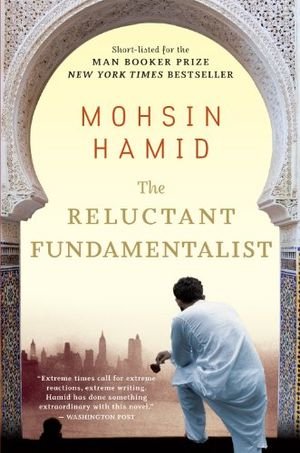
The Reluctant Fundamentalist
Mohsin Hamid
4.8
At a cafe table in Lahore, a bearded Pakistani man converses with an uneasy American stranger. As dusk deepens to night, he begins the tale that has brought them to this fateful encounter...
Changez is living an immigrant's dream of America. At the top of his class at Princeton, he is snapped up by an elite valuation firm. He thrives on the energy of New York, and his budding romance with elegant, beautiful Erica promises entry into Manhattan society at the same exalted level once occupied by his own family back in Lahore.
But in the wake of September 11, Changez finds his position in his adopted city suddenly overturned and his relationship with Erica shifting. And Changez's own identity is in seismic shift as well, unearthing allegiances more fundamental than money, power, and maybe even love.
…
Recommended by Ahmede Hussain, Amy Waldman, and Daniyal Mueenuddin.
This is an amazing book, and it’s a shame that it didn’t win the Man Booker Prize in 2007 – in my opinion it was the best of the bunch. I think it’s going to become a modern classic in five or 10 years’ time, if it’s not already regarded as one. This novel speaks for so many peoples’ experiences in the aftermath of 9/11. The prose is very tight and the title is also very clever. [source]
Amy Waldman
You’re right – the protagonist has a completely different profile from the humble one in Harbor. Changez is from a prestigious Pakistani family, but one without a lot of money. He comes to the United States to attend Princeton on a scholarship and then is recruited into the corporate world. The whole novel is a monologue. This character, in a café in Lahore, is talking to an unidentified American, telling his story about the life he led in the United States. How he was enamoured of New York, yet smiled as the Towers fell and grew even more embittered toward America in the wake of the attacks. The structure is original and well executed. [source]
Daniyal Mueenuddin
Well, it’s an odd kind of book. I think what’s especially useful about it is the way in which it describes the transformation in this man’s thinking. The protagonist is somebody who had been living in New York and been a banker and he gradually turns into, as the title says, a reluctant fundamentalist. This is something that I have seen among my friends in Pakistan. People who I have always thought of as very, very Westernised. They went to school abroad and certainly didn’t have the habits of religious types. But they are increasingly angry with the West and sympathetic to an anti-Western agenda and propaganda and very receptive to all kind of thoughts. These are really rational people who will now tell me straight out that September 11 was actually perpetrated by the Israelis and had nothing to do with Al-Qaeda. To me their theories seem absolutely loony and yet these guys have come out with something radically different. [source]
Cover unavailable
4
Pakistan: A Hard Country
Anatol Lieven
4.8
In the past decade Pakistan has become a country of immense importance to its region, the United States, and the world. With almost 200 million people, a 500,000-man army, nuclear weapons, and a large diaspora in Britain and North America, Pakistan is central to the hopes of jihadis and the fears of their enemies. Yet the greatest short-term threat to Pakistan is not Islamist insurgency as such, but the actions of the United States, and the greatest long-term threat is ecological change. Anatol Lieven's book is a magisterial investigation of this highly complex and often poorly understood country: its regions, ethnicities, competing religious traditions, varied social landscapes, deep political tensions, and historical patterns of violence; but also its surprising underlying stability, rooted in kinship, patronage, and the power of entrenched local elites. Engagingly written, combining history and profound analysis with reportage from Lieven's extensive travels as a journalist and academic, Pakistan: A Hard Country is both utterly compelling and deeply revealing.
…
Cover unavailable
5
A Case of Exploding Mangoes
Mohammed Hanif
4.6
A Washington Post, Rocky Mountain News, Boston Globe Best Book of the Year
Intrigue and subterfuge combine with bad luck and good in this darkly comic debut about love, betrayal, tyranny, family, and a conspiracy trying its damnedest to happen.
Ali Shigri, Pakistan Air Force pilot and Silent Drill Commander of the Fury Squadron, is on a mission to avenge his father's suspicious death, which the government calls a suicide.Ali's target is none other than General Zia ul-Haq, dictator of Pakistani. Enlisting a rag-tag group of conspirators, including his cologne-bathed roommate, a hash-smoking American lieutenant, and a mango-besotted crow, Ali sets his elaborate plan in motion. There's only one problem: the line of would-be Zia assassins is longer than he could have possibly known.
…
Recommended by Daniyal Mueenuddin and Sophie Mcneill.
Daniyal Mueenuddin
No. This is a book about the assassination of General Zia. Nobody really knows who killed him, but the suggestion is that a case of mangoes was loaded on to his airplane and inside the case of mangoes was nerve gas which knocked out the pilot and caused the plane to crash. In a way it’s a comic book because it pokes fun at the General. I think it’s a useful book because of that. People like General Zia shouldn’t be taken seriously. They are comical figures who converted the country into some sort of banana republic. And poking fun at them is a good way of deflating them. Another part of the book is the role the Americans were playing in Pakistan. In the Afghan war the Americans were talking up people like General Zia and giving them anything they wanted in return for their connivance in helping with the war in Afghanistan. The Americans certainly weren’t complaining about the General’s undemocratic ways because they needed people like him. Read 4 A Sportsman’s Sketches by Ivan Turgenev Read [source]
From the internationally bestselling author of The Reluctant Fundamentalist, the boldly imagined tale of a poor boy’s quest for wealth and love.
His first two novels established Mohsin Hamid as a radically inventive storyteller with his finger on the world’s pulse. How to Get Filthy Rich in Rising Asia meets that reputation and exceeds it. The astonishing and riveting tale of a man’s journey from impoverished rural boy to corporate tycoon, it steals its shape from the business self-help books devoured by ambitious youths all over “rising Asia.” It follows its nameless hero to the sprawling metropolis where he begins to amass an empire built on that most fluid, and increasingly scarce, of goods: water. Yet his heart remains set on something else: on the pretty girl whose star rises along with his, their paths crossing and recrossing, a lifelong affair sparked and snuffed and sparked again by the forces that careen their fates along.
How to Get Filthy Rich in Rising Asia is a striking slice of contemporary life at a time of crushing upheaval. Romantic without being sentimental, political without being didactic, and spiritual without being religious, it brings an unflinching gaze to the violence and hope it depicts. And it creates two unforgettable characters who find moments of transcendent intimacy in the midst of shattering change.
It’s at once describing things that everyone should do from that commanding, imperative voice of the self-help manual: move to the city if you want to be successful, don’t fall in love, things like that. But at the same time, it’s also describing the particular narrative of this one character, and it’s oddly collapsed in this figure of you, who is both the protagonist and the author, but also the reader, who identifies with the protagonist through the second-person voice. [source]
Cover unavailable
7
Home Fire
Kamila Shamsie
4.5
Isma is free. After years of watching out for her younger siblings in the wake of their mother’s death, she’s accepted an invitation from a mentor in America that allows her to resume a dream long deferred. But she can’t stop worrying about Aneeka, her beautiful, headstrong sister back in London, or their brother, Parvaiz, who’s disappeared in pursuit of his own dream, to prove himself to the dark legacy of the jihadist father he never knew. When he resurfaces half a globe away, Isma’s worst fears are confirmed.
Then Eamonn enters the sisters’ lives. Son of a powerful political figure, he has his own birthright to live up to—or defy. Is he to be a chance at love? The means of Parvaiz’s salvation? Suddenly, two families’ fates are inextricably, devastatingly entwined, in this searing novel that asks: What sacrifices will we make in the name of love?
The suspenseful and heartbreaking story of an immigrant family driven to pit love against loyalty, with devastating consequences
…
Cover unavailable
8
In Other Rooms, Other Wonders
Daniyal Mueenuddin
4.5
“The rural rootedness and gentle humour of R.K. Narayan with the literary sophistication and stylishness of Jhumpa Lahiri.”—Financial Times
Passing from the mannered drawing rooms of Pakistan’s cities to the harsh mud villages beyond, Daniyal Mueenuddin’s linked stories describe the interwoven lives of an aging feudal landowner, his servants and managers, and his extended family, industrialists who have lost touch with the land. In the spirit of Joyce’s Dubliners and Turgenev’s A Sportsman’s Sketches, these stories comprehensively illuminate a world, describing members of parliament and farm workers, Islamabad society girls and desperate servant women. A hard-driven politician at the height of his powers falls critically ill and seeks to perpetuate his legacy; a girl from a declining Lahori family becomes a wealthy relative’s mistress, thinking there will be no cost; an electrician confronts a violent assailant in order to protect his most valuable possession; a maidservant who advances herself through sexual favors unexpectedly falls in love. Together the stories in In Other Rooms, Other Wonders make up a vivid portrait of feudal Pakistan, describing the advantages and constraints of social station, the dissolution of old ways, and the shock of change. Refined, sensuous, by turn humorous, elegiac, and tragic, Mueenuddin evokes the complexities of the Pakistani feudal order as it is undermined and transformed.
…
Recommended by Anatol Lieven.
Anatol Lieven
I put it on my list for two reasons. The first is that simply he’s so good. Some of his stories I would say rival Chekhov in their ability to put across character, place and situation in a very vivid and deep way in a very short space. I mention Chekhov and the Russian writers deliberately because I think the other thing that makes him so interesting is that besides being half American, he also represents a Pakistani educated class which is very Western influenced and which speaks English, but which, like the Westernised Russian intelligentsia and landowning class of the 19th century, lives in a country where most of the population holds to a very different traditional and religious culture. [source]
Cover unavailable
9
Pakistan: A Personal History
Khan Imran
4.5
Born only five years after Pakistan was created in 1947, Imran Khan has lived his country's history. Undermined by a ruling elite, and unable to protect its people from the carnage of regular bombings from terrorists and its own ally, America, Pakistan has for years suffered from instability. Now Imran Khan and his own political party, the Tehreek-e-Insaf, offer a real political alternative for the people of Pakistan at a time when tension between Pakistan's government and the powerful military has reached dangerous new levels. How did this flashpoint of volatility and injustice come about?
Pakistan: A Personal History provides a unique insider's view of a country unfamiliar to a western audience. Woven into this history we see how Imran Khan's personal life - his happy childhood in Lahore, his Oxford education, his extraordinary cricketing career, his marriage to Jemima Goldsmith, his mother's influence and that of his Islamic faith - inform both the historical narrativeandhis current philanthropic and political activities. It is at once absorbing and insightful, casting fresh light upon a country whose culture he believes is largely misunderstood by the West.
…
Recommended by Zitto Kabwe Ruyagwa.
Zitto Kabwe Ruyagwa
I know it is has happened since two weeks now. But I feel obliged to heartily congratulate @ImranKhanPTI for the successful election. Went through his 2011 book, his struggle and those of his party were remarkable. Lots to learn. I wish him success in transforming PAKISTAN [source]
Cover unavailable
10
Moth Smoke
Mohsin Hamid
4.5
When Daru Shezad is fired from his banking job in Lahore, he begins a decline that plummets the length of this sharply drawn, subversive tale. Before long, he can't pay his bills, and he loses his toehold among Pakistan's cell-phone-toting elite. Daru descends into drugs and dissolution, and, for good measure, he falls in love with the wife of his childhood friend and rival, Ozi—the beautiful, restless Mumtaz.
Desperate to reverse his fortunes, Daru embarks on a career in crime, taking as his partner Murad Badshah, the notorious rickshaw driver, populist, and pirate. When a long-planned heist goes awry, Daru finds himself on trial for a murder he may or may not have committed. The uncertainty of his fate mirrors that of Pakistan itself, hyped on the prospect of becoming a nuclear player even as corruption drains its political will.
Fast-paced and unexpected, Moth Smoke portrays a contemporary Pakistan as far more vivid and disturbing than the exoticized images of South Asia familiar to most of the West. This debut novel establishes Mohsin Hamid as a writer of substance and imagination.
…
Cover unavailable
11
I Am Malala: How One Girl Stood Up for Education and Changed the World (Young Readers Edition)
Malala Yousafzai, Patricia McCormick
4.5
When the Taliban took control of the Swat Valley in Pakistan, one girl spoke out. Malala Yousafzai refused to be silenced and fought for her right to an education.
On Tuesday, October 9, 2012, when she was fifteen, she almost paid the ultimate price. She was shot in the head at point-blank range while riding the bus home from school, and few expected her to survive.
Instead, Malala's miraculous recovery has taken her on an extraordinary journey from a remote valley in northern Pakistan to the halls of the United Nations in New York. At sixteen, she has become a global symbol of peaceful protest and the youngest nominee ever for the Nobel Peace Prize.
I AM MALALA is the remarkable tale of a family uprooted by global terrorism, of the fight for girls' education, of a father who, himself a school owner, championed and encouraged his daughter to write and attend school, and of brave parents who have a fierce love for their daughter in a society that prizes sons.
I AM MALALA will make you believe in the power of one person's voice to inspire change in the world.
…
Recommended by Adebola Taofeek.
Adebola Taofeek
I am finishing this Malala book tonight . Issa must. [source]
Cover unavailable
12
Amal Unbound
Aisha Saeed
4.5
The compelling story of a girl’s fight to regain her life and dreams after being forced into indentured servitude.
Life is quiet and ordinary in Amal’s Pakistani village, but she had no complaints, and besides, she’s busy pursuing her dream of becoming a teacher one day. Her dreams are temporarily dashed when–as the eldest daughter–she must stay home from school to take care of her siblings. Amal is upset, but she doesn’t lose hope and finds ways to continue learning. Then the unimaginable happens–after an accidental run-in with the son of her village’s corrupt landlord, Amal must work as his family’s servant to pay off her own family’s debt.
Life at the opulent Khan estate is full of heartbreak and struggle for Amal–especially when she inadvertently makes an enemy of a girl named Nabila. Most troubling, though, is Amal’s growing awareness of the Khans’ nefarious dealings. When it becomes clear just how far they will go to protect their interests, Amal realizes she will have to find a way to work with others if they are ever to exact change in a cruel status quo, and if Amal is ever to achieve her dreams.
…
Cover unavailable
13
Exit West
Mohsin Hamid
4.5
In a country teetering on the brink of civil war, two young people meet—sensual, fiercely independent Nadia and gentle, restrained Saeed. They embark on a furtive love affair and are soon cloistered in a premature intimacy by the unrest roiling their city. When it explodes, turning familiar streets into a patchwork of checkpoints and bomb blasts, they begin to hear whispers about doors—doors that can whisk people far away, if perilously and for a price. As the violence escalates, Nadia and Saeed decide that they no longer have a choice. Leaving their homeland and their old lives behind, they find a door and step through.
Exit West follows these characters as they emerge into an alien and uncertain future, struggling to hold on to each other, to their past, to the very sense of who they are. Profoundly intimate and powerfully inventive, it tells an unforgettable story of love, loyalty, and courage that is both completely of our time and for all time.
…
Cover unavailable
14
The Kite Runner
Khaled Hosseini and Simon & Schuster Audi
4.5
The unforgettable, heartbreaking story of the unlikely friendship between a wealthy boy and the son of his father’s servant, The Kite Runner is a beautifully crafted novel set in a country that is in the process of being destroyed. It is about the power of reading, the price of betrayal, and the possibility of redemption; and an exploration of the power of fathers over sons—their love, their sacrifices, their lies.
A sweeping story of family, love, and friendship told against the devastating backdrop of the history of Afghanistan over the last thirty years, The Kite Runner is an unusual and powerful novel that has become a beloved, one-of-a-kind classic. --khaledhosseini.com
…
Recommended by James Altucher, Ann Miura-Ko, Magda Marcu, and 1 others.
Ann Miura-Ko recommended this book on the podcast "The Tim Ferriss Show". [source]
Magda Marcu
I’m currently reading “The Kite Runner”. I never have expectations from books, I let them surprise me as I get into the story. Learning about characteristics of different cultures, in this case the Afghan one, it’s one aspect I am interested in. [source]
Cover unavailable
15
Descent into Chaos: How the War Against Islamic Extremism Is Being Lost in Pakistan, Afghanistan and Central Asia
Ahmed Rashid
4.5
After September 11th, Ahmed Rashid's crucial book "Taliban" introduced American readers to that now notorious regime. In this new work, he returns to Pakistan, Afghanistan, and Central Asia to review the catastrophic aftermath of America's failed war on terror. Called "Pakistan's best and bravest reporter" by Christopher Hitchens, Rashid has shown himself to be a voice of reason amid the chaos of present-day Central Asia. "Descent Into Chaos" is his blistering critique of American policy-a dire warning and an impassioned call to correct these disasterous strategies before these failing states threaten global stability and bring devastation to our world.
…
Recommended by Gretchen Peters, Paddy Docherty, and Thomas Barfield.
Gretchen Peters
This is a thorough analysis of how Western policy towards the region has made things worse since 2001. It is pretty bleak. Rashid joked to me while he was writing it that the working title was, What A Fucking Mess. [source]
Paddy Docherty
Because it is the authoritative account of the current situation in the region. I would recommend it to anyone wanting to understand what’s going on in Pakistan and Afghanistan. [source]
Thomas Barfield
His book about the Taliban came to prominence after 9/11. What Rashid manages to do is to show that this is a transnational problem. [source]
Cover unavailable
16
Directorate S: The C.I.A. and America's Secret Wars in Afghanistan and Pakistan
Steve Coll
4.4
Winner of the 2018 National Book Critics Circle Award for Nonfiction
Longlisted for the 2018 National Book Award for Nonfiction
From the Pulitzer Prize-winning author of Ghost Wars, the epic and enthralling story of America's intelligence, military, and diplomatic efforts to defeat Al Qaeda and the Taliban in Afghanistan and Pakistan since 9/11
Prior to 9/11, the United States had been carrying out small-scale covert operations in Afghanistan, ostensibly in cooperation, although often in direct opposition, with I.S.I., the Pakistani intelligence agency. While the US was trying to quell extremists, a highly secretive and compartmentalized wing of I.S.I., known as "Directorate S," was covertly training, arming, and seeking to legitimize the Taliban, in order to enlarge Pakistan's sphere of influence. After 9/11, when fifty-nine countries, led by the U. S., deployed troops or provided aid to Afghanistan in an effort to flush out the Taliban and Al Qaeda, the U.S. was set on an invisible slow-motion collision course with Pakistan.
Today we know that the war in Afghanistan would falter badly because of military hubris at the highest levels of the Pentagon, the drain on resources and provocation in the Muslim world caused by the U.S.-led invasion of Iraq, and corruption. But more than anything, as Coll makes painfully clear, the war in Afghanistan was doomed because of the failure of the United States to apprehend the motivations and intentions of I.S.I.'s "Directorate S". This was a swirling and shadowy struggle of historic proportions, which endured over a decade and across both the Bush and Obama administrations, involving multiple secret intelligence agencies, a litany of incongruous strategies and tactics, and dozens of players, including some of the most prominent military and political figures. A sprawling American tragedy, the war was an open clash of arms but also a covert melee of ideas, secrets, and subterranean violence.
Coll excavates this grand battle, which took place away from the gaze of the American public. With unsurpassed expertise, original research, and attention to detail, he brings to life a narrative at once vast and intricate, local and global, propulsive and painstaking.
This is the definitive explanation of how America came to be so badly ensnared in an elaborate, factional, and seemingly interminable conflict in South Asia. Nothing less than a forensic examination of the personal and political forces that shape world history, Directorate S is a complete masterpiece of both investigative and narrative journalism.
…
Cover unavailable
17
Burnt Shadows
Kamila Shamsie
4.4
Beginning on August 9, 1945, in Nagasaki, and ending in a prison cell in the US in 2002, as a man is waiting to be sent to Guantanamo Bay, Burnt Shadows is an epic narrative of love and betrayal.
Hiroko Tanaka is twenty-one and in love with the man she is to marry, Konrad Weiss. As she steps onto her veranda, wrapped in a kimono with three black cranes swooping across the back, her world is suddenly and irrevocably altered. In the numbing aftermath of the atomic bomb that obliterates everything she has known, all that remains are the bird-shaped burns on her back, an indelible reminder of the world she has lost. In search of new beginnings, two years later, Hiroko travels to Delhi. It is there that her life will become intertwined with that of Konrad's half sister, Elizabeth, her husband, James Burton, and their employee Sajjad Ashraf, from whom she starts to learn Urdu.
With the partition of India, and the creation of Pakistan, Hiroko will find herself displaced once again, in a world where old wars are replaced by new conflicts. But the shadows of history--personal and political--are cast over the interrelated worlds of the Burtons, the Ashrafs, and the Tanakas as they are transported from Pakistan to New York and, in the novel's astonishing climax, to Afghanistan in the immediate wake of 9/11. The ties that have bound these families together over decades and generations are tested to the extreme, with unforeseeable consequences.
…
Cover unavailable
18
The Upstairs Wife: An Intimate History of Pakistan
Rafia Zakaria
4.4
A memoir of Karachi through the eyes of its women
An Indies Introduce Debut Authors Selection
For a brief moment on December 27, 2007, life came to a standstill in Pakistan. Benazir Bhutto, the country’s former prime minister and the first woman ever to lead a Muslim country, had been assassinated at a political rally just outside Islamabad. Back in Karachi—Bhutto’s birthplace and Pakistan’s other great metropolis—Rafia Zakaria’s family was suffering through a crisis of its own: her Uncle Sohail, the man who had brought shame upon the family, was near death. In that moment these twin catastrophes—one political and public, the other secret and intensely personal—briefly converged.
Zakaria uses that moment to begin her intimate exploration of the country of her birth. Her Muslim-Indian family immigrated to Pakistan from Bombay in 1962, escaping the precarious state in which the Muslim population in India found itself following the Partition. For them, Pakistan represented enormous promise. And for some time, Zakaria’s family prospered and the city prospered. But in the 1980s, Pakistan’s military dictators began an Islamization campaign designed to legitimate their rule—a campaign that particularly affected women’s freedom and safety. The political became personal when her aunt Amina’s husband, Sohail, did the unthinkable and took a second wife, a humiliating and painful betrayal of kin and custom that shook the foundation of Zakaria’s family but was permitted under the country’s new laws. The young Rafia grows up in the shadow of Amina’s shame and fury, while the world outside her home turns ever more chaotic and violent as the opportunities available to post-Partition immigrants are dramatically curtailed and terrorism sows its seeds in Karachi.
Telling the parallel stories of Amina’s polygamous marriage and Pakistan’s hopes and betrayals, The Upstairs Wife is an intimate exploration of the disjunction between exalted dreams and complicated realities.
From the Hardcover edition.
…
Cover unavailable
19
A Thousand Splendid Suns
Khaled Hosseini
4.4
A Thousand Splendid Suns is a breathtaking story set against the volatile events of Afghanistan's last thirty years—from the Soviet invasion to the reign of the Taliban to post-Taliban rebuilding—that puts the violence, fear, hope, and faith of this country in intimate, human terms. It is a tale of two generations of characters brought jarringly together by the tragic sweep of war, where personal lives—the struggle to survive, raise a family, find happiness—are inextricable from the history playing out around them.
Propelled by the same storytelling instinct that made The Kite Runner a beloved classic, A Thousand Splendid Suns is at once a remarkable chronicle of three decades of Afghan history and a deeply moving account of family and friendship. It is a striking, heart-wrenching novel of an unforgiving time, an unlikely friendship, and an indestructible love—a stunning accomplishment. --front flap
I would encourage people to read it because it gives you a sense of Afghanistan’s incredible history and the role women have played within that history [source]
Cover unavailable
20
The Night Diary
Veera Hiranandani
4.4
It's 1947, and India, newly independent of British rule, has been separated into two countries: Pakistan and India. The divide has created much tension between Hindus and Muslims, and hundreds of thousands are killed crossing borders.
Half-Muslim, half-Hindu twelve-year-old Nisha doesn't know where she belongs, or what her country is anymore. When Papa decides it's too dangerous to stay in what is now Pakistan, Nisha and her family become refugees and embark first by train but later on foot to reach her new home. The journey is long, difficult, and dangerous, and after losing her mother as a baby, Nisha can't imagine losing her homeland, too. But even if her country has been ripped apart, Nisha still believes in the possibility of putting herself back together.
…
Cover unavailable
21
Ghost Wars: The Secret History of the CIA, Afghanistan, and Bin Laden from the Soviet Invasion to September 10, 2001
Steve Coll
4.4
The news-breaking book that has sent shockwaves through the Bush White House, Ghost Wars is the most accurate and revealing account yet of the CIA's secret involvement in al-Qaeda's evolution. It won the Pulitzer Prize in 2005.
Prize-winning journalist Steve Coll has spent years reporting from the Middle East, accessed previously classified government files and interviewed senior US officials and foreign spymasters. Here he gives the full inside story of the CIA's covert funding of an Islamic jihad against Soviet forces in Afghanistan, explores how this sowed the seeds of Bin Laden's rise, traces how he built his global network and brings to life the dramatic battles within the US government over national security. Above all, he lays bare American intelligence's continual failure to grasp the rising threat of terrorism in the years leading to 9/11 - and its devastating consequences.
…
Cover unavailable
22
The Great Partition: The Making of India and Pakistan
Yasmin Khan
4.4
The Partition of India in 1947 promised its people both political and religious freedom—through the liberation of India from British rule, and the creation of the Muslim state of Pakistan. Instead, the geographical divide brought displacement and death, and it benefited the few at the expense of the very many. Thousands of women were raped, at least one million people were killed, and ten to fifteen million were forced to leave their homes as refugees. One of the first events of decolonization in the twentieth century, Partition was also one of the most bloody.
In this book Yasmin Khan examines the context, execution, and aftermath of Partition, weaving together local politics and ordinary lives with the larger political forces at play. She exposes the widespread obliviousness to what Partition would entail in practice and how it would affect the populace. Drawing together fresh information from an array of sources, Khan underscores the catastrophic human cost and shows why the repercussions of Partition resound even now, some sixty years later. The book is an intelligent and timely analysis of Partition, the haste and recklessness with which it was completed, and the damaging legacy left in its wake.
…
Cover unavailable
23
Stones Into Schools: Promoting Peace With Books, Not Bombs, in Afghanistan and Pakistan
Greg Mortenson, Khaled Hosseini
4.4
From the author of the #1 bestseller Three Cups of Tea, the continuing story of this determined humanitarian's efforts to promote peace through education.
In this dramatic first-person narrative, Greg Mortenson picks up where Three Cups of Tea left off in 2003, recounting his relentless, ongoing efforts to establish schools for girls in Afghanistan; his extensive work in Azad Kashmir and Pakistan after a massive earthquake hit the region in 2005; and the unique ways he has built relationships with Islamic clerics, militia commanders, and tribal leaders. He shares for the first time his broader vision to promote peace through education and literacy, as well as touching on military matters, Islam, and women-all woven together with the many rich personal stories of the people who have been involved in this remarkable two-decade humanitarian effort.
Since the 2006 publication of Three Cups of Tea, Mortenson has traveled across the U.S. and the world to share his vision with hundreds of thousands of people. He has met with heads of state, top military officials, and leading politicians who all seek his advice and insight. The continued phenomenal success of Three Cups of Tea proves that there is an eager and committed audience for Mortenson's work and message.
…
Cover unavailable
24
Midnight's Children
Salman Rushdie
4.4
Saleem Sinai was born at midnight, the midnight of India's independence, and found himself mysteriously "handcuffed to history" by the coincidence. He is one of 1,001 children born at the midnight hour, each of them endowed with an extraordinary talent—and whose privilege and curse it is to be both master and victims of their times. Through Saleem's gifts—inner ear and wildly sensitive sense of smell—we are drawn into a fascinating family saga set against the vast, colourful background of the India of the 20th century.
…
Cover unavailable
25
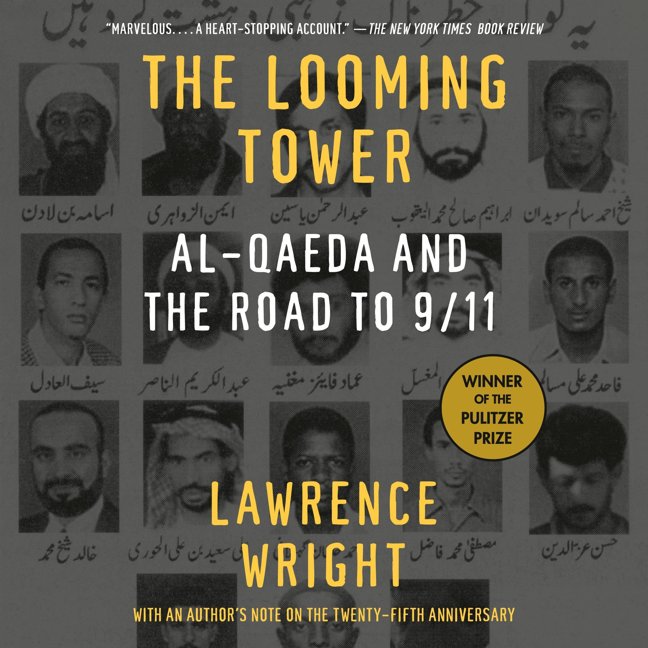
The Looming Tower: Al-Qaeda and the Road to 9/11
Lawrence Wright
4.4
A sweeping narrative history of the events leading to 9/11, a groundbreaking look at the people and ideas, the terrorist plans and the Western intelligence failures that culminated in the assault on America. Lawrence Wright's remarkable book is based on five years of research and hundreds of interviews that he conducted in Egypt, Saudi Arabia, Pakistan, Afghanistan, Sudan, England, France, Germany, Spain, and the United States.
The Looming Tower achieves an unprecedented level of intimacy and insight by telling the story through the interweaving lives of four men: the two leaders of al-Qaeda, Osama bin Laden and Ayman al-Zawahiri; the FBI's counterterrorism chief, John O'Neill; and the former head of Saudi intelligence, Prince Turki al-Faisal.
As these lives unfold, we see revealed: the crosscurrents of modern Islam that helped to radicalize Zawahiri and bin Laden . . . the birth of al-Qaeda and its unsteady development into an organization capable of the American embassy bombings in Kenya and Tanzania and the attack on the USS Cole . . . O'Neill's heroic efforts to track al-Qaeda before 9/11, and his tragic death in the World Trade towers . . . Prince Turki's transformation from bin Laden's ally to his enemy . . . the failures of the FBI, CIA, and NSA to share intelligence that might have prevented the 9/11 attacks.
The Looming Tower broadens and deepens our knowledge of these signal events by taking us behind the scenes. Here is Sayyid Qutb, founder of the modern Islamist movement, lonely and despairing as he meets Western culture up close in 1940s America; the privileged childhoods of bin Laden and Zawahiri; family life in the al-Qaeda compounds of Sudan and Afghanistan; O'Neill's high-wire act in balancing his all-consuming career with his equally entangling personal life--he was living with three women, each of them unaware of the others' existence--and the nitty-gritty of turf battles among U.S. intelligence agencies.
Brilliantly conceived and written, The Looming Tower draws all elements of the story into a galvanizing narrative that adds immeasurably to our understanding of how we arrived at September 11, 2001. The richness of its new information, and the depth of its perceptions, can help us deal more wisely and effectively with the continuing terrorist threat.
…
Recommended by Audrey Kurth Cronin, Bryan Callen, Lloyd Gardner, and 5 others.
Audrey Kurth Cronin
Reading this one book gives you an excellent grasp of the human story and the context from which al-Qaeda emerged. [source]
Wright looks at the linkage between the Egyptian Jihad and Al-Qaeda. It is a worthwhile book to read to try to understand the whole problem. [source]
Cover unavailable
26
Train to Pakistan
Khushwant Singh
4.3
Cover unavailable
27
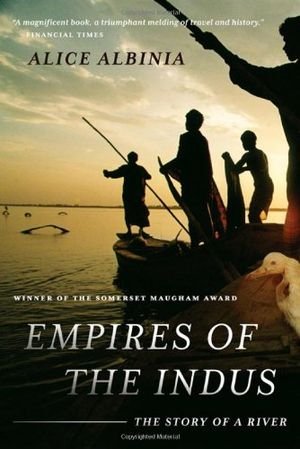
Empires of the Indus: The Story of a River
Alice Albinia
4.3
“Alice Albinia is the most extraordinary traveler of her generation. . . . A journey of astonishing confidence and courage.”—Rory Stewart
One of the largest rivers in the world, the Indus rises in the Tibetan mountains and flows west across northern India and south through Pakistan. It has been worshipped as a god, used as a tool of imperial expansion, and today is the cement of Pakistan’s fractious union. Alice Albinia follows the river upstream, through two thousand miles of geography and back to a time five thousand years ago when a string of sophisticated cities grew on its banks. “This turbulent history, entwined with a superlative travel narrative” (The Guardian) leads us from the ruins of elaborate metropolises, to the bitter divisions of today. Like Rory Stewart’s The Places In Between, Empires of the Indus is an engrossing personal journey and a deeply moving portrait of a river and its people. 18 illustrations
I chose this because it beautifully tells the story of this legacy of conquest, of the empires and colonialism and all the politics that go along with that. And also we know that the wars of this century are more than anything else going to be about resources, one of which is water. If you look at South Asia you can see that water is a huge part of that conflict. There is all the flooding in Pakistan today. The Indus is a life force for this country. It is the birthplace of what is now Pakistan. And Albinia’s book starts with Pakistan and follows the Indus all the way up to China and talks about not just the British Raj and its role in destroying the Indus delta but also as far back as Alexander the Great and his conquests and why his conquests were so successful. [source]
Victor Mallet
A wonderful book. It’s an adventure story, apart from anything else. She starts at the mouth of the Indus, and heads to the source. [source]
Cover unavailable
28
Unmarriageable
Soniah Kamal
4.3
In this one-of-a-kind retelling of Pride and Prejudice set in modern-day Pakistan, Alys Binat has sworn never to marry—until an encounter with one Mr. Darsee at a wedding makes her reconsider.
A scandal and vicious rumor concerning the Binat family have destroyed their fortune and prospects for desirable marriages, but Alys, the second and most practical of the five Binat daughters, has found happiness teaching English literature to schoolgirls. Knowing that many of her students won’t make it to graduation before dropping out to marry and have children, Alys teaches them about Jane Austen and her other literary heroes and hopes to inspire the girls to dream of more.
When an invitation arrives to the biggest wedding their small town has seen in years, Mrs. Binat, certain that their luck is about to change, excitedly sets to work preparing her daughters to fish for rich, eligible bachelors. On the first night of the festivities, Alys’s lovely older sister, Jena, catches the eye of Fahad “Bungles” Bingla, the wildly successful—and single—entrepreneur. But Bungles’s friend Valentine Darsee is clearly unimpressed by the Binat family. Alys accidentally overhears his unflattering assessment of her and quickly dismisses him and his snobbish ways. As the days of lavish wedding parties unfold, the Binats wait breathlessly to see if Jena will land a proposal—and Alys begins to realize that Darsee’s brusque manner may be hiding a very different man from the one she saw at first glance.
Told with wry wit and colorful prose, Unmarriageable is a charming update on Jane Austen’s beloved novel and an exhilarating exploration of love, marriage, class, and sisterhood.
…
Cover unavailable
29
The Blood Telegram: Nixon, Kissinger, and a Forgotten Genocide
Gary J. Bass
4.3
A riveting history—the first full account—of the involvement of Richard Nixon and Henry Kissinger in the 1971 atrocities in Bangladesh that led to war between India and Pakistan, shaped the fate of Asia, and left in their wake a host of major strategic consequences for the world today.
Giving an astonishing inside view of how the White House really works in a crisis, The Blood Telegram is an unprecedented chronicle of a pivotal but little-known chapter of the Cold War. Gary J. Bass shows how Nixon and Kissinger supported Pakistan’s military dictatorship as it brutally quashed the results of a historic free election. The Pakistani army launched a crackdown on what was then East Pakistan (today an independent Bangladesh), killing hundreds of thousands of people and sending ten million refugees fleeing to India—one of the worst humanitarian crises of the twentieth century.
Nixon and Kissinger, unswayed by detailed warnings of genocide from American diplomats witnessing the bloodshed, stood behind Pakistan’s military rulers. Driven not just by Cold War realpolitik but by a bitter personal dislike of India and its leader Indira Gandhi, Nixon and Kissinger actively helped the Pakistani government even as it careened toward a devastating war against India. They silenced American officials who dared to speak up, secretly encouraged China to mass troops on the Indian border, and illegally supplied weapons to the Pakistani military—an overlooked scandal that presages Watergate.
Drawing on previously unheard White House tapes, recently declassified documents, and extensive interviews with White House staffers and Indian military leaders, The Blood Telegram tells this thrilling, shadowy story in full. Bringing us into the drama of a crisis exploding into war, Bass follows reporters, consuls, and guerrilla warriors on the ground—from the desperate refugee camps to the most secretive conversations in the Oval Office.
Bass makes clear how the United States’ embrace of the military dictatorship in Islamabad would mold Asia’s destiny for decades, and confronts for the first time Nixon and Kissinger’s hidden role in a tragedy that was far bloodier than Bosnia. This is a revelatory, compulsively readable work of politics, personalities, military confrontation, and Cold War brinksmanship.
…
Cover unavailable
30
Kartography
Kamila Shamsie
4.3
Raheen and her best friend, Karim, share an idyllic childhood in upper-class Karachi. Their parents were even once engaged to each others' partners until they rematched in what they call "the fiancée swap." But as adolescence distances the friends, Karim takes refuge in maps while Raheen searches for the secret behind her parents' exchange. What she uncovers reveals not just a family's but a country's turbulent history-and a grown-up Raheen and Karim are caught between strained friendship and fated love.
A love story with a family mystery at its heart, Kartography is a dazzling novel by a young writer of astonishing maturity and exhilarating style. Shamsie transports us to a world we have not often seen in fiction-vibrant, dangerous, sensuous Pakistan. But even as she takes us far from the familiar, her story of passion and family secrets rings universally true.
…
Cover unavailable
31
Pakistan: Between Mosque and Military
Husain Haqqani
4.3
Among U.S. allies in the war against terrorism, Pakistan cannot be easily characterized as either friend or foe. Nuclear-armed Pakistan is an important center of radical Islamic ideas and groups. Since 9/11, the selective cooperation of president General Pervez Musharraf in sharing intelligence with the United States and apprehending al Qaeda members has led to the assumption that Pakistan might be ready to give up its longstanding ties with radical Islam. But Pakistan's status as an Islamic ideological state is closely linked with the Pakistani elites' worldview and the praetorian ambitions of its military. This book analyzes the origins of the relationships between Islamist groups and Pakistan's military, and explores the nation's quest for identity and security. Tracing how the military has sought U.S. support by making itself useful for concerns of the moment – while continuing to strengthen the mosque-military alliance within Pakistan – Haqqani offers an alternative view of political developments since the country's independence in 1947.
…
Recommended by Bruce Riedel.
Bruce Riedel
I would say that the United States has had a tempestuous relationship with Pakistan. There have been moments of great embrace between the two of us in the 50s and 60s when we built the secret U2 base there to fly over the Soviet Union. Also in the 1980s when we supported the mujahideen in the war against the Soviets in Afghanistan and then at the beginning of this century when the United States and Pakistan worked very closely against al Qaeda. These periods of great highs have also been interrupted by great lows when we have broken relations, we have sanctioned Pakistan and we have cut off arms exports at critical moments of their history. [source]
Cover unavailable
32
Midnight's Furies: The Deadly Legacy of India's Partition
Nisid Hajar
4.3
Nobody expected the liberation of India and birth of Pakistan to be so bloody — it was supposed to be an answer to the dreams of Muslims and Hindus who had been ruled by the British for centuries. Jawaharlal Nehru, Gandhi’s protégé and the political leader of India, believed Indians were an inherently nonviolent, peaceful people. Pakistan’s founder, Mohammad Ali Jinnah, was a secular lawyer, not a firebrand. But in August 1946, exactly a year before Independence, Calcutta erupted in riots. A cycle of street-fighting — targeting Hindus, then Muslims, then Sikhs — spun out of control. As the summer of 1947 approached, all three groups were heavily armed and on edge, and the British rushed to leave. Hell let loose. Trains carried Muslims west and Hindus east to their slaughter. Some of the most brutal and widespread ethnic cleansing in modern history erupted on both sides of the new border, searing a divide between India and Pakistan that remains a root cause of many evils. From jihadi terrorism to nuclear proliferation, the searing tale told in Midnight’s Furies explains all too many of the headlines we read today.
…
Cover unavailable
33
The Wandering Falcon
Jamil Ahmad
4.3
A haunting literary debut set in the forbidding remote tribal areas of Pakistan and Afghanistan.
Traditions that have lasted for centuries, both brutal and beautiful, create a rigid structure for life in the wild, astonishing place where Iran, Pakistan, and Afghanistan meet—the Federally Administered Tribal Lands (FATA). It is a formidable world and the people who live there are constantly subjected to extremes—both of geography and of culture. The Wandering Falcon begins with a young couple, refugees from their tribe, who have traveled to the middle of nowhere to escape the cruel punishments meted upon those who transgress the boundaries of marriage and family. Their son, Tor Baz, descended from both chiefs and outlaws, becomes “The Wandering Falcon,” a character who travels throughout the tribes, over the mountains and the plains, in the towns and tents that comprise the homes of the tribal people. The media today speak about this unimaginably remote region, a geopolitical hotbed of conspiracies, drone attacks, and conflict—now, told in the rich, dramatic tones of a master storyteller, this stunning, honor-bound culture is revealed from the inside. Jamil Ahmad has written an unforgettable portrait of a world of custom and compassion, of love and cruelty, of hardship and survival, a place fragile, unknown, and unforgiving.
…
Cover unavailable
34
Maps for Lost Lovers
Nadeem Aslam
4.3
If Gabriel García Márquez had chosen to write about Pakistani immigrants in England, he might have produced a novel as beautiful and devastating as Maps for Lost Lovers.
Jugnu and Chanda have disappeared. Like thousands of people all over England, they were lovers and living together out of wedlock. To Chanda’s family, however, the disgrace was unforgivable. Perhaps enough so as to warrant murder.As he explores the disappearance and its aftermath through the eyes of Jugnu’s worldly older brother, Shamas, and his devout wife, Kaukab, Nadeem Aslam creates a closely observed and affecting portrait of people whose traditions threaten to bury them alive. The result is a tour de force, intimate, affecting, tragic and suspenseful.
…
Cover unavailable
35
The Golden Legend
Nadeem Aslam
4.3
When shots ring out on the Grand Trunk Road, Nargis's life begins to crumble around her. Her husband, Massud--a fellow architect--is caught in the cross fire and dies before she can confess her greatest secret to him. Now under threat from a powerful military intelligence officer, who demands that she pardon her husband's American killer, Nargis fears that the truth about her past will soon be exposed. For weeks someone has been broadcasting people's secrets from the minaret of the local mosque, and, in a country where even the accusation of blasphemy is a currency to be bartered, the mysterious broadcasts have struck fear in Christians and Muslims alike. When the loudspeakers reveal a forbidden romance between a Muslim cleric's daughter and Nargis's Christian neighbor, Nargis finds herself trapped in the center of the chaos tearing their community apart.
…
Cover unavailable
36
Jinnah of Pakistan
Stanley Wolpert
4.3
“Few individuals significantly alter the course of history. Fewer still modify the map of the world. Hardly anyone can be credited with creating a nation-state. Muhammad Ali Jinnah did all three.” Stanley Wolpert
These are the opening lines of the preface of Stanley Wolpert’s book, “Jinnah of Pakistan” and serves to entice you to read an extremely thorough, comprehensive and detailed study about one of the most pragmatic and charismatic leaders of South Asia, Muhammad Ali Jinnah.
Stanley Wolpert is an American academic who is considered to be one of the world's foremost authorities on the political history of modern South Asia. During a trip to Bombay in 1948, he became interested in the complexities of Indian culture, history and politics. Since 1962, he has published many fictional and non-fictional books on his favorite subject.
In the preface, Wolpert adds: “For more than a quarter century, I have been intrigued by the apparent paradox of Jinnah’s strange story which has to date never been told in all the fascinating complexity of its brilliant light and tragic darkness.”
“Jinnah of Pakistan” was published in 1984. This unique and insightful biography explores the fascinating public and private life of founder of Pakistan, Muhammad Ali Jinnah from his birth in 1876 till his death in 1948. In recording the events that unfold and shape Jinnah’s life, Wolpert also chronicles almost eight decades of Indian history to the point where India achieves independence from British rule amid growing Muslim-Hindu antagonism.
It is a tragedy that the new generation of Pakistan knows about the founder of their country only through text books, a few websites and television programs. These limited resources do not tell the complete picture of a very intelligent, shrewd and resilient lawyer, politician and statesman who altered the map of South Asia through his sheer indomitable will against all odds.
It is almost a standard statement in Pakistani text books that Muhammad Ali Jinnah was a great man but after reading Stanley Wolpert’s “Jinnah of Pakistan” one can get a better understanding of why Jinnah can be….. and should be…. regarded as such a great leader. Physically a frail man, he alone gave courage, hope, strength and voice to millions of Muslims of South Asia who were dismissed as second class citizens in United India before partition in 1947.
The biography is placed on a huge canvas and takes the readers to the bustling port of Karachi where Jinnah was born and follows him to London, Bombay, Calcutta, Lucknow, Nagpur, Amritsar, New Delhi, Simla, Lahore, Peshawar, Quetta, Ziarat and finally Karachi again where lies buried “ one of history’s most remarkable, tenacious, enigmatic figures.”
The book reveals Jinnah’s failings, his loneliness, his pain, his broken marriage, his estrangement from his only daughter, his long and fatal disease which he kept under wraps and yet the true worth of his gigantic accomplishment can only be more appreciated when viewed alongside his human weaknesses.
The book also brings under spotlight, Jinnah’s love and marriage to the beautiful and vivacious “flower of Bombay" Ruttie. The whole episode is dealt with great deal of compassion as Wolpert gives a rare glimpse into Jinnah’s most private moments and thoughts___ and his ultimate pain when due to Jinnah’s extremely demanding political and legal career, the marriage breaks down and ends with Ruttie’s tragic death when she was only 29.
An excerpt from the book: “It (the funeral) was a painfully slow ritual. Jinnah sat silent through all of its five hours. As Ruttie’s body was being lowered into the grave, Jinnah as the nearest relative was the first to throw the earth on the grave. He broke down suddenly and wept and sobbed like a child for minutes together. That was the only time when I found Jinnah betraying some shadow of human weakness.”
The best thing about the book is that is very impartial and does not gloss over any facts or resort to hyperbole. Like an artist who creates a masterpiece with careful strokes of his paintbrush, Wolpert also records small anecdotes and major incidents to show Jinnah’s shrewd and skilful leadership as well his single-minded tenacity to win his case for the creation of Pakistan on behalf of the Muslims of South Asia.
For this great and engrossing biography, Stanley Wolpert has won a great deal of gratitude from those who have read and enjoyed this book. ’Jinnah of Pakistan’ is an absolute must read for the students of political history of South Asia and for every Pakistani who is interested in knowing the extent of debt owed to Quaid-e-Azam Muhammad Ali Jinnah for freedom and a separate country after the end of British Raj in the sub-continent.
…
Cover unavailable
37
Shabanu: Daughter of the Wind (Shabanu, #1)
Suzanne Fisher Staples
4.3
Life is both sweet and cruel to strong-willed young Shabanu, whose home is the windswept Cholistan Desert of Pakistan. The second daughter in a family with no sons, she' s been allowed freedoms forbidden to most Muslim girls. But when a tragic encounter with a wealthy and powerful landowner ruins the marriage plans of her older sister, Shabanu is called upon to sacrifice everything she' s dreamed of. Should she do what is necessary to uphold her family' s honor-- or listen to the stirrings of her own heart?
…
Cover unavailable
38
Magnificent Delusions: Pakistan, the United States, and an Epic History of Misunderstanding
Husain Haqqani
4.3
The relationship between America and Pakistan is based on mutual incomprehension and always has been. Pakistan—to American eyes—has gone from being a quirky irrelevance, to a stabilizing friend, to an essential military ally, to a seedbed of terror. America—to Pakistani eyes—has been a guarantee of security, a coldly distant scold, an enthusiastic military enabler, and is now a threat to national security and a source of humiliation.
The countries are not merely at odds. Each believes it can play the other—with sometimes absurd, sometimes tragic, results. The conventional narrative about the war in Afghanistan, for instance, has revolved around the Soviet invasion in 1979. But President Jimmy Carter signed the first authorization to help the Pakistani-backed mujahedeen covertly on July 3—almost six months before the Soviets invaded. Americans were told, and like to believe, that what followed was Charlie Wilson's war of Afghani liberation, with which they remain embroiled to this day. It was not. It was General Zia-ul-Haq's vicious regional power play.
Husain Haqqani has a unique insight into Pakistan, his homeland, and America, where he was ambassador and is now a professor at Boston University. His life has mapped the relationship of the two countries and he has found himself often close to the heart of it, sometimes in very confrontational circumstances, and this has allowed him to write the story of a misbegotten diplomatic love affair, here memorably laid bare.
…
Cover unavailable
39
Pakistan on the Brink: The Future of America, Pakistan, and Afghanistan
Ahmed Rashid
4.2
An urgent, on-the-ground report from Pakistan--from the bestselling author of "Descent""Into Chaos" and "Taliban" Ahmed Rashid, one of the world's leading experts on the social and political situations in Pakistan and Afghanistan, offers a highly anticipated update on the possibilities--and hazards--facing the United States after the death of Osama bin Laden and as Operation Enduring Freedom winds down. With the characteristic professionalism that has made him the preeminent independent journalist in Pakistan for three decades, Rashid asks the important questions and delivers informed insights about the future of U.S. relations with the troubled region. His most urgent book to date, "Pakistan on the Brink" is the third volume in a comprehensive series that is a call to action to our nation's leaders and an exposition of this conflict's impact on the security of the world.
…
Cover unavailable
40
Malala's Magic Pencil
Malala Yousafzai
4.2
Shortlisted for the Little Rebels Children's Book Award!
As a child in Pakistan, Malala made a wish for a magic pencil that she could use to redraw reality. She would use it for good; to give gifts to her family, to erase the smell from the rubbish dump near her house. (And to sleep an extra hour in the morning.)
As she grew older, Malala wished for bigger and bigger things. She saw a world that needed fixing. And even if she never found a magic pencil, Malala realized that she could still work hard every day to make her wishes come true.
This beautifully illustrated picture book tells Malala's story, in her own words, for a younger audience and shows them the worldview that allowed her to hold on to hope and to make her voice heard even in the most difficult of times.
…
Cover unavailable
41
Shame
Salman Rushdie
4.2
The novel that set the stage for his modern classic, The Satanic Verses, Shame is Salman Rushdie’s phantasmagoric epic of an unnamed country that is “not quite Pakistan.” In this dazzling tale of an ongoing duel between the families of two men–one a celebrated wager of war, the other a debauched lover of pleasure–Rushdie brilliantly portrays a world caught between honor and humiliation–“shamelessness, shame: the roots of violence.” Shame is an astonishing story that grows more timely by the day.
…
Recommended by Daniyal Mueenuddin and Fatima Bhutto.
Daniyal Mueenuddin
This is the only one of Rushdie’s books which is set in Pakistan. A lot of the stories in the book are actually true. For example, the description of relations among various members of the Bhutto family and the descriptions of the corruption and bribes going on are all true. [source]
I have personal reasons for choosing this. It is the story of two men, two very powerful men. One is based on my grandfather, Pakistan’s former president and prime minister Zulfikar Ali Bhutto, and the other is based on Muhammad Zia-ul-Haq, who was a military general who overthrew my grandfather and eventually killed him. [source]
Cover unavailable
42
Written in the Stars
Aisha Saeed
4.2
This heart-wrenching novel explores what it is like to be thrust into an unwanted marriage. Has Naila’s fate been written in the stars? Or can she still make her own destiny?
Naila’s conservative immigrant parents have always said the same thing: She may choose what to study, how to wear her hair, and what to be when she grows up—but they will choose her husband. Following their cultural tradition, they will plan an arranged marriage for her. And until then, dating—even friendship with a boy—is forbidden. When Naila breaks their rule by falling in love with Saif, her parents are livid. Convinced she has forgotten who she truly is, they travel to Pakistan to visit relatives and explore their roots. But Naila’s vacation turns into a nightmare when she learns that plans have changed—her parents have found her a husband and they want her to marry him, now! Despite her greatest efforts, Naila is aghast to find herself cut off from everything and everyone she once knew. Her only hope of escape is Saif . . . if he can find her before it’s too late.
…
Cover unavailable
43
Taliban: Militant Islam, Oil and Fundamentalism in Central Asia
Ahmed Rashid
4.2
Correspondent Ahmed Rashid brings the shadowy world of the Taliban—the world’s most extreme & radical Islamic organization—into sharp focus in this enormously insightful book. He offers the only authoritative account of the Taliban available to English-language readers, explaining the Taliban’s rise to power, its impact on Afghanistan & the region, its role in oil & gas company decisions, & the effects of changing American attitudes toward the Taliban. He also describes the new face of Islamic fundamentalism & explains why Afghanistan has become the world center for international terrorism. New to this updated edition of the #1 NY Times Bestseller with more than 1.5 million copies sold worldwide: How the Taliban has regained its strength. How & why the Taliban has spread across Central Asia. How the Taliban has helped Al’Qaida’s spread into Europe, North Africa, the Middle East & the Far East. Why the Afghan people feel the United States is losing the war. A major new introduction and an all-new final chapter.
…
Recommended by Jonathan Powell.
Jonathan Powell
9/11 was a big shock. When the first plane hit I thought it was an accident. When I was told of a second plane, I assumed it was a loop on the film. Once I knew the truth, I spent the rest of the day dealing with the consequences and trying to make sure the UK wasn’t under attack. [source]
Cover unavailable
44
A Golden Age
Tahmima Anam
4.2
Rehana Haque, a young widow, blissfully prepares for the party she will host for her son and daughter. But this is 1971 in East Pakistan, and change is in the air.
Set against the backdrop of the Bangladesh War of Independence, A Golden Age is a story of passion and revolution; of hope, faith, and unexpected heroism in the midst of chaos—and of one woman's heartbreaking struggle to keep her family safe.
…
Recommended by Syed Ashfaqul Haque.
Syed Ashfaqul Haque
While Days of 1971 is the recollections of a mother, this is a different generation writing about the Liberation War. Tahmima based her book on the memories of her grandparents. She also paints a bigger picture of 1947 and how we were separated again and again. The main character is a Pakistani woman living in Bangladesh, and she sided with Bangladesh during the war. This was a very emotional decision. She is an amazing character but you would find many others like her in real life – there were many cases of Pakistanis siding with Bangladesh. And there were many families with a Pakistani father and a Bengali mother, or vice-versa. It was a very complicated and intertwined thing and Tahmima portrayed these feelings masterfully. It is a story of divided hearts. When this book was published it sent ripples throughout Bangladesh. It is now very popular across the globe. [source]
Cover unavailable
45
Cracking India
Bapsi Sidhwa
4.2
The 1947 Partition of India is the backdrop for this powerful novel, narrated by a precocious child who describes the brutal transition with chilling veracity. Young Lenny Sethi is kept out of school because she suffers from polio. She spends her days with Ayah, her beautiful nanny, visiting with the large group of admirers that Ayah draws. It is in the company of these working class characters that Lenny learns about religious differences, religious intolerance, and the blossoming genocidal strife on the eve of Partition. As she matures, Lenny begins to identify the differences between the Hindus, Moslems, and Sikhs engaging in political arguments all around her. Lenny enjoys a happy, privileged life in Lahore, but the kidnapping of her beloved Ayah signals a dramatic change. Soon Lenny’s world erupts in religious, ethnic, and racial violence. By turns hilarious and heartbreaking, the domestic drama serves as a microcosm for a profound political upheaval.
…
Cover unavailable
46
Freedom at Midnight
Dominique Lapierre, Larry Collins
4.2
The end of an empire. The birth of two nations.
Seventy years ago, at midnight on August 14, 1947, the Union Jack began its final journey down the flagstaff of Viceroy’s House, New Delhi. A fifth of humanity claimed their independence from the greatest empire history has ever seen—but the price of freedom was high, as a nation erupted into riots and bloodshed, partition and war.
Freedom at Midnight is the true story of the events surrounding Indian independence, beginning with the appointment of Lord Mountbatten of Burma as the last Viceroy of British India, and ending with the assassination and funeral of Mahatma Gandhi. The book was an international bestseller and achieved enormous acclaim in the United States, Italy, Spain, and France.
“There is no single passage in this profoundly researched book that one could actually fault. Having been there most of the time in question and having assisted at most of the encounters, I can vouch for the accuracy of its general mood. It is a work of scholarship, of investigation, research and of significance.” —James Cameron, The New York Sunday Times
“Freedom at Midnight is a panoramic spectacular of a book that reads more like sensational fiction than like history, even though it is all true….. The narrative is as lively, as informative and as richly detailed as a maharaja’s palace.” —Judson Hand, The New York Daily News
“Outrageously and endlessly fascinating is my awestruck reaction to Freedom at Midnight. The new sure-to-be bestseller by Larry Collins and Dominique Lapierre. It is all here: maharajas and tigers, filth and squalor, extravagance and macabre sex, massacres, smells, starvation, cruelty and heroism. Collins and Lapierre have made human history breathtaking and heartbreaking.” —Margaret Manning, The Boston Globe
“No subject, I thought, as I picked up Freedom at Midnight, could be of less interest to me than a story of how Independence came to India after three centuries of British rule. I opened the book and began to flip through the photographs: here was a picture of Gandhi dressed in his loincloth going to have tea with the King of England; there was a picture of a maharaja being measured against his weight in gold; and another of thousands of vultures devouring corpses in the street. I began to read, fascinated. Here was the whole chronicle illustrated with anecdotes and masterful character sketches of how the British had come to India, how they had ruled it and how, finally, compelled by the force of economics and history, they had been forced to leave it divided…… Collins and Lapierre are such good writers that their books are so interesting that they are impossible to put down.” —J.M. Sanchez, The Houston Chronicle
…
Cover unavailable
47
Red Platoon: A True Story of American Valor
Clinton Romesha
4.2
THE NEW YORK TIMES BESTSELLER
The only comprehensive, firsthand account of the fourteen-hour firefight at the Battle of Keating by Medal of Honor recipient Clinton Romesha, for readers of Black Hawk Down by Mark Bowden and Lone Survivor by Marcus Luttrell.
"'It doesn't get better.' To us, that phrase nailed one of the essential truths, maybe even the essential truth, about being stuck at an outpost whose strategic and tactical vulnerabilities were so glaringly obvious to every soldier who had ever set foot in that place that the name itself--Keating--had become a kind of backhanded joke."
In 2009, Clinton Romesha of Red Platoon and the rest of the Black Knight Troop were preparing to shut down Command Outpost (COP) Keating, the most remote and inaccessible in a string of bases built by the US military in Nuristan and Kunar in the hope of preventing Taliban insurgents from moving freely back and forth between Afghanistan and Pakistan. Three years after its construction, the army was finally ready to concede what the men on the ground had known immediately: it was simply too isolated and too dangerous to defend.
On October 3, 2009, after years of constant smaller attacks, the Taliban finally decided to throw everything they had at Keating. The ensuing fourteen-hour battle--and eventual victory--cost eight men their lives.
Red Platoon is the riveting firsthand account of the Battle of Keating, told by Romesha, who spearheaded both the defense of the outpost and the counterattack that drove the Taliban back beyond the wire and received the Medal of Honor for his actions.
"A vitally important story that needs to be understood by the public, and I cannot imagine an account that does it better justice that Romesha's."--Sebastian Junger, journalist and author of The Perfect Storm
"Red Platoon is sure to become a classic of the genre."--Hampton Sides, author of Ghost Soldiers and In the Kingdom of Ice
…
Cover unavailable
48
Songs of Blood and Sword: A Daughter's Memoir
Fatima Bhutto
4.2
In September 1996, fourteen-year-old Fatima Bhutto shielded her baby brother while shots rang out outside the family home in Karachi. This was the evening that her father, Murtaza, was assassinated. It was the latest in a long line of tragedies for one of the world's best-known political dynasties.Songs of Blood and Sword tells the story of a family of feudal landlords who became power brokers in the newly created state of Pakistan. It is an epic tale of intrigue and the international political elite, the making of modern Pakistan, and, ultimately, tragedy. It is also a book about a daughter's love for her father and her search to uncover the truth of his life and death.
…
Recommended by Vishakha Desai.
Vishakha Desai
This, again, is a book written from the inside about a family, in this case the Bhutto family. Fatima is Benazir Bhutto’s niece. Both her father and her uncle were killed. What I like about the book is that, again, it’s very well written. It is unflinching in terms of exploring the family dynamic. At the same time, it really gives you an insider’s perspective on, in this case, a very feudal family – how the family really rule the country. Fatima is very young. She’s a very courageous woman, to write this book. [source]
Cover unavailable
49
Daughter Of Destiny: An Autobiography
Benazir Bhutto
4.2
Cover unavailable
50
The Story of My Experiments with Truth: Mahatma Gandhi's Autobiography with a Foreword by the Gandhi Research Foundation
M. K. Gandhi
4.2
It is not my purpose to attempt a real autobiography. I simply want to tell the story of my numerous experiments with truth, and as my life consists of nothing but those experiments, it is true that the story will take the shape of an autobiography.
...Identification with everything that lives is impossible without self-purification; without self-purification, the observance of the law of Ahimsa must remain an empty dream; God can never be realised by one who is not pure of heart. Self-purification, therefore, must remain purification in all walks of life. And purification being highly infectious, purification of oneself necessarily leads to the purification of one's surroundings.
But the path to self-purification is hard and steep. To attain perfect purity, one has to become absolutely passion-free in thought, speech and action; to rise above the opposing currents of love and hatred, attachment and repulsion. I know that I have not in me as yet the triple purity, in spite of constant ceaseless striving for it. That is why the world's praise fails to move me; indeed it very often stings me. To conquer the subtle passions seems to me far harder than the physical conquest of the world by the force of arms. Ever since my return to India, I have had experiences of the dormant passions lying hidden within me. The knowledge of them has made me feel humiliated though not defeated. The experiences and experiments have sustained me and given me great joy. But I know I still have before me a difficult path to traverse. I must reduce myself to zero. So long as a man does not of his own free will put himself last among his fellow creatures, there is no salvation for him. Ahimsa is the farthest limit of humility.
Mohandas Karamchand Gandhi, 26 November, 1925.
…
Recommended by Barack Obama, Tim Cook, Cory Booker, and 2 others.
According to the president’s Facebook page and a 2008 interview with the New York Times, this title is among his most influential forever favorites. [source]
Tim Cook
CEO/Apple
I have two books going right now: One is the Bobby Kennedy book “Bobby Kennedy: The Making of a Liberal Icon,” by Larry Tye that just came out. The other is quite an old book. It’s a Gandhi book “Mohandas K. Gandhi, Autobiography: The Story of My Experiments With Truth” that I got interested in because we went to the Gandhi museum when we were in India recently. I tend to like nonfiction and particularly reading about people and how they lived and how they fought, and what motivated them and their philosophy and so forth. [source]
The acclaimed author of The Wasted Vigil now gives us a searing, exquisitely written novel set in Pakistan and Afghanistan in the months following 9/11: a story of war, of one family’s losses, and of the simplest, most enduring human impulses.
Jeo and Mikal are foster brothers from a small town in Pakistan. Though they were inseparable as children, their adult lives have diverged: Jeo is a dedicated medical student, married a year; Mikal has been a vagabond since he was fifteen, in love with a woman he can’t have. But when Jeo decides to sneak across the border into Afghanistan—not to fight with the Taliban against the Americans, rather to help care for wounded civilians—Mikal determines to go with him, to protect him.
Yet Jeo’s and Mikal’s good intentions cannot keep them out of harm’s way. As the narrative takes us from the wilds of Afghanistan to the heart of the family left behind—their blind father, haunted by the death of his wife and by the mistakes he may have made in the name of Islam and nationhood; Mikal’s beloved brother and sister-in-law; Jeo’s wife, whose increasing resolve helps keep the household running, and her superstitious mother—we see all of these lives upended by the turmoil of war.
In language as lyrical as it is piercing, in scenes at once beautiful and harrowing, The Blind Man’s Garden unflinchingly describes a crucially contemporary yet timeless world in which the line between enemy and ally is indistinct, and where the desire to return home burns brightest of all.
…
Cover unavailable
52
Iqbal
Francesco D'Adamo
4.2
When young Iqbal is sold into slavery at a carpet factory, his arrival changes everything for the other overworked and abused chidren there. It is Iqbal who explains to them that despite their master's promises, he plans on keeping them as his slaves indefinetely. But it is also Iqbal who inspires the other children to look to a future free from toil...and is brave enough to show them how to get there. This moving fictionalized account of the real Iqbal Masih is told through the voice of Fatima, a young Pakistani girl whose life is changed by Iqbal's courage.
…
Cover unavailable
53
Zulfi Bhutto of Pakistan: His Life & Times
Stanley Wolpert
4.2
No individual in the history of Pakistan--indeed, few people in modern history--have achieved greater popular power or suffered so ignominious a death as Zulfikar Ali Bhutto. Bhutto's political rise and fall were so meteoric that his name became a legend in the land he once ruled. Indeed, a full decade after his execution his continuing popularity ensured the election of his daughter, Benazir, to the premier position he once held. As she campaigned in Sind and Punjab, the crowds cried "Jiye Bhutto "--"Bhutto Lives "--and the Bhutto they meant was Zulfi. Zulfi Bhutto of Pakistan tells the story of this remarkable life in a vivid, insightful narrative. Written by Stanley Wolpert, a leading authority on South Asia and the author of the acclaimed biography Jinnah of Pakistan, the volume traces the life of this remarkable figure from the colorful days of his feudal ancestors to his imprisonment and hanging at the hands of a military dictatorship. Bhutto, Wolpert writes, was a charismatic and contradictory man, a microcosmic reflection of Pakistan itself--a nation born out of division with India which later fell victim to its own internal split with the creation of Bangladesh. Wolpert follows him from his privileged youth in British-ruled India, to his years as a student at USC and UC Berkeley (where he sported a thin moustache, shiny two-tone shoes, and proved a keen, if rakish, fraternity brother), to Oxford and back to Pakistan. Bhutto climbed to the heights of power with amazing swiftness, winning a seat in the central Cabinet of Pakistan at the unprecedented age of thirty. Wolpert weaves Pakistan's turbulent politics and repeated wars with India together with Bhutto's ambitious maneuvering, tracing his rise to Foreign Minister, the founding of his own political movement, and finally leadership of the nation. The story of Bhutto's sometimes brilliant, sometimes quixotic career is a fascinating one, and Wolpert tells it well, through Bhutto's triumphant years in the mid-1970s, the military coup in 1977, and his treacherous imprisonment and execution in 1979. Like the nation he embodied, Bhutto led a sprawling, ambitious, and tragic existence. Wolpert's intensively researched, engagingly written account captures the scheming, the grandeur, and the contradictions of one of modern history's most fascinating figures.
…
Cover unavailable
54
Broken Verses
Kamila Shamsie
4.2
Fourteen years ago, famous Pakistani activist Samina Akram disappeared. Two years earlier, her lover, Pakistan's greatest poet, was beaten to death by government thugs. In present-day Karachi, her daughter Aasmaani has just discovered a letter in the couple's private code—a letter that could only have been written recently.
Aasmaani is thirty, single, drifting from job to job. Always left behind whenever Samina followed the Poet into exile, she had assumed that her mother's disappearance was simply another abandonment. Then, while working at Pakistan's first independent TV station, Aasmaani runs into an old friend of Samina's who gives her the first letter, then many more. Where could the letters have come from? And will they lead her to her mother?
Merging the personal with the political, Broken Verses is at once a sharp, thrilling journey through modern-day Pakistan, a carefully coded mystery, and an intimate mother-daughter story that asks how we forgive a mother who leaves.
…
Cover unavailable
55
The Duel: Pakistan on the Flight Path of American Power
Tariq Ali
4.1
Now in paperback, from a writer with unrivalled access and knowledge, a riveting portrait of America’s closest ally in the war on terror as it spirals into political chaos.The sixth most populous country in the world, Pakistan is the only Islamic state to have nuclear weapons. Its border with Afghanistan extends over 1,000 miles and is the likely hideout of Osama bin Laden. Yet it is the linchpin in the United States’ war on terror, receiving over $10 billion of American aid since 2001 and purchasing more than $5 billion of U.S. weaponry in 2006 alone.
With unilateral incursions into Pakistan by U.S. troops pursuing Taliban fighters, and surveys indicating that more than seventy percent of Pakistanis fear America as a military threat, relations between the two countries remain tense. The scion of a famous Punjabi political family, with extraordinary contacts inside the country and internationally, Tariq Ali has long been acknowledged as a leading commentator on Pakistan. In The Duel, he combines deep understanding of the country’s history with extensive firsthand research and unsparing political judgment to weigh the prospects of those contending for power today.
They say that there are three forces that determine the direction of Pakistani politics: the army, Allah and America, and I think that is slightly overstated because I am not sure Allah has that much to do with it! [source]
Cover unavailable
56
If They Come for Us
Fatimah Asghar
4.1
Poet and co-creator of the Emmy-nominated web series "Brown Girls" captures the experience of being a Pakistani Muslim woman in contemporary America, while exploring identity, violence, and healing.
In this powerful and imaginative debut poetry collection, Fatimah Asghar nakedly captures the experiences of being a young Pakistani Muslim woman in America by braiding together personal and marginalized people's histories. After being orphaned as a young girl, Asghar grapples with coming-of-age as a woman without the guidance of a mother, questions of sexuality and race, and navigating a world that put a target on her back. Asghar's poems at once bear anguish, joy, vulnerability, and compassion, while exploring the many facets of violence: how it persists within us, how it is inherited across generations, and how it manifests in our relationships with friends and family, and in our own understanding of identity. Using experimental forms and a mix of lyrical and brash language, Asghar confronts her own understanding of identity and place and belonging.
…
Cover unavailable
57
I Should Have Honor: A Memoir of Hope and Pride in Pakistan
Khalida Brohi
4.1
A fearless memoir about tribal life in Pakistan--and the act of violence that inspired one ambitious young woman to pursue a life of activism and female empowerment
"Khalida Brohi understands the true nature of honor. She is fearless in her pursuit of justice and equality."--Malala Yousafzai, winner of the Nobel Peace Prize
From a young age, Khalida Brohi was raised to believe in the sanctity of arranged marriage. Her mother was forced to marry a thirteen-year-old boy when she was only nine; Khalida herself was promised as a bride before she was even born. But her father refused to let her become a child bride. He was a man who believed in education, not just for himself but for his daughters, and Khalida grew up thinking she would become the first female doctor in her small village. Khalida thought her life was proceeding on an unusual track for a woman of her circumstances, but one whose path was orderly and straightforward.
Everything shifted for Khalida when she found out that her beloved cousin had been murdered by her uncle in a tradition known as "honor killing." Her cousin's crime? She had fallen in love with a man who was not her betrothed. This moment ignited the spark in Khalida Brohi that inspired a globe-spanning career as an activist, beginning at the age of sixteen. From a tiny cement-roofed room in Karachi where she was allowed ten minutes of computer use per day, Brohi started a Facebook campaign that went viral. From there, she created a foundation focused on empowering the lives of women in rural communities through education and employment opportunities, while crucially working to change the minds of their male partners, fathers, and brothers.
This book is the story of how Brohi, while only a girl herself, shone her light on the women and girls of Pakistan, despite the hurdles and threats she faced along the way. And ultimately, she learned that the only way to eradicate the parts of a culture she despised was to fully embrace the parts of it that she loved. Praise for I Should Have Honor
"Khalida Brohi's moving story is a testament to what is possible no matter the odds. In her courageous activism and now in I Should Have Honor, Khalida gives a voice to the women and girls who are denied their own by society. This book is a true act of honor."--Sheryl Sandberg, COO of Facebook and founder of LeanIn.Org and OptionB.Org
…
Cover unavailable
58
The Dancing Girls of Lahore: Selling Love and Saving Dreams in Pakistan's Pleasure District
Louise Brown
4.1
With beautiful understatement, Louise Brown turns a novelist's eye on a true story that beggars the imagination - the lives of the 'dancing girls' of Lahore, Parkistan.
The dancing girls of Lahore inhabit the Diamond Market in the shadow of a great mosque. The twenty-first century goes on outside the walls of this ancient quarter but scarcely registers within. Though their trade can be described with accuracy as prostitution, the dancing girls have an illustrious history: Beloved by emperors and nawabs, their sophisticated art encompassed the best of Mughal culture. The modern-day Bollywood aesthetic, with its love of gaudy spectacle, music, and dance, is their distant legacy. But the life of the pampered courtesan is not the one now being lived by Maha and her three girls. What they do is forbidden by Islam, though tolerated; but they are gandi, "unclean," and Maha's daughters, like her, are born into the business and will not leave it.
Sociologist Louise Brown spent four years in the most intimate study of the family life of a Lahori dancing girl. With beautiful understatement, she turns a novelist's eye on a true story that beggars the imagination. Maha, a classically trained dancer of exquisite grace, had her virginity sold to a powerful Arab sheikh at the age of twelve; when her own daughter Nena comes of age and Maha cannot bring in the money she once did, she faces a terrible decision as the agents of the sheikh come calling once more.
…
Cover unavailable
59
Prisoners of Geography: Ten Maps That Explain Everything About the World
In the bestselling tradition of Why Nations Fail and The Revenge of Geography, an award-winning journalist uses ten maps of crucial regions to explain the geo-political strategies of the world powers.
All leaders of nations are constrained by geography. Their choices are limited by mountains, rivers, seas, and concrete. To understand world events, news organizations and other authorities often focus on people, ideas, and political movements, but without geography, we never have the full picture. Now, in the relevant and timely Prisoners of Geography, seasoned journalist Tim Marshall examines Russia, China, the USA, Latin America, the Middle East, Africa, Europe, Japan and Korea, and Greenland and the Arctic—their weather, seas, mountains, rivers, deserts, and borders—to provide a context often missing from our political reportage: how the physical characteristics of these countries affect their strengths and vulnerabilities and the decisions made by their leaders.
In ten, up-to-date maps of each region, Marshall explains in clear and engaging prose the complex geo-political strategies of these key parts of the globe. What does it mean that Russia must have a navy, but also has frozen ports six months a year? How does this affect Putin’s treatment of Ukraine? How is China’s future constrained by its geography? Why will Europe never be united? Why will America never be invaded? Shining a light on the unavoidable physical realities that shape all of our aspirations and endeavors, Prisoners of Geography is the critical guide to one of the major (and most often overlooked) determining factors in world history.
…
Recommended by Lee Mckenzie, Lucas Morales, and Sunil Chhetri.
Lee Mckenzie
This is a great book and by far the best thing I have read for a while. If you are curious about the world in which we live, geopolitics or just fancy something a little different, you couldn’t do much better than this. Coffee optional! @Itwitius 👏🏻 #prisonersofgeography https://t.co/Gd3G2tDVyT [source]
Lucas Morales
Depending on your interest and goals, if you are like me and always looking for the trends in the big picture then I highly recommend being an active contrarian reader. Read what no one else is reading. Your goal is to think outside the box. To look at the world and ask “why hasn’t this been solved?” And that gives you a roadmap as to what opportunities may exist for your entrepreneurial efforts. So to that, here’s a snapshot, in no particular order, of what might help you push your intellectual boundaries: Born a Crime: Stories from a South African Childhood by Trevor Noah 23 Things They Don't Tell You About Capitalism by Ha-Joon Chang Postcapitalism: A Guide to Our Future by Paul Mason Capital in the Twenty-First Century by Thomas Piketty Who Gets What--And Why: The New Economics of Matchmaking and Market Design by Alvin E. Roth The Political Economy of Participatory Economics by Michael Albert and Robin Hahnel The Zero Marginal Cost Society: The Internet of Things, the Collaborative Commons, and the Eclipse of Capitalism by Jeremy Rifkin Why America Misunderstands the World by Paul R. Pillar A Theory of Justice by John Rawls Prisoners of Geography by Tim Marshall [source]
@TaranaRaja The cover got me and I'm sure the book is very, very interesting! [source]
Cover unavailable
60
Instant City: Life and Death in Karachi
Steve Inskeep
4.1
Morning Edition cohost Steve Inskeeppresents a riveting account of a single harrowing day in December 2009 that sheds light on the constant tensions in Karachi, Pakistan—when a bomb blast ripped through a Shia religious procession, followed by the torching of hundreds of businesses in Karachi’s commercial district. Through interviews with a broad cross section of Karachi residents, Inskeep peels back the layers of that terrible day. It is the beginning, and a constant touchstone, in a journey across the city’s epic history and its troubled present Thrilling and deeply researched, Instant City tells the story of one of the world’s fastest-growing metropolises and the forces competing to shape its future.
…
Cover unavailable
61
The China-Pakistan Axis: Asia's New Geopolitics
Andrew Small
4.1
The Beijing-Islamabad axis plays a central role in Asia's geopolitics, from India's rise to the prospects for a post-American Afghanistan, from the threat of nuclear terrorism to the continent's new map of mines, ports and pipelines. China is Pakistan's great economic hope and its most trusted military partner; Pakistan is the battleground for China's encounters with Islamic militancy and the heart of its efforts to counter-balance the emerging US-India partnership. For decades, each country has been the other's only 'all-weather' friend. Yet the relationship is still little understood. The wildest claims about it are widely believed, while many of its most dramatic developments are hid- den from the public eye. This book sets out the recent history of Sino-Pakistani ties and their ramifications for the West, for India, for Afghanistan, and for Asia as a whole. It tells the stories behind some of its most sensitive aspects, including Beijing's support for Pakistan's nuclear program, China's dealings with the Taliban, and the Chinese military's planning for crises in Pakistan. It describes a relationship increasingly shaped by Pakistan's internal strife, and the dilemmas China faces between the need for regional stability and the imperative for strategic competition with India and the USA.
…
Cover unavailable
62
The Taliban Shuffle: Strange Days in Afghanistan and Pakistan
Kim Barker
4.1
A true-life Catch-22 set in the deeply dysfunctional countries of Afghanistan and Pakistan, by one of the region’s longest-serving correspondents.
Kim Barker is not your typical, impassive foreign correspondent—she is candid, self-deprecating, laugh-out-loud funny. At first an awkward newbie in Afghanistan, she grows into a wisecracking, seasoned reporter with grave concerns about our ability to win hearts and minds in the region. In The Taliban Shuffle, Barker offers an insider’s account of the “forgotten war” in Afghanistan and Pakistan, chronicling the years after America’s initial routing of the Taliban, when we failed to finish the job.
When Barker arrives in Kabul, foreign aid is at a record low, electricity is a pipe dream, and of the few remaining foreign troops, some aren’t allowed out after dark. Meanwhile, in the vacuum left by the U.S. and NATO, the Taliban is regrouping as the Afghan and Pakistani governments flounder. Barker watches Afghan police recruits make a travesty of practice drills and observes the disorienting turnover of diplomatic staff. She is pursued romantically by the former prime minister of Pakistan and sees adrenaline-fueled colleagues disappear into the clutches of the Taliban. And as her love for these hapless countries grows, her hopes for their stability and security fade.
Swift, funny, and wholly original, The Taliban Shuffle unforgettably captures the absurdities and tragedies of life in a war zone.
…
Cover unavailable
63
Basti
Intizar Husain, Frances W. Pritchett, Asif Farrukhi
4.1
Basti is the great Pakistani novel, a beautifully written, brilliantly inventive reckoning with the violent history of a country whose turbulence, ambitions, and uncertainties increasingly concern the whole world. In Urdu, basti means any space, from the most intimate to the most universal, in which groups of people come together to try to live together, and the universal question at the heart of the book is how to constitute a common world. What brings people together? What tears them apart? “When the world was still all new, when the sky was fresh and the earth not yet soiled, when trees breathed through centuries and ages spoke around in the voices of birds, how astonished he was that everything was so new and yet looked so old”—so the book begins, with a mythic, even mystic, vision of harmony, as the hero, Zakir, looks back on his childhood in a subcontinent that had not yet been divided between Muslims and Hindus. But Zakir is abruptly evicted from this paradise—real or imagined—into the maelstrom of history. The new country of Pakistan is born, separating him once and for all from the woman he loves, and in a jagged and jarring sequence of scenes we witness a nation and a psyche torn into existence only to be torn apart again and again by political, religious, economic, linguistic, personal, and sexual conflicts—in effect, a world of loneliness. Zakir, whose name means “remember,” serves as the historian of this troubled place, while the ties he maintains across the years with old friends—friends who run into one another in cafés and on corners and the odd other places where history takes a time-out—suggest that the possibility of reconciliation is not simply a dream. The characters wait for a sign that minds and hearts may still meet. In the meantime, the dazzling artistry of Basti itself gives us reason to hope against hope.
…
Cover unavailable
64
Mottled Dawn: Fifty Sketches and Stories of Partition
Saadat Hasan Manto, Khalid Hassan
4.1
This is a collection of Saadat Hasan Mantos most powerful pieces on the Partition of the subcontinent into India and Pakistan in 1947. The book includes unforgettable stories like "Toba Tek Singh", "The Return", "The Assignment", "Colder Than Ice" and many more, bringing alive the most tragic event in the history of the Indian subcontinent.
Recommended by Daniyal Mueenuddin.
Daniyal Mueenuddin
All of these stories are brief, violent, hastily written and stark. I think this is very fitting to the period which he was describing which is around the time of the Partition. It’s similar to Pakistan today which has become a more violent place than a few years ago. I particularly recommend his story, “Toba Tek Singh”, which is about how two or three years after Partition, the governments of Pakistan and India decided to exchange lunatics. In other words, Muslim lunatics in Indian madhouses would be sent to Pakistan, while Hindu and Sikh lunatics in Pakistani madhouses were handed over to India. But, one lunatic – Toba Tek Singh – ended up in no-man’s-land between India and Pakistan. For me, Saadat Hasan Manto is important as a writer because you see with stories like this there is nothing prettied up about his writing. One of the things that I object to about most of the people who write about Pakistan is “the scent of mangoes and jasmine school of writing”. I think that does a disservice to the country and plays into the stereotypes that most Westerners have about Pakistan, and he certainly doesn’t do that. He tells it like it is, with all the violence, madness and political turmoil that involves. Read 2 Shame by Salman Rushdie Read [source]
The sun is setting on the Western world. Slowly but surely, the direction in which the world spins has reversed: where for the last five centuries the globe turned westwards on its axis, it now turns to the east...For centuries, fame and fortune was to be found in the west - in the New World of the Americas. Today, it is the east which calls out to those in search of adventure and riches. The region stretching from eastern Europe and sweeping right across Central Asia deep into China and India, is taking centre stage in international politics, commerce and culture - and is shaping the modern world. This region, the true centre of the earth, is obscure to many in the English-speaking world. Yet this is where civilization itself began, where the world's great religions were born and took root. The Silk Roads were no exotic series of connections, but networks that linked continents and oceans together. Along them flowed ideas, goods, disease and death. This was where empires were won - and where they were lost. As a new era emerges, the patterns of exchange are mirroring those that have criss-crossed Asia for millennia. The Silk Roads are rising again. A major reassessment of world history, The Silk Roads> is an important account of the forces that have shaped the global economy and the political renaissance in the re-emerging east.
…
Recommended by Professor Frank Mcdonough and Raoul Pal.
Professor Frank Mcdonough
Christmas is coming and if you want to give a thought-provoking book to that history fan in your life then the recent books by the brilliant @peterfrankopan will satisfy. Some write books, this guy changes perceptions. https://t.co/gWZWZnv5TN [source]
Raoul Pal
@The92ers @zerohedge It’s fascinating. The Peter Frankopan book on the Silk Roads told history well from the perspective of Iran in particular [source]
Cover unavailable
66
Buried in the Sky: The Extraordinary Story of the Sherpa Climbers on K2's Deadliest Day
Peter Zuckerman, Amanda Padoan
4.1
When Edmund Hillary first conquered Mt. Everest, Sherpa Tenzing Norgay was at his side. Indeed, for as long as Westerners have been climbing the Himalaya, Sherpas have been the unsung heroes in the background. In August 2008, when eleven climbers lost their lives on K2, the world’s most dangerous peak, two Sherpas survived. They had emerged from poverty and political turmoil to become two of the most skillful mountaineers on earth. Based on unprecedented access and interviews, Buried in the Sky reveals their astonishing story for the first time.
Peter Zuckerman and Amanda Padoan explore the intersecting lives of Chhiring Dorje Sherpa and Pasang Lama, following them from their villages high in the Himalaya to the slums of Kathmandu, across the glaciers of Pakistan to K2 Base Camp. When disaster strikes in the Death Zone, Chhiring finds Pasang stranded on an ice wall, without an axe, waiting to die. The rescue that follows has become the stuff of mountaineering legend.
At once a gripping, white-knuckled adventure and a rich exploration of Sherpa customs and culture, Buried in the Sky re-creates one of the most dramatic catastrophes in alpine history from a fascinating new perspective.
…
Cover unavailable
67
My Feudal Lord
Tehmina Durrani
4.1
Born into one of Pakistan's most influential families, Tehmina Durrani was raised in the privileged milieu of Lahore high society. Like all women of her rank, she was expected to marry a prosperous Muslim from a respectable family, bear him many children and lead a sheltered life of leisure.
Her marriage to Mustafa Khar, one of Pakistan's most eminent political figures, soon turned into a nightmare. Violently possessive and pathologically jealous, Mustafa Khar succeeded in cutting her off from the outside world. For fourteen years, Tehmina suffered alone, in silence.
When she decided to rebel, the price she paid was extremely high: as a Muslim woman seeking a divorce, she signed away all financial support, lost the custody of her four children, and found herself alienated from her friends and disowned by her parents.
When this book was first published it shook Pakistani society to its foundations. Here at last was someone who had succeded in reconciling her faith in Islam with her ardent belief in women's rights. Tehmina Durrani's story provided extraordinary insights into the vulnerable position of women caught in the complex web of Muslim society.
…
Cover unavailable
68
The Sole Spokesman: Jinnah, the Muslim League, and the Demand for Pakistan
Ayesha Jalal
4.1
In 1940 the All-India Muslim League orchestrated the demand for independent Muslim states in India. Seven years later Pakistan was created amidst a communal holocaust of unprecedented proportions. Concentrating on the All-India Muslim League and its leader, Mohammed Ali Jinnah, The Sole Spokesman assesses the role of religious communalism and provincialism in shaping the movement for Pakistan.
Cover unavailable
69
Discontent and Its Civilizations: Dispatches from Lahore, New York, and London
Mohsin Hamid
4.1
In Discontent and Its Civilizations, Mohsin Hamid traces the fracture lines generated by a decade and a half of seismic change, from the "war on terror" to the struggles of individuals to maintain humanity in the rigid face of ideology, or the indifferent face of globalization. Whether he's discussing courtship rituals or pop culture, drones or the rhythms of daily life in an extended family compound, he transports us beyond the alarmist headlines of an anxious West and a volatile East and helps to bring a dazzling diverse world within emotional and intellectual reach.
…
Cover unavailable
70
The Murder of History: A Critique of History Textbooks Used in Pakistan
K. K. Aziz
4.1
In this volume, Aziz sets out to correct the injustice that has been committed in Pakistan ever since its creation, and still continues. The history text books in the country have been woefully distorted for political ends. In this book, he has critiqued and provided the corrections for 66 text books being taught in the Social Studies, Pakistan Studies and History disciplines to students from grades 1 to 14. It’s indeed a courageous effort that unfortunately went unnoticed in his time. But then again, according to Aziz, he wrote this for posterity after all.
…
Cover unavailable
71
Reconciliation: Islam, Democracy, and the West
Benazir Bhutto
4.1
Benazir Bhutto returned to Pakistan in October 2007, after eight years of exile, hopeful that she could be a catalyst for change. Upon a tumultuous reception, she survived a suicide-bomb attack that killed nearly two hundred of her compatriots. But she continued to forge ahead, with more courage and conviction than ever, since she knew that time was running out—for the future of her nation and for her life.
In Reconciliation, Bhutto recounts in gripping detail her final months in Pakistan and offers a bold new agenda for how to stem the tide of Islamic radicalism and to rediscover the values of tolerance and justice that lie at the heart of her religion. She speaks out not just to the West but also to the Muslims across the globe. Bhutto presents an image of modern Islam that defies the negative caricatures often seen in the West. After reading this book, it will become even clearer what the world has lost by her assassination.
…
Recommended by Bruce Riedel and Hassan Abbas.
Bruce Riedel
It is a manifesto of those who believe that Islam is a religion of moderation and of modernity. [source]
Hassan Abbas
Benazir Bhutto understood the issues that matter – the religious radicals, the religious extremism in the northwest, the militancy. [source]
Cover unavailable
72
We Have Always Been Here: A Queer Muslim Memoir
Samra Habib
4.1
A CANADA READS 2020 SELECTION NATIONAL BESTSELLER
How do you find yourself when the world tells you that you don't exist?
Samra Habib has spent most of her life searching for the safety to be herself. As an Ahmadi Muslim growing up in Pakistan, she faced regular threats from Islamic extremists who believed the small, dynamic sect to be blasphemous. From her parents, she internalized the lesson that revealing her identity could put her in grave danger.
When her family came to Canada as refugees, Samra encountered a whole new host of challenges: bullies, racism, the threat of poverty, and an arranged marriage. Backed into a corner, her need for a safe space--in which to grow and nurture her creative, feminist spirit--became dire. The men in her life wanted to police her, the women in her life had only shown her the example of pious obedience, and her body was a problem to be solved.
So begins an exploration of faith, art, love, and queer sexuality, a journey that takes her to the far reaches of the globe to uncover a truth that was within her all along. A triumphant memoir of forgiveness and family, both chosen and not, We Have Always Been Here is a rallying cry for anyone who has ever felt out of place and a testament to the power of fearlessly inhabiting one's truest self.
…
Cover unavailable
73
The Idea of Pakistan
Stephen P. Cohen
4.1
In recent years Pakistan has emerged as a strategic player on the world stageboth as a potential rogue state armed with nuclear weapons and as an American ally in the war against terrorism. But our understanding of this country is superficial. To probe beyond the headlines, Stephen Cohen, author of the prize-winning India: Emerging Power, offers a panoramic portrait of this complex countryfrom its origins as a homeland for Indian Muslims to a militarydominated state that has experienced uneven economic growth, political chaos, sectarian violence, and several nuclear crises with its much larger neighbor, India. Pakistans future is uncertain. Can it fulfill its promise of joining the community of nations as a moderate Islamic state, at peace with its neighbors, or could it dissolve completely into a failed state, spewing out terrorists and nuclear weapons in several directions? The Idea of Pakistan will be an essential tool for understanding this critically important country.
…
Recommended by Mani Shankar Aiyar.
Mani Shankar Aiyar
Stephen Cohen has a similar thesis to Sherbaz Khan Mazari’s book but he also looks into the future. And the future he looks into and concludes about Pakistan is at odds with my final author MJ Akbar’s prediction of the future, where all you see is a void. Stephen Cohen makes the much more valid point that Pakistan is, in fact, a very stable country, because it has a highly educated, highly sophisticated establishment, which stretches through the military and into the land-owning classes and, through them, into the political parties. [source]
Cover unavailable
74
Our Lady of Alice Bhatti
Mohammed Hanif
4.1
The patients of the Sacred Heart Hospital for All Ailments are looking for a miracle, and Alice Bhatti is looking for a job.
Alice is a candidate for the position of junior nurse, grade 4. It is only a few weeks since her release from Borstal. She has returned to her childhood home in the French Colony, where her father, recently retired from his position as chief janitor, continues as part-time healer, and full-time headache for the local church. It seems she has inherited some of his gift.With guidance from the working nurse’s manual, and some tricks she picked up in prison, Alice brings succour to the thousands of patients littering the hospital’s corridors and concrete courtyard. In the process she attracts the attention of a lovesick patient, Teddy Bunt, apprentice to the nefarious ‘Gentleman Squad’ of the Karachi police. They fall in love; Teddy with sudden violence, Alice with cautious optimism.Their love is unexpected, but the consequences are not.
Alice soon finds that her new life is built on foundations as unstable as those of her home. A Catholic snubbed by other Catholics, who are in turn hated by everyone around them, she is also put at risk by her husband, who does two things that no member of the Gentlemen Squad has ever done – fall in love with a working girl, and allow a potentially dangerous suspect to get away. Can Teddy and Alice ever live in peace? Can two people make a life together without destroying the very thing that united them? It seems unlikely, but then Alice Bhatti is no ordinary nurse...
Filled with wit, colour and pathos, Our Lady of Alice Bhatti is a glorious story of second chances, thwarted ambitions and love in unlikely places, set in the febrile streets of downtown Karachi. It is the remarkable new novel from the author of A Case of Exploding Mangoes.
…
Cover unavailable
75
Children of Dust: A Memoir of Pakistan
Ali Eteraz
4.1
“[Eteraz’s] adventures are a heavenly read.” —O, the Oprah magazine
“In this supremely assured, lush, and rip-roaring book, Eteraz manages to do the impossible, gliding confidently over the chasm that divides East and West. Wildly entertaining…memoir of the first order.” —Murad Kalam, author of Night Journey
Ali Eteraz’s award-winning memoir reveals the searing spiritual story of growing up in Pakistan under the specter of militant Islamic fundamentalism and then overcoming the culture shock of emigrating to the United States. A gripping memoir evocative of Persepolis, Reading Lolita in Tehran, and the novel The Kite Runner, Eteraz’s narrative is also a cathartic chronicle of spiritual awakening. Yael Goldstein Love, author of Overture, calls Children of Dust “a gift and a necessity [that] should be read by believers and nonbelievers alike.”
I like Children of Dust because I think it is authentic. I think what we see so much with these immigrant stories coming out of Pakistan are these very basic narratives of third world meets the big city and the big continent. There is a crisis of identity and a questioning of their upbringing and then they come back and are completely destroyed as a human being! And that for me is a very one-dimensional way of writing about this experience. [source]
Cover unavailable
76
In the Name of Honor: A Memoir
Mukhtar Mai, Linda Coverdale, Marie-Thérèse Cuny
4.1
In June 2002, Mukhtar Mai, a Pakistani woman from the impoverished village of Meerwala, was gang raped by a local clan known as the Mastoi -- punishment for indiscretions allegedly committed by the woman's brother. While certainly not the first account of a female body being negotiated for honor in a family, this time the survivor had bravely chosen to fight back. In doing so, Mai single-handedly changed the feminist movement in Pakistan, one of the world's most adverse climates for women.
By July 2002, the Pakistani government awarded her the equivalent of 8,500 U.S. dollars in compensation money and sentenced her attackers to death -- and Mukhtar Mai went on to open a school for girls so that future generations would not suffer, as she had, from illiteracy.
In this rousing account, Mai describes her experience and how she has since become an agent for change and a beacon of hope for oppressed women around the world. Timely and topical, In the Name of Honor is the remarkable and inspirational memoir of a woman who fought and triumphed against exceptional odds.
It’s by this amazing woman, though it’s an ‘as told to’ book written by a French journalist working through an interpreter. She talked to her about how she became known around the world because of this episode where she was raped, essentially at the order of a village council in Pakistan because one of the local big families said her brother, who I don’t think was even a teenager, had allegedly assaulted one of their daughters. In fact, he had only been talking to her. But it escalated and at the end of the day, because that was an assault on the honour of this family, they insisted on getting their own back. [source]
Cover unavailable
77
Indian Summer: The Secret History of the End of an Empire
ALEX VON TUNZELMANN
4.1
A re-creation of one of the key moments of twentieth-century history: the partition and independence of India, and the final days of the Raj.
Partition is a very complicated story. Many people have tried to tell it before, but this is far and away the best book I’ve read on Partition. I don’t think she had particular access to any brand-new material. She certainly didn’t get her hands on the material she would most have liked, the love letters between Nehru and Lady Mountbatten wife of Lord Mountbatten, last Viceroy of India. Because she does two things at once: she’s telling the love story of Mountbatten and Nehru – this extraordinary love triangle at the close of British India – and the extraordinary end to 300 years of what was often extremely violent imperial conquest. To have it ending with India’s first independent prime minister falling in love with the wife of the last viceroy – it’s an utterly amazing and extraordinary story. It’s not terribly clear whether their love was consummated at the time, although most people tend to believe that it probably was consummated at some point later. [source]
Cover unavailable
78
پیر کامل (Peer-e-Kamil, #1)
Umaira Ahmad
4.1
Peer-e-Kamil (English: The Perfect Mentor) is a story focusing on a deviational sect which violates the finality of our Prophet (P.B.U.H) meanwhile, narrating a heart wrenching journey of two unhappy souls; Salaar Sikandar, a genius with an outstanding I.Q who has complicated queries about life and Imama Hashim, an ordinary girl with a stable family. Both are poles apart in terms of spiritual awakening. Destiny maneuvers their lives to cross each other’s paths, until Salaar falls in love with Imama after facing a horrifying experience that totally changes the course of his life. It was published in Shuaa Digest from July 2003 to February 2004.
…
Cover unavailable
79
Military Inc.: Inside Pakistan's Military Economy
Ayesha Siddiqa
4.1
Pakistan occupies a paradoxical, even contradictory place in American foreign policy. Nominally a strategic ally in the war on terror, it is the third-largest recipient of US aid in the world. At the same time, it is run by its military and intelligence service—whose goals certainly do not always overlap with US priorities. This book offers a close look at what the rise of the military has meant for Pakistani society. Ayesha Siddiqa shows how entrenched the military has become, not just in day-to-day governance, but in the Pakistani corporate sector as well. What are the consequences of this unprecedented merging of the military and corporate sectors? What does it mean for Pakistan’s economic development—let alone for hopes of an eventual return to democracy and de-militarization? This new edition brings Siddiqa’s account fully up to date with a new preface and conclusion that emphasize the changing role of the media.
…
Recommended by Bruce Riedel.
Bruce Riedel
This is another remarkable book. Husain Haqqani is today Pakistan’s ambassador to the United States. In his book he tells of the no-holds-barred relationship between the army and the Islamic religious parties and institutions and civil society. And the picture he paints is of an army that has gradually taken over more and more control. It has built an intelligence service that has become deeper and deeper enmeshed in Pakistani life. [source]
Cover unavailable
80
The Struggle for Pakistan: A Muslim Homeland and Global Politics
Ayesha Jalal
4.1
Established as a homeland for India's Muslims in 1947, Pakistan has had a tumultuous history. Beset by assassinations, coups, ethnic strife, and the breakaway of Bangladesh in 1971, the country has found itself too often contending with religious extremism and military authoritarianism. Now, in a probing biography of her native land amid the throes of global change, Ayesha Jalal provides an insider's assessment of how this nuclear-armed Muslim nation evolved as it did and explains why its dilemmas weigh so heavily on prospects for peace in the region.
"[An] important book...Ayesha Jalal has been one of the first and most reliable [Pakistani] political historians [on Pakistan]...The Struggle for Pakistan [is] her most accessible work to date...She is especially telling when she points to the lack of serious academic or political debate in Pakistan about the role of the military." --Ahmed Rashid, New York Review of Books
"[Jalal] shows that Pakistan never went off the rails; it was, moreover, never a democracy in any meaningful sense. For its entire history, a military caste and its supporters in the ruling class have formed an 'establishment' that defined their narrow interests as the nation's." --Isaac Chotiner, Wall Street Journal
…
Cover unavailable
81
Destiny Disrupted: A History of the World Through Islamic Eyes
Tamim Ansary
4.1
We in the west share a common narrative of world history. But our story largely omits a whole civilization whose citizens shared an entirely different narrative for a thousand years.In Destiny Disrupted, Tamim Ansary tells the rich story of world history as the Islamic world saw it, from the time of Mohammed to the fall of the Ottoman Empire and beyond. He clarifies why our civilizations grew up oblivious to each other, what happened when they intersected, and how the Islamic world was affected by its slow recognition that Europe—a place it long perceived as primitive and disorganized—had somehow hijacked destiny.
…
Cover unavailable
82
Listen to the Wind: The Story of Dr. Greg & Three Cups of Tea
Greg Mortenson, Susan Roth
4.0
Greg Mortenson stumbled, lost and delirious, into a remote Himalayan village after a failed climb up K2. The villagers saved his life, and he vowed to return and build them a school. The remarkable story of his promise kept is now perfect for reading aloud. Told in the voice of Korphe’s children, this story illuminates the humanity and culture of a relevant and distant part of the world in gorgeous collage, while sharing a riveting example of how one person can change thousands of lives.
…
Cover unavailable
83
Fighting to the End: The Pakistan Army's Way of War
C. Christine Fair
4.0
Since Pakistan was founded in 1947, its army has dominated the state. The military establishment has locked the country in an enduring rivalry with India, with the primary aim of wresting Kashmir from it. To that end, Pakistan initiated three wars over Kashmir-in 1947, 1965, and 1999-and failed to win any of them. Today, the army continues to prosecute this dangerous policy by employing non-state actors under the security of its ever-expanding nuclear umbrella. It has sustained a proxy war in Kashmir since 1989 using Islamist militants, as well as supporting non-Islamist insurgencies throughout India and a country-wide Islamist terror campaign that have brought the two countries to the brink of war on several occasions. In addition to these territorial revisionist goals, the Pakistani army has committed itself to resisting India's slow but inevitable rise on the global stage.
Despite Pakistan's efforts to coerce India, it has achieved only modest successes at best. Even though India vivisected Pakistan in 1971, Pakistan continues to see itself as India's equal and demands the world do the same. The dangerous methods that the army uses to enforce this self-perception have brought international opprobrium upon Pakistan and its army. And in recent years, their erstwhile proxies have turned their guns on the Pakistani state itself.
Why does the army persist in pursuing these revisionist policies that have come to imperil the very viability of the state itself, from which the army feeds? In Fighting to the End, C. Christine Fair argues that the answer lies, at least partially, in the strategic culture of the army. Through an unprecedented analysis of decades' worth of the army's own defense publications, she concludes that from the army's distorted view of history, it is victorious as long as it can resist India's purported drive for regional hegemony as well as the territorial status quo. Simply put, acquiescence means defeat. Fighting to the End convincingly shows that because the army is unlikely to abandon these preferences, Pakistan will remain a destabilizing force in world politics for the foreseeable future.
…
Cover unavailable
84
In the Sea there are Crocodiles
Fabio Geda
4.0
One night before putting him to bed, Enaiatollah's mother tells him three things: don't use drugs or weapons, don't cheat, don't steal. The next day he wakes up to find she isn't there. Ten-year-old Enaiatollah is left alone at the border of Pakistan to fend for himself.
In a book that takes a true story and shapes it into a beautiful piece of fiction, Italian novelist Fabio Geda describes Enaiatollah's remarkable five-year journey from Afghanistan to Italy where he finally managed to claim political asylum aged fifteen. His ordeal took him through Iran, Turkey and Greece, working on building sites in order to pay people-traffickers, and enduring the physical misery of dangerous border crossings squeezed into the false bottoms of lorries or trekking across inhospitable mountains. A series of almost implausible strokes of fortune enabled him to get to Turin, find help from an Italian family and meet Fabio Geda, with whom he became friends.
The result of their friendship is this unique book in which Enaiatollah's engaging, moving voice is brilliantly captured by Geda's subtly simple storytelling. In Geda's hands, Enaiatollah's journey becomes a universal story of stoicism in the face of fear, and the search for a place where life is liveable.
…
Recommended by Gill Lewis.
Gill Lewis
This book makes you think about the enormity of the decision to leave home. And how will you ever create a new home. It is also a very readable book. [source]
Cover unavailable
85
Pakistan: Beyond the Crisis State
Maleeha Lodhi
4.0
Cover unavailable
86
Pakistan: Eye of the Storm
Owen Bennett Jones
4.0
Pakistan, with its political instability, Islamic community, pressing economic and social problems, access to nuclear weapons, and proximity to Afghanistan, stands at the centre of global attention. This title looks at Pakistan's past, recounts its recent history, and assesses its future options.
Cover unavailable
87
Memories Of My Future
Anil Sinha and Ammar Habi
4.0
USA TODAY BESTSELLER Available in paperback, Kindle, and Kindle Unlimited! Winner of the 2017 Independent Press Award!
Look into the past and you can change the future. In Memories Of My Future, Dr. Avinash Singh is the type of surgeon that other physicians envy, and has the world in his hands. That is until tragedy strikes—and it’s a tragedy that puts him on the ropes, forcing him to revisit his greatest nightmares. It makes him realize that the successful life he had been living has been a façade. To overcome this, he will have to take a glimpse into the past and begin a journey that will teach him where true strength comes from.
Along the way, he will see the heroism in his bloodline. He will witness the story of the first nation to defeat Genghis Khan’s army. He will walk alongside the revolutionary whose love for his wife was so strong that even the mighty British Empire could not break it. But the true message Avinash will realize is that the greatest gift Man has is their mind. And once the mind is unlocked, all the answers to Man’s problems will be right before their eyes.
What Readers are Saying: "I have been reading books by and about South Asians this year, and this one was a light, inspirational one. I love the authors' belief in the beauty and strength of multiculturalism."
"Great reading for anyone wanting an uplifting novel. The history of a person's ancestry could be inspiring for the descendants. This story can help anyone who reads it. It shows what faith in self and others, and the infinite to universe can do. If only the human world can understand that love can conquer all and PEACE can prevail."
…
Cover unavailable
88
The Crow Eaters
Bapsi Sidhwa
4.0
At the dawn of the 20th century in Pakistan, Freddy Junglewalla moves his family — pregnant wife, baby daughter, and Jerbanoo, his rotund mother-in-law — from their ancestral forest home to cosmopolitan Lahore. He opens a store, and as his fortunes grow, so does the animosity between Freddy and his mother-in-law. While Freddy prospers under British rule, life with the domineering Jerbanoo is another matter entirely. This exuberant novel, full of rollicking humor, paints a vivid picture of life in the Parsee community.
…
Cover unavailable
89
Tinderbox The Past And Future Of Pakistan
M. J. Akbar
4.0
Indians and Pakistanis are the same people: why then have their nations moved on such different trajectories since freedom in 1947? Pakistan was the culmination of a search for what might be called Muslim space that began during the decline of the Mughal Empire. Mohammad Ali Jinnah wanted a secular nation with a Muslim majority, just as India was a secular nation with a Hindu majority. The father of Pakistan did not realize that there was another claimant to the nation he had delivered: Maulana Maududi, founder of the Jamaat-e-Islami, the godfather of Pakistan.
In Tinderbox: The Past and Future of Pakistan, M.J. Akbar embarks on a historical whodunnit to trace the journey of an idea, and the events, people, circumstances and mindset that divided India. He brings an impressive array of research, perception and analysis to solve this puzzle with a fluent, engaging narrative style, making a difficult subject deceptively accessible. There could be no better guide to the subcontinent s past, and a glimpse into its future.
…
Recommended by Mani Shankar Aiyar.
Mani Shankar Aiyar
Akbar comes to the conclusion that Pakistan is a failing state or, at any rate, a state threatened with failure which might take us down with it. I don’t think that is true. I think Akbar does not take sufficient account of the self-interest of the Pakistan establishment, be it the military or the influential civil elements. They don’t want to live in a Talibanised Pakistan. If you look at their lifestyle you see a people that are indistinguishable from the New Delhi elite or even the London elite. And that is why Pakistanis are to be seen in such large numbers at the elite London club Annabel’s. The ones you see there are really the representatives of those who constitute the Pakistan establishment. [source]
Cover unavailable
90
Major Pettigrew's Last Stand
Helen Simonson
4.0
You are about to travel to Edgecombe St. Mary, a small village in the English countryside filled with rolling hills, thatched cottages, and a cast of characters both hilariously original and as familiar as the members of your own family. Among them is Major Ernest Pettigrew (retired), the unlikely hero of Helen Simonson's wondrous debut. Wry, courtly, opinionated, and completely endearing, Major Pettigrew is one of the most indelible characters in contemporary fiction, and from the very first page of this remarkable novel he will steal your heart.
The Major leads a quiet life valuing the proper things that Englishmen have lived by for generations: honor, duty, decorum, and a properly brewed cup of tea. But then his brother's death sparks an unexpected friendship with Mrs. Jasmina Ali, the Pakistani shopkeeper from the village. Drawn together by their shared love of literature and the loss of their respective spouses, the Major and Mrs. Ali soon find their friendship blossoming into something more. But village society insists on embracing him as the quintessential local and her as the permanent foreigner. Can their relationship survive the risks one takes when pursuing happiness in the face of culture and tradition?
…
Cover unavailable
91
Three Cups of Deceit: How Greg Mortenson, Humanitarian Hero, Lost His Way
Jon Krakauer
4.0
Greg Mortenson has built a global reputation as a selfless humanitarian and children’s crusader, and he’s been nominated for the Nobel Peace Prize. He is also not what he appears to be. As acclaimed author Jon Krakauer discovered, Mortenson has not only fabricated substantial parts of his bestselling books Three Cups of Tea and Stones into Schools, but has also misused millions of dollars donated by unsuspecting admirers like Krakauer himself.
This is the tragic tale of good intentions gone very wrong.
…
Cover unavailable
92
Shahabnama / شہاب نامہ
Qudratullāh Shahāb
4.0
یہ کتاب قدرت اللہ شہاب کی خور نوشت ہے۔ ایک بھرپور زندگی کے ہنسنے ہنسانے، رونے رلانے والے واقعات کا حیرت ناک اور عبرتناک مرقع۔ ماضی اور حال کے آئینے میں پاکستان کے مستقبل کی عکاسی۔ یہ کتاب سربراہوں کی کج رویوں، سیاست دانوں کی ہیرا پھیریوں، نوکر شاہی کی جی حضوریوں، بیوروکریٹس کی من مانیوں، انتظامیہ کی دھاندلیوں، سور معاشرے کی بے حسی کی بے لاگ داستان ہے۔ انگریز کا راج، ہندو کا سماج، سکھوں کا مزاج، مسلمانوں کا ٹمٹماتا ہوا چراغ، داخلہ اور خارجہ پالیسیوں کے لیل و نہار، با اعتماد اور نا قابلِ اعتماد "دوست" ممالک کے نقش و نگار، کشکولِ گدائی پر انحصار، محلاتی سازشوں اور آمریت کا جال،اقدار کا زوال،مارشل لاؤں کا جنجال، جہاد کشمیر اور جزوی آزادی، یو-این-او کی قراردادوں کی بے حرمتی اور بے ثباتی۔ مسجد اقصیٰ کی ایک رات، دین مبین کی تجلیات، قلب و نظر کے مشاہدات، تزکیہ نفس کے معاملات۔ کتاب کے آخر میں "پاکستان کے بارے میں چند اندازے" اور اسلام کے فیوض و برکات اور ذاتی مشاہدات شامل کرکے مصنف نے اس خود نوشت کو نیٔ جہت عطا کر دی ہے۔
…
Cover unavailable
93
Insight Guides Pakistan (Travel Guide with Free eBook)
Insight Guides
4.0
Cover unavailable
94
The Faithful Scribe: A Story of Islam, Pakistan, Family, and War
Shahan Mufti
4.0
A journalist explores his family’s history to reveal the hybrid cultural and political landscape of Pakistan, the world’s first Islamic democracy Shahan Mufti’s family history, which he can trace back fourteen hundred years to the inner circle of the prophet Muhammad, offers an enlightened perspective on the mystifying history of Pakistan. Mufti uses the stories of his ancestors, many of whom served as judges and jurists in Muslim sharia courts of South Asia for many centuries, to reveal the deepest roots—real and imagined—of Islamic civilization in Pakistan.
More than a personal history, The Faithful Scribe captures the larger story of the world’s first Islamic democracy, and explains how the state that once promised to bridge Islam and the West is now threatening to crumble under historical and political pressure, and why Pakistan’s destiny matters to us all.
…
Cover unavailable
95
Haveli (Shabanu, #2)
Suzanne Fisher Staples
4.0
The world of Newbery Honor book "Shabanu" is vividly re-created in this novel of a young Pakistani woman's heartbreaking struggle against the tyranny of custom and ancient law. Shabanu, now a mother at 18, faces daily challenges to her position in her husband's household, even as she plans for her young daughter's education and uncertain future. Then, during a visit to the "haveli, " their home in the city of Lahore, Shabanu falls in love with Omar, in spite of traditions that forbid their union.
…
Cover unavailable
96
In the Orchard, the Swallows
Peter Hobbes
4.0
In the foothills of a mountain range in northern Pakistan is a beautiful orchard. Swallows wheel and dive silently over the branches, and the scent of jasmine threads through the air. Pomegranates hang heavy, their skins darkening to a deep crimson. Neglected now, the trees are beginning to grow wild, their fruit left to spoil on the branches.
Many miles away, a frail young man is flung out of prison gates. Looking up, scanning the horizon for swallows in flight, he stumbles and collapses in the roadside dust. His ravaged body tells the story of fifteen years of brutality.
Just one image has held and sustained him through the dark times -- the thought of the young girl who had left him dumbstruck with wonder all those years ago, whose eyes were lit up with life.
A tale of tenderness in the face of great and corrupt power, In The Orchard, The Swallows is a heartbreaking novel written in prose of exquisite stillness and beauty.
…
Cover unavailable
97
The Pakistani Bride
Bapsi Sidhwa
4.0
Zaitoon, an orphan, is adopted by Qasim, who has left the isolated hill town where he was born and made a home for the two of them in the glittering, decadent city of Lahore. As the years pass Qasim makes a fortune but grows increasingly nostalgic about his life in the mountains. Impulsively, he promises Zaitoon in marriage to a man of his tribe. But for Zaitoon, giving up the civilized city life she remembers to become the bride of this hard, inscrutable husband proves traumatic to the point where she decides to run away, though she knows that by the tribal code the punishment for such an act is death. This is a novel on women, tribals and contemporary politics.
…
Cover unavailable
98
Crossed Swords: Pakistan, Its Army, and the Wars Within
Shuja Nawaz
4.0
Based on 30 years of research and analysis, this definitive book is a profound, multi-layered, and historical analysis of the nature and role of the Pakistan army in the country's polity as well as its turbulent relationship with the United States. Shuja Nawaz examines the army and Pakistan in both peace and war. Using many hitherto unpublished materials from the archives of the United States, the United Kingdom, and the General Headquarters of the Pakistan Army, as well as interviews with key military and political figures in Pakistan and the United States, he sheds light not only on the Pakistan Army and its US connections but also on Pakistan as a key Muslim country in one of the world's toughest neighborhoods. In doing so, he lays bare key facts about Pakistan's numerous wars with India and its many rounds of political musical chairs, as well as the Kargil conflict of 1999. He then draws lessons from this history that may help Pakistan end its wars within and create a stabler political entity.
…
Recommended by Bruce Riedel.
Bruce Riedel
Shuja Nawaz’s book is a monumental study of the Pakistani army and its politics, and, since Pakistan is a country in which the army has always had an unusually large role in determining the political and economic future of the country, it is absolutely critical to understanding modern Pakistan. Shuja comes from a family that is part of the establishment. He knows the army from the inside and is able to tell the story of its development and how it played an increasingly important role in the country’s politics. [source]
Cover unavailable
99
No Way Down: Life and Death on K2
Graham Bowley
4.0
“No Way Down is both a gripping read and a clear-eyed investigation of the hubris, politics, and bad luck that brought on one of the worst disasters in modern mountaineering history.” — Michael Kodas, author of High Crimes: The Fate of Everest in an Age of Greed
“Graham Bowley’s No Way Down does a great job of putting you on the mountain. It is a refreshingly unadorned account of the true brutality of climbing K2, where heroes emerge and egos are stripped down, and the only thing achieving immortality is the cold ruthless mountain.” — Norman Ollestad, author of Crazy for the Storm
In the tradition of Into Thin Air and Touching the Void, No Way Down by New York Times reporter Graham Bowley is the harrowing account of the worst mountain climbing disaster on K2, second to Everest in height... but second to no peak in terms of danger. From tragic deaths to unbelievable stories of heroism and survival, No Way Down is an amazing feat of storytelling and adventure writing, and, in the words of explorer and author Sir Ranulph Fiennes, “the closest you can come to being on the summit of K2 on that fateful day.”