We've ranked the best martial arts books using expert recommendations, sales data, and millions of reader ratings. At Shortform, we know books. Our book guides are the best in the world. Learn why.
Written over three centuries ago by a Samurai warrior, the book has been hailed as a limitless source of psychological insight for businessmen-or anyone who relies on strategy and tactics for outwitting the competition.
Recommended by Steve Blank, Ryan Holiday, Bill Liao, and 2 others.
Widely held as a classic, this book is much more than a manifesto and manual on swordsmanship and martial arts. It’s about the mindset, the discipline, and the perception necessary to win in life or death situations. As a swordsman, Musashi fought mostly by himself, for himself. His wisdom, therefore, is mostly internal. He tells you how to out-think and out-move your enemies. He tells you how to fend for yourself and live by a code. And isn’t that precisely what so many of us need help with every day? [source]
Bill Liao
The human world occurs in language so best get good at it! [source]
Stephane Grand
I do not believe there are business and non-business books. Business is life, you do business like the man or woman you excavate from the person you are told you are. Hence, the most potent business books are not about business, in my opinion. What makes a great business book is that it is a book that helps you find a better version of yourself. Therefore, I would say that my favorite business book is Miyamoto Musashi’s Book of Five Rings. It is an amazing inwards look at how to win battles. [source]
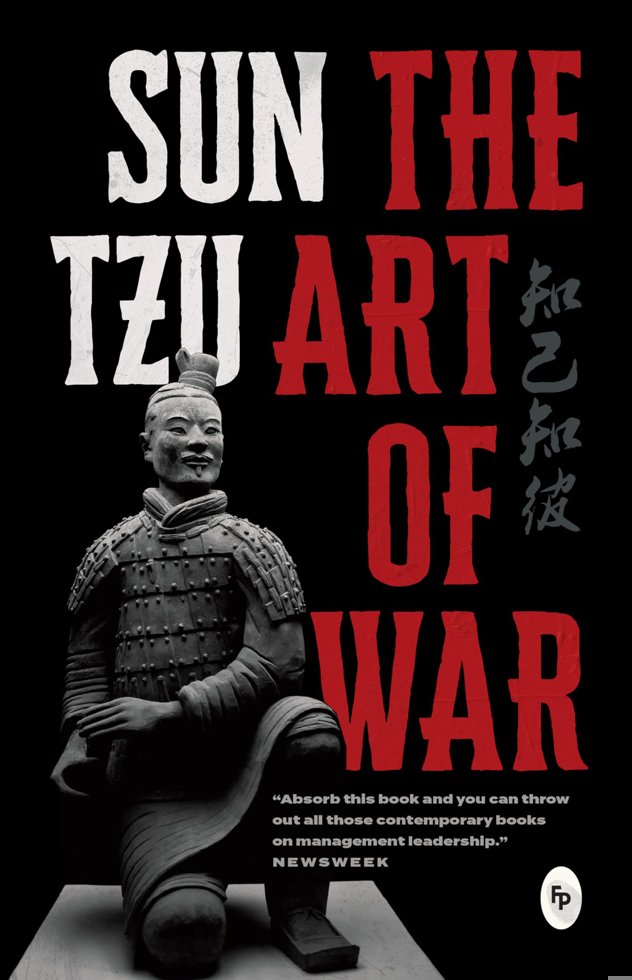
For more than two thousand years, The Art of War has stood as a cornerstone of Chinese culture-a lucid epigrammatic text that reveals as much about human psychology, politics, and economics as it does about battlefield strategy. The influence of Sun-tzu's text has grown tremendously in the West in recent years, with military leaders, politicians, and corporate executives alike finding valuable insight in these ancient words. In his crisp, accessible new translation, scholar John Minford brings this seminal work to life for modern readers.
Minford opens with a lively, learned introduction in which he explores the life and times of Sun-tzu, looks at The Art of War in the context of the turbulent Warring States period, and discusses how best to read and understand the work today. There follows Minford's translation of the core text itself in two different formats-first, the unadorned thirteen chapters of the original work and then the same text reprinted with extensive running commentary by classical Chinese scholars as well as Minford himself. The result is an opportunity for Western readers to experience Sun-tzu's work in all its intensity as it applies to many aspects of our lives.
Which books should be read by every single intelligent person on planet? … The Art of War (Sun Tsu) to learn that the act of killing fellow humans can be raised to an art. If you read all of the above works you will glean profound insight into most of what has driven the history of the western world. [source]
Cover unavailable
3
Tao of Jeet Kune Do
Bruce Lee
4.8
Compiled from Bruce Lee's notes and essays and originally published in 1975, this iconic volume is one of the seminal martial arts guides of its time. The science and philosophy behind the fighting system Lee pioneered himself--jeet kune do--is explained in detail, depicted through hundreds of Lee's own illustrations. With the collaboration of Lee's daughter, Shannon, and Bruce Lee Enterprises, this new edition is expanded, updated, and remastered, covering topics such as Zen and enlightenment, kicking, striking, grappling, and footwork. Featuring an introduction by Linda Lee, this is essential reading for any practitioner, offering a brief glimpse into the mind of one of the world's greatest martial artists.
A man who has attained mastery of an art reveals it in his every action."-- "Samurai Maximum."Under the guidance of such celebrated masters as Ed Parker and the immortal Bruce Lee, Joe Hyams vividly recounts his more than 25 years of experience in the martial arts. In his illuminating story, Hyam reveals to you how the daily application of Zen principles not only developed his physical expertise but gave him the mental discipline to control his personal problems-self-image, work pressure, competition. Indeed, mastering the spiritual goals in martial arts can dramatically alter the quality of your life-enriching your relationships with people, as well as helping you make use of all your abilities.
"If one of your goals is to live with maximum zest and minimum stress, read "Zen In The Martial Arts." The great beauty of the book is that as Hyams' mind receives enlightenment, so does our."-- "Playboy.
…
Cover unavailable
5
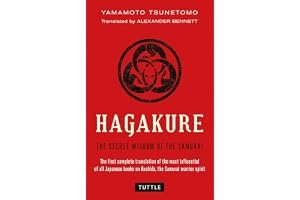
Hagakure: The Book of the Samurai
Yamamoto Tsunetomo, William Scott Wilson
4.5
Hagakure ("In the Shadow of Leaves") is a manual for the samurai classes consisting of a series of short anecdotes and reflections that give both insight and instruction-in the philosophy and code of behavior that foster the true spirit of Bushido-the Way of the Warrior. It is not a book of philosophy as most would understand the word: it is a collection of thoughts and sayings recorded over a period of seven years, and as such covers a wide variety of subjects, often in no particular sequence. The work represents an attitude far removed from our modern pragmatism and materialism, and possesses an intuitive rather than rational appeal in its assertion that Bushido is a Way of Dying, and that only a samurai retainer prepared and willing to die at any moment can be totally true to his lord. While Hagakure was for many years a secret text known only to the warrior vassals of the Hizen fief to which the author belonged, it later came to be recognized as a classic exposition of samurai thought and came to influence many subsequent generations, including Yukio Mishima. This translation offers 300 selections that constitute the core texts of the 1,300 present in the original. Hagakure was featured prominently in the film Ghost Dog, by Jim Jarmusch.
…
Cover unavailable
6
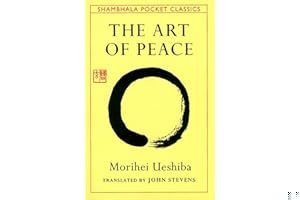
The Art of Peace (Shambhala Classics)
Morihei Ueshiba
4.5
The inspirational teachings in this collection show that the real way of the warrior is based on compassion, wisdom, fearlessness, and love of nature. The teachings are drawn from the talks and writings of Morihei Ueshiba, founder of the popular Japanese martial art of Aikido, a mind-body discipline he called the "Art of Peace," which offers a nonviolent way to victory in the face of conflict. Ueshiba believed that Aikido principles could be applied to all the challenges we face in life—in personal relationships, as we interact with society, and at work and in business.
This edition is a much-expanded version of the original miniature edition that appeared in the Shambhala Pocket Classics series. It features a wealth of new material, including a biography of Ueshiba; an essay by John Stevens that presents Ueshiba's views on "The Art of War versus the Art of Peace"; newly translated doka, didactic "poems of the Way"; and Ueshiba's own calligraphies.
…
Cover unavailable
7
Karate-Do: My Way of Life
Gichin Funakoshi
4.5
The father of Karate-do describes his life of devotion to the practices and spirit of the ancient martial art and his contributions to its modern-day evolution.
Cover unavailable
8
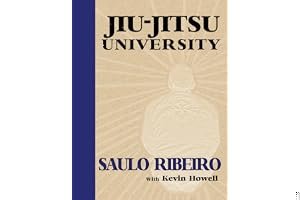
Jiu-Jitsu University
Saulo Ribeiro
4.5
Saulo Ribeiro—six-time Brazilian Jiu-Jitsu World Champion—is world-renowned for his functional jiu-jitsu knowledge and flawless technique. In Jiu-Jitsu University, Ribeiro shares with the public for the first time his revolutionary system of grappling, mapping out more than 200 techniques that carry you from white to black belt. Illuminating common jiu-jitsu errors and then illustrating practical remedies, this book is a must for all who train in jiu-jitsu. Not your run-of-the-mill technique book, Jiu-Jitsu University is a detailed training manual that will ultimately change the way jiu-jitsu is taught around the globe.
…
Cover unavailable
9
Aikido and the Dynamic Sphere: An Illustrated Introduction
Adele Westbrook, Oscar Ratti
4.4
Aikido and the Dynamic Sphere: An Illustrated Introduction provides a complete foundation in the practice of one of the most distinctive and useful Japanese martial arts.
Aikido was created in Japan in the 1920's by Morihei Ueshiba, also known as Osensei. To possess the skills, techniques and attitude of the faithful practitioner of aikido, one must achieve a very high level of integration of the powers of mind and body, the harmonious combination of physical means and ethical motives. By controlling body position and learning how to harmonize important physical and mental abilities, anyone (regardless of size, strength or weight) can fend off attacks using this sophisticated martial art.
Written and illustrated by husband/wife team, Oscar Ratti and Adele Westbrook, Aikido and the Dynamic Sphere, with over 1,200 illustrations, includes many Aikido techniques in chapters such as: What is Aikido? The Foundations of Aikido The Practice of Aikido The Basic Techniques of Neutralization Advanced Practice And more!
…
Cover unavailable
10
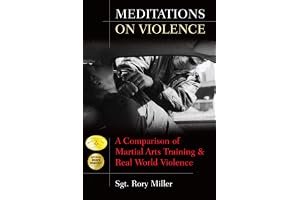
Meditations on Violence: A Comparison of Martial Arts Training & Real World Violence
Rory Miller
4.4
Experienced martial artist and veteran correction officer Sgt. Rory Miller distills what he has learned from jailhouse brawls, tactical operations and ambushes to explore the differences between martial arts and the subject martial arts were designed to deal with: Violence. Sgt. Miller introduces the myths, metaphors and expectations that most martial artists have about what they will ultimately learn in their dojo. This is then compared with the complexity of the reality of violence. Complexity is one of the recurring themes throughout this work. Section Two examines how to think critically about violence, how to evaluate sources of knowledge and clearly explains the concepts of strategy and tactics. Sections Three and Four focus on the dynamics of violence itself and the predators who perpetuate it. Drawing on hundreds of encounters and thousands of hours spent with criminals Sgt. Miller explains the types of violence; how, where, when and why it develops; the effects of adrenaline; how criminals think, and even the effects of drugs and altered states of consciousness in a fight. Section Five centers on training for violence, and adapting your present training methods to that reality. It discusses the pros and cons of modern and ancient martial arts training and gives a unique insight into early Japanese kata as a military training method. Section Six is all about how to make self-defense work. Miller examines how to look at defense in a broader context, and how to overcome some of your own subconscious resistance to meeting violence with violence. The last section deals with the aftermath--the cost of surviving sudden violence or violent environments, how it can change you for good or bad. It gives advice for supervisors and even for instructors on how to help a student/survivor. You'll even learn a bit about enlightenment.
…
Recommended by Kaci Lambe Kai.
Kaci Lambe Kai
I'm an avid martial artist and I'm currently training to become a Krav Maga instructor. I take this work very seriously and this is part of my studies in the world of self defense. [source]
Cover unavailable
11
Zen in the Art of Archery
Eugen Herrigel
4.4
The path to achieving Zen (a balance between the body and the mind) is brilliantly explained by Professor Eugen Herrigel in this timeless account.
This book is the result of the author’s six year quest to learn archery in the hands of Japanese Zen masters. It is an honest account of one man’s journey to complete abandonment of ‘the self’ and the Western principles that we use to define ourselves. Professor Herrigel imparts knowledge from his experiences and guides the reader through physical and spiritual lessons in a clear and insightful way.
Mastering archery is not the key to achieving Zen, and this is not a practical guide to archery. It is more a guide to Zen principles and learning and perfect for practitioners and non-practitioners alike.
…
Recommended by Adam Robinson, Adam Robinson, Aubrey Marcus, and 1 others.
Adam Robinson
One of five books that confirm there is far, far more in our unconscious mind than is dreamt of in our philosophy. [source]
Adam Robinson
One of five books that confirm there is far, far more in our unconscious mind than is dreamt of in our philosophy. [source]
The Unfettered Mind: Writings from a Zen Master to a Master Swordsman
Takuan Soho
4.4
The Japanese have always closely associated the sword and the spirit, but it was in the 1600s during the Tokugawa shogunate when the techniques of swordsmanship became forever associated with the spirit of Zen. The Unfettered Mind is a book of advice on swordsmanship and the cultivation of right mind and intention, written by the 17th-century Zen master Takuan Soho (1573-1645). Takuan was a gardener, calligrapher, poet, author, adviser to samurai and shoguns, and a pivotal figure in Zen painting. He was also known for his brilliance and acerbic wit. The succinct and pointed essays in this book were written to the samurai Yagyu Munenori, who was a great swordsman and rival to the legendary Miyamoto Musashi.
In these writings Soho is concerned primarily with understanding and refining the mind—both generally and when faced with conflict. Soho illuminates the difference between the right mind and the confused mind, the nature of right-mindedness, and what makes life precious. First published in 1988, this book is considered a true classic that influenced the direction that the art of Japanese swordsmanship has taken since.
…
Cover unavailable
13
Bruce Lee's Fighting Method: The Complete Edition
Bruce Lee, M. Uyehara
4.3
Vividly illustrating the techniques of a legendary innovator, this definitive examination explains how to survive attacks on the street, increase training awareness, and develop body movements. Originally compiled as a four-volume series, this revised edition breathes new life into a classic work with digitally-enhanced photography of jeet kune do founder Bruce Lee in his prime, a new chapter by former Lee student Ted Wong, and an introduction by Shannon Lee. This renowned compendium once again reclaims its place as an integral part of the Lee canon and a necessary addition for collectors and martial arts enthusiasts alike.
…
Recommended by Secret Agent Number Six.
Secret Agent Number Six
What is your favorite book? Mine are Bruce Lee's Fighting Methods. https://t.co/pAinxSCil1 [source]
Cover unavailable
14
Striking Thoughts: Bruce Lee's Wisdom for Daily Living
Bruce Lee, John Little
4.3
"A teacher is never a giver of truth—he is a guide, a pointer to the truth that each student must find for himself. A good teacher is merely a catalyst."—Bruce Lee
Within the pages of Striking Thoughts, you will find the secrets of Bruce Lee's amazing success— as an actor, martial artist, and inspiration to the world. Consisting of eight sections, Striking Thoughts covers 72 topics and 825 aphorisms—from spirituality to personal liberation and from family life to filmmaking—all of which Bruce lived by.
His ideas helped energize his life and career, and made it possible for him to live a happy and assured life, overcoming difficult obstacles with seeming ease. His ideas also inspired his family, friends, students, and colleagues to achieve success in their own lives and this personal collection will help you in your journey too.
Sections include:
On First Principles—including life, existence, time, and death
On Being Human—including the mind, happiness, fear, and dreams
On Matters of Existence—health, love, marriage, raising children, ethics, racism, and adversity
On Achievement—work, goals, faith, success, money, and fame
On Art and Artists—art, filmmaking, and acting
On Personal Liberation—conditioning, Zen Buddhism, meditation, and freedom
On the Process of Becoming—self-actualization, self-help, self-expression, and growth
On Ultimate (Final) Principles—Yin-yang, totality, Tao, and the truth This Bruce Lee Book is part of the Bruce Lee Library which also features: Bruce Lee: The Celebrated Life of the Golden Dragon Bruce Lee: The Tao of Gung Fu Bruce Lee: Artist of Life Bruce Lee: Letters of the Dragon Bruce Lee: The Art of Expressing the Human Body Bruce Lee: Jeet Kune Do
…
Cover unavailable
15
Bushido: The Soul of Japan. A Classic Essay on Samurai Ethics
Inazo Nitobe
4.3
Cover unavailable
16
Living the Martial Way: A Manual for the Way of Modern Warrior Should Think
Forrest E. Morgan
4.3
A step-by-step approach to applying the Japanese warrior's mind set to martial training and daily life.
Cover unavailable
17
Kodokan Judo: The Essential Guide to Judo by Its Founder Jigoro Kano
Jigoro Kano
4.3
Judo, or the Way of Gentleness, an ideal form of physical exercise and a reliable system. of self-defense, was specially created from traditional Japanese martial arts. This book by the creator of Kodokan judo is uniquely comprehensive and the most authoritative guide to this martial art ever published.
Over a hundred years ago Jigoro Kano mastered swordsmanship and hand-to-hand combat. Failing to discover any underlying principle, he set about designing a new martial art to reflect the concept of maximum efficiency in the use of physical and mental energy. Today, the concepts and techniques of judo taught at the Kodokan are the ones originally devised by their creator and collected together in this book. Covering everything from the fundamental techniques to prearranged formal exercises for both men and women, the book offers detailed explanations of how techniques are combined in two types of practice: randori (free practice) and kata (the practice of forms). In addition to a discussion of traditional methods of resuscitation, the book concludes with a useful appendix of information on the founder and the Kodokan International Judo Center, and a glossary of judo terminology. Fully illustrated throughout, Kodokan Judo will help students and instructors everywhere to discover the principles, techniques, and spirit of this popular martial art.
…
Cover unavailable
18
Code of the Samurai: A Modern Translation of the Bushido Shoshinshu of Taira Shigesuke
Oscar Ratti, Thomas Cleary
4.3
Learn the ways of the Japanese Bushido Code with this very readable, modern translation of the Bushido Shoshinshu.
Code of the Samurai is a four-hundred-year-old explication of the rules and expectations embodied in Bushido, the Japanese Way of the Warrior. Bushido has played a significant role in shaping the behavior of modern Japanese government, corporations, society, and individuals, as well as in developing modern Japanese martial arts within Japan and internationally.
The Japanese original of this book, Bushido Shoshinshu, (Bushido for Beginners), has been one of the primary sources on the tenets of Bushido, a way of thought that remains fascinating and relevant to the modern world, East and West. This handbook, written after five hundred years of military rule in Japan, was composed to provide practical and moral instruction for warriors, correcting wayward tendencies and outlining the personal, social, and professional standards of conduct characteristic of Bushido, the Japanese chivalric tradition.
With a bright, conversational narrative by Thomas Clear,y and powerfully evocative line drawings by master illustrator Oscar Ratti, this book is indispensable to corporate executives, students of Asian Culture, martial artists, or anyone sincerely interested in Japan and its people.
…
Recommended by Nick Rolovich.
Nick Rolovich
No event sparked this tweet. All is well in paradise, trust me. It was a quote that I found insightful from the book Code of the Samurai. Everyone back to enjoying Hawaii. Nothing to see here. [source]
Cover unavailable
19
Musashi
Eiji Yoshikawa, Charles Terry
4.3
The classic samurai novel about the real exploits of the most famous swordsman.
Miyamoto Musashi was the child of an era when Japan was emerging from decades of civil strife. Lured to the great Battle of Sekigahara in 1600 by the hope of becoming a samurai-without really knowing what it meant-he regains consciousness after the battle to find himself lying defeated, dazed and wounded among thousands of the dead and dying. On his way home, he commits a rash act, becomes a fugitive and brings life in his own village to a standstill-until he is captured by a weaponless Zen monk.
The lovely Otsu, seeing in Musashi her ideal of manliness, frees him from his tortuous punishment, but he is recaptured and imprisoned. During three years of solitary confinement, he delves into the classics of Japan and China. When he is set free again, he rejects the position of samurai and for the next several years pursues his goal relentlessly, looking neither to left nor to right.
Ever so slowly it dawns on him that following the Way of the Sword is not simply a matter of finding a target for his brute strength. Continually striving to perfect his technique, which leads him to a unique style of fighting with two swords simultaneously, he travels far and wide, challenging fighters of many disciplines, taking nature to be his ultimate and severest teacher and undergoing the rigorous training of those who follow the Way. He is supremely successful in his encounters, but in the Art of War he perceives the way of peaceful and prosperous governance and disciplines himself to be a real human being.
He becomes a reluctant hero to a host of people whose lives he has touched and been touched by. And, inevitably, he has to pit his skill against the naked blade of his greatest rival.
Musashi is a novel in the best tradition of Japanese story telling. It is a living story, subtle and imaginative, teeming with memorable characters, many of them historical. Interweaving themes of unrequited love, misguided revenge, filial piety and absolute dedication to the Way of the Samurai, it depicts vividly a world Westerners know only vaguely. Full of gusto and humor, it has an epic quality and universal appeal.
I bought this book at Kinokuniya bookstore in Shinjuku, Tokyo. It is as thick as a Harry Potter book, probably thicker, but the pages are as thin as onion skin. It’s a serious tome. I never expected to finish it, and I tore through it in less than two weeks. If you’re like me and enjoy a good Samurai story – the wandering ronin, epic battle scenes with lots of penetrating (wisdom), then you’ll love Eiji Yoshikawa’s Musashi. It’s sold more than 100 million copies in Japanese. Musashi’s transformation from talented yet conflicted young warrior to one of the greatest (perhaps the greatest) swordsman of all time teaches you about critical thinking, strategizing, and ultimately, that there is more to life than merely surviving. Musashi re-created himself from nothing and rose from destitution to legend. [source]
Cliff Hartono
My favourite non-business book is probably Musashi by Eiji Yoshikawa. It is a fictionalized history of Musashi Miyamoto, who is known in Japan as its greatest swordsman and warrior. He is probably one of the most underappreciated people in history – after being undefeated in countless duels, he became an accomplished architect, painter, sculptor, writer and philosopher. A captivating book about an endlessly fascinating person. [source]
Cover unavailable
20
Bruce Lee's Fighting Method: Self-Defense Techniques, Vol. 1
Bruce Lee
4.3
How to survive attacks on the street, defenses against surprise attacks, armed and unarmed assailants, one attacker or many, are among the topics covered.
Cover unavailable
21
Bruce Lee: The Art of Expressing the Human Body
Bruce Lee, John Little
4.3
Learn the secrets to obtaining Bruce Lee's astounding physique with this insightful martial arts training book.
The Art of Expressing the Human Body, a title coined by Bruce Lee himself to describe his approach to martial arts, documents the techniques he used so effectively to perfect his body for superior health and muscularity.
Beyond his martial arts and acting abilities, Lee's physical appearance and strength were truly astounding. He achieved this through an intensive and ever-evolving conditioning regime that is being revealed for the first time in this book.
Drawing on Lee's notes, letters, diaries and training logs, Bruce Lee historian John Little presents the full extent of Lee's unique training methods including nutrition, aerobics, isometrics, stretching and weight training.
In addition to serving as a record of Bruce Lee's training, The Art of Expressing the Human Body, with its easy-to-understand and simple-to-follow training routines, is a valuable source book for those who seek dramatic improvement in their health, conditioning, physical fitness, and appearance.
This Bruce Lee Book is part of the Bruce Lee Library which also features: Bruce Lee: Striking Thoughts Bruce Lee: The Celebrated Life of the Golden Dragon Bruce Lee: The Tao of Gung Fu Bruce Lee: Artist of Life Bruce Lee: Letters of the Dragon Bruce Lee: Jeet Kune Do
…
Cover unavailable
22
The Art of Learning: A Journey in the Pursuit of Excellence
Josh Waitzkin knows what it means to be at the top of his game. A public figure since winning his first National Chess Championship at the age of nine, Waitzkin was catapulted into a media whirlwind as a teenager when his father's book "Searching for Bobby Fischer" was made into a major motion picture. After dominating the scholastic chess world for ten years, Waitzkin expanded his horizons, taking on the martial art Tai Chi Chuan and ultimately earning the title of World Champion. How was he able to reach the pinnacle of two disciplines that on the surface seem so different? "I've come to realize that what I am best at is not Tai Chi, and it is not chess," he says. "What I am best at is the art of learning."In his riveting new book, "The Art of Learning," Waitzkin tells his remarkable story of personal achievement and shares the principles of learning and performance that have propelled him to the top -- twice.
With a narrative that combines heart-stopping martial arts wars and tense chess face-offs with life lessons that speak to all of us, "The Art of Learning" takes readers through Waitzkin's unique journey to excellence. He explains in clear detail how a well-thought-out, principled approach to learning is what separates success from failure. Waitzkin believes that achievement, even at the championship level, is a function of a lifestyle that fuels a creative, resilient growth process. Rather than focusing on climactic wins, Waitzkin reveals the inner workings of his everyday method, from systematically triggering intuitive breakthroughs, to honing techniques into states of remarkable potency, to mastering the art of performance psychology.
Through his own example, Waitzkin explains how to embrace defeat and make mistakes work for you. Does your opponent make you angry? Waitzkin describes how to channel emotions into creative fuel. As he explains it, obstacles are not obstacles but challenges to overcome, to spur the growth process by turning weaknesses into strengths. He illustrates the exact routines that he has used in all of his competitions, whether mental or physical, so that you too can achieve your peak performance zone in any competitive or professional circumstance.
In stories ranging from his early years taking on chess hustlers as a seven year old in New York City's Washington Square Park, to dealing with the pressures of having a film made about his life, to International Chess Championships in India, Hungary, and Brazil, to gripping battles against powerhouse fighters in Taiwan in the Push Hands World Championships, "The Art of Learning" encapsulates an extraordinary competitor's life lessons in a page-turning narrative.
…
Recommended by Bryan Callen, Chris Oliver, Dave Elitch, and 4 others.
I probably have recommended The Art of Learning and The 4-Hour Body, I'm not kidding, more than any other books. [source]
Chris Oliver
The Art of Learning as well is phenomenal. You're always learning new things in programming and startups so being good at learning is a crucial skill to have. [source]
Dave Elitch
I tell everyone I teach to get this book. [source]
Cover unavailable
23
Secrets of the Samurai: The Martial Arts of Feudal Japan
Oscar Ratti, Adele Westbrook
4.3
Explains in detail the weapons, techniques, strategies and principles of combat that made the Japanese warrior a formidable foe. An essential work for anyone with an interest in Japanese battle techniques or military traditions.
Cover unavailable
24
The Life-Giving Sword: Secret Teachings from the House of the Shogun
Yagyu Munenori, William Scott Wilson
4.2
This is a translation of an important classic on Zen swordfighting. Yagyu Munenori was so widely renowned that he was appointed official sword instructor to two Tokugawa shoguns. (The position was always coveted by Miyamoto Musashi, but he never succeeded in gaining the post). Yagyu's style is known as the Shinkage-ryu style, for centuries the official style of the Tokugawa dynasty. His spiritual mentor was Zen priest Takuan. Here, Yagyu's Buddhist spirituality is clearly reflected in his central idea of the "life-giving sword" - the notion of controlling an opponent by the spiritual readiness to fight, rather than during the fight. His mastery of restraint and diplomacy made him a trusted political and military advisor to the shoguns. This book is a look into a master swordsman's thoughts on nonattachment and even non-violence.
…
Cover unavailable
25
Bruce Lee's Fighting Method: Basic Training, Vol. 2
Bruce Lee
4.2
Reveals how the iconic warrior attained his legendary speed, power, and footwork. Included are practical, effective stretches for increasing flexibility, abdominal exercises that can be performed anywhere, and hard-hitting advice on running, biking, skipping rope, and shadowboxing. More than just a fitness guide, this must-have manual also delves into the fundamental aspects of Bruce Lee’s revolutionary combat philosophy, jeet kune do, including how to strengthen your fists with iron-palm training, get the most out of your punches and kicks, camouflage your attacks, develop the footwork to evade almost any blow, cover distance rapidly, escape from a tight corner, conserve energy for countering, build muscles without sacrificing speed, fix flaws in your stance, and improve your peripheral vision, leverage, and timing.
…
Cover unavailable
26
The Twenty Guiding Principles of Karate: The Spiritual Legacy of the Master
Gichin Funakoshi, Jotaro Takagi, John Teramoto
4.2
Gichin Funakoshi, "the father of karate," once said that "the ultimate aim of karate lies not in victory nor defeat, but in the perfection of the character of its participants."
Cover unavailable
27
Karate-Do Kyohan: The Master Text
Gichin Funakoshi
4.2
Nineteen "kata" ("forms") of karate - the art of self-defense without weapons - are presented here in complete detail. They are the ones selected by the great master and teacher, Gichin Funakoshi, to give comprehensive training in Karate-do, the way of karate.
Cover unavailable
28
The Warrior Within: The philosophies of Bruce Lee to better understand the world around you and achieve a rewarding life
John Little
4.2
Inspire and educate yourself with this comprehensive guide to the tactful and legendary ways of renowned martial arts master, Bruce Lee!
During his lifetime, legendary martial artist Bruce Lee formulated a complex personal philosophy--a synthesis of Eastern and Western ideals--that extolled the virtues of knowledge and total mastery of one's self. However, most of his philosophical writings could be found only within the personal library of the Bruce Lee estate--until now. The Warrior Within is the most comprehensive volume of these teachings, meant to help you apply Lee's philosophies to your own life. This unique guide reveals such life-affirming secrets as:
Seeing the totality of life and putting things into perspective
Understanding the concept of Yin and Yang
Defeating adversity by adapting to circumstances
Tapping into inner spiritual forces to help shape the future
With a foreword by his wife, Linda Lee Cadwell and photographs and other memorabilia from Bruce Lee's short but celebrated life, The Warrior Within is an engrossing and easy-to-understand guide to the little-explored world of Bruce Lee.
…
Cover unavailable
29
Tao Te Ching: By Lao Tzu - Illustrated
Lao Tse
4.2
A lucid translation of the well-known Taoist classic by a leading scholar-now in a Shambhala Pocket Library edition. Written more than two thousand years ago, the Tao Teh Ching, or -The Classic of the Way and Its Virtue, - is one of the true classics of the world of spiritual literature. Traditionally attributed to the legendary -Old Master, - Lao Tzu, the Tao Teh Ching teaches that the qualities of the enlightened sage or ideal ruler are identical with those of the perfected individual. Today, Lao Tzu's words are as useful in mastering the arts of leadership in business and politics as they are in developing a sense of balance and harmony in everyday life. To follow the Tao or Way of all things and realize their true nature is to embody humility, spontaneity, and generosity. John C. H. Wu has done a remarkable job of rendering this subtle text into English while retaining the freshness and depth of the original. A jurist and scholar, Dr. Wu was a recognized authority on Taoism and the translator of several Taoist and Zen texts and of Chinese poetry. This book is part of the Shambhala Pocket Library series. The Shambhala Pocket Library is a collection of short, portable teachings from notable figures across religious traditions and classic texts. The covers in this series are rendered by Colorado artist Robert Spellman. The books in this collection distill the wisdom and heart of the work Shambhala Publications has published over 50 years into a compact format that is collectible, reader-friendly, and applicable to everyday life.
Q: What are the books that had a major influence on you? Or simply the ones you like the most. : Tao te Ching, score takes care of itself, between the world and me, the four agreements, the old man and the sea...I love reading! [source]
According to a Yibada interview with Chen Wei, who wrote Ma’s 2014 authorized biography, the Alibaba founder and executive chairman always carries the Tao Te Ching, the foundational text of Taoist philosophy, religion and ethics composed by Lao Tzu in the sixth century B.C. [source]
In the philosophy side, I’ve been rereading the Tao Te Ching. [source]
Cover unavailable
30
Bruce Lee's Fighting Method: Advanced Techniques, Vol. 4
Bruce Lee
4.2
The legendary fighter teaches how to perform jeet kune do’s most devastating strikes and exploit an opponent’s weaknesses with crafty counterattacks like finger jabs and spin kicks. In addition, Lee breaks down the attributes that make up the ultimate warrior and reveals how to develop the proper tactics and attitude for victory. As the fourth and final volume in the Bruce Lee’s Fighting Method series, it contains detailed illustrations and vintage photos capturing Lee in his prime. This essential series, compiled and organized by his close friend, Mito Uyehara, is the perfect companion to Bruce Lee’s classic text, Tao of Jeet Kune Do.
…
Cover unavailable
31
Bruce Lee Jeet Kune Do: Bruce Lee's Commentaries on the Martial Way
Bruce Lee
4.2
Compiled from Bruce Lee's notes and writings, Bruce Lee Jeet Kune Do is the seminal book presenting the martial art created by Bruce Lee himself.
Jeet Kune Do was a revolutionary new approach to the martial arts in its time and is the principal reason why Bruce Lee is revered as a pioneer by martial artists today, many decades after his death. The development of his unique martial art form—its principles, core techniques, and lesson plans—are all presented in this book in Bruce Lee's own words and notes. This book is the complete and official version of Jeet Kune Do which was originally published by Tuttle Publishing in cooperation with the Lee family in 1997. It is still the most comprehensive presentation of Jeet Kune Do available.
This Jeet Kune Do book features Lee's illustrative sketches and his remarkable notes and commentaries on the nature of combat and achieving success in life through the martial arts, as well as the importance of a positive mental attitude during training. Also, there is a series of "Questions Every Martial Artist Must Ask Himself" that Lee posed to himself and intended to explore as part of his development, but never lived to complete. Bruce Lee Jeet Kune Do is the book every Bruce Lee fan must have in his collection.
This Bruce Lee Book is part of the Bruce Lee Library which also features: Bruce Lee: Striking Thoughts Bruce Lee: The Celebrated Life of the Golden Dragon Bruce Lee: The Tao of Gung Fu Bruce Lee: Artist of Life Bruce Lee: Letters of the Dragon Bruce Lee: The Art of Expressing the Human Body
…
Cover unavailable
32
American Shaolin: Flying Kicks, Buddhist Monks, and the Legend of Iron Crotch: An Odyssey in the New China
Matthew Polly
4.2
Cover unavailable
33
Bruce Lee's Fighting Method: Skill in Techniques, Vol. 3
Bruce Lee
4.2
Bruce Lee teaches you how to develop skills in body movement, hand techniques, kicking, parrying, striking vital target points and sparring.
Cover unavailable
34
A Fighter's Heart: One Man's Journey Through the World of Fighting
Sam Sheridan
4.2
In 1999, after a series of wildly adventurous jobs around the world, Sam Sheridan found himself in Australia, loaded with cash and intent on not working until he'd spent it all. It occurred to him that, without distractions, he could finally indulge a long-dormant obsession: fighting. Within a year, he was in Bangkok training with the greatest fighter in muay Thai (Thai kickboxing) history and stepping through the ropes for a professional bout. That one fight wasn't enough. Sheridan set out to test himself on an epic journey into how and why we fight, facing Olympic boxers, Brazilian jiu-jitsu stars, and Ultimate Fighting champions. Along the way, Sheridan delivers an insightful look at violence as a career and a spectator sport, a behind-the-pageantry glimpse of athletes at the top of their terrifying game. An extraordinary combination of gonzo journalism and participatory sports writing, A Fighter's Heart is a dizzying first-hand account of what it's like to reach the peak of finely disciplined personal aggression, to hit--and be hit.
I read both of Sam Sheridan’s books A Fighter’s Heart and A Fighter’s Mind this year and they are both spectacular. Don’t be put off by the subject matter. They are good. [source]
Cover unavailable
35
Bruce Lee: Artist of Life
Bruce Lee, John Little
4.2
A rare, never-before-seen collection of Lee's private letters and writing, offering insight into the many facets of his life, including his poetry, life philosophies, and his thoughts on martial arts, love, fatherhood, friendship. A fascinating look at the man behind the myth.
One of Bruce Lee’s primary missions in life was to authentically express himself. He also had a high need for public expression of his excellence. And he found it in the arts. He just holds up the flag for the balance between a deep internal investigation, and a relentless commitment to an external craft. [source]
Cover unavailable
36
The Bible of Karate Bubishi
Patrick McCarthy
4.2
Philosophy, strategy and medicine as related to the martial arts, translated with commentary.
Cover unavailable
37
Facing Violence: Preparing for the Unexpected
Rory Miller
4.2
Survival Favors the Prepared Mind--Robert Crowley
This book stands alone as an introduction to the context of self-defense. There are seven elements that must be addressed to bring self-defense training to something approaching 'complete.' Any training that dismisses any of these areas leaves you vulnerable.
1. Legal and ethical implications. A student learning self-defense must learn force law. Otherwise it is possible to train to go to prison. Side by side with the legal rules, every student must explore his or her own ethical limitations. Most do not really know where this ethical line lies within them. 2. Violence dynamics. Self-defense must teach how attacks happen. Students must be able to recognize an attack before it happens and know what kind they are facing. 3. Avoidance. Students need to learn and practice not fighting. Learning includes escape and evasion, verbal de-escalation, and also pure-not-be there avoidance. 4. Counter-ambush. If the student didn't see the precursors or couldn't successfully avoid the encounter he or she will need a handful of actions trained to reflex level for a sudden violent attack. 5. Breaking the freeze. Freezing is almost universal in a sudden attack. Students must learn to recognize a freeze and break out of one. 6. The fight itself. Most martial arts and self-defense instructors concentrate their time right here. What is taught just needs to be in line with how violence happens in the world. 7. The aftermath. There are potential legal, psychological, and medical effects of engaging in violence no matter how justified. Advanced preparation is critical. Any teacher or student of self-defense, anyone interested in self-defense, and any person who desires a deeper understanding of violence needs to read this book.
We strongly recommend this book to anybody wishing to learn self-defense, or understand how to stay safe should violence rear it's ugly head
…
Cover unavailable
38
Bruce Lee The Tao of Gung Fu: A Study in the Way of Chinese Martial Art
Bruce Lee, John Little
4.2
The Tao of Gung Fu reveals Bruce Lee's thoughtful analysis of the tapestry of Chinese martial arts—offering glimpses into the varied styles and his commentary on these arts. Lee's intense curiosity led him to accumulate this knowledge and expose the limitations of strict adherence to tradition, which inspired him to develop his cosmopolitan "way of no way."
The Tao of Gung Fu includes insights into various Chinese martial arts and training methodologies, sketches of martial arts techniques, Lee's personal scrapbook of his famous thesis, "The Tao of Gung Fu." Witness Lee's personal cultivation of excellence in martial arts. His application of philosophy to physical movements epitomizes the unification of mind and body—a genuine way of living for the martial artist.
Chapters include:
What is Gung Fu?—An Introduction to Chinese Gung Fu, On Yin and Yang, and Bridging the Gap of Yin and Yang
Some Techniques of Gung Fu—The Fundamentals of Gung Fu, The Basic Striking Points of Gung Fu, Introducing the Wing Chun Straight Punch, and The Practice of Forms
Taoism in the Chinese Art of Gung Fu—On Wu-Hsin (No-Mindedness), On Wu Wei (Nondoing), and Centered Thoughts
Ideas and Opinions—Traditions and Histories of Chinese Gung Fu, The Question of Psychic Center, and Bruce's view on Gung Fu
Appendices—Bruce Lee's gung fu background at the time he wrote this book, Gung Fu terminology, and Letters and gung fu scrapbook This Bruce Lee Book is part of the Bruce Lee Library which also features: Bruce Lee: Striking Thoughts Bruce Lee: The Celebrated Life of the Golden Dragon Bruce Lee: Artist of Life Bruce Lee: Letters of the Dragon Bruce Lee: The Art of Expressing the Human Body Bruce Lee: Jeet Kune Do
…
Cover unavailable
39
The Spirit of Aikido
Kisshomaru Ueshiba
4.2
Aiki is the power of harmony, of all beings, all things working together.
Aikido-a modern Japanese martial art unique in its synthesis of classic forms with a well-defined spiritual base-offers a key to the art of living naturally and unselfishly in a complicated world. This book explains it in reference to the founder's philosophy of mind-and action. In addition, the history of aikido's prewar development as a non-competitive new martial art is described, with a consideration of its international role.
…
Cover unavailable
40
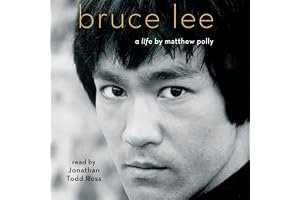
Bruce Lee: A Life
Matthew Polly
4.2
“The first noteworthy treatment of its subject—and a definitive one at that...Fascinating narrative threads proliferate.” —The New York Times Book Review
The most authoritative biography—featuring dozens of rarely seen photographs—of film legend Bruce Lee, who made martial arts a global phenomenon, bridged the divide between Eastern and Western cultures, and smashed long-held stereotypes of Asians and Asian-Americans.
Forty-five years after Bruce Lee’s sudden death at age thirty-two, journalist and bestselling author Matthew Polly has written the definitive account of Lee’s life. It’s also one of the only accounts; incredibly, there has never been an authoritative biography of Lee. Following a decade of research that included conducting more than one hundred interviews with Lee’s family, friends, business associates, and even the actress in whose bed Lee died, Polly has constructed a complex, humane portrait of the icon.
Polly explores Lee’s early years as a child star in Hong Kong cinema; his actor father’s struggles with opium addiction and how that turned Bruce into a troublemaking teenager who was kicked out of high school and eventually sent to America to shape up; his beginnings as a martial arts teacher, eventually becoming personal instructor to movie stars like James Coburn and Steve McQueen; his struggles as an Asian-American actor in Hollywood and frustration seeing role after role he auditioned for go to a white actors in eye makeup; his eventual triumph as a leading man; his challenges juggling a sky-rocketing career with his duties as a father and husband; and his shocking end that to this day is still shrouded in mystery.
Polly breaks down the myths surrounding Bruce Lee and argues that, contrary to popular belief, he was an ambitious actor who was obsessed with the martial arts—not a kung-fu guru who just so happened to make a couple of movies. This is an honest, revealing look at an impressive yet imperfect man whose personal story was even more entertaining and inspiring than any fictional role he played onscreen.
…
Cover unavailable
41
The Demon's Sermon on the Martial Arts
Issai Chozanshi, William Scott Wilson
4.2
The Demon said to the swordsman, "Fundamentally, man's mind is not without good. It is simply that from the moment he has life, he is always being brought up with perversity. Thus, having no idea that he has gotten used to being soaked in it, he harms his self-nature and falls into evil. Humandesire is the root of this perversity."
Woven deeply into the martial traditions and folklore of Japan, the fearsome Tengu dwell in the country's mountain forest. Mythical half-man, half-bird creatures with long noses, Tengu have always inspired dread and awe, inhabiting a liminal world between the human and the demonic, and guarding the most hidden secrets of swordsmanship. In The Demon's Sermon on the Martial Arts, a translation of the 18th-century samurai classic by Issai Chozanshi, an anonymous swordsman journeys to the heart of Mt. Kurama, the traditional domain of these formidable beings. There he encounters a host of demon; through a series of discussions and often playful discourse, they reveal to him the very deepest principles of the martial arts, and show how the secrets of sword fighting impart the truths of life itself.
The Demon's Sermon opens with The discourses, a collection of whimsical fables concerned with the theme of transformation-for Chozanshi a core phenomenon to the martial artist. Though ostensibly light and fanciful, these stories offer the attentive reader ideas that subvert perceived notions of conflict and the individual's relationship to the outside world. In the main body of work, The Sermon, Chozanshi demonstrates how transformation is fostered and nurtured through ch'i - the vital and fundamental energy that flows through all things, animate and inanimate, and the very bedrock of Chozanshi's themes and the martial arts themselves. This he does using the voice of the Tengu, and the reader is invited to eavesdrop with the swordsman on the demon's revelations of the deepest truths concerning ch'i, the principles of yin and yang, and how these forces shape our existence. In The Dispatch, the themes are brought to an elegant conclusion using the parable of an old and toothless cat who, like the demon, has mastered the art of acting by relying on nothing, and in so doing can defeat even the wiliest and most vicious of rats despite his advanced years.
This is the first direct translation from the original text into English by William Scott Wilson, the renowned translator of Hagakure and The Book of Five Rings. It captures the tone and essence of this classic while still making it accessible and meaningful to today's reader. Chozanshi's deep understanding of Taoism, Buddhism, Confucianism, and Shinto, as well as his insight into the central role of ch'i in the universe, are all given thoughtful treatment in Wilson's introduction and extensive endnotes. A provocative book for the general reader, The Demon's Sermon will also prove an invaluable addition to the libraries of all those interested in the fundamental principles of the martial arts, and how those principles relate to our existence.
…
Cover unavailable
42
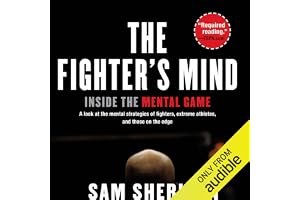
The Fighter's Mind: Inside the Mental Game
Sam Sheridan
4.2
In his acclaimed national best seller, A Fighter's Heart, Sam Sheridan took readers with him as he stepped through the ropes into the dangerous world of professional fighting. From a muay Thai bout in Bangkok to Rio, where he trained with jiu-jitsu royalty, to Iowa, where he matched up against the toughest in MMA, Sheridan threw himself into a quest to understand how and why we fight. In The Fighter's Mind, Sheridan does for the brain what his first book did for the body. To uncover the secrets of mental strength and success, Sheridan interviewed dozens of the world's most fascinating and dangerous men, including celebrated trainers Freddie Roach and Greg Jackson; champion fighters Randy Couture, Frank Shamrock, and Marcelo Garcia; ultrarunner David Horton; legendary wrestler Dan Gable, and many more. What are their secrets? How do they stay committed through years of training, craft a game plan, and adjust to the realities of the ring? How do they project strength when weak, and remain mentally tough despite incredible physical pain? A fascinating book, bursting at the seams with incredible stories and insight, The Fighter's Mind answers these questions and many more.
I read both of Sam Sheridan’s books A Fighter’s Heart and A Fighter’s Mind this year and they are both spectacular. Don’t be put off by the subject matter. They are good. [source]
Cover unavailable
43
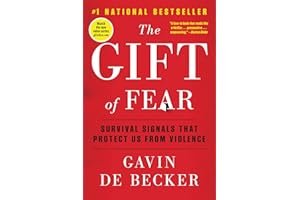
The Gift of Fear: Survival Signals That Protect Us from Violence
Gavin De Becker
4.2
True fear is a gift. Unwarranted fear is a curse. Learn how to tell the difference.
A date won't take "no" for an answer. The new nanny gives a mother an uneasy feeling. A stranger in a deserted parking lot offers unsolicited help. The threat of violence surrounds us every day. But we can protect ourselves, by learning to trust—and act on—our gut instincts.
In this empowering book, Gavin de Becker, the man Oprah Winfrey calls the nation's leading expert on violent behavior, shows you how to spot even subtle signs of danger—before it's too late. Shattering the myth that most violent acts are unpredictable, de Becker, whose clients include top Hollywood stars and government agencies, offers specific ways to protect yourself and those you love, including how to act when approached by a stranger, when you should fear someone close to you, what to do if you are being stalked, how to uncover the source of anonymous threats or phone calls, the biggest mistake you can make with a threatening person, and more. Learn to spot the danger signals others miss. It might just save your life.
The Gift of Fear by Gavin de Becker shares a bunch of anecdotes from violent attacks, how the victims often knew per instinct that something wasn’t right, but suppressed that instinct for fear of seeming rude or silly or whatever. He also presents a bunch of analytical frameworks for evaluating threats, stalkers, and other menaces. But it’s not a dry textbook. Gavin had a violent upbringing and brings a lot of personal anecdotes and perspectives to bear as well. [source]
Nicholas C. Zakas
If I had a daughter, girlfriend, or wife, I’d highly recommend this book to them. https://t.co/rwuAY7cIXw Less useful for men unless you have reason to fear assassination, but an interesting read nonetheless. [source]
Cover unavailable
44
Dynamic Aikido
Gozo Shioda
4.2
Aikido-a martial art deriving its effectiveness, like judo and karate, from the flow of ki
-- techniques that, when thoroughly mastered, enable the gentle to overcome the strong
-- exercise and sport for men and women of all ages, based on natural movements and harmony of mind and body
Ancient theory, modern practice: Dynamic Aikido brings together the whole spectrum of theoretical and applied aikido. Through it, one can become perfectly attuned to one's opponent, can sense his intentions and turn his movements to one's own advantage. Comprehensive and fully illustrated, DynamicAikido presents the basic postures and stances, fundamental techniques and applications: how to cope with a frontal attack, how to avoid an attack from the rear, how to sense and thwart the pickpocket. An essential companion for every beginner, a vital reference for students of all levels.
…
Cover unavailable
45
Budo: Teachings of the Founder of Aikido
Morihei Ueshiba, Kisshomaru Ueshiba
4.2
Morihei Ueshiba is rightly known as one of the world's greatest martial artists for his creation of aikido, the synthesis of his superb technique and his profound spiritual insight into the nature of the universe. Aikido is much more than just another fighting style, it is a holistic approach to life that Morihei described as "a divine path inspired by the gods that leads to truth, goodness, and beauty." Sadly, Morihei left few writings to explain his martial arts philosophy, preferring to teach his disciples by direct example.
Aikido students will be familiar with photographs and film footage of Morihei as an old man, effortlessly defeating his much younger opponents, but very little has been published about Morihei's prewar years, when he was perfecting aiki-budo, as aikido was then known. In 1938 Morihei wrote Budo (Martial Way) as an instruction manual and a statement of the aims and spirit of his martial arts philosophy. Budo, however, was never made available to the general public, and it even contains the injunction that "these techniques ... should not be disclosed indiscriminately to the public."
Now with the worldwide popularity of aikido rivaling that of judo and karate-do, the Aikikai Foundation and the Ueshiba family have decided that it is time for this historic treatise of the martial arts to be translated into English, and made available to general readers and students of aikido all over the world. Reproduced faithfully from the original, this seminal work contains one of the founder's few personal statements of his basic principles, expressed both in prose and mystical poetry. The text is accompanied by photographs of Morihei illustrating the aikido techniques he describes.
This martial arts classic is preceded by an introductory biographical essay on Morihei by his son Kisshomaru Ueshiba, the present chairman of the Aikikai Foundation. This enlightening work recounts the founder's early life, his inspirational 'encounter with the religious mystic Onisaburo Deguchi, and the spiritual revelations that led him to develop the art of aikido.
The volume concludes with a series of action photographs of the founder demonstrating aikido techniques, taken at a private dojo in Tokyo in 1936. This section also includes selected photographs of Morihei in action in 1951. The more than 400 historic photographs shown here provide an unequalled opportunity to observe the lifelong devotion to aikido and the continuity of performance that characterized Morihei's approach to his art.
…
Cover unavailable
46
On Combat: The Psychology and Physiology of Deadly Conflict in War and in Peace
Dave Grossman
4.1
Following his best selling, Pulitzer Prize nominated book On Killing, Lt. Col. Dave Grossman, with Loren W. Christensen, present On Combat, a ground-breaking examination of what it takes to perform, cope and survive in the toxicity of deadly combat as a soldier in a foreign land, and a police officer in the mean streets of urban America.
Written by two warriors who have been there and done that, On Combat looks at what happens to the human body under the stresses of deadly battle the impact on the nervous system, heart, breathing, visual and auditory perception, memory – then discusses new research findings as to what measures warriors can take to prevent such debilitations so they can stay in the fight, survive, and win.
…
Cover unavailable
47
The Zen Way to Martial Arts: A Japanese Master Reveals the Secrets of the Samurai
Taisen Deshimaru, Nancy Amphoux, George Leonard
4.1
At last: a book on the martial arts from a true Zen master. Taisen Deshimaru was born in Japan of an old samurai family, and he recieved from the Great Master Kodo Sawaki the Transmission of Mind to Mind when Sawaki died. In 1967, Deshimaru-Roshi went to France and taught as a missionary general of the Sato Zen School until his death in 1982. In Europe he learned how to make Oriental concepts understandable to the Western mind. One of the results of that experience was this book: a series of lessons, question-and-answer sessions, and koans (riddles or anecdotes that point out general principles) that provide practical wisdom for all students of the martial arts--kendo, aikido, iai-do, jodo, or archery--as well as for the general reader interested in Zen.
…
Cover unavailable
48
Angry White Pyjamas: A Scrawny Oxford Poet Takes Lessons from the Tokyo Riot Police
Robert Twigger
4.1
Adrift in Tokyo, translating obscene rap lyrics for giggling Japanese high school girls, "thirtynothing" Robert Twigger comes to a revelation about himself: He has never been fit nor brave. Guided by his roommates, Fat Frank and Chris, he sets out to cleanse his body and mind. Not knowing his fist from his elbow, the author is drawn into the world of Japanese martial arts, joining the Tokyo Riot Police on their yearlong, brutally demanding course of budo training, where any ascetic motivation soon comes up against bloodstained "white pyjamas" and fractured collarbones. In Angry White Pyjamas, Twigger blends, the ancient with the modern--the ultratraditionalism, ritual, and violence of the dojo (training academy) with the shopping malls, nightclubs, and scenes of everyday Tokyo life in the 1990s--to provide a brilliant, bizarre glimpse of life in contemporary Japan.
…
Cover unavailable
49
The Three Ninja Pigs
Corey Rosen Schwartz, Dan Santat
4.1
Practice makes perfect in this kick-butt fractured fairy tale.
Why does this wolf think he can come to town and blow all the houses down? These three little pigs just aren't going to take it from that bully anymore! The first starts aikido lessons---he'll make mincemeat out of that wolf! His brother learns a little jujitsu--he'll chop that guy to pieces!
But when the wolf actually appears, it turs out these two pigs aren't quite ready after all. Good thing their sister has been training every day to master some serious karate moves that save the day. KIYA!
Corey Rosen Schwartz serves up a fun combination of smart-aleck dialogue and tongue-in-cheek rhymes that'll have kids howling, and rising star Dan Santat's spunky illustrations are sure to pack a punch!
…
Cover unavailable
50
Ninjutsu History and Tradition
Masaaki Hatsumi
4.1
This is the only book on the art of ninjutsu written by Dr. Masaaki Hatsumi, the 34th-generation leader of the togakure-ryu ninjutsu tradition. This best-seller contains training and fighting secrets known only to the ninja of ancient Japan.
Cover unavailable
51
Brazilian Jiu-Jitsu: Theory and Technique
Renzo Gracie
4.1
While most martial arts deal only with the initial punching and kicking stages of combat, Brazilian jiu-jitsu concentrates on ground combat. This guide shows how to use Brazilian jiu-jitsu to increase combat effectiveness. Photographs and step-by-step instructions show how to master the techniques used in this exciting new form of combat.
Cover unavailable
52
Wing Chun Kung Fu: Traditional Chinese Kung Fu for Self-Defense and Health
Ip Chun and Michael Tse
4.1
Straightforward and efficient, Wing Chun Kung Fu is one of the most popular forms of Kung Fu because it emphasizes techniqu over strength. By using the skills of Wing Chun Kung Fu, a smaller and weaker person can easily overcome a larger strong opponent. With its focus on technique rather than force, it is suitable for both men and women, young and old, and for those of all levels of physical fitness. Grandmaster Ip Chun is regarded as the world's leading authority on Wing Chun. Bruce Lee--Wing Chun's most famous student--was taught by Ip Chun's father, Grandmaster Ip Man. Michael Ise is also a highly respected Qigong and martial arts master. Together they demonstrate that first form of Wing Chun (Siu Lim Tao) and show how it can be used for self-denence. They also outline the history and the art of Wing Chun and discuss its many other benefits, which include
Increased Energy and Vitality Greater Confidence and Inner Strength An Understanding of the Skills and Benefits of Meditation
With expert instruction and more than 100 step-by-step photographs, Wing Chun Kung Fu makes it easy to master the power and grace of this ancient martial art.
…
Cover unavailable
53
The Ninja and Their Secret Fighting Art
Stephen K. Hayes
4.1
Look past the legends and learn about the REAL ninjas of feudal Japan with this entertaining, illustrated ninjutsu guide.
Ninjutsu, the least understood of the Japanese martial arts, is an ancient fighting style emphasizing natural movement, responsiveness to adversaries, and absolute practicality. In feudal Japan, ninja were feared for their skill in espionage and, particularly, assassination. Masters of weaponry, stealth, and martial techniques, ninja were credited with supernatural powers because of the near-invincibility of their unique and deadly art.
In The Ninja and Their Secret Fighting Art, Black Belt Hall of Fame member, Stephen K. Hayes, reveals the secrets that lead to the perception of the ninja as warriors of almost sorcerous skill—the art of invisibility, special tools and weapons, and psychological training enabling the ninja to gain advantage in any situation.
Chapters include: Perspective—Origin; Organization; Training; At the Height of Power; The Decline; Ninjutsu in the Modern World Search for the Ninja Unarmed Combat—The Ninja Fists; Fighting Postures; Other Factors Weaponry—Chains and Cords; Sticks and Staffs; Canes with Concealed Weapons; The Ninja Sword; Throwing Blades The Way of Invisibility—Sense Deception; Phantom Steps; Reconnaissance; Blending with the Night; Attacking the Eyes; The Art of Disguise Shadow Warriors—Espionage; Commando Tactics The Realm of the Spirit—Psychological Warfare; The Force of the Killer; The Great Harmony
…
Cover unavailable
54
Moving toward Stillness: Lessons in Daily Life from the Martial Ways of Japan
Dave Lowry
4.1
Moving Toward Stillness: Lessons in Daily Life from the Martial Ways of Japan is a distillation of the most important lessons learned from a lifetime devoted to martial arts training.
Drawing from his highly regarded magazine columns in Black Belt magazine, author Dave Lowry sets out lessons that not only guide us to a deeper understanding of the social values and moral imperatives that are the ancient heart of budo, but speak to us also of the universal nature of those values and of how they remain relevant to us, in the modern West.
Among the 45 chapters of this martial arts philosophy book you'll find lessons addressing everything from such well-known martial concepts as "one encounter, one chance" to the art of being alone, from strategy for the modern-day battlefield to the luxury of anger, from subduing the self and bending like the bamboo to maintaining an unwavering calm in the face of death.
Essays include: The Way of the Master Excess Baggage Swimming 'Round the Stone Simple Things Even if I Die Not Knowing, But Doing and many more
…
Cover unavailable
55
Ultimate Flexibility: A Complete Guide to Stretching for Martial Arts
Sang H. Kim
4.1
A guide to stretching for martial arts, from the very basics of why you should stretch to detailed workout guidelines for every style and level of martial arts practice. It teaches you nearly 200 flexibility exercises that he has personally used to achieve the highest levels of flexibility.
Cover unavailable
56
Essence of Ninjutsu
Masaaki Hatsumi
4.1
Looking back almost 1,000 years, the mists of Japan's chaotic past shroud the development of a way of life, an ancient struggle waged against fierce feudal lords who ruled the island nation with swords of steel and a code of death before dishonor. The people of the mountainous regions of what is now Iga prefecture wanted to live in peace, but their lords had other plans-so the people learned the martial arts of self-defense and used their meager farm tools as weapons against the samurai blades of their oppressors. Nine traditions of the ninja arts grew out of this seemingly endless struggle, and legends were told of the supernatural abilities of the ninja fighters. The ninja never gained the kind of power that topples tyrants, but they gained a reputation that made tyrants cautious. And they gained the kind of power that makes the spirit endure and the mind the master of its fate. Told in actual stories of past grandmasters and in dojo lectures on techniques-with photographs, drawings, and paintings-the last surviving grandmaster of the ancient art of ninjutsu, Dr. Masaaki Hatsumi, presents Essence of Ninjutsu: The Nine Traditions. In it, he explains why, after more than 900 years, the art of the shadow warriors continues to inspire and serve practitioners from around the world. Dr. Hatsumi's book contains historic ninja scrolls and describes techniques for self-defense, and it debunks tricks that are attributed to the ninja but actually derive more from the circus than the martial arts. Essence of Ninjutsu is a fascinating, authoritative look at the roots of ninjutsu and how it continues to enrich the lives of its practitioners today. Dr. Masaaki Hatsumi is a bone doctor, artist, and writer, as well as the 34th grandmaster of the nine schools of the ninja arts in Japan. He has toured the United States in recent years to help Americans better understand the ninja and their way of life. His articles have appeared in all of the major martial arts magazines.
…
Cover unavailable
57
The Lone Samurai: The Life of Miyamoto Musashi
William Scott Wilson
4.1
The Lone Samurai is a landmark biography of Miyamoto Musashi, the legendary Japanese figure known throughout the world as a master swordsman, spiritual seeker, and author of The Book of Five Rings. With a compassionate yet critical eye, William Scott Wilson delves into the workings of Musashi's mind as the iconoclastic samurai wrestled with philosophical and spiritual ideas that are as relevant today as they were in his times. Musashi found peace and spiritual reward in seeking to perfect his chosen Way, and came to realize that perfecting a single Way, no matter the path, could lead to fulfillment. The Lone Samurai is far more than a vivid account of a fascinating slice of feudal Japan. It is the story of one man's quest for answers, perfection, and access to the Way.
By age thirteen, Miyamoto Musashi had killed his opponent in what would become the first of many celebrated swordfights. By thirty, he had fought more than sixty matches, losing none. He would live another thirty years but kill no one else. He continued to engage in swordfights but now began to show his skill simply by thwarting his opponents' every attack until they acknowledged Musashi's all-encompassing ability. At the same time, the master swordsman began to expand his horizons, exploring Zen Buddhism and its related arts, particularly ink painting, in a search for a truer Way.
Musashi was a legend in his own time. As a swordsman, he preferred the wooden sword and in later years almost never fought with a real weapon. He outfoxed his opponents or turned their own strength against them. At the height of his powers, he began to evolve artistically and spiritually, becoming one of the country's most highly regarded ink painters and calligraphers, while deepening his practice of Zen Buddhism. He funneled his hard-earned insights about the warrior arts into his spiritual goals. Ever the solitary wanderer, Musashi shunned power, riches, and the comforts of a home or fixed position with a feudal lord in favor of a constant search for truth, perfection, and a better Way. Eventually, he came to the realization that perfection in one art, whether peaceful or robust, could offer entry to a deeper, spiritual understanding. His philosophy, along with his warrior strategies, is distilled in his renowned work, The Book of Five Rings, written near the end of his life.
Musashi remains a source of fascination for the Japanese, as well as for those of us in the West who have more recently discovered the ideals of the samurai and Zen Buddhism. The Lone Samurai is the first biography ever to appear in English of this richly layered, complex seventeenth-century swordsman and seeker, whose legacy has lived far beyond his own time and place.
---------------------------------------------------------------- INTERVIEW WITH WILLIAM SCOTT WILSON ABOUT BUSHIDO
Q.: What is Bushido?
A.: Bushido might be explained in part by the etymology of the Chinese characters used for the word. Bu comes from two radicals meanings "stop" and "spear." So even though the word now means "martial" or "military affair," it has the sense of stopping aggression. Shi can mean "samurai," but also means "gentleman" or "scholar." Looking at the character, you can see a man with broad shoulders but with his feet squarely on the ground. Do, with the radicals of head and motion, originally depicted a thoughtful way of action. It now means a path, street or way. With this in mind, we can understand Bushido as a Way of life, both ethical and martial, with self-discipline as a fundamental tenet. Self-discipline requires the warrior at once to consider his place in society and the ethics involved, and to forge himself in the martial arts. Both should eventually lead him to understand that his fundamental opponents are his own ignorance and passions.
Q.: How did the code develop and how did it influence Japanese society?
A.: The warrior class began to develop as a recognizable entity around the 11th and 12th centuries. The leaders of this class were often descended from the nobility, and so were men of education and breeding. I would say that the code developed when the leaders of the warrior class began to reflect on their position in society and what it meant to be a warrior. They first began to write these thoughts down as yuigon, last words to their descendents, or as kabegaki, literally "wall writings," maxims posted to all their samurai. Samurai itself is an interesting word, coming from the classical saburau, "to serve." So when we understand that a samurai is "one who serves," we see that the implications go much farther than simply being a soldier or fighter.
Also, it is important to understand that Confucian scholars had always reflected on what it meant to be true gentleman, and they concluded that such a man would be capable of both the martial and literary. The Japanese inherited this system of thought early on, so certain ideals were already implicitly accepted.
The warrior class ruled the country for about 650 years, and their influence-political, philosophical and even artistic-had a long time to percolate throughout Japanese society.
Q.: The Samurai were very much renaissance men - they were interested in the arts, tea ceremony, religion, as well as the martial arts. What role did these interests play in the development of Bushido? How did the martial arts fit in?
A.: This question goes back to the Confucian ideal of balance that Japanese inherited, probably from the 7th century or so. The word used by both to express this concept, for the "gentleman" by the Chinese and the warrior by Japanese, is (hin), pronounced uruwashii in Japanese, meaning both "balanced" and "beautiful." The character itself is a combination of "literature" (bun) and "martial" (bu). The study of arts like Tea ceremony, calligraphy, the study of poetry or literature, and of course the martial arts of swordsmanship or archery, broadened a man's perspective and understanding of the world and, as mentioned above, provided him with a vehicle for self-discipline. The martial arts naturally were included in the duties of a samurai, but this did not make them any less instructive in becoming a full human being.
Q.: What was sword fighting like? Was the swordplay different for different samurai?
A.: There were literally hundreds of schools of samurai swordsmanship by the 1800's and, as previously mentioned, each school emphasized differing styles and approaches. Some would have the student to jump and leap, others to keep his feel solidly on the ground; some would emphasize different ways of holding the sword, others one method only. One school stated that technical swordsmanship took second place to sitting meditation. Historically speaking, there were periods when much of the swordfighting was done on horseback, and others when it was done mostly on foot. Also, as the shape and length of the sword varied through different epochs, so did styles of fighting. Then I suppose that a fight between men who were resolved to die would be quite different from a fight between men who were not interested in getting hurt.
Q.: How is the code reflected in Japanese society today?
A.: When I first came to live in Japan in the 60's, I was impressed how totally dedicated and loyal people were to the companies where they were employed. When I eventually understood the words samurai and saburau, it started to make sense. While these men (women would usually not stay long with a company, giving up work for marriage) did not carry swords of course, they seemed to embody that old samurai sense of service, duty, loyalty and even pride. This may sound strange in our own "me first" culture, but it impressed me that the company had sort of taken the place of a feudal lord, and that the stipend of the samurai had become the salary of the white-collar worker.M
That is on the societal level. On an individual level, I have often felt that Japanese have a strong resolution, perhaps from this cultural background of Bushido, to go through problems rather than around them. Persistence and patience developed from self-discipline?
…
Cover unavailable
58
Fight Like a Physicist: The Incredible Science Behind Martial Arts
Jason Thalken Ph.D.
4.1
Fight Like a Physicist provides an in-depth, sometimes whimsical look into the physics behind martial arts for sport and self-defense. Whether you are an experienced martial artist or a curious enthusiast, this book can give you an "unfair advantage" by unraveling the complex science of effective fighting techniques and examining the core principles that make them work.
In addition to breaking down the principles behind the punches, Dr. Thalken, a computational physicist with a long history of martial arts across various styles, applies the mind-set of a physicist to a number of controversial topics in the martial arts: -Making physics your "unfair advantage," in the ring and on the street -Examining center of mass, pi, levers, wedges, angular momentum, and linear momentum for martial artists -Protecting the brains of fighters and football players from concussions -Reducing traumatic brain injury in contact sports -Exposing the illusion of safety provided by gloves and helmets -Overturning conventional wisdom on compliance during an assault -Busting Hollywood action myths -Giving the mystical side of martial arts a much-needed reality check
Dr. Thalken invites readers to take a scientific approach to training and fighting, and provides all the tools necessary to get the most out of their experiences and make their training count.
…
Cover unavailable
59
In the Dojo: A Guide to the Rituals and Etiquette of the Japanese Martial Arts
Dave Lowry
4.1
Beginning students in Japanese martial arts, such as karate, judo, aikido, iaido, kyudo, and kendo, learn that when they are in the dojo (the practice space), they must don their practice garb with ritual precision, address their teacher and senior students in a specific way, and follow certain unwritten but deeply held codes of behavior. But very soon they begin to wonder about the meaning behind the traditions, gear, and relationships in the dojo.
In this collection of lively, detailed essays, Dave Lowry, one of the most well-known and respected swordsmen in the United States, illuminates the history and meaning behind the rituals, training costumes, objects, and relationships that have such profound significance in Japanese martial arts, including
• the dojo space itself • the teacher-student relationship • the act of bowing • what to expect—and what will be expected of you—when you visit a dojo • the training weapons • the hakama (ceremonial skirt) and dogi (practice uniform) • the Shinto shrine
Authoritative, insightful, and packed with fascinating stories from his own experience, In the Dojo provides a wealth of information that beginning students will pore over and advanced students will treasure.
…
Cover unavailable
60
Moving Zen: One Mans Journey to the Heart of Karate
C. W. Nicol
4.1
A classic story of one man's confrontation with the self through Karate.
In 1962 at age twenty-two, C. W. Nicol left Wales to study Karate in Japan. He quickly found that the study of the martial art engaged his whole being and transformed his outlook on life. Moving Zen is the multifaceted story of a young man who arrived in Japan to study the technique of, and spirit behind, Karate.
Joining the Japan Karate Association, or Shotokan, Nicol discovered that Karate, while extremely violent, also called for politeness and a sense of mutual trust and responsibility. He learned that the stronger the Karateka, the more inclined he was to be gentle with others. Those who have gained a measure of skill but have not yet achieved spiritual maturity are the dangerous practitioners. Studying kata, Nicol came to realize that these forms are, in essence, moving Zen and that the ultimate goal of all the martial arts is tranquility.
Through the help of many gifted teachers, C. W. Nicol gained his black belt, and moved progressively closer to his goal of tranquility. His story, Moving Zen, was first published in 1975 and has achieved the status of a modern classic.
…
Cover unavailable
61
Stick Fighting: Techniques of Self-Defense
Masaaki Hatsumi, Quintin Chambers
4.1
Step-by-step instructions and over 300 photographs allow the trainee to follow and learn the techniques with ease.
The ideal weapon for self-defense is a stick. To find a comprehensive system of techniques using the stick, we must turn to the East, for systems known to the West have fallen into disuse. In this book, the techniques of Kukishin Ryu-an ancient Japanese method-have been updated and adapted for use today. A thorough grounding in the fundamentals dealt with here will enable you to disarm and control any assailant.
CONTENTS Section 1: Basic Movements Section 2: Techniques against First Attack Section 3: Techniques against Foot Attacks Section 4: Techniques against Wrist Holding Section 5: Techniques against Sleeve and Lapel Holding Section 6: Techniques against Seizure from Behind Section 7: Techniques against Stick Holding Section 8: Immobilizations
…
Cover unavailable
62
Karate-Do Nyumon
Gichin Funakoshi
4.1
Karate-do Nyumon literally means a passage through the gates of the Karate way - in other words, an introduction to the world of Karate. Karate-do Nyumon is the result of Master Funakoshi's wish to clarify Karate thought and practice for those who know nothing about it. It comprises unpublished writings from the years before his death in 1957, together with simplified kata - sequences of movements - synthesized by Funakoshi from the traditional Okinawa Karate-do kata, for beginners. In his description of what Karate is, the Master describes the history of Karate - its origins in the ancient methods of unarmed combat in China, and its growth as a fighting method in Okinawa, a country where arms were banned in a succession of decrees from the Japanese mainland. In order to prevent it being subjected to control, or more importantly, to prevent the Japanese overlords from knowing and using the techniques, the practice of Karate was kept a secret. To preserve this secrecy, the habit persisted until very recent times of keeping no records. Master Funakoshi, however, recognized in this book and others the need to formulate the kata precisely, so as to establish a standard of true Okinawan Karate.
…
Cover unavailable
63
Iron and Silk
Mark Salzman
4.1
Salzman captures post-cultural revolution China through his adventures as a young American English teacher in China and his shifu-tudi (master-student) relationship with China's foremost martial arts teacher.
Cover unavailable
64
Autumn Lightning: The Education of an American Samurai
Dave Lowry
4.1
Dave Lowry juxtaposes his singular experience as an adept student of kenjutsu (the art of swordsmanship) under a Japanese teacher in St. Louis with a riveting account of the samurai tradition in Japan. Intertwining tales of the masters with reflections on his own apprenticeship in the samurai's arts, he reveals in their time-honored methods a way of life with profound relevance to modern times. The result is a fascinating, singular autobiography. Lowry captures the sense of wonder and mystery that makes martial arts compelling to so many practitioners. Even those who do not practice martial arts will delight in this unusual coming-of-age story.
…
Cover unavailable
65
Mixed Martial Arts: The Book of Knowledge
BJ Penn, Glen Cordoza, et al.
4.1
Cover unavailable
66
Traditions, Essays on the Japanese Martial Arts and Ways: Tuttle Martial Arts
Dave Lowry
4.1
The goals of budo—the martial arts and ways of Japan—lie in refining the body and spirit. The techniques, methods, and rituals of budo can provide invaluable lessons for today's martial artists—and serve as guides to a well-lived life.
In Traditions, Dave Lowry discusses unique aspects of budo ranging from hacho, or deliberate asymmetry, to uke-waza, the art of "receiving" an attack. The spirit of ryomi, the process of self-evaluation and improvement, is illustrated through the story of Kaofujita, a master swordsman who never stopped practicing the first movement he learned. You'll also learn the importance of yuyo, the distance where an attacker must focus his strike, from the story of Jubei, whose mastery of yuyo saved him in a life-and-death encounter, and the significance of shikaku, the dead zone, on maintaining balance in combat and in life.
With its focus on traditional Japanese martial arts and fascinating stories that illustrate key principles and martial arts philosophy,Traditions will be required reading for serious martial artists.
…
Cover unavailable
67
Classical Budo
Donn F. Draeger
4.1
Donn Draeger was one of the most famous and well-respected martial artists of the twentieth century, and he was a pioneer in bringing Asian martial arts study to the West. Here, he illuminates the compelling historical, political, and philosophical events that gave rise to the development of the budo arts. The classical budo, or "martial ways" are not combat systems like their forerunner, bujutsu, or "martial arts"; nor are they sports like modern judo, kendo, or karate. They are first and foremost spiritual disciplines, whose ultimate goal, achieved through the most rigorous mental and physical training, is self-realization in the tradition of Zen Buddhism. The author details the history, philosophy, and methods of a variety of these "martial ways," some using weapons and some weaponless, and reveals how they evolved from their combative roots. The book includes fascinating artwork from classical sources, and archival photographs of modern budo masters in action.
…
Cover unavailable
68
On the Warrior's Path: Philosophy, Fighting, and Martial Arts Mythology
Daniele Bolelli
4.1
From the "chop-sockey" kung-fu epics on the big screen to practices like tae kwon do at local community centers, the martial arts have become a major phenomenon in Western culture. In On the Warrior's Path, author Daniele Bolelli examines the central figure in this trend: the warrior. Bolelli, himself a martial artist, looks at every facet of the warrior lifestyle, from the unbreakable tenacity of the Japanese swordsman to the contemplative practices of the mysterious warrior monks of China. Drawing from both classical and popular sources of warrior culture, Bolelli shows what it takes to inhabit this singular role, along the way making surprising connections between martial arts and psychedelic culture, basketball, American Indian society, surfing, Star Wars, and more.
…
Cover unavailable
69
When Violence Is the Answer: Learning How to Do What It Takes When Your Life Is at Stake
Tim Larkin
4.1
In a civilized society, violence is rarely the answer. But when it is, it's the only answer. The sound of breaking glass downstairs in the middle of the night. The words, "Move and you die." The hands on your child, or the knife to your throat.
In this essential book, self-protection expert and former military intelligence officer Tim Larkin changes the way we think about violence in order to save our lives. By deconstructing our assumptions about violence -- its morality, its function in modern society, how it actually works -- Larkin unlocks the shackles of our own taboos and arms us with what we need to know to prevent, prepare for, and survive the unthinkable event of life-or-death violence.
Through a series of harrowing true-life stories, Larkin demonstrates that violence is a tool equally effective in the hands of the "bad guy" or the "good guy"; that the person who acts first, fastest and with the full force of their body is the one who survives; and that each and every one of us is capable of being that person when our lives are at stake.
An indispensable resource, When Violence is the Answer will remain with you long after you've finished reading, as the bedrock of your self-protection skills and knowledge.
…
Cover unavailable
70
Best Karate, Vol.1: Comprehensive
Masatoshi Nakayama
4.1
All the basic points of karate arranged systematically for effective learning, step by step--the parts of the body used as natural weapons, the stances, how to block, how to attack, introduction to the kata and to kumite.
The fundamentals as presented in this volume, briefly but accurately, are the distillation of the author's forty-six years' experience in this art of self-defense. As well as setting forth the basic rules that must be put into practice when performing kata or applying techniques in kumite, this volume pinpoints the underlying physical and physiological principles of karate: source and concentration of power; stance, form, stability and technique; movement in all directions; basic and comprehensive aspects of training.
…
Cover unavailable
71
The Essence of Karate
Gichin Funakoshi, Gisho Funakoshi, Richard Berger, Hirokazu Kanazawa
4.1
Gichin Funakoshi is a legendary figure and the founder of Shotokan karate, the most popular style of Japanese karate, with millions of practitioners worldwide. In The Essence of Karate, Funakoshi creates, in his own words, a narrative of modern karate. He explains the philosophical and spiritual underpinnings and includes memories of his own training, as well as recollections of other karate masters and the history of the martial art. He also discusses the importance of winning without fighting, and the reason why many great martial artists improve with age.
The preface has been contributed by Hirokazu Kanazawa, President of the Shotokan Karate-do International Federation (and Funakoshi's disciple). He fondly writes of his memories of Gichin Funakoshi during his youth and what he learned from the master. In the afterword, the founder's great-nephew, Gisho Funakoshi, shares previously unknown personal anecdotes about his "Uncle Funakoshi."
…
Cover unavailable
72
The Art and Science of Stick Fighting: Complete Instructional Guide
Joe Varady
4.1
"Simplicity is the shortest distance between two points." ― Bruce Lee, The Tao of Jeet Kune Do
The best of both Eastern and Western stick fighting techniques
The Art and Science of Stick Fighting is a unique, non-style specific, approach to fighting with the short stick. Its curriculum is streamlined and divided into nine logical stages of training that allow the reader to quickly and methodically learn and develop the skills needed for fighting with the stick. Whether you are just starting out, or have been practicing stick fighting for years, there is something for everyone in this book. Also included are systematic workouts and descriptions of how to make and use specific training equipment as you learn and master The Art and Science of Stick Fighting.
The Art and Science of Stick Fighting features Nine levels of instruction, progressing from easy to expert Over 700 photos with motion arrows A "nondenominational" approach to the stick, utilizing the best of Eastern and Western arts A comprehensive, methodical approach to building stick fighting skills This book stands apart from other stick fighting training manuals because it emphasizes the dynamics of combat. Many other books focus on forms and twirling. The author draws on thirty years of martial experience, presenting the best of both Eastern and Western traditions.
The Art and Science of Stick Fighting begins with the basics, upon which everything else relies.
A stable stance Basic footwork An effective guard From there you learn different types of strikes and how to practice them in helpful, easy-to-learn patterns. The aim is to grow so comfortable wielding a stick that it is as though the stick has become an extension of your body. Once the basics are in place, you learn the strategies and tactics of fighting with the stick at long, middle, and close range. By controlling the distance, you control the fight!
Learn important guidelines for sparring, from light contact up to full-contact training. Learn how to construct your own padded weapons. Learn effective fighting tips that will rev up your game. Also included are chapters on advanced techniques; combating short ranged weapons such as a knife to long range weapons like the staff. Even detailed techniques to use when your opponent is armed but you are not!
Whether you already study the stick or are just starting out, if you want to learn how to get an edge, The Art and Science of Stick Fighting is for you!
…
Cover unavailable
73
Classical Bujutsu: The Martial Arts and Ways of Japan
Donn F. Draeger
4.1
Evolved amid the incessant warfare of medieval Japan, bujutsu, or "martial arts," provided the warrior with the technical and psychological training that prepared him to use his weapons in actual combat. Classical Bujutsu emphasizes the intensely practical nature of these martial arts. The author describes sixteen major forms of bujutsu, employing a variety of weapons and techniques.
Cover unavailable
74
Comprehensive Asian Fighting Arts
Donn F. Draeger, Robert W. Smith
4.0
Fighting arts are as old as man himself and as varied as his languages. In Asia they developed to a degree of effectiveness probably unsurpassed elsewhere in the world. This book explains the relationships between fighting arts, assesses their strengths and weaknesses, and presents new material about hitherto unknown fighting methods. Written by two of the best-known and most widely published authorities in the field, it covers fighting methods and techniques found in eleven Asian countries-fighting techniques that range from the artful Chinese tai-chi and Burmese bando to Japanese jujutsu and the lethal pentjak-silat of Indonesia.
Documentation of these has been supplemented with a wealth of fascinating anecdotes. The reader learns of the daring exploits of the Japanese ninja, of Gama, perhaps the greatest of the great Indian wrestlers, of the Indonesian "trance" fighters-and hundreds of other tales that serve to illustrate some of the most deadly fighting systems that the world has known.
The volume is illustrated with over two hundred photographs and drawings, many of them depicting combat styles and techniques that have never been seen in the West.
…
Cover unavailable
75
The Way of Kata: A Comprehensive Guide to Deciphering Martial Applications
Lawrence A. Kane, Kris Wilder, Jeff Cooper, Iain Abernethy
4.0
The Principles for Understanding Kata are Largely Unknown - Until Now
The ancient masters developed kata, or "formal exercises," as fault-tolerant methods to preserve their unique, combat-proven fighting systems. Unfortunately, they deployed a two-track system of instruction where an 'outer circle' of students unknowingly received modified forms with critical details or important principles omitted. Only the select 'inner circle' that had gained a master's trust and respect would be taught okuden waza, the powerful hidden applications of kata.
The theory of deciphering kata applications (kaisai no genri) was once a great mystery revealed only to trusted disciples of the ancient masters in order to protect the secrets of their systems. Even today, while the basic movements of kata are widely known, advanced practical applications and sophisticated techniques frequently remain hidden from the casual observer. The principles and rules for understanding kata are largely unknown.
This groundbreaking book unveils these methods, not only teaching you how to analyze your kata to understand what it is trying to tell you, but also helping you to utilize your fighting techniques more effectively--both in self-defense and in tournament applications.
Fifteen general principles to identify effective techniques
Twelve discrete rules for deciphering martial applications Comprehensive insights into kata history, strategy and tactics Vital physiological considerations Well organized materials for easy reference and comprehensive understanding
…
Cover unavailable
76
Analysis of Shaolin Chin Na
Dr. Jwing-Ming Yang Ph.D.
4.0
Chin Na (Qin Na) is one of the four major fighting categories in all Chinese martial styles. The four categories are:
Kicking (Ti) Striking (Da) Wrestling (Shuai) Seize-Controlling (Na) Seize-Controlling Chin Na techniques can be effectively used against an opponents grabbing attacks as well as against wrestling. Pressing and striking Chin Na can be used to seal the opponents breathing, vein/artery, or Qi circulation, which can cause severe pain, numbness, and unconsciousness. Some techniques can even be fatal.
Most of Chin Na can be learned easily and be adopted into any martial style. Chin Na has been known as the root of the Japanese arts of Jujitsu and Aikido, and practitioners can use the study of Chin Na to increase their understanding of the theory and principles of their own arts.
This book is designed to make learning easier.
If you study a barehand art, likely there are Chin Na techniques you can adapt!
You will learn over 150 Chin Na techniques
Fundamental principles that make Chin Na work. Speed, power, grabbing, escaping, and countering techniques. Finger Chin Na. Wrist Chin Na. Elbow Chin Na. Shoulder, neck, and waist Chin Na. Leg Chin Na. Muscle Grabbing Chin Na. Cavity press Chin Na. Using Chin Na in a fight. Dealing with injuries. The ability to control an opponent through Chin Na is one of the highest measures of martial skill. You will improve your martial skills with the many training methods, attacks, and counterattack techniques detailed in this book. Your are going to increase your fighting options!
Remember, Chin Na can be integrated with any open hand martial style.
…
Cover unavailable
77
Sword and Brush: The Spirit of the Martial Arts
Dave Lowry
4.0
This moment of perfect clarity that is the force behind all the traditional Japanese arts—from archery to flower arranging—is celebrated here in Dave Lowry's exploration of the common principles shared by calligraphy and the martial arts.
Forty-two examples of Lowry's calligraphy, accompanied by his essays, show how the way of the brush reflects the strategic principles of the way of the sword. Each calligraphy represents a term from the martial arts—such as do, the way, or wa, harmony. The accompanying text amplifies our understanding of the term, what it meant to Japanese warriors, and what it means to practitioners of calligraphy and the martial arts today. What becomes clear is that these two seemingly unrelated disciplines actually partake of the same profound elemental spirit.
…
Cover unavailable
78
Comprehensive Applications in Shaolin Chin Na: The Practical Defense of Chinese Seizing Arts for All Styles
Yang Jwing-Ming
4.0
Quite a few books have been published on the subject of Chin Na (Qin Na), the proven seizing techniques of Chinese martial arts. However, most books focus on the introduction of techniques themselves, and contain very little or no discussion on application in actual combat situations. This seizing art has thus been confined to stage performances instead of real combat use.
Although Dr. Yang has published other Chin Na books, both fundamental and advanced texts, he believes this work is necessary in order to make this art more complete and alive. Therefore, in addition to introducing many new techniques, this book is also laid out according to actual combat scenarios - for example, application of Chin Na when your opponent punches, grabs, kicks or attacks with a knife.
…
Cover unavailable
79
Little Black Book of Viol PB: What Every Young Man Needs to Know about Fighting
Lawrence A. Kane, Kris Wilder, Lt. Col. John R. Finch, Marc "Animal" MacYoung, Rory Miller
4.0
The Little Black Book of Violence will arm you with the knowledge and good sense to make informed choices in hazardous situations. While some yahoo spewing insults about your favorite sports team is worlds apart from a drug-crazed lunatic lunging at you with a sharp knife in his hands and bloodlust in his eyes, there is a large gray area in between these two extremes where hard and fast rules do not always apply. This is where wisdom, oftentimes hard-earned wisdom, makes the difference between good decisions and bad ones.
Every time you engage in violence, no matter how small or trivial it may appear to be at the time, it has the potential of escalating into something extraordinarily serious. What is really worth fighting for when you might find yourself spending the rest of your life behind bars, confined to a wheelchair, or trying to dig yourself out of bankruptcy from beneath the crushing weight of a civil lawsuit? It is important to ask yourself, "Is this really worth fighting over?" While in some instances the response could legitimately be "Yes," more often than not it ought to be "No."
More than mere techniques, this book fills in crucial information about street survival that most martial arts instructors don't teach or even know. You will learn how to use awareness, avoidance, and de-escalation to help stave off violence. Despite the best intentions, however, you may still find yourself in situations where you have no choice but to fight and others where it is prudent to do so. Consequently you will also learn smart things you might want to try and dumb things you should attempt to avoid during a physical confrontation.
In addition to learning strategies and techniques for defending yourself on the street you will also learn how to manage the aftermath of violence, including performing first aid, interacting with law enforcement, managing witnesses, finding a good attorney, navigating the legal system, dealing with the press, and overcoming psychological trauma.
Men, who commit about 80 percent of all violent crimes, are twice as likely to become victims of aggressive behavior as women. While written primarily for this at-risk demographic, this comprehensive tome is essential reading for anyone who regularly deals with violence, thinks they may encounter a hostile situation, or who simply wants to increase their ability to survive a dangerous encounter.
…
Cover unavailable
80
Wing Chun Kung Fu
J. Yimm Lee, Bruce Lee
4.0
Edited by Bruce Lee and featuring jeet kune do legend Ted Wong, this book introduces the reader to the sil lim tao form, the immovable-elbow and centerline theories, chi sao (sticky hands), trapping, and much more. Wing Chun Kung-Fu continues to set the standard for martial arts instructional books, and it has become the perennial study guide for kung fu enthusiasts of all skill levels.
Cover unavailable
81
Musashi's Book of Five Rings: The Definitive Interpretation of Miyamoto Musashi's Classic Book of Strategy
Miyamoto Musashi
4.0
Cover unavailable
82
Complete Krav Maga: The Ultimate Guide to Over 230 Self-Defense and Combative Techniques
Darren Levine, John Whitman
4.0
EVERY MOVE, EVERY TECHNIQUE
“Darren Levine has my unqualified support and gratitude for his contributions to Krav Maga.” —Imi Lichtenfeld, founder of Krav Maga
The official self-defense system of the Israeli Defense Forces, Krav Maga offers you an easy-to-learn yet highly effective self-defense system that emphasizes instinctive movements, practical techniques and realistic training scenarios. Based on the principle that it is best to move from defense to attack as quickly as possible, Complete Krav Maga teaches fast-escape maneuvers combined with powerful counterattacks. Whether you are big or small, male or female, young or old, you can use Krav Maga to protect yourself by exploiting an assailant’s vulnerabilities. Learning Krav Maga will give you the fitness, skills and confidence to feel safer and more secure every day. All the moves in Complete Krav Maga—from beginner Yellow Belt to advanced Brown Belt—are described in depth and illustrated with step-by-step photos:
•Beginner Punches, kicks, knee strikes and basic defense movements
•Intermediate Further self-defense moves, counterattacks, and defenses against knives, guns and sticks
•Advanced All weapon defenses, groundfighting techniques and advanced strikes
…
Cover unavailable
83
The Martial Arts Teacher
Jonathan Bluestein Shifu
4.0
The teaching of martial arts can be one of the noblest professions, but bears with it some of the most unique and surprising challenges imaginable. In this special book, best-selling author shifu Jonathan Bluestein reveals in great detail the manner in which this wonderful occupation and life-mission may be carried out with great success and joy. Written for martial arts teachers of any style, practicing or aspiring, this exceptional work is guaranteed to provide you with solid and easily applicable life-changing advice. With this exceptional book, be the best that you can become!
…
Cover unavailable
84
Total Aikido: The Master Course
Gozo Shioda, Yasuhisa Shioda
4.0
The basics are only a guiding principle. Your strongest posture is the one that fits your constitution. That cannot be taught to you, you have to find it for yourself. It is not a question of widening your stance or narrowing it, if the truth be told. But, people will do what is comfortable for them, so if you allow them to, they will just make it up for themselves. That is why, you must always return to the basics. This is what is important. -Gozo Shioda
Aikido students and enthusiasts the world over will be delighted with this English translation of Gozo Shioda's "hidden principles," finally made available by the Yoshinkan school of aikido. An outstanding student of aikido founder Morihei Ueshiba, Shioda, who taught thousands of people in his lifetime, left a profound legacy, successfully teaching the spiritual and practical applications of a martial art that could all too easily become mired in one or the other.
In this sequel to Dynamic Aikido, the preeminent master continues his explanation of the essential principles but in finer detail. Comprehensive and fully illustrated, Total Aikido covers the basic postures and movements with special emphasis on certain key points for perfecting one's technique to achieve maximum effect with the minimum of effort. Demonstrations are provided in a dojo setting, with helpful pointers for avoiding common mistakes. To enable students to develop greater strength and control, they are shown how to increase their speed, shift their center of gravity, and synchronize movements with those of their opponents.
This is an essential work for students of all levels, a treasury of expert information.
…
Cover unavailable
85
Naruto, Vol. 01: Uzumaki Naruto (Naruto, #1)
Masashi Kishimoto
4.0
Naruto is a ninja-in-training with an incorrigible knack for mischief. His wild antics amuse his teammates, but Naruto is completely serious about one thing: becoming the world's greatest ninja!
UZUMAKI NARUTO
Twelve years ago the Village Hidden in the Leaves was attacked by a fearsome threat. A nine-tailed fox spirit claimed the life of the village leader, the Hokage, and many others. Today, the village is at peace, and a troublemaking kid named Naruto is struggling to graduate from Ninja Academy. His goal may be to become Hokage, but his true destiny will be much more complicated. The adventure begins now!
…
Cover unavailable
86
Breathe: A Life in Flow
Rickson Gracie
4.0
Cover unavailable
87
Miyamoto Musashi: His Life and Writings
Kenji Tokitsu
4.0
Miyamoto Musashi, who lived in Japan in the fifteenth century, was a renowned samurai warrior. He has become a martial arts icon, known not just as an undefeated dueler, but also as a master of battlefield strategy. Kenji Tokitsu turns a critical eye on Musashi's life and writings, separating fact from fiction, and giving a clear picture of the man behind the myth.
Musashi's best-known work, The Book of Five Rings , provides timeless insight into the nature of conflict. Tokitsu translates and provides extensive commentary on that popular work, as well as three other short texts on strategy that were written before it, and a longer, later work entitled "The Way to Be Followed Alone." Tokitsu is a thoughtful and informed guide, putting the historical and philosophical aspects of the text into context, and illuminating the etymological nuances of particular Japanese words and phrases. As a modern martial artist and a scholar, Tokitsu provides a view of Musashi's life and ideas that is accessible and relevant to today's readers and martial arts students.
…
Cover unavailable
88
Mastering Jujitsu
Renzo Gracie
4.0
In recent years, the grappling arts have proven to be the most effective form of combat in mixed martial arts (MMA) and no-holds-barred (NHB) competitions. Above all others, the Gracie brand of Brazilian jujitsu has become recognized as the preeminent fighting style in unarmed combat. Now Renzo Gracie--instructor; competitor; and champion of numerous grappling, MMA, and NHB events--reveals the inner workings of the art in his latest book, Mastering Jujitsu.
From the origins of the art to personal techniques, you will experience the impact the Gracies have had on jujitsu and learn the strategies they have developed to dominate their opponents. Gracie shares the subtleties of the techniques necessary for mastering the art, and he clearly demonstrates the flow of movement with more than 250 high-quality photos.
Not only will Mastering Jujitsu help you progress from isolated skill development techniques to a full set of tactics and fight plans, but it will also introduce you to the concept of combat phases and teach you to attack from any phase. You will learn how to react to your opponent in any situation. Whether you're caught in a bottom position or attacking from the top, Gracie reveals the key strategies designed to give you the upper hand.
The depth and breadth of topics covered in Mastering Jujitsu will aid even the most experienced black belts in their understanding and execution of Brazilian jujitsu. With detailed coverage on advanced principles, you will get all the tactics, strategies, techniques, and drills you need for close combat fighting.
…
Cover unavailable
89
Best Karate, Vol.2: Fundamentals
Masatoshi Nakayama
4.0
As well as setting forth the basic rules that must be put into practice when performing kata or applying techniques in kumite, this volume pinpoints the underlying physical and physiological principles of karate: source and concentration of power; stance, form, stability and technique; movement in all directions; basic and comprehensive aspects of training.
Cover unavailable
90
The Root of Chinese Qigong: Secrets of Health, Longevity, & Enlightenment
Dr. Jwing-Ming Yang Ph.D.
4.0
A complete reference for all levels of Qigong practice. Qigong, the study and use of Qi, promotes longevity, health, and spiritual development.
Cover unavailable
91
Shaolin Kempo Unveiled
Marlon Wilson and Tom Ingargiola
4.0
Cover unavailable
92
Tai Chi Walking for Weight Loss: A Beginner-Friendly 28-Day Program with 10-Minute Daily Walking to Burn Fat Naturally, Enhance Mobility, and Reconnect with Your Body
Tirezahe Betukote
4.0
Transform Your Body in Just 10 Minutes a Day—No Gym, No Stress, No OverwhelmAre you tired of intense workouts that leave you exhausted, discouraged, or simply too busy to stay consistent?“Tai Chi Walking for Weight Loss” offers a refreshingly simple, gentle, and effective alternative—designed especially for beginners, busy individuals, and anyone seeking a sustainable path to better health.A Smarter Way to Lose Weight—NaturallyThis book introduces a unique Tai Chi-inspired walking method that combines mindful movement, breath control, and low-impact exercise to help your body burn fat efficiently—without strain or burnout.With just 10 minutes a day, you can begin to:Boost metabolism naturallyImprove circulation and energy levelsReduce stress-related weight gainSupport long-term fat loss without extreme dietingYour 28-Day Guided TransformationInside, you’ll find a structured 28-day program that removes guesswork and builds momentum step by step.Each day includes:Easy-to-follow walking routinesGentle Tai Chi principles adapted for beginnersBreathing techniques to enhance fat burningMind-body awareness practices for lasting resultsNo prior experience needed. No complicated routines. Just simple, consistent progress.Designed for Real LifeWhether you’re a busy parent, working professional, or someone restarting your fitness journey, this program fits seamlessly into your daily routine.Perfect for:Beginners with no fitness backgroundPeople who dislike high-intensity workoutsThose recovering mobility or rebuilding strengthAnyone seeking a calm, mindful approach to weight lossMore Than Weight Loss—A Full-Body ResetBeyond shedding pounds, this method helps you:Enhance balance and mobilityReduce joint stiffness and physical tensionImprove posture and body awarenessReconnect with your body in a meaningful, sustainable wayWhy This Book WorksUnlike traditional fitness programs that rely on intensity and discipline alone, this approach focuses on consistency, ease, and mind-body harmony—the key to lasting transformation.You won’t just lose weight.You’ll build a healthier relationship with movement.Start Your Journey TodayIf you’re ready to:Feel lighter without extreme workoutsMove with more ease and confidenceCreate a daily habit that actually sticksThen this book is your perfect starting point.
…
Cover unavailable
93
The Theory and Practice of Historical Martial Arts
Guy Windsor
4.0
Cover unavailable
94
Chinese Gung Fu: The Philosophical Art of Self-Defense
Bruce Lee
4.0
Originally published in 1963, this book includes personal testimonies regarding the author and his art from James Y. Lee, the legendary Ed Parker, and jujutsu icon Wally Jay. Through hand-drawn diagrams and captioned photo sequences, Lee’s text comes to life as he demonstrates a variety of training exercises and fighting techniques. Topics include basic gung fu stances, waist training, leg training, and the theory of yin and yang.
The re-edition of Bruce Lee’s original thoughts on kung fu offers martial arts enthusiasts and collectors exactly what they want: more Lee. Featuring digitally-enhanced photography, new pictures of Lee from a lost session and an original essay in Lee’s handwriting, Chinese Gung Fu still maintains its position as a timeless work by one of martial art’s greatest masters.
…
Cover unavailable
95
Mastering the Rubber Guard: Jiu Jitsu for Mixed Martial Arts Competition
Eddie Bravo, Erich Krauss, Glen Cordoza
4.0
Cover unavailable
96
Mind Gym: An Athlete's Guide to Inner Excellence
Gary Mack
4.0
Drawing on his work with some of the top teams in professional sports, noted sport psychology consultant Gary Mack shares with you the same techniques and exercises he uses to help elite athletes build mental "muscle." These 40 accessible lessons and inspirational anecdotes will help you gain the "head edge" over the competition.
One of the books I often give away is Mind Gym by Gary Mack. It’s a very mechanical, easy, lots-of-white-space-on-the-page book. And it’s one of my favourites, a very applied synopsis of mental skills from a sport and performance psychology standpoint. [source]
Cover unavailable
97
Ranma ½, Vol. 1 (Ranma ½ (US 2nd), #1)
Rumiko Takahashi
4.0
Years ago, Genma promised his old friend Soun Tendo that Ranma would marry one of Soun's three daughters, and carry on the family's martial arts school. Except that the girl picked to be Ranma's bride doesn't seem to like him, Ranma keeps getting into fights..and did we mention that whole changing into a girl thing?
Cover unavailable
98
Shaolin Spirit: The Way to Self-Mastery
Shi Heng Yi
4.0
Cover unavailable
99
The Art and Science of Staff Fighting: A Complete Instructional Guide
Varady
4.0
NINE LEVELS, EASY TO EXPERT
This book stands apart from other staff training manuals. While most titles focus on forms and twirling, The Art and Science of Staff Fighting emphasizes the dynamics of combat. The author draws on thirty years of martial experience, presenting the best of both Eastern and Western traditions.
Joe Varady lays out a comprehensive course of study in nine levels, from beginner to expert. He guides readers through such fundamentals as stances, striking, blocking, and footwork. In advanced lessons, readers learn disarming techniques, groundwork, and facing multiple opponents.
But this book is not just for staff enthusiasts. Even those unfamiliar with martial arts can adapt these techniques, increasing their skill and confidence in defending themselves.
"Our environment is usually full of improvised weapons," Varady writes. "Staff fighting techniques can be effectively applied in a self-defense situation using a walking stick, coatrack, curtain rod, floor lamp, hockey stick, fallen tree branch, broom, mop, shovel, or rake."
Equipped with this knowledge, readers will begin to realize that, in one way or another, they are nearly always armed and capable of defending themselves.
This book features:
Nine levels of instruction, progressing from easy to expert Over 600 photos with motion arrows A "nondenominational" approach to staff, utilizing the best of Eastern and Western arts A comprehensive, methodical approach to building staff skills If you are already a student of the staff, these lessons will not conflict with your katas or current style. Instead, they will augment your techniques, broadening your options.
Whether you are an experienced staff fighter or a layman seeking practical techniques for self-defense, The Art and Science of Staff Fighting will help you develop the skills you need.
…
Cover unavailable
100
Aikido and the Harmony of Nature
Mitsugi Saotome
4.0
Here is a unique approach to the teachings of the Founder of Aikido, Morihei Ueshiba, as interpreted by his direct student of fifteen years. Mitsugi Saotome examines the spiritual philosophy of the Founder, the warrior ideals of feudal Japan as the basis of his martial arts philosophy, and the scientific principles underlying the philosophy of Aikido technique.
The author shows that the physical movement of Aikido is the embodiment of principles of the spirit. Negative force is not countered with aggression but is controlled and redirected through the power and balance of spiral movement. This is the shape of Aikido and the dynamic shape at the foundation of all energies of existence. Aikido movement can only be understood from its roots in universal law and the processes of nature. The sincere practice and study of Aikido deepens our appreciation for the perfection of nature's balance and brings us back into harmony with our environment, other people, and ourselves.
Abundantly illustrated with the author's drawings, diagrams, and calligraphies, as well as photographs demonstrating Aikido techniques, the book also offers a history of Aikido, personal anecdotes about the Founder, and translations of several of his lectures.


 1
1