

 1
1100 Best Algorithms Books of All Time
We've ranked the best algorithms books using expert recommendations, sales data, and millions of reader ratings. At Shortform, we know books. Our book guides are the best in the world. Learn why.
1 2
2Algorithm Design Manual
 Recommended by Hadley Wickham.
This book is an illustration of the power of names in the Google era. [source]
 3
3Data Structures and Algorithms in Java
The design and analysis of efficient data structures has long been recognized as a key component of the Computer Science curriculum. Goodrich, Tomassia and Goldwasser's approach to this classic topic is based on the object-oriented paradigm as the framework of choice for the design of data structures. For each ADT presented in the text, the authors provide an associated Java interface. Concrete data structures realizing the ADTs are provided as Java classes implementing the interfaces. The Java code implementing fundamental data structures in this book is organized in a single Java package, net.datastructures. This package forms a coherent library of data structures and algorithms in Java specifically designed for educational purposes in a way that is complimentary with the Java Collections Framework.
 Recommended by Ana Bell.
Ana Bell
The book presents some very basic algorithms, using Java. Every algorithm you see in the book is also implemented in Java, so if you want to run it, you can copy the code and execute it yourself. [source]
 4
4Algorithms to Live By: The Computer Science of Human Decisions
A fascinating exploration of how insights from computer algorithms can be applied to our everyday lives, helping to solve common decision-making problems and illuminate the workings of the human mind
All our lives are constrained by limited space and time, limits that give rise to a particular set of problems. What should we do, or leave undone, in a day or a lifetime? How much messiness should we accept? What balance of new activities and familiar favorites is the most fulfilling? These may seem like uniquely human quandaries, but they are not: computers, too, face the same constraints, so computer scientists have been grappling with their version of such issues for decades. And the solutions they've found have much to teach us.
In a dazzlingly interdisciplinary work, acclaimed author Brian Christian and cognitive scientist Tom Griffiths show how the algorithms used by computers can also untangle very human questions. They explain how to have better hunches and when to leave things to chance, how to deal with overwhelming choices and how best to connect with others. From finding a spouse to finding a parking spot, from organizing one's inbox to understanding the workings of memory, Algorithms to Live By transforms the wisdom of computer science into strategies for human living.
All our lives are constrained by limited space and time, limits that give rise to a particular set of problems. What should we do, or leave undone, in a day or a lifetime? How much messiness should we accept? What balance of new activities and familiar favorites is the most fulfilling? These may seem like uniquely human quandaries, but they are not: computers, too, face the same constraints, so computer scientists have been grappling with their version of such issues for decades. And the solutions they've found have much to teach us.
In a dazzlingly interdisciplinary work, acclaimed author Brian Christian and cognitive scientist Tom Griffiths show how the algorithms used by computers can also untangle very human questions. They explain how to have better hunches and when to leave things to chance, how to deal with overwhelming choices and how best to connect with others. From finding a spouse to finding a parking spot, from organizing one's inbox to understanding the workings of memory, Algorithms to Live By transforms the wisdom of computer science into strategies for human living.

Doug McMillon
CEO/Walmart
Here are some of my favorite reads from 2017. Lots of friends and colleagues send me book suggestions and it's impossible to squeeze them all in. I continue to be super curious about how digital and tech are enabling people to transform our lives but I try to read a good mix of books that apply to a variety of areas and stretch my thinking more broadly. [source]

Chris Oliver
This is a great book talking about how you can use computer science to help you make decisions in life. How do you know when to make a decision on the perfect house? Car? etc? It helps you apply algorithms to making those decisions optimally without getting lost. [source]
Emi Gal
When asked what books he would recommend to young people interested in his career path, mentioned Algorithms to Live By. [source]
 5
5Cracking the Coding Interview: 189 Programming Questions and Solutions
I am not a recruiter. I am a software engineer. And as such, I know what it's like to be asked to whip up brilliant algorithms on the spot and then write flawless code on a whiteboard. I've been through this as a candidate and as an interviewer.
Cracking the Coding Interview, 6th Edition is here to help you through this process, teaching you what you need to know and enabling you to perform at your very best. I've coached and interviewed hundreds of software engineers. The result is this book.
Learn how to uncover the hints and hidden details in a question, discover how to break down a problem into manageable chunks, develop techniques to unstick yourself when stuck, learn (or re-learn) core computer science concepts, and practice on 189 interview questions and solutions.
These interview questions are real; they are not pulled out of computer science textbooks. They reflect what's truly being asked at the top companies, so that you can be as prepared as possible. WHAT'S INSIDE?
• 189 programming interview questions, ranging from the basics to the trickiest algorithm problems.
• A walk-through of how to derive each solution, so that you can learn how to get there yourself.
• Hints on how to solve each of the 189 questions, just like what you would get in a real interview.
• Five proven strategies to tackle algorithm questions, so that you can solve questions you haven't seen.
• Extensive coverage of essential topics, such as big O time, data structures, and core algorithms.
• A behind the scenes look at how top companies like Google and Facebook hire developers.
• Techniques to prepare for and ace the soft side of the interview: behavioral questions.
• For interviewers and companies: details on what makes a good interview question and hiring process.
Cracking the Coding Interview, 6th Edition is here to help you through this process, teaching you what you need to know and enabling you to perform at your very best. I've coached and interviewed hundreds of software engineers. The result is this book.
Learn how to uncover the hints and hidden details in a question, discover how to break down a problem into manageable chunks, develop techniques to unstick yourself when stuck, learn (or re-learn) core computer science concepts, and practice on 189 interview questions and solutions.
These interview questions are real; they are not pulled out of computer science textbooks. They reflect what's truly being asked at the top companies, so that you can be as prepared as possible. WHAT'S INSIDE?
• 189 programming interview questions, ranging from the basics to the trickiest algorithm problems.
• A walk-through of how to derive each solution, so that you can learn how to get there yourself.
• Hints on how to solve each of the 189 questions, just like what you would get in a real interview.
• Five proven strategies to tackle algorithm questions, so that you can solve questions you haven't seen.
• Extensive coverage of essential topics, such as big O time, data structures, and core algorithms.
• A behind the scenes look at how top companies like Google and Facebook hire developers.
• Techniques to prepare for and ace the soft side of the interview: behavioral questions.
• For interviewers and companies: details on what makes a good interview question and hiring process.
 6
6Grokking Algorithms An Illustrated Guide For Programmers and Other Curious People
An algorithm is nothing more than a step-by-step procedure for solving a problem. The algorithms you'll use most often as a programmer have already been discovered, tested, and proven. If you want to take a hard pass on Knuth's brilliant but impenetrable theories and the dense multi-page proofs you'll find in most textbooks, this is the book for you. This fully-illustrated and engaging guide makes it easy for you to learn how to use algorithms effectively in your own programs.
Grokking Algorithms is a disarming take on a core computer science topic. In it, you'll learn how to apply common algorithms to the practical problems you face in day-to-day life as a programmer. You'll start with problems like sorting and searching. As you build up your skills in thinking algorithmically, you'll tackle more complex concerns such as data compression or artificial intelligence. Whether you're writing business software, video games, mobile apps, or system utilities, you'll learn algorithmic techniques for solving problems that you thought were out of your grasp. For example, you'll be able to:
Write a spell checker using graph algorithms
Understand how data compression works using Huffman coding
Identify problems that take too long to solve with naive algorithms, and attack them with algorithms that give you an approximate answer instead
Each carefully-presented example includes helpful diagrams and fully-annotated code samples in Python. By the end of this book, you will know some of the most widely applicable algorithms as well as how and when to use them.
Grokking Algorithms is a disarming take on a core computer science topic. In it, you'll learn how to apply common algorithms to the practical problems you face in day-to-day life as a programmer. You'll start with problems like sorting and searching. As you build up your skills in thinking algorithmically, you'll tackle more complex concerns such as data compression or artificial intelligence. Whether you're writing business software, video games, mobile apps, or system utilities, you'll learn algorithmic techniques for solving problems that you thought were out of your grasp. For example, you'll be able to:
Write a spell checker using graph algorithms
Understand how data compression works using Huffman coding
Identify problems that take too long to solve with naive algorithms, and attack them with algorithms that give you an approximate answer instead
Each carefully-presented example includes helpful diagrams and fully-annotated code samples in Python. By the end of this book, you will know some of the most widely applicable algorithms as well as how and when to use them.
 7
7Algorithms
This text, extensively class-tested over a decade at UC Berkeley and UC San Diego, explains the fundamentals of algorithms in a story line that makes the material enjoyable and easy to digest. Emphasis is placed on understanding the crisp mathematical idea behind each algorithm, in a manner that is intuitive and rigorous without being unduly formal. Features include: The use of boxes to strengthen the narrative: pieces that provide historical context, descriptions of how the algorithms are used in practice, and excursions for the mathematically sophisticated.
Carefully chosen advanced topics that can be skipped in a standard one-semester course, but can be covered in an advanced algorithms course or in a more leisurely two-semester sequence.
An accessible treatment of linear programming introduces students to one of the greatest achievements in algorithms. An optional chapter on the quantum algorithm for factoring provides a unique peephole into this exciting topic. In addition to the text, DasGupta also offers a Solutions Manual, which is available on the Online Learning Center.
"Algorithms is an outstanding undergraduate text, equally informed by the historical roots and contemporary applications of its subject. Like a captivating novel, it is a joy to read." Tim Roughgarden Stanford University
Carefully chosen advanced topics that can be skipped in a standard one-semester course, but can be covered in an advanced algorithms course or in a more leisurely two-semester sequence.
An accessible treatment of linear programming introduces students to one of the greatest achievements in algorithms. An optional chapter on the quantum algorithm for factoring provides a unique peephole into this exciting topic. In addition to the text, DasGupta also offers a Solutions Manual, which is available on the Online Learning Center.
"Algorithms is an outstanding undergraduate text, equally informed by the historical roots and contemporary applications of its subject. Like a captivating novel, it is a joy to read." Tim Roughgarden Stanford University
 8
8Hello World: Being Human in the Age of Algorithms
A look inside the algorithms that are shaping our lives and the dilemmas they bring with them.
If you were accused of a crime, who would you rather decide your sentence—a mathematically consistent algorithm incapable of empathy or a compassionate human judge prone to bias and error? What if you want to buy a driverless car and must choose between one programmed to save as many lives as possible and another that prioritizes the lives of its own passengers? And would you agree to share your family’s full medical history if you were told that it would help researchers find a cure for cancer?
These are just some of the dilemmas that we are beginning to face as we approach the age of the algorithm, when it feels as if the machines reign supreme. Already, these lines of code are telling us what to watch, where to go, whom to date, and even whom to send to jail. But as we rely on algorithms to automate big, important decisions—in crime, justice, healthcare, transportation, and money—they raise questions about what we want our world to look like. What matters most: Helping doctors with diagnosis or preserving privacy? Protecting victims of crime or preventing innocent people being falsely accused?
Hello World takes us on a tour through the good, the bad, and the downright ugly of the algorithms that surround us on a daily basis. Mathematician Hannah Fry reveals their inner workings, showing us how algorithms are written and implemented, and demonstrates the ways in which human bias can literally be written into the code. By weaving in relatable, real world stories with accessible explanations of the underlying mathematics that power algorithms, Hello World helps us to determine their power, expose their limitations, and examine whether they really are improvement on the human systems they replace.
If you were accused of a crime, who would you rather decide your sentence—a mathematically consistent algorithm incapable of empathy or a compassionate human judge prone to bias and error? What if you want to buy a driverless car and must choose between one programmed to save as many lives as possible and another that prioritizes the lives of its own passengers? And would you agree to share your family’s full medical history if you were told that it would help researchers find a cure for cancer?
These are just some of the dilemmas that we are beginning to face as we approach the age of the algorithm, when it feels as if the machines reign supreme. Already, these lines of code are telling us what to watch, where to go, whom to date, and even whom to send to jail. But as we rely on algorithms to automate big, important decisions—in crime, justice, healthcare, transportation, and money—they raise questions about what we want our world to look like. What matters most: Helping doctors with diagnosis or preserving privacy? Protecting victims of crime or preventing innocent people being falsely accused?
Hello World takes us on a tour through the good, the bad, and the downright ugly of the algorithms that surround us on a daily basis. Mathematician Hannah Fry reveals their inner workings, showing us how algorithms are written and implemented, and demonstrates the ways in which human bias can literally be written into the code. By weaving in relatable, real world stories with accessible explanations of the underlying mathematics that power algorithms, Hello World helps us to determine their power, expose their limitations, and examine whether they really are improvement on the human systems they replace.

Darroch: “The best book I’ve read recently is called Hello World... It’s about the impact of algorithms across different areas... For me this was the best piece of learning I’ve done in recent months.” [source]

The fact is, the age of AI is coming fast, and we need to be ready for it. This book will help you decide how worried you should be. [source]
 9
9The Art of Computer Programming, Volumes 1-4a Boxed Set
"The bible of all fundamental algorithms and the work that taught many of today's software developers most of what they know about computer programming.""--Byte," September 1995 Countless readers have spoken about the profound personal influence of Knuth's work. Scientists have marveled at the beauty and elegance of his analysis, while ordinary programmers have successfully applied his "cookbook" solutions to their day-to-day problems. All have admired Knuth for the breadth, clarity, accuracy, and good humor found in his books. "I can't begin to tell you how many pleasurable hours of study and recreation they have afforded me I have pored over them in cars, restaurants, at work, at home... and even at a Little League game when my son wasn't in the line-up.""--"Charles Long Primarily written as a reference, some people have nevertheless found it possible and interesting to read each volume from beginning to end. A programmer in China even compared the experience to reading a poem. "If you think you're a really good programmer... read Knuth's] "Art of Computer Programming.".. You should definitely send me a resume if you can read the whole thing.""--"Bill Gates Whatever your background, if you need to do any serious computer programming, you will find your own good reason to make each volume in this series a readily accessible part of your scholarly or professional library. "It's always a pleasure when a problem is hard enough that you have to get the Knuths off the shelf. I find that merely opening one has a very useful terrorizing effect on computers.""--"Jonathan Laventhol
In describing the new fourth volume, one reviewer listed the qualities that distinguish all of Knuth's work.
In sum: ] "detailed coverage of the basics, illustrated with well-chosen examples; occasional forays into more esoteric topics and problems at the frontiers of research; impeccable writing peppered with occasional bits of humor; extensive collections of exercises, all with solutions or helpful hints; a careful attention to history; implementations of many of the algorithms in his classic step-by-step form."
--Frank Ruskey
These four books comprise what easily could be the most important set of information on any serious programmer's bookshelf.
In describing the new fourth volume, one reviewer listed the qualities that distinguish all of Knuth's work.
In sum: ] "detailed coverage of the basics, illustrated with well-chosen examples; occasional forays into more esoteric topics and problems at the frontiers of research; impeccable writing peppered with occasional bits of humor; extensive collections of exercises, all with solutions or helpful hints; a careful attention to history; implementations of many of the algorithms in his classic step-by-step form."
--Frank Ruskey
These four books comprise what easily could be the most important set of information on any serious programmer's bookshelf.
 Recommended by Max Levchin.
Max Levchin
Co-founder/PayPal, CEO/Affirm, Investor
I have a certain permanent love for the author's magnum opus. [source]
 10
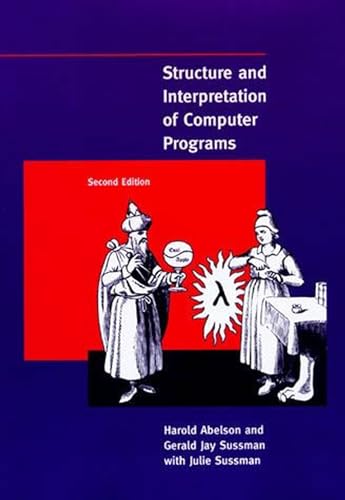
10Structure and Interpretation of Computer Programs
Structure and Interpretation of Computer Programs has had a dramatic impact on computer science curricula over the past decade. This long-awaited revision contains changes throughout the text. There are new implementations of most of the major programming systems in the book, including the interpreters and compilers, and the authors have incorporated many small changes that reflect their experience teaching the course at MIT since the first edition was published. A new theme has been introduced that emphasizes the central role played by different approaches to dealing with time in computational models: objects with state, concurrent programming, functional programming and lazy evaluation, and nondeterministic programming. There are new example sections on higher-order procedures in graphics and on applications of stream processing in numerical programming, and many new exercises. In addition, all the programs have been reworked to run in any Scheme implementation that adheres to the IEEE standard.
Max Levchin
Co-founder/PayPal, CEO/Affirm, Investor
Easier to read than "The Art of Computer Programming" end-to-end quickly. [source]
The most valuable thing this book gives you is confidence and knowledge to go and create your own programming language. [source]

John Maeda
@jesseddy The best book in classical and “hands-on example” terms is Structure and Interpretation of Computer Programs — but it requires maybe a year to get thru and for me, 10 years more to marinate over. *A* book is the one I am finishing now to come out Nov 2019. https://t.co/OODjQXgf1I [source]
 11
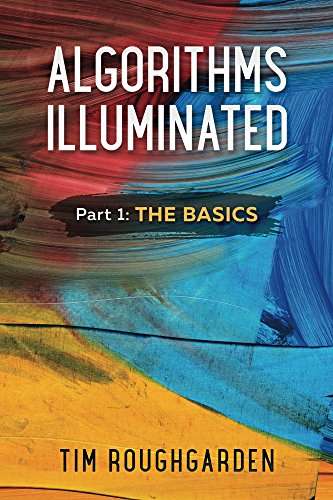
11Algorithms Illuminated: The Basics (Part 1)
Algorithms are the heart and soul of computer science. Their applications range from network routing and computational genomics to public-key cryptography and machine learning. Studying algorithms can make you a better programmer, a clearer thinker, and a master of technical interviews. Algorithms Illuminated is an accessible introduction to the subject for anyone with at least a little programming experience. The exposition emphasizes the big picture and conceptual understanding over low-level implementation and mathematical details---like a transcript of what an expert algorithms tutor would say over a series of one-on-one lessons. Part 1 covers asymptotic analysis and big-O notation, divide-and-conquer algorithms and the master method, randomized algorithms, and several famous algorithms for sorting and selection.
 12
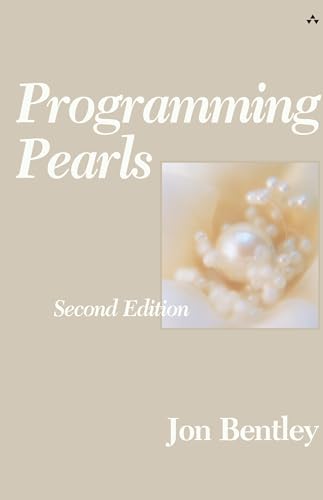
12Programming Pearls
The first edition of Programming Pearls was one of the most influential books I read early in my career, and many of the insights I first encountered in that book stayed with me long after I read it. Jon has done a wonderful job of updating the material. I am very impressed at how fresh the new examples seem. - Steve McConnell When programmers list their favorite books, Jon Bentley's collection of programming pearls is commonly included among the classics. Just as natural pearls grow from grains of sand that irritate oysters, programming pearls have grown from real problems that have irritated real programmers. With origins beyond solid engineering, in the realm of insight and creativity, Bentley's pearls offer unique and clever solutions to those nagging problems. Illustrated by programs designed as much for fun as for instruction, the book is filled with lucid and witty descriptions of practical programming techniques and fundamental design principles. It is not at all surprising that Programming Pearls has been so highly valued by programmers at every level of experience. In this revision, the first in 14 years, Bentley has substantially updated his essays to reflect
 Recommended by Jeff Atwood and James Stanley.
James Stanley
I very much enjoyed reading "Programming Pearls" by John Bentley. Most of the software we write is trying to solve fairly large and ill-defined problems in a way that minimises development cost, but Programming Pearls presents a lot of small, well-defined problems, and talks through their solutions in ways that minimise machine resource usage. There are lots of good "a-ha" moments when reading it, and working through ways to think about the problems that knock asymptotic orders off the computational complexity. [source]
 13
13The Art of Computer Programming, Volume 1: Fundamental Algorithms
The first revision of this third volume is the most comprehensivesurvey of classical computer techniques for sorting and searching. It extends thetreatment of data structures in Volume 1 to consider both large and smalldatabases and internal and external memories. The book contains a selection ofcarefully checked computer methods, with a quantitative analysis of theirefficiency. Outstanding features of the second edition include a revised sectionon optimum sorting and new discussions of the theory of permutations and ofuniversal hashing.
 14
14Algorithms Demystified
Have you ever wondered how your GPS can find the fastest way to your destination, selecting one route from seemingly countless possibilities in mere seconds? How your credit card account number is protected when you make a purchase over the Internet? The answer is algorithms. And how do these mathematical formulations translate themselves into your GPS, your laptop, or your smart phone? This book offers an engagingly written guide to the basics of computer algorithms. In "Algorithms Demystified," Thomas Cormen -- coauthor of the leading college textbook on the subject -- provides a general explanation, with limited mathematics, of how algorithms enable computers to solve problems. Readers will learn what computer algorithms are, how to describe them, and how to evaluate them. They will discover simple ways to search for information in a computer; methods for rearranging information in a computer into a prescribed order ("sorting"); how to solve basic problems that can be modeled in a computer with a mathematical structure called a "graph" (useful for modeling road networks, dependencies among tasks, and financial relationships); how to solve problems that ask questions about strings of characters such as DNA structures; the basic principles behind cryptography; fundamentals of data compression; and even that there are some problems that no one has figured out how to solve on a computer in a reasonable amount of time.
 15
15Algorithm Design
Algorithm Design introduces algorithms by looking at the real-world problems that motivate them. The book teaches students a range of design and analysis techniques for problems that arise in computing applications. The text encourages an understanding of the algorithm design process and an appreciation of the role of algorithms in the broader field of computer science.
August 6, 2009 Author, Jon Kleinberg, was recently cited in the New York Times for his statistical analysis research in the Internet age.
August 6, 2009 Author, Jon Kleinberg, was recently cited in the New York Times for his statistical analysis research in the Internet age.
 16
16Problem Solving with Algorithms and Data Structures Using Python
THIS TEXTBOOK is about computer science. It is also about Python. However, there is much more. The study of algorithms and data structures is central to understanding what computer science is all about. Learning computer science is not unlike learning any other type of difficult subject matter. The only way to be successful is through deliberate and incremental exposure to the fundamental ideas. A beginning computer scientist needs practice so that there is a thorough understanding before continuing on to the more complex parts of the curriculum. In addition, a beginner needs to be given the opportunity to be successful and gain confidence. This textbook is designed to serve as a text for a first course on data structures and algorithms, typically taught as the second course in the computer science curriculum. Even though the second course is considered more advanced than the first course, this book assumes you are beginners at this level. You may still be struggling with some of the basic ideas and skills from a first computer science course and yet be ready to further explore the discipline and continue to practice problem solving. We cover abstract data types and data structures, writing algorithms, and solving problems. We look at a number of data structures and solve classic problems that arise. The tools and techniques that you learn here will be applied over and over as you continue your study of computer science.
 17
17Algorithms in a Nutshell
Creating robust software requires the use of efficient algorithms, but programmers seldom think about them until a problem occurs. Algorithms in a Nutshell describes a large number of existing algorithms for solving a variety of problems, and helps you select and implement the right algorithm for your needs -- with just enough math to let you understand and analyze algorithm performance.
With its focus on application, rather than theory, this book provides efficient code solutions in several programming languages that you can easily adapt to a specific project. Each major algorithm is presented in the style of a design pattern that includes information to help you understand why and when the algorithm is appropriate.
With this book, you will:
Solve a particular coding problem or improve on the performance of an existing solution
Quickly locate algorithms that relate to the problems you want to solve, and determine why a particular algorithm is the right one to use
Get algorithmic solutions in C, C++, Java, and Ruby with implementation tips
Learn the expected performance of an algorithm, and the conditions it needs to perform at its best
Discover the impact that similar design decisions have on different algorithms
Learn advanced data structures to improve the efficiency of algorithms
With Algorithms in a Nutshell, you'll learn how to improve the performance of key algorithms essential for the success of your software applications.
With its focus on application, rather than theory, this book provides efficient code solutions in several programming languages that you can easily adapt to a specific project. Each major algorithm is presented in the style of a design pattern that includes information to help you understand why and when the algorithm is appropriate.
With this book, you will:
Solve a particular coding problem or improve on the performance of an existing solution
Quickly locate algorithms that relate to the problems you want to solve, and determine why a particular algorithm is the right one to use
Get algorithmic solutions in C, C++, Java, and Ruby with implementation tips
Learn the expected performance of an algorithm, and the conditions it needs to perform at its best
Discover the impact that similar design decisions have on different algorithms
Learn advanced data structures to improve the efficiency of algorithms
With Algorithms in a Nutshell, you'll learn how to improve the performance of key algorithms essential for the success of your software applications.
 18
18Invisible Women: Data Bias in a World Designed for Men
Imagine a world where your phone is too big for your hand, where your doctor prescribes a drug that is wrong for your body, where in a car accident you are 47% more likely to be seriously injured, where every week the countless hours of work you do are not recognised or valued. If any of this sounds familiar, chances are that you're a woman.
Invisible Women shows us how, in a world largely built for and by men, we are systematically ignoring half the population. It exposes the gender data gap – a gap in our knowledge that is at the root of perpetual, systemic discrimination against women, and that has created a pervasive but invisible bias with a profound effect on women’s lives.
Award-winning campaigner and writer Caroline Criado Perez brings together for the first time an impressive range of case studies, stories and new research from across the world that illustrate the hidden ways in which women are forgotten, and the impact this has on their health and well-being. From government policy and medical research, to technology, workplaces, urban planning and the media, Invisible Women reveals the biased data that excludes women. In making the case for change, this powerful and provocative book will make you see the world anew.
Invisible Women shows us how, in a world largely built for and by men, we are systematically ignoring half the population. It exposes the gender data gap – a gap in our knowledge that is at the root of perpetual, systemic discrimination against women, and that has created a pervasive but invisible bias with a profound effect on women’s lives.
Award-winning campaigner and writer Caroline Criado Perez brings together for the first time an impressive range of case studies, stories and new research from across the world that illustrate the hidden ways in which women are forgotten, and the impact this has on their health and well-being. From government policy and medical research, to technology, workplaces, urban planning and the media, Invisible Women reveals the biased data that excludes women. In making the case for change, this powerful and provocative book will make you see the world anew.


 Recommended by Adam Wagner, Asher Wolf, Caitlin Moran, and 9 others.
Adam Wagner
@CCriadoPerez @MumsnetTowers I love this - the book, Poppy, the mug - it's so well composed! [source]
Asher Wolf
Tell me your best thing today. Mine was an amazing book and greeting card arrived in the post from the wonderful @MmeEmmeline https://t.co/GpEs2lg037 [source]
Caitlin Moran
@CCriadoPerez mate, I bow in admiration. it's an AMAZING, game-changing book. [source]
19The Art of Computer Programming, Volumes 1-3 Boxed Set
Knuth's classic work has been widely acclaimed as one of the most influential works in the field of computer science. For the first time, these books are available as a boxed, three-volume set. The handsome slipcase makes this set an ideal gift for the recent computer science graduate or professional programmer. Offering a description of classical computer science, this multi-volume work is a useful resource in programming theory and practice for students, researchers, and practitioners alike. For programmers, it offers cookbook solutions to their day-to-day problems.
 20
20The Art of Computer Programming: Volume 3: Sorting and Searching
The first revision of this third volume is the most comprehensivesurvey of classical computer techniques for sorting and searching. It extends thetreatment of data structures in Volume 1 to consider both large and smalldatabases and internal and external memories. The book contains a selection ofcarefully checked computer methods, with a quantitative analysis of theirefficiency. Outstanding features of the second edition include a revised sectionon optimum sorting and new discussions of the theory of permutations and ofuniversal hashing.
 21
21The Hundred-Page Machine Learning Book
WARNING! To avoid buying counterfeit on Amazon, click on "See All Buying Options" and choose "Amazon.com" and not a third-party seller.
Concise and to the point — the book can be read during a week. During that week, you will learn almost everything modern machine learning has to offer. The author and other practitioners have spent years learning these concepts.
Companion wiki — the book has a continuously updated wiki that extends some book chapters with additional information: Q&A, code snippets, further reading, tools, and other relevant resources.
Flexible price and formats — choose from a variety of formats and price options: Kindle, hardcover, paperback, EPUB, PDF. If you buy an EPUB or a PDF, you decide the price you pay!
Read first, buy later — download book chapters for free, read them and share with your friends and colleagues. Only if you liked the book or found it useful in your work, study or business, then buy it.
Concise and to the point — the book can be read during a week. During that week, you will learn almost everything modern machine learning has to offer. The author and other practitioners have spent years learning these concepts.
Companion wiki — the book has a continuously updated wiki that extends some book chapters with additional information: Q&A, code snippets, further reading, tools, and other relevant resources.
Flexible price and formats — choose from a variety of formats and price options: Kindle, hardcover, paperback, EPUB, PDF. If you buy an EPUB or a PDF, you decide the price you pay!
Read first, buy later — download book chapters for free, read them and share with your friends and colleagues. Only if you liked the book or found it useful in your work, study or business, then buy it.
 Recommended by Kirk Borne.
Kirk Borne
Recent top-selling books in #AI & #MachineLearning: https://t.co/Ij9I7SzR4d ————— #BigData #DataScience #DataMining #Algorithms #PredictiveAnalytics #Python ————— ...in the TOP 10: 1)The Hundred-Page ML Book: https://t.co/dQ7nP6gwP0 2)Hands-on ML with...: https://t.co/Y0Iz3GbtGP https://t.co/72rAFN1FwW [source]
 22
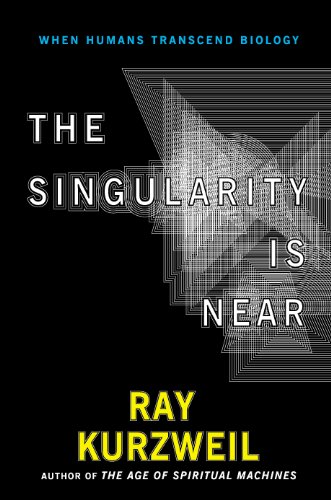
22The Singularity is Near: When Humans Transcend Biology
The great inventor and futurist Ray Kurzweil is one of the best-known and controversial advocates for the role of machines in the future of humanity. In his latest, thrilling foray into the future, he envisions an event--thesingularity--in which technological change becomes so rapid and so profound that our bodies and brains will merge with our machines.
The Singularity Is Near portrays what life will be like after this event--a human-machine civilization where our experiences shift from real reality to virtual reality and where our intelligence becomes nonbiological and trillions of times more powerful than unaided human intelligence. In practical terms, this means that human aging and pollution will be reversed, world hunger will be solved, and our bodies and environment transformed by nanotechnology to overcome the limitations of biology, including death.
We will be able to create virtually any physical product just from information, resulting in radical wealth creation. In addition to outlining these fantastic changes, Kurzweil also considers their social and philosophical ramifications. With its radical but optimistic view of the course of human development, The Singularity Is Near is certain to be one of the most widely discussed and provocative books of 2005.
The Singularity Is Near portrays what life will be like after this event--a human-machine civilization where our experiences shift from real reality to virtual reality and where our intelligence becomes nonbiological and trillions of times more powerful than unaided human intelligence. In practical terms, this means that human aging and pollution will be reversed, world hunger will be solved, and our bodies and environment transformed by nanotechnology to overcome the limitations of biology, including death.
We will be able to create virtually any physical product just from information, resulting in radical wealth creation. In addition to outlining these fantastic changes, Kurzweil also considers their social and philosophical ramifications. With its radical but optimistic view of the course of human development, The Singularity Is Near is certain to be one of the most widely discussed and provocative books of 2005.



Antonio Eram
This book was recommended by Antonio when asked for titles he would recommend to young people interested in his career path. [source]

Mark O'Connell
I wouldn’t be the first to look at him this way but I read Kurzweil’s work as essentially a work of religious mysticism. I think there’s no other way to read it, really. [source]

Steve Aoki
It opened me up to the idea of science fiction becoming science fact. [source]
 23
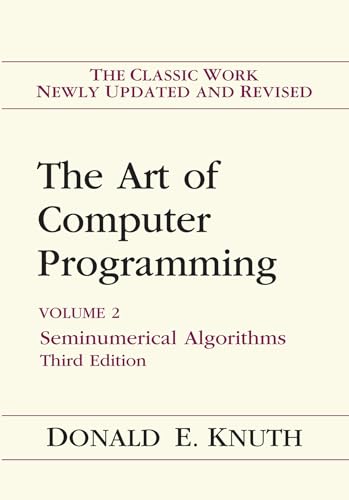
23The Art of Computer Programming, Volume 2: Seminumerical Algorithms
The bible of all fundamental algorithms and the work that taught many of today's software developers most of what they know about computer programming. -Byte, September 1995 I can't begin to tell you how many pleasurable hours of study and recreation they have afforded me! I have pored over them in cars, restaurants, at work, at home... and even at a Little League game when my son wasn't in the line-up. -Charles Long If you think you're a really good programmer... read [Knuth's] Art of Computer Programming... You should definitely send me a resume if you can read the whole thing. -Bill Gates It's always a pleasure when a problem is hard enough that you have to get the Knuths off the shelf. I find that merely opening one has a very useful terrorizing effect on computers. -Jonathan Laventhol The second volume offers a complete introduction to the field of seminumerical algorithms, with separate chapters on random numbers and arithmetic. The book summarizes the major paradigms and basic theory of such algorithms, thereby providing a comprehensive interface between computer programming and numerical analysis. Particularly noteworthy in this third edition is Knuth's new treatment of random number generators, and his discussion of calculations with formal power series.
Ebook (PDF version) produced by Mathematical Sciences Publishers (MSP), http: //msp.org
Ebook (PDF version) produced by Mathematical Sciences Publishers (MSP), http: //msp.org
 24
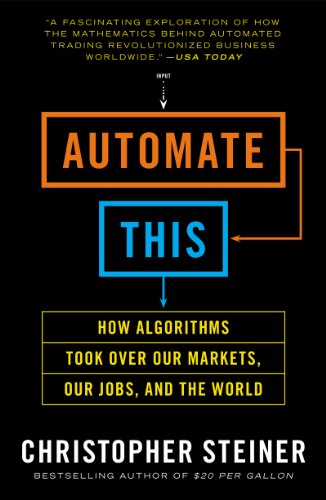
24Automate This: How Algorithms Came to Rule Our World
The rousing story of the last gasp of human agency and how today’s best and brightest minds are endeavoring to put an end to it.
It used to be that to diagnose an illness, interpret legal documents, analyze foreign policy, or write a newspaper article you needed a human being with specific skills—and maybe an advanced degree or two. These days, high-level tasks are increasingly being handled by algorithms that can do precise work not only with speed but also with nuance. These “bots” started with human programming and logic, but now their reach extends beyond what their creators ever expected. In this fascinating, frightening book, Christopher Steiner tells the story of how algorithms took over—and shows why the “bot revolution” is about to spill into every aspect of our lives, often silently, without our knowledge. The May 2010 “Flash Crash” exposed Wall Street’s reliance on trading bots to the tune of a 998-point market drop and $1 trillion in vanished market value. But that was just the beginning. In Automate This, we meet bots that are driving cars, penning haiku, and writing music mistaken for Bach’s. They listen in on our customer service calls and figure out what Iran would do in the event of a nuclear standoff. There are algorithms that can pick out the most cohesive crew of astronauts for a space mission or identify the next Jeremy Lin. Some can even ingest statistics from baseball games and spit out pitch-perfect sports journalism indistinguishable from that produced by humans. The interaction of man and machine can make our lives easier. But what will the world look like when algorithms control our hospitals, our roads, our culture, and our national security? What happens to businesses when we automate judgment and eliminate human instinct? And what role will be left for doctors, lawyers, writers, truck drivers, and many others? Who knows—maybe there’s a bot learning to do your job this minute.
It used to be that to diagnose an illness, interpret legal documents, analyze foreign policy, or write a newspaper article you needed a human being with specific skills—and maybe an advanced degree or two. These days, high-level tasks are increasingly being handled by algorithms that can do precise work not only with speed but also with nuance. These “bots” started with human programming and logic, but now their reach extends beyond what their creators ever expected. In this fascinating, frightening book, Christopher Steiner tells the story of how algorithms took over—and shows why the “bot revolution” is about to spill into every aspect of our lives, often silently, without our knowledge. The May 2010 “Flash Crash” exposed Wall Street’s reliance on trading bots to the tune of a 998-point market drop and $1 trillion in vanished market value. But that was just the beginning. In Automate This, we meet bots that are driving cars, penning haiku, and writing music mistaken for Bach’s. They listen in on our customer service calls and figure out what Iran would do in the event of a nuclear standoff. There are algorithms that can pick out the most cohesive crew of astronauts for a space mission or identify the next Jeremy Lin. Some can even ingest statistics from baseball games and spit out pitch-perfect sports journalism indistinguishable from that produced by humans. The interaction of man and machine can make our lives easier. But what will the world look like when algorithms control our hospitals, our roads, our culture, and our national security? What happens to businesses when we automate judgment and eliminate human instinct? And what role will be left for doctors, lawyers, writers, truck drivers, and many others? Who knows—maybe there’s a bot learning to do your job this minute.
 25
25Hacker's Delight
Aiming to tell the dark secrets of computer arithmetic, this title is suitable for library developers, compiler writers, and lovers of elegant hacks.
 26
26Information Theory, Inference and Learning Algorithms
Information theory and inference, often taught separately, are here united in one entertaining textbook. These topics lie at the heart of many exciting areas of contemporary science and engineering - communication, signal processing, data mining, machine learning, pattern recognition, computational neuroscience, bioinformatics, and cryptography. This textbook introduces theory in tandem with applications. Information theory is taught alongside practical communication systems, such as arithmetic coding for data compression and sparse-graph codes for error-correction. A toolbox of inference techniques, including message-passing algorithms, Monte Carlo methods, and variational approximations, are developed alongside applications of these tools to clustering, convolutional codes, independent component analysis, and neural networks. The final part of the book describes the state of the art in error-correcting codes, including low-density parity-check codes, turbo codes, and digital fountain codes -- the twenty-first century standards for satellite communications, disk drives, and data broadcast. Richly illustrated, filled with worked examples and over 400 exercises, some with detailed solutions, David MacKay's groundbreaking book is ideal for self-learning and for undergraduate or graduate courses. Interludes on crosswords, evolution, and sex provide entertainment along the way. In sum, this is a textbook on information, communication, and coding for a new generation of students, and an unparalleled entry point into these subjects for professionals in areas as diverse as computational biology, financial engineering, and machine learning.
 27
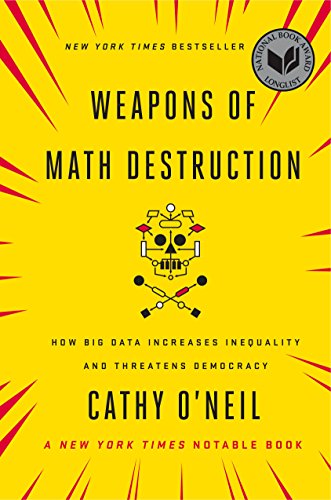
27Weapons of Math Destruction: How Big Data Increases Inequality and Threatens Democracy
Longlisted for the National Book Award
New York Times Bestseller
A former Wall Street quant sounds an alarm on the mathematical models that pervade modern life -- and threaten to rip apart our social fabric
We live in the age of the algorithm. Increasingly, the decisions that affect our lives--where we go to school, whether we get a car loan, how much we pay for health insurance--are being made not by humans, but by mathematical models. In theory, this should lead to greater fairness: Everyone is judged according to the same rules, and bias is eliminated.
But as Cathy O'Neil reveals in this urgent and necessary book, the opposite is true. The models being used today are opaque, unregulated, and uncontestable, even when they're wrong. Most troubling, they reinforce discrimination: If a poor student can't get a loan because a lending model deems him too risky (by virtue of his zip code), he's then cut off from the kind of education that could pull him out of poverty, and a vicious spiral ensues. Models are propping up the lucky and punishing the downtrodden, creating a "toxic cocktail for democracy." Welcome to the dark side of Big Data.
Tracing the arc of a person's life, O'Neil exposes the black box models that shape our future, both as individuals and as a society. These "weapons of math destruction" score teachers and students, sort resumes, grant (or deny) loans, evaluate workers, target voters, set parole, and monitor our health.
O'Neil calls on modelers to take more responsibility for their algorithms and on policy makers to regulate their use. But in the end, it's up to us to become more savvy about the models that govern our lives. This important book empowers us to ask the tough questions, uncover the truth, and demand change.
-- Longlist for National Book Award (Non-Fiction)
-- Goodreads, semi-finalist for the 2016 Goodreads Choice Awards (Science and Technology)
-- Kirkus, Best Books of 2016
-- New York Times, 100 Notable Books of 2016 (Non-Fiction)
-- The Guardian, Best Books of 2016
-- WBUR's "On Point," Best Books of 2016: Staff Picks
-- Boston Globe, Best Books of 2016, Non-Fiction
New York Times Bestseller
A former Wall Street quant sounds an alarm on the mathematical models that pervade modern life -- and threaten to rip apart our social fabric
We live in the age of the algorithm. Increasingly, the decisions that affect our lives--where we go to school, whether we get a car loan, how much we pay for health insurance--are being made not by humans, but by mathematical models. In theory, this should lead to greater fairness: Everyone is judged according to the same rules, and bias is eliminated.
But as Cathy O'Neil reveals in this urgent and necessary book, the opposite is true. The models being used today are opaque, unregulated, and uncontestable, even when they're wrong. Most troubling, they reinforce discrimination: If a poor student can't get a loan because a lending model deems him too risky (by virtue of his zip code), he's then cut off from the kind of education that could pull him out of poverty, and a vicious spiral ensues. Models are propping up the lucky and punishing the downtrodden, creating a "toxic cocktail for democracy." Welcome to the dark side of Big Data.
Tracing the arc of a person's life, O'Neil exposes the black box models that shape our future, both as individuals and as a society. These "weapons of math destruction" score teachers and students, sort resumes, grant (or deny) loans, evaluate workers, target voters, set parole, and monitor our health.
O'Neil calls on modelers to take more responsibility for their algorithms and on policy makers to regulate their use. But in the end, it's up to us to become more savvy about the models that govern our lives. This important book empowers us to ask the tough questions, uncover the truth, and demand change.
-- Longlist for National Book Award (Non-Fiction)
-- Goodreads, semi-finalist for the 2016 Goodreads Choice Awards (Science and Technology)
-- Kirkus, Best Books of 2016
-- New York Times, 100 Notable Books of 2016 (Non-Fiction)
-- The Guardian, Best Books of 2016
-- WBUR's "On Point," Best Books of 2016: Staff Picks
-- Boston Globe, Best Books of 2016, Non-Fiction

 Recommended by Paula Boddington and Ramesh Srinivasan.
Paula Boddington
How the use of algorithms has affected people’s lives and occasionally ruined them. [source]
Ramesh Srinivasan
This book is a really fantastic analysis of how quantification, the collection of data, the modelling around data, the predictions made by using data, the algorithmic and quantifiable ways of predicting behaviour based on data, are all built by elites for elites and end up, quite frankly, screwing over everybody else. [source]
 28
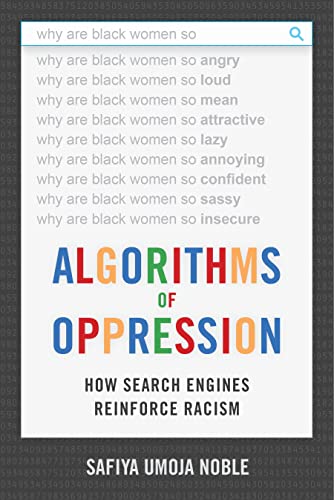
28Algorithms of Oppression: How Search Engines Reinforce Racism
Run a Google search for "black girls" - what will you find? "Big Booty" and other sexually explicit terms are likely to come up as top search terms. But, if you type in "white girls," the results are radically different. The suggested porn sites and un-moderated discussions about "why black women are so sassy" or "why black women are so angry" presents a disturbing portrait of black womanhood in modern society.
In Algorithms of Oppression, Safiya Umoja Noble challenges the idea that search engines like Google offer an equal playing field for all forms of ideas, identities, and activities. Data discrimination is a real social problem; Noble argues that the combination of private interests in promoting certain sites, along with the monopoly status of a relatively small number of Internet search engines, leads to a biased set of search algorithms that privilege whiteness and discriminate against people of color, specifically women of color.
Through an analysis of textual and media searches as well as extensive research on paid online advertising, Noble exposes a culture of racism and sexism in the way discoverability is created online. As search engines and their related companies grow in importance - operating as a source for email, a major vehicle for primary and secondary school learning, and beyond - understanding and reversing these disquieting trends and discriminatory practices is of utmost importance.
An original, surprising and, at times, disturbing account of bias on the internet, Algorithms of Oppression contributes to our understanding of how racism is created, maintained, and disseminated in the 21st century.
In Algorithms of Oppression, Safiya Umoja Noble challenges the idea that search engines like Google offer an equal playing field for all forms of ideas, identities, and activities. Data discrimination is a real social problem; Noble argues that the combination of private interests in promoting certain sites, along with the monopoly status of a relatively small number of Internet search engines, leads to a biased set of search algorithms that privilege whiteness and discriminate against people of color, specifically women of color.
Through an analysis of textual and media searches as well as extensive research on paid online advertising, Noble exposes a culture of racism and sexism in the way discoverability is created online. As search engines and their related companies grow in importance - operating as a source for email, a major vehicle for primary and secondary school learning, and beyond - understanding and reversing these disquieting trends and discriminatory practices is of utmost importance.
An original, surprising and, at times, disturbing account of bias on the internet, Algorithms of Oppression contributes to our understanding of how racism is created, maintained, and disseminated in the 21st century.
 Recommended by Sherrilyn Ifill.
Sherrilyn Ifill
It's our first Thurgood Marshall Institute podcast. A terrific discussion with Professor @safiyanoble, author of the must read book Algorithms of Oppression. Listen. @TMI_LDF https://t.co/6eq51hhrJH [source]
 29
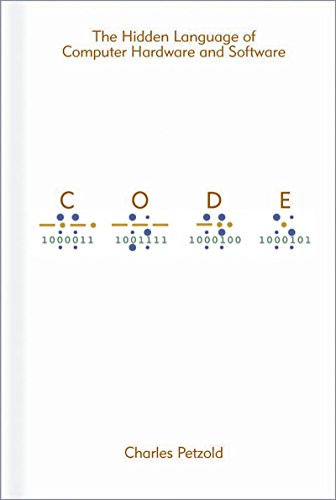
29Code: The Hidden Language of Computer Hardware and Software
What do flashlights, the British invasion, black cats, and seesaws have to do with computers? In CODE, they show us the ingenious ways we manipulate language and invent new means of communicating with each other. And through CODE, we see how this ingenuity and our very human compulsion to communicate have driven the technological innovations of the past two centuries.
Using everyday objects and familiar language systems such as Braille and Morse code, author Charles Petzold weaves an illuminating narrative for anyone who’s ever wondered about the secret inner life of computers and other smart machines.
It’s a cleverly illustrated and eminently comprehensible story—and along the way, you’ll discover you’ve gained a real context for understanding today’s world of PCs, digital media, and the Internet. No matter what your level of technical savvy, CODE will charm you—and perhaps even awaken the technophile within.
Using everyday objects and familiar language systems such as Braille and Morse code, author Charles Petzold weaves an illuminating narrative for anyone who’s ever wondered about the secret inner life of computers and other smart machines.
It’s a cleverly illustrated and eminently comprehensible story—and along the way, you’ll discover you’ve gained a real context for understanding today’s world of PCs, digital media, and the Internet. No matter what your level of technical savvy, CODE will charm you—and perhaps even awaken the technophile within.
Recommended by Ana Bell.Ana Bell
It gets you to use your imagination to virtually build a computer. It’s easy to read, you can lie down on the couch and enjoy it—it’s not so much of a textbook. It demystifies the magic of a computer and what it is. [source]
 30
30The Art of Computer Programming, Volume 4A: Combinatorial Algorithms, Part 1
The Art of Computer Programming, Volume 4A: Combinatorial Algorithms, Part 1 Knuth's multivolume analysis of algorithms is widely recognized as the definitive description of classical computer science. The first three volumes of this work have long comprised a unique and invaluable resource in programming theory and practice. Scientists have marveled at the beauty and elegance of Knuth's analysis, while practicing programmers have successfully applied his "cookbook" solutions to their day-to-day problems. The level of these first three volumes has remained so high, and they have displayed so wide and deep a familiarity with the art of computer programming, that a sufficient "review" of future volumes could almost be: "Knuth, Volume n has been published." -Data Processing Digest Knuth, Volume n has been published, where n = 4A. In this long-awaited new volume, the old master turns his attention to some of his favorite topics in broadword computation and combinatorial generation (exhaustively listing fundamental combinatorial objects, such as permutations, partitions, and trees), as well as his more recent interests, such as binary decision diagrams. The hallmark qualities that distinguish his previous volumes are manifest here anew: detailed coverage of the basics, illustrated with well-chosen examples; occasional forays into more esoteric topics and problems at the frontiers of research; impeccable writing peppered with occasional bits of humor; extensive collections of exercises, all with solutions or helpful hints; a careful attention to history; implementations of many of the algorithms in his classic step-by-step form. There is an amazing amount of information on each page. Knuth has obviously thought long and hard about which topics and results are most central and important, and then, what are the most intuitive and succinct ways of presenting that material. Since the areas that he covers in this volume have exploded since he first envisioned writing about them, it is wonderful how he has managed to provide such thorough treatment in so few pages. -Frank Ruskey, Department of Computer Science, University of Victoria The book is Volume 4A, because Volume 4 has itself become a multivolume undertaking. Combinatorial searching is a rich and important topic, and Knuth has too much to say about it that is new, interesting, and useful to fit into a single volume, or two, or maybe even three. This book alone includes approximately 1500 exercises, with answers for self-study, plus hundreds of useful facts that cannot be found in any other publication. Volume 4A surely belongs beside the first three volumes of this classic work in every serious programmer's library. Finally, after a wait of more than thirty-five years, the first part of Volume 4 is at last ready for publication. Check out the boxed set that brings together Volumes 1 - 4A in one elegant case, and offers the purchaser a $50 discount off the price of buying the four volumes individually. Ebook (PDF version) produced by Mathematical Sciences Publishers (MSP), http: //msp.org
The Art of Computer Programming, Volumes 1-4A Boxed Set, 3/e ISBN: 0321751043
The Art of Computer Programming, Volumes 1-4A Boxed Set, 3/e ISBN: 0321751043
 31
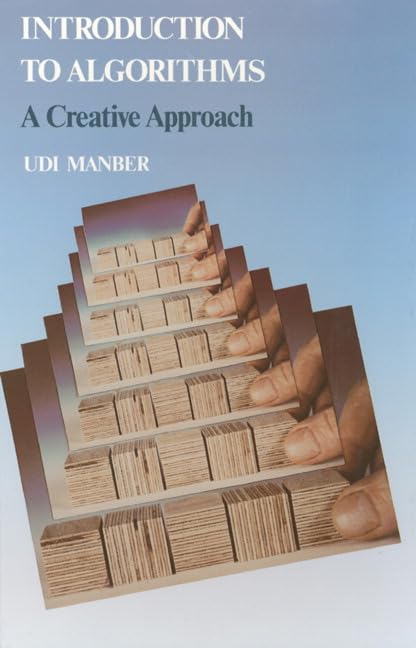
31Introduction to Algorithms: A Creative Approach
This book emphasizes the creative aspects of algorithm design by examining steps used in the process of algorithms development. The heart of this creative process lies in an analogy between proving mathematical theorems by induction and designing combinatorial algorithms. The book contains hundreds of problems and examples. It is designed to enhance the reader's problem-solving abilities and understanding of the principles behind algorithm design.
 32
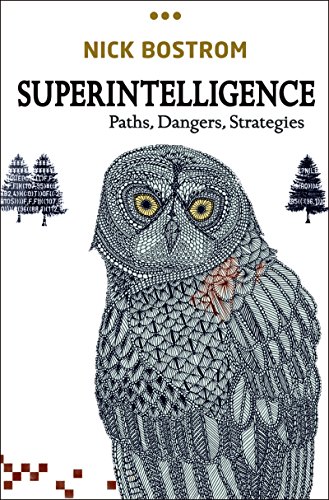
32Superintelligence: Paths, Dangers, Strategies
Superintelligence asks the questions: what happens when machines surpass humans in general intelligence? Will artificial agents save or destroy us? Nick Bostrom lays the foundation for understanding the future of humanity and intelligent life.
The human brain has some capabilities that the brains of other animals lack. It is to these distinctive capabilities that our species owes its dominant position. If machine brains surpassed human brains in general intelligence, then this new superintelligence could become extremely powerful--possibly beyond our control. As the fate of the gorillas now depends more on humans than on the species itself, so would the fate of humankind depend on the actions of the machine superintelligence.
But we have one advantage: we get to make the first move. Will it be possible to construct a seed Artificial Intelligence, to engineer initial conditions so as to make an intelligence explosion survivable? How could one achieve a controlled detonation?
The human brain has some capabilities that the brains of other animals lack. It is to these distinctive capabilities that our species owes its dominant position. If machine brains surpassed human brains in general intelligence, then this new superintelligence could become extremely powerful--possibly beyond our control. As the fate of the gorillas now depends more on humans than on the species itself, so would the fate of humankind depend on the actions of the machine superintelligence.
But we have one advantage: we get to make the first move. Will it be possible to construct a seed Artificial Intelligence, to engineer initial conditions so as to make an intelligence explosion survivable? How could one achieve a controlled detonation?

Elon Musk
Founder/SpaceX
Worth reading Superintelligence by Bostrom. We need to be super careful with AI. Potentially more dangerous than nukes. [source]
Maria Ramos
CEO/Barclays Africa
Ramos will take the summer to examine some of the questions weighing more heavily on humankind as we contemplate our collective future: what happens when we can write our own genetic codes, and what happens when we create technology that is meaningfully more intelligent than us. The Gene: An Intimate History—Siddhartha Mukherjee Superintelligence: Paths, Dangers, Strategies—Nick Bostrom The Ministry of Utmost Happiness—Arundhati Roy [source]

Will MacAskill
I picked this book because the possibility of us developing human-level artificial intelligence, and from there superintelligence—an artificial agent that is considerably more intelligent than we are—is at least a contender for the most important issue in the next two centuries. Bostrom’s book has been very influential in effective altruism, lots of people work on artificial intelligence in order to ensure that it is developed safely. I don’t agree with the entire contents of the book, but there are many compelling arguments in it. It would be extremely overconfident to dismiss this book as too speculative. In fact, I think there should be a lot more work that tries to understand the biggest challenges for the next two hundred years, and what we could do to try to overcome them. [source]
 33
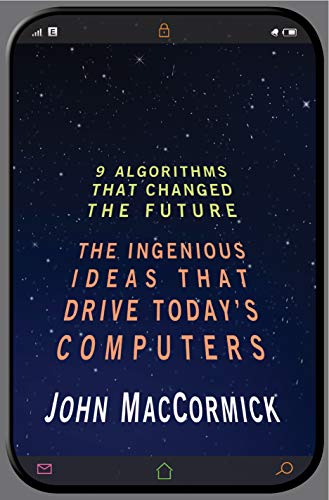
33Nine Algorithms That Changed the Future: The Ingenious Ideas That Drive Today's Computers
Every day, we use our computers to perform remarkable feats. A simple web search picks out a handful of relevant needles from the world's biggest haystack: the billions of pages on the World Wide Web. Uploading a photo to Facebook transmits millions of pieces of information over numerous error-prone network links, yet somehow a perfect copy of the photo arrives intact. Without even knowing it, we use public-key cryptography to transmit secret information like credit card numbers; and we use digital signatures to verify the identity of the websites we visit. How do our computers perform these tasks with such ease?
This is the first book to answer that question in language anyone can understand, revealing the extraordinary ideas that power our PCs, laptops, and smartphones. Using vivid examples, John MacCormick explains the fundamental "tricks" behind nine types of computer algorithms, including artificial intelligence (where we learn about the "nearest neighbor trick" and "twenty questions trick"), Google's famous PageRank algorithm (which uses the "random surfer trick"), data compression, error correction, and much more.
These revolutionary algorithms have changed our world: this book unlocks their secrets, and lays bare the incredible ideas that our computers use every day.
This is the first book to answer that question in language anyone can understand, revealing the extraordinary ideas that power our PCs, laptops, and smartphones. Using vivid examples, John MacCormick explains the fundamental "tricks" behind nine types of computer algorithms, including artificial intelligence (where we learn about the "nearest neighbor trick" and "twenty questions trick"), Google's famous PageRank algorithm (which uses the "random surfer trick"), data compression, error correction, and much more.
These revolutionary algorithms have changed our world: this book unlocks their secrets, and lays bare the incredible ideas that our computers use every day.
 34
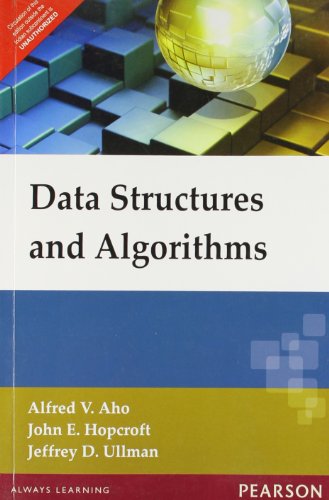
34Data Structures and Algorithms
The authors' treatment of data structures in Data Structures and Algorithms is unified by an informal notion of "abstract data types," allowing readers to compare different implementations of the same concept. Algorithm design techniques are also stressed and basic algorithm analysis is covered. Most of the programs are written in Pascal.
 35
35Data Structures and Algorithms Made Easy
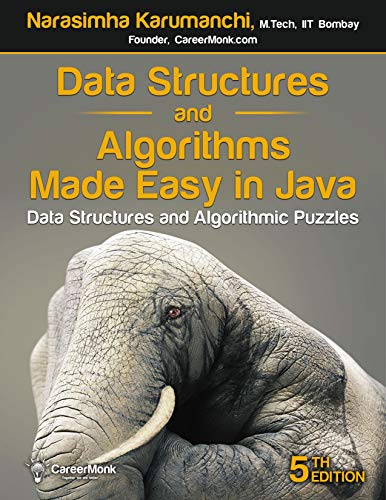
Peeling Data Structures and Algorithms for (C/C++ version): • Programming puzzles for interviews • Campus Preparation • Degree/Masters Course Preparation • Instructor's • GATE Preparation • Big job hunters: Microsoft, Google, Amazon, Yahoo, Flip Kart, Adobe, IBM Labs, Citrix, Mentor Graphics, NetApp, Oracle, Webaroo, De-Shaw, Success Factors, Face book, McAfee and many more • Reference Manual for working people
 36
36The Nature of Code
How can we capture the unpredictable evolutionary and emergent properties of nature in software? How can understanding the mathematical principles behind our physical world help us to create digital worlds? This book focuses on a range of programming strategies and techniques behind computer simulations of natural systems, from elementary concepts in mathematics and physics to more advanced algorithms that enable sophisticated visual results. Readers will progress from building a basic physics engine to creating intelligent moving objects and complex systems, setting the foundation for further experiments in generative design. Subjects covered include forces, trigonometry, fractals, cellular automata, self-organization, and genetic algorithms. The book's examples are written in Processing, an open-source language and development environment built on top of the Java programming language. On the book's website (http://www.natureofcode.com), the examples run in the browser via Processing's JavaScript mode.
 37
37Algorithms on Strings, Trees and Sequences: Computer Science and Computational Biology
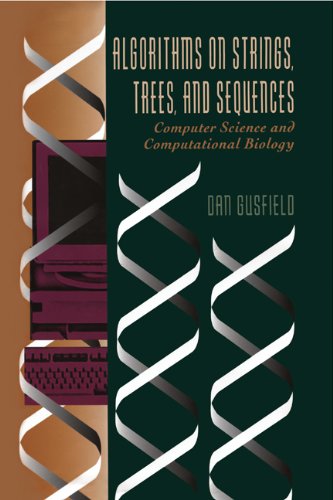
Traditionally an area of study in computer science, string algorithms have, in recent years, become an increasingly important part of biology, particularly genetics. This volume is a comprehensive look at computer algorithms for string processing. In addition to pure computer science, Gusfield adds extensive discussions on biological problems that are cast as string problems and on methods developed to solve them. This text emphasizes the fundamental ideas and techniques central to today's applications. New approaches to this complex material simplify methods that up to now have been for the specialist alone. With over 400 exercises to reinforce the material and develop additional topics, the book is suitable as a text for graduate or advanced undergraduate students in computer science, computational biology, or bio-informatics.
 38
38Algorithms Plus Data Structures Equals Programs (Prentice-Hall series in automatic computation)
 39
39Code Complete
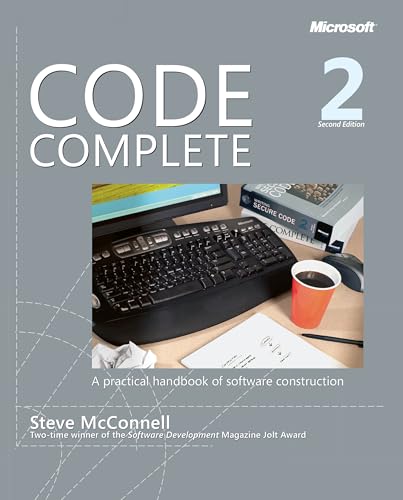
Widely considered one of the best practical guides to programming, Steve McConnell's original CODE COMPLETE has been helping developers write better software for more than a decade. Now this classic book has been fully updated and revised with leading-edge practices--and hundreds of new code samples--illustrating the art and science of software construction. Capturing the body of knowledge available from research, academia, and everyday commercial practice, McConnell synthesizes the most effective techniques and must-know principles into clear, pragmatic guidance. No matter what your experience level, development environment, or project size, this book will inform and stimulate your thinking--and help you build the highest quality code.
Discover the timeless techniques and strategies that help you:
Design for minimum complexity and maximum creativity
Reap the benefits of collaborative development
Apply defensive programming techniques to reduce and flush out errors
Exploit opportunities to refactor--or evolve--code, and do it safely
Use construction practices that are right-weight for your project
Debug problems quickly and effectively
Resolve critical construction issues early and correctly
Build quality into the beginning, middle, and end of your project
Discover the timeless techniques and strategies that help you:
Design for minimum complexity and maximum creativity
Reap the benefits of collaborative development
Apply defensive programming techniques to reduce and flush out errors
Exploit opportunities to refactor--or evolve--code, and do it safely
Use construction practices that are right-weight for your project
Debug problems quickly and effectively
Resolve critical construction issues early and correctly
Build quality into the beginning, middle, and end of your project
Recommended by Jeff Atwood, Ana Bell, and Santiago Basulto.Ana Bell
Code Complete is for people working in industry, writing software for companies. It has little checklists at key points in the book; if you are in industry, you can make sure that your code is readable and debugged by going through these checklists and making sure you’re touching upon all aspects. [source]
Santiago Basulto
If my career path is hackers turned business people, I’d say: Start with the basics and fundamentals: SICP: Structure and Interpretation of Computer Programs Code Complete 2 [source]
 40
40Compilers: Principles, Techniques, and Tools
This introduction to compilers is the direct descendant of the well-known book by Aho and Ullman, Principles of Compiler Design. The authors present updated coverage of compilers based on research and techniques that have been developed in the field over the past few years. The book provides a thorough introduction to compiler design and covers topics such as context-free grammars, fine state machines, and syntax-directed translation.
 41
41Algorithms in C, Parts 1-4: Fundamentals, Data Structures, Sorting, Searching
 42
42Concrete Mathematics: A Foundation for Computer Science
Concrete Mathematics is a blending of CONtinuous and disCRETE mathematics. "More concretely," the authors explain, "it is the controlled manipulation of mathematical formulas, using a collection of techniques for solving problems."
 43
43Algorithms Illuminated (Part 2): Graph Algorithms and Data Structures
Algorithms are the heart and soul of computer science. Their applications range from network routing and computational genomics to public-key cryptography and machine learning. Studying algorithms can make you a better programmer, a clearer thinker, and a master of technical interviews. Algorithms Illuminated is an accessible introduction to the subject for anyone with at least a little programming experience. The exposition emphasizes the big picture and conceptual understanding over low-level implementation and mathematical details---like a transcript of what an expert algorithms tutor would say over a series of one-on-one lessons. Part 2 covers graph search and applications, shortest paths, and the usage and implementation of several data structures (heaps, search trees, hash tables, and bloom filters).
 44
44Elements of Programming Interviews in Java: The Insiders' Guide
This is a larger-format version of Elements of Programming Interviews in Java. Specifically, the font size is larger, and the page size is 7"x10" (the regular format uses 6"x9").
The content is identical.
This is the Java version of our book. See our website for links to the C++ version. Have you ever...
Wanted to work at an exciting futuristic company?
Struggled with an interview problem that could have been solved in 15 minutes?
Wished you could study real-world computing problems?
If so, you need to read Elements of Programming Interviews (EPI).
EPI is your comprehensive guide to interviewing for software development roles.
The core of EPI is a collection of over 250 problems with detailed solutions. The problems are representative of interview questions asked at leading software companies. The problems are illustrated with 200 figures, 300 tested programs, and 150 additional variants.
The book begins with a summary of the nontechnical aspects of interviewing, such as strategies for a great interview, common mistakes, perspectives from the other side of the table, tips on negotiating the best offer, and a guide to the best ways to use EPI. We also provide a summary of data structures, algorithms, and problem solving patterns.
Coding problems are presented through a series of chapters on basic and advanced data structures, searching, sorting, algorithm design principles, and concurrency. Each chapter stars with a brief introduction, a case study, top tips, and a review of the most important library methods. This is followed by a broad and thought-provoking set of problems.
A practical, fun approach to computer science fundamentals, as seen through the lens of common programming interview questions.
Jeff Atwood/Co-founder, Stack Overflow and Discourse
The content is identical.
This is the Java version of our book. See our website for links to the C++ version. Have you ever...
Wanted to work at an exciting futuristic company?
Struggled with an interview problem that could have been solved in 15 minutes?
Wished you could study real-world computing problems?
If so, you need to read Elements of Programming Interviews (EPI).
EPI is your comprehensive guide to interviewing for software development roles.
The core of EPI is a collection of over 250 problems with detailed solutions. The problems are representative of interview questions asked at leading software companies. The problems are illustrated with 200 figures, 300 tested programs, and 150 additional variants.
The book begins with a summary of the nontechnical aspects of interviewing, such as strategies for a great interview, common mistakes, perspectives from the other side of the table, tips on negotiating the best offer, and a guide to the best ways to use EPI. We also provide a summary of data structures, algorithms, and problem solving patterns.
Coding problems are presented through a series of chapters on basic and advanced data structures, searching, sorting, algorithm design principles, and concurrency. Each chapter stars with a brief introduction, a case study, top tips, and a review of the most important library methods. This is followed by a broad and thought-provoking set of problems.
A practical, fun approach to computer science fundamentals, as seen through the lens of common programming interview questions.
Jeff Atwood/Co-founder, Stack Overflow and Discourse
 45
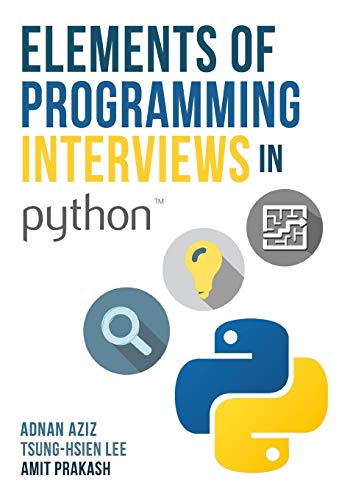
45Elements of Programming Interviews in Python: The Insiders' Guide
This is the Python version of our book. See the website for links to the C++ and Java version.Have you ever...
Wanted to work at an exciting futuristic company?
Struggled with an interview problem thatcould have been solved in 15 minutes?
Wished you could study real-world computing problems?
If so, you need to read Elements of Programming Interviews (EPI).
EPI is your comprehensive guide to interviewing for software development roles.
The core of EPI is a collection of over 250 problems with detailed solutions. The problems are representative of interview questions asked at leading software companies. The problems are illustrated with 200 figures, 300 tested programs, and 150 additional variants.
The book begins with a summary of the nontechnical aspects of interviewing, such as strategies for a great interview, common mistakes, perspectives from the other side of the table, tips on negotiating the best offer, and a guide to the best ways to use EPI. We also provide a summary of data structures, algorithms, and problem solving patterns.
Coding problems are presented through a series of chapters on basic and advanced data structures, searching, sorting, algorithm design principles, and concurrency. Each chapter stars with a brief introduction, a case study, top tips, and a review of the most important library methods. This is followed by a broad and thought-provoking set of problems.
A practical, fun approach to computer science fundamentals, as seen through the lens of common programming interview questions.
Jeff Atwood/Co-founder, Stack Overflow and Discourse
Wanted to work at an exciting futuristic company?
Struggled with an interview problem thatcould have been solved in 15 minutes?
Wished you could study real-world computing problems?
If so, you need to read Elements of Programming Interviews (EPI).
EPI is your comprehensive guide to interviewing for software development roles.
The core of EPI is a collection of over 250 problems with detailed solutions. The problems are representative of interview questions asked at leading software companies. The problems are illustrated with 200 figures, 300 tested programs, and 150 additional variants.
The book begins with a summary of the nontechnical aspects of interviewing, such as strategies for a great interview, common mistakes, perspectives from the other side of the table, tips on negotiating the best offer, and a guide to the best ways to use EPI. We also provide a summary of data structures, algorithms, and problem solving patterns.
Coding problems are presented through a series of chapters on basic and advanced data structures, searching, sorting, algorithm design principles, and concurrency. Each chapter stars with a brief introduction, a case study, top tips, and a review of the most important library methods. This is followed by a broad and thought-provoking set of problems.
A practical, fun approach to computer science fundamentals, as seen through the lens of common programming interview questions.
Jeff Atwood/Co-founder, Stack Overflow and Discourse
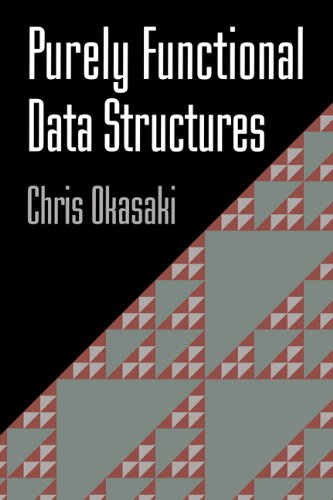 46
46Purely Functional Data Structures
Most books on data structures assume an imperative language such as C or C++. However, data structures for these languages do not always translate well to functional languages such as Standard ML, Haskell, or Scheme. This book describes data structures from the point of view of functional languages, with examples, and presents design techniques that allow programmers to develop their own functional data structures. The author includes both classical data structures, such as red-black trees and binomial queues, and a host of new data structures developed exclusively for functional languages. All source code is given in Standard ML and Haskell, and most of the programs are easily adaptable to other functional languages. This handy reference for professional programmers working with functional languages can also be used as a tutorial or for self-study.
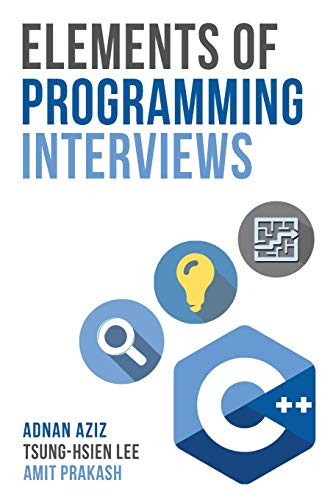 47
47Elements of Programming Interviews: The Insiders' Guide C++
New! Java versions of all C++ programs in the book at http: //bit.ly/epi-programs Get a PDF sampler of EPI from http: //bit.ly/epi-sampler
Have you ever...
Wanted to work at an exciting futuristic company? Struggled with an interview problem that could have been solved in 15 minutes? Wished you could study real-world computing problems?
If so, you need to read Elements of Programming Interviews (EPI).
The core of EPI is a collection of 300 problems with detailed solutions, including over 100 figures and 250 tested programs. The problems are challenging, well-motivated, and accessible. They are representative of the questions asked at interviews at the most exciting companies.
The book begins with a summary of patterns for data structure, algorithms, and problem solving that will help you solve the most challenging interview problems. This is followed by chapters on basic and advanced data structures, algorithm design, concurrency, system design, probability and discrete mathematics. Each chapter starts with a brief review of key concepts and results followed by a deep and wide set of questions.
EPI concludes with a summary of the nontechnical aspects of interviewing, including common mistakes, strategies for a great interview, perspectives from across the table, negotiating the best offer, and much more.
"This book is the best compilation of programming related problems I have seen. It is a great resource for a diverse set of topics when preparing for technical interviews, as a quick refresher in a subject area or when you are just looking for a brain teaser to challenge yourself."
Shashank Gupta / Scaligent, formerly Engineering Manager, Amazon.com, Senior Engineering Manager, Yahoo!, Manager of Software Development, Cisco Systems
Have you ever...
Wanted to work at an exciting futuristic company? Struggled with an interview problem that could have been solved in 15 minutes? Wished you could study real-world computing problems?
If so, you need to read Elements of Programming Interviews (EPI).
The core of EPI is a collection of 300 problems with detailed solutions, including over 100 figures and 250 tested programs. The problems are challenging, well-motivated, and accessible. They are representative of the questions asked at interviews at the most exciting companies.
The book begins with a summary of patterns for data structure, algorithms, and problem solving that will help you solve the most challenging interview problems. This is followed by chapters on basic and advanced data structures, algorithm design, concurrency, system design, probability and discrete mathematics. Each chapter starts with a brief review of key concepts and results followed by a deep and wide set of questions.
EPI concludes with a summary of the nontechnical aspects of interviewing, including common mistakes, strategies for a great interview, perspectives from across the table, negotiating the best offer, and much more.
"This book is the best compilation of programming related problems I have seen. It is a great resource for a diverse set of topics when preparing for technical interviews, as a quick refresher in a subject area or when you are just looking for a brain teaser to challenge yourself."
Shashank Gupta / Scaligent, formerly Engineering Manager, Amazon.com, Senior Engineering Manager, Yahoo!, Manager of Software Development, Cisco Systems
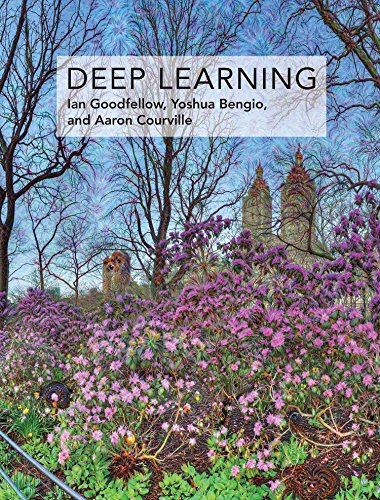 48
48Deep Learning
An introduction to a broad range of topics in deep learning, covering mathematical and conceptual background, deep learning techniques used in industry, and research perspectives.
Deep learning is a form of machine learning that enables computers to learn from experience and understand the world in terms of a hierarchy of concepts. Because the computer gathers knowledge from experience, there is no need for a human computer operator to formally specify all the knowledge that the computer needs. The hierarchy of concepts allows the computer to learn complicated concepts by building them out of simpler ones; a graph of these hierarchies would be many layers deep. This book introduces a broad range of topics in deep learning.
The text offers mathematical and conceptual background, covering relevant concepts in linear algebra, probability theory and information theory, numerical computation, and machine learning. It describes deep learning techniques used by practitioners in industry, including deep feedforward networks, regularization, optimization algorithms, convolutional networks, sequence modeling, and practical methodology; and it surveys such applications as natural language processing, speech recognition, computer vision, online recommendation systems, bioinformatics, and videogames. Finally, the book offers research perspectives, covering such theoretical topics as linear factor models, autoencoders, representation learning, structured probabilistic models, Monte Carlo methods, the partition function, approximate inference, and deep generative models.
Deep Learning can be used by undergraduate or graduate students planning careers in either industry or research, and by software engineers who want to begin using deep learning in their products or platforms. A website offers supplementary material for both readers and instructors.
Deep learning is a form of machine learning that enables computers to learn from experience and understand the world in terms of a hierarchy of concepts. Because the computer gathers knowledge from experience, there is no need for a human computer operator to formally specify all the knowledge that the computer needs. The hierarchy of concepts allows the computer to learn complicated concepts by building them out of simpler ones; a graph of these hierarchies would be many layers deep. This book introduces a broad range of topics in deep learning.
The text offers mathematical and conceptual background, covering relevant concepts in linear algebra, probability theory and information theory, numerical computation, and machine learning. It describes deep learning techniques used by practitioners in industry, including deep feedforward networks, regularization, optimization algorithms, convolutional networks, sequence modeling, and practical methodology; and it surveys such applications as natural language processing, speech recognition, computer vision, online recommendation systems, bioinformatics, and videogames. Finally, the book offers research perspectives, covering such theoretical topics as linear factor models, autoencoders, representation learning, structured probabilistic models, Monte Carlo methods, the partition function, approximate inference, and deep generative models.
Deep Learning can be used by undergraduate or graduate students planning careers in either industry or research, and by software engineers who want to begin using deep learning in their products or platforms. A website offers supplementary material for both readers and instructors.
Elon Musk
Founder/SpaceX
Written by three experts in the field, Deep Learning is the only comprehensive book on the subject. [source]

Nassim Nicholas Taleb
Author
Very clear exposition, does the math without getting lost in the details. Although many of the concepts of the introductory first 100 pages can be found elsewhere, they are presented with remarkable cut-to-the-chase clarity. [source]

Satya Nadella
CEO/Microsoft
Elon Musk and Facebook AI chief Yann LeCun have praised this textbook on one of software’s most promising frontiers. After its publication, Microsoft signed up coauthor Bengio, a pioneer in machine learning, as an adviser [source]
 49
49Pattern Recognition and Machine Learning
Pattern recognition has its origins in engineering, whereas machine learning grew out of computer science. However, these activities can be viewed as two facets of the same field, and together they have undergone substantial development over the past ten years. In particular, Bayesian methods have grown from a specialist niche to become mainstream, while graphical models have emerged as a general framework for describing and applying probabilistic models. Also, the practical applicability of Bayesian methods has been greatly enhanced through the development of a range of approximate inference algorithms such as variational Bayes and expectation propagation. Similarly, new models based on kernels have had a significant impact on both algorithms and applications. This new textbook reflects these recent developments while providing a comprehensive introduction to the fields of pattern recognition and machine learning. It is aimed at advanced undergraduates or first-year PhD students, as well as researchers and practitioners, and assumes no previous knowledge of pattern recognition or machine learning concepts. Knowledge of multivariate calculus and basic linear algebra is required, and some familiarity with probabilities would be helpful though not essential as the book includes a self-contained introduction to basic probability theory.
 50
50How to Solve It: A New Aspect of Mathematical Method
A perennial bestseller by eminent mathematician G. Polya, How to Solve It will show anyone in any field how to think straight. In lucid and appealing prose, Polya reveals how the mathematical method of demonstrating a proof or finding an unknown can be of help in attacking any problem that can be "reasoned" out--from building a bridge to winning a game of anagrams. Generations of readers have relished Polya's deft--indeed, brilliant--instructions on stripping away irrelevancies and going straight to the heart of the problem.
 51
51The Man Who Solved the Market: How Jim Simons Launched the Quant Revolution
Gregory Zuckerman, the bestselling author of The Greatest Trade Ever and The Frackers, answers the question investors have been asking for decades: How did Jim Simons do it?
Shortlisted for the Financial Times/McKinsey Business Book of the Year Award
Jim Simons is the greatest money maker in modern financial history. No other investor--Warren Buffett, Peter Lynch, Ray Dalio, Steve Cohen, or George Soros--can touch his record. Since 1988, Renaissance's signature Medallion fund has generated average annual returns of 66 percent. The firm has earned profits of more than $100 billion; Simons is worth twenty-three billion dollars.
Drawing on unprecedented access to Simons and dozens of current and former employees, Zuckerman, a veteran Wall Street Journal investigative reporter, tells the gripping story of how a world-class mathematician and former code breaker mastered the market. Simons pioneered a data-driven, algorithmic approach that's sweeping the world.
As Renaissance became a market force, its executives began influencing the world beyond finance. Simons became a major figure in scientific research, education, and liberal politics. Senior executive Robert Mercer is more responsible than anyone else for the Trump presidency, placing Steve Bannon in the campaign and funding Trump's victorious 2016 effort. Mercer also impacted the campaign behind Brexit.
The Man Who Solved the Market is a portrait of a modern-day Midas who remade markets in his own image, but failed to anticipate how his success would impact his firm and his country. It's also a story of what Simons's revolution means for the rest of us.
Shortlisted for the Financial Times/McKinsey Business Book of the Year Award
Jim Simons is the greatest money maker in modern financial history. No other investor--Warren Buffett, Peter Lynch, Ray Dalio, Steve Cohen, or George Soros--can touch his record. Since 1988, Renaissance's signature Medallion fund has generated average annual returns of 66 percent. The firm has earned profits of more than $100 billion; Simons is worth twenty-three billion dollars.
Drawing on unprecedented access to Simons and dozens of current and former employees, Zuckerman, a veteran Wall Street Journal investigative reporter, tells the gripping story of how a world-class mathematician and former code breaker mastered the market. Simons pioneered a data-driven, algorithmic approach that's sweeping the world.
As Renaissance became a market force, its executives began influencing the world beyond finance. Simons became a major figure in scientific research, education, and liberal politics. Senior executive Robert Mercer is more responsible than anyone else for the Trump presidency, placing Steve Bannon in the campaign and funding Trump's victorious 2016 effort. Mercer also impacted the campaign behind Brexit.
The Man Who Solved the Market is a portrait of a modern-day Midas who remade markets in his own image, but failed to anticipate how his success would impact his firm and his country. It's also a story of what Simons's revolution means for the rest of us.

@Singh7575 ~The man who solved the market Nice book and interesting insights from Jim's life. Read it last month. Happy reading👍 [source]

Andy Sum
I finished reading a book! Pretty interesting biography and background on some of the emotions involved in quantatative trading. Worth reading. https://t.co/doi843dcGN [source]

Great read: Fascinating book that tells the tale of a enigmatic hedge fund, it’s secretive founder, and the team of brilliant data scientists who managed to “solve the market.” Nice work @GZuckerman ! https://t.co/QVgG546flw [source]
 52
52Pearls of Functional Algorithm Design
Richard Bird takes a radically new approach to algorithm design, namely, design by calculation. These 30 short chapters each deal with a particular programming problem drawn from sources as diverse as games and puzzles, intriguing combinatorial tasks, and more familiar areas such as data compression and string matching. Each pearl starts with the statement of the problem expressed using the functional programming language Haskell, a powerful yet succinct language for capturing algorithmic ideas clearly and simply. The novel aspect of the book is that each solution is calculated from an initial formulation of the problem in Haskell by appealing to the laws of functional programming. Pearls of Functional Algorithm Design will appeal to the aspiring functional programmer, students and teachers interested in the principles of algorithm design, and anyone seeking to master the techniques of reasoning about programs in an equational style.
 53
53Data Structures and Algorithms in Java
Data Structures and Algorithms in Java, Second Edition is designed to be easy to read and understand although the topic itself is complicated. Algorithms are the procedures that software programs use to manipulate data structures. Besides clear and simple example programs, the author includes a workshop as a small demonstration program executable on a Web browser. The programs demonstrate in graphical form what data structures look like and how they operate. In the second edition, the program is rewritten to improve operation and clarify the algorithms, the example programs are revised to work with the latest version of the Java JDK, and questions and exercises will be added at the end of each chapter making the book even more useful.
Educational Supplement
Suggested solutions to the programming projects found at the end of each chapter are made available to instructors at recognized educational institutions. This educational supplement can be found at www.prenhall.com, in the Instructor Resource Center.
 54
54Hackers & Painters: Big Ideas from the Computer Age
“The computer world is like an intellectual Wild West, in which you can shoot anyone you wish with your ideas, if you’re willing to risk the consequences.” —from Hackers & Painters: Big Ideas from the Computer Age, by Paul Graham
We are living in the computer age, in a world increasingly designed and engineered by computer programmers and software designers, by people who call themselves hackers. Who are these people, what motivates them, and why should you care?
Consider these facts: Everything around us is turning into computers. Your typewriter is gone, replaced by a computer. Your phone has turned into a computer. So has your camera. Soon your TV will. Your car was not only designed on computers, but has more processing power in it than a room-sized mainframe did in 1970. Letters, encyclopedias, newspapers, and even your local store are being replaced by the Internet.
Hackers & Painters: Big Ideas from the Computer Age, by Paul Graham, explains this world and the motivations of the people who occupy it. In clear, thoughtful prose that draws on illuminating historical examples, Graham takes readers on an unflinching exploration into what he calls “an intellectual Wild West.”
The ideas discussed in this book will have a powerful and lasting impact on how we think, how we work, how we develop technology, and how we live. Topics include the importance of beauty in software design, how to make wealth, heresy and free speech, the programming language renaissance, the open-source movement, digital design, internet startups, and more.
We are living in the computer age, in a world increasingly designed and engineered by computer programmers and software designers, by people who call themselves hackers. Who are these people, what motivates them, and why should you care?
Consider these facts: Everything around us is turning into computers. Your typewriter is gone, replaced by a computer. Your phone has turned into a computer. So has your camera. Soon your TV will. Your car was not only designed on computers, but has more processing power in it than a room-sized mainframe did in 1970. Letters, encyclopedias, newspapers, and even your local store are being replaced by the Internet.
Hackers & Painters: Big Ideas from the Computer Age, by Paul Graham, explains this world and the motivations of the people who occupy it. In clear, thoughtful prose that draws on illuminating historical examples, Graham takes readers on an unflinching exploration into what he calls “an intellectual Wild West.”
The ideas discussed in this book will have a powerful and lasting impact on how we think, how we work, how we develop technology, and how we live. Topics include the importance of beauty in software design, how to make wealth, heresy and free speech, the programming language renaissance, the open-source movement, digital design, internet startups, and more.

Evan Williams
Co-creator/Blogger
I want everybody I know to read "How to Make Wealth" and "Mind the Gap" (chapters 6 and 7), which brilliantly articulate the most commonly, and frustratingly, misunderstood core economic principles of everyday life. [source]
Bob Frankston
A wonderful book and required reading. Paul helps others understand why I chose the name 'Software Arts' for the company Dan Bricklin and I started. Those who don't understand the language of software cannot consider themselves literate. [source]

Chris Anderson
A delightful ping-pong around the brain of a really smart guy. The chapter that answers the key question of our age-- why are nerds unpopular?-- is worth the price of admission alone. [source]
 55
55The Master Algorithm: How the Quest for the Ultimate Learning Machine Will Remake Our World
A thought-provoking and wide-ranging exploration of machine learning and the race to build computer intelligences as flexible as our own
In the world's top research labs and universities, the race is on to invent the ultimate learning algorithm: one capable of discovering any knowledge from data, and doing anything we want, before we even ask. In The Master Algorithm, Pedro Domingos lifts the veil to give us a peek inside the learning machines that power Google, Amazon, and your smartphone. He assembles a blueprint for the future universal learner--the Master Algorithm--and discusses what it will mean for business, science, and society. If data-ism is today's philosophy, this book is its bible.
In the world's top research labs and universities, the race is on to invent the ultimate learning algorithm: one capable of discovering any knowledge from data, and doing anything we want, before we even ask. In The Master Algorithm, Pedro Domingos lifts the veil to give us a peek inside the learning machines that power Google, Amazon, and your smartphone. He assembles a blueprint for the future universal learner--the Master Algorithm--and discusses what it will mean for business, science, and society. If data-ism is today's philosophy, this book is its bible.
 Recommended by Vinod Khosla.
Vinod Khosla
Co-Founder/Sun Microsystem
If you want speculation about what the master AI might need (one view). For a slightly more technical read, I’d suggest Ian Goodfellows Deep Learning. [source]
 56
56Approximation Algorithms
Although this may seem a paradox, all exact science is dominated by the idea of approximation. Bertrand Russell (1872-1970) Most natural optimization problems, including those arising in important application areas, are NP-hard. Therefore, under the widely believed con jecture that P -=/= NP, their exact solution is prohibitively time consuming. Charting the landscape of approximability of these problems, via polynomial time algorithms, therefore becomes a compelling subject of scientific inquiry in computer science and mathematics. This book presents the theory of ap proximation algorithms as it stands today. It is reasonable to expect the picture to change with time. This book is divided into three parts. In Part I we cover combinato rial algorithms for a number of important problems, using a wide variety of algorithm design techniques. The latter may give Part I a non-cohesive appearance. However, this is to be expected - nature is very rich, and we cannot expect a few tricks to help solve the diverse collection of NP-hard problems. Indeed, in this part, we have purposely refrained from tightly cat egorizing algorithmic techniques so as not to trivialize matters. Instead, we have attempted to capture, as accurately as possible, the individual character of each problem, and point out connections between problems and algorithms for solving them."
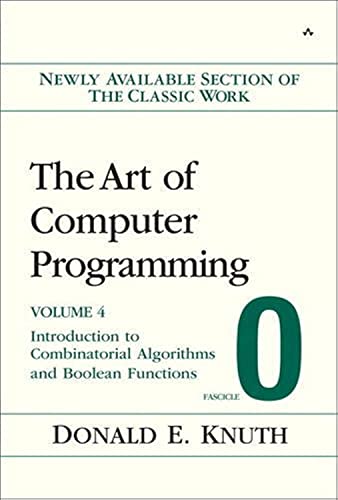 57
57The Art of Computer Programming, Volume 4, Fascicle 0: Introduction to Combinatorial Algorithms and Boolean Functions
Finally, after a wait of more than thirty-five years, the first part of Volume 4 is at last ready for publication. Check out the boxed set that brings together Volumes 1 - 4A in one elegant case, and offers the purchaser a $50 discount off the price of buying the four volumes individually. The Art of Computer Programming, Volumes 1-4A Boxed Set, 3/e ISBN: 0321751043 Art of Computer Programming, Volume 4, Fascicle 0, The: Introduction to Combinatorial Algorithms and Boolean Functions: Introduction to Combinatorial Algorithms and Boolean Functions This multivolume work on the analysis of algorithms has long been recognized as the definitive description of classical computer science. The three complete volumes published to date already comprise a unique and invaluable resource in programming theory and practice. Countless readers have spoken about the profound personal influence of Knuth s writings. Scientists have marveled at the beauty and elegance of his analysis, while practicing programmers have successfully applied his cookbook solutions to their day-to-day problems. All have admired Knuth for the breadth, clarity, accuracy, and good humor found in his books.
To begin the fourth and later volumes of the set, and to update parts of the existing three, Knuth has created a series of small books called "fascicles," which will be published at regular intervals. Each fascicle will encompass a section or more of wholly new or revised material. Ultimately, the content of these fascicles will be rolled up into the comprehensive, final versions of each volume, and the enormous undertaking that began in 1962 will be complete.
Volume 4, Fascicle 0
This fascicle introduces what will become by far the longest chapter in "The Art of Computer Programming," a chapter on combinatorial algorithms that will itself fill three full-sized volumes. Combinatorial algorithms, informally, are techniques for the high-speed manipulation of extremely large quantities of objects, such as permutations or the elements of graphs. Combinatorial patterns or arrangements solve vast numbers of practical problems, and modern approaches to dealing with them often lead to methods that are more than a thousand times faster than the straightforward procedures of yesteryear. This fascicle primes the pump for everything that follows in the chapter, discussing first the essential ideas of combinatorics and then introducing fundamental ideas for dealing efficiently with 0s and 1s inside a machine, including Boolean basics and Boolean function evaluation. As always, the author s exposition is enhanced by hundreds of new exercises, arranged carefully for self-instruction, together with detailed answers.
"
To begin the fourth and later volumes of the set, and to update parts of the existing three, Knuth has created a series of small books called "fascicles," which will be published at regular intervals. Each fascicle will encompass a section or more of wholly new or revised material. Ultimately, the content of these fascicles will be rolled up into the comprehensive, final versions of each volume, and the enormous undertaking that began in 1962 will be complete.
Volume 4, Fascicle 0
This fascicle introduces what will become by far the longest chapter in "The Art of Computer Programming," a chapter on combinatorial algorithms that will itself fill three full-sized volumes. Combinatorial algorithms, informally, are techniques for the high-speed manipulation of extremely large quantities of objects, such as permutations or the elements of graphs. Combinatorial patterns or arrangements solve vast numbers of practical problems, and modern approaches to dealing with them often lead to methods that are more than a thousand times faster than the straightforward procedures of yesteryear. This fascicle primes the pump for everything that follows in the chapter, discussing first the essential ideas of combinatorics and then introducing fundamental ideas for dealing efficiently with 0s and 1s inside a machine, including Boolean basics and Boolean function evaluation. As always, the author s exposition is enhanced by hundreds of new exercises, arranged carefully for self-instruction, together with detailed answers.
"
 58
58Introduction to the Design and Analysis of Algorithms
Based on a new classification of algorithm design techniques and a clear delineation of analysis methods, Introduction to the Design and Analysis of Algorithms presents the subject in a coherent and innovative manner. Written in a student-friendly style, the book emphasizes the understanding of ideas over excessively formal treatment while thoroughly covering the material required in an introductory algorithms course. Popular puzzles are used to motivate students' interest and strengthen their skills in algorithmic problem solving. Other learning-enhancement features include chapter summaries, hints to the exercises, and a detailed solution manual.
 59
59Competitive Programming 3
 60
60Computer Science Distilled: Learn the Art of Solving Computational Problems
A foolproof walkthrough of must-know computer science concepts. Designed for readers who don't need the academic formality, it's a fast and easy computer science guide. It teaches essential concepts for people who want to program computers effectively. First, it introduces discrete mathematics, then it exposes the most common algorithms and data structures. It also shows the principles that make computers and programming languages work.
 61
61Artificial Intelligence: A Modern Approach
For one or two-semester, undergraduate or graduate-level courses in Artificial Intelligence. The long-anticipated revision of this best-selling text offers the most comprehensive, up-to-date introduction to the theory and practice of artificial intelligence. *NEW-Nontechnical learning material-Accompanies each part of the book. *NEW-The Internet as a sample application for intelligent systems-Added in several places including logical agents, planning, and natural language. *NEW-Increased coverage of material - Includes expanded coverage of: default reasoning and truth maintenance systems, including multi-agent/distributed AI and game theory; probabilistic approaches to learning including EM; more detailed descriptions of probabilistic inference algorithms. *NEW-Updated and expanded exercises-75% of the exercises are revised, with 100 new exercises. *NEW-On-line Java software. *Makes it easy for students to do projects on the web using intelligent agents. *A unified, agent-based approach to AI-Organizes the material around the task of building intelligent agents. *Comprehensive, up-to-date coverage-Includes a unified view of the field organized around the rational decision making pa
 62
62Technically Wrong: Sexist Apps, Biased Algorithms, and Other Threats of Toxic Tech
Buying groceries, tracking our health, finding a date: whatever we want to do, odds are that we can now do it online. But few of us realize just how many oversights, biases, and downright ethical nightmares are baked inside the tech products we use every day. It’s time we change that.
In Technically Wrong, Sara Wachter-Boettcher demystifies the tech industry, leaving those of us on the other side of the screen better prepared to make informed choices about the services we use—and to demand more from the companies behind them.
A Wired Top Tech Book of the Year
A Fast Company Best Business and Leadership Book of the Year
In Technically Wrong, Sara Wachter-Boettcher demystifies the tech industry, leaving those of us on the other side of the screen better prepared to make informed choices about the services we use—and to demand more from the companies behind them.
A Wired Top Tech Book of the Year
A Fast Company Best Business and Leadership Book of the Year
 63
63Algorithms for Optimization
A comprehensive introduction to optimization with a focus on practical algorithms for the design of engineering systems.
This book offers a comprehensive introduction to optimization with a focus on practical algorithms. The book approaches optimization from an engineering perspective, where the objective is to design a system that optimizes a set of metrics subject to constraints. Readers will learn about computational approaches for a range of challenges, including searching high-dimensional spaces, handling problems where there are multiple competing objectives, and accommodating uncertainty in the metrics. Figures, examples, and exercises convey the intuition behind the mathematical approaches. The text provides concrete implementations in the Julia programming language.
Topics covered include derivatives and their generalization to multiple dimensions; local descent and first- and second-order methods that inform local descent; stochastic methods, which introduce randomness into the optimization process; linear constrained optimization, when both the objective function and the constraints are linear; surrogate models, probabilistic surrogate models, and using probabilistic surrogate models to guide optimization; optimization under uncertainty; uncertainty propagation; expression optimization; and multidisciplinary design optimization. Appendixes offer an introduction to the Julia language, test functions for evaluating algorithm performance, and mathematical concepts used in the derivation and analysis of the optimization methods discussed in the text. The book can be used by advanced undergraduates and graduate students in mathematics, statistics, computer science, any engineering field, (including electrical engineering and aerospace engineering), and operations research, and as a reference for professionals.
This book offers a comprehensive introduction to optimization with a focus on practical algorithms. The book approaches optimization from an engineering perspective, where the objective is to design a system that optimizes a set of metrics subject to constraints. Readers will learn about computational approaches for a range of challenges, including searching high-dimensional spaces, handling problems where there are multiple competing objectives, and accommodating uncertainty in the metrics. Figures, examples, and exercises convey the intuition behind the mathematical approaches. The text provides concrete implementations in the Julia programming language.
Topics covered include derivatives and their generalization to multiple dimensions; local descent and first- and second-order methods that inform local descent; stochastic methods, which introduce randomness into the optimization process; linear constrained optimization, when both the objective function and the constraints are linear; surrogate models, probabilistic surrogate models, and using probabilistic surrogate models to guide optimization; optimization under uncertainty; uncertainty propagation; expression optimization; and multidisciplinary design optimization. Appendixes offer an introduction to the Julia language, test functions for evaluating algorithm performance, and mathematical concepts used in the derivation and analysis of the optimization methods discussed in the text. The book can be used by advanced undergraduates and graduate students in mathematics, statistics, computer science, any engineering field, (including electrical engineering and aerospace engineering), and operations research, and as a reference for professionals.
64The Art of Computer Programming, Volume 4, Fascicles 0-4
The Art of Computer Programming: Bitwise Tricks and Techniques; Binary Decision Diagrams v. 4, Fascicle 1 Finally, after a wait of more than thirty-five years, the first part of Volume 4 is at last ready for publication. Check out the boxed set that brings together Volumes 1 - 4A in one elegant case, and offers the purchaser a $50 discount off the price of buying the four volumes individually. The Art of Computer Programming, Volumes 1-4A Boxed Set, 3/e ISBN: 0321751043 Art of Computer Programming, Vo... Full description
 65
65An Introduction to the Analysis of Algorithms
People who analyze algorithms have double happiness. First of all they experience the sheer beauty of elegant mathematical patterns that surround elegant computational procedures. Then they receive a practical payoff when their theories make it possible to get other jobs done more quickly and more economically.... The appearance of this long-awaited book is therefore most welcome. Its authors are not only worldwide leaders of the field, they also are masters of exposition. --D. E. Knuth This book provides a thorough introduction to the primary techniques used in the mathematical analysis of algorithms. The authors draw from classical mathematical material, including discrete mathematics, elementary real analysis, and combinatorics, as well as from classical computer science material, including algorithms and data structures. They focus on average-case or probabilistic analysis, although they also cover the basic mathematical tools required for worst-case or complexity analysis. Topics include recurrences, generating functions, asymptotics, trees, strings, maps, and an analysis of sorting, tree search, string search, and hashing algorithms. Despite the large interest in th
 66
66Algorithms in C++, Parts 1-4: Fundamentals, Data Structure, Sorting, Searching
Robert Sedgewick has thoroughly rewritten and substantially expanded and updated his popular work to provide current and comprehensive coverage of important algorithms and data structures. Christopher Van Wyk and Sedgewick have developed new C++ implementations that both express the methods in a concise and direct manner, and also provide programmers with the practical means to test them on real applications. Many new algorithms are presented, and the explanations of each algorithm are much more detailed than in previous editions. A new text design and detailed, innovative figures, with accompanying commentary, greatly enhance the presentation. The third edition retains the successful blend of theory and practice that has made Sedgewick's work an invaluable resource for more than 250,000 programmers! This particular book, Parts 1n4, represents the essential first half of Sedgewick's complete work. It provides extensive coverage of fundamental data structures and algorithms for sorting, searching, and related applications. Although the substance of the book applies to programming in any language, the implementations by Van Wyk and Sedgewick also exploit the natural match between C++ classes and ADT implementations. Highlights Expanded coverage of arrays, linked lists, strings, trees, and other basic data structures
Greater emphasis on abstract data types (ADTs), modular programming, object-oriented programming, and C++ classes than in previous editions
Over 100 algorithms for sorting, selection, priority queue ADT implementations, and symbol table ADT (searching) implementations
New implementations of binomial queues, multiway radix sorting, randomized BSTs, splay trees, skip lists, multiway tries, B trees, extendible hashing, and much more
Increased quantitative information about the algorithms, giving you a basis for comparing them
Over 1000 new exercises to help you learn the properties of algorithms Whether you are learning the algorithms for the first time or wish to have up-to-date reference material that incorporates new programming styles with classic and new algorithms, you will find a wealth of useful information in this book.
Greater emphasis on abstract data types (ADTs), modular programming, object-oriented programming, and C++ classes than in previous editions
Over 100 algorithms for sorting, selection, priority queue ADT implementations, and symbol table ADT (searching) implementations
New implementations of binomial queues, multiway radix sorting, randomized BSTs, splay trees, skip lists, multiway tries, B trees, extendible hashing, and much more
Increased quantitative information about the algorithms, giving you a basis for comparing them
Over 1000 new exercises to help you learn the properties of algorithms Whether you are learning the algorithms for the first time or wish to have up-to-date reference material that incorporates new programming styles with classic and new algorithms, you will find a wealth of useful information in this book.
 67
67Programming Interviews Exposed: Secrets to Landing Your Next Job (Programmer to Programmer)
The pressure is on during the interview process but with the right preparation, you can walk away with your dream job. This classic book uncovers what interviews are really like at America's top software and computer companies and provides you with the tools to succeed in any situation. The authors take you step-by-step through new problems and complex brainteasers they were asked during recent technical interviews. 50 interview scenarios are presented along with in-depth analysis of the possible solutions. The problem-solving process is clearly illustrated so you'll be able to easily apply what you've learned during crunch time. You'll also find expert tips on what questions to ask, how to approach a problem, and how to recover if you become stuck. All of this will help you ace the interview and get the job you want.
What you will learn from this book
Tips for effectively completing the job application Ways to prepare for the entire programming interview process How to find the kind of programming job that fits you best Strategies for choosing a solution and what your approach says about you How to improve your interviewing skills so that you can respond to any question or situation Techniques for solving knowledge-based problems, logic puzzles, and programming problems Who this book is for
This book is for programmers and developers applying for jobs in the software industry or in IT departments of major corporations.
Wrox Beginning guides are crafted to make learning programming languages and technologies easier than you think, providing a structured, tutorial format that will guide you through all the techniques involved.
What you will learn from this book
Tips for effectively completing the job application Ways to prepare for the entire programming interview process How to find the kind of programming job that fits you best Strategies for choosing a solution and what your approach says about you How to improve your interviewing skills so that you can respond to any question or situation Techniques for solving knowledge-based problems, logic puzzles, and programming problems Who this book is for
This book is for programmers and developers applying for jobs in the software industry or in IT departments of major corporations.
Wrox Beginning guides are crafted to make learning programming languages and technologies easier than you think, providing a structured, tutorial format that will guide you through all the techniques involved.
 68
68Learning From Data: A Short Course
Machine learning allows computational systems to adaptively improve their performance with experience accumulated from the observed data. Its techniques are widely applied in engineering, science, finance, and commerce. This book is designed for a short course on machine learning. It is a short course, not a hurried course. From over a decade of teaching this material, we have distilled what we believe to be the core topics that every student of the subject should know. We chose the title `learning from data' that faithfully describes what the subject is about, and made it a point to cover the topics in a story-like fashion. Our hope is that the reader can learn all the fundamentals of the subject by reading the book cover to cover. ---- Learning from data has distinct theoretical and practical tracks. In this book, we balance the theoretical and the practical, the mathematical and the heuristic. Our criterion for inclusion is relevance. Theory that establishes the conceptual framework for learning is included, and so are heuristics that impact the performance of real learning systems. ---- Learning from data is a very dynamic field. Some of the hot techniques and theories at times become just fads, and others gain traction and become part of the field. What we have emphasized in this book are the necessary fundamentals that give any student of learning from data a solid foundation, and enable him or her to venture out and explore further techniques and theories, or perhaps to contribute their own. ---- The authors are professors at California Institute of Technology (Caltech), Rensselaer Polytechnic Institute (RPI), and National Taiwan University (NTU), where this book is the main text for their popular courses on machine learning. The authors also consult extensively with financial and commercial companies on machine learning applications, and have led winning teams in machine learning competitions.
 69
69Introduction to the Theory of Computation
This highly anticipated revision builds upon the strengths of the previous edition. Sipser's candid, crystal-clear style allows students at every level to understand and enjoy this field. His innovative "proof idea" sections explain profound concepts in plain English. The new edition incorporates many improvements students and professors have suggested over the years, and offers updated, classroom-tested problem sets at the end of each chapter.
 70
70Advanced Data Structures
Advanced Data Structures presents a comprehensive look at the ideas, analysis, and implementation details of data structures as a specialized topic in applied algorithms. Data structures are how data is stored within a computer, and how one can go about searching for data within. This text examines efficient ways to search and update sets of numbers, intervals, or strings by various data structures, such as search trees, structures for sets of intervals or piece-wise constant functions, orthogonal range search structures, heaps, union-find structures, dynamization and persistence of structures, structures for strings, and hash tables. This is the first volume to show data structures as a crucial algorithmic topic, rather than relegating them as trivial material used to illustrate object-oriented programming methodology, filling a void in the ever-increasing computer science market. Numerous code examples in C and more than 500 references make Advanced Data Structures an indispensable text. topic. Numerous code examples in C and more than 500 references make Advanced Data Structures an indispensable text.
 71
71Ideals, Varieties, and Algorithms: An Introduction to Computational Algebraic Geometry and Commutative Algebra
This text covers topics in algebraic geometry and commutative algebra with a strong perspective toward practical and computational aspects. The first four chapters form the core of the book. A comprehensive chart in the Preface illustrates a variety of ways to proceed with the material once these chapters are covered. In addition to the fundamentals of algebraic geometry the elimination theorem, the extension theorem, the closure theorem and the Nullstellensatz this new edition incorporates several substantial changes, all of which are listed in the Preface. The largest revision incorporates a new Chapter (ten), which presents some of the essentials of progress made over the last decades in computing Grobner bases. The book also includes current computer algebra material in Appendix C and updated independent projects (Appendix D).
The book may serve as a first or second course in undergraduate abstract algebra and with some supplementation perhaps, for beginning graduate level courses in algebraic geometry or computational algebra. Prerequisites for the reader include linear algebra and a proof-oriented course.It is assumed that the reader has access to a computer algebra system. Appendix C describes features of Maple, Mathematica(r) and Sage, as well as other systems that are most relevant to the text. Pseudocode is used in the text; Appendix B carefully describes the pseudocode used.
From the reviews of previous editions:
The book gives an introduction to Buchberger s algorithm with applications to syzygies, Hilbert polynomials, primary decompositions. There is an introduction to classical algebraic geometry with applications to the ideal membership problem, solving polynomial equations and elimination theory. The book is well-written. The reviewer is sure that it will be an excellent guide to introduce further undergraduates in the algorithmic aspect of commutative algebra and algebraic geometry.
Peter Schenzel, zbMATH, 2007
I consider the book to be wonderful. ... The exposition is very clear, there are many helpful pictures and there are a great many instructive exercises, some quite challenging ... offers the heart and soul of modern commutative and algebraic geometry.
The American Mathematical Monthly
"
The book may serve as a first or second course in undergraduate abstract algebra and with some supplementation perhaps, for beginning graduate level courses in algebraic geometry or computational algebra. Prerequisites for the reader include linear algebra and a proof-oriented course.It is assumed that the reader has access to a computer algebra system. Appendix C describes features of Maple, Mathematica(r) and Sage, as well as other systems that are most relevant to the text. Pseudocode is used in the text; Appendix B carefully describes the pseudocode used.
From the reviews of previous editions:
The book gives an introduction to Buchberger s algorithm with applications to syzygies, Hilbert polynomials, primary decompositions. There is an introduction to classical algebraic geometry with applications to the ideal membership problem, solving polynomial equations and elimination theory. The book is well-written. The reviewer is sure that it will be an excellent guide to introduce further undergraduates in the algorithmic aspect of commutative algebra and algebraic geometry.
Peter Schenzel, zbMATH, 2007
I consider the book to be wonderful. ... The exposition is very clear, there are many helpful pictures and there are a great many instructive exercises, some quite challenging ... offers the heart and soul of modern commutative and algebraic geometry.
The American Mathematical Monthly
"
 72
72Data Structures and Algorithms in Python
Based on the authors' market leading data structures books in Java and C++, this book offers a comprehensive, definitive introduction to data structures in Python by authoritative authors. Data Structures and Algorithms in Python is the first authoritative object-oriented book available for Python data structures. Designed to provide a comprehensive introduction to data structures and algorithms, including their design, analysis, and implementation, the text will maintain the same general structure as Data Structures and Algorithms in Java and Data Structures and Algorithms in C++.
Begins by discussing Python's conceptually simple syntax, which allows for a greater focus on concepts. Employs a consistent object-oriented viewpoint throughout the text. Presents each data structure using ADTs and their respective implementations and introduces important design patterns as a means to organize those implementations into classes, methods, and objects. Provides a thorough discussion on the analysis and design of fundamental data structures. Includes many helpful Python code examples, with source code provided on the website. Uses illustrations to present data structures and algorithms, as well as their analysis, in a clear, visual manner. Provides hundreds of exercises that promote creativity, help readers learn how to think like programmers, and reinforce important concepts. Contains many Python-code and pseudo-code fragments, and hundreds of exercises, which are divided into roughly 40% reinforcement exercises, 40% creativity exercises, and 20% programming projects.
Begins by discussing Python's conceptually simple syntax, which allows for a greater focus on concepts. Employs a consistent object-oriented viewpoint throughout the text. Presents each data structure using ADTs and their respective implementations and introduces important design patterns as a means to organize those implementations into classes, methods, and objects. Provides a thorough discussion on the analysis and design of fundamental data structures. Includes many helpful Python code examples, with source code provided on the website. Uses illustrations to present data structures and algorithms, as well as their analysis, in a clear, visual manner. Provides hundreds of exercises that promote creativity, help readers learn how to think like programmers, and reinforce important concepts. Contains many Python-code and pseudo-code fragments, and hundreds of exercises, which are divided into roughly 40% reinforcement exercises, 40% creativity exercises, and 20% programming projects.
 73
73Algorithms Illuminated (Part 3): Greedy Algorithms and Dynamic Programming
Algorithms are the heart and soul of computer science. Their applications range from network routing and computational genomics to public-key cryptography and machine learning. Studying algorithms can make you a better programmer, a clearer thinker, and a master of technical interviews. Algorithms Illuminated is an accessible introduction to the subject for anyone with at least a little programming experience. The exposition emphasizes the big picture and conceptual understanding over low-level implementation and mathematical details---like a transcript of what an expert algorithms tutor would say over a series of one-on-one lessons. Part 3 covers greedy algorithms (scheduling, minimum spanning trees, clustering, Huffman codes) and dynamic programming (knapsack, sequence alignment, shortest paths, optimal search trees).
 74
74Machine Learning: A Probabilistic Perspective
A comprehensive introduction to machine learning that uses probabilistic models and inference as a unifying approach.
Today's Web-enabled deluge of electronic data calls for automated methods of data analysis. Machine learning provides these, developing methods that can automatically detect patterns in data and then use the uncovered patterns to predict future data. This textbook offers a comprehensive and self-contained introduction to the field of machine learning, based on a unified, probabilistic approach.
The coverage combines breadth and depth, offering necessary background material on such topics as probability, optimization, and linear algebra as well as discussion of recent developments in the field, including conditional random fields, L1 regularization, and deep learning. The book is written in an informal, accessible style, complete with pseudo-code for the most important algorithms. All topics are copiously illustrated with color images and worked examples drawn from such application domains as biology, text processing, computer vision, and robotics. Rather than providing a cookbook of different heuristic methods, the book stresses a principled model-based approach, often using the language of graphical models to specify models in a concise and intuitive way. Almost all the models described have been implemented in a MATLAB software package—PMTK (probabilistic modeling toolkit)—that is freely available online. The book is suitable for upper-level undergraduates with an introductory-level college math background and beginning graduate students.
Today's Web-enabled deluge of electronic data calls for automated methods of data analysis. Machine learning provides these, developing methods that can automatically detect patterns in data and then use the uncovered patterns to predict future data. This textbook offers a comprehensive and self-contained introduction to the field of machine learning, based on a unified, probabilistic approach.
The coverage combines breadth and depth, offering necessary background material on such topics as probability, optimization, and linear algebra as well as discussion of recent developments in the field, including conditional random fields, L1 regularization, and deep learning. The book is written in an informal, accessible style, complete with pseudo-code for the most important algorithms. All topics are copiously illustrated with color images and worked examples drawn from such application domains as biology, text processing, computer vision, and robotics. Rather than providing a cookbook of different heuristic methods, the book stresses a principled model-based approach, often using the language of graphical models to specify models in a concise and intuitive way. Almost all the models described have been implemented in a MATLAB software package—PMTK (probabilistic modeling toolkit)—that is freely available online. The book is suitable for upper-level undergraduates with an introductory-level college math background and beginning graduate students.
Recommended by Kirk Borne.Kirk Borne
#MachineLearning — a Probabilistic Perspective: https://t.co/wAZwLoUFGF ———— #BigData #Statistics #DataScience #DeepLearning #AI #Algorithms #StatisticalLiteracy #Mathematics #abdsc ——— ⬇Get this brilliant 1100-page 28-chapter highly-rated book: https://t.co/Tm2zchpHSu https://t.co/jprUDdzkj8 [source]
 75
75Applied Cryptography: Protocols, Algorithms, and Source Code in C
"…the best introduction to cryptography I've ever seen. … The book the National Security Agency wanted never to be published." –Wired Magazine
"…monumental… fascinating… comprehensive… the definitive work on cryptography for computer programmers…" –Dr. Dobb's Journal
"…easily ranks as one of the most authoritative in its field." —PC Magazine
"…the bible of code hackers." –The Millennium Whole Earth Catalog
This new edition of the cryptography classic provides you with a comprehensive survey of modern cryptography. The book details how programmers and electronic communications professionals can use cryptography—the technique of enciphering and deciphering messages-to maintain the privacy of computer data. It describes dozens of cryptography algorithms, gives practical advice on how to implement them into cryptographic software, and shows how they can be used to solve security problems. Covering the latest developments in practical cryptographic techniques, this new edition shows programmers who design computer applications, networks, and storage systems how they can build security into their software and systems.
What's new in the Second Edition?
• New information on the Clipper Chip, including ways to defeat the key escrow mechanism
• New encryption algorithms, including algorithms from the former Soviet Union and South Africa, and the RC4 stream cipher
• The latest protocols for digital signatures, authentication, secure elections, digital cash, and more
• More detailed information on key management and cryptographic implementations
"…monumental… fascinating… comprehensive… the definitive work on cryptography for computer programmers…" –Dr. Dobb's Journal
"…easily ranks as one of the most authoritative in its field." —PC Magazine
"…the bible of code hackers." –The Millennium Whole Earth Catalog
This new edition of the cryptography classic provides you with a comprehensive survey of modern cryptography. The book details how programmers and electronic communications professionals can use cryptography—the technique of enciphering and deciphering messages-to maintain the privacy of computer data. It describes dozens of cryptography algorithms, gives practical advice on how to implement them into cryptographic software, and shows how they can be used to solve security problems. Covering the latest developments in practical cryptographic techniques, this new edition shows programmers who design computer applications, networks, and storage systems how they can build security into their software and systems.
What's new in the Second Edition?
• New information on the Clipper Chip, including ways to defeat the key escrow mechanism
• New encryption algorithms, including algorithms from the former Soviet Union and South Africa, and the RC4 stream cipher
• The latest protocols for digital signatures, authentication, secure elections, digital cash, and more
• More detailed information on key management and cryptographic implementations
Recommended by Dominic Steil.Dominic Steil
One of the five books recommends to young people interested in his career path. [source]
 76
76Mazes for Programmers: Code Your Own Twisty Little Passages
Unlock the secrets to creating random mazes! Whether you're a game developer, an algorithm connoisseur, or simply in search of a new puzzle, you're about to level up. Learn algorithms to randomly generate mazes in a variety of shapes, sizes, and dimensions. Bend them into Moebius strips, fold them into cubes, and wrap them around spheres. Stretch them into other dimensions, squeeze them into arbitrary outlines, and tile them in a dizzying variety of ways. From twelve little algorithms, you'll discover a vast reservoir of ideas and inspiration.
From video games to movies, mazes are ubiquitous. Explore a dozen algorithms for generating these puzzles randomly, from Binary Tree to Eller's, each copiously illustrated and accompanied by working implementations in Ruby. You'll learn their pros and cons, and how to choose the right one for the job.
You'll start by learning six maze algorithms and transition from making mazes on paper to writing programs that generate and draw them. You'll be introduced to Dijkstra's algorithm and see how it can help solve, analyze, and visualize mazes. Part 2 shows you how to constrain your mazes to different shapes and outlines, such as text, circles, hex and triangle grids, and more. You'll learn techniques for culling dead-ends, and for making your passages weave over and under each other. Part 3 looks at six more algorithms, taking it all to the next level. You'll learn how to build your mazes in multiple dimensions, and even on curved surfaces.
Through it all, you'll discover yourself brimming with ideas, the best medicine for programmer's block, burn-out, and the grayest of days. By the time you're done, you'll be energized and full of maze-related possibilities!
What You Need:
The example code requires version 2 of the Ruby programming language. Some examples depend on the ChunkyPNG library to generate PNG images, and one chapter uses POV-Ray version 3.7 to render 3D graphics.
From video games to movies, mazes are ubiquitous. Explore a dozen algorithms for generating these puzzles randomly, from Binary Tree to Eller's, each copiously illustrated and accompanied by working implementations in Ruby. You'll learn their pros and cons, and how to choose the right one for the job.
You'll start by learning six maze algorithms and transition from making mazes on paper to writing programs that generate and draw them. You'll be introduced to Dijkstra's algorithm and see how it can help solve, analyze, and visualize mazes. Part 2 shows you how to constrain your mazes to different shapes and outlines, such as text, circles, hex and triangle grids, and more. You'll learn techniques for culling dead-ends, and for making your passages weave over and under each other. Part 3 looks at six more algorithms, taking it all to the next level. You'll learn how to build your mazes in multiple dimensions, and even on curved surfaces.
Through it all, you'll discover yourself brimming with ideas, the best medicine for programmer's block, burn-out, and the grayest of days. By the time you're done, you'll be energized and full of maze-related possibilities!
What You Need:
The example code requires version 2 of the Ruby programming language. Some examples depend on the ChunkyPNG library to generate PNG images, and one chapter uses POV-Ray version 3.7 to render 3D graphics.
 77
77From Mathematics to Generic Programming
In this substantive yet accessible book, pioneering software designer Alexander Stepanov and his colleague Daniel Rose illuminate the principles of generic programming and the mathematical concept of abstraction on which it is based, helping you write code that is both simpler and more powerful. If you're a reasonably proficient programmer who can think logically, you have all the background you'll need. Stepanov and Rose introduce the relevant abstract algebra and number theory with exceptional clarity. They carefully explain the problems mathematicians first needed to solve, and then show how these mathematical solutions translate to generic programming and the creation of more effective and elegant code. To demonstrate the crucial role these mathematical principles play in many modern applications, the authors show how to use these results and generalized algorithms to implement a real-world public-key cryptosystem. As you read this book, you'll master the thought processes necessary for effective programming and learn how to generalize narrowly conceived algorithms to widen their usefulness without losing efficiency. You'll also gain deep insight into the value of mathematics to programming--insight that will prove invaluable no matter what programming languages and paradigms you use. You will learn about
How to generalize a four thousand-year-old algorithm, demonstrating indispensable lessons about clarity and efficiency
Ancient paradoxes, beautiful theorems, and the productive tension between continuous and discrete
A simple algorithm for finding greatest common divisor (GCD) and modern abstractions that build on it
Powerful mathematical approaches to abstraction
How abstract algebra provides the idea at the heart of generic programming
Axioms, proofs, theories, and models: using mathematical techniques to organize knowledge about your algorithms and data structures
Surprising subtleties of simple programming tasks and what you can learn from them
How practical implementations can exploit theoretical knowledge
How to generalize a four thousand-year-old algorithm, demonstrating indispensable lessons about clarity and efficiency
Ancient paradoxes, beautiful theorems, and the productive tension between continuous and discrete
A simple algorithm for finding greatest common divisor (GCD) and modern abstractions that build on it
Powerful mathematical approaches to abstraction
How abstract algebra provides the idea at the heart of generic programming
Axioms, proofs, theories, and models: using mathematical techniques to organize knowledge about your algorithms and data structures
Surprising subtleties of simple programming tasks and what you can learn from them
How practical implementations can exploit theoretical knowledge
 78
78A Discipline of Programming
 79
79Genetic Algorithms in Search, Optimization, and Machine Learning
This book brings together - in an informal and tutorial fashion - the computer techniques, mathematical tools, and research results that will enable both students and practitioners to apply genetic algorithms to problems in many fields. Major concepts are illustrated with running examples, and major algorithms are illustrated by Pascal computer programs. No prior knowledge of GAs or genetics is assumed, and only a minimum of computer programming and mathematics background is required. 0201157675B07092001
 80
80Graph Algorithms: Practical Examples in Apache Spark & Neo4j
Discover how graph algorithms can help you leverage the relationships within your data to develop more intelligent solutions and enhance your machine learning models. You'll learn how graph analytics are uniquely suited to unfold complex structures and reveal difficult-to-find patterns lurking in your data. Whether you are trying to build dynamic network models or forecast real-world behavior, this book illustrates how graph algorithms deliver value--from finding vulnerabilities and bottlenecks to detecting communities and improving machine learning predictions.
This practical book walks you through hands-on examples of how to use graph algorithms in Apache Spark and Neo4j--two of the most common choices for graph analytics. Also included: sample code and tips for over 20 practical graph algorithms that cover optimal pathfinding, importance through centrality, and community detection.
Learn how graph analytics vary from conventional statistical analysis
Understand how classic graph algorithms work, and how they are applied
Get guidance on which algorithms to use for different types of questions
Explore algorithm examples with working code and sample datasets from Spark and Neo4j
See how connected feature extraction can increase machine learning accuracy and precision
Walk through creating an ML workflow for link prediction combining Neo4j and Spark
This practical book walks you through hands-on examples of how to use graph algorithms in Apache Spark and Neo4j--two of the most common choices for graph analytics. Also included: sample code and tips for over 20 practical graph algorithms that cover optimal pathfinding, importance through centrality, and community detection.
Learn how graph analytics vary from conventional statistical analysis
Understand how classic graph algorithms work, and how they are applied
Get guidance on which algorithms to use for different types of questions
Explore algorithm examples with working code and sample datasets from Spark and Neo4j
See how connected feature extraction can increase machine learning accuracy and precision
Walk through creating an ML workflow for link prediction combining Neo4j and Spark
Recommended by Kirk Borne.Kirk Borne
Great book: "Graph Algorithms: Practical Examples in #ApacheSpark and @Neo4j" by @amyhodler & @markhneedham, with the Foreward by me😎 ———— Get FREE PDF copy: https://t.co/61yQgYUrud ———— #GraphAnalytics #BigData #GraphDB #LinkedData #SmartData #DataScience #AI #MachineLearning https://t.co/BQaK75O7mP [source]
 81
81Windows Internals, Part 1: User Mode
Delve inside Windows architecture and internals - and see how core components work behind the scenes. This classic guide has been fully updated for Windows 8.1 and Windows Server 2012 R2, and now presents its coverage in three volumes: Book 1, User Mode; Book 2, Kernel Mode; Book 3, Device Driver Models.
In Book 1, you'll plumb Windows fundamentals, independent of platform - server, desktop, tablet, phone, Xbox. Coverage focuses on high-level functional descriptions of the various Windows components and features that interact with, or are manipulated by, user mode programs, or applications. You'll also examine management mechanisms and operating system components that are implemented in user mode, such as service processes.
As always, you get critical insider perspectives on how Windows operates. And through hands-on experiments, you'll experience its internal behavior firsthand - knowledge you can apply to improve application design, debugging, system performance, and support.
Planned chapters: Concepts & Tools; System Architecture; Windows Application Support; Windows Store Apps; Graphics & the Desktop; Management Mechanisms; User Mode Memory Management; Security; Storage; Networking; Hyper-V.
In Book 1, you'll plumb Windows fundamentals, independent of platform - server, desktop, tablet, phone, Xbox. Coverage focuses on high-level functional descriptions of the various Windows components and features that interact with, or are manipulated by, user mode programs, or applications. You'll also examine management mechanisms and operating system components that are implemented in user mode, such as service processes.
As always, you get critical insider perspectives on how Windows operates. And through hands-on experiments, you'll experience its internal behavior firsthand - knowledge you can apply to improve application design, debugging, system performance, and support.
Planned chapters: Concepts & Tools; System Architecture; Windows Application Support; Windows Store Apps; Graphics & the Desktop; Management Mechanisms; User Mode Memory Management; Security; Storage; Networking; Hyper-V.
 Recommended by Rob Fuller.
Rob Fuller
@maddiestone Awesome book, I've read a couple editions and always learn new things. Have fun ;-) I would also recommend reading the older editions they have tricks and info that seem to disappear in newer ones. [source]
 82
82Essential Algorithms: A Practical Approach to Computer Algorithms
A friendly and accessible introduction to the most useful algorithms
Computer algorithms are the basic recipes for programming. Professional programmers need to know how to use algorithms to solve difficult programming problems. Written in simple, intuitive English, this book describes how and when to use the most practical classic algorithms, and even how to create new algorithms to meet future needs. The book also includes a collection of questions that can help readers prepare for a programming job interview.
Reveals methods for manipulating common data structures such as arrays, linked lists, trees, and networks Addresses advanced data structures such as heaps, 2-3 trees, B-trees Addresses general problem-solving techniques such as branch and bound, divide and conquer, recursion, backtracking, heuristics, and more Reviews sorting and searching, network algorithms, and numerical algorithms Includes general problem-solving techniques such as brute force and exhaustive search, divide and conquer, backtracking, recursion, branch and bound, and more In addition, Essential Algorithms features a companion website that includes full instructor materials to support training or higher ed adoptions.
Computer algorithms are the basic recipes for programming. Professional programmers need to know how to use algorithms to solve difficult programming problems. Written in simple, intuitive English, this book describes how and when to use the most practical classic algorithms, and even how to create new algorithms to meet future needs. The book also includes a collection of questions that can help readers prepare for a programming job interview.
Reveals methods for manipulating common data structures such as arrays, linked lists, trees, and networks Addresses advanced data structures such as heaps, 2-3 trees, B-trees Addresses general problem-solving techniques such as branch and bound, divide and conquer, recursion, backtracking, heuristics, and more Reviews sorting and searching, network algorithms, and numerical algorithms Includes general problem-solving techniques such as brute force and exhaustive search, divide and conquer, backtracking, recursion, branch and bound, and more In addition, Essential Algorithms features a companion website that includes full instructor materials to support training or higher ed adoptions.
 83
83Mastering Algorithms with C
There are many books on data structures and algorithms, including some with useful libraries of C functions. Mastering Algorithms with C offers you a unique combination of theoretical background and working code. With robust solutions for everyday programming tasks, this book avoids the abstract style of most classic data structures and algorithms texts, but still provides all of the information you need to understand the purpose and use of common programming techniques.
Implementations, as well as interesting, real-world examples of each data structure and algorithm, are included.
Using both a programming style and a writing style that are exceptionally clean, Kyle Loudon shows you how to use such essential data structures as lists, stacks, queues, sets, trees, heaps, priority queues, and graphs. He explains how to use algorithms for sorting, searching, numerical analysis, data compression, data encryption, common graph problems, and computational geometry. And he describes the relative efficiency of all implementations. The compression and encryption chapters not only give you working code for reasonably efficient solutions, they offer explanations of concepts in an approachable manner for people who never have had the time or expertise to study them in depth.
Anyone with a basic understanding of the C language can use this book. In order to provide maintainable and extendible code, an extra level of abstraction (such as pointers to functions) is used in examples where appropriate. Understanding that these techniques may be unfamiliar to some programmers, Loudon explains them clearly in the introductory chapters.
Contents include:
Pointers
Recursion
Analysis of algorithms
Data structures (lists, stacks, queues, sets, hash tables, trees, heaps, priority queues, graphs)
Sorting and searching
Numerical methods
Data compression
Data encryption
Graph algorithms
Geometric algorithms
Implementations, as well as interesting, real-world examples of each data structure and algorithm, are included.
Using both a programming style and a writing style that are exceptionally clean, Kyle Loudon shows you how to use such essential data structures as lists, stacks, queues, sets, trees, heaps, priority queues, and graphs. He explains how to use algorithms for sorting, searching, numerical analysis, data compression, data encryption, common graph problems, and computational geometry. And he describes the relative efficiency of all implementations. The compression and encryption chapters not only give you working code for reasonably efficient solutions, they offer explanations of concepts in an approachable manner for people who never have had the time or expertise to study them in depth.
Anyone with a basic understanding of the C language can use this book. In order to provide maintainable and extendible code, an extra level of abstraction (such as pointers to functions) is used in examples where appropriate. Understanding that these techniques may be unfamiliar to some programmers, Loudon explains them clearly in the introductory chapters.
Contents include:
Pointers
Recursion
Analysis of algorithms
Data structures (lists, stacks, queues, sets, hash tables, trees, heaps, priority queues, graphs)
Sorting and searching
Numerical methods
Data compression
Data encryption
Graph algorithms
Geometric algorithms
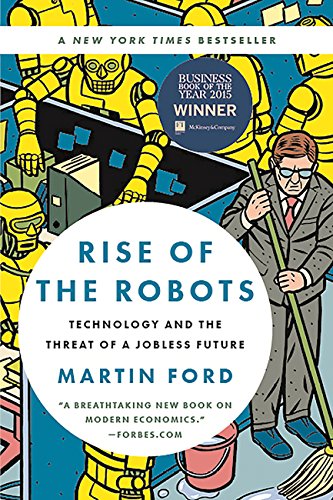 84
84Rise of the Robots: Technology and the Threat of a Jobless Future
What are the jobs of the future? How many will there be? And who will have them? We might imagine—and hope—that today's industrial revolution will unfold like the last: even as some jobs are eliminated, more will be created to deal with the new innovations of a new era. In Rise of the Robots, Silicon Valley entrepreneur Martin Ford argues that this is absolutely not the case. As technology continues to accelerate and machines begin taking care of themselves, fewer people will be necessary. Artificial intelligence is already well on its way to making “good jobs” obsolete: many paralegals, journalists, office workers, and even computer programmers are poised to be replaced by robots and smart software. As progress continues, blue and white collar jobs alike will evaporate, squeezing working- and middle-class families ever further. At the same time, households are under assault from exploding costs, especially from the two major industries—education and health care—that, so far, have not been transformed by information technology. The result could well be massive unemployment and inequality as well as the implosion of the consumer economy itself.
In Rise of the Robots, Ford details what machine intelligence and robotics can accomplish, and implores employers, scholars, and policy makers alike to face the implications. The past solutions to technological disruption, especially more training and education, aren't going to work, and we must decide, now, whether the future will see broad-based prosperity or catastrophic levels of inequality and economic insecurity. Rise of the Robots is essential reading for anyone who wants to understand what accelerating technology means for their own economic prospects—not to mention those of their children—as well as for society as a whole.
In Rise of the Robots, Ford details what machine intelligence and robotics can accomplish, and implores employers, scholars, and policy makers alike to face the implications. The past solutions to technological disruption, especially more training and education, aren't going to work, and we must decide, now, whether the future will see broad-based prosperity or catastrophic levels of inequality and economic insecurity. Rise of the Robots is essential reading for anyone who wants to understand what accelerating technology means for their own economic prospects—not to mention those of their children—as well as for society as a whole.
Recommended by Matthew Barby.Matthew Barby
On the other side of things, which is a bit more like inspirational and a bit more tactical, it would probably be Rise of the Robots. Focuses all on the rise of artificial intelligence. Has some really interesting pieces on how people are disrupting in a bunch of different verticals for like ED Tech, health, 3D printing, and a bunch of other areas, and the impact that that has on jobs in the future. I love those two books at the moment. [source]
 85
85Introduction to Machine Learning with Python: A Guide for Data Scientists
Machine learning has become an integral part of many commercial applications and research projects, but this field is not exclusive to large companies with extensive research teams. If you use Python, even as a beginner, this book will teach you practical ways to build your own machine learning solutions. With all the data available today, machine learning applications are limited only by your imagination.
You'll learn the steps necessary to create a successful machine-learning application with Python and the scikit-learn library. Authors Andreas Muller and Sarah Guido focus on the practical aspects of using machine learning algorithms, rather than the math behind them. Familiarity with the NumPy and matplotlib libraries will help you get even more from this book.
With this book, you'll learn:
Fundamental concepts and applications of machine learning
Advantages and shortcomings of widely used machine learning algorithms
How to represent data processed by machine learning, including which data aspects to focus on
Advanced methods for model evaluation and parameter tuning
The concept of pipelines for chaining models and encapsulating your workflow
Methods for working with text data, including text-specific processing techniques
Suggestions for improving your machine learning and data science skills
You'll learn the steps necessary to create a successful machine-learning application with Python and the scikit-learn library. Authors Andreas Muller and Sarah Guido focus on the practical aspects of using machine learning algorithms, rather than the math behind them. Familiarity with the NumPy and matplotlib libraries will help you get even more from this book.
With this book, you'll learn:
Fundamental concepts and applications of machine learning
Advantages and shortcomings of widely used machine learning algorithms
How to represent data processed by machine learning, including which data aspects to focus on
Advanced methods for model evaluation and parameter tuning
The concept of pipelines for chaining models and encapsulating your workflow
Methods for working with text data, including text-specific processing techniques
Suggestions for improving your machine learning and data science skills
 Recommended by Francesco Marconi.
Francesco Marconi
Top programming languages ranked by its annual search engine popularity. Python has gained momentum because of its importance to machine learning development. At @WSJ we are using it to build tools for journalists. Tip: this is a great book for anyone who wants to get started! https://t.co/ZsHjqB5gvC [source]
 86
86Programming Challenges: The Programming Contest Training Manual
There are many distinct pleasures associated with computer programming. Craftsm- ship has its quiet rewards, the satisfaction that comes from building a useful object and making it work. Excitement arrives with the ?ash of insight that cracks a previously intractable problem. The spiritual quest for elegance can turn the hacker into an artist. Therearepleasuresinparsimony, insqueezingthelastdropofperformanceoutofclever algorithms and tight coding. Thegames, puzzles, andchallengesofproblemsfrominternationalprogrammingc- petitionsareagreatwaytoexperiencethesepleasureswhileimprovingyouralgorithmic and coding skills. This book contains over 100 problems that have appeared in previous programming contests, along with discussions of the theory and ideas necessary to - tack them. Instant online grading for all of these problems is available from two WWW robot judging sites. Combining this book with a judge gives an exciting new way to challenge and improve your programming skills. This book can be used for self-study, for teaching innovative courses in algorithms and programming, and in training for international competition. To the Reader Theproblemsinthisbookhavebeenselectedfromover1,000programmingproblemsat the Universidad de Valladolid online judge, available athttp: //online-judge.uva.es.The judgehasruledonwelloveronemillionsubmissionsfrom27,000registeredusersaround the world to date. We have taken only the best of the best, the most fun, exciting, and interesting problems availa
 87
87Machine Learning
Mitchell covers the field of machine learning, the study of algorithms that allow computer programs to automatically improve through experience and that automatically infer general laws from specific data.
 Recommended by Daniel H Wilson.
Daniel H Wilson
Yes, Machine Learning is a textbook and I would call it the textbook for machine learning and artificial intelligence. Machine learning is just the math of teaching a machine how to solve a problem on its own, because you’re not going to be able to be there to solve it for the machine. It can be any kind of problem: it could be a robot that needs to figure out how to get from point A to point B or it could be a supply inventory algorithm for trying to figure out how many products it should order for Walmart. [source]
 88
88Data Structures and Algorithmic Thinking with Python: Data Structure and Algorithmic Puzzles
Table of Contents: goo.gl/VLEUca
Sample Chapter: goo.gl/8AEcYk
Source Code: goo.gl/L8Xxdt
It is the Python version of "Data Structures and Algorithms Made Easy".
The sample chapter should give you a very good idea of the quality and style of our book. In particular, be sure you are comfortable with the level and with our Python coding style.
This book focuses on giving solutions for complex problems in data structures and algorithm. It even provides multiple solutions for a single problem, thus familiarizing readers with different possible approaches to the same problem. "Data Structure and Algorithmic Thinking with Python" is designed to give a jumpstart to programmers, job hunters and those who are appearing for exams. All the code in this book are written in Python. It contains many programming puzzles that not only encourage analytical thinking, but also prepares readers for interviews. This book, with its focused and practical approach, can help readers quickly pick up the concepts and techniques for developing efficient and effective solutions to problems.
Sample Chapter: goo.gl/8AEcYk
Source Code: goo.gl/L8Xxdt
It is the Python version of "Data Structures and Algorithms Made Easy".
The sample chapter should give you a very good idea of the quality and style of our book. In particular, be sure you are comfortable with the level and with our Python coding style.
This book focuses on giving solutions for complex problems in data structures and algorithm. It even provides multiple solutions for a single problem, thus familiarizing readers with different possible approaches to the same problem. "Data Structure and Algorithmic Thinking with Python" is designed to give a jumpstart to programmers, job hunters and those who are appearing for exams. All the code in this book are written in Python. It contains many programming puzzles that not only encourage analytical thinking, but also prepares readers for interviews. This book, with its focused and practical approach, can help readers quickly pick up the concepts and techniques for developing efficient and effective solutions to problems.
89Algorithms for Interviews
 90
90Algorithmic Puzzles
While many think of algorithms as specific to computer science, at its core algorithmic thinking is defined by the use of analytical logic to solve problems. This logic extends far beyond the realm of computer science and into the wide and entertaining world of puzzles. In Algorithmic Puzzles, Anany and Maria Levitin use many classic brainteasers as well as newer examples from job interviews with major corporations to show readers how to apply analytical thinking to solve puzzles requiring well-defined procedures.
The book's unique collection of puzzles is supplemented with carefully developed tutorials on algorithm design strategies and analysis techniques intended to walk the reader step-by-step through the various approaches to algorithmic problem solving. Mastery of these strategies--exhaustive search, backtracking, and divide-and-conquer, among others--will aid the reader in solving not only the puzzles contained in this book, but also others encountered in interviews, puzzle collections, and throughout everyday life. Each of the 150 puzzles contains hints and solutions, along with commentary on the puzzle's origins and solution methods.
The only book of its kind, Algorithmic Puzzles houses puzzles for all skill levels. Readers with only middle school mathematics will develop their algorithmic problem-solving skills through puzzles at the elementary level, while seasoned puzzle solvers will enjoy the challenge of thinking through more difficult puzzles.
The book's unique collection of puzzles is supplemented with carefully developed tutorials on algorithm design strategies and analysis techniques intended to walk the reader step-by-step through the various approaches to algorithmic problem solving. Mastery of these strategies--exhaustive search, backtracking, and divide-and-conquer, among others--will aid the reader in solving not only the puzzles contained in this book, but also others encountered in interviews, puzzle collections, and throughout everyday life. Each of the 150 puzzles contains hints and solutions, along with commentary on the puzzle's origins and solution methods.
The only book of its kind, Algorithmic Puzzles houses puzzles for all skill levels. Readers with only middle school mathematics will develop their algorithmic problem-solving skills through puzzles at the elementary level, while seasoned puzzle solvers will enjoy the challenge of thinking through more difficult puzzles.
 91
91The Most Human Human: What Talking with Computers Teaches Us About What It Means to Be Alive
The Most Human Human is a provocative, exuberant, and profound exploration of the ways in which computers are reshaping our ideas of what it means to be human. Its starting point is the annual Turing Test, which pits artificial intelligence programs against people to determine if computers can “think.”
Named for computer pioneer Alan Turing, the Turing Test convenes a panel of judges who pose questions—ranging anywhere from celebrity gossip to moral conundrums—to hidden contestants in an attempt to discern which is human and which is a computer. The machine that most often fools the panel wins the Most Human Computer Award. But there is also a prize, bizarre and intriguing, for the Most Human Human.
In 2008, the top AI program came short of passing the Turing Test by just one astonishing vote. In 2009, Brian Christian was chosen to participate, and he set out to make sure Homo sapiens would prevail.
The author’s quest to be deemed more human than a computer opens a window onto our own nature. Interweaving modern phenomena like customer service “chatbots” and men using programmed dialogue to pick up women in bars with insights from fields as diverse as chess, psychiatry, and the law, Brian Christian examines the philosophical, biological, and moral issues raised by the Turing Test.
One central definition of human has been “a being that could reason.” If computers can reason, what does that mean for the special place we reserve for humanity?
Named for computer pioneer Alan Turing, the Turing Test convenes a panel of judges who pose questions—ranging anywhere from celebrity gossip to moral conundrums—to hidden contestants in an attempt to discern which is human and which is a computer. The machine that most often fools the panel wins the Most Human Computer Award. But there is also a prize, bizarre and intriguing, for the Most Human Human.
In 2008, the top AI program came short of passing the Turing Test by just one astonishing vote. In 2009, Brian Christian was chosen to participate, and he set out to make sure Homo sapiens would prevail.
The author’s quest to be deemed more human than a computer opens a window onto our own nature. Interweaving modern phenomena like customer service “chatbots” and men using programmed dialogue to pick up women in bars with insights from fields as diverse as chess, psychiatry, and the law, Brian Christian examines the philosophical, biological, and moral issues raised by the Turing Test.
One central definition of human has been “a being that could reason.” If computers can reason, what does that mean for the special place we reserve for humanity?

 92
92How to Think About Algorithms
There are many algorithm texts that provide lots of well-polished code and proofs of correctness. This book is not one of them. Instead, this book presents insights, notations, and analogies to help the novice describe and think about algorithms like an expert. By looking at both the big picture and easy step-by-step methods for developing algorithms, the author helps students avoid the common pitfalls. He stresses paradigms such as loop invariants and recursion to unify a huge range of algorithms into a few meta-algorithms. Part of the goal is to teach the students to think abstractly. Without getting bogged with formal proofs, the book fosters a deeper understanding of how and why each algorithm works. These insights are presented in a slow and clear manner accessible to second- or third-year students of computer science, preparing them to find their own innovative ways to solve problems.
 93
93Building Machine Learning Powered Applications: Going from Idea to Product
Learn the skills necessary to design, build, and deploy applications powered by machine learning. Through the course of this hands-on book, you'll build an example ML-driven application from initial idea to deployed product. Data scientists, software engineers, and product managers with little or no ML experience will learn the tools, best practices, and challenges involved in building a real-world ML application step-by-step.
Author Emmanuel Ameisen, who worked as a data scientist at Zipcar and led Insight Data Science's AI program, demonstrates key ML concepts with code snippets, illustrations, and screenshots from the book's example application.
The first part of this guide shows you how to plan and measure success for an ML application. Part II shows you how to build a working ML model, and Part III explains how to improve the model until it fulfills your original vision. Part IV covers deployment and monitoring strategies.
This book will help you:
Determine your product goal and set up a machine learning problem
Build your first end-to-end pipeline quickly and acquire an initial dataset
Train and evaluate your ML model and address performance bottlenecks
Deploy and monitor models in a production environment
Author Emmanuel Ameisen, who worked as a data scientist at Zipcar and led Insight Data Science's AI program, demonstrates key ML concepts with code snippets, illustrations, and screenshots from the book's example application.
The first part of this guide shows you how to plan and measure success for an ML application. Part II shows you how to build a working ML model, and Part III explains how to improve the model until it fulfills your original vision. Part IV covers deployment and monitoring strategies.
This book will help you:
Determine your product goal and set up a machine learning problem
Build your first end-to-end pipeline quickly and acquire an initial dataset
Train and evaluate your ML model and address performance bottlenecks
Deploy and monitor models in a production environment
 94
94Computers and Intractability: A Guide to the Theory of NP-Completeness
In computer science, more specifically computational complexity theory, Computers and Intractability: A Guide to the Theory of NP-Completeness is an influential textbook by Michael Garey and David S. Johnson. It was the first book exclusively on the theory of NP-completeness and computational intractability. The book features an appendix providing a thorough compendium of NP-complete problems (which was updated in later printings of the book). The book is now outdated in some respects as it does not cover more recent development such as the PCP theorem. It is nevertheless still in print and is regarded as a classic: in a 2006 study, the CiteSeer search engine listed the book as the most cited reference in computer science literature.
 95
95Modern B-Tree Techniques
Invented about 40 years ago and called ubiquitous less than 10 years later, B-tree indexes have been used in a wide variety of computing systems from handheld devices to mainframes and server farms. Over the years, many techniques have been added to the basic design in order to improve efficiency or to add functionality. Examples include separation of updates to structure or contents, utility operations such as non-logged yet transactional index creation, and robust query processing such as graceful degradation during index-to-index navigation. Modern B-Tree Techniques reviews the basics of B-trees and of B-tree indexes in databases, transactional techniques and query processing techniques related to B-trees, B-tree utilities essential for database operations, and many optimizations and improvements. It is intended both as a tutorial and as a reference, enabling researchers to compare index innovations with advanced B-tree techniques and enabling professionals to select features, functions, and tradeoffs most appropriate for their data management challenges.
 96
96Think Like a Programmer: An Introduction to Creative Problem Solving
Rewire your brain
Examples in this book are written in C++, but will improve your ability to think like a programmer in any language.
The real challenge of programming isn't learning a language's syntax—it's learning to creatively solve problems so you can build something great. In this one-of-a-kind text, author V. Anton Spraul breaks down the ways that programmers solve problems and teaches you what other introductory books often ignore: how to Think Like a Programmer. Each chapter tackles a single programming concept, like classes, pointers, and recursion, and open-ended exercises throughout challenge you to apply your knowledge. You'll also learn how to:
Split problems into discrete components to make them easier to solve Make the most of code reuse with functions, classes, and libraries Pick the perfect data structure for a particular job Master more advanced programming tools like recursion and dynamic memory Organize your thoughts and develop strategies to tackle particular types of problems Although the book's examples are written in C++, the creative problem-solving concepts they illustrate go beyond any particular language; in fact, they often reach outside the realm of computer science. As the most skillful programmers know, writing great code is a creative art—and the first step in creating your masterpiece is learning to Think Like a Programmer.
Examples in this book are written in C++, but will improve your ability to think like a programmer in any language.
The real challenge of programming isn't learning a language's syntax—it's learning to creatively solve problems so you can build something great. In this one-of-a-kind text, author V. Anton Spraul breaks down the ways that programmers solve problems and teaches you what other introductory books often ignore: how to Think Like a Programmer. Each chapter tackles a single programming concept, like classes, pointers, and recursion, and open-ended exercises throughout challenge you to apply your knowledge. You'll also learn how to:
Split problems into discrete components to make them easier to solve Make the most of code reuse with functions, classes, and libraries Pick the perfect data structure for a particular job Master more advanced programming tools like recursion and dynamic memory Organize your thoughts and develop strategies to tackle particular types of problems Although the book's examples are written in C++, the creative problem-solving concepts they illustrate go beyond any particular language; in fact, they often reach outside the realm of computer science. As the most skillful programmers know, writing great code is a creative art—and the first step in creating your masterpiece is learning to Think Like a Programmer.
 97
97Guide to Competitive Programming: Learning and Improving Algorithms Through Contests
This invaluable textbook presents a comprehensive introduction to modern competitive programming. The text highlights how competitive programming has proven to be an excellent way to learn algorithms, by encouraging the design of algorithms that actually work, stimulating the improvement of programming and debugging skills, and reinforcing the type of thinking required to solve problems in a competitive setting. The book contains many "folklore" algorithm design tricks that are known by experienced competitive programmers, yet which have previously only been formally discussed in online forums and blog posts.
Topics and features: reviews the features of the C++ programming language, and describes how to create efficient algorithms that can quickly process large data sets; discusses sorting algorithms and binary search, and examines a selection of data structures of the C++ standard library; introduces the algorithm design technique of dynamic programming, and investigates elementary graph algorithms; covers such advanced algorithm design topics as bit-parallelism and amortized analysis, and presents a focus on efficiently processing array range queries; surveys specialized algorithms for trees, and discusses the mathematical topics that are relevant in competitive programming; examines advanced graph techniques, geometric algorithms, and string techniques; describes a selection of more advanced topics, including square root algorithms and dynamic programming optimization.
This easy-to-follow guide is an ideal reference for all students wishing to learn algorithms, and practice for programming contests. Knowledge of the basics of programming is assumed, but previous background in algorithm design or programming contests is not necessary. Due to the broad range of topics covered at various levels of difficulty, this book is suitable for both beginners and more experienced readers.
Topics and features: reviews the features of the C++ programming language, and describes how to create efficient algorithms that can quickly process large data sets; discusses sorting algorithms and binary search, and examines a selection of data structures of the C++ standard library; introduces the algorithm design technique of dynamic programming, and investigates elementary graph algorithms; covers such advanced algorithm design topics as bit-parallelism and amortized analysis, and presents a focus on efficiently processing array range queries; surveys specialized algorithms for trees, and discusses the mathematical topics that are relevant in competitive programming; examines advanced graph techniques, geometric algorithms, and string techniques; describes a selection of more advanced topics, including square root algorithms and dynamic programming optimization.
This easy-to-follow guide is an ideal reference for all students wishing to learn algorithms, and practice for programming contests. Knowledge of the basics of programming is assumed, but previous background in algorithm design or programming contests is not necessary. Due to the broad range of topics covered at various levels of difficulty, this book is suitable for both beginners and more experienced readers.
 98
98Understanding Machine Learning: From Theory to Algorithms
Machine learning is one of the fastest growing areas of computer science, with far-reaching applications. The aim of this textbook is to introduce machine learning, and the algorithmic paradigms it offers, in a principled way. The book provides an extensive theoretical account of the fundamental ideas underlying machine learning and the mathematical derivations that transform these principles into practical algorithms. Following a presentation of the basics of the field, the book covers a wide array of central topics that have not been addressed by previous textbooks. These include a discussion of the computational complexity of learning and the concepts of convexity and stability; important algorithmic paradigms including stochastic gradient descent, neural networks, and structured output learning; and emerging theoretical concepts such as the PAC-Bayes approach and compression-based bounds. Designed for an advanced undergraduate or beginning graduate course, the text makes the fundamentals and algorithms of machine learning accessible to students and non-expert readers in statistics, computer science, mathematics, and engineering.
 99
99Understanding Computation: From Simple Machines to Impossible Programs
Finally, you can learn computation theory and programming language design in an engaging, practical way. Understanding Computation explains theoretical computer science in a context you’ll recognize, helping you appreciate why these ideas matter and how they can inform your day-to-day programming.
Rather than use mathematical notation or an unfamiliar academic programming language like Haskell or Lisp, this book uses Ruby in a reductionist manner to present formal semantics, automata theory, and functional programming with the lambda calculus. It’s ideal for programmers versed in modern languages, with little or no formal training in computer science.
* Understand fundamental computing concepts, such as Turing completeness in languages
* Discover how programs use dynamic semantics to communicate ideas to machines
* Explore what a computer can do when reduced to its bare essentials
* Learn how universal Turing machines led to today’s general-purpose computers
* Perform complex calculations, using simple languages and cellular automata
* Determine which programming language features are essential for computation
* Examine how halting and self-referencing make some computing problems unsolvable
* Analyze programs by using abstract interpretation and type systems
Rather than use mathematical notation or an unfamiliar academic programming language like Haskell or Lisp, this book uses Ruby in a reductionist manner to present formal semantics, automata theory, and functional programming with the lambda calculus. It’s ideal for programmers versed in modern languages, with little or no formal training in computer science.
* Understand fundamental computing concepts, such as Turing completeness in languages
* Discover how programs use dynamic semantics to communicate ideas to machines
* Explore what a computer can do when reduced to its bare essentials
* Learn how universal Turing machines led to today’s general-purpose computers
* Perform complex calculations, using simple languages and cellular automata
* Determine which programming language features are essential for computation
* Examine how halting and self-referencing make some computing problems unsolvable
* Analyze programs by using abstract interpretation and type systems
 100
100Algorithms in C, Part 5: Graph Algorithms
Once again, Robert Sedgewick provides a current and comprehensive introduction to important algorithms. The focus this time is on graph algorithms, which are increasingly critical for a wide range of applications, such as network connectivity, circuit design, scheduling, transaction processing, and resource allocation. In this book, Sedgewick offers the same successful blend of theory and practice with concise implementations that can be tested on real applications, which has made his work popular with programmers for many years. Algorithms in C, Third Edition, Part 5: Graph Algorithms is the second book in Sedgewick's thoroughly revised and rewritten series. The first book, Parts 1-4, addresses fundamental algorithms, data structures, sorting, and searching. A forthcoming third book will focus on strings, geometry, and a range of advanced algorithms. Each book's expanded coverage features new algorithms and implementations, enhanced descriptions and diagrams, and a wealth of new exercises for polishing skills. A focus on abstract data types makes the programs more broadly useful and relevant for the modern object-oriented programming environment. Coverage includes: A complete overview of graph properties and types
Diagraphs and DAGs
Minimum spanning trees
Shortest paths
Network flows
Diagrams, sample C code, and detailed algorithm descriptions The Web site for this book (http: //www.cs.princeton.edu/ rs/) provides additional source code for programmers along with numerous support materials for educators. A landmark revision, Algorithms in C, Third Edition, Part 5 provides a complete tool set for programmers to implement, debug, and use graph algorithms across a wide range of computer applications.
Diagraphs and DAGs
Minimum spanning trees
Shortest paths
Network flows
Diagrams, sample C code, and detailed algorithm descriptions The Web site for this book (http: //www.cs.princeton.edu/ rs/) provides additional source code for programmers along with numerous support materials for educators. A landmark revision, Algorithms in C, Third Edition, Part 5 provides a complete tool set for programmers to implement, debug, and use graph algorithms across a wide range of computer applications.