We've ranked the best web design books using expert recommendations, sales data, and millions of reader ratings. At Shortform, we know books. Our book guides are the best in the world. Learn why.
Cover unavailable
1
Don't Make Me Think, Revisited: A Common Sense Approach to Web Usability
Steve Krug
5.0
Since Don’t Make Me Think was first published in 2000, over 400,000 Web designers and developers have relied on Steve Krug’s guide to help them understand the principles of intuitive navigation and information design.
In this 3rd edition, Steve returns with fresh perspective to reexamine the principles that made Don’t Make Me Think a classic-–with updated examples and a new chapter on mobile usability. And it’s still short, profusely illustrated…and best of all–fun to read.
If you’ve read it before, you’ll rediscover what made Don’t Make Me Think so essential to Web designers and developers around the world. If you’ve never read it, you’ll see why so many people have said it should be required reading for anyone working on Web sites.
…
Recommended by Brian Armstrong, Jeff Atwood, Ken Norton, and 13 others.
Anoop Anthony
Krug was teaching usability two decades ago when UX wasn't a buzzword, and the WWW was still in its nascent stages. (The first edition of this book was published in 2000!) I cut my teeth on Don't make me think back when I first started out in the industry. It is now in its third edition and still relevant — it offers compelling insights into building great user experiences into websites and applications. [source]
Auston Bunsen
I’m actually a self-taught programmer, so these books have really helped me with practical skills that I could put to use & yield results. The return on investment for these kinds of books is off the charts for me! [source]
Chris Goward
Here are some of the books that have been very impactful for me, or taught me a new way of thinking: … Don't Make Me Think. [source]
Even the smartest among us can feel inept as we fail to figure out which light switch or oven burner to turn on, or whether to push, pull, or slide a door. The fault, argues this ingenious—even liberating—book, lies not in ourselves, but in product design that ignores the needs of users and the principles of cognitive psychology. The problems range from ambiguous and hidden controls to arbitrary relationships between controls and functions, coupled with a lack of feedback or other assistance and unreasonable demands on memorization. The Design of Everyday Things shows that good, usable design is possible. The rules are simple: make things visible, exploit natural relationships that couple function and control, and make intelligent use of constraints. The goal: guide the user effortlessly to the right action on the right control at the right time.
In this entertaining and insightful analysis, cognitive scientist Don Norman hails excellence of design as the most important key to regaining the competitive edge in influencing consumer behavior. Now fully expanded and updated, with a new introduction by the author, The Design of Everyday Things is a powerful primer on how—and why—some products satisfy customers while others only frustrate them.
…
Recommended by Andrew Chen, Marissa Mayer, Nir Eyal, and 23 others.
Grey Baker
I mainly read to decompress and change my state of mind, so it’s hard to point to an insight I read that helped me. Reading fiction has pulled me out of a bad mood more times than I can count, though, and always reenergises me to attack problems that had stumped me again. That said, I read and loved Norman Norman’s “The Design of Everyday Things”, and it’s helped me think through design problems ever since. [source]
Julia Enthoven
For people interested in designing or building software products: The Design of Everyday Things by Don Norman and The Lean Product Playbook by Dan Olsen. Both books have informed my product sense and helped me make decisions about great UX. [source]
Kaci Lambe
These three books are about how people actually use design in their lives. They helped me understand this very basic idea: There are no dumb users, only bad designers. Take the time to create based on how your design will be interacted with. Test it. Iterate. That's how you become a good designer. [source]
Cover unavailable
3
HTML and CSS: Design and Build Websites
Jon Duckett
4.7
Every day, more and more people want to learn some HTML and CSS. Joining the professional web designers and programmers are new audiences who need to know a little bit of code at work (update a content management system or e-commerce store) and those who want to make their personal blogs more attractive. Many books teaching HTML and CSS are dry and only written for those who want to become programmers, which is why this book takes an entirely new approach.
• Introduces HTML and CSS in a way that makes them accessible to everyone—hobbyists, students, and professionals—and it’s full-color throughout
• Utilizes information graphics and lifestyle photography to explain the topics in a simple way that is engaging
• Boasts a unique structure that allows you to progress through the chapters from beginning to end or just dip into topics of particular interest at your leisure
This educational book is one that you will enjoy picking up, reading, then referring back to. It will make you wish other technical topics were presented in such a simple, attractive and engaging way!
…
Cover unavailable
4
Learning Web Design: A Beginner's Guide to Html, Css, Javascript, and Web Graphics
Jennifer Robbins
4.5
Do you want to build web pages but have no prior experience? This friendly guide is the perfect place to start. You'll begin at square one, learning how the web and web pages work, and then steadily build from there. By the end of the book, you'll have the skills to create a simple site with multicolumn pages that adapt for mobile devices.
Each chapter provides exercises to help you learn various techniques and short quizzes to make sure you understand key concepts.
This thoroughly revised edition is ideal for students and professionals of all backgrounds and skill levels. It is simple and clear enough for beginners, yet thorough enough to be a useful reference for experienced developers keeping their skills up to date.
Build HTML pages with text, links, images, tables, and forms Use style sheets (CSS) for colors, backgrounds, formatting text, page layout, and even simple animation effects Learn how JavaScript works and why the language is so important in web design Create and optimize web images so they'll download as quickly as possible
NEW! Use CSS Flexbox and Grid for sophisticated and flexible page layout
NEW! Learn the ins and outs of Responsive Web Design to make web pages look great on all devices
NEW! Become familiar with the command line, Git, and other tools in the modern web developer's toolkit
JavaScript and jQuery: Interactive Front-End Web Development
Jon Duckett
4.4
Learn JavaScript and jQuery a nicer way
This full-color book adopts a visual approach to teaching JavaScript & jQuery, showing you how to make web pages more interactive and interfaces more intuitive through the use of inspiring code examples, infographics, and photography. The content assumes no previous programming experience, other than knowing how to create a basic web page in HTML & CSS. You'll learn how to achieve techniques seen on many popular websites (such as adding animation, tabbed panels, content sliders, form validation, interactive galleries, and sorting data)..Introduces core programming concepts in JavaScript and jQueryUses clear descriptions, inspiring examples, and easy-to-follow diagramsTeaches you how to create scripts from scratch, and understand the thousands of JavaScripts, JavaScript APIs, and jQuery plugins that are available on the webDemonstrates the latest practices in progressive enhancement, cross-browser compatibility, and when you may be better off using CSS3
If you're looking to create more enriching web experiences and express your creativity through code, then this is the book for you.This book is also available as part of a set in hardcover - Web Design with HTML, CSS, JavaScript and jQuery, 9781119038634 - and in softcover - Web Design with HTML, CSS, JavaScript and jQuery, 9781118907443.
How do successful companies create products people can’t put down?
Why do some products capture widespread attention while others flop? What makes us engage with certain products out of sheer habit? Is there a pattern underlying how technologies hook us? Nir Eyal answers these questions (and many more) by explaining the Hook Model—a four-step process embedded into the products of many successful companies to subtly encourage customer behavior. Through consecutive “hook cycles,” these products reach their ultimate goal of bringing users back again and again without depending on costly advertising or aggressive messaging.
Hooked is based on Eyal’s years of research, consulting, and practical experience. He wrote the book he wished had been available to him as a start-up founder—not abstract theory, but a how-to guide for building better products. Hooked is written for product managers, designers, marketers, start-up founders, and anyone who seeks to understand how products influence our behavior.
Eyal provides readers with:
• Practical insights to create user habits that stick. • Actionable steps for building products people love.
• Fascinating examples from the iPhone to Twitter, Pinterest to the Bible App, and many other habit-forming products.
…
Recommended by Andrew Chen, Nir Eyal, Ken Norton, and 41 others.
Matt Mullenweg
Founder & CEO/Automattic
Hooked gives you the blueprint for the next generation of products. Read Hooked or the company that replaces you will. [source]
Boris Veldhuijzen van Zanten
The book everyone in Silicon Valley is talking about. [source]
Chandini Jain
One of the five books Chandini would you recommend to young people interested in her career path. [source]
Cover unavailable
8
The Elements of User Experience: User-Centered Design for the Web and Beyond
Jesse James Garrett
4.4
From the moment it was published almost ten years ago, Elements of User Experience became a vital reference for web and interaction designers the world over, and has come to define the core principles of the practice. Now, in this updated, expanded, and full-color new edition, Jesse James Garrett has refined his thinking about the Web, going beyond the desktop to include information that also applies to the sudden proliferation of mobile devices and applications. Successful interaction design requires more than just creating clean code and sharp graphics. You must also fulfill your strategic objectives while meeting the needs of your users. Even the best content and the most sophisticated technology won't help you balance those goals without a cohesive, consistent user experience to support it. With so many issues involved--usability, brand identity, information architecture, interaction design-- creating the user experience can be overwhelmingly complex. This new edition of The Elements of User Experience cuts through that complexity with clear explanations and vivid illustrations that focus on ideas rather than tools or techniques. Garrett gives readers the big picture of user experience development, from strategy and requirements to information architecture and visual design.
…
Recommended by Kaci Lambe Kai.
Kaci Lambe Kai
These three books are about how people actually use design in their lives. They helped me understand this very basic idea: There are no dumb users, only bad designers. Take the time to create based on how your design will be interacted with. Test it. Iterate. That's how you become a good designer. [source]
Cover unavailable
9
The Principles of Beautiful Web Design
Jason Beaird
4.4
Tired of making web sites that work absolutely perfectly but just don't look nice?
If so, then The Principles of Beautiful Web Design is for you. A simple, easy-to-follow guide, illustrated with plenty of full-color examples, this book will lead you through the process of creating great designs from start to finish. Good design principles are not rocket science, and using the information contained in this book will help you create stunning web sites.
Understand the design process, from discovery to implementation Understand what makes "good design" Developing pleasing layouts using grids, the rule of thirds, balance and symmetry Use color effectively, develop color schemes and create a palette Use textures, lines, points, shapes, volumes and depth Learn how good typography can make ordinary designs look great Effective imagery: choosing, editing and placing images And much more Throughout the book, you'll follow an example design, from concept to completion, learning along the way. The book's full-color layout and large format (8" x 10") make The Principles Of Beautiful Wed Design a pleasure to read.
Editorial Reviews
"The Principles of Beautiful Web Design is a good book to kick start your graphic-design journey. The biggest benefit that I got from this book is the knowledge to learn from great designs as opposed to just admiring them in a state of awe." - Slashdot.org
"Jason is a great writer, and the book is quite easy to read. It's put together wonderfully, including many full color screenshots and other forms of imagery that make the book a pleasure to read. I'd definitely recommend the book to anyone in Web design." - MondayByNoon
"Jason Beaird covers web design in a way that non-designers can understand. He walks you through all of the aspects of design development from initial meeting to finished product. If you are just getting into web development, this is a must read." - Blogcritics.org
"This is a thoroughly practical guide to web design that is very well written: good technical depth in easy-to-understand language with excellent illustrations and graphics that support the text. For many users it will be the only web-design text they will need. For those who want to further advance their skills and knowledge it will provide a sound foundation." - PC Update
"His "Don't just tell, show!" style makes this book accessible to everyone... It strikes a carefully thought-out balance between describing principles and illustrating them. It is clear and well structured, with practical examples in every chapter." - Mitch Wheat
…
Cover unavailable
10
Web Design with Html, Css, JavaScript and Jquery Set
Jon Duckett
4.3
A two-book set for web designers and front-end developers This two-book set combines the titles HTML & CSS: Designing and Building Web Sites and JavaScript & jQuery: Interactive Front-End Development. Together these two books form an ideal platform for anyone who wants to master HTML and CSS before stepping up to JavaScript and jQuery.
HTML & CSS covers structure, text, links, images, tables, forms, useful options, adding style with CSS, fonts, colors, thinking in boxes, styling lists and tables, layouts, grids, and even SEO, Google analytics, ftp, and HTML5. JavaScript & jQuery offers an excellent combined introduction to these two technologies using a clear and simple visual approach using diagrams, infographics, and photographs.
A handy two-book set that uniquely combines related technologies Highly visual format and accessible language makes these books highly effective learning tools Perfect for beginning web designers and front-end developers
…
Cover unavailable
11
Rocket Surgery Made Easy: The Do-It-Yourself Guide to Finding and Fixing Usability Problems
Steve Krug
4.3
It's been known for years that usability testing can dramatically improve products. But with a typical price tag of $5,000 to $10,000 for a usability consultant to conduct each round of tests, it rarely happens.
In this how-to companion to Don't Make Me Think: A Common Sense Approach to Web Usability, Steve Krug spells out an approach to usability testing that anyone can easily apply to their own web site, application, or other product. (As he said in Don't Make Me Think, "It's not rocket surgery".)
In this new book, Steve explains how to:
-Test any design, from a sketch on a napkin to a fully-functioning web site or application -Keep your focus on finding the most important problems (because no one has the time or resources to fix them all) -Fix the problems that you find, using his "The least you can do" approach
By pairing the process of testing and fixing products down to its essentials (A morning a month, that's all we ask ), Rocket Surgery makes it realistic for teams to test early and often, catching problems while it's still easy to fix them. Rocket Surgery Made Easy adds demonstration videos to the proven mix of clear writing, before-and-after examples, witty illustrations, and practical advice that made Don't Make Me Think so popular.
…
Recommended by Paul Boag.
Cover unavailable
12
The Non-Designer's Design Book (Non Designer's Design Book)
Robin Williams
4.3
A lot has happened in the world of digital design since the first edition of this title was published, but one thing remains true: There is an ever-growing number of people attempting to design everything from newsletters to advertisements with no formal training. This book is the one place they can turn to find quick, non-intimidating, excellent design help from trusted design instructor Robin Williams. This revised and expanded classic includes a new chapter on designing with type, more quizzes and exercises, updated projects, and new visual and typographic examples that give the book a fresh, modern look. In" The Non-Designer's Design Book, " "4th Edition, " Robin turns her attention to the basic principles that govern good design. Perfect for beginners, Robin boils great design into four easy-to-master principles: contrast, repetition, alignment, and proximity (C.R.A.P.!). Readers who follow her clearly explained concepts will produce more sophisticated and professional work immediately. Humor-infused, jargon-free prose interspersed with design exercises, quizzes, and illustrations make learning a snap-which is just what audiences have come to expect from this bestselling author.
…
Recommended by David Kadavy.
Cover unavailable
13
100 Things Every Designer Needs to Know about People
Susan Weinschenk
4.3
We design to elicit responses from people. We want them to buy something, read more, or take action of some kind. Designing without understanding what makes people act the way they do is like exploring a new city without a map: results will be haphazard, confusing, and inefficient. This book combines real science and research with practical examples to deliver a guide every designer needs. With it you'll be able to design more intuitive and engaging work for print, websites, applications, and products that matches the way people think, work, and play.
Learn to increase the effectiveness, conversion rates, and usability of your own design projects by finding the answers to questions such as:
What grabs and holds attention on a page or screen? What makes memories stick? What is more important, peripheral or central vision? How can you predict the types of errors that people will make? What is the limit to someone's social circle? How do you motivate people to continue on to (the next step? What line length for text is best? Are some fonts better than others? These are just a few of the questions that the book answers in its deep-dive exploration of what makes people tick.
…
Recommended by Jane Pyle.
Cover unavailable
14
Designing for Emotion
Aaron Walter
4.3
Make your users fall in love with your site via the precepts packed into this brief, charming book by MailChimp user experience design lead Aarron Walter. From classic psychology to case studies, highbrow concepts to common sense, Designing for Emotion demonstrates accessible strategies and memorable methods to help you make a human connection through design.
Cover unavailable
15
Bulletproof Web Design: Improving Flexibility and Protecting Against Worst-Case Scenarios with XHTML and CSS
Dan Cederholm
4.3
No matter how visually appealing or content-packed a Web site may be, if it's not adaptable to a variety of situations and reaching the widest possible audience, it isn't really succeeding. In Bulletproof Web Desing, author and Web designer extraordinaire, Dan Cederholm outlines standards-based strategies for building designs that provide flexibility, readability, and user control--key components of every sucessful site. Each chapter starts out with an example of an unbulletproof site one that employs a traditional HTML-based approach which Dan then deconstructs, pointing out its limitations. He then gives the site a make-over using XHTML and Cascading Style Sheets (CSS), so you can see how to replace bloated code with lean markup and CSS for fast-loading sites that are accessible to all users. Finally, he covers several popular fluid and elastic-width layout techniques and pieces together all of the page components discussed in prior chapters into a single-page template.
…
Cover unavailable
16
Steal Like an Artist: 10 Things Nobody Told You About Being Creative
You don’t need to be a genius, you just need to be yourself. That’s the message from Austin Kleon, a young writer and artist who knows that creativity is everywhere, creativity is for everyone. A manifesto for the digital age, Steal Like an Artist is a guide whose positive message, graphic look and illustrations, exercises, and examples will put readers directly in touch with their artistic side.
Part of ambition is modeling yourself after those you’d like to be like. Austin’s philosophy of ruthlessly stealing and remixing the greats might sound appalling at first but it is actually the essence of art. You learn by stealing, you become creative by stealing, you push yourself to be better by working with these materials. Austin is a fantastic artist, but most importantly he communicates the essence of writing and creating art better than anyone else I can think of. It is a manifesto for any young, creative person looking to make his mark. Pair up with Show Your Work which is also excellent. [source]
Breezy and fun and yes, scary. Scary because it calls your bluff. [source]
Andra Zaharia
While I was thinking of the best books to add to this short list, I realized that not even half of them are directly related to digital marketing. This is because I believe that the best marketers are people who understand human nature deeply and aim to bring out the best in it. Call me naive, but that’s how I see it. If I were to want to pursue a career in marketing, I’d read … Steal Like An Artist. [source]
Cover unavailable
17
Design Is a Job
Mike Monteiro
4.3
Co-founder of Mule Design and raconteur Mike Monteiro wants to help you do your job better. From contracts to selling design, from working with clients to working with each other, this brief book is packed with knowledge you can’t afford not to know.
Cover unavailable
18
Designing with Web Standards
Jeffrey Zeldman
4.3
You code. And code. And code. You build only to rebuild. You focus on making your site compatible with almost every browser or wireless device ever put out there. Then along comes a new device or a new browser, and you start all over again.
You can get off the merry-go-round.
It's time to stop living in the past and get away from the days of spaghetti code, insanely nested table layouts, tags, and other redundancies that double and triple the bandwidth of even the simplest sites. Instead, it's time for forward compatibility.
Isn't it high time you started designing with web standards?
Standards aren't about leaving users behind or adhering to inflexible rules. Standards are about building sophisticated, beautiful sites that will work as well tomorrow as they do today. You can't afford to design tomorrow's sites with yesterday's piecemeal methods.
Jeffrey teaches you to:
- Slash design, development, and quality assurance costs (or do great work in spite of constrained budgets)
- Deliver superb design and sophisticated functionality without worrying about browser incompatibilities
- Set up your site to work as well five years from now as it does today
- Redesign in hours instead of days or weeks
- Welcome new visitors and make your content more visible to search engines
- Stay on the right side of accessibility laws and guidelines
- Support wireless and PDA users without the hassle and expense of multiple versions
- Improve user experience with faster load times and fewer compatibility headaches
- Separate presentation from structure and behavior, facilitating advanced publishing workflows
…
Cover unavailable
19
Information Architecture for the World Wide Web: Designing Large-Scale Web Sites
Louis Rosenfeld and Peter Morville
4.3
Today's web sites have moved far beyond "brochureware." They are larger and more complex, have great strategic value to their sponsors, and their users are busier and less forgiving. Designers, information architects, and web site managers are required to juggle vast amounts of information, frequent changes, new technologies, and sometimes even multiple objectives, making some web sites look like a fast-growing but poorly planned city-roads everywhere, but impossible to navigate. Well-planned information architecture has never been as essential as it is now.
Information Architecture for the World Wide Web, 2nd Edition, shows you how to blend aesthetics and mechanics for distinctive, cohesive web sites that work. Most books on web development concentrate on either the graphics or the technical issues of a site. This book focuses on the framework that holds the two together.
This edition contains more than 75% new material. You'll find updated chapters on organization, labeling, navigation, and searching; and a new chapter on thesauri, controlled vocabularies and metadata will help you understand the interconnectedness of these systems. The authors have expanded the methodology chapters to include a more interdisciplinary collection of tools and techniques. They've also complemented the top-down strategies of the first edition with bottom-up approaches that enable distributed, emergent solutions.
A whole new section addresses the opportunities and challenges of practicing information architecture, while another section discusses how that work impacts and is influenced by the broader organizational context. New case studies provide models for creating enterprise intranet portals and online communities. Finally, you'll find pointers to a wealth of essential information architecture resources, many of which did not exist a few years ago.
By applying the principles outlined in this completely updated classic, you'll build web sites and intranets that are easier to navigate and appealing to your users, as well as scalable and simple to maintain. Information Architecture for the World Wide Web, 2nd Edition is a treasure trove of ideas and practical advice for anyone involved in building or maintaining a large, complex web site or intranet.
CSS lets you create professional-looking websites, but learning its finer points can be tricky--even for seasoned web developers. This fully updated edition provides the most modern and effective tips, tricks, and tutorial-based instruction on CSS available today. Learn how to use new tools such as Flexbox and Sass to build web pages that look great and run fast on any desktop or mobile device. Ideal for casual and experienced designers alike.
The important stuff you need to know:
Start with the basics. Write CSS-friendly HTML, including the HTML5 tags recognized by today's browsers.
Design for mobile devices. Create web pages that look great when visitors use them on the go.
Make your pages work for you. Add animations that capture the imagination, and forms that get the job done.
Take control of page layouts. Use professional design techniques such as floats and positioning.
Make your layouts more flexible. Design websites with Flexbox that adjust to different devices and screen sizes.
Work more efficiently. Write less CSS code and work with smaller files, using Syntactically Awesome Stylesheets (Sass).
…
Cover unavailable
21
Fanatical Prospecting: The Ultimate Guide to Opening Sales Conversations and Filling the Pipeline by Leveraging Social Selling, Telephone, Email, Text, and Cold Calling
Ditch the failed sales tactics, fill your pipeline, and crush your number
Fanatical Prospecting gives salespeople, sales leaders, entrepreneurs, and executives a practical, eye-opening guide that clearly explains the why and how behind the most important activity in sales and business development--prospecting.
The brutal fact is the number one reason for failure in sales is an empty pipe and the root cause of an empty pipeline is the failure to consistently prospect. By ignoring the muscle of prospecting, many otherwise competent salespeople and sales organizations consistently underperform.
Step by step, Jeb Blount outlines his innovative approach to prospecting that works for real people, in the real world, with real prospects.
Learn how to keep the pipeline full of qualified opportunities and avoid debilitating sales slumps by leveraging a balanced prospecting methodology across multiple prospecting channels.
This book reveals the secrets, techniques, and tips of top earners. You'll learn:
Why the 30-Day Rule is critical for keeping the pipeline full Why understanding the Law of Replacement is the key to avoiding sales slumps How to leverage the Law of Familiarity to reduce prospecting friction and avoid rejection The 5 C's of Social Selling and how to use them to get prospects to call you How to use the simple 5 Step Telephone Framework to get more appointments fast How to double call backs with a powerful voice mail technique How to leverage the powerful 4 Step Email Prospecting Framework to create emails that compel prospects to respond How to get text working for you with the 7 Step Text Message Prospecting Framework And there is so much more! Fanatical Prospecting is filled with the high-powered strategies, techniques, and tools you need to fill your pipeline with high quality opportunities.
In the most comprehensive book ever written about sales prospecting, Jeb Blount reveals the real secret to improving sales productivity and growing your income fast. You'll gain the power to blow through resistance and objections, gain more appointments, start more sales conversations, and close more sales.
Break free from the fear and frustration that is holding you and your team back from effective and consistent prospecting. It's time to get off the feast or famine sales roller-coaster for good!
…
Recommended by Mike Weinberg, The CEO Library Community (through anonymous form), and Trish Bertuzzi.
The CEO Library Community (through anonymous form)
One of the best 3 books I've read in 2019 [source]
Cover unavailable
22
Hardboiled Web Design
Andy Clarke
4.3
If you’ve been working on the web for a while, your bookshelves may already be buckling under the weight of books about HTML and CSS. Do you really need another one?
Hardboiled Web Design is different. It’s for people who want to understand why, when and how to use the latest HTML5 and CSS3 technologies in their everyday work. Not tomorrow or next week, but today. It won’t teach you the basics of writing markup or CSS, but if you’re hungry to learn about how the latest technologies and techniques will make your websites and applications more creative, flexible and adaptable, then this is the book for you.
Are you ready to get hardboiled?
…
Cover unavailable
23
Universal Principles of Design, Revised and Updated: 125 Ways to Enhance Usability, Influence Perception, Increase Appeal, Make Better Design Decisions, and Teach through Design
William Lidwell, Kritina Holden, Jill Butler
4.3
Whether a marketing campaign or a museum exhibit, a video game or a complex control system, the design we see is the culmination of many concepts and practices brought together from a variety of disciplines. Because no one can be an expert on everything, designers have always had to scramble to find the information and know-how required to make a design work—until now. Universal Principles of Design, Revised and Updated is a comprehensive, cross-disciplinary encyclopedia of design. Richly illustrated and easy to navigate, it pairs clear explanations of every design concept with visual examples of the concepts applied in practice. From the "80/20” rule to chunking, from baby-face bias to Occam's razor, and from self-similarity to storytelling, every major design concept is defined and illustrated for readers to expand their knowledge. This landmark reference will become the standard for designers, engineers, architects, and students who seek to broaden and improve their design expertise.
…
Recommended by Benjamin Humphrey and Jane Pyle.
Benjamin Humphrey
Essentially a reference book for product designers, the universal principles is a smartly curated and neatly presented guide to the key terms you'll come across as a designer, with examples and diagrams. A beautiful book. [source]
Cover unavailable
24
Web Form Design: Filling in the Blanks
Luke Wroblewski
4.3
Cover unavailable
25
Head First HTML with CSS & XHTML
Eric Freeman
4.2
Tired of reading HTML books that only make sense after you're an expert? Then it's about time you picked up Head First HTML with CSS & XHTML and really learned HTML. You want to learn HTML so you can finally create those web pages you've always wanted, so you can communicate more effectively with friends, family, fans, and fanatic customers. You also want to do it right so you can actually maintain and expand your Web pages over time, and so your web pages work in all the browsers and mobile devices out there. Oh, and if you've never heard of CSS, that's okay - we won't tell anyone you're still partying like it's 1999 - but if you're going to create Web pages in the 21st century then you'll want to know and understand CSS.
Learn the real secrets of creating Web pages, and why everything your boss told you about HTML tables is probably wrong (and what to do instead). Most importantly, hold your own with your co-worker (and impress cocktail party guests) when he casually mentions how his HTML is now strict, and his CSS is in an external style sheet.
With Head First HTML with CSS & XHTML, you'll avoid the embarrassment of thinking web-safe colors still matter, and the foolishness of slipping a font tag into your pages. Best of all, you'll learn HTML and CSS in a way that won't put you to sleep. If you've read a Head First book, you know what to expect: a visually-rich format designed for the way your brain works. Using the latest research in neurobiology, cognitive science, and learning theory, this book will load HTML, CSS, and XHTML into your brain in a way that sticks.
So what are you waiting for? Leave those other dusty books behind and come join us in Webville. Your tour is about to begin.
"Elegant design is at the core of every chapter here, each concept conveyed with equal doses of pragmatism and wit." --Ken Goldstein, Executive Vice President, Disney Online
"This book is a thoroughly modern introduction to forward-looking practices in web page markup and presentation." --Danny Goodman, author of Dynamic HTML: The Definitive Guide
"What used to be a long trial and error learning process has now been reduced neatly into an engaging paperback." --Mike Davidson, CEO, Newsvine, Inc.
"I love Head First HTML with CSS & XHTML--it teaches you everything you need to learn in a 'fun coated' format!" --Sally Applin, UI Designer and Artist
"I haven't had as much fun reading a book (other than Harry Potter) in years. And your book finally helped me break out of my hapless so-last-century way of creating web pages." --Professor David M. Arnow, Department of Computer and Information Science, Brooklyn College
"If you've ever had a family member who wanted you to design a website for them, buy them Head First HTML with CSS and XHTML. If you've ever asked a family member to design you a web site, buy this book. If you've ever bought an HTML book and ended up using it to level your desk, or for kindling on a cold winter day, buy this book. This is the book you've been waiting for. This is the learning system you've been waiting for." --Warren Kelly, Blogcritics.org
…
Cover unavailable
26
Thinking With Type
Ellen Lupton
4.2
Our all time best selling book is now available in a revised and expanded second edition. Thinking with Type is the definitive guide to using typography in visual communication, from the printed page to the computer screen. This revised edition includes forty-eight pages of new content, including the latest information on style sheets for print and the web, the use of ornaments and captions, lining and non-lining numerals, the use of small caps and enlarged capitals, as well as information on captions, font licensing, mixing typefaces, and hand lettering. Throughout the book, visual examples show how to be inventive within systems of typographic form—what the rules are and how to break them. Thinking with Type is a type book for everyone: designers, writers, editors, students, and anyone else who works with words. The popular online companion to Thinking with Type (www.thinkingwithtype.com) has been revised to reflect the new material in the second edition.
…
Recommended by David Kadavy, Kimberly Gloria Choi, Marius Ciuchete Paun, and 1 others.
Kimberly Gloria Choi
When asked what books she would recommend to youngsters interested in her professional path, Kimberly mentioned Thinking with Type. [source]
Marius Ciuchete Paun
Question: What books would you recommend to young people interested in your career path? Answer: “Just My Type” by Simon Garfield “Thinking with Type” by Ellen Lupton “Don't Make Me Think” by Steve Krug “Geometry of Design” by Kimberly Elam “Grid Systems in Graphic Design” by Josef Müller-Brockmann “ReWork” by Jason Fried These titles should be a good start, I think. [source]
Cover unavailable
27
Letting Go of the Words: Writing Web Content That Works
Redish
4.2
Web site design and development continues to become more sophisticated. An important part of this maturity originates with well-laid-out and well-written content. Ginny Redish is a world-renowned expert on information design and how to produce clear writing in plain language for the web. All of the invaluable information that she shared in the first edition is included with numerous new examples. New information on content strategy for web sites, search engine optimization (SEO), and social media make this once again the only book you need to own to optimize your writing for the web.
…
Cover unavailable
28
Content Strategy for the Web
Kristina Halvorson
4.2
If your website content is out of date, off-brand, and out of control, you're missing a huge opportunity to engage, convert, and retain customers online. Redesigning your home page won't help. Investing in a new content management system won't fix it, either. So, where do you start? Without meaningful content, your website isn't worth much to your key audiences. But creating (and caring for) "meaningful" content is far more complicated than we're often willing to acknowledge. Content Strategy for the Web explains how to create and deliver useful, usable content for your online audiences, when and where they need it most. It also shares content best practices so you can get your next website redesign right, on time and on budget. For the first time, you'll:
See content strategy (and its business value) explained in plain language Find out why so many web projects implode in the content development phase ... and how to avoid the associated, unnecessary costs and delays Learn how to audit and analyze your content Make smarter, achievable decisions about which content to create and how Find out how to maintain consistent, accurate, compelling content over time Get solid, practical advice on staffing for content-related roles and responsibilities "
…
Cover unavailable
29
About Face: The Essentials of Interaction Design
Alan Cooper, Robert Reimann, et al.
4.2
The three editions of "About Face" have shaped and evolved the landscape of interaction design, bringing it from the research labs into every day lexicon and development. The fourth edition of this groundbreaking book will be no less game changing.
The 4th edition of "About Face "is the most significant revision yet, with a new unique design and 4-color interior, dedicated web site, and classroom ancillaries. The revision takes into account the worldwide shift to smartphones and tablets on the consumer and enterprise level and how designing for these devices is not as easy as just downsizing a website.
The new edition includes: Dynamic 4-color interiorUpdates to reflect new thinking in interface, interaction and product design methodsNew content relevant to the popularization of mobile platforms and differing screen sizesEvolving design in platforms such as consumer electronics and other ubiquitous devicesUpdated examples to reflect current state-of-the-art interfaces and up to date case studiesUpdates to Cooper's immensely popular Goal-Directed Design methodologyFull training and classroom materials for corporate trainings or university textsDedicated website created by Cooper to complement the examples and instruction in the book
…
Recommended by Jeff Atwood, Bret Victor, and 1 others.
Cover unavailable
30
CSS Mastery: Advanced Web Standards Solutions
Cameron Moll, Andy Budd, Simon Collison
4.2
This book is your indispensable guide to cutting-edge CSS developmentall you need to work your way up to CSS professional. You'll learn how to: - Plan, organize, and maintain your stylesheets more effectively - Apply the secrets of liquid, elastic, and hybrid layouts - Create flickr-style image maps, remote rollovers, and other advanced CSS features - Lay out forms using pure CSS - Recognize common browser bugs, and how to fix them
While CSS is a relatively simple technology to learn, it is a difficult one to master. When you first start developing sites using CSS, you will come across all kinds of infuriating browser bugs and inconsistencies. It sometimes feels like there are a million and one different techniques to master, spread across a bewildering array of websites. The range of possibilities seems endless and makes for a steep and daunting learning curve. By bringing all of the latest tips, tricks, and techniques together in one handy reference, this book demystifies the secrets of CSS and makes the journey to CSS mastery as simple and painless as possible. While most books concentrate on basic skills, this one is different, assuming that you already know the basics and why you should be using CSS in your work, and concentrating mainly on advanced techniques. It begins with a brief recap of CSS fundamentals such as the importance of meaningful markup, how to structure and maintain your code, and how the CSS layout model really works. With the basics out of the way, each subsequent chapter details a particular aspect of CSS-based design. Through a series of easy-to-follow tutorials, you will learn practical CSS techniques you can immediately start using in your daily work. Browser inconsistencies are the thorn in most CSS developers' sides, so we have dedicated two whole chapters to CSS hacks, filters, and bug fixing, as well as looking at image replacement; professional link, form, and list styling; pure CSS layouts; and much more. All of these techniques are then put into practice in two beautifully designed case studies, written by two of the world's best CSS designers, Simon Collison and Cameron Moll.
Summary of Contents: - Chapter 1: Setting the Foundations - Chapter 2: Visual Formatting Model Recap - Chapter 3: Background Images and Image Replacement - Chapter 4: Styling Links - Chapter 5: Styling Lists and Creating Nav Bars - Chapter 6: Styling Forms and Data Tables - Chapter 7: Layout - Chapter 8: Hacks and Filters - Chapter 9: Bugs and Bug Fixing - Case Study 1: More Than Doodles - Case Study 2: Tuscany Luxury Resorts
…
Cover unavailable
31
On Web Typography
Jason Santa Maria
4.2
Achieving a thorough grasp of typography can take a lifetime, but moving beyond the basics is within your reach right now. In this book, we’ll learn how to look at typefaces with a discerning eye, different approaches to typographic planning, how typography impacts the act of reading, and how to choose and combine appropriate typefaces from an aesthetic and technical point of view. Through an understanding of our design tools and how they relate to the web as a medium, we can empower ourselves to use type in meaningful and powerful ways.
This book will be released Summer 2012.
…
Recommended by Jason Santa Maria and Veerle Pieters.
Cover unavailable
32
Web Standards Solutions: The Markup and Style Handbook (Pioneering Series)
Dan Cederholm
4.2
Recommended by Sunit Singh.
Cover unavailable
33
Sass for Web Designers
Dan Cederholm
4.2
Let’s face it: CSS is hard. Our stylesheets are more complex than they used to be, and we’re bending the spec to do as much as it can. Can Sass help?
A reluctant convert to Sass, Dan Cederholm tells how he came around to the popular CSS pre-processor, and shares just what you need to take better control of your stylesheets (all the while working the way you always have). From getting started to advanced techniques, Dan will help you level up your stylesheets and get back to work in no time.
…
Cover unavailable
34
The Zen of CSS Design: Visual Enlightenment for the Web
Dave Shea, Molly E. Holzschlag
4.2
Proving once and for all that standards-compliant design does not equal dull design, this inspiring tome uses examples from the landmark CSS Zen Garden site as the foundation for discussions on how to create beautiful, progressive CSS-based Web sites.
Cover unavailable
35
Mobile First
Luke Wroblewski
4.2
Our industry’s long wait for the complete, strategic guide to mobile web design is finally over. Former Yahoo! design architect and co-creator of Bagcheck Luke Wroblewski knows more about mobile experience than the rest of us, and packs all he knows into this entertaining, to-the-point guidebook. Its data-driven strategies and battle tested techniques will make you a master of mobile—and improve your non-mobile design, too!
…
Cover unavailable
36
The Elements of Content Strategy
Erin Kissane
4.2
Content strategy is the web’s hottest new thing. But where did it come from? And why does it matter? And what does the content renaissance mean for you? This brief guide explores content strategy’s roots, and quickly and expertly demonstrates not only how it’s done, but how you can do it well. A compelling read for both experienced content strategists and those making the transition from other fields.
…
Cover unavailable
37
Learning Web Design: A Beginner's Guide to (X)HTML, StyleSheets, and Web Graphics
Jennifer Niederst Robbins, Aaron Gustafson
4.2
Everything you need to know to create professional web sites is right here. Learning Web Design starts from the beginning -- defining how the Web and web pages work -- and builds from there. By the end of the book, you'll have the skills to create multi-column CSS layouts with optimized graphic files, and you'll know how to get your pages up on the Web.
This thoroughly revised edition teaches you how to build web sites according to modern design practices and professional standards. Learning Web Design explains:
How to create a simple (X)HTML page, how to add links and images Everything you need to know about web standards -- (X)HTML, DTDs, and more Cascading Style Sheets -- formatting text, colors and backgrounds, using the box model, page layout, and more All about web graphics, and how to make them lean and mean through optimization The site development process, from start to finish Getting your pages on the Web -- hosting, domain names, and FTP The book includes exercises to help you to learn various techniques, and short quizzes to make sure you're up to speed with key concepts. If you're interested in web design, Learning Web Design is the place to start.
…
Cover unavailable
38
Handcrafted CSS: More Bulletproof Web Design / Bulletproof Essentials
Dan Cederholm, Ethan Marcotte
4.2
Cover unavailable
39
JavaScript: The Good Parts
Douglas Crockford
4.2
Most programming languages contain good and bad parts, but JavaScript has more than its share of the bad, having been developed and released in a hurry before it could be refined. This authoritative book scrapes away these bad features to reveal a subset of JavaScript that's more reliable, readable, and maintainable than the language as a whole--a subset you can use to create truly extensible and efficient code.
Considered the JavaScript expert by many people in the development community, author Douglas Crockford identifies the abundance of good ideas that make JavaScript an outstanding object-oriented programming language-ideas such as functions, loose typing, dynamic objects, and an expressive object literal notation. Unfortunately, these good ideas are mixed in with bad and downright awful ideas, like a programming model based on global variables.
When Java applets failed, JavaScript became the language of the Web by default, making its popularity almost completely independent of its qualities as a programming language. In JavaScript: The Good Parts, Crockford finally digs through the steaming pile of good intentions and blunders to give you a detailed look at all the genuinely elegant parts of JavaScript, including:
Syntax Objects Functions Inheritance Arrays Regular expressions Methods Style Beautiful features The real beauty? As you move ahead with the subset of JavaScript that this book presents, you'll also sidestep the need to unlearn all the bad parts. Of course, if you want to find out more about the bad parts and how to use them badly, simply consult any other JavaScript book.
With JavaScript: The Good Parts, you'll discover a beautiful, elegant, lightweight and highly expressive language that lets you create effective code, whether you're managing object libraries or just trying to get Ajax to run fast. If you develop sites or applications for the Web, this book is an absolute must.
…
Recommended by Auston Bunsen.
Auston Bunsen
I’m actually a self-taught programmer, so these books have really helped me with practical skills that I could put to use & yield results. The return on investment for these kinds of books is off the charts for me! [source]
Cover unavailable
40
The Elements of Typographic Style: Version 4.0
Robert Bringhurst
4.1
Renowned typographer and poet Robert Bringhurst brings clarity to the art of typography with this masterful style guide. Combining the practical, theoretical, and historical, this edition is completely updated, with a thorough revision and updating of the longest chapter, "Prowling the Specimen Books," and many other small but important updates based on things that are continually changing in the field.
…
Recommended by David Kadavy.
Cover unavailable
41
Grid Systems in Graphic Design/Raster Systeme Fur Die Visuele Gestaltung (German and English Edition)
Josef Müller-Brockmann
4.1
Recommended by Marius Ciuchete Paun.
Marius Ciuchete Paun
Question: What books would you recommend to young people interested in your career path? Answer: “Just My Type” by Simon Garfield “Thinking with Type” by Ellen Lupton “Don't Make Me Think” by Steve Krug “Geometry of Design” by Kimberly Elam “Grid Systems in Graphic Design” by Josef Müller-Brockmann “ReWork” by Jason Fried These titles should be a good start, I think. [source]
Cover unavailable
42
CSS Pocket Reference
Eric A. Meyer
4.1
More proof that good things come in small--and sometimes even inexpensive--packages: the "CSS Pocket Reference" has been completely revised and updated to reflect the latest Cascading Style Sheet specifications, CSS2 and CSS2.1.An indispensable reference for web designers and developers, this slim little book covers the essential information needed to effectively implement CSS, with an introduction to the key concepts of CSS and a complete alphabetical reference to the CSS2 and CSS 2.1 properties. And since browser incompatibility is the biggest CSS headache for most developers, it also includes an invaluable chart displaying detailed information about CSS support for every style element across all browsers. For anyone who wants to correctly implement CSS, this book condenses all the details in its companion volume, "Cascading Style Sheets: The Definitive Guide," into one easy-to-use cheat-sheet.The "CSS Pocket Reference" delivers just the CSS details that you need to complete the task at hand. When you're stuck and want an answer quickly, the tiny "CSS Pocket Reference" is the book you'll want by your keyboard or in your back pocket. (Yes, it really does fit in a back pocket, but it's too useful to stay there long.)
…
Cover unavailable
43
Simple and Usable Web, Mobile, and Interaction Design
Giles Colborne
4.1
In a complex world, products that are easy to use win favour with consumers. This is the first book on the topic of simplicity aimed specifically at interaction designers. It shows how to drill down and simplify user experiences when designing digital tools and applications.
Cover unavailable
44
Neuro Web Design: What Makes Them Click?
Susan Weinschenk
4.1
"While you're reading Neuro Web Design, you'll probably find yourself thinking 'I already knew that...' a lot. But when you're finished, you'll discover that your ability to create effective web sites has mysteriously improved. A brilliant idea for a book, and very nicely done." -- Steve Krug, author of Don't Make Me Think! A Common Sense Approach to Web Usability
Why do people decide to buy a product online? Register at your Web site? Trust the information you provide? Neuro Web Design applies the research on motivation, decision making, and neuroscience to the design of Web sites. You will learn the unconscious reasons for people's actions, how emotions affect decisions, and how to apply the principles of persuasion to design Web sites that encourage users to click.
Neuro Web Design employs "neuro-marketing" concepts, which are at the intersection of psychology and user experience. It's scientific, yet you'll find it accessible, easy to read, and easy to understand. By applying the concepts and examples in this book, you'll be able to dramatically increase the effectiveness and conversion rates of your own Web site.
…
Recommended by Paul Boag.
Cover unavailable
45
A Practical Guide to Designing for the Web
Mark Boulton
4.1
A Practical Guide to Designing for the Web aims to teach you techniques for designing your website using the principles of graphic design. Featuring five sections, each covering a core aspect of graphic design: Getting Started, Research, Typography, Colour, and Layout. Learn solid graphic design theory that you can simply apply to your designs, making the difference from a good design to a great one.
http://designingfortheweb.co.uk
…
Cover unavailable
46
Designing with the Mind in Mind: Simple Guide to Understanding User Interface Design Guidelines
Jeff Johnson
4.1
In this completely updated and revised edition of "Designing with the Mind in Mind," Jeff Johnson provides you with just enough background in perceptual and cognitive psychology that user interface (UI) design guidelines make intuitive sense rather than being just a list or rules to follow.
Early UI practitioners were trained in cognitive psychology, and developed UI design rules based on it. But as the field has evolved since the first edition of this book, designers enter the field from many disciplines. Practitioners today have enough experience in UI design that they have been exposed to design rules, but it is essential that they understand the psychology behind the rules in order to effectively apply them.
In this new edition, you'll find new chapters on human choice and decision making, hand-eye coordination and attention, as well as new examples, figures, and explanations throughout. Provides an essential source for user interface design rules and how, when, and why to apply themArms designers with the science behind each design rule, allowing them to make informed decisions in projects, and to explain those decisions to others Equips readers with the knowledge to make educated tradeoffs between competing rules, project deadlines, and budget pressuresCompletely updated and revised, including additional coverage on human choice and decision making, hand-eye coordination and attention, and new mobile and touch-screen examples throughout
…
Recommended by Jane Pyle.
Cover unavailable
47
Just Enough Research
Erika Hall
4.1
Design research is a hard slog that takes years to learn and time away from the real work of design, right? Wrong.
Good research is about asking more and better questions, and thinking critically about the answers. It’s something every member of your team can and should do, and which everyone can learn, quickly. And done well, it will save you time by reducing unknowns and making sure you're building the right thing, in the best possible way.
In Just Enough Research, co-founder of Mule Design Erika Hall distills her experience into a brief cookbook of research methods. Learn how to discover your competitive advantages, spot your own blind spots and biases, identify small changes with huge potential impact, and why you should never, ever hold a focus group. You'll be on the path to good research in less time than you can plan your next pitch.
…
Recommended by Daniel Burka, Jason Santa Maria, Mike Monteiro, and 1 others.
Daniel Burka
Awesome! @mulegirl's excellent new book, Conversational Design, is now available from @abookapart. My blurb even made it in! "This book cuts through the fluff and buzzwords to get straight to the point..." https://t.co/0oeD5J0OSH [source]
Mike Monteiro
Hello. @mulegirl’s revised, expanded, even more good edition of the world’s best research book, Just Enough Research, dropped today. Buy it for yourself, or buy it for everyone in your company, and you’ll make better things. https://t.co/7U4xcCu2ez [source]
Tim Kastelle
“A large corporation is more like Australia: it’s impossible to see the whole landscape at once and there are so many things capable of maiming or killing you.” Just Enough Research by @mulegirl is a fantastic book - highly recommended. https://t.co/t11yOVeqNc [source]
Cover unavailable
48
The Inmates are Running the Asylum: Why High-tech Products Drive Us Crazy and How to Restore the Sanity
Suddenly, everyone's talking about HTML5, and ready or not, you need to get acquainted with this powerful new development in web and application design. Some of its new features are already being implemented by existing browsers, and much more is around the corner. Written by developers who have been using the new language for the past year in their work, this book shows you how to start adapting the language now to realize its benefits on today's browsers. Rather than being just an academic investigation, it concentrates on the practical--the problems HTML5 can solve for you right away. By following the book's hands-on HTML5 code examples you'll learn: new semantics and structures to help your site become richer and more accessible how to apply the most important JavaScript APIs that are already implemented the uses of native multimedia for video and audiotechniques for drawing lines, fills, gradients, images and text with canvas how to build more intelligent web formsimplementation of new storage options and web databaseshow geolocation works with HTML5 in both web and mobile applicationsAll the code from this book (and more) is available at www.introducinghtml5.com.
There appear to be intermittent problems with the first printing of Introducing HTML5. If you have one of these copies, please email us at ask@peachpit.com with a copy of your receipt (from any reseller), and we'll either provide access to the eBook or send you another copy of the print book -- whichever you prefer. If you'd like the eBook we can add that to your Peachpit.com account. You can set up a free account at www.peachpit.com/join http: //www.peachpit.com/join>. Thanks so much for your understanding!
…
Cover unavailable
50
CSS: The Definitive Guide
Eric A. Meyer
4.1
CSS: The Definitive Guide, 3rd Edition, provides you with a comprehensive guide to CSS implementation, along with a thorough review of all aspects of CSS 2.1. Updated to cover Internet Explorer 7, Microsoft's vastly improved browser, this new edition includes content on positioning, lists and generated content, table layout, user interface, paged media, and more.
Simply put, Cascading Style Sheets (CSS) is a way to separate a document's structure from its presentation. The benefits of this can be quite profound: CSS allows a much richer document appearance than HTML and also saves time -- you can create or change the appearance of an entire document in just one place; and its compact file size makes web pages load quickly.
CSS: The Definitive Guide, 3rd Edition, provides you with a comprehensive guide to CSS implementation, along with a thorough review of all aspects of CSS 2.1. Updated to cover Internet Explorer 7, Microsoft's vastly improved browser, this new edition includes content on positioning, lists and generated content, table layout, user interface, paged media, and more. Author Eric Meyer tackles the subject with passion, exploring in detail each individual CSS property and how it interacts with other properties. You'll not only learn how to avoid common mistakes in interpretation, you also will benefit from the depth and breadth of his experience and his clear and honest style. This is the complete sourcebook on CSS.
The 3rd edition contains:
Updates to reflect changes in the latest draft version of CSS 2.1 Browser notes updated to reflect changes between IE6 and IE7 Advanced selectors supported in IE7 and other major browsers included A new round of technical edits by a fresh set of editors Clarifications and corrected errata, including updated URLs ofreferenced online resources
…
Cover unavailable
51
A Project Guide to UX Design: For User Experience Designers in the Field or in the Making
Russ Unger, Carolyn Chandler
4.1
"If you are a young designer entering or contemplating entering the UX field this is a canonical book. If you are an organization that really needs to start grokking UX this book is also for you. " -- Chris Bernard, User Experience Evangelist, Microsoft User experience design is the discipline of creating a useful and usable Web site or application--one that's easily navigated and meets the needs of both the site owner and its users. But there's a lot more to successful UX design than knowing the latest Web technologies or design trends: It takes diplomacy, project management skills, and business savvy. That's where this book comes in. Authors Russ Unger and Carolyn Chandler show you how to integrate UX principles into your project from start to finish. - Understand the various roles in UX design, identify stakeholders, and enlist their support - Obtain consensus from your team on project objectives - Define the scope of your project and avoid mission creep - Conduct user research and document your findings - Understand and communicate user behavior with personas - Design and prototype your application or site - Make your product findable with search engine optimization - Plan for development, product rollout, and ongoing quality assurance
…
Cover unavailable
52
Adaptive Web Design: Crafting Rich Experiences with Progressive Enhancement
Aaron Gustafson
4.1
Building an elegant, functional website requires more than just knowing how to code. In Adaptive Web Design, Second Edition, you’ll learn how to use progressive enhancement to build websites that won’t break, work anywhere, are accessible by anyone—on any device, and are designed to work well into the future.
Adaptive Web Design, Second Edition goes beyond the first edition to frame even more of the web design process in the lens of progressive enhancement. You will learn how content strategy, UX, HTML, CSS, responsive web design, JavaScript, server-side programming, and performance optimization all come together in the service of users on whatever device they happen to use to access the Web.
Understanding progressive enhancement will make you a better web professional, whether you’re a content strategist, information architect, UX designer, visual designer, front-end developer, back-end developer, or project manager. It will enable you to visualize experience as a continuum and craft interfaces that are capable of reaching more users while simultaneously costing less money to develop. When you've mastered the tenets and concepts in this book, you will see the Web in a whole new way—like Neo seeing the Matrix. You will gain Web design superpowers and become invaluable to your employer, clients, and the Web as a whole.
…
Recommended by Veerle Pieters.
Cover unavailable
53
Communicating Design: Developing Web Site Documentation for Design and Planning
Dan M. Brown
4.1
Most discussion about Web design seems to focus on the creative process, yet turning concept into reality requires a strong set of deliverables--the documentation (concept model, site maps, usability reports, and more) that serves as the primary communication tool between designers and customers. The only guide devoted to just that topic is now bigger and better.
Combining quick tips for improving deliverables with in-depth discussions of presentation and risk mitigation techniques, author Dan Brown shows you how to make the documentation you're required to provide into the most efficient communications tool possible. From usability reports to project plans, content maps, flow charts, wireframes, site maps, and more, each chapter includes a contents checklist, presentation strategy, maintenance strategy, a description of the development process and the deliverable's impact on the project.
The second edition of this popular book is in a larger format and contains additional chapters with updated and more numerous illustrations. A completely new section teaches designers how to create deliverables in the context of telling a larger story.
…
Cover unavailable
54
JavaScript: The Definitive Guide
David Flanagan
4.1
Since 1996, JavaScript: The Definitive Guide has been the bible for JavaScript programmers—a programmer's guide and comprehensive reference to the core language and to the client-side JavaScript APIs defined by web browsers. The 6th edition covers HTML5 and ECMAScript 5, with new chapters on jQuery and server side JavaScript. It's recommended for experienced programmers who want to learn the programming language of the Web, and for current JavaScript programmers who want to master it.
…
Cover unavailable
55
Designing Interfaces: Patterns for Effective Interaction Design
Jenifer Tidwell
4.1
Designing a good interface isn't easy. Users demand software that is well-behaved, good-looking, and easy to use. Your clients or managers demand originality and a short time to market. Your UI technology -- web applications, desktop software, even mobile devices -- may give you the tools you need, but little guidance on how to use them well.
UI designers over the years have refined the art of interface design, evolving many best practices and reusable ideas. If you learn these, and understand why the best user interfaces work so well, you too can design engaging and usable interfaces with less guesswork and more confidence.
Designing Interfaces captures those best practices as design patterns -- solutions to common design problems, tailored to the situation at hand. Each pattern contains practical advice that you can put to use immediately, plus a variety of examples illustrated in full color. You'll get recommendations, design alternatives, and warnings on when not to use them.
Each chapter's introduction describes key design concepts that are often misunderstood, such as affordances, visual hierarchy, navigational distance, and the use of color. These give you a deeper understanding of why the patterns work, and how to apply them with more insight.
A book can't design an interface for you -- no foolproof design process is given here -- but Designing Interfaces does give you concrete ideas that you can mix and recombine as you see fit. Experienced designers can use it as a sourcebook of ideas. Novice designers will find a roadmap to the world of interface and interaction design, with enough guidance to start using these patterns immediately.
…
Cover unavailable
56
Transcending CSS: The Fine Art of Web Design
Andy Clarke, Molly E. Holzschlag, Aaron Gustafson, Mark Boulton
4.1
As the Web evolves to incorporate new standards and the latest browsers offer new possibilities for creative design, the art of creating Web sites is also changing. Few Web designers are experiences programmers, and as a result, working with semantic markup and CSS can create roadblocks to achieving truly beautiful designs using all the resources available. Add to this the pressures of presenting exceptional design to clients and employers, without compromising efficient workflow, and the challenge deepens for those working in a fast-paced environment. As someone who understands these complexities firsthand, author and designer Andy Clarke offers visual designers a progressive approach to creating artistic, usable, and accessible sites using transcendent CSS. In this groundbreaking book, you'll discover how to implement highly original designs through visual demonstrations of the creative possibilities using markup and CSS. You'll learn to use a new design workflow, build prototypes that work well for designers and all team members, use grids effectively, visualize markup, and discover every phase of the transcendent design process, from working with the latest browsers to incorporating CSS3 to collaborating with team members effectively. Transcending CSS: The Fine Art of Web Design Uses a visual approach to help you learn coding techniques Includes numerous examples of world-class Web sites, photography, and other inspirations that give designers ideas for visualizing their code Offers early previews of technical advances in new Web browsers and of the emerging CSS3 specification
…
Cover unavailable
57
Learning PHP, MySQL & JavaScript: With jQuery, CSS & HTML5 (Learning PHP, MYSQL, Javascript, CSS & HTML5)
Robin Nixon
4.1
Build interactive, data-driven websites with the potent combination of open source technologies and web standards, even if you have only basic HTML knowledge. In this update to this popular hands-on guide, you’ll tackle dynamic web programming with the latest versions of today’s core technologies: PHP, MySQL, JavaScript, CSS, HTML5, and key jQuery libraries.
Web designers will learn how to use these technologies together and pick up valuable web programming practices along the way—including how to optimize websites for mobile devices. At the end of the book, you’ll put everything together to build a fully functional social networking site suitable for both desktop and mobile browsers.
Explore MySQL, from database structure to complex queries Use the MySQLi extension, PHP’s improved MySQL interface Create dynamic PHP web pages that tailor themselves to the user Manage cookies and sessions and maintain a high level of security Enhance the JavaScript language with jQuery and jQuery mobile libraries Use Ajax calls for background browser-server communication Style your web pages by acquiring CSS2 and CSS3 skills Implement HTML5 features, including geolocation, audio, video, and the canvas element Reformat your websites into mobile web apps
…
Cover unavailable
58
The Web Designer's Idea Book: The Ultimate Guide To Themes, Trends Styles In Website Design
Patrick McNeil
4.1
Inspiring Web Design at a Glance
The Web Designer's Idea Book includes more than 700 websites arranged thematically, so you can find inspiration for layout, color, style and more. Author Patrick McNeil has cataloged more than 5,000 sites on his website, and showcased in this book are the very best examples.
Sites are organized by type, design style, theme, color, element and structure. Each chapter is easy to use and reference again and again, whether you're talking with a coworker or discussing website design options with a client. As a handy desk reference for design layout, color and style, this book is a must-have for starting new projects.
…
Cover unavailable
59
CSS Secrets: Better Solutions to Everyday Web Design Problems
Lea Verou
4.1
Based on two popular talks from author Lea Verou--including "CSS3 Secrets: 10 things you may not know about CSS"--this practical guide provides intermediate to advanced CSS developers with more than 40 undocumented techniques and tips for using CSS3 to create better websites.
The talks that spawned this book have been top-rated by attendees in every conference they were presented, and praised in industry media such as ."net" magazine.Get information you won't find in any other bookLearn through small, easily digestible chaptersHelps you understand CSS more deeply so you can improve your own solutionsApply Lea's techniques to practically every CSS problem you faceGain tips from a rockstar author who serves as an Invited Expert in W3C's CSS Working Group
…
Cover unavailable
60
Seductive Interaction Design: Creating Playful, Fun, and Effective User Experiences
Stephen P. Anderson
4.1
What happens when you've built a great website or app, but no one seems to care? How do you get people to stick around long enough to see how your service might be of value? In Seductive Interaction Design, speaker and author Stephen P. Anderson takes a fresh approach to designing sites and interactions based on the stages of seduction. This beautifully designed book examines what motivates people to act.
Topics include:
AESTHETICS, BEAUTY, AND BEHAVIOR: Why do striking visuals grab our attention? And how do emotions affect judgment and behavior?
PLAYFUL SEDUCTION: How do you create playful engagements during the moment? Why are serendipity, arousal, rewards, and other delights critical to a good experience?
THE SUBTLE ART OF SEDUCTION: How do you put people at ease through clear and suggestive language? What are some subtle ways to influence behavior and get people to move from intent to action?
THE GAME OF SEDUCTION: How do you continue motivating people long after the first encounter? Are there lessons to be gained from learning theories or game design?
Principles from psychology are found throughout the book, along with dozens of examples showing how these techniques have been applied with great success. In addition, each section includes interviews with influential web and interaction designers.
…
Cover unavailable
61
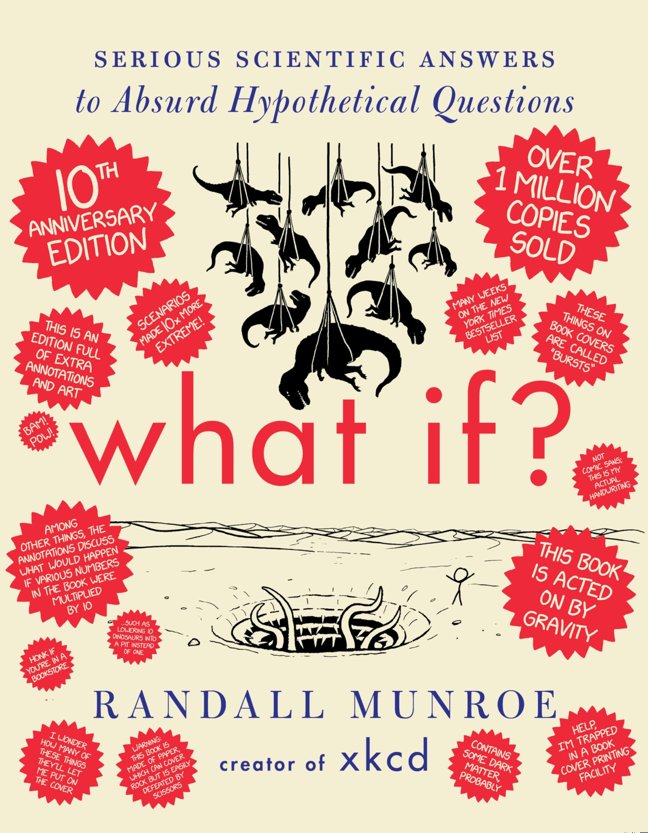
What If? Serious Scientific Answers to Absurd Hypothetical Questions
Randall Munroe
4.1
Randall Munroe left NASA in 2005 to start up his hugely popular site XKCD 'a web comic of romance, sarcasm, math and language' which offers a witty take on the world of science and geeks. It now has 600,000 to a million page hits daily. Every now and then, Munroe would get emails asking him to arbitrate a science debate. 'My friend and I were arguing about what would happen if a bullet got struck by lightning, and we agreed that you should resolve it . . . ' He liked these questions so much that he started up What If.
If your cells suddenly lost the power to divide, how long would you survive?
How dangerous is it, really, to be in a swimming pool in a thunderstorm?
If we hooked turbines to people exercising in gyms, how much power could we produce?
What if everyone only had one soulmate?
When (if ever) did the sun go down on the British empire?
How fast can you hit a speed bump while driving and live?
What would happen if the moon went away?
In pursuit of answers, Munroe runs computer simulations, pores over stacks of declassified military research memos, solves differential equations, and consults with nuclear reactor operators. His responses are masterpieces of clarity and hilarity, studded with memorable cartoons and infographics. They often predict the complete annihilation of humankind, or at least a really big explosion. Far more than a book for geeks, WHAT IF: Serious Scientific Answers to Absurd Hypothetical Questions explains the laws of science in operation in a way that every intelligent reader will enjoy and feel much the smarter for having read.
…
Recommended by Bill Gates, Astro Teller, Fabrice Grinda, and 1 others.
The subtitle of the book is “Serious Scientific Answers to Absurd Hypothetical Questions,” and that’s exactly what it is. People write Munroe with questions that range over all fields of science: physics, chemistry, biology. Questions like, “From what height would you need to drop a steak for it to be cooked when it hit the ground?” (The answer, it turns out, is “high enough that it would disintegrate before it hit the ground.”) Munroe’s explanations are funny, but the science underpinning his answers is very accurate. It’s an entertaining read, and you’ll also learn a bit about things like ballistics, DNA, the oceans, the atmosphere, and lightning along the way. [source]
Astro Teller
The kids are obsessed with this. They can quote it from memory. They’ve learned probably more science from this book than they have from their science class in the last two years. [source]
Fabrice Grinda
I have lots of books to recommend, but they are not related to my career path. The only one that is remotely related is Peter Thiel’s Zero to One. That said here are books I would recommend. [source]
Cover unavailable
62
JavaScript & jQuery The Missing Manual
David Sawyer McFarland
4.1
JavaScript lets you supercharge your HTML with animation, interactivity, and visual effects--but many web designers find the language hard to learn. This easy-to-read guide not only covers JavaScript basics, but also shows you how to save time and effort with the jQuery and jQuery UI libraries of prewritten JavaScript code. You'll build web pages that feel and act like desktop programs--with little or no programming.
The important stuff you need to know: Pull back the curtain on JavaScript. Learn how to build a basic program with this language. Get up to speed on jQuery. Quickly assemble JavaScript programs that work well on multiple web browsers.Transform your user interface. Learn jQuery UI, the JavaScript library for interface features like design themes and controls.Make your pages interactive. Create JavaScript events that react to visitor actions.Use animations and effects. Build drop-down navigation menus, pop-ups, automated slideshows, and more.Collect data with web forms. Create easy-to-use forms that ensure more accurate visitor responses.Practice with living examples. Get step-by-step tutorials for web projects you can build yourself.
…
Cover unavailable
63
Lean UX: Designing Great Products with Agile Teams
Jeff Gothelf, Josh Seiden
4.1
Lean UX has become the preferred approach to interaction design, tailor-made for today's agile teams. In the second edition of this award winning book, leading advocates Jeff Gothelf and Josh Seiden expand on the valuable Lean UX principles, tactics, and techniques covered in the first edition to share how product teams can easily incorporate design, experimentation, iteration, and continuous learning from real users into their Agile process.
Inspired by Lean and Agile development theories, Lean UX lets you focus on the actual experience being designed, rather than deliverables. This book shows you how to collaborate closely with other members of your Agile product team, and gather feedback early and often. You'll learn how to drive the design in short, iterative cycles to assess what works best for the business and the user. Lean UX shows you how to make this change--for the better.
Frame a vision of the problem you're solving and focus your team on the right outcomes Bring the designers' toolkit to the rest of your product team Share your insights with your team much earlier in the process Create Minimum Viable Products to determine which ideas are valid Incorporate the voice of the customer throughout the project cycle Make your team more productive: combine Lean UX with Agile's Scrum framework Understand the organizational shifts necessary to integrate Lean UX
…
Recommended by Andy Budd and Laura Klein.
Cover unavailable
64
Envisioning Information
Edward R. Tufte
4.1
The celebrated design professor here tackles the question of how best to communicate real-life experience in a two-degree format, whether on the printed page or the computer screen. The Whole Earth Review called Envisioning Information a "passionate, elegant revelation."
Recommended by Kevin Rose, Jeff Atwood, Bret Victor, and 1 others.
The master when it comes to taking complicated data and turning it into beautiful charts and graphs that are easy to understand. If you’re into graphic design, print design, web design, you name it, you’re going to get some really good information and how tos out of these books. He has a whole series of these books. [source]
Cover unavailable
65
Above the Fold: Understanding the Principles of Successful Web Site Design
Brian D Miller
4.1
This is a different kind of web design book. "Above the Fold" is not about timely design or technology trends; instead, this book is about the timeless fundamentals of effective communication within the context of web design. It is intended to help you, the reader, understand the considerations that web designers make when developing successful websites.
"Above the Fold" is divided into three sections: Design & TypographyPlanning & UsabilityBusiness Value Each section represents a phase in the continuous cycle of web design. It's the balance among design, usability, and return on investment that makes a website truly great.
Topics covered in "Above the Fold" include: What makes web design uniqueThe history of web designAnatomy of a web pageWhite space and grid use in web designThe elements of web design: color, texture, imagery, scale, depth, animation, and variabilityWeb typography, including web-safe type, images of type, and font replacement and embeddingWeb project planningInformation architecture, including site maps, wireframes, and user flow diagramsThe elements of usability: navigation, breadcrumbs, links, search, submission forms, and error messagingSearch engine optimizationOnline marketing, including banner ads, viral and social marketing, on-site marketing, and email marketingWeb statistics and analysis
…
Cover unavailable
66
The Web Designer's Idea Book Volume 2: More of the Best Themes, Trends and Styles in Website Design
Patrick McNeil
4.1
Web Design Inspiration at a Glance
Volume 2 of The Web Designer's Idea Book includes more than 650 new websites arranged thematically, so you can easily find inspiration for your work. Author Patrick McNeil, creator of the popular web design blog designmeltdown.com and author of the original bestselling Web Designer's Idea Book, has cataloged thousands of sites, and showcases the latest and best examples in this book. The web is the most rapidly changing design medium, and this book offers an organized overview of what's happening right now. Sites are categorized by type, design element, styles and themes, structural styles, and structural elements. This new volume also includes a helpful chapter explaining basic design principles and how they can be applied online. Whether you're brainstorming with a coworker or explaining your ideas to a client, this book provides a powerful communication tool you can use to jumpstart your next project.
…
Cover unavailable
67
HTML, XHTML, and CSS (Visual Quickstart Guide)
Elizabeth Castro
4.1
Need to learn HTML fast? This best-selling reference's visual format and step-by-step, task-based instructions will have you up and running with HTML in no time. In this completely updated edition of our best-selling guide to HTML, Web expert and best-selling author Elizabeth Castro uses crystal-clear instructions and friendly prose to introduce you to all of today's HTML and XHTML essentials. Yoursquo;ll learn how to design, structure, and format your Web site. You'll create and use images, links, styles, lists, tables, frames, and forms, and you'll add sound and movies to your site. Finally, you will test and debug your site, and publish it to the Web. Along the way, you'll find extensive coverage of CSS techniques, current browsers (Opera, Safari, Firefox), creating pages for the mobile Web, and more. Visual QuickStart Guide--the quick and easy way to learn! Easy visual approach uses pictures to guide you through HTML and show you what to do. Concise steps and explanations get you up and running in no time. Page for page, the best content and value around. Companion Web site at www.cookwood.com/html offers examples, a lively question-and-answer area, updates, and more. Need to learn HTML fast? This best-selling reference's visual format and step-by-step, task-based instructions will have you up and running with HTML in no time.
…
Cover unavailable
68
Responsible Responsive Design
Scott Jehl
4.1
Responsive design has immeasurably improved multi-device, multi-browser visual layout—but it’s only the first step in building responsively. Learn how to turn a critical eye on your designs as you develop for new contexts (what does mobile really mean?) and screen features, speedy and lagging networks, and truly global audiences. Serve the right content across platforms, and tune for performance. Scott Jehl tackles those topics and more, ensuring that the sites and apps you build today last far into the future.
…
Recommended by Veerle Pieters.
Cover unavailable
69
Eloquent Javascript: A Modern Introduction to Programming
Marijn Haverbeke
4.1
Completely revised and updated, this best-selling introduction to programming in JavaScript focuses on writing real applications.
Eloquent JavaScript dives into the JavaScript language to show programmers how to write elegant, effective JavaScript code. Like any good programming book, Eloquent JavaScript begins with fundamentals--variables, control structures, functions, and data structures--then moves on to complex topics like object-oriented programming and regular expressions. This third edition introduces new features covering the 2017 version of JavaScript, such as class notation, arrow functions, iterators, async functions, template strings, and black scope. Author Marijn Haverbeke keeps the friendly tone and easy-to-follow explanations that made the original a hit, and he adds new exercises for readers to test their skills. Eloquent JavaScript will have readers fluent in the language of the web in no time, eloquently.
…
Cover unavailable
70
Implementing Responsive Design: Building Sites for an Anywhere, Everywhere Web
Tim Kadlec, Aaron Gustafson
4.0
New devices and platforms emerge daily. Browsers iterate at a remarkable pace. Faced with this volatile landscape we can either struggle for control or we can embrace the inherent flexibility of the web.
Responsive design is not just another technique—it is the beginning of the maturation of a medium and a fundamental shift in the way we think about the web.
Implementing Responsive Design is a discussion about how this affects the way we design, build, and think about our sites. Readers will learn how to:
- Build responsive sites using a combination of fluid layouts, media queries and fluid media - Adopt a responsive workflow from the very start of a project - Enhance content for different devices - Use feature-detection and server-side enhancement to provide a richer experience
…
Cover unavailable
71
Handcrafted CSS: More Bulletproof Web Design
Dan Cederholm, Ethan Marcotte
4.0
There's a real connection between craftsmanship and Web design. That's the theme running through Handcrafted CSS: More Bulletproof Web Design, by bestselling author Dan Cederholm, with a chapter contributed by renowned Web designer and developer Ethan Marcotte. This book explores CSS3 that works in today's browsers, and you'll be convinced that now's the time to start experimenting with it.
Whether you're a Web designer, project manager, or a graphic designer wanting to learn more about the fluidity that's required when designing for the Web, you'll discover the tools to create the most flexible, reliable, and bulletproof Web designs. And you'll finally be able to persuade your clients to adopt innovative and effective techniques that make everyone's life easier while improving the end user's experience. This book's seven chapters deconstruct various aspects of a case-study Web site for the Tugboat Coffee Company, focusing on aspects that make it bulletproof and demonstrate progressive enrichment techniques over more traditional labor-intensive methods.
Subjects covered in this book include:
building for unanticipated future use progressively enriching designs using CSS3 properties using RGBA color for transparency with an alpha channel modular float management crafting flexible frameworks fluid layouts using grid-based design principles craftsmanship details on typography, jQuery, and shifting backgrounds
…
Cover unavailable
72
Designing Data-Intensive Applications
Martin Kleppmann
4.0
Many forces affect software today: larger datasets, geographical disparities, complex company structures, and the growing need to be fast and nimble in the face of change.
Proven approaches such as service-oriented and event-driven architectures are joined by newer techniques such as microservices, reactive architectures, DevOps, and stream processing. Many of these patterns are successful by themselves, but as this practical ebook demonstrates, they provide a more holistic and compelling approach when applied together.
Author Ben Stopford explains how service-based architectures and stream processing tools such as Apache Kafka® can help you build business-critical systems.
* Learn why streaming beats request-response based architectures in complex, contemporary use cases * Understand why replayable logs such as Kafka provide a backbone for both service communication and shared datasets * Explore how event collaboration and event sourcing patterns increase safety and recoverability with functional, event-driven approaches * Apply patterns including Event Sourcing and CQRS, and how to build multi-team systems with microservices and SOA using patterns such as “inside out databases” and “event streams as a source of truth” * Build service ecosystems that blend event-driven and request-driven interfaces using a replayable log and Kafka's Streams API * Scale beyond individual teams into larger, department- and company-sized architectures, using event streams as a source of truth
…
Cover unavailable
73
Product Design for the Web: Principles of Designing and Releasing Web Products
Randy J. Hunt
4.0
Web designers are no longer just web designers. To create a successful web product that's as large as Etsy, Facebook, Twitter, or Pinterest-or even as small as a tiny app-you need to know more than just HTML and CSS. You need to understand how to create meaningful online experiences so that users want to come back again and again.
In other words, you have to stop thinking like a web designer or a visual designer or a UX designer or an interaction designer and start thinking like a product designer.
In this breakthrough introduction to modern product design, Etsy Creative Director Randy Hunt explains the skills, processes, types of tools, and recommended workflows for creating world-class web products. After reading this book, you'll have a complete understanding of what product design really is and you'll be equipped with the best practices necessary for building your own successful online products.
…
Recommended by Ron Conway.
Ron Conway
Understand how to create meaningful online experiences so that users want to come back again and again. [source]
Cover unavailable
74
The Smashing Book
Smashing Magazine
4.0
Responsive design is a default these days, but we are all still figuring out just the right process and techniques to better craft responsive websites. That’s why we created a new book — to gather practical techniques and strategies from people who have learned how to get things done right, in actual projects with actual real-world challenges.
Cover unavailable
75
Head First HTML and CSS
Elisabeth Robson, Eric Freeman
4.0
Tired of reading HTML books that only make sense after you're an expert? Then it's about time you picked up Head First HTML and really learned HTML. You want to learn HTML so you can finally create those web pages you've always wanted, so you can communicate more effectively with friends, family, fans, and fanatic customers. You also want to do it right so you can actually maintain and expand your web pages over time so they work in all browsers and mobile devices. Oh, and if you've never heard of CSS, that's okay--we won't tell anyone you're still partying like it's 1999--but if you're going to create web pages in the 21st century then you'll want to know and understand CSS.
Learn the real secrets of creating web pages, and why everything your boss told you about HTML tables is probably wrong (and what to do instead). Most importantly, hold your own with your co-worker (and impress cocktail party guests) when he casually mentions how his HTML is now strict, and his CSS is in an external style sheet.
With Head First HTML, you'll avoid the embarrassment of thinking web-safe colors still matter, and the foolishness of slipping a font tag into your pages. Best of all, you'll learn HTML and CSS in a way that won't put you to sleep. If you've read a Head First book, you know what to expect: a visually-rich format designed for the way your brain works. Using the latest research in neurobiology, cognitive science, and learning theory, this book will load HTML and CSS into your brain in a way that sticks.
So what are you waiting for? Leave those other dusty books behind and come join us in Webville. Your tour is about to begin.
…
Cover unavailable
76
Designing Web Usability
Jakob Nielsen
4.0
New approaches for crafting effective sites. This book is a tutorial and exposition of the principles of Web site design. It aids users in building web sites that stand out from the noise of the web and bring them to the content in an effective and efficient way. This four-color book gives substantial critiques of existing Web site designs.
Recommended by Jeff Atwood.
Cover unavailable
77
The Art of SEO: Mastering Search Engine Optimization
Eric Enge, Stephan Spencer, et al.
4.0
A well-designed, easy-to-navigate website is useless if no one can find it. In this book, four experts help you optimize your site for search engine visibility, using proven guidelines and cutting-edge techniques for planning and executing a comprehensive strategy. Much has changed in SEO since the first edition of this book, including new methods for ranking sites based on user engagement with pages and content. Search engines also have improved their ranking results with data from social media. This second edition helps you adjust to these changes with an array of effective tactics, from basic to advanced. It’s the ideal SEO reference.Explore the underlying theory behind SEO and how search engines work Learn the steps you need to prepare for, execute, and evaluate SEO initiatives Examine a number of advanced strategies and tactics Understand the intricacies involved in managing complex SEO projects Learn what’s necessary to build a competent SEO team with defined roles Glimpse the future of search and what lies ahead for the SEO industry
…
Recommended by Tony Hsieh and Aleyda Solis.
Tony Hsieh
CEO/Zappos.com
SEO expertise is a core need for today’s online businesses. Written by some of the top SEO practitioners out there, this book can teach you what you need to know for your online business. [source]
Cover unavailable
78
Designing with Progressive Enhancement: Building the Web That Works for Everyone
Todd Parker, Scott Jehl, Maggie Costello Wachs, Patty Toland
4.0
Progressive enhancement is an approach to web development that aims to deliver the best possible experience to the widest possible audience, and simplifies coding and testing as well. Whether users are viewing your sites on an iPhone, the latest and greatest high-end system, or even hearing them on a screen-reader, their experience should be easy to understand and use, and as fully-featured and functional as possible.
Designing with Progressive Enhancement will show you how. It's both a practical guide to understanding the principles and benefits of progressive enhancement, and a detailed exploration of examples that will teach you--whether you're a designer or a developer--how, where, and when to implement the specific coding and scripting approaches that embody progressive enhancement.
In this book, you'll learn:
Why common coding approaches leave users behind, and how progressive enhancement is a more inclusive and accessible alternative How to analyze complex interface designs, see the underlying semantic HTML experience that will work everywhere, and layer on advanced enhancements safely A unique browser capabilities testing suite that helps deliver enhancements only to devices that can handle them Real-world best practices for coding HTML, CSS, and JavaScript to work with progressive enhancement, and cases where forward-looking HTML5 and CSS3 techniques can be applied effectively today How to factor in accessibility features like WAI-ARIA and keyboard support to ensure universal access Detailed techniques to transform semantic HTML into interactive components like sliders, tabs, tree controls, and charts, along with downloadable jQuery-based widgets to apply directly in your projects
…
Cover unavailable
79
LOGO Design Love, Annotated and Expanded Edition
David Airey
4.0
Completely updated and expanded, the second edition of David Airey's "Logo Design Love" contains more of just about everything that made the first edition so great: more case studies, more sketches, more logos, more tips for working with clients, more insider stories, and more practical information for getting the job and getting it done right. In "Logo Design Love," David shows you how to develop an iconic brand identity from start to finish, using client case studies from renowned designers. In the process, he reveals how designers create effective briefs, generate ideas, charge for their work, and collaborate with clients. David not only shares his personal experiences working on identity projects-including sketches and final results of his own successful designs-he also uses the work of many well-known designers such as Paula Scher, who designed the logos for Citi and Microsoft Windows, and Lindon Leader, creator of the current FedEx identity, as well as work from leading design studios, including Moving Brands, Pentagram, MetaDesign, Sagmeister & Walsh, and many more. In "Logo Design Love," you'll learn: Best practices for extending a logo into a complete brand identity systemWhy one logo is more effective than anotherHow to create your own iconic designsWhat sets some designers above the rest31 practical design tips for creating logos that last
…
Cover unavailable
80
The User Experience Team of One: A Research and Design Survival Guide
Leah Buley
4.0
The User Experience Team of One prescribes a range of approaches that have big impact and take less time and fewer resources than the standard lineup of UX deliverables. Whether you want to cross over into user experience or you're a seasoned practitioner trying to drag your organization forward, this book gives you tools and insight for doing more with less.
Recommended by Andy Budd.
Cover unavailable
81
jQuery: Novice to Ninja
Earle Castledine, Craig Sharkie
4.0
jQuery: Novice to Ninja is a compilation of best-practice jQuery solutions to meet the most challenging JavaScript problems. In this question-and-answer book on jQuery, you'll find a cookbook of ready-to-go solutions to help breathe life into your web page.
Topics covered include: - Scrolling, Resizing and Animating Webpage elements - Backgrounds, Slideshows, and Crossfaders - Menus, Tabs, and Panels - Buttons, Fields, and Controls - Lists, Trees, and Tables - Frames, Windows, and Dialogs - Adding interactivity with Ajax - Using the jQuery User Interface Themeroller - Writing your own jQuery plug-ins
All code used to create each solution is available for download and guaranteed to be simple, efficient and cross-browser compatible.
…
Cover unavailable
82
Design for Hackers: Reverse Engineering Beauty
David Kadavy
4.0
Discover the techniques behind beautiful design by deconstructing designs to understand them. The term 'hacker' has been redefined to consist of anyone who has an insatiable curiosity as to how things work--and how they can try to make them better. This book is aimed at hackers of all skill levels and explains the classical principles and techniques behind beautiful designs by deconstructing those designs in order to understand what makes them so remarkable. Author and designer David Kadavy provides you with the framework for understanding good design and places a special emphasis on interactive mediums. You'll explore color theory, the role of proportion and geometry in design, and the relationship between medium and form. Packed with unique reverse engineering design examples, this book inspires and encourages you to discover and create new beauty in a variety of formats. Breaks down and studies the classical principles and techniques behind the creation of beautiful design. Illustrates cultural and contextual considerations in communicating to a specific audience. Discusses why design is important, the purpose of design, the various constraints of design, and how today's fonts are designed with the screen in mind. Dissects the elements of color, size, scale, proportion, medium, and form. Features a unique range of examples, including the graffiti in the ancient city of Pompeii, the lack of the color black in Monet's art, the style and sleekness of the iPhone, and more.
By the end of this book, you'll be able to apply the featured design principles to your own web designs, mobile apps, or other digital work.
…
Cover unavailable
83
Responsive Design: Patterns & Principles
Ethan Marcotte
4.0
Cover unavailable
84
Web ReDesign 2.0: Workflow that Works
Emily Cotler
4.0
If anything, this volume's premise--that the business of Web design is one of constant change-has only proven truer over time. So much so, in fact, that the 12-month design cycles cited in the last edition have shrunk to 6 or even 3 months today. Which is why, more than ever, you need a smart, practical guide that demonstrates how to plan, budget, organize, and manage your Web redesign - or even you initial design - projects from conceptualization to launch. This volume delivers! In these pages Web designer extraordinaire Kelly Goto and coauthor Emily Cotler have distilled their real-world experience into a sound approach to Web redesign workflow that is as much about business priorities as it is about good design. By focusing on where these priorities intersect, Kelly and Emily get straight to the heart of the matter. Each chapter includes a case study that illustrates a key step in the process, and you'll find a plethora of forms, checklists, and worksheets that help you put knowledge into action.This is an AIGA Design Press book published under Peachpit's New Riders imprint in partnership with AIGA.
…
Cover unavailable
85
Refactoring: Improving the Design of Existing Code
Martin Fowler
4.0
Fully Revised and Updated-Includes New Refactorings and Code Examples"Any fool can write code that a computer can understand. Good programmers write code that humans can understand." --M. Fowler (1999) For more than twenty years, experienced programmers worldwide have relied on Martin Fowler's Refactoring to improve the design of existing code and to enhance software maintainability, as well as to make existing code easier to understand. This eagerly awaited new edition has been fully updated to reflect crucial changes in the programming landscape. Refactoring, Second Edition, features an updated catalog of refactorings and includes JavaScript code examples, as well as new functional examples that demonstrate refactoring without classes. Like the original, this edition explains what refactoring is; why you should refactor; how to recognize code that needs refactoring; and how to actually do it successfully, no matter what language you use. Understand the process and general principles of refactoring Quickly apply useful refactorings to make a program easier to comprehend and change Recognize "bad smells" in code that signal opportunities to refactor Explore the refactorings, each with explanations, motivation, mechanics, and simple examples Build solid tests for your refactorings Recognize tradeoffs and obstacles to refactoring Includes free access to the canonical web edition, with even more refactoring resources. (See inside the book for details about how to access the web edition.)
This is next on my list of technical books to read! Refactoring is one of two programming books that I’ve read multiple times (the other is Smalltalk Best Practice Patterns), and I’m due for another reading. What perfect time then to dive into Martin Fowler’s long anticipated 2nd edition, now using JavaScript rather than Java for the code examples. Like the stoic books, I read Refactoring and that Smalltalk book again and again not because I’m going to learn something new, per se, but because I want to be reminded about what I already know. And what better time to reread than just as we’re kicking off a new major project that needs a fresh architectural foundation. Also, these two books just remind every time of how much I love the craft of programming. It’s not just having the programs, it’s not just solving problems, it’s simply using my hands and head to program that in and of itself is sublime. [source]
Cover unavailable
86
A Practical Wedding Planner: A Step-by-Step Guide to Creating the Wedding You Want with the Budget You've Got (without Losing Your Mind in the Process)
Meg Keene
4.0
The author of A Practical Wedding offers a no-nonsense wedding planner, with all the tools, tips, and strategies to get the celebration you want, on a budget you can actually afford
Whether you're newly engaged or haven't quite made anything official yet, but you know you want to spend your lives together, you're going to need help planning your wedding. When you're ready to take a deep breath and start, this is the book you want--need--to have. From figuring out what you really want--as opposed to what everyone else thinks you should want--to helping you keep an eye on the ceremony itself and the vows, Meg Keene, founder of apracticalwedding.com, covers all the essentials. With checklists (such as flowers, food, final venue walk-through) and key spreadsheets (guest list and seating chart, budget, venue search, and more), A Practical Wedding Planner helps you:
Set a budget--and stick to it Choose a venue: traditional, non-traditional, and everything in between Hire good vendors and keep your friendors (and tells you why DIY doesn't always save money) Figure out catering, rentals, and everything else Pinterest forgot to tell you Reality-check wedding décor Create and write a ceremony that really represents both of you Get everyone to show up...and have a good time
…
Cover unavailable
87
Design Basics Index
Jim Krause
4.0
Master the 3 C's of Head-Turning Design!
Cover your basics with the book that covers everything from typography and color to layout and business issues! Jim Krause, author of the popular Index series, guides you through the understanding and practice of the three elements every successful visual design must have:
Components: Learn how to get the most out of the photos, illustrations, icons, typography, linework, decoration, borders and backgrounds you use within your design.
Composition: Practice combining the components of a design in a visually appealing way by using the principles of placement, grouping, alignment, flow and spacing to create a pleasing, cohesive design.
Concept: Utilize the intangible elements of theme, connotation and style to present and deliver your message in a way that will wow your clients every time.
Whether you're a new, mid-level or experienced designer who is brainstorming ideas or finalizing your presentation, this handy-to-use, take-it-with-you book will instruct and inspire you to new heights of creativity.
…
Cover unavailable
88
Building Findable Websites: Web Standards, Seo, and Beyond
Aarron Walter Walter
4.0
This is not another SEO book written for marketing professionals. Between these covers you'll find practical advice and examples for people who build websites aiming to reach their target audience. Each chapter will introduce you to best practices and fresh perspectives on how to accomplish these simple, yet indispensable goals:
Help more people find your site Help users find content within your site Encourage return visits The path this book travels through the villages of Web standards, accessibility, and contemporary technologies like Ajax, APIs, Flash, and microformats. You'll find the big ideas behind these technologies and real world examples, illustrating that you don't have to compromise the user experience to create search engine friendly, findable websites.
Although this book illuminates a broad range of findability strategies, one common theme pervades: Web standards + compelling content = improved findability = more successful sites
You'll find even more findability guidance on the book's companion website (http: //buildingfindablewebsites.com) including 5 bonus chapters.
…
Cover unavailable
89
Web Design in a Nutshell: A Desktop Quick Reference
Jennifer Niederst
4.0
Are you still designing web sites like it's 1999? If so, you're in for a surprise. Since the last edition of this book appeared five years ago, there has been a major climate change with regard to web standards. Designers are no longer using (X)HTML as a design tool, but as a means of defining the meaning and structure of content. Cascading Style Sheets are no longer just something interesting to tinker with, but rather a reliable method for handling all matters of presentation, from fonts and colors to the layout of the entire page. In fact, following the standards is now a mandate of professional web design.
Our popular reference, Web Design in a Nutshell, is one of the first books to capture this new web landscape with an edition that's been completely rewritten and expanded to reflect the state of the art. In addition to being an authoritative reference for (X)HTML and Cascading Style Sheets, this book also provides an overview of the unique requirements of designing for the Web and gets to the nitty-gritty of JavaScript and DOM Scripting, web graphics optimization, and multimedia production. It is an indispensable tool for web designers and developers of all levels.
The third edition covers these contemporary web design topics:
Structural layer: HTML 4.01 and XHTML 1.0 (9 chapters), including an alphabetical reference of all elements, attributes and character entities Presentation layer: Ten all-new chapters on Cascading Style Sheets, Level 2.1, including an alphabetical reference of all properties and values. Behavior layer: JavaScript and scripting with the Document Object Model (DOM) Web environment: New web standards, browsers, display devices, accessibility, and internationalization Web graphics optimization: Producing lean and mean GIF, JPEG, PNG, and animated GIFs Multimedia: Web audio, video, Flash, and PDF Organized so that readers can find answers quickly, Web Design in a Nutshell, Third Edition helps experienced designers come up to speed quickly on standards-based web design, and serves as a quick reference for those already familiar with the new standards and technology.
There are many books for web designers, but none that address such a wide variety of topics. Find out why nearly half a million buyers have made this the most popular web design book available.
…
Cover unavailable
90
Ordering Disorder: Grid Principles for Web Design
Khoi Vinh
4.0
The grid has long been an invaluable tool for creating order out of chaos for designers of all kinds from city planners to architects to typesetters and graphic artists. In recent years, web designers, too, have come to discover the remarkable power that grid-based design can afford in creating intuitive, immersive, and beautiful user experiences. "Ordering Disorder" delivers a definitive take on grids and the Web. It provides both the big ideas and the brass-tacks techniques of grid-based design. Readers are sure to come away with a keen understanding of the power of grids, as well as the design tools needed to implement them for the World Wide Web. Khoi Vinh is internationally recognized for bringing the tried-and-true principles of the typographic grid to the World Wide Web. He is the former Design Director for NYTimes.com, where he consolidated his reputation for superior user experience design. He writes and lectures widely on design, technology, and culture, and has published the popular blog Subtraction.com for over a decade. More information at grids.subtraction.com"
…
Cover unavailable
91
Web Design - Start Here: A No-Nonsense, Jargon Free Guide to the Fundamentals of Web Design
Stefan Mischook
4.0
This friendly, comprehensive guide will teach you everything you need to know to create and maintain stylish, effective websites that please clients, customers, viewers, and you.
Cover unavailable
92
Stylin' with CSS: A Designer's Guide
Charles Wyke-Smith
4.0
Cascading Style Sheets enable you to rapidly create web designs that can be shared by hundreds of web pages, accelerating development times and centralizing text and layout information for easy editing and updates. Stylin with CSS teaches you everything you need to know start using CSS in your web development work, from the basics of markup of your content and styling text, through to creating multi-column page layouts without the use of tables. Learn how to create interface components, such as drop-down menus, navigation links, and animated graphical buttons, using only CSS no JavaScript required. Discover how to design code that will work on the latest standard-compliant browsers, while working around the quirks of the older browsers. With a mastery of CSS, your web design capabilities will move to a new level, and everything you need to know to get your started and build your skills is right here in this book. You ll be stylin in no time!"
…
Cover unavailable
93
Build Your Own Website The Right Way Using HTML & CSS
Ian Lloyd
4.0
Build Your Own Website The Right Way Using HTML & CSS, 2nd Edition teaches web development from scratch, without assuming any previous knowledge of HTML, CSS or web development techniques. This book introduces you to HTML and CSS as you follow along with the author, step-by-step, to build a fully functional web site from the ground up.
However, unlike countless other "learn web design" books, this title concentrates on modern, best-practice techniques from the very beginning, which means you'll get it right the first time. The web sites you'll build will:
Look good on a PC, Mac or Linux computer Render correctly whether your visitors are using Internet Explorer, Firefox, Opera, or Safari Use web standards so your sites will be fast loading and easy to maintain Be accessible to disabled users who use screenreaders to browse the Web By the end of the book, you'll be equipped with enough knowledge to set out on your first projects as a professional web developer, or you can simply use the knowledge you've gained to create attractive, functional, usable and accessible sites for personal use.
…
Cover unavailable
94
Interaction of Color
Josef Albers, Nicholas Fox Weber
4.0
Josef Albers’s Interaction of Color is a masterwork in twentieth-century art education. Conceived as a handbook and teaching aid for artists, instructors, and students, this timeless book presents Albers’s unique ideas of color experimentation in a way that is valuable to specialists as well as to a larger audience.
Originally published by Yale University Press in 1963 as a limited silkscreen edition with 150 color plates, Interaction of Color first appeared in paperback in 1971, featuring ten representative color studies chosen by Albers. The paperback has remained in print ever since and is one of the most influential resources on color for countless readers.
This new paperback edition presents a significantly expanded selection of more than thirty color studies alongside Albers’s original unabridged text, demonstrating such principles as color relativity, intensity, and temperature; vibrating and vanishing boundaries; and the illusions of transparency and reversed grounds. Now available in a larger format and with enhanced production values, this expanded edition celebrates the unique authority of Albers’s contribution to color theory and brings the artist’s iconic study to an eager new generation of readers.
…
Cover unavailable
95
HTML and CSS Web Standards Solutions: A Web Standardista's Approach
Christopher Murphy
4.0
Why did we choose to write this book? We're both extremely busy--lecturing bachelor's degree and master's degree interactive design students, maintaining our own practice wo- ing for clients, and furthering our established careers as artists exhibiting internationally--so the idea of a "how to" book for would-be web designers wasn't arrived at lightly. That said, we felt the time was right for this sort of book. There are a lot of excellent books that we point our students toward: Dan Cederholm's inspiring Web Standards Solutions; Paul Haine's meticulous HTML Mastery; and Andy Budd, Cameron Moll, and Simon Collison's indispensable CSS Mastery, to name but a few. All are fantastic books and we urge our s- dents to buy every one; however, none of them seemed to cover everything our students needed to embark on a well-grounded, web standards-based approach in one package: namely, a solid foundation in well-structured XHTML coupled with a comprehensive int- duction to CSS. Cue Web Standardistas.
…
Cover unavailable
96
Guinness World Records Gamer's 2020 (Guinness World Records Gamer's Edition)
Guinness World Records
4.0
Cover unavailable
97
Designing Web Interfaces: Principles and Patterns for Rich Interactions
Bill Scott, Theresa Neil
4.0
Want to learn how to create great user experiences on today's Web? In this book, UI experts Bill Scott and Theresa Neil present more than 75 design patterns for building web interfaces that provide rich interaction. Distilled from the authors' years of experience at Sabre, Yahoo!, and Netflix, these best practices are grouped into six key principles to help you take advantage of the web technologies available today. With an entire section devoted to each design principle, Designing Web Interfaces helps you:
Make It Direct-Edit content in context with design patterns for In Page Editing, Drag & Drop, and Direct Selection Keep It Lightweight-Reduce the effort required to interact with a site by using In Context Tools to leave a "light footprint" Stay on the Page-Keep visitors on a page with overlays, inlays, dynamic content, and in-page flow patterns Provide an Invitation-Help visitors discover site features with invitations that cue them to the next level of interaction Use Transitions-Learn when, why, and how to use animations, cinematic effects, and other transitions React Immediately-Provide a rich experience by using lively responses such as Live Search, Live Suggest, Live Previews, and more Designing Web Interfaces illustrates many patterns with examples from working websites. If you need to build or renovate a website to be truly interactive, this book gives you the principles for success.
…
Cover unavailable
98
Smashing WordPress: Beyond the Blog
Thord Daniel Hedengren
4.0
GO BEYOND THE BLOGSmashing WordPress shows you how to utilize the power of the WordPress platform, and provides a creative spark to help you build WordPress-powered sites that go beyond the obvious. You will learn the core concepts used to build just about anything in WordPress, resulting in fast deployments and greater design flexibility.
Inside, WordPress expert Thord Daniel Hedengren takes you beyond the blog and shows you how WordPress can serve as a CMS, a photo gallery, an e-commerce site, and more.
YOU WILL LEARN:
THE ANATOMY OF A WP INSTALL AND HOW WORDPRESS ACTUALLY WORKS HOW TO BUILD BEAUTIFUL WORDPRESS THEMES - INCLUDING CHILD THEMES HOW TO CREATE CUSTOM LOGIN FORMS AND ADMIN THEMES HOW TO USE THE LOOP TO CONTROL CONTENT, AND EVEN USE ALTERNATIVES TO THE LOOP HOW TO INTEGRATE THEME OPTIONS HOW TO BUILD PLUGINS - INCLUDING WIDGET FUNCTIONALITY HOW TO BUILD YOUR WORDPRESS PROJECTS FOR SEO INTEGRATE WORDPRESS WITH THE SOCIAL WEB HOW TO CREATE AMAZING NAVIGATION HOW TO USE CONDITIONAL CONTROL ELEMENTS
…
Cover unavailable
99
Designing for the Social Web
Joshua Porter
4.0
With tons of examples from real-world interfaces and a touch of the underlying social psychology theory, Joshua Porter shows you how to design your next great social web application.
Cover unavailable
100
White Space Is Not Your Enemy: A Beginner's Guide to Communicating Visually Through Graphic, Web and Multimedia Design
Kim Golombisky, Rebecca Hagen
4.0
Designing a brochure or web site without an art background? Step away from the computer and read this breezy introduction to visual communications first. Written for non-designers, White Space is Not Your Enemy is a practical graphic design and layout text introducing the concepts and practices necessary for producing effective visual communications across a variety of formats, from print to Web.
This beautifully illustrated, full-color book covers the basics to help you develop your eye and produce attractive work. Topics include: * The basics of effective design that communicates its intended message * Pre-design planning * 13 Layout Sins to avoid * Basic typography * Working with color * Storyboarding for video, Web, and presentions * Information graphics * Mini Art School--all the basics in one chapter * Outputting your work


 1
1