We've ranked the best optics books using expert recommendations, sales data, and millions of reader ratings. At Shortform, we know books. Our book guides are the best in the world. Learn why.
In Bryson's biggest book, he confronts his greatest challenge: to understand—and, if possible, answer—the oldest, biggest questions we have posed about the universe and ourselves. Taking as territory everything from the Big Bang to the rise of civilization, Bryson seeks to understand how we got from there being nothing at all to there being us. To that end, he has attached himself to a host of the world’s most advanced (and often obsessed) archaeologists, anthropologists, and mathematicians, travelling to their offices, laboratories, and field camps. He has read (or tried to read) their books, pestered them with questions, apprenticed himself to their powerful minds. A Short History of Nearly Everything is the record of this quest, and it is a sometimes profound, sometimes funny, and always supremely clear and entertaining adventure in the realms of human knowledge, as only Bill Bryson can render it. Science has never been more involving or entertaining.
…
Recommended by Amanda Palmer, David Goldberg, and Fabrice Grinda.
Amanda Palmer
Amanda Palmer recommended this book in the book "Tools of Titans". [source]
David Goldberg
What I really liked about A Short History of Nearly Everything is that it gives an excellent account of a lot of the personalities and the interconnectedness of important discoveries in cosmology and elsewhere. He does such a great job of bringing together our understanding of cosmology, evolution, paleontology, and geology in a very, very fluid way. [source]
Fabrice Grinda
I have lots of books to recommend, but they are not related to my career path. The only one that is remotely related is Peter Thiel’s Zero to One. That said here are books I would recommend. [source]
Cover unavailable
2
The Feynman Lectures on Physics
Richard P. Feynman
4.9
The legendary introduction to physics from the subject's greatest teacher "The whole thing was basically an experiment," Richard Feynman said late in his career, looking back on the origins of his lectures. The experiment turned out to be hugely successful, spawning a book that has remained a definitive introduction to physics for decades. Ranging from the most basic principles of Newtonian physics through such formidable theories as general relativity and quantum mechanics, Feynman's lectures stand as a monument of clear exposition and deep insight. Now, we are reintroducing the printed books to the trade, fully corrected, for the first time ever, and in collaboration with Caltech. Timeless and collectible, the lectures are essential reading, not just for students of physics but for anyone seeking an introduction to the field from the inimitable Feynman.
You don't have to take a course to learn physics. If you're hardcore, read the Feynman book and do the problems. [source]
David Bainbridge
I think that he is one of the most intelligent people to live in the 20th century. Yet at the same time, surprisingly, he is an amazingly good teacher. This is quite an unusual combination. [source]
Cover unavailable
3
QED: The Strange Theory of Light & Matter: Alix G. Mautner Memorial Lectures
Richard P. Feynman
4.8
Famous the world over for the creative brilliance of his insights into the physical world, Nobel Prize-winning physicist Richard Feynman also possessed an extraordinary talent for explaining difficult concepts to the nonscientist. QED--the edited version of four lectures on quantum electrodynamics that Feynman gave to the general public at UCLA as part of the Alix G. Mautner Memorial Lecture series--is perhaps the best example of his ability to communicate both the substance and the spirit of science to the layperson.
The focus, as the title suggests, is quantum electrodynamics (QED), the part of the quantum theory of fields that describes the interactions of the quanta of the electromagnetic field-light, X rays, gamma rays--with matter and those of charged particles with one another. By extending the formalism developed by Dirac in 1933, which related quantum and classical descriptions of the motion of particles, Feynman revolutionized the quantum mechanical understanding of the nature of particles and waves. And, by incorporating his own readily visualizable formulation of quantum mechanics, Feynman created a diagrammatic version of QED that made calculations much simpler and also provided visual insights into the mechanisms of quantum electrodynamic processes.
In this book, using everyday language, spatial concepts, visualizations, and his renowned "Feynman diagrams" instead of advanced mathematics, Feynman successfully provides a definitive introduction to QED for a lay readership without any distortion of the basic science. Characterized by Feynman's famously original clarity and humor, this popular book on QED has not been equaled since its publication.
…
Recommended by Larry Page, Marcus Chown, and Ryan Shea.
Marcus Chown
When Feynman was at Cal Tech, this wealthy couple who’d grown up in the same New York neighbourhood as he had said, Look, you’ve won this Nobel Prize, now explain to ordinary people what for. And Feynman said, No, it’s too complicated. But eventually he did this series of public lectures, and that was the book. It’s a tiny book and in it he describes the whole of quantum electrodynamics without a single equation. [source]
Ryan Shea
@jaltma @AriannaSimpson Incredible book. Perhaps my favorite physics book. [source]
Cover unavailable
4
Introduction to Modern Optics
Grant R. Fowles
4.5
This incisive text provides a basic undergraduate-level course in modern optics for students in physics, technology and engineering. The first half of the book deals with classical physical optics; the second principally with the quantum nature of light. Chapters 1 and 2 treat the propagation of light waves, including the concepts of phase and group velocities, and the vectorial nature of light. Chapter 3 applies the concepts of partial coherence and coherence length to the study of interference, and Chapter 4 takes up multiple-beam interference and includes Fabry-Perot interferometry and multilayer-film theory. Diffraction and holography are the subjects of Chapter 5, and the propagation of light in material media (including crystal and nonlinear optics) are central to Chapter 6. Chapters 7 and 8 introduce the quantum theory of light and elementary optical spectra, and Chapter 9 explores the theory of light amplification and lasers. Chapter 10 briefly outlines ray optics in order to introduce students to the matrix method for treating optical systems and to apply the ray matrix to the study of laser resonators. Many applications of the laser to the study of optics are integrated throughout the text. The author assumes students have had an intermediate course in electricity and magnetism and some advanced mathematics beyond calculus. For classroom use, a list of problems is included at the end of each chapter, with selected answers at the end of the book.
…
Cover unavailable
5
Scientific American September 2026
Scientific American
4.3
Scientific American covers the most important and exciting research, ideas and knowledge in science, health, technology, the environment and society. It is committed to sharing trustworthy knowledge and enhancing our understanding of the world .
Cover unavailable
6
Principles of Optics: Electromagnetic Theory of Propagation, Interference and Diffraction of Light
Max Born, Emil Wolf, A. B. Bhatia, P. C. Clemmow, D. Gabor, A. R. Stokes, A. M. Taylor, P. A. Wayman, W. L. Wilcock
4.3
Principles of Optics is one of the classic science books of the twentieth century, and probably the most influential book in optics published in the past forty years. This edition has been thoroughly revised and updated, with new material covering the CAT scan, interference with broad-band light and the so-called Rayleigh-Sommerfeld diffraction theory. This edition also details scattering from inhomogeneous media and presents an account of the principles of diffraction tomography to which Emil Wolf has made a basic contribution. Several new appendices are also included. This new edition will be invaluable to advanced undergraduates, graduate students and researchers working in most areas of optics.
…
Cover unavailable
7
Vision and Art (Updated and Expanded Edition)
Margaret S. Livingstone, David Hubel
4.3
With the original release of Vision and Art in 2002, Harvard professor Margaret Livingstone successfully bridged the gap between science and art, exploring how great painters fool the brain: why Mona Lisa’s smile seems so mysterious, or Monet’s Poppy Field appears to sway. In the revised and expanded edition, Livingstone presents two new chapters of her latest observations, has substantially expanded other chapters, and updates the rest of the existing text with new insights gleaned from her ongoing research, bringing the book to the cutting edge in the field of neuroscience. Accompanying Livingstone’s lively prose are many charts and diagrams that lucidly illustrate her points, as well as in-depth analyses of the phenomena found in major works of art. Be it the explanation of common optical illusions or the breakdown of techniques painters use to create those illusions, Vision and Art provides a wealth of information for artists, scholars, and scientists alike.
There are many things as an artist you can’t discover or explain by yourself along the way, like how a bright colour can appear to be lighter than it is, or the science behind making your picture look as if something is receding. Margaret Livingstone explains tricks of the eye: questions of luminance, depth and colour; and does so in terms of our vision system. All the time painters have a challenge of expressing something that is three dimensional, on the surface of their canvas, which is flat. [source]
Cover unavailable
8
Fixing My Gaze: A Scientist's Journey into Seeing in Three Dimensions
Susan R. Barry, Oliver Sacks
4.3
When neuroscientist Susan Barry was fifty years old, she took an unforgettable trip to Manhattan. As she emerged from the dim light of the subway into the sunshine, she saw a view of the city that she had witnessed many times in the past but now saw in an astonishingly new way. Skyscrapers on street corners appeared to loom out toward her like the bows of giant ships. Tree branches projected upward and outward, enclosing and commanding palpable volumes of space. Leaves created intricate mosaics in 3D. With each glance, she experienced the deliriously novel sense of immersion in a three dimensional world.
Barry had been cross-eyed and stereoblind since early infancy. After half a century of perceiving her surroundings as flat and compressed, on that day she was seeing Manhattan in stereo depth for first time in her life. As a neuroscientist, she understood just how extraordinary this transformation was, not only for herself but for the scientific understanding of the human brain. Scientists have long believed that the brain is malleable only during a “critical period” in early childhood. According to this theory, Barry’s brain had organized itself when she was a baby to avoid double vision – and there was no way to rewire it as an adult. But Barry found an optometrist who prescribed a little-known program of vision therapy; after intensive training, Barry was ultimately able to accomplish what other scientists and even she herself had once considered impossible.
A revelatory account of the brain’s capacity for change, Fixing My Gaze describes Barry’s remarkable journey and celebrates the joyous pleasure of our senses.
…
Cover unavailable
9
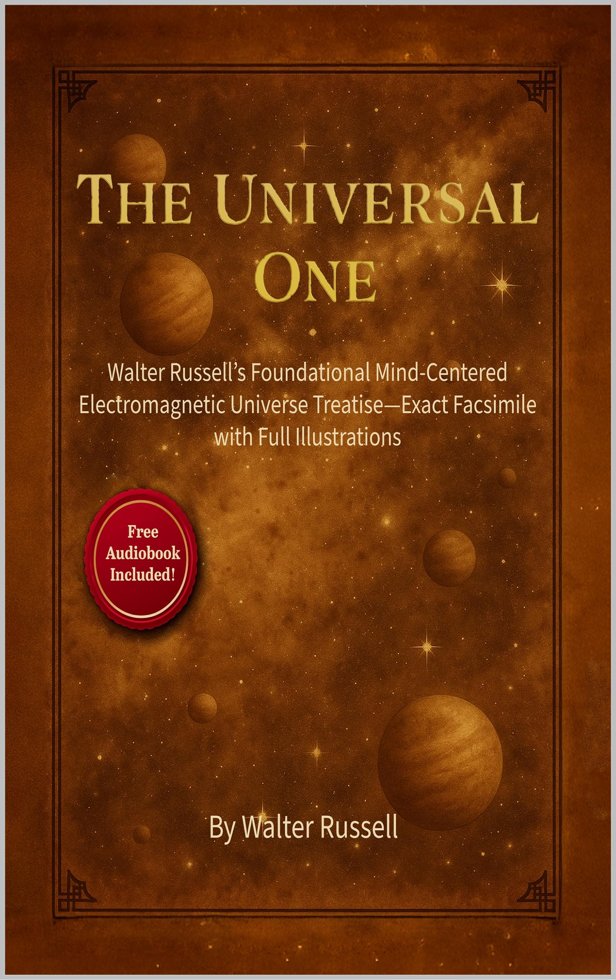
The Universal One
Walter Russell
4.3
A “must” for the serious student of Russell science and philosophy, The Universal One is Walter Russell’s first expression of his new Cosmogony explaining the Mind-centered electromagnetic universe.
Russell later revised some of the content of The Universal One in The Secret of Light and A New Concept of the Universe. Students of the Russell science should be aware of the historic sequence of Walter Russell’s books of science, and note the various changes in details which Walter Russell himself made.
Nikola Tesla told Walter Russell to hide his cosmogony from the world for a thousand years. Though a century or more ahead of its time, The Universal One, uniting spiritual Cause and scientifically observable Effect in a seamless whole, is now appealing to the many people—scientists and laymen alike—who are examining the nature of science and consciousness.
In this 1926 historic volume, Walter Russell first reveals the possibility of transmutation of the elements. This is a universe of Mind, a finite universe, limited as to cause, and to the effect of cause. A finite universe, in which the effects of cause are limited, must also be limited as to cause; so when that measurable cause is known, then can man comprehend and measure all effects. The effects of cause are complex and mystify man, but cause itself is simple.
The universe is a multiplicity of changing effects of but One unchanging cause. All things are universal. Nothing is which is not universal. Nothing is of itself alone. Man and Mind and all creating things are universal. No man can say: ‘I alone am I.’ There is but One universe, One Mind, One force, One substance. When man knows this in measurable exactness then will he have no limitations within those which are universal.” — Walter Russell, from The Prelude to The Universal One.
Part I: Creation; The Life Principle; Mind, The One Universal Substance; Thinking Mind; The Process of Thinking; Thinking Registered in Matter; Concerning Appearances; The Sex Principle; Sex Opposites of Light; The Reproductive Principle; Energy Transmission; A Finite Universe; A Dimensionless Universe; Concerning Dimension; The Formula of Locked Potentials; Universal Oneness; Omnipresence; Omnipotence; Omniscience.
Part II: Dynamics of Mind & Light Units of Matter; Electricity and Magnetism; New Concepts of Electricity and Magnetism; Electricity; The Elements of Matter; The Octave Cycle of the Elements of Matter; The Instability and the Illusion of Stability of Matter; The Universal Pulse; Concerning Energy; Electro-Magnetic Pressure; Attraction and Repulsion; Gravitation and Radiation; Expressions of Gravitation and Radiation – Universal Direction; Universal Mathematics & Ratios; Charging & Discharging Poles; The Wave; Time; Temperature; Color; Universal Mechanics; Rotation; Revolution; Crystallization; Plane and Ecliptic; Ionization; Valence; Tone; Conclusion; New Laws and Principles.
The Universal One Contains numerous charts and diagrams.The Universal One is both an historic and present/future treasure illuminating questions about universal cosmogony and philosophical considerations of the nature of the universe.
…
Cover unavailable
10
My Trip to the Hospital
Mercer Mayer
4.2
When Little Critter breaks his leg in a soccer game, he has to make his first trip to the hospital. Follow brave Little Critter as he rides in an ambulance, meets the doctor, and gets his first X-ray and his first cast.
Cover unavailable
11
Nonlinear Optics
Robert W. Boyd
4.2
Nonlinear Optics, Fourth Edition, is a tutorial-based introduction to nonlinear optics that is suitable for graduate-level courses in electrical and electronic engineering, and for electronic and computer engineering departments, physics departments, and as a reference for industry practitioners of nonlinear optics. It will appeal to a wide audience of optics, physics and electrical and electronic engineering students, as well as practitioners in related fields, such as materials science and chemistry.
…
Cover unavailable
12
OpTic Gaming: The True Story of the Making of eSports Greatest Team
H3CZ, NaDeSHot, et al.
4.2
OpTic Gaming, the four-time Call of Duty Major League Gaming Champions and one of the top eSports teams in the world, now takes fans behind the controller—into the game and the minds of the greatest gamers in the world—in this fascinating and unique memoir and insider guide.
Emerging on the scene in 2006, OpTic Gaming has dominated the Call of Duty e-sports arena, thanks to the talents of legendary players such as Matt “NaDeSHoT” Haag, the biggest eSports personality on earth; Seth “Scump” Abnerl, the best Call of Duty player in the world; Midnite, one of the first girl gamers to rise to stardom on YouTube; and Hector “H3CZ” Rodriguez, the team founder and CEO. With over one million subscribers and seventy-one million YouTube views, no other team of players in Major League Gaming (MLG) can match OpTic's popularity or ability to bring fans into the game.
Now, these remarkable players have collaborated to produce this one-of-a-kind book. In OpTic Gaming, they candidly share their story of becoming Call of Duty royalty—consistently ranking in the top eight nationally—laying bare their lives, exploring what it takes to make it in professional gaming, and speaking honestly about the consequences of their newfound fame. These best-of-the-best take you behind the controller, offering insights, knowledge, and strategies to help you improve your shot, master the most complex maps, and conquer the game with the ultimate weapons. Going beyond their number-one game, the team also discusses the rest of their lineups and how to become a champion in any arena. Revealing their go-to strategies, best missions, and favorite challenges, OpTic Gaming brings fans closer to these wildly popular gamers than ever before.
…
Cover unavailable
13
The Holographic Universe: The Revolutionary Theory of Reality
Michael Talbot
4.2
"Awake-up call to wonder, an adventure in ideas." —Larry Dossey,M.D., author of Space, Time & Medicine
Now witha new foreword by Lynn McTaggart, author of TheField, Michael Talbot’s classic treatise on the latest frontiers of physicsreveals a revolutionary theory of reality, explaining the paranormal abilitiesof the mind, the unsolved riddles of brain and body, and the true nature of theuniverse. Lyall Watson, author of Supernature,calls The Holographic Universe “elegant,” writing, “[Talbot] helps tobridge the artificial gap that has opened up between mind and matter, betweenus and the rest of the cosmos.”
…
Cover unavailable
14
Optics
Eugene Hecht
4.2
Accurate, authoritative and comprehensive, Optics, Fourth Edition has been revised to provide readers with the most up-to-date coverage of optics. The market leader for over a decade, this book provides a balance of theory and instrumentation, while also including the necessary classical background. The writing style is lively and accessible.
Cover unavailable
15
Interaction of Color
Josef Albers, Nicholas Fox Weber
4.2
Josef Albers’s Interaction of Color is a masterwork in twentieth-century art education. Conceived as a handbook and teaching aid for artists, instructors, and students, this timeless book presents Albers’s unique ideas of color experimentation in a way that is valuable to specialists as well as to a larger audience.
Originally published by Yale University Press in 1963 as a limited silkscreen edition with 150 color plates, Interaction of Color first appeared in paperback in 1971, featuring ten representative color studies chosen by Albers. The paperback has remained in print ever since and is one of the most influential resources on color for countless readers.
This new paperback edition presents a significantly expanded selection of more than thirty color studies alongside Albers’s original unabridged text, demonstrating such principles as color relativity, intensity, and temperature; vibrating and vanishing boundaries; and the illusions of transparency and reversed grounds. Now available in a larger format and with enhanced production values, this expanded edition celebrates the unique authority of Albers’s contribution to color theory and brings the artist’s iconic study to an eager new generation of readers.
…
Cover unavailable
16
The Optics Of Ibn Al Haytham
Ibn Al-Haytham, Professor Abdelhamid I Sabra
4.2
Cover unavailable
17
Electromagnetic Principles Of Integrated Optics
Donald L. Lee
4.2
Develops the fundamental electromagnetic concepts and principles of guided wave optics from Maxwell's equations in a unified fashion. Analyzes many important building blocks of integrated optical systems. Discusses 2- and 3-dimensional optical waveguides, optical fibers, prism and dielectric waveguide couplers, waveguide filters, grating reflectors, and spectrum analyzers. The first introductory text to use optics rather than microwaves as a teaching vehicle, thus making the subject matter easily comprehensible. Numerous worked examples and homework problems included.
…
Cover unavailable
18
Opticks
Sir Isaac Newton, I. Bernard Cohen, Albert Einstein, Sir Edmund Whittaker
4.2
"Recommended to all scientists." — Journal of Royal Naval Scientific Service "The publishers do us a service by issuing this reprint." — The Institute of Physics "An underpinning for the entire edifice of physics." — Scientific American A comprehensive survey of eighteenth-century knowledge about all aspects of light, Opticks also offers countless scientific insights by its distinguished author. One of the most readable of all the great classics of physical science, this volume will impress readers with its surprisingly modern perspectives. In language that lay readers can easily follow, Sir Isaac Newton describes his famous experiments with spectroscopy and colors, lenses, and the reflection and diffraction of light. Book I contains his fundamental experiments with the spectrum, Book II deals with the ring phenomena, and Book III covers diffraction. The work concludes with "Queries" — speculations concerning light and gravitation. Opticks is introduced with a Foreword by Albert Einstein.
…
Recommended by Sophie Gee.
Sophie Gee
Newton’s a genius whose most obvious contribution to science was to formulate the laws of motion and of gravity and to come up with breakthrough theories about light, colour, vision and so on. But in the Queries to the Opticks he treats these questions as philosophical problems as much as scientific problems. He sees his work not simply as changing the way that scientific inquiry is going to happen for the next 300 years, but also the way that people think about what it means to be human. [source]
Cover unavailable
19
Vermeer's Camera: Uncovering the Truth Behind the Masterpieces
Philip Steadman
4.2
Art historians have long speculated on how Vermeer achieved the uncanny mixture of detached precision, compositional repose, and perspective accuracy that have drawn many to describe his work as "photographic." Indeed, many wonder if Vermeer employed a camera obscura, a primitive form of camera, to enhance his realistic effects?
In Vermeer's Camera, Philip Steadman traces the development of the camera obscura--first described by Leonaro da Vinci--weighs the arguments that scholars have made for and against Vermeer's use of the camera, and offers a fascinating examination of the paintings themselves and what they alone can tell us of Vermeer's technique. Vermeer left no record of his method and indeed we know almost nothing of the man nor of how he worked. But by a close and illuminating study of the paintings Steadman concludes that Vermeer did use the camera obscura and shows how the inherent defects in this primitive device enabled Vermeer to achieve some remarkable effects--the slight blurring of image, the absence of sharp lines, the peculiar illusion not of closeness but of distance in the domestic scenes. Steadman argues that the use of the camera also explains some previously unexplainable qualities of Vermeer's art, such as the absence of conventional drawing, the pattern of underpainting in areas of pure tone, the pervasive feeling of reticence that suffuses his canvases, and the almost magical sense that Vermeer is painting not objects but light itself.
Drawing on a wealth of Vermeer research and displaying an extraordinary sensitivity to the subtleties of the work itself, Philip Steadman offers in Vermeer's Camera a fresh perspective on some of the most enchanting paintings ever created.
Philip Steadman also took a practical approach in his book Vermeer’s Camera (2001) to determine whether Vermeer used a lens. The reason people think it possible, or even likely, is because Vermeer’s work has qualities that stand out, qualities which are unusual, and which could be related to the use of optics. In particular we see an extraordinary sensitivity to light, and a sense that we are looking at moments frozen in time. There are other unusual features too. There are few lines, mostly just blurry edges; there are changes in focus; and shifts in scale. There are also little highlight dots in his pictures, which are unusual; and in the lowest layer there’s a lack of compositional line, unlike in the underpaintings of other Old Master painters of his day. Vermeer’s painting is composed of shapes, rather than lines. [source]
Cover unavailable
20
The Ultimate Optics Guide to Rifle Shooting: A Comprehensive Guide to Using Your Riflescope on the Range and in the Field
CPL. Reginald J.G. Wales
4.2
The Ultimate Optics Guide to Rifle Shooting walks you through each step of the process on how to use your optical rifle scope to its maximum potential. A complete and comprehensive guide to using your rifle scope in the field or on the range. The optical rifle scope has been in use for more than one hundred years, but it's not until now that a book has come along to teach the shooter how to truly use it. Law Enforcement and Military Snipers, competition shooters and hunters, this book will raise your shooting skills to a whole new level of effectiveness. With illustrations and full description of each facet of the operation of the rifle scope this book is a must for anyone who uses an optic on a firearm. The author speaks to you in a language that every shooter can understand and gives you real world examples of its uses....
…
Cover unavailable
21
Surface Plasmons On Smooth And Rough Surfaces And On Gratings
Heinz Raether
4.2
The book reviews the properties of surface plasmons that depict electromagnetic surface waves or surface plasma polaritons. Their propagation on smooth and corrugated surfaces (with rough or grating profiles) is considered. In the latter case, the corrugations can cause strong coupling of the surface plasmons with photons leading to resonances with a strong enhancement of the electromagnetic field in the surface. Coupling and field enhancement are the most prominent phenomena on corrugated surfaces and lead to numerous important applications. Attention has been focused on the explanation of the physics. To keep the text readable, sophisticated calculations have been avoided, and instead various applications dealing with enhanced light emission, nonlinear optics, SERS, and other cases of interest are discussed.
…
Cover unavailable
22
Worked Problems in Ophthalmic Lenses
Janney, Tunnacliffe
4.2
Cover unavailable
23
Contact Lens Complications E-Book
Richard C.K. Jordan and Michael A.O. Lewi
4.2
Effectively manage even the most challenging contact lens complications with help from Contact Lens Complications, 3rd Edition! Award-winning author, clinician, and researcher Professor Nathan Efron presents a thoroughly up-to-date, clinician-friendly guide to identifying, understanding, and managing ocular response to contact lens wear. Evaluate and manage patients efficiently with an organization that parallels your clinical decision making, arranging complications logically by tissue pathologies.
Turn to the lavish illustrations and full-color schematic diagrams for a quick visual understanding of the causes and remedies for contact lens complications.Stay up to date with the latest advances and concepts in contact-lens-related ocular pathology, including findings from the Dry Eye Workshop (DEWS), the International Workshop on Meibomian Gland Dysfunction, a new approach to corneal inflammatory events and microbial keratitis, and new instrumentation and techniques for anterior eye examination.
Find information quickly with the updated "Complications Quick-Find Index" at the beginning of the book - both a valuable aid to formulating a rapid diagnosis and treatment plan, and a useful study tool for examinations.
Consult the most comprehensive and widely-used grading system available, as well as 350 new references that reflect an evidence-based approach, and dozens of superb new illustrations that help you instantly recognize clinical signs.
Access the complete contents online at www.expertconsult.com, as well as a downloadable image gallery, redesigned grading morphs, and upgraded self-help grading tutor programs that help you assess condition severity.
…
Cover unavailable
24
The Plane Wave Spectrum Representation of Electromagnetic Fields
P. C. Clemmow
4.2
This is a classic text reissued in the joint IEEE/OUP series. It explains and illustrates a powerful technique for use in electromagnetic waves represented by the superposition of plane waves travelling in diverse directions. There is no other self-contained account of this technique available. This reprint includes a new Foreword by Dr. James Wait and an updated bibliography provided by Professor Rod Donnelly.
…
Cover unavailable
25
Catching the Light: The Entwined History of Light and Mind
Arthur Zajonc
4.2
In 1910, the surgeons Moreau and LePrince wrote about their successful operation on an eight-year-old boy who had been blind since birth because of cataracts. When the boy's eyes were healed they removed the bandages and, waving a hand in front of the child's physically perfect eyes, asked him what he saw. "I don't know," was his only reply. What he saw was only a varying brightness in front of him. However, when allowed to touch the hand as it began to move, he cried out in a voice of triumph, "It's moving!" He could feel it move, but he still needed laboriously to learn to see it move. Light and eyes were not enough to grant him sight. How, then, do we see? What's the difference between seeing and perception? What is light? From ancient times to the present, from philosophers to quantum physicists, nothing has so perplexed, so fascinated, so captivated the mind as the elusive definition of light. In Catching the Light, Arthur Zajonc takes us on an epic journey into history, tracing how humans have endeavored to understand the phenomenon of light. Blending mythology, religion, science, literature, and painting, Zajonc reveals in poetic detail the human struggle to identify the vital connection between the outer light of nature and the inner light of the human spirit. He explains the curiousness of the Greeks' blue and green "color blindness": Odysseus gazing longingly at the "wine-dark sea"; the use of chloros (green) as the color of honey in Homer's Odessey; and Euripides' use of the color green to describe the hue of tears and blood. He demonstrates the complexity of perception through the work of Paul Cézanne--the artist standing on the bank of a river, painting the same scene over and over again, the motifs multiplying before his eyes. And Zajonc goes on to show how our quest for an understanding of light, as well as the conclusions we draw, reveals as much about the nature of our own psyche as it does about the nature of light itself. For the ancient Egyptians the nature of light was clear--it simply was the gaze of God. In the hands of the ancient Greeks, light had become the luminous inner fire whose ethereal effluence brought sight. In our contemporary world of modern quantum physics, science plays the greatest part in our theories of light's origin--from scientific perspectives such as Sir Isaac Newton's "corpuscular theory of light" and Michael Faraday's "lines of force" to such revolutionary ideas as Max Planck's "discrete motion of a pendulum" (the basis of quantum mechanics), Albert Einstein's "particles of light" and "theory of relativity," and Niels Bohr's "quantum jumps." Yet the metaphysical aspects of the scientific search, Zajonc shows, still loom large. For the physicist Richard Feynman, a quantum particle travels all paths, eventually distilling to one path whose action is least--the most beautiful path of all. Whatever light is, here is where we will find it. With rare clarity and unmatched lyricism, Zajonc illuminates the profound implications of the relationships between the multifaceted strands of human experience and scientific endeavor. A fascinating search into our deepest scientific mystery, Catching the Light is a brilliant synthesis
…
Cover unavailable
26
Laser Material Processing
William M. Steen
4.2
Laser Material Processing is an introductory book on the application of lasers to cutting, welding, and the many new processes in surface treatment. Background information on surface treatment processes is provided to give the reader a real understanding of the process mechanisms, method of application, and industrial potential. Additionally, there are sections on basic optics, theoretical modelling, automation and safety. The material presented is based upon a course Professor Steen presents to groups from British Aerospace, and to his own MSc students in laser technology. This unique combination of topics has excellent potential as university course material for undergraduate, graduate, and postgraduate studies in optoelectronics, laser processing, and advanced manufacturing. Engineers and technicians in these areas will also find the book a welcome source of information on the rapidly expanding use of industrial lasers.
…
Cover unavailable
27
Understanding Physics for JEE Main & Advanced Optics & Modern Physics
D C Pandey
4.2
•Detailed “theory” is given with the figures to understand the topic well.
•“Sample examples” are given for subject understanding before the text.
•Each topic includes the “introductory exercise” to test the ability.
•“Extra Points” are given to follow the points in brief.
•2 leveled solved examples are given at the end of chapter
•Consist 2 leveled exercise level 1 for AIEEE and level 2 for IIT JEE, including subjective Questions, Single Correct Option, Assertion & Reason, Match the Column including Reasoning, Aptitude & Comprehension, etc.
•Chapter-wise Hints & Solutions are provided at the end of the book.
…
Cover unavailable
28
Ophthalmic Prescription Work
Arthur G. Bennett, Simon J.L. Blumlein, S.J.L. Blumlein
4.2
Cover unavailable
29
Theoretical Optics: An Introduction
Hartmann Römer
4.2
Cover unavailable
30
IR and Raman Spectroscopy: Fundamental Processing
Siegfried Wartewig
4.2
An introduction to practical IR and Raman spectroscopy. This interactive course shows newcomers the decisive and central steps in IR and Raman spectroscopy, together with their processing. Using the latest version of the packaged BRUKER software, users can manipulate the data to meet their own special requirements for further evaluation, allowing them to do without automatic processing or expert help. Furthermore, the CD-ROM contains a comprehensive library of spectra for comparing data results with model compounds. Unique in its successful interplay of text, software and pre-prepared data.
…
Cover unavailable
31
Scientific American 20th January 2026
Scientific American
4.2
Scientific American covers the most important and exciting research, ideas and knowledge in science, health, technology, the environment and society. It is committed to sharing trustworthy knowledge and enhancing our understanding of the world .
Cover unavailable
32
BASIC PHYSICS: PRINCIPLES AND CONCEPTS
Avijit Lahiri
4.2
Cover unavailable
33
Principles of Anatomy and Physiology
Gerard J. Tortora, Bryan H. Derrickson
4.2
Cover unavailable
34
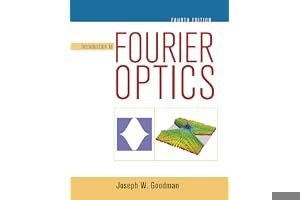
Introduction to Fourier Optics
Joseph W. Goodman
4.2
Introduction to Fourier Optics is the standard teaching and reference text for Fourier Optics and optical Information processing. Over the years, applications of these principles have been important in diverse fields such as pattern recognition, image processing, displays, sensors, communications, data storage and imaging systems. Previous editions have included updated material on holography and wavefront modulation. In this most recent edition, a new chapter describes devices and techniques important for optical communications, emphasizing the interplay between time, temporal frequency, space and spatial frequency. Topics such as fiber Bragg gratings, ultrashort pulse shaping and spectral holography are presented in the same clear and understandable yet detailed manner as the other topics in the text. Once again, the use of Fourier techniques provides particular insight into the principles and applications of these important new fields. This latest edition is an outstanding enhancement of this classic text. About Author: Joseph W Goodman is William Ayer Professor Emeritus. He held the William Ayer Chair in Electrical Engineering at Stanford and also served in several administrative posts.
…
Cover unavailable
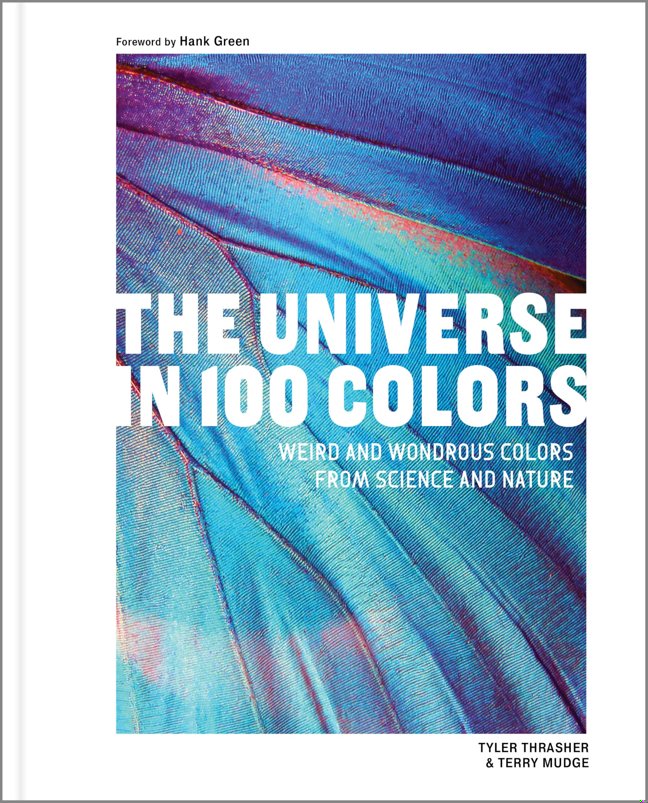
35
The Universe in 100 Colors: Weird and Wondrous Colors from Science and Nature
Tyler Thrasher, Terry Mudge, and Hank Green
4.2
At the intersection of science, art, nature, and design, this breathtaking coffee table book reveals 100 extraordinary hues you’ve likely never seen before.Created by Instagram sensation Tyler Thrasher and Terry Mudge (creator of the Matter box), with a foreword by Hank Green, The Universe in 100 Colors is a visual and scientific journey through the spectrum of our universe.Each entry features vivid photography, fascinating facts, and insights into color theory and rare color combinations found in nature and design. Explore shades like Cosmic Latte, Dragon’s Blood, and Sonoluminescence, alongside structural and impossible colors that challenge what we think we know about light and perception.Key Features:A Visual Celebration of Science and Nature – Explore 100 mind-blowing colors that exist in the farthest corners of nature and the universe, blending science, art, and color theory in one breathtaking coffee table book.Perfect Gift for Art & Science Lovers – A striking coffee table book for anyone passionate about color theory, design, science, and nature — ideal for birthdays, holidays, or inspiration year-round.Beautifully Designed & Informative – Each color features a full-page image, fun facts, and insights into color theory, color combinations, and how light and matter create our visual world.Discover the Science of Color – Learn about structural and impossible colors, and explore how science and nature work together to produce incredible hues.Perfect for artists, designers, and anyone fascinated by science and nature, this oversized coffee table book is as educational as it is mesmerizing. A perfect gift for creative minds and curious souls alike — a true celebration of how color theory, science, and nature intertwine to paint the universe in every imaginable shade.
…
Cover unavailable
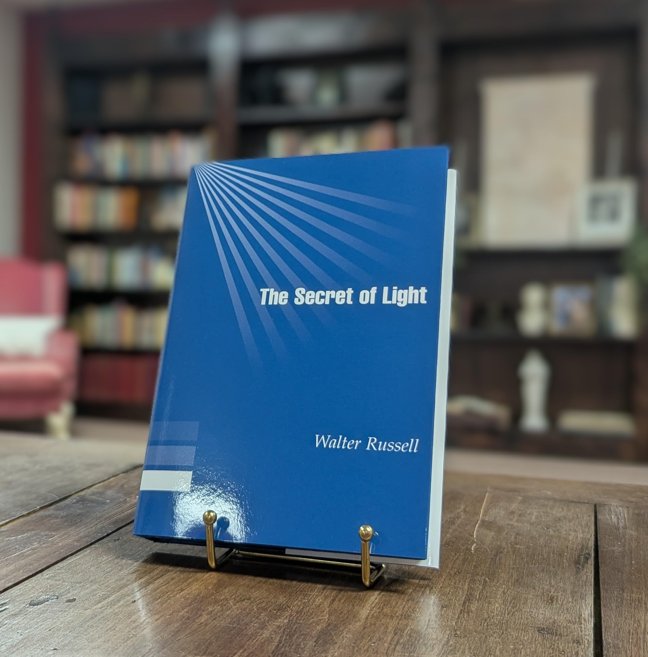
36
The Secret of Light
Walter Russell
4.2
This book explains the nature of Light and proves the existence of God by methods and standards acceptable to science and religion alike. It lays a spiritual foundation under the material one of science; one upon which the current New Age movement is built.
A century and more ahead of his time, Walter Russell, in The Secret of Light presents a unique Cosmogony, that of a universe in which Creator and Creation are proven to be a seamless, unified whole, and in which the dualism of “mind and matter” disappears.
In revelation of what he terms “natural science,” Russell presents a two-way, magnetic-electric thought-wave universe, cyclic in nature and eternally “creating,” as opposed to the “created, expanding, entropic universe” of current science.
Russell’s philosophy of the science of Being, the invisible world of Cause—the nature of consciousness, knowing, thinking, sensing, inspiration, intuition, energy, and the creative process—and the science of Expressed Being, the visible world of Effect—the nature of light, the wave structure of universal creation, the creation of the elements that make up our visible world, and the cycle nature of life and death— are proven a unified continuum.
The Secret of Light illuminates the many questions regarding the nature of “science and consciousness.” Dr. Francis Trevelyan Miller (LITT.D., LL.D.), Historical Foundations, New York, wrote in 1947 of The Secret of Light,
“I hasten to congratulate you on your epoch-making achievement in giving the world The Secret of Light. In this little volume, with its tremendous magnitude of thought, you have given Science and human knowledge a rebirth—a transmigration from its physical plane to its potential grandeur on the cosmic plane.”
“You have opened the door into the infinite—science must enter. It may hesitate; it may engage in controversy, but it cannot afford to ignore the principles you have established which eventually will revolutionize man’s concept of himself, his world, his universe, and his human problems.”
“You have done for us in the Twentieth Century what Ptolemy, Euclid, Copernicus, Galileo, Kepler did for their earlier centuries. But you have further penetrated all physical barriers and extended your discoveries into definite forms of the infinite law which created our universe and keeps it in operation with mathematical precision through the millions of years.”
“Hitherto, Science while delving into these infinite sources has not attempted to define them. It has left the terminology to the ecclesiastics and theological dialectics. You have the courage and vision to start where they leave off — to explore the creative or spiritual law which motivates everything that exists: principles of far greater import than Einstein’s relativity. I hail you as a forerunner of our New Age of Science.”
Part I: Omniscience, The Universe of Knowing Part II: Omnipotence, The Universe of Power Part III: Omnipresence; The Universe of Being
…
Cover unavailable
37
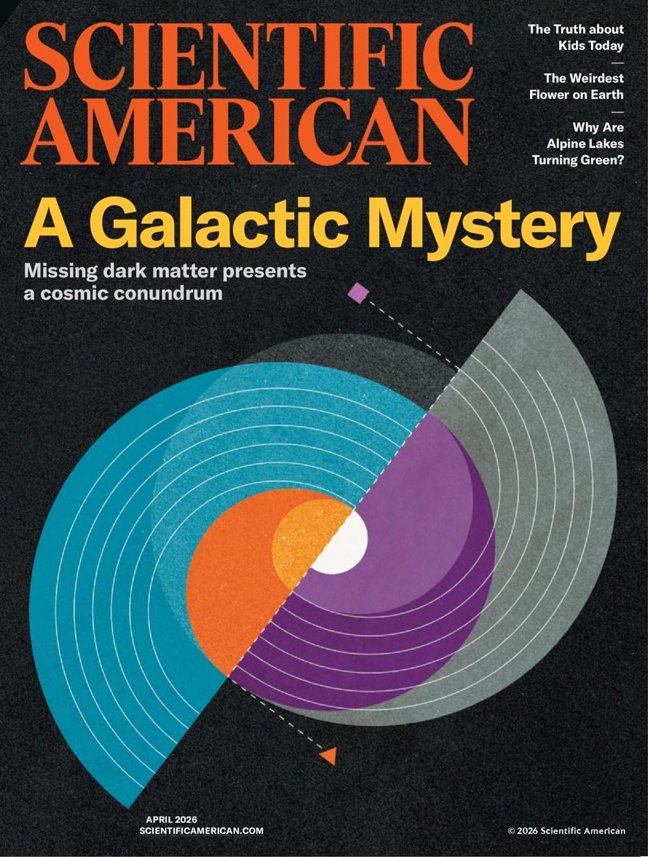
Scientific American April 2026
Scientific American
4.1
Scientific American covers the most important and exciting research, ideas and knowledge in science, health, technology, the environment and society. It is committed to sharing trustworthy knowledge and enhancing our understanding of the world .
Cover unavailable
38
The Optics of Life: A Biologist's Guide to Light in Nature
Sonke Johnsen
4.1
Optics--a field of physics focusing on the study of light--is also central to many areas of biology, including vision, ecology, botany, animal behavior, neurobiology, and molecular biology. The Optics of Life introduces the fundamentals of optics to biologists and nonphysicists, giving them the tools they need to successfully incorporate optical measurements and principles into their research. Sönke Johnsen starts with the basics, describing the properties of light and the units and geometry of measurement. He then explores how light is created and propagates and how it interacts with matter, covering topics such as absorption, scattering, fluorescence, and polarization. Johnsen also provides a tutorial on how to measure light as well as an informative discussion of quantum mechanics.
The Optics of Life features a host of examples drawn from nature and everyday life, and several appendixes that offer further practical guidance for researchers. This concise book uses a minimum of equations and jargon, explaining the basic physics of light in a succinct and lively manner. It is the essential primer for working biologists and for anyone seeking an accessible introduction to optics.
…
Cover unavailable
39
Quantum Physics for Beginners: Discover The Most Mind-Blowing Quantum Physics Theories Made Easy to Understand the Secrets and Wonders of the Science that is Changing our Lives
Elliot Berg
4.1
Cover unavailable
40
Diffractive Optics: Design, Fabrication, and Test
Donald C. O'Shea, Thomas J. Suleski, et al.
4.1
This work is based on a series of short courses in diffractive optics which provided basic theory on diffractive optics and then allowed participants to progress through a series of exercises on the design, fabrication, and testing of diffractive optical elements (DOEs).
Cover unavailable
41
Ross and Wilson Anatomy and Physiology in Health and Illness
Anne Waugh MSc CertEd SRN RNT FHEA, Allison Grant BSc PhD RGN
4.1
The purpose of the book is reflected in its title, Anatomy and Physiology in Health and Illness. The text is written in straightforward language and is complemented by extensive clear, full-colour illustrations. Each chapter provides an explanation of the normal structure and functions of the human body and what occurs when disease or illness disrupts the normal processes. Carefully refined, clear and unambiguous text Excellent layout ensures the text and relevant illustrations are close together Highly illustrated with clear line diagrams, mostly in colour Text uses regular sequences of headings, lists, and bullet points to help with learning and revision Omits the unnecessary detail which can confuse the student new to the subject A glossary of common prefixes, suffixes and roots commonly used in anatomy and physiology An Appendix containing useful biological values for easy reference Learning outcomes related to the sections within each chapter Accompanying Colouring and workbook that facilitates structured learning and revision of the material in this book Access to an Evolve companion website offering animations, MCQs, a full image bank, an audio pronunciation guide as well as useful web links. - text revised and updated, including one chapter integrating the musculoskeletal system and a new chapter on genetics to reflect the increasing importance of this topic - new and revised artwork/illustrations - enhanced features on the Evolve website for students: -High quality animations -Multiple-choice questions -Web links to supplementary websites -An audio pronunciation guide and for Lecturers: -Image bank: the complete collection of images from the book.
…
Cover unavailable
42
Blue: The Science and Secrets of Nature's Rarest Color
Kai Kupferschmidt
4.1
Cover unavailable
43
Optical Communications Essentials
Gerd Keiser
4.1
This tour takes readers through the basics and cutting edge applications of optical communications. Broken into short modules, complete with illustrations and sidebars, the text is suitable for use in the classroom, independent study or corporate training.
Cover unavailable
44
Modern Classical Physics: Optics, Fluids, Plasmas, Elasticity, Relativity, and Statistical Physics
Kip S. Thorne
4.1
From Nobel Prize winner Kip Thorne and acclaimed physicist Roger Blandford, a groundbreaking textbook on twenty-first-century classical physics
This first-year, graduate-level text and reference book covers the fundamental concepts and twenty-first-century applications of six major areas of classical physics that every masters- or PhD-level physicist should be exposed to, but often isn't: statistical physics, optics (waves of all sorts), elastodynamics, fluid mechanics, plasma physics, and special and general relativity and cosmology. Growing out of a full-year course that the eminent researchers Kip Thorne and Roger Blandford taught at Caltech for almost three decades, this book is designed to broaden the training of physicists. Its six main topical sections are also designed so they can be used in separate courses, and the book provides an invaluable reference for researchers.
Presents all the major fields of classical physics except three prerequisites: classical mechanics, electromagnetism, and elementary thermodynamics Elucidates the interconnections between diverse fields and explains their shared concepts and tools Focuses on fundamental concepts and modern, real-world applications Takes applications from fundamental, experimental, and applied physics; astrophysics and cosmology; geophysics, oceanography, and meteorology; biophysics and chemical physics; engineering and optical science and technology; and information science and technology Emphasizes the quantum roots of classical physics and how to use quantum techniques to elucidate classical concepts or simplify classical calculations Features hundreds of color figures, some five hundred exercises, extensive cross-references, and a detailed index An online illustration package is available to professors
…
Cover unavailable
45
Speckle Phenomena in Optics: Theory and Applications
Joseph W. Goodman
4.1
Providing a comprehensive discussion of the statistical properties of speckle, Speckle Phenomena in Optics shares detailed coverage of its role in applications such as astronomy, projection display, and optical radar detection.
Cover unavailable
46
Classical Electrodynamics
John David Jackson
4.1
A revision of the defining book covering the physics and classical mathematics necessary to understand electromagnetic fields in materials and at surfaces and interfaces. The third edition has been revised to address the changes in emphasis and applications that have occurred in the past twenty years.
Cover unavailable
47
Crashing Through: A True Story of Risk, Adventure, and the Man Who Dared to See
Robert Kurson
4.1
The bestselling author of Shadow Divers returns with a riveting story of exploration, mystery, and the discovery of an unknown world--this time about one man's incredible odyssey from blindness into sight.
Cover unavailable
48
Light: The Visible Spectrum and Beyond
Megan Watzke
4.1
A visual exploration of the power and behavior of light, across the electromagnetic spectrum, and how it affects life on earth and everything in the Universe. Light allows us to see everything around us, but humans can only see a sliver of all light, known as the electromagnetic spectrum. Here, Kim Arcand and Megan Watzke present the subject of light as never before. Organized along the order of the electromagnetic spectrum, each chapter focuses on a different type of light. From radio waves, harnessed for telecommunications, to X-rays, which let us peer inside the human body and view areas around black holes in deep space, Arcand and Watzke show us all the important ways light impacts us. An introductory chapter describes what light is and how it behaves, while hundreds of full-color photographs and illustrations demonstrate concepts and make for a stunning book that's a joy to read and browse.
…
Cover unavailable
49
Orthogonal Frequency Division Multiplexing for Optical Communications
William Shieh
4.1
The first book on optical OFDM by the leading pioneers in the fieldThe only book to cover error correction codes for optical OFDMGives applications of OFDM to free-space communications, optical access networks, and metro and log haul transports show optical OFDM can be implementedContains introductions to signal processing for optical engineers and optical communication fundamentals for wireless engineers This book gives a coherent and comprehensive introduction to the fundamentals of OFDM signal processing, with a distinctive focus on its broad range of applications. It evaluates the architecture, design and performance of a number of OFDM variations, discusses coded OFDM, and gives a detailed study of error correction codes for access networks, 100 Gb/s Ethernet and future optical networks.
The emerging applications of optical OFDM, including single-mode fiber transmission, multimode fiber transmission, free space optical systems, and optical access networks are examined, with particular attention paid to passive optical networks, radio-over-fiber, WiMAX and UWB communications.
Written by two of the leading contributors to the field, this book will be a unique reference for optical communications engineers and scientists. Students, technical managers and telecom executives seeking to understand this new technology for future-generation optical networks will find the book invaluable.
William Shieh is an associate professor and reader in the electrical and electronic engineering department, The University of Melbourne, Australia. He received his M.S. degree in electrical engineering and Ph.D. degree in physics both from University of Southern California.
Ivan Djordjevic is an Assistant Professor of Electrical and Computer Engineering at the University of Arizona, Tucson, where he directs the Optical Communications Systems Laboratory (OCSL). His current research interests include optical networks, error control coding, constrained coding, coded modulation, turbo equalization, OFDM applications, and quantum error correction.
"This wonderful book is the first one to address the rapidly emerging optical OFDM field. Written by two leading researchers in the field, the book is structured to comprehensively cover any optical OFDM aspect one could possibly think of, from the most fundamental to the most specialized. The book adopts a coherent line of presentation, while striking a thoughtful balance between the various topics, gradually developing the optical-physics and communication-theoretic concepts required for deep comprehension of the topic, eventually treating the multiple optical OFDM methods, variations and applications. In my view this book will remain relevant for many years to come, and will be increasingly accessed by graduate students, accomplished researchers as well as telecommunication engineers and managers keen to attain a perspective on the emerging role of OFDM in the evolution of photonic networks." -- "Prof. Moshe Nazarathy, EE Dept., Technion, Israel Institute of Technology" * The first book on optical OFDM by the leading pioneers in the field * The only book to cover error correction codes for optical OFDM * Applications of OFDM to free-space communications, optical access networks, and metro and log haul transports show optical OFDM can be implemented * An introduction to signal processing for optical communications * An introduction to optical communication fundamentals for the wireless engineer
…
Cover unavailable
50
Dorland's Pocket Medical Index
William Alexander, Newman Dorland
4.1
Cover unavailable
51
Photonic Crystals: Molding the Flow of Light - Second Edition
John D. Joannopoulos
4.1
Since it was first published in 1995, Photonic Crystals has remained the definitive text for both undergraduates and researchers on photonic band-gap materials and their use in controlling the propagation of light. This newly expanded and revised edition covers the latest developments in the field, providing the most up-to-date, concise, and comprehensive book available on these novel materials and their applications.
Starting from Maxwell's equations and Fourier analysis, the authors develop the theoretical tools of photonics using principles of linear algebra and symmetry, emphasizing analogies with traditional solid-state physics and quantum theory. They then investigate the unique phenomena that take place within photonic crystals at defect sites and surfaces, from one to three dimensions. This new edition includes entirely new chapters describing important hybrid structures that use band gaps or periodicity only in some directions: periodic waveguides, photonic-crystal slabs, and photonic-crystal fibers. The authors demonstrate how the capabilities of photonic crystals to localize light can be put to work in devices such as filters and splitters. A new appendix provides an overview of computational methods for electromagnetism. Existing chapters have been considerably updated and expanded to include many new three-dimensional photonic crystals, an extensive tutorial on device design using temporal coupled-mode theory, discussions of diffraction and refraction at crystal interfaces, and more. Richly illustrated and accessibly written, Photonic Crystals is an indispensable resource for students and researchers.
Extensively revised and expanded
Features improved graphics throughout
Includes new chapters on photonic-crystal fibers and combined index-and band-gap-guiding
Provides an introduction to coupled-mode theory as a powerful tool for device design
Covers many new topics, including omnidirectional reflection, anomalous refraction and diffraction, computational photonics, and much more.
…
Cover unavailable
52
Special Relativity and Classical Field Theory: The Theoretical Minimum
Leonard Susskind
4.1
A funny, insightful, and self-contained guide to Einstein's relativity theory and classical field theories--including electromagnetism
Physicist Leonard Susskind and data engineer Art Friedman are back. This time, they introduce readers to Einstein's special relativity and Maxwell's classical field theory. Using their typical brand of real math, enlightening drawings, and humor, Susskind and Friedman walk us through the complexities of waves, forces, and particles by exploring special relativity and electromagnetism. It's a must-read for both devotees of the series and any armchair physicist who wants to improve their knowledge of physics' deepest truths.
…
Cover unavailable
53
Secret Knowledge: Rediscovering the Lost Techniques of the Old Masters
David Hockney
4.1
Join one of the most influential artists of our time as he investigates the painting techniques of the Old Masters. Hockney’s extensive research led him to conclude that artists such as Caravaggio, Velázquez, da Vinci, and other hyperrealists actually used optics and lenses to create their masterpieces.In this passionate yet pithy book, Hockney takes readers on a journey of discovery as he builds a case that mirrors and lenses were used by the great masters to create their highly detailed and realistic paintings and drawings. Hundreds of the best-known and best-loved paintings are reproduced alongside his straightforward analysis. Hockney also includes his own photographs and drawings to illustrate techniques used to capture such accurate likenesses. Extracts from historical and modern documents and correspondence with experts from around the world further illuminate this thought-provoking book that will forever change how the world looks at art.
Secret Knowledge will open your eyes to how we perceive the world and how we choose to represent it.
…
Cover unavailable
54
Through Two Doors at Once: The Elegant Experiment That Captures the Enigma of Our Quantum Reality
Anil Ananthaswamy
4.1
One of Smithsonian's Favorite Books of 2018 One of Forbes's 2018 Best Books About Astronomy, Physics and Mathematics One of Kirkus's Best Books of 2018
The intellectual adventure story of the "double-slit" experiment, showing how a sunbeam split into two paths first challenged our understanding of light and then the nature of reality itself--and continues to almost 200 years later.
Many of science's greatest minds have grappled with the simple yet elusive "double-slit" experiment. Thomas Young devised it in the early 1800s to show that light behaves like a wave, and in doing so opposed Isaac Newton. Nearly a century later, Albert Einstein showed that light comes in quanta, or particles, and the experiment became key to a fierce debate between Einstein and Niels Bohr over the nature of reality. Richard Feynman held that the double slit embodies the central mystery of the quantum world. Decade after decade, hypothesis after hypothesis, scientists have returned to this ingenious experiment to help them answer deeper and deeper questions about the fabric of the universe.
How can a single particle behave both like a particle and a wave? Does a particle exist before we look at it, or does the very act of looking create reality? Are there hidden aspects to reality missing from the orthodox view of quantum physics? Is there a place where the quantum world ends and the familiar classical world of our daily lives begins, and if so, can we find it? And if there's no such place, then does the universe split into two each time a particle goes through the double slit?
With his extraordinarily gifted eloquence, Anil Ananthaswamy travels around the world and through history, down to the smallest scales of physical reality we have yet fathomed. Through Two Doors at Once is the most fantastic voyage you can take.
…
Cover unavailable
55
Introduction to Fiber Optics, Third Edition
John Crisp
4.1
Introduction to Fiber Optics is well established as an introductory text for engineers, managers and students. It meets the needs of systems designers, installation engineers, electronic engineers and anyone else looking to gain a working knowledge of fiber optics with a minimum of maths. Review questions are included in the text to enable the reader to check their understanding as they work through the book. The new edition of this successful book is now fully up to date with the new standards, latest technological developments and includes a new chapter on specifying optical components. Whether you are looking for a complete self-study course in fiber optics, a concise reference text to dip into, or a readable introduction to this fast moving technology, this book has the solution. * A practical, no-nonsense guide to fiber optics * Up-to-date coverage that minimises mathematics * New material on specifying optical components
…
Cover unavailable
56
Optics Demystified
Stan Gibilisco
4.1
Publisher's Note: Products purchased from Third Party sellers are not guaranteed by the publisher for quality, authenticity, or access to any online entitlements included with the product.
An enlightening guide to optics
Are you in the dark when it comes to understanding the science of optics? Now there's a glimmer in the gloom! Optics Demystified brings this challenging topic into focus.
Written in an easy-to-follow format, this practical guide begins by covering the nature of light, the electromagnetic spectrum, reflection, refraction, and color dispersion. You'll move on to common optical devices and effects, lasers, and optical data transmission technology. Industrial, medical, and military applications are discussed, as are exotic optics such as holography. Detailed examples and concise explanations make it easy to understand the material, and end-of-chapter quizzes and a final exam help reinforce learning.
It's a no-brainer! You'll get:
Explanations of the particle and wave theories
Analysis of optical microscopes and telescopes
Functional details of fiber optics
A sampling of optical illusions
A time-saving approach to performing better on an exam or at work
Simple enough for a beginner but challenging enough for an advanced student, Optics Demystified illuminates this vital physics topic.
…
Cover unavailable
57
Cite Them Right: The Essential Referencing Guide
Richard Pears, Graham Shields
4.1
This book is renowned as the most comprehensive yet easy-to-use guide to referencing available. Tutors rely on the advice to guide their students in the skills of identifying and referencing information sources and avoiding plagiarism. This new edition has new and expanded content, especially in relation to latest electronic sources.
Cover unavailable
58
Optics
A. N. Matveev
4.1
Cover unavailable
59
Foa Reference Guide to Fiber Optics: Study Guide to Foa Certification
Jim Hayes
4.1
Updated January 2019.This book is a complete guide to the design, installation, testing and operation of fiber optic networks. It was written with the assistance of many experienced Fiber Optic Association (FOA) instructors in fiber optics as a reference book for classes aimed at FOA CFOT certification as well as a basic reference for anyone working in the field of fiber optics. This book offers expansive coverage on the components and processes of fiber optics as used in all applications and installation practices. A complete curriculum for teaching fiber optics using this book as a text is available from FOA.
…
Cover unavailable
60
Alhacen's Theory of Visual Perception (First Three Books of Alhacen's de Aspectibus), Volume One--Introduction and Latin Text
Alhazen and A. Mark Smith
4.1
Sometime between 1028 and 1038, Ibn al-Haytham completed his monumental optical synthesis, Kitab al-Manazir ("Book of Optics"). By no later than 1200, and perhaps somewhat earlier, this treatise appeared in Latin under the title De aspectibus. In that form it was attributed to a certain "Alhacen." These differences in title and authorial designation are indicative of the profound differences between the two versions, Arabic and Latin, of the treatise. In many ways, in fact, they can be regarded not simply as different versions of the same work, but as different works in their own right. Accordingly, the Arab author, Ibn al-Haytham, and his Latin incarnation, Alhacen, represent two distinct, sometimes even conflicting, interpretive voices. And the same holds for their respective texts. To complicate matters, "Alhacen" does not represent a single interpretive voice. There were at least two translators at work on the Latin text, one of them adhering faithfully to the Arabic original, the other content with distilling, even paraphrasing, the Arabic original. Consequently, the Latin text presents not one, but at least two faces to the reader. This critical edition represents fourteen years of work on Dr. Smith's part. Awarded the 2001 J. F. Lewis Award.
…
Cover unavailable
61
Scientific American July/August 2026
Scientific American
4.1
Scientific American covers the most important and exciting research, ideas and knowledge in science, health, technology, the environment and society. It is committed to sharing trustworthy knowledge and enhancing our understanding of the world .
Cover unavailable
62
Electromagnetic Fields
Jean G. Van Bladel
4.1
Professor Jean Van Bladel, an eminent researcher and educator in fundamental electromagnetic theory and its application in electrical engineering, has updated and expanded his definitive text and reference on electromagnetic fields to twice its original content. This new edition incorporates the latest methods, theory, formulations, and applications that relate to today's technologies. With an emphasis on basic principles and a focus on electromagnetic formulation and analysis, Electromagnetic Fields, Second Edition includes detailed discussions of electrostatic fields, potential theory, propagation in waveguides and unbounded space, scattering by obstacles, penetration through apertures, and field behavior at high and low frequencies.
…
Cover unavailable
63
The Ultimate Book of Optical Illusions
Al Seckel
4.1
Cover unavailable
64
Plasma Etching: An Introduction
Dennis M. Manos
4.1
Plasma etching plays an essential role in microelectronic circuit manufacturing. Suitable for researchers, process engineers, and graduate students, this book introduces the basic physics and chemistry of electrical discharges and relates them to plasma etching mechanisms. Throughout the volume the authors offer practical examples of process chemistry, equipment design, and production methods.
Cover unavailable
65
Laser Physics
Murray Sargent III, Marlan O. Scully, Willis E. Jr." Lamb
4.1
This book treats the interaction of radiation with matter, particular attention being paid to the laser. Knowledge is assumed of the usual half-year introduction of quantum mechanics found in undergraduate physics curricula. The material can be covered in two semesters, or, alternatively, the first part (Chaps 1-13) can be used as a one-semester course in which quantum mechanical aspects of the electromagnetic field are ignored. Each chapter is accompanied by problems that illustrate the text and give useful (occasionally new) results. Existing laser media are intrinsically quantum mechanical and are most easily studied with the quantum theory. Understanding the laser along these lines enlivens one's understanding of quantum mechanics itself. In fact, the material constitutes a viable, applied alternative for the usual second and third semesters of quantum mechanics.
…
Cover unavailable
66
Lasers (Revised)
Anthony E Siegman
4.1
This is both a textbook and general reference on the subject of laser theory and basic laser principles. The book gives a detailed accurate treatment of laser physics which does not require a background in quantum mechanics.
Cover unavailable
67
Principles of Nano-Optics
Lukas Novotny, Bert Hecht
4.1
Nano-optics is the study of optical phenomena and techniques on the nanometer scale, that is, near or beyond the diffraction limit of light. It is an emerging field of study, motivated by the rapid advance of nanoscience and nanotechnology which require adequate tools and strategies for fabrication, manipulation and characterization at this scale. In this 2006 text the authors provide a comprehensive overview of the theoretical and experimental concepts necessary to understand and work in nano-optics. With a very broad perspective, they cover optical phenomena relevant to the nanoscale across diverse areas ranging from quantum optics to biophysics, introducing and extensively describing all of the significant methods. Written for graduate students who want to enter the field, the text includes problem sets to reinforce and extend the discussion. It is also a valuable reference for researchers and course teachers.
…
Cover unavailable
68
Contact Lenses
Anthony J. Phillips MPhil FBOA HD FAAO FBCO FVCO FCLSA DCLP, Lynne Speedwell BSc MSc(Health Psych) DCLP FAAO
4.1
Cover unavailable
69
A History of the Photographic Lens
Rudolf Kingslake
4.1
The lens is generally the most expensive and least understood part of any camera. In this book, Rudolf Kingslake traces the historical development of the various types of lenses from Daguerre's invention of photography in 1839 through lenses commonly used today. From an early lens still being manufactured for use in low-cost cameras to designs made possible through such innovations as lens coating, rare-earth glasses, and computer aided lens design and testing, the author details each major advance in design and fabrication. The book explains how and why each new lens type was developed, and why most of them have since been abandoned. This authoritative history of lens technology also includes brief biographies of several outstanding lens designers and manufacturers of the past.
…
Cover unavailable
70
A Systems Approach to Lithium-Ion Battery Management
Phillip Weicker
4.1
The advent of lithium ion batteries has brought a significant shift in the area of large format battery systems. This title discusses battery management system (BMS) technology for large format lithium-ion battery packs from a systems perspective. It provides an update on BMS technology, covering software, hardware, integration, testing, and safety.
Cover unavailable
71
Electronic Properties of Doped Semiconductors
B.I. Shklovskii
4.1
Cover unavailable
72
Optic Nerve
María Gainza and Thomas Bunstead
4.1
The narrator of Optic Nerve is an Argentinian woman whose obsession is art. The story of her life is the story of the paintings, and painters, who matter to her. Her intimate, digressive voice guides us through a gallery of moments that have touched her.
In these pages, El Greco visits the Sistine Chapel and is appalled by Michelangelo’s bodies. The mystery of Rothko’s refusal to finish murals for the Seagram Building in New York is blended with the story of a hospital in which a prostitute walks the halls while the narrator’s husband receives chemotherapy. Alfred de Dreux visits Géricault’s workshop; Gustave Courbet’s devilish seascapes incite viewers “to have sex, or to eat an apple”; Picasso organizes a cruel banquet in Rousseau’s honor . . . All of these fascinating episodes in art history interact with the narrator’s life in Buenos Aires―her family and work; her loves and losses; her infatuations and disappointments. The effect is of a character refracted by environment, composed by the canvases she studies.
Seductive and capricious, Optic Nerve marks the English-language debut of a major Argentinian writer. It is a book that captures, like no other, the mysterious connections between a work of art and the person who perceives it.
…
Cover unavailable
73
The Universal One: Walter Russell’s Foundational Mind-Centered Electromagnetic Universe Treatise—Exact Facsimile with Full Illustrations
Walter Russell
4.1
Rediscover Walter Russell’s Visionary TreatiseUnlock the full depth of The Universal One: Original Facsimile Edition, an exact reproduction of Walter Russell’s 1926 landmark work on the Mind-Centered Electromagnetic Universe. Every page, diagram and cosmic mandala appears here in its original form—preserved for collectors, seekers, and students alike.Inside this edition you’ll find:Exact Facsimile of the complete 1926 text, including original typography and layoutFull Illustrations, from detailed cosmogony diagrams to Russell’s signature cosmic mandalaA bonus audio companion—perfect for immersive, hands-free explorationWhether your interest lies in alternative cosmology, spiritual philosophy, or the intersection of science and metaphysics, this volume bridges those worlds. Walter Russell’s unified model demonstrates how mind and matter are inseparable aspects of one creative intelligence—revealing fresh insights for modern readers.Crafted for archival quality, this edition features:Warm cream-tone pagesHigh-resolution scansStep into Russell’s timeless cosmogony and experience the universe as he saw it. Add this meticulously preserved facsimile to your library and embark on a journey through the very heart of the Mind-Centered Electromagnetic Universe.
…
Cover unavailable
74
Schaum's Outline of Optics
Eugene Hecht
4.1
Confusing Textbooks? Missed Lectures? Not Enough Time?
Fortunately for you, there's Schaum's Outlines. More than 40 million students have trusted Schaum's to help them succeed in the classroom and on exams. Schaum's is the key to faster learning and higher grades in every subject. Each Outline presents all the essential course information in an easy-to-follow, topic-by-topic format. You also get hundreds of examples, solved problems, and practice exercises to test your skills.
This Schaum's Outline gives you
Practice problems with full explanations that reinforce knowledge Coverage of the most up-to-date developments in your course field In-depth review of practices and applications Fully compatible with your classroom text, Schaum's highlights all the important facts you need to know. Use Schaum's to shorten your study time-and get your best test scores!
Schaum's Outlines-Problem Solved.
…
Cover unavailable
75
Zapped: From Infrared to X-rays, the Curious History of Invisible Light
Bob Berman
4.1
How much do you know about the radiation all around you?
Your electronic devices swarm with it; the sun bathes you in it. It's zooming at you from cell towers, microwave ovens, CT scans, mammogram machines, nuclear power plants, deep space, even the walls of your basement. You cannot see, hear, smell or feel it, but there is never a single second when it is not flying through your body. Too much of it will kill you, but without it you wouldn't live a year.
From beloved popular science writer Bob Berman, Zapped tells the story of all the light we cannot see, tracing infrared, microwaves, ultraviolet, X-rays, gamma rays, radio waves and other forms of radiation from their historic, world-altering discoveries in the 19th century to their central role in our modern way of life, setting the record straight on health costs (and benefits) and exploring the consequences of our newest technologies.
Lively, informative, and packed with fun facts and "eureka moments," Zapped will delight anyone interested in gaining a deeper understanding of our world.
…
Cover unavailable
76
Ways of Being
James Bridle
4.1
Artist, technologist, and philosopher James Bridle’s Ways of Being is a brilliant, searching exploration of different kinds of intelligence―plant, animal, human, artificial―and how they transform our understanding of humans’ place in the cosmos.What does it mean to be intelligent? Is it something unique to humans or shared with other beings―beings of flesh, wood, stone, and silicon? The last few years have seen rapid advances in “artificial” intelligence. But rather than a friend or companion, AI increasingly appears to be something stranger than we ever imagined, an alien invention that threatens to decenter and supplant us.At the same time, we’re only just becoming aware of the other intelligences that have been with us all along, even if we’ve failed to recognize or acknowledge them. These others―the animals, plants, and natural systems that surround us―are slowly revealing their complexity, agency, and knowledge, just as the technologies we’ve built to sustain ourselves are threatening to cause their extinction and ours. What can we learn from them, and how can we change ourselves, our technologies, our societies, and our politics to live better and more equitably with one another and the nonhuman world?The artist and maverick thinker James Bridle draws on biology and physics, computation, literature, art, and philosophy to answer these unsettling questions. Startling and bold, Ways of Being explores the fascinating, strange, and multitudinous forms of knowing, doing, and being that make up the world, and that are essential for our survival.Includes illustrations
…
Cover unavailable
77
Optics
Bruno B. Rossi
4.1
Cover unavailable
78
Atom-Photon Interactions: Basic Processes and Applications
Claude Cohen-Tannoudji, Jacques Dupont-Roc, Gilbert Grynberg
4.1
Atom-Photon Interactions: Basic Processes and Applications allows the reader to master various aspects of the physics of the interaction between light and matter. It is devoted to the study of the interactions between photons and atoms in atomic and molecular physics, quantum optics, and laser physics. The elementary processes in which photons are emitted, absorbed, scattered, or exchanged between atoms are treated in detail and described using diagrammatic representation. The book presents different theoretical approaches, including:
Perturbative methods The resolvent method Use of the master equation The Langevin equation The optical Bloch equations The dressed-atom approach Each method is presented in a self-contained manner so that it may be studied independently. Many applications of these approaches to simple and important physical phenomena are given to illustrate the potential and limitations of each method.
…
Cover unavailable
79
Conceptual Physics
Paul G. Hewitt
4.0
Cover unavailable
80
Essential Calculus-based Physics Study Guide Workbook: Waves, Fluids, Sound, Heat, and Light (Learn Physics with Calculus Step-by-Step Book 3)
Chris McMullen
4.0
Cover unavailable
81
Introduction to Lens Design: With Practical Zemax Examples
Joseph M. Geary
4.0
Cover unavailable
82
Color and Meaning: Art, Science, and Symbolism
John Gage
4.0
Is color just a physiological reaction, a sensation resulting from different wave lengths of light on receptors in our eyes? Does color have an effect on our feelings? The phenomenon of color is examined in extraordinary new ways in John Gage's latest book. His pioneering study is informed by the conviction that color is a contingent, historical occurrence whose meaning, like language, lies in the particular contexts in which it is experienced and interpreted.
Gage covers topics as diverse as the optical mixing techniques implicit in mosaic; medieval color-symbolism; the equipment of the manuscript illuminator's workshop, the color languages and color practices of Latin America at the time of the Spanish Conquest; the earliest history of the prism; and the color ideas of Goethe and Runge, Blake and Turner, Seurat and Matisse.
From the perspective of the history of science, Gage considers the bearing of Newton's optical discoveries on painting, the chemist Chevreul's contact with painters and the growing interest of experimental psychologists in the topic of color in the late nineteenth century, particularly in relation to synaesthesia. He includes an invaluable overview of the twentieth-century literature that bears on the historical interpretation of color in art. Gage's explorations further extend the concepts he addressed in his prize-winning book, Color and Culture.
…
Cover unavailable
83
Lightspeed: The Ghostly Aether and the Race to Measure the Speed of Light
John C. H. Spence
4.0
This book tells the human story of one of man's greatest intellectual adventures - how it came to be understood that light travels at a finite speed, so that when we look up at the stars, we are looking back in time. And how the search for a God-given absolute frame of reference in the universe led most improbably to Einstein's most famous equation E=mc2, which represents the energy that powers the stars and nuclear weapons.� From the ancient Greeks measuring the solar system, to the theory of relativity and satellite navigation, the book takes the reader on a gripping historical journey. We learn how Galileo discovered the moons of Jupiter and used their eclipses as a global clock, allowing travellers to find their Longitude. And how Ole Roemer, noticing that the eclipses were a little late, used this to obtain the first measurement of the speed of light, which takes eight minutes to get to us from the sun. We move from the international collaborations to observe the Transits of Venus, including Cook's voyage to Australia, to the achievements of Young and Fresnel, whose discoveries eventually taught us that light travels as a wave but arrives as a particle, and all the quantum weirdness which follows. In the nineteenth century, we find Faraday and Maxwell, struggling to understand how light can propagate through the vacuum of space unless it is filled with a ghostly vortex Aether foam. We follow the brilliantly gifted experimentalists Hertz, discoverer of radio, Michelson with his search for the Aether wind, and Foucault and Fizeau with their spinning mirrors and lightbeams across the rooftops of Paris. Messaging faster than light using quantum entanglement, and the reality of the quantum world, conclude this saga.
…
Cover unavailable
84
Little Critter: Just a Storybook Collection
Mercer Mayer
4.0
This collection features six of your favorite Little Critter® stories! Join Little Critter as he enters the school science fair, trains for a big race, enjoys a snowy day, spends the weekend with Grandma and Grandpa, and so much more.
Cover unavailable
85
Elements of Modern Optical Design
Donald C. O'Shea
4.0
A textbook for elementary optical design that treats lasers, modulators, and scanners as part of the design process. Moves from the simplest concepts in optics to a basic understanding of ray tracing in optical systems, the components of those systems, and the process by which a design is produced. Features numerous problems, examples, and figures.
Cover unavailable
86
Fiber Optic Test and Measurement
Dennis Derickson
4.0
This is the most authoritative, complete source of test and measurement information for engineers who design and maintain fiber optic networks.This book presents measurement principles for characterizing all three basic components of a fiber optic communication system: the optical transmitter, fiber medium and optical receiver. It also covers system level measurements, and discusses the principles and limitations of current fiber optic testing equipment. It discusses testing to SONET/SDH international standards, and helps engineers choose the best approach to testing today's new erbium doped fiber amplifiers. The book provides detailed recommendations for understanding polarization states, and presents new methods for accurately characterizing the behavior of Wavelength Division Multiplexing (WDM) fiber systems. It includes detailed coverage of testing fiber in the local loop, using optical power meters and optical time domain reflectometers. It also reviews the latest state-of-the-art 10 Gb/s systems, and even faster systems on the horizon. The coverage is practical, helping professionals accurately measure and test fiber optic systems without becoming experts in theory.All fiber optic engineers working with communications applications.
…
Cover unavailable
87
Understand Physics: Teach Yourself
Jim Breithaupt
4.0
Cover unavailable
88
Fundamentals of Optics
Francis A. Jenkins
4.0
Cover unavailable
89
Computational Fourier Optics: A MATLAB Tutorial
David G. Voelz
4.0
Cover unavailable
90
Modern Optical Engineering: The Design of Optical Systems
Warren Smith
4.0
Publisher's Note: Products purchased from Third Party sellers are not guaranteed by the publisher for quality, authenticity, or access to any online entitlements included with the product.
The Latest Advances in Optical Engineering and Lens Technology
Long-established as the definitive optics text and reference, Modern Optical Engineering has been completely revised and updated to equip you with all the latest optical and lens advances. The Fourth Edition now contains cutting-edge information on optical engineering theory, design, and practice, including new chapters on ray tracing, optical system design, and third-order aberration theory.
Written by the renowned optical scientist Warren J. Smith, this state-of-the-art guide provides unsurpassed coverage of image formation, basic optical devices, image evaluation, fabrication and testing methods, and more. Comprehensive and up-to-date, Modern Optical Engineering features:
The latest information on optical engineering theory, design, and practice Over 150 detailed illustrations New to this edition: new coverage of ray tracing, optical system design, and third-order aberration theory; new lens designs; new optical design software; and new problems and exercises Inside This Updated Optical Engineering Classic
- Image formation - Aberrations - Prisms and mirrors - The eye - Stops and apertures - Optical materials - Interference coatings - Radiometry and photometry - Basic optical devices - Optical systems - Ray tracing - Third-order aberration theory - Image evaluation - Design of optical systems - 44 lens designs - Optics fabrication and testing
…
Cover unavailable
91
FASTER THAN LIGHT: HOW YOUR SHADOW CAN DO IT BUT YOU CAN'T
Robert J. Nemiroff
4.0
Cover unavailable
92
The Contact Lens Manual: A Practical Guide to Fitting
Andrew Gasson FCOptom DCLP FAAO, Judith A. Morris MSc FCOptom FAAO FIACLE
4.0
The Contact Lens Manual continues to meet the needs of a new generation of optometrists, dispensing opticians, contact lens practitioners and students who require clear and reliable information for fitting a complete range of contact lenses.
The fourth edition of this best-selling classic, now in full colour throughout, provides the most up-to-date guidance in all aspects of today's lenses in a practical and easy to use manual. Featuring new developments in lens types, care regimes, current practices, and electronic access to brand new video footage as well as a range of learning tools, this manual offers a complete package to help readers expand their lens knowledge, improve fitting and optimise patient care.
The authors use a down-to-earth practical approach to distil years of experience into one handy volume.A bullet point style makes the information easily accessible.Key information is presented so it can be quickly located.Practical tips, clinical pearls, helpful advice, and warnings are presented in boxes so readers can see at a glance what to do. Features updates to all chapters and lens types with a wealth of new information on silicone hydrogels, toric soft lenses, rigid gas-permeable fitting and patient after care. Presents a new chapter on dry eyes with expert guidance on treatment and practical management advice. Includes an expanded illustration programme and page design with full colour throughout including colour-coded sections and boxes to highlight key information for easier learning. Electronic access to brand new video footage of lens and eye care regimes, along with over 100 clinical photographs, images from the book, simulations and calculation tools.
…
Cover unavailable
93
The Science of Art: Optical Themes in Western Art from Brunelleschi to Seurat
Martin Kemp
4.0
In this pathbreaking and richly illustrated book, Martin Kemp examines the major optically oriented examples of artistic theory and practice from Brunelleschi’s invention of perspective and its exploitation by Leonardo and Durer to the beginnings of photography. In a discussion of color theory, Kemp traces two main traditions of color science: the Aristotelian tradition of primary colors and Newton’s prismatic theory that influenced Runge, Turner, and Seurat. His monumental book not only adds to our understanding of a large group of individual works of art but also provides valuable information for all those interested in the interaction between science and art.
"This beautifully made volume . . . shows us the unity of the visual study of nature—the exalted mutual task of Renaissance science and art."—Scientific American
"[A] wonderful book. . . . Martin Kemp has convincingly demonstrated that even the most diverse styles of Western art from the Renaissance to modern times remained ever enthralled by scientific optics. . . . [A] handsome volume."—Samuel Y. Edgerton, American Scientist
"An extraordinarily ambitious, even daring, enterprise. . . . The book leaves us in no doubt about its author’s expertise in both fields. It includes the most comprehensive account of the development of perspective theory and practice I know."—Thomas Puttfarken, Times Higher Education Supplement
"Kemp has performed a valuable service. . . . His style is lucid and he emerges as an honest broker who judiciously weighs the historical evidence. He has an impressive command of the literature of both art and optical science across much of Europe and over a span of four centuries. . . . Kemp’s thesis is amply illustrated with several hundred plates, including many of his own line drawings. . . . The reader is led gently through the history of art and the details of optical science to appreciate their interrelationship."—Geoffrey Cantor, Oxford Art Journal
…
Cover unavailable
94
Computational Electrodynamics: The Finite-Difference Time-Domain Method
Allen Taflove, Susan C. Hagness
4.0
This extensively revised and expanded third edition of the Artech House bestseller, Computational Electrodynamics: The Finite-Difference Time-Domain Method, offers engineers the most up-to-date and definitive resource on this critical method for solving Maxwell's equations. The method helps practitioners design antennas, wireless communications devices, high-speed digital and microwave circuits, and integrated optical devices with unsurpassed efficiency. There has been considerable advancement in FDTD computational technology over the past few years, and the third edition brings professionals the very latest details with entirely new chapters on important techniques, major updates on key topics, and new discussions on emerging areas such as nanophotonics. What's more, to supplement the third edition, the authors have created a Web site with solutions to problems, downloadable graphics and videos, and updates,
…
Cover unavailable
95
Foundations in Nursing and Health Care - Beginning Reflective Practice (Foundations in Nursing & Health Care)
Melanie Jasper
4.0
Cover unavailable
96
Clinical Anatomy Of The Visual System
Lee Ann Remington OD MS FAAO, Denise Goodwin
4.0
This concise source for the clinical anatomy of the visual system covers the clinical anatomy of the eye, its adnexa, and the visual pathways in a well-illustrated, well-referenced format. It balances histologic content of the microscopic anatomy with functional aspects of the eye and visual system. Clear illustrations complement the text and provide clinical information on diseases and disorders that represent departures from normal clinical anatomy. Full color illustrations throughout enhance the anatomical and clinical information. The only anatomy text written by an optometrist for optometrists and students - it provides a strong foundation for recognizing and understanding clinical situations, problems, and treatments.
Clinical Comment sections have been expanded to include more clinical correlation comments and put knowledge of ocular anatomy into a practice perspective. Clinical appearance of normal structures is now included, with normal photos of the cornea, iris, lens, retina, etc., to show how appearance is directly related to structure. New information on aging changes in ocular tissue and the visual pathway keeps readers current with the expanding field of geriatric care and the changes that occur to normal anatomy.
…
Cover unavailable
97
Vintage Neon
Len Davidson
4.0
During the middle of the 20th century, neon signs turned North America's roadside into a luminous wonderland. The most compelling signs were figural: imaginative, cartoon drawings in light. These unforgettable depictions of exploding bowling pins, crashing cars, baton twirling majorettes, and lassoing cowboys were the fodder for legend and lore. Neon designer Len Davidson has captured the magic with over 350 photos of superb vintage signs. He has drawn on renowned photographers, museums, and private collections, as well as his own Neon Museum of Philadelphia pieces to compile the definitive photo archive. Davidson has also expressed the legend in words. The pages echo with the voices of sign makers and shopkeepers, photographers and preservationists. Architects and sign artisans will find this collection invaluable. It is also an essential volume for anyone who has been captured by the spell of the highway and neon's siren song.
…
Cover unavailable
98
Modern Introduction to Surface Plasmons: Theory, Mathematica Modeling and Applications
Dror Sarid, William A. Challener
4.0
Introducing graduate students in physics, optics, materials science and electrical engineering to surface plasmons, this book also covers guided modes at planar interfaces of metamaterials with negative refractive index. The physics of localized and propagating surface plasmons, on planar films, gratings, nanowires and nanoparticles, is developed using both analytical and numerical techniques. Guided modes at the interfaces between materials with any combination of positive or negative permittivity and permeability are analyzed in a systematic manner. Applications of surface plasmon physics are described, including near-field transducers in heat-assisted magnetic recording and biosensors. Resources at www.cambridge.org/9780521767170 include Mathematica code to generate figures from the book, color versions of many figures, and extended discussion of topics such as vector diffraction theory.
…
Cover unavailable
99
Optics
Ajoy Ghatak
4.0
"Optics" gives a comprehensive and balanced account of traditional optics as well as some of the recent developments in this field while meeting the requirements of a course on optics meant for undergraduate students of science and engineering.
Cover unavailable
100
The Automated Lighting Programmer's Handbook
Brad Schiller
4.0
This guide helps lighting designers with the creative and operational challenges they face in their rapidly evolving industry. Providing respected and clear coverage of the process of programming automated lighting fixtures, the author brings the designer from basic principles to preproduction preparations. Concepts, procedures, and guidelines to ensure a successful production are covered as well as troubleshooting, much needed information on work relationships, and technology including LED lighting, console networking, digital lighting, and more. Chapters are peppered with advice and war stories from some of the most prominent lighting designers of today.