We've ranked the best free will books using expert recommendations, sales data, and millions of reader ratings. At Shortform, we know books. Our book guides are the best in the world. Learn why.
Belief in free will touches nearly everything that human beings value. It is difficult to think about law, politics, religion, public policy, intimate relationships, morality—as well as feelings of remorse or personal achievement—without first imagining that every person is the true source of his or her thoughts and actions. And yet the facts tell us that free will is an illusion.
In this enlightening book, Sam Harris argues that this truth about the human mind does not undermine morality or diminish the importance of social and political freedom, but it can and should change the way we think about some of the most important questions in life.
…
Recommended by A.J. Jacobs.
A.J. Jacobs
I don’t believe in free will … Some people see that as depressing but I actually find it liberating because it’s so much easier to forgive yourself for doing stupid things. [source]
Cover unavailable
2
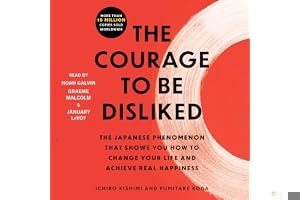
The Courage to Be Disliked: The Japanese Phenomenon That Shows You How to Change Your Life and Achieve Real Happiness
The Life-Changing Magic of Tidying Up for the mind, The Courage to Be Disliked is the Japanese phenomenon that shows you how to free yourself from the shackles of past experiences and others’ expectations to achieve real happiness.
The Courage to Be Disliked, already an enormous bestseller in Asia with more than 3.5 million copies sold, demonstrates how to unlock the power within yourself to be the person you truly want to be.
Using the theories of Alfred Adler, one of the three giants of twentieth century psychology, this book follows an illuminating conversation between a philosopher and a young man. The philosopher explains to his pupil how each of us is able to determine our own life, free from the shackles of past experiences, doubts, and the expectations of others. It’s a way of thinking that is deeply liberating, allowing us to develop the courage to change, and to ignore the limitations that we and those around us have placed on ourselves. The result is a book that is both highly accessible and profound in its importance. Millions have already read and benefitted from its wisdom.
This is a truly special book in the vein of Marie Kondo’s The Life-Changing Magic of Tidying Up but for the mind. Those ready to embrace the insights and liberation promised by The Courage to Be Disliked will come to a deeper understanding of themselves and others, and find the inspiration to take the reins of their own life.
Had to take my time reading this one. AMAZING READ. Not that I didn't have the courage to be disliked it's actually one of my specialities but the reasoning why it's ok to be disliked and the understanding behind people disliking you and why you shouldn't give a sh*t is incredible. I highly recommend this one!!!! [source]
Smash hit in Japan, and easy to see why. Adlerian psychology meets Stoic philosophy in Socratic dialogue. Compelling from front to back. Highly recommend. [source]
Ryan Hoover
It's like this book was written just for me. I came away with so many 'aha!' moments that have helped me better understand myself. [source]
The mind guides our footsteps as we progress along the pathway of life.
Purity of mind leads inevitably to purity of life, to the precious love and understanding that should control our everyday acts and attitudes towards friends and foes.
But where must one look for guidance? How does one achieve purity of mind that alone brings happiness and confidence?
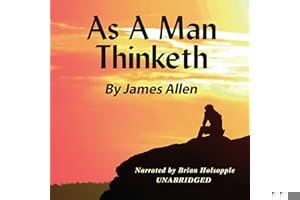
The author offers his clear answers in this book As A Man Thinketh. His words have helped millions for more than a century--and they continue to point the true way to a better life for a troubled humanity.
"Out of a clean heart comes a clean life and a clean body," James Allen writes. "Out of a defiled mind proceeds a defiled life and a corrupt body."
Too many mortals strive to improve only their wordly position--and too few seek spiritual betterment. Such is the problem James Allen faced in his own time. The ideas he found in his inner-most heart after great searching guided him as they will guide you.
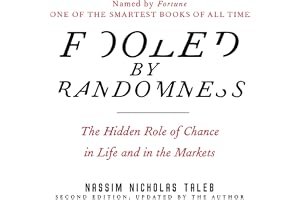
Fooled by Randomness is a standalone book in Nassim Nicholas Taleb’s landmark Incerto series, an investigation of opacity, luck, uncertainty, probability, human error, risk, and decision-making in a world we don’t understand. The other books in the series are The Black Swan, Antifragile, and The Bed of Procrustes.
Now in a striking new hardcover edition, Fooled by Randomness is the word-of-mouth sensation that will change the way you think about business and the world. Nassim Nicholas Taleb–veteran trader, renowned risk expert, polymathic scholar, erudite raconteur, and New York Times bestselling author of The Black Swan–has written a modern classic that turns on its head what we believe about luck and skill.
This book is about luck–or more precisely, about how we perceive and deal with luck in life and business. Set against the backdrop of the most conspicuous forum in which luck is mistaken for skill–the world of trading–Fooled by Randomness provides captivating insight into one of the least understood factors in all our lives. Writing in an entertaining narrative style, the author tackles major intellectual issues related to the underestimation of the influence of happenstance on our lives.
The book is populated with an array of characters, some of whom have grasped, in their own way, the significance of chance: the baseball legend Yogi Berra; the philosopher of knowledge Karl Popper; the ancient world’s wisest man, Solon; the modern financier George Soros; and the Greek voyager Odysseus. We also meet the fictional Nero, who seems to understand the role of randomness in his professional life but falls victim to his own superstitious foolishness.
However, the most recognizable character of all remains unnamed–the lucky fool who happens to be in the right place at the right time–he embodies the “survival of the least fit.” Such individuals attract devoted followers who believe in their guru’s insights and methods. But no one can replicate what is obtained by chance.
Are we capable of distinguishing the fortunate charlatan from the genuine visionary? Must we always try to uncover nonexistent messages in random events? It may be impossible to guard ourselves against the vagaries of the goddess Fortuna, but after reading Fooled by Randomness we can be a little better prepared.
PRAISE FOR FOOLED BY RANDOMNESS:
Named by Fortune One of the Smartest Books of All Time
A Financial Times Best Business Book of the Year
“[Fooled by Randomness] is to conventional Wall Street wisdom approximately what Martin Luther’s ninety-five theses were to the Catholic Church.” –Malcolm Gladwell, author of Blink
“The book that rolled down Wall Street like a hand grenade.” –Maggie Mahar, author of Bull! A History of the Boom, 1982—1999
“Fascinating . . . Taleb will grab you.” –Peter L. Bernstein, author of Capital Ideas Evolving
“Recalls the best of scientist/essayists like Richard Dawkins . . . and Stephen Jay Gould.” –Michael Schrage, author of Serious Play: How the World’s Best Companies Simulate to Innovate
“We need a book like this. . . . Fun to read, refreshingly independent-minded.” –Robert J. Shiller, author of Irrational Exuberance
“Powerful . . . loaded with crackling little insights [and] extreme brilliance.” –National Review
And throw in “The Black Swan” and “Fooled by Randomness”. “Fragile” means if you hit something might break. “Resilient” means if you hit something, it will stay the same. On my podcast Nassim discusses “Antifragility” – building a system, even on that works for you on a personal level, where you if you harm your self in some way it becomes stronger. That podcast changed my life He discusses Antifragility throughout history, up to our current economic situation, and even in our personal situations. [source]
Anant Jain
The five-book series, "Incerto", by Nassim Nicholas Taleb has had a profound impact on how I think about the world. There’s some overlap across the books — but you'll likely find the repetition helpful in retaining the content better. [source]
Art De Vany
I used this book is a class I taught on the economics of uncertainty. [source]
"Mere Christianity" is first and foremost a rational book — it is in many ways the opposite of a traditional religious tome. Lewis, who was once an atheist, has been on both sides of the table, and he approaches the notion of God with accessible, clear thinking. The book reveals that experiencing God doesn't have to be a mystical exercise; God can be a concrete and logical conclusion. Lewis was a man of formidable intellect, and he brought it all to bear in this phenomenal book on the rationality of faith. [source]
Cover unavailable
6
Atlas Shrugged
Ayn Rand
4.4
This is the story of a man who said that he would stop the motor of the world and did. Was he a destroyer or the greatest of liberators?
Why did he have to fight his battle, not against his enemies, but against those who needed him most, and his hardest battle against the woman he loved? What is the world’s motor — and the motive power of every man? You will know the answer to these questions when you discover the reason behind the baffling events that play havoc with the lives of the characters in this story.
Tremendous in its scope, this novel presents an astounding panorama of human life — from the productive genius who becomes a worthless playboy — to the great steel industrialist who does not know that he is working for his own destruction — to the philosopher who becomes a pirate — to the composer who gives up his career on the night of his triumph — to the woman who runs a transcontinental railroad — to the lowest track worker in her Terminal tunnels.
You must be prepared, when you read this novel, to check every premise at the root of your convictions.
This is a mystery story, not about the murder — and rebirth — of man’s spirit. It is a philosophical revolution, told in the form of an action thriller of violent events, a ruthlessly brilliant plot structure and an irresistible suspense. Do you say this is impossible? Well, that is the first of your premises to check.
Travis Kalanick mentioned this book in a Washington Post interview. [source]
Cover unavailable
7
The Brothers Karamazov
Fyodor Dostoevsky
4.4
The Brothers Karamasov is a murder mystery, a courtroom drama, and an exploration of erotic rivalry in a series of triangular love affairs involving the “wicked and sentimental” Fyodor Pavlovich Karamazov and his three sons―the impulsive and sensual Dmitri; the coldly rational Ivan; and the healthy, red-cheeked young novice Alyosha. Through the gripping events of their story, Dostoevsky portrays the whole of Russian life, is social and spiritual striving, in what was both the golden age and a tragic turning point in Russian culture.
This award-winning translation by Richard Pevear and Larissa Volokhonsky remains true to the verbal inventiveness of Dostoevsky’s prose, preserving the multiple voices, the humor, and the surprising modernity of the original. It is an achievement worthy of Dostoevsky’s last and greatest novel.
…
Recommended by Randall Stephenson, Adam Townsend, Christian B Miller, and 3 others.
@FinchmanWill @jposhaughnessy @Cernovich @mcclay_roman My son's favorite book of all time [source]
Christian B Miller
A host of deep philosophical questions are at work in the book: about, say, the existence of God, the nature of morality without God, and the role of free will. [source]
Cover unavailable
8
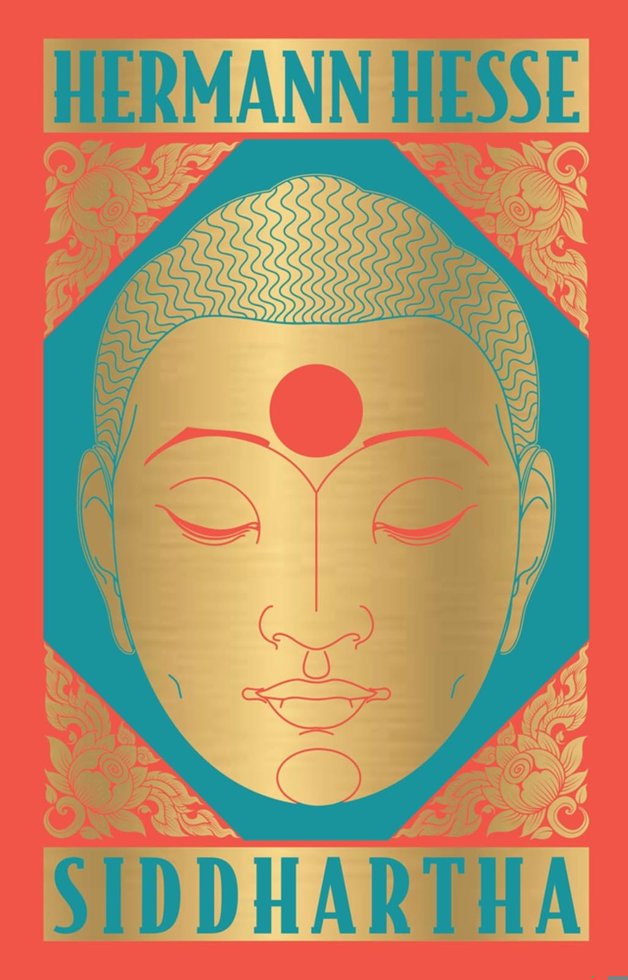
Siddhartha
Hermann Hesse
4.4
Herman Hesse's classic novel has delighted, inspired, and influenced generations of readers, writers, and thinkers. In this story of a wealthy Indian Brahmin who casts off a life of privilege to seek spiritual fulfillment. Hesse synthesizes disparate philosophies--Eastern religions, Jungian archetypes, Western individualism--into a unique vision of life as expressed through one man's search for meaning.
For the millions of Americans who want spirituality without religion, Sam Harris’s new book is a guide to meditation as a rational spiritual practice informed by neuroscience and psychology.
From multiple New York Times bestselling author, neuroscientist, and “new atheist” Sam Harris, Waking Up is for the 30 percent of Americans who follow no religion, but who suspect that Jesus, Buddha, Lao Tzu, Rumi, and the other saints and sages of history could not have all been epileptics, schizophrenics, or frauds. Throughout the book, Harris argues that there are important truths to be found in the experiences of such contemplatives—and, therefore, that there is more to understanding reality than science and secular culture generally allow.
Waking Up is part seeker’s memoir and part exploration of the scientific underpinnings of spirituality. No other book marries contemplative wisdom and modern science in this way, and no author other than Sam Harris—a scientist, philosopher, and famous skeptic—could write it.
…
Recommended by Susan Cain, Chris Goward, Fabrice Grinda, and 1 others.
Susan Cain
Author
Such a fantastic book. And it was really, for me, completely lifechanging. [source]
Chris Goward
I also highly recommend Sam Harris' Waking Up, which is a more well-rounded unpacking of non-religious mindfulness practice. [source]
Fabrice Grinda
Very well thought through analysis of spirituality without religion. [source]
Cover unavailable
10
The Oxford Handbook of Free Will
Robert Kane
4.3
This second edition of the Oxford Handbook of Free Will is intended to be a sourcebook and guide to current work on free will and related subjects. Its focus is on writings of the past forty years, in which there has been a resurgence of interest in traditional issues about the freedom of the will in the light of new developments in the sciences, philosophy and humanistic studies. Special attention is given to research on free will of the first decade of the twenty-first century since the publication of the first edition of the Handbook. All the essays have been newly written or rewritten for this volume. In addition, there are new essayists and essays surveying topics that have become prominent in debates about free will in the past decade, including new work on the relation of free will to physics, the neurosciences, cognitive science, psychology and empirical philosophy, new versions of traditional views (compatibilist, incompatibilist, libertarian, etc.) and new views (e.g., revisionism) that have emerged. The twenty-eight essays by prominent international scholars and younger scholars cover a host of free will related issues, such as moral agency and responsibility, accountability and blameworthiness in ethics, autonomy, coercion and control in social theory, criminal liability, responsibility and punishment in legal theory, issues about the relation of mind to body, consciousness and the nature of action in philosophy of mind and the cognitive and neurosciences, questions about divine foreknowledge, providence and human freedom in philosophy of religion, and general metaphysical questions about necessity and possibility, determinism, time and chance, quantum reality, causation and explanation.
The instant New York Times bestseller“Excellent . . . Outstanding for its breadth of research, the liveliness of the writing, and the depth of humanity it conveys.” –Wall Street JournalOne of our great behavioral scientists, the bestselling author of Behave, mounts a devastating scientific and philosophical case against free will—an argument with profound consequencesRobert Sapolsky’s Behave, his now classic account of why humans do good and why they do bad, pointed toward an unsettling conclusion: we may not grasp exactly how nature and nurture create the physics and chemistry that cause all human behavior, but that doesn’t mean they don’t exist. In Determined, Sapolsky takes his argument all the way, mounting a brilliant (and in his inimitable way, delightful) full-frontal assault on the pleasant fantasy that there is some separate self who tells our biology what to do.Determined offers a marvelous synthesis of what we know about consciousness—the tight weave between reason and emotion and between stimulus and response in the moment and over a life. One by one, Sapolsky takes out all the major arguments for free will, cutting a path through the thickets of chaos theory and quantum physics. But as Sapolsky acknowledges, it’s sometimes impossible to uncouple from our zeal to judge people, including ourselves. Determined applies this new understanding to some of our most essential questions around punishment, morality, and living well together. Most of all, Sapolsky argues that while accepting the reality about free will is monumentally difficult, it will make for a much more humane world.
…
Cover unavailable
12
Elbow Room: The Varieties of Free Will Worth Wanting
Daniel C. Dennett
4.3
Anyone who has wondered if free will is just an illusion or has asked 'could I have chosen otherwise?' after performing some rash deed will find this book an absorbing discussion of an endlessly fascinating subject. Daniel Dennett, whose previous books include "Brainstorms "and (with Douglas Hofstadter) "The Mind's I, " tackles the free will problem in a highly original and witty manner, drawing on the theories and concepts of several fields usually ignored by philosophers; not just physics and evolutionary biology, but engineering, automata theory, and artificial intelligence.
In "Elbow Room," Dennett shows how the classical formulations of the problem in philosophy depend on misuses of imagination, and he disentangles the philosophical problems of real interest from the "family of anxieties' they get enmeshed in - imaginary agents, bogeymen, and dire prospects that seem to threaten our freedom. Putting sociobiology in its rightful place, he concludes that we can have free will and science too. "Elbow Room" begins by showing how we can be "moved by reasons" without being exempt from physical causation. It goes on to analyze concepts of control and self-control-concepts often skimped by philosophers but which are central to the questions of free will and determinism. A chapter on "self-made selves" discusses the idea of self or agent to see how it can be kept from disappearing under the onslaught of science. Dennett then sees what can be made of the notion of acting under the idea of freedomdoes the elbow room we think we have really exist? What is an opportunity, and how can anything in our futures be "up to us"? He investigates the meaning of "can" and "could have done otherwise," and asks why we want free will in the first place.We are wise, Dennett notes, to want free will, but that in itself raises a host of questions about responsibility. In a final chapter, he takes up the problem of how anyone can ever be guilty, and what the rationale is for holding people responsible and even, on occasion, punishing them.
"Elbow Room "is an expanded version of the John Locke Lectures which Dennett gave at Oxford University in 1983.
…
Recommended by Paul Russell.
Paul Russell
Elbow Room was written in 1984 so perhaps it’s getting a bit long in the tooth. However, I selected it because it’s a really good place for readers to start if they want to work their way into the contemporary debate. In terms of style, it’s very accessible and enjoyable. Dennett is a sharp philosopher with an engaging style. The main aim of this book is to debunk or defang the feeling that determinism presents an ominous sceptical threat to freedom and moral responsibility. Dennett sees the free will problem as a problem generated by philosophy. Philosophers abuse what he calls ‘intuition pumps’ and employ misleading philosophical analogies. By these means they generate groundless worries about the implications and consequences of determinism. An example would be, ‘If determinism is true, it would be like being in prison.’ Or ‘If determinism is true, we’re like a robot, mere mechanism.’ Dennett systematically tries to debunk claims of this kind and by doing this he wants to, as he puts it, vindicate a modestly optimistic self-image. In other words, he wants to bring us back to the original common sense view that we talked about at the beginning. In many ways Dennett, who was a student of Gilbert Ryle’s, and in some ways belongs to the Wittgensteinian tradition, simply wants to ‘show the fly the way out of the fly bottle’ on this topic. [source]
Cover unavailable
13
Who's in Charge? Free Will and the Science of the Brain
Michael Gazzaniga
4.3
“Big questions are Gazzaniga’s stock in trade.” —New York Times
“Gazzaniga is one of the most brilliant experimental neuroscientists in the world.” —Tom Wolfe
“Gazzaniga stands as a giant among neuroscientists, for both the quality of his research and his ability to communicate it to a general public with infectious enthusiasm.” —Robert Bazell, Chief Science Correspondent, NBC News
The author of Human, Michael S. Gazzaniga has been called the “father of cognitive neuroscience.” In his remarkable book, Who’s in Charge?, he makes a powerful and provocative argument that counters the common wisdom that our lives are wholly determined by physical processes we cannot control. His well-reasoned case against the idea that we live in a “determined” world is fascinating and liberating, solidifying his place among the likes of Oliver Sacks, Antonio Damasio, V.S. Ramachandran, and other bestselling science authors exploring the mysteries of the human brain
Told with deadpan humour and bitter irony, Kurt Vonnegut's cult tale of global destruction preys on our deepest fears of witnessing Armageddon and, worse still, surviving it ...
Dr Felix Hoenikker, one of the founding 'fathers' of the atomic bomb, has left a deadly legacy to the world. For he's the inventor of 'ice-nine', a lethal chemical capable of freezing the entire planet. The search for its whereabouts leads to Hoenikker's three ecentric children, to a crazed dictator in the Caribbean, to madness. Felix Hoenikker's Death Wish comes true when his last, fatal gift to humankind brings about the end, that for all of us, is nigh...
…
Recommended by Ev Williams and Andy Stern.
Andy Stern
I think it's something that progressives need to think about, because the book talks a lot about two tendencies that people can adopt, to try to find meaning and purpose. One is kind of a sheer technological approach, and the other is more of a spiritual and religious approach. The book talks about the perils and challenges of each way. Sometimes we as progressives defend technology and science and fact, and other people – clearly both progressive and otherwise – appreciate the spiritual more. Then on either extreme, the book tries to say that blind adherence to either tendency also has huge problems. The book, for me, is about trying to seek meaning, not trying to find simple answers, and appreciating that in some ways following a belief to an extreme can be equally as dangerous as having no beliefs. [source]
Cover unavailable
16
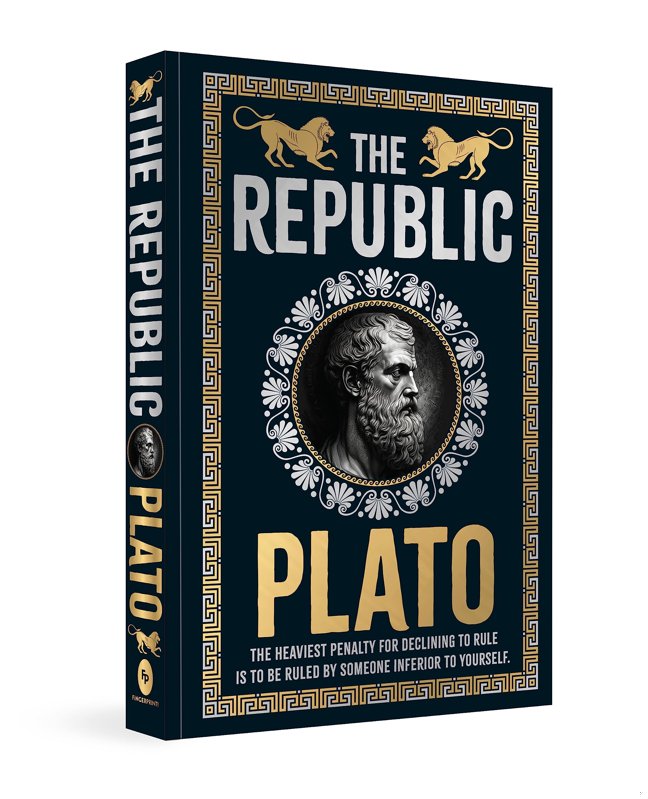
The Republic: The Influential Classic
Plato
4.2
The newest deluxe edition in the bestselling Capstone Classics Series This ancient classic has had a make-over. In recent years these Capstone Classic deluxe editions have caught the book buying public's imagination. The volumes of international bestsellers such as Think and Grow Rich and The Art of War have quickly become the market leaders. Now Plato's best known work, one of the most intellectually and historically influential works of philosophy and political theory, has been brought to life in this luxury, hardback, keep-sake edition.
This edition includes:
Plato's plans for a perfect society characterised by a blend of wisdom, courage, self-discipline and justice Lessons to learn about living according to eternal truths, instead of existing simply for survival and pleasure A new introduction by Tom Butler Bowdon, the classic personal development expert
It’s very readable even if you aren’t a professional philosopher. Take the story of ‘The Ring of Gyges,’ which raises the question of whether you would continue to act like a good person if you had a ring of invisibility that let you get away with doing whatever you wanted to do. That’s a fascinating thought experiment that anybody can appreciate. [source]
I’m about a third through this and still can’t tell whether Plato is making a mockery of Socrates ideas for the idyllic society or not. So many of the arguments presented as Socrates’ are so tortured and with so disconnected leaps of logic that it’s hard to take it at face value. Yet still, it’s good fun to follow the dialogue. It reads more like a play than a book, and again, immensely accessible. It’s fun to see the lines that continue from a book like this to the considerations of the Stoics all the way to Adam Smith and the Wealth of Nations and then onto a modern critique and history in that Debt: First 5,000 Years. A conversation spanning millennia. [source]
Jonathan Glover
It contains a tremendous amount of nonsense about what the ideal society would be like. But it is an unmissable book because of Socrates. He invented the method of doing and teaching philosophy that has never been improved on. [source]
Cover unavailable
17
Critique of Pure Reason
Immanuel Kant, Paul Guyer, et al.
4.2
'The purpose of this critique of pure speculative reason consists in the attempt to change the old procedure of metaphysics and to bring about a complete revolution'
Kant's Critique of Pure Reason (1781) is the central text of modern philosophy. It presents a profound and challenging investigation into the nature of human reason, its knowledge and its illusions. Reason, Kant argues, is the seat of certain concepts that precede experience and make it possible, but we are not therefore entitled to draw conclusions about the natural world from these concepts. The Critique brings together the two opposing schools of philosophy: rationalism, which grounds all our knowledge in reason, and empiricism, which traces all our knowledge to experience. Kant's transcendental idealism indicates a third way that goes far beyond these alternatives.
…
Recommended by Adrian Moore, Luciano Floridi, and Simon Blackburn.
Adrian Moore
This is the greatest philosophical book of all time. This is Kant’s masterpiece. [source]
I find reading Kant a bit like understanding cricket as a foreigner: hard to get at first, but once you get it, it’s very enjoyable. [source]
Simon Blackburn
An illuminating way to think of the Critique is as a kind of prolonged wrestling match with Hume. [source]
Cover unavailable
18
Four Views on Free Will (Great Debates in Philosophy)
John Martin Fischer, Robert Kane, Derk Pereboom, Manuel Vargas
4.2
Focusing on the concepts and interactions of free will, moral responsibility, and determinism, this text represents the most up-to-date account of the four major positions in the free will debate.
Four serious and well-known philosophers explore the opposing viewpoints of libertarianism, compatibilism, hard incompatibilism, and revisionism The first half of the book contains each philosopher's explanation of his particular view; the second half allows them to directly respond to each other's arguments, in a lively and engaging conversation Offers the reader a one of a kind, interactive discussion Forms part of the acclaimed Great Debates in Philosophy series
…
Recommended by Paul Russell.
Paul Russell
I suppose I’m cheating here because I’m squeezing four books into one. However, I would particularly recommend this book to readers, as the four authors of this book — Robert Kane, John Fischer, Derk Pereboom and Manuel Vargas — are all significant figures in the contemporary field and have mapped out distinct and influential positions. The reader can quickly get a sense of the general lie of the land and some of the basic available options. Just to sketch them quickly: Kane is a libertarian, which is to say he’s an incompatibilist who thinks that for us to be free and responsible determinism cannot be true. For this we need an alternative metaphysical framework that accounts for the sort of freedom required for responsibility, which involves more than mere indeterminism. Fischer is a semi-compatibilist. He thinks determinism doesn’t threaten responsibility, but it does threaten free will understood in terms of open alternatives. Fischer argues that we have a rational self-control that involves what he calls ‘reasons responsiveness.’ That ability serves as a foundation for moral responsibility, but falls short of full, metaphysical freedom. Although we don’t have genuine open alternative possibilities, we don’t need them, Fischer argues, for moral responsibility. In several respects this view resembles Dennett’s general strategy, except that Fischer doesn’t buy into the freedom part of it. Rational self-control allows us to recognize reasons and respond to them in a more or less reliable and consistent way, and that’s all that responsibility requires. Pereboom is a hard incompatibilist, or what he sometimes calls an ‘optimistic sceptic.’ According to this view, while we are not free or morally responsible this is not that depressing. We can save most of what we actually care about, including our inter-personal relations, through some form of moral assessment that doesn’t rely on strong moral responsibility. We can, moreover, live lives that are still meaningful and personally satisfying. The supposition that scepticism does not imply pessimism is the main thrust of Pereboom’s line. Vargas calls his position ‘revisionism.’ Roughly what he says is that we should make a basic distinction between what he calls the ‘diagnostic’ understanding of freedom and responsibility — what we ordinarily think freedom and responsibility is — and a ‘prescriptive’ understanding. In our ordinary life, we may well have incompatibilist natural intuitions, and while we may not be able to save those, we can revise our conceptions of freedom and responsibility so that we still retain a suitably robust account that serves all the things we usually care about. Although this is revisionary it’s not radical scepticism. Vargas wants to avoid throwing the baby out with the bathwater and stops short of unqualified, extreme scepticism. The position we should come back to for a moment is Kane’s. There’s a standard objection to classical libertarianism which is that it relies on ‘spooky metaphysics,’ postulating ghostly agents in some way intervening in the natural order. What makes Kane’s libertarianism interesting is that he argues that libertarians can avoid this and give a naturalistic account of the possibility of moral freedom. The idea here is that what’s caused doesn’t have to be necessitated. Agents can be free as long as there are crucial points in their lives when they are capable of making what Kane calls ‘self-forming’ decisions or actions. What that requires is that free and responsible agents have more than one reason that they can act on in the very same circumstances, and that in those very same circumstances, either reason could move them to act. Whichever way they act, however, they act for a reason. While it is not determined it is still not capricious. In these circumstances, Kane claims, free agents have genuine alternatives and are the ultimate sources of their conduct and character. [source]
Cover unavailable
19
A Contemporary Introduction to Free Will
Robert Kane
4.2
Accessible to students with no background in the subject, A Contemporary Introduction to Free Will provides an extensive and up-to-date overview of all the latest views on this central problem of philosophy. Opening with a concise introduction to the history of the problem of free will--and its place in the history of philosophy--the book then turns to contemporary debates and theories about free will, determinism, and related subjects like moral responsibility, coercion, compulsion, autonomy, agency, rationality, freedom, and more. Classical compatibilist and new compatibilist theories of free will are considered along with the latest incompatibilist or libertarian theories and the most recent skeptical challenges to free will. Separate chapters are devoted to the relation of free will to moral responsibility and ethics; to modern science; and to religious questions about predestination, divine foreknowledge, and human freedom. Numerous down-to-earth examples and challenging thought experiments enliven the text. The book is an ideal addition to introduction to philosophy, metaphysics, and free will courses.
…
Cover unavailable
20
A Clockwork Orange
Anthony Burgess
4.2
In Anthony Burgess’s influential nightmare vision of the future, where the criminals take over after dark, the story is told by the central character, Alex, a teen who talks in a fantastically inventive slang that evocatively renders his and his friends’ intense reaction against their society. Dazzling and transgressive, A Clockwork Orange is a frightening fable about good and evil and the meaning of human freedom. This edition includes the controversial last chapter not published in the first edition, and Burgess’s introduction, “A Clockwork Orange Resucked.”
…
Cover unavailable
21
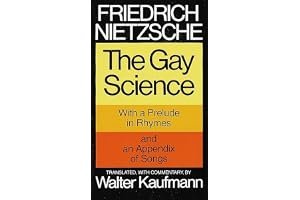
The Gay Science
Friedrich Nietzsche, Walter Kaufmann
4.2
Recommended by Andrew Hui, Emrys Westacott, and Stephane Grand.
Andrew Hui
I chose Gay Science because that’s where he really becomes a master of the form: it’s incredibly vivid and incandescent in parts where you get a dazzled by his sheer visionary, aesthetic philosophy of life. [source]
Emrys Westacott
It’s just a translation of the German, Die fröhliche Wissenschaft, which means the joyful wisdom. It’s my favourite of all Nietzsche’s books. It’s interesting that 50 years ago Nietzsche was not taught much in academic philosophy departments. Gradually, in the 1970s and ever since, there’s been a tremendous burgeoning of academic interest in him. If you go to the philosophy section in any bookshop, you’ll find there are more books on Nietzsche than on any of the other great philosophers. One reason for that is that he’s an absolutely fabulous writer. He’s also extraordinarily original and seems to have so many interesting thoughts on almost everything. [source]
Stephane Grand
I have been running my own businesses for the last 15 years. Just before that, before diving head-on into entrepreneurship and independence, I used to be the country monitor of a large accounting and consulting network for China. Having had some ethical differences with members of my former network, I decided to break away from it. However, since I was equipped with a very expensive education, everybody around me was recommending that I would go and work for another firm. I was mired in doubt and was considering going back to management consulting. I have always had two go-to books when having moments of self-doubt like this. Those books are the Zarathustra and the Gay Science by Nietzsche. As I was reading through the prologue of the Zarathustra, and the title character was seeing the acrobat crossing between towers on the marketplace of Baghdad, I realized that staying in a cushy job would not help me cross between the beast and the superman, in a manner of speaking. Hence, Nietzsche helped me make a decision that I had already made in my heart, and which consisted in starting my own company. [source]
Cover unavailable
22
On Free Choice of the Will
Augustine of Hippo
4.2
Cover unavailable
23
Freedom Evolves
Daniel C. Dennett
4.2
Can there be freedom and free will in a deterministic world? Renowned philosopher Daniel Dennett emphatically answers "yes!" Using an array of provocative formulations, Dennett sets out to show how we alone among the animals have evolved minds that give us free will and morality. Weaving a richly detailed narrative, Dennett explains in a series of strikingly original arguments—drawing upon evolutionary biology, cognitive neuroscience, economics, and philosophy—that far from being an enemy of traditional explorations of freedom, morality, and meaning, the evolutionary perspective can be an indispensable ally. In Freedom Evolves, Dennett seeks to place ethics on the foundation it deserves: a realistic, naturalistic, potentially unified vision of our place in nature.
…
Cover unavailable
24
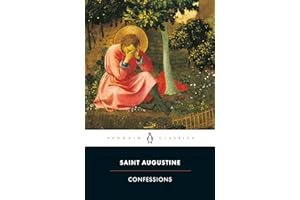
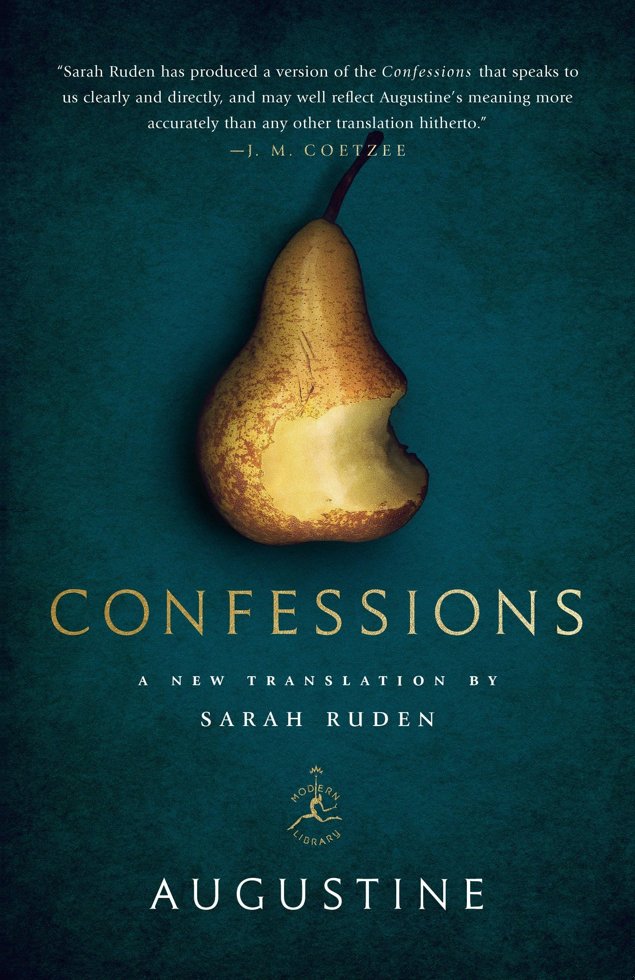
Confessions
Augustine of Hippo
4.2
Augustine's Confessions is one of the most influential and most innovative works of Latin literature. Written in the author's early forties in the last years of the fourth century A.D. and during his first years as a bishop, they reflect on his life and on the activity of remembering and interpreting a life. Books I-IV are concerned with infancy and learning to talk, schooldays, sexual desire and adolescent rebellion, intense friendships and intellectual exploration. Augustine evolves and analyses his past with all the resources of the reading which shaped his mind: Virgil and Cicero, Neoplatonism and the Bible. This volume, which aims to be usable by students who are new to Augustine, alerts readers to the verbal echoes and allusions of Augustine's brilliant and varied Latin, and explains his theological and philosophical questioning of what God is and what it is to be human. The edition is intended for use by students and scholars of Latin literature, theology and Church history.
…
Recommended by A N Wilson, Carlos Eire, Paula Fredriksen, and 3 others.
A lot of people think becoming a Christian is a decision you make. St Augustine doesn’t really think that. [source]
Carlos Eire
St Augustine of Hippo was one of the first thinkers to struggle with the concepts of time, memory and eternity. [source]
Paula Fredriksen
For the reader it’s somewhat like crashing a session of classic psychoanalytic therapy: Augustine speaks, God just listens, and we overhear. [source]
Cover unavailable
25
Does Prayer Change Things? (Crucial Questions, #3)
R.C. Sprou
4.2
Does prayer make any difference? Does it really change anything? Yes, says Dr. R. C. Sproul in this Crucial Questions booklet. Though we cannot hope that our prayers will change God's mind, prevailing upon Him to act against His will, we can be sure that prayer does change things including our own hearts. Plus, it is one of the chief means by which God carries out His will in the world. For these reasons, Dr. Sproul argues, prayer has a vital place in the life of the Christian. In short chapters packed with practical wisdom, he unveils the purpose, the pattern, the practice, the prohibitions, and the power of prayer, calling Christians to come before God's presence with joy and hope.
…
Cover unavailable
26
Free Will
Gary Watson
4.2
The new edition of this highly successful text will once again provide the ideal introduction to free will. This volume brings together some of the most influential contributions to the topic of free will during the past 50 years, as well as some notable recent work.
Cover unavailable
27
Whole Again: Healing Your Heart and Rediscovering Your True Self After Toxic Relationships and Emotional Abuse
Jackson MacKenzie
4.2
From a leading voice on recovering from toxic relationships, a deeply insightful guide to getting back to your "old self" again--in order to truly heal and move on.
Jackson MacKenzie has helped millions of people in their struggle to understand the experience of toxic relationships. His first book, Psychopath Free, explained how to identify and survive the immediate situation. In this highly anticipated new book, he guides readers on what to do next--how to fully heal from abuse in order to find love and acceptance for the self and others.
Through his close work with--and deep connection to--thousands of survivors of abusive relationships Jackson discovered that most survivors have symptoms of trauma long after the relationship is over. These range from feelings of numbness and emptiness to depression, perfectionism, substance abuse, and many more. But he's also found that it is possible to work through these symptoms and find love on the other side, and this book shows how. Through a practice of mindfulness, introspection, and exercises using specific tools, readers learn to identify the protective self they've developed - and uncover the core self, so that they can finally move on to live a full and authentic life--to once again feel light, free, and whole, and ready to love again.
This book addresses and provides crucial guidance on topics and conditions like: complex PTSD, Narcissistic abuse, Avoidant Personality Disorder, Codependency, Core wounding, toxic shame, Borderline Personality Disorder, and so many more. Whole Again offers hope and multiple strategies to anyone who has survived a toxic relationship, as well as anyone suffering the effects of a breakup involving lying, cheating and other forms of abuse--to release old wounds and safely let the love back inside where it belongs.
…
Cover unavailable
28
Psychopath Free: Recovering from Emotionally Abusive Relationships with Narcissists, Sociopaths, and Other Toxic People
Jackson MacKenzie
4.2
Have you ever been in a relationship with a psychopath? Chances are, even if you did, you would never know it. Psychopaths are cunning charmers and master manipulators, to the point where you start to accept the most extreme behaviors as normal… Even if it hurts you. All around us, every single day, human beings devoid of empathy are wreaking havoc and destroying lives in the coldest, most heartless ways imaginable. In constant pursuit of money, sex, influence, or simple entertainment, psychopaths will do whatever it takes to gain power over others. They hide behind a veil of normalcy, arranging their friends and partners like pawns in a game of chess.
Using false praise and flattery to get what they want, they can lure any unsuspecting target into a relationship. Once hooked, their charming promises spin into mind games and psychological torture. Victims are left devastated and confused, unable to recognize—or even put into words—the nightmare that just took place.
This significantly expanded edition of Psychopath Free contains new chapters, updated content, and real survivor experiences. Written from the heart, it is the first guide for survivors written by a survivor, offering hope for healing and thriving after psychopathic abuse. Say goodbye to the chaos, self-doubt, and victimization. You are free.
…
Cover unavailable
29
The Light Shall Set You Free
Dr. Norma J. Milanovich and Dr. Shirley McCune
4.2
The Ascended Masters state this book is destined to transform the world. Contained within these pages are some of the greatest spiritual teachings from the ancient mystery schools, plus instruction on how to apply these teachings to our everyday lives. Some of the information revealed here has not been made available before now. All of the information, if applied to our everyday lives, has the power to revolutionize the world.
In the past, only adept, saints, apostles, mystics, and high priests and priestesses were allowed access to this instruction. With this knowledge, these individuals ruled and empowered themselves and civilizations, using the power that came with this knowledge to create and heal. Common folk leaned heavily on these spiritual elite for solutions to their problems, for the masses had acquired neither the discipline nor the strength of will it took to master the teachings on their own. Learning and applying these truths require lifetimes of discipline and dedication. More importantly, mastering the knowledge demanded that one be accountable for his or her own actions – a responsibility the masses were not ready to accept.
The Ascended masters, however, decree that the time has come for everyone to learn these teachings and share in the responsibility for transforming life and the world. Admittance into the Fifth Dimension demands this of all. Therefore, all who read this book must be forewarned that access to this knowledge automatically holds the soul accountable for its part of creation and each will be judged accordingly! The portal now stands open for all to pass through to collectively build the Seventh Golden Age on Earth.
…
Cover unavailable
30
Consciousness Explained
Daniel C. Dennett
4.2
In Consciousness Explained, Daniel C. Dennett reveals the secrets of one of the last remaining mysteries of the universe: the human brain.
Daniel C. Dennett's now-classic book blends philosophy, psychology and neuroscience - with the aid of numerous examples and thought-experiments - to explore how consciousness has evolved, and how a modern understanding of the human mind is radically different from conventional explanations of consciousness.
What people think of as the stream of consciousness is not a single, unified sequence, the author argues, but 'multiple drafts' of reality composed by a computer-like 'virtual machine'.
Dennett explains how science has exploded the classic mysteries of consciousness: the nature of introspection, the self or ego and its relation to thoughts and sensations, the problems posed by qualia, and the level of consciousness of non-human creatures.
'Brilliant ... a torrent of stimulating thought' Richard Dawkins
'Revolutionary ... one of the most mentally agile, intellectually resourceful books you are likely to read' Guardian
'A masterful tapestry of deep insights ... Dennett has written a profound and important book that is also clear, exciting and witty' Douglas R. Hofstadter, author of Gödel, Escher, Bach
'Extraordinary ... supremely engaging and witty' Independent
'Dennett's exposition is nothing short of brilliant, the best example I've seen of a science book aimed at both professionals and general readers' The New York Times Book Review
Daniel C. Dennett is one of the most original and provocative thinkers in the world. A brilliant polemicist and philosopher, he is famous for challenging unexamined orthodoxies, and an outspoken supporter of the Brights movement. His books include Brainstorms, Brainchildren, Elbow Room, Breaking the Spell, Darwin's Dangerous Idea and Freedom Evolves.
…
Recommended by Keith Frankish and Susan Blackmore.
Keith Frankish
The book is packed with thought experiments, all designed to undermine the intuitive but misleading picture of the Cartesian Theatre. [source]
Susan Blackmore
People go in two directions: they either love the way he writes, or they hate it. I love it, with all his mad examples and neologisms. [source]
Cover unavailable
31
Existentialism is a Humanism
Jean-Paul Sartre, Carol Macomber, Arlette Elkaïm-Sartre, Annie Cohen-Solal
4.1
It was to correct common misconceptions about his thought that Jean-Paul Sartre, the most dominent European intellectual of the post-World War II decades, accepted an invitation to speak on October 29, 1945, at the Club Maintenant in Paris. The unstated objective of his lecture (“Existentialism Is a Humanism”) was to expound his philosophy as a form of “existentialism,” a term much bandied about at the time. Sartre asserted that existentialism was essentially a doctrine for philosophers, though, ironically, he was about to make it accessible to a general audience. The published text of his lecture quickly became one of the bibles of existentialism and made Sartre an international celebrity.
The idea of freedom occupies the center of Sartre’s doctrine. Man, born into an empty, godless universe, is nothing to begin with. He creates his essence—his self, his being—through the choices he freely makes (“existence precedes essence”). Were it not for the contingency of his death, he would never end. Choosing to be this or that is to affirm the value of what we choose. In choosing, therefore, we commit not only ourselves but all of mankind.
This book presents a new English translation of Sartre’s 1945 lecture and his analysis of Camus’s The Stranger, along with a discussion of these works by acclaimed Sartre biographer Annie Cohen-Solal. This edition is a translation of the 1996 French edition, which includes Arlette Elkaïm-Sartre’s introduction and a Q&A with Sartre about his lecture.
As a newcomer to existentialism, it can be hard to wrap your brain around the core concepts when reading novels like The Stranger or Nausea, or writers like Kierkegaard. You get a great feel for the existentialist ambience, but what are the core tenets? This (short) book delivers it about as directly as you can get it, as it’s basically just two parts: 1) An account of a lecture/defense that Sartre gave of existentialism, complete with a debate with someone in the audience, and 2) Sartre’s review of Camus’ The Stranger. The key concept that Sartre explains is the notion of Existence Precedes Essence. It’s one of those concepts that sounds intimidatingly highbrow, but really just means that we are not born with a purpose before we are “thrown into this world”. That then sets the stage for reaffirming human choice. That we always have a choice. That destiny or divine purpose is just an excuse we use not to make (hard) choices. This description of existentialism really resonated with me and provides a wonderful alternative vision to the stoic philosophy. There’s much agreement between the two views of the world, but also enough disagreement to provide interesting tension. Especially between the Aurelius version of stoicism, which endlessly belabors the point of doing “what the universe asks you to do”. [source]
Serious Sartreans get quite annoyed with this book because it’s a very accessible, easy-to-read, non-technical, public lecture. [source]
Cover unavailable
32
Chosen By God: Know God's Perfect Plan for His Glory and His Children
R. C. Sproul
4.1
Here is a clear scriptural case for the classic (and sometimes controversial) Christian doctrine of predestination. Through this view of a truly sovereign God, readers will see how sinfulness prevents man from choosing God on his own; instead, God must change people's hearts.
Cover unavailable
33
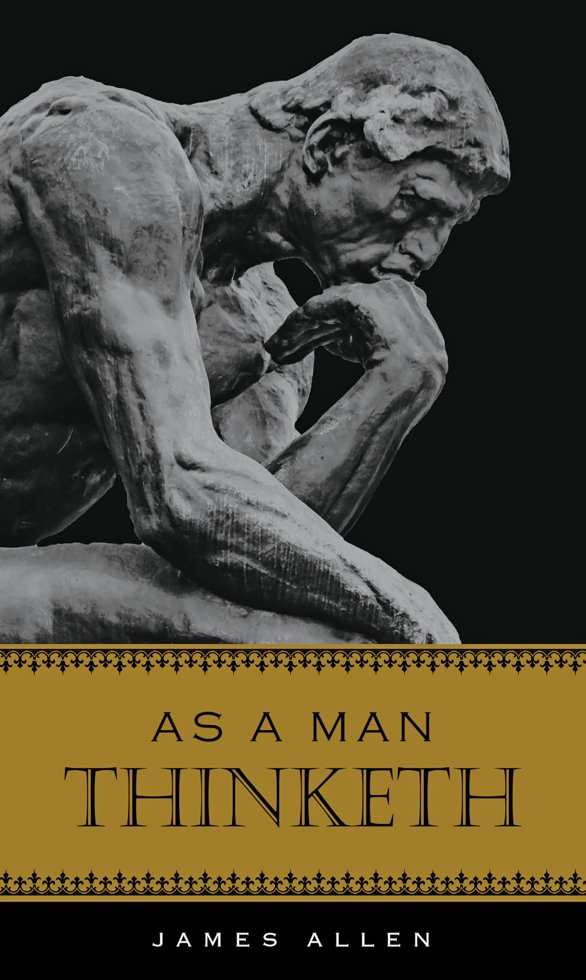
As A Man Thinketh (Deluxe, Hardcovder Edition)
James Allen
4.1
Before there was The Secret, there was As a Man Thinketh.For more than a century, James Allen’s landmark work on the power of thought has inspired people in all walks of life.Discover how thought shapes behavior, our relationships with others, and with the world around us.Chapter by chapter, Allen reveals the long-term effects of focused, positive thought in every area of life, and on identity itself.Says Allen, ''Thought allied fearlessly to purpose becomes creative force: he who knows this is ready to become something higher and stronger than a mere bundle of wavering thoughts and fluctuating sensations; he who does this has become the conscious and intelligent wielder of his mental powers.''With archival printing, this pocket-sized edition is designed for both portability and longevity.Hardcover gift volume with dust jacket is a classic addition to any home or office library.64 pages.Book measures 4-1/2'' wide x 7-1/2'' high.
…
Cover unavailable
34
The Rebel
Albert Camus
4.1
By one of the most profoundly influential thinkers of our century, The Rebel is a classic essay on revolution. For Albert Camus, the urge to revolt is one of the "essential dimensions" of human nature, manifested in man's timeless Promethean struggle against the conditions of his existence, as well as the popular uprisings against established orders throughout history. And yet, with an eye toward the French Revolution and its regicides and deicides, he shows how inevitably the course of revolution leads to tyranny, as old regimes throughout the world collapse, The Rebel resonates as an ardent, eloquent, and supremely rational voice of conscience for our tumultuous times.
Translated from the French by Anthony Bower.
…
Cover unavailable
35
The Courage to Be Happy: Discover the Power of Positive Psychology and Choose Happiness Every Day
Ichiro Kishimi
4.1
Cover unavailable
36
Will I Ever Be Good Enough?: Healing the Daughters of Narcissistic Mothers
Karyl McBride
4.1
Cover unavailable
37
The Symposium
Plato, Christopher Gill
4.1
A fascinating discussion on sex, gender, and human instincts, as relevant today as ever.
In the course of a lively drinking party, a group of Athenian intellectuals exchange views on eros, or desire. From their conversation emerges a series of subtle reflections on gender roles, sex in society and the sublimation of basic human instincts. The discussion culminates in a radical challenge to conventional views by Plato's mentor, Socrates, who advocates transcendence through spiritual love. The Symposium is a deft interweaving of different viewpoints and ideas about the nature of love--as a response to beauty, a cosmic force, a motive for social action and as a means of ethical education.
For more than seventy years, Penguin has been the leading publisher of classic literature in the English-speaking world. With more than 1,700 titles, Penguin Classics represents a global bookshelf of the best works throughout history and across genres and disciplines. Readers trust the series to provide authoritative texts enhanced by introductions and notes by distinguished scholars and contemporary authors, as well as up-to-date translations by award-winning translators.
Bryan Callen recommended this book on the podcast "The Tim Ferriss Show". [source]
Edward Skidelsky
Plato is the founding figure in the Western philosophical tradition and the Symposium is one of his most charming books – you can read it like a novel. [source]
Cover unavailable
38
Will I Ever Be Free of You?: How to Navigate a High-Conflict Divorce from a Narcissist and Heal Your Family
Dr. Karyl McBride Ph.D.
4.1
“A compact but thorough guide to successfully handling and surviving a divorce.” —PsychCentral
The bestselling author of Will I Ever Be Good Enough?: Healing the Daughters of Narcissistic Mothers draws on her expertise in treating men, women, and children damaged by narcissists in this practical guide to divorce and its aftermath.
Narcissism—a personality disorder that goes beyond mere selfishness and vanity—is a prevalent cause of marital and family problems. Narcissists do not have the capacity to love, understand other people’s emotions, or feel empathy. They are grandiose in their need for praise and attention, they overestimate their abilities, and they diminish people around them with emotional abuse. Being in an intimate relationship with a narcissist destroys your hopes, dreams, and peace of mind and erodes your children’s emotional health and your finances.
Does this sound like what you have to deal with? If you ever look at your partner and wonder in despair if you will ever be free, the answer is yes, you can be.
A leading authority on narcissism, Dr. Karyl McBride offers proven therapeutic advice that will help you protect and nurture yourself and your children through your difficult divorce, from separating from your narcissistic partner and navigating the court system, where a narcissist can be especially destructive, to a restorative healing program of trauma recovery.
…
Cover unavailable
39
Thus Spake Zarathustra: A Book For All And None
Friedrich Wilhelm Nietzsche
4.1
Thus Spoke Zarathustra is a foundational work of Western literature and is widely considered to be Friedrich Nietzsche’s masterpiece. It includes the German philosopher’s famous discussion of the phrase ‘God is dead’ as well as his concept of the Superman. Nietzsche delineates his Will to Power theory and devotes pages to critiquing Christian thinking, in particular Christianity’s definition of good and evil.
…
Recommended by Stephane Grand.
Stephane Grand
My favorite book is “Thus spoke Zarathustra” by Friedrich Nietzsche. I do not think I have ever read a book that had more resonance for me. [source]
Cover unavailable
40
Fear and Trembling
Soren Kierkegaard
4.1
Soren Kierkegaard was a Danish philosopher, theologian, and religious author interested in human psychology. He is regarded as a leading pioneer of existentialism and one of the greatest philosophers of the 19th Century.
In Fear and Trembling, Kierkegaard wanted to understand the anxiety that must have been present in Abraham when God commanded him to offer his son as a human sacrifice. Abraham had a choice to complete the task or to forget it. He resigned himself to the loss of his son, acting according to his faith. In other words, one must be willing to give up all his or her earthly possessions in infinite resignation and must also be willing to give up whatever it is that he or she loves more than God. Abraham had passed the test -- his love for God proved greater than anything else in him. And because a good and just Creator would not want a father to kill his son, God intervened at the last moment to prevent the sacrifice.
While most of the 20th century existentialists, like Sartre and Camus, were devout atheists, Kierkegaard is an existentialist obsessed with faith. Fear and Trembling is a very long, and at times obtuse, meditation on the topic of faith and doubt. It uses the story of Abraham and Isaac to contrast the ideas of faith and humanism. Kierkegaard is in awe of Abraham’s faith and how it compels him to sacrifice Isaac, and he uses that to interrogate the topic of faith in general. I found the theological acrobatics employed by Kierkegaard a bit strained, to say the least. But it was a fascinating read none the less, and Kierkegaard’s language and metaphors and incredible depth is inspiring. I’m keen to give this a read in the original Danish form. [source]
Cover unavailable
41
The Bondage of the Will
Martin Luther, J. I. Packer, O. R. Johnston
4.1
First published in 1525, Martin Luther's "Bondage of the Will" is acknowledged by theologians as one of the great masterpieces of the Reformation. It is Luther's response to Desiderius Erasmus's "Diatribe on Free Will, " written in his direct and unique style, combining deep spirituality with humor. Luther writes powerfully about man's depravity and God's sovereignty. The crucial issue for Luther concerned what ability free will has, and to what degree it is subject to God's sovereignty. For Luther, this key issue of free will is directly connected to God's plan of salvation. Is man able to save himself, or is his salvation entirely a work of divine grace? This work is vital to understanding the primary doctrines of the Reformation and will long remain among the great theological classics of Christian history.
…
Cover unavailable
42
On the Shortness of Life
Seneca, C. D. N. Costa
4.1
The Stoic writings of the philosopher Seneca offer powerful insights into the art of living, the importance of reason and morality, and continue to provide profound guidance to many through their eloquence, lucidity and timeless wisdom.
Throughout history, some books have changed the world. They have transformed the way we see ourselves—and each other. They have inspired debate, dissent, war and revolution. They have enlightened, outraged, provoked and comforted. They have enriched lives—and destroyed them.
Now, Penguin brings you the works of the great thinkers, pioneers, radicals and visionaries whose ideas shook civilization, and helped make us who we are. Penguin's Great Ideas series features twelve groundbreaking works by some of history's most prodigious thinkers, and each volume is beautifully packaged with a unique type-drive design that highlights the bookmaker's art. Offering great literature in great packages at great prices, this series is ideal for those readers who want to explore and savor the Great Ideas that have shaped the world.
…
Recommended by Chip Conley, Ryan Holiday, John Craig, and 3 others.
Chip Conley
Says something about the fact that it’s not so much the shortness of life, it’s how we waste it. [source]
Seneca’s letters are the best place to start, but the essays in On the Shortness of Life are excellent as well. [source]
John Craig
This is the book that I recommend to everybody. It's everything you will need to make it in life & business. It is by far a complete business self-motivational book all-in-one. The best thing is that it’s 2,000-year of time-tested wisdom. [source]
Cover unavailable
43
The Ethics of Ambiguity
Simone de Beauvoir
4.1
Simone de Beauvoir, novelist, dramatist, and philosopher, was the most distinguished woman writer in modern France. A leading exponent of French existentialism, her work complements, though it is independent of, that of Jean-Paul Sartre. In "The Ethics of Ambiguity," Madame de Beauvoir penetrates at once to the central ethical problems of modern man: what shall he do, how shall he go about making values, in the face of this awareness of the absurdity of his existence? She forces the reader to face the absurdity of the human condition and then, having done so, proceeds to develop a dialectic of ambiguity which will enable him not to master the chaos, but to create with it.
…
Cover unavailable
44
Being and Nothingness
Jean-Paul Sartre
4.1
Being & Nothingness is without doubt one of the most significant philosophical books of the 20th century. The central work by one of the century's most influential thinkers, it altered the course of western philosophy. Its revolutionary approach challenged all previous assumptions about the individual's relationship with the world. Known as 'the Bible of existentialism', its impact on culture & literature was immediate & was felt worldwide, from the absurdist drama of Samuel Beckett to the soul-searching cries of the Beat poets. Being & Nothingness is one of those rare books whose influence has affected the mindset of subsequent generations. Seventy years after its 1st publication, its message remains as potent as ever--challenging readers to confront the fundamental dilemmas of human freedom, choice, responsibility & action.
…
Cover unavailable
45
Determined to Believe?: The Sovereignty of God, Freedom, Faith, and Human Responsibility
John C. Lennox
4.1
Cover unavailable
46
Becoming the Narcissist's Nightmare: How to Devalue and Discard the Narcissist While Supplying Yourself
Shahida Arabi
4.1
Although clinical research has been conducted on narcissism as a disorder, less is known about its effects on victims who are in toxic relationships with partners with Narcissistic Personality Disorder. Individuals with this disorder engage in chronic devaluation and manipulation of their partners, a psychological and emotional phenomenon known as "narcissistic abuse." Unfortunately, the full extent of what narcissistic abuse entails is not taught in any psychology class or diagnostic manual. Since pathological narcissists are unlikely to seek treatment for their disorder, it is difficult to pinpoint what exactly makes a narcissistic abuser tick and the manipulative tactics they use, which are likely to differ from those of other types of abusers as they are more covert and underhanded. What is even more baffling is the addiction we form with our narcissistic abusers, created by biochemical bonds and trauma bonds that are also unlike any other relationship we experience. In this book, survivors will learn: -The red flags of narcissistic behavior and covert manipulation tactics, including subtle signs many survivors don't catch in the early stages of dating a narcissist. -The motives behind narcissistic abuse and techniques to resist a narcissist's manipulation. -Why abuse survivors usually stay with a narcissist long after incidents of abuse occur. -How our own brain chemistry locks us into an addiction with a narcissistic or toxic partner, creating cravings for the constant chaos of the abuse cycle. -Traditional and alternative methods to begin to detach and heal from the addiction to the narcissist, including eleven important steps all survivors must take on the road to healing. -Methods to rewrite the narratives that abusers have written for us so we can begin to reconnect with our authentic selves and purpose. -How to rebuild an even more victorious and empowering life after abuse. Narcissistic partners employ numerous stealthy tactics to devalue and manipulate their victims behind closed doors. These partners lack empathy and demonstrate an incredible sense of entitlement and sense of superiority which drives their exploitative behavior in interpersonal relationships. Their tactics can include verbal abuse and emotional invalidation, stonewalling, projection, taking control of every aspect of the victim's life, gaslighting and triangulation. Due to the narcissistic partner's "false self," the charismatic mask he or she projects to society, the victim often feels isolated in this type of abuse and is unlikely to have his or her experiences validated by friends, family and society. Using the latest scientific research as well as thousands of survivor accounts, this book will explore how the emotional manipulation tactics of narcissistic and antisocial partners affect those around them, particularly with regards to its cumulative socioemotional and psychological effects on the victim. It will also address questions such as: What successful techniques, tools and healing modalities (both traditional and alternative) are available to survivors who have been ridiculed, manipulated, verbally abused and subject to psychological warfare? What can survivors do to better engage in self-love and self-care? How can they forge the path to healthier relationships, especially if they've been a victim of narcissistic abuse by multiple people or raised by a narcissist? Most importantly, how can they use their experiences of narcissistic abuse to empower themselves towards personal development? What can their interactions with a narcissistic abuser teach them about themselves, their relationship patterns and the wounds that still need to be healed in order to move forward into the happy relationships and victorious lives they do deserve?
…
Cover unavailable
47
The Illusion of Conscious Will
Daniel M. Wegner
4.1
Do we consciously cause our actions, or do they happen to us? Philosophers, psychologists, neuroscientists, theologians, and lawyers have long debated the existence of free will versus determinism. In this book Daniel Wegner offers a novel understanding of the issue. Like actions, he argues, the feeling of conscious will is created by the mind and brain. Yet if psychological and neural mechanisms are responsible for all human behavior, how could we have conscious will? The feeling of conscious will, Wegner shows, helps us to appreciate and remember our authorship of the things our minds and bodies do. Yes, we feel that we consciously will our actions, Wegner says, but at the same time, our actions happen to us. Although conscious will is an illusion, it serves as a guide to understanding ourselves and to developing a sense of responsibility and morality.
Approaching conscious will as a topic of psychological study, Wegner examines the issue from a variety of angles. He looks at illusions of the will?-those cases where people feel that they are willing an act that they are not doing or, conversely, are not willing an act that they in fact are doing. He explores conscious will in hypnosis, Ouija board spelling, automatic writing, and facilitated communication, as well as in such phenomena as spirit possession, dissociative identity disorder, and trance channeling. The result is a book that sidesteps endless debates to focus, more fruitfully, on the impact on our lives of the illusion of conscious will.
Selected as a Finalist in the category of Psychology/Mental Health in the 2002 Independent Publisher Book Awards (IPPYs) presented by Independent Publisher Magazine., Silver Award Winner for Philosophy in the 2002 ForeWord Magazine Book of the Year Awards. and Selected as an Outstanding Academic Book for 2002 by Choice Magazine
…
Cover unavailable
48
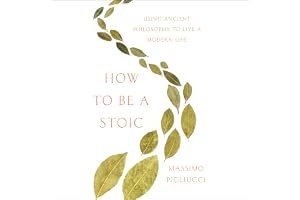
How to Be a Stoic: Using Ancient Philosophy to Live a Modern Life
Massimo Pigliucci
4.1
In the tradition of How to Live and How Proust Can Change Your Life, a philosopher asks how ancient Stoicism can help us flourish today Whenever we worry about what to eat, how to love, or simply how to be happy, we are worrying about how to lead a good life. No goal is more elusive. In How to Be a Stoic, philosopher Massimo Pigliucci offers Stoicism, the ancient philosophy that inspired the great emperor Marcus Aurelius, as the best way to attain it. Stoicism is a pragmatic philosophy that focuses our attention on what is possible and gives us perspective on what is unimportant. By understanding Stoicism, we can learn to answer crucial questions: Should we get married or divorced? How should we handle our money in a world nearly destroyed by a financial crisis? How can we survive great personal tragedy? Whoever we are, Stoicism has something for us--and How to Be a Stoic is the essential guide.
Stoicism in its modern form, as described by Massimo Pigliucci, is a philosophy for living. [source]
Cover unavailable
49
The Foundation of Augustinian-Calvinism
Ken Wilson
4.1
"Wilson's book is ground-breaking and thought-provoking, and indispensable for every serious student of hugely influential core aspects of Augustine's thought." -- Professor Karla Pollman, University of Bristol on Dr. Ken Wilson's "Augustine's Conversion". This book summarizes Dr. Wilson's "ground-breaking" doctoral thesis at the University of Oxford which was published by Mohr Siebeck in 2018 as "Augustine's Conversion from Traditional Free Choice to 'Non-free Free Will': A Comprehensive Methodology". With a new audience in mind, Dr. Wilson presents his extensive research on free will in ancient and early Christian thought in a shorter and more accessible format with translations of the ancient and modern foreign languages in plain English. Dr. Wilson first provides readers with essential background information on free will in the ancient philosophies and religions of Stoicism, Gnosticism, Neoplatonism, and Manichaeism. He then guides his readers through the writings of the earliest Christian authors who wrote on free will. Finally, Dr. Wilson explores a curious split between St. Augustine's early and later writings and shows how the ideas presented in Augustine's later writings became the foundation for modern Calvinist (Reformed) theology, also known as Augustinian-Calvinism.
…
Cover unavailable
50
Shame and Necessity, Second Edition
Bernard Williams
4.1
We tend to suppose that the ancient Greeks had primitive ideas of the self, of responsibility, freedom, and shame, and that now humanity has advanced from these to a more refined moral consciousness. Bernard Williams's original and radical book questions this picture of Western history. While we are in many ways different from the Greeks, Williams claims that the differences are not to be traced to a shift in these basic conceptions of ethical life. We are more like the ancients than we are prepared to acknowledge, and only when this is understood can we properly grasp our most important differences from them, such as our rejection of slavery.
The author is a philosopher, but much of his book is directed to writers such as Homer and the tragedians, whom he discusses as poets and not just as materials for philosophy. At the center of his study is the question of how we can understand Greek tragedy at all, when its world is so far from ours.
Williams explains how it is that when the ancients speak, they do not merely tell us about themselves, but about ourselves. In a new foreword A.A. Long explores the impact of this volume in the context of Williams's stunning career.
…
Recommended by Paul Russell.
Paul Russell
This is a highly regarded book, though in terms of the standard free will literature, it’s very different in its approach. Unlike some of the other books I’ve mentioned it’s not an easy book to read. There’s no simple position or model that Williams is interested in articulating. It’s a book that’s focused on ancient Greek conceptions of agency and responsibility. Not only is he interested in the contrast between the ancient Greeks and us, but he’s also interested in the difference between the Greek tragedians — Sophocles, Aeschylus and Homer — on the one hand, and Socrates, Plato and Aristotle on the other, thinkers who are really the founders of the western philosophical tradition. What’s interesting about this book is that it’s not just about free will, it’s also about our views concerning the nature of philosophy. Williams argues that methodologically, philosophers need to be historically sensitive and informed, and that typically they aren’t. That’s a problem with many discussions about free will, there is a lack of historical self-consciousness. One of the great merits of Williams’s book is that he is, among other things, a distinguished scholar of classical literature. Not only is he open to the possibility of learning from history, he also thinks we can learn from literature, and from tragedy in particular. So it’s a very interesting and challenging book. Williams has multiple agendas – including a very ambitious agenda that involves a critique of our whole modern conception of morality. There’s a well entrenched view that the Greeks didn’t have any adequate conception of freedom and responsibility at all. They were, it is suggested, full of primitive views about fate and the gods and the limits of agency and they didn’t really appreciate the importance of intention and voluntariness. On this view, we moderns have managed to get past all this and now, fortunately, have a sophisticated, adequate conception! Williams argues that while the ancient Greeks’ views were certainly very different from ours, and there is no question of going back to the world they lived in, they nevertheless understood and appreciated things that we can still learn a great a deal from. Part of Williams’s project in the book is to suggest that there are very important respects in which the early Greeks were much more realistic about the human predicament as it concerns human agency itself, and in particular our vulnerability to fate and luck as it affects our own moral or ethical lives. [source]
Cover unavailable
51
The Significance of Free Will
Robert Kane
4.1
Robert Kane provides a critical overview of debates about free will of the past half century, relating this recent inquiry to the broader history of the free will issue and to vital currents of twentieth century thought. Kane also defends a traditional libertarian or incompatibilist view of free will (one that insists upon the incompatibility of free will and determinism), employing arguments that are both new to philosophy and that respond to contemporary developments in physics and biology, neuro science, and the cognitive and behavioral sciences.
…
Cover unavailable
52
The Will to Meaning: Foundations and Applications of Logotherapy
Viktor E. Frankl
4.1
From the author of Man's Search for Meaning, one of the most influential works of psychiatric literature since Freud."Perhaps the most significant thinker since Freud and Adler," said The American Journal of Psychiatry about Europe's leading existential psychologist, the founder of logotherapy.
Frankl is one of the most profound modern thinkers on meaning and purpose. His contribution was to change the question from the vague philosophy of “What is the meaning of life?” to man being asked and forced to answer with his actions. He looks at how we find purpose by dedicating ourselves to a cause, learning to love and finding a meaning to our suffering. His other two books on the topic, Will To Meaning and Man’s Search for Ultimate Meaning have gems in them as well. [source]
Cover unavailable
53
The Art of Living: The Classical Manual on Virtue, Happiness and Effectiveness
Epictetus
4.1
Epictetus was born into slavery about 55 C.E. in the eastern outreaches of the Roman Empire. Sold as a child and crippled from the beatings of his master, Epictetus was eventually freed, rising from his humble roots to establish an influential school of Stoic philosophy. Stressing that human beings cannot control life, only how they respond to it, Epictetus dedicated his life to outlining the simple way to happiness, fulfillment, and tranquility. By putting into practice the ninety-three witty, wise, and razor-sharp instructions that make up The Art of Living, readers learn to successfully meet the challenges of everyday life and face life's inevitable losses and disappointments with grace.
Epictetus's teachings rank among the greatest wisdom texts of human civilization. Sharon Lebell presents this esteemed philosopher's invaluable insights for the first time in a splendidly down-to-earth rendition. The result is the West's first and best primer for living the best possible life -- as helpful in the twenty-first century as it was in the first.
The Tell-Tale Brain: A Neuroscientist's Quest for What Makes Us Human
V. S. Ramachandran
4.1
V. S. Ramachandran is at the forefront of his field-so much so that Richard Dawkins dubbed him the "Marco Polo of neuroscience." Now, in a major new work, Ramachandran sets his sights on the mystery of human uniqueness. Taking us to the frontiers of neurology, he reveals what baffling and extreme case studies can teach us about normal brain function and how it evolved. Synesthesia becomes a window into the brain mechanisms that make some of us more creative than others. And autism--for which Ramachandran opens a new direction for treatment--gives us a glimpse of the aspect of being human that we understand least: self-awareness. Ramachandran tackles the most exciting and controversial topics in neurology with a storyteller's eye for compelling case studies and a researcher's flair for new approaches to age-old questions. Tracing the strange links between neurology and behavior, this book unveils a wealth of clues into the deepest mysteries of the human brain.
…
Cover unavailable
56
The World as Will and Representation, Vol. 1
Arthur Schopenhauer, E. F. J. Payne
4.1
Arthur Schopenhauer's Die Welt als Wille und Vorstellung is one of the most important philosophical works of the nineteenth century, the basic statement of one important stream of post-Kantian thought. It is without question Schopenhauer's greatest work. Conceived and published before the philosopher was 30 and expanded 25 years later, it is the summation of a lifetime of thought.
For 70 years, the only unabridged English translation of this work was the Haldane-Kemp collaboration. In 1958, a new translation by E. F. J. Payne appeared that decisively supplanted the older one. Payne's translation is superior because it corrects nearly 1,000 errors and omissions in the Haldane-Kemp translation, and it is based on the definitive 1937 German edition of Schopenhauer's work prepared by Dr. Arthur Hübscher. Payne's edition is the first to translate into English the text's many quotations in half a dozen languages. It is thus the most useful edition for the student or teacher.
…
Recommended by The CEO Library Community (through anonymous form).
The CEO Library Community (through anonymous form)
One of the best 3 books I've read in 2019 [source]
Cover unavailable
57
When God Winks: How the Power of Coincidence Guides Your Life
SQuire Rushnell
4.1
SQuire Rushnell teaches you how to use the power of “Godwinks”—divine coincidences—to seize certainty in uncertain times, and enrich your career and relationships.
Whether you call it synchronicity or coincidence, it is not an accident that you just picked up When God Winks. In fact, you may have suspected all along that there is more to coincidence than meets the eye. These seemingly random events are actually signposts that can help you successfully navigate your career, relationships, and interests. By recognizing the “Godwinks” our Creator has placed in our paths, we can understand—and embrace—the journey God has laid out for us.
Read the incredible “Godwinks” experienced by everyday people and celebrities including Barbra Streisand, Charles Schulz, Oprah Winfrey, Kevin Costner, Mark Twain, John Adams, and Thomas Jefferson.
After reading When God Winks, you’ll learn to recognize coincidences in your life for what they truly are: an act of God’s enduring love.
…
Cover unavailable
58
The Mind and the Brain: Neuroplasticity and the Power of Mental Force
Jeffrey M. Schwartz MD, Sharon Begley
4.1
A groundbreaking work of science that confirms, for the first time, the independent existence of the mind–and demonstrates the possibilities for human control over the workings of the brain.
Conventional science has long held the position that 'the mind' is merely an illusion, a side effect of electrochemical activity in the physical brain. Now in paperback, Dr Jeffrey Schwartz and Sharon Begley's groundbreaking work, The Mind and the Brain, argues exactly the opposite: that the mind has a life of its own.Dr Schwartz, a leading researcher in brain dysfunctions, and Wall Street Journal science columnist Sharon Begley demonstrate that the human mind is an independent entity that can shape and control the functioning of the physical brain. Their work has its basis in our emerging understanding of adult neuroplasticity–the brain's ability to be rewired not just in childhood, but throughout life, a trait only recently established by neuroscientists.
Through decades of work treating patients with obsessive–compulsive disorder (OCD), Schwartz made an extraordinary finding: while following the therapy he developed, his patients were effecting significant and lasting changes in their own neural pathways. It was a scientific first: by actively focusing their attention away from negative behaviors and toward more positive ones, Schwartz's patients were using their minds to reshape their brains–and discovering a thrilling new dimension to the concept of neuroplasticity.
The Mind and the Brain follows Schwartz as he investigates this newly discovered power, which he calls self–directed neuroplasticity or, more simply, mental force. It describes his work with noted physicist Henry Stapp and connects the concept of 'mental force' with the ancient practice of mindfulness in Buddhist tradition. And it points to potential new applications that could transform the treatment of almost every variety of neurological dysfunction, from dyslexia to stroke–and could lead to new strategies to help us harness our mental powers. Yet as wondrous as these implications are, perhaps even more important is the philosophical dimension of Schwartz's work. For the existence of mental force offers convincing scientific evidence of human free will, and thus of man's inherent capacity for moral choice.
…
Cover unavailable
59
The Allegory of the Cave
Plato
4.1
The Allegory of the Cave (Republic)
The Allegory of the Cave, or Plato's Cave, was presented by the Greek philosopher Plato in his work Republic (514a–520a) to compare "the effect of education (παιδεία) and the lack of it on our nature". It is written as a dialogue between Plato's brother Glaucon and his mentor Socrates, narrated by the latter. The allegory is presented after the analogy of the sun (508b–509c) and the analogy of the divided line (509d–511e). All three are characterized in relation to dialectic at the end of Books VII and VIII (531d–534e). Plato has Socrates describe a group of people who have lived chained to the wall of a cave all of their lives, facing a blank wall. The people watch shadows projected on the wall from objects passing in front of a fire behind them, and give names to these shadows. The shadows are the prisoners' reality. Socrates explains how the philosopher is like a prisoner who is freed from the cave and comes to understand that the shadows on the wall are not reality at all, for he can perceive the true form of reality rather than the manufactured reality that is the shadows seen by the prisoners. The inmates of this place do not even desire to leave their prison; for they know no better life. The prisoners manage to break their bonds one day, and discover that their reality was not what they thought it was. They discovered the sun, which Plato uses as an analogy for the fire that man cannot see behind. Like the fire that cast light on the walls of the cave, the human condition is forever bound to the impressions that are received through the senses. Even if these interpretations (or, in Kantian terminology, intuitions) are an absurd misrepresentation of reality, we cannot somehow break free from the bonds of our human condition - we cannot free ourselves from phenomenal state just as the prisoners could not free themselves from their chains. If, however, we were to miraculously escape our bondage, we would find a world that we could not understand - the sun is incomprehensible for someone who has never seen it. In other words, we would encounter another "realm", a place incomprehensible because, theoretically, it is the source of a higher reality than the one we have always known; it is the realm of pure Form, pure fact. Socrates remarks that this allegory can be paired with previous writings, namely the analogy of the sun and the analogy of the divided line.
…
Cover unavailable
60
Self-Reliance and Other Essays
Ralph Waldo Emerson
4.1
Essayist, poet, and philosopher, Ralph Waldo Emerson (1803–1882) propounded a transcendental idealism emphasizing self-reliance, self-culture, and individual expression. The six essays and one address included in this volume, selected from Essays, First Series (1841) and Essays, Second Series (1844), offer a representative sampling of his views outlining that moral idealism as well as a hint of the later skepticism that colored his thought. In addition to the celebrated title essay, the others included here are "History," "Friendship," "The Over-Soul," "The Poet," and "Experience," plus the well-known and frequently read Harvard Divinity School Address.
…
Cover unavailable
61
Free: Why Science Hasn't Disproved Free Will
Alfred R. Mele
4.1
Does free will exist? The question has fueled heated debates spanning from philosophy to psychology and religion. The answer has major implications, and the stakes are high. To put it in the simple terms that have come to dominate these debates, if we are free to make our own decisions, we are accountable for what we do, and if we aren't free, we're off the hook.
There are neuroscientists who claim that our decisions are made unconsciously and are therefore outside of our control and social psychologists who argue that myriad imperceptible factors influence even our minor decisions to the extent that there is no room for free will. According to philosopher Alfred R. Mele, what they point to as hard and fast evidence that free will cannot exist actually leaves much room for doubt. If we look more closely at the major experiments that free will deniers cite, we can see large gaps where the light of possibility shines through.
In Free: Why Science Hasn't Disproved Free Will, Mele lays out his opponents' experiments simply and clearly, and proceeds to debunk their supposed findings, one by one, explaining how the experiments don't provide the solid evidence for which they have been touted. There is powerful evidence that conscious decisions play an important role in our lives, and knowledge about situational influences can allow people to respond to those influences rationally rather than with blind obedience.
Mele also explores the meaning and ramifications of free will. What, exactly, does it mean to have free will -- is it a state of our soul, or an undefinable openness to alternative decisions? Is it something natural and practical that is closely tied to moral responsibility? Since evidence suggests that denying the existence of free will actually encourages bad behavior, we have a duty to give it a fair chance.
…
Cover unavailable
62
Freedom and Belief
Galen Strawson
4.1
On the whole, we continue to believe firmly both that we have free will and that we are morally responsible for what we do. Here, the author argues that there is a fundamental sense in which there is no such thing as free will or true moral responsibility (as ordinarily understood). Devoting the main body of his book to an attempt to explain why we continue to believe as we do, Strawson examines various aspects of the "cognitive phenomenology" of freedom--the nature, causes, and consequences of our deep commitment to belief in freedom.
…
Cover unavailable
63
On the Free Choice of the Will, On Grace and Free Choice, and Other Writings
Peter King
4.1
The works translated here deal with two major themes in the thinking of St Augustine (354-430): free will and divine grace. On the one hand, free will enables human beings to make their own choices; on the other hand, God's grace is required for these choices to be efficacious. 'On the Free Choice of the Will', 'On Grace and Free Choice', 'On Reprimand and Grace' and 'On the Gift of Perseverance' set out Augustine's theory of human responsibility, and sketch a subtle reconciliation of will and grace. This volume is the first to bring together Augustine's early and later writings on these two themes, in a new translation by Peter King, enabling the reader to see what Augustine regarded as the crowning achievement of his work. The volume also includes a clear and accessible introduction that analyzes Augustine's key philosophical lines of thought.
…
Cover unavailable
64
An Essay on Free Will
Peter van Inwagen
4.1
In this stimulating and thought-provoking book, the author defends the thesis that free will is incompatible with determinism. He disputes the view that determinism is necessary for moral responsbility. Finding no good reason for accepting determinism, but believing moral responsibility to be indubitable, he concludes that determinism should be rejected.
Cover unavailable
65
The Rising (The Alchemy Wars, #2)
Ian Tregillis
4.1
The second book in the Alchemy Wars trilogy by Ian Tregillis, an epic tale of liberation and war.
Jax, a rogue Clakker, has wreaked havoc upon the Clockmakers' Guild by destroying the Grand Forge. Reborn in the flames, he must begin his life as a free Clakker, but liberation proves its own burden.
Berenice, formerly the legendary spymaster of New France, mastermind behind her nation's attempts to undermine the Dutch Hegemony -- has been banished from her homeland and captured by the Clockmakers Guild's draconian secret police force.
Meanwhile, Captain Hugo Longchamp is faced with rallying the beleaguered and untested defenders of Marseilles-in-the-West for the inevitable onslaught from the Brasswork Throne and its army of mechanical soldiers.
…
Cover unavailable
66
A Free Will: Origins of the Notion in Ancient Thought
Michael Frede, A. A. Long, David Sedley
4.1
Where does the notion of free will come from? How and when did it develop, and what did that development involve? In Michael Frede's radically new account of the history of this idea, the notion of a free will emerged from powerful assumptions about the relation between divine providence, correctness of individual choice, and self-enslavement due to incorrect choice. Anchoring his discussion in Stoicism, Frede begins with Aristotle--who, he argues, had no notion of a free will--and ends with Augustine. Frede shows that Augustine, far from originating the idea (as is often claimed), derived most of his thinking about it from the Stoicism developed by Epictetus.
…
Cover unavailable
67
Responsibility and Control: A Theory of Moral Responsibility
John Martin Fischer
4.0
This book provides a comprehensive, systematic theory of moral responsibility. The authors explore the conditions under which individuals are morally responsible for actions, omissions, consequences, and emotions. The leading idea in the book is that moral responsibility is based on "guidance control." This control has two components: the mechanism that issues in the relevant behavior must be the agent's own mechanism, and it must be appropriately responsive to reasons. The book develops an account of both components. The authors go on to offer a sustained defense of the thesis that moral responsibility is compatible with causal determinism. This major study will interest moral philosophers, legal theorists, and those in religious studies concerned with the issue of moral responsibility.
…
Cover unavailable
68
Outrageous Acts and Everyday Rebellions
Gloria Steinem
4.0
Outrageous Acts and Everyday Rebellions—a phenomenal success that sold nearly half a million copies since its original publication in 1983—is Gloria Steinem's most diverse and timeless collection of essays. Both male and female readers have acclaimed it as a witty, warm, and life-changing view of the world—"as if women mattered." Steinem's truly personal writing is here, from the humorous exposé "I Was a Playboy Bunny" to the moving tribute to her mother "Ruth's Song (Because She Could Not Sing It)" to prescient essays on female genital mutilation and the difference between erotica and pornography. The satirical and hilarious "If Men Could Menstruate" alone is worth the price of admission.
This second edition features a new preface by the author and added notes on classic essays.
…
Cover unavailable
69
Intuition Pumps And Other Tools for Thinking
Daniel C. Dennett
4.0
Over a storied career, Daniel C. Dennett has engaged questions about science and the workings of the mind. His answers have combined rigorous argument with strong empirical grounding. And a lot of fun. Intuition Pumps and Other Tools for Thinking offers seventy-seven of Dennett’s most successful "imagination-extenders and focus-holders" meant to guide you through some of life’s most treacherous subject matter: evolution, meaning, mind, and free will. With patience and wit, Dennett deftly deploys his thinking tools to gain traction on these thorny issues while offering readers insight into how and why each tool was built.
Alongside well-known favorites like Occam’s Razor and reductio ad absurdum lie thrilling descriptions of Dennett’s own creations: Trapped in the Robot Control Room, Beware of the Prime Mammal, and The Wandering Two-Bitser. Ranging across disciplines as diverse as psychology, biology, computer science, and physics, Dennett’s tools embrace in equal measure light-heartedness and accessibility as they welcome uninitiated and seasoned readers alike. As always, his goal remains to teach you how to "think reliably and even gracefully about really hard questions."
A sweeping work of intellectual seriousness that’s also studded with impish delights, Intuition Pumps offers intrepid thinkers—in all walks of life—delicious opportunities to explore their pet ideas with new powers.
…
Cover unavailable
70
Autonomous Agents: From Self-Control to Autonomy
Alfred R. Mele
4.0
This book addresses two related topics: self-control and individual autonomy. In approaching these issues, Mele develops a conception of an ideally self-controlled person, and argues that even such a person can fall short of personal autonomy. He then examines what needs to be added to such a person to yield an autonomous agent and develops two overlapping answers: one for compatibilist believers in human autonomy and one for incompatibilists. While remaining neutral between those who hold that autonomy is compatible with determinism and those who deny this, Mele shows that belief that there are autonomous agents is better grounded than belief that there are not.
…
Cover unavailable
71
Making Up The Mind: How The Brain Creates Our Mental World
Chris Frith
4.0
Written by one of the world's leading neuroscientists, Making Up the Mind is the first accessible account of experimental studies showing how the brain creates our mental world.
Uses evidence from brain imaging, psychological experiments and studies of patients to explore the relationship between the mind and the brain Demonstrates that our knowledge of both the mental and physical comes to us through models created by our brain Shows how the brain makes communication of ideas from one mind to another possible
…
Recommended by Dorothy Rowe and Sarah-Jayne Blakemore.
Dorothy Rowe
This first book is by Chris Frith, Making up the Mind, How the Brain Creates our Mental World. Everything that I have written has been based on the proposition that what determines our behaviour isn’t what happens to us but how we interpret what happens to us. The basis of that is what neuroscientists have been showing over the last 20-odd years, which is that the way our brain operates means that we can’t see reality directly but only the pictures that our brain creates. Chris is an academic psychologist and emeritus professor at University College London. He wrote this not as an academic book but to help the ordinary layperson understand the way our brain works – it’s very readable, although you do have to pay attention. There are two quotes I use over and over again. Here is one: ‘Even if all our senses are intact and our brain is functioning normally, we do not have direct access to the physical world – it may feel as if we have direct access but this is an illusion.’ [source]
Sarah-Jayne Blakemore
It’s about consciousness, and how we are conscious, and how our brains enable us to be conscious, and to have awareness of the world around us. [source]
Cover unavailable
72
My Big TOE: Discovery: Book Two of a Trilogy Unifying Philosophy, Physics, and Metaphysics
Thomas Campbell and Thomas W. Campbell
4.0
Cover unavailable
73
Undefeated: Persevere in the Face of Adversity, Master the Art of Never Giving Up, and Always Beat the Odds Stacked Against You
Scott Allan
4.0
Cover unavailable
74
Human, All Too Human: A Book for Free Spirits
R. J. Hollingdale
4.0
Cover unavailable
75
Empower Your Thoughts: Control Worry and Anxiety, Develop a Positive Mental Attitude, and Master Your Mindset (The Empowered Guru Series Book 2)
Scott Allan
4.0
Cover unavailable
76
Calvin's Dilemma: God's Sovereignty vs. Man's Free Will
Dave Hunt
4.0
Cover unavailable
77
Rebel of the Sands (Rebel of the Sands, #1)
Alwyn Hamilton
4.0
Mortals rule the desert nation of Miraji, but mythical beasts still roam the wild and remote areas, and rumor has it that somewhere, djinn still perform their magic. For humans, it’s an unforgiving place, especially if you’re poor, orphaned, or female.
Amani Al’Hiza is all three. She’s a gifted gunslinger with perfect aim, but she can’t shoot her way out of Dustwalk, the back-country town where she’s destined to wind up wed or dead.
Then she meets Jin, a rakish foreigner, in a shooting contest, and sees him as the perfect escape route. But though she’s spent years dreaming of leaving Dustwalk, she never imagined she’d gallop away on mythical horse—or that it would take a foreign fugitive to show her the heart of the desert she thought she knew.
Rebel of the Sands reveals what happens when a dream deferred explodes—in the fires of rebellion, of romantic passion, and the all-consuming inferno of a girl finally, at long last, embracing her power.
…
Cover unavailable
78
I Will Be Okay (Mindful Mantras) (Volume 4)
Ms Laurie N Wright and Ms Ana Santos
4.0
Cover unavailable
79
The Life of the Mind
Hannah Arendt, Mary Mccarthy
4.0
Recommended by Phuthuma Nhleko.
Cover unavailable
80
And the Truth Shall Set You Free
David Icke
4.0
David Icke exposes what he calls the real story behind global events which shape the future of human existence & the world we leave our children. He lifts the veil on a web of interconnected manipulation to claim that the same few people, secret societies & organizations control the daily direction of our lives.
Cover unavailable
81
How to Be Free: An Ancient Guide to the Stoic Life
Epictetus, Anthony Long
4.0
A superb new edition of Epictetus's famed handbook on Stoicism--translated by one of the world's leading authorities on Stoic philosophy
Born a slave, the Roman Stoic philosopher Epictetus (c. 55-135 AD) taught that mental freedom is supreme, since it can liberate one anywhere, even in a prison. In How to Be Free, A. A. Long--one of the world's leading authorities on Stoicism and a pioneer in its remarkable contemporary revival--provides a superb new edition of Epictetus's celebrated guide to the Stoic philosophy of life (the Encheiridion) along with a selection of related reflections in his Discourses.
Freedom, for Epictetus, is not a human right or a political prerogative but a psychological and ethical achievement, a gift that we alone can bestow on ourselves. We can all be free, but only if we learn to assign paramount value to what we can control (our motivations and reactions), treat what we cannot control with equanimity, and view our circumstances as opportunities to do well and be well, no matter what happens to us through misfortune or the actions of other people.
How to Be Free features splendid new translations and the original Greek on facing pages, a compelling introduction that sets Epictetus in context and describes the importance of Stoic freedom today, and an invaluable glossary of key words and concepts. The result is an unmatched introduction to this powerful method of managing emotions and handling life's situations, from the most ordinary to the most demanding.
I really enjoyed the new series of translations that Princeton University Press has done of Cicero and Epictetus and Seneca. They are worth reading for sure. [source]
Cover unavailable
82
The Consolation of Philosophy
Ancius Boethius and Victor Watts
4.0
Boethius was an eminent public figure under the Gothic emperor Theodoric, and an exceptional Greek scholar. When he became involved in a conspiracy and was imprisoned in Pavia, it was to the Greek philosophers that he turned. THE CONSOLATION was written in the period leading up to his brutal execution. It is a dialogue of alternating prose and verse between the ailing prisoner and his 'nurse' Philosophy. Her instruction on the nature of fortune and happiness, good and evil, fate and free will, restore his health and bring him to enlightenment. THE CONSOLATION was extremely popular throughout medieval Europe and his ideas were influential on the thought of Chaucer and Dante.
…
Cover unavailable
83
Effective Intentions: The Power of Conscious Will
Alfred R. Mele
4.0
Each of the following claims has been defended in the scientific literature on free will and consciousness: your brain routinely decides what you will do before you become conscious of its decision; there is only a 100 millisecond window of opportunity for free will, and all it can do is veto conscious decisions, intentions, or urges; intentions never play a role in producing corresponding actions; and free will is an illusion.
In Effective Intentions Alfred Mele shows that the evidence offered to support these claims is sorely deficient. He also shows that there is strong empirical support for the thesis that some conscious decisions and intentions have a genuine place in causal explanations of corresponding actions. In short, there is weighty evidence of the existence of effective conscious intentions or the power of conscious will. Mele examines the accuracy of subjects' reports about when they first became aware of decisions or intentions in laboratory settings and develops some implications of warranted skepticism about the accuracy of these reports. In addition, he explores such questions as whether we must be conscious of all of our intentions and why scientists disagree about this. Mele's final chapter closes with a discussion of imaginary scientific findings that would warrant bold claims about free will and consciousness of the sort he examines in this book.
…
Cover unavailable
84
Ketotarian: The (Mostly) Plant-Based Plan to Burn Fat, Boost Your Energy, Crush Your Cravings, and Calm Inflammation
Will Cole
4.0
A new twist on keto: The fat-burning power of ketogenic eating meets the clean green benefits of a plant-centric plate
The keto craze is just getting warmed up. The ketogenic diet kick-starts your body's metabolism so it burns fat, instead of sugar, as its primary fuel. But most ketogenic plans are meat- and dairy-heavy, creating a host of other problems, especially for those who prefer plants at the center of the plate. Dr. Will Cole comes to the rescue with Ketotarian, which has all the fat-burning benefits without the antibiotics and hormones that are packed into most keto diets.
First developed for individuals suffering from seizures, keto diets have been shown to reduce inflammation and lower the risk of many chronic health problems including Alzheimer's and some cancers. Adding a plant-based twist, Ketotarian includes 75 recipes that are vegetarian, vegan, or pescatarian, offering a range of delicious and healthy choices for achieving weight loss, renewed health, robust energy, and better brain function.
Packed with expert tips, tricks, and advice for going--and staying--Ketotarian, including managing macronutrients, balancing electrolytes, and finding your carb sweet spot, this best-of-both-worlds program is a game-changer for anyone who wants to tame inflammation and achieve peak physical and mental performance. Let the Ketotarian revolution begin!
…
Cover unavailable
85
Confessions
Augustine
4.0
One of the great works of Western literature, from perhaps the most important thinker of Christian antiquity, in a revolutionary new translation by one of today’s leading classicists Sarah Ruden’s fresh, dynamic translation of Confessions brings us closer to Augustine’s intent than any previous version. It puts a glaring spotlight on the life of one individual to show how all lives have meaning that is universal and eternal. In this intensely personal narrative, Augustine tells the story of his sinful youth and his conversion to Christianity. He describes his ascent from a humble farm in North Africa to a prestigious post in the Roman Imperial capital of Milan, his struggle against his own overpowering sexuality, his renunciation of secular ambition and marriage, and the recovery of the faith his mother had taught him during his earliest years. Augustine’s concerns are often strikingly contemporary, and the confessional mode he invented can be seen everywhere in writing today. Grounded in her command of Latin as it was written and spoken in the ancient world, Sarah Ruden’s translation is a bold departure from its predecessors—and the most historically accurate translation ever. Stylistically beautiful, with no concessions made to suit later theology and ritual, Ruden’s rendition will give readers a startling and illuminating new perspective on one of the central texts of Christianity.Praise for Confessions“[Ruden] has clearly thought deeply about what Augustine was trying to say.”—The Wall Street Journal“A translation of [Augustine’s] masterwork that does justice both to him and to his God . . . Repeated small acts of attention to the humble, human roots of Augustine’s imagery of his relations to God enable Ruden to convey a living sense of the Being before Whom we find him transfixed in prayer: ‘Silent, long-suffering and with so much mercy in your heart.’”—The New York Review of Books “Delightfully readable . . . In this lively translation filled with vivid, personal prose, Ruden introduces readers to a saint whom many will realize they only thought they knew. . . . Approaching her subject with deep religious and historical knowledge, [Ruden] chooses to translate Augustine as a performative, engaging storyteller rather than a systematic theologian.”—Publishers Weekly (starred review)“Ruden’s translation makes Augustine’s ancient text accessible to a new generation of readers with a real taste of the original Latin.”—Library Journal “[Ruden’s] record as a translator of ancient texts . . . clearly establishes her considerable talent.”—Christianity Today
…
Cover unavailable
86
Free Will and Consciousness: A Determinist Account of the Illusion of Free Will
Gregg Caruso
4.0
In recent decades, with advances in the behavioral, cognitive, and neurosciences, the idea that patterns of human behavior may ultimately be due to factors beyond our conscious control has increasingly gained traction and renewed interest in the age-old problem of free will. In this book, Gregg D. Caruso examines both the traditional philosophical problems long associated with the question of free will, such as the relationship between determinism and free will, as well as recent experimental and theoretical work directly related to consciousness and human agency. He argues that our best scientific theories indeed have the consequence that factors beyond our control produce all of the actions we perform and that because of this we do not possess the kind of free will required for genuine or ultimate responsibility. It is further argued that the strong and pervasive belief in free will, which the author considers an illusion, can be accounted for through a careful analysis of our phenomenology and a proper theoretical understanding of consciousness. Indeed, the primary goal of this book is to argue that our subjective feeling of freedom, as reflected in the first-person phenomenology of agentive experience, is an illusion created by certain aspects of our consciousness.
…
Cover unavailable
87
We Will Be Free: Overlanding In Africa and Around South America
Mr Graeme Robert Bell and Mrs Luisa Bell
4.0
Cover unavailable
88
Consciousness Is All There Is: How Understanding and Experiencing Consciousness Will Transform Your Life
Tony Nader
4.0
Cover unavailable
89
The World as Will and Idea: Volume 1 2 and 3
Arthur Schopenhauer
4.0
Cover unavailable
90
Ralph Waldo Emerson on Self-Reliance: Advice, Wit, and Wisdom from the Father of Transcendentalism
Ralph Waldo Emerson
4.0
Ralph Waldo Emerson was one of the great minds of the mid-nineteenth century. His thoughts and views led the Transcendentalist movement, and his writings?especially Self-Reliance?taught people to ?trust thyself" and see how their self-worth was more important than anything else. Emerson on Self-Reliance is a wonderful collection of writings that will teach not only how to have a better perception of the world, but also how you are capable of having a better perception of yourself. ?To believe your own thought, to believe that what is true for you in your private heart is true for all men?that is genius." With quotes and excerpts from Emerson's poems, essays, and other writings, Emerson on Self-Reliance will not only open your eyes to the brilliant mind that he was, but hopefully help you look inside to see how great you really are and, as stated before, to ?trust thyself."
…
Cover unavailable
91
Strangers to Ourselves: Discovering the Adaptive Unconscious
Timothy D. Wilson
4.0
"Know thyself," a precept as old as Socrates, is still good advice. But is introspection the best path to self-knowledge? What are we trying to discover, anyway? In an eye-opening tour of the unconscious, as contemporary psychological science has redefined it, Timothy D. Wilson introduces us to a hidden mental world of judgments, feelings, and motives that introspection may never show us.
This is not your psychoanalyst's unconscious. The adaptive unconscious that empirical psychology has revealed, and that Wilson describes, is much more than a repository of primitive drives and conflict-ridden memories. It is a set of pervasive, sophisticated mental processes that size up our worlds, set goals, and initiate action, all while we are consciously thinking about something else.
If we don't know ourselves--our potentials, feelings, or motives--it is most often, Wilson tells us, because we have developed a plausible story about ourselves that is out of touch with our adaptive unconscious. Citing evidence that too much introspection can actually do damage, Wilson makes the case for better ways of discovering our unconscious selves. If you want to know who you are or what you feel or what you're like, Wilson advises, pay attention to what you actually do and what other people think about you. Showing us an unconscious more powerful than Freud's, and even more pervasive in our daily life, Strangers to Ourselves marks a revolution in how we know ourselves.
One of the loveliest, most insightful books about social psychology that I ever read. [source]
Cover unavailable
92
Apology
Plato
4.0
Cover unavailable
93
Estoicismo: La sabiduría eterna para vivir una buena vida - Desarrolla el valor, construye la confianza y encuentra la paz in
James W. Williams
4.0
Cover unavailable
94
Responsibility and the Moral Sentiments
R. Jay Wallace
4.0
R. Jay Wallace advances a powerful and sustained argument against the common view that accountability requires freedom of will. Instead, he maintains, the fairness of holding people responsible depends on their rational competence: the power to grasp moral reasons and to control their behavior accordingly. He shows how these forms of rational competence are compatible with determinism. At the same time, giving serious consideration to incompatibilist concerns, Wallace develops a compelling diagnosis of the common assumption that freedom is necessary for responsibility.
…
Recommended by Paul Russell.
Paul Russell
This is an important point. While I think it would be too much to say that the free will problem is just the problem of moral responsibility, they are intimately connected. Free will stretches beyond the problem of responsibility, since it touches on our conception of ourselves as creators, individuals and so on but the issue that really matters to us is the problem of our agency in relation to our moral accountability. This is why Wallace’s book is particularly interesting. As the title suggests, Wallace is drawing on a tradition that emphasizes the importance of moral sentiments for understanding this issue. The approach he takes follows that of an influential paper by Peter Strawson, an Oxford philosopher, called “Freedom and Resentment.” The approach here is to begin with an understanding of what it is to hold somebody responsible, where holding somebody responsible is understood as a matter of entertaining certain distinctive kinds of emotions towards them. Those emotions presuppose certain kinds of beliefs about them, and then we try to understand what it is for them to be responsible, by properly understanding the emotions involved in holding people responsible. So we get a better insight into the conditions of responsibility, by examining their foundation in these attitudes and practices. [source]
Cover unavailable
95
Braintrust: What Neuroscience Tells Us About Morality
Patricia S. Churchland
4.0
What is morality? Where does it come from? And why do most of us heed its call most of the time? In Braintrust, neurophilosophy pioneer Patricia Churchland argues that morality originates in the biology of the brain. She describes the "neurobiological platform of bonding" that, modified by evolutionary pressures and cultural values, has led to human styles of moral behavior. The result is a provocative genealogy of morals that asks us to reevaluate the priority given to religion, absolute rules, and pure reason in accounting for the basis of morality. Moral values, Churchland argues, are rooted in family values displayed by all mammals--the caring for offspring. The evolved structure, processes, and chemistry of the brain incline humans to strive not only for self-preservation but for the well-being of allied selves--first offspring, then mates, kin, and so on, in wider and wider "caring" circles. Separation and exclusion cause pain, and the company of loved ones causes pleasure; responding to feelings of social pain and pleasure, brains adjust their circuitry to local customs. In this way, caring is apportioned, conscience molded, and moral intuitions instilled. A key part of the story is oxytocin, an ancient body-and-brain molecule that, by decreasing the stress response, allows humans to develop the trust in one another necessary for the development of close-knit ties, social institutions, and morality. A major new account of what really makes us moral, Braintrust challenges us to reconsider the origins of some of our most cherished values.
This book is about the neuroscience of morality. It was published in 2011. This is a brand new field of science, and new discoveries are happening all the time. Morality is the most basic of societal pressures, and Churchland explains how it works. [source]
Cover unavailable
96
The Nonsense of Free Will: Facing Up to a False Belief
R. T. Oerton, Richard Oerton
4.0
Did Myra Hindley deserve to be punished? Does any criminal? Is belief in free will an essential foundation for morality, or an excuse for unwarranted cruelty? Is free will a myth and, if so, can we let go of it? In this entertaining, accessible but deeply serious book, the author brings a refreshingly original approach to the age-old conflict between free will and determinism and comes down firmly against free will. But what does 'free will' mean? And if we rejected it, what would the consequences be? The author, a lawyer who has worked both on law reform at the Law Commission and in private practice, and has written legal and other books and articles, has turned to a subject which has interested him for over half a century. He strongly believes that it does not belong exclusively to philosophers. These questions should be of concern to everyone - and no one who is willing to look at them objectively should be afraid to judge for themselves and reach their own conclusions.
…
Cover unavailable
97
Time and Free Will: An Essay on the Immediate Data of Consciousness
Henri Bergson
4.0
2015 Reprint of 1910 Edition. Full facsimile of the original edition. Not reproduced with Optical Recognition Software. In this classic treatise Bergson attempts to dispel the philosophical arguments against free will. In human experience, he argues, life is experienced as a continuous and unmeasurable flow rather than as a succession of distinct states of consciousness. Contents: The intensity of psychic states The multiplicity of conscious states the idea of duration The organization of conscious states free will Conclusion.
…
Cover unavailable
98
Magnificent Rebels: The First Romantics and the Invention of the Self
Andrea Wulf, Julie Teal, and Random House Audio
4.0
Cover unavailable
99
The Will to Power
Edmund de Waa
4.0
Nietzsche's notebooks, kept by him during his most productive years, offer a fascinating glimpse into the workshop and mind of a great thinker, and compare favorably with the notebooks of Gide and Kafka, Camus and Wittgenstein. The Will to Power, compiled from the notebooks, is one of the most famous books of the past hundred years, but few have studied it. Here, at last, is the first critical edition in any language.
Down through the Nazi period The Will to Power was often mistakenly considered to be Nietzsche's crowning systematic labor; since World War II it has frequently been denigrated, just as fallaciously, as being not worth reading. In fact, it represents a stunning selection from Nietzsche's notebooks, in a topical arrangement that enables the reader to find what Nietzsche wrote on nihilism, art, morality, religion, the theory of knowledge, and whatever else interested him. But no previous edition—even in the original German—shows which notes Nietzsche utilized subsequently in his works, and which sections are not paralleled in the finished books. Nor has any previous edition furnished a commentary or index.
Walter Kauffman, in collaboration with R.J. Hollingdale, brings to this volume his unsurpassed skills as a Nietzsche translator and scholar. Professor Kauffman has included the approximate date of each note. His running footnote commentary offers the information needed to follow Nietzsche's train of thought, and indicates, among other things, which notes were eventually superseded by later formulations, and where all German editions, including the very latest, depart from the manuscripts. The comprehensive index serves to guide the reader to the extraordinary riches of this book.
…
Cover unavailable
100
Zero World Problems: New Standards of Living for the Post-Materialist Economy


 1
1 Recommended by A.J. Jacobs.