1100 Best Copyright Books of All Time
We've ranked the best copyright books using expert recommendations, sales data, and millions of reader ratings. At Shortform, we know books. Our book guides are the best in the world. Learn why.
1
2Remix: Making Art and Commerce Thrive in the Hybrid Economy
Lawrence Lessig, the reigning authority on intellectual property in the Internet age, spotlights the newest and possibly the most harmful culture war—a war waged against our kids and others who create and consume art. America’s copyright laws have ceased to perform their original, beneficial role: protecting artists’ creations while allowing them to build on previous creative works. In fact, our system now criminalizes those very actions.
For many, new technologies have made it irresistible to flout these unreasonable and ultimately untenable laws. Some of today’s most talented artists are felons, and so are our kids, who see no reason why they shouldn’t do what their computers and the Web let them do, from burning a copyrighted CD for a friend to “biting” riffs from films, videos, songs, etc and making new art from them.
Criminalizing our children and others is exactly what our society should not do, and Lessig shows how we can and must end this conflict—a war as ill conceived and unwinnable as the war on drugs. By embracing “read-write culture,” which allows its users to create art as readily as they consume it, we can ensure that creators get the support—artistic, commercial, and ethical—that they deserve and need. Indeed, we can already see glimmers of a new hybrid economy that combines the profit motives of traditional business with the “sharing economy” evident in such Web sites as Wikipedia and YouTube. The hybrid economy will become ever more prominent in every creative realm—from news to music—and Lessig shows how we can and should use it to benefit those who make and consume culture.
Remix is an urgent, eloquent plea to end a war that harms our children and other intrepid creative users of new technologies. It also offers an inspiring vision of the post-war world where enormous opportunities await those who view art as a resource to be shared openly rather than a commodity to be hoarded.
3Information Doesn't Want to Be Free: Laws for the Internet Age
4Content: Selected Essays on Technology, Creativity, Copyright, and the Future of the Future
5The Public Domain: Enclosing the Commons of the Mind
Boyle identifies as a major problem the widespread failure to understand the importance of the public domain—the realm of material that everyone is free to use and share without permission or fee. The public domain is as vital to innovation and culture as the realm of material protected by intellectual property rights, he asserts, and he calls for a movement akin to the environmental movement to preserve it. With a clear analysis of issues ranging from Jefferson’s philosophy of innovation to musical sampling, synthetic biology and Internet file sharing, this timely book brings a positive new perspective to important cultural and legal debates. If we continue to enclose the “commons of the mind,” Boyle argues, we will all be the poorer.
6The Future of Ideas: The Fate of the Commons in a Connected World
Lessig weaves the history of technology and its relevant laws to make a lucid and accessible case to protect the sanctity of intellectual freedom. He shows how the door to a future of ideas is being shut just as technology is creating extraordinary possibilities that have implications for all of us. Vital, eloquent, judicious and forthright, The Future of Ideas is a call to arms that we can ill afford to ignore.
7Code: Version 2.0
Founder/O'Reilly Media
Code and Other Laws of Cyberspace, by Larry Lessig. One of my all-time favorite quotes is Edwin Schlossberg's "The skill of writing is to create a context in which other people can think." This book gave me a whole new set of tools for thinking about the complex interplay between four forces: government laws and regulations, social norms, technology, and markets. Lessig makes a simple but profound case that you can't think of technical issues in isolation from their legal and cultural context. [source]
8Mind Your Business: Plan Your Business and Turn Your Creative Passion Into Your Full-Time Gig
9Publication Manual of the American Psychological Association(r)
In addition to providing clear guidance on grammar, the mechanics of writing, and APA style, the Publication Manual offers an authoritative and easy-to-use reference and citation system and comprehensive coverage of the treatment of numbers, metrication, statistical and mathematical data, tables, and figures for use in writing, reports, or presentations.
The new edition has been revised and updated to include:
The latest guidelines and examples for referencing electronic and online sources
New and revised guidelines for submitting papers electronically
Improved guidelines for avoiding plagiarism
Simplified formatting guidelines for writers using up-to-date word-processing software
All new guidelines for presenting case studies
Improved guidelines for the construction of tables
Updates on copyright and permissions issues for writers
New reference examples for audiovisual media and patents
An expanded and improved index for quick and easy access
Writers, scholars, and professionals will also find:
New guidelines on how to choose text, tables, or figures to present data
Guidelines for writing cover letters for submitting articles for publication, plus a sample letter
Expanded guidelines on the retention of raw data
New advice on establishing written agreements for the use of shared data
New information on the responsibilities of co-authors
New and experienced readers alike will find the 5th Edition a complete resource for writing, presenting, or publishing with clarity and persuasiveness.
Approximately 400 pages
10Clearance and Copyright: Everything the Independent Filmmaker Needs to Know
11Models of Integrity: Art and Law in Post-Sixties America
@felixsalmon In her amazing new book (https://t.co/S7WEJhZQST), Joan Kee recounts Douglas Huebler reissuing already-sold works in an attempt to punish a dealer who hadn't paid him his cut. (The collectors were collateral damage.) [source]
12Moral Panics and the Copyright Wars
In Moral Panics and the Copyright Wars, William Patry lays bare how we got to where we are: a bloated, punitive legal regime that has strayed far from its modest, but important roots. Patry demonstrates how copyright is a utilitarian government program--not a property or moral right. As a government program, copyright must be regulated and held accountable to ensure it is serving its public purpose. Just as Wall Street must serve Main Street, neither can copyright be left to a Reaganite "magic of the market."
The way we have come to talk about copyright--metaphoric language demonizing everyone involved--has led to bad business and bad policy decisions. Unless we recognize that the debates over copyright are debates over business models, we will never be able to make the correct business and policy decisions.
A centrist and believer in appropriately balanced copyright laws, Patry concludes that calls for strong copyright laws, just like calls for weak copyright laws, miss the point entirely: the only laws we need are effective laws, laws that further the purpose of encouraging the creation of new works and learning. Our current regime, unfortunately, creates too many bad incentives, leading to bad conduct. Just as President Obama has called for re-tooling and re-imagining the auto industry, Patry calls for a remaking of our copyright laws so that they may once again be respected.
13Copyrights and Copywrongs: The Rise of Intellectual Property and How It Threatens Creativity
In Copyrights and Copywrongs, Siva Vaidhyanathan tracks the history of American copyright law through the 20th century, from Mark Twain's vehement exhortations for "thick" copyright protection, to recent lawsuits regarding sampling in rap music and the "digital moment," exemplified by the rise of Napster and MP3 technology. He argues persuasively that in its current punitive, highly restrictive form, American copyright law hinders cultural production, thereby contributing to the poverty of civic culture.
In addition to choking cultural expression, recent copyright law, Vaidhyanathan argues, effectively sanctions biases against cultural traditions which differ from the Anglo-European model. In African-based cultures, borrowing from and building upon earlier cultural expressions is not considered a legal trespass, but a tribute. Rap and hip hop artists who practice such "borrowing" by sampling and mixing, however, have been sued for copyright violation and forced to pay substantial monetary damages. Similarly, the oral transmission of culture, which has a centuries-old tradition within African American culture, is complicated by current copyright laws. How, for example, can ownership of music, lyrics, or stories which have been passed down through generations be determined? Upon close examination, strict legal guidelines prove insensitive to the diverse forms of cultural expression prevalent in the United States, and reveal much about the racialized cultural values which permeate our system of laws. Ultimately, copyright is a necessary policy that should balance public and private interests but the recent rise of "intellectual property" as a concept have overthrown that balance. Copyright, Vaidhyanathan asserts, is policy, not property.
Bringing to light the republican principles behind original copyright laws as well as present-day imbalances and future possibilities for freer expression and artistic equity, this volume takes important strides towards unraveling the complex web of culture, law, race, and technology in today's global marketplace.
14Animals: 1,419 Copyright-Free Illustrations of Mammals, Birds, Fish, Insects, etc
1,419 clear wood engravings present, in natural, lifelike poses, over 1,000 species of animals. Included are many different versions of the familiar animals most wanted and used by commercial artists and craftsmen. Arranged according to the following seven categories, the illustrations portray mammals, birds, reptiles, amphibians, fish, insects, and other invertebrates.
Selected for their visual impact and usability by artist-collagist Jim Harter, these illustrations form one of the most extensive, royalty-free pictorial sourcebooks of animals ever assembled for the specific use of illustrators, graphic designers, craftspeople, decoupeurs, and collagists. Captions give modern common-name identifications, and a thorough index provides immediate access to individual animal pictures. Because of the accuracy and detail of most of the renderings, naturalists will also enjoy browsing through this volume and using it for illustrative purposes.
15Skulls & Anatomy: Copyright Free Vintage Illustrations for Artists & Designers
Skulls & Anatomy, Copyright Free Vintage Illustrations for Artists & Designers is a collection of 180 high quality, digitised, anatomical drawings for use in personal or commercial creative projects. This is an essential resource to take your art and design to the next level and give you a competitive advantage over your peers.
Vault Editions' team of professional designers and illustrators have spent a lifetime hunting and restoring vintage woodcuts and engravings from around the world to create amazing artwork with. Now, we are opening the vault of our archives to the public.
Within this collection, you will find rare, high-quality images carefully curated by our team of professional artists and designers who have used this imagery to create projects from gig-posters to identity design. We have carefully restored the artwork and provided a download link within the publication where you will locate high-resolution files in JPEG format as well as TIFF files with backgrounds removed to speed up your workflow.
By collaging multiple images together, you can create impressive and dynamic designs in minutes that will impress both your clients and peers, no matter what your skill level is.
We hope we can provide a useful resource for you and your creative practice. If you have any feedback about our collection, we would love to hear from you. You can contact us via info@vaulteditions.com
16Self-Publisher's Legal Handbook, Second Edition: Updated Guide to Protecting Your Rights and Wallet
Using 30 years of legal experience, Sedwick shows writers how to
• Set up their business
• Protect their copyright
• Avoid infringement
• Spot scams
• Save on taxes
This second edition covers additional topics including
• Choosing a pen name
• Using lyrics and images
• Fighting content theft
• Minimizing defamation and privacy risks
• Expanding beyond the book
Don’t lose your copyright by signing a bad contract, or waste money by buying into a scam, or lose sleep by getting sued for defamation. Self-Publisher’s Legal Handbook helps writers navigate the legal aspects of writing and independent publishing.
17How to Fix Copyright
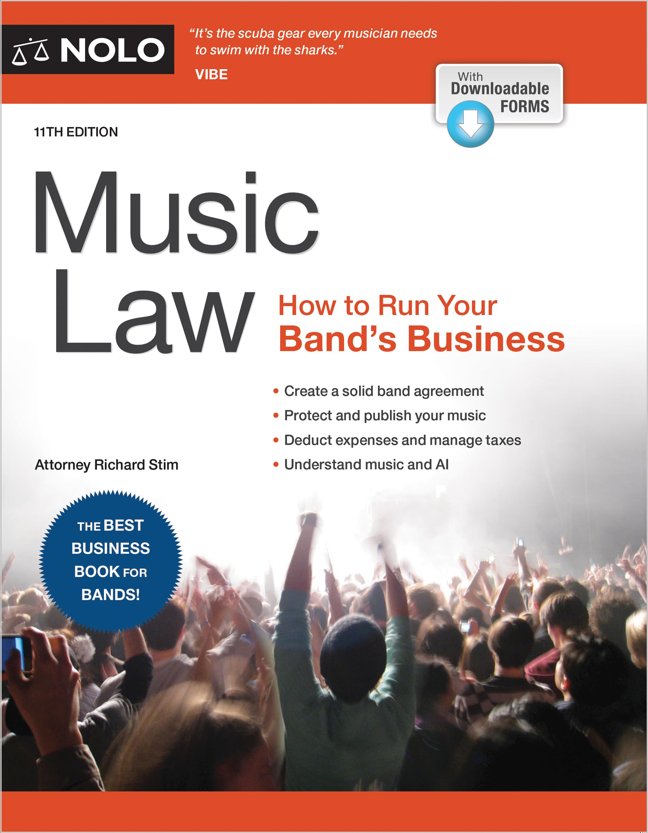
18Music Law: How to Run Your Band's Business
Whether you're recording an album, budgeting a tour, or insuring your vintage guitar, you need solid information to make the right legal and business choices.
Music Law is the all-in-one guide you need. Written by musician and lawyer Rich Stim, it explains everything you need to:
write a partnership agreement
buy, insure, and maintain equipment
use samples and do covers
register your band's name
sell and license your music
get royalties for streaming and downloads
deal with taxes and deductions
find the right manager and write a fair contract
get gigs and get paid
protect your copyright legally
deal with legal issues in the recording studio, and
understand record contracts.
This is quite simply the best business and legal guide for bands ever written. Completely updated to provide the latest in the law and current business practices, it covers music licensing and trends affecting the digital-music scene.
19Pirate Cinema
Trent thinks he is too clever for that to happen, but it does, and nearly destroys his family. Shamed and shattered, Trent runs away to London, where slowly he learns the ways of staying alive on the streets. He joins artists and activists fighting a new bill that will jail too many, especially minors, at one stroke. Jem introduces him to the Jammie Dodgers, beautiful brilliant "26" to love and cemetery parties.
Things look bad. Parliament is in power of a few wealthy media conglomerates. But the powers-that-be haven’t entirely reckoned with the power of a gripping movie to change people’s minds ...
20Reclaiming Fair Use: How to Put Balance Back in Copyright
21Copyright and Popular Media: Liberal Villains and Technological Change
22Legal Forms for Everyone: Leases, Home Sales, Avoiding Probate, Living Wills, Trusts, Divorce, Copyrights, and Much More
Legal Forms for Everyone is the ultimate self-help legal guide that will save hours of research time and money in legal fees. Written by an experienced attorney, this book is complete with the most commonly needed, ready-to-use legal forms and precise instructions and checklists on how to use them, as well as advice about when you should hire an attorney. In addition, all the forms are online on a supplemental website to aid in customizing for individual needs.
Readers will find forms and advice for a variety of legal situations, including preparing a will, avoiding probate, buying and selling real estate, handling divorce or separation, getting a new name, copyrights and trademarks, bankruptcy, and so much more. However, due to the ever-evolving legal system and the development of new technologies, Carl Battle has added to this new edition such changes as:
How to protect against credit fraud, identity theft, and internet fraud
How to navigate new electronic filing systems for copyrights, trademarks, and patents
Updated information in filing fees, exemptions, and forms for filing for bankruptcy
The latest information on filing for patents
Legal Forms for Everyone is a comprehensive tool for getting in and out of legal situations without having to pay for that costly attorney.
23Monsters and Beasts: An Image Archive for Artists and Designers
24The Public Domain: How to Find & Use Copyright-Free Writings, Music, Art & More
Millions of creative works--books, artwork, photos, songs, movies, and more--are available copyright-free in the public domain. Whether your tastes run more Jane Austen or Jane Eyre, Beethoven or Irving Berlin, Edvard Munch or Claude Monet, you'll find inspiration in The Public Domain.
The only book that helps you find and identify which creative works are protected by copyright and which are not, The Public Domain covers the rules for:
writings
music
art
photography
architecture
maps
choreography
movies
video
software
databases
collections
The 8th edition is completely updated with hundreds of new online and digitized public domain resources. The book covers the latest legal developments regarding copyright and the public domain--from state copyright policies to free and low-cost legal advice for creative types to copyright issues regarding photos lacking human authorship, and much more!
25Complete Copyright
26Year Zero
Women: A Pictorial Archive from Nineteenth-Century Sources
28Vintage Botanical Illustration: Copyright-Free Images for Artists, Designers and Plant Lovers
29Against Intellectual Monopoly
30Against Intellectual Property
Mises warned against patents, and so did Rothbard. But Kinsella goes much further. He argues that the very existence of patents — and copyrights and trademarks, too — is contrary to a free market. They all use the state to create artificial scarcities of nonscarce goods and employ coercion in a way that is contrary to property rights and the freedom of contract.
Many who read this book will be unprepared for the rigor of Kinsella's argument. It takes time to settle in, simply because it seems so shocking at first. But Kinsella makes his case with powerful logic and examples that are overwhelming in their persuasive power.
After all, the relevance of this argument in a digital age can't be overstated. The state works with monopolistic private producers to inhibit innovation and stop the progress of technology, while using coercion against possible competitors and against consumers. Even US foreign policy is profoundly affected by widespread confusions over what is legitimate and what is merely asserted as property.
What Kinsella is calling for instead of this cartelizing system is nothing more or less than a pure free market, which involves nothing resembling what we call intellectual property today. IP, he argues, is really nothing more than a state-enforced legal convention, not an extension of real ownership.
Few books written in the last decades have caused so much fundamental rethinking. It is essential that libertarians get this issue right and understand the arguments on all sides. Kinsella's book is masterful in doing just that — making a case against IP that turns out to be more rigorous and thorough than any written on the left, right, or anywhere in between.
Read it and prepare to change your mind.
To search for Mises Institute titles, enter a keyword and LvMI (short for Ludwig von Mises Institute); e.g., Depression LvMI
31Register Your Book: The Essential Guide to ISBNs, Barcodes, Copyright, and LCCNs
...to set your book up for long-term success, improve sales opportunities, and protect your investment, including: Everything you need to know about ISBNs, Barcodes, Copyright, & LCCNs.Make sure your book can be distributed by any distributor.Never have to abandon your hard-earned reader reviews.Ensure your book can be printed by any printer.Add your book to the major book industry databases.Prevent your advance reading copies from being re-sold.Avoid legal headaches and missed filing deadlines.
"Straightforward and easy to digest, this is one how-to that every new author or publisher should have in their arsenal!" --Brooke Warner, Publisher of She Writes Press and author of Green-Light Your Book: How Writers Can Succeed in the New Era of Publishing
..".proceed with confidence in spending your time and dollars to get it done right, the first time."
--Carla King, Self-Pub Boot Camp
..".a thorough and deceptively simple guide for independent authors and publishers..."
--Kim Anderson, Founder and CEO, The Reading Room
Music Law in the Digital Age: Copyright Essentials for Today's Music Business
Plants: 2,400 Royalty-Free Illustrations of Flowers, Trees, Fruits and Vegetables
Selected from rare publications dating from the 1840s to the turn of the century, the illustrations encompass a wide range of plant species and classifications: garden flowers, cactuses, bromeliads, ferns, deciduous trees, evergreens, grasses, legumes, orchids, nightshades, and many more. All are identified with Latin or common names and are arranged alphabetically by family. Also presented are specialized appendices on edible foods, medicinal herbs, and plants used in decoration and in graphic design, including borders and motifs.
Created during a period when wood engraving had reached its zenith and become a greatly refined art, these splendid royalty-free illustrations will be an indispensable and inspirational resource for artists and craftspeople working in a variety of areas. The collection will also delight botanists, gardeners, and collectors of old engravings, all of whom are sure to treasure this tribute to the beauty and infinite variety of the plant kingdom.
34The Copyright Wars: Three Centuries of Trans-Atlantic Battle
Peter Baldwin explains why the copyright wars have always been driven by a fundamental tension. Should copyright assure authors and rights holders lasting claims, much like conventional property rights, as in Continental Europe? Or should copyright be primarily concerned with giving consumers cheap and easy access to a shared culture, as in Britain and America? "The Copyright Wars" describes how the Continental approach triumphed, dramatically increasing the claims of rights holders. The book also tells the widely forgotten story of how America went from being a leading copyright opponent and pirate in the eighteenth and nineteenth centuries to become the world's intellectual property policeman in the late twentieth. As it became a net cultural exporter and its content industries saw their advantage in the Continental ideology of strong authors' rights, the United States reversed position on copyright, weakening its commitment to the ideal of universal enlightenment--a history that reveals that today's open-access advocates are heirs of a venerable American tradition.
Compelling and wide-ranging, "The Copyright Wars" is indispensable for understanding a crucial economic, cultural, and political conflict that has reignited in our own time.
35Copyright Cases and Materials (University Casebook Series)
36Copyrighteous: A Catalyst for Creativity in the Classroom
Repeat.
You are an educator and a creator and a curator. You have insight into what your students need, and you have ideas for designing instructional materials that lead to authentic learning experiences. With that in mind, you want to pull from the best resources for your students--which often means working beyond the textbook or pre-packaged curriculum. But how can you do so responsibly?
In Copyrighteous, educator Diana Gill encourages teachers, administrators, and students to use and share their creative voices as learners. Through her examples and stories, you'll learn . . .
How you can use copyright to be responsible and break the rules
How to model best practices for sharing in this digitally connected world
Why considering copyright makes you a better designer
How to support students and colleagues as creators
Discover how considering copyright can be a catalyst for creativity,
not the death of it.
"Copyrighteous will surprise you. It's not just a book about using resources responsibly and attributing. It's an inspiring encouragement to forge your own path, tap into your creativity and create the class of your dreams. As a proud textbook ditcher, this book spoke to my teacher soul!"
--Matt Miller, author of Ditch That Textbook
"This is the book that educators have been waiting for, even if they didn't realize it
was what they needed!"
--Adam Welcome, educator, speaker, author, and runner
"Copyrighteous is an inspiring look at how we can take potential hurdles and turn them into launching pads to create rich and engaging learning experiences for our students."
--Jesse Lubinsky, chief learning officer, Ready Learner One LLC
37The Copyright Zone: A Legal Guide for Photographers and Artists in the Digital Age
Presented in a fun and easy to digest style, Jack Reznicki and Ed Greenberg, LLC help explain the need-to-know facts of the confusing world of legal jargon and technicalities through real world case studies, personal asides, and the clear writing style that has made their blog Thecopyrightzone.com and monthly column by the same name in Photoshop User magazine two industry favorites. The second edition of this well-reviewed text has almost doubled in size to ensure that every legal issue you need to know about as a photographer or artist is covered and enjoyable to learn!
38Intellectual Property: A Very Short Introduction
Vaidhyanathan explains that intellectual property exists as it does because powerful interests want it to exist. The strongest economies in the world have a keen interest in embedding rigid methods of control and enforcement over emerging economies to preserve the huge economic interests linked to their copyright industries-film, music, software, and publishing. For this reason, the fight over the global standardization of intellectual property has become one of the most important sites of tension in North-South global relations. Through compelling case studies, including those of Starbucks, Coca-Cola, Sony, Amazon, and Google Books, Vaidhyanathan shows that the modern intellectual property systems reflect three centuries of changes in politics, economics, technologies, and social values. Although it emerged from a desire to foster creativity while simultaneously protecting it, intellectual property today has fundamentally shifted to a political dimension.
39Digital Copyright: Protecting Intellectual Property on the Internet
The general public is used to thinking of copyright (if it thinks of it at all) as marginal and arcane, and it hasn't paid much attention as legislation to expand copyright moved through Congress. But copyright law is central to our society's information policy, and affects what we can read, view, hear, use, or learn.
In this enlightening and well-argued book, law professor Jessica Litman questions whether copyright laws crafted by lawyers and their lobbyists really make sense for the vast majority of us. Should every interaction between ordinary consumers and copyright-protected works be governed by laws drafted without ordinary consumers in mind? Is it practical to enforce such laws, or expect consumers to obey them? Most important, what are the effects of such laws on the exchange of information in a free society? Litman's critique exposes the 1998 copyright law as an incoherent patchwork. She argues for reforms that reflect common sense and the way people actually behave in their daily digital interactions.
(front flap)
40Reporting Quantitative Research in Psychology: How to Meet APA Style Journal Article Reporting Standards
41The Piracy Crusade: How the Music Industry's War on Sharing Destroys Markets and Erodes Civil Liberties
42Patents, Copyrights and Trademarks For Dummies
43Legal Guide for the Visual Artist
Allworth Press, an imprint of Skyhorse Publishing, publishes a broad range of books on the visual and performing arts, with emphasis on the business of art. Our titles cover subjects such as graphic design, theater, branding, fine art, photography, interior design, writing, acting, film, how to start careers, business and legal forms, business practices, and more. While we don't aspire to publish a New York Times bestseller or a national bestseller, we are deeply committed to quality books that help creative professionals succeed and thrive. We often publish in areas overlooked by other publishers and welcome the author whose expertise can help our audience of readers.
44Democracy of Sound: Music Piracy and the Remaking of American Copyright in the Twentieth Century
In Democracy of Sound, Alex Sayf Cummings uncovers the little-known history of music piracy and its sweeping effects on the definition of copyright in the United States. When copyright emerged, only visual material such as books and maps were thought to deserve protection; even musical compositions were not included until 1831. Once a performance could be captured on a wax cylinder or vinyl disc, profound questions arose over the meaning of intellectual property. Is only a written composition defined as a piece of art? If a singer performs a different interpretation of a song, is it a new and distinct work? Such questions have only grown more pressing with the rise of sampling and other forms of musical pastiche. Indeed, music has become the prime battleground between piracy and copyright. It is compact, making it easy to copy. And it is highly social, shared or traded through social networks--often networks that arise around music itself. But such networks also pose a counter-argument: as channels for copying and sharing sounds, they were instrumental in nourishing hip-hop and other new forms of music central to American culture today. Piracy is not always a bad thing.
An insightful and often entertaining look at the history of music piracy, Democracy of Sound offers invaluable background to one of the hot-button issues involving creativity and the law.
45Intellectual Property in the New Technological Age 2019: Vol II Copyights, Trademarks and State IP Protections
46Examples & Explanations for Copyright
Here's why you need an E&E to help you study throughout the semester:
Clear explanations of each class topic, in a conversational, funny style.
Features hypotheticals similar to those presented in class, with corresponding analysis so you can use them during the semester to test your understanding, and again at exam time to help you review.
It offers coverage that works with ALL the major casebooks, and suits any class on a given topic. The Examples & Explanations series has been ranked the most popular study aid among law students because it is equally as helpful from the first day of class through the final exam.
47Piracy: The Intellectual Property Wars from Gutenberg to Gates
Since the rise of Napster and other file-sharing services in its wake, most of us have assumed that intellectual piracy is a product of the digital age and that it threatens creative expression as never before. The Motion Picture Association of America, for instance, claimed that in 2005 the film industry lost $2.3 billion in revenue to piracy online. But here Adrian Johns shows that piracy has a much longer and more vital history than we have realized—one that has been largely forgotten and is little understood.
Piracy explores the intellectual property wars from the advent of print culture in the fifteenth century to the reign of the Internet in the twenty-first. Brimming with broader implications for today’s debates over open access, fair use, free culture, and the like, Johns’s book ultimately argues that piracy has always stood at the center of our attempts to reconcile creativity and commerce—and that piracy has been an engine of social, technological, and intellectual innovations as often as it has been their adversary. From Cervantes to Sonny Bono, from Maria Callas to Microsoft, from Grub Street to Google, no chapter in the story of piracy evades Johns’s graceful analysis in what will be the definitive history of the subject for years to come.
48Copyright's Paradox
49Music Copyright Law
50How to Make $100,000 per Year in Passive Income and Travel the World: The Passive Income Guide to Wealth and Financial Freedom - Features 14 Proven Passive Income Strategies
If you are sick and tired of making your boss rich, working hard for little pay, living paycheck to paycheck, or just want to dramatically upgrade your current lifestyle, this is the book that can change everything.
Follow the steps listed in this book and you will achieve financial independence much sooner than you ever thought possible.
Millions of people are living life on their own terms, doing what they love, working when they choose to, and more often than not, making double, triple, or more than they ever did at their “normal” jobs. Are you ready to join the movement?
51La baia dei pirati: Assalto al copyright
52Copyright Clarity: How Fair Use Supports Digital Learning
53Copyright and Cultural Institutions: Guidelines for Digitization for U.S. Libraries, Archives, and Museums
54Copyright in Historical Perspective
55Wired Shut: Copyright and the Shape of Digital Culture
56Free Software, Free Society: Selected Essays
This collection includes historical writings such as The GNU Manifesto, which defined and launched the activist Free Software Movement, along with new writings on hot topics in copyright, patent law, and the controversial issue of "trusted computing."
Stallman takes a critical look at common abuses of copyright law and
patents when applied to computer software programs, and how these
abuses damage our entire society and remove our existing freedoms. He
also discusses the social aspects of software and how free software
can create community and social justice.
Given the current turmoil in copyright and patent laws, including
the DMCA and proposed CBDTPA, these essays are more relevant than
ever. Stallman tackles head-on the essential issues driving the
current changes in copyright law. He argues that for creativity to
flourish, software must be free of inappropriate and overly-broad
legal constraints. Over the past twenty years his arguments and
actions have changed the course of software history; this new book is
sure to impact the future of software and legal policies in the years
to come.
Lawrence Lessig, the author of two well-known books on similar topics,
writes the introduction. He is a noted legal expert on copyright law
and a Stanford Law School professor.
57The Anarchist in the Library: How the Clash Between Freedom and Control Is Hacking the Real World and Crashing the System
58Makers
Perry and Lester invent things—seashell robots that make toast, Boogie Woogie Elmo dolls that drive cars. They also invent entirely new economic systems, like the “New Work,” a New Deal for the technological era. Barefoot bankers cross the nation, microinvesting in high-tech communal mini-startups like Perry and Lester’s. Together, they transform the country, and Andrea Fleeks, a journo-turned-blogger, is there to document it.
Then it slides into collapse. The New Work bust puts the dot.combomb to shame. Perry and Lester build a network of interactive rides in abandoned Wal-Marts across the land. As their rides, which commemorate the New Work’s glory days, gain in popularity, a rogue Disney executive grows jealous, and convinces the police that Perry and Lester’s 3D printers are being used to run off AK-47s.
Hordes of goths descend on the shantytown built by the New Workers, joining the cult. Lawsuits multiply as venture capitalists take on a new investment strategy: backing litigation against companies like Disney. Lester and Perry’s friendship falls to pieces when Lester gets the ‘fatkins’ treatment, turning him into a sybaritic gigolo.
Then things get really interesting.
59Copyright Law for Librarians and Educators: Creative Strategies and Practical Solutions
The goal is to provide librarians in developing and transition countries information concerning copyright law. More specifically, it aspires to inform librarians concerning copyright law in general; the aspects of copyright law that most affect libraries; and how librarians in the future could most effectively participate in the processes by which copyright law is interpreted and shaped.
First launched in 2010, the number of formats and translations is growing.
60Ripped: How the Wired Generation Revolutionized Music
National radio host and critically acclaimed music journalist Greg Kot masterfully chronicles this story of how we went from $17.99 to $0.00 in less than a decade. It's a fascinating tale of backward thinking, forward thinking, and the power of music.
61Fundamentals of Heat and Mass Transfer
62Harter's Picture Archive for Collage and Illustration
These rare pictures, both real and imagined, of relics, rituals, people, animals, and geometric shapes and designs provide much-needed material for collage and illustrations — material of the highest quality that is difficult if not impossible to find elsewhere. There are 25 full-page scenes of historic, natural, and city vistas that are ideally suited as background for collages and other projects. All of the pictures are sharply defined and clearly printed on one side of each page to allow for optimal use of their lines and textures and to eliminate the possibility of "show-through."
The illustrations were chosen by the well-known collagist Jim Harter, whose work has appeared in TheNew York Times, New York magazine, and other publications. Mr. Harter's artistry is evident in his selection of images that — besides being useful as decorative or illustrative elements — have a strong visual impact and symbolic potential. Line engravings offer unique textural qualities, and as Mr. Harter writes, they "have a dream-like quality that other material cannot duplicate." Mr. Harter’s introduction gives a brief history of collage as well as instructions on techniques and materials and an overview of his own perspective on the art. To illustrate the various ways these nineteenth-century cuts can be used, six collages composed entirely of images from this book are included.
63The Essential Guide to Intellectual Property
Intellectual property is one of the most confusing—and widely used—dimensions of the law. By granting exclusive rights to publish, manufacture, copy, or distribute information and technology, IP laws shape our cultures, our industries, and our politics in countless ways, with consequences for everyone, including artists, inventors, entrepreneurs, and citizens at large. In this engaging, accessible study, Aram Sinnreich uncovers what’s behind current debates and what the future holds for copyrights, patents, and trademarks.
64The Pirate's Dilemma: How Youth Culture Is Reinventing Capitalism
In The Pirate's Dilemma, VICE magazine's Matt Mason -- poised to become the Malcolm Gladwell of the iPod Generation -- brings the exuberance of a passionate music fan and the technological savvy of an IT wizard to the task of sorting through the changes brought about by the interface of pop culture and innovation. He charts the rise of various youth movements -- from pirate radio to remix culture -- and tracks their ripple effect throughout larger society. Mason brings a passion and a breadth of intelligence to questions such as the following: How did a male model who messed with disco records in the 1970s influence the way Boeing designs airplanes? Who was the nun who invented dance music, and how is her influence undermining capitalism as we know it? Did three high school kids who remixed Nazis into Smurfs in the 1980s change the future of the video game industry? Can hip-hop really bring about world peace? Each chapter crystallizes the idea behind one of these fringe movements and shows how it combined with technology to subvert old hierarchies and empower the individual.
With great wit and insight -- and a cast of characters that includes such icons as the Ramones, Andy Warhol, Madonna, Russell Simmons, and 50 Cent -- Mason uncovers the trends that have transformed countercultural scenes into burgeoning global industries and movements, ultimately changing our way of life.
65Creativity and Copyright: Legal Essentials for Screenwriters and Creative Artists
66The Copyright Permission and Libel Handbook: A Step-By-Step Guide for Writers, Editors, and Publishers
67Copy This Book: An Artista's Guide to Copyright
How do you get copyright? For what work? And for how long? How does copyright move across mediums, and how can you go about integrating the work of others? Copy This Book details the concepts of authorship and original creation that underlie our legal system, equipping the reader with the conceptual keys to participate in the debate on intellectual property today.
"This sharp and useful book shines a light on the rights of all artists to protect--and share--their work. Eric Schrijver has produced an essential guide for navigating the new Commons and the old laws of copyright control." --Ellen Lupton
68Explore the Rocky Mountain High Peaks
69Ready-to-Use Celtic Designs
70Intellectual Property Stories 2005 (Law Stories)
71Music Copyright Law, 1st ed.
72The Law (in Plain English) for Writers (Fifth Edition)
A career as a writer involves much more than the act of writing itself. In The Law (in Plain English) for Writers, Fifth Edition, Leonard DuBoff and Sarah Tugman proffer invaluable advice for the myriad legal and business facets of being a writer. Readers will discover how to succeed in every area affecting a writer's livelihood, such as submissions, dealing with agents, taxes, permissions, royalties, alternatives to mainstream publishers, copyright, book and magazine contracts, and how to prevent disputes.
This newly revised edition, keeping up with the changing legal landscape, contains information on a variety of legal issues pertinent to writers of all types, including:
Updated coverage on issues such as how to avoid trouble posed by the interplay between the right to free speech, privacy, and defamation law Changes in the copyright law, procedures, and recent cases on copyright protection and infringement Updated and revised chapters on the business of writing New and updated Internet resources
For writers of all levels, this comprehensive resource is the key to turning a writing career into a sustainable livelihood.
73Kafka's Last Trial: The Case of a Literary Legacy
Nearly a century later, an international legal battle erupted to determine which country could claim ownership: Israel, where Kafka dreamed of living, or Germany, where Kafka’s three sisters perished in the Holocaust? Benjamin Balint offers a gripping account of the controversial trial in Israeli courts— brimming with dilemmas legal, ethical, and political—that determined the fate of Kafka’s manuscripts.
“Thoughtful and provocative.” — Ruth Franklin, Wall Street Journal
“A tale pitting two Goliaths against one octogenarian David, untangled in exacting, riveting detail. . . . A must- read.” — Rebecca Schuman, Slate
“A gifted cultural historian with a scholarly sensibility.” — Lev Mendes, New York Times Book Review
74The Case for Copyright Reform
75Common as Air: Revolution, Art, and Ownership
For the founders, democratic self-governance itself demanded open and easy access to ideas. So did the growth of creative communities such as that of eighteenth-century science. And so did the flourishing of public persons, the very actors whose civic virtue brought the nation into being.
In this lively, carefully argued, and well-documented book, Hyde brings the past to bear on present matters, shedding fresh light on everything from the Human Genome Project to Bob Dylan's musical roots. Common as Air allows us to stand on the shoulders of America's revolutionary giants and thus to see beyond today's narrow debates over cultural ownership. What it reveals is nothing less than a vision of how to reclaim the commonwealth of art and ideas that we were meant to inherit.
76Context: Further Selected Essays on Productivity, Creativity, Parenting, and Politics in the 21st Century
77Old-Fashioned Silhouettes: 942 Copyright-Free Illustrations
The human profile and figure, coiffed and dressed in many different ways; familiar animals, flowers and birds; coaches, planes, automobiles, ships, and much, much more are generously represented in this treasury of bold images. All are royalty-free, and all can be reproduced easily and put to work instantly to add a sparkling, old-fashioned touch to your next layout.
78Getting Permission: How to License & Clear Copyrighted Materials Online & Off
Online or off, before you use some or all of a song, photo, book, or any other work covered by copyright law, you need to get permission first. If you don't, you could end up facing legal action from the rights-holder. This easy-to-use book shows you how to get the rights you need, with step-by-step instructions and more than 30 forms. Find out when permission is required, who to ask, and when (and how much) you can expect to pay. Getting Permission explains:
the copyright permission process
the public domain ("free" content)
how to figure out who owns a copyright
website permissions
the "fair use" rule
school-related permissions
license and merchandise agreements (including sample contracts and other forms)
and much more.
This edition is updated with summaries of recent copyright and fair use cases, as well as dozens of real-life questions from the Dear Rich permissions blog.
All forms are downloadable through a special link in the book (details inside).
79Victorian Floral Illustrations: 344 Wood Engravings of Exotic Flowers and Plants
Illustrations include exquisitely detailed renderings of flowers and other plant features of exotic specimens from around the world: passionflower, baobab, spider lily, hop, quaking grass, mourning cypress, American mangrove, wayfaring tree, Christmas rose, Indian rhododendron, false indigo, winged pea, Persian walnut. cat's-claw mimosa, Bhutan cypress, and many more.
The engravings encompass a broad spectrum of plant forms: trees, shrubs, aquatic and climbing plants, evergreens, vines, brushes, herbs, various perennials, and others. Orchids are especially well represented; over 10 percent of the illustrations in this volume depict orchids. Each illustration is accompanied by an identifying caption that provides the scientific name and a brief description of the plant, its native region, and if it is a flower, the coloration of the blossoms.
The clarity and accuracy of these engravings is striking; they are well-suited to reproduction for almost any graphic purpose. Moreover, all illlustrations are royalty-free; no prior permission or fee is required for their use.
Invaluable to graphic artists in need of a comprehensive archive of unusual floral illustrations, this versatile reference will delight botanists, naturalists, flower lovers, and any admirer of exotic plants that are depicted with the meticulous clarity and detail of fine engravings.
80The Last Bookaneer
book'a-neer' (bŏŏk'kå-nēr'), n. a literary pirate; an individual capable of doing all that must be done in the universe of books that publishers, authors, and readers must not have a part in
London, 1890—Pen Davenport is the most infamous bookaneer in Europe. A master of disguise, he makes his living stalking harbors, coffeehouses, and print shops for the latest manuscript to steal. But this golden age of publishing is on the verge of collapse. For a hundred years, loose copyright laws and a hungry reading public created a unique opportunity: books could easily be published without an author’s permission. Authors gained fame but suffered financially—Charles Dickens, Mark Twain, Robert Louis Stevenson, to name a few—but publishers reaped enormous profits while readers bought books inexpensively. Yet on the eve of the twentieth century, a new international treaty is signed to grind this literary underground to a sharp halt. The bookaneers are on the verge of extinction.
From the author of The Dante Club, Matthew Pearl, The Last Bookaneer is the astonishing story of these literary thieves’ epic final heist. On the island of Samoa, a dying Robert Louis Stevenson labors over a new novel. The thought of one last book from the great author fires the imaginations of the bookaneers, and soon Davenport sets out for the South Pacific island. As always, Davenport is reluctantly accompanied by his assistant Fergins, who is whisked across the world for one final caper. Fergins soon discovers the supreme thrill of aiding Davenport in his quest to steal Stevenson’s manuscript and make a fortune before the new treaty ends the bookaneers’ trade forever. But Davenport is hardly the only bookaneer with a mind to pirate Stevenson’s last novel. His longtime adversary, the monstrous Belial, appears on the island, and soon Davenport, Fergins, and Belial find themselves embroiled in a conflict larger, perhaps, than literature itself.
In The Last Bookaneer, Pearl crafts a finely wrought tale about a showdown between brilliant men in the last great act of their professions. It is nothing short of a page-turning journey to the heart of a lost era.
81Fashions of the Thirties: 476 Authentic Copyright-Free Illustrations
This volume reproduces hundreds of illustrations from issues of that now-rare periodical. A "must-have" for graphic artists looking for authentic fashions of the 1930s, this collection of more than 470 illustrations depicts, in sharp and easy-to-reproduce detail, formal and casual wear for adults and children of all ages. Among the items shown are stylish dresses, suits, evening gowns, coats, loungewear, fur stoles, handbags, lingerie, jewelry, and hats for women; men's suits, slacks, beachwear, jackets, ties, shoes, and pajamas; and a variety of playclothes and special-occasion outfits for infants, young children, and teenagers.
An instant source of period charm for designers, these illustrations will also be of great value to students of fashion and costume history.
82The Late Age of Print: Everyday Book Culture from Consumerism to Control
From the rise of retail superstores to Oprah's phenomenal reach, Striphas tracks the methods through which the book industry has adapted (or has failed to adapt) to rapid changes in twentieth-century print culture. Barnes & Noble, Borders, and Amazon.com have established new routes of traffic in and around books, and pop sensations like Harry Potter and the Oprah Book Club have inspired the kind of brand loyalty that could only make advertisers swoon. At the same time, advances in digital technology have presented the book industry with extraordinary threats and unique opportunities.
Striphas's provocative analysis offers a counternarrative to those who either triumphantly declare the end of printed books or deeply mourn their passing. With wit and brilliant insight, he isolates the invisible processes through which books have come to mediate our social interactions and influence our habits of consumption, integrating themselves into our routines and intellects like never before.
83The Idea Writers: Copywriting in a New Media and Marketing Era
A memorable slogan has been the cornerstone of every great ad campaign. In the past, writing one great headline could launch a career. But today's advertising campaigns are interactive, multi-platform and ongoing, and the copywriter's canvas is vast. At any given time, a copywriter may be conceiving a video game, writing a TV show, maintaining a Twitter feed, creating a mobile app or an interactive installation or, yes, writing a headline or a TV script.
While the best copywriters have always been brand storytellers, now that story can play out anywhere. The digital revolution put control in the hands of the people - the audience - now no longer just consumers, but active participants in a brand's story.
The art and science of advertising has gone from creating one-way messages to engaging audiences in ongoing conversations.
A new ad landscape means new opportunities for writers who now have the incredible opportunity to push brand narrative to places it's never been before and to actually create something so useful or entertaining that it generates its own audience. It also means that many of the rules of the past - while exceedingly worthy of study - are insufficient to guide the modern copywriter. Co-published with AdvertisingAge, The Idea Writers outlines the changing landscape of the advertising industry while providing useful how-to advice.
Filled with interviews from top creatives including:
Greg Hahn, Nick Law, Jeff Benjamin, Tim Delaney, Rei Inamoto, Lee Clow, Steve Simpson, Rick Condos, David Droga, Gerry Graf, Ty Montague, Calle and Pelle Sjonell, PJ Pereira, David Abbott and many more!
84Copyright Law in a Nutshell (Nutshells)
85Hollywood's Copyright Wars: From Edison to the Internet
Beginning with Thomas Edison's aggressive copyright disputes and concluding with recent lawsuits against YouTube, "Hollywood's Copyright Wars" follows the struggle of the film, television, and digital media industries to influence and adapt to copyright law. Many of Hollywood's most valued treasures, from "Modern Times" (1936) to "Star Wars" (1977), cannot be fully understood without appreciating their legal controversies. Peter Decherney shows that the history of intellectual property in Hollywood has not always mirrored the evolution of the law. Many landmark decisions have barely changed the industry's behavior, while some quieter policies have had revolutionary effects. His most remarkable contributions uncover Hollywood's reliance on self-regulation. Rather than involve congress, judges, or juries in settling copyright disputes, studio heads and filmmakers have often kept such arguments "in house," turning to talent guilds and other groups for solutions. Whether the issue has been battling piracy in the 1900s, controlling the threat of home video, or managing modern amateur and noncommercial uses of protected content, much of Hollywood's engagement with the law has occurred offstage, in the larger theater of copyright. Decherney's unique history recounts these extralegal solutions and their impact on American media and culture.
86Free Ride: How Digital Parasites are Destroying the Culture Business, and How the Culture Business Can Fight Back
On the Internet, “information wants to be free.” This memorable phrase shaped the online business model, but it is now driving the media companies on whom the digital industry feeds out of business. Today, newspaper stocks have fallen to all-time lows as papers are pressured to give away content, music sales have fallen by more than half since file sharing became common, TV ratings are plummeting as viewership migrates online, and publishers face off against Amazon over the price of digital books.
In Free Ride, Robert Levine narrates an epic tale of value destruction that moves from the corridors of Congress, where the law was passed that legalized YouTube, to the dorm room of Shawn Fanning, the founder of Napster; from the bargain-pricing dramas involving iTunes and Kindle to Google’s fateful decision to digitize first and ask questions later. Levine charts how the media industry lost control of its destiny and suggests innovative ways it can resist the pull of zero.
Fearless in its reporting and analysis, Free Ride is the business history of the decade and a much-needed call to action.
87Creative License: The Law and Culture of Digital Sampling
88The Creative Artist's Legal Guide: Copyright, Trademark and Contracts in Film and Digital Media Production
In today's complex media environment, aspiring filmmakers and new media artists are as vulnerable as swimmers in shark-infested waters. This user-friendly guide supplies creative artists with the essential legal concepts needed to swim safely with lawyers, agents, executives, and other experts in intellectual property and business law.
How do I copyright my screenplay? How can I clear rights for my film project? What can I do to avoid legal trouble when I produce my mockumentary? How do I ascertain whether a vintage novel is in the public domain? Is the trademark I've invented for my production company available? What about copyright and trademark rights overseas? If I upload my film to YouTube, do I give up any rights?
Bill Seiter and Ellen Seiter answer these questions and countless others while also demystifying the fundamental principles of intellectual property. Clear and thorough, this plain-spoken and practical guide is essential for anyone seeking to navigate the rapidly changing media environment of today.
Reality Television Contracts: How to Negotiate the Best Deal
•A brief history of reality television
•A breakdown of how ideas develop and of the "players" involved
•Reviews of and comments on agreement templates for all parties in the development and production stages
•"Deal point" checklists to help stay on track
Directed at attorneys who currently represent clients in the industry or would like to add reality television to their law practices, at reality television producers or those looking to break into the scene, and at all reality television participants, the contracts included in this book will be an indispensable resource all the way!
Allworth Press, an imprint of Skyhorse Publishing, publishes a broad range of books on the visual and performing arts, with emphasis on the business of art. Our titles cover subjects such as graphic design, theater, branding, fine art, photography, interior design, writing, acting, film, how to start careers, business and legal forms, business practices, and more. While we don't aspire to publish a New York Times bestseller or a national bestseller, we are deeply committed to quality books that help creative professionals succeed and thrive. We often publish in areas overlooked by other publishers and welcome the author whose expertise can help our audience of readers.
90The Copyright Thing Doesn’t Work Here: Adinkra and Kente Cloth and Intellectual Property in Ghana
In The Copyright Thing Doesn’t Work Here, Boatema Boateng focuses on the appropriation and protection of adinkra and kente cloth in order to examine the broader implications of the use of intellectual property law to preserve folklore and other traditional forms of knowledge. Boateng investigates the compatibility of indigenous practices of authorship and ownership with those established under intellectual property law, considering the ways in which both are responses to the changing social and historical conditions of decolonization and globalization. Comparing textiles to the more secure copyright protection that Ghanaian musicians enjoy under Ghanaian copyright law, she demonstrates that different forms of social, cultural, and legal capital are treated differently under intellectual property law.
Boateng then moves beyond Africa, expanding her analysis to the influence of cultural nationalism among the diaspora, particularly in the United States, on the appropriation of Ghanaian and other African cultures for global markets. Boateng’s rich ethnography brings to the surface difficult challenges to the international regulation of both contemporary and traditional concepts of intellectual property, and questions whether it can even be done.
Hollywood Dealmaking: Negotiating Talent Agreements for Film, TV, and Digital Media
All the ins and outs of negotiating are explained, including back ends, gross and adjusted gross profits, deferments, box office bonuses, copyrights, and much more. This easy-to-follow reference is packed with expert insights on distribution, licensing, and merchandising. The book's invaluable resource section includes definitions of lingo for acquisition agreements and employment deals, twelve ready-to-use sample contracts, and a directory of entertainment attorneys in both New York and Los Angeles. In Hollywood Dealmaking, readers will recognize the key players in the process, understand the "lingo" of crafting deals, learn how to negotiate agreements for the option and purchase of books and screenplays, be able to negotiate employment deals for all members of a film or television crew, understand payment terms and bonuses, and be able to register copyrights in scripts and other literary works.
Allworth Press, an imprint of Skyhorse Publishing, publishes a broad range of books on the visual and performing arts, with emphasis on the business of art. Our titles cover subjects such as graphic design, theater, branding, fine art, photography, interior design, writing, acting, film, how to start careers, business and legal forms, business practices, and more. While we don't aspire to publish a New York Times bestseller or a national bestseller, we are deeply committed to quality books that help creative professionals succeed and thrive. We often publish in areas overlooked by other publishers and welcome the author whose expertise can help our audience of readers.
92Bound by Law?: Tales from the Public Domain
93The Illustrated Story of Copyright
In The Illustrated Story of Copyright, Professor Edward Samuels explains in a straightforward and colorful style the history and intricacies of copyright. From the printing press to the photocopying machine, the phonograph to the MP3, this comprehensive guide explains the basic principles of copyright law and brings to life the relevant copyright technologies. Using hundreds of photos, illustrations and sidebars, Samuels traces the story of copyright from its adoption in this country 210 years ago to today's headline issues posed by the Internet and the digitizing of creative works. And remarkably, this is the only book of its kind that is accessible to a lay audience, and that also will delight people already conversant in the field.
This timely work takes what is commonly perceived to be a difficult subject and gives it a fresh and engaging edge. An essential tool to navigate the complex partnership of creativity and property rights, The Illustrated Story of Copyright belongs on the bookshelf of every creative person.
94Promises to Keep: Technology, Law, and the Future of Entertainment
95Copyright Plain and Simple, Second Edition
96Author Law A to Z: A Desktop Guide to Writer's Rights and Responsibilities
97Intellectual Privacy: Rethinking Civil Liberties in the Digital Age
98The Law of Public Communication
99The Case for Books: Past, Present, and Future
The digital age is revolutionizing the information landscape. Already, more books have been scanned and digitized than were housed in the great library in Alexandria, making available millions of texts for a curious reader at the click of a button, and electronic book sales are growing exponentially. Will this revolution in the delivery of information and entertainment make for more transparent and far-reaching dissemination or create a monopolistic stranglehold?
In The Case for Books, Robert Darnton, an intellectual pioneer in the field of the history of the book and director of Harvard University's Library, offers an in-depth examination of the book from its earliest beginnings to its shifting role today in popular culture, commerce, and the academy.
As an author, editorial advisor, and publishing entrepreneur, Darnton is a unique authority on the life and role of the book in society. This book is a wise work of scholarship—one that requires readers to carefully consider how the digital revolution will broadly affect the marketplace of ideas.
100Freedom of Expression: Resistance and Repression in the Age of Intellectual Property
Kembrew McLeod is professor of communication studies at the University of Iowa, author of Owning Culture: Authorship, Ownership, and Intellectual Property Law, and coproducer of the documentary Copyright Criminals: This Is a Sampling Sport.
Lawrence Lessig is professor of law at Stanford Law School.
This book’s documentary companion will be available through Media Education Foundation.