We've ranked the best chaos theory books using expert recommendations, sales data, and millions of reader ratings. At Shortform, we know books. Our book guides are the best in the world. Learn why.
Cover unavailable
1
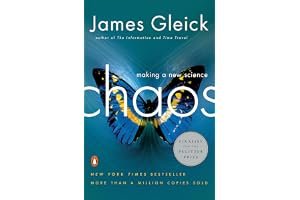
Chaos: Making a New Science
James Gleick
5.0
Few writers distinguish themselves by their ability to write about complicated, even obscure topics clearly and engagingly. In Chaos, James Gleick, a former science writer for the New York Times, shows that he resides in this exclusive category. Here he takes on the job of depicting the first years of the study of chaos--the seemingly random patterns that characterise many natural phenomena.
This is not a purely technical book. Instead, it focuses as much on the scientists studying chaos as on the chaos itself. In the pages of Gleick's book, the reader meets dozens of extraordinary and eccentric people. For instance, Mitchell Feigenbaum, who constructed and regulated his life by a 26-hour clock and watched his waking hours come in and out of phase with those of his coworkers at Los Alamos National Laboratory.
As for chaos itself, Gleick does an outstanding job of explaining the thought processes and investigative techniques that researchers bring to bear on chaos problems. Rather than attempt to explain Julia sets, Lorenz attractors and the Mandelbrot Set with gigantically complicated equations, Chaos relies on sketches, photographs and Gleick's wonderful descriptive prose. --Christine Buttery
…
Recommended by Adam Maloof and Pedro G Ferreira.
Adam Maloof
James Gleick is a former science writer for the New York Times and in this book Gleick describes the science of chaos, and how complex systems can also be interpreted in terms of simple rules and simple (but interacting) behaviours. [source]
Pedro G Ferreira
It turns out that even simple equations can have such complicated behaviour that, in practice, it’s impossible to predict the outcome, which is described as ‘chaotic’. [source]
Cover unavailable
2
The Feynman Lectures on Physics
Richard P. Feynman
4.9
The legendary introduction to physics from the subject's greatest teacher "The whole thing was basically an experiment," Richard Feynman said late in his career, looking back on the origins of his lectures. The experiment turned out to be hugely successful, spawning a book that has remained a definitive introduction to physics for decades. Ranging from the most basic principles of Newtonian physics through such formidable theories as general relativity and quantum mechanics, Feynman's lectures stand as a monument of clear exposition and deep insight. Now, we are reintroducing the printed books to the trade, fully corrected, for the first time ever, and in collaboration with Caltech. Timeless and collectible, the lectures are essential reading, not just for students of physics but for anyone seeking an introduction to the field from the inimitable Feynman.
You don't have to take a course to learn physics. If you're hardcore, read the Feynman book and do the problems. [source]
David Bainbridge
I think that he is one of the most intelligent people to live in the 20th century. Yet at the same time, surprisingly, he is an amazingly good teacher. This is quite an unusual combination. [source]

Cover unavailable
3
Complexity: The Emerging Science at the Edge of Order and Chaos
M. Mitchell Waldrop
4.8
Why did the stock market crash more than 500 points on a single Monday in 1987? Why do ancient species often remain stable in the fossil record for millions of years and then suddenly disappear? In a world where nice guys often finish last, why do humans value trust and cooperation? At first glance these questions don't appear to have anything in common, but in fact every one of these statements refers to a complex system. The science of complexity studies how single elements, such as a species or a stock, spontaneously organize into complicated structures like ecosystems and economies; stars become galaxies, and snowflakes avalanches almost as if these systems were obeying a hidden yearning for order. Drawing from diverse fields, scientific luminaries such as Nobel Laureates Murray Gell-Mann and Kenneth Arrow are studying complexity at a think tank called The Santa Fe Institute. The revolutionary new discoveries researchers have made there could change the face of every science from biology to cosmology to economics. M. Mitchell Waldrop's groundbreaking bestseller takes readers into the hearts and minds of these scientists to tell the story behind this scientific revolution as it unfolds.
…
Recommended by Bill Gurley, Pedro G Ferreira, and Ryan Petersen.
This is such a great point. This is the essence of Complexity Theory. With complex systems (multi-variable, nonlinear), you have no idea if the variable you are using for analysis will hold over the long term. Read this book, it changes everything - https://t.co/Z1ySFSb4pd https://t.co/rht8SzZ76l [source]
Pedro G Ferreira
Ideas of complexity have not been applied to cosmology as much as I think they should be. [source]

Ryan Petersen
@trengriffin @mjmauboussin @bgurley Which one is better? I love Waldrop, never found a better complexity book (besides Big History, great courses) [source]

Cover unavailable
4
Deep Simplicity: Bringing Order to Chaos and Complexity
John Gribbin
4.8
Over the past two decades, no field of scientific inquiry has had a more striking impact across a wide array of disciplines–from biology to physics, computing to meteorology–than that known as chaos and complexity, the study of complex systems. Now astrophysicist John Gribbin draws on his expertise to explore, in prose that communicates not only the wonder but the substance of cutting-edge science, the principles behind chaos and complexity. He reveals the remarkable ways these two revolutionary theories have been applied over the last twenty years to explain all sorts of phenomena–from weather patterns to mass extinctions.
Grounding these paradigm-shifting ideas in their historical context, Gribbin also traces their development from Newton to Darwin to Lorenz, Prigogine, and Lovelock, demonstrating how–far from overturning all that has gone before–chaos and complexity are the triumphant extensions of simple scientific laws. Ultimately, Gribbin illustrates how chaos and complexity permeate the universe on every scale, governing the evolution of life and galaxies alike.
… it's pretty hard to understand everything, but if you can't understand it, you can always give it to a more intelligent friend. [source]
Cover unavailable
5
The Drunkard's Walk: How Randomness Rules Our Lives
Leonard Mlodinow
4.8
Recommended by David Spiegelhalter and Gabriel Coarna.
David Spiegelhalter
This is a general introduction to the history of probability and the way it comes into everyday life. It intersperses the historical development with modern applications, and looks at finance, sport, gambling, lotteries and coincidences. [source]

Gabriel Coarna
Leonard Mlodinow's "The Drunkarkd's Walk" -more precisely, the section on the "Monty Hall" problem- totally changed how I look-at/think-about probabilities and choices in general; this has impacted almost every real-life choice I've made since I read this book. [source]

Cover unavailable
6
Sync: How Order Emerges from Chaos in the Universe, Nature, and Daily Life
Steven Strogatz
4.8
The tendency to synchronize may be the most mysterious and pervasive drive in all of nature. It has intrigued some of the most brilliant minds of the 20th century, including Albert Einstein, Richard Feynman, Norbert Wiener, Brian Josephson, and Arthur Winfree. At once elegant and riveting, Sync tells the story of the dawn of a new science. Steven Strogatz, a leading mathematician in the fields of chaos and complexity theory, explains how enormous systems can synchronize themselves, from the electrons in a superconductor to the pacemaker cells in our hearts. He shows that although these phenomena might seem unrelated on the surface, at a deeper level there is a connection, forged by the unifying power of mathematics.
…
Recommended by Morten Kringelbach.
Morten Kringelbach
Steven Strogatz is a wonderful scientist. He is both a mathematician and a physicist. He’s done a lot of work on understanding non-linear systems. The reason I’ve chosen this book is that if we really want to understand the language of the brain we have to engage with these very powerful concepts of how it is that things are synchronised. This is a book for the general public that tries to relay some of that excitement, some of the tools that we’ve gained mathematically in order to do that. He starts with fireflies. [source]

Cover unavailable
7
Nonlinear Dynamics and Chaos: With Applications to Physics, Biology, Chemistry, and Engineering
Steven H. Strogatz
4.8
This textbook is aimed at newcomers to nonlinear dynamics and chaos. The presentation stresses analytical methods, concrete examples, and geometric intuition. A unique feature of the book is its emphasis on applications. These include mechanical vibrations, lasers, biological rhythms, superconducting circuits, insect outbreaks, chemical oscillators, genetic control systems, chaotic waterwheels, and even a technique for using chaos to send secret messages. In each case, the scientific background is explained at an elementary level and closely integrated with mathematical theory.
About the Author: Steven Strogatz is in the Center for Applied Mathematics and the Department of Theoretical and Applied Mathematics at Cornell University. Since receiving his Ph.D. from Harvard university in 1986, Professor Strogatz has been honored with several awards, including the E.M. Baker Award for Excellence, the highest teaching award given by MIT.
…
Cover unavailable
8
Jurassic Park (Jurassic Park, #1)
Michael Crichton, Scott Brick, et al
4.8
An astonishing technique for recovering and cloning dinosaur DNA has been discovered. Now humankind’s most thrilling fantasies have come true. Creatures extinct for eons roam Jurassic Park with their awesome presence and profound mystery, and all the world can visit them—for a price.
Until something goes wrong. . . .
In Jurassic Park, Michael Crichton taps all his mesmerizing talent and scientific brilliance to create his most electrifying technothriller.
Today is World Book Day, a wonderful opportunity to address this #ChallengeRichard sent in by Mike Gonzalez of New Jersey: Make a list of your top 65 books to read in a lifetime. [source]

Cover unavailable
9
Bellwether
Connie Willis
4.7
Pop culture, chaos theory and matters of the heart collide in this unique novella from the Hugo and Nebula winning author of Doomsday Book.
Sandra Foster studies fads and their meanings for the HiTek corporation. Bennet O'Reilly works with monkey group behavior and chaos theory for the same company. When the two are thrust together due to a misdelivered package and a run of seemingly bad luck, they find a joint project in a flock of sheep. But series of setbacks and disappointments arise before they are able to find answers to their questions.
A series of epiphanies from the author and others that the world is really interesting when you look at iterative algorithms applied millions and billions of times. [source]
Cover unavailable
11
Does God Play Dice?: The New Mathematics of Chaos
Ian Stewart
4.7
The revised and updated edition includes three completely new chapters on the prediction and control of chaotic systems. It also incorporates new information regarding the solar system and an account of complexity theory. This witty, lucid and engaging book makes the complex mathematics of chaos accessible and entertaining. Presents complex mathematics in an accessible style. Includes three new chapters on prediction in chaotic systems, control of chaotic systems, and on the concept of chaos. Provides a discussion of complexity theory.
…
Cover unavailable
12
Leadership and the New Science Revised: Discover- Ing Order in a Chaotic World
Margaret J. Wheatley
4.7
In 1992, Leadership and the New Science launched a revolution by demonstrating that ideas drawn from quantum physics, chaos theory, and molecular biology could improve organizational performance. Margaret Wheatley called for free-flowing information, individual empowerment, relationship networks, and organizational change that evolves organically -- ideas that have become commonplace. This new edition includes a new chapter that examines the relationship of change to identity.
…
Recommended by Susan Mazza.
Cover unavailable
13
The U.S. Constitution and Fascinating Facts about It
Terry L. Jordan
4.7
Cover unavailable
14
Indra's Net: Alchemy and Chaos Theory as Models for Transformation
Robertson, Robin
4.7
In this clear, engaging book, Robin Robertson draws parallels between alchemy and chaos theory and shows how to apply them to our inner development. He is not proposing they replace traditional spiritual paths, but rather that they reflect deep structures in the psyche that any inner journey awakens. The model they provide necessarily underlies all paths of spiritual transformation and describes a framework for the stages through which any seeker goes. No matter what your particular calling, these insights enrich understanding of the transformative process, whether outside in the world, or within your life.
…
Cover unavailable
15
Transformers Volume 5: Chaos Theory
Mike Costa, E.J. Su, et al.
4.7
The fate of Rodimus and the Matrix of Leadership is finally revealed in this newest story arc of "Transformers, Chaos Theory". The situation on Earth continues to deteriorate while we shift focus to outer space where Rodimus was last seen dead! But, after crash landing on a strange planet, Rodimus struggles to find a way back to Earth and the Autobot forces...until a few familiar faces show up to help and a new threat to Cybertron is revealed.
…
Cover unavailable
16
Handbook of Mindfulness: Theory, Research, and Practice
Kirk Warren Brown, J. David Creswell, et al.
4.7
An authoritative handbook, this volume offers both a comprehensive review of the current science of mindfulness and a guide to its ongoing evolution. Leading scholars explore mindfulness in the context of contemporary psychological theories of attention, perceptual processing, motivation, and behavior, as well as within a rich cross-disciplinary dialogue with the contemplative traditions. After surveying basic research from neurobiological, cognitive, emotional/affective, and interpersonal perspectives, the book delves into applications of mindfulness practice in healthy and clinical populations, reviewing a growing evidence base. Examined are interventions for behavioral and emotion dysregulation disorders, depression, anxiety, and addictions, and for physical health conditions.
…
Cover unavailable
17
Turbulent Mirror: An Illustrated Guide to Chaos Theory and the Science of Wholeness
John Briggs
4.7
Until recently, such phenomena as the volatility of weather systems, the fluctuation of the shock market, or the random firing of neurons in the brain were considered too "noisy" and complex to be probed by science. But now, with the aid of high-speed computers, scientists have been able to penetrate a reality that is changing the way we perceive the universe. Their findings -- the basis for chaos theory -- represent one of the most exciting scientific pursuits of our time.
No better introduction to this find could be found than John Briggs and F. David Peat's Turbulent Mirror. Together, they explore the many faces of chaos and reveal how its law direct most of the processes of everyday life and how it appears that everything in the universe is interconnected -- discovering an "emerging science of wholeness."
Turbulent Mirror introduces us to the scientists involved in study this endlessly strange field; to the theories that are turning our perception of the world on its head; and to the discoveries in mathematics, biology, and physics that are heralding a revolution more profound than the one responsible for producing the atomic bomb. With practical applications ranging from the control of traffic flow and the development of artifical intelligence to the treatment of heart attacks and schizophrenia, chaos promises to be an increasingly rewarding area of inquiry -- of interest to everyone.
…
Cover unavailable
18
Origins (Learning From Granite Mountain - Anchor Point 1)
Brad Mayhew
4.7
Cover unavailable
19
Seven Life Lessons of Chaos: Spiritual Wisdom from the Science of Change
John Briggs and F David Peat
4.7
If you have ever felt your life was out of control and headed toward chaos,science has an important message: Life is chaos, and that's a very exciting thing!
In this eye-opening book, John Briggs and F. David Peat reveal sevenenlightening lessons for embracing the chaos of daily life.
Be Creative: engage with chaos to find imaginative new solutions and live more dynamically
Use Butterfly Power: let chaos grow local efforts into global results
Go With the Flow: use chaos to work collectively with others
Explore What's Between: discover life's rich subtleties and avoid the traps of stereotypes
See the Art of the World: appreciate the beauty of life's chaos
Live Within Time: utilize time's hidden depths
Rejoin the Whole: realize our fractal connectedness to each other and the world
Life is impossible to control--instead of fighting this truth, Seven Life Lessons of Chaos shows you how to accept, celebrate, and use it to live life to its fullest.
…
Cover unavailable
20
The Fractal Geometry of Nature
Benoit B. Mandelbrot
4.7
Clouds are not spheres, mountains are not cones, and lightning does not travel in a straight line. The complexity of nature's shapes differs in kind, not merely degree, from that of the shapes of ordinary geometry, the geometry of fractal shapes.
Now that the field has expanded greatly with many active researchers, Mandelbrot presents the definitive overview of the origins of his ideas and their new applications. The Fractal Geometry of Nature is based on his highly acclaimed earlier work, but has much broader and deeper coverage and more extensive illustrations.
…
Cover unavailable
21
The Web of Life: A New Scientific Understanding of Living Systems
Fritjof Capra
4.7
Cover unavailable
22
Linked: How Everything Is Connected to Everything Else and What It Means for Business, Science, and Everyday Life
Albert-Laszlo Barabasi
4.7
In the 1980's, James Gleick's Chaos introduced the world to complexity. Now, Albert-László Barabási's Linked reveals the next major scientific leap: the study of networks. We've long suspected that we live in a small world, where everything is connected to everything else. Indeed, networks are pervasive--from the human brain to the Internet to the economy to our group of friends. These linkages, it turns out, aren't random. All networks, to the great surprise of scientists, have an underlying order and follow simple laws. Understanding the structure and behavior of these networks will help us do some amazing things, from designing the optimal organization of a firm to stopping a disease outbreak before it spreads catastrophically.In Linked, Barabási, a physicist whose work has revolutionized the study of networks, traces the development of this rapidly unfolding science and introduces us to the scientists carrying out this pioneering work. These "new cartographers" are mapping networks in a wide range of scientific disciplines, proving that social networks, corporations, and cells are more similar than they are different, and providing important new insights into the interconnected world around us. This knowledge, says Barabási, can shed light on the robustness of the Internet, the spread of fads and viruses, even the future of democracy. Engaging and authoritative, Linked provides an exciting preview of the next century in science, guaranteed to be transformed by these amazing discoveries.From Linked:This book has a simple message: think networks. It is about how networks emerge, what they look like, and how they evolve. It aims to develop a web-based view of nature, society, and technology, providing a unified framework to better understand issues ranging from the vulnerability of the Internet to the spread of diseases. Networks are present everywhere. All we need is an eye for them...We will see the challenges doctors face when they attempt to cure a disease by focusing on a single molecule or gene, disregarding the complex interconnected nature of the living matter. We will see that hackers are not alone in attacking networks: we all play Goliath, firing shots at a fragile ecological network that, without further support, could soon replicate our worst nightmares by turning us into an isolated group of species...Linked is meant to be an eye-opening trip that challenges you to walk across disciplines by stepping out of the box of reductionism. It is an invitation to explore link by link the next scientific revolution: the new science of networks.
…
Recommended by Anne-Marie Slaughter and Bill Barhydt.
Anne-Marie Slaughter
Linked is about how to understand the world in terms of networks. To understand network science the first thing to do is to visualise the world the way you visualise the Internet or even the universe – hubs of infinitely intersecting networks. As the author says, everything can be reduced to links and nodes. This book is a very accessible introduction to the science of networks and to how to think about everything from anthills to traffic jams to complex conflict from the perspective of network science. [source]
Bill Barhydt
Written before Facebook, this book predicts what the world will look like with amazing precision. [source]
Cover unavailable
23
The Systems Thinker – Dynamical Systems: Make Better Decisions and Find Lasting Solutions Using Scientific Analysis. (The Systems Thinker Series Book 5)
Albert Rutherford
4.7
Cover unavailable
24
Complexity: A Primer
Miklos Szilagyi
4.7
Cover unavailable
25
A Guide to Temporal Networks (Series on Complexity Science)
Naoki Masuda
4.7
Network science offers a powerful language to represent and study complex systems composed of interacting elements — from the Internet to social and biological systems. In its standard formulation, this framework relies on the assumption that the underlying topology is static, or changing very slowly as compared to dynamical processes taking place on it, e.g., epidemic spreading or navigation. Fuelled by the increasing availability of longitudinal networked data, recent empirical observations have shown that this assumption is not valid in a variety of situations. Instead, often the network itself presents rich temporal properties and new tools are required to properly describe and analyse their behaviour.A Guide to Temporal Networks presents recent theoretical and modelling progress in the emerging field of temporally varying networks, and provides connections between different areas of knowledge required to address this multi-disciplinary subject. After an introduction to key concepts on networks and stochastic dynamics, the authors guide the reader through a coherent selection of mathematical and computational tools for network dynamics. Perfect for students and professionals, this book is a gateway to an active field of research developing between the disciplines of applied mathematics, physics and computer science, with applications in others including social sciences, neuroscience and biology.
Almost 12 years have passed by since we wrote Chaos and Fractals. At the time we were hoping that our approach of writing a book which would be both accessible without mathematical sophistication and portray these exiting new fields in an authentic manner would find an audience. Now we know it did. We know from many reviews and personal letters that the book is used in a wide range of ways: researchers use it to acquaint themselves, teachers use it in college and university courses, students use it for background reading, and there is also a substantial audience of lay people who just want to know what chaos and fractals are about. Every book that is somewhat technical in nature is likely to have a number of misprints and errors in its first edition. Some of these were caught and brought to our attention by our readers. One of them, Hermann Flaschka, deserves to be thanked in particular for his suggestions and improvements. This second edition has several changes. We have taken out the two appendices from the firstedition. At the time of the first edition Yuval Fishers contribution, which we published as an appendix was probably the first complete expository account on fractal image compression. Meanwhile, Yuvals book Fractal Image Compression: Theory and Application appeared and is now the publication to refer to.
…
Cover unavailable
27
Chaos: Making a New Science by James Gleick | Summary & Study Guide
BookRags
4.7
Cover unavailable
28
Atlas of Physarum Computing
Andrew Adamatzky
4.7
Cover unavailable
29
Teaching With the Instructional Cha-Chas: Four Steps to Make Learning Stick (Educational Neuroscience, Formative Assessment, and Differentiated Instruction Strategies for Student Success)
LeAnn Nickelsen and Melissa Dickson
4.7
Cover unavailable
30
Book of Extremes: Why the 21st Century Isn T Like the 20th Century
Ted G. G. Lewis
4.7
What makes the 21st century different from the 20th century? This century is the century of extremes -- political, economic, social, and global black-swan events happening with increasing frequency and severity. Book of Extremes is a tour of the current reality as seen through the lens of complexity theory the only theory capable of explaining why the Arab Spring happened and why it will happen again; why social networks in the virtual world behave like flashmobs in the physical world; why financial bubbles blow up in our faces and will grow and burst again; why the rich get richer and will continue to get richer regardless of governmental policies; why the future of economic wealth and national power lies in comparative advantage and global trade; why natural disasters will continue to get bigger and happen more frequently; and why the Internet invented by the US -- is headed for a global monopoly controlled by a non-US corporation. It is also about the extreme innovations and heroic innovators yet to be discovered and recognized over the next 100 years.Complexity theory combines the predictable with the unpredictable. It assumes a nonlinear world of long-tailed distributions instead of the classical linear world of normal distributions. In the complex 21st century, almost nothing is linear or normal. Instead, the world is highly connected, conditional, nonlinear, fractal, and punctuated. Life in the 21st century is a long-tailed random walk Levy walks -- through extreme events of unprecedented impact. It is an exciting time to be alive. "
…
Cover unavailable
31
Fractal Conjugate Space & Time: Cause of Negentropy, Gravity and Perception: Conjuring Life: "The Fractal Shape of TIME" Geometric Origins of Biologic Negentropy..
Daniel Winter
4.7
Cover unavailable
32
Ages in Chaos I: From the Exodus to King Akhnaton
Immanuel Velikovsky
4.7
This is the first volume of the series Ages in Chaos, in which Immanuel Velikovsky undertakes a reconstruction of the history of antiquity. With utmost precision and the exciting style of a presentation that's typical for him he shows, beyond doubt, what nobody would consider possible: in the conventional history of Egypt - and therefore also of many neighboring cultures - a span of 600 years is described, which has never happened! This assertion is as unbelievable and outrageous as the assertions in Worlds in Collision or Earth in Upheaval. But Velikovsky takes us on a detailed and highly interesting journey through the - corrected - history and makes us a witness to how many question marks disappear, doubts vanish and corresponding facts from the entire Near East furnish a picture of overall conformity and correctness. You will meet an Egyptian eyewitness of the biblical plagues and the mysterious Queen of Sheba. You will find out to where her legendary visit led her. You will, moreover, learn surprising details about the temple of Solomon and learn who was behind its sacking. In the end you do not only wonder how conventional historiography has come into existence, but why it is still taught and published. Just as Velikovsky became the father of "neo-catastrophism" by Worlds in Collision, he became the father of "new chronology" by Ages in Chaos.
…
Cover unavailable
33
Order Out of Chaos: Man's New Dialogue with Nature
Ilya Prigogine, Isabelle Stengers, Alvin Toffler
4.7
Belgian philosopher Isabelle Stengers and Ilya Prigogine, winner of the Nobel Prize in 1977 for his work on the thermodynamics of non-equilibrium systems, make their ideas accessible to a wide audience in this book, which has engendered massive debate in Europe and America. Stengers and Prigogine show how the two great themes of classic science, order and chaos, which coexisted uneasily for centuries, are being reconciled in a new and unexpected synthesis.
…
Cover unavailable
34
Introduction to Applied Nonlinear Dynamical Systems and Chaos
Stephen Wiggins
4.7
This introduction to applied nonlinear dynamics and chaos places emphasis on teaching the techniques and ideas that will enable students to take specific dynamical systems and obtain some quantitative information about their behavior. The new edition has been updated and extended throughout, and contains a detailed glossary of terms.
From the reviews:
"Will serve as one of the most eminent introductions to the geometric theory of dynamical systems." --Monatshefte f�r Mathematik
…
Cover unavailable
35
The Systems Thinker - Mental Models: Take Control Over Your Thought Patterns. Learn Advanced Decision-Making and Problem-Solving Skills. (The Systems Thinker Series Book 3)
Albert Rutherford
4.7
Cover unavailable
36
Exploring Chaos: Theory and Experiment
Brian Davies
4.7
This book presents elements of the theory of chaos in dynamical systems in a framework of theoretical understanding coupled with numerical and graphical experimentation. The theory is developed using only elementary calculus and algebra, and includes dynamics of one-and two-dimensional maps, periodic orbits, stability and its quantification, chaotic behavior, and bifurcation theory of one-dimensional systems. There is an introduction to the theory of fractals, with an emphasis on the importance of scaling, and a concluding chapter on ordinary differential equations. The accompanying software, written in Java, is available online (see link below). The program enables students to carry out their own quantitative experiments on a variety of nonlinear systems, including the analysis of fixed points of compositions of maps, calculation of Fourier spectra and Lyapunov exponents, and box counting for two-dimensional maps. It also provides for visualizing orbits, final state and bifurcation diagrams, Fourier spectra and Lyapunov exponents, basins of attractions, three-dimensional orbits, Poincaré sections, and return maps.
…
Cover unavailable
37
Nonlinear Dynamics and Chaos: With Applications to Physics, Biology, Chemistry, and Engineering, Second Edition
Steven H. Strogatz
4.7
This textbook is aimed at newcomers to nonlinear dynamics and chaos, especially students taking a first course in the subject. The presentation stresses analytical methods, concrete examples, and geometric intuition. The theory is developed systematically, starting with first-order differential equations and their bifurcations, followed by phase plane analysis, limit cycles and their bifurcations, and culminating with the Lorenz equations, chaos, iterated maps, period doubling, renormalization, fractals, and strange attractors.
…
Cover unavailable
38
A text book of Engineering Chemistry
Steven H. Strogatz
4.6
The book covers the syllabus for Engineering chemistry course offered to first year B.E/B.Tech students of various India University
Cover unavailable
39
X-23 - Volume 2: Chaos Theory
Marjorie Liu, Sana Takeda, et al.
4.6
X-23 thought she'd walked away from her past. But in the wake of her brutal discoveries in Madripoor, she realizes there are some crimes - of the heart and body - that cannot be so easily forgotten. Yet as memories begin to spin her out of control, an old mentor and an uneasy ally return to her life: Wolverine and the vampire Jubilee. COLLECTING: X-23 10-16
Cover unavailable
40
Chaos theory in Psychology and the Life Sciences
Robin Robertson
4.6
This book represents the best of the first three years of the Society for Chaos Theory in Psychology conferences. While chaos theory has been a topic of considerable interest in the physical and biological sciences, its applications in psychology and related fields have been obscured until recently by its complexity. Nevertheless, a small but rapidly growing community of psychologists, neurobiologists, sociologists, mathematicians, and philosophers have been coming together to discuss its implications and explore its research possibilities.
Chaos theory has been termed the first authentic paradigm shift since the advent of quantum physics. Whether this is true or not, it unquestionably bears profound implications for many fields of thought. These include the cognitive analysis of the mind, the nature of personality, the dynamics of psychotherapy and counseling, understanding brain events and behavioral records, the dynamics of social organization, and the psychology of prediction. To each of these topics, chaos theory brings the perspective of dynamic self-organizing processes of exquisite complexity. Behavior, the nervous system, and social processes exhibit many of the classical characteristics of chaotic systems -- they are deterministic and globally predictable and yet do not submit to precise predictability.
This volume is the first to explore ideas from chaos theory in a broad, psychological perspective. Its introduction, by the prominent neuroscientist Walter Freeman, sets the tone for diverse discussions of the role of chaos theory in behavioral research, the study of personality, psychotherapy and counseling, mathematical cognitive psychology, social organization, systems philosophy, and the understanding of the brain.
…
Cover unavailable
41
Introduction to the Modeling and Analysis of Complex Systems
Hiroki Sayama
4.6
Introduction to the Modeling and Analysis of Complex Systems introduces students to mathematical/computational modeling and analysis developed in the emerging interdisciplinary field of Complex Systems Science. Complex systems are systems made of a large number of microscopic components interacting with each other in nontrivial ways. Many real-world systems can be understood as complex systems, where critically important information resides in the relationships between the parts and not necessarily within the parts themselves. This textbook offers an accessible yet technically-oriented introduction to the modeling and analysis of complex systems. The topics covered include: fundamentals of modeling, basics of dynamical systems, discrete-time models, continuous-time models, bifurcations, chaos, cellular automata, continuous field models, static networks, dynamic networks, and agent-based models. Most of these topics are discussed in two chapters, one focusing on computational modeling and the other on mathematical analysis. This unique approach provides a comprehensive view of related concepts and techniques, and allows readers and instructors to flexibly choose relevant materials based on their objectives and needs. Python sample codes are provided for each modeling example. This textbook is also available free online from the Open SUNY Textbooks website (http://textbooks.opensuny.org).
…
Cover unavailable
42
The Physics of Wall Street: A Brief History of Predicting the Unpredictable
James Owen Weatherall
4.6
After the economic meltdown of 2008, Warren Buffett famously warned, “beware of geeks bearing formulas.” But as James Weatherall demonstrates, not all geeks are created equal. While many of the mathematicians and software engineers on Wall Street failed when their abstractions turned ugly in practice, a special breed of physicists has a much deeper history of revolutionizing finance. Taking us from fin-de-siècle Paris to Rat Pack-era Las Vegas, from wartime government labs to Yippie communes on the Pacific coast, Weatherall shows how physicists successfully brought their science to bear on some of the thorniest problems in economics, from options pricing to bubbles.
The crisis was partly a failure of mathematical modeling. But even more, it was a failure of some very sophisticated financial institutions to think like physicists. Models—whether in science or finance—have limitations; they break down under certain conditions. And in 2008, sophisticated models fell into the hands of people who didn’t understand their purpose, and didn’t care. It was a catastrophic misuse of science.
The solution, however, is not to give up on models; it's to make them better. Weatherall reveals the people and ideas on the cusp of a new era in finance. We see a geophysicist use a model designed for earthquakes to predict a massive stock market crash. We discover a physicist-run hedge fund that earned 2,478.6% over the course of the 1990s. And we see how an obscure idea from quantum theory might soon be used to create a far more accurate Consumer Price Index.
Both persuasive and accessible, The Physics of Wall Street is riveting history that will change how we think about our economic future.
…
Cover unavailable
43
The Essence of Chaos
Edward Lorenz
4.6
Chaos surrounds us. Seemingly random events -- the flapping of a flag, a storm-driven wave striking the shore, a pinball's path -- often appear to have no order, no rational pattern. Explicating the theory of chaos and the consequences of its principal findings -- that actual, precise rules may govern such apparently random behavior -- has been a major part of the work of Edward N. Lorenz. In The Essence of Chaos, Lorenz presents to the general reader the features of this "new science," with its far-reaching implications for much of modern life, from weather prediction to philosophy, and he describes its considerable impact on emerging scientific fields.
Unlike the phenomena dealt with in relativity theory and quantum mechanics, systems that are now described as "chaotic" can be observed without telescopes or microscopes. They range from the simplest happenings, such as the falling of a leaf, to the most complex processes, like the fluctuations of climate. Each process that qualifies, however, has certain quantifiable characteristics: how it unfolds depends very sensitively upon its present state, so that, even though it is not random, it seems to be. Lorenz uses examples from everyday life, and simple calculations, to show how the essential nature of chaotic systems can be understood. In order to expedite this task, he has constructed a mathematical model of a board sliding down a ski slope as his primary illustrative example. With this model as his base, he explains various chaotic phenomena, including some associated concepts such as strange attractors and bifurcations.
As a meteorologist, Lorenz initially became interested in the field of chaos because of its implications for weather forecasting. In a chapter ranging through the history of weather prediction and meteorology to a brief picture of our current understanding of climate, he introduces many of the researchers who conceived the experiments and theories, and he describes his own initial encounter with chaos.
A further discussion invites readers to make their own chaos. Still others debate the nature of randomness and its relationship to chaotic systems, and describe three related fields of scientific thought: nonlinearity, complexity, and fractality. Appendixes present the first publication of Lorenz's seminal paper "Does the Flap of a Butterfly's Wing in Brazil Set Off a Tornado in Texas?"; the mathematical equations from which the copious illustrations were derived; and a glossary.
…
Cover unavailable
44
Chaos and Dynamical Systems
David Feldman
4.6
Chaos and Dynamical Systems presents an accessible, clear introduction to dynamical systems and chaos theory, important and exciting areas that have shaped many scientific fields. While the rules governing dynamical systems are well-specified and simple, the behavior of many dynamical systems is remarkably complex. Of particular note, simple deterministic dynamical systems produce output that appears random and for which long-term prediction is impossible. Using little math beyond basic algebra, David Feldman gives readers a grounded, concrete, and concise overview.
In initial chapters, Feldman introduces iterated functions and differential equations. He then surveys the key concepts and results to emerge from dynamical systems: chaos and the butterfly effect, deterministic randomness, bifurcations, universality, phase space, and strange attractors. Throughout, Feldman examines possible scientific implications of these phenomena for the study of complex systems, highlighting the relationships between simplicity and complexity, order and disorder.
Filling the gap between popular accounts of dynamical systems and chaos and textbooks aimed at physicists and mathematicians, Chaos and Dynamical Systems will be highly useful not only to students at the undergraduate and advanced levels, but also to researchers in the natural, social, and biological sciences.
…
Cover unavailable
45
Emergence: From Chaos To Order
John Holland
4.6
In this important book, John H. Holland dramatically shows us that the “emergence” of order from disorder has much to teach us about life, mind and organizations. Creative activities in both the arts and the sciences depend upon an ability to model the world. The most creative of those models exhibits emergent properties, so that “what comes out is more than what goes in.” From the ingenious checkers-playing computer that started beating its creator in game after game, to the emotive creations of the poet, Emergence shows that Holland’s theory successfully predicts many complex behaviors in art and science.
…
Cover unavailable
46
At Home in the Universe: The Search for the Laws of Self-Organization and Complexity
Stuart Kauffman
4.6
A major scientific revolution has begun, a new paradigm that rivals Darwin's theory in importance. At its heart is the discovery of the order that lies deep within the most complex of systems, from the origin of life, to the workings of giant corporations, to the rise and fall of great civilizations. And more than anyone else, this revolution is the work of one man, Stuart Kauffman, a MacArthur Fellow and visionary pioneer of the new science of complexity. Now, in At Home in the Universe, Kauffman brilliantly weaves together the excitement of intellectual discovery and a fertile mix of insights to give the general reader a fascinating look at this new science - and at the forces for order that lie at the edge of chaos.
…
Cover unavailable
47
Common LISP Modules: Artificial Intelligence in the Era of Neural Networks and Chaos Theory
Mark Watson
4.6
While creativity plays an important role in the advancement of computer science, great ideas are built on a foundation of practical experience and knowledge. This book presents programming techniques which will be useful in both AI projects and more conventional software engineering endeavors. My primary goal is to enter- tain, to introduce new technologies and to provide reusable software modules for the computer programmer who enjoys using programs as models for solutions to hard and interesting problems. If this book succeeds in entertaining, then it will certainly also educate. I selected the example application areas covered here for their difficulty and have provided both program examples for specific applications and (I hope) the method- ology and spirit required to master problems for which there is no obvious solution. I developed the example programs on a Macintosh (TM) using the Macintosh Common LISP (TM) development system capturing screen images while the example programs were executing. To ensure portability to all Common LISP environments, I have provided a portable graphics library in Chapter 2. All programs in this book are copyrighted by Mark Watson. They can be freely used in any free or commercial software systems if the following notice appears in the fine print of the program's documentation: "This program contains software written by Mark Watson." No royalties are required. The program miniatures contained in this book may not be distributed by posting in source code form on public information networks, or in printed form without my written permission.
…
Cover unavailable
48
Ten Equations to Explain the Mysteries of Modern Astrophysics: From Information and Chaos Theory to Ghost Particles and Gravitational Waves
Santhosh Mathew
4.6
Cover unavailable
49
The Nonlinear Workbook: Chaos, Fractals, Cellular Automata, Genetic Algorithms, Gene Expression Programming, Support Vector Machine, Wavelets, Hidden Markov Models, Fuzzy Logic with C++, Java and SymbolicC++ Programs
Willi-Hans Steeb
4.6
Cover unavailable
50
Business Cycles
Lars Tvede
4.6
Cover unavailable
51
The Edge Of Organization: Chaos And Complexity Theories Of Formal Social Systems
Russ Marion
4.6
Russ Marion describes formal and social organizations from the perspective of chaos and complexity theories. The book is generously illustrated and includes references plus an annotated bibliography.
Cover unavailable
52
The End of Certainty
Ilya Prigogine
4.6
Time, the fundamental dimension of our existence, has fascinated artists, philosophers, and scientists of every culture and every century. All of us can remember a moment as a child when time became a personal reality, when we realized what a "year" was, or asked ourselves when "now" happened. Common sense says time moves forward, never backward, from cradle to grave. Nevertheless, Einstein said that time is an illusion. Nature's laws, as he and Newton defined them, describe a timeless, deterministic universe within which we can make predictions with complete certainty. In effect, these great physicists contended that time is reversible and thus meaningless.
…
Cover unavailable
53
Ubiquity: Why Catastrophes Happen
Mark Buchanan
4.6
Why do catastrophes happen? What sets off earthquakes, for example? What about mass extinctions of species? The outbreak of major wars? Massive traffic jams that seem to appear out of nowhere? Why does the stock market periodically suffer dramatic crashes? Why do some forest fires become superheated infernos that rage totally out of control?
Experts have never been able to explain the causes of any of these disasters. Now scientists have discovered that these seemingly unrelated cataclysms, both natural and human, almost certainly all happen for one fundamental reason. More than that, there is not and never will be any way to predict them.
Critically acclaimed science journalist Mark Buchanan tells the fascinating story of the discovery that there is a natural structure of instability woven into the fabric of our world. From humble beginnings studying the physics of sandpiles, scientists have learned that an astonishing range of things–Earth’s crust, cars on a highway, the market for stocks, and the tightly woven networks of human society–have a natural tendency to organize themselves into what’s called the “critical state,” in which they are poised on what Buchanan describes as the “knife-edge of instability.” The more places scientists have looked for the critical state, the more places they’ve found it, and some believe that the pervasiveness of instability must now be seen as a fundamental feature of our world.
Ubiquity is packed with stories of real-life catastrophes, such as the huge earthquake that in 1995 hit Kobe, Japan, killing 5,000 people; the forest fires that ravaged Yellowstone National Park in 1988; the stock market crash of 1987; the mass extinction that killed off the dinosaurs; and the outbreak of World War I. Combining literary flair with scientific rigor, Buchanan introduces the researchers who have pieced together the evidence of the critical state, explaining their ingenious work and unexpected insights in beautifully lucid prose.
At the dawn of this new century, Buchanan reveals, we are witnessing the emergence of an extraordinarily powerful new field of science that will help us comprehend the bewildering and unruly rhythms that dominate our lives and may even lead to a true science of the dynamics of human culture and history.
From the Hardcover edition.
…
Cover unavailable
54
Student Solutions Manual for Nonlinear Dynamics and Chaos, 2nd edition
Mitchal Dichter
4.6
This official Student Solutions Manual includes solutions to the odd-numbered exercises featured in the second edition of Steven Strogatz's classic text Nonlinear Dynamics and Chaos: With Applications to Physics, Biology, Chemistry, and Engineering. The textbook and accompanying Student Solutions Manual are aimed at newcomers to nonlinear dynamics and chaos, especially students taking a first course in the subject. Complete with graphs and worked-out solutions, this manual demonstrates techniques for students to analyze differential equations, bifurcations, chaos, fractals, and other subjects Strogatz explores in his popular book.
…
Cover unavailable
55
Math Geek: From Klein Bottles to Chaos Theory, a Guide to the Nerdiest Math Facts, Theorems, and Equations
Raphael Rosen
4.6
The new "sine" of mathematical geekdom!
Do you dream about long division in your sleep? Does the thought of solving abstruse equations bring a smile to your face? Do you love celebrating pi every March? Then, Math Geek was made for you! With this guide, you'll learn even more about the power of numbers as you explore their brilliant nature in ways you've never imagined. From manhole covers to bubbles to subway maps, each page gives you a glimpse of the world through renowned mathematicians' eyes and reveals how their theorems and equations can be applied to nearly everything you encounter. Covering dozens of your favorite math topics, you'll find fascinating answers to questions like: How are the waiting times for buses determined? Why is Romanesco Broccoli so mesmerizing? How do you divide a cake evenly? Should you run or walk to avoid rain showers? Filled with compelling mathematical explanations, Math Geek sheds light on the incredible world of numbers hidden deep within your day-to-day life.
…
Cover unavailable
56
Systems Thinking and Chaos: Simple Scientific Analysis on How Chaos and Unpredictability Shape Our World (And How to Find Order in It)
Albert Rutherford
4.6
Cover unavailable
57
Play Therapy: A Comprehensive Guide to Theory and Practice
David A. Crenshaw, Anne L. Stewart, et al.
4.6
This authoritative work brings together leading play therapists to describe state-of-the-art clinical approaches and applications. The book explains major theoretical frameworks and summarizes the contemporary play therapy research base, including compelling findings from neuroscience. Contributors present effective strategies for treating children struggling with such problems as trauma, maltreatment, attachment difficulties, bullying, rage, grief, and autism spectrum disorder. Practice principles are brought to life in vivid case illustrations throughout the volume. Special topics include treatment of military families and play therapy interventions for adolescents and adults.
…
Cover unavailable
58
Fly Me to the Moon: An Insider's Guide to the New Science of Space Travel
Edward Belbruno
4.6
When a leaf falls on a windy day, it drifts and tumbles, tossed every which way on the breeze. This is chaos in action. In Fly Me to the Moon, Edward Belbruno shows how to harness the same principle for low-fuel space travel--or, as he puts it, surfing the gravitational field.
Belbruno devised one of the most exciting concepts now being used in space flight, that of swinging through the cosmos on the subtle fluctuations of the planets' gravitational pulls. His idea was met with skepticism until 1991, when he used it to get a stray Japanese satellite back on course to the Moon. The successful rescue represented the first application of chaos to space travel and ushered in an emerging new field.
Part memoir, part scientific adventure story, Fly Me to the Moon gives a gripping insider's account of that mission and of Belbruno's personal struggles with the science establishment. Along the way, Belbruno introduces readers to recent breathtaking advances in American space exploration. He discusses ways to capture and redirect asteroids; presents new research on the origin of the Moon; weighs in on discoveries like 2003 UB313 (now named Eris), a dwarf planet detected in the far outer reaches of our solar system--and much more.
Grounded in Belbruno's own rigorous theoretical research but written for a general audience, Fly Me to the Moon is for anybody who has ever felt moved by the spirit of discovery.
…
Cover unavailable
59
Safety-II in Practice: Developing the Resilience Potentials
Erik Hollnagel
4.6
Safety-I is defined as the freedom from unacceptable harm. The purpose of traditional safety management is therefore to find ways to ensure this 'freedom'. But as socio-technical systems steadily have become larger and less tractable, this has become harder to do. Resilience engineering pointed out from the very beginning that resilient performance - an organisation's ability to function as required under expected and unexpected conditions alike - required more than the prevention of incidents and accidents. This developed into a new interpretation of safety (Safety-II) and consequently a new form of safety management.
Safety-II changes safety management from protective safety and a focus on how things can go wrong, to productive safety and a focus on how things can and do go well. For Safety-II, the aim is not just the elimination of hazards and the prevention of failures and malfunctions but also how best to develop an organisation's potentials for resilient performance - the way it responds, monitors, learns, and anticipates. That requires models and methods that go beyond the Safety-I toolbox. This book introduces a comprehensive approach for the management of Safety-II, called the Resilience Assessment Grid (RAG). It explains the principles of the RAG and how it can be used to develop the resilience potentials. The RAG provides four sets of diagnostic and formative questions that can be tailored to any organisation. The questions are based on the principles of resilience engineering and backed by practical experience from several domains.
Safety-II in Practice is for both the safety professional and academic reader. For the professional, it presents a workable method (RAG) for the management of Safety-II, with a proven track record. For academic and student readers, the book is a concise and practical presentation of resilience engineering.
…
Cover unavailable
60
A Student's Guide to Entropy
Don S. Lemons
4.6
Cover unavailable
61
Worlds Hidden in Plain Sight: The Evolving Idea of Complexity at the Santa Fe Institute, 1984–2019 (Compass)
David C. Krakauer
4.6
Over the last three decades, the Santa Fe Institute and its network of researchers have been pursuing a revolution in science.
Ignoring the boundaries of disciplines and schools and searching for novel fundamental ideas, theories, and practices, this international community integrates the full range of scientific inquiries that will help us to understand and survive on a complex planet.
This volume collects essays from the past thirty years of research, in which contributors explain in clear and accessible language many of the deepest challenges and insights of complexity science.
Explore the evolution of complex systems science with chapters from Nobel Laureates Murray Gell-Mann and Kenneth Arrow, as well as numerous pioneering complexity researchers, including John Holland, Brian Arthur, Robert May, Richard Lewontin, Jennifer Dunne, and Geoffrey West.
…
Cover unavailable
62
Nonlinear Oscillations, Dynamical Systems, and Bifurcations of Vector Fields
John Guckenheimer, Philip Holmes
4.6
An application of the techniques of dynamical systems and bifurcation theories to the study of nonlinear oscillations. Taking their cue from Poincare, the authors stress the geometrical and topological properties of solutions of differential equations and iterated maps. Numerous exercises, some of which require nontrivial algebraic manipulations and computer work, convey the important analytical underpinnings of problems in dynamical systems and help readers develop an intuitive feel for the properties involved.
…
Cover unavailable
63
Think in Systems: The Art of Strategic Planning, Effective Problem Solving, And Lasting Results
Zoe McKey
4.6
Cover unavailable
64
The Elements of Thinking in Systems: Use Systems Archetypes to Understand, Manage, and Fix Complex Problems and Make Smarter Decisions
Albert Rutherford
4.6
Cover unavailable
65
Learn To Think in Systems: Use System Archetypes to Understand, Manage, and Fix Complex Problems and Make Smarter Decisions
Albert Rutherford
4.6
Cover unavailable
66
A Crude Look at the Whole: The Science of Complex Systems in Business, Life, and Society
John H. Miller
4.6
A top expert explains why a social and economic understanding of complex systems will help society to anticipate and confront our biggest challenges Imagine trying to understand a stained glass window by breaking it into pieces and examining it one shard at a time. While you could probably learn a lot about each piece, you would have no idea about what the entire picture looks like. This is reductionism--the idea that to understand the world we only need to study its pieces--and it is how most social scientists approach their work.
In A Crude Look at the Whole, social scientist and economist John H. Miller shows why we need to start looking at whole pictures. For one thing, whether we are talking about stock markets, computer networks, or biological organisms, individual parts only make sense when we remember that they are part of larger wholes. And perhaps more importantly, those wholes can take on behaviors that are strikingly different from that of their pieces. Miller, a leading expert in the computational study of complex adaptive systems, reveals astounding global patterns linking the organization of otherwise radically different structures: It might seem crude, but a beehive's temperature control system can help predict market fluctuations and a mammal's heartbeat can help us understand the "heartbeat" of a city and adapt urban planning accordingly. From enduring racial segregation to sudden stock market disasters, once we start drawing links between complex systems, we can start solving what otherwise might be totally intractable problems.
Thanks to this revolutionary perspective, we can finally transcend the limits of reductionism and discover crucial new ideas. Scientifically founded and beautifully written, A Crude Look at the Whole is a powerful exploration of the challenges that we face as a society. As it reveals, taking the crude look might be the only way to truly see.
…
Cover unavailable
67
Complexity Theory and the Social Sciences: The State of the Art
David Byrne and Gill Callaghan
4.6
For the past two decades, complexity has informed a range of work across the social sciences. There are diverse schools of complexity thinking, and authors have used these ideas in a multiplicity of ways, from health inequalities to the organization of large scale firms. Some understand complexity as emergence from the rule-based interactions of simple agents and explore it through agent-based modelling. Others argue against such restricted complexity and for the development of case-based narratives deploying a much wider set of approaches and techniques. Major social theorists have been reinterpreted through a complexity lens and the whole methodological programme of the social sciences has been recast in complexity terms. In four parts, this book seeks to establish the state of the art of complexity-informed social science as it stands now, examining:
the key issues in complexity theory the implications of complexity theory for social theory the methodology and methods of complexity theory complexity within disciplines and fields.
It also points ways forward towards a complexity-informed social science for the twenty-first century, investigating the argument for a post-disciplinary, open social science. Byrne and Callaghan consider how this might be developed as a programme of teaching and research within social science. This book will be particularly relevant for, and interesting to, students and scholars of social research methods, social theory, business and organization studies, health, education, urban studies and development studies.
…
Cover unavailable
68
Chaos Theory: Two Essays on Market Anarchy
Robert P. Murphy
4.6
Among the most advanced topics in the literature in the Austro-libertarian milieu is that which deals with the workings of the fully free society, that is, the society with no state, or anarcho-capitalism. Robert Murphy deals with this head on, and makes the first full contribution to this literature in the new century. Working within a Rothbardian framework, he takes up the challenge of Hans Hoppe regarding the role of market insurance in property security to extend the analysis to the security of person.
His applications are part empirical and part speculative, but unfailingly provocative, rigorous, and thoughtful. The title itself refers to the supposed chaos that results from eliminating the state but Murphy shows that out of chaos grows an ordered liberty. Anyone interested in exploring the farthest reaches of anarchist theory must come to terms with Murphy's account.
This volume contains: Foreword Introduction (Jeremy Sapienza) I. Private Law II. Private Defense Original illustrations by Robert Vroman
…
Cover unavailable
69
Simply Complexity: A Clear Guide to Complexity Theory
Neil Johnson
4.6
Johnson uses real-life examples as he leads us on a fascinating and entertaining romp through cutting-edge topics like chaos, game theory, economics, and even jazz and quantum physics. He shows the surprising ways in which order eventually emerges from the interaction of all things.
Cover unavailable
70
Differential Equations, Dynamical Systems, and an Introduction to Chaos (Pure and Applied Mathematics)
Morris W. Hirsch, Stephen Smale, Robert L. Devaney
4.6
Differential Equations, Dynamical Systems, and an Introduction to Chaos, Second Edition, provides a rigorous yet accessible introduction to differential equations and dynamical systems.
The original text by three of the world's leading mathematicians has become the standard textbook for graduate courses in this area. Thirty years in the making, this Second Edition brings students to the brink of contemporary research, starting from a background that includes only calculus and elementary linear algebra.
The book explores the dynamical aspects of ordinary differential equations and the relations between dynamical systems and certain fields outside pure mathematics. It presents the simplification of many theorem hypotheses and includes bifurcation theory throughout. It contains many new figures and illustrations; a simplified treatment of linear algebra; detailed discussions of the chaotic behavior in the Lorenz attractor, the Shil'nikov systems, and the double scroll attractor; and increased coverage of discrete dynamical systems.
This book will be particularly useful to advanced students and practitioners in higher mathematics.
…
Cover unavailable
71
Overcomplicated: Technology at the Limits of Comprehension
Samuel Arbesman
4.6
The acclaimed author of The Half-Life of Facts explains the challenges of overly complex technology. On July 8th, 2015, something weird happened. The NYSE computers went down and trading was suspended for several hours. The culprit wasn't hackers or a rogue algorithm. It was just... a glitch. And it's just the beginning.
Technological complexity is no trivial matter. While a few hours of suspended trading may not have had lasting impact on the markets, imagine the damage that could result from a breakdown of our air traffic control systems, or earthquake warning systems. We need a new way to think about technology, and we need it fast.
In Overcomplicated, complexity scientist Samuel Arbesman argues that we've reached a new era: a time when our technological systems have become too complex and interconnected for us to fully understand or predict.
From our machines and software to our legal frameworks and urban infrastructure, Arbesman explores the forces that lead us to continue to make systems more complicated and more incomprehensible, despite our best efforts to make them simpler. He goes on to identify a new framework for thinking about (and planning within) complex systems.
We must abandon the idea that we will understand the rules, and instead become field biologists for technology--relying on description and observation to uncover facts about how a system might work.
Whether you work in business, finance, science, or IT, or you simply own a smart phone, Overcomplicated offers valuable insight on how to adapt to the complex age we are living in.
…
Cover unavailable
72
Chaos: A Very Short Introduction
Lenny Smith
4.6
Chaos exists in systems all around us. Even the simplest system of cause and effect can be subject to chaos, denying us accurate predictions of its behaviour, and sometimes giving rise to astonishing structures of large-scale order. Our growing understanding of Chaos Theory is having fascinating applications in the real world - from technology to global warming, politics, human behaviour, and even gambling on the stock market. Leonard Smith shows that we all have an intuitive understanding of chaotic systems. He uses accessible maths and physics (replacing complex equations with simple examples like pendulums, railway lines, and tossing coins) to explain the theory, and points to numerous examples in philosophy and literature (Edgar Allen Poe, Chang-Tzu, Arthur Conan Doyle) that illuminate the problems. The beauty of fractal patterns and their relation to chaos, as well as the history of chaos, and its uses in the real world and implications for the philosophy of science are all discussed in this Very Short Introduction.
…
Cover unavailable
73
In the Wake of Chaos: Unpredictable Order in Dynamical Systems
Stephen H. Kellert
4.5
Chaos theory has captured scientific and popular attention. What began as the discovery of randomness in simple physical systems has become a widespread fascination with "chaotic" models of everything from business cycles to brainwaves to heart attacks. But what exactly does this explosion of new research into chaotic phenomena mean for our understanding of the world? In this timely book, Stephen Kellert takes the first sustained look at the broad intellectual and philosophical questions raised by recent advances in chaos theory—its implications for science as a source of knowledge and for the very meaning of that knowledge itself.
…
Cover unavailable
74
Putting A New Spin on Groups: The Science of Chaos
Bud A. McClure
4.5
Putting a New Spin on Groups: The Science of Chaos, Second Edition continues to challenge orthodoxy and static ideas about small group dynamics. A primary goal is to offer an alternative model of group development that addresses three factors: *The model integrates old ideas from previous models of group development with new concepts from chaos theory and the work of Arthur Young. *The book emphasizes the importance of conflict in group development and recognizes that group growth--while progressive--is neither linear or unidimensional. *Particular attention is focused on how groups change, evolve, and mature. In addition, this book highlights certain group phenomena that have been given only cursory attention in many group textbooks, including women in authority, group metaphors, regressive groups, and the transpersonal potential of small groups.
This book has been revised in response to feedback from reviewers and colleagues and includes new ideas, applications of chaos theory in social sciences, and thinking about group behavior. It is an intellectually challenging read with just the right amount of world application.
…
Cover unavailable
75
The Systems Thinker: Essential Thinking Skills For Solving Problems, Managing Chaos, and Creating Lasting Solutions in a Complex World
Albert Rutherford
4.5
Cover unavailable
76
The Language of Birds: Some Notes on Chance and Divination
Dale Pendell
4.5
Chance, the great beloved of gamblers, lovers, generals and kings, has long held sway over mortal affairs. Whether assuming the form of the goddess Fortuna and her ever-turning Wheel, or the abstract mathematic of 'randomness', Her favor is universally sought, and Her displeasure feared. To the devotee of Chance, Divination may be regarded as Her secret liturgy, providing glimpses of the unknown to those she esteems. Into the retort of the alchemist-poet, Pendell compounds portent, omen, oracle, and the art of prediction to distill The Language of Birds, a reverie upon the nature of the Goddess of Fortune and the sacred function of Chance.
Dale Pendell is the author of the Pharmako triad of books (Pharmako/Poeia, Pharmako/Dynamis, Pharmako/Gnosis), exploring the mystical poesis of psychotropic plants and the Poison Path.
…
Cover unavailable
77
The Emergence of Everything: How the World Became Complex
Harold J. Morowitz
4.5
When the whole is greater than the sum of the parts--indeed, so great that the sum far transcends the parts and represents something utterly new and different--we call that phenomenon emergence. When the chemicals diffusing in the primordial waters came together to form the first living cell, that was emergence. When the activities of the neurons in the brain result in mind, that too is emergence. In The Emergence of Everything, one of the leading scientists involved in the study of complexity, Harold J. Morowitz, takes us on a sweeping tour of the universe, a tour with 28 stops, each one highlighting a particularly important moment of emergence. For instance, Morowitz illuminates the emergence of the stars, the birth of the elements and of the periodic table, and the appearance of solar systems and planets. We look at the emergence of living cells, animals, vertebrates, reptiles, and mammals, leading to the great apes and the appearance of humanity. He also examines tool making, the evolution of language, the invention of agriculture and technology, and the birth of cities. And as he offers these insights into the evolutionary unfolding of our universe, our solar system, and life itself, Morowitz also seeks out the nature of God in the emergent universe, the God posited by Spinoza, Bruno, and Einstein, a God Morowitz argues we can know through a study of the laws of nature. Written by one of our wisest scientists, The Emergence of Everything offers a fascinating new way to look at the universe and the natural world, and it makes an important contribution to the dialogue between science and religion.
…
Cover unavailable
78
Do Dice Play God?: The Mathematics of Uncertainty
Ian Stewart
4.5
A celebrated mathematician explores how math helps us make sense of the unpredictable We would like to believe we can know things for certain. We want to be able to figure out who will win an election, if the stock market will crash, or if a suspect definitely committed a crime. But the odds are not in our favor. Life is full of uncertainty --- indeed, scientific advances indicate that the universe might be fundamentally inexact --- and humans are terrible at guessing. When asked to predict the outcome of a chance event, we are almost always wrong. Thankfully, there is hope. As award-winning mathematician Ian Stewart reveals, over the course of history, mathematics has given us some of the tools we need to better manage the uncertainty that pervades our lives. From forecasting, to medical research, to figuring out how to win Let's Make a Deal, Do Dice Play God? is a surprising and satisfying tour of what we can know, and what we never will.